EP0241314B1 - Beschleuniger der Aktivität von Hydrolase - Google Patents
Beschleuniger der Aktivität von Hydrolase Download PDFInfo
- Publication number
- EP0241314B1 EP0241314B1 EP87303182A EP87303182A EP0241314B1 EP 0241314 B1 EP0241314 B1 EP 0241314B1 EP 87303182 A EP87303182 A EP 87303182A EP 87303182 A EP87303182 A EP 87303182A EP 0241314 B1 EP0241314 B1 EP 0241314B1
- Authority
- EP
- European Patent Office
- Prior art keywords
- accelerator
- blood
- blood coagulation
- compound
- hydrolase
- Prior art date
- Legal status (The legal status is an assumption and is not a legal conclusion. Google has not performed a legal analysis and makes no representation as to the accuracy of the status listed.)
- Expired - Lifetime
Links
Classifications
-
- C—CHEMISTRY; METALLURGY
- C12—BIOCHEMISTRY; BEER; SPIRITS; WINE; VINEGAR; MICROBIOLOGY; ENZYMOLOGY; MUTATION OR GENETIC ENGINEERING
- C12N—MICROORGANISMS OR ENZYMES; COMPOSITIONS THEREOF; PROPAGATING, PRESERVING, OR MAINTAINING MICROORGANISMS; MUTATION OR GENETIC ENGINEERING; CULTURE MEDIA
- C12N9/00—Enzymes; Proenzymes; Compositions thereof; Processes for preparing, activating, inhibiting, separating or purifying enzymes
- C12N9/96—Stabilising an enzyme by forming an adduct or a composition; Forming enzyme conjugates
-
- C—CHEMISTRY; METALLURGY
- C12—BIOCHEMISTRY; BEER; SPIRITS; WINE; VINEGAR; MICROBIOLOGY; ENZYMOLOGY; MUTATION OR GENETIC ENGINEERING
- C12Q—MEASURING OR TESTING PROCESSES INVOLVING ENZYMES, NUCLEIC ACIDS OR MICROORGANISMS; COMPOSITIONS OR TEST PAPERS THEREFOR; PROCESSES OF PREPARING SUCH COMPOSITIONS; CONDITION-RESPONSIVE CONTROL IN MICROBIOLOGICAL OR ENZYMOLOGICAL PROCESSES
- C12Q1/00—Measuring or testing processes involving enzymes, nucleic acids or microorganisms; Compositions therefor; Processes of preparing such compositions
- C12Q1/56—Measuring or testing processes involving enzymes, nucleic acids or microorganisms; Compositions therefor; Processes of preparing such compositions involving blood clotting factors, e.g. involving thrombin, thromboplastin, fibrinogen
-
- C—CHEMISTRY; METALLURGY
- C07—ORGANIC CHEMISTRY
- C07F—ACYCLIC, CARBOCYCLIC OR HETEROCYCLIC COMPOUNDS CONTAINING ELEMENTS OTHER THAN CARBON, HYDROGEN, HALOGEN, OXYGEN, NITROGEN, SULFUR, SELENIUM OR TELLURIUM
- C07F15/00—Compounds containing elements of Groups 8, 9, 10 or 18 of the Periodic Table
- C07F15/02—Iron compounds
- C07F15/025—Iron compounds without a metal-carbon linkage
-
- C—CHEMISTRY; METALLURGY
- C07—ORGANIC CHEMISTRY
- C07F—ACYCLIC, CARBOCYCLIC OR HETEROCYCLIC COMPOUNDS CONTAINING ELEMENTS OTHER THAN CARBON, HYDROGEN, HALOGEN, OXYGEN, NITROGEN, SULFUR, SELENIUM OR TELLURIUM
- C07F15/00—Compounds containing elements of Groups 8, 9, 10 or 18 of the Periodic Table
- C07F15/04—Nickel compounds
- C07F15/045—Nickel compounds without a metal-carbon linkage
-
- C—CHEMISTRY; METALLURGY
- C07—ORGANIC CHEMISTRY
- C07F—ACYCLIC, CARBOCYCLIC OR HETEROCYCLIC COMPOUNDS CONTAINING ELEMENTS OTHER THAN CARBON, HYDROGEN, HALOGEN, OXYGEN, NITROGEN, SULFUR, SELENIUM OR TELLURIUM
- C07F15/00—Compounds containing elements of Groups 8, 9, 10 or 18 of the Periodic Table
- C07F15/06—Cobalt compounds
- C07F15/065—Cobalt compounds without a metal-carbon linkage
-
- C—CHEMISTRY; METALLURGY
- C07—ORGANIC CHEMISTRY
- C07F—ACYCLIC, CARBOCYCLIC OR HETEROCYCLIC COMPOUNDS CONTAINING ELEMENTS OTHER THAN CARBON, HYDROGEN, HALOGEN, OXYGEN, NITROGEN, SULFUR, SELENIUM OR TELLURIUM
- C07F5/00—Compounds containing elements of Groups 3 or 13 of the Periodic Table
- C07F5/06—Aluminium compounds
- C07F5/069—Aluminium compounds without C-aluminium linkages
-
- G—PHYSICS
- G01—MEASURING; TESTING
- G01N—INVESTIGATING OR ANALYSING MATERIALS BY DETERMINING THEIR CHEMICAL OR PHYSICAL PROPERTIES
- G01N2333/00—Assays involving biological materials from specific organisms or of a specific nature
- G01N2333/90—Enzymes; Proenzymes
- G01N2333/914—Hydrolases (3)
- G01N2333/948—Hydrolases (3) acting on peptide bonds (3.4)
- G01N2333/95—Proteinases, i.e. endopeptidases (3.4.21-3.4.99)
- G01N2333/964—Proteinases, i.e. endopeptidases (3.4.21-3.4.99) derived from animal tissue
- G01N2333/96425—Proteinases, i.e. endopeptidases (3.4.21-3.4.99) derived from animal tissue from mammals
- G01N2333/96427—Proteinases, i.e. endopeptidases (3.4.21-3.4.99) derived from animal tissue from mammals in general
- G01N2333/9643—Proteinases, i.e. endopeptidases (3.4.21-3.4.99) derived from animal tissue from mammals in general with EC number
- G01N2333/96433—Serine endopeptidases (3.4.21)
- G01N2333/96441—Serine endopeptidases (3.4.21) with definite EC number
- G01N2333/96458—Factor XII (3.4.21.38)
Definitions
- This invention relates to an accelerator of the activity of hydrolase, especially one that accelerates the activation of the precursors of serine protease, including blood coagulation Factor XII, and that accelerates the enzyme activity of serine protease produced by the activation of the said precursors. Moreover, this invention relates to an accelerator of blood coagulation with the use of the said accelerator.
- a relatively long period of time is needed for blood collected from subjects to be tested to coagulate. For example, even if glass test vessels, which allow blood to coagulate in a relatively short period of time, are used, it takes 40-60 minutes until coagulation, and if test vessels made of a synthetic resin are used, the vessels must be left for 4 hours or more. For that reason, there is the problem that it is not possible to obtain serum needed for tests speedily. This is a particular problem when the test is to be done in a emergency.
- a blood coagulation accelerator is used so that blood will coagulate rapidly.
- Factor XII is one form of precursor of a protein hydrolase (serine protease) related to blood coagulation, and by its activation, other blood coagulation factors in the blood are activated in turn to start blood coagulation.
- As accelerators of the activity of Factor XII conventionally, glass, kaolin, bentonite, silica, and other inorganic fine or coloidal particles, and ellagic acid are known. These are also used as one ingredient among the reagents for the measurement of the activated partial thromboplastin time (APTT), which is one kind of test of coagulation functioning.
- APTT activated partial thromboplastin time
- an organic cyclic compound with the following general formula has carbonyl groups adjacent to each other in the structure that are substantially in the same plane as each other and is useful for accelerators of the activity of hydrolase, which can be used for accelerators of blood coagulation. (wherein A is the cyclic compound moiety.)
- proteases including trypsin, thrombin, and cathepsin B as protein hydrolases for the acceleration of blood coagulation.
- proteases including trypsin, thrombin, and cathepsin B
- protein hydrolases act to accelerate the activation of blood coagulation factors in the blood, so the blood coagulates rapidly.
- neutralizer of heparin mentioned above, compounds with amine salts and/or a quaternary nitrogen can be used, including alkylamine hydrochloride.
- the abovementioned amine salts, etc. adsorb onto heparin, neutralizing it, and act to inactivate the heparin; moreover, the compounds with the structure of formula I activate blood coagulation Factor XII in the blood, so that it becomes possible for the blood to coagulate in a short period of time.
- an accelerator of blood coagulation containing compounds of the structure shown in formula I as the main ingredient, it is now possible to obtain serum from blood that has coagulated in a short period of time, having been taken from either healthy persons or patients given heparin. There is not a large scattering in the time taken for the blood to coagulate.
- the compounds of the structure shown in formula I mutually interact with some components of blood and influence the data obtained by clinical examinations, so that the use of the compounds as the main ingredient of an accelerator of blood coagulation must be limited.
- JP 6027858 discloses the use of cyclic diketones to facilitate blood separation and in JP 60186760 the incorporation of a specific oxalate salt into serum to accelerate blood coagulation is proposed.
- US 3177237 discloses silicon and germanium chelates of tropolones.
- US 3093659 discloses halokojic acid metal complexes for use as antifungal and insecticidal agents.
- EP 159917 discloses pharmaceutical compositions containing a hydroxy pyrone-iron complex.
- US 3647842 discloses a method of stabilizing cobalt carbonyl compounds by oxygen dentated ligands.
- J.Am.Chem Soc 1982, 104, 1555-1566 discloses O-Benzosemiquinone and its metal chelates.
- Chem.Abs.Vol.91, 1979 Page 620 Abstract No.123856 V discloses side bonded ketone complexes of platinum.
- Chem.Abs.Vol.98, 1983 page 644 Abstract No.53598f discloses base complexes of 2-indolinones
- Chem.Abs. vol 76, 1972 page 508 Abstract No.127110 k discloses reactions of the group VI metal hexacarbonyls.
- a metal complex comprising as a ligand, an organic cyclic compound of the formula (I) where A is a moiety of the organic cyclic compound containing 5 or 6 carbon atoms
- the hydrolase is serine protease.
- the hydrolase is blood coagulation Factor XII.
- the accelerator of blood coagulation of this invention contains the above-mentioned accelerator of the hydrolase activity.
- the accelerator of blood coagulation further contains hydrolase as a co-accelerator, the hydrolase being an enzyme that can hydrolyze the bond between Arg and any amino acid residue and/or the bond between Lys and any amino acid residue on a peptide chain.
- the hydrolase contained in the said acceleration of blood coagulation is at least one selected from serine protease, thiol protease, and metal protease.
- the accelerator of blood coagulation further includes an organic compound that has an amino salt and/or a quaternary nitrogen.
- the accelerator of blood coagulation further includes an anti-fibrinolysis agent and/or an anti-plasmin agent.
- the invention disclosed herein makes possible the objects of (1) providing an accelerator of the activity of hydrolase that can be an excellent accelerator of blood coagulation; (2) providing an accelerator of the activity of hydrolase as mentioned above that is readily manufactured and refined; (3) providing an accelerator of the activity of hydrolase that can be stored for long periods of time because it is relatively stable against heat; (4) providing an accelerator of blood coagulation that includes the accelerator of the hydrolase activity and promotes the coagulation of blood in a short period of time; (5) providing an accelerator of blood coagulation that gives good separation effect of the serum and the blood clot and separates the serum from the blood clot in a high yield; (6) providing an accelerator of blood coagulation that does not change the serum, so the serum can be used for every kind of biochemical test and clinical test to give accurate results at all times with reliability; (7) providing an accelerator of blood coagulation that promotes the speedy coagulation of blood even if the blood contains heparin, and with which there is stability even after coagulation, and also good separation of serum.
- the compounds shown in formula I below which are a ligand of the coordinate compound or the metal complex (i.e., the accelerator of the activity of hydrolase of this invention), can be homocyclic compounds or heterocyclic compounds; also, they can be monocyclic or polycyclic compounds. (wherein A is the cyclic compound moiety.)
- cyclic compounds a six-membered ring or a five-membered ring that contains the two carbonyl groups shown in formula I is preferable.
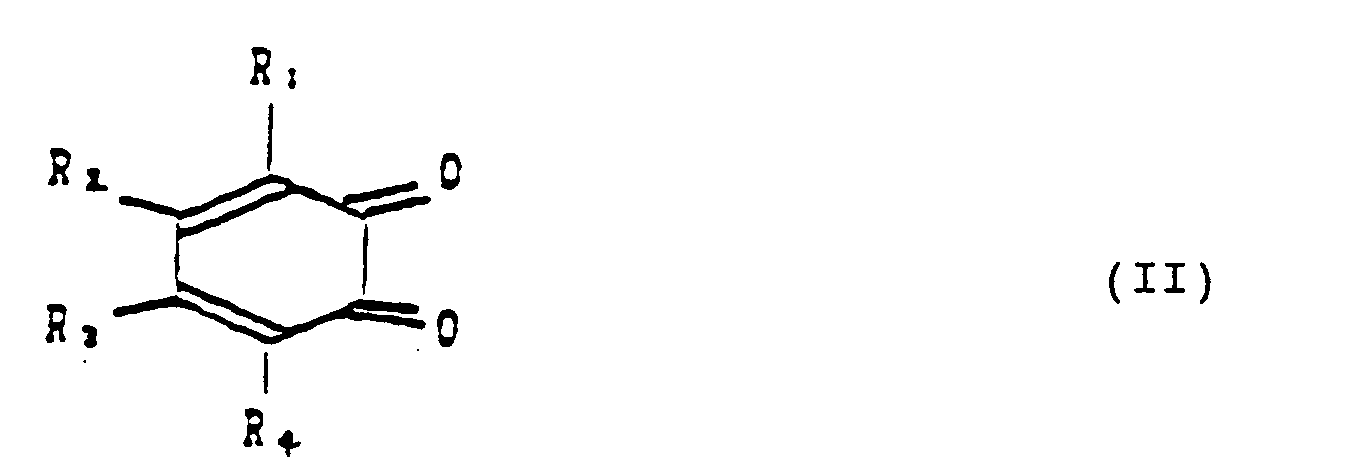
- the preferred six-membered ring is a compound with an o-quinone shown below in general formula II: (wherein R 1 , R 2 , R 3 and R 4 are hydrogen, hydrocarbon, polar group or polycyclic compound moiety, independently.)
- Formula II is not limited to hydrocarbons; alkyl groups, and particularly alkyl groups with 1 to 18 carbon atoms, are preferred.
- Examples of the polar substitution group are carboxyl groups, carboxylic acid esters, hydroxyl groups, amino acids, mercapt groups, etc., but they are not limited thereto.
- o-quinone ring o-quinone and other compounds shown below in formulae III-VII can be mentioned:
- heterocyclic compounds there are, e.g., compounds (IX) shown below. (wherein R 6 is hydrogen or hydrocarbon, polycyclic compound moiety; and R 7 and R 8 is hydrogen, polar group or polycyclic compound moiety, independently.
- the hydrocarbon and polar group are as defined in formula 11.
- the metals that form the complex are metals other than alkaline metals that have o,o-ligands.
- the handling of complexes containing Fe, Co, Ni, Al, etc., is particularly facile, so they are preferred.
- the metal complex that is the accelerator of the activity of hydrolase of this invention can be obtained by the addition of a salt solution that contains the above-mentioned metal ions to a compound I that becomes the above- mentioned ligand.
- a salt solution that contains the above-mentioned metal ions
- a compound I that becomes the above- mentioned ligand.
- an aqueous solution of hydrochloride, sulfate, etc. alone or by the addition of a mixture of these aqueous solutions, it is possible to obtain the metal complex as a reaction product.
- an oxidized propyl gallate-iron complex can be obtained from a mixture of a solution containing oxidized propyl gallate with a solution of ferric chloride.
- a metal complex there can be a ligand that contains one or more kinds of halogen radicals, sulfuric acid moiety, nitric acid moiety, and ammonium moiety. Water can be also included as a ligand.
- the accelerator of blood coagulation of this invention can contain another hydrolase as a co-accelerator other than the accelerator of the activity of the hydrolase mentioned above.
- This hydrolase is a protease that can hydrolyze the bond between Arg and any amino acid residue or the bond between Lys and any amino acid residue on the peptide chain.
- a protease there are, for example, serine proteases such as trypsin, thrombin, snake venom thrombin-like enzymes, etc.; thiol proteases such as cathepsin B and ficin, etc.; and metal proteases such as kinase I, etc.
- serine proteases are suitable for use. These proteases used alone act to accelerate blood coagulation, and when used together as a co-accelerator with the accelerator (metal complex) of the activity of hydrolase mentioned above, the activation of blood coagulation is even more rapid.
- the hydrolase mentioned above When the hydrolase mentioned above is included, then it is included in the proportion of 10- 2- 10 7 parts by weight of the said enzyme (10 1- 10 10 units) for every 100 parts by weight of the metal complex. Even if there is too little enzyme included, blood coagulation will be accelerated if there is the metal complex present, but compared to the case when the enzyme, is provided in the proportions mentioned above, the effects are much smaller; if there is an excess, the effects compared with those obtained with the proportions mentioned above are not achieved.
- an organic compound that includes amines salts and/or a quaternary nitrogen can be present. These compounds adsorb onto heparin, neutralizing it, and are used as agents to neutralize heparin.
- amines constituting the amine salts primary, secondary, and tertiary amines are all acceptable, and the acid in the structure of the amine salt can be either an inorganic acid or an organic acid.
- an inorganic acid halohydro-acids, sulfuric acid, sulfurous acid, etc.
- an organic acid there are formic acid, acetic acid, etc.
- the organic residue of an amine salt is an alkyl group, but it can also be a hydrocarbon group including a different element such as an imino group, ether group, or so on.
- the amine salt can also be an intramolecular salt.
- amine salts for example, these are hexadecyldimethylamine hydrochloride and tetradecyldi(aminoethyl)glycine.
- an organic compound with a quaternary nitrogen is tetraalkyl ammonium. It is also acceptable for the compound to have a hydrocarbon group that contains another element such as an imino group, ether group, etc., or for the compound to have an allyl group instead of an alkyl group. As a preferred example, there is the dodecyltrimethylammonium chloride shown in formula XIII.
- the proportions are 5-10,000 parts by weight of the said neutralizing agent to 100 parts by weight of the metal complex. If there is not enough of the neutralizing agent, then when the blood contains heparin, the heparin will not be neutralized and so the blood will not coagulate. If there is too much of the neutralizing agent, the effects compared with those obtained with the proportions mentioned above are not achieved.
- an anti-fibrinolysis agent and/or an antiplasmin agent can be included.
- Aprotinin, soybean trypsin inhibitor, E -aminocaproic acid, p-aminomethylbenzoic acid, 4-(aminomethyl)cyclohexanecarboxylic acid, etc. which are conventionally used clinically, can be used as the anti-fibrinolysis agent and/or the anti-plasmin agent. These can be used independently or in combination.
- aprotinin is used at the proportion of about 100-600 KIU per milliliter of blood
- soybean trypsin inhibitor is used at the proportion of about 500-4000 FU per milliliter of blood
- E - aminocaproic acid, p-aminomethylbenzoic acid, and 4-(aminomethyl)-cyclohexanecarboxylic acid are all used at the proportion of about 10- 2- 10- 8 g per milliliter of blood in the accelerator of blood coagulation.
- the accelerator of blood coagulation of this invention is used at proportions in the range of 1 x 10- 10 to 1 x 10- 1 g per milliliter of blood. If the proportion is too small, the effects of acceleration of blood coagulation will not be obtained. If there is an excess, results will not be attained with the proportion to the amount used.
- the vessels to contain the blood for testing can be of either glass or resin. It is acceptable for the accelerator of blood coagulation to be added to the blood after it has been collected into the vessel, and it is also acceptable for the accelerator of blood coagulation to be present already in the vessel to be used before blood sampling.
- the accelerator of blood coagulation can be in the form of a powder, and it can also be dissolved, in advance, in an appropriate solvent.
- the accelerator of blood coagulation When the accelerator of blood coagulation is used in the form of a powder, or as a solution of high concentration, and when one portion of the blood may come into contact with the blood coagulation accelerator at a high concentration, so that there is the danger that the protein of the blood may be denatured, the said accelerator of blood coagulation should be held on a carrier that has a specific surface area that is large.
- the carrier that is used in this way, there are no special restrictions, provided that there is no harmful effect on the blood test results and that the carrier has a large specific surface area.
- unwoven cloth, textiles, resin beads, etc. are suitable for use.
- the solution or dispersion of the accelerator can be applied to the carrier, or the carrier can be immersed in a solution or dispersion of the accelerator, after which it is dried.
- Water that contains appropriate assistant agents such as gum arabic, etc., is prepared and used for a dispersion of the accelerator of blood coagulation, and this can be lyophilized, resulting in a accelerator of blood coagulation held on a carrier in particulate form.
- the accelerator of the activity of hydrolase of this invention is an accelerator of the activity of enzymes that decompose proteins, and especially an accelerator of serine protease.
- Serine protease has the ability to cut, by hydrolysis, the bond of peptide chains between Arg and any amino acid residue and also the bond between Lys and any amino acid residue.
- the accelerator of the activity of hydrolase of this invention when used as an accelerator of blood coagulation, first activates Factor XII, which is one kind of precursor of serine protease. Then, the enzyme reaction of the activated Factor XII is further accelerated, and the other blood coagulation factors in the blood are activated in turn, so that the blood coagulates in a short period of time.
- this accelerator of blood coagulation can be used to coagulate blood that contains heparin. If such an accelerator of blood is added to blood that contains heparin, the neutralizer of the amine salt, etc., adsorbs, neutralizes, and precipitates the heparin, so that the inhibition of thrombin and Factor XII by the heparin can be eliminated. For that reason, the normal ability of the blood to coagulate is restored.
- a hydrolase activity accelerator (metal complex) contained in the accelerator of blood coagulation has the ability to act on the Factor XII in the blood to activate it. So, as when normal blood is treated, the blood coagulates rapidly.
- the time needed for blood coagulation varies.
- the metal complex is the sole main ingredient, and if a vessel made of synthetic resin is used, the time needed is generally about 20-30 minutes; when a hydrolase is included as a co-accelerator, it takes about 3-7 minutes under the same conditions.
- blood that contains heparin is treated, it takes about 20-40 minutes for coagulation under the same conditions.
- the accelerator of blood coagulation of this invention it is possible by use of the accelerator of blood coagulation of this invention to coagulate blood that is normal and also blood that contains heparin in a short period of time.
- the blood clot satisfactorily aggregates, and the separation effect of the serum and the blood clot is excellent. So, when the serum is obtained, the blood clot does not mix with the serum, and it is possible to obtain serum in a high yield.
- the compound that is the main ingredient of the accelerator of blood coagulation of this invention is a metal complex, so compared to the organic cyclic compound I included in the accelerator of blood coagulation already disclosed by the inventors, the stability to heat is still greater. Accordingly, even when the accelerator of blood coagulation of this invention undergoes such treatment as autoclave sterilization, etc., the function thereof is not reduced. It is also possible to store this accelerator satisfactorily for long periods of time.
- the above-mentioned organic cyclic compound is used as the accelerator of blood coagulation, there is the danger that changes the some kinds of serum components, but the compound included in the accelerator of blood coagulation of this invention does not react with the components in the blood, so that accurate test results can be obtained.
- a cobalt complex was used instead of an iron complex.
- Other conditions were the same as those given for Example 1-2.
- a nickel complex was used instead of an iron complex.
- Other conditions were the same as those given for Example 1-2.
- Example 1 - 1 A tube made of glass was used, and the accelerator of blood coagulation was not used. Other conditions were the same as those given for Example 1 - 1.
- a physiological saline solution dispersion liquid which contained an iron complex of oxidized ellagic acid (a compound with the structure shown in formula V) as an agent to activate blood coagulation factors (the metal complex), and trypsin as a co-accelerator of blood coagulation in concentrations of 0.5% by weight and 0.05% by weight, respectively, was prepared.
- Freshly collected human blood (3 ml) was put into a commercially available plain tube made of polyethylene, and 30 j1. I of the solution of the accelerator of blood coagulation described above was added thereto.
- the plain tube was left at room temperature, and the time needed for the blood to lose its ability to flow was measured, and taken to be the blood coagulation time. Then, the sample was centrifuged after coagulation at 3000 rpm for 5 minutes, and the separation effect of the serum was evaluated by eye. The results are shown in Table 2. Results for Examples 2 (1-2) to 2 (4-3) are also given in Table 2.
- Thrombin was used as a hydrolase of a co-accelerator, and a physiological saline solution dispersion liquid of the accelerator of blood coagulation was prepared so that the concentration of the said enzyme was 500 units/ml.
- Other conditions were the same as in Example 2 (1-1).
- Snake venom thrombin-like enzyme was used as a hydrolase of a co-accelerator, and a physiological saline solution dispersion liquid of the accelerator of blood coagulation was prepared so that the concentration of the said enzyme was 0.005% by weight.
- Other conditions were the same as in Example 2 (1-1).
- a nickel complex of oxidized ellagic acid (a compound with the structure shown in formula V) as a metallic complex was used. Other conditions were the same as those given for Example 2 (1-3).
- Trypsin was used alone as the accelerator of blood coagulation, Other conditions were the same as given for Example 2 (1-1).
- Thrombin was used alone as the accelerator of blood coagulation. Other conditions were the same as given for Example 2 (1-2).
- an aqueous dispersion liquid containing an iron complex of oxidized ellagic acid (a compound with the structure of formula V) and polycation (a compound with the structure of formula XVI) was prepared.
- a non-woven cloth of polyacetate was then impregnated with the dispersion, and dried thoroughly. There was 10- 4 g of each of the above two components contained on each square centimeter of unwoven cloth.
- Example 3-1 In a 10-ml commercially available tube made of polyethylene, 8 ml of freshly collected human blood that contained 2 units of heparin per milliliter was injected, and then 80 /1.1 of the above-mentioned dispersion liquid was added thereto. Other treatment was the same as in Example 3-1, and the results were evaluated.
- Example 3-1 In a 10-ml commercially available tube made of polyethylene, 8 ml of freshly, collected human blood that contained 2 units of heparin per milliliter was injected, and then 1 g of the above-mentioned particulate holding thereon the accelerator of blood coagulation was added thereto. The sample was treated as for Example 3-1, and then evaluated.
- An iron complex of o-quinone and polycation (a compound with the structure shown in formula XV) were used instead of the iron complex of oxidized n-propyl gallate and tetradecyldi(aminoethyl)glycine, respectively.
- the iron complex of o-quinone and polycation were employed in concentration of 0.5% by weight and 0.4% by weight, respectively.
- Other conditions were the same as those given for Example 3-2.
- Dodecyltrimethylammonium chloride were used instead of the tetradecyldi(aminoethyl)glycine. Other conditions were the same as those given for Example 3-2.
- a cobalt complex of oxidized ellagic acid (V) and polycation (a compound with the structure shown in formula XV) were used instead of the iron complex of oxidized n-propyl gallate and tetradecyldi-(aminoethyl)glycine.
- Other conditions were the same as those given for Example 3-2.
- a nickel complex of ellagic acid (V) and polycation (a compound with the structure shown in formula XV) were used instead of the iron complex of oxidized n-propyl gallate and tetradecyldi(aminoethyl)glycine Other conditions were the same as those given for Example 3-2.
- Example 3-1 In a 10-ml commercially available tube made of polyethylene, 8 ml of freshly collected human blood that contained 2 units of heparin per milliliter was injected, and then without the addition of the accelerator of blood coagulation, the same treatment as for Example 3-1 was carried out, and the results were evaluated.
- Polyester unwoven cloth was impregnated with an aqueous dispersion liquid containing an iron complex of oxidized ellagic acid (a compound with the structure shown in formula V), polycation (a compound with the structure shown in formula XVI), and aprotinin, and was then completely dried. There were, per square centimeter of unwoven cloth, 4 x 10- 4 g of the iron complex, 4 x 10- 4 g of polycation, and 500 KIU of aprotinin.
- a dispersion in physiological saline solution was made so that the concentration of oxidized n-propyl gallate was 0.5 % by weight, that of tetradecyldi(aminoethyl)glycine was 0.5% by weight, and that of aprotinin was 10,000 KIU/ml.
- Example 4-1 In a 5-ml commercially available tube made of polyethylene, 2 ml of freshly collected human blood that contained 1.0 IU of heparin was injected, and then 50 ⁇ l of the dispersion liquid mentioned above was added thereto. Then, the sample was treated as in Example 4-1, and the results were evaluated.
- Example 4-1 In a 5-ml commercially available tube made of polyethylene, 2 ml of freshly collected human blood that contained 1.0 IU of heparin per milliliter was injected. Then, 0.3 g of the accelerator of blood coagulation described above was added thereto. Then, the sample was treated as in Example 4-1, and the results were evaluated.
- An iron complex of o-quinone, a polycation (a compound with the structure shown in formula XV) and E - aminocaproic acid were used instead of the iron complex of oxidized n-propyl gallate, tetradecyl-(aminoethyl)glycine and aprotinin.
- the iron complex of o-quinone, the polycation and the E -aminocaproic acid were employed in concentrations of 0.5% by weight, 0.5% by weight and 0.1% by weight, respectively. Other conditions were the same as those given for Example 4-2.
- Dodecyltrimethylammonium chloride was used instead of the tetradecyldi(aminoethyl)glycine. Other conditions were the same as those given for Example 4-2.
- a cobalt complex of oxidized ellagic acid (V) and polycation (a compound with the structure shown in formula XV) were used instead of the iron complex of oxidized n-propyl gallate and tetradecyldi-(aminoethyl)glycine.
- Other conditions were the same as those given for Example 4-2.
- a nickel complex of oxidized ellagic acid (V) and polycation (a compound with the structure shown in formula XV) were used instead of the iron complex of oxidized n-propyl gallate and tetradecyldi-(aminoethyl)glycine.
- Other conditions were the same as those given for Example 4-2.
- Example 5-1 This example is the same as Example 5-1 except that oxidized ellagic acid shown in formula V was used as an accelerator of blood coagulation.
- Example 5-1 This example is the same as Example 5-1 except that the dispersion liquid of the accelerator of blood coagulation was not used.
- Table 7 indicates that UA, PL, and TG can be measured with accuracy in the serum obtained from Example 5-1 in which metal complex, was used as an accelerator of blood coagulation, whereas the contents of UA, PL, and TG in the serum obtained from Comparative Example 5-1 in which-oxidized ellagic acid that does not form a metal complex was used cannot be accurately measured (namely, the contents of UA, PL, and TG in the serum of this comparative example are lower than those of UA, PL, and TG in the serum from Comparative Example 5-2).
- the accelerator of blood coagulation of Comparative Example 5-1 influences the assay of the contents of the above-mentioned components in the serum for the worse.
- an aqueous dispersion liquid containing an iron complex (an accelerator of blood coagulation) of oxidized ellagic acid (a compound represented by formula V) in a concentration of 0.1% by weight was put into a hard glass tube, which was then heat-treated at 121 ° C for 1 hour under two atmospheres of pressure.
- the said accelerator of blood coagulation was not denatured at all before and after such autoclave treatment.
Landscapes
- Chemical & Material Sciences (AREA)
- Organic Chemistry (AREA)
- Health & Medical Sciences (AREA)
- Life Sciences & Earth Sciences (AREA)
- Engineering & Computer Science (AREA)
- Zoology (AREA)
- Wood Science & Technology (AREA)
- Genetics & Genomics (AREA)
- Bioinformatics & Cheminformatics (AREA)
- Proteomics, Peptides & Aminoacids (AREA)
- Molecular Biology (AREA)
- Biochemistry (AREA)
- General Health & Medical Sciences (AREA)
- Microbiology (AREA)
- General Engineering & Computer Science (AREA)
- Biotechnology (AREA)
- Analytical Chemistry (AREA)
- Physics & Mathematics (AREA)
- Neurosurgery (AREA)
- Biophysics (AREA)
- Immunology (AREA)
- Hematology (AREA)
- Medicinal Chemistry (AREA)
- Biomedical Technology (AREA)
- Investigating Or Analysing Biological Materials (AREA)
- Pharmaceuticals Containing Other Organic And Inorganic Compounds (AREA)
- Measuring Or Testing Involving Enzymes Or Micro-Organisms (AREA)
- Medicines That Contain Protein Lipid Enzymes And Other Medicines (AREA)
Claims (14)



Applications Claiming Priority (8)
| Application Number | Priority Date | Filing Date | Title |
|---|---|---|---|
| JP61084457A JPH0725672B2 (ja) | 1986-04-11 | 1986-04-11 | 血液凝固促進剤 |
| JP61084455A JPH084499B2 (ja) | 1986-04-11 | 1986-04-11 | 加水分解酵素活性促進剤 |
| JP84456/86 | 1986-04-11 | ||
| JP61084456A JPH0643342B2 (ja) | 1986-04-11 | 1986-04-11 | 血液凝固促進剤 |
| JP84457/86 | 1986-04-11 | ||
| JP84455/86 | 1986-04-11 | ||
| JP23047886A JPH065230B2 (ja) | 1986-09-29 | 1986-09-29 | 血液凝固促進剤 |
| JP230478/86 | 1986-09-29 |
Publications (3)
| Publication Number | Publication Date |
|---|---|
| EP0241314A2 EP0241314A2 (de) | 1987-10-14 |
| EP0241314A3 EP0241314A3 (en) | 1990-02-07 |
| EP0241314B1 true EP0241314B1 (de) | 1994-08-10 |
Family
ID=27466977
Family Applications (1)
| Application Number | Title | Priority Date | Filing Date |
|---|---|---|---|
| EP87303182A Expired - Lifetime EP0241314B1 (de) | 1986-04-11 | 1987-04-10 | Beschleuniger der Aktivität von Hydrolase |
Country Status (5)
| Country | Link |
|---|---|
| US (2) | US5041558A (de) |
| EP (1) | EP0241314B1 (de) |
| KR (1) | KR950006614B1 (de) |
| CA (1) | CA1313997C (de) |
| DE (1) | DE3750344T2 (de) |
Families Citing this family (11)
| Publication number | Priority date | Publication date | Assignee | Title |
|---|---|---|---|---|
| DE69120674T2 (de) * | 1990-04-17 | 1996-11-07 | Analytical Control Syst Inc | Koagulationsassays und reagenzien |
| DE69423738T2 (de) * | 1993-11-04 | 2000-11-23 | Dade Behring, Inc.(N.D.Ges.Des Staates Delaware) | Tetrahydroxychinon als eine aktivatorkomponente für den aktivierten partiellen thromboplastinzeit-test der blutgerinnung und als anzeiger von blutgerinnungsstörungen |
| US6245573B1 (en) * | 1998-02-12 | 2001-06-12 | University Of Medicine And Dentistry Of New Jersey | Rapid assessment of the coagulant activity of blood |
| WO2001097826A2 (en) * | 2000-06-16 | 2001-12-27 | University Of Medicine And Dentistry Of New Jersey | Hemostatic compositions, devices and methods |
| US6632678B2 (en) * | 2001-01-03 | 2003-10-14 | Sienco, Inc. | Method for performing activated clotting time test with reduced sensitivity to the presence of aprotinin and for assessing aprotinin sensitivity |
| FR2822462B1 (fr) * | 2001-03-23 | 2005-07-15 | Stago Diagnostica | Composes activateurs de la coagulation endogene utilisation pour l'exploration de la coagulation endogene |
| CA2504603C (en) * | 2002-11-19 | 2012-11-13 | Sekisui Chemical Co., Ltd. | Plasma or serum separation membrane and filter apparatus including the plasma or serum separation membrane |
| CN106883273B (zh) * | 2017-02-22 | 2019-06-18 | 南京林业大学 | 双黄酮-钴配合物及其制备方法和应用 |
| US20230050815A1 (en) * | 2019-12-18 | 2023-02-16 | Sekisui Medical Co., Ltd. | Blood collection container |
| CN114921447B (zh) * | 2022-07-01 | 2023-12-12 | 可孚医疗科技股份有限公司 | 酶试剂的制备方法及含该酶试剂的凝血酶原时间检测卡 |
| WO2025172747A1 (en) | 2024-02-14 | 2025-08-21 | Ethicon, Inc. | Flowable paste with ellagic acid-nickel complex and uses thereof for activating coagulation |
Family Cites Families (12)
| Publication number | Priority date | Publication date | Assignee | Title |
|---|---|---|---|---|
| US3093659A (en) * | 1956-06-20 | 1963-06-11 | Pfizer & Co C | Antifungal and insecticidal halokojic acid metal complexes |
| US3177237A (en) * | 1963-07-01 | 1965-04-06 | Du Pont | Silicon and germanium chelates of tropolones |
| US3647842A (en) * | 1969-03-20 | 1972-03-07 | Chevron Res | Stabilization of cobalt carbonyl compounds by oxygen-dentated ligands |
| US4329498A (en) * | 1979-09-11 | 1982-05-11 | Allied Corporation | Preparation of 6-aminocaproic acid via muconic acid mononitrile |
| US4329798A (en) * | 1980-07-29 | 1982-05-18 | Edwards Gerald D | Tooth construction for digging buckets |
| JPS6011519A (ja) * | 1983-06-30 | 1985-01-21 | Nisshinbo Ind Inc | 導電性多孔質構造体 |
| JPS6027858A (ja) * | 1983-07-25 | 1985-02-12 | Sekisui Chem Co Ltd | 血清と血餅との分離方法 |
| GB8410290D0 (en) * | 1984-04-19 | 1984-05-31 | Callingham B A | Pharmaceutical compositions |
| JPS60174952A (ja) * | 1984-02-21 | 1985-09-09 | Sekisui Chem Co Ltd | 血液凝固促進剤 |
| JPS60186760A (ja) * | 1984-03-05 | 1985-09-24 | Sekisui Chem Co Ltd | 血液凝固促進剤 |
| JPH0627858A (ja) * | 1990-12-04 | 1994-02-04 | Ricoh Co Ltd | 画像形成装置 |
| JP3203567B2 (ja) * | 1992-06-26 | 2001-08-27 | 株式会社トキメック | 加速度計 |
-
1987
- 1987-04-10 EP EP87303182A patent/EP0241314B1/de not_active Expired - Lifetime
- 1987-04-10 US US07/036,886 patent/US5041558A/en not_active Expired - Fee Related
- 1987-04-10 KR KR1019870003408A patent/KR950006614B1/ko not_active Expired - Fee Related
- 1987-04-10 CA CA000534473A patent/CA1313997C/en not_active Expired - Fee Related
- 1987-04-10 DE DE3750344T patent/DE3750344T2/de not_active Expired - Fee Related
-
1993
- 1993-10-13 US US08/135,755 patent/US5413786A/en not_active Expired - Fee Related
Non-Patent Citations (3)
| Title |
|---|
| CHEMICAL ABSTRACTS, vol. 102, no. 25, 24th June 1985, page 324, abstract no.217869z, Columbus, Ohio, US; & JP-A-60 27 858 (SEKISUI CHEMICAL CO. LTD) 12-02-1985 * |
| Chemical Abstracts, vol.104, no. 5, 3th February 1986, page 298, abstract no. 31394b, Columbus Ohio, US; & JP-A-60174952 * |
| J. ORGANOMET. CHEM. 1979, 175(2), 303-13 * |
Also Published As
| Publication number | Publication date |
|---|---|
| EP0241314A3 (en) | 1990-02-07 |
| DE3750344T2 (de) | 1994-12-08 |
| DE3750344D1 (de) | 1994-09-15 |
| US5041558A (en) | 1991-08-20 |
| KR870010186A (ko) | 1987-11-30 |
| CA1313997C (en) | 1993-03-02 |
| EP0241314A2 (de) | 1987-10-14 |
| AU619442B2 (en) | 1992-01-30 |
| US5413786A (en) | 1995-05-09 |
| KR950006614B1 (ko) | 1995-06-19 |
| AU7142487A (en) | 1987-10-15 |
Similar Documents
| Publication | Publication Date | Title |
|---|---|---|
| US5041558A (en) | Accelerator of the activity of hydrolase | |
| Cuatrecasas | Perturbation of the insulin receptor of isolated fat cells with proteolytic enzymes: Direct measurement of insulin-receptor interactions | |
| CA1213198A (en) | Diagnostic activated partial thromboplastin reagent | |
| JPH06317584A (ja) | 血液試料の抗凝血剤前処理のためのインヒビター | |
| Rivard et al. | Cofactor of the “lupus anticoagulant” | |
| US5705396A (en) | Additive for diagnostic tests for determination of the coagulability of blood, method of reducing the influencing of diagnostic tests by heparin and the use of metal salts for these purposes | |
| JPH04501460A (ja) | 触媒活性セリンプロテアーゼに関する免疫検定法 | |
| US5320945A (en) | Method and reagent for the determination of antithrombin III | |
| CN111684284A (zh) | 使用活性炭诊断止血障碍的方法 | |
| JPH08154697A (ja) | 血液検査用容器 | |
| JPS63275954A (ja) | 血液検査用容器 | |
| JP3401162B2 (ja) | 血液凝固促進剤及び血液検査用容器 | |
| Hecht et al. | Sphingosine as inhibitor of prothrombin activation with thromboplastin or with threone | |
| JP2002156379A (ja) | 溶液で安定でかつ効率的に活性化するaptt測定用試薬 | |
| EP0677171B1 (de) | Tetrahydroxychinon als eine aktivatorkomponente für den aktivierten partiellen thromboplastinzeit-test der blutgerinnung und als anzeiger von blutgerinnungsstörungen | |
| JP5212821B2 (ja) | スペーサーを介して高分子へ結合する基質を含む修飾基質を用いた酵素測定アッセイ | |
| JP2512527B2 (ja) | 血液凝固促進剤および血液検査用容器 | |
| JPS6383670A (ja) | 血液検査用容器 | |
| Kosman et al. | ESR probing of macromolecules: Spin label study of the conformational integrity and transitions in modified α-chymotrypsin | |
| JPH0546502B2 (de) | ||
| SU1161878A1 (ru) | Способ определени активности тромбина | |
| JPH084499B2 (ja) | 加水分解酵素活性促進剤 | |
| JPH065230B2 (ja) | 血液凝固促進剤 | |
| JPS63275953A (ja) | 血液凝固促進剤 | |
| Zuman et al. | Polarography of proteins: a history |
Legal Events
| Date | Code | Title | Description |
|---|---|---|---|
| PUAI | Public reference made under article 153(3) epc to a published international application that has entered the european phase |
Free format text: ORIGINAL CODE: 0009012 |
|
| AK | Designated contracting states |
Kind code of ref document: A2 Designated state(s): DE FR GB IT NL |
|
| PUAL | Search report despatched |
Free format text: ORIGINAL CODE: 0009013 |
|
| AK | Designated contracting states |
Kind code of ref document: A3 Designated state(s): DE FR GB IT NL |
|
| 17P | Request for examination filed |
Effective date: 19900716 |
|
| 17Q | First examination report despatched |
Effective date: 19920207 |
|
| GRAA | (expected) grant |
Free format text: ORIGINAL CODE: 0009210 |
|
| AK | Designated contracting states |
Kind code of ref document: B1 Designated state(s): DE FR GB IT NL |
|
| ITF | It: translation for a ep patent filed | ||
| REF | Corresponds to: |
Ref document number: 3750344 Country of ref document: DE Date of ref document: 19940915 |
|
| ET | Fr: translation filed | ||
| PLBE | No opposition filed within time limit |
Free format text: ORIGINAL CODE: 0009261 |
|
| STAA | Information on the status of an ep patent application or granted ep patent |
Free format text: STATUS: NO OPPOSITION FILED WITHIN TIME LIMIT |
|
| 26N | No opposition filed | ||
| PGFP | Annual fee paid to national office [announced via postgrant information from national office to epo] |
Ref country code: GB Payment date: 19970401 Year of fee payment: 11 |
|
| PGFP | Annual fee paid to national office [announced via postgrant information from national office to epo] |
Ref country code: FR Payment date: 19970409 Year of fee payment: 11 |
|
| PGFP | Annual fee paid to national office [announced via postgrant information from national office to epo] |
Ref country code: DE Payment date: 19970418 Year of fee payment: 11 |
|
| PGFP | Annual fee paid to national office [announced via postgrant information from national office to epo] |
Ref country code: NL Payment date: 19970428 Year of fee payment: 11 |
|
| PG25 | Lapsed in a contracting state [announced via postgrant information from national office to epo] |
Ref country code: GB Free format text: LAPSE BECAUSE OF NON-PAYMENT OF DUE FEES Effective date: 19980410 |
|
| PG25 | Lapsed in a contracting state [announced via postgrant information from national office to epo] |
Ref country code: FR Free format text: THE PATENT HAS BEEN ANNULLED BY A DECISION OF A NATIONAL AUTHORITY Effective date: 19980430 |
|
| PG25 | Lapsed in a contracting state [announced via postgrant information from national office to epo] |
Ref country code: NL Free format text: LAPSE BECAUSE OF NON-PAYMENT OF DUE FEES Effective date: 19981101 |
|
| GBPC | Gb: european patent ceased through non-payment of renewal fee |
Effective date: 19980410 |
|
| NLV4 | Nl: lapsed or anulled due to non-payment of the annual fee |
Effective date: 19981101 |
|
| PG25 | Lapsed in a contracting state [announced via postgrant information from national office to epo] |
Ref country code: DE Free format text: LAPSE BECAUSE OF NON-PAYMENT OF DUE FEES Effective date: 19990202 |
|
| REG | Reference to a national code |
Ref country code: FR Ref legal event code: ST |
|
| PG25 | Lapsed in a contracting state [announced via postgrant information from national office to epo] |
Ref country code: IT Free format text: LAPSE BECAUSE OF NON-PAYMENT OF DUE FEES;WARNING: LAPSES OF ITALIAN PATENTS WITH EFFECTIVE DATE BEFORE 2007 MAY HAVE OCCURRED AT ANY TIME BEFORE 2007. THE CORRECT EFFECTIVE DATE MAY BE DIFFERENT FROM THE ONE RECORDED. Effective date: 20050410 |