EP0212221A1 - Verfahren zur Herstellung von 2,6-Naphthalindicarbonsäure - Google Patents
Verfahren zur Herstellung von 2,6-Naphthalindicarbonsäure Download PDFInfo
- Publication number
- EP0212221A1 EP0212221A1 EP86109528A EP86109528A EP0212221A1 EP 0212221 A1 EP0212221 A1 EP 0212221A1 EP 86109528 A EP86109528 A EP 86109528A EP 86109528 A EP86109528 A EP 86109528A EP 0212221 A1 EP0212221 A1 EP 0212221A1
- Authority
- EP
- European Patent Office
- Prior art keywords
- oxidation
- oxidation stage
- solvent
- acid
- weight
- Prior art date
- Legal status (The legal status is an assumption and is not a legal conclusion. Google has not performed a legal analysis and makes no representation as to the accuracy of the status listed.)
- Granted
Links
- RXOHFPCZGPKIRD-UHFFFAOYSA-N naphthalene-2,6-dicarboxylic acid Chemical compound C1=C(C(O)=O)C=CC2=CC(C(=O)O)=CC=C21 RXOHFPCZGPKIRD-UHFFFAOYSA-N 0.000 title claims abstract description 26
- 238000000034 method Methods 0.000 title claims description 30
- 238000002360 preparation method Methods 0.000 title claims description 7
- 230000003647 oxidation Effects 0.000 claims abstract description 72
- 238000007254 oxidation reaction Methods 0.000 claims abstract description 72
- 239000003054 catalyst Substances 0.000 claims abstract description 22
- 238000006243 chemical reaction Methods 0.000 claims abstract description 22
- 239000001301 oxygen Substances 0.000 claims abstract description 19
- 229910052760 oxygen Inorganic materials 0.000 claims abstract description 19
- QVGXLLKOCUKJST-UHFFFAOYSA-N atomic oxygen Chemical compound [O] QVGXLLKOCUKJST-UHFFFAOYSA-N 0.000 claims abstract description 18
- GDTBXPJZTBHREO-UHFFFAOYSA-N bromine Substances BrBr GDTBXPJZTBHREO-UHFFFAOYSA-N 0.000 claims abstract description 18
- 229910052794 bromium Inorganic materials 0.000 claims abstract description 18
- 229910017052 cobalt Inorganic materials 0.000 claims abstract description 13
- 239000010941 cobalt Substances 0.000 claims abstract description 13
- GUTLYIVDDKVIGB-UHFFFAOYSA-N cobalt atom Chemical group [Co] GUTLYIVDDKVIGB-UHFFFAOYSA-N 0.000 claims abstract description 13
- SPAYGOAEIJHIDE-UHFFFAOYSA-N 1-(6-methylnaphthalen-2-yl)ethanone Chemical compound C1=C(C)C=CC2=CC(C(=O)C)=CC=C21 SPAYGOAEIJHIDE-UHFFFAOYSA-N 0.000 claims abstract description 12
- WKBOTKDWSSQWDR-UHFFFAOYSA-N Bromine atom Chemical compound [Br] WKBOTKDWSSQWDR-UHFFFAOYSA-N 0.000 claims abstract description 11
- 239000011572 manganese Substances 0.000 claims abstract description 10
- PWHULOQIROXLJO-UHFFFAOYSA-N Manganese Chemical compound [Mn] PWHULOQIROXLJO-UHFFFAOYSA-N 0.000 claims abstract description 9
- 229910052748 manganese Inorganic materials 0.000 claims abstract description 9
- QTBSBXVTEAMEQO-UHFFFAOYSA-N Acetic acid Chemical compound CC(O)=O QTBSBXVTEAMEQO-UHFFFAOYSA-N 0.000 claims description 98
- 239000002904 solvent Substances 0.000 claims description 29
- 239000000047 product Substances 0.000 claims description 26
- 239000011541 reaction mixture Substances 0.000 claims description 22
- 150000007933 aliphatic carboxylic acids Chemical class 0.000 claims description 17
- 239000007789 gas Substances 0.000 claims description 15
- XLYOFNOQVPJJNP-UHFFFAOYSA-N water Substances O XLYOFNOQVPJJNP-UHFFFAOYSA-N 0.000 claims description 13
- 239000007858 starting material Substances 0.000 claims description 9
- 239000000706 filtrate Substances 0.000 claims description 6
- 150000002697 manganese compounds Chemical class 0.000 claims description 6
- UOGMEBQRZBEZQT-UHFFFAOYSA-L manganese(2+);diacetate Chemical compound [Mn+2].CC([O-])=O.CC([O-])=O UOGMEBQRZBEZQT-UHFFFAOYSA-L 0.000 claims description 6
- BDAGIHXWWSANSR-UHFFFAOYSA-N methanoic acid Natural products OC=O BDAGIHXWWSANSR-UHFFFAOYSA-N 0.000 claims description 6
- 239000012452 mother liquor Substances 0.000 claims description 6
- 238000000926 separation method Methods 0.000 claims description 6
- 239000011877 solvent mixture Substances 0.000 claims description 6
- 150000001869 cobalt compounds Chemical class 0.000 claims description 5
- 239000012429 reaction media Substances 0.000 claims description 5
- 238000004821 distillation Methods 0.000 claims description 4
- 239000007788 liquid Substances 0.000 claims description 4
- VNNDVNZCGCCIPA-FDGPNNRMSA-N (z)-4-hydroxypent-3-en-2-one;manganese Chemical compound [Mn].C\C(O)=C\C(C)=O.C\C(O)=C\C(C)=O VNNDVNZCGCCIPA-FDGPNNRMSA-N 0.000 claims description 3
- OSWFIVFLDKOXQC-UHFFFAOYSA-N 4-(3-methoxyphenyl)aniline Chemical compound COC1=CC=CC(C=2C=CC(N)=CC=2)=C1 OSWFIVFLDKOXQC-UHFFFAOYSA-N 0.000 claims description 3
- 150000001875 compounds Chemical class 0.000 claims description 3
- 235000019253 formic acid Nutrition 0.000 claims description 3
- CPELXLSAUQHCOX-UHFFFAOYSA-M Bromide Chemical compound [Br-] CPELXLSAUQHCOX-UHFFFAOYSA-M 0.000 claims description 2
- 239000007791 liquid phase Substances 0.000 claims description 2
- 239000000126 substance Substances 0.000 claims 1
- JHJLBTNAGRQEKS-UHFFFAOYSA-M sodium bromide Chemical compound [Na+].[Br-] JHJLBTNAGRQEKS-UHFFFAOYSA-M 0.000 description 16
- VOCNMTIGMYPFPY-UHFFFAOYSA-N 6-methylnaphthalene-2-carboxylic acid Chemical compound C1=C(C(O)=O)C=CC2=CC(C)=CC=C21 VOCNMTIGMYPFPY-UHFFFAOYSA-N 0.000 description 11
- -1 bromine compound Chemical class 0.000 description 9
- 239000000243 solution Substances 0.000 description 9
- 239000000203 mixture Substances 0.000 description 8
- WFDIJRYMOXRFFG-UHFFFAOYSA-N Acetic anhydride Chemical compound CC(=O)OC(C)=O WFDIJRYMOXRFFG-UHFFFAOYSA-N 0.000 description 7
- QAHREYKOYSIQPH-UHFFFAOYSA-L cobalt(II) acetate Chemical compound [Co+2].CC([O-])=O.CC([O-])=O QAHREYKOYSIQPH-UHFFFAOYSA-L 0.000 description 7
- 239000002253 acid Substances 0.000 description 6
- 230000000052 comparative effect Effects 0.000 description 6
- 229940011182 cobalt acetate Drugs 0.000 description 5
- 125000004432 carbon atom Chemical group C* 0.000 description 4
- CPELXLSAUQHCOX-UHFFFAOYSA-N Hydrogen bromide Chemical compound Br CPELXLSAUQHCOX-UHFFFAOYSA-N 0.000 description 3
- 125000000217 alkyl group Chemical group 0.000 description 3
- 239000012065 filter cake Substances 0.000 description 3
- 239000007787 solid Substances 0.000 description 3
- YGYNBBAUIYTWBF-UHFFFAOYSA-N 2,6-dimethylnaphthalene Chemical compound C1=C(C)C=CC2=CC(C)=CC=C21 YGYNBBAUIYTWBF-UHFFFAOYSA-N 0.000 description 2
- QIMMUPPBPVKWKM-UHFFFAOYSA-N 2-methylnaphthalene Chemical compound C1=CC=CC2=CC(C)=CC=C21 QIMMUPPBPVKWKM-UHFFFAOYSA-N 0.000 description 2
- ZSPDYGICHBLYSD-UHFFFAOYSA-N 2-methylnaphthalene-1-carboxylic acid Chemical compound C1=CC=CC2=C(C(O)=O)C(C)=CC=C21 ZSPDYGICHBLYSD-UHFFFAOYSA-N 0.000 description 2
- IJGRMHOSHXDMSA-UHFFFAOYSA-N Atomic nitrogen Chemical compound N#N IJGRMHOSHXDMSA-UHFFFAOYSA-N 0.000 description 2
- 150000008064 anhydrides Chemical class 0.000 description 2
- 239000007795 chemical reaction product Substances 0.000 description 2
- BZRRQSJJPUGBAA-UHFFFAOYSA-L cobalt(ii) bromide Chemical compound Br[Co]Br BZRRQSJJPUGBAA-UHFFFAOYSA-L 0.000 description 2
- 238000010790 dilution Methods 0.000 description 2
- 239000012895 dilution Substances 0.000 description 2
- 238000002474 experimental method Methods 0.000 description 2
- 238000001914 filtration Methods 0.000 description 2
- 238000002955 isolation Methods 0.000 description 2
- 238000004519 manufacturing process Methods 0.000 description 2
- 230000035484 reaction time Effects 0.000 description 2
- 238000010992 reflux Methods 0.000 description 2
- 238000003756 stirring Methods 0.000 description 2
- 239000000725 suspension Substances 0.000 description 2
- 238000005406 washing Methods 0.000 description 2
- SHFLOIUZUDNHFB-UHFFFAOYSA-N 6-formylnaphthalene-2-carboxylic acid Chemical compound C1=C(C=O)C=CC2=CC(C(=O)O)=CC=C21 SHFLOIUZUDNHFB-UHFFFAOYSA-N 0.000 description 1
- QTBSBXVTEAMEQO-UHFFFAOYSA-M Acetate Chemical compound CC([O-])=O QTBSBXVTEAMEQO-UHFFFAOYSA-M 0.000 description 1
- 238000005863 Friedel-Crafts acylation reaction Methods 0.000 description 1
- WAEMQWOKJMHJLA-UHFFFAOYSA-N Manganese(2+) Chemical compound [Mn+2] WAEMQWOKJMHJLA-UHFFFAOYSA-N 0.000 description 1
- WAIPAZQMEIHHTJ-UHFFFAOYSA-N [Cr].[Co] Chemical compound [Cr].[Co] WAIPAZQMEIHHTJ-UHFFFAOYSA-N 0.000 description 1
- FXXACINHVKSMDR-UHFFFAOYSA-N acetyl bromide Chemical compound CC(Br)=O FXXACINHVKSMDR-UHFFFAOYSA-N 0.000 description 1
- 230000010933 acylation Effects 0.000 description 1
- 238000005917 acylation reaction Methods 0.000 description 1
- 239000003513 alkali Substances 0.000 description 1
- SWLVFNYSXGMGBS-UHFFFAOYSA-N ammonium bromide Chemical compound [NH4+].[Br-] SWLVFNYSXGMGBS-UHFFFAOYSA-N 0.000 description 1
- 125000001246 bromo group Chemical group Br* 0.000 description 1
- 229910052799 carbon Inorganic materials 0.000 description 1
- 125000002915 carbonyl group Chemical group [*:2]C([*:1])=O 0.000 description 1
- 230000003197 catalytic effect Effects 0.000 description 1
- ZBYYWKJVSFHYJL-UHFFFAOYSA-L cobalt(2+);diacetate;tetrahydrate Chemical compound O.O.O.O.[Co+2].CC([O-])=O.CC([O-])=O ZBYYWKJVSFHYJL-UHFFFAOYSA-L 0.000 description 1
- 230000007423 decrease Effects 0.000 description 1
- 230000000694 effects Effects 0.000 description 1
- 238000004817 gas chromatography Methods 0.000 description 1
- 125000004435 hydrogen atom Chemical group [H]* 0.000 description 1
- 229910000042 hydrogen bromide Inorganic materials 0.000 description 1
- 239000012535 impurity Substances 0.000 description 1
- KYTZHLUVELPASH-UHFFFAOYSA-N naphthalene-1,2-dicarboxylic acid Chemical compound C1=CC=CC2=C(C(O)=O)C(C(=O)O)=CC=C21 KYTZHLUVELPASH-UHFFFAOYSA-N 0.000 description 1
- 229910052757 nitrogen Inorganic materials 0.000 description 1
- 150000002926 oxygen Chemical class 0.000 description 1
- 229920000642 polymer Polymers 0.000 description 1
Classifications
-
- C—CHEMISTRY; METALLURGY
- C07—ORGANIC CHEMISTRY
- C07C—ACYCLIC OR CARBOCYCLIC COMPOUNDS
- C07C51/00—Preparation of carboxylic acids or their salts, halides or anhydrides
- C07C51/16—Preparation of carboxylic acids or their salts, halides or anhydrides by oxidation
- C07C51/21—Preparation of carboxylic acids or their salts, halides or anhydrides by oxidation with molecular oxygen
- C07C51/255—Preparation of carboxylic acids or their salts, halides or anhydrides by oxidation with molecular oxygen of compounds containing six-membered aromatic rings without ring-splitting
- C07C51/265—Preparation of carboxylic acids or their salts, halides or anhydrides by oxidation with molecular oxygen of compounds containing six-membered aromatic rings without ring-splitting having alkyl side chains which are oxidised to carboxyl groups
Definitions
- the present invention relates to a process for the preparation of 2,6-naphthalenedicarboxylic acid, starting from a 2-acyl-6-alkylnaphthalene, preferably 2-acetyl-6-methylnaphthalene, by a two-stage oxidation with oxygen.
- a 2-acyl-6-alkylnaphthalene is first in a first oxidation stage under the catalytic action of a manganese compound in an aliphatic carboxylic acid, preferably acetic acid, as a solvent or in a solvent containing an aliphatic carboxylic acid with oxygen or an oxygen-containing gas, preferably air , oxidized and the oxidation product formed in a second oxidation stage, now in the presence of a cobalt and a bromine compound as a catalyst, in an aliphatic carboxylic acid as solvent or an aliphatic carboxylic acid, preferably Acetic acid containing solvent mixture with oxygen or an oxygen-containing gas, preferably air, oxidized to 2,6-naphthalenedicarboxylic acid.
- the invention relates to a process for the preparation of 2,6-naphthalenedicarboxylic acid by oxidation in the liquid phase with oxygen or an oxygen-containing gas, characterized in that the 2-acyl-6-alkylnaphthalene in a first oxidation stage in the presence of a in the reaction mixture soluble manganese compound as a catalyst in an aliphatic carboxylic acid as a solvent or in a solvent mixture containing an aliphatic carboxylic acid is oxidized at temperatures of 80 to 180 0 C and the resulting 6-alkyl-2-naphthoic acid in a second oxidation stage in the presence of a cobalt compound soluble in the reaction mixture and a component providing bromine ions as a catalyst in an aliphatic carboxylic acid as solvent or in a solvent mixture containing an aliphatic carboxylic acid is oxidized to the product at a reaction temperature of 150 to 250 ° C.
- the decisive difference between the first and second oxidation stage of the process according to the invention thus relates to the catalysts used.
- a manganese catalyst is required in the first oxidation stage.
- a cobalt and a bromine component are required as a catalyst.
- a manganese compound can be used in the second oxidation step in addition to the cobalt and bromine compounds, but this is not necessary.
- Suitable starting materials for the preparation of 2,6-naphthalenedicarboxylic acid by the process according to the invention are 2-acyl-6-alkylnaphthalenes of the general
- R and R ' have the meaning of the same or different, straight-chain or branched alkyl groups having 1 to 6 carbon atoms, the aromatic radical in R' or the carbon atom closest to R in the carbonyl group carrying at least 1 H atom got to.
- the starting materials are accessible by Friedel-Crafts acylation from alkyl, especially 2-methylnaphthalene.
- the first oxidation stage is catalyzed by a manganese compound in the absence of a cobalt and / or bromine compound.
- the preferred concentration of the Mn catalyst is 0.001 to 0.1, preferably 0.01 to 0.05 part by weight of manganese per part by weight of the acyl-alkylnaphthalene in the form of a manganese compound soluble in the reaction mixture, for example manganese (II). acetate or manganese (II) acetyl acetonate.
- the cobalt or bromine component may optionally be present in the concentration suitable for the second oxidation stage, but not both components at the same time.
- a manganese catalyst is preferred in the absence of a cobalt and a bromine component.
- Suitable solvents for the oxidation of acyl-alkylnaphthalene according to the invention are aliphatic carboxylic acids with preferably 2 to 4 carbon atoms, in particular acetic acid and / or the anhydrides of the aliphatic carboxylic acids in question, in particular acetic anhydride.
- the aliphatic carboxylic acids or the corresponding anhydrides can be used alone, in combination with one another or in combination with another solvent which is resistant to oxygen under the reaction conditions.
- a well-suited solvent is also aqueous-dilute acetic acid with, for example, 1 to 20% by weight of water.
- acyl-alkylnaphthalene and the solvent or solvent mixture are preferably used in the process according to the invention in weight ratios of about 1: 2 to 1:20, in particular 1: 3 and 1:10.
- the reaction mixture obtained in the first oxidation stage can, if appropriate after distillative removal of low boilers such as water and / or formic acid or after addition of further solvent, without isolation of the reaction product formed from the acyl-alkylnaphthalene in the second oxidation stage after addition of a suitable cobalt and a bromine compound are further oxidized.
- the reaction product formed from the acylalkylnaphthalene in the first oxidation stage is preferably isolated by a conventional solid-liquid separation, if appropriate after prior concentration or dilution of the reaction mixture, for example by adding water, before it is used for the second oxidation stage.
- the mother liquor obtained in the product isolation can be used again as a reaction medium for the oxidation of the acyl-alkylnaphthalene.
- the yield is increased considerably. It is advisable to remove water and other low boilers beforehand and, if necessary, add acetic acid and the catalyst.
- the first oxidation stage of the process is carried out at temperature from 80 to 180 0 C, preferably from 100 to 160 ° C.
- the pressure is 0 to 60 bar, preferably 5 to 40 bar.
- the use of the manganese catalyst is decisive for the first oxidation stage of the process according to the invention.
- the second oxidation stage is characterized by the use of a catalyst combination of a cobalt and a bromine compound.
- Suitable cobalt compounds are, in particular, cobalt bromide, cobalt acetate or a compound providing cobalt acetate in acetic acid solution.
- suitable bromine components are also elemental bromine, hydrogen bromide, acetyl bromide and in particular alkali bromide or ammonium bromide. It is crucial that the bromine component is able to form bromine atoms or bromine ions under the reaction conditions.
- the suitable catalyst concentration is 0.0005 to 0.05, preferably 0.002 to 0.02, by weight, per part by weight of the acyl-alkylnaphthalene used in the first oxidation stage or the oxidation product formed and possibly isolated and used in the second oxidation stage.
- Manganese does not interfere with the course of the second stage reaction.
- preferred solvent for the second oxidation stage is also acetic acid or an aqueous dilute acetic acid.
- Suitable concentration ratios are about 2 to 50, preferably 4 to 20 parts by weight of acetic acid per part by weight of the product to be oxidized.
- the reaction temperature of the second oxidation stage is 150 to 2 0 ° C, preferably at 160 to 220 o C.
- the temperature is preferably 20 to 80 ° C, especially 30 to 50 ° C higher than in the first stage.
- the pressure is 5 to 80 bar, preferably 10 to 60 bar.
- the 2,6-naphthalenedicarboxylic acid resulting after the second oxidation stage can be isolated from the reaction mixture by a conventional solid-liquid separation.
- Mother liquors of the second oxidation stage can be reused in a corresponding manner for a renewed oxidation of the second stage, as a result of which the yields increase, the catalyst requirement decreases and the effort for working up the mother liquors is very reduced.
- This two-stage process results in a significant improvement in the purity of the target product compared to one-stage processes.
- high levels of purity of over 97% require large amounts of solvent in the second oxidation stage, for example 13 to 50 parts by weight per part by weight of alkylnaphthoic acid.
- solvent in the second oxidation stage for example 13 to 50 parts by weight per part by weight of alkylnaphthoic acid.
- Such high degrees of dilution are difficult for an industrial process, however, when large quantities of filtrate are to be reused as a reaction medium or to recover the Acetic acid by distillation. to be worked up.
- the reactor With a large amount of solvent, the reactor must be large or smaller amounts can be produced in the same times.
- 2,6-Naphthalenedicarboxylic acid should now be produced in the highest possible purity by oxidation of 6-alkyl-2-naphthoic acid with the highest possible use ratio of 6-alkyl-2-naphthoic acid to the aliphatic carboxylic acid used as solvent.
- 2,6-naphthalenedicarboxylic acid is therefore prepared by adding all or most of the alkylnaphthoic acid to be oxidized to the reaction mixture during the reaction.
- a considerably larger, even multiple, amount of a 6-alkyl-2-naphthoic acid is oxidized if this is not initially introduced in the feed mixture, but is mostly only added during the reaction.
- This metering can take place in portions or advantageously continuously and can be adapted approximately to the reaction rate.
- the first stage can also be carried out in this way.
- the alkylnaphthoic acid can be added in solid form, or else suspended or dissolved in a suitable, oxidation-resistant solvent, preferably in the aliphatic carboxylic acid having 2 to 4 carbon atoms used as the reaction medium.
- the solution can be prepared and added at elevated temperature, for example at the reaction temperature.
- elevated temperature for example at the reaction temperature.
- suspensions of the starting material in the solvent up to the limit of flowability are preferred.
- a partial amount of 5 to 10% of the total alkylnaphthoic acid to be oxidized is sufficient, although larger amounts, for example up to 25%, are also possible. Individual portions added should not be larger than 25%.
- the total amount can then advantageously be 0.1 to 0.6 part by weight per part by weight of solvent under these conditions.
- the mother liquor combined with the washing filtrates was concentrated to 380 g while distilling off water, formic acid and acetic acid.
- the mother liquor combined with the wash filtrate was concentrated to a weight of 500 g with removal of water and acetic acid by distillation, 0.2 g of sodium bromide and 35 g of the product isolated after the first oxidation stage were added and then oxidized and worked up again under the conditions described above. 36.2 g (86.9% of theory) of 2,6-naphthalenedicarboxylic acid with a purity of 97.4% were obtained.
- Example 1 According to the experimental arrangement described in Example 1, 50 g of 2-acetyl-6-methylnaphthalene, 400 g of acetic acid, 5 g of cobalt acetate and 0.5 g of sodium bromide for oxidation at 190 0 C, a pressure of 25 bar and a gas outlet of 2 1 / min. used. From the after 15.2 g of a product mixture with a content of only 30.9% of 2,6-naphthalenedicarboxylic acid were isolated by filtration of the reaction mixture which had cooled to room temperature.
- Comparative example A was repeated at a reaction temperature of 190 ° C. This time, only 14.7 g of solid containing 40% 2,6-naphthalenedicarboxylic acid were isolated from the reaction mixture.
- Comparative Example A was repeated with an additional 5 g of manganese (II) acetate as a catalyst component. 50.0 g of a product mixture containing 79.1% of 2,6-naphthalenedicarboxylic acid were isolated from the reaction mixture.
- the first oxidation stage described in Example 1 was repeated with a feed mixture of 50 g of 2-acetyl-6-methylnaphthalene, 300 g of acetic acid, 100 g of water and 7.5 g of manganese (II) acetate. 39.2 g of oxidation product were isolated from the reaction mixture by filtration. 20 g of this product were then analogous to the 2nd oxidation stage described in Example 1 in a solution of 2 g of cobalt (II) acetate and 0.5 g of sodium bromide in 500 g of acetic acid at 180 ° C and a gas outlet of 2 1 / min . oxidized. 18.7 g of 2,6-naphthalenedicarboxylic acid with a purity of 97.7% were then isolated from the reaction mixture.
- Example 3 Analogously to Example 3, a mixture of 50 g was first 2-Acetyl-6-methylnaphthalene, 400 g acetic acid and 10 g manganese (II) acetyl acetonate oxidized at 140 ° C. Of the 31.7 g of oxidation product isolated thereafter, 10 g in a solution of 2 g of cobalt (II) acetate and 0.5 g of sodium bromide in 500 g of acetic acid were subjected to a second oxidation at 190 ° C. Thereafter, 9.6 g of 2,6-naphthalenedicarboxylic acid with a purity of 97.7% were obtained.
- II manganese
- the mother liquor combined with the washing filtrate was concentrated by distillation to a weight of 1,230 g with a water content of 5% by weight, 25 g of 6-methyl-2-naphthoic acid of the stated quality and 2 g of sodium bromide were added and in the manner described above, this was first and then oxidized a further three times each 25 g of 6-methyl-2-naphthoic acid. This time, 108.7 g (94.5% of theory) of 2,6-naphthalenedicarboxylic acid were obtained with a purity of 97.7%.
- Example 5 Analogously to Example 5, first 25 g and then a total of 188 g of 6-methyl-2-naphthoic acid (purity 97.6%) in 1200 g of 97.5% by weight acetic acid were added in 8 equal portions under the catalyst mentioned in Example 1 - and reaction conditions oxidized. 230.8 g of a 97.9% 2,6-naphthalenedicarboxylic acid (93.6% of theory) resulted.
- Example 5 The experiment described in Example 5 was repeated with 120 g of 6-methyl-2-naphthoic acid in 12 portions of 10 g each. 131.6 g of naphthalenedicarboxylic acid with a purity of 98.9% were obtained (yield 96.5% of theory).
- Example 5 was repeated, but with only 800 g of 95% by weight acetic acid and 10 g of 6-methyl-2-naphthoic acid (purity 96.2%) at the beginning and addition of 100 g of starting material in 400 g of the acetic acid in 20, substantially equal portions during the reaction. 118.8 g of product were obtained. Purity 99.1%, yield 95.8% of theory. Th.
Landscapes
- Chemical & Material Sciences (AREA)
- Organic Chemistry (AREA)
- Engineering & Computer Science (AREA)
- Oil, Petroleum & Natural Gas (AREA)
- Low-Molecular Organic Synthesis Reactions Using Catalysts (AREA)
- Organic Low-Molecular-Weight Compounds And Preparation Thereof (AREA)
Abstract
Description
- Die vorliegende Erfindung betrifft ein Verfahren zur Herstellung von 2,6-Naphthalindicarbonsäure, ausgehend von einem 2-Acyl-6-alkylnaphthalin, vorzugsweise 2-Acetyl-6-methylnaphthalin, durch eine zweistufige Oxidation mit Sauerstoff.
- Erfindungsgemäß wird ein 2-Acyl-6-alkylnaphthalin zunächst in einer ersten Oxidationsstufe unter der katalytischen Wirkung einer Manganverbindung in einer aliphatischen Carbonsäure, vorzugsweise Essigsäure, als Lösungsmittel bzw. in einem eine aliphatische Carbonsäure enthaltenden Lösungsmittel mit Sauerstoff oder einem Sauerstoff enthaltenden Gas, vorzugsweise Luft, oxidiert und das dabei gebildete Oxidationsprodukt in einer zweiten Oxidationsstufe, nunmehr in Gegenwart einer Kobalt- und einer Bromverbindung als Katalysator, in einer aliphatischen Carbonssäure als Lösungsmittel bzw. einem eine aliphatische Carbonsäure, vorzugsweise Essigsäure, enthaltenden Lösungsmittelgemisch mit Sauerstoff bzw. einem Sauerstoff enthaltenden Gas, vorzugsweise Luft, zu 2,6-Naphthalindicarbonsäure oxidiert.
- Gegenstand der Erfindung ist ein Verfahren zur Herstellung von 2,6-Naphthalindicarbonsäure, durch Oxidation in flüssiger Phase mit Sauerstoff bzw. einem Sauerstoff enthaltenden Gas, dadurch gekennzeichnet, daß das 2-Acyl-6-alkylnaphthalin in einer ersten Oxidationsstufe in Gegenwart einer im Reaktionsgemisch löslichen Manganverbindung als Katalysator in einer aliphatischen Carbonsäure als Lösungsmittel bzw. in einem eine aliphatische Carbonsäure enthaltenden Lösungsmittelgemisch bei Temperaturen von 80 bis 1800 C oxidiert wird und die entstehende 6-Alkyl-2-naphthoesäure in einer zweiten Oxidationsstufe in Gegenwart einer im Reaktionsgemisch löslichen Kobaltverbindung und einer Bromionen liefernden Komponente als Katalysator in einer aliphatischen Carbonsäure als Lösungsmittel bzw. in einem eine aliphatische Carbonsäure enthaltenden Lösungsmittelgemisch bei einer Reaktionstemperatur von 150 bis 250° C zum Produkt oxidiert wird.
- Der entscheidende Unterschied zwischen der ersten und zweiten Oxidationsstufe des erfindungsgemäßen Verfahrens betrifft also die verwendeten Katalysatoren. In der ersten Oxidationsstufe ist ein Mangankatalysator erforderlich. In der zweiten Oxidationsstufe ist dagegen eine Kobalt- und eine Brom-komponente als Katalysator erforderlich. Eine Manganverbindung kann bei der zweiten Oxidationsstufe zusätzlich zu der Kobalt- und Bromverbindung eingesetzt werden, jedoch ist das nicht notwendig.
- Es sind bereits mehrere Verfahren zur Herstellung der für die Gewinnung spezieller Polymerer geeigneten 2,6-Naphthalindicarbonsäure bekannt. Die Mehrzahl der Verfahren geht von 2,6-Dialkylnaphthalinen, insbesondere von 2,6 Dimethylnapjthalin, aus. Die Bereitung der Ausgangsprodukte bereitet in der notwendigen Isomerenreinheit allerdings erhebliche Schwierigkeiten. Auch sind die Ergebnisse der Oxidationen mit Luftsauerstoff bezüglich der Ausbeute und Reinheit des Zielproduktes bei der Mehrzahl der beschriebenen Verfahren gemäß DE-OS 21 07 357, Japan Kokai 76 06.953, Japan Kokai 77 17.453 oder der Belg. PS 660 333 unbefriedigend.
- Beim erfindungsgemäßen Verfahren wird kein Dialkylnaphthalin, sondern ein durch Acylierung eines Alkylnaphthalin zugängliches 2-Acyl-6-alkylnaphthalin, insbesondere das 2-Acetyl-6-methylnaphthalin, als Ausgangsprodukt verwendet.
- Wie die Vergleichsbeispiele A und B zeigen, sind für die. Oxidation derartiger Verbindungen mit Luftsauerstoff in essigsaurer Lösung die für die Oxidation von Alkylaromaten, beispielsweise auch von Dialkylnaphthalinen, üblichen, durch eine Kombination einer Kobalt- und einer Bromverbindung als Katalysator charakterisierten Bedingungen wenig geeignet. Vielmehr sind die erfindungsgemäßen Oxidationsbedingungen erforderlich, um ausgehend von einem 2-Acyl-6-alkylnaphthalin mit überlegenen Ergebnissen 2,6-Naphthalindicarbonsäure herzustellen.
- Geeignete Ausgangsstoffe für die Herstellung von 2,6-Naphthalindicarbonsäure nach dem erfindungsgemäßen Verfahren sind 2-Acyl-6-alkylnaphthaline der allgemeinen
- Formel I:
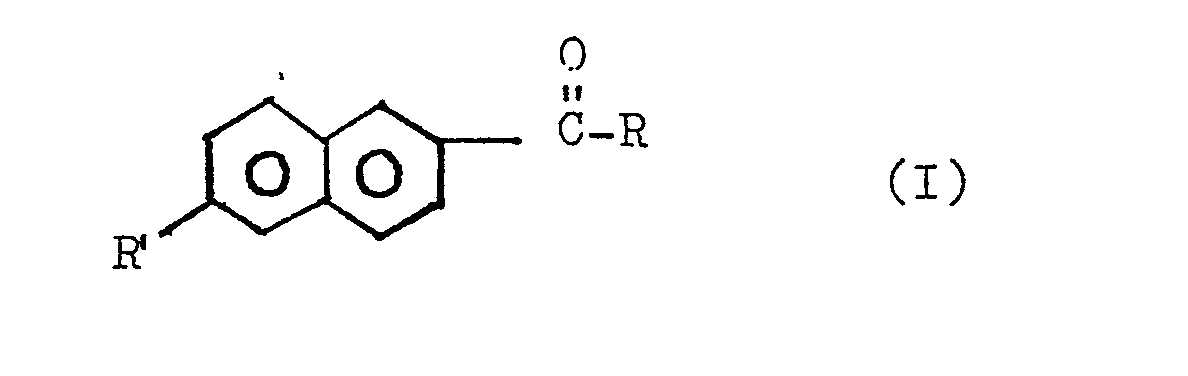
- Darin haben R und R' die Bedeutung gleicher oder unterschiedlicher, geradkettiger oder verzweigter Alkylgruppen mit 1 bis 6 C-Atomen, wobei das in R'dem aromatischen Rest bzw. das in R der Carbonylgruppe nächststehende C-Atom zumindest noch 1 H-Atom tragen muß. Bevorzugtes Ausgangsprodukt ist das 2-Acetyl-6-methylnaphthalin (R = R' = CH3). Die Ausgangsstoffe sind durch Friedel-Crafts-Acylierung aus Alkyl-, besonders 2-Methylnaphthalin, zugängig.
- Charakteristisch für das erfindungsgemäße Verfahren ist, daß es zwei, bezüglich der Bedingungen sehr unterschiedliche Oxidationsstufen beeinhaltet. Die erste Oxidations stufe wird durch eine Manganverbindung bei Abwesenheit einer Kobalt- und/oder Bromverbindung katalysiert. Die bevorzugte Konzentration des Mn-Katalysators beträgt pro Gew.-Teil des Acyl-alkylnaphthalins 0,001 bis 0,1, vorzugsweise 0,01 bis 0,05 Gew.-Teile Mangan in Form einer im Reaktionsgemisch löslichen Manganverbindung, beispielsweise Mangan (II)-acetat oder Mangan (II)-acetyl- acetonat. Neben dem Mangankatalysator kann in der ersten Oxidationsstufe gegebenenfalls die Kobalt- oder Bromkomponente in der für die zweite Oxidationsstufe geeigneten Konzentration anwesend sein, jedoch nicht beide Komponenten gleichzeitig. Bevorzugt wird jedoch ein Mangankatalysator in Abwesenheit einer Kobalt- und einer Bromkomppnente.
- Geeignete Lösungsmittel für die erfindungsgemäße Oxidation von Acyl-alkylnaphthalin sind aliphatische Carbonsäuren mit vorzugsweise 2 bis 4 C-Atomen, insbesondere Essigsäure und/oder die Anhydride der betreffenden aliphatischen Carbonsäuren, insbesondere Acetanhydrid. Die aliphatischen Carbonsäuren oder die entsprechenden Anhydride können allein, in Kombination untereinander oder auch in Kombination mit einem weiteren, unter den Reaktionsbedingungen gegen Sauerstoff beständigen Lösungsmittel eingesetzt werden. Ein gut geeignetes Lösungsmittel ist neben reiner Essigsäure auch wässrig-verdünnte Essigsäure mit beispielsweise 1 bis 20 Gew.-% Wasser.
- Das Acyl-alkylnaphthalin und das Lösungsmittel bzw. Lösungsmittelgemisch werden beim erfindungsgemäßen Verfahren vorzugsweise in Gewichtsverhältnissen von ca. 1 : 2 bis 1 : 20, insbesondere 1 : 3 und 1 : 10 eingesetzt.
- Das in der ersten Oxidationsstufe erhaltene Reaktionsgemisch kann, ggf. nach destillativer Abtrennung von Leichtsiedern wie Wasser und/oder Ameisensäure oder nach Zusatz von weiterem Lösungsmittel, ohne Isolierung des aus dem Acyl-alkylnaphthalin entstandenen Reaktionsproduktes in der zweiten Oxidationsstufe nach Zugabe einer geeigneten Kobalt- und einer Bromverbindung weiter oxidiert werden. Vorzugsweise wird das in der ersten Oxidationsstufe aus dem Acylalkylnaphthalin entstandene Reaktionsprodukt, ggf. nach vorheriger Einengung oder aber Verdünnung des Reaktionsgemisches, beispielsweise durch Wasserzusatz, durch eine übliche Fest-Flüssig-Trennung isoliert, bevor es zur zweiten Oxidationsstufe eingesetzt-wird. Dann kann die bei der Produktisolierung erhaltene Mutterlauge erneut als Reaktionsmedium für die Oxidation des Acyl-alkylnaphthalins verwendet werden. Dadurch, besonders bei mehrfacher Wiederverwendung der Mutterlauge, wird die Ausbeute beträchtlich erhöht. Zweckmäßig wird zuvor Wasser und andere Leichtsieder entfernt und ggf. Essigsäure und der Katalysator ergänzt.
- Die erste Oxidationsstufe des Verfahrens erfolgt bei Temperatur von 80 bis 1800 C, vorzugsweise von 100 bis 160° C. Der Druck beträgt 0 bis 60 bar, vorzugsweise 5 bis 40 bar.
- Entscheidend für die erste Oxidationsstufe des erfindungsgemäßen Verfahrens ist die Verwendung des Mangankatalysators.
- Die zweite Oxidationsstufe ist dagegen durch die Verwendung einer Katalysatorkombination aus einer Kobalt-und einer Bromverbindung gekennzeichnet. Geeignete Kobaltverbindungen sind insbesondere Kobaltbromid, Kobaltacetat oder eine in essigsaurer Lösung Kobaltacetat liefernde Verbindung. Geeignete Bromkomponenten sind neben dem Kobaltbromid auch elementares Brom, Bromwasserstoff, Acetylbromid und insbesondere Alkalibromide oder Ammoniumbromid. Entscheidend ist, daß die Bromkomponente unter den Reaktionsbedingungen Bromatome oder Bromionen zu bilden vermag.
- Die geeignete Katalysatorkonzentration beträgt pro Gew.-Teil des in der ersten Oxidationsstufe eingesetzten Acyl-alkylnaphthalins bzw. des entstandenen und ggf. isolierten und in der zweiten Oxidationsstufe eingesetzten Oxidationsproduktes 0,0005 bis 0,05, vorzugsweise 0,002 bis 0,02 Gew.-Teile Kobalt in Form einer im Reaktionsgemisch löslichen Kobaltverbindung und 0,001 bis 0,1, vorzugsweise 0,002 bis 0,04 Gew.-Teile Brom in Form einer geeigneten Bromverbindung. Mangan stört nicht den Reaktionsverlauf der zweiten Stufe.
- Bevorzugtes Lösungsmittel für die zweite Oxidationsstufe ist allerdings ebenfalls Essigsäure bzw. eine wässrig-verdünnte Essigsäure. Geeignete Konzentrationsverhältnisse sind ca. 2 bis 50, vorzugsweise 4 bis 20 Gew.-Teile Essigsäure pro Gew.-Teil des zu oxidierenden Produktes.
- Die Reaktionstemperatur der zweiten Oxidationsstufe liegt bei 150 bis 2 0° C, vorzugsweise bei 160 bis 220oC. Die Temperatur liegt vorzugsweise um 20 bis 80°C, besonders 30 bis 50° C hoher als in der ersten Stufe. Der Druck liegt bei 5 bis 80 bar, vorzugsweise bei 10 bis 60 bar.
- Die nach der zweiten Oxidationsstufe resultierende 2,6-Naphthalindicarbonsäure kann aus dem Reaktionsgemisch durch eine übliche Fest-Flüssig-Trennung isoliert werden.
- Mutterlaugen der zweiten Oxidationsstufe können in entsprechender Weise für eine erneute Oxidation der zweiten Stufe wiederverwendet werden, wodurch die Ausbeuten steigen, der Katalysatorbedarf sinkt und der Aufwand für die Aufarbeitung der Mutterlaugen sehr vermindert ist.
- Dieses zweistufige Verfahren ergibt gegenüber einstufigen Verfahren eine erhebliche Verbesserung der Reinheit des Zielproduktes. Allerdings sind für hohe Reinheitsgrade von über 97 % große Lösungsmittelmengen in der zweiten Oxidationsstufe von beispielsweise 13 bis 50 Gew.-Teilen pro Gew.-Teil Alkylnaphthoesäure erforderlich. Derart hohe Verdünnungsgrade sind für ein technisches Verfahren aber dann schwierig, wenn große Filtratmengen zum Wiedereinsatz als Reaktionsmedium oder zur Rückgewinnung der Essigsäure destillativ. aufzuarbeiten sind.
- Der Reaktor muß bei einer großen Lösungsmittelmenge groß sein bzw. sind in gleichen Zeiten geringere Mengen herstellbar.
- Es zeigte sich weiterhin, daß die Reinheit von bei sonst gleichen Bedinungen gewonnener 2,6-Naphthalindicarbonsäure stark bei vermindertem Anteil des Lösungsmittels absinkt. So resultierte bei einem Gewichtsverhältnis des Lösungsmittels Essigsäure zu der Methylnaphthoesäure von 12 : 1 im Einsatzgemisch das Zielprodukt nur mit einer Reinheit von 90,3 %. Als Hauptverunreinigung enthielt das Oxidationsprodukt noch 6-Formyl-2-naphthoesäure und den Ausgangsstoff 6-Methyl-2-naphthoesäure. Bei weiterer Erhöhung der Einsatzmenge an 6-Methyl-2-naphthoesäure wurde die 2,6-Naphthalindicarbonsäure nur mit einer Reinheit von 87 % erhalten.
- 2,6-Naphthalindicarbonsäure sollte nun in möglichst hoher Reinheit durch Oxidation von 6-Alkyl-2-naphthoesäure bei möglichst hohem Einsatzverhältnis von 6-Alkyl-2-naphthoesäure zu der als Lösungsmittel verwendeten aliphatischen Carbonsäure hergestellt werden.
- In weiterer Ausbildung der Erfindung wird daher 2,6-Naphthalindicarbonsäure dadurch hergestellt, daß die zu oxidierende Alkylnaphthoesäure dem Reaktionsgemisch ganz oder zum größten Teil während der Reaktion zugesetzt wird. Dadurch wird bei vergleichbarer oder besserer Reinheit des Zielproduktes in der gleichen Menge des Lösungsmittels dann eine erheblich größere, gar vielfache Menge einer 6-Alkyl-2-naphthoesäure oxidiert, wenn diese nicht insgesamt im Einsatzgemisch vorgelegt, sondern größtenteils erst während der Reaktion zugesetzt wird. Diese Eindosierung kann portionsweise oder vorteilhaft kontinuierlich erfolgen und annähernd der Reaktionsgeschwindigkeit angepaßt werden.
- Auch die erste Stufe kann so ausgeführt werden.
- Die Zugabe der Alkylnaphthoesäure kann in fester Form, oder aber suspendiert oder gelöst in einem geeigneten, oxidationsbeständigen Lösungsmittel, vorzugsweise in der als Reaktionsmedium verwendeten aliphatischen Carbonsäure mit 2 bis 4 C-Atomen erfolgen.
- Bei Zudosierung einer Lösung der Alkylnaphthoesäure, z.B. in Essigsäure und/oder Acetanhydrid, kann die Lösung bei erhöhter Temperatur, beispielsweise bei Reaktionstemperatur, hergestellt und zugegeben werden. Bevorzugt sind jedoch Suspensionen des Ausgangsstoffes im Lösungsmittel bis zur Grenze der Fließfähigkeit.
- Die Wirkung der Zugabe möglichst großer Mengen des Ausgangsstoffes je Menge Lösungsmittel kontinuierlich oder in häufigen kleinen Portionen auf die Reinheit ist überraschend hoch und kann dadurch demonstriert werden, daß die Oxidation willkürlich in einzelne Abschnitte mit jeweils zu oxidierenden Teilmengen der vorgegebenen Menge Alkylnaphthoesäure unterteilt wird.
- Technisch erfolgt eine kontinuierliche oder annähernd kontinuierliche Zugabe des Ausgangsstoffes nach Maßgabe des Umsatzes in möglichst konzentrierter Suspension, ggf. als Feststoff.
- Zum Start der Reaktion ist im Einsatzgemisch eine Teilmenge von 5 bis 10 % der insgesamt zu oxidierenden Alkylnaphthoesäure ausreichend, obwohl auch größere Mengen, bis beispielsweise 25 %, möglich sind. Zugegebene Einzelportionen sollen nicht größer als 25 % sein.
- Die Gesamtmenge kann dann unter diesen Bedingungen vorteilhaft 0,1 bis 0,6 Gew.-Teile pro Gew.-Teil Lösungsmittel betragen.
- Ein mit Rührer, Gaseinleitungsrohr, Temperaturfühler, Manometer und Druck-Rückflußkühler ausgestatteter, beheizbarer Autoklav aus Hastelloy C wurde mit 100 g 2-Acetyl-6-methylnaphthalin, 380 g Essigsäure, 20 g Wasser und 15 g Mangan (II)-acetat beschickt. Durch die Lösung wurde bei 140° C und einem Druck von 25 bar unter Rühren Preßluft mit einer Gasaustrittsgeschwindigkeit von 3 1/min. geleitet. Der Reaktionsverlauf wurde durch kontinuierliche Messung des Sauerstoffgehaltes im Abgas kontrolliert. Als dieser Sauerstoffgehalt nach einer Reaktionszeit von 105 min. wieder den Ausgangswert von 21 % erreicht hatte, wurde die Lufteinleitung abgestellt, das Reaktionsgemisch unter Rühren auf Raumtemperatur abgekühlt, filtriert und der Filterkuchen mit 300 g 95 Gew.-%iger Essigsäure gewaschen. Es wurden 70,3 g 6-Methyl-2-naphthoesäure (69,3 % d. Th.) erhalten. Reinheit 99,5 %.
- Die mit den Waschfiltraten vereinigte Mutterlauge wurde unter Abdestillation von Wasser, Ameisensäure und Essigsäure auf 380 g eingeengt. Nach Zusatz von 20 g Wasser, 67,5 g 2-Acetyl-6-methylnaphthalin und 3,5 g Mangan (II)-acetat wurde erneut unter den zuvor beschrie benen Bedingungen oxidiert. Diesmal wurden 67,3 g 6-Methyl-2-naphthoesäure (98,2 %, bezogen auf frisch eingesetztes 2-Acetyl-6-methylnaphthalin) erhalten.
- Analog dem zuvor beschriebenen Versuch für die erste Oxidationsstufe wurden 36,5 g des dort isolierten Produktes in einer Lösung von 2 g Kobaltacetat und 0,5 g Natriumbromid in 500 g Essigsäure bei einer Temperatur von 1900 C, einem Druck von 25 bar und einer Gasaustrittsgeschwindigkeit von 4 1/min. oxidiert. Nach einer Reaktionszeit von 140 min. wurde das auf Raumtemperatur abgekühlte Reaktionsgemisch filtriert, der Filterkuchen mit 250 g Essigsäure gewaschen und getrocknet. Es wurden 35,4 g 2,6-Naphthalindicarbonsäure (81,9 %) mit einer gaschromatographisch bestimmten Reinheit von 97,9 % erhalten.
- Die mit dem Waschfiltrat vereinte Mutterlauge wurde unter destillativer Abtrennung von Wasser und Essigsäure auf ein Gewicht von 500 g eingeengt, 0,2 g Natriumbromid und 35 g des nach der ersten Oxidationsstufe isolierten Produktes zugesetzt und dann erneut unter den zuvor beschriebenen Bedingungen oxidiert und aufgearbeitet. Es wurden 36,2 g ( 86,9 % der Theorie) 2,6-Naphthalindicarbonsäure mit einer Reinheit von 97,4 % gewonnen.
- Eine Mischung von 50 g 2-Acetyl-6-methylnaphthalin, 380g Essigsäure, 20 g Wasser und 7,5 g Mangan (II)-acetat wurde bei 140° C, 25 bar und einem Gasaustritt der Luft von 1,5 l./min. oxidiert. Nach beendeter Sauerstoffaufnahme wurden 5 g Kobaltacetat und 0,5 g Natriumbromid zugefügt und in entsprechender Weise bei 190° C Luft durchgeleitet. Nach dieser 2. Oxidationsstufe wurden durch Aufarbeitung wie im Beispiel 1 50,8 g Produkt mit einem Gehalt von 93 % 2,6-Naphthalindicarbonsäure isoliert (80,8 % d. Th.).
- Entsprechend der in Beispiel 1 beschriebenen Versuchsanordnung wurden 50 g 2-Acetyl-6-methylnaphthalin, 400 g Essigsäure, 5 g Kobaltacetat und 0,5 g Natriumbromid zur Oxidation bei 1900 C, einem Druck von 25 bar und einem Gasaustritt von 2 1/min. eingesetzt. Aus dem nach beendeter Sauerstoffaufnahme auf Raumtemperatur angekühlten Reaktionsgemisch wurden durch Filtration 15,2 g eines Produktgemisches mit einem Gehalt von nur 30,9 % 2,6-Naphthalindicarbonsäure isoliert.
- Vergleichsbeispiel A wurde bei einer Reaktionstemperatur von 1900 C wiederholt. Diesmal wurden aus dem Reaktionsgemisch nur 14,7 g Feststoff mit einem Gehalt von 40 % 2,6-Naphthalindicarbonsäure isoliert.
- Vergleichsbeispiel A wurde mit zusätzlich noch 5 g Mangan (II)-acetat als Katalysatorbestandteil wiederholt. Aus dem Reaktionsgemisch wurden 50,0 g eines Produktgemisches mit einem Gehalt von 79,1 % 2,6-Naphthalindicarbonsäure isoliert.
- Die in Beispiel 1 beschriebene 1. Oxidationsstufe wurde bei einem Einsatzgemisch aus 50 g 2-Acetyl-6-methylnaphthalin, 300 g Essigsäure, 100 g Wasser und 7,5 g Mangan (II)-acetat wiederholt. Aus dem Reaktionsgemisch wurden durch Filtration 39,2 g Oxidationsprodukt isoliert. 20 g dieses Produktes wurden dann analog der in Beispiel 1 beschriebenen 2. Oxidationsstufe in einer Lösung von 2 g Kobalt (II)-acetat und 0,5 g Natriumbromid in 500 g Essig säure bei 180° C und einem Gasaustritt von 2 1/min. oxidiert. Aus dem Reaktionsgemisch wurden dann 18,7 g 2,6-Naphthalindicarbonsäure mit einer Reinheit von 97,7 % isoliert.
- Analog Beispiel 3 wurde zunächst ein Gemisch aus 50 g 2-Acetyl-6-methylnaphthalin, 400 g Essigsäure und 10 g Mangan (II)-acetyl-acetonat bei 140° C oxidiert. Von den danach isolierten 31,7 g Oxidationsprodukt wurden 10 g in einer Lösung von 2 g Kobalt (II)-acetat und 0,5 g Natriumbromid in 500 g Essigsäure einer 2. Oxidation bei 190° C unterworfen. Danach wurden 9,6 g 2,6-Naphthalindicarbonsäure mit einer Reinheit von 97,7 % erhalten.
- Ein mit Rührer, Gaseinleitungsrohr, Temperaturfühler, Manometer und Druck-Rückflußkühler ausgestatteter, beheizbarer Autoklav aus Hastellog C wurde mit 25 g 6-Methyl-2-naphthoesäure (Reinheit 96,8 %), 1.200 g 95 Gew.-%iger Essigsäure, 8 g Kobalt (II)-acetat-tetrahydrat und 8 g Natriumbromid beschickt, unter Stickstoff auf 1850 C erhitzt und dann bei einem Druck von 25 bar mit einer nach der Entspannung gemessenen Gasaustrittsgeschwindigkeit von 2 1/min. Luft durch die Lösung geleitet.Der Reaktions verlauf wurde durch kontinuierliche Messung des Sauerstoffgehaltes im Abgas kontrolliert. Nachdem hier der Sauerstoffgehalt auf 7 % angestiegen war, wurde die Reaktion unterbrochen, dem entspannten Reaktionsgemisch bei unter 100° C nochmals 25 g 6-Methyl-2-naphthoesäure gleicher qualität zugesetzt und in der zuvor beschriebenen Weise erneut oxidiert. Der Vorgang wurde dann weitere zweimal wiederholt, nach der letzten Zugabe der Methylnaphthoesäure wurde jedoch die Lufteinleitung bei 1850 C so lange fortgesetzt, bis der Sauerstoffgehalt im Abgas einen Wert von 20 % erreicht hatte. Das abgekühlte und entspannte Reaktionsgemisch wurde filtriert, der Filterkuchen mit 400 g Essigsäure gewaschen und getrocknet. Es resultierten 105,3 g (91,5 % d. Th.) 2,6-Naphthalindicarbonsäure mit einer Reinheit von 97,8 %.
- Die mit dem Waschfiltrat vereinte Mutterlauge wurde destillativ auf ein Gewicht von 1.230 g mit einem Wassergehalt von 5 Gew.-% eingeengt, 25 g 6-Methyl-2-naphthoesäure der genannten Qualität und 2 g Natriumbromid zugesetzt und in der zuvor beschriebenen Weise zunächst diese und dann weitere dreimal je 25 g 6-Methyl-2-naphthoesäure oxidiert. Diesmal wurden 108,7 g (94,5 % d. Th.) 2,6-Naphthalindicarbonsäure mit einer Reinheit von 97,7% erhalten.
- Analog Beispiel 5 wurden zunächst 25 g und dann in 8 gleichen Portionen insgesamt weitere 188 g 6-Methyl- 2-naphthoesäure (Reinheit 97,6 %) in 1.200 g 97,5 Gew.- %iger Essigsäure unter den in Beispiel 1 genannten Katalysator- und Reaktionsbedingungen oxidiert. Es resultierten 230,8 g einer 97,9 %igen 2,6-Naphthalindicarbonsäure (93,6 % d. Th.).
- Der in Beispiel 5 beschriebene Versuch wurde mit 120 g 6-Methyl-2-naphthoesäure in 12 Portionen zu je 10 g wiederholt. Dabei wurden 131,6 g Naphthalindicarbonsäure einer Reinheit von 98,9 % gewonnen (Ausbeute 96,5 % d. Th.).
- Beispiel 5 wurde wiederholt, jedoch mit nur 800 g 95 Gew.-%iger Essigsäure und 10 g 6-Methyl-2-naphthoesäure (Reinheit 96,2 %) am Beginn und Zugabe von 100 g Ausgangsstoff in 400 g der Essigsäure in 20, im wesentlichen gleichen Portionen während der Reaktion. Es wurden 118,8 g Produkt erhalten. Reinheit 99,1 %, Ausbeute 95,8 % d. Th.
Claims (14)
Applications Claiming Priority (4)
| Application Number | Priority Date | Filing Date | Title |
|---|---|---|---|
| DE19853529381 DE3529381A1 (de) | 1985-08-16 | 1985-08-16 | Verfahren zur herstellung von 2,6-naphthalindicarbonsaeure |
| DE3529381 | 1985-08-16 | ||
| DE3543879 | 1985-12-12 | ||
| DE19853543879 DE3543879A1 (de) | 1985-12-12 | 1985-12-12 | Verfahren zur herstellung von 2,6-naphthalindicarbonsaeure durch oxidation von 6-alkyl-2-naphthoesaeure |
Publications (2)
| Publication Number | Publication Date |
|---|---|
| EP0212221A1 true EP0212221A1 (de) | 1987-03-04 |
| EP0212221B1 EP0212221B1 (de) | 1990-05-09 |
Family
ID=25835102
Family Applications (1)
| Application Number | Title | Priority Date | Filing Date |
|---|---|---|---|
| EP86109528A Expired - Lifetime EP0212221B1 (de) | 1985-08-16 | 1986-07-11 | Verfahren zur Herstellung von 2,6-Naphthalindicarbonsäure |
Country Status (3)
| Country | Link |
|---|---|
| US (1) | US4764638A (de) |
| EP (1) | EP0212221B1 (de) |
| DE (1) | DE3671009D1 (de) |
Cited By (1)
| Publication number | Priority date | Publication date | Assignee | Title |
|---|---|---|---|---|
| EP0324342A1 (de) * | 1988-01-11 | 1989-07-19 | Mitsubishi Gas Chemical Company, Inc. | Verfahren zur Herstellung von 2,6-Naphthalindicarbonsäure |
Families Citing this family (4)
| Publication number | Priority date | Publication date | Assignee | Title |
|---|---|---|---|---|
| JPH01160943A (ja) * | 1987-12-17 | 1989-06-23 | Sumikin Chem Co Ltd | ナフタレンジカルボン酸の製造法 |
| JP2874223B2 (ja) * | 1989-11-15 | 1999-03-24 | 三菱瓦斯化学株式会社 | 高純度2,6‐ナフタリンジカルボン酸の製造法 |
| EP0439007A3 (en) * | 1990-01-26 | 1992-06-24 | Mitsubishi Gas Chemical Company, Inc. | Process for producing 2,6-naphthalene dicarboxylic acid |
| JP3199104B2 (ja) * | 1995-01-11 | 2001-08-13 | 三菱瓦斯化学株式会社 | 2,6−ナフタレンジカルボン酸及びそのエステルの製造法 |
Citations (3)
| Publication number | Priority date | Publication date | Assignee | Title |
|---|---|---|---|---|
| US3055839A (en) * | 1959-11-12 | 1962-09-25 | Sun Oil Co | Cobalt oxidation catalyst |
| DE1291329B (de) * | 1966-04-13 | 1969-03-27 | Hoechst Ag | Verfahren zur Herstellung von Naphthalin-dicarbonsaeure-(1, 4) |
| DE2243158A1 (de) * | 1971-09-03 | 1973-03-15 | Teijin Ltd | Verfahren zur herstellung der 2,6naphthalindicarbonsaeure |
Family Cites Families (3)
| Publication number | Priority date | Publication date | Assignee | Title |
|---|---|---|---|---|
| US3856855A (en) * | 1970-02-17 | 1974-12-24 | Teijin Ltd | Process for preparation of naphthalene monocarboxylic acid or naphthalene dicarboxylic acid |
| US4665215A (en) * | 1984-07-24 | 1987-05-12 | Celanese Corporation | Process for producing 4-acetoxybenzoic acid |
| CA1255327A (en) * | 1984-07-24 | 1989-06-06 | Celanese Corporation | Process for producing acyloxy aromatic carboxylic acid |
-
1986
- 1986-07-11 DE DE8686109528T patent/DE3671009D1/de not_active Expired - Lifetime
- 1986-07-11 EP EP86109528A patent/EP0212221B1/de not_active Expired - Lifetime
- 1986-08-12 US US06/896,116 patent/US4764638A/en not_active Expired - Fee Related
Patent Citations (3)
| Publication number | Priority date | Publication date | Assignee | Title |
|---|---|---|---|---|
| US3055839A (en) * | 1959-11-12 | 1962-09-25 | Sun Oil Co | Cobalt oxidation catalyst |
| DE1291329B (de) * | 1966-04-13 | 1969-03-27 | Hoechst Ag | Verfahren zur Herstellung von Naphthalin-dicarbonsaeure-(1, 4) |
| DE2243158A1 (de) * | 1971-09-03 | 1973-03-15 | Teijin Ltd | Verfahren zur herstellung der 2,6naphthalindicarbonsaeure |
Cited By (1)
| Publication number | Priority date | Publication date | Assignee | Title |
|---|---|---|---|---|
| EP0324342A1 (de) * | 1988-01-11 | 1989-07-19 | Mitsubishi Gas Chemical Company, Inc. | Verfahren zur Herstellung von 2,6-Naphthalindicarbonsäure |
Also Published As
| Publication number | Publication date |
|---|---|
| DE3671009D1 (de) | 1990-06-13 |
| US4764638A (en) | 1988-08-16 |
| EP0212221B1 (de) | 1990-05-09 |
Similar Documents
| Publication | Publication Date | Title |
|---|---|---|
| DE3128147C2 (de) | Verfahren zur Gewinnung von aromatischen Monocarbonsäuren | |
| DE69230967T2 (de) | Verfahren zur herstellung von 2,6-naphthalindicarbonsäure | |
| DE2942375C2 (de) | Verfahren zur Herstellung von Terephthalsäure | |
| DE2420960A1 (de) | Verfahren zur oxydation von di- oder trimethylbenzolen mit molekularem sauerstoff | |
| DE2627475C3 (de) | Verfahren zur Herstellung von Terephthalsäure | |
| DE2600541C3 (de) | Verfahren zur Herstellung von Phenylbrenztraubensäure oder Arylbrenztraubensäuren | |
| DE2847170C2 (de) | Verfahren zur kontinuierlichen Herstellung von Terephthalsäure | |
| DE3030463C2 (de) | Verfahren zur Herstellung einer aromatischen Polycarbonsäure | |
| EP0212221B1 (de) | Verfahren zur Herstellung von 2,6-Naphthalindicarbonsäure | |
| DE2144920C3 (de) | Verfahren zur Herstellung von p-Toluylsäure und Monomethylterephthalat | |
| DE2945004C2 (de) | ||
| EP0121684B1 (de) | Verfahren zur Herstellung von Halogenbenzoesäuren aus im Kern halogenierten Toluolen | |
| DE3531982C2 (de) | Verfahren zur Herstellung von 2,6-Naphtalindicarbonsäure | |
| DE2163031B2 (de) | Verfahren zur herstellung von terephthalsaeuredimethylester | |
| DE3529381C2 (de) | ||
| DE2605363C3 (de) | Verfahren zur Herstellung von Phthalsäure | |
| DE2908934A1 (de) | Verfahren zur herstellung von benzolcarbonsaeuren | |
| DE3227846A1 (de) | Verfahren zur gewinnung und reinigung von phenoxybenzoesaeurederivaten | |
| DE2833585C2 (de) | Verfahren zur Herstellung von Dimethylterephthalat | |
| EP0091604A1 (de) | Verfahren zur Herstellung von Isobuttersäurefluorid bzw. Isobuttersäure | |
| DE2355415C3 (de) | Verfahren zur Herstellung von Terephthalsäure | |
| EP0213340B1 (de) | Verfahren zur Herstellung von aromatischen Carbonsäuren | |
| DE3440407C2 (de) | ||
| DE3610718C2 (de) | ||
| DE3618643A1 (de) | Verfahren zum herstellen von 2,6-naphthalindiol, und 2,6 diacetoxynaphthalin |
Legal Events
| Date | Code | Title | Description |
|---|---|---|---|
| PUAI | Public reference made under article 153(3) epc to a published international application that has entered the european phase |
Free format text: ORIGINAL CODE: 0009012 |
|
| AK | Designated contracting states |
Kind code of ref document: A1 Designated state(s): DE FR GB IT NL |
|
| 17P | Request for examination filed |
Effective date: 19870704 |
|
| RAP1 | Party data changed (applicant data changed or rights of an application transferred) |
Owner name: HUELS TROISDORF AKTIENGESELLSCHAFT |
|
| RAP1 | Party data changed (applicant data changed or rights of an application transferred) |
Owner name: HUELS AKTIENGESELLSCHAFT |
|
| 17Q | First examination report despatched |
Effective date: 19890421 |
|
| ITF | It: translation for a ep patent filed | ||
| GRAA | (expected) grant |
Free format text: ORIGINAL CODE: 0009210 |
|
| AK | Designated contracting states |
Kind code of ref document: B1 Designated state(s): DE FR GB IT NL |
|
| REF | Corresponds to: |
Ref document number: 3671009 Country of ref document: DE Date of ref document: 19900613 |
|
| GBT | Gb: translation of ep patent filed (gb section 77(6)(a)/1977) | ||
| ET | Fr: translation filed | ||
| PLBE | No opposition filed within time limit |
Free format text: ORIGINAL CODE: 0009261 |
|
| STAA | Information on the status of an ep patent application or granted ep patent |
Free format text: STATUS: NO OPPOSITION FILED WITHIN TIME LIMIT |
|
| 26N | No opposition filed | ||
| PGFP | Annual fee paid to national office [announced via postgrant information from national office to epo] |
Ref country code: FR Payment date: 19920617 Year of fee payment: 7 |
|
| PGFP | Annual fee paid to national office [announced via postgrant information from national office to epo] |
Ref country code: GB Payment date: 19920630 Year of fee payment: 7 |
|
| ITTA | It: last paid annual fee | ||
| PGFP | Annual fee paid to national office [announced via postgrant information from national office to epo] |
Ref country code: NL Payment date: 19920731 Year of fee payment: 7 |
|
| PG25 | Lapsed in a contracting state [announced via postgrant information from national office to epo] |
Ref country code: GB Effective date: 19930711 |
|
| PGFP | Annual fee paid to national office [announced via postgrant information from national office to epo] |
Ref country code: DE Payment date: 19930715 Year of fee payment: 8 |
|
| PG25 | Lapsed in a contracting state [announced via postgrant information from national office to epo] |
Ref country code: NL Effective date: 19940201 |
|
| GBPC | Gb: european patent ceased through non-payment of renewal fee |
Effective date: 19930711 |
|
| NLV4 | Nl: lapsed or anulled due to non-payment of the annual fee | ||
| PG25 | Lapsed in a contracting state [announced via postgrant information from national office to epo] |
Ref country code: FR Effective date: 19940331 |
|
| REG | Reference to a national code |
Ref country code: FR Ref legal event code: ST |
|
| PG25 | Lapsed in a contracting state [announced via postgrant information from national office to epo] |
Ref country code: DE Effective date: 19950401 |
|
| PG25 | Lapsed in a contracting state [announced via postgrant information from national office to epo] |
Ref country code: IT Free format text: LAPSE BECAUSE OF NON-PAYMENT OF DUE FEES;WARNING: LAPSES OF ITALIAN PATENTS WITH EFFECTIVE DATE BEFORE 2007 MAY HAVE OCCURRED AT ANY TIME BEFORE 2007. THE CORRECT EFFECTIVE DATE MAY BE DIFFERENT FROM THE ONE RECORDED. Effective date: 20050711 |