EP0184091B1 - Verfahren zur Herstellung von Polymer-Dispersionen, die blockfeste Filme bilden - Google Patents
Verfahren zur Herstellung von Polymer-Dispersionen, die blockfeste Filme bilden Download PDFInfo
- Publication number
- EP0184091B1 EP0184091B1 EP85114875A EP85114875A EP0184091B1 EP 0184091 B1 EP0184091 B1 EP 0184091B1 EP 85114875 A EP85114875 A EP 85114875A EP 85114875 A EP85114875 A EP 85114875A EP 0184091 B1 EP0184091 B1 EP 0184091B1
- Authority
- EP
- European Patent Office
- Prior art keywords
- weight
- parts
- monomer
- monomers
- polymer
- Prior art date
- Legal status (The legal status is an assumption and is not a legal conclusion. Google has not performed a legal analysis and makes no representation as to the accuracy of the status listed.)
- Expired
Links
- 229920000642 polymer Polymers 0.000 title claims abstract description 35
- 239000006185 dispersion Substances 0.000 title abstract description 23
- 230000000903 blocking effect Effects 0.000 title description 17
- 238000004519 manufacturing process Methods 0.000 title description 4
- 238000000034 method Methods 0.000 claims abstract description 15
- 238000000576 coating method Methods 0.000 claims abstract description 13
- 239000011230 binding agent Substances 0.000 claims abstract description 7
- 239000011248 coating agent Substances 0.000 claims abstract 2
- 239000000463 material Substances 0.000 claims abstract 2
- 238000002360 preparation method Methods 0.000 claims abstract 2
- 239000000178 monomer Substances 0.000 claims description 67
- 239000000203 mixture Substances 0.000 claims description 28
- 239000004815 dispersion polymer Substances 0.000 claims description 21
- 238000006116 polymerization reaction Methods 0.000 claims description 12
- 230000009477 glass transition Effects 0.000 claims description 11
- 238000007720 emulsion polymerization reaction Methods 0.000 claims description 9
- 239000000839 emulsion Substances 0.000 claims description 7
- 239000003995 emulsifying agent Substances 0.000 claims description 6
- 238000004132 cross linking Methods 0.000 claims description 5
- 229920001519 homopolymer Polymers 0.000 claims description 4
- 125000001302 tertiary amino group Chemical group 0.000 claims description 4
- 239000012874 anionic emulsifier Substances 0.000 claims description 3
- 125000001951 carbamoylamino group Chemical group C(N)(=O)N* 0.000 claims description 3
- 150000001728 carbonyl compounds Chemical class 0.000 claims description 3
- 125000002915 carbonyl group Chemical group [*:2]C([*:1])=O 0.000 claims description 3
- 239000012875 nonionic emulsifier Substances 0.000 claims description 3
- OFOBLEOULBTSOW-UHFFFAOYSA-N Malonic acid Chemical compound OC(=O)CC(O)=O OFOBLEOULBTSOW-UHFFFAOYSA-N 0.000 claims description 2
- 125000001931 aliphatic group Chemical group 0.000 claims description 2
- 125000000129 anionic group Chemical group 0.000 claims description 2
- 125000003178 carboxy group Chemical group [H]OC(*)=O 0.000 claims description 2
- 125000005392 carboxamide group Chemical group NC(=O)* 0.000 claims 1
- 239000007870 radical polymerization initiator Substances 0.000 claims 1
- CQEYYJKEWSMYFG-UHFFFAOYSA-N butyl acrylate Chemical compound CCCCOC(=O)C=C CQEYYJKEWSMYFG-UHFFFAOYSA-N 0.000 description 13
- VVQNEPGJFQJSBK-UHFFFAOYSA-N Methyl methacrylate Chemical compound COC(=O)C(C)=C VVQNEPGJFQJSBK-UHFFFAOYSA-N 0.000 description 12
- 239000007864 aqueous solution Substances 0.000 description 11
- XLYOFNOQVPJJNP-UHFFFAOYSA-N water Substances O XLYOFNOQVPJJNP-UHFFFAOYSA-N 0.000 description 10
- SNQQPOLDUKLAAF-UHFFFAOYSA-N nonylphenol Chemical compound CCCCCCCCCC1=CC=CC=C1O SNQQPOLDUKLAAF-UHFFFAOYSA-N 0.000 description 8
- 239000003973 paint Substances 0.000 description 8
- 125000004432 carbon atom Chemical group C* 0.000 description 7
- PPBRXRYQALVLMV-UHFFFAOYSA-N Styrene Chemical compound C=CC1=CC=CC=C1 PPBRXRYQALVLMV-UHFFFAOYSA-N 0.000 description 6
- 229920000847 nonoxynol Polymers 0.000 description 6
- 239000000243 solution Substances 0.000 description 6
- SMZOUWXMTYCWNB-UHFFFAOYSA-N 2-(2-methoxy-5-methylphenyl)ethanamine Chemical compound COC1=CC=C(C)C=C1CCN SMZOUWXMTYCWNB-UHFFFAOYSA-N 0.000 description 5
- NIXOWILDQLNWCW-UHFFFAOYSA-N 2-Propenoic acid Natural products OC(=O)C=C NIXOWILDQLNWCW-UHFFFAOYSA-N 0.000 description 5
- HRPVXLWXLXDGHG-UHFFFAOYSA-N Acrylamide Chemical compound NC(=O)C=C HRPVXLWXLXDGHG-UHFFFAOYSA-N 0.000 description 5
- -1 aliphatic dicarboxylic acids Chemical class 0.000 description 5
- 229920000180 alkyd Polymers 0.000 description 5
- DBMJMQXJHONAFJ-UHFFFAOYSA-M Sodium laurylsulphate Chemical compound [Na+].CCCCCCCCCCCCOS([O-])(=O)=O DBMJMQXJHONAFJ-UHFFFAOYSA-M 0.000 description 4
- ROOXNKNUYICQNP-UHFFFAOYSA-N ammonium persulfate Chemical compound [NH4+].[NH4+].[O-]S(=O)(=O)OOS([O-])(=O)=O ROOXNKNUYICQNP-UHFFFAOYSA-N 0.000 description 4
- 238000001035 drying Methods 0.000 description 4
- 229910052757 nitrogen Inorganic materials 0.000 description 4
- 239000002245 particle Substances 0.000 description 4
- 235000019333 sodium laurylsulphate Nutrition 0.000 description 4
- 239000002904 solvent Substances 0.000 description 4
- VHUUQVKOLVNVRT-UHFFFAOYSA-N Ammonium hydroxide Chemical compound [NH4+].[OH-] VHUUQVKOLVNVRT-UHFFFAOYSA-N 0.000 description 3
- IAYPIBMASNFSPL-UHFFFAOYSA-N Ethylene oxide Chemical group C1CO1 IAYPIBMASNFSPL-UHFFFAOYSA-N 0.000 description 3
- CERQOIWHTDAKMF-UHFFFAOYSA-M Methacrylate Chemical compound CC(=C)C([O-])=O CERQOIWHTDAKMF-UHFFFAOYSA-M 0.000 description 3
- DNIAPMSPPWPWGF-UHFFFAOYSA-N Propylene glycol Chemical compound CC(O)CO DNIAPMSPPWPWGF-UHFFFAOYSA-N 0.000 description 3
- IBVAQQYNSHJXBV-UHFFFAOYSA-N adipic acid dihydrazide Chemical compound NNC(=O)CCCCC(=O)NN IBVAQQYNSHJXBV-UHFFFAOYSA-N 0.000 description 3
- 125000000217 alkyl group Chemical group 0.000 description 3
- 150000001408 amides Chemical class 0.000 description 3
- QGZKDVFQNNGYKY-UHFFFAOYSA-N ammonia Natural products N QGZKDVFQNNGYKY-UHFFFAOYSA-N 0.000 description 3
- 235000011114 ammonium hydroxide Nutrition 0.000 description 3
- 239000003999 initiator Substances 0.000 description 3
- 239000004816 latex Substances 0.000 description 3
- 229920000126 latex Polymers 0.000 description 3
- CHQMHPLRPQMAMX-UHFFFAOYSA-L sodium persulfate Substances [Na+].[Na+].[O-]S(=O)(=O)OOS([O-])(=O)=O CHQMHPLRPQMAMX-UHFFFAOYSA-L 0.000 description 3
- LCPVQAHEFVXVKT-UHFFFAOYSA-N 2-(2,4-difluorophenoxy)pyridin-3-amine Chemical compound NC1=CC=CN=C1OC1=CC=C(F)C=C1F LCPVQAHEFVXVKT-UHFFFAOYSA-N 0.000 description 2
- HVXRCAWUNAOCTA-UHFFFAOYSA-N 4-(6-methylheptyl)phenol Chemical compound CC(C)CCCCCC1=CC=C(O)C=C1 HVXRCAWUNAOCTA-UHFFFAOYSA-N 0.000 description 2
- HGINCPLSRVDWNT-UHFFFAOYSA-N Acrolein Chemical compound C=CC=O HGINCPLSRVDWNT-UHFFFAOYSA-N 0.000 description 2
- NLXLAEXVIDQMFP-UHFFFAOYSA-N Ammonium chloride Substances [NH4+].[Cl-] NLXLAEXVIDQMFP-UHFFFAOYSA-N 0.000 description 2
- CIWBSHSKHKDKBQ-JLAZNSOCSA-N Ascorbic acid Chemical compound OC[C@H](O)[C@H]1OC(=O)C(O)=C1O CIWBSHSKHKDKBQ-JLAZNSOCSA-N 0.000 description 2
- SOGAXMICEFXMKE-UHFFFAOYSA-N Butylmethacrylate Chemical compound CCCCOC(=O)C(C)=C SOGAXMICEFXMKE-UHFFFAOYSA-N 0.000 description 2
- MHAJPDPJQMAIIY-UHFFFAOYSA-N Hydrogen peroxide Chemical compound OO MHAJPDPJQMAIIY-UHFFFAOYSA-N 0.000 description 2
- IGFHQQFPSIBGKE-UHFFFAOYSA-N Nonylphenol Natural products CCCCCCCCCC1=CC=C(O)C=C1 IGFHQQFPSIBGKE-UHFFFAOYSA-N 0.000 description 2
- 229910001870 ammonium persulfate Inorganic materials 0.000 description 2
- 230000015572 biosynthetic process Effects 0.000 description 2
- 239000003795 chemical substances by application Substances 0.000 description 2
- 235000014113 dietary fatty acids Nutrition 0.000 description 2
- MGPYDQFQAJEDIG-UHFFFAOYSA-N ethene;urea Chemical class C=C.NC(N)=O MGPYDQFQAJEDIG-UHFFFAOYSA-N 0.000 description 2
- 239000000194 fatty acid Substances 0.000 description 2
- 229930195729 fatty acid Natural products 0.000 description 2
- 150000004665 fatty acids Chemical class 0.000 description 2
- 150000002191 fatty alcohols Chemical class 0.000 description 2
- 229940042795 hydrazides for tuberculosis treatment Drugs 0.000 description 2
- OMNKZBIFPJNNIO-UHFFFAOYSA-N n-(2-methyl-4-oxopentan-2-yl)prop-2-enamide Chemical compound CC(=O)CC(C)(C)NC(=O)C=C OMNKZBIFPJNNIO-UHFFFAOYSA-N 0.000 description 2
- LGYJSPMYALQHBL-UHFFFAOYSA-N pentanedihydrazide Chemical compound NNC(=O)CCCC(=O)NN LGYJSPMYALQHBL-UHFFFAOYSA-N 0.000 description 2
- 239000003505 polymerization initiator Substances 0.000 description 2
- 239000000758 substrate Substances 0.000 description 2
- CIHOLLKRGTVIJN-UHFFFAOYSA-N tert‐butyl hydroperoxide Chemical compound CC(C)(C)OO CIHOLLKRGTVIJN-UHFFFAOYSA-N 0.000 description 2
- 239000002023 wood Substances 0.000 description 2
- ZNGSVRYVWHOWLX-KHFUBBAMSA-N (1r,2s)-2-(methylamino)-1-phenylpropan-1-ol;hydrate Chemical compound O.CN[C@@H](C)[C@H](O)C1=CC=CC=C1.CN[C@@H](C)[C@H](O)C1=CC=CC=C1 ZNGSVRYVWHOWLX-KHFUBBAMSA-N 0.000 description 1
- ALSTYHKOOCGGFT-KTKRTIGZSA-N (9Z)-octadecen-1-ol Chemical class CCCCCCCC\C=C/CCCCCCCCO ALSTYHKOOCGGFT-KTKRTIGZSA-N 0.000 description 1
- SNVRDQORMVVQBI-OWOJBTEDSA-N (e)-but-2-enedihydrazide Chemical compound NNC(=O)\C=C\C(=O)NN SNVRDQORMVVQBI-OWOJBTEDSA-N 0.000 description 1
- SNVRDQORMVVQBI-UPHRSURJSA-N (z)-but-2-enedihydrazide Chemical compound NNC(=O)\C=C/C(=O)NN SNVRDQORMVVQBI-UPHRSURJSA-N 0.000 description 1
- OAYXUHPQHDHDDZ-UHFFFAOYSA-N 2-(2-butoxyethoxy)ethanol Chemical compound CCCCOCCOCCO OAYXUHPQHDHDDZ-UHFFFAOYSA-N 0.000 description 1
- JAHNSTQSQJOJLO-UHFFFAOYSA-N 2-(3-fluorophenyl)-1h-imidazole Chemical compound FC1=CC=CC(C=2NC=CN=2)=C1 JAHNSTQSQJOJLO-UHFFFAOYSA-N 0.000 description 1
- GOXQRTZXKQZDDN-UHFFFAOYSA-N 2-Ethylhexyl acrylate Chemical compound CCCCC(CC)COC(=O)C=C GOXQRTZXKQZDDN-UHFFFAOYSA-N 0.000 description 1
- POAOYUHQDCAZBD-UHFFFAOYSA-N 2-butoxyethanol Chemical compound CCCCOCCO POAOYUHQDCAZBD-UHFFFAOYSA-N 0.000 description 1
- WWILHZQYNPQALT-UHFFFAOYSA-N 2-methyl-2-morpholin-4-ylpropanal Chemical compound O=CC(C)(C)N1CCOCC1 WWILHZQYNPQALT-UHFFFAOYSA-N 0.000 description 1
- IXPWKHNDQICVPZ-UHFFFAOYSA-N 2-methylhex-1-en-3-yne Chemical compound CCC#CC(C)=C IXPWKHNDQICVPZ-UHFFFAOYSA-N 0.000 description 1
- NEWFQHAOPHWBPR-UHFFFAOYSA-N 2-methylidenebutanedihydrazide Chemical compound NNC(=O)CC(=C)C(=O)NN NEWFQHAOPHWBPR-UHFFFAOYSA-N 0.000 description 1
- CFVWNXQPGQOHRJ-UHFFFAOYSA-N 2-methylpropyl prop-2-enoate Chemical compound CC(C)COC(=O)C=C CFVWNXQPGQOHRJ-UHFFFAOYSA-N 0.000 description 1
- NIXOWILDQLNWCW-UHFFFAOYSA-M Acrylate Chemical compound [O-]C(=O)C=C NIXOWILDQLNWCW-UHFFFAOYSA-M 0.000 description 1
- NLHHRLWOUZZQLW-UHFFFAOYSA-N Acrylonitrile Chemical compound C=CC#N NLHHRLWOUZZQLW-UHFFFAOYSA-N 0.000 description 1
- LFQSCWFLJHTTHZ-UHFFFAOYSA-N Ethanol Chemical compound CCO LFQSCWFLJHTTHZ-UHFFFAOYSA-N 0.000 description 1
- VGGSQFUCUMXWEO-UHFFFAOYSA-N Ethene Chemical compound C=C VGGSQFUCUMXWEO-UHFFFAOYSA-N 0.000 description 1
- JIGUQPWFLRLWPJ-UHFFFAOYSA-N Ethyl acrylate Chemical compound CCOC(=O)C=C JIGUQPWFLRLWPJ-UHFFFAOYSA-N 0.000 description 1
- 239000005977 Ethylene Substances 0.000 description 1
- DGAQECJNVWCQMB-PUAWFVPOSA-M Ilexoside XXIX Chemical compound C[C@@H]1CC[C@@]2(CC[C@@]3(C(=CC[C@H]4[C@]3(CC[C@@H]5[C@@]4(CC[C@@H](C5(C)C)OS(=O)(=O)[O-])C)C)[C@@H]2[C@]1(C)O)C)C(=O)O[C@H]6[C@@H]([C@H]([C@@H]([C@H](O6)CO)O)O)O.[Na+] DGAQECJNVWCQMB-PUAWFVPOSA-M 0.000 description 1
- JVTAAEKCZFNVCJ-UHFFFAOYSA-M Lactate Chemical compound CC(O)C([O-])=O JVTAAEKCZFNVCJ-UHFFFAOYSA-M 0.000 description 1
- STNJBCKSHOAVAJ-UHFFFAOYSA-N Methacrolein Chemical compound CC(=C)C=O STNJBCKSHOAVAJ-UHFFFAOYSA-N 0.000 description 1
- CERQOIWHTDAKMF-UHFFFAOYSA-N Methacrylic acid Chemical compound CC(=C)C(O)=O CERQOIWHTDAKMF-UHFFFAOYSA-N 0.000 description 1
- ZLMJMSJWJFRBEC-UHFFFAOYSA-N Potassium Chemical compound [K] ZLMJMSJWJFRBEC-UHFFFAOYSA-N 0.000 description 1
- BCKXLBQYZLBQEK-KVVVOXFISA-M Sodium oleate Chemical compound [Na+].CCCCCCCC\C=C/CCCCCCCC([O-])=O BCKXLBQYZLBQEK-KVVVOXFISA-M 0.000 description 1
- QAOWNCQODCNURD-UHFFFAOYSA-N Sulfuric acid Chemical class OS(O)(=O)=O QAOWNCQODCNURD-UHFFFAOYSA-N 0.000 description 1
- 239000003513 alkali Substances 0.000 description 1
- 229910052783 alkali metal Inorganic materials 0.000 description 1
- 150000001447 alkali salts Chemical class 0.000 description 1
- 150000001412 amines Chemical class 0.000 description 1
- 150000003863 ammonium salts Chemical class 0.000 description 1
- 235000010323 ascorbic acid Nutrition 0.000 description 1
- 229960005070 ascorbic acid Drugs 0.000 description 1
- 239000011668 ascorbic acid Substances 0.000 description 1
- CREXVNNSNOKDHW-UHFFFAOYSA-N azaniumylideneazanide Chemical group N[N] CREXVNNSNOKDHW-UHFFFAOYSA-N 0.000 description 1
- HCOMFAYPHBFMKU-UHFFFAOYSA-N butanedihydrazide Chemical compound NNC(=O)CCC(=O)NN HCOMFAYPHBFMKU-UHFFFAOYSA-N 0.000 description 1
- 125000005521 carbonamide group Chemical group 0.000 description 1
- 150000001733 carboxylic acid esters Chemical class 0.000 description 1
- 150000001735 carboxylic acids Chemical class 0.000 description 1
- 239000003054 catalyst Substances 0.000 description 1
- 238000006243 chemical reaction Methods 0.000 description 1
- 230000015271 coagulation Effects 0.000 description 1
- 238000005345 coagulation Methods 0.000 description 1
- 239000000084 colloidal system Substances 0.000 description 1
- 230000000052 comparative effect Effects 0.000 description 1
- 238000001816 cooling Methods 0.000 description 1
- 238000005336 cracking Methods 0.000 description 1
- LDHQCZJRKDOVOX-NSCUHMNNSA-N crotonic acid Chemical compound C\C=C\C(O)=O LDHQCZJRKDOVOX-NSCUHMNNSA-N 0.000 description 1
- ZWLIYXJBOIDXLL-UHFFFAOYSA-N decanedihydrazide Chemical compound NNC(=O)CCCCCCCCC(=O)NN ZWLIYXJBOIDXLL-UHFFFAOYSA-N 0.000 description 1
- 150000001991 dicarboxylic acids Chemical class 0.000 description 1
- MTHSVFCYNBDYFN-UHFFFAOYSA-N diethylene glycol Chemical compound OCCOCCO MTHSVFCYNBDYFN-UHFFFAOYSA-N 0.000 description 1
- LQZZUXJYWNFBMV-UHFFFAOYSA-N dodecan-1-ol Chemical class CCCCCCCCCCCCO LQZZUXJYWNFBMV-UHFFFAOYSA-N 0.000 description 1
- MOTZDAYCYVMXPC-UHFFFAOYSA-N dodecyl hydrogen sulfate Chemical compound CCCCCCCCCCCCOS(O)(=O)=O MOTZDAYCYVMXPC-UHFFFAOYSA-N 0.000 description 1
- 229940043264 dodecyl sulfate Drugs 0.000 description 1
- 239000000975 dye Substances 0.000 description 1
- 230000007613 environmental effect Effects 0.000 description 1
- 239000003822 epoxy resin Substances 0.000 description 1
- 150000002148 esters Chemical class 0.000 description 1
- SWRGUMCEJHQWEE-UHFFFAOYSA-N ethanedihydrazide Chemical compound NNC(=O)C(=O)NN SWRGUMCEJHQWEE-UHFFFAOYSA-N 0.000 description 1
- ZEYMDLYHRCTNEE-UHFFFAOYSA-N ethenyl 3-oxobutanoate Chemical compound CC(=O)CC(=O)OC=C ZEYMDLYHRCTNEE-UHFFFAOYSA-N 0.000 description 1
- RJUVPCYAOBNZAX-VOTSOKGWSA-N ethyl (e)-3-(dimethylamino)-2-methylprop-2-enoate Chemical compound CCOC(=O)C(\C)=C\N(C)C RJUVPCYAOBNZAX-VOTSOKGWSA-N 0.000 description 1
- 239000000417 fungicide Substances 0.000 description 1
- LNEPOXFFQSENCJ-UHFFFAOYSA-N haloperidol Chemical compound C1CC(O)(C=2C=CC(Cl)=CC=2)CCN1CCCC(=O)C1=CC=C(F)C=C1 LNEPOXFFQSENCJ-UHFFFAOYSA-N 0.000 description 1
- 238000010438 heat treatment Methods 0.000 description 1
- 239000002917 insecticide Substances 0.000 description 1
- VZCYOOQTPOCHFL-UPHRSURJSA-N maleic acid Chemical compound OC(=O)\C=C/C(O)=O VZCYOOQTPOCHFL-UPHRSURJSA-N 0.000 description 1
- 239000011976 maleic acid Substances 0.000 description 1
- 150000002734 metacrylic acid derivatives Chemical class 0.000 description 1
- FQPSGWSUVKBHSU-UHFFFAOYSA-N methacrylamide Chemical compound CC(=C)C(N)=O FQPSGWSUVKBHSU-UHFFFAOYSA-N 0.000 description 1
- LVHBHZANLOWSRM-UHFFFAOYSA-N methylenebutanedioic acid Natural products OC(=O)CC(=C)C(O)=O LVHBHZANLOWSRM-UHFFFAOYSA-N 0.000 description 1
- 150000002763 monocarboxylic acids Chemical class 0.000 description 1
- 238000000465 moulding Methods 0.000 description 1
- XDRFUBVYWZBYQI-UHFFFAOYSA-N n-(3,5-dioxohexyl)prop-2-enamide Chemical compound CC(=O)CC(=O)CCNC(=O)C=C XDRFUBVYWZBYQI-UHFFFAOYSA-N 0.000 description 1
- GLDOVTGHNKAZLK-UHFFFAOYSA-N octadecan-1-ol Chemical class CCCCCCCCCCCCCCCCCCO GLDOVTGHNKAZLK-UHFFFAOYSA-N 0.000 description 1
- LYRFLYHAGKPMFH-UHFFFAOYSA-N octadecanamide Chemical class CCCCCCCCCCCCCCCCCC(N)=O LYRFLYHAGKPMFH-UHFFFAOYSA-N 0.000 description 1
- ANISOHQJBAQUQP-UHFFFAOYSA-N octyl prop-2-enoate Chemical compound CCCCCCCCOC(=O)C=C ANISOHQJBAQUQP-UHFFFAOYSA-N 0.000 description 1
- FATBGEAMYMYZAF-KTKRTIGZSA-N oleamide Chemical class CCCCCCCC\C=C/CCCCCCCC(N)=O FATBGEAMYMYZAF-KTKRTIGZSA-N 0.000 description 1
- 150000002888 oleic acid derivatives Chemical class 0.000 description 1
- 239000011236 particulate material Substances 0.000 description 1
- PNJWIWWMYCMZRO-UHFFFAOYSA-N pent‐4‐en‐2‐one Natural products CC(=O)CC=C PNJWIWWMYCMZRO-UHFFFAOYSA-N 0.000 description 1
- 150000004965 peroxy acids Chemical class 0.000 description 1
- 239000000049 pigment Substances 0.000 description 1
- 229920000058 polyacrylate Polymers 0.000 description 1
- 229920000647 polyepoxide Polymers 0.000 description 1
- 229920001228 polyisocyanate Polymers 0.000 description 1
- 239000005056 polyisocyanate Substances 0.000 description 1
- 229920006254 polymer film Polymers 0.000 description 1
- 229920005862 polyol Polymers 0.000 description 1
- 150000003077 polyols Chemical class 0.000 description 1
- 239000011591 potassium Substances 0.000 description 1
- 229910052939 potassium sulfate Inorganic materials 0.000 description 1
- XWGJFPHUCFXLBL-UHFFFAOYSA-M rongalite Chemical compound [Na+].OCS([O-])=O XWGJFPHUCFXLBL-UHFFFAOYSA-M 0.000 description 1
- RYYKJJJTJZKILX-UHFFFAOYSA-M sodium octadecanoate Chemical compound [Na+].CCCCCCCCCCCCCCCCCC([O-])=O RYYKJJJTJZKILX-UHFFFAOYSA-M 0.000 description 1
- 238000003756 stirring Methods 0.000 description 1
- 238000006277 sulfonation reaction Methods 0.000 description 1
- 230000001988 toxicity Effects 0.000 description 1
- 231100000419 toxicity Toxicity 0.000 description 1
- VZCYOOQTPOCHFL-UHFFFAOYSA-N trans-butenedioic acid Natural products OC(=O)C=CC(O)=O VZCYOOQTPOCHFL-UHFFFAOYSA-N 0.000 description 1
- LDHQCZJRKDOVOX-UHFFFAOYSA-N trans-crotonic acid Natural products CC=CC(O)=O LDHQCZJRKDOVOX-UHFFFAOYSA-N 0.000 description 1
- 230000007704 transition Effects 0.000 description 1
- 229920002554 vinyl polymer Polymers 0.000 description 1
Classifications
-
- C—CHEMISTRY; METALLURGY
- C09—DYES; PAINTS; POLISHES; NATURAL RESINS; ADHESIVES; COMPOSITIONS NOT OTHERWISE PROVIDED FOR; APPLICATIONS OF MATERIALS NOT OTHERWISE PROVIDED FOR
- C09D—COATING COMPOSITIONS, e.g. PAINTS, VARNISHES OR LACQUERS; FILLING PASTES; CHEMICAL PAINT OR INK REMOVERS; INKS; CORRECTING FLUIDS; WOODSTAINS; PASTES OR SOLIDS FOR COLOURING OR PRINTING; USE OF MATERIALS THEREFOR
- C09D151/00—Coating compositions based on graft polymers in which the grafted component is obtained by reactions only involving carbon-to-carbon unsaturated bonds; Coating compositions based on derivatives of such polymers
-
- C—CHEMISTRY; METALLURGY
- C08—ORGANIC MACROMOLECULAR COMPOUNDS; THEIR PREPARATION OR CHEMICAL WORKING-UP; COMPOSITIONS BASED THEREON
- C08F—MACROMOLECULAR COMPOUNDS OBTAINED BY REACTIONS ONLY INVOLVING CARBON-TO-CARBON UNSATURATED BONDS
- C08F2/00—Processes of polymerisation
- C08F2/12—Polymerisation in non-solvents
- C08F2/16—Aqueous medium
- C08F2/22—Emulsion polymerisation
- C08F2/24—Emulsion polymerisation with the aid of emulsifying agents
- C08F2/26—Emulsion polymerisation with the aid of emulsifying agents anionic
-
- C—CHEMISTRY; METALLURGY
- C08—ORGANIC MACROMOLECULAR COMPOUNDS; THEIR PREPARATION OR CHEMICAL WORKING-UP; COMPOSITIONS BASED THEREON
- C08F—MACROMOLECULAR COMPOUNDS OBTAINED BY REACTIONS ONLY INVOLVING CARBON-TO-CARBON UNSATURATED BONDS
- C08F285/00—Macromolecular compounds obtained by polymerising monomers on to preformed graft polymers
Definitions
- the present invention relates to the production of polymer dispersions which have a low film-forming temperature and form films with high blocking resistance, and to the use of these polymer dispersions as binders for paints.
- paints based on solvent-containing alkyd resins result in coatings which are non-blocking due to autoxidative crosslinking.
- the solvents to be used are disadvantageous because they are released into the environment.
- such paints tend to cross-link, which causes cracking and flaking of the coatings, as can often be observed in windows coated with alkyd resins.
- alkyd resin coatings are affected by weather influences, e.g. UV rays and rainwater, severely degraded. Paints based on water-dilutable alkyd resins, in which the solvent content is still about 20% by weight, also show similar disadvantages.
- Two-component systems based on epoxy resins, polyisocyanates / polyols and acid-curing paints are also used to produce paints.
- a disadvantage of such systems is the toxicity of the components and the limited shelf life of such mixtures.
- Aqueous polymer dispersions can also be used as binders for paints which give non-blocking coatings. However, it is a prerequisite that the polymers have high glass transition temperatures. Such polymer dispersions therefore require the addition of film-forming aids, e.g. of petrol, glycol ether or esters such as propylene glycol, butyl diglycol and butyl glycol lactate so that they film at room temperature.
- film-forming aids e.g. of petrol, glycol ether or esters such as propylene glycol, butyl diglycol and butyl glycol lactate so that they film at room temperature.
- the present invention is based on the object of a production process for a polymer dispersion which films at room temperature with at most small amounts of film-forming aids and whose films have high elongation values and good blocking resistance.
- Suitable monomers A are monoolefinically unsaturated carboxylic esters such as ethyl acrylate, n-butyl acrylate, isobutyl acrylate and 2-ethylhexyl acrylate, n-octyl acrylate and methacrylate, and also ethylene.
- Suitable monomers B are e.g. Styrene and methyl methacrylate as well as acrylonitrile and butyl methacrylate.
- Suitable monomers C are, in particular, mono- and / or dicarboxylic acids containing 3 to 5 carbon atoms and / or their amides. The amount of monomers C is preferably in the range from 1 to 4%, based on the total polymer. Of particular interest are acrylic acid and methacrylic acid and their amides and also crotonic acid, itaconic acid and maleic acid and / or their amides.
- Suitable monoolefinically unsaturated carbonyl compounds D are, above all, acrolein, methacrolein, diacetone acrylamide and methacrylamide, and also vinyl acetoacetate. Acrylamidomethylacetylacetone may also be mentioned.
- the amount of crosslinking monomers D is preferably between 1 and 4% by weight, based on the total monomers. When used, crosslinking does not take place during the polymerization but only during use, i.e. during film formation or afterwards.
- monomers include monoolefinically unsaturated ureido compounds, in particular monoolefinically unsaturated derivatives of ethylene urea of the general formula (a) in question, in which R stands for monoolefinically unsaturated aliphatic radicals having 2 to 10 carbon atoms, such as
- Examples of such derivatives of ethylene urea are N-vinyl-N, N'-ethylene urea, N-vinyl oxyethyl-N, N'-ethylene urea, N- (ß-acrylamidoethyl) -N, N'-ethylene urea and especially N- ( ß-Acryloxiethyl) -N, N'-ethylene urea and N- [ß (a-Acryloxiacetamido) -ethyl] -N, N'-ethylene urea.
- monoolefinically unsaturated monomers with a tertiary amino group i.e. monoolefinically unsaturated tertiary amino compounds come e.g. wN, N'-dialkylaminoalkyl acrylates and / or methacrylates in question, which mostly contain 2 to 4 carbon atoms in the ester-like alkyl group and 1 to 4 carbon atoms in the alkyl groups bonded solely to the amino nitrogen atoms, as particularly N, N-diethylaminoethyl acrylate and methacrylate, ⁇ -N, N'-dimethylamino propyl acrylate and methacrylate, and N, N'-di-n-butylaminoethyl acrylate.
- the usual anionic emulsifiers can be used for the new process.
- These include, in particular, sulfuric acid esters of fatty alcohols, such as lauryl sulfate, sulfonation products of oxy-kylated, especially oxyethylated, mostly 8 to 12 carbon atoms in the alkyl radical containing alkylphenols, such as pn-nonyl and pn-dodecylphenol and p-isooctylphenol, water-soluble alkali metal salts of fatty acids, such as sodium stearate and sodium oleate and sulfonated and alkylated biphenyl ethers.
- Non-ionic emulsifiers which can be used in the new process include, for example, oxyalkylated, preferably ethoxylated fatty alcohols, fatty amines, fatty acid amides and / or mostly 8 to 12 carbon atoms in the alkyl group-containing monoalkylphenols which contain 5 to 30, in particular 10 to 25, ethylene oxide units in the molecule contain, for example, ethoxylated lauryl alcohol, ethoxylated oleyl alcohol, ethoxylated sperm oil alcohol and ethoxylated stearyl alcohol, ethoxylated stearic acid amide, ethoxylated oleyl amide, ethoxylated oleic acid, ethoxylated pn-nonylphenol, ethoxylated p-isooctylphenol and ethoxylated pn-dodecylphenol can be used.
- oxyalkylated
- a non-ionic emulsifier is used, it can be added at any later point in the process of introducing and / or continuing the emulsion polymerization.
- the usual radical-forming polymerization initiators can be used in the usual amounts.
- the alkali and ammonium salts of peroxyacids such as potassium, sodium and ammonium persulfate, are particularly suitable.
- redox catalysts are also very suitable, e.g. Combinations of ammonium persulfate and ammonium hydrogen sulfate or hydrogen peroxide and ascorbic acid as well as tert-butyl hydroperoxide and sodium formaldehyde sulfoxylate.
- the amount of such initiators is 0.1 to 2, preferably 0.2 to 1% by weight, based on the monomers in the initial charge.
- further initiator is generally added to the polymerization mixture in such a way that its total amount is from 0.05 to 2, in particular 0.1 to 0.5,% by weight, based on the total monomers.
- hydrazides of aliphatic dicarboxylic acids are added to the polymer dispersions prepared by the new process in an amount of from 0.3 to 1, preferably from 0.4 to 0.8, mol per mole of carbonyl monomers polymerized into the polymer .
- the suitable aliphatic dihydrazides are derived in particular from carboxylic acids containing 2 to 10, preferably 4 to 6, carbon atoms.
- Examples include oxalic acid dihydrazide, malonic acid dihydrazide, succinic acid dihydrazide, glutaric acid dihydrazide, adipic acid dihydrazide, sebacic acid dihydrazide, maleic acid dihydrazide, fumaric acid dihydrazide and / or itaconic acid dihydrazide; Glutaric acid dihydrazide and adipic acid dihydrazide are preferred.
- the new process gives polymer dispersions whose film-forming temperature, without the addition of film-forming aids, is usually in the range from +5 to 40, in particular from 10 to 30 ° C. Nevertheless, they result in films which are practically block-proof immediately after drying, so that objects coated with these binders can be stacked relatively quickly after they have been coated. This is surprising, especially since, according to the information in US Pat. No.
- the core and shell of a polymer produced by two-stage emulsion polymerization are said to retain their properties even after processing: by a high glass transition temperature of the outer Shell of the latex particles should therefore be expected to have a high film-forming temperature, especially after the work of Distler and Kanig, Colloid and Polym. Sci., 256 (1978), pages 1052 to 1060, latex particles with a uniform polymer composition 9 can already be found in the film as individuals after their filming. This would be all the more to be expected if the latex particles had shells that are harder than their core. The much higher glass transition temperature of the outer shell of the polymer particles would inevitably be decisive for the film-forming temperature.
- the polymer dispersions produced by the new process are particularly suitable as binders for paints and, in particular, glazes, and the usual amounts of the usual pigments, dyes, fungicides, deflowing agents and insecticides can also be used.
- the glazes produced with the new polymer dispersions enable wood, for example window frames, to be coated quickly, which can be deposited practically immediately after drying, without the risk of blocking, provided that only the coatings have cooled to room temperature.
- the parts and percentages given in the following examples relate to the weight.
- the parts by volume given in relation to the parts by weight relate to the liter to the kilogram.
- a polymerization vessel 200 parts of water are introduced and heated to 80 ° C. 5 parts of sodium lauryl sulfate are then dissolved and 25 parts of a 20% strength aqueous solution of a nonylphenol ethoxylated with 14 mol of ethylene oxide are added. 5 parts of feed (I) and 10 parts of feed (111) are then added. After the reaction has started, the mixture is polymerized at 80 ° C. for 10 minutes and then feed (I) and feed (111) are started.
- Feed (I) which is fed in within one hour, is an emulsion of 248 parts of n-butyl acrylate, 27 parts of methyl methacrylate, 3.75 parts of acrylic acid, 12.5 parts of a 20% strength aqueous solution of the ethoxylated nonylphenol, 2.5 parts a 50% aqueous solution of acrylamide and 155 parts of water.
- feed (11) is fed into the polymerization mixture within one hour.
- Feed (11) is composed of 202 parts of methyl methacrylate, 23 parts of n-butyl acrylate, 3.75 parts of acrylic acid, 12.5 parts of the aqueous solution of the ethoxylated nonylphenol, 2.5 parts of the 50% strength acrylamide solution and 155 parts of water .
- Feed (111) consists of a solution of 2.5 parts of sodium persulfate in 100 parts of water.
- the polymerization mixture is kept at 80 ° C. for a further hour, then cooled and the pH is adjusted to 8 to 9 with concentrated aqueous ammonia solution. A 45% aqueous polymer dispersion is obtained, the minimum film-forming temperature (MFT) of which is 14 ° C
- PVC films were coated with the dispersion in a wet layer thickness of 250 ⁇ m and, after the coatings had dried, two coated film pieces were placed with their coated side on top of one another and 24 hours at 60 ° C. with 14.7-104N / m2 (1.5 Kp / cm2). The pieces of film could then be separated from each other without any noticeable effort and without any surface damage (grade 0).
- the body was coated with three layers of the glaze, the total application weight being 200 g / m2. After drying, 2 wooden bodies with their coated surface were each 24 hours at 60 ° C with a pressure of 1.23. 104N / m2 (125 g / cm2) pressed together. No blocking occurred.
- Example 1 The procedure is as described in Example 1, but 261.3 parts of n-butyl acrylate and 13.7 parts of methyl methacrylate are used in feed (I), and 213.8 parts of methyl methacrylate and 11.2 parts of n-butyl acrylate are used in feed (II) . Under otherwise identical conditions, a polymer dispersion is obtained whose MFT is 20 ° C. and which is just as resistant to blocking as the dispersion from Example 1.
- Example 2 The procedure is essentially as indicated in Example 1, but a mixture of 187 parts of water, 0.5 part of sodium lauryl sulfate, 25 parts of a 20% strength aqueous solution of the ethoxylated nonylphenol, 5 parts of feed (I) and 10 parts of Inlet (III) on.
- Feed (I) consists of 50 parts of styrene, 200 parts of n-butyl acrylate, 3.75 parts of acrylic acid, 2.5 parts of a 50% aqueous solution of acrylamide, 2.25 parts of sodium lauryl sulfate and 12.5 parts of a 20% aqueous solution Solution of the ethoxylated nonylphenol and 100 parts of water.
- Feed (II) contains 50 parts of n-butyl acrylate and 200 parts of styrene and the same further components in the same amounts as indicated for feed (I).
- a polymer dispersion of MFT 0 ° C. is obtained, the films and glazes of which are just as resistant to blocking as those of the polymer dispersion of Example 1.
- Feed (II) consists of 180 parts of methyl methacrylate, 20 parts of n-butyl acrylate, 25 parts of N, N'-dimethylaminoethyl methacrylate, 12.5 parts of a 20% aqueous solution of the ethoxylated nonylphenol, 2.5 parts of a 50% aqueous solution Acrylamide solution and 100 parts water.
- Feed (111) consisting of a solution of 2.5 parts of sodium persulfate in 100 parts of water, is added to the polymerization vessel at a constant rate over the course of 2 1/4 hours, starting with the addition of feed (I).
- a 50% aqueous polymer dispersion is obtained, the MFT of which is 12 ° C. Films and glazes made therefrom show practically the same good blocking behavior as the dispersion of Example 1.
- a polymer dispersion of MFT 17 ° C. is then obtained. As such and in the form of its glazes, it gives films whose blocking resistance practically corresponds to the blocking resistance of films or glazes of the dispersion from Example 1.
Landscapes
- Chemical & Material Sciences (AREA)
- Organic Chemistry (AREA)
- Chemical Kinetics & Catalysis (AREA)
- Polymers & Plastics (AREA)
- Medicinal Chemistry (AREA)
- Health & Medical Sciences (AREA)
- Materials Engineering (AREA)
- Wood Science & Technology (AREA)
- Engineering & Computer Science (AREA)
- Life Sciences & Earth Sciences (AREA)
- Paints Or Removers (AREA)
- Addition Polymer Or Copolymer, Post-Treatments, Or Chemical Modifications (AREA)
- Polymerisation Methods In General (AREA)
- Macromolecular Compounds Obtained By Forming Nitrogen-Containing Linkages In General (AREA)
- Polymers With Sulfur, Phosphorus Or Metals In The Main Chain (AREA)
- Compositions Of Macromolecular Compounds (AREA)
- Medicinal Preparation (AREA)
Description
- Die vorliegende Erfindung betrifft die Herstellung von Polymer-Dispersionen, die eine niedere Filmbildetemperatur aufweisen und Filme mit hoher Blockfestigkeit bilden, sowie die Verwendung dieser Polymer-Dispersionen als Bindemittel für Anstrichmittel. Es ist bekannt, daß Anstrichstoffe auf Basis von Lösungsmittel enthaltenden Alkydharzen Überzüge ergeben, die aufgrund einer autoxidativen Vernetzung blockfest sind. Bei diesen Systemen sind jedoch die mitzuverwendenden Lösungsmittel nachteilig, da diese an die Umwelt abgegeben werden. Dazu neigen derartige Anstrichstoffe zur Nachvemetzung, wodurch Rißbildung und Abplatzen der Beschichtungen auftritt, wie dies häufig bei Fenstern beobachtet werden kann, die mit Alkydharzen beschichtet sind. Schließlich werden Alkydharz-Beschichtungen durch Witterungseinflüsse, z.B. UV-Strahlen und Regenwasser, stark abgebaut. Ähnliche Nachteile zeigen auch Anstrichmittel auf Basis von wasserverdünnbaren Alkydharzen, bei denen der Lösungsmittelanteil noch etwa 20 Gew.% beträgt.
- Zur Herstellung von Anstrichen werden auch 2-Komponenten-Systeme auf Basis von Epoxid-Harzen, Polyisocyanaten/Polyolen und säurehärtenden Lacken eingesetzt. Ein Nachteil derartiger Systeme ist die Giftigkeit der Komponenten und die begrenzte Lagerfähigkeit derartiger Abmischungen.
- Auch wäßrige Polymer-Dispersionen können als Bindemittel für Anstrichmittel, die blockfeste Beschichtungen ergeben, eingesetzt werden. Dabei ist es jedoch Voraussetzung, daß die Polymeren hohe Glastemperaturen aufweisen. Derartige Polymer-Dispersionen bedürfen daher eines Zusatzes an Filmbildehilfsmitteln, z.B. von Benzin, Glykolether oder Estern wie Propylenglykol, Butyldiglykol und Butylglykolactat damit sie bei Raumtemperatur verfilmen. Derartige Gemische aus wäßrigen Polymer-Dispersionen von Polymeren mit hoher Glastemperatur und Filmbildehilfsmitteln der genannten Art, dessen Menge von der Glastemperatur und der molekularen Struktur des Polymeren sowie der Art des Filmbildehilfsmittels abhängt, bilden bei Raumtemperatur im allgemeinen transparente Filme, die nach Abgabe des Filmbildehilfsmittels an die Umwelt blockfest sind. Vermindert man bei derartigen Systemen den Anteil des Filmbildehilfsmittels, so muß das Polymere bei erhöhten Temperaturen, d.h. unter Erhitzen, verfilmt werden. Hohe Lösungsmittelmengen sind aber wegen der Umweltbelastung von Nachteil.
- Darüber hinaus lassen die Eigenschaften von Beschichtungen auf Basis von Polymer-Dispersionen, deren Polymere Glastemperaturen im Bereich von 25 bis 60°C aufweisen, zu wünschen übrig, da die Polymerfilme eine geringe Dehnung aufweisen, so daß die Beschichtungen auf nicht dimensionsstabilen Untergründen, wie Holz reißen und abplatzen. Als weiterer Nachteil derartiger "harter" Polymer-Dispersionen, die nur unter Zusatz erhöhter Mengen an Filmbildehilfsmitteln verarbeitbar sind, ist die ungünstige Anfangsblockfestigkeit zu nennen, die auch bei Alkydharz-haltigen Beschichtungen auftritt. Unter Anfangsblockfestigkeit versteht man die Neigung zum Blocken der frisch aufgetragenen, nur kurz getrockneten Beschichtungen. Diese Blockneigung macht z.B. ein rasches Stapeln von beschichteten Substraten praktisch unmöglich. Sie wird durch die hohen, noch im Bindemittelfilm enthaltenen Mengen an Filmbildehilfsmittel, die von den üblichen Polymeren bei Raumtemperatur nur langsam abgegeben werden, verursacht. Bei einer bei Raumtemperatur durchgeführten Trocknung wird die Endblockfestigkeit häufig erst nach mehreren Tagen erreicht.
- Der vorliegenden Erfindung liegt nun als Aufgabe ein Herstellungsverfahren für eine Polymer- Dispersion zugrunde, die bei Raumtemperatur mit höchstens geringen Mengen an Filmbildehilfsmitteln verfilmt und deren Filme hohe Dehnungswerte und gute Blockfestigkeit haben.
- Es wurde nun gefunden, daß man wäßrige Polymer-Dispersionen, die eine niedere Filmbildetemperatur aufweisen und Filme mit hoher Blockfestigkeit bilden, durch mehrstufige Emulsionspolymerisation von überwiegenden Mengen monoolefinisch ungesättigten Monomeren A, deren Homopolymerisate eine Glastemperatur von 0 bis -72°C haben mit monoolefinisch ungesättigten Monomeren B, deren Homopolymerisate eine Glastemperatur von 80 bis 140°C haben, 0 bis 6 Gew.%, bezogen auf die gesamten Monomeren, monoolefinisch ungesättigte Monomere C, die Carboxyl- und/oder Carbonamidgruppen aufweisen und 0 bis 10 Gew.%, bezogen auf die gesamten Monomeren an vernetzend wirkenden olefinisch ungesättigten Monomeren D herstellen kann, indem man zunächst
- a) 1 bis 10 Gew.% eines Monomeren-Gemisches (I) aus
- 75 bis 98 Gew.-Teilen Monomeren A,
- 2 bis 25 Gew.-Teilen Monomeren B,
- 0,5 bis 10 Gew.-Teilen Monomeren C und
- 0 bis 10 Gew.-Teilen Monomeren D
als Vorlage in Gegenwart von 0,1 bis 2 Gew.%, bezogen auf die gesamten Monomeren (der Monomerengemische I und II) anionischem Emulgator und von 0 bis 1 Gew.%, bezogen auf die gesamten Monomeren, nichtionischem Emulgator, sowie eines wasserlöslichen radikalbildenden Polymerisationsinitiators in 0,5 bis 4 %iger wäßrige Emulsion polymerisiert, sodann - b) den Rest des Monomerengemisches (I) nach Maßgabe des Fortschreitens der Emulsionspolymerisation zuführt und schließlich nach Beendigung des Zulaufs des Monomerengemisches (I)
- c) unter Weiterführung der Emulsionspolymerisation nach Maßgabe des Verbrauchs ein Monomerengemisch (11) zuführt, das aus
- 75 bis 98 Gew.-Teilen Monomeren B,
- 2 bis 25 Gew.-Teilen Monomeren A,
- 0 bis 10 Gew.-Teilen Monomeren C,
- 0 bis 10 Gew.-Teilen Monomeren D und/oder 0 bis 15 Gew.-Teilen monoolefinisch ungesättigten Ureidoverbindungen
- oder tert.-Aminoverbindungen
- Als Monomere A kommen monoolefinisch ungesättigte Carbonsäureester wie Ethylacrylat, n-Butylacrylat, iso-Butylacrylat und 2-Ethylhexylacrylat, n-Octylacrylat und -methacrylat, sowie ferner Ethylen in Frage. Geeignete Monomere B sind z.B. Styrol und Methylmethacrylat sowie Acrylnitril und Butylmethacrylat. Als Monomere C kommen vor allem 3- bis 5 C-Atome enthaltende Mono- und/oder Dicarbonsäuren und/oder deren Amide in Betracht. Die Menge an Monomeren C liegt vorzugsweise im Bereich von 1 bis 4 %, bezogen auf das gesamte Polymerisat. Von besonderem Interesse sind Acrylsäure und Methacrylsäure und deren Amide sowie ferner Crotonsäure, Itakonsäure und Maleinsäure und/oder deren Amide.
- Geeignete monoolefinisch ungesättigte Carbonylverbindungen D sind vor allem Acrolein, Methacrolein, Diacetonacrylamid und -methacrylamid, sowie Acetessigsäurevinylester. Genannt sei ferner Acrylamidomethylacetylaceton.
- Die Menge an vemetzend wirkenden Monomeren D liegt vorzugsweise zwischen 1 und 4 Gew.%, bezogen auf die gesamten Monomeren. Bei ihrem Einsatz findet eine Vernetzung nicht während der Polymerisation sondern erst bei der Anwendung, d.h. bei Filmbildung oder danach statt.
- Als weitere Monomere kommen monoolefinisch ungesättigte Ureidoverbindungen, insbesondere monoolefinisch ungesättigte Derivate des Ethylenhamstoffs der allgemeinen Formel (a)


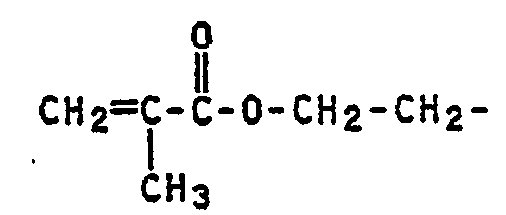


- Beispiele für derartige Derivate des Ethylenharnstoffs sind N-Vinyl-N,N'-ethylenharnstoff, N-Vinyloxiethyl-N,N'-ethylenharnstoff, N-(ß-Acryl- amidoethyl)-N,N'-ethylenharnstoff sowie besonders N-(ß-Acryloxiethyl)-N, N'-ethylenharnstoff und N-[ß(a-Acryloxiacetamido)-ethyl]-N,N'-ethy- lenhamstoff.
- Als monoolefinisch ungesättigte Monomere mit einer tertiären Aminogruppe, d.h. also monoolefinisch ungesättigte tert.Amino-Verbindungen kommen z.B. w-N,N'-Dialkylamino-alkylacrylate und/oder -methacrylate in Frage, die in der esterartig gebundenen Alkylgruppe meist 2 bis 4 C-Atome und in den allein an die Amino-Stickstoffatome gebundenen Alkylgruppen 1 bis 4 C-Atome enthalten, wie besonders N,N-Diethylaminoethylacrylat und -methacrylat, ω-N,N'-Dimethylamino-propylacrylat und -methacrylat sowie N,N'-Di-n-butylaminoethylacrylat.
- Für das neue Verfahren können die üblichen anionischen Emulgatoren eingesetzt werden, deren Menge vorzugsweise 0,5 bis 1,5 Gew.%, bezogen auf das Polymere, beträgt. Als solche sind besonders Schwefelsäureester von Fettalkoholen, wie Laurylsulfat, Sulflerungsprodukte von oxatkytierten, insbesondere oxethylierten, meist 8 bis 12 C-Atome im Alkylrest enthaltenden Alkylphenolen, wie besonders p-n-Nonyl- und p-n-Dodecylphenol sowie p-Isooctylphenol, wasserlösliche Alkalisalze von Fettsäuren, wie Natriumstearat und Natriumoleat und sulfonierte und alkylierte Biphenylether geeignet.
- Als nicht-ionische Emulgatoren können bei dem neuen Verfahren z.B. oxalkylierte, vorzugsweise oxethylierte Fettalkohole, Fettamine, Fettsäureamide und/oder meist 8 bis 12 C-Atome in den Alkylgruppen enthaltende Monoalkylphenole, die 5 bis 30, insbesondere 10 bis 25 Ethylenoxid-Einheiten im Molekül enthalten, z.B. oxethylierter Laurylalkohol, oxethylierter Oleylalkohol, oxethylierter Spermölalkohol und oxethylierter Stearylalkohol, oxethyliertes Stearinsäureamid, oxethyliertes Oleylamid, oxethylierte Ölsäure, oxethyliertes p-n-Nonylphenol, oxethylierter p-Isooctylphenol und oxethyliertes p-n-Dodecylphenol, eingesetzt werden.
- Soweit ein nicht-ionischer Emulgator eingesetzt wird, kann dieser schon in der Vorlage und/oder bei der Weiterführung der Emulsionspolymerisation zu einem beliebigen späteren Zeitpunkt zugesetzt werden.
- Bei dem neuen Verfahren können die üblichen radikalbildenden Polymerisationsinitiatoren in den üblichen Mengen eingesetzt werden. Besonders geeignet sind die Alkali- und Ammoniumsalze von Peroxisäuren, wie Kalium-, Natrium- und Ammoniumpersulfat.
- Sehr gut geeignet sind auch die üblichen RedoxKatalysatoren z.B. Kombinationen aus Ammoniumpersulfat und Ammoniumhydrogensulfat oder Wasserstoffperoxid und Ascorbinsäure sowie tert.-Butylhydroperoxid und Natriumformaldehydsulfoxylat.
- Die Menge an derartigen Initiatoren liegt bei 0,1 bis 2, vorzugsweise bei 0,2 bis 1 Gew.%, bezogen auf die Monomeren in der Vorlage. Bei der Weiterführung der Polymerisation wird dem Polymerisationsgemisch im allgemeinen weiterer Initiator derart zugegeben, daß dessen Menge insgesamt von 0,05 bis 2, insbesondere 0,1 bis 0,5 Gew.%, bezogen auf die gesamten Monomeren beträgt.
- Den nach dem neuen Verfahren hergestellten Polymer-Dispersionen werden, wenn die Polymeren Monomere D einpolymerisiert enthalten, Hydrazide aliphatischer Dicarbonsäuren in einer Menge von 0,3 bis 1, vorzugsweise von 0,4 bis 0,8 Mol je Mol in das Polymere einpolymerisierten Carbonylmonomeren zugesetzt. Die geeigneten aliphatischen Dihydrazide leiten sich insbesondere von 2 bis 10, vorzugsweise 4 bis 6 C-Atomen enthaltenden Carbonsäuren ab. Beispiele hierfür sind Oxalsäuredihydrazid, Malonsäuredihydrazid, Bernsteinsäuredihydrazid, Glutarsäuredihydrazid, Adipinsäuredihydrazid, Sebacinsäuredihydrazid, Maleinsäuredihydrazid, Fumarsäuredihydrazid und/oder Itaconsäuredihyrazid; vorgezogen werden Glutarsäuredihydrazid und Adipinsäuredihydrazid.
- Nach dem neuen Verfahren erhält man Polymer-Dispersionen, deren Filmbildetemperatur ohne Zusatz von Filmbildehilfsmitteln, meist im Bereich von +5 bis 40, insbesondere von 10 bis 30°C liegt. Trotzdem ergeben sie Filme, die praktisch unmittelbar nach dem Trocknen blockfest sind, so daß mit Hilfe dieser Bindemittel beschichtete Gegenstände nach ihrer Beschichtung verhältnismäßig rasch gestapelt werden können. Dies ist überraschend, zumal nach den Angaben in der US-PS 4141935 (Spalte 5, Zeile 5 bis 7 und Beispiel 1) Kern und Hülle eines durch zweistufige Emulsionspolymerisation hergestellten Polymerisats ihre Eigenschaften auch nach der Verarbeitung beibehalten sollen: Durch eine hohe Glastemperatur der äußeren Schale der Latexteilchen sollte daher eine hohe Filmbildetemperatur erwartet werden, zumal nach der Arbeit von Distler und Kanig, Colloid and Polym. Sci., 256 (1978), Seiten 1052 bis 1060 schon Latexteilchen mit einheitlicher Polymerisatzusammensetzun9 nach ihrer Verfilmung als Individuen im Film wiedergefunden werden können. Dies wäre umso mehr zu erwarten, wenn die Latexteilchen Schalen aufwiesen, die härter sind als ihr Kern. Zwangsläufig müßte daher die wesentlich höhere Glastemperatur der äußeren Hülle der Polymer-Teilchen für die Filmbildetemperatur entscheidend sein.
- Es ist zwar aus der DE-AS 2163461 bekannt, durch Emulsionspolymerisation ein teilchenförmiges Material herzustellen, das aus einem kautschukartigen Kern aus vemetztem Acrylpolymeren und einer glasartigen äußeren Hülle aus polymerisiertem Methylmethacrylat sowie einer Übergangsschicht zwischen Kern und Hülle besteht, wobei die Glastemperatur des Kerns wesentlich unterhalb der der äußeren Hülle liegt, doch werden die dabei erhaltenen Dispersionen nicht als solche eingesetzt, sondern die Polymerisate nach der Koagulation der Dispersion zur Herstellung von Formkörpern verwendet, und dieser Schrift können keine Hinweise auf Filmbildetemperatur oder Blockneigung von daraus hergestellten Filmen entnommen werden.
- Die nach dem neuen Verfahren hergestellten Polymer-Dispersionen eignen sich mit besonderem Vorteil als Bindemittel für Anstrichmittel und insbesondere Lasuren, wobei zusätzlich die üblichen Pigmente, Farbstoffe, Fungizide, Entbläuungsmittel und Insektizide in den üblichen Mengen mitverwendet werden können. Die mit den neuen Polymer-Dispersionen hergestellten Lasuren, ermöglichen ein rasches Beschichten von Holz, beispielsweise von Fensterrahmen, die praktisch unmittelbar nach dem Trocknen abgelagert werden können, ohne daß dann die Gefahr des Blockens besteht, soweit nur die Beschichtungen auf Raumtemperatur abgekühlt sind.
- Die in den folgenden Beispielen angegebenen Teile und Prozente beziehen sich auf das Gewicht. Die darin angegebenen Volumenteile verhalten sich zu den Gewichtsteilen wie das Liter zum Kilogramm.
- In einem Polymerisationsgefäß werden 200 Teile Wasser vorgelegt und auf 80°C erwärmt. Man löst dann 5 Teile Natriumlaurylsulfat und gibt 25 Teile einer 20 %igen wäßrigen Lösung eines mit 14 Mol Ethylenoxid ethoxylierten Nonylphenols zu. Man fügt dann 5 Teile von Zulauf (I) und 10 Teile von Zulauf (111) zu. Nach dem Anspringen der Reaktion wird 10 Minuten bei 80°C polymerisiert und dann mit Zulauf (I) und Zulauf (111) begonnen.
- Zulauf (I), der innerhalb einer Stunde zugefahren wird, ist eine Emulsion aus 248 Teilen n-Butylacrylat, 27 Teilen Methylmethacrylat, 3,75 Teilen Acrylsäure, 12,5 Teilen einer 20 %igen wäßrigen Lösung des ethoxylierten Nonylphenols, 2,5 Teilen einer 50 %igen wäßrigen Lösung von Acrylamid und 155 Teilen Wasser.
- Nach Beendigung von Zulauf (I) wird Zulauf (11) innerhalb einer Stunde in das Polymerisationsgemisch zugefahren. Zulauf (11) setzt sich aus 202 Teilen Methylmethacrylat, 23 Teilen n-Butylacrylat, 3,75 Teilen Acrylsäure, 12,5 Teilen der wäßrigen Lösung des ethoxylierten Nonylphenols, 2,5 Teilen der 50 %igen Acrylamid-Lösung und 155 Teilen Wasser zusammen.
- Der Rest von Zulauf (III) wird zusammen mit Zulauf (1) innerhalb von 2 1/4 Stunden in das Polymerisationsgefäß gegeben. Zulauf (111) besteht aus einer Lösung von 2,5 Teilen Natriumpersulfat in 100 Teilen Wasser.
- Nach Beendigung des Zulaufes der Monomeren und des Initiators wird das Polymerisationsgemisch eine weitere Stunde auf 80°C gehalten, dann abgekühlt und mit konzentrierter wäßriger Ammoniaklösung der pH-Wert auf 8 bis 9 gestellt. Man erhält eine 45 %ige wäßrige Polymer-Dispersion, deren minimale Filmbildetemperatur (MFT) 14°C beträgt
- Zur Prüfung der Blockfestiakeit von Filmen aus der erfindungsgemäß hergestellten Dispersion wurden PVC-Folien mit der Dispersion in einer Naßschichtdicke von 250µm beschichtet und nach dem Trocknen der Beschichtungen zwei beschichtete Folienstücke mit ihrer beschichteten Seite aufeinander gelegt und 24 Stunden bei 60°C mit 14.7 - 104N/m2 (1,5 Kp/cm2) belastet. Die Folienstücke ließen sich danach ohne merklichen Kraftaufwand und ohne jede Oberflächenbeschädigung voneinander trennen (Note 0).
- Zur Prüfung der Blockfestiokeit wurde zudem eine farbige Lasur folgender Zusammensetzung geprüft:

- Mit der Lasur wurden Holzkörper 3-schichtig beschichtet, wobei das Auftragsgewicht insgesamt 200 g/m2 betrug. Nach dem Trocknen wurden jeweils 2 Holzkörper mit ihrer beschichteten Oberfläche 24 Stunden bei 60°C mit einem Druck von 1.23 . 104N/m2 (125 g/cm2) aufeinander gepreßt. Es trat kein Blocken ein.
- Man arbeitet wie in Beispiel 1 angegeben, verwendet jedoch bei sonst gleichen Bedingungen in Zulauf (I) 137,5 Teile Methylmethacrylat und 137,5 Teile n-Butylacrylat sowie in Zulauf (II) 112,5 Teile Methylmethacrylat und 112,5 Teile n-Butylacrylat. Man erhält dann unter sonst gleichen Bedingungen eine Polymer-Dispersion deren MFT 14°C beträgt. Die Blockfestigkeit von Filmen und Lasuren, die, wie oben angegeben geprüft wurden, zeigten die Note 5, d.h. die Beschichtungen waren jeweils untereinander fest verklebt.
- Man arbeitet, wie in Beispiel 1 angegeben, setzt jedoch dem Zulauf (I) 261,3 Teile n-Butylacrylat und 13,7 Teile Methylmethacrylat, sowie in Zulauf (II) 213,8 Teile Methylmethacrylat und 11,2 Teile n-Butylacrylat ein. Bei sonst gleichen Bedingungen erhält man eine Polymer-Dispersion, deren MFT 20°C beträgt, und die gleich blockfest ist wie die Dispersion von Beispiel 1.
- Man arbeitet, wie in Beispiel 1 angegeben, setzt jedoch in Zulauf (1) 192,5 Teile n-Butylacrylat und 82,5 Teile Methylmethacrylat, sowie in Zulauf (II) 157,5 Teile Methylmethacrylat und 67,5 Teile n-Butylacrylat ein. Man erhält dann unter sonst gleichen Bedingungen eine Polymer-Dispersion, der MFT 14°C, deren Filme und Lasuren nur geringfügig weniger blockfest sind, als die der Dispersion von Beispiel 1.
- Man arbeitet im wesentlichen wie in Beispiel 1 angegeben, setzt jedoch als Vorlage ein Gemisch aus 187 Teilen Wasser, 0,5 Teilen Natriumlaurylsulfat, 25 Teilen einer 20 %igen wäßrigen Lösung des ethoxylierten Nonylphenols, 5 Teile von Zulauf (I) und 10 Teile von Zulauf (III) ein.
- Zulauf (I) besteht aus 50 Teilen Styrol, 200 Teilen n-Butylacrylat, 3,75 Teilen Acrylsäure, 2,5 Teilen einer 50 %igen wäßrigen Lösung von Acrylamid, 2,25 Teilen Natriumlaurylsulfat und 12,5 Teilen einer 20 %igen wäßrigen Lösung des ethoxylierten Nonylphenols und 100 Teilen Wasser.
- Zulauf (II) enthält 50 Teile n-Butylacrylat und 200 Teile Styrol sowie die gleichen weiteren Komponenten in den gleichen Mengen wie für Zulauf (I) angegeben.
- Man erhält eine Polymerdispersion der MFT 0°C, deren Filme und Lasuren gleich blockfest sind wie die der Polymer-Dispersion von Beispiel 1.
- Man legt ein Gemisch aus 182 Teilen Wasser, 5 Teilen Natriumlaurylsulfat und 25 Teilen einer 20 %igen wäßrigen Lösung von mit 14 Mol Ethylenoxid ethoxyliertem Nonylphenol, 5 Teile von Zulauf (I) und 10 Teile von Zulauf (III) vor und erwärmt unter Rühren auf 80°C. Nach dem Anpolymerisieren fährt man den restlichen Zulauf (I) innerhalb von 1 Stunde zu dem Polymerisationsgemisch. Er besteht aus 270 Teilen n-Butylacrylat, 30 Teilen Methylmethacrylat, 7,5 Teilen Acrylsäure, 2,5 Teilen einer 50 %igen wäßrigen Acrylamidlösung, 12,5 Teilen einer 20 %igen wäßrigen Lösung des ethoxylierten Nonylphenols und 105 Teilen Wasser.
- Nach Beendigung von Zulauf (I) werden 8 Vol.-Teile konz. wäßrige Ammoniaklösung zugegeben (bis pH 7-8) und danach mit der Zugabe von Zulauf (II) begonnen. Zulauf (II) besteht aus 180 Teilen Methylmethacrylat, 20 Teilen n-Butylacrylat, 25 Teilen N,N'-Dimethylaminoethylmethacrylat, 12,5 Teilen einer 20 %igen wäßrigen Lösung des ethoxylierten Nonylphenols, 2,5 Teilen einer 50 %igen wäßrigen Acrylamidlösung und 100 Teilen Wasser.
- Zulauf (111), bestehend aus einer Lösung von 2,5 Teilen Natriumpersulfat in 100 Teilen Wasser, wird innerhalb von 2 1/4 Stunden, beginnend mit dem Zulaufenlassen von Zulauf (I), mit gleichbleibender Geschwindigkeit in das Polymerisationsgefäß gegeben.
- Man erhält eine 50 %ige wäßrige Polymer-Dispersion, deren MFT 12°C beträgt. Daraus hergestellte Filme und Lasuren zeigen praktisch das gleich gute Blockverhalten wie die Dispersion von Beispiel 1.
- Man arbeitet wie in Beispiel 1 angegeben, verwendet jedoch in Zulauf (I) und Zulauf (11) jeweils zusätzlich 7,5 Teile Diacetonacrylamid. Nach dem Abkühlen der erhaltenen Polymer-Dispersion und dem Zugeben des wäßrigen Ammoniak, gibt man zusätzlich noch 10 Teile Adipinsäuredihydrazid zu.
- Man erhält dann eine Polymer-Dispersion der MFT 17°C. Sie ergibt als solche und in Form ihrer Lasuren Filme, deren Blockfestigkeit praktisch der Blockfestigkeit von Filmen bzw. Lasuren der Dispersion von Beispiel 1 entspricht.
besteht, wobei der Anteil des Monomerengemisches (I) 40 bis 65 Gew.%, bezogen auf die Gesamtmenge der beiden Monomerengemische beträgt, als Monomere D monoolefinisch ungesättigte Carbonylverbindungen einsetzt, die Monomerengemische (I) und (11) dem Polymerisationsgefäß als solche oder als wäßrige Emulsion zugeführt werden, derart, daß die entstehende wäßrige Polymerdispersion einen Polymergehalt von 40 bis 60 Gew.-%, bezogen auf die Polymer-Dispersion, und einen Gehalt an anionischem Emulgator von 0,5 bis 3 Gew.%, bezogen auf das Polymere, hat, und der fertigen Polymerdispersion, wenn das Polymere Monomere D einpolymerisiert enthält, Hydrazide aliphatischer Dicarbonsäuren in einer Menge von 0,5 bis 1 Mol je Mol Carbonyl-Monomeres zusetzt.
Claims (2)
als Vorlage in Gegenwart von 0,1 bis 2 Gew.%, bezogen auf die gesamten Monomeren (der Monomerengemische I und II) anionischem Emulgator und von 0 bis 1 Gew.%, bezogen auf die gesamten Monomeren, nicht-ionischem Emulgator, sowie eines wasserlöslichen radikalbildenden Polymerisationsinitiators, in Form einer 0,5 bis 4 %igen wäßrigen Emulsion polymerisiert, sodann
besteht, wobei der Anteil des Monomerengemisches (I) 40 bis 65 Gew.%, bezogen auf die Gesamtmenge der beiden Monomerengemische beträgt, als Monomere D monoolefinisch ungesättigte Carbonylverbindungen einsetzt, die Monomerengemische (I) und (11) dem Polymerisationsgefäß als solche oder als wäßrige Emulsion zuführt, derart, daß die entstehende wäßrige Polymerdispersion einen Polymergehalt von 40 bis 60 Gew.-%, bezogen auf die Polymer-Dispersion, und einen Gehalt an anionischem Emulgator von 0,5 bis 3 Gew.-%, bezogen auf das Polymere, hat, und der fertigen Polymerdispersion, wenn das Polymere Monomere D einpolymerisiert enthält, Hydrazide aliphatischer Dicarbonsäuren in einer Menge von 0,5 bis 1 Mol je Mol Carbonyl-Monomeres zusetzt.
Priority Applications (1)
| Application Number | Priority Date | Filing Date | Title |
|---|---|---|---|
| AT85114875T ATE47865T1 (de) | 1984-12-01 | 1985-11-23 | Verfahren zur herstellung von polymerdispersionen, die blockfeste filme bilden. |
Applications Claiming Priority (2)
| Application Number | Priority Date | Filing Date | Title |
|---|---|---|---|
| DE19843443964 DE3443964A1 (de) | 1984-12-01 | 1984-12-01 | Verfahren zur herstellung von polymer-dispersionen, die blockfeste filme bilden |
| DE3443964 | 1984-12-01 |
Publications (3)
| Publication Number | Publication Date |
|---|---|
| EP0184091A2 EP0184091A2 (de) | 1986-06-11 |
| EP0184091A3 EP0184091A3 (en) | 1986-12-30 |
| EP0184091B1 true EP0184091B1 (de) | 1989-11-08 |
Family
ID=6251718
Family Applications (1)
| Application Number | Title | Priority Date | Filing Date |
|---|---|---|---|
| EP85114875A Expired EP0184091B1 (de) | 1984-12-01 | 1985-11-23 | Verfahren zur Herstellung von Polymer-Dispersionen, die blockfeste Filme bilden |
Country Status (7)
| Country | Link |
|---|---|
| US (1) | US4654397A (de) |
| EP (1) | EP0184091B1 (de) |
| JP (1) | JPH0764887B2 (de) |
| AT (1) | ATE47865T1 (de) |
| AU (1) | AU580816B2 (de) |
| DE (2) | DE3443964A1 (de) |
| DK (1) | DK168540B1 (de) |
Cited By (1)
| Publication number | Priority date | Publication date | Assignee | Title |
|---|---|---|---|---|
| DE19609509B4 (de) * | 1996-03-11 | 2006-11-02 | Celanese Emulsions Gmbh | Wäßrige Polymerdispersionen als Bindemittel für elastische block- und kratzfeste Beschichtungen |
Families Citing this family (146)
| Publication number | Priority date | Publication date | Assignee | Title |
|---|---|---|---|---|
| GB8412423D0 (en) * | 1984-05-16 | 1984-06-20 | Allied Colloids Ltd | Polymeric compositions |
| JPH0651860B2 (ja) * | 1986-07-09 | 1994-07-06 | 株式会社日本触媒 | ブロッキング防止用塗料 |
| DE3902103A1 (de) * | 1989-01-25 | 1990-08-02 | Roehm Gmbh | Bindemittel fuer waessrige glanzfarben |
| US5120889A (en) * | 1989-12-14 | 1992-06-09 | National Starch And Chemical Investment Holding Corporation | Method for manufacturing binder for lead storage battery glass (fiber) mats |
| US5182179A (en) * | 1990-12-07 | 1993-01-26 | Rohm And Haas Company | Fiber binder |
| DE4334178A1 (de) * | 1993-10-07 | 1995-04-13 | Basf Ag | Wäßrige Polymerisatzubereitungen |
| DE4340648A1 (de) * | 1993-11-30 | 1995-06-01 | Hoechst Ag | Wäßrige Polymerdispersionen als Bindemittel für blockfeste, kratzfeste und chemikalienbeständige Beschichtungen |
| US5334655A (en) * | 1993-12-09 | 1994-08-02 | Rohm And Haas Company | Method for reducing microfoam in a spray-applied waterborne composition |
| GB9408725D0 (en) † | 1994-05-03 | 1994-06-22 | Zeneca Resins Bv | Production of aqueous polymer compositions |
| US5486576A (en) | 1994-07-01 | 1996-01-23 | Rohm And Haas Company | Method for reducing microfoam in a spray-applied waterborne thermoset composition |
| US5623085A (en) | 1994-09-23 | 1997-04-22 | Rohm And Haas Company | Method for reducing microfoam in a spray-applied waterborne composition |
| US5800873A (en) * | 1994-10-03 | 1998-09-01 | Basf Lacke+Farben Ag | Process for the production of sealed packaging containers and the use of a sealing coating for coating plastics films |
| DE4439459A1 (de) * | 1994-11-04 | 1995-05-04 | Basf Ag | Wäßrige Polymerisatdispersion |
| DE4439457A1 (de) * | 1994-11-04 | 1995-04-27 | Basf Ag | Wäßrige Polymerisatdispersion |
| US5506282A (en) * | 1994-12-06 | 1996-04-09 | Rohm And Haas Company | Method for providing maximum coating film gloss |
| US5569687A (en) * | 1995-03-16 | 1996-10-29 | Rohm And Haas Company | Waterborne zinc-rich primer compositions |
| US5635248A (en) * | 1995-06-07 | 1997-06-03 | Rohm And Haas Company | Method of producing coating on reconstituted wood substrate |
| US6153690A (en) * | 1996-05-29 | 2000-11-28 | Rohm And Haas Company | Method of producing isocyanate-modified latex polymer |
| US5948833A (en) * | 1996-06-04 | 1999-09-07 | Rohm And Haas Company | Method of reducing yellowing of water-borne road marking paints and composition used therein |
| US6037390A (en) * | 1997-12-31 | 2000-03-14 | E. I. Du Pont De Nemours And Company | Smear resistant pigmented ink jet inks containing β-diketone or ureido dispersants |
| AU771383B2 (en) * | 1998-12-08 | 2004-03-18 | Rohm And Haas Company | Dirt pickup resistant coating binder and coatings |
| US6290866B1 (en) * | 1999-01-25 | 2001-09-18 | Rohm And Haas Company | Leather coating binder and coated leather having good embossability and wet-flex endurance |
| DE19912191C2 (de) † | 1999-03-18 | 2001-07-26 | Wacker Chemie Gmbh | Verfahren zur Herstellung von wäßrigen Polymerdispersionen mit hohem Festgehalt |
| DE19954619A1 (de) * | 1999-11-12 | 2001-05-17 | Basf Ag | Wässrige Polymerdispersionen |
| JP3654820B2 (ja) * | 2000-06-20 | 2005-06-02 | 大日本塗料株式会社 | 水性塗料用樹脂組成物 |
| DE10040407A1 (de) | 2000-08-18 | 2002-02-28 | Basf Ag | Silanhaltige Polymerdispersionen für Fliesenklebstoffe |
| DE60124940T2 (de) * | 2000-09-21 | 2007-09-20 | Rohm And Haas Co. | Methoden und zusammensetzungen betreffend polare monomere und mehrwärtige kationen |
| GB0124280D0 (en) * | 2001-10-10 | 2001-11-28 | Avecia Bv | Aqueous Coating Compositions |
| AU2002301310B2 (en) | 2001-10-17 | 2007-12-20 | Rohm And Haas Company | Polymer composition |
| DE10153932A1 (de) * | 2001-11-06 | 2003-05-22 | Basf Ag | Wässrige Kunstharzzubereitung |
| US20030224184A1 (en) | 2002-05-07 | 2003-12-04 | Hermes Ann Robertson | Method of producing wear resistant traffic markings |
| DE10256148A1 (de) * | 2002-11-29 | 2004-06-17 | Basf Ag | Gegenstand der vorliegenden Erfindung sind Zusammensetzungen enthaltend mindestens ein Copolymer (A) und mindestens ein Copolymer (B) sowie deren Verwendung in kosmetischen Zubereitungen |
| TWI256416B (en) * | 2003-06-02 | 2006-06-11 | Rohm & Haas | Aqueous leather treatment composition and method of use |
| US20050136272A1 (en) * | 2003-12-23 | 2005-06-23 | Vanrheenen Paul | Gloss reducing polymer composition |
| WO2006006994A2 (en) | 2004-06-22 | 2006-01-19 | Lexmark International, Inc. | Inkjet ink composition |
| US7381753B2 (en) * | 2004-06-29 | 2008-06-03 | Lexmark International, Inc. | Inkjet ink composition |
| TWI321554B (en) * | 2004-08-25 | 2010-03-11 | Rohm & Haas | Composition for forming a composite material |
| US7700703B2 (en) | 2004-12-23 | 2010-04-20 | Rohm And Haas Company | Polymer additives and adhesive compositions including them |
| US20060167135A1 (en) * | 2005-01-25 | 2006-07-27 | Lexmark International, Inc. | Inkjet ink binder and inkjet ink composition |
| US7589158B2 (en) * | 2005-11-30 | 2009-09-15 | Columbia Insurance Company | Polymers with improved shelf stability |
| EP1944342B1 (de) | 2006-03-15 | 2011-02-23 | Rohm and Haas Company | Wässrige Zusammensetzungen mit mattierenden Polymerpartikeln |
| JP5019349B2 (ja) * | 2006-03-15 | 2012-09-05 | 大日本塗料株式会社 | 水性塗料用樹脂組成物 |
| DE102006013898A1 (de) * | 2006-03-25 | 2007-09-27 | Celanese Emulsions Gmbh | Polymerdispersionen, Verfahren zu deren Herstellung und deren Verwendung |
| US7695770B2 (en) * | 2006-09-21 | 2010-04-13 | Rohm And Haas Company | Coating binder polymer and coatings |
| US8877852B2 (en) | 2006-12-15 | 2014-11-04 | Rohm And Haas Company | Phosphorous-containing organic polymer and compositions and processes including same |
| JP5765869B2 (ja) | 2006-12-20 | 2015-08-19 | ローム アンド ハース カンパニーRohm And Haas Company | 液状適用音響減衰材 |
| EP1935862A1 (de) * | 2006-12-22 | 2008-06-25 | Rohm and Haas France SAS | Verfahren zur Behandlung von Beton |
| EP1942086B1 (de) | 2006-12-22 | 2009-07-08 | Rohm and Haas Company | Verfahren zur Behandlung von Beton |
| US20080206469A1 (en) | 2007-02-23 | 2008-08-28 | Arnold Stan Brownell | Aqueous compositions and processes including fluorocarbons |
| JP2008213368A (ja) * | 2007-03-06 | 2008-09-18 | Nippon Zeon Co Ltd | インクジェット記録媒体用ラテックス及びその製造方法、並びにインクジェット記録媒体用塗工組成物及びインクジェット記録媒体 |
| JP2009001776A (ja) | 2007-06-11 | 2009-01-08 | Rohm & Haas Co | 水性エマルジョンポリマー会合性増粘剤 |
| JP2009067952A (ja) * | 2007-09-14 | 2009-04-02 | Dainippon Toryo Co Ltd | 防錆用塗料組成物 |
| EP2058364B1 (de) | 2007-11-08 | 2013-05-01 | Rohm and Haas Company | Flüssigkeitsangewandte Schalldämpfung |
| NO20084094L (no) | 2007-11-29 | 2009-06-02 | Rohm & Haas | Sammensetninger omfattende vandig emulsjon kopolymer |
| EP2235077B2 (de) * | 2007-12-20 | 2017-06-21 | Lubrizol Advanced Materials, Inc. | Verwendung einer wässrigen zusammensetzung als wasserbeschichtung mit verbesserter früher wassertrübung und chemischer beständigkeit |
| EP2077301B1 (de) | 2008-01-02 | 2016-10-19 | Rohm and Haas Company | Scheuer- und fleckenbeständige Beschichtung |
| EP2141181B1 (de) * | 2008-07-03 | 2012-05-02 | Rohm and Haas Company | Lederbeschichtungszusammensetzungen mit verbesserter Prägungsfähigkeit |
| DE602009000490D1 (de) | 2008-08-05 | 2011-02-10 | Rohm & Haas | Wässrige, polymere Dispersion und Verfahren zur Bereitstellung verbesserter Haftung |
| EP2172517B1 (de) | 2008-10-06 | 2018-11-21 | Rohm and Haas Company | Verbundstoffpartikel |
| DE102009056187A1 (de) | 2008-11-28 | 2010-07-15 | Basf Se | Polyesterharz auf Basis von 2-Propylheptansäureglycidester und/oder 4-Methyl-2 propylhexansäureglycidester |
| JP2010215874A (ja) * | 2009-03-19 | 2010-09-30 | Asahi Kasei Chemicals Corp | プラスチックフィルムコーテイング用水性樹脂組成物 |
| WO2011008272A1 (en) * | 2009-07-14 | 2011-01-20 | The Sherwin-Williams Company | Starch hybrid polymers |
| WO2011017388A2 (en) | 2009-08-07 | 2011-02-10 | Lubrizol Advanced Materials, Inc. | Emulsion copolymers for heat seal adhesive |
| CN102040794B (zh) | 2009-10-21 | 2014-10-08 | 罗门哈斯公司 | 可固化水性组合物 |
| EP2333022B1 (de) | 2009-12-09 | 2012-06-27 | Rohm and Haas Company | Schnelltrocknende wässrige Binderzusammensetzungen mit hohem PVK mit Kleinpartikelbindemittel und damit erzeugte Straßenmarkierungen |
| CN102101929B (zh) | 2009-12-18 | 2013-10-16 | 罗门哈斯公司 | 可固化水性组合物 |
| CN102108232B (zh) | 2009-12-25 | 2014-03-12 | 罗门哈斯公司 | 不含二氧化钛的多层涂料体系 |
| JP2011168045A (ja) | 2010-01-11 | 2011-09-01 | Rohm & Haas Co | 記録材料 |
| CN102206394B (zh) | 2010-03-31 | 2014-02-12 | 罗门哈斯公司 | 含水共聚物分散液和涂料组合物 |
| EP2371870B1 (de) | 2010-04-01 | 2012-07-11 | Rohm and Haas Company | Mehrstufen-Emulsionspolymer und daraus gebildete Beschichtungen |
| CA2743794C (en) | 2010-06-25 | 2013-09-10 | Dow Global Technologies Llc | Coalescent for aqueous compositions |
| CA2747190A1 (en) | 2010-08-30 | 2012-02-29 | Dow Global Technologies Llc | Coalescent for aqueous compositions |
| EP2426155B2 (de) | 2010-09-03 | 2017-06-28 | Rohm and Haas Company | Mehrstufen-Emulsionspolymer und verbesserte Pigmenteffizienz |
| CN102453447B (zh) | 2010-10-26 | 2014-02-26 | 罗门哈斯公司 | 可移除的胶粘贴 |
| JP5241901B2 (ja) | 2010-10-28 | 2013-07-17 | ローム アンド ハース カンパニー | 水性不織物バインダーおよびこれから製造された処理された不織物 |
| CN102464932B (zh) | 2010-11-16 | 2016-03-30 | 罗门哈斯公司 | 红外反射涂料组合物 |
| ES2528791T5 (es) | 2010-12-20 | 2021-12-03 | Covestro Netherlands Bv | Polímero vinílico bio-renovable secuencial |
| EP2471881B1 (de) | 2010-12-28 | 2014-06-18 | Rohm and Haas Company | Wässrige Beschichtungszusammensetzung, Verfahren zur Bereitstellung einer Beschichtung und damit beschichtetes zementäres Substrat |
| ITVA20110008A1 (it) | 2011-03-25 | 2012-09-26 | Lamberti Spa | Composizioni detergenti |
| CN102746601B (zh) | 2011-04-18 | 2014-11-26 | 罗门哈斯公司 | 耐水白涂料用共聚物分散体 |
| CA2771763C (en) | 2011-04-29 | 2014-08-05 | Rohm And Haas Company | Stabilized aqueous compositions comprising cationic polymers that deliver paint and primer properties in a coating |
| CA2771572C (en) | 2011-04-29 | 2014-06-03 | Rohm And Haas Company | Aqueous compositions comprising ion exchange resins that deliver paint and primer properties in a coating |
| KR101992859B1 (ko) | 2011-06-03 | 2019-06-25 | 롬 앤드 하아스 컴패니 | 수성 코팅 조성물 |
| CN102952462B (zh) | 2011-08-25 | 2016-06-29 | 罗门哈斯公司 | 底涂层/透明涂层涂料 |
| EP2586836B1 (de) | 2011-08-25 | 2017-08-23 | Rohm and Haas Company | Klare matte Beschichtung |
| CN103890125B (zh) | 2011-10-21 | 2016-12-14 | 罗门哈斯公司 | 一种新型和稳定的水性杂化粘结剂 |
| ITVA20110030A1 (it) | 2011-11-11 | 2013-05-12 | Lamberti Spa | Composizione acquosa di polimeri per la patinatura della carta |
| US9029454B2 (en) † | 2012-01-19 | 2015-05-12 | Celanese Emulsions Gmbh | Aqueous polymer dispersions |
| US9255171B2 (en) | 2012-02-03 | 2016-02-09 | Dsm Ip Assets B.V. | Polymer, process and composition |
| WO2013113938A1 (en) | 2012-02-03 | 2013-08-08 | Dsm Ip Assets B.V. | Use of a polymer composition |
| TWI494396B (zh) | 2012-04-11 | 2015-08-01 | Rohm & Haas | 可分散非織物 |
| CN104508030A (zh) | 2012-06-19 | 2015-04-08 | 陶氏环球技术有限责任公司 | 水基共混物组合物及其制备方法 |
| WO2013191825A1 (en) | 2012-06-19 | 2013-12-27 | Dow Global Technologies Llc | Aqueous based blend composition and method of producing the same |
| TWI521032B (zh) | 2012-06-28 | 2016-02-11 | 羅門哈斯公司 | 濕性膠 |
| EP2698212B1 (de) | 2012-08-17 | 2017-10-11 | Rohm and Haas Company | Substratmarkierungssystem |
| JP6247492B2 (ja) | 2012-11-06 | 2017-12-13 | ダウ グローバル テクノロジーズ エルエルシー | 水性皮革コーティング組成物および皮革をコーティングするための方法 |
| EP3004190B1 (de) | 2013-05-30 | 2020-02-12 | Dow Global Technologies LLC | Holzbeschichtungszusammensetzung |
| BR102014017358B1 (pt) | 2013-07-30 | 2020-06-02 | Rohm And Haas Company | Dispersão aquosa estável de partículas de polímero, e, método |
| RU2717795C2 (ru) * | 2013-08-22 | 2020-03-25 | Басф Се | Способ получения эмульсионных полимеров |
| TR201908506T4 (tr) | 2014-08-20 | 2019-07-22 | Dow Global Technologies Llc | Hızlı dağılan dokunmamış bağlayıcı. |
| EP3018148B1 (de) | 2014-11-04 | 2017-06-28 | Basf Se | Verfahren zur Herstellung einer wässrigen Polymerdispersion |
| BR112017012880B1 (pt) * | 2014-12-19 | 2021-12-21 | Dow Global Technologies Llc | Dispersão aquosa de polímero e método de preparação da mesma |
| CN107109738B (zh) | 2014-12-30 | 2019-11-01 | 罗门哈斯公司 | 用于非编织粘合剂的洗剂 |
| CN107429138A (zh) | 2015-03-31 | 2017-12-01 | 罗门哈斯公司 | 制备压敏粘着剂组合物的方法 |
| US11760822B2 (en) | 2015-03-31 | 2023-09-19 | Rohm And Haas Company | Methods of making pressure sensitive adhesive compositions |
| AU2016202331B2 (en) | 2015-04-30 | 2020-08-13 | Rohm And Haas Company | Durable aqueous compositions for use in making traffic markings having good dirt pickup resistance and traffic markings made therewith |
| US10870776B2 (en) | 2015-05-19 | 2020-12-22 | Rohm And Haas Company | Curable aqueous composition |
| TWI705114B (zh) | 2015-08-31 | 2020-09-21 | 美商羅門哈斯公司 | 用於皮革面塗層的水性多段共聚物組合物 |
| WO2017058849A1 (en) | 2015-09-30 | 2017-04-06 | Dow Global Technologies Llc | Multistage copolymer compositions for use in elastomeric construction caulks and sealants |
| JP7025330B2 (ja) | 2015-12-18 | 2022-02-24 | ローム アンド ハース カンパニー | 潤滑性を有する溶融強度加工助剤として多段コポリマーを含有する熱可塑性組成物 |
| EP3397714B1 (de) | 2015-12-29 | 2022-12-21 | Rohm and Haas Company | Formaldehydfreie härtbare formulierung |
| WO2017132046A1 (en) | 2016-01-26 | 2017-08-03 | Rohm And Haas Company | Thermoplastic compositions containing acrylic copolymers as melt strength and clarity process aids |
| CA2960249A1 (en) | 2016-03-28 | 2017-09-28 | Dow Global Technologies Llc | Aqueous compositions having polyalkoxylates for improved open time |
| CA2960100C (en) | 2016-03-28 | 2025-10-14 | Dow Global Technologies Llc | AQUEOUS COMPOSITIONS CONTAINING POLYALCOXYLATE SALTS INTENDED FOR IMPROVING OPEN TIME |
| AU2017245005B2 (en) | 2016-03-31 | 2019-08-01 | Rohm And Haas Company | Durable aqueous compositions for use in making traffic markings having good dirt pickup resistance and traffic markings made therewith |
| EP3445817A1 (de) | 2016-04-20 | 2019-02-27 | Rohm and Haas Company | Polyvinylchloridrohr |
| TWI744304B (zh) | 2016-04-20 | 2021-11-01 | 美商羅門哈斯公司 | 用於定向聚氯乙烯的加工助劑 |
| TWI753895B (zh) | 2016-04-20 | 2022-02-01 | 美商羅門哈斯公司 | 用於製備定向聚氯乙烯的方法 |
| US11505715B2 (en) | 2016-10-14 | 2022-11-22 | Dow Global Technologies Llc | Aqueous matte coating compositions |
| TW201817802A (zh) * | 2016-10-31 | 2018-05-16 | 日商日本瑞翁股份有限公司 | 丙烯酸橡膠之製造方法、丙烯酸橡膠組成物之製造方法以及橡膠交聯物之製造方法 |
| JP6465250B2 (ja) * | 2016-10-31 | 2019-02-06 | 日本ゼオン株式会社 | アクリルゴムの製造方法 |
| US11326011B2 (en) * | 2016-12-28 | 2022-05-10 | Dow Global Technologies Llc | Aqueous polymer dispersion and process of making the same |
| WO2018140042A1 (en) | 2017-01-27 | 2018-08-02 | Celanese International Corporation | Aqueous polymer dispersions |
| US11286381B2 (en) | 2017-03-30 | 2022-03-29 | Rohm And Haas Company | Formaldehyde-free curable composition |
| CN109281225A (zh) | 2017-07-21 | 2019-01-29 | 陶氏环球技术有限责任公司 | 具有多价金属离子的乳胶调配物 |
| EP3456695B1 (de) | 2017-09-13 | 2020-11-11 | Dow Global Technologies LLC | Wässrige beschichtungszusammensetzung |
| US10640581B2 (en) | 2017-10-11 | 2020-05-05 | Dow Global Technologies Llc | Waterborne damping composition |
| EP3724242A1 (de) | 2018-01-12 | 2020-10-21 | Sirrus, Inc. | Mit verbindungen vernetzte emulsionspolymere mit zwei oder mehr dicarbonyl-substituierten 1-alkeneinheiten |
| WO2019173154A1 (en) | 2018-03-05 | 2019-09-12 | Rohm And Haas Company | (meth)acrylate copolymer compositions and use thereof as pour point depressants for crude oil |
| WO2020010509A1 (en) * | 2018-07-10 | 2020-01-16 | Dow Global Technologies Llc | Aqueous dispersion of multi-stage polymeric particles and process of making the same |
| EP3856701A1 (de) | 2018-09-27 | 2021-08-04 | Dow Global Technologies LLC | Beschichtungszusammensetzung für poröse baumaterialien |
| CA3112956A1 (en) | 2018-09-27 | 2020-04-02 | Dow Global Technologies Llc | Coating composition for controlling efflorescence |
| WO2020091992A1 (en) | 2018-10-30 | 2020-05-07 | Dow Global Technologies Llc | Sealant composition |
| WO2020167621A1 (en) | 2019-02-14 | 2020-08-20 | Sirrus, Inc. | Particles encapsulated with dicarbonyl-substituted-1- alkenes |
| JP7369199B2 (ja) | 2019-02-28 | 2023-10-25 | ダウ グローバル テクノロジーズ エルエルシー | 農業用種子のための流動性濃縮組成物 |
| IT201900003841A1 (it) | 2019-03-15 | 2020-09-15 | Lamberti Spa | Composizioni per la cura della persona |
| KR20210143219A (ko) | 2019-03-22 | 2021-11-26 | 롬 앤드 하스 캄파니 | 유기 파사드를 위한 내수성 |
| US11964912B2 (en) | 2019-04-16 | 2024-04-23 | Dow Global Technologies Llc | Freeze-thaw stable quick-set additive |
| CN113840848B (zh) | 2019-05-08 | 2023-10-03 | 巴斯夫欧洲公司 | 水性聚合物胶乳 |
| US20230312972A1 (en) | 2020-09-03 | 2023-10-05 | Arkema Inc. | Coating composition with improved block and humidity resistance, direct to metal adherence and low voc content |
| US20240425628A1 (en) | 2021-01-26 | 2024-12-26 | Basf Se | Aqueous polymer latex |
| EP4314100A1 (de) | 2021-04-01 | 2024-02-07 | Basf Se | Wässrige polymerdispersion aus polymerteilchen mit hohlräumen |
| IT202100008414A1 (it) | 2021-04-02 | 2022-10-02 | Lamberti Spa | Addensanti associativi |
| EP4381012B1 (de) | 2021-08-04 | 2025-10-08 | Basf Se | Verfahren zur modifizierung eines wässrigen polymerlatex |
| EP4413087A1 (de) | 2021-10-04 | 2024-08-14 | Basf Se | Verwendung von wässrigen polymerzusammensetzungen als flecken für poröse materialien |
| EP4504840A1 (de) | 2022-05-02 | 2025-02-12 | Dow Silicones Corporation | Beschichtungszusammensetzung und deren verwendung |
Family Cites Families (11)
| Publication number | Priority date | Publication date | Assignee | Title |
|---|---|---|---|---|
| BE642380A (de) * | 1963-01-11 | 1964-07-10 | ||
| NL299741A (de) * | 1962-11-02 | 1900-01-01 | ||
| GB1062338A (en) * | 1963-11-19 | 1967-03-22 | Dunlop Rubber Co | Improvements in or relating to acrylic polymer emulsions |
| US4016127A (en) * | 1971-07-06 | 1977-04-05 | Rohm And Haas Company | Emulsion copolymers of acrolein and their use in treating leather |
| US3787522A (en) * | 1972-11-01 | 1974-01-22 | Ford Motor Co | Acrylate polymer particles comprising a core,an outer shell,and an intermediate layer |
| US3947400A (en) * | 1974-04-02 | 1976-03-30 | American Cyanamid Company | Emulsion polymerization of acrylate or other vinyl monomers using selected mixtures of soluble salts of certain sulfosuccinic acid half esters |
| US4048130A (en) * | 1975-03-08 | 1977-09-13 | Lonza Ltd. | Process for the production of self-cross-linking lacquers |
| US4081418A (en) * | 1976-05-10 | 1978-03-28 | American Cyanamid Company | Emulsifiers useful for emulsion polymerization of vinyl monomers |
| US4190562A (en) * | 1977-04-04 | 1980-02-26 | The B. F. Goodrich Company | Improved water absorbent copolymers of copolymerizable carboxylic acids and acrylic or methacrylic esters |
| US4141935A (en) * | 1978-02-10 | 1979-02-27 | Rohm And Haas Company | Thermoplastic film having improved outdoor weatherability |
| US4567246A (en) * | 1982-12-16 | 1986-01-28 | Celanese Corporation | Water-swellable crosslinked polymeric microgel particles and aqueous dispersions of organic film-forming resins containing the same |
-
1984
- 1984-12-01 DE DE19843443964 patent/DE3443964A1/de not_active Withdrawn
-
1985
- 1985-11-23 DE DE8585114875T patent/DE3574146D1/de not_active Expired
- 1985-11-23 EP EP85114875A patent/EP0184091B1/de not_active Expired
- 1985-11-23 AT AT85114875T patent/ATE47865T1/de not_active IP Right Cessation
- 1985-11-29 DK DK555085A patent/DK168540B1/da not_active IP Right Cessation
- 1985-11-29 AU AU50594/85A patent/AU580816B2/en not_active Ceased
- 1985-12-02 US US06/803,164 patent/US4654397A/en not_active Expired - Lifetime
- 1985-12-02 JP JP60269568A patent/JPH0764887B2/ja not_active Expired - Lifetime
Cited By (1)
| Publication number | Priority date | Publication date | Assignee | Title |
|---|---|---|---|---|
| DE19609509B4 (de) * | 1996-03-11 | 2006-11-02 | Celanese Emulsions Gmbh | Wäßrige Polymerdispersionen als Bindemittel für elastische block- und kratzfeste Beschichtungen |
Also Published As
| Publication number | Publication date |
|---|---|
| JPH0764887B2 (ja) | 1995-07-12 |
| ATE47865T1 (de) | 1989-11-15 |
| EP0184091A3 (en) | 1986-12-30 |
| DK555085A (da) | 1986-06-02 |
| EP0184091A2 (de) | 1986-06-11 |
| US4654397A (en) | 1987-03-31 |
| DK555085D0 (da) | 1985-11-29 |
| DE3574146D1 (en) | 1989-12-14 |
| AU580816B2 (en) | 1989-02-02 |
| DE3443964A1 (de) | 1986-06-12 |
| JPS61136501A (ja) | 1986-06-24 |
| AU5059485A (en) | 1986-06-05 |
| DK168540B1 (da) | 1994-04-18 |
Similar Documents
| Publication | Publication Date | Title |
|---|---|---|
| EP0184091B1 (de) | Verfahren zur Herstellung von Polymer-Dispersionen, die blockfeste Filme bilden | |
| DE2640967C2 (de) | Verfahren zur Herstellung von hitzehärtbaren, selbstvernetzenden Harzen | |
| EP0381029B1 (de) | Wässrige Polyacrylat-Systeme für Lackierung von Kunststoffoberflächen | |
| EP0279067B1 (de) | Wässrige Polymerdispersionen für die Holzbeschichtung | |
| EP0727441A2 (de) | Verfahren zur Herstellung von emulgatorfreien wässrigen Polymerdispersionen | |
| EP0575931B1 (de) | In Zweistufenfahrweise hergestellte Vinylpolymerisate und ihre Verwendung als Lackbindemittel | |
| DE3235043C2 (de) | Verfahren zur Herstellung eines kationischen Acryllatex | |
| EP0320865B1 (de) | Verfahren zur Herstellung von wässrigen Polymerdispersionen | |
| EP0332011B1 (de) | Herstellung von wässrigen Polyalkylmethacrylat-Dispersionen durch Emulsionspolymerisation in zwei Stufen und deren Verwendung in Holzlacken | |
| EP0722477B1 (de) | Wässrige polymerisatzubereitungen | |
| EP0296487A1 (de) | Lagerstabile wässrige Polymerdispersionen | |
| DE2658118C2 (de) | Wäßrige Harzdispersionen | |
| EP0900651B1 (de) | Verwendung wässriger Polyacrylatdispersionen als Kaschierklebstoffe | |
| DE3235044C2 (de) | Kationische Acryllatexzusammensetzung und ihre Verwendung | |
| EP0288763A2 (de) | Wässrige Sekundärdispersionen | |
| EP0022514A1 (de) | Wässrige Dispersion auf Grundlage von (Meth-)Acrylsäurederivaten, ihre Herstellung und Verwendung | |
| EP0168870B1 (de) | Verfahren zur Herstellung eines für Beschichtungsmittel geeigneten Bindemittels und dessen Verwendung | |
| EP0347760B1 (de) | Verwendung von wässrigen Kunststoffdispersionen | |
| CH446719A (de) | Verfahren zur Herstellung stabiler wässriger Dispersionen von Pfropfmischpolymerisaten | |
| EP0447999B1 (de) | Wässrige Bindemitteldispersion | |
| DE3724858A1 (de) | Waessrige kunststoffdispersion | |
| EP0798357A1 (de) | Verwendung von wässrigen Dispersionen als Heisssiegellack | |
| EP0960920A1 (de) | Korrosionsschutz-Beschichtungsmittel | |
| EP0771847A2 (de) | Wässrige Polymerdispersionen | |
| DE2856459A1 (de) | Verfahren zur herstellung von polymerisaten |
Legal Events
| Date | Code | Title | Description |
|---|---|---|---|
| PUAI | Public reference made under article 153(3) epc to a published international application that has entered the european phase |
Free format text: ORIGINAL CODE: 0009012 |
|
| AK | Designated contracting states |
Kind code of ref document: A2 Designated state(s): AT BE CH DE FR GB IT LI NL SE |
|
| PUAL | Search report despatched |
Free format text: ORIGINAL CODE: 0009013 |
|
| AK | Designated contracting states |
Kind code of ref document: A3 Designated state(s): AT BE CH DE FR GB IT LI NL SE |
|
| 17P | Request for examination filed |
Effective date: 19861121 |
|
| 17Q | First examination report despatched |
Effective date: 19880226 |
|
| GRAA | (expected) grant |
Free format text: ORIGINAL CODE: 0009210 |
|
| AK | Designated contracting states |
Kind code of ref document: B1 Designated state(s): AT BE CH DE FR GB IT LI NL SE |
|
| REF | Corresponds to: |
Ref document number: 47865 Country of ref document: AT Date of ref document: 19891115 Kind code of ref document: T |
|
| ITF | It: translation for a ep patent filed | ||
| GBT | Gb: translation of ep patent filed (gb section 77(6)(a)/1977) | ||
| REF | Corresponds to: |
Ref document number: 3574146 Country of ref document: DE Date of ref document: 19891214 |
|
| ET | Fr: translation filed | ||
| PLBI | Opposition filed |
Free format text: ORIGINAL CODE: 0009260 |
|
| PLBI | Opposition filed |
Free format text: ORIGINAL CODE: 0009260 |
|
| PLBI | Opposition filed |
Free format text: ORIGINAL CODE: 0009260 |
|
| 26 | Opposition filed |
Opponent name: HUELS AKTIENGESELLSCHAFT Effective date: 19900621 |
|
| 26 | Opposition filed |
Opponent name: HOECHST AKTIENGESELLSCHAFT ZENTRALE PATENTABTEILUN Effective date: 19900803 Opponent name: HUELS AKTIENGESELLSCHAFT Effective date: 19900621 |
|
| 26 | Opposition filed |
Opponent name: RWE- DEA AKTIENGESELLSCHAFT FUER MINERALOEL UND CH Effective date: 19900808 Opponent name: HOECHST AKTIENGESELLSCHAFT ZENTRALE PATENTABTEILUN Effective date: 19900803 Opponent name: HUELS AKTIENGESELLSCHAFT Effective date: 19900621 |
|
| NLR1 | Nl: opposition has been filed with the epo |
Opponent name: HUELS AG. |
|
| NLR1 | Nl: opposition has been filed with the epo |
Opponent name: RWE- DEA AG FUER MINERALOEL UND CHEMIE. Opponent name: HOECHST AG. |
|
| ITTA | It: last paid annual fee | ||
| EAL | Se: european patent in force in sweden |
Ref document number: 85114875.9 |
|
| PLAB | Opposition data, opponent's data or that of the opponent's representative modified |
Free format text: ORIGINAL CODE: 0009299OPPO |
|
| R26 | Opposition filed (corrected) |
Opponent name: HUELS AKTIENGESELLSCHAFT * 900803 CLARIANT GMBH PA Effective date: 19900621 |
|
| NLR1 | Nl: opposition has been filed with the epo |
Opponent name: RWE- DEA AKTIENGESELLSCHAFT FUER MINERALOEL UND CH Opponent name: CLARIANT GMBH PATENTE, MARKEN, LIZENZEN Opponent name: HUELS AKTIENGESELLSCHAFT |
|
| APAC | Appeal dossier modified |
Free format text: ORIGINAL CODE: EPIDOS NOAPO |
|
| PLBN | Opposition rejected |
Free format text: ORIGINAL CODE: 0009273 |
|
| STAA | Information on the status of an ep patent application or granted ep patent |
Free format text: STATUS: OPPOSITION REJECTED |
|
| 27O | Opposition rejected |
Effective date: 19980603 |
|
| NLR2 | Nl: decision of opposition | ||
| REG | Reference to a national code |
Ref country code: CH Ref legal event code: AEN Free format text: REAKTIVIERUNG NACH IRRTUEMLICHER LOESCHUNG |
|
| REG | Reference to a national code |
Ref country code: GB Ref legal event code: IF02 |
|
| PGFP | Annual fee paid to national office [announced via postgrant information from national office to epo] |
Ref country code: NL Payment date: 20031105 Year of fee payment: 19 |
|
| PGFP | Annual fee paid to national office [announced via postgrant information from national office to epo] |
Ref country code: AT Payment date: 20031112 Year of fee payment: 19 |
|
| PGFP | Annual fee paid to national office [announced via postgrant information from national office to epo] |
Ref country code: GB Payment date: 20031119 Year of fee payment: 19 |
|
| PGFP | Annual fee paid to national office [announced via postgrant information from national office to epo] |
Ref country code: CH Payment date: 20031128 Year of fee payment: 19 |
|
| PGFP | Annual fee paid to national office [announced via postgrant information from national office to epo] |
Ref country code: BE Payment date: 20040121 Year of fee payment: 19 |
|
| PGFP | Annual fee paid to national office [announced via postgrant information from national office to epo] |
Ref country code: SE Payment date: 20041105 Year of fee payment: 20 |
|
| PGFP | Annual fee paid to national office [announced via postgrant information from national office to epo] |
Ref country code: FR Payment date: 20041109 Year of fee payment: 20 |
|
| PGFP | Annual fee paid to national office [announced via postgrant information from national office to epo] |
Ref country code: DE Payment date: 20041118 Year of fee payment: 20 |
|
| PG25 | Lapsed in a contracting state [announced via postgrant information from national office to epo] |
Ref country code: GB Free format text: LAPSE BECAUSE OF NON-PAYMENT OF DUE FEES Effective date: 20041123 Ref country code: AT Free format text: LAPSE BECAUSE OF NON-PAYMENT OF DUE FEES Effective date: 20041123 |
|
| PG25 | Lapsed in a contracting state [announced via postgrant information from national office to epo] |
Ref country code: LI Free format text: LAPSE BECAUSE OF NON-PAYMENT OF DUE FEES Effective date: 20041130 Ref country code: CH Free format text: LAPSE BECAUSE OF NON-PAYMENT OF DUE FEES Effective date: 20041130 Ref country code: BE Free format text: LAPSE BECAUSE OF NON-PAYMENT OF DUE FEES Effective date: 20041130 |
|
| BERE | Be: lapsed |
Owner name: *BASF A.G. Effective date: 20041130 |
|
| PG25 | Lapsed in a contracting state [announced via postgrant information from national office to epo] |
Ref country code: NL Free format text: LAPSE BECAUSE OF NON-PAYMENT OF DUE FEES Effective date: 20050601 |
|
| GBPC | Gb: european patent ceased through non-payment of renewal fee |
Effective date: 20041123 |
|
| REG | Reference to a national code |
Ref country code: CH Ref legal event code: PL |
|
| NLV4 | Nl: lapsed or anulled due to non-payment of the annual fee |
Effective date: 20050601 |
|
| APAH | Appeal reference modified |
Free format text: ORIGINAL CODE: EPIDOSCREFNO |
|
| EUG | Se: european patent has lapsed | ||
| BERE | Be: lapsed |
Owner name: *BASF A.G. Effective date: 20041130 |