EP0332011B1 - Herstellung von wässrigen Polyalkylmethacrylat-Dispersionen durch Emulsionspolymerisation in zwei Stufen und deren Verwendung in Holzlacken - Google Patents
Herstellung von wässrigen Polyalkylmethacrylat-Dispersionen durch Emulsionspolymerisation in zwei Stufen und deren Verwendung in Holzlacken Download PDFInfo
- Publication number
- EP0332011B1 EP0332011B1 EP89103443A EP89103443A EP0332011B1 EP 0332011 B1 EP0332011 B1 EP 0332011B1 EP 89103443 A EP89103443 A EP 89103443A EP 89103443 A EP89103443 A EP 89103443A EP 0332011 B1 EP0332011 B1 EP 0332011B1
- Authority
- EP
- European Patent Office
- Prior art keywords
- weight
- dispersion
- methacrylate
- aqueous
- carbon atoms
- Prior art date
- Legal status (The legal status is an assumption and is not a legal conclusion. Google has not performed a legal analysis and makes no representation as to the accuracy of the status listed.)
- Expired - Lifetime
Links
Classifications
-
- C—CHEMISTRY; METALLURGY
- C08—ORGANIC MACROMOLECULAR COMPOUNDS; THEIR PREPARATION OR CHEMICAL WORKING-UP; COMPOSITIONS BASED THEREON
- C08F—MACROMOLECULAR COMPOUNDS OBTAINED BY REACTIONS ONLY INVOLVING CARBON-TO-CARBON UNSATURATED BONDS
- C08F220/00—Copolymers of compounds having one or more unsaturated aliphatic radicals, each having only one carbon-to-carbon double bond, and only one being terminated by only one carboxyl radical or a salt, anhydride ester, amide, imide or nitrile thereof
- C08F220/02—Monocarboxylic acids having less than ten carbon atoms; Derivatives thereof
- C08F220/10—Esters
- C08F220/12—Esters of monohydric alcohols or phenols
- C08F220/14—Methyl esters, e.g. methyl (meth)acrylate
-
- C—CHEMISTRY; METALLURGY
- C08—ORGANIC MACROMOLECULAR COMPOUNDS; THEIR PREPARATION OR CHEMICAL WORKING-UP; COMPOSITIONS BASED THEREON
- C08F—MACROMOLECULAR COMPOUNDS OBTAINED BY REACTIONS ONLY INVOLVING CARBON-TO-CARBON UNSATURATED BONDS
- C08F265/00—Macromolecular compounds obtained by polymerising monomers on to polymers of unsaturated monocarboxylic acids or derivatives thereof as defined in group C08F20/00
- C08F265/04—Macromolecular compounds obtained by polymerising monomers on to polymers of unsaturated monocarboxylic acids or derivatives thereof as defined in group C08F20/00 on to polymers of esters
- C08F265/06—Polymerisation of acrylate or methacrylate esters on to polymers thereof
Definitions
- the present invention relates to a process for the preparation of aqueous dispersions of alkyl methacrylate copolymers by two-stage emulsion copolymerization and the use of the dispersions prepared by this process in wood coatings.
- Wooden surfaces e.g. of panels, furniture and doors are often coated with transparent lacquers for aesthetics and protection against environmental influences. So far, nitro paints, acid-curing alkyl-amino paints, paints based on unsaturated polyesters, polyurethane paints and more recently also aqueous paints based on polymer dispersions have been used. The classic lacquers mentioned are of concern because of the solvents they contain and released to the environment during processing.
- EP-A-29144 discloses the use of polymer dispersions containing N-methylol (meth) acrylamide in copolymerized form for painting wooden surfaces.
- the methylol groups can react with each other at temperatures above 100 ° C, i.e. the lacquer can cross-link and thus its resistance to chemical influences can be improved.
- heating is necessary for crosslinking in the presence of the wood and that formaldehyde is eliminated in the crosslinking reaction.
- Such coatings also leave something to be desired in terms of their scratch resistance, hardness, elasticity, grindability and stack strength.
- mixtures of polymer dispersions have also been used, for example to increase the film hardness.
- the films often become cloudy, which also tends to tarnish under the influence of water.
- embrittlement in the films the so-called whitening occurs frequently when subjected to mechanical stress, and cracks and flaking occur when exposed to temperature under "cold-warm alternation" (cold-check test).
- aqueous dispersions of alkyl methacrylate copolymers with mono- and / or dicarboxylic acids containing 3-6 C atoms can be advantageously prepared by stepwise emulsion copolymerization in the presence of customary water-soluble radical-forming polymerization initiators and customary emulsifiers at customary polymerization temperatures in which one at least 37.5% by weight of methyl methacrylate, 14.75-62.5% by weight of n-butyl methacrylate and / or iso-butyl methacrylate, 1-5% by weight of 3-6 C atoms containing ⁇ , ⁇ -monoolefinically unsaturated mono- and / or dicarboxylic acids and 0-5% by weight of amides containing 3-6 C atoms of ⁇ , ⁇ -monoolefinically unsaturated mono- and / or dicarboxylic acids polymerized in aqueous emulsion, being in
- Such polymethacrylate dispersions are suitable especially in a mixture with 95-40% by weight (solid / solid), based on the mixture, of aqueous polyalkyl methacrylate dispersions with a minimum film-forming temperature of 20-60 ° C and a light transmission value of at least 80%, the polymer of which is 95 -99% of its weight is composed of alkanols containing 1-8 carbon atoms and 1-5% of its weight is composed of ⁇ , ⁇ -monoolefinically unsaturated mono- and / or dicarboxylic acids and / or their amides, containing 1-6 carbon atoms, as a binder in wood varnishes.
- the customary water-soluble radical-forming polymerization initiators can be used in amounts of 0.25-2, in particular 0.7-1.5,% by weight, based on the polymerizing monomers are used.
- water-soluble peroxydisulfates such as ammonium persulfate, potassium persulfate and sodium persulfate, perborates
- the usual redox initiator systems e.g. based on hydrogen peroxide and persulfates on the one hand and ascorbic acid, sodium bisulfide or sodium formaldehyde sulfoxylate on the other hand, optionally in the presence of heavy metal ions.
- Suitable emulsifiers are the customary ionic and optionally additionally nonionic emulsifiers used in the emulsion polymerization of olefinically unsaturated monomers, e.g. Sodium lauryl sulfate, sulfuric acid half-ester, ethoxylated alkyl phenols or ethoxylated alcohols and the sulfonates of aromatic or aliphatic hydrocarbons.
- nonionic emulsifiers are ethoxylated alkyl phenols, ethoxylated alcohols and ethoxylated amides.
- the step polymerization is generally carried out at temperatures of 30-100, in particular 60-95 ° C., the polymerization temperature in the first and second step of the process being the same or different.
- the new production process is carried out in such a way that the total amount of monomers and the aqueous phase are chosen in such a way that a 30-70%, in particular a 40-60%, aqueous dispersion is obtained.
- an aqueous emulsion of the remainder of the monomers of the first stage being polymerized and an aqueous emulsion of the remainder of the monomers of the first stage being polymerized after the polymerization of a small proportion of the monomers of the first stage Can feed monomers of the second stage with stirring.
- the method can also be carried out by the method of the monomer feed method or in a two-stage batch procedure.
- n-butyl methacrylate is preferred as the butyl methacrylate, but isobutyl methacrylate or mixtures of these butyl methacrylates can also be used.
- Particularly suitable olefinically unsaturated carboxylic acids are acrylic and methacrylic acid, in particular methacrylic acid, and also maleic acid, itaconic acid and fumaric acid. Their amount is preferably 1-3.5% by weight.
- Particularly suitable olefinically unsaturated carboxamides are acrylamide and methacrylamide and also maleic acid mono- and diamide, fumaric acid diamide and itaconic acid diamide.
- the step polymers preferably contain 0.5-2.5%, based on the total monomers, of amides of ⁇ , ⁇ -monoolefinically unsaturated mono- and / or dicarboxylic acids copolymerized.
- the polymethacrylate dispersions produced by the new process have a minimum film-forming temperature (measured in the absence of solvents) of 65-110 ° C and minimum film-forming temperatures of 70 to 95 ° C are preferred.
- Their light transmission value is at least 85%, mostly 88 to 96%, in particular 90 to 94%. This corresponds approximately to an average particle size of 0.03 to 0.15 nm.
- a light transmittance value of at least 80% the copolymer of which is composed of 95-99% of its weight from methacrylic esters containing alkanols containing 1-8 C atoms and from 1-5% of its weight of ⁇ , ⁇ -monoolefinically unsaturated mono containing 1-6 atoms - and / or dicarboxylic acids and / or their amides.
- Such aqueous dispersions can be prepared in a conventional manner, preferably by the emulsion feed process using the customary, for example the abovementioned, emulsifiers and polymerization initiators at the usual polymerization temperatures, the amounts of monomers and aqueous phase generally being chosen in such a way that that 30-70, preferably 40-60% aqueous dispersions are obtained.
- the methyl and ethyl methacrylates are chosen in amounts of 0-60% by weight and the 2-ethylhexyl acrylate in amounts of 0-40% by weight as the methacrylic acid methyl ester % and the methacrylic acid esters of alkanols containing 4-6 carbon atoms, such as especially n-butyl methacrylate and iso-butyl methacrylate, in amounts of 0-99% by weight.
- the proportion of ⁇ , ⁇ -monoolefinically unsaturated carboxylic acids and / or their amides in these statistically composed copolymers should preferably be 0.5 to 4% by weight, based on the total monomers.
- these dispersions can contain 0-4% by weight, preferably 0-1.5% by weight, divinyl compounds, such as divinylbenzene or butanediol diacrylate, and 0-4% by weight of a polymerizable ⁇ , ⁇ -ethylenically unsaturated carbonyl compound, such as divinyl acrylamide, and 0- 3% by weight of a dihydrazide compound, such as adipic acid dihydrazide.
- aqueous polymethacrylate step copolymer dispersions prepared by the new polymerization process are used together with the polymethacrylate dispersions prepared in the conventional manner and having a minimum film-forming temperature of 20-60 ° C. as binders for wood coatings
- conventional film-forming aids such as butyl glycol and butyl diglycol acetate can be used.
- Conventional defoamers such as silicones, preferably mineral oils, thickeners, for example on the basis of polyurethane and / or polyacrylate and, if appropriate, customary wetting and matting agents.
- the wood lacquers can e.g. applied by brushing, spraying, rolling or pouring onto the wooden surfaces and dried in a conventional manner.
- the percentages given in the following examples relate to the weight.
- a dispersion (2) having a solids content of 42.8% and a viscosity of 225 mpas is obtained, the LD value of which is 92%.
- a template of 690 g of water and 3.6 g of a 28% aqueous solution of the sodium salt of a C12-C14 fatty alcohol ether sulfate of degree of ethoxylation 2.5 is heated to 85 ° C. To do this, add 10% of feeds 1 and 2 and polymerize for 1/4 hour. Then the rest of feed 1 is fed in 2 1/2 hours and feed 2 in 2 3/4 hours. After feed 2 has ended, polymerization is continued for 1 3/4 hours, then the mixture is cooled and the pH is adjusted to 7.5 with concentrated aqueous ammonia (25% strength).
- Wood varnish 1 (dispersion varnish for furniture for spraying)
- Wood varnish 2 (dispersion varnish for furniture for spraying)
- a wood lacquer is produced as indicated under wood lacquer (1), but the same amount of the dispersion of the comparative example is used instead of the dispersion (1).
Landscapes
- Chemical & Material Sciences (AREA)
- Health & Medical Sciences (AREA)
- Chemical Kinetics & Catalysis (AREA)
- Medicinal Chemistry (AREA)
- Polymers & Plastics (AREA)
- Organic Chemistry (AREA)
- Polymerisation Methods In General (AREA)
- Paints Or Removers (AREA)
- Addition Polymer Or Copolymer, Post-Treatments, Or Chemical Modifications (AREA)
- Emulsifying, Dispersing, Foam-Producing Or Wetting Agents (AREA)
- Chemical And Physical Treatments For Wood And The Like (AREA)
Description
- Die vorliegende Erfindung betrifft ein Verfahren zur Herstellung von wäßrigen Dispersionen von Alkylmethacrylat-Copolymerisaten durch zweistufige Emulsionscopolymerisation und die Verwendung der nach diesem Verfahren hergestellten Dispersionen in Holzlacken.
- Holzoberflächen, z.B. von Panelen, Möbeln und Türen, werden aus Gründen der Ästhetik und des Schutzes gegen Umwelteinflüsse häufig mit transparenten Lacken beschichtet. Verwendung finden bisher Nitro-Lacke, säurehärtende Alkyl-Amino-Lacke, Lacke auf Basis von ungesättigten Polyestern, Polyurethan-Lacke und neuerdings auch wäßrige Lacke auf Basis von Polymer-Dispersionen. Die genannten klassischen Lacke sind aufgrund der darin enthaltenen und während der Verarbeitung an die Umwelt abgegebenen Lösemittel bedenklich.
- Aus der EP-A-29144 ist die Verwendung von N-Methylol(meth)-acrylamid einpolymerisiert enthaltenden Polymer-Dispersionen für das Lackieren von Holzoberflächen bekannt. Die Methylol-Gruppen können bei Temperaturen über 100°C miteinander reagieren, d.h. der Lack kann vernetzen und somit in seiner Widerstandsfähigkeit gegen chemische Einflüsse verbessert werden. Nachteilig ist dabei jedoch, daß für das Vernetzen in Gegenwart des Holzes erhitzt werden muß und daß bei der Vernetzungsreaktion Formaldehyd abgespalten wird. Derartige Beschichtungen lassen zudem hinsichtlich ihrer Kratzfestigkeit, Härte, Elastizität, Schleifbarkeit und Stapelfestigkeit zu wünschen übrig. Um das Eigenschaftsniveau von Holzlacken in der Praxis optimal einzustellen, hat man auch schon Mischungen von Polymer-Dispersionen eingesetzt, beispielsweise um die Filmhärte anzuheben. Dabei treten jedoch häufig Trübungen der Filme auf, die zudem zum Weißanlaufen unter dem Einfluß von Wasser neigen. Außerdem tritt dabei in den Filmen aufgrund einer Versprödung häufig bei mechanischer Beanspruchung der sogenannte Weißbruch und bei Temperaturbeanspruchungen unter "Kalt-Warm-Wechsel" (cold-check-test) treten Risse und Abplatzungen auf.
- Aufgabe der vorliegenden Erfindung ist es nun, eine harte Polymethacrylsäureester-Dispersion zur Verfügung zu stellen, die mit weicheren Polymethacrylsäureester-Dispersionen verträglich ist und im Gemisch damit nach der Verfilmung transparente, zähelastische und schleifbare Filme liefert, die zur Beschichtung von Holz besonders geeignet sind.
- Zur Lösung dieser Aufgabe wurde gefunden, daß man wäßrige Dispersionen von Alkylmethacrylat-Copolymerisaten mit 3-6 C-Atome enthaltenden Mono- und/oder Dicarbonsäuren durch stufenweise Emulsionscopolymerisation in Gegenwart von üblichen wasserlöslichen radikalbildenden Polymerisationsinitiatoren und von üblichen Emulgatoren bei üblichen Polymerisationstemperaturen mit Vorteil herstellen kann, in dem man
mindestens 37,5 Gew.% Methylmethacrylat,
14,75-62,5 Gew.% n-Butylmethacrylat und/oder Iso-Butylmethacrylat,
1-5 Gew.% 3-6 C-Atome enthaltende α,β-monoolefinisch ungesättigte Mono- und/oder Dicarbonsäuren und
0-5 Gew.% Amide 3-6 C-Atome enthaltender α,β-monoolefinisch ungesättigter Mono- und/oder Dicarbonsäuren
in wäßriger Emulsion polymerisiert,
wobei in einer ersten Stufe
80,75-35 Gew.% Methylmethacrylat,
25,5-2,5 Gew.% der Butylmethacrylate,
1-5 Gew.% der olefinisch ungesättigte Carbonsäuren und
0-5 Gew.% der olefinisch ungesättigte Carbonsäureamide
und einer in einer zweiten Stufe
15-0,75 Gew.% Methylmethacrylat,
47,5-10,5 Gew.% der Butylmethacrylate,
1-5 Gew.% der olefinisch ungesättigten Carbonsäuren und
0-5 Gew.% der olefinisch ungesättigten Carbonsäureamide
polymerisiert werden, derart, daß die Dispersion eine Mindestfilmbilde-Temperatur von 65-110°C und einen Lichtdurchlässigkeitswert von mindestens 85% hat und die Gewichtsprozente jeweils auf die gesamten Monomeren bezogen sind. Derartige Polymethacrylat-Dispersionen eignen sich besonders im Gemisch mit 95-40 Gew.% (fest/fest), bezogen auf das Gemisch, an wäßrigen Polyalkylmethacrylat-Dispersionen einer Mindestfilmbilde-Temperatur von 20-60°C und eines Lichtdurchlässigkeitswertes von mindestens 80%, deren Polymerisat sich zu 95-99% seines Gewichts aus Methacrylsäureestern 1-8 C-Atome enthaltender Alkanole und zu 1-5% seines Gewichtes aus 1-6 C-Atome enthaltenden α,β-monoolefinisch ungesättigten Mono- und/oder Dicarbonsäuren und/oder deren Amiden zusammensetzt, als Bindemittel in Holzlacken. Derartige Gemische ergeben nach dem Auftragen und Trocknen Filme, die klar-transparent, zähelastisch und kratzfest sind, die nicht zum Weißbruch bei mechanischer Beanspruchung und nicht zur Weißfärbung unter dem Einfluß von Wasser und beim cold-check-test nicht zur Bildung von Rissen und Abplatzungen neigen. Außerdem zeigen derartige Gemische bei ihrer Verwendung als Bindemittel für Holzlacke nach dem Auftrocknen auf Holz ein überraschend gutes Hervorheben der Oberflächenzeichnung des Holzes (Anfeuerung) und sind gut schleifbar. - Bei der Herstellung der wäßrigen Polyalkylmethacrylat-Dispersionen einer Mindestfilmbilde-Temperatur von 65-110°C können die üblichen wasserlöslichen radikalbildenden Polymerisationsinitiatoren in Mengen von 0,25-2, insbesondere von 0,7-1,5 Gew.%, bezogen auf die zu polymerisierenden Monomeren eingesetzt werden. Beispiel hierfür sind wasserlösliche Peroxydisulfate, wie Ammoniumpersulfat, Kaliumpersulfat und Natriumpersulfat, Perborate, sowie die üblichen Redox-Initiatorsysteme, z.B. auf Basis von Wasserstoffperoxid und Persulfaten einerseits und Ascorbinsäure, Natriumbisulfid oder Natriumformaldehydsulfoxylat andererseits, gegebenenfalls in Gegenwart von Schwermetallionen.
- Als Emulgatoren kommen die üblichen, bei der Emulsionspolymerisation olefinisch ungesättigter Monomere verwendeten ionischen und gegebenenfalls zusätzlich nichtionische Emulgatoren in Frage, z.B. Natriumlaurylsulfat, Schwefelsäurehalbester oxethylierter Alkyl-Phenole oder oxethylierter Alkohole und die Sulfonate aromatischer oder aliphatischer Kohlenwasserstoffe. Beispiele für nichtionische Emulgatoren sind oxethylierte Alkyl-Phenole, oxethylierte Alkohole und oxethylierte Amide.
- Die Stufenpolymerisation wird im allgemeinen bei Temperaturen von 30-100, insbesondere von 60-95°C durchgeführt, wobei die Polymerisationstemperatur in der ersten und zweiten Stufe des Verfahrens gleich oder verschieden sein kann. Im allgemeinen arbeitet man bei dem neuen Herstellungsverfahren derart, daß die Gesamtmenge an Monomeren und der wäßrigen Phase derart gewählt werden, daß man eine 30-70%ige, insbesondere eine 40-60%ige wäßrige Dispersion erhält, wobei man vorzugsweise nach dem sogenannten Emulsions-Zulauf-Verfahren arbeitet, wobei man einer auf Polymerisationstemperatur erwärmten wäßrigen Vorlage nach dem Anpolymerisieren eines kleinen Anteils der Monomeren der ersten Stufe eine wäßrige Emulsion des Restes der Monomeren der ersten Stufe und nach deren Auspolymerisieren eine wäßrige Emulsion der Monomeren der zweiten Stufe unter Rühren zuführen kann. Das Verfahren kann ferner nach der Methode des Monomeren-Zulauf-Verfahrens oder in einer zweistufigen Batch-Fahrweise durchgeführt werden.
- Als Butylmethacrylat wird bei dem Verfahren n-Butylmethacrylat vorgezogen, doch kann auch Isobutylmethacrylat oder Gemische dieser Butylmethacrylate eingesetzt werden. Als olefinisch ungesättigte Carbonsäuren sind vor allem Acryl- und Methacrylsäure, insbesondere Methacrylsäure, sowie ferner Maleinsäure, Itaconsäure und Fumarsäure geeignet. Ihre Menge beträgt vorzugsweise 1-3,5 Gew.%. Als olefinisch ungesättigte Carbonsäureamide kommen vor allem Acrylamid und Methacrylamid sowie ferner Maleinsäuremono- und -diamid, Fumarsäurediamid und Itaconsäurediamid in Frage. Vorzugsweise enthalten die Stufenpolymerisate 0,5-2,5%, bezogen auf die gesamten Monomeren, an Amiden α,β-monoolefinisch ungesättigter Mono-und/oder Dicarbonsäuren einpolymerisiert.
- Die nach dem neuen Verfahren hergestellten Polymethacrylat-Dispersionen haben eine Mindestfilmbilde-Temperatur (in Abwesenheit von Lösungsmitteln gemessen) von 65-110°C und Mindestfilmbilde-Temperaturen von 70 bis 95°C werden vorgezogen. Ihr Lichtdurchlässigkeitswert beträgt mindestens 85%, meist 88 bis 96%, insbesondere 90 bis 94%. Dies entspricht etwa einer mittleren Teilchengröße von 0,03 bis 0,15 nm.
- Beim Einsatz der nach dem neuen Herstellungsverfahren hergestellten wäßrigen Dispersionen der Alkylmethacrylat-Stufencopolymerisate in Holzlacken werden mit Vorteil 95-40, insbesondere 85 bis 50 Gew.% (fest/fest) an wäßrigen Polyalkylmethacrylat-Dispersionen einer Mindestfilmbilde-Temperatur von 20-60°C und eines Lichtdurchlässigkeitswertes von mindestens 80%, deren Copolymerisat sich aus 95-99% seines Gewichts aus Methacrylsäureesteren 1-8 C-Atome enthaltender Alkanole und aus 1-5% seines Gewichts aus 1-6 -Atome enthaltenden α,β-monoolefinisch ungesättigten Mono- und/oder Dicarbonsäuren und/oder deren Amiden zusammensetzt, mitverwendet. Derartige wäßrige Dispersionen können in an sich üblicher Weise, vorzugsweise nach dem Emulsions-Zulauf-Verfahren unter Verwendung der üblichen, z.B. obengenannten, Emulgatoren und Polymerisationsinitiatoren bei den üblichen Polymerisationstemperaturen hergestellt werden, wobei man die Mengen an Monomeren und wäßriger Phase im allgemeinen derart wählt, daß man 30-70, vorzugsweise 40-60%ige wäßrige Dispersionen erhält.
- Dabei wählt man meist neben den α,β-monoolefinisch ungesättigten Carbonsäuren und deren Amiden der obengenannten Art als Methacrylsäuremethylester den Methacrylsäuremethyl- und -ethylester in Mengen von 0-60 Gew.%, den Acrylsäure-2-ethylhexylester in Mengen von 0-40 Gew.% und die Methacrylsäureester von 4-6 C-Atome enthaltenden Alkanolen, wie besonders n-Butylmethacrylat und Iso-Butylmethacrylat, in Mengen von 0-99 Gew.%. Der Anteil an α,β-monoolefinisch ungesättigten Carbonsäuren und/oder deren Amiden soll bei diesen statistisch zusammengesetzten Copolymerisaten vorzugsweise 0,5 bis 4 Gew.%, bezogen auf die gesamten Monomeren, betragen. Gegebenenfalls können diese Dispersionen 0-4 Gew.%, bevorzugt 0-1,5 Gew.% Divinylverbindungen, wie Divinylbenzol oder Butandioldiacrylat, sowie 0-4 Gew.% einer einpolymerisierbaren α,β-ethylenisch ungesättigten Carbonylverbindung, wie Divinylacrylamid, und 0-3 Gew.% einer Dihydrazidverbindung, wie Adipinsäuredihydrazid enthalten. Bei dem Einsatz der nach dem neuen Polymerisationsverfahren hergestellten wäßrigen Polymethacrylat-Stufencopolymerisat-Dispersionen zusammen mit den in herkömmlicher Weise hergestellten Polymethacrylat-Dispersionen einer Mindestfilmbilde-Temperatur von 20-60°C als Bindemittel für Holzlacke können übliche Filmbilde-Hilfsmittel, wie Butylglykol und Butyldiglykolacetat, übliche Entschäumer, wie Silicone, bevorzugt Mineralöle, Verdicker, z.B. auf Polyurethan- und/oder Polyacrylat-Basis sowie gegebenenfalls übliche Netz- und Mattierungsmittel mitverwendet werden. Die Holzlacke können in an sich üblicher Weise z.B. durch Streichen, Spritzen, Rollen oder Gießen auf die Holzoberflächen aufgebracht und in an sich üblicher Weise getrocknet werden.
- Die in den folgenden Beispielen angegebenen Prozente beziehen sich auf das Gewicht. Die darin angegebenen Viskositäten wurden nach DIN 53019, die darin angegebenen LD-Werte wie folgt gemessen: Eine Dispersion wird mit Wasser auf 10 Gew.% verdünnt. Von dieser verdünnten Dispersion pipettiert man 10 ml in einem 1000-ml-Kolben und füllt auf 1 l auf. Gegen Wasser (LD = 100) wird in einer 2,5 cm breiten Küvette die Lichtdurchlässigkeit bestimmt. Die darin angegebenen Teile sind Gewichtsteile.
- In einem Reaktionsgefäß legt man 550 g Wasser und 3,6 g einer 28%igen wäßrigen Lösung eines Natriumsalzes eines C₁₂-C₁₄-Fettalkoholethersulfats des Ethoxylierungsgrads 2,5 vor, erwärmt auf 85°C und gibt unter Rühren jeweils 10% von Zulauf 1 und Zulauf 3 zu. Nach 1/4 Stunde wird der Rest von Zulauf 1 innerhalb von 110 min. zugefahren. Man fügt dann Zulauf 2 innerhalb von 40 min. zu. Die Zulaufdauer von Zulauf 3 beträgt 2 3/4 Stunden. Nach Abschluß des Zulaufs 2 wird 1 3/4 Stunden bei 85°C nachpolymerisiert, dann gekühlt und der pH-Wert mit konzentriertem Ammoniakwasser (25%ig) auf 7,5 gestellt.
- 510 g Wasser
24,2 g C₁₂-C₁₄-Fettalkoholethersulfat-Na-Salz (EO 2,5) (28%ig)
27,75 g Methacrylsäure
9 g Methacrylsäureamid
765 g Methylmethacrylat
15 g n-Butylmethacrylat
- 170 g Wasser
8 g C₁₂-C₁₄-Fettalkoholethersulfat-Na-Salz (EO 2,5) (28%ig)
9,25 g Methacrylsäure
3 g Methacrylsäureamid
85 g Methacrylsäuremethylester
135 g n-Butylmethacrylat
- 150 g Wasser
2 g Natriumperoxidisulfat
- Man erhält eine wäßrige Dispersion eines Polymethacryl-Stufenpolymerisats eines Feststoffgehalts von 43 Gew.%, einer Viskosität von 195 mpas und des LD-Werts 89%.
- In einem Reaktionsgefäß wird eine Vorlage aus 550 g Wasser und 3,6 g einer 28%igen wäßrigen Lösung des Natriumsalzes eines C₁₂-C₁₄-Fettalkoholethersulfats des Ethoxylierungsgrads 2,5 auf 80°C erhitzt. Man fügt dann jeweils 10% der Zuläufe 1 und 3 zu und erhöht die Temperatur innerhalb von 1/4 Stunde auf 85°C. Danach wird der Rest des Zulaufs 1 innerhalb von 95 min. und anschließend innerhalb von 55 min. Zulauf 2 zugegeben. Zulauf 3 wird innerhalb von 2 3/4 Stunden zugefahren. Nach Beendigung von Zulauf 2 wird noch 1 3/4 Stunden nachpolymerisiert, dann gekühlt und der pH-Wert mit konzentriertem wäßrigen Ammoniak (25%ig) auf 7,3 gestellt.
- 440 g Wasser
20,9 g C₁₂-C₁₄-Fettalkoholethersulfat-Na-Salz (EO 2,5) (28%ig)
24 g Methacrylsäure
7,8 g Methacrylsäureamid
595 g Methacrylsäuremethylester
45 g n-Butylmethacrylat
- 200 g Wasser
11,3 g C₁₂-C₁₄-Fettalkoholethersulfat-Na-Salz (EO 2,5) (28%ig)
13 g Methacrylsäure
4,2 g Methacrylsäureamid
225 g Methmethacrylat
105 g n-Butylmethacrylat
- 150 g Wasser
2 g Natriumperoxidisulaft
- Man erhält eine Dispersion (2) eines Feststoffgehalts von 42,8% und einer Viskosität von 225 mpas deren LD-Wert 92% beträgt.
- In einem Reaktionsgefäß wird eine Vorlage aus 690 g Wasser und 3,6 g einer 28%igen wäßrigen Lösung des Natriumsalzes eines C₁₂-C₁₄-Fettalkoholethersulfats des Ethoxylierungsgrads 2,5 auf 85°C erwärmt. Hierzu fügt man jeweils 10% der Zuläufe 1 und 2 und polymerisiert 1/4 Stunde an. Dann wird der Rest von Zulauf 1 in 2 1/2 Stunden und Zulauf 2 in 2 3/4 Stunden zugefahren. Nach Beendigung von Zulauf 2 wird 1 3/4 Stunden nachpolymerisiert, dann gekühlt und der pH-Wert mit konzentriertem wäßrigem Ammoniak (25%ig) auf 7,5 gestellt.
- 555 g Wasser
32,7 g C₁₂-C₁₄-Fettalkoholethersulfat-Na-Salz (EO 2,5) (28%ig)
12,1 g Methacrylsäureamid
37,6 g Methacrylsäure
864 g Methacrylsäuremethylester
151 g n-Butylmethacrylat
- 184 g Wasser
1,02 g Kaliumpersulfat
- Man erhält eine wäßrige Dispersion eines statistischen Polymethacrylsäureester-Copolymerisats eines Feststoffgehalts von 42,98% der Viskosität 180 mpas und des LD-Werts 85%.
- Für die Herstellung der im folgenden angegebenen Holzlacke wurde zusätzlich zu den Dispersionen (1), (2) und des Vergleichsversuchs eine Dispersion
- a) hergestellt in üblicher Weise durch Emulsionspolymerisation (Emulsions-Zulauf-Verfahren) unter Verwendung von 2%, bezogen auf die Monomeren, an Natriumsalz eines C₁₂-C₁₄-Fettalkoholethersulfats vom Ethoxylierungsgrad 2,5 aus 81% n-Butylmethacrylat, 15% Methylmethacrylat, 1,5% Acrylsäure, 1,5% Methacrylsäure und 1% Acrylamid; Polymerengehalt 44%, Viskosität 200 mpas und LD-Wert 96%
und eine Dispersion - b) hergestellt in üblicher Weise nach dem Emulsions-Zulauf-Verfahren unter Verwendung von 1,5%, bezogen auf die Monomeren, Laurylsulfat und 0,5%, bezogen auf die Monomeren ethoxyliertes Isooctylphenol eines Oxethylierungsgrads von 25 aus 96,1% n-Butylmethacrylat, 1,5% Acrylsäure, 1,4% Methacrylsäure und 1,0% Acrylamid; Feststoffgehalt 47%, Viskosität 350 mpas und LD-Wert 94%
- Zu einer Paste aus
30 Teilen Propylenglykolmonobutylether,
30 Teilen Ethyldiglykol,
10 Teilen 3,3,5-Trimethylpentan-1,3-diol-isobutyrat,
30 Teilen Butyldiglykol,
10 Teilen Soja-Lecithin,
5 Teilen handelsüblichem Entschäumer auf Mineralölbasis,
5 Teilen eines mit 35 Mol Propylenoxyd und 5 Mol Ethylenoxyd oxyalkylierten C₁₆-C₁₉-Oxoalkohols,
25 Teilen Wasser und
10 Teilen handelsüblichen Mattierungsmittel auf Siliciumoxidbasis
gibt man langsam unter Rühren
220 Teile Dispersion (1),
520 Teile Dispersion (a) und
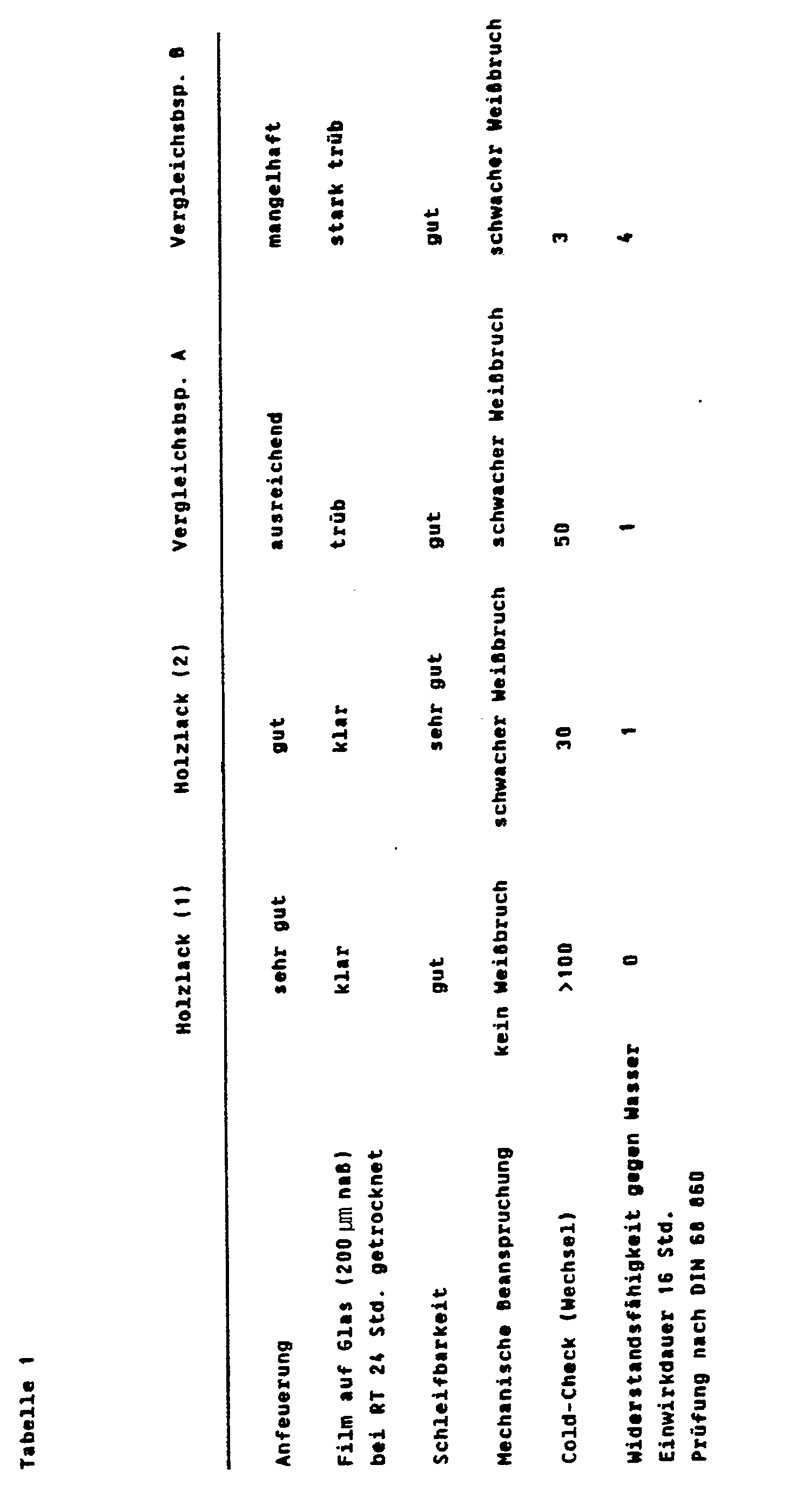
80 Teile einer 35%igen wäßrigen Polyethylenwachsdispersion. - Die mit diesem Dispersionslack (1) erzielten Ergebnisse sind in Tabelle 1 zusammengefaßt.
- Zu einer Paste aus
30 Teilen Propylenglykolmonobutylether,
30 Teilen Ethyldiglykol,
10 Teilen 3,3,5-Trimethylpentan-1,3-diol-isobutyrat,
30 Teilen Butyldiglykol,
10 Teilen Soja-Lecithin,
5 Teilen handelsüblichen Entschäumer auf Mineralölbasis,
5 Teilen eines mit 35 Mol Propylenoxyd und 5 Mol Ethylenoxyd oxalkylierten C₁₆-C₁₉-Oxoalkohols,
25 Teilen Wasser,
10 Teilen handelsüblichem Mattierungsmittel auf Siliciumdioxidbasis gibt man unter langsamem Rühren
370 Teile Dispersion (2),
370 Teile Dispersion (b) und
80 Teile einer 35%igen wäßrigen Paraffinwachs-Emulsion (Erweichungspunkt 70-130°C). - Die mit diesem Dispersionslack (2) erzielten Ergebnisse sind in Tabelle 1 zusammgenfaßt.
- Man stellt, wie unter Holzlack (1) angegeben, einen Holzlack her, verwendet aber an Stelle der Dispersion (1) die gleiche Menge der Dispersion des Vergleichsbeispiels.
- Die mit diesem Holzlack erhaltenen Ergebnisse sind in Tabelle 1 zusammengefaßt.
- Man stellt, wie unter Holzlack (2) angegeben, einen Holzlack her, verwendet aber an Stelle der Dispersion (2) die Dispersion aus dem Vergleichsbeispiel.
- Die mit diesem Holzlack erhaltenen Ergebnisse sind in Tabelle 1 zusammengefaßt.
Claims (2)
mindestens 37,5 Gew.% Methylmethacrylat,
14,75 - 62,5 Gew.% n-Butylmethacrylat und/oder Iso-Butylmethacrylat,
1-5 Gew.% 3-6 C-Atome enthaltende α,β-monoolefinisch ungesättigte Mono- und/oder Dicarbonsäuren und
0-5 Gew.% Amide 3-5 C-Atome enthaltender α,β-monoolefinisch ungesättigter Mono- und/oder Dicarbonsäuren
in wäßriger Emulsion polymerisiert, wobei in einer ersten Stufe
80,75-35 Gew.% Methylmethacrylat,
25,5-2,5 Gew.% der Butylmethacrylate,
1-5 Gew.% der olefinisch ungesättigten Carbonsäuren und
0-5 Gew.% der olefinisch ungesättigten Carbonsäureamide
und in einer zweiten Stufe
15-0,75 Gew.% Methylmethacrylat,
47,5-10,5 Gew.% der Butylmethacrylate,
1-5 Gew.% der olefinisch ungesättigten Carbonsäuren und
0-5 Gew.% der olefinisch ungesättigten Carbonsäureamide
polymerisiert werden, derart, daß die Dispersion eine Mindestfilmbilde-Temperatur von 65-110°C und einen Lichtdurchlässigkeitswert von mindestens 85% hat und die Gewichtsprozente jeweils auf die gesamten Monomeren bezogen sind.
Priority Applications (1)
| Application Number | Priority Date | Filing Date | Title |
|---|---|---|---|
| AT89103443T ATE69244T1 (de) | 1988-03-08 | 1989-02-28 | Herstellung von waessrigen polyalkylmethacrylatdispersionen durch emulsionspolymerisation in zwei stufen und deren verwendung in holzlacken. |
Applications Claiming Priority (2)
| Application Number | Priority Date | Filing Date | Title |
|---|---|---|---|
| DE3807531 | 1988-03-08 | ||
| DE3807531A DE3807531A1 (de) | 1988-03-08 | 1988-03-08 | Herstellung von waessrigen polyalkylmethacrylat-dispersionen durch emulsionspolymerisation in zwei stufen und deren verwendung in holzlacken |
Publications (2)
| Publication Number | Publication Date |
|---|---|
| EP0332011A1 EP0332011A1 (de) | 1989-09-13 |
| EP0332011B1 true EP0332011B1 (de) | 1991-11-06 |
Family
ID=6349132
Family Applications (1)
| Application Number | Title | Priority Date | Filing Date |
|---|---|---|---|
| EP89103443A Expired - Lifetime EP0332011B1 (de) | 1988-03-08 | 1989-02-28 | Herstellung von wässrigen Polyalkylmethacrylat-Dispersionen durch Emulsionspolymerisation in zwei Stufen und deren Verwendung in Holzlacken |
Country Status (8)
| Country | Link |
|---|---|
| EP (1) | EP0332011B1 (de) |
| JP (1) | JPH026511A (de) |
| AT (1) | ATE69244T1 (de) |
| AU (1) | AU3106489A (de) |
| DE (2) | DE3807531A1 (de) |
| DK (1) | DK108689A (de) |
| ES (1) | ES2026707T3 (de) |
| FI (1) | FI891101L (de) |
Families Citing this family (15)
| Publication number | Priority date | Publication date | Assignee | Title |
|---|---|---|---|---|
| DE3841540A1 (de) * | 1988-12-09 | 1990-06-13 | Basf Lacke & Farben | Verfahren zur herstellung eines mehrschichtigen ueberzuges, wasserverduennbare beschichtungszusammensetzungen, wasserverduennbare emulsionspolymere und verfahren zur herstellung von wasserverduennbaren emulsionspolymeren |
| US5635564A (en) * | 1988-12-09 | 1997-06-03 | Basf Lacke + Farben, Ag | Preparation of a multicoat coating, water-thinnable coating compositions, water-thinnable emulsion polymers and preparation of water-thinnable emulsion polymers |
| DE3843965A1 (de) * | 1988-12-24 | 1990-07-12 | Roehm Gmbh | Mehrphasige, waessrige kunststoffdispersion und ihre verwendung in ueberzugsmittel |
| DE3902103A1 (de) * | 1989-01-25 | 1990-08-02 | Roehm Gmbh | Bindemittel fuer waessrige glanzfarben |
| US5035944A (en) * | 1989-11-13 | 1991-07-30 | Rohm And Haas Company | Method for treating substrates |
| DE3942804A1 (de) * | 1989-12-23 | 1991-06-27 | Basf Lacke & Farben | Verfahren zur herstellung eines mehrschichtigen ueberzuges |
| US5149729A (en) * | 1990-05-01 | 1992-09-22 | Ppg Industries, Inc. | Waterborne acrylic stain composition containing core-shell grafted polymers |
| BR9104402A (pt) * | 1991-10-10 | 1993-04-20 | Glasurit Do Brasil Limitada | Polimero de emulsao diluivel na agua,processo para a preparacao de um polimero de emulsao diluivel na agua,composicao de revestimento aquosa e emprego do polimero |
| DE4213964A1 (de) * | 1992-04-29 | 1993-11-04 | Basf Ag | Waessrige polymerisatdispersionen |
| DE4336206A1 (de) * | 1993-10-23 | 1995-04-27 | Hoechst Ag | Wäßrige selbstvernetzende Polyurethan-Vinyl-Hybrid-Dispersionen |
| DE4340648A1 (de) * | 1993-11-30 | 1995-06-01 | Hoechst Ag | Wäßrige Polymerdispersionen als Bindemittel für blockfeste, kratzfeste und chemikalienbeständige Beschichtungen |
| DE19609509B4 (de) * | 1996-03-11 | 2006-11-02 | Celanese Emulsions Gmbh | Wäßrige Polymerdispersionen als Bindemittel für elastische block- und kratzfeste Beschichtungen |
| AU771383B2 (en) * | 1998-12-08 | 2004-03-18 | Rohm And Haas Company | Dirt pickup resistant coating binder and coatings |
| KR100357961B1 (ko) * | 2000-08-04 | 2002-10-25 | 삼성에스디아이 주식회사 | 아크릴 에멀젼의 합성방법 |
| CN103601837B (zh) * | 2013-11-15 | 2015-10-28 | 杭州海维特化工科技有限公司 | 一种聚丙烯酸酯乳液及制备方法 |
Family Cites Families (2)
| Publication number | Priority date | Publication date | Assignee | Title |
|---|---|---|---|---|
| BE806279A (fr) * | 1972-11-16 | 1974-04-19 | Du Pont | Email acrylique thermodurcissable aqueux |
| US4385152A (en) * | 1979-11-06 | 1983-05-24 | Boyack Robert M | Acrylic polymer emulsion |
-
1988
- 1988-03-08 DE DE3807531A patent/DE3807531A1/de not_active Withdrawn
-
1989
- 1989-02-28 ES ES198989103443T patent/ES2026707T3/es not_active Expired - Lifetime
- 1989-02-28 EP EP89103443A patent/EP0332011B1/de not_active Expired - Lifetime
- 1989-02-28 DE DE8989103443T patent/DE58900423D1/de not_active Expired - Lifetime
- 1989-02-28 AT AT89103443T patent/ATE69244T1/de not_active IP Right Cessation
- 1989-03-06 JP JP1052195A patent/JPH026511A/ja active Pending
- 1989-03-07 DK DK108689A patent/DK108689A/da not_active Application Discontinuation
- 1989-03-07 AU AU31064/89A patent/AU3106489A/en not_active Abandoned
- 1989-03-08 FI FI891101A patent/FI891101L/fi not_active Application Discontinuation
Also Published As
| Publication number | Publication date |
|---|---|
| EP0332011A1 (de) | 1989-09-13 |
| ES2026707T3 (es) | 1992-05-01 |
| FI891101A7 (fi) | 1989-09-09 |
| DE58900423D1 (de) | 1991-12-12 |
| FI891101A0 (fi) | 1989-03-08 |
| DE3807531A1 (de) | 1989-09-21 |
| AU3106489A (en) | 1989-09-14 |
| DK108689D0 (da) | 1989-03-07 |
| ATE69244T1 (de) | 1991-11-15 |
| FI891101L (fi) | 1989-09-09 |
| JPH026511A (ja) | 1990-01-10 |
| DK108689A (da) | 1989-09-09 |
Similar Documents
| Publication | Publication Date | Title |
|---|---|---|
| EP0184091B1 (de) | Verfahren zur Herstellung von Polymer-Dispersionen, die blockfeste Filme bilden | |
| DE2605624C2 (de) | Verfahren zur Herstellung einer stabilen, wäßrigen Emulsion und ihre Verwendung | |
| EP0379892B1 (de) | Bindemittel für wässrige Glanzfarben | |
| EP0279067B1 (de) | Wässrige Polymerdispersionen für die Holzbeschichtung | |
| EP2324069B1 (de) | Monomermischung, polymer, beschichtungsmittel und verfahren zur herstellung einer beschichtung | |
| EP0121230A1 (de) | Crotonesterhaltige Copolymerisate, Verfahren zu ihrer Herstellung und ihre Verwendung als Verdicker in wässrigen Systemen sowie als Schlichtemittel | |
| DE2943030A1 (de) | Verfahren zur herstellung einer waessrigen emulsion eines mischpolymers | |
| DE19609509A1 (de) | Wäßrige Polymerdispersion als Bindemittel für elastische block- und kratzfeste Beschichtungen | |
| EP0332011A1 (de) | Herstellung von wässrigen Polyalkylmethacrylat-Dispersionen durch Emulsionspolymerisation in zwei Stufen und deren Verwendung in Holzlacken | |
| EP0473148A1 (de) | Wasserverdünnbares Copolymerisat, dessen Herstellung und Verwendung, sowie wässrige Überzugsmittel | |
| EP0575931B1 (de) | In Zweistufenfahrweise hergestellte Vinylpolymerisate und ihre Verwendung als Lackbindemittel | |
| DE3024368C2 (de) | Überzugsmasse auf der Basis eines wäßrigen Mediums | |
| EP0655481B1 (de) | Verfahren zur Herstellung von wässrige Polymerdispersionen die als Bindemittel für blockfeste, kratzfeste und chemikalienbeständige Beschichtungen geeignet sind | |
| DE3235043A1 (de) | Waermehaertbare kationische acryllatexzusammensetzung und ihre verwendung | |
| DE60127149T2 (de) | WÄSSRIGE DISPERSION von ADDITIONSPOLYMERTEILCHEN | |
| EP0022514B1 (de) | Wässrige Dispersion auf Grundlage von (Meth-)Acrylsäurederivaten, ihre Herstellung und Verwendung | |
| WO1995009896A1 (de) | Wässrige polymerisatzubereitungen | |
| DE2934086A1 (de) | Emulsionspolymerisat mit verdickungswirkung im sauren bereich | |
| EP0960889B1 (de) | Phosphat- oder Phosphonatgruppen enthaltende Bindemittel für den Korrosionsschutz | |
| DE2547970C2 (de) | Filmbildende wäßrige Kunststoffdispersionen und ihre Verwendung als Bindemittel für wäßrige Anstrichfarben | |
| DE3234992A1 (de) | Verfahren zur herstellung eines bestaendigen kationischen acryllatex und dessen verwendung | |
| EP0070498B1 (de) | Wässrige Kunststoff-Dispersion, Verfahren zu ihrer Herstellung und Verwendung dieser Dispersion | |
| DE3303930A1 (de) | Verwendung einer waessrigen poly(meth)acrylat-sekundaerdispersion als verdickendes bindemittel fuer buntsteinputz | |
| DE1264066B (de) | Verfahren zur Herstellung von waessriger Copolymerisatsalzloesungen | |
| CA2155779A1 (en) | Aqueous polymer dispersions for coating wood |
Legal Events
| Date | Code | Title | Description |
|---|---|---|---|
| PUAI | Public reference made under article 153(3) epc to a published international application that has entered the european phase |
Free format text: ORIGINAL CODE: 0009012 |
|
| AK | Designated contracting states |
Kind code of ref document: A1 Designated state(s): AT BE CH DE ES FR GB IT LI NL SE |
|
| 17P | Request for examination filed |
Effective date: 19890729 |
|
| 17Q | First examination report despatched |
Effective date: 19910319 |
|
| GRAA | (expected) grant |
Free format text: ORIGINAL CODE: 0009210 |
|
| AK | Designated contracting states |
Kind code of ref document: B1 Designated state(s): AT BE CH DE ES FR GB IT LI NL SE |
|
| REF | Corresponds to: |
Ref document number: 69244 Country of ref document: AT Date of ref document: 19911115 Kind code of ref document: T |
|
| ITF | It: translation for a ep patent filed | ||
| REF | Corresponds to: |
Ref document number: 58900423 Country of ref document: DE Date of ref document: 19911212 |
|
| GBT | Gb: translation of ep patent filed (gb section 77(6)(a)/1977) | ||
| ET | Fr: translation filed | ||
| REG | Reference to a national code |
Ref country code: ES Ref legal event code: FG2A Ref document number: 2026707 Country of ref document: ES Kind code of ref document: T3 |
|
| PLBE | No opposition filed within time limit |
Free format text: ORIGINAL CODE: 0009261 |
|
| STAA | Information on the status of an ep patent application or granted ep patent |
Free format text: STATUS: NO OPPOSITION FILED WITHIN TIME LIMIT |
|
| 26N | No opposition filed | ||
| EAL | Se: european patent in force in sweden |
Ref document number: 89103443.1 |
|
| PGFP | Annual fee paid to national office [announced via postgrant information from national office to epo] |
Ref country code: CH Payment date: 19980204 Year of fee payment: 10 Ref country code: AT Payment date: 19980204 Year of fee payment: 10 |
|
| PGFP | Annual fee paid to national office [announced via postgrant information from national office to epo] |
Ref country code: ES Payment date: 19980213 Year of fee payment: 10 |
|
| PGFP | Annual fee paid to national office [announced via postgrant information from national office to epo] |
Ref country code: BE Payment date: 19980217 Year of fee payment: 10 |
|
| PG25 | Lapsed in a contracting state [announced via postgrant information from national office to epo] |
Ref country code: LI Free format text: LAPSE BECAUSE OF NON-PAYMENT OF DUE FEES Effective date: 19990228 Ref country code: CH Free format text: LAPSE BECAUSE OF NON-PAYMENT OF DUE FEES Effective date: 19990228 Ref country code: BE Free format text: LAPSE BECAUSE OF NON-PAYMENT OF DUE FEES Effective date: 19990228 Ref country code: AT Free format text: LAPSE BECAUSE OF NON-PAYMENT OF DUE FEES Effective date: 19990228 |
|
| PG25 | Lapsed in a contracting state [announced via postgrant information from national office to epo] |
Ref country code: ES Free format text: LAPSE BECAUSE OF NON-PAYMENT OF DUE FEES Effective date: 19990301 |
|
| BERE | Be: lapsed |
Owner name: BASF A.G. Effective date: 19990228 |
|
| REG | Reference to a national code |
Ref country code: CH Ref legal event code: PL |
|
| PGFP | Annual fee paid to national office [announced via postgrant information from national office to epo] |
Ref country code: DE Payment date: 19991223 Year of fee payment: 12 |
|
| PGFP | Annual fee paid to national office [announced via postgrant information from national office to epo] |
Ref country code: FR Payment date: 20000125 Year of fee payment: 12 |
|
| PGFP | Annual fee paid to national office [announced via postgrant information from national office to epo] |
Ref country code: SE Payment date: 20000126 Year of fee payment: 12 |
|
| PGFP | Annual fee paid to national office [announced via postgrant information from national office to epo] |
Ref country code: NL Payment date: 20000204 Year of fee payment: 12 |
|
| PGFP | Annual fee paid to national office [announced via postgrant information from national office to epo] |
Ref country code: GB Payment date: 20000215 Year of fee payment: 12 |
|
| PG25 | Lapsed in a contracting state [announced via postgrant information from national office to epo] |
Ref country code: DE Free format text: LAPSE BECAUSE OF THE APPLICANT RENOUNCES Effective date: 20010220 |
|
| PG25 | Lapsed in a contracting state [announced via postgrant information from national office to epo] |
Ref country code: GB Free format text: LAPSE BECAUSE OF NON-PAYMENT OF DUE FEES Effective date: 20010228 |
|
| PG25 | Lapsed in a contracting state [announced via postgrant information from national office to epo] |
Ref country code: SE Free format text: LAPSE BECAUSE OF NON-PAYMENT OF DUE FEES Effective date: 20010301 |
|
| PG25 | Lapsed in a contracting state [announced via postgrant information from national office to epo] |
Ref country code: NL Free format text: LAPSE BECAUSE OF NON-PAYMENT OF DUE FEES Effective date: 20010901 |
|
| GBPC | Gb: european patent ceased through non-payment of renewal fee |
Effective date: 20010228 |
|
| PG25 | Lapsed in a contracting state [announced via postgrant information from national office to epo] |
Ref country code: FR Free format text: LAPSE BECAUSE OF NON-PAYMENT OF DUE FEES Effective date: 20011031 |
|
| NLV4 | Nl: lapsed or anulled due to non-payment of the annual fee |
Effective date: 20010901 |
|
| REG | Reference to a national code |
Ref country code: ES Ref legal event code: FD2A Effective date: 20010810 |
|
| EUG | Se: european patent has lapsed |
Ref document number: 89103443.1 |
|
| REG | Reference to a national code |
Ref country code: FR Ref legal event code: ST |
|
| PG25 | Lapsed in a contracting state [announced via postgrant information from national office to epo] |
Ref country code: IT Free format text: LAPSE BECAUSE OF NON-PAYMENT OF DUE FEES;WARNING: LAPSES OF ITALIAN PATENTS WITH EFFECTIVE DATE BEFORE 2007 MAY HAVE OCCURRED AT ANY TIME BEFORE 2007. THE CORRECT EFFECTIVE DATE MAY BE DIFFERENT FROM THE ONE RECORDED. Effective date: 20050228 |