EP0347760B1 - Verwendung von wässrigen Kunststoffdispersionen - Google Patents
Verwendung von wässrigen Kunststoffdispersionen Download PDFInfo
- Publication number
- EP0347760B1 EP0347760B1 EP89110916A EP89110916A EP0347760B1 EP 0347760 B1 EP0347760 B1 EP 0347760B1 EP 89110916 A EP89110916 A EP 89110916A EP 89110916 A EP89110916 A EP 89110916A EP 0347760 B1 EP0347760 B1 EP 0347760B1
- Authority
- EP
- European Patent Office
- Prior art keywords
- dispersion
- weight
- emulsion
- sodium
- formulation
- Prior art date
- Legal status (The legal status is an assumption and is not a legal conclusion. Google has not performed a legal analysis and makes no representation as to the accuracy of the status listed.)
- Expired - Lifetime
Links
- 239000006185 dispersion Substances 0.000 title claims abstract description 64
- 229920000642 polymer Polymers 0.000 title abstract description 10
- 239000000839 emulsion Substances 0.000 claims abstract description 24
- 239000013543 active substance Substances 0.000 claims abstract description 12
- 239000003995 emulsifying agent Substances 0.000 claims abstract description 12
- 239000003973 paint Substances 0.000 claims abstract description 9
- 239000002904 solvent Substances 0.000 claims abstract description 9
- NIXOWILDQLNWCW-UHFFFAOYSA-N acrylic acid group Chemical group C(C=C)(=O)O NIXOWILDQLNWCW-UHFFFAOYSA-N 0.000 claims abstract description 8
- 229920002554 vinyl polymer Polymers 0.000 claims abstract description 5
- 229920000058 polyacrylate Polymers 0.000 claims abstract description 4
- 230000000903 blocking effect Effects 0.000 claims description 15
- 239000004922 lacquer Substances 0.000 claims description 10
- UFHFLCQGNIYNRP-UHFFFAOYSA-N Hydrogen Chemical compound [H][H] UFHFLCQGNIYNRP-UHFFFAOYSA-N 0.000 claims description 5
- ULUAUXLGCMPNKK-UHFFFAOYSA-N Sulfobutanedioic acid Chemical class OC(=O)CC(C(O)=O)S(O)(=O)=O ULUAUXLGCMPNKK-UHFFFAOYSA-N 0.000 claims description 5
- 229910052783 alkali metal Inorganic materials 0.000 claims description 4
- 125000000217 alkyl group Chemical group 0.000 claims description 4
- 229910052739 hydrogen Inorganic materials 0.000 claims description 3
- 239000001257 hydrogen Substances 0.000 claims description 3
- 150000001340 alkali metals Chemical group 0.000 claims description 2
- 125000002877 alkyl aryl group Chemical group 0.000 claims description 2
- 239000007767 bonding agent Substances 0.000 claims 1
- -1 N-substituted sulphosuccinamides Chemical class 0.000 abstract description 22
- 229920001577 copolymer Polymers 0.000 abstract description 5
- 229920001519 homopolymer Polymers 0.000 abstract description 5
- 239000011230 binding agent Substances 0.000 abstract description 3
- 239000000203 mixture Substances 0.000 description 46
- XLYOFNOQVPJJNP-UHFFFAOYSA-N water Substances O XLYOFNOQVPJJNP-UHFFFAOYSA-N 0.000 description 29
- 239000000178 monomer Substances 0.000 description 27
- 238000009472 formulation Methods 0.000 description 26
- 229920003023 plastic Polymers 0.000 description 22
- 239000004033 plastic Substances 0.000 description 22
- CHQMHPLRPQMAMX-UHFFFAOYSA-L sodium persulfate Chemical compound [Na+].[Na+].[O-]S(=O)(=O)OOS([O-])(=O)=O CHQMHPLRPQMAMX-UHFFFAOYSA-L 0.000 description 16
- CQEYYJKEWSMYFG-UHFFFAOYSA-N butyl acrylate Chemical compound CCCCOC(=O)C=C CQEYYJKEWSMYFG-UHFFFAOYSA-N 0.000 description 10
- VVQNEPGJFQJSBK-UHFFFAOYSA-N Methyl methacrylate Chemical compound COC(=O)C(C)=C VVQNEPGJFQJSBK-UHFFFAOYSA-N 0.000 description 9
- PPBRXRYQALVLMV-UHFFFAOYSA-N Styrene Chemical class C=CC1=CC=CC=C1 PPBRXRYQALVLMV-UHFFFAOYSA-N 0.000 description 9
- 239000000654 additive Substances 0.000 description 9
- 238000000576 coating method Methods 0.000 description 9
- 238000004519 manufacturing process Methods 0.000 description 9
- 229910052708 sodium Inorganic materials 0.000 description 9
- 239000011734 sodium Substances 0.000 description 9
- QGZKDVFQNNGYKY-UHFFFAOYSA-N Ammonia Chemical compound N QGZKDVFQNNGYKY-UHFFFAOYSA-N 0.000 description 8
- CERQOIWHTDAKMF-UHFFFAOYSA-N Methacrylic acid Chemical compound CC(=C)C(O)=O CERQOIWHTDAKMF-UHFFFAOYSA-N 0.000 description 7
- 230000000996 additive effect Effects 0.000 description 7
- 125000004432 carbon atom Chemical group C* 0.000 description 7
- 239000013530 defoamer Substances 0.000 description 7
- 238000000034 method Methods 0.000 description 7
- 238000006116 polymerization reaction Methods 0.000 description 7
- 150000003839 salts Chemical class 0.000 description 7
- DGAQECJNVWCQMB-PUAWFVPOSA-M Ilexoside XXIX Chemical compound C[C@@H]1CC[C@@]2(CC[C@@]3(C(=CC[C@H]4[C@]3(CC[C@@H]5[C@@]4(CC[C@@H](C5(C)C)OS(=O)(=O)[O-])C)C)[C@@H]2[C@]1(C)O)C)C(=O)O[C@H]6[C@@H]([C@H]([C@@H]([C@H](O6)CO)O)O)O.[Na+] DGAQECJNVWCQMB-PUAWFVPOSA-M 0.000 description 6
- HEMHJVSKTPXQMS-UHFFFAOYSA-M Sodium hydroxide Chemical compound [OH-].[Na+] HEMHJVSKTPXQMS-UHFFFAOYSA-M 0.000 description 6
- 238000006243 chemical reaction Methods 0.000 description 6
- 239000003999 initiator Substances 0.000 description 6
- 239000002966 varnish Substances 0.000 description 6
- IAYPIBMASNFSPL-UHFFFAOYSA-N Ethylene oxide Chemical compound C1CO1 IAYPIBMASNFSPL-UHFFFAOYSA-N 0.000 description 5
- 150000002762 monocarboxylic acid derivatives Chemical class 0.000 description 5
- 229920001567 vinyl ester resin Polymers 0.000 description 5
- 229910019142 PO4 Inorganic materials 0.000 description 4
- QAOWNCQODCNURD-UHFFFAOYSA-L Sulfate Chemical compound [O-]S([O-])(=O)=O QAOWNCQODCNURD-UHFFFAOYSA-L 0.000 description 4
- ROOXNKNUYICQNP-UHFFFAOYSA-N ammonium persulfate Chemical compound [NH4+].[NH4+].[O-]S(=O)(=O)OOS([O-])(=O)=O ROOXNKNUYICQNP-UHFFFAOYSA-N 0.000 description 4
- 239000012935 ammoniumperoxodisulfate Substances 0.000 description 4
- 150000001990 dicarboxylic acid derivatives Chemical class 0.000 description 4
- 230000009477 glass transition Effects 0.000 description 4
- NBIIXXVUZAFLBC-UHFFFAOYSA-K phosphate Chemical compound [O-]P([O-])([O-])=O NBIIXXVUZAFLBC-UHFFFAOYSA-K 0.000 description 4
- 239000010452 phosphate Substances 0.000 description 4
- HRPVXLWXLXDGHG-UHFFFAOYSA-N Acrylamide Chemical compound NC(=O)C=C HRPVXLWXLXDGHG-UHFFFAOYSA-N 0.000 description 3
- NIXOWILDQLNWCW-UHFFFAOYSA-M Acrylate Chemical compound [O-]C(=O)C=C NIXOWILDQLNWCW-UHFFFAOYSA-M 0.000 description 3
- 108010015776 Glucose oxidase Proteins 0.000 description 3
- GWEVSGVZZGPLCZ-UHFFFAOYSA-N Titan oxide Chemical compound O=[Ti]=O GWEVSGVZZGPLCZ-UHFFFAOYSA-N 0.000 description 3
- 229910021529 ammonia Inorganic materials 0.000 description 3
- VXIVSQZSERGHQP-UHFFFAOYSA-N chloroacetamide Chemical compound NC(=O)CCl VXIVSQZSERGHQP-UHFFFAOYSA-N 0.000 description 3
- 238000004806 packaging method and process Methods 0.000 description 3
- 239000000049 pigment Substances 0.000 description 3
- 238000003756 stirring Methods 0.000 description 3
- DNIAPMSPPWPWGF-GSVOUGTGSA-N (R)-(-)-Propylene glycol Chemical compound C[C@@H](O)CO DNIAPMSPPWPWGF-GSVOUGTGSA-N 0.000 description 2
- OAYXUHPQHDHDDZ-UHFFFAOYSA-N 2-(2-butoxyethoxy)ethanol Chemical compound CCCCOCCOCCO OAYXUHPQHDHDDZ-UHFFFAOYSA-N 0.000 description 2
- SMZOUWXMTYCWNB-UHFFFAOYSA-N 2-(2-methoxy-5-methylphenyl)ethanamine Chemical compound COC1=CC=C(C)C=C1CCN SMZOUWXMTYCWNB-UHFFFAOYSA-N 0.000 description 2
- PXWASTUQOKUFKY-UHFFFAOYSA-N 2-(methylamino)propan-1-ol Chemical compound CNC(C)CO PXWASTUQOKUFKY-UHFFFAOYSA-N 0.000 description 2
- NECRQCBKTGZNMH-UHFFFAOYSA-N 3,5-dimethylhex-1-yn-3-ol Chemical compound CC(C)CC(C)(O)C#C NECRQCBKTGZNMH-UHFFFAOYSA-N 0.000 description 2
- JSGVZVOGOQILFM-UHFFFAOYSA-N 3-methoxy-1-butanol Chemical compound COC(C)CCO JSGVZVOGOQILFM-UHFFFAOYSA-N 0.000 description 2
- 239000004925 Acrylic resin Substances 0.000 description 2
- 229920000178 Acrylic resin Polymers 0.000 description 2
- QGZKDVFQNNGYKY-UHFFFAOYSA-O Ammonium Chemical compound [NH4+] QGZKDVFQNNGYKY-UHFFFAOYSA-O 0.000 description 2
- GAWIXWVDTYZWAW-UHFFFAOYSA-N C[CH]O Chemical group C[CH]O GAWIXWVDTYZWAW-UHFFFAOYSA-N 0.000 description 2
- QXNVGIXVLWOKEQ-UHFFFAOYSA-N Disodium Chemical compound [Na][Na] QXNVGIXVLWOKEQ-UHFFFAOYSA-N 0.000 description 2
- LFQSCWFLJHTTHZ-UHFFFAOYSA-N EtOH Substances CCO LFQSCWFLJHTTHZ-UHFFFAOYSA-N 0.000 description 2
- 239000005977 Ethylene Substances 0.000 description 2
- VZCYOOQTPOCHFL-OWOJBTEDSA-N Fumaric acid Chemical compound OC(=O)\C=C\C(O)=O VZCYOOQTPOCHFL-OWOJBTEDSA-N 0.000 description 2
- OAKJQQAXSVQMHS-UHFFFAOYSA-N Hydrazine Chemical compound NN OAKJQQAXSVQMHS-UHFFFAOYSA-N 0.000 description 2
- XEEYBQQBJWHFJM-UHFFFAOYSA-N Iron Chemical compound [Fe] XEEYBQQBJWHFJM-UHFFFAOYSA-N 0.000 description 2
- BAPJBEWLBFYGME-UHFFFAOYSA-N Methyl acrylate Chemical compound COC(=O)C=C BAPJBEWLBFYGME-UHFFFAOYSA-N 0.000 description 2
- XTXRWKRVRITETP-UHFFFAOYSA-N Vinyl acetate Chemical compound CC(=O)OC=C XTXRWKRVRITETP-UHFFFAOYSA-N 0.000 description 2
- 239000002253 acid Substances 0.000 description 2
- 239000000853 adhesive Substances 0.000 description 2
- 230000001070 adhesive effect Effects 0.000 description 2
- 150000001298 alcohols Chemical class 0.000 description 2
- XYLMUPLGERFSHI-UHFFFAOYSA-N alpha-Methylstyrene Chemical compound CC(=C)C1=CC=CC=C1 XYLMUPLGERFSHI-UHFFFAOYSA-N 0.000 description 2
- 239000012736 aqueous medium Substances 0.000 description 2
- 230000015572 biosynthetic process Effects 0.000 description 2
- 230000000694 effects Effects 0.000 description 2
- KJXHESLMVDKXGI-UHFFFAOYSA-N ethanol;oxirane Chemical compound CCO.C1CO1 KJXHESLMVDKXGI-UHFFFAOYSA-N 0.000 description 2
- 239000011521 glass Substances 0.000 description 2
- 125000002496 methyl group Chemical group [H]C([H])([H])* 0.000 description 2
- 238000002156 mixing Methods 0.000 description 2
- DNIAPMSPPWPWGF-UHFFFAOYSA-N monopropylene glycol Natural products CC(O)CO DNIAPMSPPWPWGF-UHFFFAOYSA-N 0.000 description 2
- 239000002245 particle Substances 0.000 description 2
- 239000004014 plasticizer Substances 0.000 description 2
- 235000013772 propylene glycol Nutrition 0.000 description 2
- 239000007787 solid Substances 0.000 description 2
- 150000003467 sulfuric acid derivatives Chemical class 0.000 description 2
- 239000004094 surface-active agent Substances 0.000 description 2
- 239000003760 tallow Substances 0.000 description 2
- ISXSCDLOGDJUNJ-UHFFFAOYSA-N tert-butyl prop-2-enoate Chemical compound CC(C)(C)OC(=O)C=C ISXSCDLOGDJUNJ-UHFFFAOYSA-N 0.000 description 2
- CIHOLLKRGTVIJN-UHFFFAOYSA-N tert‐butyl hydroperoxide Chemical compound CC(C)(C)OO CIHOLLKRGTVIJN-UHFFFAOYSA-N 0.000 description 2
- VZCYOOQTPOCHFL-UHFFFAOYSA-N trans-butenedioic acid Natural products OC(=O)C=CC(O)=O VZCYOOQTPOCHFL-UHFFFAOYSA-N 0.000 description 2
- ZZKZWXLCGQPRIM-UHFFFAOYSA-N (4-amino-4-oxobutanoyl)-octadecylsulfamic acid;sodium Chemical compound [Na].[Na].CCCCCCCCCCCCCCCCCCN(S(O)(=O)=O)C(=O)CCC(N)=O ZZKZWXLCGQPRIM-UHFFFAOYSA-N 0.000 description 1
- NVZWEEGUWXZOKI-UHFFFAOYSA-N 1-ethenyl-2-methylbenzene Chemical compound CC1=CC=CC=C1C=C NVZWEEGUWXZOKI-UHFFFAOYSA-N 0.000 description 1
- JAHNSTQSQJOJLO-UHFFFAOYSA-N 2-(3-fluorophenyl)-1h-imidazole Chemical compound FC1=CC=CC(C=2NC=CN=2)=C1 JAHNSTQSQJOJLO-UHFFFAOYSA-N 0.000 description 1
- UDOWZUNBRDYSPG-UHFFFAOYSA-N 2-[4-amino-1-(octadecylamino)-1,4-dioxo-2-sulfobutan-2-yl]butanedioic acid Chemical compound CCCCCCCCCCCCCCCCCCNC(=O)C(CC(N)=O)(S(O)(=O)=O)C(CC(O)=O)C(O)=O UDOWZUNBRDYSPG-UHFFFAOYSA-N 0.000 description 1
- FHENGCFKEDIEPW-UHFFFAOYSA-N 4-amino-1-(dodecylamino)-1,4-dioxobutane-2-sulfonic acid;sodium Chemical compound [Na].[Na].CCCCCCCCCCCCNC(=O)C(S(O)(=O)=O)CC(N)=O FHENGCFKEDIEPW-UHFFFAOYSA-N 0.000 description 1
- OAOABCKPVCUNKO-UHFFFAOYSA-N 8-methyl Nonanoic acid Chemical compound CC(C)CCCCCCC(O)=O OAOABCKPVCUNKO-UHFFFAOYSA-N 0.000 description 1
- OMPJBNCRMGITSC-UHFFFAOYSA-N Benzoylperoxide Chemical compound C=1C=CC=CC=1C(=O)OOC(=O)C1=CC=CC=C1 OMPJBNCRMGITSC-UHFFFAOYSA-N 0.000 description 1
- 101100117236 Drosophila melanogaster speck gene Proteins 0.000 description 1
- JIGUQPWFLRLWPJ-UHFFFAOYSA-N Ethyl acrylate Chemical compound CCOC(=O)C=C JIGUQPWFLRLWPJ-UHFFFAOYSA-N 0.000 description 1
- AVXURJPOCDRRFD-UHFFFAOYSA-N Hydroxylamine Chemical compound ON AVXURJPOCDRRFD-UHFFFAOYSA-N 0.000 description 1
- IGFHQQFPSIBGKE-UHFFFAOYSA-N Nonylphenol Natural products CCCCCCCCCC1=CC=C(O)C=C1 IGFHQQFPSIBGKE-UHFFFAOYSA-N 0.000 description 1
- OFOBLEOULBTSOW-UHFFFAOYSA-N Propanedioic acid Natural products OC(=O)CC(O)=O OFOBLEOULBTSOW-UHFFFAOYSA-N 0.000 description 1
- DBMJMQXJHONAFJ-UHFFFAOYSA-M Sodium laurylsulphate Chemical compound [Na+].CCCCCCCCCCCCOS([O-])(=O)=O DBMJMQXJHONAFJ-UHFFFAOYSA-M 0.000 description 1
- NINIDFKCEFEMDL-UHFFFAOYSA-N Sulfur Chemical compound [S] NINIDFKCEFEMDL-UHFFFAOYSA-N 0.000 description 1
- OUQBWKJHTODQRM-UHFFFAOYSA-K [Na+].C(C)(=O)[O-].C(C)(=O)[O-].C(C)(=O)[O-].C(CCCCCCCCCCCCCCCCC)NCCN.[Na+].[Na+] Chemical compound [Na+].C(C)(=O)[O-].C(C)(=O)[O-].C(C)(=O)[O-].C(CCCCCCCCCCCCCCCCC)NCCN.[Na+].[Na+] OUQBWKJHTODQRM-UHFFFAOYSA-K 0.000 description 1
- 150000007513 acids Chemical class 0.000 description 1
- 239000012190 activator Substances 0.000 description 1
- 229920000180 alkyd Polymers 0.000 description 1
- 125000000129 anionic group Chemical group 0.000 description 1
- 125000005228 aryl sulfonate group Chemical group 0.000 description 1
- 235000019400 benzoyl peroxide Nutrition 0.000 description 1
- 229910052799 carbon Inorganic materials 0.000 description 1
- 150000001735 carboxylic acids Chemical class 0.000 description 1
- 239000003638 chemical reducing agent Substances 0.000 description 1
- 239000003795 chemical substances by application Substances 0.000 description 1
- 230000015271 coagulation Effects 0.000 description 1
- 238000005345 coagulation Methods 0.000 description 1
- 239000011248 coating agent Substances 0.000 description 1
- 239000008199 coating composition Substances 0.000 description 1
- 229910017052 cobalt Inorganic materials 0.000 description 1
- 239000010941 cobalt Substances 0.000 description 1
- GUTLYIVDDKVIGB-UHFFFAOYSA-N cobalt atom Chemical compound [Co] GUTLYIVDDKVIGB-UHFFFAOYSA-N 0.000 description 1
- 239000003086 colorant Substances 0.000 description 1
- 239000012141 concentrate Substances 0.000 description 1
- 239000000470 constituent Substances 0.000 description 1
- 238000001816 cooling Methods 0.000 description 1
- LDHQCZJRKDOVOX-NSCUHMNNSA-N crotonic acid Chemical compound C\C=C\C(O)=O LDHQCZJRKDOVOX-NSCUHMNNSA-N 0.000 description 1
- 230000007547 defect Effects 0.000 description 1
- 239000004815 dispersion polymer Substances 0.000 description 1
- 238000001035 drying Methods 0.000 description 1
- 238000007720 emulsion polymerization reaction Methods 0.000 description 1
- 230000007613 environmental effect Effects 0.000 description 1
- 150000002148 esters Chemical class 0.000 description 1
- RTZKZFJDLAIYFH-UHFFFAOYSA-N ether Substances CCOCC RTZKZFJDLAIYFH-UHFFFAOYSA-N 0.000 description 1
- 150000002191 fatty alcohols Chemical class 0.000 description 1
- 239000000945 filler Substances 0.000 description 1
- 239000001530 fumaric acid Substances 0.000 description 1
- 239000003292 glue Substances 0.000 description 1
- 238000010438 heat treatment Methods 0.000 description 1
- 238000005470 impregnation Methods 0.000 description 1
- 238000010348 incorporation Methods 0.000 description 1
- 239000004615 ingredient Substances 0.000 description 1
- 229910052742 iron Inorganic materials 0.000 description 1
- VZCYOOQTPOCHFL-UPHRSURJSA-N maleic acid Chemical compound OC(=O)\C=C/C(O)=O VZCYOOQTPOCHFL-UPHRSURJSA-N 0.000 description 1
- 239000011976 maleic acid Substances 0.000 description 1
- FQPSGWSUVKBHSU-UHFFFAOYSA-N methacrylamide Chemical compound CC(=C)C(N)=O FQPSGWSUVKBHSU-UHFFFAOYSA-N 0.000 description 1
- LVHBHZANLOWSRM-UHFFFAOYSA-N methylenebutanedioic acid Natural products OC(=O)CC(=C)C(O)=O LVHBHZANLOWSRM-UHFFFAOYSA-N 0.000 description 1
- SNVLJLYUUXKWOJ-UHFFFAOYSA-N methylidenecarbene Chemical compound C=[C] SNVLJLYUUXKWOJ-UHFFFAOYSA-N 0.000 description 1
- 230000003472 neutralizing effect Effects 0.000 description 1
- SNQQPOLDUKLAAF-UHFFFAOYSA-N nonylphenol Chemical compound CCCCCCCCCC1=CC=CC=C1O SNQQPOLDUKLAAF-UHFFFAOYSA-N 0.000 description 1
- 150000001451 organic peroxides Chemical class 0.000 description 1
- JDBKXCSZIPHUBR-UHFFFAOYSA-N oxirane;sulfuric acid Chemical compound C1CO1.OS(O)(=O)=O JDBKXCSZIPHUBR-UHFFFAOYSA-N 0.000 description 1
- 238000010422 painting Methods 0.000 description 1
- PNJWIWWMYCMZRO-UHFFFAOYSA-N pent‐4‐en‐2‐one Natural products CC(=O)CC=C PNJWIWWMYCMZRO-UHFFFAOYSA-N 0.000 description 1
- JRKICGRDRMAZLK-UHFFFAOYSA-N peroxydisulfuric acid Chemical class OS(=O)(=O)OOS(O)(=O)=O JRKICGRDRMAZLK-UHFFFAOYSA-N 0.000 description 1
- 150000003014 phosphoric acid esters Chemical class 0.000 description 1
- 230000019612 pigmentation Effects 0.000 description 1
- 229920001495 poly(sodium acrylate) polymer Polymers 0.000 description 1
- 229920000151 polyglycol Polymers 0.000 description 1
- 239000010695 polyglycol Substances 0.000 description 1
- 229920002635 polyurethane Polymers 0.000 description 1
- 239000004814 polyurethane Substances 0.000 description 1
- 239000011148 porous material Substances 0.000 description 1
- 159000000001 potassium salts Chemical class 0.000 description 1
- HJWLCRVIBGQPNF-UHFFFAOYSA-N prop-2-enylbenzene Chemical compound C=CCC1=CC=CC=C1 HJWLCRVIBGQPNF-UHFFFAOYSA-N 0.000 description 1
- LYBIZMNPXTXVMV-UHFFFAOYSA-N propan-2-yl prop-2-enoate Chemical compound CC(C)OC(=O)C=C LYBIZMNPXTXVMV-UHFFFAOYSA-N 0.000 description 1
- HRZFUMHJMZEROT-UHFFFAOYSA-L sodium disulfite Chemical compound [Na+].[Na+].[O-]S(=O)S([O-])(=O)=O HRZFUMHJMZEROT-UHFFFAOYSA-L 0.000 description 1
- 235000019333 sodium laurylsulphate Nutrition 0.000 description 1
- 235000010262 sodium metabisulphite Nutrition 0.000 description 1
- NNMHYFLPFNGQFZ-UHFFFAOYSA-M sodium polyacrylate Chemical compound [Na+].[O-]C(=O)C=C NNMHYFLPFNGQFZ-UHFFFAOYSA-M 0.000 description 1
- 230000006641 stabilisation Effects 0.000 description 1
- 238000011105 stabilization Methods 0.000 description 1
- 229920001909 styrene-acrylic polymer Polymers 0.000 description 1
- 239000000126 substance Substances 0.000 description 1
- 229910052717 sulfur Inorganic materials 0.000 description 1
- QAOWNCQODCNURD-UHFFFAOYSA-N sulfuric acid Substances OS(O)(=O)=O QAOWNCQODCNURD-UHFFFAOYSA-N 0.000 description 1
- 239000004753 textile Substances 0.000 description 1
- 239000002562 thickening agent Substances 0.000 description 1
- 239000004408 titanium dioxide Substances 0.000 description 1
- LDHQCZJRKDOVOX-UHFFFAOYSA-N trans-crotonic acid Natural products CC=CC(O)=O LDHQCZJRKDOVOX-UHFFFAOYSA-N 0.000 description 1
- 229910052723 transition metal Inorganic materials 0.000 description 1
- 150000003624 transition metals Chemical class 0.000 description 1
- 229910052720 vanadium Inorganic materials 0.000 description 1
- LEONUFNNVUYDNQ-UHFFFAOYSA-N vanadium atom Chemical compound [V] LEONUFNNVUYDNQ-UHFFFAOYSA-N 0.000 description 1
- 125000000391 vinyl group Chemical group [H]C([*])=C([H])[H] 0.000 description 1
- 238000004383 yellowing Methods 0.000 description 1
Classifications
-
- C—CHEMISTRY; METALLURGY
- C09—DYES; PAINTS; POLISHES; NATURAL RESINS; ADHESIVES; COMPOSITIONS NOT OTHERWISE PROVIDED FOR; APPLICATIONS OF MATERIALS NOT OTHERWISE PROVIDED FOR
- C09D—COATING COMPOSITIONS, e.g. PAINTS, VARNISHES OR LACQUERS; FILLING PASTES; CHEMICAL PAINT OR INK REMOVERS; INKS; CORRECTING FLUIDS; WOODSTAINS; PASTES OR SOLIDS FOR COLOURING OR PRINTING; USE OF MATERIALS THEREFOR
- C09D5/00—Coating compositions, e.g. paints, varnishes or lacquers, characterised by their physical nature or the effects produced; Filling pastes
- C09D5/02—Emulsion paints including aerosols
-
- C—CHEMISTRY; METALLURGY
- C08—ORGANIC MACROMOLECULAR COMPOUNDS; THEIR PREPARATION OR CHEMICAL WORKING-UP; COMPOSITIONS BASED THEREON
- C08F—MACROMOLECULAR COMPOUNDS OBTAINED BY REACTIONS ONLY INVOLVING CARBON-TO-CARBON UNSATURATED BONDS
- C08F2/00—Processes of polymerisation
- C08F2/12—Polymerisation in non-solvents
- C08F2/16—Aqueous medium
- C08F2/22—Emulsion polymerisation
- C08F2/24—Emulsion polymerisation with the aid of emulsifying agents
- C08F2/26—Emulsion polymerisation with the aid of emulsifying agents anionic
-
- C—CHEMISTRY; METALLURGY
- C08—ORGANIC MACROMOLECULAR COMPOUNDS; THEIR PREPARATION OR CHEMICAL WORKING-UP; COMPOSITIONS BASED THEREON
- C08K—Use of inorganic or non-macromolecular organic substances as compounding ingredients
- C08K5/00—Use of organic ingredients
- C08K5/36—Sulfur-, selenium-, or tellurium-containing compounds
- C08K5/41—Compounds containing sulfur bound to oxygen
- C08K5/42—Sulfonic acids; Derivatives thereof
-
- C—CHEMISTRY; METALLURGY
- C09—DYES; PAINTS; POLISHES; NATURAL RESINS; ADHESIVES; COMPOSITIONS NOT OTHERWISE PROVIDED FOR; APPLICATIONS OF MATERIALS NOT OTHERWISE PROVIDED FOR
- C09D—COATING COMPOSITIONS, e.g. PAINTS, VARNISHES OR LACQUERS; FILLING PASTES; CHEMICAL PAINT OR INK REMOVERS; INKS; CORRECTING FLUIDS; WOODSTAINS; PASTES OR SOLIDS FOR COLOURING OR PRINTING; USE OF MATERIALS THEREFOR
- C09D5/00—Coating compositions, e.g. paints, varnishes or lacquers, characterised by their physical nature or the effects produced; Filling pastes
- C09D5/02—Emulsion paints including aerosols
- C09D5/024—Emulsion paints including aerosols characterised by the additives
- C09D5/027—Dispersing agents
-
- C—CHEMISTRY; METALLURGY
- C09—DYES; PAINTS; POLISHES; NATURAL RESINS; ADHESIVES; COMPOSITIONS NOT OTHERWISE PROVIDED FOR; APPLICATIONS OF MATERIALS NOT OTHERWISE PROVIDED FOR
- C09K—MATERIALS FOR MISCELLANEOUS APPLICATIONS, NOT PROVIDED FOR ELSEWHERE
- C09K23/00—Use of substances as emulsifying, wetting, dispersing, or foam-producing agents
-
- C—CHEMISTRY; METALLURGY
- C09—DYES; PAINTS; POLISHES; NATURAL RESINS; ADHESIVES; COMPOSITIONS NOT OTHERWISE PROVIDED FOR; APPLICATIONS OF MATERIALS NOT OTHERWISE PROVIDED FOR
- C09K—MATERIALS FOR MISCELLANEOUS APPLICATIONS, NOT PROVIDED FOR ELSEWHERE
- C09K23/00—Use of substances as emulsifying, wetting, dispersing, or foam-producing agents
- C09K23/10—Derivatives of low-molecular-weight sulfocarboxylic acids or sulfopolycarboxylic acids
-
- C—CHEMISTRY; METALLURGY
- C09—DYES; PAINTS; POLISHES; NATURAL RESINS; ADHESIVES; COMPOSITIONS NOT OTHERWISE PROVIDED FOR; APPLICATIONS OF MATERIALS NOT OTHERWISE PROVIDED FOR
- C09K—MATERIALS FOR MISCELLANEOUS APPLICATIONS, NOT PROVIDED FOR ELSEWHERE
- C09K23/00—Use of substances as emulsifying, wetting, dispersing, or foam-producing agents
- C09K23/22—Amides or hydrazides
Definitions
- the invention relates to the use of an aqueous plastic dispersion based on homopolymers and / or copolymers of acrylic and / or vinyl polymers as binders for producing block-resistant, non-adhesive, solvent-free or low-solvent dispersion paints.
- EP-PS 0 184 091 describes the production of a non-blocking plastic dispersion. However, the manufacturing process disclosed there is unusually complicated.
- aqueous acrylic resin dispersions are known from DE-A-1 804 159, which have various acrylic monomers and emulsifiers. These dispersions are mainly used for textile impregnation and therefore do not require high blocking resistance. Therefore, the preferred emulsifiers are also alkylphenol polyglycol ether sulfates and fatty alcohol sulfates, which do not affect the block temperature.
- the object of the invention is therefore to produce an aqueous plastic dispersion as a binder for the production of non-blocking, non-adhesive, solvent-free or low-solvent dispersion lacquers or dispersion gloss lacquers.
- the gloss coatings produced in this way should neither stick nor block at temperatures below 50 ° C.
- the invention relates in particular to the use of an aqueous plastic dispersion containing these active substances in a concentration from 0.05 to 5% by weight, preferably from 0.1 to 2% by weight, in particular from 0.15 to 0.5% by weight, based on the total amount of monomers of the plastic dispersions.
- the invention also relates in particular to the use of an aqueous plastic dispersion as a pre-concentrate for mixing the dispersion coatings which contain these active substances in a concentration from 5 to 25% by weight preferably from 7.5 to 15% by weight, and in particular from 9 to 12% by weight, approximately 10% by weight, based on the total amount of monomers of the plastic dispersions.
- the invention particularly relates to an aqueous plastic dispersion containing these active substances in a concentration from 0.05 to 5% by weight, preferably from 0.1 to 2% by weight, in particular from 0.15 to 1% by weight, based on the total amount of the emulsion paint formulation.
- the glass transition temperature Tg of these polymer dispersions prepared from the above monomer combination should have a value of below 50 ° C.
- the minimum film-forming temperature is preferably in a range between 0 and 30 ° C.
- the incorporation of unsaturated carboxylic acids (e) in the copolymer increases the stability of the dispersion.
- the polymer contains in particular 0.5 to 5, preferably 1 to 3% by weight of an alpha, beta-unsaturated monocarboxylic acid with preferably 4 or 5 carbon atoms and / or an unsaturated dicarboxylic acid with preferably 4 or 5 carbon atoms or a mixture thereof Monomer.
- Suitable acids are acrylic acid, methacrylic acid, crotonic acid, maleic acid, fumaric acid and itaconic acid. Acrylic acid and / or methacrylic acid are preferably used.
- the polymer also contains 0 to 4% by weight of an alpha-beta-unsaturated monocarboxylic acid amide and / or an unsaturated dicarboxylic acid amide or a mixture of such monomers. These monomers contribute to the stabilization during manufacture and processing. Their content also serves to set the desired particle size. 0.5 to 1.5% by weight are preferably used.
- the dispersion has a solids content of 30 to 60% by weight, preferably 40 to 50% by weight.
- it also contains one or more emulsifiers, at least one of which is an N-substituted sulfosuccinic acid amide of the stated formula or a salt thereof.
- Examples of usable anionic emulsifiers in addition to the N-substituted sulfosuccinic acid amides or their salts are alkali metal salts of partial sulfur or phosphoric acid esters of alcohols, oxyethylated alkylphenols or oxyethylated alcohols, and also alkyl or arylsulfonates. Salts of sulfosuccinic acid esters and esters are also suitable. Sulfosuccinic acid semiesters, alkanol sulfates and oxyethylated alkylphenol sulfates are preferred in an amount of 0.1 to 5% by weight, based on monomers (a) to (e) equal to 100, used.
- one or more non-ionic emulsifiers of the type of an oxyethylated alkylphenol or fatty alcohol e.g. Nonylphenol with 4 to 50 moles of ethylene oxide, in an amount of 0.1 to 5, preferably 0.5 to 2% by weight, based on the monomers (a) to (e) equal to 100.
- ammonium, sodium and potassium salts of peroxodisulfuric acid and peroxodiphosphoric acid are suitable as initiators.
- Organic peroxides and the like can also be used. such as dibenzoyl peroxide or tert-butyl hydroperoxide.
- Sodium disulfite, hydrazine, hydroxylamine and similar reducing agents can be used as activators.
- Salts of transition metals such as e.g. of cobalt, iron or vanadium.
- the polymerization process is carried out as an emulsion polymerization in an aqueous medium in known apparatus, such as a stirred kettle with a heating and cooling device.
- the monomers are emulsified in an aqueous medium.
- the monomers can be added in such a way that a solution of all the water, the emulsifier and part of the initiator is introduced and the monomer mixture and the rest of the initiator are added slowly at the polymerization temperature. It is also possible to introduce a portion of the water, the emulsifiers and the initiator, to prepare a pre-emulsion from the monomers, the remaining water, the remaining emulsifiers and the remaining initiator and to slowly feed this in at the polymerization temperature.
- the initial charge is heated and then the pre-emulsion or the monomer mixture is slowly fed in at the polymerization temperature in the course of 1 to 4 hours.
- the polymerization temperature is in a range from 50 to 100 ° C, preferably 80 to 95 ° C.
- the batch is stirred for a further 0.5 to 3 hours at 50 to 100 ° C., preferably at 80 to 95 ° C. to reduce the residual monomers.
- the polymers obtained by the polymerization process have glass transition temperatures in the range from 0 to + 60 ° C, preferably between +10 and + 40 ° C.
- the process leads to polymers which have an average particle size between 30 and 400 nm, preferably between 80 and 180 nm.
- the polymer dispersions obtained can be formulated into clear lacquers or into pigmented lacquers.
- a procedure is followed in which part or all of the required amount of dispersion is rubbed into a pigment paste using pigments and / or fillers and the customary coating auxiliaries and, if appropriate, neutralizing agents.
- only part of the dispersion is introduced and the remaining amount of dispersion is added after the pigment paste has been rubbed in.
- the dried pigmented or unpigmented Varnish films of the coating compositions produced on the basis of the polymer dispersion have an excellent flow.
- the often observed surface defects, for example crater formation, orange peel effect, shrinkage and stress cracks as well as speck and pore formation are not present.
- these lacquer films show good opacity, smoothness (slip effect), elasticity, gloss, adhesion, weather resistance and yellowing resistance.
- N-substituted sulfosuccinic acid amide or its ammonium or alkali metal salts are added before the polymerization of a plastic dispersion or a conventional dispersion is mixed with a second dispersion containing one or more N-substituted sulfosuccinic acid amides or their salts. It is also possible to add one or more N-substituted sulfosuccinic acid amides or their salts to a suitable conventional dispersion or to add these only when the gloss coatings are being prepared.
- methyl acrylate, ethyl acrylate and isopropyl acrylate together with the above-mentioned auxiliary monomers are used as the basis of the homopolymer dispersions.
- the blocking resistance is determined as follows. 300 ⁇ wet films are drawn onto Leneta (R) film with a splitting knife and then dried in a drying cabinet at 50 ° C. for 20 hours. The coated film will then cut into 1 cm wide longitudinal strips and these strips with their coated sides laid one on top of the other. These double strips are placed on a gradient bank that has a temperature gradient of 30 to 70 ° C. The double strips are loaded with 100 g.cm ⁇ 2 for three hours. The double strips are then removed from the bank, cooled to room temperature for thirty minutes and pulled apart by hand. The point at which the films stick together or have influenced one another by the appearance of their surface is determined. The temperature at this point on the gradient bank is defined as the "block temperature".
- a plastic dispersion (clear dispersion) was produced using the following process:
- the starting solution was heated to 80 ° C. without sodium peroxodisulfate, then the sodium peroxodisulfate solution was added.
- the feed of the pre-emulsion was started.
- the pre-emulsion was pumped into the reactor from 1/5 of the final feed rate increasing steadily up to the final feed rate.
- a constant stream of pre-emulsion was fed to the reactor.
- the pre-emulsion had been fed in and the reaction temperature had risen to 85-87 ° C. This was followed by a 90-minute post-reaction at 85-90 ° C.
- the mixture was then cooled and microcide was added at about 60 ° C.
- the pH was adjusted to 7.5 with sodium hydroxide solution and filtered through a 63 ⁇ sieve.
- Ingredients 1 to 10 were mixed in succession with stirring and then dispersed well with a dissolver for 20 minutes. The dispersion was then lacquered and the processing viscosity was adjusted using water.
- Gloss varnishes were produced according to formulation formulation No. 2. However, the additive was not added, but formulation No. 1 was previously mixed with 0.30% by weight of additives (A) to (O) and these dispersions were then used in formulation No. 2.
- a plastic dispersion is produced according to the following procedure:
- the starting solution was heated to 80 ° C. without ammonium peroxodisulfate, then the ammonium peroxodisulfate solution was added. As soon as the reactor temperature reached 80 ° C, the feed of the pre-emulsion was started.
- the pre-emulsion was pumped into the reactor from 1/5 of the final feed rate increasing steadily to the final feed rate. From the 45th minute, a constant stream of pre-emulsion was fed to the reactor. After 90 minutes, the pre-emulsion had been fed in and the reaction temperature had risen to 85-87 ° C. This was followed by a 30-minute post-reaction at 85-90 ° C. The mixture was then cooled, microcide was added at about 60 ° C. and filtered through a 63 ⁇ sieve.
- Formulation No. 1 described in Example 1 was admixed with 11, 25 and 43% by weight of formulation No. 3 and homogenized by stirring. The block temperature of the dispersion mixtures was then measured and gloss coatings according to formulation No. 2 described in Example 2, but without an additive, were prepared with these mixtures and the block temperature was also determined.
- a plastic dispersion was produced using the following procedure:
- the starting solution was heated to 80 ° C. without sodium peroxodisulfate, then the sodium peroxodisulfate solution was added.
- the feed of the pre-emulsion was started.
- the pre-emulsion was pumped into the reactor from 1/5 of the final feed rate increasing steadily up to the final feed rate.
- a constant stream of pre-emulsion was fed to the reactor.
- the pre-emulsion had been fed in and the reaction temperature had risen to 85-87 ° C. This was followed by a 90-minute post-reaction at 85-90 ° C.
- the mixture was then cooled and microcide was added at about 60 ° C.
- the pH was adjusted to 8.5 with ammonia, the mixture was filtered through a 63 ⁇ sieve and the blocking resistance was determined: Block resistance > 70 ° C
- Formulation No. 4 was used to produce a white lacquer according to the formulation of Formulation No. 2, but without an additive, and the blocking resistance was determined: Block resistance > 70 ° C
- Colored lacquers of formulation No. 5 were produced: (1) 2-methylamino propanol 2.0 g (2) 1,2-propanediol 35.0 g (3) Methoxybutanol 15.0 g (4) Butyl diglycol 7.5 g (5) Surfynol (R) 440 (ICI) 3.0 g (6) Polyurethane thickener 6.0 g (7) Color paste HF (R) (TENNECO) 100.0 g (8th) Dispersion 660.0 g (10) water 122.5 g
- the components (1) to (7) were mixed in succession with stirring and then dispersed well for 20 minutes using a dissolver. The dispersion was then lacquered and the processing viscosity was adjusted using water.
- Block resistance of the colored varnish example Block resistance (° C) 7a 68 7b > 70 7c > 70 7d ⁇ 30
Landscapes
- Chemical & Material Sciences (AREA)
- Organic Chemistry (AREA)
- Materials Engineering (AREA)
- Engineering & Computer Science (AREA)
- Dispersion Chemistry (AREA)
- Life Sciences & Earth Sciences (AREA)
- Wood Science & Technology (AREA)
- Polymers & Plastics (AREA)
- Health & Medical Sciences (AREA)
- Medicinal Chemistry (AREA)
- Chemical Kinetics & Catalysis (AREA)
- Paints Or Removers (AREA)
- Processes Of Treating Macromolecular Substances (AREA)
Description
- Die Erfindung bezieht sich auf die verwendung einer wäßrigen Kunstoffdispersion auf Basis von Homo- und/oder Copolymerisaten aus Acryl- und/oder Vinylpolymeren als Bindemittel zur Herstellung blockfester, nicht klebender, lösungsmittelfreier bzw. lösungsmittelarmer Dispersions lacke.
- Aus Gründen des Umweltschutzes und insbesondere des Gesundheitsschutzes ist es notwendig, die Lösemittelemission von Glanzlacken zu vermindern. So werden neuerdings auch für das Streichen von Türen, Fensterrahmen u.a. Dispersionslacke verwendet. Diese haben jedoch den Nachteil, schon bei Temperaturen unter 50°C zu blocken, d.h. gestrichenen und getrockneten Flächen verkleben, wenn sie zusammengepreßt werden, Fenster und Türen lassen sich dann nicht mehr öffnen.
- In der EP-PS 0 184 091 wird die Herstellung einer nicht blockenden Kunststoffdispersion beschrieben. Das dort offenbarte Herstellungsverfahren ist jedoch ungewöhnlich kompliziert.
- Andere Hersteller polymerisieren eine extrem "harte" Kunststoffdispersion mit sehr hoher Glastemperatur von über 40°C und setzen dieser Kunststoffdispersion zur Verfilmung große Mengen Lösemittel oder Weichmacher zu. Damit wird die Lösemittelemission von Alkydharz- und Acrylharzglanzlacken nur geringfügig vermindert. Außerdem haben Dispersionsglanzlacke, die mit diesen Kunststoffdispersionen hergestellt werden, die unangenehme Eigenschaft, die temporären Lösemittel und Weichmacher im Verlaufe der Zeit abzugeben, und führen dadurch zu spröden, rißanfälligen Überzügen. Sie bringen daher keine ausreichende Emissionsverminderung und verspröden.
- Andererseits sind wäßrige Acrylharzdispersionen aber aus DE-A-1 804 159 bekannt, die verschiedene Acrylmonomere und Emulgatoren aufweisen. Diese Dispersionen werden hauptsächlich zur Textilimprägnierung eingesetzt und benötigen daher keine hohe Blockfestigkeit. Von daher sind als bevorzugte Emulgatoren auch Alkylphenolpolyglycolethersulfate und Fettalkoholsulfate vorgesehen, die die Blocktemperatur nicht beeinflussen.
- Die Aufgabe der Erfindung ist es daher, eine wäßrige Kunststoffdispersion als Bindemittel für die Herstellung blockfester, nicht klebender, lösungsmittelfreier bzw. lösungsmittelarmer Dispersioneslacke bzw. Dispersionsglanzlacke herzustellen. Die so hergestellen Glanzlacke sollen bei Temperaturen unter 50 °C weder kleben noch verblocken.
- Von der Industrie angestrebt wird eine Blockfestigkeit von über 50 °C. Temperaturen von 50 °C bis zu 70 °C werden von dunkel gestrichenen Fenster- und Türrahmen auf der Sonnenseite eines Hauses ohne weiteres durch Absorption der Sonneneinstrahlung erreicht. Mit solchen Kunststoffdispersionen sollen sich Lacke formulieren lassen, die klebefreie, nicht blockenden Filme bei niedriger Mindestfilmbildetemperatur und damit verbundener niedriger Glasübergangstemperatur des Polymerisates bilden und damit nur ein Minimum oder gar keine Lösemittel zur Verfilmung benötigen.
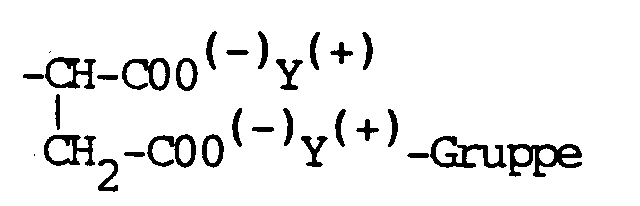
- Diese Aufgabe wird erfindungsgemäß durch die Verwendung einer wäßrigen Kunststoffdispersion auf Basis von Homo- und/oder Copolymerisaten aus Acryl- und/oder Vinylpolymeren und Emulgatoren gelöst, die zusätzlich als Aktivsubstanz(en) ein oder mehrere N-substituierte(s) Sulfobernsteinsäureamid(e) der allgemeinen Formeln I oder II

worin - R₁
- eine Alkyl- oder Alkylarylgruppe mit C₈ bis C₂₀-Kohlenwasserstoffatomen,
- R₂
- Wasserstoff oder die
- X, Y
- gleich oder verschiedenen H, NH₄ oder ein Alkalimetallatom bedeuten,
- Überraschenderweise wurde nämlich gefunden, daß diese N-substituierten Sulfobernsteinsäureamide und deren Salze die Blocktemperatur von Kunststoffdispersionen und Dispersionslacken erheblich erhöhen.
- Gegenstand der Erfindung ist insbesondere die verwendung einer wäßrigen Kunstoffdispersion, die diese Aktivsubstanzen in einer Konzentration
von 0,05 bis 5 Gew.%,
bevorzugt von 0,1 bis 2 Gew.%,
insbesondere von 0,15 bis 0,5 Gew.%,
bezogen auf die Gesamtmenge der Monomeren der Kunststoffdispersionen, enthält. - Gegenstand der Erfindung ist insbesondere auch die verwendung einer wäßrigen Kunststoffdispersion als Vorkonzentrat zum Abmischen der Dispersionslacke, die diese Aktivsubstanzen in einer Konzentration
von 5 bis 25 Gew.%
bevorzugt von 7,5 bis 15 Gew.%, und
insbesondere von 9 bis 12 Gew.%, etwa 10 Gew.%,
bezogen auf die Gesamtmenge der Monomeren der Kunststoffdispersionen, enthält. - Gegenstand der Erfindung ist insbesondere auch einen wäßrige Kunststoffdispersion, die diese Aktivsubstanzen in einer Konzentration
von 0,05 bis 5 Gew.%,
bevorzugt von 0,1 bis 2 Gew.%,
insbesondere von 0,15 bis 1 Gew.%,
bezogen auf die Gesamtmenge der Dispersionsfarben-Formulierung, enthält. - Eine bevorzugte wäßrige Homo- und/oder Copolymerisatdispersion als Basis für die wäßrige Kunststoffdispersion weist - bezogen auf Festsubstanz - die folgende Monomeren-Zusammensetzung, bezogen auf 100 Gew.% auf:
- (a) 5 bis 100 Gew. % eines aromatischen Vinylmonomeren, insbesondere eines Vinylbenzols, das mit C₁ bis C₄-Alkylgruppen im Kern oder in der Vinylgruppe substituiert sein kann, wie Styrol, alpha-Methylstyrol, Vinyltoluol, und/oder von tert-Butylacrylat oder eines (Meth)acrylsäureesters mit einer C₁ bis C₅-Monoalkoholkomponente und/oder eines Vinylesters mit einer C₁ bis C₁₁ -Monocarbonsäurekomponente wie Vinylacetat, VeoVa® 9 oder eines Gemisches solcher Monomeren, jeweils mit einer Homopolymerisatglastemperatur Tg der einzelnen Monomeren über 35°C, und/oder
- (b) 5 bis 100 Gew. % eines Acrylesters mit einer C₁ bis C₈-Monoalkoholkomponente und/oder eines (Meth)acrylsäureesters mit einer C₅ bis C₁₀-Monoalkoholkomponente und/oder eines Vinylesters wie VeoVa® 10 (VeoVa® = Versaticsäurevinylester), und/oder Gemisches solcher Monomeren, jeweils mit einer Homopolymisatglastemperatur Tg der einzelnen Monomeren unter 35°C, sowie
- (c) 0 bis 20 Gew.% eines monoolefinisch ungesättigten (Meth)acrylat-Monomeren mit einer C₁ bis C₈-Alkanolkomponente, wie Hydroxyethyl(meth)acrylat, Hydroxpropyl (meth)acrylat,
- (d) 0 bis 20 Gew.% eines veretherten N-Alkylol(meth)-acrylamides der allgemeinen Formel
CH₂=C(R₁)-C(O)-NH-(A)-O-R₂,
worin- R
- Wasserstoff oder Methyl,
- A
- n- oder iso-Alkylen mit 1 bis 4 Kohlenstoffatomen und
- R₂
- C₁ bis C₄-Alkyl bedeuten,
- (e) 0 bis 10 Gew.% einer alpha, beta-ungesättigten Monocarbonsäure mit 3 bis 5 Kohlenstoffatomen und/oder einer alpha, beta-ungesättigten Dicarbonsäure mit 3 bis 5 Kohlenstoffatomen, oder eines Gemisches solcher Monomeren, und
- (f) 0 bis 4 Gew. % eines alpha, beta-ungesättigten Monocarbonsäureamids mit 3 bis 5 Kohlenstoffatomen und/oder eines alpha, beta-ungesättigten Dicarbonsäureamids mit 4 bis 5 Kohlenstoffatomen oder eines Gemisches solcher Monomeren.
- Um die gewünschten Eigenschaften ohne Verwendung größerer Mengen Filmbildehilfsmittel einzustellen, soll die Glasübergangstemperatur Tg dieser aus der obigen Monomerenkombination hergestellten Polymerdispersionen einen Wert von unter 50°C aufweisen. Die Mindestfilmbildetemperatur liegt bevorzugt in einem Bereich zwischen 0 und 30°C.
- Der Einbau von ungesättigten Carbonsäuren (e) in das Copolymerisat erhöht die Stabilität der Dispersion. Bei der Herstellung von hochglänzenden Lacken treten bei der Pigmentierung sehr hohe Scherkräfte auf, die bei herkömmlichen Dispersionen zur Koagulation führen können. Aus diesem Grund enthält das Polymerisat insbesondere 0,5 bis 5, vorzugsweise 1 bis 3 Gew. %, einer alpha, beta-ungesättigten Monocarbonsäure mit vorzugsweise 4 oder 5 Kohlenstoffatomen und/oder einer ungesättigten Dicarbonsäure mit vorzugsweise 4 oder 5 Kohlenstoffatomen oder einer Mischung solcher Monomerer. Geeignete Säuren sind Acrylsäure, Methacrylsäure, Crotonsäure, Maleinsäure, Fumarsäure und Itaconsäure. Bevorzugt werden Acrylsäure und/oder Methacrylsäure eingesetzt.
- Außerdem enthält das Polymerisat noch 0 bis 4 Gew. %, eines alpha-beta-ungesättigten Monocarbonsäureamides und/oder eines ungesättigten Dicarbonsäureamides oder eines Gemisches solcher Monomerer. Diese Monomere tragen zur Stabilisierung bei der Herstellung und Verarbeitung bei. Außerdem dient ihr Gehalt zur Einstellung der gewünschten Teilchengröße. Bevorzugt werden 0,5 bis 1,5 Gew.%, eingesetzt.
- Die Dispersion besitzt einen Feststoffgehalt von 30 bis 60 Gew. %, vorzugsweise 40 bis 50 Gew. %. Sie enthält neben dem Polymerisat außerdem einen oder mehrere Emulgatoren, von denen mindestens einer ein N-substituiertes Sulfobernsteinsäureamid der angegebenen Formel oder ein Salz davon ist.
- Beispiele für verwendbare anionische Emulgatoren neben den N-substituierten Sulfobernsteinsäureamiden oder deren Salzen sind Alkalisalze von Schwefel- oder Phosphorsäureteilestern von Alkoholen, oxethylierten Alkylphenolen oder oxethylierten Alkoholen, sowie Alkyl- oder Arylsulfonate. Außerdem sind Salze von Sulfobernsteinsäureestern und -habestern geeignet. Vorzugsweise werden Sulfobernsteinsäurehalbester, Alkanolsulfate und oxethylierte Alkylphenolsulfate in einer Menge von 0,1 bis 5 Gew.%, bezogen auf Monomere (a) bis (e) gleich 100, eingesetzt.
- Zur Erhöhung der Stabilität der Dispersion werden vorzugsweise ein oder mehrere nichtionische Emulgatoren vom Typ eines oxethylierten Alkylphenols oder Fettalkohols, z.B. Nonylphenol mit 4 bis 50 Mol Ethylenoxid, in einer Menge von 0,1 bis 5, vorzugsweise 0,5 bis 2 Gew.% auf die Monomeren (a) bis (e) gleich 100, eingesetzt.
- Als Initiator eignen sich die üblichen Ammonium-, Natrium- und Kaliumsalze der Peroxodischwefelsäure und der Peroxodiphosphorsäure. Es können auch organische Peroxide u.ä. wie Dibenzoylperoxid oder tert-Butylhydroperoxid eingesetzt werden. Als Aktivatoren können Natriumdisulfit, Hydrazin, Hydroxylamin und ähnliche Reduktionsmittel eingesetzt werden. Als Beschleuniger der Polymerisationsreaktion können ferner Salze von Übergangsmetallen, wie z.B. von Cobalt, Eisen oder Vanadin, eingesetzt werden.
- Das Polymerisationsverfahren wird als Emulsionspolymerisation in einem wäßrigen Medium in bekannten Apparaten, wie einem Rührkessel mit Heiz- und Kühlvorrichtung, durchgeführt. Dabei sind die Monomeren in einem wäßrigen Medium emulgiert. Die Zugabe der Monomeren kann so erfolgen, daß eine Lösung aus dem gesamten Wasser, dem Emulgator und einem Teil des Initiators vorgelegt wird und das Monomerengemisch und der Rest des Initiators bei Polymerisationstemperatur langsam zugegeben wird. Weiterhin ist es möglich, einen Teil des Wassers, der Emulgatoren und des Initiators vorzulegen, aus den Monomeren, dem restlichen Wasser, den restlichen Emulgatoren und dem restlichen Initiator eine Voremulsion herzustellen und diese bei Polymerisationstemperatur langsam einzuspeisen. Ferner besteht die Möglichkeit, einen Teil des Wassers, der Monomeren, der Emulgatoren und des Initiators vorzulegen und aus den restlichen Bestandteilen eine Präemulsion herzustellen. Bei diesen vorzugsweisen Verfahren wird die Vorlage aufgeheizt und dann die Präemulsion bzw. die Monomermischung langsam bei Polymerisationstemperatur im Verlaufe von 1 bis 4 Stunden zugespeist.
- Die Polymerisationstemperatur liegt in einem Bereich von 50 bis 100°C, vorzugsweise 80 bis 95°C. Nach beendeter Zugabe des Monomerengemisches bzw. der Voremulsion wird der Ansatz noch 0,5 bis 3 Stunden bei 50 bis 100°C, vorzugsweise bei 80 bis 95°C zur Restmonomerenverminderung gerührt.
- Die durch das Polymerisationsverfahren erhaltenen Polymerisate haben Glasübergangstemperaturen im Bereich von 0 bis +60°C, vorzugsweise zwischen +10 und +40°C. Das Verfahren führt zu Polymerisaten, die eine mittlere Teilchengröße zwischen 30 und 400 nm, bevorzugt zwischen 80 und 180 nm, aufweisen.
- Die erhaltenen Polymerdispersionen können zu Klarlacken oder zu pigmentierten Lacken formuliert werden. Bei der Herstellung von pigmentierten Systemen geht man so vor, daß ein Teil oder die gesamte benötigte Dispersionsmenge mit Pigmenten und/oder Füllstoffen sowie den üblichen Lackhilfsmitteln und ggf. Neutralisationsmitteln zu einer Pigmentpaste angerieben wird. Im bevorzugten Fall wird nur ein Teil der Dispersion vorgelegt und die restliche Dispersionsmenge nach dem Anreiben der Pigmentpaste zugesetzt.
- Die getrockneten pigmentierten oder nicht pigmentierten Lackfilme der auf Basis der Polymerisatdispersion hergestellten Überzugsmittel weisen einen hervorragenden Verlauf aus. Die oft zu beobachtenden Oberflächenstörungen, beispielsweise Kraterbildung, Orangenschaleneffekt, Schrumpf- und Spannungsrisse sowie Stippen- und Porenbildung sind nicht vorhanden. Außerdem zeigen diese Lackfilme gute Deckkraft, Glätte (Slipeffekt), Elastizität, Glanz, Haftung, Wetterbeständigkeit und Vergilbungsresistenz.
- Es ist relativ unerheblich, ob das oder die N-substituierten Sulfobernsteinsäureamide oder deren Ammonium- oder Alkalisalze vor der Polymerisation einer Kunststoffdispersion zugesetzt werden oder eine herkömmliche Dispersion mit einer ein oder mehrere N-substituierte Sulfobernsteinsäureamide bzw. deren Salze enthaltenden zweiten Dispersion gemischt wird. Es ist ebenso möglich, einer geeigneten herkömmlichen Dispersion ein oder mehrere N-substituierte Sulfobernsteinsäureamide bzw. deren Salze zuzusetzen oder diese erst bei der Herstellung der Glanzlacke zuzusetzen.
- Als Basis der Homopolymerisatdispersionen kommen insbesondere Methylacrylat, Ethylacrylat und Isopropylacrylat zusammen mit den obengenannten Hilfsmonomeren zum Einsatz.
- Die folgenden Beispiele dienen der Erläuterung der Erfindung. Prozentangaben und Verhältnisangaben beziehen sich jeweils auf das Gewicht.
- Die Bestimmung der Blockfestigkeit wird wie folgt durchgeführt. Es werden 300-µ-Naßfilme auf Leneta(R) -Folie mit einem Spaltrakel aufgezogen und dann 20 Stunden bei 50°C im Trockenschrank getrocknet. Die beschichtete Folie wird dann in 1 cm breite Längsstreifen geschnitten und diese Streifen mit ihren beschichteten Seiten aufeinandergelegt. Diese Doppelstreifen werden auf eine Gradientenbank gelegt, die ein Temperaturgefälle von 30 bis 70°C aufweist. Die Doppelstreifen werden mit 100 g.cm⁻² drei Stunden lang belastet. Dann werden die Doppelstreifen von der Bank abgenommen, dreißig Minuten auf Raumtemperatur abgekühlt und per Hand auseinandergezogen. Es wird die Stelle bestimmt, ab der die Filme zusammenkleben oder sich an Hand des Aussehens ihrer Oberfläche gegenseitig beeinflußt haben. Die an dieser Stelle auf der Gradientenbank vorhanden gewesenen Temperatur wird als "Blocktemperatur" definiert.
- Es wurde eine Kunststoffdispersion (Klardispersion) nach folgendem Verfahren hergestellt:
-
Startlösung: Entmineralisiertes Wasser 5,312 kg Natrium-octylphenyl-25EO-sulfat (30 % in Wasser) 0,145 kg Nonylphenyl-30-ethylenoxid (25 %ig in Wasser) 0,290 kg Natriumperoxodisulfat (5 %ig in Wasser) 0,724 kg Entschäumer 0,003 kg Präemulsion: Entmineralisiertes Wasser 5,312 kg Natrium-octylphenyl-25EO-sulfat (30 % in Wasser) 0,483 kg Nonylphenyl-30-ethylenoxid (25 %ig in Wasser) 0,580 kg Natriumperoxodisulfat (5 %ig in Wasser) 1,450 kg Methylmethacrylat 6,723 kg n-Butylacrylat 6,723 kg VeoVa(R) 10 (Shell) 0,700 kg Methacrylsäure 0,290 kg Acrylamid 0,058 kg Entschäumer 0,007 kg Konfektionierung: Microzid 0,044 kg Natronlauge (12,5 %ig in Wasser) ca.1,0 kg (pH: 7,5) - Die Startlösung wurde ohne Natriumperoxodisulfat auf 80°C aufgeheizt, dann die Natriumperoxodisulfat-Lösung zugegeben. Sobald die Reaktortemperatur wieder die 80°C erreicht hatte, wurde mit der Einspeisung der Präemulsion begonnen. In den ersten 45 Minuten wurde die Präemulsion vom 1/5 der Endeinspeisungsgeschwindigkeit gleichmäßig zunehmend bis zur Endeinspeisegeschwindigkeit steigend in den Reaktor gepumt. Ab der 45. Minute wurde ein konstanter Strom an Präemulsion dem Reaktor zugeführt. Nach 90 Minuten war die Präemulsion eingespeist und die Reaktionstemperatur auf 85-87°C gestiegen. Es folgte eine 90-minütige Nachreaktion bei 85-90°C. Danach wurde gekühlt und bei ca. 60°C Microzid zugesetzt. Mit Natronlauge wurde auf pH 7,5 eingestellt und über ein 63 µ-Sieb filtriert.
- Dieser Kunststoffdispersion wurden jeweils 0,25 Gew.% Aktivsubstanz der folgenden Tenside zugesetzt und die Blockfestigkeit dieser Mischungen bestimmt:
Additiv Blockfestigkeit (°C) (X) Kein Zusatztensid < 30 (A) Di-Natrium-N-lauryl-sulfosuccinamid 65 (B) Di-Natrium-N-octadecyl-N-sulfosuccinamid 60 (C) Tetra-Natrium-N-octadecyl-N-dicarboxy-ethyl-sulfosuccinamid 65 (D) Di-Natrium-N-octadecylethanolamidosulfosuccinat < 30 (E) Natrium-nonylphenyl-25-ethylenoxidsulfat < 30 (F) Di-Natrium-(lauryl-4-ethylenoxid)-sulfosuccinat < 30 (G) Natrium-di-2-ethylhexyl-sulfosuccinat < 30 (H) Natriumlaurylsulfat < 30 (I) Tri-Natrium-N-octadecyl-ethylendiamintriacetat < 30 (J) Talgfettalkohol-11-ethylenoxid-ethanol < 30 (K) Talgfettalkohol-25-ethylenoxid-ethanol < 30 (L) Nonylphenyl-10-ethylenoxid-ethanol < 30 (M) Nonyphenyl-30-ethylenoxid-ethanol < 30 (N) Mischung Natrium-di-nonylphenyl-6-ethylenoxid-phosphat und Di-natrium-nonylphenyl-6-ethylenoxid-phosphat < 30 (O) Mischung Natrium-di-lauryl-4-ethylenoxidphosphat und Di-natrium-lauryl-4-ethylenoxid-phosphat < 30 - Mit der in Beispiel 1 beschriebenen Formulierung Nr. 1 und den Additiven (A) bis (O) wurden Glanzlacke nach folgender Formulierung hergestellt.
-
(1) 2-Methylaminopropanol 2,0 g (2) Disperse Ayd(R) W 22 (DANIELS PRODUCTS) 18,0 g (3) Natriumpolyacrylat 4,0 g (4) Propandiol-1,2 25,0 g (5) Methoxybutanol 15,0 g (6) Butyldiglykol 7,5 g (7) Surfynol(R)440 (ICI) 3,0 g (8) Entschäumer 1,0 g (9) Additiv (A bis O) (100 % Aktivsubstanz) 1,75 g (10) Titandioxid (Rutiltyp) 230,0 g (11) Dispersion (50 %ig)-Formulierung Nr.1 590,0 g (12) Wasser 88,5 g - Die Bestandteile 1 bis 10 wurden nacheinander unter Rühren gemischt und anschließend 20 Minuten gut mit einem Dissolver dispergiert. Danach wurde mit der Dispersion aufgelackt und mit Wasser die Verarbeitungsviskosität eingestellt.
- Es wurden Glanzlacke nach der Rezeptur Formulierung Nr.2 hergestellt. Jedoch wurde das Additiv nicht zugegeben, sondern die Formulierung Nr. 1 vorher mit jeweils 0,30 Gew.% der Additive (A) bis (O) gemischt und diese Dispersionen dann in der Formulierung Nr. 2 verwendet.
- Die Blocktemperaturen der Glanzlacke wurden nach dem gleichen Verfahren wie bei der Prüfung der Klardispersion bestimmt.
Ergebnisse: Additiv Blockfestigkeit (°C) Beispiel 2 Beispiel 3 ohne < 30 < 30 (A) > 70 > 70 (B) > 70 68 (C) 65 65 (D) < 30 < 30 (E) < 30 < 30 (F) < 30 < 30 (G) < 30 < 30 (H) < 30 < 30 (I) < 30 < 30 (J) < 30 < 30 (K) < 30 < 30 (L) < 30 < 30 (M) < 30 < 30 (N) < 30 < 30 (O) < 30 < 30 - Es wird eine Kunststoffdispersion nach folgendem Verfahren hergestellt:
-
Startlösung: Entmineralisiertes Wasser 182,0 g Tetra-Natrium-N-(1,2-dicarboxy-ethyl)-N-octadecyl-sulfosuccinamid (35 %ig) 7,9 g Ammoniumperoxodisulfat (5 %ig in Wasser) 19,8 g Entschäumer 0,03 g Präemulsion: Entmineralisiertes Wasser 284,8 g Tetra-natrium-N (1,2-dicarboxy-ethyl)-N-octadecyl-sulfosuccinamid (35 %ig) 99,7 g Ammoniumperoxodisulfat (5 %ig in Wasser) 31,6 g Methylmethacrylat 381,4 g Methacrylsäure 15,3 g Acrylamid (30 %ig) 3,8 g Entschäumer 0,02 g Ammoniak (25 %ig) 11,0 g Konfektionierung: Microzid 3,2 g - Die Startlösung wurde ohne Ammoniumperoxodisulfat auf 80°C aufgeheizt, dann die Ammoniumperoxodisulfatlösung zugegeben. Sobald die Reaktortemperatur wieder die 80 °C erreicht hatte, wurde mit der Einspeisung der Präemulsion begonnen.
- In den ersten 45 Minuten wurde die Präemulsion vom 1/5 der Endeinspeisegeschwindigkeit gleichmäßig zunehmend bis zur Endeinspeisegeschwindigkeit steigend in den Reaktor gepumpt. Ab der 45. Minute wurde ein konstanter Strom an Präemulsion dem Reaktor zugeführt. Nach 90 Minuten war die Präemulsion eingespeist und die Reaktionstemperatur auf 85-87 °C gestiegen. Es folgte eine 30-minütige Nachreaktion bei 85-90 °C. Danach wurde gekühlt, bei ca. 60 °C Microzid zugesetzt und über ein 63 µ-Sieb filtriert.
- Der im Beispiel 1 beschriebenen Formulierung Nr. 1 wurden 11, 25 und 43 Gew.% der Formulierung Nr. 3 zugesetzt und durch Rühren homogenisiert. Dann wurde die Blocktemperatur der Dispersionsmischungen gemessen und mit diesen Mischungen Glanzlacke nach der im Beispiel 2 beschriebenen Formulierung Nr. 2 jedoch ohne Additiv hergestellt und ebenfalls deren Blocktemperatur bestimmt.
Mischungsanteil Formulierung Nr. 3 (%) Blockfestigkeit (°C) von Disp.mischung Glanzlack 0 < 30 < 30 11 50 > 70 25 65 > 70 43 > 70 > 70 - Es wurde eine Kunststoffdispersion nach folgendem Verfahren hergestellt:
-
Startlösung: Entmineralisiertes Wasser 269,0 g Natrium-nonylphenyl-25EO-sulfat (35% in Wasser) 3,43 g Nonylphenyl-30-ethylenoxid (25 %ig in Wasser) 3,20 g Natriumperoxodisulfat (5 %ig in Wasser) 25,60 g Entschäumer 0,08 g Präemulsion: Entmineralisiertes Wasser 416,0 g Natrium-nonylphenyl-25EO-sulfat (35% in Wasser) 22,86 g Tetra-Natrium-N-(1,2-dicarboxi-ethyl)-N-octadecyl-sulfosuccinamid (35 %ig) 11,43 g Nonylphenyl-30-ethylenoxid (25 %ig in Wasser) 6,40 g Natriumperoxodisulfat (5 %ig in Wasser) 32,00 g Methylmethacrylat 348,32 g n-Butylacrylat 321,36 g VeoVa(R) 10 (SHELL) 106,48 g Methacrylsäure 16,00 g Methacrylamid 8,00 g Entschäumer 0,12 g Konfektionierung: Microzid 1,60 g Ammoniak (25 %ig) bis pH = 8,5 ca. 5 g - Die Startlösung wurde ohne Natriumperoxodisulfat auf 80 °C aufgeheizt, dann die Natriumperoxodisulfatlösung zugegeben. Sobald die Reaktortemperatur wieder die 80 °C erreicht hatte, wurde mit der Einspeisung der Präemulsion begonnen. In den ersten 45 Minuten wurde die Präemulsion vom 1/5 der Endeinspeisegeschwindigkeit gleichmäßig zunehmend bis zur Endeinspeisegeschwindigkeit steigend in den Reaktor gepumt. Ab der 45. Minute wurde ein konstanter Strom an Präemulsion dem Reaktor zugeführt. Nach 90 Minuten war die Präemulsion eingespeist und die Reaktionstemperatur auf 85-87 °C gestiegen. Es folgte eine 90-minütige Nachreaktion bei 85-90 °C. Danach wurde gekühlt und bei ca. 60 °C Microzid zugesetzt. Mit Ammoniak wurde auf pH 8,5 eingestellt, über ein 63 µ-Sieb filtriert und die Blockfestigkeit bestimmt:
Blockfestigkeit > 70 °C - Mit der Formulierung Nr. 4 wurde ein Weißlack nach der Rezeptur der Formulierung Nr. 2 jedoch ohne Additiv hergestellt und die Blockfestigkeit bestimmt:
Blockfestigkeit > 70°C - Handelsüblichen Reinacrylat- und Styrol-Acrylat-Kunststoffdispersionen wurden 0,175 Gew.% Aktivsubstanz Tetra-Natrium-N-octadecyl-N-(1,2-dicarboxy-ethyl)-sulfosuccinamid (ADD) zugesetzt und die Blockfestigkeit der Dispersionen mit und ohne ADD bestimmt.
Handelsübliche Dispersion (Typ) Blockfestigkeit (°C) der Dispersion vor Zugabe von ADD nach Zugabe von ADD Styrol/n-Butylacrylat < 30 > 70 Methylmethacrylat/n-Butylacrylat I 42 45 Methylmethacrylat/n-Butylacrylat II 54 > 70 Methylmethacrylat/n-Butylacrylat III 42 > 70 - Mit den ohne und mit ADD versetzten Dispersionen wurden Weißlacke nach Formulierung Nr. 2 ohne Additiv hergestellt und die Blockfestigkeit dieser Farben bestimmt.
Handelsübliche Dispersion (Typ) Blockfestigkeit (°C) des Glanzlacks ohne ADD mit ADD Styrol/n-Butylacrylat < 30 > 70 Methylmethacrylat/n-Butylacrylat I 36 65 Methylmethacrylat/n-Butylacrylat II 65 > 70 Methylmethacrylat/n-Butylacrylat III 38 > 70 - Es wurden Buntlacke der Formulierung Nr. 5 hergestellt:
(1) 2-Methyl-amino-propanol 2,0 g (2) Propandiol-1,2 35,0 g (3) Methoxybutanol 15,0 g (4) Butyldiglykol 7,5 g (5) Surfynol(R)440 (ICI) 3,0 g (6) Polyurethanverdicker 6,0 g (7) Farbpaste HF(R) (TENNECO) 100,0 g (8) Dispersion 660,0 g (10) Wasser 122,5 g - Die Bestandteile (1) bis (7) wurden nacheinander unter Rühren gemischt und anschließend 20 Minuten gut mit einem Dissolver dispergiert. Danach wurde mit der Dispersion aufgelackt und mit Wasser die Verarbeitungsviskosität eingestellt.
-
- Beispiel 7a
- Formulierung Nr. 1 versetzt mit 0,175 Gew.% Aktivsubstanz Tetra-Natrium-N-octadecyl-N-(1,2-dicarboxy-ethyl)sulfosuccinamid
- Beispiel 7b
- Formulierung Nr. 1 gemischt mit 11 Gew.% Formulierung Nr. 3
- Beispiel 7c
- Formulierung Nr. 4
- Beispiel 7d
- Formulierung Nr. 1
-
Blockfestigkeit des Buntlacks: Beispiel Blockfestigkeit (°C) 7a 68 7b > 70 7c > 70 7d < 30
Claims (2)
- Verwendung einer wäßrigen Kunststoffdispersion auf Basis von Homo- und/oder Copolymerisaten aus Acryl- und/oder Vinylpolymeren und Emulgatoren, die zusätzlich als Aktivsubstanz(en) ein oder mehrere N-substituierte(s) Sulfobernsteinsäureamid(e) der allgemeinen Formeln I oder II

R₁ eine Alkyl- oder Alkylarylgruppe mit C₈ bis C₂₀ - Kohlenwasserstoffatomen,
R₂ Wasserstoff oder die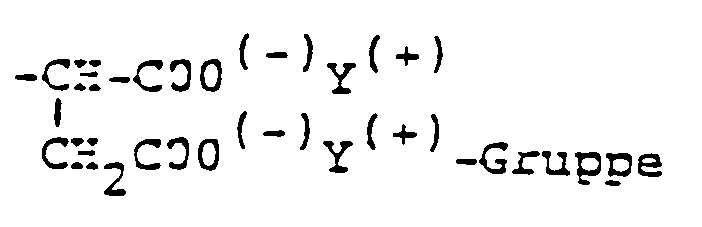
X, Y gleich oder verschiedenen H, NH₄ oder ein Alkalimetallatom bedeuten,
in einer Konzentration von 0,1 bis 6 Gew.-%, bezogen auf die Gesamtmenge der Kunststoffdispersion, enthält, als Bindemittel bei der Herstellung blockfester, nichtklebender, lösungsmittelfreier bzw. lösungsmittelarmer Dispersionslacke bzw. Dispersionsglanzlacke. - Verwendung nach Anspruch 1,
dadurch gekennzeichnet, daß in der Kunststoffdispersion das (die) Additiv(e) in einer Konzentration von 0,5 bis 5 Gew.-%, insbesondere von 1,5 bis 3 Gew.-%, bezogen auf die Gesamtmenge, vorhanden ist (sind).
Priority Applications (1)
| Application Number | Priority Date | Filing Date | Title |
|---|---|---|---|
| AT89110916T ATE95220T1 (de) | 1988-06-18 | 1989-06-16 | Verwendung von waessrigen kunststoffdispersionen. |
Applications Claiming Priority (2)
| Application Number | Priority Date | Filing Date | Title |
|---|---|---|---|
| DE3820754 | 1988-06-18 | ||
| DE3820754A DE3820754A1 (de) | 1988-06-18 | 1988-06-18 | Waessrige kunststoffdispersionen |
Publications (2)
| Publication Number | Publication Date |
|---|---|
| EP0347760A1 EP0347760A1 (de) | 1989-12-27 |
| EP0347760B1 true EP0347760B1 (de) | 1993-09-29 |
Family
ID=6356829
Family Applications (1)
| Application Number | Title | Priority Date | Filing Date |
|---|---|---|---|
| EP89110916A Expired - Lifetime EP0347760B1 (de) | 1988-06-18 | 1989-06-16 | Verwendung von wässrigen Kunststoffdispersionen |
Country Status (3)
| Country | Link |
|---|---|
| EP (1) | EP0347760B1 (de) |
| AT (1) | ATE95220T1 (de) |
| DE (2) | DE3820754A1 (de) |
Cited By (3)
| Publication number | Priority date | Publication date | Assignee | Title |
|---|---|---|---|---|
| US8030391B2 (en) | 2005-07-09 | 2011-10-04 | Celanese Emulsions Gmbh | Aqueous plastic dispersions, method for producing the same and their use |
| US8993668B2 (en) | 2007-07-19 | 2015-03-31 | Celanese Emulsions Gmbh | Polyvinyl ester dispersions, process for preparation thereof and use thereof |
| US9175185B2 (en) | 2007-07-19 | 2015-11-03 | Celanese Emulsions Gmbh | Coating compositions having high weathering resistance, process for preparation thereof and use thereof |
Families Citing this family (4)
| Publication number | Priority date | Publication date | Assignee | Title |
|---|---|---|---|---|
| US5460874A (en) * | 1994-09-30 | 1995-10-24 | Minnesota Mining And Manufacturing Company | Water-based coating compositions for imaging applications |
| DE19710382A1 (de) * | 1997-03-13 | 1998-09-17 | Buna Sow Leuna Olefinverb Gmbh | Radispergierbare Dispersionspulver auf Basis von Polyacrylaten |
| DE10112431A1 (de) | 2001-03-15 | 2002-10-02 | Clariant Gmbh | Wässrige Kunststoff-Dispersionen, Verfahren zu deren Herstellung sowie deren Verwendung |
| US20170029544A1 (en) * | 2014-04-09 | 2017-02-02 | Celanese Sales Germany Gmbh | Process for the emulsion polymerization of free-radically polymerizable, ethylenically unsaturated monomers |
Family Cites Families (1)
| Publication number | Priority date | Publication date | Assignee | Title |
|---|---|---|---|---|
| DE1804159C2 (de) * | 1968-10-19 | 1983-07-28 | Röhm GmbH, 6100 Darmstadt | Wäßrige, einen anionischen Emulgator enthaltende Kunstharzdispersion |
-
1988
- 1988-06-18 DE DE3820754A patent/DE3820754A1/de active Granted
-
1989
- 1989-06-16 EP EP89110916A patent/EP0347760B1/de not_active Expired - Lifetime
- 1989-06-16 AT AT89110916T patent/ATE95220T1/de not_active IP Right Cessation
- 1989-06-16 DE DE89110916T patent/DE58905738D1/de not_active Expired - Fee Related
Cited By (3)
| Publication number | Priority date | Publication date | Assignee | Title |
|---|---|---|---|---|
| US8030391B2 (en) | 2005-07-09 | 2011-10-04 | Celanese Emulsions Gmbh | Aqueous plastic dispersions, method for producing the same and their use |
| US8993668B2 (en) | 2007-07-19 | 2015-03-31 | Celanese Emulsions Gmbh | Polyvinyl ester dispersions, process for preparation thereof and use thereof |
| US9175185B2 (en) | 2007-07-19 | 2015-11-03 | Celanese Emulsions Gmbh | Coating compositions having high weathering resistance, process for preparation thereof and use thereof |
Also Published As
| Publication number | Publication date |
|---|---|
| DE58905738D1 (de) | 1993-11-04 |
| ATE95220T1 (de) | 1993-10-15 |
| EP0347760A1 (de) | 1989-12-27 |
| DE3820754C2 (de) | 1992-04-09 |
| DE3820754A1 (de) | 1990-02-08 |
Similar Documents
| Publication | Publication Date | Title |
|---|---|---|
| DE69504650T3 (de) | Verfahren zur herstellung von wässrigen polymer-zusammensetzungen | |
| DE60007896T2 (de) | Wässrige, polymodale, mehstufenpolymereemulsion | |
| EP0184091B1 (de) | Verfahren zur Herstellung von Polymer-Dispersionen, die blockfeste Filme bilden | |
| DE69601400T2 (de) | Wässerige Dispersionen aus Vinylpolymeren | |
| EP0795568B1 (de) | Wässrige Polymerdispersionen als Bindemittel für elastische block- und kratzfeste Beschichtungen | |
| EP0068044B1 (de) | Wässrige Pigmentpasten und deren Verwendung | |
| EP0381029B1 (de) | Wässrige Polyacrylat-Systeme für Lackierung von Kunststoffoberflächen | |
| DE2703829A1 (de) | Fluessige hitzehaertbare harzmasse | |
| EP0607205B1 (de) | Wasserverdünnbares emulsionspolymerisat, verfahren zur herstellung des wasserverdünnbaren emulsionspolymerisates, wassrige beschichtungszusammensetzung auf basis des emulsionspolymerisates sowie dessen verwendung als reib- und dispergierharz sowie als bindemittel für physikalisch trocknende lacke | |
| EP0575931B1 (de) | In Zweistufenfahrweise hergestellte Vinylpolymerisate und ihre Verwendung als Lackbindemittel | |
| DE2709308C2 (de) | ||
| DE69127728T2 (de) | Wässerige Metallic-Grundierungszusammensetzung auf Basis von Acryl-Latex-Harzen unter Verwendung eines wasserverdünnbaren Harzes als Medium für das Aluminium und Hectorit-Ton zur Rheologie-Regelung | |
| EP0381030B1 (de) | Wässriges Polyacrylat-System für die Schlusslackierung von Polyvinylchlorid-Oberflächen | |
| DE4105354A1 (de) | Waessrige polymerdispersionen, enthaltend organische verbindungen mit carbonat- und carbonylgruppen, sowie damit hergestellte anstrich- und beschichtungssysteme | |
| DE2835622A1 (de) | Waessrige polymerdispersion | |
| EP0655481A1 (de) | Wässrige Polymerdispersionen als Bindemittel für blockfeste, kratzfeste und chemikalienbeständige Beschichtungen | |
| DE3820754C2 (de) | ||
| EP0026875B1 (de) | Verwendung von Polymerisatlösungen von Acryl- und Methacrylsäureestern als Lackhilfsmittel | |
| DE69006393T2 (de) | Wässerige Metall-Basisbeschichtung mit verbesserten Stabilität und Aussehen. | |
| DE3622566C2 (de) | ||
| DE3727112A1 (de) | Waessrige beschichtungsstoffe auf basis von sekundaerdispersionen carboxylgruppen enthaltender copolymerisate von acrylsaeure- oder methacrylsaeureestern | |
| DE3235044C2 (de) | Kationische Acryllatexzusammensetzung und ihre Verwendung | |
| EP0009110B1 (de) | Verwendung von Polyglycidylaminen als Additive in wässrigen Anstrichmitteln | |
| DE2855696A1 (de) | Waessrige polymerdispersion | |
| EP0960891B1 (de) | Verfahren zur Herstellung von vernetzbaren Bindemitteln |
Legal Events
| Date | Code | Title | Description |
|---|---|---|---|
| PUAI | Public reference made under article 153(3) epc to a published international application that has entered the european phase |
Free format text: ORIGINAL CODE: 0009012 |
|
| AK | Designated contracting states |
Kind code of ref document: A1 Designated state(s): AT BE CH DE ES FR GB IT LI NL SE |
|
| 17P | Request for examination filed |
Effective date: 19900417 |
|
| 17Q | First examination report despatched |
Effective date: 19910527 |
|
| RAP1 | Party data changed (applicant data changed or rights of an application transferred) |
Owner name: RWE-DEA AKTIENGESELLSCHAFT FUER MINERALOEL UND CHE |
|
| GRAA | (expected) grant |
Free format text: ORIGINAL CODE: 0009210 |
|
| AK | Designated contracting states |
Kind code of ref document: B1 Designated state(s): AT BE CH DE ES FR GB IT LI NL SE |
|
| PG25 | Lapsed in a contracting state [announced via postgrant information from national office to epo] |
Ref country code: IT Free format text: LAPSE BECAUSE OF FAILURE TO SUBMIT A TRANSLATION OF THE DESCRIPTION OR TO PAY THE FEE WITHIN THE PRE;WARNING: LAPSES OF ITALIAN PATENTS WITH EFFECTIVE DATE BEFORE 2007 MAY HAVE OCCURRED AT ANY TIME BEFORE 2007. THE CORRECT EFFECTIVE DATE MAY BE DIFFERENT FROM THE ONE RECORDED.SCRIBED TIME-LIMIT Effective date: 19930929 Ref country code: SE Effective date: 19930929 Ref country code: ES Free format text: THE PATENT HAS BEEN ANNULLED BY A DECISION OF A NATIONAL AUTHORITY Effective date: 19930929 Ref country code: GB Effective date: 19930929 |
|
| REF | Corresponds to: |
Ref document number: 95220 Country of ref document: AT Date of ref document: 19931015 Kind code of ref document: T |
|
| REF | Corresponds to: |
Ref document number: 58905738 Country of ref document: DE Date of ref document: 19931104 |
|
| ET | Fr: translation filed | ||
| GBV | Gb: ep patent (uk) treated as always having been void in accordance with gb section 77(7)/1977 [no translation filed] |
Effective date: 19930929 |
|
| PLBE | No opposition filed within time limit |
Free format text: ORIGINAL CODE: 0009261 |
|
| STAA | Information on the status of an ep patent application or granted ep patent |
Free format text: STATUS: NO OPPOSITION FILED WITHIN TIME LIMIT |
|
| 26N | No opposition filed | ||
| REG | Reference to a national code |
Ref country code: CH Ref legal event code: PUE Owner name: RWE-DEA AKTIENGESELLSCHAFT FUER MINERALOEL UND CHE |
|
| NLS | Nl: assignments of ep-patents |
Owner name: NESTE CHEMICALS GMBH |
|
| PGFP | Annual fee paid to national office [announced via postgrant information from national office to epo] |
Ref country code: AT Payment date: 20000629 Year of fee payment: 12 |
|
| PGFP | Annual fee paid to national office [announced via postgrant information from national office to epo] |
Ref country code: NL Payment date: 20000630 Year of fee payment: 12 Ref country code: FR Payment date: 20000630 Year of fee payment: 12 |
|
| PGFP | Annual fee paid to national office [announced via postgrant information from national office to epo] |
Ref country code: BE Payment date: 20000801 Year of fee payment: 12 |
|
| PGFP | Annual fee paid to national office [announced via postgrant information from national office to epo] |
Ref country code: CH Payment date: 20000825 Year of fee payment: 12 |
|
| PGFP | Annual fee paid to national office [announced via postgrant information from national office to epo] |
Ref country code: DE Payment date: 20000826 Year of fee payment: 12 |
|
| REG | Reference to a national code |
Ref country code: FR Ref legal event code: TP |
|
| PG25 | Lapsed in a contracting state [announced via postgrant information from national office to epo] |
Ref country code: AT Free format text: LAPSE BECAUSE OF NON-PAYMENT OF DUE FEES Effective date: 20010616 |
|
| PG25 | Lapsed in a contracting state [announced via postgrant information from national office to epo] |
Ref country code: CH Free format text: LAPSE BECAUSE OF NON-PAYMENT OF DUE FEES Effective date: 20010630 Ref country code: LI Free format text: LAPSE BECAUSE OF NON-PAYMENT OF DUE FEES Effective date: 20010630 Ref country code: BE Free format text: LAPSE BECAUSE OF NON-PAYMENT OF DUE FEES Effective date: 20010630 |
|
| BERE | Be: lapsed |
Owner name: NESTE CHEMICALS G.M.B.H. Effective date: 20010630 |
|
| PG25 | Lapsed in a contracting state [announced via postgrant information from national office to epo] |
Ref country code: NL Free format text: LAPSE BECAUSE OF NON-PAYMENT OF DUE FEES Effective date: 20020101 |
|
| REG | Reference to a national code |
Ref country code: CH Ref legal event code: PL |
|
| PG25 | Lapsed in a contracting state [announced via postgrant information from national office to epo] |
Ref country code: FR Free format text: LAPSE BECAUSE OF NON-PAYMENT OF DUE FEES Effective date: 20020228 |
|
| NLV4 | Nl: lapsed or anulled due to non-payment of the annual fee |
Effective date: 20020101 |
|
| PG25 | Lapsed in a contracting state [announced via postgrant information from national office to epo] |
Ref country code: DE Free format text: LAPSE BECAUSE OF NON-PAYMENT OF DUE FEES Effective date: 20020403 |