EP0177443A1 - Kristallmodifikation des Dinatrium-3-amino-1-hydroxy-propan-1,1-diphosphonates - Google Patents
Kristallmodifikation des Dinatrium-3-amino-1-hydroxy-propan-1,1-diphosphonates Download PDFInfo
- Publication number
- EP0177443A1 EP0177443A1 EP85810352A EP85810352A EP0177443A1 EP 0177443 A1 EP0177443 A1 EP 0177443A1 EP 85810352 A EP85810352 A EP 85810352A EP 85810352 A EP85810352 A EP 85810352A EP 0177443 A1 EP0177443 A1 EP 0177443A1
- Authority
- EP
- European Patent Office
- Prior art keywords
- amino
- disodium
- water
- diphosphonate
- hydroxypropane
- Prior art date
- Legal status (The legal status is an assumption and is not a legal conclusion. Google has not performed a legal analysis and makes no representation as to the accuracy of the status listed.)
- Granted
Links
- 239000013078 crystal Substances 0.000 title claims abstract description 83
- 230000004048 modification Effects 0.000 title claims abstract description 62
- 238000012986 modification Methods 0.000 title claims abstract description 62
- CEYUIFJWVHOCPP-UHFFFAOYSA-L disodium;(3-amino-1-hydroxy-1-phosphonatopropyl)phosphonic acid Chemical compound [Na+].[Na+].NCCC(O)(P(O)([O-])=O)P(O)([O-])=O CEYUIFJWVHOCPP-UHFFFAOYSA-L 0.000 title claims description 93
- XLYOFNOQVPJJNP-UHFFFAOYSA-N water Substances O XLYOFNOQVPJJNP-UHFFFAOYSA-N 0.000 claims abstract description 155
- 238000000034 method Methods 0.000 claims abstract description 41
- 238000004519 manufacturing process Methods 0.000 claims abstract description 11
- 241001465754 Metazoa Species 0.000 claims abstract description 6
- OYPRJOBELJOOCE-UHFFFAOYSA-N Calcium Chemical compound [Ca] OYPRJOBELJOOCE-UHFFFAOYSA-N 0.000 claims abstract description 3
- 229910019142 PO4 Inorganic materials 0.000 claims abstract description 3
- 239000011575 calcium Substances 0.000 claims abstract description 3
- 229910052791 calcium Inorganic materials 0.000 claims abstract description 3
- NBIIXXVUZAFLBC-UHFFFAOYSA-K phosphate Chemical compound [O-]P([O-])([O-])=O NBIIXXVUZAFLBC-UHFFFAOYSA-K 0.000 claims abstract description 3
- 239000010452 phosphate Substances 0.000 claims abstract description 3
- HEMHJVSKTPXQMS-UHFFFAOYSA-M Sodium hydroxide Chemical compound [OH-].[Na+] HEMHJVSKTPXQMS-UHFFFAOYSA-M 0.000 claims description 65
- 239000000243 solution Substances 0.000 claims description 58
- LFQSCWFLJHTTHZ-UHFFFAOYSA-N Ethanol Chemical compound CCO LFQSCWFLJHTTHZ-UHFFFAOYSA-N 0.000 claims description 42
- 238000002425 crystallisation Methods 0.000 claims description 35
- 230000008025 crystallization Effects 0.000 claims description 35
- 230000015572 biosynthetic process Effects 0.000 claims description 28
- 238000003756 stirring Methods 0.000 claims description 25
- WRUUGTRCQOWXEG-UHFFFAOYSA-N pamidronate Chemical compound NCCC(O)(P(O)(O)=O)P(O)(O)=O WRUUGTRCQOWXEG-UHFFFAOYSA-N 0.000 claims description 24
- 239000007787 solid Substances 0.000 claims description 19
- 238000006386 neutralization reaction Methods 0.000 claims description 17
- QXNVGIXVLWOKEQ-UHFFFAOYSA-N Disodium Chemical compound [Na][Na] QXNVGIXVLWOKEQ-UHFFFAOYSA-N 0.000 claims description 14
- 239000000825 pharmaceutical preparation Substances 0.000 claims description 14
- 238000002360 preparation method Methods 0.000 claims description 13
- 239000000725 suspension Substances 0.000 claims description 13
- 239000000843 powder Substances 0.000 claims description 12
- 238000010586 diagram Methods 0.000 claims description 11
- 238000001035 drying Methods 0.000 claims description 9
- 239000007864 aqueous solution Substances 0.000 claims description 8
- 229920006395 saturated elastomer Polymers 0.000 claims description 8
- 229910052799 carbon Inorganic materials 0.000 claims description 7
- 238000006243 chemical reaction Methods 0.000 claims description 7
- 238000001816 cooling Methods 0.000 claims description 7
- 238000010438 heat treatment Methods 0.000 claims description 6
- 230000005855 radiation Effects 0.000 claims description 6
- 238000010583 slow cooling Methods 0.000 claims description 6
- RYGMFSIKBFXOCR-UHFFFAOYSA-N Copper Chemical compound [Cu] RYGMFSIKBFXOCR-UHFFFAOYSA-N 0.000 claims description 5
- 239000010949 copper Substances 0.000 claims description 5
- 229910052802 copper Inorganic materials 0.000 claims description 5
- 159000000000 sodium salts Chemical class 0.000 claims description 5
- YUAXTYWDUNVRBJ-UHFFFAOYSA-N NCCCO.[Na].[Na] Chemical compound NCCCO.[Na].[Na] YUAXTYWDUNVRBJ-UHFFFAOYSA-N 0.000 claims description 4
- -1 disodium-3-amino-l-hydroxy-propane-1,1-diphosphonate 1-hydroxy-propane-1,1-di-phosphonate Chemical compound 0.000 claims description 3
- 238000001914 filtration Methods 0.000 claims description 3
- 150000004686 pentahydrates Chemical group 0.000 claims description 3
- XHAZMZWXAOBLQG-UHFFFAOYSA-N (1-hydroxy-1-phosphonopropyl)phosphonic acid Chemical compound CCC(O)(P(O)(O)=O)P(O)(O)=O XHAZMZWXAOBLQG-UHFFFAOYSA-N 0.000 claims description 2
- 230000000977 initiatory effect Effects 0.000 claims 4
- 150000001875 compounds Chemical class 0.000 claims 2
- 238000000967 suction filtration Methods 0.000 claims 2
- 230000004584 weight gain Effects 0.000 claims 2
- 235000019786 weight gain Nutrition 0.000 claims 2
- DRPKUPBGKFMTRM-UHFFFAOYSA-N (2-amino-1-hydroxy-1-phosphonopropyl)phosphonic acid Chemical compound CC(N)C(O)(P(O)(O)=O)P(O)(O)=O DRPKUPBGKFMTRM-UHFFFAOYSA-N 0.000 claims 1
- 238000005119 centrifugation Methods 0.000 claims 1
- 208000030159 metabolic disease Diseases 0.000 claims 1
- 208000037265 diseases, disorders, signs and symptoms Diseases 0.000 abstract description 4
- 201000010099 disease Diseases 0.000 abstract description 2
- 230000004060 metabolic process Effects 0.000 abstract description 2
- 208000035475 disorder Diseases 0.000 abstract 1
- 239000000203 mixture Substances 0.000 description 29
- OKKJLVBELUTLKV-UHFFFAOYSA-N Methanol Chemical compound OC OKKJLVBELUTLKV-UHFFFAOYSA-N 0.000 description 21
- 239000004480 active ingredient Substances 0.000 description 17
- 239000000047 product Substances 0.000 description 13
- 239000003826 tablet Substances 0.000 description 11
- 229920002472 Starch Polymers 0.000 description 10
- 235000019698 starch Nutrition 0.000 description 10
- HQKMJHAJHXVSDF-UHFFFAOYSA-L magnesium stearate Substances [Mg+2].CCCCCCCCCCCCCCCCCC([O-])=O.CCCCCCCCCCCCCCCCCC([O-])=O HQKMJHAJHXVSDF-UHFFFAOYSA-L 0.000 description 9
- 238000002329 infrared spectrum Methods 0.000 description 8
- 229920001223 polyethylene glycol Polymers 0.000 description 8
- 239000008107 starch Substances 0.000 description 8
- 230000000052 comparative effect Effects 0.000 description 7
- 238000003860 storage Methods 0.000 description 7
- GUBGYTABKSRVRQ-QKKXKWKRSA-N Lactose Natural products OC[C@H]1O[C@@H](O[C@H]2[C@H](O)[C@@H](O)C(O)O[C@@H]2CO)[C@H](O)[C@@H](O)[C@H]1O GUBGYTABKSRVRQ-QKKXKWKRSA-N 0.000 description 6
- 239000002775 capsule Substances 0.000 description 6
- 239000003085 diluting agent Substances 0.000 description 6
- 239000004615 ingredient Substances 0.000 description 6
- 239000008101 lactose Substances 0.000 description 6
- 239000007788 liquid Substances 0.000 description 6
- 239000007858 starting material Substances 0.000 description 6
- 239000000454 talc Substances 0.000 description 6
- 229910052623 talc Inorganic materials 0.000 description 6
- 235000012222 talc Nutrition 0.000 description 6
- 239000002202 Polyethylene glycol Substances 0.000 description 5
- 239000008187 granular material Substances 0.000 description 5
- 235000019359 magnesium stearate Nutrition 0.000 description 5
- 239000011541 reaction mixture Substances 0.000 description 5
- 150000003839 salts Chemical class 0.000 description 5
- 108010010803 Gelatin Proteins 0.000 description 4
- 238000000576 coating method Methods 0.000 description 4
- 239000008298 dragée Substances 0.000 description 4
- 238000009472 formulation Methods 0.000 description 4
- 239000008273 gelatin Substances 0.000 description 4
- 229920000159 gelatin Polymers 0.000 description 4
- 229940014259 gelatin Drugs 0.000 description 4
- 235000019322 gelatine Nutrition 0.000 description 4
- 235000011852 gelatine desserts Nutrition 0.000 description 4
- 239000012452 mother liquor Substances 0.000 description 4
- CDBYLPFSWZWCQE-UHFFFAOYSA-L sodium carbonate Substances [Na+].[Na+].[O-]C([O-])=O CDBYLPFSWZWCQE-UHFFFAOYSA-L 0.000 description 4
- PEDCQBHIVMGVHV-UHFFFAOYSA-N Glycerine Chemical compound OCC(O)CO PEDCQBHIVMGVHV-UHFFFAOYSA-N 0.000 description 3
- 239000008186 active pharmaceutical agent Substances 0.000 description 3
- 238000009835 boiling Methods 0.000 description 3
- 239000002552 dosage form Substances 0.000 description 3
- 235000013855 polyvinylpyrrolidone Nutrition 0.000 description 3
- 239000001267 polyvinylpyrrolidone Substances 0.000 description 3
- 229920000036 polyvinylpyrrolidone Polymers 0.000 description 3
- FBPFZTCFMRRESA-FSIIMWSLSA-N D-Glucitol Natural products OC[C@H](O)[C@H](O)[C@@H](O)[C@H](O)CO FBPFZTCFMRRESA-FSIIMWSLSA-N 0.000 description 2
- FBPFZTCFMRRESA-JGWLITMVSA-N D-glucitol Chemical compound OC[C@H](O)[C@@H](O)[C@H](O)[C@H](O)CO FBPFZTCFMRRESA-JGWLITMVSA-N 0.000 description 2
- 239000005909 Kieselgur Substances 0.000 description 2
- VYPSYNLAJGMNEJ-UHFFFAOYSA-N Silicium dioxide Chemical compound O=[Si]=O VYPSYNLAJGMNEJ-UHFFFAOYSA-N 0.000 description 2
- GWEVSGVZZGPLCZ-UHFFFAOYSA-N Titan oxide Chemical compound O=[Ti]=O GWEVSGVZZGPLCZ-UHFFFAOYSA-N 0.000 description 2
- 239000007900 aqueous suspension Substances 0.000 description 2
- 239000011230 binding agent Substances 0.000 description 2
- 239000001506 calcium phosphate Substances 0.000 description 2
- 125000004432 carbon atom Chemical group C* 0.000 description 2
- 239000000969 carrier Substances 0.000 description 2
- 239000001913 cellulose Substances 0.000 description 2
- 229920002678 cellulose Polymers 0.000 description 2
- 238000004090 dissolution Methods 0.000 description 2
- 239000000945 filler Substances 0.000 description 2
- 210000004051 gastric juice Anatomy 0.000 description 2
- 239000007903 gelatin capsule Substances 0.000 description 2
- 229930195733 hydrocarbon Natural products 0.000 description 2
- 150000002430 hydrocarbons Chemical class 0.000 description 2
- 239000005457 ice water Substances 0.000 description 2
- 238000011065 in-situ storage Methods 0.000 description 2
- 239000000314 lubricant Substances 0.000 description 2
- 239000000463 material Substances 0.000 description 2
- 239000003960 organic solvent Substances 0.000 description 2
- 239000012188 paraffin wax Substances 0.000 description 2
- 239000012047 saturated solution Substances 0.000 description 2
- 229910000029 sodium carbonate Inorganic materials 0.000 description 2
- 239000002904 solvent Substances 0.000 description 2
- 239000000600 sorbitol Substances 0.000 description 2
- 239000003381 stabilizer Substances 0.000 description 2
- 239000000829 suppository Substances 0.000 description 2
- 239000002511 suppository base Substances 0.000 description 2
- 150000003626 triacylglycerols Chemical class 0.000 description 2
- QORWJWZARLRLPR-UHFFFAOYSA-H tricalcium bis(phosphate) Chemical class [Ca+2].[Ca+2].[Ca+2].[O-]P([O-])([O-])=O.[O-]P([O-])([O-])=O QORWJWZARLRLPR-UHFFFAOYSA-H 0.000 description 2
- 239000001993 wax Substances 0.000 description 2
- IXPNQXFRVYWDDI-UHFFFAOYSA-N 1-methyl-2,4-dioxo-1,3-diazinane-5-carboximidamide Chemical compound CN1CC(C(N)=N)C(=O)NC1=O IXPNQXFRVYWDDI-UHFFFAOYSA-N 0.000 description 1
- 229920001817 Agar Polymers 0.000 description 1
- GUBGYTABKSRVRQ-XLOQQCSPSA-N Alpha-Lactose Chemical compound O[C@@H]1[C@@H](O)[C@@H](O)[C@@H](CO)O[C@H]1O[C@@H]1[C@@H](CO)O[C@H](O)[C@H](O)[C@H]1O GUBGYTABKSRVRQ-XLOQQCSPSA-N 0.000 description 1
- 241000416162 Astragalus gummifer Species 0.000 description 1
- 102000055006 Calcitonin Human genes 0.000 description 1
- 108060001064 Calcitonin Proteins 0.000 description 1
- FBPFZTCFMRRESA-KVTDHHQDSA-N D-Mannitol Chemical compound OC[C@@H](O)[C@@H](O)[C@H](O)[C@H](O)CO FBPFZTCFMRRESA-KVTDHHQDSA-N 0.000 description 1
- 238000003109 Karl Fischer titration Methods 0.000 description 1
- FYYHWMGAXLPEAU-UHFFFAOYSA-N Magnesium Chemical compound [Mg] FYYHWMGAXLPEAU-UHFFFAOYSA-N 0.000 description 1
- 229930195725 Mannitol Natural products 0.000 description 1
- 240000007594 Oryza sativa Species 0.000 description 1
- 235000007164 Oryza sativa Nutrition 0.000 description 1
- 239000005662 Paraffin oil Substances 0.000 description 1
- PMZURENOXWZQFD-UHFFFAOYSA-L Sodium Sulfate Chemical compound [Na+].[Na+].[O-]S([O-])(=O)=O PMZURENOXWZQFD-UHFFFAOYSA-L 0.000 description 1
- 235000021355 Stearic acid Nutrition 0.000 description 1
- CZMRCDWAGMRECN-UGDNZRGBSA-N Sucrose Chemical compound O[C@H]1[C@H](O)[C@@H](CO)O[C@@]1(CO)O[C@@H]1[C@H](O)[C@@H](O)[C@H](O)[C@@H](CO)O1 CZMRCDWAGMRECN-UGDNZRGBSA-N 0.000 description 1
- 229930006000 Sucrose Natural products 0.000 description 1
- 229920001615 Tragacanth Polymers 0.000 description 1
- 241000209140 Triticum Species 0.000 description 1
- 235000021307 Triticum Nutrition 0.000 description 1
- 240000008042 Zea mays Species 0.000 description 1
- 235000005824 Zea mays ssp. parviglumis Nutrition 0.000 description 1
- 235000002017 Zea mays subsp mays Nutrition 0.000 description 1
- SMEGJBVQLJJKKX-HOTMZDKISA-N [(2R,3S,4S,5R,6R)-5-acetyloxy-3,4,6-trihydroxyoxan-2-yl]methyl acetate Chemical compound CC(=O)OC[C@@H]1[C@H]([C@@H]([C@H]([C@@H](O1)O)OC(=O)C)O)O SMEGJBVQLJJKKX-HOTMZDKISA-N 0.000 description 1
- 235000010489 acacia gum Nutrition 0.000 description 1
- 239000001785 acacia senegal l. willd gum Substances 0.000 description 1
- 229940081735 acetylcellulose Drugs 0.000 description 1
- 239000002253 acid Substances 0.000 description 1
- 239000008272 agar Substances 0.000 description 1
- 235000010419 agar Nutrition 0.000 description 1
- 235000010443 alginic acid Nutrition 0.000 description 1
- 239000000783 alginic acid Substances 0.000 description 1
- 229920000615 alginic acid Polymers 0.000 description 1
- 229960001126 alginic acid Drugs 0.000 description 1
- 150000004781 alginic acids Chemical class 0.000 description 1
- BBBFJLBPOGFECG-VJVYQDLKSA-N calcitonin Chemical compound N([C@H](C(=O)N[C@@H](CC(C)C)C(=O)NCC(=O)N[C@@H](CCCCN)C(=O)N[C@@H](CC(C)C)C(=O)N[C@@H](CO)C(=O)N[C@@H](CCC(N)=O)C(=O)N[C@@H](CCC(O)=O)C(=O)N[C@@H](CC(C)C)C(=O)N[C@@H](CC=1NC=NC=1)C(=O)N[C@@H](CCCCN)C(=O)N[C@@H](CC(C)C)C(=O)N[C@@H](CCC(N)=O)C(=O)N[C@@H]([C@@H](C)O)C(=O)N[C@@H](CC=1C=CC(O)=CC=1)C(=O)N1[C@@H](CCC1)C(=O)N[C@@H](CCCNC(N)=N)C(=O)N[C@@H]([C@@H](C)O)C(=O)N[C@@H](CC(N)=O)C(=O)N[C@@H]([C@@H](C)O)C(=O)NCC(=O)N[C@@H](CO)C(=O)NCC(=O)N[C@@H]([C@@H](C)O)C(=O)N1[C@@H](CCC1)C(N)=O)C(C)C)C(=O)[C@@H]1CSSC[C@H](N)C(=O)N[C@@H](CO)C(=O)N[C@@H](CC(N)=O)C(=O)N[C@@H](CC(C)C)C(=O)N[C@@H](CO)C(=O)N[C@@H]([C@@H](C)O)C(=O)N1 BBBFJLBPOGFECG-VJVYQDLKSA-N 0.000 description 1
- 229960004015 calcitonin Drugs 0.000 description 1
- FUFJGUQYACFECW-UHFFFAOYSA-L calcium hydrogenphosphate Chemical compound [Ca+2].OP([O-])([O-])=O FUFJGUQYACFECW-UHFFFAOYSA-L 0.000 description 1
- 235000011010 calcium phosphates Nutrition 0.000 description 1
- CJZGTCYPCWQAJB-UHFFFAOYSA-L calcium stearate Chemical compound [Ca+2].CCCCCCCCCCCCCCCCCC([O-])=O.CCCCCCCCCCCCCCCCCC([O-])=O CJZGTCYPCWQAJB-UHFFFAOYSA-L 0.000 description 1
- 235000013539 calcium stearate Nutrition 0.000 description 1
- 239000008116 calcium stearate Substances 0.000 description 1
- 125000002057 carboxymethyl group Chemical group [H]OC(=O)C([H])([H])[*] 0.000 description 1
- 239000012876 carrier material Substances 0.000 description 1
- 229920002301 cellulose acetate Polymers 0.000 description 1
- 238000012512 characterization method Methods 0.000 description 1
- 239000011248 coating agent Substances 0.000 description 1
- 238000009833 condensation Methods 0.000 description 1
- 230000005494 condensation Effects 0.000 description 1
- 235000005822 corn Nutrition 0.000 description 1
- 239000012043 crude product Substances 0.000 description 1
- 230000007423 decrease Effects 0.000 description 1
- 230000001419 dependent effect Effects 0.000 description 1
- 239000003599 detergent Substances 0.000 description 1
- 235000019700 dicalcium phosphate Nutrition 0.000 description 1
- 239000007884 disintegrant Substances 0.000 description 1
- 239000000428 dust Substances 0.000 description 1
- 239000000975 dye Substances 0.000 description 1
- 238000001704 evaporation Methods 0.000 description 1
- 230000008020 evaporation Effects 0.000 description 1
- 239000010685 fatty oil Substances 0.000 description 1
- 239000000706 filtrate Substances 0.000 description 1
- 239000012530 fluid Substances 0.000 description 1
- 239000011521 glass Substances 0.000 description 1
- 229920003132 hydroxypropyl methylcellulose phthalate Polymers 0.000 description 1
- 229940031704 hydroxypropyl methylcellulose phthalate Drugs 0.000 description 1
- 230000001771 impaired effect Effects 0.000 description 1
- 239000012535 impurity Substances 0.000 description 1
- 150000002500 ions Chemical class 0.000 description 1
- 238000002955 isolation Methods 0.000 description 1
- 238000002372 labelling Methods 0.000 description 1
- 239000004922 lacquer Substances 0.000 description 1
- 238000012792 lyophilization process Methods 0.000 description 1
- 229910052749 magnesium Inorganic materials 0.000 description 1
- 239000000594 mannitol Substances 0.000 description 1
- 235000010355 mannitol Nutrition 0.000 description 1
- 229920000609 methyl cellulose Polymers 0.000 description 1
- 239000001923 methylcellulose Substances 0.000 description 1
- 235000010981 methylcellulose Nutrition 0.000 description 1
- 229960002900 methylcellulose Drugs 0.000 description 1
- 238000002156 mixing Methods 0.000 description 1
- 230000003472 neutralizing effect Effects 0.000 description 1
- QIQXTHQIDYTFRH-UHFFFAOYSA-N octadecanoic acid Chemical compound CCCCCCCCCCCCCCCCCC(O)=O QIQXTHQIDYTFRH-UHFFFAOYSA-N 0.000 description 1
- OQCDKBAXFALNLD-UHFFFAOYSA-N octadecanoic acid Natural products CCCCCCCC(C)CCCCCCCCC(O)=O OQCDKBAXFALNLD-UHFFFAOYSA-N 0.000 description 1
- 239000003791 organic solvent mixture Substances 0.000 description 1
- 239000002245 particle Substances 0.000 description 1
- 230000000144 pharmacologic effect Effects 0.000 description 1
- 235000021317 phosphate Nutrition 0.000 description 1
- XNGIFLGASWRNHJ-UHFFFAOYSA-L phthalate(2-) Chemical compound [O-]C(=O)C1=CC=CC=C1C([O-])=O XNGIFLGASWRNHJ-UHFFFAOYSA-L 0.000 description 1
- 239000000049 pigment Substances 0.000 description 1
- 239000004014 plasticizer Substances 0.000 description 1
- 229920001592 potato starch Polymers 0.000 description 1
- 229940116317 potato starch Drugs 0.000 description 1
- 238000011085 pressure filtration Methods 0.000 description 1
- 230000001105 regulatory effect Effects 0.000 description 1
- 235000009566 rice Nutrition 0.000 description 1
- 229940100486 rice starch Drugs 0.000 description 1
- 238000005185 salting out Methods 0.000 description 1
- 238000006748 scratching Methods 0.000 description 1
- 230000002393 scratching effect Effects 0.000 description 1
- 238000000926 separation method Methods 0.000 description 1
- RMAQACBXLXPBSY-UHFFFAOYSA-N silicic acid Chemical compound O[Si](O)(O)O RMAQACBXLXPBSY-UHFFFAOYSA-N 0.000 description 1
- 235000012239 silicon dioxide Nutrition 0.000 description 1
- 238000009097 single-agent therapy Methods 0.000 description 1
- 235000010413 sodium alginate Nutrition 0.000 description 1
- 239000000661 sodium alginate Substances 0.000 description 1
- 229940005550 sodium alginate Drugs 0.000 description 1
- 235000002639 sodium chloride Nutrition 0.000 description 1
- 239000007901 soft capsule Substances 0.000 description 1
- 241000894007 species Species 0.000 description 1
- 230000002269 spontaneous effect Effects 0.000 description 1
- 239000008117 stearic acid Substances 0.000 description 1
- 239000000126 substance Substances 0.000 description 1
- 239000005720 sucrose Substances 0.000 description 1
- 238000004781 supercooling Methods 0.000 description 1
- 230000001225 therapeutic effect Effects 0.000 description 1
- 239000004408 titanium dioxide Substances 0.000 description 1
- 235000010487 tragacanth Nutrition 0.000 description 1
- 239000000196 tragacanth Substances 0.000 description 1
- 229940116362 tragacanth Drugs 0.000 description 1
- 229940078499 tricalcium phosphate Drugs 0.000 description 1
- 235000019731 tricalcium phosphate Nutrition 0.000 description 1
- 229910000391 tricalcium phosphate Inorganic materials 0.000 description 1
- 230000001960 triggered effect Effects 0.000 description 1
- 238000005406 washing Methods 0.000 description 1
- 238000005303 weighing Methods 0.000 description 1
- 229940100445 wheat starch Drugs 0.000 description 1
- 238000010626 work up procedure Methods 0.000 description 1
Classifications
-
- C—CHEMISTRY; METALLURGY
- C07—ORGANIC CHEMISTRY
- C07F—ACYCLIC, CARBOCYCLIC OR HETEROCYCLIC COMPOUNDS CONTAINING ELEMENTS OTHER THAN CARBON, HYDROGEN, HALOGEN, OXYGEN, NITROGEN, SULFUR, SELENIUM OR TELLURIUM
- C07F9/00—Compounds containing elements of Groups 5 or 15 of the Periodic Table
- C07F9/02—Phosphorus compounds
- C07F9/06—Phosphorus compounds without P—C bonds
- C07F9/16—Esters of thiophosphoric acids or thiophosphorous acids
- C07F9/165—Esters of thiophosphoric acids
-
- C—CHEMISTRY; METALLURGY
- C07—ORGANIC CHEMISTRY
- C07F—ACYCLIC, CARBOCYCLIC OR HETEROCYCLIC COMPOUNDS CONTAINING ELEMENTS OTHER THAN CARBON, HYDROGEN, HALOGEN, OXYGEN, NITROGEN, SULFUR, SELENIUM OR TELLURIUM
- C07F9/00—Compounds containing elements of Groups 5 or 15 of the Periodic Table
- C07F9/02—Phosphorus compounds
- C07F9/28—Phosphorus compounds with one or more P—C bonds
- C07F9/38—Phosphonic acids [RP(=O)(OH)2]; Thiophosphonic acids ; [RP(=X1)(X2H)2(X1, X2 are each independently O, S or Se)]
- C07F9/3804—Phosphonic acids [RP(=O)(OH)2]; Thiophosphonic acids ; [RP(=X1)(X2H)2(X1, X2 are each independently O, S or Se)] not used, see subgroups
- C07F9/3839—Polyphosphonic acids
- C07F9/3873—Polyphosphonic acids containing nitrogen substituent, e.g. N.....H or N-hydrocarbon group which can be substituted by halogen or nitro(so), N.....O, N.....S, N.....C(=X)- (X =O, S), N.....N, N...C(=X)...N (X =O, S)
-
- A—HUMAN NECESSITIES
- A61—MEDICAL OR VETERINARY SCIENCE; HYGIENE
- A61P—SPECIFIC THERAPEUTIC ACTIVITY OF CHEMICAL COMPOUNDS OR MEDICINAL PREPARATIONS
- A61P3/00—Drugs for disorders of the metabolism
-
- A—HUMAN NECESSITIES
- A61—MEDICAL OR VETERINARY SCIENCE; HYGIENE
- A61P—SPECIFIC THERAPEUTIC ACTIVITY OF CHEMICAL COMPOUNDS OR MEDICINAL PREPARATIONS
- A61P3/00—Drugs for disorders of the metabolism
- A61P3/12—Drugs for disorders of the metabolism for electrolyte homeostasis
- A61P3/14—Drugs for disorders of the metabolism for electrolyte homeostasis for calcium homeostasis
Definitions
- the invention relates to a new, crystal water-containing crystal modification of disodium 3-amino-l-hydroxypropane-l, 1-diphosphonate of the formula or a method for producing the same.
- disodium 3-amino-1-hydroxypropane-1,1-diphosphonate (I) and its usefulness as an active pharmaceutical ingredient are thus to be regarded as known in the art, they contain Publications do not give exact details of its manufacture. So the DE-Offenlegungsschrift N r. 2,443,963 merely show that the 3-amino-1-hydroxypropane-1,1-diphosphonic acid "can be converted into the desired salts by complete or partial neutralization".
- disodium 3-amino-1-hydroxypropane-1,1-diphosphonate is obtained in a hygroscopic form and unsatisfactory crystallinity by the usual neutralization process.
- the neutralization is carried out, for example, in accordance with the method of preparation of the homologous disodium 6-amino-1-hydroxy-hexane-1,1-diphophonate described in Example 2 of US Pat. No. 4,304,734 (Comparative Example 1), a Amorphous product obtained, which even after drying at about 60 * under reduced pressure to constant weight still hygroscopic properties, ie absorbs changing amounts of water depending on the ambient humidity. This makes its processing into a pharmaceutical dosage form suitable for enteral and oral administration very difficult and the storage stability of such dosage forms is impaired to an unacceptable extent.
- disodium 3-amino-1-hydroxy-propane-1,1-diphosphonate is obtained in a storage-stable crystal water-containing crystal modification, hereinafter referred to as "modification E", if the crystal formation is at least 50 C initiates and dries at normal or slightly elevated temperature, or, if you treat solid forms of disodium 3-amino-1-hydroxy-propane-1,1-diphosphonate with less water and water.
- the new crystal water-containing crystal modification of disodium 3-amino-1-hydroxy-propane-1,1-diphosphonate (modification E) has a characteristic X-ray powder diagram, which is clearly distinguished from those of modifications A, B and C and to characterize the new ones Modification E can serve. However, their method of manufacture can also be used for characterization.
- Modification E of disodium 3-amino-1-hydroxypropane-1,1-diphosphonate contains about 24.1 to about 24.5% by weight, i.e. about 5 moles of water per mole of the same. It is therefore assumed that it is crystal pentahydrate.
- the modification E according to the invention of the disodium-3-amino-1-hydroxy-propane-1,1-diphosphonate can accordingly be processed without difficulty to storage-stable enteral, such as orally administrable, pharmaceutical preparations. Providing them for the first time thus opens up a practicable way of providing for the enteral and oral administration of certain pharmaceutical preparations of disodium 3-amino-1-hydroxypropane-1,1-diphosphonate.
- the invention also relates to a novel method for producing the new crystal water-containing crystal modification of disodium 3-amino-1-hydroxy-propane-1,1-diphosphonate.
- This is characterized in that disodium 3-amino-1-hydroxypropane-1,1-diphosphonate is brought to crystallization from a water-containing solution or a lower-water solid form of disodium 3-amino-1-hydroxypropane-1 , 1-diphosphonates treated with water, the product isolated and dried at normal or slightly elevated temperature.
- a water-containing solution of disodium 3-amino-1-hydroxypropane-1,1-diphosphonate is, for example, a solution of disodium 3-amino-1-hydroxypropane-1,1-diphosphonate in water or a mixture of water and to understand a water-miscible organic solvent or diluent.
- Aqueous or aqueous-ethanolic solutions with an ethanol content of not more than 40% by volume are preferred.
- Lower water fat forms form the disodium-3-amino-l-hydroxy-propane-1,1-diphosphonate, for example crystalline solid forms are the same with a crystal water content of less than about 24% by weight, for example from about 5 to about e.g. of 7.3% by weight, in particular largely anhydrous disodium 3-amino-1-hydroxypropane-1,1-diphosphonate (modification A) and the water-crystal modification C thereof.
- the disodium-3-amino-1-hydroxy-propane-1,1-diphosphonate is crystallized from water-containing solution in a conventional manner from at least saturated solution, it being possible to distinguish between a crystal formation phase and a crystal wax phase.
- the crystal formation can take place spontaneously, for example on solid suspended particles contained in the solution or on the surface of the reaction vessel or stirrer, but is expediently inoculated, i.e. Introduction of seed crystals, triggered. If no seed crystals are available, they can be produced, advantageously in an aliquot part of the solution, in the usual way, for example by shaking vigorously, introducing glass dust, scratching the wall of the vessel or supercooling.
- the total solution volume can also be changed slightly, i.e. by some, e.g. 2 to 5 ° C, subcool to promote spontaneous crystal formation, and then warm up again to the initial temperature.
- the crystal growth is brought about in particular by lowering the saturation concentration, for example by cooling or adding a diluent in which the disodium 3-amino-1-hydroxypropane-1,1-diphosphonate is less soluble than in water, such as one of those mentioned Water-miscible diluent, or by combining both and possibly other suitable measures.
- the cooling rate or The feed rate of the diluent should be matched to the crystal wax rate in such a way that significant oversaturation of the solution is avoided.
- the new, crystal water-containing crystal modification formed can be isolated from its water-containing suspension with the aid of any method available for the separation of binary solid / liquid systems, for example by filtration, pressure filtration (“suction filtering”), centrifuging or decanting.
- washing can be carried out with water or, preferably, an aqueous alkanol having 1 to 7, especially 1 to 4, carbon atoms, for example, with about 40 to 60% strength ethanol or 50 to 75% strength methanol .
- Drying at normal or slightly elevated temperature is carried out, for example, in the temperature range from approximately 15 ° to approximately 60 ° C., preferably at approximately 18 ° to approximately 25 ° C. (room temperature) or at approximately 35 ° to approximately 40 ° C., and up to approximately constant weight continued.
- work can be carried out under reduced pressure, so-called water jet vacuum (about 5 to about 25 mbar) being quite sufficient.
- At least saturated solutions of disodium 3-amino-1-hydroxypropane-1,1-diphosphonate are prepared in a conventional manner. for example, by dissolving a solid form of the same or advantageously in situ by partially neutralizing 3-amino-1-hydroxypropane-1,1-diphosphonic acid with a basic sodium salt in a water-containing medium and, if necessary, converting an initially unsaturated solution of disodium 3-amino -1-hydroxy-propane-1,1-diphosphonates in a saturated.
- Basic sodium salts suitable for the partial neutralization of the 3-amino-l-hydroxypropane-1,1-diphosphonic acid are, for example, sodium hydroxide or sodium carbonate.
- 3-Amino-1-hydroxypropane-1,1-diphosphonic acid is preferably reacted in aqueous suspension with at least the amount of aqueous sodium hydroxide solution required for the formation of disodium 3-amino-1-hydroxypropane-1,1-diphosphonate , ie as much aqueous, preferably about 30 to 40%, sodium hydroxide solution is added to an aqueous suspension of 3-amino-1-hydroxy-propane-1,1-diphosphonic acid until the pH of the reaction mixture is at least 7, preferably about 7, Is 2 to 7.5.
- the conversion of an unsaturated, preferably aqueous, solution of disodium 3-amino-1-hydroxypropane-1,1-diphosphonate into a saturated one takes place in the usual way, for example by concentration, i.e. Evaporation of excess solvent, preferably water, adding a water-miscible diluent in which disodium 3-amino-1-hydroxy-propane-1,1-diphosphonate is less soluble than in water or, indirectly, by lowering the saturation concentration of disodium -3-amino-1-hydroxypropane-1,1-diphosphonate, e.g. by cooling or, secondly, addition of the same ion, such as salting out.
- concentration i.e. Evaporation of excess solvent, preferably water
- adding a water-miscible diluent in which disodium 3-amino-1-hydroxy-propane-1,1-diphosphonate is less soluble than in water or, indirectly, by lowering the
- the saturation concentration of disodium 3-amino-1-hydroxypropane-1,1-diphosphonate in water-containing solution is strongly temperature-dependent. This allows the crystallization to be controlled by a suitable choice of the starting temperature in such a way that the crystal growth takes place predominantly in the comfortably manageable temperature range from approximately 0 to approximately 50 °. Accordingly, the crystal formation is preferably initiated at at least 50 ° C., preferably at about 50 ° to about 80 ° C., in particular about 55 to 70 ° C. This ensures that at about 0 to 5 ° C.
- an approximately 10 to 55%, preferably approximately 12 to 28%, aqueous solution of disodium 3-amino-1-hydroxypropane-1,1-diphosphonate is added about 70 to about 80 ° C, e.g. at about 75 ° C, up to the saturation concentration of the disodium-3-amino-l-hydroxypropane-l, 1-diphosphonate, initiates crystal formation, slowly cools to about 0 ° to 5 ° C and dries the isolated product at about 20 ° to about 40 ° C, preferably at about 35 ° to about 40 ° to approximately constant weight.
- an approximately 35 to 45 cm e.g.
- the heat of neutralization released during the neutralization of 3-amino-1-hydroxy-propane-1,1-diphosphonic acid can advantageously be used to cover at least part of the energy required for reaching the crystal formation temperature.
- the invention thus also relates to a process for the preparation of the disodium 3-amino-1-hydroxypropane-1,1-diphosphonate in the form of the new, crystal water-containing modification E by reacting 3-amino-1-hydroxypropane-1 ' , 1-diphosphonic acid with a basic sodium salt suitable for its partial neutralization.
- the reaction conditions are advantageously chosen so that the neutralization in the temperature range from about 35 ° to about 85 ° C, preferably from. about 35 ° to about 55 ° C or from about 50 ° to about 85 ° C, the crystal formation at at least about 50 ° C, for example at about 50 ° to about 75 ° C, preferably at about 50 ° to about 55 ° C, or at about 55 ° to about 70 ° C, and the crystal growth takes place predominantly in the temperature range from about 50 ° to about 0 ° C.
- the crystallization of disodium 3-amino-1-hydroxy-propane-1,1-diphosphonate in the new crystal water-containing crystal modification from at least saturated water-containing solution and the in situ preparation of such a solution are neutralized, for example 10 parts by weight of 3-amino-7-hydroxypropane-1,1-diphosphonic acid, suspended in about 18 to 23, for example about 20, parts by volume of water at about 65 ° to about 85 ° C., with that for the formation of disodium-3 Amino-l-hydroxypropane-l, l-diphosphonate required amount about 27.5 to about 32.5%, for example about 8.5 to 8.7, ie about 8.6 parts by volume (about 11.4 Parts by weight), about 30X aqueous sodium hydroxide solution, if necessary, filters the solution formed, the filtrate washes with about 1.2 to 1.6, for example about 1.4, parts by volume of water, until at least saturation, for example to about 70 ° to about 55
- 10 parts by weight of 3-amino-l-hydroxypropane-l, l-diphosphonic acid are suspended in about 25 to about 35, e.g. about 32.5 parts by volume of water, heated to about 35 ° C., then gives the amount of about 27.5 to 32X strength required for the formation of the disodium 3-amino-l-hydroxypropane-l, l-diphosphonate, e.g. about 8.5 to 8.7, i.e.
- the treatment in comparison with the modification E according to the invention of low-water solid manifestations of disodium 3-amino-1-hydroxypropane-1,1-diphosphonate with water is carried out in a customary manner by exposure to at least the amount of water required for the formation of the new, water containing form.
- the water can be in a liquid or gaseous state.
- the amount of water which can be used is limited by the solubility of the disodium 3-amino-1-hydroxypropane-1,1-diphosphonate; it must not reach the limit value required for complete dissolution, that is to say the multiple given by the reciprocal of the saturation concentration of disodium 3-amino-1-hydroxy-propane-1,1-diphosphonate reduced by 1.
- the limit value required for complete dissolution that is to say the multiple given by the reciprocal of the saturation concentration of disodium 3-amino-1-hydroxy-propane-1,1-diphosphonate reduced by 1.
- at least about 32% by weight of water is required. About 2 to 3 times, for example 2.5 times, the amount by weight of water has proven to be optimal.
- the temperature at which treatment with water is carried out in the fluid state is not critical in itself. In order to keep losses as low as possible due to the greatly increasing solubility, it is recommended, however, at normal or, especially towards the end of the treatment, slightly lower temperature, for example at about 15 ° to about 30 ° C, in particular about 20 ° to about 25 ° C, and work towards the end at about 0 ° to 5 ° C.
- the starting material When treating with water in the vapor state, the starting material is placed in a water vapor-containing atmosphere, e.g. humid air.
- a water vapor-containing atmosphere e.g. humid air.
- the duration of exposure required for the conversion decreases with increasing relative humidity. Therefore, this should not fall significantly below 90% and should be slightly less than 100% with regard to possible condensation of water on the crystal surface.
- moist air has the relative humidity of about 95% to about 99%, e.g. of about 97 X, proved to be well suited.
- this process variant for example, largely anhydrous disodium 3-amino-1-hydroxypropane-1,1-diphosphonate or another crystalline form with less water, e.g. modification C, the same at about 20 ° to about 25 ° C humid air of the relative humidity of about 90 to 99%, e.g. from about 95% to about 99% until at least the amount of water required, i.e. of at least about 32.2% by weight, e.g. from about 32.2 to about 37.5% by weight (taking into account the initial water content) and then lowers the air humidity back to normal ambient values, i.e. from about 35% to about 80%, e.g. to about 40% to about 60%.
- modification C the same at about 20 ° to about 25 ° C humid air of the relative humidity of about 90 to 99%, e.g. from about 95% to about 99% until at least the amount of water required, i.e. of at least about 32.2% by weight, e.g. from about 32.2 to
- the preparation of solid, low-water manifestations of disodium 3-amino-1-hydroxypropane-1,1-diphosphonate serving as starting material is carried out by partial neutralization of 3-amino-1-hydroxypropane-1,1-diphosphonic acid with sodium hydroxide or sodium carbonate, crystallization of the disodium-3-amino-l- formed Hydroxy-propane-1,1-diphosphonates from at least saturated water-containing solution and isolation thereof, as described above, and suitable aftertreatment. This consists in a sharp drying by heating to about 100 ° to about 160 ° C, for example to about 120 ° to about 150 ° C.
- largely anhydrous disodium 3-amino-1-hydroxypropane-1,1-diphosphonate is obtained, for example, by adding 3-amino-1-hydroxy-propane-1,1-diphosphonic acid to a suspension of 10 parts by weight about 25 to 37.5, e.g. about 32, parts by volume of water, the amount of about 25 to 45%, e.g., required for the formation of disodium 3-amino-l-hydroxy-propane-l, l-di-phosphonate. about 8.4 to 8.5, i.e.
- a suspension of 10 parts by weight of 3-amino-1-hydroxy-propane-1,1 is heated, for example -diphosphonic acid in about 70 to 100, for example about 92 parts by weight of water to about 60 ° C, gives the amount necessary for the formation of disodium 3-amino-1-hydroxy-propane-1,1-diphosphonate he about 27.5 up to 32.5%, for example about 8.5 to 8.7, ie about 8.6 parts by volume (about 11.4 parts by weight), about 30% aqueous sodium hydroxide solution, heated to about 60 ° C., evaporated at about 75 ° C from about 50 parts of water until crystallization begins, add about 10 to 15, for example about 12.8, parts by volume of ethanol, then cool to room temperature, stir for 1 hour at about 0 ° to about 5 ° C.
- the new crystal water-containing crystal modification (modification E) of the disodium-3-amino-1-hydroxy-propane-1,1-diphosphonate is due to its excellent storage stability, as already mentioned, which as an active pharmaceutical ingredient in for the enteral, such as oral, but also rectal, administration of certain pharmaceutical preparations currently the most suitable solid form of disodium 3-amino-1-hydroxy-propane-1,1-diphosphonate.
- the invention also relates to the use of this new crystal water-containing crystal modification of disodium 3-amino-1-hydroxy-propane-1,1-diphosphonate as an active ingredient in or for the production of pharmaceutical preparations intended for enteral, preferably oral, administration, and Pharmaceutical preparations intended for enteral, preferably oral, administration, containing the new crystal water-containing crystal modification (modification E) of disodium 3-amino-1-hydroxypropane-1,1-diphosphonate.
- modification E new crystal water-containing crystal modification
- the pharmaceutical preparations according to the invention are in particular those for oral, further rectal administration to warm-blooded animals, which contain the pharmacological active ingredient alone or together with a pharmaceutically usable carrier material.
- the dosage of the active ingredient depends on the warm-blooded species, the age and the individual condition, as well as on the mode of administration.
- an approximate daily dose of approximately 0.2 to approximately 200, in particular approximately 1 to approximately 50 mg / kg, can advantageously be estimated in several equal partial doses for a warm-blooded animal weighing approximately 75 kg when administered orally.
- the new pharmaceutical preparations contain, for example, from about 10% to about 80%, preferably from about 20% to about 60, of the active ingredient.
- Pharmaceutical preparations according to the invention for enteral administration are, for example, those in unit dosage forms such as dragées, tablets, capsules or suppositories. These are produced in a manner known per se, for example by means of conventional mixing, granulating, coating, solution or lyophilization processes. So pharmaceutical preparations for oral use can be obtained by combining the active ingredient with solid carriers, optionally granulating a mixture obtained, and processing the mixture or granules, if desired or necessary, into tablets or dragee cores after adding suitable auxiliaries.
- Suitable carriers are in particular fillers, such as sugar, for example lactose, sucrose, mannitol or sorbitol, cellulose preparations and / or calcium phosphates, for example tricalcium phosphate or calcium hydrogenphosphate, and also binders, such as starch paste using, for example, corn, wheat, rice or potato starch, gelatin , Tragacanth, methyl cellulose and / or polyvinyl pyrrolidone, and / or, if desired, disintegrants, such as the starches mentioned above, carboxymethyl starch, crosslinked polyvinyl pyrrolidone, agar, alginic acid or a salt thereof, such as sodium alginate.
- fillers such as sugar, for example lactose, sucrose, mannitol or sorbitol, cellulose preparations and / or calcium phosphates, for example tricalcium phosphate or calcium hydrogenphosphate
- binders such as starch paste using, for example, corn, wheat
- Adjuncts are especially flow conditioners and lubricants, for example silicic acid, talc, stearic acid or salts thereof, e wi magnesium or calcium stearate, and / or polyethylene glycol.
- Dragee cores are provided with suitable, optionally gastric juice-resistant coatings, including concentrated sugar solutions which may contain arabic gum, talc, polyvinylpyrrolidone, polyethylene glycol and / or titanium dioxide, lacquer solutions in suitable organic solvents or solvent mixtures or, for the production of gastric juice-resistant coatings . Solutions of suitable cellulose preparations, such as acetyl cellulose phthalate or hydroxypropyl methyl cellulose phthalate, are used. Dyes or pigments can be added to the tablets or dragee coatings, for example for identification or for labeling different doses of active ingredient.
- compositions are plug-in capsules made of gelatin, and soft, closed capsules made of gelatin and a plasticizer, such as glycerol or sorbitol.
- the capsules can contain the active ingredient in the form of granules, for example in a mixture with fillers, such as lactose, binders, such as starches, and / or lubricants, such as talc or magnesium stearate, and optionally from Stabilizers included.
- the active ingredient is preferably dissolved or suspended in suitable liquids, such as fatty oils, paraffin oil or liquid polyethylene glycols, stabilizers also being able to be added.
- suppositories into consideration consist of a combination of the active ingredient with a suppository base.
- Suitable suppository bases are e.g. natural or synthetic triglycerides, paraffin hydrocarbons, polyethylene glycols or higher alkanols.
- Gelatin rectal capsules can also be used, which contain a combination of the active ingredient with a base material; as basic materials come e.g. liquid triglycerides, polyethylene glycols or paraffin hydrocarbons in question.
- Example 1 74.2 g of largely anhydrous disodium 3-amino-1-hydroxypropane-1,1-diphosphonate are dissolved in 500 ml of demineralized water with stirring in a water bath heated to 75 °. The mixture is slowly concentrated under reduced pressure until crystallization begins, which takes place after about 375 ml of water have been stripped off, and the mixture is slowly allowed to cool to room temperature with stirring. After standing overnight, the mixture is stirred for 1 hour in an ice bath, suction filtered, washed with a little ice-cold water and dried to constant weight under about 20 mbar at room temperature.
- the starting material can be prepared, for example, as follows: 77.1 g of 3-amino-1-hydroxypropane-1,1-diphosphonic acid are suspended in 250 ml of demineralized water and 65.6 g of 40% aqueous sodium hydroxide solution are added with vigorous stirring . The feed rate thereof is regulated so that the temperature of the reaction mixture rises to about 50 ° C. during neutralization. The mixture is warmed to 52 ° C., inoculated, slowly allowed to cool to room temperature, left to stand overnight, suctioned off the salt cake obtained, washed with 120 ml of about 66% methanol and dried under 10-20 mbar at 150 ° C. until Constant weight.
- the disodium 3-amino-1-hydroxypropane-1,1-diphosphonate is obtained in crystalline, largely anhydrous form (modification A). This is characterized by the following grid spacings (d values) and relative line intensities (intensities) of your X-ray powder diagram (camera according to Guinier-de-Wolff, radiation source: copper K ⁇ ):
- Example 2 40.0 g of largely anhydrous disodium 3-amino-1-hydroxy-propsn-1,1-diphosphonate are suspended in 125 ml of demineralized water and heated to complete dissolution with vigorous stirring. The clear solution formed at 59.5 ° is first cooled to 52 ° and slowly cooled to room temperature after the onset of crystallization. The mixture is left to stir for 8 hours at room temperature, suction filtered, washed with about 60 ml of a mixture of 2 parts by volume of methanol and 1 part by volume of water and dried at 28-31 ° under about 20 mbar to constant weight. The disodium 3-amino-1-hydroxypropane-1,1-diphosphonate is obtained in the new crystal water-containing crystal form (modification E), the IR spectrum of which is identical to that of the product obtained according to Example 1.
- modification E the IR spectrum of which is identical to that of the product obtained according to Example 1.
- Example 3 70.0 kg of 3-amino-1-hydroxypropane-1,1-diphosphonic acid are suspended in 140 l of demineralized water with stirring. The mixture is heated to 65-70 ° and 59.9 l (79.5 kg) of 30% aqueous sodium hydroxide solution are run in so rapidly that the temperature of the reaction mixture rises to about 85 ° to form a clear solution.
- the pH of the solution should be between 7.2 and 7.5. He can if necessary, fine adjustment by adding small amounts of 30% sodium hydroxide solution or 3-amino-1-hydroxypropane-1,1-diphosphonic acid.
- the solution is clarified by a filter preheated to 75-80 ° and coated with a little diatomaceous earth in a vessel preheated to the same temperature. Inoculate, cool to 20-25 ° with stirring over the course of 2 hours, allow 70 l of 96% strength ethanol to run in with stirring for a further 2 hours, then cool to 0-5 ° within 1 hour and leave at this temperature for at least 1 hour stir out.
- the mother liquor is then centrifuged off and washed in portions with a mixture of 25 l of ethanol and 45 l of demineralized water. You can swing out well and dry in a vacuum cabinet at 35-40 ° to constant weight (about 24 hours).
- the disodium 3-amino-1-hydroxypropane-1,1-diphosphonate is obtained in the new crystal water-containing crystal form (modification E), the IR spectrum of which is identical to that of the product obtained according to Example 1.
- Example 4 32.7 g of 3-amino-1-hydroxypropane-1,1-diphosphonic acid are suspended in 106 ml of demineralized water. The mixture is heated to 35 ° and 28 ml of 30% aqueous sodium hydroxide solution are added dropwise with vigorous stirring so that the temperature of the reaction mixture rises to 54 °. First a clear solution emerges, from which crystallization begins immediately. The mixture is allowed to cool slowly to room temperature with further stirring, the mixture is stirred for 8 hours at room temperature, suction filtered, washed with a mixture of 2 parts by volume of methanol and 1 part by volume of water and dried at 30 ° under about 20 mbar to constant weight. The disodium 3-amino-1-hydroxypropane-1,1-diphosphonate is obtained in the new crystal water-containing crystal form (modification E), the IR spectrum of which is identical to that of the product obtained according to Example 1.
- Example 5 40.0 g of disodium 3-amino-1-hydroxypropane-1,1-diphosphonate in the water-poor crystal form of modification C are suspended in 100 ml of demineralized water and stirred overnight at room temperature. You leave under the Stand mother liquor in an ice bath, suction, wash with a little ice water and dry at room temperature under reduced pressure (approx. 20 mbar) until the weight is constant. The disodium 3-amino-1-hydroxypropane-1,1-diphosphonate is obtained in the new crystal water-containing crystal form (modification E), the IR spectrum of which is identical to that of the product obtained according to Example 1.
- Example 6 10 kg of crude disodium 3-amino-1-hydroxy-1,1-diphosphonate with a water content of about 7.3% by weight (determined by heating to about 180 °) are spread out on drying trays and placed in a circulating air dryer , the remaining sheets of which are filled with water. The dryer is then operated in the recirculation mode with the lowest fan power level until the weight of the substance has increased by approximately 23 to 26 times. Then you remove the water-filled sheets and dry at about 35 ° in mixed air mode to constant weight. The disodium 3-amino-1-hydroxypropane-1,1-diphosphonate is obtained in the new crystal water-containing crystal form (modification E), the IR spectrum of which is identical to that of the product obtained according to Example 1.
- modification E new crystal water-containing crystal form
- Disodium 3-amino-1-hydroxypropane-1,1-diphosphonate is obtained in the form of the granular-crystalline crystal form of modification B which is lower in water compared to the crystal water-containing crystal modification (modification E) according to the invention. This is indicated by the following lattice spacings (d- Values) and relative line intensities (intensities) of their X-ray powder diagram (camera according to Guinier-de-Wolff, radiation source: copper K ⁇ ) characterized:
- the X-ray powder diagram is different from that of Modifications A, C and E.
- Gelatin capsules containing 200 mg of the new crystal water-containing crystal modification of disodium 3-amino-1-hydroxypropane-1,1-diphosphonate (modification E) as active ingredient can e.g. can be produced as follows:
- Composition for 1000 capsules
- the active ingredient and the lactose are mixed well together.
- the powder obtained is sieved and filled into portions of 0.20 g each in gelatin capsules.
- Tablets containing 100 mg of the new, crystal water-containing crystal modification of disodium 3-amino-1-hydroxypropane-1,1-diphosphonate can be produced as follows:
- Tablets containing 75 mg of the new, crystal water-containing crystal modification of disodium 3-amino-l-hydroxypropane-1,1-diphosphonate (modification E) as active ingredient can be produced as follows:
Landscapes
- Chemical & Material Sciences (AREA)
- Health & Medical Sciences (AREA)
- Organic Chemistry (AREA)
- General Health & Medical Sciences (AREA)
- Life Sciences & Earth Sciences (AREA)
- Molecular Biology (AREA)
- Biochemistry (AREA)
- Diabetes (AREA)
- Pharmacology & Pharmacy (AREA)
- Chemical Kinetics & Catalysis (AREA)
- General Chemical & Material Sciences (AREA)
- Medicinal Chemistry (AREA)
- Nuclear Medicine, Radiotherapy & Molecular Imaging (AREA)
- Hematology (AREA)
- Obesity (AREA)
- Bioinformatics & Cheminformatics (AREA)
- Animal Behavior & Ethology (AREA)
- Engineering & Computer Science (AREA)
- Public Health (AREA)
- Veterinary Medicine (AREA)
- Rheumatology (AREA)
- Endocrinology (AREA)
- Pharmaceuticals Containing Other Organic And Inorganic Compounds (AREA)
Abstract
Description
- Die Erfindung betrifft eine neue, kristallwasserhaltige Kristallmodifikation des Dinatrium-3-amino-l-hydroxy-propan-l,1-diphospho- nates der Formel

bzw. ein Verfahren zur Herstellung derselben. - Die dem Dinatriumsalz der Formel I zugrundeliegende 3-Amino-l- hydroxy-propan-1,1-diphosphonsäure, ein Verfahren zu ihrer Herstellung und ihre Verwendung als komplexbildender Waschmittelbestandteil ist in der DE-Auslegeschrift Nr. 2.130.794 beschrieben. Die genannte Säure sowie ihre wasserlöslichen Salze sind gemäss der DE-Offenlegungsschrift Nr. 2.405.254 auch als Arzneimittelwirkstoffe zur Behandlung von Störungen des Calcium- und Phosphatstoffwechsels und damit verbundener Erkrankungen von Warmblütern geeignet. Insbesondere kann gemäss der DE-Offenlegungsschrift Nr. 2.553.963 durch gleichzeitige orale Verabreichung von 3-Amino-l-hydroxypropan-1,1-diphosphonsäure bzw. eines wasserlöslichen Salzes derselben, namentlich von Dinatrium-3-amino-1-hydroxy-propan-1,1- diphosphonat (I), die für einen bestimmten therapeutischen Effekt erforderliche Calcitonindpsis gegenüber einer Calcitonin-Monotherapie gesenkt werden.
- Obgleich das Dinatrium-3-amino-1-hydroxy-propan-1,1-diphosphonat (I) sowie seine Verwendbarkeit als Arzneimittelwirkstoff somit als im Stande der Technik bekannt anzusehen ist, enthalten die genannten Druckschriften keine genauen Angaben zu seiner Herstellung. So ist der DE-Offenlegungsschrift Nr. 2.443.963 lediglich zu entnehmen, dass die 3-Amino-1-hydroxy-propan-1,1-diphosphonsäure "durch vollständige oder partielle Neutralisation in die gewünschten Salze übergeführt werden" kann.
- Nach üblichem Neutralisationsverfahren erhält man das Dinatrium-3-amino-1-hydroxy-propan-1,1-diphosphonat jedoch in hygroskopischer Form und unbefriedigender Kristallinität. Führt man die Neutralisation beispielsweise in Anlehnung an die in Beispiel 2 der US-Patentschrift Nr. 4.304.734 beschriebenen Herstellungsweise des homologen Dinatrium-6-amino-1-hydroxy-hexan-1,1-diphophonates durch (Vergleichsbeispiel 1), wird ein amorphes Produkt erhalten, das auch nach Trocknen bei etwa 60* unter vermindertem Druck bis zur Gewichtskonstanz noch hygroskopische Eigenschaften aufweist, d.h. in Abhängigkeit von der Umgebungsfeuchtigkeit wechselnde Wassermengen aufnimmt. Dadurch wird seine Verarbeitung zu einer für die enterale, wie orale, Verabreichung geeigneten pharmazeutischen Darreichungsform sehr erschwert und die Lagerstabilität solcher Darreichungsformen in unvertretbarem Masse beeinträchtigt.
- Versuche, durch Abwandlung der Neutralisations- oder Aufarbeitungsbedingungen eine definierte, bei annähernd normalen Umgebungsbedingungen lagerstabile kristalline Erscheinungsform des Dinatrium-3-amino-1-hydroxy-propan-1,1-diphosphonates zu erhalten und so die aufgezeigten Schwierigkeiten zu umgehen, führten zunächst nicht zum Erfolg. Je nach Verfahrensweise wurde die Bildung mehrerer verschiedener, anhand ihrer Röntgenpulverdiagramme und ihrer IR-Spektren unterscheidbarer fester Erscheinungsformen festgestellt. Engt man beispielsweise eine wässrige Lösung von Dinatrium-3-amino-l-hydroxypropan-1,1-diphosphonat bei etwa 75°C stark ein, lässt das Produkt durch langsames Abkühlen im Temperaturbereich von etwa 45°C bis etwa 0°C auskristallisieren, nutscht ab und trocknet bei Raumtemperatur unter vermindertem Druck bis zur Gewichtskonstanz (Vergleichsbeispiel 2), erhält man das Dinatrium-3-amino-1-hydroxy-propan-1,1- diphosphonat in einer nach den Charakteristiken seines Röntgenpulverdiagramms als "Modifikation B" bezeichneten Kristallform. Verfährt man analog, nimmt die Trocknung jedoch bei etwa 120'C vor (Vergleichsbeispiel 3), erhält man eine weitere, nunmehr weitgehend wasserfreie, als "Modifikation A" bezeichnete Kristallform. Verfährt man wiederum analog, gibt jedoch nach dem Einengen bei etwa 70-80°C Aethanol hinzu, lässt unter Abkühlen kristallisieren und trocknet bei etwa 120°C unter vermindertem Druck bis zur Gewichtskonstanz (Beispiel 5, Ausgangsstoff), erhält man die nur mässig kristalline "Modifikation C". Keine dieser Modifikationen wies die für einen enteralen, wie oralen, Arzneimittelwirkstoff zu fordernde Lagerstabilität auf. Hinzukommt, dass sich keine der erwähnten Verfahrensweisen reproduzierbar in wenigstens halbtechnischen Massstab übertragen liess.
- Es bedurfte erst der überraschenden Feststellung, dass das Dinatrium-3-amino-1-hydroxy-propan-1,1-diphosphonat in einer lagerstabilen, kristallwasserhaltigen, nachstehend als "Modifikation E" bezeichneten Kristallmodifikation erhalten wird, wenn man die Kristallbildung bei mindestens 50 C einleitet und die Trocknung bei normaler oder leicht erhöhter Temperatur vornimmt, oder, wenn man wasserärmere feste Erscheinungsformen des Dinatrium-3-amino-1-hydroxy-propan-1,1- diphosphonates mit Wasser behandelt.
- Die neue kristallwasserhaltige Kristallmodifikation des Dinatrium-3-amino-1-hydroxy-propan-1,1-diphosphonates (Modifikation E) weist ein charakteristisches Röntgenpulverdiagramm auf, welches von denen der Modifikationen A, B und C eindeutig unterschieden werden und zur Charakterisierung der neuen Modifikation E dienen kann. Zur Charakterisierung kann aber auch ihre Herstellungsweise herangezogen werden.
- Die Modifikation E des Dinatrium-3-amino-1-hydroxy-propan-1,1- diphosphonates enthält etwa 24,1 bis etwa 24,5 Gew. -%, d.h. pro Mol desselben etwa 5 Mol Wasser. Es wird deshalb angenommen, dass es sich kristallchemisch um ein Pentahydrat handelt.
- Dieses weist ausgezeichnete Kristallinität auf und ist bei annähernd normalen Umgebungsbedingungen völlig lagerstabil. So wurde festgestellt, dass weder Veränderung der relativen Luftfeuchtigkeit im Bereich von etwa 10 bis etwa 95 %, noch Erwärmen auf etwa 60°C, selbst unter quasi-isothermen Bedingungen, noch 3-monatiges Lagern bei etwa 40° bis 60°C und etwa 30 bis 55 Z relativer Luftfeuchtigkeit, noch 3-wöchiges Lagern bei Raumtemperatur und etwa 92 % relativer Luftfeuchtigkeit eine nachweisbare Veränderung des Röntgenpulverdiagramms oder des IR-Spektrums bewirkt.
- Die erfindungsgemässe Modifikation E des Dinatrium-3-amino-l-hydroxy-propan-1,1-diphosphonates kann dementsprechend ohne Schwierigkeiten zu lagerstabilen enteral, wie oral, applizierbaren Arzneimittelzubereitungen verarbeitet werden. Durch ihre Bereitstellung wird somit erstmalig ein praktikabler Weg zur Bereitstellung für die enterale, wie orale, Verabreichung bestimmter Arzneimittelzubereitungen des Dinatrium-3-amino-1-hydroxy-propan-1,1- diphosphonates eröffnet.
- Die Erfindung betrifft dementsprechend ebenso ein neuartiges Verfahren zur Herstellung der neuen, kristallwasserhaltigen Kristallmodifikation des Dinatrium-3-amino-1-hydroxy-propan-1,1-diphos- phonates. Dieses ist dadurch gekennzeichnet, dass man Dinatrium-3-amino-1-hydroxy-propan-1,1-diphosphonat aus wasserhaltiger Lösung zur Kristallisation bringt bzw. eine wasserärmere feste Erscheinungsform des Dinatrium-3-amino-1-hydroxy-propan-1,1-diphosphonates mit Wasser behandelt, jeweils das Produkt isoliert und bei normaler oder leicht erhöhter Temperatur trocknet.
- Unter wasserhaltiger Lösung des Dinatrium-3-amino-1-hydroxy-propan-1,1-diphosphonates ist beispielsweise eine Lösung von Dinatrium-3-amino-1-hydroxy-propan-1,1-diphosphonat in Wasser oder einem Gemisch von Wasser und eines mit Wasser mischbaren organischen Lösungs- oder Verdünnungsmittels zu verstehen. Als Lösungs- oder Verdünnungsmittel kommen insbesondere niedere Alkanole, d.h. Alkanole mit 1 bis 7, vor allem 1 bis 4 Kohlenstoffatomen, namentlich Aethanol oder in zweiter Linie Methanol, in Betracht. Bevorzugt sind wässrige oder wässrig- äthanolische Lösungen mit einem Aethanolgehalt von nicht mehr als 40 Vol -%.
- Wasserärmere fette Erscheinungs formen das Dinatrium-3-amino-l-hydroxy-propan-1,1-diphosphonates sind beispielsweise kristalline feste Erscheinungsformen denselben mit einem Kristallwassergehalt von weniger als etwa 24 Gew.-%, beispielsweise von etwa 5 bis etwa z.B. von 7,3, Gew.-% insbesondere weitgehend wasserfreies Dinatrium-3-amino-1-hydroxy-propan-1,1-diphosphonat (Modifikation A) sowie die kristallwasserhaltige Modifikation C desselben.
- Die Kristallisation des Dinatrium-3-amino-1-hydroxy-propan-1,1- diphosphonates aus wasserhaltiger Lösung erfolgt in üblicher Weise aus mindestens gesättigter Lösung, wobei zwischen einer Kristallbildungsphase und einer Kristallwachatumsphase unterschieden werden kann.
- Die Kristallbildung kann spontan erfolgen, beispielsweise an in der Lösung enthaltenen festen Schwebeteilchen oder an der Oberfläche des Reaktionsgefässes bzw. Rührgerätes, wird aber zweckmässig durch Animpfen, d.h. Einbringen von Impfkristallen, ausgelöst. Stehen keine Impfkristalle zur Verfügung, können diese, vorteilhaft in einem aliquoten Teil der Lösung, in üblicher Weise, beispielsweise durch heftiges Schütteln, Einbringen von Glasstaub, Ritzen der Gefässwand oder Unterkühlen, hergestellt werden. Man kann aber auch das gesamte Lösungsvolumen geringfügig, d.h. um einige, z.B. 2 bis 5°C, unterkühlen, um die spontane Kristallbildung zu fördern, und dann wieder auf Ausgangstemperatur erwärmen.
- Das Kristallwachstum wird insbesondere durch Erniedrigung der Sättigungskonzentration bewirkt, beispielsweise durch Abkühlen oder Hinzufügen eines Verdünnungsmittel, in welchem das Dinatrium-3-amino-1-hydroxy-propan-1,1-diphosphonat weniger löslich ist als in Wasser, wie eines der genannten mit Wasser mischbaren Verdünnungsmittel, oder durch Kombination beider und gegebenenfalls weiterer geeigneter Massnahmen. Dabei soll die Abkühlgeschwindigkeit bzw. die Zulaufgeschwindigkeit des Verdünnungsmittels so auf die Kristallwachsgeschwindigkeit abgestimmt werden, dass deutliche Uebersättigung der Lösung vermieden wird.
- Die gebildete neue, kristallwasserhaltige Kristallmodifikation kann mit Hilfe einer beliebigen für die Trennung binärer fest/flüssiger Systeme zur Verfügung stehenden Methode aus ihrer wasserhaltigen Suspension isoliert werden, beispielsweise durch Filtration, Druckfiltration ("Abnutschen"), Zentrifugieren oder Dekantieren. Zur Entfernung von in verbleibenden Mutterlaugeresten enthaltenen Verunreinigungen kann mit Wasser oder vorzugsweise einem wässrigen Alkanol mit 1 bis 7, vor allem 1 bis 4 Kohlenstoffatomen, z.B, mit ungefähr 40 bis 60%-igem.Aethanol oder 50 bis 75X-igem Methanol, nachgewaschen werden. Die Trocknung bei normaler oder leicht erhöhter Temperatur wird beispielsweise im Temperaturbereich von etwa 15° bis etwa 60°C, vorzugsweise bei etwa 18° bis etwa 25°C (Raumtemperatur) oder bei etwa 35° bis etwa 40°C, durchgeführt und bis zu annähernder Gewichtskonstanz fortgesetzt. Zur Beschleunigung der Trocknung kann unter vermindertem Druck gearbeitet werden, wobei sogenanntes Wasserstrahlvakuum (etwa 5 bis etwa 25 mbar) durchaus genügt.
- Die Herstellung mindestens gesättigter Lösungen des Dinatrium-3-amino-1-hydroxy-propan-1,1-diphosphonates erfolgt in üblicher Weise,. beispielsweise durch Auflösen einer festen Erscheinungsform derselben oder vorteilhaft in situ durch partielle Neutralisation von 3-Amino-1-hydroxy-propan-1,1-diphosphonsäure mit einem basischen Natriumsalz in wasserhaltigem Milieu und erforderlichenfalls Ueberführung einer zunächst ungesättigten Lösung des Dinatrium-3-amino-1-hydroxy-propan-1,1-diphosphonates in eine gesättigte.
- Für die partielle Neutralisation der 3-Amino-l-hydroxy-propan-1,1-diphosphonsäure geeignete basische Natriumsalze sind beispielsweise Natriumhydroxid oder Natriumcarbonat.
- Vorzugsweise setzt man 3-Amino-1-hydroxy-propan-1,1-diphosphonsäure in wässriger Suspension mit mindestens der für die Bildung des Dinatrium-3-amino-1-hydroxy-propan-1,1-diphosphonates erforderlichen Menge wässriger Natronlauge um, d.h. man fügt zu einer wässrigen Suspension von 3-Amino-1-hydroxy-propan-1,1-diphosphonsäure soviel wässrige, vorzugsweise etwa 30 bis 40%ige, Natronlauge hinzu, bis der pH-Wert der Reaktionsmischung mindestens 7, vorzugsweise etwa 7,2 bis 7,5 beträgt.
- Die Ueberführung einer ungesättigten, vorzugsweise wässrigen Lösung von Dinatrium-3-amino-1-hydroxy-propan-1,1-diphosphonat in eine gesättigte erfolgt in üblicher Weise, beispielsweise durch Einengen, d.h. Verdampfen überschüssigen Lösungsmittels, vorzugsweise von Wasser, Hinzufügen eines mit Wasser mischbaren Verdünnungsmittels, in welchem Dinatrium-3-amino-l-hydroxy-propan-1,1-diphosphonat weniger löslich ist als im Wasser oder, indirekt, durch Erniedrigung der Sättigungskonzentration von Dinatrium-3-amino-1-hydroxy-propan-1,1-diphosphonat, z.B. durch Abkühlen oder, in zweiter Linie, gleichionigen Zusatz, wie Aussalzen.
- Die Sättigungskonzentration des Dinatrium-3-amino-1-hydroxy-propan-1,1-diphosphonats in wasserhaltiger Lösung ist stark temperaturabhängig. Das gestattet, durch geeignete Wahl der Ausgangstemperatur die Kristallisation so zu lenken, dass das Kristallwachstum überwiegend im bequem beherrschbaren Temperaturbereich von etwa 0 bis etwa 50° erfolgt. Vorzugsweise leitet man die Kristallbildung dementsprechend bei mindestens 50°C, vorzugsweise bei etwa 50° bis etwa 80°C, insbesondere etwa 55 bis 70°C, ein. Dadurch wird sichergestellt, dass bei etwa 0 bis 5°C mindestens 95 Z des gelösten Dinatrium-3-amino-1-hydroxy-propan-1,1-diphosphonates in Form der erfindungsgemässen kristallwasserhaltigen Kristallmodifikation (Modifikation E) auskristallisieren. Wird die Kristallbildung unterhalb etwa 50°C, z.B. bei 45°C, eingeleitet, kann sich die Modifikation B bilden, die sich jedoch durch Erhitzen in die Modifikation A umwandeln lässt, die ihrerseits durch Behandlung mit Wasser in die erfindungsgemässe Modifikation E überführt werden kann.
- In einer bevorzugten Ausführungsform des vorstehend beschriebenen Kristallisationsverfahrens engt man beispielsweise eine etwa 10 bis 55%-ige, vorzugsweise etwa 12 bis 28%-ige, wässrige Lösung von Dinatrium-3-amino-1-hydroxy-propan-1,1-diphosphonat bei etwa 70 bis etwa 80°C, z.B. bei etwa 75°C, bis zur Sättigungskonzentration des Dinatrium-3-amino-l-hydroxy-propan-l,1-diphosphonates ein, leitet die Kristallbildung ein, kühlt langsam auf etwa 0° bis 5°C ab und trocknet das isolierte Produkt bei etwa 20° bis etwa 40°C, vorzugsweise bei etwa 35° bis etwa 40° bis zur annähernden Gewichtskonstanz. In einer anderen, besonders bevorzugten Ausführungsform kühlt man eine etwa 35 bis 45f-ige, z.B. etwa 40%-ige, auf etwa 70° bis 80°C erwärmte wässrige Lösung langsam auf nicht weniger als 55°C ab, bis die Kristallbildung einsetzt, kühlt dann langsam, z.B. innerhalb von etwa 2 Stunden,.zunächst auf etwa 20 bis 25°C ab, fügt etwa 35 bis 45, z.B. etwa 40 Vol-%, (bezogen auf die Gesamtwassermenge) Aethanol hinzu, kühlt langsam, z.B. innerhalb einer Stunde, weiter auf 0° bis etwa 5°C, lässt einige Zeit, z.B. etwa 1 Stunde, bei dieser Temperatur rühren und trocknet das isolierte Produkt bei etwa 20° bis etwa 40°C, vorzugsweise bei etwa 35°C bis etwa 40°C, bis zur annähernden Gewichtskonstanz.
- Die bei der Neutralisation von 3-Amino-1-hydroxy-propan-1,1- diphosphonsäure freiwerdende Neutralisationswärme kann vorteilhaft genutzt werden, um zumindest einen Teil des Energiebedarfes für die Erreichung der Kristallbildungstemperatur zu decken.
- Die Erfindung betrifft somit ebenso ein Verfahren zur Herstellung des Dinatrium-3-amino-1-hydroxy-propan-1,1-diphosphonates in Form der neuen, kristallwaserhaltigen Modifikation E durch Umsetzung von 3-Amino-1-hydroxy-propan-1',1-diphosphonsäure mit einem für deren partielle Neutralisation geeigneten basischen Natriumsalz. Dieses ist dadurch gekennzeichnet, dass man 3-Amino-1-hydroxy-propan-1,1- diphosphonsäure in wasserhaltiger Suspension und/oder Lösung mit der erforderlichen Menge wässriger Natronlauge umsetzt, das gebildete Dinatrium-3-amino-1-hydroxy-propan-1,1-diphosphonat aus mindestens gesättigter wasserhaltiger Lösung in Form der neuen, kristallwasserhaltigen Kristallform zur Kristallisation bringt, das Produkt isoliert und bei normaler oder leicht erhöhter Temperatur trocknet.
- Die Reaktionsbedingungen werden dabei vorteilhaft so gewählt, dass die Neutralisation im Temperaturbereich von etwa 35° bis etwa 85°C, vorzugsweise von. etwa 35° bis etwa 55°C oder von etwa 50° bis etwa 85°C, die Kristallbildung bei mindestens etwa 50°C, beispielsweise bei etwa 50° bis etwa 75°C, vorzugsweise bei etwa 50° bis etwa 55°C, oder bei etwa 55° bis etwa 70°C, und das Kristallwachstum überwiegend im Temperaturbereich von etwa 50° bis etwa 0°C erfolgt.
- In einer bevorzugten Ausführungsform dieser die Kristallisation des Dinatrium-3-amino-1-hydroxy-propan-1,1-diphosphonates in der neuen, kristallwasserhaltigen Kristallmodifikation aus mindestens gesättigter wasserhaltiger Lösung und die in situ-Herstellung einer solchen Lösung kombinierenden Verfahrensweise neutralisiert man beispielsweise 10 Gewichtsteile 3-Amino-7-hydroxy-propan-1,1-diphosphonsäure, suspendiert in etwa 18 bis 23, z.B. etwa 20, Volumenteilen Wasser bei etwa 65° bis etwa 85°C, mit der für die Bildung des Dinatrium-3-amino-l-hydroxy-propan-l,l-diphosphonates erforderlichen Menge etwa 27,5 bis etwa 32,5%-iger, z.B. etwa 8,5 bis 8,7, d.h. etwa 8,6 Volumenteilen (etwa 11,4 Gewichtsteilen), ungefähr 30X-iger, wässriger Natronlauge, filtriert erforderlichenfalls die gebildete Lösung, wäscht das Filtrat mit etwa 1,2 bis 1,6, z.B. etwa l,4,Volumenteilen Wasser nach, lässt bis mindestens zur Sättigung, beispielsweise auf etwa 70° bis etwa 55°C, abkühlen, impft an, kühlt langsam, beispielsweise innerhalb von etwa 2 Stunden, auf etwa 20° bis etwa 25°C, fügt etwa 7 bis 12, z.B. etwa 10, Volumenteile Aethanol hinzu, kühlt langsam, beispielsweise innerhalb einer Stunde, weiter auf etwa 0° bis etwa 5°C, lässt bei dieser Temperatur einige Zeit, beispielsweise etwa 1 bis 15 Stunden, nachrühren, nutscht oder zentrifugiert ab, wäscht in Portionen mit ingesamt etwa 7,5 bis 12,5, z.B. etwa 10, Volumenteilen etwa 40 bis 60%-igen, z.B. etwa 50X-igen, wässrigen Aethanols nach und trocknet bei leicht erhöhter Temperatur, beispielsweise etwa 30° bis etwa 60°C, vorzugsweise bei etwa 35° bis 40°, vorteilhaft unter vermindertem Druck, bis zur Gewichtskonstanz.
- In einer anderen bevorzugten Ausführungsform suspendiert man beispielsweise 10 Gewichtsteile 3-Amino-l-hydroxy-propan-l,l-diphosphonsäure, in etwa 25 bis etwa 35, z.B. etwa 32,5, Volumenteilen Wasser, erwärmt auf etwa 35°C, gibt dann die für die Bildung des Dinatrium-3-amino-l-hydroxy-propan-l,l-diphosphonates erforderlichen Menge etwa 27,5 bis 32X-iger, z.B. etwa 8,5 bis 8,7, d.h. etwa 8,6 Volumenteile (etwa 11,4 Gewichtsteile, ungefähr 30%-iger, wässriger Natronlauge so schnell hinzu, dass die Temperatur auf etwa 52 bis 58°C, z.B. auf etwa 54°C, steigt, leitet ungefähr bei dieser Temperatur die Kristallisation ein, lässt unter Rühren langsam auf Raumtemperatur abkühlen, saugt ab, wäscht portionsweise mit insgesamt etwa 15 bis 25, z.B. etwa 18 Volumenteilen, etwa 50 bis 75%-igen, z.B. ungefähr 66X-igen, wässrigen Methanols nach und trocknet wie vorstehend angegeben.
- Die Behandlung im Vergleich mit der erfindungsgemässen Modifikation E wasserärmerer fester Erscheinungsformen des Dinatrium-3-amino-1-hydroxypropan-1,1-diphosphonates mit Wasser erfolgt in üblicher Weise durch Einwirkung mindestens der für die Bildung der neuen, kristallwasserhaltigen Form erforderlichen Wassermenge. Das Wasser kann dabei in flüssigem oder gasförmigen Aggregatzustand vorliegen.
- Bei der Behandlung mit Wasser in flüssigem Zustand ist die anwendbare Wassermenge nach oben durch die Löslichkeit des Dinatrium-3-amino-1-hydroxy-propan-1,1-diphosphonates begrenzt; sie darf den zur vollständigen Auflösung erforderlichen Grenzwert, d.h. das durch den um 1 verminderten Kehrwert der Sättigungskonzentration des Dinatrium-3-amino-1-hydroxy-propan-1,1-diphosphonates gegebene Vielfache nicht erreichen. Andererseits werden ausgehend von weitgehend wasserfreiem Dinatrium-3-amino-1-hydroxy-propan-1,1- diphosphonat mindestens etwa 32 Gew.-% Wasser benötigt. Als optimal hat sich die etwa 2- bis 3-fache, z.B. 2,5-fache, Gewichtsmenge Wasser erwiesen. Die Temperatur, bei der die Behandlung mit Wasser im fluosigen Aggregatzustand durchgeführt wird, ist an sich nicht kritiach. Um Verluate durch die mit der Temperatur stark ansteigende Löslichkeit möglichat gering zu halten, empfiehlt es sich jedoch, bei normaler oder, insbesondere gegen Ende der Behandlung, leicht erniedrigter Temperatur, z.B. bei etwa 15° bis etwa 30°C, insbesondere etwa 20° bis etwa 25°C, und gegen Ende bei etwa 0° bis 5°C, zu arbeiten.
- Bei der Behandlung mit Wasser im dampfförmigen Aggregatzustand setzt man das Ausgangsmaterial einer wasserdampfhaltigen Atmosphäre, z.B. feuchter Luft, aus. Die für die Umwandlung erforderliche Expositionsdauer nimmt mit zunehmender relativer Luftfeuchtigkeit ab. Diese sollte deshalb etwa 90 % nicht wesentlich unterschreiten und im Hinblick auf mögliche Kondensation von Wasser an der Kristalloberfläche etwas weniger als 100 % betragen. Bei etwa 20° bis etwa 25°C hat sich feuchte Luft der relativen Luftfeuchtigkeit von etwa 95 % bis etwa 99 %, z.B. von etwa 97 X, als gut geeignet erwiesen.
- In einer bevorzugten AusfUhrungsform dieser Verfahrensvariante lässt man beispielsweise auf weitgehend wasserfreies Dinatrium-3-amino-l-hydroxy-propan-1,1-diphosphonat oder auf eine andere wasserärmere kristalline Form, z.B. die Modifikation C, desselben bei etwa 20° bis etwa 25°C feuchte Luft der relativen Luftfeuchtigkeit von etwa 90 bis 99 %, z.B. von etwa 95% bis etwa 99 %, bis zur Aufnahme mindestens der erforderlichen Wassermenge, d.h. von mindestens etwa 32,2 Gew.%, z.B. von etwa 32,2 bis etwa 37,5 Gew.-%, (unter Berücksichtigung des Ausgangswassergehalts) einwirken und senkt.dann die Luftfeuchtigkeit wieder auf normale Umgebungswerte, d.h. auf etwa 35% bis etwa 80%, z.B. auf etwa 40% bis etwa 60%.
- Die Herstellung als Ausgangsmaterial dienender wasserärmerer fester Erscheinungsformen des Dinatrium-3-amino-1-hydroxy-propan-1,1-diphos- phonates erfolgt durch partielle Neutralisation von 3-Amino-l-hydroxy-propan-1,1-diphosphonsäure mit Natriumhydroxid oder Natriumcarbonat, Kristallisation des gebildeten Dinatrium-3-amino-l-hydroxy-propan-1,1-diphosphonates aus mindestens gesättigten wasserhaltigen Lösung und Isolierung desselben, wie vorstehend beschrieben, und geeignete Nachbehandlung. Diese besteht in einer scharfen Trocknung durch Erwärmen auf etwa 100° bis etwa 160°C, beispielsweise auf etwa 120° bis etwa 150°C.
- So erhält man weitgehend wasserfreies Dinatrium-3-amino-l-hydroxypropan-1,1-diphosphonat (Modifikation A) beispielsweise, indem man zu einer Suspension von 10 Gewichtsteile 3-Amino-l-hydroxy-propan-1,1- diphosphonsäure in etwa 25 bis 37,5, z.B. etwa 32, Volumenteilen Wasser die für die Bildung des Dinatrium-3-amino-l-hydroxy-propan-l,l-di- phosphonates erforderliche Menge etwa 25 bis 45%-iger, z.B. etwa 8,4 bis 8,5,d.h. etwa 8,5 Gewichtsteile, ungefähr 40%-iger, wässriger Natronlauge so schnell hinzugibt, dass die Reaktionstemperatur auf etwa 50° bis 55°C steigt, bei etwa 45 bis 52°C die Kristallbildung einleitet, langsam auf Raumtemperatur abkühlt, absaugt, in Portionen mit insgesamt etwa 10 bis 20, z.B. etwa 16, Volumenteilen etwa 50 bis 75%-igen, z.B. ungefähr 66X-igen, wässrigen Methanols wäscht und unter vermindertem Druck bei etwa 120° bis etwa 150°C bis zur Gewichtskonstanz trocknet.
- Zur Herstellung der als Ausgangsmaterial verwendbaren kristallinen Modifikation C des Dinatrium-3-amino-1-hydroxy-propan-1,1-diphos- phonates erwärmt man beispielsweise eine Suspension von 10 Gewichtsteilen 3-Amino-1-hydroxy-propan-1,1-diphosphonsäure in etwa 70 bis 100, z.B. etwa 92, Gewichtsteilen Wasser auf etwa 60°C, gibt die für die Bildung des Dinatrium-3-amino-1-hydroxy-propan-1,1-diphosphonates er forderliche Menge etwa 27,5 bis 32,5%-iger, z.B. etwa 8,5 bis 8,7, d.h. etwa 8,6 Volumenteile (etwa 11,4 Gewichtsteile), ungefähr 30%-iger, wässriger Natronlauge hinzu, erwärmt auf etwa 60°C, dampft bei etwa 75°C etwa 50 Teile Wasser ab, bis die Kristallisation beginnt, fügt etwa 10 bis 15, z.B. etwa 12,8, Volumenteile Aethanol hinzu, kühlt dann auf Raumtemperatur, rührt 1 Stunde bei etwa 0° bis etwa 5°C aus, saugt ab, wäscht mit etwa 20 Volumenteilen etwa 66%-igem Aethanol nach und trocknet unter vermindertem Druck bei etwa 120°C bis zu annähernden Gewichtskonstanz. Die neue kristallwasserhaltige Kristallmodifikation (Modifikation E) des Dinatrium-3-amino-1-hydroxy-propan-1,1-diphosphonates ist auf Grund ihrer vorzüglichen Lagerstabilität, wie bereits erwähnt, die als Arzneimittelwirkstoff in für die zur enteralen, wie oralen, aber auch rektalen, Verabreichung bestimmten Arzneimittelzubereitungen derzeit bestgeeignete feste Erscheinungsform des Dinatrium-3-amino-1-hydroxy-propan-1,1-diphosphonates.
- Die Erfindung betrifft dementsprechend auch die Verwendung dieser neuen kristallwasserhaltigen Kristallmodifikation des Dinatrium-3-amino-1-hydroxy-propan-1,1-diphosphonates als Wirkstoff in bzw. zur Herstellung von für die enterale, vorzugsweise orale, Verabreichung bestimmten pharmazeutischen Präparaten, sowie für die enterale, vorzugsweise orale, Verabreichung bestimmte pharmazeutische Präparate, enthaltend die neue, kristallwasserhaltige Kristallmodifikation (Modifikation E) des Dinatrium-3-amino-1-hydroxy-propan-1,1- diphosphonates.
- Bei den erfindungsgemässen pharmazeutischen Präparaten handelt es sich insbesondere um solche zur oralen, ferner rektalen Verabreichung an Warmblüter, welche den pharmakologischen Wirkstoff allein oder zusammen mit einem pharmazeutisch anwendbaren Trägermaterial enthalten. Die Dosierung des Wirkstoffs hängt von der Warmblüter-Spezies, dem Alter und dem individuellen Zustand, sowie von der Applikationsweise ab.
- Im Normalfall ist für einen etwa 75 kg schweren Warmblüter bei oraler Applikation eine ungefähre Tagesdosis von etwa 0,2 bis etwa 200, insbesondere etwa 1 bis etwa 50, mg/kg, vorteilhaft in mehreren gleichen Teildosen zu veranschlagen.
- Die neuen pharmazeutischen Präparate enthalten z.B. von etwa 10 % bis etwa 80 %, vorzgusweise von etwa 20 % bis etwa 60 x des Wirkstoffs, erfindungsgemäss pharmazeutische Präparate zur enteralen Verabreichung sind z.B. solche in Dosiseinheitsformen wie Dragees, Tabletten, Kapseln oder Suppositorien. Diesen werden in an sich bekannter Weise, z.B. mittels konventioneller Misch-, Granulier-, Dragier-, Lösungs- oder Lyophilisierungsverfahren hergestellt. So kann man pharmazeutische Präparate zur oralen Anwendung erhalten, indem man den Wirkstoff mit festen Trägerstoffen kombiniert, ein erhaltenes Gemisch gegebenenfalls granuliert, und das Gemisch bzw. Granulat, wenn erwünscht oder notwendig, nach Zugabe von geeigneten Hilfsstoffen, zu Tabletten oder Dragee-Kernen verarbeitet.
- Geeignete Trägerstoffe sind insbesondere Füllstoffe, wie Zucker, z.B. Lactose, Saccharose, Mannit oder Sorbit, Cellulosepräparate und/oder Calciumphosphate, z.B. Tricalciumphosphat oder Calciumhydrogenphosphat, ferner Bindemittel, wie Stärkekleister unter Verwendung z.B. von Mais-, Weizen-, Reis- oder Kartoffelstärke, Gelatine, Traganth, Methylcellulose und/oder Polyvinylpyrrolidon, und/oder, wenn erwünscht, Sprengmittel, wie die obengeannten Stärken, ferner Carboxymethylstärke, quervernetztes Polyvinylpyrrolidon, Agar, Alginsäure oder ein Salz davon, wie Natriumalginat. Hilfsmittel sind in erster Linie Fliessregulier- und Schmiermittel, z.B. Kieselsäure, Talk, Stearinsäure oder Salze davon,wie Magnesium- oder Calciumstearat, und/oder Polyäthylenglykol. Dragee-Kerne werden mit geeigneten, gegebenenfalls Magensaft-resistenten Ueberzügen versehen, wobei man u.a. konzentrierte Zuckerlösungen, welche gegebenenfalls arabischen Gummi, Talk, Polyvinylpyrrolidon, Polyäthylenglykol und/oder Titandioxid enthalten, Lacklösungen in geeigneten organischen Lösungsmitteln oder Lösungsmittelgemischen oder, zur Herstellung von magensaftresistenten Ueberzügen, Lösungen von geeigneten Cellulosepräparaten, wie Acetylcellulosephthalat oder Hydroxypropylmethylcellulosephthalat, verwendet. Den Tabletten oder Dragee-Ueberzügen können Farbstoffe oder Pigmente, z.B. zur Identifizierung oder zur Kennzeichnung verschiedener Wirkstoffdosen, beigefügt werden.
- Weitere oral anwendbare pharmazeutische Präparate sind Steckkapseln aus Gelatine, sowie weiche, geschlossene Kapseln aus Gelatine und einem Weichmacher, wie Glycerin oder Sorbitol. Die Steckkapseln können den Wirkstoff in Form eines Granulats, z.B. im Gemisch mit Füllstoffen, wie Lactose, Bindemitteln, wie Stärken, und/oder Gleitmitteln, wie Talk oder Magnesiumstearat, und gegebenenfalls von Stabilisatoren, enthalten. In weichen Kapseln ist der Wirkatoff vorzugsweise in geeigneten Flüssigkeiten, wie fetten Oelen, Paraffinöl oder flüssigen Polyäthylenglykolen gelöst oder auspendiert, wobei ebenfalls Stabilisatoren zugefügt sein können.
- Als rektal anwendbare pharmazeutische Präparate kommen z.B. Suppositorien in Betracht, welche aus einer Kombination des Wirkstoffs mit einer Suppositoriengrundmasse bestehen. Als Suppositoriengrundmasse eignen sich z.B. natürliche oder synthetische Triglyceride, Paraffinkohlenwasserstoffe, Polyäthylenglykole oder höhere Alkanole. Ferner können auch Gelatine-Rektalkapseln verwendet werden, die eine Kombination des Wirkstoffs mit einer Grundmasse enthalten; als Grundmassenstoffe kommen z.B. flüssige Triglyceride, Polyäthylenglykole oder Paraffinkohlenwasserstoffe in Frage.
- Die nachfolgenden Beispiele illustrieren die oben beschriebene Erfindung; sie sollen jedoch diese in ihrem Umfang in keiner Weise einschränken, Temperaturen sind in Celsiusgraden, Drucke in mbar angegeben.
- Beispiel 1: 74,2 g weitgehend wasserfreies Dinatrium-3-amino-l-hydroxy-propan-1,1-diphosphonat werden unter Rühren in einem auf 75° geheizten Wasserbad in 500 ml entmineralisiertem Wasser gelöst. Man engt unter vermindertem Druck langsam ein, bis Kristallisation einsetzt, was nach Abziehen von etwa 375 ml Wasser erfolgt, und lässt unter Rühren langsam auf Raumtemperatur abkühlen. Nach Stehenlassen über Nacht lässt man 1 Stunde im Eisbad rühren, saugt ab, wäscht mit wenig eiskaltem Wasser nach und trocknet unter etwa 20 mbar bei Raumtemperatur bis zur Gewichtskonstanz. Man erhält so das Dinatrium-3-amino-1-hydroxy-propan-1,1-diphosphonat in Form der neuen, kristallwasserhaltigen Kristallmodifikation (Modifikation E). Diese ist durch folgende Gitterabstände (d-Werte) und relativen Linienintensitäten (Intensitäten) ihres Röntgenpulverdiagramms (Kamera nach Guinier-de-Wolff, Strahlungsquelle: Kupfer-K ) charakterisiert:

- Das Ausgangsmaterial kann beispielsweise folgendermassen hergestellt werden: 77,1 g 3-Amino-1-hydroxy-propan-1,1-diphosphonsäure werden in 250 ml entmineralisiertem Wasser suspendiert und unter kräftigem Rühren mit 65,6 g 40%-iger wässriger Natronlauge versetzt. Die Zulaufgeschwindigkeit derselben wird so einreguliert, dass die Temperatur der Reaktionsmischung während der Neutralisation auf etwa 50°C steigt. Man erwärmt auf 52°C, impft an, lässt langsam auf Raumtemperatur abkühlen, lässt über Nacht stehen, saugt den erhaltenen Salzkuchen ab, wäscht mit 120 ml etwa 66%-igem Methanol und trocknet unter 10-20 mbar bei 150°C bis zur Gewichtskonstanz. Man erhält das Dinatrium-3-amino-l-hydroxypropan-1,1-diphosphonat in kristalliner, weitgehend wasserfreien Form (Modifikation A). Diese ist durch folgende Gitterabstände (d-Werte) und relativen Linienintensitäten (Intensitäten) ihres Röntgenpulverdiagramms (Kamera nach Guinier-de-Wolff, Strahlungsquelle: Kupfer-Kα) charakterisiert:


- Beispiel 2: 40,0 g weitgehend wasserfreies Dinatrium-3-amino-l-hydroxy-propsn-1,1-diphosphonat werden in 125 ml entmineralisiertem Wasser suspendiert und unter heftigem Rühren bis zur vollständigen Auflösung erwärmt. Die bei 59,5° gebildete klare Lösung wird zunächst auf 52° abgekühlt und nach Einsetzen der Kristallisation langsam auf Raumtemperatur weitergekühlt. Man lässt 8 Stunden bei Raumtemperatur weiterrühren, saugt ab, wäscht mit etwa 60 ml eines Gemisches aus 2 Volumenteilen Methanol und 1 Volumenteilen Wasser und trocknet bei 28-31° unter etwa 20 mbar bis zur Gewichtskonstanz. Man erhält das Dinatrium-3-amino-1-hydroxy-propan-1,1-diphosphonat in der neuen, kristallwasserhaltigen Kristallform (Modifikation E), deren IR-Spektrum mit dem des gemäss Beispiel 1 erhaltenen Produktes identisch ist.
- Beispiel 3: 70,0 kg 3-Amino-1-hydroxy-propan-1,1-diphosphonsäure werden unter Rühren in 140 1 entmineralisiertem Wasser suspendiert. Man erwärmt auf 65-70° und lässt 59,9 1 (79,5 kg) 30Z-ige wässrige Natronlauge so schnell zulaufen, dass die Temperatur der Reaktionsmischung unter Bildung einer klaren Lösung auf etwa 85° steigt. Der pH-Wert der Lösung soll zwischen 7,2 und 7,5 liegen. Er kann erforderlichenfalls durch Zugabe kleiner Mengen 30%-iger Natronlauge bzw. von 3-Amino-1-hydroxy-propan-1,1-diphosphonsäure feineingestellt werden. Die Lösung wird durch einen mit wenig Diatomeenerde belegten, auf 75-80° vorgeheizten Filter in ein auf die gleiche Temperatur vorgeheiztes Gefäss klarfiltriert. Man impft an, kühlt unter Rühren innerhalb von 2 Stunden auf 20-25°, lässt innerhalb weiterer 2 Stunden unter Rühren 70 1 96Z-iges Aethanol zulaufen, kühlt dann innerhalb 1 Stunde auf 0-5° und lässt mindestens 1 Stunde bei dieser Temperatur ausrühren. Dann wird von der Mutterlauge abzentrifugiert und portionsweise mit einem Gemisch aus 25 1 Aethanol und 45 1 entmineralisiertem Wasser gewaschen. Man lässt gut ausschwingen und trocknet im Vakuumschrank bei 35-40° bis zur Gewichtskonstanz (etwa 24 Stunden). Man erhält das Dinatrium-3-amino-1-hydroxy-propan-1,1-diphosphonat in der neuen, kristallwasserhaltigen Kristallform (Modifikation E), deren IR-Spektrum mit dem des gemäss Beispiel 1 erhaltenen Produktes identisch ist.
- Beispiel 4: 32,7 g 3-Amino-1-hydroxy-propan-1,1-diphosphonsäure werden in 106 ml entmineralisiertem Wasser suspendiert. Man erwärmt auf 35° und tropft unter lebhaftem Rühren 28 ml 30Z-ige wässrige Natronlauge so schnell hinzu, dass die Temperatur der Reaktionsmischung auf 54° steigt. Es entsteht zunächst eine klare Lösung, aus der alsbald Kristallisation einsetzt. Man lässt unter weiterem Rühren langsam auf Raumtemperatur abkühlen, lässt 8 Stunden bei Raumtemperatur nachrühren, saugt ab, wäscht mit einem Gemisch aus 2 Volumenteilen Methanol und 1 Volumenteil Wasser und trocknet bei 30° unter etwa 20 mbar bis zur Gewichtskonstanz. Man erhält das Dinatrium-3-amino-1-hydroxy-propan-1,1-diphosphonat in der neuen, kristallwasserhaltigen Kristallform (Modifikation E), deren IR-Spektrum mit dem des gemäss Beispiel 1 erhaltenen Produktes identisch ist.
- Beispiel 5: 40,0 g Dinatrium-3-amino-1-hydroxy-propan-1,1-diphos- phonat in der wasserärmeren Kristallform der Modifikation C werden in 100 ml entmineralisiertem Wasser suspendiert und über Nacht bei Raumtemperatur gerührt. Man lässt noch einige Stunden unter der Mutterlauge im Eisbad stehen, saugt ab, wäscht mit wenig Eiswasser nach und trocknet bei Raumtemperatur unter vermindertem Druck (ca. 20 mbar) bis zur Gewichtskonstanz. Man erhält das Dinatrium-3-amino-1-hydroxy-propan-1,1-diphosphonat in der neuen, kristallwasserhaltigen Kristallform (Modifikation E), deren IR-Spektrum mit dem des gemäss Beispiel 1 erhaltenen Produktes identisch ist.
- 235 g 3-Amino-1-hydroxy-propan-1,1-diphosphonsäure werden in 2,17 1 entmineralisiertem Wasser suspendiert und unter Rühren auf 60°C erwärmt. Dann wird 30%-ige wässrige Natronlauge so lang zugegeben, bis der pH-Wert 7,5 beträgt, wofür etwa 200 ml erforderlich sind. Man erwärmt auf 70°, destilliert unter vermindertem Druck etwa 1,2 1 Wasser ab, bis Kristallisation einsetzt, und fügt unter Rühren 300 ml Aethanol hinzu. Dann kühlt man unter Rühren auf Raumtemperatur ab, rührt 1 Stunde im Eisbad aus, saugt ab, wäscht mit 400 ml 66%-igem Aethanol nach und trocknet unter vermindertem Druck (ca. 20 mbar) bei 120° bis zur Gewichtskonstanz. Man erhält die im Vergleich mit der erfindungsgemässen kristallwasserhaltigen Kristallmodifikation (Modifikation E) wasserärmere, kristalline Modifikation C des Dinatrium-3-amino-1-hydroxy-propan-1,1-diphosphonates. Diese ist durch folgende Gitterabstände (d-Werte) und relativen Linienintensitäten (Intensitäten) ihres Röntgenpulverdiagramms (Kamera nach Guinier-de-Wolft, Strahlungsquelle: Kupfer-Kα) eharakterisiert:

- Beispiel 6: 10 kg rohes Dinatrium-3-amino-1-hydroxy-1,1-diphosphonat mit einem Wassergehalt von etwa 7,3 Gew. % (bestimmt durch Ausheizen auf etwa 180°) werden auf Trockenblechen ausgebreitet und in einen Umluftschranktrockner eingebracht, dessen übrige Bleche mit Wasser gefüllt sind. Darauf wird der Trockner in Umluftbetriebsart bei schwächster Gebläseleistungsstufe betrieben,bis das Gewicht der Substanz um etwa 23 bis 26 X zugenommen hat. Dann entfernt man die wassergefüllten Bleche und trocknet bei etwa 35° in Mischluftbetriebsart bis zur Gewichtskonstanz. Man erhält das Dinatrium-3-amino-l-hydroxypropan-1,1-diphosphonat in der neuen, kristallwasserhaltigen Kristallform (Modifikation E), deren IR-Spektrum mit dem des gemäss Beispiel 1 erhaltenen Produktes identisch ist.
- 2,35 g 3-Amino-1-hydroxy-propan-1,1-diphosphonsäure werden in 100 ml Wasser suspendiert und unter Rühren tropfenweise bis zur vollständigen Neutralisation (pH = 7,4) mit n-Natronlauge (ca. 20,0 ml) versetzt. Man dampft unter vermindertem Druck bei 60°-70° zur Trockne ein und trocknet unter vermindertem Druck (ca. 20 mbar) bis zur Gewichtskonstanz. Man erhält Dinatrium-3-amino-l-hydroxy-propan-1,1-diphosphonat in Form eines amorphen, an der Luft zerfliesslichen Produkts, das gemäss Titration nach Karl Fischer etwa 12,9 Gew. -% Wasser aufweist.
- 50,0 g 3-Amino-1-hydroxy-propan-1,1-diphosphonsäure werden in 370 ml entmineralisiertem Wasser suspendiert und unter Rühren auf 50° erwärmt. Dann werden 56,6 g 30%-ige wässrige Natronlauge so zugege ben, dass die Temperatur der Reaktionsmischung während der Neutralisation auf 59° steigt. Man erwärmt auf 65°, filtriert heiss über Diatomeenerde, erwärmt auf 75° und destilliert unter Rühren bei vermindertem Druck 300 ml Wasser ab. Man lässt auf etwa 52° abkühlen, impft an und lässt unter Rühren langsam auf Raumtemperatur abkühlen, wobei bei etwa 45° Kristallisation einsetzt. Man lässt über Nacht unter der Mutterlauge stehen, rührt 1 Stunde im Eisbad aus, saugt ab, wäscht mit wenig Eiswasser und trocknet unter vermindertem Druck bei Raumtemperatur bis zur Gewichtskonstanz. Man erhält Dinatrium-3-amino-1-hydroxy-propan-1,1-diphosphonat in Form der im Vergleich mit der erfindungsgmeässen kristallwasserhaltigen Kristallmodifikation (Modifikation E) wasserärmere körnig-kristallinen Kristallform der Modifikation B. Diese ist durch folgende Gitterabstände (d-Werte) und relativen Linienintensitäten (Intensitäten) ihres Röntgenpulverdiagramms (Kamera nach Guinier-de-Wolff, Strahlungsquelle: Kupfer-Kα) charakterisiert:


- Das Röntgenpulverdiagramm ist von denjenigen der Modifikation A, C und E verschieden.
- Man verfährt gemäss Vergleichsbeispiel 2 mit dem Unterschied, dass zur Trocknung des Rohproduktes unter vermindertem Druck bis zur Gewichtskonstanz auf 120° erwärmt wird. Man erhält Dinatrium-3-amino-1-hydroxy-propan-1,1-diphosphonat in weitgehend wasserfreier, kristalliner Form (Modifikation A). Das Produkt ist nach Ausweis des IR-Spektrums identisch mit dem Ausgangsmaterial von Beispiel 1.
- Gelatinekapseln, enthaltend 200 mg der neuen, kristallwasserhaltigen Kristallmodifikation des Dinatrium-3-amino-1-hydroxy-propan-1,1- diphosphonates (Modifikation E) als Wirkstoff, können z.B. wie folgt hergestellt werden:
-

- Der Wirkstoff und die Lactose (feinst gemahlen) werden gut miteinander vermischt. Das erhaltene Pulver wird gesiebt und in Portionen zu je 0,20 g in Gelatinekapseln abgefüllt.
- Tabletten, enthaltend 25 mg der neuen, kristallwasserhaltigen Kristallmodifikation des Dinatrium-3-amino-1-hydroxy-propan-1,1- diphosphonates (Modifikation E), können folgendermassen erhalten werden:
-

- Herstellung: Sämtliche festen Ingredienzien werden zunächst durch ein Sieb von 0,6 mm Maschenweite getrieben. Dann wird der Wirkstoff, die Lactose, das Talkum, das Magnesiumstearat und die Hälfte der Stärke vermischt. Die andere Hälfte der Stärke wird in 40 ml Wasser suspendiert und diese Suspension zu einer siedenden Lösung des Polyäthylenglykols in 100 ml Wasser hinzugegeben und das Gemisch, wenn nötig unter Hinzufügen von Wasser, granuliert. Das Granulat wird über Nacht bei 35° getrocknet, durch ein Sieb mit 1,2 mm Maschenweite getrieben und zu beidseitig konkaven T&bletten von etwa 6 mm Durchmesser verpresst.
- Tabletten enthaltend 100 mg der neuen, kristallwasserhaltigen Kristallmodifikation des Dinatrium-3-amino-1-hydroxy-propan-1,1- diphosphonates (Modifikation E), können folgendermassen hergestellt werden:
-
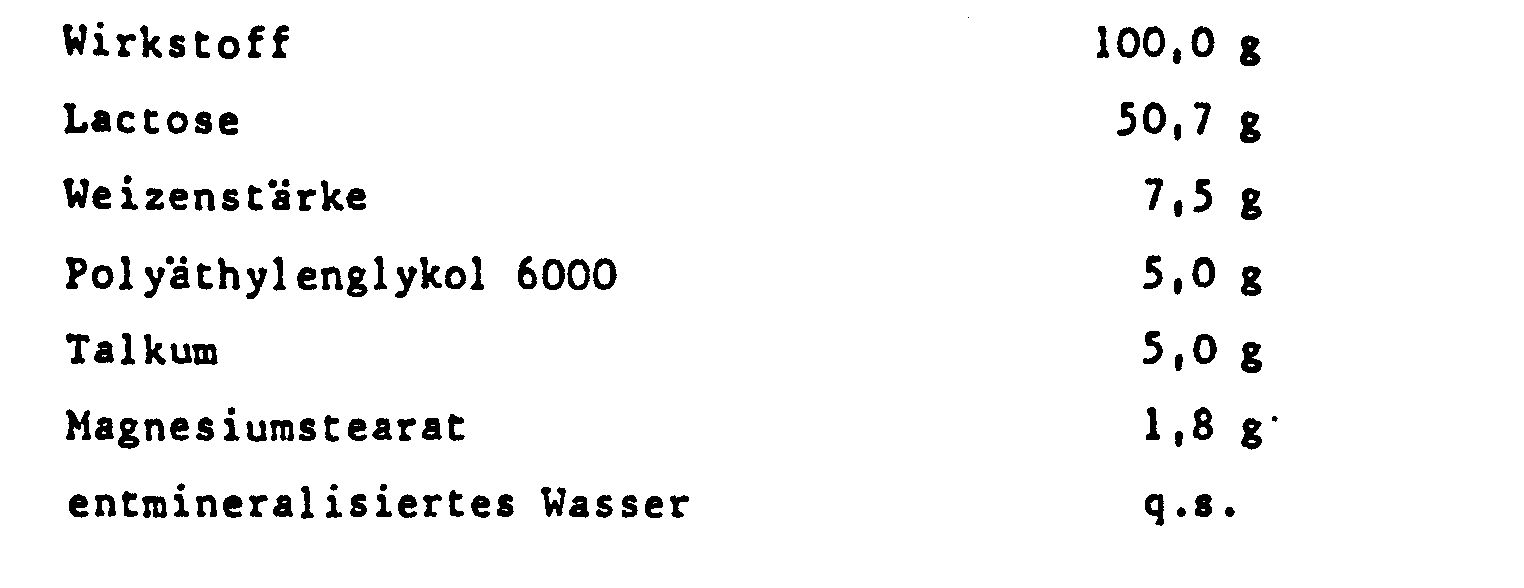
- Herstellung: Sämtliche festen Ingredienzien werden zunächst durch ein Sieb von 0,6 mm Maschenweite getrieben. Dann wird der Wirkstoff, die Lactose, das Talkum, das Magnesiumstearat und die Hälfte der Stärke vermischt. Die andere Hälfte der Stärke wird in 40 ml Wasser suspendiert und diese Suspension zu einer siedenen Lösung des Polyäthylenglykols in 100 ml Wasser hinzugegeben und das Gemisch, wenn nötig unter Hinzufügen von Wasser, granuliert. Das Granulat wird über Nacht bei 35° getrocknet, durch ein Sieb mit 1,2 mm Maschenweite getrieben und zu beidseitig konkaven Tabletten von etwa 6 mm Durchmesser verpresst.
- Tabletten enthaltend 75 mg der neuen, kristallwasserhaltigen Kristallmodifikation des Dinatrium-3-amino-l-hydroxy-propan-1,1- diphosphonates (Modifikation E) als Wirkstoff, können folgendermassen hergestellt werden:
-

- Herstellung: Sämtliche festen Ingredienzien werden zunächst durch ein Sieb von 0,6 mm Maschenweite getrieben. Dann wird der Wirkstoff, die Lactose, das Talkum, das Magnesiumstearat und die Hälfte der Stärke vermischt. Die andere Hälfte der Stärke wird in 40 ml Wasser suspendiert und diese Suspension zu einer siedenden Lösung des Polyäthylenglykols in 100 ml Wasser hinzugegeben und das Gemisch , wenn nötig unter Hinzufügen von Wasser, granuliert. Das Granulat wird über Nacht bei 35° getrocknet, durch ein Sieb mit 1,2 mm Maschenweite getrieben und zu beidseitig konkaven Tabletten von etwa 6 mm Durchmesser verpresst.
Claims (37)

in kristalliner, kristallwasserhaltiger Form.


Priority Applications (1)
| Application Number | Priority Date | Filing Date | Title |
|---|---|---|---|
| AT85810352T ATE47396T1 (de) | 1984-08-06 | 1985-07-30 | Kristallmodifikation des dinatrium-3-amino-1hydroxy-propan-1,1-diphosphonates. |
Applications Claiming Priority (2)
| Application Number | Priority Date | Filing Date | Title |
|---|---|---|---|
| CH3768/84 | 1984-08-06 | ||
| CH376884 | 1984-08-06 |
Publications (2)
| Publication Number | Publication Date |
|---|---|
| EP0177443A1 true EP0177443A1 (de) | 1986-04-09 |
| EP0177443B1 EP0177443B1 (de) | 1989-10-18 |
Family
ID=4263070
Family Applications (1)
| Application Number | Title | Priority Date | Filing Date |
|---|---|---|---|
| EP85810352A Expired EP0177443B1 (de) | 1984-08-06 | 1985-07-30 | Kristallmodifikation des Dinatrium-3-amino-1-hydroxy-propan-1,1-diphosphonates |
Country Status (26)
| Country | Link |
|---|---|
| US (2) | US4639338A (de) |
| EP (1) | EP0177443B1 (de) |
| JP (1) | JPS6143196A (de) |
| KR (1) | KR940000817B1 (de) |
| AR (4) | AR240832A1 (de) |
| AT (1) | ATE47396T1 (de) |
| AU (1) | AU591066B2 (de) |
| CA (1) | CA1255694A (de) |
| CY (1) | CY1570A (de) |
| DD (1) | DD239597A5 (de) |
| DE (1) | DE3573783D1 (de) |
| DK (1) | DK167282B1 (de) |
| DO (1) | DOP1990004769A (de) |
| ES (2) | ES8701188A1 (de) |
| FI (1) | FI79712C (de) |
| GR (1) | GR851910B (de) |
| HK (1) | HK42591A (de) |
| HU (1) | HU193124B (de) |
| IE (1) | IE58077B1 (de) |
| IL (1) | IL75990A (de) |
| MX (1) | MX9203373A (de) |
| NO (1) | NO165401C (de) |
| PH (1) | PH24854A (de) |
| PT (1) | PT80916B (de) |
| SG (1) | SG91390G (de) |
| ZA (1) | ZA855892B (de) |
Cited By (11)
| Publication number | Priority date | Publication date | Assignee | Title |
|---|---|---|---|---|
| EP0387194A1 (de) * | 1989-03-08 | 1990-09-12 | Ciba-Geigy Ag | N-substituierte Aminoalkandiphosphonsäuren |
| EP0421921A1 (de) * | 1989-09-07 | 1991-04-10 | Ciba-Geigy Ag | Doppelt beschichtete Granulate |
| EP0566535A1 (de) | 1992-04-15 | 1993-10-20 | Ciba-Geigy Ag | Methandiphosphonsäure-Formulierungen mit Ionenaustauschern |
| WO1995029679A1 (en) * | 1994-04-29 | 1995-11-09 | Merck & Co., Inc. | Wet granulation formulation for bisphosphonic acids |
| EP0654291A3 (de) * | 1993-11-24 | 1996-03-20 | Fuji Photo Film Co Ltd | Verfahren zur Kristallisierung organischer Chemikalien. |
| EP0891979A1 (de) * | 1997-07-15 | 1999-01-20 | Gador S.A. | Kristalline Form von N,N-dimethyl-3-amino-1-hydroxypropan-1,1-Diphosphonsäure Mononatriumsalz Monohydrat und ein Verfahren zu ihrer Herstellung |
| WO2000034293A1 (en) * | 1998-12-10 | 2000-06-15 | Aesgen, Inc. | Method for preparation of disodium pamidronate |
| US6160165A (en) * | 1998-12-10 | 2000-12-12 | Aesgen, Inc. | Method for preparation of disodium pamidronate |
| EP1228762A3 (de) * | 1998-12-10 | 2003-06-11 | Aesgen, Inc. | Verfahren zur Herstellung von Dinatriumpamidronat |
| WO2003053985A1 (en) * | 2001-12-21 | 2003-07-03 | Lyogen Limited | Pamidronic acid monosodium salt and preparation thereof |
| US6692764B2 (en) | 1994-04-29 | 2004-02-17 | Merck & Co., Inc. | Wet granulation formulation for bisphosphonic acids |
Families Citing this family (48)
| Publication number | Priority date | Publication date | Assignee | Title |
|---|---|---|---|---|
| CH664158A5 (fr) * | 1984-07-18 | 1988-02-15 | Symphar Sa | Derives propylidenediphosphonates-1,3 substitues en position 2, leur procede de preparation et compositions pharmaceutiques les contenant. |
| ES2039237T3 (es) * | 1986-04-24 | 1993-09-16 | Fujisawa Pharmaceutical Co., Ltd. | Procedimiento para preparar nuevos compuestos de acido difosfonico. |
| IL86951A (en) * | 1987-07-06 | 1996-07-23 | Procter & Gamble Pharma | Methylene phosphonoalkylphosphinates and pharmaceutical preparations containing them |
| US4963681A (en) * | 1987-07-06 | 1990-10-16 | Norwich Eaton Pharmaceuticals, Inc. | Process for synthesis of aminomethylene phosphonoalkylphosphinates |
| IT1222734B (it) * | 1987-09-25 | 1990-09-12 | Scalvo S P A | Formulaziopne farmaceutiche e forme di dosaggio per la somminaistarzione rettale di calcitonina |
| US4922007A (en) * | 1989-06-09 | 1990-05-01 | Merck & Co., Inc. | Process for preparing 4-amino-1-hydroxybutylidene-1,1-bisphosphonic acid or salts thereof |
| US5019651A (en) * | 1990-06-20 | 1991-05-28 | Merck & Co., Inc. | Process for preparing 4-amino-1-hydroxybutylidene-1,1-bisphosphonic acid (ABP) or salts thereof |
| EP0541037A3 (en) * | 1991-11-06 | 1997-02-26 | Takeda Chemical Industries Ltd | Squalene synthetase inhibitory composition and use thereof |
| US5270365A (en) * | 1991-12-17 | 1993-12-14 | Merck & Co., Inc. | Prevention and treatment of periodontal disease with alendronate |
| US6406714B1 (en) | 1992-12-02 | 2002-06-18 | Merck & Co., Inc. | Dry mix formulation for bisphosphonic acids |
| US5358941A (en) * | 1992-12-02 | 1994-10-25 | Merck & Co., Inc. | Dry mix formulation for bisphosphonic acids with lactose |
| GB9408775D0 (en) * | 1994-05-04 | 1994-06-22 | Ciba Geigy Ag | Use of certain methanebisphosphonic acid derivatives to prevent prothesis loosening and prothesis migration |
| DE19719680A1 (de) | 1997-05-09 | 1998-11-19 | Boehringer Mannheim Gmbh | Verwendung von Diphosphonsäuren zur präventiven Behandlung von Spätfolgen bei Harnblasenerweiterung oder Harnblasenersatz |
| EP1702924A3 (de) * | 1998-08-27 | 2007-07-18 | Teva Pharmaceutical Industries Ltd | Hydratformen des Natriumsalzes von Alendronat, Verfahren zu ihrer Herstellung und pharmazeutische Zusammensetzungen |
| DK1107974T3 (da) | 1998-08-27 | 2006-10-30 | Teva Pharma | Nye hydratformer af alendronat natrium, processer til fremstilling deraf, og farmaceutiske sammensætninger deraf |
| EP0998933A1 (de) | 1998-10-09 | 2000-05-10 | Boehringer Mannheim Gmbh | Verfahren zur Herstellung von bisphosphonathaltigen pharmazeutischen Zusammensetzungen zur oralen Applikation |
| EP0998932A1 (de) | 1998-10-09 | 2000-05-10 | Boehringer Mannheim Gmbh | Feste pharmazeutische Darreichungsform enthaltend Diphosphonsäure oder deren Salze und Verfahren zu ihrer Herstellung |
| US6143919A (en) * | 1999-05-18 | 2000-11-07 | 3M Innovative Properties Company | Polymerizable acidic compounds and methods of preparation |
| US6315566B1 (en) | 1999-05-18 | 2001-11-13 | 3M Innovative Properties Company | Dental materials |
| US6963008B2 (en) * | 1999-07-19 | 2005-11-08 | Teva Pharmaceutical Industries Ltd. | Hydrate forms of alendronate sodium, processes for manufacture thereof, and pharmaceutical compositions thereof |
| ES2153794B1 (es) * | 1999-08-06 | 2001-10-16 | Medichem Sa | Procedimiento para la obtencion del acido 4-amino-1-hidroxibutiliden-1,1-bisfosfonico y de su sal monosodica trihidratada. |
| KR100343232B1 (ko) * | 1999-12-10 | 2002-07-10 | 김재윤 | 결정성 파미드론산 이나트륨염 수화물과 그의 제조방법 |
| KR20030043931A (ko) * | 2000-09-18 | 2003-06-02 | 에프. 에이취. 펄딩 앤드 컴파니 리미티드 | 디포스포네이트 용액 |
| JP2004519463A (ja) * | 2001-01-23 | 2004-07-02 | ガドール エス アー | 骨の代謝病の予防および/または治療のための組成物、その組成物の調製方法およびその使用 |
| BR0209361A (pt) | 2001-05-02 | 2004-06-08 | Sicor Inc | Dissódio de pamidronato injetável |
| CA2372450A1 (en) * | 2001-05-10 | 2001-09-19 | Pharmaceutical Partners Of Canada Inc. | Liquid injectable formulation of disodium pamidronate |
| US20040052843A1 (en) * | 2001-12-24 | 2004-03-18 | Lerner E. Itzhak | Controlled release dosage forms |
| NZ552513A (en) * | 2001-12-24 | 2008-08-29 | Teva Pharma | Dosage form with a core tablet of active ingredient sheathed in a compressed annular body of powder or granular material, and process and tooling for producing it |
| EP1490090A4 (de) | 2002-02-22 | 2006-09-20 | New River Pharmaceuticals Inc | Wirkstoff-abgabesystem und verfahren zum schutz und zur verabreichung von wirkstoffen |
| US20040138180A1 (en) * | 2002-10-03 | 2004-07-15 | Barr Laboratories, Inc. | Bisphosphonate composition and process for the preparation thereof |
| WO2004056373A1 (en) * | 2002-12-20 | 2004-07-08 | F. Hoffmann-La Roche Ag | High dose ibandronate formulation |
| US20050119230A1 (en) * | 2003-09-18 | 2005-06-02 | Alexandra Glausch | Pharmaceutical products comprising bisphosphonated |
| WO2005054260A1 (en) * | 2003-12-04 | 2005-06-16 | Mustafa Nevzat Ilac Sanayii A.S. | Method for producing pure disodium pamidronate |
| EP2283825B1 (de) | 2004-05-24 | 2022-04-13 | Allergan Pharmaceuticals International Limited | Enterische feste orale Dosierform eines Bisphosphonats mit einem Chelate |
| WO2008128056A1 (en) * | 2004-10-08 | 2008-10-23 | The Board Of Trustees Of The University Of Illinois | Bisphosphonate compounds and methods with enhanced potency for multiple targets including fpps, ggpps, and dpps |
| US7358361B2 (en) * | 2004-10-08 | 2008-04-15 | The Board Of Trustees Of The University Of Illinois | Biophosphonate compounds and methods for bone resorption diseases, cancer, bone pain, immune disorders, and infectious diseases |
| AU2007226964B2 (en) * | 2006-03-17 | 2012-03-22 | The Board Of Trustees Of The University Of Illinois | Bisphosphonate compounds and methods |
| US20100144679A1 (en) * | 2007-03-21 | 2010-06-10 | Duke University | Medication kits and formulations for preventing, treating or reducing secondary fractures after previous fracture |
| EP2234608A2 (de) | 2007-12-11 | 2010-10-06 | Viamet Pharmaceuticals, Inc. | Metalloenzymhemmer mit metallbindenden teilen in kombination mit targeting-teilen |
| HUE025737T2 (en) | 2009-09-01 | 2016-05-30 | Univ Duke | Bisphosphonate compositions and methods for treating heart failure |
| FR2954320B1 (fr) | 2009-12-17 | 2012-06-15 | Cll Pharma | Composition pharmaceutique orale suprabiodisponible contenant un acide biphosphonique ou un de ses sels |
| US20130138221A1 (en) | 2010-04-16 | 2013-05-30 | Novartis Ag | Methods and compositions for improving implant osseointegration |
| CN104010647A (zh) | 2011-11-16 | 2014-08-27 | 杜克大学 | 用于治疗和/或减轻心功能障碍的双膦酸盐组合物及方法 |
| GB201200868D0 (en) | 2012-01-19 | 2012-02-29 | Depuy Int Ltd | Bone filler composition |
| US11654152B2 (en) | 2012-05-14 | 2023-05-23 | Antecip Bioventures Ii Llc | Compositions for oral administration of zoledronic acid or related compounds for treating disease |
| PT2849758T (pt) * | 2012-05-14 | 2018-05-09 | Antecip Bioventures Ii Llc | Composições que compreendem o ácido zoledrónico ou compostos relacionados para o alívio da dor inflamatória e estados relacionados |
| KR101995432B1 (ko) * | 2016-10-13 | 2019-07-02 | 엘지전자 주식회사 | 공기조화기 및 그 제어방법 |
| EP3553067A1 (de) * | 2018-04-10 | 2019-10-16 | Abiogen Pharma S.p.A. | Polymorph von natriumneridronat und herstellungsverfahren dafür |
Citations (3)
| Publication number | Priority date | Publication date | Assignee | Title |
|---|---|---|---|---|
| DE2405254A1 (de) * | 1974-02-04 | 1975-08-14 | Henkel & Cie Gmbh | Pharmazeutische oder kosmetische praeparate |
| DE2553963A1 (de) * | 1975-12-01 | 1977-06-08 | Henkel & Cie Gmbh | Pharmazeutische praeparate zur behandlung von stoerungen des calciumstoffwechsels |
| US4304734A (en) * | 1980-10-16 | 1981-12-08 | Vysoka Skola Chemicko-Technologicka | 6-Amino-1-hydroxyhexylidene diphosphonic acid, salts and a process for production thereof |
Family Cites Families (12)
| Publication number | Priority date | Publication date | Assignee | Title |
|---|---|---|---|---|
| DE2130794C3 (de) * | 1971-06-22 | 1974-07-11 | Joh. A. Benckiser Gmbh, 6700 Ludwigshafen | Verfahren zur Herstellung von l-Hydroxy-S-amino-propan-ljl-diphosphonsäure |
| US4134969A (en) * | 1974-02-04 | 1979-01-16 | Henkel Kommanditgesellschaft Auf Aktien (Henkel Kgaa) | Method of treatment of calcium disorders using aminoalkane-diphosphonic acids |
| DE2534391C2 (de) * | 1975-08-01 | 1983-01-13 | Henkel KGaA, 4000 Düsseldorf | 1-Hydroxy-3-aminoalkan-1,1-diphosphonsäuren |
| JPS5283957A (en) * | 1975-12-01 | 1977-07-13 | Henkel & Cie Gmbh | Medicine for treating metabolic obstruction of calcium |
| DK506476A (da) * | 1975-12-01 | 1977-06-02 | Henkel & Cie Gmbh | Farmaceutiske preparater til behandling af calciumstofs skifteforstyrrelser |
| SE409706B (sv) * | 1976-05-21 | 1979-09-03 | Astra Pharma Prod | Forfarande for framstellning av n,n-dimetyl-3-(4-bromfenyl)-3-3(3-pyridyl)-allylamin dihydroklorid monohydrat |
| DE2702631A1 (de) * | 1977-01-22 | 1978-07-27 | Henkel Kgaa | Verfahren zur herstellung von 1-hydroxy-3-amino-propan-1,1-diphosphonsaeuren |
| DE2943498C2 (de) * | 1979-10-27 | 1983-01-27 | Henkel KGaA, 4000 Düsseldorf | Verfahren zur Herstellung von 3-Amino-1-hydroxypropan-1,1-diphosphonsäure |
| DE3016289A1 (de) * | 1980-04-28 | 1981-10-29 | Henkel KGaA, 4000 Düsseldorf | Verfahren zur herstellung von omega -amino-1-hydroxyalkyliden-1,1-bis-phosphonsaeuren |
| DE3151038A1 (de) * | 1981-12-23 | 1983-07-28 | Henkel KGaA, 4000 Düsseldorf | Verfahren zur herstellung von 3-amino-1-hydroxypropan-1,1-diphosphonsaeure |
| US4446052A (en) * | 1982-05-17 | 1984-05-01 | The Procter & Gamble Company | Aqueous gel containing tricalcium di(1-hydroxy-3-aminopropane-1,1-diphosphonate |
| CH664158A5 (fr) * | 1984-07-18 | 1988-02-15 | Symphar Sa | Derives propylidenediphosphonates-1,3 substitues en position 2, leur procede de preparation et compositions pharmaceutiques les contenant. |
-
1985
- 1985-07-29 US US06/759,985 patent/US4639338A/en not_active Expired - Lifetime
- 1985-07-30 AT AT85810352T patent/ATE47396T1/de not_active IP Right Cessation
- 1985-07-30 DE DE8585810352T patent/DE3573783D1/de not_active Expired
- 1985-07-30 EP EP85810352A patent/EP0177443B1/de not_active Expired
- 1985-08-01 PH PH32593A patent/PH24854A/en unknown
- 1985-08-01 IL IL75990A patent/IL75990A/xx not_active IP Right Cessation
- 1985-08-02 FI FI852986A patent/FI79712C/fi not_active IP Right Cessation
- 1985-08-02 IE IE193185A patent/IE58077B1/en not_active IP Right Cessation
- 1985-08-02 CA CA000488039A patent/CA1255694A/en not_active Expired
- 1985-08-05 PT PT80916A patent/PT80916B/pt unknown
- 1985-08-05 DD DD85279373A patent/DD239597A5/de not_active IP Right Cessation
- 1985-08-05 ZA ZA855892A patent/ZA855892B/xx unknown
- 1985-08-05 NO NO853087A patent/NO165401C/no not_active IP Right Cessation
- 1985-08-05 DK DK355485A patent/DK167282B1/da not_active IP Right Cessation
- 1985-08-05 JP JP60171301A patent/JPS6143196A/ja active Granted
- 1985-08-05 GR GR851910A patent/GR851910B/el unknown
- 1985-08-05 ES ES545899A patent/ES8701188A1/es not_active Expired
- 1985-08-05 AU AU45777/85A patent/AU591066B2/en not_active Expired
- 1985-08-05 KR KR1019850005620A patent/KR940000817B1/ko not_active Expired - Lifetime
- 1985-08-05 HU HU842978A patent/HU193124B/hu unknown
- 1985-08-06 AR AR301204A patent/AR240832A1/es active
-
1986
- 1986-06-02 ES ES555602A patent/ES8706707A1/es not_active Expired
- 1986-09-08 US US06/905,097 patent/US4711880A/en not_active Expired - Lifetime
-
1989
- 1989-06-29 AR AR89314298A patent/AR244698A1/es active
- 1989-06-29 AR AR89314299A patent/AR244696A1/es active
- 1989-06-29 AR AR89314300A patent/AR244697A1/es active
-
1990
- 1990-11-13 SG SG913/90A patent/SG91390G/en unknown
- 1990-11-20 DO DO1990004769A patent/DOP1990004769A/es unknown
-
1991
- 1991-05-30 HK HK425/91A patent/HK42591A/xx not_active IP Right Cessation
- 1991-12-20 CY CY1570A patent/CY1570A/xx unknown
-
1992
- 1992-06-25 MX MX9203373A patent/MX9203373A/es unknown
Patent Citations (3)
| Publication number | Priority date | Publication date | Assignee | Title |
|---|---|---|---|---|
| DE2405254A1 (de) * | 1974-02-04 | 1975-08-14 | Henkel & Cie Gmbh | Pharmazeutische oder kosmetische praeparate |
| DE2553963A1 (de) * | 1975-12-01 | 1977-06-08 | Henkel & Cie Gmbh | Pharmazeutische praeparate zur behandlung von stoerungen des calciumstoffwechsels |
| US4304734A (en) * | 1980-10-16 | 1981-12-08 | Vysoka Skola Chemicko-Technologicka | 6-Amino-1-hydroxyhexylidene diphosphonic acid, salts and a process for production thereof |
Cited By (15)
| Publication number | Priority date | Publication date | Assignee | Title |
|---|---|---|---|---|
| US5036058A (en) * | 1989-03-08 | 1991-07-30 | Ciba-Geigy Corporation | N-substituted aminoalkanediphosphonic acids |
| EP0387194A1 (de) * | 1989-03-08 | 1990-09-12 | Ciba-Geigy Ag | N-substituierte Aminoalkandiphosphonsäuren |
| EP0421921A1 (de) * | 1989-09-07 | 1991-04-10 | Ciba-Geigy Ag | Doppelt beschichtete Granulate |
| EP0566535A1 (de) | 1992-04-15 | 1993-10-20 | Ciba-Geigy Ag | Methandiphosphonsäure-Formulierungen mit Ionenaustauschern |
| EP0654291A3 (de) * | 1993-11-24 | 1996-03-20 | Fuji Photo Film Co Ltd | Verfahren zur Kristallisierung organischer Chemikalien. |
| US6692764B2 (en) | 1994-04-29 | 2004-02-17 | Merck & Co., Inc. | Wet granulation formulation for bisphosphonic acids |
| WO1995029679A1 (en) * | 1994-04-29 | 1995-11-09 | Merck & Co., Inc. | Wet granulation formulation for bisphosphonic acids |
| EP0891979A1 (de) * | 1997-07-15 | 1999-01-20 | Gador S.A. | Kristalline Form von N,N-dimethyl-3-amino-1-hydroxypropan-1,1-Diphosphonsäure Mononatriumsalz Monohydrat und ein Verfahren zu ihrer Herstellung |
| US6160165A (en) * | 1998-12-10 | 2000-12-12 | Aesgen, Inc. | Method for preparation of disodium pamidronate |
| US6268524B1 (en) | 1998-12-10 | 2001-07-31 | Aesgen, Inc. | Method for preparation of disodium pamidronate |
| EP1228762A3 (de) * | 1998-12-10 | 2003-06-11 | Aesgen, Inc. | Verfahren zur Herstellung von Dinatriumpamidronat |
| AU764157B2 (en) * | 1998-12-10 | 2003-08-14 | Eisai Inc. | Method for preparation of disodium pamidronate |
| WO2000034293A1 (en) * | 1998-12-10 | 2000-06-15 | Aesgen, Inc. | Method for preparation of disodium pamidronate |
| US6794536B1 (en) | 1998-12-10 | 2004-09-21 | Aesqen, Inc. | Method for preparation of disodium pamidronate |
| WO2003053985A1 (en) * | 2001-12-21 | 2003-07-03 | Lyogen Limited | Pamidronic acid monosodium salt and preparation thereof |
Also Published As
Similar Documents
| Publication | Publication Date | Title |
|---|---|---|
| EP0177443B1 (de) | Kristallmodifikation des Dinatrium-3-amino-1-hydroxy-propan-1,1-diphosphonates | |
| DE69322087T2 (de) | Neues kristall von heterozyclischen bis(phosphonsäure) monohydrat-derivat | |
| EP0023594B1 (de) | Trans-Chinazolinderivate, Verfahren zu ihrer Herstellung, Zwischenprodukte und Arzneimittel enthaltend solche Chinazolinderivate | |
| DE60010316T3 (de) | Magnesiumomeprazol | |
| DD267490A5 (de) | Verfahren zur herstellung von wasserfreiem, kristallinem natriumsalz von 5-chlor-3-(2-thenoyl)-2-odindol-1-carboxamid | |
| DE2722162A1 (de) | Verfahren zur herstellung von phosphonigen saeuren | |
| DE1946315C2 (de) | 4,5-Dihydro-5-oxo-s-triazolo-[1,5-a]-pyrimidin-Derivate, Verfahren zu ihrer Herstellung und sie enthaltende pharmazeutische Zusammensetzungen | |
| DE2360096A1 (de) | 2-aminomethylenindanone, verfahren zu ihrer herstellung und diese enthaltende pharmazeutische mittel | |
| EP0133935A2 (de) | p-Oxibenzoesäurederivate, Verfahren zu ihrer Herstellung und ihre Verwendung zur Herstellung von Arzneimitteln mit hypolipämischer Wirkung | |
| WO1982002889A1 (en) | Ammonium salts of a substituted carbonic acid,preparation method thereof,utilization and medicinal preparations containing them | |
| DE60220448T2 (de) | Methode zur Eliminierung der Sulphonen Analogen, die während der Synthese der Pyridinen Benzimidazolen Sulfoxside-Komponenten vorkommen | |
| DE69619267T2 (de) | Verfahren zur herstellung von 3-amino-1,2,4-benzotriazindioxide | |
| EP0253293B1 (de) | Neue Guanidiniumasparaginate | |
| DE1493618A1 (de) | Cumarinderivate und ein Verfahren zu ihrer Herstellung | |
| DE2513693A1 (de) | Theophyllinderivate, verfahren zu deren herstellung und arzneimittel | |
| DE2412388A1 (de) | Dibenzothiophenderivate, verfahren zu deren herstellung und sie enthaltende arzneimittel | |
| DE69906876T2 (de) | Verfahren zur Reinigung von Carbazol-ester Vorstufen von 6-Chlor-alpha-methyl-carbazole-2-essigsäure | |
| DE2817558C2 (de) | Antitumormittel mit einem Gehalt an Derivaten von Trans-4-(aminomethyl)cyclohexan-1-carbonsäure | |
| EP0095641A1 (de) | Chinazolinonderivate, Verfahren zu ihrer Herstellung und ihre Verwendung in Arzneimitteln | |
| DE2309100C2 (de) | N-Acylierte Aminophenolätherderivate, Verfahren zu ihrer Herstellung und sie enthaltende pharmazeutische Formulierung zur Behandlung von Leberegelinfektionen bei Säugern | |
| DE2839311C2 (de) | Pharmazeutisches Präparat gegen Geschwüre | |
| DE1693190C3 (de) | Durch Alkylsulfonyloxyäthylamino-Gruppen disubstituierte Alkane und Hydroxyalkane, Verfahren zu deren Herstellung und diese Verbindungen enthaltende pharmazeutische Präparate | |
| DE1207393B (de) | Verfahren zur Herstellung von Natrium-dichlorisocyanurat und dessen Mono- und Dihydrat | |
| DE2337896A1 (de) | 4-phenylaminopyridinderivate | |
| DE3431273A1 (de) | Kristallines natriumsalz der d-6-((alpha)-(2-oxo-3-furfuryl-iden-amino-imidazolidin-1-yl)-carbonylamino)-thienyl-2-acetamido)-penicillansaeure, verfahren zur herstellung und seine verwendung in arzneimitteln |
Legal Events
| Date | Code | Title | Description |
|---|---|---|---|
| PUAI | Public reference made under article 153(3) epc to a published international application that has entered the european phase |
Free format text: ORIGINAL CODE: 0009012 |
|
| 17P | Request for examination filed |
Effective date: 19850801 |
|
| AK | Designated contracting states |
Kind code of ref document: A1 Designated state(s): AT BE CH DE FR GB IT LI LU NL SE |
|
| 17Q | First examination report despatched |
Effective date: 19871116 |
|
| GRAA | (expected) grant |
Free format text: ORIGINAL CODE: 0009210 |
|
| AK | Designated contracting states |
Kind code of ref document: B1 Designated state(s): AT BE CH DE FR GB IT LI LU NL SE |
|
| REF | Corresponds to: |
Ref document number: 47396 Country of ref document: AT Date of ref document: 19891115 Kind code of ref document: T |
|
| REF | Corresponds to: |
Ref document number: 3573783 Country of ref document: DE Date of ref document: 19891123 |
|
| ET | Fr: translation filed | ||
| ITF | It: translation for a ep patent filed | ||
| GBT | Gb: translation of ep patent filed (gb section 77(6)(a)/1977) | ||
| PLBE | No opposition filed within time limit |
Free format text: ORIGINAL CODE: 0009261 |
|
| STAA | Information on the status of an ep patent application or granted ep patent |
Free format text: STATUS: NO OPPOSITION FILED WITHIN TIME LIMIT |
|
| 26N | No opposition filed | ||
| REG | Reference to a national code |
Ref country code: FR Ref legal event code: CC Free format text: FRCC 92C0383, 920602 |
|
| REG | Reference to a national code |
Ref country code: FR Ref legal event code: CB Free format text: FRCB 92C0383, 850730 |
|
| REG | Reference to a national code |
Ref country code: FR Ref legal event code: CL |
|
| ITTA | It: last paid annual fee | ||
| EPTA | Lu: last paid annual fee | ||
| EAL | Se: european patent in force in sweden |
Ref document number: 85810352.6 |
|
| REG | Reference to a national code |
Ref country code: CH Ref legal event code: SPCF Free format text: CHSPCFIKS 52092/910419, 960125 |
|
| REG | Reference to a national code |
Ref country code: CH Ref legal event code: SPCF Free format text: CHSPCFIKS 52092/910419, 960125 |
|
| REG | Reference to a national code |
Ref country code: CH Ref legal event code: SPCP Free format text: IKS 52092/910419, 960125 Ref country code: CH Ref legal event code: PFA Free format text: CIBA-GEIGY AG;HENKEL KOMMANDITGESELLSCHAFT AUF AKTIEN TRANSFER- HENKEL KOMMANDITGESELLSCHAFT AUF AKTIEN;NOVARTIS AG |
|
| REG | Reference to a national code |
Ref country code: CH Ref legal event code: NV Representative=s name: NOVARTIS AG |
|
| REG | Reference to a national code |
Ref country code: CH Ref legal event code: SPCG Free format text: IKS 50433/19920123, 19960125, EXPIRES:20070123 Ref country code: CH Ref legal event code: SPCC Free format text: IKS 50438/19920423, 19960125 |
|
| REG | Reference to a national code |
Ref country code: GB Ref legal event code: 732E |
|
| NLS | Nl: assignments of ep-patents |
Owner name: NOVARTIS AG;HENKEL KOMMANDITGESELLSCHAFT AUF AKTIE |
|
| REG | Reference to a national code |
Ref country code: FR Ref legal event code: TP |
|
| REG | Reference to a national code |
Ref country code: GB Ref legal event code: IF02 |
|
| PGFP | Annual fee paid to national office [announced via postgrant information from national office to epo] |
Ref country code: FR Payment date: 20040602 Year of fee payment: 20 |
|
| PGFP | Annual fee paid to national office [announced via postgrant information from national office to epo] |
Ref country code: NL Payment date: 20040604 Year of fee payment: 20 Ref country code: BE Payment date: 20040604 Year of fee payment: 20 |
|
| PGFP | Annual fee paid to national office [announced via postgrant information from national office to epo] |
Ref country code: SE Payment date: 20040608 Year of fee payment: 20 Ref country code: DE Payment date: 20040608 Year of fee payment: 20 |
|
| PGFP | Annual fee paid to national office [announced via postgrant information from national office to epo] |
Ref country code: AT Payment date: 20040609 Year of fee payment: 20 |
|
| PGFP | Annual fee paid to national office [announced via postgrant information from national office to epo] |
Ref country code: LU Payment date: 20040610 Year of fee payment: 20 |
|
| PGFP | Annual fee paid to national office [announced via postgrant information from national office to epo] |
Ref country code: CH Payment date: 20040615 Year of fee payment: 20 |
|
| PGFP | Annual fee paid to national office [announced via postgrant information from national office to epo] |
Ref country code: GB Payment date: 20040621 Year of fee payment: 20 |
|
| PG25 | Lapsed in a contracting state [announced via postgrant information from national office to epo] |
Ref country code: GB Free format text: LAPSE BECAUSE OF EXPIRATION OF PROTECTION Effective date: 20050729 |
|
| PG25 | Lapsed in a contracting state [announced via postgrant information from national office to epo] |
Ref country code: NL Free format text: LAPSE BECAUSE OF EXPIRATION OF PROTECTION Effective date: 20050730 |
|
| BE20 | Be: patent expired |
Owner name: *HENKEL K.G.A.A. Effective date: 20050730 Owner name: *NOVARTIS A.G. Effective date: 20050730 |
|
| REG | Reference to a national code |
Ref country code: GB Ref legal event code: PE20 |
|
| EUG | Se: european patent has lapsed | ||
| REG | Reference to a national code |
Ref country code: CH Ref legal event code: PL |
|
| NLV7 | Nl: ceased due to reaching the maximum lifetime of a patent |
Effective date: 20050730 |
|
| REG | Reference to a national code |
Ref country code: CH Ref legal event code: SPCW Spc suppl protection certif: C00177443/01 |
|
| REG | Reference to a national code |
Ref country code: CH Ref legal event code: SPCC Free format text: PRODUCT NAME: PAMIDRONSAEURE (DINATRIUM-3-AMINO-1-HYDROXY-PROPAN-1,1-D); IRRTUEMLICH WURDE DIE LOESCHUNG NACH ABLAUF DER GESETZLICHEN SCHUTZFRIST IM +PAT+ NR. 4/2007 IM KAPITEL 10.2 ZURUECKZIEHUNGEN/ZURUECKWEISUNGEN VON ESZ-GESUCHEN UND ERTEILTEN ESZ PUBLIZIERT. DAS KORREKTE KAPITEL IST 10.3 LOESCHUNGEN VON ESZ-GESUCHEN UND ERTEILTEN ESZ Spc suppl protection certif: C00177443 Filing date: 19960125 |
|
| BE20 | Be: patent expired |
Owner name: *HENKEL K.G.A.A. Effective date: 20050730 Owner name: *NOVARTIS A.G. Effective date: 20050730 |