EP0101080B2 - Magnetisches Aufzeichnungsmedium - Google Patents
Magnetisches Aufzeichnungsmedium Download PDFInfo
- Publication number
- EP0101080B2 EP0101080B2 EP83107984A EP83107984A EP0101080B2 EP 0101080 B2 EP0101080 B2 EP 0101080B2 EP 83107984 A EP83107984 A EP 83107984A EP 83107984 A EP83107984 A EP 83107984A EP 0101080 B2 EP0101080 B2 EP 0101080B2
- Authority
- EP
- European Patent Office
- Prior art keywords
- protrusions
- magnetic recording
- recording medium
- resin
- substrate
- Prior art date
- Legal status (The legal status is an assumption and is not a legal conclusion. Google has not performed a legal analysis and makes no representation as to the accuracy of the status listed.)
- Expired - Lifetime
Links
- 230000005291 magnetic effect Effects 0.000 title claims description 43
- 239000000758 substrate Substances 0.000 claims description 92
- 239000008187 granular material Substances 0.000 claims description 65
- 239000002985 plastic film Substances 0.000 claims description 65
- 229920006255 plastic film Polymers 0.000 claims description 65
- 239000010409 thin film Substances 0.000 claims description 54
- 230000005294 ferromagnetic effect Effects 0.000 claims description 51
- 229910052751 metal Inorganic materials 0.000 claims description 44
- 239000002184 metal Substances 0.000 claims description 44
- 229920005989 resin Polymers 0.000 claims description 37
- 239000011347 resin Substances 0.000 claims description 37
- 239000000314 lubricant Substances 0.000 claims description 24
- VYPSYNLAJGMNEJ-UHFFFAOYSA-N Silicium dioxide Chemical compound O=[Si]=O VYPSYNLAJGMNEJ-UHFFFAOYSA-N 0.000 claims description 21
- 238000000576 coating method Methods 0.000 claims description 20
- -1 fatty acid esters Chemical class 0.000 claims description 20
- 239000011230 binding agent Substances 0.000 claims description 15
- 238000005461 lubrication Methods 0.000 claims description 14
- 229920000728 polyester Polymers 0.000 claims description 13
- 229920001169 thermoplastic Polymers 0.000 claims description 12
- 239000004416 thermosoftening plastic Substances 0.000 claims description 12
- OKTJSMMVPCPJKN-UHFFFAOYSA-N Carbon Chemical compound [C] OKTJSMMVPCPJKN-UHFFFAOYSA-N 0.000 claims description 11
- 239000011248 coating agent Substances 0.000 claims description 11
- 235000014113 dietary fatty acids Nutrition 0.000 claims description 11
- 239000000194 fatty acid Substances 0.000 claims description 11
- 229930195729 fatty acid Natural products 0.000 claims description 11
- 229910052799 carbon Inorganic materials 0.000 claims description 10
- 239000000178 monomer Substances 0.000 claims description 9
- 239000000377 silicon dioxide Substances 0.000 claims description 9
- 239000000126 substance Substances 0.000 claims description 9
- 150000004703 alkoxides Chemical class 0.000 claims description 8
- 150000004665 fatty acids Chemical class 0.000 claims description 7
- 229920006267 polyester film Polymers 0.000 claims description 7
- 239000000839 emulsion Substances 0.000 claims description 6
- 229920006287 phenoxy resin Polymers 0.000 claims description 6
- 239000013034 phenoxy resin Substances 0.000 claims description 6
- 239000004721 Polyphenylene oxide Substances 0.000 claims description 5
- 229920002492 poly(sulfone) Polymers 0.000 claims description 5
- 229920000058 polyacrylate Polymers 0.000 claims description 5
- 229920000515 polycarbonate Polymers 0.000 claims description 5
- 239000004417 polycarbonate Substances 0.000 claims description 5
- 229920006393 polyether sulfone Polymers 0.000 claims description 5
- 229920006380 polyphenylene oxide Polymers 0.000 claims description 5
- 239000004952 Polyamide Substances 0.000 claims description 4
- 229920002647 polyamide Polymers 0.000 claims description 4
- 229920001296 polysiloxane Polymers 0.000 claims description 4
- 239000000463 material Substances 0.000 claims description 3
- 229920000642 polymer Polymers 0.000 claims description 3
- 229920000915 polyvinyl chloride Polymers 0.000 claims description 3
- 239000004800 polyvinyl chloride Substances 0.000 claims description 3
- 239000000344 soap Substances 0.000 claims description 3
- 239000004094 surface-active agent Substances 0.000 claims description 3
- 239000004793 Polystyrene Substances 0.000 claims description 2
- 229920002037 poly(vinyl butyral) polymer Polymers 0.000 claims description 2
- 229920002223 polystyrene Polymers 0.000 claims description 2
- 239000000243 solution Substances 0.000 description 69
- 239000010410 layer Substances 0.000 description 63
- 239000010408 film Substances 0.000 description 52
- 239000000203 mixture Substances 0.000 description 49
- 229920000139 polyethylene terephthalate Polymers 0.000 description 28
- 239000005020 polyethylene terephthalate Substances 0.000 description 28
- 238000000034 method Methods 0.000 description 23
- 229910052760 oxygen Inorganic materials 0.000 description 14
- QVGXLLKOCUKJST-UHFFFAOYSA-N atomic oxygen Chemical compound [O] QVGXLLKOCUKJST-UHFFFAOYSA-N 0.000 description 13
- 239000001301 oxygen Substances 0.000 description 13
- PXHVJJICTQNCMI-UHFFFAOYSA-N nickel Substances [Ni] PXHVJJICTQNCMI-UHFFFAOYSA-N 0.000 description 12
- 239000002685 polymerization catalyst Substances 0.000 description 10
- 239000013078 crystal Substances 0.000 description 8
- 239000000843 powder Substances 0.000 description 8
- 239000002904 solvent Substances 0.000 description 8
- 239000003795 chemical substances by application Substances 0.000 description 7
- 239000006185 dispersion Substances 0.000 description 7
- 229920002521 macromolecule Polymers 0.000 description 7
- 230000003746 surface roughness Effects 0.000 description 7
- 238000001771 vacuum deposition Methods 0.000 description 7
- CONKBQPVFMXDOV-QHCPKHFHSA-N 6-[(5S)-5-[[4-[2-(2,3-dihydro-1H-inden-2-ylamino)pyrimidin-5-yl]piperazin-1-yl]methyl]-2-oxo-1,3-oxazolidin-3-yl]-3H-1,3-benzoxazol-2-one Chemical compound C1C(CC2=CC=CC=C12)NC1=NC=C(C=N1)N1CCN(CC1)C[C@H]1CN(C(O1)=O)C1=CC2=C(NC(O2)=O)C=C1 CONKBQPVFMXDOV-QHCPKHFHSA-N 0.000 description 6
- 229920002302 Nylon 6,6 Polymers 0.000 description 6
- XUIMIQQOPSSXEZ-UHFFFAOYSA-N Silicon Chemical compound [Si] XUIMIQQOPSSXEZ-UHFFFAOYSA-N 0.000 description 6
- 239000002131 composite material Substances 0.000 description 6
- 230000007062 hydrolysis Effects 0.000 description 6
- 238000006460 hydrolysis reaction Methods 0.000 description 6
- 230000001965 increasing effect Effects 0.000 description 6
- XEEYBQQBJWHFJM-UHFFFAOYSA-N iron Substances [Fe] XEEYBQQBJWHFJM-UHFFFAOYSA-N 0.000 description 6
- 239000010703 silicon Substances 0.000 description 6
- 229910052710 silicon Inorganic materials 0.000 description 6
- 238000007740 vapor deposition Methods 0.000 description 6
- HMUNWXXNJPVALC-UHFFFAOYSA-N 1-[4-[2-(2,3-dihydro-1H-inden-2-ylamino)pyrimidin-5-yl]piperazin-1-yl]-2-(2,4,6,7-tetrahydrotriazolo[4,5-c]pyridin-5-yl)ethanone Chemical compound C1C(CC2=CC=CC=C12)NC1=NC=C(C=N1)N1CCN(CC1)C(CN1CC2=C(CC1)NN=N2)=O HMUNWXXNJPVALC-UHFFFAOYSA-N 0.000 description 5
- 229910020630 Co Ni Inorganic materials 0.000 description 5
- 229910002440 Co–Ni Inorganic materials 0.000 description 5
- 125000004429 atom Chemical group 0.000 description 5
- 229920001577 copolymer Polymers 0.000 description 5
- 229910052759 nickel Inorganic materials 0.000 description 5
- WZFUQSJFWNHZHM-UHFFFAOYSA-N 2-[4-[2-(2,3-dihydro-1H-inden-2-ylamino)pyrimidin-5-yl]piperazin-1-yl]-1-(2,4,6,7-tetrahydrotriazolo[4,5-c]pyridin-5-yl)ethanone Chemical compound C1C(CC2=CC=CC=C12)NC1=NC=C(C=N1)N1CCN(CC1)CC(=O)N1CC2=C(CC1)NN=N2 WZFUQSJFWNHZHM-UHFFFAOYSA-N 0.000 description 4
- 230000015572 biosynthetic process Effects 0.000 description 4
- UKMSUNONTOPOIO-UHFFFAOYSA-N docosanoic acid Chemical compound CCCCCCCCCCCCCCCCCCCCCC(O)=O UKMSUNONTOPOIO-UHFFFAOYSA-N 0.000 description 4
- POULHZVOKOAJMA-UHFFFAOYSA-N dodecanoic acid Chemical compound CCCCCCCCCCCC(O)=O POULHZVOKOAJMA-UHFFFAOYSA-N 0.000 description 4
- 238000005755 formation reaction Methods 0.000 description 4
- IPCSVZSSVZVIGE-UHFFFAOYSA-N hexadecanoic acid Chemical compound CCCCCCCCCCCCCCCC(O)=O IPCSVZSSVZVIGE-UHFFFAOYSA-N 0.000 description 4
- 229910052742 iron Inorganic materials 0.000 description 4
- 230000002265 prevention Effects 0.000 description 4
- 150000003839 salts Chemical class 0.000 description 4
- 238000012360 testing method Methods 0.000 description 4
- LFQSCWFLJHTTHZ-UHFFFAOYSA-N Ethanol Chemical compound CCO LFQSCWFLJHTTHZ-UHFFFAOYSA-N 0.000 description 3
- OYHQOLUKZRVURQ-HZJYTTRNSA-N Linoleic acid Chemical compound CCCCC\C=C/C\C=C/CCCCCCCC(O)=O OYHQOLUKZRVURQ-HZJYTTRNSA-N 0.000 description 3
- 229910052782 aluminium Inorganic materials 0.000 description 3
- XAGFODPZIPBFFR-UHFFFAOYSA-N aluminium Chemical compound [Al] XAGFODPZIPBFFR-UHFFFAOYSA-N 0.000 description 3
- 238000000354 decomposition reaction Methods 0.000 description 3
- 238000001035 drying Methods 0.000 description 3
- 150000002148 esters Chemical class 0.000 description 3
- 150000002576 ketones Chemical class 0.000 description 3
- 229960004232 linoleic acid Drugs 0.000 description 3
- 150000002739 metals Chemical class 0.000 description 3
- 229920003207 poly(ethylene-2,6-naphthalate) Polymers 0.000 description 3
- 239000011112 polyethylene naphthalate Substances 0.000 description 3
- 238000000926 separation method Methods 0.000 description 3
- 239000010936 titanium Substances 0.000 description 3
- 229910052719 titanium Inorganic materials 0.000 description 3
- WRIDQFICGBMAFQ-UHFFFAOYSA-N (E)-8-Octadecenoic acid Natural products CCCCCCCCCC=CCCCCCCC(O)=O WRIDQFICGBMAFQ-UHFFFAOYSA-N 0.000 description 2
- MYRTYDVEIRVNKP-UHFFFAOYSA-N 1,2-Divinylbenzene Chemical compound C=CC1=CC=CC=C1C=C MYRTYDVEIRVNKP-UHFFFAOYSA-N 0.000 description 2
- LQJBNNIYVWPHFW-UHFFFAOYSA-N 20:1omega9c fatty acid Natural products CCCCCCCCCCC=CCCCCCCCC(O)=O LQJBNNIYVWPHFW-UHFFFAOYSA-N 0.000 description 2
- QSBYPNXLFMSGKH-UHFFFAOYSA-N 9-Heptadecensaeure Natural products CCCCCCCC=CCCCCCCCC(O)=O QSBYPNXLFMSGKH-UHFFFAOYSA-N 0.000 description 2
- 229910002012 Aerosil® Inorganic materials 0.000 description 2
- 235000021357 Behenic acid Nutrition 0.000 description 2
- DGAQECJNVWCQMB-PUAWFVPOSA-M Ilexoside XXIX Chemical compound C[C@@H]1CC[C@@]2(CC[C@@]3(C(=CC[C@H]4[C@]3(CC[C@@H]5[C@@]4(CC[C@@H](C5(C)C)OS(=O)(=O)[O-])C)C)[C@@H]2[C@]1(C)O)C)C(=O)O[C@H]6[C@@H]([C@H]([C@@H]([C@H](O6)CO)O)O)O.[Na+] DGAQECJNVWCQMB-PUAWFVPOSA-M 0.000 description 2
- UQSXHKLRYXJYBZ-UHFFFAOYSA-N Iron oxide Chemical compound [Fe]=O UQSXHKLRYXJYBZ-UHFFFAOYSA-N 0.000 description 2
- 239000005639 Lauric acid Substances 0.000 description 2
- JHWNWJKBPDFINM-UHFFFAOYSA-N Laurolactam Chemical compound O=C1CCCCCCCCCCCN1 JHWNWJKBPDFINM-UHFFFAOYSA-N 0.000 description 2
- FYYHWMGAXLPEAU-UHFFFAOYSA-N Magnesium Chemical compound [Mg] FYYHWMGAXLPEAU-UHFFFAOYSA-N 0.000 description 2
- 229920000571 Nylon 11 Polymers 0.000 description 2
- 229920000299 Nylon 12 Polymers 0.000 description 2
- 229920002292 Nylon 6 Polymers 0.000 description 2
- 229920000305 Nylon 6,10 Polymers 0.000 description 2
- 239000005642 Oleic acid Substances 0.000 description 2
- ZQPPMHVWECSIRJ-UHFFFAOYSA-N Oleic acid Natural products CCCCCCCCC=CCCCCCCCC(O)=O ZQPPMHVWECSIRJ-UHFFFAOYSA-N 0.000 description 2
- 235000021314 Palmitic acid Nutrition 0.000 description 2
- 239000004642 Polyimide Substances 0.000 description 2
- 239000004115 Sodium Silicate Substances 0.000 description 2
- 235000021355 Stearic acid Nutrition 0.000 description 2
- PPBRXRYQALVLMV-UHFFFAOYSA-N Styrene Chemical compound C=CC1=CC=CC=C1 PPBRXRYQALVLMV-UHFFFAOYSA-N 0.000 description 2
- BOTDANWDWHJENH-UHFFFAOYSA-N Tetraethyl orthosilicate Chemical compound CCO[Si](OCC)(OCC)OCC BOTDANWDWHJENH-UHFFFAOYSA-N 0.000 description 2
- RTAQQCXQSZGOHL-UHFFFAOYSA-N Titanium Chemical compound [Ti] RTAQQCXQSZGOHL-UHFFFAOYSA-N 0.000 description 2
- HCHKCACWOHOZIP-UHFFFAOYSA-N Zinc Chemical compound [Zn] HCHKCACWOHOZIP-UHFFFAOYSA-N 0.000 description 2
- 239000002253 acid Substances 0.000 description 2
- 239000000654 additive Substances 0.000 description 2
- DTOSIQBPPRVQHS-PDBXOOCHSA-N alpha-linolenic acid Chemical compound CC\C=C/C\C=C/C\C=C/CCCCCCCC(O)=O DTOSIQBPPRVQHS-PDBXOOCHSA-N 0.000 description 2
- 235000020661 alpha-linolenic acid Nutrition 0.000 description 2
- SMZOGRDCAXLAAR-UHFFFAOYSA-N aluminium isopropoxide Chemical compound [Al+3].CC(C)[O-].CC(C)[O-].CC(C)[O-] SMZOGRDCAXLAAR-UHFFFAOYSA-N 0.000 description 2
- 229940116226 behenic acid Drugs 0.000 description 2
- 239000011247 coating layer Substances 0.000 description 2
- 229910017052 cobalt Inorganic materials 0.000 description 2
- 239000010941 cobalt Substances 0.000 description 2
- GUTLYIVDDKVIGB-UHFFFAOYSA-N cobalt atom Chemical compound [Co] GUTLYIVDDKVIGB-UHFFFAOYSA-N 0.000 description 2
- 230000007423 decrease Effects 0.000 description 2
- 238000000151 deposition Methods 0.000 description 2
- 238000009826 distribution Methods 0.000 description 2
- HOWGUJZVBDQJKV-UHFFFAOYSA-N docosane Chemical compound CCCCCCCCCCCCCCCCCCCCCC HOWGUJZVBDQJKV-UHFFFAOYSA-N 0.000 description 2
- QHMGJGNTMQDRQA-UHFFFAOYSA-N dotriacontane Chemical compound CCCCCCCCCCCCCCCCCCCCCCCCCCCCCCCC QHMGJGNTMQDRQA-UHFFFAOYSA-N 0.000 description 2
- 230000000694 effects Effects 0.000 description 2
- 239000003822 epoxy resin Substances 0.000 description 2
- MVLVMROFTAUDAG-UHFFFAOYSA-N ethyl octadecanoate Chemical compound CCCCCCCCCCCCCCCCCC(=O)OCC MVLVMROFTAUDAG-UHFFFAOYSA-N 0.000 description 2
- STVZJERGLQHEKB-UHFFFAOYSA-N ethylene glycol dimethacrylate Substances CC(=C)C(=O)OCCOC(=O)C(C)=C STVZJERGLQHEKB-UHFFFAOYSA-N 0.000 description 2
- BXWNKGSJHAJOGX-UHFFFAOYSA-N hexadecan-1-ol Chemical compound CCCCCCCCCCCCCCCCO BXWNKGSJHAJOGX-UHFFFAOYSA-N 0.000 description 2
- QXJSBBXBKPUZAA-UHFFFAOYSA-N isooleic acid Natural products CCCCCCCC=CCCCCCCCCC(O)=O QXJSBBXBKPUZAA-UHFFFAOYSA-N 0.000 description 2
- 229960004488 linolenic acid Drugs 0.000 description 2
- KQQKGWQCNNTQJW-UHFFFAOYSA-N linolenic acid Natural products CC=CCCC=CCC=CCCCCCCCC(O)=O KQQKGWQCNNTQJW-UHFFFAOYSA-N 0.000 description 2
- 229910052749 magnesium Inorganic materials 0.000 description 2
- 239000011777 magnesium Substances 0.000 description 2
- 229910044991 metal oxide Inorganic materials 0.000 description 2
- 150000004706 metal oxides Chemical class 0.000 description 2
- WQEPLUUGTLDZJY-UHFFFAOYSA-N n-Pentadecanoic acid Natural products CCCCCCCCCCCCCCC(O)=O WQEPLUUGTLDZJY-UHFFFAOYSA-N 0.000 description 2
- LQERIDTXQFOHKA-UHFFFAOYSA-N nonadecane Chemical compound CCCCCCCCCCCCCCCCCCC LQERIDTXQFOHKA-UHFFFAOYSA-N 0.000 description 2
- RZJRJXONCZWCBN-UHFFFAOYSA-N octadecane Chemical compound CCCCCCCCCCCCCCCCCC RZJRJXONCZWCBN-UHFFFAOYSA-N 0.000 description 2
- QIQXTHQIDYTFRH-UHFFFAOYSA-N octadecanoic acid Chemical compound CCCCCCCCCCCCCCCCCC(O)=O QIQXTHQIDYTFRH-UHFFFAOYSA-N 0.000 description 2
- OQCDKBAXFALNLD-UHFFFAOYSA-N octadecanoic acid Natural products CCCCCCCC(C)CCCCCCCCC(O)=O OQCDKBAXFALNLD-UHFFFAOYSA-N 0.000 description 2
- ZQPPMHVWECSIRJ-KTKRTIGZSA-N oleic acid Chemical compound CCCCCCCC\C=C/CCCCCCCC(O)=O ZQPPMHVWECSIRJ-KTKRTIGZSA-N 0.000 description 2
- 235000021313 oleic acid Nutrition 0.000 description 2
- 229920003023 plastic Polymers 0.000 description 2
- 239000004033 plastic Substances 0.000 description 2
- 229920001707 polybutylene terephthalate Polymers 0.000 description 2
- 229920000647 polyepoxide Polymers 0.000 description 2
- 229920001721 polyimide Polymers 0.000 description 2
- BCWYYHBWCZYDNB-UHFFFAOYSA-N propan-2-ol;zirconium Chemical compound [Zr].CC(C)O.CC(C)O.CC(C)O.CC(C)O BCWYYHBWCZYDNB-UHFFFAOYSA-N 0.000 description 2
- 230000003014 reinforcing effect Effects 0.000 description 2
- 239000011734 sodium Substances 0.000 description 2
- 229910052708 sodium Inorganic materials 0.000 description 2
- NTHWMYGWWRZVTN-UHFFFAOYSA-N sodium silicate Chemical compound [Na+].[Na+].[O-][Si]([O-])=O NTHWMYGWWRZVTN-UHFFFAOYSA-N 0.000 description 2
- 229910052911 sodium silicate Inorganic materials 0.000 description 2
- 239000008117 stearic acid Substances 0.000 description 2
- TUNFSRHWOTWDNC-HKGQFRNVSA-N tetradecanoic acid Chemical compound CCCCCCCCCCCCC[14C](O)=O TUNFSRHWOTWDNC-HKGQFRNVSA-N 0.000 description 2
- 238000007669 thermal treatment Methods 0.000 description 2
- 229920002803 thermoplastic polyurethane Polymers 0.000 description 2
- 229920005992 thermoplastic resin Polymers 0.000 description 2
- JMXKSZRRTHPKDL-UHFFFAOYSA-N titanium ethoxide Chemical compound [Ti+4].CC[O-].CC[O-].CC[O-].CC[O-] JMXKSZRRTHPKDL-UHFFFAOYSA-N 0.000 description 2
- IIYFAKIEWZDVMP-UHFFFAOYSA-N tridecane Chemical compound CCCCCCCCCCCCC IIYFAKIEWZDVMP-UHFFFAOYSA-N 0.000 description 2
- XLYOFNOQVPJJNP-UHFFFAOYSA-N water Substances O XLYOFNOQVPJJNP-UHFFFAOYSA-N 0.000 description 2
- 229910052725 zinc Inorganic materials 0.000 description 2
- 239000011701 zinc Substances 0.000 description 2
- QMMJWQMCMRUYTG-UHFFFAOYSA-N 1,2,4,5-tetrachloro-3-(trifluoromethyl)benzene Chemical compound FC(F)(F)C1=C(Cl)C(Cl)=CC(Cl)=C1Cl QMMJWQMCMRUYTG-UHFFFAOYSA-N 0.000 description 1
- OHVLMTFVQDZYHP-UHFFFAOYSA-N 1-(2,4,6,7-tetrahydrotriazolo[4,5-c]pyridin-5-yl)-2-[4-[2-[[3-(trifluoromethoxy)phenyl]methylamino]pyrimidin-5-yl]piperazin-1-yl]ethanone Chemical compound N1N=NC=2CN(CCC=21)C(CN1CCN(CC1)C=1C=NC(=NC=1)NCC1=CC(=CC=C1)OC(F)(F)F)=O OHVLMTFVQDZYHP-UHFFFAOYSA-N 0.000 description 1
- LDMOEFOXLIZJOW-UHFFFAOYSA-N 1-dodecanesulfonic acid Chemical compound CCCCCCCCCCCCS(O)(=O)=O LDMOEFOXLIZJOW-UHFFFAOYSA-N 0.000 description 1
- RZRNAYUHWVFMIP-KTKRTIGZSA-N 1-oleoylglycerol Chemical compound CCCCCCCC\C=C/CCCCCCCC(=O)OCC(O)CO RZRNAYUHWVFMIP-KTKRTIGZSA-N 0.000 description 1
- LOUICXNAWQPGSU-UHFFFAOYSA-N 2,2,3,3-tetrafluorooxirane Chemical compound FC1(F)OC1(F)F LOUICXNAWQPGSU-UHFFFAOYSA-N 0.000 description 1
- GZBSIABKXVPBFY-UHFFFAOYSA-N 2,2-bis(hydroxymethyl)propane-1,3-diol;prop-2-enoic acid Chemical compound OC(=O)C=C.OC(=O)C=C.OC(=O)C=C.OC(=O)C=C.OCC(CO)(CO)CO GZBSIABKXVPBFY-UHFFFAOYSA-N 0.000 description 1
- LDXJRKWFNNFDSA-UHFFFAOYSA-N 2-(2,4,6,7-tetrahydrotriazolo[4,5-c]pyridin-5-yl)-1-[4-[2-[[3-(trifluoromethoxy)phenyl]methylamino]pyrimidin-5-yl]piperazin-1-yl]ethanone Chemical compound C1CN(CC2=NNN=C21)CC(=O)N3CCN(CC3)C4=CN=C(N=C4)NCC5=CC(=CC=C5)OC(F)(F)F LDXJRKWFNNFDSA-UHFFFAOYSA-N 0.000 description 1
- SMZOUWXMTYCWNB-UHFFFAOYSA-N 2-(2-methoxy-5-methylphenyl)ethanamine Chemical compound COC1=CC=C(C)C=C1CCN SMZOUWXMTYCWNB-UHFFFAOYSA-N 0.000 description 1
- JAHNSTQSQJOJLO-UHFFFAOYSA-N 2-(3-fluorophenyl)-1h-imidazole Chemical compound FC1=CC=CC(C=2NC=CN=2)=C1 JAHNSTQSQJOJLO-UHFFFAOYSA-N 0.000 description 1
- NIXOWILDQLNWCW-UHFFFAOYSA-N 2-Propenoic acid Natural products OC(=O)C=C NIXOWILDQLNWCW-UHFFFAOYSA-N 0.000 description 1
- JQMFQLVAJGZSQS-UHFFFAOYSA-N 2-[4-[2-(2,3-dihydro-1H-inden-2-ylamino)pyrimidin-5-yl]piperazin-1-yl]-N-(2-oxo-3H-1,3-benzoxazol-6-yl)acetamide Chemical compound C1C(CC2=CC=CC=C12)NC1=NC=C(C=N1)N1CCN(CC1)CC(=O)NC1=CC2=C(NC(O2)=O)C=C1 JQMFQLVAJGZSQS-UHFFFAOYSA-N 0.000 description 1
- IHCCLXNEEPMSIO-UHFFFAOYSA-N 2-[4-[2-(2,3-dihydro-1H-inden-2-ylamino)pyrimidin-5-yl]piperidin-1-yl]-1-(2,4,6,7-tetrahydrotriazolo[4,5-c]pyridin-5-yl)ethanone Chemical compound C1C(CC2=CC=CC=C12)NC1=NC=C(C=N1)C1CCN(CC1)CC(=O)N1CC2=C(CC1)NN=N2 IHCCLXNEEPMSIO-UHFFFAOYSA-N 0.000 description 1
- KTXWGMUMDPYXNN-UHFFFAOYSA-N 2-ethylhexan-1-olate;titanium(4+) Chemical compound [Ti+4].CCCCC(CC)C[O-].CCCCC(CC)C[O-].CCCCC(CC)C[O-].CCCCC(CC)C[O-] KTXWGMUMDPYXNN-UHFFFAOYSA-N 0.000 description 1
- SDTMFDGELKWGFT-UHFFFAOYSA-N 2-methylpropan-2-olate Chemical compound CC(C)(C)[O-] SDTMFDGELKWGFT-UHFFFAOYSA-N 0.000 description 1
- BGGIUGXMWNKMCP-UHFFFAOYSA-N 2-methylpropan-2-olate;zirconium(4+) Chemical compound CC(C)(C)O[Zr](OC(C)(C)C)(OC(C)(C)C)OC(C)(C)C BGGIUGXMWNKMCP-UHFFFAOYSA-N 0.000 description 1
- YLZOPXRUQYQQID-UHFFFAOYSA-N 3-(2,4,6,7-tetrahydrotriazolo[4,5-c]pyridin-5-yl)-1-[4-[2-[[3-(trifluoromethoxy)phenyl]methylamino]pyrimidin-5-yl]piperazin-1-yl]propan-1-one Chemical compound N1N=NC=2CN(CCC=21)CCC(=O)N1CCN(CC1)C=1C=NC(=NC=1)NCC1=CC(=CC=C1)OC(F)(F)F YLZOPXRUQYQQID-UHFFFAOYSA-N 0.000 description 1
- SDDGNMXIOGQCCH-UHFFFAOYSA-N 3-fluoro-n,n-dimethylaniline Chemical compound CN(C)C1=CC=CC(F)=C1 SDDGNMXIOGQCCH-UHFFFAOYSA-N 0.000 description 1
- FQMIAEWUVYWVNB-UHFFFAOYSA-N 3-prop-2-enoyloxybutyl prop-2-enoate Chemical compound C=CC(=O)OC(C)CCOC(=O)C=C FQMIAEWUVYWVNB-UHFFFAOYSA-N 0.000 description 1
- DBCAQXHNJOFNGC-UHFFFAOYSA-N 4-bromo-1,1,1-trifluorobutane Chemical compound FC(F)(F)CCCBr DBCAQXHNJOFNGC-UHFFFAOYSA-N 0.000 description 1
- WTFUTSCZYYCBAY-SXBRIOAWSA-N 6-[(E)-C-[[4-[2-(2,3-dihydro-1H-inden-2-ylamino)pyrimidin-5-yl]piperazin-1-yl]methyl]-N-hydroxycarbonimidoyl]-3H-1,3-benzoxazol-2-one Chemical compound C1C(CC2=CC=CC=C12)NC1=NC=C(C=N1)N1CCN(CC1)C/C(=N/O)/C1=CC2=C(NC(O2)=O)C=C1 WTFUTSCZYYCBAY-SXBRIOAWSA-N 0.000 description 1
- DFGKGUXTPFWHIX-UHFFFAOYSA-N 6-[2-[4-[2-(2,3-dihydro-1H-inden-2-ylamino)pyrimidin-5-yl]piperazin-1-yl]acetyl]-3H-1,3-benzoxazol-2-one Chemical compound C1C(CC2=CC=CC=C12)NC1=NC=C(C=N1)N1CCN(CC1)CC(=O)C1=CC2=C(NC(O2)=O)C=C1 DFGKGUXTPFWHIX-UHFFFAOYSA-N 0.000 description 1
- DEXFNLNNUZKHNO-UHFFFAOYSA-N 6-[3-[4-[2-(2,3-dihydro-1H-inden-2-ylamino)pyrimidin-5-yl]piperidin-1-yl]-3-oxopropyl]-3H-1,3-benzoxazol-2-one Chemical compound C1C(CC2=CC=CC=C12)NC1=NC=C(C=N1)C1CCN(CC1)C(CCC1=CC2=C(NC(O2)=O)C=C1)=O DEXFNLNNUZKHNO-UHFFFAOYSA-N 0.000 description 1
- LLQHSBBZNDXTIV-UHFFFAOYSA-N 6-[5-[[4-[2-(2,3-dihydro-1H-inden-2-ylamino)pyrimidin-5-yl]piperazin-1-yl]methyl]-4,5-dihydro-1,2-oxazol-3-yl]-3H-1,3-benzoxazol-2-one Chemical compound C1C(CC2=CC=CC=C12)NC1=NC=C(C=N1)N1CCN(CC1)CC1CC(=NO1)C1=CC2=C(NC(O2)=O)C=C1 LLQHSBBZNDXTIV-UHFFFAOYSA-N 0.000 description 1
- HRPVXLWXLXDGHG-UHFFFAOYSA-N Acrylamide Chemical compound NC(=O)C=C HRPVXLWXLXDGHG-UHFFFAOYSA-N 0.000 description 1
- NLHHRLWOUZZQLW-UHFFFAOYSA-N Acrylonitrile Chemical compound C=CC#N NLHHRLWOUZZQLW-UHFFFAOYSA-N 0.000 description 1
- KWIUHFFTVRNATP-UHFFFAOYSA-N Betaine Natural products C[N+](C)(C)CC([O-])=O KWIUHFFTVRNATP-UHFFFAOYSA-N 0.000 description 1
- RYGMFSIKBFXOCR-UHFFFAOYSA-N Copper Chemical compound [Cu] RYGMFSIKBFXOCR-UHFFFAOYSA-N 0.000 description 1
- BWGNESOTFCXPMA-UHFFFAOYSA-N Dihydrogen disulfide Chemical compound SS BWGNESOTFCXPMA-UHFFFAOYSA-N 0.000 description 1
- MYMOFIZGZYHOMD-UHFFFAOYSA-N Dioxygen Chemical compound O=O MYMOFIZGZYHOMD-UHFFFAOYSA-N 0.000 description 1
- ORAWFNKFUWGRJG-UHFFFAOYSA-N Docosanamide Chemical compound CCCCCCCCCCCCCCCCCCCCCC(N)=O ORAWFNKFUWGRJG-UHFFFAOYSA-N 0.000 description 1
- YCKRFDGAMUMZLT-UHFFFAOYSA-N Fluorine atom Chemical compound [F] YCKRFDGAMUMZLT-UHFFFAOYSA-N 0.000 description 1
- 239000004640 Melamine resin Substances 0.000 description 1
- 229920000877 Melamine resin Polymers 0.000 description 1
- 241000361919 Metaphire sieboldi Species 0.000 description 1
- CERQOIWHTDAKMF-UHFFFAOYSA-N Methacrylic acid Chemical compound CC(=C)C(O)=O CERQOIWHTDAKMF-UHFFFAOYSA-N 0.000 description 1
- ZOKXTWBITQBERF-UHFFFAOYSA-N Molybdenum Chemical compound [Mo] ZOKXTWBITQBERF-UHFFFAOYSA-N 0.000 description 1
- DFPAKSUCGFBDDF-UHFFFAOYSA-N Nicotinamide Chemical compound NC(=O)C1=CC=CN=C1 DFPAKSUCGFBDDF-UHFFFAOYSA-N 0.000 description 1
- 229910019142 PO4 Inorganic materials 0.000 description 1
- QHZLMUACJMDIAE-UHFFFAOYSA-N Palmitic acid monoglyceride Natural products CCCCCCCCCCCCCCCC(=O)OCC(O)CO QHZLMUACJMDIAE-UHFFFAOYSA-N 0.000 description 1
- 239000004698 Polyethylene Substances 0.000 description 1
- ZLMJMSJWJFRBEC-UHFFFAOYSA-N Potassium Chemical class [K] ZLMJMSJWJFRBEC-UHFFFAOYSA-N 0.000 description 1
- GWEVSGVZZGPLCZ-UHFFFAOYSA-N Titan oxide Chemical compound O=[Ti]=O GWEVSGVZZGPLCZ-UHFFFAOYSA-N 0.000 description 1
- DAKWPKUUDNSNPN-UHFFFAOYSA-N Trimethylolpropane triacrylate Chemical compound C=CC(=O)OCC(CC)(COC(=O)C=C)COC(=O)C=C DAKWPKUUDNSNPN-UHFFFAOYSA-N 0.000 description 1
- XTXRWKRVRITETP-UHFFFAOYSA-N Vinyl acetate Chemical compound CC(=O)OC=C XTXRWKRVRITETP-UHFFFAOYSA-N 0.000 description 1
- BZHJMEDXRYGGRV-UHFFFAOYSA-N Vinyl chloride Chemical compound ClC=C BZHJMEDXRYGGRV-UHFFFAOYSA-N 0.000 description 1
- 235000010724 Wisteria floribunda Nutrition 0.000 description 1
- OCKWAZCWKSMKNC-UHFFFAOYSA-N [3-octadecanoyloxy-2,2-bis(octadecanoyloxymethyl)propyl] octadecanoate Chemical compound CCCCCCCCCCCCCCCCCC(=O)OCC(COC(=O)CCCCCCCCCCCCCCCCC)(COC(=O)CCCCCCCCCCCCCCCCC)COC(=O)CCCCCCCCCCCCCCCCC OCKWAZCWKSMKNC-UHFFFAOYSA-N 0.000 description 1
- 239000006230 acetylene black Substances 0.000 description 1
- 150000007513 acids Chemical class 0.000 description 1
- 150000001338 aliphatic hydrocarbons Chemical class 0.000 description 1
- 239000003513 alkali Substances 0.000 description 1
- 125000000217 alkyl group Chemical group 0.000 description 1
- 150000008052 alkyl sulfonates Chemical class 0.000 description 1
- 239000000956 alloy Substances 0.000 description 1
- 229910045601 alloy Inorganic materials 0.000 description 1
- 239000004411 aluminium Chemical class 0.000 description 1
- PNEYBMLMFCGWSK-UHFFFAOYSA-N aluminium oxide Inorganic materials [O-2].[O-2].[O-2].[Al+3].[Al+3] PNEYBMLMFCGWSK-UHFFFAOYSA-N 0.000 description 1
- 150000003863 ammonium salts Chemical class 0.000 description 1
- 239000013556 antirust agent Substances 0.000 description 1
- 239000002216 antistatic agent Substances 0.000 description 1
- 239000004760 aramid Substances 0.000 description 1
- 150000004945 aromatic hydrocarbons Chemical class 0.000 description 1
- 229920003235 aromatic polyamide Polymers 0.000 description 1
- 239000012298 atmosphere Substances 0.000 description 1
- VBICKXHEKHSIBG-UHFFFAOYSA-N beta-monoglyceryl stearate Natural products CCCCCCCCCCCCCCCCCC(=O)OCC(O)CO VBICKXHEKHSIBG-UHFFFAOYSA-N 0.000 description 1
- 229960003237 betaine Drugs 0.000 description 1
- YHWCPXVTRSHPNY-UHFFFAOYSA-N butan-1-olate;titanium(4+) Chemical compound [Ti+4].CCCC[O-].CCCC[O-].CCCC[O-].CCCC[O-] YHWCPXVTRSHPNY-UHFFFAOYSA-N 0.000 description 1
- WUKWITHWXAAZEY-UHFFFAOYSA-L calcium difluoride Chemical compound [F-].[F-].[Ca+2] WUKWITHWXAAZEY-UHFFFAOYSA-L 0.000 description 1
- 229910001634 calcium fluoride Inorganic materials 0.000 description 1
- 239000006229 carbon black Substances 0.000 description 1
- 239000003518 caustics Substances 0.000 description 1
- 229960000541 cetyl alcohol Drugs 0.000 description 1
- 238000006243 chemical reaction Methods 0.000 description 1
- 229910052804 chromium Inorganic materials 0.000 description 1
- 239000011651 chromium Substances 0.000 description 1
- 239000011362 coarse particle Substances 0.000 description 1
- 229910052802 copper Inorganic materials 0.000 description 1
- 239000010949 copper Substances 0.000 description 1
- 238000005520 cutting process Methods 0.000 description 1
- TUTWLYPCGCUWQI-UHFFFAOYSA-N decanamide Chemical compound CCCCCCCCCC(N)=O TUTWLYPCGCUWQI-UHFFFAOYSA-N 0.000 description 1
- 238000000502 dialysis Methods 0.000 description 1
- 229910001882 dioxygen Inorganic materials 0.000 description 1
- ILRSCQWREDREME-UHFFFAOYSA-N dodecanamide Chemical compound CCCCCCCCCCCC(N)=O ILRSCQWREDREME-UHFFFAOYSA-N 0.000 description 1
- 125000003438 dodecyl group Chemical group [H]C([H])([H])C([H])([H])C([H])([H])C([H])([H])C([H])([H])C([H])([H])C([H])([H])C([H])([H])C([H])([H])C([H])([H])C([H])([H])C([H])([H])* 0.000 description 1
- 239000003995 emulsifying agent Substances 0.000 description 1
- 238000007720 emulsion polymerization reaction Methods 0.000 description 1
- ZJOLCKGSXLIVAA-UHFFFAOYSA-N ethene;octadecanamide Chemical compound C=C.CCCCCCCCCCCCCCCCCC(N)=O.CCCCCCCCCCCCCCCCCC(N)=O ZJOLCKGSXLIVAA-UHFFFAOYSA-N 0.000 description 1
- 238000001125 extrusion Methods 0.000 description 1
- 238000001914 filtration Methods 0.000 description 1
- 239000011737 fluorine Substances 0.000 description 1
- 229910052731 fluorine Inorganic materials 0.000 description 1
- 239000007789 gas Substances 0.000 description 1
- FEEPBTVZSYQUDP-UHFFFAOYSA-N heptatriacontanediamide Chemical compound NC(=O)CCCCCCCCCCCCCCCCCCCCCCCCCCCCCCCCCCCC(N)=O FEEPBTVZSYQUDP-UHFFFAOYSA-N 0.000 description 1
- HSEMFIZWXHQJAE-UHFFFAOYSA-N hexadecanamide Chemical compound CCCCCCCCCCCCCCCC(N)=O HSEMFIZWXHQJAE-UHFFFAOYSA-N 0.000 description 1
- ALBYIUDWACNRRB-UHFFFAOYSA-N hexanamide Chemical compound CCCCCC(N)=O ALBYIUDWACNRRB-UHFFFAOYSA-N 0.000 description 1
- 125000004435 hydrogen atom Chemical group [H]* 0.000 description 1
- 230000003301 hydrolyzing effect Effects 0.000 description 1
- 230000001939 inductive effect Effects 0.000 description 1
- 238000005342 ion exchange Methods 0.000 description 1
- 238000007733 ion plating Methods 0.000 description 1
- NLYAJNPCOHFWQQ-UHFFFAOYSA-N kaolin Chemical compound O.O.O=[Al]O[Si](=O)O[Si](=O)O[Al]=O NLYAJNPCOHFWQQ-UHFFFAOYSA-N 0.000 description 1
- 238000004898 kneading Methods 0.000 description 1
- 239000011133 lead Substances 0.000 description 1
- 125000005644 linolenyl group Chemical group 0.000 description 1
- 239000007788 liquid Substances 0.000 description 1
- 230000001050 lubricating effect Effects 0.000 description 1
- 230000005415 magnetization Effects 0.000 description 1
- 238000005259 measurement Methods 0.000 description 1
- FQPSGWSUVKBHSU-UHFFFAOYSA-N methacrylamide Chemical compound CC(=C)C(N)=O FQPSGWSUVKBHSU-UHFFFAOYSA-N 0.000 description 1
- ITNVWQNWHXEMNS-UHFFFAOYSA-N methanolate;titanium(4+) Chemical compound [Ti+4].[O-]C.[O-]C.[O-]C.[O-]C ITNVWQNWHXEMNS-UHFFFAOYSA-N 0.000 description 1
- LVHBHZANLOWSRM-UHFFFAOYSA-N methylenebutanedioic acid Natural products OC(=O)CC(=C)C(O)=O LVHBHZANLOWSRM-UHFFFAOYSA-N 0.000 description 1
- 239000011259 mixed solution Substances 0.000 description 1
- 238000002156 mixing Methods 0.000 description 1
- 229910052750 molybdenum Inorganic materials 0.000 description 1
- 239000011733 molybdenum Substances 0.000 description 1
- MHWZQNGIEIYAQJ-UHFFFAOYSA-N molybdenum diselenide Chemical compound [Se]=[Mo]=[Se] MHWZQNGIEIYAQJ-UHFFFAOYSA-N 0.000 description 1
- RZRNAYUHWVFMIP-UHFFFAOYSA-N monoelaidin Natural products CCCCCCCCC=CCCCCCCCC(=O)OCC(O)CO RZRNAYUHWVFMIP-UHFFFAOYSA-N 0.000 description 1
- 238000000465 moulding Methods 0.000 description 1
- 125000001421 myristyl group Chemical group [H]C([*])([H])C([H])([H])C([H])([H])C([H])([H])C([H])([H])C([H])([H])C([H])([H])C([H])([H])C([H])([H])C([H])([H])C([H])([H])C([H])([H])C([H])([H])C([H])([H])[H] 0.000 description 1
- ZIUHHBKFKCYYJD-UHFFFAOYSA-N n,n'-methylenebisacrylamide Chemical compound C=CC(=O)NCNC(=O)C=C ZIUHHBKFKCYYJD-UHFFFAOYSA-N 0.000 description 1
- LYRFLYHAGKPMFH-UHFFFAOYSA-N octadecanamide Chemical compound CCCCCCCCCCCCCCCCCC(N)=O LYRFLYHAGKPMFH-UHFFFAOYSA-N 0.000 description 1
- 239000003921 oil Substances 0.000 description 1
- FATBGEAMYMYZAF-KTKRTIGZSA-N oleamide Chemical compound CCCCCCCC\C=C/CCCCCCCC(N)=O FATBGEAMYMYZAF-KTKRTIGZSA-N 0.000 description 1
- 125000001117 oleyl group Chemical group [H]C([*])([H])C([H])([H])C([H])([H])C([H])([H])C([H])([H])C([H])([H])C([H])([H])C([H])([H])/C([H])=C([H])\C([H])([H])C([H])([H])C([H])([H])C([H])([H])C([H])([H])C([H])([H])C([H])([H])C([H])([H])[H] 0.000 description 1
- 230000003287 optical effect Effects 0.000 description 1
- 239000003960 organic solvent Substances 0.000 description 1
- 125000000913 palmityl group Chemical group [H]C([*])([H])C([H])([H])C([H])([H])C([H])([H])C([H])([H])C([H])([H])C([H])([H])C([H])([H])C([H])([H])C([H])([H])C([H])([H])C([H])([H])C([H])([H])C([H])([H])C([H])([H])C([H])([H])[H] 0.000 description 1
- 239000012188 paraffin wax Substances 0.000 description 1
- MOQRZWSWPNIGMP-UHFFFAOYSA-N pentyl octadecanoate Chemical compound CCCCCCCCCCCCCCCCCC(=O)OCCCCC MOQRZWSWPNIGMP-UHFFFAOYSA-N 0.000 description 1
- 239000005011 phenolic resin Substances 0.000 description 1
- 125000001997 phenyl group Chemical group [H]C1=C([H])C([H])=C(*)C([H])=C1[H] 0.000 description 1
- 239000010452 phosphate Substances 0.000 description 1
- 239000000088 plastic resin Substances 0.000 description 1
- 229920003055 poly(ester-imide) Polymers 0.000 description 1
- 229920001225 polyester resin Polymers 0.000 description 1
- 239000004645 polyester resin Substances 0.000 description 1
- 229920000573 polyethylene Polymers 0.000 description 1
- 229920006254 polymer film Polymers 0.000 description 1
- 238000006116 polymerization reaction Methods 0.000 description 1
- 239000011591 potassium Chemical class 0.000 description 1
- 229910052700 potassium Inorganic materials 0.000 description 1
- FBCQUCJYYPMKRO-UHFFFAOYSA-N prop-2-enyl 2-methylprop-2-enoate Chemical compound CC(=C)C(=O)OCC=C FBCQUCJYYPMKRO-UHFFFAOYSA-N 0.000 description 1
- QTECDUFMBMSHKR-UHFFFAOYSA-N prop-2-enyl prop-2-enoate Chemical compound C=CCOC(=O)C=C QTECDUFMBMSHKR-UHFFFAOYSA-N 0.000 description 1
- 229930195734 saturated hydrocarbon Natural products 0.000 description 1
- RMAQACBXLXPBSY-UHFFFAOYSA-N silicic acid Chemical compound O[Si](O)(O)O RMAQACBXLXPBSY-UHFFFAOYSA-N 0.000 description 1
- FDNAPBUWERUEDA-UHFFFAOYSA-N silicon tetrachloride Chemical compound Cl[Si](Cl)(Cl)Cl FDNAPBUWERUEDA-UHFFFAOYSA-N 0.000 description 1
- 229910000030 sodium bicarbonate Inorganic materials 0.000 description 1
- UIIMBOGNXHQVGW-UHFFFAOYSA-M sodium bicarbonate Substances [Na+].OC([O-])=O UIIMBOGNXHQVGW-UHFFFAOYSA-M 0.000 description 1
- 238000004544 sputter deposition Methods 0.000 description 1
- 229910052712 strontium Inorganic materials 0.000 description 1
- CIOAGBVUUVVLOB-UHFFFAOYSA-N strontium atom Chemical compound [Sr] CIOAGBVUUVVLOB-UHFFFAOYSA-N 0.000 description 1
- 239000000057 synthetic resin Substances 0.000 description 1
- 229920003002 synthetic resin Polymers 0.000 description 1
- 210000001550 testis Anatomy 0.000 description 1
- OGIDPMRJRNCKJF-UHFFFAOYSA-N titanium oxide Inorganic materials [Ti]=O OGIDPMRJRNCKJF-UHFFFAOYSA-N 0.000 description 1
- WOZZOSDBXABUFO-UHFFFAOYSA-N tri(butan-2-yloxy)alumane Chemical compound [Al+3].CCC(C)[O-].CCC(C)[O-].CCC(C)[O-] WOZZOSDBXABUFO-UHFFFAOYSA-N 0.000 description 1
- OVZUSPADPSOQQN-UHFFFAOYSA-N tri(propan-2-yloxy)indigane Chemical compound [In+3].CC(C)[O-].CC(C)[O-].CC(C)[O-] OVZUSPADPSOQQN-UHFFFAOYSA-N 0.000 description 1
- UAEJRRZPRZCUBE-UHFFFAOYSA-N trimethoxyalumane Chemical compound [Al+3].[O-]C.[O-]C.[O-]C UAEJRRZPRZCUBE-UHFFFAOYSA-N 0.000 description 1
- WRECIMRULFAWHA-UHFFFAOYSA-N trimethyl borate Chemical compound COB(OC)OC WRECIMRULFAWHA-UHFFFAOYSA-N 0.000 description 1
- NHDIQVFFNDKAQU-UHFFFAOYSA-N tripropan-2-yl borate Chemical compound CC(C)OB(OC(C)C)OC(C)C NHDIQVFFNDKAQU-UHFFFAOYSA-N 0.000 description 1
- ZMCWFMOZBTXGKI-UHFFFAOYSA-N tritert-butyl borate Chemical compound CC(C)(C)OB(OC(C)(C)C)OC(C)(C)C ZMCWFMOZBTXGKI-UHFFFAOYSA-N 0.000 description 1
- ITRNXVSDJBHYNJ-UHFFFAOYSA-N tungsten disulfide Chemical compound S=[W]=S ITRNXVSDJBHYNJ-UHFFFAOYSA-N 0.000 description 1
- 238000004804 winding Methods 0.000 description 1
- 230000037303 wrinkles Effects 0.000 description 1
Images
Classifications
-
- G—PHYSICS
- G11—INFORMATION STORAGE
- G11B—INFORMATION STORAGE BASED ON RELATIVE MOVEMENT BETWEEN RECORD CARRIER AND TRANSDUCER
- G11B5/00—Recording by magnetisation or demagnetisation of a record carrier; Reproducing by magnetic means; Record carriers therefor
- G11B5/62—Record carriers characterised by the selection of the material
- G11B5/72—Protective coatings, e.g. anti-static or antifriction
- G11B5/725—Protective coatings, e.g. anti-static or antifriction containing a lubricant, e.g. organic compounds
-
- G—PHYSICS
- G11—INFORMATION STORAGE
- G11B—INFORMATION STORAGE BASED ON RELATIVE MOVEMENT BETWEEN RECORD CARRIER AND TRANSDUCER
- G11B5/00—Recording by magnetisation or demagnetisation of a record carrier; Reproducing by magnetic means; Record carriers therefor
- G11B5/62—Record carriers characterised by the selection of the material
- G11B5/73—Base layers, i.e. all non-magnetic layers lying under a lowermost magnetic recording layer, e.g. including any non-magnetic layer in between a first magnetic recording layer and either an underlying substrate or a soft magnetic underlayer
- G11B5/733—Base layers, i.e. all non-magnetic layers lying under a lowermost magnetic recording layer, e.g. including any non-magnetic layer in between a first magnetic recording layer and either an underlying substrate or a soft magnetic underlayer characterised by the addition of non-magnetic particles
- G11B5/7334—Base layer characterised by composition or structure
-
- G—PHYSICS
- G11—INFORMATION STORAGE
- G11B—INFORMATION STORAGE BASED ON RELATIVE MOVEMENT BETWEEN RECORD CARRIER AND TRANSDUCER
- G11B5/00—Recording by magnetisation or demagnetisation of a record carrier; Reproducing by magnetic means; Record carriers therefor
- G11B5/62—Record carriers characterised by the selection of the material
- G11B5/73—Base layers, i.e. all non-magnetic layers lying under a lowermost magnetic recording layer, e.g. including any non-magnetic layer in between a first magnetic recording layer and either an underlying substrate or a soft magnetic underlayer
- G11B5/739—Magnetic recording media substrates
- G11B5/73923—Organic polymer substrates
- G11B5/73927—Polyester substrates, e.g. polyethylene terephthalate
-
- Y—GENERAL TAGGING OF NEW TECHNOLOGICAL DEVELOPMENTS; GENERAL TAGGING OF CROSS-SECTIONAL TECHNOLOGIES SPANNING OVER SEVERAL SECTIONS OF THE IPC; TECHNICAL SUBJECTS COVERED BY FORMER USPC CROSS-REFERENCE ART COLLECTIONS [XRACs] AND DIGESTS
- Y10—TECHNICAL SUBJECTS COVERED BY FORMER USPC
- Y10S—TECHNICAL SUBJECTS COVERED BY FORMER USPC CROSS-REFERENCE ART COLLECTIONS [XRACs] AND DIGESTS
- Y10S428/00—Stock material or miscellaneous articles
- Y10S428/90—Magnetic feature
-
- Y—GENERAL TAGGING OF NEW TECHNOLOGICAL DEVELOPMENTS; GENERAL TAGGING OF CROSS-SECTIONAL TECHNOLOGIES SPANNING OVER SEVERAL SECTIONS OF THE IPC; TECHNICAL SUBJECTS COVERED BY FORMER USPC CROSS-REFERENCE ART COLLECTIONS [XRACs] AND DIGESTS
- Y10—TECHNICAL SUBJECTS COVERED BY FORMER USPC
- Y10T—TECHNICAL SUBJECTS COVERED BY FORMER US CLASSIFICATION
- Y10T428/00—Stock material or miscellaneous articles
- Y10T428/24—Structurally defined web or sheet [e.g., overall dimension, etc.]
- Y10T428/24355—Continuous and nonuniform or irregular surface on layer or component [e.g., roofing, etc.]
-
- Y—GENERAL TAGGING OF NEW TECHNOLOGICAL DEVELOPMENTS; GENERAL TAGGING OF CROSS-SECTIONAL TECHNOLOGIES SPANNING OVER SEVERAL SECTIONS OF THE IPC; TECHNICAL SUBJECTS COVERED BY FORMER USPC CROSS-REFERENCE ART COLLECTIONS [XRACs] AND DIGESTS
- Y10—TECHNICAL SUBJECTS COVERED BY FORMER USPC
- Y10T—TECHNICAL SUBJECTS COVERED BY FORMER US CLASSIFICATION
- Y10T428/00—Stock material or miscellaneous articles
- Y10T428/24—Structurally defined web or sheet [e.g., overall dimension, etc.]
- Y10T428/24802—Discontinuous or differential coating, impregnation or bond [e.g., artwork, printing, retouched photograph, etc.]
-
- Y—GENERAL TAGGING OF NEW TECHNOLOGICAL DEVELOPMENTS; GENERAL TAGGING OF CROSS-SECTIONAL TECHNOLOGIES SPANNING OVER SEVERAL SECTIONS OF THE IPC; TECHNICAL SUBJECTS COVERED BY FORMER USPC CROSS-REFERENCE ART COLLECTIONS [XRACs] AND DIGESTS
- Y10—TECHNICAL SUBJECTS COVERED BY FORMER USPC
- Y10T—TECHNICAL SUBJECTS COVERED BY FORMER US CLASSIFICATION
- Y10T428/00—Stock material or miscellaneous articles
- Y10T428/24—Structurally defined web or sheet [e.g., overall dimension, etc.]
- Y10T428/24802—Discontinuous or differential coating, impregnation or bond [e.g., artwork, printing, retouched photograph, etc.]
- Y10T428/24851—Intermediate layer is discontinuous or differential
-
- Y—GENERAL TAGGING OF NEW TECHNOLOGICAL DEVELOPMENTS; GENERAL TAGGING OF CROSS-SECTIONAL TECHNOLOGIES SPANNING OVER SEVERAL SECTIONS OF THE IPC; TECHNICAL SUBJECTS COVERED BY FORMER USPC CROSS-REFERENCE ART COLLECTIONS [XRACs] AND DIGESTS
- Y10—TECHNICAL SUBJECTS COVERED BY FORMER USPC
- Y10T—TECHNICAL SUBJECTS COVERED BY FORMER US CLASSIFICATION
- Y10T428/00—Stock material or miscellaneous articles
- Y10T428/24—Structurally defined web or sheet [e.g., overall dimension, etc.]
- Y10T428/24802—Discontinuous or differential coating, impregnation or bond [e.g., artwork, printing, retouched photograph, etc.]
- Y10T428/24893—Discontinuous or differential coating, impregnation or bond [e.g., artwork, printing, retouched photograph, etc.] including particulate material
-
- Y—GENERAL TAGGING OF NEW TECHNOLOGICAL DEVELOPMENTS; GENERAL TAGGING OF CROSS-SECTIONAL TECHNOLOGIES SPANNING OVER SEVERAL SECTIONS OF THE IPC; TECHNICAL SUBJECTS COVERED BY FORMER USPC CROSS-REFERENCE ART COLLECTIONS [XRACs] AND DIGESTS
- Y10—TECHNICAL SUBJECTS COVERED BY FORMER USPC
- Y10T—TECHNICAL SUBJECTS COVERED BY FORMER US CLASSIFICATION
- Y10T428/00—Stock material or miscellaneous articles
- Y10T428/25—Web or sheet containing structurally defined element or component and including a second component containing structurally defined particles
- Y10T428/254—Polymeric or resinous material
Definitions
- the present invention relates to an improvement in magnetic recording medium for video tape recording.
- Ferromagnetic thin film type magnetic recording media manufactured by forming such a ferromagnetic thin film as of Fe, Co, Ni or their alloys on a polyester film, by means of vacuum deposition, ion plating, sputtering, or the like method are known. These recording media are advantageous in that their recording density can be drastically increased in comparison with the conventional coated-magnetic-film type recording media.
- the pole gap of the magnetic recording head must be made very small and the surface of the magnetic recording medium must be very smooth to decrease spacing loss to the utmost extent.
- the tape surface is too much smoothed, it has been found that squealing of the tape is induced when running around a recording head drum, and therefore the surface state must be finished with a good controlling.
- the surface condition of the magnetic recording medium is greatly influenced by the surface configuration of the substrate plastic film. Accordingly there have been made many proposals to control the surface conditions of the substrate film surfaces.
- One of the proposals is disclosed in the Japanese Patent unexamined publication No. Sho 53-107314 according to which a magnetic recording medium is made by forming a ferromagnetic thin film on a substrate polymer film into which 0.1 to 5 weight% of fine grains of a thermo-plastic resin have been incorporated by kneading and subsequent extrusion sheet molding. Thereby granular protrusions are formed on the film surface.
- This recording medium has satisfactory tape running characteristic and also a good reproduced picture quality.
- this conventional magnetic recording medium has the problem that when the surface roughness of the ferromagnetic recording medium is made under 30 nm in order to improve the surface smoothness of the magnetic recording medium or attaining a high recording density, stick slips are produced thereby inducing squealing.
- the present invention purposes to provide improved magnetic recording media having improved characteristics against squealing in high moisture and high temperature use, and in still life, as well as improved envelope characteristic, suitable for high density recording.
- a magnetic recording medium in accordance with the present invention comprises
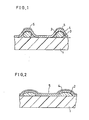
- Figure 1 and Figure 2 show a preferred first embodiment and a preferred second embodiment in accordance with the present invention, wherein reference number 1 designates a plastic film substrate having a flat surface. On a surface of the plastic film substrate, protrusions of granules 2 are formed with even distribution.
- a layer of binder is formed to bond granules 2 on the surface of the plastic film substrate 1.
- a scattering of the granules 2 bonded by the binder layer 3 or directly bonded on the substrate 1 forms the undercoating layer.
- a ferromagnetic metal thin film 4 is formed on the undercoating layer.
- the lubrication layer 5 is formed on the ferromagnetic thin film 4.
- the granules 2 and the binder 3 together form granular protrusions.
- a scattering of the granules 2 directly bonded on the surface of the plastic film substrate 1 as such forms the granular protrusions.
- the above-mentioned two types of undercoating layers are effective in improving the characteristics of the magnetic recording medium.
- the lubrication layer 5 is formed only on limited parts, namely, around top parts of the granular protrusions.
- the lubrication layer 5 is formed all over the ferromagnetic thin film 4.
- polyester film substrate comprising as major component polyethyleneterephthalate (as single substance), its copolymer, its mixed polymer, polyethylenenaphthalate (as single substance), its copolymer or its mixed polymer, can be used.
- substrates of polyesterimide, polyimide or the like polyimide plastics, or aromatic polyamide film substrate can be used.
- Especially appropriate substrates are those having very smooth surface.
- the substrate is a polyester film
- those having almost no minute protrusions induced by polymerization residue, or those having the minute protrusions of roughness smaller than several tens nm or those having minute protrusions of evenly distributed earth-worm-shape or granules with surface roughness smaller than several tens nm are preferred.
- Heights of the granular protrusions are measured by using high accuracy contact tip type roughness meter (Talystep-1 of Taylor-Hobson Co., Ltd. USA), and the measured roughness is represented by the value which is the level difference from the peak of the protrusion to the bottom of the valley of the surface in a manner as defined by ISO R468-1966 or JIS B0601 Standard.
- Usable heights of the granular protrusions are in the range of 3-50 nm, and more preferably in the optimum range of 5-30 nm. With heights under 3 nm, the effect of preventing the squealing in the high moisture, high temperature condition is insufficient, and over 50 nm of height the envelope is likely to produce disturbance.
- the ratio of lateral size to height must be within the range of from 1:1 1 to 20: 1, and more preferably, the optimum range is from 2:1 to 10:1.
- the lateral size is over 20 times of the height, then the prevention effect of squealing is not sufficient; and when the lateral size is smaller than its protrusion height the protrusions become fragile, and running is not smooth.
- the density of the granular protrusions can be determined by observing them through a differential interference type optical microscope of the magnitude of about 400 and observing at least 10 microscopic fields, or by observing them by a scanning type electron microscope of the magnitude of about 3,000 over 10 microscopic fields or more, and counting the number of granular protrusions in the fields, followed by subsequent calculation of average value of the density of granular protrusions per 1/ m m2 .
- thermo-plastic resin minute granules As minute granules, thermo-plastic resin minute granules, cross-lined resin minute granules, minute granules of metal oxide, e.g. silica, alumina, titanium oxide, iron oxide, etc., minute granules of carbon, hydrolysis product of metal alkoxide, etc. are usable.
- metal oxide e.g. silica, alumina, titanium oxide, iron oxide, etc.
- minute granules of carbon hydrolysis product of metal alkoxide, etc.
- the thermo-plastic resin minute granules and the cross-linked resin minute granules are bonded by itself onto the surface of the polyester film substrate, and therefore both configurations of Figure 1 example and Figure 2 example can be utilized.
- Other minute granules of inorganic nature need binder layer 3 as shown in the example of Figure 1.
- thermo-plastic minute granules As resin for the thermo-plastic minute granules, the following are appropriate:
- microgel granule consisting of the cross-linked macromolecule is usable.
- the granules obtained by emulsion polymerization when using monomers having two or more unsaturated double bonds (polyfunctional monomer) as main material and having the granule diameter of 200 nm or smaller, preferably 5-100 nm, are suitable.
- polyfunctional monomer for instance, divinylbenzene, ethylene glycol dimethacrylate, neobenzil glycol dimethacrylate, 1,3-butylene glycol diacrylate, methylene bisacrylamide, trimethylolpropane triacrylate, tetramethylolmethane tetraacrylate, etc. may be used.
- polyfunctional monomers such monomers as styrene, acrylic acid, methacrylic acid, itaconic acid, allylacrylate, allylmethacrylate, acrylamide, methacrylamide, acrylonitrile, vinyl acetate or vinyl chloride may be added.
- the microgel granule dispersion solution is prepared by adding emulsifier such as sodium, dodecyl sulfonate and reaction accelerator such as K,S 2 0 1 -NaHCO 3 to an aqueous dispersion of a monomer selected from the above-mentioned group of monomers, and reacting for 10-30 hours at 50°C in aqueous dispersion with a monomer concentration of about 10%, followed by removal of inorganic salts by dialysis.
- the resultant liquid is diluted by solvent alcohol, ester or ketone, and is coated on the plastic film substrate and dried to form the undercoating layer with granular protrusions as shown in Figure 2.
- a diluted solution of the above-mentioned microgel is added with a binder selected from the group consisting of thermo-plastic resins and cross- linked resins, then is coated on the plastic substrate and dried.
- metal oxide minute granules for instance, fine powdered silica obtained through dry method from tetrachlorosilane (for instance: Aerosil of Japan Aerosil Corporation), fine powder obtained from the decomposition by acid or alkali treatment of sodium silicate (for example: Syloid of Fuji Devison Chemical Corporation of Japan), silicasol granule obtained by ion exchange of sodium silicate (for instance, Snowtex of Nissan Chemical Industrial Corporation of Japan), are obtainable and by dispersing the powder or granules in a solution mainly consisting of water, alcohol, ketone or ester, then filtrating coarse granules, if necessary, the granules are applied on the plastic film substrate.
- tetrachlorosilane for instance: Aerosil of Japan Aerosil Corporation
- fine powder obtained from the decomposition by acid or alkali treatment of sodium silicate for example: Syloid of Fuji Devison Chemical Corporation of Japan
- carbon black obtained by oil furnace method, channel method, gas furnace method, thermal method and acetylene black, etc. are usable. And these are dispersed in an organic solvent such as a ketone, ester, alcohol, or an aliphatic or aromatic hydrocarbon etc., followed by filtration of coarse particles, if necessary.
- tetraethoxysilane aluminum s-butoxide, aluminum t-butoxide, aluminum isopropoxide, aluminum methoxide, triisopropyl borate, trimethyl borate, tri-tert-butyl borate, titanium tetra-i-propoxide, titanium tetra-n-butoxide, tetrakis (2-ethyl hexyl) titanate, titanium tri-n-butoxyl monostearate, tetramethyltitanate, tetraethyltitanate, zirconium-tetra-t-butoxide, tetraisopropyl zirconate, indium isopropoxide.
- the minute granules produced by the hydrolytic decomposition of the metal alkoxide As regards the minute granules produced by the hydrolytic decomposition of the metal alkoxide, to a diluted solution of 10-1000 ppm of the above-mentioned metal alkoxide, 1-50% of solvent containing 10-10000 ppm water is added, to hydrolyse the metal alkoxide to produce minute granules of 3-50 nm as dispersion in the solvent.
- the granular protrusions are obtainable.
- single substance, copolymer or mixture of saturation polyester such as polyethyleneterephthalate, polybutylene-terephthalate, polyethylenenaphthalate, etc.
- polyamides such as nylon 6, nylon 66, nylon 610, nylon 11, nylon 12, etc.
- crosslinked resins such as epoxy resin, urethane resin, silicon resin, phenol resin, melamine resin or denatured resins thereof can be used.
- a method to produce a layer comprising the minute granules and the binder for example, there is a method such that, into a colloidal solution containing dispersed minute granules of 3-50 nm diameter in an amount of 10-1000 ppm, a resin to become the binder is dissolved in an amount of 20-20000 ppm, and the mixed solution is applied on the plastic film substrate and dried.
- the ferromagnetic thin film 4 for instance, oblique vacuum deposition or vertical vacuum deposition of metal thin film of Co, Ni, Fe, etc. or metal thin film containing these metals as host material (for instance, Co-Cr vertical magnetization film) can be used.
- metal thin film of Co, Ni, Fe, etc. or metal thin film containing these metals as host material for instance, Co-Cr vertical magnetization film
- Preferable contents of the oxygen in the ferromagnetic thin film or the reinforcing non-magnetic metal thin film should be at least 3% or more, preferably 5% or more.
- undercoating film having reinforcing effect as oxygen-containing thin film of metal such as Ti, Cr or Ni or oxide film such as A1 2 0 3 or Si0 2 may be formed to enforce bonding of the ferromagnetic thin film.
- the still life of the magnetic recording medium can be drastically improved.
- the still life has a relation with respect to the thickness of the ferromagnetic thin film, and when the thickness is 40 nm or smaller, the still life rapidly decreases, and therefore the thickness of the ferromagnetic thin film should be preferably 40 nm or more.
- lubricant layer 5 By forming lubricant layer 5 on the surface of the ferromagnetic thin film, improvement of the tape running characteristic is further attainable, and thereby prevention of squealing in hot temperature and high moisture is further enhanced.
- the lubricant layer can be formed by depositing the below-mentioned organic or inorganic lubricant as such simply on the ferromagnetic thin film surface, or can be applied in a form of thin resin coating formed by applying a solution containing the lubricant substance and plastic resin.
- the lubricant layer 5 may be formed on the whole ferromagnetic thin film surface, or alternatively on limited parts thereof, namely above the top parts of the protrusions only.
- the lubricant layer 5 can be formed by direct coating on the surface of the ferromagnetic thin film, or alternatively by firstly coating on the rear side of the plastic film substrate and then transferring it on the front surface side (on the ferromagnetic thin film) when the magnetic recording media is wound up on a roll.
- lubricants fatty acids, fatty acid esters, fatty acid amides, metallic soaps, aliphatic alcohols, paraffins, silicones, fluorine-surfactants or inorganic lubricants, etc. are usable.
- the amount of lubricant must be 0.5-500 mg/m 2 , and a more preferable range is 5-200 mg/m.
- fatty acid those having 12 carbons or more, such as lauric acid, myristic acid, palmitic acid, stearic acid, behenic acid, oleic acid, linolic acid, linolenic acid, etc., can be used.
- fatty acid esters ethyl stearate, butyl stearate, pentyl stearate, stearic acid monoglyceride, palmitic acid monoglyceride, oleic acid monoglyceride, pentaerythritol-tetrastearate, etc., can be used.
- fatty acid amide hexanoyl amide, decanoyl amide, lauric acid amide, palmitic acid amide, stearic acid amide, behenic acid amide, oleic acid amide, linolic acid amide, methylene bis-stearic acid amide and ethylene bis-stearic acid amide, etc.
- hexanoyl amide, decanoyl amide, lauric acid amide, palmitic acid amide, stearic acid amide, behenic acid amide, oleic acid amide, linolic acid amide, methylene bis-stearic acid amide and ethylene bis-stearic acid amide, etc. can be used.
- cetyl alcohol and stearyl alcohols can be used.
- paraffin such saturated hydrocarbons as n-octadecane, n-nonadecane, n-tridecane, n-docosane, n-dotriacontane, etc., can be used.
- silicone polysiloxane having its hydrogens partly substituted by alkyl group or phenyl group, and those further denatured by fatty acid, aliphatic alcohols, acidamide or the like can be used.
- fluorine surfactant salts of perfluoroalkyl carboxylic acid or perfluoroalkyl sulfonic acid and sodium, potassium, magnesium, zinc, aluminium, iron, cobalt or nickel, and perfluoroalkyl phosphate ester, perfluoroalkyl betaine, perfluoroalkyltrimethyl ammonium salt, perfluoroethylene oxide, perfluoroalkyl fatty acid ester, etc., can be used.
- grpahite powder molybdenum, disulfide powder, tungsten disulfide powder, molybdenum selenide powder, tungsten selenide powder, calcium fluoride powder or the like can be used.
- the lubricant layer is formed by applying the above-mentioned lubricant as such or solving the lubricant and a synthetic resin into a solution and applying it, or by depositing from vapor of the lubricant substance on the ferromagnetic thin film surface.
- lubricant may be applied on part of the surface only, for instance, as checkered pattern or as oblique stripe-shaped or dot-shaped pattern in some case.
- the magnetic recording medium in accordance with the present invention manufactured as above has satisfactory improvement in prevention of squealing at high temperature and high moisture condition and of still life and further in envelope characteristic.
- the reason of the envelope characteristic improvement it is supposed that touching of the head cylinder and the magnetic recording medium takes place at the tops of granular protrusions on the ferromagnetic thin film surface, the top parts having a relatively large rate of curvature, and the distribution and heights of the granular protrusions are considerably even and uniform. And the uniformnesses are supposed to be higher than those of the magnetic recording medium having granular protrusions induced by oligomer separation at the surface of polyester film substrate.
- a smooth faced polyethyleneterephthalate diaxial stretched film with greatly suppressed forming of protrusions induced by polymerization catalyst residue and having a roughness of 3 nm or lower is used as a starting plastic film substrate.
- a solution having the following composition is applied to a thickness of about 10 11m by means of continuous coating process and dried, thereby to obtain a belt shaped film having a large number of granules consisting of polycarbonate having about 5 nm height and distributed at a rate of 1,000,000 granules/mm 2 . And this is designated Sample A.
- composition of the solution (all Darts are bv weiaht)
- Example 1 the composition of the solution is changed to the below-mentioned one, and a plastic film substrate with the undercoating layer having granular protrusions consisting of polyester and having heights of about 20 nm and distributed at a rate of about 100,000 protrusions/mm 2 is obtained, and this is designated Sample B.
- Example 1 the composition of the solution is changed to the below-mentioned one, and a plastic film substrate with the undercoating layer having granular protrusions consisting of nylon 66 and having heights of about 50 nm and distributed at a rate of about 2500 protrusions/mm 2 is obtained, and this is designated Sample C.
- Example 1 the composition of the solution is changed to the below-mentioned one, and a plastic film substrate with the undercoating layer having granular protrusions consisting of polyacrylate and having heights of about 30 nm and distributed at a rate of about 100,000 protrusions/mm 2 , and this is designated Sample E.
- Example 1 the composition of the solution is changed to the below-mentioned one, and a plastic film substrate with the undercoating layer having granular protrusions consisting of polysulfon and distributed at a rate of about 10,000 protrusions/mm 2 is obtained, and this is designated Sample F.
- Example 1 the composition of the solution is changed to the below-mentioned one, and a plastic film substrate with the undercoating layer having granular protrusions consisting of polyethersulfon and having heights of about 20 nm and distributed at a rate of about 500,000 protrusions/mm 2 is obtained, and this is designated Sample G.
- Example 1 the composition of the solution is changed to the below-mentioned one, and a plastic film substrate with the undercoating layer having granular protrusions consisting of polyphenyleneoxide and having heights of about 10 nm and distributed at a rate of about 500,000 protrusions/mm 2 is obtained, and this is designated Sample H.
- Example 1 the composition of the solution is changed to the below-mentioned one, and a plastic film substrate with the undercoating layer having granular protrusions consisting of phenoxy resin and having heights of about 20 nm and distributed at a rate of about 200,000 protrusions/mm 2 is obtained, and this is designated Sample I.
- Example 1 the composition of the solution is changed to the below-mentioned one, and a plastic film substrate with the undercoating layer having granular protrusions consisting of nylon 66 bonded by phenoxy resin as binder and having about 20 nm height distributed at a rate of about 200,000 protrusions/ mm 2 is obtained, and this is designated Sample J.
- a smooth faced polyethyleneterephthalate film containing substantially no minute granules induced by polymerization catalyst residue is prepared as a starting plastic film substrate.
- a solution mainly comprising a denatured silicon emulsion containing a viscosity increasing agent is applied during stretching process of the plastic film and dried, to form polyethyleneterephthalate diaxial stretched film having minute wave-like protrusions of about 10 nm surface roughness of different macromolecule from that of the substrate, during the stretching.
- This composite film is used as the belt-shaped plastic film substrate, and thereon the same coatings as described in Examples 1 through 9 are formed, and these are designated Samples K, L, M, N, O, P, Q, R and S.
- the granular protrusions formed on the plastic film substrates have the same nature to those of corresponding Samples A to J with D omitted, respectively.
- the under coating layer on the surface of the plastic film substrate is omitted and the sample is designated Sample T.
- the plastic film substrate used for the sample tape T is heat-treated prior to vacuum vapor deposition of the ferromagnetic metal thin film, thereby to separate polyester oligomer crystal protrusions of about 30 nm height and distributed at a density of about 100000 protrusions/mm 2 under the ferromagnetic metal thin film, thereby forming the similar protrusions on the surface of the magnetic recording medium.
- the above-mentioned lubrication layer is formed thereon.
- other comparison samples are made by omitting the formations of the lubrication layers on the above-mentioned samples A, B and C, and these samples are designated as comparison samples A', B', and C'.
- comparison samples T', A', B' and C' the above-mentioned measurements are carried out, thus the following results are obtained.
- Examples 2-1 to 2-5 are those having under-coating layers with granular protrusions made by cross-linked resins.
- a smooth faced polyethyleneterephthalate diaxial stretched film with greatly suppressed forming of protrusions induced by polymerization catalyst residue and having roughness of 3 nm or lower is used as a starting plastic film substrate.
- a solution having the following contents is made continuously applied and dried to form coating of about 10 nm thickness, thereby to obtain a long belt-shaped film having a large number of protrusions having nuclei of microgel granules of 15 nm height, and distributed at a rate of about 300,000 protrusions/ mm 2 , and this is designated Sample A-2.
- Example 2-1 composition of the solution is changed to the below-mentioned one, and a belt-shaped plastic film substrate with protrusions having microgel granules as their nuclei and having heights of about 30 nm and distributed at a rate of about 500,000 protrusions/mm 2 is obtained, and this is designated Sample B-2.
- Example 2-1 composition of the solution is changed to the below-mentioned one, and a belt-shaped plastic film substrate with the undercoating layer having granular protrusions having microgel granules as nuclei and having heights of about 10 nm and distributed at a rate of about 1,000,000 protrusions/mm 2 is obtained, and this is designated Sample C-2.
- a smooth faced polyethyleneterephthalate film containing substantially no minute granules induced by polymerization catalyst residue is prepared as a starting plastic film substrate.
- a solution mainly comprising a denatured silicon emulsion containing a viscosity increasing agent is applied during the stretching process of the plastic film and dried, to form polyethyleneterephthalate diaxial stretched film having minute wave-like protrusions of about 10 nm surface roughness of different macromolecule from that of the substrate, during the stretching.
- This composite film is used as a belt-shaped plastic film and thereon the same coatings as described in the Examples 2-1 through 2-3 are formed, and these are designated Sample K-2, L-2 and M-2, respectively.
- the granular resin protrusions formed on these samples are similar to those of the corresponding Samples A-2, B-2 and C-2, respectively.
- the plastic film substrates as such used in the Examples 2-1 to 2-3 and Example 2-4 are designated Sample S-2 and Sample T-2.
- a ferromagnetic metal thin film of Co-Ni (Ni:20 wt.%) of about 100 nm thickness is coated under existence of a very small amount of oxygen.
- the oxygen contents to metal of the ferromagnetic metal thin film was 5 atom %.
- a smooth faced polyethyleneterephthalate diaxial stretched film with greatly suppressed forming of protrusions induced by polymerization catalyst residue and having a roughness of 3 nm or lower is used as a starting plastic film substrate.
- a solution having the following composition is applied to a thickness of about 10 ⁇ m by means of a continuous coating process and dried, thereby to obtain a belt-shaped film having a large number of protrusions with carbon minute granules as nuclei having 50 nm height and distributed at a rate of about 10,000 protrusions/mm 2 , And this is designated Sample A-3.
- Example 3-1 the composition of the solution is changed to the below-mentioned one, and a belt-shaped plastic film substrate with the undercoating layer having granular protrusions containing carbon minute granules as nuclei and having about 10 nm height and distributed at a rate of about 2,000,000 protrusions/mm 2 is obtained, and this is designated Sample B-3.
- Example 3-1 the composition of the solution is changed to the below-mentioned one, and a belt-shaped plastic film substrate with the undercoating layer having granular protrusions containing carbon minute granules as nuclei having heights of about 30 nm and distributed at a rate of 100,000 protrusions/ mm 2 is obtained, and this is designated Sample C-3.
- Example 3-1 the composition of the solution is changed to the below-mentioned one, and a belt-shaped plastic film substrate with the undercoating layer having granular protrusions containing carbon minute granules as nuclei having heights of about 20 nm and distributed at a rate of about 1,000,000 protrusions/mm 2 is obtained, and this is designated Sample D-3.
- a smooth faced polyethyleneterephthalate film containing substantially no minute granules induced by polymerization catalyst residue is prepared as a starting plastic film substrate.
- a solution mainly comprising a denatured silicon emulsion containing a viscosity increasing agent is applied during the stretching process of the plastic film and dried, to form polyethyleneterephthalate diaxial stretched film having minute wave-like protrusions of about 10 nm surface roughness of different macromolecule from that of the substrate, during the stretching.
- This composite film is used as a belt-shaped plastic film and thereon the same coatings as described in the Examples 3-1 through 3-4 are formed, and these are designated Sample K-3, L-3, M-3 and N-3, respectively.
- the granular resin protrusions formed on these samples are similar to those of the corresponding Samples A-3 through D-3, respectively.
- the plastic film substrate as such without the overriding undercoating layer is desginated Sample S-3 and Sample T-3.
- Samples A-3 through T-3 are connected in sequence and by means of continuous oblique vacuum deposition method, a ferromagnetic thin film of Co-Ni (Ni: 20 wt.%) of film thickness of about 100 nm is formed under existence of a small amount of oxygen. Contents of the oxygen against metal in the ferromagnetic metal thin film is 5 atom%. Then, various lubrication layers are formed by applying the various solutions of the lubricant. And the resultant connected films are cut into belt-shaped magnetic recording media and tested under a severe condition of 30°C and 90% RH by making them run around a head cylinder of a video recorder to examine characteristics of squealing, envelope and still life.
- Sample T is heat treated prior to vacuum vapor deposition of the ferromagnetic metal thin film to form polyester oligomer crystal at the surface, and thereafter, a ferromagnetic metal thin film is vacuum deposited, thereby to make the magnetic recording media having minute protrusions of about 30 nm distributed at a rate about 100,000 protrusions/mm 2 and induced from the oligomer crystals, with an overriding lubricant layer.
- Samples A-3 through T-3 some of the same are tested without formation of the lubricant layer. And the test results are shown in the following Table 3.
- a smooth faced polyethyleneterephthalate diaxial stretched film with greatly suppressed forming of protrusions induced by polymerization catalyst residue and having a roughness of 3 nm or lower is used as a starting plastic film substrate.
- a solution having the following composition is applied to a thickness of about 10 ⁇ m by means of a continuous coating process and dried, thereby to obtain a belt-shaped film having a large number of protrusions having nuclear of silica minute granules of 10 nm height, and distributed at a rate of 5,000,000 granules/mm 2 . And this is designated Sample A-4.
- Example 4-1 the composition of the solution is changed to the below-mentioned one, and a belt-shaped plastic film substrate with the undercoating layer having granular protrusions containing silica minute granules as nuclei and having heights of about 8 nm and distributed at a rate of about 1,000,000 protrusions/mm 2 is obtained, and this is designated Sample B-4.
- Example 4-1 the composition of the solution is changed to the below-mentioned one, and a belt-shaped plastic film substrate with the undercoating layer having granular protrusions containing silica minute granules as nuclei and having heights of about 20 nm and distributed at a rate of about 200,000 protrusions/mm 2 is obtained, and this is designated Sample C-4.
- Example 1 the composition of the solution is changed to the below-mentioned one, and a belt-shaped plastic film substrate with the undercoating layer having granular protrusions containing silica minute granules as nuclei and having heights of about 25 nm and distributed at a rate of about 500,000 protrusions/mm 2 is obtained, and this is designated Sample D-4.
- a smooth faced polyethyleneterephthalate film containing substantially no minute granules induced by polymerization catalyst residue is prepared as a starting plastic film substrate.
- a solution mainly comprising a denatured silicon emulsion containing a viscosity increasing agent is applied during the stretched process of the plastic film and dried, to form polyethyleneterephthalate diaxial stretched film having minute wave-like protrusions of about 10 nm surface roughness of different macromolecule from that of the substrate, during the stretching.
- This composite film is used as a belt-shaped plastic film and thereon the same coatings as described in the Examples 4-1 through 4-4 are formed, and these are deignated Sample K-4, L-4, M-4 and N-4, respectively.
- the granular resin protrusions formed on these samples are similar to those of the corresponding Samples A-4 through D-4, respectively.
- the plastic film substrate as such without the overriding undercoating layer is designated Sample S-4 and Sample T-4.
- Samples A-4 through T-4 are connected in sequence, and by means of continuous oblique vacuum vapor deposition method a ferromagnetic thin film of Co-Ni (Ni: 20 wt.%) of film thickness of about 100 nm is formed under existence of a small amount of oxygen. Contents of the oxygen against metal in the ferromagnetic metal thin film is 5 atom %. Then, various lubrication layers are formed by applying the various solutions of the lubricant. And the resultant conencted films are cut into belt-shaped magnetic recording media and tested under the severe conditions of 30°C and 90% RH by making them run around a head cylinder of a video recorder to examine characteristics of squealing, envelope and still life.
- Sample T is heat-treated prior to vacuum deposition of the ferromagnetic metal thin film, to form polyester oligomer crystal at the surface. And thereafter, a ferromagnetic metal thin film is vacuum deposited thereon to make the magnetic recording media having minute protrusions of about 30 nm height and disubstituted at a rate about 100,000 protrusions/mm 2 induced from the oligomer crystals with an overriding lubricant layer, and besides, the above-mentioned comparison Samples A-4 through T-4, are testes as such, some of which are tested without formation of the lubricant layer. And the test results are shown in the following Table 4.
- a smooth faced polyethyleneterephthalate diaxial stretched film with greatly suppressed forming of protrusions induced by polymerization catalyst residue and having a roughness of 3 nm or lower is used as a starting plastic film substrate.
- a solution having the following composition is applied to a thickness of about 10 pm by means of a continuous coating process and dried, thereby to obtain a belt-shaped film having a large number of protrusions having nuclei of minute granules of hdyrolysis product of tetraethoxy silane of 10 nm height, and distributed at a rate of 1,000,000 granules/mm 2 . And this is designated Sample A-5.
- Example 5-1 the composition of the solution is changed to the below-mentioned one, and a belt-shaped plastic film substrate with the undercoating layer having granular protrusions containing hydrolysis product of aluminum isopropoxide as nuclei and having heights of about 40 nm and distributed at a rate of about 100,000 protrusions/mm 2 is obtained, and this is designated Sample B-5.
- Example 5-1 the composition of the solution is changed to the below-mentioned one, and a belt-shaped plastic film substrate with the undercoating layer having granular protrusions containing the hydrolysis product of tetra-n-butoxytitanate, as nuclei and having heights of about 5 nm and distributed at a rate of about 1,000,000 protrusions/mm 2 is obtained, and this is designated Sample C-5.
- Example 5-1 the composition of the solution is changed to the below-mentioned one, and a belt-shaped plastic film substrate with the undercoating layer having granular protrusions containing hydrolysis product of tetra-isopropyl zirconate as nuclei and having heights of about 30 nm and distributed at a rate of about 500,000 protrusions/mm 2 is obtained, and this is designated Sample D-5.
- a smooth faced polyethyleneterephthalate film containing substantially no minute granules induced by polymerization catalyst residue is prepared as a starting plastic film substrate.
- a solution mainly comprising a denatured silicon emulsion containing a viscosity increasing agent is applied during the stretching process of the plastic film and dried, to form polyethyleneterephthalate diaxial stretched film having minute wave-like protrusions of about 10 nm surface roughness of different macromolecule from that of the substrate, during the stretching.
- This composite film is used as a belt-shaped plastic film and thereon the same coatings as described in the Examples 5-1 through 5-4 are formed, and these are designated Sample K-5, L-5, M-5 and N-5, respectively.
- the granular resin protrusions formed on these samples are similar to those of the corresponding Samples A-5 through D-5, respectively.
- the plastic film substrate as such without the overriding undercoating layer is designated Sample S-5 and Sample T-5.
- Samples A-5 through T-5 are connected in sequence and by means of continuous oblique vacuum vapor deposition method, a ferromagnetic thin film of Co-Ni (Ni: 20 wt.%) of film thickness of about 100 nm is formed under existence of a small amount of oxygen. Contents of the oxygen against metal in the ferromagnetic metal thin film is 5 atom %. Then, various lubrication layers are formed by applying the various solutions of the lubricant. And the resultant connected films are cut into belt-shaped magnetic recording media and tested under the severe condition of 30°C and 90% RH by making them run around a head cylinder of a video recorder to examine characteristics of squealing, envelope and still life.
- Sample T-5 is heat treated prior to vacuum vapor deposition of the ferromagnetic metal thin film to form polyester oligomer crystals at the surface, and thereafter, a ferromagnetic metal thin film is vacuum deposited thereon to make the magnetic recording media, which have minute protrusions of about 30 nm distributed at a rate about 100,000 protrusions/mm 2 induced from the oligomer crystals and have an overriding lubrication layer.
- Samples A-5 through T-5 as such, and besides, some of the same without formation of the lubricant layer are tested by running around a head cylinder. And the test results are shown in the following Table 5.
- the magnetic recording media embodying the present invention have satisfactory characteristics of no squealing even under severe operating conditions of high moisture and high temperature, and also have a satisfactory envelope characteristic as well as long still life in the high moisture condition, and have a good stable running performance, and are very useful as a magnetic recording medium for VTR tape, etc.
Landscapes
- Magnetic Record Carriers (AREA)
- Laminated Bodies (AREA)
Claims (8)
Applications Claiming Priority (10)
| Application Number | Priority Date | Filing Date | Title |
|---|---|---|---|
| JP57140629A JPS5930231A (ja) | 1982-08-12 | 1982-08-12 | 磁気記録媒体 |
| JP140629/82 | 1982-08-12 | ||
| JP152185/82 | 1982-08-31 | ||
| JP57152185A JPS5942637A (ja) | 1982-08-31 | 1982-08-31 | 磁気記録媒体 |
| JP159842/82 | 1982-09-14 | ||
| JP159841/82 | 1982-09-14 | ||
| JP57159842A JPS5948826A (ja) | 1982-09-14 | 1982-09-14 | 磁気記録媒体 |
| JP57159841A JPS5948825A (ja) | 1982-09-14 | 1982-09-14 | 磁気記録媒体 |
| JP57202988A JPS5992427A (ja) | 1982-11-18 | 1982-11-18 | 磁気記録媒体 |
| JP202988/82 | 1982-11-18 |
Publications (3)
| Publication Number | Publication Date |
|---|---|
| EP0101080A1 EP0101080A1 (de) | 1984-02-22 |
| EP0101080B1 EP0101080B1 (de) | 1987-04-29 |
| EP0101080B2 true EP0101080B2 (de) | 1990-09-26 |
Family
ID=27527597
Family Applications (1)
| Application Number | Title | Priority Date | Filing Date |
|---|---|---|---|
| EP83107984A Expired - Lifetime EP0101080B2 (de) | 1982-08-12 | 1983-08-11 | Magnetisches Aufzeichnungsmedium |
Country Status (3)
| Country | Link |
|---|---|
| US (1) | US4540618A (de) |
| EP (1) | EP0101080B2 (de) |
| DE (1) | DE3371260D1 (de) |
Families Citing this family (39)
| Publication number | Priority date | Publication date | Assignee | Title |
|---|---|---|---|---|
| EP0109667B1 (de) * | 1982-11-19 | 1987-04-01 | Matsushita Electric Industrial Co., Ltd. | Magnetisches Aufzeichnungsmedium |
| JPS59203229A (ja) * | 1983-04-30 | 1984-11-17 | Victor Co Of Japan Ltd | 磁気記録媒体 |
| JPS605423A (ja) * | 1983-06-22 | 1985-01-12 | Fujitsu Ltd | 連続磁性膜型磁気記録媒体 |
| US4542071A (en) * | 1983-07-14 | 1985-09-17 | International Business Machines Corporation | Lubricated magnetic recording disk |
| US4848348A (en) * | 1983-11-14 | 1989-07-18 | Minnesota Mining And Manufacturing Company | Coated films |
| DE3347531A1 (de) * | 1983-12-30 | 1985-07-11 | Basf Ag, 6700 Ludwigshafen | Magnetische aufzeichnungstraeger |
| JPH0618067B2 (ja) * | 1984-02-13 | 1994-03-09 | 日本ビクター株式会社 | 磁気記録媒体 |
| JPS60229227A (ja) * | 1984-04-27 | 1985-11-14 | Fuji Photo Film Co Ltd | 磁気記録媒体 |
| JPS618727A (ja) * | 1984-06-21 | 1986-01-16 | Fuji Photo Film Co Ltd | 磁気記録媒体 |
| US4656663A (en) * | 1984-08-06 | 1987-04-07 | E. I. Du Pont De Nemours And Company | Method of film inspection with a microscopical image analyzer |
| JPS6150211A (ja) * | 1984-08-20 | 1986-03-12 | Res Dev Corp Of Japan | 垂直磁気記録媒体およびその製法 |
| KR890004256B1 (ko) * | 1984-09-29 | 1989-10-28 | 니뽕 빅터 가부시끼 가이샤 | 자기 기록 매체 |
| US4816933A (en) * | 1984-10-23 | 1989-03-28 | Tdk Corporation | Magnetic recording medium of particular coercive force, filling ratio, and protrusions and recording/reproducing method therefor |
| US4673617A (en) * | 1985-04-25 | 1987-06-16 | Matsushita Electric Industrial Co., Ltd. | Thin film magnetic recording media |
| US5256481A (en) * | 1986-03-20 | 1993-10-26 | Hitachi Maxell, Ltd. | Magnetic recording medium |
| US5985402A (en) * | 1986-12-19 | 1999-11-16 | Hitachi, Ltd. | Magnetic disk and its manufacturing method |
| JPS63191315A (ja) * | 1987-02-04 | 1988-08-08 | Fuji Photo Film Co Ltd | 磁気記録媒体 |
| US5737159A (en) * | 1987-07-29 | 1998-04-07 | Hitachi, Ltd. | Magnetic disk and its manufacturing method |
| JPH0652567B2 (ja) * | 1987-10-23 | 1994-07-06 | 富士写真フイルム株式会社 | 磁気記録媒体 |
| JP2690948B2 (ja) * | 1988-07-04 | 1997-12-17 | 株式会社日立製作所 | 磁気記録媒体の製造方法 |
| DE3827631A1 (de) * | 1988-08-16 | 1990-02-22 | Hoechst Ag | Selbsttragendes flaechengebilde mit wenigstens einer strukturierten oberflaeche |
| US5156938A (en) * | 1989-03-30 | 1992-10-20 | Graphics Technology International, Inc. | Ablation-transfer imaging/recording |
| JP2554277B2 (ja) * | 1989-03-31 | 1996-11-13 | 富士写真フイルム株式会社 | 磁気記録媒体 |
| US5202810A (en) * | 1989-04-27 | 1993-04-13 | Hitachi, Ltd. | Magnetic disk having an improved surface configuration |
| US5949612A (en) * | 1995-03-21 | 1999-09-07 | Censtor Corp. | Low friction sliding hard disk drive system |
| JPH0641110B2 (ja) * | 1990-01-22 | 1994-06-01 | ソマール株式会社 | 研磨フィルムの製造方法 |
| US5679337A (en) * | 1991-06-14 | 1997-10-21 | Professional Pharmaceutical, Inc. | Method and composition for topical treatment of Aphthous stomatitis histamine using phosphate as active ingredient |
| JP2777003B2 (ja) * | 1991-06-28 | 1998-07-16 | 帝人株式会社 | 磁気記録媒体用ポリエステルフイルム及びその製造方法 |
| JPH06338049A (ja) * | 1993-05-28 | 1994-12-06 | Sony Corp | 磁気記録媒体 |
| US6804085B1 (en) * | 1995-03-21 | 2004-10-12 | Seagate Technology, Llc | Hard drive system interface between a disk surface and a transducer contacting the surface during communication |
| US5935758A (en) * | 1995-04-20 | 1999-08-10 | Imation Corp. | Laser induced film transfer system |
| GB9617416D0 (en) * | 1996-08-20 | 1996-10-02 | Minnesota Mining & Mfg | Thermal bleaching of infrared dyes |
| US5945249A (en) * | 1995-04-20 | 1999-08-31 | Imation Corp. | Laser absorbable photobleachable compositions |
| EP0987686B1 (de) * | 1998-09-17 | 2004-11-03 | Toray Industries, Inc. | Verfahren zum Lagern von Polyesterfolie für magnetisches Aufzeichnungsmedium und Verfahren zur Herstellung eines magnetischen Aufzeichnungsmediums |
| US6800374B2 (en) * | 2001-06-20 | 2004-10-05 | Sony Corporation | Cleaning tape |
| US6808741B1 (en) * | 2001-10-26 | 2004-10-26 | Seagate Technology Llc | In-line, pass-by method for vapor lubrication |
| US6805904B2 (en) * | 2002-02-20 | 2004-10-19 | International Business Machines Corporation | Process of forming a multilayer nanoparticle-containing thin film self-assembly |
| JP2005056489A (ja) * | 2003-08-04 | 2005-03-03 | Fuji Photo Film Co Ltd | 磁気記録媒体 |
| US9246036B2 (en) | 2012-08-20 | 2016-01-26 | Universal Display Corporation | Thin film deposition |
Family Cites Families (10)
| Publication number | Priority date | Publication date | Assignee | Title |
|---|---|---|---|---|
| DE2255028A1 (de) * | 1972-11-10 | 1974-06-12 | Basf Ag | Verfahren zur herstellung von magnetischen aufzeichnungsplatten |
| JPS5630609B2 (de) * | 1973-11-02 | 1981-07-16 | ||
| JPS5843817B2 (ja) * | 1976-02-24 | 1983-09-29 | 富士写真フイルム株式会社 | 磁気記録体 |
| GB1591582A (en) * | 1977-03-01 | 1981-06-24 | Teijin Ltd | Polyester film having slipperiness |
| JPS6035267B2 (ja) * | 1978-01-09 | 1985-08-13 | 東レ株式会社 | 表面の改質されたポリエステルフイルム |
| US4275113A (en) * | 1978-10-17 | 1981-06-23 | Hitachi Maxell, Ltd. | Magnetic recording medium |
| US4320207A (en) * | 1979-01-25 | 1982-03-16 | Diafoil Company Limited | Polyester film containing fine powder of crosslinked polymer |
| DE3024918A1 (de) * | 1979-07-02 | 1981-01-22 | Fuji Photo Film Co Ltd | Magnetisches aufzeichnungsmaterial und verfahren zu dessen herstellung |
| JPS5766936A (en) * | 1980-10-15 | 1982-04-23 | Teijin Ltd | Polyester film |
| US4439479A (en) * | 1982-01-15 | 1984-03-27 | Teijin Limited | Slippery biaxially stretched polyester films |
-
1983
- 1983-08-08 US US06/521,075 patent/US4540618A/en not_active Expired - Lifetime
- 1983-08-11 EP EP83107984A patent/EP0101080B2/de not_active Expired - Lifetime
- 1983-08-11 DE DE8383107984T patent/DE3371260D1/de not_active Expired
Also Published As
| Publication number | Publication date |
|---|---|
| EP0101080B1 (de) | 1987-04-29 |
| US4540618A (en) | 1985-09-10 |
| DE3371260D1 (en) | 1987-06-04 |
| EP0101080A1 (de) | 1984-02-22 |
Similar Documents
| Publication | Publication Date | Title |
|---|---|---|
| EP0101080B1 (de) | Magnetisches Aufzeichnungsmedium | |
| US4645703A (en) | Magnetic recording medium | |
| US5336079A (en) | Biaxially oriented laminated film comprising particles in a specific ratio of particle density | |
| US4514451A (en) | Polyester substrate for magnetic recording medium having oligomer protrusions thereon | |
| JPH02281421A (ja) | 磁気記録媒体の製造方法 | |
| JPS58100221A (ja) | 磁気記録媒体 | |
| JPS5948825A (ja) | 磁気記録媒体 | |
| JP3405812B2 (ja) | 磁気記録媒体 | |
| KR20030033966A (ko) | 테잎형 자기 매체 | |
| JP2646244B2 (ja) | 磁気記録媒体 | |
| US5145738A (en) | Magnetic recording medium | |
| JPS60151833A (ja) | 磁気記録媒体 | |
| JPS6180525A (ja) | 磁気記録媒体 | |
| JPS5948826A (ja) | 磁気記録媒体 | |
| JP3261625B2 (ja) | 磁気記録媒体 | |
| JP3252224B2 (ja) | 磁気記録媒体 | |
| JPH11185242A (ja) | 磁気記録媒体 | |
| EP0700035B1 (de) | Magnetisches Aufzeichnungsmedium | |
| JP2856938B2 (ja) | 磁気記録媒体 | |
| JPS63167410A (ja) | 磁気記録媒体 | |
| JPH0529964B2 (de) | ||
| JP3385499B2 (ja) | 磁気記録媒体 | |
| JPH11185241A (ja) | 磁気記録媒体 | |
| JPH10308018A (ja) | 磁気記録媒体 | |
| JPH0630152B2 (ja) | 磁気記録媒体の製造方法 |
Legal Events
| Date | Code | Title | Description |
|---|---|---|---|
| PUAI | Public reference made under article 153(3) epc to a published international application that has entered the european phase |
Free format text: ORIGINAL CODE: 0009012 |
|
| AK | Designated contracting states |
Designated state(s): DE FR GB |
|
| 17P | Request for examination filed |
Effective date: 19840625 |
|
| GRAA | (expected) grant |
Free format text: ORIGINAL CODE: 0009210 |
|
| AK | Designated contracting states |
Kind code of ref document: B1 Designated state(s): DE FR GB |
|
| REF | Corresponds to: |
Ref document number: 3371260 Country of ref document: DE Date of ref document: 19870604 |
|
| ET | Fr: translation filed | ||
| PLBI | Opposition filed |
Free format text: ORIGINAL CODE: 0009260 |
|
| 26 | Opposition filed |
Opponent name: BASF AKTIENGESELLSCHAFT, LUDWIGSHAFEN Effective date: 19880129 |
|
| PUAH | Patent maintained in amended form |
Free format text: ORIGINAL CODE: 0009272 |
|
| STAA | Information on the status of an ep patent application or granted ep patent |
Free format text: STATUS: PATENT MAINTAINED AS AMENDED |
|
| 27A | Patent maintained in amended form |
Effective date: 19900926 |
|
| AK | Designated contracting states |
Kind code of ref document: B2 Designated state(s): DE FR GB |
|
| EN3 | Fr: translation not filed ** decision concerning opposition | ||
| ET3 | Fr: translation filed ** decision concerning opposition | ||
| REG | Reference to a national code |
Ref country code: FR Ref legal event code: BR |
|
| REG | Reference to a national code |
Ref country code: GB Ref legal event code: 746 Effective date: 19960628 |
|
| PGFP | Annual fee paid to national office [announced via postgrant information from national office to epo] |
Ref country code: GB Payment date: 19970804 Year of fee payment: 15 |
|
| PGFP | Annual fee paid to national office [announced via postgrant information from national office to epo] |
Ref country code: FR Payment date: 19970811 Year of fee payment: 15 |
|
| PGFP | Annual fee paid to national office [announced via postgrant information from national office to epo] |
Ref country code: DE Payment date: 19970818 Year of fee payment: 15 |
|
| PG25 | Lapsed in a contracting state [announced via postgrant information from national office to epo] |
Ref country code: GB Free format text: LAPSE BECAUSE OF NON-PAYMENT OF DUE FEES Effective date: 19980811 |
|
| GBPC | Gb: european patent ceased through non-payment of renewal fee |
Effective date: 19980811 |
|
| PG25 | Lapsed in a contracting state [announced via postgrant information from national office to epo] |
Ref country code: FR Free format text: LAPSE BECAUSE OF NON-PAYMENT OF DUE FEES Effective date: 19990430 |
|
| PG25 | Lapsed in a contracting state [announced via postgrant information from national office to epo] |
Ref country code: DE Free format text: LAPSE BECAUSE OF NON-PAYMENT OF DUE FEES Effective date: 19990601 |
|
| REG | Reference to a national code |
Ref country code: FR Ref legal event code: ST |