EP0017028A1 - Verfahren zur Herstellung einer kristallinen SiO2-Modifikation - Google Patents
Verfahren zur Herstellung einer kristallinen SiO2-Modifikation Download PDFInfo
- Publication number
- EP0017028A1 EP0017028A1 EP80101260A EP80101260A EP0017028A1 EP 0017028 A1 EP0017028 A1 EP 0017028A1 EP 80101260 A EP80101260 A EP 80101260A EP 80101260 A EP80101260 A EP 80101260A EP 0017028 A1 EP0017028 A1 EP 0017028A1
- Authority
- EP
- European Patent Office
- Prior art keywords
- modification
- crystalline
- sio
- hexamethylenediamine
- ions
- Prior art date
- Legal status (The legal status is an assumption and is not a legal conclusion. Google has not performed a legal analysis and makes no representation as to the accuracy of the status listed.)
- Granted
Links
Classifications
-
- C—CHEMISTRY; METALLURGY
- C01—INORGANIC CHEMISTRY
- C01B—NON-METALLIC ELEMENTS; COMPOUNDS THEREOF; METALLOIDS OR COMPOUNDS THEREOF NOT COVERED BY SUBCLASS C01C
- C01B37/00—Compounds having molecular sieve properties but not having base-exchange properties
- C01B37/02—Crystalline silica-polymorphs, e.g. silicalites dealuminated aluminosilicate zeolites
Definitions
- Si0 2 modifications A number of crystalline Si0 2 modifications are known. These are characterized by a variety of remarkable properties.
- An SiO 2 modification which has molecular sieving properties is also known. This SiO 2 modification is produced in the presence of tetrapropylammonium hydroxide.
- the invention relates to a new crystalline Si0 2 modification and a process for its preparation.
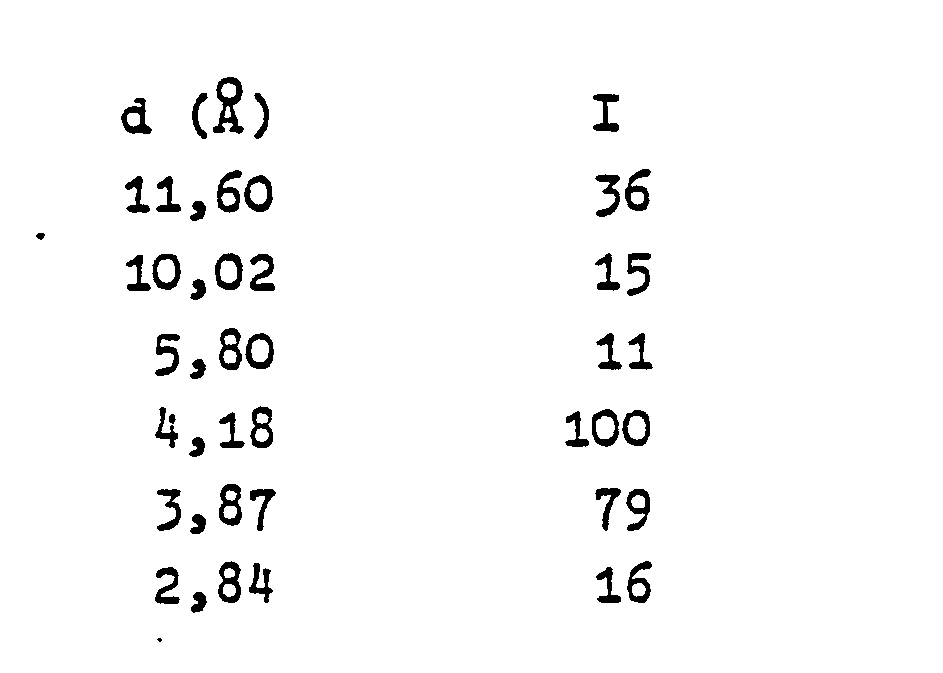
- the new Si0 2 modification is characterized by an X-ray diffraction pattern that has at least the following diffraction lines:
- a reactive amorphous SiO 2 is treated at elevated temperatures with aqueous solutions of hexamethylenediamine.
- a mixture of two crystalline phases which consists of pure Si0 2 after removal of the mother liquor.
- One modification proves to be the analog of the well-known aluminosilicate zeolite ZSM-5 consisting of pure Si0 2 , the other modification has a new, different crystal structure.
- a particular embodiment of the process according to the invention consists in that reactive amorphous SiO 2 is stirred homogeneously in an aqueous solution of hexamethylenediamine and the mixture is heated in a closed reaction vessel for 1/2 to 50 days to temperatures between 100 to 200 ° C. Temperatures of 120 to 170 ° C. in a period of 0.5 to 7 days, in particular 140 to 160 ° C. in 1 to 5 days, are preferably used.
- the crystallization can be directed in such a way that the new crystalline SiO 2 modification predominantly or entirely arises. It has been shown that small amounts of Al, boron or other metals, which are often present as impurities, favor the formation of the ZSM-5-like structure. Stirring or shaking during crystallization also has an effect on the product composition.
- the X-ray diffraction patterns are recorded using an automatic Phillips diffractometer APD-10. CuKa radiation is used. The stated values are subject to the usual errors for such an admission procedure. The accuracy of the d values is approximately ⁇ 0.3 ⁇ for small diffraction angles and + 0.1 to + 0.05 ⁇ for large diffraction angles. Only the most important d values of the diffraction lines are given in Table 1, but these enable the person skilled in the art to clearly characterize this new modification. A characteristic diffraction pattern that contains all the intense diffraction lines is summarized in Table 2 below.
- the intensity of the diffraction lines can be subject to fluctuations, for example due to drying or calcining, but this does not make it difficult to clearly characterize this new SiO 2 modification.
- Si0 2 modifications according to the invention are particularly suitable as selective adsorbents, for example as molecular sieves.
- pyrogenic silica (Aerosil) are introduced into 118 g of 50 percent aqueous hexamethylenediamine solution at 60 ° C. and the mixture is homogenized. The mixture is then heated in a steel autoclave for 5 days to 150 ° C. under its own pressure. According to X-ray diffraction analysis, the crystalline product formed consists of about 50% new crystalline Si0 2 modification . and about 50% Si0 2 with the crystal structure of the known aluminosilicate zeolite ZSM-5.
- Solution 1 consists of 130 g Aerosil, 47.6 g NaOH and 783 g water, solution 2 from 70 g phosphoric acid in 712 g water and solution 3 from 420 g 50% hexamethylenediamine solution.
- Solutions 3 and 2 are added to solution 1 with stirring and the mixture is homogenized. The mixture is then heated to 150 ° C. under its own pressure with stirring for 5 days. The crystalline product is filtered, washed and dried. According to X-ray diffraction analysis, it consists 100% of the new crystalline SiO 2 modification with the diffraction lines as shown in Table 2.
- the product formed consists of over 90% of the new crystalline SiO 2 modification.
Landscapes
- Chemical & Material Sciences (AREA)
- Organic Chemistry (AREA)
- Life Sciences & Earth Sciences (AREA)
- General Life Sciences & Earth Sciences (AREA)
- Geology (AREA)
- Inorganic Chemistry (AREA)
- Silicates, Zeolites, And Molecular Sieves (AREA)
- Silicon Compounds (AREA)
- Catalysts (AREA)
- Solid-Sorbent Or Filter-Aiding Compositions (AREA)
Abstract
Description
- Es sind eine Reihe kristalliner Si02-Modifikationen bekannt. Diese zeichnen sich durch eine Vielzahl bemerkenswerter Eigenschaften aus. So ist auch eine SiO2-Modifikation bekannt, die Molekularsiebeigenschaften aufweist. Die Herstellung dieser SiO2-Modifikation erfolgt in Gegenwart von Tetrapropylammoniumhydroxid.
- Die Erfindung betrifft eine neue kristalline Si02-Modifikation sowie ein Verfahren zu ihrer Herstellung.
- Die neue Si02-Modifikation ist gekennzeichnet durch ein Röntgenbeugungsdiagramm, das mindestens folgende Beugungslinien aufweist:

- Es wurde nun gefunden, daß man eine neue kristalline Si02-Modifikation mit den oben angeführten Röntgenbeugungslinien erhält, wenn man ein reaktionsfähiges amorphes Si02 in Gegenwart von Hexamethylendiamin unter hydrothermalen Bedingungen kristallisiert.
- Bei der Durchführung des erfindungsgemäßen Verfahrens wird z.B. ein reaktionsfähiges amorphes SiO2 bei erhöhten Temperaturen mit wäßrigen Lösungen von Hexamethylendiamin behandelt. Im allgemeinen erhält man in Abhängigkeit von den Reaktionsbedingungen ein Gemisch zweier kristalliner Phasen, die nach Entfernen der Mutterlauge aus reinem Si02 besteht. Die eine Modifikation erweist sich als das aus reinem Si02 bestehende Analoge des bekannten Aluminosilikatzeolithes ZSM-5, die andere Modifikation hat eine neue, von diesem abweichende Kristallstruktur.
- Eine besonders Ausführungsform des erfindungsgemäßen Verfahrens besteht darin, daß man reaktionsfähiges amorphes SiO2 in einer wäßrigen Lösung von Hexamethylendiamin homogen verrührt und die Mischung in einem geschlossenen Reaktionsgefäß 1/2 bis 50 Tage auf Temperaturen zwischen 100 bis 200°C erhitzt. Bevorzugt werden Temperaturen von 120 bis 170°C in einem Zeitraum von 0,5 bis 7 Tagen, insbesondere 140 bis 160°C in 1 bis 5 Tagen angewendet.
- Als Ausgangsstoffe kommen alle amorphen reaktionsfähigen Si02-Arten, sowie verschiedene Kieselsäuren in Frage. Geeignet ist als Lösungsmittel Hexamethylendiamin in wäßriger Lösung, z.B. eine 50-prozentige Lösung. Nach erfolgter Kristallisation wird das Produkt filtriert, gewaschen und getrocknet. In diesem Zustand enthält das Produkt noch größere Mengen Wasser und Hexamethylendiamin. Diese Komponenten können beispielsweise durch Erhitzen auf 100 bis 900°C, vorzugsweise 200 bis 600°C, aus dem Produkt entfernt werden. Der zurückbleibende Stoff besteht dann wie die chemische Analyse zeigt aus reinem SiO2. Man erhält die erfindungsgemäße neue Si02--Modifikation in vielen Fällen im Gemisch mit dem reinen SiO2-Analogen des bekannten Aluminosilikatzeoliths ZSM-5. Die d-Werte der wichtigsten Beugungslinien dieser Phase sind folgende:
- 11,1 / 10,0 / 3,85 / 3,80 / 3,70 / 3,65 / 3,04 / 2,97 / , 2,60 / 2,48 / 2,40 / 2,01 / 1,99.
- Durch geeignete Wahl der Zusammensetzung der Reaktionsmischung kann die Kristallisation so gelenkt werden, daß überwiegend oder ganz die neue kristalline Si02-Modifikation entsteht. Es hat sich gezeigt, daß geringe Mengen von Al, Bor oder anderen Metallen, die oft als Verunreinigungen vorhanden sind, die Bildung der ZSM-5-artigen Struktur begünstigen. Auch das Rühren oder Schütteln während der Kristallisation hat einen Einfluß auf die Produktzusammensetzung.
- Es wurde weiterhin gefunden, daß die Anwesenheit von [PO4]- und/oder [SO4]-Anionen zusammen mit Natriumionen während der Kristallisation die Bildung der erfindungsgemäßen neuen SiO2-Modifikation in reiner Form bewirkt. Da so hergestellte Produkt zeigt stets die in der nachfolgenden Tabelle 1 angegebenen Beugungslinien und weist keine weitere kristalline Beimengungen auf. Die chemische Analyse ergibt nur geringfügige Anteile an [PO4]-oder [Na]-Ionen.

- Die Röntgenbeugungsdiagramme werden mit Hilfe eines auto- ' matischen Phillips-Diffraktometers APD-10 aufgenommen. Es wird CuKa-Strahlung verwendet. Die angegebenen Werte sind mit den für ein solches Aufnahmeverfahren üblichen Fehlern behaftet. Die Genauigkeit der d-Werte beträgt bei kleinen Beugungswinkeln etwa ± 0,3 Å, bei großen Beugungswinkeln + 0,1 bis + 0,05 Å. In der Tabelle 1 sind nur die wichtigsten d-Werte der Beugungslinien angegeben, die aber dem Fachmann eine eindeutige Charakterisierung dieser neuen Modifikation ermöglichen. Ein charakteristisches Beugungsdiagramm, das alle intensiven Beugungslinien enthält, ist in der folgenden Tabelle 2 zusammengestellt.

- Die Intensität der Beugungslinien kann je nach Vorbehandlung der Probe z.B. durch Trocknung oder Kalzinierung, Schwankungen unterworfen sein, die jedoch eine eindeutige Charakterisierung dieser neuen SiO2-Modifikation nicht erschweren.
- Die erfindungsgemäßen Si02-Modifikationen sind insbeson- dere selektiv wirkende Adsorptionsmittel, z.B. als Molekuarsiebe geeignet.
- Die Durchführung des erfindungsgemäßen Verfahrens wird an Hand der nachstehenden Beispiele näher erläutert.
- 5 g pyrogene Kieselsäure (Aerosil) werden bei 60°C in 95 g 42-prozentige wäßrige Hexamethylendiaminlösung homogen eingerührt. Die Mischung wird dann in einem Stahlautoklaven für 5 Tage auf 150°C unter ihrem Eigendruck erhitzt, wobei der Autoklav geschüttelt wird. Das gebildete kristalline Produkt wird filtriert, mit destilliertem Wasser gewaschen und über Nach bei 570°C kalziniert. Die Röntgenbeugungsanalyse ergibt, daß das kristalline Material zu etwa 80 % aus der neuen kristallinen Si02--Modifikation besteht und etwa 20 % SiO2 mit der Kristallstruktur des Aluminosilikatzeoliths ZSM-5 aufweist. Die chemische Analyse ergibt, daß das Produkt aus reinem Si02 besteht.
- 11 g pyrogene Kieselsäure (Aerosil) werden bei 60°C in 118 g 50-prozentige wäßrige Hexamethylendiaminlösung eingetragen und die Mischung homogenisiert. Die Mischung wird dann in einem Stahlautoklaven für 5 Tage auf 150°C unter ihrem Eigendruck erhit.zt. Das gebildete kristalline Produkt besteht laut Röntgenbeugungsanalyse zu etwa 50 % aus neuen kristallinen Si02-Modifikation.und zu etwa 50 % aus Si02 mit der Kristallstruktur des bekannten Aluminosilikatzeoliths ZSM-5.
- Es werden drei Lösungen hergestellt. Lösung 1 besteht aus 130 g Aerosil, 47,6 g NaOH und 783 g Wasser, Lösung 2 aus 70 g Phosphorsäure in 712 g Wasser und Lösung 3 aus 420 g 50-prozentiger Hexamethylendiaminlösung.
- Die Lösungen 3 und 2 werden unter Rühren zu Lösung 1 hinzugegeben und die Mischung homogenisiert. Die Mischung wird dann unter Rühren 5 Tage auf 150°C unter ihrem Eigendruck erhitzt. Das kristalline Produkt wird filtriert, gewaschen und getrocknet. Laut Röntgenbeugungsanalyse besteht es zu 100 % aus der neuen kristallinen SiO2-Modifikation mit den Beugungslinien wie sie in der Tabelle 2 angegeben sind.
- Zu einer homogenen Mischung aus 11,45 g Aerosil und 118 g 50-prozentiger Hexamethylendiaminlösung werden 6 g Na2S04 hinzugegeben und die Mischung in einem Schüttelautoklaven für 5 Tage auf 150°C erhitzt.
- Das gebildete Produkt besteht zu über 90 % aus der neuen kristallinen SiO2-Modifikation.
Claims (3)
Priority Applications (1)
| Application Number | Priority Date | Filing Date | Title |
|---|---|---|---|
| AT80101260T ATE4044T1 (de) | 1979-03-14 | 1980-03-12 | Verfahren zur herstellung einer kristallinen sio2-modifikation. |
Applications Claiming Priority (2)
| Application Number | Priority Date | Filing Date | Title |
|---|---|---|---|
| DE2909930A DE2909930C2 (de) | 1979-03-14 | 1979-03-14 | Neue kristalline SiO↓2↓-Modifikation und Verfahren zu ihrer Herstellung |
| DE2909930 | 1979-03-14 |
Publications (2)
| Publication Number | Publication Date |
|---|---|
| EP0017028A1 true EP0017028A1 (de) | 1980-10-15 |
| EP0017028B1 EP0017028B1 (de) | 1983-07-06 |
Family
ID=6065314
Family Applications (1)
| Application Number | Title | Priority Date | Filing Date |
|---|---|---|---|
| EP80101260A Expired EP0017028B1 (de) | 1979-03-14 | 1980-03-12 | Verfahren zur Herstellung einer kristallinen SiO2-Modifikation |
Country Status (7)
| Country | Link |
|---|---|
| US (1) | US4300911A (de) |
| EP (1) | EP0017028B1 (de) |
| AT (1) | ATE4044T1 (de) |
| BR (1) | BR8001494A (de) |
| CA (1) | CA1153868A (de) |
| DE (2) | DE2909930C2 (de) |
| ES (1) | ES489505A1 (de) |
Cited By (3)
| Publication number | Priority date | Publication date | Assignee | Title |
|---|---|---|---|---|
| GB2168993A (en) * | 1984-12-04 | 1986-07-02 | Mitsubishi Chem Ind | Aqueous dispersion of silicic anhydride and abrasive composition comprising the dispersion |
| AU570084B2 (en) * | 1983-12-19 | 1988-03-03 | Cosden Technology Inc. | Crystalline silicas |
| EP0419838A3 (en) * | 1989-08-30 | 1991-07-10 | Kali-Chemie Aktiengesellschaft | Crystalline silicon dioxide |
Families Citing this family (6)
| Publication number | Priority date | Publication date | Assignee | Title |
|---|---|---|---|---|
| DE3031557C2 (de) * | 1980-08-21 | 1986-05-22 | Basf Ag, 6700 Ludwigshafen | Kristalliner Borsilikatzeolith ZBM-30 und Verfahren zu seiner Herstellung |
| GB2084552A (en) * | 1980-09-26 | 1982-04-15 | Norton Co | Silica polymorph |
| US4395388A (en) * | 1981-11-16 | 1983-07-26 | Standard Oil Company (Indiana) | Synthetic cristobalite |
| FR2882744B1 (fr) * | 2005-03-07 | 2008-06-06 | Inst Francais Du Petrole | Solide cristallise cok-7, procede de preparation et utilisation pour la transformation d'hydrocarbures |
| CN103114333B (zh) * | 2012-12-18 | 2016-08-03 | 常州英中纳米科技有限公司 | 单晶球形二氧化硅颗粒的制备方法 |
| CN113307275B (zh) * | 2021-03-05 | 2022-08-05 | 武汉大学 | 一种高纯结晶二氧化硅颗粒的制备方法 |
Citations (5)
| Publication number | Priority date | Publication date | Assignee | Title |
|---|---|---|---|---|
| US4061724A (en) * | 1975-09-22 | 1977-12-06 | Union Carbide Corporation | Crystalline silica |
| DE2629709A1 (de) * | 1976-07-02 | 1978-01-05 | Ibm Deutschland | Verfahren zur herstellung eines metallionenfreien amorphen siliciumdioxids und daraus hergestelltes poliermittel |
| DE2743143A1 (de) * | 1976-09-27 | 1978-03-30 | Union Carbide Corp | Polymorphes kristallines siliziumdioxid und verfahren zu seiner herstellung |
| DE2817576A1 (de) * | 1977-04-22 | 1978-11-02 | Mobil Oil Corp | Synthetischer kristalliner aluminosilicat-zeolith, verfahren zu seiner herstellung und seine verwendung |
| DE2751443A1 (de) * | 1977-11-17 | 1979-05-23 | Union Carbide Corp | Kristallines siliciumdioxid |
Family Cites Families (1)
| Publication number | Priority date | Publication date | Assignee | Title |
|---|---|---|---|---|
| EP0015132B1 (de) * | 1979-02-21 | 1984-02-22 | Mobil Oil Corporation | Kristalliner Zeolith, dessen Aufbau und Verwendung |
-
1979
- 1979-03-14 DE DE2909930A patent/DE2909930C2/de not_active Expired
-
1980
- 1980-02-20 CA CA000346042A patent/CA1153868A/en not_active Expired
- 1980-02-27 US US06/124,988 patent/US4300911A/en not_active Expired - Lifetime
- 1980-03-12 DE DE8080101260T patent/DE3064006D1/de not_active Expired
- 1980-03-12 AT AT80101260T patent/ATE4044T1/de not_active IP Right Cessation
- 1980-03-12 EP EP80101260A patent/EP0017028B1/de not_active Expired
- 1980-03-13 ES ES489505A patent/ES489505A1/es not_active Expired
- 1980-03-13 BR BR8001494A patent/BR8001494A/pt unknown
Patent Citations (5)
| Publication number | Priority date | Publication date | Assignee | Title |
|---|---|---|---|---|
| US4061724A (en) * | 1975-09-22 | 1977-12-06 | Union Carbide Corporation | Crystalline silica |
| DE2629709A1 (de) * | 1976-07-02 | 1978-01-05 | Ibm Deutschland | Verfahren zur herstellung eines metallionenfreien amorphen siliciumdioxids und daraus hergestelltes poliermittel |
| DE2743143A1 (de) * | 1976-09-27 | 1978-03-30 | Union Carbide Corp | Polymorphes kristallines siliziumdioxid und verfahren zu seiner herstellung |
| DE2817576A1 (de) * | 1977-04-22 | 1978-11-02 | Mobil Oil Corp | Synthetischer kristalliner aluminosilicat-zeolith, verfahren zu seiner herstellung und seine verwendung |
| DE2751443A1 (de) * | 1977-11-17 | 1979-05-23 | Union Carbide Corp | Kristallines siliciumdioxid |
Non-Patent Citations (1)
| Title |
|---|
| NATURE, Band 280, Nr. 5724, 23. August 1979 D.M. BIBBY et al. "Silicalite-2, a silica analoque of the aluminosilicate ZSM 11" Seiten 664 bis 665. * |
Cited By (4)
| Publication number | Priority date | Publication date | Assignee | Title |
|---|---|---|---|---|
| AU570084B2 (en) * | 1983-12-19 | 1988-03-03 | Cosden Technology Inc. | Crystalline silicas |
| GB2168993A (en) * | 1984-12-04 | 1986-07-02 | Mitsubishi Chem Ind | Aqueous dispersion of silicic anhydride and abrasive composition comprising the dispersion |
| US4664679A (en) * | 1984-12-04 | 1987-05-12 | Mitsubishi Chemical Industries Ltd. | Aqueous dispersion of silicic anhydride and abrasive composition comprising the dispersion |
| EP0419838A3 (en) * | 1989-08-30 | 1991-07-10 | Kali-Chemie Aktiengesellschaft | Crystalline silicon dioxide |
Also Published As
| Publication number | Publication date |
|---|---|
| ATE4044T1 (de) | 1983-07-15 |
| CA1153868A (en) | 1983-09-20 |
| DE2909930C2 (de) | 1984-05-10 |
| BR8001494A (pt) | 1980-11-11 |
| US4300911A (en) | 1981-11-17 |
| DE2909930A1 (de) | 1980-09-25 |
| DE3064006D1 (en) | 1983-08-11 |
| ES489505A1 (es) | 1980-09-16 |
| EP0017028B1 (de) | 1983-07-06 |
Similar Documents
| Publication | Publication Date | Title |
|---|---|---|
| EP0010572B1 (de) | Kristalline Eisensilikate mit Zeolithstruktur sowie Verfahren zu ihrer Herstellung | |
| DE2145800A1 (de) | Verfahren zur Herstellung eines Zeolith mit hohem Kieselsäuregehalt | |
| DE1263726B (de) | Verfahren zur Herstellung kristalliner zeolithischer Molekularsiebe | |
| DE1951907A1 (de) | Verfahren zur Herstellung eines Faujasit mit hohem Siliciumdioxydgehalt | |
| DE2442240A1 (de) | Verfahren zur herstellung eines kristallinen aluminosilicatzeolithen | |
| DE2503878A1 (de) | Esterprodukte und verfahren zu ihrer herstellung | |
| DE2140481B2 (de) | Verfahren zur Herstellung kristalliner Alumosilikate mit Faujasitstniktur | |
| DE2839830A1 (de) | Hydrophile, silanbehandelte zeolithmaterialien | |
| DE69312162T2 (de) | Verfahren zur Herstellung von Zeolithen mit vermindertem Oberflächensäuregehalt | |
| EP0091537A1 (de) | Kristallines Alumosilikat, Verfahren zu seiner Herstellung und Verwendung | |
| DE2704039B2 (de) | Synthetisches kristallines zeolithisches Molekularsieb und Verfahren zu seiner Herstellung | |
| EP0017028B1 (de) | Verfahren zur Herstellung einer kristallinen SiO2-Modifikation | |
| CH493426A (de) | Verfahren zur Verbesserung der physikalischen Eigenschaften von Alumino-Silikat-Zeolithen und deren Verwendung | |
| DE2533614A1 (de) | Verfahren zur herstellung von zeolithischen alkalialuminiumsilikaten | |
| DE69210059T2 (de) | Verfahren zur Herstellung von Aluminophosphatverbindungen und substituierten Derivaten von VFI-Strukturtyp | |
| DE1792631C3 (de) | Verfahren zur Herstellung von Mordenit durch Erhitzen amorpher Silicium-Aluminiumoxid-Gemische | |
| DE2510700C2 (de) | Verfahren zur Herstellung von Zeolithen mit verbesserter Hochtemperatur- und Säurebeständigkeit | |
| DE2002626A1 (de) | Verfahren zur Herstellung von Zeolithen mit Faujasit-Struktur | |
| DE1467053A1 (de) | Zeolithe sowie Verfahren zur Herstellung derselben | |
| DE1567544A1 (de) | Verfahren zur Herstellung von kristallinen Zeolithen | |
| DE1293730B (de) | Verfahren zur Herstellung von synthetischem kristallinem Zeolith | |
| DE1138383B (de) | Verfahren zur Herstellung von Zeolith X | |
| DE2640541C2 (de) | Verfahren zur Synthese von Zeolithen | |
| DE2725496B2 (de) | Verfahren zur Herstellung von Natriumzeolith A | |
| DE3239825C2 (de) | Kristallines Alumosilikat PZ 2, Verfahren zu seiner Herstellung und seine Verwendung |
Legal Events
| Date | Code | Title | Description |
|---|---|---|---|
| PUAI | Public reference made under article 153(3) epc to a published international application that has entered the european phase |
Free format text: ORIGINAL CODE: 0009012 |
|
| AK | Designated contracting states |
Designated state(s): AT BE DE FR GB IT NL |
|
| 17P | Request for examination filed |
Effective date: 19801231 |
|
| ITF | It: translation for a ep patent filed | ||
| GRAA | (expected) grant |
Free format text: ORIGINAL CODE: 0009210 |
|
| AK | Designated contracting states |
Designated state(s): AT BE DE FR GB IT NL |
|
| REF | Corresponds to: |
Ref document number: 4044 Country of ref document: AT Date of ref document: 19830715 Kind code of ref document: T |
|
| REF | Corresponds to: |
Ref document number: 3064006 Country of ref document: DE Date of ref document: 19830811 |
|
| ET | Fr: translation filed | ||
| PLBE | No opposition filed within time limit |
Free format text: ORIGINAL CODE: 0009261 |
|
| STAA | Information on the status of an ep patent application or granted ep patent |
Free format text: STATUS: NO OPPOSITION FILED WITHIN TIME LIMIT |
|
| 26N | No opposition filed | ||
| ITTA | It: last paid annual fee | ||
| PGFP | Annual fee paid to national office [announced via postgrant information from national office to epo] |
Ref country code: FR Payment date: 19930217 Year of fee payment: 14 |
|
| PGFP | Annual fee paid to national office [announced via postgrant information from national office to epo] |
Ref country code: AT Payment date: 19930226 Year of fee payment: 14 |
|
| PGFP | Annual fee paid to national office [announced via postgrant information from national office to epo] |
Ref country code: GB Payment date: 19930301 Year of fee payment: 14 |
|
| PGFP | Annual fee paid to national office [announced via postgrant information from national office to epo] |
Ref country code: DE Payment date: 19930313 Year of fee payment: 14 |
|
| PGFP | Annual fee paid to national office [announced via postgrant information from national office to epo] |
Ref country code: BE Payment date: 19930318 Year of fee payment: 14 |
|
| PGFP | Annual fee paid to national office [announced via postgrant information from national office to epo] |
Ref country code: NL Payment date: 19930331 Year of fee payment: 14 |
|
| PG25 | Lapsed in a contracting state [announced via postgrant information from national office to epo] |
Ref country code: GB Effective date: 19940312 Ref country code: AT Effective date: 19940312 |
|
| PG25 | Lapsed in a contracting state [announced via postgrant information from national office to epo] |
Ref country code: BE Effective date: 19940331 |
|
| BERE | Be: lapsed |
Owner name: BASF A.G. Effective date: 19940331 |
|
| PG25 | Lapsed in a contracting state [announced via postgrant information from national office to epo] |
Ref country code: NL Effective date: 19941001 |
|
| GBPC | Gb: european patent ceased through non-payment of renewal fee |
Effective date: 19940312 |
|
| NLV4 | Nl: lapsed or anulled due to non-payment of the annual fee | ||
| PG25 | Lapsed in a contracting state [announced via postgrant information from national office to epo] |
Ref country code: FR Effective date: 19941130 |
|
| PG25 | Lapsed in a contracting state [announced via postgrant information from national office to epo] |
Ref country code: DE Effective date: 19941201 |
|
| REG | Reference to a national code |
Ref country code: FR Ref legal event code: ST |