WO2022163862A1 - 樹脂組成物及び成形体 - Google Patents
樹脂組成物及び成形体 Download PDFInfo
- Publication number
- WO2022163862A1 WO2022163862A1 PCT/JP2022/003773 JP2022003773W WO2022163862A1 WO 2022163862 A1 WO2022163862 A1 WO 2022163862A1 JP 2022003773 W JP2022003773 W JP 2022003773W WO 2022163862 A1 WO2022163862 A1 WO 2022163862A1
- Authority
- WO
- WIPO (PCT)
- Prior art keywords
- resin composition
- mass
- group
- fluororesin
- less
- Prior art date
- Legal status (The legal status is an assumption and is not a legal conclusion. Google has not performed a legal analysis and makes no representation as to the accuracy of the status listed.)
- Ceased
Links
Images
Classifications
-
- C—CHEMISTRY; METALLURGY
- C08—ORGANIC MACROMOLECULAR COMPOUNDS; THEIR PREPARATION OR CHEMICAL WORKING-UP; COMPOSITIONS BASED THEREON
- C08L—COMPOSITIONS OF MACROMOLECULAR COMPOUNDS
- C08L67/00—Compositions of polyesters obtained by reactions forming a carboxylic ester link in the main chain; Compositions of derivatives of such polymers
- C08L67/04—Polyesters derived from hydroxycarboxylic acids, e.g. lactones
-
- C—CHEMISTRY; METALLURGY
- C08—ORGANIC MACROMOLECULAR COMPOUNDS; THEIR PREPARATION OR CHEMICAL WORKING-UP; COMPOSITIONS BASED THEREON
- C08G—MACROMOLECULAR COMPOUNDS OBTAINED OTHERWISE THAN BY REACTIONS ONLY INVOLVING UNSATURATED CARBON-TO-CARBON BONDS
- C08G63/00—Macromolecular compounds obtained by reactions forming a carboxylic ester link in the main chain of the macromolecule
- C08G63/02—Polyesters derived from hydroxycarboxylic acids or from polycarboxylic acids and polyhydroxy compounds
- C08G63/60—Polyesters derived from hydroxycarboxylic acids or from polycarboxylic acids and polyhydroxy compounds derived from the reaction of a mixture of hydroxy carboxylic acids, polycarboxylic acids and polyhydroxy compounds
- C08G63/605—Polyesters derived from hydroxycarboxylic acids or from polycarboxylic acids and polyhydroxy compounds derived from the reaction of a mixture of hydroxy carboxylic acids, polycarboxylic acids and polyhydroxy compounds the hydroxy and carboxylic groups being bound to aromatic rings
-
- C—CHEMISTRY; METALLURGY
- C08—ORGANIC MACROMOLECULAR COMPOUNDS; THEIR PREPARATION OR CHEMICAL WORKING-UP; COMPOSITIONS BASED THEREON
- C08J—WORKING-UP; GENERAL PROCESSES OF COMPOUNDING; AFTER-TREATMENT NOT COVERED BY SUBCLASSES C08B, C08C, C08F, C08G or C08H
- C08J5/00—Manufacture of articles or shaped materials containing macromolecular substances
- C08J5/04—Reinforcing macromolecular compounds with loose or coherent fibrous material
-
- C—CHEMISTRY; METALLURGY
- C08—ORGANIC MACROMOLECULAR COMPOUNDS; THEIR PREPARATION OR CHEMICAL WORKING-UP; COMPOSITIONS BASED THEREON
- C08K—Use of inorganic or non-macromolecular organic substances as compounding ingredients
- C08K7/00—Use of ingredients characterised by shape
-
- C—CHEMISTRY; METALLURGY
- C08—ORGANIC MACROMOLECULAR COMPOUNDS; THEIR PREPARATION OR CHEMICAL WORKING-UP; COMPOSITIONS BASED THEREON
- C08K—Use of inorganic or non-macromolecular organic substances as compounding ingredients
- C08K7/00—Use of ingredients characterised by shape
- C08K7/02—Fibres or whiskers
- C08K7/04—Fibres or whiskers inorganic
- C08K7/14—Glass
-
- C—CHEMISTRY; METALLURGY
- C08—ORGANIC MACROMOLECULAR COMPOUNDS; THEIR PREPARATION OR CHEMICAL WORKING-UP; COMPOSITIONS BASED THEREON
- C08L—COMPOSITIONS OF MACROMOLECULAR COMPOUNDS
- C08L101/00—Compositions of unspecified macromolecular compounds
- C08L101/12—Compositions of unspecified macromolecular compounds characterised by physical features, e.g. anisotropy, viscosity or electrical conductivity
-
- C—CHEMISTRY; METALLURGY
- C08—ORGANIC MACROMOLECULAR COMPOUNDS; THEIR PREPARATION OR CHEMICAL WORKING-UP; COMPOSITIONS BASED THEREON
- C08L—COMPOSITIONS OF MACROMOLECULAR COMPOUNDS
- C08L27/00—Compositions of homopolymers or copolymers of compounds having one or more unsaturated aliphatic radicals, each having only one carbon-to-carbon double bond, and at least one being terminated by a halogen; Compositions of derivatives of such polymers
- C08L27/02—Compositions of homopolymers or copolymers of compounds having one or more unsaturated aliphatic radicals, each having only one carbon-to-carbon double bond, and at least one being terminated by a halogen; Compositions of derivatives of such polymers not modified by chemical after-treatment
- C08L27/12—Compositions of homopolymers or copolymers of compounds having one or more unsaturated aliphatic radicals, each having only one carbon-to-carbon double bond, and at least one being terminated by a halogen; Compositions of derivatives of such polymers not modified by chemical after-treatment containing fluorine atoms
- C08L27/18—Homopolymers or copolymers or tetrafluoroethene
-
- C—CHEMISTRY; METALLURGY
- C08—ORGANIC MACROMOLECULAR COMPOUNDS; THEIR PREPARATION OR CHEMICAL WORKING-UP; COMPOSITIONS BASED THEREON
- C08L—COMPOSITIONS OF MACROMOLECULAR COMPOUNDS
- C08L67/00—Compositions of polyesters obtained by reactions forming a carboxylic ester link in the main chain; Compositions of derivatives of such polymers
-
- C—CHEMISTRY; METALLURGY
- C08—ORGANIC MACROMOLECULAR COMPOUNDS; THEIR PREPARATION OR CHEMICAL WORKING-UP; COMPOSITIONS BASED THEREON
- C08L—COMPOSITIONS OF MACROMOLECULAR COMPOUNDS
- C08L67/00—Compositions of polyesters obtained by reactions forming a carboxylic ester link in the main chain; Compositions of derivatives of such polymers
- C08L67/02—Polyesters derived from dicarboxylic acids and dihydroxy compounds
- C08L67/03—Polyesters derived from dicarboxylic acids and dihydroxy compounds the dicarboxylic acids and dihydroxy compounds having the carboxyl- and the hydroxy groups directly linked to aromatic rings
-
- C—CHEMISTRY; METALLURGY
- C08—ORGANIC MACROMOLECULAR COMPOUNDS; THEIR PREPARATION OR CHEMICAL WORKING-UP; COMPOSITIONS BASED THEREON
- C08L—COMPOSITIONS OF MACROMOLECULAR COMPOUNDS
- C08L2205/00—Polymer mixtures characterised by other features
- C08L2205/12—Polymer mixtures characterised by other features containing additives being liquid crystalline or anisotropic in the melt
Definitions
- the present invention relates to resin compositions and molded articles. This application claims priority based on Japanese Patent Application No. 2021-014344 filed in Japan on February 1, 2021, the content of which is incorporated herein.
- Polymer materials are used in various fields due to their ease of molding and lightness. Among them, in recent years, high-performance polymer materials (engineering materials) that can replace metals and ceramics have been used in various fields such as electrical, electronic, mechanical, optical equipment, automobiles, aircraft, and medical fields.
- liquid crystalline polymer in the electric/electronic parts, further miniaturization of the parts is being promoted in the trend toward lighter, thinner, shorter and smaller parts.
- the components tend to require higher performance such as thermal stability suitable for surface mounting technology that applies lead-free solder.
- the liquid crystalline polymer can be said to be a particularly excellent material among the engineering materials.
- Liquid crystalline polymer is a material with good molding processability such as thin wall fluidity and low burr performance, high thermal stability, high mechanical strength, and excellent insulation properties, and does not use additives that have a high environmental impact. , has high flame resistance.
- Patent Document 1 discloses a liquid crystalline resin composition containing at least 100 parts by weight of a liquid crystalline polyester resin and 10 to 100 parts by weight of a glass fiber, wherein the glass fiber A pellet-shaped liquid crystalline polyester resin composition characterized by having a weight average fiber length of 30 to 100 ⁇ m and containing 0.1 to 5.0% by weight of glass fibers having a fiber length of 300 to 500 ⁇ m in all glass fibers. is disclosed.
- the occurrence of die swell may be a problem.
- the die swell is a phenomenon in which the molten resin expands after exiting the extrusion die.
- the particle size of the obtained pellets becomes non-uniform, resulting in a decrease in productivity.
- the present invention has been made in view of such circumstances, and an object of the present invention is to provide a resin composition having a good effect of suppressing the occurrence of die swell and a molded article produced using the resin composition. .
- a liquid crystalline polymer and a fluororesin are contained, and the fluororesin has a CF 3 group content relative to the CF 2 group content in the fluororesin, which is determined by the following [Method for measuring CF 3 group content].
- Method for measuring CF 3 group content The CF 3 group content relative to the CF 2 group content in the fluororesin is obtained from the peak area ICF 3 corresponding to the CF 3 group measured by 19 F solid-state NMR and the peak area ICF 2 corresponding to the CF 2 group. It is calculated as an area percentage and determined by the following formula (f1).
- CF 3 group content (%) ⁇ (ICF 3 )/3/(ICF 2 )/2 ⁇ 100 (f1)
- the resin composition of this embodiment contains a liquid crystalline polymer and a fluororesin.
- the liquid crystalline polymer in the resin composition of the present embodiment is a thermoplastic resin exhibiting a liquid crystal-like property in which straight chains of molecules are regularly arranged in a molten state.
- the resin composition containing a liquid crystalline polymer also preferably exhibits liquid crystallinity in a molten state, and the resin composition of the present embodiment preferably melts at a temperature of 450° C. or less.
- the resin composition of the present embodiment has high strength, high heat resistance, and high dimensional accuracy.
- the liquid crystalline polymer in the resin composition of the present embodiment may be a liquid crystalline polyester, a liquid crystalline polyester amide, a liquid crystalline polyester ether, or a liquid crystalline polyester carbonate. Alternatively, it may be a liquid crystalline polyester imide.
- a liquid crystalline polyester is preferable, and a wholly aromatic liquid crystalline polyester using only an aromatic compound as a raw material monomer is more preferable.
- Typical examples of the liquid crystalline polymer in the resin composition of the present embodiment include at least one selected from the group consisting of aromatic hydroxycarboxylic acids, aromatic dicarboxylic acids, aromatic diols, aromatic hydroxylamines and aromatic diamines.
- the aromatic hydroxycarboxylic acids, aromatic dicarboxylic acids, aromatic diols, aromatic hydroxyamines and aromatic diamines are each independently partly or wholly replaced by polymerizable derivatives thereof. good too.
- Examples of polymerizable derivatives of compounds having a carboxyl group such as aromatic hydroxycarboxylic acids and aromatic dicarboxylic acids include those obtained by converting the carboxyl group to an alkoxycarbonyl group or an aryloxycarbonyl group (ester), carboxyl Examples include those obtained by converting a group to a haloformyl group (acid halides) and those obtained by converting a carboxyl group to an acyloxycarbonyl group (acid anhydrides).
- polymerizable derivatives of compounds having a hydroxyl group such as aromatic hydroxycarboxylic acids, aromatic diols and aromatic hydroxylamines include those obtained by acylating the hydroxyl group to convert it to an acyloxyl group (acylated products ).
- polymerizable derivatives of compounds having an amino group such as aromatic hydroxylamines and aromatic diamines include those obtained by acylating the amino group to convert it to an acylamino group (acylated product).
- the liquid crystalline polymer in the resin composition of the present embodiment preferably has a flow initiation temperature of, for example, 280° C. or higher, more preferably 280° C. or higher and 420° C. or lower, and 300° C. or higher and 400° C. or lower. is more preferred.
- Heat resistance and strength/rigidity tend to improve as the flow initiation temperature of the liquid crystalline polymer in the resin composition of the present embodiment increases.
- the flow initiation temperature of the liquid crystalline polymer exceeds 420° C., the melting temperature and melt viscosity of the resin composition containing the liquid crystalline polymer tend to increase. Therefore, the temperature required for molding the resin composition tends to increase.
- the flow initiation temperature is also referred to as flow temperature or flow temperature.
- the liquid crystalline polymer is heated at a rate of 4° C./min under a load of 9.8 MPa (100 kg/cm 2 ). It is the temperature at which a viscosity of 4800 Pa s (48000 poise) is exhibited when melted and extruded from a nozzle with an inner diameter of 1 mm and a length of 10 mm, and serves as a measure of the molecular weight of liquid crystalline polymers (edited by Naoyuki Koide, " Liquid Crystal Polymer -Synthesis/Molding/Application-", CMC Co., Ltd., June 5, 1987, p.95).
- a repeating unit (u1) represented by the following formula (1) (hereinafter also referred to as “repeating unit (u1)”), and a repeating unit (u1) represented by the following formula (2) (hereinafter also referred to as “repeating unit (u2)”), and a repeating unit (u3) represented by the following formula (3) (hereinafter also referred to as “repeating unit (u3)”)
- u1 a repeating unit represented by the following formula (1)
- a repeating unit (u2) represented by the following formula (2)
- a repeating unit (u3) represented by the following formula (3) (hereinafter also referred to as “repeating unit (u3))
- Liquid crystalline polyesters are particularly preferred.
- Ar 1 represents a phenylene group.
- Ar 2 and Ar 3 each independently represent a phenylene group or a biphenylylene group.
- X and Y each independently represent an oxygen atom or an imino group (—NH).
- the hydrogen atoms of the groups represented by Ar 1 , Ar 2 and Ar 3 are each independently a halogen atom, an alkyl group having 1 to 10 carbon atoms, or an aryl group having 6 to 20 carbon atoms. may be substituted.
- the repeating unit (u1) is a repeating unit derived from monohydroxybenzoic acid.
- Ar 1 is a phenylene group, and the hydrogen atom of the phenylene group is substituted with a halogen atom, an alkyl group having 1 to 10 carbon atoms, or an aryl group having 6 to 20 carbon atoms. good too.
- the halogen atom includes a fluorine atom, a chlorine atom, a bromine atom and an iodine atom.
- alkyl group examples include methyl group, ethyl group, n-propyl group, isopropyl group, n-butyl group, isobutyl group, s-butyl group, t-butyl group, n-hexyl group, 2-ethylhexyl group, n-octyl and n-decyl groups are included.
- aryl group examples include phenyl group, o-tolyl group, m-tolyl group, p-tolyl group, 1-naphthyl group and 2-naphthyl group.
- repeating units (u1) those in which Ar 1 is a p-phenylene group (repeating units derived from p-hydroxybenzoic acid) are preferable.
- a repeating unit (u2) is a repeating unit derived from a predetermined aromatic dicarboxylic acid.
- Ar 2 represents a phenylene group or a biphenylene group, and the hydrogen atoms of the phenylene group and the biphenylene group are substituted with a halogen atom, an alkyl group having 1 to 10 carbon atoms, or an aryl group having 6 to 20 carbon atoms; good too.
- the alkyl group having 1 to 10 carbon atoms and the aryl group having 6 to 20 carbon atoms a halogen atom optionally substituted for the hydrogen atom of the above group represented by Ar 1 , and the same alkyl groups and aryl groups having 6 to 20 carbon atoms.
- repeating unit (u2) among the above, those in which Ar 2 is a p-phenylene group (repeating units derived from terephthalic acid), those in which Ar 2 is an m-phenylene group (repeating units derived from isophthalic acid) ), and Ar 2 is a diphenyl ether-4,4′-diyl group (a repeating unit derived from diphenyl ether-4,4′-dicarboxylic acid), and Ar 2 is a p-phenylene group (repeating unit derived from terephthalic acid), and Ar 2 is an m-phenylene group (repeating unit derived from isophthalic acid).
- the repeating unit (u3) is a repeating unit derived from a given aromatic diol, aromatic hydroxylamine or aromatic diamine.
- Ar 3 represents a phenylene group or a biphenylene group, and the hydrogen atoms of the phenylene group and the biphenylene group may be substituted with a halogen atom, an alkyl group having 1 to 10 carbon atoms, or an aryl group having 6 to 20 carbon atoms. good.
- halogen atom the alkyl group having 1 to 10 carbon atoms and the aryl group having 6 to 20 carbon atoms, a halogen atom optionally substituted for the hydrogen atom of the above group represented by Ar 1 , and the same alkyl groups and aryl groups having 6 to 20 carbon atoms.
- X and Y are each independently an oxygen atom or an imino group (--NH--), both of which are preferably oxygen atoms.
- repeating unit (u3) among the above, those in which Ar 3 is a p-phenylene group (repeating units derived from hydroquinone, p-aminophenol or p-phenylenediamine), and those in which Ar 3 is 4,4′- A biphenylylene group (a repeating unit derived from 4,4'-dihydroxybiphenyl, 4-amino-4'-hydroxybiphenyl or 4,4'-diaminobiphenyl) is preferred, and Ar 3 is a 4,4'-biphenylylene group and X and Y are oxygen atoms (repeating units derived from 4,4'-dihydroxybiphenyl) are more preferred.
- the number of repeating units (u1) is preferably 30% or more, more preferably 40% or more, and further preferably 50% or more of the total number (100%) of all repeating units. preferable.
- the number of repeating units (u1) is preferably 80% or less, more preferably 70% or less, and even more preferably 65% or less of the total number of all repeating units.
- the number of repeating units (u1) in the liquid crystal polyester is preferably 30% or more and 80% or less, more preferably 40% or more and 70% or less, and further preferably 50% or more and 65% or less. preferable.
- the number of repeating units (u2) is preferably 7% or more, more preferably 10% or more, and even more preferably 15% or more of the total number of all repeating units.
- the number of repeating units (u2) is preferably 35% or less, more preferably 30% or less, and even more preferably 25% or less of the total number of all repeating units.
- the number of repeating units (u2) in the liquid crystal polyester is preferably 7% or more and 35% or less, more preferably 10% or more and 30% or less, and further preferably 15% or more and 25% or less. preferable.
- the number of repeating units (u3) is preferably 7% or more, more preferably 10% or more, and even more preferably 15% or more of the total number of all repeating units.
- the number of repeating units (u3) is preferably 35% or less, more preferably 30% or less, and even more preferably 25% or less of the total number of all repeating units.
- the number of repeating units (u3) in the liquid crystal polyester is preferably 7% or more and 35% or less, more preferably 10% or more and 30% or less, and further preferably 15% or more and 25% or less. preferable.
- the number of each repeating unit can be determined by the analytical method described in JP-A-2000-19168, for example. Specifically, the liquid crystalline polyester resin is reacted with a lower alcohol (alcohol having 1 to 3 carbon atoms) in a supercritical state to depolymerize the liquid crystalline polyester resin to a monomer that derives its repeating unit, and a depolymerization product is obtained. The number of each repeating unit can be calculated by quantifying the monomer deriving each repeating unit obtained as by liquid chromatography.
- the number of repeating units (u1) can be determined by measuring the molar concentration of the monomers that induce the repeating units (u1) to (u3), respectively, by liquid chromatography.
- the ratio of the molar concentration of the monomers that induce the repeating unit (u1) when the total molar concentration of the monomers that induce the repeating units (u1) to (u3) is 100% can ask.
- a liquid crystalline polyester having such a predetermined repeating unit composition is excellent in heat resistance and thermal stability.
- the number of repeating units (u2) and the number of repeating units (u3) in the liquid crystalline polyester are preferably substantially equal.
- the ratio between the number of repeating units (u2) and the number of repeating units (u3) is represented by [number of repeating units (u2)]/[number of repeating units (u3)], for example 0 .9/1 to 1/0.9, preferably 0.95/1 to 1/0.95, more preferably 0.98/1 to 1/0.98.
- the liquid crystalline polyester may have two or more types of repeating units (u1) to (u3) each independently.
- the liquid crystalline polyester may have repeating units other than the repeating units (u1) to (u3), but the number thereof is, for example, 10% or less, preferably 5%, relative to the total number of all repeating units. It is below.
- liquid crystalline polymer having high heat resistance and thermal stability as the liquid crystalline polymer in the resin composition of the present embodiment include: (i) repeating units (u1) in which Ar 1 is a p-phenylene group (that is, repeating units derived from p-hydroxybenzoic acid), preferably 40% or more and 80% of the total number of all repeating units; Below, more preferably 45% or more and 75% or less, more preferably 50% or more and 70% or less, (ii) a repeating unit (u2) in which Ar 2 is a p-phenylene group (that is, a repeating unit derived from terephthalic acid) is preferably 1% or more and 30% or less, more preferably 10% or more and 25% or less, and preferably 15% or more and 20% or less, (iii) the repeating unit (u2) in which Ar 2 is an m-phenylene group (that is, the repeating unit derived from isophthalic acid) is preferably 1% or more and 15% or less, more preferably
- each repeating unit described above is a value approximate to the ratio (% by mole) of each repeating unit calculated from the charged amount of raw material monomers. Therefore, the preferred ratio (% by mol) of each repeating unit calculated from the charged amount of the raw material monomers is the same value as the preferred number (%) of each repeating unit described above.
- the liquid crystalline polymer in the present embodiment is preferably produced by melt-polymerizing raw material monomers corresponding to repeating units constituting the polymer and solid-phase polymerizing the resulting polymer.
- Melt polymerization may be carried out in the presence of a catalyst.
- this catalyst include metal compounds such as magnesium acetate, stannous acetate, tetrabutyl titanate, lead acetate, sodium acetate, potassium acetate, antimony trioxide, 4-(dimethylamino)pyridine, 1-methylimidazole, and the like. Nitrogen-containing heterocyclic compounds are preferably used.
- the liquid crystalline polymer in the present embodiment is preferably melt-kneaded using an extruder and then molded into pellets.
- the extruder one having a cylinder, one or more screws arranged in the cylinder, and one or more supply ports provided in the cylinder is preferably used. Furthermore, as the extruder, one having one or more vents provided in the cylinder is more preferable. In addition, it is preferable to use an extruder equipped with a kneading section downstream of the supply port (in the case where a plurality of supply ports are provided, downstream of each supply port).
- the kneading portion refers to a portion provided in a part of the screw for efficiently performing melt-kneading.
- kneading portion examples include a kneading disc (a forward kneading disc, a neutral kneading disc, and a reverse kneading disc), a mixing screw, and the like.
- a kneading disc a forward kneading disc, a neutral kneading disc, and a reverse kneading disc
- a mixing screw and the like.
- the extruder is connected to a decompression facility at a location having one or more vents.
- a decompression facility By degassing the inside of the cylinder of the extruder using vacuum equipment during melt kneading of the liquid crystalline polymer, residual low molecular weight components can be removed from the liquid crystalline polymer.
- liquid crystalline polymer in the resin composition of the present embodiment may be used singly or in combination of two or more.
- the content of the liquid crystalline polymer in the resin composition of the present embodiment is preferably 30% by mass or more, more preferably 40% by mass or more, and 55% by mass or more relative to the total amount of the resin composition. It is even more preferable to have On the other hand, the content of the liquid crystalline polymer is preferably 95% by mass or less, more preferably 70% by mass or less, and even more preferably 65% by mass or less, relative to the total amount of the resin composition. .
- the content of the liquid crystalline polymer is preferably 30% by mass or more and 95% by mass or less, more preferably 40% by mass or more and 70% by mass or less, and 55% by mass with respect to the total amount of the resin composition. It is more preferable that the content is 65% by mass or more.
- the fluororesin in the resin composition of the present embodiment has a peak area percentage of 0.05% of the CF 3 group content relative to the CF 2 group content in the fluororesin, which is determined by the following [Method for measuring CF 3 group content]. That's it. [Method for measuring CF 3 group content]
- the CF 3 group content relative to the CF 2 group content in the fluororesin is obtained from the peak area ICF 3 corresponding to the CF 3 group measured by 19 F solid-state NMR and the peak area ICF 2 corresponding to the CF 2 group. It is calculated as an area percentage and determined by the following formula (f1).
- CF 3 group content (%) ⁇ (ICF 3 )/3/(ICF 2 )/2 ⁇ 100 (f1)
- the peak area percentage of the CF 3 group content was determined with reference to the content described in Macromolecules 2001, 34, 66-75.
- NMR devices for measuring solid samples include 400 MHz NMR devices (manufactured by JEOL, Bruker, Agilent, Varian, etc.).
- 19 F solid-state NMR measurement for calculating the CF 3 group content is performed, for example, by a single pulse method under the following measurement conditions.
- Measuring device PS400WB (manufactured by Varian) Static magnetic field strength: 9.4 Tesla (resonance frequency: 400 MHz (1H)) Magic angle rotation: 35 kHz (35000 rotations per second) Repeat time: 15s Accumulation times: 128 times Temperature: 26°C Chemical shift reference material: hexafluorobenzene
- the fluororesin in the resin composition of the present embodiment has a peak area percentage of 0.05 for the CF 3 group content relative to the CF 2 group content in the fluororesin, determined by the above [Method for measuring CF 3 group content]. % or more, preferably 0.05% or more and 1.0% or less, more preferably 0.05% or more and 0.20% or less, still more preferably 0.05% or more and 0.15% or less and particularly preferably 0.05% or more and 0.10% or less.
- the fluororesin in the resin composition of the present embodiment has a peak area percentage of the CF 3 group content of 0.05% or more, the resin composition of the present embodiment containing the fluororesin is less susceptible to die swell. The effect of suppressing is good. On the other hand, if the peak area percentage of the CF 3 group content is equal to or less than the preferable upper limit, the thermal stability is further improved.
- the fluororesin in the resin composition of the present embodiment preferably has a resin decomposition initiation temperature of 450° C. or higher, more preferably 470° C. or higher, and even more preferably 473° C. or higher.
- the resin decomposition initiation temperature is the temperature of the fluororesin from 25 ° C. (room temperature) to 800 ° C. using a thermogravimetry device (product name: TGA-50, manufactured by Shimadzu Corporation) under the condition of 10 ° C./min. is the temperature at which the weight reduction rate becomes 0.1% when heated at .
- the upper limit of the resin decomposition initiation temperature of the fluororesin in the resin composition of the present embodiment is not particularly limited, and is, for example, 600° C. or less.
- the resin decomposition temperature of the fluororesin in the resin composition of the present embodiment is preferably 450° C. or higher and 600° C. or lower, more preferably 470° C. or higher and 600° C. or lower, and even more preferably 473° C. or higher and 600° C. or lower.
- the number average molecular weight (Mn) of the fluororesin in the resin composition of the present embodiment is preferably 100 to 5,000,000, more preferably 200 to 1,000,000, even more preferably 300 to 50,000, and 10,000 to 30,000 is particularly preferred.
- the number average molecular weight (Mn) is defined in J. Am. Appl. Polym. Sci. 1973, 17, 3253, which is the number average molecular weight (Mn). Specifically, it is calculated by the following formula (m-1) from the heat of crystallization ( ⁇ Hc: cal/g) obtained using a differential scanning calorimeter (product name: DSC-50, manufactured by Shimadzu Corporation). value.
- the amount of heat of crystallization ( ⁇ Hc) is the amount of heat obtained from the area of the crystallization peak in the DSC curve.
- Number average molecular weight (Mn) 2.1 ⁇ 10 10 ⁇ Hc -5.16 (m-1)
- the thermal stability and the effect of suppressing the occurrence of die swell are further improved.
- the above-mentioned peak area percentage of CF 3 group content, resin decomposition initiation temperature, and number average molecular weight (Mn) of the fluororesin can be controlled by changing the production method of the fluororesin.
- Mn number average molecular weight
- CF A fluororesin having a peak area percentage of 3 -group content of 0.05% or more can be obtained.
- fluororesin in the resin composition of the present embodiment include polytetrafluoroethylene (PTFE), tetrafluoroethylene-hexafluoropropylene copolymer (FEP), polychlorotrifluoroethylene (PCTFE), ethylene- Tetrafluoroethylene copolymer, ethylene-chlorotrifluoroethylene copolymer, polyvinylidene fluoride (PVDF), tetrafluoroethylene-perfluoroalkyl vinyl ether copolymer (perfluoroalkoxyalkane, PFA), and the like.
- PTFE polytetrafluoroethylene
- FEP tetrafluoroethylene-hexafluoropropylene copolymer
- PCTFE polychlorotrifluoroethylene
- PVDF polyvinylidene fluoride
- PVDF tetrafluoroethylene-perfluoroalkyl vinyl ether copolymer
- PTFE is preferable as the fluororesin in the resin composition of the present embodiment from the viewpoint of improving thermal stability and the effect of suppressing the occurrence of die swell.
- the peak area percentage of the CF 3 group content with respect to the CF 2 group content in PTFE determined by the above [Method for measuring CF 3 group content] is 0.5. 05% or more, more preferably PTFE having a peak area percentage of the CF 3 group content of 0.05% or more and 1.0% or less, and a peak area percentage of the CF 3 group content of 0.05% or more and 1.0% or less.
- PTFE with a content of 05% or more and 0.20% or less is more preferable, and PTFE with a peak area percentage of the CF 3 group content of 0.05% or more and 0.10% or less is even more preferable.
- PTFE having a resin decomposition initiation temperature of 450° C. or higher and 600° C. or lower is preferable, and PTFE having a resin decomposition initiation temperature of 470° C. or higher and 600° C. or lower is more preferable.
- PTFE having a decomposition initiation temperature of 473° C. or higher and 600° C. or lower is more preferable.
- the fluororesin in the resin composition of the present embodiment preferably has a number average molecular weight (Mn) of 100 to 5,000,000, more preferably 200 to 1,000,000, and more preferably 300 to 50,000.
- Mn number average molecular weight
- PTFE with 10,000 to 30,000 is particularly preferred.
- the fluororesin in the resin composition of the present embodiment may be used singly or in combination of two or more.
- the content of the fluororesin in the resin composition of the present embodiment is preferably 0.05% by mass or more, more preferably 0.10% by mass or more, and 0.05% by mass or more, based on the total amount of the resin composition. More preferably, it is 50% by mass or more.
- the content of the fluororesin is preferably 5.0% by mass or less, more preferably 1.5% by mass or less, and 1.0% by mass or less with respect to the total amount of the resin composition. It is even more preferable to have
- the content of the fluororesin is preferably 0.05% by mass or more and 5.0% by mass or less, and 0.10% by mass or more and 1.5% by mass or less with respect to the total amount of the resin composition. is more preferable, and more preferably 0.50% by mass or more and 1.0% by mass or less.
- the content of the fluororesin in the resin composition of the present embodiment with respect to the total amount of the resin composition is within the above preferable range, the effect of suppressing the occurrence of die swell is further improved.
- the content of the fluororesin in the resin composition of the present embodiment is preferably 0.1 parts by mass or more, and 0.5 parts by mass or more with respect to 100 parts by mass of the liquid crystalline polymer. is more preferable, and 1.0 parts by mass or more is even more preferable.
- the content of the fluororesin is preferably 5.0 parts by mass or less, more preferably 3.0 parts by mass or less, and 2.0 parts by mass with respect to 100 parts by mass of the liquid crystalline polymer.
- the content of the fluororesin is preferably 0.1 parts by mass or more and 5.0 parts by mass or less, more preferably 0.5 parts by mass or more and 3.0 parts by mass or less, and 1.0 parts by mass Part or more and 2.0 parts by mass or less is more preferable.
- the content of the fluororesin in the resin composition of the present embodiment with respect to 100 parts by mass of the liquid crystalline polymer is within the above preferable range, the thermal stability and the effect of suppressing the occurrence of die swell are further improved.
- the fluororesin in the resin composition of the present embodiment can be produced, for example, by the following method (manufacturing method (i) or (ii)). can.
- Production method (i) is a method for producing polytetrafluoroethylene (PTFE) using both emulsion polymerization and suspension polymerization. Specifically, tetrafluoroethylene is polymerized to produce emulsified particles in the presence of a polymerization initiator (water-soluble peroxide) and an aqueous medium (eg, deionized high-purity pure water). The emulsified particles are then aggregated to produce an aggregated powder.
- a polymerization initiator water-soluble peroxide
- aqueous medium eg, deionized high-purity pure water
- polytetrafluoroethylene having a peak area percentage of the CF 3 group content in the above range is obtained by polymerizing tetrafluoroethylene. can be manufactured.
- Process (ii) is a process in which tetrafluoroethylene and at least one optional comonomer are polymerized in an aqueous polymerization medium.
- tetrafluoroethylene and at least one copolymerizable fluorinated ethylenically unsaturated comonomer e.g., perfluoro(propyl vinyl ether) (PPVE)
- PPVE perfluoro(propyl vinyl ether)
- PPVE perfluoro(propyl vinyl ether)
- PPVE perfluoro(propyl vinyl ether)
- PPVE perfluoro(propyl vinyl ether)
- a particular dispersant e.g., perfluoroalkyl (C 4 to C 16
- the fluororesin produced by the production method (ii) is preferable as the fluororesin in the resin composition of the present embodiment.
- the resin composition of the present embodiment contains the above-described liquid crystalline polymer and fluororesin, and may further contain components (optional components) other than these components within the range in which the effects of the present invention are exhibited.
- optional components include glass fibers, inorganic fillers other than glass fibers, pigments, and additives.
- the type of glass fiber in the resin composition of the present embodiment is not particularly limited, and known ones can be used. , AR glass (ie, glass for alkali resistant applications), S glass or T glass, and the like. Among them, the glass fiber is preferably E glass.
- the glass fibers may be untreated or treated.
- the glass fiber can be treated with a sizing agent, a silane coupling agent, a boron compound, or the like.
- sizing agents include aromatic urethane sizing agents, aliphatic urethane sizing agents, and acrylic sizing agents.
- the fiber diameter of the glass fiber in the resin composition of the present embodiment is not particularly limited, but for example, it is preferably 1 to 40 ⁇ m, more preferably 3 to 35 ⁇ m, even more preferably 5 to 15 ⁇ m. .
- the fiber length of the glass fiber in the resin composition of the present embodiment is not particularly limited, but is preferably 10 to 150 ⁇ m, more preferably 30 to 125 ⁇ m, and even more preferably 50 to 100 ⁇ m. .
- the fiber diameter and fiber length of the glass fiber in the resin composition of this embodiment can be measured, for example, with a scanning electron microscope, an optical microscope, or the like.
- the glass fibers in the resin composition of the present embodiment may be used singly or in combination of two or more.
- the content of the glass fiber in the resin composition of the present embodiment is preferably 10% by mass or more, more preferably 20% by mass or more, and 35% by mass or more, relative to the total amount of the resin composition. is more preferred.
- the glass fiber content is preferably 70% by mass or less, more preferably 60% by mass or less, and even more preferably 45% by mass or less, relative to the total amount of the resin composition.
- the glass fiber content is preferably 10% by mass or more and 70% by mass or less, more preferably 20% by mass or more and 60% by mass or less, and 35% by mass or more, relative to the total amount of the resin composition. It is more preferably 45% by mass or less.
- the mechanical strength of the molded body can be further improved in addition to the effect of suppressing the occurrence of die swell.
- the content of the above-mentioned fluororesin is 0.05 parts by mass or more with respect to 100 parts by mass of the above-mentioned liquid crystalline polymer and glass fiber. is preferred, 0.10 parts by mass or more is more preferred, and 0.50 parts by mass or more is even more preferred.
- the content of the fluororesin is preferably 5.0 parts by mass or less, more preferably 1.5 parts by mass or less, relative to 100 parts by mass of the liquid crystalline polymer and the glass fiber. It is more preferably 1.0 parts by mass or less.
- the content of the fluororesin is preferably 0.05 parts by mass or more and 5.0 parts by mass or less, and 0.10 parts by mass or more and 1.0 parts by mass, based on 100 parts by mass of the liquid crystalline polymer and the glass fiber. It is more preferably 5 parts by mass or less, and even more preferably 0.50 parts by mass or more and 1.0 parts by mass or less.
- the content of the fluororesin with respect to the liquid crystalline polymer and the glass fiber in the resin composition of the present embodiment is within the above preferable range, the thermal stability, the effect of suppressing the occurrence of die swell, and the mechanical strength are well balanced. Become.
- the inorganic filler other than glass fiber in the resin composition of the present embodiment may be a fibrous filler, a plate-like filler, or a particulate filler other than fibrous and plate-like fillers. There may be.
- the inorganic filler in the resin composition of the present embodiment is preferably a plate-like filler among those described above.
- plate-like fillers include talc and mica.
- the talc in the resin composition of the present embodiment is preferably pulverized hydrated magnesium silicate.
- the crystal structure of the hydrous magnesium silicate molecule is a pyrophyllite-type three-layered structure, and talc has this structure stacked up.
- the talc is more preferably tabular talc obtained by finely pulverizing crystals of hydrated magnesium silicate molecules to about a unit layer.
- Talc may be untreated or treated.
- Treated talc includes those surface-treated with known surfactants.
- the surfactant include silane coupling agents, titanium coupling agents, higher fatty acids, higher fatty acid esters, higher fatty acid amides, and higher fatty acid salts.
- the median diameter (D50) of talc is preferably 5 to 30 ⁇ m, more preferably 10 to 25 ⁇ m.
- the median diameter (D50) of talc can be measured, for example, with a known laser diffraction particle size distribution analyzer or the like.
- the talc in the resin composition of the present embodiment may be used singly or in combination of two or more.
- the content of talc in the resin composition of the present embodiment is preferably 5% by mass or more, more preferably 15% by mass or more, and 25% by mass or more relative to the total amount of the resin composition. is more preferred.
- the content of talc is preferably 80% by mass or less, more preferably 70% by mass or less, and even more preferably 60% by mass or less, relative to the total amount of the resin composition.
- the content of talc is preferably 5% by mass or more and 80% by mass or less, more preferably 15% by mass or more and 70% by mass or less, and 25% by mass or more and 60% by mass, based on the total amount of the resin composition. % by mass or less is more preferable.
- Mica is a pulverized silicate mineral containing aluminum, potassium, magnesium, sodium, iron and the like.
- An octahedral structure composed of two or three metal oxides/hydroxides is sandwiched between four tetrahedral structures formed by oxides of three atoms of silicon (Si) and one atom of aluminum (Al). It forms a structure.
- the mica in the present embodiment may be natural mica such as muscovite, phlogopite, fluorine phlogopite, tetrasilisic mica, or synthetic mica that is artificially produced.
- Mica may be untreated or treated.
- the treated mica include those surface-treated with known surfactants.
- the surfactant include silane coupling agents, titanium coupling agents, higher fatty acids, higher fatty acid esters, higher fatty acid amides, and higher fatty acid salts.
- the median diameter (D50) of mica is preferably 5 to 30 ⁇ m, more preferably 10 to 25 ⁇ m.
- the median diameter (D50) of mica can be measured, for example, with a known laser diffraction particle size distribution analyzer or the like.
- the mica in the resin composition of the present embodiment may be used singly or in combination of two or more.
- the content of mica in the resin composition of the present embodiment is preferably 5% by mass or more, more preferably 15% by mass or more, and 25% by mass or more with respect to the total amount of the resin composition. is more preferred.
- the mica content is preferably 80% by mass or less, more preferably 70% by mass or less, and even more preferably 60% by mass or less, relative to the total amount of the resin composition.
- the mica content is preferably 5% by mass or more and 80% by mass or less, more preferably 15% by mass or more and 70% by mass or less, and 25% by mass or more and 60% by mass or less, based on the total amount of the resin composition. % by mass or less is more preferable.
- the content of mica in the resin composition of the present embodiment is within the above range, the mechanical strength of the molded article produced using the resin composition can be further improved.
- pigments include alumina, iron oxide, cobalt oxide, chromium oxide, manganese oxide, titanium oxide, carbon black, and titanium yellow. Among them, carbon black and titanium oxide are preferred.
- the pigments in the resin composition of the present embodiment may be used singly or in combination of two or more.
- the content of the pigment in the resin composition of the present embodiment is preferably 0.05% by mass or more, more preferably 0.1% by mass or more, relative to the total amount of the resin composition, and 0.5% by mass or more. % by mass or more is more preferable.
- the pigment content is preferably 10% by mass or less, more preferably 7% by mass or less, and even more preferably 5% by mass or less, relative to the total amount of the resin composition.
- the content of the pigment is preferably 0.05% by mass or more and 10% by mass or less, more preferably 0.1% by mass or more and 7% by mass or less, relative to the total amount of the resin composition. More preferably, it is 5% by mass or more and 5% by mass or less.
- the content of carbon black in the resin composition of the present embodiment is preferably 0.05% by mass or more, more preferably 0.1% by mass or more, relative to the total amount of the resin composition. , more preferably 0.5% by mass or more.
- the content of carbon black is preferably 5% by mass or less, more preferably 3% by mass or less, and further preferably 1.5% by mass or less with respect to the total amount of the resin composition.
- the content of carbon black is preferably 0.05% by mass or more and 5% by mass or less, more preferably 0.1% by mass or more and 3% by mass or less, relative to the total amount of the resin composition. More preferably, it is 0.5% by mass or more and 1.5% by mass or less.
- the average particle size of primary particles of carbon black may be, for example, 20 to 50 nm, or 20 to 40 nm.
- the primary particle size of carbon black is determined by the Carbon Black Yearbook No. 2 published by the Carbon Black Association. 48 (1998) p. 114 can be obtained. Specifically, carbon black is observed at a magnification of 20,000 using a transmission electron microscope, the diameters of the primary particles of arbitrary 1,000 carbon black particles are measured, and the number average value thereof is calculated.
- the specific surface area of carbon black may be, for example, 30-200 m 2 /g, and may be 50-160 m 2 /g.
- the specific surface area of carbon black refers to the nitrogen adsorption specific surface area.
- the nitrogen adsorption specific surface area can be measured by removing gas adhering to the sample surface in advance, adsorbing nitrogen onto the sample at liquid nitrogen temperature, and calculating the specific surface area from the amount of adsorption. Specifically, according to JIS K6217-2: 2001, using a BET specific surface area measuring device (eg AccuSorb 2100E manufactured by Micromeritics), nitrogen gas is adsorbed under liquid nitrogen temperature, the adsorption amount is measured, and the BET method can be calculated by
- the oil absorption of carbon black may be 30 mL/100 g or more and 120 mL/100 g or less, and may be 40 mL/100 g or more and 80 mL/100 g or less.
- the oil absorption of carbon black can be determined by the method described in JIS K6217-4:2001 using a dibutyl phthalate absorption meter.
- Titanium oxide The titanium oxide in the resin composition of the present embodiment is not particularly limited, and any known titanium oxide can be used.
- the crystal structure of titanium oxide is not particularly limited, and may be rutile type, anatase type, or a mixture of both.
- Titanium oxide may be surface-treated.
- properties such as dispersibility can be improved by subjecting titanium oxide to a surface treatment using an inorganic metal oxide.
- inorganic metal oxides include aluminum oxide.
- the average particle size of titanium oxide is preferably 0.1 to 1 ⁇ m, more preferably 0.15 to 0.25 ⁇ m.
- the average particle size of titanium oxide can be measured, for example, with a known laser diffraction particle size distribution analyzer.
- the titanium oxide in the resin composition of the present embodiment may be used singly or in combination of two or more.
- the content of titanium oxide in the resin composition of the present embodiment is preferably 0.5% by mass or more, more preferably 1% by mass or more, and 2% by mass or more, relative to the total amount of the resin composition. is more preferable.
- the content of titanium oxide is preferably 10% by mass or less, more preferably 7% by mass or less, and even more preferably 5% by mass or less, relative to the total amount of the resin composition.
- the content of titanium oxide is preferably 0.5% by mass or more and 10% by mass or less, more preferably 1% by mass or more and 7% by mass or less, relative to the total amount of the resin composition, and 2% by mass. % or more and 5 mass % or less.
- Additives include flame retardants, conductivity-imparting agents, crystal nucleating agents, ultraviolet absorbers, antioxidants, damping agents, antibacterial agents, insect repellents, deodorants, anti-coloring agents, heat stabilizers, and release agents. , antistatic agents, plasticizers, lubricants, dyes, foaming agents, foam control agents, viscosity modifiers, and surfactants.
- the resin composition of the present embodiment described above contains a liquid crystalline polymer and a fluororesin , and the fluororesin is the CF
- the peak area percentage of CF 3 group content to 2 group content is 0.05% or more.
- the resin composition of the present embodiment further improves the effect of suppressing the occurrence of die swell by using a liquid crystalline polymer and a fluororesin having a peak area percentage of the CF 3 group content of 0.05% or more.
- the resin composition of the present embodiment further improves the thermal stability by using a liquid crystalline polymer and a fluororesin having a peak area percentage of the CF 3 group content of 0.05% or more. be able to.
- the present invention has the following aspects.
- the fluororesin has a peak area percentage of 0.05% or more of the CF 3 group content relative to the CF 2 group content in the fluororesin, determined by the following [Method for measuring CF 3 group content], preferably
- the resin composition is 0.05% or more and 1.0% or less, more preferably 0.05% or more and 0.20% or less, and still more preferably 0.05% or more and 0.10% or less.
- CF 3 group content relative to the CF 2 group content in the fluororesin is obtained from the peak area ICF 3 corresponding to the CF 3 group measured by 19F solid-state NMR and the peak area ICF 2 corresponding to the CF 2 group. It is calculated as a percentage and obtained by the following formula (f1).
- CF 3 group content (%) ⁇ (ICF 3 )/3/(ICF 2 )/2 ⁇ 100 (f1)
- the liquid crystalline polymer comprises a repeating unit (u1) represented by the following formula (1), a repeating unit (u2) represented by the following formula (2), and a repeating unit represented by the following formula (3)
- the resin composition according to "1" which is a liquid crystalline polyester having units (u3).
- Ar 1 represents a phenylene group.
- Ar 2 and Ar 3 each independently represent a phenylene group or a biphenylylene group.
- X and Y each independently represent an oxygen atom or an imino group (—NH
- the hydrogen atoms of the groups represented by Ar 1 , Ar 2 and Ar 3 are each independently a halogen atom, an alkyl group having 1 to 10 carbon atoms, or an aryl group having 6 to 20 carbon atoms. may be substituted.
- the content of the liquid crystalline polymer is preferably 30% by mass or more and 95% by mass or less, more preferably 40% by mass or more and 70% by mass or less, and still more preferably 55% by mass or more and 65% by mass or less,
- the content of the fluororesin is preferably 0.05% by mass or more and 5.0% by mass or less, more preferably 0.10% by mass or more and 1.5% by mass or less, relative to the total amount of the resin composition. , more preferably 0.50% by mass or more and 1.0% by mass or less, the resin composition according to "1" or "2".
- the content of the glass fiber is preferably 10% by mass or more and 70% by mass or less, more preferably 20% by mass or more and 60% by mass or less, and still more preferably 35% by mass, based on the total amount of the resin composition.
- a resin composition having characteristics such that the rate of change in b * after heating is preferably 12% or less, more preferably 9% or less, still more preferably 5% or less, and particularly preferably less than 3.3%.
- the peak area percentage of the CF 3 group content with respect to the CF 2 group content in the fluororesin is 0.05. % or more, a step of producing a fluororesin, and a step of mixing the fluororesin and a liquid crystalline polymer.
- the CF 3 group content relative to the CF 2 group content in the fluororesin is obtained from the peak area ICF 3 corresponding to the CF 3 group measured by 19 F solid-state NMR and the peak area ICF 2 corresponding to the CF 2 group. It is calculated as an area percentage and determined by the following formula (f1).
- CF 3 group content (%) ⁇ (ICF 3 )/3/(ICF 2 )/2 ⁇ 100 (f1)
- the molded article of this embodiment is a molded article produced using the resin composition described above.
- the molded article of this embodiment can be obtained by a known molding method using a resin composition.
- a melt molding method is preferable, and examples thereof include an injection molding method, an extrusion molding method such as a T-die method and an inflation method, a compression molding method, a blow molding method, and a vacuum molding method. methods and press molding. Among them, the injection molding method is preferable.
- the resin composition described above when used as a molding material and molded by an injection molding method, the resin composition is melted using a known injection molding machine, and the melted resin composition is injected into a mold. Molded by Here, when the resin composition is charged into the injection molding machine, each component may be charged separately into the injection molding machine, or some or all of the components may be mixed in advance and charged into the injection molding machine as a mixture.
- Known injection molding machines include, for example, TR450EH3 manufactured by Sodick Co., Ltd., hydraulic horizontal molding machine PS40E5ASE manufactured by Nissei Plastic Industry Co., Ltd., and the like.
- the temperature conditions for injection molding are appropriately determined according to the type of liquid crystalline polymer, and it is preferable to set the cylinder temperature of the injection molding machine to a temperature 10 to 80°C higher than the flow start temperature of the liquid crystalline polymer to be used.
- the temperature of the mold is preferably set in the range of room temperature (25° C.) to 180° C. from the viewpoint of the cooling rate of the resin composition and productivity.
- Other injection conditions such as screw rotation speed, back pressure, injection speed, holding pressure, holding pressure time, etc., may be appropriately adjusted.
- the molded article of the present embodiment can be applied to all uses to which liquid crystalline polymers are generally applicable.
- the molded article of the present embodiment includes, for example, electric and electronic parts such as connectors, sockets, relay parts, coil bobbins, optical pickups, oscillators, printed wiring boards, circuit boards, semiconductor packages, and computer-related parts; IC trays and wafer carriers. , Semiconductor manufacturing process related parts; VTRs, TVs, irons, air conditioners, stereos, vacuum cleaners, refrigerators, rice cookers, lighting equipment parts; Lamp reflectors, lamp holders, etc.
- Compact discs, lasers Discs (registered trademark), speakers, and other audio product parts ferrules for optical cables, telephone parts, facsimile parts, modems, and other communications equipment parts; separation claws, heater holders, and other parts related to copiers and printers; impellers, fans Machine parts such as gears, gears, bearings, motor parts and cases; automobile parts such as mechanical parts for automobiles, engine parts, parts in the engine room, electrical parts, interior parts, pots for microwave cooking, heat-resistant tableware, etc.
- Cooking utensils heat insulation and soundproofing materials such as flooring and wall materials; support materials such as beams and columns; building materials such as roofing materials; Radiation facility parts, marine facility parts, cleaning jigs, optical equipment parts, valves, pipes, nozzles, filters, membranes, medical equipment parts and medical materials, sensor parts, sanitary equipment, sports Goods, leisure goods.
- the molded article of the present embodiment is preferably used as a coil bobbin.
- a coil bobbin which is a suitable application, will be described in detail below.
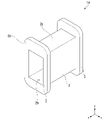
- FIG. 1 is a schematic diagram showing the coil bobbin of this embodiment. As shown in the figure, the coil bobbin 1A has a body portion 2 and a pair of flange portions 3 .
- the extending direction of the main body 2 is the x-axis direction
- the direction orthogonal to the x-axis direction in the horizontal plane is the y-axis direction
- the direction orthogonal to each of the x-axis direction and the y-axis direction is z Axial direction.
- the body part 2 is a tubular member.
- the body portion 2 has a shaft hole 29 passing through the body portion 2 in the x-axis direction.
- a winding is wound around the outer surface 2 b of the body portion 2 in the circumferential direction of the body portion 2 .
- the windings wound on the outer surface 2b form a coil.
- the flanges 3 are provided at both ends in the extending direction of the shaft hole 29 of the main body 2 .
- the collar portion 3 has an annular shape extending in the yz plane direction.
- the collar portion 3 may have a through hole through which the winding is inserted.
- a coil bobbin which is an electric/electronic component such as the coil bobbin 1A described above, is used as a core of a coil formed by winding a wire.
- a coil wound around a bobbin is likely to reach a high temperature due to the use environment or heating due to energization. Therefore, the molded article of the present embodiment, which has high thermal stability, is useful as a coil bobbin.
- the pellets obtained from the resin composition are unlikely to have an irregular shape, and the pellets are put into a molding machine and plasticized. Defects are less likely to occur due to reduced variability in weighing.
- the temperature was raised to 320°C over 2 hours and 50 minutes while distilling off the by-product acetic acid and unreacted acetic anhydride, and the reaction was terminated when an increase in torque was observed to obtain a prepolymer.
- the flow initiation temperature of the prepolymer was 263°C.
- the resulting prepolymer is cooled to room temperature (25° C.) and pulverized with a coarse pulverizer to obtain a liquid crystalline polymer (liquid crystal polyester) powder (particle diameter is about 0.1 to 1 mm), followed by a nitrogen atmosphere. Then, the temperature was raised from room temperature (25° C.) to 250° C. over 1 hour, then from 250° C. to 300° C. over 5 hours, and held at 300° C. for 3 hours to proceed with the polymerization reaction in a solid phase.
- the obtained liquid crystalline polymer (liquid crystal polyester; resin A) had a flow initiation temperature of 361°C.
- each repeating unit in Resin A calculated from the charged amount of raw material monomers is the repeating unit (u1) in which Ar 1 is a p-phenylene group (that is, p-hydroxybenzoin acid) is 60 mol%, the repeating unit (u2) in which Ar 2 is a p-phenylene group (that is, the repeating unit derived from terephthalic acid) is 18 mol%, and Ar 2 is an m-phenylene group.
- a certain repeating unit (u2) (that is, repeating units derived from isophthalic acid) is 2 mol %
- Ar 3 is a 4,4'-biphenylylene group
- X and Y are oxygen atoms (i.e., repeating units (u3) , a repeating unit derived from 4,4′-dihydroxybiphenyl) was 20 mol %.
- the temperature was raised from 150° C. to 320° C. over 2 hours and 50 minutes while distilling off the by-produced acetic acid and unreacted acetic anhydride, and when an increase in torque was observed, the contents were removed from the reactor. It was taken out and cooled to room temperature to obtain a solid prepolymer.
- the prepolymer was pulverized using a pulverizer, and the resulting pulverized product was heated from room temperature to 250° C. over 1 hour and then from 250° C. to 295° C. over 5 hours under a nitrogen atmosphere. , and 295° C. for 3 hours to carry out solid state polymerization.
- the resulting solid-phase polymer was cooled to room temperature to obtain a powdery liquid crystalline polyester (L3).
- the obtained liquid crystalline polymer liquid crystal polyester; resin B) had a flow initiation temperature of 327°C.
- each repeating unit in Resin B calculated from the charged amount of raw material monomers is the repeating unit (u1) in which Ar 1 is a p-phenylene group (that is, p-hydroxybenzoin acid) is 60 mol%, the repeating unit (u2) in which Ar 2 is a p-phenylene group (that is, the repeating unit derived from terephthalic acid) is 15 mol%, and Ar 2 is an m-phenylene group.
- a certain repeating unit (u2) (that is, repeating units derived from isophthalic acid) is 5 mol %
- Ar 3 is a 4,4'-biphenylylene group
- X and Y are oxygen atoms (i.e., repeating units (u3) , a repeating unit derived from 4,4′-dihydroxybiphenyl) was 20 mol %.
- an aqueous solution prepared by dissolving 700 mg of disuccinic acid peroxide (DSP) in 20 g of deionized water and an aqueous solution prepared by dissolving 700 mg of ammonium persulfate (APS) in 20 g of deionized water were pressurized into the tank using TFE. . Since the pressure inside the tank was lowered due to the decomposition of the polymerization initiator, TFE was continuously supplied to maintain the pressure inside the tank at 0.80 ⁇ 0.05 MPa. During the polymerization reaction, the temperature in the tank was adjusted to 85 ⁇ 1° C., and the stirring rotation speed was controlled to 350 rpm.
- DSP disuccinic acid peroxide
- APS ammonium persulfate
- the CF 3 group content relative to the CF 2 group content in the resins F1 to F5 is the peak area ICF 3 corresponding to the CF 3 group measured by 19 F solid-state NMR, and the peak area ICF 2 corresponding to the CF 2 group. It was calculated as an area percentage from , and obtained by the following formula (f1).
- CF 3 group content (%) ⁇ (ICF 3 )/3/(ICF 2 )/2 ⁇ 100 (f1)
- Measuring device PS400WB (manufactured by Varian) Static magnetic field strength: 9.4 Tesla (resonance frequency: 400 MHz (1H)) Magic angle rotation: 35 kHz (35000 rotations per second) Repeat time: 15s Accumulation times: 128 times Temperature: 26°C Chemical shift reference material: hexafluorobenzene
- Resin A a liquid crystalline polymer (liquid crystal polyester; resin A) obtained by the production method described above
- G1 glass fiber (product name: milled fiber EFH75-01, manufactured by Central Glass Co., Ltd., fiber diameter 11 ⁇ m, fiber length 75 ⁇ m)
- Resins F1 to F5 fluororesins obtained by the respective production methods described above
- M1 carbon black (product name: #45LB, manufactured by Mitsubishi Chemical Corporation, primary particle diameter 24 nm, specific surface area 125 m 2 /g, oil absorption 45 mL/100 g)
- the resin compositions of Examples 1 to 4 which contain resins F1 to F4 having a peak area percentage of CF 3 group content of 0.05% or more, are superior to the resin composition of Comparative Example 1. Therefore, the effect of suppressing the occurrence of die swell was good.
- the resin compositions of Examples 1 to 4 containing a liquid crystalline polymer and resins F1 to F4 having a CF 3 group content peak area percentage of 0.05% or more were used.
- the molded product had a low b * rate of change and was less likely to yellow. From this, it was confirmed that the molded articles produced using the resin compositions of Examples 1 to 4 had high thermal stability. Further, among the examples, the molded articles produced using the resin compositions of Examples 2 to 4 containing the resins F2 to F4 had a particularly low b * rate of change and suppressed yellowing.
- Resin B a liquid crystalline polymer (liquid crystal polyester; resin B) obtained by the production method described above
- T1 Talc (product name: MS-KY, manufactured by Nippon Talc Co., Ltd., median diameter (D50) 21 ⁇ m)
- Resins F1 to F4 fluororesins obtained by the respective production methods described above
- M2 Titanium Yellow (product name: TY-70S, manufactured by Ishihara Sangyo Co., Ltd., average particle size 1.00 ⁇ m)
- M3 Carbon black (product name: BP4350, manufactured by Cabot Corporation, oil absorption 66-77 mL/100 g)
- M4 Titanium oxide (product name: CR-60, manufactured by Ishihara Sangyo Co., Ltd., average particle size 0.21 ⁇ m)
- the resin compositions of Examples 5 to 8 were also good in the effect of suppressing the occurrence of die swell, like the resin compositions of Examples 1 to 4 described above.
Landscapes
- Chemical & Material Sciences (AREA)
- Health & Medical Sciences (AREA)
- Chemical Kinetics & Catalysis (AREA)
- Medicinal Chemistry (AREA)
- Polymers & Plastics (AREA)
- Organic Chemistry (AREA)
- Engineering & Computer Science (AREA)
- Manufacturing & Machinery (AREA)
- Materials Engineering (AREA)
- Compositions Of Macromolecular Compounds (AREA)
Priority Applications (4)
| Application Number | Priority Date | Filing Date | Title |
|---|---|---|---|
| US18/262,306 US20240067818A1 (en) | 2021-02-01 | 2022-02-01 | Resin composition and molded body |
| CN202280012232.1A CN116802235B (zh) | 2021-02-01 | 2022-02-01 | 树脂组合物及成型体 |
| JP2022578541A JP7833420B2 (ja) | 2021-02-01 | 2022-02-01 | 樹脂組成物及び成形体 |
| KR1020237028980A KR20230135648A (ko) | 2021-02-01 | 2022-02-01 | 수지 조성물 및 성형체 |
Applications Claiming Priority (2)
| Application Number | Priority Date | Filing Date | Title |
|---|---|---|---|
| JP2021014344 | 2021-02-01 | ||
| JP2021-014344 | 2021-02-01 |
Publications (1)
| Publication Number | Publication Date |
|---|---|
| WO2022163862A1 true WO2022163862A1 (ja) | 2022-08-04 |
Family
ID=82654669
Family Applications (1)
| Application Number | Title | Priority Date | Filing Date |
|---|---|---|---|
| PCT/JP2022/003773 Ceased WO2022163862A1 (ja) | 2021-02-01 | 2022-02-01 | 樹脂組成物及び成形体 |
Country Status (5)
| Country | Link |
|---|---|
| US (1) | US20240067818A1 (https=) |
| JP (1) | JP7833420B2 (https=) |
| KR (1) | KR20230135648A (https=) |
| CN (1) | CN116802235B (https=) |
| WO (1) | WO2022163862A1 (https=) |
Citations (11)
| Publication number | Priority date | Publication date | Assignee | Title |
|---|---|---|---|---|
| JP2011178830A (ja) * | 2010-02-26 | 2011-09-15 | Sumitomo Chemical Co Ltd | 熱可塑性樹脂組成物及びその成形体 |
| JP2012116907A (ja) * | 2010-11-30 | 2012-06-21 | Sumitomo Chemical Co Ltd | 液晶ポリエステル組成物 |
| WO2012090410A1 (ja) * | 2010-12-28 | 2012-07-05 | 東レ株式会社 | 液晶性ポリエステル樹脂組成物及びその製造方法とそれからなる成形品 |
| JP2012149127A (ja) * | 2011-01-17 | 2012-08-09 | Sumitomo Chemical Co Ltd | 液晶ポリエステル含有液状組成物 |
| JP2013032485A (ja) * | 2011-06-27 | 2013-02-14 | Sumitomo Chemical Co Ltd | 樹脂組成物、成形体および摺動用部材 |
| JP2013032484A (ja) * | 2011-06-27 | 2013-02-14 | Sumitomo Chemical Co Ltd | 樹脂組成物、成形体および摺動用部材 |
| WO2014171029A1 (ja) * | 2013-04-17 | 2014-10-23 | ダイセル・エボニック株式会社 | 耐光性樹脂組成物およびその成形体 |
| JP2018177931A (ja) * | 2017-04-11 | 2018-11-15 | Agc株式会社 | 樹脂組成物および成形品 |
| JP2019014787A (ja) * | 2017-07-04 | 2019-01-31 | Jxtgエネルギー株式会社 | 液晶ポリエステル組成物およびその成形品 |
| WO2020059261A1 (ja) * | 2018-09-19 | 2020-03-26 | オイレス工業株式会社 | 複層摺動部材及びそれを用いた自動車のラックピニオン式舵取装置 |
| WO2020226034A1 (ja) * | 2019-05-08 | 2020-11-12 | 三菱エンジニアリングプラスチックス株式会社 | ポリカーボネート樹脂組成物 |
Family Cites Families (4)
| Publication number | Priority date | Publication date | Assignee | Title |
|---|---|---|---|---|
| JP4497711B2 (ja) * | 2000-12-18 | 2010-07-07 | 三井・デュポンフロロケミカル株式会社 | 熱溶融性フッ素樹脂混合繊維及びその製造方法 |
| US7012768B2 (en) * | 2000-12-27 | 2006-03-14 | Ntn Corporation | Optical pick-up |
| ES2660142T3 (es) * | 2008-05-30 | 2018-03-21 | Whitford Corporation | Composiciones de fluoropolímeros mezclados |
| EP2418227B1 (en) * | 2009-03-31 | 2018-12-19 | Daikin Industries, Ltd. | Method for producing stabilized fluoropolymer |
-
2022
- 2022-02-01 CN CN202280012232.1A patent/CN116802235B/zh active Active
- 2022-02-01 JP JP2022578541A patent/JP7833420B2/ja active Active
- 2022-02-01 US US18/262,306 patent/US20240067818A1/en active Pending
- 2022-02-01 WO PCT/JP2022/003773 patent/WO2022163862A1/ja not_active Ceased
- 2022-02-01 KR KR1020237028980A patent/KR20230135648A/ko active Pending
Patent Citations (11)
| Publication number | Priority date | Publication date | Assignee | Title |
|---|---|---|---|---|
| JP2011178830A (ja) * | 2010-02-26 | 2011-09-15 | Sumitomo Chemical Co Ltd | 熱可塑性樹脂組成物及びその成形体 |
| JP2012116907A (ja) * | 2010-11-30 | 2012-06-21 | Sumitomo Chemical Co Ltd | 液晶ポリエステル組成物 |
| WO2012090410A1 (ja) * | 2010-12-28 | 2012-07-05 | 東レ株式会社 | 液晶性ポリエステル樹脂組成物及びその製造方法とそれからなる成形品 |
| JP2012149127A (ja) * | 2011-01-17 | 2012-08-09 | Sumitomo Chemical Co Ltd | 液晶ポリエステル含有液状組成物 |
| JP2013032485A (ja) * | 2011-06-27 | 2013-02-14 | Sumitomo Chemical Co Ltd | 樹脂組成物、成形体および摺動用部材 |
| JP2013032484A (ja) * | 2011-06-27 | 2013-02-14 | Sumitomo Chemical Co Ltd | 樹脂組成物、成形体および摺動用部材 |
| WO2014171029A1 (ja) * | 2013-04-17 | 2014-10-23 | ダイセル・エボニック株式会社 | 耐光性樹脂組成物およびその成形体 |
| JP2018177931A (ja) * | 2017-04-11 | 2018-11-15 | Agc株式会社 | 樹脂組成物および成形品 |
| JP2019014787A (ja) * | 2017-07-04 | 2019-01-31 | Jxtgエネルギー株式会社 | 液晶ポリエステル組成物およびその成形品 |
| WO2020059261A1 (ja) * | 2018-09-19 | 2020-03-26 | オイレス工業株式会社 | 複層摺動部材及びそれを用いた自動車のラックピニオン式舵取装置 |
| WO2020226034A1 (ja) * | 2019-05-08 | 2020-11-12 | 三菱エンジニアリングプラスチックス株式会社 | ポリカーボネート樹脂組成物 |
Also Published As
| Publication number | Publication date |
|---|---|
| US20240067818A1 (en) | 2024-02-29 |
| KR20230135648A (ko) | 2023-09-25 |
| JPWO2022163862A1 (https=) | 2022-08-04 |
| JP7833420B2 (ja) | 2026-03-19 |
| CN116802235A (zh) | 2023-09-22 |
| CN116802235B (zh) | 2025-07-29 |
Similar Documents
| Publication | Publication Date | Title |
|---|---|---|
| TWI762742B (zh) | 液晶聚酯樹脂組成物及成形體 | |
| TWI773853B (zh) | 液晶聚酯樹脂組成物及成形體 | |
| JP5556223B2 (ja) | 液晶高分子組成物、その製造方法及び成形体 | |
| CN103360730B (zh) | 液晶聚酯组合物 | |
| CN110168018B (zh) | 液晶聚酯树脂组合物 | |
| WO2019098228A1 (ja) | 液晶ポリエステル組成物および樹脂成形体 | |
| CN110809606A (zh) | 液晶聚酯树脂组合物和成型体 | |
| JP7269920B2 (ja) | 液晶ポリエステル組成物および成形品 | |
| JP2009001639A (ja) | 耐熱性に優れた樹脂組成物及びその製造方法 | |
| JP2011202062A (ja) | 摺動用熱可塑性樹脂組成物、摺動用熱可塑性樹脂組成物の製造方法および摺動部品 | |
| JP5447440B2 (ja) | 液晶ポリエステル樹脂組成物の製造方法 | |
| KR102695568B1 (ko) | 수지 조성물 | |
| JP5197553B2 (ja) | 液晶性樹脂組成物及びその成形体 | |
| JP7833420B2 (ja) | 樹脂組成物及び成形体 | |
| JP2011157533A (ja) | 液晶ポリエステル組成物及びそのフィルム | |
| JP2011207055A (ja) | 液晶ポリエステル樹脂ペレットの製造方法および押出機 | |
| JP5407988B2 (ja) | 液晶性樹脂組成物及びその成形体 | |
| CN118401606A (zh) | 树脂组合物及成型体 | |
| CN117580910A (zh) | 树脂组合物及成形体 | |
| JP2025007207A (ja) | 樹脂組成物及びその製造方法、並びに、成形体及びギヤ | |
| KR20240045323A (ko) | 액정 폴리에스테르 펠릿 조성물 및 사출 성형품 | |
| WO2023136196A1 (ja) | 液晶ポリエステル組成物、及び成形体 | |
| JP2004182748A (ja) | 液晶ポリエステル樹脂混合物およびそれを用いた成形方法 | |
| KR20240045324A (ko) | 액정 폴리에스테르 펠릿 조성물 및 사출 성형품 | |
| JP2012193304A (ja) | 液晶ポリエステル樹脂組成物、成形体 |
Legal Events
| Date | Code | Title | Description |
|---|---|---|---|
| 121 | Ep: the epo has been informed by wipo that ep was designated in this application |
Ref document number: 22746081 Country of ref document: EP Kind code of ref document: A1 |
|
| WWE | Wipo information: entry into national phase |
Ref document number: 18262306 Country of ref document: US |
|
| ENP | Entry into the national phase |
Ref document number: 2022578541 Country of ref document: JP Kind code of ref document: A |
|
| WWE | Wipo information: entry into national phase |
Ref document number: 202280012232.1 Country of ref document: CN |
|
| ENP | Entry into the national phase |
Ref document number: 20237028980 Country of ref document: KR Kind code of ref document: A |
|
| NENP | Non-entry into the national phase |
Ref country code: DE |
|
| 122 | Ep: pct application non-entry in european phase |
Ref document number: 22746081 Country of ref document: EP Kind code of ref document: A1 |
|
| WWG | Wipo information: grant in national office |
Ref document number: 202280012232.1 Country of ref document: CN |