WO2022124174A1 - 含金属添加剤、架橋性高分子組成物、架橋高分子材料、金属部材ならびにワイヤーハーネス - Google Patents
含金属添加剤、架橋性高分子組成物、架橋高分子材料、金属部材ならびにワイヤーハーネス Download PDFInfo
- Publication number
- WO2022124174A1 WO2022124174A1 PCT/JP2021/044193 JP2021044193W WO2022124174A1 WO 2022124174 A1 WO2022124174 A1 WO 2022124174A1 JP 2021044193 W JP2021044193 W JP 2021044193W WO 2022124174 A1 WO2022124174 A1 WO 2022124174A1
- Authority
- WO
- WIPO (PCT)
- Prior art keywords
- metal
- containing additive
- diketonato
- polymer composition
- component
- Prior art date
- Legal status (The legal status is an assumption and is not a legal conclusion. Google has not performed a legal analysis and makes no representation as to the accuracy of the status listed.)
- Ceased
Links
Images


Classifications
-
- C—CHEMISTRY; METALLURGY
- C08—ORGANIC MACROMOLECULAR COMPOUNDS; THEIR PREPARATION OR CHEMICAL WORKING-UP; COMPOSITIONS BASED THEREON
- C08K—Use of inorganic or non-macromolecular organic substances as compounding ingredients
- C08K5/00—Use of organic ingredients
- C08K5/0091—Complexes with metal-heteroatom-bonds
-
- C—CHEMISTRY; METALLURGY
- C07—ORGANIC CHEMISTRY
- C07C—ACYCLIC OR CARBOCYCLIC COMPOUNDS
- C07C31/00—Saturated compounds having hydroxy or O-metal groups bound to acyclic carbon atoms
- C07C31/02—Monohydroxylic acyclic alcohols
- C07C31/125—Monohydroxylic acyclic alcohols containing five to twenty-two carbon atoms
-
- C—CHEMISTRY; METALLURGY
- C07—ORGANIC CHEMISTRY
- C07C—ACYCLIC OR CARBOCYCLIC COMPOUNDS
- C07C49/00—Ketones; Ketenes; Dimeric ketenes; Ketonic chelates
- C07C49/04—Saturated compounds containing keto groups bound to acyclic carbon atoms
- C07C49/12—Ketones containing more than one keto group
- C07C49/14—Acetylacetone, i.e. 2,4-pentanedione
-
- C—CHEMISTRY; METALLURGY
- C07—ORGANIC CHEMISTRY
- C07F—ACYCLIC, CARBOCYCLIC OR HETEROCYCLIC COMPOUNDS CONTAINING ELEMENTS OTHER THAN CARBON, HYDROGEN, HALOGEN, OXYGEN, NITROGEN, SULFUR, SELENIUM OR TELLURIUM
- C07F3/00—Compounds containing elements of Groups 2 or 12 of the Periodic Table
- C07F3/04—Calcium compounds
-
- C—CHEMISTRY; METALLURGY
- C07—ORGANIC CHEMISTRY
- C07F—ACYCLIC, CARBOCYCLIC OR HETEROCYCLIC COMPOUNDS CONTAINING ELEMENTS OTHER THAN CARBON, HYDROGEN, HALOGEN, OXYGEN, NITROGEN, SULFUR, SELENIUM OR TELLURIUM
- C07F3/00—Compounds containing elements of Groups 2 or 12 of the Periodic Table
- C07F3/06—Zinc compounds
-
- C—CHEMISTRY; METALLURGY
- C07—ORGANIC CHEMISTRY
- C07F—ACYCLIC, CARBOCYCLIC OR HETEROCYCLIC COMPOUNDS CONTAINING ELEMENTS OTHER THAN CARBON, HYDROGEN, HALOGEN, OXYGEN, NITROGEN, SULFUR, SELENIUM OR TELLURIUM
- C07F5/00—Compounds containing elements of Groups 3 or 13 of the Periodic Table
- C07F5/06—Aluminium compounds
-
- C—CHEMISTRY; METALLURGY
- C08—ORGANIC MACROMOLECULAR COMPOUNDS; THEIR PREPARATION OR CHEMICAL WORKING-UP; COMPOSITIONS BASED THEREON
- C08K—Use of inorganic or non-macromolecular organic substances as compounding ingredients
- C08K5/00—Use of organic ingredients
- C08K5/04—Oxygen-containing compounds
- C08K5/05—Alcohols; Metal alcoholates
-
- C—CHEMISTRY; METALLURGY
- C08—ORGANIC MACROMOLECULAR COMPOUNDS; THEIR PREPARATION OR CHEMICAL WORKING-UP; COMPOSITIONS BASED THEREON
- C08K—Use of inorganic or non-macromolecular organic substances as compounding ingredients
- C08K5/00—Use of organic ingredients
- C08K5/04—Oxygen-containing compounds
- C08K5/07—Aldehydes; Ketones
-
- C—CHEMISTRY; METALLURGY
- C08—ORGANIC MACROMOLECULAR COMPOUNDS; THEIR PREPARATION OR CHEMICAL WORKING-UP; COMPOSITIONS BASED THEREON
- C08K—Use of inorganic or non-macromolecular organic substances as compounding ingredients
- C08K5/00—Use of organic ingredients
- C08K5/04—Oxygen-containing compounds
- C08K5/09—Carboxylic acids; Metal salts thereof; Anhydrides thereof
- C08K5/098—Metal salts of carboxylic acids
-
- C—CHEMISTRY; METALLURGY
- C08—ORGANIC MACROMOLECULAR COMPOUNDS; THEIR PREPARATION OR CHEMICAL WORKING-UP; COMPOSITIONS BASED THEREON
- C08L—COMPOSITIONS OF MACROMOLECULAR COMPOUNDS
- C08L101/00—Compositions of unspecified macromolecular compounds
- C08L101/02—Compositions of unspecified macromolecular compounds characterised by the presence of specified groups, e.g. terminal or pendant functional groups
-
- C—CHEMISTRY; METALLURGY
- C09—DYES; PAINTS; POLISHES; NATURAL RESINS; ADHESIVES; COMPOSITIONS NOT OTHERWISE PROVIDED FOR; APPLICATIONS OF MATERIALS NOT OTHERWISE PROVIDED FOR
- C09D—COATING COMPOSITIONS, e.g. PAINTS, VARNISHES OR LACQUERS; FILLING PASTES; CHEMICAL PAINT OR INK REMOVERS; INKS; CORRECTING FLUIDS; WOODSTAINS; PASTES OR SOLIDS FOR COLOURING OR PRINTING; USE OF MATERIALS THEREFOR
- C09D7/00—Features of coating compositions, not provided for in group C09D5/00; Processes for incorporating ingredients in coating compositions
- C09D7/40—Additives
- C09D7/60—Additives non-macromolecular
- C09D7/63—Additives non-macromolecular organic
-
- H—ELECTRICITY
- H01—ELECTRIC ELEMENTS
- H01B—CABLES; CONDUCTORS; INSULATORS; SELECTION OF MATERIALS FOR THEIR CONDUCTIVE, INSULATING OR DIELECTRIC PROPERTIES
- H01B7/00—Insulated conductors or cables characterised by their form
- H01B7/0045—Cable-harnesses
-
- H—ELECTRICITY
- H01—ELECTRIC ELEMENTS
- H01B—CABLES; CONDUCTORS; INSULATORS; SELECTION OF MATERIALS FOR THEIR CONDUCTIVE, INSULATING OR DIELECTRIC PROPERTIES
- H01B7/00—Insulated conductors or cables characterised by their form
- H01B7/17—Protection against damage caused by external factors, e.g. sheaths or armouring
- H01B7/28—Protection against damage caused by moisture, corrosion, chemical attack or weather
- H01B7/2806—Protection against damage caused by corrosion
-
- C—CHEMISTRY; METALLURGY
- C08—ORGANIC MACROMOLECULAR COMPOUNDS; THEIR PREPARATION OR CHEMICAL WORKING-UP; COMPOSITIONS BASED THEREON
- C08K—Use of inorganic or non-macromolecular organic substances as compounding ingredients
- C08K2201/00—Specific properties of additives
- C08K2201/014—Additives containing two or more different additives of the same subgroup in C08K
Definitions
- the present disclosure relates to metal-containing additives, crosslinkable polymer compositions, crosslinked polymer materials, metal members and wire harnesses.
- the ⁇ -diketonato metal complex is widely used as a manufacturing raw material for manufacturing various materials.
- a ⁇ -diketonato metal complex is preferably used as a raw material for forming a metal oxide thin film by a chemical vapor deposition method (CVD method).
- CVD method chemical vapor deposition method
- an alkoxyalkylmethyl group is used from the viewpoint of forming a metal complex having a low melting point, excellent stability against moisture, air and heat, and suitable for forming a metal thin film by a CVD method. It is disclosed that it is a ⁇ -diketonato metal complex having.
- Patent Document 2 from the viewpoint of lowering the vaporization temperature and making it suitable as a material for forming an oxide thin film, an adduct of a metal complex having acetylacetone as a ligand and an orthophenanthroline derivative or 2,2'.
- -A metal acetylacetonato complex for forming an oxide thin film composed of an adduct of a bipyridyl derivative is disclosed.
- the ⁇ -diketonato metal complex When the ⁇ -diketonato metal complex is used as a film-forming raw material by a CVD method or the like, it can be said that one that causes melting or vaporization at a low temperature to some extent is preferable as described in Patent Document 1 and Patent Document 2.
- the ⁇ -diketonato metal complex when used for applications other than the film-forming raw material, it is not always preferable that the ⁇ -diketonato metal complex causes changes such as melting and vaporization at a low temperature.
- the ⁇ -diketonato metal complex stably retains its structure at the stage of storage and material preparation before heating to liberate the metal ion, and can be easily decomposed. It is preferable not to cause denaturation. That is, it is preferable that the ⁇ -diketonato metal complex has high storage stability.
- the problem to be solved in the present disclosure is a metal-containing additive and a crosslinkable polymer composition containing a ⁇ -diketonato metal complex and having excellent storage stability, and a structure using such a crosslinkable polymer composition. It is an object of the present invention to provide a crosslinked polymer material, a metal member, and a wire harness.
- the metal-containing additive according to the present disclosure includes a ⁇ -diketonato metal complex and a primary alkyl alcohol having 4 or more and 30 or less carbon atoms.
- the crosslinkable polymer composition according to the present disclosure contains the metal-containing additive and an organic polymer, and the organic polymer forms an ionic bond with a metal ion released from the metal-containing additive by heat. It has a possible substituent.
- the crosslinked polymer material according to the present disclosure is a crosslinked body of the crosslinkable polymer composition, and the organic polymer is crosslinked via the metal ion released from the metal-containing additive.
- the metal member according to the present disclosure includes a metal base material and a coating material that covers the surface of the metal base material, and the coating material is composed of the crosslinked polymer material.
- the wire harness according to the present disclosure includes the crosslinked polymer material.
- the metal-containing additive and the crosslinkable polymer composition according to the present disclosure contain a ⁇ -diketonato metal complex and have excellent storage stability. Further, the crosslinked polymer material, the metal member and the wire harness according to the present disclosure are configured by using such a crosslinked polymer composition.
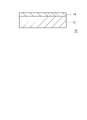
- FIG. 1 is a cross-sectional view of a metal member according to an embodiment of the present disclosure.
- FIG. 2 is a perspective view of a wire harness according to an embodiment of the present disclosure.
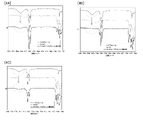
- FIG. 3 is a vertical cross-sectional view taken along the line AA in FIG. 4A to 4C are diagrams showing changes in the FT-IR spectrum when an alkyl alcohol is added to three types of ⁇ -diketonato metal complexes.
- the metal-containing additive according to the present disclosure includes a ⁇ -diketonato metal complex and a primary alkyl alcohol having 4 or more and 30 or less carbon atoms.
- the complex structure of the ⁇ -diketonato metal complex is stabilized by adding a primary alkyl alcohol having 4 or more and 30 or less carbon atoms to the ⁇ -diketonato metal complex.
- a primary alkyl alcohol having 4 or more and 30 or less carbon atoms to the ⁇ -diketonato metal complex.
- the storage stability of the ⁇ -diketonato metal complex can be enhanced as compared with the case where the alkyl alcohol is not added. That is, it can be stably stored for a long period of time at a relatively low temperature such as normal temperature.
- the metal-containing additive contains a ⁇ -diketonato metal complex, it is conceivable that the metal ion is liberated by heating and used as an additive for metal cross-linking of an organic polymer, for example.
- the additive Due to the high storage stability of the agent, the additive is stored in a state where the additive is stored before use, or when the material is being prepared such as mixing of a composition, the additive is placed in a state where metal ions are not released. It can be held stably.
- the alkyl alcohol may be a linear alkyl alcohol. Then, the effect of stabilizing the complex structure of the ⁇ -diketonato metal complex is excellent, and the storage stability of the metal-containing additive and the composition containing the metal-containing additive can be effectively enhanced.
- the alkyl alcohol is contained at least twice as much as the ⁇ -diketonato metal complex in terms of molar ratio. Then, a sufficient amount of alkyl alcohol is contained in order to enhance the stability of the complex structure of the ⁇ -diketonato metal complex, and the effect of making the metal-containing additive having high storage stability is excellent.
- the metal constituting the ⁇ -diketonato metal complex may contain at least one of alkaline earth metals, zinc, titanium and aluminum.
- the ⁇ -diketonato complexes of these metals have high stability, and by adding an alkyl alcohol, the stability is further enhanced, and the ⁇ -diketonato complex becomes a metal-containing additive having particularly excellent storage stability. Further, since these metals have a valence of divalent or higher, they give a stable crosslinked body when used for crosslinking an organic polymer.
- At least a part of the alkyl alcohol is coordinated to the metal of the ⁇ -diketonato metal complex.
- the metal-containing additive has higher storage stability than the ⁇ -diketonato metal complex, and is preferably one that liberates metal ions at a temperature of 50 ° C. or higher and 200 ° C. or lower. Then, in the metal-containing additive, the stability of storage at room temperature and the like and the effective utilization of free metal ions by heating can be achieved at the same time.
- the crosslinkable polymer composition according to the present disclosure contains the metal-containing additive and an organic polymer, and the organic polymer forms an ionic bond with a metal ion released from the metal-containing additive by heat. It has a possible substituent.
- the crosslinkable polymer composition When the crosslinkable polymer composition is heated, the organic polymer is crosslinked via the metal ions liberated from the metal-containing additive. Therefore, it is possible to form a cured body of an organic polymer having high heat resistance through heating.
- the metal-containing additive contained in the crosslinkable polymer composition according to the present disclosure since the metal-containing additive contained in the crosslinkable polymer composition according to the present disclosure has high storage stability, the crosslinkable polymer composition has high fluidity when not heated. It is in a state or a soft state. Therefore, the crosslinkable polymer composition can be easily and highly uniformly arranged at a desired position and form, such as by being applied to a metal surface, and then cured. As a result, a cured product having a dense structure can be obtained.
- the substituent of the organic polymer is preferably at least one of a carboxylic acid group, an acid anhydride group, a phosphoric acid group, and a sulfonic acid group. Since these functional groups easily form ionic bonds with metal ions liberated from the metal-containing additive, the crosslinkable polymer composition has excellent crosslinkability.
- the organic polymer is preferably liquid at 150 ° C. or lower. Then, it is easy to arrange the crosslinkable polymer composition at a desired position and form, such as by applying it to a metal surface at a relatively low temperature.
- the metal-containing additive is contained in an amount of 0.2 parts by mass or more and 30 parts by mass or less with respect to 100 parts by mass of the organic polymer. Then, by containing a sufficient amount of the metal-containing additive, the crosslinkable polymer composition has excellent crosslinkability, and a large amount of the metal-containing additive such as separation and precipitation of the metal-containing component is contained. It is easy to avoid the influence of things.
- the crosslinked polymer material according to the present disclosure is a crosslinked body of the crosslinkable polymer composition, and the organic polymer is crosslinked via the metal ion released from the metal-containing additive.
- a crosslinked polymer material is formed by liberating metal ions from a metal-containing additive having high storage stability by heating and cross-linking an organic polymer with the metal ions. Therefore, the crosslinkable polymer material can be easily arranged as a cured product having high heat resistance.
- the metal member according to the present disclosure includes a metal base material and a coating material that covers the surface of the metal base material, and the coating material is composed of the crosslinked polymer material.
- the coating material is composed of the crosslinked polymer material.
- the wire harness according to the present disclosure includes the crosslinked polymer material.
- the wire harness By containing the crosslinked polymer material, the wire harness has excellent anticorrosion properties, and even when heated, the wire harness maintains its high anticorrosion properties. Further, since the crosslinked polymer material uses the above-mentioned metal-containing additive having high storage stability as a raw material, it is possible to easily form such a wire harness having excellent corrosion resistance. can.
- the metal-containing additive according to the present disclosure includes a ⁇ -diketonato metal complex and a primary alkyl alcohol having 4 or more and 30 or less carbon atoms (hereinafter, may be simply referred to as an alkyl alcohol). I'm out.
- an alkyl alcohol By adding an alkyl alcohol to the ⁇ -diketonato metal complex, the ⁇ -diketonato metal complex has higher storage stability than the case of the ⁇ -diketonato metal complex alone.
- high storage stability means that quality changes such as decomposition are unlikely to occur at a low temperature such as room temperature, and that the chemical structure and physical properties can be maintained and stored for a longer period of time at that temperature.
- the ⁇ -diketonato metal complex is a ⁇ -diketonato ligand (1,3-diketonato ligand) coordinated to the central metal.
- the ⁇ -diketonato ligand is represented by the following general formula (1) and is bidentate with respect to the central metal.
- R 1 , R 2 , and R 3 represent hydrocarbon groups.
- R 1 , R 2 , and R 3 may be hydrocarbon groups having the same structure as each other, or may be hydrocarbon groups having different structures from each other.
- R 1 , R 2 , and R 3 may be an aliphatic hydrocarbon group or a hydrocarbon group containing an aromatic ring.
- R 1 , R 2 , and R 3 are preferably hydrocarbon groups having 1 or more and 10 or less carbon atoms.
- R 1 may be hydrogen. The case where at least two of R 1 , R 2 , and R 3 are connected to each other by a ring structure is also included.
- Examples of the ⁇ -diketonato ligand include acetylacetonato ligand (acac), 2,2,6,6-tetramethyl-3,5-heptandionato ligand (dpm), and 3-methyl-2,4-. Pentazionato Ligand, 3-Ethyl-2,4-Pentandionato Ligand, 3,5-Heptandionato Ligand, 2,6-dimethyl-3,5-Heptandionato Ligand, 1,3-diphenyl-1, Examples thereof include 3-propanedionato ligand.
- the acetylacetonato ligand is particularly preferable from the viewpoint of the magnitude of the stabilizing effect due to the addition of the alkyl alcohol. As the ligand, only one type may be used, or two or more types may be used in combination.
- the metal species constituting the ⁇ -diketonato metal complex are not particularly limited, and examples thereof include alkaline earth metals, zinc, titanium, aluminum, iron, nickel, copper, and zirconium. It is preferably at least one of alkaline earth metals, zinc, titanium and aluminum.
- the ⁇ -diketonato metal complex having these metals as the central metal has high stability, and the stability is further increased by adding an alkyl alcohol. Further, the metal ions of these metals have a valence of divalent or higher, and in the crosslinkable polymer composition described below, the metal ions are liberated from the metal-containing additive to metal-crosslink the organic polymer. In the meantime, high cross-linking property is obtained.
- the metal species constituting the ⁇ -diketonato metal complex may be only one kind or two or more kinds.
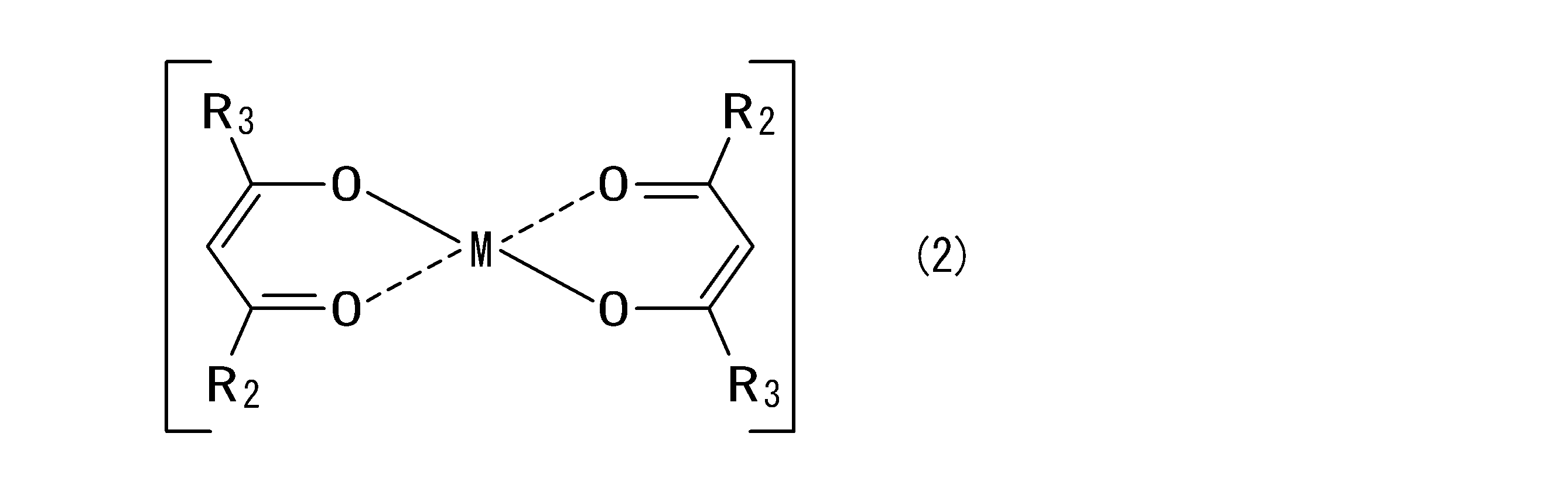
- the formula (2) below shows, for example, the structure of the ⁇ -diketonato metal complex when a divalent metal ion having a planar tetracoordination is used as the central metal.
- R 1 in the formula (1) is a hydrogen atom.
- the alkyl alcohol used as the metal-containing additive is a primary alkyl alcohol having 4 or more and 30 or less carbon atoms, and has the structure of the following formula (3).
- R-OH (3) R is an alkyl group having 4 or more carbon atoms and 30 or less carbon atoms.
- metal ions are liberated from the ⁇ -diketonato metal complex by heating with heat, that is, by heating to a temperature higher than normal temperature.
- the storage stability is higher than that of the ⁇ -diketonato metal complex itself in a state where it is not exposed to heat such as at room temperature. Is improving.
- the ⁇ -diketonato metal complex itself also has a certain degree of storage stability, and in many cases it does not easily undergo denaturation such as decomposition at relatively low temperatures such as room temperature, but it can be further stored by adding an alkyl alcohol.
- the ⁇ -diketonato metal complex releases metal ions by decomposition or the like when it receives heat, and requires the presence of metal ions such as metal cross-linking in the crosslinkable polymer composition described below.
- the reaction can proceed.
- the liberation of metal ions by heating also occurs in the state where an alkyl alcohol is added. The temperature at which the metal ion is liberated does not change much with the addition of the alkyl alcohol.
- the improvement in storage stability of the ⁇ -diketonato metal complex by the addition of the alkyl alcohol can be explained by the rearrangement of the alkyl alcohol to the ⁇ -diketonato metal complex.
- Coordination refers to the phenomenon in which an alkyl alcohol is coordinated to the central metal of the ⁇ -diketonato metal complex in addition to the ⁇ -diketonato ligand.
- Alkoxy alcohols are rearranged in the form of alkoxy ligands.
- the structure in which the alkylalkoxy ligand is rear-coordinated to the ⁇ -diketonato metal complex of the formula (2) can be expressed as the formula (4) below.
- the alkyl chain of the alkyl alcohol is indicated by a wavy line.
- the central metal is protected by the ⁇ -diketonato ligand and is in a highly stable state.
- the complex structure may not have the most stable structure and may remain distorted. This strain causes destabilization of the structure of the ⁇ -diketonato metal complex.
- the flexibility of the alkyl chain alleviates the distortion of the complex structure and enhances the protection against the central metal. ..
- the ⁇ -diketonato metal complex can be coordinated with a ligand other than the ⁇ -diketonato ligand in addition to the ⁇ -diketonato ligand, and as a result, the properties of the complex can be modified. Although it does not mention the improvement of storage stability, it is also reported in Non-Patent Documents 1 and 2.
- the structure of the ⁇ -diketonato metal complex may be stabilized by adding a compound having a functional group capable of coordinating to the metal and an alkyl chain to the ⁇ -diketonato metal complex. ..
- a compound having a functional group capable of coordinating to the metal and an alkyl chain to the ⁇ -diketonato metal complex.
- compounds having an organic acid group such as a carboxyl group, an amino group, and an epoxy group as functional groups, which were tested in the examples shown later.
- compounds having the effect of improving storage stability while maintaining the property of liberating metal ions by heating at a temperature of about 50 ° C. or higher and 200 ° C. or lower are other than alkyl alcohols. Not found.
- an alkyl alcohol When an alkyl alcohol is added to a ⁇ -diketonato metal complex, it has a complex structure, unlike the case where a compound that forms a stronger bond with a central metal and is re-coordinated, such as a compound having a carboxyl group, is added. Since the stabilization of the alcohol is not too strong, it is effective in improving the heat retention stability at room temperature and the like, but at the time of heating, metal ions can be easily liberated by decomposition of the complex structure and the like.
- the alkyl alcohol is a primary alcohol, it is more effective in stabilizing the ⁇ -diketonato metal complex than in the case of a secondary alcohol or a tertiary alcohol, probably related to the smallness of steric hindrance. Further, when the number of carbon atoms of the alkyl group (R) constituting the alkyl alcohol is 4 or more, a high effect can be obtained for improving the storage stability of the metal-containing additive. More preferably, the alkyl group has 5 or more carbon atoms. On the other hand, when the number of carbon atoms of the alkyl group is 30 or less, the compatibility with the ⁇ -diketonato metal complex becomes good.
- the alkyl group has 24 or less carbon atoms.
- the alkyl alcohol is a primary alcohol in which a hydroxyl group is bonded to the end of the alkyl group, the alkyl group may have a branch in the middle, but from the viewpoint of enhancing the effect of improving storage stability, the alkyl group may have a branch in the middle. It is preferably a straight chain alkyl group.
- the alkyl alcohol preferably has no functional group other than a hydroxyl group. Suitable alkyl alcohols include 1-pentanol, 1-octanol, 1-dodecanol, 1-hexadecanol and the like.
- the alkyl alcohol may be only one kind or two or more kinds.
- the alkyl alcohol is contained at least twice as much as the ⁇ -diketonato metal complex in terms of molar ratio. More preferably, it is 3 times or more, and 5 times or more.
- the upper limit of the amount of the alkyl alcohol added is not particularly set, but from the viewpoint of preventing the total amount of the metal-containing additive from being excessively large with respect to the required amount of the ⁇ -diketonato metal complex.
- the molar ratio should be kept below 15 times that of the ⁇ -diketonato metal complex.
- the metal-containing additive according to the present embodiment can be prepared, for example, by mixing a ⁇ -diketonato metal complex and an alkyl alcohol at a predetermined compounding ratio and stirring the mixture. At the time of stirring, heating may be performed if necessary.
- the metal-containing additive releases metal ions by decomposition, phase transition (excluding melting), or the like at a temperature of 50 ° C. or higher and 200 ° C. or lower in a crosslinkable polymer composition described below. Is preferable. Then, during storage at room temperature or while preparing the material by mixing with other substances, the release of metal ions is suppressed, which is excellent in storage and handling, and by heating at an appropriate temperature. , Metal ions are easily released from the metal-containing additive, and phenomena that require the presence of metal ions, such as curing of the crosslinkable polymer composition described below, are likely to proceed.
- the metal-containing additive is one that liberates metal ions at a temperature of 150 ° C. or lower.
- the decomposition point or phase transition point of the metal-containing additive can be represented by the baseline change start temperature by differential scanning calorimetry (DSC).
- DSC differential scanning calorimetry
- the temperature at which the metal-containing additive liberates metal ions by decomposition, phase transition, etc. can be adjusted by the specific types of ⁇ -diketonato metal complex and alkyl alcohol, the compounding ratio of their components, and the like. ..
- the metal-containing additive according to the present embodiment described above is used as a component of the crosslinkable polymer composition described below, and the metal ions released by heating play a role of metal-crosslinking the organic polymer.
- the use of the metal-containing additive is not limited to metal cross-linking of an organic polymer, and can be applied to various uses in which metal ions are liberated by heating and the metal ions can be used for chemical reactions and the like. Examples of these uses include surface treatment for the purpose of antistatic and the like, modification of paints and adhesives, and the like.
- the metal-containing additive described above contains only the ⁇ -diketonato metal complex and the alkyl alcohol as components, and the subsequent description of the crosslinkable polymer composition also mentions the compounding ratio with other components and the like.
- the total amount of these two components is treated as the amount of the metal-containing additive added, but the metal-containing additive composed of these two components is further added with another component to add the metal-containing additive. It may be used in the form of an agent composition. Examples of other components include solvents, dyes, thickeners, antioxidants, corrosion inhibitors and the like.
- crosslinkable Polymer Composition and Crosslinkable Polymer Material contains the metal-containing additive according to the embodiment of the present disclosure described above as the component A and the component B. , Contains an organic polymer having a substituent capable of forming an ionic bond with a metal ion freed from the component A.
- the crosslinkable polymer composition according to the present disclosure undergoes heating, and the B component is crosslinked via the metal ion liberated from the A component to cause curing, and the crosslinkable polymer according to the embodiment of the present disclosure. Make up the material.
- examples of the substituent capable of forming an ionic bond with a metal ion include a carboxylic acid group, an acid anhydride group, a phosphoric acid group, and a sulfonic acid group.
- the above substituent does not contain a hydroxyl group.
- the above-mentioned substituent may be only one kind or two or more kinds.
- the above-mentioned substituent may be at least one of the exemplified substituents. This is because it is easy to form an ionic bond with a metal ion liberated from the A component.
- the substituent may be an electron-withdrawing group. This is because it is easy to form an ionic bond with a metal ion liberated from the A component.
- the content of the above-mentioned substituent in the component B is not particularly limited, but is preferably 0.01% by mass or more and 10% by mass or less from the viewpoint of ensuring physical properties by crosslinking.
- the upper limit is more preferably 0.1% by mass or more, further preferably 0.2% by mass or more, and the lower limit is more preferably 5% by mass or less, still more preferably 3% by mass or less.
- the content of the substituent in the component B can be determined by comparing the magnitude of the substituent-specific peak in the infrared absorption spectrum with the magnitude of the spectral peak of the material having a known content.
- the organic polymer of component B is an organic polymer such as resin, rubber, and elastomer.
- the component B may be liquid at room temperature or solid at room temperature, but is preferably liquid at 150 ° C. or lower. This is because the crosslinkable polymer composition can be easily arranged at a desired position and form by applying it to a metal surface or the like at a relatively low temperature. It is preferable that not only the B component alone but also the crosslinkable polymer composition as a whole is liquid at 150 ° C. or lower, and further at room temperature. In addition, the crosslinkable polymer composition can be easily prepared. Further, the component B is preferably liquid at room temperature. The B component preferably has a molecular weight of 1000 or more.
- the B component preferably has a molecular weight of 100,000 or less from the viewpoint that it tends to be liquid at room temperature. More preferably, the molecular weight is 50,000 or less.
- the molecular weight of component B is expressed as a number average molecular weight (Mn) by gel permeation chromatography (GPC) analysis.
- organic polymer of the B component examples include polyolefin, polybutadiene, polyisoprene, polyacrylate, polymethacrylate, polyurethane, polyester, organopolysiloxane (silicone) and the like.
- the substituent of the B component may be introduced into the main chain of the organic polymer or may be introduced into the side chain.
- organic polymer of the B component polybutadiene and polyisoprene are particularly preferable from the viewpoint of ensuring fluidity at room temperature.
- the organic polymer also includes a polymer having a relatively low degree of polymerization such as an oligomer.
- the content of the A component in the crosslinkable polymer composition it is preferable that the A component is contained in an amount of 0.2 parts by mass or more with respect to 100 parts by mass of the B component. Then, sufficient cross-linking property to the B component is obtained. More preferably, the content of the component A is 1 part by mass or more, 2 parts by mass or more, and 3 parts by mass or more. On the other hand, the content of the A component may be suppressed to 30 parts by mass or less with respect to 100 parts by mass of the B component.
- the content of the component A is 20 parts by mass or less, and 15 parts by mass or less.
- the crosslinkable polymer composition of the present disclosure appropriately contains additives such as a diluent, a dispersant, a colorant, and an anticorrosion component in addition to the above A component and B component as long as the function of the material is not impaired. May be good.
- additives such as a diluent, a dispersant, a colorant, and an anticorrosion component in addition to the above A component and B component as long as the function of the material is not impaired. May be good.
- various compounds having a functional group that can coordinate with a metal such as an organic acid group such as a carboxyl group, an amino group, and an epoxy group, are added to the ⁇ -diketonato metal complex.
- the substance that inactivates the ⁇ -diketonato metal complex of component A such as a contained base acid compound, a substance that destabilizes a ⁇ -diketonato metal complex such as a containing machine amine compound, a compound having an epoxy group, etc. It is preferable that the substance that inactivates the functional group of the component B is not contained in the crosslinkable polymer composition.
- the crosslinkable polymer composition shall not contain various curable materials such as photocurable materials, moisture curable materials, anaerobic curable materials, cationic curable materials, anion curable materials, thermosetting materials and the like. Is preferable.
- the crosslinkable polymer composition of the present disclosure when the component B is 150 ° C. or lower or liquid at room temperature, it is preferable that the polymer component which is solid at 150 ° C. or lower or room temperature is not contained. More preferably, the crosslinkable polymer composition may contain only the B component as the polymer component. Further, as a component that should not be contained in the crosslinkable polymer composition, the following compounds (a) to (f) can be mentioned.
- the characteristics of the crosslinked polymer material such as heat resistance will not be fully exhibited. Further, when the compound of the group (e) is contained in the crosslinkable polymer composition, coloring or generation of corrosive gas may occur due to heating.
- the crosslinkable polymer composition can be easily prepared by adding the component A prepared in advance to the component B, mixing the components, and dispersing the component A in the component B.
- the crosslinkable polymer composition according to the present disclosure having the above structure, metal ions are liberated from the component A by heat, and the liberated metal ions form an ionic bond with the substituent of the component B to form an ion.
- the organic polymer of component B is cross-linked via the bond.
- the rate of formation of ionic bonds is faster than the rate of formation of covalent bonds. Therefore, the crosslinkable polymer composition according to the present disclosure has an excellent curing rate.
- the metal ion of the component A is liberated by heat, the metal ion is not liberated from the component A until the temperature at which the metal ion is liberated, and the cross-linking of the organic polymer of the component B by the ionic bond does not proceed.
- the crosslinkable polymer composition according to the present disclosure is excellent in storage stability, and in a state of high fluidity or a soft state before cross-linking, can be applied to a metal surface in a desired position and form. By arranging and heating, a cured product having a desired form such as a coating film can be easily formed as having a highly uniform structure. Further, in the crosslinkable polymer composition according to the present disclosure, the organic polymer of the B component is crosslinked via an ionic bond, and the bonding force is stronger than the van der Waals force to form a tough crosslinked body. .. Further, the crosslinkable polymer composition according to the present disclosure is excellent in heat resistance and chemical resistance because the organic polymer of the B component is crosslinked via an ionic bond.
- thermosetting resin can be used in a manner similar to that of a thermosetting resin in that curing can be promoted by heating. Therefore, in comparison with other types of curable resins having curability, the advantages of the thermosetting resin can be enjoyed in the same manner as the thermosetting resin. As such advantages, for example, operations such as light irradiation in a photocurable resin, supply of moisture in a thermosetting resin, and blocking of oxygen in an anaerobic curable resin are not required for curing, and cation curability is not required. It can be mentioned that there is no concern about corrosion of the coated surface as in the case of resin or anion curable resin.
- the crosslinkable polymer composition according to the present embodiment has both fast-curing property and storage stability. It can be compatible. In general thermosetting resins such as epoxy resins, the curability can be improved by lowering the curing start temperature, but it is difficult to sufficiently suppress the progress of curing even at relatively low temperatures such as room temperature. As described above, the crosslinkable polymer composition according to the present embodiment is in a state where the component A does not release metal ions at a relatively low temperature such as room temperature, while the storage stability is lowered. This is because the metal ion can be liberated by heating while the metal ion is stably maintained, and the metal cross-linking of the component B can proceed.
- general thermosetting resins such as epoxy resins
- the curability can be improved by lowering the curing start temperature, but it is difficult to sufficiently suppress the progress of curing even at relatively low temperatures such as room temperature.
- the crosslinkable polymer composition according to the present embodiment is in a state where the component A does not release metal ions at a relatively low temperature such
- the crosslinkable polymer composition according to the present embodiment can be heated to a temperature at which metal ions are liberated from the component A. Curing can proceed in a relatively short time.
- a metal-containing additive containing a ⁇ -diketonato metal complex and an alkyl alcohol is used as the A component, but even if the ⁇ -diketonato metal complex is used alone as the A component, metal ions due to heating are used.
- the B component can be crosslinked through the liberation of the substance, and high fast curing property can be exhibited. Even in that case, high storage stability can be obtained to some extent.
- an alkyl alcohol to the ⁇ -diketonato metal complex, as described above for the metal-containing additive higher storage stability as a metal-containing additive than when the ⁇ -diketonato metal complex itself is used. Will have.
- the crosslinkable polymer composition according to the present disclosure is easily crosslinked and cured by heat.
- the crosslinked polymer material according to the present disclosure is composed of a crosslinked body of the crosslinkable polymer composition according to the present disclosure.
- the B component in the crosslinkable polymer composition is in a state of being crosslinked via the metal ion liberated from the A component.
- the crosslinkable polymer composition according to the present disclosure can be suitably used as a protective material, an adhesive material, a curing molding material and the like. It can also be used for anticorrosion applications. For example, it can be used for anticorrosion to prevent metal corrosion by adhering to the surface of a metal base material to be surface-protected and covering the metal base material. Further, as an anticorrosive application, it can be used, for example, as an anticorrosive agent for a covered electric wire with a terminal.
- FIG. 1 shows a cross-sectional view of a metal member according to an embodiment.
- the metal member 10 has a metal base material 12 and a covering material 14 that covers the surface of the metal base material 12, and the covering material 14 is a crosslinked polymer material according to the present disclosure, that is, a crosslinkable property according to the present disclosure. It is composed of a crosslinked body (cured product) of a polymer composition. Due to the effects of the fast-curing property and storage stability of the crosslinkable polymer composition, the layer of the coating material 14 can be easily formed as a dense film. Therefore, the coating material 14 has high corrosion resistance to the metal base material 12. Is demonstrated.
- the wire harness according to the present disclosure includes the crosslinked polymer material according to the present disclosure.
- a form in which the crosslinked polymer material according to the present disclosure is used as an anticorrosion agent for covering an electrical connection portion between a terminal fitting of a covered electric wire with a terminal and an electric wire conductor in a wire harness can be mentioned.
- a coated electric wire with a terminal is a conductor terminal of an insulated electric wire in which a terminal fitting is connected, and the terminal fitting and the electric wire conductor are made of the crosslinked polymer material (cured product of the crosslinkable polymer composition according to the present disclosure) according to the present disclosure. It consists of a covered electrical connection between. This structure prevents corrosion at the electrical connections.
- FIG. 2 is a perspective view of a covered electric wire with a terminal according to an embodiment of the present disclosure
- FIG. 3 is a vertical sectional view taken along line AA in FIG.
- the electric wire conductor 3 and the terminal fitting 5 of the coated electric wire 2 in which the electric wire conductor 3 is covered with an insulating coating (insulator) 4 are formed by an electric connection portion 6. It is electrically connected.
- the terminal fitting 5 has a tab-shaped connecting portion 51 made of an elongated flat plate connected to the mating terminal, and a wire fixing portion made of a wire barrel 52 and an insulation barrel 53 extendingly formed at the end of the connecting portion 51. Has 54.
- the terminal fitting 5 can be formed (processed) into a predetermined shape by pressing a metal plate material.
- the insulating coating 4 of the terminal of the coated electric wire 2 is peeled off to expose the electric wire conductor 3, and the exposed electric wire conductor 3 is crimped to one side of the terminal fitting 5 to expose the electric wire conductor 2. And the terminal fitting 5 are connected.
- the wire barrel 52 of the terminal fitting 5 is crimped from above the wire conductor 3 of the coated electric wire 2, and the wire conductor 3 and the terminal fitting 5 are electrically connected. Further, the insulation barrel 53 of the terminal fitting 5 is crimped from above the insulating coating 4 of the coated electric wire 2.
- the range indicated by the alternate long and short dash line is covered by the cured product 7 of the crosslinkable polymer composition according to the present disclosure.
- the area up to the surface of is covered with the cured product 7. That is, the tip 2a side of the covered electric wire 2 is covered with the cured product 7 so as to slightly protrude from the tip of the electric wire conductor 3 to the connection portion 51 side of the terminal fitting 5.
- the end edge 5a side of the terminal fitting 5 is covered with the cured product 7 so as to slightly protrude from the end portion of the insulation barrel 53 to the insulating coating 4 side of the coated electric wire 2. Then, as shown in FIG. 3, the side surface 5b of the terminal fitting 5 is also covered with the cured product 7. The back surface 5c of the terminal fitting 5 may or may not be covered with the cured product 7.
- the peripheral end of the cured product 7 is composed of a portion that contacts the surface of the terminal fitting 5, a portion that contacts the surface of the electric wire conductor 3, and a portion that contacts the surface of the insulating coating 4.
- the electrical connection portion 6 is covered with the cured product 7 to a predetermined thickness along the outer peripheral shape of the terminal fitting 5 and the covered electric wire 2.
- the exposed portion of the electric wire conductor 3 of the covered electric wire 2 is completely covered with the cured product 7 so as not to be exposed to the outside. Therefore, the electrical connection portion 6 is completely covered with the cured product 7. Since the cured product 7 has excellent adhesion to all of the electric wire conductor 3, the insulating coating 4, and the terminal fitting 5, the cured product 7 allows moisture or the like to enter the electric wire conductor 3 and the electrical connection portion 6 from the outside, and the metal portion is formed. Prevents corrosion.
- the cured product 7 has excellent adhesion, even if the electric wire is bent in the process from manufacturing the wire harness to attaching it to an attachment target such as a vehicle, the electric wire conductor 3 is formed at the peripheral end of the cured product 7. , It is difficult to create a gap between the insulating coating 4 and the terminal fitting 5, and the waterproof and anticorrosion functions are maintained.
- the crosslinkable polymer composition according to the present disclosure that forms the cured product 7 is arranged in a predetermined range.
- known means such as a dropping method and a coating method can be used.
- the cured product 7 is formed in a predetermined range with a predetermined thickness.
- the thickness is preferably 0.1 mm or less. If the cured product 7 becomes too thick, it becomes difficult to insert the terminal fitting 5 into the connector.
- the electric wire conductor 3 of the covered electric wire 2 is composed of a stranded wire formed by twisting a plurality of strands 3a.
- the stranded wire may be composed of one kind of metal strand or may be composed of two or more kinds of metal strands.
- the stranded wire may include a wire made of an organic fiber or the like in addition to the metal wire.
- the term "consisting of one type of metal strand” means that all the metal strands constituting the twisted wire are made of the same metal material, and the term “consisting of two or more types of metal strands" means that the twisted wire is composed of the same metal material. It means that the wire contains a metal wire made of different metal materials.
- the stranded wire may include a reinforcing wire (tension member) or the like for reinforcing the coated electric wire 2.
- the material of the metal wire constituting the electric wire conductor 3 copper, a copper alloy, aluminum, an aluminum alloy, or a material obtained by various plating on these materials can be exemplified. Further, as the material of the metal wire as the reinforcing wire, copper alloy, titanium, tungsten, stainless steel and the like can be exemplified. Moreover, Kevlar and the like can be mentioned as an organic fiber as a reinforcing wire. As the metal wire constituting the electric wire conductor 3, aluminum, an aluminum alloy, or a material obtained by subjecting these materials to various platings is preferable from the viewpoint of weight reduction.
- Examples of the material of the insulating coating 4 include rubber, polyolefin, PVC, and thermoplastic elastomer. These materials may be used alone or in combination of two or more.
- Various additives may be appropriately added to the material of the insulating coating 4. Examples of the additive include a flame retardant, a filler, a colorant and the like.
- Examples of the material of the terminal fitting 5 include brass, which is generally used, various copper alloys, and copper. A part (for example, a contact) or the whole of the surface of the terminal fitting 5 may be plated with various metals such as tin, nickel, and gold.
- the terminal fitting is crimp-connected to the terminal of the electric wire conductor, but instead of the crimp connection, another known electric connection method such as welding may be used.
- the present invention is not limited to the examples.
- the relationship between the component composition of the metal-containing additive and the storage stability and curing rate of the crosslinkable polymer composition was investigated.
- the state of the metal-containing additive was examined.
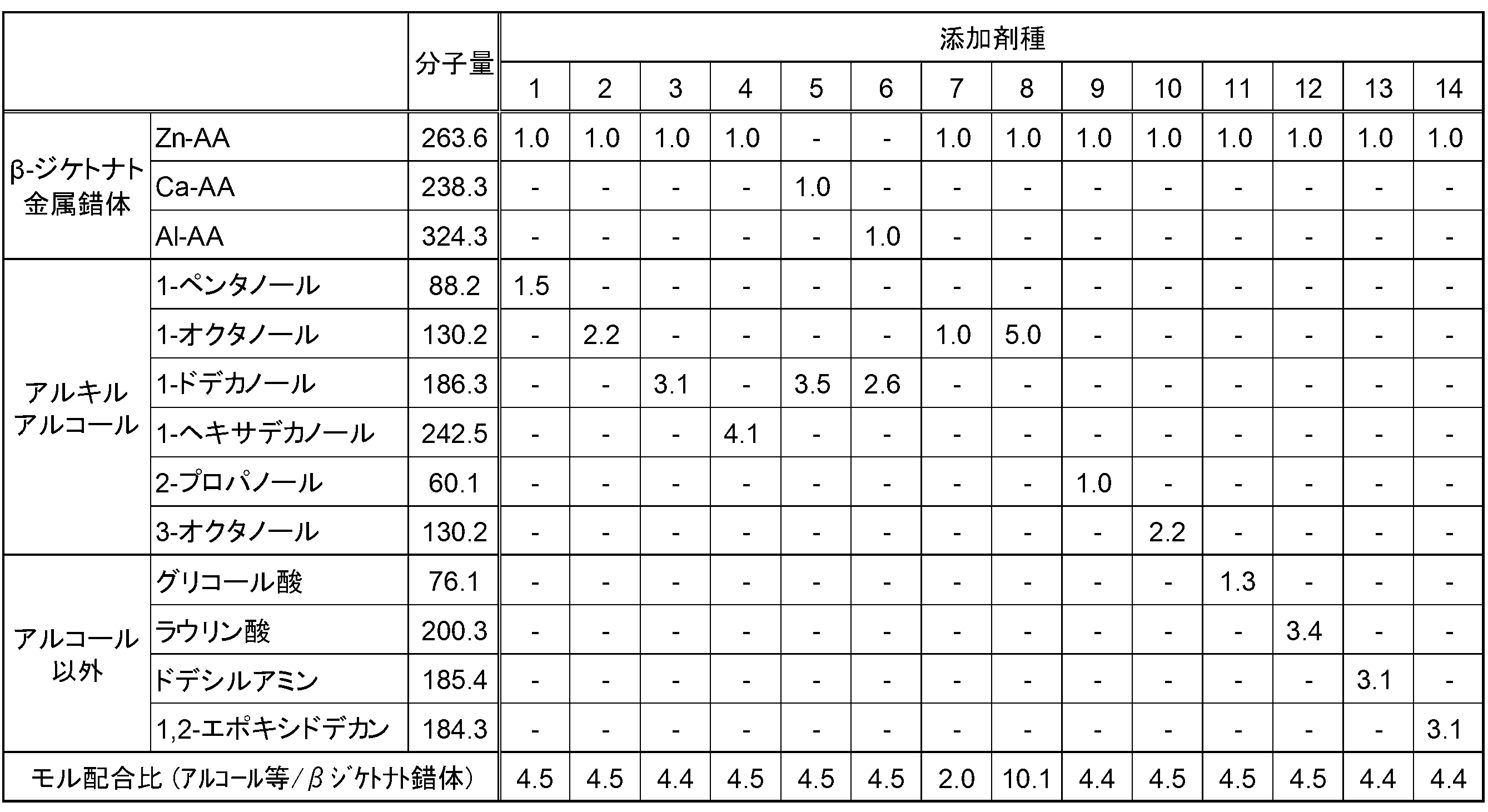
- Additives 1 to 10 were prepared by blending a ⁇ -diketonato metal complex and an alkyl alcohol with the blending compositions shown in Table 1, uniformly mixing them at 80 ° C. for 10 minutes, and then allowing them to cool to room temperature. Further, instead of the alkyl alcohol, a component other than the alcohol was used to prepare the additives 11 to 14 in the same manner.
- the materials used to prepare the metal-containing additives are as follows. (1) ⁇ -diketonato metal complex-Zn-AA: zinc (II) acetylacetonate (decomposition start point: 105 ° C) -Ca-AA: Calcium (II) acetylacetonate (starting point of phase transition: 110 ° C) -Al-AA: Aluminum (III) Acetylacetonate (Phase transition start point: 112 ° C)
- the decomposition start point or the phase transition start point of each metal complex is evaluated as the baseline change start temperature in: DSC (measurement temperature range: 25 to 200 ° C., measured in the atmosphere).
- Alcohol 1-pentanol, 1-octanol, 1-dodecanol, 1-hexadecanol, 2-propanol, 3-octanol (all manufactured by Fuji Film Wako Pure Chemical Industries, Ltd.)
- Ingredients other than alcohol glycolic acid, lauric acid, dodecylamine, 1,2-epoxydodecane (all manufactured by Tokyo Chemical Industry Co., Ltd.)
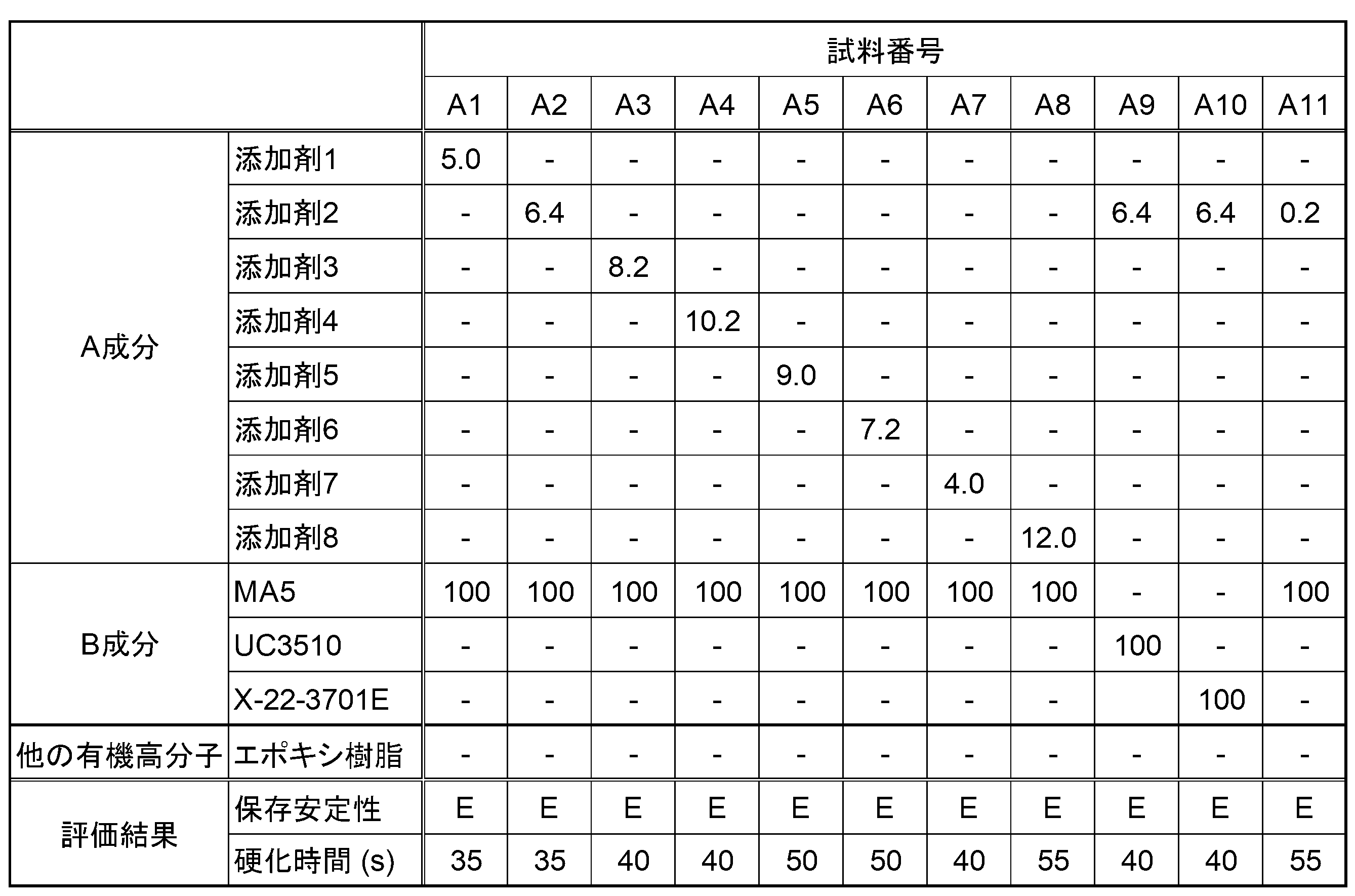
- ⁇ Preparation of crosslinkable polymer composition The metal-containing additive prepared above was mixed with the organic polymer of component B together with the organic polymer of component B for 5 minutes in an agate mortar at room temperature with the compounding composition (unit: parts by mass) shown in Tables 2 and 3. As a result, the compositions for Samples A1 to A11 and B1 to B4 and B7 to B11 were prepared. In the samples B2 to B4, the ⁇ -diketonato metal complex itself used as the raw material for preparing the metal-containing additive described above is used as the component A. In each sample, the blending amount of the component A is set so that the content (molar amount) of the ⁇ -diketonato metal complex contained therein is about the same. Further, the sample B5 was composed of only the B component, and the sample B6 was composed of only the epoxy resin.
- the organic polymer materials used are as follows.
- Component B-MA5 Maleic anhydride-modified liquid polybutadiene (manufactured by CRAY VALLEY), number average molecular weight 4700, substituent equivalent 2350 g / mol UC3510: Carboxyl group-introduced liquid polyacrylate (manufactured by Toagosei), number average molecular weight 2000, substituent equivalent 801 g / mol X-22-3701E: carboxyl-modified silicone oil (manufactured by Shin-Etsu Chemical Co., Ltd.), substituent equivalent 4000 g / mol
- Other organic polymers / epoxy resin Mitsubishi Chemical's epoxy resin "jER828” (epoxy equivalent: 184 or more and 194 or less) and Mitsubishi Chemical's "ST12" (amine equivalent: 345KOHmg / g or more) as a curing agent. 385 KOH mg / g or less) was added.
- ⁇ Evaluation method> Storage stability As an acceleration condition for evaluating long-term storage stability, the prepared composition is left to stand in a constant temperature bath at 40 ° C. for 72 hours (according to JIS 60068-2-2) to form a composition. Storage stability was evaluated based on whether or not the substance was cured. After the above acceleration conditions, the case where the viscosity of the composition was the same as that in the initial state was evaluated as having excellent long-term storage stability (E). On the other hand, when the viscosity of the composition increased by passing through the above acceleration conditions, it was evaluated as not excellent in long-term storage stability (N). At this time, the viscosity of the composition was evaluated by a cone plate type rotary viscometer (Merlin VR manufactured by Leosys).
- each prepared metal-containing additive component A
- the compounding ratio of the alkyl alcohol or other components to the ⁇ -diketonato metal complex is indicated by the molar compounding ratio based on the content of the ⁇ -diketonato metal complex.
- the compounding ratio is 4.4 or 4.5 for each additive except for the additives 7 and 8.
- Tables 2 and 3 show the content (unit: parts by mass) of each component of the compositions of the samples A1 to A11 and B1 to B11 prepared above in the upper row, and the results of each evaluation in the lower row. show.
- compositions of Samples A1 to A11 are substituents capable of forming an ionic bond with a metal ion by using a metal-containing compound prepared from a ⁇ -diketonato metal complex and a primary alkyl alcohol having 4 or more and 30 or less carbon atoms as the A component. It is contained together with the B component made of an organic polymer having.
- the composition in each of the samples A1 to A11, the composition has a high long-term storage stability evaluated as "E", and the curing proceeds in a short curing time of 60 seconds or less. ..
- component A has high stability that does not cause denaturation in an accelerated test at 40 ° C., and when heated to 120 ° C., it releases metal ions and crosslinks component B to metal.
- the samples A2, A7, and A8 have different molar compounding ratios in the metal-containing additives, but they are added so as to contain the same amount of ⁇ -diketonato metal complex as the composition. By setting the addition amount of the agent, high storage stability is obtained and a sufficiently short curing time is achieved in each case.
- the composition of the metal-containing additive of the A component and the type of the organic polymer of the B component are different, but regardless of the details of the composition, any of them is sufficient. High storage stability and fast curing rate are obtained.
- sample B5 contains only the B component and does not contain the metal-containing additive of the A component, it is excellent in storage stability, but cannot cause metal cross-linking and is cured even after 600 seconds.
- Sample B6 uses only a commercially available two-component epoxy resin that can be cured at room temperature, but in the storage stability evaluation, curing proceeds while the temperature is kept at 40 ° C., and the storage stability is significantly inferior. .. On the other hand, the curing rate is slow even at 120 ° C., and it takes as long as 420 seconds to cure.
- Samples B2 to B4 use a ⁇ -diketonato metal complex that has not been stabilized by the addition of an alkyl alcohol as the component A, and the storage stability of the composition is evaluated as “N”, which is low. ..
- the storage stability is evaluated by an accelerated test at 40 ° C. assuming long-term storage, but the same storage stability evaluation is also performed for the samples B2 to B4 at room temperature.
- a sufficiently high storage stability can be obtained even in a composition in which the ⁇ -diketonato metal complex itself is mixed with the B component.
- Sample B1 uses a ⁇ -diketonato metal complex to which an alkyl alcohol is added as the component A.
- the alkyl alcohol used is 2-propanol, and the number of carbon atoms is as low as 3.
- the effect of structural stabilization of the ⁇ -diketonato metal complex by the addition of the alkyl alcohol is small, and the storage stability of the composition is low.
- Sample B7 also uses a ⁇ -diketonato metal complex to which an alkyl alcohol is added as the component A.
- the alkyl alcohol is not a primary alcohol but a secondary alcohol.
- the structural stabilization effect on the ⁇ -diketonato metal complex is diminished and the storage stability of the composition is impaired.
- a ⁇ -diketonato metal complex to which a carboxylic acid is added instead of an alkyl alcohol is used.
- the composition exhibits high storage stability, but it takes a long time to cure. Since the electron-withdrawing property of the carboxylic acid is too high, it re-coordinates too strongly to the central metal of the ⁇ -diketonato metal complex, which is very effective in stabilizing the complex structure, but it is a metal even when heated. It is considered that the ion is not released.
- Glycolic acid used in sample B8 has a hydroxyl group in addition to the carboxyl group, but since it is rear-coordinated with the carboxyl group having a high electron-attracting property, it is suitable as in the case of using an alkyl alcohol. It is considered that it is not possible to achieve both structural stabilization and the ability to release metal ions by heating.
- sample B10 as the component A, a ⁇ -diketonato metal complex to which an alkylamine is added instead of an alkylalcohol is used.
- the composition of sample B10 is cured in a very short time, but the storage stability is low.
- Alkylamine can also be re-coordinated to the central metal of the ⁇ -diketonato metal complex, but it is considered that the complex structure is rather destabilized by the re-coordination.
- the destabilization of the complex structure increased the reaction activity and facilitated the release of metal ions, which is interpreted as the progress of curing in a short time.
- sample B11 as the component A, a ⁇ -diketonato metal complex to which an epoxy compound is added instead of an alkyl alcohol is used.
- the composition of sample B11 has low storage stability and takes a long time to cure. It is interpreted that the epoxy group cannot be coordinated to the metal and is not a component that enhances the storage stability of the composition, corresponding to the fact that the ⁇ -diketonato metal complex is not stabilized by rearrangement. Will be done. It is presumed that the reason why the curing takes a long time is that the functional group of the B component and the epoxy group cause a side reaction due to heating, and metal cross-linking is less likely to occur. It can be said that the epoxy compound is not suitable as an additive component not only because it does not contribute to the improvement of storage stability but also because it has a reaction activity with respect to the B component itself.
- FT-IR measurement Infrared absorption measurement
- ATR method total reflection measurement method
- ⁇ Evaluation result> 4A-4C show the measured FT-IR spectra.
- Zn-AA in FIG. 4A, Ca-AA in FIG. 4B, and Al-AA in FIG. 4C are used.
- the thin line at the top shows 1-dodecanol
- the dashed line at the middle shows the ⁇ -diketonato metal complex.
- the thick line at the bottom shows the prepared metal-containing additive.
- the absorption peak of the C O expansion and contraction vibration that each ⁇ -diketonato metal complex has near 1380 cm -1 shifts to the high wave number side as it is mixed with 1-dodecanol, as indicated by the arrows in each figure. is doing.
Landscapes
- Chemical & Material Sciences (AREA)
- Organic Chemistry (AREA)
- Health & Medical Sciences (AREA)
- Chemical Kinetics & Catalysis (AREA)
- Medicinal Chemistry (AREA)
- Polymers & Plastics (AREA)
- Life Sciences & Earth Sciences (AREA)
- Engineering & Computer Science (AREA)
- Materials Engineering (AREA)
- Wood Science & Technology (AREA)
- Compositions Of Macromolecular Compounds (AREA)
- Paints Or Removers (AREA)
Abstract
Description
最初に本開示の実施態様を列記して説明する。
本開示の含金属添加剤、架橋性高分子組成物、架橋高分子材料、金属部材ならびにワイヤーハーネスの具体例を、以下に図面を参照しつつ説明する。なお、本開示はこれらの例示に限定されるものではない。
本開示にかかる含金属添加剤は、β-ジケトナト金属錯体と、炭素数が4以上30以下の一級アルキルアルコール(以下、単にアルキルアルコールと称する場合がある)とを含んでいる。β-ジケトナト金属錯体にアルキルアルコールが添加されることで、そのβ-ジケトナト金属錯体単独の場合よりも、高い保存安定性を有するものとなる。ここで、保存安定性が高いとは、常温等の低い温度で、分解等の品質変化を起こしにくく、その温度で、より長い時間、化学構造および物性を維持して保存できることを意味する。

R-OH (3)
ここで、Rは炭素数4以上、30以下のアルキル基である。

本開示にかかる架橋性高分子組成物は、A成分として、上記で説明した本開示の実施形態にかかる含金属添加剤と、B成分として、A成分から遊離する金属イオンとイオン結合を形成可能な置換基を有する有機高分子を含む。本開示にかかる架橋性高分子組成物は、加熱を経て、A成分から遊離した金属イオンを介して、B成分が架橋されることで、硬化を起こし、本開示の実施形態にかかる架橋高分子材料を構成する。
次に、本開示にかかる金属部材について説明する。図1には、一実施形態にかかる金属部材の断面図を示している。
次に、本開示にかかるワイヤーハーネスについて説明する。本開示にかかるワイヤーハーネスは、本開示にかかる架橋高分子材料を含むものである。具体的には、例えば、ワイヤーハーネスにおける端子付き被覆電線の端子金具と電線導体の間の電気接続部を覆う防食剤などに、本開示にかかる架橋高分子材料を用いる形態が挙げられる。
まず、含金属添加剤の添加およびその成分組成が、組成物に対して与える効果を調べた。
表1に記載した配合組成で、β-ジケトナト金属錯体とアルキルアルコールを配合し、80℃で10分間均一に混合した後、常温まで放冷することで、添加剤1~10を調製した。さらに、アルキルアルコールの代わりに、アルコール以外の成分を使用して、同様に、添加剤11~14を調製した。
(1)β-ジケトナト金属錯体
・Zn-AA:亜鉛(II)アセチルアセトナート(分解開始点:105℃)
・Ca-AA:カルシウム(II)アセチルアセトナート(相転移開始点:110℃)
・Al-AA:アルミニウム(III)アセチルアセトナート(相転移開始点:112℃)
ここで、各金属錯体の分解開始点または相転移開始点は、:DSC(測定温度範囲:25~200℃、大気中測定)におけるベースライン変化開始温度として評価したものである。
(2)アルキルアルコール
・1-ペンタノール
・1-オクタノール
・1-ドデカノール
・1-ヘキサデカノール
・2-プロパノール
・3-オクタノール
(いずれも富士フィルム和光純薬社製)
(3)アルコール以外の成分
・グリコール酸
・ラウリン酸
・ドデシルアミン
・1,2-エポキシドデカン
(いずれも東京化成工業社製)
上記で調製した含金属添加剤をA成分として、B成分の有機高分子とともに、表2,3に記載の配合組成(単位:質量部)で、常温にてメノウ乳鉢で5分間混合した。これにより、試料A1~A11およびB1~B4,B7~B11にかかる組成物を調製した。なお、試料B2~B4では、A成分として、上記で含金属添加剤の調製原料として用いたβ-ジケトナト金属錯体そのものを使用している。各試料において、A成分の配合量は、それぞれに含まれるβ-ジケトナト金属錯体の含量(モル量)が、同程度になるように、設定している。さらに、試料B5をB成分のみより構成し、試料B6をエポキシ樹脂のみより構成した。
(1)B成分
・MA5:無水マレイン酸変性液状ポリブタジエン(CRAY VALLEY製)、数平均分子量4700、置換基当量2350g/mol
・UC3510:カルボキシル基導入液状ポリアクリレート(東亞合成製)、数平均分子量2000、置換基当量801g/mol
・X-22-3701E:カルボキシル変性シリコーンオイル(信越化学工業製)、置換基当量4000g/mol
(2)他の有機高分子
・エポキシ樹脂:三菱ケミカル製エポキシ樹脂「jER828」(エポキシ当量:184以上194以下)に、硬化剤として、三菱ケミカル製「ST12」(アミン当量:345KOHmg/g以上、385KOHmg/g以下)を添加した。配合比は、エポキシ樹脂/硬化剤=67/33(単位:質量部)とした。
(1)保存安定性
長期保存安定性を評価するための加速条件として、40℃の恒温槽中、72時間の条件(JIS 60068-2-2準拠)で、調製した組成物を放置し、組成物の硬化が進行しているか否かにより、保存安定性を評価した。上記加速条件を経た後に、初期状態と比較して組成物の粘度が同等である場合を、長期保存安定性に優れる(E)と評価した。一方、上記加速条件を経ることで、組成物の粘度が上昇した場合を、長期保存安定性に優れない(N)と評価した。この際、組成物の粘度は、コーンプレート型回転粘度計(レオシス社製 Merlin VR)によって評価した。
50mm×50mm×0.5mm厚の銅板を予め120℃に加熱しておき、その上に調製した各組成物を0.1g垂らした。各組成物を加熱した銅板上に垂らした時点を0秒とし、垂らした組成物が硬化するまでの時間を硬化時間とした。組成物が硬化するまでの時間は、垂らした組成物の表面にスパーテルを当てて引き上げたときに組成物が糸を引かなくなった時点とした。60秒以内に硬化が確認されたものは、硬化速度に優れる(硬化が速い)と評価することができる。
下の表1に、調製した各含金属添加剤(A成分)の配合組成を、質量(g)を単位として表示している。また、β-ジケトナト金属錯体に対するアルキルアルコールまたは他の成分の配合比を、β-ジケトナト金属錯体の含有量を基準としたモル配合比にて表示している。配合比は、添加剤7,8を除いて、各添加剤で、4.4または4.5に揃っている。

次に、β-ジケトナト金属錯体にアルキルアルコールを添加した含金属添加剤が、どのような構造を有するかを検討した。
β-ジケトナト金属錯体としてZn-AA,Ca-AA,Al-AAの3種を用い、アルキルアルコールとして1-ドデカノールを用いて、上記[1]の試験と同様にして、含金属添加剤を調製した。ただし、ここでは、余剰のアルコールが生じないように、1-ドデカノールの添加量が、モル配合比でβ-ジケトナト金属錯体の2倍未満となるように、以下の配合比とした。
・Zn-AAを1.0g(3.8mmol)に対して、1-ドデカノールを1.0g(5.4mmol)添加。
・Ca-AAを1.0g(4.2mmol)に対して、1-ドデカノールを1.0g(5.4mmol)添加。
・Al-AAを1.0g(3.1mmol)に対して、1-ドデカノールを1.0g(5.4mmol)添加。
原料のβ-ジケトナト金属錯体および1-ドデカノール、さらに上記で調製した含金属添加剤に対して、全反射測定法(ATR法)により、赤外吸収測定(FT-IR測定)を行った。
図4A~4Cに、測定されたFT-IRスペクトルを示す。β-ジケトナト金属錯体として、図4AではZn-AA、図4BではCa-AA、図4CではAl-AAを用いている。いずれの図においても、最上段の細線が1-ドデカノールを示し、中段の破線がβ-ジケトナト金属錯体を示している。そして、最下段の太線が、調製した含金属添加剤を示している。
2 被覆電線
2a 被覆電線の先端
3 電線導体
3a 素線
4 絶縁被覆(絶縁体)
5 端子金具
5a 端子金具の端縁
5b 端子金具の側面
5c 端子金具の裏面
51 接続部
52 ワイヤバレル
53 インシュレーションバレル
54 電線固定部
6 電気接続部
7 硬化物
10 金属部材
12 金属基材
14 被覆材
Claims (13)
- β-ジケトナト金属錯体と、
炭素数が4以上30以下の一級アルキルアルコールとを含む、含金属添加剤。 - 前記アルキルアルコールは、直鎖アルキルアルコールである、請求項1に記載の含金属添加剤。
- モル比で、前記β-ジケトナト金属錯体に対して、前記アルキルアルコールが2倍以上含有されている、請求項1または請求項2に記載の含金属添加剤。
- 前記β-ジケトナト金属錯体を構成する金属は、アルカリ土類金属、亜鉛、チタン、アルミニウムのうちの少なくとも1種を含む、請求項1から請求項3のいずれか1項に記載の含金属添加剤。
- 前記アルキルアルコールの少なくとも一部は、前記β-ジケトナト金属錯体の金属に配位している、請求項1から請求項4のいずれか1項に記載の含金属添加剤。
- 前記含金属添加剤は、前記β-ジケトナト金属錯体よりも高い保存安定性を有し、
50℃以上200℃以下の温度で金属イオンを遊離させる、請求項1から請求項5のいずれか1項に記載の含金属添加剤。 - 請求項1から請求項6のいずれか1項に記載の含金属添加剤と、
有機高分子と、を含み、
前記有機高分子は、熱により前記含金属添加剤から遊離する金属イオンとイオン結合を形成可能な置換基を有している、架橋性高分子組成物。 - 前記有機高分子の前記置換基は、カルボン酸基、酸無水物基、リン酸基、スルホン酸基のうちの少なくとも1種である、請求項7に記載の架橋性高分子組成物。
- 前記有機高分子は、150℃以下において液状である、請求項7または請求項8に記載の架橋性高分子組成物。
- 前記有機高分子100質量部に対し、前記含金属添加剤が0.2質量部以上30質量部以下含まれる、請求項7から請求項9のいずれか1項に記載の架橋性高分子組成物。
- 請求項7から請求項10のいずれか1項に記載の架橋性高分子組成物の架橋体であり、
前記有機高分子が前記含金属添加剤から遊離した前記金属イオンを介して架橋されている、架橋高分子材料。 - 金属基材と、前記金属基材の表面を被覆する被覆材と、を有し、前記被覆材が、請求項11に記載の架橋高分子材料で構成される、金属部材。
- 請求項12に記載の架橋高分子材料を含む、ワイヤーハーネス。
Priority Applications (3)
| Application Number | Priority Date | Filing Date | Title |
|---|---|---|---|
| US18/038,141 US12509570B2 (en) | 2020-12-11 | 2021-12-02 | Metal-containing additive, crosslinkable polymer composition, crosslinked polymer material, metal member, and wire harness |
| CN202180082057.9A CN116601133B (zh) | 2020-12-11 | 2021-12-02 | 含金属添加剂、交联性高分子组合物、交联高分子材料、金属构件和线束 |
| JP2022568223A JP7642677B2 (ja) | 2020-12-11 | 2021-12-02 | 金属部材およびワイヤーハーネス |
Applications Claiming Priority (2)
| Application Number | Priority Date | Filing Date | Title |
|---|---|---|---|
| JP2020-205528 | 2020-12-11 | ||
| JP2020205528 | 2020-12-11 |
Publications (1)
| Publication Number | Publication Date |
|---|---|
| WO2022124174A1 true WO2022124174A1 (ja) | 2022-06-16 |
Family
ID=81973183
Family Applications (1)
| Application Number | Title | Priority Date | Filing Date |
|---|---|---|---|
| PCT/JP2021/044193 Ceased WO2022124174A1 (ja) | 2020-12-11 | 2021-12-02 | 含金属添加剤、架橋性高分子組成物、架橋高分子材料、金属部材ならびにワイヤーハーネス |
Country Status (4)
| Country | Link |
|---|---|
| US (1) | US12509570B2 (ja) |
| JP (1) | JP7642677B2 (ja) |
| CN (1) | CN116601133B (ja) |
| WO (1) | WO2022124174A1 (ja) |
Citations (5)
| Publication number | Priority date | Publication date | Assignee | Title |
|---|---|---|---|---|
| JPH11235872A (ja) * | 1998-02-23 | 1999-08-31 | Konica Corp | 画像形成材料及び画像形成方法 |
| JPH11314672A (ja) * | 1998-05-06 | 1999-11-16 | Sumitomo Chem Co Ltd | 蓋付容器 |
| JP2005054087A (ja) * | 2003-08-05 | 2005-03-03 | Mitsubishi Engineering Plastics Corp | 導電性ポリアミド樹脂組成物 |
| JP2010092782A (ja) * | 2008-10-10 | 2010-04-22 | Toyo Ink Mfg Co Ltd | 金属酸化物分散体 |
| WO2017204046A1 (ja) * | 2016-05-27 | 2017-11-30 | 東レ株式会社 | 平版印刷版原版 |
Family Cites Families (49)
| Publication number | Priority date | Publication date | Assignee | Title |
|---|---|---|---|---|
| US4943513A (en) * | 1988-10-07 | 1990-07-24 | Morton Thiokol, Inc. | Photoimageable composition with reduced cold flow due to salt-bridging by metal ions and dry film formed therefrom |
| JPH08975B2 (ja) | 1991-10-17 | 1996-01-10 | 東ソー・アクゾ株式会社 | 酸化物薄膜形成用金属アセチルアセトナト錯体 |
| JP2652297B2 (ja) | 1992-02-26 | 1997-09-10 | 三洋化成工業株式会社 | 樹脂組成物、コーティング剤および接着剤 |
| JPH0741636A (ja) | 1993-07-26 | 1995-02-10 | Yokohama Rubber Co Ltd:The | スチレン−エチレン−ブチレン−スチレンブロック共重合体組成物およびこれを含むホットメルト接着剤 |
| JP3650979B2 (ja) * | 1996-02-08 | 2005-05-25 | 日本エクスラン工業株式会社 | 抗菌・抗黴ポリマー粒子 |
| US6512051B2 (en) | 1998-01-22 | 2003-01-28 | The Yokohama Rubber Co., Ltd. | Elastomer composition |
| DE69941101D1 (de) | 1998-10-08 | 2009-08-20 | Kaneka Corp | Strahlenhärtbare Zusammensetzungen |
| JP4514261B2 (ja) | 1998-11-20 | 2010-07-28 | 株式会社Adeka | 塩化ビニル系樹脂組成物 |
| JP2001342305A (ja) | 2000-05-31 | 2001-12-14 | Toyo Ink Mfg Co Ltd | 繊維強化オレフィン系樹脂用着色剤組成物及びその成形品 |
| US6809157B2 (en) | 2000-06-29 | 2004-10-26 | The Yokohama Rubber Co., Ltd. | Thermoplastic polymer and thermoplastic elastomer composition |
| JP2002020579A (ja) | 2000-07-11 | 2002-01-23 | Mitsubishi Engineering Plastics Corp | ポリアセタール樹脂組成物 |
| JP3958201B2 (ja) | 2002-03-04 | 2007-08-15 | ディーエスエム アイピー アセッツ ビー.ブイ. | 液状硬化性樹脂組成物 |
| JP4076381B2 (ja) | 2002-07-05 | 2008-04-16 | 横浜ゴム株式会社 | 熱可塑性エラストマー組成物 |
| JP2004051814A (ja) | 2002-07-22 | 2004-02-19 | Yokohama Rubber Co Ltd:The | 熱可塑性エラストマー組成物 |
| US20070225449A1 (en) | 2003-10-24 | 2007-09-27 | Jsr Corporation | Ionomer, Process for Production Thereof and Molded Article |
| JP2006083361A (ja) | 2003-10-24 | 2006-03-30 | Jsr Corp | アイオノマー及びその製造方法並びに成形品 |
| JP4716193B2 (ja) | 2004-03-15 | 2011-07-06 | 宇部興産株式会社 | β−ジケトナトを配位子とする金属錯体 |
| JP2005336178A (ja) * | 2004-04-28 | 2005-12-08 | Showa Denko Kk | β−ジケトン化合物、およびポリウレタン硬化用触媒 |
| DE112006002981B4 (de) | 2005-11-04 | 2014-04-30 | NOK Klüber Co., Ltd. | Schmiermittel |
| JP4965245B2 (ja) | 2006-12-28 | 2012-07-04 | 株式会社オートネットワーク技術研究所 | キレート導入高分子および高分子組成物ならびに被覆電線およびワイヤーハーネス |
| JP4875581B2 (ja) | 2007-09-28 | 2012-02-15 | 関西ペイント株式会社 | 複層塗膜形成方法 |
| CN101328191B (zh) * | 2008-06-13 | 2013-06-05 | 中国科学院上海有机化学研究所 | 一类含氮配体过渡金属络合物、合成方法及其用途 |
| JP2010096416A (ja) | 2008-10-16 | 2010-04-30 | Furukawa-Sky Aluminum Corp | 熱交換器用プレコートアルミニウムフィン材 |
| JP2011162673A (ja) | 2010-02-10 | 2011-08-25 | Tosoh Corp | 樹脂組成物 |
| CN104136494A (zh) | 2011-12-29 | 2014-11-05 | 莫门蒂夫性能材料股份有限公司 | 可湿固化的有机聚硅氧烷组合物 |
| EP2907845A4 (en) | 2012-10-12 | 2016-07-27 | Ccs Inc | SEALANT COMPOSITION FOR ELECTRICAL AND ELECTRONIC COMPONENTS, COATING MATERIALS FOR ELECTRICAL AND ELECTRONIC COMPONENTS AND LED DEVICE |
| JP6198574B2 (ja) | 2013-10-30 | 2017-09-20 | 株式会社クラレ | 粘着剤組成物 |
| JP6481251B2 (ja) | 2013-12-03 | 2019-03-13 | 日立化成株式会社 | 感光性樹脂組成物、及び感光性エレメント |
| JP5843406B2 (ja) | 2014-02-19 | 2016-01-13 | 株式会社オートネットワーク技術研究所 | 金属表面コーティング用組成物およびこれを用いた端子付き被覆電線 |
| US9657252B2 (en) * | 2014-04-17 | 2017-05-23 | Afton Chemical Corporation | Lubricant additives and lubricant compositions having improved frictional characteristics |
| JP2016050288A (ja) | 2014-09-02 | 2016-04-11 | 株式会社オートネットワーク技術研究所 | 電線被覆材用組成物、絶縁電線およびワイヤーハーネス |
| JP6393582B2 (ja) | 2014-10-30 | 2018-09-19 | 株式会社オートネットワーク技術研究所 | ワイヤーハーネス |
| JP6612498B2 (ja) | 2014-11-21 | 2019-11-27 | スリーエム イノベイティブ プロパティズ カンパニー | エポキシ接着剤、並びに自動車用部材及びその製造方法 |
| US20170190876A1 (en) | 2015-12-31 | 2017-07-06 | Frx Polymers, Inc. | Fast curing, transparent and translucent, non-halogenated flame retardant systems |
| JP6446383B2 (ja) | 2016-03-29 | 2018-12-26 | 株式会社オートネットワーク技術研究所 | 表面保護剤組成物および端子付き被覆電線 |
| JP6996808B2 (ja) | 2016-11-09 | 2022-01-17 | 花王株式会社 | 絶縁膜形成用樹脂組成物 |
| KR102706797B1 (ko) | 2018-02-23 | 2024-09-19 | 닛신보 케미칼 가부시키가이샤 | 수지 조성물, 수지 재료 및 수지 가교체 |
| JP6895915B2 (ja) | 2018-03-14 | 2021-06-30 | 株式会社オートネットワーク技術研究所 | 表面保護剤組成物および端子付き被覆電線 |
| WO2019189723A1 (ja) | 2018-03-30 | 2019-10-03 | 味の素株式会社 | 封止用組成物 |
| JP7139193B2 (ja) | 2018-08-28 | 2022-09-20 | サカタインクス株式会社 | プラズマ硬化用インキ組成物 |
| JP7086025B2 (ja) | 2019-03-27 | 2022-06-17 | 古河電気工業株式会社 | 複合ケーブル及びその製造方法 |
| JP7456225B2 (ja) | 2019-03-28 | 2024-03-27 | 日本ポリエチレン株式会社 | アイオノマー樹脂を含む電線・ケーブル |
| CN111825914B (zh) | 2019-04-18 | 2024-03-29 | 株式会社博迈立铖 | 树脂组合物、绝缘电线、电缆和绝缘电线的制造方法 |
| WO2020262482A1 (ja) | 2019-06-24 | 2020-12-30 | 日本ポリエチレン株式会社 | フィルム状成形体用樹脂及びそれからなる成形品 |
| JP7461194B2 (ja) | 2020-03-27 | 2024-04-03 | 株式会社オートネットワーク技術研究所 | 金属架橋性高分子組成物、金属架橋高分子材料、金属部材、ワイヤーハーネスならびに金属架橋高分子材料の製造方法 |
| CN116490552B (zh) | 2020-11-16 | 2024-10-01 | 株式会社自动网络技术研究所 | 交联性高分子组合物、交联高分子材料、金属构件和线束 |
| CN117881750A (zh) | 2021-08-30 | 2024-04-12 | 株式会社自动网络技术研究所 | 交联性高分子组合物、交联高分子材料、绝缘电线和线束 |
| WO2023032900A1 (ja) | 2021-08-30 | 2023-03-09 | 株式会社オートネットワーク技術研究所 | 架橋性高分子組成物、架橋高分子材料、絶縁電線ならびにワイヤーハーネス |
| JP7813546B2 (ja) | 2021-09-28 | 2026-02-13 | 株式会社オートネットワーク技術研究所 | 絶縁電線、ワイヤーハーネス、および絶縁電線の製造方法 |
-
2021
- 2021-12-02 JP JP2022568223A patent/JP7642677B2/ja active Active
- 2021-12-02 US US18/038,141 patent/US12509570B2/en active Active
- 2021-12-02 CN CN202180082057.9A patent/CN116601133B/zh active Active
- 2021-12-02 WO PCT/JP2021/044193 patent/WO2022124174A1/ja not_active Ceased
Patent Citations (5)
| Publication number | Priority date | Publication date | Assignee | Title |
|---|---|---|---|---|
| JPH11235872A (ja) * | 1998-02-23 | 1999-08-31 | Konica Corp | 画像形成材料及び画像形成方法 |
| JPH11314672A (ja) * | 1998-05-06 | 1999-11-16 | Sumitomo Chem Co Ltd | 蓋付容器 |
| JP2005054087A (ja) * | 2003-08-05 | 2005-03-03 | Mitsubishi Engineering Plastics Corp | 導電性ポリアミド樹脂組成物 |
| JP2010092782A (ja) * | 2008-10-10 | 2010-04-22 | Toyo Ink Mfg Co Ltd | 金属酸化物分散体 |
| WO2017204046A1 (ja) * | 2016-05-27 | 2017-11-30 | 東レ株式会社 | 平版印刷版原版 |
Also Published As
| Publication number | Publication date |
|---|---|
| CN116601133B (zh) | 2024-09-20 |
| US20230407046A1 (en) | 2023-12-21 |
| CN116601133A (zh) | 2023-08-15 |
| US12509570B2 (en) | 2025-12-30 |
| JPWO2022124174A1 (ja) | 2022-06-16 |
| JP7642677B2 (ja) | 2025-03-10 |
Similar Documents
| Publication | Publication Date | Title |
|---|---|---|
| US12435202B2 (en) | Metal-crosslinkable polymer composition, metal-crosslinked polymeric material, metal component, and wiring harness | |
| CN102933749B (zh) | 防腐蚀剂、具有端子的包覆电线、以及线束 | |
| US10079439B2 (en) | Metal surface coating composition and terminal-equipped covered electrical wire using same | |
| Zhang et al. | Synergistic effect of phosphorus–nitrogen and silicon-containing chain extenders on the mechanical properties, flame retardancy and thermal degradation behavior of waterborne polyurethane | |
| JP7463548B2 (ja) | 架橋性高分子組成物、架橋高分子材料、金属部材ならびにワイヤーハーネス | |
| JP7706557B2 (ja) | 絶縁電線およびワイヤーハーネス | |
| TW201542741A (zh) | 接著促進劑、含有彼而成之硬化性有機聚矽氧烷組合物 | |
| US20130032394A1 (en) | Anticorrosive, coated electric wire with terminal, and wiring harness | |
| WO2023032900A1 (ja) | 架橋性高分子組成物、架橋高分子材料、絶縁電線ならびにワイヤーハーネス | |
| WO2023053889A1 (ja) | 絶縁電線、ワイヤーハーネス、および絶縁電線の製造方法 | |
| JP7642677B2 (ja) | 金属部材およびワイヤーハーネス | |
| JPH0586328A (ja) | 被覆溶液及び該被覆溶液で被覆してなる物品 | |
| JP5287146B2 (ja) | 絶縁電線 | |
| JP2013149418A (ja) | 端子付き電線および端子付き電線の製造方法 | |
| WO2024167026A1 (ja) | 架橋性高分子組成物、架橋高分子材料、絶縁電線ならびにワイヤーハーネス | |
| WO2024167025A1 (ja) | 架橋性高分子組成物、架橋高分子材料、絶縁電線ならびにワイヤーハーネス | |
| JP6294285B2 (ja) | 金属表面コーティング用組成物 | |
| JP2000265013A (ja) | 難燃架橋樹脂組成物及びその電線・ケーブル | |
| CN114479650A (zh) | 抗腐蚀材料、带有端子的电线以及线束 | |
| JP3445119B2 (ja) | 難燃性組成物およびこれを用いた難燃性電線・ケーブル | |
| JPH0527658B2 (ja) |
Legal Events
| Date | Code | Title | Description |
|---|---|---|---|
| 121 | Ep: the epo has been informed by wipo that ep was designated in this application |
Ref document number: 21903278 Country of ref document: EP Kind code of ref document: A1 |
|
| WWE | Wipo information: entry into national phase |
Ref document number: 18038141 Country of ref document: US |
|
| ENP | Entry into the national phase |
Ref document number: 2022568223 Country of ref document: JP Kind code of ref document: A |
|
| WWE | Wipo information: entry into national phase |
Ref document number: 202180082057.9 Country of ref document: CN |
|
| NENP | Non-entry into the national phase |
Ref country code: DE |
|
| 122 | Ep: pct application non-entry in european phase |
Ref document number: 21903278 Country of ref document: EP Kind code of ref document: A1 |
|
| WWG | Wipo information: grant in national office |
Ref document number: 18038141 Country of ref document: US |