WO2021241537A1 - 損傷図作成支援方法及び装置 - Google Patents
損傷図作成支援方法及び装置 Download PDFInfo
- Publication number
- WO2021241537A1 WO2021241537A1 PCT/JP2021/019704 JP2021019704W WO2021241537A1 WO 2021241537 A1 WO2021241537 A1 WO 2021241537A1 JP 2021019704 W JP2021019704 W JP 2021019704W WO 2021241537 A1 WO2021241537 A1 WO 2021241537A1
- Authority
- WO
- WIPO (PCT)
- Prior art keywords
- damage
- cracks
- visible light
- damage diagram
- image
- Prior art date
- Legal status (The legal status is an assumption and is not a legal conclusion. Google has not performed a legal analysis and makes no representation as to the accuracy of the status listed.)
- Ceased
Links
Images




Classifications
-
- G—PHYSICS
- G06—COMPUTING OR CALCULATING; COUNTING
- G06T—IMAGE DATA PROCESSING OR GENERATION, IN GENERAL
- G06T7/00—Image analysis
- G06T7/0002—Inspection of images, e.g. flaw detection
-
- G—PHYSICS
- G06—COMPUTING OR CALCULATING; COUNTING
- G06T—IMAGE DATA PROCESSING OR GENERATION, IN GENERAL
- G06T7/00—Image analysis
- G06T7/0002—Inspection of images, e.g. flaw detection
- G06T7/0004—Industrial image inspection
-
- G—PHYSICS
- G01—MEASURING; TESTING
- G01N—INVESTIGATING OR ANALYSING MATERIALS BY DETERMINING THEIR CHEMICAL OR PHYSICAL PROPERTIES
- G01N21/00—Investigating or analysing materials by the use of optical means, i.e. using sub-millimetre waves, infrared, visible or ultraviolet light
- G01N21/84—Systems specially adapted for particular applications
- G01N21/88—Investigating the presence of flaws or contamination
- G01N21/8851—Scan or image signal processing specially adapted therefor, e.g. for scan signal adjustment, for detecting different kinds of defects, for compensating for structures, markings, edges
-
- G—PHYSICS
- G06—COMPUTING OR CALCULATING; COUNTING
- G06T—IMAGE DATA PROCESSING OR GENERATION, IN GENERAL
- G06T11/00—Two-dimensional [2D] image generation
-
- G—PHYSICS
- G06—COMPUTING OR CALCULATING; COUNTING
- G06T—IMAGE DATA PROCESSING OR GENERATION, IN GENERAL
- G06T7/00—Image analysis
- G06T7/10—Segmentation; Edge detection
- G06T7/13—Edge detection
-
- G—PHYSICS
- G01—MEASURING; TESTING
- G01N—INVESTIGATING OR ANALYSING MATERIALS BY DETERMINING THEIR CHEMICAL OR PHYSICAL PROPERTIES
- G01N21/00—Investigating or analysing materials by the use of optical means, i.e. using sub-millimetre waves, infrared, visible or ultraviolet light
- G01N21/84—Systems specially adapted for particular applications
- G01N21/88—Investigating the presence of flaws or contamination
- G01N21/8851—Scan or image signal processing specially adapted therefor, e.g. for scan signal adjustment, for detecting different kinds of defects, for compensating for structures, markings, edges
- G01N2021/8887—Scan or image signal processing specially adapted therefor, e.g. for scan signal adjustment, for detecting different kinds of defects, for compensating for structures, markings, edges based on image processing techniques
-
- G—PHYSICS
- G06—COMPUTING OR CALCULATING; COUNTING
- G06T—IMAGE DATA PROCESSING OR GENERATION, IN GENERAL
- G06T2207/00—Indexing scheme for image analysis or image enhancement
- G06T2207/20—Special algorithmic details
- G06T2207/20092—Interactive image processing based on input by user
- G06T2207/20104—Interactive definition of region of interest [ROI]
-
- G—PHYSICS
- G06—COMPUTING OR CALCULATING; COUNTING
- G06T—IMAGE DATA PROCESSING OR GENERATION, IN GENERAL
- G06T2207/00—Indexing scheme for image analysis or image enhancement
- G06T2207/30—Subject of image; Context of image processing
- G06T2207/30108—Industrial image inspection
- G06T2207/30132—Masonry; Concrete
Definitions
- the present invention relates to a damage diagram creation support method and an apparatus, and more particularly to a damage diagram creation support method and an apparatus for supporting the creation of a damage diagram based on a structure inspection result.
- the present invention has been made in view of such circumstances, and an object of the present invention is to provide a damage diagram creation support method and an apparatus capable of appropriately recording the detection result of cracks automatically detected from an image.
- a step of acquiring information on an area having damage inside the structure in the inspection target area a step of acquiring a visible light image of the inspection target area taken by a visible light camera, and a structure in the visible light image.
- the step of detecting the cracks appearing on the surface of the object and the step of creating a damage diagram tracing the cracks detected in the visible light image, and the area other than the area having the internal damage has the first width.
- a damage diagram creation support method including a step of tracing cracks above a threshold and creating a damage diagram by tracing cracks above a second threshold whose width is smaller than the first threshold for an area having internal damage. ..
- the visible light image is an image taken with a pixel resolution capable of detecting cracks having a width of at least 0.1 mm, the first threshold value is 0.2 mm, and the second threshold value is 0.1 mm.
- the damage diagram creation support method of (1) which further includes a step of measuring the internal state of the inspection target area in a non-destructive manner and detecting an area having damage inside.
- the damage diagram creation support method of (4) which takes an image that visualizes the internal state of the inspection target area using electromagnetic waves or ultrasonic waves.
- the damage diagram creation support method of (5) which takes an image that visualizes the internal state of the inspection target area using millimeter waves, microwaves, or terahertz waves.
- Damage map creation support method of (2) that measures the internal state of the inspection target area by the non-contact acoustic exploration method.
- a damage diagram creation support method according to any one of (1) to (7), which detects a floating area as an area having damage inside the structure.
- a damage diagram creation support device that assists in the creation of a damage diagram that records cracks that appear on the surface of a structure.
- the processor has a processor, and the processor causes damage to the inside of the structure within the inspection target area.
- the process of acquiring information on the area to be inspected the process of acquiring a visible light image of the area to be inspected with a visible light camera, the process of detecting cracks appearing on the surface of a structure in the visible light image, and the process of detecting visible light.
- the area other than the area with internal damage traces the cracks whose width is equal to or greater than the first threshold, and the area with internal damage is.
- a damage diagram creation support device that traces cracks having a width smaller than the first threshold and is equal to or greater than the second threshold, and creates a damage diagram.
- the visible light image is an image taken with a pixel resolution capable of detecting cracks having a width of at least 0.1 mm, the first threshold value is 0.2 mm, and the second threshold value is 0.1 mm.
- the detection result of cracks automatically detected from an image can be appropriately recorded.
- Block diagram showing an example of the hardware configuration of the damage diagram creation support device Block diagram of the main functions of the damage diagram creation support device
- Block diagram of the main functions of the damage diagram creation support device The figure which shows an example of the display of the screen which specifies an internal damage area.
- Plan view showing the schematic configuration of the deck Flowchart showing the procedure from inspection to creation of damage diagram
- the figure which shows an example of the shooting method of split shooting A flowchart showing the procedure for creating a damage diagram by the damage diagram creation support device.
- a diagram showing an example of a damage diagram created by the damage diagram creation support device A diagram showing an example of a damage diagram generated by separating layers for each type of crack.
- FIG. 1 is a block diagram showing an example of a hardware configuration of a damage diagram creation support device.
- the damage diagram creation support device 10 includes a CPU (Central Processing Unit) 11, a RAM (Random Access Memory) 12, a ROM (Read Only Memory) 13, an HDD (Hard Disk Drive) 14, and an operation unit 15. , Display unit 16, input / output interface (Interface, IF) 17, communication interface 18, and the like. That is, the damage diagram creation support device 10 is composed of a computer, and the computer functions as the damage diagram creation support device 10 by executing a predetermined program. As the computer constituting the damage diagram creation support device 10, a general-purpose computer such as a personal computer can be used.
- the CPU 11 is an example of a processor. The program executed by the CPU 11 and various data are stored in the ROM 13 and / or the HDD 14.
- the operation unit 15 is composed of, for example, a keyboard, a mouse, and the like.
- the display unit 16 is composed of, for example, a liquid crystal display (Liquid Crystal Display, LCD), an organic EL display (Organic Light Emitting Display Display, OLED display), or the like.
- FIG. 2 is a block diagram of the main functions of the damage diagram creation support device.
- the damage diagram creation support device 10 has functions such as an image data acquisition unit 10A, a crack detection unit 10B, a panorama synthesis unit 10C, an internal damage area information acquisition unit 10D, and a damage diagram creation unit 10E. Have. These functions are realized by the CPU 11 executing a predetermined program.
- the image data acquisition unit 10A acquires image data of a visible light image obtained by photographing the inspection target area.
- the image data acquisition unit 10A acquires image data of a visible light image via the input / output interface 17 or the communication interface 18.
- the image data of the acquired visible light image is stored in the HDD 14.
- the crack detection unit 10B analyzes the visible light image and detects cracks appearing on the surface of the structure.
- Various methods can be adopted for detecting cracks.
- a method of detecting cracks can be adopted by using a trained model machine-learned using an image containing cracks as training data.
- the type of machine learning algorithm is not particularly limited, and is, for example, RNN (Recurrent Neural Network / Recurrent Neural Network), CNN (Convolutional Neural Network / Convolutional Neural Network), MLP (Multilayer Perceptron), or the like.
- An algorithm using the above can be used.
- a method of detecting cracks based on the luminance distribution and the RGB value distribution of the image can be adopted. Since the region having cracks has a luminance distribution and an RGB value distribution different from those of other regions, the cracks can be detected from the image by searching for changes in the luminance value and the RGB value.
- the crack detection unit 10B measures the width of the detected crack at the same time as the crack is detected.
- Known image measurement techniques can be used to measure the width of cracks.
- the panorama compositing unit 10C generates one image by panoramic compositing when the image data group of the visible light image taken separately is acquired.
- the split photography is a method of dividing an inspection target area into a plurality of areas and taking a picture for each area. When shooting, a part of the adjacent area is overlapped and shot.
- the panorama synthesizing unit 10C joins the images of each area to generate one image. Since the panoramic composition itself is a known technique, the details thereof will be omitted.
- the panorama composition unit 10C performs a panorama composition process by applying corrections such as scaling correction, tilt correction, and rotation correction to each image as necessary. It should be noted that the crack detection can be configured to be performed on the image after the panoramic composition.
- the internal damage area information acquisition unit 10D acquires information on the area (internal damage area) in which the structure is damaged inside the inspection target area.
- information on the internally damaged area is acquired by using a visible light image obtained by capturing the inspection target area.
- the visible light image obtained by capturing the inspection target area is displayed on the display unit 16, and the information on the internal damage area is acquired by accepting the designation of the internal damage area on the screen.
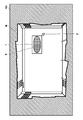
- FIG. 3 is a diagram showing an example of a screen display for designating an internal damage area. It should be noted that the figure shows an example in which one coffer of a deck slab in a bridge is photographed. That is, an example is shown in which one coffer of the deck is used as the inspection target area.
- the visible light image IM in which the inspection target area is photographed is displayed on the screen 16A of the display unit 16.
- the panoramic composite image is displayed on the display unit 16.
- FIG. 3 shows an example when a panoramic composite image is displayed. The user operates the pointer P via the operation unit 15 to specify the position and range of the internal damage area on the screen 16A of the display unit 16.
- FIG. 3 shows an example in which the internal damage area is designated by being surrounded by a rectangular frame F.
- Reference numeral W schematically indicates internal damage.
- the damage diagram creation unit 10E creates a damage diagram in which information on cracks is recorded.
- a crack is traced on a visible light image obtained by photographing the inspection target area to create a damage diagram. Therefore, the damage diagram creation unit 10E creates a damage diagram based on the crack detection result by the crack detection unit 10B. Further, when the damage diagram creation unit 10E creates the damage diagram, the damage diagram is created based on the information of the internal damage area acquired by the internal damage area information acquisition unit 10D.
- the region other than the internal damage region traces cracks having a width equal to or larger than the first threshold value.
- the internal damage region traces cracks having a width equal to or larger than the second threshold value.
- the relationship between the first threshold value and the second threshold value is that the first threshold value> the second threshold value. That is, the second threshold value is set to a value smaller than the first threshold value.
- the first threshold is set to 0.2 mm and the second threshold is set to 0.1 mm. Therefore, in the area other than the internal damage area, cracks having a width of 0.2 mm or more are traced, and in the internal damage area, cracks having a width of 0.1 mm or more are traced, and a damage diagram is created.
- the created damage diagram is displayed on the display unit 16. Further, it is recorded in the HDD 14 according to an instruction from the user. When recording on the HDD 14, the image data of the visible light image is also recorded. The image data of the visible light image is associated with the damage diagram and recorded in the HDD 14.
- a bridge is an example of a structure.
- the floor slab is an example of a structure made of reinforced concrete.
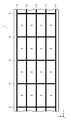
- FIG. 4 is a plan view showing a schematic configuration of the floor slab.
- each coffer 2, 2, ... is set in the inspection target area.
- the coffer 2 is a section divided by the main girder 3 and the cross girder 4 in the deck 1.
- the longitudinal direction of the deck 1 (direction of the main girder 3) is the x direction
- the direction orthogonal to the x direction is the y direction.
- the direction orthogonal to the floor slab 1 (vertical downward direction) is defined as the z direction.
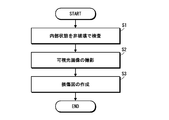
- FIG. 5 is a flowchart showing the procedure from inspection to creation of a damage diagram.
- step S1 the internal state of the inspection target area is inspected non-destructively (step S1).
- step S2 the inspection target area is photographed with a visible light camera (step S2).
- step S3 the captured visible light image is taken into the damage diagram creation support device 10 to create a damage diagram.
- an image (millimeter wave image) that visualizes the internal state of the inspection target area is taken by using a millimeter wave camera (millimeter wave imaging device).
- a millimeter wave camera for example, an active millimeter wave camera can be used.
- An active millimeter-wave camera irradiates a subject with millimeter waves, receives the reflected waves, and generates an image that visualizes the internal state of the subject.
- the millimeter wave is an electromagnetic wave having a wavelength of 1 to 10 mm and a frequency of 30 to 300 GHz.
- a millimeter-wave camera for example, electronically or mechanically scans a millimeter-wave beam to create a two-dimensional image of the internal state of a subject within an angle of view.
- a plurality of transmitting antennas and a plurality of receiving antennas By using a plurality of transmitting antennas and a plurality of receiving antennas, shooting can be speeded up.
- a plurality of receiving antennas can be arranged in one direction and scanned in a direction orthogonal to the arrangement direction to form a two-dimensional image.
- the resolution can be improved by adopting so-called MIMO (Multiple Input Multipple Output) radar technology.
- MIMO Multiple Input Multipple Output
- MIMO Multiple Input Multipple Output
- Floating concrete means that the area near the surface of concrete is floating.
- Floating concrete means that the concrete near the surface is losing its integrity with the concrete inside due to continuous cracking inside the concrete.
- a visible light camera is a camera that photographs a subject with sensitivity in the wavelength band of visible light (generally 380 nm to 780 nm).
- the visible light camera is a general digital camera (portable terminal, etc.) equipped with a CMOS image sensor (complementary metal-oxide semiconductor device image sensor), a CCD image sensor (charge coupled device image sensor), etc. Including) can be used.
- CMOS image sensor complementary metal-oxide semiconductor device image sensor
- CCD image sensor charge coupled device image sensor
- Including can be used.
- a digital camera capable of color photography is used. Therefore, a color image is taken as a visible light image.
- the color image is an image (so-called RGB image) having each intensity value (brightness value) of R (red; red), G (green; green), and B (blue; blue) in pixel units.
- FIG. 6 is a diagram showing an example of a shooting method for split shooting.
- the frame of the broken line indicated by the reference numeral A is a frame indicating one shooting range (field of view of the visible light camera).
- the coffer 2 which is the inspection target area is photographed while sequentially moving in the y direction and the x direction.
- the arrow a in the figure indicates the moving direction.
- the photographer faces the floor slab and shoots from a certain distance. Also, in the adjacent shooting areas, the pictures are taken so that some of them overlap each other. For example, the images are taken so as to overlap by 30% or more. As a result, the images can be appropriately combined when the panorama is combined.
- the captured visible light image is photographed with a pixel resolution capable of detecting cracks having a width of at least the second threshold value or more.
- the second threshold value is 0.1 mm
- the captured visible light image is photographed with a pixel resolution capable of detecting cracks having a width of at least 0.1 mm or more.
- the crack detection unit 10B of the damage diagram creation support device 10 takes a picture with a pixel resolution capable of detecting a crack having a width of 0.1 mm or more.
- pixel resolution refers to the size of the field of view per pixel of the image sensor mounted on the visible light camera.
- the pixel resolution represents how many mm one pixel of the image sensor corresponds to.
- the unit is "mm / pixel”.
- Pixel resolution is determined by the field size and the number of pixels.
- the "field of view size” is the range (shooting range) in which the inspection object is photographed.
- the relationship between the pixel resolution, the visual field size and the number of pixels is expressed by the following equation.
- the captured visible light image is captured with a pixel resolution capable of detecting cracks having a width of up to 0.1 mm.
- the pixel resolution capable of detecting cracks having a width of at least 0.1 mm from the captured visible light image is, for example, 0.3 [mm / pixel].
- the number of pixels of the image sensor mounted on the visible light camera to be used is 3000 pixels in the vertical direction and 4000 pixels in the horizontal direction.
- the field of view size for shooting under the condition of pixel resolution of 0.3 [mm / pixel] is set as follows.
- S3 Creation of damage diagram
- the damage diagram is created by using the damage diagram creation support device 10.
- the user inputs a visible light image of the inspection target area taken by the visible light camera to the damage diagram creation support device 10, and causes the user (inspection engineer) to create a damage diagram.
- FIG. 7 is a flowchart showing the procedure for creating a damage diagram by the damage diagram creation support device.
- the image data of the visible light image obtained by capturing the inspection target area is captured (step S31).
- the image data is input to the damage diagram creation support device 10 via the input / output interface 17 or the communication interface 18.
- step S32 When the image data is input, cracks are detected (step S32). In this embodiment, cracks having a width of at least 0.1 mm or more are detected.
- step S33 the panoramic composition process is performed (step S33). It should be noted that this processing is performed only when the divided shot image is input.
- step S34 the information of the internally damaged area is acquired (step S34).
- the visible light image obtained by capturing the inspection target area is displayed on the display unit 16, and the user receives the designation of the internal damage area.
- the user specifies the internal damage area based on the result of the internal condition inspection.
- a damage diagram is created based on the crack detection result and the information of the internal damage area (step S35).
- the damage diagram is created by tracing cracks on a visible light image of the area to be inspected. At that time, the region other than the internal damage region traces cracks having a width of 0.2 mm or more, and the internal damage region traces cracks having a width of 0.1 mm or more to create a damage diagram.
- FIG. 8 is a diagram showing an example of a damage diagram created when all cracks detected on a visible light image are traced.
- the thick line L1 shows a line that traces a crack having a width of 0.2 mm or more.
- the thin line L2 shows a line tracing a crack of 0.1 mm or more and less than 0.2 mm.
- the rectangular frame F indicates an internal damage region.
- FIG. 9 is a diagram showing an example of a damage diagram created by the damage diagram creation support device of the present embodiment.
- cracks having a width of 0.1 mm or more are displayed only in the internal damage region. That is, as a whole, cracks having a width of 0.2 mm or more are displayed, and cracks having a width of 0.1 mm or more are displayed only for the internally damaged area.
- the created damage diagram is displayed on the display unit 16. Further, it is recorded in the HDD 14 according to an instruction from the user. Image data of a visible light image obtained by photographing the inspection target area is also recorded in the HDD 14. The image data of the visible light image is associated with the damage diagram and recorded in the HDD 14.
- the damage diagram creation support device 10 of the present embodiment it is possible to appropriately create a damage diagram in which cracks are recorded according to the application. That is, the detection result of fine cracks (cracks of less than 0.2 mm) is displayed only in the region where the surface properties need to be confirmed in detail. This makes it possible to create a damage diagram that is easy to check.
- cracks having a width of 0.1 mm or more are detected in all the regions to be inspected, but the internal damage region and the region other than the internal damage region are detected. It may be configured to detect cracks separately from the above. In this case, a crack having a width of 0.1 mm or more is detected in the internal damage region, and a crack having a width of 0.2 mm or more is detected in a region other than the internal damage region.
- a damage diagram (see FIG. 8) in which cracks having a width of 0.1 mm or more are recorded in all areas to be inspected may be separately prepared. This makes it possible to display a damage diagram recording all cracks, if necessary. In addition, a damage diagram may be created in which layers are separated for each type of crack.
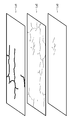
- FIG. 10 is a diagram showing an example of a damage diagram generated by separating layers for each type of crack.
- the figure shows an example in which the damage diagram is composed of three layers (first layer Ly1 to third layer Ly3).
- the first layer Ly1 is composed of a layer in which cracks having a width of 0.2 mm or more are recorded.
- the second layer Ly2 is composed of a layer in which cracks having a width of 0.1 mm or more and less than 0.2 mm are recorded.
- the third layer Ly3 is composed of a layer in which cracks having a width of 0.1 mm or more and less than 0.2 mm are recorded only in the internally damaged area. According to the damage diagram having such a configuration, for example, by selecting and displaying the first layer Ly1 and the third layer Ly3, cracks having a width of 0.1 mm or more are displayed in the internal damage region.
- a damage diagram showing cracks having a width of 0.2 mm or more is displayed. Further, by selecting and displaying the first layer Ly1 and the second layer Ly2, a damage diagram showing cracks having a width of 0.1 mm or more in all areas is displayed.
- the detected cracks may be individually numbered, and the width information may be managed for each crack.
- an image in which the internal state of the structure is visualized is taken by a millimeter-wave camera, and the internal state of the structure is measured nondestructively.
- the means and methods for measuring the internal state of the structure in a non-destructive manner are not limited to this.
- a device that visualizes the internal state using electromagnetic waves such as microwaves and terahertz waves (microwave imaging device, terahertz imaging, etc.) can be used to measure the internal state of the structure (electromagnetic waves). Radar method).
- a device that visualizes the internal state using ultrasonic waves can be used to measure the internal state of the structure (so-called ultrasonic method).
- known non-destructive exploration methods such as infrared photography, X-ray contrast imaging, and non-contact acoustic exploration can be adopted to measure the internal state of the structure.
- the user manually inputs the internal damage area, but the method for acquiring the information of the internal damage area is not limited to this.
- a region having internal damage may be indicated by a chalk or the like, and the region indicated by the chalk or the like may be automatically recognized from the visible light image to acquire information on the internally damaged region.
- the photographed image data may be acquired and the information of the internal damage area may be acquired. can. In this case, the image that visualizes the internal state of the structure is analyzed, the damaged area is detected, and the information of the internal damaged area is automatically acquired.
- the present invention works particularly effectively when inspecting reinforced concrete structures such as bridges, tunnels, dams and buildings.
- the application of the present invention is not limited to this.
- the same can be applied when inspecting a structure whose surface is composed of tiles, bricks, or the like.
- shooting with a visible light camera can be performed by mounting the visible light camera on an unmanned aerial vehicle (so-called drone), an unmanned traveling vehicle, or the like.
- unmanned aerial vehicle so-called drone
- unmanned traveling vehicle or the like.
- a visible light camera when mounted on an unmanned aerial vehicle or the like to shoot an inspection target, it can be configured to shoot automatically. For example, it may be configured to automatically fly a predetermined route and photograph the inspection target.
- a camera imaging device
- an unmanned aerial vehicle an unmanned vehicle, etc. be able to.
- the damage diagram creation support device is realized by a so-called stand-alone computer, but it can also be realized by a client-server type system.
- the functions of the crack detection unit 10B, the panorama synthesis unit 10C, the internal damage area information acquisition unit 10D, the damage diagram creation unit 10E, and the like may be configured to be realized by the server.
- the client terminal is provided with a function of transmitting an image to the server, a function of receiving a result (panoramic composite image, damage diagram data, etc.) from the server, and the like.
- the hardware that realizes the damage diagram creation support device can be configured with various processors.
- the circuit configuration can be changed after manufacturing CPU and / or GPU (Graphic Processing Unit), FPGA (Field Programmable Gate Array), which are general-purpose processors that execute programs and function as various processing units. Includes a dedicated electric circuit, which is a processor having a circuit configuration specially designed for executing a specific process such as a programmable logic device (Programmable Logic Device, PLD), an ASIC (Application Specific Integrated Circuit), etc. Is done.
- One processing unit constituting the inspection support device may be composed of one of the above-mentioned various processors, or may be composed of two or more processors of the same type or different types.
- one processing unit may be configured by a plurality of FPGAs or a combination of a CPU and an FPGA.
- a plurality of processing units may be configured by one processor.
- one processor is configured by a combination of one or more CPUs and software, as represented by a computer such as a client or a server.
- the processor functions as a plurality of processing units.
- the various processing units are configured by using one or more of the above-mentioned various processors as a hardware-like structure.
- the hardware-like structure of these various processors is, more specifically, an electric circuit (cyclery) in which circuit elements such as semiconductor elements are combined.
- Damage diagram creation support device 10A Image data acquisition unit 10B Crack detection unit 10C Panorama composition unit 10D Internal damage area information acquisition unit 10E Damage diagram creation unit 11 CPU 12 RAM 13 ROM 14 HDD 15 Operation unit 16 Display unit 16A Display unit screen 17 Input / output interface 18 Communication interface a Shooting movement direction F Frame surrounding the internal damage area IM Visible light image L1 Line L2 that traces cracks with a width of 0.2 mm or more Line tracing cracks of 0.1 mm or more and less than 0.2 mm Ly1 First layer of damage diagram Ly2 Second layer of damage diagram Ly3 Third layer of damage diagram P Pointer W Damage inside the structure S1 to S3 Procedure from inspection to creation of damage diagram S31 to S35 Procedure for creating damage diagram by damage diagram creation support device
Landscapes
- Engineering & Computer Science (AREA)
- Physics & Mathematics (AREA)
- General Physics & Mathematics (AREA)
- Computer Vision & Pattern Recognition (AREA)
- Theoretical Computer Science (AREA)
- Quality & Reliability (AREA)
- Chemical & Material Sciences (AREA)
- Life Sciences & Earth Sciences (AREA)
- Health & Medical Sciences (AREA)
- Analytical Chemistry (AREA)
- Biochemistry (AREA)
- General Health & Medical Sciences (AREA)
- Immunology (AREA)
- Pathology (AREA)
- Signal Processing (AREA)
- Investigating Materials By The Use Of Optical Means Adapted For Particular Applications (AREA)
- Image Processing (AREA)
- Investigating Or Analyzing Materials By The Use Of Ultrasonic Waves (AREA)
- Image Analysis (AREA)
Priority Applications (2)
| Application Number | Priority Date | Filing Date | Title |
|---|---|---|---|
| JP2022526556A JP7353485B2 (ja) | 2020-05-29 | 2021-05-25 | 損傷図作成支援方法及び装置 |
| US18/050,846 US12283033B2 (en) | 2020-05-29 | 2022-10-28 | Damage diagram creation support method and damage diagram creation support device |
Applications Claiming Priority (2)
| Application Number | Priority Date | Filing Date | Title |
|---|---|---|---|
| JP2020094329 | 2020-05-29 | ||
| JP2020-094329 | 2020-05-29 |
Related Child Applications (1)
| Application Number | Title | Priority Date | Filing Date |
|---|---|---|---|
| US18/050,846 Continuation US12283033B2 (en) | 2020-05-29 | 2022-10-28 | Damage diagram creation support method and damage diagram creation support device |
Publications (1)
| Publication Number | Publication Date |
|---|---|
| WO2021241537A1 true WO2021241537A1 (ja) | 2021-12-02 |
Family
ID=78744424
Family Applications (1)
| Application Number | Title | Priority Date | Filing Date |
|---|---|---|---|
| PCT/JP2021/019704 Ceased WO2021241537A1 (ja) | 2020-05-29 | 2021-05-25 | 損傷図作成支援方法及び装置 |
Country Status (3)
| Country | Link |
|---|---|
| US (1) | US12283033B2 (https=) |
| JP (1) | JP7353485B2 (https=) |
| WO (1) | WO2021241537A1 (https=) |
Families Citing this family (4)
| Publication number | Priority date | Publication date | Assignee | Title |
|---|---|---|---|---|
| CN117095294B (zh) * | 2023-08-24 | 2024-06-25 | 中建安装集团黄河建设有限公司 | 一种预制楼板施工质量诊断方法、介质及系统 |
| CN119418262A (zh) * | 2024-10-14 | 2025-02-11 | 中电建路桥集团有限公司 | 一种基于深度神经网络的桥梁混凝土裂缝智能检测方法 |
| CN120070373B (zh) * | 2025-02-10 | 2025-08-05 | 中交路桥建设有限公司 | 基于机器视觉的桥梁深水围堰施工质量检测方法及系统 |
| CN121236214A (zh) * | 2025-11-28 | 2025-12-30 | 中铁大桥局集团有限公司 | 裂缝分割图像的后处理优化和量化方法、装置及设备 |
Citations (7)
| Publication number | Priority date | Publication date | Assignee | Title |
|---|---|---|---|---|
| JP2002257744A (ja) * | 2001-03-02 | 2002-09-11 | Takenaka Komuten Co Ltd | コンクリートの欠陥検査方法およびコンクリートの欠陥検査装置 |
| JP2008145298A (ja) * | 2006-12-11 | 2008-06-26 | Tohoku Electric Power Engineering & Construction Co Ltd | 水車構造物の三次元欠陥検査装置 |
| JP2013250059A (ja) * | 2012-05-30 | 2013-12-12 | Railway Technical Research Institute | コンクリート表面の変状管理方法 |
| KR101492336B1 (ko) * | 2013-09-24 | 2015-02-11 | 서울여자대학교 산학협력단 | 금속품의 크랙 자동 검출 시스템 및 그 검출 방법 |
| WO2017119154A1 (ja) * | 2016-01-07 | 2017-07-13 | 三菱電機株式会社 | 検出装置および検出方法 |
| JP2018185228A (ja) * | 2017-04-26 | 2018-11-22 | 三菱電機株式会社 | 移動型探傷装置 |
| WO2020059706A1 (ja) * | 2018-09-20 | 2020-03-26 | 富士フイルム株式会社 | 学習用データ収集装置、学習用データ収集方法、及びプログラム |
Family Cites Families (53)
| Publication number | Priority date | Publication date | Assignee | Title |
|---|---|---|---|---|
| JP3279781B2 (ja) | 1993-11-30 | 2002-04-30 | 第一高周波工業株式会社 | コンクリート中の鉄筋の発錆進行状況判定方法 |
| JPH1183996A (ja) | 1997-09-03 | 1999-03-26 | Omron Corp | ミリ波検出装置 |
| JPH1183754A (ja) | 1997-09-04 | 1999-03-26 | Mitsui High Tec Inc | リードフレーム検査装置 |
| JPH11259656A (ja) | 1998-03-10 | 1999-09-24 | Teito Rapid Transit Authority | トンネル壁面判定装置 |
| JP2000193611A (ja) | 1998-12-24 | 2000-07-14 | Koji Otsuka | アスファルト舗装下のコンクリ―ト橋梁床版のひび割れ等の劣化状態をx線造影撮影法により検査する方法 |
| JP3778004B2 (ja) | 2001-05-23 | 2006-05-24 | 株式会社日立製作所 | 電波が伝播できる検査対象の検査装置 |
| US6862537B2 (en) | 2002-03-21 | 2005-03-01 | Ford Global Technologies Llc | Sensor fusion system architecture |
| JP4319834B2 (ja) | 2002-12-27 | 2009-08-26 | 財団法人鉄道総合技術研究所 | コンクリート表面及び建築物の外壁の撮像装置、並びにコンクリート表面及び建築物の外壁の撮像方法 |
| JP4287187B2 (ja) | 2003-04-24 | 2009-07-01 | 株式会社東芝 | 欠陥検査装置 |
| JP2005037366A (ja) | 2003-06-24 | 2005-02-10 | Constec Engi Co | 赤外線構造物診断システム及び赤外線構造物診断方法 |
| JP2005016995A (ja) | 2003-06-24 | 2005-01-20 | Railway Technical Res Inst | 赤外線構造物診断方法 |
| WO2005086620A2 (en) | 2003-10-10 | 2005-09-22 | L-3 Communications Security And Detection Systems | Mmw contraband screening system |
| JP4372658B2 (ja) | 2004-10-07 | 2009-11-25 | ソニーケミカル&インフォメーションデバイス株式会社 | 欠陥マーキング装置及び欠陥マーキング方法 |
| JP2006132973A (ja) | 2004-11-02 | 2006-05-25 | Fujimitsu Komuten:Kk | コンクリート構造物のクラック検査装置及びクラック検査方法 |
| JP4369915B2 (ja) | 2005-10-31 | 2009-11-25 | 日本電信電話株式会社 | 電磁波イメージングシステム |
| JP5005218B2 (ja) | 2005-12-28 | 2012-08-22 | 愛知機械工業株式会社 | 検査装置および検査方法 |
| JP4288265B2 (ja) | 2006-01-10 | 2009-07-01 | 日本電信電話株式会社 | 電磁波イメージングシステム、構造物透視装置および構造物透視方法 |
| JP5093451B2 (ja) | 2007-02-21 | 2012-12-12 | 独立行政法人 宇宙航空研究開発機構 | 航空機用水面及び地面観測装置 |
| JP4526570B2 (ja) | 2008-03-10 | 2010-08-18 | 西日本高速道路エンジニアリング四国株式会社 | 赤外線カメラによる構造物調査方法 |
| CN101614814B (zh) | 2009-07-29 | 2012-02-01 | 武汉大学 | 用于天基激光测高的智能化数据采集方法及系统 |
| JP5113810B2 (ja) | 2009-08-07 | 2013-01-09 | 日本電信電話株式会社 | 画像処理方法、画像処理装置及びひび割れ検知システム |
| JP5275968B2 (ja) | 2009-12-24 | 2013-08-28 | 株式会社パスコ | 内部変状検出支援装置及び内部変状検出支援プログラム |
| US8054464B2 (en) | 2010-01-25 | 2011-11-08 | Sigma Space Corp. | Polarization switching lidar device and method |
| WO2012050595A1 (en) | 2010-09-29 | 2012-04-19 | Entech Engineering, Inc. | Complete remote sensing bridge investigation system |
| CN101950436A (zh) | 2010-09-29 | 2011-01-19 | 中国科学院国家天文台 | 利用激光高度计数据制作数字高程模型的方法 |
| WO2012073722A1 (ja) | 2010-12-01 | 2012-06-07 | コニカミノルタホールディングス株式会社 | 画像合成装置 |
| CN102095755B (zh) | 2010-12-09 | 2012-10-03 | 重庆建工市政交通工程有限责任公司 | 一种混凝土结构的无损检测方法 |
| JP5591165B2 (ja) | 2011-03-25 | 2014-09-17 | 公益財団法人鉄道総合技術研究所 | コンクリート表面の変状領域の検出方法 |
| JP6029870B2 (ja) | 2012-06-27 | 2016-11-24 | 公益財団法人鉄道総合技術研究所 | コンクリート表面の変状検出方法及び装置 |
| JP2015219014A (ja) | 2014-05-14 | 2015-12-07 | コニカミノルタ株式会社 | 物体診断装置 |
| JP6413058B2 (ja) | 2014-06-20 | 2018-10-31 | 西日本高速道路エンジニアリング四国株式会社 | コンクリート構造物のはく落予測診断方法 |
| JP2016111414A (ja) | 2014-12-03 | 2016-06-20 | コニカミノルタ株式会社 | 飛行体の位置検出システム及び飛行体 |
| CN105068065B (zh) | 2015-07-29 | 2017-06-27 | 武汉大学 | 星载激光测高仪在轨检校方法及系统 |
| JP6700054B2 (ja) | 2016-02-04 | 2020-05-27 | 学校法人桐蔭学園 | 非接触音響探査システム |
| JP2017161452A (ja) | 2016-03-11 | 2017-09-14 | Ntn株式会社 | 振動検査装置 |
| US10816654B2 (en) | 2016-04-22 | 2020-10-27 | Huawei Technologies Co., Ltd. | Systems and methods for radar-based localization |
| JP6609057B2 (ja) | 2016-08-22 | 2019-11-20 | 富士フイルム株式会社 | 画像処理装置 |
| JP6574747B2 (ja) | 2016-09-26 | 2019-09-11 | 日本製鉄株式会社 | 煙道又は煙突の調査方法 |
| US11555916B2 (en) | 2016-12-08 | 2023-01-17 | University Of Washington | Millimeter wave and/or microwave imaging systems and methods including examples of partitioned inverse and enhanced resolution modes and imaging devices |
| JP6441421B1 (ja) | 2017-07-28 | 2018-12-19 | 株式会社TonTon | 外面材調査システム |
| JP6939255B2 (ja) | 2017-08-28 | 2021-09-22 | 積水ハウス株式会社 | シーリング目地検査方法 |
| JP2019070627A (ja) | 2017-10-11 | 2019-05-09 | 日本無線株式会社 | 非破壊検査システム |
| US10746625B2 (en) | 2017-12-22 | 2020-08-18 | Infineon Technologies Ag | System and method of monitoring a structural object using a millimeter-wave radar sensor |
| JP7089735B2 (ja) | 2018-01-29 | 2022-06-23 | 株式会社プロドローン | 無人航空機 |
| JP6734583B2 (ja) | 2018-02-23 | 2020-08-05 | 株式会社市川工務店 | 橋梁などの構造物を検査するための画像処理システム、画像処理方法及びプログラム |
| JP2019158793A (ja) | 2018-03-16 | 2019-09-19 | 公益財団法人鉄道総合技術研究所 | ひび割れ調査装置 |
| US10591601B2 (en) | 2018-07-10 | 2020-03-17 | Luminar Technologies, Inc. | Camera-gated lidar system |
| US11391819B2 (en) | 2018-07-18 | 2022-07-19 | Qualcomm Incorporate | Object verification using radar images |
| JP7304060B2 (ja) | 2018-07-26 | 2023-07-06 | 直人 今西 | 構造内部変状特性検出装置 |
| JP6717452B2 (ja) | 2018-09-26 | 2020-07-01 | 技建開発株式会社 | 鉄筋コンクリート構造物の内部異常状態検出方法 |
| JP7033045B2 (ja) | 2018-10-17 | 2022-03-09 | 株式会社神戸製鋼所 | 学習装置、推定装置、亀裂検出装置、亀裂検出システム、学習方法、推定方法、亀裂検出方法、及びプログラム |
| JP6611147B1 (ja) | 2019-05-16 | 2019-11-27 | 株式会社センシンロボティクス | 撮像システム及び撮像方法 |
| JP2020016667A (ja) | 2019-10-25 | 2020-01-30 | 東急建設株式会社 | 変状部の検査装置 |
-
2021
- 2021-05-25 WO PCT/JP2021/019704 patent/WO2021241537A1/ja not_active Ceased
- 2021-05-25 JP JP2022526556A patent/JP7353485B2/ja active Active
-
2022
- 2022-10-28 US US18/050,846 patent/US12283033B2/en active Active
Patent Citations (7)
| Publication number | Priority date | Publication date | Assignee | Title |
|---|---|---|---|---|
| JP2002257744A (ja) * | 2001-03-02 | 2002-09-11 | Takenaka Komuten Co Ltd | コンクリートの欠陥検査方法およびコンクリートの欠陥検査装置 |
| JP2008145298A (ja) * | 2006-12-11 | 2008-06-26 | Tohoku Electric Power Engineering & Construction Co Ltd | 水車構造物の三次元欠陥検査装置 |
| JP2013250059A (ja) * | 2012-05-30 | 2013-12-12 | Railway Technical Research Institute | コンクリート表面の変状管理方法 |
| KR101492336B1 (ko) * | 2013-09-24 | 2015-02-11 | 서울여자대학교 산학협력단 | 금속품의 크랙 자동 검출 시스템 및 그 검출 방법 |
| WO2017119154A1 (ja) * | 2016-01-07 | 2017-07-13 | 三菱電機株式会社 | 検出装置および検出方法 |
| JP2018185228A (ja) * | 2017-04-26 | 2018-11-22 | 三菱電機株式会社 | 移動型探傷装置 |
| WO2020059706A1 (ja) * | 2018-09-20 | 2020-03-26 | 富士フイルム株式会社 | 学習用データ収集装置、学習用データ収集方法、及びプログラム |
Also Published As
| Publication number | Publication date |
|---|---|
| US20230075504A1 (en) | 2023-03-09 |
| JPWO2021241537A1 (https=) | 2021-12-02 |
| US12283033B2 (en) | 2025-04-22 |
| JP7353485B2 (ja) | 2023-09-29 |
Similar Documents
| Publication | Publication Date | Title |
|---|---|---|
| JP7353485B2 (ja) | 損傷図作成支援方法及び装置 | |
| WO2021241535A1 (ja) | 構造物の検査方法及び検査システム | |
| US20230111766A1 (en) | Structure inspection method and structure inspection system | |
| Xie et al. | Automatic multi-image stitching for concrete bridge inspection by combining point and line features | |
| US9292925B2 (en) | Imaging system and control method thereof | |
| JPWO2021241536A5 (https=) | ||
| JP7436656B2 (ja) | 撮影システム、撮影方法、撮影プログラム、及び情報取得方法 | |
| WO2019003796A1 (ja) | 画像合成方法、画像合成装置、及び記録媒体 | |
| JP7151873B2 (ja) | 検査装置 | |
| JP2022151763A (ja) | 航空機構造体の損傷の自動評価 | |
| JP2005016995A (ja) | 赤外線構造物診断方法 | |
| JPWO2021241535A5 (https=) | ||
| JP2016070676A (ja) | 演算装置、演算方法、およびプログラム | |
| CN112703725A (zh) | 合成处理系统、合成处理装置以及合成处理方法 | |
| CN113281343A (zh) | 一种对多层透明材料进行缺陷检测的系统及方法 | |
| Lachat et al. | First experiences with the Trimble SX10 Scanning Total Station for building facade survey | |
| KR20050110005A (ko) | 마이크로-검사 입력을 이용한 매크로 결함 검출 방법 및시스템 | |
| TW200908017A (en) | Structure visual inspection apparatus and inspection method therefor | |
| JP2007322162A (ja) | 3次元形状測定装置及び3次元形状測定方法 | |
| KR100803043B1 (ko) | 디스플레이 장치의 결함검사 장치 및 방법 | |
| JP7559417B2 (ja) | 表示装置、表示システム、表示制御方法およびプログラム | |
| EP3869542B1 (en) | Device and method for inspection | |
| JPH1114334A (ja) | 網入りガラスの欠陥検出方法および装置 | |
| JP2006275780A (ja) | パターン検査方法 | |
| JP2022048650A (ja) | クラック測定システム、クラック測定方法、コンピュータプログラム |
Legal Events
| Date | Code | Title | Description |
|---|---|---|---|
| 121 | Ep: the epo has been informed by wipo that ep was designated in this application |
Ref document number: 21813979 Country of ref document: EP Kind code of ref document: A1 |
|
| ENP | Entry into the national phase |
Ref document number: 2022526556 Country of ref document: JP Kind code of ref document: A |
|
| NENP | Non-entry into the national phase |
Ref country code: DE |
|
| 122 | Ep: pct application non-entry in european phase |
Ref document number: 21813979 Country of ref document: EP Kind code of ref document: A1 |