WO2021193414A1 - 大豆原料の加熱処理物及びそれを有効成分とする起泡剤 - Google Patents
大豆原料の加熱処理物及びそれを有効成分とする起泡剤 Download PDFInfo
- Publication number
- WO2021193414A1 WO2021193414A1 PCT/JP2021/011335 JP2021011335W WO2021193414A1 WO 2021193414 A1 WO2021193414 A1 WO 2021193414A1 JP 2021011335 W JP2021011335 W JP 2021011335W WO 2021193414 A1 WO2021193414 A1 WO 2021193414A1
- Authority
- WO
- WIPO (PCT)
- Prior art keywords
- weight
- heat
- treated product
- bubble
- foam
- Prior art date
- Legal status (The legal status is an assumption and is not a legal conclusion. Google has not performed a legal analysis and makes no representation as to the accuracy of the status listed.)
- Ceased
Links
Images



Classifications
-
- A—HUMAN NECESSITIES
- A23—FOODS OR FOODSTUFFS; TREATMENT THEREOF, NOT COVERED BY OTHER CLASSES
- A23L—FOODS, FOODSTUFFS OR NON-ALCOHOLIC BEVERAGES, NOT OTHERWISE PROVIDED FOR; PREPARATION OR TREATMENT THEREOF
- A23L11/00—Pulses, i.e. fruits of leguminous plants, for production of food; Products from legumes; Preparation or treatment thereof
-
- A—HUMAN NECESSITIES
- A23—FOODS OR FOODSTUFFS; TREATMENT THEREOF, NOT COVERED BY OTHER CLASSES
- A23L—FOODS, FOODSTUFFS OR NON-ALCOHOLIC BEVERAGES, NOT OTHERWISE PROVIDED FOR; PREPARATION OR TREATMENT THEREOF
- A23L2/00—Non-alcoholic beverages; Dry compositions or concentrates therefor; Preparation or treatment thereof
-
- A—HUMAN NECESSITIES
- A23—FOODS OR FOODSTUFFS; TREATMENT THEREOF, NOT COVERED BY OTHER CLASSES
- A23L—FOODS, FOODSTUFFS OR NON-ALCOHOLIC BEVERAGES, NOT OTHERWISE PROVIDED FOR; PREPARATION OR TREATMENT THEREOF
- A23L2/00—Non-alcoholic beverages; Dry compositions or concentrates therefor; Preparation or treatment thereof
- A23L2/40—Effervescence-generating compositions
-
- A—HUMAN NECESSITIES
- A23—FOODS OR FOODSTUFFS; TREATMENT THEREOF, NOT COVERED BY OTHER CLASSES
- A23L—FOODS, FOODSTUFFS OR NON-ALCOHOLIC BEVERAGES, NOT OTHERWISE PROVIDED FOR; PREPARATION OR TREATMENT THEREOF
- A23L29/00—Foods or foodstuffs containing additives; Preparation or treatment thereof
Definitions
- the present invention relates to a heat-treated product of soybean raw material and a foaming agent containing the same as an active ingredient.
- Foaming property and foaming stability are important for foods and drinks containing bubbles such as meringue and shake beverages, and means for improving foaming property and foaming stability have been studied conventionally.
- a technique of using water-soluble hemicellulose as a foaming agent Patent Document 1
- a technique of using a foaming agent such as cyclodextrin or soy peptide Patent Document 2
- foaming water-soluble soybean polysaccharide into a foaming beverage A technique for using as a stabilizer (Patent Document 3) has been proposed.
- Patent Documents 1 to 3 Foods and drinks that require foaming property are required to have good foaming property and bubble stability, but the techniques of Patent Documents 1 to 3 are not always sufficient and there is room for improvement. Therefore, at present, in order to impart more foaming property and bubble stability, foaming agents such as soybean peptides shown in Patent Document 2 and water-soluble soybean polysaccharides described in Patent Documents 1 and 3 are used. It is necessary to manufacture the foaming stabilizers separately and combine them, but it is not efficient in terms of cost and work. Therefore, if a sufficiently good foaming agent and bubble stabilizer can be provided with one material, it is advantageous in terms of cost and work.
- foaming agents such as soybean peptides shown in Patent Document 2 and water-soluble soybean polysaccharides described in Patent Documents 1 and 3 are used. It is necessary to manufacture the foaming stabilizers separately and combine them, but it is not efficient in terms of cost and work. Therefore, if a sufficiently good foaming agent and bubble stabilizer can be provided with one material, it is advantageous in terms
- an object of the present invention is to provide a material capable of imparting good foaming property, bubble stability, and fineness of bubbles.
- the present inventors have conducted diligent studies to solve the above problems.
- the molecular weight distribution was measured at a wavelength of 220 nm by gel filtration HPLC.
- a specific fraction with a weight average molecular weight of 3000 to 15000 exists at a rate of a certain amount or more, and when the rate of change in bubble size is measured with a dynamic foam analyzer, the rate of change in bubble size is 10% or less. It has been found that this imparts good foaming property, bubble stability, and fineness of bubbles to beverages and the like, and has completed the present invention.
- the present invention (1) Heat-treated soybean raw material having the following A) to C), A) Crude protein mass is 14-35% by weight, sugar mass is 55-85% by weight, lipid content is 1% by weight or less, in terms of dry matter. B) In the molecular weight distribution at a wavelength of 220 nm measured by gel filtration HPLC, the ratio of the peak area of the fraction of the peptide region having a weight average molecular weight of 3000 to 15000 to the total peak area is 40% or more. C) When the rate of change in bubble size is measured with a dynamic foam analyzer using a 0.3 wt% aqueous solution, the rate of change in bubble size calculated by the following formula is 10% or less.
- Rate of change in bubble size ⁇ Foam size 5 minutes after bubble formation ( ⁇ m 2 ) -Foam size immediately after bubble formation ( ⁇ m 2 ) ⁇ ⁇ Bubble size immediately after bubble formation ( ⁇ m 2 ) x 100
- Raw material derived from soybeans having a crude protein mass of 28 to 55% by weight, a sugar mass of 35 to 62% by weight, and a lipid content of 5% by weight or less in terms of dry matter is used at a pH of more than 100 ° C and 160 ° C or less.
- a slurry is obtained by heating under the conditions of more than 6 or less, and the crude protein mass in the filtrate after solid-liquid separation is 14 to 35% by weight and the sugar mass is 55 to 85% by weight in terms of dry matter.
- A) Crude protein mass is 14-35% by weight, sugar mass is 55-85% by weight, lipid content is 1% by weight or less, in terms of dry matter.
- the heat-treated product is characterized by the following A) to C).
- A) Crude protein mass is 14-35% by weight, sugar mass is 55-85% by weight, lipid content is 1% by weight or less, in terms of dry matter.
- soybean raw material of the present invention As the soybean raw material of the present invention, okara obtained in the process of producing defatted soybean and isolated soybean protein can be used. These can be used alone or in combination of two or more.
- okara obtained in the process of producing defatted soybean and isolated soybean protein
- these can be used alone or in combination of two or more.
- it is necessary to use a soybean raw material having a high crude protein mass.
- a heat-treated product of the soybean raw material having high foaming power and bubble stability can be obtained.
- the crude protein mass of the soybean-derived raw material is 28 to 55% by weight, the sugar mass is 35 to 62% by weight, and the lipid amount is 5% by weight or less in terms of dry matter.
- defatted soybean alone as a raw material or to mix defatted soybean and okara obtained in the production process of separated soybean protein.
- the mixing ratio of the defatted soybean and the okara can be appropriately mixed so as to fall within the above range.
- the filtrate is purified within a range in which the crude protein mass, sugar mass, and lipid mass after purification are 14 to 35% by weight, sugar mass is 55 to 85% by weight, and lipid content is 1% by weight or less in terms of dry matter. You can or do not have to. Then, if necessary, it is sterilized and dried by freeze-drying, spray-drying or the like to obtain the heat-treated product of the present invention.
- the crude protein mass in the heat-treated product is obtained by calculating the total amount of nitrogen in the sample by the Kjeldahl method, multiplying it by a coefficient of 6.25, measuring it as a percentage with respect to the sample, and expressing it in terms of dry matter.
- the crude protein mass of the heat-treated product of the present invention is 14 to 35% by weight in terms of dry matter.
- the lower limit value can be preferably selected from 16% by weight or more and 17% by weight or more.
- the upper limit value can be preferably selected from 33% by weight or less and 30% by weight or less.
- Preferred embodiments are, for example, 14-33% by weight, 14-30% by weight, 16-35% by weight, 16-33% by weight, 16-30% by weight, 17-35% by weight, 17-33% by weight, 17-. 30% by weight is mentioned.
- the gel filtration chromatography conditions are not particularly limited, but for example, the molecular weight distribution can be measured by the following method.
- HPLC is preferably used. Typical measurement conditions are shown below, but conditions that can measure the molecular weight distribution with the same degree of accuracy and accuracy as the conditions shown below can also be adopted.
- ⁇ Measurement conditions Column: HPLC column TSK gel G3000PWXL ( ⁇ 7.2mm ⁇ 30cm) and TSK gel G2000PWXL ( ⁇ 7.2mm ⁇ 30cm) manufactured by Tosoh Corporation are connected.
- the proportion of the fraction of the peptide region having a weight average molecular weight of 3000 to 15000 is important. That is, in the molecular weight distribution at a wavelength of 220 nm measured by gel filtration HPLC, the ratio of the peak area of the fraction of the peptide region having a weight average molecular weight of 3000 to 15000 to the total peak area is required to be 40% or more. It is preferably 44% or more, more preferably 45% or more, still more preferably 50% or more.
- the sugar mass is measured by the phenol-sulfuric acid method.
- the sugar mass of the heat-treated product of the present invention is 55 to 85% by weight in terms of solid content.
- the lower limit value can be preferably selected from 58% by weight or more and 60% by weight or more.
- the upper limit value can be preferably selected from 83% by weight or less and 80% by weight or less. In a preferred embodiment, for example, 55 to 83% by weight, 55 to 80% by weight, 58 to 85% by weight, 58 to 83% by weight, 58 to 80% by weight, 60 to 85% by weight, 60 to 83% by weight, 60 to 80% by weight is mentioned.
- the lipid content was calculated using the Soxhlet extraction method with diethyl ether.
- the amount of lipid in the heat-treated product of the present invention is 1% by weight or less in terms of dry matter. It is preferably 0.5% by weight or less, more preferably 0% by weight.
- the bubbles generated in beverages and foods have a small size of bubbles and the generated fine bubbles are stable.
- the size of bubbles and how stable the bubbles were were investigated. Foam size is measured with a dynamic foam analyzer. A 0.3 wt% aqueous solution was prepared, and after sufficient degassing using an aspirator, the foam size ( ⁇ m 2 ) measured with a dynamic foam analyzer (DFA100, manufactured by KRUSS) under the conditions shown in Table 1 below. The rate of change was measured. The rate of change in bubble size is calculated by the following formula.
- the bubble generation time is 10 seconds as shown in Table 1 below, and the time immediately after the bubble generation means the time point 10 seconds after the bubble generation.
- Rate of change in foam size 10% or less, it is judged that fine bubbles can be maintained.
- Rate of change in bubble size (%) ⁇ Foam size 5 minutes after bubble formation ( ⁇ m 2 ) -Foam size immediately after bubble formation ( ⁇ m 2 ) ⁇ ⁇ Bubble size immediately after bubble formation ( ⁇ m 2 ) x 100
- the foaming agent of the present invention is a foaming agent containing a heat-treated product of a soybean raw material having the following A) to C) as an active ingredient. That is, A) Crude protein mass is 14-35% by weight, sugar mass is 55-85% by weight, lipid content is 1% by weight or less, in terms of dry matter. B) In the molecular weight distribution at a wavelength of 220 nm measured by gel filtration HPLC, the ratio of the peak area of the fraction of the peptide region having a weight average molecular weight of 3000 to 15000 to the total peak area is 40% or more.
- the foaming agent of the present invention can impart good foaming property, bubble stability, and fineness of bubbles to foods and drinks.
- the foaming agent may consist only of the heat-treated product of the soybean raw material, or may further contain an emulsifier such as monoglyceride and various other substances having a foaming effect and a bubble stabilizing effect.
- the content of the heat-treated product of the soybean raw material in the foaming agent may be 10 to 100% by weight, preferably 50 to 100% by weight, and more preferably 90 to 100% by weight.
- Foods and drinks used in the present invention include merengue, confectionery using merengue, frozen confectionery such as frozen, sparkling wine, beer, and beer-taste beverages such as sparkling liquor and third beer (beer or foaming under the Japanese Liquor Tax Law).
- the raw material is other than malt, or a mixture of effervescent liquor and another alcoholic beverage
- the fourth beer beer under the Japanese Liquor Tax Law or treatment that does not belong to effervescent liquor
- beverages such as fermented type or non-fermented type non-alcoholic beer, etc., while increasing the malt usage rate to nearly 50% and adding distilled liquor (liqueur) made from wheat as a raw material can be mentioned.
- the heat-treated product of the present invention is preferably used for beverages among foods and drinks, and is capable of enhancing the effect on foams such as fineness of foams among beverages.
- Beer-taste beverages such as beer, fermented or non-fermented non-alcoholic beer are preferred. More preferably, it is a fermented type or non-fermented type non-alcoholic beer, and even more preferably, it is a non-fermented type non-alcoholic beer.
- the amount of the heat-treated product or foaming agent added to the food or drink of the present invention is, for example, 0.001 to 1% by weight, more preferably 0.005 to 0.5% by weight, based on the weight of the beverage as a heat-treated product in a beverage. be.
- the heat-treated product is preferably 0.005 to 10% by weight, more preferably 0.01 to 5% by weight, based on the weight of the ice cream.
- the amount is preferably 0.05 to 5% by weight, more preferably 0.1 to 3% by weight, based on the egg white used as the heat-treated product.
- the beer-taste beverage of the present invention is a sparkling liquor, a third beer (in order to treat it as not belonging to beer or sparkling liquor under the Japanese Liquor Tax Law, the raw material is other than malt, or another alcoholic beverage is added to the sparkling liquor.
- Mixed beer 4th beer (distilled liquor made from wheat (liqueur) while increasing the malt usage rate to nearly 50% in order to treat it as not belonging to beer or sparkling liquor under the Japanese Liquor Tax Law ), Fermented or non-fermented non-alcoholic beer.
- the amount of the heat-treated product or foaming agent added to the beer-taste beverage of the present invention is preferably 0.001 to 1% by weight, more preferably 0.005 to 0.5% by weight, based on the weight of the beverage as the heat-treated product.
- various glycosides such as sugars, sugar alcohols and saponins, fragrances, peptides such as dietary fiber and polysaccharides and soybean peptides, acids and raw materials such as yeast extract
- saccharides include reducing sugars such as glucose, fructose and sucrose, oligosaccharides such as sucrose, various dextrins and oligosaccharides
- fragrances include malt flavor, hop flavor, beer flavor, alcohol flavor, caramel flavor and the like. be able to. Malt flavor is preferred as a flavor that imparts and reinforces beer flavor.
- hops or hop extracts and bitterness agents can be used in combination.
- the hop or hop extract refers to a hop leaf or a ground product thereof, an extract obtained by extracting these with water or boiling water, a concentrate or a dried product of the extract.
- the bitterness agent a conventionally known bitterness agent selected from hop-derived bitterness substances, caffeine, gentiana extract, peptides, theobromine, naringin, wormwood extract, wormwood extract, kina extract and the like is used. can do.
- the production of the beer-taste beer of the present invention will be described by exemplifying a non-fermented non-alcoholic beer.
- a process performed in the production of a normal non-fermented non-alcoholic beer is adopted.
- the primary raw material liquid containing the food material, malt, etc. of the present invention is boiled, hop extract and flavor are added and heated again, and if necessary, fermented alcohol is added, and then carbonized by a carbonation step.
- the precipitate can be separated and removed by filtration, centrifugation, or the like at each stage. Further, carbonated water may be added after the raw material liquid is prepared in a concentrated state.
- the pH of the beer-taste beverage of the present invention is not particularly limited, but is generally pH 3-5.
- the pH is preferably 3 to 4.5, more preferably pH 3 to 4. If the pH is too low, the acidity becomes strong and the flavor may be affected. Further, if the pH is too high, the bactericidal effect may be lowered and the storage stability may be lowered.
- % In the example means weight standard.
- the heat-treated product of the soybean raw material is simply described as the heat-treated product.
- Example 1 Add 15 times the amount of water to dry defatted soybeans with a water content of 6%, a crude protein mass of 48%, a sugar mass of 42%, and a fat content of 2% obtained in the soybean oil extraction manufacturing process, and use hydrochloric acid.
- the pH was adjusted to 4.4, and the mixture was heated and extracted at 126 ° C. for 2.5 hours.
- the pH of the heat-extracted slurry after cooling was 4.7.
- Example 2 Dry defatted soybeans obtained in the soybean oil squeezing manufacturing process and dried okara obtained in the separated soybean protein manufacturing process are mixed to obtain 5% water content, 40% crude protein mass in terms of dry matter, 52% sugar mass, and 1 lipid content. 15 times the amount of water was added to the dried soybean raw material adjusted to%, the pH was adjusted to 4.4 with hydrochloric acid, and the mixture was heated and extracted at 126 ° C. for 2.5 hours. The pH of the heat-extracted slurry after cooling was 4.8. After adjusting the pH of the slurry recovered with sodium hydroxide to 5.0, it was centrifuged (10000 ⁇ G, 30 minutes) and separated into a supernatant and a precipitate. This supernatant was desalted by electrodialysis and then freeze-dried to obtain a heat-treated product B.
- Example 3 Dry defatted soybeans obtained in the soybean oil squeezing manufacturing process and dried okara obtained in the separated soybean protein manufacturing process are mixed, and the water content is 6%, the crude protein mass is 33%, the sugar mass is 60%, and the lipid content is 1 in terms of dry matter. 15 times the amount of water was added to the dried soybean raw material of%, the pH was adjusted to 4.4 with hydrochloric acid, and the mixture was heated and extracted at 126 ° C. for 2.5 hours. The pH of the heat-extracted slurry after cooling was 4.8. After adjusting the pH of the slurry recovered with sodium hydroxide to 5.0, it was centrifuged (10000 ⁇ G, 30 minutes) and separated into a supernatant and a precipitate. This supernatant was desalted by electrodialysis and then freeze-dried to obtain a heat-treated product C.
- Example 4 Dry defatted soybeans obtained in the soybean oil squeezing manufacturing process and dried okara obtained in the separated soybean protein manufacturing process are mixed, and the water content is 6%, the crude protein mass is 30% in terms of dry matter, the sugar mass is 62%, and the lipid content is 1. 15 times the amount of water was added to the dried soybean raw material of%, the pH was adjusted to 4.4 with hydrochloric acid, and the mixture was heated and extracted at 126 ° C. for 2.5 hours. The pH of the heat-extracted slurry after cooling was 4.8. After adjusting the pH of the slurry recovered with sodium hydroxide to 5.0, it was centrifuged (10000 ⁇ G, 30 minutes) and separated into a supernatant and a precipitate. This supernatant was desalted by electrodialysis and then freeze-dried to obtain a heat-treated product D.
- Table 2 shows the sugar mass, crude protein mass, crude ash content, and lipid content of the heat-treated products obtained in Examples 1 to 4 and Comparative Examples 1 to 5.
- the sugar mass was measured by the phenol-sulfuric acid method, the crude ash content was measured by the ashing method, and the lipid amount was measured by the Soxhlet extraction method using diethyl ether.
- the proportion of the fraction of the peptide region having a weight average molecular weight of 3000 to 15000 was determined by measuring the molecular weight distribution using gel filtration chromatography.
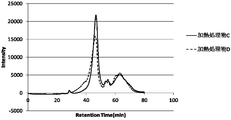
- the charts when the molecular weight distribution of the heat-treated products A to I was measured by gel filtration HPLC at a wavelength of 220 nm are shown in FIGS. 1 and 2.
- Table 3 shows the results of measurement with a dynamic foam analyzer for the heat-treated products obtained in Examples 1 to 4 and Comparative Examples 1 to 5.
- the rate of change in bubble size of the heat-treated products A to D is 10% or less, and the generated fine bubbles are stable.
- a heat-treated product E having a low crude protein mass a heat-treated product F having a high crude protein mass and a low sugar mass, a heat-treated product G having a low sugar mass, and a fraction of a peptide region having a weight average molecular weight of 3000 to 15000.
- the numerical values of the foam size change rate of the heat-treated product H having a low ratio, the sugar mass being low, and the crude protein mass being high and the heat-treated product I having a high oil content were poor.
- the next step is to prepare various foods and drinks. The presence or absence of the effect of the present invention was confirmed.
- the cells were allowed to stand for 2 minutes after pulse irradiation, and the bubble stability was evaluated by the formula shown below.
- a foam volume of less than 40 ml immediately after irradiation was rated as x
- a foam volume of 40 ml or more was rated as foaming ⁇
- a foam volume of 50 ml or more was rated as foaming ⁇ .
- those with a foam residual ratio of less than 80% were rated as bubble stability ⁇
- those with a foam residual ratio of 80% or more were rated as bubble stability ⁇
- those with a foam residual ratio of 90% or more were rated as bubble stability ⁇ .
- Foam residual rate (%) Foam volume 2 minutes after irradiation (ml) ⁇
- Table 4 shows the results of foaming property, foam residual rate, and bubble stability.
- the non-alcoholic beers to which the heat-treated products A to D were added had higher foaming properties and higher foam stability than the non-alcoholic beers without additives (Comparative Example 11).
- those to which the heat-treated products B and C were added were more excellent in both foaming property and bubble stability.
- the non-alcoholic beer to which the heat-treated product E, which has a high weight average molecular weight of 3000 to 15000 and has a high sugar mass but a low crude protein content, is added has excellent bubble stability. The result was that the foaming property was inferior.
- the heat-treated product F having a very high crude protein mass and a very low sugar mass resulted in inferior bubble stability.
- the heat-treated product G having a small sugar mass had a poor foaming property.
- the non-alcoholic beer to which the heat-treated product H having a low weight average molecular weight of 3000 to 15000 and a high crude protein mass was added resulted in poor foaming property and bubble stability.
- the foaming property and the bubble stability were poor.
- Example 13 a commercially available beer (“Premium Malt's” manufactured by Suntory Ltd.) to which no heat-treated product was added was evaluated in the same manner as in Example 9 (Comparative Example 13).
- soy peptide High Newt-DC6
- soy polysaccharide Soya Five-S-LA200
- the molecular weight distribution of Comparative Example 14 was measured, the fraction of the peptide region having a weight average molecular weight of 3000 to 15000 was 35.6%.
- the non-alcoholic beer to which the heat-treated product A was added had a high evaluation with an average evaluation score of 4.0 points or more, and was compared with the non-added beer in terms of foaming property, fineness of foam, and beer. The feeling of foam was good. Further, as a result of comparing the non-alcoholic beer to which the heat-treated product A was added with the commercially available fermented beer (Comparative Example 13) having good foaming property and fineness of bubbles, the non-alcoholic beer to which the heat-treated product A was added was compared. It was confirmed that the foaming property, the fineness of the bubbles, and the feeling of foaming when drinking were at the same level as those of commercially available fermented beer (Example 9, Comparative Example 13).
- A) crude protein mass is 14 to 35% by weight, sugar mass is 55 to 85% by weight, lipid content is 1% by weight or less in terms of dry matter, and B) molecular weight distribution at a wavelength of 220 nm by gel filtration HPLC measurement.
- the ratio of the peak area of the fraction of the peptide region with a weight average molecular weight of 3000 to 15000 to the total peak area is 40% or more.
Landscapes
- Life Sciences & Earth Sciences (AREA)
- Health & Medical Sciences (AREA)
- Nutrition Science (AREA)
- Chemical & Material Sciences (AREA)
- Engineering & Computer Science (AREA)
- Food Science & Technology (AREA)
- Polymers & Plastics (AREA)
- Agronomy & Crop Science (AREA)
- Botany (AREA)
- Non-Alcoholic Beverages (AREA)
- Peptides Or Proteins (AREA)
Priority Applications (2)
| Application Number | Priority Date | Filing Date | Title |
|---|---|---|---|
| JP2022510413A JP7771947B2 (ja) | 2020-03-23 | 2021-03-19 | 大豆原料の加熱処理物及びそれを有効成分とする起泡剤 |
| CN202180023468.0A CN115426896A (zh) | 2020-03-23 | 2021-03-19 | 大豆原料的加热处理物以及将其作为有效成分的起泡剂 |
Applications Claiming Priority (2)
| Application Number | Priority Date | Filing Date | Title |
|---|---|---|---|
| JP2020050756 | 2020-03-23 | ||
| JP2020-050756 | 2020-03-23 |
Publications (1)
| Publication Number | Publication Date |
|---|---|
| WO2021193414A1 true WO2021193414A1 (ja) | 2021-09-30 |
Family
ID=77892563
Family Applications (1)
| Application Number | Title | Priority Date | Filing Date |
|---|---|---|---|
| PCT/JP2021/011335 Ceased WO2021193414A1 (ja) | 2020-03-23 | 2021-03-19 | 大豆原料の加熱処理物及びそれを有効成分とする起泡剤 |
Country Status (4)
| Country | Link |
|---|---|
| JP (1) | JP7771947B2 (https=) |
| CN (1) | CN115426896A (https=) |
| TW (1) | TWI899173B (https=) |
| WO (1) | WO2021193414A1 (https=) |
Cited By (1)
| Publication number | Priority date | Publication date | Assignee | Title |
|---|---|---|---|---|
| JPWO2022196519A1 (https=) * | 2021-03-18 | 2022-09-22 |
Citations (5)
| Publication number | Priority date | Publication date | Assignee | Title |
|---|---|---|---|---|
| JPH08205815A (ja) * | 1995-02-01 | 1996-08-13 | Fuji Oil Co Ltd | 大豆醸造品の製造法 |
| WO2008069027A1 (ja) * | 2006-11-28 | 2008-06-12 | Fuji Oil Company, Limited | 泡安定剤及びそれを含有してなる発泡性飲料 |
| WO2012102198A1 (ja) * | 2011-01-24 | 2012-08-02 | 不二製油株式会社 | 炭酸飲料の炭酸保持剤 |
| WO2018025616A1 (ja) * | 2016-08-05 | 2018-02-08 | 不二製油グループ本社株式会社 | 冷凍泡含有フローズン飲料 |
| JP2020055968A (ja) * | 2018-10-03 | 2020-04-09 | 不二製油株式会社 | 水溶性大豆多糖類及びそれを含有する飲食品 |
Family Cites Families (2)
| Publication number | Priority date | Publication date | Assignee | Title |
|---|---|---|---|---|
| WO2012128183A1 (ja) * | 2011-03-18 | 2012-09-27 | 不二製油株式会社 | アルコール含有炭酸飲料用の炭酸保持剤 |
| CN107846939B (zh) * | 2015-07-31 | 2022-08-12 | 不二制油集团控股株式会社 | 多糖类-蛋白质复合体的制造方法 |
-
2021
- 2021-03-08 TW TW110108193A patent/TWI899173B/zh active
- 2021-03-19 WO PCT/JP2021/011335 patent/WO2021193414A1/ja not_active Ceased
- 2021-03-19 JP JP2022510413A patent/JP7771947B2/ja active Active
- 2021-03-19 CN CN202180023468.0A patent/CN115426896A/zh active Pending
Patent Citations (5)
| Publication number | Priority date | Publication date | Assignee | Title |
|---|---|---|---|---|
| JPH08205815A (ja) * | 1995-02-01 | 1996-08-13 | Fuji Oil Co Ltd | 大豆醸造品の製造法 |
| WO2008069027A1 (ja) * | 2006-11-28 | 2008-06-12 | Fuji Oil Company, Limited | 泡安定剤及びそれを含有してなる発泡性飲料 |
| WO2012102198A1 (ja) * | 2011-01-24 | 2012-08-02 | 不二製油株式会社 | 炭酸飲料の炭酸保持剤 |
| WO2018025616A1 (ja) * | 2016-08-05 | 2018-02-08 | 不二製油グループ本社株式会社 | 冷凍泡含有フローズン飲料 |
| JP2020055968A (ja) * | 2018-10-03 | 2020-04-09 | 不二製油株式会社 | 水溶性大豆多糖類及びそれを含有する飲食品 |
Cited By (2)
| Publication number | Priority date | Publication date | Assignee | Title |
|---|---|---|---|---|
| JPWO2022196519A1 (https=) * | 2021-03-18 | 2022-09-22 | ||
| WO2022196519A1 (ja) * | 2021-03-18 | 2022-09-22 | 不二製油グループ本社株式会社 | エンドウ由来の原料の加熱処理物及びそれを有効成分とする起泡剤 |
Also Published As
| Publication number | Publication date |
|---|---|
| JPWO2021193414A1 (https=) | 2021-09-30 |
| CN115426896A (zh) | 2022-12-02 |
| TWI899173B (zh) | 2025-10-01 |
| TW202145905A (zh) | 2021-12-16 |
| JP7771947B2 (ja) | 2025-11-18 |
Similar Documents
| Publication | Publication Date | Title |
|---|---|---|
| KR101405722B1 (ko) | 기포 안정제 및 그것을 함유하는 발포성 음료 | |
| KR101845582B1 (ko) | 비발효 맥주 풍미 음료 및 그 제조 방법 | |
| JP4547015B2 (ja) | 発泡性飲料および飲料用起泡剤 | |
| JP5672773B2 (ja) | 非発酵ビール風味炭酸飲料 | |
| CN107846939B (zh) | 多糖类-蛋白质复合体的制造方法 | |
| JP5694616B1 (ja) | 難消化性デキストリン及び苦味物質を含有する非発酵ビール風味飲料 | |
| US20140170295A1 (en) | Unfermented beer-taste beverage | |
| KR20140009303A (ko) | 탄산음료의 탄산 유지제 | |
| CN103429728B (zh) | 含酒精碳酸饮料用的碳酸保持剂 | |
| JP6107125B2 (ja) | 炭酸飲料の二酸化炭素保持剤 | |
| JP2008271820A (ja) | 泡安定化剤ならびに該泡安定化剤を添加した飲食品 | |
| JP2014180268A (ja) | ビールテイスト飲料及びその製造方法 | |
| JP7771947B2 (ja) | 大豆原料の加熱処理物及びそれを有効成分とする起泡剤 | |
| KR20160098197A (ko) | 맥주맛 발포성 음료 및 그 제법 | |
| JP2020055968A (ja) | 水溶性大豆多糖類及びそれを含有する飲食品 | |
| JPS60126065A (ja) | 炭酸飲料の製法 | |
| JP2016178906A (ja) | ビール風味炭酸飲料 | |
| WO2022196519A1 (ja) | エンドウ由来の原料の加熱処理物及びそれを有効成分とする起泡剤 | |
| JP7419015B2 (ja) | 発泡性アルコール飲料 | |
| JP6097380B2 (ja) | ビールテイスト飲料及びその製造方法 | |
| JP5872726B2 (ja) | ビールテイスト飲料及びその製造方法 | |
| JP2007159471A (ja) | 起泡性炭酸飲料 | |
| JP2026008291A (ja) | ビールテイスト発酵麦芽アルコール飲料 | |
| JP2018170968A (ja) | 酸性アルコール飲料 | |
| JP6181215B2 (ja) | ビールテイスト飲料及びビールテイスト飲料の製造方法 |
Legal Events
| Date | Code | Title | Description |
|---|---|---|---|
| 121 | Ep: the epo has been informed by wipo that ep was designated in this application |
Ref document number: 21775795 Country of ref document: EP Kind code of ref document: A1 |
|
| ENP | Entry into the national phase |
Ref document number: 2022510413 Country of ref document: JP Kind code of ref document: A |
|
| NENP | Non-entry into the national phase |
Ref country code: DE |
|
| 122 | Ep: pct application non-entry in european phase |
Ref document number: 21775795 Country of ref document: EP Kind code of ref document: A1 |