WO2021124978A1 - 焙煎器/焙煎機及び焙煎方法 - Google Patents
焙煎器/焙煎機及び焙煎方法 Download PDFInfo
- Publication number
- WO2021124978A1 WO2021124978A1 PCT/JP2020/045619 JP2020045619W WO2021124978A1 WO 2021124978 A1 WO2021124978 A1 WO 2021124978A1 JP 2020045619 W JP2020045619 W JP 2020045619W WO 2021124978 A1 WO2021124978 A1 WO 2021124978A1
- Authority
- WO
- WIPO (PCT)
- Prior art keywords
- roasting
- drum
- chamber
- roasted
- beans
- Prior art date
- Legal status (The legal status is an assumption and is not a legal conclusion. Google has not performed a legal analysis and makes no representation as to the accuracy of the status listed.)
- Ceased
Links
Images





Classifications
-
- A—HUMAN NECESSITIES
- A23—FOODS OR FOODSTUFFS; TREATMENT THEREOF, NOT COVERED BY OTHER CLASSES
- A23N—MACHINES OR APPARATUS FOR TREATING HARVESTED FRUIT, VEGETABLES OR FLOWER BULBS IN BULK, NOT OTHERWISE PROVIDED FOR; PEELING VEGETABLES OR FRUIT IN BULK; APPARATUS FOR PREPARING ANIMAL FEEDING- STUFFS
- A23N12/00—Machines for cleaning, blanching, drying or roasting fruits or vegetables, e.g. coffee, cocoa, nuts
- A23N12/08—Machines for cleaning, blanching, drying or roasting fruits or vegetables, e.g. coffee, cocoa, nuts for drying or roasting
-
- A—HUMAN NECESSITIES
- A47—FURNITURE; DOMESTIC ARTICLES OR APPLIANCES; COFFEE MILLS; SPICE MILLS; SUCTION CLEANERS IN GENERAL
- A47J—KITCHEN EQUIPMENT; COFFEE MILLS; SPICE MILLS; APPARATUS FOR MAKING BEVERAGES
- A47J31/00—Apparatus for making beverages
- A47J31/42—Beverage-making apparatus with incorporated grinding or roasting means for coffee
-
- A—HUMAN NECESSITIES
- A23—FOODS OR FOODSTUFFS; TREATMENT THEREOF, NOT COVERED BY OTHER CLASSES
- A23F—COFFEE; TEA; THEIR SUBSTITUTES; MANUFACTURE, PREPARATION, OR INFUSION THEREOF
- A23F5/00—Coffee; Coffee substitutes; Preparations thereof
- A23F5/04—Methods of roasting coffee
-
- A—HUMAN NECESSITIES
- A23—FOODS OR FOODSTUFFS; TREATMENT THEREOF, NOT COVERED BY OTHER CLASSES
- A23N—MACHINES OR APPARATUS FOR TREATING HARVESTED FRUIT, VEGETABLES OR FLOWER BULBS IN BULK, NOT OTHERWISE PROVIDED FOR; PEELING VEGETABLES OR FRUIT IN BULK; APPARATUS FOR PREPARING ANIMAL FEEDING- STUFFS
- A23N12/00—Machines for cleaning, blanching, drying or roasting fruits or vegetables, e.g. coffee, cocoa, nuts
- A23N12/08—Machines for cleaning, blanching, drying or roasting fruits or vegetables, e.g. coffee, cocoa, nuts for drying or roasting
- A23N12/10—Rotary roasters
-
- A—HUMAN NECESSITIES
- A23—FOODS OR FOODSTUFFS; TREATMENT THEREOF, NOT COVERED BY OTHER CLASSES
- A23N—MACHINES OR APPARATUS FOR TREATING HARVESTED FRUIT, VEGETABLES OR FLOWER BULBS IN BULK, NOT OTHERWISE PROVIDED FOR; PEELING VEGETABLES OR FRUIT IN BULK; APPARATUS FOR PREPARING ANIMAL FEEDING- STUFFS
- A23N12/00—Machines for cleaning, blanching, drying or roasting fruits or vegetables, e.g. coffee, cocoa, nuts
- A23N12/08—Machines for cleaning, blanching, drying or roasting fruits or vegetables, e.g. coffee, cocoa, nuts for drying or roasting
- A23N12/12—Auxiliary devices for roasting machines
- A23N12/125—Accessories or details
Definitions
- the present invention relates to a roaster / roasting machine used for roasting edible plant materials that are roasted and become foods, such as beans such as coffee beans and cacao beans and tea leaves such as roasted tea, and particularly coffee.
- the present invention relates to a home / personal roasting machine or a commercial roasting machine suitable for roasting beans, and a roasting method using the same.
- roasting is a kind of heating process, and means heating and drying foodstuffs without using oil or water as a heat medium. Roasting changes the chemistry of proteins in foods and changes their flavor. Many beans become edible after roasting, and especially for coffee beans, roasting is an important process because the aroma and flavor peculiar to coffee can be obtained by roasting. It is a process.
- roasting using roasting is performed by heating with a gas stove or electric heat while grasping and shaking the handle portion.
- Roasting performed for the production of commercial foods is generally a direct flame type that heats directly with a flame of a gas stove, a gas burner, etc., a hot air type that heats by passing hot air through the roasting chamber, or hot air and flame. This is done by heating a container or drum called a roasting chamber by a semi-hot air type that also uses.
- roasting affects the flavor, it is necessary to uniformly heat the group of products to be roasted.
- a roasting machine or a roasting machine including a heating means, a driving mechanism such as stirring, rotation, and shaking.
- the roasting chamber such as tray, bowl, cylinder, wire mesh, etc.
- they are appropriately selected according to the heating method, the amount of roasted material to be stored, the size of the roasting equipment, incidental equipment, etc.
- iron is usually used because it has excellent heat resistance and durability, and also has a drive mechanism for stirring the object to be roasted, is easy to process, and has high thermal conductivity.
- Metals such as are used.
- a device is devised to uniformly heat a group of roasted products by automatically stirring the roasted products by a drive mechanism such as a stirring blade or rotation of a drum.
- roasted beans obtained through a roasting process in which the temperature and roasting time are uniformly programmed in a roasting machine that employs a metal roasting chamber have a problem that the flavor tends to be monotonous.
- a roasted product such as coffee beans, which has a multi-layered structure and internal chemical changes have a large effect on the flavor
- a group of coffee beans that are simply roasted at the same time are apparently heated to the same extent. Not only must the core be heated to the same extent.
- roasting machines use an infrared heater in which an electric heating resistor such as nichrome wire is embedded in a plate-shaped ceramic body as a heat source, and by arranging it in a metal drum or around the drum, the drum is used.
- a roasting device that evenly radiates infrared rays to the coffee beans inside has been proposed (Special Fair 3-25153, Real Fair 5-2077).
- the ceramic dome is heated by a combustion device in the ceramic dome arranged in the roasting machine, and the radiant heat of far infrared rays emitted from the ceramic dome and the convection heat of the heated air are used.
- a method of roasting green coffee beans stored in a roasting tank has been proposed.
- the entire drum is made of ceramic (Japanese Patent Laid-Open No. 2001-197875), coffee.
- a medium-sized to large-sized roasting machine Japanese Patent Laid-Open No. 2006-149204 in which the roasting chamber for accommodating beans is composed of porous roasting, and unglazed between the inner and outer nets formed of punching metal.
- a roasting device Patent No.
- Japanese Patent No. 3645506 Special Fair 3-25153 Gazette Jitsufuku No. 5-2077 Japanese Unexamined Patent Publication No. 2008-173111 Japanese Unexamined Patent Publication No. 2001-197875 Japanese Unexamined Patent Publication No. 2006-149204 Japanese Patent No. 4111812 Japanese Unexamined Patent Publication No. 2012-235760 JP-A-2002-119269 Jikkenhei 2-39688 Gazette Japanese Unexamined Patent Publication No. 3-266966 Japanese Unexamined Patent Publication No. 2003-70652
- roasting using far infrared rays is considered to have a deeper taste than a roasting machine using a metal roasting room.
- ceramics are generally inferior in thermal conductivity to metals, if the entire roasting chamber is composed of ceramics or pottery as in Patent Document 5-7, roasting such as preheating, roasting, and cooling of the roasting chamber is performed.
- Commercial roasting machines that repeat cycles have problems in terms of productivity and energy costs, and are actually limited to home and personal use like roasting.
- Patent Documents 8-12 The method of applying a ceramic coating to the inner wall surface of a drum, which is a roasting chamber, or coating or adhering a far-infrared ray generator (Patent Documents 8-12) is applied to a drum that rotates while stirring the object to be roasted.
- a ceramic coating to the inner wall surface of a drum, which is a roasting chamber, or coating or adhering a far-infrared ray generator
- the present invention has been made in view of the above circumstances, and an object of the present invention is a simple structure, a hard and multi-layered coating like green coffee beans, without causing a decrease in productivity.
- a roasting method capable of heating even roasted products to the center
- a home roasting machine equipped with a roasting room capable of realizing the roasting method, and a commercial roasting machine. It is in.
- the roasting machine / roasting machine of the present invention is a roasting machine / roasting machine provided with a roasting chamber for roasting edible plant materials, and the roasting chamber has a bulk density of 1.2 to 2.2 g. It is characterized by being composed of a carbon material having a thermal conductivity of 60 to 200 W / m ⁇ K at / cm 3 and a thermal conductivity at 25 ° C.
- the carbon material is preferably graphite or a carbon fiber reinforced carbon composite material.
- the inner wall surface of the roasting chamber may be coated with a glassy carbon coating, a pyrolytic carbon coating, a ceramic coating or a polysiloxane-based coating.
- the roasting chamber may have a container shape with an open upper surface, or may have a drum shape having a circular or polygonal cross section perpendicular to the longitudinal direction.
- the roasting chamber is composed of a bottomed container having an open upper surface, it is preferable that the roasting chamber is further provided with a lid that closes the upper surface of the bottomed container.
- the lid may be provided with or cut out a vent that can ventilate the inside and outside of the roasting chamber.
- the roasting chamber has a drum shape
- an opening for loading / unloading the edible plant material is provided on one side end or the peripheral surface of the drum; an air flow passes through the one side end of the drum.
- Examples thereof include a mode in which a plurality of through holes that can be formed but the edible plant material cannot pass through are perforated, and the bottom surface or a lid that can be opened and closed is closed.
- the roasting chamber is housed in a casing provided with an input port for inputting the edible plant material and an outlet for discharging the edible plant material roasted from the roasting chamber. Is a drum shape having an open end with one side open, and the open end may be in a form communicating with the inlet and the outlet.
- a rotation mechanism for rotating the roasting chamber may be provided.
- the roasting machine of the present invention may include a heating means for heating the roasting chamber, and examples of the heating means include a gas stove, a gas combustion chamber, a heater, an induction heating coil, or a combination thereof.
- a control unit that controls the temperature and roasting time of the roasting chamber may be provided.
- the roasting chamber may be provided with a stirring member for stirring the food-grade plant material.
- the roasting machine from another point of view of the present invention is a hot air generating part that generates hot air for roasting edible plant materials; a bottom surface or a bottom surface in which a plurality of through holes through which hot air from the hot air generating part passes is perforated.
- a drum-shaped roasting chamber that is closed by an openable and closable lid and is supported so that the longitudinal direction of the drum is horizontal; and a rotation mechanism for rotating the drum.
- the drum is made of a carbon material having a bulk density of 1.2 to 2.2 g / cm 3 and a thermal conductivity of 60 to 200 W / m ⁇ K at 25 ° C. It is a feature.
- a control unit for controlling the temperature and roasting time of the roasting chamber may be provided.
- the roasting method of the present invention is a method for roasting beans and includes a step in which the beans come into contact with heated graphite.
- Typical beans are coffee beans.
- the roasting chamber itself is made of a carbon material having high thermal conductivity and capable of emitting far infrared rays, a far infrared ray effect can be obtained with a simple structure. Then, while suppressing overheating of the surface, it is possible to heat the inside of the roasted object having a multi-layer structure such as green coffee beans, so roasting is performed by automatic adjustment in which the roasting temperature and roasting time are uniformly set. Even so, it is possible to roast with a rich flavor with little variation between batches. Further, based on the high thermal conductivity of the carbon material, the roasting time and the cooling time are shortened, so that the roasting cycle time can be shortened and the productivity is improved.
- the roasting machine or roasting machine of the present invention is a carbon material having a roasting chamber having a bulk density of 1.2 to 2.2 g / cm 3 and a thermal conductivity of 60 to 200 W / m ⁇ K at 25 ° C. It is characterized by being composed of. That is, the roaster or roaster of the present invention is a roasted product to be roasted (for example, edible plant materials such as beans, seeds, nuts, tea leaves, preferably beans, more preferably coffee beans). It suffices if the roasting room where the coffee beans are stored and heated is made of carbon material. For example, in the case of coffee beans, a home or personal roaster or cafe that roasts several cups of green coffee beans. Small to medium-sized commercial roasters that roast about 200 g to 10 kg of green coffee beans at a time, and 10 to 100 kg of green coffee beans at a time are automatically adjusted. Includes any large commercial roasting machine.
- the roaster or roaster of the present invention is a roasted product to be roasted (for example, edible
- the bulk density of the carbon material used as the constituent material of the roasting chamber is 1.2 to 2.2 g / cm 3 , preferably 1.3 to 2.0 g / cm 3 , and more preferably 1.5 to 1.9 g / cm. 3 , more preferably 1.7 to 1.9 g / cm 3 .
- the thermal conductivity at 25 ° C. is 60 W / m ⁇ K or more, preferably 80 W / m ⁇ K or more, more preferably 100 W / m ⁇ K or more, and the upper limit is usually 200 W / m ⁇ K or less.
- the carbon material used as the constituent material of the roasting chamber is graphite (graphite), carbon fiber reinforced carbon composite material (CC composite), and glassy carbon (non-graphite obtained by carbonizing a thermocurable resin such as phenol resin).
- graphite graphite
- carbon fiber reinforced carbon composite material CC composite
- glassy carbon non-graphite obtained by carbonizing a thermocurable resin such as phenol resin.
- Carbonized carbon porous carbon (porous carbon graphite) and the like, among these, graphite and CC composite are preferable, and graphite is more preferable.
- As the graphite in addition to natural graphite and artificial graphite, charcoal, carbonized product of pitch or synthetic resin and the like can be used, and artificial graphite is more preferable. Artificial graphite satisfying the bulk density and thermal conductivity in the above range is available on the market.
- artificial graphite is generally obtained by kneading and kneading an aggregate such as coke and a binder such as pitch and coal tar, forming it into a desired shape, firing it, and further heating it at a high temperature. It refers to those that have been graphitized by a method such as.
- the molding method may be any of extrusion molding, mold molding, vibration molding, cold hydrostatic pressure (CIP) molding and the like. Further, at the time of firing, pitch impregnation or the like is appropriately performed so as to obtain the desired specific gravity and porosity.
- the graphite roasting chamber can be manufactured by cutting a block of artificial graphite primaryly formed into a desired shape so as to have a specified size.
- the shape of the carbon fiber reinforced resin (CFRP) molded body before firing is made into a desired shape (polygonal column, cylindrical shape, bowl shape, etc.) to be made of CC composite.
- a roasting room can be created.
- the interfiber gaps of the carbon fiber woven fabric serving as the reinforcing base material can also serve as ventilation holes.
- ceramic coats such as alumina, silica, and zirconia, glass coats, glassy carbon coats, polysiloxane-based heat-resistant coats, and pyrolytic carbon can be applied to the inner and outer walls of the containers or cylinders that make up the roasting chamber. Coating such as graphite coating may be applied.
- a networked coating film is formed by siloxane bond by heating.
- a ceramic coat a ceramic layer can be formed by applying a paint containing the ceramic powder and then drying it, or by CVD, spraying, or the like on the ceramic powder.
- a polysiloxane-based heat-resistant coat is preferable.
- Simple coating methods such as brush coating and spray coating can be applied, and the drying and curing process can be performed at about 200 to 300 ° C, which is advantageous in terms of workability and economy.
- the obtained coating film is excellent in wear resistance, heat resistance, and weather resistance.
- the coating film thickness is 10 ⁇ m or more, preferably 20 ⁇ m or more, 100 ⁇ m or less, preferably 50 ⁇ m or less, and usually about 20 to 30 ⁇ m.
- the inner surface of the roasting chamber is coated, the part that comes into direct contact with the object to be roasted becomes the coating layer, but since the thickness of the coating layer is 100 ⁇ m at the maximum, the effect of the coating on the thermal conductivity is not so great. It doesn't matter. Further, when the film thickness of the coating is 50 ⁇ m or less, the porous structure of the graphite surface is maintained, so that the far-infrared radiation effect of graphite itself can be exhibited.
- the porous surface of graphite can be expected to have an effect of adsorbing tar and oil contained in exhaust gas with respect to a roasted product in which oil is exposed on the surface by roasting, such as coffee beans. This is preferable from the viewpoint of cleaning the exhaust duct and durability, and at the above-mentioned coating film thickness, the effect of the porosity of graphite can also be obtained.
- the inner and outer surfaces (graphite surface, CC composite surface) of the roasting chamber may be mirror-processed.
- Mirror processing has the effect of making it less likely to be scratched.
- Mirroring can be done with or in place of the coating.
- the size of the roasting chamber is appropriately set according to the type of roasting machine or roasting machine in which the roasting chamber is incorporated and the amount of substances to be roasted (batch amount) to be roasted at one time.
- the thickness of the carbon material constituting the roasting chamber increases as the far-infrared effect increases, but the time and energy required for heating to the far-infrared radiation temperature increase. Therefore, the thickness is usually 2 to 10 mm, preferably 3 to 3. It is appropriately selected within the range of 7 mm, more preferably 3 to 5 mm, so as to secure the desired strength as a roasting chamber.
- Examples of the shape of the roasting chamber include a container shape with an open top surface (rectangular or circular bottom surface), a drum shape having a circular or polygonal cross section cut perpendicular to the longitudinal direction, and the like.
- a container shape it is preferable to use a bottomed container having an open upper surface in combination with a lid that closes the opening on the upper surface.
- the lid may be made of a carbon material like the container, or may be made of a material other than the carbon material (for example, glass). In the case of glass, it is preferable in that the state of the object to be roasted in the roasting chamber can be observed.
- a lid made of carbon material since all the partition walls constituting the roasting chamber space are made of carbon material, a high far-infrared effect can be expected.
- the lid used in combination with the container may have a part of the peripheral edge of the lid cut out so that the inside and outside of the container can be ventilated, or a vent may be provided at an appropriate place on the lid. Good.
- a vent may be provided at an appropriate place on the lid.
- an opening serving as a viewing window and a vent is provided near the center of the lid so that the inside of the container can be observed.
- the drum-shaped roasting chamber is usually used so that the longitudinal direction is horizontal when the drum rotates, and when the drum does not rotate, the drum is used upright. Both ends (top and bottom of a cylinder or polygonal prism) in the longitudinal direction may be open at both ends depending on the heating method of the roasting machine to which the roasting chamber is applied, the driving method of the drum, and the like. It may be a bottomed cylinder in which only one is closed, or it may be used in combination with a lid whose open end can be opened and closed or which can be attached and detached.
- both ends are open or hot air (airflow) inlets so that hot air or airflow can pass through the drum.
- the side is preferably closed with a bottom or lid perforated with a plurality of through holes through which airflow can pass.
- the opposite end is an open end, and when the roasting chamber is housed in the casing, it communicates with the inlet of the roasted product, the hot air exhaust duct, and the outlet of the roasted product.
- the opposite end is closed by a lid or a casing that houses the roasting chamber so that the drum is sealed during roasting. It is preferable to have.
- the roasting chamber is usually closed with a cylinder whose both ends are closed, or at least one end is closed with a removable or openable lid. It is composed of a bottomed cylinder. If necessary, the peripheral surface of the drum may be provided with a ventilation hole, or an inlet / outlet for the roasted product may be provided. The inlet / outlet can be closed by opening and closing with a cover, and it is preferable to use a transparent cover such as glass. This makes it possible to observe the state of the object to be roasted in the drum during roasting. When one side end is composed of a bottomed cylinder closed by a removable or openable lid, this one side end serves as a loading / unloading port for the roasted product.
- the roasting machine In the case of a roasting machine in which the drum as a roasting chamber rotates, the roasting machine is equipped with a rotating mechanism for rotating the drum.
- the rotation shaft may be inserted into the drum as the rotation transmission means of the rotation mechanism, or the drive motor or the pulley serving as the rotation transmission means of the drive motor is provided on one end surface (bottom surface, lid). , Gears, etc. may be attached.
- the roasting machine or roasting machine of the present invention may be provided with a stirring member for stirring the roasted product.
- the stirring member include a stirring blade that stirs the object to be roasted by rotating itself, and a baffle plate erected on the inner wall surface of the roasting chamber when the roasting chamber itself rotates. , It is appropriately selected according to the shape, composition, heating method, etc. of the roasting chamber.
- a stirring blade is usually attached to the bottom surface of the container, and in the case of a drum type roasting chamber, it is attached to the inner wall surface of the drum.
- the baffle plate to be erected may be adhered to the inner wall surface by using carbon cement or the like, or may be integrally formed or cut with the drum.
- the stirring member may be omitted.
- the heating method for heating the roasting chamber having the above configuration is not particularly limited.
- the direct heating type is not limited to the direct flame type in which a flame is directly applied to the roasting chamber, and a method of heating using an infrared heater such as an electric heater, a halogen heater, or a carbon heater instead of the flame, induction heating (IH) is used. It may be the method used.
- the roasting chamber itself may be heated by energization by utilizing the electric resistance of the carbon material, and may be used as a far-infrared heating element (graphite heater) that radiates far-infrared rays.
- the heating method can be appropriately selected according to the size, structure, power source, equipment of the installation location, etc. of the roasting room.
- the container-type roasting chamber which consists only of the container and lid that make up the roasting chamber, is itself a roasting machine for home use, using a home gas stove, an IH stove, and an electric heater. Can be roasted. However, from the viewpoint of preventing variations in heating depending on the size and type of heat source such as stove size, it is preferable to provide a heating means.
- a gas stove As the heating means, a gas stove, a gas combustion chamber, a heater, a heating coil for induction, etc. are used depending on the type of heat source, and are installed together with an electric outlet, a gas pipeline joint, an electric circuit, a control circuit, and the like. Further, in order to control the temperature of the roasting chamber and the roasting time, a heat source and a control unit for controlling the heat source may be provided. This enables automatic adjustment and automatic roasting by a control program.
- the rotary roasting machine is provided with a drive unit (drive motor and motor operation unit) for rotation and a casing for accommodating them.
- a drive unit drive motor and motor operation unit
- a casing for accommodating them.
- an air flow generator that generates an air flow is integrally combined.
- a hopper for loading the roasted product into the roasting chamber, a chute for discharging the roasted product into the cooling tank, a damper for adjusting the exhaust volume, and cooling of the roasted product.
- An apparatus, a cyclone for separating and removing chafus and the like, an afterburner for separating and removing uncarbonized substances, an intake duct, an exhaust duct, a blower and the like may be appropriately provided, and a roasting apparatus incorporating these may be used.
- the roasting chamber is made of a carbon material having high thermal conductivity, the preheating time of the roasting chamber and the time required for roasting are continuous.
- the cooling time of the roasting room can be shortened as compared with the conventional case.
- the carbon material roasting chamber reaches a predetermined temperature, it emits far infrared rays (electromagnetic waves having a wavelength of 3 to 100 ⁇ m, preferably 3 to 50 ⁇ m).
- Far-infrared rays have the property of being easily reflected by metals and easily absorbed by other substances, but the roasting machine / roasting machine of the present invention directly emits far-infrared rays because the roasting chamber itself emits far-infrared rays. It can reach the roasted product and can be effectively used for the roasted product as compared with the method of arranging the far-infrared heating element around the roasting chamber (container, drum).
- Far-infrared rays can penetrate to the center of beans through the fine holes of beans even in a bulky chunky roasted product with a multi-layer structure, such as green coffee beans, so the surface is excessive. It is possible to heat up to the center without heating. Therefore, the difference in heat energy received can be small depending on the position and condition of the beans in the roasting chamber (beans in contact with the bottom of the roasting chamber and beans in contact with the side of the roasting chamber, etc.). , It is possible to suppress the variation in the finish between batches due to the heat power adjustment.
- the flavor of roasted beans removes the water inside the green beans sufficiently, and by a chemical reaction, the proportions of proteins, lipids, chlorogenic acid, (in the case of coffee beans), sucrose, etc., which are abundant in raw beans, are reduced. It is obtained by increasing the aroma components such as various organic acids that are the source of the flavor (fragrance, taste) peculiar to roasted beans (coffee beans).
- the reaction of coffee beans proceeds by its own exothermic reaction from the timing of the first goby, the control of temperature rise is greatly related to the flavor so that the reaction does not proceed too much.
- coffee bean roasters based on their knowledge and experience, carefully check not only the appearance such as bean color, but also the aroma and sound, and the damper and displacement to adjust the heat and displacement.
- By manually adjusting the exhaust duct a deep taste is achieved.
- uneven heating can be caused without finely adjusting the heating power and temperature while monitoring the roasting condition as performed by a skilled person. It is possible to obtain roasted beans that are heated to the inside of the beans and that guarantee a certain level of quality.
- the carbon material which is the radiator of far infrared rays is a constituent material of the roasting chamber itself, the coating containing the far infrared rays substance and the inside of the roasting chamber Compared with the conventional roasting machine attached to the wall surface, the effect can be exerted permanently and stably, so that it is particularly useful for a commercial roasting machine that requires a long service life.
- the method for roasting beans of the present invention is a method including a step in which the beans come into contact with heated graphite, and is roasting provided with the roasting machine of the present invention, specifically, a graphite roasting chamber. It can be carried out using a vessel / roasting machine. As the type of the graphite roasting chamber, either a container shape or a drum shape may be used. Further, the heating method is not particularly limited, and can be applied to various heating methods.
- the roasting method of the present invention is used for roasting beans, especially beans such as green coffee beans, which are hard and have a multi-layer structure, and it is generally difficult to heat the core without overheating the surface. It is effective as a roasting method.
- the beans to be roasted are efficiently heated to the core by heat energy from both heat conduction from the heated roasting chamber (container, drum) and radiant heat from far infrared rays radiated from graphite.
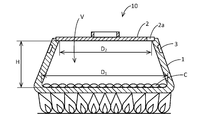
- the roasting machine of the first embodiment is a container-type roasting machine that employs a container-shaped roasting chamber having an open upper surface, and examples thereof include the forms shown in FIGS. 1 to 4.
- the shape of the bottomed container may be either circular or quadrangular at the bottom. Further, the diameter or one side (D 2 ) of the upper opening may be smaller than or equal to the diameter or one side (D 1) of the bottom surface of the container.
- the upper surface opening may be roasted in an open state, but it is preferably used in combination with a lid that closes the upper surface opening.
- the lid may be made of the same carbon material as the container, may be made of a different type of carbon material from the container, or may be made of a material other than the carbon material (for example, glass). .. In the case of a glass lid, the change in color of the roasted product in the container can be observed.
- the roaster 10 shown in FIG. 1 is composed of a combination of a bottomed container 1 serving as a storage portion for a roasted product (bean c in FIG. 1) and a lid 2 for closing the upper surface opening of the bottomed container 1. .
- the bottomed container 1 is a head-shaped conical container in which the diameter of a circle gradually decreases from the bottom surface to the top surface, and is entirely made of a carbon material.
- the recess 3 provided slightly above the outer peripheral surface of the side wall of the bottomed container 1 serves as a grip portion.
- the size of the bottom surface of the bottomed container 1 is about 80 to 260 mm in diameter D 1 so that the flame can come into contact with the entire bottom surface. These can be appropriately selected according to the size of the stove to be used.
- the size of the top surface opening depends on the size of the bottom surface, but usually, the bottom surface diameter (D 1 ): the diameter of the top surface opening (D 2 ) is about 10: 8 to 10: 5.
- the bottom surface is preferably sized to correspond to the size of the flame, and in the case of IH, the size of the coil, in relation to the fact that a group of the roasted material c is spread so as to come into contact with the bottom surface of the container. ..
- the height H is preferably about 80 to 200 mm. From the viewpoint of stability when placed on the stove, the bottom diameter (D 1 ): height (H) is preferably 1: 1 to 3: 1.
- the space V in the container becomes a closed space, and radiant heat can be effectively used.
- a part of the peripheral edge of the lid 2 used for the roaster 10 is notched, and the notched portion 2a can serve as a vent for releasing water vapor generated from the heated beans c. ..
- a convex portion may be provided on the upper edge of the bottomed container so that the vent provided by the notch portion 2a can be appropriately closed depending on the positional relationship with the upper surface portion of the bottomed container 1.
- the roaster 10 having such a configuration is mainly used as a home or personal roaster, and as shown in FIG. 1, the bottom surface of the bottomed container 1 is formed. It can be placed on a gas stove or IH stove and roasted by direct heating.
- a recess 3 serving as a grip portion is recessed in the side wall of the bottomed container 1, but a handle may be attached to the side wall instead of the recess.
- the shape, structure, and material of the handle are not particularly limited. Materials with low thermal conductivity such as carbon fiber reinforced plastic and wood are preferably used.
- a one-handed grip portion 7 When attaching the handle, it may be a one-handed grip portion that can be gripped with one hand.
- a one-handed grip portion 7 In a roaster having a bottom surface size (D 1 ) of about 60 to 150 mm, a one-handed grip portion 7 may be attached to the bottomed container 6 as in the roaster 5 shown in FIG.
- the vent 2a is formed by a notch in the lid, but in the roaster of the present invention, a hole serving as a vent is provided in any place of the lid. You may open it.
- the roasting device 20 shown in FIG. 3 has a tray-shaped bottomed container 21 and a lid in which the height H of the container constituting the roasting chamber is about 1/2 to 1/3 of the size of the bottom surface (diameter or one side). It is a combination with the body 22.
- the lid 22 is provided with a through hole that serves as a vent 22a.
- the size of the through hole is not particularly limited, but is preferably about 1/10 to 1/3 of the lid area. When small, it acts as a vent. In the case of a through hole having a diameter of 2 cm or more, it also serves as a viewing window for observing the state of beans in the container.
- a graphite lid it is convenient in that the roasting status of the object to be roasted can be confirmed without opening the lid. Further, with an opening of this degree, it is not necessary to reduce the radiant heat in the roasting chamber.
- the roaster 20 is a small to medium-sized roaster mainly used for home use or cafes, and the height (H) of the bottomed container is usually about 50 to 200 mm, and the size of the bottom surface. (Diameter or one side) D 1 is 100 to 300 mm.
- the upper opening size (diameter or one side) D 2 of the tray-shaped container 21 is increased almost equal to or slightly to the size D 1 of the bottom surface, and the height relative to the bottom surface size D 1 (H) is low , Excellent placement stability compared to pot-type roasters. Since the height of the container 21 constituting the roasting chamber is relatively low, it is possible to efficiently obtain the heating effect by radiant heat even though the size of the upper surface opening (D 2) is large.
- a roasting machine equipped with a tray-shaped roasting chamber uses a gas burner, an electric heater or an IH as a heating source when the gas stove as a heating source is large, and the heating source is attached to the bottom of the container for roasting. Suitable for vessels. If the area of the bottom surface of the container is relatively large, the amount of roasted material that can come into contact with the carbon material also increases, so the amount that can be roasted at one time increases, and it is also used as a commercial roasting machine used in private roasting cafes and the like. be able to.
- the roasted product for example, green coffee beans c
- the container type roaster is suitable for directly heating the bottom surface of the container with a gas stove, an electric heating stove, an IH stove, or the like. In any heat source, it is preferable to set the bottom surface of the roaster so that the flames evenly hit the bottom surfaces of the containers 1 and 21.
- the roasting machine may be preheated to a predetermined temperature before the roasted product is added. In the case of green coffee beans, the green coffee beans are usually put into a container preheated to about 100 to 150 ° C., and roasting is started.
- the heating by the roaster of the present invention enables heating to the inside of the beans by far infrared rays radiated from the carbon material container as well as heating by heat conduction from the container, so that the inside of the beans can be heated without burning the surface. Can be heated uniformly.
- the roasting time (heating time) is appropriately set according to the type of heating source, the degree of roasting, and the type of the product to be roasted (type of coffee beans).
- roasting may be performed while shaking the handle 7 as appropriate. If you want to roast the roasted material at a time that exceeds the amount spread on the bottom of the container with a small roasting machine, you can make the group of roasted material uniformly contact the carbon material of the container by shaking appropriately. The uniformity of roasting can be ensured.
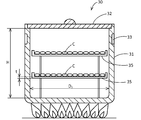
- a container having a container height H larger than the bottom area is used, and a multi-stage cover is used in the container.
- a shelf board for placing the roasted product may be set.
- the bottomed container 31 is a deep-bottomed pot having a circular or square bottom surface, and the height H is 2 to 2 of the bottom surface size (diameter D or one side L) D 1. It is three times.
- the upper surface opening of the bottomed container 31 can be closed by the lid 32.
- a recess 33 serving as a grip portion is recessed on the peripheral wall surface of the bottomed container 31.
- the shelf boards 35 having legs are laminated and set in two stages.
- the shelf board 35 is made of a carbon material.
- the carbon material constituting the shelf board 35 may be the same as or different from that of the bottomed container 31.
- the bottomed container 31 may be made of graphite
- the shelf board 35 may be made of CC composite.
- a shelf board made of a lightweight and high-strength CC composite board is preferable because it is necessary to carry out a loading / unloading operation.
- the size of the shelf board 35 is substantially equal to the size of the bottom surface of the bottomed container 31, and the thickness (t) depends on the constituent material. If it is a CC composite plate, it is about 1 to 10 mm, and if it is a graphite plate, it is about 3 to 20 mm. In FIG. 4, the number of shelves is two, but three or more may be stacked depending on the height H of the bottomed container 31 and the length of the legs of the shelves 35. Since the roasted product (c) is spread on each shelf board 35, the amount of beans to be roasted is doubled or tripled at a time, depending on the number of stages of the shelf board 35, as compared with the case where it is spread only on the bottom surface. Can be roasted.
- the entire roasting chamber (bottomed container, lid, shelf board) is made of carbon material, even if it is placed on any shelf board, it will be heated by radiant heat even though it is heated by direct fire.
- the inside of the roasted product can be heated.
- none of the shelf boards 35 is in direct contact with the bottom surface of the bottomed container 31 and the beans are located in the space of the roasting chamber and are mainly heated by radiant heat, the shelf boards on which the beans are placed are placed.
- the heating unevenness due to the difference in the steps (first step, second step, etc.) is small.
- the roaster 30 using the shelf board is effective when it is desired to increase the amount of coffee beans that can be roasted at one time with respect to the size of the gas stove of the heating source.
- the shelf board 35 may be set after preheating the roasting machine.
- the roasting machine of the second embodiment is a case where a stirring member is attached to the container type roasting chamber.
- a stirring blade 42 is attached to the bottom surface of a bottomed container 41 made of a carbon material constituting the roasting chamber.
- the stirring blade 42 is rotated by being driven by a motor.
- a heat source (heater, IH coil, etc.) for heating the drive motor and the container 41 serving as the roasting chamber is housed in the casing 43.
- the inner wall surface of the container 41 may be coated with a glassy carbon coating, a pyrolytic carbon coating, a ceramic coating, a glass coating, a polysiloxane-based heat-resistant coating, or the like, and is preferably a polysiloxane-based heat-resistant coating. Since the inner wall surface of the container 41 is subjected to frictional sliding due to the rotation of beans during roasting, there is an effect of preventing wear of the carbon material.
- the upper surface opening of the container 41 may be combined with a lid as in the roasting machines shown in FIGS. 1 and 3, or roasting without a lid is possible, but preferably with a lid. Used in combination.
- the lid may be made of the same type of carbon material as the container, or a glass lid may be used. Further, the lid may be appropriately provided with notches, openings, etc. that serve as ventilation holes.
- Reference numeral 44 denotes an operation panel, which is equipped with timers for setting the roasting time, and operation knobs 44a and 44b of the controller for setting the roasting temperature, stirring speed, and the like.
- the type of operation is appropriately set according to the heat source used and the built-in control program.
- the amount of roasted material to be roasted at one time is an amount that can be agitated by the stirring blades and is spread on the bottom surface. More than in the case of the first embodiment.
- the operation knobs 44a and 44b are set so as to finish the roasting degree to the desired degree according to the type of operation of the operation panel 44.
- the container 41 is heated by the heat source, the drive motor is rotated, and the roasted product is heated while being stirred by the stirring blades 42. If necessary, the roasted product may be added after preheating to a predetermined temperature.
- the roasting machine of the third embodiment is a direct-fire heating type roasting machine in which the roasting chamber is composed of a rotating drum. That is, one batch, which is generally distributed as a roasting machine for direct fire, is a drum-shaped roasting machine for personal and household roasting machines of about 100 to 500 g, and a roasting machine for cafes and private roasters of about 300 g to 5 kg.
- the roasting chamber is characterized by using a drum made of a carbon material with a bulk density of 1.2 to 2.2 g / cm 3 and a thermal conductivity of 60 to 200 W / m ⁇ K at 25 ° C. is there.
- the rotating drum that serves as the roasting chamber is a cylinder or square column, hexagonal column, or octagonal column made of carbon material, that is, a cylinder having a circular or polygonal cross section perpendicular to the longitudinal direction.
- the size of the drum is appropriately selected according to the target batch amount within the range of one side (or diameter) of 100 to 300 mm and the longitudinal length of about 150 to 350 mm.
- the thickness of the drum can be appropriately selected in the range of about 2 to 5 mm. This is because, while having a necessary and sufficient strength with such a thickness, if it becomes too thick, it takes time to heat it to a predetermined temperature.
- the drum-shaped roasting chamber is installed so that the longitudinal direction of the cylindrical body or polygonal column is horizontal, and is heated while rotating with the longitudinal direction as the rotation axis.
- the inner and outer wall surfaces of the drum may be coated with a ceramic coating, a glass coating, a polysiloxane-based heat-resistant coating, or the like. Since the inner wall surface of the drum is subjected to frictional sliding due to the stirring of beans during roasting, it has an effect of preventing wear of the carbon material.
- Both side ends of the cylinder constituting the drum may be closed by a lid, or a bottomed cylinder whose one end is closed by a removable or openable lid may be used.
- the lid may be made of either a carbon material or a metal.
- One end of the drum is preferably made of a metal material because a drive motor for rotation and a rotation transmission mechanism (gear, pulley, etc.) from the motor are attached. Further, when the lid body is removable or can be opened and closed, the drum end closed by the lid body may be used as a loading / unloading port for the roasted product.
- the peripheral surface of the drum may be provided with ventilation holes, or may be provided with inlet / outlet for roasted material, if necessary.
- inlet / outlet When the inlet / outlet is opened on the peripheral surface, it is preferable that the inlet / outlet can be opened and closed with a transparent cover such as glass. This makes it possible to observe the state of the object to be roasted in the drum during roasting.
- the roasting machine of the third embodiment preferably includes heating means, and generally, the roasting chamber and the rotation mechanism of the roasting chamber drum are provided in the housing together with the heating means according to the size of the roasting chamber. It is stored.
- the heating means an infrared heater, a heating wire heater, or the like can be used in addition to a gas burner capable of directly heating by a flame.
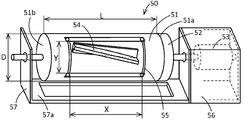
- FIG. 6 shows an embodiment of a direct-fire type roasting machine provided with a bottomed cylindrical roasting chamber.
- one side end 51b of the cylindrical drum 51 constituting the roasting chamber is the bottom surface of the cylinder, and a drive motor for rotating the drum is attached to the open end 51a. It is closed by the detachable lid 52.
- An inlet / outlet 55 for roasted material is provided on the peripheral surface of the drum 51.
- the loading / unloading port 55 is normally closed by a glass window so that the inside of the drum 51 can be observed.
- the rotating shaft of the motor 53 may penetrate the lid 52 and reach the bottom surface 51b on the opposite side in the drum 51, or the end of the rotating shaft is only integrally attached to the lid 52. But it may be.
- a stirring member 54 having an L-shaped cross section, which serves as a stirring means, is erected so as to be oblique to the longitudinal direction of the drum 51.
- the stirring member 54 can be stirred by acting as an obstacle plate for the roasted object that rotates following the drum 51.
- the casing 56 that supports the drive motor 53 is integrally formed with the support 57 that supports the drum 51.
- the bottom surface of the support 57 is a frame 57a to be placed on a stove or the like, and when the frame 57a is set on the stove, the peripheral surface of the drum 51 can be heated.
- the support 57 only supports both ends of the drum 51, but a cover having a U-shaped cross section covering the upper half of the drum 51 may be integrally attached.
- a roasting machine provided with such a rotating drum type roasting chamber 51 can be directly heated by a direct fire while rotating the drum, like a conventional direct-fired roasting machine using a metal drum. it can.
- the frame 57a is set on a burner (preferably a U-shaped or I-shaped burner) capable of heating according to the length of the drum in the longitudinal direction or a stove provided with an electric heater.
- the drum 51 can be heated while rotating. If necessary, after preheating the drum 51, the rotation of the drum 51 is stopped, the roasted product is charged from the charging port 55, the charging port 55 is closed again, and the drum 51 is rotated and heated. Can be resumed.
- roasting machine 50 is not provided with heating means
- an electric heater or a tabletop stove may be integrally combined with the support 57 as the roasting machine of the third embodiment.
- each member may be supported by using a housing that houses all of the drum 51, the drive motor, and the heating means.
- a roasting chamber temperature monitoring means for example, an infrared sensor or a thermostat
- a control unit for controlling the thermal power and time of the heating means may be provided.
- one plate material having an L-shaped cross section is attached as the stirring member, but the roasting machine of the present embodiment is not limited to this.
- a plurality of stirring members may be attached, or spiral stirring members may be attached so as to draw a spiral from one side end to the other side end of the inner wall surface of the drum 51.
- the roasting state is observed by observing the appearance of beans through the inlet / outlet 55, and the heating power is adjusted at the timing of goby. For this reason, the variation between roasting batches tends to increase.
- the far-infrared effect of the roasting chamber made of carbon material causes the inside of the beans to be heated from the early stage of heating. Since it can be achieved, it is possible to achieve the desired flavorful roasting even if the heating power is adjusted by the timing of the bean-colored appearance and the roasting sound, and thus it is possible to prevent the roasting level from fluctuating between batches. Therefore, even a direct-fired roasting machine that automatically controls roasting can achieve a satisfactory roasting level.
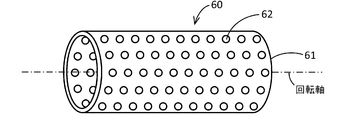
- the peripheral surface of the drum 51 was not perforated with ventilation holes, but as in the roasting chamber composed of the roasting chamber 60 shown in FIG. 7 and the roasting chamber 60'shown in FIG. A through hole serving as a ventilation hole may be provided on the peripheral wall surface of the body. Vents 62 are drilled in the peripheral wall surface of the cylinder 61 constituting the roasting chamber 60.
- the roasting chamber 60' is an octagonal pillar roasting chamber composed of a combination of eight CC composite plates 63. In the carbon fiber woven fabric that is the base fabric of the CC composite plate 63, the gap 65 between the fibers 64a and 64a serves as a vent.
- the fourth embodiment is a mode in which a rotating drum made of a carbon material is used as a roasting chamber of a hot air heating type or semi-hot air heating type commercial roasting machine.
- a hot air generating unit that generates hot air for roasting the object to be roasted
- a drum-shaped roasting chamber through which hot air from the hot air generating unit passes
- a rotating mechanism for rotating the drum It is a roasting machine equipped with. It can be used as a roasting room of a roasting machine capable of handling a batch of roasted substances of 1 kg, 5 kg, 10 kg, 30 kg, 50 kg, 60 kg, and a maximum of 100 kg at a time.
- the drum size is appropriately selected according to the target batch amount within the range of one side (or diameter) of 100 to 500 mm and the longitudinal length of about 150 to 500 mm.
- the thickness of the drum can be appropriately selected in the range of about 3 to 10 mm, preferably about 3 to 7 mm, and more preferably about 3 to 5 mm. This is because it is possible to secure the necessary and sufficient strength with such a thickness, but if it becomes too thick, it takes time to heat it to a predetermined temperature.
- the rotating drums that make up the roasting chamber are cylinders or quadrangular prisms, hexagonal prisms, and octagonal prisms made of carbon material, which are installed so that the longitudinal direction is horizontal and rotates around the longitudinal direction as the rotation axis. It is heated while being heated. Both ends of the cylinder constituting the drum may be open, and one end (intake side) is closed by a bottom surface or an openable / closable lid having a plurality of through holes through which hot air can pass. You may. In the case of a general commercial roasting machine, the end face on the exhaust side of hot air is an open end because it is connected to the inlet of the roasted product, the exhaust flow path of hot air, and the chute for discharging the roasted product.
- the open end is incorporated into a casing provided with an input port for charging the roasted material and an exhaust port for discharging the roasted material from the roasting chamber. It is possible to communicate only with the exhaust channel during roasting, and to communicate with the exhaust port after roasting.
- a rotating shaft that rotates the drum is inserted into the drum, and a rotation transmission mechanism (for example, a pulley) from a drive motor for rotating the drum is inserted into the bottom surface or the lid of the cylinder forming the end face on the intake side. , Gear, etc.) are connected.
- a rotation transmission mechanism for example, a pulley
- a stirring member for stirring the roasted product is attached to the inner wall surface of the drum.
- a baffle plate erected on the inner wall surface of the drum preferably a graphite or CC composite plate is used.
- Such a plate-like body is erected so that the roasted product is pushed out to the outlet side by rotation, slightly diagonally from the longitudinal direction, or spirally drawn from one side end to the other side end. It is preferable to do so.
- an impeller serving as a stirring blade may be attached to a rotating shaft passing through the inside of the drum.
- the inner wall surface of the drum may or may not be coated with a polysiloxane-based heat-resistant coating, a ceramic coating, a glass coating, a glassy carbon coating, a pyrolytic carbon coating, or the like.
- a polysiloxane-based heat-resistant coating is preferable from the viewpoint of coating workability and wear resistance.
- the coating thickness is preferably 10 ⁇ m to 100 ⁇ m, preferably 20 to 50 ⁇ m, and more preferably about 20 to 30 ⁇ m.
- FIG. 9 is a diagram showing a configuration of an embodiment of a drum for a roasting chamber according to a fourth embodiment.
- the roasting chamber drum 70 shown in FIG. 9 is a carbon material having a bulk density of 1.2 to 2.2 g / cm 3 and a thermal conductivity of 60 to 200 W / m ⁇ K at 25 ° C., preferably graphite.
- the bottom surface 72 is composed of a bottomed cylindrical body 71 made of graphite, and a through hole 72a through which a rotation shaft can be inserted is provided in the center, and a large number of through holes 72b through which hot air can pass are substantially evenly perforated over the entire surface. ..
- the end face 73 on the opposite side is open, and the rotary shaft bearing 74 is attached slightly inside from the end face 73.
- an L-shaped body 75 extending in the longitudinal direction is erected as a stirring member.
- the three L-shaped bodies 75 are attached diagonally to the longitudinal direction of the tubular body 71 at equal intervals on the inner wall surface.
- FIG. 10 shows an example of the configuration of a hot air roasting machine to which the roasting chamber drum 70 is applied.
- a combustion chamber 81 serving as a hot air generating portion is arranged below the drum 70.
- the combustion gas (hot air) generated in the combustion chamber 81 is sent by the blower 82 to the bottom surface (intake side) 72 of the drum 70 for the roasting chamber through the flow path 77 for hot air.
- the drum 70 is rotated by a rotary drive motor (not shown) directly or indirectly connected to one side end of a rotary shaft 76 that is inserted through the drum 70.
- the other end 73 of the drum 70 can be connected to the front door 80a of the housing 80.
- the front door 80a is provided with an input port for charging the roasted product c and a discharge port for discharging the roasted product that has been roasted.
- the inlet is connected to a flow path 85 connected to the hopper 83 and the exhaust duct 84, and the flow path 85 can be selectively switched to the hopper 83 or the exhaust duct 84 by the switching lever 86. ing.
- the discharge port is provided below the front door 80a, and a chute 87 is attached via a shutter (not shown) that can be opened and closed. By opening the shutter after roasting, the roasted product can be discharged from the chute 87 to the cooling tank 88 installed in front of the housing 80.
- the roasted product c'discharged to the cooling tank 88 is cooled by a cooling fan (not shown).
- the temperature of the roasting chamber drum 70 or hot air is monitored by a temperature sensor (not shown) installed near
- the hot air type roasting machine provided with the drum for the roasting room according to the present invention can be used in the same manner as the conventional hot air type commercial roasting machine. That is, the heat source is switched and the drive motor of the drum 70 is switched on, the drum 70 is preheated, and when the predetermined temperature is reached, the switching lever 86 is switched to the hopper side 83, and the coffee beans to be roasted from the hopper 83 are turned on. Add beans c. After charging, the switching lever 86 may be switched to the exhaust duct 84 side again to start roasting.
- the feature of the roasting machine of this embodiment is that the roasting drum is made of a carbon material, and the structure of the roasting machine can be variously modified according to the heat source, size, installation location, etc. Is.
- a sample outlet for appropriately taking out and checking the roasted product may be attached to the front door.
- the exhaust duct is one system, but it may be two systems provided with the exhaust duct for exhausting the air from the cooling tank.
- beans to be roasted are roasted while in contact with a roasting chamber made of carbon material, and therefore directly receive far infrared rays emitted from a heated drum. This makes it possible to reduce the effects of heating variations due to the ambient temperature and humidity of the device. Therefore, while checking the roasted beans frequently after goby, even in the case of automatic control in which the timing of taking out the roasted beans does not depend on the roaster, it is possible to obtain roasted beans with less uneven heating and variation between batches. It is possible.
- the roasting machine of the fifth embodiment utilizes the electrical resistance characteristics of the carbon material (preferably graphite), which is a constituent material of the roasting chamber, as a heating source for the rotating drum constituting the roasting chamber, and is the roasting chamber itself. It utilizes the heat generated by. It can be used together with the direct fire and hot air heating type, or in place of the direct fire and hot air heating type.
- the carbon material preferably graphite
- the drum 90 may be induced and heated by winding an electric coil 91 around the peripheral surface of a drum 90 made of a carbon material and passing an electric current through the coil 91.
- the current control enables heating control of the drum 90 itself.
- the drum 90 that generates heat by induction heating radiates far infrared rays. Therefore, since the roasted product housed in the drum 90 is heated by both heat conduction and radiant heat by electromagnetic waves including far infrared rays, it is possible to heat up to the core portion while suppressing overheating of the surface. ..
- the power source of the drum 90 itself is electric, it can not only meet the demands of green chemistry compared to roasting machines that use the thermal energy of combustion gas, but also connect to the gas pipeline. There are no equipment restrictions such as, and even if it is large, the degree of freedom in installing the equipment is increased.
- the induction heating method that heats the drum itself is different from a roasting machine that uses a halogen heater or a heating wire heater as a heating element, because the object to be roasted is heated in contact with an infrared heating element, so electricity is used as a heat source. Compared with other methods that utilize, the increase in energy cost can be suppressed.
- Another example of the fifth embodiment includes a method of using a carbon material as an infrared heating element (graphite heater).
- a carbon material When a carbon material is energized, it generates heat due to electrical resistance and radiates far infrared rays, so it can be used in place of hot air heating as well as hot air heating.
- the roasting chamber When the roasting chamber is a stationary type, the roasting chamber itself can be energized to generate heat.
- the roasting chamber is a rotating drum, for example, as shown in FIG. 12, a tubular far-infrared radiator 97 made of a carbon material is inserted through a rotating shaft 96 through the drum 95 via a heat insulating material 98.
- An example of the externally fitted configuration An example of the externally fitted configuration.
- the tubular far-infrared ray radiator 97 When the tubular far-infrared ray radiator 97 is energized, the tubular far-infrared ray radiator 97 generates heat and emits far-infrared rays.
- the far-infrared rays radiated from the tubular far-infrared ray radiator 97 and the far-infrared rays radiated by heating the drum 95 are absorbed and radiated, and the roasted product can be heated.
- the graphite heater tubular far-infrared radiator 97
- the roasted product comes into contact with both the heated drum 95 and the graphite heater 97, so that heat conduction Efficient roasting with far infrared rays can be expected.
- the above roasting machine is effective for making the roasting machine compact because it saves space for a heating source such as a stove or an electric heater.
- the roasting machine of the sixth embodiment is a roasting machine that roasts the roasted product while stirring the roasted product by an air flow in a fixed drum, and the amount of the roasted product is 500 g or less, preferably 300 g or less. Can be used as a roasting machine.
- the drum used as a roasting chamber has a drum shape with a circular or polygonal cross section perpendicular to the longitudinal direction, and one end of the drum has a bottom surface in which a plurality of through holes through which air flow can pass are perforated.
- a cylinder made of carbon material which is closed by a lid that can be opened and closed, is used.
- the drum, which is the roasting chamber, is fixed upright so that the bottom surface or the lid is on the lower side, and does not rotate. Below the drum, an air flow generating means for blowing air into the roasting chamber is installed.
- a hot air generator may be used as the air flow generating means, or a blower that blows air at room temperature may be used.
- the hot air acts as a stirring means for stirring the roasted material and as a heating medium for heating the roasted material in the roasting chamber.
- the drum becomes a carbon heater and the temperature rises by inducing heating the drum or by energizing the drum.
- the object to be roasted in the drum is agitated by the air flow sent from the blower into the roasting chamber, and is heated by the contact with the heated drum or the far infrared rays from the drum.
- a sirocco fan, an axial fan, or the like can be used as the blower.
- FIG. 13 is a schematic view showing the configuration around the roasting chamber of the roasting machine of the sixth embodiment.
- the hot air generator 103 is arranged below the bottomed cylinder (drum) 101 serving as the roasting chamber, and the hot air (arrow) from the hot air generator 103 is carbon. Air is blown into the drum 101 through a through hole drilled in the bottom surface 102 of the material drum 101. The roasted product c in the drum 101 is stirred and heated by hot air.
- the roasting chamber is composed of a bottomed cylinder, but the bottom may be closed with a lid made of a removable perforated plate instead of the bottom.
- the upper part of the drum communicates with a casing provided with an inlet for the product to be roasted.
- a drum made of carbon material can be applied instead of the roasting drum provided in the known fluidized bed type roasting machine. ..
- FIG. 13B shows an example of a fluidized bed type roasting machine in which the roasting chamber itself acts as a heating element.
- a blower 113 is disposed below the carbon material drum 110, which is perforated with a plurality of through holes 112 through which air flow can pass and is closed by a bottom surface or a lid that can be opened and closed or is detachable.
- the drum 110 itself may be used as a graphite heater, or as shown in FIG. 11, an induction heating coil is arranged on the peripheral surface of the cylinder. By doing so, the drum 110 may be induced and heated.
- the spare graphite heater 111 in the center of the drum 110.
- the upper part of the drum preferably communicates with a casing provided with an inlet for the product to be roasted.
- the roasting chamber space becomes an effective heating space by far infrared rays radiated from both the drum 110 and the spare graphite heater 111 arranged at the center. Therefore, the roasted product c agitated by the air flow from the blower 113 is efficiently heated and roasted by heat conduction due to contact with the inner wall surface of the drum 110 and the preliminary graphite heater 111 in addition to far infrared rays. ..
- a polysiloxane-based heat-resistant coating using Thermozine CT type paint manufactured by Tokyo Thermochemical Industry Co., Ltd.
- the upper surface opening of the container was used in a state of being closed with a lid having a notch (53 mm ⁇ 7 mm), in combination with a lid having a hole of ⁇ 40 mm or ⁇ 80 mm, or in a state without a lid.
- stirring blades (blade size of graphite L-shaped member: length 100 mm, height 20 mm, thickness 5 mm) are attached using carbon cement at an angle of about 20 ° with respect to the longitudinal direction.
- Two types were prepared: one with a polysiloxane-based heat-resistant coat (using Thermodine CT type paint manufactured by Tokyo Thermochemical Industry Co., Ltd.) on the inner wall surface of the cylinder (average film thickness 20 ⁇ m) and one without.
- an L-shaped member (height 20 mm, length 185 mm) that serves as a stirring means so that the roasted product can be pushed out to the discharge port side (opposite the hot air outlet side) after roasting.
- they are attached to three places on the inner wall surface of the drum so as to be oblique to the rotation axis direction of the peripheral surface.
- Steel drum for hot air heating (1 kg) This is a steel drum used as a roasting chamber for a commercial hot air heating type roasting machine of 1 kg per batch. Except for the thickness, it has almost the same shape and size as the hot air heating drum used in the examples.
- roasted food Brazilian raw beans and Colombian raw beans were used. Colombian green beans are coffee beans that are difficult to roast evenly because the beans are hard and the water does not evaporate easily, they are large and thick, and the water content varies. .. On the other hand, depending on the quality of roasting, the flavor may be heavy, and it is easy to make a difference depending on the quality of roasting.
- Heating method a direct flame, induction heating, or hot air method was selected depending on the type of roasting machine.
- a household gas stove Iwatani tabletop type: flame portion diameter 88 mm
- a gas stove Teanico Co., Ltd .: flame portion diameter 100 mm
- a household IH cooker AEG 3-port cooktop IH cooker (AH1735CA)
- Hot air heating is a method in which hot air heated by a heat source (gas) attached to a commercial roasting machine is heated by passing through the inside of a drum.
- the roasting machine used is equipped with a spoon on the front door that allows the beans in the drum to be taken out during roasting, and the beans are taken out sequentially during roasting and exhausted while checking the aroma and color.
- the duct and drum temperatures can be controlled.
- roasting conditions are based on the roasting sound, the appearance of the beans, the aroma of the roasted beans, and the monitor temperature of the roasting room by a coffee bean roasting expert (20 years of roasting experience). Individually adjusted manually to achieve the desired degree of roasting.
- ⁇ Evaluation method 1. Appearance of roasted beans The variation in bean color of a group of roasted beans was visually observed. The uniformity of the bean color of the roasted beans group affects the commercial value of the roasted beans.
- Coffee flavor The roasted beans about 16 hours after roasting were roughly ground using a commercially available manual coffee mill. 12 g of the obtained coffee powder was put into a Shigaraki ware coffee pot, and 140 g of boiling water was poured into the pot little by little over about 30 seconds after the temperature was adjusted to about 90 ° C. The inner lid of the Shigaraki coffee pot was put on and held as it was for 3 minutes. After that, I set a ceramic filter in the Shigaraki coffee pot and poured coffee into the coffee cup.
- Example 1 A pot-shaped container (the inner and outer wall surfaces of the container were coated with a polysiloxane-based heat-resistant paint) was used in combination with a lid (with a notch). After preheating the container to 100 ° C, 50 g of green coffee beans (Brazil) is placed on the bottom surface of the container so as not to overlap as shown in FIG. 1, and the upper opening is covered with a household gas stove. It was placed on (flame diameter: 88 mm) and heated slightly stronger than medium heat. After 5 minutes of heating, the first goby started.
- Brazil green coffee beans
- the coffee beans were taken out of the container, transferred to a metal colander, fanned with a fan, and cooled to room temperature.
- the weight of the roasted coffee beans was measured and found to be 42 g.
- the amount of water evaporated by roasting is 16% by mass with respect to the initial weight, which corresponds to medium roasting.
- Brazilian coffee beans are said to be delicious in medium roast because of their balance with acidity.
- the obtained roasted beans were evaluated for their appearance, flavor, and storage stability based on the above evaluation method. The results are also shown in Table 1.
- Examples 2-5 Using the roasting machines shown in Table 1, the Brazilian beans were roasted in a medium roast by heating with direct heat (Examples 2 and 3) or IH (Examples 4 and 5) with the lids on. ..
- the amount of green coffee beans put into the roasting machine was 20 g in the case of a small tray and 60 g in the case of a large tray.
- Example 1 The roasting time required to finish the medium roasting as in Example 1 is as shown in Table 1.
- the obtained roasted beans were evaluated for appearance, flavor, and storage stability in the same manner as in Example 1.
- the results are also shown in Table 1.
- the amount of water evaporated with respect to the roasting time and the initial weight was 10.5 minutes and 14% by mass in Example 4, and 8 minutes and 18% in Example 5. It was confirmed that even if an IH stove was used, it could be roasted in the same amount of time as a gas stove.
- Comparative Example 1 Roasting was used as the roasting machine. After heating (preheating) this roasting for 7 minutes, 30 g of green coffee beans (Brazil) was added, the heating power was set to medium heat, and the roasting was carried out by holding the handle of the roasting with a hand wearing a work gloves and shaking it from side to side. The generation of steam was confirmed 1.5 minutes after the roast was held over the fire. The first goby started 5 minutes after the start of heating. When the heat was reduced after reaching the first goby, the amount of smoke gradually increased, and then about 1 minute later, the second goby started. At this point, the roast was removed from the heat (roasting time 7.5 minutes).
- the roasted beans were discharged from the discharge hole of the roasting handle, transferred to a metal colander in the same manner as in Example 1, and the roasted beans were cooled to room temperature with a fan. A slight browning was observed on the surface of the roasted beans. With respect to the obtained roasted beans, the appearance, flavor, and flavor preservation were evaluated in the same manner as in Example 1. The results are also shown in Table 1.
- Reference example 1 Commercially available coffee beans (Brazil: about 3 months have passed from the date of manufacture, medium roasting, judging from the expiration date (6 months from roasting) stated on the container).
- the commercially available beans are automatically roasted in a large (30 to 60 kg) commercial roasting machine (steel drum, hot air type) according to a predetermined program of heating power, temperature control, and roasting time. It is a thing.
- the flavor and storage stability of the commercially available beans used as Reference Example 1 were set to medium (3).
- Reference example 2 Using a commercial 5 kg type hot air roasting machine for green coffee beans (Brazil), a skilled person takes out the beans being roasted and manually adjusts the amount of hot air while directly checking the bean color and aroma. I adjusted it and finished it in a medium roast. The roasting time was 22 minutes.
- Reference Example 2 is manually roasted by an expert, and its flavor and storage stability are superior to those of a general-purpose commercial product (Reference Example 1).
- Examples 1-5 roasted in an artificial graphite container are all superior in flavor and storage stability as compared with Reference Example 1, and when a pot-shaped container is used (Example 1) and a small tray is used (Example 1).
- Example 2) the flavor and storage stability were comparable to those of Reference Example 2.
- Example 3 the flavor and storage stability tended to be inferior to those in Examples 1, 2, 4, and 5, but this was because the entire bottom surface of the tray could be directly heated by a flame in the medium-sized tray (Example 3). It is considered that the color uniformity of the roasted beans was slightly inferior because of the absence, and as a result, the flavor was deteriorated.
- roasting using roasting requires manual shaking, and although the heat was adjusted while observing the bean color, the flavor of the obtained roasted beans was better than that of general-purpose commercial products. Was also inferior. Furthermore, it is probable that the water inside the beans could not be sufficiently removed, but the flavor of the crushed coffee powder deteriorated, which was a level that felt unpleasant.
- Example 11-15 As shown in Table 2, in the pot-shaped container, a roaster in which the size of the vent was changed depending on the type of lid or the presence or absence of the lid was used. In addition, Colombian beans were used as green coffee beans and roasted on an open flame (flame diameter: 100 mm) so as to be finished in a medium roast (water evaporation amount is 14 to 16% by weight). In roasting, as in Example 1, the container was preheated to 100 ° C., and then green coffee beans were spread on the bottom surface of the container. The roasting time of each example is as shown in Table 2. Table 2 also shows the results of evaluating the bean color, flavor, and storage stability.
- Comparative Example 11 As a roasting machine, using the same roasting as in Comparative Example 1, Colombian beans were roasted over direct heat so as to be finished in medium roasting (moisture evaporation amount was 14 to 16% by weight). The roasting time after preheating for 7 minutes was 7.5 minutes. Table 2 also shows the results of evaluating the bean color, flavor, and storage stability of the obtained roasted beans.
- Reference example 11 Similar to Reference Example 1, a large-scale commercial roasting machine (steel drum, hot air type) is used for general-purpose commercial roasting that is automatically roasted according to a predetermined program of heating power, temperature control, and roasting time.
- the product is Colombian beans (medium roasted), and the flavor and storage stability are set to medium (3).
- Reference example 12 Commercially available Colombian beans (medium roasted) roasted on demand.
- a roasting machine (Daichi Denshi Co., Ltd.) was used. In this roasting machine, heated air is blown from below a vertically fixed glass drum to roast green coffee beans while stirring with an air stream. Since a glass drum is used, it is possible to observe the state of the beans during roasting. Roasted beans can be obtained automatically by selecting a control program set according to the degree of roasting of a small amount of beans.
- Reference example 13 Using the commercial 5 kg type hot air roasting machine used in Reference Example 2, Colombian beans were finished into medium roast by manual adjustment. The roasting time was 22.5 minutes.
- Examples 11-15 When a graphite roasting chamber is used (Examples 11-15), the flavor and storage stability are superior to those of general-purpose commercial products (Reference Example 11), and the top opening is not closed by the lid (Examples). Except for 13), it was comparable to the case where a skilled worker roasted it for business use (Reference Example 13). From the comparison of Examples 14 and 15, it was confirmed that the presence or absence of the coating on the container did not affect the flavor and storage stability.
- Comparative Example 11 when roasting was used (Comparative Example 11), not only the troublesomeness of manual shaking and heat adjustment, but also the flavor of roasted beans tended to be inferior to that of general-purpose commercial products. Further, in Comparative Example 11, since the upper surface opening was not closed by the lid, a large amount of smoke was generated during roasting, and the amount of smoke was larger than that of Example 13.
- Reference example 12 is a case where the roasting chamber is made of glass. When the roasting operations such as heating power adjustment and stirring were automated, the bean-colored appearance was uniform, but the flavor was inferior to that of the general-purpose commercial product (Reference Example 11) using a steel drum. It is considered that such a difference in flavor is due to the constituent materials of the roasting chamber.
- the adjustment of the thermal power was performed based on the observation of the bean color and the goby sound through the inlet and outlet.
- the roasting time was 7 minutes, and the amount of water evaporation (ratio to the initial weight) was 16% by mass.
- Table 3 shows the results of evaluating the bean color, flavor, and flavor preservation of the obtained roasted beans.
- Reference Example 11 general-purpose commercial Colombian beans by all-automated roasting
- Comparative Example 22 Roasting was carried out using a commercial hot air roasting machine having a configuration as shown in FIG. The rotation of the drum was about 60 rpm. After heating the drum to 150 ° C. (12 minutes), 1 kg of green coffee beans was added from the hopper to start roasting. During the roasting, the beans were taken out from time to time, and the heat was manually adjusted while checking the bean color and aroma one after another to finish the roasting. The roasting time was 22 minutes, and the weight of the roasted beans was 830 g (water loss 17% by mass). Table 3 also shows the results of bean color, flavor, and storage stability of the roasted beans.
- Examples 21, 22 In the direct-fired drum type roasting machine used in Comparative Example 21, the drum was replaced with a small graphite drum (with coating in Example 21 and without coating in Example 22) for roasting. After preheating to 150 ° C., 150 g of raw Colombian beans were added from the inlet, the inlet was closed, and then roasted in the same manner as in Comparative Example 21. While checking the temperature with a thermocouple, the temperature was maintained at about 210 ° C. with a thermal power adjusting cock of propane gas, and when the second goby started, heating was stopped and the roast was finished. The amount of water evaporation (ratio to the initial weight) was 17% by mass.
- Example 23 In the commercial 1 kg hot air roasting machine used in Comparative Example 22, the drum was replaced with a graphite 1 kg drum and roasted in the same manner as in Comparative Example 22. The time required to reach the preheating temperature of 150 ° C. was 11 minutes. Table 3 also shows the results of bean color, flavor, and storage stability of roasted beans.
- Example 21-23 In the roasting machine (Example 21-23) in which the roasting chamber is composed of graphite drums, commercial roasting equipped with a 1 kg drum (steel) for both direct flame type and hot air type. Achieves the same excellent flavor and storage stability as when roasting by adjusting the heat power while the expert takes out the beans appropriately during roasting and checks them including the aroma (Comparative Example 22). We were able to.
- the direct-fired roasting machine (Comparative Example 21), which uses a drum made of a multi-perforated stainless steel body as the roasting chamber, was able to roast the beans so that the color of the beans was almost uniform.
- Examples 31, 32 are cases where the Colombian beans are roasted using the graphite drums corresponding to Examples 21 and 23, respectively, and the Colombian beans are deep roasted (the moisture reduction rate of Example 31 is 23% by mass and Example 32). The water content reduction rate is 26% by mass).
- Each roasting time is as shown in Table 4.
- the evaluation results of roasted beans are also shown in Table 4.
- Comparative Example 31 This is a case where Colombian beans are deep roasted using a commercial hot air heating roasting machine for 1 kg used in Comparative Example 22 (moisture reduction rate: 26% by mass). The evaluation results of roasted beans are shown in Table 4.
- Reference example 31 Commercially available beans roasted on demand (direct-fired automatic roasting using a small fixed glass drum) used in Reference Example 12. Roasted beans within 24 hours after roasting were obtained, and the flavor and storage stability were set to medium (3).
- both the direct-fire roasting machine and the hot-air roasting machine are superior in flavor and storage stability to the on-demand commercial product Reference Example 31. It was. It is probable that the excellent flavor was achieved even in the direct-fired type, where it is difficult to fine-tune the heating power, because not only the heat energy from the direct-fired fire but also the far-infrared rays radiated from graphite could heat the inside of the beans.
- Example 32 The deep roasted Colombian beans are rich, as used for espresso, and the flavor of roasted beans manually adjusted by experts is strong, so the flavor evaluation was evaluated as (5+). Even when the hot-air graphite drum was used (Example 32), excellent flavor and storage stability comparable to those of Comparative Example 31 could be achieved. Further, in Example 32, it was confirmed that the amount of smoke generated during roasting tended to be smaller than that in Comparative Example 31. Since the surface of graphite has porosity, a part of tar and oil exuded on the surface of roasted beans may have been adsorbed based on the pore structure of graphite. Exhaust gas with less tar and oil content reduces the frequency of cleaning the exhaust duct and the labor required for cleaning.
- the taste recognition device TS-5000Z Intelligent Sensor Co., Ltd.
- the first taste bitter taste, astringent taste, umami, salty taste
- the aftertaste bitter taste, astringent taste, umami richness
- the taste recognition device used is a device that quantifies the strength of individual taste components by increasing or decreasing the membrane potential of six types of sensors (salt, umami, acidity, bitterness, astringency, and sweetness) composed of artificial lipid membranes. Is.
- the first taste is the taste that is felt the moment it is put in the mouth, and the "aftertaste” is the taste that remains even after swallowing the ingredients.
- the digitization performed by the taste recognition device means that the taste item is expressed as a numerical value that can be expressed by multiplying the taste sensor output by an appropriate coefficient.
- the obtained information (taste item) is calculated based on Weber's law and the basic response characteristics of the sensor, and is measured with a 20% concentration difference, which is said to be identifiable by the general public, as one unit.
- Reference Example 11 (general-purpose commercial product) is used as the reference solution, the potential of the reference solution is set to zero, the potential difference from the sample solution is used as the first measure, then the sensor is lightly washed, and the reference solution is measured again. The potential difference at that time was measured as the aftertaste.
- FIGS. 15 and 16 A list of measurement results is shown in FIGS. 15 and 16.
- the vertical axis is the taste item value.
- the value of Reference Example 11 corresponds to 0. It can be judged that the closer to the case where a skilled person roasts by manual adjustment using a commercial roasting machine (Reference Example 13), the better the flavor.
- Examples 21-23 showed values close to those of Reference Example 13, whereas Comparative Example 21 and Reference Example 12 Had different tendencies (the taste item values were opposite or the value difference was large).
- the salty taste, the bitter taste, and the umami have a value difference of 1 or more, which is a recognizable level difference. This tendency was consistent with the sensory evaluation results by the panelists.
- the aftertaste particularly the astringency, the value was ⁇ (weak astringency) in Examples 21-23, whereas both Reference Examples 12 and 13 were positive (astringency).
- roasting using a graphite drum can realize roasting with excellent flavor preservation to the same extent as when a skilled person roasts manually using a commercial hot air roasting machine. , It was confirmed by the objective evaluation by the taste recognition device.
- Example 23 Even in the case of direct-fire heating (Examples 21 and 22), there was no significant difference from Example 23 and Reference Example 13 in which an expert roasted the roasted rice while adjusting the degree of heating including incense. By using a graphite drum, it is considered that the variation in flavor due to the presence or absence of minor adjustment can be suppressed.
- the roasting machine and the roasting machine of the present invention are based on a roasting chamber made of a carbon material, and at the same time, without performing small heat adjustment and stirring of the roasted product as performed by a skilled person.
- a group of roasted products to be roasted can be heated almost uniformly. Even a multi-layered roasted product such as coffee beans can be uniformly heated to the inside, so that variation between batches can be suppressed. Therefore, both home and personal roasting machines that automatically adjust roasting conditions such as temperature and time, cafes that perform home roasting, and commercial roasting machines used by roasting companies are all flavorful roasting machines. It is useful to be able to obtain beans.
Landscapes
- Engineering & Computer Science (AREA)
- Food Science & Technology (AREA)
- Life Sciences & Earth Sciences (AREA)
- Chemical & Material Sciences (AREA)
- Polymers & Plastics (AREA)
- Apparatuses For Bulk Treatment Of Fruits And Vegetables And Apparatuses For Preparing Feeds (AREA)
- Tea And Coffee (AREA)
Priority Applications (3)
| Application Number | Priority Date | Filing Date | Title |
|---|---|---|---|
| US17/612,428 US20220313002A1 (en) | 2019-12-18 | 2020-12-08 | Roaster / roasting machine and roasting method |
| JP2021565496A JPWO2021124978A1 (https=) | 2019-12-18 | 2020-12-08 | |
| EP20903676.3A EP3957189A4 (en) | 2019-12-18 | 2020-12-08 | ROASTER/ROASTING DEVICE AND METHOD OF ROASTING |
Applications Claiming Priority (2)
| Application Number | Priority Date | Filing Date | Title |
|---|---|---|---|
| JP2019228062 | 2019-12-18 | ||
| JP2019-228062 | 2019-12-18 |
Publications (1)
| Publication Number | Publication Date |
|---|---|
| WO2021124978A1 true WO2021124978A1 (ja) | 2021-06-24 |
Family
ID=76478666
Family Applications (1)
| Application Number | Title | Priority Date | Filing Date |
|---|---|---|---|
| PCT/JP2020/045619 Ceased WO2021124978A1 (ja) | 2019-12-18 | 2020-12-08 | 焙煎器/焙煎機及び焙煎方法 |
Country Status (4)
| Country | Link |
|---|---|
| US (1) | US20220313002A1 (https=) |
| EP (1) | EP3957189A4 (https=) |
| JP (1) | JPWO2021124978A1 (https=) |
| WO (1) | WO2021124978A1 (https=) |
Cited By (4)
| Publication number | Priority date | Publication date | Assignee | Title |
|---|---|---|---|---|
| TWI831684B (zh) * | 2023-05-02 | 2024-02-01 | 愛烙達股份有限公司 | 加熱均勻的烘培裝置 |
| US20250003049A1 (en) * | 2022-03-24 | 2025-01-02 | Mitsubishi Chemical Corporation | Manufacturing method of quartz member, method for forming silica coating, and method for smoothing surface of quartz member |
| JP2025036818A (ja) * | 2023-09-05 | 2025-03-17 | 株式会社モトヤマ | 焙煎装置 |
| JP7818249B1 (ja) * | 2024-09-24 | 2026-02-20 | 株式会社モトヤマ | 焙煎装置 |
Families Citing this family (3)
| Publication number | Priority date | Publication date | Assignee | Title |
|---|---|---|---|---|
| TWI835297B (zh) * | 2022-09-16 | 2024-03-11 | 麗明國際機械有限公司 | 滾筒式烘焙機之熱能導流裝置 |
| GR20230100705A (el) * | 2023-09-01 | 2025-04-09 | I.P. - Cc Μονοπροσωπη Ι.Κ.Ε., | Μηχανημα επεξεργασιας ωμου καφε |
| WO2025046249A1 (en) * | 2023-09-01 | 2025-03-06 | I.P.-Cc Monoprosopi I.K.E. | Raw coffee processing machine |
Citations (19)
| Publication number | Priority date | Publication date | Assignee | Title |
|---|---|---|---|---|
| JPS645506B2 (https=) | 1980-07-11 | 1989-01-31 | Fujitsu Ltd | |
| JPH0239688U (https=) | 1988-09-12 | 1990-03-16 | ||
| JPH0325153A (ja) | 1989-06-21 | 1991-02-01 | Ig Tech Res Inc | 壁耐火目地構造 |
| JPH0325153B2 (https=) | 1986-12-24 | 1991-04-05 | Hotsuka Koohoreeshon Kk | |
| JPH03266966A (ja) | 1990-03-19 | 1991-11-27 | Sadakatsu Sunami | コーヒー豆焙煎装置 |
| JPH052077Y2 (https=) | 1989-03-29 | 1993-01-19 | ||
| JPH0819480A (ja) * | 1994-07-07 | 1996-01-23 | Osaka Gas Co Ltd | 調理用プレート |
| JP2001197875A (ja) | 2000-01-17 | 2001-07-24 | Isami Tanaka | コーヒ豆等の焙煎用ドラムユニットと、それを使用する焙煎機 |
| JP2002119269A (ja) | 2000-10-17 | 2002-04-23 | Genhin Watanabe | 焙煎機 |
| JP2003070652A (ja) | 2001-08-31 | 2003-03-11 | Cafetec:Kk | 全自動コーヒーメーカ |
| JP2006149204A (ja) | 2004-10-27 | 2006-06-15 | Yodogawa Engineering Kk | コーヒー豆の焙煎装置 |
| JP2007175395A (ja) * | 2005-12-28 | 2007-07-12 | Mitsubishi Electric Corp | 電磁誘導加熱用調理器及び電磁誘導加熱調理装置 |
| JP4111812B2 (ja) | 2002-12-06 | 2008-07-02 | 淀川エンジニアリング株式会社 | コーヒー豆焙煎装置 |
| JP2008173111A (ja) | 2007-01-17 | 2008-07-31 | Hrs Co Ltd | 豆コーヒーの焙煎方法及び豆コーヒー焙煎機 |
| JP3161886U (ja) * | 2010-06-02 | 2010-08-12 | 株式会社高又製作所 | 焼き栗調理器 |
| JP2012235760A (ja) | 2011-05-13 | 2012-12-06 | Yukio Hirose | コーヒー豆の焙煎装置及び焙煎方法 |
| JP2016529888A (ja) * | 2013-07-30 | 2016-09-29 | シーエムテック カンパニー リミテッドCmtech Co.,Ltd. | コーヒー焙煎機 |
| US20170013870A1 (en) * | 2015-07-14 | 2017-01-19 | Han-Lin HSIAO | Roaster |
| JP3228905U (ja) * | 2020-06-24 | 2020-11-19 | 株式会社イロドリップ | たこ焼き器 |
Family Cites Families (40)
| Publication number | Priority date | Publication date | Assignee | Title |
|---|---|---|---|---|
| US125579A (en) * | 1872-04-09 | Improvement in coffee-roasters | ||
| US514553A (en) * | 1894-02-13 | Coffee-roaster | ||
| US340328A (en) * | 1886-04-20 | Coffee-roaster | ||
| US133625A (en) * | 1872-12-03 | Improvement | ||
| US305959A (en) * | 1884-09-30 | peterson | ||
| US4048473A (en) * | 1975-04-17 | 1977-09-13 | Burkhart William H | Food cooking machine |
| US4325191A (en) * | 1980-05-16 | 1982-04-20 | Advance Company Limited | Coffee roaster |
| GB2162412B (en) * | 1984-07-31 | 1987-12-23 | Sanden Corp | Coffee roaster |
| DE3788331T2 (de) * | 1986-09-30 | 1994-04-28 | Canon Kk | Aerostatisches Lager. |
| JPH0714373B2 (ja) * | 1987-04-28 | 1995-02-22 | 日本カーボン株式会社 | 調理用黒鉛加熱板 |
| DE3719045A1 (de) * | 1987-06-06 | 1988-12-15 | Degussa | Halterungselemente aus graphit fuer heizstaebe in industrieoefen |
| US4810846A (en) * | 1988-01-26 | 1989-03-07 | The United States Of America As Represented By The United States Department Of Energy | Container for heat treating materials in microwave ovens |
| JPH01215271A (ja) * | 1988-02-19 | 1989-08-29 | Potsuka Corp:Kk | コーヒー豆焙煎装置 |
| DE3807264A1 (de) * | 1988-03-05 | 1989-09-14 | Sigri Gmbh | Verfahren und vorrichtung zur gewinnung von sattdampf bei der synthese von chlorwasserstoffgas |
| US6113982A (en) * | 1990-06-25 | 2000-09-05 | Lanxide Technology Company, Lp | Composite bodies and methods for making same |
| IL98530A (en) * | 1990-06-25 | 1996-06-18 | Lanxide Technology Co Ltd | Methods for creating self-supporting compound bodies and objects produced by them using parent metals in the form of vapors and elemental oxidants |
| US5193444A (en) * | 1991-04-16 | 1993-03-16 | Rair Systems, Inc. | Apparatus for heating, cooking and roasting food |
| US5638607A (en) * | 1995-11-08 | 1997-06-17 | Source Intermarketing Ag | Coffee roaster |
| US5632098A (en) * | 1996-04-04 | 1997-05-27 | Finch; Timothy S. | Bean roasting system |
| US5771600A (en) * | 1996-05-31 | 1998-06-30 | Romanow; James D. | Coffee-bean roasting attachment for a rotisserie |
| US6942887B1 (en) * | 2001-01-12 | 2005-09-13 | Jeffrey Freedman | Coffee roaster and method |
| US7838799B2 (en) * | 2001-01-12 | 2010-11-23 | Jeffrey Freedman | Coffee roaster method and control |
| US20060147590A1 (en) * | 2001-01-12 | 2006-07-06 | Jeffrey Freedman | Coffee roaster method and control |
| US6773501B2 (en) * | 2001-08-27 | 2004-08-10 | Corning Incorporated | Method of making a <250 nm wavelength optical fluoride crystal and device |
| WO2003031893A1 (en) * | 2001-10-10 | 2003-04-17 | Joseph Behm | Small-batch coffee bean roaster and counter-top oven appliance |
| FR2832936B1 (fr) * | 2001-12-05 | 2004-02-20 | Snecma Moteurs | Procede et installation pour le traitement de gaz effluent contenant des hydrocarbures |
| EP1477467B1 (en) * | 2003-05-16 | 2012-05-23 | Hitachi Metals, Ltd. | Composite material having high thermal conductivity and low thermal expansion coefficient, and heat-dissipating substrate |
| WO2006090004A1 (en) * | 2005-02-23 | 2006-08-31 | Picodeon Ltd Oy | Pulsed laser deposition method |
| TWI305131B (en) * | 2005-09-08 | 2009-01-01 | Ind Tech Res Inst | Heat dissipation device and composite material with high thermal conductivity |
| JP4787179B2 (ja) * | 2007-01-22 | 2011-10-05 | 三菱電機株式会社 | 誘導加熱式調理器の製造方法 |
| JP5079593B2 (ja) * | 2008-05-16 | 2012-11-21 | リンナイ株式会社 | 調理鍋 |
| KR101254238B1 (ko) * | 2010-11-05 | 2013-04-18 | 이철주 | 가변자기장 발생기를 이용한 볶음기 |
| KR101400599B1 (ko) * | 2013-11-07 | 2014-06-27 | 하이바이오 주식회사 | 고소한 참깨 로스팅기 |
| EP3192112A4 (en) * | 2014-09-09 | 2018-04-11 | Sion Power Corporation | Protective layers in lithium-ion electrochemical cells and associated electrodes and methods |
| US11006652B2 (en) * | 2014-11-05 | 2021-05-18 | Koninklijke Philips N.V. | Coffee roasting apparatus, coffee brewing apparatus and method |
| US20160324363A1 (en) * | 2015-01-21 | 2016-11-10 | Ross Cohen | Novel Device for Maximizing the Production of and Preservation of 2-furfurylthiol in Frozen Coffee Cubes |
| US10136760B2 (en) * | 2015-08-04 | 2018-11-27 | All About Bbq, Llc | Rotisserie and grill cylindrical tumbler |
| JP6232588B2 (ja) * | 2015-12-28 | 2017-11-22 | 株式会社大木工藝 | 加熱調理装置 |
| EP3410875B1 (en) * | 2016-02-05 | 2023-08-30 | Royal Duyvis Wiener B.V. | Apparatus for drying and/or roasting beans or nibs |
| KR101971999B1 (ko) * | 2018-11-02 | 2019-08-16 | 유대현 | 모듈형 스마트 커피 로스터기 |
-
2020
- 2020-12-08 JP JP2021565496A patent/JPWO2021124978A1/ja active Pending
- 2020-12-08 WO PCT/JP2020/045619 patent/WO2021124978A1/ja not_active Ceased
- 2020-12-08 EP EP20903676.3A patent/EP3957189A4/en not_active Withdrawn
- 2020-12-08 US US17/612,428 patent/US20220313002A1/en not_active Abandoned
Patent Citations (19)
| Publication number | Priority date | Publication date | Assignee | Title |
|---|---|---|---|---|
| JPS645506B2 (https=) | 1980-07-11 | 1989-01-31 | Fujitsu Ltd | |
| JPH0325153B2 (https=) | 1986-12-24 | 1991-04-05 | Hotsuka Koohoreeshon Kk | |
| JPH0239688U (https=) | 1988-09-12 | 1990-03-16 | ||
| JPH052077Y2 (https=) | 1989-03-29 | 1993-01-19 | ||
| JPH0325153A (ja) | 1989-06-21 | 1991-02-01 | Ig Tech Res Inc | 壁耐火目地構造 |
| JPH03266966A (ja) | 1990-03-19 | 1991-11-27 | Sadakatsu Sunami | コーヒー豆焙煎装置 |
| JPH0819480A (ja) * | 1994-07-07 | 1996-01-23 | Osaka Gas Co Ltd | 調理用プレート |
| JP2001197875A (ja) | 2000-01-17 | 2001-07-24 | Isami Tanaka | コーヒ豆等の焙煎用ドラムユニットと、それを使用する焙煎機 |
| JP2002119269A (ja) | 2000-10-17 | 2002-04-23 | Genhin Watanabe | 焙煎機 |
| JP2003070652A (ja) | 2001-08-31 | 2003-03-11 | Cafetec:Kk | 全自動コーヒーメーカ |
| JP4111812B2 (ja) | 2002-12-06 | 2008-07-02 | 淀川エンジニアリング株式会社 | コーヒー豆焙煎装置 |
| JP2006149204A (ja) | 2004-10-27 | 2006-06-15 | Yodogawa Engineering Kk | コーヒー豆の焙煎装置 |
| JP2007175395A (ja) * | 2005-12-28 | 2007-07-12 | Mitsubishi Electric Corp | 電磁誘導加熱用調理器及び電磁誘導加熱調理装置 |
| JP2008173111A (ja) | 2007-01-17 | 2008-07-31 | Hrs Co Ltd | 豆コーヒーの焙煎方法及び豆コーヒー焙煎機 |
| JP3161886U (ja) * | 2010-06-02 | 2010-08-12 | 株式会社高又製作所 | 焼き栗調理器 |
| JP2012235760A (ja) | 2011-05-13 | 2012-12-06 | Yukio Hirose | コーヒー豆の焙煎装置及び焙煎方法 |
| JP2016529888A (ja) * | 2013-07-30 | 2016-09-29 | シーエムテック カンパニー リミテッドCmtech Co.,Ltd. | コーヒー焙煎機 |
| US20170013870A1 (en) * | 2015-07-14 | 2017-01-19 | Han-Lin HSIAO | Roaster |
| JP3228905U (ja) * | 2020-06-24 | 2020-11-19 | 株式会社イロドリップ | たこ焼き器 |
Cited By (5)
| Publication number | Priority date | Publication date | Assignee | Title |
|---|---|---|---|---|
| US20250003049A1 (en) * | 2022-03-24 | 2025-01-02 | Mitsubishi Chemical Corporation | Manufacturing method of quartz member, method for forming silica coating, and method for smoothing surface of quartz member |
| TWI831684B (zh) * | 2023-05-02 | 2024-02-01 | 愛烙達股份有限公司 | 加熱均勻的烘培裝置 |
| JP2025036818A (ja) * | 2023-09-05 | 2025-03-17 | 株式会社モトヤマ | 焙煎装置 |
| JP7818249B1 (ja) * | 2024-09-24 | 2026-02-20 | 株式会社モトヤマ | 焙煎装置 |
| WO2026070676A1 (ja) * | 2024-09-24 | 2026-04-02 | 株式会社モトヤマ | 焙煎装置 |
Also Published As
| Publication number | Publication date |
|---|---|
| JPWO2021124978A1 (https=) | 2021-06-24 |
| EP3957189A4 (en) | 2023-01-11 |
| US20220313002A1 (en) | 2022-10-06 |
| EP3957189A1 (en) | 2022-02-23 |
Similar Documents
| Publication | Publication Date | Title |
|---|---|---|
| WO2021124978A1 (ja) | 焙煎器/焙煎機及び焙煎方法 | |
| CN104010554B (zh) | 食物烧烤装置 | |
| KR101626517B1 (ko) | 커피 배전기 | |
| US6917017B2 (en) | Counter-top cooker having multiple heating elements | |
| JP5050676B2 (ja) | 加熱調理器 | |
| CA1339848C (fr) | Procede et appareil de traitement thermique pour des preparation de substances alimentaire au moyen de la vapeur d'eau | |
| JPH0346105B2 (https=) | ||
| WO2019204723A1 (en) | Smoker with smoke on demand system | |
| KR101899316B1 (ko) | 커피 로스터 | |
| US20220257053A1 (en) | Automated Oven Appliance for Baking and Broiling Food | |
| KR100907684B1 (ko) | 열풍식 커피 로스터 | |
| CN121101375A (zh) | 烹饪系统 | |
| JP2022520208A (ja) | 湿潤調理モードを有する調理装置 | |
| US20050089318A1 (en) | Electric grill | |
| US2639133A (en) | Coffee roaster | |
| KR20160048046A (ko) | 커피 배전기 | |
| JP2005249290A (ja) | 加熱調理器 | |
| KR100240301B1 (ko) | 육류 토굴구이 장치 | |
| JP2001517123A (ja) | 調理方法及び装置 | |
| KR20170023467A (ko) | 전자레인지용 커피 로스팅 용기 | |
| JP7818249B1 (ja) | 焙煎装置 | |
| JP2004347151A (ja) | 加熱調理装置 | |
| GR1009680B (el) | Πολυψησταρια | |
| KR20110002874U (ko) | 다용도 로스터 | |
| JP2025036818A (ja) | 焙煎装置 |
Legal Events
| Date | Code | Title | Description |
|---|---|---|---|
| 121 | Ep: the epo has been informed by wipo that ep was designated in this application |
Ref document number: 20903676 Country of ref document: EP Kind code of ref document: A1 |
|
| ENP | Entry into the national phase |
Ref document number: 2020903676 Country of ref document: EP Effective date: 20211119 |
|
| ENP | Entry into the national phase |
Ref document number: 2021565496 Country of ref document: JP Kind code of ref document: A |
|
| NENP | Non-entry into the national phase |
Ref country code: DE |