WO2020256143A1 - ガラスフィラーとその製造方法、及びガラスフィラーを含む樹脂組成物 - Google Patents
ガラスフィラーとその製造方法、及びガラスフィラーを含む樹脂組成物 Download PDFInfo
- Publication number
- WO2020256143A1 WO2020256143A1 PCT/JP2020/024256 JP2020024256W WO2020256143A1 WO 2020256143 A1 WO2020256143 A1 WO 2020256143A1 JP 2020024256 W JP2020024256 W JP 2020024256W WO 2020256143 A1 WO2020256143 A1 WO 2020256143A1
- Authority
- WO
- WIPO (PCT)
- Prior art keywords
- glass
- filler according
- weight
- sio
- expressed
- Prior art date
- Legal status (The legal status is an assumption and is not a legal conclusion. Google has not performed a legal analysis and makes no representation as to the accuracy of the status listed.)
- Ceased
Links
Images


Classifications
-
- C—CHEMISTRY; METALLURGY
- C03—GLASS; MINERAL OR SLAG WOOL
- C03C—CHEMICAL COMPOSITION OF GLASSES, GLAZES OR VITREOUS ENAMELS; SURFACE TREATMENT OF GLASS; SURFACE TREATMENT OF FIBRES OR FILAMENTS MADE FROM GLASS, MINERALS OR SLAGS; JOINING GLASS TO GLASS OR OTHER MATERIALS
- C03C3/00—Glass compositions
- C03C3/04—Glass compositions containing silica
- C03C3/076—Glass compositions containing silica with 40% to 90% silica, by weight
- C03C3/089—Glass compositions containing silica with 40% to 90% silica, by weight containing boron
- C03C3/091—Glass compositions containing silica with 40% to 90% silica, by weight containing boron containing aluminium
- C03C3/093—Glass compositions containing silica with 40% to 90% silica, by weight containing boron containing aluminium containing zinc or zirconium
-
- C—CHEMISTRY; METALLURGY
- C03—GLASS; MINERAL OR SLAG WOOL
- C03C—CHEMICAL COMPOSITION OF GLASSES, GLAZES OR VITREOUS ENAMELS; SURFACE TREATMENT OF GLASS; SURFACE TREATMENT OF FIBRES OR FILAMENTS MADE FROM GLASS, MINERALS OR SLAGS; JOINING GLASS TO GLASS OR OTHER MATERIALS
- C03C13/00—Fibre or filament compositions
-
- C—CHEMISTRY; METALLURGY
- C03—GLASS; MINERAL OR SLAG WOOL
- C03B—MANUFACTURE, SHAPING, OR SUPPLEMENTARY PROCESSES
- C03B37/00—Manufacture or treatment of flakes, fibres, or filaments from softened glass, minerals, or slags
- C03B37/005—Manufacture of flakes
-
- C—CHEMISTRY; METALLURGY
- C03—GLASS; MINERAL OR SLAG WOOL
- C03B—MANUFACTURE, SHAPING, OR SUPPLEMENTARY PROCESSES
- C03B37/00—Manufacture or treatment of flakes, fibres, or filaments from softened glass, minerals, or slags
- C03B37/10—Non-chemical treatment
- C03B37/16—Cutting or severing
-
- C—CHEMISTRY; METALLURGY
- C03—GLASS; MINERAL OR SLAG WOOL
- C03C—CHEMICAL COMPOSITION OF GLASSES, GLAZES OR VITREOUS ENAMELS; SURFACE TREATMENT OF GLASS; SURFACE TREATMENT OF FIBRES OR FILAMENTS MADE FROM GLASS, MINERALS OR SLAGS; JOINING GLASS TO GLASS OR OTHER MATERIALS
- C03C12/00—Powdered glass; Bead compositions
-
- C—CHEMISTRY; METALLURGY
- C03—GLASS; MINERAL OR SLAG WOOL
- C03C—CHEMICAL COMPOSITION OF GLASSES, GLAZES OR VITREOUS ENAMELS; SURFACE TREATMENT OF GLASS; SURFACE TREATMENT OF FIBRES OR FILAMENTS MADE FROM GLASS, MINERALS OR SLAGS; JOINING GLASS TO GLASS OR OTHER MATERIALS
- C03C3/00—Glass compositions
- C03C3/04—Glass compositions containing silica
- C03C3/076—Glass compositions containing silica with 40% to 90% silica, by weight
- C03C3/089—Glass compositions containing silica with 40% to 90% silica, by weight containing boron
- C03C3/091—Glass compositions containing silica with 40% to 90% silica, by weight containing boron containing aluminium
-
- C—CHEMISTRY; METALLURGY
- C03—GLASS; MINERAL OR SLAG WOOL
- C03C—CHEMICAL COMPOSITION OF GLASSES, GLAZES OR VITREOUS ENAMELS; SURFACE TREATMENT OF GLASS; SURFACE TREATMENT OF FIBRES OR FILAMENTS MADE FROM GLASS, MINERALS OR SLAGS; JOINING GLASS TO GLASS OR OTHER MATERIALS
- C03C4/00—Compositions for glass with special properties
- C03C4/16—Compositions for glass with special properties for dielectric glass
-
- C—CHEMISTRY; METALLURGY
- C08—ORGANIC MACROMOLECULAR COMPOUNDS; THEIR PREPARATION OR CHEMICAL WORKING-UP; COMPOSITIONS BASED THEREON
- C08K—Use of inorganic or non-macromolecular organic substances as compounding ingredients
- C08K3/00—Use of inorganic substances as compounding ingredients
- C08K3/40—Glass
-
- C—CHEMISTRY; METALLURGY
- C08—ORGANIC MACROMOLECULAR COMPOUNDS; THEIR PREPARATION OR CHEMICAL WORKING-UP; COMPOSITIONS BASED THEREON
- C08K—Use of inorganic or non-macromolecular organic substances as compounding ingredients
- C08K7/00—Use of ingredients characterised by shape
-
- C—CHEMISTRY; METALLURGY
- C08—ORGANIC MACROMOLECULAR COMPOUNDS; THEIR PREPARATION OR CHEMICAL WORKING-UP; COMPOSITIONS BASED THEREON
- C08K—Use of inorganic or non-macromolecular organic substances as compounding ingredients
- C08K7/00—Use of ingredients characterised by shape
- C08K7/02—Fibres or whiskers
- C08K7/04—Fibres or whiskers inorganic
- C08K7/14—Glass
-
- C—CHEMISTRY; METALLURGY
- C08—ORGANIC MACROMOLECULAR COMPOUNDS; THEIR PREPARATION OR CHEMICAL WORKING-UP; COMPOSITIONS BASED THEREON
- C08K—Use of inorganic or non-macromolecular organic substances as compounding ingredients
- C08K7/00—Use of ingredients characterised by shape
- C08K7/16—Solid spheres
- C08K7/18—Solid spheres inorganic
- C08K7/20—Glass
-
- C—CHEMISTRY; METALLURGY
- C03—GLASS; MINERAL OR SLAG WOOL
- C03C—CHEMICAL COMPOSITION OF GLASSES, GLAZES OR VITREOUS ENAMELS; SURFACE TREATMENT OF GLASS; SURFACE TREATMENT OF FIBRES OR FILAMENTS MADE FROM GLASS, MINERALS OR SLAGS; JOINING GLASS TO GLASS OR OTHER MATERIALS
- C03C2213/00—Glass fibres or filaments
Definitions
- the present invention relates to a glass filler.
- the present invention also relates to a method for producing a glass filler and a resin composition containing the glass filler.
- Resin compositions are widely used as electrical insulating members and mechanical members in various parts provided in electronic devices.
- Electrical insulation members include SMT (surface mount technology), FPC (flexible printed circuits), board-to-board, CPU (central processing unit) sockets, memory cards, card edges, connector housings used for optical connectors, LCDs (liquid crystal display).
- Reactance bobbins used for backlights, coils, flats, transformers, magnetic heads, etc., relay cases, relay base switches, reflow dip switches, switches used for tact switches, sensor cases, capacitor casings, volume casings, trimmer casings, etc. Can be mentioned.
- Examples of the mechanical parts include a lens holder and a pickup base for an optical pickup, an insulator and a terminal for a micromotor, a drum for a laser printer, and the like.
- the resin composition is also used as a film such as a base film for FPC and a base film for copper-clad laminates.
- a type of printed circuit board provided in an electronic device also includes a substrate made of a resin composition.
- a printed wiring board before electronic components are mounted also has a substrate composed of a resin composition.
- both the printed circuit board and the printed wiring board are collectively referred to as a “printed board”.
- the above resin composition contains a thermoplastic resin and an inorganic filler, and further contains a curing agent, a modifier, etc., if necessary.
- Glass fillers may be used as the inorganic filler.
- a typical glass filler is flaky glass.
- the printed circuit board may contain more glass fiber. This glass fiber is also required to have a low dielectric constant.
- Patent Documents 1 to 5 disclose glass fibers composed of a glass composition having a low dielectric constant.
- the glass composition for forming the glass filler is required to have a characteristic temperature suitable for mass production as well as having a low dielectric constant.
- the characteristic temperature of the critical glass composition mass production of glass filler temperature temperature T3, i.e. the viscosity is 10 3 dPas, and the like.
- the temperatures T2, T2.5, and even the devitrification temperature TL are also indicators for determining whether the glass composition is suitable for mass production of the glass filler.
- an object of the present invention is to provide a glass filler containing a novel glass composition having a low dielectric constant and suitable for mass production.
- the present invention Display by weight%, 40 ⁇ SiO 2 ⁇ 60 25 ⁇ B 2 O 3 ⁇ 45 5 ⁇ Al 2 O 3 ⁇ 15 0 ⁇ R 2 O ⁇ 5 0 ⁇ RO ⁇ 15 Including SiO 2 + B 2 O 3 ⁇ 80 and / or SiO 2 + B 2 O 3 ⁇ 78 and 0 ⁇ RO ⁇ 10
- a glass filler containing a glass composition wherein the above is satisfied.
- R 2 O is at least one oxide selected from Li 2 O, Na 2 O and K 2 O
- RO is at least one oxide selected from Mg O, Ca O and Sr O. Is.
- the present invention is described from another aspect. Display by weight%, 40 ⁇ SiO 2 ⁇ 60 25 ⁇ B 2 O 3 ⁇ 45 0 ⁇ Al 2 O 3 ⁇ 18 0 ⁇ R 2 O ⁇ 5 0 ⁇ RO ⁇ 12 Including i) SiO 2 + B 2 O 3 ⁇ 80, and SiO 2 + B 2 O 3 + Al 2 O 3 ⁇ 99.9, and ii) SiO 2 + B 2 O 3 ⁇ 78, SiO 2 + B 2 O 3 + Al 2 O 3 ⁇ 99.9 and 0 ⁇ RO ⁇ 10
- a glass filler containing a glass composition, in which at least one of the above is satisfied.
- the present invention is described from another aspect. Display by weight%, 40 ⁇ SiO 2 ⁇ 60 25 ⁇ B 2 O 3 ⁇ 45 0 ⁇ Al 2 O 3 ⁇ 18 0 ⁇ R 2 O ⁇ 5 3 ⁇ RO ⁇ 8 Including SiO 2 + B 2 O 3 ⁇ 75, and SiO 2 + B 2 O 3 + Al 2 O 3 ⁇ 97 Provided is a glass filler containing a glass composition, wherein the above is satisfied.
- the present invention is described from another aspect. Displayed in% by weight, SiO 2 + B 2 O 3 ⁇ 77 is established, The permittivity at a frequency of 1 GHz is 4.4 or less, The temperature T2 at which the viscosity is 10 2 dPas is 1700 ° C or lower, Provided is a glass filler containing a glass composition.
- the present invention is described from another aspect.
- a resin composition containing a glass filler according to the present invention and a thermoplastic resin is provided.
- the present invention is described from another aspect.
- a method for producing a glass filler which comprises a step of melting the above-mentioned glass composition and a step of molding the melted glass composition into a glass filler.
- the method for producing a glass filler includes a step of melting a glass raw material prepared so as to obtain the above-mentioned glass composition constituting the glass filler, and a step of molding the melted glass raw material into the glass filler. It may be a method.
- the present invention it is possible to provide a glass filler containing a glass composition having a lower dielectric constant and a characteristic temperature suitable for mass production.
- the glass filler according to the present invention is suitable for improving various properties of the resin composition by blending the glass filler while keeping the dielectric constant of the resin composition low. This improvement is, for example, improvement of strength, heat resistance, dimensional stability, reduction of coefficient of linear thermal expansion and reduction of anisotropy, reduction of anisotropy of shrinkage rate during molding.
- FIG. 1A It is a perspective view which shows an example of the flake-shaped glass. It is a top view of the flake-shaped glass shown in FIG. 1A. It is sectional drawing which shows an example of the flake-shaped glass manufacturing apparatus. It is sectional drawing which shows an example of the manufacturing apparatus of chopped strand. It is sectional drawing which shows an example of the manufacturing apparatus of chopped strand. It is a perspective view which shows an example of a flat fiber. It is a perspective view which shows another example of a flat fiber.
- % indications indicating the content of each component are weight%.
- substantially free is meant that the content is less than 0.1% by weight, preferably less than 0.07% by weight, more preferably less than 0.05% by weight.
- substantially in this wording means to allow impurities inevitably mixed from industrial raw materials within the above limits. The content rate, characteristics and other preferable ranges of each component can be grasped by arbitrarily combining the upper limit and the lower limit described individually below.
- the temperature at which the viscosity becomes 10 n dPas is expressed as Tn (for example, T2.5 means the temperature at which the viscosity of the glass composition becomes 10 2.5 dPas).
- Tn for example, T2.5 means the temperature at which the viscosity of the glass composition becomes 10 2.5 dPas.
- the permittivity means the relative permittivity, but in the present specification, it is simply referred to as the permittivity according to the convention.
- the permittivity and the dielectric loss tangent are values at room temperature (25 ° C.). The following description is not intended to limit the present invention, but is presented to indicate a preferred embodiment thereof.
- SiO 2 is a component that forms a network structure of glass. SiO 2 has an effect of lowering the dielectric constant of the glass composition. If the content of SiO 2 is too low, the dielectric constant of the glass composition cannot be sufficiently lowered. If the content of SiO 2 is too high, the viscosity at the time of melting becomes too high, and it becomes difficult to obtain a homogeneous glass composition.
- the content of SiO 2 is preferably 40% or more, 45% or more, 46% or more, further 48% or more, particularly 49% or more, and in some cases 50% or more, further 50.5% or more, 51% or more. It may be 52% or more and 53% or more.
- the content of SiO 2 is preferably 60% or less, less than 58%, 56% or less, further less than 55%, particularly 54.5% or less, and in some cases 54% or less, 53% or less, 52% or less, 51. It may be less than or equal to%.
- An example of a preferable range of the content of SiO 2 is 40% or more and less than 58%, and further 40% or more and less than 55%. Further, the content of SiO 2 can be 40% or more and 49.95% or less.
- B 2 O 3 is a component that forms the network structure of glass.
- B 2 O 3 lowers the dielectric constant of the glass composition, lowers the viscosity of the glass composition at the time of melting, improves the defoaming property (foaming property), and suppresses the mixing of bubbles in the formed glass filler. Has an action.
- B 2 O 3 tends to volatilize when the glass composition is melted, and if the content thereof is excessive, it becomes difficult to obtain sufficient homogeneity as the glass composition, or bubbles are mixed in the formed glass filler. Is insufficiently suppressed.
- the content of B 2 O 3 is preferably 25% or more, 27% or more, 29% or more, 30% or more, more preferably 30% or more, and in some cases 30.5% or more, further 31% or more. It may be 32% or more, 33% or more, 34% or more.
- the content of B 2 O 3 is preferably 45% or less, 43% or less, 41% or less, further 39% or less, and in some cases 38% or less, further 36% or less, 35% or less, 34% or less, It may be 32% or less.
- An example of a preferable range of the content of B 2 O 3 is more than 30% and 45% or less.
- the content of B 2 O 3 can be 25% or more and 40% or less, 25% or more and 29.9% or less, or 31% or more and 40% or less.
- (SiO 2 + B 2 O 3 ) can be 70% or more.
- the sum of the content of SiO 2, the content of B 2 O 3 and the content of Al 2 O 3 (SiO 2 + B 2 O 3 + Al 2 O 3 ) is 99.9 to allow other components. % Or less is preferable.
- (SiO 2 + B 2 O 3 + Al 2 O 3 ) may be 98% or less, 97% or less, less than 97%, and further 96% or less.
- a preferable example of the combination of (SiO 2 + B 2 O 3 ) and (SiO 2 + B 2 O 3 + Al 2 O 3 ) is that (SiO 2 + B 2 O 3 ) is 82% or more and (SiO 2 + B 2 O 3 + Al). 2 O 3 ) is 98% or less. Further, (SiO 2 + B 2 O 3 + Al 2 O 3 ) can be 90% or more and 98% or less, or 90% or more and 97% or less.
- Preferable combination of SiO 2 and B 2 O 3 In order to obtain a glass composition having a lower dielectric constant and being easily melted, there is a preferable range of combinations of SiO 2 and B 2 O 3 contents.
- the content of SiO 2 is 48 to 51%, preferably 49 to 51%, more preferably 50 to 51%, and the content of B 2 O 3 is 33 to 35%, preferably 34. It is a combination of ⁇ 35%.
- the second combination has a SiO 2 content of 50 to 53%, preferably 51 to 52%, and a B 2 O 3 content of 32 to 35%, preferably 32 to 34%.
- the third combination has a SiO 2 content of 52 to 54%, preferably 52.5 to 54%, and a B 2 O 3 content of 31 to 34%, preferably 32 to 34%. is there.
- the fourth combination is a combination in which the content of SiO 2 is 52 to 55%, preferably 53 to 55%, and the content of B 2 O 3 is 30 to 32%.
- the content of SiO 2 is 47 to 52%, preferably 48 to 51%, more preferably 48.5 to 50.5%, and particularly preferably 48.95 to 49.95%.
- the content of B 2 O 3 is 25 to 30%, preferably 26 to 29.5%, and more preferably 26 to 29%.
- the total (MgO + CaO) of the MgO content and the CaO content is preferably 3.5% or more, further 4% or more, and 8% or less is suitable.
- the sixth combination has a SiO 2 content of 48-53%, preferably 49-52%, more preferably 49-51.5%, and in some cases 49-51% or 48.95-.
- (MgO + CaO) is 1% or more and less than 3.5%, preferably 1 to 3%, more preferably 1 to 2.5%, and in some cases 1.5 to 2.5%. ..
- Al 2 O 3 is a component that forms a network structure of glass.
- Al 2 O 3 has the effect of increasing the chemical durability of the glass composition.
- Al 2 O 3 facilitates devitrification of the glass composition during spinning.
- the content of Al 2 O 3 is preferably 5% or more, 7.5% or more, 8% or more, 9% or more, more preferably 10% or more, and in some cases 10.5% or more, 12% or more, 13%. It may be the above.
- the content of Al 2 O 3 is preferably 20% or less, 18% or less, 17% or less, more preferably 15% or less, and in some cases 14% or less, further 13% or less, 12.5% or less. May be good.
- Al 2 O 3 is generally understood as a component that increases the viscosity of the glass composition during melting. However, in a glass composition having a high value of SiO 2 + B 2 O 3 , Al 2 O 3 can specifically reduce the viscosity at the time of melting.
- An example of a preferable range of Al 2 O 3 content is 8 to 12.5%, particularly 10 to 12.5%.
- these ranges are particularly suitable.
- Another example of a preferred range of Al 2 O 3 content is 13-17%.
- the content of Al 2 O 3 is particularly suitable to be 13 to 17%.
- Yet another example of the preferred range of Al 2 O 3 content is 12-15%.
- the content of Al 2 O 3 is particularly suitable to be 12 to 15%.
- Alkali metal oxides are well known as components that reduce the viscosity at the time of melting, but when the content of the alkali metal oxides is increased, the dielectric constant increases at the same time.
- Al 2 O 3 has an action of specifically lowering the viscosity at the time of melting, but has a slight side effect of increasing the dielectric constant.
- MgO is an optional component that lowers the viscosity of the glass composition during melting, suppresses the mixing of bubbles into the glass filler, and improves the homogeneity of the glass composition. Even if the content of MgO is 0.1% or more, 0.2% or more, further 0.5% or more, 0.6% or more, and in some cases 0.8% or more, or even 1% or more. Good. The content of MgO is preferably less than 10%, 8% or less, 7% or less, 5% or less, and in some cases, 3% or less, and further 2% or less, particularly 1.6% or less.
- the MgO content may be preferably 1.7% or less, 1.5% or less, and further 1.2% or less and 1% or less in order to make the ratio with the CaO content an appropriate range. ..
- the optimum MgO content may be 2% or more, for example, 2 to 8%, further 2 to 5%, or 3 to 5%.
- MgO has a large effect of lowering the liquidus temperature, since it is enough to alkali metal oxide R 2 O while not raising the dielectric constant is not, in preference to R 2 O, in other words containing more R 2 O It is preferable to add it so that the rate is high.
- An example of a preferable range of MgO content is 0.5 to 2%.
- the content of MgO is 0.5 to 2%, more preferably 0.5 to 1.6%. ..
- the content of MgO is 0.5 to 2%, more preferably 1 to 2%.
- Another example of the preferred range of MgO content is 0.1-1%.
- the content of MgO is 0.1 to 1%, more preferably 0.1% or more and less than 1%.
- CaO CaO is an optional component that improves the solubility of the glass raw material and lowers the viscosity of the glass composition during melting.
- the action of CaO is greater than that of MgO.
- the CaO content may be 0.1% or more, 0.5% or more, further 1% or more, and in some cases 1.5% or more, further 2% or more.
- the CaO content is preferably less than 10%, 7% or less, 5% or less, and in some cases, 4% or less, 3.5% or less, 3% or less, and even 2.5% or less. It should be noted that CaO has a greater effect of increasing the dielectric constant of the glass composition than MgO and ZnO.
- CaO also alkali metal oxides R 2 O in preference to, so that high other words R 2 O than content, it is preferably added.
- An example of a preferable range of the CaO content is 2 to 5%, and further 2 to 3.5%.
- the content of CaO is particularly suitable to be 2 to 5%, and the first to fourth combinations are 2 to 3.5. %, 2.5-5% is more suitable for the fifth combination.
- Another example of a preferred range of CaO content is 0.5-2%.
- the sixth combination of the contents of SiO 2 and B 2 O 3 is adopted, the content of Ca O of 0.5 to 2% is particularly suitable.
- Examples of a particularly preferable combination of the MgO content and the CaO content include 1 to 2% for MgO and 2 to 5% for CaO. This combination is particularly suitable when adopting a fifth combination of SiO 2 and B 2 O 3 content.
- SrO is also an optional component that improves the solubility of the glass raw material and lowers the viscosity of the glass composition at the time of melting. However, since SrO increases the dielectric constant of the glass composition as compared with MgO and CaO, it is desirable to limit the content.
- the content of SrO is preferably 1% or less, 0.5% or less, and more preferably 0.1% or less. SrO does not have to be substantially contained.
- the SrO content of 0.1% or less is particularly suitable. In this case, SrO may not be substantially contained. However, SrO may be added so that its content is 0.1 to 5% and further 1 to 3.5%.
- the content of SrO is 0.1 to 5%, more preferably 1 to 3.5%.
- the ratio SrO / CaO to the content of SrO to the content of CaO may exceed 1. In this case, the ratio of CaO / MgO to the CaO content to the MgO content may also exceed 1.
- RO The total content of RO, that is, the content of MgO, CaO and SrO, is less than 15%, 12% or less, 10% or less, less than 10%, 9.5% or less, 8% or less, and even less than 7%. In particular, 6% or less is preferable, and in some cases, 5% or less, and further 4% or less may be used. If the RO content is too high, the dielectric constant may not drop sufficiently.
- Each component constituting RO is an optional component individually, but it is preferable that at least one of them is contained, that is, the total content exceeds 0%.
- the RO content is preferably 1% or more, 1.5% or more, 2% or more, more preferably 2.5% or more, and in some cases, 3% or more, further 3.5% or more.
- a preferable example of the RO content range is 2 to 7%, particularly 2 to 4%.
- MgO / RO The ratio of MgO / RO, that is, the content of MgO to the content of RO is preferably less than 0.8, more preferably less than 0.7, and may be 0.5 or less or 0.4 or less in some cases.
- MgO / RO is preferably 0.1 or more, more preferably 0.14 or more, and in some cases, 0.19 or more.
- MgO / RO is preferably 0.1 to 0.5.
- MgO / (MgO + CaO) The ratio of MgO / (MgO + CaO), that is, the ratio of the content of MgO to the total content of MgO and CaO may also be in a range in which the above-mentioned upper limit and lower limit of MgO / RO are arbitrarily combined.
- MgO / (MgO + CaO) is preferably 0.1 to 0.5, and particularly 0.1 to 0.4.
- Li 2 O is an optional component that has the effect of lowering the viscosity of the glass composition at the time of melting to suppress the mixing of bubbles into the glass filler even when added in a small amount, and further has the effect of suppressing devitrification. Is.
- the addition of an appropriate amount of Li 2 O remarkably suppresses the tendency of the glass composition to undergo phase separation.
- the content of Li 2 O is preferably 1.5% or less, 1% or less, 0.5% or less, and in some cases 0.4% or less, 0.3% or less, and further 0.2% or less. You may.
- the content of Li 2 O is preferably 0.01% or more, 0.03% or more, and more preferably 0.05% or more. Examples of the preferable range of the content of Li 2 O are 0.01 to 0.5%, and further 0.05 to 0.4%.
- Na 2 O Na 2 O is also an optional component that has the effect of reducing the viscosity of the glass composition during melting even when added in a small amount and suppressing the mixing of bubbles into the glass filler, and also has the effect of suppressing devitrification.
- the Na 2 O content may be 0.01% or more, 0.05% or more, and further 0.1% or more.
- the Na 2 O content is preferably 1.5% or less, 1% or less, 0.5% or less, more preferably 0.4% or less, and in some cases 0.2% or less, further 0.15% or less. In particular, it may be 0.1% or less, 0.05% or less, and 0.01% or less.
- An example of a preferable range of the Na 2 O content is 0.01 to 0.4%.
- K 2 O K 2 O is also an optional component that has the effect of suppressing the mixing of bubbles into the glass filler by lowering the viscosity of the glass composition at the time of melting even if it is added in a small amount, and also has the effect of suppressing devitrification. Is.
- K 2 O has a large effect of increasing the dielectric constant of the glass composition.
- the content of K 2 O is preferably 1% or less, 0.5% or less, 0.2% or less, and in some cases, even if it is 0.1% or less, 0.05% or less, 0.01% or less. Good. K 2 O may not be substantially contained.
- R 2 O The total content of R 2 O and Li 2 O, Na 2 O and K 2 O is preferably 5% or less, 4% or less, 3% or less, 2% or less, and further preferably 1.5% or less. In some cases, it may be 1% or less, further 0.6% or less, 0.5% or less.
- Each component constituting R 2 O is an optional component individually, but it is preferable that at least one of them is contained, that is, the total content exceeds 0%.
- the content of R 2 O is preferably 0.03% or more, 0.05% or more, more preferably 0.1% or more, particularly 0.15% or more, 0.2% or more.
- the characteristic temperature may be adjusted to a more preferable range.
- Li 2 O should be added so that the content is 0.25% or more, and further 0.3% or more. Is preferable.
- Na 2 O may be added so that the content of Na 2 O is 0.05% or more and less than the content of Li 2 O.
- T-Fe 2 O 3 is an optional component that improves the solubility of the glass raw material by its heat ray absorbing action and also improves the homogeneity of the glass composition at the time of melting.
- the content of T-Fe 2 O 3 is preferably 0.01% or more, 0.02% or more, 0.05% or more, and more preferably 0.10% or more.
- the effect of improving solubility is remarkable when the content of T-Fe 2 O 3 is 0.01% or more, but the effect of improving homogeneity is particularly remarkable when the content of T-Fe 2 O 3 is 0.02% or more.
- T-Fe 2 O 3 Excessive heat ray absorbing action of T-Fe 2 O 3 the purpose of such inhibiting, content of T-Fe 2 O 3 is 0.5% or less, 0.3% or less, further 0.25% or less Preferably, it may be 0.20% or less in some cases.
- the amount of total iron oxide in the glass composition is converted into Fe 2 O 3 by converting iron oxide other than Fe 2 O 3 such as Fe O into Fe 2 O 3 , that is, the content of T-Fe 2 O 3 . , Is displayed. Therefore, at least a part of T-Fe 2 O 3 can be contained as FeO.
- An example of a preferable range of the content of T-Fe 2 O 3 is 0.01 to 0.5%, and further 0.1 to 0.3%.
- ZnO ZnO is an optional component that improves the solubility of the glass raw material and lowers the viscosity of the glass composition at the time of melting. However, ZnO increases the dielectric constant of the glass composition.
- the ZnO content is preferably 3.5% or less, 2% or less, 1% or less, and more preferably 0.5% or less. ZnO may not be substantially contained.
- Ingredients other than the above that can be contained in the glass composition include P 2 O 5 , BaO, PbO, TiO 2 , ZrO 2 , La 2 O 3 , Y 2 O 3 , MoO 3 , WO 3 , Nb 2 O 5 , Cr. Examples thereof include 2 O 3 , SnO 2 , CeO 2 , As 2 O 3 , Sb 2 O 3 , and SO 3 .
- Another component that the glass composition may contain is a noble metal element such as Pt, Rh, Os, and a halogen element such as F, Cl.
- the acceptable content of these components is preferably less than 2%, even less than 1%, particularly less than 0.5% for each, preferably less than 5% in total, more than 3%, especially 2%. Less than, especially less than 1%.
- the glass composition may not substantially contain each of the above other components. TiO 2 may be added in a small amount for the reason described later, but it may not be substantially contained. The same applies to ZrO 2 .
- the glass composition may contain components effective in promoting clarification at the time of melting, preferably SO 3 , F, and Cl in a range of less than 2%.
- TiO 2 may reduce the dielectric constant and the dielectric loss tangent of the glass composition, contrary to the common general knowledge of those skilled in the art. From this point of view, the content of TiO 2 may exceed 0% and may be 1% or less. In particular, when the sixth combination of the contents of SiO 2 and B 2 O 3 is adopted, TiO 2 exceeding 0% and not more than 1% may be added.
- the glass composition in a preferred embodiment comprises the following components: 40 ⁇ SiO 2 ⁇ 58 25 ⁇ B 2 O 3 ⁇ 40 7.5 ⁇ Al 2 O 3 ⁇ 18 0 ⁇ R 2 O ⁇ 4 0 ⁇ Li 2 O ⁇ 1.5 0 ⁇ Na 2 O ⁇ 1.5 0 ⁇ K 2 O ⁇ 1 1 ⁇ RO ⁇ 10 0 ⁇ MgO ⁇ 10 0 ⁇ CaO ⁇ 10 0 ⁇ SrO ⁇ 5 0 ⁇ T-Fe 2 O 3 ⁇ 0.5
- 7.5 ⁇ Al 2 O 3 ⁇ 15 and 0 ⁇ SrO ⁇ 1 may be established.
- the glass compositions of these forms preferably further satisfy 40 ⁇ SiO 2 ⁇ 55. Further, SiO 2 + B 2 O 3 ⁇ 80 may be satisfied, and preferably SiO 2 + B 2 O 3 + Al 2 O 3 ⁇ 99.9 may be further satisfied. MgO / RO ⁇ 0.8, particularly MgO / RO ⁇ 0.8 and 40 ⁇ SiO 2 ⁇ 55 are also other conditions that the glass composition of the above form may satisfy.
- the permittivity of the glass composition at a measurement frequency of 1 GHz is 4.65 or less, 4.4 or less, 4.35 or less, 4.30 or less, 4.25 or less, and even 4.20 or less. , In some cases 4.18 or less.
- the permittivity of the measurement frequency of 5 GHz is 4.63 or less, 4.4 or less, 4.31 or less, 4.27 or less, 4.22 or less, and further 4.17 or less, and in some cases, 4.15 or less. is there.
- the permittivity at a measurement frequency of 10 GHz is 4.55 or less, 4.4 or less, 4.22 or less, 4.18 or less, 4.14 or less, and even 4.08 or less, and in some cases 4.06 or less. is there.
- the dielectric loss tangent of the glass composition at a measurement frequency of 1 GHz is 0.007 or less, 0.005 or less, 0.004 or less, more 0.003 or less, and in some cases 0.002 or less.
- the dielectric loss tangent at the measurement frequency of 1 GHz may be 0.001 or less, less than 0.001, 0.0009 or less, 0.0008 or less, and further 0.0007 or less.
- the dielectric loss tangent at the measurement frequency of 5 GHz is 0.007 or less, 0.005 or less, 0.004 or less, further 0.003 or less, and in some cases 0.002 or less.
- the dielectric loss tangent at a measurement frequency of 10 GHz is 0.007 or less, 0.006 or less, 0.005 or less, 0.004 or less, further 0.003 or less, and in some cases 0.002 or less.
- the T2 of the glass composition is 1700 ° C or lower, 1650 ° C or lower, 1640 ° C or lower, 1620 ° C or lower, further 1610 ° C or lower, and in some cases less than 1600 ° C, 1550 ° C or lower, further 1520 ° C.
- T2 is a temperature that serves as a guideline for the melting temperature of the glass melt. Since T2, which is excessively high, requires an extremely high temperature for melting the glass melt, the energy cost and the cost of the device that can withstand the high temperature are high.
- T2 is preferably 1590 ° C. or lower, 1550 ° C. or lower, further 1500 ° C. or lower, and in some cases 1450 ° C. or lower, further 1400 ° C. or lower.
- T3 is preferably 1450 ° C. or lower, 1420 ° C. or lower, 1400 ° C. or lower, further 1365 ° C. or lower, particularly 1360 ° C. or lower, and in some cases 1330 ° C. or lower, further 1300 ° C. or lower.
- T3 is a temperature that serves as a guide for molding the glass filler.
- the glass composition T3 is higher than the devitrification temperature TL. Further, in a more preferable form, T3 is 10 ° C. or higher, further 50 ° C. or higher, and in some cases 100 ° C. or higher than TL. In a preferred embodiment, the glass composition T2.5 is at least 50 ° C. higher than the devitrification temperature TL. Also, in a more preferred embodiment, T2.5 is more than 100 ° C. higher than TL. T3 and T2.5, which are sufficiently higher than TL, greatly contribute to the stable production of glass fillers.
- the fifth combination of SiO 2 and B 2 O 3 content is suitable for achieving particularly favorable characteristic temperatures.
- Preferred characteristic temperatures are, for example, T2 at 1520 ° C. or lower, particularly 1510 ° C. or lower, and T3 at 1300 ° C. or lower, which is higher than TL.
- a glass composition having a Li 2 O content of 0.25% or more is also suitable for achieving the above-mentioned preferable characteristic temperature.
- Glass filler (Form of glass filler)
- the form of the glass filler is not particularly limited, but may correspond to at least one selected from, for example, flake-shaped glass, chopped strand, milled fiber, glass powder, glass beads, flat fiber, and flaky glass. .. However, these forms are not strictly distinguished from each other. Further, two or more kinds of glass fillers having different forms may be used in combination as a filler.
- the form of the glass filler may be other than glass fiber. Hereinafter, each form will be described.
- Flake-shaped glass is also called scaly glass and has a flake-shaped shape.
- the average thickness of the flake-shaped glass is, for example, 0.1 to 15 ⁇ m. As shown in FIG. 1A, the thickness of the flake-shaped glass corresponds to the distance t between both main surfaces of the flake-shaped glass 10.
- FIG. 1B shows the main surface of the flake-shaped glass 10 having an area S.
- the average particle size is, for example, 0.2 to 15000 ⁇ m.
- the aspect ratio of the flake-shaped glass is, for example, 2 to 1000. The aspect ratio can be obtained by dividing the average particle size by the average thickness.
- the average thickness can be obtained by measuring the thickness t of 100 or more flaky glasses using a scanning electron microscope (SEM) and calculating the average value thereof.
- the average particle size of the flake-shaped glass can be determined by the particle size (D50) corresponding to a cumulative deposition percentage of 50% in the particle size distribution measured by the laser diffraction / scattering method.
- Flake-shaped glass can be obtained by a known blow method, cup method, or the like.
- a manufacturing apparatus using the blow method is shown in FIG.
- the glass base 11 having a predetermined composition melted in the refractory kiln tank 12 expands like a balloon by the gas sent to the blow nozzle 13, and becomes a hollow glass film 14.
- the flake-shaped glass 10 is obtained by pulverizing the hollow glass film 14 with a pair of pressing rolls 15.
- the chopped strand has a shape in which glass fiber is cut into short pieces.
- the fiber diameter of the chopped strand is, for example, 1 to 50 ⁇ m, and the aspect ratio thereof is, for example, 2 to 1000.
- the aspect ratio of the chopped strand can be obtained by dividing the fiber length by the fiber diameter.
- the chopped strand can be produced using, for example, the apparatus shown in FIGS. 3 and 4.
- a glass substrate melted in a refractory kiln and having a predetermined composition is drawn from a bushing 20 having a large number of nozzles (for example, 2400) at the bottom, and is drawn out as a large number of glass filaments 21. ..
- the binder (bundle) 24 is applied by the coating roller 23 of the binder applicator 22.
- a large number of glass filaments 21 coated with the binder 24 are focused by the reinforcing pad 25 as three strands 26 each composed of, for example, about 800 glass filaments 21.
- Each strand 26 is wound around a cylindrical tube 29 fitted in a collet 28 while being twilled by a traverse finger 27.
- the cylindrical tube 29 around which the strands 26 are wound is removed from the collet 28 to obtain a cake (strand roll) 30.
- the cake 30 is housed in the krill 31, the strand 26 is pulled out from the cake 30, and the strand 26 is bundled as the strand bundle 33 by the focusing guide 32.
- Water or a treatment liquid is sprayed onto the strand bundle 33 from the spraying device 34.
- the strand bundle 33 is cut by the rotary blade 36 of the cutting device 35 to obtain a chopped strand 37.
- Milled fiber has a shape obtained by cutting glass fiber into powder.
- the fiber diameter of the milled fiber is, for example, 1 to 50 ⁇ m, and the aspect ratio thereof is, for example, 2 to 500.
- the aspect ratio of the milled fiber can be obtained by dividing the fiber length by the fiber diameter.
- the milled fiber can be obtained by a known method.
- Glass powder is powdery glass and is manufactured by crushing glass.
- the average particle size of the glass powder is, for example, 1 to 500 ⁇ m.
- the particle size of the glass powder is defined as the diameter of a sphere having the same volume as the particles of the glass powder.
- the glass powder can be obtained by a known method.
- Glass beads have a spherical or substantially spherical shape.
- the average particle size of the glass beads is, for example, 1 to 500 ⁇ m.
- the particle size of a glass bead is defined as the diameter of a sphere having the same volume as the particle of the glass bead. Glass beads can be obtained by a known method.
- the flat fiber has a shape obtained by cutting a glass fiber having a flat shape such as an ellipse in cross section.
- the major axis D2 is larger than the minor axis D1 in the cross section of the flat fiber, and D2 / D1 is, for example, 1.2 or more.
- the minor axis D1 is, for example, 0.5 to 25 ⁇ m.
- the major axis D2 is, for example, 0.6 to 300 ⁇ m.
- the length L of the flat fiber is, for example, 10 to 1000 ⁇ m.
- Flat fibers can be obtained by known methods.
- the cross-sectional shape of the flat fiber may have a concave shape in which the surface extending along the major axis D2 is recessed at the central portion rather than the end portion.
- the flaky glass is a thin flake-shaped glass.
- the flaky glass may be composed of, for example, flake-shaped glass having an average thickness of 0.1 to 2.0 ⁇ m, and for example, flake-shaped glass having a thickness in the range of 0.01 to 2.0 ⁇ m. It may be contained in a proportion of 90% by mass or more.
- the flaky glass having a thin average thickness and a small variation in thickness has a high effect of reinforcing the resin and is also excellent in an effect of reducing the molding shrinkage rate of the resin.
- the flaky glass is also suitable for relaxing restrictions such as the thickness of the resin molded body.
- the flaky glass is preferably composed of flaky glass having an average thickness of 0.1 to 1.0 ⁇ m.
- the flaky glass preferably contains flaky glass having a thickness in the range of 0.05 to 1.0 ⁇ m in an amount of 90% by mass or more.
- the flaky glass can be obtained by the method described above.
- the glass filler may be at least partially granulated.
- Granulation is a process in which a glass filler is subjected to a binder treatment, and individual glass fillers are bound to each other by a binder to form granules.
- Granular flake-shaped glass has excellent workability due to its low scattering property, and is also excellent in dispersibility in a resin. When granular flaky glass is used, the feedability is improved and more reliable quantitative feed is possible.
- the binder used for granulation will be described.
- the binder preferably contains a surfactant and a binding component.
- the surfactant may be anionic, cationic, amphoteric or nonionic.
- the binding component contains an epoxy resin or urethane resin, it is preferable to use a nonionic surfactant. This is because the aggregation of the binder can be suppressed and stabilized.
- Anionic surfactants include sodium dioctyl sulphosuccinate, fatty acid salt, alkyl sulfate ester salt, alkyl sulfonate, alkylaryl sulfonate, alkylnaphthalene sulfonate, alkyl sulfosuccinate, alkyl diphenyl ether disulfonate. , Alkyl phosphate, polyoxyethylene alkyl sulfate ester salt, polyoxyethylene alkyl allyl sulfate ester salt, sulfosuccinic acid ester salt and the like.
- Examples of the cationic surfactant include higher amine halides, alkylpyridinium halides, quaternary ammonium salts and the like.
- Examples of the amphoteric surfactant include laurylaminopropionate, lauryl dimethyl betaine and the like.
- Examples of the nonionic surfactant include polyoxyethylene glycol alkyl ethers such as polyoxyethylene lauryl ether, polyoxyethylene higher alcohol ether, and polyoxyethylene octylphenyl ether, and polyethylene glycol fatty acid esters such as polyethylene glycol monostearate.
- Sorbitane fatty acid esters such as sorbitan monolaurate and polyoxyethylene sorbitan monolaurate, glycol fatty acid esters such as glycol monostearate, fatty acid monoglycerides and the like. You may use these in combination of 2 or more types.
- the binding component of the binder is not particularly limited, and an organic or inorganic component can be used.
- the organic binding component include methyl cellulose, carboxymethyl cellulose, starch, carboxymethyl starch, hydroxyethyl cellulose, hydroxypropyl cellulose, polyvinyl alcohol, silane coupling agent, acrylic resin, epoxy resin, phenol resin, vinyl acetate, urethane resin and the like.
- the inorganic binding component include water glass, colloidal silica, colloidal alumina, aminosilane and the like.
- the binding component preferably contains at least one selected from a silane coupling agent, an epoxy resin and a urethane resin.
- Silane coupling agents have two or more reactive groups in the molecule, one of which reacts with the surface of the flake-like glass and the other with the organic binding component and the thermoplastic resin, so that the flake
- the compatibility between the glass and the thermoplastic resin is improved.
- Epoxy resins and urethane resins have good compatibility with silane coupling agents and thermoplastic resins.
- the concentration of the binder is preferably 1 to 10% by mass in terms of the total solid content concentration.
- the binder can be produced, for example, by appropriately adding a binding component, a surfactant and the like to the solvent at room temperature and atmospheric pressure, and stirring the binder until it becomes uniform.
- the ratio of the binder in the granulated glass filler in other words, the adhesion rate of the binder is, for example, 0.1 to 2% by mass in terms of solid content mass ratio.
- An adhesion rate of 0.1% by mass or more is suitable for sufficiently suppressing the scattering property of the glass filler.
- An adhesion rate of 2% by mass or less is suitable for suppressing gas generation and discoloration of the resin composition during extrusion molding of the resin composition.
- the method for granulating the glass filler is not particularly limited, and for example, a stirring granulation method, a fluidized bed granulation method, a jet granulation method, a rotary granulation method, or the like can be used.
- a method can be applied in which a glass filler to which an appropriate amount of binder is attached by spraying or the like is spread in a rotating drum or on a vibrating tray and heated to evaporate the solvent while granulating.
- a granular glass filler having a desired size can be produced.
- the surface of the glass filler may be treated with a surface treatment agent. This treatment may improve the reinforcing effect of the glass filler.
- a surface treatment agent include silicon-based coupling agents such as ⁇ -aminopropyltriethoxysilane, vinyltriethoxysilane, and ⁇ -methacryloxypropyltrimethoxysilane, and titanium-based coupling agents.
- the amount of the surface treatment agent used is, for example, 0.05 to 0.20% by mass of the glass filler.
- the glass filler is produced by a method including a step of melting the glass composition described above and a step of molding the melted glass composition into a desired glass filler.
- the temperature at which the glass composition is melted is, for example, 1400 ° C. or higher.
- the glass filler is produced by a method including a step of melting a glass raw material prepared so as to obtain a glass composition constituting the glass filler and a step of molding the melted glass raw material into the glass filler. You can also.
- the temperature at which the glass raw material is melted is, for example, 1400 ° C. or higher.
- the resin composition according to the present invention contains a thermoplastic resin together with the glass filler according to the present invention.
- the thermoplastic resin is not particularly limited, and includes, for example, polyvinyl chloride, polypropylene, polyethylene, polystyrene, polyester, polyamide, polycarbonate, polybutylene, polybutylene terephthalate, and copolymers thereof.
- polybutylene terephthalate is used, the effect of suppressing warpage of the molded product and improving dimensional stability by mixing with the glass filler is enhanced.
- the content of the glass filler such as flake-shaped glass in the resin composition is preferably 5 to 70% by mass.
- the content is 5% by mass or more, the function of the glass filler as a reinforcing material is easily exhibited.
- the content is 70% by weight or less, it becomes easy to uniformly disperse the glass filler in the resin composition.
- it is more preferable that the content of the glass filler is 30% by mass or more.
- the resin composition may appropriately contain a reinforcing material other than the glass filler.
- a reinforcing material other than the glass filler.
- glass fiber may be contained.
- the glass fiber may be added at the same content as the glass filler.
- Flake-shaped glass, flat fiber, and flaky glass have a relatively large specific surface area and are suitable for securing a bonding force with a thermoplastic resin. From this point of view, the flat fiber shown in FIG. 6 is preferable because the concave surface shape contributes to the expansion of the specific surface area.
- the resin composition according to the present invention has a low dielectric constant, and has improved strength, heat resistance, and dimensional stability, reduced linear thermal expansion coefficient and anisotropy, and reduced anisotropy of shrinkage during molding. It is suitable for improving various characteristics such as.
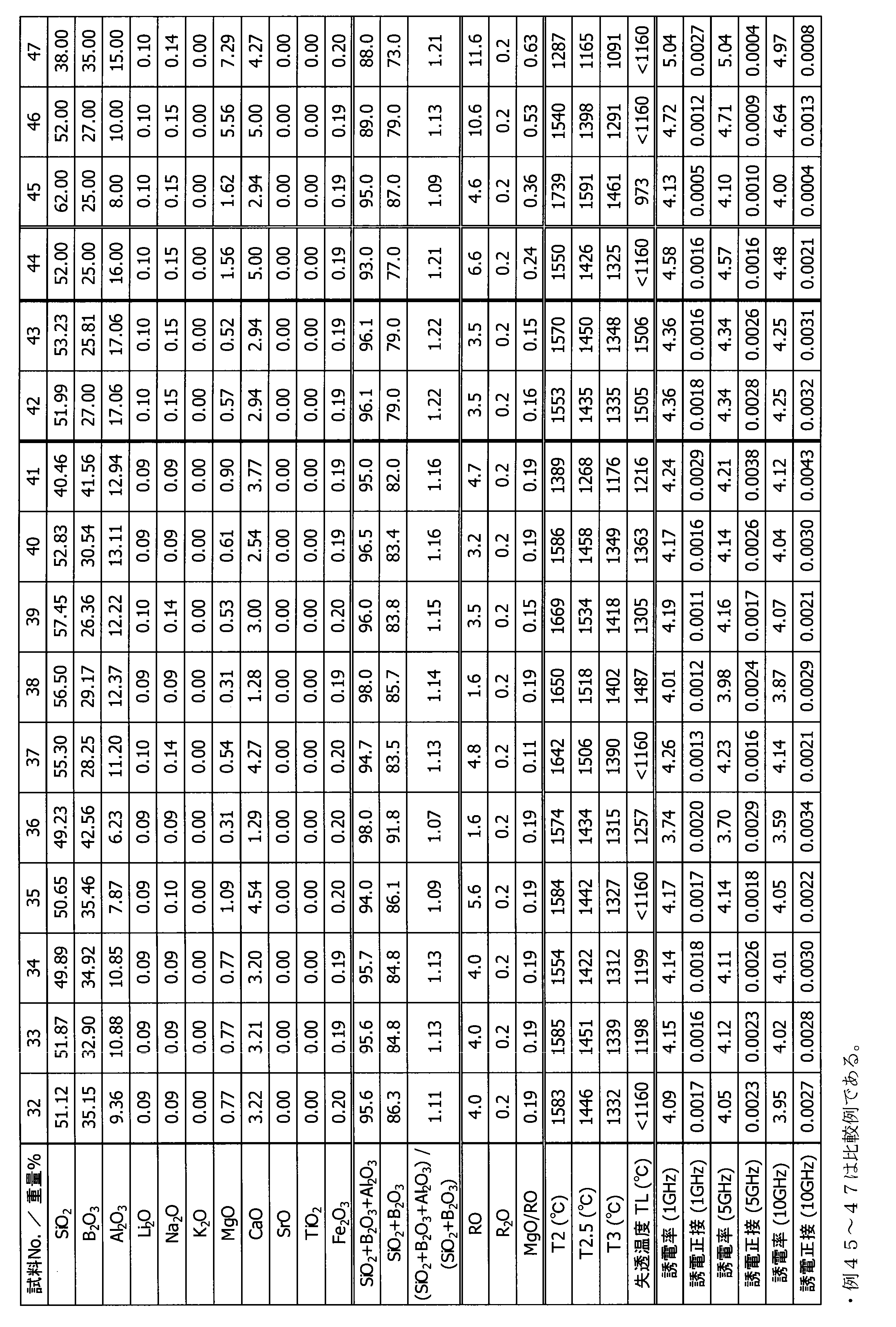
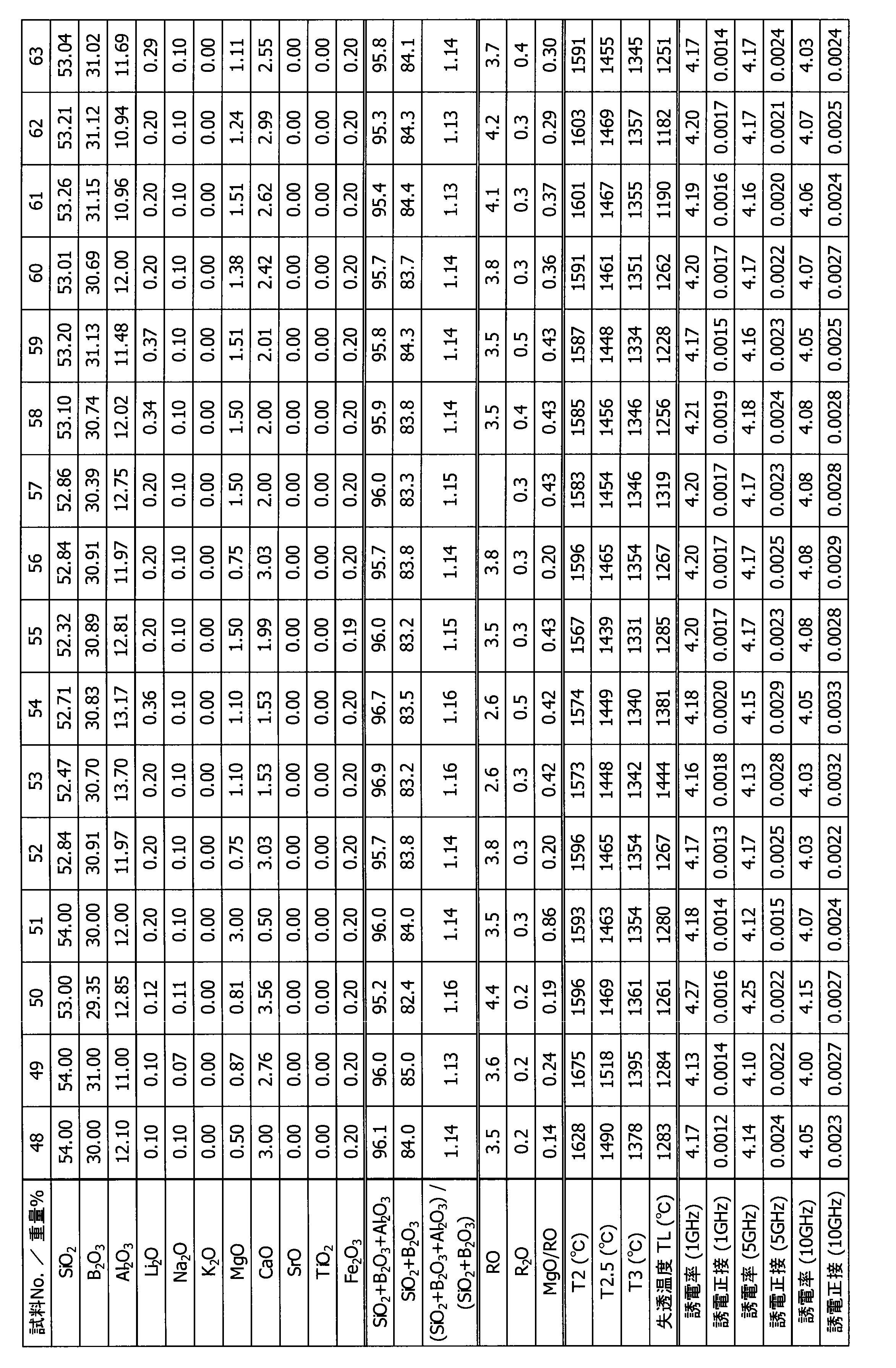
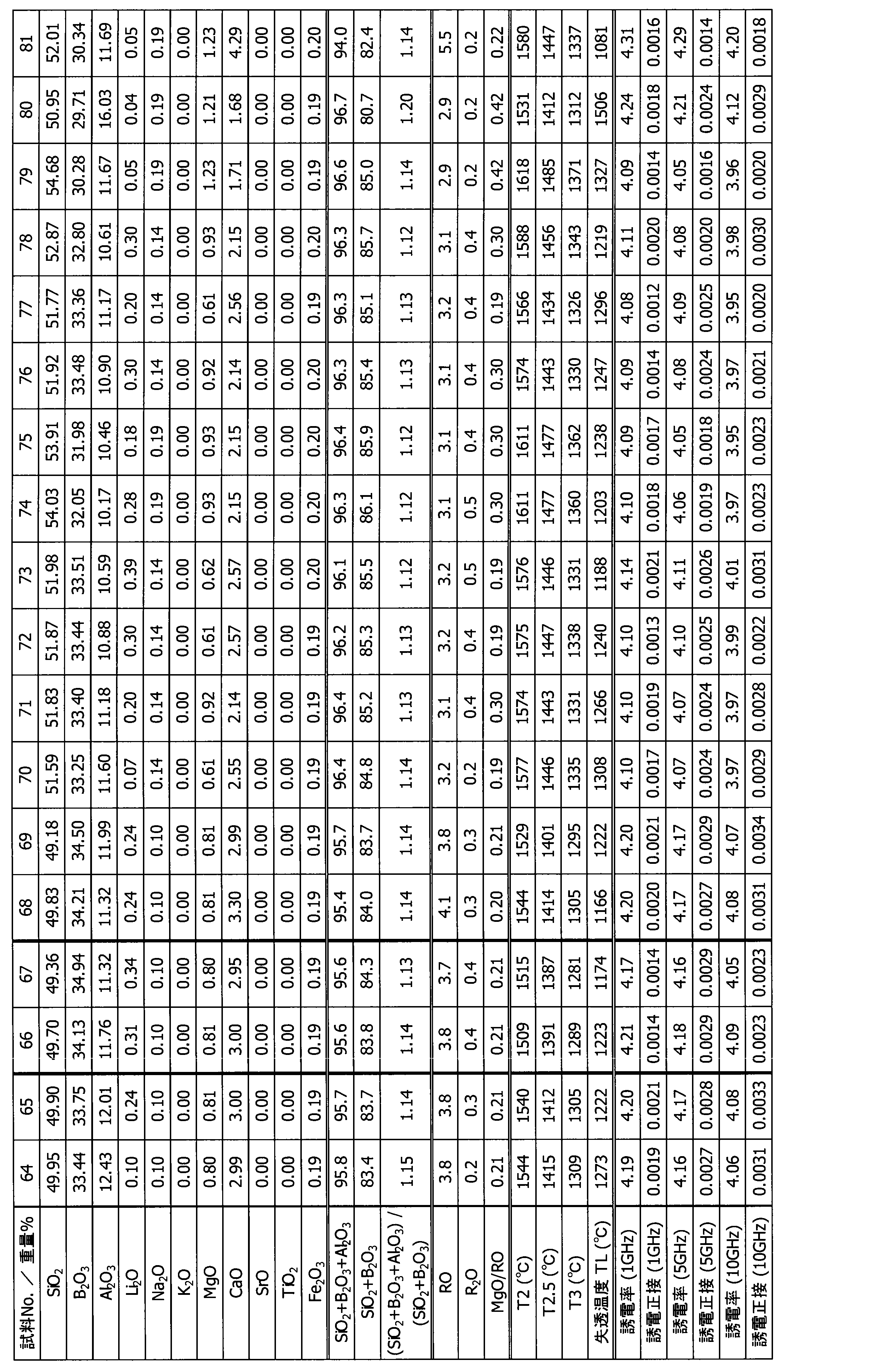
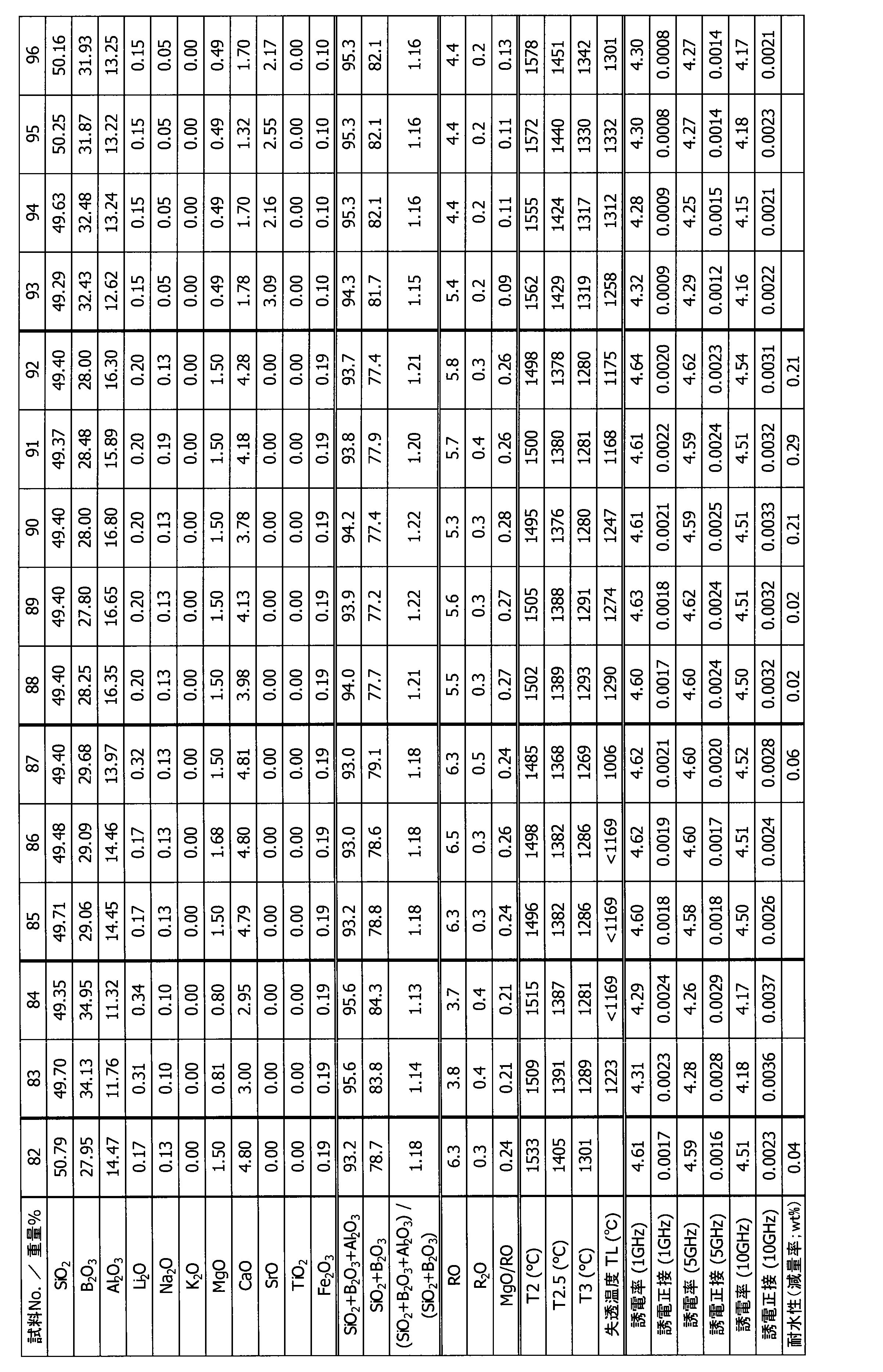
- the glass raw materials were weighed so as to have each composition shown in Tables 1 to 6 (the unit of the content of the components was% by weight) and mixed so as to be in a homogeneous state to prepare a glass raw material mixed batch.
- the prepared mixed batch was put into a platinum rhodium crucible and heated in an indirect heating electric furnace set at 1600 ° C. for 3 hours or more in an air atmosphere to obtain molten glass.
- the obtained molten glass was poured into a refractory mold and cast-molded, and then the obtained molded product was slowly cooled to room temperature in a slow-cooling furnace to prepare a glass composition sample to be used for evaluation.
- the glass samples prepared in this manner were evaluated for their dielectric constants and dielectric loss tangents at characteristic temperatures T2, T2.5 and T3, devitrification temperature TL, frequencies 1 GHz, 5 GHz and 10 GHz.
- the evaluation method is as follows.
- the viscosity was measured by the platinum ball pulling method, and the temperatures at which the viscosities were 10 2 dPa ⁇ s, 10 2.5 dPa ⁇ s, and 10 3 dPa ⁇ s were T2, T2.5, and T3, respectively.
- the sample glass was pulverized, passed through a sieve having a mesh size of 2.83 mm, and the particles remaining on the sieve having a mesh size of 1.00 mm were sieved. The particles were washed to remove fine particles adhering to the particles, and dried to prepare a sample for measuring devitrification temperature.
- 25 g of the devitrification temperature measurement sample is placed in a platinum boat (rectangular, lidless platinum vessel) so that the thickness is substantially uniform, held in a temperature tilting furnace for 2 hours, removed from the furnace, and placed inside the glass. The maximum temperature at which devitrification was observed was defined as the devitrification temperature.
- the water resistance test was carried out based on the dissolution test according to the Japan Optical Glass Industry Association standard JOGIS 06: 1999 "Measuring method of chemical durability of optical glass (powder method)". Specifically, it was carried out as follows. The sample glass was pulverized, passed through a sieve having a mesh size of 600 ⁇ m, and the particles remaining on the sieve having a mesh size of 425 ⁇ m were sieved. The particles were washed with methanol to remove fine particles adhering to the particles, and dried to prepare a sample for water resistance test.
- the same weight g as the specific gravity of the water resistance test sample was weighed in a round bottom flask, 80 ml of pure water was added, and the sample was stoppered and held at a temperature of 99 ° C. or higher for 1 hour for elution treatment.
- the sample after the elution treatment was washed with methanol, the sample remaining after drying was weighed, and the weight loss rate was calculated as a percentage.
- the permittivity and the dielectric loss tangent at each frequency were measured using a permittivity measuring device by the cavity resonator perturbation method.
- the measurement temperature was 25 ° C., and the dimensions of the measurement sample were a rectangular parallelepiped with a bottom surface of 1.5 cm on a side and a length of 10 cm.
- the glass compositions of Examples 1 to 44 and Examples 48 to 96 had a dielectric constant of 4.65 or less, T2 of 1700 ° C. or less, and T3 of 1450 ° C. or less at a measurement frequency of 1 GHz. Some of these glass compositions have a dielectric constant of 4.4 or less at a measurement frequency of 1 GHz, and are the glass compositions of Examples 1 to 43, Examples 48 to 81, Examples 83 to 84, and Examples 93 to 96. The dielectric constant at a measurement frequency of 1 GHz was 4.36 or less.
- the glass compositions of Examples 1 to 41, Examples 48 to 81, Examples 83 to 84, and Examples 93 to 96 had a permittivity of 4.35 or less at a measurement frequency of 1 GHz.
- T2 was 1520 ° C. or lower
- T3 was 1300 ° C. or lower, which was higher than TL.
- the glass compositions of Examples 66-67 and 83-92 have a B 2 O 3 content of 35% or less, in some cases 30% or less, T2 of 1520 ° C or less, and T3 of 1300 ° C or less. It became higher than TL.
- the glass compositions of Examples 2 and 93 to 96 had a dielectric loss tangent of less than 0.001 at a frequency of 1 GHz.
- the glass compositions of Examples 93-96 had a dielectric loss tangent of less than 0.001 at a frequency of 1 GHz and a T2 of less than 1600 ° C.
- the glass compositions of Examples 45 to 47 are comparative examples. In Example 45, T2 exceeded 1700 ° C., and in Examples 46 to 47, the permittivity at a measurement frequency of 1 GHz exceeded 4.7.
Landscapes
- Chemical & Material Sciences (AREA)
- Organic Chemistry (AREA)
- Engineering & Computer Science (AREA)
- Chemical Kinetics & Catalysis (AREA)
- Geochemistry & Mineralogy (AREA)
- Life Sciences & Earth Sciences (AREA)
- Materials Engineering (AREA)
- General Chemical & Material Sciences (AREA)
- Polymers & Plastics (AREA)
- Medicinal Chemistry (AREA)
- Health & Medical Sciences (AREA)
- General Life Sciences & Earth Sciences (AREA)
- Manufacturing & Machinery (AREA)
- Glass Compositions (AREA)
Abstract
Description
重量%で表示して、
40≦SiO2≦60
25≦B2O3≦45
5≦Al2O3≦15
0<R2O≦5
0<RO<15
を含み、
SiO2+B2O3≧80、及び/又は、SiO2+B2O3≧78かつ0<RO<10
が成立する、ガラス組成物を含むガラスフィラー、を提供する。
本明細書において、R2Oは、Li2O、Na2O及びK2Oから選ばれる少なくとも1種の酸化物であり、ROは、MgO、CaO及びSrOから選ばれる少なくとも1種の酸化物である。
重量%で表示して、
40≦SiO2≦60
25≦B2O3≦45
0<Al2O3≦18
0<R2O≦5
0≦RO≦12
を含み、
i)SiO2+B2O3≧80、及びSiO2+B2O3+Al2O3≦99.9、並びに
ii)SiO2+B2O3≧78、SiO2+B2O3+Al2O3≦99.9、及び0<RO<10
の少なくとも一方が成立する、ガラス組成物を含むガラスフィラー、を提供する。
重量%で表示して、
40≦SiO2≦60
25≦B2O3≦45
0<Al2O3≦18
0<R2O≦5
3<RO<8
を含み、
SiO2+B2O3≧75、及びSiO2+B2O3+Al2O3<97
が成立する、ガラス組成物を含むガラスフィラー、を提供する。
重量%で表示してSiO2+B2O3≧77が成立し、
周波数1GHzにおける誘電率が4.4以下であり、
粘度102dPasになる温度T2が1700℃以下、
である、ガラス組成物を含むガラスフィラー、を提供する。
本発明によるガラスフィラーと、熱可塑性樹脂とを含む樹脂組成物、を提供する。
上述のガラス組成物を溶融する工程と、溶融した前記ガラス組成物をガラスフィラーへと成形する工程と、を含むガラスフィラーの製造方法、を提供する。ガラスフィラーの製造方法は、ガラスフィラーを構成する上述のガラス組成物が得られるように調製したガラス原料を溶融する工程と、溶融した前記ガラス原料を前記ガラスフィラーへと成形する工程と、を含む方法であってもよい。
(SiO2)
SiO2は、ガラスの網目構造を形成する成分である。SiO2は、ガラス組成物の誘電率を下げる作用を有する。SiO2の含有率が低過ぎると、ガラス組成物の誘電率を十分に低くすることができない。SiO2の含有率が高過ぎると、溶融時の粘性が高くなり過ぎて均質なガラス組成物を得ることが難しくなる。SiO2の含有率は、40%以上、45%以上、46%以上、さらには48%以上、特に49%以上が好ましく、場合によっては50%以上、さらに50.5%以上、51%以上、52%以上、53%以上であってもよい。SiO2の含有率は、60%以下、58%未満、56%以下、さらには55%未満、特に54.5%以下が好ましく、場合によっては54%以下、53%以下、52%以下、51%以下であってもよい。SiO2の含有率の好ましい範囲の一例は、40%以上58%未満であり、さらには40%以上55%未満である。また、SiO2の含有率は、40%以上49.95%以下とすることもできる。
B2O3は、ガラスの網目構造を形成する成分である。B2O3は、ガラス組成物の誘電率を下げると共に、溶融時のガラス組成物の粘性を下げ、脱泡性(泡抜け性)を向上させ、形成したガラスフィラーにおける泡の混入を抑制する作用を有する。一方で、B2O3は、ガラス組成物の溶融時に揮発しやすく、その含有率が過大となると、ガラス組成物として十分な均質性が得られ難くなったり、形成したガラスフィラーにおける泡の混入の抑制が不十分となる。B2O3の含有率は、25%以上、27%以上、29%以上、30%以上、さらには30%を超えることが好ましく、場合によっては30.5%以上、さらには31%以上、32%以上、33%以上、34%以上であってもよい。B2O3の含有率は、45%以下、43%以下、41%以下、さらには39%以下が好ましく、場合によっては38%以下、さらには36%以下、35%以下、34%以下、32%以下であってもよい。B2O3の含有率の好ましい範囲の一例は、30%を超え45%以下である。また、B2O3の含有率は、25%以上40%以下、25%以上29.9%以下、または31%以上40%以下とすることができる。
誘電率が十分に低いガラス組成物を得るためには、SiO2の含有率とB2O3の含有率の合計(SiO2+B2O3)を77%以上、78%以上、さらに80%以上に調整するとよい。(SiO2+B2O3)は、81%以上、82%以上、さらには83%以上が好ましく、場合によっては84%以上、さらには85%以上であってもよい。(SiO2+B2O3)は、90%以下、さらには87.5%以下であってもよい。(SiO2+B2O3)の値が高過ぎると、ガラス組成物が分相する傾向が助長されるからである。また、(SiO2+B2O3)は70%以上とすることができる。SiO2の含有率、B2O3の含有率、及びAl2O3の含有率の合計(SiO2+B2O3+Al2O3)は、その他の成分を許容するために、99.9%以下が好適である。(SiO2+B2O3+Al2O3)は、98%以下、97%以下、97%未満、さらには96%以下であってもよい。(SiO2+B2O3)と(SiO2+B2O3+Al2O3)との組み合わせの好ましい一例は、(SiO2+B2O3)が82%以上、(SiO2+B2O3+Al2O3)が98%以下である。また、(SiO2+B2O3+Al2O3)は、90%以上98%以下、または90%以上97%以下とすることができる。
誘電率がより低く、溶融しやすいガラス組成物を得るためには、SiO2とB2O3の含有率には好ましい範囲の組み合わせがある。第1の組み合わせは、SiO2の含有率が48~51%、好ましくは49~51%、より好ましくは50~51%であり、B2O3の含有率が33~35%、好ましくは34~35%の組み合わせである。第2の組み合わせは、SiO2の含有率が50~53%、好ましくは51~52%であり、B2O3の含有率が32~35%、好ましくは32~34%の組み合わせである。第3の組み合わせは、SiO2の含有率が52~54%、好ましくは52.5~54%であり、B2O3の含有率が31~34%、好ましくは32~34%の組み合わせである。第4の組み合わせは、SiO2の含有率が52~55%、好ましくは53~55%であり、B2O3の含有率が30~32%の組み合わせである。
Al2O3は、ガラスの網目構造を形成する成分である。Al2O3は、ガラス組成物の化学的耐久性を高める作用を有する。一方で、Al2O3は、紡糸時におけるガラス組成物の失透を起こりやすくする。Al2O3の含有率は、5%以上、7.5%以上、8%以上、9%以上、さらには10%以上が好ましく、場合によっては10.5%以上、12%以上、13%以上であってもよい。Al2O3の含有率は、20%以下、18%以下、17%以下、さらには15%以下が好ましく、場合によっては14%以下、さらには13%以下、12.5%以下であってもよい。失透温度TLを温度T3よりも低い範囲に確実に制御したい場合に適したAl2O3の含有率の一例は12.3%以下である。Al2O3は、一般には溶融時のガラス組成物の粘性を高める成分と理解されている。しかし、SiO2+B2O3の値が高いガラス組成物では、Al2O3は特異的に溶融時の粘性を低下させる作用を奏しうる。
MgOは、溶融時におけるガラス組成物の粘性を下げてガラスフィラーへの泡の混入を抑制し、ガラス組成物としての均質性を向上させる任意成分である。MgOの含有率は、0.1%以上、0.2%以上、さらには0.5%以上、0.6%以上、場合によっては0.8%以上、さらには1%以上であってもよい。MgOの含有率は、10%未満、8%以下、7%以下、5%以下が好ましく、場合によっては3%以下、さらには2%以下、特に1.6%以下であってもよい。MgOの含有率は、CaOの含有率との比を適切な範囲とするために、1.7%以下、1.5%以下、さらには1.2%以下、1%以下が好ましいこともある。ただし、その他の成分の含有率によっては、最適なMgOの含有率が2%以上、例えば2~8%、さらには2~5%、或いは3~5%になることもある。なお、MgOは、失透温度を下げる効果が大きく、そうでありながらアルカリ金属酸化物R2Oほどには誘電率を引き上げないため、R2Oより優先的に、言い換えるとR2Oより含有率が高くなるように、添加することが好ましい。
CaOは、ガラス原料の溶解性を向上させ、溶融時におけるガラス組成物の粘性を下げる任意成分である。CaOの作用はMgOに比べて大きい。CaOの含有率は、0.1%以上、0.5%以上、さらには1%以上、場合によっては1.5%以上、さらには2%以上であってもよい。CaOの含有率は、10%未満、7%以下、5%以下が好ましく、場合によっては4%以下、3.5%以下、3%以下、さらには2.5%以下であってもよい。なお、CaOは、MgO及びZnOに比べて、ガラス組成物の誘電率を増加させてしまう効果が大きい。MgOと同様の理由により、CaOも、アルカリ金属酸化物R2Oより優先的に、言い換えるとR2Oより含有率が高くなるように、添加することが好ましい。
SrOも、ガラス原料の溶解性を向上させ、溶融時におけるガラス組成物の粘性を下げる任意成分である。しかし、SrOは、MgO及びCaOと比較してガラス組成物の誘電率を高くするため、その含有率は制限することが望ましい。SrOの含有率は、1%以下、0.5%以下、さらには0.1%以下が好ましい。SrOは、実質的に含まれていなくてもよい。
ROの含有率、すなわちMgO、CaO及びSrOの含有率の合計は、15%未満、12%以下、10%以下、10%未満、9.5%以下、8%以下、さらには7%未満、特に6%以下が好ましく、場合によっては5%以下、さらには4%以下であってもよい。ROの含有率が高過ぎると誘電率が十分に下がらないことがある。ROを構成する各成分は、個別には任意成分であるが、その少なくとも1つが含まれていること、すなわち含有率の合計が0%を超えていることが好ましい。ROの含有率は、1%以上、1.5%以上、2%以上、さらには2.5%以上が好ましく、場合によっては3%以上、さらには3.5%以上であってもよい。
MgO/RO、すなわちROの含有率に対するMgOの含有率の比は、0.8未満、さらには0.7未満が好ましく、場合によっては0.5以下、0.4以下であってもよい。MgO/ROが大きくなると、ガラス組成物が分相する傾向が顕著になるため、ガラス組成物の均質性が損なわれることがある。一方で、ガラス組成物の誘電率を抑えるべく、MgO/ROは、0.1以上、さらには0.14以上が好ましく、場合によっては0.19以上であってもよい。MgO/ROは、好ましくは0.1~0.5である。
MgO/(MgO+CaO)、すなわちMgOとCaOの含有率の合計に対するMgOの含有率の比も、MgO/ROについての上述した上限及び下限を任意に組み合わせた範囲にあってよい。MgO/(MgO+CaO)は、好ましくは0.1~0.5であり、特に0.1~0.4である。
Li2Oは、少量の添加であっても溶融時におけるガラス組成物の粘性を下げてガラスフィラーへの泡の混入を抑制する作用を有し、さらには失透を抑制する作用も有する任意成分である。また、適量のLi2Oの添加はガラス組成物が分相する傾向を顕著に抑制する。しかし、Li2Oは、他のR2Oよりもその作用は相対的に弱いものの、ガラス組成物の誘電率を上昇させる。Li2Oの含有率は、1.5%以下、1%以下、0.5%以下が好ましく、場合によっては0.4%以下、0.3%以下、さらには0.2%以下であってもよい。Li2Oの含有率は、0.01%以上、0.03%以上、さらには0.05%以上が好ましい。Li2Oの含有率の好ましい範囲の例は、0.01~0.5%、さらに0.05~0.4%である。
Na2Oも、少量の添加であっても溶融時におけるガラス組成物の粘性が下げてガラスフィラーへの泡の混入を抑制する作用を有し、さらには失透を抑制する作用も有する任意成分である。この観点からはNa2Oの含有率は、0.01%以上、0.05%以上、さらには0.1%以上であってもよい。しかし、Na2Oの添加は、ガラス組成物の誘電率を上昇させないように、限られた範囲に止める必要がある。Na2Oの含有率は、1.5%以下、1%以下、0.5%以下、さらには0.4%以下が好ましく、場合によっては0.2%以下、さらには0.15%以下、特に0.1%以下、0.05%以下、0.01%以下であってもよい。Na2Oの含有率の好ましい範囲の例は、0.01~0.4%である。
K2Oも、少量の添加であっても溶融時におけるガラス組成物の粘性が下げてガラスフィラーへの泡の混入を抑制する作用を有し、さらには失透を抑制する作用も有する任意成分である。しかし、K2Oは、ガラス組成物の誘電率を上昇させる作用が大きい。K2Oの含有率は、1%以下、0.5%以下、0.2%以下が好ましく、場合によっては0.1%以下、0.05%以下、0.01%以下であってもよい。K2Oは、実質的に含まれていなくてもよい。
R2Oの含有率、Li2O、Na2O及びK2Oの含有率の合計は、5%以下、4%以下、3%以下、2%以下、さらには1.5%以下が好ましく、場合によっては1%以下、さらには0.6%以下、0.5%以下であってもよい。R2Oを構成する各成分は、個別には任意成分であるが、その少なくとも1つが含まれていること、すなわち含有率の合計が0%を超えていることが好ましい。R2Oの含有率は、0.03%以上、0.05%以上、さらには0.1%以上、特に0.15%以上、0.2%以上が好ましい。
T-Fe2O3は、その熱線吸収作用によってガラス原料の溶解性を向上させると共に、溶融時におけるガラス組成物の均質性を向上させる任意成分である。T-Fe2O3の含有率は、0.01%以上、0.02%以上、0.05%以上、さらには0.10%以上が好ましい。なお溶解性向上の効果はT-Fe2O3の含有率が0.01%以上で顕著に表れるが、均質性向上の効果は0.02%以上で特に顕著に表れる。T-Fe2O3による過度の熱線吸収作用を抑制する等の目的から、T-Fe2O3の含有率は、0.5%以下、0.3%以下、さらに0.25%以下が好ましく、場合によっては0.20%以下であってもよい。本明細書では、慣用に従い、ガラス組成物の全酸化鉄の量を、FeO等のFe2O3以外の酸化鉄をFe2O3に換算した値、すなわちT-Fe2O3の含有率、として表示している。したがって、T-Fe2O3の少なくとも一部はFeOとして含まれうる。T-Fe2O3の含有率の好ましい範囲の例は0.01~0.5%、さらに0.1~0.3%である。
ZnOは、ガラス原料の溶解性を向上させ、溶融時におけるガラス組成物の粘性を下げる任意成分である。しかし、ZnOは、ガラス組成物の誘電率を上昇させる。ZnOの含有率は、3.5%以下、2%以下、1%以下、さらには0.5%以下が好ましい。ZnOは、実質的に含まれていなくてもよい。
ガラス組成物が含みうる上記以外の成分としては、P2O5、BaO、PbO、TiO2、ZrO2、La2O3、Y2O3、MoO3、WO3、Nb2O5、Cr2O3、SnO2、CeO2、As2O3、Sb2O3、SO3を例示できる。ガラス組成物が含みうる別の成分は、例えばPt、Rh、Os等の貴金属元素であり、また例えばF、Cl等のハロゲン元素である。これらの成分の許容される含有率は、それぞれについて好ましくは2%未満、さらには1%未満、特に0.5%未満であり、合計で好ましくは5%未満、さらに3%未満、特に2%未満、とりわけ1%未満である。ただし、ガラス組成物には、上記その他の成分がそれぞれ実質的に含まれていなくてもよい。TiO2は、後述する理由により微量を添加してもよいが、実質的に含まれていなくてもよい。ZrO2も同様である。また、BaO及びPbOは実質的に含まれていないことが好ましい。P2O5も実質的に含まれていないことが好ましい。BaO及びPbOはガラス組成物の誘電率を引き上げる効果が大きく、P2O5は分相を誘発するためである。上記に列挙したSiO2からZnOまでの成分以外の成分は実質的に含まれていなくてもよい。ただしこの場合でも、ガラス組成物は、溶融時の清澄促進に有効な成分、好ましくはSO3、F、Clをそれぞれ2%未満の範囲で含有していてもよい。
好ましい一形態におけるガラス組成物は、以下の成分を含む。
40≦SiO2<58
25≦B2O3≦40
7.5≦Al2O3≦18
0<R2O≦4
0≦Li2O≦1.5
0≦Na2O≦1.5
0≦K2O≦1
1≦RO<10
0≦MgO<10
0≦CaO<10
0≦SrO≦5
0≦T-Fe2O3≦0.5
0≦ZnO≦3.5
を加えたガラス組成物も好ましい別の一形態である。
(誘電率)
好ましい一形態において、ガラス組成物の測定周波数1GHzの誘電率は、4.65以下、4.4以下、4.35以下、4.30以下、4.25以下、さらには4.20以下であり、場合によっては4.18以下である。測定周波数5GHzの誘電率は、4.63以下、4.4以下、4.31以下、4.27以下、4.22以下、さらには4.17以下であり、場合によっては4.15以下である。測定周波数10GHzの誘電率は、4.55以下、4.4以下、4.22以下、4.18以下、4.14以下、さらには4.08以下であり、場合によっては4.06以下である。
好ましい一形態において、ガラス組成物の測定周波数1GHzの誘電正接は、0.007以下、0.005以下、0.004以下、さらには0.003以下、場合によっては0.002以下である。測定周波数1GHzの誘電正接は、0.001以下、0.001未満、0.0009以下、0.0008以下、さらには0.0007以下であってもよい。測定周波数5GHzの誘電正接は、0.007以下、0.005以下、0.004以下、さらには0.003以下、場合によっては0.002以下である。測定周波数10GHzの誘電正接は、0.007以下、0.006以下、0.005以下、0.004以下、さらには0.003以下であり、場合によっては0.002以下である。
好ましい一形態において、ガラス組成物のT2は、1700℃以下、1650℃以下、1640℃以下、1620℃以下、さらには1610℃以下であり、場合によっては1600℃未満、1550℃以下、さらに1520℃以下、特に1510℃以下である。T2はガラス融液の溶融温度の目安となる温度である。過度に高いT2は、ガラス融液の溶融に極めて高温を要するためエネルギーコストや高温に耐える装置のコストが高い。同じ温度であれば、T2の低いガラスの方が融液の粘度が低いのでガラス融液の清澄や均質化に効果があり、一方、同じ粘度で溶融する場合はT2が低いガラスの方が低温で溶融でき、量産に適している。T2.5は、好ましくは、1590℃以下、1550℃以下、さらには1500℃以下であり、場合によっては1450℃以下、さらに1400℃以下である。T3は、好ましくは、1450℃以下、1420℃以下、1400℃以下、さらには1365℃以下、特に1360℃以下であり、場合によっては1330℃以下、さらに1300℃以下である。T3は、ガラスフィラーの成形の目安となる温度である。
(ガラスフィラーの形態)
ガラスフィラーの形態は、特に制限されないが、例えば、フレーク状ガラス、チョップドストランド、ミルドファイバー、ガラス粉末、ガラスビーズ、フラットファイバー、及び薄片状ガラスから選ばれる少なくとも1種に該当するものであってよい。ただし、これらの形態は、互いに厳密に区別されるものではない。また、互いに異なる形態を有する2種以上のガラスフィラーを組み合わせてフィラーとして用いてもよい。ガラスフィラーの形態は、ガラス繊維以外であってもよい。以下、各形態について説明する。
ガラスフィラーは、少なくともその一部が顆粒化されていてもよい。顆粒化は、ガラスフィラーにバインダー処理を施し、個々のガラスフィラーをバインダーによって互いに結びつけて造粒する処理である。顆粒状のフレーク状ガラスは、飛散性が低いために作業性に優れ、樹脂中での分散性にも優れている。顆粒状のフレーク状ガラスを用いると、フィード性が向上し、より確実な定量的フィードが可能となる。以下、顆粒化に用いるバインダーについて説明する。
ガラスフィラーは、上記で説明したガラス組成物を溶融する工程と、溶融したガラス組成物を所望のガラスフィラーへと成形する工程と、を含む方法により製造される。ガラス組成物を溶融する温度は、例えば1400℃以上である。
本発明による樹脂組成物は、本発明によるガラスフィラーと共に熱可塑性樹脂を含む。熱可塑性樹脂は、特に限定されないが、例えば、ポリ塩化ビニル、ポリプロピレン、ポリエチレン、ポリスチレン、ポリエステル、ポリアミド、ポリカーボネート、ポリブチレン、ポリブチレンテレフタレート、これらの共重合体等である。ポリブチレンテレフタレートを用いると、ガラスフィラーとの混合による成形品の反り抑制や寸法安定性の改善効果が大きくなる。
白金球引き上げ法により粘度を測定し、その粘度が102dPa・s、102.5dPa・s、103dPa・sとなる温度を、それぞれT2、T2.5、T3とした。
試料ガラスを粉砕し、目開き2.83mmの篩を通り、目開き1.00mmの篩に残る粒子をふるい分けた。この粒子を洗浄して粒子に付着した微粉を除去し、乾燥して失透温度測定用サンプルを調製した。失透温度測定用サンプルの25gを白金ボート(長方形でフタのない白金製の器)に厚みが略均一になるようにいれ、温度傾斜炉中で2時間保持した後に炉から取り出し、ガラス内部に失透が観察された最高温度を失透温度とした。
耐水性試験は、日本光学硝子工業会規格 JOGIS 06:1999 「光学ガラスの化学的耐久性の測定方法(粉末法)」に準じた溶出試験に基づき行った。具体的には以下のように行った。試料ガラスを粉砕し、目開き600μmの篩を通り、目開き425μmの篩に残る粒子をふるい分けた。この粒子をメタノールで洗浄して粒子に付着した微粉を除去し、乾燥して耐水試験用サンプルを調製した。耐水試験用サンプルのその比重と同じ重量gを丸底フラスコに秤量し、純水80mlを加え、栓をして温度99℃以上で1時間保持して溶出処理を施した。溶出処理後のサンプルをメタノールで洗浄し、乾燥後に残ったサンプルを秤量し、減量率を百分率で算出した。
各周波数における誘電率及び誘電正接は、空洞共振器摂動法による誘電率測定装置を用いて測定した。測定温度は25℃、測定用サンプルの寸法は、底面が1辺1.5cmの正方形で長さ10cmの直方体とした。


Claims (56)
- 重量%で表示して、
40≦SiO2≦60
25≦B2O3≦45
5≦Al2O3≦15
0<R2O≦5
0<RO<15
を含み、
SiO2+B2O3≧80、及び/又は、SiO2+B2O3≧78かつ0<RO<10
が成立する、ガラス組成物を含むガラスフィラー。
ただし、R2Oは、Li2O、Na2O及びK2Oから選ばれる少なくとも1種の酸化物であり、ROは、MgO、CaO及びSrOから選ばれる少なくとも1種の酸化物である。 - 重量%で表示して、
40≦SiO2≦60
25≦B2O3≦45
0<Al2O3≦18
0<R2O≦5
0≦RO≦12
を含み、
i)SiO2+B2O3≧80、及びSiO2+B2O3+Al2O3≦99.9、並びに
ii)SiO2+B2O3≧78、SiO2+B2O3+Al2O3≦99.9、及び0<RO<10
の少なくとも一方が成立する、ガラス組成物を含むガラスフィラー。
ただし、R2Oは、Li2O、Na2O及びK2Oから選ばれる少なくとも1種の酸化物であり、ROは、MgO、CaO及びSrOから選ばれる少なくとも1種の酸化物である。 - 重量%で表示して、
40≦SiO2≦60
25≦B2O3≦45
0<Al2O3≦18
0<R2O≦5
3<RO<8
を含み、
SiO2+B2O3≧75、及びSiO2+B2O3+Al2O3<97
が成立する、ガラス組成物を含むガラスフィラー。
ただし、R2Oは、Li2O、Na2O及びK2Oから選ばれる少なくとも1種の酸化物であり、ROは、MgO、CaO及びSrOから選ばれる少なくとも1種の酸化物である。 - 重量%で表示してSiO2+B2O3≧77が成立し、
周波数1GHzにおける誘電率が4.4以下であり、
粘度102dPasになる温度T2が1700℃以下、
である、ガラス組成物を含むガラスフィラー。 - 前記ガラス組成物が、重量%で表示して、
30<B2O3≦45
を含む、請求項1~4のいずれか1項に記載のガラスフィラー。 - 前記ガラス組成物が、重量%で表示して、
40≦SiO2<58
を含む、請求項1~5のいずれか1項に記載のガラスフィラー。 - 前記ガラス組成物が、重量%で表示して、
40≦SiO2<55
を含む、請求項6に記載のガラスフィラー。 - 前記ガラス組成物が、重量%で表示して、
SiO2+B2O3≧82
SiO2+B2O3+Al2O3≦98
が成立する、請求項1~7のいずれか1項に記載のガラスフィラー。 - 前記ガラス組成物が、重量%で表示して、
40≦SiO2<58
25≦B2O3≦40
7.5≦Al2O3≦18
0<R2O≦4
0≦Li2O≦1.5
0≦Na2O≦1.5
0≦K2O≦1
1≦RO<10
0≦MgO<10
0≦CaO<10
0≦SrO≦5
0≦T-Fe2O3≦0.5
を含む、請求項1~8のいずれか1項に記載のガラスフィラー。
ただし、R2Oは、Li2O、Na2O及びK2Oから選ばれる少なくとも1種の酸化物であり、ROは、MgO、CaO及びSrOから選ばれる少なくとも1種の酸化物であり、T-Fe2O3はFe2O3に換算したガラス組成物中の全酸化鉄である。 - 前記ガラス組成物が、重量%で表示して、
40≦SiO2<58
25≦B2O3≦40
7.5≦Al2O3≦15
0<R2O≦4
0≦Li2O≦1.5
0≦Na2O≦1.5
0≦K2O≦1
1≦RO<10
0≦MgO<10
0≦CaO<10
0≦SrO≦1
0≦T-Fe2O3≦0.5
を含む、請求項9に記載のガラスフィラー。 - 前記ガラス組成物が、重量%で表示して、
48≦SiO2≦51
33≦B2O3≦35
を含む、請求項1~10のいずれか1項に記載のガラスフィラー。 - 前記ガラス組成物が、重量%で表示して、
50≦SiO2≦53
32≦B2O3≦35
を含む、請求項1~10のいずれか1項に記載のガラスフィラー。 - 前記ガラス組成物が、重量%で表示して、
52≦SiO2≦54
31≦B2O3≦34
を含む、請求項1~10のいずれか1項に記載のガラスフィラー。 - 前記ガラス組成物が、重量%で表示して、
52≦SiO2≦55
30≦B2O3≦32
を含む、請求項1~10のいずれか1項に記載のガラスフィラー。 - 前記ガラス組成物が、重量%で表示して、
47≦SiO2≦52
25≦B2O3≦30
を含む、請求項1~4のいずれか1項に記載のガラスフィラー。 - 前記ガラス組成物が、重量%で表示して、
48≦SiO2≦53
28≦B2O3≦35
1≦MgO+CaO<3.5
を含む、請求項1~10のいずれか1項に記載のガラスフィラー。 - 前記ガラス組成物が、重量%で表示して、
8≦Al2O3≦12.5
を含む、請求項1~16のいずれか1項に記載のガラスフィラー。 - 前記ガラス組成物が、重量%で表示して、
10≦Al2O3≦12.5
を含む、請求項17に記載のガラスフィラー。 - 前記ガラス組成物が、重量%で表示して、
13≦Al2O3≦17
を含む、請求項1~16のいずれか1項に記載のガラスフィラー。 - 前記ガラス組成物が、重量%で表示して、
12≦Al2O3≦15
を含む、請求項1~16のいずれか1項に記載のガラスフィラー。 - 前記ガラス組成物が、重量%で表示して、
0.01≦Li2O3≦0.5
を含む、請求項1~20のいずれか1項に記載のガラスフィラー。 - 前記ガラス組成物が、重量%で表示して、
0.05≦Li2O≦0.4
を含む、請求項21に記載のガラスフィラー。 - 前記ガラス組成物が、重量%で表示して、
0.01≦Na2O≦0.4
を含む、請求項1~22のいずれか1項に記載のガラスフィラー。 - 前記ガラス組成物が、重量%で表示して、
Li2O>Na2O
が成立する、請求項1~23のいずれか1項に記載のガラスフィラー。 - 前記ガラス組成物が、重量%で表示して、
0.5≦MgO≦1.6
を含む、請求項1~24のいずれか1項に記載のガラスフィラー。 - 前記ガラス組成物が、重量%で表示して、
2≦CaO≦3.5
を含む、請求項1~25のいずれか1項に記載のガラスフィラー。 - 前記ガラス組成物が、重量%で表示して、
0.1≦SrO≦5
を含む、請求項1~26のいずれか1項に記載のガラスフィラー。 - 前記ガラス組成物が、重量%で表示して、
0.1≦MgO≦1
を含む、請求項1~27のいずれか1項に記載のガラスフィラー。 - 前記ガラス組成物が、重量%で表示して、
0.5≦CaO≦2
を含む、請求項28に記載のガラスフィラー。 - 前記ガラス組成物が、重量%で表示して、
2≦MgO+CaO+SrO≦7
を含む、請求項28又は29に記載のガラスフィラー。 - 前記ガラス組成物が、重量%で表示して、
2≦MgO+CaO+SrO≦4
を含む、請求項1~30のいずれか1項に記載のガラスフィラー。 - 前記ガラス組成物が、重量%で表示して、
1≦MgO≦2
2≦CaO≦5
を含む、請求項1~27のいずれか1項に記載のガラスフィラー。 - 前記ガラス組成物が、重量%で表示して、
0.01≦T-Fe2O3≦0.5
を含む、請求項1~32に記載のガラスフィラー。 - 前記ガラス組成物が、重量%で表示して、
0.1≦T-Fe2O3≦0.3
を含む、請求項33に記載のガラスフィラー。 - 前記ガラス組成物において、重量%で表示して、
MgO/RO<0.8
が成立する請求項1~34のいずれか1項に記載のガラスフィラー。 - 前記ガラス組成物において、重量%で表示して、
0.1≦MgO/RO≦0.5
が成立する請求項35に記載のガラスフィラー。 - 前記ガラス組成物において、重量%で表示して、
0.1≦MgO/(MgO+CaO)≦0.5
が成立する請求項1~36のいずれか1項に記載のガラスフィラー。 - 前記ガラス組成物において、重量%で表示して、
BaO及びPbOが実質的に含まれていない、請求項1~37のいずれか1項に記載のガラスフィラー。 - 前記ガラス組成物において、重量%で表示して、
TiO2が実質的に含まれていない、請求項1~38のいずれか1項に記載のガラスフィラー。 - 前記ガラス組成物において、重量%で表示して、
0<TiO2≦1
を含む、請求項1~38のいずれか1項に記載のガラスフィラー。 - 前記ガラス組成物の周波数1GHzにおける誘電率が4.35以下、
である、請求項1~40のいずれか1項に記載のガラスフィラー。 - 前記ガラス組成物の周波数1GHzにおける誘電正接が0.007以下、
である、請求項1~41のいずれか1項に記載のガラスフィラー。 - 前記ガラス組成物が粘度102dPasになる温度T2が1650℃以下、
である、請求項1~42のいずれか1項に記載のガラスフィラー。 - 前記ガラス組成物が粘度102dPasになる温度T2が1610℃以下、
である、請求項43に記載のガラスフィラー。 - 前記ガラス組成物が粘度103dPasになる温度T3が前記ガラス組成物の失透温度TLよりも高い、請求項1~44のいずれか1項に記載のガラスフィラー。
- フレーク状ガラス、チョップドストランド、ミルドファイバー、ガラス粉末、ガラスビーズ、フラットファイバー、及び薄片状ガラスから選ばれる少なくとも1つに該当する、請求項1~45のいずれか1項に記載のガラスフィラー。
- フレーク状ガラスである、請求項46に記載のガラスフィラー。
- チョップドストランドである、請求項46に記載のガラスフィラー。
- ミルドファイバーである、請求項46に記載のガラスフィラー。
- ガラス粉末である、請求項46に記載のガラスフィラー。
- ガラスビーズである、請求項46に記載のガラスフィラー。
- フラットファイバーである、請求項46に記載のガラスフィラー。
- 薄片状ガラスである、請求項46に記載のガラスフィラー。
- 請求項1~53のいずれか1項に記載のガラスフィラーと、熱可塑性樹脂とを含む樹脂組成物。
- 請求項1~4のいずれか1項に記載のガラス組成物を溶融する工程と、溶融した前記ガラス組成物をガラスフィラーへと成形する工程と、を含むガラスフィラーの製造方法。
- 請求項1~53のいずれか1項に記載のガラスフィラーの製造方法であって、
前記ガラスフィラーを構成するガラス組成物が得られるように調製したガラス原料を溶融する工程と、溶融した前記ガラス原料を前記ガラスフィラーへと成形する工程と、を含むガラスフィラーの製造方法。
Priority Applications (6)
| Application Number | Priority Date | Filing Date | Title |
|---|---|---|---|
| CN202410162129.6A CN118005282A (zh) | 2019-06-21 | 2020-06-19 | 玻璃填料及其制造方法以及包含玻璃填料的树脂组合物 |
| EP20825883.0A EP3988512A4 (en) | 2019-06-21 | 2020-06-19 | GLASS FILLER AS WELL AS METHOD FOR MANUFACTURING IT, AND RESIN COMPOSITION CONTAINING THIS GLASS FILLER |
| JP2021526951A JP7618550B2 (ja) | 2019-06-21 | 2020-06-19 | ガラスフィラーとその製造方法、及びガラスフィラーを含む樹脂組成物 |
| CN202080043561.3A CN114026051B (zh) | 2019-06-21 | 2020-06-19 | 玻璃填料及其制造方法以及包含玻璃填料的树脂组合物 |
| US17/596,886 US12534397B2 (en) | 2019-06-21 | 2020-06-19 | Glass filler and method for producing the same, and resin composition including glass filler |
| US19/436,955 US20260125311A1 (en) | 2019-06-21 | 2025-12-30 | Glass filler and method for producing the same, and resin composition including glass filler |
Applications Claiming Priority (2)
| Application Number | Priority Date | Filing Date | Title |
|---|---|---|---|
| JP2019115734 | 2019-06-21 | ||
| JP2019-115734 | 2019-06-21 |
Related Child Applications (2)
| Application Number | Title | Priority Date | Filing Date |
|---|---|---|---|
| US17/596,886 A-371-Of-International US12534397B2 (en) | 2019-06-21 | 2020-06-19 | Glass filler and method for producing the same, and resin composition including glass filler |
| US19/436,955 Continuation US20260125311A1 (en) | 2019-06-21 | 2025-12-30 | Glass filler and method for producing the same, and resin composition including glass filler |
Publications (1)
| Publication Number | Publication Date |
|---|---|
| WO2020256143A1 true WO2020256143A1 (ja) | 2020-12-24 |
Family
ID=74037129
Family Applications (1)
| Application Number | Title | Priority Date | Filing Date |
|---|---|---|---|
| PCT/JP2020/024256 Ceased WO2020256143A1 (ja) | 2019-06-21 | 2020-06-19 | ガラスフィラーとその製造方法、及びガラスフィラーを含む樹脂組成物 |
Country Status (5)
| Country | Link |
|---|---|
| US (2) | US12534397B2 (ja) |
| EP (1) | EP3988512A4 (ja) |
| JP (1) | JP7618550B2 (ja) |
| CN (2) | CN118005282A (ja) |
| WO (1) | WO2020256143A1 (ja) |
Cited By (5)
| Publication number | Priority date | Publication date | Assignee | Title |
|---|---|---|---|---|
| JPWO2022239747A1 (ja) * | 2021-05-13 | 2022-11-17 | ||
| JP7283647B1 (ja) * | 2022-03-03 | 2023-05-30 | 日東紡績株式会社 | ガラス繊維用ガラス組成物、ガラス繊維、ガラス繊維織物及びガラス繊維強化樹脂組成物 |
| WO2023171228A1 (ja) | 2022-03-09 | 2023-09-14 | 日本板硝子株式会社 | フレーク状基材及び樹脂組成物 |
| WO2025047166A1 (ja) | 2023-08-25 | 2025-03-06 | 日本板硝子株式会社 | 光輝性顔料及び樹脂組成物 |
| EP4682186A1 (en) | 2023-03-17 | 2026-01-21 | Nippon Sheet Glass Company, Limited | Resin molded article |
Families Citing this family (4)
| Publication number | Priority date | Publication date | Assignee | Title |
|---|---|---|---|---|
| EP3988512A4 (en) | 2019-06-21 | 2023-07-26 | Nippon Sheet Glass Company, Limited | GLASS FILLER AS WELL AS METHOD FOR MANUFACTURING IT, AND RESIN COMPOSITION CONTAINING THIS GLASS FILLER |
| WO2021251399A1 (ja) * | 2020-06-10 | 2021-12-16 | 日本板硝子株式会社 | ガラス組成物、ガラスフィラーとその製造方法、及びガラスフィラーを含む樹脂組成物 |
| CN115287785A (zh) * | 2022-09-13 | 2022-11-04 | 江苏先诺新材料科技有限公司 | 一种聚酰亚胺短切纤维生产设备 |
| KR102882273B1 (ko) * | 2025-02-25 | 2025-11-05 | 오재구 | 고굴절률 유리비드 제조를 위한 제조시스템 및 이를 이용한 고굴절률 유리비드 제조방법 |
Citations (8)
| Publication number | Priority date | Publication date | Assignee | Title |
|---|---|---|---|---|
| JPS62226839A (ja) | 1986-03-27 | 1987-10-05 | Nippon Sheet Glass Co Ltd | 低誘電率ガラス繊維 |
| JPS6451345A (en) * | 1987-08-18 | 1989-02-27 | Nippon Sheet Glass Co Ltd | Glass fiber composition having low dielectric constant |
| JP2009286686A (ja) | 2008-04-28 | 2009-12-10 | Nippon Electric Glass Co Ltd | ガラス繊維用ガラス組成物、ガラス繊維及びガラス繊維シート状物 |
| JP2010508226A (ja) | 2006-10-26 | 2010-03-18 | エイジーワイ ホールディングス コーポレイション | 低誘電性グラスファイバー |
| JP2012153582A (ja) * | 2011-01-27 | 2012-08-16 | Nippon Sheet Glass Co Ltd | ガラス組成物及びその用途 |
| JP2013159546A (ja) * | 2012-02-08 | 2013-08-19 | Nippon Sheet Glass Co Ltd | ガラスフィラー |
| WO2017187471A1 (ja) | 2016-04-28 | 2017-11-02 | 日本板硝子株式会社 | ガラス組成物、ガラス繊維、ガラスクロスおよびガラス繊維の製造方法 |
| WO2018216637A1 (ja) | 2017-05-26 | 2018-11-29 | 日本板硝子株式会社 | ガラス組成物、ガラス繊維、ガラスクロス、及びガラス繊維の製造方法 |
Family Cites Families (42)
| Publication number | Priority date | Publication date | Assignee | Title |
|---|---|---|---|---|
| US4166745A (en) | 1977-12-16 | 1979-09-04 | Corning Glass Works | Refractive index-corrected copper-cadmium halide photochromic glasses |
| JPS599992A (ja) | 1982-07-08 | 1984-01-19 | 株式会社日立製作所 | 多層配線基板の製造方法 |
| JPH0776113B2 (ja) | 1987-02-16 | 1995-08-16 | 日本硝子繊維株式会社 | 熱可塑性樹脂又は熱硬化性樹脂成形用の補強材 |
| JPH02208236A (ja) | 1989-02-08 | 1990-08-17 | Nakashima:Kk | ガラス溶射用材料 |
| JP3269937B2 (ja) * | 1995-06-05 | 2002-04-02 | 日東紡績株式会社 | 低誘電率ガラス繊維 |
| JPH092839A (ja) | 1995-06-15 | 1997-01-07 | Nitto Boseki Co Ltd | 低誘電正接ガラス繊維 |
| JP3954130B2 (ja) | 1996-04-03 | 2007-08-08 | 日東紡績株式会社 | 低誘電率ガラスパウダー及びそれを用いたプリント配線基板並びに樹脂混合材料物 |
| JPH11228170A (ja) * | 1998-02-05 | 1999-08-24 | Nitto Boseki Co Ltd | ガラス繊維パウダーおよびそれを用いた高耐水性樹脂成形品 |
| JP3069790B1 (ja) | 1999-09-08 | 2000-07-24 | 日本フエロー株式会社 | 陶磁器釉薬用フリットの製造方法 |
| JP2001122637A (ja) | 1999-10-26 | 2001-05-08 | Nippon Electric Glass Co Ltd | ディスプレイ用ガラス基板 |
| JP2003137590A (ja) | 2001-05-09 | 2003-05-14 | Nippon Electric Glass Co Ltd | 低誘電率低誘電正接ガラス、それを用いたガラス繊維及びガラス繊維織物 |
| JP2004107112A (ja) | 2002-09-17 | 2004-04-08 | Nippon Electric Glass Co Ltd | 低誘電率低誘電正接ガラス繊維 |
| JP2007031183A (ja) | 2005-07-25 | 2007-02-08 | Kohoku Kogyo Kk | 酸化スズ含有ガラス |
| JP5013304B2 (ja) | 2006-03-17 | 2012-08-29 | 日本電気硝子株式会社 | ディスプレイ用ガラス基板 |
| WO2007138832A1 (ja) | 2006-05-25 | 2007-12-06 | Nippon Electric Glass Co., Ltd. | 無アルカリガラスおよび無アルカリガラス基板 |
| CN101012105B (zh) * | 2006-12-21 | 2010-05-19 | 泰山玻璃纤维股份有限公司 | 一种低介电常数玻璃纤维 |
| KR20150144342A (ko) | 2008-08-27 | 2015-12-24 | 닛폰 이타가라스 가부시키가이샤 | 유리조각 및 코팅된 유리조각 |
| JP5292029B2 (ja) | 2008-09-10 | 2013-09-18 | 株式会社オハラ | ガラス |
| CN102143922B (zh) | 2008-09-10 | 2014-10-15 | 株式会社小原 | 玻璃 |
| CN101696089A (zh) * | 2009-10-29 | 2010-04-21 | 四川省玻纤集团有限公司 | 用于高频高密度电路板的低介电常数玻璃纤维 |
| DE102010007796B3 (de) | 2010-02-12 | 2011-04-14 | Schott Ag | Röntgenopakes bariumfreies Glas und dessen Verwendung |
| JP5810086B2 (ja) * | 2010-08-05 | 2015-11-11 | 日本板硝子株式会社 | ガラスフィラー |
| FR2988465B1 (fr) | 2012-03-20 | 2014-03-14 | Eurokera | Porte de four |
| US9643884B2 (en) | 2013-08-15 | 2017-05-09 | Corning Incorporated | Alkali-doped and alkali-free boroaluminosilicate glass |
| US10144198B2 (en) | 2014-05-02 | 2018-12-04 | Corning Incorporated | Strengthened glass and compositions therefor |
| CN106660855A (zh) | 2014-09-03 | 2017-05-10 | 日本电气硝子株式会社 | 支承玻璃基板及使用其的层叠体 |
| CN106795040A (zh) | 2014-09-09 | 2017-05-31 | Ppg工业俄亥俄公司 | 玻璃组合物, 可纤维化玻璃组合物和由其制得的玻璃纤维 |
| CN117447073A (zh) | 2015-05-13 | 2024-01-26 | 电子玻璃纤维美国有限责任公司 | 适于形成纤维的玻璃组合物 |
| KR102295451B1 (ko) | 2015-06-30 | 2021-08-27 | 아반스트레이트 가부시키가이샤 | 디스플레이용 유리 기판 및 그 제조 방법 |
| CN109790061B (zh) | 2016-11-10 | 2022-06-28 | 日本板硝子株式会社 | 玻璃填料及其制造方法 |
| US11339083B2 (en) | 2016-12-28 | 2022-05-24 | Agy Holding Corporation | Low dielectric glass composition, fibers, and article |
| US11739023B2 (en) | 2016-12-28 | 2023-08-29 | Agy Holding Corporation | Low dielectric glass composition, fibers, and article |
| JP2018177601A (ja) | 2017-04-17 | 2018-11-15 | 日本電気硝子株式会社 | ガラス樹脂複合体 |
| JP2018203571A (ja) | 2017-06-05 | 2018-12-27 | Agc株式会社 | ガラス |
| JP6468409B1 (ja) | 2017-09-08 | 2019-02-13 | 日東紡績株式会社 | ガラス繊維用ガラス組成物、ガラス繊維及びそれを用いるガラス繊維強化樹脂組成物 |
| JP7410450B2 (ja) | 2018-12-14 | 2024-01-10 | 日本電気硝子株式会社 | ガラス繊維及びその製造方法 |
| JP2022522986A (ja) | 2019-01-18 | 2022-04-21 | コーニング インコーポレイテッド | 電子デバイス用の低誘電損失ガラス |
| EP3988512A4 (en) | 2019-06-21 | 2023-07-26 | Nippon Sheet Glass Company, Limited | GLASS FILLER AS WELL AS METHOD FOR MANUFACTURING IT, AND RESIN COMPOSITION CONTAINING THIS GLASS FILLER |
| WO2020255396A1 (ja) * | 2019-06-21 | 2020-12-24 | 日本板硝子株式会社 | ガラス組成物、ガラス繊維、ガラスクロス、及びガラス繊維の製造方法 |
| WO2021251399A1 (ja) * | 2020-06-10 | 2021-12-16 | 日本板硝子株式会社 | ガラス組成物、ガラスフィラーとその製造方法、及びガラスフィラーを含む樹脂組成物 |
| JP7812809B2 (ja) * | 2021-02-05 | 2026-02-10 | 日本板硝子株式会社 | ガラス組成物ならびにガラス繊維およびその製造方法 |
| CN116940536A (zh) * | 2021-02-05 | 2023-10-24 | 日本板硝子株式会社 | 玻璃组合物、以及玻璃填料及其制造方法 |
-
2020
- 2020-06-19 EP EP20825883.0A patent/EP3988512A4/en active Pending
- 2020-06-19 JP JP2021526951A patent/JP7618550B2/ja active Active
- 2020-06-19 CN CN202410162129.6A patent/CN118005282A/zh active Pending
- 2020-06-19 CN CN202080043561.3A patent/CN114026051B/zh active Active
- 2020-06-19 US US17/596,886 patent/US12534397B2/en active Active
- 2020-06-19 WO PCT/JP2020/024256 patent/WO2020256143A1/ja not_active Ceased
-
2025
- 2025-12-30 US US19/436,955 patent/US20260125311A1/en active Pending
Patent Citations (8)
| Publication number | Priority date | Publication date | Assignee | Title |
|---|---|---|---|---|
| JPS62226839A (ja) | 1986-03-27 | 1987-10-05 | Nippon Sheet Glass Co Ltd | 低誘電率ガラス繊維 |
| JPS6451345A (en) * | 1987-08-18 | 1989-02-27 | Nippon Sheet Glass Co Ltd | Glass fiber composition having low dielectric constant |
| JP2010508226A (ja) | 2006-10-26 | 2010-03-18 | エイジーワイ ホールディングス コーポレイション | 低誘電性グラスファイバー |
| JP2009286686A (ja) | 2008-04-28 | 2009-12-10 | Nippon Electric Glass Co Ltd | ガラス繊維用ガラス組成物、ガラス繊維及びガラス繊維シート状物 |
| JP2012153582A (ja) * | 2011-01-27 | 2012-08-16 | Nippon Sheet Glass Co Ltd | ガラス組成物及びその用途 |
| JP2013159546A (ja) * | 2012-02-08 | 2013-08-19 | Nippon Sheet Glass Co Ltd | ガラスフィラー |
| WO2017187471A1 (ja) | 2016-04-28 | 2017-11-02 | 日本板硝子株式会社 | ガラス組成物、ガラス繊維、ガラスクロスおよびガラス繊維の製造方法 |
| WO2018216637A1 (ja) | 2017-05-26 | 2018-11-29 | 日本板硝子株式会社 | ガラス組成物、ガラス繊維、ガラスクロス、及びガラス繊維の製造方法 |
Non-Patent Citations (1)
| Title |
|---|
| See also references of EP3988512A4 |
Cited By (7)
| Publication number | Priority date | Publication date | Assignee | Title |
|---|---|---|---|---|
| JPWO2022239747A1 (ja) * | 2021-05-13 | 2022-11-17 | ||
| WO2022239747A1 (ja) * | 2021-05-13 | 2022-11-17 | 日本電気硝子株式会社 | ガラス繊維及びその製造方法 |
| JP7283647B1 (ja) * | 2022-03-03 | 2023-05-30 | 日東紡績株式会社 | ガラス繊維用ガラス組成物、ガラス繊維、ガラス繊維織物及びガラス繊維強化樹脂組成物 |
| WO2023166788A1 (ja) * | 2022-03-03 | 2023-09-07 | 日東紡績株式会社 | ガラス繊維用ガラス組成物、ガラス繊維、ガラス繊維織物及びガラス繊維強化樹脂組成物 |
| WO2023171228A1 (ja) | 2022-03-09 | 2023-09-14 | 日本板硝子株式会社 | フレーク状基材及び樹脂組成物 |
| EP4682186A1 (en) | 2023-03-17 | 2026-01-21 | Nippon Sheet Glass Company, Limited | Resin molded article |
| WO2025047166A1 (ja) | 2023-08-25 | 2025-03-06 | 日本板硝子株式会社 | 光輝性顔料及び樹脂組成物 |
Also Published As
| Publication number | Publication date |
|---|---|
| EP3988512A1 (en) | 2022-04-27 |
| CN114026051B (zh) | 2024-03-01 |
| JPWO2020256143A1 (ja) | 2020-12-24 |
| EP3988512A4 (en) | 2023-07-26 |
| CN118005282A (zh) | 2024-05-10 |
| US20260125311A1 (en) | 2026-05-07 |
| US20220315735A1 (en) | 2022-10-06 |
| US12534397B2 (en) | 2026-01-27 |
| JP7618550B2 (ja) | 2025-01-21 |
| CN114026051A (zh) | 2022-02-08 |
Similar Documents
| Publication | Publication Date | Title |
|---|---|---|
| US20260125311A1 (en) | Glass filler and method for producing the same, and resin composition including glass filler | |
| JP7702438B2 (ja) | ガラス組成物ならびにガラスフィラーおよびその製造方法 | |
| JP7410450B2 (ja) | ガラス繊維及びその製造方法 | |
| JP7289358B2 (ja) | ガラスフィラーとその製造方法、及びガラスフィラーを含む樹脂含有組成物 | |
| JP7576091B2 (ja) | ガラス組成物、ガラスフィラーとその製造方法、及びガラスフィラーを含む樹脂組成物 | |
| TW202102455A (zh) | 玻璃組成物、玻璃纖維、玻璃布、及玻璃纖維之製造方法 | |
| JP2010260781A (ja) | 無機充填材及びその製造方法 | |
| CN120202171B (zh) | 玻璃组合物、玻璃纤维和玻璃填料 | |
| JP2019112246A (ja) | ガラス繊維及びその製造方法 | |
| TW202346232A (zh) | 玻璃纖維 | |
| JP7817489B1 (ja) | ガラス組成物、ガラス繊維、及びガラスフィラー | |
| TW202400537A (zh) | 玻璃纖維 | |
| JP2014108897A (ja) | ガラスフィラー | |
| JPWO2011125316A1 (ja) | ガラスフィラー | |
| TWI845201B (zh) | 玻璃纖維 | |
| TW202536886A (zh) | 金糊劑 | |
| TW202311192A (zh) | 玻璃纖維及其製造方法 | |
| CN115818967A (zh) | 一种应用于芯片封装ic载板的低热膨胀系数玻璃纤维及其制备方法、应用 |
Legal Events
| Date | Code | Title | Description |
|---|---|---|---|
| 121 | Ep: the epo has been informed by wipo that ep was designated in this application |
Ref document number: 20825883 Country of ref document: EP Kind code of ref document: A1 |
|
| ENP | Entry into the national phase |
Ref document number: 2021526951 Country of ref document: JP Kind code of ref document: A |
|
| NENP | Non-entry into the national phase |
Ref country code: DE |
|
| WWE | Wipo information: entry into national phase |
Ref document number: 2020825883 Country of ref document: EP |
|
| WWG | Wipo information: grant in national office |
Ref document number: 17596886 Country of ref document: US |