WO2020241105A1 - 二次電池用の負極活物質、及び二次電池 - Google Patents
二次電池用の負極活物質、及び二次電池 Download PDFInfo
- Publication number
- WO2020241105A1 WO2020241105A1 PCT/JP2020/016668 JP2020016668W WO2020241105A1 WO 2020241105 A1 WO2020241105 A1 WO 2020241105A1 JP 2020016668 W JP2020016668 W JP 2020016668W WO 2020241105 A1 WO2020241105 A1 WO 2020241105A1
- Authority
- WO
- WIPO (PCT)
- Prior art keywords
- layer
- negative electrode
- active material
- electrode active
- secondary battery
- Prior art date
- Legal status (The legal status is an assumption and is not a legal conclusion. Google has not performed a legal analysis and makes no representation as to the accuracy of the status listed.)
- Ceased
Links
Images



Classifications
-
- H—ELECTRICITY
- H01—ELECTRIC ELEMENTS
- H01M—PROCESSES OR MEANS, e.g. BATTERIES, FOR THE DIRECT CONVERSION OF CHEMICAL ENERGY INTO ELECTRICAL ENERGY
- H01M4/00—Electrodes
- H01M4/02—Electrodes composed of, or comprising, active material
- H01M4/36—Selection of substances as active materials, active masses, active liquids
- H01M4/362—Composites
- H01M4/366—Composites as layered products
-
- H—ELECTRICITY
- H01—ELECTRIC ELEMENTS
- H01M—PROCESSES OR MEANS, e.g. BATTERIES, FOR THE DIRECT CONVERSION OF CHEMICAL ENERGY INTO ELECTRICAL ENERGY
- H01M10/00—Secondary cells; Manufacture thereof
- H01M10/05—Accumulators with non-aqueous electrolyte
- H01M10/052—Li-accumulators
- H01M10/0525—Rocking-chair batteries, i.e. batteries with lithium insertion or intercalation in both electrodes; Lithium-ion batteries
-
- H—ELECTRICITY
- H01—ELECTRIC ELEMENTS
- H01M—PROCESSES OR MEANS, e.g. BATTERIES, FOR THE DIRECT CONVERSION OF CHEMICAL ENERGY INTO ELECTRICAL ENERGY
- H01M4/00—Electrodes
- H01M4/02—Electrodes composed of, or comprising, active material
- H01M4/13—Electrodes for accumulators with non-aqueous electrolyte, e.g. for lithium-accumulators; Processes of manufacture thereof
- H01M4/139—Processes of manufacture
- H01M4/1393—Processes of manufacture of electrodes based on carbonaceous material, e.g. graphite-intercalation compounds or CFx
-
- H—ELECTRICITY
- H01—ELECTRIC ELEMENTS
- H01M—PROCESSES OR MEANS, e.g. BATTERIES, FOR THE DIRECT CONVERSION OF CHEMICAL ENERGY INTO ELECTRICAL ENERGY
- H01M4/00—Electrodes
- H01M4/02—Electrodes composed of, or comprising, active material
- H01M4/13—Electrodes for accumulators with non-aqueous electrolyte, e.g. for lithium-accumulators; Processes of manufacture thereof
- H01M4/139—Processes of manufacture
- H01M4/1395—Processes of manufacture of electrodes based on metals, Si or alloys
-
- H—ELECTRICITY
- H01—ELECTRIC ELEMENTS
- H01M—PROCESSES OR MEANS, e.g. BATTERIES, FOR THE DIRECT CONVERSION OF CHEMICAL ENERGY INTO ELECTRICAL ENERGY
- H01M4/00—Electrodes
- H01M4/02—Electrodes composed of, or comprising, active material
- H01M4/36—Selection of substances as active materials, active masses, active liquids
- H01M4/38—Selection of substances as active materials, active masses, active liquids of elements or alloys
- H01M4/386—Silicon or alloys based on silicon
-
- H—ELECTRICITY
- H01—ELECTRIC ELEMENTS
- H01M—PROCESSES OR MEANS, e.g. BATTERIES, FOR THE DIRECT CONVERSION OF CHEMICAL ENERGY INTO ELECTRICAL ENERGY
- H01M4/00—Electrodes
- H01M4/02—Electrodes composed of, or comprising, active material
- H01M4/36—Selection of substances as active materials, active masses, active liquids
- H01M4/58—Selection of substances as active materials, active masses, active liquids of inorganic compounds other than oxides or hydroxides, e.g. sulfides, selenides, tellurides, halogenides or LiCoFy; of polyanionic structures, e.g. phosphates, silicates or borates
- H01M4/583—Carbonaceous material, e.g. graphite-intercalation compounds or CFx
- H01M4/587—Carbonaceous material, e.g. graphite-intercalation compounds or CFx for inserting or intercalating light metals
-
- H—ELECTRICITY
- H01—ELECTRIC ELEMENTS
- H01M—PROCESSES OR MEANS, e.g. BATTERIES, FOR THE DIRECT CONVERSION OF CHEMICAL ENERGY INTO ELECTRICAL ENERGY
- H01M4/00—Electrodes
- H01M4/02—Electrodes composed of, or comprising, active material
- H01M4/62—Selection of inactive substances as ingredients for active masses, e.g. binders, fillers
-
- H—ELECTRICITY
- H01—ELECTRIC ELEMENTS
- H01M—PROCESSES OR MEANS, e.g. BATTERIES, FOR THE DIRECT CONVERSION OF CHEMICAL ENERGY INTO ELECTRICAL ENERGY
- H01M10/00—Secondary cells; Manufacture thereof
- H01M10/05—Accumulators with non-aqueous electrolyte
- H01M10/054—Accumulators with insertion or intercalation of metals other than lithium, e.g. with magnesium or aluminium
-
- H—ELECTRICITY
- H01—ELECTRIC ELEMENTS
- H01M—PROCESSES OR MEANS, e.g. BATTERIES, FOR THE DIRECT CONVERSION OF CHEMICAL ENERGY INTO ELECTRICAL ENERGY
- H01M4/00—Electrodes
- H01M4/02—Electrodes composed of, or comprising, active material
- H01M2004/026—Electrodes composed of, or comprising, active material characterised by the polarity
- H01M2004/027—Negative electrodes
-
- Y—GENERAL TAGGING OF NEW TECHNOLOGICAL DEVELOPMENTS; GENERAL TAGGING OF CROSS-SECTIONAL TECHNOLOGIES SPANNING OVER SEVERAL SECTIONS OF THE IPC; TECHNICAL SUBJECTS COVERED BY FORMER USPC CROSS-REFERENCE ART COLLECTIONS [XRACs] AND DIGESTS
- Y02—TECHNOLOGIES OR APPLICATIONS FOR MITIGATION OR ADAPTATION AGAINST CLIMATE CHANGE
- Y02E—REDUCTION OF GREENHOUSE GAS [GHG] EMISSIONS, RELATED TO ENERGY GENERATION, TRANSMISSION OR DISTRIBUTION
- Y02E60/00—Enabling technologies; Technologies with a potential or indirect contribution to GHG emissions mitigation
- Y02E60/10—Energy storage using batteries
Definitions
- the present disclosure relates to a negative electrode active material for a secondary battery and a secondary battery using the negative electrode active material.
- Patent Document 1 a titanium-containing inorganic oxide capable of storing lithium ions exists on the surface and inside of the graphite particles, and the titanium-containing inorganic oxide observed by elemental mapping of the graphite particle cross section is the graphite particles.
- a negative electrode active material for a non-aqueous electrolyte secondary battery made of a composite graphite material existing from the surface to a depth of 4% or more of the average particle size is disclosed. Further, Patent Document 1 describes that the use of the negative electrode active material improves the input characteristics and the cycle characteristics of the non-aqueous electrolyte secondary battery.
- Patent Document 1 By the way, in a secondary battery such as a lithium ion battery, it is an important issue to suppress heat generation when an abnormality such as an internal short circuit occurs.
- the technique of Patent Document 1 is expected to exert the above effects, but there is room for improvement in suppressing heat generation when an abnormality such as an internal short circuit occurs.
- the negative electrode active material for a secondary battery which is one aspect of the present disclosure, is selected from core particles containing a material that occludes and releases metal ions, amorphous carbon, carbon nanotubes, carbon nanofibers, and a conductive polymer.
- a first layer formed on the surface of the core particles and at least one inorganic compound selected from oxides, phosphoric acid compounds, silicic acid compounds, and boric acid compounds. It has a second layer formed on the first layer.
- the secondary battery according to one aspect of the present disclosure includes a negative electrode containing the negative electrode active material, a positive electrode, and an electrolyte.
- the negative electrode active material which is one aspect of the present disclosure, it is possible to provide a secondary battery in which heat generation is suppressed when an abnormality such as an internal short circuit occurs.
- the present inventors have obtained a battery by using a negative electrode active material in which the first layer and the second layer are formed on the surface of core particles such as graphite particles.
- an inorganic compound such as a metal oxide
- the thermal stability of the negative electrode is expected to be improved and the effect of suppressing heat generation is expected, but the surface functionality of the graphite particle surface (basal surface) is expected. Since there are almost no groups, it is considered difficult to form a layer of the inorganic compound.
- the present inventors have found that the second layer is stably formed by coating the surface of core particles such as graphite particles with a first layer composed of amorphous carbon or the like.
- the outer body is not limited to the cylindrical outer can, for example, a square outer can. It may be an exterior body made of a laminated sheet including a metal layer and a resin layer. Further, the electrode body may be a laminated electrode body in which a plurality of positive electrodes and a plurality of negative electrodes are alternately laminated one by one via a separator.
- FIG. 1 is a cross-sectional view of the secondary battery 10 which is an example of the embodiment.
- the secondary battery 10 includes a winding type electrode body 14, an electrolyte, and an outer can 16 for accommodating the electrode body 14 and the electrolyte.
- the electrode body 14 has a positive electrode 11, a negative electrode 12, and a separator 13, and has a wound structure in which the positive electrode 11 and the negative electrode 12 are spirally wound via the separator 13.
- the outer can 16 is a bottomed cylindrical metal container having an opening on one side in the axial direction, and the opening of the outer can 16 is closed by a sealing body 17.
- the battery sealing body 17 side is on the top and the bottom side of the outer can 16 is on the bottom.
- the electrolyte may be an aqueous electrolyte, but is preferably a non-aqueous electrolyte containing a non-aqueous solvent and an electrolyte salt dissolved in the non-aqueous solvent.
- the non-aqueous solvent for example, esters, ethers, nitriles, amides, and a mixed solvent of two or more of these are used.
- the non-aqueous solvent may contain a halogen substituent in which at least a part of hydrogen in these solvents is substituted with a halogen atom such as fluorine.
- the electrolyte salt for example, a lithium salt such as LiPF 6 is used.
- the electrolyte is not limited to the liquid electrolyte, and may be a solid electrolyte using a gel polymer or the like.
- the positive electrode 11, the negative electrode 12, and the separator 13 constituting the electrode body 14 are all strip-shaped long bodies, and are alternately laminated in the radial direction of the electrode body 14 by being wound in a spiral shape.
- the negative electrode 12 is formed to have a size one size larger than that of the positive electrode 11 in order to prevent precipitation of lithium. That is, the negative electrode 12 is formed longer than the positive electrode 11 in the longitudinal direction and the width direction (short direction).
- the two separators 13 are formed at least one size larger than the positive electrode 11, and are arranged so as to sandwich the positive electrode 11, for example.
- the electrode body 14 has a positive electrode lead 20 connected to the positive electrode 11 by welding or the like, and a negative electrode lead 21 connected to the negative electrode 12 by welding or the like.
- Insulating plates 18 and 19 are arranged above and below the electrode body 14, respectively.
- the positive electrode lead 20 extends to the sealing body 17 side through the through hole of the insulating plate 18, and the negative electrode lead 21 extends to the bottom side of the outer can 16 through the outside of the insulating plate 19.
- the positive electrode lead 20 is connected to the lower surface of the internal terminal plate 23 of the sealing body 17 by welding or the like, and the cap 27, which is the top plate of the sealing body 17 electrically connected to the internal terminal plate 23, serves as the positive electrode terminal.
- the negative electrode lead 21 is connected to the inner surface of the bottom of the outer can 16 by welding or the like, and the outer can 16 serves as a negative electrode terminal.
- a gasket 28 is provided between the outer can 16 and the sealing body 17 to ensure the airtightness inside the battery.
- the outer can 16 is formed with a grooved portion 22 that supports the sealing body 17, with a part of the side surface portion protruding inward.
- the grooved portion 22 is preferably formed in an annular shape along the circumferential direction of the outer can 16, and the sealing body 17 is supported on the upper surface thereof.
- the sealing body 17 is fixed to the upper part of the outer can 16 by the grooved portion 22 and the opening end portion of the outer can 16 crimped to the sealing body 17.
- the sealing body 17 has a structure in which an internal terminal plate 23, a lower valve body 24, an insulating member 25, an upper valve body 26, and a cap 27 are laminated in this order from the electrode body 14 side.
- Each member constituting the sealing body 17 has, for example, a disk shape or a ring shape, and each member except the insulating member 25 is electrically connected to each other.
- the lower valve body 24 and the upper valve body 26 are connected at their respective central portions, and an insulating member 25 is interposed between the respective peripheral portions.
- the positive electrode 11, the negative electrode 12, and the separator 13 constituting the electrode body 14 will be described in detail, and in particular, the negative electrode active material constituting the negative electrode 12 will be described in detail.
- the positive electrode 11 has a positive electrode core body and a positive electrode mixture layer provided on the surface of the positive electrode core body.
- a metal foil stable in the potential range of the positive electrode 11 such as aluminum or an aluminum alloy, a film in which the metal is arranged on the surface layer, or the like can be used.
- the positive electrode mixture layer contains a positive electrode active material, a binder, and a conductive material, and is preferably provided on both sides of the positive electrode core body excluding the portion to which the positive electrode lead 20 is connected.
- the thickness of the positive electrode mixture layer is, for example, 50 ⁇ m to 150 ⁇ m on one side of the positive electrode core body.
- a positive electrode mixture slurry containing a positive electrode active material, a binder, a conductive material, and the like is applied to the surface of a positive electrode core, the coating film is dried, and then compressed to form a positive electrode mixture layer. It can be manufactured by forming it on both sides of the core body.
- the positive electrode active material is composed mainly of a lithium transition metal composite oxide.
- metal elements other than Li contained in the lithium transition metal composite oxide include Ni, Co, Mn, Al, B, Mg, Ti, V, Cr, Fe, Cu, Zn, Ga, Sr, Zr, Nb, In, Sn, Ta, W and the like can be mentioned.
- An example of a suitable lithium transition metal composite oxide is a composite oxide containing at least one of Ni, Co, and Mn. Specific examples include a lithium transition metal composite oxide containing Ni, Co and Mn, and a lithium transition metal composite oxide containing Ni, Co and Al.
- Examples of the conductive material contained in the positive electrode mixture layer include carbon materials such as carbon black, acetylene black, ketjen black, and graphite.
- Examples of the binder contained in the positive electrode mixture layer include fluororesins such as polytetrafluoroethylene (PTFE) and polyvinylidene fluoride (PVdF), polyacrylonitrile (PAN), polyimide resins, acrylic resins, and polyolefin resins. .. These resins may be used in combination with cellulose derivatives such as carboxymethyl cellulose (CMC) or salts thereof, polyethylene oxide (PEO) and the like.
- the negative electrode 12 has a negative electrode core body and a negative electrode mixture layer provided on the surface of the negative electrode core body.
- a metal foil stable in the potential range of the negative electrode 12 such as copper or a copper alloy, a film in which the metal is arranged on the surface layer, or the like can be used.
- the negative electrode mixture layer contains the negative electrode active material and the binder, and is preferably provided on both sides of the negative electrode core body excluding the exposed core body portion where the negative electrode lead 21 is connected.
- the thickness of the negative electrode mixture layer is, for example, 50 ⁇ m to 150 ⁇ m on one side of the negative electrode core body.
- a negative electrode mixture slurry containing a negative electrode active material, a binder, and the like is applied to the surface of the negative electrode core, the coating film is dried, and then compressed to form a negative electrode mixture layer of the negative electrode core. It can be produced by forming it on both sides.
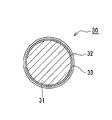
- the negative electrode active material 30 is a particulate substance, and includes core particles 31 containing a material that occludes and releases metal ions such as lithium ions, a first layer 32 formed on the surface of the core particles 31, and a first layer 32. It has a second layer 33 formed on the layer 32 of 1.
- the first layer 32 contains at least one selected from amorphous carbon, carbon nanotubes, carbon nanofibers, and conductive polymers.
- the second layer 33 contains at least one inorganic compound selected from oxides, phosphoric acid compounds, silicic acid compounds, and boric acid compounds.
- the first layer 32 is formed directly on the surface of the core particles 31.
- the second layer 33 is formed on the surface of the core particles 31 via the first layer 32, but a part of the second layer 33 may be formed directly on the surface of the core particles 31.
- the negative electrode active material 30 has core particles 31 / first layer 32 / second layer 33 in this order from the particle center side, and the first layer 32 and the second layer 33-2 are present on the surface of the core particles 31. It can be said that it is a core-shell particle in which a layered shell is formed. By coating the surface of the core particles 31 with the first layer 32, a high-quality second layer 33 is formed, the thermal stability of the negative electrode 12 is improved, and heat generation at the time of abnormality occurrence is suppressed.
- the negative electrode active material 30 may have layers other than the first layer 32 and the second layer 33 as long as the object of the present disclosure is not impaired.
- the core particles 31 are preferably composed of a material containing carbon or silicon (Si).
- the carbon-containing material include natural graphite such as scaly graphite, massive artificial graphite, and artificial graphite such as graphitized mesophase carbon microbeads.
- Graphite is a particle having a volume-based median diameter (D50) of, for example, 5 ⁇ m to 30 ⁇ m, preferably 10 ⁇ m to 25 ⁇ m.
- D50 means a particle diameter in which the cumulative frequency is 50% from the smallest particle diameter in the volume-based particle size distribution, and is also called a medium diameter.
- the D50 can be measured using water as a dispersion medium using a laser diffraction type particle size distribution measuring device (for example, Microtrac HRA manufactured by Nikkiso Co., Ltd.).
- the Si-containing material applied to the core particles 31 may be Si particles, but is preferably a silicon oxide phase and a Si-containing compound dispersed in the silicon oxide phase (hereinafter, referred to as “SiO”). ), Or a compound containing a lithium silicate phase and Si dispersed in the lithium silicate phase (hereinafter referred to as “LSX”).
- SiO and LSX are particles in which, for example, D50 is smaller than that of graphite D50.
- the volume-based D50 of SiO and LSX is preferably 1 ⁇ m to 15 ⁇ m, more preferably 4 ⁇ m to 10 ⁇ m.
- SiO has a sea-island structure in which fine Si particles are substantially uniformly dispersed in an amorphous silicon oxide matrix, and is represented by the general formula SiO x (0.5 ⁇ x ⁇ 1.6). ..
- the content of Si particles is preferably 35 to 75% by mass with respect to the total mass of SiO, from the viewpoint of achieving both battery capacity and cycle characteristics.
- the LSX has, for example, a sea-island structure in which fine Si particles are substantially uniformly dispersed in a matrix of lithium silicate represented by the general formula Li 2z SiO (2 + z) (0 ⁇ z ⁇ 2).
- the content of Si particles is preferably 35 to 75% by mass with respect to the total mass of LSX, as in the case of SiO.
- a carbon-containing material such as graphite and a Si-containing material such as SiO and LSX may be used in combination as the core particles 31.
- a Si-containing material such as SiO and LSX
- an example of the mixing ratio is 60:40 to 95: 5 in mass ratio.
- the first layer 32 is composed mainly of at least one selected from amorphous carbon, carbon nanotubes, carbon nanofibers, and a conductive polymer. Above all, the first layer 32 is preferably composed of amorphous carbon.
- the first layer 32 may be substantially composed of only amorphous carbon, and may contain a material other than amorphous carbon as long as the object of the present disclosure is not impaired.
- the first layer 32 has a conductivity equal to or higher than that of the core particles 31, and also contributes to lowering the resistance of the battery.
- the first layer 32 may be formed so as to cover the entire surface of the core particles 31 as illustrated in FIGS. 2A and 2B, and may be scattered on the surface of the core particles 31 as illustrated in FIG. 2C. Alternatively, it may be formed in a mesh shape. In the example shown in FIG. 2C, a part of the surface of the core particles 31 is exposed without being covered by the first layer 32.
- the thickness of the first layer 32 is, for example, 1 ⁇ m or less, preferably 1 nm to 500 nm, and more preferably 10 nm to 100 nm. The thickness of the first layer 32 can be measured by observing the particle cross section of the negative electrode active material 30 with a transmission electron microscope (TEM) (the same applies to the second layer 33).
- TEM transmission electron microscope
- the first layer 32 is preferably formed in an amount of 0.1 to 5% by mass with respect to the mass of the core particles 31. In this case, a wide area of the surface of the core particles 31 is covered with the first layer 32.
- the ratio of the surface of the core particles 31 coated by the first layer 32 that is, the coverage of the surface of the core particles 31 by the first layer 32 is preferably 60% or more, more preferably 70% or more, substantially. It may be 100%.
- the coverage is measured by X-ray photoelectron spectroscopy (XPS) or Auger electron spectroscopy (AES).
- XPS X-ray photoelectron spectroscopy
- AES Auger electron spectroscopy
- it is more desirable that the first layer 32 is formed on a portion without surface functional groups, for example, on a basal surface in the case of graphite.
- the presence of the first layer 32 as a buffer layer facilitates the formation of the second layer 33, which is normally difficult to form on a surface having no surface functional groups.
- the first layer 32 can be formed by mixing coal pitch, petroleum pitch, phenol resin, conductive polymer paste, etc. with the core particles 31 and performing heat treatment. Alternatively, it can be formed by a CVD method using acetylene, methane or the like. Further, the first layer 32 may be formed by fixing carbon powder such as carbon black to the surface of the core particles 31 using a binder.
- the second layer 33 is composed mainly of at least one inorganic compound selected from oxides, phosphoric acid compounds, silicic acid compounds, and boric acid compounds.
- the inorganic compound constituting the second layer 33 is preferably a compound having no lithium ion conductivity from the viewpoint of improving safety and the like.
- the presence or absence of lithium ion conductivity can be evaluated as follows. Make pellets based on the compound and attach lithium foil to both ends of the pellet. The presence or absence of lithium ion conductivity can be evaluated based on the value of the current flowing by applying a constant voltage to the Li / pellet / Li laminate (when no current flows, the presence or absence of lithium ion conductivity is defined as no lithium ion conductivity. ).
- the inorganic compound constituting the second layer 33 preferably contains at least one metal element selected from titanium, aluminum, zirconium, and magnesium.
- the second layer 33 has better adhesion to the first layer 32 than the surface of the core particles 31, and is evenly formed on the surface of the core particles 31 coated with the first layer 32.
- the second layer 33 may be less conductive than the first layer 32.
- the inorganic compound constituting the second layer 33 include metal oxides such as titanium oxide, aluminum oxide, zirconium oxide, magnesium oxide and silicon oxide, sodium phosphate, potassium phosphate, calcium phosphate and magnesium phosphate.
- Metal phosphates such as aluminum phosphate, phosphate esters such as ammonium polyphosphate, condensed phosphates such as melamine polyphosphate, sodium borate, potassium borate, calcium borate, magnesium borate, aluminum borate, etc.
- Condensed borates such as metal borate, borate ester, melamine borate, metal silicates such as sodium silicate, potassium silicate, calcium silicate, magnesium silicate, barium silicate, manganese silicate, etc. Can be mentioned.
- the second layer 33 may be formed on the surface of the core particles 31 via the first layer 32, and may be formed so as to cover the entire surface of the core particles 31 as illustrated in FIG. 2A. As illustrated in 2B and C, the core particles 31 may be interspersed or formed in a mesh pattern on the surface.
- the first layer 32 is formed over substantially the entire surface of the core particles 31, and the second layer 33 is formed over a wide area except for a part on the first layer 32.
- the first layer 32 is formed over a wide area except for a part of the surface of the core particle 31, and the second layer 33 is formed directly on the first layer 32 and on the surface of the core particle 31. Has been done. In either case, a part of the first layer 32 is not covered by the second layer 33 and is exposed on the outermost surface of the negative electrode active material 30.
- the thickness of the second layer 33 is, for example, 1 ⁇ m or less, preferably 1 nm to 500 nm, and more preferably 10 nm to 100 nm.
- the second layer 33 is preferably formed in an amount of 0.1 to 5% by mass with respect to the mass of the core particles 31. In this case, a wide area of the surface of the core particles 31 is covered with the second layer 33.
- the ratio of the surface of the core particles 31 coated by the second layer 33 that is, the coverage of the surface of the core particles 31 by the second layer 33 is preferably 50% or more, more preferably 60% or more, substantially. It may be 100%.
- the coverage of the first layer 32 by the second layer 33 is, for example, 60% to 95%, preferably 60% to 80%.
- the metal alkoxide of the above compound is mixed with the core particles 31 having the first layer 32 formed on the surface, and a small amount thereof is formed. It can be formed by performing heat treatment after adding the water of. This method is generally called the sol-gel method.
- Other various phosphoric acid compounds, boric acid compounds, silicic acid compounds and the like can be formed by mixing the compound with the core particles 31 having the first layer 32 formed on the surface, filtering and drying the impurities.
- the binder contained in the negative electrode mixture layer fluororesin, PAN, polyimide, acrylic resin, polyolefin or the like can be used as in the case of the positive electrode 11, but styrene-butadiene rubber (SBR) is used. Is preferable.
- the negative electrode mixture layer preferably further contains CMC or a salt thereof, polyacrylic acid (PAA) or a salt thereof, polyvinyl alcohol (PVA) and the like. Above all, it is preferable to use SBR in combination with CMC or a salt thereof, PAA or a salt thereof.
- a porous sheet having ion permeability and insulating property is used as the separator 13.
- the porous sheet include a microporous thin film, a woven fabric, and a non-woven fabric.
- polyolefins such as polyethylene and polypropylene, cellulose and the like are suitable.
- the separator 13 may have either a single-layer structure or a laminated structure. A heat-resistant layer or the like may be formed on the surface of the separator 13.
- a lithium transition metal composite oxide represented by the general formula LiNi 0.82 Co 0.15 Al 0.03 O 2 was used as the positive electrode active material.
- Positive electrode active material, acetylene black, and polyvinylidene fluoride are mixed at a solid content mass ratio of 97: 2: 1, and N-methyl-2-pyrrolidone (NMP) is used as a dispersion medium to prepare a positive electrode mixture slurry.
- NMP N-methyl-2-pyrrolidone
- this positive electrode mixture slurry is applied to both sides of the positive electrode core made of aluminum foil, the coating film is dried and compressed, and then cut into a predetermined electrode size, and the positive electrode mixture layers are formed on both sides of the positive electrode core. The formed positive electrode was produced.
- the core particles graphite having a D50 of about 50 ⁇ m was used. After immersing the core particles made of graphite in a petroleum pitch, they were calcined at 800 ° C. in a reducing atmosphere such as Ar gas to form a first layer made of amorphous carbon over substantially the entire surface of the core particles. .. The first layer was formed in an amount of 0.5% by mass with respect to the core particles.
- the obtained negative electrode active material, a dispersion of styrene-butadiene rubber (SBR), and sodium carboxymethyl cellulose (CMC-Na) are mixed at a solid content mass ratio of 98: 1: 1 and water is used as a dispersion medium.
- SBR styrene-butadiene rubber
- CMC-Na sodium carboxymethyl cellulose
- this negative electrode mixture slurry is applied to both sides of the negative electrode core made of copper foil, the coating film is dried and compressed, and then cut into a predetermined electrode size, and the negative electrode mixture layers are formed on both sides of the negative electrode core.
- the formed negative electrode was produced.
- Ethylene carbonate (EC), methyl ethyl carbonate (EMC), and dimethyl carbonate (DMC) were mixed in a volume ratio of 2: 1: 7.
- a non-aqueous electrolyte was prepared by dissolving LiPF 6 in the mixed solvent so as to have a concentration of 1.4 mol / L.
- the positive electrode to which the aluminum positive electrode lead is attached and the negative electrode to which the nickel negative electrode lead is attached are spirally wound through a polyethylene separator and molded into a flat shape to form a wound electrode body. Made.
- This electrode body was housed in an exterior body made of aluminum laminate, and after injecting the non-aqueous electrolyte solution, the opening of the exterior body was sealed to prepare a non-aqueous electrolyte secondary battery.
- Example 2 A negative electrode and a non-aqueous electrolyte secondary battery were produced in the same manner as in Example 1 except that aluminum oxide (Al 2 O 3 ) was used instead of TiO 2 in the production of the negative electrode active material.
- Al 2 O 3 aluminum oxide
- Example 3 A negative electrode and a non-aqueous electrolyte secondary battery were produced in the same manner as in Example 1 except that zirconium oxide (ZrO 2 ) was used instead of TiO 2 in the production of the negative electrode active material.
- zirconium oxide ZrO 2
- Example 4 A negative electrode and a non-aqueous electrolyte secondary battery were produced in the same manner as in Example 1 except that magnesium oxide (MgO) was used instead of TiO 2 in the production of the negative electrode active material.
- MgO magnesium oxide
- Example 5 A negative electrode and a non-aqueous electrolyte secondary battery were produced in the same manner as in Example 1 except that silicon oxide (SiO 2 ) was used instead of TiO 2 in the production of the negative electrode active material.
- silicon oxide SiO 2
- Example 6 A negative electrode and a non-aqueous electrolyte secondary battery were produced in the same manner as in Example 1 except that aluminum phosphate (AlPO 4 ) was used instead of TiO 2 in the production of the negative electrode active material.
- AlPO 4 aluminum phosphate
- Example 7 A negative electrode and a non-aqueous electrolyte secondary battery were prepared in the same manner as in Example 1 except that aluminum phosphate (Al 2 (PO 4 ) 2 ) was used instead of TiO 2 in the preparation of the negative electrode active material. ..
- Example 8 A negative electrode and a non-aqueous electrolyte secondary battery were produced in the same manner as in Example 1 except that potassium silicate (K 2 SiO 3 ) was used instead of TiO 2 in the production of the negative electrode active material.
- potassium silicate K 2 SiO 3
- a negative electrode and a non-aqueous electrolyte secondary battery were prepared in the same manner as in Example 1 except that the first layer and the second layer were not formed on the surface of the core particles in the preparation of the negative electrode active material.
- Example 2 A negative electrode and a non-aqueous electrolyte secondary battery were prepared in the same manner as in Example 1 except that the second layer was not formed on the surface of the core particles in the preparation of the negative electrode active material.
- Example 3 A negative electrode and a non-aqueous electrolyte secondary battery were produced in the same manner as in Example 1 except that the first layer was not formed on the surface of the core particles in the production of the negative electrode active material.
- the temperature rise of all the batteries of the examples after the nail piercing test was smaller than that of the batteries of the comparative examples. That is, in the battery of the example, heat generation when an internal short circuit occurs is significantly suppressed as compared with the battery of the comparative example.
- a negative electrode active material in which both the first layer and the second layer do not exist is used on the surface of graphite particles (Comparative Example 1), but also when a negative electrode active material in which one layer does not exist is used (when a negative electrode active material in which one layer does not exist is used ( In Comparative Examples 2 and 3), the heat generation suppressing effect cannot be obtained either.
- the battery resistance was lower than that of the batteries of Comparative Examples 1 and 3, and the increase in the battery temperature after the nailing test was suppressed.
- the battery of the example suppressed the rise in the battery temperature after the nailing test as compared with the battery of the comparative example 2.
- the battery resistance of the battery of Comparative Example 2 is lower than that of the battery of Example 2.
- the battery temperature after the nailing test was higher than that of the battery of Comparative Example 1, but the nails were formed by forming the first layer or the second layer on the surface of the core particles. It is unlikely that the battery temperature will rise after the insertion test.
- the negative electrode active material of the example in which the first layer and the second layer were formed in this order on the surface of the core particles was used, the increase in battery temperature after the nailing test was significantly suppressed.
- the first layer functions as a cushioning material between the core particles and the second layer. That is, it is considered that the substance constituting the second layer is sufficiently adhered to the surface of the core particles by interposing the first layer between the core particles and the second layer. Therefore, the negative electrode active material of the example has a sufficient second layer on the surface of the core particles, and by using the negative electrode active material of the example, the temperature rise that cannot be obtained with the negative electrode active material of Comparative Example 3 A suppressive effect can be obtained.
- Each of the negative electrode active materials of Example 1 and Comparative Example 3 contains TiO 2 in the second layer.
- the battery resistance was significantly increased as compared with the battery of Comparative Example 1.
- the battery of Example 1 since the first layer is formed between the core particles and the second layer, it is possible to suppress an increase in battery resistance as in the battery of Comparative Example 3, and further. The battery resistance could be suppressed lower than that in the case where the second layer did not exist (Comparative Example 1).
- Rechargeable battery 11 Positive electrode 12 Negative electrode 13 Separator 14 Electrode body 16 Exterior can 17 Sealing body 18, 19 Insulation plate 20 Positive electrode lead 21 Negative electrode lead 22 Grooved part 23 Internal terminal plate 24 Lower valve body 25 Insulation member 26 Upper valve body 27 Cap 28 Gasket 30 Negative electrode active material 31 Core particles 32 First layer 33 Second layer
Landscapes
- Chemical & Material Sciences (AREA)
- Chemical Kinetics & Catalysis (AREA)
- Electrochemistry (AREA)
- General Chemical & Material Sciences (AREA)
- Engineering & Computer Science (AREA)
- Composite Materials (AREA)
- Materials Engineering (AREA)
- Manufacturing & Machinery (AREA)
- Inorganic Chemistry (AREA)
- Battery Electrode And Active Subsutance (AREA)
- Secondary Cells (AREA)
Priority Applications (4)
| Application Number | Priority Date | Filing Date | Title |
|---|---|---|---|
| CN202080039210.5A CN113892200A (zh) | 2019-05-30 | 2020-04-16 | 二次电池用的负极活性物质及二次电池 |
| JP2021522697A JP7474951B2 (ja) | 2019-05-30 | 2020-04-16 | 二次電池用の負極活物質、及び二次電池 |
| EP20813692.9A EP3979365A4 (en) | 2019-05-30 | 2020-04-16 | NEGATIVE ELECTRODE ACTIVE MATERIAL FOR A SECONDARY BATTERY AND SECONDARY BATTERY |
| US17/613,655 US20220231282A1 (en) | 2019-05-30 | 2020-04-16 | Negative-electrode active material for secondary battery, and secondary battery |
Applications Claiming Priority (2)
| Application Number | Priority Date | Filing Date | Title |
|---|---|---|---|
| JP2019101106 | 2019-05-30 | ||
| JP2019-101106 | 2019-05-30 |
Publications (1)
| Publication Number | Publication Date |
|---|---|
| WO2020241105A1 true WO2020241105A1 (ja) | 2020-12-03 |
Family
ID=73552313
Family Applications (1)
| Application Number | Title | Priority Date | Filing Date |
|---|---|---|---|
| PCT/JP2020/016668 Ceased WO2020241105A1 (ja) | 2019-05-30 | 2020-04-16 | 二次電池用の負極活物質、及び二次電池 |
Country Status (5)
| Country | Link |
|---|---|
| US (1) | US20220231282A1 (https=) |
| EP (1) | EP3979365A4 (https=) |
| JP (1) | JP7474951B2 (https=) |
| CN (1) | CN113892200A (https=) |
| WO (1) | WO2020241105A1 (https=) |
Cited By (1)
| Publication number | Priority date | Publication date | Assignee | Title |
|---|---|---|---|---|
| WO2022205667A1 (zh) * | 2021-03-30 | 2022-10-06 | 万向一二三股份公司 | 一种硅基负极材料及其制备方法、应用 |
Families Citing this family (3)
| Publication number | Priority date | Publication date | Assignee | Title |
|---|---|---|---|---|
| KR102376217B1 (ko) * | 2021-07-28 | 2022-03-18 | 주식회사 그랩실 | 다층 구조의 음극 활물질, 이의 제조방법 및 이를 포함하는 리튬 이차전지 |
| CN117941097A (zh) * | 2021-09-15 | 2024-04-26 | 纳诺格拉夫公司 | 包含表面改质氧化硅粒子的电极材料 |
| EP4439717A4 (en) * | 2022-09-05 | 2025-09-10 | Lg Energy Solution Ltd | NEGATIVE ACTIVE MATERIAL, NEGATIVE ELECTRODE COMPRISING SAME, SECONDARY BATTERY COMPRISING SAME, AND METHOD FOR PRODUCING NEGATIVE ACTIVE MATERIAL THEREOF |
Citations (6)
| Publication number | Priority date | Publication date | Assignee | Title |
|---|---|---|---|---|
| JP2014022041A (ja) | 2012-07-12 | 2014-02-03 | Sony Corp | 負極活物質および負極活物質の製造方法、ならびにリチウムイオン電池、電池パック、電子機器、電動車両、蓄電装置および電力システム |
| JP2014157817A (ja) * | 2013-02-15 | 2014-08-28 | Samsung Sdi Co Ltd | 負極活物質、それを採用した負極、及びその負極を採用したリチウム電池 |
| WO2016157735A1 (ja) * | 2015-03-30 | 2016-10-06 | 三洋電機株式会社 | 非水電解質二次電池 |
| JP2017054615A (ja) * | 2015-09-07 | 2017-03-16 | トヨタ自動車株式会社 | 被覆負極活物質 |
| JP2017054614A (ja) * | 2015-09-07 | 2017-03-16 | トヨタ自動車株式会社 | 被覆負極活物質 |
| WO2018173521A1 (ja) * | 2017-03-22 | 2018-09-27 | パナソニックIpマネジメント株式会社 | 二次電池用負極およびその製造方法並びに二次電池 |
Family Cites Families (9)
| Publication number | Priority date | Publication date | Assignee | Title |
|---|---|---|---|---|
| US20140370380A9 (en) * | 2009-05-07 | 2014-12-18 | Yi Cui | Core-shell high capacity nanowires for battery electrodes |
| JP2013515349A (ja) * | 2009-12-21 | 2013-05-02 | エー123 システムズ, インコーポレイテッド | アノード材料 |
| CN102122708A (zh) * | 2010-01-08 | 2011-07-13 | 中国科学院物理研究所 | 用于锂离子二次电池的负极材料、含该负极材料的负极及其制备方法以及含该负极的电池 |
| CN102544464B (zh) * | 2010-12-28 | 2014-06-25 | 清华大学 | 钛酸锂复合材料及其制备方法以及锂离子电池 |
| KR101849976B1 (ko) * | 2011-04-08 | 2018-05-31 | 삼성전자주식회사 | 전극 활물질, 그 제조방법, 이를 포함한 전극 및 이를 채용한 리튬 이차 전지 |
| KR101368474B1 (ko) * | 2012-03-23 | 2014-03-03 | 강원대학교산학협력단 | 리튬 이차 전지용 음극 활물질, 이의 제조방법 및 이를 포함하는 리튬 이차 전지 |
| JP2016046204A (ja) * | 2014-08-26 | 2016-04-04 | トヨタ自動車株式会社 | リチウムイオン二次電池用負極活物質 |
| DE102016202459A1 (de) * | 2016-02-17 | 2017-08-17 | Wacker Chemie Ag | Kern-Schale-Kompositpartikel |
| US10290864B2 (en) * | 2016-04-07 | 2019-05-14 | StoreDot Ltd. | Coated pre-lithiated anode material particles and cross-linked polymer coatings |
-
2020
- 2020-04-16 CN CN202080039210.5A patent/CN113892200A/zh active Pending
- 2020-04-16 EP EP20813692.9A patent/EP3979365A4/en active Pending
- 2020-04-16 WO PCT/JP2020/016668 patent/WO2020241105A1/ja not_active Ceased
- 2020-04-16 JP JP2021522697A patent/JP7474951B2/ja active Active
- 2020-04-16 US US17/613,655 patent/US20220231282A1/en active Pending
Patent Citations (6)
| Publication number | Priority date | Publication date | Assignee | Title |
|---|---|---|---|---|
| JP2014022041A (ja) | 2012-07-12 | 2014-02-03 | Sony Corp | 負極活物質および負極活物質の製造方法、ならびにリチウムイオン電池、電池パック、電子機器、電動車両、蓄電装置および電力システム |
| JP2014157817A (ja) * | 2013-02-15 | 2014-08-28 | Samsung Sdi Co Ltd | 負極活物質、それを採用した負極、及びその負極を採用したリチウム電池 |
| WO2016157735A1 (ja) * | 2015-03-30 | 2016-10-06 | 三洋電機株式会社 | 非水電解質二次電池 |
| JP2017054615A (ja) * | 2015-09-07 | 2017-03-16 | トヨタ自動車株式会社 | 被覆負極活物質 |
| JP2017054614A (ja) * | 2015-09-07 | 2017-03-16 | トヨタ自動車株式会社 | 被覆負極活物質 |
| WO2018173521A1 (ja) * | 2017-03-22 | 2018-09-27 | パナソニックIpマネジメント株式会社 | 二次電池用負極およびその製造方法並びに二次電池 |
Non-Patent Citations (1)
| Title |
|---|
| See also references of EP3979365A4 |
Cited By (1)
| Publication number | Priority date | Publication date | Assignee | Title |
|---|---|---|---|---|
| WO2022205667A1 (zh) * | 2021-03-30 | 2022-10-06 | 万向一二三股份公司 | 一种硅基负极材料及其制备方法、应用 |
Also Published As
| Publication number | Publication date |
|---|---|
| JP7474951B2 (ja) | 2024-04-26 |
| EP3979365A1 (en) | 2022-04-06 |
| JPWO2020241105A1 (https=) | 2020-12-03 |
| CN113892200A (zh) | 2022-01-04 |
| EP3979365A4 (en) | 2022-07-20 |
| US20220231282A1 (en) | 2022-07-21 |
Similar Documents
| Publication | Publication Date | Title |
|---|---|---|
| JP6193285B2 (ja) | リチウムイオン二次電池用負極、リチウムイオン二次電池、電池パック及び車 | |
| JP7394327B2 (ja) | 二次電池 | |
| JP7474951B2 (ja) | 二次電池用の負極活物質、及び二次電池 | |
| US20220166007A1 (en) | Non-aqueous electrolyte secondary battery | |
| JP7324119B2 (ja) | 非水電解質二次電池用正極活物質、及び非水電解質二次電池 | |
| JP7496533B2 (ja) | 二次電池 | |
| CN114080703B (zh) | 二次电池用负极活性物质、以及二次电池 | |
| JP2020149821A (ja) | 非水電解質二次電池 | |
| WO2023053773A1 (ja) | リチウムイオン二次電池 | |
| WO2020213499A1 (ja) | 非水電解質二次電池用の負極、及び非水電解質二次電池 | |
| WO2020059450A1 (ja) | 二次電池用スラリー、二次電池用正極、及び二次電池 | |
| WO2022196040A1 (ja) | 非水電解質二次電池 | |
| US11522188B2 (en) | Positive electrode active material for non-aqueous electrolyte secondary battery, and non-aqueous electrolyte secondary battery | |
| CN113054160A (zh) | 非水电解质二次电池用负极、和非水电解质二次电池 | |
| JP7668469B2 (ja) | 非水電解質二次電池用負極、及び非水電解質二次電池 | |
| JPWO2020090410A1 (ja) | 二次電池 | |
| JP7664545B2 (ja) | 非水電解質二次電池用正極活物質および非水電解質二次電池 | |
| JP2021072194A (ja) | 非水電解質二次電池用正極活物質、及び非水電解質二次電池 | |
| JP7720569B2 (ja) | リチウムイオン電池 | |
| JPWO2020066255A1 (ja) | 二次電池用正極及び二次電池 | |
| JP7780722B2 (ja) | 非水電解質二次電池用正極活物質および非水電解質二次電池 | |
| WO2024042871A1 (ja) | 非水電解質二次電池 | |
| WO2024042897A1 (ja) | 二次電池用負極および非水電解質二次電池 | |
| WO2020261742A1 (ja) | 二次電池用電極、二次電池用セパレータ、及び二次電池 | |
| JP7745169B2 (ja) | 非水電解質二次電池 |
Legal Events
| Date | Code | Title | Description |
|---|---|---|---|
| 121 | Ep: the epo has been informed by wipo that ep was designated in this application |
Ref document number: 20813692 Country of ref document: EP Kind code of ref document: A1 |
|
| ENP | Entry into the national phase |
Ref document number: 2021522697 Country of ref document: JP Kind code of ref document: A |
|
| NENP | Non-entry into the national phase |
Ref country code: DE |
|
| ENP | Entry into the national phase |
Ref document number: 2020813692 Country of ref document: EP Effective date: 20220103 |