WO2020161934A1 - 複合体およびその製造方法、ならびに塗装金属板 - Google Patents
複合体およびその製造方法、ならびに塗装金属板 Download PDFInfo
- Publication number
- WO2020161934A1 WO2020161934A1 PCT/JP2019/024965 JP2019024965W WO2020161934A1 WO 2020161934 A1 WO2020161934 A1 WO 2020161934A1 JP 2019024965 W JP2019024965 W JP 2019024965W WO 2020161934 A1 WO2020161934 A1 WO 2020161934A1
- Authority
- WO
- WIPO (PCT)
- Prior art keywords
- metal plate
- layer
- rubber
- primer layer
- carbon
- Prior art date
- Legal status (The legal status is an assumption and is not a legal conclusion. Google has not performed a legal analysis and makes no representation as to the accuracy of the status listed.)
- Ceased
Links
Images
Classifications
-
- B—PERFORMING OPERATIONS; TRANSPORTING
- B32—LAYERED PRODUCTS
- B32B—LAYERED PRODUCTS, i.e. PRODUCTS BUILT-UP OF STRATA OF FLAT OR NON-FLAT, e.g. CELLULAR OR HONEYCOMB, FORM
- B32B15/00—Layered products comprising a layer of metal
- B32B15/04—Layered products comprising a layer of metal comprising metal as the main or only constituent of a layer, which is next to another layer of the same or of a different material
- B32B15/06—Layered products comprising a layer of metal comprising metal as the main or only constituent of a layer, which is next to another layer of the same or of a different material of natural rubber or synthetic rubber
-
- B—PERFORMING OPERATIONS; TRANSPORTING
- B32—LAYERED PRODUCTS
- B32B—LAYERED PRODUCTS, i.e. PRODUCTS BUILT-UP OF STRATA OF FLAT OR NON-FLAT, e.g. CELLULAR OR HONEYCOMB, FORM
- B32B15/00—Layered products comprising a layer of metal
- B32B15/04—Layered products comprising a layer of metal comprising metal as the main or only constituent of a layer, which is next to another layer of the same or of a different material
- B32B15/08—Layered products comprising a layer of metal comprising metal as the main or only constituent of a layer, which is next to another layer of the same or of a different material of synthetic resin
-
- B—PERFORMING OPERATIONS; TRANSPORTING
- B32—LAYERED PRODUCTS
- B32B—LAYERED PRODUCTS, i.e. PRODUCTS BUILT-UP OF STRATA OF FLAT OR NON-FLAT, e.g. CELLULAR OR HONEYCOMB, FORM
- B32B25/00—Layered products comprising a layer of natural or synthetic rubber
- B32B25/04—Layered products comprising a layer of natural or synthetic rubber comprising rubber as the main or only constituent of a layer, which is next to another layer of the same or of a different material
- B32B25/08—Layered products comprising a layer of natural or synthetic rubber comprising rubber as the main or only constituent of a layer, which is next to another layer of the same or of a different material of synthetic resin
-
- B—PERFORMING OPERATIONS; TRANSPORTING
- B32—LAYERED PRODUCTS
- B32B—LAYERED PRODUCTS, i.e. PRODUCTS BUILT-UP OF STRATA OF FLAT OR NON-FLAT, e.g. CELLULAR OR HONEYCOMB, FORM
- B32B27/00—Layered products comprising a layer of synthetic resin
- B32B27/18—Layered products comprising a layer of synthetic resin characterised by the use of special additives
- B32B27/20—Layered products comprising a layer of synthetic resin characterised by the use of special additives using fillers, pigments, thixotroping agents
-
- B—PERFORMING OPERATIONS; TRANSPORTING
- B32—LAYERED PRODUCTS
- B32B—LAYERED PRODUCTS, i.e. PRODUCTS BUILT-UP OF STRATA OF FLAT OR NON-FLAT, e.g. CELLULAR OR HONEYCOMB, FORM
- B32B27/00—Layered products comprising a layer of synthetic resin
- B32B27/18—Layered products comprising a layer of synthetic resin characterised by the use of special additives
- B32B27/26—Layered products comprising a layer of synthetic resin characterised by the use of special additives using curing agents
-
- B—PERFORMING OPERATIONS; TRANSPORTING
- B32—LAYERED PRODUCTS
- B32B—LAYERED PRODUCTS, i.e. PRODUCTS BUILT-UP OF STRATA OF FLAT OR NON-FLAT, e.g. CELLULAR OR HONEYCOMB, FORM
- B32B27/00—Layered products comprising a layer of synthetic resin
- B32B27/40—Layered products comprising a layer of synthetic resin comprising polyurethanes
-
- B—PERFORMING OPERATIONS; TRANSPORTING
- B32—LAYERED PRODUCTS
- B32B—LAYERED PRODUCTS, i.e. PRODUCTS BUILT-UP OF STRATA OF FLAT OR NON-FLAT, e.g. CELLULAR OR HONEYCOMB, FORM
- B32B7/00—Layered products characterised by the relation between layers; Layered products characterised by the relative orientation of features between layers, or by the relative values of a measurable parameter between layers, i.e. products comprising layers having different physical, chemical or physicochemical properties; Layered products characterised by the interconnection of layers
- B32B7/04—Interconnection of layers
- B32B7/12—Interconnection of layers using interposed adhesives or interposed materials with bonding properties
-
- C—CHEMISTRY; METALLURGY
- C08—ORGANIC MACROMOLECULAR COMPOUNDS; THEIR PREPARATION OR CHEMICAL WORKING-UP; COMPOSITIONS BASED THEREON
- C08K—Use of inorganic or non-macromolecular organic substances as compounding ingredients
- C08K3/00—Use of inorganic substances as compounding ingredients
- C08K3/02—Elements
- C08K3/04—Carbon
-
- C—CHEMISTRY; METALLURGY
- C09—DYES; PAINTS; POLISHES; NATURAL RESINS; ADHESIVES; COMPOSITIONS NOT OTHERWISE PROVIDED FOR; APPLICATIONS OF MATERIALS NOT OTHERWISE PROVIDED FOR
- C09D—COATING COMPOSITIONS, e.g. PAINTS, VARNISHES OR LACQUERS; FILLING PASTES; CHEMICAL PAINT OR INK REMOVERS; INKS; CORRECTING FLUIDS; WOODSTAINS; PASTES OR SOLIDS FOR COLOURING OR PRINTING; USE OF MATERIALS THEREFOR
- C09D7/00—Features of coating compositions, not provided for in group C09D5/00; Processes for incorporating ingredients in coating compositions
- C09D7/40—Additives
- C09D7/60—Additives non-macromolecular
- C09D7/61—Additives non-macromolecular inorganic
-
- C—CHEMISTRY; METALLURGY
- C23—COATING METALLIC MATERIAL; COATING MATERIAL WITH METALLIC MATERIAL; CHEMICAL SURFACE TREATMENT; DIFFUSION TREATMENT OF METALLIC MATERIAL; COATING BY VACUUM EVAPORATION, BY SPUTTERING, BY ION IMPLANTATION OR BY CHEMICAL VAPOUR DEPOSITION, IN GENERAL; INHIBITING CORROSION OF METALLIC MATERIAL OR INCRUSTATION IN GENERAL
- C23C—COATING METALLIC MATERIAL; COATING MATERIAL WITH METALLIC MATERIAL; SURFACE TREATMENT OF METALLIC MATERIAL BY DIFFUSION INTO THE SURFACE, BY CHEMICAL CONVERSION OR SUBSTITUTION; COATING BY VACUUM EVAPORATION, BY SPUTTERING, BY ION IMPLANTATION OR BY CHEMICAL VAPOUR DEPOSITION, IN GENERAL
- C23C26/00—Coating not provided for in groups C23C2/00 - C23C24/00
-
- B—PERFORMING OPERATIONS; TRANSPORTING
- B32—LAYERED PRODUCTS
- B32B—LAYERED PRODUCTS, i.e. PRODUCTS BUILT-UP OF STRATA OF FLAT OR NON-FLAT, e.g. CELLULAR OR HONEYCOMB, FORM
- B32B2255/00—Coating on the layer surface
- B32B2255/06—Coating on the layer surface on metal layer
Definitions
- the present invention relates to a composite, a manufacturing method thereof, and a coated metal plate.
- Composites including a metal plate and a rubber layer bonded to the metal plate are widely used in, for example, anti-vibration rubber for automobiles, seismically isolated laminated rubber as a building member, and healthcare products.
- Patent Document 1 As a composite used for, for example, an oil seal, in Patent Document 1, a metal plate, (a) an undercoat adhesive layer containing a phenol resin and an epoxy resin, and (b) a phenol resin, a halogenated polymer and a metal oxide are included. An acrylic rubber-metal composite having an overcoat adhesive layer containing it and an acrylic rubber layer (c) in this order is disclosed.
- Such a composite has 1) a step of cleaning or surface-treating the surface of the metal plate by shot blasting, etc. 2) On the cleaned or surface-treated metal plate (for ensuring adhesion with the metal plate) ) A step of applying an undercoat vulcanization adhesive and drying it to form an undercoat vulcanization adhesive layer, 3) a topcoat vulcanization adhesion (to ensure adhesiveness with a rubber layer) on the undercoat vulcanization adhesive layer Step of applying and drying an agent to form a topcoat adhesive layer, 4) laminating an unvulcanized rubber composition on the obtained topcoat vulcanized adhesive layer, and thermocompression bonding with a hot press or the like, It is obtained by simultaneously advancing the vulcanization of the unvulcanized rubber composition and the vulcanization in the undercoat adhesive layer and the overcoat adhesive layer to bond the metal plate and the rubber layer.
- a vulcanizing adhesive used for bonding such a metal plate and a rubber layer usually contains a halogenated rubber such as chlorinated rubber or brominated rubber and a vulcanizing agent such as sulfur in order to improve the adhesiveness.
- a vulcanizing adhesive a one-layer type vulcanizing adhesive for adhering the metal plate and the rubber layer with only one layer, an undercoat vulcanizing adhesive applied to the metal plate side, and a rubber layer side are applied.
- the above method has a problem that productivity is low because a large number of steps are required before finally obtaining a complex.
- the step 1) (the step of cleaning the surface of the metal plate) and the step 2) (the step of forming the undercoat adhesive layer on the surface of the metal plate) can be omitted. ..
- step 3 step of forming the overcoat adhesive layer
- step 4 laminate of a rubber layer on the overcoat adhesive layer and heat treatment.
- a composite in which the metal plate and the rubber layer are adhered can be obtained only by performing the step of pressure bonding.
- it is desired to use a coated metal plate provided with an undercoat adhesive layer that is, precoating).
- the present invention has been made in view of the above circumstances, and an object of the present invention is to provide a composite having good adhesiveness, a method for producing the same, and a coated metal plate that does not cause blocking, which is used for the composite.
- the present invention relates to the following composite, its manufacturing method, and a coated metal plate.
- the composite of the present invention is a composite having a metal plate, a coated metal plate having a primer layer arranged on the metal plate, and a rubber layer arranged on the primer layer of the coated metal plate.
- the primer layer comprises a cured product of a resin composition containing a curable resin, a curing agent, and carbon-based particles, and the specific surface area of the carbon-based particles is 10 to 1500 m 2 /g.
- the content of the carbon-based particles is 3 to 25 mass% with respect to the curable resin, and the content of the rubber component is 1 mass% or less with respect to the curable resin.
- the method for producing a composite of the present invention has a metal plate and a primer layer disposed on the metal plate, and the primer layer is a resin containing a curable resin, a curing agent, and carbon-based particles. It is a cured product of the composition, the specific surface area of the carbon-based particles is 10 to 1500 m 2 /g, the content of the carbon-based particles is 3 to 25% by mass with respect to the resin, and the rubber is The content of components is a step of preparing a coated metal plate having a content of 1% by mass or less with respect to the resin, and a first rubber-based polymer and a first cross-linking agent on the primer layer of the coated metal plate. And then cross-linking the resin composition for a rubber layer containing the above to obtain a rubber layer disposed on the primer layer.
- the coated metal plate of the present invention is a coated metal plate for bonding with a rubber layer, and has a metal plate, a chemical conversion treatment film, and a primer layer in this order, and the chemical conversion treatment film is a chromate-based film. Or a chromate-free film containing a silane coupling agent having an amino group and an organic resin, the primer layer is disposed on the outermost surface of the coated metal plate, the primer layer is cured Made of a cured product of a resin composition containing a hydrophobic resin, a curing agent, and carbon particles, the specific surface area of the carbon particles is 10 to 1500 m 2 /g, and the content of the carbon particles is It is 3 to 25 mass% with respect to the curable resin, and the content of the rubber component is 1 mass% or less with respect to the curable resin.
- the present invention it is possible to provide a composite having good adhesiveness, a method for producing the same, and a coated metal plate that does not cause blocking, which is used for the composite.
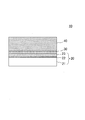
- FIG. 1 is a schematic sectional view showing an example of the composite body of the present invention.
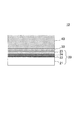
- FIG. 2 is a schematic sectional view showing another example of the complex of the present invention.
- the inventors of the present invention in a coated metal plate having a metal plate and a primer layer, by including a predetermined amount of carbon-based particles in the primer layer, even if the rubber component is not substantially contained, the rubber It has been found that good adhesion can be achieved with the layer (or the adhesive layer).
- the carbon-based particles contained in the primer layer are likely to chemically adsorb the rubber component contained in the rubber layer (or the adhesive layer). Such chemisorption is more likely to occur as the primary average particle size of the carbon-based particles is smaller and the specific surface area is larger. It is considered that this improves the adhesiveness between the primer layer and the rubber layer (or the adhesive layer).
- the conventional step 1) (the step of cleaning or surface-treating the surface of the metal plate) and step 2) (the step of forming an undercoat adhesive layer) of the related art are omitted.
- the composite can be obtained with a small number of steps.
- the primer layer of the coated metal plate does not substantially contain a rubber component (for obtaining adhesiveness), it does not adhere to the primer layer of the coated metal plate during, for example, a state in which the coated metal plate is wound or stored. It is possible to suppress the occurrence of blocking such as adhesion between the back surface of the metal plate and adhesion between the primer layers.
- the present invention has been made based on such findings.
- Composite The composite of the present invention has a coated metal plate and a rubber layer arranged on the primer layer of the coated metal plate.
- the painted metal plate includes a metal plate and a primer layer disposed on the metal plate.
- the coated metal plate preferably further has a chemical conversion treatment film arranged between the metal plate and the primer layer.
- Metal plate The type of metal plate is not particularly limited.
- the metal sheet include cold-rolled steel sheet, galvanized steel sheet (electrical Zn plating, hot-dip Zn plating), alloyed zinc-plated steel sheet (alloyed hot-dip Zn plating that is alloyed after hot-dip Zn plating), zinc-alloy plated steel sheet ( Hot-dip Zn-Mg plating, hot-dip Zn-Al-Mg plating, hot-dip Zn-Al plating), hot-dip Al-Si plated steel sheet, stainless steel sheet (austenite type, martensite type, ferrite type, ferrite-martensite two-phase type), Aluminum plate, aluminum alloy plate, copper plate, brass plate, titanium plate and the like are included.
- the metal plate may be subjected to a known pretreatment such as degreasing treatment or surface cleaning by corona discharge, or mechanical polishing, pickling, roughening by shot blasting, etc.
- the thickness of the metal plate can be appropriately set according to the application of the composite, but when it is used as a vibration isolator, for example, it can be 0.2 to 2.0 mm.
- the chemical conversion coating is arranged between the metal plate and the primer layer and improves the adhesion between the metal plate and the primer layer.
- the chemical conversion coating may be arranged on at least a region (bonding region) of the surface of the metal plate to be bonded to the rubber layer, but may be arranged on the entire surface of the metal plate.
- the type of chemical conversion treatment film is not particularly limited, and it may be a chromate film such as a chromate-based film, a chromate phosphate-based film, or a chromate-free film.
- the chemical conversion coating is preferably a chromate-free coating.
- the chromate-free film contains an inorganic compound (without chromate) and an organic resin.
- the inorganic compound examples include a silane compound (eg, silane coupling agent), a titanium compound (eg, Ti—Mo composite material), a fluoroacid compound (eg, hexafluorotitanic acid), and a zirconium compound (eg, hexafluorozirconic acid). Is included. These inorganic compounds may be used alone or in combination of two or more. Among them, the inorganic compound is preferably a silane compound, and more preferably a silane coupling agent from the viewpoint of easily increasing the adhesion between the metal plate and the primer layer.
- silane compound eg, silane coupling agent
- Ti—Mo composite material titanium compound
- fluoroacid compound eg, hexafluorotitanic acid
- zirconium compound eg, hexafluorozirconic acid
- the silane coupling agent preferably has an amino group, preferably a primary amino group, from the viewpoint of increasing the reactivity with the epoxy resin and the curing agent contained in the primer layer described later.
- Examples of silane coupling agents are ⁇ -aminopropyltrimethoxysilane, ⁇ -aminopropyltriethoxysilane, N-(2-aminoethyl)aminopropyltrimethoxysilane, N-(2-aminoethyl)aminopropylmethyl.
- Dimethoxysilane N-(2-aminoethyl)aminopropyltriethoxysilane, N-(2-aminoethyl)aminopropylmethyldiethoxysilane, N-(2-aminoethyl)aminopropylmethyldimethoxysilane and the like are included.
- the organic resin can enhance the affinity with the resin contained in the primer layer and enhance the adhesion between the chemical conversion coating and the primer layer.
- organic resins include urethane resins, phenolic resins, N-methylglucamine resins, tannic acid and polyacrylic acid. These organic resins may be used alone or in combination of two or more. Further, these organic resins may be cured with a curing agent such as an isocyanate compound or a polycarbodiimide compound.
- the adhesion amount of the chemical conversion treatment film is not particularly limited as long as it can improve the adhesion between the metal plate and the primer layer.
- the adhesion amount may be adjusted so that the total Cr conversion adhesion amount is 5 to 100 mg/m 2 .
- the amount of adhesion is in the range of 10 to 300 mg/m 2 for the film containing the silane compound, and in the range of 10 to 500 mg/m 2 for the film containing the titanium compound.
- the deposition amount may be adjusted so that the deposition amount in terms of fluorine or the deposition amount in total of metal elements is in the range of 3 to 100 mg/m 2 .
- the rust preventive layer is arranged as a metal plate to enhance the corrosion resistance when it is necessary to protect it from a corrosive environment such as salt damage such as a cold rolled steel plate or a plated steel plate.
- the rust preventive layer preferably comprises a cured product of a resin composition containing a curable resin, a curing agent, and a rust preventive pigment.
- curable resin used for the rust preventive layer examples include the same as those exemplified as the curable resin used for the primer layer.
- the curable resin used for the anticorrosion layer and the curable resin used for the primer layer may be the same or different, and are the same from the viewpoint of easily obtaining good adhesion to the primer layer. Is preferred.
- anticorrosion pigments examples include chromium anticorrosion pigments such as calcium chromate and strontium chromate; non-chromium anticorrosion pigments such as magnesium phosphate, magnesium hydrogen phosphate, zinc phosphate, aluminum dihydrogen tripolyphosphate, and calcium silicate. Contains rust pigment. These rust preventive pigments may be used alone or in combination of two or more.
- the thickness of the rust preventive layer may be in a range capable of imparting sufficient corrosion resistance to the coated metal plate, and is, for example, preferably 1 to 20 ⁇ m, more preferably 3 to 10 ⁇ m.
- the primer layer is arranged on the metal plate and the outermost layer of the coated metal plate, and adheres (joins) the metal plate and the rubber layer (or the adhesive layer).
- the primer layer is a curable resin, a curing agent, and carbon-based particles. It is preferably composed of a cured product of a resin composition containing.
- the curable resin is not particularly limited as long as it has a functional group (for example, a hydroxyl group) that reacts with the curing agent and has good adhesion to the chemical conversion coating.
- a functional group for example, a hydroxyl group
- the curable resin contained in the primer layer is a reactive group capable of reacting with an amino group (carboxyl group, ester group, epoxy group, ketone group, It is preferably a resin having a halogen group).
- the curable resin contained in the primer layer is a resin having a functional group capable of reacting with the epoxy group (carboxyl group, amino group, hydroxyl group, etc.). Is preferred. Among them, from the viewpoint of easily obtaining good adhesion without film peeling during molding, or when the chemical conversion treatment film contains a silane coupling agent having an amino group, good adhesion with the chemical conversion treatment film is obtained.
- the curable resin is preferably a curable polyester resin or an epoxy resin from the viewpoint of being easily damaged.
- the curable polyester resin is, for example, a hydroxyl group-containing polyester resin, which is a polycondensation product of a polyvalent carboxylic acid component and a polyhydric alcohol component.
- polyvalent carboxylic acid components include terephthalic acid, isophthalic acid, phthalic acid or anhydrides thereof, aromatic polyvalent carboxylic acids such as 2,6-naphthalenedicarboxylic acid, 2,7-naphthalenedicarboxylic acid and trimellitic acid. And its anhydrides, and aliphatic polycarboxylic acids such as succinic acid, adipic acid, azelaic acid, sebacic acid, dodecanedicarboxylic acid, 1,4-cyclohexanedicarboxylic acid and butanetricarboxylic acid.
- polyhydric alcohol components include ethylene glycol, 1,3-propanediol, 1,4-butanediol, 1,5-pentanediol, 1,6-hexanediol, diethylene glycol, triethylene glycol, 1,2- Propanediol, neopentyl glycol, 1,2-butanediol, 1,3-butanediol, 2,3-butanediol, 1,2-pentanediol, 2,3-pentanediol, 1,4-pentanediol, 1 ,4-hexanediol, 2,5-hexanediol, 3-methyl-1,5-pentanediol, 1,2-dodecanediol, 1,2-octadecanediol, 1,4-cyclohexanediol, 1,4-cyclohexanediol Aliphatic polyhydric alcohol
- examples of the curable polyester resin include epoxy-modified polyester resin.
- the epoxy-modified polyester resin may be, for example, one obtained by esterifying a carboxyl group-containing polyester resin and an epoxy compound.
- the raw material carboxyl group-containing polyester resin may be a polycondensation product of a polyvalent carboxylic acid component and a polyhydric alcohol component, as described above. However, it is preferable that the polyhydric carboxylic acid component/polyhydric alcohol component amount ratio is adjusted such that the carboxyl group has a predetermined amount, or that the polyhydric carboxylic acid component contains a trivalent or higher carboxylic acid.
- the carboxyl group-containing polyester resin as the raw material may be a hydroxy group-containing polyester resin reacted with an acid anhydride.
- the curable polyester resin has an aromatic skeleton from the viewpoint of increasing the heat resistance of the primer layer obtained (the polyvalent carboxylic acid component contains an aromatic carboxylic acid component, or the polyhydric alcohol component is an aromatic polyvalent (Including alcohol) is preferred.
- the number average molecular weight of the curable polyester resin is not particularly limited, but from the viewpoint of the strength and processability of the coating film, it is preferably several thousands to tens of thousands, specifically 3000 to 15,000. Among them, the number average molecular weight is preferably higher from the viewpoint of increasing flexibility of the primer layer, making it easier to swell with the oil content in the rubber layer (or solvent in the adhesive layer), and improving adhesiveness. More preferably, it is ⁇ 15,000.
- the number average molecular weight of the curable polyester resin can be measured in terms of polystyrene by gel permeation chromatography. Specific measurement conditions can be the same as those in the examples described later.
- epoxy resin examples include bisphenol A type epoxy resin, bisphenol F type epoxy resin, hydrogenated bisphenol A type epoxy resin, brominated bisphenol A type epoxy resin, and other bisphenol type epoxy resins; phenol novolac type epoxy resin, orthocresol novolac.
- Type epoxy resin novolak type epoxy resin which is polyglycidyl ether of phenol or alkylphenol novolak resin such as bisphenol A novolak type epoxy resin; ethylene glycol diglycidyl ether, propylene glycol diglycidyl ether, 1,4-butanediol diglycidyl ether, Alkylene glycol type epoxy resins which are polyglycidyl ethers of alkylene glycols such as 1,6-hexanediol diglycidyl ether, trimethylolpropane triglycidyl ether, pentaerythritol tetraglycidyl ether; orthophthalic acid diglycidyl ester, isophthalic acid diglycidyl ester, Glycidyl ester type epoxies such as terephthalic acid diglycidyl ester, tetrahydrophthalic acid diglycidyl ester, hexahydrophthalic acid digly
- an epoxy resin having an aromatic ring is preferable from the viewpoint that adhesion with a metal plate (or chemical conversion coating) is easily obtained, or a cured coating having high strength or heat resistance is easily obtained.
- a bisphenol type epoxy resin is more preferable, and a bisphenol A type epoxy resin is further preferable.
- the number average molecular weight of the epoxy resin is not particularly limited, but from the viewpoint of the strength and workability of the coating film, it is preferably about several thousand. Specifically, the number average molecular weight of the epoxy resin is preferably 400 to 25,000. When the number average molecular weight of the epoxy resin is 400 or more, a coating film having good strength is easily obtained, and corrosion resistance and the like are easily enhanced. When the number average molecular weight of the epoxy resin is 25,000 or less, the viscosity of the coating liquid does not become too high, so that the coating workability and workability by a roll coater or the like are not easily impaired. Further, since the proportion of the solid content in the paint does not decrease too much, the productivity is not easily impaired.
- the number average molecular weight is preferably higher from the viewpoint of increasing flexibility of the primer layer, making it easier to swell with an oil component (or solvent in the adhesive layer) in the rubber layer, and easily improving adhesiveness.
- the number average molecular weight of the resin is more preferably 4000 to 20000.
- the number average molecular weight of the epoxy resin can be measured by the same method as described above.
- the epoxy resin may also be a modified epoxy resin having a functional group that reacts with an isocyanate group such as an amino group or a hydroxy group (for example, an epoxy resin modified with an alkanolamine).
- the epoxy resin is a modified epoxy resin having a functional group that reacts with an isocyanate group, from the viewpoint of enhancing the affinity with the components contained in the chemical conversion coating or the rubber layer and easily obtaining good adhesion. Is preferred.
- the content of the curable resin is preferably 55 to 88.5 mass% with respect to the solid content of the resin composition.
- the content of the curable resin is 55% by mass or more, the obtained primer layer may not only have sufficient film strength, but also have good scratch resistance, corrosion resistance, water resistance or chemical resistance. You can.
- the content of the curable resin is 88.5% by mass or less, the viscosity of the resin composition at the time of forming the primer layer does not become too high, so that coating workability and workability are less likely to be impaired.
- the content of the curable resin is more preferably 60 to 85 mass% with respect to the solid content of the resin composition.
- the curing agent is not particularly limited as long as it can cure the curable resin.
- Examples of curing agents for curing epoxy resins include amine compounds, acid anhydrides and imidazole compounds.
- an isocyanate compound and a melamine compound are contained in the example of the hardening agent of the modified epoxy resin or curable polyester resin which has an amino group or a hydroxy group etc. as mentioned above.
- the isocyanate compound is preferable from the viewpoint of easily imparting flexibility to the primer layer to easily suppress cracks and also to enhance adhesiveness with the rubber layer (or the adhesive layer).
- the primer layer obtained by using an isocyanate compound as a curing agent easily swells moderately with the solvent in the adhesive layer and the oil component in the rubber layer (compared to the case where a melamine-based curing agent is used, for example). This is because the reaction points also tend to increase.
- isocyanate compound examples include aliphatic isocyanate compounds such as hexamethylene diisocyanate (HDI), lysine diisocyanate and dimer acid diisocyanate (DDI); norbornene diisocyanate (NBDI), isophorone diisocyanate (IPDI), cyclohexane diisocyanate, dicyclohexylmethane diisocyanate and the like.
- HDI hexamethylene diisocyanate
- DDI lysine diisocyanate and dimer acid diisocyanate
- NBDI norbornene diisocyanate
- IPDI isophorone diisocyanate
- cyclohexane diisocyanate dicyclohexylmethane diisocyanate and the like.
- Alicyclic isocyanate compounds such as methylene diphenyl diisocyanate (MDI), tolylene diisocyanate (TDI), xylylene diisocyanate (XDI), naphthylene 1,5-diisocyanate (NDI), tetramethylene xylylene diisocyanate (TMXDI), phenylene diisocyanate, etc.
- Aromatic isocyanate compounds are included. Of these, an aliphatic isocyanate compound is preferable from the viewpoint of obtaining a primer layer having good adhesion.
- the content of the curing agent is preferably 10 to 40 mass% with respect to the curable resin.
- the content of the curing agent is 10% by mass or more, the curable resin can be sufficiently cured.
- a primer layer having sufficient film strength is easily obtained, and adhesiveness (or bondability) between the primer layer and the adhesive layer is easily obtained.
- the content of the curing agent is 40% by mass or less, bleed out is unlikely to occur.
- the carbon-based particles are preferably carbon-based particles having a nitrogen adsorption specific surface area of 10 to 1500 m 2 /g.
- the nitrogen adsorption specific surface area of the carbon-based particles is 10 m 2 /g or more, the carbon-based particles are appropriately aggregated, and therefore the oil component (or the adhesive composition is applied) when the rubber layer resin composition is applied. It is easy to trap the organic solvent). As a result, the primer layer is likely to swell and good adhesiveness is easily obtained.
- the nitrogen adsorption specific surface area of the carbon-based particles is 1500 m 2 /g or less, the number of reaction points with the rubber layer (or the adhesive layer) is appropriately large, so that the rubber-based weight of the rubber layer (or the adhesive layer) is large. Interaction with coalesce is less likely to be impaired.
- the specific surface area of the carbon-based particles is more preferably 30 to 500 m 2 /g.
- the specific surface area (nitrogen adsorption specific surface area) of carbon-based particles can be measured by the BET method according to JIS Z 8830:2013.
- the type of carbon particles is not particularly limited as long as the nitrogen adsorption specific surface area satisfies the above range.
- Examples of such carbon-based particles include carbon black and activated carbon.
- the primary average particle size is small (easily adjusted within the range described below), the number of crosslinking points with the rubber component contained in the rubber layer (or adhesive layer) is increased, and the primer layer and the rubber layer (or adhesive layer) Carbon black is preferable from the viewpoint of easily increasing the adhesiveness with.
- the primary average particle diameter of the carbon-based particles is preferably 10 nm to 10 ⁇ m.
- the primary average particle diameter is preferably 10 to 100 nm, more preferably 10 to 50 nm, from the viewpoint of dramatically improving the adhesiveness to rubber by reducing the particle diameter.
- the primary average particle diameter of carbon-based particles can be measured as the arithmetic average particle diameter by observing the particle diameters of arbitrary 20 particles with an electron microscope. Separation and recovery of the carbon-based particles is performed, for example, by dissolving the primer layer of the coated metal plate in an organic solvent or the like that dissolves the curable resin that constitutes the primer layer, and then filtering and drying the separated carbon-based particles. It can be done by
- the pH of the carbon-based particles is preferably in the range of 6-8.
- the pH is 6 or more, the oxygen content of the carbon-based particles is moderately large, so that the dispersibility is likely to be good, and when the pH is 8 or less, the storage stability of the obtained coating is not easily impaired.
- the pH can be measured by a pH meter using a glass electrode.
- the content of carbon-based particles is preferably 3 to 25 mass% with respect to the curable resin contained in the primer layer.
- the content of the carbon-based particles is 3% by mass or more, the adhesiveness between the primer layer and the rubber layer (or the adhesive layer) is likely to be sufficiently enhanced, and the primer layer and the rubber layer (or the adhesive layer) are partially partially formed. It may be difficult to cause interfacial peeling and the like.
- the content of the carbon-based particles is 25% by mass or less, brittleness of the primer layer can be easily suppressed. Thereby, it is easy to suppress the occurrence of cohesive failure of the primer layer when processing the coated metal plate, and it is possible to prevent the workability from being impaired.
- the content of the carbon-based particles is preferably 4 to 20% by mass based on the curable resin contained in the primer layer.
- the carbon-based particles may be uniformly present in the primer layer or may be unevenly distributed in the thickness direction. From the viewpoint of enhancing the adhesiveness between the primer layer and the rubber layer (or the adhesive layer), the carbon-based particles may be contained in at least the surface layer portion of the primer layer on the rubber layer (or the adhesive layer) side.
- the primer layer containing the carbon-based particles has good adhesiveness with the rubber layer (or the adhesive layer) even without containing the rubber component as in the conventional case. Therefore, the primer layer can be made substantially free of the rubber component.
- the content of the rubber component is 1% by mass or less, preferably 0.1% by mass or less based on the curable resin contained in the primer layer.
- the primer layer is titanium dioxide, iron oxide, various baked pigments, cyanine blue, color pigments such as cyaning clay, calcium carbonate, clay, extender pigments such as barium sulfate, metal powders such as aluminum powders, bone agents, if necessary.
- the composition may further contain components other than those described above, such as an antifoaming agent, a leveling agent, a surface conditioner, a viscosity modifier, a dispersant, a wax and a rust preventive pigment.
- examples of other components may include rust preventive pigments, but they are not necessary when a rust preventive layer is provided between the primer layer and the metal plate.
- the primer layer preferably further contains an aggregate. This is because the dispersibility of the carbon-based particles is likely to be further increased by adding the aggregate.
- the aggregate can improve the film hardness and abrasion resistance of the primer layer, or impart irregularities to the surface of the primer layer to improve the appearance.
- the aggregate may be an inorganic aggregate or an organic aggregate.
- the shape of the aggregate is not particularly limited, and may be scale-like, fibrous, granular or lump-like.
- scale-like inorganic aggregates include glass flakes, barium sulfate flakes, graphite flakes, synthetic mica flakes, synthetic alumina flakes, silica flakes, and mica-like iron oxide (MIO).
- fibrous inorganic aggregate include potassium titanate fiber, wollastonite fiber, silicon carbide fiber, alumina fiber, alumina silicate fiber, silica fiber, rock wool, slag wool, glass fiber, and carbon fiber.
- organic aggregate include acrylic particles and polyacrylonitrile particles.
- granular or lumped inorganic aggregates or matting agents include glass beads, silica particles, titania particles.
- the thickness of the primer layer is not particularly limited as long as it can sufficiently bond the metal plate (or the chemical conversion coating) and the rubber layer (or the adhesive layer).
- the thickness of the primer layer is preferably 1 to 30 ⁇ m.
- the thickness of the primer layer is 1 ⁇ m or more, good adhesion with the rubber layer (or the adhesive layer) is easily obtained. Further, when the thickness of the primer layer is 30 ⁇ m or less, the coated metal plate can be easily thinned. From the above viewpoint, the thickness of the primer layer is more preferably 3 to 20 ⁇ m, further preferably 5 to 10 ⁇ m. When the primer layer is composed of two or more layers, the thickness of the primer layer means the total thickness thereof.
- the primer layer may be composed of one layer, or may be composed of two or more layers.
- the primer layer is preferably composed of one layer.
- the primer layer is a first primer layer arranged on the metal plate (or chemical conversion coating) side and having a relatively low content of carbon-based particles, It may have a second primer layer arranged on the rubber layer (or adhesive layer) side and having a relatively large content of carbon-based particles.
- the first primer layer may include a rust preventive pigment from the viewpoint of enhancing the corrosion resistance of the metal plate.
- the rubber layer is arranged on the primer layer of the painted metal plate.
- the rubber layer is composed of a crosslinked product of a resin composition for a rubber layer, which contains a first rubber polymer as a raw material and a first crosslinking agent.
- the first rubber-based polymer is not particularly limited, and may be a diene-based polymer or a non-diene-based polymer.
- diene polymer examples include butadiene rubber (BR), isoprene rubber (IR), isobutylene isoprene rubber (IIR), nitrile butadiene rubber (NBR), chloroprene rubber (CR), nitrile isoprene rubber (NIR), natural rubber.
- BR butadiene rubber
- IR isoprene rubber
- IIR isobutylene isoprene rubber
- NBR chloroprene rubber
- NIR nitrile isoprene rubber
- NBR nitrile butadiene rubber
- NR vinyl pyridine butadiene rubber
- SBR styrene butadiene rubber
- XSBR carboxystyrene isoprene rubber
- XNBR carboxy-nitrile butadiene rubber
- NBR nitrile butadiene rubber
- SBR styrene butadiene rubber
- NR natural rubber
- NBR nitrile butadiene rubber
- non-diene polymer examples include ethylene propylene diene rubber (EPDM), chlorosulfonated polyethylene (CSM), acrylic rubber (ACM), urethane rubber (U), silicone rubber (Q), epichlorohydrin rubber (ECO). ) Is included.
- EPDM ethylene propylene diene rubber
- CSM chlorosulfonated polyethylene
- ACM acrylic rubber
- U urethane rubber
- Q silicone rubber
- ECO epichlorohydrin rubber
- the first cross-linking agent may be selected according to the type of the first rubber polymer as a raw material.
- the first cross-linking agent include sulfur (for example, fine powder sulfur 200 mesh manufactured by Hosoi Chemical Co., Ltd.), oxime compound (for example, dimethylglyoxime (DMG), diacetylmonooxime (DAM)), polyamine compound (for example, N,N′).
- the oxime compound can be used as a cross-linking agent for diene polymers such as isobutylene isoprene rubber (IIR), nitrile butadiene rubber (NBR), and styrene butadiene rubber (SBR).
- the polyamine compound can be used for a rubber-based polymer (CR, ACM, etc.) having a halogen atom serving as a crosslinking point.
- the organic peroxide can be used as a cross-linking agent for many rubber-based polymers except for a part such as IIR.
- the cross-linking agent may be one kind or a combination of two or more kinds.
- the content of the first cross-linking agent is preferably, for example, 3 to 10 mass% with respect to the first rubber-based polymer as a raw material.
- the resin composition for the rubber layer may further contain components other than those described above, if necessary.
- other components include heat resistant rubber polymers, plasticizers, antioxidants, crosslinking accelerators, reinforcing materials and the like.
- the rubber layer resin composition may further include a polymethylene chain-based rubber polymer as the heat resistant rubber polymer.
- a polymethylene chain-based rubber polymer as the heat resistant rubber polymer.
- a diene polymer containing a large number of double bonds in the molecule has poor heat resistance. Therefore, by adding an appropriate amount of a polymethylene chain-based rubber polymer having high heat resistance and having no double bond in the molecule, The thermal deterioration of the layer resin composition can be further suppressed.
- the content of the polymethylene chain type rubber polymer is preferably 0 to 60% by mass, more preferably 10 to 50% by mass, and 15 to 35% by mass with respect to the first rubber polymer as a raw material. Is more preferable.
- plasticizers examples include stearic acid.
- the plasticizer may be one kind or a combination of two or more kinds.
- the content of the plasticizer may be, for example, 0.5 to 4.0 mass% with respect to the first rubber-based polymer as a raw material.
- antioxidants include naphthylamine-based, diphenylamine-based, p-phenylenediamine-based, quinoline-based, hydroquinone derivative, monophenol-based, polyphenol-based, thiobisphenol-based, hindered phenol-based, and phosphite-based .
- the antiaging agent may be one kind or a combination of two or more kinds.
- the content of the antioxidant may be, for example, 0.5 to 8.0 mass% with respect to the first rubber polymer as a raw material.
- crosslinking accelerator examples include guanidine-based, aldehyde-amine-based, aldehyde-ammonia-based, thiazole-based, sulfenamide-based, thiourea-based, thiuram-based, dithiocarbamate-based, xanthate-based, and zinc oxide (zinc white). included.
- the vulcanization accelerator may be one kind or a combination of two or more kinds.
- the content of the crosslinking accelerator may be, for example, 1.0 to 8.0 mass% with respect to the first rubber-based polymer which is a raw material.
- Reinforcement material examples include carbon black, silica and the like.
- the content of the reinforcing material is preferably, for example, 10 to 60% by mass based on the first rubber polymer. Further, the total content of the other components is preferably 30% by mass or less based on the rubber layer.
- the thickness of the rubber layer can be appropriately set according to the application of the composite, but from the viewpoint of exhibiting sufficient rubber elasticity, it is preferably 10 ⁇ m or more, for example. When the thickness of the rubber layer is 10 ⁇ m or more, vibration damping property is likely to be exhibited. In addition, as long as it has a vibration-proof property, the thickness of the rubber layer does not need to have an upper limit, and may be 30 mm, for example.
- the composite of the present invention may further have other layers such as an adhesive layer, if necessary.
- the rubber layer is a rubber layer in which adhesion to a primer layer such as EPDM is difficult to be obtained, from the viewpoint of further increasing the adhesion between the primer layer and the rubber layer of the coated metal plate, the primer layer and the rubber layer An adhesive layer may be further arranged between the two.
- the adhesive layer comprises a crosslinked product of an adhesive composition containing a second rubber-based polymer and a second crosslinking agent.
- Examples of the second rubber-based polymer used in the adhesive layer include those similar to those exemplified as the first rubber-based polymer used in the rubber layer.
- the first rubber-based polymer contained in the rubber layer is a diene-based polymer
- the second rubber-based polymer contained in the adhesive layer is preferably a halogenated rubber-based polymer.
- the example of the halogenated rubber-based polymer may be a halide of the above-mentioned diene-based polymer or non-diene-based polymer.
- halogenated rubber polymers include dichlorobutadiene polymers, brominated dichlorobutadiene polymers, chloroprene rubber (CR), chlorosulfonated polyethylene (CSM), epichlorohydrin rubber (ECO), Included are brominated or chlorinated rubbers such as chlorinated polyethylene.
- the second cross-linking agent may be sulfur or an organic oxide.
- the adhesive composition may further contain other components such as a metal oxide and a phenol resin, if necessary.
- the metal oxide may function as a crosslinking aid or a filler.
- metal oxides include titanium oxide, zinc oxide, magnesium oxide, calcium oxide and the like. Above all, a mixture of titanium oxide and an oxide of a divalent metal is preferable.
- -Phenolic resin may have a function of enhancing the adhesiveness between the primer layer and the rubber layer.
- the phenol resin include novolac type phenol resin and resol type phenol resin.
- the adhesive composition may be commercially available as a vulcanization adhesive for top coating.
- Examples of such commercial products include Chem Corporation 210, 215, 607, 5150, 6108, 6110, 6125, 6225, XJ150, XJ551, XJ552, XJ549 from Road Corporation.
- the thickness of the adhesive layer is not particularly limited as long as it can sufficiently bond the primer layer and the rubber layer.
- the thickness of the adhesive layer may be, for example, 5 to 50 ⁇ m. When the thickness of the adhesive layer is 5 ⁇ m or more, good adhesion between the primer layer and the rubber layer is easily obtained. Further, when the thickness of the adhesive layer is 30 ⁇ m or less, the coated metal plate can be easily thinned. From the above viewpoint, the thickness of the adhesive layer is more preferably 5 to 50 ⁇ m, further preferably 10 to 30 ⁇ m.
- FIG. 1 is a schematic sectional view showing an example of the composite body of the present invention.
- the composite 10 has a coated metal plate 20, an adhesive layer 30, and a rubber layer 40 in this order.
- the coated metal plate 20 has a metal plate 21, a chemical conversion coating 22, and a primer layer 23 in this order.
- the primer layer 23 of the coated metal plate 20 and the rubber layer 40 are satisfactorily adhered (or joined) via the adhesive layer 30.
- the adhesive layer 30 may be omitted.
- the surface layer portion of the primer layer 23 including the adhesive surface with the adhesive layer 30 (or the rubber layer 40 when the adhesive layer 30 is not provided) is a solvent in the adhesive layer 30 (or an oil content in the rubber layer 40). It is preferable that the swelling is caused by Thereby, good adhesiveness with the adhesive layer 30 (or the rubber layer 40) is easily obtained. The swollen portion can be confirmed by, for example, observing the cross section of the primer layer 23 with a low vacuum SEM.
- FIG. 2 is a schematic sectional view showing another example of the complex of the present invention.
- the composite body 10 shown in FIG. 2 has the same configuration as that of FIG. 1 except that it further includes a rust preventive layer 24 disposed between the chemical conversion coating 22 of the coated metal plate 20 and the primer layer 23.
- Such a composite 10 may have higher corrosion resistance.
- the method for producing a composite body of the present invention comprises (1) a step of preparing a coated metal plate, and (2) applying a resin composition for a rubber layer onto a primer layer of the coated metal plate, Cross-linking to obtain a rubber layer adhered (bonded) to the coated metal plate.
- a resin composition for a rubber layer onto a primer layer of the coated metal plate Cross-linking to obtain a rubber layer adhered (bonded) to the coated metal plate.
- Step (1) First, a chemical conversion treatment liquid is applied to the surface of the metal plate to form a chemical conversion treatment film.
- the above-mentioned metal plate can be used.
- the metal plate may be subjected to a known pretreatment such as degreasing treatment or surface cleaning by corona discharge, or mechanical polishing, pickling, roughening by shot blasting, etc., if necessary.
- the chemical conversion treatment liquid is a solution containing the constituent components of the chemical conversion treatment film described above.
- the chromate-free chemical conversion treatment liquid may be an aqueous solution containing the aforementioned inorganic compound and an organic resin. If necessary, the chemical conversion treatment liquid may further contain a small amount of an alcohol, a ketone, or a cellosolve-based water-soluble organic solvent, in addition to water.
- the chemical conversion treatment liquid may further contain a curing agent for curing the organic resin, if necessary.
- a curing agent for curing the organic resin, if necessary.
- the curing agent include diisocyanate compounds having an aromatic ring, isocyanate compounds such as aliphatic diisocyanate compounds, and polycarbodiimide compounds.
- the solid content concentration of the chemical conversion treatment liquid is preferably 0.1 to 40 mass %. When the solid content concentration is 0.1% by mass or more, a chemical conversion treatment film having a sufficient thickness can be easily obtained. On the other hand, when the solid content concentration is 40% by mass or less, the storage stability of the chemical conversion treatment liquid is less likely to be impaired.
- the pH of the chemical conversion treatment liquid is preferably adjusted within the range of 3 to 12.
- the chemical conversion treatment liquid is applied to the surface of the metal plate subjected to alkali degreasing by a roll coating method, a spray method, a curtain flow method, a spin coating method, a dip coating method, etc., and dried at room temperature without washing with water. ..
- the drying temperature is preferably 200° C. or lower.
- a resin composition containing the above-mentioned curable resin and carbon-based particles (resin composition for primer layer) is applied, dried and baked to form a primer layer.
- resin composition for primer layer contains a curing agent, baking is performed under conditions such that the resin composition is cured. Even if the resin composition is completely cured, the surface of the primer layer has polar groups derived from an epoxy resin or the like, so that the oil content in the rubber layer (or the solvent in the adhesive layer) causes Easy to swell.
- the isocyanate compound in the primer layer resin composition is blocked from the viewpoint of increasing storage stability (increasing the pot life of the primer layer composition).
- the blocking agent for example, known ⁇ -caprolactam, methyl ethyl ketone oxime and the like can be used.
- the primer layer resin composition may further contain a solvent, if necessary, from the viewpoint of improving coating workability.
- a solvent examples include alcohol solvents such as methanol, ethanol, isopropanol and 1-butanol, ketone solvents such as acetone, methyl ethyl ketone, methyl isobutyl ketone and cyclohexanone, and benzene solvents such as xylene. These solvents may be used alone or in combination of two or more.
- the method for applying the resin composition for the primer layer is not particularly limited and may be appropriately selected from known methods.
- the method for drying the resin composition for the primer layer is not particularly limited, and the solvent may be volatilized.
- the drying temperature for example, when the resin contained in the resin composition for the primer layer has a functional group that reacts with the curing agent, may be a temperature at which the solvent can be volatilized in a range where the resin is not completely cured,
- the ultimate plate temperature is preferably 180 to 220° C., for example.
- a resin composition for a rubber layer containing the above-mentioned second rubber-based polymer and a second cross-linking agent is applied onto the primer layer of the obtained coated metal plate, and the resin for the rubber layer is provided.
- a layer of the composition is formed.
- the resin composition for a rubber layer may be in a sheet form or a liquid form.
- the rubber layer resin composition may further contain a solvent.
- the solvent contained in the rubber layer resin composition include those similar to the solvent contained in the primer layer composition.
- the method for applying the resin composition for a rubber layer is not particularly limited, and may be, for example, a screen printing method, a roll coating method, a curtain flow method, or a dip coating method.
- the rubber layer resin composition applied on the primer layer of the coated metal plate is crosslinked to obtain a rubber layer made of a crosslinked product of the rubber layer resin composition.
- the crosslinking of the rubber layer resin composition is preferably performed by heating.
- the heating method is not particularly limited, but may be, for example, a thermocompression bonding method.
- the cross-linking temperature may be a temperature at which the first rubber-based polymer in the resin composition for the rubber layer cross-links, and depends on the composition of the resin composition for the rubber layer, but may be, for example, 150 to 250°C.
- the crosslinking time may be, for example, about 2 to 15 minutes.
- the pressure at the time of thermocompression bonding may be such that the primer layer and the rubber layer can be sufficiently adhered, and may be, for example, 10 to 30 MPa.
- the method for producing a complex of the present invention may further include other steps, if necessary.
- a step (3) of applying the above-mentioned adhesive composition onto the primer layer to form a layer made of the adhesive composition is performed. You may go further.
- the adhesive composition may further contain a solvent, if necessary.
- the solvent contained in the adhesive composition include those similar to the solvent contained in the primer layer composition.
- the method of applying the adhesive composition is not particularly limited and may be the same as the method of applying the resin composition for a rubber layer described above.
- the rubber layer resin composition is applied onto the layer made of the adhesive composition obtained in the step (3), and then dried and crosslinked. That is, since the adhesive composition often contains a solvent, it is preferable to crosslink the resin composition for the rubber layer while drying and crosslinking the adhesive composition.
- Drying and cross-linking may be performed simultaneously or sequentially. From the viewpoint of facilitating sufficient adhesion between the primer layer and the rubber layer via the adhesive layer, it is preferable that the drying and the crosslinking are sequentially performed. That is, it is preferable that after the adhesive composition is dried (drying step), the adhesive composition and the resin composition for the rubber layer are respectively crosslinked (crosslinking step).
- the drying temperature may be a temperature at which the solvent in the adhesive composition can be volatilized, and may be a temperature lower than the crosslinking temperature, for example, room temperature to 80° C.
- the drying time may be, for example, about 2 to 15 minutes.
- the adhesive composition in the crosslinking step, can be crosslinked together with the rubber layer resin composition. Thereby, the adhesiveness between the primer layer and the adhesive layer can be further enhanced.
- the composite of the present invention can be used in various applications such as an anti-vibration rubber for automobiles, a seismically isolated laminated rubber as a building member, and a health care product.
- Metal plate Metal plate M1 Zn-6%Al-3%Mg alloy-plated steel plate with a thickness of 0.5 mm and a coating weight of 90 g/m 2 per side
- Metal plate M2 Cold rolled with a thickness of 2.0 mm Steel plate
- Metal plate M3 hot-dip Zn-plated steel plate having a thickness of 0.8 mm and a coating weight of 60 g/m 2 per side
- Metal plate M4 alloyed Zn-plated steel plate having a thickness of 1.0 mm and a coating weight of 45 g/m 2 per side (fused Alloyed hot-dip Zn plating which was alloyed after Zn plating)
- Metal plate M5 0.8 mm thick, molten Al-9% Si plated steel plate with a coating weight of 60 g/m 2 per side
- Metal plate M6 Stainless steel plate with a thickness of 0.5 mm
- Metal plate M7 Aluminum plate with a thickness of 1.5 mm
- Metal Plate M8 Aluminum alloy plate having a thickness of 2.0 mm Metal plate
- Resin composition for primer layer 100 parts by mass of curable polyester 1 (number average molecular weight 12000) and 10 parts by mass of an isocyanate compound (curing agent 1) obtained by blocking hexamethylene diisocyanate (HDI) with ⁇ -caprolactam are shown in Table 1 or 2.
- a mixed solvent solvent naphtha coal tar naphtha: 30%, cyclohexanone: 30%, n-butanol: 5%
- silica particles average particle size: 4 ⁇ m
- Primer layer resin compositions 39 to 44 were obtained in the same manner as the primer layer resin composition 3, except that the types of the curable resin and the curing agent were changed as shown in Table 2.
- an isocyanate compound (curing agent 1) mainly composed of hexamethylene diisocyanate (HDI) and blocked with ⁇ -caprolactam is used; in the primer layer resin composition 44, melamine is used.
- a system curing agent (curing agent 2) was used.
- compositions of the obtained primer layer resin compositions 1 to 25 are shown in Table 1, and the composition of the primer layer resin compositions 26 to 44 are shown in Table 2.
- Curable polyester 1 Hydroxy group-containing high molecular weight polyester resin (hydroxy group-containing aromatic polyester, number average molecular weight: 12000, Tg: 75°C)
- Curable polyester 2 hydroxy group-containing low molecular weight polyester resin (hydroxy group-containing aromatic polyester, number average molecular weight 3000, Tg: 65° C.)
- Curable polyester 3 Epoxy modified polyester resin (epoxy modified product of carboxy group-containing aromatic polyester, number average molecular weight 4000, Tg: 63° C.)
- Curable polyester 4 Epoxy modified high molecular weight polyester (epoxy modified product of carboxy group-containing aromatic polyester, number average molecular weight: 14000, Tg: 70° C.)
- Epoxy 1 Amine-modified epoxy resin (number average molecular weight: 5000, Tg: 60°C)
- Epoxy 2 amine modified high molecular weight epoxy resin (number average molecular weight: 20000, Tg: 65°C)
- the number average molecular weight of the resin contained in the resin composition for the primer layer and the primary average particle diameter of the additive material were measured by the following methods.
- the number average molecular weight of the resin was measured by the gel permeation chromatography method. Specifically, it measured on the following measurement conditions. ⁇ Measurement conditions> Eluent: THF Flow rate: 1.0 ml/min Temperature: 40°C Detector: Differential refractometer
- the average particle diameter of the additive material was obtained as an arithmetic average particle diameter of 20 particles observed with an electron microscope.
- the specific surface area (nitrogen adsorption specific surface area) of the additive material was measured by the BET method according to JIS Z 8830:2013.
- Adhesive composition A1 Chemloc 6125 (main component: chlorinated rubber, subcomponent: sulfur (vulcanizing agent), zinc oxide (vulcanizing aid), and high-boiling solvent manufactured by Lord Corporation.
- Adhesive composition A2 XJ551 manufactured by Road Corporation (main component: chlorinated rubber, subcomponents: sulfur (vulcanizing agent) and high boiling point solvent)
- EPDM raw rubber 100 parts by mass Carbon black (HAF): 50 parts by mass Naphthene-based process oil: 20 parts by mass Stearic acid: 1 part by mass Zinc white (zinc oxide): 5 parts by mass Sulfur: 2 parts by mass Thiazole-based crosslinking accelerator: 2 parts by mass
- Preparation and evaluation of composite ⁇ Preparation of composite 1> (1) Preparation of coated metal plate A metal plate M1 (thickness 0.5 mm, zinc deposition rate 90 g/m 2 on one side of zinc-6% aluminum-3% magnesium alloy plated steel sheet) was prepared, and the surface was degreased with alkali.
- the chemical conversion treatment liquid C1 prepared above was applied on the alkali-degreased surface of this metal plate by a bar coating method and then dried to form a chemical conversion treatment film having a film adhesion amount of 100 mg/m 2 .
- the resin composition for a primer layer 1 was applied on the chemical conversion treatment film by a bar coating method and then dried at a plate reaching temperature of 200° C. to form a primer layer having a thickness of 5 ⁇ m to obtain a coated metal plate.
- Composites 2 to 60 were obtained in the same manner as composite 1 except that the type of coated metal plate was changed as shown in Tables 3 to 5.
- the composites 2 to 18 and 32 to 34 at least one of the primary average particle diameter and the content of carbon black contained in the primer layer of the coated metal plate was changed as shown in Table 3 or 4. Other than that, it is the same as the composite 3; in the composites 19 to 31 and 35 to 37, the kind and content of the additive material contained in the primer layer of the coated metal plate were changed as shown in Table 3 or 4. Is the same as the composite 3; the composite 38 is the same as the composite 3 except that the additive material was not added to the primer layer of the coated metal plate; the composites 39 to 43 are the primers of the coated metal plate.
- Composites 44-47 show the thickness of the primer layer of the coated metal plate in Table 5.
- the composites 58 to 60 are the same as the composite 3 except that the type of the chemical conversion coating on the coated metal plate is changed as shown in Table 5.
- a composite 61 was obtained in the same manner as the composite 3 except that the types of the adhesive composition and the uncrosslinked rubber sheet were changed as shown in Table 5.
- a composite 63 was obtained in the same manner as the composite 40 except that the kind of the curing agent contained in the primer layer was changed as shown in Table 5.
- the blocking resistance of the obtained coated metal plate and the adhesiveness of the composite were evaluated by the following methods.
- the coated metal plate was cut into a size of 50 mm ⁇ 50 mm to obtain two test pieces. These two sample pieces were laminated so that the coating film surfaces were in contact with each other, and were held for 24 hours under the conditions of temperature: 50° C. and pressure: 2 MPa. Then, the adhesive state (presence or absence of blocking) of the two sample pieces was visually observed and evaluated based on the following criteria. ⁇ : No blocking occurred ⁇ : Blocking occurred If ⁇ , it was judged as good.
- the adhesiveness between the primer layer and the adhesive layer of the obtained composite was 90 degrees in accordance with JIS K6854-1:1999 (Adhesive-Peeling adhesion strength test method-Part 1: 90 degree peeling). It was measured by a peel test. The 90-degree peeling test was performed at a tensile speed (moving speed) of 50 mm/min using a test piece having a width of 25 mm and a length of 150 mm. Then, the adhesiveness was evaluated based on the following criteria.
- the peeling interface has only cohesive (internal) fracture of the rubber layer and is extremely excellent in adhesiveness ⁇ : 90% or more and less than 100% of the peeling interface is cohesive (internal) fracture of the rubber layer, and the other is the primer layer /Adhesive layer interface destruction and excellent adhesiveness ⁇ : 70% or more and less than 90% of the peeled interface is cohesive (internal) destruction of the rubber layer, and other is primer layer/adhesive layer interface destruction , Excellent adhesiveness ⁇ : less than 70% of the peeling interface is cohesive (internal) destruction of the rubber layer, the other is interface destruction of the primer layer/adhesive layer, and poor adhesiveness x: all the peeling interface is primer Layer/adhesive layer interface destruction, resulting in poor adhesiveness.
- Table 3 shows the evaluation results of the composites 1 to 25
- Table 4 shows the evaluation results of the composites 26 to 38
- Table 5 shows the evaluation results of the composites 39 to 63.
- the coated metal plates other than the coated metal plate 37 did not cause blocking. Further, it can be seen that all the composites of the present invention have good adhesiveness.
- the adhesiveness is improved by setting the primary average particle size of carbon black to 50 nm or less (compared with composites 1 to 6).
- the adhesiveness is further improved by using the isocyanate compound as the curing agent (comparison between the composites 40 and 63). This is considered to be because the isocyanate compound has a higher flexibility in the primer layer obtained and is more likely to swell with the solvent or the like of the adhesive layer.
- the film thickness of the primer layer (comparison between composites 3 and 44 to 47), the type of chemical conversion coating (comparison between composites 3 and 58 to 60), or the type of metal plate (composite 3 and 48 to 57). It can be seen that good adhesiveness can be obtained even if the (comparison) is changed. It is also found that good adhesiveness can be obtained even if the type of rubber is changed (comparison between composites 3 and 61).
- the adhesiveness and the corrosion resistance (corresponding to JIS-Z2371, corrosion resistance in a 35° C. 5% NaCl salt spray test) of the composite 62 were evaluated, respectively, the composite 62 had good adhesion as well as the composite 3 It was confirmed that it has higher corrosion resistance than body 3.
- the composite 38 in which the primer layer does not contain carbon-based particles and the composites 35 to 37 containing other materials other than carbon-based particles all have sufficient adhesiveness. You can see that you cannot get it. On the other hand, it can be seen that the composite 37 containing a rubber component instead of the carbon-based particles has relatively good adhesion, but causes blocking.
- the present invention it is possible to provide a composite having good adhesiveness, a method for producing the same, and a coated metal plate that does not cause blocking, which is used for the composite.
Landscapes
- Chemical & Material Sciences (AREA)
- Organic Chemistry (AREA)
- Engineering & Computer Science (AREA)
- Materials Engineering (AREA)
- Chemical Kinetics & Catalysis (AREA)
- Mechanical Engineering (AREA)
- Metallurgy (AREA)
- Life Sciences & Earth Sciences (AREA)
- Wood Science & Technology (AREA)
- Inorganic Chemistry (AREA)
- Health & Medical Sciences (AREA)
- Medicinal Chemistry (AREA)
- Polymers & Plastics (AREA)
- Laminated Bodies (AREA)
- Other Surface Treatments For Metallic Materials (AREA)
Abstract
本発明の複合体は、塗装金属板と、前記塗装金属板の前記プライマー層上に配置されたゴム層と有する。塗装金属板は、金属板と、前記金属板上に配置されたプライマー層とを有する。プライマー層は、硬化性樹脂と、硬化剤と、カーボン系粒子とを含む樹脂組成物の硬化物からなる。カーボン系粒子の比表面積は、10~1500m2/gであり、カーボン系粒子の含有量は、前記硬化性樹脂に対して3~25質量%であり、かつゴム成分の含有量は、前記硬化性樹脂に対して1質量%以下である。
Description
本発明は、複合体およびその製造方法、ならびに塗装金属板に関する。
金属板と、それと接合されたゴム層とを含む複合体は、例えば自動車用防振ゴム、建築部材としての免震積層ゴム、ヘルスケア製品などに広く用いられている。
例えばオイルシールなどに用いられる複合体として、特許文献1では、金属板と、(a)フェノール樹脂およびエポキシ樹脂を含む下塗り接着剤層と、(b)フェノール樹脂、ハロゲン化ポリマーおよび金属酸化物を含む上塗り接着剤層と、(c)アクリルゴム層とをこの順に有するアクリルゴム-金属複合体が開示されている。
このような複合体は、1)金属板の表面を、ショットブラストなどで洗浄または表面処理する工程、2)洗浄または表面処理した金属板上に、(金属板との接着性を確保するための)下塗り加硫接着剤を塗布および乾燥させて、下塗り接着剤層を形成する工程、3)下塗り加硫接着剤層上に、(ゴム層との接着性を確保するための)上塗り加硫接着剤を塗布および乾燥させて、上塗り接着剤層を形成する工程、4)得られた上塗り加硫接着剤層上に、未加硫ゴム組成物を積層し、熱プレスなどで熱圧着して、当該未加硫ゴム組成物の加硫と、下塗り接着剤層および上塗り接着剤層中の加硫を同時進行させて、金属板とゴム層とを接着させることによって得られる。
このような金属板とゴム層との接着に用いられる加硫接着剤は、接着性を高めるために、通常、塩素化ゴムや臭素化ゴムなどのハロゲン化ゴムと、硫黄などの加硫剤とを含む。そのような加硫接着剤としては、一層のみで金属板とゴム層とを接着させる一層型加硫接着剤や、金属板側に塗布される下塗り加硫接着剤と、ゴム層側に塗布される上塗り加硫接着剤との二層で構成される二層型加硫接着剤などがある。
しかしながら、上記のような方法では、最終的に複合体を得るまでの間に、多くの工程数が必要であるため、生産性が低いという問題があった。特に、上記1)の工程(金属板の表面を洗浄する工程)と、上記2)の工程(金属板の表面に、下塗り接着剤層を形成する工程)については、省略できることが望まれている。
すなわち、下塗り接着剤層を備えた塗装金属板があれば、上記3)の工程(上塗り接着剤層を形成する工程)と上記4)の工程(上塗り接着剤層上にゴム層を積層および熱圧着させる工程)を行うだけで、金属板とゴム層とが接着された複合体を得ることができる。このように、工程数を少なくして生産性を高めるためには、下塗り接着剤層を備えた塗装金属板を用いること(すなわち、プレコート化)が望まれている。
しかしながら、従来の下塗り加硫接着剤層を備えた塗装金属板は、例えばコイル状に巻き取って保管する間に、積層される塗装金属板の下塗り接着剤層と金属板の裏面とが接着したり、(金属板の両面に下塗り接着剤層を有する場合は)下塗り接着剤層同士が接着または架橋したりし、所謂、ブロッキングが発生するという問題があった。したがって、そのようなブロッキングを生じることなく、塗装金属板とゴム層との接着性が良好な複合体を得ることが望まれている。
本発明は、上記事情に鑑みてなされたものであり、良好な接着性を有する複合体およびその製造方法、ならびにそれに用いられる、ブロッキングを生じない塗装金属板を提供することを目的とする。
本発明は、以下の複合体およびその製造方法、ならびに塗装金属板に関する。
本発明の複合体は、金属板と、前記金属板上に配置されたプライマー層とを有する塗装金属板と、前記塗装金属板の前記プライマー層上に配置されたゴム層と有する複合体であって、前記プライマー層は、硬化性樹脂と、硬化剤と、カーボン系粒子とを含む樹脂組成物の硬化物からなり、前記カーボン系粒子の比表面積は、10~1500m2/gであり、前記カーボン系粒子の含有量は、前記硬化性樹脂に対して3~25質量%であり、かつゴム成分の含有量は、前記硬化性樹脂に対して1質量%以下である。
本発明の複合体の製造方法は、金属板と、前記金属板上に配置されたプライマー層とを有し、前記プライマー層は、硬化性樹脂と、硬化剤と、カーボン系粒子とを含む樹脂組成物の硬化物からなり、前記カーボン系粒子の比表面積は、10~1500m2/gであり、前記カーボン系粒子の含有量は、前記樹脂に対して3~25質量%であり、かつゴム成分の含有量は、前記樹脂に対して1質量%以下である塗装金属板を準備する工程と、前記塗装金属板の前記プライマー層上に、第1ゴム系重合体と、第1架橋剤とを含むゴム層用樹脂組成物を付与した後、架橋させて、前記プライマー層上に配置されたゴム層を得る工程と、を有する。
本発明の塗装金属板は、ゴム層と接合されるための塗装金属板であって、金属板と、化成処理皮膜と、プライマー層とをこの順に有し、前記化成処理皮膜は、クロメート系皮膜であるか、またはアミノ基を有するシランカップリング剤と有機樹脂とを含むクロメートフリー系皮膜であり、前記プライマー層は、前記塗装金属板の最表面に配置されており、前記プライマー層は、硬化性樹脂と、硬化剤と、カーボン系粒子とを含む樹脂組成物の硬化物からなり、前記カーボン系粒子の比表面積は、10~1500m2/gであり、前記カーボン系粒子の含有量は、前記硬化性樹脂に対して3~25質量%であり、かつゴム成分の含有量は、前記硬化性樹脂に対して1質量%以下である。
本発明によれば、良好な接着性を有する複合体およびその製造方法、ならびにそれに用いられる、ブロッキングを生じない塗装金属板を提供することができる。
本発明者らは、金属板と、プライマー層とを有する塗装金属板において、プライマー層に、所定量のカーボン系粒子を含有させることで、ゴム成分などを実質的に含有させなくても、ゴム層(または接着剤層)と良好に接着させうることを見出した。
この理由は明らかではないが、以下のように考えられる。すなわち、プライマー層に含まれるカーボン系粒子は、ゴム層(または接着剤層)に含まれるゴム成分を化学的に吸着しやすい。このような化学吸着は、カーボン系粒子の一次平均粒子径が小さく、比表面積が大きいほど、より生じやすい。それにより、プライマー層とゴム層(または接着剤層)との接着性が高められると考えられる。
そのような塗装金属板があれば、従来の上記1)の工程(金属板の表面を洗浄または表面処理する工程)や上記2)の工程(下塗り接着剤層を形成する工程)を省略することができる。すなわち、少ない工程数で、複合体を得ることができる。さらに、塗装金属板のプライマー層は、(接着性を得るための)ゴム成分を実質的に含有しないため、例えば塗装金属板を巻き取った状態または保管する間に、塗装金属板のプライマー層と金属板の裏面とが接着したり、プライマー層同士が接着したりするなどの、ブロッキングが生じるのを抑制することができる。本発明は、このような知見に基づいてなされたものである。
以下、本発明の実施の形態について、詳細に説明する。
1.複合体
本発明の複合体は、塗装金属板と、当該塗装金属板のプライマー層上に配置されたゴム層とを有する。
本発明の複合体は、塗装金属板と、当該塗装金属板のプライマー層上に配置されたゴム層とを有する。
1-1.塗装金属板
塗装金属板は、金属板と、当該金属板上に配置されたプライマー層とを有する。塗装金属板は、金属板とプライマー層との密着性を高める観点から、金属板とプライマー層との間に配置された化成処理皮膜をさらに有することが好ましい。また、金属板の腐食を高度に抑制する観点から、化成処理皮膜とプライマー層との間に配置された防錆層をさらに有することが好ましい。
塗装金属板は、金属板と、当該金属板上に配置されたプライマー層とを有する。塗装金属板は、金属板とプライマー層との密着性を高める観点から、金属板とプライマー層との間に配置された化成処理皮膜をさらに有することが好ましい。また、金属板の腐食を高度に抑制する観点から、化成処理皮膜とプライマー層との間に配置された防錆層をさらに有することが好ましい。
[金属板]
金属板の種類は、特に限定されない。金属板の例には、冷延鋼板、亜鉛めっき鋼板(電気Znめっき、溶融Znめっき)、合金化亜鉛めっき鋼板(溶融Znめっき後に合金化処理した合金化溶融Znめっき)、亜鉛合金めっき鋼板(溶融Zn-Mgめっき、溶融Zn-Al-Mgめっき、溶融Zn-Alめっき)、溶融Al-Siめっき鋼板、ステンレス鋼板(オーステナイト系、マルテンサイト系、フェライト系、フェライト・マルテンサイト二相系)、アルミニウム板、アルミニウム合金板、銅板、黄銅板、チタン板などが含まれる。
金属板の種類は、特に限定されない。金属板の例には、冷延鋼板、亜鉛めっき鋼板(電気Znめっき、溶融Znめっき)、合金化亜鉛めっき鋼板(溶融Znめっき後に合金化処理した合金化溶融Znめっき)、亜鉛合金めっき鋼板(溶融Zn-Mgめっき、溶融Zn-Al-Mgめっき、溶融Zn-Alめっき)、溶融Al-Siめっき鋼板、ステンレス鋼板(オーステナイト系、マルテンサイト系、フェライト系、フェライト・マルテンサイト二相系)、アルミニウム板、アルミニウム合金板、銅板、黄銅板、チタン板などが含まれる。
金属板は、必要に応じて、脱脂処理やコロナ放電による表面の清浄化、もしくは、機械研磨、酸洗、ショットブラストなどによる粗面化などの公知の塗装前処理が施されていてもよい。
金属板の厚みは、複合体の用途に応じて適宜に設定されうるが、例えば防振部材などに用いる場合は、例えば0.2~2.0mmとしうる。
[化成処理皮膜]
化成処理皮膜は、金属板とプライマー層との間に配置されており、金属板とプライマー層との間の密着性を向上させる。化成処理皮膜は、金属板の表面のうち、少なくともゴム層と接合する領域(接合領域)に配置されていればよいが、金属板の表面全体に配置されていてもよい。
化成処理皮膜は、金属板とプライマー層との間に配置されており、金属板とプライマー層との間の密着性を向上させる。化成処理皮膜は、金属板の表面のうち、少なくともゴム層と接合する領域(接合領域)に配置されていればよいが、金属板の表面全体に配置されていてもよい。
化成処理皮膜の種類は、特に限定されず、クロム酸塩系、リン酸クロム酸塩系などのクロメート皮膜であってもよいし、クロメートフリー皮膜であってもよい。例えば、環境負荷を低減する観点では、化成処理皮膜は、クロメートフリー皮膜であることが好ましい。
クロメートフリー皮膜は、(クロメートを含まない)無機化合物と、有機樹脂とを含む。
無機化合物の例には、シラン化合物(例えばシランカップリング剤)、チタン化合物(例えば、Ti-Mo複合材料)、フルオロアシッド化合物(例えばヘキサフルオロチタン酸)、およびジルコニウム化合物(例えばヘキサフルオロジルコニウム酸)が含まれる。これらの無機化合物は、1種類で使用してもよいし、2種以上を組み合わせて使用してもよい。中でも、無機化合物は、シラン化合物であることが好ましく、金属板とプライマー層との密着性を高めやすい観点から、シランカップリング剤であることがより好ましい。
シランカップリング剤は、後述するプライマー層に含まれるエポキシ樹脂や硬化剤との反応性を高める観点などから、アミノ基、好ましくは第1級アミノ基を有することが好ましい。シランカップリング剤の例には、γ-アミノプロピルトリメトキシシラン、γ-アミノプロピルトリエトキシシラン、N-(2-アミノエチル)アミノプロピルトリメトキシシラン、N-(2-アミノエチル)アミノプロピルメチルジメトキシシラン、N-(2-アミノエチル)アミノプロピルトリエトキシシラン、N-(2-アミノエチル)アミノプロピルメチルジエトキシシラン、N-(2-アミノエチル)アミノプロピルメチルジメトキシシランなどが含まれる。
有機樹脂は、プライマー層に含まれる樹脂との親和性を高め、化成処理皮膜とプライマー層との密着性を高めうる。有機樹脂の例には、ウレタン樹脂、フェノール樹脂、N-メチルグルカミン樹脂、タンニン酸およびポリアクリル酸が含まれる。これらの有機樹脂は、1種類で使用してもよいし、2種以上を組み合わせて使用してもよい。また、これらの有機樹脂は、イソシアネート化合物や、ポリカルボジイミド化合物などの硬化剤により硬化されていてもよい。
化成処理皮膜の付着量は、金属板とプライマー層との間の密着性を向上させうる範囲であれば、特に限定されない。例えば、クロメート皮膜の場合、全Cr換算付着量が5~100mg/m2となるように付着量を調整すればよい。また、クロメートフリー皮膜の場合、シラン化合物を含む皮膜では、付着量が10~300mg/m2の範囲となるように、チタン化合物を含む皮膜では、付着量が10~500mg/m2の範囲となるように、フルオロアシッド系皮膜では、フッ素換算付着量または総金属元素換算付着量が3~100mg/m2の範囲となるように、それぞれ付着量を調整すればよい。
[防錆層]
防錆層は、金属板として、例えば冷延鋼板やめっき鋼板などのように、塩害などの腐食環境から保護する必要がある場合、耐食性を高めるために配置される。
防錆層は、金属板として、例えば冷延鋼板やめっき鋼板などのように、塩害などの腐食環境から保護する必要がある場合、耐食性を高めるために配置される。
防錆層は、硬化性樹脂と、硬化剤と、防錆顔料とを含む樹脂組成物の硬化物からなることが好ましい。
防錆層に用いられる硬化性樹脂の例には、プライマー層に用いられる硬化性樹脂として例示したものと同様のものが含まれる。防錆層に用いられる硬化性樹脂とプライマー層に用いられる硬化性樹脂とは、同じであってもよいし、異なってもよく、プライマー層との良好な密着性を得やすくする観点では、同じであることが好ましい。
防錆顔料の例には、クロム酸カルシウム、クロム酸ストロンチウムなどのクロム系防錆顔料;リン酸マグネシウム、リン酸水素マグネシウム、リン酸亜鉛、トリポリリン酸二水素アルミニウム、カルシウムシリケートなどの非クロム系防錆顔料が含まれる。これらの防錆顔料は、1種類であってもよいし、2種類以上を組み合わせてもよい。
防錆層の厚みは、塗装金属板に十分な耐食性を付与しうる範囲であればよく、例えば1~20μmであることが好ましく、3~10μmであることがより好ましい。
[プライマー層]
プライマー層は、金属板上であって、塗装金属板の最表層に配置されており、金属板とゴム層(または接着剤層)とを接着(接合)させる。金属板とゴム層(または接着剤層)との間の接着性を高めつつ、得られる複合体の耐熱性を高める観点などから、プライマー層は、硬化性樹脂と、硬化剤と、カーボン系粒子とを含む樹脂組成物の硬化物からなることが好ましい。
プライマー層は、金属板上であって、塗装金属板の最表層に配置されており、金属板とゴム層(または接着剤層)とを接着(接合)させる。金属板とゴム層(または接着剤層)との間の接着性を高めつつ、得られる複合体の耐熱性を高める観点などから、プライマー層は、硬化性樹脂と、硬化剤と、カーボン系粒子とを含む樹脂組成物の硬化物からなることが好ましい。
(硬化性樹脂)
硬化性樹脂は、硬化剤と反応する官能基(例えばヒドロキシル基など)を有し、かつ化成処理皮膜と良好な密着性を有するものであればよく、特に制限されない。例えば、化成処理皮膜が、アミノ基を有するシランカップリング剤を含む場合、プライマー層に含まれる硬化性樹脂は、アミノ基と反応しうる反応基(カルボキシル基やエステル基、エポキシ基、ケトン基、ハロゲン基など)を有する樹脂であることが好ましい。また、化成処理皮膜がエポキシ基を有するシランカップリング剤を含む場合、プライマー層に含まれる硬化性樹脂は、エポキシ基と反応しうる官能基(カルボキシル基やアミノ基、ヒドロキシル基など)を有する樹脂であることが好ましい。中でも、成形加工時に塗膜剥離が生じない良好な密着性が得られやすい観点、または化成処理皮膜がアミノ基を有するシランカップリング剤を含む場合に、化成処理皮膜との良好な密着性が得られやすい観点などから、硬化性樹脂は、硬化性ポリエステル樹脂、またはエポキシ樹脂であることが好ましい。
硬化性樹脂は、硬化剤と反応する官能基(例えばヒドロキシル基など)を有し、かつ化成処理皮膜と良好な密着性を有するものであればよく、特に制限されない。例えば、化成処理皮膜が、アミノ基を有するシランカップリング剤を含む場合、プライマー層に含まれる硬化性樹脂は、アミノ基と反応しうる反応基(カルボキシル基やエステル基、エポキシ基、ケトン基、ハロゲン基など)を有する樹脂であることが好ましい。また、化成処理皮膜がエポキシ基を有するシランカップリング剤を含む場合、プライマー層に含まれる硬化性樹脂は、エポキシ基と反応しうる官能基(カルボキシル基やアミノ基、ヒドロキシル基など)を有する樹脂であることが好ましい。中でも、成形加工時に塗膜剥離が生じない良好な密着性が得られやすい観点、または化成処理皮膜がアミノ基を有するシランカップリング剤を含む場合に、化成処理皮膜との良好な密着性が得られやすい観点などから、硬化性樹脂は、硬化性ポリエステル樹脂、またはエポキシ樹脂であることが好ましい。
硬化性ポリエステル樹脂は、例えばヒドロキシル基含有ポリエステル樹脂であり、多価カルボン酸成分と、多価アルコール成分との重縮合物である。
多価カルボン酸成分の例には、テレフタル酸、イソフタル酸、フタル酸またはその無水物、2,6-ナフタレンジカルボン酸、2,7-ナフタレンジカルボン酸、トリメリット酸などの芳香族多価カルボン酸およびその無水物、およびコハク酸、アジピン酸、アゼライン酸、セバシン酸、ドデカンジカルボン酸、1,4-シクロヘキサンジカルボン酸、ブタントリカルボン酸などの脂肪族多価カルボン酸が含まれる。
多価アルコール成分の例には、エチレングリコール、1,3-プロパンジオール、1,4-ブタンジオール、1,5-ペンタンジオール、1,6-ヘキサンジオール、ジエチレングリコール、トリエチレングリコール、1,2-プロパンジオール、ネオペンチルグリコール、1,2-ブタンジオール、1,3-ブタンジオール、2,3-ブタンジオール、1,2-ペンタンジオール、2,3-ペンタンジオール、1,4-ペンタンジオール、1,4-ヘキサンジオール、2,5-ヘキサンジオール、3-メチル-1,5-ペンタンジオール、1,2-ドデカンジオール、1,2-オクタデカンジオール、1,4-シクロヘキサンジオール、1,4-シクロヘキサンジメタノール、トリメチロールプロパン(TMP)、ペンタエリスリトール(PE)、トリメチロールエタン(TME)、エリスリトール、ジペンタエリスリトール、ソルビトール、グリセリンなどの脂肪族多価アルコール;
ビスフェノールAアルキレンオキシド付加物、ビスフェノールSアルキレンオキサイド付加物などの芳香族多価アルコールが含まれる。ヒドロキシル基含有ポリエステル樹脂を構成する多価アルコール成分は、3価以上のアルコールを含むことが好ましく、2価のアルコールをさらに含んでもよい。
ビスフェノールAアルキレンオキシド付加物、ビスフェノールSアルキレンオキサイド付加物などの芳香族多価アルコールが含まれる。ヒドロキシル基含有ポリエステル樹脂を構成する多価アルコール成分は、3価以上のアルコールを含むことが好ましく、2価のアルコールをさらに含んでもよい。
また、硬化性ポリエステル樹脂の例には、エポキシ変性ポリエステル樹脂も含まれる。エポキシ変性ポリエステル樹脂は、例えばカルボキシル基含有ポリエステル樹脂とエポキシ化合物とをエステル化反応させたものでありうる。
原料となるカルボキシル基含有ポリエステル樹脂は、前述と同様に、多価カルボン酸成分と多価アルコール成分との重縮合物でありうる。ただし、カルボキシル基が所定量となるように多価カルボン酸成分/多価アルコール成分の量比が調整されているか、または多価カルボン酸成分が3価以上のカルボン酸を含むことが好ましい。また、原料となるカルボキシル基含有ポリエステル樹脂は、ヒドロキシ基含有ポリエステル樹脂に酸無水物を反応させたものであってもよい。
硬化性ポリエステル樹脂は、得られるプライマー層の耐熱性などを高める観点から、芳香族骨格を有する(多価カルボン酸成分が芳香族カルボン酸成分を含むか、または多価アルコール成分が芳香族多価アルコールを含む)ことが好ましい。
硬化性ポリエステル樹脂の数平均分子量は、特に限定されないが、塗膜の強度や加工性の観点では、数千~数万、具体的には3000~15000であることが好ましい。中でも、プライマー層の可撓性を高めて、ゴム層中の油分(または接着剤層中の溶媒)により膨潤させやすくし、接着性を高めやすくする観点では、数平均分子量は高いほうが好ましく、5000~15000であることがより好ましい。硬化性ポリエステル樹脂の数平均分子量は、ゲルパーミエーションクロマトグラフィー法によりポリスチレン換算にて測定することができる。具体的な測定条件は、後述する実施例と同様としうる。
エポキシ樹脂の例には、ビスフェノールA型エポキシ樹脂、ビスフェノールF型エポキシ樹脂、水素化ビスフェノールA型エポキシ樹脂、臭素化ビスフェノールA型エポキシ樹脂などのビスフェノール型エポキシ樹脂;フェノールノボラック型エポキシ樹脂、オルソクレゾールノボラック型エポキシ樹脂、ビスフェノールAノボラック型エポキシ樹脂などのフェノールまたはアルキルフェノールノボラック樹脂のポリグリシジルエーテルであるノボラック型エポキシ樹脂;エチレングリコールジグリシジルエーテル、プロピレングリコールジグリシジルエーテル、1,4-ブタンジオールジグリシジルエーテル、1,6-ヘキサンジオールジグリシジルエーテル、トリメチロールプロパントリグリシジルエーテル、ペンタエリスリトールテトラグリシジルエーテル等のアルキレングリコールのポリグリシジルエーテルであるアルキレングリコール型エポキシ樹脂;オルソフタル酸ジグリシジルエステル、イソフタル酸ジグリシジルエステル、テレフタル酸ジグリシジルエステル、テトラヒドロフタル酸ジグリシジルエステル、ヘキサヒドロフタル酸ジグリシジルエステル、コハク酸ジグリシジルエステル、アジピン酸ジグリシジルエステル、セバシン酸ジグリシジルエステル、ダイマー酸ジグリシジルエステルなどのグリシジルエステル型エポキシ樹脂;トリグリシジルイソシアヌレート、テトラグリシジルジアミノジフェニルメタンなどのグリシジルアミン型エポキシ樹脂が含まれる。中でも、金属板(または化成処理皮膜)との密着性が得られやすい、または強度もしくは耐熱性の高い硬化塗膜が得られやすい観点から、芳香環を有するエポキシ樹脂(芳香族エポキシ樹脂)が好ましく、ビスフェノール型エポキシ樹脂がより好ましく、ビスフェノールA型エポキシ樹脂がさらに好ましい。
エポキシ樹脂の数平均分子量は、特に限定されないが、塗膜の強度や加工性の観点では、数千程度であることが好ましい。具体的には、エポキシ樹脂の数平均分子量は、400~25000であることが好ましい。エポキシ樹脂の数平均分子量が400以上であると、良好な強度の塗膜が得られやすく、耐食性なども高めやすい。エポキシ樹脂の数平均分子量が25000以下であると、塗布液の粘度が高くなりすぎないため、ロールコーターなどによる塗装作業性や加工性が損なわれにくい。また、塗料中に占める固形分の割合が減少しすぎないため、生産性も損なわれにくい。中でも、プライマー層の可撓性を高めて、ゴム層中の油分(または接着剤層中の溶媒)により膨潤させやすくし、接着性を高めやすくする観点では、数平均分子量は高いほうが好ましく、エポキシ樹脂の数平均分子量は、4000~20000であることがより好ましい。エポキシ樹脂の数平均分子量は、前述と同様の方法で測定することができる。
また、エポキシ樹脂は、アミノ基またはヒドロキシ基などのイソシアネート基と反応する官能基を有する変性エポキシ樹脂(例えばアルカノールアミンで変性されたエポキシ樹脂など)であってもよい。中でも、化成処理皮膜やゴム層に含まれる成分との親和性を高めて、良好な密着性を得やすくする観点では、エポキシ樹脂は、イソシアネート基と反応する官能基を有する変性エポキシ樹脂であることが好ましい。
硬化性樹脂の含有量は、樹脂組成物の固形分に対して55~88.5質量%であることが好ましい。硬化性樹脂の含有量が55質量%以上であると、得られるプライマー層が、十分な膜強度を有しうるだけでなく、良好な耐スクラッチ性、耐食性、耐水性または耐薬品性なども有しうる。硬化性樹脂の含有量が88.5質量%以下であると、プライマー層を形成する際の樹脂組成物の粘度が高くなりすぎないため、塗装作業性や加工性が損なわれにくい。硬化性樹脂の含有量は、上記観点から、樹脂組成物の固形分に対して60~85質量%であることがより好ましい。
(硬化剤)
硬化剤は、硬化性樹脂を硬化させうるものであればよく、特に制限されない。エポキシ樹脂を硬化させるための硬化剤の例には、アミン化合物、酸無水物およびイミダゾール化合物が含まれる。また、前述のようなアミノ基またはヒドロキシ基などを有する変性エポキシ樹脂や硬化性ポリエステル樹脂の硬化剤の例には、イソシアネート化合物やメラミン化合物が含まれる。
硬化剤は、硬化性樹脂を硬化させうるものであればよく、特に制限されない。エポキシ樹脂を硬化させるための硬化剤の例には、アミン化合物、酸無水物およびイミダゾール化合物が含まれる。また、前述のようなアミノ基またはヒドロキシ基などを有する変性エポキシ樹脂や硬化性ポリエステル樹脂の硬化剤の例には、イソシアネート化合物やメラミン化合物が含まれる。
中でも、プライマー層に可撓性を付与してクラックを抑制しやすくするとともに、ゴム層(または接着剤層)との接着性も高めやすくする観点では、イソシアネート化合物が好ましい。イソシアネート化合物を硬化剤として得られるプライマー層は、(例えばメラミン系硬化剤を用いた場合と比べて)接着剤層中の溶媒やゴム層中の油分によって適度に膨潤しやすく、カーボン系粒子との反応点も増加しやすいからである。
イソシアネート化合物の例には、ヘキサメチレンジイソシアネート(HDI)、リジンジイソシアネート、ダイマー酸ジイソシアネート(DDI)などの脂肪族イソシアネート化合物;ノルボルネンジイソシアネート(NBDI)、イソホロンジイソシアネート(IPDI)、シクロヘキサンジイソシアネート、ジシクロヘキシルメタンジイソシアネートなどの脂環式イソシアネート化合物;メチレンジフェニルジイソシアネート(MDI)、トリレンジイソシアネート(TDI)、キシリレンジイソシアネート(XDI)、ナフチレン1,5-ジイソシアネート(NDI)、テトラメチレンキシリレンジイソシアネート(TMXDI)、フェニレンジイソシアネートなどの芳香族イソシアネート化合物が含まれる。中でも、良好な密着性を有するプライマー層を得る観点では、脂肪族イソシアネート化合物が好ましい。
硬化剤の含有量は、硬化性樹脂に対して10~40質量%であることが好ましい。硬化剤の含有量が10質量%以上であると、硬化性樹脂を十分に硬化させうる。それにより、十分な膜強度のプライマー層が得られやすく、プライマー層と接着層との間の接着性(または接合性)も得られやすい。硬化剤の含有量が40質量%以下であると、ブリードアウトを生じにくい。
(カーボン系粒子)
カーボン系粒子は、窒素吸着比表面積が10~1500m2/gのカーボン系粒子であることが好ましい。カーボン系粒子の窒素吸着比表面積が10m2/g以上であると、カーボン系粒子が適度に凝集しているため、ゴム層用樹脂組成物を付与する際の油分(または接着剤組成物を付与する際の有機溶媒)をトラップしやすい。それにより、プライマー層が膨潤しやすく、良好な接着性が得られやすい。一方、カーボン系粒子の窒素吸着比表面積が1500m2/g以下であると、ゴム層(または接着剤層)との反応点が適度に多いため、ゴム層(または接着剤層)のゴム系重合体との相互作用が損なわれにくい。カーボン系粒子の比表面積は、30~500m2/gであることがより好ましい。
カーボン系粒子は、窒素吸着比表面積が10~1500m2/gのカーボン系粒子であることが好ましい。カーボン系粒子の窒素吸着比表面積が10m2/g以上であると、カーボン系粒子が適度に凝集しているため、ゴム層用樹脂組成物を付与する際の油分(または接着剤組成物を付与する際の有機溶媒)をトラップしやすい。それにより、プライマー層が膨潤しやすく、良好な接着性が得られやすい。一方、カーボン系粒子の窒素吸着比表面積が1500m2/g以下であると、ゴム層(または接着剤層)との反応点が適度に多いため、ゴム層(または接着剤層)のゴム系重合体との相互作用が損なわれにくい。カーボン系粒子の比表面積は、30~500m2/gであることがより好ましい。
カーボン系粒子の比表面積(窒素吸着比表面積)は、JIS Z 8830:2013に準拠してBET法により測定することができる。
カーボン系粒子の種類は、窒素吸着比表面積が上記範囲を満たすものであればよく、特に制限されない。そのようなカーボン系粒子の例には、カーボンブラック、活性炭などが含まれる。中でも、一次平均粒子径が小さく(後述する範囲に調整しやすく)、ゴム層(または接着剤層)に含まれるゴム成分との架橋点を多くし、プライマー層とゴム層(または接着剤層)との接着性を高めやすい観点から、カーボンブラックが好ましい。
カーボン系粒子の一次平均粒子径は、10nm~10μmであることが好ましい。一次平均粒子径が10nm以上であると、低コスト化しやすく、10μm以下であると、プライマー層の表面から露出しにくいため、塗膜割れを生じにくくしうる。一次平均粒子径は、小粒径化により、ゴムとの接着性を飛躍的に向上させる観点では、10~100nmであることがより好ましく、10~50nmであることがさらに好ましい。
カーボン系粒子の一次平均粒子径は、電子顕微鏡により、任意の20個の粒子の粒子径を観察し、それらの算術平均粒径として測定することができる。カーボン系粒子の分離および回収は、例えば塗装金属板のプライマー層を、当該プライマー層を構成する硬化性樹脂を溶解させる有機溶媒などに溶解させた後、分離されたカーボン系粒子をろ過および乾燥させることによって行うことができる。
カーボン系粒子のpHは、6~8の範囲内であることが好ましい。pHが6以上であると、カーボン系粒子の酸素含有量が適度に多いため、分散性が良好となりやすく、8以下であると、得られる塗料の貯蔵安定性が損なわれにくい。pHは、ガラス電極を用いたpHメーターにより測定することができる。
カーボン系粒子の含有量は、プライマー層に含まれる硬化性樹脂に対して3~25質量%であることが好ましい。カーボン系粒子の含有量が3質量%以上であると、プライマー層とゴム層(または接着剤層)との接着性を十分に高めやすく、部分的にプライマー層とゴム層(または接着剤層)との間の界面剥離などを生じにくくしうる。カーボン系粒子の含有量が25質量%以下であると、プライマー層が脆くなるのを抑制しやすい。それにより、塗装金属板を加工する際の、プライマー層の凝集破壊の発生を抑制しやすく、加工性が損なわれるのを抑制できる。カーボン系粒子の含有量は、上記観点から、プライマー層に含まれる硬化性樹脂に対して4~20質量%であることが好ましい。
カーボン系粒子は、プライマー層中に均一に存在していてもよいし、厚み方向に偏在していてもよい。プライマー層とゴム層(または接着剤層)との接着性を高める観点では、カーボン系粒子は、プライマー層の、少なくともゴム層(または接着剤層)側の表層部に含まれていればよい。
このように、カーボン系粒子を含有するプライマー層は、従来のようにゴム成分を含有しなくても、ゴム層(または接着剤層)との良好な接着性を有する。したがって、プライマー層は、ゴム成分を実質的に含有しないようにすることができる。具体的には、ゴム成分の含有量が、プライマー層に含まれる硬化性樹脂に対して1質量%以下、好ましくは0.1質量%以下である。
(他の成分)
プライマー層は、必要に応じて二酸化チタン、酸化鉄、各種焼成顔料、シアニンブルー、シアニングレーなどの着色顔料、炭酸カルシウム、クレー、硫酸バリウムなどの体質顔料、アルミニウム粉などの金属粉、骨剤、消泡剤、レベリング剤、表面調整剤、粘性調整剤、分散剤、ワックス、防錆顔料など、上記以外の他の成分をさらに含んでいてもよい。また、他の成分の例には、上記以外にも、防錆顔料も含まれうるが、プライマー層と金属板との間に防錆層を設ける場合は、必要としない。中でも、プライマー層は、骨材をさらに含むことが好ましい。骨材の添加により、カーボン系粒子の分散性がさらに高まりやすいからである。
プライマー層は、必要に応じて二酸化チタン、酸化鉄、各種焼成顔料、シアニンブルー、シアニングレーなどの着色顔料、炭酸カルシウム、クレー、硫酸バリウムなどの体質顔料、アルミニウム粉などの金属粉、骨剤、消泡剤、レベリング剤、表面調整剤、粘性調整剤、分散剤、ワックス、防錆顔料など、上記以外の他の成分をさらに含んでいてもよい。また、他の成分の例には、上記以外にも、防錆顔料も含まれうるが、プライマー層と金属板との間に防錆層を設ける場合は、必要としない。中でも、プライマー層は、骨材をさらに含むことが好ましい。骨材の添加により、カーボン系粒子の分散性がさらに高まりやすいからである。
骨材について:
骨材は、プライマー層の膜硬度および耐摩耗性を向上させたり、プライマー層の表面に凹凸を付与して、外観を向上させたりしうる。骨材は、無機骨材であってもよいし、有機骨材であってもよい。骨材の形状は、特に制限されず、鱗片状、繊維状、粒状または塊状のいずれであってもよい。
骨材は、プライマー層の膜硬度および耐摩耗性を向上させたり、プライマー層の表面に凹凸を付与して、外観を向上させたりしうる。骨材は、無機骨材であってもよいし、有機骨材であってもよい。骨材の形状は、特に制限されず、鱗片状、繊維状、粒状または塊状のいずれであってもよい。
鱗片状の無機骨材の例には、ガラスフレーク、硫酸バリウムフレーク、グラファイトフレーク、合成マイカフレーク、合成アルミナフレーク、シリカフレーク、雲母状酸化鉄(MIO)が含まれる。繊維状の無機骨材の例には、チタン酸カリウム繊維、ウォラスナイト繊維、炭化ケイ素繊維、アルミナ繊維、アルミナシリケート繊維、シリカ繊維、ロックウール、スラグウール、ガラス繊維、炭素繊維が含まれる。有機骨材の例には、アクリル粒子、ポリアクリロニトリル粒子が含まれる。粒状または塊状の無機骨材またはつや消し剤の例には、ガラスビース、シリカ粒子、チタニア粒子が含まれる。
(物性)
プライマー層の厚みは、金属板(または化成処理皮膜)とゴム層(または接着剤層)とを十分に接着させうる程度であればよく、特に限定されない。
プライマー層の厚みは、金属板(または化成処理皮膜)とゴム層(または接着剤層)とを十分に接着させうる程度であればよく、特に限定されない。
プライマー層の厚みは、上記観点から、1~30μmであることが好ましい。プライマー層の厚みが1μm以上であると、ゴム層(または接着剤層)との良好な接着性が得られやすい。また、プライマー層の厚みが30μm以下であると、塗装金属板を薄膜化しやすい。プライマー層の厚みは、上記観点から、3~20μmであることがより好ましく、5~10μmであることがさらに好ましい。なお、プライマー層が2層以上で構成される場合、プライマー層の厚みは、それらの合計厚みをいう。
プライマー層は、1層で構成されていてもよいし、2層以上で構成されていてもよい。例えば、塗装金属板が防錆層を有する場合は、プライマー層は1層で構成されることが好ましい。また、塗装金属板が防錆層を有しない場合は、プライマー層は、金属板(または化成処理皮膜)側に配置された、カーボン系粒子の含有量が相対的に少ない第1プライマー層と、ゴム層(または接着剤層)側に配置された、カーボン系粒子の含有量が相対的に多い第2プライマー層とを有してもよい。第1プライマー層は、金属板の耐食性を高める観点から、防錆顔料を含んでもよい。
1-2.ゴム層
ゴム層は、塗装金属板のプライマー層上に配置されている。ゴム層は、原料としての第1ゴム系重合体と、第1架橋剤とを含むゴム層用樹脂組成物の架橋物からなる。
ゴム層は、塗装金属板のプライマー層上に配置されている。ゴム層は、原料としての第1ゴム系重合体と、第1架橋剤とを含むゴム層用樹脂組成物の架橋物からなる。
(第1ゴム系重合体)
第1ゴム系重合体は、特に制限されず、ジエン系重合体であってもよいし、非ジエン系重合体であってもよい。
第1ゴム系重合体は、特に制限されず、ジエン系重合体であってもよいし、非ジエン系重合体であってもよい。
ジエン系重合体の例には、ブタジエンゴム(BR)、イソプレンゴム(IR)、イソブチレンイソプレンゴム(IIR)、ニトリルブタジエンゴム(NBR)、クロロプレンゴム(CR)、ニトリルイソプレンゴム(NIR)、天然ゴム(NR)、ビニルピリジンブタジエンゴム(PBR)、スチレンブタジエンゴム(SBR)、カルボキシスチレンイソプレンゴム(XSBR)、カルボキシ-ニトリルブタジエンゴム(XNBR)が含まれる。中でも、ニトリルブタジエンゴム(NBR)、スチレンブタジエンゴム(SBR)が好ましく、密着性および汎用性の観点では、天然ゴム(NR)、ニトリルブタジエンゴム(NBR)がより好ましい。
非ジエン系重合体の例には、エチレンプロピレンジエンゴム(EPDM)、クロロスルホン化ポリエチレン(CSM)、アクリルゴム(ACM)、ウレタンゴム(U)、シリコーンゴム(Q)、エピクロロヒドリンゴム(ECO)が含まれる。中でも、汎用性の観点では、エチレンプロピレンゴム(EPDM)が好ましい。
(第1架橋剤)
第1架橋剤は、原料としての第1ゴム系重合体の種類に応じて選択されればよい。第1架橋剤の例には、硫黄(例えば、細井化学工業製微粉硫黄200メッシュ)、オキシム化合物(例えばジメチルグリオキシム(DMG)、ジアセチルモノオキシム(DAM))、ポリアミン化合物(例えばN,N’-ジシンナミリデン-1,6-ヘキサンジアミン、ヘキサメチレンジアミンモノカーボネート、4,4’-メチレンビス(シクロヘキシルアミン)カーバメート)、有機過酸化物(例えばジクミルパーオキサイド、クメンヒドロパーオキサイド、p-メタンヒドロパーオキサイド、2,5-ジメチルヘキサン-2,5-ジヒドロパーオキサイド、ジ-t-ブチル-パーオキサイド、ベンゾイルパーオキシド、m-トルイルパーオキサイド、2,5-ジメチル-2,5-ジ(t-ブチルパーオキシ)ヘキサン)、ポリオール化合物(例えば2,2-ビス(4-ヒドロキシフェニル)プロパン、2,2-ビス(4-ヒドロキシフェニル)パーフルオロプロパン、ヒドロキノン)が含まれる。
第1架橋剤は、原料としての第1ゴム系重合体の種類に応じて選択されればよい。第1架橋剤の例には、硫黄(例えば、細井化学工業製微粉硫黄200メッシュ)、オキシム化合物(例えばジメチルグリオキシム(DMG)、ジアセチルモノオキシム(DAM))、ポリアミン化合物(例えばN,N’-ジシンナミリデン-1,6-ヘキサンジアミン、ヘキサメチレンジアミンモノカーボネート、4,4’-メチレンビス(シクロヘキシルアミン)カーバメート)、有機過酸化物(例えばジクミルパーオキサイド、クメンヒドロパーオキサイド、p-メタンヒドロパーオキサイド、2,5-ジメチルヘキサン-2,5-ジヒドロパーオキサイド、ジ-t-ブチル-パーオキサイド、ベンゾイルパーオキシド、m-トルイルパーオキサイド、2,5-ジメチル-2,5-ジ(t-ブチルパーオキシ)ヘキサン)、ポリオール化合物(例えば2,2-ビス(4-ヒドロキシフェニル)プロパン、2,2-ビス(4-ヒドロキシフェニル)パーフルオロプロパン、ヒドロキノン)が含まれる。
オキシム化合物は、例えばイソブチレンイソプレンゴム(IIR)、ニトリルブタジエンゴム(NBR)、スチレンブタジエンゴム(SBR)などのジエン系重合体の架橋剤として用いることができる。ポリアミン化合物は、架橋点となるハロゲン原子を有するゴム系重合体(CR、ACMなど)に用いることができる。有機過酸化物は、IIRなどの一部を除く、多くのゴム系重合体の架橋剤として用いることができる。架橋剤は、1種類であってもよいし、2種類以上を組み合わせてもよい。
第1架橋剤の含有量は、原料となる第1ゴム系重合体に対して、例えば3~10質量%であることが好ましい。
(他の成分)
ゴム層用樹脂組成物は、必要に応じて上記以外の他の成分をさらに含んでもよい。他の成分の例には、耐熱性ゴムポリマー、可塑剤、老化防止剤、架橋促進剤、補強材などが含まれる。
ゴム層用樹脂組成物は、必要に応じて上記以外の他の成分をさらに含んでもよい。他の成分の例には、耐熱性ゴムポリマー、可塑剤、老化防止剤、架橋促進剤、補強材などが含まれる。
耐熱性ゴムポリマーについて:
ゴム層用樹脂組成物は、耐熱性ゴムポリマーとして、ポリメチレン鎖系ゴムポリマーをさらに含んでもよい。例えば、分子内に二重結合を多く含むジエン系重合体は、耐熱性に乏しいため、耐熱性が高い、分子内に二重結合を含まないポリメチレン鎖系ゴムポリマーを適量添加することで、ゴム層用樹脂組成物の熱劣化をさらに抑制することができる。
ゴム層用樹脂組成物は、耐熱性ゴムポリマーとして、ポリメチレン鎖系ゴムポリマーをさらに含んでもよい。例えば、分子内に二重結合を多く含むジエン系重合体は、耐熱性に乏しいため、耐熱性が高い、分子内に二重結合を含まないポリメチレン鎖系ゴムポリマーを適量添加することで、ゴム層用樹脂組成物の熱劣化をさらに抑制することができる。
ポリメチレン鎖系ゴムポリマーの含有量は、原料となる第1ゴム系重合体に対して0~60質量%であることが好ましく、10~50質量%であることがより好ましく、15~35質量%であることがさらに好ましい。
可塑剤について:
可塑剤の例には、ステアリン酸が含まれる。可塑剤は、1種類であってもよいし、2種類以上を組み合わせてもよい。可塑剤の含有量は、原料となる第1ゴム系重合体に対して、例えば0.5~4.0質量%でありうる。
可塑剤の例には、ステアリン酸が含まれる。可塑剤は、1種類であってもよいし、2種類以上を組み合わせてもよい。可塑剤の含有量は、原料となる第1ゴム系重合体に対して、例えば0.5~4.0質量%でありうる。
老化防止剤について:
老化防止剤の例には、ナフチルアミン系、ジフェニルアミン系、p-フェニレンジアミン系、キノリン系、ヒドロキノン誘導体、モノフェノール系、ポリフェノール系、チオビスフェノール系、ヒンダートフェノール系、亜リン酸エステル系が含まれる。老化防止剤は、1種類であってもよいし、2種類以上を組み合わせてもよい。老化防止剤の含有量は、原料となる第1ゴム系重合体に対して、例えば0.5~8.0質量%でありうる。
老化防止剤の例には、ナフチルアミン系、ジフェニルアミン系、p-フェニレンジアミン系、キノリン系、ヒドロキノン誘導体、モノフェノール系、ポリフェノール系、チオビスフェノール系、ヒンダートフェノール系、亜リン酸エステル系が含まれる。老化防止剤は、1種類であってもよいし、2種類以上を組み合わせてもよい。老化防止剤の含有量は、原料となる第1ゴム系重合体に対して、例えば0.5~8.0質量%でありうる。
架橋促進剤について:
架橋促進剤の例には、グァニジン系、アルデヒド-アミン系、アルデヒド-アンモニア系、チアゾール系、スルフェンアミド系、チオ尿素系、チウラム系、ジチオカルバメート系、ザンテート系、酸化亜鉛(亜鉛華)が含まれる。加硫促進剤は、1種類であってもよいし、2種類以上を組み合わせてもよい。架橋促進剤の含有量は、原料となる第1ゴム系重合体に対して、例えば1.0~8.0質量%でありうる。
架橋促進剤の例には、グァニジン系、アルデヒド-アミン系、アルデヒド-アンモニア系、チアゾール系、スルフェンアミド系、チオ尿素系、チウラム系、ジチオカルバメート系、ザンテート系、酸化亜鉛(亜鉛華)が含まれる。加硫促進剤は、1種類であってもよいし、2種類以上を組み合わせてもよい。架橋促進剤の含有量は、原料となる第1ゴム系重合体に対して、例えば1.0~8.0質量%でありうる。
補強材について:
補強材の例には、カーボンブラック、シリカなどが含まれる。補強材の含有量は、第1ゴム系重合体に対して、例えば10~60質量%であることが好ましい。また、他の成分の合計含有量は、ゴム層に対して30質量%以下であることが好ましい。
補強材の例には、カーボンブラック、シリカなどが含まれる。補強材の含有量は、第1ゴム系重合体に対して、例えば10~60質量%であることが好ましい。また、他の成分の合計含有量は、ゴム層に対して30質量%以下であることが好ましい。
(物性)
ゴム層の厚みは、複合体の用途に応じて適宜設定されうるが、十分なゴム弾性を発現させる観点では、例えば10μm以上であることが好ましい。ゴム層の厚みが10μm以上であると、防振性を発現しやすい。その他、防振性を有する用途であれば、ゴム層の厚みは、上限を設ける必要はなく、例えば30mmであってもよい。
ゴム層の厚みは、複合体の用途に応じて適宜設定されうるが、十分なゴム弾性を発現させる観点では、例えば10μm以上であることが好ましい。ゴム層の厚みが10μm以上であると、防振性を発現しやすい。その他、防振性を有する用途であれば、ゴム層の厚みは、上限を設ける必要はなく、例えば30mmであってもよい。
1-3.他の層
本発明の複合体は、必要に応じて、接着剤層などの他の層をさらに有してもよい。例えば、ゴム層が、EPDMなどのプライマー層との接着性が得られにくいゴム層である場合、塗装金属板のプライマー層とゴム層との接着性をより高める観点から、プライマー層とゴム層との間に接着剤層をさらに配置してもよい。
本発明の複合体は、必要に応じて、接着剤層などの他の層をさらに有してもよい。例えば、ゴム層が、EPDMなどのプライマー層との接着性が得られにくいゴム層である場合、塗装金属板のプライマー層とゴム層との接着性をより高める観点から、プライマー層とゴム層との間に接着剤層をさらに配置してもよい。
[接着剤層]
接着剤層は、第2ゴム系重合体と、第2架橋剤とを含む接着剤組成物の架橋物からなる。
接着剤層は、第2ゴム系重合体と、第2架橋剤とを含む接着剤組成物の架橋物からなる。
(第2ゴム系重合体)
接着剤層に用いられる第2ゴム系重合体の例には、ゴム層に用いられる第1ゴム系重合体として例示したものと同様のものが含まれる。例えば、ゴム層に含まれる第1ゴム系重合体がジエン系重合体である場合、接着剤層に含まれる第2ゴム系重合体は、ハロゲン化ゴム系重合体であることが好ましい。
接着剤層に用いられる第2ゴム系重合体の例には、ゴム層に用いられる第1ゴム系重合体として例示したものと同様のものが含まれる。例えば、ゴム層に含まれる第1ゴム系重合体がジエン系重合体である場合、接着剤層に含まれる第2ゴム系重合体は、ハロゲン化ゴム系重合体であることが好ましい。
ハロゲン化ゴム系重合体の例には、前述のジエン系重合体または非ジエン系重合体のハロゲン化物でありうる。そのようなハロゲン化ゴム系重合体の例には、ジクロロブタジエンの重合体、臭素化ジクロロブタジエンの重合体、クロロプレンゴム(CR)、クロロスルホン化ポリエチレン(CSM)、エピクロロヒドリンゴム(ECO)、塩素化ポリエチレンなどの臭素化ゴムまたは塩素化ゴムが含まれる。
(第2架橋剤)
第2架橋剤は、硫黄または有機化酸化物でありうる。
第2架橋剤は、硫黄または有機化酸化物でありうる。
(他の成分)
接着剤組成物は、必要に応じて金属酸化物や、フェノール樹脂などの他の成分をさらに含んでもよい。
接着剤組成物は、必要に応じて金属酸化物や、フェノール樹脂などの他の成分をさらに含んでもよい。
金属酸化物は、架橋助剤または充填材として機能しうる。金属酸化物の例には、酸化チタンや酸化亜鉛、酸化マグネシウム、酸化カルシウムなどが含まれる。中でも、酸化チタンおよび2価金属の酸化物の混合物が好ましい。
フェノール樹脂は、プライマー層とゴム層との接着性を高める機能を有しうる。フェノール樹脂の例には、ノボラック型フェノール樹脂、レゾール型フェノール樹脂が含まれる。
接着剤組成物は、上塗り加硫接着剤として市販されているものであってもよい。そのような市販品の例には、ロード・コーポレーション社のケムロック210、215、607、5150、6108、6110、6125、6225、XJ150、XJ551、XJ552、XJ549が含まれる。
(物性)
接着剤層の厚みは、特に限定されず、プライマー層とゴム層とを十分に接着させることができる程度であればよい。接着剤層の厚みは、例えば5~50μmとしうる。接着剤層の厚みが5μm以上であると、プライマー層とゴム層との良好な接着性が得られやすい。また、接着剤層の厚みが30μm以下であると、塗装金属板を薄膜化しやすい。接着剤層の厚みは、上記観点から、5~50μmであることがより好ましく、10~30μmであることがさらに好ましい。
接着剤層の厚みは、特に限定されず、プライマー層とゴム層とを十分に接着させることができる程度であればよい。接着剤層の厚みは、例えば5~50μmとしうる。接着剤層の厚みが5μm以上であると、プライマー層とゴム層との良好な接着性が得られやすい。また、接着剤層の厚みが30μm以下であると、塗装金属板を薄膜化しやすい。接着剤層の厚みは、上記観点から、5~50μmであることがより好ましく、10~30μmであることがさらに好ましい。
1-4.層構成
図1は、本発明の複合体の一例を示す断面模式図である。
図1は、本発明の複合体の一例を示す断面模式図である。
図1に示されるように、複合体10は、塗装金属板20と、接着剤層30と、ゴム層40とをこの順に有する。塗装金属板20は、金属板21と、化成処理皮膜22と、プライマー層23とをこの順に有する。塗装金属板20のプライマー層23と、ゴム層40とは、接着剤層30を介して良好に接着(または接合)されている。なお、接着剤層30は、省略されてもよい。
そして、プライマー層23の、接着剤層30(接着剤層30を有しない場合はゴム層40)との接着面を含む表層部は、接着剤層30中の溶媒(またはゴム層40中の油分)によって膨潤していることが好ましい。それにより、接着剤層30(またはゴム層40)との間で良好な接着性が得られやすい。膨潤部は、例えばプライマー層23の断面の低真空SEM観察によって確認することができる。
図2は、本発明の複合体の他の例を示す断面模式図である。図2に示される複合体10は、塗装金属板20の化成処理皮膜22とプライマー層23との間に配置された防錆層24をさらに有する以外は図1と同様に構成されている。そのような複合体10は、より高い耐食性を有しうる。
2.複合体の製造方法
本発明の複合体の製造方法は、(1)塗装金属板を準備する工程と、(2)塗装金属板のプライマー層上に、ゴム層用樹脂組成物を付与した後、架橋させて、塗装金属板と接着(接合)されたゴム層を得る工程と、を有する。以下、塗装金属板が化成処理皮膜を有する例で、各工程について説明する。
本発明の複合体の製造方法は、(1)塗装金属板を準備する工程と、(2)塗装金属板のプライマー層上に、ゴム層用樹脂組成物を付与した後、架橋させて、塗装金属板と接着(接合)されたゴム層を得る工程と、を有する。以下、塗装金属板が化成処理皮膜を有する例で、各工程について説明する。
(1)の工程について
まず、金属板の表面に化成処理液を付与して、化成処理皮膜を形成する。
まず、金属板の表面に化成処理液を付与して、化成処理皮膜を形成する。
金属板は、前述のものを用いることができる。金属板は、必要に応じて、脱脂処理やコロナ放電による表面の清浄化、もしくは、機械研磨、酸洗、ショットブラストなどによる粗面化などの公知の塗装前処理が施されていてもよい。
化成処理液は、前述の化成処理皮膜の構成成分を含む溶液である。例えば、クロメートフリーの化成処理液は、前述の無機化合物と、有機樹脂とを含む水溶液でありうる。化成処理液は、必要に応じて、水に加えて、少量のアルコール、ケトン、セロソルブ系の水溶性有機溶剤をさらに含んでいてもよい。
化成処理液は、必要に応じて有機樹脂を硬化させるための硬化剤をさらに含んでもよい。硬化剤の例には、芳香環を有するジイソシアネート化合物、脂肪族ジイソシアネート化合物などのイソシアネート化合物や、ポリカルボジイミド化合物が含まれる。
化成処理液の固形分濃度は、0.1~40質量%であることが好ましい。固形分濃度が、0.1質量%以上であると、十分な厚みの化成処理皮膜が得られやすい。一方、固形分濃度が40質量%以下であると、化成処理液の貯蔵安定性が損なわれにくい。化成処理液のpHは、3~12の範囲に調整されることが好ましい。
そして、化成処理液を、ロールコート法、スプレー法、カーテンフロー法、スピンコート法、ディップコート法などにより、アルカリ脱脂を施した金属板の表面に塗布し、水洗することなく、常温で乾燥させる。常温で乾燥させることで、化成処理皮膜を形成することも可能であるが、連続操業を考慮すると、50℃以上の温度で乾燥時間を短縮することが好ましい。ただし、化成処理皮膜に含まれる有機成分の熱分解を確実に抑制する観点では、乾燥温度は200℃以下であることが好ましい。
次いで、得られた金属板の化成処理皮膜上に、前述の硬化性樹脂と、カーボン系粒子とを含む樹脂組成物(プライマー層用樹脂組成物)を塗布し、乾燥および焼き付けして、プライマー層を形成する。プライマー層用樹脂組成物が硬化剤を含む場合、焼き付けは、当該樹脂組成物が硬化するような条件で行う。なお、当該樹脂組成物が完全に硬化しても、プライマー層の表層には、エポキシ樹脂などに由来する極性基が存在するため、ゴム層中の油分(または接着剤層中の溶媒)などによって膨潤しやすい。
なお、硬化剤がイソシアネート化合物である場合、貯蔵安定性を高める観点(プライマー層用組成物のポットライフを高める観点)から、プライマー層用樹脂組成物中のイソシアネート化合物は、ブロック化されていることが好ましい。ブロック剤としては、例えば公知のε-カプロラクタム、メチルエチルケトンオキシムなどを用いることができる。
プライマー層用樹脂組成物は、塗布作業性を高める観点などから、必要に応じて溶媒をさらに含んでもよい。溶媒の例には、メタノール、エタノール、イソプロパノール、1-ブタノールなどのアルコール系溶媒、アセトン、メチルエチルケトン、メチルイソブチルケトン、シクロヘキサノンなどのケトン系溶媒、キシレンなどのベンゼン系溶媒が含まれる。これらの溶媒は、1種類であってもよいし、2種類以上を組み合わせてもよい。
プライマー層用樹脂組成物の塗布方法は、特に限定されず、公知の方法から適宜選択すればよい。
プライマー層用樹脂組成物の乾燥方法は、特に限定されず、溶媒を揮散させればよい。乾燥温度は、例えばプライマー層用樹脂組成物に含まれる樹脂が硬化剤と反応する官能基を有する場合、樹脂が完全には硬化しない範囲で溶媒を揮発させうる温度であればよく、乾燥時の到達板温は、例えば180~220℃であることが好ましい。
(2)の工程について
得られた塗装金属板のプライマー層上に、前述の第2ゴム系重合体と、第2架橋剤とを含むゴム層用樹脂組成物を付与し、当該ゴム層用樹脂組成物からなる層を形成する。ゴム層用樹脂組成物は、シート状であってもよいし、液状であってもよい。
得られた塗装金属板のプライマー層上に、前述の第2ゴム系重合体と、第2架橋剤とを含むゴム層用樹脂組成物を付与し、当該ゴム層用樹脂組成物からなる層を形成する。ゴム層用樹脂組成物は、シート状であってもよいし、液状であってもよい。
ゴム層用樹脂組成物は、溶媒をさらに含んでもよい。ゴム層用樹脂組成物に含まれる溶媒の例には、プライマー層用組成物に含まれる溶媒と同様のものが含まれる。
ゴム層用樹脂組成物が液状である場合、ゴム層用樹脂組成物の付与方法は、特に限定されず、例えばスクリーン印刷法、ロールコート法、カーテンフロー法、ディップコート法でありうる。
次いで、塗装金属板のプライマー層上に付与したゴム層用樹脂組成物を架橋させて、ゴム層用樹脂組成物の架橋物からなるゴム層を得る。
ゴム層用樹脂組成物の架橋は、加熱により行うことが好ましい。加熱方法は、特に限定されないが、例えば熱圧着法でありうる。
架橋温度は、ゴム層用樹脂組成物中の第1ゴム系重合体が架橋する温度であればよく、ゴム層用樹脂組成物の組成にもよるが、例えば150~250℃としうる。架橋時間は、例えば2~15分程度としうる。
熱圧着時の圧力は、プライマー層とゴム層を十分に接着させうる程度であればよく、例えば10~30MPaとしうる。
他の工程について
本発明の複合体の製造方法は、必要に応じて他の工程をさらに有してもよい。例えば、上記(1)の工程と(2)の工程との間に、(3)プライマー層上に、前述の接着剤組成物を付与して、接着剤組成物からなる層を形成する工程をさらに行ってもよい。
本発明の複合体の製造方法は、必要に応じて他の工程をさらに有してもよい。例えば、上記(1)の工程と(2)の工程との間に、(3)プライマー層上に、前述の接着剤組成物を付与して、接着剤組成物からなる層を形成する工程をさらに行ってもよい。
接着剤組成物は、必要に応じて溶媒をさらに含んでいてもよい。接着剤組成物に含まれる溶媒の例には、プライマー層用組成物に含まれる溶媒と同様のものが含まれる。また、接着剤組成物の付与方法は、特に限定されず、前述のゴム層用樹脂組成物の付与方法と同様でありうる。
そして、上記(2)の工程においては、(3)の工程で得られた、接着剤組成物からなる層上に、ゴム層用樹脂組成物を付与した後、乾燥および架橋させる。すなわち、接着剤組成物は溶媒を含むことが多いことから、接着剤組成物の乾燥および架橋を行いつつ、ゴム層用樹脂組成物の架橋を行うことが好ましい。
乾燥と架橋は、同時に行ってもよいし、逐次的に行ってもよい。プライマー層とゴム層とを、接着剤層を介して十分に接着させやすくする観点では、乾燥および架橋は、逐次的に行うことが好ましい。すなわち、接着剤組成物を乾燥させた後(乾燥工程)、接着剤組成物とゴム層用樹脂組成物をそれぞれ架橋させることが好ましい(架橋工程)。
乾燥温度は、接着剤組成物中の溶媒が揮発しうる程度の温度であればよく、通常、架橋温度よりも低い温度、例えば室温~80℃としうる。乾燥時間は、例えば2~15分程度としうる。
また、架橋工程では、ゴム層用樹脂組成物の架橋とともに、接着剤組成物の架橋も行うことができる。それにより、プライマー層と接着剤層との間の接着性をさらに高めることができる。
3.複合体の用途
本発明の複合体は、例えば自動車用防振ゴム、建築部材としての免震積層ゴム、ヘルスケア製品などの種々の用途に用いることができる。
本発明の複合体は、例えば自動車用防振ゴム、建築部材としての免震積層ゴム、ヘルスケア製品などの種々の用途に用いることができる。
以下、本発明について実施例を参照して詳細に説明するが、本発明はこれらの実施例により限定されない。
1.材料の準備
(1)金属板
金属板M1:厚み0.5mm、片面当たりめっき付着量90g/m2のZn-6%Al-3%Mg合金めっき鋼板
金属板M2:厚み2.0mmの冷延鋼板
金属板M3:厚み0.8mm、片面当たりめっき付着量60g/m2の溶融Znめっき鋼板
金属板M4:厚み1.0mm、片面当たりめっき付着量45g/m2の合金化Znめっき鋼板(溶融Znめっき後に合金化処理した合金化溶融Znめっき)
金属板M5:厚み0.8mm、片面当たりめっき付着量60g/m2の溶融Al-9%Siめっき鋼板
金属板M6:厚み0.5mmのステンレス鋼板
金属板M7:厚み1.5mmのアルミニウム板
金属板M8:厚み2.0mmのアルミニウム合金板
金属板M9:厚み1.0mmの銅板
金属板M10:厚み1.0mmの黄銅板
金属板M11:厚み0.5mmのチタン板
これらの金属板は、化成処理直前にアルカリ脱脂または酸洗処理後、湯洗、水洗することで、金属板表面を清浄化(親水化)させたものを用いた。
(1)金属板
金属板M1:厚み0.5mm、片面当たりめっき付着量90g/m2のZn-6%Al-3%Mg合金めっき鋼板
金属板M2:厚み2.0mmの冷延鋼板
金属板M3:厚み0.8mm、片面当たりめっき付着量60g/m2の溶融Znめっき鋼板
金属板M4:厚み1.0mm、片面当たりめっき付着量45g/m2の合金化Znめっき鋼板(溶融Znめっき後に合金化処理した合金化溶融Znめっき)
金属板M5:厚み0.8mm、片面当たりめっき付着量60g/m2の溶融Al-9%Siめっき鋼板
金属板M6:厚み0.5mmのステンレス鋼板
金属板M7:厚み1.5mmのアルミニウム板
金属板M8:厚み2.0mmのアルミニウム合金板
金属板M9:厚み1.0mmの銅板
金属板M10:厚み1.0mmの黄銅板
金属板M11:厚み0.5mmのチタン板
これらの金属板は、化成処理直前にアルカリ脱脂または酸洗処理後、湯洗、水洗することで、金属板表面を清浄化(親水化)させたものを用いた。
(2)化成処理液
<化成処理液C1の調製>
エタノールを10質量%溶解させた水に、N-(2-アミノエチル)アミノプロピルトリエトキシシランおよびウレタン樹脂の混合物(質量比6:4)を添加して、固形分濃度が3質量%の化成処理液C1を得た。
<化成処理液C1の調製>
エタノールを10質量%溶解させた水に、N-(2-アミノエチル)アミノプロピルトリエトキシシランおよびウレタン樹脂の混合物(質量比6:4)を添加して、固形分濃度が3質量%の化成処理液C1を得た。
<化成処理液C2の調製>
塗布型クロメート処理剤(サーフコートNRC300、日本ペイント株式会社製)を使用した。
塗布型クロメート処理剤(サーフコートNRC300、日本ペイント株式会社製)を使用した。
<化成処理液C3の調製>
純水を溶媒として六価クロムイオン:20g/l、三価クロムイオン:20g/l、リン酸:40g/l、シリカ:80g/l、ポリメタクリル酸メチル:40g/lを添加して、リン酸クロム塩系の化成処理液C3を得た。
純水を溶媒として六価クロムイオン:20g/l、三価クロムイオン:20g/l、リン酸:40g/l、シリカ:80g/l、ポリメタクリル酸メチル:40g/lを添加して、リン酸クロム塩系の化成処理液C3を得た。
<化成処理液C4の調製>
純水(溶媒)に、20g/LのTi化合物および40g/Lのフェノール樹脂を添加して、クロメートフリーの化成処理液C4を得た。
純水(溶媒)に、20g/LのTi化合物および40g/Lのフェノール樹脂を添加して、クロメートフリーの化成処理液C4を得た。
(3)プライマー層用樹脂組成物
<プライマー層用樹脂組成物1~38の調製>
100質量部の硬化性ポリエステル1(数平均分子量12000)と、ヘキサメチレンジイソシアネート(HDI)をε-カプロラクタムでブロック化した10質量部のイソシアネート化合物(硬化剤1)と、表1または2に示される種類および量の添加材料と、骨材として3質量部のシリカ粒子(平均粒子径4μm)とを、混合溶媒(ソルベントナフサコールタールナフサ:30%、シクロヘキサノン:30%、n-ブタノール:5%、エチレングリコールモノブチルエーテル:5%)に溶解させて、プライマー層用樹脂組成物を得た。
<プライマー層用樹脂組成物1~38の調製>
100質量部の硬化性ポリエステル1(数平均分子量12000)と、ヘキサメチレンジイソシアネート(HDI)をε-カプロラクタムでブロック化した10質量部のイソシアネート化合物(硬化剤1)と、表1または2に示される種類および量の添加材料と、骨材として3質量部のシリカ粒子(平均粒子径4μm)とを、混合溶媒(ソルベントナフサコールタールナフサ:30%、シクロヘキサノン:30%、n-ブタノール:5%、エチレングリコールモノブチルエーテル:5%)に溶解させて、プライマー層用樹脂組成物を得た。
<プライマー層用樹脂組成物39~44の調製>
硬化性樹脂および硬化剤の種類を表2に示されるように変更した以外は、プライマー層用樹脂組成物3と同様にしてプライマー層用樹脂組成物39~44を得た。なお、プライマー層用樹脂組成物39~43では、ヘキサメチレンジイソシアネート(HDI)を主体にε-カプロラクタムでブロック化させたイソシアネート化合物(硬化剤1)を用い;プライマー層用樹脂組成物44では、メラミン系硬化剤(硬化剤2)を用いた。
硬化性樹脂および硬化剤の種類を表2に示されるように変更した以外は、プライマー層用樹脂組成物3と同様にしてプライマー層用樹脂組成物39~44を得た。なお、プライマー層用樹脂組成物39~43では、ヘキサメチレンジイソシアネート(HDI)を主体にε-カプロラクタムでブロック化させたイソシアネート化合物(硬化剤1)を用い;プライマー層用樹脂組成物44では、メラミン系硬化剤(硬化剤2)を用いた。
得られたプライマー層用樹脂組成物1~25の組成を表1に、プライマー層用樹脂組成物26~44の組成を表2に示す。
なお、表中の略称は、以下を示す。
硬化性ポリエステル1:ヒドロキシ基含有高分子量ポリエステル樹脂(ヒドロキシ基含有芳香族系ポリエステル、数平均分子量:12000、Tg:75℃)
硬化性ポリエステル2:ヒドロキシ基含有低分子量ポリエステル樹脂(ヒドロキシ基含有芳香族系ポリエステル、数平均分子量3000、Tg:65℃)
硬化性ポリエステル3:エポキシ変性ポリエステル樹脂(カルボキシ基含有芳香族系ポリエステルのエポキシ変性物、数平均分子量4000、Tg:63℃)
硬化性ポリエステル4:エポキシ変性高分子量ポリエステル(カルボキシ基含有芳香族系ポリエステルのエポキシ変性物、数平均分子量:14000、Tg:70℃)
エポキシ1:アミン変性エポキシ樹脂(数平均分子量:5000、Tg:60℃)
エポキシ2:アミン変性高分子量エポキシ樹脂(数平均分子量:20000、Tg:65℃)
硬化性ポリエステル1:ヒドロキシ基含有高分子量ポリエステル樹脂(ヒドロキシ基含有芳香族系ポリエステル、数平均分子量:12000、Tg:75℃)
硬化性ポリエステル2:ヒドロキシ基含有低分子量ポリエステル樹脂(ヒドロキシ基含有芳香族系ポリエステル、数平均分子量3000、Tg:65℃)
硬化性ポリエステル3:エポキシ変性ポリエステル樹脂(カルボキシ基含有芳香族系ポリエステルのエポキシ変性物、数平均分子量4000、Tg:63℃)
硬化性ポリエステル4:エポキシ変性高分子量ポリエステル(カルボキシ基含有芳香族系ポリエステルのエポキシ変性物、数平均分子量:14000、Tg:70℃)
エポキシ1:アミン変性エポキシ樹脂(数平均分子量:5000、Tg:60℃)
エポキシ2:アミン変性高分子量エポキシ樹脂(数平均分子量:20000、Tg:65℃)

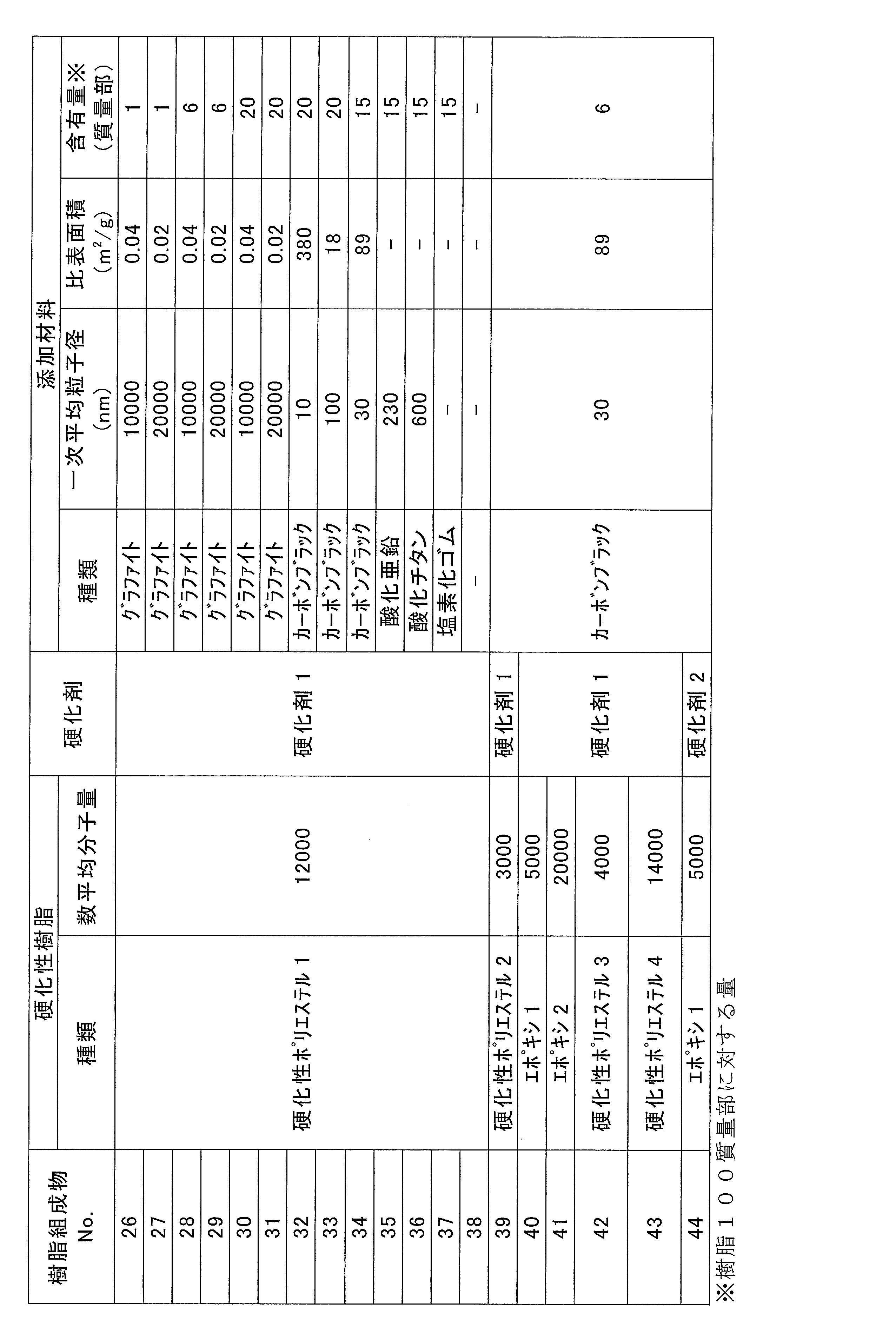
なお、プライマー層用樹脂組成物に含まれる樹脂の数平均分子量および添加材料の一次平均粒子径は、以下の方法で測定した。
(数平均分子量)
樹脂の数平均分子量は、ゲルパーミエーションクロマトグラフィー法により測定した。具体的には、以下の測定条件で測定した。
<測定条件>
溶離液:THF
流速:1.0ml/min
温度:40℃
検出器:示差屈折計
樹脂の数平均分子量は、ゲルパーミエーションクロマトグラフィー法により測定した。具体的には、以下の測定条件で測定した。
<測定条件>
溶離液:THF
流速:1.0ml/min
温度:40℃
検出器:示差屈折計
(一次平均粒子径)
添加材料の平均粒子径は、電子顕微鏡により、任意の20個の粒子の粒子径を観察し、それらの算術平均粒径として求めた。
添加材料の平均粒子径は、電子顕微鏡により、任意の20個の粒子の粒子径を観察し、それらの算術平均粒径として求めた。
(比表面積)
添加材料の比表面積(窒素吸着比表面積)は、JIS Z 8830:2013に準拠してBET法により測定した。
添加材料の比表面積(窒素吸着比表面積)は、JIS Z 8830:2013に準拠してBET法により測定した。
(4)接着剤組成物
接着剤組成物A1:ロード・コーポレーション社製ケムロック6125(主成分:塩素化ゴム、副成分:硫黄(加硫剤)、酸化亜鉛(加硫助剤)および高沸点溶媒)
接着剤組成物A2:ロード・コーポレーション社製XJ551(主成分:塩素化ゴム、副成分:硫黄(加硫剤)および高沸点溶媒)
接着剤組成物A1:ロード・コーポレーション社製ケムロック6125(主成分:塩素化ゴム、副成分:硫黄(加硫剤)、酸化亜鉛(加硫助剤)および高沸点溶媒)
接着剤組成物A2:ロード・コーポレーション社製XJ551(主成分:塩素化ゴム、副成分:硫黄(加硫剤)および高沸点溶媒)
(5)ゴム層用樹脂組成物
<未架橋ゴムシートR1>
NBR生ゴム:100質量部
カーボンブラック(HAF):50質量部
ナフテン系プロセスオイル:20質量部
ステアリン酸:1質量部
亜鉛華(酸化亜鉛):5質量部
硫黄:2質量部
チアゾール系架橋促進剤:2質量部
<未架橋ゴムシートR1>
NBR生ゴム:100質量部
カーボンブラック(HAF):50質量部
ナフテン系プロセスオイル:20質量部
ステアリン酸:1質量部
亜鉛華(酸化亜鉛):5質量部
硫黄:2質量部
チアゾール系架橋促進剤:2質量部
<未架橋ゴムシートR2>
EPDM生ゴム:100質量部
カーボンブラック(HAF):50質量部
ナフテン系プロセスオイル:20質量部
ステアリン酸:1質量部
亜鉛華(酸化亜鉛):5質量部
硫黄:2質量部
チアゾール系架橋促進剤:2質量部
EPDM生ゴム:100質量部
カーボンブラック(HAF):50質量部
ナフテン系プロセスオイル:20質量部
ステアリン酸:1質量部
亜鉛華(酸化亜鉛):5質量部
硫黄:2質量部
チアゾール系架橋促進剤:2質量部
2.複合体の作製および評価
<複合体1の作製>
(1)塗装金属板の作製
金属板M1(厚み0.5mm、片面当たりめっき付着量90g/m2の亜鉛-6%アルミニウム-3%マグネシウム合金めっき鋼板)を準備し、表面をアルカリ脱脂した。この金属板のアルカリ脱脂した面上に、上記調製した化成処理液C1をバーコート法で塗布した後、乾燥させて、皮膜付着量100mg/m2の化成処理皮膜を形成した。次いで、化成処理皮膜上に、プライマー層用樹脂組成物1をバーコート法で塗布した後、板到達温度200℃で乾燥させて、厚み5μmのプライマー層を形成し、塗装金属板を得た。
<複合体1の作製>
(1)塗装金属板の作製
金属板M1(厚み0.5mm、片面当たりめっき付着量90g/m2の亜鉛-6%アルミニウム-3%マグネシウム合金めっき鋼板)を準備し、表面をアルカリ脱脂した。この金属板のアルカリ脱脂した面上に、上記調製した化成処理液C1をバーコート法で塗布した後、乾燥させて、皮膜付着量100mg/m2の化成処理皮膜を形成した。次いで、化成処理皮膜上に、プライマー層用樹脂組成物1をバーコート法で塗布した後、板到達温度200℃で乾燥させて、厚み5μmのプライマー層を形成し、塗装金属板を得た。
(2)複合体1の作製
次いで、得られた塗装金属板のプライマー層上に、接着剤組成物として上記接着剤組成物A1(LOAD製ケムロック6125)をバーコート法で塗布した後、80℃で10分間乾燥させて、厚み10μmの接着剤組成物からなる層を形成した。そして、当該接着剤組成物からなる層上に、ゴム層用樹脂組成物として厚み3mmの未架橋ゴムシートR1を載せた後、熱プレス機にて、温度160℃、圧力200kgf/cm2で15分間熱圧着させて、接着剤組成物および未架橋ゴムシートR1をそれぞれ架橋させた。それにより、塗装金属板/接着剤層/ゴム層の積層構造を有する複合体1を得た。
次いで、得られた塗装金属板のプライマー層上に、接着剤組成物として上記接着剤組成物A1(LOAD製ケムロック6125)をバーコート法で塗布した後、80℃で10分間乾燥させて、厚み10μmの接着剤組成物からなる層を形成した。そして、当該接着剤組成物からなる層上に、ゴム層用樹脂組成物として厚み3mmの未架橋ゴムシートR1を載せた後、熱プレス機にて、温度160℃、圧力200kgf/cm2で15分間熱圧着させて、接着剤組成物および未架橋ゴムシートR1をそれぞれ架橋させた。それにより、塗装金属板/接着剤層/ゴム層の積層構造を有する複合体1を得た。
<複合体2~60の作製>
塗装金属板の種類を表3~5に示されるように変更した以外は複合体1と同様にして、複合体2~60を得た。
塗装金属板の種類を表3~5に示されるように変更した以外は複合体1と同様にして、複合体2~60を得た。
具体的には、複合体2~18および32~34は、塗装金属板のプライマー層に含まれるカーボンブラックの一次平均粒子径と含有量の少なくとも一方を表3または4に示されるように変更した以外は複合体3と同じであり;複合体19~31および35~37は、塗装金属板のプライマー層に含まれる添加材料の種類および含有量を表3または4に示されるように変更した以外は複合体3と同じであり;複合体38は、塗装金属板のプライマー層に添加材料を添加しなかった以外は複合体3と同じであり;複合体39~43は、塗装金属板のプライマー層に含まれる硬化性樹脂の種類を表5に示されるように変更した以外は複合体3と同じであり;複合体44~47は、塗装金属板のプライマー層の膜厚を表5に示されるように変更した以外は複合体3と同じであり;複合体48~57は、塗装金属板の金属板の種類を表5に示されるように変更した以外は複合体3と同じであり;複合体58~60は、塗装金属板の化成処理皮膜の種類を表5に示されるように変更した以外は複合体3と同じである。
<複合体61の作製>
接着剤組成物および未架橋ゴムシートの種類を表5に示されるように変更した以外は複合体3と同様にして、複合体61を得た。
接着剤組成物および未架橋ゴムシートの種類を表5に示されるように変更した以外は複合体3と同様にして、複合体61を得た。
<複合体62の作製>
(防錆層用樹脂組成物)
エポキシ1(主樹脂成分)100質量部に対して、トリポリリン酸二水素アルミニウム、リン酸マグネシウム、リン酸水素マグネシウムおよびリン酸亜鉛を合計15質量部配合し、混合して、防錆層用樹脂組成物を得た。
(防錆層用樹脂組成物)
エポキシ1(主樹脂成分)100質量部に対して、トリポリリン酸二水素アルミニウム、リン酸マグネシウム、リン酸水素マグネシウムおよびリン酸亜鉛を合計15質量部配合し、混合して、防錆層用樹脂組成物を得た。
(複合体の作製)
そして、化成処理皮膜とプライマー層との間に、上記防錆層用樹脂組成物を塗布した後、乾燥および硬化させて、厚み5μmの防錆層を形成した以外は塗装金属板3と同様にして塗装金属板を得た。この塗装金属板を用いた以外は複合体3と同様にして複合体62を得た。
そして、化成処理皮膜とプライマー層との間に、上記防錆層用樹脂組成物を塗布した後、乾燥および硬化させて、厚み5μmの防錆層を形成した以外は塗装金属板3と同様にして塗装金属板を得た。この塗装金属板を用いた以外は複合体3と同様にして複合体62を得た。
<複合体63の作製>
プライマー層に含まれる硬化剤の種類を、表5に示されるように変更した以外は複合体40と同様にして、複合体63を得た。
プライマー層に含まれる硬化剤の種類を、表5に示されるように変更した以外は複合体40と同様にして、複合体63を得た。
得られた塗装金属板の耐ブロッキング性および複合体の接着性を、以下の方法で評価した。
(耐ブロッキング性)
塗装金属板を、50mm×50mmの大きさに切り出して、2つの試験片を得た。この2つの試料片を、塗膜面同士が接するように積層し、温度:50℃、圧力:2MPaをかけた状態で24時間保持した。その後、当該2つの試料片の粘着状態(ブロッキングの有無)を目視観察し、以下の基準に基づいて評価した。
○:ブロッキング発生なし
×:ブロッキング発生あり
○であれば良好と判断した。
塗装金属板を、50mm×50mmの大きさに切り出して、2つの試験片を得た。この2つの試料片を、塗膜面同士が接するように積層し、温度:50℃、圧力:2MPaをかけた状態で24時間保持した。その後、当該2つの試料片の粘着状態(ブロッキングの有無)を目視観察し、以下の基準に基づいて評価した。
○:ブロッキング発生なし
×:ブロッキング発生あり
○であれば良好と判断した。
(接着性)
得られた複合体の、プライマー層/接着剤層間の接着性は、JIS K6854-1:1999(接着剤―はく離接着強さ試験方法―第1部:90度はく離)に準拠して、90度剥離試験により測定した。90度剥離試験は、幅25mm、長さ150mmの試験片を用いて、引張速度(移動速度)50mm/分で行った。そして、以下の基準に基づいて、接着性を評価した。
◎◎:剥離界面がゴム層の凝集(内部)破壊のみであり、極めて接着性に優れる
◎:剥離界面の90%以上100%未満がゴム層の凝集(内部)破壊であり、その他がプライマー層/接着剤層の界面破壊であり、接着性に優れる
○:剥離界面の70%以上90%未満がゴム層の凝集(内部)破壊であり、その他がプライマー層/接着剤層の界面破壊であり、接着性に優れる
△:剥離界面の70%未満がゴム層の凝集(内部)破壊であり、その他がプライマー層/接着剤層の界面破壊であり、接着性に劣る
×:剥離界面が全てプライマー層/接着剤層の界面破壊であり、接着性に劣る
○以上であれば良好と判断した。
得られた複合体の、プライマー層/接着剤層間の接着性は、JIS K6854-1:1999(接着剤―はく離接着強さ試験方法―第1部:90度はく離)に準拠して、90度剥離試験により測定した。90度剥離試験は、幅25mm、長さ150mmの試験片を用いて、引張速度(移動速度)50mm/分で行った。そして、以下の基準に基づいて、接着性を評価した。
◎◎:剥離界面がゴム層の凝集(内部)破壊のみであり、極めて接着性に優れる
◎:剥離界面の90%以上100%未満がゴム層の凝集(内部)破壊であり、その他がプライマー層/接着剤層の界面破壊であり、接着性に優れる
○:剥離界面の70%以上90%未満がゴム層の凝集(内部)破壊であり、その他がプライマー層/接着剤層の界面破壊であり、接着性に優れる
△:剥離界面の70%未満がゴム層の凝集(内部)破壊であり、その他がプライマー層/接着剤層の界面破壊であり、接着性に劣る
×:剥離界面が全てプライマー層/接着剤層の界面破壊であり、接着性に劣る
○以上であれば良好と判断した。
複合体1~25の評価結果を表3に、複合体26~38の評価結果を表4に、および複合体39~63の評価結果を表5にそれぞれ示す。
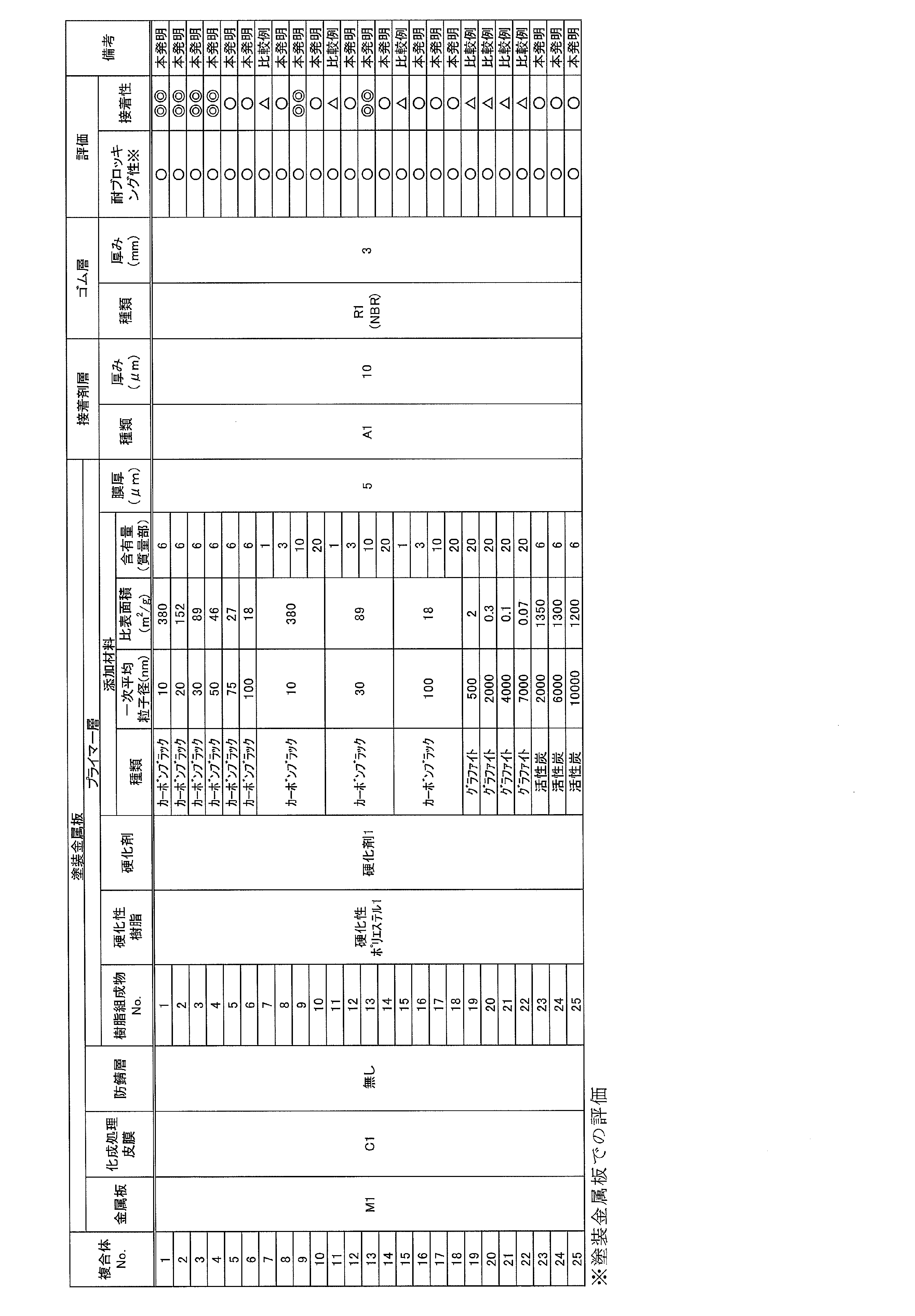

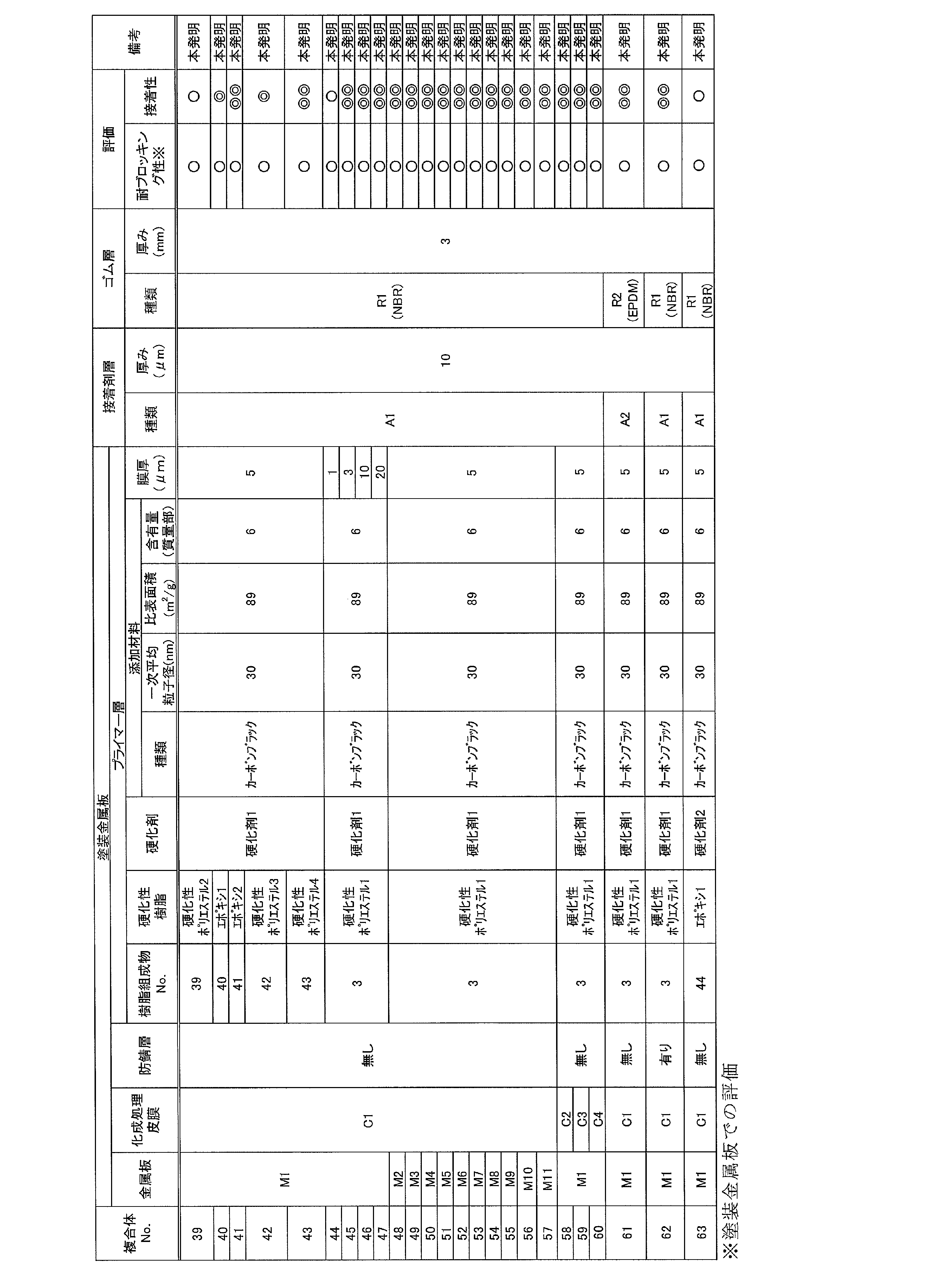
表3~5に示されるように、塗装金属板37以外の塗装金属板は、いずれもブロッキングを生じなかった。また、本発明の複合体は、いずれも良好な接着性を有することがわかる。
特に、カーボン系粒子としてカーボンブラックを用いることで、接着性が高まることがわかる(複合体1~4と23との対比)。
また、カーボンブラックの一次平均粒子径を50nm以下とすることで、接着性が高まることがわかる(複合体1~6の対比)。
また、プライマー層に含まれる樹脂の分子量を高くするほうが、接着性がより高まることがわかる(複合体39と3との対比)。これは、分子量が高い樹脂のほうが、得られるプライマー層の可撓性が高く、接着剤層の溶媒などによって膨潤しやすいからであると考えられる。
また、硬化剤をイソシアネート化合物とすることで、接着性がより高まることがわかる(複合体40と63との対比)。これは、イソシアネート化合物のほうが、得られるプライマー層の可撓性が高く、接着剤層の溶媒などによって膨潤しやすいからであると考えられる。
また、プライマー層の膜厚(複合体3および44~47の対比)、化成処理皮膜の種類(複合体3および58~60の対比)、または金属板の種類(複合体3および48~57の対比)を変えても、良好な接着性が得られることがわかる。また、ゴムの種類を変更しても、良好な接着性が得られることがわかる(複合体3と61の対比)。
また、複合体62について接着性および耐食性(JIS-Z2371準拠、35℃5%NaCl塩水噴霧試験での耐食性)をそれぞれ評価したところ、複合体3と同様に良好な接着性を有しつつ、複合体3よりもより高い耐食性を有することを確認した。
これに対し、表4に示されるように、プライマー層がカーボン系粒子を含まない複合体38、およびカーボン系粒子以外の他の材料を含む複合体35~37は、いずれも十分な接着性が得られないことがわかる。一方、カーボン系粒子に代えて、ゴム成分を含む複合体37は、接着性は比較的良好であるものの、ブロッキングが生じることがわかる。
また、表4に示されるように、プライマー層に含まれるカーボン系粒子の含有量が樹脂に対して25質量%を超える複合体32および33は、そもそも塗料化できないことがわかる。一方、プライマー層に含まれるカーボン系粒子の含有量が樹脂に対して3質量%未満である複合体7、11および15は、十分な接着性が得られないことがわかる。
本出願は、2019年2月7日出願の特願2019-020812に基づく優先権を主張する。当該出願明細書及び図面に記載された内容は、すべて本願明細書に援用される。
本発明によれば、良好な接着性を有する複合体およびその製造方法、ならびにそれに用いられる、ブロッキングを生じない塗装金属板を提供することができる。
10 複合体
20 塗装金属板
30 接着剤層
40 ゴム層
21 金属板
22 化成処理皮膜
23 プライマー層
24 防錆層
20 塗装金属板
30 接着剤層
40 ゴム層
21 金属板
22 化成処理皮膜
23 プライマー層
24 防錆層
Claims (17)
- 金属板と、前記金属板上に配置されたプライマー層とを有する塗装金属板と、前記塗装金属板の前記プライマー層上に配置されたゴム層と有する複合体であって、
前記プライマー層は、硬化性樹脂と、硬化剤と、カーボン系粒子とを含む樹脂組成物の硬化物からなり、
前記カーボン系粒子の比表面積は、10~1500m2/gであり、
前記カーボン系粒子の含有量は、前記硬化性樹脂に対して3~25質量%であり、かつ
ゴム成分の含有量は、前記硬化性樹脂に対して1質量%以下である、複合体。 - 前記ゴム層は、第1ゴム系重合体と、第1架橋剤とを含むゴム層用樹脂組成物の架橋物であり、
前記プライマー層と前記ゴム層との間に配置され、第2ゴム系重合体と、第2架橋剤とを含む接着剤組成物の架橋物からなる接着剤層をさらに有する、
請求項1に記載の複合体。 - 前記塗装金属板は、前記金属板と前記プライマー層との間に配置された化成処理皮膜をさらに有する、
請求項1または2に記載の複合体。 - 前記塗装金属板は、前記化成処理皮膜と前記プライマー層との間に配置された防錆層をさらに有する、
請求項3に記載の複合体。 - 前記硬化剤は、イソシアネート化合物である、
請求項1~4のいずれか一項に記載の複合体。 - 前記イソシアネート化合物は、脂肪族イソシアネートである、
請求項5に記載の複合体。 - 前記カーボン系粒子の一次平均粒子径は、10~50nmである、
請求項1~6のいずれか一項に記載の複合体。 - 前記カーボン系粒子は、カーボンブラックである、
請求項7に記載の複合体。 - 前記プライマー層の厚みは、3~20μmである、
請求項1~8のいずれか一項に記載の複合体。 - 前記化成処理皮膜は、クロメート系皮膜であるか、またはアミノ基を有するシランカップリング剤と有機樹脂とを含むクロメートフリー系皮膜である、
請求項1~9のいずれか一項に記載の複合体。 - 1)金属板と、前記金属板上に配置されたプライマー層とを有し、
前記プライマー層は、硬化性樹脂と、硬化剤と、カーボン系粒子とを含む樹脂組成物の硬化物からなり、
前記カーボン系粒子の比表面積が、10~1500m2/gであり、
前記カーボン系粒子の含有量が、前記硬化性樹脂に対して3~25質量%であり、かつ
ゴム成分の含有量が、前記硬化性樹脂に対して1質量%以下である塗装金属板を準備する工程と、
2)前記塗装金属板の前記プライマー層上に、第1ゴム系重合体と、第1架橋剤とを含むゴム層用樹脂組成物を付与した後、架橋させて、ゴム層を得る工程と、を有する、
複合体の製造方法。 - 3)前記プライマー層上に、第2ゴム系重合体と、第2架橋剤とを含む接着剤組成物を付与して、前記接着剤組成物からなる層を形成する工程をさらに有し、
前記2)の工程では、前記接着剤組成物からなる層上に、前記ゴム層用樹脂組成物を付与する、
請求項11に記載の複合体の製造方法。 - ゴム層と接合されるための塗装金属板であって、
金属板と、化成処理皮膜と、プライマー層とをこの順に有し、
前記化成処理皮膜は、クロメート系皮膜であるか、またはアミノ基を有するシランカップリング剤と有機樹脂とを含むクロメートフリー系皮膜であり、
前記プライマー層は、前記塗装金属板の最表面に配置されており、
前記プライマー層は、硬化性樹脂と、硬化剤と、カーボン系粒子とを含む樹脂組成物の硬化物からなり、
前記カーボン系粒子の比表面積は、10~1500m2/gであり、
前記カーボン系粒子の含有量は、前記硬化性樹脂に対して3~25質量%であり、かつ
ゴム成分の含有量は、前記硬化性樹脂に対して1質量%以下である、
塗装金属板。 - 前記化成処理皮膜と前記プライマー層との間に配置された防錆層をさらに有する、
請求項13に記載の塗装金属板。 - 前記カーボン系粒子の一次平均粒子径は、10~50nmである、
請求項13または14に記載の塗装金属板。 - 前記カーボン系粒子は、カーボンブラックである、
請求項15に記載の塗装金属板。 - 前記プライマー層の厚みは、3~20μmである、
請求項13~16のいずれか一項に記載の塗装金属板。
Priority Applications (2)
| Application Number | Priority Date | Filing Date | Title |
|---|---|---|---|
| CN201980091502.0A CN113423569A (zh) | 2019-02-07 | 2019-06-24 | 复合体及其制造方法以及涂装金属板 |
| KR1020217028386A KR102546031B1 (ko) | 2019-02-07 | 2019-06-24 | 복합체 및 그 제조 방법, 및 도장 금속판 |
Applications Claiming Priority (2)
| Application Number | Priority Date | Filing Date | Title |
|---|---|---|---|
| JP2019020812A JP7284379B2 (ja) | 2019-02-07 | 2019-02-07 | 複合体およびその製造方法、ならびに塗装金属板 |
| JP2019-020812 | 2019-02-07 |
Publications (1)
| Publication Number | Publication Date |
|---|---|
| WO2020161934A1 true WO2020161934A1 (ja) | 2020-08-13 |
Family
ID=71947577
Family Applications (1)
| Application Number | Title | Priority Date | Filing Date |
|---|---|---|---|
| PCT/JP2019/024965 Ceased WO2020161934A1 (ja) | 2019-02-07 | 2019-06-24 | 複合体およびその製造方法、ならびに塗装金属板 |
Country Status (5)
| Country | Link |
|---|---|
| JP (1) | JP7284379B2 (ja) |
| KR (1) | KR102546031B1 (ja) |
| CN (1) | CN113423569A (ja) |
| TW (1) | TW202045354A (ja) |
| WO (1) | WO2020161934A1 (ja) |
Families Citing this family (1)
| Publication number | Priority date | Publication date | Assignee | Title |
|---|---|---|---|---|
| CN112628317A (zh) * | 2020-12-18 | 2021-04-09 | 庄浩楠 | 一种汽车多层消音片及制备工艺 |
Citations (8)
| Publication number | Priority date | Publication date | Assignee | Title |
|---|---|---|---|---|
| JPS58101049A (ja) * | 1981-12-10 | 1983-06-16 | 積水化学工業株式会社 | ポリオレフイン被覆金属製品 |
| JPS6282023A (ja) * | 1985-10-04 | 1987-04-15 | Nitto Electric Ind Co Ltd | 鋼材の防食方法 |
| JP2001011366A (ja) * | 1999-07-02 | 2001-01-16 | Sumitomo Rubber Ind Ltd | プライマー層およびそれを用いた金属板とゴムの複合体 |
| JP2007038533A (ja) * | 2005-08-03 | 2007-02-15 | Nok Corp | ゴム金属積層体 |
| JP2010053269A (ja) * | 2008-08-29 | 2010-03-11 | Yokohama Rubber Co Ltd:The | タイヤサイドトレッド用ゴム組成物およびそれを用いた空気入りタイヤ |
| CN101976023A (zh) * | 2010-08-23 | 2011-02-16 | 吴声立 | 一种密实导电橡胶充电辊及其制造方法 |
| JP2016143023A (ja) * | 2015-02-05 | 2016-08-08 | 富士ゼロックス株式会社 | 導電性部材、帯電装置、プロセスカートリッジ、画像形成装置、および導電性部材の製造方法 |
| JP2017092417A (ja) * | 2015-11-17 | 2017-05-25 | 信越ポリマー株式会社 | 電磁波シールドフィルムおよび電磁波シールドフィルム付きプリント配線板 |
Family Cites Families (18)
| Publication number | Priority date | Publication date | Assignee | Title |
|---|---|---|---|---|
| JPS5212353A (en) * | 1975-07-15 | 1977-01-29 | Teijin Ltd | Method of transferring cop |
| JPH03263467A (ja) * | 1990-03-13 | 1991-11-22 | Kansai Paint Co Ltd | 複合型制振材用粘弾性組成物 |
| JPH11129388A (ja) * | 1997-11-04 | 1999-05-18 | Nkk Corp | 耐傷付き性、加工性及び耐久性に優れたプレコート金属板及びその製造方法 |
| JP3514125B2 (ja) * | 1998-07-08 | 2004-03-31 | Nok株式会社 | ゴム積層金属板 |
| JP2000141538A (ja) * | 1998-09-04 | 2000-05-23 | Nok Corp | ゴム積層金属板およびその製造法 |
| JP2001260235A (ja) * | 2000-03-22 | 2001-09-25 | Yokohama Rubber Co Ltd:The | ゴムと金属との接着方法、および、これを用いた構造体 |
| JP4876683B2 (ja) | 2006-04-13 | 2012-02-15 | Nok株式会社 | アクリルゴム−金属複合体 |
| JP5087761B2 (ja) * | 2007-10-30 | 2012-12-05 | Jfe鋼板株式会社 | プレコート鋼板 |
| JP4877380B2 (ja) * | 2009-11-09 | 2012-02-15 | Nok株式会社 | ゴム金属積層体 |
| JP5829799B2 (ja) * | 2010-01-21 | 2015-12-09 | 日新製鋼株式会社 | 耐食性および耐アルカリ性に優れた塗装鋼板 |
| JP2013024395A (ja) * | 2011-07-26 | 2013-02-04 | Nippon Gasket Co Ltd | 金属製ガスケット材 |
| JP2013244613A (ja) * | 2012-05-23 | 2013-12-09 | Jfe Galvanizing & Coating Co Ltd | プレコート鋼板 |
| WO2014148548A1 (ja) | 2013-03-19 | 2014-09-25 | 富士フイルム株式会社 | レーザー彫刻用樹脂組成物、レーザー彫刻用フレキソ印刷版原版の製造方法、フレキソ印刷版原版、フレキソ印刷版の製版方法及びフレキソ印刷版 |
| CN105531342B (zh) * | 2013-09-24 | 2018-04-27 | Nok株式会社 | 丁腈橡胶-金属叠层垫片材料 |
| JP2016175400A (ja) * | 2015-03-19 | 2016-10-06 | 株式会社神戸製鋼所 | 樹脂塗装亜鉛めっき金属板 |
| US11028276B2 (en) * | 2015-03-31 | 2021-06-08 | Nippon Steel Corporation | Surface-treated metal sheet, coated member, and method for producing coated member |
| JP6398851B2 (ja) * | 2015-04-09 | 2018-10-03 | 新日鐵住金株式会社 | 下地化成処理を行ったポリオレフィン被覆鋼材 |
| JP6934312B2 (ja) * | 2017-04-04 | 2021-09-15 | Nok株式会社 | ゴム金属積層体およびガスケット |
-
2019
- 2019-02-07 JP JP2019020812A patent/JP7284379B2/ja active Active
- 2019-06-24 WO PCT/JP2019/024965 patent/WO2020161934A1/ja not_active Ceased
- 2019-06-24 CN CN201980091502.0A patent/CN113423569A/zh active Pending
- 2019-06-24 KR KR1020217028386A patent/KR102546031B1/ko active Active
-
2020
- 2020-02-06 TW TW109103733A patent/TW202045354A/zh unknown
Patent Citations (8)
| Publication number | Priority date | Publication date | Assignee | Title |
|---|---|---|---|---|
| JPS58101049A (ja) * | 1981-12-10 | 1983-06-16 | 積水化学工業株式会社 | ポリオレフイン被覆金属製品 |
| JPS6282023A (ja) * | 1985-10-04 | 1987-04-15 | Nitto Electric Ind Co Ltd | 鋼材の防食方法 |
| JP2001011366A (ja) * | 1999-07-02 | 2001-01-16 | Sumitomo Rubber Ind Ltd | プライマー層およびそれを用いた金属板とゴムの複合体 |
| JP2007038533A (ja) * | 2005-08-03 | 2007-02-15 | Nok Corp | ゴム金属積層体 |
| JP2010053269A (ja) * | 2008-08-29 | 2010-03-11 | Yokohama Rubber Co Ltd:The | タイヤサイドトレッド用ゴム組成物およびそれを用いた空気入りタイヤ |
| CN101976023A (zh) * | 2010-08-23 | 2011-02-16 | 吴声立 | 一种密实导电橡胶充电辊及其制造方法 |
| JP2016143023A (ja) * | 2015-02-05 | 2016-08-08 | 富士ゼロックス株式会社 | 導電性部材、帯電装置、プロセスカートリッジ、画像形成装置、および導電性部材の製造方法 |
| JP2017092417A (ja) * | 2015-11-17 | 2017-05-25 | 信越ポリマー株式会社 | 電磁波シールドフィルムおよび電磁波シールドフィルム付きプリント配線板 |
Also Published As
| Publication number | Publication date |
|---|---|
| TW202045354A (zh) | 2020-12-16 |
| KR20210124383A (ko) | 2021-10-14 |
| KR102546031B1 (ko) | 2023-06-20 |
| JP2020128020A (ja) | 2020-08-27 |
| CN113423569A (zh) | 2021-09-21 |
| JP7284379B2 (ja) | 2023-05-31 |
Similar Documents
| Publication | Publication Date | Title |
|---|---|---|
| CN108884894B (zh) | 高耐久性弹簧及其涂装方法 | |
| WO2019194199A1 (ja) | 金属-炭素繊維強化樹脂材料複合体及び金属―炭素繊維強化樹脂材料複合体の製造方法 | |
| WO2018047577A1 (ja) | 表面処理溶融亜鉛めっき鋼板およびそれを用いた接着継手 | |
| JP4654089B2 (ja) | 耐久密着性に優れたクロメートフリー樹脂複合型制振材料 | |
| KR102546031B1 (ko) | 복합체 및 그 제조 방법, 및 도장 금속판 | |
| JP7360025B2 (ja) | 複合体およびその製造方法、ならびに塗装金属板 | |
| JP5543004B1 (ja) | 塗装金属素形材 | |
| CN112262040B (zh) | 金属-碳纤维强化树脂材料复合体和金属-碳纤维强化树脂材料复合体的制造方法 | |
| JP7339514B2 (ja) | 複合体およびその製造方法、ならびに塗装金属板 | |
| CN113557192B (zh) | 汽车用加强钢构件 | |
| JP2018028141A (ja) | 自動車部材用表面処理鋼板 | |
| WO2020067447A1 (ja) | 接着接合構造体および自動車用部品 | |
| JP7360049B2 (ja) | 複合体の製造方法および複合体、ならびに塗装金属板の製造方法および塗装金属板 | |
| JP7352078B2 (ja) | 複合体およびその製造方法、ならびに塗装金属板 | |
| WO2007119769A1 (ja) | アクリルゴム-金属複合体 | |
| JP7356002B2 (ja) | 複合体およびその製造方法、ならびに塗装金属板 | |
| JP7385215B2 (ja) | 複合体、ガスケット、複合体の製造方法および塗装金属板 | |
| KR20170003953A (ko) | 분사 가능한 탄소섬유-에폭시 물질 및 방법 | |
| WO2020202460A1 (ja) | 金属-炭素繊維強化樹脂材料複合体および金属-炭素繊維強化樹脂材料複合体の製造方法 | |
| JP5905733B2 (ja) | 塗装ステンレス鋼板とアクリロニトリル−ブタジエン−スチレン樹脂組成物の成形体とが接合された複合体およびその製造方法 | |
| JPH0439360A (ja) | 複合型制振金属板用芯材樹脂、複合型制振金属板および複合型制振金属板の製造方法 | |
| JPH115269A (ja) | 樹脂被覆金属板と塗料組成物および樹脂被覆金属板の製造方法 | |
| CN115362061A (zh) | 橡胶金属层叠体和垫片 | |
| CN115362062A (zh) | 橡胶金属层叠体和垫片 | |
| JP2004332009A (ja) | 耐剥離防食性に優れた重防食被覆鋼材 |
Legal Events
| Date | Code | Title | Description |
|---|---|---|---|
| 121 | Ep: the epo has been informed by wipo that ep was designated in this application |
Ref document number: 19914587 Country of ref document: EP Kind code of ref document: A1 |
|
| NENP | Non-entry into the national phase |
Ref country code: DE |
|
| ENP | Entry into the national phase |
Ref document number: 20217028386 Country of ref document: KR Kind code of ref document: A |
|
| 122 | Ep: pct application non-entry in european phase |
Ref document number: 19914587 Country of ref document: EP Kind code of ref document: A1 |