WO2020105677A1 - 熱硬化性保護膜形成用フィルム、保護膜形成用複合シート、及びチップの製造方法 - Google Patents
熱硬化性保護膜形成用フィルム、保護膜形成用複合シート、及びチップの製造方法Info
- Publication number
- WO2020105677A1 WO2020105677A1 PCT/JP2019/045409 JP2019045409W WO2020105677A1 WO 2020105677 A1 WO2020105677 A1 WO 2020105677A1 JP 2019045409 W JP2019045409 W JP 2019045409W WO 2020105677 A1 WO2020105677 A1 WO 2020105677A1
- Authority
- WO
- WIPO (PCT)
- Prior art keywords
- protective film
- forming
- film
- thermosetting
- sensitive adhesive
- Prior art date
- Legal status (The legal status is an assumption and is not a legal conclusion. Google has not performed a legal analysis and makes no representation as to the accuracy of the status listed.)
- Ceased
Links
Images


Classifications
-
- C—CHEMISTRY; METALLURGY
- C09—DYES; PAINTS; POLISHES; NATURAL RESINS; ADHESIVES; COMPOSITIONS NOT OTHERWISE PROVIDED FOR; APPLICATIONS OF MATERIALS NOT OTHERWISE PROVIDED FOR
- C09J—ADHESIVES; NON-MECHANICAL ASPECTS OF ADHESIVE PROCESSES IN GENERAL; ADHESIVE PROCESSES NOT PROVIDED FOR ELSEWHERE; USE OF MATERIALS AS ADHESIVES
- C09J7/00—Adhesives in the form of films or foils
- C09J7/10—Adhesives in the form of films or foils without carriers
-
- C—CHEMISTRY; METALLURGY
- C08—ORGANIC MACROMOLECULAR COMPOUNDS; THEIR PREPARATION OR CHEMICAL WORKING-UP; COMPOSITIONS BASED THEREON
- C08J—WORKING-UP; GENERAL PROCESSES OF COMPOUNDING; AFTER-TREATMENT NOT COVERED BY SUBCLASSES C08B, C08C, C08F, C08G or C08H
- C08J5/00—Manufacture of articles or shaped materials containing macromolecular substances
- C08J5/18—Manufacture of films or sheets
-
- B—PERFORMING OPERATIONS; TRANSPORTING
- B05—SPRAYING OR ATOMISING IN GENERAL; APPLYING FLUENT MATERIALS TO SURFACES, IN GENERAL
- B05D—PROCESSES FOR APPLYING FLUENT MATERIALS TO SURFACES, IN GENERAL
- B05D7/00—Processes, other than flocking, specially adapted for applying liquids or other fluent materials to particular surfaces or for applying particular liquids or other fluent materials
- B05D7/50—Multilayers
- B05D7/56—Three layers or more
-
- C—CHEMISTRY; METALLURGY
- C09—DYES; PAINTS; POLISHES; NATURAL RESINS; ADHESIVES; COMPOSITIONS NOT OTHERWISE PROVIDED FOR; APPLICATIONS OF MATERIALS NOT OTHERWISE PROVIDED FOR
- C09J—ADHESIVES; NON-MECHANICAL ASPECTS OF ADHESIVE PROCESSES IN GENERAL; ADHESIVE PROCESSES NOT PROVIDED FOR ELSEWHERE; USE OF MATERIALS AS ADHESIVES
- C09J133/00—Adhesives based on homopolymers or copolymers of compounds having one or more unsaturated aliphatic radicals, each having only one carbon-to-carbon double bond, and at least one being terminated by only one carboxyl radical, or of salts, anhydrides, esters, amides, imides, or nitriles thereof; Adhesives based on derivatives of such polymers
- C09J133/04—Homopolymers or copolymers of esters
-
- C—CHEMISTRY; METALLURGY
- C09—DYES; PAINTS; POLISHES; NATURAL RESINS; ADHESIVES; COMPOSITIONS NOT OTHERWISE PROVIDED FOR; APPLICATIONS OF MATERIALS NOT OTHERWISE PROVIDED FOR
- C09J—ADHESIVES; NON-MECHANICAL ASPECTS OF ADHESIVE PROCESSES IN GENERAL; ADHESIVE PROCESSES NOT PROVIDED FOR ELSEWHERE; USE OF MATERIALS AS ADHESIVES
- C09J175/00—Adhesives based on polyureas or polyurethanes; Adhesives based on derivatives of such polymers
- C09J175/04—Polyurethanes
-
- C—CHEMISTRY; METALLURGY
- C09—DYES; PAINTS; POLISHES; NATURAL RESINS; ADHESIVES; COMPOSITIONS NOT OTHERWISE PROVIDED FOR; APPLICATIONS OF MATERIALS NOT OTHERWISE PROVIDED FOR
- C09J—ADHESIVES; NON-MECHANICAL ASPECTS OF ADHESIVE PROCESSES IN GENERAL; ADHESIVE PROCESSES NOT PROVIDED FOR ELSEWHERE; USE OF MATERIALS AS ADHESIVES
- C09J201/00—Adhesives based on unspecified macromolecular compounds
-
- C—CHEMISTRY; METALLURGY
- C09—DYES; PAINTS; POLISHES; NATURAL RESINS; ADHESIVES; COMPOSITIONS NOT OTHERWISE PROVIDED FOR; APPLICATIONS OF MATERIALS NOT OTHERWISE PROVIDED FOR
- C09J—ADHESIVES; NON-MECHANICAL ASPECTS OF ADHESIVE PROCESSES IN GENERAL; ADHESIVE PROCESSES NOT PROVIDED FOR ELSEWHERE; USE OF MATERIALS AS ADHESIVES
- C09J201/00—Adhesives based on unspecified macromolecular compounds
- C09J201/005—Dendritic macromolecules
-
- C—CHEMISTRY; METALLURGY
- C09—DYES; PAINTS; POLISHES; NATURAL RESINS; ADHESIVES; COMPOSITIONS NOT OTHERWISE PROVIDED FOR; APPLICATIONS OF MATERIALS NOT OTHERWISE PROVIDED FOR
- C09J—ADHESIVES; NON-MECHANICAL ASPECTS OF ADHESIVE PROCESSES IN GENERAL; ADHESIVE PROCESSES NOT PROVIDED FOR ELSEWHERE; USE OF MATERIALS AS ADHESIVES
- C09J7/00—Adhesives in the form of films or foils
- C09J7/20—Adhesives in the form of films or foils characterised by their carriers
- C09J7/22—Plastics; Metallised plastics
- C09J7/24—Plastics; Metallised plastics based on macromolecular compounds obtained by reactions involving only carbon-to-carbon unsaturated bonds
- C09J7/245—Vinyl resins, e.g. polyvinyl chloride [PVC]
-
- C—CHEMISTRY; METALLURGY
- C09—DYES; PAINTS; POLISHES; NATURAL RESINS; ADHESIVES; COMPOSITIONS NOT OTHERWISE PROVIDED FOR; APPLICATIONS OF MATERIALS NOT OTHERWISE PROVIDED FOR
- C09J—ADHESIVES; NON-MECHANICAL ASPECTS OF ADHESIVE PROCESSES IN GENERAL; ADHESIVE PROCESSES NOT PROVIDED FOR ELSEWHERE; USE OF MATERIALS AS ADHESIVES
- C09J7/00—Adhesives in the form of films or foils
- C09J7/30—Adhesives in the form of films or foils characterised by the adhesive composition
-
- C—CHEMISTRY; METALLURGY
- C09—DYES; PAINTS; POLISHES; NATURAL RESINS; ADHESIVES; COMPOSITIONS NOT OTHERWISE PROVIDED FOR; APPLICATIONS OF MATERIALS NOT OTHERWISE PROVIDED FOR
- C09J—ADHESIVES; NON-MECHANICAL ASPECTS OF ADHESIVE PROCESSES IN GENERAL; ADHESIVE PROCESSES NOT PROVIDED FOR ELSEWHERE; USE OF MATERIALS AS ADHESIVES
- C09J7/00—Adhesives in the form of films or foils
- C09J7/30—Adhesives in the form of films or foils characterised by the adhesive composition
- C09J7/35—Heat-activated
-
- C—CHEMISTRY; METALLURGY
- C09—DYES; PAINTS; POLISHES; NATURAL RESINS; ADHESIVES; COMPOSITIONS NOT OTHERWISE PROVIDED FOR; APPLICATIONS OF MATERIALS NOT OTHERWISE PROVIDED FOR
- C09J—ADHESIVES; NON-MECHANICAL ASPECTS OF ADHESIVE PROCESSES IN GENERAL; ADHESIVE PROCESSES NOT PROVIDED FOR ELSEWHERE; USE OF MATERIALS AS ADHESIVES
- C09J7/00—Adhesives in the form of films or foils
- C09J7/30—Adhesives in the form of films or foils characterised by the adhesive composition
- C09J7/38—Pressure-sensitive adhesives [PSA]
- C09J7/381—Pressure-sensitive adhesives [PSA] based on macromolecular compounds obtained by reactions involving only carbon-to-carbon unsaturated bonds
- C09J7/385—Acrylic polymers
-
- H—ELECTRICITY
- H10—SEMICONDUCTOR DEVICES; ELECTRIC SOLID-STATE DEVICES NOT OTHERWISE PROVIDED FOR
- H10P—GENERIC PROCESSES OR APPARATUS FOR THE MANUFACTURE OR TREATMENT OF DEVICES COVERED BY CLASS H10
- H10P54/00—Cutting or separating of wafers, substrates or parts of devices
-
- H—ELECTRICITY
- H10—SEMICONDUCTOR DEVICES; ELECTRIC SOLID-STATE DEVICES NOT OTHERWISE PROVIDED FOR
- H10W—GENERIC PACKAGES, INTERCONNECTIONS, CONNECTORS OR OTHER CONSTRUCTIONAL DETAILS OF DEVICES COVERED BY CLASS H10
- H10W74/00—Encapsulations, e.g. protective coatings
- H10W74/01—Manufacture or treatment
-
- H—ELECTRICITY
- H10—SEMICONDUCTOR DEVICES; ELECTRIC SOLID-STATE DEVICES NOT OTHERWISE PROVIDED FOR
- H10W—GENERIC PACKAGES, INTERCONNECTIONS, CONNECTORS OR OTHER CONSTRUCTIONAL DETAILS OF DEVICES COVERED BY CLASS H10
- H10W74/00—Encapsulations, e.g. protective coatings
- H10W74/01—Manufacture or treatment
- H10W74/012—Manufacture or treatment of encapsulations on active surfaces of flip-chip devices, e.g. forming underfills
-
- H—ELECTRICITY
- H10—SEMICONDUCTOR DEVICES; ELECTRIC SOLID-STATE DEVICES NOT OTHERWISE PROVIDED FOR
- H10W—GENERIC PACKAGES, INTERCONNECTIONS, CONNECTORS OR OTHER CONSTRUCTIONAL DETAILS OF DEVICES COVERED BY CLASS H10
- H10W74/00—Encapsulations, e.g. protective coatings
- H10W74/10—Encapsulations, e.g. protective coatings characterised by their shape or disposition
- H10W74/15—Encapsulations, e.g. protective coatings characterised by their shape or disposition on active surfaces of flip-chip devices, e.g. underfills
-
- H—ELECTRICITY
- H10—SEMICONDUCTOR DEVICES; ELECTRIC SOLID-STATE DEVICES NOT OTHERWISE PROVIDED FOR
- H10W—GENERIC PACKAGES, INTERCONNECTIONS, CONNECTORS OR OTHER CONSTRUCTIONAL DETAILS OF DEVICES COVERED BY CLASS H10
- H10W74/00—Encapsulations, e.g. protective coatings
- H10W74/40—Encapsulations, e.g. protective coatings characterised by their materials
- H10W74/47—Encapsulations, e.g. protective coatings characterised by their materials comprising organic materials, e.g. plastics or resins
-
- C—CHEMISTRY; METALLURGY
- C08—ORGANIC MACROMOLECULAR COMPOUNDS; THEIR PREPARATION OR CHEMICAL WORKING-UP; COMPOSITIONS BASED THEREON
- C08J—WORKING-UP; GENERAL PROCESSES OF COMPOUNDING; AFTER-TREATMENT NOT COVERED BY SUBCLASSES C08B, C08C, C08F, C08G or C08H
- C08J2333/00—Characterised by the use of homopolymers or copolymers of compounds having one or more unsaturated aliphatic radicals, each having only one carbon-to-carbon double bond, and only one being terminated by only one carboxyl radical, or of salts, anhydrides, esters, amides, imides, or nitriles thereof; Derivatives of such polymers
- C08J2333/04—Characterised by the use of homopolymers or copolymers of compounds having one or more unsaturated aliphatic radicals, each having only one carbon-to-carbon double bond, and only one being terminated by only one carboxyl radical, or of salts, anhydrides, esters, amides, imides, or nitriles thereof; Derivatives of such polymers esters
- C08J2333/06—Characterised by the use of homopolymers or copolymers of compounds having one or more unsaturated aliphatic radicals, each having only one carbon-to-carbon double bond, and only one being terminated by only one carboxyl radical, or of salts, anhydrides, esters, amides, imides, or nitriles thereof; Derivatives of such polymers esters of esters containing only carbon, hydrogen, and oxygen, the oxygen atom being present only as part of the carboxyl radical
- C08J2333/10—Homopolymers or copolymers of methacrylic acid esters
- C08J2333/12—Homopolymers or copolymers of methyl methacrylate
-
- C—CHEMISTRY; METALLURGY
- C08—ORGANIC MACROMOLECULAR COMPOUNDS; THEIR PREPARATION OR CHEMICAL WORKING-UP; COMPOSITIONS BASED THEREON
- C08J—WORKING-UP; GENERAL PROCESSES OF COMPOUNDING; AFTER-TREATMENT NOT COVERED BY SUBCLASSES C08B, C08C, C08F, C08G or C08H
- C08J2463/00—Characterised by the use of epoxy resins; Derivatives of epoxy resins
-
- C—CHEMISTRY; METALLURGY
- C08—ORGANIC MACROMOLECULAR COMPOUNDS; THEIR PREPARATION OR CHEMICAL WORKING-UP; COMPOSITIONS BASED THEREON
- C08J—WORKING-UP; GENERAL PROCESSES OF COMPOUNDING; AFTER-TREATMENT NOT COVERED BY SUBCLASSES C08B, C08C, C08F, C08G or C08H
- C08J2463/00—Characterised by the use of epoxy resins; Derivatives of epoxy resins
- C08J2463/02—Polyglycidyl ethers of bis-phenols
-
- C—CHEMISTRY; METALLURGY
- C09—DYES; PAINTS; POLISHES; NATURAL RESINS; ADHESIVES; COMPOSITIONS NOT OTHERWISE PROVIDED FOR; APPLICATIONS OF MATERIALS NOT OTHERWISE PROVIDED FOR
- C09J—ADHESIVES; NON-MECHANICAL ASPECTS OF ADHESIVE PROCESSES IN GENERAL; ADHESIVE PROCESSES NOT PROVIDED FOR ELSEWHERE; USE OF MATERIALS AS ADHESIVES
- C09J2301/00—Additional features of adhesives in the form of films or foils
- C09J2301/30—Additional features of adhesives in the form of films or foils characterized by the chemical, physicochemical or physical properties of the adhesive or the carrier
- C09J2301/312—Additional features of adhesives in the form of films or foils characterized by the chemical, physicochemical or physical properties of the adhesive or the carrier parameters being the characterizing feature
Definitions
- the present invention relates to a thermosetting protective film forming film, a protective film forming composite sheet, and a method for manufacturing a chip.
- the present application claims priority based on Japanese Patent Application No. 2018-219635 filed in Japan on November 22, 2018, the contents of which are incorporated herein by reference.
- semiconductor devices have been manufactured using a mounting method called a so-called face down method.
- a semiconductor chip having electrodes such as bumps on the circuit surface is used, and the electrodes are bonded to the substrate. Therefore, the back surface of the semiconductor chip opposite to the circuit surface may be exposed.
- a resin film containing an organic material is formed as a protective film on the exposed back surface of the semiconductor chip, and it may be incorporated into a semiconductor device as a semiconductor chip with a protective film.
- the protective film is used to prevent cracks from being generated in the semiconductor chip after the dicing process or packaging.
- a composite sheet for forming a protective film comprising a support sheet and a film for forming a protective film on the support sheet is used.
- the protective film-forming film can be cured to form a protective film.
- the support sheet can be used for fixing the semiconductor wafer when dividing the semiconductor wafer having the protective film forming film or the protective film on the back surface into semiconductor chips.
- the support sheet can also be used as a dicing sheet.
- the composite film for forming a protective film including the support sheet and the film for forming a protective film can also be used as an integrated body of the film for forming a protective film and the dicing sheet (see Patent Document 1).
- a method of dicing a semiconductor wafer with a dicing blade is widely used as a method of obtaining a semiconductor chip.
- a semiconductor wafer provided with a protective film forming film or a protective film on the back surface is divided by a dicing blade together with the protective film forming film or the protective film to obtain individual semiconductor chips. ..
- a modified layer is formed inside the semiconductor wafer by irradiating a laser beam so as to focus on a focus set inside the semiconductor wafer, and then the modified layer is formed and the rear surface is formed on the rear surface.
- the semiconductor wafer to which the resin film is attached is expanded together with the resin film in the surface direction of the resin film to cut the resin film, divide the semiconductor wafer at the modified layer site, and divide into individual pieces, A method of obtaining a semiconductor chip is known. If the resin film is expanded in the plane direction under normal temperature conditions, the resin film may be defectively divided. Therefore, in order to properly divide the resin film together with the semiconductor wafer, for example, at a temperature of ⁇ 15 ° C. Cool expansion is being considered under low temperature conditions.
- the dividing method by cool expanding does not involve the formation of cutting parts by the dicing blade in a semiconductor wafer, so that more semiconductor chips can be obtained from the semiconductor wafer and no cutting chips are produced. Has the advantage.
- thermosetting protective film-forming film is used.
- the surface of the protective film that contacts the support sheet is ring-shaped and has a height of several hundred nanometers.
- center mark some degree of swelling
- the present invention provides a thermosetting protective film-forming film in which generation of a center mark in the protective film is suppressed even when the protective film is formed through a protective film forming step after the dividing step. To aim. Another object of the present invention is to provide a protective film-forming composite sheet including the thermosetting protective film-forming film on a support sheet. Another object of the present invention is to provide a method for producing a chip with a protective film, which uses the thermosetting protective film-forming film.
- the protective film formation is performed at all temperatures within a temperature range of 80 ° C. or higher and 130 ° C. or lower that can be the heat treatment temperature for heat curing in the protective film formation step. It was found that the generation of the center mark can be suppressed by setting the storage elastic modulus of the film to 2 MPa or more. That is, as one aspect of the present invention, there is provided the following thermosetting protective film-forming film, protective film-forming composite sheet, and method for producing a chip with a protective film.
- thermosetting protective film-forming film having a storage elastic modulus E ′ of 2 MPa or more at all temperatures in the temperature range of 80 ° C. or higher and 130 ° C. or lower.
- the protective film-forming film has a polymer component (A) having a structural unit containing a functional group (a1) and two or more functional groups (f1) that react with the functional group (a1).
- the thermosetting protection according to (2), wherein the content of the structural unit containing the functional group (a1) is 3 parts by mass or more based on 100 parts by mass of the polymer component (A). Film for film formation.
- thermosetting protective film as described in any one of (1) to (6) above, which has a storage elastic modulus E ′ of 3000 MPa or less at all temperatures in the temperature range of 0 ° C. or higher and lower than 23 ° C. Forming film.
- the protective film-forming film has a storage elastic modulus E ′ (E ′ (80)) of 129.5 to 130.0 ° C. at any temperature in the temperature range of 80.0 to 80.5 ° C.
- the value of E '(80) / E' (130) which is the ratio with the storage elastic modulus E '(E' (130)) at any temperature in the temperature range of, is 0.3 to 3.
- the thermosetting protective film-forming film as described in any one of (1) to (7) above.
- thermosetting protective film-forming film as described in any one of (1) to (8) above, which has a thickness of 1 to 100 ⁇ m.
- the protective film-forming film contains a polymer component (A) and a thermosetting component (B),
- the polymer component (A) is an acrylic resin, Thermosetting according to any one of (1) to (9) above, wherein the thermosetting component (B) is an epoxy thermosetting resin composed of an epoxy resin (B1) and a thermosetting agent (B2).
- Film for forming a protective film (11) A support sheet, and the thermosetting protective film-forming film as described in any one of (1) to (10) above, A composite sheet for forming a protective film, comprising the thermosetting protective film-forming film on the support sheet.
- Forming a laminate by attaching the film for use to a wafer or a chip By expanding the laminate at a temperature of less than 23 ° C., the wafer and the thermosetting protective film forming film are divided, or the thermosetting protective film forming film attached to the chip is divided.
- Process And a step of forming a protective film on the chip by heat-curing the divided thermosetting protective film-forming film.
- the wafer has a modified layer formed inside the wafer by irradiating the inside of the wafer with laser light.
- the step of dividing the thermosetting protective film forming film expands the wafer on which the modified layer is formed in the surface direction of the protective film forming film together with the thermosetting protective film forming film.
- the method is the step of cutting the thermosetting protective film-forming film and dividing the wafer at the modified layer site, as described in the above (12).
- thermosetting protective film forming film in which the generation of the center mark in the protective film is suppressed and the thermosetting film Provided is a composite sheet for forming a protective film, which comprises a film for forming a protective film, and a method for producing a chip using the film for forming a protective film.
- FIG. 5 is a cross-sectional view schematically showing an example of a method of manufacturing a chip with a protective film according to an embodiment of the present invention. It is a schematic diagram of the observation image acquired by the optical interference type surface roughness meter of the center mark confirmed in the protective film obtained by curing the protective film forming film of the comparative example.
- thermosetting protective film for forming thermosetting protective film
- the film for forming thermosetting protective film according to one embodiment of the present invention is thermosetting, and has storage elasticity at all temperatures in the temperature range of 80 ° C to 130 ° C.
- the rate E ′ is 2 MPa or more.
- thermosetting protective film-forming film according to the embodiment of the present invention will be simply referred to as "thermosetting protective film-forming film” or "protective film-forming film”.
- the film for forming a protective film is thermosetting.
- thermosetting means the property of being cured by the application of heat.
- the protective film forming film is cured by heat treatment to form a protective film.
- This protective film can be used to protect the back surface of the wafer or the chip (the surface opposite to the electrode formation surface).
- the protective film forming film tends to be soft and can be easily attached to an object to be attached.
- the wafer or chip include a semiconductor wafer or semiconductor chip, an insulator wafer or insulator chip, a conductor wafer or conductor chip, and the like.
- Examples of the insulator wafer include a glass wafer and a sapphire wafer, but the insulator wafer is not limited to these. In the following embodiments, a case where a semiconductor wafer or a semiconductor chip is used as a wafer or a chip may be described.
- thermosetting protective film-forming film means a film before thermosetting
- protection film means a cured product obtained by thermosetting the thermosetting protective film forming film. ..
- the “normal temperature” means a temperature at which it is not cooled or heated, that is, a normal temperature, and examples thereof include a temperature of 15 to 25 ° C.
- cool expand means applying a force that spreads in a direction parallel to the surface of the wafer at a temperature lower than room temperature. The temperature for carrying out the cool expansion may be less than 23 ° C or less than 15 ° C.
- the protective film-forming film has a storage elastic modulus E ′ of 2 MPa or more at all temperatures in the temperature range of 80 ° C. or higher and 130 ° C. or lower, a protective film is formed through heat curing after expansion. Even if there is, it is possible to suppress the generation of the center mark in the protective film.
- the storage elastic modulus E ′ is less than 2 MPa, a center mark may occur on the protective film.
- the protective film-forming film has a storage elastic modulus E ′ of 3 MPa or more at all temperatures in the temperature range of 80 ° C. or higher and 130 ° C. or lower.
- the upper limit value of the storage elastic modulus E ′ of the protective film-forming film at all temperatures in the temperature range of 80 ° C. or higher and 130 ° C. or lower is not particularly limited, but may be 100 MPa or lower, for example. , 80 MPa or less, or 20 MPa or less.
- the storage elastic modulus E ′ of the protective film forming film at all temperatures in the temperature range of 80 ° C. or higher and 130 ° C. or lower may be, for example, 3 MPa or more and 100 MPa or less, or 3.5 MPa or more and 100 MPa or less.
- It may be 4 MPa or more and 80 MPa or less, 5 MPa or more and 20 MPa or less, and 5.5 MPa or more and 20 MPa or less.
- the upper limit value and the lower limit value of the numerical range of the storage elastic modulus E ′ exemplified above can be freely combined.
- the temperature range of 80 ° C. or higher and 130 ° C. or lower may correspond to the heat treatment temperature for thermosetting the protective film forming film in the protective film forming step described later.
- the protective film forming step will be described in detail in the method for manufacturing a chip with a protective film described later.
- all the temperatures in the temperature range of 80 ° C. or higher and 130 ° C. or lower are 100 ° C. or higher and 130 ° C. or lower. Is preferably all temperatures, and more preferably all temperatures in the temperature range of 120 ° C. or higher and 130 ° C. or lower.
- the storage elastic modulus E ′ of the protective film forming film can be measured as described below, as shown in Examples below. 16 layers of a protective film forming film having a thickness of 15 ⁇ m are laminated to obtain a laminate having a width of 4 mm, a length of 22 mm and a thickness of 240 ⁇ m, which is used as a measurement sample of the protective film forming film.
- the storage elastic modulus E ′ was measured by using a dynamic viscoelasticity automatic measuring device (for example, A & D Co., Ltd. Rheovibron DDV-01FP) with respect to the above-mentioned measurement sample by a tension method (tensile mode), between chucks.
- Storage elastic modulus E ′ (for example, from ⁇ 10 ° C.) in a temperature range including a desired temperature or temperature range under measurement conditions of distance: 20 mm, frequency: 11 Hz, temperature rising rate: 3 ° C./min, and constant temperature rising.
- the storage modulus E ′) up to 140 ° C. is measured.
- the storage elastic modulus E ′ of the protective film-forming film is not completely or partially heat-cured (that is, the protective film-forming film after being formed and dried if necessary is not thermally cured). It is the value obtained by measuring the protective film-forming film that has not been exposed to the curing temperature).
- the protective film-forming film has a storage elastic modulus E ′ (E ′ (80)) at a temperature of 80.0 to 80.5 ° C. and a temperature range of 129.5 to 130.0 ° C. It is preferable that the value of E ′ (80) / E ′ (130), which is the ratio with the storage elastic modulus E ′ (E ′ (130)) at any temperature of, is 0.3 to 3, It is more preferably 0.5 to 2, and more preferably 1 to 1.2.
- the protective film-forming film having such characteristics has a high stability in storage elastic modulus E'in a high temperature range around 80 ° C. or higher and 130 ° C. or lower, and can be said to be a high-quality protective film-forming film. In addition, the protective film-forming film having such characteristics does not cause a sudden decrease in the storage elastic modulus E ′ during the temperature rising process, so that it is possible to more effectively suppress the generation of the center mark.
- the thermosetting protective film-forming film preferably has a storage elastic modulus E ′ of 5 MPa or more and 5 MPa or more and 3000 MPa at all temperatures in the temperature range of 23 ° C. or higher and lower than 80 ° C. It is preferably not more than 5.1 MPa, more preferably not less than 5.1 MPa and not more than 3000 MPa, more preferably not less than 5.1 MPa and not more than 1000 MPa, still more preferably not less than 5.2 MPa and not more than 400 MPa, not less than 5.3 MPa. It is particularly preferable that the pressure is 300 MPa or less.
- the upper limit value and the lower limit value of the numerical range of the storage elastic modulus E ′ illustrated above can be freely combined.
- the temperature range of 23 ° C. or more and less than 80 ° C. may correspond to the temperature when the protective film forming film is attached to the wafer or the chip in the attaching step described later.
- the attaching step will be described in detail in the method for manufacturing a chip with a protective film described later.
- the storage elastic modulus E ′ of the thermosetting protective film-forming film is equal to or more than the lower limit value, fluidity of the protective film-forming film after the wafer or the like is attached to the thermosetting protective film-forming film. If it is too high, it is possible to further prevent bleeding (bleeding) from the edge of the wafer or chip. Further, when the storage elastic modulus E ′ of the thermosetting protective film forming film is equal to or less than the upper limit value, the sticking to a wafer or the like can be further improved.
- thermosetting protective film-forming film preferably has a storage elastic modulus E ′ of 3000 MPa or less, and 100 MPa or more and 3000 MPa at all temperatures in the temperature range of 0 ° C. or higher and lower than 23 ° C. It is preferably below, and more preferably from 100 MPa to 2800 MPa.
- the upper limit value and the lower limit value of the numerical range of the storage elastic modulus E ′ illustrated above can be freely combined.
- the temperature range of 0 ° C. or higher and lower than 23 ° C. may correspond to the temperature when the protective film-forming film is expanded in the dividing step described later.
- the dividing step will be described in detail in the method of manufacturing a chip with a protective film described later.
- the storage elastic modulus E ′ of the thermosetting protective film-forming film is not less than the lower limit value, the elongation of the protective film-forming film in the dividing step does not become excessive, and it is easy by the force applied by expanding. Since it is cleaved, the cleaving property can be improved.
- the temperature range of 0 ° C or higher and lower than 23 ° C corresponds to the temperature condition of cool expand (CE) performed at a temperature lower than room temperature
- CE cool expand
- the storage elastic modulus E ′ can be adjusted by, for example, adjusting the type of the components contained in the protective film-forming film including the crosslinking agent (F) and the content thereof.
- FIG. 1 is a sectional view schematically showing an example of a protective film forming film according to an embodiment of the present invention.
- FIG. 1 in order to facilitate understanding of the features of the present invention, for the sake of convenience, there may be a case where an essential part is enlarged and the dimensional ratios of the respective components are the same as the actual ones. Not necessarily.
- the protective film forming film 13 shown here is provided with a first release film 151 on one surface (which may be referred to as “first surface” in the present specification) 13a of the film 13, and the first surface 13a and Is provided with the second release film 152 on the other surface (which may be referred to as “second surface” in this specification) 13b on the opposite side.
- a film 13 for forming a protective film is suitable for storage as a roll, for example.
- the first release film 151 and the second release film 152 are not essential configurations.
- Both the first release film 151 and the second release film 152 may be known ones.
- the first release film 151 and the second release film 152 may be the same as each other, or different from each other, for example, different release forces required when releasing from the protective film forming film 13. May be.
- one of the first peeling film 151 and the second peeling film 152 is removed, and the back surface of the semiconductor wafer (not shown) is attached to the exposed surface. Then, the other remaining ones of the first release film 151 and the second release film 152 are removed, and the resulting exposed surface becomes a surface to be attached to the support sheet.
- thermosetting protective film-forming film is thermosetting and, after undergoing thermosetting, finally becomes a protective film having high impact resistance.
- This protective film can prevent the occurrence of cracks in the semiconductor chip after the dividing step, for example.
- the protective film-forming film can be formed using the thermosetting protective film-forming composition described below.
- the protective film-forming film may be only one layer (single layer), or may be a plurality of layers of two or more layers, and in the case of a plurality of layers, the plurality of layers may be the same or different from each other.
- the combination is not particularly limited.
- a plurality of layers may be the same or different from each other means “all layers may be the same or all of the layers may be the same”.
- the layers may be different, and only some of the layers may be the same ", and" a plurality of layers are different from each other "means that" at least one of the constituent material and the thickness of each layer is different from each other. " Means "different".
- the thickness of the protective film-forming film is not particularly limited, but is preferably 1 to 100 ⁇ m, more preferably 3 to 75 ⁇ m, and particularly preferably 5 to 50 ⁇ m.
- the thickness of the protective film forming film is equal to or more than the lower limit value, the adhesive force to the adherend wafer and chip is further increased.
- the thickness of the protective film forming film is equal to or less than the upper limit value, the protective film which is a cured product can be more easily fractured by utilizing shearing force at the time of cool expansion.
- the "thickness of the protective film forming film” means the total thickness of the protective film forming film, for example, the thickness of the protective film forming film composed of a plurality of layers, It means the total thickness of all the layers constituting the.
- thickness can be obtained by using a constant pressure thickness measuring device according to JIS K7130 as a value represented by an average of thicknesses measured at five randomly selected points.
- the shape of the protective film forming film is not particularly limited, but the shape of the protective film forming film may be circular considering that it is attached to a circular wafer.
- the diameter thereof is, for example, 200 mm (for 8-inch wafer) or 300 mm (for 12-inch wafer).
- Examples of preferable protective film forming films include those containing a polymer component (A) and a thermosetting component (B).
- the polymer component (A) is a component that can be regarded as formed by a polymerization reaction of a polymerizable compound.
- the thermosetting component (B) is a component that can undergo a curing (polymerization) reaction by using heat as a trigger for the reaction.
- the polymerization reaction also includes a polycondensation reaction.
- the adhesive force between the protective film obtained by curing the protective film-forming film and the adhesive layer that the support sheet may have is preferably 30 to 2000 mN / 25 mm, and 40 to It is more preferably 1700 mN / 25 mm, particularly preferably 50 to 1500 mN / 25 mm.
- the adhesive force is equal to or more than the lower limit value, when the chip with the protective film is picked up, the pickup of the chip with the protective film other than the purpose is suppressed, and the target chip with the protective film can be highly selectively picked up.
- the adhesive force is equal to or less than the upper limit value, cracking and chipping of the chip with a protective film can be suppressed at the time of pickup.
- the adhesive strength is within the specific range, the protective film-forming composite sheet has good picking suitability.
- the adhesive force between the protective film and the adhesive layer can be measured by the following method. That is, a protective sheet-forming composite sheet having a width of 25 mm and an arbitrary length is attached to an adherend by the protective film-forming film. Next, the protective film-forming film is heat-cured to form a protective film, and then the support sheet is peeled from the protective film attached to the adherend at a peeling speed of 300 mm / min. Peeling at this time is carried out in the longitudinal direction of the support sheet (the length direction of the composite sheet for forming a protective film) so that the surfaces of the protective film and the pressure-sensitive adhesive layer that are in contact with each other form an angle of 180 °. The so-called 180 ° peeling is performed. Then, the load (peeling force) at the time of this 180 ° peeling is measured, and the measured value is taken as the adhesive force (mN / 25 mm).
- the length of the protective film-forming composite sheet used for the measurement is not particularly limited as long as the adhesive force can be stably detected, but it is preferably 100 to 300 mm.
- the composite sheet for forming a protective film is attached to an adherend to stabilize the attached state of the composite sheet for forming a protective film.
- the adhesive force between the protective film-forming film and the adhesive layer is not particularly limited and may be, for example, 80 mN / 25 mm or more, but is preferably 100 mN / 25 mm or more. , 150 mN / 25 mm or more, more preferably 200 mN / 25 mm or more.
- the adhesive force is 100 mN / 25 mm or more, peeling between the protective film forming film and the supporting sheet is suppressed during dicing, and, for example, a chip having a protective film forming film on the back surface is scattered from the supporting sheet. Is suppressed.
- the upper limit of the adhesive force between the protective film-forming film and the pressure-sensitive adhesive layer is not particularly limited, and may be, for example, 4000 mN / 25 mm or less, 3000 mN / 25 mm or less, and 2000 mN. It may be / 25 mm or less. However, these are examples.
- the adhesive force between the protective film and the pressure-sensitive adhesive layer, and the adhesive force between the protective film-forming film and the adhesive layer are, for example, the types and amounts of the components contained in the protective film-forming film, and the adhesiveness. It can be appropriately adjusted by adjusting the constituent material of the agent layer, the surface state of the pressure-sensitive adhesive layer, and the like.
- the type and amount of the components contained in the protective film forming film can be adjusted by the type and amount of the components contained in the protective film forming composition described later. Then, among the components of the composition for forming a protective film, for example, by adjusting the type and content of the polymer having no energy ray-curable group, the content of the filler, or the content of the crosslinking agent, The adhesive force between the protective film or the protective film-forming film and the support sheet can be more easily adjusted.
- the layer on which the film for forming a protective film in the support sheet is provided is a pressure-sensitive adhesive layer
- its constituent material can be appropriately adjusted by adjusting the type and amount of the components contained in the pressure-sensitive adhesive layer.
- the type and amount of the components contained in the pressure-sensitive adhesive layer can be adjusted by the type and amount of the components contained in the pressure-sensitive adhesive composition described above.
- the layer for providing the protective film forming film in the supporting sheet is a base material
- the adhesive force between the protective film or the protective film forming film and the supporting sheet is, in addition to the constituent material of the base material, It can also be adjusted by the surface condition of the substrate.
- the surface condition of the base material is, for example, the surface treatment described above as one for improving the adhesion to other layers of the base material, that is, sand blasting treatment, uneven treatment by solvent treatment, corona discharge treatment, It can be adjusted by performing any one of electron beam irradiation treatment, plasma treatment, ozone / ultraviolet ray irradiation treatment, flame treatment, chromic acid treatment, hot air treatment, and other oxidation treatments; and primer treatment.
- the protective film forming film may be thermosetting and energy ray curable, and may contain, for example, an energy ray curable component.
- the protective film-forming film may be thermosetting and not energy ray curable.
- the energy ray-curable component is preferably uncured, preferably tacky, and more preferably uncured and tacky.
- the curing conditions for forming the protective film by curing the protective film forming film are appropriately determined depending on the type of the protective film forming film in consideration of the degree of curing such that the protective film sufficiently exhibits its function. Just select it.
- the heating temperature for curing the protective film forming film may be a temperature at which the protective film forming film is thermally cured.
- the heating temperature can be, for example, a temperature of 80 ° C. or higher and 130 ° C.
- the storage elastic modulus E ′ may be a temperature of the thermosetting temperature of the protective film-forming film or higher, for example, The temperature may be 80 ° C or higher and 200 ° C or lower, 100 ° C or higher and 180 ° C or lower, 110 ° C or higher and 170 ° C or lower, or 120 ° C or higher and 130 ° C or lower.
- the heating time for applying the heating temperature is preferably 0.5 hours or more and 5 hours or less, more preferably 0.5 hours or more and 3 hours or less, and 1 hour or more and 2 hours or less. Particularly preferred.
- the protective film-forming film can be formed using the thermosetting protective film-forming composition containing the constituent material. For example, it can be formed by forming a thermosetting protective film-forming composition into a film and then drying it as necessary. For example, by applying the composition for forming a thermosetting protective film to the surface to be formed of the film for forming a thermosetting protective film, and drying it if necessary, to form a thermosetting protective film at the target site. A film can be formed.
- the content ratio of the components that do not vaporize at room temperature in the thermosetting protective film-forming composition is usually the same as the content ratio of the components of the thermosetting protective film-forming film.
- "normal temperature" is as described above.
- thermosetting protective film-forming composition can be performed, for example, by the same method as in the case of coating the pressure-sensitive adhesive composition described below.
- thermosetting protective film-forming composition when containing the solvent described below, is preferably dried by heating, in this case, For example, it is preferable to dry at 70 to 130 ° C. for 10 seconds to 5 minutes.
- thermosetting protective film-forming composition examples include a thermosetting protective film-forming composition (III-1) containing a polymer component (A) and a thermosetting component (B) (in the present specification). May be abbreviated as "protective film forming composition (III-1)") and the like.
- the polymer component (A) is a polymer compound for imparting film forming properties and flexibility to the thermosetting protective film forming film.
- the polymer component (A) has thermoplasticity and does not have thermosetting property.
- the composition (III-1) for forming a protective film and the polymer component (A) contained in the film for forming a thermosetting protective film may be only one kind, two or more kinds, or two or more kinds. , Their combination and ratio can be arbitrarily selected.
- thermoplastic acrylic resin examples include thermoplastic acrylic resin, thermoplastic polyester resin (thermoplastic resin having an ester bond), thermoplastic polyurethane resin (thermoplastic resin having a urethane bond), thermoplastic acrylic.
- Urethane resin thermoplastic silicone resin (thermoplastic resin having siloxane bond), thermoplastic rubber resin (thermoplastic resin having rubber structure), thermoplastic phenoxy resin, thermoplastic polyimide (thermoplastic resin having imide bond) Etc.
- thermoplastic acrylic resin is preferable.
- thermoplasticity may be omitted in the names of these resins.
- thermoplastic acrylic resin may be simply referred to as “acrylic resin”.
- the acrylic resin is a resin containing a structural unit derived from a (meth) acrylic acid ester that is a monomer.
- derived from means that the monomer has undergone a structural change necessary for polymerization.
- (meth) acrylic acid includes both “acrylic acid” and “methacrylic acid”. The same applies to terms similar to (meth) acrylic acid.
- the acrylic resin in the polymer component (A) examples include known acrylic polymers.
- the weight average molecular weight (Mw) of the acrylic resin is preferably 10,000 to 2,000,000, and more preferably 100,000 to 15,000,000.
- the shape stability (temporal stability during storage) of the thermosetting protective film-forming film is improved.
- the thermosetting protective film forming film easily follows the uneven surface of the adherend, and the adherend and the thermosetting protective film are formed. Generation of voids and the like between the film and the film for use is further suppressed.
- the weight average molecular weight means a polystyrene conversion value measured by gel permeation chromatography (GPC) method, unless otherwise specified.
- the glass transition temperature (Tg) of the acrylic resin is preferably ⁇ 60 to 70 ° C., more preferably ⁇ 30 to 50 ° C.
- Tg of the acrylic resin is at least the lower limit value, the adhesive force between the protective film and the support sheet is suppressed, and the peelability of the support sheet is improved. Further, when the Tg of the acrylic resin is not more than the upper limit value, the adhesive force between the thermosetting protective film forming film and the adherend of the protective film is improved.
- the glass transition temperature of the homopolymer of each monomer in the Fox equation the value described in Polymer Data Handbook or Adhesion Handbook can be used.
- the Tg of methyl acrylate homopolymer is 10 ° C and the Tg of 2-hydroxyethyl acrylate homopolymer is -15 ° C.
- the acrylic resin is selected from, for example, one or more polymers of (meth) acrylic acid ester; (meth) acrylic acid, itaconic acid, vinyl acetate, acrylonitrile, styrene and N-methylolacrylamide. Examples thereof include copolymers of two or more kinds of monomers.
- Examples of the (meth) acrylic ester forming the acrylic resin include methyl (meth) acrylate, ethyl (meth) acrylate, n-propyl (meth) acrylate, isopropyl (meth) acrylate, and (meth) acrylate.
- the acrylic resin is, for example, one or more monomers selected from (meth) acrylic acid, itaconic acid, vinyl acetate, acrylonitrile, styrene, N-methylolacrylamide, etc., in addition to the (meth) acrylic acid ester. May be obtained by copolymerization.
- the monomer that constitutes the acrylic resin may be only one kind, or two or more kinds, and when there are two or more kinds, the combination and the ratio thereof can be arbitrarily selected.
- the acrylic resin may have a functional group capable of binding to other compounds such as a vinyl group, a (meth) acryloyl group, an amino group, a hydroxyl group, a carboxy group, and an isocyanate group.
- the functional group of the acrylic resin may be bonded to another compound via a crosslinking agent (F) described below, or may be directly bonded to another compound without the crosslinking agent (F). ..
- F crosslinking agent
- thermoplastic resin other than the acrylic resin (hereinafter sometimes simply referred to as “thermoplastic resin”) may be used in combination with the acrylic resin.
- thermoplastic resin By using the thermoplastic resin, the peelability of the protective film from the support sheet is improved, or the thermosetting protective film forming film easily follows the uneven surface of the adherend, and the adherend and the thermosetting Occurrence of voids and the like between the film and the film for forming a protective film may be further suppressed.
- the weight average molecular weight of the thermoplastic resin is preferably 1,000 to 100,000, more preferably 3,000 to 80,000.
- the glass transition temperature (Tg) of the thermoplastic resin is preferably ⁇ 30 to 150 ° C., more preferably ⁇ 20 to 120 ° C.
- thermoplastic resin examples include polyester resin, polyurethane resin, phenoxy resin, polybutene, polybutadiene, polystyrene and the like.
- thermoplastic resin contained in the protective film-forming composition (III-1) and the thermosetting protective film-forming film may be only one kind, two or more kinds, or two or more kinds.
- the combination and ratio of can be arbitrarily selected.
- the ratio of the content of the polymer component (A) to the total content of all components other than the solvent is preferably 1% by mass or more and less than 85% by mass, regardless of the type of the polymer component (A). It is preferably 2% by mass or more and less than 65% by mass, more preferably 3% by mass or more and less than 50% by mass, further preferably 4% by mass or more and less than 40% by mass, and 5% by mass or more and 35% by mass. % Is particularly preferable, and 10% by mass or more and less than 30% by mass is particularly preferable.
- the polymer component (A) may also correspond to the thermosetting component (B).
- the protective film-forming composition (III-1) contains components corresponding to both the polymer component (A) and the thermosetting component (B), it forms a protective film.
- the composition (III-1) is considered to contain the polymer component (A) and the thermosetting component (B).
- thermosetting component (B) has thermosetting properties and is a component for curing the thermosetting protective film-forming film to form a hard protective film.
- the thermosetting component (B) contained in the protective film-forming composition (III-1) and the thermosetting protective film-forming film may be only one kind, two or more kinds, or two or more kinds. In that case, those combinations and ratios can be arbitrarily selected.
- thermosetting component (B) examples include an epoxy thermosetting resin (thermosetting resin having an epoxy group), a thermosetting polyimide (thermosetting resin having an imide bond), and a thermosetting polyurethane resin.
- thermosetting resin having a urethane bond examples include a thermosetting unsaturated polyester resin (a thermosetting resin having an ester bond and an unsaturated bond between carbon atoms), a thermosetting silicone resin (a siloxane bond) And the like, and an epoxy thermosetting resin is preferable.
- the epoxy thermosetting resin includes an epoxy resin (B1) and a thermosetting agent (B2).
- the protective film-forming composition (III-1) and the thermosetting protective film-forming film contain only one kind of epoxy thermosetting resin, two or more kinds thereof, or two or more kinds. , Their combination and ratio can be arbitrarily selected.
- Epoxy resin (B1) may be one having an epoxy group in the molecule and may be a known one. Examples thereof include polyfunctional epoxy resins, biphenyl compounds, bisphenol A diglycidyl ether and hydrogenated products thereof. Ortho-cresol novolac epoxy resin, dicyclopentadiene type epoxy resin, biphenyl type epoxy resin, bisphenol A type epoxy resin, bisphenol F type epoxy resin, phenylene skeleton type epoxy resin, etc., having two or more epoxy groups in the molecule The epoxy compound of is mentioned.
- An epoxy resin having an unsaturated hydrocarbon group may be used as the epoxy resin (B1).
- An epoxy resin having an unsaturated hydrocarbon group has higher compatibility with an acrylic resin than an epoxy resin having no unsaturated hydrocarbon group. Therefore, by using the epoxy resin having an unsaturated hydrocarbon group, the reliability of the package obtained by using the composite sheet for forming a protective film is improved.
- Examples of the epoxy resin having an unsaturated hydrocarbon group include compounds obtained by converting a part of the epoxy groups of a polyfunctional epoxy resin into a group having an unsaturated hydrocarbon group. Such a compound can be obtained, for example, by addition-reacting (meth) acrylic acid or its derivative with an epoxy group. Further, examples of the epoxy resin having an unsaturated hydrocarbon group include compounds in which a group having an unsaturated hydrocarbon group is directly bonded to an aromatic ring or the like which constitutes the epoxy resin.
- the unsaturated hydrocarbon group is a polymerizable unsaturated group, and specific examples thereof include ethenyl group (vinyl group), 2-propenyl group (allyl group), (meth) acryloyl group, (meth) Examples thereof include an acrylamide group, and an acryloyl group is preferable.
- a "derivative" means the thing by which one or more hydrogen atoms of the original compound were substituted by the group (substituent) other than a hydrogen atom.
- the number average molecular weight of the epoxy resin (B1) is not particularly limited, but from the viewpoint of the curability of the thermosetting protective film-forming film and the strength and heat resistance of the protective film after curing, it is preferably 300 to 30,000. The range of 300 to 10,000 is more preferable, and the range of 300 to 3000 is particularly preferable.
- the epoxy equivalent of the epoxy resin (B1) is preferably 100 to 1100 g / eq, more preferably 150 to 1000 g / eq.
- the epoxy resin (B1) may be used alone or in combination of two or more, and when two or more are used in combination, the combination and ratio thereof can be arbitrarily selected.
- thermosetting agent (B2) functions as a curing agent for the epoxy resin (B1).
- thermosetting agent (B2) include compounds having two or more functional groups capable of reacting with an epoxy group in one molecule.
- the functional group include a phenolic hydroxyl group, an alcoholic hydroxyl group, an amino group, a carboxy group, a group in which an acid group is anhydrate, and the like, and a phenolic hydroxyl group, an amino group, or an acid group is anhydrate. It is preferably a group, and more preferably a phenolic hydroxyl group or an amino group.
- thermosetting agents (B2) examples of the phenol-based curing agent having a phenolic hydroxyl group include polyfunctional phenol resins, biphenols, novolac-type phenol resins, dicyclopentadiene-based phenol resins, and aralkylphenol resins.
- examples of the amine-based curing agent having an amino group include dicyandiamide (hereinafter sometimes abbreviated as “DICY”) and the like.
- the thermosetting agent (B2) may have an unsaturated hydrocarbon group.
- the thermosetting agent (B2) having an unsaturated hydrocarbon group for example, a compound obtained by substituting a part of a hydroxyl group of a phenol resin with a group having an unsaturated hydrocarbon group, an aromatic ring of the phenol resin, Examples thereof include compounds in which a group having a saturated hydrocarbon group is directly bonded.
- the unsaturated hydrocarbon group in the thermosetting agent (B2) is the same as the unsaturated hydrocarbon group in the epoxy resin having an unsaturated hydrocarbon group described above.
- thermosetting agent (B2) When a phenolic curing agent is used as the thermosetting agent (B2), it is preferable that the thermosetting agent (B2) has a high softening point or glass transition temperature from the viewpoint that the peelability of the protective film from the support sheet is improved. ..
- the thermosetting agent (B2) is a solid that is solid at room temperature and does not exhibit curing activity with respect to the epoxy resin (B1), while it is dissolved by heating and exhibits curing activity with respect to the epoxy resin (B1). It is preferably a curing agent (hereinafter sometimes abbreviated as "heat activated latent epoxy resin curing agent").
- the thermoactive latent epoxy resin curing agent is stably dispersed in the epoxy resin (B1) in the thermosetting protective film-forming film at room temperature, but is compatible with the epoxy resin (B1) when heated. Reacts with the epoxy resin (B1).
- the heat-activatable latent epoxy resin curing agent the storage stability of the composite sheet for forming a protective film is significantly improved.
- thermosetting deterioration of the thermosetting protective film forming film is effectively suppressed. Further, since the thermosetting property of the thermosetting protective film forming film upon heating becomes higher, the pick-up property of the chip with a protective film described later is further improved.
- heat-activable latent epoxy resin curing agent examples include onium salts, dibasic acid hydrazides, dicyandiamides, amine adducts of curing agents, and the like.
- the number average molecular weight of the resin component such as polyfunctional phenol resin, novolac type phenol resin, dicyclopentadiene phenol resin, aralkylphenol resin is preferably 300 to 30,000, It is more preferably 400 to 10,000, and particularly preferably 500 to 3,000.
- the molecular weight of the non-resin component such as biphenol or dicyandiamide in the thermosetting agent (B2) is not particularly limited, but is preferably 60 to 500, for example.
- thermosetting agent (B2) one type may be used alone, two or more types may be used in combination, and when two or more types are used in combination, their combination and ratio can be arbitrarily selected.
- the content of the thermosetting agent (B2) was 0.1% by mass based on 100 parts by mass of the epoxy resin (B1).
- the amount is preferably 1 to 500 parts by mass, more preferably 1 to 200 parts by mass.
- the content of the thermosetting agent (B2) is at least the lower limit value, the curing of the thermosetting protective film-forming film will proceed more easily.
- the content of the thermosetting agent (B2) is not more than the upper limit value, the moisture absorption rate of the thermosetting protective film-forming film is reduced, and the composite sheet for protective film formation was obtained. Improves package reliability.
- the content of the thermosetting component (B) (for example, the total content of the epoxy resin (B1) and the thermosetting agent (B2))
- the amount is preferably 1 to 200 parts by mass, more preferably 5 to 150 parts by mass, and even more preferably 10 to 100 parts by mass with respect to 100 parts by mass of the content of the polymer component (A). Is particularly preferable.
- the content of the thermosetting component (B) is in such a range, the adhesive force between the protective film and the support sheet is suppressed, and the releasability of the support sheet is improved.
- the film for forming a thermosetting protective film of the embodiment contains a polymer component (A) and a thermosetting component (B), and the polymer component (A) is an acrylic resin, and a thermosetting component.
- the polymer component (A) is an acrylic resin, and a thermosetting component.
- examples thereof include (B) an epoxy thermosetting resin composed of an epoxy resin (B1) and a thermosetting agent (B2).
- the protective film forming composition (III-1) and the thermosetting protective film forming film may contain a curing accelerator (C).
- the curing accelerator (C) is a component for adjusting the curing rate of the protective film forming composition (III-1).
- Preferred curing accelerators (C) include, for example, tertiary amines such as triethylenediamine, benzyldimethylamine, triethanolamine, dimethylaminoethanol, tris (dimethylaminomethyl) phenol; 2-methylimidazole, 2-phenylimidazole.
- 2-phenyl-4-methylimidazole 2-phenyl-4,5-dihydroxymethylimidazole, 2-phenyl-4-methyl-5-hydroxymethylimidazole and the like imidazoles (one or more hydrogen atoms are other than hydrogen atoms)
- An imidazole substituted with a group of an organic phosphine such as tributylphosphine, diphenylphosphine, and triphenylphosphine (phosphine in which one or more hydrogen atoms are substituted with an organic group); Examples thereof include tetraphenylboron salts such as tetraphenylborate.
- the curing accelerator may be only one kind, two or more kinds, or two or more kinds. , Their combination and ratio can be arbitrarily selected.
- the content of the curing accelerator (C) in the protective film forming composition (III-1) and the thermosetting protective film forming film is the thermosetting component (B).
- the content is preferably 0.01 to 10 parts by mass and more preferably 0.1 to 5 parts by mass with respect to 100 parts by mass.
- the content of the curing accelerator (C) is at least the lower limit value, the effect of using the curing accelerator (C) can be obtained more significantly.
- the content of the curing accelerator (C) is not more than the upper limit value, for example, the highly polar curing accelerator (C) is contained in the thermosetting protective film forming film under high temperature and high humidity conditions. In the above, the effect of suppressing the segregation by moving to the adhesion interface side with the adherend is enhanced, and the reliability of the package obtained by using the composite sheet for forming a protective film is further improved.
- the protective film forming composition (III-1) and the thermosetting protective film forming film may contain a filler (D). Since the thermosetting protective film-forming film contains the filler (D), the thermal expansion coefficient of the protective film obtained by curing the thermosetting protective film-forming film is easily adjusted. By optimizing the expansion coefficient with respect to the object for forming the protective film, the reliability of the package obtained using the composite sheet for forming the protective film is further improved. In addition, when the thermosetting protective film forming film contains the filler (D), the hygroscopic rate of the protective film can be reduced and the heat dissipation can be improved.
- the filler (D) may be either an organic filler or an inorganic filler, but is preferably an inorganic filler.
- Preferred inorganic fillers include, for example, powders of silica, alumina, talc, calcium carbonate, titanium white, red iron oxide, silicon carbide, boron nitride, etc .; beads obtained by sphering these inorganic fillers; surface modification of these inorganic fillers. Products; single crystal fibers of these inorganic fillers; glass fibers and the like.
- the inorganic filler is preferably silica or alumina.
- the filler (D) contained in the protective film-forming composition (III-1) and the thermosetting protective film-forming film may be only one kind, two or more kinds, or two or more kinds, The combination and ratio thereof can be arbitrarily selected.
- the ratio of the content of the filler (D) to the total content of all components other than the solvent (ie, thermosetting protection) is preferably more than 5% by mass and less than 85% by mass, and 20% by mass. %, Preferably less than 85% by mass, more preferably more than 30% by mass and less than 80% by mass, further preferably more than 45% by mass and less than 80% by mass, 46% by mass. It is particularly preferable that it is more than 75% and less than 75% by mass. When the content of the filler (D) is in such a range, it becomes easier to adjust the thermal expansion coefficient.
- the protective film forming composition (III-1) and the thermosetting protective film forming film may contain a coupling agent (E).
- a coupling agent (E) having a functional group capable of reacting with an inorganic compound or an organic compound it is possible to improve the adhesiveness and adhesion of the thermosetting protective film-forming film to an adherend. it can.
- the coupling agent (E) the protective film obtained by curing the thermosetting protective film-forming film has improved water resistance without impairing heat resistance.
- the coupling agent (E) is preferably a compound having a functional group capable of reacting with the functional group of the polymer component (A), thermosetting component (B), etc., and is preferably a silane coupling agent. More preferable.
- Preferred examples of the silane coupling agent include 3-glycidyloxypropyltrimethoxysilane, 3-glycidyloxypropylmethyldiethoxysilane, 3-glycidyloxypropyltriethoxysilane, 3-glycidyloxymethyldiethoxysilane, and 2-glycidyloxymethyldiethoxysilane.
- the protective film-forming composition (III-1) and the thermosetting protective film-forming film may contain only one type of coupling agent, two or more types, or two or more types. , Their combination and ratio can be arbitrarily selected.
- the content of the coupling agent (E) in the protective film-forming composition (III-1) and the thermosetting protective film-forming film is the polymer component (A) and It is preferably 0.03 to 20 parts by mass, more preferably 0.05 to 10 parts by mass, and 0.1 to 5 parts by mass based on 100 parts by mass of the total content of the thermosetting component (B). It is particularly preferable that it is parts by mass.
- the content of the coupling agent (E) is at least the lower limit value, the dispersibility of the filler (D) in the resin is improved, and the thermosetting protective film forming film is adhered to the adherend.
- the effect of using the coupling agent (E), such as improved properties, can be more remarkably obtained.
- the content of the coupling agent (E) is not more than the upper limit value, the generation of outgas is further suppressed.
- Crosslinking agent (F) As the polymer component (A), those having a functional group such as a vinyl group, a (meth) acryloyl group, an amino group, a hydroxyl group, a carboxy group or an isocyanate group, which can be bonded to other compounds, such as the above acrylic resin.
- the protective film-forming composition (III-1) and the thermosetting protective film-forming film contain a cross-linking agent (F) for binding the functional group to another compound for crosslinking. Good.
- the storage elastic modulus E ′ of the above-mentioned thermosetting protective film-forming film can be easily adjusted to a suitable range.
- a polymer component (A) having a structural unit containing a functional group (a1) and a cross-linking agent (F) having two or more functional groups (f1) that react with the functional group (a1) are contained.
- a film for forming a thermosetting protective film can be exemplified.
- the content of the constituent unit containing the functional group (a1) is preferably 3 parts by mass or more, and preferably 3 parts by mass or more and 40 parts by mass or less, relative to 100 parts by mass of the polymer component (A). Is more preferable, 5 parts by mass or more and 30 parts by mass or less is further preferable, and 7 parts by mass or more and 20 parts by mass or less is particularly preferable.
- the storage elastic modulus E ′ of the above-mentioned thermosetting protective film-forming film can be easily adjusted to a suitable range. is there.
- the content of the functional group (f1) is preferably 0.005 to 4 equivalents, more preferably 0.05 to 2 equivalents, relative to 1 equivalent of the functional group (a1). More preferably, it is 0.1 to 1 equivalent.
- the storage elastic modulus E ′ of the above-mentioned thermosetting protective film-forming film can be easily adjusted to a suitable range.
- cross-linking agent (F) for example, an organic polyvalent isocyanate compound, an organic polyvalent imine compound, a metal chelate-based cross-linking agent (cross-linking agent having a metal chelate structure), an aziridine-based cross-linking agent (cross-linking agent having an aziridinyl group), etc. Is mentioned.
- organic polyvalent isocyanate compound for example, an aromatic polyvalent isocyanate compound, an aliphatic polyvalent isocyanate compound and an alicyclic polyvalent isocyanate compound (hereinafter, these compounds are collectively referred to as "aromatic polyvalent isocyanate compound etc.” Abbreviated); trimers such as the aromatic polyvalent isocyanate compounds, isocyanurates and adducts; terminal isocyanate urethane prepolymers obtained by reacting the aromatic polyvalent isocyanate compounds and polyol compounds Etc.
- the "adduct” is an aromatic polyvalent isocyanate compound, an aliphatic polyvalent isocyanate compound or an alicyclic polyvalent isocyanate compound, and ethylene glycol, propylene glycol, neopentyl glycol, trimethylolpropane or castor oil or the like. It means a reaction product with a molecularly active hydrogen-containing compound, and examples thereof include a xylylene diisocyanate adduct of trimethylolpropane as described below. Further, the “terminal isocyanate urethane prepolymer” is as described above.
- organic polyvalent isocyanate compounds examples include tolylene diisocyanate (TDI) -based, hexamethylene diisocyanate (HDI) -based, xylylene diisocyanate (XDI) -based, and isocyanate-based cross-linking agents such as adducts of these diisocyanates (that is, isocyanate groups. Cross-linking agents having two or more).
- organic polyvalent isocyanate compound examples include, for example, 2,4-tolylene diisocyanate; 2,6-tolylene diisocyanate; 1,3-xylylene diisocyanate; 1,4-xylylene diisocyanate; diphenylmethane- 4,4'-diisocyanate; diphenylmethane-2,4'-diisocyanate; 3-methyldiphenylmethane diisocyanate; hexamethylene diisocyanate; isophorone diisocyanate; dicyclohexylmethane-4,4'-diisocyanate; dicyclohexylmethane-2,4'-diisocyanate; tri Compounds obtained by adding one or more of tolylene diisocyanate, hexamethylene diisocyanate and xylylene diisocyanate to all or part of hydroxyl groups of a polyol such as methylol propane; lysine diis
- organic polyvalent imine compound examples include N, N′-diphenylmethane-4,4′-bis (1-aziridinecarboxamide), trimethylolpropane-tri- ⁇ -aziridinylpropionate, and tetramethylolmethane.
- -Tri- ⁇ -aziridinyl propionate, N, N′-toluene-2,4-bis (1-aziridinecarboxamide) triethylenemelamine and the like can be mentioned.
- crosslinking agent (F) When an organic polyisocyanate compound is used as the crosslinking agent (F), it is preferable to use a hydroxyl group-containing polymer as the polymer component (A).
- a reaction between the cross-linking agent (F) and the polymer component (A) gives a thermosetting protective film-forming film. A crosslinked structure can be easily introduced.
- thermosetting protective film-forming film in which the functional group (f1) is an isocyanate group and the functional group (a1) is a hydroxyl group.
- the cross-linking agent (F) having two or more isocyanate groups in the molecule include isocyanate-based cross-linking agents, and the above-mentioned organic polyvalent isocyanate compounds can be exemplified, and XDI-based or TDI-based aromatic polyvalent isocyanate compounds. Is preferable from the viewpoint of stability when used as a protective film forming composition and reactivity when used as a protective film forming film.
- the structural unit containing a hydroxyl group is derived from a hydroxyl group-containing monomer having a hydroxyl group in the molecule, and the hydroxyl group-containing monomer can be exemplified by the hydroxyl group-containing (meth) acrylic acid ester in the polymer component (A) described above. ) Hydroxyalkyl acrylate is preferred.
- composition (III-1) for forming a protective film and the crosslinking agent (F) contained in the film for forming a thermosetting protective film may be only one kind, two or more kinds, or two or more kinds, The combination and ratio thereof can be arbitrarily selected.
- the content of the cross-linking agent (F) is 0.10 parts by mass based on 100 parts by mass of the polymer component (A).
- the amount is preferably 01 to 20 parts by mass, more preferably 0.1 to 10 parts by mass, and particularly preferably 0.5 to 5 parts by mass.
- the content of the cross-linking agent (F) is at least the lower limit value, the effect of using the cross-linking agent (F) can be more remarkably obtained.
- the content of the cross-linking agent (F) is not more than the upper limit value, the adhesive force between the thermosetting protective film-forming film and the support sheet, and the thermosetting protective film-forming film wafer or chip. It is possible to prevent the adhesive force between and from decreasing excessively.
- the protective film forming composition (III-1) may contain an energy ray-curable resin (G). Since the thermosetting protective film-forming film contains the energy ray-curable resin (G), its characteristics can be changed by irradiation with energy rays.
- the energy ray-curable resin (G) is obtained by polymerizing (curing) an energy ray-curable compound.
- the energy ray-curable compound include compounds having at least one polymerizable double bond in the molecule, and acrylate compounds having a (meth) acryloyl group are preferable.
- acrylate-based compound examples include trimethylolpropane tri (meth) acrylate, tetramethylolmethane tetra (meth) acrylate, pentaerythritol tri (meth) acrylate, pentaerythritol tetra (meth) acrylate, dipentaerythritol monohydroxypenta ( (Meth) acrylate, dipentaerythritol hexa (meth) acrylate, 1,4-butylene glycol di (meth) acrylate, 1,6-hexanediol di (meth) acrylate and the like (meth) acrylate containing a chain aliphatic skeleton; Cycloaliphatic skeleton-containing (meth) acrylate such as cyclopentanyl di (meth) acrylate; polyalkylene glycol (meth) acrylate such as polyethylene glycol di (meth) acrylate; oligo
- the weight average molecular weight of the energy ray-curable compound is preferably 100 to 30,000, and more preferably 300 to 10,000.
- the energy ray-curable compound used for polymerization may be only one kind, or two or more kinds, and when there are two or more kinds, the combination and ratio thereof can be arbitrarily selected.
- the energy ray-curable resin (G) contained in the protective film-forming composition (III-1) may be only one kind, or two or more kinds, and when there are two or more kinds, the combination and the ratio thereof are It can be arbitrarily selected.
- the ratio of the content of the energy ray-curable resin (G) to the total mass of the protective film forming composition (III-1) is 1 to 95% by mass. It is preferably from 2 to 90% by mass, more preferably from 3 to 85% by mass.
- the photopolymerization initiator (H) in the protective film forming composition (III-1) may be the same as the photopolymerization initiator in the adhesive composition (I-1).
- the photopolymerization initiator (H) contained in the protective film forming composition (III-1) may be only one kind, or may be two or more kinds, and in the case of two or more kinds, their combination and ratio are arbitrary. You can choose to.
- the content of the photopolymerization initiator (H) is 0.1 to 20 parts by mass based on 100 parts by mass of the energy ray-curable resin (G). Is more preferable, 1 to 10 parts by mass is more preferable, and 2 to 5 parts by mass is particularly preferable.
- the protective film-forming composition (III-1) and the thermosetting protective film-forming film may contain a colorant (I).
- a colorant (I) include known pigments such as inorganic pigments, organic pigments and organic dyes.
- organic pigments and organic dyes examples include aminium dyes, cyanine dyes, merocyanine dyes, croconium dyes, squarylium dyes, azulenium dyes, polymethine dyes, naphthoquinone dyes, pyrylium dyes, phthalocyanines.
- Dye naphthalocyanine dye, naphtholactam dye, azo dye, condensed azo dye, indigo dye, perinone dye, perylene dye, dioxazine dye, quinacridone dye, isoindolinone dye, quinophthalone dye , Pyrrole dyes, thioindigo dyes, metal complex dyes (metal complex salt dyes), dithiol metal complex dyes, indolephenol dyes, triallylmethane dyes, anthraquinone dyes, dioxazine dyes, naphthol dyes, azomethine dyes Examples thereof include dyes, benzimidazolone dyes, pyranthrone dyes and slene dyes.
- inorganic pigments examples include carbon black, cobalt pigments, iron pigments, chromium pigments, titanium pigments, vanadium pigments, zirconium pigments, molybdenum pigments, ruthenium pigments, platinum pigments, ITO ( Examples thereof include indium tin oxide) dyes and ATO (antimony tin oxide) dyes.
- the colorant (I) contained in the protective film-forming composition (III-1) and the thermosetting protective film-forming film may be only one kind, two or more kinds, or two or more kinds, The combination and ratio thereof can be arbitrarily selected.
- the content of the colorant (I) in the thermosetting protective film forming film may be appropriately adjusted according to the purpose.
- the protective film may be printed by laser irradiation, and by adjusting the content of the colorant (I) in the thermosetting protective film-forming film and adjusting the light transmittance of the protective film, Print visibility can be adjusted.
- the content of the colorant (I) in the thermosetting protective film forming film it is possible to improve the design of the protective film and make it difficult to see the grinding marks on the back surface of the wafer.
- the ratio of the content of the colorant (I) to the total content of all components other than the solvent that is, the thermosetting protective film forming composition.
- the ratio of the content of the colorant (I) to the total mass of the thermosetting protective film-forming film in the film for use is preferably 0.1 to 10% by mass, and 0.1 to 7.5% by mass. % Is more preferable, and 0.1 to 5% by mass is particularly preferable.
- the content of the colorant (I) is not less than the lower limit value, the effect of using the colorant (I) can be more remarkably obtained.
- the content of the colorant (I) is equal to or less than the upper limit value, an excessive decrease in light transmittance of the thermosetting protective film-forming film is suppressed.
- the protective film-forming composition (III-1) and the thermosetting protective film-forming film may contain a general-purpose additive (J) as long as the effects of the present invention are not impaired.
- the general-purpose additive (J) may be a known one and can be arbitrarily selected according to the purpose and is not particularly limited, but preferable examples include, for example, a plasticizer, an antistatic agent, an antioxidant, a gettering agent and the like. Is mentioned.
- the protective film-forming composition (III-1) and the thermosetting protective film-forming film contain the general-purpose additive (I), one kind may be used, two kinds or more, or two kinds or more. , Their combination and ratio can be arbitrarily selected.
- the contents of the general-purpose additive (I) in the protective film-forming composition (III-1) and the thermosetting protective film-forming film are not particularly limited and may be appropriately selected depending on the purpose.
- the protective film-forming composition (III-1) preferably further contains a solvent.
- the protective film-forming composition (III-1) containing a solvent has good handleability.
- the solvent is not particularly limited, but preferred examples include hydrocarbons such as toluene and xylene; alcohols such as methanol, ethanol, 2-propanol, isobutyl alcohol (2-methylpropan-1-ol) and 1-butanol. Examples include esters such as ethyl acetate and butyl acetate; ketones such as acetone and methyl ethyl ketone; ethers such as tetrahydrofuran; amides such as dimethylformamide and N-methylpyrrolidone (compounds having an amide bond).
- the solvent contained in the protective film-forming composition (III-1) may be only one type, or may be two or more types, and in the case of two or more types, their combination and ratio can be arbitrarily selected.
- the solvent contained in the protective film forming composition (III-1) is preferably methyl ethyl ketone or the like from the viewpoint that the components contained in the protective film forming composition (III-1) can be mixed more uniformly.
- thermosetting protective film-forming composition such as the protective film-forming composition (III-1) can be obtained by blending the respective components for constituting it.
- the order of adding each component is not particularly limited, and two or more components may be added simultaneously.
- a solvent it may be used by mixing the solvent with any of the compounding ingredients other than the solvent and diluting this compounding ingredient in advance, or by diluting any of the compounding ingredients other than the solvent in advance.
- the solvent may be used as a mixture with these ingredients.
- the method of mixing the respective components at the time of compounding is not particularly limited, and a known method such as a method of mixing by rotating a stirring bar or a stirring blade; a method of mixing using a mixer; It may be selected appropriately.
- the temperature and time at the time of adding and mixing each component may be appropriately adjusted in consideration of the condition that each compounding component is unlikely to deteriorate, but the temperature is preferably 15 to 30 ° C.
- thermosetting protective film-forming film can be produced by applying a thermosetting protective film-forming composition onto a release film (preferably the release-treated surface) and then drying it as necessary.
- the manufacturing method at this time is as described above.
- the thermosetting protective film-forming film is usually stored, for example, as shown in FIG. 1, in a state where release films are attached to both surfaces thereof.
- the release film preferably the release-treated surface
- the release film is further formed on the exposed surface (the surface opposite to the side provided with the release film) of the protective film forming film formed on the release film as described above. You can stick together.
- the protective film forming film can be provided on the support sheet to form a protective film forming composite sheet.
- the protective film-forming composite sheet can be attached to the back surface of the wafer or the chip (the surface opposite to the electrode formation surface) via the protective film-forming film. After that, from this state, the target chip with the protective film can be manufactured and further the device (for example, the semiconductor device) can be manufactured by the manufacturing method described later.
- the protective film-forming film may be provided first on the back surface of the wafer instead of the support sheet.
- a protective film forming film is attached to the back surface of the wafer or chip, and a support sheet is attached to the exposed surface of the protective film forming film (the surface opposite to the side attached to the wafer or chip).
- the protective film-forming film has energy ray curability as well as thermosetting property
- the protective film-forming film in the pasted state is irradiated with energy rays to be cured, and then the protective film-forming film
- a support sheet may be attached to the exposed surface (the surface opposite to the side attached to the wafer) to form a protective film-forming composite sheet.
- a chip with a protective film as a target can be manufactured and further a device (for example, a semiconductor device) can be manufactured by a manufacturing method described later.
- Composite sheet for forming a protective film includes a support sheet of the embodiment, and a thermosetting protective film forming film of the embodiment, The thermosetting protective film forming film is provided on the support sheet.
- the composite sheet for forming a protective film according to the embodiment of the present invention is also simply referred to as "composite sheet for forming a protective film”.
- thermosetting protective film-forming film even after the thermosetting protective film-forming film is cured, the laminated structure of the cured product of the support sheet and the thermosetting protective film-forming film (in other words, the support sheet and the protective film). As long as the above is maintained, this laminated structure is referred to as a "composite sheet for forming a protective film”.
- the thickness of the wafer or chip that may be used for the protective film-forming composite sheet is not particularly limited, but is preferably 30 to 1000 ⁇ m in terms of easier division into chips, which will be described later. More preferably, it is about 400 ⁇ m.
- the support sheet may be composed of one layer (single layer) or may be composed of two or more layers.
- the plurality of layers may be the same as or different from each other, and the combination of the plurality of layers is not particularly limited as long as the effects of the present invention are not impaired.
- a preferred support sheet includes, for example, a base material and a pressure-sensitive adhesive layer laminated directly on the base material (in other words, the base material and the pressure-sensitive adhesive layer are directly contacted and laminated in this order).
- FIG. 2 is a cross-sectional view schematically showing an example of the protective film-forming composite sheet according to the present invention.
- the protective film-forming composite sheet 1 shown here includes a base material 11, an adhesive layer 12, and a thermosetting protective film-forming film 13 in this order.
- the protective film-forming composite sheet 1 further includes a release film 15 on the thermosetting protective film-forming film 13, and the release film 15 is removed when the protective film-forming composite sheet 1 is used.
- the thermosetting protective film forming film 13 becomes a protective film by being thermally cured.
- the pressure-sensitive adhesive layer 12 is laminated on the surface 11a of the base material 11, and the thermosetting protective film-forming film 13 is laminated on a part of the surface 12a of the pressure-sensitive adhesive layer 12. There is. Then, of the surface 12a of the pressure-sensitive adhesive layer 12, on the exposed surface on which the thermosetting protective film forming film 13 is not laminated and on the surface 13a (upper surface and side surface) of the thermosetting protective film forming film 13 The release film 15 is laminated.
- the composite sheet for forming a protective film is a laser beam from the side of the support sheet for the thermosetting protective film-forming film or for the protective film after thermosetting the thermosetting protective film-forming film. It is preferable that the support sheet is transparent to the laser light for laser printing so that the laser light can be transmitted through the support sheet and laser printing can be performed.
- the wafer is irradiated with infrared laser light from the support sheet side (for example, stealth dicing (SD)), and the infrared laser light passes through the support sheet.
- the support sheet be transparent to the laser light in the infrared region so that the modified layer can be formed inside the wafer.
- thermosetting protective film forming film or the protective film can be reliably cut, whether the chip was chipped, or the laser beam when performing infrared inspection passed through the supporting sheet to facilitate the state of the chip.
- the support sheet is transparent to a laser beam when an infrared ray is inspected, and the thermosetting protective film-forming film is colored so that a decrease in manufacturing efficiency of the semiconductor device can be suppressed. .. This makes it possible to easily inspect the state of whether or not the thermosetting protective film-forming film could be reliably cleaved, and suppress a decrease in the manufacturing efficiency of the chip with protective film or the semiconductor device.
- FIG. 3 is a cross-sectional view schematically showing another example of the protective film-forming composite sheet.
- the same elements as those shown in FIG. 2 are designated by the same reference numerals as those in FIG. 2, and detailed description thereof will be omitted.
- the protective film-forming composite sheet 2 shown here is different from the protective film-forming composite sheet 1 shown in FIG. 2 except that the jig adhesive layer 16 is laminated on a part of the surface 12 a of the adhesive layer 12. Is the same as.
- the jig adhesive layer 16 may be laminated on the surface of the protective film forming film 23, but since the jig adhesive layer 16 is laminated on the surface 12a of the pressure-sensitive adhesive layer 12, Since the sticky layers are attached to each other, the adhesion between the layers becomes better. Further, when the table is pushed up by the expansion in the “dividing step” to be described later, the protective film forming film does not exist in the extra portion immediately above the table, so that the protective film forming film is unlikely to float or peel off.
- the back surface of the semiconductor wafer (not shown) is attached to the front surface 23a of the thermosetting protective film forming film 23 in a state where the release film 15 is removed.
- the upper surface of the surface 16a of the jig adhesive layer 16 is used by being attached to a jig such as a ring frame.
- the protective film-forming composite sheet is not limited to the ones shown in FIGS. 2 to 3, and those in which a part of the configuration shown in FIGS. 2 to 3 is changed or deleted within a range that does not impair the effects of the present invention. Further, other configurations may be added to those described above.
- the composite sheet for forming a protective film is a laminate provided with a support sheet, a thermosetting protective film-forming film, and a wafer or a chip in this order, which is attached to a wafer or a chip in the method for producing a chip with a protective film to be described later. It can be used when preparing.
- each structure of the composite sheet for forming a protective film will be described in detail.
- the substrate is in the form of a sheet or a film, and examples of its constituent material include various resins.
- the resin include polyethylene such as low density polyethylene (LDPE), linear low density polyethylene (LLDPE) and high density polyethylene (HDPE); other than polyethylene such as polypropylene, polybutene, polybutadiene, polymethylpentene and norbornene resin.
- Polyolefin Ethylene-vinyl acetate copolymer, ethylene- (meth) acrylic acid copolymer, ethylene- (meth) acrylic acid ester copolymer, ethylene-norbornene copolymer, and other ethylene-based copolymers (that is, monomers A copolymer obtained by using ethylene as a); a vinyl chloride resin such as polyvinyl chloride, a vinyl chloride copolymer (that is, a resin obtained by using vinyl chloride as a monomer); polystyrene; a polycycloolefin; Polyesters such as polyethylene terephthalate, polyethylene naphthalate, polybutylene terephthalate, polyethylene isophthalate, polyethylene-2,6-naphthalene dicarboxylate, wholly aromatic polyesters in which all constituent units have an aromatic cyclic group; two or more kinds Polyester copolymers; poly (meth) acrylic acid esters; polyurethanes; polyure
- the resin also include polymer alloys such as a mixture of the polyester and other resins.
- the polymer alloy of the polyester and the resin other than the polyester is preferably one in which the amount of the resin other than the polyester is relatively small.
- the resin for example, a crosslinked resin obtained by crosslinking one or two or more of the above-exemplified resins; a modified ionomer using one or more of the above-exemplified resins. Resins are also included.
- the resin constituting the base material may be only one kind, or two or more kinds, and in the case of two or more kinds, the combination and the ratio thereof can be arbitrarily selected.
- the substrate may be composed of one layer (single layer) or may be composed of two or more layers, and when composed of a plurality of layers, the plurality of layers may be the same or different from each other.
- the combination of layers is not particularly limited.
- the thickness of the base material is preferably 50 to 300 ⁇ m, more preferably 60 to 100 ⁇ m.
- the thickness of the base material is within such a range, the flexibility of the composite sheet for forming a protective film and the stickability to a wafer or a chip are further improved.
- the “thickness of the base material” means the total thickness of the base material, and for example, the thickness of the base material composed of a plurality of layers means the total thickness of all layers constituting the base material. means.
- the base material contains polypropylene because it has excellent heat resistance, has appropriate flexibility, has cool expandability, and has good pickup suitability.
- the base material containing polypropylene may be, for example, a single-layer base material or a multi-layer base material composed only of polypropylene, or a multi-layer base material in which a polypropylene layer and a resin layer other than polypropylene are laminated. May be. Since the base material of the protective film-forming film has heat resistance, it is possible to effectively prevent the support sheet from bending even under the condition where the thermosetting protective film-forming film is heat-cured.
- the base material is preferably one with high thickness accuracy, that is, one with suppressed thickness variation regardless of the part.
- materials that can be used to form such a highly accurate base material include polyethylene, polyolefins other than polyethylene, polyethylene terephthalate, ethylene-vinyl acetate copolymer, and the like. Is mentioned.
- the base material contains various known additives such as a filler, a colorant, an antistatic agent, an antioxidant, an organic lubricant, a catalyst and a softening agent (plasticizer) in addition to the main constituent materials such as the resin. May be.
- the optical properties of the base material satisfy the optical properties of the support sheet described above.
- the substrate may be transparent or opaque, may be colored depending on the purpose, or may have other layers deposited thereon.
- the substrate is roughened by sandblasting, solvent treatment, corona discharge treatment, electron beam irradiation treatment, plasma treatment in order to improve adhesion with other layers such as an adhesive layer provided thereon.
- the surface may be subjected to oxidation treatment such as ozone / ultraviolet irradiation treatment, flame treatment, chromic acid treatment, and hot air treatment.
- the base material may have a surface subjected to a primer treatment.
- the base material prevents the base material from adhering to another sheet and the base material from adhering to the adsorption table when the antistatic coating layer and the composite film for forming a protective film are stacked and stored. It may have a layer or the like.
- the base material can be manufactured by a known method.
- a base material containing a resin can be manufactured by molding a resin composition containing the resin.
- the adhesive layer is in the form of a sheet or a film and contains an adhesive.
- the pressure-sensitive adhesive include pressure-sensitive adhesive resins such as acrylic resins, urethane-based resins, rubber-based resins, silicone-based resins, epoxy-based resins, polyvinyl ethers, polycarbonates, ester-based resins, etc., and acrylic-based resins are preferred. ..
- the “adhesive resin” is a concept including both a resin having an adhesive property and a resin having an adhesive property, and for example, not only the resin itself having an adhesive property , A resin that exhibits adhesiveness when used in combination with other components such as additives, and a resin that exhibits adhesiveness due to the presence of a trigger such as heat or water.
- the pressure-sensitive adhesive layer may be composed of one layer (single layer) or may be composed of two or more layers, and when composed of a plurality of layers, these layers may be the same or different from each other.
- the combination of a plurality of layers is not particularly limited.
- the thickness of the pressure-sensitive adhesive layer is preferably 1 to 100 ⁇ m, more preferably 1 to 60 ⁇ m, and particularly preferably 1 to 30 ⁇ m.
- the "thickness of the pressure-sensitive adhesive layer” means the thickness of the whole pressure-sensitive adhesive layer, for example, the thickness of the pressure-sensitive adhesive layer composed of a plurality of layers is the total of all layers constituting the pressure-sensitive adhesive layer. Means the thickness of.
- the optical properties of the pressure-sensitive adhesive layer preferably satisfy the optical properties of the support sheet described above. That is, the pressure-sensitive adhesive layer may be transparent or opaque, and may be colored depending on the purpose.
- the adhesive layer may be formed using an energy ray-curable adhesive or may be formed using a non-energy ray-curable adhesive.
- the pressure-sensitive adhesive layer formed using the energy ray-curable pressure-sensitive adhesive can easily adjust the physical properties before and after curing.
- the “energy ray” means an electromagnetic wave or a charged particle beam having an energy quantum, and examples thereof include ultraviolet rays, radiation, electron beams and the like.
- Ultraviolet rays can be emitted by using, for example, a high-pressure mercury lamp, a fusion lamp, a xenon lamp, a black light or an LED lamp as an ultraviolet ray source.
- the electron beam can be emitted by an electron beam accelerator or the like.
- “energy ray-curable” means a property of being cured by irradiation with energy rays
- “non-energy ray-curable” means a property of not being cured by irradiation of energy rays. To do.
- the pressure-sensitive adhesive layer can be formed using a pressure-sensitive adhesive composition containing a pressure-sensitive adhesive.
- a pressure-sensitive adhesive composition containing a pressure-sensitive adhesive For example, it can be formed by forming the pressure-sensitive adhesive composition into a sheet shape or a film shape, and drying it as necessary.
- the pressure-sensitive adhesive composition can be formed on a target site by applying the pressure-sensitive adhesive composition to the surface on which the pressure-sensitive adhesive layer is to be formed, and drying it as necessary.
- a more specific method for forming the pressure-sensitive adhesive layer will be described later in detail together with a method for forming other layers.
- the ratio of the contents of the components that do not vaporize at room temperature in the pressure-sensitive adhesive composition is usually the same as the ratio of the contents of the components in the pressure-sensitive adhesive layer.
- the coating of the pressure-sensitive adhesive composition may be performed by a known method, for example, air knife coater, blade coater, bar coater, gravure coater, roll coater, roll knife coater, curtain coater, die coater, knife coater, screen coater.
- a known method for example, air knife coater, blade coater, bar coater, gravure coater, roll coater, roll knife coater, curtain coater, die coater, knife coater, screen coater.
- Examples include a method using various coaters such as a Meyer bar coater and a kiss coater.
- the drying conditions of the pressure-sensitive adhesive composition are not particularly limited, but when the pressure-sensitive adhesive composition contains the solvent described below, it is preferable to heat-dry it.
- the pressure-sensitive adhesive composition containing a solvent is preferably dried, for example, at 70 to 130 ° C. for 10 seconds to 5 minutes.
- the pressure-sensitive adhesive composition containing the energy ray-curable pressure-sensitive adhesive that is, the energy ray-curable pressure-sensitive adhesive composition
- the energy ray-curable pressure-sensitive adhesive composition for example, non-energy ray-curable pressure-sensitive adhesive Adhesive composition (I-1) containing resin (I-1a) (hereinafter sometimes abbreviated as “adhesive resin (I-1a)”) and an energy ray-curable compound; non-energy Energy ray curable adhesive resin (I-2a) in which an unsaturated group is introduced into the side chain of the ray curable adhesive resin (I-1a) (hereinafter referred to as “adhesive resin (I-2a)”
- a pressure-sensitive adhesive composition (I-2) containing may be abbreviated); a pressure-sensitive adhesive composition (I-3) containing the pressure-sensitive adhesive resin (I-2a) and an energy ray-curable compound, etc. Is mentioned.
- the pressure-sensitive adhesive composition (I-1) contains the non-energy ray-curable pressure-sensitive adhesive resin (I-1a) and the energy ray-curable compound.
- the adhesive resin (I-1a) is preferably an acrylic resin.
- the acrylic resin include an acrylic polymer having at least a structural unit derived from an alkyl (meth) acrylate ester.
- the acrylic resin may have only one type of structural unit, or may have two or more types, and in the case of two or more types, their combination and ratio can be arbitrarily selected.
- Examples of the (meth) acrylic acid alkyl ester include those in which the alkyl group constituting the alkyl ester has 1 to 20 carbon atoms, and the alkyl group is linear or branched. Is preferred. Specific examples of the (meth) acrylic acid alkyl ester include methyl (meth) acrylate, ethyl (meth) acrylate, n-propyl (meth) acrylate, isopropyl (meth) acrylate, and (meth) acrylic acid.
- n-butyl isobutyl (meth) acrylate, sec-butyl (meth) acrylate, tert-butyl (meth) acrylate, pentyl (meth) acrylate, hexyl (meth) acrylate, heptyl (meth) acrylate, 2-Ethylhexyl (meth) acrylate, isooctyl (meth) acrylate, n-octyl (meth) acrylate, n-nonyl (meth) acrylate, isononyl (meth) acrylate, decyl (meth) acrylate, (meth ) Undecyl acrylate, dodecyl (meth) acrylate (lauryl (meth) acrylate), tridecyl (meth) acrylate, tetradecyl (meth) acrylate (myristyl acrylate), pentadecy
- the acrylic polymer preferably has a structural unit derived from a (meth) acrylic acid alkyl ester in which the alkyl group has 4 or more carbon atoms.
- the alkyl group preferably has 4 to 12 carbon atoms, and more preferably 4 to 8 carbon atoms.
- the (meth) acrylic acid alkyl ester in which the alkyl group has 4 or more carbon atoms is preferably a methacrylic acid alkyl ester.
- the acrylic polymer preferably further has a structural unit derived from a functional group-containing monomer, in addition to the structural unit derived from the (meth) acrylic acid alkyl ester.
- the functional group-containing monomer for example, the functional group becomes a starting point of crosslinking by reacting with a crosslinking agent described later, or the functional group reacts with an unsaturated group in an unsaturated group-containing compound described later.
- the acrylic polymer include those capable of introducing an unsaturated group into the side chain.
- Examples of the functional group in the functional group-containing monomer include a hydroxyl group, a carboxy group, an amino group, and an epoxy group. That is, examples of the functional group-containing monomer include a hydroxyl group-containing monomer, a carboxy group-containing monomer, an amino group-containing monomer, and an epoxy group-containing monomer.
- hydroxyl group-containing monomer examples include hydroxymethyl (meth) acrylate, 2-hydroxyethyl (meth) acrylate, 2-hydroxypropyl (meth) acrylate, 3-hydroxypropyl (meth) acrylate, and (meth) acrylate.
- Hydroxyalkyl (meth) acrylates such as 2-hydroxybutyl acrylate, 3-hydroxybutyl (meth) acrylate, 4-hydroxybutyl (meth) acrylate; non- (meth) acrylic non-adhesives such as vinyl alcohol and allyl alcohol. Examples thereof include saturated alcohols (that is, unsaturated alcohols having no (meth) acryloyl skeleton).
- carboxy group-containing monomer examples include ethylenically unsaturated monocarboxylic acids such as (meth) acrylic acid and crotonic acid (that is, monocarboxylic acids having an ethylenically unsaturated bond); fumaric acid, itaconic acid, maleic acid.
- An ethylenically unsaturated dicarboxylic acid such as citraconic acid (that is, a dicarboxylic acid having an ethylenically unsaturated bond); an anhydride of the ethylenically unsaturated dicarboxylic acid; a carboxyalkyl (meth) acrylate such as 2-carboxyethyl methacrylate. Esters and the like can be mentioned.
- the functional group-containing monomer is preferably a hydroxyl group-containing monomer or a carboxy group-containing monomer, more preferably a hydroxyl group-containing monomer.
- the functional group-containing monomer constituting the acrylic polymer may be only one kind, or two or more kinds, and when there are two or more kinds, the combination and the ratio thereof can be arbitrarily selected.
- the content of the structural unit derived from the functional group-containing monomer is preferably 1 to 35% by mass, more preferably 2 to 32% by mass, based on the total amount of the structural unit. It is particularly preferably 3 to 30% by mass.
- the acrylic polymer may further have a constitutional unit derived from another monomer, in addition to the constitutional unit derived from the (meth) acrylic acid alkyl ester and the constitutional unit derived from the functional group-containing monomer.
- the other monomer is not particularly limited as long as it is copolymerizable with (meth) acrylic acid alkyl ester and the like. Examples of the other monomer include styrene, ⁇ -methylstyrene, vinyltoluene, vinyl formate, vinyl acetate, acrylonitrile, and acrylamide.
- the other monomer constituting the acrylic polymer may be only one kind, or two or more kinds, and in the case of two or more kinds, the combination and the ratio thereof can be arbitrarily selected.
- the acrylic polymer can be used as the non-energy ray curable adhesive resin (I-1a).
- the functional group in the acrylic polymer is reacted with an unsaturated group-containing compound having an energy ray-polymerizable unsaturated group (energy ray-polymerizable group) to obtain the above energy ray-curable adhesive It can be used as a resin (I-2a).
- the adhesive resin (I-1a) contained in the adhesive composition (I-1) may be only one kind, or may be two or more kinds, and in the case of two or more kinds, the combination and the ratio thereof are arbitrary. You can choose.
- the ratio of the content of the pressure-sensitive adhesive resin (I-1a) to the total mass of the pressure-sensitive adhesive composition (I-1) is preferably 5 to 99% by mass. It is more preferably 10 to 95% by mass, and particularly preferably 15 to 90% by mass.
- Examples of the energy ray-curable compound contained in the pressure-sensitive adhesive composition (I-1) include monomers or oligomers having an energy ray-polymerizable unsaturated group and curable by irradiation with energy rays.
- examples of the monomer include trimethylolpropane tri (meth) acrylate, pentaerythritol (meth) acrylate, pentaerythritol tetra (meth) acrylate, dipentaerythritol hexa (meth) acrylate, 1,4 -Poly (meth) acrylates such as butylene glycol di (meth) acrylate and 1,6-hexanediol (meth) acrylate; urethane (meth) acrylate; polyester (meth) acrylate; polyether (meth) acrylate; epoxy ( Examples thereof include (meth) acrylate.
- examples of the oligomer include oligomers obtained by polymerizing the above-exemplified monomers.
- the energy ray-curable compound is preferably a urethane (meth) acrylate or a urethane (meth) acrylate oligomer in that it has a relatively large molecular weight and does not easily lower the storage elastic modulus of the pressure-sensitive adhesive layer.
- the energy ray-curable compound contained in the pressure-sensitive adhesive composition (I-1) may be only one kind, or two or more kinds, and in the case of two or more kinds, their combination and ratio can be arbitrarily selected. ..
- the ratio of the content of the energy ray-curable compound with respect to the total mass of the pressure-sensitive adhesive composition (I-1) is preferably 1 to 95% by mass, It is more preferably 5 to 90% by mass, and particularly preferably 10 to 85% by mass.
- a pressure-sensitive adhesive composition ( I-1) preferably further contains a crosslinking agent.
- the crosslinking agent is, for example, one that reacts with the functional group to crosslink the adhesive resins (I-1a) with each other.
- the cross-linking agent include isocyanate-based cross-linking agents such as tolylene diisocyanate, hexamethylene diisocyanate, xylylene diisocyanate, and adducts of these diisocyanates (that is, cross-linking agents having an isocyanate group); epoxy cross-linking such as ethylene glycol glycidyl ether.
- cross-linking agents having glycidyl groups
- aziridine-based cross-linking agents such as hexa [1- (2-methyl) -aziridinyl] triphosphatriazine
- metals such as aluminum chelates
- examples thereof include chelate-based crosslinking agents (that is, crosslinking agents having a metal chelate structure); isocyanurate-based crosslinking agents (that is, crosslinking agents having an isocyanuric acid skeleton).
- the cross-linking agent is preferably an isocyanate cross-linking agent from the viewpoints of improving the cohesive force of the pressure-sensitive adhesive and improving the pressure-sensitive adhesive force of the pressure-sensitive adhesive layer, and the ease of availability.
- the pressure-sensitive adhesive composition (I-1) may contain only one type of crosslinking agent, or two or more types of crosslinking agents, and in the case of two or more types, their combination and ratio can be arbitrarily selected.
- the content of the crosslinking agent is 0.01 to 50 parts by mass based on 100 parts by mass of the adhesive resin (I-1a). Is preferable, 0.1 to 20 parts by mass is more preferable, and 0.3 to 15 parts by mass is particularly preferable.
- the pressure-sensitive adhesive composition (I-1) may further contain a photopolymerization initiator.
- the pressure-sensitive adhesive composition (I-1) containing the photopolymerization initiator is sufficiently cured even when irradiated with a relatively low energy ray such as ultraviolet rays.
- photopolymerization initiator examples include benzoin, benzoin methyl ether, benzoin ethyl ether, benzoin isopropyl ether, benzoin isobutyl ether, benzoin benzoic acid, benzoin methyl benzoate, benzoin dimethyl ketal, and other benzoin compounds; acetophenone, 2-hydroxy Acetophenone compounds such as 2-methyl-1-phenyl-propan-1-one and 2,2-dimethoxy-1,2-diphenylethan-1-one; bis (2,4,6-trimethylbenzoyl) phenylphosphine Acylphosphine oxide compounds such as oxides and 2,4,6-trimethylbenzoyldiphenylphosphine oxide; sulfide compounds such as benzylphenyl sulfide and tetramethylthiuram monosulfide; ⁇ -ketol compounds such as 1-hydroxycyclohexyl phenyl ketone; azo Azo
- the photopolymerization initiator contained in the pressure-sensitive adhesive composition (I-1) may be only one kind, or may be two or more kinds, and in the case of two or more kinds, their combination and ratio can be arbitrarily selected.
- the content of the photopolymerization initiator in the pressure-sensitive adhesive composition (I-1) is 0.01 to 20 parts by mass with respect to 100 parts by mass of the energy ray-curable compound.
- the amount is preferably 0.03 to 10 parts by mass, more preferably 0.03 to 10 parts by mass, and particularly preferably 0.05 to 5 parts by mass.
- the pressure-sensitive adhesive composition (I-1) may contain other additives that do not correspond to any of the above components, as long as the effects of the present invention are not impaired.
- the other additives include antistatic agents, antioxidants, softening agents (plasticizers), fillers (fillers), rust inhibitors, colorants (pigments, dyes), sensitizers, tackifiers.
- Known additives such as a reaction retarder, a crosslinking accelerator (catalyst), and the like can be mentioned.
- the reaction retarder means, for example, an undesired crosslinking reaction in the adhesive composition (I-1) during storage due to the action of the catalyst mixed in the adhesive composition (I-1). It suppresses the progress.
- the other additives contained in the pressure-sensitive adhesive composition (I-1) may be only one kind, or two or more kinds, and in the case of two or more kinds, their combination and ratio can be arbitrarily selected.
- the content of the other additives in the pressure-sensitive adhesive composition (I-1) is not particularly limited and may be appropriately selected according to the type.
- the pressure-sensitive adhesive composition (I-1) may contain a solvent. Since the pressure-sensitive adhesive composition (I-1) contains the solvent, the suitability for coating on the surface to be coated is improved.
- the solvent is preferably an organic solvent
- examples of the organic solvent include ketones such as methyl ethyl ketone and acetone; esters such as ethyl acetate (for example, carboxylic acid ester); ethers such as tetrahydrofuran and dioxane; cyclohexane, n- Examples thereof include aliphatic hydrocarbons such as hexane; aromatic hydrocarbons such as toluene and xylene; alcohols such as 1-propanol and 2-propanol.
- the solvent used in the production of the adhesive resin (I-1a) may be directly used in the adhesive composition (I-1) without being removed from the adhesive resin (I-1a).
- the same or different kind of solvent as that used in the production of the adhesive resin (I-1a) may be added separately during the production of the adhesive composition (I-1).
- the solvent contained in the pressure-sensitive adhesive composition (I-1) may be only one kind, or may be two or more kinds, and in the case of two or more kinds, their combination and ratio can be arbitrarily selected.
- the content of the solvent in the pressure-sensitive adhesive composition (I-1) is not particularly limited and may be adjusted appropriately.
- the pressure-sensitive adhesive composition (I-2) is an energy-ray-curable pressure-sensitive adhesive resin in which an unsaturated group is introduced into the side chain of the non-energy-ray-curable pressure-sensitive adhesive resin (I-1a). It contains (I-2a).
- the adhesive resin (I-2a) can be obtained, for example, by reacting the functional group in the adhesive resin (I-1a) with an unsaturated group-containing compound having an energy ray-polymerizable unsaturated group.
- the unsaturated group-containing compound can bond with the adhesive resin (I-1a) by reacting with a functional group in the adhesive resin (I-1a) in addition to the energy ray-polymerizable unsaturated group.
- a functional group in the adhesive resin (I-1a) in addition to the energy ray-polymerizable unsaturated group.
- It is a compound having a group.
- the energy ray-polymerizable unsaturated group include (meth) acryloyl group, vinyl group (alias: ethenyl group), allyl group (alias: 2-propenyl group), and the like, and (meth) acryloyl group is preferable. .
- Examples of the group capable of binding to the functional group in the adhesive resin (I-1a) include an isocyanate group and a glycidyl group capable of binding to a hydroxyl group or an amino group, and a hydroxyl group and an amino group capable of binding to a carboxy group or an epoxy group. Etc.
- Examples of the unsaturated group-containing compound include (meth) acryloyloxyethyl isocyanate, (meth) acryloyl isocyanate, and glycidyl (meth) acrylate.
- the adhesive resin (I-2a) contained in the adhesive composition (I-2) may be only one kind, or may be two or more kinds, and in the case of two or more kinds, the combination and the ratio thereof are arbitrary. You can choose.
- the ratio of the content of the pressure-sensitive adhesive resin (I-2a) to the total mass of the pressure-sensitive adhesive composition (I-2) is preferably 5 to 99% by mass. It is more preferably 10 to 95% by mass, and particularly preferably 10 to 90% by mass.
- the adhesive resin (I-2a) for example, when the same acrylic polymer having a structural unit derived from a functional group-containing monomer as in the adhesive resin (I-1a) is used, the adhesive composition ( I-2) may further contain a crosslinking agent.
- Examples of the crosslinking agent in the pressure-sensitive adhesive composition (I-2) include the same crosslinking agents as in the pressure-sensitive adhesive composition (I-1).
- the cross-linking agent contained in the pressure-sensitive adhesive composition (I-2) may be only one kind, or two or more kinds, and in the case of two or more kinds, their combination and ratio can be arbitrarily selected.
- the content of the crosslinking agent is 0.01 to 50 parts by mass based on 100 parts by mass of the adhesive resin (I-2a). Is preferable, 0.1 to 20 parts by mass is more preferable, and 0.3 to 15 parts by mass is particularly preferable.
- the pressure-sensitive adhesive composition (I-2) may further contain a photopolymerization initiator.
- the pressure-sensitive adhesive composition (I-2) containing the photopolymerization initiator is sufficiently cured even when irradiated with a relatively low energy ray such as ultraviolet rays.
- Examples of the photopolymerization initiator in the pressure-sensitive adhesive composition (I-2) include the same photopolymerization initiators in the pressure-sensitive adhesive composition (I-1).
- the photopolymerization initiator contained in the pressure-sensitive adhesive composition (I-2) may be only one type, or may be two or more types, and in the case of two or more types, their combination and ratio can be arbitrarily selected.
- the content of the photopolymerization initiator in the pressure-sensitive adhesive composition (I-2) is 0.01 to 100 parts by mass with respect to 100 parts by mass of the adhesive resin (I-2a).
- the amount is preferably 20 parts by mass, more preferably 0.03 to 10 parts by mass, and particularly preferably 0.05 to 5 parts by mass.
- the pressure-sensitive adhesive composition (I-2) may contain other additives that do not correspond to any of the above components, as long as the effects of the present invention are not impaired.
- Examples of the other additives in the pressure-sensitive adhesive composition (I-2) include the same as the other additives in the pressure-sensitive adhesive composition (I-1).
- the other additives contained in the pressure-sensitive adhesive composition (I-2) may be only one kind, or two or more kinds, and in the case of two or more kinds, their combination and ratio can be arbitrarily selected.
- the content of the other additives in the pressure-sensitive adhesive composition (I-2) is not particularly limited and may be appropriately selected depending on the type.
- the pressure-sensitive adhesive composition (I-2) may contain a solvent for the same purpose as in the case of the pressure-sensitive adhesive composition (I-1).
- Examples of the solvent in the pressure-sensitive adhesive composition (I-2) include the same solvents as in the pressure-sensitive adhesive composition (I-1).
- the solvent contained in the pressure-sensitive adhesive composition (I-2) may be only one kind, or may be two or more kinds, and in the case of two or more kinds, their combination and ratio can be arbitrarily selected.
- the content of the solvent in the pressure-sensitive adhesive composition (I-2) is not particularly limited and may be appropriately adjusted.
- the pressure-sensitive adhesive composition (I-3) contains the pressure-sensitive adhesive resin (I-2a) and the energy ray-curable compound.
- the ratio of the content of the pressure-sensitive adhesive resin (I-2a) to the total mass of the pressure-sensitive adhesive composition (I-3) is preferably 5 to 99% by mass. It is more preferably 10 to 95% by mass, and particularly preferably 15 to 90% by mass.
- Examples of the energy ray-curable compound contained in the pressure-sensitive adhesive composition (I-3) include monomers and oligomers having an energy ray-polymerizable unsaturated group and curable by irradiation with energy rays. Examples thereof include the same energy ray-curable compounds contained in the product (I-1).
- the energy ray-curable compound contained in the pressure-sensitive adhesive composition (I-3) may be only one kind, or may be two or more kinds, and in the case of two or more kinds, a combination and a ratio thereof may be arbitrarily selected. .
- the content of the energy ray-curable compound is 0.01 to 300 parts by mass based on 100 parts by mass of the adhesive resin (I-2a). It is preferably 0.03 to 200 parts by mass, more preferably 0.05 to 100 parts by mass.
- the pressure-sensitive adhesive composition (I-3) may further contain a photopolymerization initiator.
- the pressure-sensitive adhesive composition (I-3) containing a photopolymerization initiator is sufficiently cured even when irradiated with a relatively low energy ray such as ultraviolet rays.
- Examples of the photopolymerization initiator in the pressure-sensitive adhesive composition (I-3) include the same as the photopolymerization initiator in the pressure-sensitive adhesive composition (I-1).
- the photopolymerization initiator contained in the pressure-sensitive adhesive composition (I-3) may be only one kind, or two or more kinds, and in the case of two or more kinds, their combination and ratio can be arbitrarily selected.
- the content of the photopolymerization initiator in the pressure-sensitive adhesive composition (I-3) is 100 parts by mass of the total content of the adhesive resin (I-2a) and the energy ray-curable compound. On the other hand, it is preferably 0.01 to 20 parts by mass, more preferably 0.03 to 10 parts by mass, and particularly preferably 0.05 to 5 parts by mass.
- the pressure-sensitive adhesive composition (I-3) may contain other additives that do not correspond to any of the above components, as long as the effects of the present invention are not impaired.
- Examples of the other additives include the same as the other additives in the pressure-sensitive adhesive composition (I-1).
- the other additives contained in the pressure-sensitive adhesive composition (I-3) may be only one kind, or two or more kinds, and in the case of two or more kinds, the combination and the ratio thereof can be arbitrarily selected.
- the content of the other additives in the pressure-sensitive adhesive composition (I-3) is not particularly limited and may be appropriately selected according to the type.
- the pressure-sensitive adhesive composition (I-3) may contain a solvent for the same purpose as in the case of the pressure-sensitive adhesive composition (I-1).
- Examples of the solvent in the pressure-sensitive adhesive composition (I-3) include the same solvents as those in the pressure-sensitive adhesive composition (I-1).
- the solvent contained in the pressure-sensitive adhesive composition (I-3) may be only one type, or may be two or more types, and in the case of two or more types, their combination and ratio can be arbitrarily selected.
- the content of the solvent in the pressure-sensitive adhesive composition (I-3) is not particularly limited and may be appropriately adjusted.
- a non-energy ray-curable pressure-sensitive adhesive composition in addition to the energy ray-curable pressure-sensitive adhesive composition, a non-energy ray-curable pressure-sensitive adhesive composition can also be mentioned.
- the non-energy ray curable pressure sensitive adhesive composition include non-energy ray curable materials such as acrylic resins, urethane resins, rubber resins, silicone resins, epoxy resins, polyvinyl ethers, polycarbonates and ester resins.
- a pressure-sensitive adhesive composition (I-4) containing a hydrophilic adhesive resin (I-1a) can be mentioned, and one containing an acrylic resin is preferable.
- the pressure-sensitive adhesive compositions other than the pressure-sensitive adhesive compositions (I-1) to (I-3) preferably contain one or more cross-linking agents, and the content thereof is the above-mentioned pressure-sensitive adhesive composition. This can be the same as the case of (I-1) or the like.
- Adhesive resin (I-1a) examples of the adhesive resin (I-1a) in the adhesive composition (I-4) include the same as the adhesive resin (I-1a) in the adhesive composition (I-1).
- the adhesive resin (I-1a) contained in the adhesive composition (I-4) may be only one kind, or may be two or more kinds. You can choose.
- the ratio of the content of the pressure-sensitive adhesive resin (I-1a) to the total mass of the pressure-sensitive adhesive composition (I-4) is preferably 5 to 99% by mass. It is more preferably 10 to 95% by mass, and particularly preferably 15 to 90% by mass.
- the ratio of the content of the pressure-sensitive adhesive resin (I-1a) to the total content of all components other than the solvent is preferably 50 to 98% by mass, and may be, for example, 65 to 98% by mass or 80 to 98% by mass. ..
- the pressure-sensitive adhesive composition ( I-4) preferably further contains a crosslinking agent.
- Examples of the crosslinking agent in the pressure-sensitive adhesive composition (I-4) include the same as the crosslinking agent in the pressure-sensitive adhesive composition (I-1).
- the crosslinking agent contained in the pressure-sensitive adhesive composition (I-4) may be only one kind, or may be two or more kinds, and in the case of two or more kinds, their combination and ratio can be arbitrarily selected.
- the content of the crosslinking agent is preferably 0.01 to 50 parts by mass with respect to 100 parts by mass of the content of the adhesive resin (I-1a), It is more preferably 0.1 to 20 parts by mass, and particularly preferably 0.3 to 15 parts by mass.
- the pressure-sensitive adhesive composition (I-4) may contain other additives that do not correspond to any of the above components, as long as the effects of the present invention are not impaired.
- the other additives include the same as the other additives in the pressure-sensitive adhesive composition (I-1).
- the content of the other additives in the pressure-sensitive adhesive composition (I-4) is not particularly limited and may be appropriately selected depending on the type.
- the pressure-sensitive adhesive composition (I-4) may contain a solvent for the same purpose as in the case of the pressure-sensitive adhesive composition (I-1).
- Examples of the solvent in the pressure-sensitive adhesive composition (I-4) include the same solvent as in the pressure-sensitive adhesive composition (I-1).
- the solvent contained in the pressure-sensitive adhesive composition (I-4) may be only one kind, or two or more kinds, and in the case of two or more kinds, their combination and ratio can be arbitrarily selected.
- the content of the solvent in the pressure-sensitive adhesive composition (I-4) is not particularly limited and may be appropriately adjusted.
- the pressure-sensitive adhesive compositions other than the pressure-sensitive adhesive compositions (I-1) to (I-3) and the pressure-sensitive adhesive compositions (I-1) to (I-3) such as the pressure-sensitive adhesive composition (I-4) are It is obtained by blending the above-mentioned pressure-sensitive adhesive and, if necessary, each component for constituting the pressure-sensitive adhesive composition, such as components other than the above-mentioned pressure-sensitive adhesive.
- the order of adding each component is not particularly limited, and two or more components may be added simultaneously.
- a solvent When a solvent is used, it may be used by mixing the solvent with any of the compounding ingredients other than the solvent and diluting this compounding ingredient in advance, or by diluting any of the compounding ingredients other than the solvent in advance. Alternatively, the solvent may be used as a mixture with these ingredients.
- the method of mixing the respective components at the time of compounding is not particularly limited, and a known method such as a method of mixing by rotating a stirring bar or a stirring blade; a method of mixing using a mixer; It may be selected appropriately.
- the temperature and time at the time of adding and mixing each component may be appropriately adjusted in consideration of the condition that each compounding component is unlikely to deteriorate, but the temperature is preferably 15 to 30 ° C.
- the protective film-forming composite sheet can be produced by laminating the above-mentioned layers in a corresponding positional relationship.
- the method of forming each layer is as described above.
- the above-mentioned pressure-sensitive adhesive composition may be applied onto the base material and dried as necessary.
- a protective film forming composition is applied onto the pressure-sensitive adhesive layer to form a protective film. It is possible to directly form the forming film. For layers other than the protective film-forming film, this layer can be laminated on the pressure-sensitive adhesive layer by the same method using the composition for forming this layer. As described above, in the case of using any of the compositions to form a continuous two-layer laminated structure, the composition is further applied onto the layer formed from the composition to form a new layer. Can be formed.
- the layer to be laminated later is formed in advance by using the composition on another release film, and the side of the formed layer which is in contact with the release film is It is preferable to form a continuous two-layer laminated structure by bonding the exposed surface on the opposite side to the exposed surface of the remaining layer that has already been formed.
- the composition is preferably applied to the release-treated surface of the release film.
- the release film may be removed as needed after the laminated structure is formed.
- a protective film-forming composite sheet in which a pressure-sensitive adhesive layer is laminated on a base material, and a protective film-forming film is laminated on the pressure-sensitive adhesive layer (in other words, the support sheet is a laminate of the base material and the pressure-sensitive adhesive layer).
- a pressure-sensitive adhesive composition is applied onto a base material and dried if necessary to form a pressure-sensitive adhesive layer on the base material.
- the protective film-forming composition is separately applied on the release film and dried as necessary to form the protective film-forming film on the release film.
- the exposed surface of the protective film-forming film is bonded to the exposed surface of the pressure-sensitive adhesive layer already laminated on the base material, and the protective-film forming film is laminated on the adhesive layer to form a protective film.
- a composite sheet is obtained.
- the release film When laminating the pressure-sensitive adhesive layer on the substrate, as described above, instead of the method of coating the pressure-sensitive adhesive composition on the substrate, apply the pressure-sensitive adhesive composition on the release film.
- the adhesive layer is formed on the release film by drying it if necessary, and the exposed surface of this layer is attached to one surface of the substrate to form the adhesive layer on the substrate. You may laminate. In any method, the release film may be removed at any timing after forming the target laminated structure.
- all layers (adhesive layer, protective film forming film, jig adhesive layer) other than the base material constituting the protective film forming composite sheet are previously formed on the release film, Since it can be laminated on the surface of the target layer by a method of laminating it, a layer adopting such a step may be appropriately selected as necessary to manufacture the composite sheet for forming a protective film. Further, the composite sheet for forming a protective film and each layer constituting the composite sheet for forming a protective film may be punched into a desired shape, if necessary.
- the protective film-forming composite sheet is usually stored with a release film attached to the surface of the outermost layer (eg, protective film forming film) on the side opposite to the support sheet. Therefore, a composition for forming a layer constituting the outermost layer, such as a composition for forming a protective film, should be coated on this release film (preferably its release-treated surface), and dried if necessary. Then, a layer constituting the outermost layer is formed on the release film, and the remaining layers are laminated on any of the above-described methods on the exposed surface of the layer opposite to the side in contact with the release film. Then, the protective film-forming composite sheet can also be obtained by leaving the release film in a bonded state without removing it.
- a composition for forming a layer constituting the outermost layer such as a composition for forming a protective film
- a method for producing a chip with a protective film according to an embodiment of the present invention is a thermosetting protective film in the film for forming a thermosetting protective film or the composite sheet for forming a protective film.
- a step of forming a laminate by attaching the forming film to a wafer or a chip (hereinafter, may be abbreviated as "attaching step”);
- the wafer and the thermosetting protective film-forming film are divided by expanding the laminate at a temperature of less than 23 ° C. (preferably less than 15 ° C.), or the thermosetting protection attached to the chip.
- a step of dividing the film-forming film (hereinafter sometimes abbreviated as “dividing step”), A step of forming a protective film on the chip by heating and curing the divided thermosetting protective film forming film (hereinafter, may be abbreviated as "protective film forming step”).
- dividing step A step of dividing the film-forming film
- protective film forming step A step of forming a protective film on the chip by heating and curing the divided thermosetting protective film forming film.
- the method for manufacturing a chip with a protective film will be simply referred to as a “method for manufacturing a chip with a protective film”.
- the wafer may be one in which a modified layer is formed inside the wafer by irradiating the inside of the wafer with laser light.
- the method of manufacturing a chip with a protective film, the step of irradiating the inside of the wafer with laser light to form a modified layer inside the wafer (hereinafter abbreviated as "modified layer forming step") And a modified layer is formed on the wafer.
- the wafer on which the modified layer is formed is expanded in the surface direction of the protective film-forming film together with the thermosetting protective film-forming film, whereby the thermosetting protective film is expanded.
- a step of cutting the film forming film and dividing the wafer at the modified layer may be performed.
- the method for manufacturing a chip with a protective film may include a modified layer forming step, a dividing step, and a protective film forming step in this order after the attaching step.
- An example of a method of manufacturing the chip with the protective film will be described with reference to FIG.
- a case where a semiconductor wafer or a semiconductor chip is used as a wafer or a chip will be described, and a method for manufacturing a chip with a protective film may be referred to as a “method for manufacturing a semiconductor chip with a protective film”.
- FIG. 4 is a cross-sectional view schematically showing an example of a method of manufacturing a chip with a protective film.
- the back surface of the semiconductor wafer 18 is ground to a desired thickness, and then the back surface of the semiconductor wafer 18 after back surface grinding is attached to the thermosetting protective film forming film 23 of the protective film forming composite sheet 2.
- the composite sheet 2 for forming a protective film is fixed to the ring frame 17 (FIG. 4 (a)).
- the back grinding tape 20 is attached to the surface (electrode forming surface) of the semiconductor wafer 18, the back grinding tape 20 is removed from the semiconductor wafer 18.
- the protective film-forming film of the embodiment has a storage elastic modulus E ′ of 5 MPa or more at all temperatures in the temperature range of 23 ° C. or higher and lower than 80 ° C., so that the wafer is attached to the thermosetting protective film-forming film. It is possible to further prevent the exudation of the protective film-forming film due to excessive flow (or the exudation of the protective film-forming film from the edge of the wafer or the chip) during or after the treatment.
- laser light is irradiated from the side of the protective film forming composite sheet 2 so as to focus on the focus set inside the semiconductor wafer 18 (SD) (FIG. 4B), and inside the semiconductor wafer 18.
- the modified layer 18c is formed.
- laser printing is performed by irradiating laser light from the support sheet 10 side as necessary.
- the semiconductor wafer 18 together with the protective film-forming composite sheet 2 attached to the back surface is transferred to a low temperature environment and subjected to cool expansion (CE) in the plane direction of the protective film forming composite sheet 2 to form a thermosetting protective film.
- the forming film is cleaved, and the semiconductor wafer 18 is divided at the portion of the modified layer 18c to be divided into individual pieces (FIG. 4C).
- the temperature condition of the cool expand (CE) may be lower than room temperature, but may be lower than 23 ° C., lower than 15 ° C., ⁇ 20 to 10 ° C., ⁇ 15 to It may be 5 ° C. If necessary, an infrared camera is used to perform an infrared inspection from the support sheet 10 side.
- the cool expand (CE The temperature condition of) may be less than 23 ° C or less than 15 ° C.
- the protective film-forming film of the embodiment has a storage elastic modulus E ′ of 3000 MPa or less at all temperatures in the temperature range of 0 ° C. or higher and lower than 23 ° C., so that the protective film-forming film has a cleaving property in the dividing step. It will be better.
- a fixing jig may be attached to the expanded support sheet 10 (that is, the base material 11 and the pressure-sensitive adhesive layer 12) to fix the support sheet 10 in the expanded state.
- the support sheet 10 is cool-expanded by applying heat shrinkability (heat shrinkability) to the base material 11, the support sheet 10 is supported by utilizing the heat shrinkability (heat shrink property) of the base material 11. It is also possible to fix the support sheet 10 in the expanded state without mounting a fixing jig except for the slack of the sheet 10.
- the pressure-sensitive adhesive layer 12 is energy ray curable
- the expanded support sheet 10 is fixed by mounting a fixing jig, and then the pressure sensitive adhesive layer 12 is cured by irradiation with energy rays. After curing the pressure-sensitive adhesive layer 12, it is preferable to move to the next step of curing the thermosetting protective film forming film 23.
- thermosetting protective film forming film 23 is heated by heating (FIG. 4 (d)), and the thermosetting protection is performed.
- the film forming film 23 is cured to form a protective film 23 '.
- the protective film-forming film of the embodiment has a storage elastic modulus E ′ of 2 MPa or more at all temperatures in the temperature range of 80 ° C. or higher and 130 ° C. or lower, so that the protective film is subjected to the protective film formation step after the dividing step. Even when the film is formed, it is possible to suppress the generation of the center mark in the protective film.
- the semiconductor chip 19 with the protective film 23 ' is peeled off from the support sheet 10 together with the protective film 23' attached to the back surface of the semiconductor chip 19 to pick up the semiconductor chip 19 (FIG. 4 (e)).
- the pressure-sensitive adhesive layer 12 is energy ray curable
- the pressure sensitive adhesive layer 12 is cured by irradiation with energy rays, if necessary, and the semiconductor chip 19 is applied to the back surface of the cured pressure sensitive adhesive layer 12.
- the semiconductor chip 19 with the protective film 23 ′ can be obtained more easily.
- the residual stress remaining in the pressure-sensitive adhesive layer 12 causes the portion of the protective-film forming film 23 in contact with the pressure-sensitive adhesive layer 12 to be pulled outward from the center of the chip and deformed, and the protective film is formed in the deformed state. It is considered that the working film 23 is cured and a trace (center trace) is formed at the center of the protective film 23 ′ after curing.
- the storage elastic modulus E ′ is 2 MPa or more at all temperatures in the temperature range of 80 ° C. or higher and 130 ° C. or lower, so that the deformation of the protective film forming film is preferable. It is considered that the generation of the central scar is suppressed by the above.
- the protective film-forming composition contains a cross-linking agent as an example of a structure for setting the storage elastic modulus E ′ to 2 MPa or more at all temperatures in the temperature range of 80 ° C. or higher and 130 ° C. or lower.
- a cross-linking agent as an example of a structure for setting the storage elastic modulus E ′ to 2 MPa or more at all temperatures in the temperature range of 80 ° C. or higher and 130 ° C. or lower.
- FIG. 4 illustrates an example of a method for manufacturing a semiconductor chip with a protective film using the protective film forming composite sheet 2 having the adhesive layer 16 for a jig. The same applies to an example of a method of manufacturing a semiconductor chip with a protective film using the composite sheet 1 for forming a protective film that is not present.
- laser light is irradiated from the side of the protective film forming composite sheet 2 so as to focus on a focus set inside the semiconductor wafer 18 (SD), and the modified layer is formed inside the semiconductor wafer 18.
- the present invention is not limited to this, and may include the modified layer forming step, the laminating step, the dividing step, and the protective film forming step in this order, and specifically,
- the modified layer may be formed inside the semiconductor wafer 18 to which the back grinding tape 20 is stuck, and the protective film forming composite sheet 2 may be stuck to the semiconductor wafer 18 on which the modified layer is formed.
- laser light is irradiated from the side of the support sheet 10 to perform laser printing, and cool expansion (CE), heat curing, infrared inspection, and pickup are performed to obtain the semiconductor chip 19 with the protective film 23 '.
- CE cool expansion
- FIG. 4 illustrates a method of dividing both the semiconductor wafer 18 on which the modified layer is formed and the protective film forming film 23 in the dividing step
- a plurality of semiconductor chips that have been divided in advance are illustrated.
- the thermosetting protective film forming film may be bonded together, and only the protective film forming film may be divided in the subsequent dividing step.
- a method of obtaining a plurality of divided semiconductor chips for example, a method of grinding the back surface of the semiconductor wafer on which the modified layer is formed and dividing the semiconductor wafer at the modified layer forming portion by the force at the time of grinding is used. Can be mentioned.
- ⁇ Device manufacturing method flip-chip connect the obtained chip with protective film (for example, semiconductor chip) to the circuit surface of the substrate by the same method as the conventional method with the protective film attached. After that, it can be made into a package (for example, a semiconductor package). Then, a target device (for example, a semiconductor device) may be manufactured using this package.
- protective film for example, semiconductor chip
- a polymer component (100 parts by mass, solid content) and a cross-linking agent component (18 parts by mass, solid content) are further contained, and methyl ethyl ketone is further contained as a solvent.
- An adhesive composition (I-4) was prepared.
- a release film (second release film, “SP-PET382150” manufactured by Lintec Co., thickness 38 ⁇ m) in which one side of a polyethylene terephthalate film was release-treated by silicone treatment was used, and the release-treated surface was obtained as described above.
- the composition (III-1) for forming a protective film was applied and dried at 100 ° C. for 2 minutes to produce a thermosetting film for forming a protective film having a thickness of 15 ⁇ m.
- a release film (first release film, "SP-PET381031” manufactured by Lintec Co., Ltd., thickness: 38 ⁇ m) of the obtained protective film-forming film on the side not provided with the second release film is subjected to a release treatment.
- a first release film was provided on one surface of the protective film forming film, and a second release film was provided on the other surface.
- the laminated film was formed into a circular shape.
- the release film was removed from the pressure-sensitive adhesive layer of the support sheet obtained above. Further, the first release film was removed from the laminated film obtained above. Then, by exposing the exposed surface of the pressure-sensitive adhesive layer produced by removing the release film and the exposed surface of the protective film-forming film produced by removing the first release film, the base material, the adhesive An agent layer, a protective film forming film, and a second release film were laminated in this order in the thickness direction to prepare a protective film forming composite sheet.
- the diameter of the protective film forming film was 310 mm.
- the thickness was measured using a constant pressure thickness meter (manufactured by Teclock, Inc., product name "PG-02").
- the storage elastic modulus E ′ of the protective film forming film was measured using a dynamic viscoelasticity automatic measuring device (A & D Co., Ltd., Rheovibron DDV-01FP) by a tension method (tensile mode), chuck distance: 20 mm.
- the storage elastic modulus E ′ from ⁇ 10 ° C. to 140 ° C. was measured under the measurement conditions of frequency: 11 Hz, heating rate: 3 ° C./min, and constant heating rate. Among these, values of storage elastic modulus E ′ at around 0 ° C., around 23 ° C., around 80 ° C., and around 130 ° C. were obtained.
- a laser saw (DFL7361 manufactured by Disco Co., Ltd.) is applied to the silicon wafer to irradiate a laser beam having a wavelength of 1342 nm from the side opposite to the ground surface, so that the silicon wafer has a chip size inside.
- the modified layer was formed to have a size of 5 mm ⁇ 5 mm.
- an expander (DDS2300, manufactured by Disco Co., Ltd.), cool-expanding was performed at a thrust height of 16 mm, a thrust speed of 100 mm / s, and a temperature of 0 ° C., and the silicon wafer was diced into chips of 5 mm ⁇ 5 mm.
- the protective film-forming film was cleaved. Then, while rotating the heater at a heater rotation speed of 1 ° / sec, the composite sheet for forming a protective film is heat-shrinked (heat shrink) to retain the expanded state of the support sheet by removing the slack, The film was heat-cured under the condition of time, and the protective film-forming film was used as a protective film. Then, an adhesive sheet was attached to the side opposite to the support sheet (that is, the chip side).
- the chip was peeled off from the support sheet and the protective film was observed.
- the protective film is observed (magnification 100 times) using a digital microscope (Digital Microscope VHX-1000 manufactured by Keyence Corporation), and the "cutting property" of the protective film forming film and the “bleeding of the protective film forming film” And the presence or absence of "center marks” on the protective film were evaluated.
- FIG. 5 shows a schematic diagram of an observed image of the confirmed center mark, which is obtained by an optical interference type surface roughness meter (manufactured by Veeco, product name: Wyko NT1100).
- FIG. 5B is a sectional view of FIG. As shown in FIG. 5, the center mark 25 was formed on the protective film 23 ′ of the semiconductor chip 19 with the protective film 23 ′.
- the storage elastic modulus E ′ satisfies the requirement of 5 MPa or higher. No bleeding was confirmed.
- the storage elastic modulus E ′ satisfies the requirement of 3000 MPa or less, and in the protective film-forming composite sheets of Examples 1 to 4, The cleaving property was better.
- the value of the storage elastic modulus E' has a correlation with the content of the crosslinking agent.
- the value of the storage elastic modulus E ′ of the protective film-forming film can be easily adjusted to a value that can suppress the generation of the center mark. there were.
- the present invention can be used for manufacturing semiconductor devices.
Landscapes
- Chemical & Material Sciences (AREA)
- Organic Chemistry (AREA)
- Engineering & Computer Science (AREA)
- Chemical Kinetics & Catalysis (AREA)
- Manufacturing & Machinery (AREA)
- Wood Science & Technology (AREA)
- Life Sciences & Earth Sciences (AREA)
- Health & Medical Sciences (AREA)
- Polymers & Plastics (AREA)
- Medicinal Chemistry (AREA)
- Materials Engineering (AREA)
- Dicing (AREA)
- Adhesive Tapes (AREA)
- Laminated Bodies (AREA)
- Laser Beam Processing (AREA)
- Adhesives Or Adhesive Processes (AREA)
Abstract
Description
本願は、2018年11月22日に、日本に出願された特願2018-219635号に基づき優先権を主張し、その内容をここに援用する。
保護膜は、ダイシング工程やパッケージングの後に、半導体チップにおいてクラックが発生するのを防止するために利用される。
また、本発明は、支持シート上に当該熱硬化性保護膜形成用フィルムを備えた保護膜形成用複合シートを提供することを目的とする。
また、本発明は、当該熱硬化性保護膜形成用フィルムを用いた、保護膜付きチップの製造方法を提供することを目的とする。
すなわち、本発明の一態様として、以下の熱硬化性保護膜形成用フィルム、保護膜形成用複合シート、及び保護膜付きチップの製造方法を提供する。
80℃以上130℃以下の温度範囲の全ての温度において、貯蔵弾性率E’が2MPa以上である、熱硬化性保護膜形成用フィルム。
(2) 前記保護膜形成用フィルムが、官能基(a1)を含む構成単位を有する重合体成分(A)、及び、前記官能基(a1)と反応する官能基(f1)を2個以上有する架橋剤(F)を含有する、前記(1)に記載の熱硬化性保護膜形成用フィルム。
(3) 前記重合体成分(A)100質量部に対して、前記官能基(a1)を含む構成単位の含有量が、3質量部以上である、前記(2)に記載の熱硬化性保護膜形成用フィルム。
(4) 前記官能基(a1)1当量に対して、前記官能基(f1)の含有量が、0.005~4当量である、前記(2)又は(3)に記載の熱硬化性保護膜形成用フィルム。
(5) 前記官能基(f1)がイソシアネート基であり、前記官能基(a1)が水酸基である、前記(2)~(4)のいずれか一つに記載の熱硬化性保護膜形成用フィルム。
(6) 23℃以上80℃未満の温度範囲の全ての温度において、貯蔵弾性率E’が5MPa以上である、前記(1)~(5)のいずれか一つに記載の熱硬化性保護膜形成用フィルム。
(7) 0℃以上23℃未満の温度範囲の全ての温度において、貯蔵弾性率E’が3000MPa以下である、前記(1)~(6)のいずれか一つに記載の熱硬化性保護膜形成用フィルム。
(8) 前記保護膜形成用フィルムが、80.0~80.5℃の温度範囲のいずれかの温度における貯蔵弾性率E’(E’(80))と、129.5~130.0℃の温度範囲のいずれかの温度における貯蔵弾性率E’(E’(130))との比である、E’(80)/E’(130)の値が、0.3~3である、前記(1)~(7)のいずれか一つに記載の熱硬化性保護膜形成用フィルム。
(9) 厚さが1~100μmである、前記(1)~(8)のいずれか一つに記載の熱硬化性保護膜形成用フィルム。
(10) 前記保護膜形成用フィルムが、重合体成分(A)及び熱硬化性成分(B)を含有し、
前記重合体成分(A)が、アクリル系樹脂であり、
熱硬化性成分(B)が、エポキシ樹脂(B1)及び熱硬化剤(B2)からなるエポキシ系熱硬化性樹脂である、前記(1)~(9)のいずれか一つに記載の熱硬化性保護膜形成用フィルム。
(11) 支持シートと、前記(1)~(10)のいずれか一つに記載の熱硬化性保護膜形成用フィルムと、を備え、
前記支持シート上に、前記熱硬化性保護膜形成用フィルムを備えた、保護膜形成用複合シート。
(12) 前記(1)~(10)のいずれか一つに記載の熱硬化性保護膜形成用フィルム、又は前記(11)に記載の保護膜形成用複合シート中の熱硬化性保護膜形成用フィルムを、ウエハ又はチップに貼付することにより積層体を形成する工程と、
前記積層体を23℃未満の温度でエキスパンドすることにより、前記ウエハ及び前記熱硬化性保護膜形成用フィルムを分割する、又は前記チップに貼付された前記熱硬化性保護膜形成用フィルムを分割する工程と、
前記分割された前記熱硬化性保護膜形成用フィルムを加熱硬化することにより、前記チップ上に保護膜を形成する工程と、を備える、保護膜付きチップの製造方法。
(13) 前記ウエハが、ウエハの内部にレーザー光が照射されて、ウエハの内部に改質層が形成されたものであり、
前記熱硬化性保護膜形成用フィルムを分割する工程が、前記改質層が形成された前記ウエハを、前記熱硬化性保護膜形成用フィルムとともに、前記保護膜形成用フィルムの表面方向にエキスパンドすることにより、前記は熱硬化性保護膜形成用フィルムを切断するとともに、前記改質層の部位において前記ウエハを分割する工程である、前記(12)に記載の保護膜付きチップの製造方法。
本発明の一実施形態に係る熱硬化性保護膜形成用フィルムは、熱硬化性であり、80℃以上130℃以下の温度範囲の全ての温度において、貯蔵弾性率E’が2MPa以上であるものである。
後述するように、前記熱硬化性保護膜形成用フィルムを支持シート上に設けることで、保護膜形成用複合シートを構成できる。
以下、本発明の一実施形態に係る熱硬化性保護膜形成用フィルムを、単に「熱硬化性保護膜形成用フィルム」又は「保護膜形成用フィルム」とも云う。
前記保護膜形成用フィルムは、加熱処理によって硬化し、保護膜となる。この保護膜は、ウエハ又はチップの裏面(電極形成面とは反対側の面)を保護するために使用できる。
保護膜形成用フィルムは、軟質な傾向にあり、貼付対象物に容易に貼付できる。
ウエハ又はチップとしては、半導体ウエハ又は半導体チップ、絶縁体ウエハ又は絶縁体チップ、導電体ウエハ又は導電体チップ等が挙げられる。絶縁体ウエハとしては、ガラスウエハ、サファイアウエハを例示でき、これらに限定されない。以下の実施形態では、ウエハ又はチップとして、半導体ウエハ又は半導体チップを用いる場合を説明する場合がある。
本明細書において、「クールエキスパンド」とは、常温よりも低い温度で、ウエハの面に平行な方向に拡げる力を加えることをいう。
クールエキスパンドを実施する際の温度は、23℃未満であってもよく、15℃未満であってもよい。
保護膜形成用フィルムの、80℃以上130℃以下の温度範囲の全ての温度における、貯蔵弾性率E’の上限値は、特に制限されるものではないが、例えば、100MPa以下であってもよく、80MPa以下であってもよく、20MPa以下であってもよい。
保護膜形成用フィルムの、80℃以上130℃以下の温度範囲の全ての温度における、貯蔵弾性率E’は、例えば、3MPa以上100MPa以下であってもよく、3.5MPa以上100MPa以下であってもよく、4MPa以上80MPa以下であってもよく、5MPa以上20MPa以下であってもよく、5.5MPa以上20MPa以下であってもよい。上記で例示した貯蔵弾性率E’の数値範囲の上限値と下限値とは、自由に組み合わせることができる。
厚さ15μmの保護膜形成用フィルムを16層積層して、幅4mm、長さ22mm、厚さ240μm、の積層体を得て、これを保護膜形成用フィルムの測定試料とする。貯蔵弾性率E’は、動的粘弾性自動測定装置(例えば、株式会社エー・アンド・ディー製 レオバイブロンDDV-01FP)を用いて、上記の測定試料に対し、引張法(引張モード)、チャック間距離:20mm、周波数:11Hz、昇温速度:3℃/min、等速昇温の測定条件で、所望の温度又は温度範囲を含む温度帯での貯蔵弾性率E’(例えば、-10℃から140℃までの貯蔵弾性率E’)を測定する。
保護膜形成用フィルムの貯蔵弾性率E’は、完全又は一部を問わず、熱硬化がされていない(即ち、製膜され、必要に応じて乾燥された後の保護膜形成用フィルムが熱硬化する温度にさらされていない)保護膜形成用フィルムを測定対象として求めた値とする。
0℃以上23℃未満の温度範囲は、常温よりも低い温度で実施される、クールエキスパンド(CE)の温度条件と対応することを考慮すると、上記の0℃以上23℃未満の温度範囲の全ての温度とは、0℃以上15℃未満の温度範囲の全ての温度であってもよい。
このような保護膜形成用フィルム13は、例えば、ロール状として保管するのに好適である。
なお、本発明の一実施形態に係る保護膜形成用フィルムにおいて、第1剥離フィルム151及び第2剥離フィルム152は、必須の構成ではない。
第1剥離フィルム151及び第2剥離フィルム152は、互いに同じものであってもよいし、例えば、保護膜形成用フィルム13から剥離させるときに必要な剥離力が互いに異なるなど、互いに異なるものであってもよい。
保護膜形成用フィルムは、後述する熱硬化性保護膜形成用組成物を用いて形成できる。
なお、本明細書においては、保護膜形成用フィルムの場合に限らず、「複数層が互いに同一でも異なっていてもよい」とは、「すべての層が同一であってもよいし、すべての層が異なっていてもよく、一部の層のみが同一であってもよい」ことを意味し、さらに「複数層が互いに異なる」とは、「各層の構成材料及び厚さの少なくとも一方が互いに異なる」ことを意味する。
ここで、「保護膜形成用フィルムの厚さ」とは、保護膜形成用フィルム全体の厚さを意味し、例えば、複数層からなる保護膜形成用フィルムの厚さとは、保護膜形成用フィルムを構成するすべての層の合計の厚さを意味する。
すなわち、幅が25mmで長さが任意の保護膜形成用複合シートをその保護膜形成用フィルムにより被着体へ貼付する。
次いで、保護膜形成用フィルムを熱硬化させて、保護膜を形成した後、被着体へ貼付されているこの保護膜から、支持シートを剥離速度300mm/minで剥離させる。このときの剥離は、保護膜及び粘着剤層の互いに接触していた面同士が180°の角度を為すように、支持シートをその長さ方向(保護膜形成用複合シートの長さ方向)へ剥離させる、いわゆる180°剥離とする。そして、この180°剥離のときの荷重(剥離力)を測定し、その測定値を前記粘着力(mN/25mm)とする。
一方、支持シートにおける保護膜形成用フィルムを設ける層が、基材である場合には、保護膜又は保護膜形成用フィルムと支持シートとの間の粘着力は、基材の構成材料以外に、基材の表面状態でも調節できる。そして、基材の表面状態は、例えば、基材の他の層との密着性を向上させるものとして先に挙げた表面処理、すなわち、サンドブラスト処理、溶剤処理等による凹凸化処理;コロナ放電処理、電子線照射処理、プラズマ処理、オゾン・紫外線照射処理、火炎処理、クロム酸処理、熱風処理等の酸化処理;プライマー処理等のいずれかを施すことで、調節できる。
保護膜形成用フィルムは、熱硬化性であり、かつエネルギー線硬化性を有さないものであってもよい。
エネルギー線硬化性成分は、未硬化であることが好ましく、粘着性を有することが好ましく、未硬化でかつ粘着性を有することがより好ましい。
保護膜形成用フィルムを硬化させる加熱温度は、保護膜形成用フィルムが熱硬化する温度であればよい。この加熱温度は、上記貯蔵弾性率E’の規定における80℃以上130℃以下の温度を例示できるが、それに限られず、保護膜形成用フィルムの熱硬化温度以上の温度であればよく、例えば、80℃以上200℃以下であってもよく、100℃以上180℃以下であってもよく、110℃以上170℃以下であってもよく、120℃以上130℃以下であってもよい。そして、前記加熱温度を与える加熱時間は、0.5時間以上5時間以下であることが好ましく、0.5時間以上3時間以下であることがより好ましく、1時間以上2時間以下であることが特に好ましい。
保護膜形成用フィルムは、その構成材料を含有する熱硬化性保護膜形成用組成物を用いて形成できる。例えば、熱硬化性保護膜形成用組成物をフィルム状に製膜し、それを必要に応じて乾燥させることで形成できる。例えば、熱硬化性保護膜形成用フィルムの形成対象面に熱硬化性保護膜形成用組成物を塗工し、必要に応じて乾燥させることで、目的とする部位に熱硬化性保護膜形成用フィルムを形成できる。熱硬化性保護膜形成用組成物中の、常温で気化しない成分同士の含有量の比率は、通常、熱硬化性保護膜形成用フィルムの前記成分同士の含有量の比率と同じとなる。ここで、「常温」とは、先に説明したとおりである。
熱硬化性保護膜形成用組成物としては、例えば、重合体成分(A)及び熱硬化性成分(B)を含有する熱硬化性保護膜形成用組成物(III-1)(本明細書においては、「保護膜形成用組成物(III-1)」と略記することがある)等が挙げられる。
重合体成分(A)は、熱硬化性保護膜形成用フィルムに造膜性や可撓性等を付与するための重合体化合物である。重合体成分(A)は、熱可塑性を有し、熱硬化性を有しない。
保護膜形成用組成物(III-1)及び熱硬化性保護膜形成用フィルムが含有する重合体成分(A)は、1種のみでもよいし、2種以上でもよく、2種以上である場合、それらの組み合わせ及び比率は任意に選択できる。
「本明細書においては、これら樹脂の名称において、「熱可塑性」との記載を省略することがある。例えば、「熱可塑性アクリル系樹脂」を単に「アクリル系樹脂」と称することがある。
なお、本明細書において、「(メタ)アクリル酸」とは、「アクリル酸」及び「メタクリル酸」の両方を包含する概念とする。(メタ)アクリル酸と類似の用語についても同様である。
アクリル系樹脂の重量平均分子量(Mw)は、10000~2000000であることが好ましく、100000~1500000であることがより好ましい。アクリル系樹脂の重量平均分子量が前記下限値以上であることで、熱硬化性保護膜形成用フィルムの形状安定性(保管時の経時安定性)が向上する。また、アクリル系樹脂の重量平均分子量が前記上限値以下であることで、被着体の凹凸面へ熱硬化性保護膜形成用フィルムが追従し易くなり、被着体と熱硬化性保護膜形成用フィルムとの間でボイド等の発生がより抑制される。
1/Tg=(W1/Tg1)+(W2/Tg2)+…+(Wm/Tgm)(式中、Tgはアクリル系樹脂のガラス転移温度であり、Tg1,Tg2,…Tgmはアクリル系樹脂の原料となる各単量体のホモポリマーのガラス転移温度であり、W1、W2、…Wmは各単量体の質量分率である。ただし、W1+W2+…+Wm=1である。)
前記Foxの式における各単量体のホモポリマーのガラス転移温度は、高分子データ・ハンドブック又は粘着ハンドブック記載の値を用いることができる。例えば、メチルアクリレートホモポリマーのTgは10℃、2-ヒドロキシエチルアクリレートホモポリマーのTgは-15℃である。
(メタ)アクリル酸イソボルニル、(メタ)アクリル酸ジシクロペンタニル等の(メタ)アクリル酸シクロアルキルエステル;
(メタ)アクリル酸ベンジル等の(メタ)アクリル酸アラルキルエステル;
(メタ)アクリル酸ジシクロペンテニルエステル等の(メタ)アクリル酸シクロアルケニルエステル;
(メタ)アクリル酸ジシクロペンテニルオキシエチルエステル等の(メタ)アクリル酸シクロアルケニルオキシアルキルエステル;
(メタ)アクリル酸イミド;
(メタ)アクリル酸グリシジル等のグリシジル基含有(メタ)アクリル酸エステル;
(メタ)アクリル酸ヒドロキシメチル、(メタ)アクリル酸2-ヒドロキシエチル、(メタ)アクリル酸2-ヒドロキシプロピル、(メタ)アクリル酸3-ヒドロキシプロピル、(メタ)アクリル酸2-ヒドロキシブチル、(メタ)アクリル酸3-ヒドロキシブチル、(メタ)アクリル酸4-ヒドロキシブチル等の水酸基含有(メタ)アクリル酸エステル;
(メタ)アクリル酸N-メチルアミノエチル等の置換アミノ基含有(メタ)アクリル酸エステル等が挙げられる。ここで、「置換アミノ基」とは、アミノ基の1個又は2個の水素原子が水素原子以外の基で置換されてなる基を意味する。
前記熱可塑性樹脂を用いることで、保護膜の支持シートからの剥離性が向上したり、被着体の凹凸面へ熱硬化性保護膜形成用フィルムが追従し易くなり、被着体と熱硬化性保護膜形成用フィルムとの間でボイド等の発生がより抑制されることがある。
熱硬化性成分(B)は、熱硬化性を有し、熱硬化性保護膜形成用フィルムを硬化させて、硬質の保護膜を形成するための成分である。
保護膜形成用組成物(III-1)及び熱硬化性保護膜形成用フィルムが含有する熱硬化性成分(B)は、1種のみでもよいし、2種以上でもよく、2種以上である場合、それらの組み合わせ及び比率は任意に選択できる。
エポキシ系熱硬化性樹脂は、エポキシ樹脂(B1)及び熱硬化剤(B2)からなる。
保護膜形成用組成物(III-1)及び熱硬化性保護膜形成用フィルムが含有するエポキシ系熱硬化性樹脂は、1種のみでもよいし、2種以上でもよく、2種以上である場合、それらの組み合わせ及び比率は任意に選択できる。
エポキシ樹脂(B1)としては、分子内にエポキシ基を有するものであってよく、公知のものが挙げられ、例えば、多官能系エポキシ樹脂、ビフェニル化合物、ビスフェノールAジグリシジルエーテル及びその水添物、オルソクレゾールノボラックエポキシ樹脂、ジシクロペンタジエン型エポキシ樹脂、ビフェニル型エポキシ樹脂、ビスフェノールA型エポキシ樹脂、ビスフェノールF型エポキシ樹脂、フェニレン骨格型エポキシ樹脂等、分子内に2以上のエポキシ基を有する2官能以上のエポキシ化合物が挙げられる。
また、不飽和炭化水素基を有するエポキシ樹脂としては、例えば、エポキシ樹脂を構成する芳香環等に、不飽和炭化水素基を有する基が直接結合した化合物等が挙げられる。
不飽和炭化水素基は、重合性を有する不飽和基であり、その具体的な例としては、エテニル基(ビニル基)、2-プロペニル基(アリル基)、(メタ)アクリロイル基、(メタ)アクリルアミド基等が挙げられ、アクリロイル基が好ましい。
なお、本明細書において「誘導体」とは、元の化合物の1個以上の水素原子が水素原子以外の基(置換基)で置換されてなるものを意味する。
エポキシ樹脂(B1)のエポキシ当量は、100~1100g/eqであることが好ましく、150~1000g/eqであることがより好ましい。
熱硬化剤(B2)は、エポキシ樹脂(B1)に対する硬化剤として機能する。
熱硬化剤(B2)としては、例えば、1分子中にエポキシ基と反応し得る官能基を2個以上有する化合物が挙げられる。前記官能基としては、例えば、フェノール性水酸基、アルコール性水酸基、アミノ基、カルボキシ基、酸基が無水物化された基等が挙げられ、フェノール性水酸基、アミノ基、又は酸基が無水物化された基であることが好ましく、フェノール性水酸基又はアミノ基であることがより好ましい。
熱硬化剤(B2)のうち、アミノ基を有するアミン系硬化剤としては、例えば、ジシアンジアミド(以下、「DICY」と略記することがある)等が挙げられる。
不飽和炭化水素基を有する熱硬化剤(B2)としては、例えば、フェノール樹脂の水酸基の一部が、不飽和炭化水素基を有する基で置換されてなる化合物、フェノール樹脂の芳香環に、不飽和炭化水素基を有する基が直接結合してなる化合物等が挙げられる。
熱硬化剤(B2)における前記不飽和炭化水素基は、上述の不飽和炭化水素基を有するエポキシ樹脂における不飽和炭化水素基と同様のものである。
前記熱活性潜在性エポキシ樹脂硬化剤は、常温では熱硬化性保護膜形成用フィルムにおいて、エポキシ樹脂(B1)中に安定して分散しているが、加熱によってエポキシ樹脂(B1)と相溶し、エポキシ樹脂(B1)と反応する。前記熱活性潜在性エポキシ樹脂硬化剤を用いることで、保護膜形成用複合シートの保存安定性が顕著に向上する。例えば、保護膜形成用フィルムから隣接する支持シートへのこの硬化剤の移動が抑制され、熱硬化性保護膜形成用フィルムの熱硬化性の低下が効果的に抑制される。そして、熱硬化性保護膜形成用フィルムの加熱による熱硬化性がより高くなるため、後述する保護膜付きチップのピックアップ性がより向上する。
熱硬化剤(B2)のうち、例えば、ビフェノール、ジシアンジアミド等の非樹脂成分の分子量は、特に限定されないが、例えば、60~500であることが好ましい。
保護膜形成用組成物(III-1)及び熱硬化性保護膜形成用フィルムは、硬化促進剤(C)を含有していてもよい。硬化促進剤(C)は、保護膜形成用組成物(III-1)の硬化速度を調整するための成分である。
好ましい硬化促進剤(C)としては、例えば、トリエチレンジアミン、ベンジルジメチルアミン、トリエタノールアミン、ジメチルアミノエタノール、トリス(ジメチルアミノメチル)フェノール等の第3級アミン;2-メチルイミダゾール、2-フェニルイミダゾール、2-フェニル-4-メチルイミダゾール、2-フェニル-4,5-ジヒドロキシメチルイミダゾール、2-フェニル-4-メチル-5-ヒドロキシメチルイミダゾール等のイミダゾール類(1個以上の水素原子が水素原子以外の基で置換されたイミダゾール);トリブチルホスフィン、ジフェニルホスフィン、トリフェニルホスフィン等の有機ホスフィン類(1個以上の水素原子が有機基で置換されたホスフィン);テトラフェニルホスホニウムテトラフェニルボレート、トリフェニルホスフィンテトラフェニルボレート等のテトラフェニルボロン塩等が挙げられる。
保護膜形成用組成物(III-1)及び熱硬化性保護膜形成用フィルムは、充填材(D)を含有していてもよい。熱硬化性保護膜形成用フィルムが充填材(D)を含有することにより、熱硬化性保護膜形成用フィルムを硬化して得られた保護膜は、熱膨張係数の調整が容易となり、この熱膨張係数を保護膜の形成対象物に対して最適化することで、保護膜形成用複合シートを用いて得られたパッケージの信頼性がより向上する。また、熱硬化性保護膜形成用フィルムが充填材(D)を含有することにより、保護膜の吸湿率を低減したり、放熱性を向上させたりすることもできる。
好ましい無機充填材としては、例えば、シリカ、アルミナ、タルク、炭酸カルシウム、チタンホワイト、ベンガラ、炭化ケイ素、窒化ホウ素等の粉末;これら無機充填材を球形化したビーズ;これら無機充填材の表面改質品;これら無機充填材の単結晶繊維;ガラス繊維等が挙げられる。
これらの中でも、無機充填材は、シリカ又はアルミナであることが好ましい。
保護膜形成用組成物(III-1)及び熱硬化性保護膜形成用フィルムは、カップリング剤(E)を含有していてもよい。カップリング剤(E)として、無機化合物又は有機化合物と反応可能な官能基を有するものを用いることにより、熱硬化性保護膜形成用フィルムの被着体に対する接着性及び密着性を向上させることができる。また、カップリング剤(E)を用いることで、熱硬化性保護膜形成用フィルムを硬化して得られた保護膜は、耐熱性を損なうことなく、耐水性が向上する。
好ましい前記シランカップリング剤としては、例えば、3-グリシジルオキシプロピルトリメトキシシラン、3-グリシジルオキシプロピルメチルジエトキシシラン、3-グリシジルオキシプロピルトリエトキシシラン、3-グリシジルオキシメチルジエトキシシラン、2-(3,4-エポキシシクロヘキシル)エチルトリメトキシシラン、3-メタクリロイルオキシプロピルトリメトキシシラン、3-アミノプロピルトリメトキシシラン、3-(2-アミノエチルアミノ)プロピルトリメトキシシラン、3-(2-アミノエチルアミノ)プロピルメチルジエトキシシラン、3-(フェニルアミノ)プロピルトリメトキシシラン、3-アニリノプロピルトリメトキシシラン、3-ウレイドプロピルトリエトキシシラン、3-メルカプトプロピルトリメトキシシラン、3-メルカプトプロピルメチルジメトキシシラン、ビス(3-トリエトキシシリルプロピル)テトラスルファン、メチルトリメトキシシラン、メチルトリエトキシシラン、ビニルトリメトキシシラン、ビニルトリアセトキシシラン、イミダゾールシラン等が挙げられる。
重合体成分(A)として、上述のアクリル系樹脂等の、他の化合物と結合可能なビニル基、(メタ)アクリロイル基、アミノ基、水酸基、カルボキシ基、イソシアネート基等の官能基を有するものを用いる場合、保護膜形成用組成物(III-1)及び熱硬化性保護膜形成用フィルムは、前記官能基を他の化合物と結合させて架橋するための架橋剤(F)を含有していてもよい。架橋剤(F)を用いて架橋することにより、上述の熱硬化性保護膜形成用フィルムの貯蔵弾性率E’を、好適な範囲へと容易に調整可能である。
保護膜形成用組成物(III-1)は、エネルギー線硬化性樹脂(G)を含有していてもよい。熱硬化性保護膜形成用フィルムは、エネルギー線硬化性樹脂(G)を含有していることにより、エネルギー線の照射によって特性を変化させることができる。
前記エネルギー線硬化性化合物としては、例えば、分子内に少なくとも1個の重合性二重結合を有する化合物が挙げられ、(メタ)アクリロイル基を有するアクリレート系化合物が好ましい。
保護膜形成用組成物(III-1)は、エネルギー線硬化性樹脂(G)を含有する場合、エネルギー線硬化性樹脂(G)の重合反応を効率よく進めるために、光重合開始剤(H)を含有していてもよい。
保護膜形成用組成物(III-1)及び熱硬化性保護膜形成用フィルムは、着色剤(I)を含有していてもよい。
着色剤(I)としては、例えば、無機系顔料、有機系顔料、有機系染料等、公知のものが挙げられる。
保護膜形成用組成物(III-1)及び熱硬化性保護膜形成用フィルムは、本発明の効果を損なわない範囲内において、汎用添加剤(J)を含有していてもよい。
汎用添加剤(J)は、公知のものでよく、目的に応じて任意に選択でき、特に限定されないが、好ましいものとしては、例えば、可塑剤、帯電防止剤、酸化防止剤、ゲッタリング剤等が挙げられる。
保護膜形成用組成物(III-1)及び熱硬化性保護膜形成用フィルムの汎用添加剤(I)の含有量は、特に限定されず、目的に応じて適宜選択すればよい。
保護膜形成用組成物(III-1)は、さらに溶媒を含有することが好ましい。溶媒を含有する保護膜形成用組成物(III-1)は、取り扱い性が良好となる。
前記溶媒は特に限定されないが、好ましいものとしては、例えば、トルエン、キシレン等の炭化水素;メタノール、エタノール、2-プロパノール、イソブチルアルコール(2-メチルプロパン-1-オール)、1-ブタノール等のアルコール;酢酸エチル、酢酸ブチル等のエステル;アセトン、メチルエチルケトン等のケトン;テトラヒドロフラン等のエーテル;ジメチルホルムアミド、N-メチルピロリドン等のアミド(アミド結合を有する化合物)等が挙げられる。
保護膜形成用組成物(III-1)が含有する溶媒は、1種のみでもよいし、2種以上でもよく、2種以上である場合、それらの組み合わせ及び比率は任意に選択できる。
保護膜形成用組成物(III-1)等の熱硬化性保護膜形成用組成物は、これを構成するための各成分を配合することで得られる。
各成分の配合時における添加順序は特に限定されず、2種以上の成分を同時に添加してもよい。
溶媒を用いる場合には、溶媒を溶媒以外のいずれかの配合成分と混合してこの配合成分を予め希釈しておくことで用いてもよいし、溶媒以外のいずれかの配合成分を予め希釈しておくことなく、溶媒をこれら配合成分と混合することで用いてもよい。
配合時に各成分を混合する方法は特に限定されず、撹拌子又は撹拌翼等を回転させて混合する方法;ミキサーを用いて混合する方法;超音波を加えて混合する方法等、公知の方法から適宜選択すればよい。
各成分の添加及び混合時の温度並びに時間は、各配合成分が劣化し難い条件を考慮して、適宜調節すればよいが、温度は15~30℃であることが好ましい。
前記熱硬化性保護膜形成用フィルムは、剥離フィルム(好ましくはその剥離処理面)上に熱硬化性保護膜形成用組成物を塗工し、必要に応じて乾燥させることで製造できる。このときの製造方法は、先に説明したとおりである。
なお、熱硬化性保護膜形成用フィルムは、例えば、図1に示すように、通常、その両面に剥離フィルムが貼り合わされた状態で保管される。そのためには、上記のように剥離フィルム上に形成した保護膜形成用フィルムの露出面(剥離フィルムを備えている側とは反対側の面)に、さらに剥離フィルム(好ましくはその剥離処理面)を貼り合わせればよい。
前記保護膜形成用フィルムは、上述のように、支持シート上に設けることで、保護膜形成用複合シートを構成できる。保護膜形成用複合シートは、その保護膜形成用フィルムを介して、ウエハ又はチップの裏面(電極形成面とは反対側の面)に貼付可能である。以降、この状態から、後述する製造方法により、目的とする保護膜付きチップを製造でき、更には装置(例えば、半導体装置)を製造できる。
本発明の一実施形態に係る保護膜形成用複合シートは、実施形態の支持シートと、実施形態の熱硬化性保護膜形成用フィルムと、を備え、
前記支持シート上に、前記熱硬化性保護膜形成用フィルムを備えたものである。
本発明の一実施形態に係る保護膜形成用複合シートを、単に「保護膜形成用複合シート」とも云う。
前記支持シートは、1層(単層)からなるものでもよいし、2層以上の複数層からなるものでもよい。支持シートが複数層からなる場合、これら複数層は、互いに同一でも異なっていてもよく、これら複数層の組み合わせは、本発明の効果を損なわない限り、特に限定されない。
ここに示す保護膜形成用複合シート1は、基材11と、粘着剤層12と、熱硬化性保護膜形成用フィルム13とをこの順に備える。また、保護膜形成用複合シート1は、さらに熱硬化性保護膜形成用フィルム13上に剥離フィルム15を備えており、剥離フィルム15は保護膜形成用複合シート1の使用時に取り除かれる。熱硬化性保護膜形成用フィルム13は熱硬化することによって保護膜となる。
ここに示す保護膜形成用複合シート2は、粘着剤層12の表面12aの一部に治具用接着剤層16が積層されている点以外は、図2に示す保護膜形成用複合シート1と同じものである。治具用接着剤層16は、保護膜形成用フィルム23の表面に積層されていてもよいが、治具用接着剤層16が粘着剤層12の表面12aに積層されていることで、共に粘着質な層同士が貼り合わされることとなり、層間の密着がより良好となる。また、後述の「分割工程」でのエキスパンドにてテーブルを突き上げる場合、テーブルの直上の余計な部分に保護膜形成用フィルムが存在しないため、保護膜形成用フィルムの浮き・剥がれが発生し難い。
以下、保護膜形成用複合シートの各構成について、詳細に説明する。
前記基材は、シート状又はフィルム状であり、その構成材料としては、例えば、各種樹脂が挙げられる。
前記樹脂としては、例えば、低密度ポリエチレン(LDPE)、直鎖低密度ポリエチレン(LLDPE)、高密度ポリエチレン(HDPE)等のポリエチレン;ポリプロピレン、ポリブテン、ポリブタジエン、ポリメチルペンテン、ノルボルネン樹脂等のポリエチレン以外のポリオレフィン;エチレン-酢酸ビニル共重合体、エチレン-(メタ)アクリル酸共重合体、エチレン-(メタ)アクリル酸エステル共重合体、エチレン-ノルボルネン共重合体等のエチレン系共重合体(すなわち、モノマーとしてエチレンを用いて得られた共重合体);ポリ塩化ビニル、塩化ビニル共重合体等の塩化ビニル系樹脂(すなわち、モノマーとして塩化ビニルを用いて得られた樹脂);ポリスチレン;ポリシクロオレフィン;ポリエチレンテレフタレート、ポリエチレンナフタレート、ポリブチレンテレフタレート、ポリエチレンイソフタレート、ポリエチレン-2,6-ナフタレンジカルボキシレート、すべての構成単位が芳香族環式基を有する全芳香族ポリエステル等のポリエステル;2種以上の前記ポリエステルの共重合体;ポリ(メタ)アクリル酸エステル;ポリウレタン;ポリウレタンアクリレート;ポリイミド;ポリアミド;ポリカーボネート;フッ素樹脂;ポリアセタール;変性ポリフェニレンオキシド;ポリフェニレンスルフィド;ポリスルホン;ポリエーテルケトン等が挙げられる。
また、前記樹脂としては、例えば、前記ポリエステルとそれ以外の樹脂との混合物等のポリマーアロイも挙げられる。前記ポリエステルとそれ以外の樹脂とのポリマーアロイは、ポリエステル以外の樹脂の量が比較的少量であるものが好ましい。
また、前記樹脂としては、例えば、ここまでに例示した前記樹脂の1種又は2種以上が架橋した架橋樹脂;ここまでに例示した前記樹脂の1種又は2種以上を用いたアイオノマー等の変性樹脂も挙げられる。
ここで、「基材の厚さ」とは、基材全体の厚さを意味し、例えば、複数層からなる基材の厚さとは、基材を構成するすべての層の合計の厚さを意味する。
ポリプロピレンを含有する基材は、例えば、ポリプロピレンのみからなる単層又は複数層の基材であってもよいし、ポリプロピレン層とポリプロピレン以外の樹脂層とが積層されてなる複数層の基材であってもよい。
保護膜形成用フィルムは、基材が耐熱性を有することで、熱硬化性保護膜形成用フィルムを加熱硬化する条件下でも支持シートが撓んでしまうことを効果的に抑制できる。
また、基材は、表面がプライマー処理を施されたものであってもよい。
また、基材は、帯電防止コート層;保護膜形成用複合シートを重ね合わせて保存する際に、基材が他のシートに接着することや、基材が吸着テーブルに接着することを防止する層等を有するものであってもよい。
前記粘着剤層は、シート状又はフィルム状であり、粘着剤を含有する。
前記粘着剤としては、例えば、アクリル系樹脂、ウレタン系樹脂、ゴム系樹脂、シリコーン系樹脂、エポキシ系樹脂、ポリビニルエーテル、ポリカーボネート、エステル系樹脂等の粘着性樹脂が挙げられ、アクリル系樹脂が好ましい。
ここで、「粘着剤層の厚さ」とは、粘着剤層全体の厚さを意味し、例えば、複数層からなる粘着剤層の厚さとは、粘着剤層を構成するすべての層の合計の厚さを意味する。
紫外線は、例えば、紫外線源として高圧水銀ランプ、ヒュージョンランプ、キセノンランプ、ブラックライト又はLEDランプ等を用いることで照射できる。電子線は、電子線加速器等によって発生させたものを照射できる。
本明細書において、「エネルギー線硬化性」とは、エネルギー線を照射することにより硬化する性質を意味し、「非エネルギー線硬化性」とは、エネルギー線を照射しても硬化しない性質を意味する。
粘着剤層は、粘着剤を含有する粘着剤組成物を用いて形成できる。例えば、粘着剤組成物をシート状又はフィルム状に製膜し、それを必要に応じて乾燥させることで形成できる。例えば、粘着剤層の形成対象面に粘着剤組成物を塗工し、必要に応じて乾燥させることで、目的とする部位に粘着剤層を形成できる。粘着剤層のより具体的な形成方法は、他の層の形成方法とともに、後ほど詳細に説明する。粘着剤組成物中の、常温で気化しない成分同士の含有量の比率は、通常、粘着剤層の前記成分同士の含有量の比率と同じとなる。
前記粘着剤組成物(I-1)は、上述の様に、非エネルギー線硬化性の粘着性樹脂(I-1a)と、エネルギー線硬化性化合物と、を含有する。
前記粘着性樹脂(I-1a)は、アクリル系樹脂であることが好ましい。
前記アクリル系樹脂としては、例えば、少なくとも(メタ)アクリル酸アルキルエステル由来の構成単位を有するアクリル系重合体が挙げられる。
前記アクリル系樹脂が有する構成単位は、1種のみでもよいし、2種以上でもよく、2種以上である場合、それらの組み合わせ及び比率は任意に選択できる。
(メタ)アクリル酸アルキルエステルとして、より具体的には、(メタ)アクリル酸メチル、(メタ)アクリル酸エチル、(メタ)アクリル酸n-プロピル、(メタ)アクリル酸イソプロピル、(メタ)アクリル酸n-ブチル、(メタ)アクリル酸イソブチル、(メタ)アクリル酸sec-ブチル、(メタ)アクリル酸tert-ブチル、(メタ)アクリル酸ペンチル、(メタ)アクリル酸ヘキシル、(メタ)アクリル酸ヘプチル、(メタ)アクリル酸2-エチルヘキシル、(メタ)アクリル酸イソオクチル、(メタ)アクリル酸n-オクチル、(メタ)アクリル酸n-ノニル、(メタ)アクリル酸イソノニル、(メタ)アクリル酸デシル、(メタ)アクリル酸ウンデシル、(メタ)アクリル酸ドデシル((メタ)アクリル酸ラウリル)、(メタ)アクリル酸トリデシル、(メタ)アクリル酸テトラデシル((メタ)アクリル酸ミリスチル)、(メタ)アクリル酸ペンタデシル、(メタ)アクリル酸ヘキサデシル((メタ)アクリル酸パルミチル)、(メタ)アクリル酸ヘプタデシル、(メタ)アクリル酸オクタデシル((メタ)アクリル酸ステアリル)、(メタ)アクリル酸ノナデシル、(メタ)アクリル酸イコシル等が挙げられる。
前記官能基含有モノマーとしては、例えば、前記官能基が後述する架橋剤と反応することで架橋の起点となったり、前記官能基が後述する不飽和基含有化合物中の不飽和基と反応することで、アクリル系重合体の側鎖に不飽和基の導入を可能とするものが挙げられる。
すなわち、官能基含有モノマーとしては、例えば、水酸基含有モノマー、カルボキシ基含有モノマー、アミノ基含有モノマー、エポキシ基含有モノマー等が挙げられる。
前記他のモノマーは、(メタ)アクリル酸アルキルエステル等と共重合可能なものであれば特に限定されない。
前記他のモノマーとしては、例えば、スチレン、α-メチルスチレン、ビニルトルエン、ギ酸ビニル、酢酸ビニル、アクリロニトリル、アクリルアミド等が挙げられる。
一方、前記アクリル系重合体中の官能基に、エネルギー線重合性不飽和基(エネルギー線重合性基)を有する不飽和基含有化合物を反応させたものは、上述のエネルギー線硬化性の粘着性樹脂(I-2a)として使用できる。
粘着剤組成物(I-1)が含有する前記エネルギー線硬化性化合物としては、エネルギー線重合性不飽和基を有し、エネルギー線の照射により硬化可能なモノマー又はオリゴマーが挙げられる。
エネルギー線硬化性化合物のうち、モノマーとしては、例えば、トリメチロールプロパントリ(メタ)アクリレート、ペンタエリスリトール(メタ)アクリレート、ペンタエリスリトールテトラ(メタ)アクリレート、ジペンタエリスリトールヘキサ(メタ)アクリレート、1,4-ブチレングリコールジ(メタ)アクリレート、1,6-へキサンジオール(メタ)アクリレート等の多価(メタ)アクリレート;ウレタン(メタ)アクリレート;ポリエステル(メタ)アクリレート;ポリエーテル(メタ)アクリレート;エポキシ(メタ)アクリレート等が挙げられる。
エネルギー線硬化性化合物のうち、オリゴマーとしては、例えば、上記で例示したモノマーが重合してなるオリゴマー等が挙げられる。
エネルギー線硬化性化合物は、分子量が比較的大きく、粘着剤層の貯蔵弾性率を低下させにくいという点では、ウレタン(メタ)アクリレート、ウレタン(メタ)アクリレートオリゴマーが好ましい。
粘着性樹脂(I-1a)として、(メタ)アクリル酸アルキルエステル由来の構成単位以外に、さらに、官能基含有モノマー由来の構成単位を有する前記アクリル系重合体を用いる場合、粘着剤組成物(I-1)は、さらに架橋剤を含有することが好ましい。
架橋剤としては、例えば、トリレンジイソシアネート、ヘキサメチレンジイソシアネート、キシリレンジイソシアネート、これらジイソシアネートのアダクト体等のイソシアネート系架橋剤(すなわち、イソシアネート基を有する架橋剤);エチレングリコールグリシジルエーテル等のエポキシ系架橋剤(すなわち、グリシジル基を有する架橋剤);ヘキサ[1-(2-メチル)-アジリジニル]トリフオスファトリアジン等のアジリジン系架橋剤(すなわち、アジリジニル基を有する架橋剤);アルミニウムキレート等の金属キレート系架橋剤(すなわち、金属キレート構造を有する架橋剤);イソシアヌレート系架橋剤(すなわち、イソシアヌル酸骨格を有する架橋剤)等が挙げられる。
粘着剤の凝集力を向上させて粘着剤層の粘着力を向上させる点、及び入手が容易である等の点から、架橋剤はイソシアネート系架橋剤であることが好ましい。
粘着剤組成物(I-1)は、さらに光重合開始剤を含有していてもよい。光重合開始剤を含有する粘着剤組成物(I-1)は、紫外線等の比較的低エネルギーのエネルギー線を照射しても、十分に硬化反応が進行する。
また、前記光重合開始剤としては、例えば、1-クロロアントラキノン等のキノン化合物;アミン等の光増感剤等を用いることもできる。
粘着剤組成物(I-1)は、本発明の効果を損なわない範囲内において、上述のいずれの成分にも該当しない、その他の添加剤を含有していてもよい。
前記その他の添加剤としては、例えば、帯電防止剤、酸化防止剤、軟化剤(可塑剤)、充填材(フィラー)、防錆剤、着色剤(顔料、染料)、増感剤、粘着付与剤、反応遅延剤、架橋促進剤(触媒)等の公知の添加剤が挙げられる。
なお、反応遅延剤とは、例えば、粘着剤組成物(I-1)中に混入している触媒の作用によって、保存中の粘着剤組成物(I-1)において、目的としない架橋反応が進行するのを抑制するものである。反応遅延剤としては、例えば、触媒に対するキレートによってキレート錯体を形成するものが挙げられ、より具体的には、1分子中にカルボニル基(-C(=O)-)を2個以上有するものが挙げられる。
粘着剤組成物(I-1)は、溶媒を含有していてもよい。粘着剤組成物(I-1)は、溶媒を含有していることで、塗工対象面への塗工適性が向上する。
前記粘着剤組成物(I-2)は、上述の様に、非エネルギー線硬化性の粘着性樹脂(I-1a)の側鎖に不飽和基が導入されたエネルギー線硬化性の粘着性樹脂(I-2a)を含有する。
前記粘着性樹脂(I-2a)は、例えば、粘着性樹脂(I-1a)中の官能基に、エネルギー線重合性不飽和基を有する不飽和基含有化合物を反応させることで得られる。
前記エネルギー線重合性不飽和基としては、例えば、(メタ)アクリロイル基、ビニル基(別名:エテニル基)、アリル基(別名:2-プロペニル基)等が挙げられ、(メタ)アクリロイル基が好ましい。
粘着性樹脂(I-1a)中の官能基と結合可能な基としては、例えば、水酸基又はアミノ基と結合可能なイソシアネート基及びグリシジル基、並びにカルボキシ基又はエポキシ基と結合可能な水酸基及びアミノ基等が挙げられる。
粘着性樹脂(I-2a)として、例えば、粘着性樹脂(I-1a)におけるものと同様の、官能基含有モノマー由来の構成単位を有する前記アクリル系重合体を用いる場合、粘着剤組成物(I-2)は、さらに架橋剤を含有していてもよい。
粘着剤組成物(I-2)が含有する架橋剤は、1種のみでもよいし、2種以上でもよく、2種以上である場合、それらの組み合わせ及び比率は任意に選択できる。
粘着剤組成物(I-2)は、さらに光重合開始剤を含有していてもよい。光重合開始剤を含有する粘着剤組成物(I-2)は、紫外線等の比較的低エネルギーのエネルギー線を照射しても、十分に硬化反応が進行する。
粘着剤組成物(I-2)が含有する光重合開始剤は、1種のみでもよいし、2種以上でもよく、2種以上である場合、それらの組み合わせ及び比率は任意に選択できる。
粘着剤組成物(I-2)は、本発明の効果を損なわない範囲内において、上述のいずれの成分にも該当しない、その他の添加剤を含有していてもよい。
粘着剤組成物(I-2)における前記その他の添加剤としては、粘着剤組成物(I-1)におけるその他の添加剤と同じものが挙げられる。
粘着剤組成物(I-2)が含有するその他の添加剤は、1種のみでもよいし、2種以上でもよく、2種以上である場合、それらの組み合わせ及び比率は任意に選択できる。
粘着剤組成物(I-2)は、粘着剤組成物(I-1)の場合と同様の目的で、溶媒を含有していてもよい。
粘着剤組成物(I-2)における前記溶媒としては、粘着剤組成物(I-1)における溶媒と同じものが挙げられる。
粘着剤組成物(I-2)が含有する溶媒は、1種のみでもよいし、2種以上でもよく、2種以上である場合、それらの組み合わせ及び比率は任意に選択できる。
溶媒を用いる場合、粘着剤組成物(I-2)の溶媒の含有量は、特に限定されず、適宜調節すればよい。
前記粘着剤組成物(I-3)は、上述の様に、前記粘着性樹脂(I-2a)と、エネルギー線硬化性化合物と、を含有する。
粘着剤組成物(I-3)が含有する前記エネルギー線硬化性化合物としては、エネルギー線重合性不飽和基を有し、エネルギー線の照射により硬化可能なモノマー及びオリゴマーが挙げられ、粘着剤組成物(I-1)が含有するエネルギー線硬化性化合物と同じものが挙げられる。
粘着剤組成物(I-3)が含有する前記エネルギー線硬化性化合物は、1種のみでもよいし、2種以上でもよく、2種以上である場合、それらの組み合わせ及び比率は任意に選択できる。
粘着剤組成物(I-3)は、さらに光重合開始剤を含有していてもよい。光重合開始剤を含有する粘着剤組成物(I-3)は、紫外線等の比較的低エネルギーのエネルギー線を照射しても、十分に硬化反応が進行する。
粘着剤組成物(I-3)が含有する光重合開始剤は、1種のみでもよいし、2種以上でもよく、2種以上である場合、それらの組み合わせ及び比率は任意に選択できる。
粘着剤組成物(I-3)は、本発明の効果を損なわない範囲内において、上述のいずれの成分にも該当しない、その他の添加剤を含有していてもよい。
前記その他の添加剤としては、粘着剤組成物(I-1)におけるその他の添加剤と同じものが挙げられる。
粘着剤組成物(I-3)が含有するその他の添加剤は、1種のみでもよいし、2種以上でもよく、2種以上である場合、それらの組み合わせ及び比率は任意に選択できる。
粘着剤組成物(I-3)は、粘着剤組成物(I-1)の場合と同様の目的で、溶媒を含有していてもよい。
粘着剤組成物(I-3)における前記溶媒としては、粘着剤組成物(I-1)における溶媒と同じものが挙げられる。
粘着剤組成物(I-3)が含有する溶媒は、1種のみでもよいし、2種以上でもよく、2種以上である場合、それらの組み合わせ及び比率は任意に選択できる。
溶媒を用いる場合、粘着剤組成物(I-3)の溶媒の含有量は、特に限定されず、適宜調節すればよい。
ここまでは、粘着剤組成物(I-1)、粘着剤組成物(I-2)及び粘着剤組成物(I-3)について主に説明したが、これらの含有成分として説明したものは、これら3種の粘着剤組成物以外の全般的な粘着剤組成物(本明細書においては、「粘着剤組成物(I-1)~(I-3)以外の粘着剤組成物」と称する)でも、同様に用いることができる。
非エネルギー線硬化性の粘着剤組成物としては、例えば、アクリル系樹脂、ウレタン系樹脂、ゴム系樹脂、シリコーン系樹脂、エポキシ系樹脂、ポリビニルエーテル、ポリカーボネート、エステル系樹脂等の、非エネルギー線硬化性の粘着性樹脂(I-1a)を含有する粘着剤組成物(I-4)が挙げられ、アクリル系樹脂を含有するものが好ましい。
粘着剤組成物(I-4)で好ましいものとしては、例えば、前記粘着性樹脂(I-1a)と、架橋剤と、を含有するものが挙げられる。
粘着剤組成物(I-4)における粘着性樹脂(I-1a)としては、粘着剤組成物(I-1)における粘着性樹脂(I-1a)と同じものが挙げられる。
粘着剤組成物(I-4)が含有する粘着性樹脂(I-1a)は、1種のみでもよいし、2種以上でもよく、2種以上である場合、それらの組み合わせ及び比率は任意に選択できる。
粘着性樹脂(I-1a)として、(メタ)アクリル酸アルキルエステル由来の構成単位以外に、さらに、官能基含有モノマー由来の構成単位を有する前記アクリル系重合体を用いる場合、粘着剤組成物(I-4)は、さらに架橋剤を含有することが好ましい。
粘着剤組成物(I-4)が含有する架橋剤は、1種のみでもよいし、2種以上でもよく、2種以上である場合、それらの組み合わせ及び比率は任意に選択できる。
粘着剤組成物(I-4)は、本発明の効果を損なわない範囲内において、上述のいずれの成分にも該当しない、その他の添加剤を含有していてもよい。
前記その他の添加剤としては、粘着剤組成物(I-1)におけるその他の添加剤と同じものが挙げられる。
粘着剤組成物(I-4)が含有するその他の添加剤は、1種のみでもよいし、2種以上でもよく、2種以上である場合、それらの組み合わせ及び比率は任意に選択できる。
粘着剤組成物(I-4)は、粘着剤組成物(I-1)の場合と同様の目的で、溶媒を含有していてもよい。
粘着剤組成物(I-4)における前記溶媒としては、粘着剤組成物(I-1)における溶媒と同じものが挙げられる。
粘着剤組成物(I-4)が含有する溶媒は、1種のみでもよいし、2種以上でもよく、2種以上である場合、それらの組み合わせ及び比率は任意に選択できる。
溶媒を用いる場合、粘着剤組成物(I-4)の溶媒の含有量は、特に限定されず、適宜調節すればよい。
粘着剤組成物(I-1)~(I-3)や、粘着剤組成物(I-4)等の粘着剤組成物(I-1)~(I-3)以外の粘着剤組成物は、前記粘着剤と、必要に応じて前記粘着剤以外の成分等の、粘着剤組成物を構成するための各成分を配合することで得られる。
各成分の配合時における添加順序は特に限定されず、2種以上の成分を同時に添加してもよい。
溶媒を用いる場合には、溶媒を溶媒以外のいずれかの配合成分と混合してこの配合成分を予め希釈しておくことで用いてもよいし、溶媒以外のいずれかの配合成分を予め希釈しておくことなく、溶媒をこれら配合成分と混合することで用いてもよい。
配合時に各成分を混合する方法は特に限定されず、撹拌子又は撹拌翼等を回転させて混合する方法;ミキサーを用いて混合する方法;超音波を加えて混合する方法等、公知の方法から適宜選択すればよい。
各成分の添加及び混合時の温度並びに時間は、各配合成分が劣化し難い条件を考慮して、適宜調節すればよいが、温度は15~30℃であることが好ましい。
前記保護膜形成用複合シートは、上述の各層を対応する位置関係となるように積層することで製造できる。各層の形成方法は、先に説明したとおりである。
例えば、支持シートを製造するときに、基材上に粘着剤層を積層する場合には、基材上に上述の粘着剤組成物を塗工し、必要に応じて乾燥させればよい。
ただし、これら2層のうちの後から積層する層は、別の剥離フィルム上に前記組成物を用いてあらかじめ形成しておき、この形成済みの層の前記剥離フィルムと接触している側とは反対側の露出面を、既に形成済みの残りの層の露出面と貼り合わせることで、連続する2層の積層構造を形成することが好ましい。このとき、前記組成物は、剥離フィルムの剥離処理面に塗工することが好ましい。剥離フィルムは、積層構造の形成後、必要に応じて取り除けばよい。
いずれの方法においても、剥離フィルムは目的とする積層構造を形成後の任意のタイミングで取り除けばよい。
また、保護膜形成用複合シート及び保護膜形成用複合シートを構成する各層は、必要に応じて、所望の形状に抜き加工してもよい。
本発明の一実施形態に係る保護膜付きチップの製造方法は、前記熱硬化性保護膜形成用フィルム、又は前記保護膜形成用複合シート中の熱硬化性保護膜形成用フィルムを、ウエハ又はチップに貼付することにより、積層体を形成する工程(以下「貼付工程」と略記することがある)と、
前記積層体を23℃未満(好ましくは15℃未満)の温度でエキスパンドすることにより、前記ウエハ及び前記熱硬化性保護膜形成用フィルムを分割する、又は前記チップに貼付された前記熱硬化性保護膜形成用フィルムを分割する工程(以下「分割工程」と略記することがある)と、
前記分割された前記熱硬化性保護膜形成用フィルムを加熱硬化することにより、前記チップ上に保護膜を形成する工程(以下「保護膜形成工程」と略記することがある)と、を備える。
以下、本発明の一実施形態に係る保護膜付きチップの製造方法を、単に「保護膜付きチップの製造方法」とも云う。
かかる場合には、保護膜付きチップの製造方法は、前記ウエハの内部にレーザー光を照射して、ウエハの内部に改質層を形成する工程(以下「改質層形成工程」と略記することがある)を備え、改質層が形成されたウエハを得るものであってよい。また、前記分割工程は、前記改質層が形成された前記ウエハを、前記熱硬化性保護膜形成用フィルムとともに、前記保護膜形成用フィルムの表面方向にエキスパンドすることにより、前記熱硬化性保護膜形成用フィルムを切断するとともに、前記改質層の部位において前記ウエハを分割する工程であってもよい。
以下の実施形態では、ウエハ又はチップとして、半導体ウエハ又は半導体チップを用いる場合を説明し、保護膜付きチップの製造方法を「保護膜付き半導体チップの製造方法」と称する場合がある。
まず、半導体ウエハ18の裏面を所望の厚さに研削してから、保護膜形成用複合シート2の熱硬化性保護膜形成用フィルム23に裏面研削後の半導体ウエハ18の裏面を貼付するとともに、保護膜形成用複合シート2をリングフレーム17に固定する(図4(a))。半導体ウエハ18の表面(電極形成面)にバックグラインドテープ20が貼付されている場合には、このバックグラインドテープ20を半導体ウエハ18から取り除く。
80℃以上130℃以下の温度範囲の全ての温度において、貯蔵弾性率E’が2MPa以上とするための構成の一例として、保護膜形成用組成物が架橋剤を含有することは有効である。そのメカニズムの詳細は明らかではないが、おそらく架橋剤によって形成される高次構造に起因して、高温領域での貯蔵弾性率E’が好適なものとなると考えられる。
以降は、従来法と同様の方法で、得られた保護膜付きチップ(例えば、半導体チップ)を、この保護膜が貼付された状態のまま、基板の回路面にフリップチップ接続した後、パッケージ(例えば、半導体パッケージ)とできる。そして、このパッケージを用いて、目的とする装置(例えば、半導体装置)を作製すればよい。
(保護膜形成用組成物(III-1)の製造原料)
保護膜形成用組成物の製造に用いた成分を以下に示す。
・重合体成分
(A):メチルアクリレート90質量部、2-ヒドロキシエチルアクリレート10質量部を共重合してなるアクリル系重合体(重量平均分子量:40万。Tg:7℃)
・エポキシ樹脂
(B1)-1:ビスフェノールA型エポキシ樹脂(三菱化学社製 jER828、エポキシ当量184~194g/eq)
(B1)-2:ビスフェノールA型エポキシ樹脂(三菱化学社製 jER1055、エポキシ当量800~900g/eq)
(B1)-3:ジシクロペンタジエン型エポキシ樹脂(DIC社製 エピクロンHP-7200HH、エポキシ当量255~260g/eq)
・硬化剤
(B2):ジシアンジアミド(三菱化学製 DICY7、活性水素量21g/eq)
・硬化促進剤
(C):2-フェニル-4,5-ジヒドロキシメチルイミダゾール(四国化成工業社製 キュアゾール2PHZ)
・充填剤
(D):シリカフィラー(アドマテックス社製 SC205G-MMQ 平均粒子径0.3μm)
・カップリング剤
(E):シランカップリング剤(越化学工業製 X-41―1056)
・架橋剤
(F)-1:キシリレンジイソシアナートのトリメチロールプロパンアダクト体(三井化学株式会社製 タケネート(登録商標)D-110N)
(F)-2:トリレンジイソシアネートのトリメチロールプロパンアダクト体(東ソー株式会社製、コロネートL)
・着色剤
(I):三色混合顔料(山陽色素製 D1201M、固形分濃度30質量%)
(保護膜形成用組成物(III-1)の製造)
重合体成分(A)、エポキシ樹脂(B1)-1、エポキシ樹脂(B1)-2、エポキシ樹脂(B1)-3、硬化剤(B2)、硬化促進剤(C)、充填材(D)、カップリング剤(E)、架橋剤(F)-1、架橋剤(F)-2、及び着色剤(I)を、これらの含有量(固形分量、質量部)が表1に示す値(固形質量比)となるようにメチルエチルケトンに溶解又は分散させて、23℃で撹拌することで、固形分濃度が50質量%である保護膜形成用組成物(III-1)を調製した。なお、表1中の含有成分の欄の「-」との記載は、保護膜形成用組成物(III-1)がその成分を含有していないことを意味する。

・重合体成分
(メタ)アクリル酸エステル共重合体(2-エチルヘキシルアクリレート(2EHA)80質量部、2-ヒドロキシルエチルアクリレート(HEA)20質量部を共重合して得た共重合体。重量平均分子量:80万)
・架橋剤成分
キシリレンジイソシアナートのトリメチロールプロパンアダクト体(三井化学株式会社製、タケネート(登録商標)D-110N)
ポリエチレンテレフタレート製フィルムの片面がシリコーン処理により剥離処理された剥離フィルム(リンテック社製「SP-PET381031」、厚さ38μm)を用い、その前記剥離処理面に、上記で得られた粘着剤組成物(I-4)を塗工し、120℃で2分加熱乾燥させることにより、厚さ10μmの非エネルギー線硬化性の粘着剤層を形成した。
次いで、この粘着剤層の露出面に、基材としてポリプロピレン系フィルム(厚さ80μm)を貼り合せることにより、基材、粘着剤層及び剥離フィルムがこの順に、これらの厚さ方向において積層されてなる支持シートを得た。
ポリエチレンテレフタレート製フィルムの片面がシリコーン処理により剥離処理された剥離フィルム(第2剥離フィルム、リンテック社製「SP-PET382150」、厚さ38μm)を用い、その前記剥離処理面に、上記で得られた保護膜形成用組成物(III-1)を塗工し、100℃で2分乾燥させることにより、厚さ15μmの熱硬化性の保護膜形成用フィルムを製造した。
さらに、得られた保護膜形成用フィルムの、第2剥離フィルムを備えていない側の露出面に、剥離フィルム(第1剥離フィルム、リンテック社製「SP-PET381031」、厚さ38μm)の剥離処理面を貼り合わせることにより、保護膜形成用フィルムの一方の面に第1剥離フィルムを備え、他方の面に第2剥離フィルムを備えた積層フィルムを得た後、積層フィルムを円形に成形した。
定圧厚さ測定器(テクロック社製、製品名「PG-02」)を用いて測定した。
(保護膜形成用フィルムの動的粘弾性評価(貯蔵弾性率E’))
上記の保護膜形成用組成物(III-1)を、剥離フィルムに塗布・乾燥(乾燥条件:100℃、2分間)して、剥離フィルム上に形成された厚さ15μmの保護膜形成用フィルムを得た。この保護膜形成用フィルムを16層積層して、幅4mm、長さ22mm、厚さ240μm、の積層体を得て、これを保護膜形成用フィルムの測定試料とした。
保護膜形成用フィルムの貯蔵弾性率E’は、動的粘弾性自動測定装置(株式会社エー・アンド・ディー製 レオバイブロンDDV-01FP)を用いて、引張法(引張モード)、チャック間距離:20mm、周波数:11Hz、昇温速度:3℃/min、等速昇温の測定条件で、-10℃から140℃までの貯蔵弾性率E’を測定した。このうち、0℃付近、23℃付近、80℃付近、及び130℃付近における貯蔵弾性率E’の値を得た。
裏面研削済のバックグラインドテープ付きのシリコンウエハ(直径:12インチ、厚さ:150μm、研削面:♯2000)の研削面に、保護膜形成用複合シートの保護膜形成用フィルム面を、テープマウンター(リンテック社製ADWILL RAD-2700)を用いて70℃に加熱しながら貼付した。バックグラインドテープを剥離した後、シリコンウエハに対して、レーザーソー(ディスコ社製,DFL7361)を用いて、波長1342nmのレーザー光を研削面の反対面側から照射して、シリコンウエハ内部にチップサイズが5mm×5mmとなるように改質層を形成した。次に、エキスパンダー(ディスコ社製、DDS2300)を用いて、突き上げ高さ:16mm、突き上げ速度:100mm/s、温度:0℃にてクールエキスパンドして、シリコンウエハを5mm×5mmのチップに個片化するとともに、保護膜形成用フィルムを割断した。そして、ヒーター回転速度:1°/secでヒーターを回転させながら、保護膜形成用複合シートを熱収縮(ヒートシュリンク)させて支持シートのたるみを除いてエキスパンドした状態を保持し、130℃,2時間の条件で加熱硬化を行い、保護膜形成用フィルムを保護膜にした。その後、支持シートと反対側(すなわち、チップ側)に粘着シートを貼付した。
〇…10個のチップについて試験をしたうち、いずれも、保護膜形成用フィルムの未割断部分が確認されない。
△…10個のチップについて試験をしたうち、少なくとも1個のチップにおいて、保護膜形成用フィルムの未割断部分が発生していた。
×…10個のチップについて試験をしたうち、全てのチップにおいて、保護膜形成用フィルムの未割断部分が発生していた。
〇…10個のチップについて試験をしたうち、いずれも、保護膜形成用フィルムの染み出しが確認されない。
△…10個のチップについて試験をしたうち、少なくとも1個のチップにおいて保護膜形成用フィルムの染み出しが発生していた。
×…10個のチップについて試験をしたうち、全てのチップにおいて保護膜形成用フィルムの染み出しが発生していた。
〇…10個のチップについて試験をしたうち、いずれも、保護膜に中心痕が確認されない。
△…10個のチップについて試験をしたうち、少なくとも1個のチップにおいて、保護膜に中心痕が発生していた。
×…10個のチップについて試験をしたうち、全てのチップにおいて、保護膜に中心痕が発生していた。
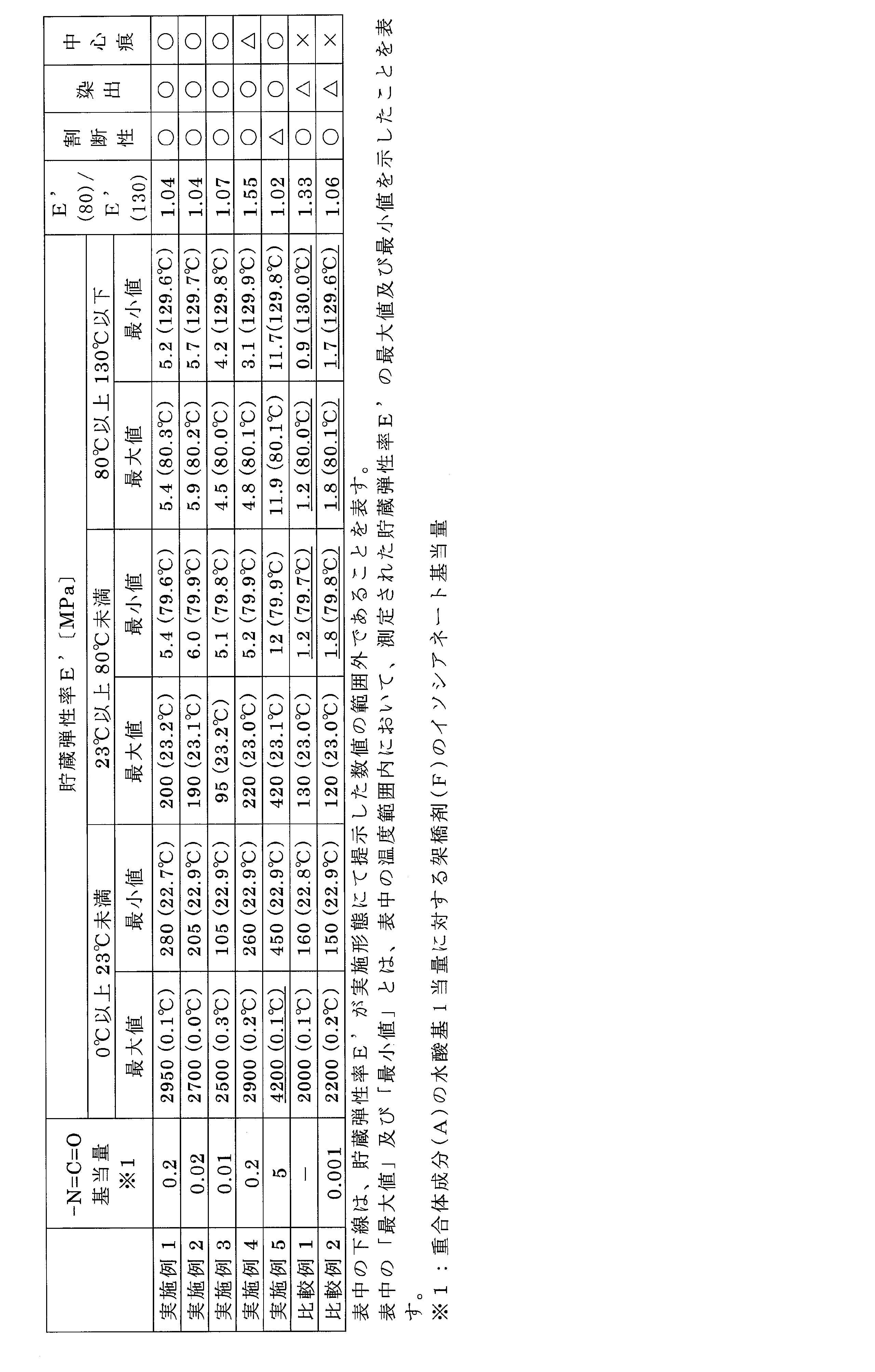
一方、80℃以上130℃以下の温度範囲の全ての温度において、貯蔵弾性率E’が2MPa以上の規定を満たしていない、比較例1~2の保護膜形成用フィルムでは、中心痕の発生が確認された。確認された中心痕の、光干渉式表面粗さ計(Veeco社製、製品名:Wyko NT1100)により取得した観察画像の模式図を図5に示す。図5(b)は、図5(a)の断面図である。図5に示すように、保護膜23’付き半導体チップ19の保護膜23’に、中心痕25が形成されていた。
Claims (13)
- 熱硬化性であり、
80℃以上130℃以下の温度範囲の全ての温度において、貯蔵弾性率E’が2MPa以上である、熱硬化性保護膜形成用フィルム。 - 前記保護膜形成用フィルムが、官能基(a1)を含む構成単位を有する重合体成分(A)、及び、前記官能基(a1)と反応する官能基(f1)を2個以上有する架橋剤(F)を含有する、請求項1に記載の熱硬化性保護膜形成用フィルム。
- 前記重合体成分(A)100質量部に対して、前記官能基(a1)を含む構成単位の含有量が、3質量部以上である、請求項2に記載の熱硬化性保護膜形成用フィルム。
- 前記官能基(a1)1当量に対して、前記官能基(f1)の含有量が、0.005~4当量である、請求項2又は3に記載の熱硬化性保護膜形成用フィルム。
- 前記官能基(f1)がイソシアネート基であり、前記官能基(a1)が水酸基である、請求項2~4のいずれか一項に記載の熱硬化性保護膜形成用フィルム。
- 23℃以上80℃未満の温度範囲の全ての温度において、貯蔵弾性率E’が5MPa以上である、請求項1~5のいずれか一項に記載の熱硬化性保護膜形成用フィルム。
- 0℃以上23℃未満の温度範囲の全ての温度において、貯蔵弾性率E’が3000MPa以下である、請求項1~6のいずれか一項に記載の熱硬化性保護膜形成用フィルム。
- 前記保護膜形成用フィルムが、80.0~80.5℃の温度範囲のいずれかの温度における貯蔵弾性率E’(E’(80))と、129.5~130.0℃の温度範囲のいずれかの温度における貯蔵弾性率E’(E’(130))との比である、E’(80)/E’(130)の値が、0.3~3である、請求項1~7のいずれか一項に記載の熱硬化性保護膜形成用フィルム。
- 厚さが1~100μmである、請求項1~8のいずれか一項に記載の熱硬化性保護膜形成用フィルム。
- 前記保護膜形成用フィルムが、重合体成分(A)及び熱硬化性成分(B)を含有し、
前記重合体成分(A)が、アクリル系樹脂であり、
熱硬化性成分(B)が、エポキシ樹脂(B1)及び熱硬化剤(B2)からなるエポキシ系熱硬化性樹脂である、請求項1~9のいずれか一項に記載の熱硬化性保護膜形成用フィルム。 - 支持シートと、請求項1~10のいずれか一項に記載の熱硬化性保護膜形成用フィルムと、を備え、
前記支持シート上に、前記熱硬化性保護膜形成用フィルムを備えた、保護膜形成用複合シート。 - 請求項1~10のいずれか一項に記載の熱硬化性保護膜形成用フィルム、又は請求項11に記載の保護膜形成用複合シート中の熱硬化性保護膜形成用フィルムを、ウエハ又はチップに貼付することにより積層体を形成する工程と、
前記積層体を23℃未満の温度でエキスパンドすることにより、前記ウエハ及び前記熱硬化性保護膜形成用フィルムを分割する、又は前記チップに貼付された前記熱硬化性保護膜形成用フィルムを分割する工程と、
前記分割された前記熱硬化性保護膜形成用フィルムを加熱硬化することにより、前記チップ上に保護膜を形成する工程と、を備える、保護膜付きチップの製造方法。 - 前記ウエハが、ウエハの内部にレーザー光が照射されて、ウエハの内部に改質層が形成されたものであり、
前記熱硬化性保護膜形成用フィルムを分割する工程が、前記改質層が形成された前記ウエハを、前記熱硬化性保護膜形成用フィルムとともに、前記保護膜形成用フィルムの表面方向にエキスパンドすることにより、前記は熱硬化性保護膜形成用フィルムを切断するとともに、前記改質層の部位において前記ウエハを分割する工程である、請求項12に記載の保護膜付きチップの製造方法。
Priority Applications (4)
| Application Number | Priority Date | Filing Date | Title |
|---|---|---|---|
| CN201980059711.7A CN112703239B (zh) | 2018-11-22 | 2019-11-20 | 热固性保护膜形成用膜、保护膜形成用复合片、及芯片的制造方法 |
| JP2020520331A JP6777834B1 (ja) | 2018-11-22 | 2019-11-20 | 熱硬化性保護膜形成用フィルム、保護膜形成用複合シート、及びチップの製造方法 |
| CN202211159504.9A CN115536969A (zh) | 2018-11-22 | 2019-11-20 | 热固性保护膜形成用膜、保护膜形成用复合片、及芯片的制造方法 |
| KR1020217007398A KR102929203B1 (ko) | 2018-11-22 | 2019-11-20 | 열경화성 보호막 형성용 필름, 보호막 형성용 복합 시트, 및 칩의 제조 방법 |
Applications Claiming Priority (2)
| Application Number | Priority Date | Filing Date | Title |
|---|---|---|---|
| JP2018-219635 | 2018-11-22 | ||
| JP2018219635 | 2018-11-22 |
Publications (1)
| Publication Number | Publication Date |
|---|---|
| WO2020105677A1 true WO2020105677A1 (ja) | 2020-05-28 |
Family
ID=70773829
Family Applications (1)
| Application Number | Title | Priority Date | Filing Date |
|---|---|---|---|
| PCT/JP2019/045409 Ceased WO2020105677A1 (ja) | 2018-11-22 | 2019-11-20 | 熱硬化性保護膜形成用フィルム、保護膜形成用複合シート、及びチップの製造方法 |
Country Status (5)
| Country | Link |
|---|---|
| JP (2) | JP6777834B1 (ja) |
| KR (1) | KR102929203B1 (ja) |
| CN (2) | CN112703239B (ja) |
| TW (1) | TWI826594B (ja) |
| WO (1) | WO2020105677A1 (ja) |
Cited By (5)
| Publication number | Priority date | Publication date | Assignee | Title |
|---|---|---|---|---|
| CN112635309A (zh) * | 2020-12-07 | 2021-04-09 | 福建晶安光电有限公司 | 衬底加工方法及利用该方法加工的衬底 |
| CN113972333A (zh) * | 2020-07-22 | 2022-01-25 | 华为技术有限公司 | 一种显示模组和电子设备 |
| CN115109370A (zh) * | 2021-03-22 | 2022-09-27 | 琳得科株式会社 | 保护膜形成膜、保护膜形成用复合片、带保护膜的工件加工物与带保护膜的工件的制造方法 |
| KR20230040880A (ko) | 2021-09-16 | 2023-03-23 | 린텍 가부시키가이샤 | 보호막 형성 필름 및 보호막 형성용 복합 시트 |
| WO2024021182A1 (zh) * | 2022-07-29 | 2024-02-01 | 广东汇齐新材料有限公司 | 一种自修复tpu热熔胶膜及其制备方法 |
Families Citing this family (6)
| Publication number | Priority date | Publication date | Assignee | Title |
|---|---|---|---|---|
| KR102823307B1 (ko) * | 2019-06-13 | 2025-06-23 | 닛토덴코 가부시키가이샤 | 다이싱 테이프 및 다이싱 다이 본드 필름 |
| JP7831967B2 (ja) * | 2021-08-25 | 2026-03-17 | リンテック株式会社 | 保護膜形成フィルム、保護膜形成用複合シート、保護膜付きワークの製造方法、及び、保護膜付きワーク加工物の製造方法 |
| KR102635559B1 (ko) * | 2021-12-07 | 2024-02-08 | (주)이녹스첨단소재 | 점착 조성물 및 이를 포함하는 디스플레이용 점착 시트 |
| JP7841916B2 (ja) * | 2022-03-24 | 2026-04-07 | リンテック株式会社 | 保護膜形成用フィルム、保護膜形成用複合シート、保護膜付き半導体チップ及び半導体装置 |
| JP7820064B2 (ja) * | 2022-05-20 | 2026-02-25 | 株式会社ディスコ | エキスパンド装置、及び、エキスパンド方法 |
| TWI879450B (zh) * | 2024-02-23 | 2025-04-01 | 翌驊實業股份有限公司 | 應用於sdbg製程之封裝貼合膜、其製備方法及其使用方法 |
Citations (3)
| Publication number | Priority date | Publication date | Assignee | Title |
|---|---|---|---|---|
| JP2012241063A (ja) * | 2011-05-17 | 2012-12-10 | Nitto Denko Corp | 半導体装置製造用の接着シート |
| WO2014054781A1 (ja) * | 2012-10-05 | 2014-04-10 | リンテック株式会社 | 保護膜形成層付ダイシングシートおよびチップの製造方法 |
| JP2017092333A (ja) * | 2015-11-13 | 2017-05-25 | 日東電工株式会社 | 積層体および合同体・半導体装置の製造方法 |
Family Cites Families (7)
| Publication number | Priority date | Publication date | Assignee | Title |
|---|---|---|---|---|
| JP5632695B2 (ja) | 2009-11-26 | 2014-11-26 | 日東電工株式会社 | ダイシングフィルム付き接着フィルム、及び、該ダイシングフィルム付き接着フィルムを用いた半導体装置の製造方法 |
| JP5393902B2 (ja) | 2011-08-09 | 2014-01-22 | 三井化学東セロ株式会社 | 半導体装置の製造方法およびその方法に用いられる半導体ウエハ表面保護用フィルム |
| JP5976326B2 (ja) | 2012-01-25 | 2016-08-23 | 日東電工株式会社 | 半導体装置の製造方法、及び、当該半導体装置の製造方法に用いられる接着フィルム |
| SG11201507775XA (en) | 2013-03-22 | 2015-10-29 | Lintec Corp | Protective film-forming film and protective film-forming composite sheet |
| JP5828990B2 (ja) | 2013-09-30 | 2015-12-09 | リンテック株式会社 | 樹脂膜形成用複合シート |
| CN108701640B (zh) * | 2016-04-28 | 2022-12-20 | 琳得科株式会社 | 保护膜形成用膜以及保护膜形成用复合片 |
| JP6776081B2 (ja) * | 2016-09-28 | 2020-10-28 | リンテック株式会社 | 保護膜付き半導体チップの製造方法及び半導体装置の製造方法 |
-
2019
- 2019-11-20 KR KR1020217007398A patent/KR102929203B1/ko active Active
- 2019-11-20 TW TW108142088A patent/TWI826594B/zh active
- 2019-11-20 CN CN201980059711.7A patent/CN112703239B/zh active Active
- 2019-11-20 WO PCT/JP2019/045409 patent/WO2020105677A1/ja not_active Ceased
- 2019-11-20 JP JP2020520331A patent/JP6777834B1/ja active Active
- 2019-11-20 CN CN202211159504.9A patent/CN115536969A/zh active Pending
-
2020
- 2020-10-07 JP JP2020169729A patent/JP7014875B2/ja active Active
Patent Citations (3)
| Publication number | Priority date | Publication date | Assignee | Title |
|---|---|---|---|---|
| JP2012241063A (ja) * | 2011-05-17 | 2012-12-10 | Nitto Denko Corp | 半導体装置製造用の接着シート |
| WO2014054781A1 (ja) * | 2012-10-05 | 2014-04-10 | リンテック株式会社 | 保護膜形成層付ダイシングシートおよびチップの製造方法 |
| JP2017092333A (ja) * | 2015-11-13 | 2017-05-25 | 日東電工株式会社 | 積層体および合同体・半導体装置の製造方法 |
Cited By (6)
| Publication number | Priority date | Publication date | Assignee | Title |
|---|---|---|---|---|
| CN113972333A (zh) * | 2020-07-22 | 2022-01-25 | 华为技术有限公司 | 一种显示模组和电子设备 |
| CN112635309A (zh) * | 2020-12-07 | 2021-04-09 | 福建晶安光电有限公司 | 衬底加工方法及利用该方法加工的衬底 |
| CN112635309B (zh) * | 2020-12-07 | 2024-07-12 | 福建晶安光电有限公司 | 衬底加工方法及利用该方法加工的衬底 |
| CN115109370A (zh) * | 2021-03-22 | 2022-09-27 | 琳得科株式会社 | 保护膜形成膜、保护膜形成用复合片、带保护膜的工件加工物与带保护膜的工件的制造方法 |
| KR20230040880A (ko) | 2021-09-16 | 2023-03-23 | 린텍 가부시키가이샤 | 보호막 형성 필름 및 보호막 형성용 복합 시트 |
| WO2024021182A1 (zh) * | 2022-07-29 | 2024-02-01 | 广东汇齐新材料有限公司 | 一种自修复tpu热熔胶膜及其制备方法 |
Also Published As
| Publication number | Publication date |
|---|---|
| CN112703239B (zh) | 2022-10-04 |
| JP2021013035A (ja) | 2021-02-04 |
| KR102929203B1 (ko) | 2026-02-20 |
| JP6777834B1 (ja) | 2020-10-28 |
| KR20210093229A (ko) | 2021-07-27 |
| JPWO2020105677A1 (ja) | 2021-02-15 |
| CN115536969A (zh) | 2022-12-30 |
| CN112703239A (zh) | 2021-04-23 |
| TW202028321A (zh) | 2020-08-01 |
| JP7014875B2 (ja) | 2022-02-01 |
| TWI826594B (zh) | 2023-12-21 |
Similar Documents
| Publication | Publication Date | Title |
|---|---|---|
| JP6777834B1 (ja) | 熱硬化性保護膜形成用フィルム、保護膜形成用複合シート、及びチップの製造方法 | |
| JP7182603B2 (ja) | 保護膜形成用複合シート及び保護膜付き半導体チップの製造方法 | |
| JP7330166B2 (ja) | 保護膜形成用複合シート及び保護膜付き半導体チップの製造方法 | |
| JP6914698B2 (ja) | 樹脂膜形成用複合シート | |
| JP7044780B2 (ja) | 樹脂膜形成用フィルム及び樹脂膜形成用複合シート | |
| JPWO2020116275A1 (ja) | 保護膜形成用複合シート、及び半導体チップの製造方法 | |
| KR20200145675A (ko) | 보호막 형성용 복합 시트, 및 보호막이 형성된 반도체 칩의 제조 방법 | |
| JP2021158181A (ja) | 保護膜形成フィルム、保護膜形成用複合シート、及び保護膜形成フィルム付きワークの搬送方法 | |
| JP2020183044A (ja) | 保護膜形成用複合シート | |
| JP6686241B1 (ja) | 保護膜形成用フィルム、保護膜形成用複合シート、検査方法及び識別方法 | |
| JP2019062108A (ja) | 樹脂膜形成用複合シート | |
| JP2022146565A (ja) | 保護膜形成フィルム、保護膜形成用複合シート、及びウエハの再生方法 | |
| JP2022146567A (ja) | 保護膜形成フィルム、保護膜形成用複合シート、保護膜付きワーク加工物の製造方法、及び保護膜付きワークの製造方法 | |
| JP7114013B1 (ja) | 治具固定用粘着シート、保護膜形成用複合シート、及び保護膜付きチップの製造方法 | |
| JP7465099B2 (ja) | 保護膜形成用複合シート、及び保護膜付きチップの製造方法 | |
| JPWO2020116288A1 (ja) | 保護膜形成用複合シート、及び半導体チップの製造方法 | |
| JP2019062107A (ja) | 樹脂膜形成用複合シート | |
| WO2022202502A1 (ja) | 治具固定用粘着シート、保護膜形成用複合シート、及び保護膜付きチップの製造方法 | |
| JP2023148426A (ja) | 保護膜形成フィルム、保護膜形成用複合シート、キット、及び、保護膜形成フィルムの使用 | |
| JP2024008898A (ja) | 保護膜形成フィルム、保護膜形成用複合シート、キット、及び、保護膜形成フィルムの使用 | |
| JP2023147741A (ja) | 保護膜形成フィルム、保護膜形成用複合シート、半導体装置の製造方法、及び保護膜形成フィルムの使用 | |
| JP2023031526A (ja) | 保護膜形成フィルム、保護膜形成用複合シート、保護膜付きワークの製造方法、及び、保護膜付きワーク加工物の製造方法 | |
| JP2021040099A (ja) | 保護膜形成用フィルム、保護膜形成用複合シート、及び保護膜付きワーク加工物の製造方法 | |
| JPWO2019187014A1 (ja) | 支持シート及び保護膜形成用複合シート |
Legal Events
| Date | Code | Title | Description |
|---|---|---|---|
| ENP | Entry into the national phase |
Ref document number: 2020520331 Country of ref document: JP Kind code of ref document: A |
|
| 121 | Ep: the epo has been informed by wipo that ep was designated in this application |
Ref document number: 19886910 Country of ref document: EP Kind code of ref document: A1 |
|
| NENP | Non-entry into the national phase |
Ref country code: DE |
|
| 122 | Ep: pct application non-entry in european phase |
Ref document number: 19886910 Country of ref document: EP Kind code of ref document: A1 |
|
| WWR | Wipo information: refused in national office |
Ref document number: 1020217007398 Country of ref document: KR |