WO2020050219A1 - パッド型吸収性物品 - Google Patents
パッド型吸収性物品 Download PDFInfo
- Publication number
- WO2020050219A1 WO2020050219A1 PCT/JP2019/034440 JP2019034440W WO2020050219A1 WO 2020050219 A1 WO2020050219 A1 WO 2020050219A1 JP 2019034440 W JP2019034440 W JP 2019034440W WO 2020050219 A1 WO2020050219 A1 WO 2020050219A1
- Authority
- WO
- WIPO (PCT)
- Prior art keywords
- basis weight
- core
- pad
- absorbent article
- low
- Prior art date
- Legal status (The legal status is an assumption and is not a legal conclusion. Google has not performed a legal analysis and makes no representation as to the accuracy of the status listed.)
- Ceased
Links
Images


Classifications
-
- A—HUMAN NECESSITIES
- A61—MEDICAL OR VETERINARY SCIENCE; HYGIENE
- A61F—FILTERS IMPLANTABLE INTO BLOOD VESSELS; PROSTHESES; DEVICES PROVIDING PATENCY TO, OR PREVENTING COLLAPSING OF, TUBULAR STRUCTURES OF THE BODY, e.g. STENTS; ORTHOPAEDIC, NURSING OR CONTRACEPTIVE DEVICES; FOMENTATION; TREATMENT OR PROTECTION OF EYES OR EARS; BANDAGES, DRESSINGS OR ABSORBENT PADS; FIRST-AID KITS
- A61F13/00—Bandages or dressings; Absorbent pads
- A61F13/15—Absorbent pads, e.g. sanitary towels, swabs or tampons for external or internal application to the body; Supporting or fastening means therefor; Tampon applicators
- A61F13/45—Absorbent pads, e.g. sanitary towels, swabs or tampons for external or internal application to the body; Supporting or fastening means therefor; Tampon applicators characterised by the shape
- A61F13/47—Sanitary towels, incontinence pads or napkins
- A61F13/472—Sanitary towels, incontinence pads or napkins specially adapted for female use
-
- A—HUMAN NECESSITIES
- A61—MEDICAL OR VETERINARY SCIENCE; HYGIENE
- A61F—FILTERS IMPLANTABLE INTO BLOOD VESSELS; PROSTHESES; DEVICES PROVIDING PATENCY TO, OR PREVENTING COLLAPSING OF, TUBULAR STRUCTURES OF THE BODY, e.g. STENTS; ORTHOPAEDIC, NURSING OR CONTRACEPTIVE DEVICES; FOMENTATION; TREATMENT OR PROTECTION OF EYES OR EARS; BANDAGES, DRESSINGS OR ABSORBENT PADS; FIRST-AID KITS
- A61F13/00—Bandages or dressings; Absorbent pads
- A61F13/15—Absorbent pads, e.g. sanitary towels, swabs or tampons for external or internal application to the body; Supporting or fastening means therefor; Tampon applicators
- A61F13/53—Absorbent pads, e.g. sanitary towels, swabs or tampons for external or internal application to the body; Supporting or fastening means therefor; Tampon applicators characterised by the absorbing medium
- A61F13/531—Absorbent pads, e.g. sanitary towels, swabs or tampons for external or internal application to the body; Supporting or fastening means therefor; Tampon applicators characterised by the absorbing medium having a homogeneous composition through the thickness of the pad
- A61F13/532—Absorbent pads, e.g. sanitary towels, swabs or tampons for external or internal application to the body; Supporting or fastening means therefor; Tampon applicators characterised by the absorbing medium having a homogeneous composition through the thickness of the pad inhomogeneous in the plane of the pad
Definitions
- the present invention relates to a pad-type absorbent article such as a sanitary napkin.
- Patent Literature 2 discloses an absorbent core having an equal width in the front-rear direction.
- This absorbent core is provided with a V-shaped opening on the skin surface of a protrusion arranged at the center in the width direction facing the excretion part of the wearer for the purpose of preventing lateral leakage, and on both sides of the protrusion. It has a high density part.
- a pad-type absorbent article includes an absorbent core having a front core portion and a rear core portion located at both ends in the front-rear direction, and an intermediate core portion.
- the intermediate core part is located between the front core part and the rear core part.
- the intermediate core portion has a shorter length in the width direction orthogonal to the front-rear direction than the front core portion and the rear core portion.
- the intermediate core portion is located in the central region in the width direction, and a high basis weight portion having a higher basis weight than the front core portion and the rear core portion, and is located in the both side regions in the width direction, and is higher than the high basis weight portion.
- a low basis weight part having a low basis weight.
- the high basis weight portion is a high basis weight and high thickness portion located at the center in the width direction, and the high basis weight and high thickness portion which is thinner than the high basis weight and high thickness portions located on both sides in the width direction of the high basis weight and high thickness portion. And a low thickness portion.
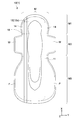
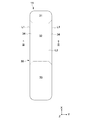
- FIG. 2 is a schematic plan view of an absorber constituting a part of the pad-type absorbent article in FIG. 1 in a single state.
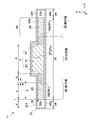
- FIG. 3 is a schematic cross-sectional view of the absorbent body of FIG. 2 cut along a line III-III passing through a straight portion of a peripheral groove provided in the absorbent core, and is a diagram conceptually showing a relationship between the absorbent core and a core wrap sheet. It is.
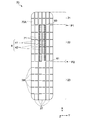
- FIG. 3 is a plan view showing an absorbent core constituting a part of the absorber of FIG. 2.
- FIG. 4 is a drawing corresponding to FIG. 3 according to another embodiment of the present invention. It is a top view showing the absorptive core as a comparative example.
- the present invention relates to a pad-type absorbent article that can reduce friction between the absorbent article and the wearer's skin.
- the X-axis direction is the front-rear direction of the pad-type absorbent article (hereinafter, also referred to as the absorbent article) 1
- the Y-axis direction is the width direction
- the Z-axis direction is the up-down direction (thickness direction).
- the X, Y, and Z axes are orthogonal to each other.
- a side closer to the wearer's skin is an upper side
- a side farther from the skin is a lower side.
- the absorbent article 1 of the present embodiment is configured as a sanitary napkin, and is hereinafter referred to as a napkin 10.
- the napkin 10 includes a main body M, a pair of wing portions W, and a pair of rear flap portions F.
- the main body M extends in the front-rear direction X, and is fixed to the inner surface (wearing surface) of the wearer's underwear at the time of wearing.
- the main body M has an absorber 11 and has a function of absorbing a liquid material such as menstrual blood of a wearer (hereinafter, also referred to as “liquid”).
- the main body M has a front area M1, an intermediate area M2, and a rear area M3, which are sectioned along the front-rear direction X.
- the front area M1 is an area arranged in front of the intermediate area M2 (abdominal side of the wearer), and is configured to face the front of the excretory part of the wearer when worn.
- the intermediate region M2 is configured to face the excretory part of the wearer when worn. Note that the intermediate region M2 may be located closer to the front of the main body M as illustrated, or may be located at the center of the main body M.
- the rear area M3 is an area arranged behind the intermediate area M2 (on the back side of the wearer), and is configured to face the rear of the excretory part of the wearer when worn.
- the wing portion W is configured to protrude greatly from the intermediate region M2 to the outside in the width direction Y.
- the rear flap portion F is configured to bulge outward from the rear region M3 in the width direction Y.
- the napkin 10 does not have to have at least one of the wing W and the rear flap F.
- the napkin 10 includes an absorber 11, a top sheet 12, a back sheet (not shown), a pair of side sheets 14, and a pressing groove 16.
- the napkin 10 has a configuration in which a back sheet, an absorber 11 and a top sheet 12 are laminated.
- the napkin 10 is configured such that the skin facing surface 12a of the topsheet 12 is in contact with the wearer's skin when worn.
- the absorber 11 has a front-rear direction in the X-axis direction, and is arranged at the center of the napkin 10 in the thickness direction.
- the absorber 11 absorbs the liquid from the surface on the side of the top sheet 12, diffuses the liquid inside, and holds the liquid.
- the absorber 11 will be described later.
- the topsheet 12 is configured as a liquid-permeable sheet material, and is disposed on the absorber 11.
- the topsheet 12 constitutes an outer surface of the body M above the napkin 10 in the thickness direction.
- the back sheet is arranged to face the top sheet 12 in the thickness direction with the absorber 11 interposed therebetween.
- the back sheet constitutes an outer surface of the napkin 10 below the thickness direction.
- the back sheet is joined to the top sheet 12 and the side sheet 14 by an adhesive, a heat seal, or the like, for example, at the peripheral edge.
- the pair of side sheets 14 oppose each other in the width direction Y with the top sheet 12 interposed therebetween, and are arranged on the peripheral edge of the napkin 10 in the width direction.
- the compression groove portion 16 is configured as a linear groove formed by pressing the absorber 11 and the topsheet 12.
- the absorber 11 has an absorbent core 20 and a core wrap sheet 30.
- the absorbent core 20 has a function of absorbing and retaining a liquid.
- the absorbent core 20 may be formed of, for example, a fiber aggregate formed of hydrophilic fibers such as pulp fibers, or may have a configuration in which the fiber aggregate holds a water-absorbing polymer. .
- a member constituting the absorbent core 20 is referred to as an absorbing member.
- the core wrap sheet 30 is wound in the width direction Y of the absorbent core 20 so as to cover the front and back of the absorbent core 20.
- the length of the core wrap sheet 30 along the X-axis direction is formed to be equal to the length (total length) of the absorbent core 20 in the front-rear direction X, but is not limited thereto. It may be long or short.
- the core wrap sheet 30 has a function of covering the absorbent core 20 and maintaining the shape of the absorbent core 20, for example.
- the core wrap sheet is formed of, for example, a thin soft paper such as a tissue paper or a liquid-permeable nonwoven fabric.
- the core wrap sheet 30 may be composed of one sheet material, or may be composed of a plurality of sheet materials.
- the core wrap sheet 30 may be joined to the top sheet 12 and the back sheet 13 by, for example, an adhesive applied in a predetermined pattern.
- the absorbent core 20 has a front core portion 21 located in the front region M1, an intermediate core portion 22 located in the intermediate region M2, and a rear core portion 23 located in the rear region M3. .
- the front core section 21 and the rear core section 23 are located on both ends in the front-rear direction X of the absorbent core 20, and the intermediate core section 22 is located between the front core section 21 and the rear core section 23.
- the intermediate core portion 22 extends from the rear side of the front area M1 to the front side of the rear area M3 via the intermediate area M2.
- the absorbent core 20 has a symmetrical plane shape in the width direction Y.
- FIG. 4 shows the widths D1, D2, and D3, which are the dimensions in the width direction Y of the front core portion 21, the intermediate core portion 22, and the rear core portion 23.
- the width D2 of the intermediate core portion 22 is shorter than both the width D1 of the front core portion 21 and the width D3 of the rear core portion 23. That is, the absorptive core 20 has the intermediate core portion 22 formed between the pair of constricted regions 22s and narrower than the front core portion 21 and the rear core portion 23 in the middle portion in the front-rear direction X.
- the width D1 of the front core portion 21 and the width D3 of the rear core portion 23 are the same. However, the width D1 of the front core portion 21 and the width D3 of the rear core portion 23 may be different. Further, the widths of the front core section 21, the intermediate core section 22, and the rear core section 23 may not be uniform. In this case, the maximum dimension in the width direction Y of each of the front core section 21 and the rear core section 23 can be defined as widths D1 and D3, and the minimum dimension in the width direction Y of the intermediate core section 22 can be defined as D2.
- the intermediate core portion 22 is an excretion portion facing portion that is disposed to face the vaginal opening that is the excretion portion of the wearer when the napkin 10 is worn.
- the front core portion 21 is arranged closer to the front (abdominal side) of the wearer than the intermediate core portion 22, and the rear core portion 23 is arranged closer to the rear side (back side) of the wearer than the intermediate core portion 22.
- the front core portion 21 has a tapered portion 21a at the rear end, and the rear core portion 23 has a tapered portion 23a at the front end.
- the tapered portion 21a (23a) decreases the width of the front core portion 21 (rear core portion 23) toward the intermediate core portion 22.
- the constricted region 22s corresponds to a space formed between both edges in the width direction Y of the intermediate core portion 22 and the tapered portions 21a and 23a.
- a plurality of grooves are provided on the skin facing surface 20a side of the absorbent core 20.
- the front core portion 21, the intermediate core portion 22, and the rear core portion 23 are provided with a vertical groove portion 27 and a horizontal groove portion 28, and the intermediate core portion 22 is provided with a peripheral groove portion 29.
- a boundary groove portion 60 is provided at a boundary portion P1 between the front core portion 21 and the intermediate core portion 22, and a boundary groove portion 61 is provided at a boundary portion P2 between the intermediate core portion 22 and the rear core portion 23.
- the boundary part P1 and the boundary part P2 are respectively located so as to cross the absorbent core 20 in the width direction Y.
- the boundary portion P1 refers to a portion that does not belong to any portion between the front core portion 21 and the intermediate core portion 22, and the boundary portion P2 does not belong to any portion between the rear core portion 23 and the intermediate core portion 22. Part.
- the absorbent core 20 is divided into a plurality of blocks by a low-basis vertical groove 27, a lateral groove 28, a peripheral groove 29, and boundary grooves 60 and 61, in which the absorbent member has a relatively low basis weight.
- These grooves are configured to sink downward from the top surface in the thickness direction (the surface located on the skin side of the wearer) in the block portion divided into the block shape.
- the block portion is configured to protrude upward in the thickness direction.
- the region where the groove is formed that is, the bottom portion where the groove is formed is relatively thinner than the region of the block portion where the groove is not formed.
- the bottom forming the groove has a relatively lower basis weight than the block, and the bottom of the groove has lower rigidity than the block. Therefore, when an external force is applied to the absorbent core 20, the absorbent core 20 is easily deformed with the groove as a deformation starting point.
- the basis weight of the front core portion 21, the intermediate core portion 22, and the rear core portion 23 refers to the basis weight of the block portion excluding the respective groove portions 27, 28, 29, 60, 61.
- the vertical groove portions 27 extend in the front-rear direction X, and are arranged in plurality in the width direction Y at intervals.
- the vertical groove portion 27 is formed over the entire length in the front-rear direction X so as to divide each of the front core portion 21, the intermediate core portion 22, and the rear core portion 23 in the width direction Y.
- the lateral grooves 28 extend in the width direction Y and are arranged at intervals in the front-rear direction X.
- the lateral groove portion 28 is formed over the entire length in the width direction Y so as to divide the front core portion 21, the intermediate core portion 22, and the rear core portion 23 in the front-rear direction X.
- the boundary grooves 60 and 61 formed at the boundaries P1 and P2 are not included in the lateral grooves 28.
- the groove width which is the length of the boundary grooves 60 and 61 in the front-rear direction X, is wider than the horizontal groove 28.
- the peripheral groove portion 29 is formed along the outer edge in the front-rear direction X of the high basis weight portion 4 described later.
- the configuration such as the shape and arrangement of the vertical groove 27, the horizontal groove 28, and the peripheral groove 29 is not limited to the configuration illustrated in FIG. 4, but may be appropriately determined based on the shape of the absorbent core 20, the required function, and the like. Is set.
- the flexibility of the absorbent core 20 is increased, and the mounting property is improved. be able to.
- the groove by providing the groove, the liquid excreted into the space of the groove can be quickly drawn and taken into the absorbent core 20, so that the liquid absorbing speed can be increased.
- the absorbent core 20 is partitioned into a plurality of blocks, the surface area of the absorbent core 20 can be increased, and the liquid can be efficiently absorbed and held.
- the intermediate core portion 22 includes a high basis weight portion 4 having a high basis weight of the absorbing member, and a low basis weight portion 25 having a basis weight lower than the high basis weight portion 4.
- the high basis weight portion 4 has a higher basis weight than the front core portion 21 and the rear core portion 23.
- the high basis weight portion 4 is located in the center region 65 in the width direction of the intermediate core portion 22 and is provided to extend in the front-rear direction X.
- the low basis weight portion 25 is located in the width direction both side regions 66 of the intermediate core portion 22 and extends in the front-rear direction X.
- the low basis weight portions 25 extend in the front-rear direction X and face each other along the width direction Y with the high basis weight portion 4 interposed therebetween, and are located in a pair on the left and right.
- the low basis weight portion 25 is located below the upper surface of the high basis weight and high thickness portion 41.
- the absorbent core 20 when a virtual line parallel to the vertical direction X is drawn through a portion of the high basis weight portion 4 where the length in the width direction is the largest, the inner side of the virtual line in the width direction Y is centered.
- An area 65 is provided, and the outside is a side area 66.
- the “portion of the high basis weight portion 4 where the length in the width direction is the largest” is preferably present at the central portion in the vertical direction of the intermediate core portion 22 in consideration of the fit of the wearer to the groin.
- the high basis weight portion 4 has a high basis weight and high thickness portion 41 and a high basis weight and low thickness portion 42.
- the high basis weight and high thickness portion 41 is located at the center in the width direction.
- the pair of high-basis-weight and low-thickness portions 42 are positioned on both sides in the width direction of the high-basis-weight and high-thickness portion 41 so as to face each other in the width direction Y with the high-basis weight and high-thickness portion 41 therebetween.
- the high-basis-weight high-thickness portion 41 and the high-basis-weight low-thickness portion 42 are located before and after the intermediate core portion 22 having the narrowest width in the region where the constricted region 22s is provided along the front-rear direction X of the absorbent core 20. It is provided extending over the entire length in the direction.
- the part 25 is arranged.
- the high basis weight part 4 is arranged so as to face the excretion part of the wearer when the napkin 10 is worn. In FIG.
- the low basis weight portion 25 is indicated by a dot pattern having a low density
- the high basis weight portion 4 is indicated by a dot pattern having a higher density than the dot pattern of the low basis weight portion 25.
- the dot pattern density of the high basis weight and low thickness portion 42 is shown more densely than in the high basis weight and high thickness portion 41.
- the basis weight of the high basis weight low thickness part 42 is equal to the basis weight of the high basis weight high thickness part 41. However, the basis weights of the high basis weight high thickness portion 41 and the high basis weight low thickness portion 42 do not need to be completely the same, and from the viewpoint of absorption performance, the difference between the higher basis weight and the lower basis weight is calculated.
- the value divided by the higher basis weight is preferably within 20%, more preferably within 10%.
- the high basis weight and low thickness portion 42 has a higher density and a higher density of the absorbing member than the high basis weight and high thickness portion 41.
- the thickness of the high basis weight low thickness portion 42 is thinner than the high basis weight high thickness portion 41 and is equal to the low basis weight portion 25.
- the high basis weight low thickness portion 42 is located between the high basis weight high thickness portion 41 and the low basis weight portion 25.
- the high-basis-weight low-thickness portion 42 has the highest rigidity
- the high-basis-weight high-thickness portion 41 has the next highest
- the low-basis weight portion 25 has the lowest.
- the high basis weight and high thickness portion 41 of the high basis weight portion 4 is formed to be thicker than the low basis weight portion 25 and the high basis weight low thickness portion 42, and is upward in the thickness direction (on the side of the top sheet 12). ). Thereby, good fit between the central portion of the intermediate region M2 of the napkin 10 corresponding to the high basis weight and high thickness portion 41 and the excretion part of the wearer is ensured.
- a portion of the absorbent core 20 located outside the high basis weight portion 4 in the width direction Y is referred to as a side portion 44. Therefore, in the present embodiment, a portion including both the low basis weight portion 25 and the linear portion 291 of the peripheral groove portion 29 in the absorbent core 20 is the side portion 44. As shown in FIG. 4, when viewed in a plan view, the side portions 44 have an elongated shape extending in the front-rear direction X, and are positioned as a pair facing each other in the width direction Y with the high basis weight portion 4 interposed therebetween. .
- the pair of side portions 44 are located on both sides in the width direction Y of the high basis weight portion 4 in contact with the high basis weight portion 4, and are regions having a lower basis weight than the high basis weight portion 4.
- An intermediate portion of the lateral portion 44 in the front-rear direction X has a uniform width along the front-rear direction X.
- the high basis weight portion 4 has a substantially semicircular shape whose width gradually decreases toward the front core portion 21 and the rear core portion 23 at the front portion and the rear portion, respectively.
- the part and the rear part are arranged along the high-basis-weight part 4 having such a substantially semicircular shape. Thereby, the width of the front part and the rear part of the side part 44 is gradually increased from the middle part in the front-rear direction X of the side part 44 toward both front and rear ends.
- a first virtual straight line along the width direction Y is drawn in a region where the linear portion 291 of the peripheral groove 29 of the absorbent core 20 exists.
- the region where the high basis weight portion 4 is located is the central region 65 in the intermediate core portion 22, and the region where the pair of side portions 44 on both sides of the high basis weight portion 4 is located on the side.
- the boundary between the central region 65 and the lateral region 66 extends linearly along the front-rear direction X.
- a second virtual straight line along the width direction Y is drawn in a region where the curved portion 292 of the peripheral groove portion 29 of the absorbent core 20 exists.
- a part of the side part 44 is located in the central area 65 in addition to the high basis weight part 4, and the boundary between the central area 65 and the side area 66 is the high basis weight part 4. Does not coincide with the boundary between the side portion 44.
- the width a of the high basis weight and high thickness portion 41, the width b of the high basis weight and low thickness portion 42, the width c of the low basis weight portion 25, and the width e of the peripheral groove portion 29 are: Shows the width in the width direction Y of the high basis weight high thickness portion 41, the high basis weight low thickness portion 42, the low basis weight portion 25, and the peripheral groove portion 29, which are respectively located on the above-mentioned first virtual straight line. .
- the width f of the side portion 44 indicates the width in the width direction Y of the side portion 44 located on the above-mentioned first virtual straight line, and the width c of the low basis weight portion 25 and the width e of the peripheral groove portion 29.
- the narrow covering portion 34 covering the narrow region 22s is located on the first virtual straight line, and the width d of the narrow covering portion 34 indicates the width of the narrow covering portion 34 in the width direction Y.
- the width c of the low basis weight portion 25 is the same as the width dimension f of the side portion 44.
- the dimension b in the width direction Y of the high basis weight and low thickness portion 42 is smaller than the dimension f in the width direction Y of the side part 44.
- the method of providing the high-basis-weight portion 4 with the high-density high-basis-weight low-thickness portion 42 is not particularly limited.
- the high basis weight and low thickness portion 42 can be formed by press working.
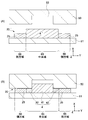
- the intermediate core portion of the absorbent core 20 ′ before the press working includes a high basis weight portion 4 ′ having a high basis weight arranged in the center region 65 in the width direction and both sides in the width direction. It has a low basis weight part 25 having a lower basis weight than the high basis weight part 4 ′ arranged in the area 66.
- the absorbent core 20 ' is covered with a core wrap sheet (not shown), and both rolls of a press device provided with a press roll 50 having a concave portion 53 on a part of the peripheral surface and a flat roll 51 having a smooth peripheral surface. Introduced in between. Thereby, as shown in FIG. 5B, both sides in the width direction Y of the high basis weight portion 4 'are strongly pressed and compressed, and the high basis weight low thickness portion 42 is formed. At the time of pressurization, the interval between the press roll 50 and the flat roll 51 is set so that the low-basis weight portions 25 arranged on both side regions 66 are not pressurized.
- the depth of the concave portion 53 is set so that a region corresponding to the concave portion 53 of the press roll 50 in the high basis weight portion 4 'is not pressed.
- the high basis weight portion 4 ′ by locally compressing the high basis weight portion 4 ′, the high basis weight portion 4 having the high basis weight / thickness portion 41 and the high basis weight / low thickness portion 42 is formed.
- the intermediate core portion 22 is provided with a peripheral groove portion 29, one vertical groove portion 27c, and four horizontal groove portions 28.
- the vertical groove portion located in the intermediate core portion 22 will be referred to as a vertical groove portion 27c to distinguish it from the vertical groove portion 27 provided in another core portion. 27.
- the peripheral groove 29 as the first groove is formed between the high basis weight portion 4 and the low basis weight portion 25 so as to surround at least the periphery of the high basis weight portion 4 in the front-rear direction X. Is done.
- the peripheral groove portion 29 is provided along the side edge of the high basis weight low thickness portion 42.
- the low basis weight portion 25 is provided along the side edge of the high basis weight portion 4 via the peripheral groove portion 29 therebetween.
- the peripheral groove portion 29 has a lower basis weight than the low basis weight portion 25.
- the peripheral groove portion 29 is provided in the front-rear direction X, and has a straight portion 291 extending along the front-rear direction X and a curved portion 292 which communicates with the straight portion 291 and curves.
- the curved portion 292 makes the front end portion 45 and the rear end portion 46 of the high basis weight portion 4 substantially semicircular.
- the shape is not limited to a semicircular shape, but is preferably a shape such as a triangular shape, a trapezoidal shape, or a combination shape of a circular arc and a straight line, which can disperse an external force acting in a plane.
- the peripheral groove portion 29 is a second groove portion extending along the width direction Y provided at a boundary portion P2 (P1) between the intermediate core portion 22 and the rear core portion 23 (the front core portion 21 and the intermediate core portion 22). In the boundary groove 61 (60).
- the rear end portion 46 of the high basis weight portion 4 extending in the front-rear direction X is adjacent to the boundary groove portion 61, and the front end portion 45 of the high basis weight portion 4 is adjacent to the boundary groove portion 60.
- the high-basis-weight low-thickness portion 42 does not exist at the front end and the rear end of the high-basis weight 4.
- the width of the low-basis-weight portion 25 is the middle of the low-basis-weight portion 25 in the longitudinal direction X It gradually increases from the part toward both ends.
- the vertical groove portion 27c is located at the center in the width direction Y of the intermediate core portion 22, at the center in the width direction Y of the high basis weight and high thickness portion 41, and at the center in the width direction Y of each of the front core portion 21 and the rear core portion 23. It is located on the same straight line as the located vertical groove 27 and communicates with each other.
- the four lateral groove portions 28 provided in the intermediate core portion 22 are arranged at equal intervals in parallel with each other so as to cross the intermediate core portion 22 along the width direction Y.
- the lateral groove 28 is disposed so as to be orthogonal to the linear portion 291 of the peripheral groove 29.
- the core wrap sheet 30 includes a core covering portion (31 to 33) covering each portion of the absorbent core 20, and a pair of narrow covering portions covering a pair of constricted regions 22s of the absorbent core 20. 34.
- the core covering portion includes a front core covering portion 31 covering the front core portion 21, an intermediate core covering portion 32 covering the intermediate core portion 22, and a rear core covering portion 33 covering the rear core portion 23.
- the boundaries between the core covering portions 31 to 33 and the constricted covering portion 34 are indicated by alternate long and short dash lines.
- the core wrap sheet 30 is made of a sheet material having sufficiently lower rigidity than the absorbent core 20, the core wrap sheet 30 covers the absorbent core 20 in a shape corresponding to the shape of the absorbent core 20.
- the intermediate core covering portion 32 is deformed into a shape corresponding to the shape of the protruding portion (the high basis weight portion 4) of the surface 20a of the intermediate core portion 22.
- the constricted covering portion 34 extends from the outer edge portion of the intermediate core portion 22 to the constricted region 22s by being bridged between the front core portion 21 and the rear core portion 23. For this reason, the constricted covering portion 34 is maintained in a shape corresponding to the constricted region 22s with a constant tension applied in the front-rear direction X.
- the absorbent member constituting the absorbent core 20 does not exist inside the constricted covering portion 34, but the fibers protruding outward from the peripheral edge of the absorbent core 20 and the absorbent core 20 are separated from the absorbent core 20. A part of the absorbing member may exist partially.
- the constricted covering part 34 is drawn in FIG. 3 so as to have the same thickness as the low-basis weight part 25 of the absorbent core in the thickness direction Z, the space in the thickness direction is within the absorbent article.
- the front surface region 341 and the back surface region 342 are in contact with each other.
- the area of the main body M including the constricted area 22s in the napkin 10 is larger than the area including the absorbent core 20 in the napkin 10. It has low rigidity and is soft. Therefore, at the time of wearing, the intermediate region M2 of the napkin 10 is a region that receives an external force directed inward in the width direction Y from both legs of the wearer located outside the width direction Y, but this region has low rigidity and is soft. Rubbing between the groin and the napkin 10 is reduced. Thereby, a comfortable use feeling can be given to the wearer.
- the high basis weight portion 4 is provided at the center in the width direction Y, and the low basis weight portions 25 are provided on both sides thereof.
- the high basis weight portion 4 has a high basis weight and high thickness portion 41 at the center in the width direction Y, and a higher thickness than the high basis weight and high thickness portion 41 between the high basis weight thickness portion 41 and the low basis weight portion 25. It has a thin pair of high basis weight and low thickness portions 42.
- the high basis weight and low thickness portion 42 makes it difficult for the force from the thigh applied to the low basis weight portion 25 to propagate to the high basis weight and high thickness portion 41.
- the high basis weight part high thickness part 41 becomes difficult to carry out unnecessary deformation, it becomes easy for the high basis weight high thickness part 41 to adhere to the excretion part of the wearer, and the fit is improved. Further, the deformation in the area facing the excretion part and the intermediate core part 22 around the area may cause high rigidity locally, which may cause a strong rubbing feeling with the wearer's skin. The deformation of the low basis weight portion 25 and the high basis weight and low thickness portion 42 is also suppressed by the presence of, so that the rubbing feeling is reduced. Further, the configuration of the present invention has a favorable effect on the absorption performance.
- the presence of the high-basis-weight low-thickness portion 42 makes it difficult for the high-basis-weight portion high-thickness portion 41 to be deformed unnecessarily. Since the bodily fluid discharged from the excretory part is easily drawn into the absorbent core 20, the high-basis weight part 4 can easily hold a large amount of bodily fluid, and lateral leakage of bodily fluid in the constricted part can be suppressed.
- the high-basis-weight low-thickness portion 42 has a denser absorption member and is superior in the liquid-drawing force as compared with the high-basis-weight high-thickness portion 41.
- the absorbent core 20 has an action of withdrawing the liquid from the skin side, and the force for extracting the liquid is generated by the capillary force of the absorbent core 20, and the capillary force is the density of the absorbent member constituting the absorbent core. It becomes stronger in proportion to. That is, by providing the high-density, high-basis-weight, low-thickness portion 42, the capillary force acts, the liquid is easily pulled out from the skin side, and the drawn-out liquid is suppressed from reaching the side edge of the absorbent core. You.
- the deformation of the high-basis-weight low-thickness portion 42 is also suppressed by the function of the above-described constricted region 22s, so that the bodily fluid held in the high-basis-weight low-thickness portion 42 during wearing is moved to the low-basis weight portion 25 side. Extrusion can also be suppressed.
- the compressed high-density high-basis low-thickness portion 42 is provided to extend in the front-rear direction X over the entire length of the narrow intermediate core portion 22, the high-basis weight low-thickness portion is provided. The liquid diffusion direction is guided so that the liquid absorbed in 42 is diffused in the front-back direction X, and the lateral leakage is further suppressed.
- the width of the intermediate core portion 22 serving as the excretion portion facing portion is narrow, the provision of the high-density, high-basis-weight, low-thickness portion 42 suppresses lateral leakage.
- the absorber 11 at the time of wearing, when the absorber 11 receives an external force directed toward the inside in the width direction Y from both legs of the wearer outside the width direction Y, the absorber 11 typically corresponds to the constricted area 22s as shown in FIG.
- the tightly squeezed covering portion 34 where the absorbent core 20 does not exist is deformed first, and then the low basis weight portion 25 is deformed.
- the deformation of the intermediate core portion 22 is suppressed, and the occurrence of liquid leakage due to the deformation is suppressed.
- the deformation of the intermediate core portion 22 is suppressed, the deformation of the rear core portion due to the propagation of the deformation of the intermediate core portion to the rear core portion is also suppressed. Is suppressed.
- the high-basis-weight high-thickness portion 41 is formed so as to protrude toward the skin direction over the entire length of the intermediate core portion 22. Thereby, when the napkin 1 is mounted, a good fit between the high basis weight and high thickness portion 41 and the excretory portion can be ensured.
- the absorbent article of the present embodiment can reduce the friction between the groin and the napkin, give the wearer a comfortable feeling of use with reduced stiffness, and furthermore, It has a high fit and excellent liquid absorption performance that prevents side leakage.
- the width b in the width direction Y of the high basis weight and low thickness portion 42 is preferably smaller than the width f of the side portion. Further, it is preferable that the dimension b in the width direction Y of the high basis weight low thickness portion 42 is smaller than the width c of the low basis weight portion 25.
- These relationships may be satisfied by a half of the total length of the intermediate core portion 22 in the front-rear direction X, but are preferably satisfied by a portion in the front-rear direction X where the side region 66 exists. Further, it is preferable that the space is filled over the entire length of the intermediate core portion 22 in the front-rear direction X.
- the ratio of the high-basis-weight low-thickness portion 42 having the highest rigidity in the intermediate core portion 22 in the width direction Y of the intermediate core portion 22 can be relatively reduced, and the skin of the wearer and the napkin 1 can be reduced. Rubbing can be reduced. Further, by making the width b smaller than at least one of the width c and the width f, the length from the side edge in the width direction Y of the intermediate core portion 22 to the high rigidity high basis weight low thickness portion 42 is increased. Can be taken. That is, the width of the side portion 44 having low rigidity, preferably the width of the side region 66, can be increased, so that friction between the groin portion and the napkin 1 during mounting is reduced.
- a low-basis-weight peripheral groove portion 29 is provided between the high-basis-weight low-thickness portion 42 and the low-basis weight portion 25, so that the intermediate core portion is provided. 22 flexibility.
- the absorbent core 20 changes flexibly, and rubbing at the groin is alleviated.
- the peripheral groove portion 29 having a lower basis weight and being easily deformed than the low basis weight portion 25
- deformation around the high basis weight portion 4 is absorbed by the peripheral groove portion 29. Becomes difficult to be transmitted to the high basis weight portion 4.
- the external force received from the left and right legs is alleviated by the peripheral groove portion 29, and the external force transmitted to the high basis weight portion 4 is further reduced. Therefore, deformation of the high basis weight portion 4 is suppressed, and liquid leakage is suppressed.
- the boundary grooves 60 and 61 are provided, at the time of mounting, the boundary grooves 60 and 61 become bending points, so that the napkin 1 is easily bent in the front-rear direction X and easily deformed along the wearer's body. Also, in the curved portion 292 of the peripheral edge groove portion 29 arranged in the front-rear direction X, the napkin 1 becomes a bending point at the time of mounting, so that the napkin 1 is easily bent and easily deformed along the wearer's body. Thereby, the fitting property is improved, the rubbing is reduced, the gap between the skin and the napkin 1 is reduced, and the liquid leakage is suppressed.
- peripheral groove portion 29 and the boundary groove portion 61 (60) communicate with each other, the external force acting on the intermediate core portion 22 passes through the peripheral groove portion 29 and is further reduced at the boundary groove portion 61 (60).
- the deformation in the portion 22 is difficult to propagate to the rear core portion 23 (front core portion 21).
- the deformations generated in the front core portion 21 and the rear core portion 23 are alleviated by the boundary grooves 60 and 61 and are difficult to propagate to the intermediate core portion 22, so that the deformation in the high basis weight portion 4 is effectively suppressed. be able to.
- the provision of the lateral groove portion 28 and the peripheral groove portion 29 in the intermediate core portion 22 divides the low-basis weight portion 25 into a plurality of blocks, and provides a certain effect of confining the deformation region in block units. Thereby, propagation of the external force to the high basis weight portion 4 is suppressed, and the effect of preventing deformation of the high basis weight portion 4 can be further enhanced.
- the low-basis-weight portion 25 of the intermediate core portion 22 does not include the vertical groove portion 27 whose basis weight is lower than that of the block portion.
- the low-basis-weight portion 25 of the intermediate core portion 22 does not include the vertical groove 27 that divides the low-basis-weight portion 25 in the width direction Y.
- a longitudinal groove 27 of the front core portion and a longitudinal groove 27 of the rear core portion exist in front of and behind the low basis weight portion 25, respectively.
- the width of the high basis weight portion 4 when the width of the high basis weight portion 4 is gradually narrowed before and after, the force applied to the low basis weight portion 25 from the thigh by the front and rear of the intermediate core portion 22. It becomes easy to escape to the department. Therefore, even if an abnormally strong force is applied to the intermediate core portion 22, the deformation of the intermediate core portion 22 is easily suppressed.
- the high basis weight portion 4 when the high basis weight and low thickness portion 42 does not exist at the front end and the rear end thereof and only the high basis weight and high thickness portion 41 exists, the width of the low basis weight portion 25 is obtained. Gradually increases from the middle portion in the front-rear direction X of the low basis weight portion 25 toward both ends, so that the effect can be more easily obtained.
- the widths D1 and D3 of the front core portion 21 and the rear core portion 23 are preferably 60 mm or more, more preferably 70 mm or more, and preferably 100 mm or less, and more preferably 90 mm or less. It is as follows.
- the thickness of the front core portion 21 and the rear core portion 23 is preferably 1.5 mm or more, more preferably 2 mm or more, and preferably 6 mm or less, and more preferably 5.5 mm or less.
- the basis weight of the front core portion 21 and the rear core portion 23 is preferably 90 g / m 2 or more, more preferably 100 g / m 2 or more, and preferably 350 g / m 2 or less, and further preferably It is 300 g / m 2 or less.
- the width D2 of the intermediate core portion 22 is typically formed larger than the crotch width of a general wearer (about 30 mm), preferably 35 mm or more, more preferably 40 mm or more, and preferably It is 75 mm or less, more preferably 70 mm or less.
- the length of the intermediate core portion 22 in the front-rear direction X is, for example, preferably 60 mm or more, more preferably 80 mm or more, and preferably 180 mm or less, more preferably 170 mm or less. Accordingly, even when the mounting position is shifted in the front-rear direction X, the intermediate core portion 22 can be opposed to the excretory portion of the wearer.
- the width of the high grammage part 4 is the width at the position where the virtual line is drawn in the width direction Y in the portion where the width of the high basis weight portion 4 is the largest.
- the width of the high basis weight portion 4 arranged in the center region in the width direction of the intermediate core portion 22 is preferably 15 mm or more, more preferably 20 mm or more, and preferably 60 mm or less, more preferably 50 mm or less. It is as follows.
- the high basis weight part 4 has a high basis weight low thickness part 42 whose thickness is locally reduced by compressing both side parts. By reducing the thickness in this way, the feeling of stiffness during mounting is reduced.
- the width a of the high basis weight and high thickness portion 41 is preferably 10 mm or more, more preferably 15 mm or more, and preferably 40 mm or less, and more preferably 30 mm or less. .
- the width b of the high basis weight and low thickness portion 42 is preferably 2 mm or more, more preferably 3 mm or more, and , Preferably 10 mm or less, and more preferably 7.5 mm or less. Further, it is preferable that the width f of the side portion 44 be wider than the width b of the high-basis-weight low-thickness portion 42, since the rubbing of the napkin 10 at the groin portion is further suppressed.
- the width f of the side portion 44 is preferably 10 mm or more, and more preferably 12 mm or more. And it is preferably 30 mm or less, more preferably 25 mm or less.
- the width c of the low basis weight portion 25 is preferably 5 mm or more, and more preferably 7.5 mm or more.
- the width c of the low basis weight portion 25 is preferably 30 mm or less, and more preferably 20 mm or less.
- the width f of the side portion 44 is preferably at least twice, more preferably at least 2.5 times, and preferably at most 5 times the width b of the high basis weight and low thickness portion 42, More preferably, it is four times or less. Further, it is preferable that the dimension b in the width direction Y of the high basis weight and low thickness part 42 is smaller than the dimension d in the width direction Y of the narrow covering part 34.
- the width d of the constricted covering portion 34 is preferably 5 mm or more, more preferably 10 mm or more, and preferably 30 mm or less, and more preferably 20 mm or less.
- the basis weight of the high basis weight portion 4 is preferably 250 g / m 2 or more, more preferably 300 g / m 2 or more, and preferably 700 g / m 2 from the viewpoint of ensuring a sufficient liquid absorption capacity. Or less, more preferably 650 g / m 2 or less.
- the basis weight of the low basis weight portion 25 is preferably 90 g / m 2 or more, more preferably 100 g / m 2 or more, and more preferably 100 g / m 2 or more, from the viewpoint of reducing the rigidity while making the liquid absorbency appropriate. Is 350 g / m 2 or less, more preferably 300 g / m 2 or less.
- the thickness of the high basis weight high thickness portion 41 is preferably 2 mm or more, more preferably 2.5 mm or more, and preferably 9 mm or less, and more preferably 8 mm or less.
- the thickness of the high basis weight low thickness portion 42 and the low basis weight portion 25 is preferably 1.5 mm or more, more preferably 2 mm or more, and preferably 6 mm or less, from the viewpoint of reducing stiffness. More preferably, it is 5.5 mm or less.
- the difference between the thickness of the high-basis-weight high-thickness part 41 and the thickness of the high-basis-weight low-thickness part 42 is preferably 0.5 mm or more, and more preferably 0.5 mm or more, from the viewpoint of the fit to the excretion part of the high-basis weight high-thickness part 41 It is preferably at least 1 mm, and is preferably at most 5 mm, more preferably at most 4 mm.
- the density of the high basis weight and high thickness portion 41 is preferably 0.073 g / cm 3 or more, more preferably 0.091 g / cm 3 or more, and preferably 0.182 g / cm 3 or less, More preferably, it is 0.164 g / cm 3 or less.
- the density of the high basis weight low thickness portion 42 is preferably 0.114 g / cm 3 or more, more preferably 0.143 g / cm 3 or more, and preferably 0.286 g / cm 3 or less; More preferably, it is 0.257 g / cm 3 or less.
- the density of the high basis weight low thickness portion 42 is preferably 1.6 times or more, more preferably 1.4 times or more, and preferably 2.4 times or less of the high basis weight and high thickness portion 41. And more preferably 2.2 times or less.
- the width of the peripheral groove 29, the vertical groove 27, and the horizontal groove 28 is preferably 0.5 mm or more, more preferably 1 mm or more, and is preferably 10 mm or less, more preferably 5 mm or less.
- the width of the boundary grooves 61 (60) arranged so as to extend is preferably 1.5 mm or more, more preferably 2 mm or more, and is preferably 3.5 mm or less, more preferably 3 mm or less.
- the basis weight of the peripheral groove portion 29, the vertical groove portion 27, and the horizontal groove portion 28 is lower than the basis weight of the block portion, preferably 50 g / m 2 or more, and more preferably 250 g / m 2 or less.
- the numerical values in each of the above configurations can be measured by the following measurement methods.
- Method of measuring the width of each part of the absorbent core The width of the absorbent core, the high basis weight, the high thickness part, the high basis weight, the low thickness part, the low basis weight part, and the width of the lateral outside are determined by placing the absorbent core horizontally and using a microscope (VHX-1000 manufactured by KEYENCE) The width is measured by adjusting the measurement magnification according to (2) and enlarging the skin facing surface 20a.
- Each part of the absorbent core 20 to be measured is cut using a single-edged razor manufactured by Feather Co., Ltd. to obtain small pieces having a predetermined area.
- the weight of these small pieces is measured using an electronic balance (an electronic balance GR-300 manufactured by A & D, precision: 4 digits after the decimal point).
- the calculated weight is divided by the area of the small piece of each part to calculate the basis weight of the small piece. For each part, the average of the basis weights of the five small pieces is defined as the basis weight.
- the density is calculated by dividing the grammage obtained in the same manner as the above-described grammage measuring method by the thickness of the small piece to be measured.
- the thickness of the small piece to be measured is measured by measuring the thickness of the small piece cut out for measuring the basis weight described above.
- a circular aluminum plate having a diameter of 25 mm, a thickness of 3 mm and a mass of 2.45 g is placed horizontally and gently on the measurement surface of a small piece cut out of the absorbent core, and a non-contact type laser displacement meter (laser head manufactured by KEYENCE) is used.
- the cross section of the cut sample is measured for 20 to 100 times using, for example, a microscope (VHX-1000 manufactured by KEYENCE). Observation may be performed at a magnification of ⁇ 2 and the measurement may be performed.
- the high basis weight portion 4 protrudes upward in the thickness direction Z, but instead protrudes downward in the thickness direction Z as in the absorber 24 shown in FIG. It may be in a form.
- various grooves such as the vertical groove 27, the horizontal groove 28, the peripheral groove 29, and the boundary grooves 60 and 61 provided in the absorbent core 20 have openings on the upper side in the thickness direction Z.
- a material having an opening below the thickness direction Z such as the absorber 24 shown in FIG. 6, may be used.
- the absorbent article may be, for example, an incontinence pad, a vaginal sheet, or the like.
- An absorbent article comprising an absorbent core having a front core portion and a rear core portion located at both ends in the front-rear direction, and an intermediate core portion located between the front core portion and the rear core portion.
- the intermediate core portion has a shorter length in the width direction orthogonal to the front-rear direction than the front core portion and the rear core portion, and the intermediate core portion is located in a central region in the width direction, and the front core portion And a high basis weight portion having a basis weight higher than that of the rear core portion, and a low basis weight portion having a basis weight lower than the high basis weight portion, which is located on both side regions in the width direction.
- the mass portion has a high basis weight and high thickness portion located at the center in the width direction, and a high basis weight and low thickness that is thinner than the high basis weight and high thickness portions located on both sides in the width direction of the high basis weight and high thickness portion.
- a pad-type absorbent article a pad-type absorbent article.
- the intermediate core portion has a first groove portion having a lower basis weight than the low basis weight portion between the high basis weight and low thickness portion and the low basis weight portion in the front-rear direction.
- the intermediate core portion has a first groove portion having a lower basis weight than the low basis weight portion in the front-rear direction between the high basis weight low thickness portion and the low basis weight portion,
- the front core portion, the intermediate core portion and the rear core portion may have a vertical groove extending in the front-rear direction and a horizontal groove extending in the width direction.
- the pad-type absorbent article according to the above. (10)
- the basis weight of the high basis weight and low thickness part and the basis weight of the high basis weight and high thickness part are a value obtained by dividing the difference between the higher basis weight and the lower basis weight by the higher basis weight. %, And more preferably within 10%.
- the intermediate core portion is formed between a pair of constricted regions located in the front-rear direction intermediate portion of the absorbent core,
- the absorbent core is covered with a core wrap sheet, and the core wrap sheet is bridged between the front core portion and the rear core portion outside in a width direction from a side edge of the intermediate core portion.
- (13) The pad-type absorbent article according to (11), wherein the absorbent member constituting the absorbent core does not exist inside the narrow covering portion.
- the intermediate core portion is divided into a plurality of blocks by a lateral groove portion, In the low basis weight portion of the intermediate core portion, there is no vertical groove portion having a basis weight lower than the block portion of the low basis weight portion that divides the low basis weight portion in the width direction,
- the high basis weight low thickness portion does not exist, and in the front-rear direction region of the intermediate core portion, the width of the low basis weight portion is the width of the low basis weight portion.
- the density of the high basis weight and high thickness portion is 0.073 g / cm 3 or more, more preferably 0.091 g / cm 3 or more, and preferably 0.182 g / cm 3 or less, more preferably The pad-type absorbent article according to any one of (1) to (17), wherein is 0.164 g / cm 3 .
- the density of the high basis weight low thickness portion 42 is preferably 0.114 g / cm 3 or more, more preferably 0.143 g / cm 3 or more, and preferably 0.286 g / cm 3 or less.
- the width of the front core portion and the rear core portion is preferably 60 mm or more, more preferably 70 mm or more, and preferably 100 mm or less, and more preferably 90 mm or less.
- the thickness of the front core portion and the rear core portion is preferably 2 mm or more, more preferably 2.5 mm or more, and preferably 7 mm or less, and more preferably 6 mm or less.
- the basis weight of the front core portion and the rear core portion is preferably 90 g / m 2 or more, more preferably 100 g / m 2 or more, and preferably 300 g / m 2 or less, more preferably
- Any of the above (1) to (23), wherein the width of the intermediate core portion is preferably 35 mm or more, more preferably 40 mm or more, and preferably 75 mm or less, more preferably 70 mm or less.
- the pad-type absorbent article according to any one of the above.
- the length of the intermediate core portion in the front-rear direction is preferably 60 mm or more, more preferably 80 mm or more, and preferably 180 mm or less, more preferably 170 mm or less.
- the width of the high basis weight and low thickness portion is preferably 2 mm or more, more preferably 3 mm or more, and preferably 10 mm or less, and more preferably 7.5 mm or less.
- the intermediate core portion is located on both sides in the width direction of the high basis weight portion, has a pair of side portions including the low basis weight portion,
- the width of the side portion is preferably twice or more, more preferably 2.5 times or more, and preferably 5 times or less, more preferably 5 times or less the width of the high basis weight and low thickness portion.
- Example 1 A sanitary napkin having the same basic configuration as the napkin 10 shown in FIGS. 1 to 4 was produced.
- An air-through nonwoven fabric having a basis weight of 74 g / m 2 is used as the top sheet 12
- a moisture-impermeable polyethylene film sheet having a basis weight of 25 g / m 2 is used as the back sheet
- a water-repellent span having a basis weight of 20 g / m 2 is used as the side sheet.
- a bonded nonwoven fabric was used.
- the absorbent core has a width of the intermediate core portion 22 of 65 mm and a dimension in the front-rear direction X of 90 mm, a front core portion 21 of a width of 72 mm and a dimension of the front-rear direction X of 23 mm, and a rear core portion 23 of a width 72 mm in the front-rear direction X. Is 82 mm, and the constricted shape shown in FIG. 4 was used. As in the embodiment shown in FIG. 4, the absorbent core was provided with a plurality of horizontal grooves, vertical grooves, peripheral grooves, and boundary grooves. The basis weight of these grooves was 75 g / m 2 , and the thickness of the bottom forming the grooves was 2 mm.
- the width a of the high basis weight high thickness portion 41 was 20 mm, and the width b of the high basis weight low thickness portion 42 was 5 mm.
- the width c of the low basis weight portion 25 was 16 mm.
- the groove width of the peripheral groove portion 29 and the vertical groove portion 27c provided in the intermediate core portion 22 was 1.5 mm.
- five vertical grooves 27 are provided, of which three vertical grooves 27 located at the center have a width of 4 mm, and two vertical grooves 27 are disposed on both sides of the three vertical grooves 27, respectively.
- the width of one vertical groove was 1.5 mm.
- the dimensions in the width direction of the respective block portions provided on the front core portion 21 and the rear core portion 23 were equal in width.
- the width of the lateral groove 28 (the dimension in the front-rear direction X) was 2 mm.
- the groove width of the boundary groove portions 60 and 61 was 2.5 mm.
- the basis weight of the front core portion 21 and the rear core portion 23 was 200 g / m 2 , and the thickness was 3.5 mm.
- the basis weight of the low basis weight part 25 was 200 g / m 2
- the thickness was 3.5 mm
- the basis weight of the high basis weight part 4 was 440 g / m 2 .
- the thickness of the high basis weight high thickness portion 41 was 5.5 mm, and the thickness of the high basis weight low thickness portion 42 was 3.5 mm.
- the density of the high basis weight and high thickness part 41 was 0.080 g / m 3 , and the density of the high basis weight and low thickness part 42 was 0.126 g / m 3 .
- the absorbent core of the above embodiment is covered with a core wrap sheet to form an absorbent body, the absorbent body is sandwiched between a top sheet and a back sheet, and a side sheet is further provided. did.
- the adhesive was bonded between the absorber and the top sheet, between the absorber and the back sheet, between the side sheet and the top sheet, and between the top sheet and the back sheet.
- Example 2 Compared to Example 1, the basis weight of the high basis weight portion 4 of the intermediate core portion 22, the thickness and density of the high basis weight high thickness portion 41, the thickness and density of the high basis weight low thickness portion 42, and the front and rear A confined napkin having the same configuration as in Example 1 except for the width of the core portion was manufactured.
- the basis weight of the high basis weight portion 4 was 550 g / m 2 .
- the high basis weight high thickness part 41 had a thickness of 7.0 mm and a density of 0.079 g / m 3
- the high basis weight low thickness part 42 had a thickness of 3.5 mm and a density of 0.157 g / m 3 .
- the width of the intermediate core portion 22 is 65 mm and the dimension in the front-rear direction X is 130 mm, the width of the front core portion 21 is 80 mm, the dimension in the front-rear direction X is 36 mm, and the width of the rear core portion 23 is 80 mm.
- FIG. 7 corresponds to the absorbent core described in Patent Document 2 described above.
- the basic structure of the absorbent core of FIG. 7 and the absorbent core described in Patent Literature 2 are different from each other in the number of block portions. This is common in that the high basis weight portion is located in the intermediate core portion.
- the shape of the high basis weight portion 4 of the absorbent core 70 in the form shown in FIG. 7 is an oval shape in which the shape of the front end portion and the rear end portion of the high basis weight portion 4 in the above-described embodiment is a substantially semicircular shape.
- a napkin of a comparative example was produced in the same manner as in the napkin of Example 1, except that a sanitary napkin was produced using the absorbent core.
- the absorbent core 70 was provided with a plurality of horizontal grooves 28, vertical grooves 27, peripheral grooves 29, and boundary grooves 60 and 61. The basis weight and thickness of these grooves are the same as in Examples 1 and 2.
- the vertical groove 27 and the peripheral groove 29 each have a groove width of 1.5 mm.
- the groove width of the boundary grooves 60 and 61 was 2 mm, which is the same as the width of the lateral groove 28.
- the three vertical grooves 27 formed in the intermediate core section 22 are located on the same straight line as the five vertical grooves 27 located in the front core section 21 and the rear core section 23, respectively.
- the dimensions in the width direction of each of the block portions 71 provided on the intermediate core portion 21 and the rear core portion 23 were equal in width.
- the basis weight and thickness of the high basis weight part 4 and the low basis weight part 25, and the thickness, density and width of the high basis weight and high thickness part 41 and the high basis weight and low thickness part 42 were the same as those in Example 1.
- the simulated blood was adjusted to have a viscosity of 8 mPa ⁇ s measured using a B-type viscometer (manufactured by Toki Sangyo Co., Ltd., model number TVB-10M, measurement condition: rotor No. 19, 30 rpm, 25 ° C., 60 seconds).
- the ratio of blood cells / plasma of defibrinated horse blood was used.
- the sanitary napkin to be evaluated was fixed on sanitary shorts and attached to a dynamic model of a human body.
- a dynamic model of a human body a movable female lumbar model capable of walking motion of both legs was used.
- a three-axis tactile sensor (Touchence Corp., Shokkakuchip TS type) was installed at the groin of the dynamic model, and rubbing with the napkin at the groin was measured for one minute after starting the walking motion. One minute later, the walking motion was terminated, and the maximum shear force during walking was defined as the rubbing amount. The smaller the maximum shear force, the smaller the rubbing with the napkin in the groin.
- rubbing between the napkin and the skin can be reduced.
Landscapes
- Health & Medical Sciences (AREA)
- Epidemiology (AREA)
- Engineering & Computer Science (AREA)
- Biomedical Technology (AREA)
- Heart & Thoracic Surgery (AREA)
- Vascular Medicine (AREA)
- Life Sciences & Earth Sciences (AREA)
- Animal Behavior & Ethology (AREA)
- General Health & Medical Sciences (AREA)
- Public Health (AREA)
- Veterinary Medicine (AREA)
- Absorbent Articles And Supports Therefor (AREA)
Priority Applications (1)
| Application Number | Priority Date | Filing Date | Title |
|---|---|---|---|
| CN201980033770.7A CN112153953B (zh) | 2018-09-04 | 2019-09-02 | 垫片型吸收性物品 |
Applications Claiming Priority (2)
| Application Number | Priority Date | Filing Date | Title |
|---|---|---|---|
| JP2018165215A JP7125310B2 (ja) | 2018-09-04 | 2018-09-04 | パッド型吸収性物品 |
| JP2018-165215 | 2018-09-04 |
Publications (1)
| Publication Number | Publication Date |
|---|---|
| WO2020050219A1 true WO2020050219A1 (ja) | 2020-03-12 |
Family
ID=69721835
Family Applications (1)
| Application Number | Title | Priority Date | Filing Date |
|---|---|---|---|
| PCT/JP2019/034440 Ceased WO2020050219A1 (ja) | 2018-09-04 | 2019-09-02 | パッド型吸収性物品 |
Country Status (4)
| Country | Link |
|---|---|
| JP (1) | JP7125310B2 (cg-RX-API-DMAC7.html) |
| CN (1) | CN112153953B (cg-RX-API-DMAC7.html) |
| TW (1) | TWI819085B (cg-RX-API-DMAC7.html) |
| WO (1) | WO2020050219A1 (cg-RX-API-DMAC7.html) |
Families Citing this family (1)
| Publication number | Priority date | Publication date | Assignee | Title |
|---|---|---|---|---|
| JP2022175144A (ja) * | 2021-05-13 | 2022-11-25 | 花王株式会社 | 吸収性物品 |
Citations (5)
| Publication number | Priority date | Publication date | Assignee | Title |
|---|---|---|---|---|
| JP2013013683A (ja) * | 2011-07-06 | 2013-01-24 | Kao Corp | パンツ型吸収性物品 |
| JP2015112235A (ja) * | 2013-12-11 | 2015-06-22 | 花王株式会社 | 吸収性物品 |
| JP2015223254A (ja) * | 2014-05-27 | 2015-12-14 | ユニ・チャーム株式会社 | 3000グラム以下の低体重児用展開型使い捨ておむつ |
| JP2016086872A (ja) * | 2014-10-30 | 2016-05-23 | 花王株式会社 | 吸収性物品 |
| JP2016198416A (ja) * | 2015-04-14 | 2016-12-01 | 花王株式会社 | 吸収性物品 |
Family Cites Families (19)
| Publication number | Priority date | Publication date | Assignee | Title |
|---|---|---|---|---|
| US5429630A (en) * | 1992-05-29 | 1995-07-04 | Kimberly-Clark Corporation | Absorbent article and a method of removing said article from an undergarment |
| US8546642B2 (en) * | 2010-01-28 | 2013-10-01 | Sca Hygiene Products Ab | Absorbent article with slitted absorbent core |
| JP5921094B2 (ja) * | 2011-06-17 | 2016-05-24 | 花王株式会社 | 吸収性物品 |
| JP5291214B1 (ja) * | 2012-03-30 | 2013-09-18 | ユニ・チャーム株式会社 | 使い捨ておむつ |
| JP5593350B2 (ja) * | 2012-06-11 | 2014-09-24 | 花王株式会社 | 吸収性物品 |
| JP5670959B2 (ja) * | 2012-06-11 | 2015-02-18 | 花王株式会社 | 吸収性物品 |
| JP5997944B2 (ja) * | 2012-06-11 | 2016-09-28 | 花王株式会社 | 吸収性物品 |
| JP5670960B2 (ja) * | 2012-06-11 | 2015-02-18 | 花王株式会社 | 吸収性物品 |
| JP6012269B2 (ja) * | 2012-06-11 | 2016-10-25 | 花王株式会社 | 吸収性物品 |
| JP5604500B2 (ja) * | 2012-11-27 | 2014-10-08 | 花王株式会社 | 吸収性物品 |
| US9820896B2 (en) * | 2013-06-27 | 2017-11-21 | The Procter & Gamble Company | Wearable absorbent article with robust feeling waistband structure |
| JP6080262B2 (ja) * | 2013-11-20 | 2017-02-15 | 花王株式会社 | 吸収性物品 |
| BR112017021259B1 (pt) * | 2015-04-29 | 2022-06-28 | Kimberly-Clark Worldwide, Inc | Peça de vestuário absorvente com encaixe justo |
| CN204971911U (zh) * | 2015-07-24 | 2016-01-20 | 晋江市益源卫生用品有限公司 | 一种吸收性卫生制品用哑铃型复合吸水纸 |
| JP6411309B2 (ja) * | 2015-11-09 | 2018-10-24 | ユニ・チャーム株式会社 | 吸収性物品 |
| JP6632343B2 (ja) | 2015-11-12 | 2020-01-22 | 花王株式会社 | 吸収性物品 |
| JP6420779B2 (ja) * | 2016-02-01 | 2018-11-07 | ユニ・チャーム株式会社 | 吸収性物品 |
| SG11201804895WA (en) * | 2016-05-20 | 2018-07-30 | Kao Corp | Absorbent article |
| JP6355808B2 (ja) * | 2016-11-08 | 2018-07-11 | 花王株式会社 | 吸収性物品 |
-
2018
- 2018-09-04 JP JP2018165215A patent/JP7125310B2/ja active Active
-
2019
- 2019-09-02 CN CN201980033770.7A patent/CN112153953B/zh active Active
- 2019-09-02 WO PCT/JP2019/034440 patent/WO2020050219A1/ja not_active Ceased
- 2019-09-04 TW TW108131853A patent/TWI819085B/zh active
Patent Citations (5)
| Publication number | Priority date | Publication date | Assignee | Title |
|---|---|---|---|---|
| JP2013013683A (ja) * | 2011-07-06 | 2013-01-24 | Kao Corp | パンツ型吸収性物品 |
| JP2015112235A (ja) * | 2013-12-11 | 2015-06-22 | 花王株式会社 | 吸収性物品 |
| JP2015223254A (ja) * | 2014-05-27 | 2015-12-14 | ユニ・チャーム株式会社 | 3000グラム以下の低体重児用展開型使い捨ておむつ |
| JP2016086872A (ja) * | 2014-10-30 | 2016-05-23 | 花王株式会社 | 吸収性物品 |
| JP2016198416A (ja) * | 2015-04-14 | 2016-12-01 | 花王株式会社 | 吸収性物品 |
Also Published As
| Publication number | Publication date |
|---|---|
| TWI819085B (zh) | 2023-10-21 |
| JP2020036743A (ja) | 2020-03-12 |
| CN112153953B (zh) | 2022-03-15 |
| CN112153953A (zh) | 2020-12-29 |
| TW202023507A (zh) | 2020-07-01 |
| JP7125310B2 (ja) | 2022-08-24 |
Similar Documents
| Publication | Publication Date | Title |
|---|---|---|
| CN105764458B (zh) | 吸收性物品 | |
| JP6181027B2 (ja) | 吸収性物品 | |
| JP2015097716A (ja) | 吸収性物品 | |
| JP7194497B2 (ja) | 吸収性物品 | |
| JP7125310B2 (ja) | パッド型吸収性物品 | |
| JP6578342B2 (ja) | 生理用ナプキン | |
| WO2020050220A1 (ja) | 吸収性物品 | |
| WO2019116956A1 (ja) | 吸収性物品 | |
| JP2022175144A (ja) | 吸収性物品 | |
| JP3240070U (ja) | 吸収性物品 | |
| JP3250181U (ja) | 吸収性物品 | |
| JP7118749B2 (ja) | 吸収性物品 | |
| JP7732878B2 (ja) | 吸収性物品 | |
| WO2019116953A1 (ja) | 吸収性物品 | |
| JP3236255U (ja) | 吸収性物品 | |
| JP2021074071A (ja) | 吸収性物品 | |
| JP3244399U (ja) | 吸収性物品 | |
| JP2020075085A (ja) | 吸収性物品 | |
| JP7189706B2 (ja) | 生理用ナプキン | |
| JP2023095693A (ja) | 吸収性物品 | |
| JP2022090352A (ja) | 吸収性物品 | |
| JP2022181290A (ja) | 吸収性物品 | |
| JP2020188980A (ja) | 吸収性物品 | |
| JP2019209120A (ja) | 吸収性物品 | |
| WO2019235427A1 (ja) | 吸収性物品 |
Legal Events
| Date | Code | Title | Description |
|---|---|---|---|
| 121 | Ep: the epo has been informed by wipo that ep was designated in this application |
Ref document number: 19857692 Country of ref document: EP Kind code of ref document: A1 |
|
| NENP | Non-entry into the national phase |
Ref country code: DE |
|
| 122 | Ep: pct application non-entry in european phase |
Ref document number: 19857692 Country of ref document: EP Kind code of ref document: A1 |