WO2020012843A1 - ポリエステル系繊維、それを用いたパイル布帛、及びそれらの製造方法 - Google Patents
ポリエステル系繊維、それを用いたパイル布帛、及びそれらの製造方法 Download PDFInfo
- Publication number
- WO2020012843A1 WO2020012843A1 PCT/JP2019/022725 JP2019022725W WO2020012843A1 WO 2020012843 A1 WO2020012843 A1 WO 2020012843A1 JP 2019022725 W JP2019022725 W JP 2019022725W WO 2020012843 A1 WO2020012843 A1 WO 2020012843A1
- Authority
- WO
- WIPO (PCT)
- Prior art keywords
- fiber
- polyester
- less
- heat treatment
- temperature
- Prior art date
- Legal status (The legal status is an assumption and is not a legal conclusion. Google has not performed a legal analysis and makes no representation as to the accuracy of the status listed.)
- Ceased
Links
Images


Classifications
-
- D—TEXTILES; PAPER
- D04—BRAIDING; LACE-MAKING; KNITTING; TRIMMINGS; NON-WOVEN FABRICS
- D04B—KNITTING
- D04B1/00—Weft knitting processes for the production of fabrics or articles not dependent on the use of particular machines; Fabrics or articles defined by such processes
- D04B1/02—Pile fabrics or articles having similar surface features
- D04B1/025—Pile fabrics or articles having similar surface features incorporating loose fibres, e.g. high-pile fabrics or artificial fur
-
- D—TEXTILES; PAPER
- D02—YARNS; MECHANICAL FINISHING OF YARNS OR ROPES; WARPING OR BEAMING
- D02G—CRIMPING OR CURLING FIBRES, FILAMENTS, THREADS, OR YARNS; YARNS OR THREADS
- D02G1/00—Producing crimped or curled fibres, filaments, yarns, or threads, giving them latent characteristics
-
- D—TEXTILES; PAPER
- D02—YARNS; MECHANICAL FINISHING OF YARNS OR ROPES; WARPING OR BEAMING
- D02G—CRIMPING OR CURLING FIBRES, FILAMENTS, THREADS, OR YARNS; YARNS OR THREADS
- D02G1/00—Producing crimped or curled fibres, filaments, yarns, or threads, giving them latent characteristics
- D02G1/12—Producing crimped or curled fibres, filaments, yarns, or threads, giving them latent characteristics using stuffer boxes
-
- D—TEXTILES; PAPER
- D02—YARNS; MECHANICAL FINISHING OF YARNS OR ROPES; WARPING OR BEAMING
- D02J—FINISHING OR DRESSING OF FILAMENTS, YARNS, THREADS, CORDS, ROPES OR THE LIKE
- D02J13/00—Heating or cooling the yarn, thread, cord, rope, or the like, not specific to any one of the processes provided for in this subclass
-
- D—TEXTILES; PAPER
- D06—TREATMENT OF TEXTILES OR THE LIKE; LAUNDERING; FLEXIBLE MATERIALS NOT OTHERWISE PROVIDED FOR
- D06C—FINISHING, DRESSING, TENTERING OR STRETCHING TEXTILE FABRICS
- D06C29/00—Finishing or dressing, of textile fabrics, not provided for in the preceding groups
-
- D—TEXTILES; PAPER
- D10—INDEXING SCHEME ASSOCIATED WITH SUBLASSES OF SECTION D, RELATING TO TEXTILES
- D10B—INDEXING SCHEME ASSOCIATED WITH SUBLASSES OF SECTION D, RELATING TO TEXTILES
- D10B2321/00—Fibres made from polymers obtained by reactions only involving carbon-to-carbon unsaturated bonds
- D10B2321/10—Fibres made from polymers obtained by reactions only involving carbon-to-carbon unsaturated bonds polymers of unsaturated nitriles, e.g. polyacrylonitrile, polyvinylidene cyanide
-
- D—TEXTILES; PAPER
- D10—INDEXING SCHEME ASSOCIATED WITH SUBLASSES OF SECTION D, RELATING TO TEXTILES
- D10B—INDEXING SCHEME ASSOCIATED WITH SUBLASSES OF SECTION D, RELATING TO TEXTILES
- D10B2331/00—Fibres made from polymers obtained otherwise than by reactions only involving carbon-to-carbon unsaturated bonds, e.g. polycondensation products
- D10B2331/04—Fibres made from polymers obtained otherwise than by reactions only involving carbon-to-carbon unsaturated bonds, e.g. polycondensation products polyesters, e.g. polyethylene terephthalate [PET]
-
- D—TEXTILES; PAPER
- D10—INDEXING SCHEME ASSOCIATED WITH SUBLASSES OF SECTION D, RELATING TO TEXTILES
- D10B—INDEXING SCHEME ASSOCIATED WITH SUBLASSES OF SECTION D, RELATING TO TEXTILES
- D10B2403/00—Details of fabric structure established in the fabric forming process
- D10B2403/01—Surface features
- D10B2403/011—Dissimilar front and back faces
- D10B2403/0112—One smooth surface, e.g. laminated or coated
Definitions
- the present invention relates to a polyester fiber capable of imparting excellent crimp-removing properties to a raised layer surface portion of a pile fabric, a pile fabric using the same, and a method for producing the same.
- polyester fibers as pile fibers, but pile fabrics using polyester fibers are excellent in set recovery and voluminous feel, but are not suitable for polishing treatment during pile fabric production. If the temperature is low, the crimps of the pile fibers on the nap surface layer are not sufficiently removed, and the pile fibers are tangled with each other, resulting in a rough feel, and furthermore, the hair is cracked, and the feel and appearance are different from natural fur. there were. It is generally said that a temperature of about 200 ° C. is required for polishing a pile fabric using polyester fibers, and it is difficult to use acrylic fibers and acrylic fibers conventionally used in combination from the viewpoint of heat resistance. Met.
- Patent Document 1 proposes to improve the crimp removability of polyester fibers by adjusting the fiber cross section, fineness, fiber length, number of crimps, crimp rate, crimp fastness, and the like.
- crimping is performed after a heat treatment at 160 to 230 ° C. under a limited shrinkage condition of 1 to 7% in a spinning process, thereby improving the crimp removability of the polyester fiber in the polishing treatment. It is proposed to improve.
- the present invention in order to solve the above-mentioned conventional problems, while imparting a high crimp removability to a relatively low-temperature polishing treatment of 160 ° C. or less to the raised surface layer portion of the pile fabric, good appearance to the pile fabric, and Provided are a polyester fiber capable of giving a set recovery property and a voluminous feel, a pile fabric using the same, and a method for producing the same.
- the present invention relates to a polyester fiber having crimps, wherein the polyester fiber is suspended vertically, at a temperature of 90 ° C to 120 ° C under a load of 4 mg / dtex for 60 seconds.
- the difference between the fiber length of the polyester fiber under the load of 4 mg / dtex after the heat treatment and the fiber length of the polyester fiber under no load after the heat treatment is less than 3%.
- the polyester fiber is filled in a pressure-resistant container together with pure water while applying a pressure of 3 kPa to 20 kPa, and subjected to a wet heat treatment at 98 ° C. for 60 minutes.
- the fiber is suspended vertically and subjected to dry heat treatment at a temperature of 90 ° C. or more and 120 ° C. or less for 60 seconds under a load of 4 mg / dtex
- the fiber length of the polyester fiber under a load of 4 mg / dtex after the heat treatment and the fiber length after the heat treatment It is preferable that the difference in fiber length between the polyester fibers under no load is less than 3%.
- the polyester fiber preferably has a Young's modulus of 4 GPa or more. In one or more embodiments of the present invention, the polyester fiber preferably has a single fiber fineness of 10 dtex or less. In one or more embodiments of the present invention, the fiber cross-section of the polyester-based fiber has a flattened shape, and the flatness ratio represented by the ratio of the length of the long side of the fiber cross-section to the length of the short side of the fiber cross-section is 2 It is preferably at least 8 and at most 8.
- the present invention has a crimping step of applying crimp to a drawn yarn drawn after melt-spinning a polyester-based resin or a polyester-based resin composition.
- a crimping step of applying crimp to a drawn yarn drawn after melt-spinning a polyester-based resin or a polyester-based resin composition.
- the heat treatment is performed on the drawn yarn at a temperature of 100 ° C. or more and 200 ° C. or less.
- the present invention relates to a method for producing a polyester fiber, wherein a heat treatment is performed on a drawn yarn at a temperature of 25 ° C. or more and 140 ° C. or less after a crimping step.
- the crimped stretched yarn is heat-treated at a temperature of 25 ° C or more and 120 ° C or less.
- the present invention relates to a pile fabric containing the polyester-based fiber in an amount of 30% by weight or more of the entire pile portion.
- the pile fabric of one or more embodiments of the present invention may include a long pile portion and a short pile portion, and a difference between the average pile length of the long pile portion and the average pile length of the short pile portion may be 2 mm or more.
- the pile fabric of one or more embodiments of the present invention may include an acrylic fiber whose long pile portion is composed of an acrylic copolymer containing acrylonitrile in an amount of 35% by weight or more and less than 95% by weight.
- the present invention in one or more embodiments, relates to the method for producing a pile fabric described above, wherein the polishing is performed at a temperature of 90 ° C or more and 160 ° C or less.
- the pile fabric while giving the high crimp removal property with respect to the polishing process of relatively low temperature of 90 degreeC or more and 160 degreeC or less to the piled surface layer part of a pile fabric, the pile fabric has a favorable external appearance, and a set recovery property.
- the present invention can provide a polyester fiber capable of imparting a sense of volume and a pile fabric using the same. Further, according to the production method of the present invention, the pile fabric has a good appearance and a good appearance while imparting high crimp removability to polishing treatment at a relatively low temperature of 90 ° C or more and 160 ° C or less to the napped surface layer portion of the pile fabric. It is possible to produce a polyester fiber capable of imparting a restorability / volume feeling and a pile fabric using the same.
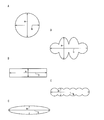
- FIG. 1A and 1B show schematic diagrams of a fiber cross section
- FIG. 1A is a schematic diagram of a circular fiber cross section
- FIG. 1B is a schematic diagram of a rectangular fiber cross section
- FIG. 1C is an elliptical fiber cross section. It is a schematic diagram of a cross section
- (D) is a schematic diagram of a flat multilobe fiber cross section
- (E) is a schematic diagram of a narrow flat fiber cross section.
- FIG. 2 is a flowchart showing one example of a manufacturing process of a pile fabric according to one or more embodiments of the present invention.
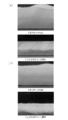
- FIG. 3 is an explanatory diagram illustrating evaluation criteria for crimp removability of a polyester fiber (pile fiber) in a pile fabric.
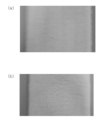
- FIG. 4 is an explanatory diagram for explaining the evaluation criteria for the set recovery property and the volume feeling of the pile fabric.
- FIG. 5 is an explanatory diagram illustrating the appearance evaluation criteria of the pile fabric.
- the present inventors have conducted intensive studies to solve the above-mentioned problems.
- the drawn yarn is subjected to a heat treatment at a temperature of 25 ° C. or more and 120 ° C. or less; C. or less, and after the crimping step, by performing a heat treatment on the drawn yarn at a temperature of 25 ° C. or more and 140 ° C. or less to obtain the obtained polyester fiber having crimp.
- the length of the polyester fiber under the load of 4 mg / dtex after the heat treatment, and the no load after the heat treatment Lower polyes
- the difference between the fiber lengths of the fibers is less than 3%, and the pile fabric using the fiber (sometimes referred to as crimp tow) is polished at a temperature of 90 ° C. or more and 160 ° C. or less to obtain a surface layer of the pile fabric. It has been found that a pile fabric in which the crimp of the portion is moderately removed, the appearance is good, and the set recovery property and the volume feeling are good.
- the difference between the fiber length of the lower polyester fiber and the fiber length of the polyester fiber under no load after the heat treatment is less than 3% "means that in a temperature range of 90 ° C or more and 120 ° C or less, the polyester fiber is When suspended vertically and subjected to dry heat treatment under a load of 4 mg / dtex for 60 seconds, the fiber length of the polyester fiber under the load of 4 mg / dtex after the heat treatment and the fiber length of the polyester fiber under no load after the heat treatment It means that the difference is less than 3%. That is, when the dry heat treatment is performed at a temperature of less than 90 ° C.
- the difference between the fiber length of the polyester fiber under the load of 4 mg / dtex after the heat treatment and the fiber length of the polyester fiber under no load after the heat treatment is 3%.
- the fiber length of the polyester fiber under a load of 4 mg / dtex after the heat treatment and the fiber length of the polyester fiber under no load after the heat treatment This is to exclude cases where the difference is less than 3%.
- the polyester resin constituting the polyester fiber is not particularly limited, and for example, polyalkylene terephthalate and / or a copolymerized polyester mainly composed of polyalkylene terephthalate can be used.
- the polyalkylene terephthalate is not particularly limited, and examples include polyethylene terephthalate, polypropylene terephthalate, polybutylene terephthalate, and polytrimethylene terephthalate. Among them, polyethylene terephthalate is preferred from the viewpoint of thermal characteristics.
- the copolymerized polyester mainly composed of the above polyalkylene terephthalate is not particularly limited. And the like.
- a copolymer polyester mainly composed of polyethylene terephthalate is preferred from the viewpoint of thermal characteristics.
- “main component” means a component containing 50 mol% or more
- “copolymerized polyester mainly containing polyalkylene terephthalate” is a copolymer containing 50 mol% or more of polyalkylene terephthalate.
- the “copolyester mainly composed of polyalkylene terephthalate” contains 60 mol% or more, more preferably 70 mol% or more, and further preferably 80 mol% or more of polyalkylene terephthalate.
- copolymerization components for example, isophthalic acid, orthophthalic acid, naphthalenedicarboxylic acid, paraphenylenedicarboxylic acid, trimellitic acid, pyromellitic acid, succinic acid, glutaric acid, adipic acid, suberic acid, azelaic acid, Polycarboxylic acids such as sebacic acid and dodecane diacid and derivatives thereof, dicarboxylic acids including sulfonic acid salts such as 5-sodium sulfoisophthalic acid and dihydroxyethyl 5-sodium sulfoisophthalate, and derivatives thereof; Propanediol, 1,3-propanediol, 1,4-butanediol, 1,6-hexanediol, neopentyl glycol, 1,4-cyclohexanedimethanol, diethylene glycol, polyethylene glycol, trimethylolpropane, pent
- polyester mainly composed of polyalkylene terephthalate examples include, for example, mainly polyethylene terephthalate, ethylene glycol ether of bisphenol A, 1,4-cyclohexanedimethanol, isophthalic acid and dihydroxy 5-sodium sulfoisophthalate.
- examples include a polyester obtained by copolymerizing one or more compounds selected from the group consisting of ethyl.
- the above-mentioned polyalkylene terephthalate and the above-mentioned polyalkylene terephthalate-based copolymerized polyester may be used alone or in combination of two or more.
- polyester terephthalate, polypropylene terephthalate, polybutylene terephthalate, polytrimethylene terephthalate, or polyethylene terephthalate as a main component polyester obtained by copolymerizing ethylene glycol ether of bisphenol A, polyethylene terephthalate as a main component, and 1,4-cyclohexanedimethanol
- a copolymerized polyester a polyester mainly composed of polyethylene terephthalate and copolymerized with isophthalic acid, and a polyester mainly composed of polyethylene terephthalate and copolymerized with dihydroxyethyl 5-sodium sulfoisophthalate, alone or in combination of two or more Is preferred.
- the intrinsic viscosity (IV value) of the polyester resin is not particularly limited, but is preferably 0.3 or more and 1.2 or less, and more preferably 0.4 or more and 1.0 or less.
- the intrinsic viscosity is 0.3 or more, the mechanical strength of the obtained fiber does not decrease.
- the intrinsic viscosity is 1.2 or less, the molecular weight does not increase too much, the melt viscosity does not become too high, the melt spinning becomes easy, and the fineness tends to be uniform.
- additives such as a matting agent, a lubricant, an antioxidant, a coloring pigment, a stabilizer, a flame retardant, and a reinforcing agent may be added.
- a matting agent examples include titanium dioxide.
- the lubricant examples include fine particles such as silica and alumina.
- the polyester fibers have crimps (also called crimps).
- the crimp refers to a crimp applied by a known crimp applying method such as a gear crimp method or a stuffing box method, and is not particularly limited.
- the number of crimps of the polyester fiber is not particularly limited, for example, the number of crimps is preferably 5/25 mm or more and 18/25 mm or less, from the viewpoint of bulkiness and card passing property, and 8/25 mm. It is more preferable that it is 14 or more / 25 mm or less. In one or more embodiments of the present invention, the number of crimps is measured according to JIS L-1015.
- the form of the crimped polyester fiber is not particularly limited, and examples thereof include a filament state, a staple state, and a tow state in which the filaments are assembled.
- the polyester-based fiber is excellent in crimp-removing property, and when the polyester-based fiber is suspended vertically and subjected to a dry heat treatment at a temperature of 90 ° C. or more and 120 ° C. or less under a load of 4 mg / dtex for 60 seconds, The difference between the fiber length of the polyester fiber under a load of 4 mg / dtex and the fiber length of the polyester fiber under no load after the heat treatment is less than 3%. "The difference between the fiber length under a load of 4 mg / dtex and the fiber length under no load is less than 3%" means that the crimp has been removed. That is, the polyester fiber has a crimp removal temperature of 90 ° C or more and 120 ° C or less.
- the crimp removal temperature of the polyester fibers is such that the polyester fibers are bundled into a 9000 dtex fiber bundle, and both ends of the fiber bundle are cut so that the sample length is about 200 mm.
- the fiber bundle is suspended vertically in a convection hot air dryer, and a load of 4 mg per dtex is applied to the fiber bundle (specifically, a weight of 36 g is hung at the lower end of the fiber bundle).
- the polyester-based fiber has a minimum temperature (crimp removal temperature) satisfying the following equation (2) of 90 ° C or more and 120 ° C or less.
- A is a fiber bundle of the above-mentioned polyester-based fiber, which is subjected to a dry heat treatment at a predetermined temperature for 60 seconds under a state of applying a load of 4 mg per dtex, followed by a load of 4 mg per dtex.
- B indicates the length of the fiber bundle in a state where the fiber bundle is in a state where the load is removed after performing the same operation.
- the polyester fiber is filled together with pure water while applying a pressure of 3 kPa to 20 kPa in a pressure vessel, and subjected to hot water treatment at 98 ° C. for 60 minutes.
- the polyester fiber is suspended vertically and subjected to dry heat treatment at a temperature of 90 ° C. or more and 120 ° C. or less for 60 seconds under a load of 4 mg / dtex
- the fiber length of the polyester fiber under the load of 4 mg / dtex after the heat treatment and the heat treatment It is preferable that the difference in the fiber length of the subsequent polyester fiber under no load is less than 3%.
- the polyester fiber is filled together with pure water while applying a pressure of 3 kPa or more and 20 kPa or less to a pressure-resistant container, and after hot water treatment at 98 ° C. for 60 minutes,
- the polyester fiber after the hot water treatment preferably has a temperature (crimp removal temperature) satisfying the above formula (2) of 90 ° C or more and 120 ° C or less.
- the polyester fiber when the crimp removal temperature of the polyester fiber is 90 ° C or more and 120 ° C or less, the polyester fiber is 90 ° C or more and 160 ° C or less in the polishing step which is one of the pile fabric processing steps.
- the crimp is appropriately removed in a relatively low temperature range, and specifically, only the crimp of the piled surface layer portion of the pile fabric is easily removed. This makes it possible to obtain an excellent pile fabric.
- the crimp removal temperature exceeds 120 ° C., the pile is poor in appearance and touch due to insufficient removal of the crimp by the polishing treatment at a low temperature of 90 ° C. or more and 160 ° C. or less, which hardly removes the crimp of the pile fiber. It becomes a fabric.
- the crimp removal temperature is lower than 90 ° C.
- the crimp of the pile fiber is almost completely removed by the polishing treatment at a low temperature of 90 ° C. or more and 160 ° C. or less. This results in a chipped pile fabric.
- the polyester fiber has been subjected to the hot water treatment, if the crimp removal temperature is 90 ° C. or more and 120 ° C. or less, even after a process such as dyeing under hot water conditions, the polyester fiber is subjected to a low temperature of 90 ° C. or more and 160 ° C. or less.
- the crimp is moderately removed, and specifically, only the crimps of the nap surface layer portion of the pile fabric are easily removed, and therefore, the appearance is good, and the set feeling is excellent in recoverability and volume.
- a pile fabric can be obtained.
- the polyester fiber is not particularly limited, but for example, preferably has a single fiber fineness of 10 dtex or less, more preferably 5 dtex or less.
- the single fiber fineness exceeds 10 dtex, the heat transfer tends to be insufficient in the polishing treatment, and it may be necessary to increase the number of times of polishing in order to appropriately remove the crimp. Further, the soft texture may be impaired by increasing the number of times of polishing.
- the polyester fiber is not particularly limited, but, for example, preferably has a single-fiber fineness of 1 dtex or more from the viewpoint of hair handling properties.
- the polyester fiber is not particularly limited, but may be, for example, a circular cross section or a flat cross section. From the viewpoint of improving the set recovery property of the pile fabric, the polyester fiber preferably has a flat shape in which the length (b) of the long side of the fiber cross section is larger than the length (a) of the short side of the fiber cross section. More preferably, the length (b) of the long side of the fiber cross section is twice or more the length (a) of the short side of the fiber cross section.
- the polyester fiber is not particularly limited. For example, the length (b) of the long side of the fiber cross section is eight times or less the length (a) of the short side of the fiber cross section from the viewpoint of enhancing the volume feeling of the pile fabric.
- the long side of the fiber cross section is the maximum length of the fiber cross section, that is, the straight line having the maximum length among straight lines connecting any two points on the outer periphery of the fiber cross section.
- the short side of the fiber cross-section is the maximum width of the fiber cross-section, i.e., when connecting any two points on the outer circumference of the fiber cross-section so as to be perpendicular to the long side of the fiber cross-section, the two maximum lengths It is a straight line connecting the points.
- the length (b) of the long side of the fiber cross section is the same as the length (a) of the short side of the fiber cross section.
- the cross-sectional shape of the polyester-based fiber is not particularly limited, but specifically, a circular shape (FIG. 1A) and a flat shape, for example, a rectangular shape (FIG. 1B), an elliptical shape (FIG. 1C), and a flat multi-lobed shape (FIG. 1D) and a constricted flat shape (FIG. 1E).
- a circular shape for example, a rectangular shape (FIG. 1B), an elliptical shape (FIG. 1C), and a flat multi-lobed shape (FIG. 1D) and a constricted flat shape (FIG. 1E).
- the polyester fiber may be subjected to a heat treatment on the drawn yarn before the crimping step, after the crimping step, or before and after the crimping step.
- the drawn yarn Before or after the crimping step, before or after the crimping step, or before and after the crimping step, the drawn yarn is heat-treated at a temperature of 25 ° C or more and 120 ° C or less; or Before the applying step, the drawn yarn is subjected to a heat treatment at a temperature of 100 ° C. or more and 200 ° C. or less, and after the crimping step, the drawn yarn is subjected to a heat treatment at a temperature of 25 ° C. or more and 140 ° C. or less. Except for the above, it can be produced by the same production method as that of ordinary polyester fibers.
- “before the crimping step” refers to a period from the end of the polyester fiber drawing step to the start of the step of applying crimp
- “After” refers to the period from the end of the crimping step to the time when the final crimped polyester fiber is obtained.
- the heat treatment at 100 ° C. is a polyester system having a final crimp from the end of the crimping step. This is performed until the fiber is obtained.
- a step other than the heat treatment step for example, an oil agent applying step, a fixed length cutting step, a rewinding step and the like may be included.
- the drawn yarn is not subjected to heat treatment, or before the crimping step
- the crimping step After or before or after the crimping step, by performing a heat treatment on the drawn yarn at a temperature of 25 ° C. or more and 120 ° C. or less, crystallization of the polyester fiber is promoted before and after the crimping step. Therefore, a polyester fiber having a crimp removal temperature of 90 ° C. or more and 120 ° C. or less can be obtained. As described above, by using the polyester fiber in a pile fabric, the polyester fiber can be processed into a pile fabric.
- no heat treatment is performed before the crimping step, and after the crimping step, the stretched yarn is subjected to 25 ° C.
- the heat treatment is preferably performed at a temperature of at least 120 ° C. and more preferably at a temperature of at least 60 ° C. and at most 110 ° C., and even more preferably at a temperature of at least 80 ° C. and at most 110 ° C.
- the heat treatment time is not particularly limited, but may be, for example, 10 minutes or more and 50 minutes or less.
- the heat treatment after the crimping step is preferably performed at a temperature of 60 ° C. or more and 110 ° C.
- the drawn yarn when the drawn yarn is heat-treated before and after the crimping step, the drawn yarn is subjected to a heat treatment at a temperature of 100 ° C or more and 200 ° C or less before the crimping step.
- the drawn yarn may be subjected to a heat treatment at a temperature of 25 ° C. or more and 140 ° C. or less.
- the drawn yarn before the crimping step, the drawn yarn is subjected to a heat treatment at a temperature of preferably 100 ° C to 170 ° C, more preferably 100 ° C to 150 ° C. Further, after the crimping step, heat treatment is preferably performed at 25 ° C.
- the time of the heat treatment is not particularly limited, but before the crimping step, for example, may be 10 seconds or more and 5 minutes or less, may be 20 seconds or more and 4 minutes or less, and after the crimping step. May be, for example, from 5 minutes to 40 minutes or from 10 minutes to 30 minutes.
- the obtained polyester-based fiber is likely to have a crimp removal temperature of 90 ° C or more and 120 ° C or less even after hot water treatment.
- crimps are appropriately removed in a polishing process at a low temperature of 90 ° C. or higher and 160 ° C. or lower, specifically, only crimping of the napped surface layer portion of the pile fabric. Is easily removed, and therefore, a pile fabric having a good appearance and excellent set recovery and voluminous feel can be obtained.
- the heat treatment performed before the crimping step and / or after the crimping step may be a dry heat treatment or a wet heat treatment. Dry heat treatment is preferred because the process is simple.
- the dry heat treatment can be performed using a soaking air dryer or a suction dryer.
- the heat treatment may be performed in a relaxed state, and the relaxation rate is not particularly limited, but may be, for example, 20% or less.
- Polyester fibers can be produced by the same method as that for producing ordinary polyester fibers except for the steps described above.
- a polyester-based resin, or a polyester-based resin composition obtained by dry-blending a polyester-based resin and additives is melt-kneaded using various general kneaders, pelletized, and then melt-spun.
- the temperature (spinning temperature) of an extruder, a gear pump, a die and the like is set to 250 ° C. or more and 300 ° C. or less, melt-spinning is performed, and the spun yarn is passed through a heating cylinder.
- the spun yarn (unstretched yarn) is obtained by cooling below and taking off at a speed of 50 m / min to 4500 m / min.
- the drawn yarn (undrawn yarn) can be drawn by heat drawing.
- a heating means in the thermal stretching a heating roller, a heat plate, a steam jet device, a hot water tank, or the like can be used, and these can be used in combination as appropriate.
- Crimping can be performed by a known crimping device such as a gear crimper or a stuffing box type crimper. Similar to the usual crimping, crimping can be performed in a state where the polyester fiber is heated to a softening temperature or higher in advance. Preheating can be performed by wet heat, for example, steam at 85 ° C. or more and 110 ° C. or less, as in the case of ordinary crimping.
- the Young's modulus of the polyester fiber is preferably 4.0 GPa or more, and more preferably 5.0 GPa or more. This is because the higher the Young's modulus, the higher the fiber rigidity and the better the volume feeling of the pile fabric.
- the pile fabric includes the polyester-based fiber in a pile portion.
- the pile portion refers to a nap portion excluding a base fabric (also referred to as a ground structure) portion of the pile fabric.
- the polyester fiber is preferably contained in an amount of at least 30% by weight, more preferably at least 40% by weight, more preferably at least 50% by weight of the entire pile portion. preferable.
- the fibers constituting the pile portion are also referred to as pile fibers.
- the pile fabric preferably includes a long pile portion and a short pile portion having different pile lengths, and an average pile length of the long pile portion and an average pile of the short pile portion
- the difference in length is preferably 2 mm or more, more preferably 5 mm or more and 50 mm or less.
- the average pile length means that the fibers constituting the pile portion of the pile fabric stand upright so that the fur is uniform, and the root of the fiber constituting the pile portion (pile fabric surface) is formed at each pile portion.
- the length from the base of the pile to the tip of the pile was measured at 10 locations and expressed as the average value.
- the pile portion may include other fibers in addition to the polyester fibers, for example, acrylic fibers, vinyl chloride fibers, and the like.
- the long pile portion preferably contains an acrylic fiber composed of an acrylic copolymer containing acrylonitrile in an amount of 35% by weight or more and less than 95% by weight.
- the acrylic copolymer preferably contains, in addition to acrylonitrile, another monomer copolymerizable with acrylonitrile in an amount of more than 5% by weight and 65% by weight or less.
- the other monomer is not particularly limited, for example, it is preferable to use one or more monomers selected from the group consisting of vinyl halides, vinylidene halides and metal salts of sulfonic acid-containing monomers, vinyl chloride, vinylidene chloride and It is more preferable to use one or more monomers selected from the group consisting of sodium styrenesulfonate.
- the above pile fabric can be manufactured by the same manufacturing method as that of ordinary pile fabric except that polishing is performed at a temperature of 90 ° C or more and 160 ° C or less.
- a sliver composed of pile fibers is knitted into a pile fabric (sometimes referred to as a knitted fabric) by a sliver knitting machine, and is subjected to pre-polishing and pre-shearing at a temperature of 90 ° C or more and 160 ° C or less, and thereafter The crimp is removed by performing polishing at a temperature of 90 ° C. or more and 160 ° C. or less, and thereafter, shearing is performed. Polishing may be performed multiple times at different temperatures.
- FIG. 2 is a flowchart showing one example of a manufacturing process of a pile fabric according to one or more embodiments of the present invention.
- the polyester fibers are bundled into a 9000 dtex fiber bundle, and both ends of the fiber bundle are trimmed to have a sample length of about 200 mm, suspended vertically in a convection hot air dryer, and the fiber bundle is weighed at 4 mg / dtex.
- a load is applied, and specifically, a weight of 36 g is hung at the lower end of the fiber bundle, and heat treatment is performed at a predetermined temperature in increments of 50 to 10 ° C. for 60 seconds. After each heat treatment, a load of 4 mg / dtex is applied.
- the length A of the fiber bundle in the applied state and the length B of the fiber bundle in the no-load state after removing the load are measured, and the difference (ie, the change in the length calculated by the following formula (1)) is measured.
- the minimum value of the temperature at which the ratio was less than 3% was determined five times, and the average value was calculated to obtain the crimp removal temperature.
- Length change rate (%) (AB) / A ⁇ 100 (1)
- the container was cooled to take out the polyester fiber in the container, and water was removed by centrifugal dehydration, followed by drying in a dryer heated to 60 ° C for 2 hours.
- the crimp removal temperature of the polyester fiber after the hot water treatment was measured by the same method as described above.
- FIG. 3 shows reference photographs of the following respective standards. Specifically, in FIG. 3, (a) is a reference photograph of reference 5, (b) is reference 4, (c) is reference 3, (d) is reference 2, and (e) is a reference photograph of reference 1.
- the crimp removability criterion is 3, the crimp of only the napped surface layer portion of the pile fabric is removed.
- 5 The directionality of the pile fiber was adjusted, and the crimp was clearly removed from the root to the tip of the pile fiber.
- 4 The directionality of the pile fiber is adjusted, and the crimp is clearly removed up to the middle part of the pile fiber.
- the directionality of the pile fiber is adjusted, and only the tip of the pile fiber has a neat crimp.
- 2 The directionality of the pile fiber was adjusted, but no crimp was removed.
- 1 The directionality of the pile fiber was not adjusted, and the crimp was not removed at all.
- FIG. 4 shows reference photographs of the respective standards. Specifically, in FIG. 4, (a) is a reference photograph in the case of good set recovery and volume feeling, and (b) is a reference photograph in the case of poor set recovery and volume feeling. . Good: The piled portions of two piled fabrics are overlapped, and the thickness of the piled fabric when a pressure of 300 Pa is applied is about 60% or more of the thickness of the piled fabric before the pressure is applied, and the set recovery and volume are good. Feeling is enough.
- FIG. 5 shows reference photographs of the respective standards. Specifically, in FIG. 5, (a) is a reference photo when the appearance is good, and (b) is a reference photo when the appearance is poor. Good: There is no convergence of pile fibers, and the surface of the pile fabric looks flat. Poor: pile fibers converge, and pile fabric appears to be broken.
- Example 1 ⁇ Preparation of polyester fiber> Using a polyethylene terephthalate (PET) having an intrinsic viscosity (IV value) of 0.65, a spinning temperature of 290 ° C., a circular section having a diameter of 0.4 mm, and a spinneret having a number of 48 holes of 320 m / m by a normal spinning machine. The spinning was performed at a speed of 1 minute and then 375% stretched with a hot roller at 80 ° C to obtain a stretched yarn. In addition, 0.3 parts by weight of titanium oxide was added to PET as a matting agent based on 100 parts by weight of PET.
- PET polyethylene terephthalate
- IV value intrinsic viscosity
- the drawn yarn is combined to an appropriate fineness, and then crimped through a preheating at 98 ° C. by a stuffing box type crimper, and a relaxation rate of 15 ° C. in a soaked air dryer set at 110 ° C. % In a relaxed state of 30% or less to obtain a crimped yarn having a single fiber fineness of 3 dtex.
- a preheating at 98 ° C. by a stuffing box type crimper and a relaxation rate of 15 ° C. in a soaked air dryer set at 110 ° C. % In a relaxed state of 30% or less to obtain a crimped yarn having a single fiber fineness of 3 dtex.
- the PET crimped yarn obtained above was cut into 51 mm to obtain a raw cotton for pile fabric.
- a sliver was prepared from 100% of the raw cotton, and a pile fabric was prepared using a sliver knitting machine.
- a pre-polishing treatment and a pre-shearing treatment were performed at 120 ° C., and the length of the piled-up portion of the pile fabric was cut to 18 mm.
- the back surface of the fabric was back-coated with an acrylic ester-based adhesive to perform a tentering treatment.
- polishing was performed three times at 160 ° C., three times at 130 ° C., and three times at 100 ° C. Thereafter, the length of the nap portion was cut to 20 mm by shearing to obtain a pile fabric having a basis weight of about 800 g / m 2 .
- Example 2 Preparation of polyester fiber> After applying the crimp, a crimped yarn having a single fiber fineness of 3 dtex was obtained in the same manner as in Example 1, except that the heat treatment was performed in a soaking air dryer set at 60 ° C. for 30 minutes.
- ⁇ Production of pile fabric> A pile fabric was produced in the same manner as in Example 1 except that the PET crimped yarn obtained above was used.
- Example 3 Preparation of polyester fiber> After applying the crimp, a crimped yarn having a single fiber fineness of 3 dtex was obtained in the same manner as in Example 1, except that the heat treatment was performed in a soaking air dryer set at 120 ° C. for 30 minutes.
- ⁇ Production of pile fabric> A pile fabric was produced in the same manner as in Example 1 except that the PET crimped yarn obtained above was used.
- Example 4 ⁇ Preparation of polyester fiber> A crimped yarn having a single fiber fineness of 3 dtex was obtained in the same manner as in Example 1 except that no heat treatment was performed after crimping. ⁇ Production of pile fabric> A pile fabric was produced in the same manner as in Example 1 except that the PET crimped yarn obtained above was used.
- Example 7 ⁇ Preparation of polyester fiber> Same as Example 6 except that heat treatment was performed for 1 minute in a soaking air dryer set at 170 ° C. before crimping, and 15 minutes in a soaking air dryer set to 100 ° C. after crimping. Thus, a crimped yarn having a single fiber fineness of 4.4 dtex was obtained.
- the drawn yarn is not subjected to heat treatment, or the drawn yarn is subjected to 25 ° C. or higher after the crimping step.
- the crimped PET yarns of Examples 1 to 5 which had been heat-treated at a temperature of 120 ° C. or less had a crimp removal temperature of 90 ° C. or more and 120 ° C. or less, and a pile fabric using the PET crimped yarn was 90 ° C.
- the treatment at 160 ° C. or lower the crimp of only the raised layer portion of the pile fabric was removed, and the appearance was good, and the set recovery property and volume feeling were also good.
- the PET crimped yarns of Examples 6 and 7 in which the heat treatment was performed at a temperature of 100 ° C or more and 200 ° C or less before crimping, and the heat treatment was performed at a temperature of 25 ° C or more and 140 ° C or less after crimping was performed
- the crimp removal temperature is 90 ° C. or more and 120 ° C. or less
- the pile fabric using the PET crimped yarn is subjected to treatment at 90 ° C. or more and 160 ° C. or less to remove the crimp of only the napped surface layer portion of the pile fabric, The appearance was good, and the set recovery and volume were good.
- the PET crimped yarns of Comparative Examples 1 to 3 in which the heat treatment was not performed before the crimping process and the drawn yarn was heat-treated at a temperature exceeding 120 ° C. after the crimping process, The crimp removal temperature exceeds 120 ° C., and the pile fabric using the PET crimped yarn has no crimp of the pile fiber removed at all by the polishing treatment of 90 ° C. or more and 160 ° C. or less, and its appearance is poor.
- the PET crimped yarn of Comparative Example 4 had a crimp removal temperature of less than 90 ° C., and a pile fabric using the PET crimped yarn was subjected to a polishing treatment at 90 ° C. or more and 160 ° C. or less. The crimp was removed clearly from the root to the tip, and it was inferior in healability and volume.
- the PET crimped yarn had a Young's modulus of 5 GPa or more, and had better fiber physical properties.
- the crimp removal temperatures of the PET crimped yarns of Examples 3, 4, 6, and 7 were in the range of 90 ° C. or more and 120 ° C. or less without any hot water treatment. Yes, it had crimp characteristics suitable for a pile fabric in a normal state.
- the PET crimped yarns of Example 4 in which the heat treatment was not performed before and after the crimp application and Examples 6 and 7 in which the heat treatment was performed at a predetermined temperature before and after the crimp application were subjected to the hot water treatment.
- the crimp removal temperature was in the range of 90 ° C to 120 ° C.
- the PET fibers of Examples 4, 6, and 7 not only have crimping properties suitable for pile fabrics in a normal state, but also have crimping properties suitable for pile fabrics after wet heat treatment. Even if the PET fiber is dyed under hot water conditions, the crimping of only the surface layer of the pile fabric is removed by the treatment at 90 ° C. or more and 160 ° C. or less, and the appearance is good and the set is recovered. It is easy to obtain a pile fabric having good properties and a good volume feeling.
- the crimp removal temperature of the PET crimped yarn of Comparative Example 1 was higher than 120 ° C. in both the untreated state and after the hot water treatment. Inferred to be inferior to the PET fibers of 4, 6, and 7.
Landscapes
- Engineering & Computer Science (AREA)
- Textile Engineering (AREA)
- Mechanical Engineering (AREA)
- Yarns And Mechanical Finishing Of Yarns Or Ropes (AREA)
- Treatment Of Fiber Materials (AREA)
- Knitting Of Fabric (AREA)
- Woven Fabrics (AREA)
Priority Applications (4)
| Application Number | Priority Date | Filing Date | Title |
|---|---|---|---|
| EP19833983.0A EP3822398A4 (en) | 2018-07-11 | 2019-06-07 | Polyester-based fiber and pile fabric cloth using same, and methods respectively for producing these products |
| CN201980043450.XA CN112352069B (zh) | 2018-07-11 | 2019-06-07 | 聚酯系纤维、使用其的绒头布帛及它们的制造方法 |
| CN202210252071.5A CN114575007B (zh) | 2018-07-11 | 2019-06-07 | 聚酯系纤维、使用其的绒头布帛及它们的制造方法 |
| JP2020530039A JP7187559B2 (ja) | 2018-07-11 | 2019-06-07 | ポリエステル系繊維、それを用いたパイル布帛、及びそれらの製造方法 |
Applications Claiming Priority (4)
| Application Number | Priority Date | Filing Date | Title |
|---|---|---|---|
| JP2018131535 | 2018-07-11 | ||
| JP2018-131535 | 2018-07-11 | ||
| JP2019037369 | 2019-03-01 | ||
| JP2019-037369 | 2019-03-01 |
Publications (1)
| Publication Number | Publication Date |
|---|---|
| WO2020012843A1 true WO2020012843A1 (ja) | 2020-01-16 |
Family
ID=69141451
Family Applications (1)
| Application Number | Title | Priority Date | Filing Date |
|---|---|---|---|
| PCT/JP2019/022725 Ceased WO2020012843A1 (ja) | 2018-07-11 | 2019-06-07 | ポリエステル系繊維、それを用いたパイル布帛、及びそれらの製造方法 |
Country Status (4)
| Country | Link |
|---|---|
| EP (1) | EP3822398A4 (https=) |
| JP (1) | JP7187559B2 (https=) |
| CN (2) | CN112352069B (https=) |
| WO (1) | WO2020012843A1 (https=) |
Cited By (1)
| Publication number | Priority date | Publication date | Assignee | Title |
|---|---|---|---|---|
| US12286732B2 (en) | 2019-12-25 | 2025-04-29 | Kaneka Corporation | Pile fabric and manufacturing method therefor |
Citations (7)
| Publication number | Priority date | Publication date | Assignee | Title |
|---|---|---|---|---|
| JPS60162857A (ja) | 1984-02-03 | 1985-08-24 | 株式会社クラレ | 獣毛調ハイパイル布帛の製造方法 |
| JPS63235527A (ja) * | 1987-03-18 | 1988-09-30 | Teijin Ltd | 高摩擦合成繊維 |
| JPH05140860A (ja) | 1991-11-19 | 1993-06-08 | Kuraray Co Ltd | 立毛布帛の製造方法 |
| JPH09228170A (ja) * | 1996-02-28 | 1997-09-02 | Nippon Ester Co Ltd | パイル布帛用混合糸 |
| JPH09273025A (ja) * | 1996-04-09 | 1997-10-21 | Teijin Ltd | ポリエステル捲縮糸、立毛布帛および立毛布帛の製造方法 |
| JPH1181120A (ja) * | 1997-09-04 | 1999-03-26 | Teijin Ltd | 繊維構造体 |
| JP2001181937A (ja) * | 1999-12-27 | 2001-07-03 | Kanegafuchi Chem Ind Co Ltd | 捲縮除去性に優れたアクリル系合成繊維の製造方法 |
Family Cites Families (14)
| Publication number | Priority date | Publication date | Assignee | Title |
|---|---|---|---|---|
| GB1320583A (en) * | 1969-08-27 | 1973-06-13 | Toray Industries | Process for manufacturing textured yarn with latent crimp |
| FR2288800A1 (fr) * | 1974-03-22 | 1976-05-21 | Rhone Poulenc Textile | Procede de texturation de fil polyester et fil obtenu par ce procede |
| CH587937A5 (en) * | 1976-03-16 | 1977-05-13 | Schweizerische Viscose | Polyester fibres suitable for crimping - have specified double refraction, heat shrinkage and crystallinity and are stretched below m.pt. |
| JP2544840B2 (ja) * | 1991-01-17 | 1996-10-16 | 株式会社クラレ | パイル製品およびその製造法 |
| JP2001181926A (ja) * | 1999-12-27 | 2001-07-03 | Kanegafuchi Chem Ind Co Ltd | 捲縮除去性に優れた立毛布帛用アクリル系合成繊維及びその製造方法。 |
| JP3692931B2 (ja) * | 2000-12-11 | 2005-09-07 | 東レ株式会社 | 潜在捲縮発現性を有するポリエステル系短繊維およびその製造方法 |
| JP2002180340A (ja) * | 2000-12-18 | 2002-06-26 | Toray Ind Inc | カーペット用脂肪族ポリエステルマルチフィラメント捲縮糸およびカーペット |
| JP3778808B2 (ja) * | 2001-04-04 | 2006-05-24 | 帝人ファイバー株式会社 | ポリエステル系熱接着性複合繊維およびその製造方法 |
| US7578957B2 (en) * | 2002-12-30 | 2009-08-25 | E. I. Du Pont De Nemours And Company | Process of making staple fibers |
| JP2005325462A (ja) * | 2004-05-12 | 2005-11-24 | Kaneka Corp | 意匠性に優れた衣料用パイル布帛 |
| JP2007002343A (ja) * | 2005-06-21 | 2007-01-11 | Kaneka Corp | 段差に優れたパイル布帛 |
| CN101313091A (zh) * | 2005-10-19 | 2008-11-26 | 东丽株式会社 | 卷曲弹力丝及其制造方法、纤维结构体 |
| JP5817942B2 (ja) * | 2013-11-08 | 2015-11-18 | 三菱レイヨン株式会社 | 高収縮性アクリル繊維と同繊維を含む紡績糸と同紡績糸を用いた段差パイル布帛 |
| EP3369850A4 (en) * | 2015-10-30 | 2019-08-21 | Kaneka Corporation | pile fabrics |
-
2019
- 2019-06-07 CN CN201980043450.XA patent/CN112352069B/zh active Active
- 2019-06-07 EP EP19833983.0A patent/EP3822398A4/en active Pending
- 2019-06-07 CN CN202210252071.5A patent/CN114575007B/zh active Active
- 2019-06-07 JP JP2020530039A patent/JP7187559B2/ja active Active
- 2019-06-07 WO PCT/JP2019/022725 patent/WO2020012843A1/ja not_active Ceased
Patent Citations (7)
| Publication number | Priority date | Publication date | Assignee | Title |
|---|---|---|---|---|
| JPS60162857A (ja) | 1984-02-03 | 1985-08-24 | 株式会社クラレ | 獣毛調ハイパイル布帛の製造方法 |
| JPS63235527A (ja) * | 1987-03-18 | 1988-09-30 | Teijin Ltd | 高摩擦合成繊維 |
| JPH05140860A (ja) | 1991-11-19 | 1993-06-08 | Kuraray Co Ltd | 立毛布帛の製造方法 |
| JPH09228170A (ja) * | 1996-02-28 | 1997-09-02 | Nippon Ester Co Ltd | パイル布帛用混合糸 |
| JPH09273025A (ja) * | 1996-04-09 | 1997-10-21 | Teijin Ltd | ポリエステル捲縮糸、立毛布帛および立毛布帛の製造方法 |
| JPH1181120A (ja) * | 1997-09-04 | 1999-03-26 | Teijin Ltd | 繊維構造体 |
| JP2001181937A (ja) * | 1999-12-27 | 2001-07-03 | Kanegafuchi Chem Ind Co Ltd | 捲縮除去性に優れたアクリル系合成繊維の製造方法 |
Non-Patent Citations (1)
| Title |
|---|
| See also references of EP3822398A4 |
Cited By (1)
| Publication number | Priority date | Publication date | Assignee | Title |
|---|---|---|---|---|
| US12286732B2 (en) | 2019-12-25 | 2025-04-29 | Kaneka Corporation | Pile fabric and manufacturing method therefor |
Also Published As
| Publication number | Publication date |
|---|---|
| CN114575007B (zh) | 2023-07-28 |
| CN112352069A (zh) | 2021-02-09 |
| EP3822398A1 (en) | 2021-05-19 |
| CN114575007A (zh) | 2022-06-03 |
| EP3822398A4 (en) | 2022-03-16 |
| CN112352069B (zh) | 2022-04-01 |
| JP7187559B2 (ja) | 2022-12-12 |
| JPWO2020012843A1 (ja) | 2021-07-08 |
Similar Documents
| Publication | Publication Date | Title |
|---|---|---|
| JP3902007B2 (ja) | 緯編地 | |
| JP7498697B2 (ja) | 捲縮を有するポリエステル系繊維、その製造方法、それを含むパイル布帛、及びパイル布帛の製造方法 | |
| JP2016125166A (ja) | 複合仮撚加工糸およびその製造方法ならびに織編物 | |
| WO2020012843A1 (ja) | ポリエステル系繊維、それを用いたパイル布帛、及びそれらの製造方法 | |
| JP7606982B2 (ja) | パイル布帛、及びその製造方法 | |
| JP2006214056A (ja) | 織物 | |
| JP2000129560A (ja) | 長短複合紡績糸使用編物の製造方法 | |
| JP6591765B2 (ja) | 潜在捲縮性複合繊維 | |
| JP2019183366A (ja) | 布帛およびその製造方法および繊維製品 | |
| JP2001348744A (ja) | ポリエステル複合糸およびそれを用いた布帛 | |
| JP2000248430A (ja) | 潜在捲縮発現性ポリエステル繊維および製造方法 | |
| JP2000064139A (ja) | 特殊断面ポリエステル複合糸 | |
| KR100302242B1 (ko) | 이수축혼섬사의제조방법 | |
| JP2015117445A (ja) | 融着特性を有する斑捲縮糸 | |
| JP2001115344A (ja) | 特殊複合捲縮糸 | |
| JP2000144541A (ja) | ポリエステル混繊糸 | |
| JP2813378B2 (ja) | 高収縮性ポリエステル繊維 | |
| JP2003227041A (ja) | 異収縮型ポリエステル系混繊糸 | |
| JPH06287825A (ja) | 疑似撚加工糸およびその製造方法 | |
| JPH08158195A (ja) | 吸水性に優れたポリエステル織編物及びその製造方法 | |
| JP2000129555A (ja) | ポリエステル織物 | |
| JPH0345735A (ja) | 混繊交絡糸 | |
| JPH1088438A (ja) | ポリエステルマルチフィラメント混繊糸とその製造法 | |
| JP2017075417A (ja) | 複合杢加工糸及びその製造方法 | |
| JP2004076182A (ja) | 芯地 |
Legal Events
| Date | Code | Title | Description |
|---|---|---|---|
| 121 | Ep: the epo has been informed by wipo that ep was designated in this application |
Ref document number: 19833983 Country of ref document: EP Kind code of ref document: A1 |
|
| ENP | Entry into the national phase |
Ref document number: 2020530039 Country of ref document: JP Kind code of ref document: A |
|
| NENP | Non-entry into the national phase |
Ref country code: DE |