WO2019150875A1 - フィラー用分散剤 - Google Patents
フィラー用分散剤 Download PDFInfo
- Publication number
- WO2019150875A1 WO2019150875A1 PCT/JP2018/048274 JP2018048274W WO2019150875A1 WO 2019150875 A1 WO2019150875 A1 WO 2019150875A1 JP 2018048274 W JP2018048274 W JP 2018048274W WO 2019150875 A1 WO2019150875 A1 WO 2019150875A1
- Authority
- WO
- WIPO (PCT)
- Prior art keywords
- acid
- dispersant
- filler
- fatty acid
- mol
- Prior art date
- Legal status (The legal status is an assumption and is not a legal conclusion. Google has not performed a legal analysis and makes no representation as to the accuracy of the status listed.)
- Ceased
Links
Classifications
-
- C—CHEMISTRY; METALLURGY
- C08—ORGANIC MACROMOLECULAR COMPOUNDS; THEIR PREPARATION OR CHEMICAL WORKING-UP; COMPOSITIONS BASED THEREON
- C08K—Use of inorganic or non-macromolecular organic substances as compounding ingredients
- C08K3/00—Use of inorganic substances as compounding ingredients
- C08K3/01—Use of inorganic substances as compounding ingredients characterized by their specific function
- C08K3/013—Fillers, pigments or reinforcing additives
-
- C—CHEMISTRY; METALLURGY
- C08—ORGANIC MACROMOLECULAR COMPOUNDS; THEIR PREPARATION OR CHEMICAL WORKING-UP; COMPOSITIONS BASED THEREON
- C08K—Use of inorganic or non-macromolecular organic substances as compounding ingredients
- C08K3/00—Use of inorganic substances as compounding ingredients
- C08K3/02—Elements
- C08K3/04—Carbon
-
- C—CHEMISTRY; METALLURGY
- C08—ORGANIC MACROMOLECULAR COMPOUNDS; THEIR PREPARATION OR CHEMICAL WORKING-UP; COMPOSITIONS BASED THEREON
- C08K—Use of inorganic or non-macromolecular organic substances as compounding ingredients
- C08K3/00—Use of inorganic substances as compounding ingredients
- C08K3/18—Oxygen-containing compounds, e.g. metal carbonyls
- C08K3/20—Oxides; Hydroxides
- C08K3/22—Oxides; Hydroxides of metals
-
- C—CHEMISTRY; METALLURGY
- C08—ORGANIC MACROMOLECULAR COMPOUNDS; THEIR PREPARATION OR CHEMICAL WORKING-UP; COMPOSITIONS BASED THEREON
- C08K—Use of inorganic or non-macromolecular organic substances as compounding ingredients
- C08K3/00—Use of inorganic substances as compounding ingredients
- C08K3/18—Oxygen-containing compounds, e.g. metal carbonyls
- C08K3/24—Acids; Salts thereof
- C08K3/26—Carbonates; Bicarbonates
-
- C—CHEMISTRY; METALLURGY
- C08—ORGANIC MACROMOLECULAR COMPOUNDS; THEIR PREPARATION OR CHEMICAL WORKING-UP; COMPOSITIONS BASED THEREON
- C08K—Use of inorganic or non-macromolecular organic substances as compounding ingredients
- C08K3/00—Use of inorganic substances as compounding ingredients
- C08K3/34—Silicon-containing compounds
-
- C—CHEMISTRY; METALLURGY
- C08—ORGANIC MACROMOLECULAR COMPOUNDS; THEIR PREPARATION OR CHEMICAL WORKING-UP; COMPOSITIONS BASED THEREON
- C08K—Use of inorganic or non-macromolecular organic substances as compounding ingredients
- C08K5/00—Use of organic ingredients
- C08K5/04—Oxygen-containing compounds
- C08K5/10—Esters; Ether-esters
- C08K5/101—Esters; Ether-esters of monocarboxylic acids
- C08K5/103—Esters; Ether-esters of monocarboxylic acids with polyalcohols
-
- C—CHEMISTRY; METALLURGY
- C08—ORGANIC MACROMOLECULAR COMPOUNDS; THEIR PREPARATION OR CHEMICAL WORKING-UP; COMPOSITIONS BASED THEREON
- C08L—COMPOSITIONS OF MACROMOLECULAR COMPOUNDS
- C08L101/00—Compositions of unspecified macromolecular compounds
-
- C—CHEMISTRY; METALLURGY
- C08—ORGANIC MACROMOLECULAR COMPOUNDS; THEIR PREPARATION OR CHEMICAL WORKING-UP; COMPOSITIONS BASED THEREON
- C08L—COMPOSITIONS OF MACROMOLECULAR COMPOUNDS
- C08L71/00—Compositions of polyethers obtained by reactions forming an ether link in the main chain; Compositions of derivatives of such polymers
- C08L71/02—Polyalkylene oxides
Definitions
- the present invention relates to a dispersant for filler. More specifically, the present invention relates to a dispersant that is useful when a filler is dispersed in a resin.
- Various fillers are used for the purpose of improving the physical properties (for example, hardness, impact strength, tensile strength, wear resistance, heat resistance, etc.) of the resin.
- the physical properties for example, hardness, impact strength, tensile strength, wear resistance, heat resistance, etc.
- it is necessary to uniformly disperse the filler in the resin.
- a highly hydrophilic filler is easy to aggregate and difficult to disperse uniformly. Even if it can be dispersed, the viscosity tends to increase, and workability improvement is required.
- Patent Document 1 discloses a method using a surfactant.
- An object of the embodiment of the present invention is to provide a filler dispersant which is excellent in filler dispersibility and can lower the viscosity of the filler dispersion.
- the filler dispersant according to the embodiment of the present invention is a filler dispersant containing a fatty acid ester (A) of polyoxyalkylene glyceryl ether, and the fatty acid constituting the fatty acid ester (A) has 8 carbon atoms. ⁇ 30.
- the dispersant according to the present embodiment is excellent in filler dispersibility and can reduce the viscosity of the filler dispersion.
- the filler dispersant according to the present embodiment contains a fatty acid ester (A) of polyoxyalkylene glyceryl ether (hereinafter sometimes simply referred to as a fatty acid ester (A)).
- the fatty acid ester (A) has 8 to 30 carbon atoms in the constituent fatty acid.
- the production method of the fatty acid ester (A) is not particularly limited, a method of esterifying polyoxyalkylene glyceryl ether and fatty acid, a method of transesterifying polyoxyalkylene glyceryl ether and fatty acid alkyl ester, an ester of glycerin and fatty acid And a method of adding alkylene oxide to the reaction product.
- Examples of the polyoxyalkylene glyceryl ether include compounds obtained by addition polymerization of alkylene oxide to glycerin.
- Examples of the alkylene oxide include ethylene oxide, propylene oxide, and butylene oxide. Of these, ethylene oxide is preferably included because the dispersibility is better and the viscosity of the dispersion is lower.
- the content of ethylene oxide in the total alkylene oxide is preferably 50 mol% or more, more preferably 70 mol% or more, and further preferably 80 mol% or more.
- the addition form when two or more alkylene oxides are used is not particularly limited, and examples thereof include block addition, random addition, and combined use of block addition and random addition. Of these, block addition is preferred because of better dispersibility and lower viscosity of the dispersion.
- fatty acid those having 8 to 30 carbon atoms are used.
- the fatty acid ester (A) is preferably an unsaturated fatty acid ester whose constituent fatty acid contains an unsaturated fatty acid.
- the content of the unsaturated fatty acid in the constituent fatty acid is preferably 50 mol% or more, more preferably 70 mol% or more, and further preferably 80 mol% or more. preferable.
- the number of carbon atoms of the fatty acid constituting the fatty acid ester (A) is preferably 8 to 24, more preferably 8 to 20, and even more preferably 8 to 18. preferable.
- fatty acid alkyl ester When fatty acid alkyl ester is used, methyl ester or ethyl ester of the above fatty acid can be used. When using a fatty acid alkyl ester, it is preferable to carry out the reaction while removing by-produced alcohol (methanol, ethanol, etc.) under reduced pressure if necessary.
- alcohol methanol, ethanol, etc.
- the fatty acid ester (A) preferably has 1 to 30 oxyalkylene groups in the molecule, and preferably 1.5 to 25, because the dispersibility is better and the dispersion has a lower viscosity. Is more preferable, and 2 to 20 is more preferable.
- the fatty acid ester (A) is preferably a compound represented by the following general formula (1).
- R 1 , R 2 and R 3 are each independently a hydrogen atom or an aliphatic acyl group having 8 to 30 carbon atoms, and at least one is an aliphatic acyl group.
- a 1 O, A 2 O and A 3 O are each independently an oxyalkylene group having 1 to 4 carbon atoms, a, b and c represent the average number of added moles of alkylene oxide, and a + b + c is 1 ⁇ 30.
- Examples of the aliphatic acyl group having 8 to 30 carbon atoms include the acyl groups derived from fatty acids exemplified above. Among these, an unsaturated aliphatic acyl group having 8 to 30 carbon atoms is preferable because the dispersibility is superior and the viscosity of the dispersion becomes lower.
- the ratio of the unsaturated aliphatic acyl group in the total aliphatic acyl group is preferably 50 mol% or more, more preferably 70 mol% or more, and further preferably 80 mol% or more.
- the number of carbon atoms is preferably 8 to 24, more preferably 8 to 20, and still more preferably 8 to 18.
- Examples of the oxyalkylene group having 1 to 4 carbon atoms include an oxyethylene group, an oxypropylene group, and an oxybutylene group as described above for the alkylene oxide, and preferably includes an oxyethylene group.
- the content in all oxyalkylene groups is not particularly limited, and may be, for example, 50 mol% or more, 70 mol% or more, or 80 mol% or more.
- the addition form in the case of containing 2 or more types of oxyalkylene groups is not specifically limited, Block addition, random addition, combined use of block addition and random addition, etc. are mentioned, Block addition is preferable.
- a + b + c is more preferably 1.5 to 25, and further preferably 2 to 20.
- the average degree of esterification of the fatty acid ester (A) is not particularly limited, but is preferably 0.5 to 2.5, more preferably 1.0 to 2.3.
- the average degree of esterification is an arithmetic average of the number (esterification degree) in which hydrogen atoms of three hydroxyl groups of polyoxyalkylene glyceryl ether are substituted with aliphatic acyl groups, that is, polyoxyalkylene glyceryl ether. It is the ratio of the number of moles of fatty acid esterified to 1 mole.
- the average degree of esterification is calculated from the weighted average of the areas of the monoester, diester and triester of the fatty acid ester (A) by GPC analysis (gel permeation chromatography). The measurement conditions for GPC are as follows.
- ⁇ Measuring device Shimadzu GPC system (manufactured by Shimadzu Corporation)
- Pump LC-10A (manufactured by Shimadzu Corporation)
- Detector RID-10A (manufactured by Shimadzu Corporation)
- Analytical column Shodex KF-G, Shodex KF-801, Shodex KF-802, Shodex KF-802.5 and Shodex KF-803 are connected in series (all manufactured by Showa Denko KK)
- Data analysis LabSolution GPC (manufactured by Shimadzu Corporation).
- the filler dispersant according to the present embodiment contains the fatty acid ester (A) and may be composed only of the fatty acid ester (A), or alternatively, the fatty acid ester (A) as a main component.
- various additives may be included as optional components. Examples of such additives include impact resistance modifiers, weather resistance modifiers, antioxidants, ultraviolet absorbers, heat stabilizers, mold release agents, dyes, pigments, flame retardants, antistatic agents, Antifogging agent, lubricant, anti-blocking agent, fluidity modifier, plasticizer, antibacterial agent, wax, anti-aging agent, vulcanizing agent, vulcanization accelerator, scorch preventing agent, softening agent, stearic acid, etc. It is done.
- the filler dispersant of this embodiment is used for dispersing various fillers.
- specific examples of the filler include metal oxides, metal hydroxides, metal carbonates, metal sulfates, metal silicates, metal nitrides, carbons, and other fillers.
- metal oxide examples include silica, diatomaceous earth, alumina, zinc oxide, titanium oxide, calcium oxide, magnesium oxide, iron oxide, tin oxide, and antimony oxide.
- metal hydroxide examples include calcium hydroxide, magnesium hydroxide, aluminum hydroxide, and basic magnesium carbonate.
- metal carbonate examples include calcium carbonate, magnesium carbonate, zinc carbonate, barium carbonate, dosonite and hydrotalcite.
- metal sulfate examples include calcium sulfate, barium sulfate, and gypsum fiber.
- metal silicate examples include calcium silicate, talc, kaolin, clay, mica, montmorillonite, bentonite, activated clay, sepiolite, imogolite, serisalite, glass fiber, glass beads, and silica-based balloon.
- metal nitride examples include aluminum nitride, boron nitride, and silicon nitride.
- Examples of carbons include carbon black, graphite, carbon fiber, carbon balloon, charcoal powder and fullerene.
- fillers include, for example, other various metal powders (gold, silver, copper, tin, etc.), potassium titanate, lead zirconate titanate, aluminum borate, molybdenum sulfide, silicon carbide, stainless fiber, zinc borate, slag Examples thereof include fiber, fluororesin powder, wood powder, cellulose fiber, rubber powder, and aramid fiber.
- fillers may be used alone or in combination of two or more.
- metal oxides, metal hydroxides, metal carbonates, metal silicates, and carbon black are preferable, and more preferably at least one selected from the group consisting of silica, montmorillonite, and carbon black.
- the amount of the filler dispersant used is not particularly limited, and for example, 1 to 100 parts by mass or 1 to 30 parts by mass may be used with respect to 100 parts by mass of filler.
- the filler dispersant according to the present embodiment is used for dispersing the filler in the resin in the resin composition containing the filler.
- the resin is a general term for natural resins and synthetic resins, and includes rubber. Specific examples of the resin include styrene butadiene rubber, acrylonitrile butadiene rubber, butyl rubber, isoprene rubber, butadiene rubber, chloroprene rubber, acrylic rubber, silicone rubber, fluorine rubber, natural rubber, acrylic resin, polyester resin, polyamide resin, polyolefin resin, Examples include polystyrene resin, polyacetal resin, alkyd resin, urethane resin, silicone resin, fluororesin, polycarbonate resin, and polyvinyl chloride resin. One of these may be applied to a resin used, or two or more resins may be applied in combination.
- the method of using the filler dispersant is not particularly limited.
- the filler dispersant may be added to the resin together with the filler and mixed.
- Various additives usually blended in the resin may be added and mixed together with the filler and filler dispersant.
- Dispersion represented by the formula (1) by introducing 440 g (10 mol) of ethylene oxide under the conditions of a pressure of 2.0 kg / cm 2 and a temperature of 130 ° C., further reacting for 3 hours, and neutralizing with acetic acid.
- Examples 1 to 17, Comparative Examples 1 and 2 67 parts by mass of polylactic acid (trade name: Terramac TP-4000, manufactured by Unitika), 30 parts by mass of montmorillonite (Kunipia F, manufactured by Kunimine Kogyo Co., Ltd.), and 3 parts by mass of the dispersant shown in Table 1 were uniformly mixed using a tumbler mixer. Then, the mixture was melt-mixed at a kneading temperature of 200 ° C. using a twin screw extruder (KRC kneader, manufactured by Kurimoto Iron Works Co., Ltd.) to obtain a pellet-shaped thermoplastic resin composition.
- KRC kneader twin screw extruder
- thermoplastic resin composition was obtained in the same manner as in Example 1 except that 69 parts by mass of polylactic acid and 31 parts by mass of montmorillonite were used and no dispersant was used.
- Example 18 comparative example 4
- 67 parts by mass of polyamide 6 (A1030BRL, manufactured by Unitika) instead of polylactic acid
- 30 parts by mass of glass fiber (T-187, manufactured by Nippon Electric Glass) instead of montmorillonite
- 3 parts by mass of the dispersant described in Table 1 A pellet-shaped thermoplastic resin composition was obtained in the same manner as in Example 1 except that the kneading temperature was 300 ° C.
- thermoplastic resin composition was obtained in the same manner as in Example 18 except that 69 parts by mass of polyamide 6 and 31 parts by mass of glass fiber were used and no dispersant was used.
- Example 19 comparative example 6
- talc Microace SG-95, manufactured by Nippon Talc Co., Ltd.
- 3 parts by mass of the dispersant shown in Table 1 were used instead of glass fiber, pellets were obtained.
- a thermoplastic resin composition was obtained.
- thermoplastic resin composition was obtained in the same manner as in Example 19 except that polyamide 6 was 69 parts by mass, talc was 31 parts by mass, and no dispersant was used.
- the melt viscosity and impact resistance of the obtained resin composition were evaluated by the following methods. The results are shown in Table 1.
- melt viscosity The melt viscosity was measured at a predetermined temperature using a dynamic viscoelasticity measuring apparatus (“Rheosol-G3000” manufactured by UBM Co., Ltd.). The measurement temperatures are 200 ° C. in Examples 1 to 18 and Comparative Examples 1 to 3, and 300 ° C. in Examples 19 to 20 and Comparative Examples 4 to 7.
- Examples 21 to 38, Comparative Examples 8 to 10 40 parts by mass of natural rubber (TSR20), 60 parts by mass of styrene butadiene rubber (trade name: Nipol NS116R, manufactured by ZS Elastomer), 35 parts by mass of carbon black (trade name: Asahi Thermal, manufactured by Asahi Carbon Co., Ltd.), silica (trade name) : Nip seal AQ, manufactured by Tosoh Silica Co., Ltd.) 70 parts by mass, silane coupling agent (trade name: Si69, manufactured by Evonik Degussa) 7 parts by mass, zinc white 3 parts by mass, stearic acid 2 parts by mass, paraffin wax 1 part by mass Parts, anti-aging agent (N-phenyl-N ′-(1,3-dimethylbutyl) -p-phenylenediamine) 3 parts by mass, sulfur 1 part by mass, vulcanization accelerator (N-oxydiethylene-2-benzothia 1 part by mass of
- the Mooney viscosity was measured by the following method using the obtained rubber composition. Further, the rubber composition was put into a mold and vulcanized at 180 ° C. for 1 hour to obtain a test piece. Filler dispersibility was evaluated by the following method using the obtained test piece. The results are shown in Table 2.
- Mooney viscosity In accordance with JIS K6300-1, Mooney viscosity was measured using an L-shaped rotor at a preheating of 1 minute, a rotor rotation time of 4 minutes, and a temperature of 100 ° C. The result was an index when the Mooney viscosity of Comparative Example 8 was taken as 100. The lower this number, the lower the Mooney viscosity and the better the processability.
- the rubber composition was put into a mold and vulcanized at 180 ° C. for 1 hour to obtain a test piece. Using the obtained test piece, the test piece was cut out in accordance with the ISO11345B method, the cross section was observed, and the dispersion state was quantified by image processing to evaluate filler dispersibility. The results are shown as an index when Comparative Example 8 is taken as 100. Larger numbers indicate fewer filler dispersions and better filler dispersion.
- Examples 20 to 36 using the dispersants 1 to 17 according to this embodiment are comparative examples using no dispersant.
- 8 and Comparative Examples 9 and 10 using the dispersants 18 and 19 according to the Comparative Examples were able to reduce the viscosity of the unvulcanized rubber and were excellent in filler dispersibility.
Landscapes
- Chemical & Material Sciences (AREA)
- Health & Medical Sciences (AREA)
- Chemical Kinetics & Catalysis (AREA)
- Medicinal Chemistry (AREA)
- Polymers & Plastics (AREA)
- Organic Chemistry (AREA)
- Compositions Of Macromolecular Compounds (AREA)
- Emulsifying, Dispersing, Foam-Producing Or Wetting Agents (AREA)
Abstract
フィラーの分散性に優れ、フィラー分散体を低粘度化し得るフィラー用分散剤を提供する。 ポリオキシアルキレングリセリルエーテルの脂肪酸エステル(A)を含有するフィラー用分散剤であって、前記脂肪酸エステル(A)を構成する脂肪酸の炭素数が8~30であるフィラー用分散剤である。前記脂肪酸エステル(A)を構成する脂肪酸は不飽和脂肪酸を含んでもよい。
Description
本発明はフィラー用分散剤に関する。さらに詳しくは樹脂にフィラーを分散させる際に有用な分散剤に関する。
樹脂の物理的性質(例えば、硬さ、衝撃強さ、引っ張り強さ、耐摩耗性、耐熱性など)を向上させる目的で、各種フィラーが使用されている。フィラーが有する性能を十分に発揮するためには、フィラーを樹脂中に均一に分散させることが必要である。しかしながら、例えば親水性が高いフィラーは凝集しやすいため均一に分散することが難しく、分散できたとしても粘度が高くなりやすく、作業性の改善が求められている。
そこで、フィラーを均一に分散するための分散剤が検討されている。例えば、特許文献1では、界面活性剤を用いる方法が開示されている。
しかしながら、特許文献1に記載の界面活性剤を用いた場合、樹脂の粘度が高くなり、耐衝撃性などの物理的性質の改善効果が小さいことがわかった。
本発明の実施形態は、フィラーの分散性に優れ、フィラー分散体を低粘度化し得るフィラー用分散剤を提供することを目的とする。
本発明の実施形態に係るフィラー用分散剤は、ポリオキシアルキレングリセリルエーテルの脂肪酸エステル(A)を含有するフィラー用分散剤であって、前記脂肪酸エステル(A)を構成する脂肪酸の炭素数が8~30であるものである。
本実施形態に係る分散剤であると、フィラーの分散性に優れ、フィラー分散体を低粘度化することができる。
以下、本発明の実施形態について詳細に説明する。
本実施形態に係るフィラー用分散剤は、ポリオキシアルキレングリセリルエーテルの脂肪酸エステル(A)(以下、単に脂肪酸エステル(A)ということがある。)を含有する。前記脂肪酸エステル(A)は、その構成脂肪酸の炭素数が8~30である。
上記脂肪酸エステル(A)の製法は特に限定されず、ポリオキシアルキレングリセリルエーテルと脂肪酸とをエステル化する方法、ポリオキシアルキレングリセリルエーテルと脂肪酸アルキルエステルとをエステル交換させる方法、グリセリンと脂肪酸とのエステル化反応物にアルキレンオキシドを付加する方法、などが挙げられる。
前記ポリオキシアルキレングリセリルエーテルとしては、グリセリンにアルキレンオキシドを付加重合した化合物が挙げられる。前記アルキレンオキシドとしては、エチレンオキシド、プロピレンオキシド、ブチレンオキシドなどが挙げられる。これらのうち、分散性がより優れ、分散体の粘度がより低くなることから、エチレンオキシドを含むことが好ましい。全アルキレンオキシド中のエチレンオキシドの含有量は、50モル%以上であることが好ましく、70モル%以上であることがより好ましく、80モル%以上であることがさらに好ましい。
アルキレンオキシドを2種以上用いる場合の付加形態は特に限定されず、ブロック付加、ランダム付加、ブロック付加とランダム付加の併用などが挙げられる。これらのうち、分散性がより優れ、分散体の粘度がより低くなることから、ブロック付加が好ましい。
脂肪酸としては、炭素数が8~30であるものが用いられ、例えば、n-オクチル酸、2-エチルヘキシル酸、イソオクチル酸、n-ノニル酸、イソノニル酸、n-デシル酸、イソデシル酸、n-ウンデシル酸、イソウンデシル酸、n-ドデシル酸、イソドデシル酸、n-トリデシル酸、イソトリデシル酸、n-テトラデシル酸、イソテトラデシル酸、n-ペンタデシル酸、イソペンタデシル酸、n-ヘキサデシル酸、イソヘキサデシル酸、2-ヘキシルデシル酸、n-ヘプタデシル酸、イソヘプタデシル酸、n-オクタデシル酸、イソオクタデシル酸、2-オクチルデシル酸、2-ヘキシルドデシル酸、n-ノナデシル酸、イソノナデシル酸、n-エイコシル酸、イソエイコシル酸、n-ヘンエイコシル酸、イソヘンエイコシル酸、n-ドコシル酸、イソドコシル酸、n-トリコシル酸、イソトリコシル酸、n-テトラコシル酸、イソテトラコシル酸、n-ペンタコシル酸、イソペンタコシル酸、n-ヘキサコシル酸、イソヘキサコシル酸、n-ヘプタコシル酸、イソヘプタコシル酸、n-オクタコシル酸、イソオクタコシル酸、n-ノナコシル酸、イソノナコシル酸、n-トリアコンチル酸、イソトリアコンチル酸等の飽和脂肪酸、オクテニル酸、ノネニル酸、デセニル酸、ウンデセニル酸、ドデセニル酸、トリデセニル酸、テトラデセニル酸、2-エチルデセニル酸、ペンタデセニル酸、ヘキサデセニル酸、ヘプタデセニル酸、オクタデセニル酸、ノナデセニル酸、エイコセニル酸、ヘンエイコセニル酸、ドコセニル酸、トリコセニル酸、テトラコセニル酸、ペンタコセニル酸、ヘキサコセニル酸、ヘプタコセニル酸、オクタコセニル酸、ノナコセニル酸、トリアコンテニル酸等の不飽和脂肪酸が挙げられる。上記脂肪酸は、いずれか1種用いてもよく、2種以上を用いてもよい。
これらのうち、分散性がより優れ、分散体の粘度がより低くなることから、不飽和脂肪酸を用いることが好ましい。すなわち、一実施形態において、脂肪酸エステル(A)は、その構成脂肪酸が不飽和脂肪酸を含んでなる不飽和脂肪酸エステルであることが好ましい。脂肪酸エステル(A)において、その構成脂肪酸中の不飽和脂肪酸の含有率は、50モル%以上であることが好ましく、70モル%以上であることがより好ましく、80モル%以上であることがさらに好ましい。また、分散性がより優れ、分散体の粘度がより低くなることから、脂肪酸エステル(A)を構成する脂肪酸の炭素数は8~24が好ましく、8~20がより好ましく、8~18が更に好ましい。
脂肪酸アルキルエステルを用いる場合は、上記脂肪酸のメチルエステル、エチルエステルなどを用いることができる。脂肪酸アルキルエステルを用いる場合、必要により減圧下で、副生するアルコール(メタノール、エタノールなど)を除去しながら反応することが好ましい。
脂肪酸エステル(A)は、分散性がより優れ、分散体の粘度がより低くなることから、分子内にオキシアルキレン基を平均1~30個有することが好ましく、1.5~25個であることがより好ましく、2~20個であることがさらに好ましい。
脂肪酸エステル(A)は、下記一般式(1)で表す化合物であることが好ましい。

式(1)中、R1、R2およびR3は、それぞれ独立して水素原子または炭素数8~30である脂肪族アシル基であり、少なくとも1つは脂肪族アシル基である。A1O、A2OおよびA3Oは、それぞれ独立して、炭素数が1~4のオキシアルキレン基であり、a、bおよびcはアルキレンオキシドの平均付加モル数を表し、a+b+cは1~30である。
炭素数8~30である脂肪族アシル基としては、上記例示の脂肪酸由来のアシル基が挙げられる。これらの中でも、分散性がより優れ、分散体の粘度がより低くなることから、炭素数8~30である不飽和脂肪族アシル基が好ましい。一実施形態において、全脂肪族アシル基中での不飽和脂肪族アシル基の比率は、50モル%以上が好ましく、より好ましくは70モル%以上であり、更に好ましくは80モル%以上である。また、分散性がより優れ、分散体の粘度がより低くなることから、炭素数8~24が好ましく、より好ましくは炭素数8~20であり、更に好ましくは炭素数8~18である。
炭素数1~4のオキシアルキレン基としては、アルキレンオキシドについて前述した通り、オキシエチレン基、オキシプロピレン基、オキシブチレン基などが挙げられ、オキシエチレン基を含むことが好ましい。オキシエチレン基を含む場合、全オキシアルキレン基中での含有率は特に限定されず、例えば50モル%以上でもよく、70モル%以上でもよく、80モル%以上でもよい。また、2種以上のオキシアルキレン基を含む場合の付加形態は特に限定されず、ブロック付加、ランダム付加、ブロック付加とランダム付加の併用などが挙げられ、ブロック付加が好ましい。また、a+b+cは、より好ましくは1.5~25であり、更に好ましくは2~20である。
脂肪酸エステル(A)の平均エステル化度は、特に限定されないが、0.5~2.5であることが好ましく、より好ましくは1.0~2.3である。ここで、平均エステル化度とは、ポリオキシアルキレングリセリルエーテルの3つのヒドロキシル基の水素原子を脂肪族アシル基に置換した数(エステル化度)の算術平均であり、すなわち、ポリオキシアルキレングリセリルエーテル1モルに対してエステル化した脂肪酸のモル数の比である。平均エステル化度は、GPC分析(ゲルパーミエーションクロマトグラフィー)により、脂肪酸エステル(A)のモノエステル、ジエステル及びトリエステルのそれぞれの面積の加重平均より算出される。尚、GPCの測定条件は、下記のとおりである。
[GPCの測定条件]
GPCの測定は下記測定装置を用い、溶離液としてTHF(テトラヒドロフラン)を毎分0.8mLの流速で流し、30℃の恒温槽中でカラムを安定させる。そこにTHFに溶解した5mg/mLの濃度の試料溶液を100μL注入して測定を行う。
・測定装置:Shimadzu GPC system((株)島津製作所製)
・ポンプ:LC-10A((株)島津製作所製)
・検出器:RID-10A((株)島津製作所製)
・分析カラム:Shodex KF-G、Shodex KF-801、Shodex KF-802、Shodex KF-802.5及びShodex KF-803を直列に連結(いずれも昭和電工(株)製)
・データ分析:LabSolution GPC((株)島津製作所製)。
GPCの測定は下記測定装置を用い、溶離液としてTHF(テトラヒドロフラン)を毎分0.8mLの流速で流し、30℃の恒温槽中でカラムを安定させる。そこにTHFに溶解した5mg/mLの濃度の試料溶液を100μL注入して測定を行う。
・測定装置:Shimadzu GPC system((株)島津製作所製)
・ポンプ:LC-10A((株)島津製作所製)
・検出器:RID-10A((株)島津製作所製)
・分析カラム:Shodex KF-G、Shodex KF-801、Shodex KF-802、Shodex KF-802.5及びShodex KF-803を直列に連結(いずれも昭和電工(株)製)
・データ分析:LabSolution GPC((株)島津製作所製)。
本実施形態に係るフィラー用分散剤は、上記脂肪酸エステル(A)を含有するものであり、脂肪酸エステル(A)のみで構成されてもよく、あるいはまた、脂肪酸エステル(A)を主成分としつつその効果が損なわれない範囲内で、任意成分として各種添加剤を含んでもよい。このような添加剤としては、例えば、耐衝撃性改質剤、耐候性改質剤、酸化防止剤、紫外線吸収剤、熱安定剤、離型剤、染料、顔料、難燃剤、帯電防止剤、防曇剤、滑剤、アンチブロッキング剤、流動性改質剤、可塑剤、防菌剤、ワックス、老化防止剤、加硫剤、加硫促進剤、スコーチ防止剤、軟化剤、ステアリン酸などが挙げられる。
本実施形態のフィラー用分散剤は、各種のフィラーの分散に用いられる。フィラーとしては、具体的には、金属酸化物、金属水酸化物、金属炭酸塩、金属硫酸塩、金属ケイ酸塩、金属窒化物、炭素類及びその他フィラーが挙げられる。
金属酸化物としては、例えば、シリカ、珪藻土、アルミナ、酸化亜鉛、酸化チタン、酸化カルシウム、酸化マグネシウム、酸化鉄、酸化スズ及び酸化アンチモン等が挙げられる。
金属水酸化物としては、例えば、水酸化カルシウム、水酸化マグネシウム、水酸化アルミニウム及び塩基性炭酸マグネシウム等が挙げられる。
金属炭酸塩としては、例えば、炭酸カルシウム、炭酸マグネシウム、炭酸亜鉛、炭酸バリウム、ドーソナイト及びハイドロタルサイト等が挙げられる。
金属硫酸塩としては、例えば、硫酸カルシウム、硫酸バリウム及び石膏繊維等が挙げられる。
金属ケイ酸塩としては、例えば、ケイ酸カルシウム、タルク、カオリン、クレー、マイカ、モンモリロナイト、ベントナイト、活性白土、セピオライト、イモゴライト、セリサリト、ガラス繊維、ガラスビーズ及びシリカ系バルーン等が挙げられる。
金属窒化物としては、例えば、窒化アルミニウム、窒化ホウ素及び窒化ケイ素等が挙げられる。
炭素類としては、例えば、カーボンブラック、グラファイト、炭素繊維、炭素バルーン、木炭粉末及びフラーレン等が挙げられる。
その他のフィラーとしては、例えば、その他各種金属粉(金、銀、銅、スズ等)、チタン酸カリウム、チタン酸ジルコン酸鉛、アルミニウムボレート、硫化モリブデン、炭化ケイ素、ステンレス繊維、ホウ酸亜鉛、スラグ繊維、フッ素樹脂粉、木粉、セルロース繊維、ゴム粉及びアラミド繊維等が挙げられる。
これらのフィラーは、それぞれ単独で用いても、2種以上併用してもよい。これらのうち、金属酸化物、金属水酸化物、金属炭酸塩、金属ケイ酸塩、カーボンブラックが好ましく、より好ましくは、シリカ、モンモリロナイト、及びカーボンブラックからなる群から選択される少なくとも1種である。
フィラー用分散剤の使用量は、特に限定されず、例えば、フィラー100質量部に対して、1~100質量部使用してもよく、1~30質量部使用してもよい。
本実施形態に係るフィラー用分散剤は、フィラーを含有する樹脂組成物において、樹脂中にフィラーを分散させるために用いられる。樹脂とは、天然樹脂と合成樹脂の総称であり、ゴムも含まれる。樹脂の具体例としては、スチレンブタジエンゴム、アクリロニトリルブタジエンゴム、ブチルゴム、イソプレンゴム、ブタジエンゴム、クロロプレンゴム、アクリルゴム、シリコーンゴム、フッ素ゴム、天然ゴム、アクリル樹脂、ポリエステル樹脂、ポリアミド樹脂、ポリオレフィン樹脂、ポリスチレン樹脂、ポリアセタール樹脂、アルキド樹脂、ウレタン樹脂、シリコーン樹脂、フッ素樹脂、ポリカーボネート樹脂およびポリ塩化ビニル樹脂などが挙げられる。これらをいずれか1種用いた樹脂に適用してもよく、2種以上組み合わせた樹脂に適用してもよい。
フィラー用分散剤の使用方法としては、特に限定されず、例えば、樹脂に対して、フィラーとともにフィラー用分散剤を添加し混合してもよい。フィラーおよびフィラー分散剤とともに、樹脂に通常配合される各種添加剤を添加し混合してもよい。
[製造例1(分散剤1の合成)]
オートクレーブにグリセリン92g(1モル)、水酸化カリウム0.3gを仕込み、反応器内を窒素置換した。圧力2.0kg/cm2、温度130℃の条件にてエチレンオキシド440g(10モル)を導入し、さらに3時間反応させた後、酢酸で中和することによりポリオキシエチレングリセリルエーテルを得た。このポリオキシエチレングリセリルエーテルを撹拌機、温度計、窒素導入管、還流管および検水管を備えた反応容器に移し、2-エチルへキサン酸245g(1.7モル)、テトラブチルチタネート0.5gを仕込み、220℃で6時間、窒素雰囲気下で検水管を用いて水を除去し、脱水縮合を行うことにより、上記式(1)で表される分散剤1(a+b+c=10、脂肪族アシル基:C7H15CO-、平均エステル化度:1.7)を得た。
オートクレーブにグリセリン92g(1モル)、水酸化カリウム0.3gを仕込み、反応器内を窒素置換した。圧力2.0kg/cm2、温度130℃の条件にてエチレンオキシド440g(10モル)を導入し、さらに3時間反応させた後、酢酸で中和することによりポリオキシエチレングリセリルエーテルを得た。このポリオキシエチレングリセリルエーテルを撹拌機、温度計、窒素導入管、還流管および検水管を備えた反応容器に移し、2-エチルへキサン酸245g(1.7モル)、テトラブチルチタネート0.5gを仕込み、220℃で6時間、窒素雰囲気下で検水管を用いて水を除去し、脱水縮合を行うことにより、上記式(1)で表される分散剤1(a+b+c=10、脂肪族アシル基:C7H15CO-、平均エステル化度:1.7)を得た。
[製造例2(分散剤2の合成)]
2-エチルへキサン酸に代えてイソノナン酸287g(1.7モル)を用いた以外は製造例1と同様の操作を行い、式(1)で表される分散剤2(a+b+c=10、脂肪族アシル基:C8H17CO-、平均エステル化度:1.7)を得た。
2-エチルへキサン酸に代えてイソノナン酸287g(1.7モル)を用いた以外は製造例1と同様の操作を行い、式(1)で表される分散剤2(a+b+c=10、脂肪族アシル基:C8H17CO-、平均エステル化度:1.7)を得た。
[製造例3(分散剤3の合成)]
2-エチルへキサン酸に代えてラウリン酸340g(1.7モル)を用いた以外は製造例1と同様の操作を行い、式(1)で表される分散剤3(a+b+c=10、脂肪族アシル基:C11H23CO-、平均エステル化度:1.7)を得た。
2-エチルへキサン酸に代えてラウリン酸340g(1.7モル)を用いた以外は製造例1と同様の操作を行い、式(1)で表される分散剤3(a+b+c=10、脂肪族アシル基:C11H23CO-、平均エステル化度:1.7)を得た。
[製造例4(分散剤4の合成)]
2-エチルへキサン酸に代えてステアリン酸483g(1.7モル)を用いた以外は製造例1と同様の操作を行い、式(1)で表される分散剤4(a+b+c=10、脂肪族アシル基:C17H35CO-、平均エステル化度:1.7)を得た。
2-エチルへキサン酸に代えてステアリン酸483g(1.7モル)を用いた以外は製造例1と同様の操作を行い、式(1)で表される分散剤4(a+b+c=10、脂肪族アシル基:C17H35CO-、平均エステル化度:1.7)を得た。
[製造例5(分散剤5の合成)]
2-エチルへキサン酸に代えてオレイン酸480g(1.7モル)を用いた以外は製造例1と同様の操作を行い、式(1)で表される分散剤5(a+b+c=10、脂肪族アシル基:C17H33CO-、平均エステル化度:1.7)を得た。
2-エチルへキサン酸に代えてオレイン酸480g(1.7モル)を用いた以外は製造例1と同様の操作を行い、式(1)で表される分散剤5(a+b+c=10、脂肪族アシル基:C17H33CO-、平均エステル化度:1.7)を得た。
[製造例6(分散剤6の合成)]
2-エチルへキサン酸に代えてベヘン酸580g(1.7モル)を用いた以外は製造例1と同様の操作を行い、式(1)で表される分散剤6(a+b+c=10、脂肪族アシル基:C21H43CO-、平均エステル化度:1.7)を得た。
2-エチルへキサン酸に代えてベヘン酸580g(1.7モル)を用いた以外は製造例1と同様の操作を行い、式(1)で表される分散剤6(a+b+c=10、脂肪族アシル基:C21H43CO-、平均エステル化度:1.7)を得た。
[製造例7(分散剤7の合成)]
2-エチルへキサン酸に代えてパルミトレイン酸433g(1.7モル)を用いた以外は製造例1と同様の操作を行い、式(1)で表される分散剤7(a+b+c=10、脂肪族アシル基:C15H29CO-、平均エステル化度:1.7)を得た。
2-エチルへキサン酸に代えてパルミトレイン酸433g(1.7モル)を用いた以外は製造例1と同様の操作を行い、式(1)で表される分散剤7(a+b+c=10、脂肪族アシル基:C15H29CO-、平均エステル化度:1.7)を得た。
[製造例8(分散剤8の合成)]
オレイン酸の使用量を339g(1.2モル)とした以外は製造例5と同様の操作を行い、式(1)で表される分散剤8(a+b+c=10、脂肪族アシル基:C17H33CO-、平均エステル化度:1.2)を得た。
オレイン酸の使用量を339g(1.2モル)とした以外は製造例5と同様の操作を行い、式(1)で表される分散剤8(a+b+c=10、脂肪族アシル基:C17H33CO-、平均エステル化度:1.2)を得た。
[製造例9(分散剤9の合成)]
オレイン酸の使用量を621g(2.2モル)とした以外は製造例5と同様の操作を行い、式(1)で表される分散剤9(a+b+c=10、脂肪族アシル基:C17H33CO-、平均エステル化度:2.2)を得た。
オレイン酸の使用量を621g(2.2モル)とした以外は製造例5と同様の操作を行い、式(1)で表される分散剤9(a+b+c=10、脂肪族アシル基:C17H33CO-、平均エステル化度:2.2)を得た。
[製造例10(分散剤10の合成)]
エチレンオキシドの使用量を88g(2モル)とした以外は製造例5と同様の操作を行い、式(1)で表される分散剤10(a+b+c=2、脂肪族アシル基:C17H33CO-、平均エステル化度:1.7)を得た。
エチレンオキシドの使用量を88g(2モル)とした以外は製造例5と同様の操作を行い、式(1)で表される分散剤10(a+b+c=2、脂肪族アシル基:C17H33CO-、平均エステル化度:1.7)を得た。
[製造例11(分散剤11の合成)]
エチレンオキシドの使用量を880g(20モル)とした以外は製造例5と同様の操作を行い、式(1)で表される分散剤11(a+b+c=20、脂肪族アシル基:C17H33CO-、平均エステル化度:1.7)を得た。
エチレンオキシドの使用量を880g(20モル)とした以外は製造例5と同様の操作を行い、式(1)で表される分散剤11(a+b+c=20、脂肪族アシル基:C17H33CO-、平均エステル化度:1.7)を得た。
[製造例12(分散剤12の合成)]
エチレンオキシドに代えてプロピレンオキサイド580g(10モル)を用いた以外は製造例5と同様の操作を行い、式(1)で表される分散剤12(a+b+c=10、脂肪族アシル基:C17H33CO-、平均エステル化度:1.7)を得た。
エチレンオキシドに代えてプロピレンオキサイド580g(10モル)を用いた以外は製造例5と同様の操作を行い、式(1)で表される分散剤12(a+b+c=10、脂肪族アシル基:C17H33CO-、平均エステル化度:1.7)を得た。
[製造例13(分散剤13の合成)]
エチレンオキシド440g(10モル)に代えて、エチレンオキシド220g(5モル)とプロピレンオキシド290g(5モル)を同時に反応させた以外は製造例5と同様の操作を行い、式(1)で表される分散剤14(a+b+c=10、脂肪族アシル基:C17H33CO-、平均エステル化度:1.7)を得た。
エチレンオキシド440g(10モル)に代えて、エチレンオキシド220g(5モル)とプロピレンオキシド290g(5モル)を同時に反応させた以外は製造例5と同様の操作を行い、式(1)で表される分散剤14(a+b+c=10、脂肪族アシル基:C17H33CO-、平均エステル化度:1.7)を得た。
[製造例14(分散剤14の合成)]
エチレンオキシド440g(10モル)に代えて、プロピレンオキシド290g(5モル)、続いてエチレンオキシド220g(5モル)を反応させた以外は製造例5と同様の操作を行い、式(1)で表される分散剤14(a+b+c=10、脂肪族アシル基:C17H33CO-、平均エステル化度:1.7)を得た。
エチレンオキシド440g(10モル)に代えて、プロピレンオキシド290g(5モル)、続いてエチレンオキシド220g(5モル)を反応させた以外は製造例5と同様の操作を行い、式(1)で表される分散剤14(a+b+c=10、脂肪族アシル基:C17H33CO-、平均エステル化度:1.7)を得た。
[製造例15(分散剤15の合成)]
エチレンオキシド440g(10モル)に代えて、1,2-ブチレンオキシド360g(5モル)、続いてエチレンオキシド220g(5モル)を反応させた以外は製造例5と同様の操作を行い、式(1)で表される分散剤15(a+b+c=10、脂肪族アシル基:C17H33CO-、平均エステル化度:1.7)を得た。
エチレンオキシド440g(10モル)に代えて、1,2-ブチレンオキシド360g(5モル)、続いてエチレンオキシド220g(5モル)を反応させた以外は製造例5と同様の操作を行い、式(1)で表される分散剤15(a+b+c=10、脂肪族アシル基:C17H33CO-、平均エステル化度:1.7)を得た。
[製造例16(分散剤16の合成)]
オートクレーブにグリセリン92g(1モル)、水酸化カリウム0.3gを仕込み、反応器内を窒素置換した。圧力2.0kg/cm2、温度130℃の条件にてエチレンオキシド440g(10モル)を導入し、さらに3時間反応させた後、酢酸で中和することによりポリオキシエチレングリセリルエーテルを得た。このポリオキシエチレングリセリルエーテルを撹拌機、温度計、窒素導入管、還流管および検水管を備えた反応容器に移し、オレイン酸メチル504g(1.7モル)、テトラブチルチタネート0.5gを仕込み、200℃で6時間、窒素雰囲気下で検水管を用いてメタノールを除去しながら、エステル交換反応を行うことにより、式(1)で表される分散剤16(a+b+c=10、脂肪族アシル基:C17H33CO-、平均エステル化度:1.7)を得た。
オートクレーブにグリセリン92g(1モル)、水酸化カリウム0.3gを仕込み、反応器内を窒素置換した。圧力2.0kg/cm2、温度130℃の条件にてエチレンオキシド440g(10モル)を導入し、さらに3時間反応させた後、酢酸で中和することによりポリオキシエチレングリセリルエーテルを得た。このポリオキシエチレングリセリルエーテルを撹拌機、温度計、窒素導入管、還流管および検水管を備えた反応容器に移し、オレイン酸メチル504g(1.7モル)、テトラブチルチタネート0.5gを仕込み、200℃で6時間、窒素雰囲気下で検水管を用いてメタノールを除去しながら、エステル交換反応を行うことにより、式(1)で表される分散剤16(a+b+c=10、脂肪族アシル基:C17H33CO-、平均エステル化度:1.7)を得た。
[製造例17(分散剤17の合成)]
撹拌機、温度計、窒素導入管、還流管および検水管を備えた反応容器にグリセリン92g(1モル)、オレイン酸480g(1.7モル)、テトラブチルチタネート0.5gを仕込み、220℃で6時間、窒素雰囲気下で検水管を用いて水を除去し、脱水縮合を行うことにより、グリセリンモノオレートを得た。このグリセリンモノオレートをオートクレーブに移し、水酸化カリウム0.3gを仕込み、反応器内を窒素置換した。圧力2.0kg/cm2、温度130℃の条件にてエチレンオキシド440g(10モル)を導入し、さらに3時間反応させた後、酢酸で中和することにより、式(1)で表される分散剤17(a+b+c=10、脂肪族アシル基:C17H33CO-、平均エステル化度:1.7)を得た。
撹拌機、温度計、窒素導入管、還流管および検水管を備えた反応容器にグリセリン92g(1モル)、オレイン酸480g(1.7モル)、テトラブチルチタネート0.5gを仕込み、220℃で6時間、窒素雰囲気下で検水管を用いて水を除去し、脱水縮合を行うことにより、グリセリンモノオレートを得た。このグリセリンモノオレートをオートクレーブに移し、水酸化カリウム0.3gを仕込み、反応器内を窒素置換した。圧力2.0kg/cm2、温度130℃の条件にてエチレンオキシド440g(10モル)を導入し、さらに3時間反応させた後、酢酸で中和することにより、式(1)で表される分散剤17(a+b+c=10、脂肪族アシル基:C17H33CO-、平均エステル化度:1.7)を得た。
[製造例18(分散剤18の合成)]
2-エチルへキサン酸に代えて酢酸102g(1.7モル)を用いた以外は製造例1と同様の操作を行い、分散剤18(式(1)において、a+b+c=10、アシル基:CH3CO-、平均エステル化度:1.7)を得た。
2-エチルへキサン酸に代えて酢酸102g(1.7モル)を用いた以外は製造例1と同様の操作を行い、分散剤18(式(1)において、a+b+c=10、アシル基:CH3CO-、平均エステル化度:1.7)を得た。
[製造例19(分散剤19の合成)]
オートクレーブにグリセリン92g(1モル)、水酸化カリウム0.3gを仕込み、反応器内を窒素置換した。圧力2.0kg/cm2、温度130℃の条件にてエチレンオキシド440g(10モル)を導入し、さらに3時間反応させた後、酢酸で中和することにより分散剤19(式(1)において、a+b+c=10、R1,R2,R3=H)を得た。
オートクレーブにグリセリン92g(1モル)、水酸化カリウム0.3gを仕込み、反応器内を窒素置換した。圧力2.0kg/cm2、温度130℃の条件にてエチレンオキシド440g(10モル)を導入し、さらに3時間反応させた後、酢酸で中和することにより分散剤19(式(1)において、a+b+c=10、R1,R2,R3=H)を得た。
[実施例1~17、比較例1~2]
ポリ乳酸(商品名:テラマックTP-4000、ユニチカ社製)67質量部、モンモリロナイト(クニピアF、クニミネ工業社製)30質量部、及び、表1に記載の分散剤3質量部をタンブラーミキサーで均一に混合した後、二軸押出機(KRCニーダー、栗本鉄工所社製)を用いて混練温度200℃で溶融混合することにより、ペレット状の熱可塑性樹脂組成物を得た。
ポリ乳酸(商品名:テラマックTP-4000、ユニチカ社製)67質量部、モンモリロナイト(クニピアF、クニミネ工業社製)30質量部、及び、表1に記載の分散剤3質量部をタンブラーミキサーで均一に混合した後、二軸押出機(KRCニーダー、栗本鉄工所社製)を用いて混練温度200℃で溶融混合することにより、ペレット状の熱可塑性樹脂組成物を得た。
[比較例3]
ポリ乳酸69質量部、モンモリロナイト31質量部とし、分散剤を用いない以外は、実施例1と同様の方法により、ペレット状の熱可塑性樹脂組成物を得た。
ポリ乳酸69質量部、モンモリロナイト31質量部とし、分散剤を用いない以外は、実施例1と同様の方法により、ペレット状の熱可塑性樹脂組成物を得た。
[実施例18、比較例4]
ポリ乳酸に代えてポリアミド6(A1030BRL、ユニチカ社製)67質量部、モンモリロナイトに代えてガラス繊維(T-187、日本電気硝子社製)30質量部、及び、表1に記載の分散剤3質量部を用い、混練温度を300℃とした以外は、実施例1と同様の方法により、ペレット状の熱可塑性樹脂組成物を得た。
ポリ乳酸に代えてポリアミド6(A1030BRL、ユニチカ社製)67質量部、モンモリロナイトに代えてガラス繊維(T-187、日本電気硝子社製)30質量部、及び、表1に記載の分散剤3質量部を用い、混練温度を300℃とした以外は、実施例1と同様の方法により、ペレット状の熱可塑性樹脂組成物を得た。
[比較例5]
ポリアミド6を69質量部、ガラス繊維を31質量部とし、分散剤を用いない以外は、実施例18と同様の方法により、ペレット状の熱可塑性樹脂組成物を得た。
ポリアミド6を69質量部、ガラス繊維を31質量部とし、分散剤を用いない以外は、実施例18と同様の方法により、ペレット状の熱可塑性樹脂組成物を得た。
[実施例19、比較例6]
ガラス繊維に代えてタルク(ミクロエースSG-95、日本タルク社製)30質量部、及び、表1に記載の分散剤3質量部を用いた以外は、実施例18と同様の方法により、ペレット状の熱可塑性樹脂組成物を得た。
ガラス繊維に代えてタルク(ミクロエースSG-95、日本タルク社製)30質量部、及び、表1に記載の分散剤3質量部を用いた以外は、実施例18と同様の方法により、ペレット状の熱可塑性樹脂組成物を得た。
[比較例7]
ポリアミド6を69質量部、タルクを31質量部とし、分散剤を用いない以外は、実施例19と同様の方法により、ペレット状の熱可塑性樹脂組成物を得た。
ポリアミド6を69質量部、タルクを31質量部とし、分散剤を用いない以外は、実施例19と同様の方法により、ペレット状の熱可塑性樹脂組成物を得た。
得られた樹脂組成物を用いて溶融粘度および耐衝撃性を下記方法により評価した。結果を表1に示す。
(溶融粘度)
動的粘弾性測定装置((株)ユー・ビー・エム製「Rheosol-G3000」)を用いて所定の温度で溶融粘度を測定した。測定温度は、実施例1~18および比較例1~3は200℃、実施例19~20および比較例4~7は300℃である。
動的粘弾性測定装置((株)ユー・ビー・エム製「Rheosol-G3000」)を用いて所定の温度で溶融粘度を測定した。測定温度は、実施例1~18および比較例1~3は200℃、実施例19~20および比較例4~7は300℃である。
(耐衝撃性)
射出成形機(SG75Mk-II、住友重機械工業社製)を用いて、シリンダー温度300℃、金型温度80℃の条件で射出成形を行い、厚さ3mmの試験片を作成した。これを用いて、ISO179に準じて温度23℃におけるノッチ付きシャルピー衝撃強度(kJ/m2)を測定した。
射出成形機(SG75Mk-II、住友重機械工業社製)を用いて、シリンダー温度300℃、金型温度80℃の条件で射出成形を行い、厚さ3mmの試験片を作成した。これを用いて、ISO179に準じて温度23℃におけるノッチ付きシャルピー衝撃強度(kJ/m2)を測定した。

表1に示されるように、ポリ乳酸にモンモリロナイトを配合する場合において、本実施形態に係る分散剤1~17を用いた実施例1~17であると、分散剤を用いていない比較例3に対して、溶融粘度が顕著に低減しており、また分散性に優れることで耐衝撃性が大幅に向上した。一方、比較例に係る分散剤18,19では、比較例1,2の通り、溶融粘度の低減効果および耐衝撃性の向上効果ともに実施例に対して劣るものであった。樹脂としてポリアミドを用い、これにガラス繊維やタルクを配合する場合も同様、本実施形態に係る分散剤を用いた実施例18,19であると、比較例4~7に対して、溶融粘度が大きく低減し、かつ耐衝撃性が大きく向上した。
[実施例21~38、比較例8~10]
天然ゴム(TSR20)40質量部、スチレンブタジエンゴム(商品名:Nipol NS116R、ZSエラストマー社製)60質量部、カーボンブラック(商品名:アサヒサーマル、旭カーボン社製)35質量部、シリカ(商品名:ニップシールAQ、東ソー・シリカ社製)70質量部、シランカップリング剤(商品名:Si69、エボニックデグザ社製)7質量部、亜鉛華3質量部、ステアリン酸2質量部、パラフィンワックス1質量部、老化防止剤(N-フェニル-N’-(1,3-ジメチルブチル)-p-フェニレンジアミン)3質量部、硫黄1質量部、加硫促進剤(N-オキシジエチレン-2-ベンゾチアゾリルスルフェンアミド)1質量部、及び、表2に記載の分散剤3質量部(ただし、比較例8は分散剤を使用しない。)をバンバリーミキサーで混練することにより、ゴム組成物を得た。
天然ゴム(TSR20)40質量部、スチレンブタジエンゴム(商品名:Nipol NS116R、ZSエラストマー社製)60質量部、カーボンブラック(商品名:アサヒサーマル、旭カーボン社製)35質量部、シリカ(商品名:ニップシールAQ、東ソー・シリカ社製)70質量部、シランカップリング剤(商品名:Si69、エボニックデグザ社製)7質量部、亜鉛華3質量部、ステアリン酸2質量部、パラフィンワックス1質量部、老化防止剤(N-フェニル-N’-(1,3-ジメチルブチル)-p-フェニレンジアミン)3質量部、硫黄1質量部、加硫促進剤(N-オキシジエチレン-2-ベンゾチアゾリルスルフェンアミド)1質量部、及び、表2に記載の分散剤3質量部(ただし、比較例8は分散剤を使用しない。)をバンバリーミキサーで混練することにより、ゴム組成物を得た。
得られたゴム組成物を用いて、下記の方法によりムーニー粘度を測定した。さらに、ゴム組成物を金型に投入し、180℃で1時間加硫することにより試験片を得た。得られた試験片を用いて、下記の方法によりフィラー分散性を評価した。結果を表2に示す。
(ムーニー粘度)
JIS K6300-1に準じて、L型ローターを用いて、予熱1分、ローターの回転時間4分、温度100℃にてムーニー粘度を測定した。結果は比較例8のムーニー粘度を100とした場合の指数とした。この数字が低いほどムーニー粘度が低く、加工性が良好であることを示す。
JIS K6300-1に準じて、L型ローターを用いて、予熱1分、ローターの回転時間4分、温度100℃にてムーニー粘度を測定した。結果は比較例8のムーニー粘度を100とした場合の指数とした。この数字が低いほどムーニー粘度が低く、加工性が良好であることを示す。
(フィラー分散性)
ゴム組成物を金型に投入し、180℃で1時間加硫することにより試験片を得た。得られた試験片を用いて、ISO11345B法に準拠して、試験片を切り出し、その断面を観察、画像処理によって分散状態を数値化することにより、フィラー分散性を評価した。結果は、比較例8を100とした場合の指数で記載した。この数字が大きいほどフィラーの分散不良が少なく、フィラー分散が優れることを示す。
ゴム組成物を金型に投入し、180℃で1時間加硫することにより試験片を得た。得られた試験片を用いて、ISO11345B法に準拠して、試験片を切り出し、その断面を観察、画像処理によって分散状態を数値化することにより、フィラー分散性を評価した。結果は、比較例8を100とした場合の指数で記載した。この数字が大きいほどフィラーの分散不良が少なく、フィラー分散が優れることを示す。
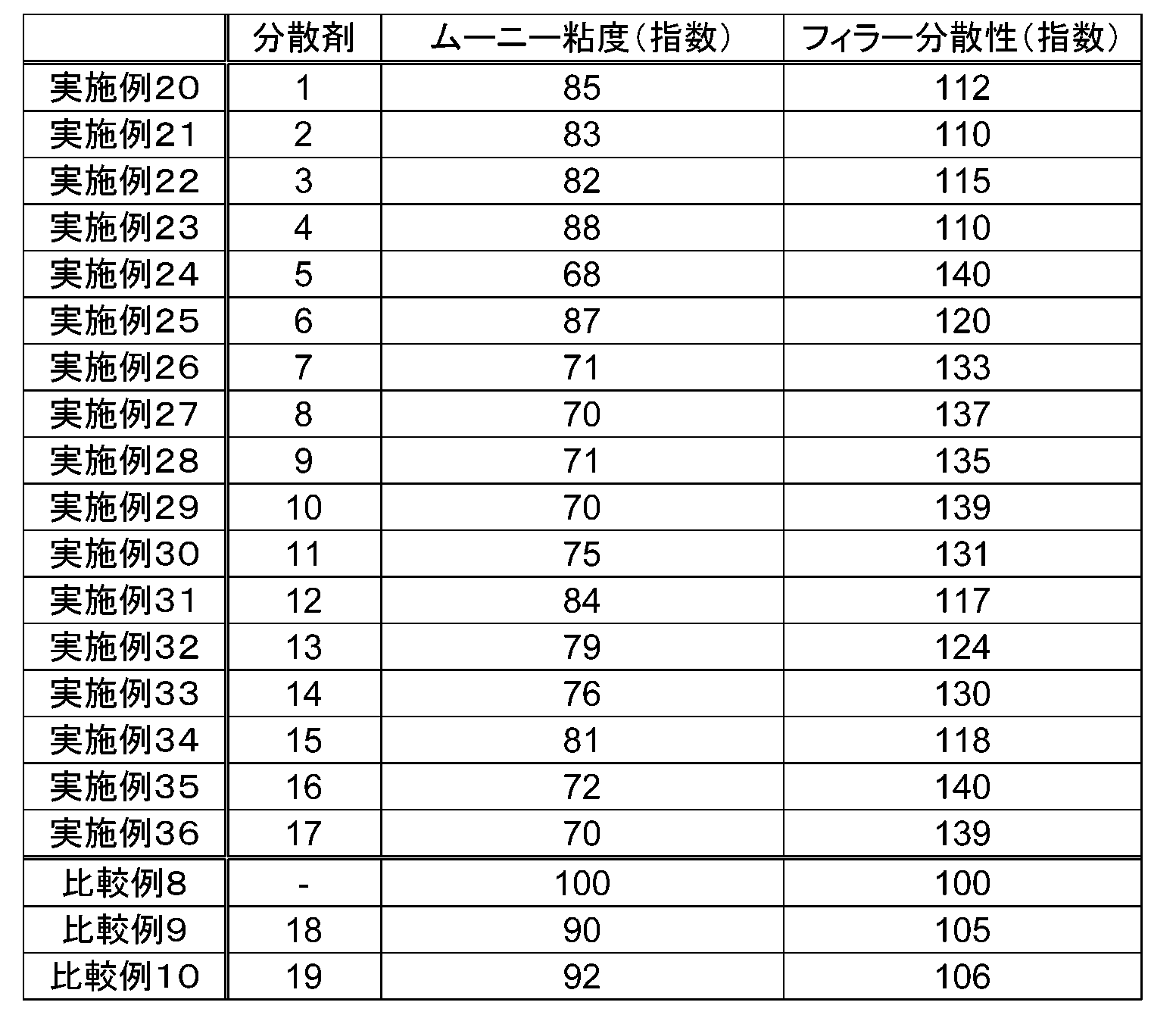
表2に示されるように、カーボンブラックおよびシリカをゴムに分散させる場合において、本実施形態に係る分散剤1~17を用いた実施例20~36であると、分散剤を用いていない比較例8、および比較例に係る分散剤18,19を用いた比較例9,10に対して未加硫ゴムの低粘度化を図ることができ、またフィラーの分散性に優れていた。
以上、本発明のいくつかの実施形態を説明したが、これら実施形態は、例として提示したものであり、発明の範囲を限定することは意図していない。これら実施形態は、その他の様々な形態で実施されることが可能であり、発明の要旨を逸脱しない範囲で、種々の省略、置き換え、変更を行うことができる。これら実施形態やその省略、置き換え、変更などは、発明の範囲や要旨に含まれると同様に、特許請求の範囲に記載された発明とその均等の範囲に含まれるものである。
Claims (5)
- ポリオキシアルキレングリセリルエーテルの脂肪酸エステル(A)を含有するフィラー用分散剤であって、
前記脂肪酸エステル(A)を構成する脂肪酸の炭素数が8~30である、フィラー用分散剤。 - 前記ポリオキシアルキレングリセリルエーテルの脂肪酸エステル(A)を構成する脂肪酸が不飽和脂肪酸を含む、請求項1に記載のフィラー用分散剤。
- 前記ポリオキシアルキレングリセリルエーテルの脂肪酸エステル(A)が、分子内にオキシアルキレン基を平均1~30個有する、請求項1または2に記載のフィラー用分散剤。
- 金属酸化物、金属水酸化物、金属炭酸塩、金属ケイ酸塩およびカーボンブラックからなる群から選択される少なくとも1種のフィラーの分散に用いられる、請求項1~3のいずれか1項に記載のフィラー用分散剤。
- フィラーを樹脂に分散させるために用いられる、請求項1~4のいずれか1項に記載のフィラー用分散剤。
Applications Claiming Priority (2)
| Application Number | Priority Date | Filing Date | Title |
|---|---|---|---|
| JP2018014592A JP7013264B2 (ja) | 2018-01-31 | 2018-01-31 | フィラー用分散剤 |
| JP2018-014592 | 2018-01-31 |
Publications (1)
| Publication Number | Publication Date |
|---|---|
| WO2019150875A1 true WO2019150875A1 (ja) | 2019-08-08 |
Family
ID=67479230
Family Applications (1)
| Application Number | Title | Priority Date | Filing Date |
|---|---|---|---|
| PCT/JP2018/048274 Ceased WO2019150875A1 (ja) | 2018-01-31 | 2018-12-27 | フィラー用分散剤 |
Country Status (3)
| Country | Link |
|---|---|
| JP (1) | JP7013264B2 (ja) |
| TW (1) | TW201938638A (ja) |
| WO (1) | WO2019150875A1 (ja) |
Cited By (1)
| Publication number | Priority date | Publication date | Assignee | Title |
|---|---|---|---|---|
| US20220388338A1 (en) * | 2021-05-26 | 2022-12-08 | Toyo Tire Corporation | Rubber composition for tires and tire |
Families Citing this family (5)
| Publication number | Priority date | Publication date | Assignee | Title |
|---|---|---|---|---|
| JP6997645B2 (ja) * | 2018-01-31 | 2022-01-17 | Toyo Tire株式会社 | タイヤ用ゴム組成物及び空気入りタイヤ |
| JP6997643B2 (ja) * | 2018-01-31 | 2022-01-17 | Toyo Tire株式会社 | タイヤ用ゴム組成物及び空気入りタイヤ |
| JP6997644B2 (ja) * | 2018-01-31 | 2022-01-17 | Toyo Tire株式会社 | タイヤ用ゴム組成物及び空気入りタイヤ |
| JP2022080096A (ja) * | 2020-11-17 | 2022-05-27 | 阪本薬品工業株式会社 | 表面処理剤、無機フィラー組成物及び樹脂組成物 |
| US20250206922A1 (en) * | 2022-03-21 | 2025-06-26 | Schill + Seilacher Struktol Gmbh | Rubber composition containing additive and use thereof |
Citations (7)
| Publication number | Priority date | Publication date | Assignee | Title |
|---|---|---|---|---|
| JPS5531898A (en) * | 1978-08-29 | 1980-03-06 | Nl Industries Inc | Coupling agent for thermosetting combined matter |
| JPH0275677A (ja) * | 1988-09-13 | 1990-03-15 | Nippon Oil & Fats Co Ltd | 被覆剤および被覆された無機質 |
| JPH06126145A (ja) * | 1992-07-01 | 1994-05-10 | Ajinomoto Co Inc | 水中処理用フィラー表面処理剤 |
| JPH07216290A (ja) * | 1994-02-04 | 1995-08-15 | Toyo Ink Mfg Co Ltd | 着色用樹脂組成物 |
| JP2000515180A (ja) * | 1996-07-10 | 2000-11-14 | キャボット コーポレイション | 組成物と生産品 |
| JP2002256113A (ja) * | 2000-12-27 | 2002-09-11 | Bridgestone Corp | ゴム組成物用添加剤,ゴム組成物用添加剤組成物及びそれを用いたゴム組成物並びにタイヤ |
| JP2009263537A (ja) * | 2008-04-25 | 2009-11-12 | Bridgestone Corp | 空気入りタイヤ |
-
2018
- 2018-01-31 JP JP2018014592A patent/JP7013264B2/ja active Active
- 2018-12-27 WO PCT/JP2018/048274 patent/WO2019150875A1/ja not_active Ceased
-
2019
- 2019-01-15 TW TW108101545A patent/TW201938638A/zh unknown
Patent Citations (7)
| Publication number | Priority date | Publication date | Assignee | Title |
|---|---|---|---|---|
| JPS5531898A (en) * | 1978-08-29 | 1980-03-06 | Nl Industries Inc | Coupling agent for thermosetting combined matter |
| JPH0275677A (ja) * | 1988-09-13 | 1990-03-15 | Nippon Oil & Fats Co Ltd | 被覆剤および被覆された無機質 |
| JPH06126145A (ja) * | 1992-07-01 | 1994-05-10 | Ajinomoto Co Inc | 水中処理用フィラー表面処理剤 |
| JPH07216290A (ja) * | 1994-02-04 | 1995-08-15 | Toyo Ink Mfg Co Ltd | 着色用樹脂組成物 |
| JP2000515180A (ja) * | 1996-07-10 | 2000-11-14 | キャボット コーポレイション | 組成物と生産品 |
| JP2002256113A (ja) * | 2000-12-27 | 2002-09-11 | Bridgestone Corp | ゴム組成物用添加剤,ゴム組成物用添加剤組成物及びそれを用いたゴム組成物並びにタイヤ |
| JP2009263537A (ja) * | 2008-04-25 | 2009-11-12 | Bridgestone Corp | 空気入りタイヤ |
Cited By (2)
| Publication number | Priority date | Publication date | Assignee | Title |
|---|---|---|---|---|
| US20220388338A1 (en) * | 2021-05-26 | 2022-12-08 | Toyo Tire Corporation | Rubber composition for tires and tire |
| US12023960B2 (en) * | 2021-05-26 | 2024-07-02 | Toyo Tire Corporation | Rubber composition for tires and tire |
Also Published As
| Publication number | Publication date |
|---|---|
| TW201938638A (zh) | 2019-10-01 |
| JP2019131690A (ja) | 2019-08-08 |
| JP7013264B2 (ja) | 2022-01-31 |
Similar Documents
| Publication | Publication Date | Title |
|---|---|---|
| WO2019150875A1 (ja) | フィラー用分散剤 | |
| EP2327742B1 (en) | Flame retardant resin composition and molded article thereof | |
| JP5193470B2 (ja) | ビス(シラトラニルアルキル)ポリスルフィド等の製造方法およびビス(シラトラニルアルキル)ポリスルフィド等の混合物 | |
| JP7120000B2 (ja) | ニトリルゴム組成物およびゴム架橋物 | |
| US11643522B2 (en) | Polymer composition containing diarylamine-based compound | |
| WO1996019532A1 (en) | Thermoplastic resin composition | |
| JP5505353B2 (ja) | アクリルゴム組成物およびゴム架橋物 | |
| CN103347945A (zh) | 具有改善性能的聚酯组合物 | |
| JP2008239713A (ja) | アクリルゴム組成物および架橋物 | |
| WO2019124462A1 (ja) | ゴム組成物及びゴム成形品 | |
| WO2019150876A1 (ja) | フィラー用分散剤 | |
| JP5163390B2 (ja) | アクリルゴム | |
| JP6983683B2 (ja) | フィラー用分散剤 | |
| JP2011052095A (ja) | ゴム組成物およびそれを用いた空気入りタイヤ | |
| JP7499240B2 (ja) | シラン化合物およびタンパク質変性剤を含んでなるシランカップリング剤組成物、ならびにそれを含むゴム組成物 | |
| EP3438195A1 (en) | Acrylic polymer composition | |
| JP2005054188A (ja) | 改良された流動性を有する水素化ニトリルゴム組成物 | |
| JP2009091592A (ja) | 半導電性ロール用ゴム組成物 | |
| JP7753785B2 (ja) | 架橋性アクリルゴム組成物およびゴム架橋物 | |
| KR101823086B1 (ko) | 지방산 에스테르를 이용한 내오존성과 저마찰 특성이 우수한 자동차용 클로로프렌 고무 조성물 | |
| WO2024090554A1 (ja) | フッ素ゴム架橋用組成物および成形品 | |
| JP2003327752A (ja) | 重合体組成物 | |
| EP3438192A1 (en) | Acrylic polymer composition | |
| JP2004018540A (ja) | 重合体組成物 | |
| JP2008127518A (ja) | 圧縮機用シール部材用アクリルゴム組成物、その架橋体及び圧縮機用シール部材 |
Legal Events
| Date | Code | Title | Description |
|---|---|---|---|
| 121 | Ep: the epo has been informed by wipo that ep was designated in this application |
Ref document number: 18904415 Country of ref document: EP Kind code of ref document: A1 |
|
| NENP | Non-entry into the national phase |
Ref country code: DE |
|
| 122 | Ep: pct application non-entry in european phase |
Ref document number: 18904415 Country of ref document: EP Kind code of ref document: A1 |