WO2019065246A1 - 樹脂組成物及び樹脂膜 - Google Patents
樹脂組成物及び樹脂膜 Download PDFInfo
- Publication number
- WO2019065246A1 WO2019065246A1 PCT/JP2018/033829 JP2018033829W WO2019065246A1 WO 2019065246 A1 WO2019065246 A1 WO 2019065246A1 JP 2018033829 W JP2018033829 W JP 2018033829W WO 2019065246 A1 WO2019065246 A1 WO 2019065246A1
- Authority
- WO
- WIPO (PCT)
- Prior art keywords
- resin
- resin composition
- resin film
- compound
- nitrogen
- Prior art date
- Legal status (The legal status is an assumption and is not a legal conclusion. Google has not performed a legal analysis and makes no representation as to the accuracy of the status listed.)
- Ceased
Links
Classifications
-
- C—CHEMISTRY; METALLURGY
- C08—ORGANIC MACROMOLECULAR COMPOUNDS; THEIR PREPARATION OR CHEMICAL WORKING-UP; COMPOSITIONS BASED THEREON
- C08F—MACROMOLECULAR COMPOUNDS OBTAINED BY REACTIONS ONLY INVOLVING CARBON-TO-CARBON UNSATURATED BONDS
- C08F265/00—Macromolecular compounds obtained by polymerising monomers on to polymers of unsaturated monocarboxylic acids or derivatives thereof as defined in group C08F20/00
- C08F265/04—Macromolecular compounds obtained by polymerising monomers on to polymers of unsaturated monocarboxylic acids or derivatives thereof as defined in group C08F20/00 on to polymers of esters
-
- C—CHEMISTRY; METALLURGY
- C08—ORGANIC MACROMOLECULAR COMPOUNDS; THEIR PREPARATION OR CHEMICAL WORKING-UP; COMPOSITIONS BASED THEREON
- C08F—MACROMOLECULAR COMPOUNDS OBTAINED BY REACTIONS ONLY INVOLVING CARBON-TO-CARBON UNSATURATED BONDS
- C08F216/00—Copolymers of compounds having one or more unsaturated aliphatic radicals, each having only one carbon-to-carbon double bond, and at least one being terminated by an alcohol, ether, aldehydo, ketonic, acetal or ketal radical
- C08F216/12—Copolymers of compounds having one or more unsaturated aliphatic radicals, each having only one carbon-to-carbon double bond, and at least one being terminated by an alcohol, ether, aldehydo, ketonic, acetal or ketal radical by an ether radical
- C08F216/125—Monomers containing two or more unsaturated aliphatic radicals, e.g. trimethylolpropane triallyl ether or pentaerythritol triallyl ether
-
- C—CHEMISTRY; METALLURGY
- C08—ORGANIC MACROMOLECULAR COMPOUNDS; THEIR PREPARATION OR CHEMICAL WORKING-UP; COMPOSITIONS BASED THEREON
- C08G—MACROMOLECULAR COMPOUNDS OBTAINED OTHERWISE THAN BY REACTIONS ONLY INVOLVING UNSATURATED CARBON-TO-CARBON BONDS
- C08G59/00—Polycondensates containing more than one epoxy group per molecule; Macromolecules obtained by polymerising compounds containing more than one epoxy group per molecule using curing agents or catalysts which react with the epoxy groups
- C08G59/18—Macromolecules obtained by polymerising compounds containing more than one epoxy group per molecule using curing agents or catalysts which react with the epoxy groups ; e.g. general methods of curing
- C08G59/20—Macromolecules obtained by polymerising compounds containing more than one epoxy group per molecule using curing agents or catalysts which react with the epoxy groups ; e.g. general methods of curing characterised by the epoxy compounds used
-
- C—CHEMISTRY; METALLURGY
- C08—ORGANIC MACROMOLECULAR COMPOUNDS; THEIR PREPARATION OR CHEMICAL WORKING-UP; COMPOSITIONS BASED THEREON
- C08K—Use of inorganic or non-macromolecular organic substances as compounding ingredients
- C08K5/00—Use of organic ingredients
- C08K5/04—Oxygen-containing compounds
- C08K5/06—Ethers; Acetals; Ketals; Ortho-esters
-
- C—CHEMISTRY; METALLURGY
- C08—ORGANIC MACROMOLECULAR COMPOUNDS; THEIR PREPARATION OR CHEMICAL WORKING-UP; COMPOSITIONS BASED THEREON
- C08K—Use of inorganic or non-macromolecular organic substances as compounding ingredients
- C08K5/00—Use of organic ingredients
- C08K5/04—Oxygen-containing compounds
- C08K5/15—Heterocyclic compounds having oxygen in the ring
- C08K5/151—Heterocyclic compounds having oxygen in the ring having one oxygen atom in the ring
- C08K5/1515—Three-membered rings
-
- C—CHEMISTRY; METALLURGY
- C08—ORGANIC MACROMOLECULAR COMPOUNDS; THEIR PREPARATION OR CHEMICAL WORKING-UP; COMPOSITIONS BASED THEREON
- C08K—Use of inorganic or non-macromolecular organic substances as compounding ingredients
- C08K5/00—Use of organic ingredients
- C08K5/16—Nitrogen-containing compounds
- C08K5/34—Heterocyclic compounds having nitrogen in the ring
- C08K5/3467—Heterocyclic compounds having nitrogen in the ring having more than two nitrogen atoms in the ring
- C08K5/3472—Five-membered rings
- C08K5/3475—Five-membered rings condensed with carbocyclic rings
-
- C—CHEMISTRY; METALLURGY
- C08—ORGANIC MACROMOLECULAR COMPOUNDS; THEIR PREPARATION OR CHEMICAL WORKING-UP; COMPOSITIONS BASED THEREON
- C08L—COMPOSITIONS OF MACROMOLECULAR COMPOUNDS
- C08L101/00—Compositions of unspecified macromolecular compounds
- C08L101/02—Compositions of unspecified macromolecular compounds characterised by the presence of specified groups, e.g. terminal or pendant functional groups
- C08L101/06—Compositions of unspecified macromolecular compounds characterised by the presence of specified groups, e.g. terminal or pendant functional groups containing oxygen atoms
- C08L101/08—Carboxyl groups
-
- C—CHEMISTRY; METALLURGY
- C08—ORGANIC MACROMOLECULAR COMPOUNDS; THEIR PREPARATION OR CHEMICAL WORKING-UP; COMPOSITIONS BASED THEREON
- C08L—COMPOSITIONS OF MACROMOLECULAR COMPOUNDS
- C08L63/00—Compositions of epoxy resins; Compositions of derivatives of epoxy resins
Definitions
- the present invention relates to a resin composition and a resin film, and more particularly to a resin composition and a resin film containing a carboxyl group-containing resin.
- Various display elements such as organic EL elements and liquid crystal display elements, integrated circuit elements, solid-state imaging elements, and electronic parts such as color filters and black matrices are protective films for preventing deterioration or damage, element surfaces
- Various resin films are provided as a planarizing film for planarizing the surface of a substrate having a wiring, an electrical insulating film for maintaining electrical insulation, and the like.
- a resin film as a pixel separation film is provided in order to separate the light emitting body portion.
- a resin film as an interlayer insulating film is provided in order to insulate between the wirings arranged in layers.
- Patent Document 1 proposes a negative photosensitive resin composition comprising a cyclic olefin polymer having a protic polar group, an unsaturated group-containing compound, and a radical generating photopolymerization initiator. According to this resin composition, it is possible to form a resin film which is excellent in pattern formability by development, transparency, and heat resistance, and in which generation of outgas is suppressed.
- materials such as glass have been generally used as a substrate of a display element.
- the resin film is cured at a high curing temperature of, for example, 200 ° C. or more to accelerate the curing reaction and make the resin film rich in chemical resistance. It was possible to form.
- a flexible plastic film or the like as a substrate instead of a glass substrate.
- the heat resistance of the plastic substrate is lower than the heat resistance of the glass substrate. Therefore, in order to form a resin film on a plastic substrate, it is necessary to lower the curing temperature when curing the resin film. Therefore, development of a resin composition capable of forming a resin film having high chemical resistance even under low temperature curing conditions is required.
- the present invention provides a resin composition which is compatible with securing the storage stability of the resin composition itself and enhancing the chemical resistance of the obtained resin film.
- the purpose is Another object of the present invention is to provide a resin film having excellent chemical resistance.
- the present inventors diligently studied for the purpose of solving the above-mentioned problems. Then, when the present inventors coexist a resin having a predetermined functional group, a polyfunctional vinyl ether compound, and a predetermined nitrogen-containing condensed heterocyclic compound in the resin composition, the resin composition itself is preserved. The inventors have newly found that compatibility between securing stability and enhancing the chemical resistance of a resin film obtained using such a resin composition has been newly found, and the present invention has been completed.
- the object of the present invention is to advantageously solve the above-mentioned problems, and the resin composition of the present invention comprises a carboxyl group-containing resin, a polyfunctional vinyl ether compound, and a nitrogen-containing nitrogen-containing resin having 3 atoms. And a fused heterocyclic compound.
- the nitrogen-containing fused heterocyclic compound is preferably a benzotriazole-based compound. If the resin composition contains a benzotriazole-based compound, it is possible to achieve both better preservation of the storage stability of the resin composition itself and enhancement of the chemical resistance of the obtained resin film. .
- the resin composition of this invention further contains a polyfunctional epoxy compound. If the resin composition further contains a polyfunctional epoxy compound, the crack resistance of the resulting resin film can be further improved.
- the said polyfunctional epoxy compound has an alicyclic epoxy group. If the polyfunctional epoxy compound contained in the resin composition has an alicyclic epoxy group, the crack resistance of the obtained resin film can be further improved.
- the carboxyl group-containing resin is a resin containing a cyclic olefin monomer unit. If the resin composition is a resin containing cyclic olefin monomer units, the amount of outgassing from the obtained resin film can be suppressed, and the water absorbency of the obtained resin film can be reduced.
- the resin composition of this invention contains the said nitrogen-containing fused heterocyclic compound in the ratio of 1 mass part or more with respect to 100 mass parts of said carboxyl group-containing resin. If the content ratio of the nitrogen-containing fused heterocyclic compound having 3 nitrogen atoms is not less than the above lower limit value, the crack resistance of the obtained resin film can be further improved.
- the present invention has an object to advantageously solve the above-mentioned problems, and the resin film of the present invention is characterized by being formed using any of the above-mentioned resin compositions. Since the resin film of the present invention is formed using the resin composition of the present invention, it is excellent in chemical resistance.
- the present invention it is possible to provide a resin composition which is compatible with securing the storage stability of the resin composition itself and enhancing the chemical resistance of the obtained resin film. Further, according to the present invention, a resin film having excellent chemical resistance can be provided.
- the resin composition of the present invention can be suitably applied to various elements, parts, and the like to form a resin film that can function as a protective film, a planarization film, an insulating film, and the like.
- the resin composition of the present invention is characterized by containing a carboxyl group-containing resin, a polyfunctional vinyl ether compound, and a nitrogen-containing fused heterocyclic compound having 3 nitrogen atoms. Securing the storage stability of the resin composition itself by blending a carboxyl group-containing resin, a polyfunctional vinyl ether compound, and a nitrogen-containing condensed heterocyclic compound having 3 nitrogen atoms in the resin composition; It can be compatible with improving the chemical resistance of the resin film obtained by using such a resin composition.
- the reactivity between the carboxyl group contained in the carboxyl group-containing resin and the polyfunctional vinyl ether compound is good, and the nitrogen-containing fused heterocyclic compound having 3 nitrogen atoms exhibits appropriate basicity.
- the carboxyl group contained in the resin and the polyfunctional vinyl ether compound can start the reaction at a low temperature, and the nitrogen-containing fused heterocyclic compound which is basic promotes such reaction. It is thought that acting as it works. From these reasons, it is presumed that according to the resin composition of the present invention, a resin film having good chemical resistance can be formed. Furthermore, the resin composition of the present invention preferably further comprises a polyfunctional epoxy compound.
- each component contained in a resin composition is demonstrated.
- the carboxyl group-containing resin is not particularly limited as long as it is constituted by a polymer having a carboxyl group, and any resin can be used.
- Examples of such carboxyl group-containing resin include (co) polymers containing a carboxyl group-containing monomer unit (hereinafter also referred to as "carboxyl group-containing monomer unit").
- (co) polymer means a polymer or a copolymer.
- the (co) polymer containing a carboxyl group-containing monomer unit is formed, for example, using an ethylenically unsaturated carboxylic acid monomer and a derivative thereof, and a carboxyl group-containing cyclic olefin monomer and a derivative thereof ( Co) polymers are mentioned.
- Ethylenically unsaturated carboxylic acid monomers include ethylenically unsaturated monocarboxylic acids and their derivatives, ethylenically unsaturated dicarboxylic acids and their acid anhydrides and their derivatives.
- Examples of ethylenically unsaturated monocarboxylic acids include (meth) acrylic acid and crotonic acid.
- (meth) acrylic acid means acrylic acid or methacrylic acid.
- examples of the derivative of the ethylenically unsaturated monocarboxylic acid include acrylic acid esters such as methyl acrylate, ethyl acrylate, butyl acrylate, methyl methacrylate, ethyl methacrylate, 2-ethylhexyl acrylate and the like.
- examples of ethylenically unsaturated dicarboxylic acids include maleic acid, fumaric acid and itaconic acid.
- cyclic olefin monomer for example, 5-hydroxycarbonylbicyclo [2.2.1] hept-2-ene, 5-methyl-5-hydroxycarbonylbicyclo [2.2.1] hept-2 -Ene, 5-carboxymethyl-5-hydroxycarbonylbicyclo [2.2.1] hept-2-ene, 5,6-dihydroxycarbonylbicyclo [2.2.1] hept-2-ene, 4-hydroxycarbonyl Tetracyclo [6.2.1.1 3, 6 . 0 2,7 ] dodec-9-ene, 9-methyl-9-hydroxycarbonyltetracyclo [6.2.1.1 3,6 . 0 2,7 ] dodec-4-ene and 9,10-dihydroxycarbonyltetracyclo [6.2.1.1 3,6 . 0 2,7 ] dodec-4-ene and the like.
- the (co) polymer containing a carboxyl group-containing monomer unit may be a polymer composed of one of the above monomers, or the above monomers and these monomers And copolymers with other monomers copolymerizable therewith.
- an N-substituted imide group which can be represented by the following formula (A) as disclosed in JP-A-2015-25892 Cyclic olefin monomer, cyclic olefin monomer having an oxygen-containing group such as ester group or acid anhydride group, cyclic olefin monomer having a nitrogen-containing group such as cyano group, cyclic olefin monomer having a sulfonyl group And cyclic olefin monomers having a silyl group or cyclic olefin monomers having a halogen atom.
- A N-substituted imide group which can be represented by the following formula (A) as disclosed in JP-A-2015-25892 Cyclic olefin monomer, cyclic olefin monomer having an oxygen-containing group such as ester group or acid anhydride group, cyclic olefin monomer having a nitrogen-containing group such as cyano group
- X represents a hydrogen atom or a linear, cyclic or branched alkyl group having 1 to 16 carbon atoms, or an aryl group such as a benzyl group, and n is 1 or 2.
- the proportion of the carboxyl group-containing monomer unit is 10 mass, based on 100% by mass of all monomer units constituting the (co) polymer. % Or more, preferably 15% by mass or more, and may be 100% by mass.
- the proportion of the carboxyl group-containing monomer unit in the (co) polymer can be measured by 1 H-NMR or the like.
- the (co) polymer containing a carboxyl group-containing monomer unit is, for example, an acrylic resin constituted by a polymer obtained using the above-mentioned acrylic acid ester monomer; And polyamide resins, polyester resins, polyurethane resins, polyolefin resins, and polymers composed of (co) polymers that can be obtained using the above-mentioned carboxyl group-containing monomer and any other monomer. It may be cycloolefin resin, and polysiloxane resin.
- a polycycloolefin resin is preferable as the carboxyl group-containing resin because the amount of outgas can be suppressed and the water absorption is low.
- the polycycloolefin resin is a resin containing cyclic olefin monomer units.
- the cyclic olefin monomer unit includes the carboxyl group-containing cyclic olefin monomer unit as described above and the other cyclic olefin monomer units.
- polycycloolefin resin which is a carboxyl group-containing resin
- a resin containing a carboxyl group-containing cyclic olefin monomer unit is more preferable, and a carboxyl group-containing cyclic olefin monomer unit and the above-mentioned formula (A)
- resins comprising cyclic olefin monomer units having the N-substituted imide group which is represented.
- 4-hydroxycarbonyltetracyclo [6.2.1.13 , 6 .
- TCDC dodeca-9-ene
- NBPI carboximide
- the content ratio of cyclic olefin monomer units in the resin containing cyclic olefin monomer units constitutes the resin
- the total monomer unit content is preferably 100% by mass, more preferably 50% by mass, more preferably 70% by mass, still more preferably 90% by mass, and 100% by mass of cyclic olefins It may be a monomer unit.
- the content ratio of the carboxyl group-containing cyclic olefin monomer unit is the total unit amount constituting the resin It is preferable that it is 100 mass%, and it is more than 40 mass%, It is more preferable that it is 55 mass%, and less than 100 mass% is preferable.
- the proportion of each monomer unit in the resin containing cyclic olefin monomer units can be measured by 1 H-NMR.
- the (co) polymer containing a carboxyl group-containing monomer unit a commercially available product or a (co) polymer produced according to a known production method can be used.
- the production method is not particularly limited, and any method such as a solution polymerization method, a suspension polymerization method, a bulk polymerization method, and an emulsion polymerization method can be used.
- polymerization mode addition polymerization such as ionic polymerization, radical polymerization, living radical polymerization and ring-opening polymerization can be adopted.
- a polymerization initiator a known polymerization initiator can be used as a polymerization initiator.
- various cyclic olefin monomers are polymerized according to a method using a known ring-opening polymerization catalyst and additives as described in, for example, JP-A-2015-25892 (co )
- the (co) polymer may be hydrogenated in the presence of a known hydrogenation catalyst.
- a vinyl ether compound having a functional group number of 2 or more can be used as a polyfunctional vinyl ether compound.
- the number of functional groups of the polyfunctional vinyl ether compound, that is, the number of vinyl ether structures contained in one molecule is preferably 2 or more, and more preferably 2 or more and 5 or less.
- vinyl ether compound having 2 functional groups examples include 1,4-butanediol divinyl ether, neopentyl glycol divinyl ether, 1,4-cyclohexanedimethanol divinyl ether, diethylene glycol divinyl ether, triethylene glycol divinyl ether, dipropylene glycol Divinyl ether and cyclohexanediol divinyl ether can be mentioned. Among them, 1,4-butanediol divinyl ether, 1,4-cyclohexanedimethanol divinyl ether, diethylene glycol divinyl ether, and cyclohexanediol divinyl ether are preferable. Moreover, as a vinyl ether compound having a functional group number of 3, trimethylolpropane trivinyl ether and trimethylolpropane ethoxylate trivinyl ether are preferable.
- the nitrogen-containing fused heterocyclic compound having 3 nitrogen atoms is a compound containing 3 nitrogen atoms in the constituent atoms of the fused heterocycle.
- the “nitrogen-containing fused heterocyclic compound having 3 nitrogen atoms” is not particularly limited as long as the constituent atoms of one fused heterocycle contain 3 nitrogen atoms, and may include any compound. More specifically, the “nitrogen-containing fused heterocyclic compound having 3 nitrogen atoms” may contain two or more fused heterocyclic rings containing three nitrogen atoms in the constituent atoms in one compound.
- the nitrogen atom may be contained in a structure other than the nitrogen-containing fused heterocyclic structure constituting the compound.
- Examples of the nitrogen-containing fused heterocyclic compound having 3 nitrogen atoms include a compound that can be represented by the following general formula (1), and a compound that has a structure that can be represented by the following general formula (1).
- any three of G 1 to G 9 are nitrogen atoms, the others are carbon atoms, R 1 is a hydrogen atom or an organic group, R 2 is a hydrogen atom, halogen It is a group, a carboxyl group, or an alkyl group having 1 to 5 carbon atoms.
- the organic group which may be R 1 contained in the formula (1) is a phenol group which may have one or more substituents, and carbon which may have one or more substituents. It may be a linear or branched alkyl group of 1 to 10.
- a substituent of the phenol group which may have one or more substituents an alkyl group having 1 to 10 carbon atoms, 3,4,5,6-tetrahydro-N-methylphthalimide group, And 1-methyl-1-phenylethyl group.
- substituent of the linear or branched alkyl group having 1 to 10 carbon atoms which may have one or more substituents include a hydroxyl group and the like.
- the compound which may be a nitrogen-containing fused heterocyclic compound having 3 nitrogen atoms may be a compound having the structures [1] and [1] ′ which can be represented by the above formula (1). Specifically, such a compound has two structures [1] and [1] ′ (wherein structures [1] and [1] ′ are both particularly limited as long as they can be represented by the above formula (1)). And C 1 to C 10 alkylene group (—C m H 2 m ⁇ ; where m is an integer of 1 to 10); formed by interconnected by), the general formula (2): [1] -C m H 2m - may be a compound that may be represented by [1] '.
- the alkylene group having 1 to 10 carbon atoms, which is a linking group is bonded to each R 1 contained in the structures [1] and [1] ′.
- benzotriazoles in which G 1 to G 3 are nitrogen atoms and G 4 to G 9 are carbon atoms in the above formulas (1) and (2) Preferred are compounds. If the resin composition contains a benzotriazole-based compound, it is possible to more effectively ensure the storage stability of the resin composition itself and to enhance the chemical resistance of the obtained resin film. it can.
- benzotriazole compounds satisfying the above formula (1) include 1H-benzotriazole-1-methanol, 1,2,3-benzotriazole (manufactured by Johoku Chemical Co., Ltd., “BT-120”), 2- (2) '-Hydroxy-5'-methylphenyl) benzotriazole (manufactured by Johoku Chemical, "JF-77”), 2- (2'-hydroxy-3'-tert-butyl-5'-methylphenyl) -5-chloro Benzotriazole (manufactured by Johoku Chemical, "JF-79”), 2- (2'-hydroxy-3 ', 5'-di-tert-amylphenyl) benzotriazole (manufactured by Johoku Chemical, "JF-80”) , 2- (2′-hydroxy-5′-tert-octylphenyl) benzotriazole (manufactured by Johoku Chemical, “JF-83”), 2- [2-hydroxy-3- (3-
- the content of the nitrogen-containing fused heterocyclic compound in the resin composition is preferably 1 part by mass or more, more preferably 2 parts by mass or more, preferably 100 parts by mass of the carboxyl group-containing resin. It is less than 20 parts by mass, more preferably 15 parts by mass or less, still more preferably 10 parts by mass or less, and particularly preferably 7 parts by mass or less. If the content ratio of the nitrogen-containing fused heterocyclic compound having 3 nitrogen atoms is not less than the above lower limit value, the crack resistance of the obtained resin film can be further improved.
- the resin film can be favorably formed by suppressing the viscosity of the resin composition from excessively increasing. it can.
- the polyfunctional epoxy compound is not particularly limited, and includes compounds having two or more epoxy groups in one molecule.
- the crack resistance of the obtained resin film can be further improved. It is presumed that this is because the polyfunctional epoxy compound present in the resin composition can appropriately suppress an increase in internal stress due to the carboxylic acid and the polyfunctional vinyl ether in the resin film.
- Examples of compounds having two or more epoxy groups in one molecule include epoxidized butanetetracarboxylic acid tetrakis (3-cyclohexenylmethyl) modified ⁇ -caprolactone, tris (2,3-epoxypropyl) isocyanurate, 1,4- Butanediol diglycidyl ether, 1,2-epoxy-4- (epoxyethyl) cyclohexane, glycerol triglycidyl ether, diethylene glycol diglycidyl ether, 2,6-diglycidyl phenyl glycidyl ether, 1,1,3-tris [p- (2,3-Epoxypropoxy) phenyl] propane, 1,2-cyclohexanedicarboxylic acid diglycidyl ester, 4,4′-methylene bis (N, N-diglycidyl aniline), 3,4-epoxycyclohexylmethyl-3,4 -Epoki
- EPOID GT-401 EPOID GT-401, GT-403, GT-301, GT-302, Celoxide 2021, Celoxide 3000 (manufactured by Daicel Corporation); jER1001, jER1002, jER1003, jER1004, jER1007, jER1009.
- the polyfunctional epoxy compound preferably has an alicyclic epoxy group.
- the number of alicyclic epoxy groups contained in the polyfunctional epoxy compound is preferably 2 or more, more preferably 3 or more, still more preferably 4 or more, and usually 6 or less. It is.
- epoxidized butanetetracarboxylic acid tetrakis (3-cyclohexenylmethyl) modified ⁇ -caprolactone (the number of alicyclic epoxy groups: 4) is preferable.
- the number of alicyclic epoxy groups contained in the polyfunctional epoxy compound is a unit structure (one molecule) per unit structure (one molecule) when the polyfunctional epoxy compound is a polymer composed of a repeating structural unit containing an alicyclic epoxy group. Means the number of alicyclic epoxy groups.
- the resin composition of the present invention may contain optional components such as a silane coupling agent, an antioxidant, and a surfactant.
- optional components known ones can be used (see, for example, WO 2015/033901 and JP-A-2015-25892). And content of these additives can also be suitably adjusted within a general range, unless the effect of the present invention is spoiled.
- solvents that may be contained in the resin composition of the present invention known organic solvents used for preparation of the resin composition can be used (see, for example, WO 2015/033901). Among them, solvents containing diethylene glycols such as diethylene glycol monomethyl ether, diethylene glycol monoethyl ether, diethylene glycol dimethyl ether, diethylene glycol diethyl ether, diethylene glycol ethyl methyl ether can be suitably used.
- the method for preparing the resin composition of the present invention is not particularly limited, and each component constituting the resin composition may be mixed by a known method.
- the method of mixing is not particularly limited, and it is possible to obtain a solution or dispersion in which each component is dissolved or dispersed in a solvent by adding and mixing each component constituting the resin composition to the solvent. it can.
- a mixing method using stirring using a stirrer, a high speed homogenizer, a disper, a planetary stirrer, a twin screw stirrer, a ball mill, a triple roll, etc. may be mentioned.
- the solution or dispersion obtained by mixing may be filtered using, for example, a filter having a pore diameter of about 0.45 ⁇ m.
- the resin film of the present invention is characterized by being formed using the resin composition of the present invention. Since the resin film of the present invention is formed using the resin composition of the present invention, it is excellent in chemical resistance.
- the resin film of the present invention can be formed by applying the resin composition of the present invention on a desired substrate. That is, the resin film of the present invention is a dried product of the above-described resin composition of the present invention, and generally, at least a carboxyl group-containing resin, a polyfunctional vinyl ether compound, and a nitrogen-containing fused heterocyclic compound having 3 nitrogen atoms. Contains Furthermore, it is preferable that the resin film of this invention contains a polyfunctional epoxy compound.
- the suitable abundance ratio of those each component is with the suitable abundance ratio of each component in a resin composition. It is the same.
- the polyfunctional vinyl ether compound contained in the resin film, the polyfunctional epoxy compound which may optionally be contained, etc. may be crosslinked at the time of the crosslinking treatment which can be optionally carried out.
- the resin film may contain the cross-linked product of the above-mentioned polyfunctional vinyl ether compound and polyfunctional epoxy compound.
- the substrate for example, a printed wiring board, a silicon wafer substrate, a glass substrate, a plastic substrate or the like can be used. Further, a substrate obtained by forming a thin transistor type liquid crystal display element, a color filter, a black matrix or the like on a glass substrate or a plastic substrate used in the display field is also suitably used. Among them, since the resin composition of the present invention can be cured at a low temperature, the resin film of the present invention formed using such a resin composition can be suitably provided on a plastic substrate.
- the application method is, for example, a method of removing the solvent after applying the resin composition on a substrate such as a plastic substrate.
- a method of applying the resin composition for example, various methods such as a spray method, a spin coating method, a roll coating method, a die coating method, a doctor blade method, a spin coating method, a bar coating method, and a screen printing method are employed. be able to.
- the solvent can be removed, for example, by drying.
- the drying conditions vary depending on the type of each component, the blending ratio, the heat resistance temperature of the substrate such as a plastic substrate, etc., but usually the temperature conditions of 30 ° C. to 150 ° C., preferably 60 ° C.
- the resin composition of the present invention can be 0.5 minutes to 90 minutes, preferably 1 minute to 60 minutes, and more preferably 1 minute to 30 minutes. According to the resin composition of the present invention, a resin film having excellent chemical resistance can be obtained even when the temperature at the time of drying is equal to or lower than the upper limit. Moreover, if the temperature at the time of drying is made more than the above-mentioned lower limit, the chemical resistance of the resin film can be sufficiently improved.
- the solvent is removed to obtain a resin film, and the obtained resin film is laminated on a substrate to obtain a substrate having a resin film. It is a method to form.
- the solvent can be removed, for example, by drying. Drying conditions can be suitably selected according to the kind and compounding ratio of each component. Drying conditions can be usually set to temperature conditions of 30 ° C. or more and 150 ° C. or less for 0.5 minutes or more and 90 minutes or less.
- a pressure bonding machine such as a pressure laminator, a press, a vacuum laminator, a vacuum press, a roll laminator or the like can be used.
- the thickness of a resin film is preferably 0.1 ⁇ m to 100 ⁇ m, more preferably 0.5 ⁇ m to 50 ⁇ m, still more preferably 0.5 ⁇ m to 30 ⁇ m, and particularly preferably 0.5 ⁇ m to 10 ⁇ m.
- the resin composition of the present invention even when the thickness of the resin film is relatively thin, chemical resistance can be sufficiently improved.
- a crosslinking process can be performed about the resin film formed of the above-mentioned application method or film lamination method as needed.
- the crosslinking treatment is not particularly limited, and can be performed by a general method as disclosed in, for example, JP-A-2015-25892.
- the resin film of the present invention preferably has a light transmittance of 95% or more at a wavelength of 400 nm when measured without passing through the bleaching exposure step.
- the light transmittance can be measured, for example, according to the method described in the examples.
- the resin film of the present invention can achieve the high light transmittance as described above without performing a so-called bleaching exposure step.
- a bleaching exposure process means the operation for exposing this resin film to overexposure conditions, and fading a colored resin film.
- the resin film formed under a given condition is 100 J in terms of the exposure dose of g-line (wavelength 436 nm), h-line (wavelength 405 nm), or i-line (wavelength 365 nm) It means a process of exposing to light of a light amount in the range of from / m 2 to 20,000 J / m 2 .
- ⁇ Storage stability of resin composition The viscosities of the resin compositions prepared in Examples and Comparative Examples were measured with an E-type viscometer according to "10 Viscosity Method with a Conical Plate-Type Rotational Viscometer" described in JIS Z 8803: 2011. The viscosity of the resin composition immediately after preparation was V0. In addition, the resin composition was sealed in a light shielding bottle, and the viscosity V1 of the resin composition after stored for 1 week in a clean room (temperature 23 ° C., humidity 45%) was measured in the same manner. Then, the viscosity change rate (%) was calculated according to the formula:
- ⁇ Chemical resistance of resin film> The resin composition prepared in Examples and Comparative Examples is applied onto a silicon wafer substrate by spin coating, and heat dried (prebaked) at 90 ° C. for 2 minutes using a hot plate to pre-bake a film thickness of 2.0 ⁇ m. A finished resin film was formed. Next, the resin film was subjected to post-baking in an air atmosphere at 130 ° C. for 20 minutes using an oven to obtain a laminate of a silicon wafer substrate having a post-baked resin film on the surface. The laminated body obtained as described above is used as a test body, and is immersed in 200 ml of chemical for 5 minutes, and the ratio of the film thickness after immersion when the film thickness before immersion is 100% (%) Was calculated.
- a Cu thin film with a film thickness of 100 nm was formed on a glass substrate (Corning Inc., product name: Corning 1737) using a sputtering apparatus.
- the Cu thin film was patterned using a photoresist to prepare a comb electrode substrate having a Cu wiring width of 7 ⁇ m and a wiring distance of 7 ⁇ m.
- the resin compositions prepared in Examples and Comparative Examples are applied by spin coating onto the comb electrode substrate, and heat dried (prebaked) at 90 ° C. for 2 minutes using a hot plate to give a film thickness of 2.0 ⁇ m.
- a resin film was formed.
- the resin film is subjected to post-baking heating at 130 ° C.
- the resin composition obtained in the example is applied on a glass substrate (Corning Inc., product name Corning 1737) by a spin coating method, and dried by heating (prebaking) at 90 ° C. for 2 minutes using a hot plate. A resin film of 2.0 ⁇ m was formed. Then, using an oven, post-baking was performed by heating at 130 ° C. for 20 minutes in an air atmosphere to obtain a laminate of the resin film and the glass substrate. The obtained laminate was measured at a wavelength of 400 nm to 800 nm using a spectrophotometer V-560 (manufactured by JASCO Corporation). The light transmittance (%) at 400 nm was calculated from the measurement results. In addition, the light transmittance (%) of the resin film was computed by the conversion value in case the thickness of a resin film is 2.0 micrometers by using as a blank the glass substrate to which the resin film is not attached.
- Example 1 Preparation of Carboxyl Group-Containing Resin> 31.5 mol% of N-phenylbicyclo [2.2.1] hept-5-ene-2,3-dicarboximide (NBPI), which is a cyclic olefin monomer having an N-substituted imide group, and carboxyl 4-hydroxy carbonyl tetracyclo [6.2.1.1 3, 6 .
- NBPI N-phenylbicyclo [2.2.1] hept-5-ene-2,3-dicarboximide
- the obtained polymerization reaction solution is put into an autoclave, and the hydrogenation reaction is carried out by stirring for 5 hours under the conditions of 150 ° C. and hydrogen pressure 4 MPa, and a carboxyl group-containing compound composed of an alicyclic olefin copolymer A solution containing a polyolefin resin was obtained.
- the polymerization conversion ratio of the above-mentioned alicyclic olefin copolymer is 99.9%
- the polystyrene conversion weight average molecular weight is 5,280
- the number average molecular weight is 3,490
- the molecular weight distribution is 1.51
- the hydrogenation ratio is 99.9 %Met.
- solid content concentration of the solution containing carboxyl group-containing polyolefin resin was 32.0 mass%.
- ⁇ Preparation of Resin Composition 100 parts of the carboxyl group-containing polyolefin resin obtained above, 40 parts of 1,4-cyclohexanedimethanol divinyl ether as a polyfunctional vinyl ether compound (manufactured by Nippon Carbide Co., Ltd., “CHDVE”), epoxidation as a polyfunctional epoxy compound Butanetetracarboxylic acid tetrakis (3-cyclohexenylmethyl) modified ⁇ -caprolactone (manufactured by Daicel Chemical Industries, Ltd .: Epolide GT 401) 40 parts, nitrogen-containing condensed heterocyclic compound having 3 nitrogen atoms 1H-as a benzotriazole based compound 5 parts of benzotriazole-1-methanol (made by Tokyo Chemical Industry Co., Ltd.), 2 parts of glycidoxypropyltrimethoxysilane (made by XIAMETER: OFS 6040) as a silane coupling agent, pent
- Example 2 A resin composition was prepared in the same manner as in Example 1 except that the compounding amount of the benzotriazole compound was changed to 5 parts, and various evaluations and the like were performed. The results are shown in Table 1.
- Example 3 1,4-butanediol divinyl ether (BDVE) was used as the polyfunctional vinyl ether compound.
- DEGDVE diethylene glycol divinyl ether
- Example 5 trimethylolpropane ethoxylate trivinyl ether was used as the polyfunctional vinyl ether compound.
- Example 6 trimethylolpropane trivinyl ether was used as the polyfunctional vinyl ether compound.
- cyclohexanediol divinyl ether (CHODVE) was used as the polyfunctional vinyl ether compound.
- a resin composition was prepared in the same manner as in Example 2 except for these points, and various evaluations and the like were performed. The results are shown in Table 1.
- Example 8 A resin composition was prepared in the same manner as in Example 2 except that the polyfunctional epoxy compound was not blended, and various evaluations and the like were performed. The results are shown in Table 1.
- Example 8 A resin composition was prepared in the same manner as in Example 2 except that monofunctional monovinyl ether compounds shown in Table 1 were respectively blended in place of the polyfunctional vinyl ether compound, and various evaluations and the like were performed. The results are shown in Table 1. In these examples, the chemical resistance of the obtained resin film was low, and cracks were generated by immersion in acetone, so that the insulation reliability was not evaluated.
- GT401 is an epoxidized butanetetracarboxylic acid tetrakis (3-cyclohexenylmethyl) modified ⁇ -caprolactone (manufactured by Daicel Chemical Industries, Ltd .
- TPA520 is a compound of 4,4 ′-[1- [4- [1-hydroxyphenyl] -1-methylethyl] phenyl] ethylidene] bisphenol and 6-diazo-5,6-dihydro-5-oxo Ester (2.0 molar) with 2-naphthalene-1-sulfonic acid (1,2-naphthoquinonediazide-5-sulfonic acid chloride),
- OFFS6040 is glycidoxypropyltrimethoxysilane (manufactured by XIAMETER: OFS6040),
- Irg1010 is pentaerythritol-tetrakis [3- (3,5-di
- Comparative Examples 1 to 7 in which the benzotriazole-based compound which is a nitrogen-containing fused heterocyclic compound having 3 nitrogen atoms is not blended, securing the storage stability of the resin composition itself, and the obtained resin film It can be seen that it was not compatible with the improvement of the chemical resistance of Among them, in Comparative Example 5 in which homophthalic acid was blended instead of the nitrogen-containing fused heterocyclic compound, the storage stability of the resin composition was lowered, and the insulation reliability of the resin film was not obtained. This is because the crosslinking reaction occurs between the polyfunctional vinyl ether compound and the polyfunctional epoxy compound contained in the resin composition, the viscosity increases, the storage stability decreases, and the resin film is further contained.
- the present invention it is possible to provide a resin composition which is compatible with securing the storage stability of the resin composition itself and enhancing the chemical resistance of the obtained resin film. Further, according to the present invention, a resin film having excellent chemical resistance can be provided.
Landscapes
- Chemical & Material Sciences (AREA)
- Health & Medical Sciences (AREA)
- Chemical Kinetics & Catalysis (AREA)
- Medicinal Chemistry (AREA)
- Polymers & Plastics (AREA)
- Organic Chemistry (AREA)
- Compositions Of Macromolecular Compounds (AREA)
- Graft Or Block Polymers (AREA)
Abstract
カルボキシル基含有樹脂と、多官能ビニルエーテル化合物と、窒素原子数が3の含窒素縮合複素環化合物と、を含む樹脂組成物である。
Description
本発明は、樹脂組成物及び樹脂膜に関するものであり、特に、カルボキシル基含有樹脂を含む樹脂組成物及び樹脂膜に関するものである。
有機EL素子及び液晶表示素子等の各種表示素子、集積回路素子、固体撮像素子、並びに、カラーフィルター及びブラックマトリックス等の電子部品には、その劣化や損傷を防止するための保護膜、素子表面や配線を有する基板表面を平坦化するための平坦化膜、及び電気絶縁性を保つための電気絶縁膜等として種々の樹脂膜が設けられている。また、例えば、有機EL素子には、発光体部を分離するために画素分離膜としての樹脂膜が設けられている。さらにまた、例えば、薄膜トランジスタ型液晶用の表示素子や集積回路素子等の素子には、層状に配置される配線の間を絶縁するために層間絶縁膜としての樹脂膜が設けられている。
従来、上記のような樹脂膜を形成するための樹脂組成物としては、種々の樹脂組成物が提案されてきた。例えば、特許文献1では、プロトン性極性基を有する環状オレフィン重合体、不飽和基含有化合物、及びラジカル発生型光重合開始剤を含有してなるネガ型感光性樹脂組成物が提案されている。かかる樹脂組成物によれば、現像によるパターン形成性、透明性、及び耐熱性に優れ、且つアウトガスの発生が抑制された樹脂膜を形成することができる。
ここで従来、表示素子の基板としては、ガラス等の材料が一般的に用いられてきた。ガラス基板上に樹脂膜を形成する場合には、樹脂膜を硬化するにあたり、例えば200℃以上といった高い硬化温度にて硬化することで、硬化反応を促進して、耐薬品性に富む樹脂膜を形成することが可能であった。しかし、近年、表示素子のフレキシブル化に伴い、ガラス基板に代えて、柔軟性を有するプラスチックフィルム等を基板として使用することが求められている。ここで、プラスチック基板の耐熱性は、ガラス基板の耐熱性よりも低い。従って、プラスチック基板上に樹脂膜を形成するためには、樹脂膜を硬化する際の硬化温度を低くすることが必要とされている。このため、低温硬化条件でも高い耐薬品性を有する樹脂膜を形成可能な、樹脂組成物の開発が求められている。
また、電子部品の製造時に基板上に種々の膜を積層する工程では、種々の薬液等を使用することが一般的である。ここで、種々の薬液への耐薬品性を高めうる組成とすると、樹脂組成物の保存安定性が悪くなり、得られる樹脂膜の耐薬品性を高めることと、樹脂組成物自体の保存安定性を維持することを両立させるのが難しいという課題があった。
上記のような状況に鑑みて、本発明は、樹脂組成物自体の保存安定性を確保することと、得られる樹脂膜の耐薬品性を高めることとを両立可能な、樹脂組成物を提供することを目的とする。
また、本発明は、耐薬品性に優れる樹脂膜を提供することを目的とする。
また、本発明は、耐薬品性に優れる樹脂膜を提供することを目的とする。
本発明者は、上記課題を解決することを目的として鋭意検討を行った。そして、本発明者は、樹脂組成物中に、所定の官能基を有する樹脂と、多官能ビニルエーテル化合物と、所定の含窒素縮合複素環化合物とを併存させた場合に、樹脂組成物自体の保存安定性を確保することと、かかる樹脂組成物を用いて得られる樹脂膜の耐薬品性を高めることと、を両立可能であることを新たに見出し、本発明を完成させた。
即ち、この発明は、上記課題を有利に解決することを目的とするものであり、本発明の樹脂組成物は、カルボキシル基含有樹脂と、多官能ビニルエーテル化合物と、窒素原子数が3の含窒素縮合複素環化合物と、を含むことを特徴とする。樹脂組成物の配合をかかる特定の配合とすることで、樹脂組成物自体の保存安定性を確保することと、得られる樹脂膜の耐薬品性を高めることと、を両立することができる。
さらに、本発明の樹脂組成物にて、前記含窒素縮合複素環化合物がベンゾトリアゾール系化合物であることが好ましい。樹脂組成物がベンゾトリアゾール系化合物を含んでいれば、一層良好に、樹脂組成物自体の保存安定性を確保することと、得られる樹脂膜の耐薬品性を高めることとを両立することができる。
また、本発明の樹脂組成物が、多官能エポキシ化合物を更に含むことが好ましい。樹脂組成物が多官能エポキシ化合物を更に含んでいれば、得られる樹脂膜の耐クラック性を一層向上させることができる。
また、本発明の樹脂組成物は、前記多官能エポキシ化合物が、脂環式エポキシ基を有することが好ましい。樹脂組成物に含まれる多官能エポキシ化合物が脂環式エポキシ基を有していれば、得られる樹脂膜の耐クラック性を一層向上させることができる。
また、本発明の樹脂組成物は、前記カルボキシル基含有樹脂が、環状オレフィン単量体単位を含む樹脂である、ことが好ましい。樹脂組成物が環状オレフィン単量体単位を含む樹脂であれば、得られる樹脂膜からのアウトガス量を抑制するとともに、得られる樹脂膜の吸水性を低減することができる。
また、本発明の樹脂組成物が、前記カルボキシル基含有樹脂100質量部に対して、前記含窒素縮合複素環化合物を1質量部以上の割合で含有することが好ましい。窒素原子数が3の含窒素縮合複素環化合物の含有割合が上記下限値以上であれば、得られる樹脂膜の耐クラック性を一層向上させることができる。
ここで、この発明は、上記課題を有利に解決することを目的とするものであり、本発明の樹脂膜は、上記何れかの樹脂組成物を用いて形成されてなることを特徴とする。本発明の樹脂膜は、本発明の樹脂組成物を用いて形成されてなるため、耐薬品性に優れる。
本発明によれば、樹脂組成物自体の保存安定性を確保することと、得られる樹脂膜の耐薬品性を高めることとを両立可能な、樹脂組成物を提供することができる。
また、本発明によれば、耐薬品性に優れる樹脂膜を提供することができる。
また、本発明によれば、耐薬品性に優れる樹脂膜を提供することができる。
以下、本発明の実施形態について詳細に説明する。本発明の樹脂組成物は、各種素子や部品等に適用されて、保護膜、平坦化膜、及び絶縁膜等として機能し得る樹脂膜を形成するために好適に用いられうる。
(樹脂組成物)
本発明の樹脂組成物は、カルボキシル基含有樹脂と、多官能ビニルエーテル化合物と、窒素原子数が3の含窒素縮合複素環化合物と、を含むことを特徴とする。樹脂組成物に、カルボキシル基含有樹脂と、多官能ビニルエーテル化合物と、窒素原子数が3の含窒素縮合複素環化合物とを配合することで、樹脂組成物自体の保存安定性を確保することと、かかる樹脂組成物を用いて得られる樹脂膜の耐薬品性を高めることとを両立することができる。ここで、カルボキシル基含有樹脂に含まれるカルボキシル基と、多官能ビニルエーテル化合物との間における反応性が良好であることと、窒素原子数が3の含窒素縮合複素環化合物が適度な塩基性を呈し得ることに起因して、上記のような効果が奏され得ると推察される。特に、耐薬品性に関しては、樹脂に含まれるカルボキシル基と多官能ビニルエーテル化合物とが、低温で反応を開始可能であること、及び塩基性である含窒素縮合複素環化合物が、かかる反応を促進するように作用することが有利に働くと考えられる。このような理由により、本発明の樹脂組成物によれば、耐薬品性の良好な樹脂膜を形成することができると推察される。さらに、本発明の樹脂組成物は、多官能エポキシ化合物を更に含むことが好ましい。
以下、樹脂組成物に含有される各成分について説明する。
本発明の樹脂組成物は、カルボキシル基含有樹脂と、多官能ビニルエーテル化合物と、窒素原子数が3の含窒素縮合複素環化合物と、を含むことを特徴とする。樹脂組成物に、カルボキシル基含有樹脂と、多官能ビニルエーテル化合物と、窒素原子数が3の含窒素縮合複素環化合物とを配合することで、樹脂組成物自体の保存安定性を確保することと、かかる樹脂組成物を用いて得られる樹脂膜の耐薬品性を高めることとを両立することができる。ここで、カルボキシル基含有樹脂に含まれるカルボキシル基と、多官能ビニルエーテル化合物との間における反応性が良好であることと、窒素原子数が3の含窒素縮合複素環化合物が適度な塩基性を呈し得ることに起因して、上記のような効果が奏され得ると推察される。特に、耐薬品性に関しては、樹脂に含まれるカルボキシル基と多官能ビニルエーテル化合物とが、低温で反応を開始可能であること、及び塩基性である含窒素縮合複素環化合物が、かかる反応を促進するように作用することが有利に働くと考えられる。このような理由により、本発明の樹脂組成物によれば、耐薬品性の良好な樹脂膜を形成することができると推察される。さらに、本発明の樹脂組成物は、多官能エポキシ化合物を更に含むことが好ましい。
以下、樹脂組成物に含有される各成分について説明する。
<カルボキシル基含有樹脂>
カルボキシル基含有樹脂としては、カルボキシル基を有する重合体により構成される限りにおいて特に限定されることなく、あらゆる樹脂を用いることができる。かかるカルボキシル基含有樹脂としては、例えば、カルボキシル基を含有する単量体単位(以下、「カルボキシル基含有単量体単位」とも称する)を含む(共)重合体が挙げられる。なお、本明細書において、「(共)重合体」とは重合体又は共重合体を意味する。
カルボキシル基含有樹脂としては、カルボキシル基を有する重合体により構成される限りにおいて特に限定されることなく、あらゆる樹脂を用いることができる。かかるカルボキシル基含有樹脂としては、例えば、カルボキシル基を含有する単量体単位(以下、「カルボキシル基含有単量体単位」とも称する)を含む(共)重合体が挙げられる。なお、本明細書において、「(共)重合体」とは重合体又は共重合体を意味する。
カルボキシル基含有単量体単位を含む(共)重合体としては、例えば、エチレン性不飽和カルボン酸単量体及びその誘導体や、カルボキシル基含有環状オレフィン単量体及びその誘導体を用いて形成した(共)重合体が挙げられる。エチレン性不飽和カルボン酸単量体としては、エチレン性不飽和モノカルボン酸及びその誘導体、エチレン性不飽和ジカルボン酸及びその酸無水物並びにそれらの誘導体が挙げられる。エチレン性不飽和モノカルボン酸の例としては、(メタ)アクリル酸及びクロトン酸が挙げられる。なお、本明細書において、「(メタ)アクリル酸」とは、アクリル酸又はメタクリル酸を意味する。エチレン性不飽和モノカルボン酸の誘導体の例としては、アクリル酸メチル、アクリル酸エチル、アクリル酸ブチル、メタクリル酸メチル、メタクリル酸エチル、2-エチルヘキシルアクリレート等のアクリル酸エステル等が挙げられる。エチレン性不飽和ジカルボン酸の例としては、マレイン酸、フマル酸及びイタコン酸が挙げられる。カルボキシル基含有環状オレフィン単量体としては、例えば、5-ヒドロキシカルボニルビシクロ[2.2.1]ヘプト‐2‐エン、5‐メチル‐5‐ヒドロキシカルボニルビシクロ[2.2.1]ヘプト‐2‐エン、5‐カルボキシメチル‐5‐ヒドロキシカルボニルビシクロ[2.2.1]ヘプト‐2‐エン、5,6‐ジヒドロキシカルボニルビシクロ[2.2.1]ヘプト‐2‐エン、4‐ヒドロキシカルボニルテトラシクロ[6.2.1.13,6.02,7]ドデカ‐9‐エン、9‐メチル‐9‐ヒドロキシカルボニルテトラシクロ[6.2.1.13,6.02,7]ドデカ‐4‐エン、及び9,10‐ジヒドロキシカルボニルテトラシクロ[6.2.1.13,6.02,7]ドデカ‐4‐エン等が挙げられる。
そして、カルボキシル基含有単量体単位を含む(共)重合体は、上記のような単量体のうちの一種からなる重合体であっても良いし、上記のような単量体と、これらと共重合可能な他の単量体との共重合体であっても良い。例えば、上記の単量体と共重合可能な他の単量体としては、既知のアミド基含有単量体、ヒドロキシル基含有単量体、イソシアネート基含有単量体、カルボキシル基含有環状オレフィン単量体以外のオレフィン単量体、シラン単量体、及び、上記のカルボキシル基含有環状オレフィン単量体以外の環状オレフィン単量体等が挙げられる。特に、上記カルボキシル基含有環状オレフィン単量体以外の環状オレフィン単量体としては、特開2015-25892号に開示されたような、下式(A)にて表されうるN-置換イミド基を有する環状オレフィン単量体、エステル基や酸無水物基等の酸素含有基を有する環状オレフィン単量体、シアノ基等の窒素含有基を有する環状オレフィン単量体、スルホニル基を有する環状オレフィン単量体、シリル基を有する環状オレフィン単量体、又はハロゲン原子を有する環状オレフィン単量体等が挙げられる。

[上記式(A)中、Xは水素原子もしくは炭素数1~16の直鎖、環状、若しくは分岐状アルキル基又はベンジル基等のアリール基を表し、nは1又は2である。]
なお、カルボキシル基含有単量体単位を含む(共)重合体は、(共)重合体を構成する全単量体単位を100質量%として、カルボキシル基含有単量体単位の割合が、10質量%以上であることが好ましく、15質量%以上であることがより好ましく、100質量%であってもよい。なお、(共)重合体中におけるカルボキシル基含有単量体単位の割合は、1H-NMR等により測定することができる。
より具体的には、カルボキシル基含有単量体単位を含む(共)重合体は、例えば、上記のようなアクリル酸エステル単量体を用いて得られた重合体により構成されるアクリル樹脂;並びに、上記のようなカルボキシル基含有単量体と、任意の他の単量体とを用いて得られうる(共)重合体により構成される、ポリアミド樹脂、ポリエステル樹脂、ポリウレタン樹脂、ポリオレフィン樹脂、ポリシクロオレフィン樹脂、及びポリシロキサン樹脂等でありうる。
中でも、アウトガス量を抑制することができ、且つ、吸水性が低いため、カルボキシル基含有樹脂としては、ポリシクロオレフィン樹脂が好ましい。ポリシクロオレフィン樹脂とは、環状オレフィン単量体単位を含む樹脂である。環状オレフィン単量体単位には、上記したようなカルボキシル基含有環状オレフィン単量体単位、及びそれ以外の環状オレフィン単量体単位が含まれる。中でも、カルボキシル基含有樹脂であるポリシクロオレフィン樹脂としては、カルボキシル基含有環状オレフィン単量体単位を含む樹脂がより好ましく、カルボキシル基含有環状オレフィン単量体単位と、上述した式(A)にて表されるN-置換イミド基を有する環状オレフィン単量体単位とを含む樹脂がさらに好ましい。特に、カルボキシル基含有環状オレフィン単量体として4‐ヒドロキシカルボニルテトラシクロ[6.2.1.1 3 , 6.0 2 , 7 ] ドデカ‐9‐エン(TCDC)を、N-置換イミド基を有する環状オレフィン単量体としてN‐フェニルビシクロ[2.2.1]ヘプト‐5‐エン‐2,3‐ジカルボキシイミド(NBPI)を用いて形成された共重合体であるポリシクロオレフィン樹脂が好ましい。
環状オレフィン単量体単位を含む樹脂における環状オレフィン単量体単位の含有割合(カルボキシル基含有環状オレフィン単量体単位の割合とそれ以外の環状オレフィン単量体単位の合計割合)は、樹脂を構成する全単量体単位を100質量%として、50質量%超であることが好ましく、70質量%超であることがより好ましく、90質量%超であることが更に好ましく、100質量%が環状オレフィン単量体単位であっても良い。
特に、「環状オレフィン単量体単位を含む樹脂」がカルボキシル基含有環状オレフィン単量体単位を含む場合には、カルボキシル基含有環状オレフィン単量体単位の含有割合は、樹脂を構成する全単量体単位を100質量%として、40質量%超であることが好ましく、55%質量超であることがより好ましく、100質量%未満が好ましい。
なお、環状オレフィン単量体単位を含む樹脂中における各単量体単位の割合は、1H-NMRにより測定することができる。
特に、「環状オレフィン単量体単位を含む樹脂」がカルボキシル基含有環状オレフィン単量体単位を含む場合には、カルボキシル基含有環状オレフィン単量体単位の含有割合は、樹脂を構成する全単量体単位を100質量%として、40質量%超であることが好ましく、55%質量超であることがより好ましく、100質量%未満が好ましい。
なお、環状オレフィン単量体単位を含む樹脂中における各単量体単位の割合は、1H-NMRにより測定することができる。
カルボキシル基含有単量体単位を含む(共)重合体としては、市販品、或いは、既知の製造方法に従って製造された(共)重合体を用いることができる。製造方法は特に限定はされず、例えば、溶液重合法、懸濁重合法、塊状重合法、乳化重合法などのいずれの方法も用いることができる。また、重合様式としては、イオン重合、ラジカル重合、リビングラジカル重合などの付加重合及び開環重合を採用することができる。また、重合開始剤としては、既知の重合開始剤を用いることができる。特に、ポリシクロオレフィン樹脂の製造に際して、例えば、特開2015-25892号に記載されたような既知の開環重合触媒及び添加剤を用いた方法に従って各種環状オレフィン単量体を重合させて(共)重合体を得た後に、既知の水素化触媒の存在下で(共)重合体を水素化しても良い。
<多官能ビニルエーテル化合物>
多官能ビニルエーテル化合物としては、官能基数が2以上のビニルエーテル化合物を用いることができる。官能基数が2以上のビニルエーテル化合物としては、(-C=C-O-)で表されうるビニルエーテル構造を、1分子中に2つ以上有する化合物が挙げられる。多官能ビニルエーテル化合物の官能基数、即ち、1分子中に含まれるビニルエーテル構造の数は、2以上であることが好ましく、2以上5以下であることがより好ましい。多官能ビニルエーテルの官能基数を上記範囲内とすることで、得られる樹脂膜の耐クラック性を一層向上させることができる。
多官能ビニルエーテル化合物としては、官能基数が2以上のビニルエーテル化合物を用いることができる。官能基数が2以上のビニルエーテル化合物としては、(-C=C-O-)で表されうるビニルエーテル構造を、1分子中に2つ以上有する化合物が挙げられる。多官能ビニルエーテル化合物の官能基数、即ち、1分子中に含まれるビニルエーテル構造の数は、2以上であることが好ましく、2以上5以下であることがより好ましい。多官能ビニルエーテルの官能基数を上記範囲内とすることで、得られる樹脂膜の耐クラック性を一層向上させることができる。
官能基数が2のビニルエーテル化合物としては、例えば、1,4‐ブタンジオールジビニルエーテル、ネオペンチルグリコールジビニルエーテル、1,4‐シクロヘキサンジメタノールジビニルエーテル、ジエチレングリコールジビニルエーテル、トリエチレングリコールジビニルエーテル、ジプロピレングリコールジビニルエーテル、及びシクロヘキサンジオールジビニルエーテルが挙げられる。中でも、1,4‐ブタンジオールジビニルエーテル、1,4‐シクロヘキサンジメタノールジビニルエーテル、ジエチレングリコールジビニルエーテル、及び、シクロヘキサンジオールジビニルエーテルが好ましい。また、官能基数が3のビニルエーテル化合物としては、トリメチロールプロパントリビニルエーテル、及びトリメチロールプロパンエトキシレートトリビニルエーテルが好ましい。
<窒素原子数が3の含窒素縮合複素環化合物>
窒素原子数が3の含窒素縮合複素環化合物とは、縮合複素環の構成原子に3つの窒素原子を含む化合物である。換言すると、「窒素原子数が3の含窒素縮合複素環化合物」は、一つの縮合複素環の構成原子に3つの窒素原子を含む限りにおいて特に限定されることなく、あらゆる化合物を含みうる。より具体的には、「窒素原子数が3の含窒素縮合複素環化合物」は、一つの化合物中に、構成原子に3つの窒素原子を含む縮合複素環を2つ以上含んでいても良いし、化合物を構成する含窒素縮合複素環構造以外の構造に窒素原子を含んでいても良い。
窒素原子数が3の含窒素縮合複素環化合物としては、例えば、下記一般式(1)で表されうる化合物、及び下記一般式(1)で表されうる構造を有する化合物が挙げられる。
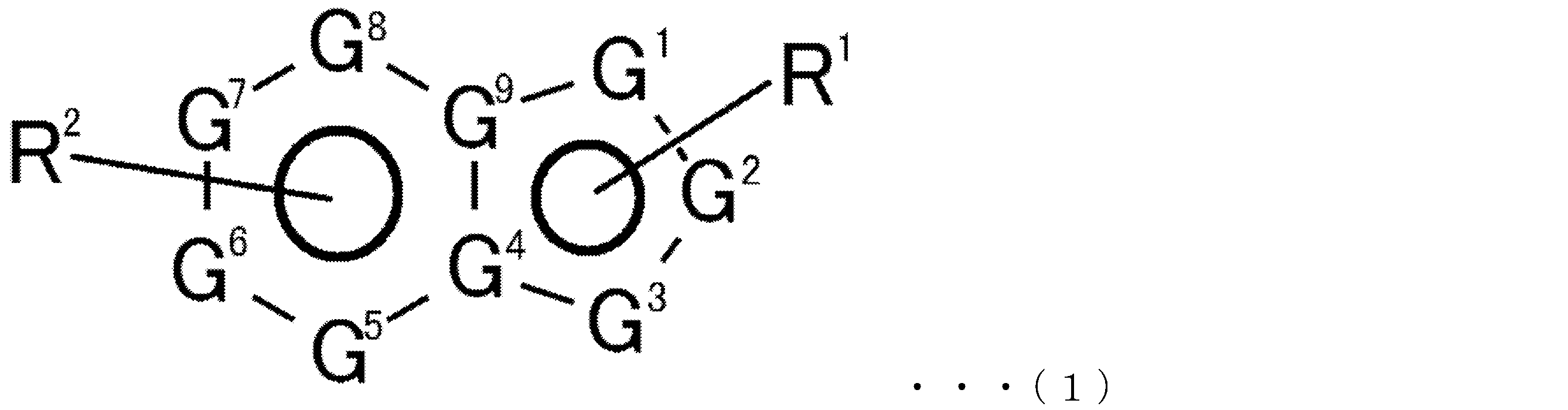
[上記式(1)中、G1~G9のうちの何れか3つが窒素原子であり、その他は炭素原子であり、R1は水素原子又は有機基であり、R2は水素原子、ハロゲン基、カルボキシル基、又は炭素数1~5のアルキル基である。]
窒素原子数が3の含窒素縮合複素環化合物とは、縮合複素環の構成原子に3つの窒素原子を含む化合物である。換言すると、「窒素原子数が3の含窒素縮合複素環化合物」は、一つの縮合複素環の構成原子に3つの窒素原子を含む限りにおいて特に限定されることなく、あらゆる化合物を含みうる。より具体的には、「窒素原子数が3の含窒素縮合複素環化合物」は、一つの化合物中に、構成原子に3つの窒素原子を含む縮合複素環を2つ以上含んでいても良いし、化合物を構成する含窒素縮合複素環構造以外の構造に窒素原子を含んでいても良い。
窒素原子数が3の含窒素縮合複素環化合物としては、例えば、下記一般式(1)で表されうる化合物、及び下記一般式(1)で表されうる構造を有する化合物が挙げられる。
また、式(1)に含まれるR1でありうる有機基は、1つ又は複数の置換基を有していても良いフェノール基、1つ又は複数の置換基を有していても良い炭素数1~10の直鎖又は分岐アルキル基であり得る。ここで、1つ又は複数の置換基を有していても良いフェノール基の置換基としては、炭素数1~10のアルキル基、3,4,5,6‐テトラヒドロ‐N‐メチルフタルイミド基、及び1‐メチル‐1‐フェニルエチル基等が挙げられる。ここで、1つ又は複数の置換基を有していても良いフェノール基が複数の置換基を有する場合には、これらは同一であっても相異なっていても良い。また、1つ又は複数の置換基を有していても良い炭素数1~10の直鎖又は分岐アルキル基の置換基としては、水酸基等が挙げられる。
また、窒素原子数が3の含窒素縮合複素環化合物であり得る化合物は、上記式(1)で表されうる構造[1]及び[1]’を有する化合物であっても良い。具体的には、かかる化合物は、2つの構造[1]及び[1]’(ここで、構造[1]及び[1]’は、共に、上記式(1)で表されうる限りにおいて特に限定されることなく、同一であっても相異なっていても良い。)が、連結基としての炭素数1~10のアルキレン基(-CmH2m-;ここで、mは1~10の整数)により相互に連結されてなる、一般式(2):[1]-CmH2m-[1]’で表されうる化合物であっても良い。ここで、連結基である上記炭素数1~10のアルキレン基は、構造[1]及び[1]’に含まれる各R1に対して結合する。
中でも、窒素原子数が3の含窒素縮合複素環化合物としては、上記式(1)(2)中、G1~G3が窒素原子であり、G4~G9が炭素原子であるベンゾトリアゾール系化合物が好ましい。樹脂組成物がベンゾトリアゾール系化合物を含んでいれば、一層効果的に、樹脂組成物自体の保存安定性を確保することと、得られる樹脂膜の耐薬品性を高めることとを両立させることができる。
上記式(1)を満たすベンゾトリアゾール系化合物としては、例えば、1H‐ベンゾトリアゾール‐1‐メタノール、1,2,3-ベンゾトリアゾール(城北化学社製、「BT‐120」)、2-(2’-ヒドロキシ-5’-メチルフェニル)ベンゾトリアゾール(城北化学社製、「JF-77」)、2-(2’-ヒドロキシ-3’-tert-ブチル-5’-メチルフェニル)-5-クロロベンゾトリアゾール(城北化学社製、「JF‐79」)、2-(2’-ヒドロキシ-3’,5’-ジ-tert-アミルフェニル)ベンゾトリアゾール(城北化学社製、「JF‐80」)、2-(2’-ヒドロキシ-5’-tert-オクチルフェニル)ベンゾトリアゾール(城北化学社製、「JF‐83」)、2-[2-ヒドロキシ-3-(3,4,5,6,7-テトラヒドロ-1,3-ジオキソ-1H-イソインドール-2-イルメチル)-5-メチルフェニル]-2H-ベンゾトリアゾール(住化ケムテックス社製、「Sumisorb 250」)、及び2-(2H-ベンゾトリアゾール-2-イル)-4,6-ビス(1-メチル-1-フェニルエチル)フェノール(アデカ社製「アデカスタブLA-24」)等が挙げられる。また、上記式(2)を満たすベンゾトリアゾール系化合物としては、2,2’-メチレンビス[6-(2H‐ベンゾトリアゾール‐2‐イル)‐4‐(1,1,3,3‐テトラメチルブチル)フェノール](アデカ社製、「アデカスタブLA-31」)が挙げられる。
中でも、カルボキシル基含有樹脂との相溶性、及び後述する溶剤への溶解性を向上させて、樹脂組成物の保存安定性を一層良好に確保する観点から、ベンゾトリアゾール系化合物としては、1H‐ベンゾトリアゾール‐1‐メタノールが好ましい。
中でも、カルボキシル基含有樹脂との相溶性、及び後述する溶剤への溶解性を向上させて、樹脂組成物の保存安定性を一層良好に確保する観点から、ベンゾトリアゾール系化合物としては、1H‐ベンゾトリアゾール‐1‐メタノールが好ましい。
[窒素原子数が3の含窒素縮合複素環化合物の含有量]
樹脂組成物中における含窒素縮合複素環化合物の含有量は、カルボキシル基含有樹脂100質量部に対して、1質量部以上であることが好ましく、2質量部以上であることがより好ましく、好ましくは20質量部未満であり、15質量部以下であることがより好ましく、10質量部以下であることがさらに好ましく、7質量部以下であることが特に好ましい。窒素原子数が3の含窒素縮合複素環化合物の含有割合が上記下限値以上であれば、得られる樹脂膜の耐クラック性を一層向上させることができる。また、窒素原子数が3の含窒素縮合複素環化合物の含有割合が上記上限値以下であれば、樹脂組成物の粘度が過度に高まることを抑制して、樹脂膜を良好に形成することができる。
樹脂組成物中における含窒素縮合複素環化合物の含有量は、カルボキシル基含有樹脂100質量部に対して、1質量部以上であることが好ましく、2質量部以上であることがより好ましく、好ましくは20質量部未満であり、15質量部以下であることがより好ましく、10質量部以下であることがさらに好ましく、7質量部以下であることが特に好ましい。窒素原子数が3の含窒素縮合複素環化合物の含有割合が上記下限値以上であれば、得られる樹脂膜の耐クラック性を一層向上させることができる。また、窒素原子数が3の含窒素縮合複素環化合物の含有割合が上記上限値以下であれば、樹脂組成物の粘度が過度に高まることを抑制して、樹脂膜を良好に形成することができる。
<多官能エポキシ化合物>
多官能エポキシ化合物としては、特に限定されることなく、1分子中にエポキシ基を2個以上有する化合物が挙げられる。樹脂組成物に多官能エポキシ化合物を含有させることで、得られる樹脂膜の耐クラック性を一層向上させることができる。これは、樹脂組成物中に存在する多官能エポキシ化合物が、樹脂膜内のカルボン酸と多官能ビニルエーテルによる内部応力の上昇を適度に抑制しうることに起因すると推察される。
多官能エポキシ化合物としては、特に限定されることなく、1分子中にエポキシ基を2個以上有する化合物が挙げられる。樹脂組成物に多官能エポキシ化合物を含有させることで、得られる樹脂膜の耐クラック性を一層向上させることができる。これは、樹脂組成物中に存在する多官能エポキシ化合物が、樹脂膜内のカルボン酸と多官能ビニルエーテルによる内部応力の上昇を適度に抑制しうることに起因すると推察される。
1分子中にエポキシ基を2個以上有する化合物としては、エポキシ化ブタンテトラカルボン酸テトラキス(3‐シクロヘキセニルメチル)修飾ε‐カプロラクトン、トリス(2,3-エポキシプロピル)イソシアヌレート、1,4-ブタンジオールジグリシジルエーテル、1,2-エポキシ-4-(エポキシエチル)シクロヘキサン、グリセロールトリグリシジルエーテル、ジエチレングリコールジグリシジルエーテル、2,6-ジグリシジルフェニルグリシジルエーテル、1,1,3-トリス[p-(2,3-エポキシプロポキシ)フェニル]プロパン、1,2-シクロヘキサンジカルボン酸ジグリシジルエステル、4,4’-メチレンビス(N,N-ジグリシジルアニリン)、3,4-エポキシシクロヘキシルメチル-3,4-エポキシシクロヘキサンカルボキシレート、トリメチロールエタントリグリシジルエーテル及びビスフェノール-A-ジグリシジルエーテル、及びペンタエリスリトールポリグリシジルエーテルが挙げられる。市販品では、例えば、エポリードGT-401、同GT-403、同GT-301、同GT-302、セロキサイド2021、セロキサイド3000(以上、ダイセル社製);jER1001、jER1002、jER1003、jER1004、jER1007、jER1009、jER1010、jER828、jER871、jER872、jER180S75、jER807、jER152、jER154(以上、三菱化学社製);EPPN201、EPPN202、EOCN-102、EOCN-103S、EOCN-104S、EOCN-1020、EOCN-1025、EOCN-1027(以上、日本化薬社製)、エピクロン200、エピクロン400(以上、DIC社製)、デナコールEX-611、EX-612、EX-614、EX-622、EX-411、EX-512、EX-522、EX-421、EX-313、EX-314、EX-321(以上、ナガセケムテックス社製)等が挙げられる。中でも、得られる樹脂膜の耐クラック性を一層向上させる観点から、多官能エポキシ化合物が、脂環式エポキシ基を有することが好ましい。さらに、多官能エポキシ化合物に含まれる脂環式エポキシ基数は、2つ以上であることが好ましく、3つ以上であることがより好ましく、4つ以上であることがさらに好ましく、通常、6個以下である。特に、エポキシ化ブタンテトラカルボン酸テトラキス(3‐シクロヘキセニルメチル)修飾ε‐カプロラクトン(脂環式エポキシ基数:4)が好ましい。なお、「多官能エポキシ化合物に含まれる脂環式エポキシ基数」は、多官能エポキシ化合物が脂環式エポキシ基を含む繰り返し構造単位よりなる高分子である場合には、単位構造(1分子)あたりの脂環式エポキシ基数を意味する。
<任意成分>
上記各種成分以外に、本発明の樹脂組成物は、シランカップリング剤、酸化防止剤、及び界面活性剤等の任意成分を含有していても良い。かかる任意成分としては、既知のものを使用することができる(例えば、国際公開第2015/033901号及び特開2015-25892号参照)。そして、これらの添加剤の含有量も、本発明の効果を損なわない限りにおいて、一般的な範囲内で適宜調節することができる。
上記各種成分以外に、本発明の樹脂組成物は、シランカップリング剤、酸化防止剤、及び界面活性剤等の任意成分を含有していても良い。かかる任意成分としては、既知のものを使用することができる(例えば、国際公開第2015/033901号及び特開2015-25892号参照)。そして、これらの添加剤の含有量も、本発明の効果を損なわない限りにおいて、一般的な範囲内で適宜調節することができる。
<溶媒>
本発明の樹脂組成物に含有されうる溶媒としては、樹脂組成物の調製に用いられる既知の有機溶媒を用いることができる(例えば、国際公開第2015/033901号参照)。中でも、ジエチレングリコールモノメチルエーテル、ジエチレングリコールモノエチルエーテル、ジエチレングリコールジメチルエーテル、ジエチレングリコールジエチルエーテル、ジエチレングリコールエチルメチルエーテルなどのジエチレングリコール類を含有する溶媒が好適に用いられうる。
本発明の樹脂組成物に含有されうる溶媒としては、樹脂組成物の調製に用いられる既知の有機溶媒を用いることができる(例えば、国際公開第2015/033901号参照)。中でも、ジエチレングリコールモノメチルエーテル、ジエチレングリコールモノエチルエーテル、ジエチレングリコールジメチルエーテル、ジエチレングリコールジエチルエーテル、ジエチレングリコールエチルメチルエーテルなどのジエチレングリコール類を含有する溶媒が好適に用いられうる。
<樹脂組成物の調製方法>
本発明の樹脂組成物の調製方法は、特に限定されず、樹脂組成物を構成する各成分を公知の方法により混合すればよい。混合の方法は、特に限定されず、樹脂組成物を構成する各成分を溶媒に対して添加し混合することにより、各成分が溶媒中に溶解又は分散されてなる溶液又は分散液を得ることができる。
本発明の樹脂組成物の調製方法は、特に限定されず、樹脂組成物を構成する各成分を公知の方法により混合すればよい。混合の方法は、特に限定されず、樹脂組成物を構成する各成分を溶媒に対して添加し混合することにより、各成分が溶媒中に溶解又は分散されてなる溶液又は分散液を得ることができる。
具体的な混合方法としては、例えば、攪拌子等を使用した攪拌、高速ホモジナイザー、ディスパー、遊星攪拌機、二軸攪拌機、ボールミル、及び三本ロール等を使用した混合方法が挙げられる。また、混合により得られた溶液又は分散液を、例えば、孔径が0.45μm程度のフィルター等を用いて濾過してもよい。
(樹脂膜)
本発明の樹脂膜は、本発明の樹脂組成物を用いて形成されたことを特徴とする。本発明の樹脂膜は、本発明の樹脂組成物を用いて形成されているので、耐薬品性に優れる。本発明の樹脂膜は、本発明の樹脂組成物を所望の基板上に適用することにより形成することができる。即ち、本発明の樹脂膜は、上述した本発明の樹脂組成物の乾燥物よりなり、通常、少なくとも、カルボキシル基含有樹脂、多官能ビニルエーテル化合物、及び窒素原子数が3の含窒素縮合複素環化合物を含有する。さらに、本発明の樹脂膜は、多官能エポキシ化合物を含むことが好ましい。なお、樹脂膜中に含まれる各成分は、上記樹脂組成物に含まれていたものであるため、それらの各成分の好適な存在比は、樹脂組成物中の各成分の好適な存在比と同じである。また、例えば、樹脂膜中に含まれる多官能ビニルエーテル化合物、及び、任意で含有されうる多官能エポキシ化合物等は、任意で実施されうる架橋処理時等により、架橋されていても良い。換言すれば、樹脂膜は、上述した多官能ビニルエーテル化合物、及び、多官能エポキシ化合物の架橋物を含んでいても良い。
本発明の樹脂膜は、本発明の樹脂組成物を用いて形成されたことを特徴とする。本発明の樹脂膜は、本発明の樹脂組成物を用いて形成されているので、耐薬品性に優れる。本発明の樹脂膜は、本発明の樹脂組成物を所望の基板上に適用することにより形成することができる。即ち、本発明の樹脂膜は、上述した本発明の樹脂組成物の乾燥物よりなり、通常、少なくとも、カルボキシル基含有樹脂、多官能ビニルエーテル化合物、及び窒素原子数が3の含窒素縮合複素環化合物を含有する。さらに、本発明の樹脂膜は、多官能エポキシ化合物を含むことが好ましい。なお、樹脂膜中に含まれる各成分は、上記樹脂組成物に含まれていたものであるため、それらの各成分の好適な存在比は、樹脂組成物中の各成分の好適な存在比と同じである。また、例えば、樹脂膜中に含まれる多官能ビニルエーテル化合物、及び、任意で含有されうる多官能エポキシ化合物等は、任意で実施されうる架橋処理時等により、架橋されていても良い。換言すれば、樹脂膜は、上述した多官能ビニルエーテル化合物、及び、多官能エポキシ化合物の架橋物を含んでいても良い。
基板としては、例えば、プリント配線基板、シリコンウエハ基板、ガラス基板、プラスチック基板等を用いることができる。また、ディスプレイ分野において使用される、ガラス基材やプラスチック基材上に、薄型トランジスタ型液晶表示素子、カラーフィルター、又はブラックマトリックス等が形成されてなる基板も好適に用いられる。中でも、本発明の樹脂組成物は低温にて硬化可能であるため、かかる樹脂組成物を用いて形成される本発明の樹脂膜は、プラスチック基板上に好適に設けられ得る。
樹脂膜を基板上に適用する方法としては、特に限定されず、例えば、塗布法やフィルム積層法等の方法を用いることができる。
塗布法は、例えば、プラスチック基板等の基板上に樹脂組成物を塗布した後、溶媒を除去する方法である。樹脂組成物を塗布する方法としては、例えば、スプレー法、スピンコート法、ロールコート法、ダイコート法、ドクターブレード法、回転塗布法、バー塗布法、及びスクリーン印刷法等の各種の方法を採用することができる。溶媒は、例えば、乾燥により除去することができる。乾燥条件は、各成分の種類、配合割合、及びプラスチック基板等の基板の耐熱温度等に応じて異なるが、通常、30℃以上150℃以下、好ましくは60℃以上120℃以下の温度条件下、0.5分以上90分以下、好ましくは1分以上60分以下、より好ましくは1分以上30分以下とすることができる。本発明の樹脂組成物によれば、乾燥時の温度が上記上限値以下であっても、耐薬品性に優れる樹脂膜を得ることができる。また、乾燥時の温度を上記下限値以上にすれば、樹脂膜の耐薬品性を十分に向上させることができる。
フィルム積層法は、樹脂フィルム形成用基材上に樹脂組成物を塗布した後に、溶媒を除去して樹脂フィルムを得て、得られた樹脂フィルムを基板上に積層して樹脂膜を有する基板を形成する方法である。溶媒は、例えば、乾燥により除去することができる。乾燥条件は、各成分の種類や配合割合に応じて適宜選択することができる。乾燥条件は、通常、30℃以上150℃以下の温度条件下、0.5分以上90分以内とすることができる。また、樹脂フィルムを基板上に積層する際には、加圧ラミネータ、プレス、真空ラミネータ、真空プレス、ロールラミネータ等の圧着機を用いることができる。
樹脂膜の厚さとしては、特に限定されず、用途に応じて適宜設定することができる。例えば、樹脂膜の厚さは、好ましくは0.1μm以上100μm以下、より好ましくは0.5μm以上50μm以下、さらに好ましくは0.5μm以上30μm以下、特に好ましくは0.5μm以上10μm以下とすることができる。本発明の樹脂組成物によれば、樹脂膜の厚みを比較的薄厚とした場合であっても、耐薬品性を十分に高めることができる。
また、必要に応じて、上記した塗布法又はフィルム積層法により形成した樹脂膜について、架橋処理を行なうことができる。架橋処理は、特に限定されることなく、例えば、特開2015-25892号に開示されたような、一般的な方法にて進行させることができる。
本発明の樹脂膜は、ブリーチング露光工程を経ずに測定した場合の、波長400nmにおける光線透過率が95%以上となることが好ましい。ここで、光線透過率は、例えば、実施例に記載した方法に従って測定することができる。
そして、本発明の樹脂膜は、所謂ブリーチング露光工程を行うことなく、上記のような高い光線透過率を達成することができる。なお、ブリーチング露光工程とは、樹脂組成物を乾燥して樹脂膜を形成した後等に、かかる樹脂膜を過露光条件下に曝して有色の樹脂膜を退色させるための操作を意味する。例えば、かかるブリーチング露光工程は、所与の条件下で形成された樹脂膜を、g線(波長436nm)、h線(波長405nm)、又はi線(波長365nm)の露光量換算で、100J/m2~20,000J/m2の範囲の光量の光に曝す工程を意味する。
以下、本発明について実施例に基づき具体的に説明するが、本発明はこれら実施例に限定されるものではない。なお、以下の説明において、量を表す「%」及び「部」は、特に断らない限り、質量基準である。
実施例及び比較例において、樹脂組成物の保存安定性、並びに、樹脂膜の耐薬品性、耐クラック性、及び絶縁信頼性は、以下のようにして評価した。また、実施例で得られた樹脂膜の光線透過率は、以下のようにして評価した。
実施例及び比較例において、樹脂組成物の保存安定性、並びに、樹脂膜の耐薬品性、耐クラック性、及び絶縁信頼性は、以下のようにして評価した。また、実施例で得られた樹脂膜の光線透過率は、以下のようにして評価した。
<樹脂組成物の保存安定性>
実施例、比較例で調製した樹脂組成物について、JIS Z 8803:2011に記載されている「10 円すい-平板形回転粘度計による粘度測定方法」に従ってE型粘度計により粘度を測定した。調製直後の樹脂組成物の粘度をV0とした。また、樹脂組成物を遮光瓶に封入し、クリーンルーム(温度23℃、湿度45%)にて1週間保管した後の樹脂組成物の粘度V1を、同様にして測定した。そして、式:|(V1-V0)/V0|×100に従って粘度変化率(%)を算出した。算出した粘度変化率について、下記基準に従って評価した。
A:粘度変化率が5%以内
B:粘度変化率が5%超
実施例、比較例で調製した樹脂組成物について、JIS Z 8803:2011に記載されている「10 円すい-平板形回転粘度計による粘度測定方法」に従ってE型粘度計により粘度を測定した。調製直後の樹脂組成物の粘度をV0とした。また、樹脂組成物を遮光瓶に封入し、クリーンルーム(温度23℃、湿度45%)にて1週間保管した後の樹脂組成物の粘度V1を、同様にして測定した。そして、式:|(V1-V0)/V0|×100に従って粘度変化率(%)を算出した。算出した粘度変化率について、下記基準に従って評価した。
A:粘度変化率が5%以内
B:粘度変化率が5%超
<樹脂膜の耐薬品性>
実施例、比較例で調製した樹脂組成物を、スピンコート法によりシリコンウエハ基板上に塗布し、ホットプレートを用いて90℃で2分間加熱乾燥(プリベーク)して、膜厚2.0μmのプリベーク済樹脂膜を形成した。次いで、この樹脂膜について、オーブンを用いて、大気雰囲気下、130℃で20分間加熱するポストベークを行うことで、ポストベーク済樹脂膜を表面に有するシリコンウエハ基板からなる積層体を得た。
上述のようにして得られた積層体を試験体として、薬品200mlに対して5分間浸漬し、浸漬前の膜厚を100%とした場合の、浸漬後の膜厚の割合である(%)を算出した。薬品としては、
(i)恒温槽にて25℃に保持したアセトン溶液;
(ii)恒温槽にて25℃に保持したレジスト剥離液(東京応化工業社製、「ST-106」、組成:モノエタノールアミン(MEA)/ジメチルスルホキシド(DMSO)=体積比7/3);及び
(iii)恒温槽にて60℃に保持したレジスト剥離液(東京応化工業社製、「ST-106」)
の3種類を準備し、各溶液に対して、それぞれ試験体を浸漬した。
なお、膜厚は、光干渉式膜厚測定装置(SCREEN社製、「ラムダエース」)を用いて測定した。
実施例、比較例で調製した樹脂組成物を、スピンコート法によりシリコンウエハ基板上に塗布し、ホットプレートを用いて90℃で2分間加熱乾燥(プリベーク)して、膜厚2.0μmのプリベーク済樹脂膜を形成した。次いで、この樹脂膜について、オーブンを用いて、大気雰囲気下、130℃で20分間加熱するポストベークを行うことで、ポストベーク済樹脂膜を表面に有するシリコンウエハ基板からなる積層体を得た。
上述のようにして得られた積層体を試験体として、薬品200mlに対して5分間浸漬し、浸漬前の膜厚を100%とした場合の、浸漬後の膜厚の割合である(%)を算出した。薬品としては、
(i)恒温槽にて25℃に保持したアセトン溶液;
(ii)恒温槽にて25℃に保持したレジスト剥離液(東京応化工業社製、「ST-106」、組成:モノエタノールアミン(MEA)/ジメチルスルホキシド(DMSO)=体積比7/3);及び
(iii)恒温槽にて60℃に保持したレジスト剥離液(東京応化工業社製、「ST-106」)
の3種類を準備し、各溶液に対して、それぞれ試験体を浸漬した。
なお、膜厚は、光干渉式膜厚測定装置(SCREEN社製、「ラムダエース」)を用いて測定した。
<樹脂膜の耐クラック性>
[プリベーク済樹脂膜の耐クラック性]
実施例、比較例で調製した樹脂組成物を、スピンコート法によりシリコンウエハ基板上に塗布し、ホットプレートを用いて90℃で2分間加熱乾燥(プリベーク)して、膜厚2.0μmのプリベーク済樹脂膜を形成し、表面にプリベーク済樹脂膜を有するシリコンウエハ基板からなる積層体を得た。積層体の表面を目視観察して、以下の基準に従って耐クラック性を評価した。
A:積層体の表面にクラックが無い。
B:積層体の表面にクラックが確認された。
[樹脂膜の耐アセトンクラック性]
上記<樹脂膜の耐薬品性>の項目にて説明した手順に従ってアセトン溶液に対して浸漬した試験体について、上記[プリベーク済樹脂膜の耐クラック性]と同様の基準に従って耐クラック性を評価した。
[プリベーク済樹脂膜の耐クラック性]
実施例、比較例で調製した樹脂組成物を、スピンコート法によりシリコンウエハ基板上に塗布し、ホットプレートを用いて90℃で2分間加熱乾燥(プリベーク)して、膜厚2.0μmのプリベーク済樹脂膜を形成し、表面にプリベーク済樹脂膜を有するシリコンウエハ基板からなる積層体を得た。積層体の表面を目視観察して、以下の基準に従って耐クラック性を評価した。
A:積層体の表面にクラックが無い。
B:積層体の表面にクラックが確認された。
[樹脂膜の耐アセトンクラック性]
上記<樹脂膜の耐薬品性>の項目にて説明した手順に従ってアセトン溶液に対して浸漬した試験体について、上記[プリベーク済樹脂膜の耐クラック性]と同様の基準に従って耐クラック性を評価した。
<樹脂膜の絶縁信頼性>
ガラス基材(コーニング社、製品名:コーニング1737)上に、スパッタ装置を用いて膜厚100nmのCu薄膜を形成した。次いで、フォトレジストを用いてCu薄膜のパターニングを行い、Cu配線幅7μm、配線間距離7μmの櫛形電極基板を作製した。かかる櫛形電極基板上に、実施例、比較例で調製した樹脂組成物をスピンコート法により塗布し、ホットプレートを用いて90℃で2分間加熱乾燥(プリベーク)して、膜厚2.0μmの樹脂膜を形成した。次いでこの樹脂膜についてオーブンを用いて、大気雰囲気下、130℃で20分間加熱するポストベークを行うことで、試験体である、樹脂膜-Cu配線-ガラス基材の順に積層されてなる積層体を得た。そして得られた試験体を15Vの電圧が印加された状態で温度85℃、湿度85%の高温恒湿槽に入れた。その後、500時間後に試験体を高温恒湿槽から取り出し、デジタルマイクロスコープ(ハイロックス社製、KH-1300)によって試験体に設けられたCu配線を観察し、樹脂膜の絶縁信頼性を以下の基準に従って評価した。
A:500時間後のCu配線に腐食が確認されない。
B:500時間後のCu配線に腐食が確認された。
ガラス基材(コーニング社、製品名:コーニング1737)上に、スパッタ装置を用いて膜厚100nmのCu薄膜を形成した。次いで、フォトレジストを用いてCu薄膜のパターニングを行い、Cu配線幅7μm、配線間距離7μmの櫛形電極基板を作製した。かかる櫛形電極基板上に、実施例、比較例で調製した樹脂組成物をスピンコート法により塗布し、ホットプレートを用いて90℃で2分間加熱乾燥(プリベーク)して、膜厚2.0μmの樹脂膜を形成した。次いでこの樹脂膜についてオーブンを用いて、大気雰囲気下、130℃で20分間加熱するポストベークを行うことで、試験体である、樹脂膜-Cu配線-ガラス基材の順に積層されてなる積層体を得た。そして得られた試験体を15Vの電圧が印加された状態で温度85℃、湿度85%の高温恒湿槽に入れた。その後、500時間後に試験体を高温恒湿槽から取り出し、デジタルマイクロスコープ(ハイロックス社製、KH-1300)によって試験体に設けられたCu配線を観察し、樹脂膜の絶縁信頼性を以下の基準に従って評価した。
A:500時間後のCu配線に腐食が確認されない。
B:500時間後のCu配線に腐食が確認された。
<樹脂膜の光線透過率>
ガラス基板(コーニング社、製品名コーニング1737)上に実施例で得られた樹脂組成物をスピンコート法により塗布し、ホットプレートを用いて90℃で2分間加熱乾燥(プリベーク)して、膜厚2.0μmの樹脂膜を形成した。次いで、オーブンを用いて、大気雰囲気下、130℃で20分間加熱するポストベークを行うことで、樹脂膜とガラス基板とからなる積層体を得た。
得られた積層体について、分光光度計V‐560(日本分光社製)を用いて400nmから800nmの波長で測定を行った。測定結果から、400nmでの光線透過率(%)を算出した。なお、樹脂膜の光線透過率(%)は、樹脂膜が付いていないガラス基板をブランクとして、樹脂膜の厚みを2.0μmとした場合の換算値で算出した。
ガラス基板(コーニング社、製品名コーニング1737)上に実施例で得られた樹脂組成物をスピンコート法により塗布し、ホットプレートを用いて90℃で2分間加熱乾燥(プリベーク)して、膜厚2.0μmの樹脂膜を形成した。次いで、オーブンを用いて、大気雰囲気下、130℃で20分間加熱するポストベークを行うことで、樹脂膜とガラス基板とからなる積層体を得た。
得られた積層体について、分光光度計V‐560(日本分光社製)を用いて400nmから800nmの波長で測定を行った。測定結果から、400nmでの光線透過率(%)を算出した。なお、樹脂膜の光線透過率(%)は、樹脂膜が付いていないガラス基板をブランクとして、樹脂膜の厚みを2.0μmとした場合の換算値で算出した。
(実施例1)
<カルボキシル基含有樹脂の調製>
N-置換イミド基を有する環状オレフィン単量体であるN‐フェニルビシクロ[2.2.1]ヘプト‐5‐エン‐2,3‐ジカルボキシイミド(NBPI)31.5モル%、及び、カルボキシル基含有環状オレフィン単量体である4‐ヒドロキシカルボニルテトラシクロ[6.2.1.13,6.02,7]ドデカ‐9‐エン(TCDC)68.5モル%からなる単量体混合物100部、1,5‐ヘキサジエン6.9部、開環重合触媒である(1,3‐ジメシチルイミダゾリン‐2‐イリデン)(トリシクロへキシルホスフィン)ベンジリデンルテニウムジクロリド(Org.Lett.,第1巻,953頁,1999年に記載された方法で合成した)0.01部、及びジエチレングリコールエチルメチルエーテル200部を窒素置換したガラス製耐圧反応器に充填し、撹拌しながら80℃にて4時間反応させて重合反応液を得た。
得られた重合反応液をオートクレーブに入れて、150℃、水素圧4MPaの条件にて、5時間撹拌して水素化反応を実施し、脂環式オレフィン共重合体により構成される、カルボキシル基含有ポリオレフィン樹脂を含む溶液を得た。上記脂環式オレフィン共重合体の重合転化率は99.9%、ポリスチレン換算重量平均分子量は5,280、数平均分子量は3,490、分子量分布は1.51、水素添加率は99.9%であった。また、カルボキシル基含有ポリオレフィン樹脂を含む溶液の固形分濃度は32.0質量%であった。
<カルボキシル基含有樹脂の調製>
N-置換イミド基を有する環状オレフィン単量体であるN‐フェニルビシクロ[2.2.1]ヘプト‐5‐エン‐2,3‐ジカルボキシイミド(NBPI)31.5モル%、及び、カルボキシル基含有環状オレフィン単量体である4‐ヒドロキシカルボニルテトラシクロ[6.2.1.13,6.02,7]ドデカ‐9‐エン(TCDC)68.5モル%からなる単量体混合物100部、1,5‐ヘキサジエン6.9部、開環重合触媒である(1,3‐ジメシチルイミダゾリン‐2‐イリデン)(トリシクロへキシルホスフィン)ベンジリデンルテニウムジクロリド(Org.Lett.,第1巻,953頁,1999年に記載された方法で合成した)0.01部、及びジエチレングリコールエチルメチルエーテル200部を窒素置換したガラス製耐圧反応器に充填し、撹拌しながら80℃にて4時間反応させて重合反応液を得た。
得られた重合反応液をオートクレーブに入れて、150℃、水素圧4MPaの条件にて、5時間撹拌して水素化反応を実施し、脂環式オレフィン共重合体により構成される、カルボキシル基含有ポリオレフィン樹脂を含む溶液を得た。上記脂環式オレフィン共重合体の重合転化率は99.9%、ポリスチレン換算重量平均分子量は5,280、数平均分子量は3,490、分子量分布は1.51、水素添加率は99.9%であった。また、カルボキシル基含有ポリオレフィン樹脂を含む溶液の固形分濃度は32.0質量%であった。
<樹脂組成物の調製>
上記で得られた、カルボキシル基含有ポリオレフィン樹脂100部、多官能ビニルエーテル化合物としての1,4-シクロヘキサンジメタノールジビニルエーテル(日本カーバイド社製、「CHDVE」)40部、多官能エポキシ化合物としてのエポキシ化ブタンテトラカルボン酸テトラキス(3‐シクロヘキセニルメチル)修飾ε‐カプロラクトン(ダイセル化学工業製:エポリードGT401)40部、窒素原子数が3の含窒素縮合複素環化合物であるベンゾトリアゾール系化合物としての1H‐ベンゾトリアゾール‐1‐メタノール(東京化成製)5部、シランカップリング剤としてグリシドキシプロピルトリメトキシシラン(XIAMETER社製:OFS6040)2部、酸化防止剤としてペンタエリスリトール‐テトラキス[3‐(3,5‐ジ‐tert‐ブチル‐4‐ヒドロキシフェニル)プロピオナート(BASF社製:Irganox1010)2部、界面活性剤としてオルガノシロキサンポリマー(信越化学製:KP341)300ppm、及び溶剤としてジエチレングリコールエチルメチルエーテル(東邦化学製:EDM)100部を混合し、溶解させた後、孔径0.45μmのポリテトラフルオロエチレン製フィルターでろ過して樹脂組成物を調製した。
得られた樹脂組成物について上記に従って保存安定性を評価し、また、得られた樹脂組成物を用いて樹脂膜を形成して上記に従って各種評価を行った。結果を表1に示す。
上記で得られた、カルボキシル基含有ポリオレフィン樹脂100部、多官能ビニルエーテル化合物としての1,4-シクロヘキサンジメタノールジビニルエーテル(日本カーバイド社製、「CHDVE」)40部、多官能エポキシ化合物としてのエポキシ化ブタンテトラカルボン酸テトラキス(3‐シクロヘキセニルメチル)修飾ε‐カプロラクトン(ダイセル化学工業製:エポリードGT401)40部、窒素原子数が3の含窒素縮合複素環化合物であるベンゾトリアゾール系化合物としての1H‐ベンゾトリアゾール‐1‐メタノール(東京化成製)5部、シランカップリング剤としてグリシドキシプロピルトリメトキシシラン(XIAMETER社製:OFS6040)2部、酸化防止剤としてペンタエリスリトール‐テトラキス[3‐(3,5‐ジ‐tert‐ブチル‐4‐ヒドロキシフェニル)プロピオナート(BASF社製:Irganox1010)2部、界面活性剤としてオルガノシロキサンポリマー(信越化学製:KP341)300ppm、及び溶剤としてジエチレングリコールエチルメチルエーテル(東邦化学製:EDM)100部を混合し、溶解させた後、孔径0.45μmのポリテトラフルオロエチレン製フィルターでろ過して樹脂組成物を調製した。
得られた樹脂組成物について上記に従って保存安定性を評価し、また、得られた樹脂組成物を用いて樹脂膜を形成して上記に従って各種評価を行った。結果を表1に示す。
(実施例2)
ベンゾトリアゾール系化合物の配合量を5部に変更した以外は、実施例1と同様にして樹脂組成物を調製し、各種評価等を行った。結果を表1に示す。
ベンゾトリアゾール系化合物の配合量を5部に変更した以外は、実施例1と同様にして樹脂組成物を調製し、各種評価等を行った。結果を表1に示す。
(実施例3~7)
実施例3では、多官能ビニルエーテル化合物として、1,4-ブタンジオールジビニルエーテル(BDVE)を用いた。
実施例4では、多官能ビニルエーテル化合物として、ジエチレングリコールジビニルエーテル(DEGDVE)を用いた。
実施例5では、多官能ビニルエーテル化合物として、トリメチロールプロパンエトキシレートトリビニルエーテルを用いた。
実施例6では、多官能ビニルエーテル化合物として、トリメチロールプロパントリビニルエーテルを用いた。
実施例7では、多官能ビニルエーテル化合物として、シクロヘキサンジオールジビニルエーテル(CHODVE)を用いた。
これらの点以外は実施例2と同様にして、それぞれ樹脂組成物を調製し、各種評価等を行った。結果を表1に示す。
実施例3では、多官能ビニルエーテル化合物として、1,4-ブタンジオールジビニルエーテル(BDVE)を用いた。
実施例4では、多官能ビニルエーテル化合物として、ジエチレングリコールジビニルエーテル(DEGDVE)を用いた。
実施例5では、多官能ビニルエーテル化合物として、トリメチロールプロパンエトキシレートトリビニルエーテルを用いた。
実施例6では、多官能ビニルエーテル化合物として、トリメチロールプロパントリビニルエーテルを用いた。
実施例7では、多官能ビニルエーテル化合物として、シクロヘキサンジオールジビニルエーテル(CHODVE)を用いた。
これらの点以外は実施例2と同様にして、それぞれ樹脂組成物を調製し、各種評価等を行った。結果を表1に示す。
(実施例8)
多官能エポキシ化合物を配合しなかった以外は実施例2と同様にして、それぞれ樹脂組成物を調製し、各種評価等を行った。結果を表1に示す。
多官能エポキシ化合物を配合しなかった以外は実施例2と同様にして、それぞれ樹脂組成物を調製し、各種評価等を行った。結果を表1に示す。
(比較例1~4)
窒素原子数が3の含窒素縮合複素環化合物を配合しなかった以外は、それぞれ、実施例2~5と同様にして、それぞれ樹脂組成物を調製し、各種評価等を行った。結果を表1に示す。なお、これらの例では得られた樹脂膜の耐薬品性が低かったため、絶縁信頼性の評価は行わなかった。
窒素原子数が3の含窒素縮合複素環化合物を配合しなかった以外は、それぞれ、実施例2~5と同様にして、それぞれ樹脂組成物を調製し、各種評価等を行った。結果を表1に示す。なお、これらの例では得られた樹脂膜の耐薬品性が低かったため、絶縁信頼性の評価は行わなかった。
(比較例5~7)
窒素原子数が3の含窒素縮合複素環化合物を配合せず、代わりに、複素環式化合物ではないホモフタル酸(比較例5)、窒素原子数が3の複素環化合物である5-メルカプト-1H-テトラゾール(比較例6)を、窒素原子数が2の含窒素縮合複素環化合物であるベンゾイミダゾール(比較例7)を、各5部配合した以外は、実施例3と同様にして、それぞれ樹脂組成物を調製し、各種評価等を行った。結果を表1に示す。
窒素原子数が3の含窒素縮合複素環化合物を配合せず、代わりに、複素環式化合物ではないホモフタル酸(比較例5)、窒素原子数が3の複素環化合物である5-メルカプト-1H-テトラゾール(比較例6)を、窒素原子数が2の含窒素縮合複素環化合物であるベンゾイミダゾール(比較例7)を、各5部配合した以外は、実施例3と同様にして、それぞれ樹脂組成物を調製し、各種評価等を行った。結果を表1に示す。
(比較例8~10)
多官能ビニルエーテル化合物に代えて、表1に示した単官能のモノビニルエーテル化合物をそれぞれ配合した以外は、実施例2と同様にして、それぞれ樹脂組成物を調製し、各種評価等を行った。結果を表1に示す。なお、これらの例では得られた樹脂膜の耐薬品性が低く、且つ、アセトン浸漬によりクラックも生じたため、絶縁信頼性の評価は行わなかった。
多官能ビニルエーテル化合物に代えて、表1に示した単官能のモノビニルエーテル化合物をそれぞれ配合した以外は、実施例2と同様にして、それぞれ樹脂組成物を調製し、各種評価等を行った。結果を表1に示す。なお、これらの例では得られた樹脂膜の耐薬品性が低く、且つ、アセトン浸漬によりクラックも生じたため、絶縁信頼性の評価は行わなかった。
(比較例11)
多官能ビニルエーテル化合物及び窒素原子数が3の含窒素縮合複素環化合物を配合せず、感光剤である4,4’-[1-[4-[1-[4-ヒドロキシフェニル]-1-メチルエチル]フェニル]エチリデン]ビスフェノールと6-ジアゾ-5,6-ジヒドロ-5-オキソ-ナフタレン-1-スルホン酸(1,2-ナフトキノンジアジド-5-スルホン酸クロライド)とのエステル体(2.0モル体)(美源商事社製、「TPA-520」)を配合した以外は、実施例1と同様にして、それぞれ樹脂組成物を調製し、各種評価等を行った。結果を表1に示す。なお、本例に従って得られた樹脂膜は、赤褐色であった。また、本例では、耐薬品性及び耐アセトンクラック性以外についての評価は行わなかった。
多官能ビニルエーテル化合物及び窒素原子数が3の含窒素縮合複素環化合物を配合せず、感光剤である4,4’-[1-[4-[1-[4-ヒドロキシフェニル]-1-メチルエチル]フェニル]エチリデン]ビスフェノールと6-ジアゾ-5,6-ジヒドロ-5-オキソ-ナフタレン-1-スルホン酸(1,2-ナフトキノンジアジド-5-スルホン酸クロライド)とのエステル体(2.0モル体)(美源商事社製、「TPA-520」)を配合した以外は、実施例1と同様にして、それぞれ樹脂組成物を調製し、各種評価等を行った。結果を表1に示す。なお、本例に従って得られた樹脂膜は、赤褐色であった。また、本例では、耐薬品性及び耐アセトンクラック性以外についての評価は行わなかった。
表1中、
「GT401」は、エポキシ化ブタンテトラカルボン酸テトラキス(3‐シクロヘキセニルメチル)修飾ε‐カプロラクトン(ダイセル化学工業製:エポリードGT401)を、
「TPA520」は、4,4’-[1-[4-[1-[4-ヒドロキシフェニル]-1-メチルエチル]フェニル]エチリデン]ビスフェノールと6-ジアゾ-5,6-ジヒドロ-5-オキソ-ナフタレン-1-スルホン酸(1,2-ナフトキノンジアジド-5-スルホン酸クロライド )とのエステル体(2.0モル体)を、
「OFS6040」は、グリシドキシプロピルトリメトキシシラン(XIAMETER社製:OFS6040)を、
「Irg1010」は、ペンタエリスリトール‐テトラキス[3‐(3,5‐ジ‐tert‐ブチル‐4‐ヒドロキシフェニル)プロピオナート(BASF社製:Irganox1010)を、
「KP341」は、オルガノシロキサンポリマー(信越化学製:KP341)を、
「EDM」は、ジエチレングリコールエチルメチルエーテルを、
それぞれ示す。

「GT401」は、エポキシ化ブタンテトラカルボン酸テトラキス(3‐シクロヘキセニルメチル)修飾ε‐カプロラクトン(ダイセル化学工業製:エポリードGT401)を、
「TPA520」は、4,4’-[1-[4-[1-[4-ヒドロキシフェニル]-1-メチルエチル]フェニル]エチリデン]ビスフェノールと6-ジアゾ-5,6-ジヒドロ-5-オキソ-ナフタレン-1-スルホン酸(1,2-ナフトキノンジアジド-5-スルホン酸クロライド )とのエステル体(2.0モル体)を、
「OFS6040」は、グリシドキシプロピルトリメトキシシラン(XIAMETER社製:OFS6040)を、
「Irg1010」は、ペンタエリスリトール‐テトラキス[3‐(3,5‐ジ‐tert‐ブチル‐4‐ヒドロキシフェニル)プロピオナート(BASF社製:Irganox1010)を、
「KP341」は、オルガノシロキサンポリマー(信越化学製:KP341)を、
「EDM」は、ジエチレングリコールエチルメチルエーテルを、
それぞれ示す。
表1より、カルボキシル基含有樹脂と、多官能ビニルエーテル化合物と、窒素原子数が3の含窒素縮合複素環化合物とを含む樹脂組成物を用いた実施例1~8では、樹脂組成物自体の保存安定性を確保することができ、且つ、得られた樹脂膜の耐薬品性が高かったことが分かる。一方、窒素原子数が3の含窒素縮合複素環化合物であるベンゾトリアゾール系化合物を配合しなかった比較例1~7では、樹脂組成物自体の保存安定性を確保することと、得られる樹脂膜の耐薬品性を高めることとを両立できなかったことが分かる。中でも、含窒素縮合複素環化合物に代えて、ホモフタル酸を配合した比較例5では、樹脂組成物の保存安定性が低下するとともに、樹脂膜の絶縁信頼性が得られなかった。これは、樹脂組成物中に含有される多官能ビニルエーテル化合物及び多官能エポキシ化合物の間で架橋反応が生じて粘度上昇して保存安定性が低下し、さらには得られた樹脂膜中に含まれるホモフタル酸がCu配線を腐食させるように作用するためであると推察される。また、多官能ビニルエーテル化合物を配合しなかった比較例8~10では、得られる樹脂膜の耐薬品性を高めることができなかったことが分かる。更にまた、多官能ビニルエーテル化合物も窒素原子数が3の含窒素縮合複素環化合物も配合しなかった比較例11では、得られる樹脂膜の耐薬品性を高めることができなかったことが分かる。
本発明によれば、樹脂組成物自体の保存安定性を確保することと、得られる樹脂膜の耐薬品性を高めることとを両立可能な、樹脂組成物を提供することができる。
また、本発明によれば、耐薬品性に優れる樹脂膜を提供することができる。
また、本発明によれば、耐薬品性に優れる樹脂膜を提供することができる。
Claims (7)
- カルボキシル基含有樹脂と、多官能ビニルエーテル化合物と、窒素原子数が3の含窒素縮合複素環化合物と、を含む、樹脂組成物。
- 前記含窒素縮合複素環化合物がベンゾトリアゾール系化合物である、請求項1に記載の樹脂組成物。
- 多官能エポキシ化合物を更に含む、請求項1又は2に記載の樹脂組成物。
- 前記多官能エポキシ化合物が、脂環式エポキシ基を有する、請求項3に記載の樹脂組成物。
- 前記カルボキシル基含有樹脂が、環状オレフィン単量体単位を含む樹脂である、請求項1~4の何れかに記載の樹脂組成物。
- 前記カルボキシル基含有樹脂100質量部に対して、前記含窒素縮合複素環化合物を1質量部以上の割合で含有する、請求項1~5の何れかに記載の樹脂組成物。
- 請求項1~6の何れかに記載の樹脂組成物を用いて形成した、樹脂膜。
Priority Applications (3)
| Application Number | Priority Date | Filing Date | Title |
|---|---|---|---|
| JP2019544552A JP7176524B2 (ja) | 2017-09-28 | 2018-09-12 | 樹脂組成物及び樹脂膜 |
| CN201880052440.8A CN111032788B (zh) | 2017-09-28 | 2018-09-12 | 树脂组合物及树脂膜 |
| KR1020207006541A KR102554238B1 (ko) | 2017-09-28 | 2018-09-12 | 수지 조성물 및 수지막 |
Applications Claiming Priority (2)
| Application Number | Priority Date | Filing Date | Title |
|---|---|---|---|
| JP2017188833 | 2017-09-28 | ||
| JP2017-188833 | 2017-09-28 |
Publications (1)
| Publication Number | Publication Date |
|---|---|
| WO2019065246A1 true WO2019065246A1 (ja) | 2019-04-04 |
Family
ID=65901293
Family Applications (1)
| Application Number | Title | Priority Date | Filing Date |
|---|---|---|---|
| PCT/JP2018/033829 Ceased WO2019065246A1 (ja) | 2017-09-28 | 2018-09-12 | 樹脂組成物及び樹脂膜 |
Country Status (5)
| Country | Link |
|---|---|
| JP (1) | JP7176524B2 (ja) |
| KR (1) | KR102554238B1 (ja) |
| CN (1) | CN111032788B (ja) |
| TW (1) | TWI763926B (ja) |
| WO (1) | WO2019065246A1 (ja) |
Cited By (1)
| Publication number | Priority date | Publication date | Assignee | Title |
|---|---|---|---|---|
| WO2023181953A1 (ja) * | 2022-03-23 | 2023-09-28 | 日本ゼオン株式会社 | 樹脂組成物及び樹脂膜 |
Citations (5)
| Publication number | Priority date | Publication date | Assignee | Title |
|---|---|---|---|---|
| JP2001072897A (ja) * | 1999-09-02 | 2001-03-21 | Dainippon Ink & Chem Inc | 化粧シート用エネルギー線硬化型樹脂組成物及びそれを用いた化粧シート |
| WO2003026835A1 (en) * | 2001-09-26 | 2003-04-03 | Nof Corporation | Flux composition for solder, solder paste, and method of soldering |
| JP2011075610A (ja) * | 2009-09-29 | 2011-04-14 | Nippon Zeon Co Ltd | 感放射線性樹脂組成物、及び積層体 |
| JP2013053297A (ja) * | 2011-04-21 | 2013-03-21 | Nippon Carbide Ind Co Inc | ビニルエーテル系樹脂組成物及びその硬化物 |
| JP2013087165A (ja) * | 2011-10-17 | 2013-05-13 | Nippon Zeon Co Ltd | 絶縁性接着フィルム、積層体、硬化物、及びプリント配線板 |
Family Cites Families (18)
| Publication number | Priority date | Publication date | Assignee | Title |
|---|---|---|---|---|
| FR2558845B1 (fr) * | 1984-01-31 | 1986-05-16 | Atochem | Compositions adhesives a reticulation thermoreversible, leur procede de fabrication et leurs applications |
| JP3936772B2 (ja) * | 1997-04-28 | 2007-06-27 | 日本写真印刷株式会社 | 転写材、表面保護シートおよびこれらを用いた耐光性、耐磨耗性、耐薬品性に優れた成形品の製造方法 |
| KR100568697B1 (ko) * | 1998-08-12 | 2006-05-25 | 다이셀 가가꾸 고교 가부시끼가이샤 | 벤조트리아졸기함유폴리에스테르,그것의제조방법,그것을포함하는자외선흡수제및합성수지조성물 |
| US6136882A (en) * | 1998-08-19 | 2000-10-24 | Morton International Inc. | Non-hazing UV curable powder coatings containing crystalline resins |
| JP2002351062A (ja) * | 2001-03-19 | 2002-12-04 | Fuji Photo Film Co Ltd | 電子線又はx線用ネガ型レジスト組成物 |
| US7960031B2 (en) * | 2004-06-30 | 2011-06-14 | Sabic Innovative Plastics Ip B.V. | Coated sheet, method of formation thereof, and articles derived therefrom |
| JP2006124648A (ja) * | 2004-10-01 | 2006-05-18 | Sumitomo Bakelite Co Ltd | 樹脂組成物、樹脂層、樹脂層付きキャリア材料および回路基板 |
| US20060116492A1 (en) * | 2004-12-01 | 2006-06-01 | 3M Innovative Properties Company | Branched polymer |
| US7326523B2 (en) * | 2004-12-16 | 2008-02-05 | International Business Machines Corporation | Low refractive index polymers as underlayers for silicon-containing photoresists |
| JP2008208357A (ja) * | 2007-02-02 | 2008-09-11 | Jsr Corp | 光学フィルムの製造方法、光学フィルム、位相差フィルム、および偏光板 |
| JP5133094B2 (ja) * | 2008-03-06 | 2013-01-30 | 株式会社クラレ | 酸素吸収性樹脂組成物 |
| JP5561271B2 (ja) * | 2009-03-26 | 2014-07-30 | 日本ゼオン株式会社 | 樹脂組成物、樹脂膜及び電子部品 |
| JP6183029B2 (ja) | 2013-07-25 | 2017-08-23 | 日本ゼオン株式会社 | ネガ型感光性樹脂組成物および電子部品 |
| KR102176852B1 (ko) | 2013-10-11 | 2020-11-10 | 주식회사 다이셀 | 접착제 |
| WO2015152075A1 (ja) * | 2014-03-31 | 2015-10-08 | リンテック株式会社 | ガスバリア性積層体、電子デバイス用部材および電子デバイス |
| KR20160029646A (ko) * | 2014-09-05 | 2016-03-15 | 동우 화인켐 주식회사 | 레지스트 박리액 조성물 |
| CN105505115A (zh) * | 2015-12-23 | 2016-04-20 | 铜陵市肆得科技有限责任公司 | 一种耐候性高装饰效果好的粉末涂料 |
| CN105601995A (zh) * | 2016-02-17 | 2016-05-25 | 黄秀茹 | 一种用于聚合物的添加剂及其添加剂组合物、聚合物组合物及其作为光稳定剂的用途 |
-
2018
- 2018-09-12 CN CN201880052440.8A patent/CN111032788B/zh active Active
- 2018-09-12 WO PCT/JP2018/033829 patent/WO2019065246A1/ja not_active Ceased
- 2018-09-12 JP JP2019544552A patent/JP7176524B2/ja active Active
- 2018-09-12 KR KR1020207006541A patent/KR102554238B1/ko active Active
- 2018-09-19 TW TW107132996A patent/TWI763926B/zh active
Patent Citations (5)
| Publication number | Priority date | Publication date | Assignee | Title |
|---|---|---|---|---|
| JP2001072897A (ja) * | 1999-09-02 | 2001-03-21 | Dainippon Ink & Chem Inc | 化粧シート用エネルギー線硬化型樹脂組成物及びそれを用いた化粧シート |
| WO2003026835A1 (en) * | 2001-09-26 | 2003-04-03 | Nof Corporation | Flux composition for solder, solder paste, and method of soldering |
| JP2011075610A (ja) * | 2009-09-29 | 2011-04-14 | Nippon Zeon Co Ltd | 感放射線性樹脂組成物、及び積層体 |
| JP2013053297A (ja) * | 2011-04-21 | 2013-03-21 | Nippon Carbide Ind Co Inc | ビニルエーテル系樹脂組成物及びその硬化物 |
| JP2013087165A (ja) * | 2011-10-17 | 2013-05-13 | Nippon Zeon Co Ltd | 絶縁性接着フィルム、積層体、硬化物、及びプリント配線板 |
Cited By (2)
| Publication number | Priority date | Publication date | Assignee | Title |
|---|---|---|---|---|
| WO2023181953A1 (ja) * | 2022-03-23 | 2023-09-28 | 日本ゼオン株式会社 | 樹脂組成物及び樹脂膜 |
| KR20240161638A (ko) | 2022-03-23 | 2024-11-12 | 니폰 제온 가부시키가이샤 | 수지 조성물 및 수지막 |
Also Published As
| Publication number | Publication date |
|---|---|
| TW201915084A (zh) | 2019-04-16 |
| CN111032788A (zh) | 2020-04-17 |
| CN111032788B (zh) | 2022-03-08 |
| TWI763926B (zh) | 2022-05-11 |
| KR20200060360A (ko) | 2020-05-29 |
| JPWO2019065246A1 (ja) | 2020-09-10 |
| KR102554238B1 (ko) | 2023-07-10 |
| JP7176524B2 (ja) | 2022-11-22 |
Similar Documents
| Publication | Publication Date | Title |
|---|---|---|
| KR101505890B1 (ko) | 열경화성 수지 조성물 및 경화막 | |
| TWI663187B (zh) | 熱硬化性組成物、硬化膜、彩色濾光片、液晶顯示元件、固體攝像元件及發光二極體發光體 | |
| WO2007139005A1 (ja) | 保護膜用熱硬化性組成物、硬化物、及び液晶表示装置 | |
| WO2007139006A1 (ja) | 保護膜用熱硬化性組成物、硬化物、及び液晶表示装置 | |
| KR20140121794A (ko) | 열경화성 조성물 | |
| WO2007139007A1 (ja) | 保護膜用熱硬化性組成物、硬化物、及び液晶表示装置 | |
| JP6528421B2 (ja) | 感光性樹脂組成物 | |
| JP6939110B2 (ja) | 熱硬化性組成物 | |
| TW201829476A (zh) | 感光性樹脂組合物、硬化物、層間絕緣膜、tft主動矩陣基板、及圖像顯示裝置 | |
| JP7176524B2 (ja) | 樹脂組成物及び樹脂膜 | |
| TW202104341A (zh) | 樹脂組成物、電子零件及樹脂膜之製造方法 | |
| JP5246749B2 (ja) | 熱硬化性樹脂組成物及びその硬化物 | |
| CN106010219A (zh) | 热硬化性树脂组合物、硬化膜及其应用 | |
| TW201037006A (en) | Thermosetting resin composition for forming protective film, protective film and method for forming protective film | |
| TWI783941B (zh) | 熱硬化性組成物、硬化膜及彩色濾光片 | |
| TW201942185A (zh) | 含有聚合性不飽和基的鹼可溶性樹脂的製造方法、含有聚合性不飽和基的鹼可溶性樹脂、以其作為必須成分的感光性樹脂組成物以及其硬化膜 | |
| JP2002012819A (ja) | 保護膜用組成物 | |
| JP4617954B2 (ja) | カラーフィルター保護膜用樹脂組成物、及びカラーフィルター | |
| TW201912708A (zh) | 熱硬化性組成物、硬化膜及彩色濾光片 | |
| TWI813756B (zh) | 熱硬化性組成物、硬化膜及彩色濾光片 | |
| CN110494469A (zh) | 热硬化性树脂组合物、硬化膜、带硬化膜基板、电子零件及喷墨用墨水 | |
| CN115124899A (zh) | 热硬化性组合物、硬化膜及彩色滤光片 | |
| TW202436548A (zh) | 黏接劑層組成物、積層體、積層體的製造方法及積層體的處理方法 | |
| CN112625479A (zh) | 热硬化性组合物、硬化膜及彩色滤光片 | |
| TW201910430A (zh) | 熱硬化性組成物、硬化膜及彩色濾光片 |
Legal Events
| Date | Code | Title | Description |
|---|---|---|---|
| 121 | Ep: the epo has been informed by wipo that ep was designated in this application |
Ref document number: 18863298 Country of ref document: EP Kind code of ref document: A1 |
|
| ENP | Entry into the national phase |
Ref document number: 2019544552 Country of ref document: JP Kind code of ref document: A |
|
| NENP | Non-entry into the national phase |
Ref country code: DE |
|
| 122 | Ep: pct application non-entry in european phase |
Ref document number: 18863298 Country of ref document: EP Kind code of ref document: A1 |