WO2019044906A1 - セラミック接合体およびその製造方法 - Google Patents
セラミック接合体およびその製造方法 Download PDFInfo
- Publication number
- WO2019044906A1 WO2019044906A1 PCT/JP2018/031950 JP2018031950W WO2019044906A1 WO 2019044906 A1 WO2019044906 A1 WO 2019044906A1 JP 2018031950 W JP2018031950 W JP 2018031950W WO 2019044906 A1 WO2019044906 A1 WO 2019044906A1
- Authority
- WO
- WIPO (PCT)
- Prior art keywords
- aluminum oxide
- closed pores
- sintered body
- convex portion
- compact
- Prior art date
- Legal status (The legal status is an assumption and is not a legal conclusion. Google has not performed a legal analysis and makes no representation as to the accuracy of the status listed.)
- Ceased
Links
Images

Classifications
-
- C—CHEMISTRY; METALLURGY
- C04—CEMENTS; CONCRETE; ARTIFICIAL STONE; CERAMICS; REFRACTORIES
- C04B—LIME, MAGNESIA; SLAG; CEMENTS; COMPOSITIONS THEREOF, e.g. MORTARS, CONCRETE OR LIKE BUILDING MATERIALS; ARTIFICIAL STONE; CERAMICS; REFRACTORIES; TREATMENT OF NATURAL STONE
- C04B35/00—Shaped ceramic products characterised by their composition; Ceramics compositions; Processing powders of inorganic compounds preparatory to the manufacturing of ceramic products
- C04B35/01—Shaped ceramic products characterised by their composition; Ceramics compositions; Processing powders of inorganic compounds preparatory to the manufacturing of ceramic products based on oxide ceramics
- C04B35/10—Shaped ceramic products characterised by their composition; Ceramics compositions; Processing powders of inorganic compounds preparatory to the manufacturing of ceramic products based on oxide ceramics based on aluminium oxide
- C04B35/111—Fine ceramics
-
- C—CHEMISTRY; METALLURGY
- C04—CEMENTS; CONCRETE; ARTIFICIAL STONE; CERAMICS; REFRACTORIES
- C04B—LIME, MAGNESIA; SLAG; CEMENTS; COMPOSITIONS THEREOF, e.g. MORTARS, CONCRETE OR LIKE BUILDING MATERIALS; ARTIFICIAL STONE; CERAMICS; REFRACTORIES; TREATMENT OF NATURAL STONE
- C04B37/00—Joining burned ceramic articles with other burned ceramic articles or other articles by heating
- C04B37/003—Joining burned ceramic articles with other burned ceramic articles or other articles by heating by means of an interlayer consisting of a combination of materials selected from glass, or ceramic material with metals, metal oxides or metal salts
-
- C—CHEMISTRY; METALLURGY
- C04—CEMENTS; CONCRETE; ARTIFICIAL STONE; CERAMICS; REFRACTORIES
- C04B—LIME, MAGNESIA; SLAG; CEMENTS; COMPOSITIONS THEREOF, e.g. MORTARS, CONCRETE OR LIKE BUILDING MATERIALS; ARTIFICIAL STONE; CERAMICS; REFRACTORIES; TREATMENT OF NATURAL STONE
- C04B37/00—Joining burned ceramic articles with other burned ceramic articles or other articles by heating
- C04B37/003—Joining burned ceramic articles with other burned ceramic articles or other articles by heating by means of an interlayer consisting of a combination of materials selected from glass, or ceramic material with metals, metal oxides or metal salts
- C04B37/005—Joining burned ceramic articles with other burned ceramic articles or other articles by heating by means of an interlayer consisting of a combination of materials selected from glass, or ceramic material with metals, metal oxides or metal salts consisting of glass or ceramic material
-
- C—CHEMISTRY; METALLURGY
- C04—CEMENTS; CONCRETE; ARTIFICIAL STONE; CERAMICS; REFRACTORIES
- C04B—LIME, MAGNESIA; SLAG; CEMENTS; COMPOSITIONS THEREOF, e.g. MORTARS, CONCRETE OR LIKE BUILDING MATERIALS; ARTIFICIAL STONE; CERAMICS; REFRACTORIES; TREATMENT OF NATURAL STONE
- C04B35/00—Shaped ceramic products characterised by their composition; Ceramics compositions; Processing powders of inorganic compounds preparatory to the manufacturing of ceramic products
- C04B35/622—Forming processes; Processing powders of inorganic compounds preparatory to the manufacturing of ceramic products
- C04B35/626—Preparing or treating the powders individually or as batches ; preparing or treating macroscopic reinforcing agents for ceramic products, e.g. fibres; mechanical aspects section B
- C04B35/62605—Treating the starting powders individually or as mixtures
- C04B35/62625—Wet mixtures
- C04B35/62635—Mixing details
-
- C—CHEMISTRY; METALLURGY
- C04—CEMENTS; CONCRETE; ARTIFICIAL STONE; CERAMICS; REFRACTORIES
- C04B—LIME, MAGNESIA; SLAG; CEMENTS; COMPOSITIONS THEREOF, e.g. MORTARS, CONCRETE OR LIKE BUILDING MATERIALS; ARTIFICIAL STONE; CERAMICS; REFRACTORIES; TREATMENT OF NATURAL STONE
- C04B35/00—Shaped ceramic products characterised by their composition; Ceramics compositions; Processing powders of inorganic compounds preparatory to the manufacturing of ceramic products
- C04B35/622—Forming processes; Processing powders of inorganic compounds preparatory to the manufacturing of ceramic products
- C04B35/626—Preparing or treating the powders individually or as batches ; preparing or treating macroscopic reinforcing agents for ceramic products, e.g. fibres; mechanical aspects section B
- C04B35/63—Preparing or treating the powders individually or as batches ; preparing or treating macroscopic reinforcing agents for ceramic products, e.g. fibres; mechanical aspects section B using additives specially adapted for forming the products, e.g.. binder binders
- C04B35/632—Organic additives
- C04B35/634—Polymers
- C04B35/63404—Polymers obtained by reactions only involving carbon-to-carbon unsaturated bonds
- C04B35/63424—Polyacrylates; Polymethacrylates
-
- C—CHEMISTRY; METALLURGY
- C04—CEMENTS; CONCRETE; ARTIFICIAL STONE; CERAMICS; REFRACTORIES
- C04B—LIME, MAGNESIA; SLAG; CEMENTS; COMPOSITIONS THEREOF, e.g. MORTARS, CONCRETE OR LIKE BUILDING MATERIALS; ARTIFICIAL STONE; CERAMICS; REFRACTORIES; TREATMENT OF NATURAL STONE
- C04B35/00—Shaped ceramic products characterised by their composition; Ceramics compositions; Processing powders of inorganic compounds preparatory to the manufacturing of ceramic products
- C04B35/622—Forming processes; Processing powders of inorganic compounds preparatory to the manufacturing of ceramic products
- C04B35/626—Preparing or treating the powders individually or as batches ; preparing or treating macroscopic reinforcing agents for ceramic products, e.g. fibres; mechanical aspects section B
- C04B35/63—Preparing or treating the powders individually or as batches ; preparing or treating macroscopic reinforcing agents for ceramic products, e.g. fibres; mechanical aspects section B using additives specially adapted for forming the products, e.g.. binder binders
- C04B35/632—Organic additives
- C04B35/636—Polysaccharides or derivatives thereof
- C04B35/6365—Cellulose or derivatives thereof
-
- C—CHEMISTRY; METALLURGY
- C04—CEMENTS; CONCRETE; ARTIFICIAL STONE; CERAMICS; REFRACTORIES
- C04B—LIME, MAGNESIA; SLAG; CEMENTS; COMPOSITIONS THEREOF, e.g. MORTARS, CONCRETE OR LIKE BUILDING MATERIALS; ARTIFICIAL STONE; CERAMICS; REFRACTORIES; TREATMENT OF NATURAL STONE
- C04B38/00—Porous mortars, concrete, artificial stone or ceramic ware; Preparation thereof
- C04B38/10—Porous mortars, concrete, artificial stone or ceramic ware; Preparation thereof by using foaming agents or by using mechanical means, e.g. adding preformed foam
-
- C—CHEMISTRY; METALLURGY
- C04—CEMENTS; CONCRETE; ARTIFICIAL STONE; CERAMICS; REFRACTORIES
- C04B—LIME, MAGNESIA; SLAG; CEMENTS; COMPOSITIONS THEREOF, e.g. MORTARS, CONCRETE OR LIKE BUILDING MATERIALS; ARTIFICIAL STONE; CERAMICS; REFRACTORIES; TREATMENT OF NATURAL STONE
- C04B2235/00—Aspects relating to ceramic starting mixtures or sintered ceramic products
- C04B2235/02—Composition of constituents of the starting material or of secondary phases of the final product
- C04B2235/30—Constituents and secondary phases not being of a fibrous nature
- C04B2235/32—Metal oxides, mixed metal oxides, or oxide-forming salts thereof, e.g. carbonates, nitrates, (oxy)hydroxides, chlorides
- C04B2235/3205—Alkaline earth oxides or oxide forming salts thereof, e.g. beryllium oxide
- C04B2235/3206—Magnesium oxides or oxide-forming salts thereof
-
- C—CHEMISTRY; METALLURGY
- C04—CEMENTS; CONCRETE; ARTIFICIAL STONE; CERAMICS; REFRACTORIES
- C04B—LIME, MAGNESIA; SLAG; CEMENTS; COMPOSITIONS THEREOF, e.g. MORTARS, CONCRETE OR LIKE BUILDING MATERIALS; ARTIFICIAL STONE; CERAMICS; REFRACTORIES; TREATMENT OF NATURAL STONE
- C04B2235/00—Aspects relating to ceramic starting mixtures or sintered ceramic products
- C04B2235/02—Composition of constituents of the starting material or of secondary phases of the final product
- C04B2235/30—Constituents and secondary phases not being of a fibrous nature
- C04B2235/32—Metal oxides, mixed metal oxides, or oxide-forming salts thereof, e.g. carbonates, nitrates, (oxy)hydroxides, chlorides
- C04B2235/3205—Alkaline earth oxides or oxide forming salts thereof, e.g. beryllium oxide
- C04B2235/3208—Calcium oxide or oxide-forming salts thereof, e.g. lime
-
- C—CHEMISTRY; METALLURGY
- C04—CEMENTS; CONCRETE; ARTIFICIAL STONE; CERAMICS; REFRACTORIES
- C04B—LIME, MAGNESIA; SLAG; CEMENTS; COMPOSITIONS THEREOF, e.g. MORTARS, CONCRETE OR LIKE BUILDING MATERIALS; ARTIFICIAL STONE; CERAMICS; REFRACTORIES; TREATMENT OF NATURAL STONE
- C04B2235/00—Aspects relating to ceramic starting mixtures or sintered ceramic products
- C04B2235/02—Composition of constituents of the starting material or of secondary phases of the final product
- C04B2235/30—Constituents and secondary phases not being of a fibrous nature
- C04B2235/34—Non-metal oxides, non-metal mixed oxides, or salts thereof that form the non-metal oxides upon heating, e.g. carbonates, nitrates, (oxy)hydroxides, chlorides
- C04B2235/3418—Silicon oxide, silicic acids or oxide forming salts thereof, e.g. silica sol, fused silica, silica fume, cristobalite, quartz or flint
-
- C—CHEMISTRY; METALLURGY
- C04—CEMENTS; CONCRETE; ARTIFICIAL STONE; CERAMICS; REFRACTORIES
- C04B—LIME, MAGNESIA; SLAG; CEMENTS; COMPOSITIONS THEREOF, e.g. MORTARS, CONCRETE OR LIKE BUILDING MATERIALS; ARTIFICIAL STONE; CERAMICS; REFRACTORIES; TREATMENT OF NATURAL STONE
- C04B2235/00—Aspects relating to ceramic starting mixtures or sintered ceramic products
- C04B2235/70—Aspects relating to sintered or melt-casted ceramic products
- C04B2235/96—Properties of ceramic products, e.g. mechanical properties such as strength, toughness, wear resistance
-
- C—CHEMISTRY; METALLURGY
- C04—CEMENTS; CONCRETE; ARTIFICIAL STONE; CERAMICS; REFRACTORIES
- C04B—LIME, MAGNESIA; SLAG; CEMENTS; COMPOSITIONS THEREOF, e.g. MORTARS, CONCRETE OR LIKE BUILDING MATERIALS; ARTIFICIAL STONE; CERAMICS; REFRACTORIES; TREATMENT OF NATURAL STONE
- C04B2237/00—Aspects relating to ceramic laminates or to joining of ceramic articles with other articles by heating
- C04B2237/02—Aspects relating to interlayers, e.g. used to join ceramic articles with other articles by heating
- C04B2237/04—Ceramic interlayers
- C04B2237/06—Oxidic interlayers
- C04B2237/064—Oxidic interlayers based on alumina or aluminates
-
- C—CHEMISTRY; METALLURGY
- C04—CEMENTS; CONCRETE; ARTIFICIAL STONE; CERAMICS; REFRACTORIES
- C04B—LIME, MAGNESIA; SLAG; CEMENTS; COMPOSITIONS THEREOF, e.g. MORTARS, CONCRETE OR LIKE BUILDING MATERIALS; ARTIFICIAL STONE; CERAMICS; REFRACTORIES; TREATMENT OF NATURAL STONE
- C04B2237/00—Aspects relating to ceramic laminates or to joining of ceramic articles with other articles by heating
- C04B2237/02—Aspects relating to interlayers, e.g. used to join ceramic articles with other articles by heating
- C04B2237/04—Ceramic interlayers
- C04B2237/08—Non-oxidic interlayers
-
- C—CHEMISTRY; METALLURGY
- C04—CEMENTS; CONCRETE; ARTIFICIAL STONE; CERAMICS; REFRACTORIES
- C04B—LIME, MAGNESIA; SLAG; CEMENTS; COMPOSITIONS THEREOF, e.g. MORTARS, CONCRETE OR LIKE BUILDING MATERIALS; ARTIFICIAL STONE; CERAMICS; REFRACTORIES; TREATMENT OF NATURAL STONE
- C04B2237/00—Aspects relating to ceramic laminates or to joining of ceramic articles with other articles by heating
- C04B2237/30—Composition of layers of ceramic laminates or of ceramic or metallic articles to be joined by heating, e.g. Si substrates
- C04B2237/32—Ceramic
- C04B2237/34—Oxidic
- C04B2237/343—Alumina or aluminates
-
- C—CHEMISTRY; METALLURGY
- C04—CEMENTS; CONCRETE; ARTIFICIAL STONE; CERAMICS; REFRACTORIES
- C04B—LIME, MAGNESIA; SLAG; CEMENTS; COMPOSITIONS THEREOF, e.g. MORTARS, CONCRETE OR LIKE BUILDING MATERIALS; ARTIFICIAL STONE; CERAMICS; REFRACTORIES; TREATMENT OF NATURAL STONE
- C04B2237/00—Aspects relating to ceramic laminates or to joining of ceramic articles with other articles by heating
- C04B2237/50—Processing aspects relating to ceramic laminates or to the joining of ceramic articles with other articles by heating
- C04B2237/62—Forming laminates or joined articles comprising holes, channels or other types of openings
-
- C—CHEMISTRY; METALLURGY
- C04—CEMENTS; CONCRETE; ARTIFICIAL STONE; CERAMICS; REFRACTORIES
- C04B—LIME, MAGNESIA; SLAG; CEMENTS; COMPOSITIONS THEREOF, e.g. MORTARS, CONCRETE OR LIKE BUILDING MATERIALS; ARTIFICIAL STONE; CERAMICS; REFRACTORIES; TREATMENT OF NATURAL STONE
- C04B2237/00—Aspects relating to ceramic laminates or to joining of ceramic articles with other articles by heating
- C04B2237/50—Processing aspects relating to ceramic laminates or to the joining of ceramic articles with other articles by heating
- C04B2237/76—Forming laminates or joined articles comprising at least one member in the form other than a sheet or disc, e.g. two tubes or a tube and a sheet or disc
- C04B2237/765—Forming laminates or joined articles comprising at least one member in the form other than a sheet or disc, e.g. two tubes or a tube and a sheet or disc at least one member being a tube
-
- C—CHEMISTRY; METALLURGY
- C04—CEMENTS; CONCRETE; ARTIFICIAL STONE; CERAMICS; REFRACTORIES
- C04B—LIME, MAGNESIA; SLAG; CEMENTS; COMPOSITIONS THEREOF, e.g. MORTARS, CONCRETE OR LIKE BUILDING MATERIALS; ARTIFICIAL STONE; CERAMICS; REFRACTORIES; TREATMENT OF NATURAL STONE
- C04B2237/00—Aspects relating to ceramic laminates or to joining of ceramic articles with other articles by heating
- C04B2237/50—Processing aspects relating to ceramic laminates or to the joining of ceramic articles with other articles by heating
- C04B2237/78—Side-way connecting, e.g. connecting two plates through their sides
-
- C—CHEMISTRY; METALLURGY
- C04—CEMENTS; CONCRETE; ARTIFICIAL STONE; CERAMICS; REFRACTORIES
- C04B—LIME, MAGNESIA; SLAG; CEMENTS; COMPOSITIONS THEREOF, e.g. MORTARS, CONCRETE OR LIKE BUILDING MATERIALS; ARTIFICIAL STONE; CERAMICS; REFRACTORIES; TREATMENT OF NATURAL STONE
- C04B2237/00—Aspects relating to ceramic laminates or to joining of ceramic articles with other articles by heating
- C04B2237/50—Processing aspects relating to ceramic laminates or to the joining of ceramic articles with other articles by heating
- C04B2237/88—Joining of two substrates, where a substantial part of the joining material is present outside of the joint, leading to an outside joining of the joint
-
- Y—GENERAL TAGGING OF NEW TECHNOLOGICAL DEVELOPMENTS; GENERAL TAGGING OF CROSS-SECTIONAL TECHNOLOGIES SPANNING OVER SEVERAL SECTIONS OF THE IPC; TECHNICAL SUBJECTS COVERED BY FORMER USPC CROSS-REFERENCE ART COLLECTIONS [XRACs] AND DIGESTS
- Y10—TECHNICAL SUBJECTS COVERED BY FORMER USPC
- Y10T—TECHNICAL SUBJECTS COVERED BY FORMER US CLASSIFICATION
- Y10T428/00—Stock material or miscellaneous articles
- Y10T428/19—Sheets or webs edge spliced or joined
- Y10T428/192—Sheets or webs coplanar
Definitions
- the present disclosure relates to a ceramic joined body and a method of manufacturing the same.
- a ceramic joined body obtained by integrating a plurality of ceramic sintered bodies and a plurality of ceramic compacts tends to have lower mechanical strength than a portion where a joined portion is not joined.
- the porosity of the bonding layer between the ceramic sintered bodies is controlled to 3 to 30% by interposing the bonding material between the ceramic sintered bodies and performing heat treatment while applying pressure.
- Patent Document 2 discloses a technique for bonding a plurality of ceramic compacts to each other, and a groove is provided in a bonding area of the ceramic compacts, a slurry is attached to the bonding area, and firing is performed. It is described that a ceramic joined body is obtained.
- a ceramic joined body includes a first aluminum oxide sintered body, a second aluminum oxide sintered body, the first aluminum oxide sintered body, and the second aluminum oxide sintering.
- a ceramic joined body having an aluminum oxide joint layer located between the body and an aluminum oxide convex portion connected to the aluminum oxide joint layer, wherein the average diameter of the closed pores of the aluminum oxide convex portion However, it is not less than 0.8 times and not more than 1.5 times the average diameter of the closed pores of each of the first aluminum oxide sintered body and the second aluminum oxide sintered body.
- a first molded body containing a powder containing aluminum oxide as a main component and a resin a second molding containing a powder containing aluminum oxide as a main component and a resin
- a step of preparing a body a step of preparing a paste containing a powder mainly composed of aluminum oxide, a cellulose-based polysaccharide and a solvent, and a surface of any one of the first molded body and the second molded body Combining the first compact and the second compact so that the paste protrudes from the bonding area between the first compact and the second compact. It has the process made into a molded object, and the process of baking the said composite molded object.
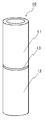
- FIG. 1 is a perspective view showing an example of the ceramic bonded body of the present embodiment
- FIG. 2 is a cross-sectional view showing an example of the ceramic bonded body of the present embodiment.
- the ceramic joined body 10 shown in FIGS. 1 and 2 has a cylindrical shape and is a compact first aluminum oxide sintered body 11 (hereinafter referred to as a dense first aluminum oxide sintered body 11 And a dense second aluminum oxide sintered body 12 (hereinafter, the dense second aluminum oxide sintered body 12 is referred to as a second sintered body 12).
- a dense aluminum oxide bonding layer 13 existing between the first sintered body 11 and the second sintered body 12 and integrating the first sintered body 11 and the second sintered body 12 (hereinafter referred to as The aluminum oxide bonding layer 13 is simply referred to as the bonding layer 13), and the aluminum oxide convex portion 14 (hereinafter, the aluminum oxide convex portion 14 is simply referred to as the convex portion 14) connected to the bonding layer 13 is provided.
- the internal space of the ceramic joined body 10 is, for example, a flow path for supplying and discharging a fluid such as a plasma generation gas.
- the gas for plasma generation includes, for example, fluorine-based gases such as SF 6 , CF 4 , CHF 3 , ClF 3 , NF 3 , C 4 F 8 , HF, etc., chlorine-based gases such as Cl 2 , HCl, BCl 3 , CCl 4 etc.
- the ceramic joined body 10 can be used as a flow path member.
- the bonding layer 13 exists in a bonding region between the bonding surface 11 a of the first sintered body 11 and the bonding surface 12 a of the second sintered body 12.
- Each of the first sintered body 11, the second sintered body 12, the bonding layer 13 and the convex portion 14 is a ceramic containing aluminum oxide as a main component.
- the main component in the present embodiment refers to the largest component of the total 100% by mass of all the components constituting the ceramic, and in particular, 90% by mass or more, and preferably 98% by mass.
- Identification of each component is performed by an X-ray diffractometer using CuK ⁇ rays, and the content of each component may be determined by, for example, an ICP (Inductively Coupled Plasma) emission spectrometer or a fluorescent X-ray analyzer.
- ICP Inductively Coupled Plasma
- the dense in the present embodiment means a state in which the area ratio of closed pores in the cross section of each member constituting the ceramic joined body 10 is 8% or less (excluding 0 area%).
- the convex portion 14 protrudes to the outside of the bonding layer 13 and is connected to the bonding layer 13. In other words, the convex portion 14 is disposed to cover at least one of the inner side surface and the outer side surface of the bonding layer 13. In the ceramic bonded body 10 shown in FIGS. 1 and 2, the convex portion 14 covers the inner peripheral surface which is the inner side surface of the bonding layer 13.
- the members constituting the ceramic joined body 10 are more easily broken as the fracture source such as the closed pores becomes larger, and also become more fragile as the distance between the fracture source and the surface of the sintered body becomes smaller. Therefore, if it is possible to reduce the size of the pores of the convex portion 14, particularly the number of closed pores usually present more than the open pores, the ceramic joined body 10 is hard to break and has excellent reliability.
- the average diameter of the closed pores of the convex portion 14 is set to 0. 0 of the average diameter of the closed pores of each of the first sintered body 11 and the second sintered body 12. 8 times or more and 1.5 times or less.
- the average diameter of the closed pores of the convex portion 14 and the first sintered body 11 and the sintered body 12 is set to 0.8 times to 1.5 times the average diameter of the closed pores of each of the first sintered body 11 and the second sintered body 12.
- the closed pores serving as a fracture source become too large. Since it does not exist, it can suppress that the ceramic joined body 10 destroys on the basis of the closed pore of the convex part 14.
- the average diameter of the closed pores of the convex portion 14 may be smaller than the average diameter of the closed pores of each of the first sintered body 11 and the second sintered body 12. With such a configuration, it is possible to make the mechanical strength of the convex portion 14 higher than the mechanical strength of the first sintered body 11 and the second sintered body 12.
- a region in which the absolute value of the skewness Sk of the distance between the centers of gravity of the closed pores of the convex portion 14 is smaller than the absolute value of the skewness Sk of the distance between the centers of gravity of the first sintered body 11 and the second sintered body 12 May be included.
- the distribution of the distance between the centers of gravity of the closed pores of the convex portion 14 is closer to the normal distribution than the distribution of the distances between the centers of gravity of the first sintered body 11 and the second sintered body 12. Therefore, the variation of the residual stress in the convex portion 14 is reduced, and the reliability is improved.
- the distance between the centers of gravity of the closed pores in the present disclosure is a linear distance connecting the centers of gravity of adjacent closed pores.
- the skewness Sk is how much the distribution is distorted from the normal distribution, that is, an index (statistics) indicating the left-right symmetry of the distribution, and when the skewness Sk> 0, the tail of the distribution is on the right
- the skewness Sk 0, the distribution becomes a symmetrical normal distribution, and when the skewness Sk ⁇ 0, the tail of the distribution goes to the left.
- the skewness Sk of the distance between the centers of gravity of closed pores may be determined using a function SKEW provided in Excel (registered trademark, Microsoft Corporation).
- a value obtained by subtracting the average diameter of the closed pores of the convex portion 14 from the average value of the distance between the centers of gravity of the closed pores of the convex portion 14 is the first value of the average distance between the centers of gravity of the closed pores of the first sintered body 11
- the value of 0.4 times or more of the value obtained by subtracting the average diameter of the closed pores of the sintered body 11 and the average value of the distance between the centers of gravity of the closed pores of the second sintered body 12 It may be 0.4 times or more of the value obtained by subtracting the average diameter.
- the value obtained by subtracting the average diameter of the closed pores of the convex portion 14 from the average value of the distance between the centers of gravity of the closed pores of the convex portion 14 can be reworded as the average value of the intervals of adjacent closed pores in the convex portion 14. It means that the adjacent closed pores are less likely to communicate with each other as the distance is larger.
- a value obtained by subtracting the average value of the closed pores of the convex portion 14 from the average value of the distance between the centers of gravity of the closed pores of the convex portion 14 may be 5 ⁇ m or more and 15 ⁇ m or less.
- this value is 5 ⁇ m or more, even if heating and cooling are repeated, the closed pores do not easily communicate with each other, and the mechanical strength of the convex portion 14 can be maintained, and the fluid flows from the inner space to the outer space It becomes difficult to leak towards.
- the distance is 15 ⁇ m or less, the distance between adjacent closed pores is narrow, and therefore even if a crack occurs, the probability that the development is blocked by the closed pores is high, so that the convex portion 14 is partially deficient Reduce the risk of
- skewness Sk of the circle equivalent diameter of the closed pores of the convex portion 14 may be larger than the skewness Sk of the distance between the centers of gravity of the closed pores of the convex portion 14.
- the skewness Sk of the equivalent pore diameter of the closed pores may also be determined using the function SKEW provided in Excel (registered trademark, Microsoft Corporation).
- the average value of the roundness of the closed pores of the convex portion 14 may be 0.78 or more.
- the average value of the circularity of the closed pores of the convex portion 14 is in this range, the shape of the closed pores becomes close to a sphere, and stress concentration in the vicinity of the closed pores is less likely to occur, so mechanical strength can be maintained. .
- the area ratio of the closed pores of the convex portion 14 of the ceramic joined body 10 of the present disclosure may be 2 area% or less, and the maximum diameter of the closed pores of the convex portion 14 may be 5 ⁇ m or less.
- the area ratio and the maximum diameter of the closed pores of the convex portion 14 are in the above-mentioned range, the closed pores which are the fracture source become small, and therefore, it becomes difficult to break.
- the area ratio of the closed pores of the convex portion 14 may be 1.5 area% or less.
- the maximum diameter of the closed pores of the convex portion 14 may be 4 ⁇ m or less and 3 ⁇ m or less.
- the average diameter of the closed pores of the convex portion 14 may be 1.5 ⁇ m or less.
- the average diameter of the closed pores is in this range, the closed pores which are the fracture source are small, so that the mechanical strength and the rigidity can be increased.
- the ratio of the maximum diameter of the closed pores of the convex portion 14 to the average diameter of the closed pores of the convex portion 14 may be 3 or less. (When the maximum diameter of the closed pores / the average diameter of the closed pores is in this range, there are no abnormally large closed pores, so it is difficult for the closed pores to communicate with each other even if heating and cooling are repeated, and the machine of the convex portion 14 While maintaining the target strength, the fluid is less likely to leak from the inner space to the outer space.
- the maximum height of the convex portion 14 (the maximum height in the normal direction from the inner surface of the bonding layer 13 in the example shown in FIG. 2) is, for example, 400 ⁇ m or more and 650 ⁇ m or less.
- the thickness of the bonding layer 13 is, for example, 0.7 mm or more and 1.3 mm or less.
- the surface of the convex portion 14 may be curved. If the surface of the convex portion 14 is curved, stress concentration is less likely to occur than in the case where the exposed surface has a corner portion, and therefore mechanical strength can be maintained.
- the average diameter, the maximum diameter, the area ratio, the distance between the centers of gravity and the circularity of the closed pores of each of these members are measured by the following method.
- the cross-sections of the first sintered body 11, the second sintered body 12, and the convex portion 14 are mirror-polished, and the cross-sections of the respective members are enlarged 500 times using a scanning electron microscope.
- An observation range is set such that the length is 256 ⁇ m and the longitudinal length is 192 ⁇ m.
- This observation range is the object of observation, and a method called particle analysis of image analysis software "A Image Kun (Ver 2.52)" (registered trademark, manufactured by Asahi Kasei Engineering Co., Ltd., hereinafter simply referred to as image analysis software) is used.
- image analysis software A Image Kun (Ver 2.52)
- image analysis software registered trademark, manufactured by Asahi Kasei Engineering Co., Ltd., hereinafter simply referred to as image analysis software
- the average value of the distances between the centers of gravity of the closed pores can be obtained by applying a method called distance between centers of gravity of image analysis.
- the threshold value is 70 to 100.
- the threshold value may be adjusted according to the brightness of the image which is the observation range, and the brightness of the particle is darkened and the method of binarization
- the threshold value may be adjusted so that the marker appearing in the image matches the shape of the closed pore, with the small figure removal area of 0.3 ⁇ m 2 and the noise removal filter.
- a first formed body containing a powder containing aluminum oxide as a main component and a resin and a second formed body containing a powder containing aluminum oxide as a main component and a resin
- Preparing a paste preparing a paste containing a powder mainly composed of aluminum oxide, a cellulose polysaccharide and a solvent, and a paste being present on the surface of either the first compact or the second compact
- a paste being present on the surface of either the first compact or the second compact
- the main component in the powder means a component of 90% by mass or more in the total 100% by mass of the powder.
- the solvent may be water.
- an organic solvent such as ethanol may be used.
- a ceramic bonded body can be obtained by firing the composite molded body in an air atmosphere at a temperature of 1500 ° C. or more and 1700 ° C. or less for 5 hours or more and 8 hours or less.
- the first compact in the composite compact becomes a first sintered body after firing
- the second compact becomes a second sintered body after firing.
- the paste interposed between the first compact and the second compact becomes a bonding layer after firing, and the paste exuding to the outside from between the first compact and the second compact becomes a convex after firing.
- MgO magnesium hydroxide converted to oxide
- SiO silicon oxide
- CaO calcium carbonate converted to oxide
- the mixed powder weighed to become a powder comprising the above is charged into a rotary mill together with a solvent such as water, and mixed with ceramic balls made of aluminum oxide having a purity of 99.5% to 99.99%.
- a molding binder such as polyvinyl alcohol, polyethylene glycol or acrylic resin is added and mixed to obtain a slurry.
- the addition amount of the molding binder is 2 parts by mass or more and 10 parts by mass or less with respect to 100 parts by mass of the mixed powder.
- granulated granules are obtained by spray-drying the slurry using a spray-drying apparatus.
- the first compact is obtained by the CIP method, for example, by setting the pressure to 80 MPa or more and 100 MPa. Also, a second molded body is obtained by the same method.
- the cellulose-based polysaccharide is, for example, at least one of methylcellulose, ethylcellulose, ethylmethylcellulose, hydroxymethylcellulose, hydroxypropylmethylcellulose, hydroxyethylmethylcellulose, carboxymethylcellulose, carboxymethylethylcellulose and carboxyethylcellulose.
- the rotation speed of the stirring device may be 1200 rpm or more and 1600 rpm or less, and the rotation time may be 5 minutes or more and 15 minutes or less.
- the rotational speed is increased to 1400 rpm or more
- the rotation speed may be set to 1600 rpm or less and the rotation time may be set to 5 minutes to 15 minutes.
- the value obtained by subtracting the average diameter of closed pores of the convex portion from the average value of the distance between the centers of gravity of the closed pores of the convex portion is the average value of the distance between the centers of gravity of the closed pores of the first sintered body
- the storage container is further given rotation and revolution simultaneously, and the number of rotations of rotation and the number of rotations of rotation
- the stirring may be carried out by rotating at 800 rpm or more and 1200 rpm or less and rotating for 2 minutes or more and 5 minutes or less.
- the value obtained by subtracting the average diameter of the closed pores of the convex portion from the average value of the distance between the centers of gravity of the closed pores of the convex portion is the value of the distance between the centers of gravity of the closed pores of the second sintered body.
- the same method as described above may be used also in the case of obtaining a ceramic joined body 0.4 times or more the value obtained by subtracting the average diameter of the pores.
- the rotation number of the rotation and the rotation number of the rotation may be 1000 rpm or more and 1200 rpm or less.
- the opposing surfaces are made into the state which faced each other, for example, a pressure is applied to a 1st compact
- a pressure is applied to a 1st compact
- the paste is dried by holding at room temperature and adjusting the humidity for 12 hours or more and 48 hours or less.
- a ceramic bonded body can be obtained by firing the composite molded body in an air atmosphere at a temperature of 1500 ° C. or more and 1700 ° C. or less for 5 hours or more and 8 hours or less.
- annular flow path members other than cylindrical flow path members for supplying and discharging a fluid such as plasma generation gas, argon, helium
- a fluid such as plasma generation gas, argon, helium
- It can be used for a flow path member formed in a cylindrical shape, an annular shape or the like for supplying and discharging a cooling fluid such as water, a shower plate provided with a large number of flow paths in the thickness direction, and the like.
- polyvinyl alcohol, polyethylene glycol and an acrylic resin were added to the solvent as a molding binder and mixed to obtain a slurry.
- the addition amount of the molding binder was 3 parts by mass in total with respect to 100 parts by mass of the mixed powder.
- granulated granules were obtained by spray-drying the slurry using a spray-drying apparatus.
- the granules were molded by CIP method under a pressure of 30 kPa to obtain a prismatic first molded body which is a precursor of the first sintered body.
- the prismatic 2nd molded object which is a precursor of a 2nd sintered compact was obtained by the same method.
- rotation means that the storage container was rotated by the stirring apparatus, and it mixed and stirred.
- rotation / revolution means that the storage container was further rotated and revolved with a stirring apparatus after rotation (first time), and was mixed and stirred. In rotation and revolution, the number of rotations of rotation and revolution is the same.
- the pressure is set to 96 MPa for the first and second compacts.
- the paste was made to project from the bonding area between the first molded body and the second molded body to obtain a composite molded body.
- Sample No. Test pieces were prepared from 1 to 10, respectively, and the three-point bending strength was measured in accordance with JIS R 1601: 2008. In addition, although C-face processing was only given to the creased surface, grinding and polishing were not performed, and the baked surface was measured as the creased surface.
- test pieces were arrange
- the horizontal length of each of the first sintered body, the second sintered body and the bonding layer obtained by polishing a cross section parallel to the thickness direction of the test specimen with diamond abrasive grains is 256 ⁇ m.
- the average diameter of the closed pores of the sintered body shown in Table 1 is the average diameter of the closed pores contained in the first sintered body and the second sintered body. Since the average diameter of the closed pore contained in a 1st sintered compact and a 2nd sintered compact was the same as a result of a measurement, it omits and describes.
- the ratio of the closed pore distance shown in Table 1 is a value obtained by subtracting the average diameter of the closed pores of the convex portions from the average value of the distance between the centers of gravity of the closed pores of the convex portions, and the closed pores of the first sintered body
- the ratio of the value obtained by subtracting the average diameter of the closed pores of the first sintered body from the average value of the distance between the centers of gravity of the second sintered body and the average value of the distance between the centers of gravity of the closed pores of the second sintered body The ratio of the value obtained by subtracting the average diameter of is omitted.
- the ratio of the closed pore distance is also omitted because it is the same for the first sintered body and the second sintered body.
- Sample No. 1 in which the average diameter of the closed pores of the convex portion is not less than 0.8 times and not more than 1.5 times the average diameter of the closed pores of the first sintered body and the second sintered body. 3 to 11 are sample Nos. It shows higher strength than 1 and 2.
- sample No. 1 in which the average diameter of the closed pores of the convex portion is smaller than the average diameter of the closed pores of the first sintered body and the second sintered body.
- the strengths of 5 to 11 are high.
- the value obtained by subtracting the average diameter of the closed pores of the convex portion from the average value of the distance between the centers of gravity of the closed pores of the convex portion is the average value of the distance between the centers of gravity of the closed pores of the sintered body
Landscapes
- Chemical & Material Sciences (AREA)
- Engineering & Computer Science (AREA)
- Ceramic Engineering (AREA)
- Materials Engineering (AREA)
- Structural Engineering (AREA)
- Organic Chemistry (AREA)
- Manufacturing & Machinery (AREA)
- Inorganic Chemistry (AREA)
- Chemical Kinetics & Catalysis (AREA)
- Ceramic Products (AREA)
Abstract
Description

11 第1焼結体
12 第2焼結体
13 接合層
14 凸部
Claims (7)
- 第1の酸化アルミニウム質焼結体と、第2の酸化アルミニウム質焼結体と、前記第1の酸化アルミニウム質焼結体と前記第2の酸化アルミニウム質焼結体との間に位置する酸化アルミニウム質接合層と、該酸化アルミニウム質接合層に繋がる酸化アルミニウム質凸部と、を有するセラミック接合体であって、
該酸化アルミニウム質凸部の閉気孔の平均径が、前記第1の酸化アルミニウム質焼結体および前記第2の酸化アルミニウム質焼結体のそれぞれの閉気孔の平均径の0.8倍以上1.5倍以下である、セラミック接合体。 - 前記酸化アルミニウム質凸部の閉気孔の平均径が、前記第1の酸化アルミニウム質焼結体および前記第2の酸化アルミニウム質焼結体のそれぞれの閉気孔の平均径よりも小さい、請求項1に記載のセラミック接合体。
- 前記酸化アルミニウム質凸部の閉気孔の重心間距離の歪度Skの絶対値が前記第1の酸化アルミニウム質焼結体および前記第2の酸化アルミニウム質焼結体のそれぞれの重心間距離の歪度Skの絶対値よりも小さい領域を有する、請求項1または請求項2に記載のセラミック接合体。
- 前記酸化アルミニウム質凸部の閉気孔の重心間距離の平均値から前記酸化アルミニウム質凸部の閉気孔の平均径を差し引いた値が、前記第1の酸化アルミニウム質焼結体の閉気孔の重心間距離の平均値から前記第1の酸化アルミニウム質焼結体の閉気孔の平均径を差し引いた値の0.4倍以上であり、前記第2の酸化アルミニウム質焼結体の閉気孔の重心間距離の平均値から前記第2の酸化アルミニウム質焼結体の閉気孔の平均径を差し引いた値の0.4倍以上である、請求項1乃至請求項3のいずれかに記載のセラミック接合体。
- 前記酸化アルミニウム質凸部の閉気孔の円相当径の歪度Skは、前記酸化アルミニウム質凸部の閉気孔の重心間距離の歪度Skよりも大きい、請求項1乃至請求項4のいずれかに記載のセラミック接合体。
- 前記酸化アルミニウム質凸部の閉気孔の円形度の平均値が0.78以上である、請求項1乃至請求項3のいずれかに記載のセラミック接合体。
- 酸化アルミニウムを主成分とする粉末と樹脂とを含有する第1成形体と、酸化アルミニウムを主成分とする粉末と樹脂とを含有する第2成形体とを準備する工程と、
酸化アルミニウムを主成分とする粉末とセルロース系多糖類と溶媒とを含有するペーストを準備する工程と、
前記第1成形体および前記第2成形体のいずれかの表面に前記ペーストを存在させる工程と、
前記第1成形体と前記第2成形体との間である接合領域から前記ペーストが突出するように前記第1成形体および前記第2成形体を合わせて複合成形体とする工程と、前記複合成形体を焼成する工程とを、有する、セラミック接合体の製造方法。
Priority Applications (3)
| Application Number | Priority Date | Filing Date | Title |
|---|---|---|---|
| KR1020207003257A KR102387056B1 (ko) | 2017-08-29 | 2018-08-29 | 세라믹 접합체 및 그 제조 방법 |
| US16/643,143 US11999660B2 (en) | 2017-08-29 | 2018-08-29 | Ceramic joined body and method for manufacturing same |
| JP2019539586A JP6952120B2 (ja) | 2017-08-29 | 2018-08-29 | セラミック接合体およびその製造方法 |
Applications Claiming Priority (2)
| Application Number | Priority Date | Filing Date | Title |
|---|---|---|---|
| JP2017163995 | 2017-08-29 | ||
| JP2017-163995 | 2017-08-29 |
Publications (1)
| Publication Number | Publication Date |
|---|---|
| WO2019044906A1 true WO2019044906A1 (ja) | 2019-03-07 |
Family
ID=65527402
Family Applications (1)
| Application Number | Title | Priority Date | Filing Date |
|---|---|---|---|
| PCT/JP2018/031950 Ceased WO2019044906A1 (ja) | 2017-08-29 | 2018-08-29 | セラミック接合体およびその製造方法 |
Country Status (4)
| Country | Link |
|---|---|
| US (1) | US11999660B2 (ja) |
| JP (1) | JP6952120B2 (ja) |
| KR (1) | KR102387056B1 (ja) |
| WO (1) | WO2019044906A1 (ja) |
Cited By (4)
| Publication number | Priority date | Publication date | Assignee | Title |
|---|---|---|---|---|
| JPWO2021141056A1 (ja) * | 2020-01-10 | 2021-07-15 | ||
| WO2022124376A1 (ja) * | 2020-12-09 | 2022-06-16 | 京セラ株式会社 | 気泡率センサ、これを用いた流量計および極低温液体移送管 |
| JPWO2022163779A1 (ja) * | 2021-01-29 | 2022-08-04 | ||
| JP7727050B1 (ja) | 2024-05-23 | 2025-08-20 | 神島化学工業株式会社 | セラミックス部材接合体の製造方法、セラミックス部材接合体及びセラミックス部材 |
Families Citing this family (1)
| Publication number | Priority date | Publication date | Assignee | Title |
|---|---|---|---|---|
| TW202321604A (zh) * | 2021-11-22 | 2023-06-01 | 美商摩特股份有限公司 | 多孔流量限制器及其製造方法 |
Citations (5)
| Publication number | Priority date | Publication date | Assignee | Title |
|---|---|---|---|---|
| WO2008096851A1 (ja) * | 2007-02-08 | 2008-08-14 | Ngk Insulators, Ltd. | 接合材組成物及びその製造方法並びに接合体及びその製造方法 |
| WO2009095982A1 (ja) * | 2008-01-28 | 2009-08-06 | Ibiden Co., Ltd. | ハニカム構造体 |
| JP2012171815A (ja) * | 2011-02-18 | 2012-09-10 | National Institute Of Advanced Industrial Science & Technology | アルミナ接合体及びアルミナ焼結体の接合方法 |
| JP2015030629A (ja) * | 2013-07-31 | 2015-02-16 | 太平洋セメント株式会社 | アルミナセラミックス接合体及びその製造方法 |
| JP2016079068A (ja) * | 2014-10-17 | 2016-05-16 | 株式会社日本セラテック | アルミナセラミックス接合体及びその製造方法 |
Family Cites Families (5)
| Publication number | Priority date | Publication date | Assignee | Title |
|---|---|---|---|---|
| JP4476557B2 (ja) * | 2003-03-25 | 2010-06-09 | 日本碍子株式会社 | セラミックス構造体の接合方法 |
| WO2007111380A1 (en) * | 2006-03-24 | 2007-10-04 | Ngk Insulators, Ltd. | Method for producing sintered body, and sintered body |
| US8349111B2 (en) * | 2006-08-14 | 2013-01-08 | Ceramatec, Inc. | Method for joining ceramic components |
| JP6066644B2 (ja) | 2012-09-26 | 2017-01-25 | 日本特殊陶業株式会社 | セラミックス接合体の製造方法 |
| JP6263351B2 (ja) | 2013-08-30 | 2018-01-17 | 日本特殊陶業株式会社 | セラミックス焼結体およびその製造方法 |
-
2018
- 2018-08-29 US US16/643,143 patent/US11999660B2/en active Active
- 2018-08-29 JP JP2019539586A patent/JP6952120B2/ja active Active
- 2018-08-29 KR KR1020207003257A patent/KR102387056B1/ko active Active
- 2018-08-29 WO PCT/JP2018/031950 patent/WO2019044906A1/ja not_active Ceased
Patent Citations (5)
| Publication number | Priority date | Publication date | Assignee | Title |
|---|---|---|---|---|
| WO2008096851A1 (ja) * | 2007-02-08 | 2008-08-14 | Ngk Insulators, Ltd. | 接合材組成物及びその製造方法並びに接合体及びその製造方法 |
| WO2009095982A1 (ja) * | 2008-01-28 | 2009-08-06 | Ibiden Co., Ltd. | ハニカム構造体 |
| JP2012171815A (ja) * | 2011-02-18 | 2012-09-10 | National Institute Of Advanced Industrial Science & Technology | アルミナ接合体及びアルミナ焼結体の接合方法 |
| JP2015030629A (ja) * | 2013-07-31 | 2015-02-16 | 太平洋セメント株式会社 | アルミナセラミックス接合体及びその製造方法 |
| JP2016079068A (ja) * | 2014-10-17 | 2016-05-16 | 株式会社日本セラテック | アルミナセラミックス接合体及びその製造方法 |
Cited By (15)
| Publication number | Priority date | Publication date | Assignee | Title |
|---|---|---|---|---|
| JPWO2021141056A1 (ja) * | 2020-01-10 | 2021-07-15 | ||
| WO2021141056A1 (ja) * | 2020-01-10 | 2021-07-15 | 京セラ株式会社 | セラミック接合体、セラミック接合体の製造方法、流路切替弁用ステータおよび流路切替弁 |
| JP7325543B2 (ja) | 2020-01-10 | 2023-08-14 | 京セラ株式会社 | セラミック接合体、セラミック接合体の製造方法、流路切替弁用ステータおよび流路切替弁 |
| KR20230098644A (ko) * | 2020-12-09 | 2023-07-04 | 교세라 가부시키가이샤 | 기포율 센서, 이것을 사용한 유량계 및 극저온 액체 이송관 |
| JPWO2022124376A1 (ja) * | 2020-12-09 | 2022-06-16 | ||
| WO2022124376A1 (ja) * | 2020-12-09 | 2022-06-16 | 京セラ株式会社 | 気泡率センサ、これを用いた流量計および極低温液体移送管 |
| JP7489489B2 (ja) | 2020-12-09 | 2024-05-23 | 京セラ株式会社 | 気泡率センサ、これを用いた流量計および極低温液体移送管 |
| KR102884308B1 (ko) * | 2020-12-09 | 2025-11-11 | 교세라 가부시키가이샤 | 기포율 센서, 이것을 사용한 유량계 및 극저온 액체 이송관 |
| US12529669B2 (en) | 2020-12-09 | 2026-01-20 | Kyocera Corporation | Void fraction sensor, flowmeter using the same, and cryogenic liquid transfer pipe |
| JPWO2022163779A1 (ja) * | 2021-01-29 | 2022-08-04 | ||
| WO2022163779A1 (ja) * | 2021-01-29 | 2022-08-04 | 京セラ株式会社 | 気泡率センサ、これを用いた流量計および極低温液体移送管 |
| JP7511031B2 (ja) | 2021-01-29 | 2024-07-04 | 京セラ株式会社 | 気泡率センサ、これを用いた流量計および極低温液体移送管 |
| JP7727050B1 (ja) | 2024-05-23 | 2025-08-20 | 神島化学工業株式会社 | セラミックス部材接合体の製造方法、セラミックス部材接合体及びセラミックス部材 |
| WO2025243627A1 (ja) * | 2024-05-23 | 2025-11-27 | 神島化学工業株式会社 | セラミックス部材接合体の製造方法、セラミックス部材接合体及びセラミックス部材 |
| JP2025177243A (ja) * | 2024-05-23 | 2025-12-05 | 神島化学工業株式会社 | セラミックス部材接合体の製造方法、セラミックス部材接合体及びセラミックス部材 |
Also Published As
| Publication number | Publication date |
|---|---|
| JP6952120B2 (ja) | 2021-10-20 |
| JPWO2019044906A1 (ja) | 2020-08-27 |
| KR102387056B1 (ko) | 2022-04-15 |
| US11999660B2 (en) | 2024-06-04 |
| KR20200024910A (ko) | 2020-03-09 |
| US20200346984A1 (en) | 2020-11-05 |
Similar Documents
| Publication | Publication Date | Title |
|---|---|---|
| WO2019044906A1 (ja) | セラミック接合体およびその製造方法 | |
| EP3075719B1 (en) | Porous material and heat insulating film | |
| JP5545803B2 (ja) | セラミックス多孔質焼結体の製造方法 | |
| WO2022138579A1 (ja) | セラミックボール用素材およびそれを用いたセラミックボールの製造方法並びにセラミックボール | |
| JP2020173089A (ja) | セラミックトレイ、これを用いる熱処理方法および熱処理装置 | |
| JP7439239B2 (ja) | 流路部材およびその製造方法 | |
| TW202229206A (zh) | 燒結體 | |
| JP7181123B2 (ja) | 半導体製造装置用部材およびその製造方法 | |
| CN103370288B (zh) | 氧化铝接合体以及氧化铝烧结体的接合方法 | |
| JP7583686B2 (ja) | 吸着用部材およびその製造方法 | |
| JP2006093492A (ja) | 真空吸着装置 | |
| TWI883673B (zh) | 真空夾盤及其製造方法 | |
| JP2020173086A (ja) | セラミックトレイ、これを用いる熱処理方法および熱処理装置 | |
| JP7018839B2 (ja) | セラミック構造体およびその製造方法 | |
| JP7204879B2 (ja) | セラミック構造体および該セラミック構造体を備えてなる支持機構 | |
| JP7598841B2 (ja) | 線材巻取り用ボビンおよび巻取装置 | |
| JP6179026B2 (ja) | 低熱膨張セラミックスおよびその製造方法 | |
| JP6590675B2 (ja) | 真空吸着装置 | |
| WO2023002975A1 (ja) | スペーサーおよび複層ガラス | |
| JP2019006648A (ja) | 配向セラミックス焼結体及びその製法 | |
| JP6336779B2 (ja) | 断熱用部材 | |
| JP2023060939A (ja) | セラミック構造体 | |
| WO2023190097A1 (ja) | セラミックス系音響整合層材料、その製造方法、およびその用途 | |
| TW202207277A (zh) | 陶瓷構造體及靜電偏向器 | |
| WO2016002852A1 (ja) | セラミック構造体および流路体ならびに電極内蔵プレート |
Legal Events
| Date | Code | Title | Description |
|---|---|---|---|
| 121 | Ep: the epo has been informed by wipo that ep was designated in this application |
Ref document number: 18850753 Country of ref document: EP Kind code of ref document: A1 |
|
| ENP | Entry into the national phase |
Ref document number: 20207003257 Country of ref document: KR Kind code of ref document: A |
|
| ENP | Entry into the national phase |
Ref document number: 2019539586 Country of ref document: JP Kind code of ref document: A |
|
| NENP | Non-entry into the national phase |
Ref country code: DE |
|
| 122 | Ep: pct application non-entry in european phase |
Ref document number: 18850753 Country of ref document: EP Kind code of ref document: A1 |