WO2019017616A1 - 유기 발광 화합물 및 이를 이용한 유기 전계 발광 소자 - Google Patents
유기 발광 화합물 및 이를 이용한 유기 전계 발광 소자 Download PDFInfo
- Publication number
- WO2019017616A1 WO2019017616A1 PCT/KR2018/007482 KR2018007482W WO2019017616A1 WO 2019017616 A1 WO2019017616 A1 WO 2019017616A1 KR 2018007482 W KR2018007482 W KR 2018007482W WO 2019017616 A1 WO2019017616 A1 WO 2019017616A1
- Authority
- WO
- WIPO (PCT)
- Prior art keywords
- group
- formula
- compound
- layer
- aryl
- Prior art date
- Legal status (The legal status is an assumption and is not a legal conclusion. Google has not performed a legal analysis and makes no representation as to the accuracy of the status listed.)
- Ceased
Links
- 0 CC=C(C=C*c1nc(-c(cc2)ccc2-c2cccc3c2-c2ccccc2C32C3=CCCC=C3c3c2cccc3)cc(-c2ccccc2)n1)C1=C*=CCC1 Chemical compound CC=C(C=C*c1nc(-c(cc2)ccc2-c2cccc3c2-c2ccccc2C32C3=CCCC=C3c3c2cccc3)cc(-c2ccccc2)n1)C1=C*=CCC1 0.000 description 12
- MRTLULYWFXNHFL-UHFFFAOYSA-N Clc1nc(-c2ccccc2)nc(-c(cc2)ccc2-c2cccnc2)c1 Chemical compound Clc1nc(-c2ccccc2)nc(-c(cc2)ccc2-c2cccnc2)c1 MRTLULYWFXNHFL-UHFFFAOYSA-N 0.000 description 2
- OOZFQOXPWBKLEZ-DHZHZOJOSA-N O=C(/C=C/c(cc1)ccc1-c1cccnc1)c1cccc(Br)c1 Chemical compound O=C(/C=C/c(cc1)ccc1-c1cccnc1)c1cccc(Br)c1 OOZFQOXPWBKLEZ-DHZHZOJOSA-N 0.000 description 2
- NXZUVHZZIZHEOP-UHFFFAOYSA-N O=Cc(cc1)ccc1-c1cccnc1 Chemical compound O=Cc(cc1)ccc1-c1cccnc1 NXZUVHZZIZHEOP-UHFFFAOYSA-N 0.000 description 2
- OJGRXJCZLNHFSF-UHFFFAOYSA-N Brc1cccc(-c2nc(-c3ccccc3)nc(-c(cc3)ccc3-c3cccnc3)c2)c1 Chemical compound Brc1cccc(-c2nc(-c3ccccc3)nc(-c(cc3)ccc3-c3cccnc3)c2)c1 OJGRXJCZLNHFSF-UHFFFAOYSA-N 0.000 description 1
- HBNCQLJRFPPKCB-AWNIVKPZSA-N C=[Br]c(cc1)ccc1C(/C=C/c(cc1)ccc1-c1cccnc1)=O Chemical compound C=[Br]c(cc1)ccc1C(/C=C/c(cc1)ccc1-c1cccnc1)=O HBNCQLJRFPPKCB-AWNIVKPZSA-N 0.000 description 1
- FQTWNVDEYJTYOT-UHFFFAOYSA-N CC(C)(c1c2)c3c(CCC=C4)c4ccc3-c1ccc2-c1nc(-c2ccccc2)nc(-c(cc2)ccc2-c2ccccn2)c1 Chemical compound CC(C)(c1c2)c3c(CCC=C4)c4ccc3-c1ccc2-c1nc(-c2ccccc2)nc(-c(cc2)ccc2-c2ccccn2)c1 FQTWNVDEYJTYOT-UHFFFAOYSA-N 0.000 description 1
- WYECURVXVYPVAT-UHFFFAOYSA-N CC(c(cc1)ccc1Br)=O Chemical compound CC(c(cc1)ccc1Br)=O WYECURVXVYPVAT-UHFFFAOYSA-N 0.000 description 1
- JYAQYXOVOHJRCS-UHFFFAOYSA-N CC(c1cccc(Br)c1)=O Chemical compound CC(c1cccc(Br)c1)=O JYAQYXOVOHJRCS-UHFFFAOYSA-N 0.000 description 1
- OMKPXODICJAYGP-UHFFFAOYSA-N CC1(C)c2cc(-c3nc(-c4ccccc4)nc(-c(cc4)ccc4-c4cccnc4)c3)ccc2-c2c1cccc2 Chemical compound CC1(C)c2cc(-c3nc(-c4ccccc4)nc(-c(cc4)ccc4-c4cccnc4)c3)ccc2-c2c1cccc2 OMKPXODICJAYGP-UHFFFAOYSA-N 0.000 description 1
- NRFQZTCQAYEXEE-UHFFFAOYSA-N Clc1cc(Cl)nc(-c2ccccc2)n1 Chemical compound Clc1cc(Cl)nc(-c2ccccc2)n1 NRFQZTCQAYEXEE-UHFFFAOYSA-N 0.000 description 1
- PXXJHWLDUBFPOL-UHFFFAOYSA-N NC(c1ccccc1)=N Chemical compound NC(c1ccccc1)=N PXXJHWLDUBFPOL-UHFFFAOYSA-N 0.000 description 1
Classifications
-
- C—CHEMISTRY; METALLURGY
- C07—ORGANIC CHEMISTRY
- C07D—HETEROCYCLIC COMPOUNDS
- C07D401/00—Heterocyclic compounds containing two or more hetero rings, having nitrogen atoms as the only ring hetero atoms, at least one ring being a six-membered ring with only one nitrogen atom
- C07D401/02—Heterocyclic compounds containing two or more hetero rings, having nitrogen atoms as the only ring hetero atoms, at least one ring being a six-membered ring with only one nitrogen atom containing two hetero rings
- C07D401/04—Heterocyclic compounds containing two or more hetero rings, having nitrogen atoms as the only ring hetero atoms, at least one ring being a six-membered ring with only one nitrogen atom containing two hetero rings directly linked by a ring-member-to-ring-member bond
-
- C—CHEMISTRY; METALLURGY
- C07—ORGANIC CHEMISTRY
- C07D—HETEROCYCLIC COMPOUNDS
- C07D401/00—Heterocyclic compounds containing two or more hetero rings, having nitrogen atoms as the only ring hetero atoms, at least one ring being a six-membered ring with only one nitrogen atom
- C07D401/02—Heterocyclic compounds containing two or more hetero rings, having nitrogen atoms as the only ring hetero atoms, at least one ring being a six-membered ring with only one nitrogen atom containing two hetero rings
- C07D401/10—Heterocyclic compounds containing two or more hetero rings, having nitrogen atoms as the only ring hetero atoms, at least one ring being a six-membered ring with only one nitrogen atom containing two hetero rings linked by a carbon chain containing aromatic rings
-
- C—CHEMISTRY; METALLURGY
- C07—ORGANIC CHEMISTRY
- C07D—HETEROCYCLIC COMPOUNDS
- C07D403/00—Heterocyclic compounds containing two or more hetero rings, having nitrogen atoms as the only ring hetero atoms, not provided for by group C07D401/00
- C07D403/02—Heterocyclic compounds containing two or more hetero rings, having nitrogen atoms as the only ring hetero atoms, not provided for by group C07D401/00 containing two hetero rings
- C07D403/10—Heterocyclic compounds containing two or more hetero rings, having nitrogen atoms as the only ring hetero atoms, not provided for by group C07D401/00 containing two hetero rings linked by a carbon chain containing aromatic rings
-
- C—CHEMISTRY; METALLURGY
- C09—DYES; PAINTS; POLISHES; NATURAL RESINS; ADHESIVES; COMPOSITIONS NOT OTHERWISE PROVIDED FOR; APPLICATIONS OF MATERIALS NOT OTHERWISE PROVIDED FOR
- C09K—MATERIALS FOR MISCELLANEOUS APPLICATIONS, NOT PROVIDED FOR ELSEWHERE
- C09K11/00—Luminescent materials, e.g. electroluminescent or chemiluminescent
- C09K11/06—Luminescent materials, e.g. electroluminescent or chemiluminescent containing organic luminescent materials
-
- H—ELECTRICITY
- H10—SEMICONDUCTOR DEVICES; ELECTRIC SOLID-STATE DEVICES NOT OTHERWISE PROVIDED FOR
- H10K—ORGANIC ELECTRIC SOLID-STATE DEVICES
- H10K50/00—Organic light-emitting devices
- H10K50/10—OLEDs or polymer light-emitting diodes [PLED]
- H10K50/14—Carrier transporting layers
- H10K50/16—Electron transporting layers
-
- H—ELECTRICITY
- H10—SEMICONDUCTOR DEVICES; ELECTRIC SOLID-STATE DEVICES NOT OTHERWISE PROVIDED FOR
- H10K—ORGANIC ELECTRIC SOLID-STATE DEVICES
- H10K85/00—Organic materials used in the body or electrodes of devices covered by this subclass
- H10K85/60—Organic compounds having low molecular weight
- H10K85/615—Polycyclic condensed aromatic hydrocarbons, e.g. anthracene
-
- H—ELECTRICITY
- H10—SEMICONDUCTOR DEVICES; ELECTRIC SOLID-STATE DEVICES NOT OTHERWISE PROVIDED FOR
- H10K—ORGANIC ELECTRIC SOLID-STATE DEVICES
- H10K85/00—Organic materials used in the body or electrodes of devices covered by this subclass
- H10K85/60—Organic compounds having low molecular weight
- H10K85/615—Polycyclic condensed aromatic hydrocarbons, e.g. anthracene
- H10K85/622—Polycyclic condensed aromatic hydrocarbons, e.g. anthracene containing four rings, e.g. pyrene
-
- H—ELECTRICITY
- H10—SEMICONDUCTOR DEVICES; ELECTRIC SOLID-STATE DEVICES NOT OTHERWISE PROVIDED FOR
- H10K—ORGANIC ELECTRIC SOLID-STATE DEVICES
- H10K85/00—Organic materials used in the body or electrodes of devices covered by this subclass
- H10K85/60—Organic compounds having low molecular weight
- H10K85/615—Polycyclic condensed aromatic hydrocarbons, e.g. anthracene
- H10K85/624—Polycyclic condensed aromatic hydrocarbons, e.g. anthracene containing six or more rings
-
- H—ELECTRICITY
- H10—SEMICONDUCTOR DEVICES; ELECTRIC SOLID-STATE DEVICES NOT OTHERWISE PROVIDED FOR
- H10K—ORGANIC ELECTRIC SOLID-STATE DEVICES
- H10K85/00—Organic materials used in the body or electrodes of devices covered by this subclass
- H10K85/60—Organic compounds having low molecular weight
- H10K85/649—Aromatic compounds comprising a hetero atom
- H10K85/654—Aromatic compounds comprising a hetero atom comprising only nitrogen as heteroatom
-
- C—CHEMISTRY; METALLURGY
- C09—DYES; PAINTS; POLISHES; NATURAL RESINS; ADHESIVES; COMPOSITIONS NOT OTHERWISE PROVIDED FOR; APPLICATIONS OF MATERIALS NOT OTHERWISE PROVIDED FOR
- C09K—MATERIALS FOR MISCELLANEOUS APPLICATIONS, NOT PROVIDED FOR ELSEWHERE
- C09K2211/00—Chemical nature of organic luminescent or tenebrescent compounds
- C09K2211/10—Non-macromolecular compounds
- C09K2211/1003—Carbocyclic compounds
- C09K2211/1007—Non-condensed systems
-
- C—CHEMISTRY; METALLURGY
- C09—DYES; PAINTS; POLISHES; NATURAL RESINS; ADHESIVES; COMPOSITIONS NOT OTHERWISE PROVIDED FOR; APPLICATIONS OF MATERIALS NOT OTHERWISE PROVIDED FOR
- C09K—MATERIALS FOR MISCELLANEOUS APPLICATIONS, NOT PROVIDED FOR ELSEWHERE
- C09K2211/00—Chemical nature of organic luminescent or tenebrescent compounds
- C09K2211/10—Non-macromolecular compounds
- C09K2211/1003—Carbocyclic compounds
- C09K2211/1011—Condensed systems
-
- C—CHEMISTRY; METALLURGY
- C09—DYES; PAINTS; POLISHES; NATURAL RESINS; ADHESIVES; COMPOSITIONS NOT OTHERWISE PROVIDED FOR; APPLICATIONS OF MATERIALS NOT OTHERWISE PROVIDED FOR
- C09K—MATERIALS FOR MISCELLANEOUS APPLICATIONS, NOT PROVIDED FOR ELSEWHERE
- C09K2211/00—Chemical nature of organic luminescent or tenebrescent compounds
- C09K2211/10—Non-macromolecular compounds
- C09K2211/1018—Heterocyclic compounds
- C09K2211/1025—Heterocyclic compounds characterised by ligands
- C09K2211/1029—Heterocyclic compounds characterised by ligands containing one nitrogen atom as the heteroatom
-
- C—CHEMISTRY; METALLURGY
- C09—DYES; PAINTS; POLISHES; NATURAL RESINS; ADHESIVES; COMPOSITIONS NOT OTHERWISE PROVIDED FOR; APPLICATIONS OF MATERIALS NOT OTHERWISE PROVIDED FOR
- C09K—MATERIALS FOR MISCELLANEOUS APPLICATIONS, NOT PROVIDED FOR ELSEWHERE
- C09K2211/00—Chemical nature of organic luminescent or tenebrescent compounds
- C09K2211/10—Non-macromolecular compounds
- C09K2211/1018—Heterocyclic compounds
- C09K2211/1025—Heterocyclic compounds characterised by ligands
- C09K2211/1059—Heterocyclic compounds characterised by ligands containing three nitrogen atoms as heteroatoms
-
- H—ELECTRICITY
- H10—SEMICONDUCTOR DEVICES; ELECTRIC SOLID-STATE DEVICES NOT OTHERWISE PROVIDED FOR
- H10K—ORGANIC ELECTRIC SOLID-STATE DEVICES
- H10K50/00—Organic light-emitting devices
- H10K50/10—OLEDs or polymer light-emitting diodes [PLED]
- H10K50/14—Carrier transporting layers
- H10K50/15—Hole transporting layers
-
- H—ELECTRICITY
- H10—SEMICONDUCTOR DEVICES; ELECTRIC SOLID-STATE DEVICES NOT OTHERWISE PROVIDED FOR
- H10K—ORGANIC ELECTRIC SOLID-STATE DEVICES
- H10K50/00—Organic light-emitting devices
- H10K50/10—OLEDs or polymer light-emitting diodes [PLED]
- H10K50/14—Carrier transporting layers
- H10K50/16—Electron transporting layers
- H10K50/166—Electron transporting layers comprising a multilayered structure
-
- H—ELECTRICITY
- H10—SEMICONDUCTOR DEVICES; ELECTRIC SOLID-STATE DEVICES NOT OTHERWISE PROVIDED FOR
- H10K—ORGANIC ELECTRIC SOLID-STATE DEVICES
- H10K50/00—Organic light-emitting devices
- H10K50/10—OLEDs or polymer light-emitting diodes [PLED]
- H10K50/17—Carrier injection layers
-
- H—ELECTRICITY
- H10—SEMICONDUCTOR DEVICES; ELECTRIC SOLID-STATE DEVICES NOT OTHERWISE PROVIDED FOR
- H10K—ORGANIC ELECTRIC SOLID-STATE DEVICES
- H10K50/00—Organic light-emitting devices
- H10K50/10—OLEDs or polymer light-emitting diodes [PLED]
- H10K50/17—Carrier injection layers
- H10K50/171—Electron injection layers
-
- H—ELECTRICITY
- H10—SEMICONDUCTOR DEVICES; ELECTRIC SOLID-STATE DEVICES NOT OTHERWISE PROVIDED FOR
- H10K—ORGANIC ELECTRIC SOLID-STATE DEVICES
- H10K85/00—Organic materials used in the body or electrodes of devices covered by this subclass
- H10K85/30—Coordination compounds
- H10K85/321—Metal complexes comprising a group IIIA element, e.g. Tris (8-hydroxyquinoline) gallium [Gaq3]
- H10K85/324—Metal complexes comprising a group IIIA element, e.g. Tris (8-hydroxyquinoline) gallium [Gaq3] comprising aluminium, e.g. Alq3
Definitions
- the present invention relates to a novel organic light emitting compound and an organic electroluminescent device using the same. More particularly, the present invention relates to a compound having excellent electron transporting ability and light emitting ability, To an improved organic electroluminescent device.
- the organic electroluminescent device when a voltage is applied between two electrodes, holes are injected into the organic layer in the anode, and electrons are injected into the organic layer in the cathode. When the injected holes and electrons meet, an exciton is formed. When the exciton falls to the ground state, light is emitted. At this time, the material used as the organic material layer can be classified into a light emitting material, a hole injecting material, a hole transporting material, an electron transporting material, an electron injecting material and the like depending on its function.
- the light emitting layer forming material of the organic EL device can be classified into blue, green and red light emitting materials depending on the luminescent color. In addition, yellow and orange light emitting materials are also used as light emitting materials for realizing better color. Further, in order to increase the color purity and increase the luminous efficiency through energy transfer, a host / dopant system can be used as a light emitting material.
- the dopant material can be divided into a fluorescent dopant using an organic material and a phosphorescent dopant using a metal complex compound containing heavy atoms such as Ir and Pt. The development of such a phosphorescent material can theoretically improve the luminous efficiency up to 4 times as compared with that of fluorescence, and attention is focused on phosphorescent host materials as well as phosphorescent dopants.
- NPB, BCP, and Alq 3 have been widely known as hole injecting materials, hole transporting materials, electron transporting materials, and electron injecting materials, and anthracene derivatives as luminescent materials have been reported.
- metal complex compounds containing Ir such as Firpic, Ir (ppy) 3 , (acac) Ir (btp) 2 and the like having advantages in terms of efficiency improvement of light emitting materials are blue, green, 4,4-dicarbazolybiphenyl (CBP) is used as a phosphorescent dopant material for red phosphorescent dopants.
- Patent Document 1 Korean Published Patent Application No. 2016-0078237
- the present invention relates to a novel compound capable of being used for an organic material layer of an organic electroluminescent device, specifically, a light emitting layer material, an electron transporting auxiliary layer material, a light emitting auxiliary layer material, or an electron transporting layer material, having excellent heat resistance, carrier transport ability, And to provide the above objects.
- Another object of the present invention is to provide an organic electroluminescent device including the novel compound, which has low driving voltage, high luminous efficiency, and improved lifetime.
- an example of the present invention provides a compound represented by the following general formula (1).
- Z 1 to Z 3 are nitrogen or carbon, and contain at least two or more nitrogen atoms
- X is represented by the following general formula (2) or (3)
- One of Y 1 to Y 4 is nitrogen and the other is carbon
- one of Y 5 to Y 6 is nitrogen and the other is carbon
- n is an integer of 1 to 3
- L is selected from the group consisting of a single bond, an arylene group having 6 to 18 carbon atoms and a heteroarylene group having 5 to 18 nuclear atoms,
- A is represented by the following formula (4)
- R a and R b are the same or different and are each independently a C 1 to C 40 alkyl group or a C 6 to C 60 aryl group or are bonded to each other to form a condensed ring,
- R 1 and R 2 are the same or different, each independently, hydrogen, deuterium, a halogen group, a cyano group, a nitro group, an alkenyl group of an amino group, C 1 ⁇ C 40 alkyl group, C 2 ⁇ C 40 of the group, C 2 ⁇ C 40 of the alkynyl group, C 3 ⁇ C 40 cycloalkyl group, a nuclear atoms, 3 to 40 hetero cycloalkyl group, C 6 ⁇ heteroaryl group of C 60 aryl group, the nuclear atoms of 5 to 60, C 1 ⁇ alkyloxy of C 40, C 6 ⁇ C 60 of the aryloxy group, an alkyl boronic of C 1 ⁇ C 40 alkyl silyl group, the group C 6 ⁇ C 60 aryl silyl, C 1 ⁇ C 40 group, C 6 ⁇ aryl of C 60 boron group, C 1 ⁇ C 40 of the phosphine group, C 1 ⁇ C 40
- c is an integer of 0 to 4
- d is an integer of 0 to 3
- An aryl group, a silyl group, an alkylboron group, an arylboron group, a phosphine group, a phosphine oxide group, an arylamine group, and the arylene group and heteroarylene group of L each independently represent a group selected from deuterium, halogen, cyano, C 1 ⁇ C 40 alkyl group, C 2 ⁇ C 40 alkenyl group, C 2 ⁇ C 40 of the alkynyl group, C 3 ⁇ C 40 cycloalkyl group, nuclear atoms, 3 to
- the present invention provides an organic electroluminescent device comprising a cathode, a cathode, and at least one organic compound layer interposed between the anode and the cathode, wherein at least one organic compound layer includes one or more compounds represented by Formula 1 to provide.
- the organic material layer containing the compound represented by Formula 1 may be selected from the group consisting of a hole injecting layer, a hole transporting layer, a light emitting auxiliary layer, a light emitting layer, an electron transporting auxiliary layer, an electron transporting layer, and an electron injecting layer.
- the compound represented by Formula 1 may be used as an electron transporting material for the electron transporting layer and the electron transporting layer.
- the compound represented by the formula (1) according to an example of the present invention is excellent in heat resistance, carrier transport ability, and light emitting ability, and can be used as an organic material layer material of an organic electroluminescent device.
- the organic electroluminescent device including the compound according to an example of the present invention can greatly improve aspects of light emitting performance, driving voltage, lifetime, efficiency, and the like, and such an organic electroluminescent device can be effectively applied to a full color display panel have.
- the novel organic compound according to the present invention is a compound having a structure in which a fluorene moiety is bonded to an electron-withdrawing group (EWG) in which a pyridine compound is bonded to triazine or pyrimidine as a basic skeleton, .
- EWG electron-withdrawing group
- the compound represented by Formula 1 is electrochemically stable due to the coupling of pyrimidine (or triazine) having excellent electron donor (EWG) characteristics and is excellent in electron transporting property, and has high triple energy, glass transition temperature And excellent thermal stability. Further, the compound represented by the formula (1) has a higher molecular weight than that of the conventional material for an organic EL device, and therefore has a high glass transition temperature and excellent thermal stability.
- the compound represented by Formula 1 has excellent electron transporting ability and light emitting property. Therefore, the compound represented by Formula 1 can be used as a material for a hole injection layer, a hole transporting layer, a light emitting layer, an electron transporting layer, and an electron injecting layer, which are organic material layers of an organic electroluminescent device. Can be used. Preferably an electron transporting auxiliary layer laminated on the light emitting layer of green phosphorescence, the electron transporting layer and the electron transporting layer.
- the compound represented by Formula 1 has a high triplet energy, and thus can be used as a material for an electron transporting layer due to a triplet-triplet fusion (TTF) effect. Further, it is possible to prevent the excitons generated in the light emitting layer from diffusing into the electron transporting layer or the hole transporting layer adjacent to the light emitting layer. The number of the excitons contributing to light emission in the light emitting layer can be increased to improve the light emitting efficiency of the device and the durability and stability of the device can be improved and the lifetime of the device can be efficiently increased.
- the organic electroluminescent device to which the compound represented by the formula (1) is applied exhibits physical characteristics that can be driven at a low voltage and thereby the lifetime is improved.
- the compound represented by Formula 1 when used in an organic electroluminescent device, excellent thermal stability and carrier transport ability (in particular, electron transporting ability and light emitting ability) can be expected, and the driving voltage, Can be improved.
- the compound represented by the above formula (1) is not only very advantageous for electron transport, but also exhibits long life characteristics.
- the excellent electron transporting ability of such a compound can have high efficiency and fast mobility in an organic electroluminescent device, and it is easy to control HOMO and LUMO energy levels according to the direction or position of a substituent. Therefore, high electron transportability can be exhibited in the organic electroluminescent device using such a compound.
- the compound represented by the formula (1) according to the present invention may be represented by any one of the following formulas (5) to (10).
- R a , R b , R 1 , R 2 , Y 1 to Y 6 , L, c, d and n are as defined in formula (1).
- X in the formula (1) may be selected from the group consisting of the structures represented by the following X-1 to X-6.
- (* Is a site where bonding is performed) may be selected from the group consisting of the structures represented by the following Ar-1 to Ar-5.
- R & lt ; a & gt ; and R < b & gt ; are each independently a methyl group or a phenyl group, (* Denotes a site where bonding is performed).
- a in the formula (1) may be selected from the group consisting of the structures represented by the following A-1 to A-6.
- L is a single bond or may be selected from the group consisting of structures represented by the following formulas L-1 to L-7.
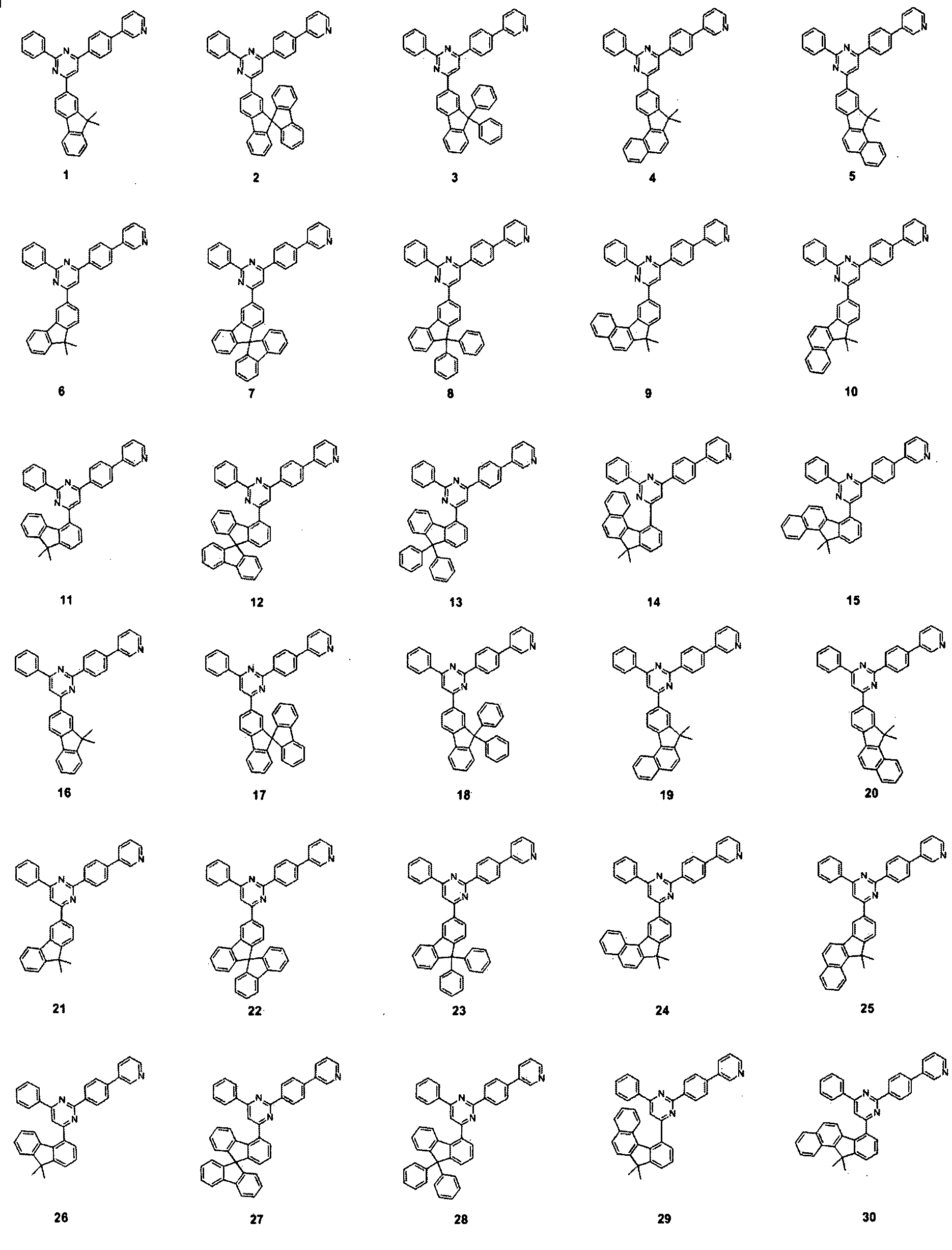
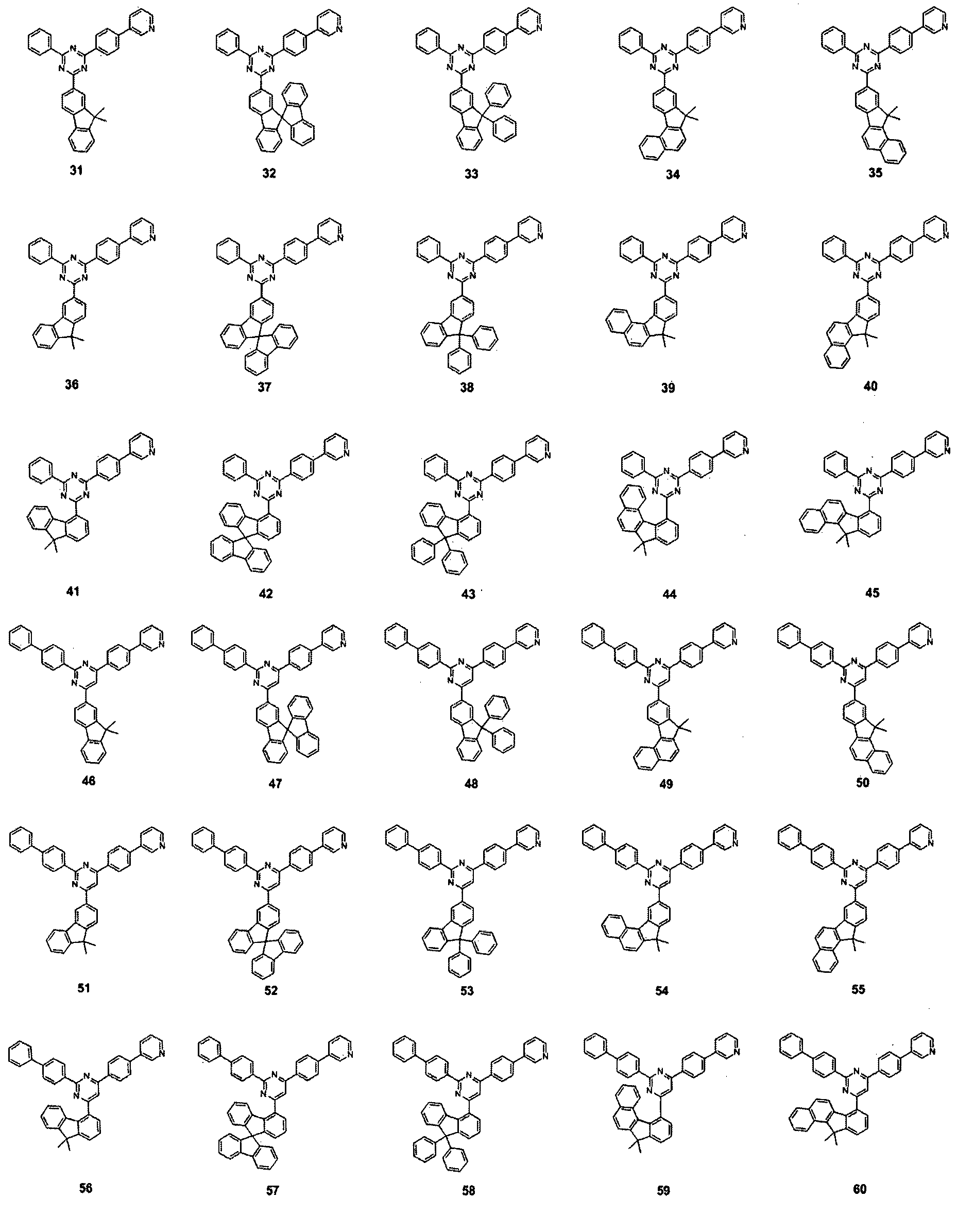
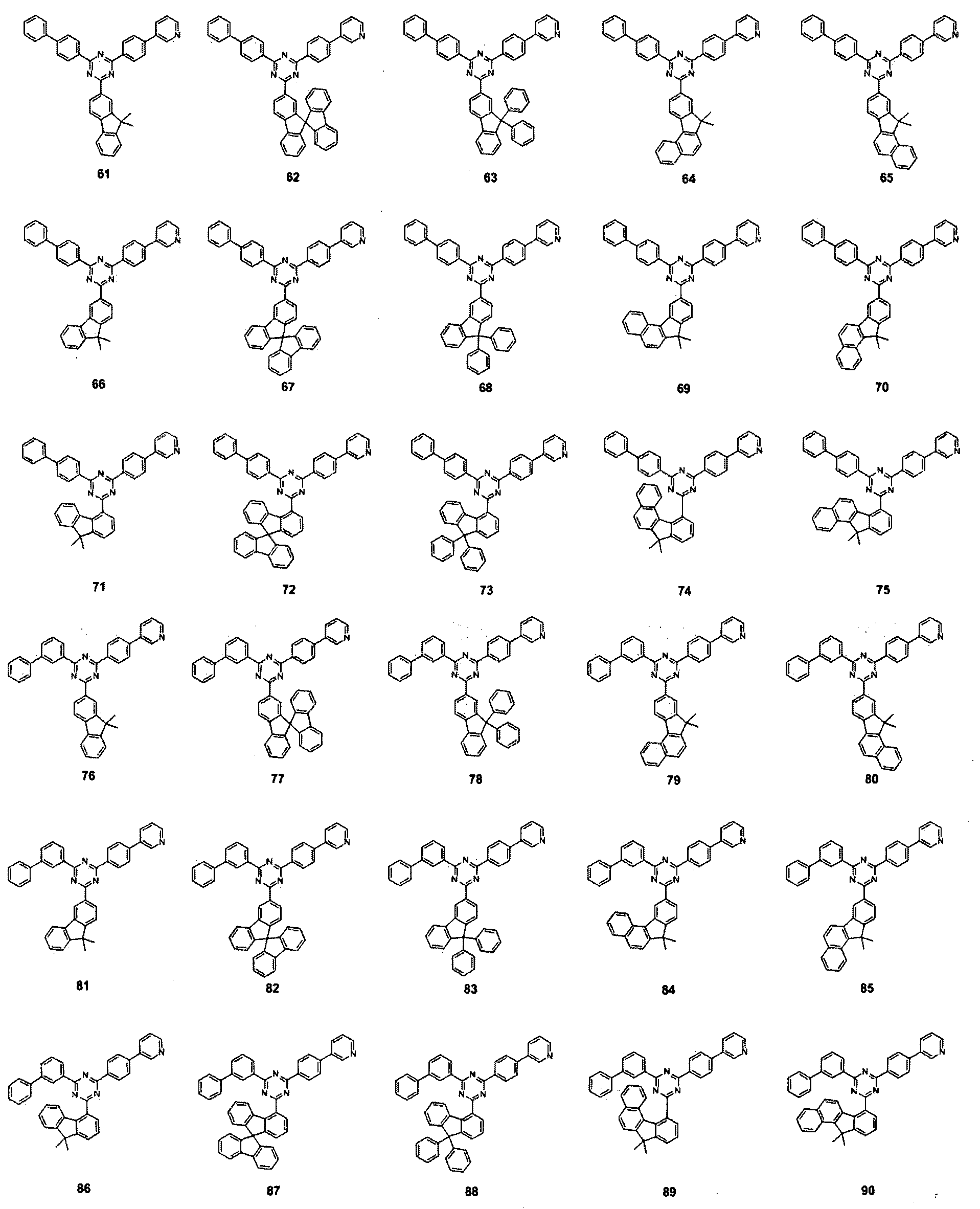
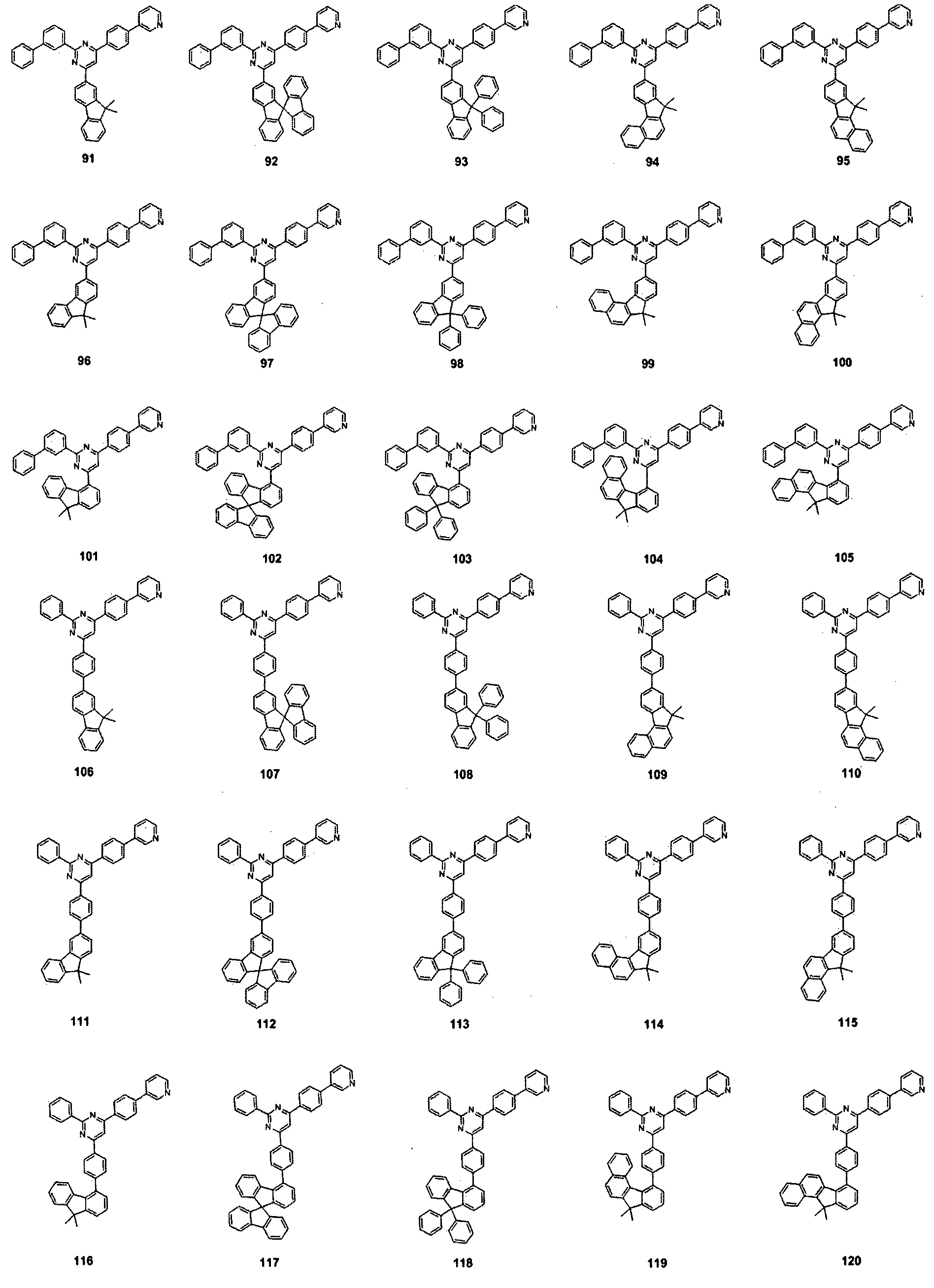
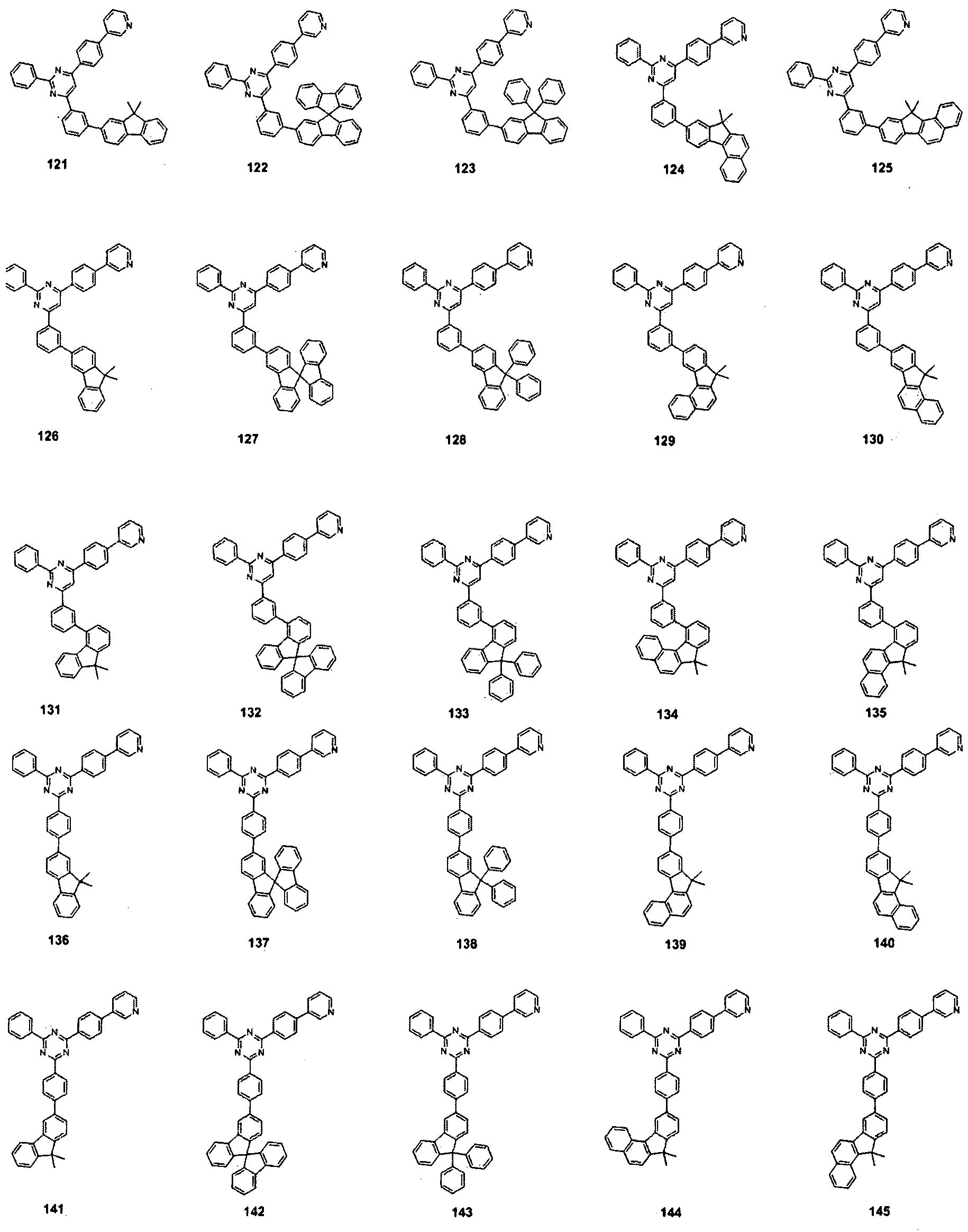
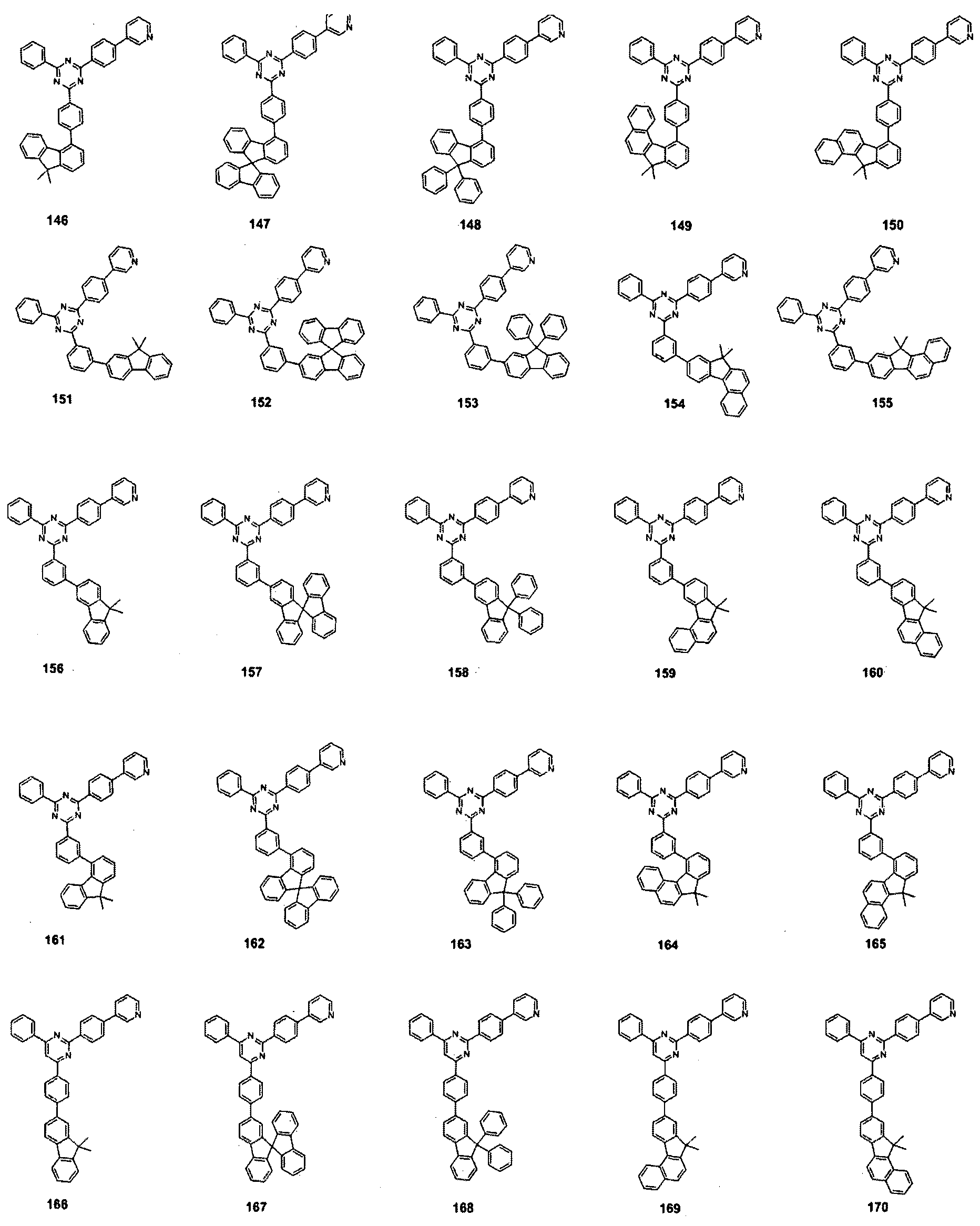
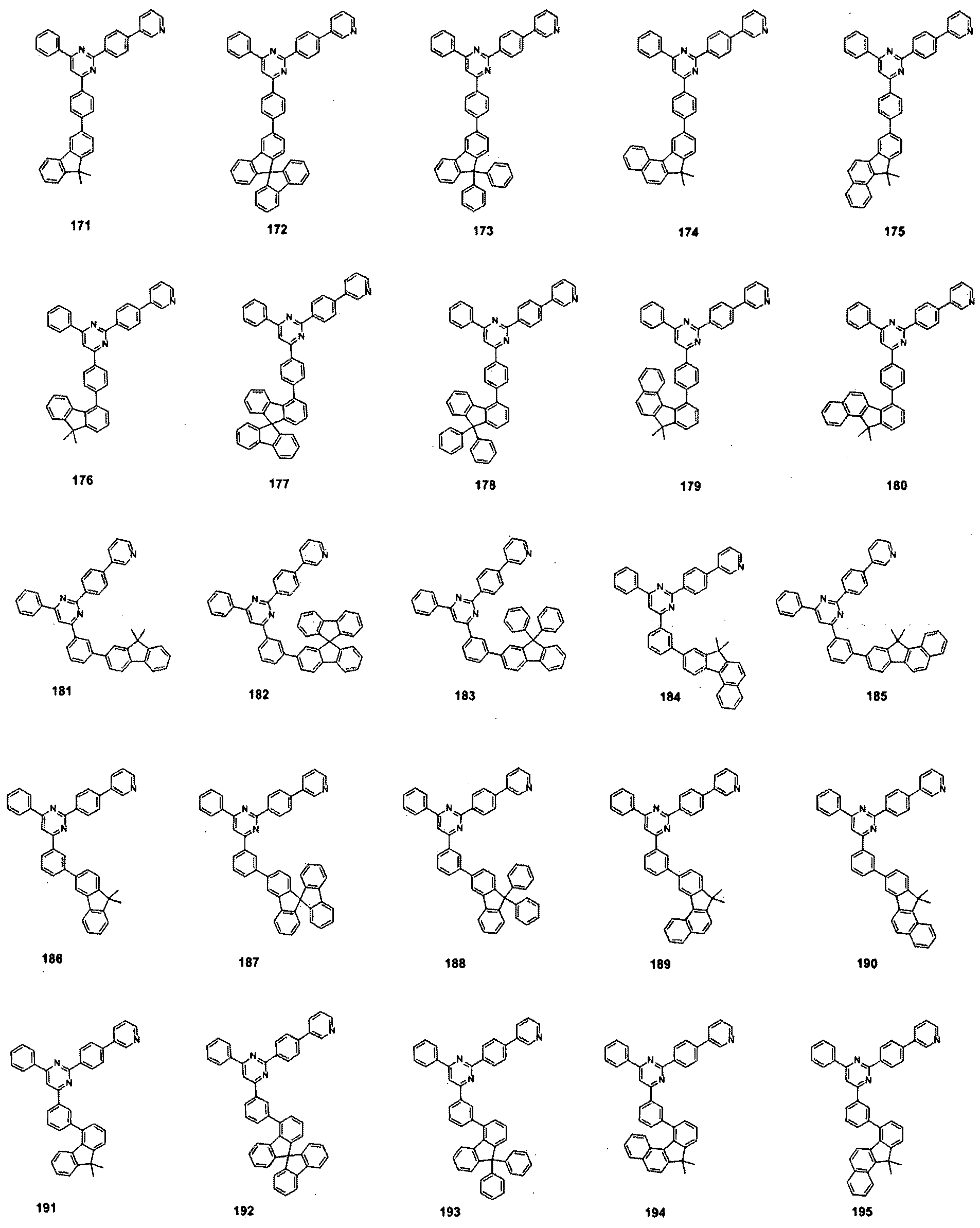
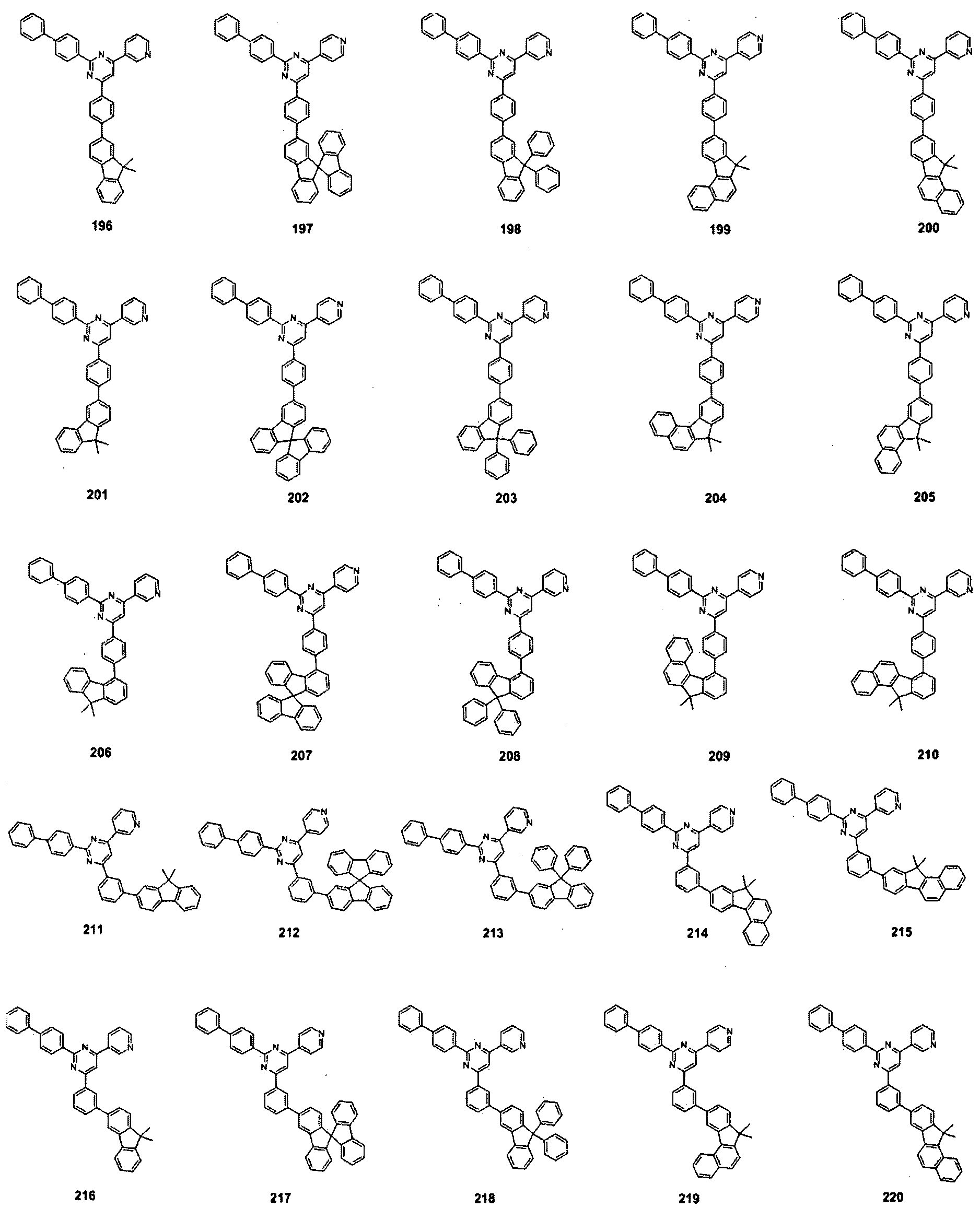
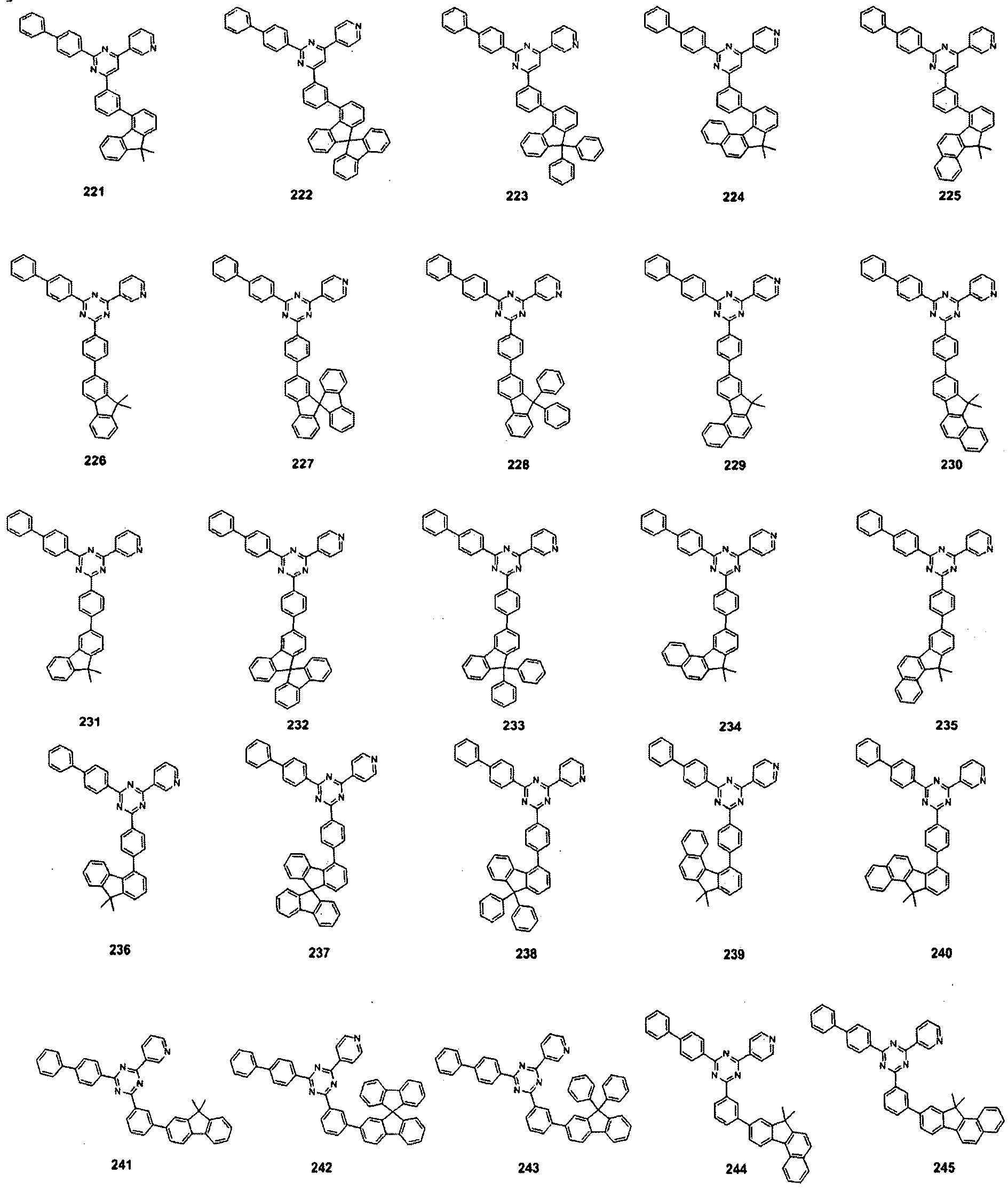
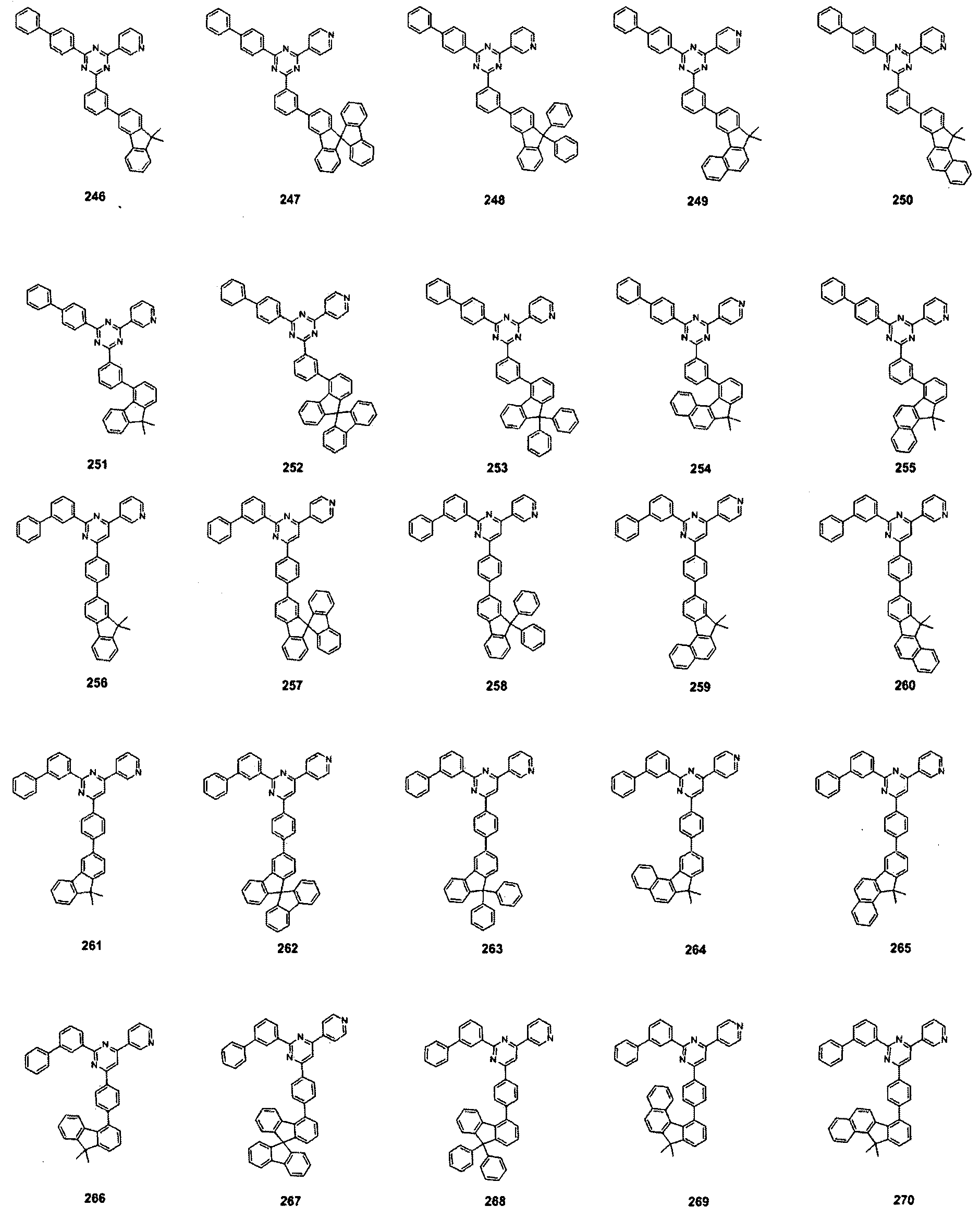
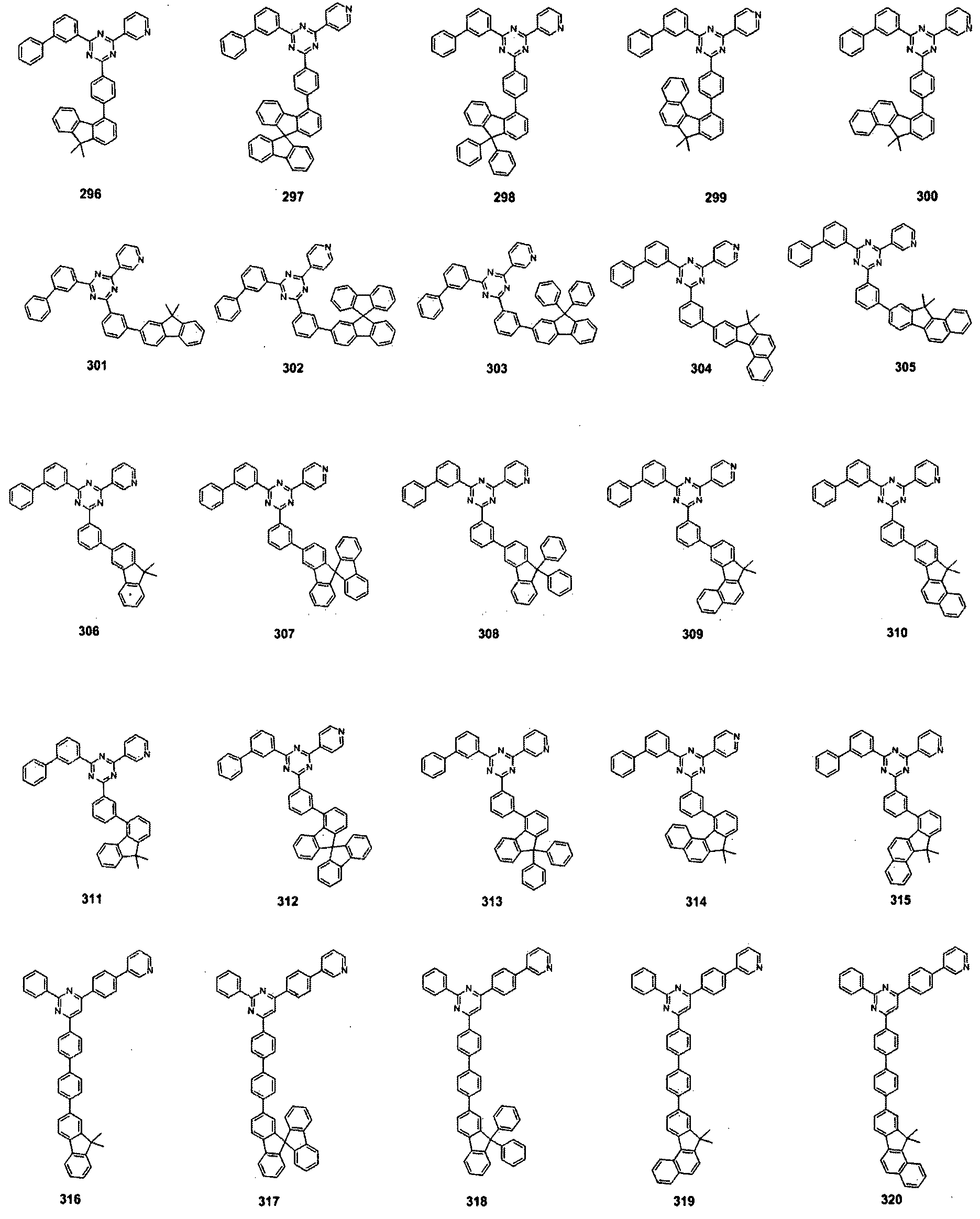
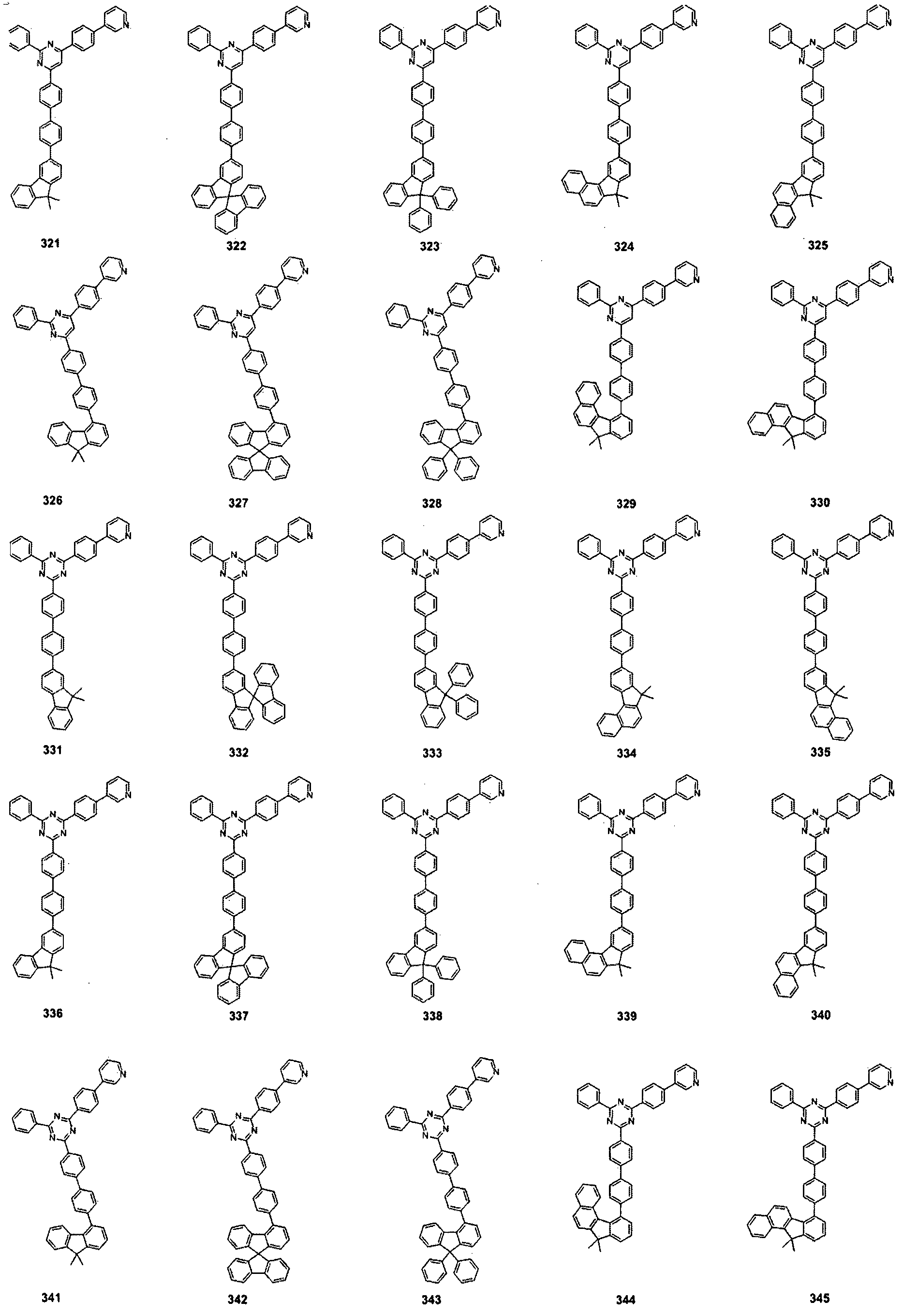
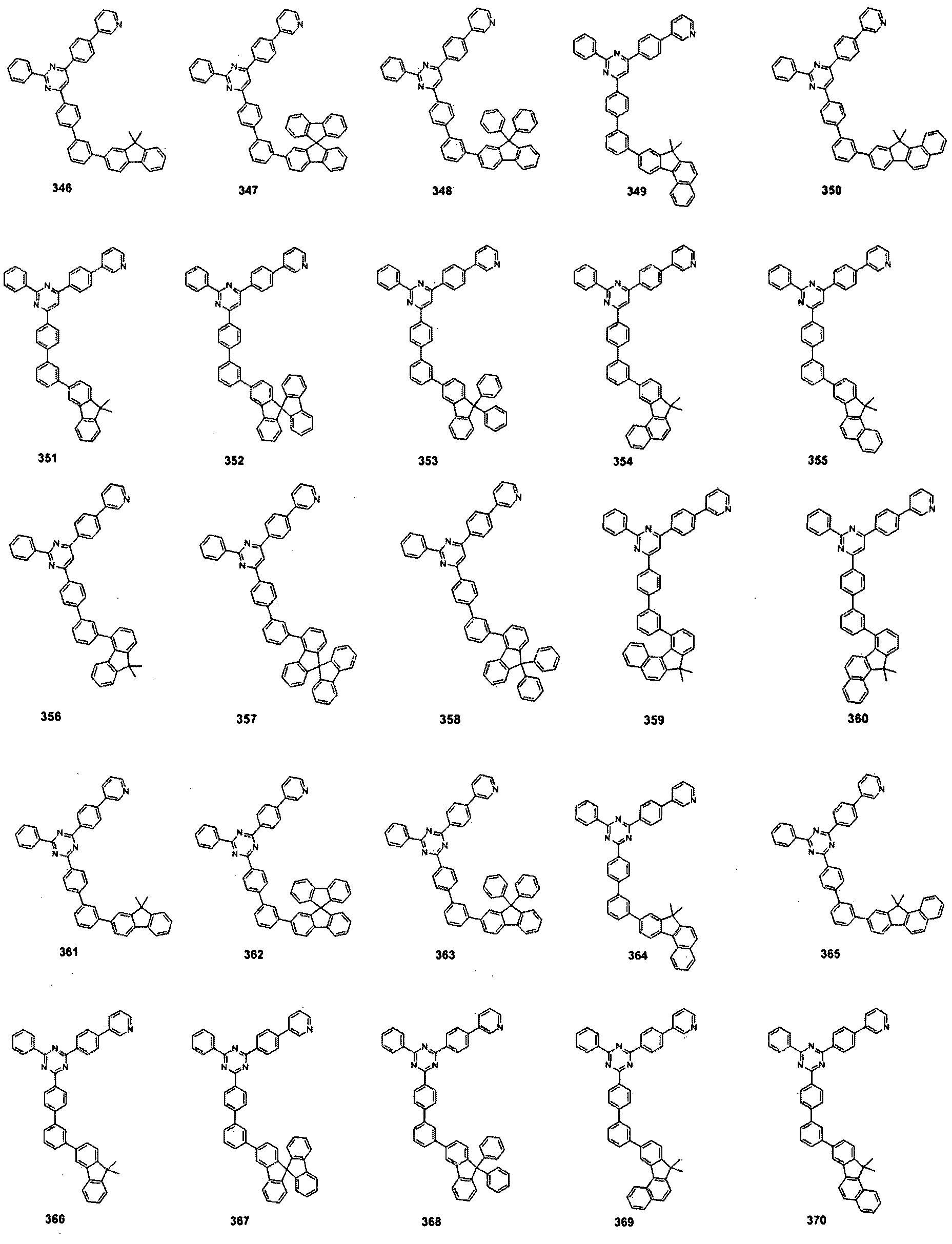
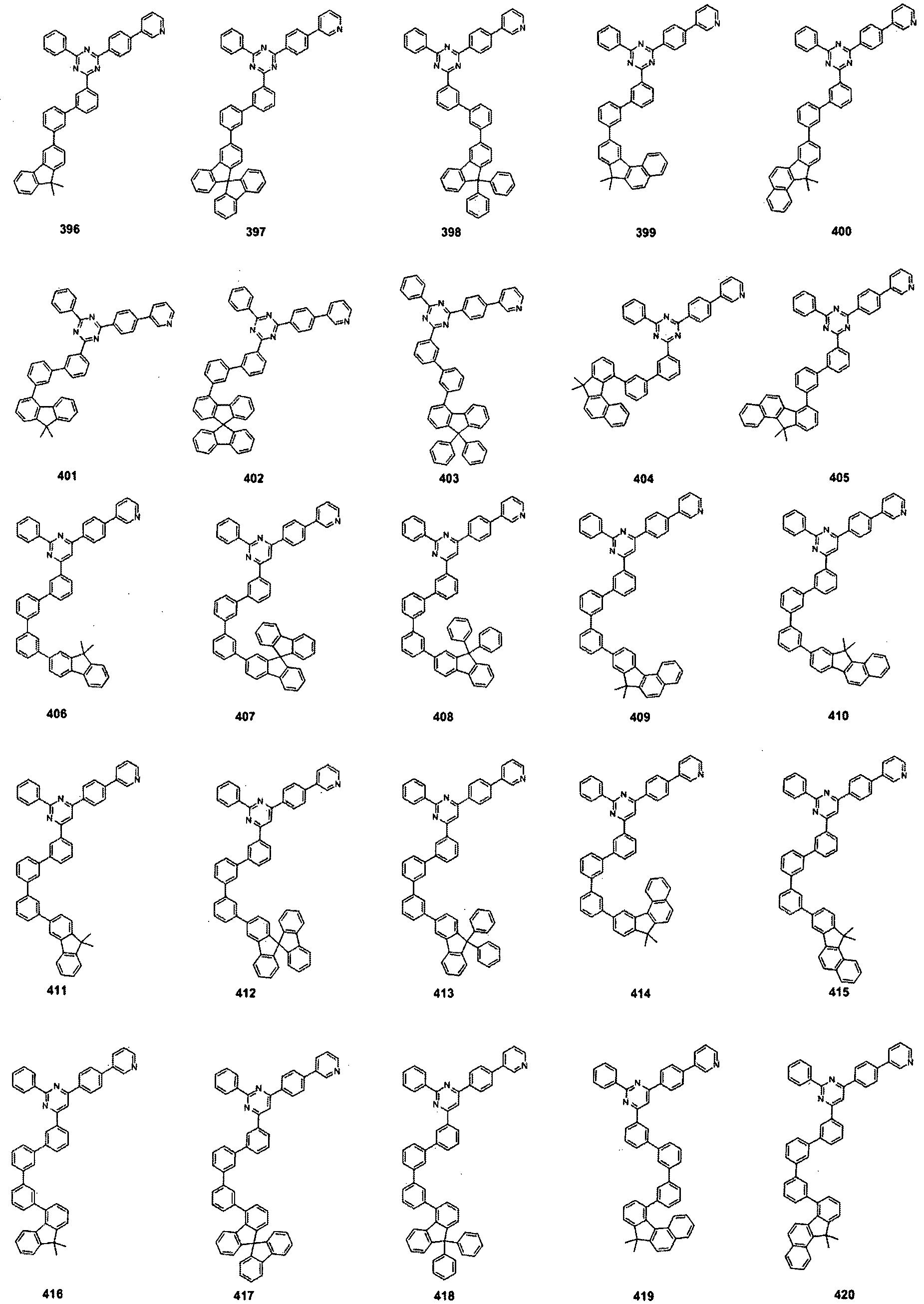
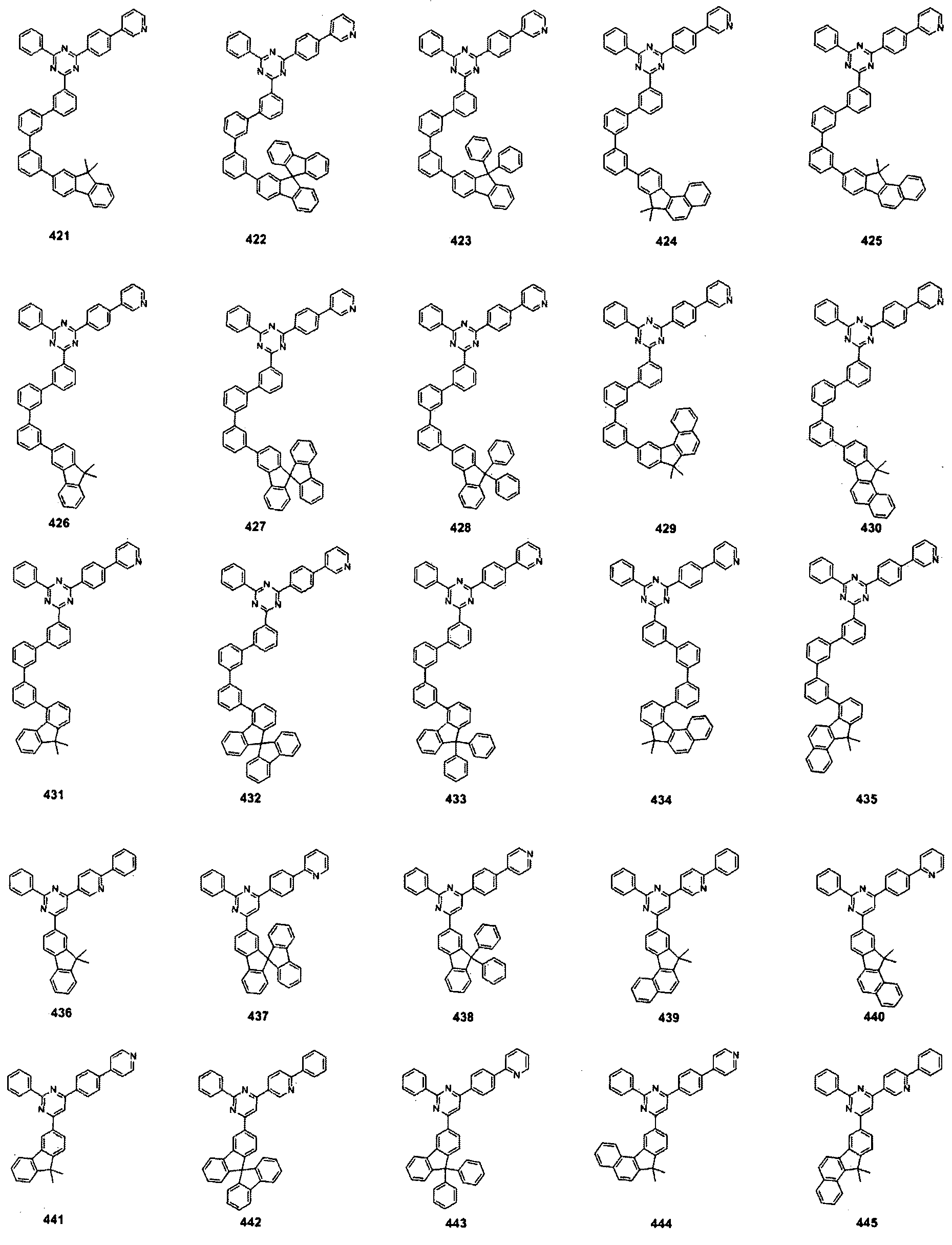
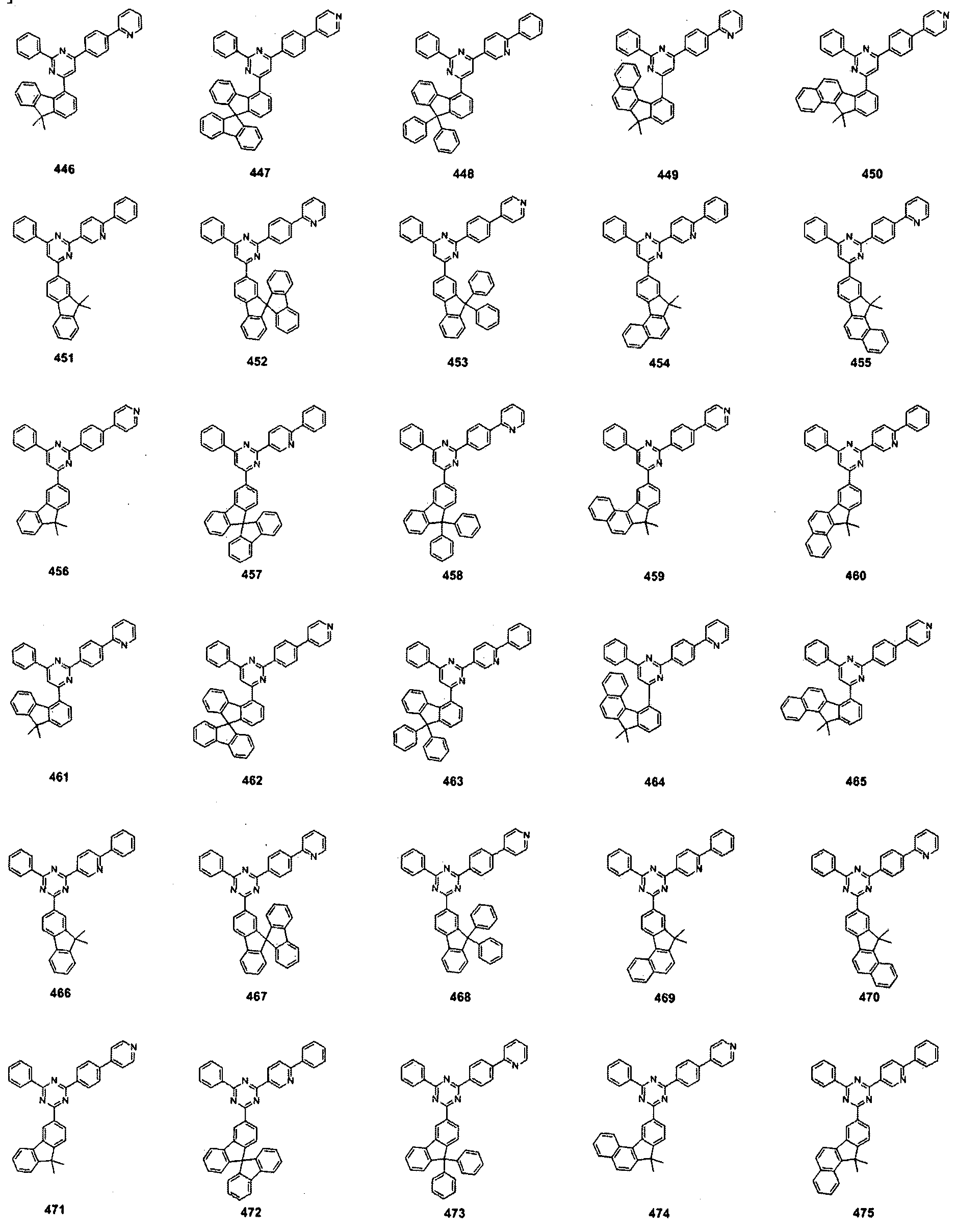
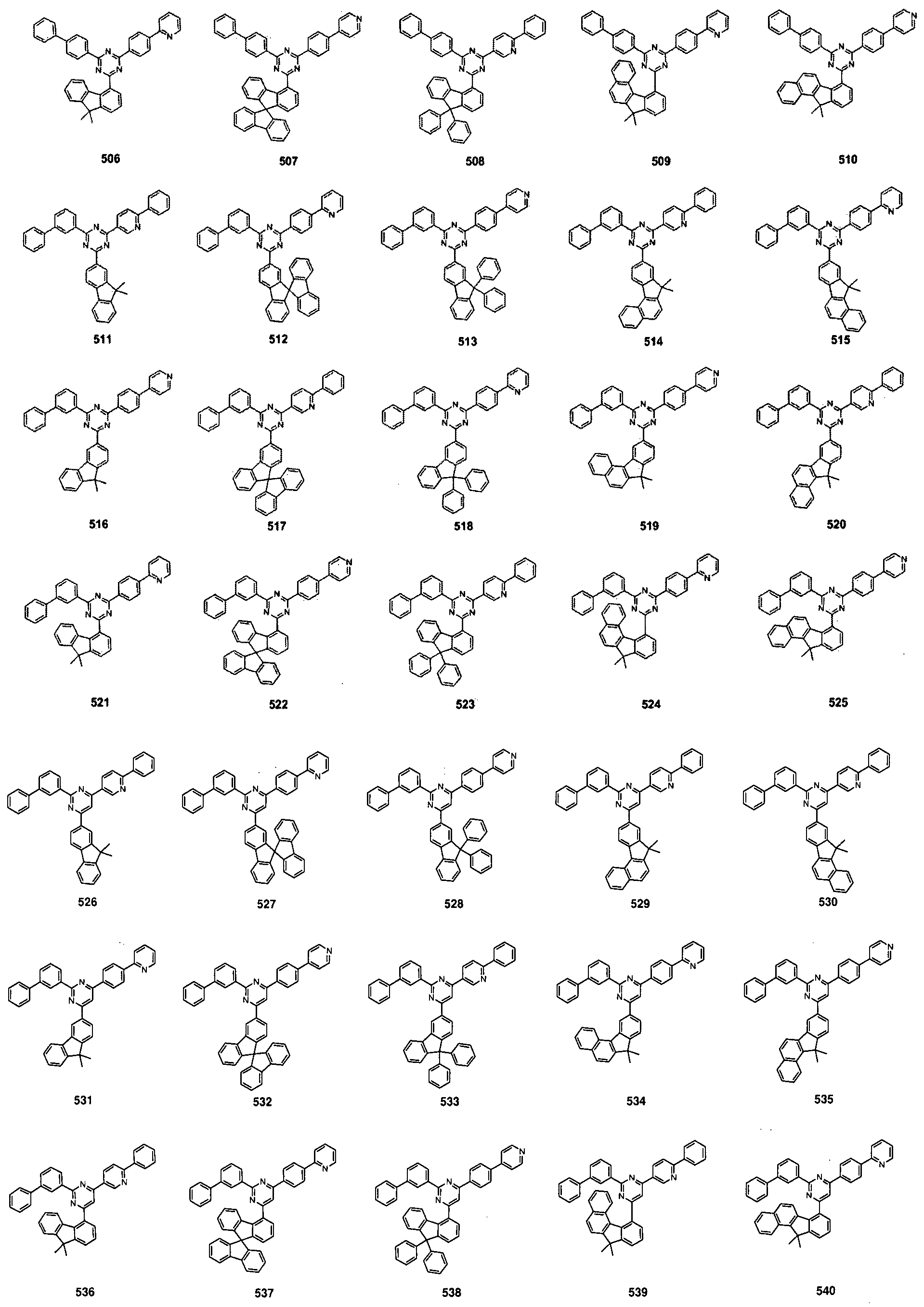
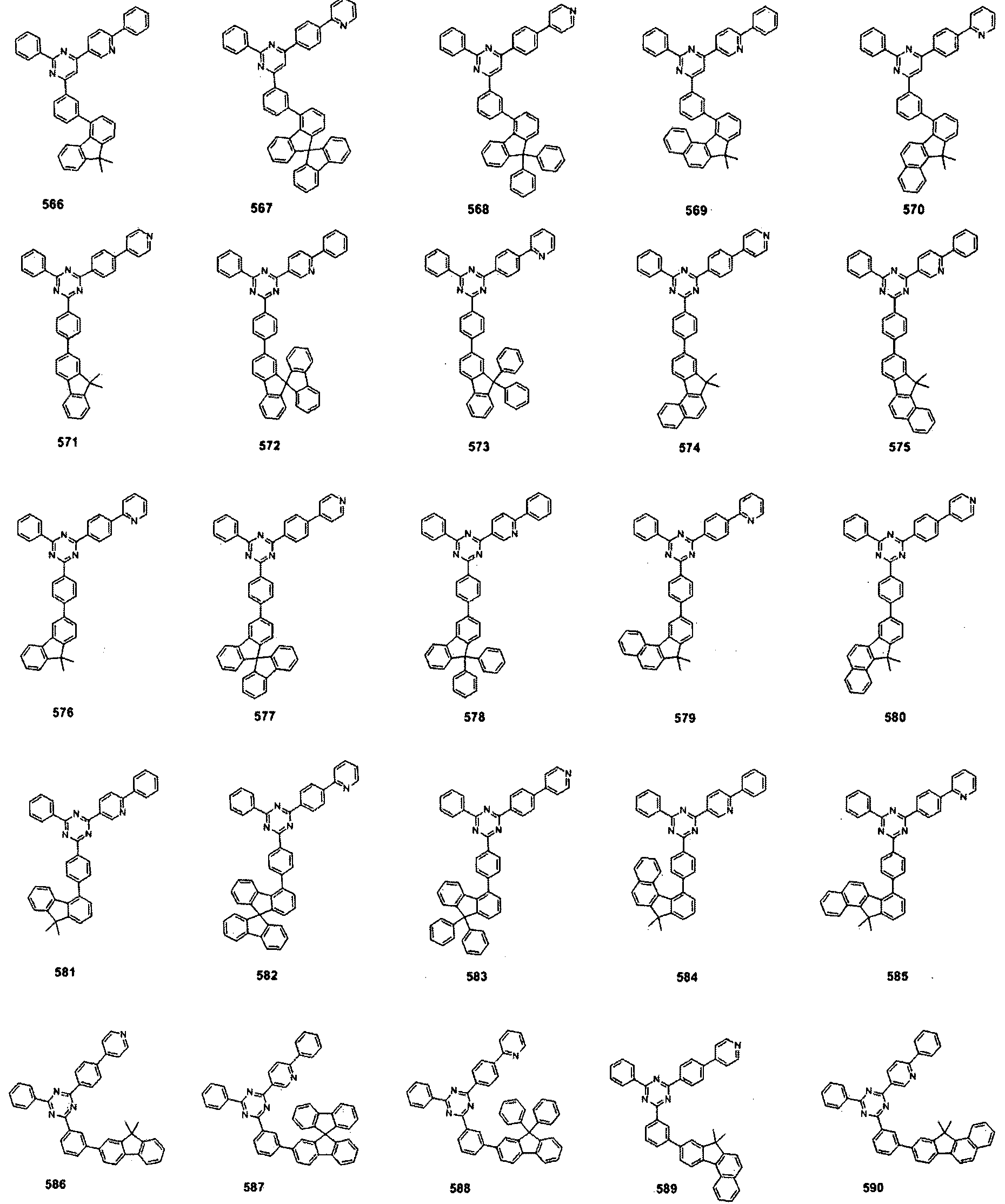
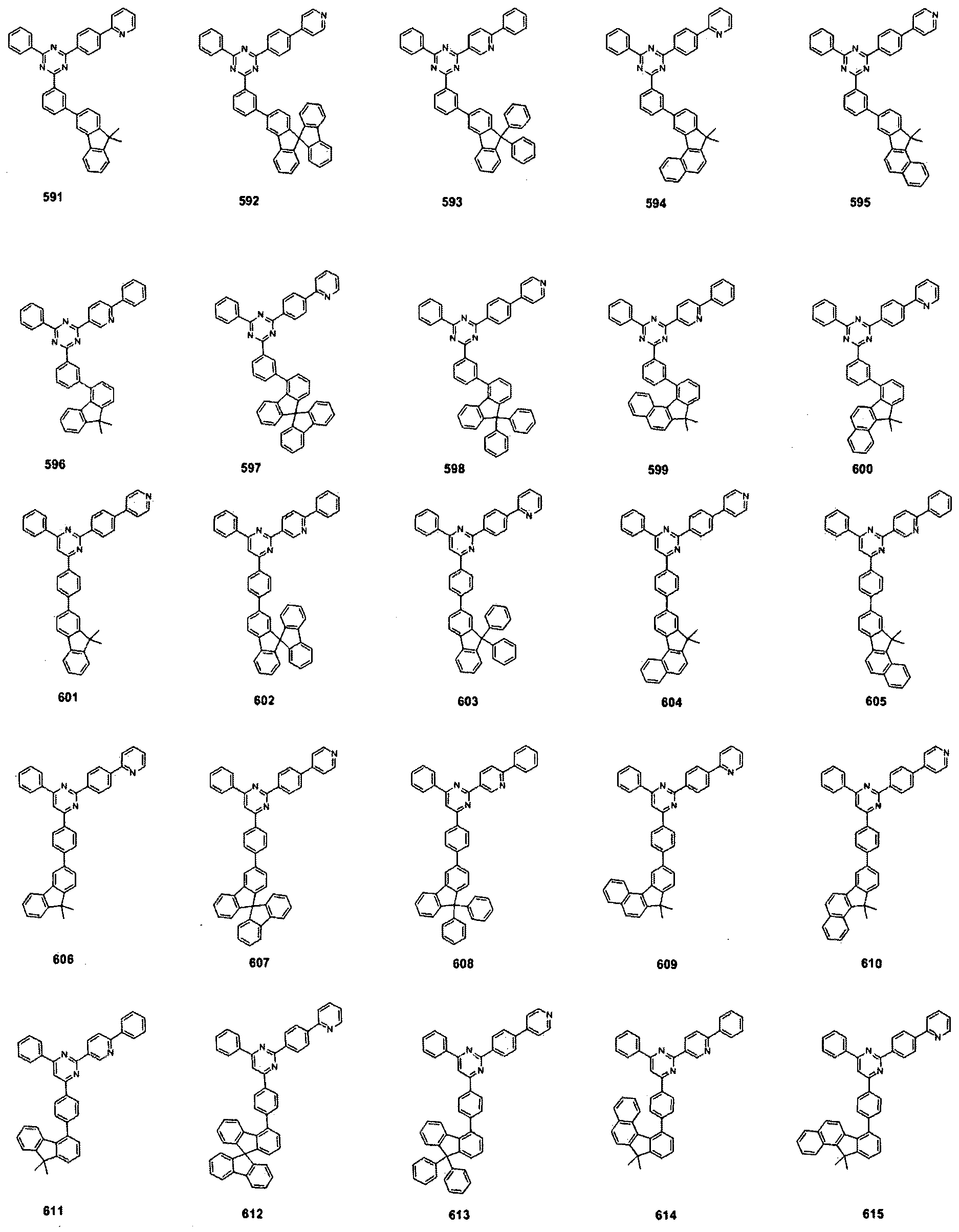
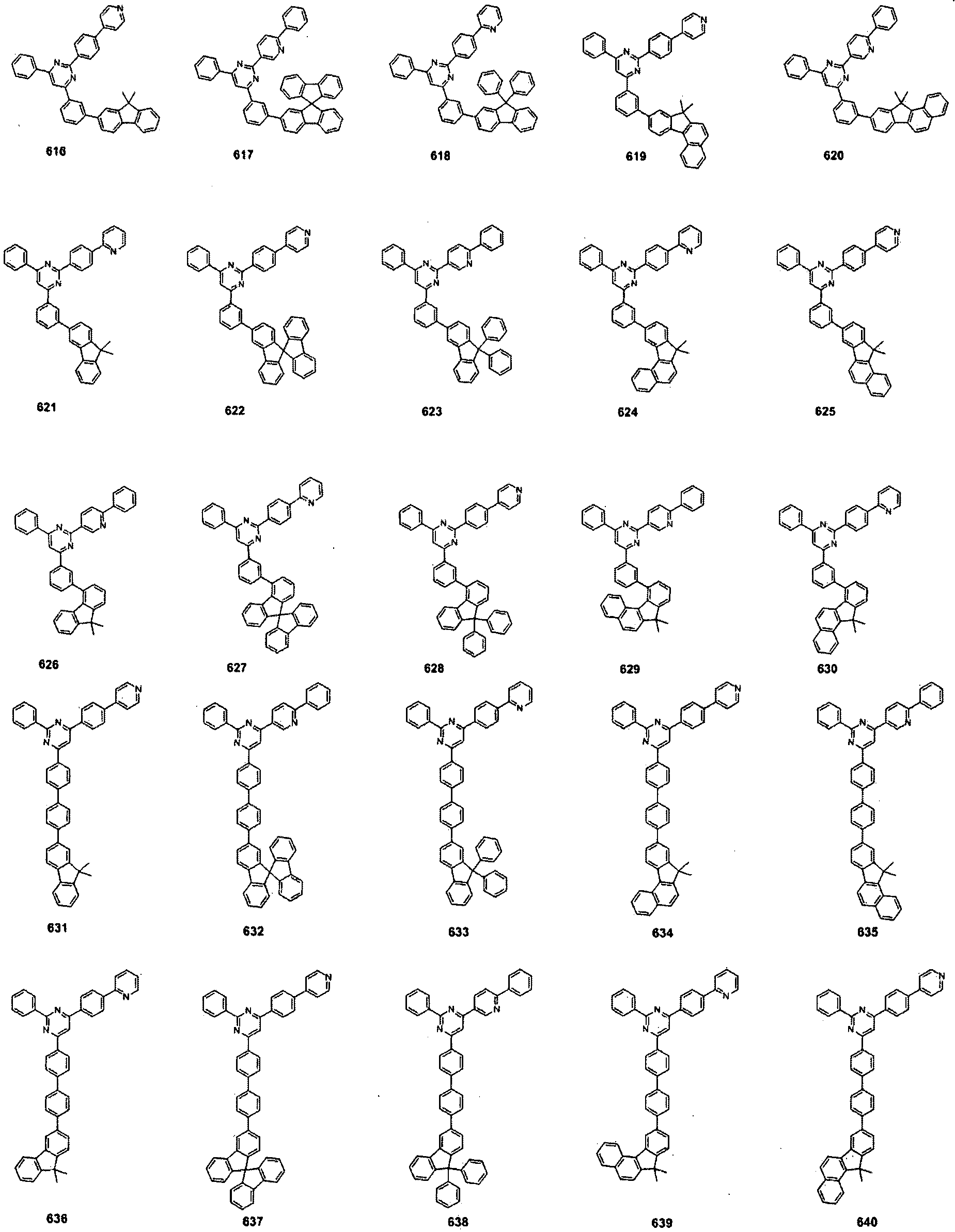
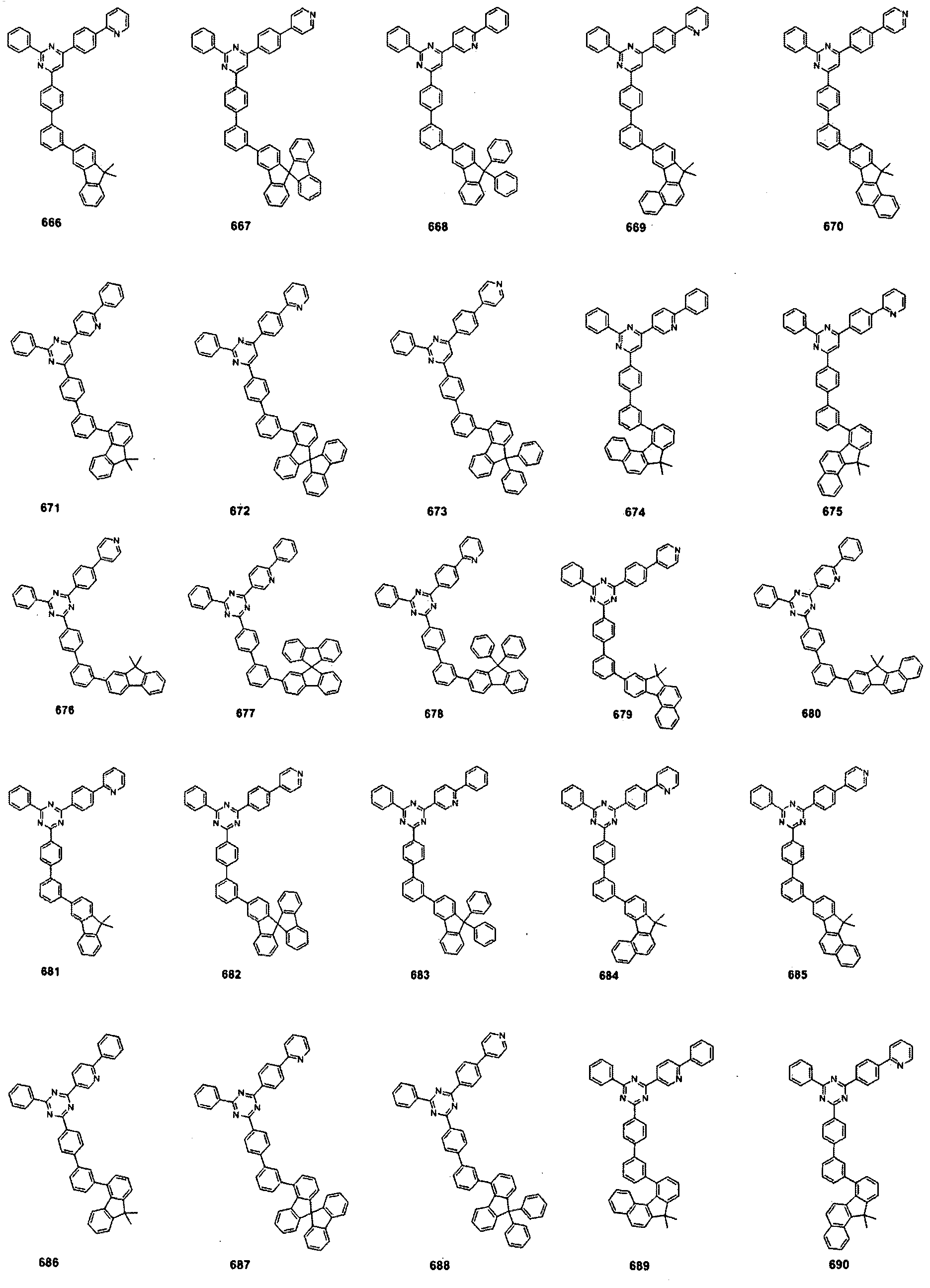
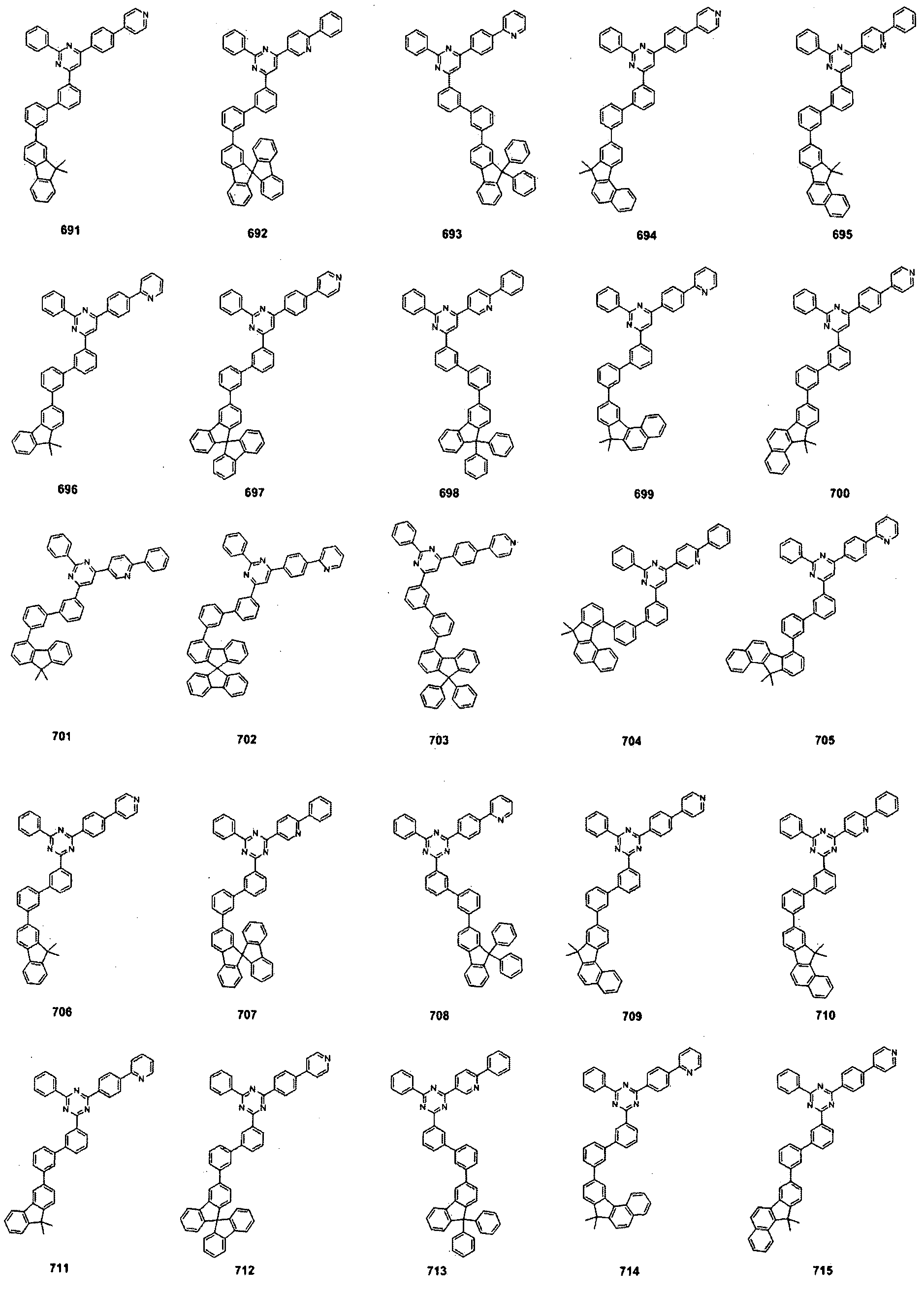
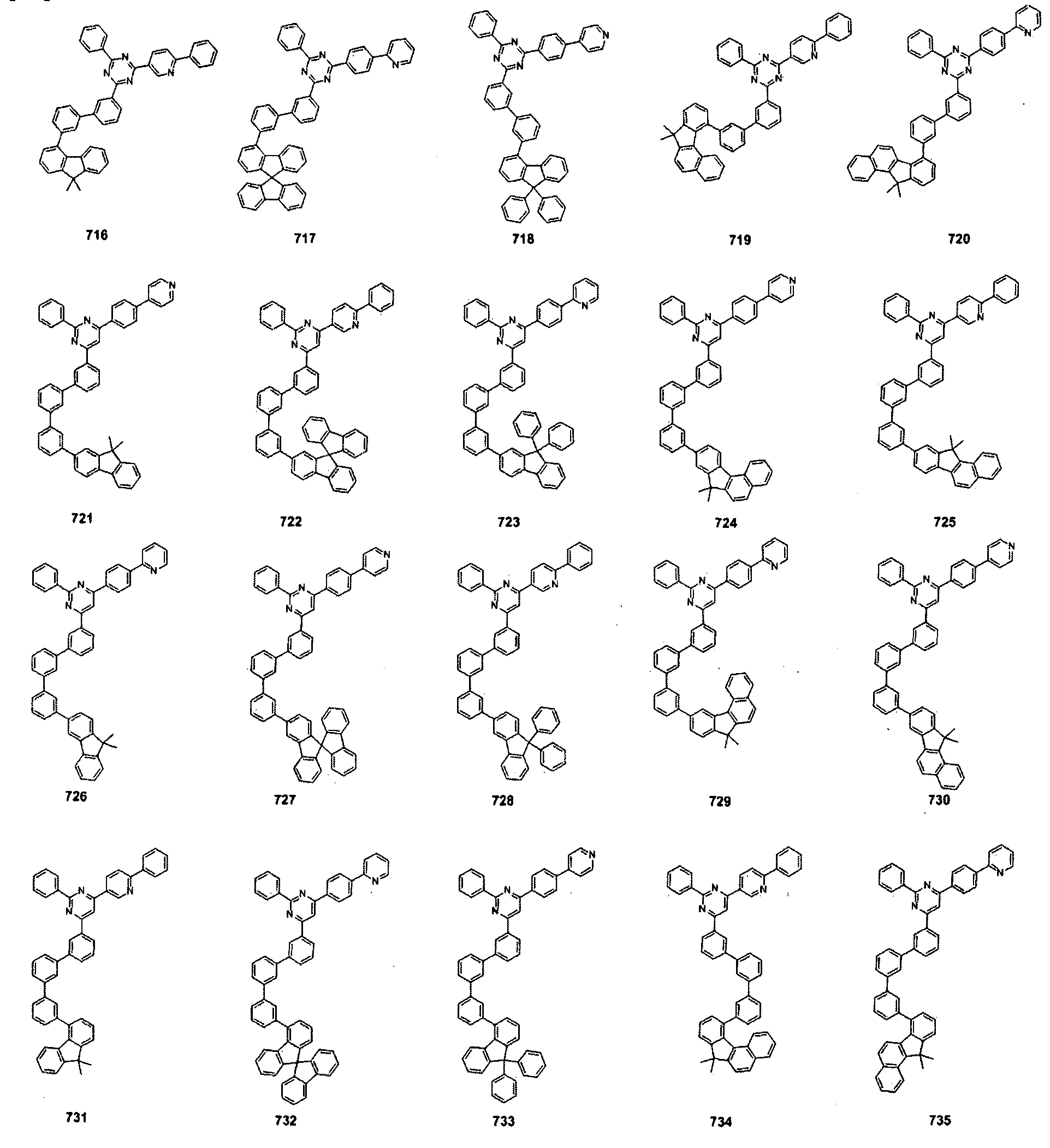
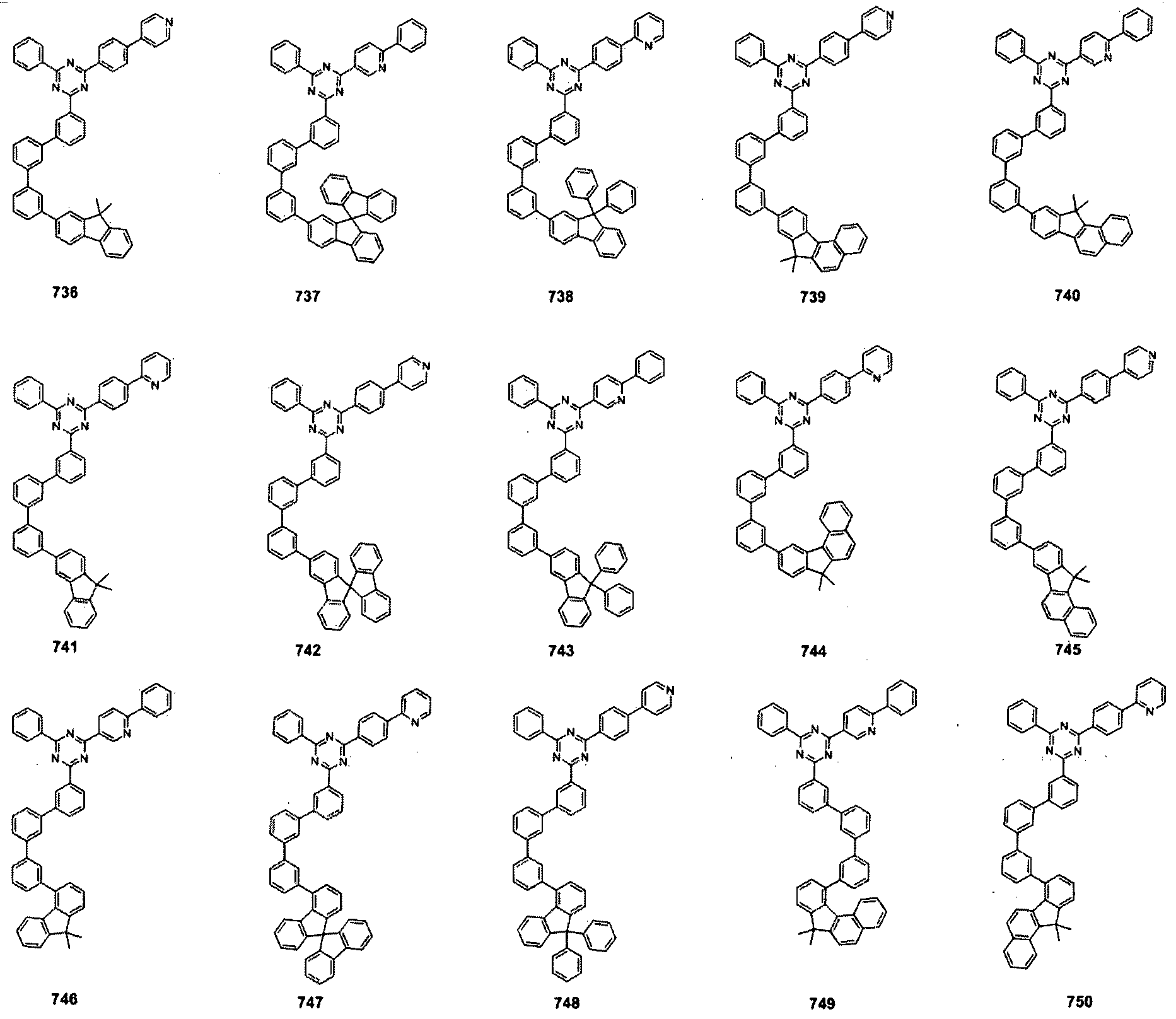
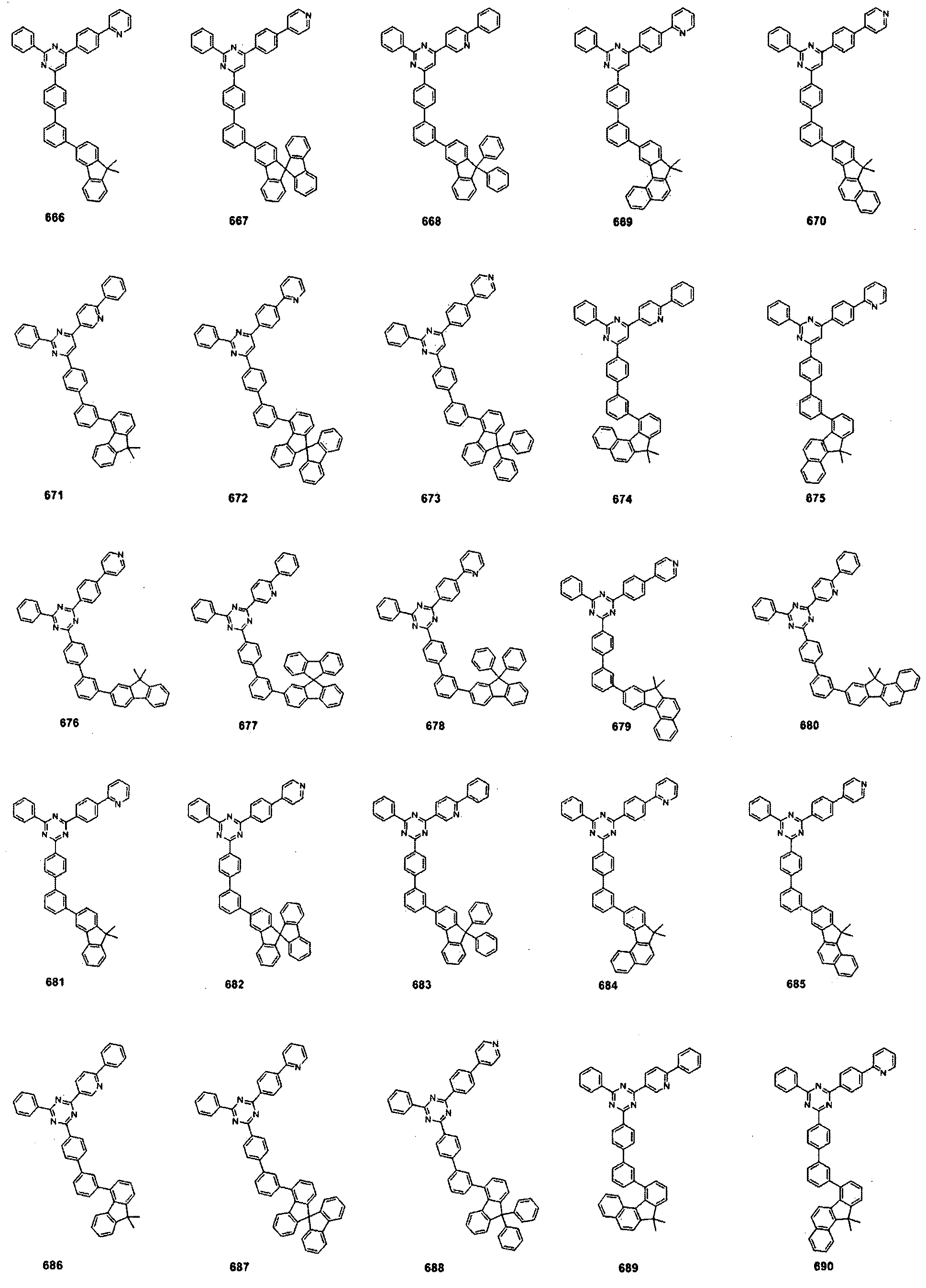
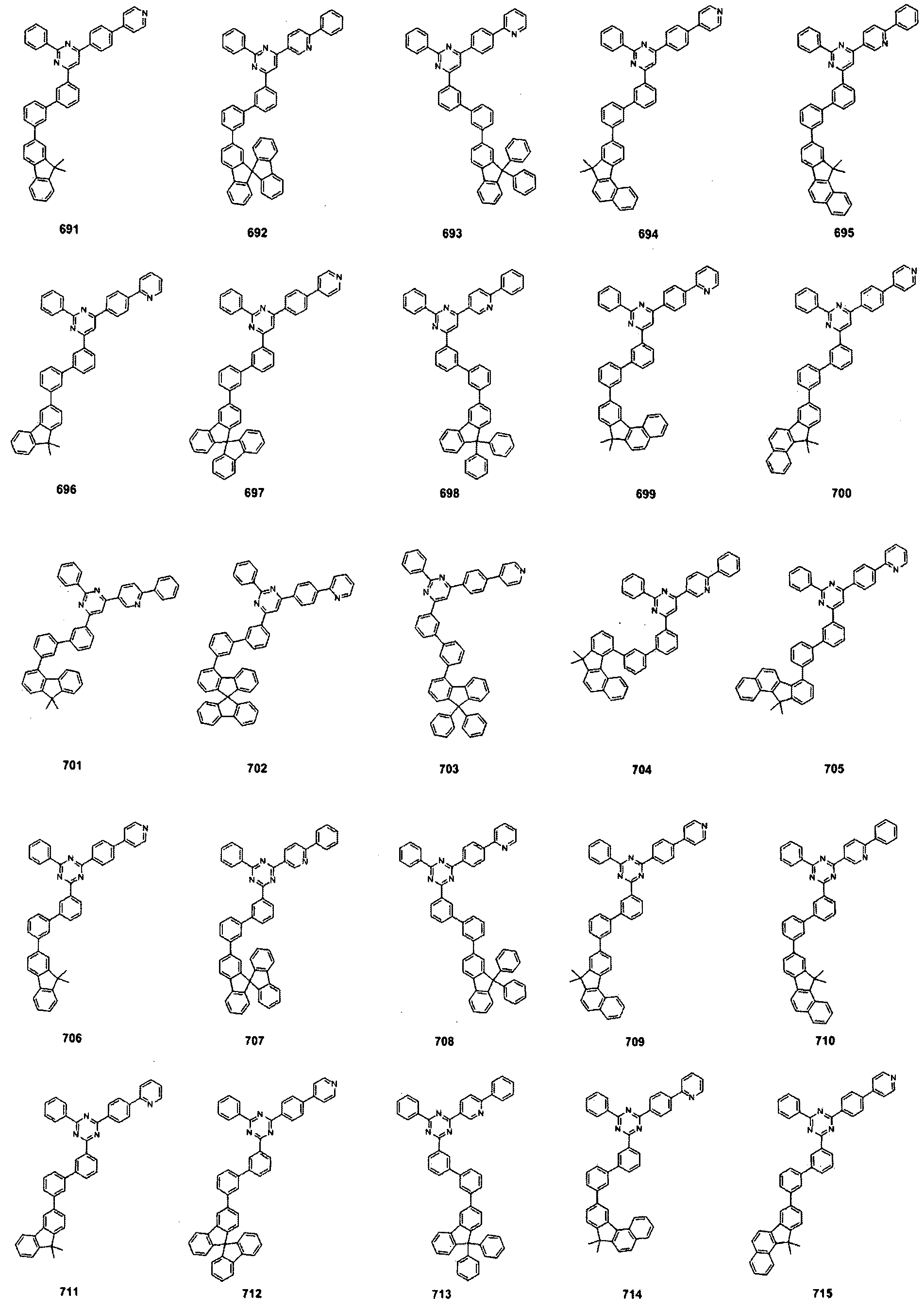
- the compound represented by the formula (1) according to the present invention described above can be further represented by a compound represented by one of the following compounds 1 to 750.
- the compounds represented by formula (1) of the present invention are not limited by the following examples.
- alkyl means a monovalent functional group obtained by removing a hydrogen atom from a linear or branched saturated hydrocarbon having 1 to 40 carbon atoms, and examples thereof include methyl, ethyl, propyl, isobutyl, sec-butyl , Pentyl, iso-amyl, hexyl, and the like.
- alkenyl means a monovalent substituent derived from a straight-chain or branched-chain unsaturated hydrocarbon having 2 to 40 carbon atoms and having at least one carbon-carbon double bond.
- alkenyl include, but are not limited to, vinyl, allyl, isopropenyl, 2-butenyl, and the like.
- alkynyl " means a monovalent substituent derived from a straight-chain or branched-chain unsaturated hydrocarbon having 2 to 40 carbon atoms and having at least one carbon-carbon triple bond.
- alkynyls include, but are not limited to, ethynyl, 2-propynyl, and the like.
- Aryl " in the present invention means a monovalent substituent derived from an aromatic hydrocarbon having 6 to 60 carbon atoms in which a single ring or two or more rings are combined. Also, a form in which two or more rings are pendant or condensed with each other may be included. Examples of such aryl include, but are not limited to, phenyl, naphthyl, phenanthryl, anthryl, and the like.
- Heteroaryl " in the present invention means a monovalent substituent derived from a monoheterocyclic or polyheterocyclic aromatic hydrocarbon having 5 to 60 nuclear atoms. Wherein at least one of the carbons, preferably one to three carbons, is replaced by a heteroatom such as N, O, S or Se.
- a form in which two or more rings are pendant or condensed with each other may be included, and further, a condensed form with an aryl group may be included.
- heteroaryls include 6-membered monocyclic rings such as pyridyl, pyrazinyl, pyrimidinyl, pyridazinyl, triazinyl, phenoxathienyl, indolizinyl, indolyl indolyl), purinyl, quinolyl, benzothiazole, carbazolyl, and heterocyclic rings such as 2-furanyl, N-imidazolyl, 2- , 2-pyridinyl, 2-pyrimidinyl, and the like, but are not limited thereto.
- aryloxy means a monovalent functional group represented by R “O-, and R" is aryl having 6 to 60 carbon atoms.
- Non-limiting examples of such aryloxy include phenyloxy, naphthyloxy, diphenyloxy, and the like.
- alkyloxy means a monovalent functional group represented by R'O-, and R 'is alkyl having 1 to 40 carbon atoms, which may be linear, branched or cyclic . ≪ / RTI > Non-limiting examples of such alkyloxy include methoxy, ethoxy, n-propoxy, 1-propoxy, t-butoxy, n-butoxy, pentoxy and the like.
- Cycloalkyl in the present invention means a monovalent functional group obtained by removing a hydrogen atom from a monocyclic or polycyclic non-aromatic hydrocarbon having 3 to 40 carbon atoms (saturated cyclic hydrocarbon). Non-limiting examples thereof include cyclopropyl, cyclopentyl, cyclohexyl, norbornyl, adamantine, and the like.
- Non-limiting examples thereof include morpholine, piperazine, and the like.
- Alkylsilyl means silyl substituted with alkyl having 1 to 40 carbon atoms
- arylsilyl means silyl substituted with aryl having 6 to 60 carbon atoms, Quot; means a boron group substituted with aryl having 6 to 60 carbon atoms
- arylphosphine group means a phosphine group substituted with aryl having 1 to 60 carbon atoms, &Quot
- arylamine means an amine substituted with aryl having 6 to 60 carbon atoms.
- condensed rings means condensed aliphatic rings, condensed aromatic rings, condensed heteroaliphatic rings, condensed heteroaromatic rings, or a combination thereof.
- the compound represented by formula (1) according to the present invention can be synthesized in various ways by referring to the synthesis process of the following examples. Detailed synthesis of the compound of the present invention will be described in detail in Synthesis Examples to be described later.
- the present invention provides an organic electroluminescent device comprising a compound represented by the above formula (1).
- the organic electroluminescent device includes at least one anode, an anode, and at least one organic layer sandwiched between the anode and the cathode, and at least one of the one or more organic layers Include the compounds represented by the above formula (1).
- the compounds may be used alone or in combination of two or more.
- the at least one organic material layer may be at least one of a hole injecting layer, a hole transporting layer, a light emitting auxiliary layer, a light emitting layer, an electron transporting auxiliary layer, an electron transporting layer and an electron injecting layer. ≪ / RTI > compounds. Specifically, it is preferable that the organic material layer containing the compound of Formula 1 is a light emitting layer, an electron transporting auxiliary layer and an electron transporting layer.
- the light emitting layer of the organic electroluminescence device of the present invention may include a host material (preferably, a phosphorescent host material).
- the light emitting layer of the organic electroluminescent device of the present invention may contain a compound other than the compound of Formula 1 as a host.
- the structure of the organic electroluminescent device of the present invention is not particularly limited, but may be a structure in which a substrate, an anode, a hole injecting layer, a hole transporting layer, a light emitting auxiliary layer, a light emitting layer, an electron transporting layer and a cathode are sequentially stacked .
- At least one of the hole injecting layer, the hole transporting layer, the light-emitting auxiliary layer, the light emitting layer, and the electron transporting layer may include the compound represented by the formula (1), and preferably the light emitting layer or the electron transporting layer comprises the compound represented by the formula . ≪ / RTI >
- an electron injection layer may be further stacked on the electron transport layer.
- the structure of the organic electroluminescent device of the present invention may be a structure in which an electrode and an electron transporting auxiliary layer are added together with the organic material layer described above.
- at least one of the hole injecting layer, the hole transporting layer, the light emitting auxiliary layer, the light emitting layer, the electron transporting supporting layer and the electron transporting layer may include the compound represented by the above formula (1)
- the transport layer may contain a compound represented by the above formula (1).
- the organic electroluminescent device of the present invention can be manufactured by forming an organic material layer and an electrode by materials and methods known in the art, except that at least one of the organic material layers includes the compound represented by the above formula have.
- the organic material layer may be formed by a vacuum deposition method or a solution coating method.
- the solution coating method include, but are not limited to, spin coating, dip coating, doctor blading, inkjet printing, or thermal transfer.
- the substrate used in the fabrication of the organic electroluminescent device of the present invention is not particularly limited, but silicon wafer, quartz, glass plate, metal plate, plastic film and sheet can be used.
- the positive electrode material examples include metals such as vanadium, chromium, copper, zinc, and gold, or alloys thereof; Metal oxides such as zinc oxide, indium oxide, indium tin oxide (ITO), and indium zinc oxide (IZO); ZnO: Al or SnO 2: a combination of a metal and an oxide such as Sb; Conductive polymers such as polythiophene, poly (3-methylthiophene), poly [3,4- (ethylene-1,2-dioxy) thiophene] (PEDT), polypyrrole or polyaniline; And carbon black, but are not limited thereto.
- metals such as vanadium, chromium, copper, zinc, and gold, or alloys thereof
- Metal oxides such as zinc oxide, indium oxide, indium tin oxide (ITO), and indium zinc oxide (IZO)
- ZnO Al or SnO 2: a combination of a metal and an oxide such as Sb
- Conductive polymers such as polythiophene, poly (3
- Examples of the negative electrode material include metals such as magnesium, calcium, sodium, potassium, titanium, indium, yttrium, lithium, gadolinium, aluminum, silver, tin or lead or alloys thereof; And multi-layer structure materials such as LiF / Al or LiO 2 / Al, but are not limited thereto.
- the hole injecting layer, the hole transporting layer, and the light emitting auxiliary layer are not particularly limited, and ordinary materials known in the art can be used.
- PPY-4 2.1 g and (9,9-dimethyl--9H- fluoren-2-yl) Boro acid and 2.2 g K 2 CO 3 1.9 g of toluene mixed with ethanol 50 ml 10 ml, addition of water 10 ml Then, 220 mg of tetrakisphenylphosphine palladium (0) was added thereto, followed by heating and stirring for 4 hours. After completion of the reaction, the temperature was lowered to room temperature and then filtered. The filtrate was poured into water and extracted with chloroform, dried the organic layer with MgSO 4. The mixture was concentrated under reduced pressure, and then subjected to column chromatography using MC to obtain 1.6 g (yield 72%) of Compound 121 as a white solid.
- glass substrate coated with ITO (Indium tin oxide) thin film of 1500 ⁇ thickness was cleaned with distilled water ultrasonic wave. After the distilled water was washed, the substrate was ultrasonically washed with a solvent such as isopropyl alcohol, acetone, and methanol, and dried. Then, the substrate was transferred to a UV OZONE cleaner (Power sonic 405, Hoshin Tech) The substrate was transferred to a vacuum evaporator.
- ITO Indium tin oxide
- a blue organic electroluminescent device was fabricated in the same manner as in Example 1 except that Alq 3 was used instead of Compound 1 as the electron transport layer material.
- a blue organic electroluminescent device was fabricated in the same manner as in Example 1 except that Compound 1 was not used as an electron transport layer material.
- NPB, ADN and Alq3 used in Examples 1 to 13 and Comparative Examples 1 and 2 are as follows.
- Example 1 Compound 1 3.6 455 8.1
- Example 2 Compound 2 3.8 451 8.6
- Example 3 Compound 4 3.8 452 9.1
- Example 4 Compound 42 3.6 452 8.5
- Example 5 Compound 45 3.7 453 8.6
- Example 6 Compound 111 3.6 451 8.8
- Example 7 Compound 112 3.9 451 9.1
- Example 8 Compound 121 3.4 453 7.7
- Example 9 Compound 133 3.3 452 7.6
- Example 10 Compound 151 3.1 451 7.1
- Example 11 Compound 156 3.2 450 7.3
- Example 12 Compound 346 4.3 451 8.9
- Example 13 Compound 350 4.4 453 9.0 Comparative Example 1 Alq 3 4.8 457 5.6 Comparative Example 2 - 4.7 459 6.1
- Example 2 2, 4, 42, 45, 111, 112, 121, 133, 151, 156, 346 and 350 of the present invention synthesized in the above Synthesis Example were used as an electron transport layer.
- the electroluminescent devices (Examples 1 to 13) are superior to the conventional blue organic electroluminescent device using Alq 3 as the electron transport layer (Comparative Example 1) and the blue organic electroluminescent device without the electron transport layer (Comparative Example 2) It was found that it exhibited excellent performance in terms of emission peak and current efficiency.
- the compounds 376, 377, 380, 409, 411, 436, 448, 518, 524, 542, and 545 synthesized in the above Synthesis Example were subjected to high purity sublimation purification by a conventionally known method, The device was fabricated.
- glass substrate coated with ITO (Indium tin oxide) thin film of 1500 ⁇ thickness was cleaned with distilled water ultrasonic wave. After the distilled water was washed, the substrate was ultrasonically washed with a solvent such as isopropyl alcohol, acetone, or methanol, and dried. Then, the substrate was transferred to a UV OZONE cleaner (Power sonic 405, Hoshin Tech) And the substrate was transferred to a vacuum evaporator.
- ITO Indium tin oxide
- NPN (15 nm) / ADN + 5% DS-405 (Doosan Electronics, 30 nm) / compounds 376, 377, 380 and 409 , 411, 436, 448, 518, 524, 542, 546 (5 nm) / Alq 3 (25 nm) / LiF (1 nm) / Al (200 nm) were stacked in this order to fabricate an organic electroluminescent device.
- a blue organic electroluminescent device was fabricated in the same manner as in Example 14 except that Compound 376 was not used as the electron transporting auxiliary layer material and Alq 3 , which is an electron transporting layer material, was deposited at 30 nm instead of 25 nm .
- the driving voltage, the emission wavelength and the current efficiency at a current density of 10 mA / cm 2 were measured for each of the organic electroluminescent devices fabricated in Examples 14 to 24 and Comparative Example 3, and the results are shown in Table 2 below .
- Example 14 Compound 376 3.7 456 9.0
- Example 15 Compound 377 3.6 455 8.8
- Example 16 Compound 380 3.5 456 8.6
- Example 17 Compound 409 3.9 455 8.5
- Example 18 Compound 411 3.4 456 9.1
- Example 19 Compound 436 3.3 457 8.8
- Example 20 Compound 448 3.6 455 9.1
- Example 21 Compound 518 3.4 454 8.4
- Example 22 Compound 524 3.7 455 8.6
- Example 23 Compound 542 3.4 456 8.8
- Example 24 Compound 545 3.6 455 9.3 Comparative Example 3 - 4.7 459 6.1
Landscapes
- Chemical & Material Sciences (AREA)
- Organic Chemistry (AREA)
- Physics & Mathematics (AREA)
- Engineering & Computer Science (AREA)
- Materials Engineering (AREA)
- Spectroscopy & Molecular Physics (AREA)
- Optics & Photonics (AREA)
- Electroluminescent Light Sources (AREA)
- Plural Heterocyclic Compounds (AREA)
- Luminescent Compositions (AREA)
Abstract
Description









| 샘플 | 전자 수송층 | 구동전압(V) | 발광피크(nm) | 전류효율(cd/A) |
| 실시예 1 | 화합물 1 | 3.6 | 455 | 8.1 |
| 실시예 2 | 화합물 2 | 3.8 | 451 | 8.6 |
| 실시예 3 | 화합물 4 | 3.8 | 452 | 9.1 |
| 실시예 4 | 화합물42 | 3.6 | 452 | 8.5 |
| 실시예 5 | 화합물 45 | 3.7 | 453 | 8.6 |
| 실시예 6 | 화합물 111 | 3.6 | 451 | 8.8 |
| 실시예 7 | 화합물 112 | 3.9 | 451 | 9.1 |
| 실시예 8 | 화합물 121 | 3.4 | 453 | 7.7 |
| 실시예 9 | 화합물 133 | 3.3 | 452 | 7.6 |
| 실시예 10 | 화합물 151 | 3.1 | 451 | 7.1 |
| 실시예 11 | 화합물 156 | 3.2 | 450 | 7.3 |
| 실시예 12 | 화합물 346 | 4.3 | 451 | 8.9 |
| 실시예 13 | 화합물 350 | 4.4 | 453 | 9.0 |
| 비교예 1 | Alq3 | 4.8 | 457 | 5.6 |
| 비교예 2 | - | 4.7 | 459 | 6.1 |
| 샘플 | 전자수송 보조층 | 구동 전압(V) | 발광 피크(nm) | 전류효율(cd/A) |
| 실시예 14 | 화합물 376 | 3.7 | 456 | 9.0 |
| 실시예 15 | 화합물 377 | 3.6 | 455 | 8.8 |
| 실시예 16 | 화합물 380 | 3.5 | 456 | 8.6 |
| 실시예 17 | 화합물 409 | 3.9 | 455 | 8.5 |
| 실시예 18 | 화합물 411 | 3.4 | 456 | 9.1 |
| 실시예 19 | 화합물 436 | 3.3 | 457 | 8.8 |
| 실시예 20 | 화합물 448 | 3.6 | 455 | 9.1 |
| 실시예 21 | 화합물 518 | 3.4 | 454 | 8.4 |
| 실시예 22 | 화합물 524 | 3.7 | 455 | 8.6 |
| 실시예 23 | 화합물 542 | 3.4 | 456 | 8.8 |
| 실시예 24 | 화합물 545 | 3.6 | 455 | 9.3 |
| 비교예 3 | - | 4.7 | 459 | 6.1 |
Claims (11)
- 하기 화학식 1로 표시되는 화합물:[화학식 1]
 상기 화학식 1에서,Z1 내지 Z3은 질소 또는 탄소이며, 적어도 두 개 이상의 질소를 포함하고,X는 하기 화학식 2 또는 화학식 3으로 표시되며,[화학식 2]
 [화학식 3]
 상기 화학식 2 내지 화학식 3에서,Y1 내지 Y4 중 하나는 질소이며, 나머지는 탄소이고, Y5 내지 Y6 중 하나는 질소이며, 다른 하나는 탄소이고,*는 상기 화학식 1과 결합이 이루어지는 부분을 의미하며,n은 1 내지 3의 정수이고,L은 단일결합, C6~C18의 아릴렌기 및 핵원자수 5 내지 18의 헤테로아릴렌기로 이루어진 군에서 선택되고,A는 하기 화학식 4로 표시되며,[화학식 4]
 상기 화학식 4에서,Ra 및 Rb는 서로 동일하거나 상이하며, 각각 독립적으로 C1~C40의 알킬기, 또는 C6~C60의 아릴기이거나, 서로 결합하여 축합 고리를 형성하고,R1 및 R2는 서로 동일하거나 상이하며, 각각 독립적으로, 수소, 중수소, 할로겐기, 시아노기, 니트로기, 아미노기, C1~C40의 알킬기, C2~C40의 알케닐기, C2~C40의 알키닐기, C3~C40의 시클로알킬기, 핵원자수 3 내지 40의 헤테로시클로알킬기, C6~C60의 아릴기, 핵원자수 5 내지 60의 헤테로아릴기, C1~C40의 알킬옥시기, C6~C60의 아릴옥시기, C1~C40의 알킬실릴기, C6~C60의 아릴실릴기, C1~C40의 알킬보론기, C6~C60의 아릴보론기, C1~C40의 포스핀기, C1~C40의 포스핀옥사이드기 및 C6~C60의 아릴아민기로 이루어진 군에서 선택되거나, 인접한 기와 결합하여 축합 고리를 형성하며,c는 0 내지 4의 정수이고,d는 0 내지 3의 정수이며,*는 상기 화학식 1과 결합이 이루어지는 부분을 의미하고,상기 Ra, Rb의 알킬기, 아릴기와, 상기 R1, R2의 알킬기, 알케닐기, 알키닐기, 시클로알킬기, 헤테로시클로알킬기, 아릴기, 헤테로아릴기, 알킬옥시기, 아릴옥시기, 알킬실릴기, 아릴실릴기, 알킬보론기, 아릴보론기, 포스핀기, 포스핀옥사이드기, 아릴아민기와, 상기 L의 아릴렌기, 헤테로아릴렌기는, 각각 독립적으로 중수소, 할로겐기, 시아노기, 니트로기, 아미노기, C1~C40의 알킬기, C2~C40의 알케닐기, C2~C40의 알키닐기, C3~C40의 시클로알킬기, 핵원자수 3 내지 40의 헤테로시클로알킬기, C6~C60의 아릴기, 핵원자수 5 내지 60의 헤테로아릴기, C1~C40의 알킬옥시기, C6~C60의 아릴옥시기, C1~C40의 알킬실릴기, C6~C60의 아릴실릴기, C1~C40의 알킬보론기, C6~C60의 아릴보론기, C1~C40의 포스핀기, C1~C40의 포스핀옥사이드기 및 C6~C60의 아릴아민기로 이루어진 군에서 선택된 1종 이상의 치환기로 치환 또는 비치환되고, 상기 치환기가 복수일 경우 복수의 치환기는 서로 동일하거나 상이하다.
 - 제1항에 있어서,상기 화학식 1로 표시되는 화합물은 하기 화학식 5 내지 화학식 10 중 어느 하나로 표시되는 것인 화합물:[화학식 5]
 [화학식 6]
 [화학식 7]
 [화학식 8]
 [화학식 9]
 [화학식 10]
 상기 화학식 5 내지 화학식 10에서,Ra, Rb, R1, R2, Y1 내지 Y6, L, c, d 및 n은 각각 제1항에서 정의한 바와 같다.
 - 제1항에 있어서,상기 화학식 1에서 X는 하기 X-1 내지 X-6으로 표시되는 구조로 이루어진 군에서 선택되는 것인 화합물.

- 제1항에 있어서,상기 화학식 1에서(*는 결합이 이루어지는 부위)로 표시되는 구조는 하기 Ar-1 내지 Ar-5로 표시되는 구조로 이루어진 군에서 선택되는 것인 화합물.


- 제1항에 있어서,상기 Ra 및 Rb는 각각 독립적으로, 메틸기 또는 페닐기이거나, 서로 결합하여(*는 결합이 이루어지는 부위)로 표시되는 축합 고리를 형성하는 화합물.

- 제1항에 있어서,상기 화학식 1에서 A는 하기 A-1 내지 A-6으로 표시되는 구조로 이루어진 군에서 선택되는 것인 화합물.

- 제1항에 있어서,상기 화학식 1에서 L은 단일결합 또는 하기 L-1 내지 L-7로 표시되는 구조로 이루어진 군에서 선택되는 것인 화합물.

- [규칙 제91조에 의한 정정 05.09.2018]
제1항에 있어서,
상기 화학식 1로 표시되는 화합물은 하기 1 내지 750으로 표시되는 화합물로 이루어진 군에서 선택되는 화합물.
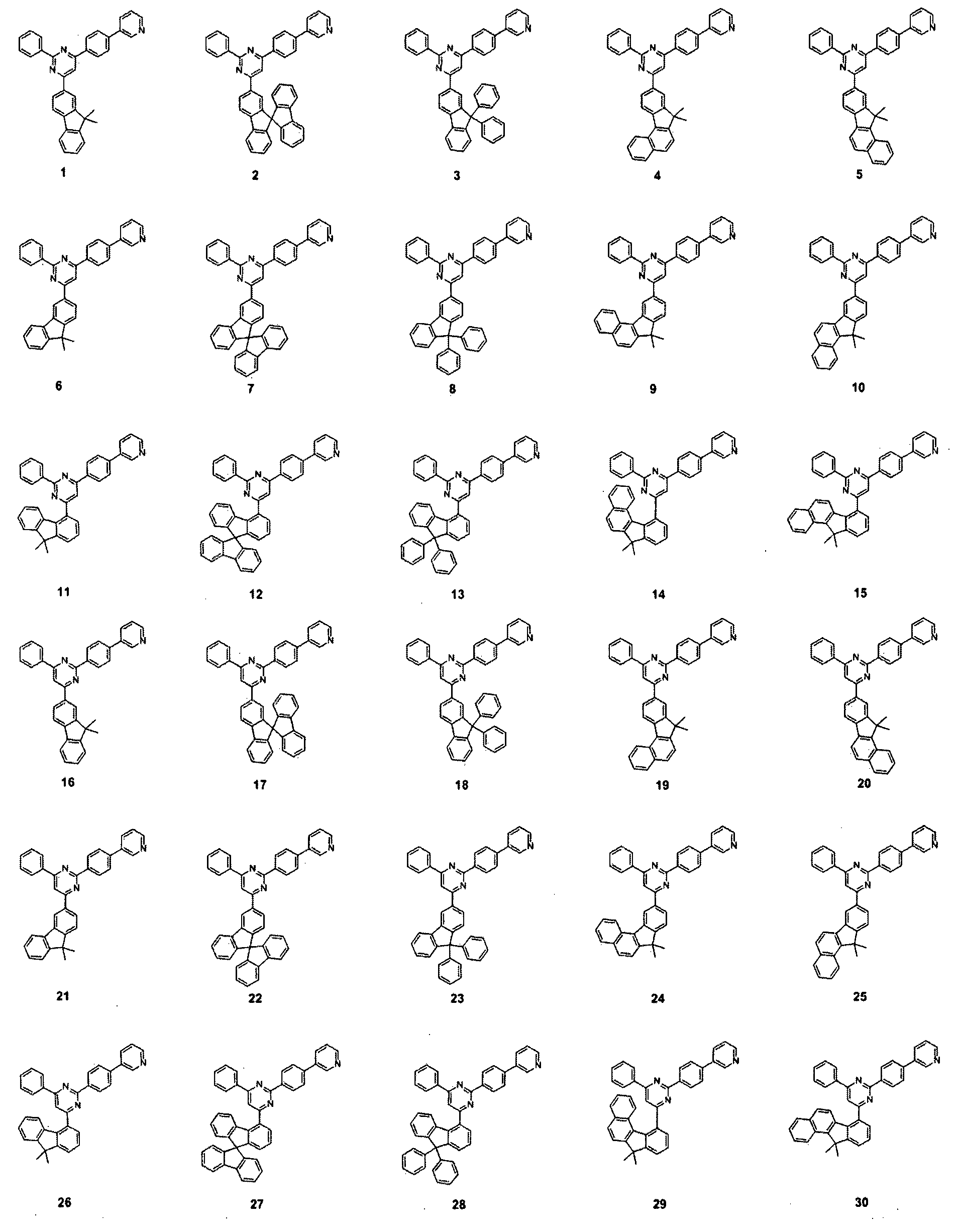

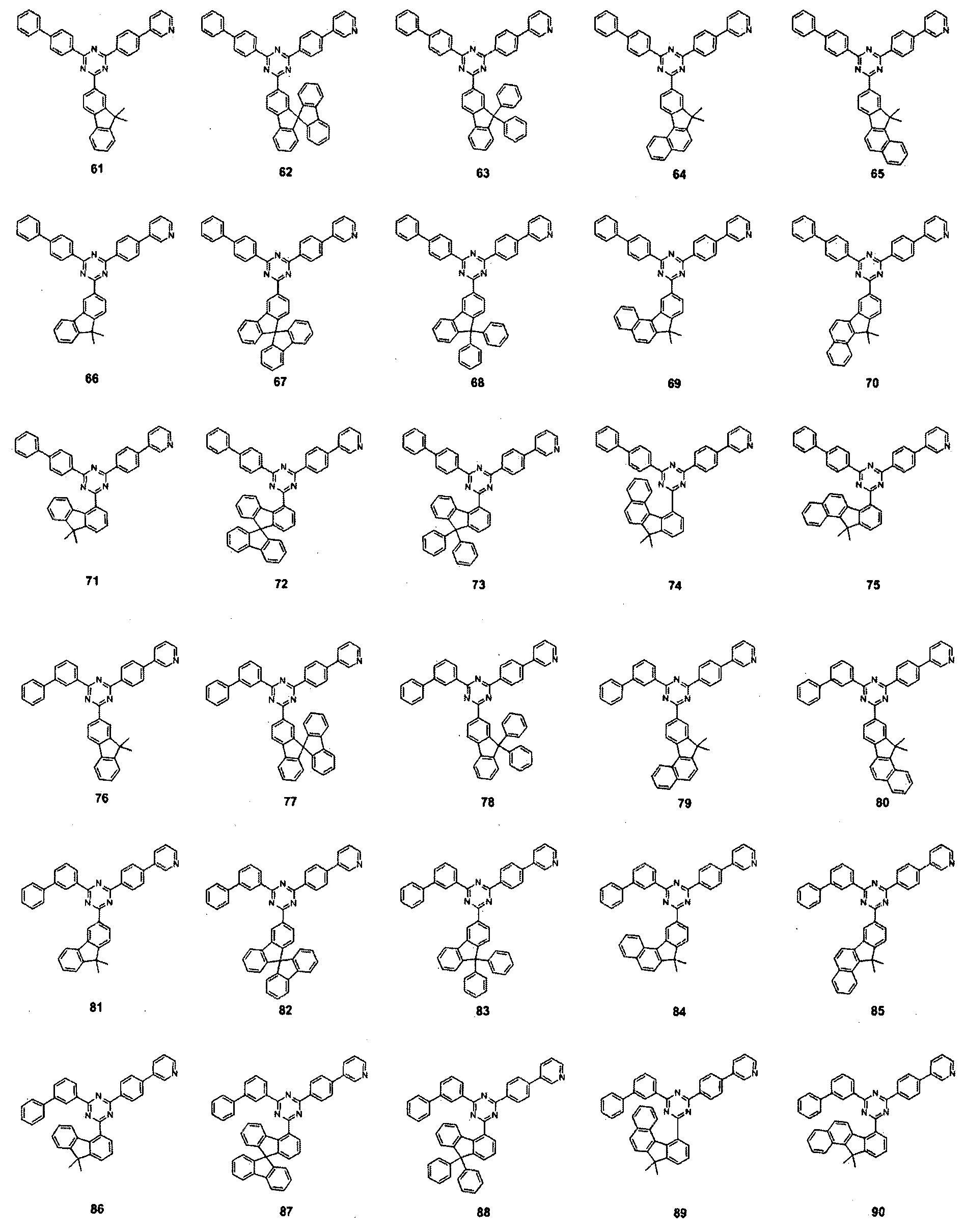
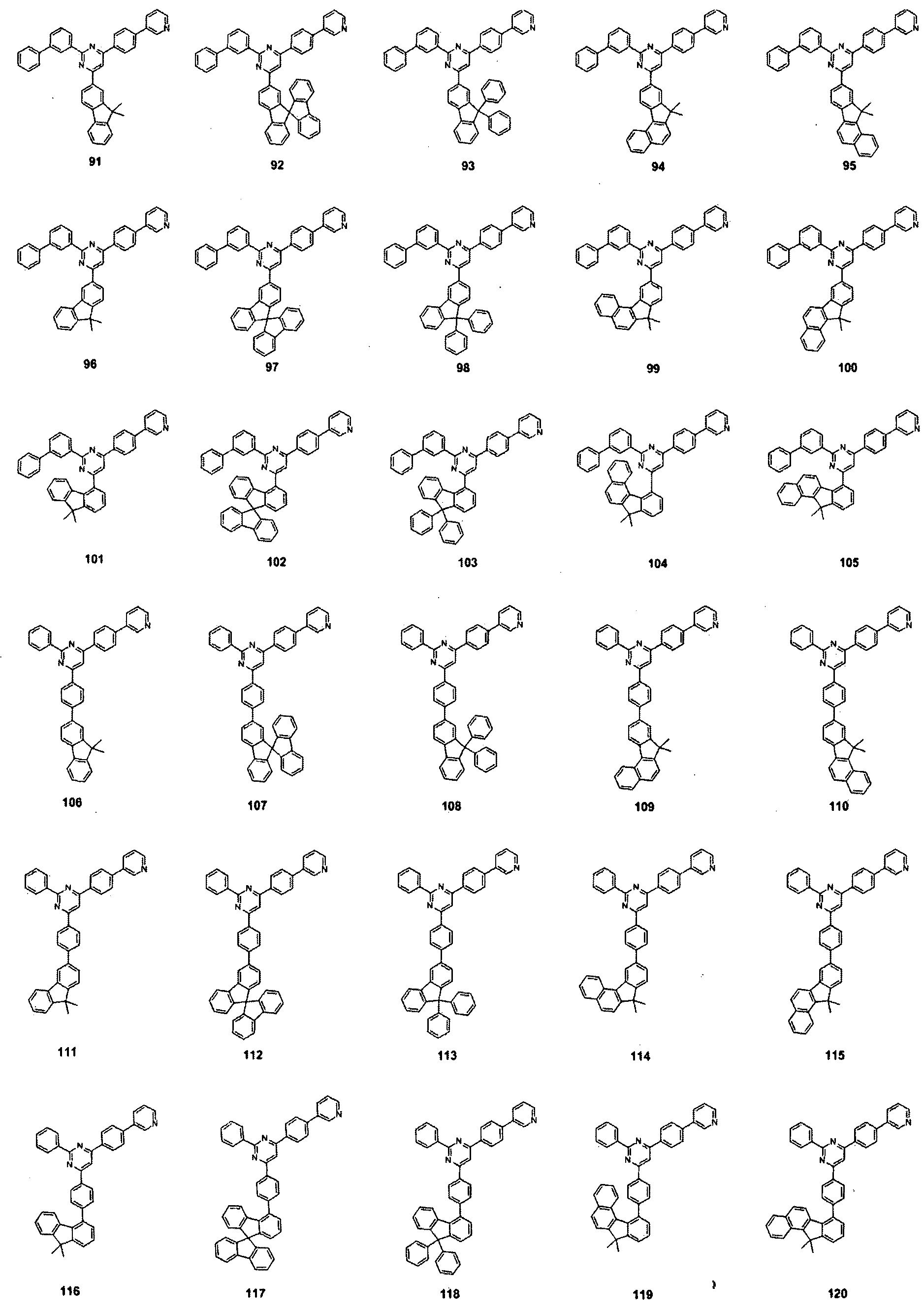
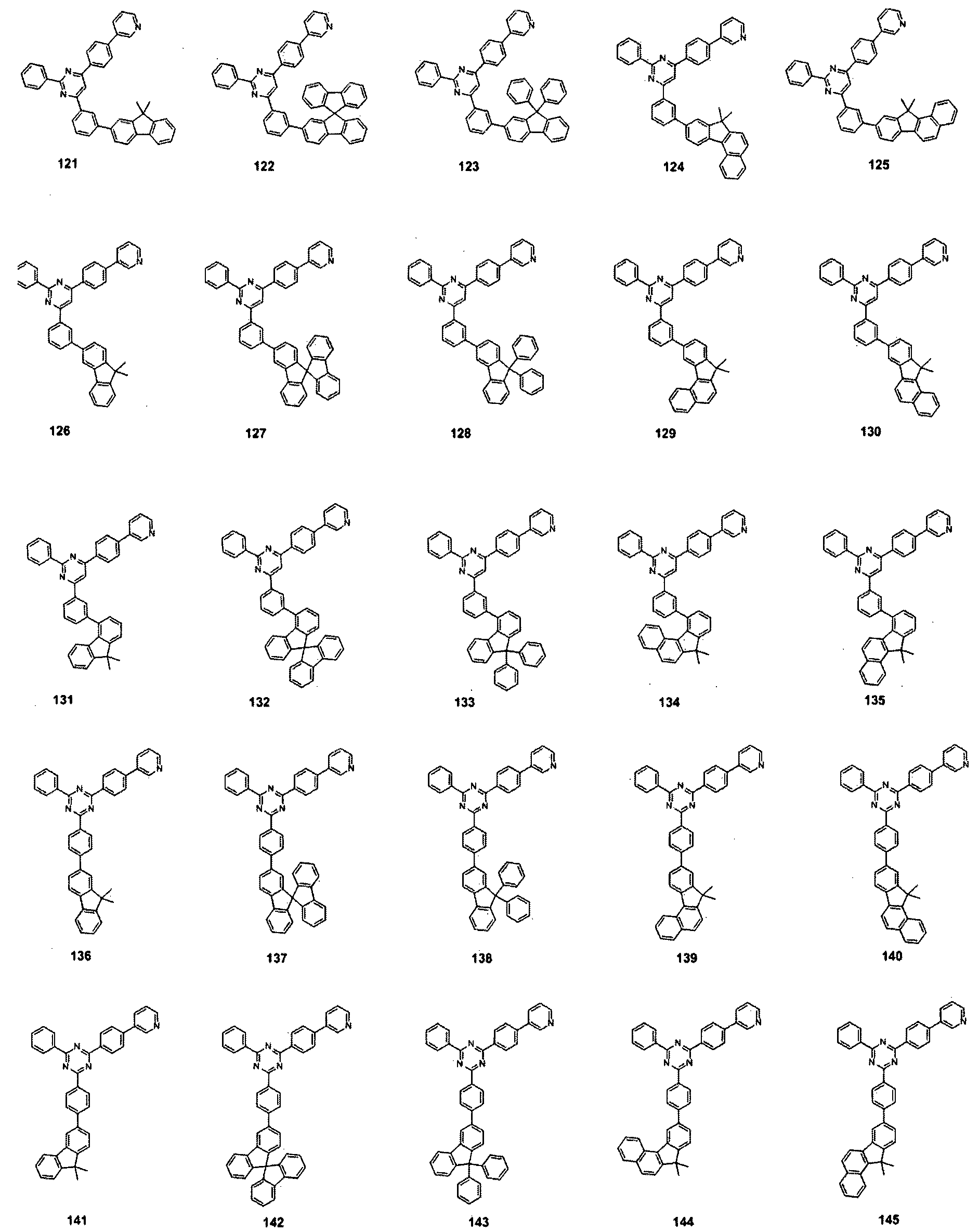
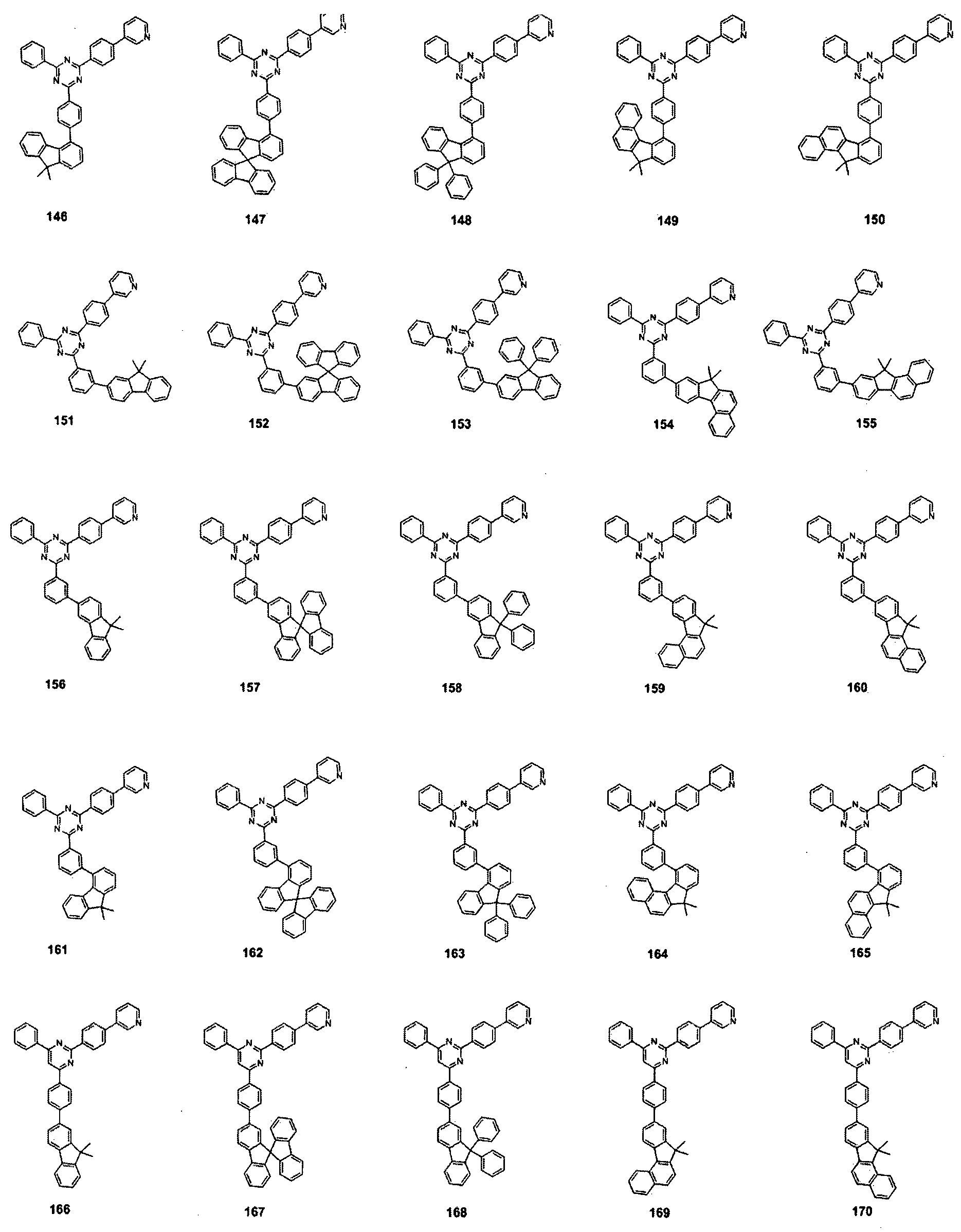
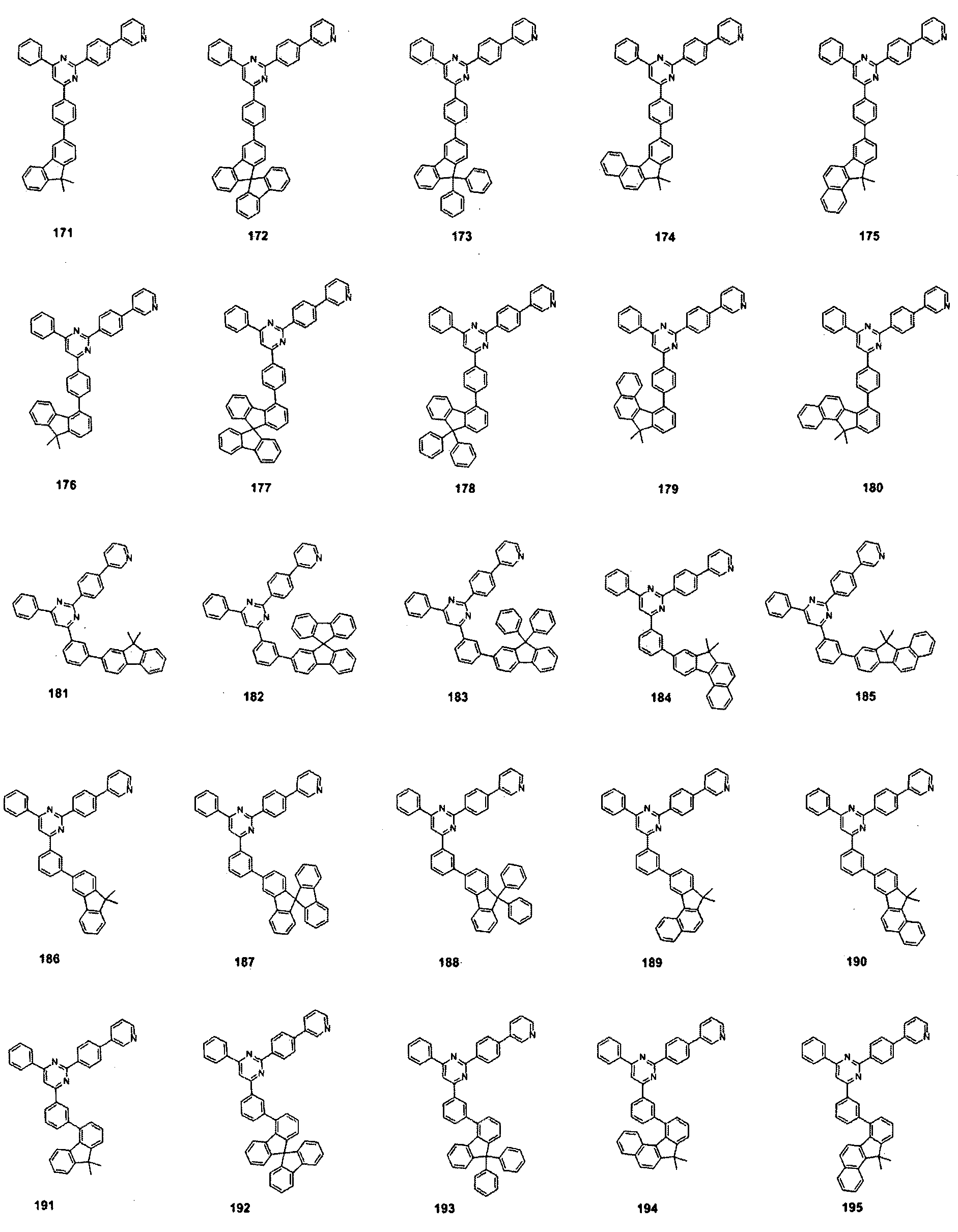
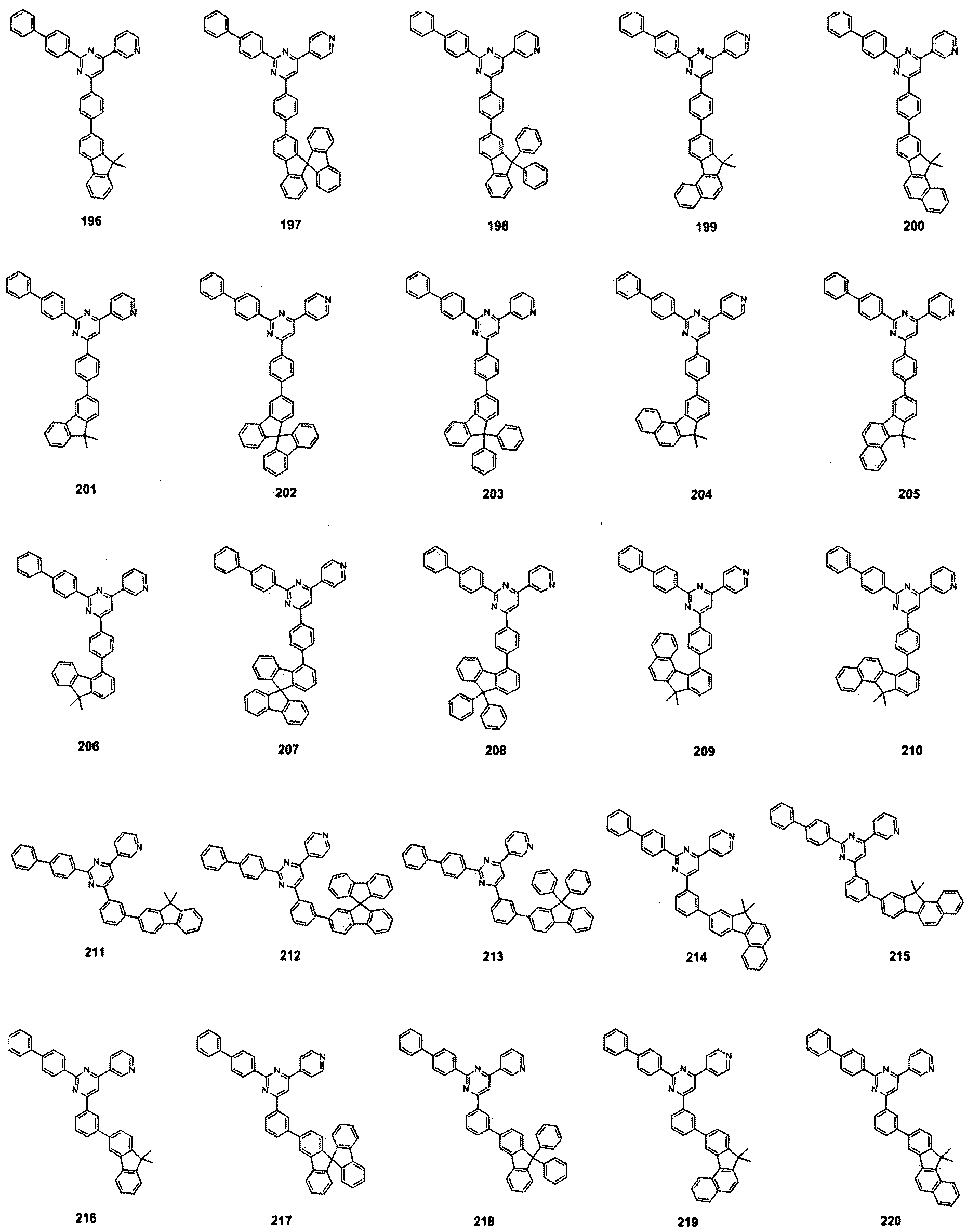
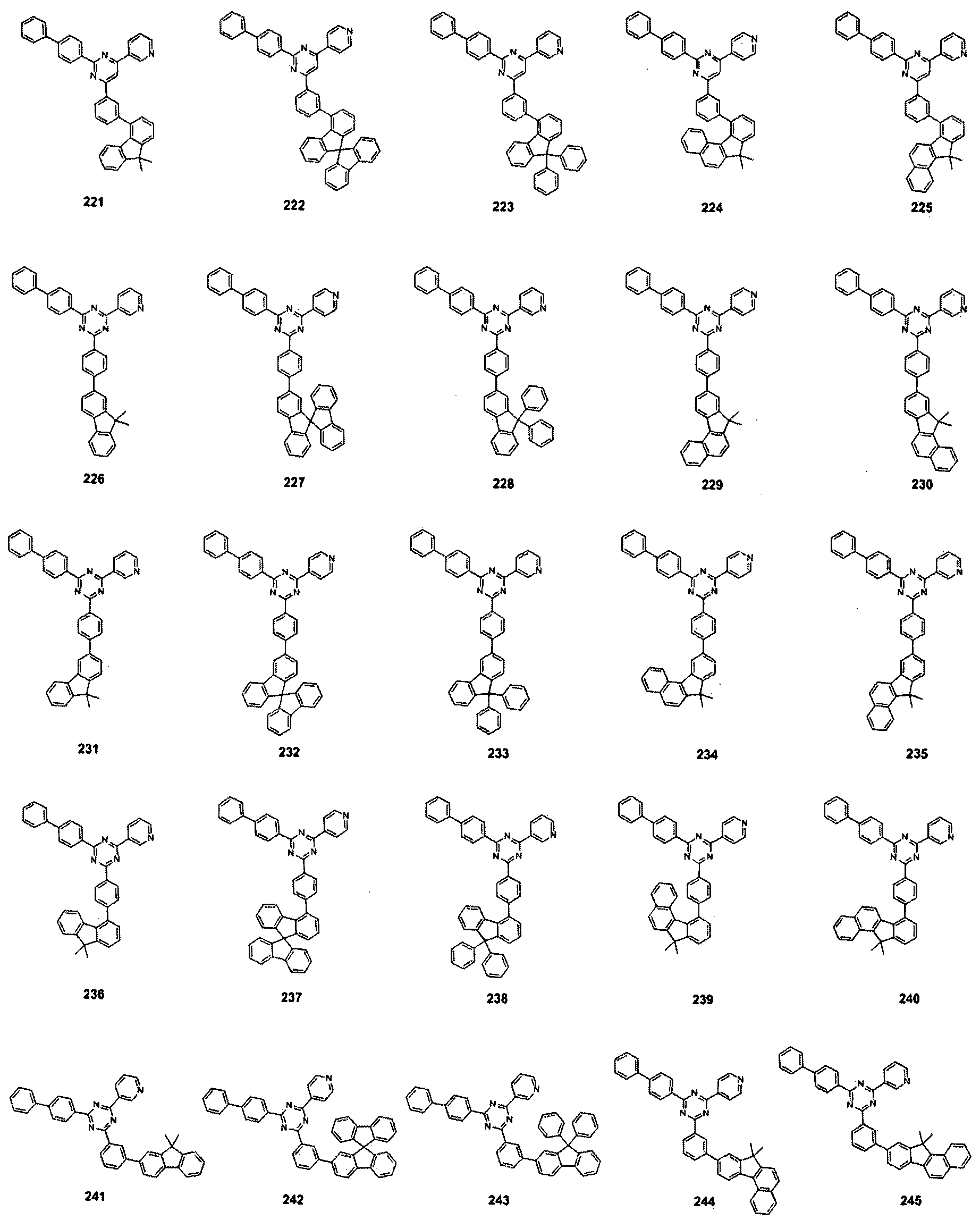
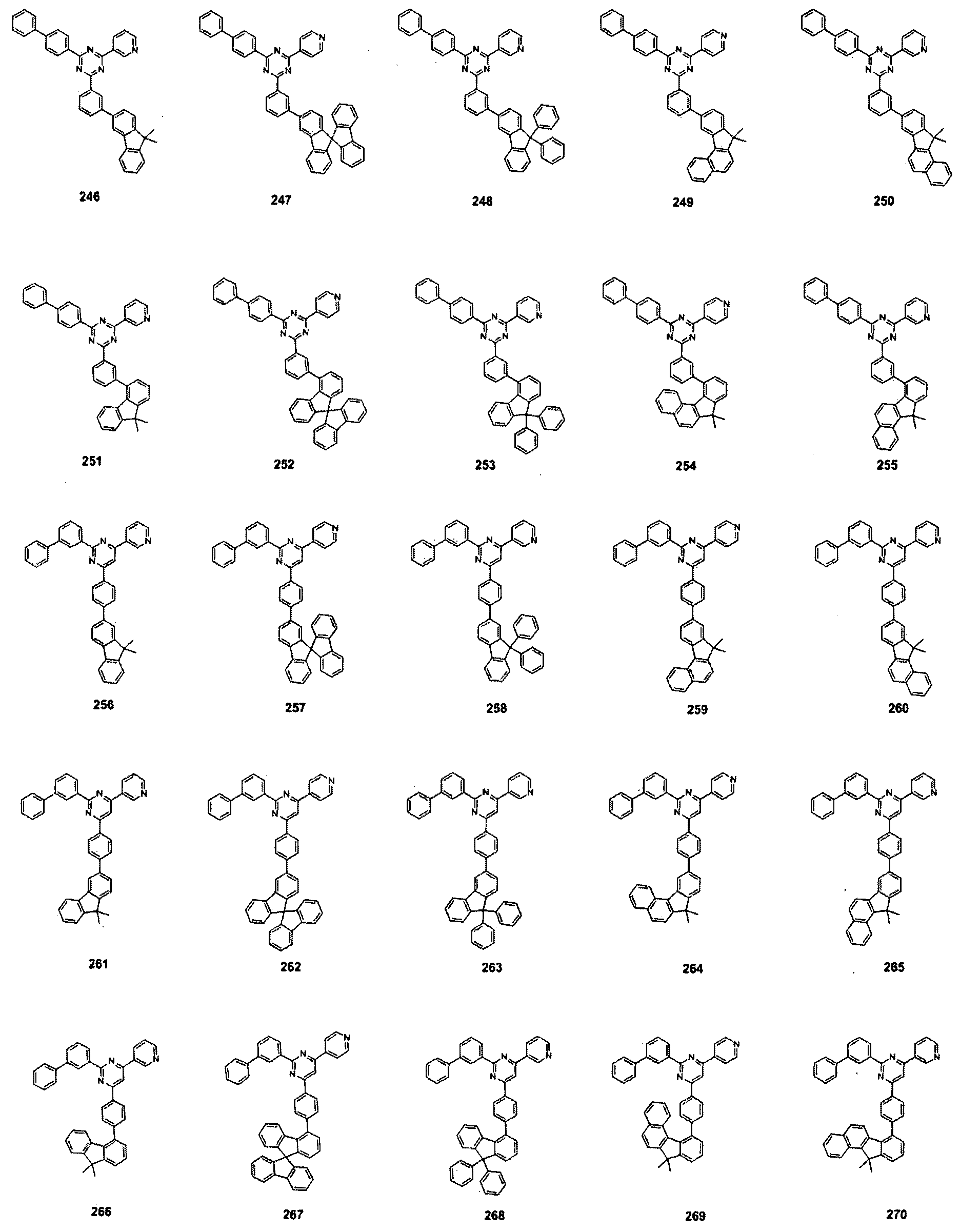
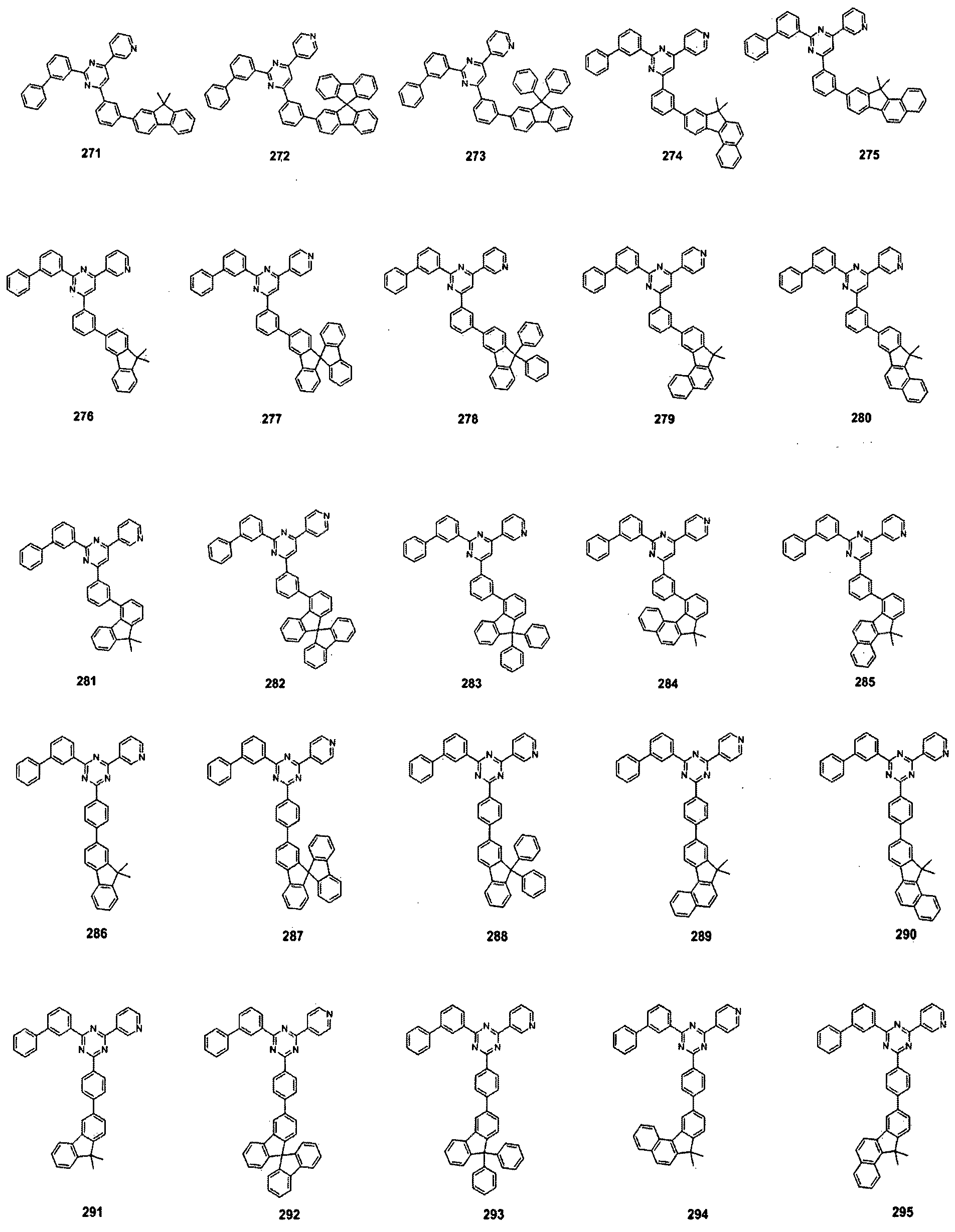
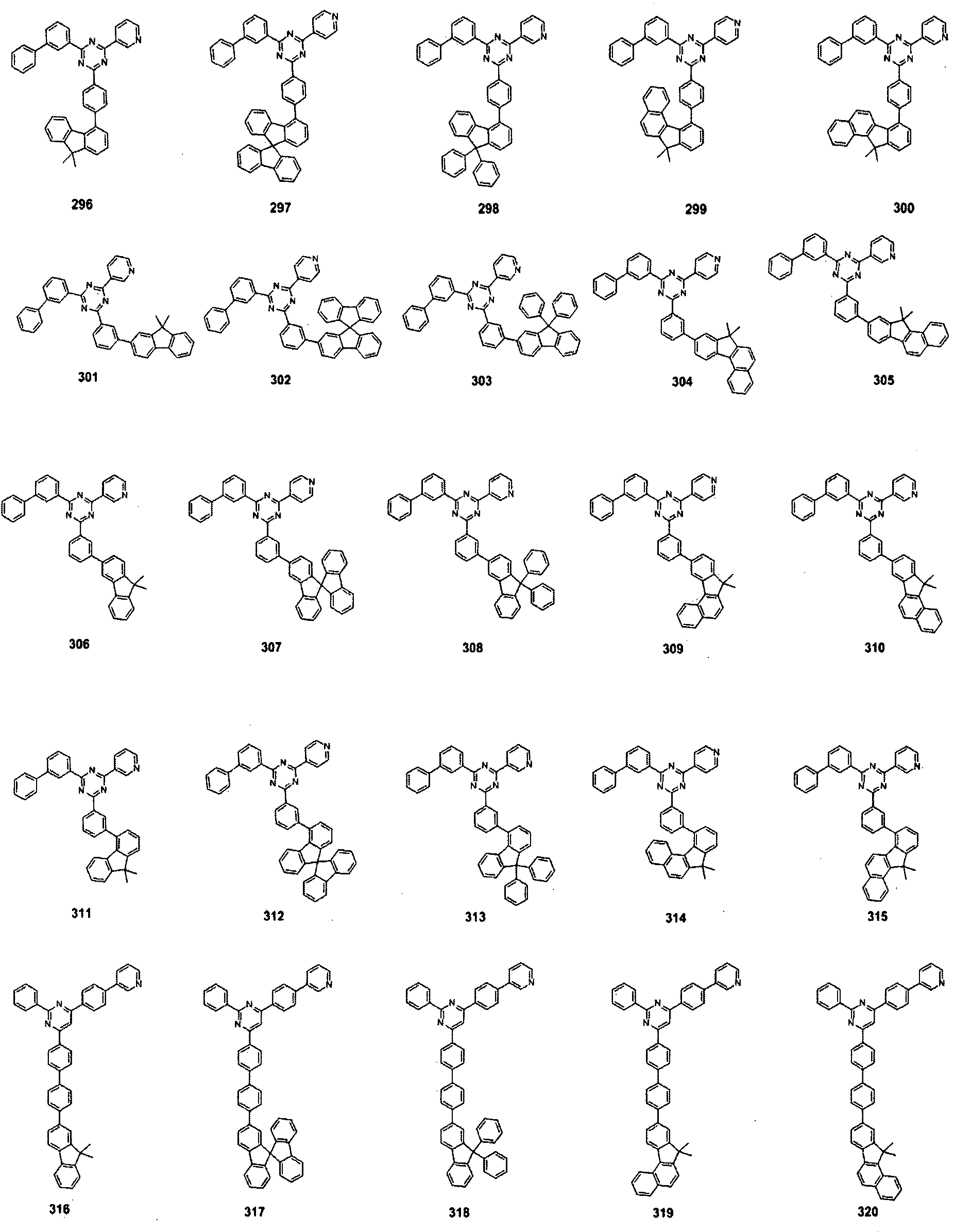
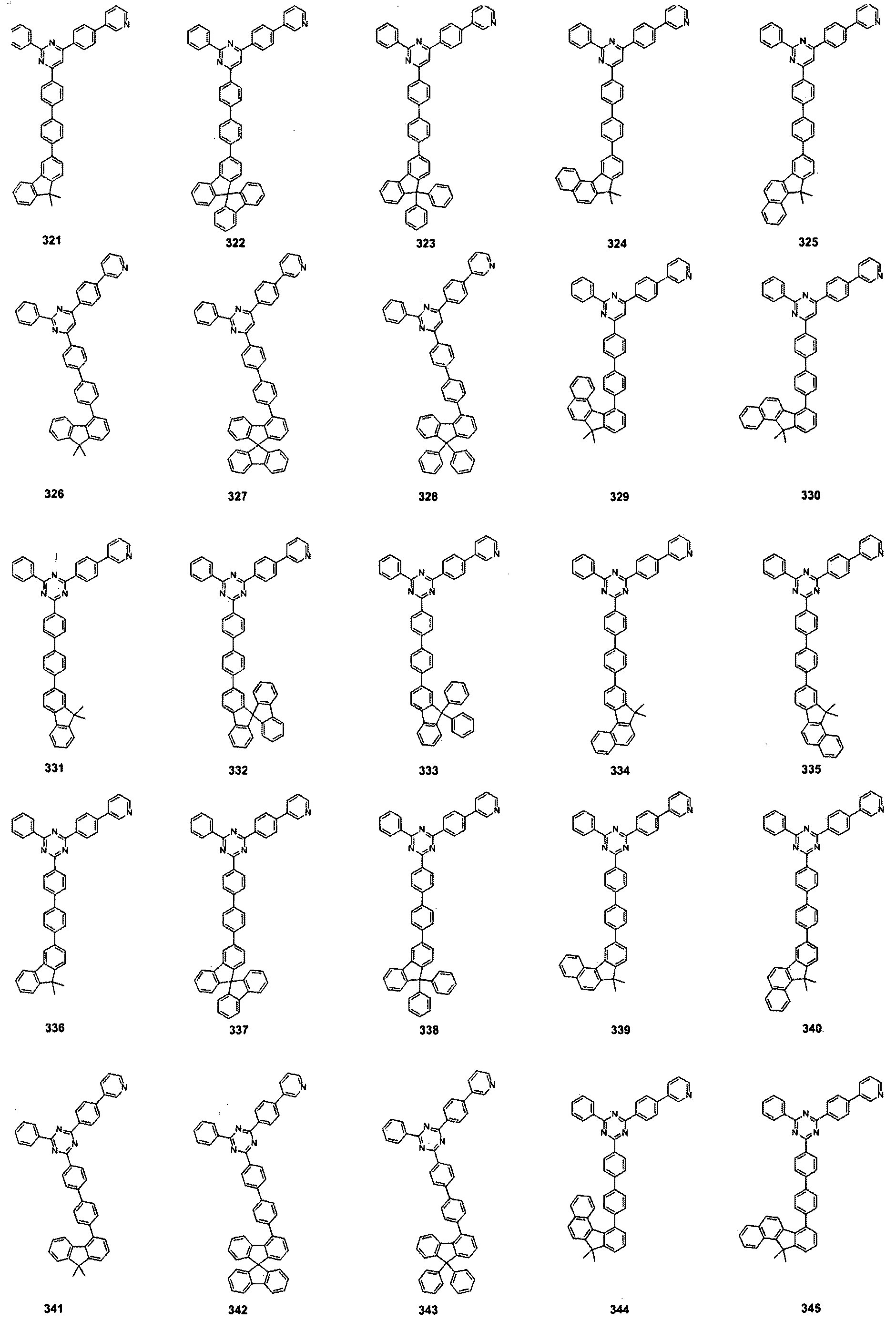

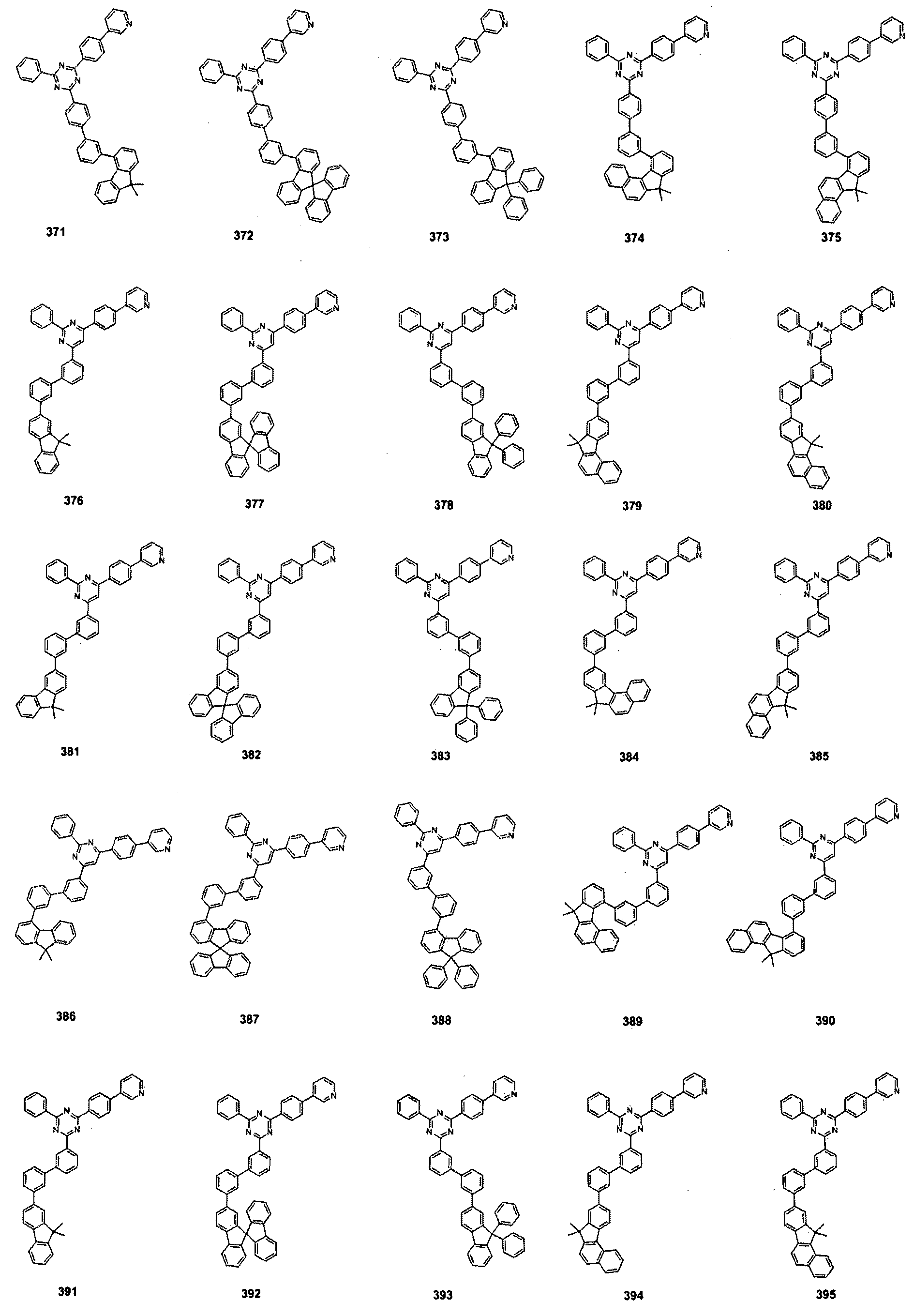
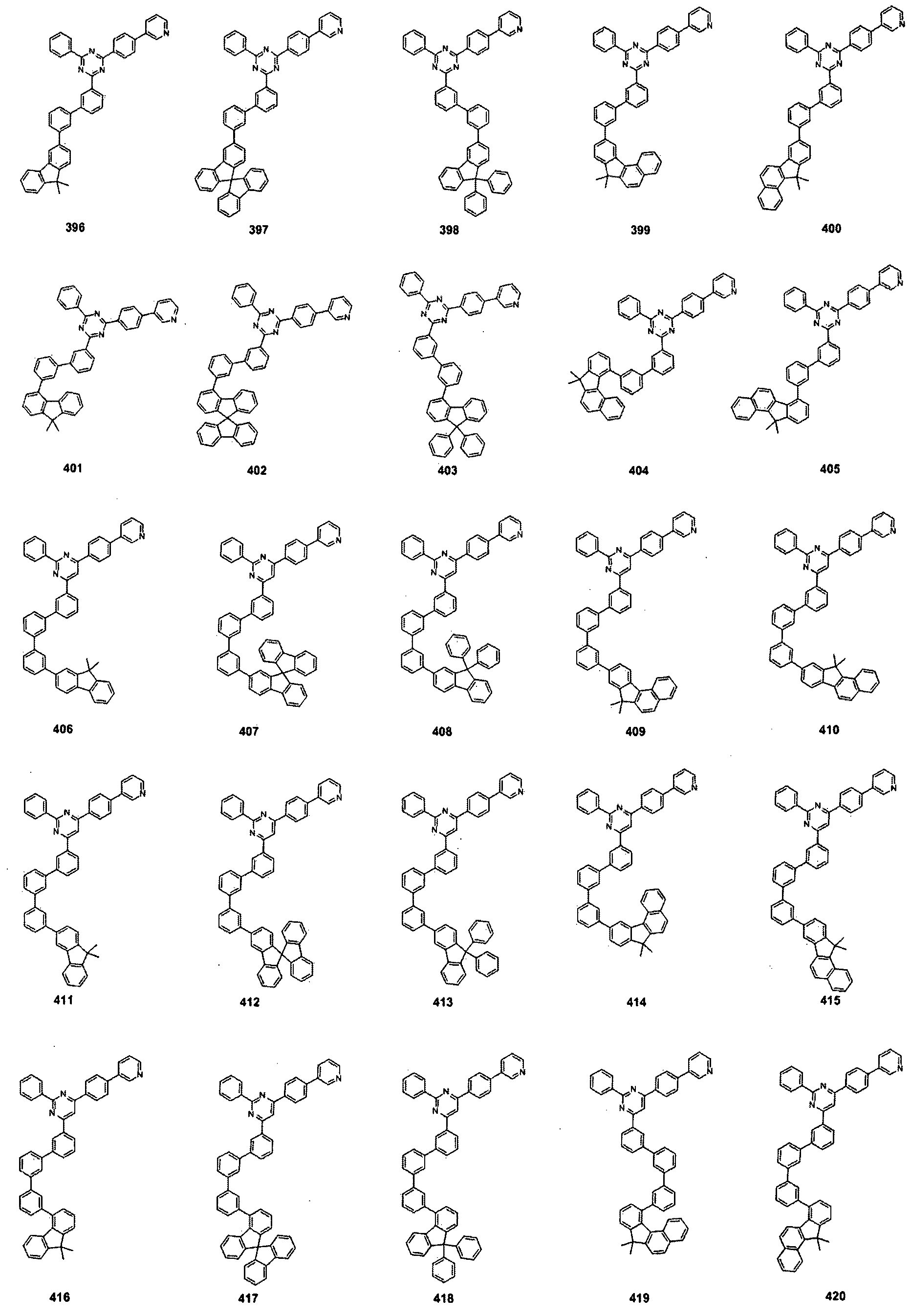
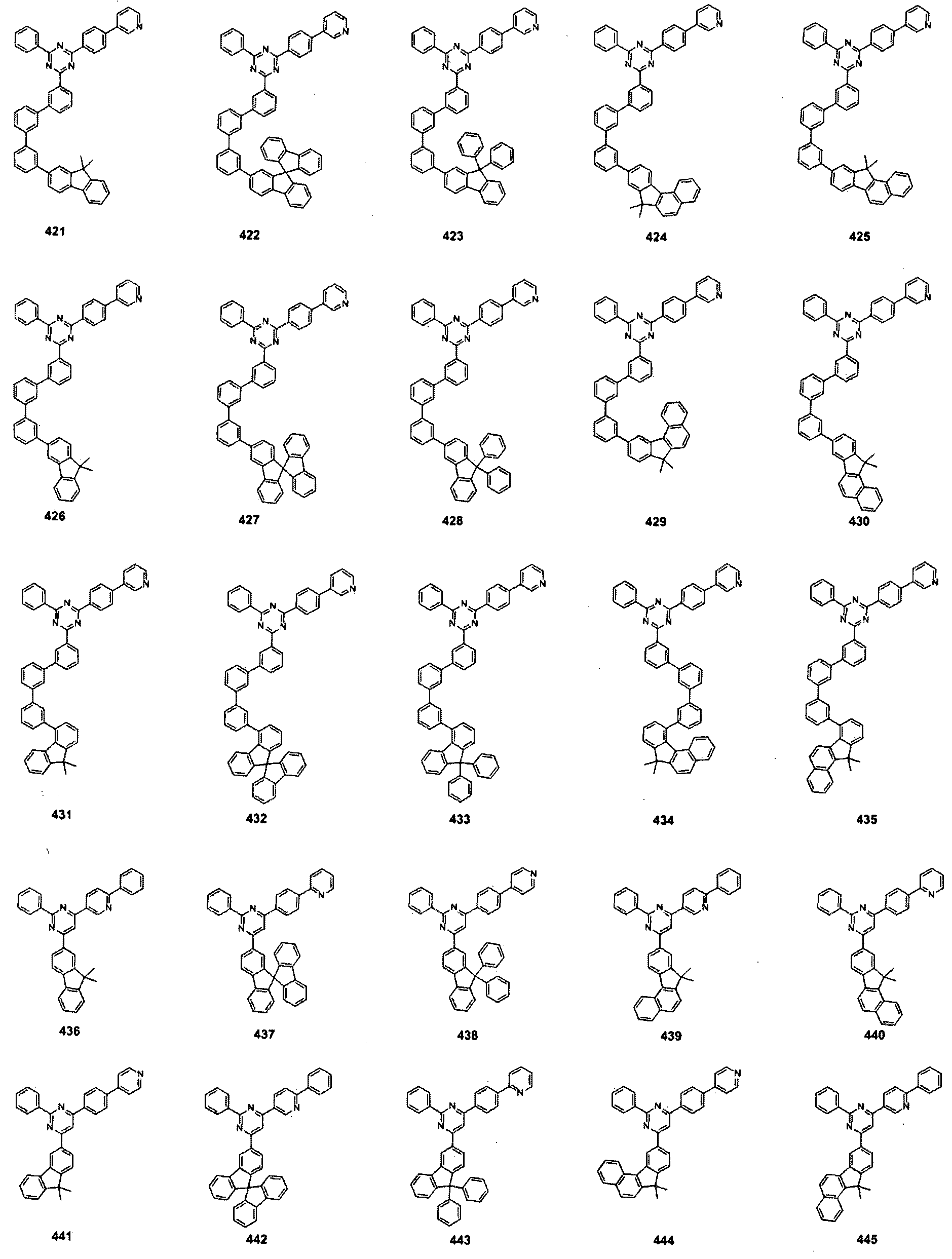
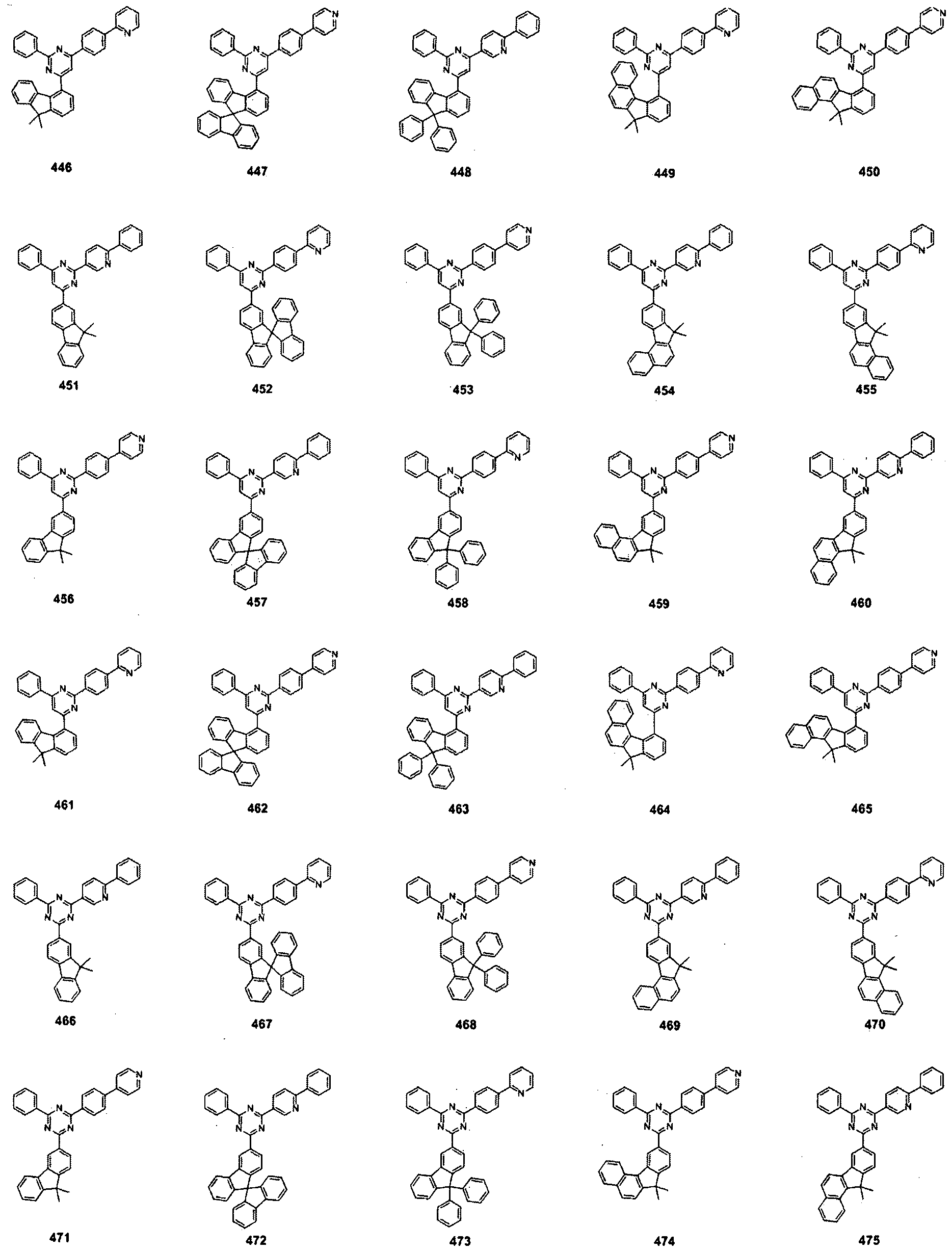
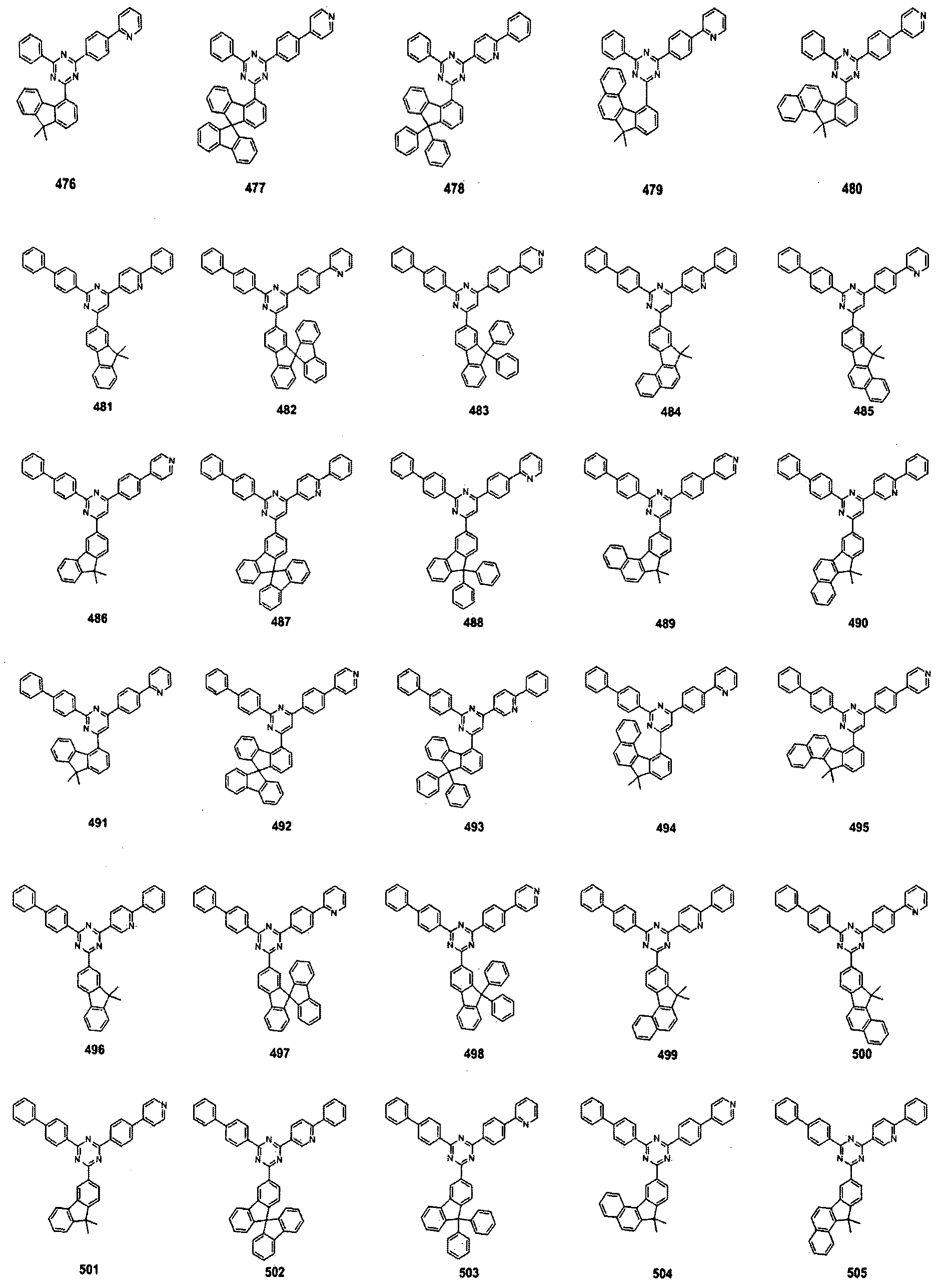


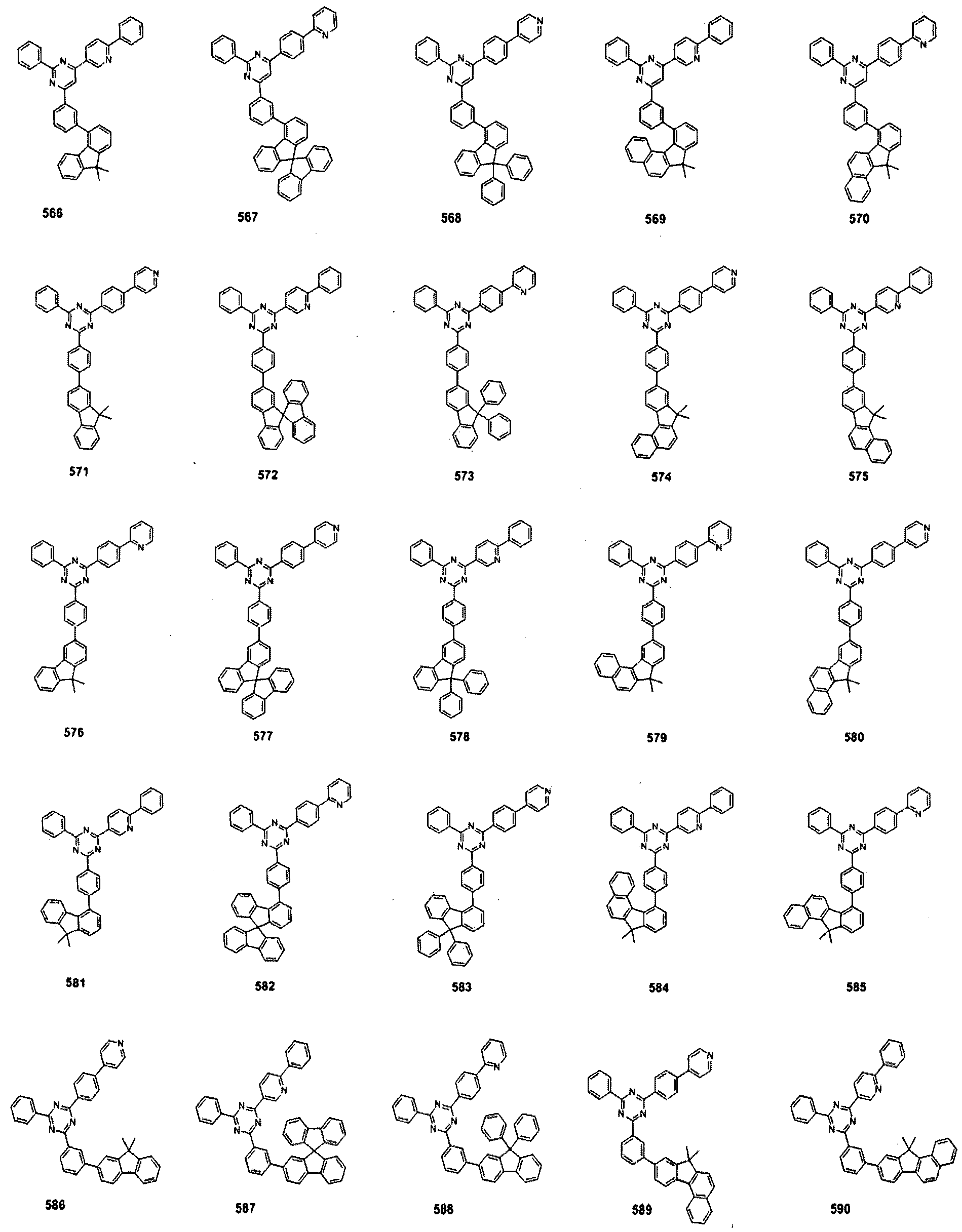
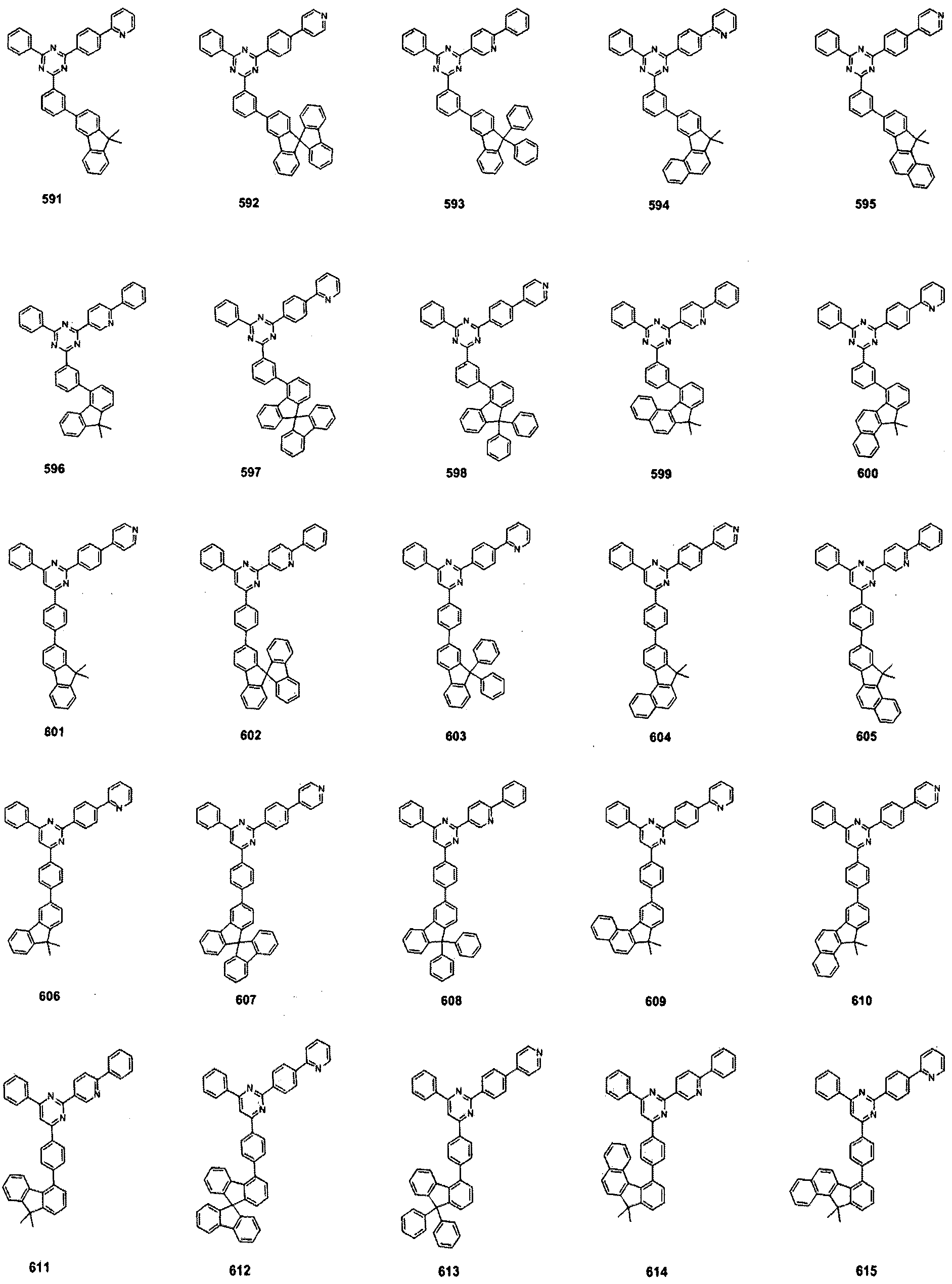

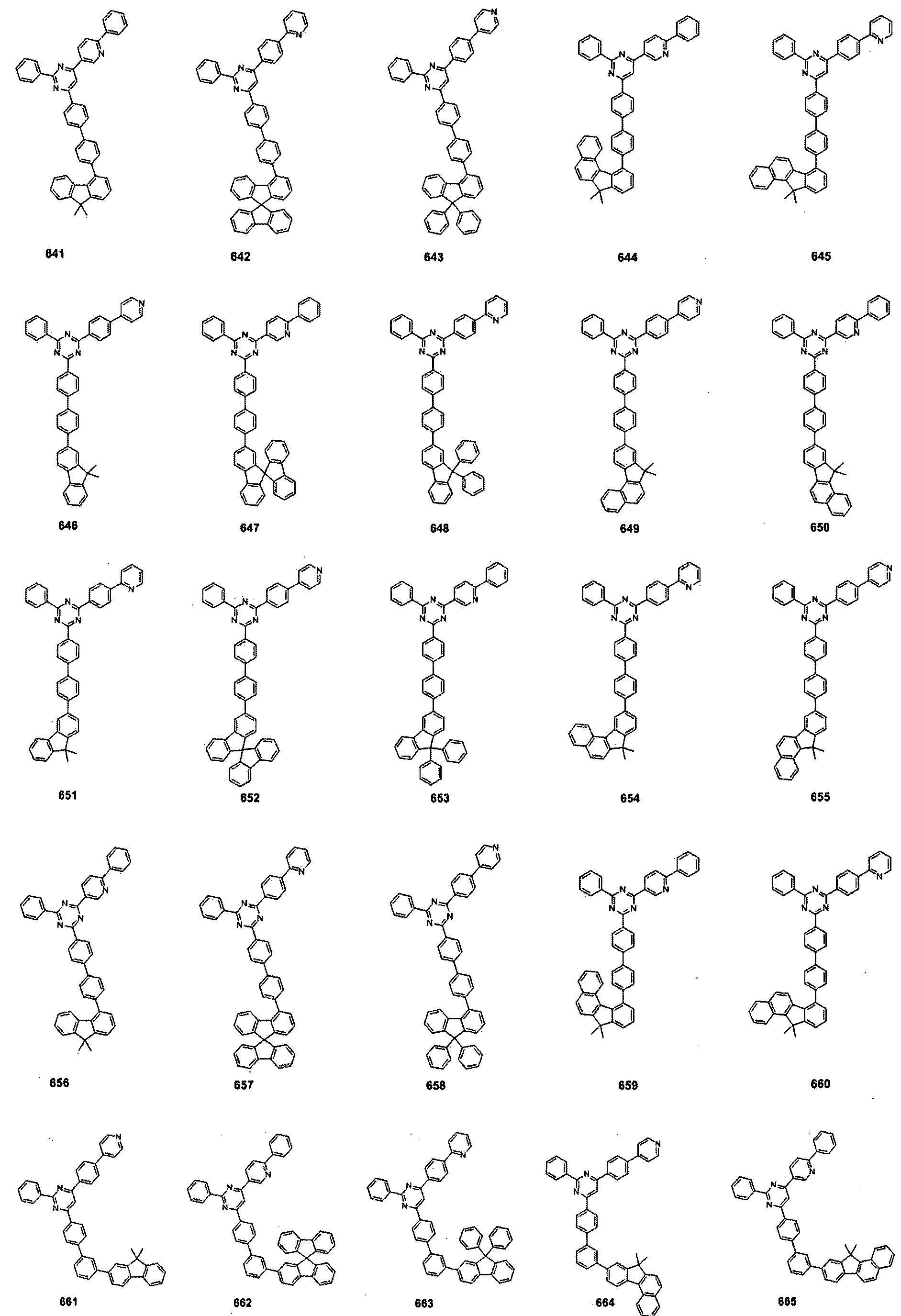


- 양극, 음극 및 상기 양극과 음극 사이에 개재된 1층 이상의 유기물층을 포함하는 유기 전계 발광 소자로서,상기 1층 이상의 유기물 층에서 적어도 하나는 제1항 내지 제8항 중 어느 한 항에 기재된 화합물을 포함하는 유기 전계 발광 소자.
- 제9항에 있어서,상기 화합물을 포함하는 유기물층은 정공 주입층, 정공 수송층, 발광 보조층, 발광층, 전자 수송층 및 전자 주입층으로 이루어진 군에서 선택되는 것인 유기 전계 발광 소자.
- 제9항에 있어서,상기 화합물을 포함하는 유기물층은 전자 수송층 및 전자수송 보조층으로 이루어진 군에서 선택되는 것인 유기 전계 발광 소자.
Priority Applications (6)
| Application Number | Priority Date | Filing Date | Title |
|---|---|---|---|
| CN201880048510.2A CN110944988A (zh) | 2017-07-20 | 2018-07-02 | 有机发光化合物及包含其的有机电致发光元件 |
| US16/632,009 US12545656B2 (en) | 2017-07-20 | 2018-07-02 | Organic light-emitting compound and organic electroluminescent device using the same |
| CN202211257812.5A CN115536633B (zh) | 2017-07-20 | 2018-07-02 | 一种化合物及包含其的有机电致发光元件 |
| JP2020502388A JP7057417B2 (ja) | 2017-07-20 | 2018-07-02 | 有機発光化合物及びこれを用いた有機電界発光素子 |
| JP2022015996A JP7364711B2 (ja) | 2017-07-20 | 2022-02-04 | 有機発光化合物及びこれを用いた有機電界発光素子 |
| US19/395,695 US20260078104A1 (en) | 2017-07-20 | 2025-11-20 | Organic light-emitting compound and organic electroluminescent device using the same |
Applications Claiming Priority (2)
| Application Number | Priority Date | Filing Date | Title |
|---|---|---|---|
| KR10-2017-0092063 | 2017-07-20 | ||
| KR1020170092063A KR20190009994A (ko) | 2017-07-20 | 2017-07-20 | 유기 발광 화합물 및 이를 이용한 유기 전계 발광 소자 |
Related Child Applications (2)
| Application Number | Title | Priority Date | Filing Date |
|---|---|---|---|
| US16/632,009 A-371-Of-International US12545656B2 (en) | 2017-07-20 | 2018-07-02 | Organic light-emitting compound and organic electroluminescent device using the same |
| US19/395,695 Division US20260078104A1 (en) | 2017-07-20 | 2025-11-20 | Organic light-emitting compound and organic electroluminescent device using the same |
Publications (1)
| Publication Number | Publication Date |
|---|---|
| WO2019017616A1 true WO2019017616A1 (ko) | 2019-01-24 |
Family
ID=65015237
Family Applications (1)
| Application Number | Title | Priority Date | Filing Date |
|---|---|---|---|
| PCT/KR2018/007482 Ceased WO2019017616A1 (ko) | 2017-07-20 | 2018-07-02 | 유기 발광 화합물 및 이를 이용한 유기 전계 발광 소자 |
Country Status (5)
| Country | Link |
|---|---|
| US (2) | US12545656B2 (ko) |
| JP (2) | JP7057417B2 (ko) |
| KR (2) | KR20190009994A (ko) |
| CN (2) | CN115536633B (ko) |
| WO (1) | WO2019017616A1 (ko) |
Cited By (5)
| Publication number | Priority date | Publication date | Assignee | Title |
|---|---|---|---|---|
| CN111233832A (zh) * | 2020-01-08 | 2020-06-05 | 上海传勤新材料有限公司 | 一种含有芴和三嗪的有机电子材料及其应用 |
| CN114514227A (zh) * | 2019-12-20 | 2022-05-17 | 株式会社Lg化学 | 化合物及包含其的有机发光器件 |
| CN114641470A (zh) * | 2019-12-20 | 2022-06-17 | 株式会社Lg化学 | 化合物及包含其的有机发光器件 |
| JPWO2022181157A1 (ko) * | 2021-02-25 | 2022-09-01 | ||
| JP2023503312A (ja) * | 2019-11-21 | 2023-01-27 | ソリュース先端素材株式会社 | 有機化合物及びこれを用いた有機電界発光素子 |
Families Citing this family (10)
| Publication number | Priority date | Publication date | Assignee | Title |
|---|---|---|---|---|
| KR20190009994A (ko) * | 2017-07-20 | 2019-01-30 | 주식회사 두산 | 유기 발광 화합물 및 이를 이용한 유기 전계 발광 소자 |
| JP7159173B2 (ja) * | 2017-09-11 | 2022-10-24 | 保土谷化学工業株式会社 | ピリミジン環構造を有する化合物および有機エレクトロルミネッセンス素子 |
| CN110746412A (zh) * | 2018-07-24 | 2020-02-04 | 昱镭光电科技股份有限公司 | 经9,9-螺二芴取代的二苯基嘧啶化合物及其有机电激发光组件 |
| KR102301533B1 (ko) * | 2019-10-25 | 2021-09-16 | 엘티소재주식회사 | 헤테로고리 화합물 및 이를 포함하는 유기 발광 소자 |
| KR102603291B1 (ko) * | 2020-01-30 | 2023-11-15 | 삼성에스디아이 주식회사 | 유기 광전자 소자용 화합물, 유기 광전자 소자용 조성물, 유기 광전자 소자 및 표시 장치 |
| KR102689556B1 (ko) * | 2020-07-17 | 2024-07-26 | 삼성에스디아이 주식회사 | 유기 광전자 소자용 조성물, 유기 광전자 소자 및 표시 장치 |
| CN112159348B (zh) * | 2020-08-07 | 2022-03-11 | 陕西莱特光电材料股份有限公司 | 含氮化合物、电子元件和电子装置 |
| KR102721208B1 (ko) * | 2020-10-05 | 2024-10-22 | 삼성에스디아이 주식회사 | 유기 광전자 소자용 조성물, 유기 광전자 소자 및 표시 장치 |
| CN112552286B (zh) * | 2020-10-26 | 2021-11-16 | 陕西莱特迈思光电材料有限公司 | 一种含氮化合物及包含其的电子元件和电子装置 |
| CN113004295B (zh) * | 2021-03-11 | 2022-07-19 | 吉林奥来德光电材料股份有限公司 | 三嗪类电子传输材料、其制备方法和应用 |
Citations (6)
| Publication number | Priority date | Publication date | Assignee | Title |
|---|---|---|---|---|
| KR20120038032A (ko) * | 2010-10-07 | 2012-04-23 | 에스에프씨 주식회사 | 이형고리 화합물 및 이를 포함하는 유기전계발광소자 |
| KR20160010730A (ko) * | 2014-07-17 | 2016-01-28 | 삼성디스플레이 주식회사 | 유기 발광 소자 및 이를 포함하는 표시 장치 |
| KR20160027985A (ko) * | 2013-07-02 | 2016-03-10 | 메르크 파텐트 게엠베하 | 전자 소자용 재료 |
| KR20170065711A (ko) * | 2015-12-03 | 2017-06-14 | 삼성디스플레이 주식회사 | 축합환 화합물 및 이를 포함한 유기 발광 소자 |
| KR101755986B1 (ko) * | 2016-02-23 | 2017-07-07 | 주식회사 엘지화학 | 헤테로고리 화합물 및 이를 포함하는 유기 발광 소자 |
| KR20170086211A (ko) * | 2016-01-18 | 2017-07-26 | 에스에프씨 주식회사 | 유기발광 화합물 및 이를 포함하는 유기발광소자 |
Family Cites Families (18)
| Publication number | Priority date | Publication date | Assignee | Title |
|---|---|---|---|---|
| DE10356099A1 (de) | 2003-11-27 | 2005-07-07 | Covion Organic Semiconductors Gmbh | Organisches Elektrolumineszenzelement |
| KR102013399B1 (ko) | 2011-11-29 | 2019-08-22 | 에스에프씨 주식회사 | 안트라센 유도체 및 이를 포함하는 유기전계발광소자 |
| FR2997984B1 (fr) * | 2012-11-15 | 2015-01-16 | Decathlon Sa | Systeme de tente modulaire |
| CN106573911A (zh) | 2014-06-11 | 2017-04-19 | 保土谷化学工业株式会社 | 嘧啶衍生物和有机电致发光器件 |
| EP3220437B1 (en) * | 2014-11-14 | 2021-04-14 | Hodogaya Chemical Co., Ltd. | Organic electroluminescent element |
| US11158811B2 (en) * | 2014-12-05 | 2021-10-26 | Hodogaya Chemical Co., Ltd. | Organic electroluminescent device |
| KR101745799B1 (ko) | 2014-12-24 | 2017-06-09 | 주식회사 두산 | 유기 화합물 및 이를 포함하는 유기 전계 발광 소자 |
| WO2016105141A2 (ko) | 2014-12-24 | 2016-06-30 | 주식회사 두산 | 유기 화합물 및 이를 포함하는 유기 전계 발광 소자 |
| CN107112425B (zh) * | 2014-12-24 | 2019-05-17 | 保土谷化学工业株式会社 | 有机电致发光器件 |
| US10593884B2 (en) * | 2015-01-06 | 2020-03-17 | Hodogaya Chemical Co., Ltd. | Organic electroluminescent device |
| JPWO2016175292A1 (ja) * | 2015-04-28 | 2018-02-22 | 出光興産株式会社 | 化合物、有機エレクトロルミネッセンス素子用材料、有機エレクトロルミネッセンス素子、および電子機器 |
| EP4301110A3 (en) | 2015-07-30 | 2024-04-10 | Merck Patent GmbH | Materials for organic electroluminescent devices |
| TWI821807B (zh) | 2016-03-17 | 2023-11-11 | 德商麥克專利有限公司 | 具有螺聯茀結構之化合物 |
| KR102148056B1 (ko) | 2016-03-29 | 2020-08-25 | 주식회사 엘지화학 | 유기 발광 소자 |
| KR102630325B1 (ko) | 2016-08-18 | 2024-01-29 | 주식회사 동진쎄미켐 | 신규 화합물 및 이를 포함하는 유기발광소자 |
| KR102055979B1 (ko) | 2017-05-29 | 2019-12-13 | 주식회사 엘지화학 | 유기 발광 소자 |
| KR102006433B1 (ko) | 2017-06-21 | 2019-10-08 | 주식회사 엘지화학 | 신규한 헤테로 고리 화합물 및 이를 이용한 유기 발광 소자 |
| KR20190009994A (ko) * | 2017-07-20 | 2019-01-30 | 주식회사 두산 | 유기 발광 화합물 및 이를 이용한 유기 전계 발광 소자 |
-
2017
- 2017-07-20 KR KR1020170092063A patent/KR20190009994A/ko not_active Ceased
-
2018
- 2018-07-02 CN CN202211257812.5A patent/CN115536633B/zh active Active
- 2018-07-02 US US16/632,009 patent/US12545656B2/en active Active
- 2018-07-02 JP JP2020502388A patent/JP7057417B2/ja active Active
- 2018-07-02 WO PCT/KR2018/007482 patent/WO2019017616A1/ko not_active Ceased
- 2018-07-02 CN CN201880048510.2A patent/CN110944988A/zh active Pending
-
2022
- 2022-02-04 JP JP2022015996A patent/JP7364711B2/ja active Active
- 2022-09-07 KR KR1020220113767A patent/KR102611736B1/ko active Active
-
2025
- 2025-11-20 US US19/395,695 patent/US20260078104A1/en active Pending
Patent Citations (6)
| Publication number | Priority date | Publication date | Assignee | Title |
|---|---|---|---|---|
| KR20120038032A (ko) * | 2010-10-07 | 2012-04-23 | 에스에프씨 주식회사 | 이형고리 화합물 및 이를 포함하는 유기전계발광소자 |
| KR20160027985A (ko) * | 2013-07-02 | 2016-03-10 | 메르크 파텐트 게엠베하 | 전자 소자용 재료 |
| KR20160010730A (ko) * | 2014-07-17 | 2016-01-28 | 삼성디스플레이 주식회사 | 유기 발광 소자 및 이를 포함하는 표시 장치 |
| KR20170065711A (ko) * | 2015-12-03 | 2017-06-14 | 삼성디스플레이 주식회사 | 축합환 화합물 및 이를 포함한 유기 발광 소자 |
| KR20170086211A (ko) * | 2016-01-18 | 2017-07-26 | 에스에프씨 주식회사 | 유기발광 화합물 및 이를 포함하는 유기발광소자 |
| KR101755986B1 (ko) * | 2016-02-23 | 2017-07-07 | 주식회사 엘지화학 | 헤테로고리 화합물 및 이를 포함하는 유기 발광 소자 |
Cited By (16)
| Publication number | Priority date | Publication date | Assignee | Title |
|---|---|---|---|---|
| EP4063353A4 (en) * | 2019-11-21 | 2023-12-27 | Solus Advanced Materials Co., Ltd. | Organic compound and organic electroluminescent device using same |
| JP2023503312A (ja) * | 2019-11-21 | 2023-01-27 | ソリュース先端素材株式会社 | 有機化合物及びこれを用いた有機電界発光素子 |
| US20230045312A1 (en) * | 2019-11-21 | 2023-02-09 | Solus Advanced Materials Co., Ltd. | An organic compound and an organic electroluminescent device using the same |
| JP7427784B2 (ja) | 2019-11-21 | 2024-02-05 | ソリュース先端素材株式会社 | 有機化合物及びこれを用いた有機電界発光素子 |
| CN114514227A (zh) * | 2019-12-20 | 2022-05-17 | 株式会社Lg化学 | 化合物及包含其的有机发光器件 |
| CN114641470A (zh) * | 2019-12-20 | 2022-06-17 | 株式会社Lg化学 | 化合物及包含其的有机发光器件 |
| CN114641470B (zh) * | 2019-12-20 | 2025-01-10 | 株式会社Lg化学 | 化合物及包含其的有机发光器件 |
| CN114514227B (zh) * | 2019-12-20 | 2025-01-10 | 株式会社Lg化学 | 化合物及包含其的有机发光器件 |
| CN111233832A (zh) * | 2020-01-08 | 2020-06-05 | 上海传勤新材料有限公司 | 一种含有芴和三嗪的有机电子材料及其应用 |
| CN111233832B (zh) * | 2020-01-08 | 2023-12-01 | 上海传勤新材料有限公司 | 一种含有芴和三嗪的有机电子材料及其应用 |
| WO2022181157A1 (ja) * | 2021-02-25 | 2022-09-01 | 出光興産株式会社 | 化合物、有機エレクトロルミネッセンス素子用材料、有機エレクトロルミネッセンス素子及び電子機器 |
| KR20230152551A (ko) * | 2021-02-25 | 2023-11-03 | 이데미쓰 고산 가부시키가이샤 | 화합물, 유기 전기발광 소자용 재료, 유기 전기발광 소자 및 전자 기기 |
| JP7249470B2 (ja) | 2021-02-25 | 2023-03-30 | 出光興産株式会社 | 化合物、有機エレクトロルミネッセンス素子用材料、有機エレクトロルミネッセンス素子及び電子機器 |
| JPWO2022181157A1 (ko) * | 2021-02-25 | 2022-09-01 | ||
| KR102780182B1 (ko) * | 2021-02-25 | 2025-03-12 | 이데미쓰 고산 가부시키가이샤 | 화합물, 유기 전기발광 소자용 재료, 유기 전기발광 소자 및 전자 기기 |
| US12312317B2 (en) | 2021-02-25 | 2025-05-27 | Idemitsu Kosan Co., Ltd. | Compound, material for organic electroluminescent elements, organic electroluminescent element, and electronic device |
Also Published As
| Publication number | Publication date |
|---|---|
| CN110944988A (zh) | 2020-03-31 |
| KR20220127220A (ko) | 2022-09-19 |
| JP2022064995A (ja) | 2022-04-26 |
| US20260078104A1 (en) | 2026-03-19 |
| KR102611736B1 (ko) | 2023-12-08 |
| CN115536633B (zh) | 2025-05-13 |
| JP7057417B2 (ja) | 2022-04-19 |
| CN115536633A (zh) | 2022-12-30 |
| KR20190009994A (ko) | 2019-01-30 |
| JP7364711B2 (ja) | 2023-10-18 |
| US20200168805A1 (en) | 2020-05-28 |
| JP2020527578A (ja) | 2020-09-10 |
| US12545656B2 (en) | 2026-02-10 |
Similar Documents
| Publication | Publication Date | Title |
|---|---|---|
| WO2019017616A1 (ko) | 유기 발광 화합물 및 이를 이용한 유기 전계 발광 소자 | |
| WO2019004599A1 (ko) | 유기 화합물 및 이를 이용한 유기 전계 발광 소자 | |
| WO2016105161A2 (ko) | 유기 화합물 및 이를 포함하는 유기 전계 발광 소자 | |
| WO2015060684A2 (ko) | 유기 화합물 및 이를 포함하는 유기 전계 발광 소자 | |
| WO2022103109A1 (ko) | 유기 화합물 및 이를 포함하는 유기 전계 발광 소자 | |
| WO2021118086A2 (ko) | 유기 화합물 및 이를 포함하는 유기 전계 발광 소자 | |
| WO2017099430A1 (ko) | 유기 화합물 및 이를 포함하는 유기 전계 발광 소자 | |
| WO2022131743A1 (ko) | 유기 발광 화합물 및 이를 이용한 유기 전계 발광 소자 | |
| WO2020218680A1 (ko) | 유기 화합물 및 이를 이용한 유기 전계 발광 소자 | |
| WO2023163479A1 (ko) | 유기 화합물 및 이를 이용한 유기 전계 발광 소자 | |
| WO2015060635A1 (ko) | 유기 화합물 및 이를 포함하는 유기 전계 발광 소자 | |
| WO2020009381A1 (ko) | 유기 화합물 및 이를 포함하는 유기 전계 발광 소자 | |
| WO2022060042A1 (ko) | 유기 화합물 및 이를 포함하는 유기 전계 발광 소자 | |
| WO2017111389A1 (ko) | 유기 화합물 및 이를 포함하는 유기 전계 발광 소자 | |
| WO2016104954A2 (ko) | 유기 화합물 및 이를 포함하는 유기 전계 발광 소자 | |
| WO2023132668A1 (ko) | 유기 화합물 및 이를 이용한 유기 전계 발광 소자 | |
| WO2018043913A1 (ko) | 유기 화합물 및 이를 포함하는 유기 전계 발광 소자 | |
| WO2020130726A1 (ko) | 유기 화합물 및 이를 포함하는 유기 전계 발광 소자 | |
| WO2019203430A1 (ko) | 유기 발광 화합물 및 이를 이용한 유기 전계 발광 소자 | |
| WO2022139455A1 (ko) | 유기 화합물 및 이를 이용한 유기 전계 발광 소자 | |
| WO2015099477A2 (ko) | 유기 화합물 및 이를 이용한 유기 전계 발광 소자 | |
| WO2015046982A2 (ko) | 유기 화합물 및 이를 포함하는 유기 전계 발광 소자 | |
| WO2021215782A1 (ko) | 유기 발광 화합물 및 이를 이용한 유기 전계 발광 소자 | |
| WO2021101255A1 (ko) | 유기 화합물 및 이를 이용한 유기 전계 발광 소자 | |
| WO2017105063A1 (ko) | 유기 화합물 및 이를 포함하는 유기 전계 발광 소자 |
Legal Events
| Date | Code | Title | Description |
|---|---|---|---|
| 121 | Ep: the epo has been informed by wipo that ep was designated in this application |
Ref document number: 18835305 Country of ref document: EP Kind code of ref document: A1 |
|
| ENP | Entry into the national phase |
Ref document number: 2020502388 Country of ref document: JP Kind code of ref document: A |
|
| NENP | Non-entry into the national phase |
Ref country code: DE |
|
| 122 | Ep: pct application non-entry in european phase |
Ref document number: 18835305 Country of ref document: EP Kind code of ref document: A1 |
|
| 32PN | Ep: public notification in the ep bulletin as address of the adressee cannot be established |
Free format text: NOTING OF LOSS OF RIGHTS PURSUANT TO RULE 112(1) EPC (EPO FORM 1205A DATED 24/06/2020) |
|
| WWG | Wipo information: grant in national office |
Ref document number: 16632009 Country of ref document: US |