WO2018105575A1 - 冷凍機油組成物およびこれを含有する冷凍機用作動流体組成物 - Google Patents
冷凍機油組成物およびこれを含有する冷凍機用作動流体組成物 Download PDFInfo
- Publication number
- WO2018105575A1 WO2018105575A1 PCT/JP2017/043550 JP2017043550W WO2018105575A1 WO 2018105575 A1 WO2018105575 A1 WO 2018105575A1 JP 2017043550 W JP2017043550 W JP 2017043550W WO 2018105575 A1 WO2018105575 A1 WO 2018105575A1
- Authority
- WO
- WIPO (PCT)
- Prior art keywords
- ester
- additive
- refrigerating machine
- machine oil
- oil composition
- Prior art date
- Legal status (The legal status is an assumption and is not a legal conclusion. Google has not performed a legal analysis and makes no representation as to the accuracy of the status listed.)
- Ceased
Links
Classifications
-
- C—CHEMISTRY; METALLURGY
- C10—PETROLEUM, GAS OR COKE INDUSTRIES; TECHNICAL GASES CONTAINING CARBON MONOXIDE; FUELS; LUBRICANTS; PEAT
- C10M—LUBRICATING COMPOSITIONS; USE OF CHEMICAL SUBSTANCES EITHER ALONE OR AS LUBRICATING INGREDIENTS IN A LUBRICATING COMPOSITION
- C10M169/00—Lubricating compositions characterised by containing as components a mixture of at least two types of ingredient selected from base-materials, thickeners or additives, covered by the preceding groups, each of these compounds being essential
- C10M169/04—Mixtures of base-materials and additives
-
- C—CHEMISTRY; METALLURGY
- C10—PETROLEUM, GAS OR COKE INDUSTRIES; TECHNICAL GASES CONTAINING CARBON MONOXIDE; FUELS; LUBRICANTS; PEAT
- C10M—LUBRICATING COMPOSITIONS; USE OF CHEMICAL SUBSTANCES EITHER ALONE OR AS LUBRICATING INGREDIENTS IN A LUBRICATING COMPOSITION
- C10M105/00—Lubricating compositions characterised by the base-material being a non-macromolecular organic compound
- C10M105/08—Lubricating compositions characterised by the base-material being a non-macromolecular organic compound containing oxygen
- C10M105/32—Esters
- C10M105/34—Esters of monocarboxylic acids
-
- C—CHEMISTRY; METALLURGY
- C10—PETROLEUM, GAS OR COKE INDUSTRIES; TECHNICAL GASES CONTAINING CARBON MONOXIDE; FUELS; LUBRICANTS; PEAT
- C10M—LUBRICATING COMPOSITIONS; USE OF CHEMICAL SUBSTANCES EITHER ALONE OR AS LUBRICATING INGREDIENTS IN A LUBRICATING COMPOSITION
- C10M105/00—Lubricating compositions characterised by the base-material being a non-macromolecular organic compound
- C10M105/08—Lubricating compositions characterised by the base-material being a non-macromolecular organic compound containing oxygen
- C10M105/32—Esters
- C10M105/36—Esters of polycarboxylic acids
-
- C—CHEMISTRY; METALLURGY
- C10—PETROLEUM, GAS OR COKE INDUSTRIES; TECHNICAL GASES CONTAINING CARBON MONOXIDE; FUELS; LUBRICANTS; PEAT
- C10M—LUBRICATING COMPOSITIONS; USE OF CHEMICAL SUBSTANCES EITHER ALONE OR AS LUBRICATING INGREDIENTS IN A LUBRICATING COMPOSITION
- C10M129/00—Lubricating compositions characterised by the additive being an organic non-macromolecular compound containing oxygen
- C10M129/02—Lubricating compositions characterised by the additive being an organic non-macromolecular compound containing oxygen having a carbon chain of less than 30 atoms
- C10M129/68—Esters
- C10M129/76—Esters containing free hydroxy or carboxyl groups
-
- C—CHEMISTRY; METALLURGY
- C10—PETROLEUM, GAS OR COKE INDUSTRIES; TECHNICAL GASES CONTAINING CARBON MONOXIDE; FUELS; LUBRICANTS; PEAT
- C10M—LUBRICATING COMPOSITIONS; USE OF CHEMICAL SUBSTANCES EITHER ALONE OR AS LUBRICATING INGREDIENTS IN A LUBRICATING COMPOSITION
- C10M137/00—Lubricating compositions characterised by the additive being an organic non-macromolecular compound containing phosphorus
- C10M137/02—Lubricating compositions characterised by the additive being an organic non-macromolecular compound containing phosphorus having no phosphorus-to-carbon bond
- C10M137/04—Phosphate esters
-
- C—CHEMISTRY; METALLURGY
- C10—PETROLEUM, GAS OR COKE INDUSTRIES; TECHNICAL GASES CONTAINING CARBON MONOXIDE; FUELS; LUBRICANTS; PEAT
- C10N—INDEXING SCHEME ASSOCIATED WITH SUBCLASS C10M RELATING TO LUBRICATING COMPOSITIONS
- C10N2020/00—Specified physical or chemical properties or characteristics, i.e. function, of component of lubricating compositions
- C10N2020/01—Physico-chemical properties
- C10N2020/02—Viscosity; Viscosity index
-
- C—CHEMISTRY; METALLURGY
- C10—PETROLEUM, GAS OR COKE INDUSTRIES; TECHNICAL GASES CONTAINING CARBON MONOXIDE; FUELS; LUBRICANTS; PEAT
- C10N—INDEXING SCHEME ASSOCIATED WITH SUBCLASS C10M RELATING TO LUBRICATING COMPOSITIONS
- C10N2030/00—Specified physical or chemical properties which is improved by the additive characterising the lubricating composition, e.g. multifunctional additives
- C10N2030/06—Oiliness; Film-strength; Anti-wear; Resistance to extreme pressure
-
- C—CHEMISTRY; METALLURGY
- C10—PETROLEUM, GAS OR COKE INDUSTRIES; TECHNICAL GASES CONTAINING CARBON MONOXIDE; FUELS; LUBRICANTS; PEAT
- C10N—INDEXING SCHEME ASSOCIATED WITH SUBCLASS C10M RELATING TO LUBRICATING COMPOSITIONS
- C10N2040/00—Specified use or application for which the lubricating composition is intended
- C10N2040/30—Refrigerators lubricants or compressors lubricants
-
- Y—GENERAL TAGGING OF NEW TECHNOLOGICAL DEVELOPMENTS; GENERAL TAGGING OF CROSS-SECTIONAL TECHNOLOGIES SPANNING OVER SEVERAL SECTIONS OF THE IPC; TECHNICAL SUBJECTS COVERED BY FORMER USPC CROSS-REFERENCE ART COLLECTIONS [XRACs] AND DIGESTS
- Y02—TECHNOLOGIES OR APPLICATIONS FOR MITIGATION OR ADAPTATION AGAINST CLIMATE CHANGE
- Y02P—CLIMATE CHANGE MITIGATION TECHNOLOGIES IN THE PRODUCTION OR PROCESSING OF GOODS
- Y02P20/00—Technologies relating to chemical industry
- Y02P20/10—Process efficiency
Definitions
- the present invention relates to a refrigerator oil composition and a working fluid composition for a refrigerator containing the same.
- CFC refrigerants Conventionally, chlorine-containing chlorofluorocarbon (CFC) refrigerants have been used as refrigerants for air conditioners such as room air conditioners and packaged air conditioners, home refrigerators, industrial refrigerators, and car air conditioners such as hybrid cars and electric vehicles. It was. In recent years, instead of these CFC refrigerants that cause destruction of the ozone layer, refrigerant R134a (1,1,1,2-tetrafluoroethane), refrigerant R125 (pentafluoroethane), refrigerant R410A (refrigerant R32 (difluoromethane) ) And refrigerant R125 (pentafluoroethane)).
- HFC refrigerants have a high global warming potential (GWP) of 1,000 or more, their use is being restricted by so-called F-gas regulations.
- GWP global warming potential
- low GWP is essential, and one of them is a hydrocarbon refrigerant such as isobutane (refrigerant R600a) that has already been put to practical use for refrigerators.
- Hydrocarbon refrigerants have an extremely low GWP of 20 or less, and are suitable for physical properties, and thus are widely used.
- Patent Document 1 discloses a refrigerating machine oil for a hydrocarbon refrigerant containing a monoester and an extreme pressure additive containing phosphorus such as a phosphate ester.
- the refrigerating machine oil composition using the additives as described above does not have sufficient lubricity depending on the conditions, and it is necessary to increase the additive amount.
- some additives that are excellent in lubricity improving effect have high crystallinity and poor solubility in refrigerating machine oil, and the amount added may be limited.
- the added additive may be precipitated and separated. In view of the above, development of a refrigerating machine oil composition having high solubility of additives is desired.
- the present invention has been made in view of such circumstances, and an object thereof is a refrigerating machine oil composition excellent in solubility of an additive added to impart lubricity, and a refrigerating machine containing the same. It is to provide a working fluid composition.
- a citric acid triester an aliphatic monohydric alcohol having 3 to 14 carbon atoms and an aliphatic monovalent carboxylic acid having 4 to 12 carbon atoms.
- a mixed ester with an aliphatic monoester consisting of the above, a mixed ester containing both in a specific mass ratio, as a refrigerating machine oil, has excellent solubility in additives that are added to impart lubricity.
- the present invention based on this finding is as follows.
- a refrigerating machine oil composition comprising a mixed ester of the following ester (A) and ester (B) and the following additive, wherein the content ratio of ester (A) and ester (B) [ester (A ) / Ester (B)] is 1/99 to 30/70 in terms of mass ratio, and the following additives are added in an amount of 0.01 to 100 mass% of the mixed ester of ester (A) and ester (B).
- a refrigerating machine oil composition comprising 10% by mass to 10% by mass, wherein the mixed ester of ester (A) and ester (B) has a kinematic viscosity at 40 ° C. of 1 mm 2 / s to 20 mm 2 / s.
- the refrigerating machine oil composition according to the above [1], which is a citric acid triester comprising: [3] The refrigerating machine oil composition according to the above [1] or [2], wherein the additive is at least one selected from the group consisting of triphenyl phosphate and glycerin monooleate. [4] A working fluid composition for a refrigerator, comprising the refrigerator oil composition according to any one of [1] to [3] above and a hydrocarbon refrigerant.
- the refrigerating machine oil composition of the present invention is excellent in the solubility of additives added to impart lubricity, and is therefore suitable for compressors such as refrigerating and air-conditioning equipment that requires lubricity and household refrigerator-freezers. Can be used. Moreover, since the refrigerating machine oil composition of the present invention is excellent in solubility of additives even in the presence of hydrocarbons, it can be suitably used in a working fluid composition for refrigerating machines containing a hydrocarbon refrigerant.
- the refrigerator oil composition and the working fluid composition for the refrigerator of the present invention will be described.
- the numerical range defined using the symbol “ ⁇ ” includes numerical values at both ends (upper limit and lower limit) of “ ⁇ ”.
- “2 to 10” represents 2 or more and 10 or less.
- the refrigerating machine oil composition of the present invention has a cloud point when dissolved in a concentration of 1% by mass in (i) a mixed ester of ester (A) and ester (B) and (ii) hexane solvent ⁇ Contains additives that are 20 ° C. or higher.
- the “refrigerator oil composition” generally means lubricating oil for a compressor in a refrigeration air conditioner, and examples of the refrigeration air conditioner include a household refrigerator-freezer.
- the ester (A) used in the present invention is a citric acid triester.
- citric acid for producing the citric acid triester industrially available citric acid can be used.
- the citric acid triester is preferably a citric acid triester composed of citric acid and an aliphatic monohydric alcohol.
- the aliphatic monohydric alcohol that forms a triester with citric acid is preferably an aliphatic monohydric alcohol having 2 to 10 carbon atoms, and more preferably an aliphatic monohydric alcohol having 2 to 9 carbon atoms.
- the aliphatic monohydric alcohol having 2 to 10 carbon atoms which forms a triester with citric acid can be used alone or in combination of two or more.
- aliphatic monohydric alcohol having 2 to 10 carbon atoms examples include ethanol, 1-propanol, 2-propanol, 1-butanol, 2-butanol, 2-methyl-1-propanol, and 2-methyl-2-propanol.
- Examples of aliphatic monohydric alcohols having 2 to 10 carbon atoms that form triester with citric acid include aliphatic monohydric alcohols having 2 to 5 carbon atoms (component (a1)) and aliphatic 1 having 6 to 10 carbon atoms. It is preferable to use a monohydric alcohol (component (a2)) in combination.
- component (a1) and the component (a2) one type may be used, or two or more types may be used.
- component (a1) examples include ethanol, 1-propanol, 2-propanol, 1-butanol, 2-butanol, 2-methyl-1-propanol, 2-methyl-2-propanol, 1-pentanol, 2- Examples include pentanol, 3-pentanol, and 3-methyl-1-butanol.
- Component (a1) is preferably a linear saturated aliphatic monohydric alcohol having 2 to 5 carbon atoms.
- 1-butanol when 1-butanol is used, a citric acid triester having excellent low-temperature stability can be obtained. Therefore, an embodiment containing 1-butanol is particularly preferable as the component (a1).
- Examples of the component (a2) include 1-hexanol, 2-hexanol, 3-hexanol, 2-methyl-1-pentanol, 2-ethyl-1-butanol, 1-heptanol, 2-heptanol, 3-heptanol, 2-methyl-1-hexanol, 2-ethyl-1-pentanol, 1-octanol, 2-octanol, 3-octanol, 2-methyl-1-heptanol, 2-ethyl-1-hexanol, 1-nonanol, 2 -Nonanol, 3-nonanol, 2-methyl-1-octanol, 2-ethyl-1-heptanol, 1-decanol, 2-decanol, 3-decanol, 2-methyl-1-nonanol, 2-ethyl-1-octanol Etc.
- the component (a2) is a branched one having 6 to 10 carbon atoms.
- a chain saturated aliphatic monohydric alcohol is preferable, and a branched chain saturated aliphatic monohydric alcohol having 7 to 9 carbon atoms is more preferable.
- 2-ethyl-1-hexanol is particularly preferred.
- the molar ratio of the component (a1) and the component (a2) constituting the citric acid triester [(component (a1) / component (a2)] is preferably 20/80 to 95/5, preferably 60/40 to It is more preferable that the molar ratio of the component (a1) and the component (a2) is adjusted to the above-mentioned range, thereby improving the ability to re-dissolve the deposited additive (additive re-solubility). Acid triesters can be obtained.
- the molar ratio of the component (a1) to the component (a2) [component (a1) / component (a2)] is more preferably 65/35 to 90/10. Preferably, it is 65/35 to 85/15.
- the method for adjusting the molar ratio [(component (a1) / component (a2)) of the component (a1) and the component (a2) constituting the citric acid triester is not particularly limited, for example, citric acid or citric acid anhydride And a mixture of component (a1) and component (a2), or a product obtained by reacting citric acid or citric anhydride with each of component (a1) and component (a2) You may mix.
- the molar ratio [(component (a1) / component (a2)]) of the component (a1) and the component (a2) constituting the citric acid triester can be analyzed by gas chromatography.
- 0.1 g) was diluted with a toluene / methanol mixed solvent (5 g) having a mass ratio of 80/20, and then 28 mass% sodium methoxide methanol solution (manufactured by Wako Pure Chemical Industries, Ltd.) (0.3 g)
- the citric acid triester is decomposed with methanol by allowing it to stand at room temperature for 30 minutes, and the obtained ester decomposition product solution is analyzed by gas chromatography, and the obtained component (a1) and component ( From the peak area ratio of a2), the molar ratio [component (a1) / component (a2)] of component (a1) and component (a2) constituting the citric acid triester is calculated.
- Rukoto can. Incidentally, each alcohol alone to analyze by gas chromat
- the citric acid triester is prepared by, for example, charging citric acid or citric acid anhydride and an aliphatic monohydric alcohol into a reactor, and reacting water in a nitrogen atmosphere at normal pressure or under reduced pressure, for example, at 150 ° C. to 250 ° C. It can manufacture by performing esterification reaction, distilling off.
- the acid value of the obtained citric acid triester is preferably 10 mgKOH / g or less, more preferably 5 mgKOH / g or less, and further preferably 2 mgKOH / g or less.
- the esterification reaction may be performed without a catalyst, or may be performed using a Bronsted acid catalyst or a Lewis acid catalyst.
- the “acid value” of the ester is measured in accordance with, for example, Japanese Industrial Standard (JIS) C2101: 1999.
- the esterification reaction for producing citric acid triester is preferably carried out using an excess amount of an aliphatic monohydric alcohol relative to citric acid or citric anhydride. In this case, after the esterification reaction, excess alcohol is distilled off under reduced pressure.
- the obtained citric acid triester is preferably purified using, for example, an adsorbent (acid clay, activated clay, silica-alumina adsorbent, etc.).
- ester (A) (citric acid triester) can be used alone or in combination of two or more.
- the ester (B) used in the present invention is an aliphatic monoester.
- the aliphatic monoester is an aliphatic monoester composed of the following component (b1) and component (b2) (that is, an aliphatic monoester formed from the following component (b1) and component (b2)). It is preferable.
- (B1) an aliphatic monohydric alcohol having 3 to 14 carbon atoms
- (b2) an aliphatic monovalent carboxylic acid having 4 to 12 carbon atoms
- the aliphatic monohydric alcohol having 3 to 14 carbon atoms of the component (b1) is preferably a linear or branched saturated aliphatic monohydric alcohol having 3 to 14 carbon atoms.
- linear or branched saturated aliphatic monohydric alcohol having 3 to 14 carbon atoms of the component (b1) a branched saturated aliphatic monohydric alcohol having 3 to 14 carbon atoms is more preferable, and the number of carbon atoms is 4 to 4.
- branched saturated aliphatic monohydric alcohols are more preferred, and 2-methyl-1-propanol and 2-ethyl-1-hexanol are particularly preferred.
- aliphatic monovalent carboxylic acid having 4 to 12 carbon atoms of the component (b2) a linear or branched saturated aliphatic monovalent carboxylic acid having 4 to 12 carbon atoms is preferable, and particularly an ester having excellent low-temperature stability. From the viewpoint of being obtained, a branched saturated aliphatic monovalent carboxylic acid having 4 to 10 carbon atoms is more preferable.
- Specific examples of such aliphatic monovalent carboxylic acids include 2-methylpropanoic acid, 2-methylbutanoic acid, 2-ethylhexanoic acid, 3,5,5-trimethylhexanoic acid, neodecanoic acid and the like. Particularly preferred is 2-ethylhexanoic acid.
- the ester (B) is prepared by, for example, charging the reactor with the aliphatic monohydric alcohol having 3 to 14 carbon atoms of the component (b1) and the aliphatic monovalent carboxylic acid having 4 to 12 carbon atoms of the component (b2). It can be produced by carrying out esterification while distilling off the reaction water under a nitrogen atmosphere at normal pressure or under reduced pressure, for example, at 150 to 250 ° C.
- the esterification reaction may be performed without a catalyst, or may be performed using a Bronsted acid catalyst or a Lewis acid catalyst. Moreover, when performing the said esterification reaction, the excess of a carboxy group or a hydroxy group can be adjusted suitably.
- the crude ester obtained by distilling off the excess aliphatic monovalent carboxylic acid or aliphatic monohydric alcohol under reduced pressure is used, for example, as an adsorbent (acid clay, activated clay, silica-alumina-based adsorption). It is preferable to carry out purification treatment using an agent.
- ester (B) from the viewpoint of a low viscosity, preferably a kinematic viscosity at 40 ° C. is 1mm 2 /s ⁇ 10.0mm 2 / s, 1mm 2 / s ⁇ 8mm 2 / s More preferably, the thickness is 1 mm 2 / s to 5 mm 2 / s.
- kinematic viscosity here is measured by the method of JISK2283: 2000, for example.
- the ester (B) has an acid value of preferably 10 mgKOH / g or less, more preferably 5 mgKOH / g or less, from the viewpoint of thermal stability as a refrigerating machine oil, and 2 mgKOH / g or less. More preferably it is.
- the acid value here is measured by the method described in JIS C2101: 1999, for example.
- ester (B) (0.1 g) is diluted with a toluene / methanol mixed solvent (5 g) having a mass ratio of 80/20, and then 28 mass% sodium methoxide methanol solution (Wako Pure Chemical Industries, Ltd.).
- Product) (0.3 g) is added, and the mixture is allowed to stand at room temperature for 30 minutes to subject the ester (B) to methanol decomposition.
- the obtained ester decomposition product solution is analyzed by gas chromatography.
- the component (b1) and the component (b2) constituting the ester (B) are obtained.
- the molar ratio can be calculated.
- the kind of component (b1) and component (b2) which comprise ester (B) can be identified by analyzing each component independently by gas chromatography.
- the refrigerating machine oil composition of the present invention contains a mixed ester of the above ester (A) and ester (B).
- the content ratio of the ester (A) to the ester (B) in the mixed ester [ester (A) / ester (B)] is 1/99 to 30/70 in mass ratio, and the content ratio is within this range. If it exists in, it can acquire the outstanding solubility with respect to the additive mentioned later.
- ester (A) / ester (B) When the content ratio [ester (A) / ester (B)] of ester (A) and ester (B) is less than 1/99, the additive solubility tends to decrease, and ester (A) and ester ( When the content ratio [Ester (A) / Ester (B)] of B) is greater than 30/70, the additive solubility improvement effect has reached its peak, and the additive solubility commensurate with the ester (A) content is reached. May be difficult to obtain.
- the method of mixing the ester (A) and the ester (B) is not particularly limited. For example, an arbitrary amount of the ester (A) and the ester (B) is measured in a container such as a beaker and stirred using a stirring blade.
- the content ratio [ester (A) / ester (B)] of ester (A) and ester (B) is preferably 1/99 to 25/75 in terms of mass ratio, It is more preferably 3/97 to 20/80.
- the kinematic viscosity at 40 ° C. of the mixed ester of ester (A) and ester (B) contained in the refrigerating machine oil composition of the present invention is preferably 1 mm 2 / s to 20 mm 2 / s, more preferably 1 mm. It is 2 / s to 17 mm 2 / s, more preferably 1 mm 2 / s to 15 mm 2 / s.
- the acid value is preferably 10 mgKOH / g or less, more preferably 5 mgKOH / g or less, still more preferably 2 mgKOH / g or less, and particularly preferably 1 mgKOH / g or less.
- “kinematic viscosity” here can be measured based on JISK2283: 2000.
- the “acid value” can be measured according to JIS C2101: 1999.
- the “cloud point” of the additive refers to the temperature at which the additive starts to precipitate or separate and the solution starts to become cloudy when the hexane solution of the 1% by mass additive is cooled, It can be measured according to JIS K2269: 1987.
- the additive is an additive added to impart lubricity to the refrigerating machine oil composition as long as the cloud point measured under the above conditions is ⁇ 20 ° C. or higher. Anything can be used.
- the mixed ester contained as a refrigerating machine oil is excellent in solubility of the additive, and the refrigerating machine oil composition of the present invention has a high cloud point and is difficult to dissolve in ordinary refrigerating machine oil.
- An agent can be used.
- the cloud point of the additive measured under the above conditions is preferably ⁇ 15 ° C. or higher.
- the melting point of the additive is measured by a differential scanning calorimeter.
- the differential scanning calorimeter for example, “DSC-6200” manufactured by Seiko Instruments Inc. can be used.
- DSC-6200 manufactured by Seiko Instruments Inc.
- about 10 mg of additive is put in a sample holder, 10 mg of alumina is used as a reference material, and the measurement is performed from ⁇ 20 ° C. to 150 ° C. and at a rate of temperature increase of 10 ° C. per minute.
- the temperature at the peak top of the endothermic peak obtained is defined as the melting point.
- the additive examples include load bearing additives, antioxidants, metal deactivators, and acid scavengers. As the viscosity of the refrigerating machine oil becomes lower, the lubrication conditions become severer. Therefore, as the additive, a load bearing additive is preferable.
- the “load bearing additive” means an additive that functions when the metal friction surfaces come into contact with each other without being able to separate the metal friction surfaces with an oil film. And extreme pressure agents.
- the load bearing additive examples include fatty acid ester additives, ether additives, phosphate ester additives, and thiophosphate ester additives.
- fatty acid ester-based additives, phosphate ester-based additives, and thiophosphate ester-based additives are preferable from the viewpoint of improving lubricity, and fatty acid ester-based additives and phosphate ester-based additives are preferred. More preferred.
- An example of the phosphate ester-based additive is triphenyl phosphate.
- the fatty acid ester-based additive include glycerin monooleate. As the additive, triphenyl phosphate and glycerin monooleate are particularly preferable.
- the above-mentioned additives may be used alone or in combination of two or more.
- the additive having a cloud point of -20 ° C. or higher when dissolved in a hexane solvent at a concentration of 1% by mass is selected from the group consisting of triphenyl phosphate and glycerin monooleate It is particularly preferred to use one or more.
- the content of the additive is 0.01% by mass to 10% by mass with respect to 100% by mass of the mixed ester of ester (A) and ester (B), preferably 0.1% by mass to 7% by mass.
- the content of the additive is within the above range, precipitation of the additive is suppressed in the refrigerating machine oil composition of the present invention, and the effects of various additives commensurate with the addition amount can be obtained.
- the present invention can also provide a working fluid composition for a refrigerator.
- the “working fluid composition for a refrigerator” refers to a mixture of a refrigerator oil composition and a refrigerant.
- the working fluid composition for a refrigerator of the present invention contains the above refrigerator oil composition and a hydrocarbon refrigerant.
- the content ratio of the refrigerating machine oil composition to the hydrocarbon refrigerant is not particularly limited, but is preferably 10:90 to 90:10 by mass ratio.
- the content rate of the hydrocarbon refrigerant is higher than the above range, the viscosity of the resulting working fluid composition for a refrigerator is lowered, which may cause poor lubrication.
- the content rate of the hydrocarbon refrigerant is lower than the above range, when the obtained working fluid composition for a refrigerator is used in a refrigeration apparatus, the refrigeration efficiency may be reduced.
- hydrocarbon refrigerant examples include ethane, propane, propylene, normal butane, and isobutane. These may be used alone or as a mixed refrigerant of two or more.
- isobutane refrigerant R600a
- the refrigerating machine oil composition of the present invention can be suitably used particularly for isobutane refrigerant.
- ester B1 The crude ester was cooled, and acid clay and silica-alumina-based adsorbent were added to each so as to be 1.0% by mass of the theoretically obtained ester amount, followed by adsorption treatment.
- the adsorption treatment temperature, pressure, and adsorption treatment time were 100 ° C., 1 kPa to 5 kPa, and 2 hours, respectively.
- filtration was performed using a filter having a pore diameter of 1 ⁇ m to obtain a target monoester (hereinafter referred to as “ester B1”).
- ester B2 The crude ester was cooled, and acid clay and silica-alumina-based adsorbent were added to each so as to be 1.0% by mass of the theoretically obtained ester amount, followed by adsorption treatment.
- the adsorption treatment temperature, pressure, and adsorption treatment time were 100 ° C., 1 kPa to 5 kPa, and 2 hours, respectively.
- filtration was performed using a filter having a pore size of 1 ⁇ m to obtain a target monoester (hereinafter referred to as “ester B2”).
- the citric acid and aliphatic monohydric alcohol (component (a1) and component (a2)) used in the production of the esters A1 and A2 of Production Examples 1 and 2 are shown in Table 1 below.
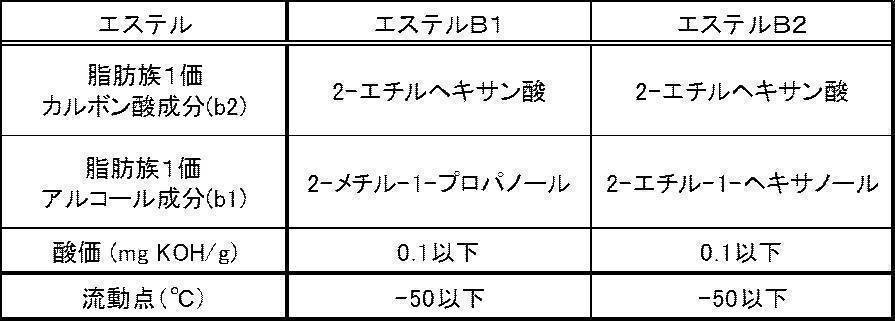
- Table 2 below shows the aliphatic monovalent carboxylic acid (component (b2)) and aliphatic monohydric alcohol (component (b1)) used in the production of the esters B1 and B2 of Production Examples 3 and 4 described above.
- esters A1 and A2 [Molar ratio of aliphatic monohydric alcohol component constituting esters A1 and A2 [component (a1) / component (a2)]]
- each ester (0.1 g) was diluted with a toluene / methanol mixed solvent (5 g) having a mass ratio of 80/20, and then 28 mass% sodium methoxide methanol solution (Wako Pure Chemical Industries, Ltd.). (Made by Co., Ltd.) (0.3 g) was added, and the ester was subjected to methanol decomposition by allowing to stand at room temperature for 30 minutes.
- the obtained ester decomposition product solution was analyzed by gas chromatography, and from the peak area ratio of the obtained aliphatic monohydric alcohol, the molar ratio of the aliphatic monohydric alcohol component constituting the esters A1 and A2 [component (a1) / Component (a2)] was calculated and shown together in Table 1.
- the analysis conditions of the implemented gas chromatography are as follows. Measuring instrument: Gas chromatograph “GC-2014” (manufactured by Shimadzu Corporation) Column: Packed column with a length of 1.1 m and an inner diameter of 3.2 mm packed with “OV-1” manufactured by GL Sciences Inc. Measurement temperature: Column from the start of measurement under conditions of an inlet temperature of 320 ° C.
- the pour points of the esters A1, A2 and the esters B1, B2 were measured.
- the “pour point” of the ester is a numerical value indicating the low temperature fluidity of the ester, and is the lowest temperature at which the ester flows.
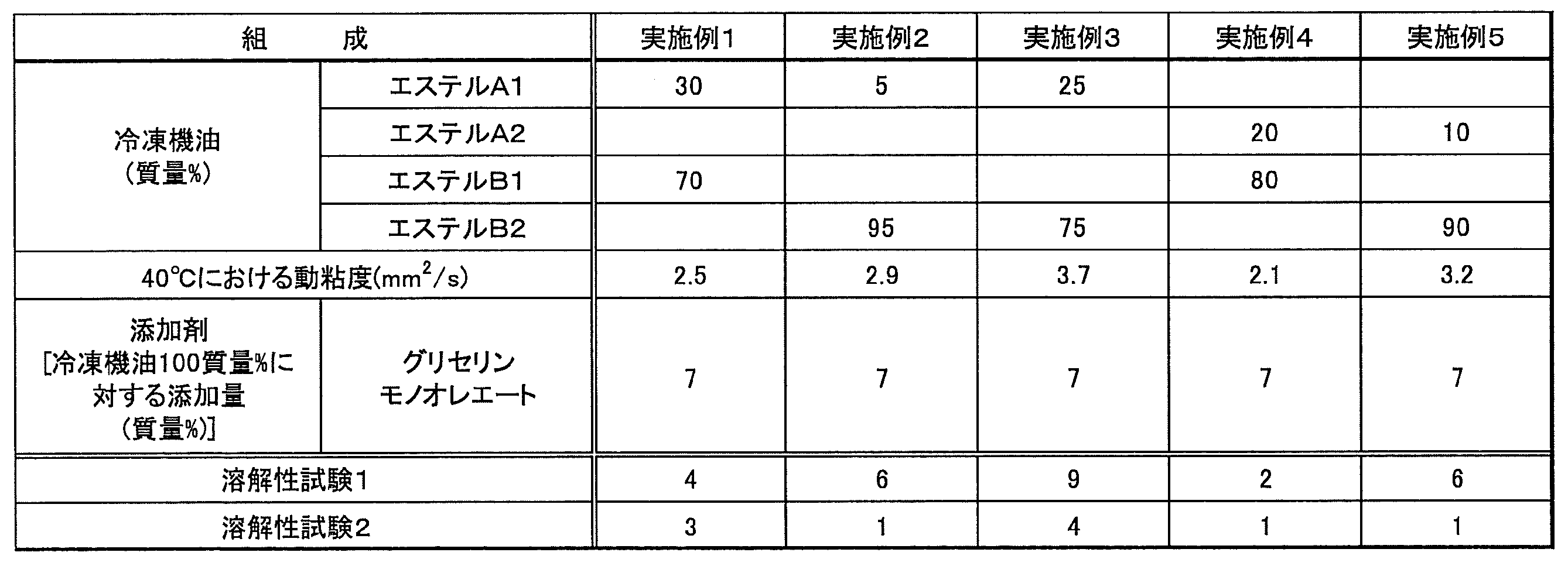
- Refrigerating machine oil compositions of Examples 1 to 10 were prepared by mixing the esters A1 and A2, the esters B1 and B2, and the additives at the composition ratios shown in Tables 3 and 4 below.
- kinematic viscosity at 40 ° C. according to JIS K2283: 2000 was measured. The measurement results are shown in Tables 3 and 4.
- the cloud point when dissolved in a hexane solvent at a concentration of 1% by mass is JIS 2269. : Measured according to 1987. The cloud point of glycerin monooleate measured under these conditions was ⁇ 5 ° C., and the cloud point of triphenyl phosphate was ⁇ 10 ° C.
- the refrigerating machine oil composition of the present invention containing the mixed ester of ester (A) and ester (B) and the additive
- the refrigerating machine oil containing ester (B) and the additive A decrease in cloud point was observed compared to the composition, indicating that the solubility of the additive was excellent.
- the refrigerating machine oil composition of the present invention was found to exhibit excellent additive solubility.
- the refrigerating machine oil composition of the present invention exhibits excellent solubility with respect to an additive added to impart lubricity, and can be suitably used for a working fluid composition for a refrigerating machine containing a hydrocarbon refrigerant. .
- the refrigerating machine oil composition and the working fluid composition for a refrigerating machine of the present invention can be suitably used for a compressor in a refrigerating and air-conditioning apparatus or a domestic refrigerating refrigerator in which lubricity is particularly required.
Landscapes
- Chemical & Material Sciences (AREA)
- Chemical Kinetics & Catalysis (AREA)
- General Chemical & Material Sciences (AREA)
- Oil, Petroleum & Natural Gas (AREA)
- Organic Chemistry (AREA)
- Health & Medical Sciences (AREA)
- Emergency Medicine (AREA)
- Lubricants (AREA)
Abstract
Description
しかし、これらのHFC冷媒は、地球温暖化係数(GWP)が1,000以上と高いことから、いわゆるF-ガス規制により使用が制限されつつある。HFC冷媒の代替候補としては低GWPであることが必須であり、その一つとして既に冷蔵庫用として実用化されているイソブタン(冷媒R600a)のような炭化水素冷媒等が挙げられる。炭化水素冷媒は、GWPが20以下と極めて低く、物性値が好適であることから、幅広い利用が検討されている。
しかしながら、上記のような添加剤を用いた冷凍機油組成物は、条件によっては潤滑性が十分ではなく、添加剤の添加量を増やす必要がある。ところが、潤滑性向上効果に優れる添加剤には、結晶性が高く、冷凍機油への溶解性が乏しいものがあり、添加量が制限される場合もある。さらに、炭化水素冷媒共存下の条件によっては、加えた添加剤が析出・分離する可能性がある。
以上のことから、添加剤の溶解性が高い冷凍機油組成物の開発が望まれている。
エステル(A):クエン酸トリエステル
エステル(B):炭素数3~14の脂肪族1価アルコールと、炭素数4~12の脂肪族1価カルボン酸とからなる脂肪族モノエステル
添加剤:ヘキサン溶媒中に1質量%の濃度で溶解させたときの曇り点が-20℃以上である、添加剤
[2]クエン酸トリエステルが、クエン酸と炭素数2~10の脂肪族1価アルコールとからなるクエン酸トリエステルである、上記[1]記載の冷凍機油組成物。
[3]前記添加剤が、トリフェニルホスフェートおよびグリセリンモノオレエートからなる群より選択される1種以上である、上記[1]又は[2]に記載の冷凍機油組成物。
[4]上記[1]~[3]のいずれか1つに記載の冷凍機油組成物および炭化水素冷媒を含有する、冷凍機用作動流体組成物。
なお、本明細書において記号「~」を用いて規定された数値範囲は、「~」の両端(上限および下限)の数値を含むものとする。例えば「2~10」は2以上10以下を表す。
本発明の冷凍機油組成物は、(i)エステル(A)とエステル(B)との混合エステル、および、(ii)ヘキサン溶媒中に1質量%の濃度で溶解させたときの曇り点が-20℃以上である添加剤を含有する。
なお、本明細書において、「冷凍機油組成物」とは、一般に、冷凍空調機器におけるコンプレッサーのための潤滑油を意味し、冷凍空調機器としては、例えば、家庭用冷凍冷蔵庫等が挙げられる。
本明細書において、「エステル(A)とエステル(B)との混合エステル」とは、エステル(A)とエステル(B)の混合物を意味する。
クエン酸とトリエステルを形成する炭素数2~10の脂肪族1価アルコールは、1種または2種類以上を使用することができる。炭素数2~10の脂肪族1価アルコールの具体例としては、エタノール、1-プロパノール、2-プロパノール、1-ブタノール、2-ブタノール、2-メチル-1-プロパノール、2-メチル-2-プロパノール、1-ペンタノール、2-ペンタノール、3-ペンタノール、3-メチル-1-ブタノール、1-ヘキサノール、2-ヘキサノール、3-ヘキサノール、2-メチル-1-ペンタノール、2-エチル-1-ブタノール、1-ヘプタノール、2-ヘプタノール、3-ヘプタノール、2-メチル-1-ヘキサノール、2-エチル-1-ペンタノール、1-オクタノール、2-オクタノール、3-オクタノール、2-メチル-1-ヘプタノール、2-エチル-1-ヘキサノール、1-ノナノール、2-ノナノール、3-ノナノール、2-メチル-1-オクタノール、2-エチル-1-ヘプタノール、1-デカノール、2-デカノール、3-デカノール、2-メチル-1-ノナノール、2-エチル-1-オクタノールなどが挙げられる。
成分(a1)としては、炭素数2~5の直鎖状の飽和脂肪族1価アルコールが好ましい。
なお、1-ブタノールを使用すると、低温安定性に優れるクエン酸トリエステルを得ることができるので、成分(a1)としては、1-ブタノールを含む態様が特に好ましい。
クエン酸トリエステル中のアルコールに由来するアルキル基が分岐鎖状である場合、クエン酸トリエステルの低温安定性が優れる傾向が見られるので、成分(a2)としては、炭素数6~10の分岐鎖飽和脂肪族1価アルコールが好ましく、炭素数7~9の分岐鎖飽和脂肪族1価アルコールがより好ましい。
なお、脂肪族1価アルコールとして、2-エチル-1-ヘキサノールを使用することによって、低温安定性に優れるクエン酸トリエステルを得ることができるので、成分(a2)としては、2-エチル-1-ヘキサノールを含む態様が特に好ましい。
添加剤再溶解性の観点からは、成分(a1)と成分(a2)のモル比[成分(a1)/成分(a2)]は、さらに好ましくは65/35~90/10であり、さらにより好ましくは65/35~85/15である。
なお、上記エステルの「酸価」は、例えば、日本工業規格(JIS) C2101:1999に準拠して測定される。
(b1)炭素数3~14の脂肪族1価アルコール
(b2)炭素数4~12の脂肪族1価カルボン酸
成分(b1)の炭素数3~14の直鎖又は分岐鎖の飽和脂肪族1価アルコールとしては、炭素数3~14の分岐鎖の飽和脂肪族1価アルコールがより好ましく、炭素数が4~9の分岐鎖の飽和脂肪族1価アルコールがさらに好ましく、2-メチル-1-プロパノールおよび2-エチル-1-ヘキサノールが特に好ましい。
エステル(A)とエステル(B)の含有量比[エステル(A)/エステル(B)]が1/99より小さい場合、添加剤溶解性が低下する傾向があり、エステル(A)とエステル(B)の含有量比[エステル(A)/エステル(B)]が30/70より大きくなると、添加剤溶解性の向上効果が頭打ちとなり、エステル(A)の含有量に見合った添加剤溶解性が得られ難くなる場合がある。
エステル(A)とエステル(B)を混合する方法は、特に限定されないが、例えば、エステル(A)とエステル(B)の任意の量をビーカー等の容器に測り採り、撹拌羽を用いて撹拌混合する方法が挙げられる。
本発明の目的には、エステル(A)とエステル(B)の含有量比[エステル(A)/エステル(B)]は、質量比にて1/99~25/75であることが好ましく、3/97~20/80であることがより好ましい。
なお、ここでいう「動粘度」は、JIS K2283:2000に準拠して測定することができる。また、「酸価」は、JIS C2101:1999に準拠して測定することができる。
本発明の冷凍機油組成物は、上述の混合エステルに加えて、ヘキサン溶媒中に1質量%の濃度で溶解させたときの曇り点が-20℃以上である添加剤を含有する。
添加剤の融点は、示差走査熱量分析計により測定される。示差走査熱量分析計としては、たとえば、セイコーインスツル株式会社製の「DSC-6200」等を使用することができる。測定は、たとえば、約10mgの添加剤を試料ホルダーに入れ、リファレンス材料としてアルミナ10mgを用い、-20℃から150℃まで、昇温速度を毎分10℃として行なう。そして、前記測定の結果、得られた吸熱ピークのピークトップの温度を融点とする。
上記した添加剤は、1種のみを単独で使用してもよく、2種以上を併用してもよい。本発明の目的には、ヘキサン溶媒中に1質量%の濃度で溶解させたときの曇り点が-20℃以上である添加剤として、トリフェニルホスフェートおよびグリセリンモノオレエートからなる群より選択される1種以上を用いることが特に好ましい。
本発明はまた、冷凍機用作動流体組成物を提供することができる。
ここで、「冷凍機用作動流体組成物」とは、冷凍機油組成物と冷媒を混合したものをいう。
本発明の冷凍機用作動流体組成物は、上記冷凍機油組成物と、炭化水素冷媒とを含有する。冷凍機油組成物と炭化水素冷媒との含有量比(冷凍機油組成物:炭化水素冷媒)に特に制限はないが、好ましくは、質量比にて10:90~90:10である。炭化水素冷媒の含有率が前記範囲より高いと、得られる冷凍機用作動流体組成物の粘度が低下し、潤滑不良を起こすおそれがある。炭化水素冷媒の含有率が前記範囲より低い場合には、得られる冷凍機用作動流体組成物を冷凍機器に用いた場合に、冷凍効率が低下するおそれがある。
製造例1
クエン酸無水物(282g、1.47mol)、1-ブタノール(294g、3.97mol)、および2-エチル-1-ヘキサノール(114g、0.87mol)を四つ口フラスコに仕込み、窒素雰囲気下、200℃で反応水を留去しつつ常圧で5時間反応を行なった。その後、200℃で酸価が2mgKOH/g以下となるまで反応を継続した。次いで、1kPa~5kPaの減圧下にて200℃で過剰なアルコールを留去し、粗エステルを得た。粗エステルを冷却し、これに酸性白土およびシリカ-アルミナ系の吸着剤を、それぞれ理論上得られるエステル量の1.0質量%となるように添加して、吸着処理した(吸着処理温度:100℃、圧力:1kPa~5kPa、吸着処理時間:2時間)。最後に孔径1μmのフィルターを用いて濾過を行い、目的のクエン酸トリエステル(酸価=0.1mgKOH/g以下)(以下「エステルA1」と記載する。)を得た。
クエン酸無水物(282g、1.47mol)、エタノール(40g、0.87mol)、および1-ヘキサノール(406g、3.97mol)を四つ口フラスコに仕込み、窒素雰囲気下、200℃で反応水を留去しつつ常圧で5時間反応を行なった。以降の工程は製造例1と同様にして行い、目的のクエン酸トリエステル(酸価=0.1mgKOH/g以下)(以下「エステルA2」と記載する。)を得た。
製造例3
2-メチル-1-プロパノール(490g、6.60mol)、2-エチルヘキサン酸(1000g、6.93mol)を四つ口フラスコに仕込み、窒素雰囲気下、150℃で反応水を留去しつつ常圧で水酸基価が5.0mgKOH/g以下になるまで反応を行った。ついで、200℃、1kPa~5kPaの減圧下にて過剰な2-エチルヘキサン酸を留去し、粗エステルを得た。粗エステルを冷却し、これに酸性白土およびシリカ-アルミナ系の吸着剤を、それぞれ理論上得られるエステル量の1.0質量%となるように添加して吸着処理した。吸着処理温度、圧力、および吸着処理時間は、それぞれ100℃、1kPa~5kPaおよび2時間とした。最後に孔径1μmのフィルターを用いて濾過を行い、目的のモノエステル(以下「エステルB1」と記載する。)を得た。
2-エチル-1-ヘキサノール(328g、2.52mol)、2-エチルヘキサン酸(369g、2.56mol)を四つ口フラスコに仕込み、窒素雰囲気下、200℃で反応水を留去しつつ常圧で水酸基価が5.0mgKOH/g以下になるまで反応を行った。ついで、200℃、1kPa~5kPaの減圧下にて過剰な2-エチルヘキサン酸を留去し、粗エステルを得た。粗エステルを冷却し、これに酸性白土およびシリカ-アルミナ系の吸着剤を、それぞれ理論上得られるエステル量の1.0質量%となるように添加して吸着処理した。吸着処理温度、圧力、および吸着処理時間は、それぞれ100℃、1kPa~5kPaおよび2時間とした。最後に孔径1μmのフィルターを用いて濾過を行い、目的のモノエステル(以下「エステルB2」と記載する。)を得た。
エステルA1、A2について、各エステル(0.1g)を、質量比が80/20であるトルエン/メタノールの混合溶媒(5g)で希釈し、次いで28質量%ナトリウムメトキシドメタノール溶液(和光純薬工業株式会社製)(0.3g)を加え、常温にて30分静置することにより、エステルを加メタノール分解した。得られたエステル分解物溶液をガスクロマトグラフィーで分析し、得られた脂肪族1価アルコールのピーク面積比から、エステルA1、A2を構成する脂肪族1価アルコール成分のモル比[成分(a1)/成分(a2)]を算出し、表1に併せて示した。
なお、実施したガスクロマトグラフィーの分析条件は、次の通りである。
測定機器:ガスクロマトグラフ「GC-2014」(株式会社島津製作所製)
カラム :ジーエルサイエンス株式会社製「OV-1」を充填した長さ1.1m、内径3.2mmのパックドカラム
測定温度:導入口温度320℃、検出器温度330℃の条件において、測定開始からカラム温度を100℃から320℃まで10℃/分の速度で昇温し、320℃で20分保持した。
検出器 :水素イオン化検出器(FID)
JIS C2101:1999に準拠して、エステルA1、A2およびエステルB1、B2の酸価を測定した。
JIS K2269-1987に準拠して、エステルA1、A2およびエステルB1、B2の流動点を測定した。
ここで、エステルの「流動点」は、エステルの低温流動性を示す数値であり、エステルが流動する最低温度となる。

上述のエステルA1、A2とエステルB1、B2、および添加剤を下記表3、4に示す組成比で混合し、実施例1~10の冷凍機油組成物を調製した。
実施例1~10の各冷凍機油組成物において用いた各冷凍機油(すなわちエステルA1またはエステルA2とエステルB1またはエステルB2との混合エステル)について、JIS K2283:2000に準拠して40℃における動粘度を測定した。測定結果は、表3、4中に示した。
JIS K2269:1987に準拠して、実施例1~5の各冷凍機油組成物について、曇り点を測定した。その際、エステルB1(100質量%)に対し、グリセリンモノオレエートを7質量%添加した冷凍機油組成物(「エステルB1・グリセリンモノオレエート混合冷凍機油組成物」という)、およびエステルB2(100質量%)に対し、グリセリンモノオレエートを7質量%添加した冷凍機油組成物(「エステルB2・グリセリンモノオレエート混合冷凍機油組成物」という)を調製し、それぞれについて、同様に曇り点を測定した。
実施例1、4の冷凍機油組成物については、エステルB1・グリセリンモノオレエート混合冷凍機油組成物の曇り点からの下がり幅の絶対値を記録した。また、実施例2、3、5の各冷凍機油組成物については、エステルB2・グリセリンモノオレエート混合冷凍機油組成物の曇り点からの下がり幅の絶対値を記録した。
結果は、表3に併せて示した。
実施例1~5の各冷凍機油組成物とヘキサンを質量比にて2:5の割合で混合し、JIS K2269:1987に準拠して、各混合物の曇り点を測定した。上記溶解性試験1の場合と同様に、実施例1、4の冷凍機油組成物とヘキサンとの混合物については、エステルB1・グリセリンモノオレエート混合冷凍機油組成物とヘキサンとの混合物の曇り点からの下がり幅の絶対値を記録した。また、実施例2、3、5の各冷凍機油組成物とヘキサンとの混合物については、エステルB2・グリセリンモノオレエート混合冷凍機油組成物とヘキサンとの混合物の曇り点からの下がり幅の絶対値を記録した。
結果は、表3に併せて示した。
JIS K2269:1987に準拠して、実施例6~10の各冷凍機油組成物の曇り点を測定した。その際、エステルB1(100質量%)に対し、トリフェニルホスフェートを7質量%添加した冷凍機油組成物(「エステルB1・トリフェニルホスフェート混合冷凍機油組成物」という)、およびエステルB2(100質量%)に対し、トリフェニルホスフェートを7質量%添加した冷凍機油組成物(「エステルB2・トリフェニルホスフェート混合冷凍機油組成物」という)を調製し、それぞれについて、同様に曇り点を測定した。実施例6、9の冷凍機油組成物については、エステルB1・トリフェニルホスフェート混合冷凍機油組成物の曇り点からの下がり幅の絶対値を記録した。また、実施例7、8、10の各冷凍機油組成物については、エステルB2・トリフェニルホスフェート混合冷凍機油組成物の曇り点からの下がり幅の絶対値を記録した。
結果は、表4に併せて示した。
実施例6~10の各冷凍機油組成物とヘキサンを質量比にて2:5の割合で混合し、JIS K2269:1987に準拠して、各混合物の曇り点を測定した。上記溶解性試験3の場合と同様に、実施例6、9の冷凍機油組成物とヘキサンとの混合物については、エステルB1・トリフェニルホスフェート混合冷凍機油組成物とヘキサンとの混合物の曇り点からの下がり幅の絶対値を記録した。また、実施例7、8、10の各冷凍機油組成物とヘキサンとの混合物については、エステルB2・トリフェニルホスフェート混合冷凍機油組成物とヘキサンとの混合物の曇り点からの下がり幅の絶対値を記録した。
結果は、表4に併せて示した。
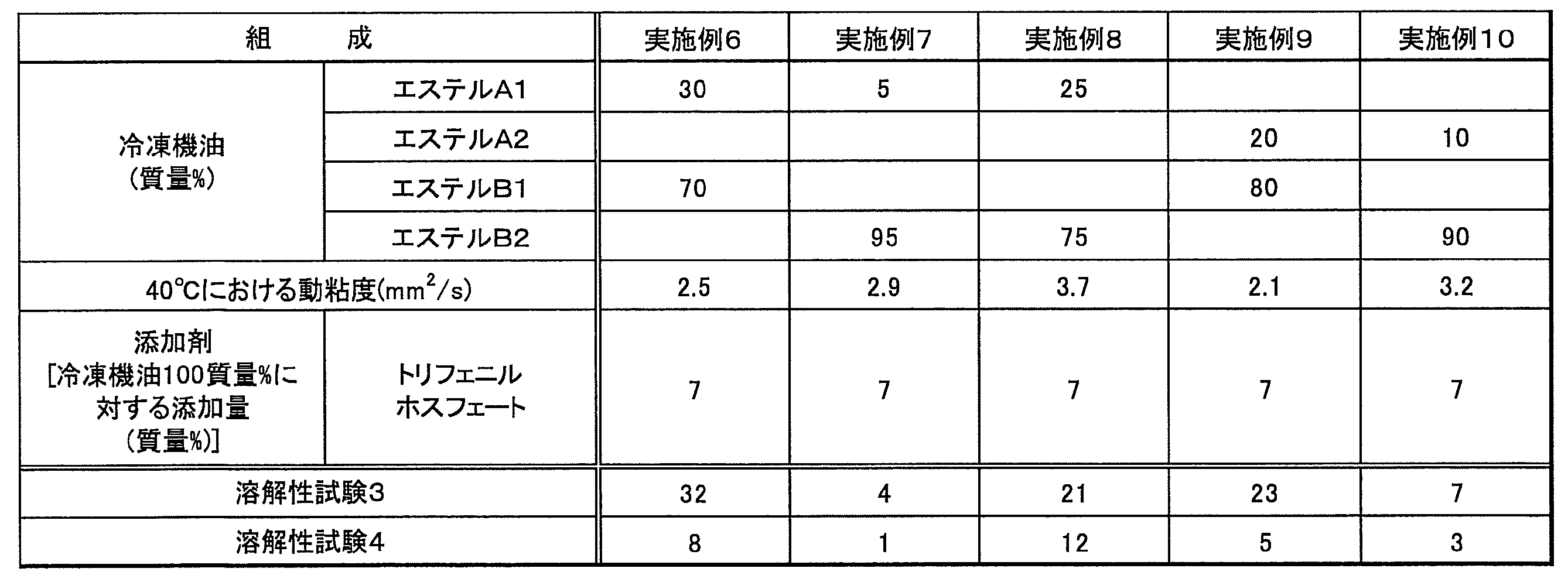
また、炭化水素であるヘキサンと混合した場合においても、本発明の冷凍機油組成物は優れた添加剤溶解性を示すことが認められた。
本発明の冷凍機油組成物および冷凍機用作動流体組成物は、潤滑性が特に要求される冷凍空調機器や家庭用冷凍冷蔵庫におけるコンプレッサー等に好適に使用することができる。
Claims (4)
- 下記エステル(A)とエステル(B)との混合エステル、および下記添加剤を含有する冷凍機油組成物であって、エステル(A)とエステル(B)の含有量比[エステル(A)/エステル(B)]が質量比にて1/99~30/70であり、下記添加剤を、エステル(A)とエステル(B)との混合エステル100質量%に対して、0.01質量%~10質量%含有し、エステル(A)とエステル(B)との混合エステルの40℃における動粘度が1mm2/s~20mm2/sである、冷凍機油組成物。
エステル(A):クエン酸トリエステル
エステル(B):炭素数3~14の脂肪族1価アルコールと、炭素数4~12の脂肪族1価カルボン酸とからなる脂肪族モノエステル
添加剤:ヘキサン溶媒中に1質量%の濃度で溶解させたときの曇り点が-20℃以上である、添加剤 - クエン酸トリエステルが、クエン酸と炭素数2~10の脂肪族1価アルコールとからなるクエン酸トリエステルである、請求項1記載の冷凍機油組成物。
- 前記添加剤が、トリフェニルホスフェートおよびグリセリンモノオレエートからなる群より選択される1種以上である、請求項1又は2に記載の冷凍機油組成物。
- 請求項1~3のいずれか1項に記載の冷凍機油組成物および炭化水素冷媒を含有する、冷凍機用作動流体組成物。
Priority Applications (3)
| Application Number | Priority Date | Filing Date | Title |
|---|---|---|---|
| CN201780075519.8A CN110036099B (zh) | 2016-12-05 | 2017-12-05 | 冷冻机油组合物以及含有该冷冻机油组合物的冷冻机用工作流体组合物 |
| JP2018554996A JP7020425B2 (ja) | 2016-12-05 | 2017-12-05 | 冷凍機油組成物およびこれを含有する冷凍機用作動流体組成物 |
| KR1020197017007A KR102468225B1 (ko) | 2016-12-05 | 2017-12-05 | 냉동기유 조성물, 및 이를 함유하는 냉동기용 작동 유체 조성물 |
Applications Claiming Priority (2)
| Application Number | Priority Date | Filing Date | Title |
|---|---|---|---|
| JP2016-236185 | 2016-12-05 | ||
| JP2016236185 | 2016-12-05 |
Publications (1)
| Publication Number | Publication Date |
|---|---|
| WO2018105575A1 true WO2018105575A1 (ja) | 2018-06-14 |
Family
ID=62491073
Family Applications (1)
| Application Number | Title | Priority Date | Filing Date |
|---|---|---|---|
| PCT/JP2017/043550 Ceased WO2018105575A1 (ja) | 2016-12-05 | 2017-12-05 | 冷凍機油組成物およびこれを含有する冷凍機用作動流体組成物 |
Country Status (5)
| Country | Link |
|---|---|
| JP (1) | JP7020425B2 (ja) |
| KR (1) | KR102468225B1 (ja) |
| CN (1) | CN110036099B (ja) |
| TW (1) | TWI746720B (ja) |
| WO (1) | WO2018105575A1 (ja) |
Cited By (2)
| Publication number | Priority date | Publication date | Assignee | Title |
|---|---|---|---|---|
| JP2022525117A (ja) * | 2019-03-13 | 2022-05-11 | トタル マーケティング セルヴィス | 冷却用組成物におけるエステルの使用 |
| JP2023073864A (ja) * | 2021-11-16 | 2023-05-26 | 出光興産株式会社 | 冷凍機油組成物及び冷凍機用混合組成物 |
Citations (3)
| Publication number | Priority date | Publication date | Assignee | Title |
|---|---|---|---|---|
| EP0562405A1 (de) * | 1992-03-24 | 1993-09-29 | Hoechst Aktiengesellschaft | Verwendung von Estern der Citronensäure als Schmiermittel für Kältemittelverdichter |
| JP2009235179A (ja) * | 2008-03-26 | 2009-10-15 | Japan Energy Corp | 冷媒用冷凍機油 |
| WO2017126578A1 (ja) * | 2016-01-20 | 2017-07-27 | 日油株式会社 | 冷媒r32用の冷凍機油およびこれを含む組成物 |
Family Cites Families (10)
| Publication number | Priority date | Publication date | Assignee | Title |
|---|---|---|---|---|
| GB0105065D0 (en) * | 2001-03-01 | 2001-04-18 | Ici Plc | Lubricant compositions |
| CA2487587C (en) * | 2003-11-21 | 2012-04-24 | Nof Corporation | A polyol ester for use within a refrigeration lubricant composition compatible with chlorine-free hydrofluorocarbon refrigerants |
| US7696136B2 (en) * | 2004-03-11 | 2010-04-13 | Crompton Corporation | Lubricant compositions containing hydroxy carboxylic acid and hydroxy polycarboxylic acid esters |
| JP4961666B2 (ja) * | 2004-12-02 | 2012-06-27 | 日油株式会社 | 冷凍機用潤滑油組成物 |
| JP4806967B2 (ja) * | 2005-05-27 | 2011-11-02 | 日油株式会社 | 冷凍機用潤滑油組成物 |
| AU2008343198B2 (en) * | 2007-12-21 | 2013-07-04 | Chevron U.S.A. Inc. | Refrigeration oil from gas-to-liquid derived and bio-derived triesters |
| JP5689428B2 (ja) * | 2012-02-22 | 2015-03-25 | Jx日鉱日石エネルギー株式会社 | 冷凍機油組成物及びその製造方法、冷凍機用作動流体組成物 |
| JP5681659B2 (ja) * | 2012-03-02 | 2015-03-11 | Jx日鉱日石エネルギー株式会社 | 冷凍機用作動流体組成物、冷凍機油及びその製造方法 |
| US9719001B2 (en) * | 2013-03-25 | 2017-08-01 | Jx Nippon Oil & Energy Corporation | Working fluid composition for refrigerator |
| CN104830455A (zh) * | 2015-04-19 | 2015-08-12 | 青岛启源振东电气有限公司 | 一种机械制冷润滑油 |
-
2017
- 2017-12-05 JP JP2018554996A patent/JP7020425B2/ja active Active
- 2017-12-05 CN CN201780075519.8A patent/CN110036099B/zh active Active
- 2017-12-05 WO PCT/JP2017/043550 patent/WO2018105575A1/ja not_active Ceased
- 2017-12-05 TW TW106142555A patent/TWI746720B/zh active
- 2017-12-05 KR KR1020197017007A patent/KR102468225B1/ko active Active
Patent Citations (3)
| Publication number | Priority date | Publication date | Assignee | Title |
|---|---|---|---|---|
| EP0562405A1 (de) * | 1992-03-24 | 1993-09-29 | Hoechst Aktiengesellschaft | Verwendung von Estern der Citronensäure als Schmiermittel für Kältemittelverdichter |
| JP2009235179A (ja) * | 2008-03-26 | 2009-10-15 | Japan Energy Corp | 冷媒用冷凍機油 |
| WO2017126578A1 (ja) * | 2016-01-20 | 2017-07-27 | 日油株式会社 | 冷媒r32用の冷凍機油およびこれを含む組成物 |
Cited By (3)
| Publication number | Priority date | Publication date | Assignee | Title |
|---|---|---|---|---|
| JP2022525117A (ja) * | 2019-03-13 | 2022-05-11 | トタル マーケティング セルヴィス | 冷却用組成物におけるエステルの使用 |
| JP7798571B2 (ja) | 2019-03-13 | 2026-01-14 | トタルエナジーズ ワンテク | 冷却用組成物におけるエステルの使用 |
| JP2023073864A (ja) * | 2021-11-16 | 2023-05-26 | 出光興産株式会社 | 冷凍機油組成物及び冷凍機用混合組成物 |
Also Published As
| Publication number | Publication date |
|---|---|
| TWI746720B (zh) | 2021-11-21 |
| JP7020425B2 (ja) | 2022-02-16 |
| KR102468225B1 (ko) | 2022-11-17 |
| JPWO2018105575A1 (ja) | 2019-10-24 |
| CN110036099B (zh) | 2021-12-10 |
| TW201835319A (zh) | 2018-10-01 |
| KR20190092437A (ko) | 2019-08-07 |
| CN110036099A (zh) | 2019-07-19 |
Similar Documents
| Publication | Publication Date | Title |
|---|---|---|
| CN104145006B (zh) | 冷冻机用工作流体组合物、冷冻机油以及其制造方法 | |
| JP5852176B2 (ja) | 冷媒2,3,3,3‐テトラフルオロ‐1‐プロペン用冷凍機油 | |
| KR102468225B1 (ko) | 냉동기유 조성물, 및 이를 함유하는 냉동기용 작동 유체 조성물 | |
| JP2006160781A (ja) | 冷凍機用潤滑油組成物 | |
| JP4806967B2 (ja) | 冷凍機用潤滑油組成物 | |
| KR101535778B1 (ko) | 비스 펜타에리스리톨 모노포르말의 헥사에스테르 | |
| JP5110240B2 (ja) | 冷凍機用潤滑油組成物 | |
| JP6614510B2 (ja) | 冷凍機油用エステルおよび冷凍機油用作動流体組成物 | |
| CN104822808B (zh) | 双季戊四醇单缩甲醛的六酯 | |
| WO2017126578A1 (ja) | 冷媒r32用の冷凍機油およびこれを含む組成物 | |
| CN108138066A (zh) | 冷冻机油、冷冻机用组合物、和冷冻机 | |
| JP6252847B2 (ja) | 冷凍機油用エステル | |
| JP6642029B2 (ja) | 冷媒r32用の冷凍機油およびこれを含有する組成物 | |
| JP6720738B2 (ja) | 冷媒r32用の冷凍機油およびこれを含有する組成物 | |
| CN108291166B (zh) | 冷冻机油用酯 | |
| JPH0485396A (ja) | 耐フロン性潤滑油 | |
| JP7519018B2 (ja) | 冷凍機油用エステルおよびそれを含む作動流体組成物 | |
| WO2013125511A1 (ja) | 混合エステル | |
| JPH04328197A (ja) | フロン冷媒用潤滑油 |
Legal Events
| Date | Code | Title | Description |
|---|---|---|---|
| 121 | Ep: the epo has been informed by wipo that ep was designated in this application |
Ref document number: 17877852 Country of ref document: EP Kind code of ref document: A1 |
|
| ENP | Entry into the national phase |
Ref document number: 2018554996 Country of ref document: JP Kind code of ref document: A |
|
| NENP | Non-entry into the national phase |
Ref country code: DE |
|
| ENP | Entry into the national phase |
Ref document number: 20197017007 Country of ref document: KR Kind code of ref document: A |
|
| 122 | Ep: pct application non-entry in european phase |
Ref document number: 17877852 Country of ref document: EP Kind code of ref document: A1 |