WO2018092760A1 - 薬液、パターン形成方法、及び、キット - Google Patents
薬液、パターン形成方法、及び、キット Download PDFInfo
- Publication number
- WO2018092760A1 WO2018092760A1 PCT/JP2017/040904 JP2017040904W WO2018092760A1 WO 2018092760 A1 WO2018092760 A1 WO 2018092760A1 JP 2017040904 W JP2017040904 W JP 2017040904W WO 2018092760 A1 WO2018092760 A1 WO 2018092760A1
- Authority
- WO
- WIPO (PCT)
- Prior art keywords
- group
- formula
- chemical solution
- resin
- mixture
- Prior art date
- Legal status (The legal status is an assumption and is not a legal conclusion. Google has not performed a legal analysis and makes no representation as to the accuracy of the status listed.)
- Ceased
Links
Classifications
-
- G—PHYSICS
- G03—PHOTOGRAPHY; CINEMATOGRAPHY; ANALOGOUS TECHNIQUES USING WAVES OTHER THAN OPTICAL WAVES; ELECTROGRAPHY; HOLOGRAPHY
- G03F—PHOTOMECHANICAL PRODUCTION OF TEXTURED OR PATTERNED SURFACES, e.g. FOR PRINTING, FOR PROCESSING OF SEMICONDUCTOR DEVICES; MATERIALS THEREFOR; ORIGINALS THEREFOR; APPARATUS SPECIALLY ADAPTED THEREFOR
- G03F7/00—Photomechanical, e.g. photolithographic, production of textured or patterned surfaces, e.g. printing surfaces; Materials therefor, e.g. comprising photoresists; Apparatus specially adapted therefor
- G03F7/004—Photosensitive materials
- G03F7/038—Macromolecular compounds which are rendered insoluble or differentially wettable
-
- G—PHYSICS
- G03—PHOTOGRAPHY; CINEMATOGRAPHY; ANALOGOUS TECHNIQUES USING WAVES OTHER THAN OPTICAL WAVES; ELECTROGRAPHY; HOLOGRAPHY
- G03F—PHOTOMECHANICAL PRODUCTION OF TEXTURED OR PATTERNED SURFACES, e.g. FOR PRINTING, FOR PROCESSING OF SEMICONDUCTOR DEVICES; MATERIALS THEREFOR; ORIGINALS THEREFOR; APPARATUS SPECIALLY ADAPTED THEREFOR
- G03F7/00—Photomechanical, e.g. photolithographic, production of textured or patterned surfaces, e.g. printing surfaces; Materials therefor, e.g. comprising photoresists; Apparatus specially adapted therefor
- G03F7/004—Photosensitive materials
- G03F7/0045—Photosensitive materials with organic non-macromolecular light-sensitive compounds not otherwise provided for, e.g. dissolution inhibitors
-
- G—PHYSICS
- G03—PHOTOGRAPHY; CINEMATOGRAPHY; ANALOGOUS TECHNIQUES USING WAVES OTHER THAN OPTICAL WAVES; ELECTROGRAPHY; HOLOGRAPHY
- G03F—PHOTOMECHANICAL PRODUCTION OF TEXTURED OR PATTERNED SURFACES, e.g. FOR PRINTING, FOR PROCESSING OF SEMICONDUCTOR DEVICES; MATERIALS THEREFOR; ORIGINALS THEREFOR; APPARATUS SPECIALLY ADAPTED THEREFOR
- G03F7/00—Photomechanical, e.g. photolithographic, production of textured or patterned surfaces, e.g. printing surfaces; Materials therefor, e.g. comprising photoresists; Apparatus specially adapted therefor
- G03F7/004—Photosensitive materials
- G03F7/0046—Photosensitive materials with perfluoro compounds, e.g. for dry lithography
-
- G—PHYSICS
- G03—PHOTOGRAPHY; CINEMATOGRAPHY; ANALOGOUS TECHNIQUES USING WAVES OTHER THAN OPTICAL WAVES; ELECTROGRAPHY; HOLOGRAPHY
- G03F—PHOTOMECHANICAL PRODUCTION OF TEXTURED OR PATTERNED SURFACES, e.g. FOR PRINTING, FOR PROCESSING OF SEMICONDUCTOR DEVICES; MATERIALS THEREFOR; ORIGINALS THEREFOR; APPARATUS SPECIALLY ADAPTED THEREFOR
- G03F7/00—Photomechanical, e.g. photolithographic, production of textured or patterned surfaces, e.g. printing surfaces; Materials therefor, e.g. comprising photoresists; Apparatus specially adapted therefor
- G03F7/004—Photosensitive materials
- G03F7/0048—Photosensitive materials characterised by the solvents or agents facilitating spreading, e.g. tensio-active agents
-
- G—PHYSICS
- G03—PHOTOGRAPHY; CINEMATOGRAPHY; ANALOGOUS TECHNIQUES USING WAVES OTHER THAN OPTICAL WAVES; ELECTROGRAPHY; HOLOGRAPHY
- G03F—PHOTOMECHANICAL PRODUCTION OF TEXTURED OR PATTERNED SURFACES, e.g. FOR PRINTING, FOR PROCESSING OF SEMICONDUCTOR DEVICES; MATERIALS THEREFOR; ORIGINALS THEREFOR; APPARATUS SPECIALLY ADAPTED THEREFOR
- G03F7/00—Photomechanical, e.g. photolithographic, production of textured or patterned surfaces, e.g. printing surfaces; Materials therefor, e.g. comprising photoresists; Apparatus specially adapted therefor
- G03F7/004—Photosensitive materials
- G03F7/039—Macromolecular compounds which are photodegradable, e.g. positive electron resists
-
- G—PHYSICS
- G03—PHOTOGRAPHY; CINEMATOGRAPHY; ANALOGOUS TECHNIQUES USING WAVES OTHER THAN OPTICAL WAVES; ELECTROGRAPHY; HOLOGRAPHY
- G03F—PHOTOMECHANICAL PRODUCTION OF TEXTURED OR PATTERNED SURFACES, e.g. FOR PRINTING, FOR PROCESSING OF SEMICONDUCTOR DEVICES; MATERIALS THEREFOR; ORIGINALS THEREFOR; APPARATUS SPECIALLY ADAPTED THEREFOR
- G03F7/00—Photomechanical, e.g. photolithographic, production of textured or patterned surfaces, e.g. printing surfaces; Materials therefor, e.g. comprising photoresists; Apparatus specially adapted therefor
- G03F7/004—Photosensitive materials
- G03F7/039—Macromolecular compounds which are photodegradable, e.g. positive electron resists
- G03F7/0392—Macromolecular compounds which are photodegradable, e.g. positive electron resists the macromolecular compound being present in a chemically amplified positive photoresist composition
- G03F7/0397—Macromolecular compounds which are photodegradable, e.g. positive electron resists the macromolecular compound being present in a chemically amplified positive photoresist composition the macromolecular compound having an alicyclic moiety in a side chain
-
- G—PHYSICS
- G03—PHOTOGRAPHY; CINEMATOGRAPHY; ANALOGOUS TECHNIQUES USING WAVES OTHER THAN OPTICAL WAVES; ELECTROGRAPHY; HOLOGRAPHY
- G03F—PHOTOMECHANICAL PRODUCTION OF TEXTURED OR PATTERNED SURFACES, e.g. FOR PRINTING, FOR PROCESSING OF SEMICONDUCTOR DEVICES; MATERIALS THEREFOR; ORIGINALS THEREFOR; APPARATUS SPECIALLY ADAPTED THEREFOR
- G03F7/00—Photomechanical, e.g. photolithographic, production of textured or patterned surfaces, e.g. printing surfaces; Materials therefor, e.g. comprising photoresists; Apparatus specially adapted therefor
- G03F7/004—Photosensitive materials
- G03F7/09—Photosensitive materials characterised by structural details, e.g. supports, auxiliary layers
- G03F7/11—Photosensitive materials characterised by structural details, e.g. supports, auxiliary layers having cover layers or intermediate layers, e.g. subbing layers
-
- G—PHYSICS
- G03—PHOTOGRAPHY; CINEMATOGRAPHY; ANALOGOUS TECHNIQUES USING WAVES OTHER THAN OPTICAL WAVES; ELECTROGRAPHY; HOLOGRAPHY
- G03F—PHOTOMECHANICAL PRODUCTION OF TEXTURED OR PATTERNED SURFACES, e.g. FOR PRINTING, FOR PROCESSING OF SEMICONDUCTOR DEVICES; MATERIALS THEREFOR; ORIGINALS THEREFOR; APPARATUS SPECIALLY ADAPTED THEREFOR
- G03F7/00—Photomechanical, e.g. photolithographic, production of textured or patterned surfaces, e.g. printing surfaces; Materials therefor, e.g. comprising photoresists; Apparatus specially adapted therefor
- G03F7/16—Coating processes; Apparatus therefor
-
- G—PHYSICS
- G03—PHOTOGRAPHY; CINEMATOGRAPHY; ANALOGOUS TECHNIQUES USING WAVES OTHER THAN OPTICAL WAVES; ELECTROGRAPHY; HOLOGRAPHY
- G03F—PHOTOMECHANICAL PRODUCTION OF TEXTURED OR PATTERNED SURFACES, e.g. FOR PRINTING, FOR PROCESSING OF SEMICONDUCTOR DEVICES; MATERIALS THEREFOR; ORIGINALS THEREFOR; APPARATUS SPECIALLY ADAPTED THEREFOR
- G03F7/00—Photomechanical, e.g. photolithographic, production of textured or patterned surfaces, e.g. printing surfaces; Materials therefor, e.g. comprising photoresists; Apparatus specially adapted therefor
- G03F7/16—Coating processes; Apparatus therefor
- G03F7/162—Coating on a rotating support, e.g. using a whirler or a spinner
-
- G—PHYSICS
- G03—PHOTOGRAPHY; CINEMATOGRAPHY; ANALOGOUS TECHNIQUES USING WAVES OTHER THAN OPTICAL WAVES; ELECTROGRAPHY; HOLOGRAPHY
- G03F—PHOTOMECHANICAL PRODUCTION OF TEXTURED OR PATTERNED SURFACES, e.g. FOR PRINTING, FOR PROCESSING OF SEMICONDUCTOR DEVICES; MATERIALS THEREFOR; ORIGINALS THEREFOR; APPARATUS SPECIALLY ADAPTED THEREFOR
- G03F7/00—Photomechanical, e.g. photolithographic, production of textured or patterned surfaces, e.g. printing surfaces; Materials therefor, e.g. comprising photoresists; Apparatus specially adapted therefor
- G03F7/20—Exposure; Apparatus therefor
- G03F7/2002—Exposure; Apparatus therefor with visible light or UV light, through an original having an opaque pattern on a transparent support, e.g. film printing, projection printing; by reflection of visible or UV light from an original such as a printed image
- G03F7/2004—Exposure; Apparatus therefor with visible light or UV light, through an original having an opaque pattern on a transparent support, e.g. film printing, projection printing; by reflection of visible or UV light from an original such as a printed image characterised by the use of a particular light source, e.g. fluorescent lamps or deep UV light
-
- G—PHYSICS
- G03—PHOTOGRAPHY; CINEMATOGRAPHY; ANALOGOUS TECHNIQUES USING WAVES OTHER THAN OPTICAL WAVES; ELECTROGRAPHY; HOLOGRAPHY
- G03F—PHOTOMECHANICAL PRODUCTION OF TEXTURED OR PATTERNED SURFACES, e.g. FOR PRINTING, FOR PROCESSING OF SEMICONDUCTOR DEVICES; MATERIALS THEREFOR; ORIGINALS THEREFOR; APPARATUS SPECIALLY ADAPTED THEREFOR
- G03F7/00—Photomechanical, e.g. photolithographic, production of textured or patterned surfaces, e.g. printing surfaces; Materials therefor, e.g. comprising photoresists; Apparatus specially adapted therefor
- G03F7/20—Exposure; Apparatus therefor
- G03F7/2041—Exposure; Apparatus therefor in the presence of a fluid, e.g. immersion; using fluid cooling means
-
- H—ELECTRICITY
- H10—SEMICONDUCTOR DEVICES; ELECTRIC SOLID-STATE DEVICES NOT OTHERWISE PROVIDED FOR
- H10P—GENERIC PROCESSES OR APPARATUS FOR THE MANUFACTURE OR TREATMENT OF DEVICES COVERED BY CLASS H10
- H10P76/00—Manufacture or treatment of masks on semiconductor bodies, e.g. by lithography or photolithography
Definitions
- the present invention relates to a chemical solution, a pattern formation method, and a kit.
- an actinic ray-sensitive or radiation-sensitive resin composition (hereinafter also referred to as “resist composition”) on a substrate such as a semiconductor wafer (hereinafter also referred to as “wafer”). )
- a substrate such as a semiconductor wafer (hereinafter also referred to as “wafer”).
- a resist film an actinic ray-sensitive or radiation-sensitive film
- the formed resist film is exposed, the exposed resist film is developed, and a predetermined pattern is formed in sequence, thereby forming a resist pattern on the wafer.
- Patent Document 1 describes a solution in which a low-volatile solvent and a low surface tension solvent are mixed in a predetermined ratio as a prewetting agent.
- the inventors applied the prewetting agent described in Patent Document 1 on a substrate, and then applied a resist composition. Depending on the combination of organic solvents, a small amount of resist composition was used, It has been found that it is difficult to form a resist film that is thinner and has a uniform thickness on the substrate, and the defect suppression performance is insufficient. In addition, when the pre-wetting agent contains only one kind of organic solvent, it is difficult to form a resist film due to the difference in components constituting the resist film, and / or defect suppression performance can be stably obtained. It was also found that there may not be.
- the present invention can form a resist film that is thinner and has a uniform thickness on a substrate by using a small amount of resist composition (hereinafter also referred to as “having excellent resist-saving properties”). ) And providing a chemical having excellent defect suppression performance.
- Another object of the present invention is to provide a pattern forming method.
- resist-saving property and defect suppression performance mean the resist saving property and defect suppression performance measured by the method described in the Example.
- a chemical solution containing a mixture of two or more organic solvents wherein the organic solvent is a compound represented by formulas (1) to (7), represented by formulas (9) to (11) Selected from the group consisting of a compound, a cyclic ketone compound having 3 to 5 ring members which may contain a substituent, a cyclic ketone compound having 6 or more ring members which may contain a substituent, a lactone compound, and a lactam compound.
- the mixture is a chemical solution composed of a lactone compound and a compound represented by formula (5)
- the mixture is a cyclic ketone compound having 6 or more ring members which may contain a substituent
- formula (1) A chemical solution and a mixture comprising the compound represented by formula (1) and a mixture comprising a lactone compound, a compound represented by formula (1) and a compound represented by formula (5) and the mixture represented by formula (1) And a chemical solution composed of the compound represented by formula (3) are excluded.
- a pre-wet process in which the chemical solution according to any one of [1] to [9] is applied onto a substrate to obtain a pre-wet substrate;
- a resist film is formed using the radiation resin composition, a resist film forming process, an exposure process of exposing the resist film, and a developing process of developing the exposed resist film using a developer.
- a kit comprising a resin having a repeating unit having a functional hydroxyl group and having a group that decomposes by the action of an acid to generate a polar group.
- a kit comprising the chemical solution according to any one of [1] to [9] and an actinic ray-sensitive or radiation-sensitive resin composition containing a resin, the condition 1 described later And a kit satisfying condition 2.
- a chemical solution having excellent resist-saving properties and excellent defect suppression performance hereinafter also referred to as “having the effect of the present invention”. Further, according to the present invention, a pattern forming method and a kit can also be provided.
- a numerical range expressed using “to” means a range including numerical values described before and after “to” as a lower limit value and an upper limit value.
- “preparation” means that a predetermined material is procured by purchasing in addition to synthesizing or preparing a specific material.
- ppm means “parts-per-million (10 ⁇ 6 )”
- ppb means “parts-per-billion (10 ⁇ 9 )”
- ppt means “parts-per-trillion (10 ⁇ 12 )”.
- 1 ⁇ corresponds to 0.1 nm.
- the description that does not indicate substitution and non-substitution includes those that have a substituent together with those that do not have a substituent, as long as the effects of the present invention are not impaired. It is included.
- the “alkyl group” includes not only an alkyl group having no substituent (unsubstituted alkyl group) but also an alkyl group having a substituent (substituted alkyl group). This is synonymous also about each compound.
- radiation in the present invention means, for example, deep ultraviolet, extreme ultraviolet (EUV), X-ray, electron beam, or the like.
- EUV extreme ultraviolet
- light means actinic rays or radiation.
- “exposure” includes not only exposure by far ultraviolet rays, X-rays, EUV, etc., but also drawing by particle beams such as electron beams or ion beams, unless otherwise specified.
- the chemical solution according to the first embodiment of the present invention is a chemical solution containing a mixture of two or more organic solvents, and the organic solvent is In the case where the compound is selected from the predetermined compound and does not contain the predetermined ether compound or contains the predetermined ether compound, the content of the predetermined ether compound in the chemical solution is It is a chemical
- the mixture is a chemical solution composed of a lactone compound and a compound represented by formula (5)
- the mixture is a cyclic ketone compound having 6 or more ring members which may contain a substituent
- formula (1) A chemical solution and a mixture comprising the compound represented by formula (1) and a mixture comprising a lactone compound, a compound represented by formula (1) and a compound represented by formula (5) and the mixture represented by formula (1)
- the chemical solution composed of the compound represented by the formula (3) are excluded.
- the chemical solution according to the above embodiment includes compounds represented by the following formula (1), the following formula (5), the following formula (7), and the following formulas (9) to (11) (hereinafter referred to as “specific compounds”).
- specific compounds compounds represented by the following formula (1), the following formula (5), the following formula (7), and the following formulas (9) to (11)
- the ether compound is not contained or the ether compound is contained, the content of the ether compound in the chemical solution is less than 10 ppm by mass with respect to the total mass of the chemical solution.
- the said ether type compound and the organic solvent mentioned later intend a different component.
- the content of the ether compound in the chemical solution is less than 10 ppm by mass with respect to the total mass of the drug solution, and is preferably 5 ppm by mass or less.
- the ether compounds may be used alone or in combination of two or more. When using 2 or more types of said ether type compounds together, it is preferable that total content is in the said range.
- the chemical solution according to the above embodiment does not contain the ether compound in that it has more excellent defect suppression performance.
- the term “substantially free of an ether compound” is intended not to detect the ether compound when measured by a method of an embodiment using a gas chromatograph mass spectrometer described later. To do.
- the ether compound is not particularly limited as long as it is other than the specific compound, and a known compound can be used.
- the ether compound include hydrocarbon compounds such as glycol ether.
- the hydrocarbon compound include dialkylene glycol alkyl ether, dialkylene glycol dialkyl ether, alkylene glycol dialkyl ether, and alkylene glycol alkyl ether. More specifically, diethylene glycol methyl ethyl ether, ethylene Examples include glycol methyl ether, diethylene glycol methyl ether, diethylene glycol ethyl ether, diethylene glycol butyl ether, diethylene glycol dimethyl ether, and diethylene glycol diethyl ether.
- ether compound for example, a compound represented by the following formula (8) can be used.
- n represents an integer of 1 or more. Although it does not restrict
- the molecular weight of the ether compound is not particularly limited, but is generally preferably less than 1000, more preferably less than 500, and still more preferably less than 200.
- the ether compound in particular, the hydrocarbon compound
- the ether compound preferably contains neither fluorine (F) nor silicon (Si).
- F fluorine
- Si silicon
- the molecules of the ether compound are aggregated by fluorine and / or silicon, or the residue is left by the interaction with the wafer and / or a component (for example, a resin described later) in the resist solution.
- the phenomenon of remaining on top can be prevented.
- toxicity and contamination problems due to fluorine can be prevented.
- medical solution contains the mixture of 2 or more types of organic solvents.
- the chemical solution contains a mixture of two or more organic solvents, the chemical solution can be adjusted with respect to the components constituting the resist film as compared with the case of using only one type, regardless of the difference in the components constituting the resist film. Thus, stable resist film formation and defect suppression performance can be obtained.
- the content of the mixture in the chemical solution is not particularly limited, but is generally preferably 99.9 to 100% by mass with respect to the total mass in the chemical solution.
- the organic solvent is preferably a liquid in an environment of ⁇ 5 kPa (gauge pressure) and 80 ° C.
- the organic solvent is a compound represented by the following formulas (1) to (7), a compound represented by the following formulas (9) to (11), or a cyclic ketone having 3 to 5 ring members which may contain a substituent.
- the compound is selected from the group consisting of a cyclic ketone compound having 6 or more ring members which may contain a substituent, a lactone compound, and a lactam compound.
- R 11 and R 12 each independently represent an alkyl group
- R 13 represents a hydrogen atom or an alkyl group
- L 1 represents a single bond or an alkylene group.
- the alkyl group for R 11 and R 12 is not particularly limited, and may be any of linear, branched, and cyclic.
- the number of carbon atoms of the alkyl group is not particularly limited, but is generally preferably 1 to 8, and more preferably 1 to 6.
- the number of carbon atoms of the alkylene group of L 1 is not particularly limited, but is generally preferably 1 to 8, and more preferably 1 to 6. Although it does not restrict
- the content of the compound represented by the formula (1) in the mixture is not particularly limited, but is generally preferably 20 to 80% by mass with respect to the total mass of the mixture.
- R 21 and R 22 each independently represent a hydrogen atom or an alkyl group
- L 2 represents a single bond or an alkylene group.
- the alkyl group for R 21 and R 22 is not particularly limited, and has already been described as the alkyl group for R 11 in formula (1).
- the alkylene group for L 2 is as described above for the alkylene group for L 1 .
- limit especially as a compound represented by Formula (2) For example, a butyl acetate, an isoamyl acetate, an ethyl acetate, a propyl butyrate, a butyl butyrate etc. are mentioned, Especially, a butyl acetate is preferable.
- the content of the compound represented by the formula (2) in the mixture is not particularly limited, but is generally preferably 45 to 65% by mass with respect to the total mass of the mixture.
- R 31 and R 32 each independently represent a hydrogen atom or an alkyl group, and at least one of the plurality of R 32 represents an alkyl group.
- L 3 represents a single bond or an alkylene group.
- the alkyl group for R 31 and R 32 is not particularly limited, and has already been described as the alkyl group for R 11 in formula (1).
- the alkylene group for L 3 is as described above for the alkylene group for L 1 .
- the compound represented by the formula (3) is not particularly limited, and examples thereof include methyl lactate, ethyl lactate, propyl lactate, methyl 2-hydroxyisobutyrate, and ethyl 2-hydroxyisobutyrate. Ethyl lactate or methyl 2-hydroxyisobutyrate is preferred.
- the content of the compound represented by the formula (3) in the mixture is not particularly limited, but is generally preferably 10 to 100% by mass and more preferably 20 to 95% by mass with respect to the total mass of the mixture.
- the state in which the compound represented by Formula (3) is contained in 100% by mass in the mixture means that each of two or more organic solvents is represented by Formula (3). Examples thereof include a mixture containing 50% by mass of ethyl lactate and 50% by mass of methyl 2-hydroxyisobutyrate.
- R 41 and R 42 each independently represents an alkyl group.
- the alkyl group for R 41 and R 42 is not particularly limited, and is as described above for the alkyl group for R 11 in formula (1). Although it does not restrict
- the content of the compound represented by the formula (4) in the mixture is not particularly limited, but is generally preferably 5 to 50% by mass and more preferably 5 to 30% by mass with respect to the total mass of the mixture.
- R 51 and R 52 each independently represent an alkyl group, and L 5 represents a single bond or an alkylene group.
- the alkyl group for R 51 and R 52 is not particularly limited, and has already been described as the alkyl group for R 11 in formula (1).
- the alkylene group for L 5 is as described above for the alkylene group for L 1 . Although it does not restrict
- the content of the compound represented by the formula (5) in the mixture is not particularly limited, but is generally preferably 20 to 50% by mass with respect to the total mass of the mixture.
- R 61 and R 62 each independently represent an alkyl group, and R 61 and R 62 may be bonded to each other to form a ring.
- the alkyl group for R 61 and R 62 is not particularly limited, and is as already described for the alkyl group for R 11 in formula (1).
- the compound represented by the formula (6) is not particularly limited, and examples thereof include ethylene carbonate, propylene carbonate, 1,2-butylene carbonate, diethyl carbonate, dimethyl carbonate, ethyl methyl carbonate, and vinylene carbonate. Ethylene carbonate or propylene carbonate is preferred.
- the content of the compound represented by the formula (6) in the mixture is not particularly limited, but is generally preferably 5 to 50% by mass with respect to the total mass of the mixture.
- R 71 , R 72 , R 73 and R 74 each independently represent an alkyl group, and R 71 and R 72 may be bonded to each other to form a ring.
- the alkyl group for R 71 to R 74 is not particularly limited, and has already been described as the alkyl group for R 11 in formula (1).
- the compound represented by the formula (7) is not particularly limited.
- 1,1-dimethoxycyclopentane cyclopentanone dimethyl acetal
- cyclopentanone dimethyl acetal 1,1-dimethoxycyclohexane
- 2,2- Examples include dibutoxypropane and 2,2-dimethoxypropane. Among them, cyclopentanone dimethyl acetal is preferable.
- the content of the compound represented by the formula (7) in the mixture is not particularly limited, but is generally preferably 20 to 95% by mass with respect to the total mass of the mixture.
- R 91 and R 92 each independently represents an alkyl group.
- R 91 and R 92 may be the same or different.
- the alkyl group for R 91 and R 92 is not particularly limited, and is as already described for the alkyl group for R 11 in formula (1).
- the compound represented by the formula (9) is not particularly limited, and examples thereof include methyl 3-methoxypropionate (MMP) and ethyl 3-ethoxypropionate.
- the content of the compound represented by the formula (9) in the mixture is not particularly limited, but is generally preferably 30 to 97% by mass with respect to the total mass of the mixture.
- R 101 represents an alkyl group.
- the alkyl group for R 101 is not particularly limited, and is as described above for the alkyl group for R 11 in formula (1).
- L 10 represents a single bond or an alkylene group.
- the alkylene group for L 10 is as described above for the alkylene group for L 1 .
- limit especially as a compound represented by Formula (10) For example, ethylene glycol monomethyl ether acetate etc. are mentioned.
- the content of the compound represented by the formula (10) in the mixture is not particularly limited, but is generally preferably 50 to 90% by mass with respect to the total mass of the mixture.
- R 111 represents an alkyl group.
- the alkyl group for R 111 is not particularly limited, and is as already described for the alkyl group for R 11 in formula (1).
- L 11 represents a single bond or an alkylene group.
- the alkylene group for L 11 is as described above for the alkylene group for L 1 .
- limit especially as a compound represented by Formula (11) For example, anisole, a phenetole, etc. are mentioned.
- the content of the compound represented by the formula (11) in the mixture is not particularly limited, but is generally preferably 1.0 to 85.0% by mass with respect to the total mass of the mixture.
- Cyclic ketone compound having 3 to 5 ring members which may contain a substituent The substituent is not particularly limited, but is a linear, branched or cyclic alkyl group, halogen atom, hydroxyl group, amino group , And combinations thereof.
- the number of ring members is preferably 4 or 5, and more preferably 5.
- the cyclic ketone compound having 3 to 5 ring members which may contain a substituent is not particularly limited, and examples thereof include cyclopentanone, 2,2,4-trimethylcyclopentanone, and cyclobutanone. Pentanone is preferred.
- the content of the cyclic ketone compound having 3 to 5 ring members which may contain a substituent in the mixture is not particularly limited, but is generally preferably 20 to 60% by mass with respect to the total mass of the mixture.
- -Cyclic ketone compound having 6 or more ring members which may contain a substituent Although it is not particularly limited as a substituent, a linear, branched or cyclic alkyl group, halogen atom, hydroxyl group, amino group, And combinations thereof.
- the upper limit of the number of ring members is not particularly limited, but is preferably 12 or less, more preferably 10 or less, and still more preferably 8 or less.
- the cyclic ketone compound having 6 or more ring members which may contain a substituent is not particularly limited.
- cyclohexanone 4-tert-butylcyclohexanone, 2-chlorocyclohexanone, dimethylcyclohexanone, 2-methoxycyclohexanone, cycloheptanone , And cyclooctanone, among which cyclohexanone is preferable.
- the content of the cyclic ketone compound having 3 to 5 ring members that may contain a substituent in the mixture is not particularly limited, but is generally preferably 65 to 95% by mass with respect to the total mass of the mixture.
- Lactone compound The lactone compound is not particularly limited.
- the content of the cyclic ketone compound having 3 to 5 ring members which may contain a substituent in the mixture is not particularly limited, but is generally preferably 5 to 50% by mass with respect to the total mass of the mixture. The mass% is more preferable.
- Lactam compound is not particularly limited, and examples thereof include 2-pyrrolidone, 1-methyl-2-pyrrolidone, and ⁇ -caprolactam. Among them, 1-methyl-2-pyrrolidone is preferable.
- the content of the lactam compound in the mixture is not particularly limited, but is generally preferably 5 to 50% by mass with respect to the total mass of the mixture.
- the chemical solution contains a mixture of two or more organic solvents.
- the mixture is at least one selected from the group consisting of formula (4), formula (6), formula (7), and a cyclic ketone compound having 3 to 5 ring members which may contain a substituent.
- medical solution containing the mixture containing the said organic solvent has the effect of this invention more excellent.
- the mixture includes at least one selected from the group consisting of the compound represented by formula (9), the compound represented by formula (4), and the compound represented by formula (6). It is preferable to contain, and it is more preferable to consist of the compound represented by Formula (9), the compound represented by Formula (4), or the compound represented by Formula (6).
- the mixture includes a compound represented by formula (10), a compound represented by formula (1), a compound represented by formula (3), a compound represented by formula (4), a formula ( 5), a compound represented by formula (6), a compound represented by formula (7), and at least one selected from the group consisting of lactone compounds,
- the mixture includes a compound represented by formula (9), a compound represented by formula (1), a compound represented by formula (3), a compound represented by formula (4), a formula ( 5), a compound represented by formula (6), a compound represented by formula (7), and at least one selected from the group consisting of lactone compounds,
- the mixture is composed of the compound represented by the formula (1) and the compound represented by the formula (4) in that the chemical solution having the better effect of the present invention can be obtained.
- medical solution does not have desired performance. Specifically, when such a chemical solution is applied onto a substrate and then a resist composition is applied so as to have a predetermined thickness, variations in the thickness of the formed resist film are likely to increase (desired film). Thickness controllability cannot be obtained.) Moreover, when a pattern is formed by the method described in Examples using the above chemical solution, the number of residues and BRIDGE defects in the unexposed area tends to increase. The number of BRIDGE defects will be described later.
- the mixture comprises a lactone compound and a chemical solution comprising the compound represented by formula (5), a cyclic ketone compound having 6 or more ring members which may contain a substituent, and formula (1).
- the chemical solution comprising the compound represented by (3) is excluded.
- medical solution which concerns on the said embodiment consists of a mixture of 2 or more types of said organic solvents at the point from which the chemical
- the advantages of the present invention can be obtained with respect to various types of resist solutions, in addition to the advantages that the processing conditions are more robust with respect to resist saving and defect suppression performance.
- “consisting of a mixture of the above organic solvents” includes forms containing by-products, isomers, impurities, etc. that are unintentionally contained in the organic solvent.
- a chemical solution in which the mixture is composed of MMP and PGMEA has a more excellent effect of the present invention.
- medical solution will have the especially outstanding resist-saving property.
- limit especially as an upper limit of content of MMP in a mixture Generally 99 mass% or less is preferable.
- medical solution does not contain a water
- a chemical solution in which the mixture is composed of MMP and PGME has a more excellent effect of the present invention.
- content of MMP in a mixture exceeds 30 mass% with respect to the mixture total mass, a chemical
- limit especially as an upper limit of content of MMP in a mixture Generally 99 mass% or less is preferable.
- medical solution does not contain a water
- the chemical solution according to the second embodiment of the present invention is a chemical solution containing a mixture of two or more organic solvents.
- the above mixture contains at least one of the following combinations of 1 to 10 organic solvents.
- medical solution contains the mixture of 2 or more types of organic solvents.
- the content of the mixture in the chemical solution is not particularly limited, but is generally preferably 99.9 to 100% by mass with respect to the mass in the chemical solution.
- Ethylene carbonate and at least one selected from the group consisting of PGME, CyPn, nBA, PGMEA, CyHx, EL, HBM, DBCPN, anisole, phenetole, EGMEA, MMP, and EEP.
- PC Propylene carbonate
- Combination 5 1-methyl-2-pyrrolidone (NMP) and at least one selected from the group consisting of PGME, CyPn, nBA, PGMEA, CyHx, EL, HBM, DBCPN, anisole, phenolele, EGMEA, MMP, and EEP .
- Combination 6 PGMEA and at least one selected from the group consisting of CyPn, nBA, DBCPN, anisole, phenetole, EGMEA, MMP, and EEP.
- CyHx and at least one selected from the group consisting of PGME, CyPn, nBA, EL, HBM, DBCPN, anisole, phenetole, EGMEA, MMP, and EEP.
- Combination 8 EL and at least one selected from the group consisting of PGME, CyPn, nBA, DBCPN, anisole, phenetole, EGMEA, MMP, and EEP.
- Combination 9 HBM and at least one selected from the group consisting of PGME, CyPn, nBA, DBCPN, anisole, phenetole, EGMEA, MMP, and EEP.
- Combination 10 DBCPN and at least one selected from the group consisting of PGME, CyPn, nBA, anisole, phenetole, EGMEA, MMP, and EEP.
- the content of each organic solvent in the mixture is not particularly limited, but is generally preferably 3 to 97% by mass, more preferably 5 to 95% by mass.
- medical solution which concerns on the said embodiment consists of a mixture of 2 or more types of said organic solvents at the point from which the chemical
- the advantages of the present invention can be obtained with respect to various types of resist solutions, in addition to the advantages that the processing conditions are more robust with respect to resist saving and defect suppression performance.
- the above chemical solution preferably has the vapor pressure of the mixture, the surface tension of the mixture, and the Hansen solubility parameter of the organic solvent within a predetermined range in that the effect of the present invention is more excellent. Below, each item is demonstrated.
- the vapor pressure at 25 ° C. of the mixture of two or more organic solvents contained in the chemical solution is not particularly limited, but is preferably 150 to 1200 Pa, more preferably 159 to 1200 Pa, further preferably 160 to 1000 Pa, and more preferably 173 to 1000 Pa. Particularly preferred.
- the vapor pressure of the mixture is 160 to 1000 Pa, the chemical solution has better defect suppression performance and better resist saving properties.
- the vapor pressure of a mixture intends the vapor pressure calculated by the following method.
- the type and content of the organic solvent contained in the chemical solution are measured using a gas chromatograph mass spectrometer.
- the organic solvent intends the organic compound contained exceeding 10,000 mass ppm in the total mass of a chemical
- the measurement conditions of the gas chromatograph mass spectrometer are as described in the examples.
- a mixture shall consist of the organic solvent detected by the said method.
- the vapor pressure of the mixture is determined by the following equation from the vapor pressure at 25 ° C. of each organic solvent contained in the mixture and the mole fraction of each organic solvent in the mixture.
- the symbol “ ⁇ ” is intended to be a sum.
- (Vapor pressure of the mixture) ⁇ ((Vapor pressure of each organic solvent at 25 ° C.) ⁇ (Mole fraction of each organic solvent))
- the mixture contained in the chemical solution includes a first organic solvent having a vapor pressure of 160 to 1000 Pa at 25 ° C. and a first organic solvent having a vapor pressure of more than 1000 Pa at 25 ° C. It is preferable to contain two organic solvents or to contain two or more first organic solvents.
- the first organic solvent is an organic solvent having a vapor pressure of 160 to 1000 Pa at 25 ° C.
- the first organic solvent include PGMEA (493), CyHx (507), EL (187), HBM (267), DBCPN (400), anisole (427), phenetole (211), EGMEA (280), and MMP. (507) and EEP (160).
- the value in parentheses represents the vapor pressure at 25 ° C. (unit: Pa).
- the content of the first organic solvent in the mixture is not particularly limited, but is generally preferably 3 to 100% by mass, more preferably 5 to 97% by mass, and more preferably 10 to 95% by mass with respect to the total mass of the mixture. Further preferred. In particular, when the mixture contains the second solvent, 30 to 80% by mass is preferable.
- a 1st organic solvent may be used individually by 1 type, or may use 2 or more types together. When using 2 or more types of 1st organic solvents together, it is preferable that total content is in the said range.
- the second organic solvent is an organic solvent whose vapor pressure at 25 ° C exceeds 1000 Pa.
- the second organic solvent include nBA (1200), PGME (1453), and CyPn (1520). CyPn is preferable in that a chemical solution having a more excellent effect of the present invention can be obtained.
- the value in parentheses represents the vapor pressure at 25 ° C. (unit: Pa).
- the content of the second organic solvent in the mixture is not particularly limited, but is generally preferably 20 to 60% by mass with respect to the total mass of the mixture.
- a 2nd organic solvent may be used individually by 1 type, or may use 2 or more types together. When using 2 or more types of 2nd organic solvents together, it is preferable that total content is in the said range.
- the mixture containing the chemical solution contains at least one kind of the third organic solvent and at least one kind of the first organic solvent, in that a chemical solution having the better effect of the present invention can be obtained.
- it preferably contains at least one third organic solvent and at least one second organic solvent, and contains at least one third organic solvent and at least one first organic solvent. More preferably, it is more preferably composed of at least one third organic solvent and at least one first organic solvent, and is composed of one third organic solvent and one first organic solvent. It is particularly preferred.
- the third organic solvent is an organic solvent having a vapor pressure at 25 ° C. of less than 160 Pa.
- the organic solvent include, but are not limited to, GBL (147), DMSO (13), PC (53), EC (67), and NMP (40).
- the numerical values in parentheses represent the vapor pressure (Pa) at 25 ° C.
- the third organic solvent may be used alone or in combination of two or more. When using 2 or more types of 3rd organic solvents together, it is preferable that total content is in the said range.
- the surface tension at 25 ° C. of a mixture of two or more organic solvents contained in the chemical solution is preferably 28 mN / m or more, more preferably more than 29 mN / m, and still more preferably 30 mN / m or more.
- limit especially as an upper limit of surface tension Generally 45 mN / m or less is preferable, 42 mN / m or less is more preferable, 40 mN / m or less is still more preferable.
- the chemical solution has better defect suppression performance (particularly BRIDGE defect suppression performance), and when the surface tension of the mixture exceeds 29 mN / m, the chemical solution is even better. It has the effect of the present invention.
- the surface tension intends the surface tension calculated by the following method. First, using a chemical solution as a sample, the type and content of the organic solvent contained in the chemical solution are measured using a gas chromatograph mass spectrometer. The measurement conditions of the gas chromatograph mass spectrometer are as described in the examples.
- a mixture shall consist of the organic solvent detected by the said method.
- the surface tension of the mixture is determined by the following equation from the surface tension at 25 ° C. of each organic solvent contained in the mixture and the molar fraction of each organic solvent in the mixture.
- Formula: (Surface tension of the mixture) ⁇ ((Surface tension of each organic solvent at 25 ° C.) ⁇ (Mole fraction of each organic solvent))
- the hydrogen bond term of the Hansen solubility parameter exceeds 9.5 (MPa) 0.5 in that the chemical solution has the effect of the present invention.
- a specific organic solvent having a dispersion term hereinafter also referred to as “ ⁇ d” in the specification) of more than 15.5 (MPa) 0.5 .
- the Hansen solubility parameter means the Hansen solubility parameter described in “Hansen Solubility Parameters: A Users Handbook, Second Edition” (page 1-310, CRC Press, issued in 2007) and the like. That is, the Hansen solubility parameter expresses solubility as a multidimensional vector (dispersion term ( ⁇ d), interdipole term ( ⁇ p), and hydrogen bond term ( ⁇ h)), and these three parameters are Can be thought of as the coordinates of a point in a three-dimensional space.
- ⁇ h of the specific organic solvent is preferably more than 9.5 (MPa) 0.5, and more preferably 11 (MPa) 0.5 or more.
- the upper limit of ⁇ h is not particularly limited, but is generally preferably 15 (MPa) 0.5 or less.
- ⁇ d of the specific organic solvent is preferably more than 15.5 (MPa) 0.5, more preferably 0.5 (MPa) 0.5 or more.
- the upper limit of ⁇ d is not particularly limited, but generally 20 (MPa) 0.5 or less is preferable.
- Examples of the specific solvent include DBCPN (4.2, 16.6), HBM (12.2, 16.5), EL (12.5, 16.0), CyHx (5.1, 17.8). ), PGMEA (9.8, 15.6), CyPn (4.8, 17.8), GBL (7.0, 17.4), DMSO (10.2, 18.4), PC (6. 5, 17.3), EC (8.0, 18.1), NMP (7.2, 18.0) and the like.
- Hansen solubility parameters ⁇ h, ⁇ d
- the unit is (MPa) 0.5 .
- Examples of the combination of organic solvents contained in the mixture include, but are not limited to, the following combinations.
- the content in parentheses represents the content (% by mass) of each organic solvent with respect to the total mass of the mixture.
- the chemical solution according to the above embodiment is preferably used for semiconductor manufacturing. Specifically, in a semiconductor device manufacturing process including a lithography process, an etching process, an ion implantation process, a peeling process, and the like, an organic substance is processed after the end of each process or before moving to the next process. Specifically, it is preferably used as a pre-wet liquid, a developer, a rinse liquid, a stripping liquid, and the like. Moreover, the said chemical
- medical solution can be used suitably also for uses other than the object for semiconductor manufacture, and can also be used as developing solutions, such as a polyimide, a resist for sensors, a resist for lenses, and a rinse solution.
- medical solution can also be used as a solvent for a medical use or a washing
- medical solution which concerns on the said embodiment is used more preferably for pre-wet use. That is, the chemical solution according to the above embodiment is preferably used as a pre-wet solution.
- the chemical solution can be used for wafer edge rinses before and after resist application.
- a BARC (Bottom of Anti-Reflection Coating) composition is applied on a wafer before applying the actinic ray-sensitive or radiation-sensitive resin composition to the substrate (wafer), the edge portion of the wafer is applied. It is also possible to remove the unintentionally applied BARC composition with the above chemical solution.
- organic solvent used for the production of the chemical solution it is preferable to prepare an organic solvent having a low impurity content.
- a commercial item of such an organic solvent what is called a "high purity grade product" is mentioned, for example.
- the method for purifying the organic solvent and / or the mixture include methods such as distillation and filtration. A well-known thing can be used as a distillation apparatus and a filtration apparatus.
- the container for storing the chemical solution is not particularly limited, and a known container can be used.
- a container having a high cleanliness in the container and a small amount of impurity elution is preferable for semiconductor manufacturing applications.
- Specific examples of containers that can be used include, but are not limited to, “Clean Bottle” series manufactured by Aicello Chemical Co., Ltd., “Pure Bottle” manufactured by Kodama Resin Co., Ltd., and the like.
- a container for the purpose of preventing contamination (contamination) of impurities in a chemical solution, a container having a six-layer structure of six kinds of resin or a seven-layer structure of six kinds of resin is used. It is preferable. Examples of the container include those described in JP-A-2015-123351.
- Containers, devices used for manufacturing chemical solutions, and members (filters, etc.) used for manufacturing chemical solutions are in contact with the chemical solution before use (inner walls of containers, inner walls of devices, the interior of members, etc .; It is preferable that the liquid portion is also washed.
- the liquid used for cleaning is preferably a cleaning liquid with few impurities, for example, the above-mentioned “high purity grade product”, a product obtained by purifying a high purity grade product, a chemical solution itself, and a solution obtained by diluting a chemical solution. Further, when the wetted part of the apparatus used for manufacturing the chemical liquid is cleaned using the cleaning liquid, it is preferable to clean until the impurities contained in the cleaning liquid become a desired amount (predetermined value) or less.
- the chemical solution may be transported and stored by bottling into a container such as a gallon bottle or a coated bottle after production.
- the gallon bottle may be one using a glass material or the other.
- the inside of the container may be replaced with an inert gas (such as nitrogen or argon) having a purity of 99.99995 volume% or more.
- an inert gas such as nitrogen or argon
- a gas having a low moisture content is preferable.
- the temperature may be normal temperature, but the temperature may be controlled in the range of ⁇ 20 ° C. to 30 ° C. in order to prevent deterioration.
- the clean room preferably meets the 14644-1 clean room criteria. It is preferable to satisfy any of ISO (International Organization for Standardization) class 1, ISO class 2, ISO class 3, and ISO class 4, more preferably ISO class 1 or ISO class 2, and ISO class 1 More preferably.
- ISO International Organization for Standardization
- the chemical solution is preferably used for forming a resist pattern (hereinafter simply referred to as “pattern”) used for semiconductor manufacturing. It does not restrict
- a pattern formation method to contain the following each process.
- B A resist film using an actinic ray-sensitive or radiation-sensitive resin composition on the pre-wet substrate
- the resist film forming step C) The resist film is exposed, the exposure step (D) The exposed resist film is developed using a developer, and the developing step. To do.
- a pre-wet process is a process of apply
- substrate used for semiconductor manufacture can be used.
- the substrate include, but are not limited to, an inorganic substrate such as silicon, SiO 2 , or SiN, or a coating inorganic substrate such as SOG (Spin On Glass).
- the substrate may be a substrate with an antireflection film provided with an antireflection film.
- the antireflection film is not particularly limited, and a known organic or inorganic antireflection film can be used.
- the method for applying the chemical on the substrate is not particularly limited, and a known application method can be used.
- spin coating is preferable as a coating method in that a uniform resist film can be formed with less actinic ray-sensitive or radiation-sensitive resin composition in the resist film forming step described later.
- the method for applying the chemical on the substrate is not particularly limited, and a known application method can be used.
- spin coating is preferable as a coating method in that a uniform resist film can be formed with less actinic ray-sensitive or radiation-sensitive resin composition in the resist film forming step described later.
- the thickness of the chemical solution layer formed on the substrate using the chemical solution is not particularly limited, but is generally preferably 0.001 to 10 ⁇ m, and more preferably 0.005 to 5 ⁇ m.
- the resist solution to be applied is an ArF immersion exposure resist. It is assumed that the surface tension of this resist solution is 28.8 mN / m.
- the surface tension of the chemical liquid mixture is not particularly limited, but it is preferably higher than the surface tension of the resist liquid and supplied to the wafer as a prewetting liquid.
- the pre-wet nozzle usually moves to above the center of the wafer. Then, the chemical is supplied to the wafer by opening and closing the valve.
- a predetermined amount of the chemical solution is supplied from the pre-wet nozzle to the center of the wafer. Thereafter, the wafer is rotated at a first speed V1 of about 500 rpm (rotation per minute), for example, and the chemical solution on the wafer is diffused over the entire surface of the wafer, so that the entire surface of the wafer is wetted by the chemical solution.
- V1 rotation per minute
- limit especially as an upper limit of 1st speed V1, 3000 rpm or less is preferable.
- a resist film forming step (described later) is started.
- the rotation speed of the wafer is increased from the first speed V1 to a high second speed V2, for example, about 2000 to 4000 rpm.
- the rotation of the wafer at the first speed V1 before the start of the resist film forming process is gradually accelerated so that the speed continuously and smoothly fluctuates thereafter.
- the acceleration of the rotation of the wafer gradually increases from, for example, zero.
- the rotation acceleration of the wafer is gradually decreased, and the rotation speed of the wafer W smoothly converges to the second speed V2.
- the rotation speed of the wafer varies so as to change from the first speed V1 to the second speed V2 in an S shape.
- the resist solution supplied to the central portion of the wafer is diffused over the entire surface of the wafer by centrifugal force, and the resist solution is applied to the surface of the wafer. Note that such resist saving technology due to fluctuations in wafer rotation speed during resist application is described in detail in Japanese Patent Application Nos. 2008-131495 and 2009-279476.
- the interval from the completion of the (A) pre-wet process to the start of the application of the resist solution in the (B) resist film forming process is not particularly limited, but is generally preferably 7 seconds or less.
- the chemical solution may be reused. That is, the chemical solution used in the pre-wet process can be collected and used in another wafer pre-wet process.
- the chemical solution is reused, it is preferable to prepare contents of impurity metals, organic impurities, water, and the like contained in the collected chemical solution.
- said preparation method it is as having already demonstrated as a manufacturing method of a chemical
- the affinity between the chemical solution used in the pre-wet process and the actinic ray-sensitive or radiation-sensitive resin composition described later is not particularly limited, but it is more uniform by using less actinic ray- or radiation-sensitive resin composition.
- a resist solution and a resin contained in a chemical solution and an actinic ray or radiation sensitive resin composition (when the actinic ray or radiation sensitive resin composition contains two or more resins)
- the mass ratio of each resin in the mixture is the same as the mass ratio of each resin to the total mass of the resin in the actinic ray-sensitive or radiation-sensitive resin composition. Does not include a hydrophobic resin to be described later) and preferably satisfies the following relationship.
- the chemical solution and the resin preferably satisfy the following conditions 1 and 2 at 25 ° C. If a chemical
- the pulse nuclear magnetic resonance particle interface characteristic evaluation apparatus is an evaluation apparatus that observes the spin (magnetic) state of an object.
- Examples of the pulse nuclear magnetic resonance particle interface property evaluation apparatus include “Acorn Area” manufactured by Xigo Nanotools.
- the evaluation apparatus measures the time (spin-spin relaxation time) from immediately after applying energy to the measurement target (excited state) to returning to the steady state.
- the spin-spin relaxation time changes due to the influence of the type of organic solvent in the chemical solution in contact with the resin.
- the amount of the organic solvent molecules in contact with the resin varies depending on the surface area of the resin and the wettability between the organic solvent and the resin. That is, it is estimated that the strength of the interaction between the resin and the chemical solution is reflected.
- Rsq1 calculated by Formula 1 from the spin-spin relaxation time of proton is an index representing the compatibility between the resin and the chemical solution.
- the upper limit of Rsq1 is not particularly limited, but is generally preferably 10.0 or less.
- c1 and c2 represent resin content (mass%) in the first test solution and the second test solution.
- c1 and c2 are not particularly limited as long as the resin is completely dissolved.
- c1 may be 0.5 mass%
- c2 may be 3.0 mass%, and the like.
- SRsq represents the rate of change of Rsq within a predetermined concentration range (c2-c1), preferably exceeding ⁇ 1, more preferably ⁇ 0.8 or more.
- the upper limit of SRsq is not particularly limited, but is generally preferably 10 or less. When SRsq exceeds ⁇ 1, the resin tends to maintain a more uniform dispersion state in the chemical solution, and the resin is less likely to aggregate.
- the resist film forming step is a step of forming a resist film on a pre-wet substrate (substrate having a chemical solution layer) using an actinic ray-sensitive or radiation-sensitive resin composition.
- an actinic ray-sensitive or radiation-sensitive resin composition In the following, first, the form of the actinic ray-sensitive or radiation-sensitive resin composition will be described.
- the actinic ray-sensitive or radiation-sensitive resin composition that can be used in the resist film forming step is not particularly limited, and a known actinic ray-sensitive or radiation-sensitive resin composition can be used.
- the actinic ray-sensitive or radiation-sensitive resin composition (hereinafter also referred to as “resist composition”) is a group that decomposes by the action of an acid to generate a polar group (such as a carboxyl group and a phenolic hydroxyl group).
- a resin containing a repeating unit (hereinafter also referred to as “acid-decomposable resin” in the present specification) and a compound that generates an acid upon irradiation with actinic rays or radiation (hereinafter referred to as “photoacid generation” in this specification). It is also preferable to contain an agent. Especially, the following resist compositions are preferable at the point from which the more excellent effect of this invention is acquired.
- a hydrophobic resin and an acid-decomposable resin described later will be described.
- the polar group is protected by a group capable of leaving with an acid (acid-leaving group).
- the acid leaving group include -C (R 36 ) (R 37 ) (R 38 ), -C (R 36 ) (R 37 ) (OR 39 ), and -C (R 01 ) (R 02 ) (OR 39 ) and the like.
- R 36 to R 39 each independently represents an alkyl group, a cycloalkyl group, an aryl group, an aralkyl group or an alkenyl group.
- R 36 and R 37 may be bonded to each other to form a ring.
- R 01 and R 02 each independently represents a hydrogen atom, an alkyl group, a cycloalkyl group, an aryl group, an aralkyl group or an alkenyl group.
- Examples of the acid-decomposable resin include a resin P having an acid-decomposable group represented by the formula (AI).
- Xa 1 represents a hydrogen atom or an alkyl group which may have a substituent.
- T represents a single bond or a divalent linking group.
- Ra 1 to Ra 3 each independently represents an alkyl group (linear or branched) or a cycloalkyl group (monocyclic or polycyclic). Two of Ra 1 to Ra 3 may combine to form a cycloalkyl group (monocyclic or polycyclic).
- Examples of the alkyl group that may have a substituent represented by Xa 1 include a methyl group and a group represented by —CH 2 —R 11 .
- R 11 represents a halogen atom (fluorine atom or the like), a hydroxyl group, or a monovalent organic group.
- Xa 1 is preferably a hydrogen atom, a methyl group, a trifluoromethyl group or a hydroxymethyl group.
- Examples of the divalent linking group for T include an alkylene group, —COO—Rt— group, —O—Rt— group, and the like.
- Rt represents an alkylene group or a cycloalkylene group.
- T is preferably a single bond or a —COO—Rt— group.
- Rt is preferably an alkylene group having 1 to 5 carbon atoms, more preferably a —CH 2 — group, a — (CH 2 ) 2 — group, or a — (CH 2 ) 3 — group.
- the alkyl group for Ra 1 to Ra 3 is preferably an alkyl group having 1 to 4 carbon atoms.
- Examples of the cycloalkyl group represented by Ra 1 to Ra 3 include a monocyclic cycloalkyl group such as a cyclopentyl group or a cyclohexyl group, or a multicyclic group such as a norbornyl group, a tetracyclodecanyl group, a tetracyclododecanyl group, or an adamantyl group.
- a cyclic cycloalkyl group is preferred.
- the cycloalkyl group formed by combining two of Ra 1 to Ra 3 includes a monocyclic cycloalkyl group such as a cyclopentyl group or a cyclohexyl group, or a norbornyl group, a tetracyclodecanyl group, or a tetracyclododecanyl group. Or a polycyclic cycloalkyl group such as an adamantyl group is preferred. A monocyclic cycloalkyl group having 5 to 6 carbon atoms is more preferable.
- the cycloalkyl group formed by combining two of Ra 1 to Ra 3 is, for example, a group in which one of the methylene groups constituting the ring has a hetero atom such as an oxygen atom or a hetero atom such as a carbonyl group. It may be replaced.
- the repeating unit represented by the formula (AI) preferably has, for example, an embodiment in which Ra 1 is a methyl group or an ethyl group, and Ra 2 and Ra 3 are bonded to form the above-described cycloalkyl group.
- Each of the above groups may have a substituent.
- substituents include an alkyl group (1 to 4 carbon atoms), a halogen atom, a hydroxyl group, an alkoxy group (1 to 4 carbon atoms), a carboxy group, And an alkoxycarbonyl group (having 2 to 6 carbon atoms), and the like, preferably having 8 or less carbon atoms.
- the total content of the repeating units represented by the formula (AI) is preferably 20 to 90 mol%, more preferably 25 to 85 mol%, based on all repeating units in the resin P. 30 to 80 mol% is more preferable.
- repeating unit represented by the formula (AI) are shown below, but are not limited thereto.
- Rx and Xa 1 each independently represent a hydrogen atom, CH 3 , CF 3 , or CH 2 OH.
- Rxa and Rxb each represents an alkyl group having 1 to 4 carbon atoms.
- Z represents a substituent containing a polar group, and when there are a plurality of them, each is independent.
- p represents 0 or a positive integer.
- the substituent containing a polar group represented by Z include, for example, a hydroxyl group, a cyano group, an amino group, an alkylamide group, a sulfonamide group, and a linear or branched alkyl group having these groups or a cycloalkyl group. An alkyl group is mentioned.
- the resin P preferably contains a repeating unit Q having a lactone structure.
- the repeating unit Q having a lactone structure preferably has a lactone structure in the side chain, for example, more preferably a repeating unit derived from a (meth) acrylic acid derivative monomer.
- the repeating unit Q having a lactone structure may be used alone or in combination of two or more, but is preferably used alone.
- the content of the repeating unit Q having a lactone structure with respect to all the repeating units of the resin P is, for example, 3 to 80 mol%, and preferably 3 to 60 mol%.
- the lactone structure preferably has a repeating unit having a lactone structure represented by any of the following formulas (LC1-1) to (LC1-17).
- a lactone structure represented by formula (LC1-1), formula (LC1-4), formula (LC1-5), or formula (LC1-8) is preferable, and represented by formula (LC1-4).
- the lactone structure is more preferable.
- the lactone structure portion may have a substituent (Rb 2 ).
- Preferred substituents (Rb 2 ) include an alkyl group having 1 to 8 carbon atoms, a cycloalkyl group having 4 to 7 carbon atoms, an alkoxy group having 1 to 8 carbon atoms, an alkoxycarbonyl group having 2 to 8 carbon atoms, and a carboxy group.
- n 2 represents an integer of 0 to 4. When n 2 is 2 or more, a plurality of substituents (Rb 2 ) may be the same or different, and a plurality of substituents (Rb 2 ) may be bonded to form a ring. .
- Resin P is a repeating unit represented by formula (a), a repeating unit represented by formula (b), a repeating unit represented by formula (c), a repeating unit represented by formula (d), and A resin comprising a repeating unit selected from the group consisting of repeating units represented by formula (e) (hereinafter, this resin is also referred to as “resin represented by formula (I)”) is preferred.
- the resin represented by the following formula (I) is a resin whose solubility in a developer (chemical solution described later) containing an organic solvent as a main component is reduced by the action of an acid, and contains an acid-decomposable group. Since the said chemical
- the resin represented by the formula (I) will be described.
- R x1 to R x5 each independently represents a hydrogen atom or an alkyl group which may contain a substituent.
- R 1 to R 4 each independently represents a monovalent substituent, and p 1 to p 4 each independently represents 0 or a positive integer.
- R a represents a linear or branched alkyl group.
- T 1 to T 5 each independently represents a single bond or a divalent linking group.
- R 5 represents a monovalent organic group.
- Examples of the alkyl group which may contain a substituent represented by R x1 to R x5 include a methyl group and a group represented by —CH 2 —R 11 .
- R 11 represents a halogen atom (fluorine atom or the like), a hydroxyl group, or a monovalent organic group.
- R x1 to R x5 are preferably each independently a hydrogen atom, a methyl group, a trifluoromethyl group, or a hydroxymethyl group.
- examples of the divalent linking group represented by T 1 to T 5 include an alkylene group, —COO—Rt— group, —O—Rt— group, and the like.
- Rt represents an alkylene group or a cycloalkylene group.
- T 1 to T 5 are preferably each independently a single bond or a —COO—Rt— group.
- Rt is preferably an alkylene group having 1 to 5 carbon atoms, more preferably a —CH 2 — group, a — (CH 2 ) 2 — group, or a — (CH 2 ) 3 — group.
- R a represents a linear or branched alkyl group. Examples thereof include a methyl group, an ethyl group, and a t-butyl group. Of these, a linear or branched alkyl group having 1 to 4 carbon atoms is preferable.
- R 1 to R 4 each independently represents a monovalent substituent.
- R 1 to R 4 are not particularly limited, and examples thereof include a hydroxyl group, a cyano group, and a linear or branched alkyl group or cycloalkyl group having a hydroxyl group or a cyano group.
- p 1 to p 4 each independently represents 0 or a positive integer.
- R 5 represents a monovalent organic group.
- R 5 is not particularly limited, and examples thereof include monovalent organic groups having a sultone structure, and tetrahydrofuran, dioxane, 1,4-thioxan, dioxolane, and 2,4,6-trioxabicyclo [3.3. 0.0] octane and other monovalent organic groups, or acid-decomposable groups (for example, adamantyl group quaternized by substitution of carbon at the position bonded to —COO group with alkyl group) Can be mentioned.
- the repeating unit (b) is also preferably formed from monomers described in paragraphs 0014 to 0018 of JP-A-2016-138219.
- a + b content of repeating unit having an acid-decomposable group with respect to all repeating units is preferably 20 to 90 mol%, more preferably 25 to 85 mol%, and more preferably 30 to 80 mol%. Further preferred.
- c + d content of repeating unit having a lactone structure with respect to all repeating units is preferably 3 to 80 mol%, and more preferably 3 to 60 mol%.
- each repeating unit (a) to repeating unit (e) may be used alone or in combination with two or more repeating units.
- the total content is preferably within the above range.
- the weight average molecular weight (Mw) of the resin represented by the formula (I) is usually preferably from 1,000 to 200,000, more preferably from 2,000 to 20,000, still more preferably from 3,000 to 15,000. .
- the said weight average molecular weight is a polystyrene conversion value calculated
- GPC Gel Permeation Chromatography
- THF tetrahydrofuran
- the resin P may contain a repeating unit having a phenolic hydroxyl group.
- the repeating unit having a phenolic hydroxyl group include repeating units represented by the following general formula (I).
- R 41 , R 42 and R 43 each independently represents a hydrogen atom, an alkyl group, a halogen atom, a cyano group or an alkoxycarbonyl group.
- R 42 may form a ring with Ar 4, R 42 in this case represents a single bond or an alkylene group.
- X 4 represents a single bond, —COO—, or —CONR 64 —, and R 64 represents a hydrogen atom or an alkyl group.
- L 4 represents a single bond or an alkylene group.
- Ar 4 represents an (n + 1) -valent aromatic ring group, and when bonded to R 42 to form a ring, represents an (n + 2) -valent aromatic ring group.
- N represents an integer of 1 to 5.
- alkyl group of R 41 , R 42 and R 43 in the general formula (I) a methyl group, ethyl group, propyl group, isopropyl group, n-butyl group, sec-butyl which may have a substituent Group, hexyl group, 2-ethylhexyl group, octyl group, dodecyl group and the like, preferably an alkyl group having 20 or less carbon atoms, more preferably an alkyl group having 8 or less carbon atoms, and still more preferably an alkyl group having 3 or less carbon atoms.
- the cycloalkyl group of R 41 , R 42 and R 43 in the general formula (I) may be monocyclic or polycyclic.
- the cycloalkyl group is preferably a monocyclic cycloalkyl group having 3 to 8 carbon atoms, such as a cyclopropyl group, a cyclopentyl group and a cyclohexyl group, which may have a substituent.
- Examples of the halogen atom of R 41 , R 42 and R 43 in the general formula (I) include a fluorine atom, a chlorine atom, a bromine atom and an iodine atom, and a fluorine atom is preferable.
- alkyl group contained in the alkoxycarbonyl group of R 41 , R 42 and R 43 in the general formula (I) the same alkyl groups as those described above for R 41 , R 42 and R 43 are preferable.
- each group examples include an alkyl group, a cycloalkyl group, an aryl group, an amino group, an amide group, a ureido group, a urethane group, a hydroxyl group, a carboxyl group, a halogen atom, an alkoxy group, a thioether group, and an acyl group.
- the substituent preferably has 8 or less carbon atoms.
- Ar 4 represents an (n + 1) -valent aromatic ring group.
- the divalent aromatic ring group when n is 1 may have a substituent, for example, an arylene group having 6 to 18 carbon atoms such as a phenylene group, a tolylene group, a naphthylene group and an anthracenylene group, and , Aromatic ring groups containing heterocycles such as thiophene, furan, pyrrole, benzothiophene, benzofuran, benzopyrrole, triazine, imidazole, benzimidazole, triazole, thiadiazole and thiazole.
- n + 1) -valent aromatic ring group in the case where n is an integer of 2 or more include (n-1) arbitrary hydrogen atoms removed from the above-described specific examples of the divalent aromatic ring group.
- the group formed is mentioned.
- the (n + 1) -valent aromatic ring group may further have a substituent.
- Examples of the substituent that the above-described alkyl group, cycloalkyl group, alkoxycarbonyl group, alkylene group, and (n + 1) -valent aromatic ring group may have include R 41 , R 42, and R 43 in the general formula (I).
- R 64 represents a hydrogen atom, an alkyl group
- the alkyl group for R 64 in, which may have a substituent, a methyl group, an ethyl group, a propyl group, Examples thereof include alkyl groups having 20 or less carbon atoms such as isopropyl group, n-butyl group, sec-butyl group, hexyl group, 2-ethylhexyl group, octyl group and dodecyl group, and alkyl groups having 8 or less carbon atoms are more preferable.
- X 4 is preferably a single bond, —COO— or —CONH—, and more preferably a single bond or —COO—.
- the alkylene group for L 4 is preferably an alkylene group having 1 to 8 carbon atoms, such as a methylene group, an ethylene group, a propylene group, a butylene group, a hexylene group and an octylene group, which may have a substituent.
- Ar 4 is preferably an aromatic ring group having 6 to 18 carbon atoms which may have a substituent, and more preferably a benzene ring group, a naphthalene ring group or a biphenylene ring group.
- the repeating unit represented by the general formula (I) preferably has a hydroxystyrene structure. That is, Ar 4 is preferably a benzene ring group.
- the repeating unit having a phenolic hydroxyl group is preferably a repeating unit represented by the following general formula (p1).
- R in the general formula (p1) represents a hydrogen atom, a halogen atom, or a linear or branched alkyl group having 1 to 4 carbon atoms. A plurality of R may be the same or different. R in the general formula (p1) is preferably a hydrogen atom.
- Ar in the general formula (p1) represents an aromatic ring, and for example, an aromatic carbon which may have a substituent having 6 to 18 carbon atoms such as a benzene ring, a naphthalene ring, an anthracene ring, a fluorene ring, and a phenanthrene ring.
- Hydrogen rings and heterocycles such as, for example, thiophene rings, furan rings, pyrrole rings, benzothiophene rings, benzofuran rings, benzopyrrole rings, triazine rings, imidazole rings, benzimidazole rings, triazole rings, thiadiazole rings, and thiazole rings.
- the aromatic ring heterocycle which contains is mentioned. Among these, a benzene ring is more preferable.
- M in the general formula (p1) represents an integer of 1 to 5, preferably 1.
- a 1 or 2.
- the content of the repeating unit having a phenolic hydroxyl group is preferably from 0 to 50 mol%, more preferably from 0 to 45 mol%, still more preferably from 0 to 40 mol%, based on all repeating units in the resin P.
- the resin P may further contain a repeating unit containing an organic group having a polar group, particularly a repeating unit having an alicyclic hydrocarbon structure substituted with a polar group. This improves the substrate adhesion and developer compatibility.
- the alicyclic hydrocarbon structure of the alicyclic hydrocarbon structure substituted with a polar group is preferably an adamantyl group, a diamantyl group or a norbornane group.
- As the polar group a hydroxyl group or a cyano group is preferable.
- the content thereof is preferably 1 to 50 mol%, more preferably 1 to 30 mol%, based on all repeating units in the resin P.
- 5 to 25 mol% is more preferable, and 5 to 20 mol% is particularly preferable.
- the resin P may contain a repeating unit having a group that generates an acid upon irradiation with actinic rays or radiation (photoacid generating group).
- the repeating unit having a group that generates an acid upon irradiation with actinic rays or radiation (photoacid generating group) include a repeating unit represented by the following formula (4).
- R 41 represents a hydrogen atom or a methyl group.
- L 41 represents a single bond or a divalent linking group.
- L 42 represents a divalent linking group.
- W represents a structural site that decomposes upon irradiation with actinic rays or radiation to generate an acid in the side chain.
- repeating unit represented by the formula (4) Specific examples of the repeating unit represented by the formula (4) are shown below, but the present invention is not limited thereto.
- examples of the repeating unit represented by the formula (4) include the repeating units described in paragraphs [0094] to [0105] of JP-A No. 2014-041327.
- the content of the repeating unit having a photoacid generating group is preferably 1 to 40 mol%, more preferably based on all repeating units in the resin P. It is 5 to 35 mol%, more preferably 5 to 30 mol%.
- Resin P may contain a repeating unit represented by the following formula (VI).
- R 61 , R 62 and R 63 each independently represents a hydrogen atom, an alkyl group, a cycloalkyl group, a halogen atom, a cyano group or an alkoxycarbonyl group.
- R 62 may be bonded to Ar 6 to form a ring, and R 62 in this case represents a single bond or an alkylene group.
- X 6 represents a single bond, —COO—, or —CONR 64 —.
- R 64 represents a hydrogen atom or an alkyl group.
- L 6 represents a single bond or an alkylene group.
- Ar 6 represents an (n + 1) -valent aromatic ring group, and represents an (n + 2) -valent aromatic ring group when bonded to R 62 to form a ring.
- Y 2 independently represents a hydrogen atom or a group capable of leaving by the action of an acid when n ⁇ 2. However, at least one of Y 2 represents a group capable of leaving by the action of an acid.
- n represents an integer of 1 to 4.
- the group Y 2 leaving by the action of an acid is preferably a structure represented by the following formula (VI-A).
- L 1 and L 2 each independently represent a hydrogen atom, an alkyl group, a cycloalkyl group, an aryl group, or a group in which an alkylene group and an aryl group are combined.
- M represents a single bond or a divalent linking group.
- Q represents an alkyl group, a cycloalkyl group which may contain a hetero atom, an aryl group which may contain a hetero atom, an amino group, an ammonium group, a mercapto group, a cyano group or an aldehyde group.
- At least two of Q, M, and L 1 may combine to form a ring (preferably a 5-membered or 6-membered ring).
- the repeating unit represented by the above formula (VI) is preferably a repeating unit represented by the following formula (3).
- Ar 3 represents an aromatic ring group.
- R 3 represents a hydrogen atom, an alkyl group, a cycloalkyl group, an aryl group, an aralkyl group, an alkoxy group, an acyl group, or a heterocyclic group.
- M 3 represents a single bond or a divalent linking group.
- Q 3 represents an alkyl group, a cycloalkyl group, an aryl group or a heterocyclic group. At least two of Q 3 , M 3 and R 3 may be bonded to form a ring.
- the aromatic ring group represented by Ar 3 is the same as Ar 6 in the above formula (VI) when n in the above formula (VI) is 1, more preferably a phenylene group or a naphthylene group, still more preferably A phenylene group.
- repeating unit represented by the formula (VI) are shown below, but the present invention is not limited thereto.
- Resin P may contain a repeating unit represented by the following formula (4).
- R 41 , R 42 and R 43 each independently represents a hydrogen atom, an alkyl group, a cycloalkyl group, a halogen atom, a cyano group or an alkoxycarbonyl group.
- R 42 may be bonded to L 4 to form a ring, and R 42 in this case represents an alkylene group.
- L 4 represents a single bond or a divalent linking group, and in the case of forming a ring with R 42 , represents a trivalent linking group.
- R 44 and R 45 represent a hydrogen atom, an alkyl group, a cycloalkyl group, an aryl group, an aralkyl group, an alkoxy group, an acyl group, or a heterocyclic group.
- M 4 represents a single bond or a divalent linking group.
- Q 4 represents an alkyl group, a cycloalkyl group, an aryl group, or a heterocyclic group. At least two of Q 4 , M 4 and R 44 may be bonded to form a ring.
- R 41, R 42 and R 43 is synonymous with R 41, R 42 and R 43 in the above-mentioned compounds represented by formula (IA), and the preferred ranges are also the same.
- L 4 has the same meaning as T in formula (AI) described above, and the preferred range is also the same.
- R 44 and R 45 are synonymous with R 3 in the above formula (3), and preferred ranges are also the same.
- M 4 has the same meaning as M 3 in the above formula (3), and the preferred range is also the same.
- Q 4 has the same meaning as Q 3 in the above formula (3), and the preferred range is also the same.
- Examples of the ring formed by combining at least two of Q 4 , M 4 and R 44 include rings formed by combining at least two of Q 3 , M 3 and R 3 , and the preferred range is the same. It is.
- the resin P may contain a repeating unit represented by the following formula (BZ).
- AR represents an aryl group.
- Rn represents an alkyl group, a cycloalkyl group, or an aryl group.
- Rn and AR may be bonded to each other to form a non-aromatic ring.
- R 1 represents a hydrogen atom, an alkyl group, a cycloalkyl group, a halogen atom, a cyano group or an alkyloxycarbonyl group.
- repeating unit represented by the formula (BZ) are shown below, but are not limited thereto.
- the content of the repeating unit having an acid-decomposable group in the resin P (when there are a plurality of types) is preferably 5 to 80 mol%, preferably 5 to 75 mol%, based on all repeating units in the resin P. Is more preferably 10 to 65 mol%.
- Resin P may contain a repeating unit represented by the following formula (V) or the following formula (VI).
- R 6 and R 7 are each independently a hydrogen atom, a hydroxy group, a linear, branched or cyclic alkyl group having 1 to 10 carbon atoms, an alkoxy group or an acyloxy group, a cyano group, a nitro group, an amino group, It represents a halogen atom, an ester group (—OCOR or —COOR: R is an alkyl group having 1 to 6 carbon atoms or a fluorinated alkyl group), or a carboxyl group.
- n 3 represents an integer of 0 to 6.
- n 4 represents an integer of 0 to 4.
- X 4 is a methylene group, an oxygen atom or a sulfur atom.
- repeating unit represented by formula (V) or formula (VI) are shown below, but are not limited thereto.
- the resin P may further contain a repeating unit having a silicon atom in the side chain.
- the repeating unit having a silicon atom in the side chain include a (meth) acrylate-based repeating unit having a silicon atom and a vinyl-based repeating unit having a silicon atom.
- the repeating unit having a silicon atom in the side chain is typically a repeating unit having a group having a silicon atom in the side chain. Examples of the group having a silicon atom include a trimethylsilyl group, a triethylsilyl group, and triphenyl.
- Silyl group tricyclohexylsilyl group, tristrimethylsiloxysilyl group, tristrimethylsilylsilyl group, methylbistrimethylsilylsilyl group, methylbistrimethylsiloxysilyl group, dimethyltrimethylsilylsilyl group, dimethyltrimethylsiloxysilyl group, and the following cyclic groups
- linear polysiloxane, cage-type, ladder-type, or random-type silsesquioxane structures can be used.
- R and R 1 each independently represents a monovalent substituent. * Represents a bond.
- repeating unit having the above group for example, a repeating unit derived from an acrylate or methacrylate compound having the above group or a repeating unit derived from a compound having the above group and a vinyl group is preferable.
- the repeating unit having a silicon atom is preferably a repeating unit having a silsesquioxane structure, whereby it is ultrafine (for example, a line width of 50 nm or less), and the cross-sectional shape has a high aspect ratio (for example, In the formation of a pattern having a film thickness / line width of 3 or more, a very excellent collapse performance can be exhibited.
- silsesquioxane structure examples include a cage-type silsesquioxane structure, a ladder-type silsesquioxane structure (ladder-type silsesquioxane structure), and a random-type silsesquioxane structure.
- a cage-type silsesquioxane structure is preferable.
- the cage silsesquioxane structure is a silsesquioxane structure having a cage structure.
- the cage silsesquioxane structure may be a complete cage silsesquioxane structure or an incomplete cage silsesquioxane structure, but may be a complete cage silsesquioxane structure. preferable.
- the ladder-type silsesquioxane structure is a silsesquioxane structure having a ladder-like skeleton.
- the random silsesquioxane structure is a silsesquioxane structure having a random skeleton.
- the cage silsesquioxane structure is preferably a siloxane structure represented by the following formula (S).
- R represents a monovalent organic group.
- a plurality of R may be the same or different.
- the organic group is not particularly limited, and specific examples thereof include a hydroxy group, a nitro group, a carboxy group, an alkoxy group, an amino group, a mercapto group, and a blocked mercapto group (for example, a mercapto group blocked (protected) with an acyl group) ), An acyl group, an imide group, a phosphino group, a phosphinyl group, a silyl group, a vinyl group, a hydrocarbon group optionally having a hetero atom, a (meth) acryl group-containing group, and an epoxy group-containing group.
- hetero atom of the hydrocarbon group that may have a hetero atom include an oxygen atom, a nitrogen atom, a sulfur atom, and a phosphorus atom.
- hydrocarbon group of the hydrocarbon group that may have a heteroatom examples include an aliphatic hydrocarbon group, an aromatic hydrocarbon group, or a group combining these.
- the aliphatic hydrocarbon group may be linear, branched or cyclic. Specific examples of the aliphatic hydrocarbon group include a linear or branched alkyl group (particularly 1 to 30 carbon atoms), a linear or branched alkenyl group (particularly 2 to 30 carbon atoms). ), A linear or branched alkynyl group (particularly having 2 to 30 carbon atoms), and the like.
- aromatic hydrocarbon group examples include aromatic hydrocarbon groups having 6 to 18 carbon atoms such as phenyl group, tolyl group, xylyl group and naphthyl group.
- the content thereof is preferably 1 to 30 mol%, more preferably 5 to 25 mol%, based on all repeating units in the resin P. 5 to 20 mol% is more preferable.
- the weight average molecular weight of the resin P is preferably 1,000 to 200,000, more preferably 3,000 to 20,000, and more preferably 5,000 to 15,000 as a polystyrene conversion value by GPC (Gel permeation chromatography) method. Further preferred.
- GPC Gel permeation chromatography
- the degree of dispersion is usually 1 to 5, preferably 1 to 3, more preferably 1.2 to 3.0, and still more preferably 1.2 to 2.0.
- the content of the resin P is preferably 50 to 99.9% by mass and more preferably 60 to 99.0% by mass in the total solid content.
- the resin P may be used alone or in combination.
- the actinic ray-sensitive or radiation-sensitive resin composition preferably contains a photoacid generator. It does not restrict
- the content of the photoacid generator in the actinic ray-sensitive or radiation-sensitive resin composition is not particularly limited, but is generally 0. 0 to the total solid content of the actinic ray-sensitive or radiation-sensitive resin composition. 1 to 20% by mass is preferable. 0.5 to 20% by mass is more preferable.
- a photo-acid generator may be used individually by 1 type, or may use 2 or more types together. When two or more kinds of photoacid generators are used in combination, the total content is preferably within the above range.
- Examples of the photoacid generator include those described in JP-A-2016-57614, JP-A-2014-219664, JP-A-2016-138219, and JP-A-2015-135379.
- the actinic ray-sensitive or radiation-sensitive resin composition may contain a quencher.
- the quencher is not particularly limited, and a known quencher can be used.
- the quencher is a basic compound and has a function of suppressing unintentional decomposition of the acid-decomposable resin by an acid diffused from the exposed region in the unexposed region.
- the quencher content in the actinic ray-sensitive or radiation-sensitive resin composition is not particularly limited, but is generally 0.1 to 0.1% based on the total solid content of the actinic ray-sensitive or radiation-sensitive resin composition. 15% by mass is preferable, and 0.5 to 8% by mass is more preferable.
- a quencher may be used individually by 1 type, or may use 2 or more types together. When two or more quenchers are used in combination, the total content is preferably within the above range.
- quenchers examples include those described in JP2016-57614A, JP2014-219664A, JP2016-138219A, and JP2015-135379A.
- the actinic ray-sensitive or radiation-sensitive resin composition may contain a hydrophobic resin.
- Hydrophobic resins are preferably designed to be unevenly distributed on the resist film surface, but unlike surfactants, they do not necessarily have hydrophilic groups in the molecule, and polar and nonpolar substances are mixed uniformly. You don't have to contribute to Effects of adding the hydrophobic resin include control of static and dynamic contact angles on the resist film surface with respect to water, suppression of outgas, and the like.
- the hydrophobic resin has at least one of “fluorine atom”, “silicon atom”, and “CH 3 partial structure contained in the side chain portion of the resin” from the viewpoint of uneven distribution in the film surface layer. It is preferable to have two or more types.
- the hydrophobic resin preferably has a hydrocarbon group having 5 or more carbon atoms. These groups may be present in the main chain of the resin or may be substituted on the side chain.
- the hydrophobic resin contains a fluorine atom and / or a silicon atom
- the fluorine atom and / or silicon atom in the hydrophobic resin may be contained in the main chain of the resin or in the side chain. May be.
- the partial structure having a fluorine atom is preferably an alkyl group having a fluorine atom, a cycloalkyl group having a fluorine atom, or an aryl group having a fluorine atom.
- the alkyl group having a fluorine atom (preferably having 1 to 10 carbon atoms, more preferably 1 to 4 carbon atoms) is a linear or branched alkyl group in which at least one hydrogen atom is substituted with a fluorine atom. Furthermore, you may have substituents other than a fluorine atom.
- the cycloalkyl group having a fluorine atom is a monocyclic or polycyclic cycloalkyl group in which at least one hydrogen atom is substituted with a fluorine atom, and may further have a substituent other than a fluorine atom.
- the aryl group having a fluorine atom include those in which at least one hydrogen atom of an aryl group such as a phenyl group and a naphthyl group is substituted with a fluorine atom, and further, there is a substituent other than a fluorine atom. Also good.
- Examples of the repeating unit having a fluorine atom or a silicon atom include those exemplified in paragraph [0519] of US2012 / 0251948A1.
- the hydrophobic resin preferably includes a CH 3 partial structure in the side chain portion.
- CH 3 partial structure contained in the side chain portion in the hydrophobic resin an ethyl group, and is intended to include CH 3 partial structure a propyl group has.
- methyl groups directly bonded to the main chain of the hydrophobic resin for example, ⁇ -methyl groups of repeating units having a methacrylic acid structure
- hydrophobic resin resins described in JP 2011-248019 A, JP 2010-175859 A, and JP 2012-032544 A can also be preferably used.
- hydrophobic resin for example, resins represented by the following formulas (1b) to (5b) are preferable.
- the content of the hydrophobic resin is preferably 0.01 to 20% by mass and more preferably 0.1 to 15% by mass with respect to the total solid content of the composition. .
- the actinic ray-sensitive or radiation-sensitive resin composition may contain a solvent. It does not restrict
- the solvent contained in the actinic ray-sensitive or radiation-sensitive resin composition may be the same as or different from the organic solvent contained in the mixture in the chemical solution already described.
- the content of the solvent in the actinic ray-sensitive or radiation-sensitive resin composition is not particularly limited, but generally, the total solid content of the actinic ray-sensitive or radiation-sensitive resin composition is 0.1 to 20% by mass. It is preferable to contain so that it may be adjusted.
- a solvent may be used individually by 1 type, or may use 2 or more types together. When two or more solvents are used in combination, the total content is preferably within the above range.
- Examples of the solvent include those described in JP-A-2016-57614, JP-A-2014-219664, JP-A-2016-138219, and JP-A-2015-135379.
- the actinic ray-sensitive or radiation-sensitive resin composition may further include a surfactant, an acid proliferating agent, a dye, a plasticizer, a photosensitizer, a light absorber, and an alkali-soluble resin other than those described above as necessary. And / or a dissolution inhibitor and the like.
- the exposure process is a process of exposing the resist film.
- the method for exposing the resist film is not particularly limited, and a known method can be used. Examples of the method for exposing the resist film include a method in which the resist film is irradiated with actinic rays or radiation through a predetermined mask. In the case of a method of irradiating the resist film with an electron beam, irradiation may be performed without using a mask (this is also referred to as “direct drawing”).
- the exposure may be immersion exposure.
- the pattern forming method preferably further includes a PEB step of baking the exposed resist film (PEB: Post Exposure Bake) before the exposure step and the development step.
- the reaction of the exposed part is promoted by baking, and the sensitivity and / or pattern shape becomes better.
- the heating temperature is preferably 80 to 150 ° C, more preferably 80 to 140 ° C, and still more preferably 80 to 130 ° C.
- the heating time is preferably 30 to 1000 seconds, more preferably 60 to 800 seconds, and even more preferably 60 to 600 seconds. Heating can be performed by means provided in a normal exposure / developing machine, and may be performed using a hot plate or the like.
- the development step is a step of developing the exposed resist film (hereinafter also referred to as “resist film after exposure”) with a developer.
- the development method is not particularly limited, and a known development method can be used. Examples of the developing method include a dipping method, a paddle method, a spray method, and a dynamic dispensing method.
- the pattern forming method may further include a step of replacing the developing solution with another solvent after the developing step to stop development.
- the development time is not particularly limited, but is generally preferably 10 to 300 seconds, and more preferably 10 to 120 seconds.
- the temperature of the developer is preferably from 0 to 50 ° C, more preferably from 15 to 35 ° C.
- the pattern formation method should just contain the image development process at least once, and may contain it in multiple times.
- the developer is not particularly limited, and a known developer can be used.
- the developer include an alkali developer and a developer (organic developer) containing an organic solvent.
- the development step both development using a developer containing an organic solvent and development with an alkaline developer may be performed (so-called double development may be performed).
- the pattern forming method preferably further includes a rinsing step after the developing step.
- the rinsing step is a step of cleaning the wafer provided with the developed resist film using a rinsing liquid.
- the cleaning method is not particularly limited, and a known cleaning method can be used. Examples of the cleaning method include a rotary discharge method, a dip method, and a spray method. In particular, it is preferable to perform cleaning by a rotary discharge method, and after cleaning, the wafer is rotated at a rotational speed of 2000 to 4000 rpm to remove the rinse liquid from the substrate.
- the rinsing time is generally preferably 10 to 300 seconds, more preferably 10 to 180 seconds, still more preferably 20 to 120 seconds.
- the temperature of the rinsing liquid is preferably 0 to 50 ° C., more preferably 15 to 35 ° C.
- the rinse liquid is preferably a rinse liquid containing an organic solvent, and examples of the organic solvent contained in the rinse liquid include hydrocarbon solvents, At least one organic solvent selected from the group consisting of ketone solvents, ester solvents, alcohol solvents, amide solvents, and ether solvents is preferred, hydrocarbon solvents, ether solvents, and At least one selected from the group consisting of ketone solvents is more preferable, and at least one selected from the group consisting of hydrocarbon solvents and ether solvents is more preferable.
- the pattern formation method when using a developer containing an organic solvent, may include a rinse step after the development step, but from the viewpoint of throughput (productivity), the pattern formation method includes a rinse step. It does not have to be.
- a pattern forming method that does not include a rinsing step for example, the description in paragraphs 0014 to 0086 of JP-A-2015-216403 can be incorporated, and the above contents are incorporated herein.
- MIBC methyl isobutyl carbinol
- butyl acetate a liquid as a developing solution
- the pattern forming method may contain other steps in addition to the steps already described. Examples of other processes include a cleaning process using a supercritical fluid and a heating process.
- the removing process using the supercritical fluid is a process of removing the developing solution and / or the rinsing solution adhering to the pattern with the supercritical fluid after the developing process and / or the rinsing process.
- the heating step is a step of heating the resist film in order to remove the solvent remaining in the pattern after the development step, the rinsing step, or the removal step with the supercritical fluid.
- the heating temperature is not particularly limited, but is generally preferably 40 to 160 ° C, more preferably 50 to 150 ° C, and still more preferably 50 to 110 ° C.
- the heating time is not particularly limited, but is generally preferably 15 to 300 seconds, more preferably 15 to 180 seconds.
- the kit which concerns on embodiment of this invention is a kit provided with the said chemical
- the kit which concerns on embodiment of this invention is a kit which has the already demonstrated chemical
- medical solution storage body which has a 1st container and the chemical
- the form which has actinic-ray-sensitive or radiation-sensitive resin composition container which has actinic-ray-sensitive or radiation-sensitive resin composition is mentioned.
- the chemical solution and the actinic ray-sensitive or radiation-sensitive resin composition are as described above. Moreover, what was already demonstrated as a container of a chemical
- medical solution container can be used as a 1st container and a 2nd container.
- the chemical solution can be used as a pre-wet solution, a cleaning solution including an aspect of a rinse solution, or a developer, and is preferably used as a pre-wet solution. That is, among the above kits, a chemical solution is used as a pre-wet liquid, and a resist is formed on the substrate after pre-wetting with the chemical solution by the method already described using the actinic ray-sensitive or radiation-sensitive resin composition of the kit. It can be used for the purpose of forming a film. According to the kit, the occurrence of defects is further suppressed.
- a kit according to another embodiment of the present invention includes the above chemical solution and an actinic ray-sensitive or radiation-sensitive resin composition containing a resin having a group that decomposes by the action of an acid to generate a polar group.
- Condition 1 The first test solution consisting of a chemical solution, a resin, and a chemical solution was measured by the following equation 1 from the spin-spin relaxation time of proton at 25 ° C. measured with a pulse nuclear magnetic resonance particle interface property evaluation apparatus. The calculated Rsq1 exceeds 0.5.
- the above test method is the same as the content described as “Affinity between chemical and resin” in the description of the pattern forming method.
- the kit according to the above embodiment since the chemical solution and the resin have better affinity, the actinic ray is used on the pre-wet substrate that has been pre-wet with the chemical solution using the chemical solution of the kit as a pre-wet liquid. Even when a resist film is formed using a heat-sensitive or radiation-sensitive resin composition, the occurrence of defects due to a solvent shock or the like is further suppressed.
- ⁇ Surface tension> The surface tension of the mixture was calculated from the surface tension at 25 ° C. of each organic solvent contained in the mixture and the molar fraction in the mixture of each organic solvent. The calculated values are shown in Table 1.
- the surface tension of the organic solvent contained in each mixture at 25 ° C. was measured using a surface tension meter (trade name “CBVP-Z”, manufactured by Kyowa Interface Science Co., Ltd.).
- HSPiP Haansen Solubility Parameters in Practice
- ⁇ Vapor pressure> The vapor pressure of the mixture of organic solvents was calculated by adding the product of the vapor pressure (Pa) at 25 ° C. of the organic solvent and the molar fraction of each organic solvent in the mixture. The calculated values are shown in Table 1.
- actinic ray-sensitive or radiation-sensitive resin composition An actinic ray-sensitive or radiation-sensitive resin (resist) composition was prepared by the following method. The resist composition was prepared by mixing each component and then filtering through a polyethylene filter having a pore size of 0.03 ⁇ m. The actinic ray-sensitive or radiation-sensitive resin compositions 1 to 6 are respectively shown below.
- Acid-decomposable resin represented by the following formula (weight average molecular weight (Mw): 7500): the numerical value described in each repeating unit means mol%): 100 parts by mass
- Quencher shown below 5 parts by mass (mass ratio was 0.1: 0.3: 0.3: 0.2 in order from the left).
- the polymer type has a weight average molecular weight (Mw) of 5000.
- the numerical value described in each repeating unit means molar ratio.
- Hydrophobic resin shown below 4 parts by mass (mass ratio is 0.5: 0.5 in order from the left)
- the hydrophobic resin on the left side has a weight average molecular weight. (Mw) is 7000, and the weight average molecular weight (Mw) of the hydrophobic resin on the right side is 8000.
- the numerical value described in each repeating unit means a molar ratio.
- Acid-decomposable resin represented by the following formula (weight average molecular weight (Mw): 8000): the numerical value described in each repeating unit means mol%): 100 parts by mass
- Photo acid generator shown below 12 parts by mass (mass ratio was 0.5: 0.5 in order from the left)
- Quencher shown below 5 parts by mass (mass ratio was 0.3: 0.7 in order from the left)
- Hydrophobic resin shown below 5 parts by mass (mass ratio was 0.8: 0.2 in order from the top)
- the weight average molecular weight of the upper hydrophobic resin ( Mw) is 8000
- the weight average molecular weight (Mw) of the lower hydrophobic resin is 6000.
- the numerical value described in each repeating unit means a molar ratio.
- Acid-decomposable resin represented by the following formula (weight average molecular weight (Mw): 8000): the numerical value described in each repeating unit means mol%): 100 parts by mass
- Quencher shown below 7 parts by mass (mass ratio was 1: 1 from left to right)
- Hydrophobic resin shown below 20 parts by mass (mass ratio is 3: 7 in order from the top)
- the weight average molecular weight (Mw) of the upper hydrophobic resin is 10,000.
- the weight average molecular weight (Mw) of the lower hydrophobic resin is 7000.
- the molar ratio of each repeating unit is 0.67 and 0.33 in order from the left.
- the following photoacid generator 0.2% by mass relative to the total mass of the resist composition
- the following photoacid generator 0.1% by mass relative to the total mass of the resist composition
- Hydrophobic resin having the following repeating units: 0.02% by mass relative to the total mass of the resist composition
- the following quencher 0.25% by mass relative to the total mass of the resist composition
- ⁇ Resist composition 5> Resin having a repeating unit represented by the following formula (molar ratio of each repeating unit is 10/30/10/35/15 from the left): 2.8% by mass relative to the total mass of the resist composition
- Hydrophobic resin having a repeating unit represented by the following formula (molar ratio of each repeating unit is 90/8/2 from the left): 0.14% by mass relative to the total mass of the resist composition
- the following photoacid generator 0.37% by mass relative to the total mass of the resist composition
- the following photoacid generator 0.21% by mass relative to the total mass of the resist composition
- the following quencher 0.026% by mass relative to the total mass of the resist composition
- ⁇ Resist composition 6> Resin having a repeating unit represented by the following formula (the molar ratio of each repeating unit is 63.33 / 25.25 / 11.49, Mw is about 21000 from the left): 13 with respect to the total mass of the resist composition mass%
- the following photoacid generator 0.32% by mass relative to the total mass of the resist composition
- the following quencher 0.018% by mass relative to the total mass of the resist composition
- each of the resist compositions was used after being mixed with the above components and then filtered through a UPE (ultra high molecular weight polyethylene) filter having a pore size of 0.1 ⁇ m and a nylon filter having a pore size of 0.04 ⁇ m.
- the weight average molecular weight (Mw) of various resin which the said resist composition contains is a polystyrene conversion value calculated
- a specific apparatus is as follows. Equipment: HLC-8120 manufactured by Tosoh Corporation Column: TSK gel Multipore HXL-M manufactured by Tosoh Corporation
- SRsq exceeded -1.
- B SRsq was ⁇ 1 or less.
- the defect suppression performance of the chemical solution was evaluated by the following method.
- a coater developer “RF 3S ” manufactured by SOKUDO was used.
- a bare silicon substrate (silicon wafer) having a diameter of about 300 mm (12 inches) was prepared.
- the antireflection film composition was applied onto a silicon wafer and baked at 200 ° C. for 60 seconds to form an antireflection film (thickness: 89 nm).
- each chemical solution is dropped on the antireflection film, and the actinic ray-sensitive or radiation-sensitive resin composition is continuously applied and baked at 90 ° C. for 60 seconds to form a resist film having a thickness of 85 nm. Formed.
- the resist film was exposed and baked at 100 ° C. for 60 seconds.
- the exposed resist film was developed with an organic solvent developer.
- the resist film after development was baked at 100 ° C. for 60 seconds to obtain a pattern.
- the image of the above pattern is acquired using a wafer inspection device “UVvision5” manufactured by Applied Materials, and the obtained image is analyzed by a fully automatic defect review device “SEMVionG4” manufactured by Applied Materials.
- SEMVionG4 fully automatic defect review device manufactured by Applied Materials.
- the number of pattern defects was measured.
- the number of pattern defects in this specification refers to the number of residues in the unexposed area (described as “unexposed area residue” in Table 1), the number of cross-link-like defects between patterns (BRIDGE defect number, Table 1). "BRIDGE”) and the number of pattern collapse points (denoted as "pattern collapse” in Table 1), and Table 1 evaluates each result according to the following criteria. Showed.
- -AA The number of pattern defects was less than 30.
- A The number of pattern defects was 30 or more and less than 60.
- B The number of pattern defects was 60 or more and less than 90.
- C The number of pattern defects was 90 or more and less than 120.
- -D The number of pattern defects was 120 or more.
- resist saving property of the resist composition after applying the chemical solution was evaluated by the following method.
- having excellent resist-saving properties means a state having excellent uniformity and excellent film thickness controllability.
- the resist composition was directly applied on a silicon wafer having a diameter of about 30 cm (12 inches) provided with an antireflection film.
- a spin coater (trade name “LITIUS”, manufactured by Tokyo Electron Ltd.) was used.
- the obtained resist film was baked at 90 ° C.
- 59 point map was measured using Dainippon Screen Co., Ltd. film thickness measuring apparatus Lambda Ace, and it confirmed that the coating spot did not generate
- the application spots are 59 points measured in a circle from the resist film to be measured, and the measurement results of the resist film thickness at each measurement point are two-dimensionally arranged and observed at each measurement point.
- the resist film has no uneven thickness.
- a silicon wafer having a diameter of about 30 cm (12 inches) provided with an antireflection film was separately prepared, and each chemical solution was dropped. Thereafter, the same amount of resist composition as that of the control was applied and baked at 90 ° C. About the obtained resist film, it observed by the method similar to the above, and confirmed that the coating spot did not generate
- the resist composition to be used was reduced to 50% by mass and 30% by mass of the control, and a test similar to the above was performed to examine whether or not coating spots occurred. The results were evaluated according to the following criteria and the results are shown in Table 2.
- A Even if the usage-amount of the resist composition was reduced to 30 mass% and 50 mass% of the control
- the table 1 is divided into 33 tables, [Table 1] ⁇ 1> (part 1) to [Table 1] ⁇ 3> (part 11).
- Table 1 the chemical solution of Example 1 is described over each corresponding row of [Table 1] ⁇ 1> (part 1) to [Table 1] ⁇ 1> (part 11). That is, the chemical solutions of the examples are described in the first row of each of [Table 1] ⁇ 1> (part 1) to [Table 1] ⁇ 1> (part 11).
- the film thickness controllability is“ A ”, the pattern collapse is“ AA ”, the unexposed portion residue is“ AA ”,“ RIDGE ”is“ AA ”, and the affinity between the chemical solution of Example 1 and the resist composition 4 is that Rsq1 is“ B ”, SRsq is“ A ”, and the uniformity is“ A ”, film thickness controllability“ A ”, pattern collapse“ AA ”, unexposed portion residue“ A ”,“ BRIDGE ”“ A ”, the chemical solution of Example 1, resist composition 5 and As the affinity, Rsq1 is “B”, SRsq is “A”, and evaluation is uniformity “A”, film thickness controllability “A”, pattern collapse “AA”, unexposed The partial residue is “A”, “BRIDGE” is “A”, and the affinity between the chemical solution of Example 1 and the resist composition 5 is that Rsq1 is “B” and SRsq is “A”.
- uniformity is “A”
- film thickness controllability is “A”
- pattern collapse is “AA”
- no dew The partial residue is “A”
- BRIDGE is “A”
- the affinity between the chemical solution of Example 1 and the resist composition 6 is that Rsq1 is “B” and SRsq is “A”.
- the uniformity is “A”
- the film thickness controllability is “A”
- the pattern collapse is “AA”
- the unexposed portion residue is “AA”
- BRIDGE is “A”.
- the other examples and comparative examples were the same as above, and the chemical solution of Example 41 was tested for ingredients and evaluations over [Table 1] ⁇ 2> (part 1) to [Table 1] ⁇ 2> (part 11). Was described.
- Example 81 described the components and their evaluations over [Table 1] ⁇ 3> (Part 1) to [Table 1] ⁇ 3> (Part 11). The same applies to the chemical solutions of the other Examples and Comparative Examples.
- the “content” of each organic solvent represents the content of each organic solvent in the mixture contained in the chemical solution.
- the chemical solution of each example had the effect of the present invention.
- the chemical solution of each comparative example did not have the effect of the present invention.
- the chemical solution of Example 38 in which the vapor pressure at 25 ° C. of the mixture is in the range of 160 to 1000 Pa is superior to that of Example 46 in terms of resist resistance and superior defects. It had suppression performance. Moreover, it had the defect suppression performance more excellent compared with the chemical
Landscapes
- Physics & Mathematics (AREA)
- General Physics & Mathematics (AREA)
- Spectroscopy & Molecular Physics (AREA)
- Engineering & Computer Science (AREA)
- Architecture (AREA)
- Structural Engineering (AREA)
- Materials For Photolithography (AREA)
- Exposure Of Semiconductors, Excluding Electron Or Ion Beam Exposure (AREA)
Abstract
Description
なお、本明細書において、省レジスト性、及び、欠陥抑制性能とは、実施例に記載した方法により測定した省レジスト性、及び、欠陥抑制性能を意図する。
ただし、混合物が、ラクトン化合物、及び、式(5)で表される化合物からなる薬液、混合物が、置換基を含有してもよい環員数6以上の環状ケトン化合物、及び、式(1)で表される化合物からなる薬液、混合物が、ラクトン化合物、式(1)で表される化合物、及び、式(5)で表される化合物からなる薬液、並びに、混合物が、式(1)で表される化合物、及び、式(3)で表される化合物からなる薬液を除く。
[2] 2種以上の有機溶剤の混合物を含有する、薬液であって、混合物が、γ-ブチロラクトン、並びに、酢酸ブチル、乳酸エチル、2-ヒドロキシイソ酪酸メチル、シクロペンタノンジメチルアセタール、シクロペンタノン、アニソール、フェネトール、エチレングリコールモノメチルエーテルアセテート、3-メトキシプロピオン酸メチル、及び、3-エトキシプロピオン酸エチルからなる群から選択される少なくとも1種、を含有するか、ジメチルスルホキシド、並びに、プロピレングリコールモノメチルエーテルアセテート、酢酸ブチル、乳酸エチル、2-ヒドロキシイソ酪酸メチル、プロピレングリコールモノメチルエーテル、シクロペンタノンジメチルアセタール、シクロペンタノン、シクロヘキサノン、アニソール、フェネトール、エチレングリコールモノメチルエーテルアセテート、3-メトキシプロピオン酸メチル、及び、3-エトキシプロピオン酸エチルからなる群から選択される少なくとも1種、を含有するか、炭酸エチレン、並びに、プロピレングリコールモノメチルエーテルアセテート、酢酸ブチル、乳酸エチル、2-ヒドロキシイソ酪酸メチル、プロピレングリコールモノメチルエーテル、シクロペンタノンジメチルアセタール、シクロペンタノン、シクロヘキサノン、アニソール、フェネトール、エチレングリコールモノメチルエーテルアセテート、3-メトキシプロピオン酸メチル、及び、3-エトキシプロピオン酸エチルからなる群から選択される少なくとも1種、を含有するか、炭酸プロピレン、並びに、プロピレングリコールモノメチルエーテルアセテート、酢酸ブチル、乳酸エチル、2-ヒドロキシイソ酪酸メチル、プロピレングリコールモノメチルエーテル、シクロペンタノンジメチルアセタール、シクロペンタノン、シクロヘキサノン、アニソール、フェネトール、エチレングリコールモノメチルエーテルアセテート、3-メトキシプロピオン酸メチル、及び、3-エトキシプロピオン酸エチルからなる群から選択される少なくとも1種、を含有するか、1-メチル-2-ピロリドン、並びに、プロピレングリコールモノメチルエーテルアセテート、酢酸ブチル、乳酸エチル、2-ヒドロキシイソ酪酸メチル、プロピレングリコールモノメチルエーテル、シクロペンタノンジメチルアセタール、シクロペンタノン、シクロヘキサノン、アニソール、フェネトール、エチレングリコールモノメチルエーテルアセテート、3-メトキシプロピオン酸メチル、及び、3-エトキシプロピオン酸エチルからなる群から選択される少なくとも1種、を含有するか、プロピレングリコールモノメチルエーテルアセテート、並びに、酢酸ブチル、シクロペンタノンジメチルアセタール、シクロペンタノン、アニソール、フェネトール、エチレングリコールモノメチルエーテルアセテート、3-メトキシプロピオン酸メチル、及び、3-エトキシプロピオン酸エチルからなる群から選択される少なくとも1種、を含有するか、シクロヘキサノン、並びに、酢酸ブチル、乳酸エチル、2-ヒドロキシイソ酪酸メチル、プロピレングリコールモノメチルエーテル、シクロペンタノンジメチルアセタール、シクロペンタノン、アニソール、フェネトール、エチレングリコールモノメチルエーテルアセテート、3-メトキシプロピオン酸メチル、及び、3-エトキシプロピオン酸エチルからなる群から選択される少なくとも1種、を含有するか、乳酸エチル、並びに、酢酸ブチル、プロピレングリコールモノメチルエーテル、シクロペンタノンジメチルアセタール、シクロペンタノン、アニソール、フェネトール、エチレングリコールモノメチルエーテルアセテート、3-メトキシプロピオン酸メチル、及び、3-エトキシプロピオン酸エチルからなる群から選択される少なくとも1種、を含有するか、2-ヒドロキシイソ酪酸メチル、並びに、酢酸ブチル、プロピレングリコールモノメチルエーテル、シクロペンタノンジメチルアセタール、シクロペンタノン、アニソール、フェネトール、エチレングリコールモノメチルエーテルアセテート、3-メトキシプロピオン酸メチル、及び、3-エトキシプロピオン酸エチルからなる群から選択される少なくとも1種、を含有するか、又は、シクロペンタノンジメチルアセタール、並びに、酢酸ブチル、プロピレングリコールモノメチルエーテル、シクロペンタノン、アニソール、フェネトール、エチレングリコールモノメチルエーテルアセテート、3-メトキシプロピオン酸メチル、及び、3-エトキシプロピオン酸エチルからなる群から選択される少なくとも1種を含有する、薬液。
[3] 2種以上の有機溶剤の混合物からなる、[1]又は[2]に記載の薬液。
[4] 混合物の25℃における蒸気圧が、160~1000Paである、[1]~[3]のいずれかに記載の薬液。
[5] 混合物が、25℃における蒸気圧が160~1000Paである第一有機溶剤と、25℃における蒸気圧が1000Paを超える第二有機溶剤と、を含有するか、又は、2種以上の第一有機溶剤を含有する、[1]~[4]のいずれかに記載の薬液。
[6] 混合物が、25℃における蒸気圧が160Pa未満である第三有機溶剤を含有する、[1]~[5]のいずれかに記載の薬液。
[7] 混合物の25℃における表面張力が、28mN/m以上である、[1]~[6]のいずれかに記載の薬液。
[8] 混合物が、ハンセン溶解度パラメータの水素結合項が9.5(MPa)0.5を超えるか、又は、分散項が15.5(MPa)0.5を超える有機溶剤を含有する、[1]~[7]のいずれかに記載の薬液。
[9] プリウェットに用いられる、[1]~[8]のいずれかに記載の薬液。
[10] [1]~[9]のいずれかに記載の薬液を基板上に塗布して、プリウェット済み基板を得る、プリウェット工程と、プリウェット済み基板上に、感活性光線性又は感放射線性樹脂組成物を用いて、レジスト膜を形成する、レジスト膜形成工程と、レジスト膜を露光する、露光工程と、露光されたレジスト膜を、現像液を用いて現像する現像工程と、を含有するパターン形成方法であって、感活性光線性又は感放射線性樹脂組成物が、後述する、式(a)で表される繰り返し単位、式(b)で表される繰り返し単位、式(c)で表される繰り返し単位、式(d)で表される繰り返し単位、及び、式(e)で表される繰り返し単位からなる群から選択される少なくとも1種の繰り返し単位からなる樹脂を含有する、パターン形成方法。
[11] プリウェット工程において基板上に塗布される薬液が、25℃において、後述する、条件1、及び、条件2を満たす、[10]に記載のパターン形成方法。
[12] [1]~[9]のいずれか一項に記載の薬液と、後述する、下記式(a)で表される繰り返し単位、下記式(b)で表される繰り返し単位、下記式(c)で表される繰り返し単位、下記式(d)で表される繰り返し単位、及び、下記式(e)で表される繰り返し単位からなる群から選択される少なくとも1種の繰り返し単位からなる樹脂を含有する感活性光線性又は感放射線性樹脂組成物と、を備えたキット。
[13][1]~[9]のいずれか一項に記載の薬液と、感活性光線性又は感放射線性樹脂組成物と、を備え、感活性光線性又は感放射線性樹脂組成物がフェノール性水酸基を有する繰り返し単位を有し、酸の作用により分解して極性基を生じる基を有する樹脂を含有する、キット。
[14][1]~[9]のいずれか一項に記載の薬液と、感活性光線性又は感放射線性樹脂組成物と、を備え、感活性光線性又は感放射線性樹脂組成物が、疎水性樹脂と、酸の作用により分解して極性基を生じる基を有する樹脂と、を含有する、備えたキット。
[15] [1]~[9]のいずれか一項に記載の薬液と、樹脂を含有する感活性光線性又は感放射線性樹脂組成物と、を備えたキットであって、後述する条件1、及び、条件2を満たす、キット。
以下に記載する構成要件の説明は、本発明の代表的な実施形態に基づいてなされることがあるが、本発明はそのような実施形態に限定されるものではない。
なお、本明細書において、「~」を用いて表される数値範囲は、「~」の前後に記載される数値を下限値及び上限値として含む範囲を意味する。
また、本発明において「準備」というときには、特定の材料を合成又は調合して備えることのほか、購入等により所定の物を調達することを含む意味である。
また、本発明において、「ppm」は「parts-per-million(10-6)」を意味し、「ppb」は「parts-per-billion(10-9)」を意味し、「ppt」は「parts-per-trillion(10-12)」を意味し、「ppq」は「parts-per-quadrillion(10-15)」を意味する。
また、本発明において、1Å(オングストローム)は、0.1nmに相当する。
また、本発明における基(原子群)の表記において、置換及び無置換を記していない表記は、本発明の効果を損ねない範囲で、置換基を有さないものと共に置換基を有するものをも包含するものである。例えば、「アルキル基」とは、置換基を有さないアルキル基(無置換アルキル基)のみならず、置換基を有するアルキル基(置換アルキル基)をも包含するものである。このことは、各化合物についても同義である。
また、本発明における「放射線」とは、例えば、遠紫外線、極紫外線(EUV;Extreme ultraviolet)、X線、又は、電子線等を意味する。また、本発明において光とは、活性光線又は放射線を意味する。本発明中における「露光」とは、特に断らない限り、遠紫外線、X線又はEUV等による露光のみならず、電子線又はイオンビーム等の粒子線による描画も露光に含める。
本発明の第一実施形態に係る薬液(以下、本明細書において、単に「薬液」という事がある。)は、2種以上の有機溶剤の混合物を含有する、薬液であって、有機溶剤が、所定の化合物から選択されるものであって、所定のエーテル系化合物を含有しないか、又は、所定のエーテル系化合物を含有する場合は、薬液中における所定のエーテル系化合物の含有量が、薬液の全質量に対して10質量ppm未満である、薬液である。ただし、混合物が、ラクトン化合物、及び、式(5)で表される化合物からなる薬液、混合物が、置換基を含有してもよい環員数6以上の環状ケトン化合物、及び、式(1)で表される化合物からなる薬液、混合物が、ラクトン化合物、式(1)で表される化合物、及び、式(5)で表される化合物からなる薬液、並びに、混合物が、式(1)で表される化合物、及び、式(3)で表される化合物からなる薬液は除かれる。
上記実施形態に係る薬液は、下記式(1)、下記式(5)、下記式(7)、及び、下記式(9)~(11)で表される化合物(以下、「特定化合物」ともいう。)以外のエーテル系化合物を含有しないか、又は、上記エーテル系化合物を含有する場合は、薬液中における上記エーテル系化合物の含有量が、薬液の全質量に対して10質量ppm未満である。
なお、本明細書において、上記エーテル系化合物と後述する有機溶剤とは、異なる成分を意図する。
上記エーテル系化合物は1種を単独で用いても、2種以上を併用してもよい。2種以上の上記エーテル系化合物を併用する場合には、合計含有量が上記範囲内であることが好ましい。

上記薬液は、2種以上の有機溶剤の混合物を含有する。薬液が2種以上の有機溶剤の混合物を含有すると、1種のみの場合と比較し、レジスト膜を構成する成分に対して薬液の調整が可能となり、レジスト膜を構成する成分の違いによらず、安定したレジスト膜の形成や、欠陥抑制性能を得ることができる。
薬液中における、混合物の含有量としては特に制限されないが、一般に、薬液中の全質量に対して、99.9~100質量%が好ましい。
有機溶剤としては、-5kPa(ゲージ圧)、80℃の環境下で液体であることが好ましい。
有機溶剤は、下記式(1)~(7)で表される化合物、下記式(9)~(11)で表される化合物、置換基を含有してもよい環員数3~5の環状ケトン化合物、置換基を含有してもよい環員数6以上の環状ケトン化合物、ラクトン化合物、及び、ラクタム化合物からなる群から選択される。
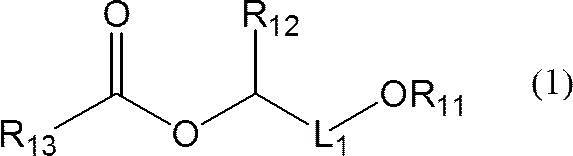
R11、及び、R12のアルキル基としては特に制限されないが、直鎖状、分岐鎖状、及び、環状のいずれであってもよい。また、アルキル基の炭素数としては特に制限されないが、一般に1~8が好ましく、1~6がより好ましい。
L1のアルキレン基の炭素数としては特に制限されないが、一般に1~8が好ましく、1~6がより好ましい。
式(1)で表される化合物としては特に制限されないが、例えば、プロピレングリコールモノメチルエーテルアセテート等が挙げられる。
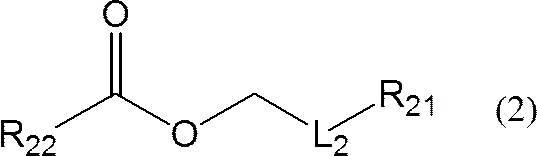
L2のアルキレン基としては、L1のアルキレン基として既に説明したとおりである。
式(2)で表される化合物としては特に制限されないが、例えば、酢酸ブチル、酢酸イソアミル、酢酸エチル、酪酸プロピル、及び、酪酸ブチル等が挙げられ、なかでも酢酸ブチルが好ましい。

R31、及び、R32のアルキル基としては特に制限されず、式(1)のR11のアルキル基として既に説明したとおりである。
L3のアルキレン基としては、L1のアルキレン基として既に説明したとおりである。
式(3)で表される化合物としては特に制限されないが、例えば、乳酸メチル、乳酸エチル、乳酸プロピル、2-ヒドロキシイソ酪酸メチル、及び、2-ヒドロキシイソ酪酸エチル等が挙げられ、なかでも、乳酸エチル、又は、2-ヒドロキシイソ酪酸メチルが好ましい。
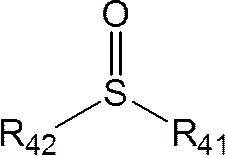
式(4)で表される化合物としては特に制限されないが、例えば、ジメチルスルホキシド、及び、ジブチルスルホキシド等が挙げられ、なかでもジメチルスルホキシドが好ましい。

L5のアルキレン基としては、L1のアルキレン基として既に説明したとおりである。
式(5)で表される化合物としては特に制限されないが、例えば、プロピレングリコールモノメチルエーテル等が挙げられる。

R61、及び、R62のアルキル基としては特に制限されず、式(1)のR11のアルキル基として既に説明したとおりである。
式(6)で表される化合物としては特に制限されないが、例えば、炭酸エチレン、炭酸プロピレン、炭酸1,2-ブチレン、炭酸ジエチル、炭酸ジメチル、炭酸エチルメチル、及び、炭酸ビニレン等が挙げられ、炭酸エチレン、又は、炭酸プロピレンが好ましい。

R71~R74のアルキル基としては特に制限されず、式(1)のR11のアルキル基として既に説明したとおりである。
式(7)で表される化合物としては特に制限されないが、例えば、1,1-ジメトキシシクロペンタン(シクロペンタノンジメチルアセタール)、シクロペンタノンジメチルアセタール、1,1-ジメトキシシクロヘキサン、2,2-ジブトキシプロパン、及び、2,2-ジメトキシプロパン等が挙げられ、なかでもシクロペンタノンジメチルアセタールが好ましい。

R91及びR92のアルキル基としては特に制限されず、式(1)のR11のアルキル基として既に説明したとおりである。
式(9)で表される化合物としては特に制限されないが、例えば、3-メトキシプロピオン酸メチル(MMP)、及び、3-エトキシプロピオン酸エチル等が挙げられる。
混合物中における式(9)で表される化合物の含有量としては特に制限されないが、混合物の全質量に対して、一般に30~97質量%が好ましい。
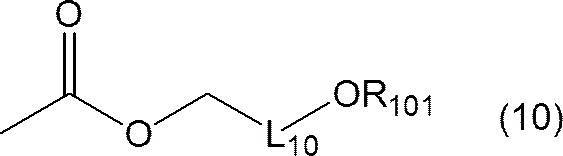
また、L10は単結合、又は、アルキレン基を表す。L10のアルキレン基としては、L1のアルキレン基として既に説明したとおりである。
式(10)で表される化合物としては特に制限されないが、例えば、エチレングリコールモノメチルエーテルアセテート等が挙げられる。
混合物中における式(10)で表される化合物の含有量としては特に制限されないが、混合物の全質量に対して、一般に50~90質量%が好ましい。

また、L11は単結合、又は、アルキレン基を表す。L11のアルキレン基としては、L1のアルキレン基として既に説明したとおりである。
式(11)で表される化合物としては特に制限されないが、例えば、アニソール、及び、フェネトール等が挙げられる。
混合物中における式(11)で表される化合物の含有量としては特に制限されないが、混合物の全質量に対して、一般に1.0~85.0質量%が好ましい。
置換基としては特に制限されないが、直鎖状、分岐鎖状、又は、環状のアルキル基、ハロゲン原子、ヒドロキシル基、アミノ基、及び、これらの組み合わせ等が挙げられる。
環員数としては4又は5が好ましく、5がより好ましい。
置換基を含有してもよい環員数3~5の環状ケトン化合物としては特に制限されないが、例えば、シクロペンタノン、2,2,4-トリメチルシクロペンタノン、及び、シクロブタノン等が挙げられ、シクロペンタノンが好ましい。
置換基としては特に制限されないが、直鎖状、分岐鎖状、又は、環状のアルキル基、ハロゲン原子、ヒドロキシル基、アミノ基、及び、これらの組み合わせ等が挙げられる。
環員数の上限値としては特に制限されないが、12以下が好ましく、10以下がより好ましく、8以下が更に好ましい。
置換基を含有してもよい環員数6以上の環状ケトン化合物としては特に制限されないが、例えば、シクロヘキサノン、4-tert-ブチルシクロヘキサノン、2-クロロシクロヘキサノン、ジメチルシクロヘキサノン、2-メトキシシクロヘキサノン、シクロヘプタノン、及び、シクロオクタノン等が挙げられ、なかでもシクロヘキサノンが好ましい。
ラクトン化合物としては特に制限されないが、例えば、β-プロピオラクトン、β-ブチロラクトン、β-バレロラクトン、γ-ブチロラクトン、γ-バレロラクトン、γ-カプリロラクトン、δ-バレロラクトン、β-メチル-δ-バレロラクトン、δ-ステアロラクトン、ε-カプロラクトン、γ-オクタノイックラクトン、2-メチル-ε-カプロラクトン、4-メチル-ε-カプロラクトン、ε-カプリロラクトン、ε-パルミトラクトン、α-ヒドロキシ-γ-ブチロラクトン、及び、α-メチル-γ-ブチロラクトン等が挙げられ、なかでも、γ-ブチロラクトンが好ましい。
ラクタム化合物としては特に制限されないが、2-ピロリドン、1-メチル-2-ピロリドン、及び、ε-カプロラクタム等が挙げられ、なかでも、1-メチル-2-ピロリドンが好ましい。
なかでも、上記混合物は、式(4)、式(6)、式(7)、及び、置換基を含有してもよい環員数3~5の環状ケトン化合物からなる群から選択される少なくとも1種の有機溶剤を含有することが好ましく、式(4)、式(6)、及び、式(7)からなる群から選択される少なくとも1種を含有することが好ましい。上記有機溶剤を含有する混合物を含有する薬液は、より優れた本発明の効果を有する。
なお、薬液が含有する有機溶剤の混合物が、式(1)で表される化合物、及び、式(3)で表される化合物からなるとは、混合物が、2種類の有機溶剤からなり、その一方が式(1)で表される化合物であり、他方が式(3)で表される化合物であることを意図する。
すなわち、例えば、プロピレングリコールモノメチルエーテルアセテートと乳酸エチル、及び、プロピレングリコールモノメチルエーテルアセテートと2-ヒドロキシイソ酪酸メチルの組合せは上記に含まれる。一方で、プロピレングリコールモノメチルエーテルアセテート、乳酸エチル、及び、2-ヒドロキシイソ酪酸メチルの混合物は、3種類の有機溶剤からなるため、上記には含まれない。
この場合、特に、省レジスト性及び、欠陥抑制性能に関して処理条件のロバスト性が広くなるなどの利点が挙げられる他、様々な種類のレジスト液に対して本発明の効果を得ることができる。
なお、本明細書において、「上記有機溶剤の混合物からなる」というときは、有機溶剤中に意図せず含有される副生成物、異性体、及び、不純物等を含有する形態も含有されるものとする。
本発明の第二実施形態に係る薬液は、2種以上の有機溶剤の混合物を含有する、薬液である。上記混合物は、以下の1~10の有機溶剤の組み合わせのうち、少なくとも1種を含有する。
上記薬液は、2種以上の有機溶剤の混合物を含有する。
薬液中における、混合物の含有量としては特に制限されないが、一般に、薬液中の質量に対して、99.9~100質量%が好ましい。
γ-ブチロラクトン(GBL)、並びに、シクロペンタノン(CyPn)、酢酸ブチル(nBA)、乳酸エチル(EL)、2-ヒドロキシイソ酪酸メチル(HBM)、シクロペンタノンジメチルアセタール(DBCPN)、アニソール(anisole)、フェネトール(phenetole)、エチレングリコールモノメチルエーテルアセテート(EGMEA)、3-メトキシプロピオン酸メチル(MMP)、及び、3-エトキシプロピオン酸エチル(EEP)からなる群から選択される少なくとも1種。
ジメチルスルホキシド(DMSO)、並びに、プロピレングリコールモノメチルエーテル(PGME)、CyPn、nBA、プロピレングリコールモノメチルエーテルアセテート(PGMEA)、シクロヘキサノン(CyHx)、EL、HBM、DBCPN、anisole、phenetole、EGMEA、MMP、及び、EEPからなる群から選択される少なくとも1種。
炭酸エチレン(EC)、並びに、PGME、CyPn、nBA、PGMEA、CyHx、EL、HBM、DBCPN、anisole、phenetole、EGMEA、MMP、及び、EEPからなる群から選択される少なくとも1種。
炭酸プロピレン(PC)、並びに、PGME、CyPn、nBA、PGMEA、CyHx、EL、HBM、DBCPN、anisole、phenetole、EGMEA、MMP、及び、EEPからなる群から選択される少なくとも1種。
1-メチル-2-ピロリドン(NMP)、並びに、PGME、CyPn、nBA、PGMEA、CyHx、EL、HBM、DBCPN、anisole、phenetole、EGMEA、MMP、及び、EEPからなる群から選択される少なくとも1種。
PGMEA、並びに、CyPn、nBA、DBCPN、anisole、phenetole、EGMEA、MMP、及び、EEPからなる群から選択される少なくとも1種。
CyHx、並びに、PGME、CyPn、nBA、EL、HBM、DBCPN、anisole、phenetole、EGMEA、MMP、及び、EEPからなる群から選択される少なくとも1種。
EL、並びに、PGME、CyPn、nBA、DBCPN、anisole、phenetole、EGMEA、MMP、及び、EEPからなる群から選択される少なくとも1種。
HBM、並びに、PGME、CyPn、nBA、DBCPN、anisole、phenetole、EGMEA、MMP、及び、EEPからなる群から選択される少なくとも1種。
DBCPN、並びに、PGME、CyPn、nBA、anisole、phenetole、EGMEA、MMP、及び、EEPからなる群から選択される少なくとも1種。
この場合、特に、省レジスト性及び、欠陥抑制性能に関して処理条件のロバスト性が広くなるなどの利点が挙げられる他、様々な種類のレジスト液に対して本発明の効果を得ることができる。
次に本発明の実施形態に係る薬液、又は、混合物に共通する物性の好適形態について説明する。上記薬液は、より優れた本発明の効果を有する点で、混合物の蒸気圧、混合物の表面張力、及び、有機溶剤のハンセン溶解度パラメータが所定の範囲であるとことが好ましい。以下では、各項目について説明する。
上記薬液が含有する2種以上の有機溶剤の混合物の25℃における蒸気圧は、特に制限されないが、150~1200Paが好ましく、159~1200Paがより好ましく、160~1000Paが更に好ましく、173~1000Paが特に好ましい。混合物の蒸気圧が160~1000Paであると、薬液はより優れた欠陥抑制性能、及び、より優れた省レジスト性を有する。
なお、本明細書において、混合物の蒸気圧とは、以下の方法によって計算される蒸気圧を意図する。
なお、ガスクロマトグラフ質量分析装置の測定条件は実施例に記載したとおりである。
式:(混合物の蒸気圧)=Σ((各有機溶剤の25℃における蒸気圧)×(各有機溶剤のモル分率))
第一有機溶剤は、25℃における蒸気圧が160~1000Paである有機溶剤である。第一有機溶剤としては、例えば、PGMEA(493)、CyHx(507)、EL(187)、HBM(267)、DBCPN(400)、anisole(427)、phenetole(211)、EGMEA(280)、MMP(507)、及び、EEP(160)等が挙げられる。なお、(カッコ)内は、25℃における蒸気圧(単位はPa)を表す。
第二有機溶剤は、25℃における蒸気圧が1000Paを超える有機溶剤である。第二有機溶剤としては、例えば、nBA(1200)、PGME(1453)、及び、CyPn(1520)等が挙げられ、より優れた本発明の効果を有する薬液が得られる点で、CyPnが好ましい。なお、(カッコ)内は、25℃における蒸気圧(単位はPa)を表す。
なかでも、より優れた本発明の効果を有する薬液が得られる点で、薬液が含有する混合物は、少なくとも1種の第三有機溶剤と、少なくとも1種の第一有機溶剤とを含有するか、又は、少なくとも1種の第三有機溶剤と、少なくとも1種の第二有機溶剤とを含有することが好ましく、少なくとも1種の第三有機溶剤と、少なくとも1種の第一有機溶剤とを含有することがより好ましく、少なくとも1種の第三有機溶剤と、少なくとも1種の第一有機溶剤とからなることが更に好ましく、1種の第三有機溶剤と、1種の第一有機溶剤とからなることが特に好ましい。
第三有機溶剤とは、25℃における蒸気圧が160Pa未満の有機溶剤を意図する。
上記の有機溶剤としては、例えば、GBL(147)、DMSO(13)、PC(53)、EC(67)、及び、NMP(40)等が挙げられるが、これに制限されない。なお、カッコ中の数値は、25℃における蒸気圧(Pa)を表す。
第三有機溶剤は、1種を単独で用いても、2種以上を併用してもよい。2種以上の第三有機溶剤を併用する場合には、合計含有量が上記範囲内であることが好ましい。
上記薬液が含有する2種以上の有機溶剤の混合物の25℃における表面張力は、28mN/m以上が好ましく、29mN/mを超えることがより好ましく、30mN/m以上が更に好ましい。表面張力の上限値としては特に制限されないが、一般に45mN/m以下が好ましく、42mN/m以下がより好ましく、40mN/m以下が更に好ましい。
混合物の表面張力が28mN/m以上であると、薬液は、より優れた欠陥抑制性能(特に、BRIDGE欠陥抑制性能)を有し、混合物の表面張力が29mN/mを超えると、薬液は更に優れた本発明の効果を有する。
まず、薬液を試料として、ガスクロマトグラフ質量分析装置を用いて薬液中に含有される有機溶剤の種類、及び、その含有量を測定する。
なお、ガスクロマトグラフ質量分析装置の測定条件は実施例に記載したとおりである。
式:(混合物の表面張力)=Σ((各有機溶剤の25℃における表面張力)×(各有機溶剤のモル分率))
また、特定有機溶剤のδdとしては、15.5(MPa)0.5超が好ましく、17(MPa)0.5以上がより好ましい。δdの上限としては特に制限されないが、一般に20(MPa)0.5以下が好ましい。
上記実施形態に係る薬液は、半導体製造用に好ましく用いられる。具体的には、リソグラフィ工程、エッチング工程、イオン注入工程、及び、剥離工程等を含有する半導体デバイスの製造工程において、各工程の終了後、又は、次の工程に移る前に、有機物を処理するために使用され、具体的にはプリウェット液、現像液、リンス液、及び、剥離液等として好適に用いられる。
また、上記薬液は、レジスト液(後述する)に含有される樹脂の希釈液としても用いることができる。また、他の有機溶剤、及び/又は、水等により希釈してもよい。
また、上記薬液は、医療用途又は洗浄用途の溶媒としても用いることができる。特に、容器、配管、及び、基板(例えば、ウェハ、及び、ガラス等)等の洗浄に好適に用いることができる。
また、感活性光線性又は感放射線性樹脂組成物を基板(ウェハ)に塗布する前に、ウェハ上にBARC(Bottom of Anti-Reflection Coating)組成物を塗布する場合には、ウェハのエッジ部に意図せず塗布されたBARC組成物を上記薬液によって除去することも可能である。
上記薬液の製造方法としては特に制限されず、公知の製造方法を用いることができる。上記薬液の製造方法としては、例えば、有機溶剤を準備する工程と、有機溶剤を混合して、混合物を得る工程とを含有する製造方法が挙げられる。なお、有機溶剤、及び/又は、混合物を、フィルタ等を用いて精製する工程を更に含有してもよい。また、有機溶剤、及び/又は、混合物を除電して帯電電位を下げる除電工程を更に含有してもよい。
有機溶剤、及び/又は、混合物を精製する方法としては、例えば、蒸留、及び、ろ過等の方法が挙げられる。蒸留装置、及び、ろ過装置としては公知のものを用いることができる。
上記薬液は、使用時まで一時的に容器内に保管してもよい。上記薬液を保管するための容器としては特に制限されず、公知の容器を用いることができる。
上記薬液を保管する容器としては、半導体製造用途向けに、容器内のクリーン度が高く、不純物の溶出が少ないものが好ましい。
使用可能な容器としては、具体的には、アイセロ化学(株)製の「クリーンボトル」シリーズ、及び、コダマ樹脂工業製の「ピュアボトル」等が挙げられるが、これらに限定されない。
また、容器としては、薬液への不純物混入(コンタミ)防止を目的として、容器の内壁が6種の樹脂の6層構造としたもの、又は、6種の樹脂の7層構造としたものを用いることが好ましい。上記の容器としては、特開2015-123351号公報に記載の容器が挙げられる。
上記薬液の製造、容器の開封及び/又は洗浄、溶液の収容等を含めた取り扱い、処理分析、及び、測定は、全てクリーンルームで行うことが好ましい。クリーンルームは、14644-1クリーンルーム基準を満たすことが好ましい。ISO(国際標準化機構)クラス1、ISOクラス2、ISOクラス3、及び、ISOクラス4のいずれかを満たすことが好ましく、ISOクラス1又はISOクラス2を満たすことがより好ましく、ISOクラス1を満たすことが更に好ましい。
上記薬液は、半導体製造用に用いられるレジストパターン(以下、単に「パターン」という。)の形成に用いることが好ましい。上記薬液を用いたパターン形成方法としては特に制限されず、公知のパターン形成方法が挙げられる。
(A)上記薬液を基板上に塗布して、プリウェット済み基板を得る、プリウェット工程
(B)プリウェット済み基板上に、感活性光線性又は感放射線性樹脂組成物を用いて、レジスト膜を形成する、レジスト膜形成工程
(C)レジスト膜を露光する、露光工程
(D)露光されたレジスト膜を、現像液を用いて現像する、現像工程
以下では、上記工程ごとにその形態を説明する。
プリウェット工程は、基板上に薬液を塗布する工程である。
基板としては特に制限されず、半導体製造用として用いられる公知の基板を用いることができる。基板としては、例えば、シリコン、SiO2、若しくはSiN等の無機基板、又は、SOG(Spin On Glass)等の塗布系無機基板等が挙げられるがこれに制限されない。
また、基板は、反射防止膜を備える、反射防止膜付き基板であってもよい。反射防止膜としては、特に制限されず、公知の有機系又は無機系の反射防止膜を用いることができる。
なお、第1の速度V1の上限値としては特に制限されないが3000rpm以下が好ましい。
こうして、(B)レジスト膜形成工程(後述する)が開始される。このレジスト膜形成工程では、ウェハの回転速度が第1の速度V1から、高速の例えば2000~4000rpm程度の第2の速度V2まで上げられる。レジスト膜形成工程の開始前に第1の速度V1であったウェハの回転は、その後速度が連続的に滑らかに変動するように徐々に加速される。このとき、ウェハの回転の加速度は、例えば零から次第に増加する。そして、レジスト膜形成工程の終了時には、ウェハの回転の加速度が次第に減少され、ウェハWの回転速度が第2の速度V2に滑らかに収束する。こうして、レジスト膜形成工程時においては、ウェハの回転速度が第1の速度V1から第2の速度V2にS字状に推移するように変動する。レジスト膜形成工程では、ウェハの中心部に供給されたレジスト液が遠心力によりウェハの表面の全面に拡散されて、ウェハの表面にレジスト液が塗布される。
なお、このようなレジスト塗布時のウェハ回転速度の変動による省レジスト技術については、特願2008-131495号公報、特開2009-279476号公報に詳細に記載されている。
薬液を再利用する場合、回収した薬液中に含有される、不純物金属、有機不純物、及び、水等の含有量を調製することが好ましい。なお、上記調製方法としては、薬液の製造方法として既に説明したとおりである。
プリウェット工程で用いられる薬液と、後述する感活性光線又は感放射線性樹脂組成物との親和性としては特に制限されないが、より少ない感活性光線又は感放射線性樹脂組成物を用いて、より均一なレジスト膜が形成できる点で、薬液と、感活性光線又は感放射線性樹脂組成物に含有される樹脂(感活性光線又は感放射線性樹脂組成物が2種以上の樹脂を含有する場合にはその「混合物」とする。混合物中の各樹脂の含有質量比は、感活性光線又は感放射線性樹脂組成物中における、樹脂の全質量に対する各樹脂の含有質量比と同様であり、上記樹脂には、後述する疎水性樹脂は含まないものとする。)とは、以下の関係を満たすことが好ましい。
薬液、並びに、樹脂、及び、薬液からなる第一試験溶液について、パルス核磁気共鳴方式粒子界面特性評価装置で測定したプロトンのスピン-スピン緩和時間から下記式1により計算したRsq1が0.5を超える。
(式1)Rsq1=(τ0/τ1)-1
ただし、式1中、τ0は、薬液のスピン-スピン緩和時間を表し、τ1は、第一試験溶液のスピン-スピン緩和時間を表す。また、第一試験溶液に含有される樹脂は、薬液に溶解しているものとする。
まず、パルス核磁気共鳴方式粒子界面特性評価装置とは、対象物のスピン(磁気)状態を観測する方式の評価装置である。パルス核磁気共鳴方式粒子界面特性評価装置としては、例えば、Xigo nanotools社製、「Acorn Area」等が挙げられる。
上記の理由は必ずしも明らかではないが、樹脂に接触している有機溶剤の分子の量がスピン-スピン緩和時間に影響を与えていると推測される。
(式1)Rsq1=(τ0/τ1)-1
Rsq1は、0.5を超えることが好ましい。Rsq1が0.5を超えると、薬液と、樹脂とは、より優れた相溶性を有する。Rsq1の上限値としては特に制限されないが、一般に10.0以下が好ましい。
樹脂及び薬液からなり、第一試験溶液中における樹脂の含有量とは異なる量の樹脂を含有する第二試験溶液、及び、第一試験溶液について、パルス核磁気共鳴方式粒子界面特性評価装置で測定したプロトンのスピン-スピン緩和時間から下記式2により計算したSRsqが-1を超える。
(式2)SRsq=(Rsq2-Rsq1)/(c2-c1)
ただし、式2中、Rsq1は、式1により計算した値を表し、Rsq2は、下記式3により計算した値を表す。c1、及び、c2は、それぞれ、第一試験溶液中、及び、第二試験溶液中における、樹脂の質量基準の含有量を表す。なお、質量基準の含有量の単位は、質量%であり、c2>c1であり、第一試験溶液、及び、第二試験溶液に含有される樹脂は、薬液に溶解しているものとする。
(式3)Rsq2=(τ0/τ2)-1
ただし、式3中、τ0は式1中におけるτ0と同義であり、τ2は、第二試験溶液のスピン-スピン緩和時間を表す。
式2中、c1、及び、c2は、第一試験溶液、及び、第二試験溶液中における樹脂の含有量(質量%)を表す。第一試験溶液、及び、第二試験溶液中においては、樹脂が完全に溶解していれば、c1、及び、c2としては特に制限されない。例えば、c1を0.5質量%、c2を3.0質量%等とすればよい。
レジスト膜形成工程は、プリウェット済み基板(薬液層を備える基板)上に、感活性光線又は感放射線性樹脂組成物を用いてレジスト膜を形成する工程である。以下では、まず、感活性光線又は感放射線性樹脂組成物の形態についてする。
上記レジスト膜形成工程において用いることができる感活性光線性又は感放射線性樹脂組成物としては特に制限されず、公知の感活性光線性又は感放射線性樹脂組成物を用いることができる。
感活性光線性又は感放射線性樹脂組成物(以下、「レジスト組成物」ともいう。)としては、酸の作用により分解して極性基(カルボキシル基、及び、フェノール性水酸基等)を生じる基を含有する繰り返し単位を含有する樹脂(以下、本明細書において「酸分解性樹脂」ともいう。)と、活性光線又は放射線の照射により酸を発生する化合物(以下、本明細書において「光酸発生剤」ともいう。)と、を含有することが好ましい。
なかでも、より優れた本発明の効果が得られる点で、以下のレジスト組成物が好ましい。
・後述する式(I)で表される樹脂を含有するレジスト組成物
・後述するフェノール性水酸基を有する酸分解性樹脂を含有するレジスト組成物
・後述する疎水性樹脂と、酸分解性樹脂とを含有するレジスト組成物
以下では、レジスト組成物の各成分について説明する。
酸分解性基において、極性基は酸で脱離する基(酸脱離性基)によって保護されている。酸脱離性基としては、例えば、-C(R36)(R37)(R38)、-C(R36)(R37)(OR39)、及び、-C(R01)(R02)(OR39)等が挙げられる。
式中、R36~R39は、各々独立に、アルキル基、シクロアルキル基、アリール基、アラルキル基又はアルケニル基を表す。R36とR37とは、互いに結合して環を形成してもよい。
R01及びR02は、各々独立に、水素原子、アルキル基、シクロアルキル基、アリール基、アラルキル基又はアルケニル基を表す。
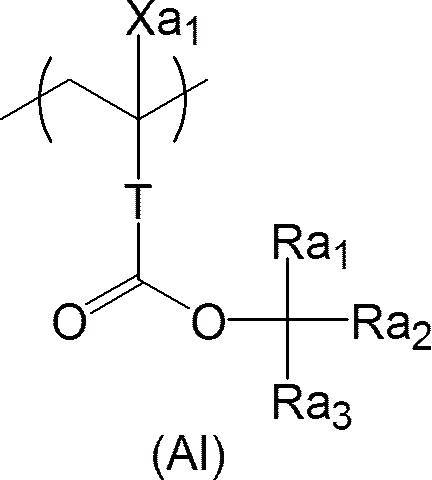
Xa1は、水素原子、又は置換基を有していてもよいアルキル基を表す。
Tは、単結合又は2価の連結基を表す。
Ra1~Ra3は、それぞれ独立に、アルキル基(直鎖状又は分岐鎖状)又はシクロアルキル基(単環又は多環)を表す。
Ra1~Ra3の2つが結合して、シクロアルキル基(単環又は多環)を形成してもよい。
Xa1は、水素原子、メチル基、トリフルオロメチル基又はヒドロキシメチル基が好ましい。
Tは、単結合又は-COO-Rt-基が好ましい。Rtは、炭素数1~5のアルキレン基が好ましく、-CH2-基、-(CH2)2-基、又は、-(CH2)3-基がより好ましい。
Ra1~Ra3の2つが結合して形成されるシクロアルキル基としては、シクロペンチル基、若しくはシクロヘキシル基等の単環のシクロアルキル基、又は、ノルボルニル基、テトラシクロデカニル基、テトラシクロドデカニル基、若しくはアダマンチル基等の多環のシクロアルキル基が好ましい。炭素数5~6の単環のシクロアルキル基がより好ましい。
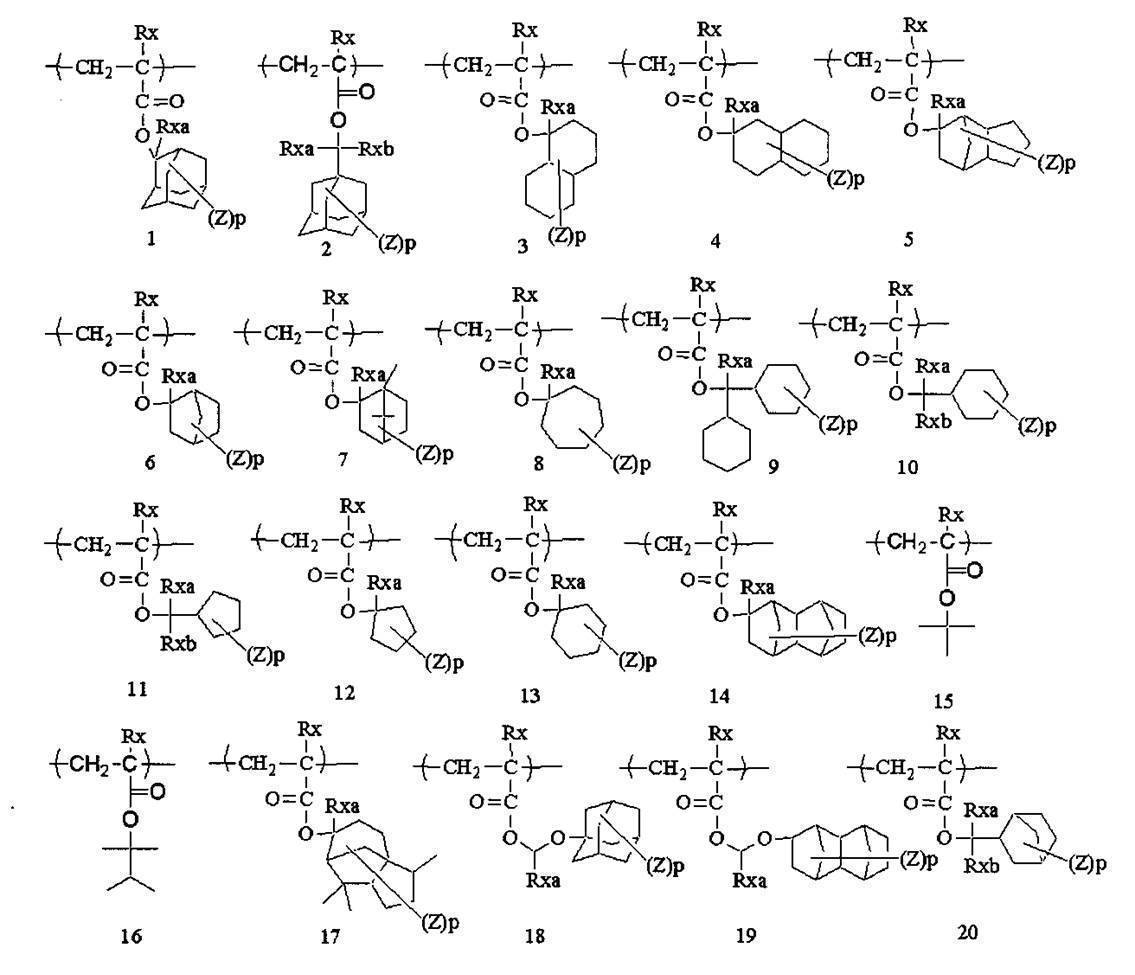
また、樹脂Pは、ラクトン構造を有する繰り返し単位Qを含有することが好ましい。
ラクトン構造を有する繰り返し単位Qは、1種単独で用いてもよく、2種以上を併用していてもよいが、1種単独で用いることが好ましい。
上記樹脂Pの全繰り返し単位に対する、ラクトン構造を有する繰り返し単位Qの含有量は、例えば、3~80モル%が挙げられ、3~60モル%が好ましい。
ラクトン構造としては、下記式(LC1-1)~(LC1-17)のいずれかで表されるラクトン構造を有する繰り返し単位を有することが好ましい。ラクトン構造としては式(LC1-1)、式(LC1-4)、式(LC1-5)、又は式(LC1-8)で表されるラクトン構造が好ましく、式(LC1-4)で表されるラクトン構造がより好ましい。
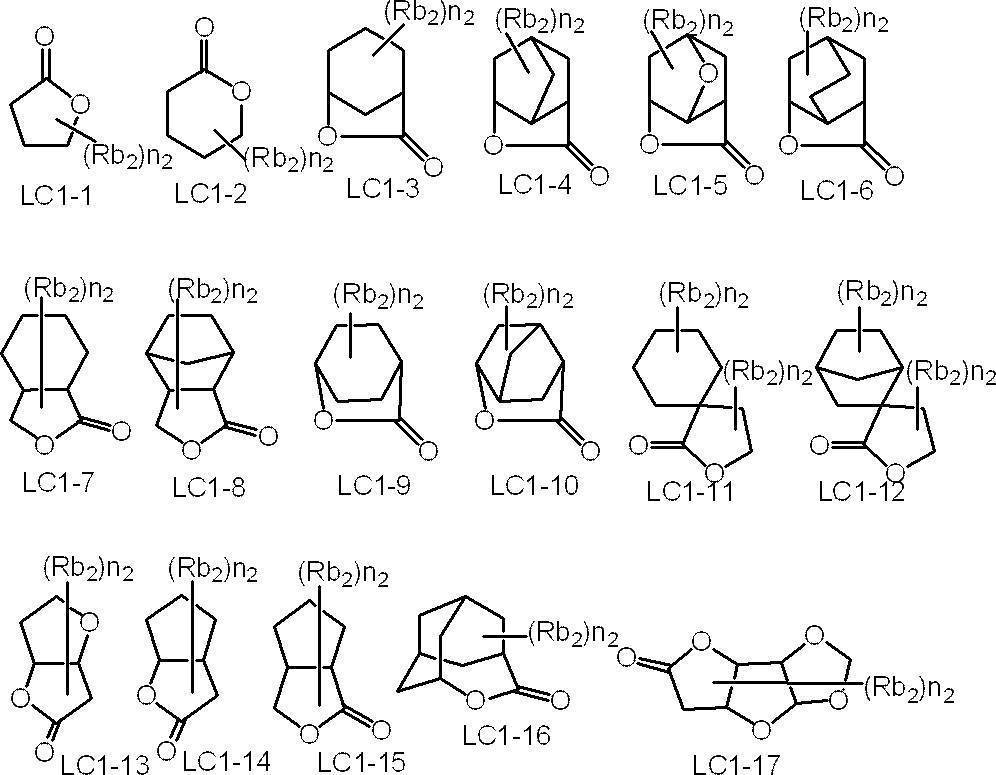
下記式(I)で表される樹脂は、酸の作用により有機溶剤を主成分とする現像液(後述する薬液)に対する溶解性が減少する樹脂であり、酸分解性基を含有する。上記薬液は、式(I)で表されるような樹脂に対する優れた溶解性を有するため、より少ないレジスト組成物を用いて均一なレジスト膜が得られやすい。以下、式(I)で表される樹脂について説明する。

Rx1~Rx5は、それぞれ独立に、水素原子、又は、置換基を含有してもよいアルキル基を表す。
R1~R4は、それぞれ独立に、1価の置換基を表し、p1~p4は、それぞれ独立に、0、又は、正の整数を表す。
Raは、直鎖状、又は、分岐鎖状のアルキル基を表す。
T1~T5は、それぞれ独立に、単結合、又は、2価の連結基を表す。
R5は1価の有機基を表す。
a~eは、モル%を表し、それぞれ独立に、0≦a≦100、0≦b≦100、0≦c<100、0≦d<100、及び、0≦e<100の範囲内の数を表す。ただし、a+b+c+d+e=100であり、a+b≠0である。
ただし、式(I)中、上記繰り返し単位(e)は、上記繰り返し単位(a)~(d)のいずれとも異なる構造を有する。
Rx1~Rx5は、それぞれ独立に、水素原子、メチル基、トリフルオロメチル基、又は、ヒドロキシメチル基が好ましい。
T1~T5は、それぞれ独立に、単結合又は-COO-Rt-基が好ましい。Rtは、炭素数1~5のアルキレン基が好ましく、-CH2-基、-(CH2)2-基、又は、-(CH2)3-基がより好ましい。
式(I)中、R1~R4は、それぞれ独立に、1価の置換基を表す。R1~R4としては、特に限定されないが、例えば、水酸基、シアノ基、及び、水酸基又はシアノ基等を有する直鎖状若しくは分岐鎖状のアルキル基又はシクロアルキル基が挙げられる。
式(I)中、p1~p4は、各々独立に、0又は正の整数を表す。なお、p1~p4の上限値は、各繰り返し単位において置換し得る水素原子の数に相当する。
式(I)中、R5は、1価の有機基を表す。R5としては、特に限定されないが、例えば、スルトン構造を有する1価の有機基、及び、テトラヒドロフラン、ジオキサン、1,4-チオキサン、ジオキソラン、及び2,4,6-トリオキサビシクロ[3.3.0]オクタン等の環状エーテルを有する1価の有機基、又は酸分解性基(例えば、-COO基と結合する位置の炭素がアルキル基で置換されて4級化されたアダマンチル基等)が挙げられる。
また、式(I)中、c+d(全繰り返し単位に対する、ラクトン構造を有する繰り返し単位の含有量)は、3~80モル%が好ましく、3~60モル%がより好ましい。
また、上記感活性光線性又は感放射線性樹脂組成物中、上記式(I)で表される樹脂の含有量は、感活性光線性又は感放射線性樹脂組成物の全固形分を基準として、通常30~99質量%が好ましく、50~95質量%がより好ましい。
また、樹脂Pは、フェノール性水酸基を有する繰り返し単位を含有していてもよい。
フェノール性水酸基を有する繰り返し単位としては、例えば、下記一般式(I)で表される繰り返し単位が挙げられる。
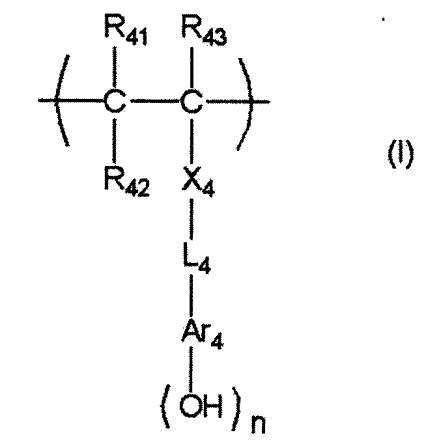
R41、R42及びR43は、各々独立に、水素原子、アルキル基、ハロゲン原子、シアノ基又はアルコキシカルボニル基を表す。但し、R42はAr4と結合して環を形成していてもよく、その場合のR42は単結合又はアルキレン基を表す。

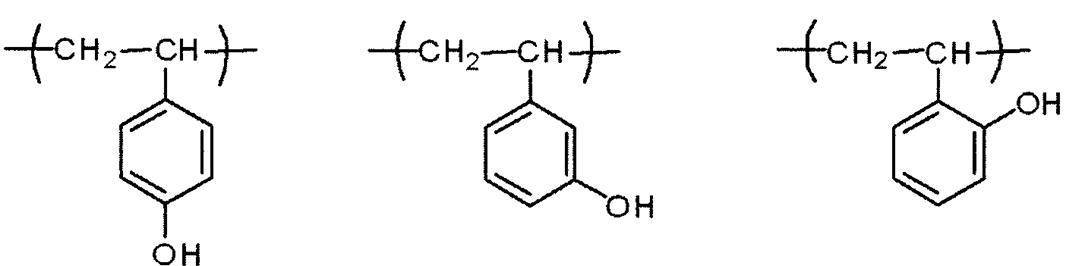

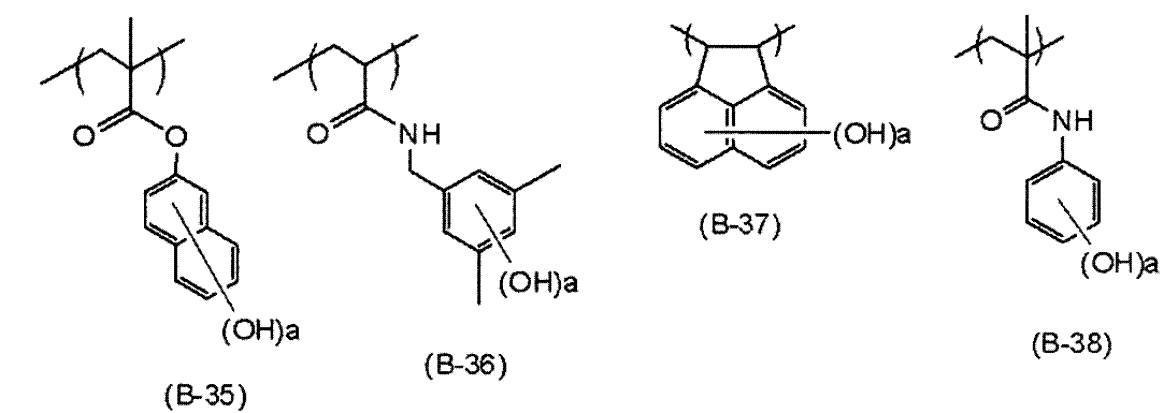
樹脂Pは、極性基を有する有機基を含有する繰り返し単位、特に、極性基で置換された脂環炭化水素構造を有する繰り返し単位を更に含有していてもよい。
これにより基板密着性、現像液親和性が向上する。極性基で置換された脂環炭化水素構造の脂環炭化水素構造としてはアダマンチル基、ジアマンチル基又はノルボルナン基が好ましい。極性基としては、水酸基又はシアノ基が好ましい。
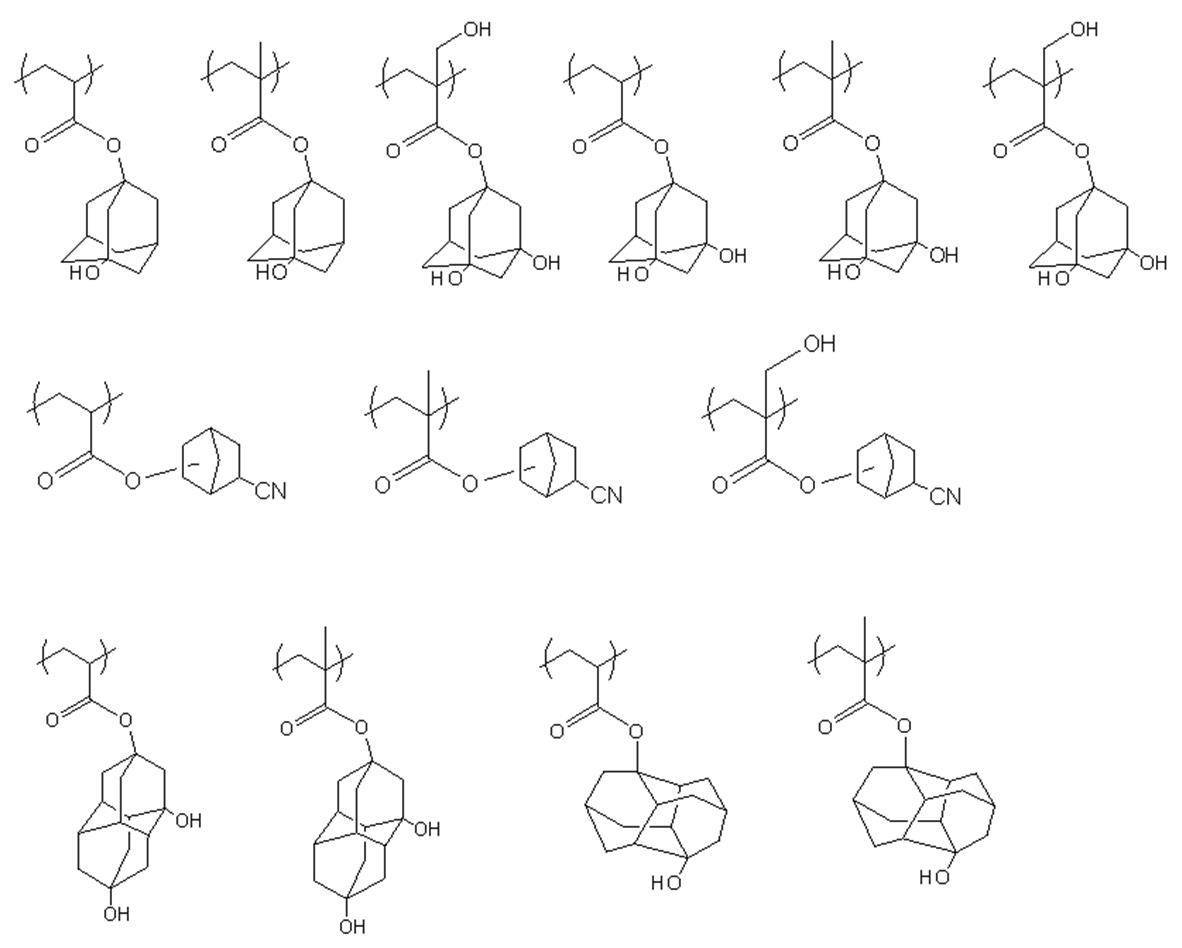
樹脂Pは、活性光線又は放射線の照射により酸を発生する基(光酸発生基)を有する繰り返し単位を含有していてもよい。
活性光線又は放射線の照射により酸を発生する基(光酸発生基)を有する繰り返し単位としては、例えば、下記式(4)で表される繰り返し単位が挙げられる。


R61、R62及びR63は、各々独立に、水素原子、アルキル基、シクロアルキル基、ハロゲン原子、シアノ基、又はアルコキシカルボニル基を表す。但し、R62はAr6と結合して環を形成していてもよく、その場合のR62は単結合又はアルキレン基を表す。
X6は、単結合、-COO-、又は-CONR64-を表す。R64は、水素原子又はアルキル基を表す。
L6は、単結合又はアルキレン基を表す。
Ar6は、(n+1)価の芳香環基を表し、R62と結合して環を形成する場合には(n+2)価の芳香環基を表す。
Y2は、n≧2の場合には各々独立に、水素原子又は酸の作用により脱離する基を表す。但し、Y2の少なくとも1つは、酸の作用により脱離する基を表す。
nは、1~4の整数を表す。
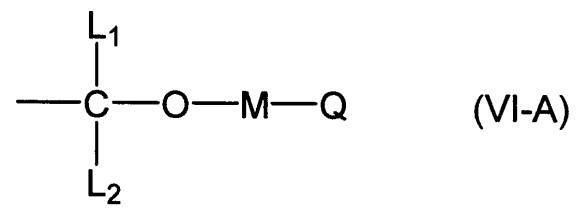
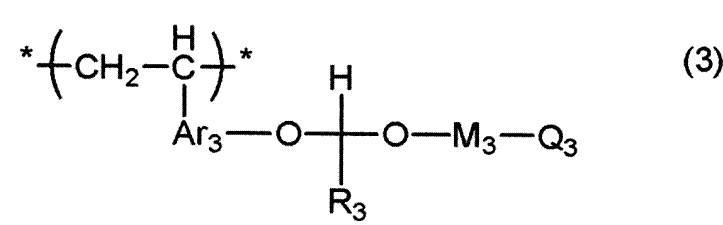
Ar3は、芳香環基を表す。
R3は、水素原子、アルキル基、シクロアルキル基、アリール基、アラルキル基、アルコキシ基、アシル基又はヘテロ環基を表す。
M3は、単結合又は2価の連結基を表す。
Q3は、アルキル基、シクロアルキル基、アリール基又はヘテロ環基を表す。
Q3、M3及びR3の少なくとも二つが結合して環を形成してもよい。

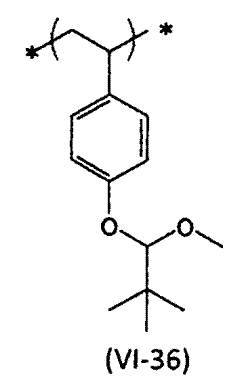
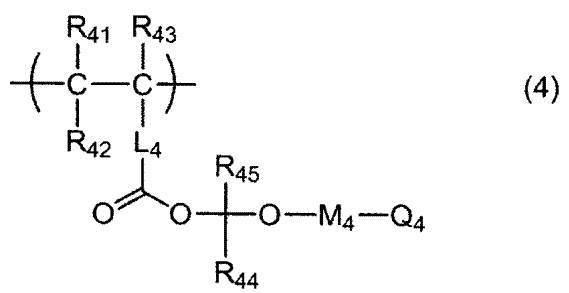
R41、R42及びR43は、各々独立に、水素原子、アルキル基、シクロアルキル基、ハロゲン原子、シアノ基又はアルコキシカルボニル基を表す。R42はL4と結合して環を形成していてもよく、その場合のR42はアルキレン基を表す。
L4は、単結合又は2価の連結基を表し、R42と環を形成する場合には3価の連結基を表す。
R44及びR45は、水素原子、アルキル基、シクロアルキル基、アリール基、アラルキル基、アルコキシ基、アシル基又はヘテロ環基を表す。
M4は、単結合又は2価の連結基を表す。
Q4は、アルキル基、シクロアルキル基、アリール基又はヘテロ環基を表す。
Q4、M4及びR44の少なくとも二つが結合して環を形成してもよい。
L4は、前述の式(AI)中のTと同義であり、また好ましい範囲も同様である。
R44及びR45は、前述の式(3)中のR3と同義であり、また好ましい範囲も同様である。
M4は、前述の式(3)中のM3と同義であり、また好ましい範囲も同様である。
Q4は、前述の式(3)中のQ3と同義であり、また好ましい範囲も同様である。
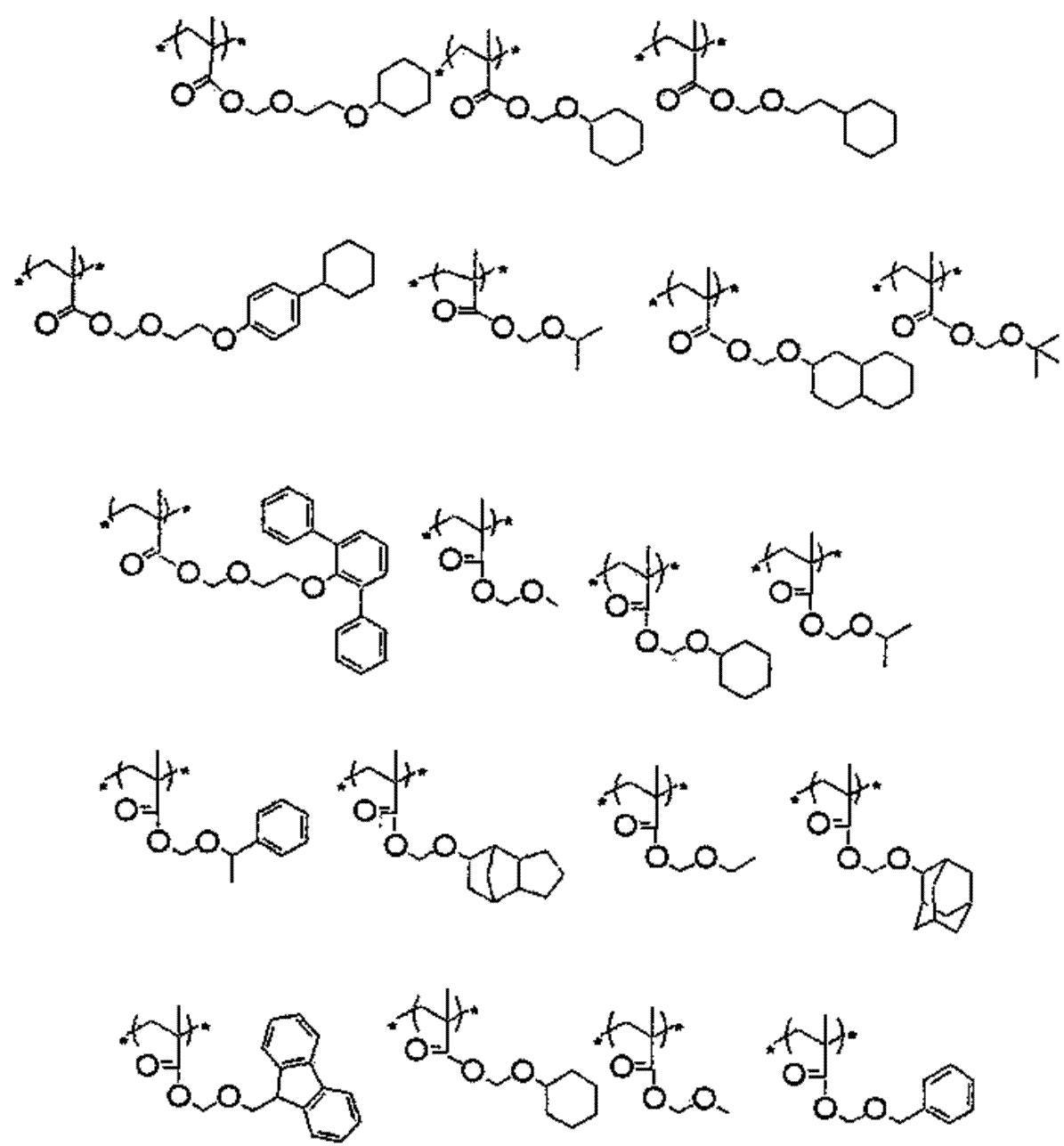
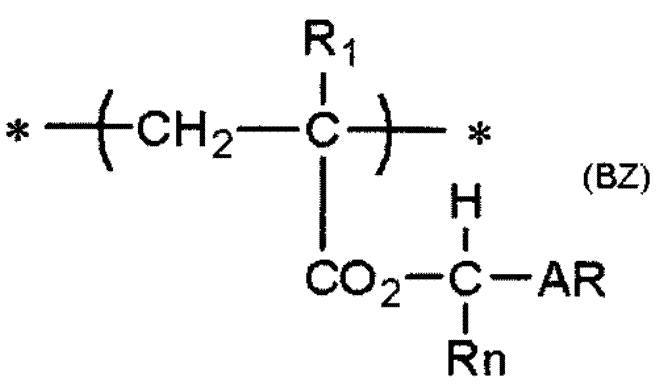
R1は、水素原子、アルキル基、シクロアルキル基、ハロゲン原子、シアノ基又はアルキルオキシカルボニル基を表す。
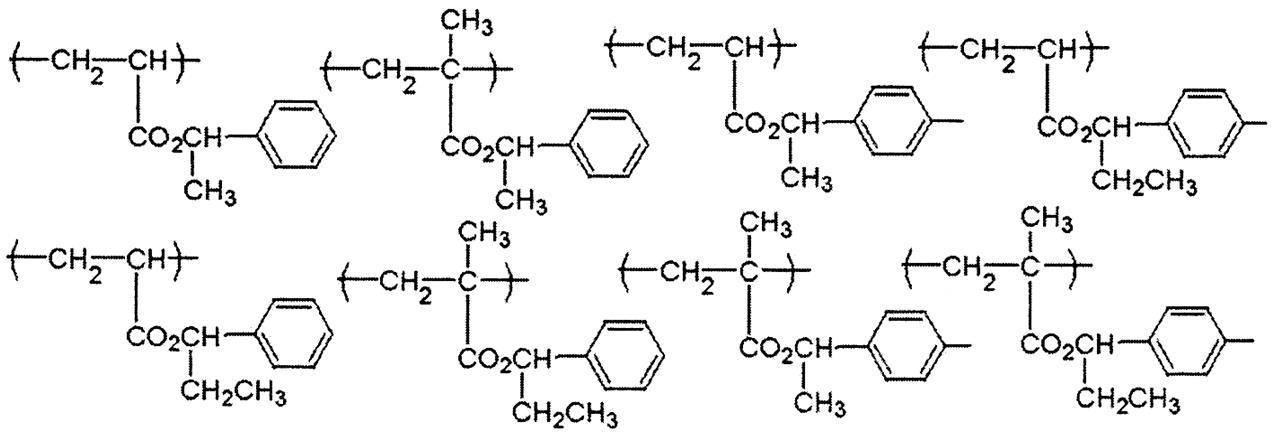
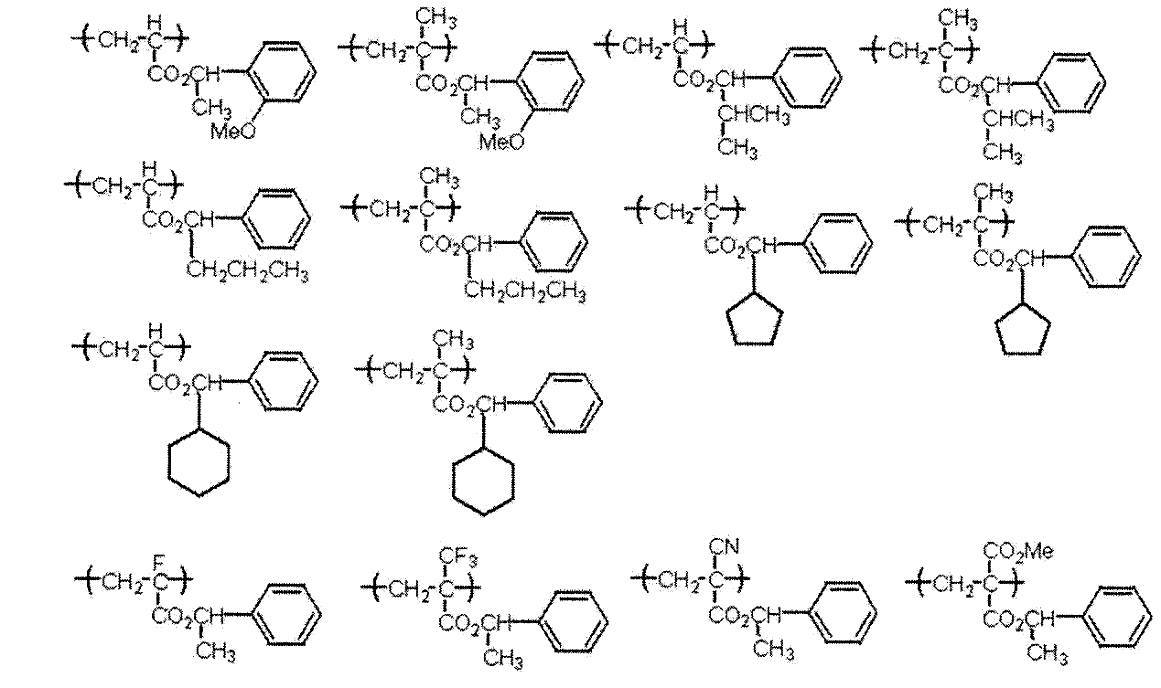
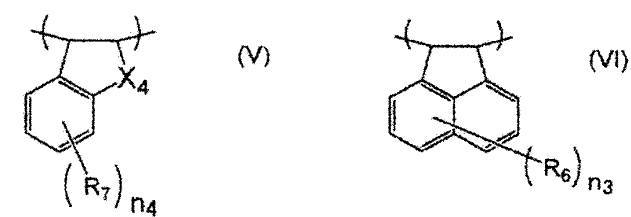
R6及びR7は、それぞれ独立に、水素原子、ヒドロキシ基、炭素数1~10の直鎖状、分岐状又は環状のアルキル基、アルコキシ基又はアシロキシ基、シアノ基、ニトロ基、アミノ基、ハロゲン原子、エステル基(-OCOR又は-COOR:Rは炭素数1~6のアルキル基又はフッ素化アルキル基)、又はカルボキシル基を表す。
n3は0~6の整数を表す。
n4は0~4の整数を表す。
X4はメチレン基、酸素原子又は硫黄原子である。


また、感活性光線性又は感放射線性組成物において、樹脂Pは、1種で使用してもよいし、複数併用してもよい。
上記感活性光線性又は感放射線性樹脂組成物は、光酸発生剤を含有することが好ましい。光酸発生剤としては特に制限されず、公知の光酸発生剤を用いることができる。
感活性光線性又は感放射線性樹脂組成物中における光酸発生剤の含有量としては特に制限されないが、一般に、感活性光線性又は感放射線性樹脂組成物の全固形分に対して、0.1~20質量%が好ましく。0.5~20質量%がより好ましい。光酸発生剤は、1種を単独で用いても、2種以上を併用してもよい。2種以上の光酸発生剤を併用する場合には、合計含有量が上記範囲内であることが好ましい。
上記感活性光線性又は感放射線性樹脂組成物は、クエンチャーを含有してもよい。クエンチャーとしては特に制限されず、公知のクエンチャーを用いることができる。
クエンチャーとは、塩基性化合物であって、未露光領域において、露光領域から拡散した酸によって、酸分解性樹脂が意図せず分解するのを抑制する機能を有する。
上記感活性光線性又は感放射線性樹脂組成物は、疎水性樹脂を含有していてもよい。
疎水性樹脂はレジスト膜の表面に偏在するように設計されることが好ましいが、界面活性剤とは異なり、必ずしも分子内に親水基を有する必要はなく、極性物質及び非極性物質を均一に混合することに寄与しなくてもよい。
疎水性樹脂を添加することの効果として、水に対するレジスト膜表面の静的及び動的な接触角の制御、並びに、アウトガスの抑制等が挙げられる。
フッ素原子を有するアルキル基(好ましくは炭素数1~10、より好ましくは炭素数1~4)は、少なくとも1つの水素原子がフッ素原子で置換された直鎖状又は分岐鎖状のアルキル基であり、更にフッ素原子以外の置換基を有していてもよい。
フッ素原子を有するシクロアルキル基は、少なくとも1つの水素原子がフッ素原子で置換された単環又は多環のシクロアルキル基であり、更にフッ素原子以外の置換基を有していてもよい。
フッ素原子を有するアリール基としては、フェニル基、及び、ナフチル基等のアリール基の少なくとも1つの水素原子がフッ素原子で置換されたものが挙げられ、更にフッ素原子以外の置換基を有していてもよい。
フッ素原子又は珪素原子を有する繰り返し単位の例としては、US2012/0251948A1の段落[0519]に例示されたものが挙げられる。
ここで、疎水性樹脂中の側鎖部分が有するCH3部分構造は、エチル基、及び、プロピル基等が有するCH3部分構造を含むものである。
一方、疎水性樹脂の主鎖に直接結合しているメチル基(例えば、メタクリル酸構造を有する繰り返し単位のα-メチル基)は、主鎖の影響により疎水性樹脂の表面偏在化への寄与が小さいため、本発明におけるCH3部分構造に含まれないものとする。

上記感活性光線性又は感放射線性樹脂組成物は、溶剤を含有してもよい。溶剤としては特に制限されず、公知の溶剤を用いることができる。
また、上記感活性光線性又は感放射線性樹脂組成物は、必要に応じて更に、界面活性剤、酸増殖剤、染料、可塑剤、光増感剤、光吸収剤、上記以外のアルカリ可溶性樹脂、及び/又は、溶解阻止剤等を含有してもよい。
露光工程は、レジスト膜を露光する工程である。レジスト膜を露光する方法としては特に制限されず、公知の方法を用いることができる。
レジスト膜を露光する方法としては、例えばレジスト膜に、所定のマスクを通して活性光線又は放射線を照射する方法が挙げられる。また、レジスト膜に電子ビームを照射する方法の場合は、マスクを介さないで照射してもよい(これを、「直描」ともいう。)。
上記パターン形成方法は、露光工程と、現像工程の前に、露光後のレジスト膜をベーク(PEB:Post Exposure Bake)する、PEB工程を更に含有することが好ましい。ベークにより露光部の反応が促進され、感度、及び/又は、パターン形状がより良好となる。
加熱温度は80~150℃が好ましく、80~140℃がより好ましく、80~130℃が更に好ましい。
加熱時間は30~1000秒が好ましく、60~800秒がより好ましく、60~600秒が更に好ましい。
加熱は通常の露光・現像機に備わっている手段で行うことができ、ホットプレート等を用いて行ってもよい。
現像工程は、露光されたレジスト膜(以下、「露光後のレジスト膜」ともいう。)を現像液によって現像する工程である。
現像方法としては、特に制限されず、公知の現像方法を用いることができる。現像方法としては、例えば、ディップ法、パドル法、スプレー法、及び、ダイナミックディスペンス法等が挙げられる。
また、上記パターン形成方法は、現像工程の後に、現像液を他の溶剤に置換し、現像を停止する工程を更に含有してもよい。
現像時間はとしては、特に制限されないが、一般に10~300秒が好ましく、10~120秒がより好ましい。現像液の温度としては、0~50℃が好ましく、15~35℃がより好ましい。パターン形成方法は、現像工程を少なくとも1回含有していればよく、複数回含有してもよい。
現像液としては特に制限されず、公知の現像液を用いることができる。現像液としては、例えば、アルカリ現像液、及び、有機溶剤を含有する現像液(有機系現像液)が挙げられる。
なお、現像工程においては、有機溶剤を含有する現像液を用いた現像と、アルカリ現像液による現像を両方行ってもよい(いわゆる二重現像を行ってもよい)。
上記パターン形成方法は、現像工程の後に更にリンス工程を有することが好ましい。
リンス工程は、現像後のレジスト膜を備えるウェハを、リンス液を用いて洗浄する工程である。
洗浄方法としては特に制限されず、公知の洗浄方法を用いることできる。洗浄方法としては、例えば、回転吐出法、ディップ法、及び、スプレー法等が挙げられる。
なかでも回転吐出法で洗浄し、洗浄後にウェハを2000~4000rpmの回転数で回転させ、リンス液を基板上から除去することが好ましい。
リンス時間としては、一般に10~300秒が好ましく、10~180秒がより好ましく、20~120秒が更に好ましい、リンス液の温度としは0~50℃が好ましく、15~35℃がより好ましい。
アルカリ現像液を用いた現像後に、レジスト膜を備えるウェハをリンスする場合、リンス液としては、純水が好ましく、界面活性剤を含有する純水であってもよい。
有機系現像液を用いた現像後に、レジスト膜を備えるウェハをリンスする場合、リンス液としては、有機溶剤を含有するリンス液が好ましく、リンス液が含有する有機溶剤として例えば、炭化水素系溶剤、ケトン系溶剤、エステル系溶剤、アルコール系溶剤、及び、アミド系溶剤、及び、エーテル系溶剤からなる群より選択される少なくとも1種の有機溶剤が好ましく、炭化水素系溶剤、エーテル系溶剤、及び、ケトン系溶剤からなる群から選択される少なくとも1種がより好ましく、炭化水素系溶剤、及び、エーテル系溶剤からなる群から選択される少なくとも1種が更に好ましい。
リンス工程を含有しないパターン形成方法としては、例えば、特開2015-216403号公報の0014段落~0086段落に記載が援用でき、上記内容は本明細書に組み込まれる。
上記パターン形成方法は、既に説明した工程に加えて、その他の工程を含有してもよい。その他の工程としては例えば、超臨界流体による洗浄工程、及び、加熱工程等が挙げられる。
超臨界流体による除去工程は、現像処理、及び/又は、リンス処理の後に、パターン上に付着している現像液、及び/又は、リンス液を超臨界流体により除去する工程である。
加熱工程は、現像工程、リンス工程、又は、超臨界流体による除去工程の後に、パターン中に残存する溶剤を除去するためにレジスト膜を加熱する工程である。
加熱温度は、特に制限されないが、一般に40~160℃が好ましく、50~150℃がより好ましく、50~110℃が更に好ましい。
加熱時間は、特に制限されないが、一般に15~300秒が好ましく、15~180秒がより好ましい。
本発明の実施形態に係るキットは、上記薬液と、感活性光線性又は感放射線性樹脂組成物と、を備えたキットである。
本発明の実施形態に係るキットは、既に説明した薬液と、感活性光線性又は感放射線性樹脂組成物とを有するキットである。キットの形態としては特に制限されないが、第1の容器と、上記第1の容器に収容された薬液とを有する薬液収容体と、第2の容器と、上記第2の容器に収容された感活性光線性又は感放射線性樹脂組成物とを有する、感活性光線性又は感放射線性樹脂組成物収容体とを有する形態が挙げられる。薬液、及び、感活性光線性又は感放射線性樹脂組成物はそれぞれ上記で説明したとおりである。また、第1の容器及び第2の容器としては、薬液収容体の容器として既に説明したものが使用できる。
上記キットにおいて、薬液はプリウェット液、又は、リンス液の態様を含む洗浄液、又は現像液等として使用でき、プリウェット液として使用するのが好ましい。すなわち、上記キットのうち、薬液をプリウェット液として使用し、薬液によるプリウェット後の基板上に、上記キットの感活性光線性又は感放射線性樹脂組成物を用いて既に説明した方法にてレジスト膜を形成する用途に使用できる。上記キットによれば、欠陥の発生がより抑制される。
条件1:薬液、並びに、樹脂、及び、薬液からなる第一試験溶液について、パルス核磁気共鳴方式粒子界面特性評価装置で測定した、25℃における、プロトンのスピン-スピン緩和時間から下記式1により計算したRsq1が0.5を超える。
(式1)Rsq1=(τ0/τ1)-1
ただし、式1中、τ0は、薬液のスピン-スピン緩和時間を表し、τ1は、第一試験溶液のスピン-スピン緩和時間を表す。
条件2:樹脂及び薬液からなり、第一試験溶液中における樹脂の含有量とは異なる量の樹脂を含有する第二試験溶液、及び、第一試験溶液について、パルス核磁気共鳴方式粒子界面特性評価装置で測定した、25℃における、プロトンのスピン-スピン緩和時間から下記式2により計算したSRsqが-1を超える。
(式2)SRsq=(Rsq2-Rsq1)/(c2-c1)
ただし、式2中、Rsq1は、式1により計算した値を表し、Rsq2は、下記式3により計算した値を表す。c1、及び、c2は、それぞれ、第一試験溶液中、及び、第二試験溶液中における、樹脂の質量基準の含有量を表す。なお、質量基準の含有量の単位は、質量%であり、c2>c1である。
(式3)Rsq2=(τ0/τ2)-1
ただし、式3中、τ0は式1中におけるτ0と同義であり、τ2は、第二試験溶液のスピン-スピン緩和時間を表す。
実施例、及び、比較例の薬液の製造のために、以下の有機溶剤を準備した。各有機溶剤は、純度99質量%以上の高純度グレードを用いた。なお、カッコ内は各有機溶剤の略号を表している。
・プロピレングリコールモノメチルエーテル(PGME)
・シクロペンタノン(CyPn)
・酢酸ブチル(nBA)
・プロピレングリコールモノメチルエーテルアセテート(PGMEA)
・シクロヘキサノン(CyHx)
・乳酸エチル(EL)
・2-ヒドロキシイソ酪酸メチル(HBM)
・シクロペンタノンジメチルアセタール(DBCPN)
・炭酸プロピレン(PC)
・γ-ブチロラクトン(GBL)
・ジメチルスルホキシド(DMSO)
・炭酸エチレン(EC)
・1-メチル-2-ピロリドン(NMP)
・3-メトキシプロピオン酸メチル(MMP)
・エチレングリコールモノメチルエーテルアセテート(EGMEA)
・3-エトキシプロピオン酸エチル(EEP)
・アニソール(anisole)
表1に記載された種類の有機溶剤を、表1に記載された質量比で混合し混合物を得た。得られた混合物を精製して、薬液を調製した
薬液の中の各成分の含有量等の測定には、以下の方法を用いた。なお、以下の測定は、全てISO(国際標準化機構)クラス2以下を満たすレベルのクリーンルームで行った。測定精度向上のため、各成分の測定において、通常の測定で検出限界以下である場合は体積換算で100分の1に濃縮して測定を行い、濃縮前の有機溶剤の含有量に換算して含有量を算出した。結果はまとめて表1に示した。
各薬液中の有機溶剤の含有量は、ガスクロマトグラフ質量分析装置(製品名「GCMS-2020」、島津製作所社製、測定条件は以下のとおり)を用いて測定した。
キャピラリーカラム:InertCap 5MS/NP 0.25mmI.D. ×30m df=0.25μm
試料導入法:スプリット 75kPa 圧力一定
気化室温度 :230℃
カラムオーブン温度:80℃(2min)-500℃(13min)昇温速度15℃/min
キャリアガス:ヘリウム
セプタムパージ流量:5mL/min
スプリット比:25:1
インターフェイス温度:250℃
イオン源温度:200℃
測定モード:Scan m/z=85~500
試料導入量:1μL
各薬液、又は、混合物の物性を以下の方法により測定、又は、計算した。
混合物の表面張力は、混合物に含有される各有機溶剤の25℃における表面張力、及び、各有機溶剤の混合物中におけるモル分率から算出した。計算値を表1に示した。
なお、各混合物に含有される有機溶剤の25℃における表面張力は表面張力計(商品名「CBVP-Z」、協和界面科学社製)を用いて測定した。
各有機溶剤のハンセン溶解度パラメータの水素結合項、及び、分散項は、HSPiP(Hansen Solubility Parameters in Practice)を用いて計算した。計算値を表1に示した。
有機溶剤の混合物の蒸気圧は、有機溶剤の25℃における蒸気圧(Pa)と、混合物中における各有機溶剤のモル分率の積を足し合わせて計算した。計算値を表1に示した。
以下の方法により感活性光線性又は感放射線性樹脂(レジスト)組成物を調製した。なお、レジスト組成物は、各成分を混合した後、0.03μmのポアサイズを備えるポリエチレンフィルタでろ過して調製した。以下、感活性光線性又は感放射線性樹脂組成物1~6についてそれぞれ示す。
酸分解性樹脂(下記式で表される樹脂(重量平均分子量(Mw):7500):各繰り返し単位に記載される数値はモル%を意味する。):100質量部
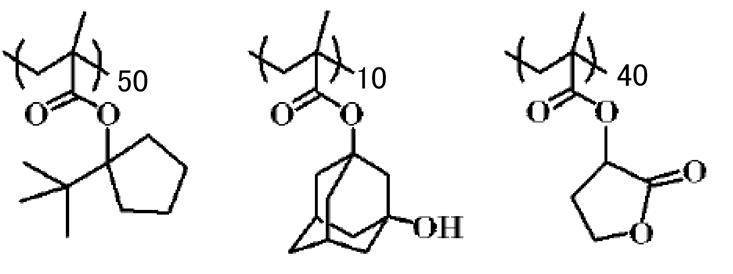
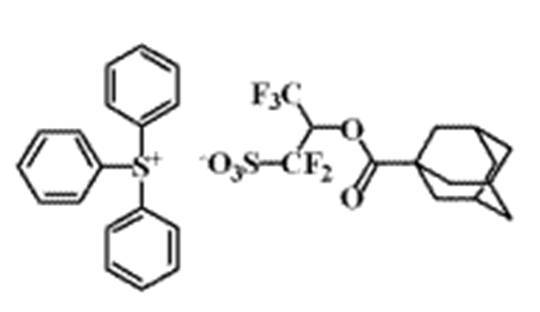

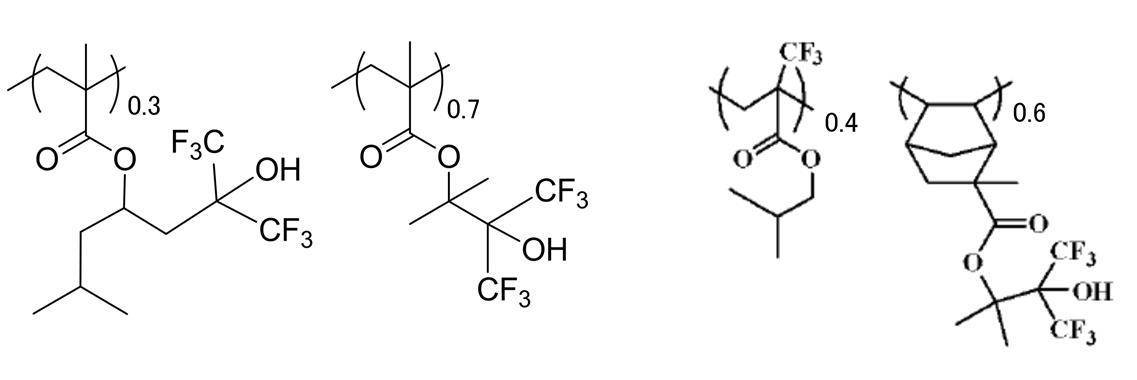
PGMEA(プロピレングリコールモノメチルエーテルアセテート):3質量部
シクロヘキサノン:600質量部
γ-BL(γ-ブチロラクトン):100質量部
酸分解性樹脂(下記式で表される樹脂(重量平均分子量(Mw):8000):各繰り返し単位に記載される数値はモル%を意味する。):100質量部


PGMEA(プロピレングリコールモノメチルエーテルアセテート):3質量部
シクロヘキサノン:600質量部
γ-BL(γ-ブチロラクトン):100質量部
酸分解性樹脂(下記式で表される樹脂(重量平均分子量(Mw):8000):各繰り返し単位に記載される数値はモル%を意味する。):100質量部
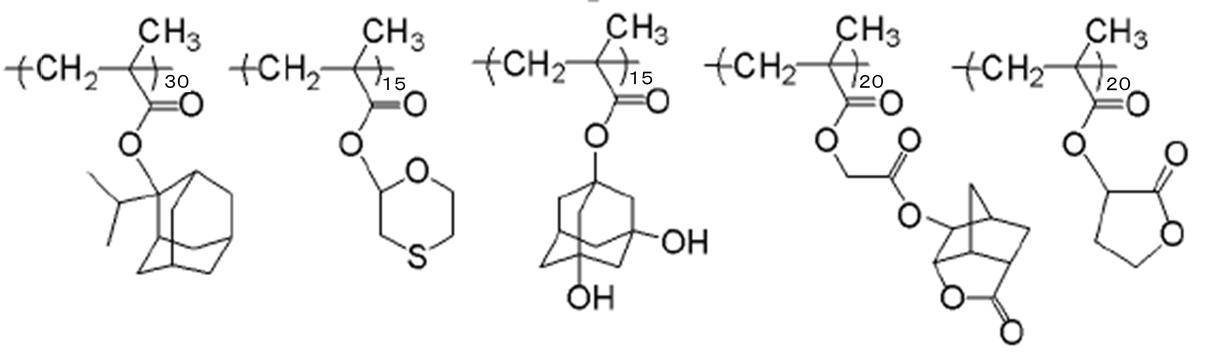

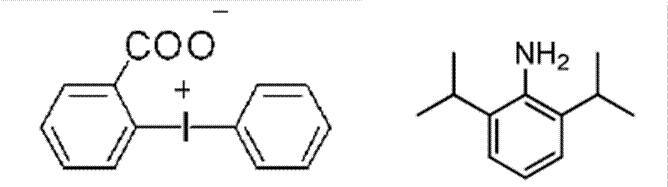

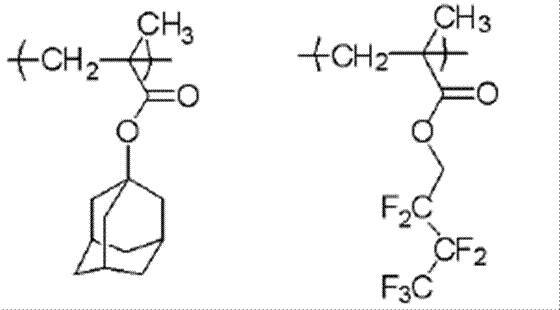
PGMEA(プロピレングリコールモノメチルエーテルアセテート):50質量部
PGME(プロピレングリコールモノメチルエーテル):100質量部
2-ヘプタノン:100質量部
γ-BL(γ-ブチロラクトン):500質量部
下記式で表される繰り返し単位を有する樹脂:レジスト組成物の全質量に対して2.9質量%
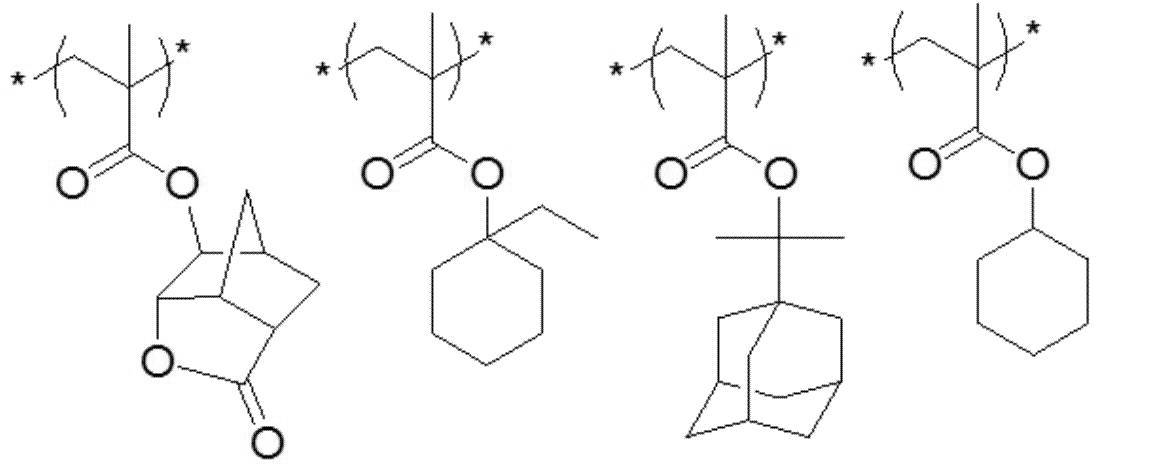
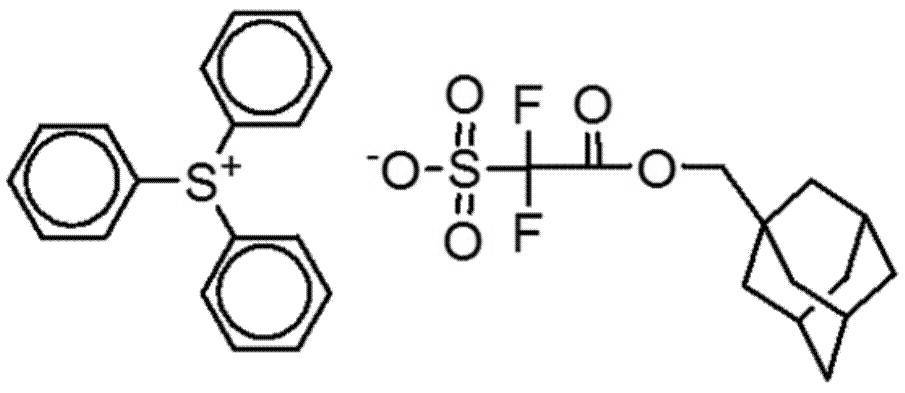
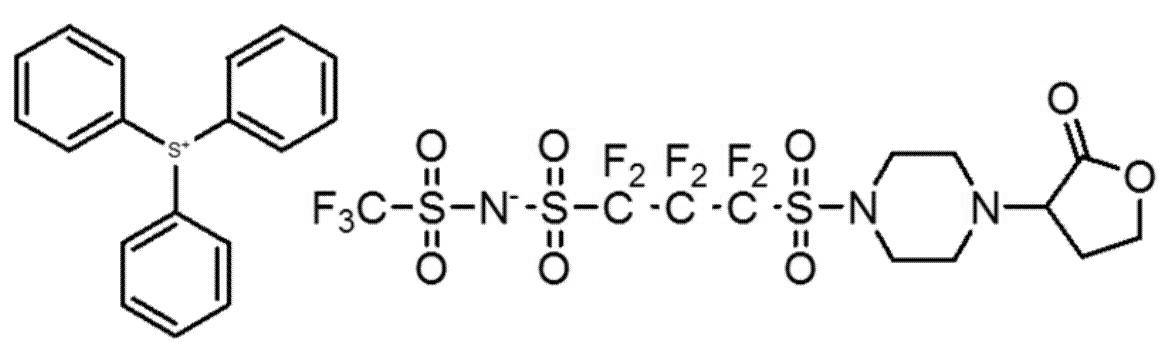
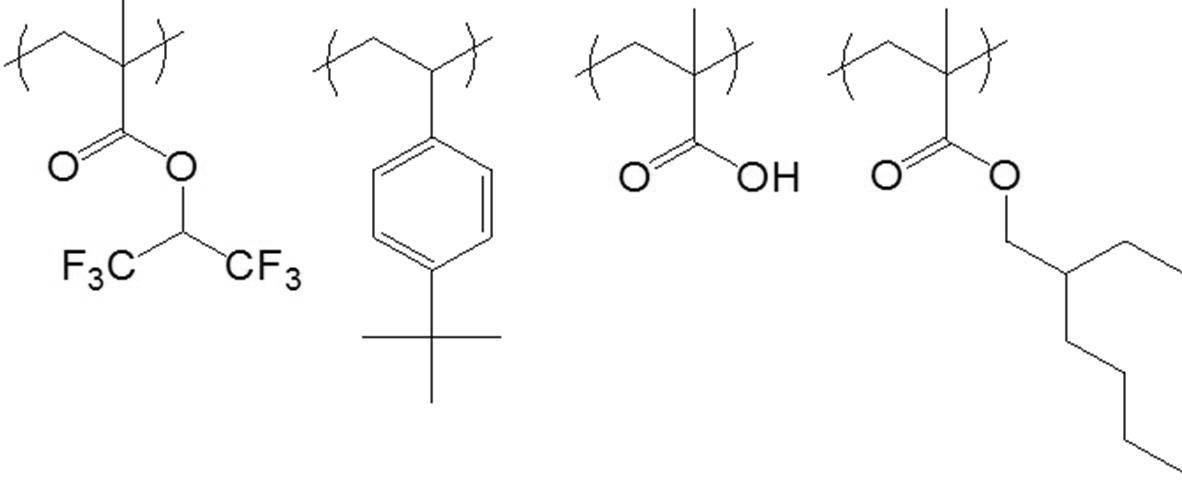

CyHx:レジスト組成物の全質量に対して、残部
下記式で表される繰り返し単位を有する樹脂(各繰り返し単位のモル比率は、左から10/30/10/35/15):レジスト組成物の全質量に対して2.8質量%
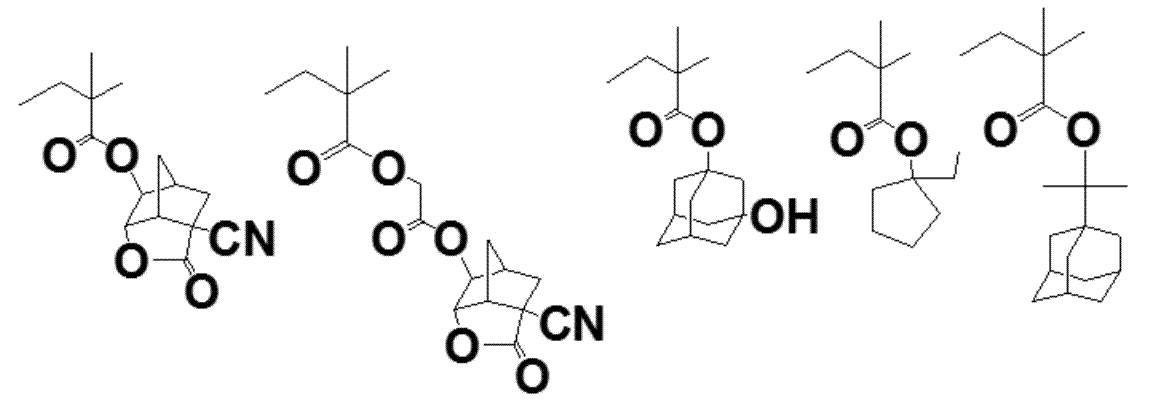
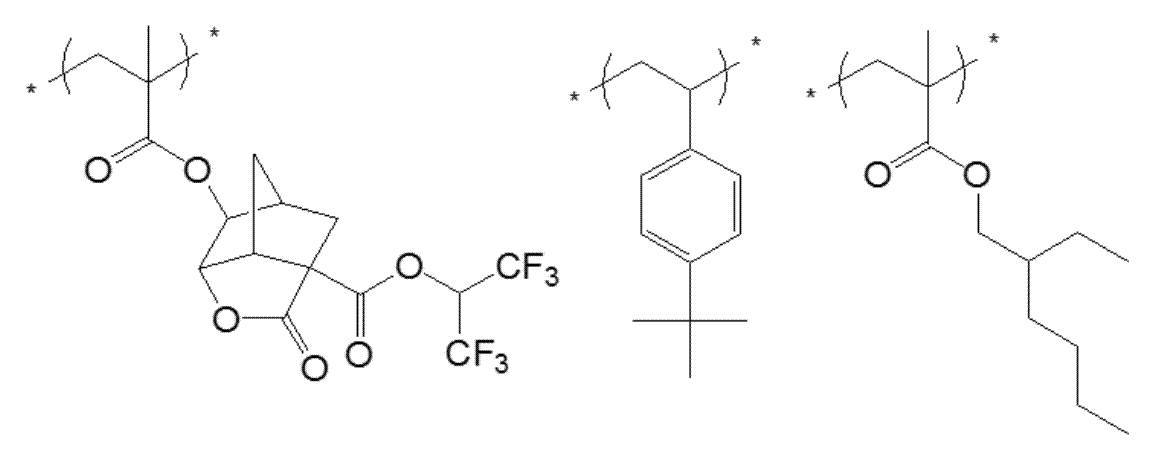
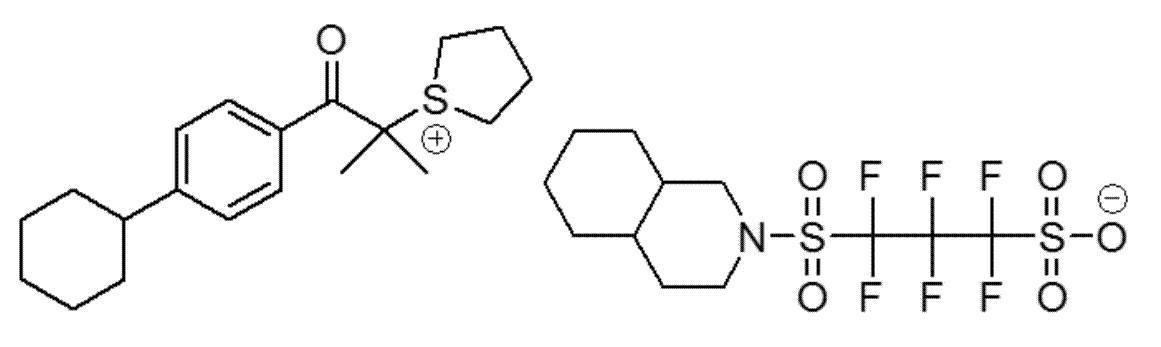

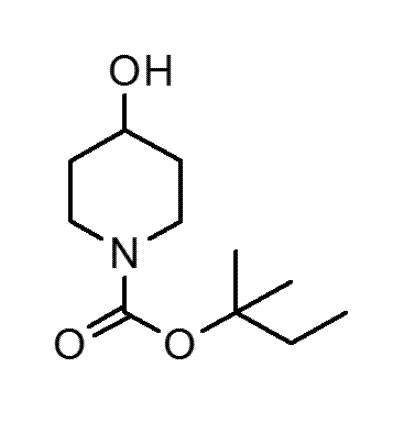
GBL:レジスト組成物の全質量に対して、残部
下記式で表される繰り返し単位を有する樹脂(各繰り返し単位のモル比率は、左から63.33/25.25/11.49、Mwは約21000):レジスト組成物の全質量に対して13質量%
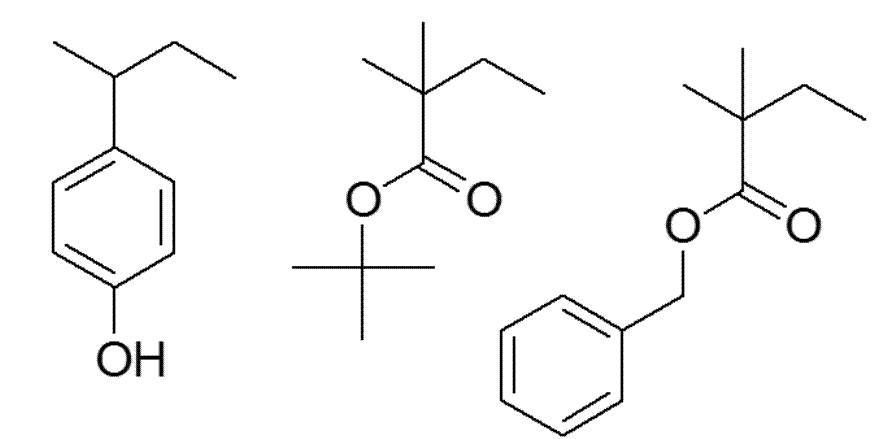
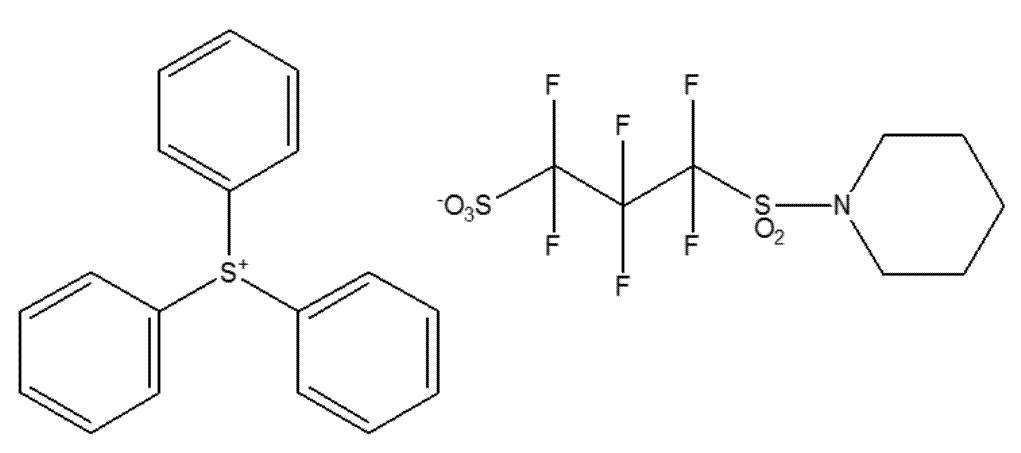
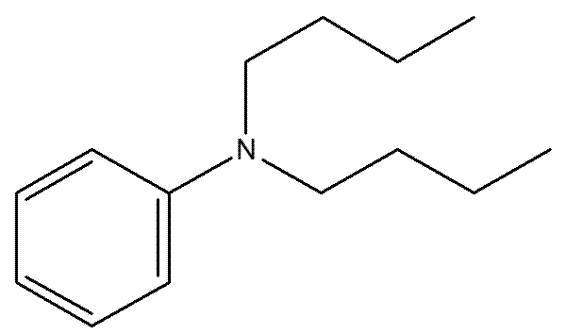
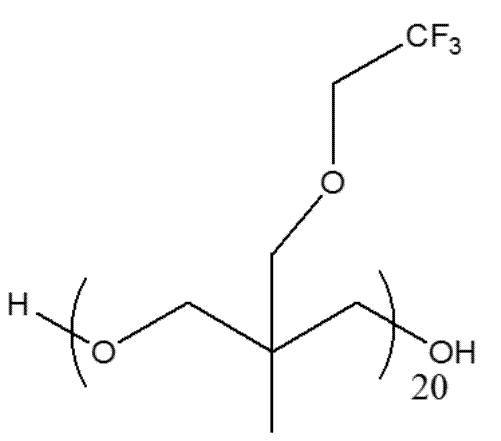
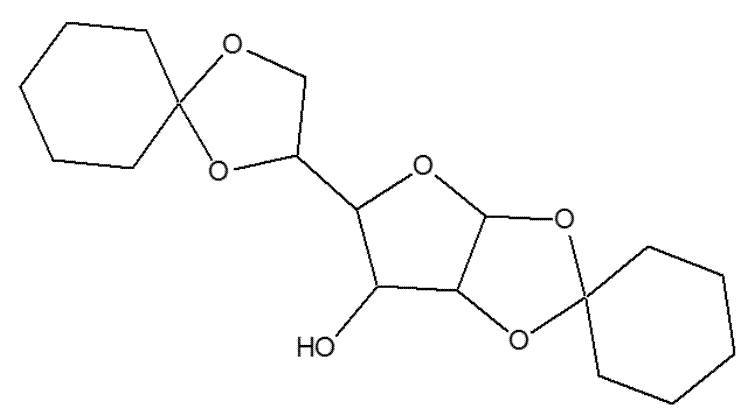
3-エトキシプロピオン酸エチル:レジスト組成物の全質量に対して、残部
また、上記レジスト組成物が含有する各種樹脂の重量平均分子量(Mw)は、展開溶媒としてテトラヒドロフラン(THF)を用いて、GPC法により求められるポリスチレン換算値である。
なお、具体的な装置は以下の通りである。
装置:東ソー社製 HLC-8120
カラム:東ソー社製 TSK gel Multipore HXL-M
各薬液と、樹脂との親和性は、パルス核磁気共鳴方式粒子界面特性評価装置(商品名「Acorn Area」、Xigo nanotools社製)を用いて測定した。
第一試験溶液としては、各薬液に各感活性光線性又は感放射線性樹脂組成物が含有する酸分解性樹脂を0.5%溶解させた溶液を使用した。
第二試験液としては、各薬液に各感活性光線性又は感放射線性樹脂組成物が含有する酸分解性樹脂を3.0%溶解させた溶液を使用した。
上記各溶液について、25℃の条件下で、τ0、τ1、及び、τ2を求め、Rsq1、及び、SRsqを算出した。結果は以下の基準により分類し、表1に示した。
A:Rsq1が0.5を超えた。
B:Rsq1が0.5以下だった。
A:SRsqが-1を超えた。
B:SRsqが-1以下だった。
以下の方法により、薬液の欠陥抑制性能を評価した。なお、下記試験には、SOKUDO社製コータデベロッパ「RF3S」を用いた。
まず、直径約300mm(12インチ)のベアシリコン基板(シリコンウェハ)を準備した。次に、シリコンウェハ上に反射防止膜組成物を塗布し、200℃で60秒ベークし、反射防止膜(厚みは89nm)を形成した。次に、反射防止膜上に各薬液を滴下して、連続して、感活性光線性又は感放射線性樹脂組成物を塗布して、90℃で60秒ベークして、厚み85nmのレジスト膜を形成した。次に、レジスト膜を露光し、100℃で、60秒間ベークした。次に、露光後のレジスト膜を有機溶剤系の現像液で現像した。現像後のレジスト膜を100℃で、60秒ベークして、パターンを得た。
アプライドマテリアルズ社製ウェハ検査装置「UVision5」を用いて、上記パターンの画像を取得し、得られた画像を、アプライドマテリアルズ社製全自動欠陥レビュー装置「SEMVisionG4」で解析し、単位面積当たりのパターン欠陥数を計測した。なお、本明細書におけるパターン欠陥数とは、未露光部における残渣数(表1中で「未露光部残渣」と記載した。)、パターン同士の架橋様の不良数(BRIDGE欠陥数、表1中で「BRIDGE」と記載した。)、及び、パターン倒れ箇所数(表1中で「パターン倒れ」と記載した。)をそれぞれ意味し、表1にはそれぞれの結果を以下の基準により評価して示した。
・A:パターン欠陥数が30個以上、60個未満だった。
・B:パターン欠陥数が60個以上、90個未満だった。
・C:パターン欠陥数が90個以上、120個未満だった。
・D:パターン欠陥数が120個以上だった。
薬液塗布後のレジスト組成物の省レジスト性を以下の方法により評価した。なお、本明細書において、優れた省レジスト性を有する、とは、優れた均一性と、優れた膜厚制御性とを有する状態を意図する。
まず、対照として、反射防止膜を備える直径約30cm(12インチ)のシリコンウェハ上に上記レジスト組成物を直接塗布した。なお、塗布には、スピンコータ(商品名「LITHIUS」、東京エレクトロン社製)を用いた。得られたレジスト膜は90℃でベークした。ベーク後のレジスト膜について、大日本スクリーン社製膜厚測定装置Lambda Aceを用いて59ポイントmap測定して、塗布斑が発生していないことを確認した。なお、塗布斑とは、測定対象のレジスト膜から円状に59点の測定点を抽出し、各測定点におけるレジスト膜の厚みの測定結果を、測定点ごとに二次元的に配置して観察した場合に、レジスト膜の厚みにムラがない状態を意図する。
次に、反射防止膜を備える直径約30cm(12インチ)のシリコンウェハを別に準備し、各薬液を滴下した。その後、対照と同量のレジスト組成物を塗布して90℃でベークした。得られたレジスト膜について、上記と同様の方法で観察し、塗布斑が発生していないことを確認した。次に、使用するレジスト組成物を対照の50質量%、及び、30質量%に減量して上記と同様の試験を行い、塗布斑が発生するかを調べた。
結果は以下の基準により評価し結果を表2に示した。
B:レジスト組成物の使用量を対照の50質量%に減量しても、塗布斑が発生しなかったが、対照の30質量%に減量すると、塗布斑が発生した。
C:レジスト組成物の使用量を対照の30質量%、及び、50質量%に減量すると、いずれも塗布斑が発生した。
反射防止膜を備える直径約30cm(12インチ)のシリコンウェハ上に、各薬液を滴下した。その後、得られるレジスト膜の厚みが8.5nmとなるよう、上記レジスト組成物を直接塗布した。なお、塗布には、スピンコータ(商品名「LITHIUS」、東京エレクトロン社製)を用いた。得られたレジスト膜は90℃でベークした。ベーク後のレジスト膜について、大日本スクリーン社製膜厚測定装置Lambda Aceを用いて59ポイントmap測定し、レジスト膜の厚みの標準偏差(以下「σ」ともいう。)を求めた。次に、標準偏差から3σを求めた。結果は以下の基準により評価し、表1に示した。
B:3σが0.15nm以上、0.2nm未満だった。
C:3σが0.2nm以上だった。
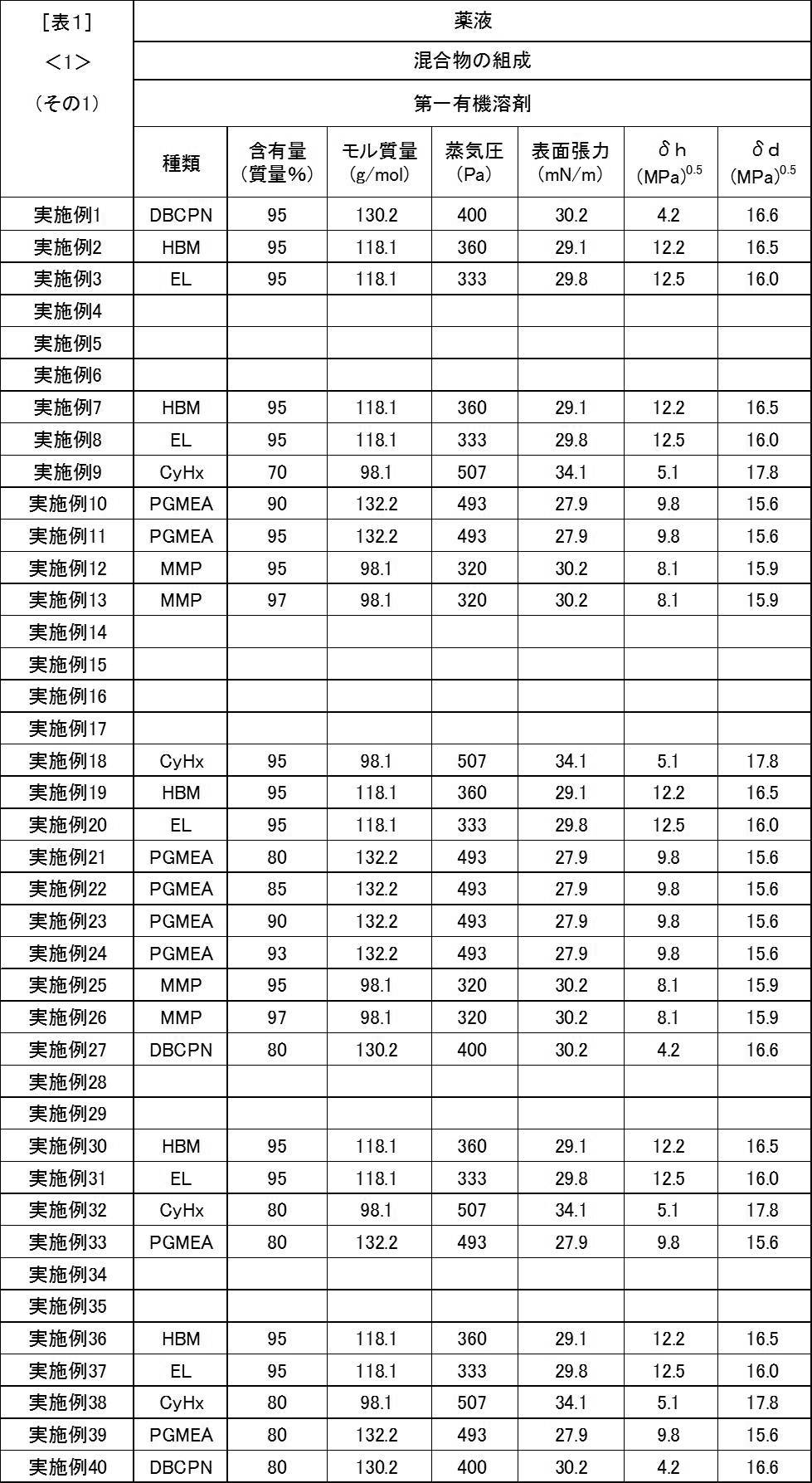
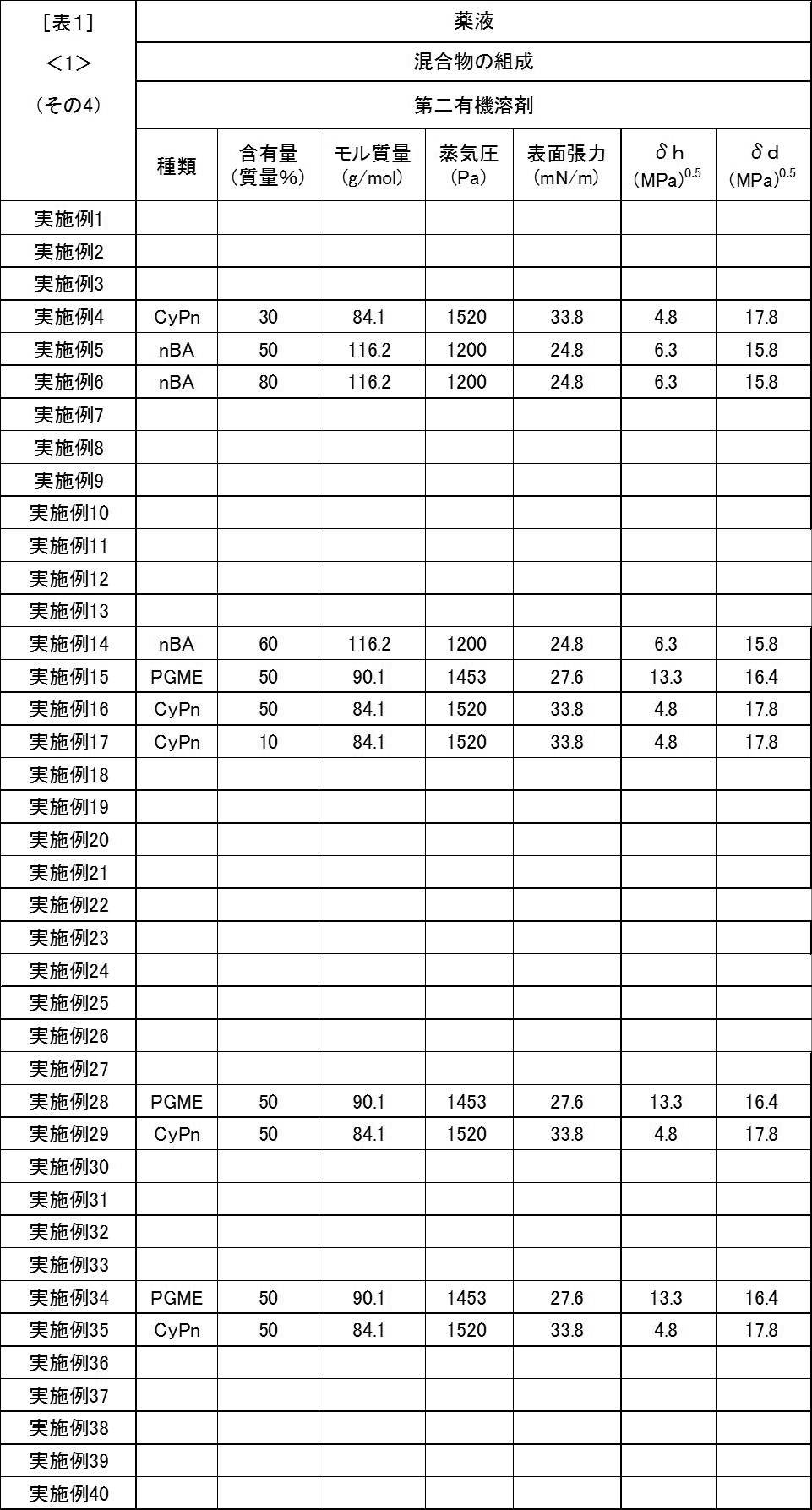

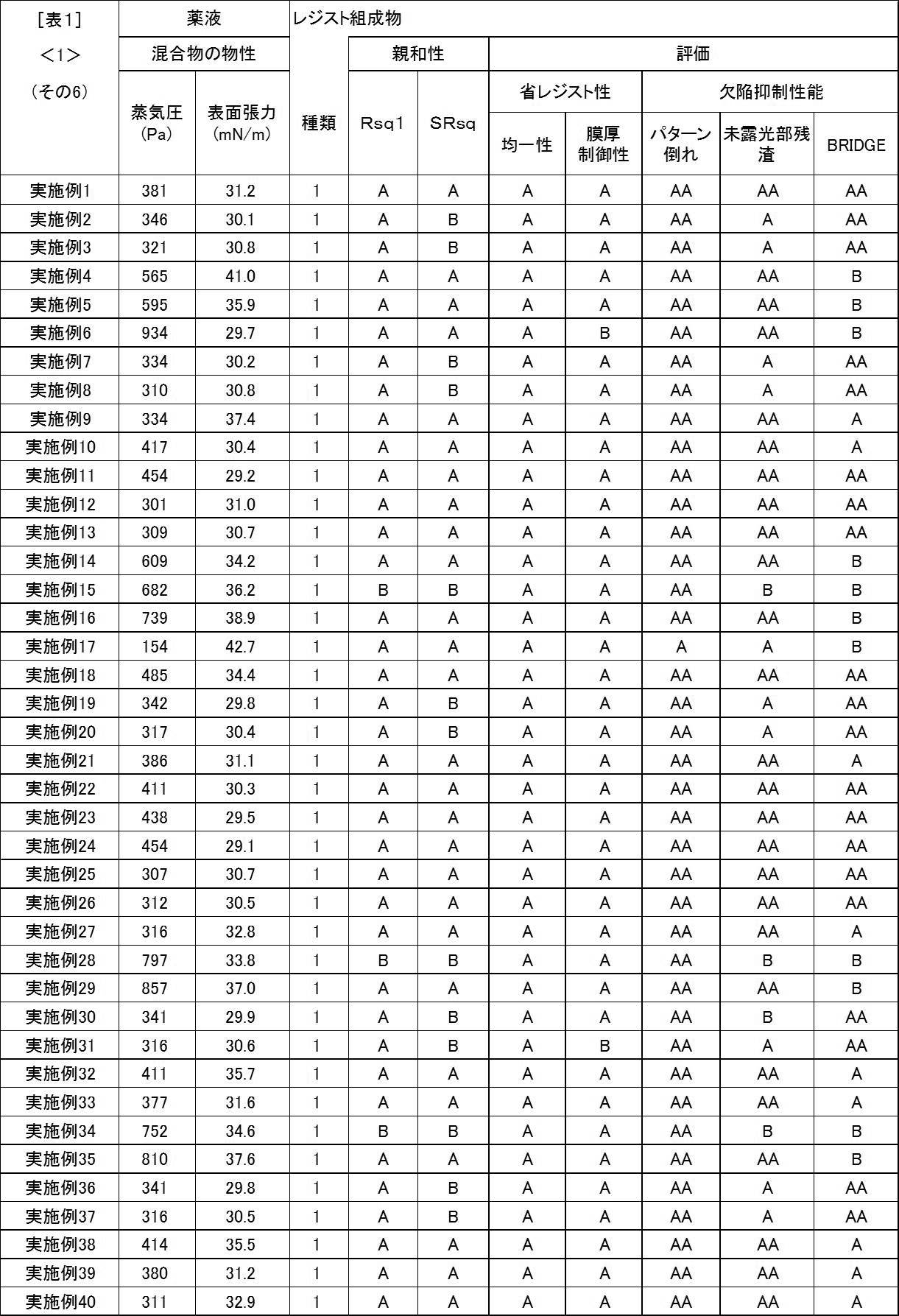
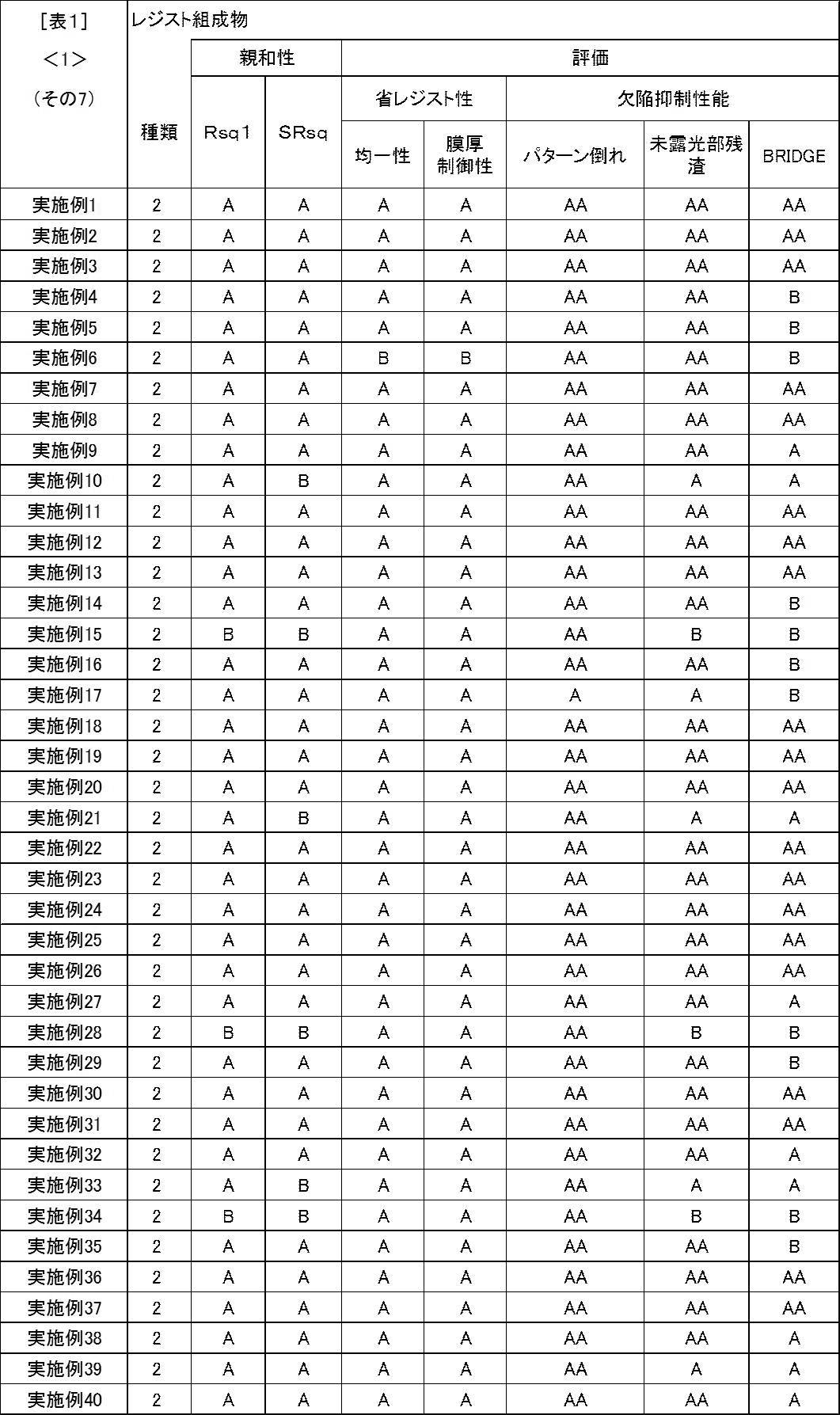
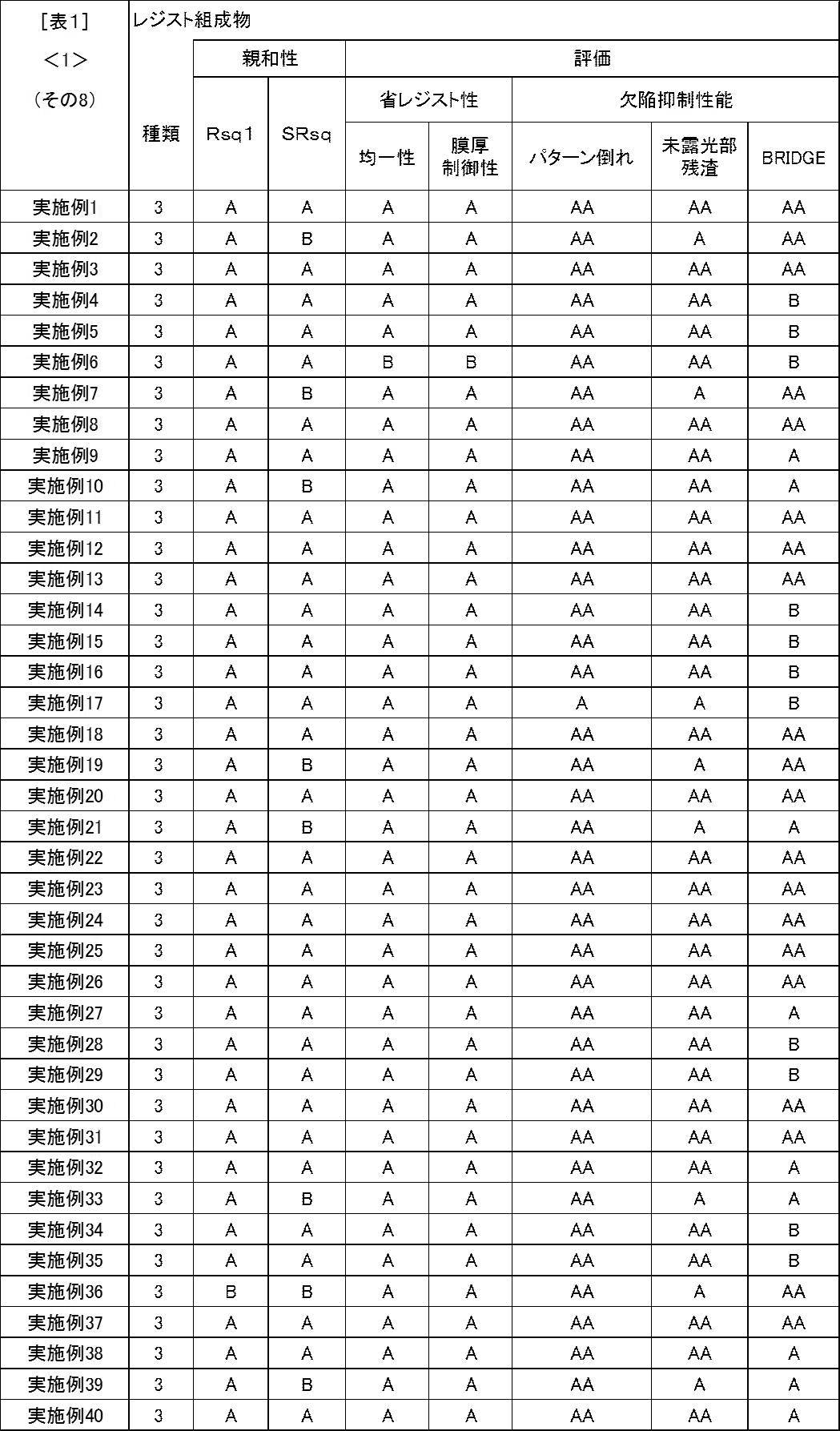

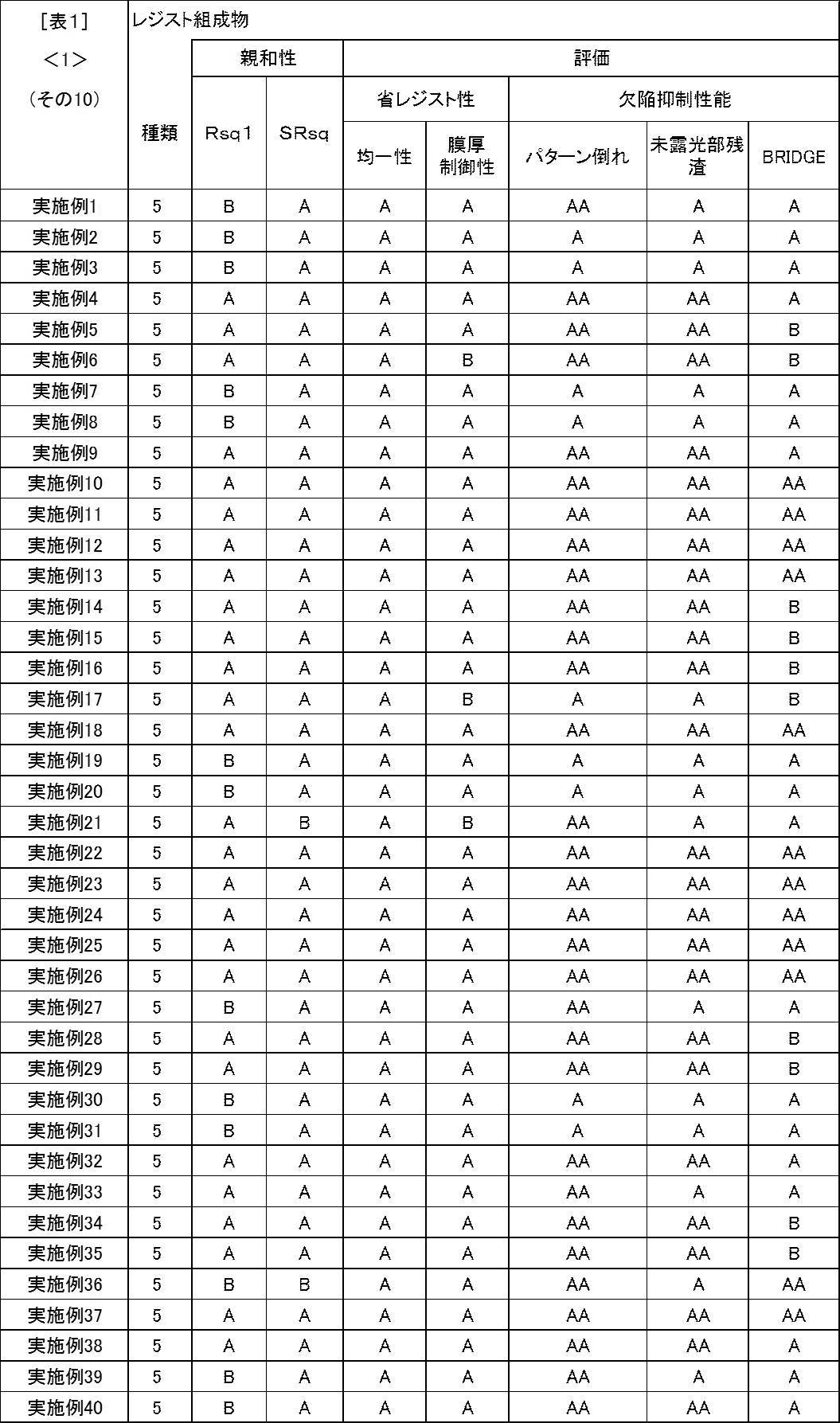

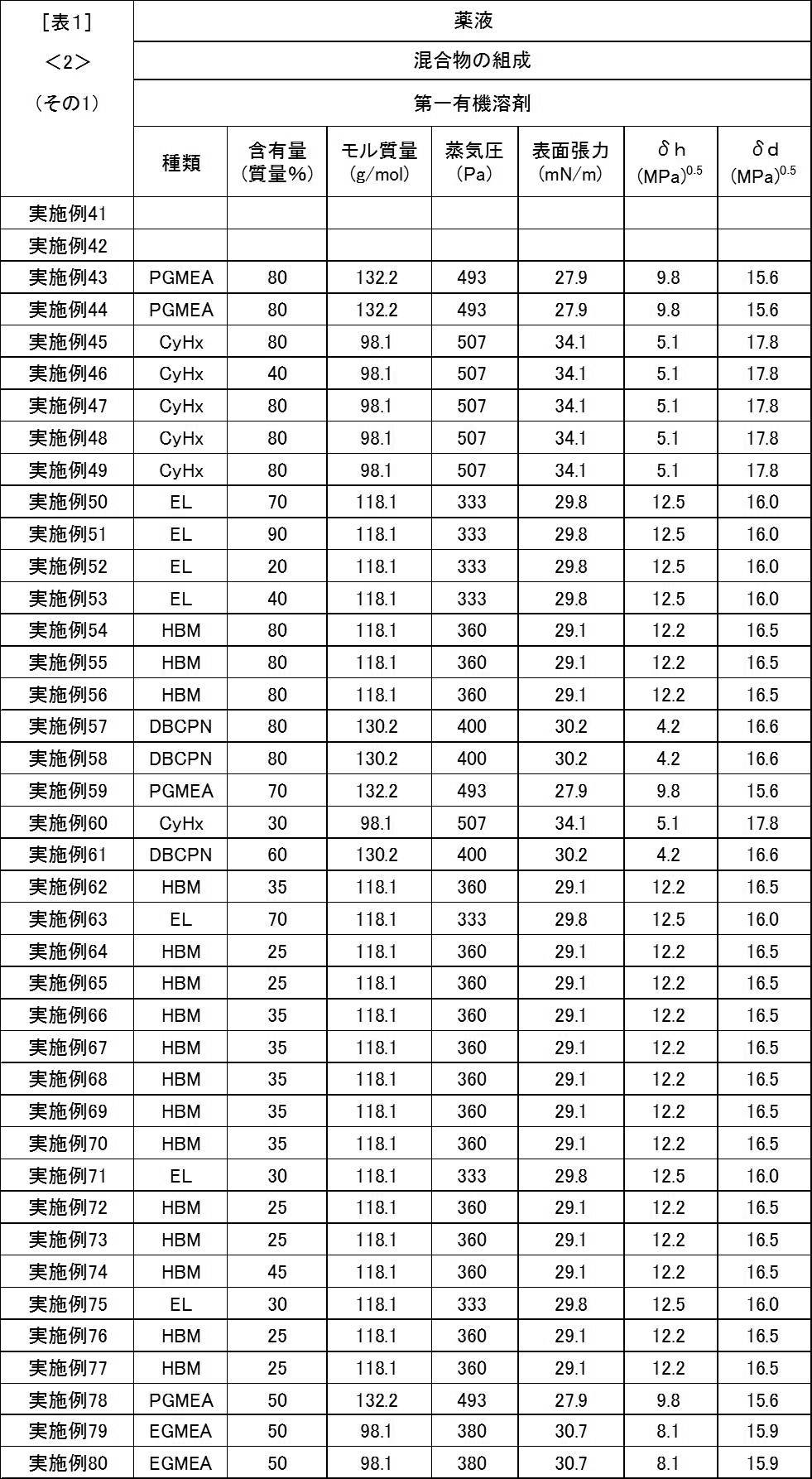


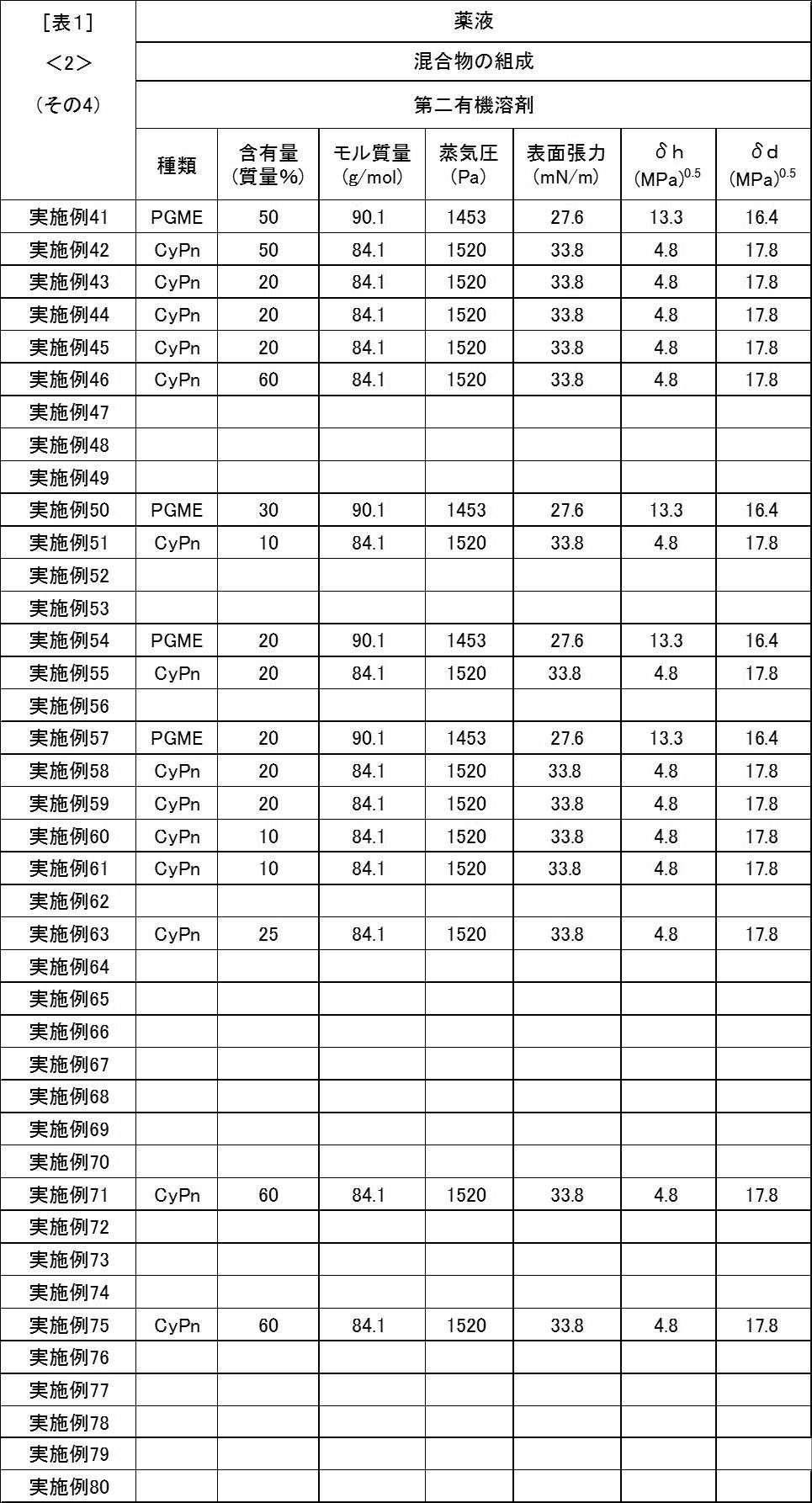
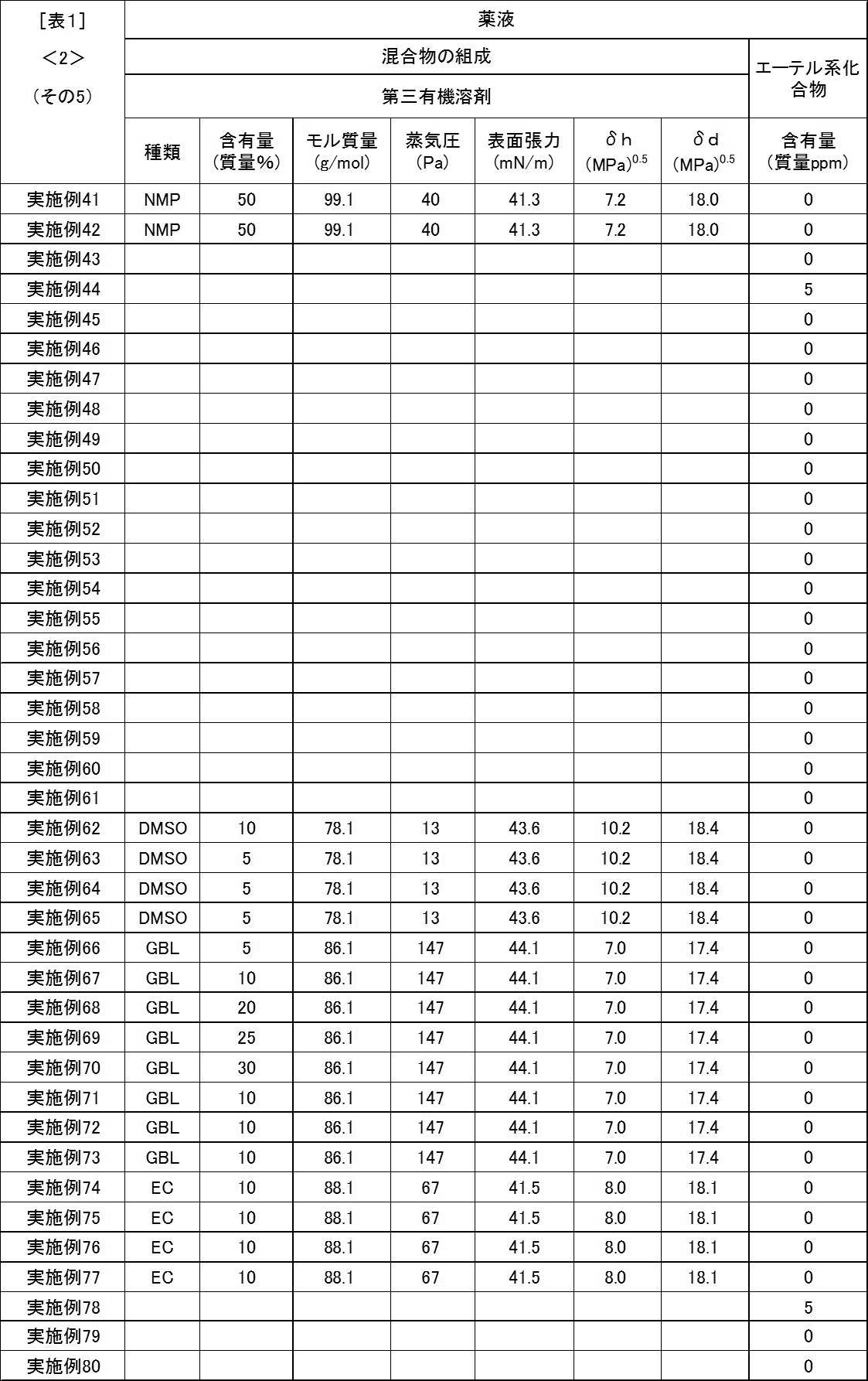


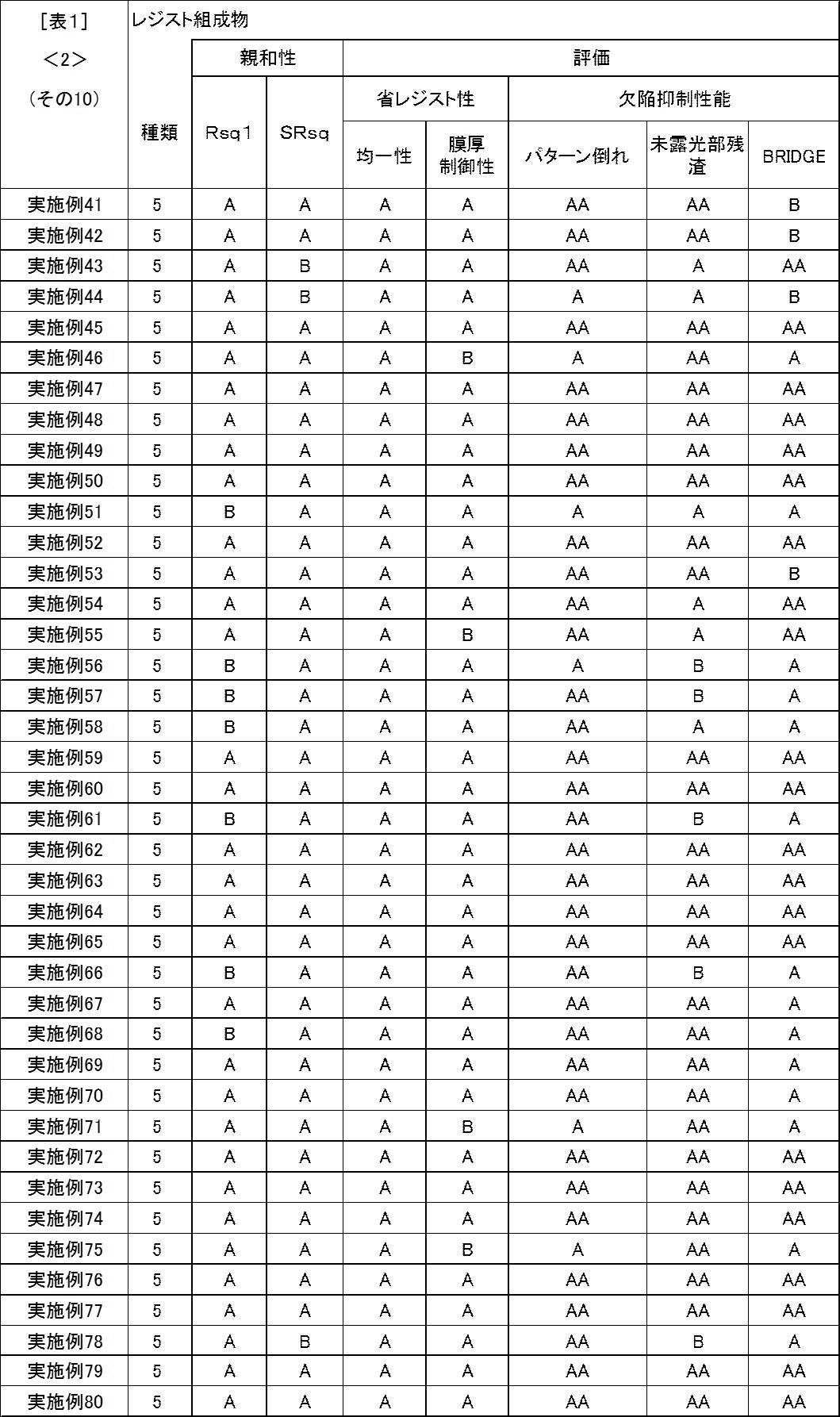

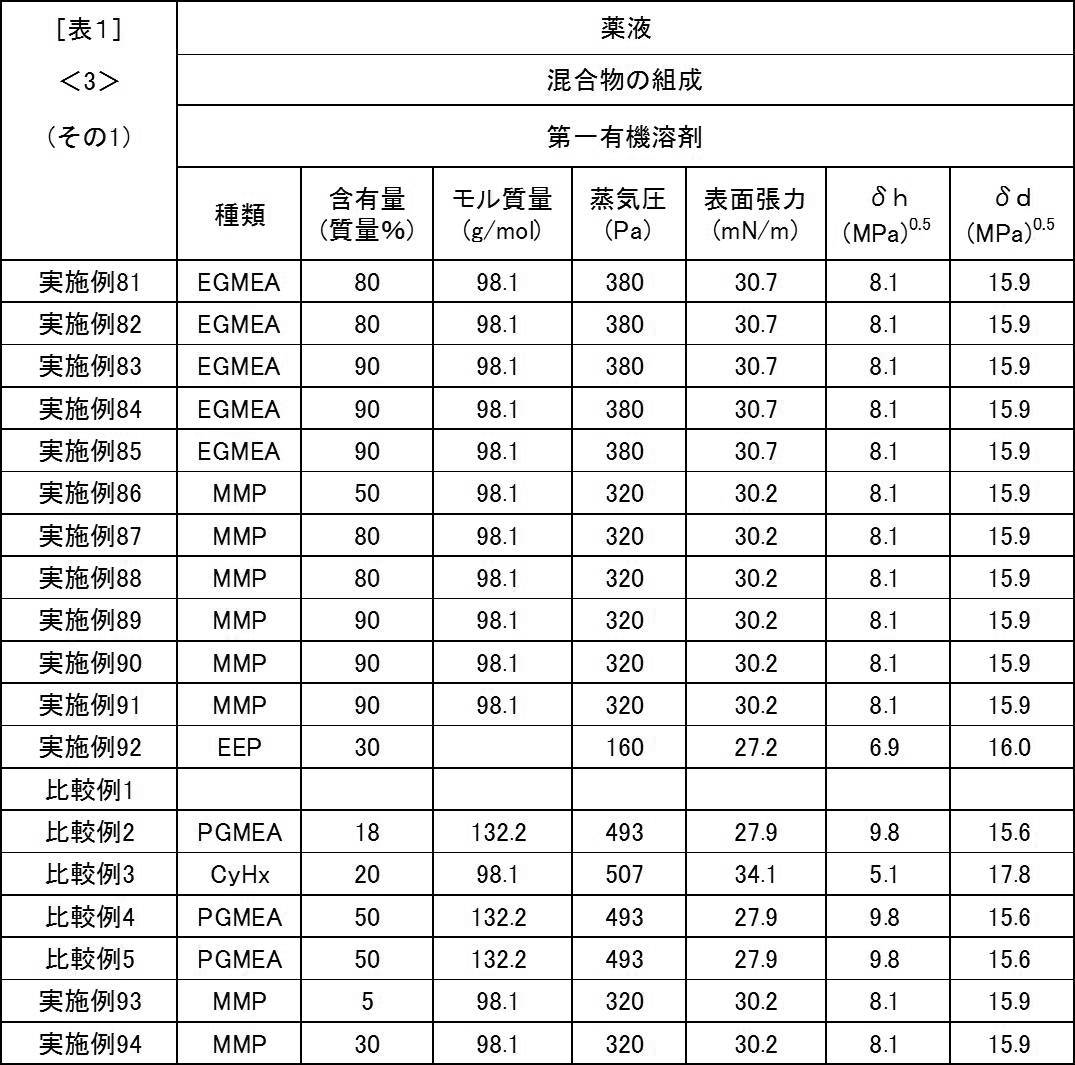
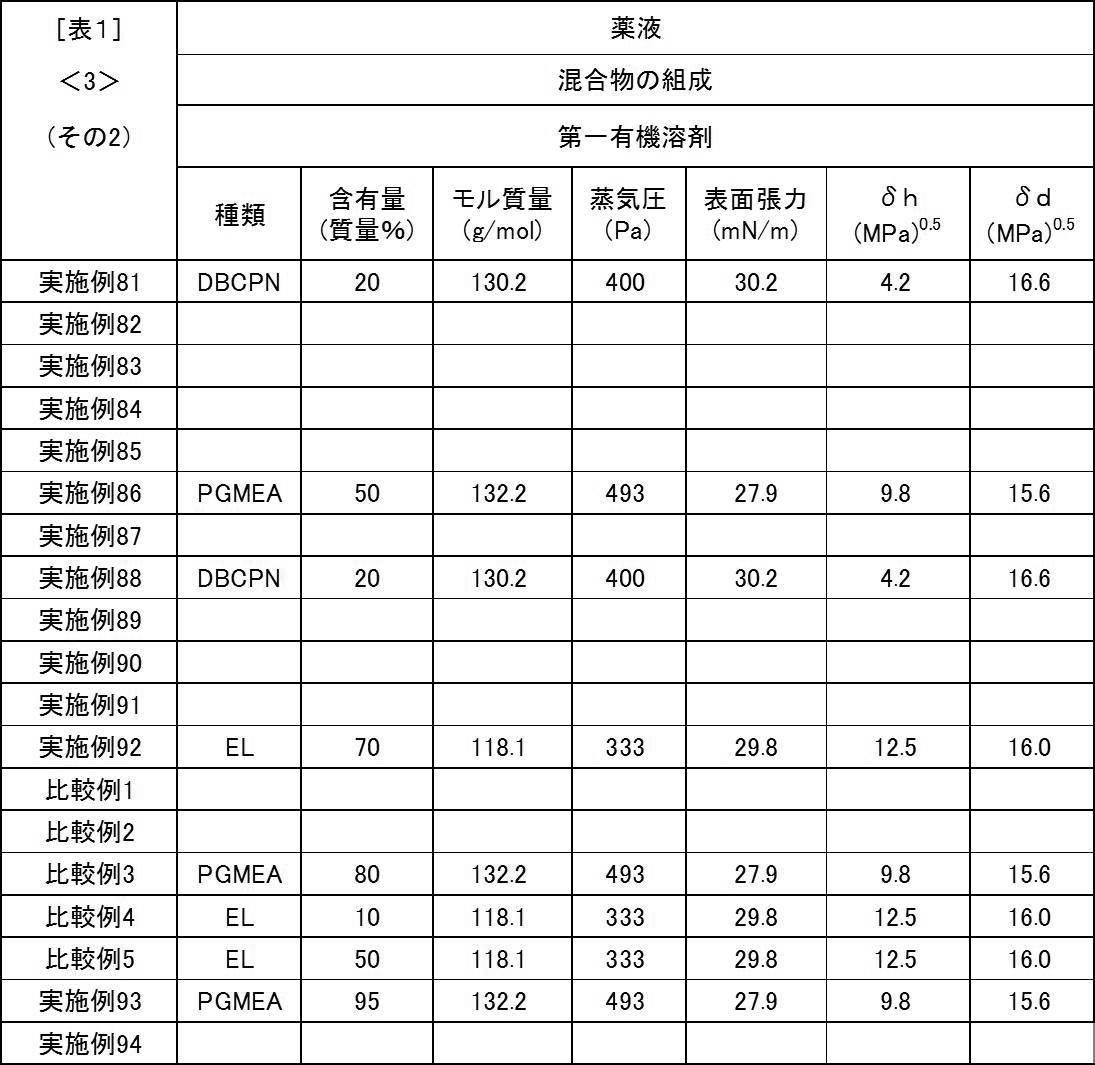


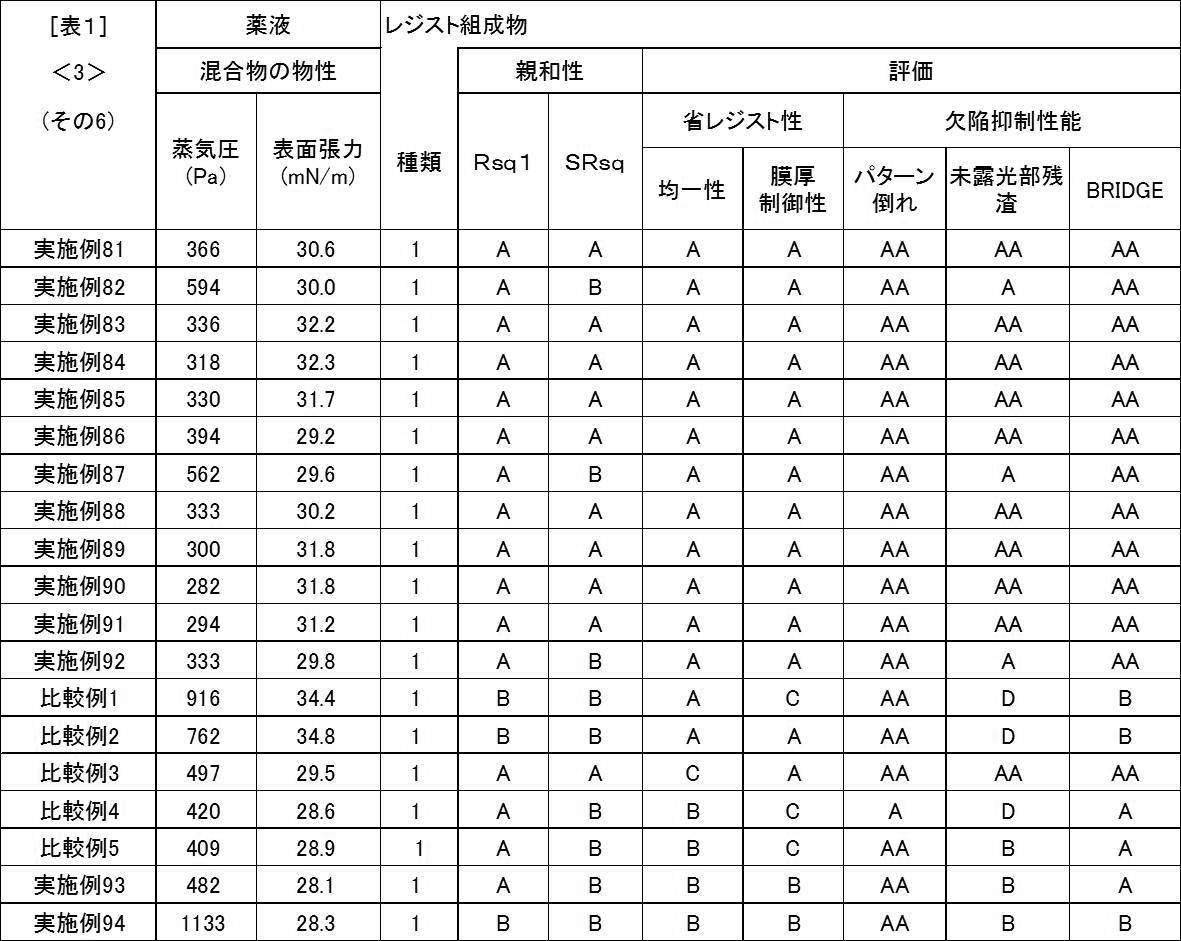
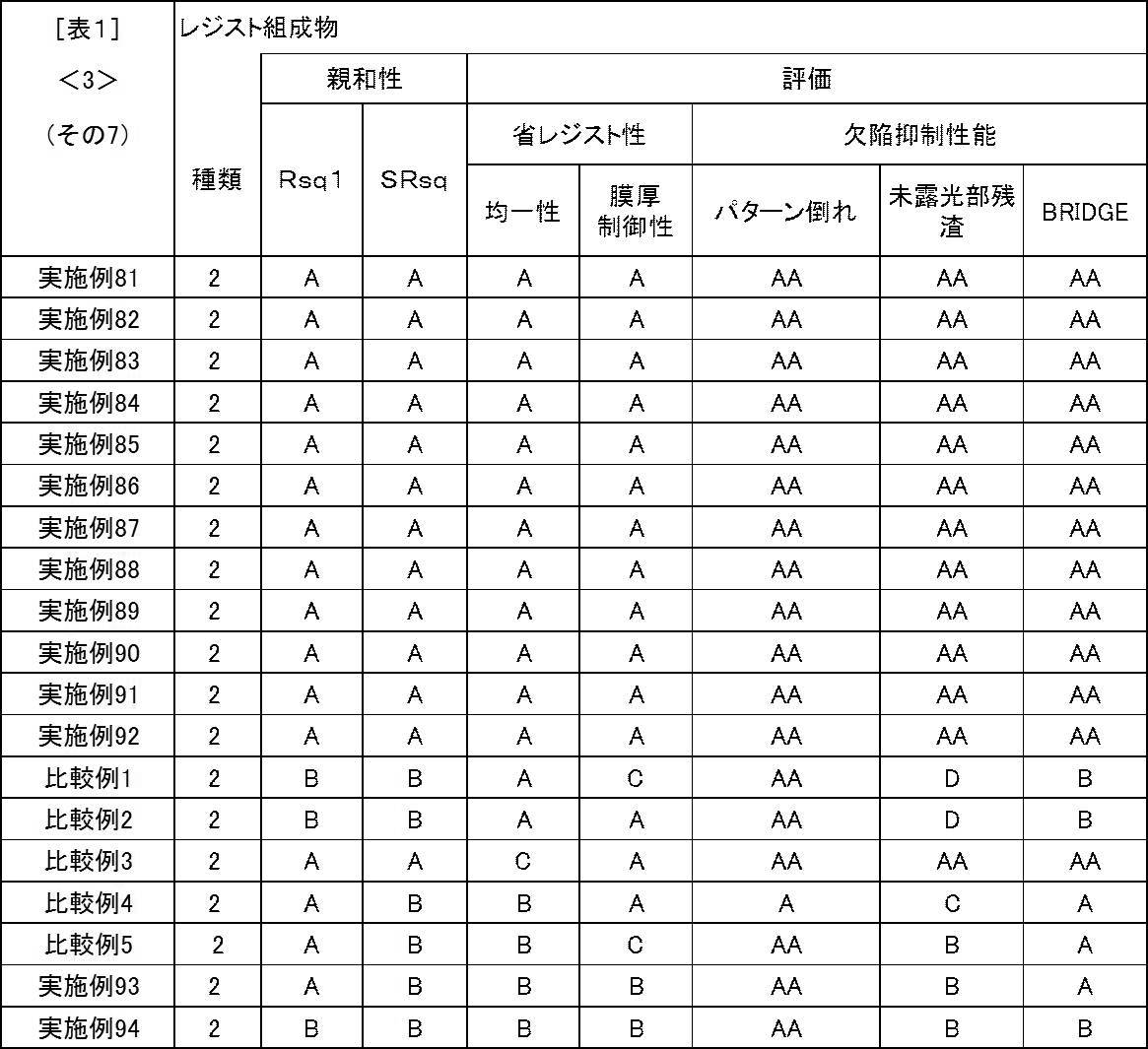


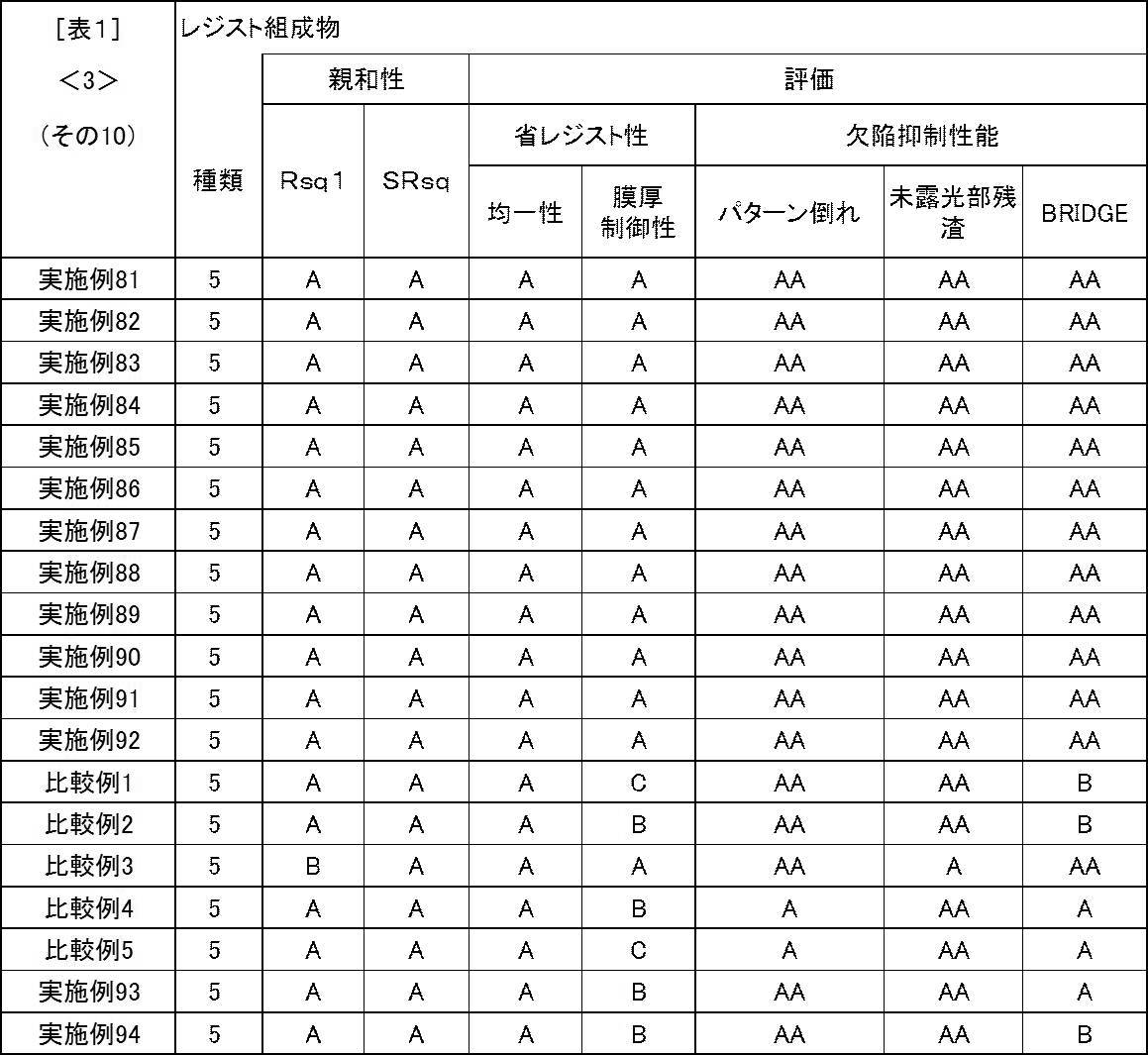

表1において、実施例1の薬液は、[表1]<1>(その1)~[表1]<1>(その11)の対応する各行にわたって記載されている。すなわち、実施例の薬液は、[表1]<1>(その1)~[表1]<1>(その11)のそれぞれの1行目に記載されており、実施例1の薬液は、混合物として、第一有機溶剤のDBCPN(DBCPNの物性は表に記載したとおりである)を95質量%含有し、第二有機溶剤を含有せず、第三有機溶剤のGBL(GBLの物性は表に記載したとおりである)を5質量%含有し、エーテル系化合物の含有量が0質量ppmであり、混合物の物性として、蒸気圧が381Paであり、表面張力が31.2mN/mであることを表わしている。また、実施例1の薬液と、レジスト組成物1との親和性としては、Rsq1が「A」であり、SRsqが「A」であり、評価として、均一性が「A」、膜厚制御性が「A」、パターン倒れが「AA」、未露光部残渣が「AA」、BRIDGEが「AA」であり、実施例1の薬液と、レジスト組成物2との親和性としては、Rsq1が「A」であり、SRsqが「A」であり、評価として、均一性が「A」、膜厚制御性が「A」、パターン倒れが「AA」、未露光部残渣が「AA」、「BRIDGE」が「AA」であり、実施例1の薬液と、レジスト組成物3との親和性としては、Rsq1が「A」であり、SRsqが「A」であり、評価として、均一性が「A」、膜厚制御性が「A」、パターン倒れが「AA」、未露光部残渣が「AA」、「BRIDGE」が「AA」であり、実施例1の薬液と、レジスト組成物4との親和性としては、Rsq1が「B」であり、SRsqが「A」であり、評価として、均一性が「A」、膜厚制御性が「A」、パターン倒れが「AA」、未露光部残渣が「A」、「BRIDGE」が「A」であり、実施例1の薬液と、レジスト組成物5との親和性としては、Rsq1が「B」であり、SRsqが「A」であり、評価として、均一性が「A」、膜厚制御性が「A」、パターン倒れが「AA」、未露光部残渣が「A」、「BRIDGE」が「A」であり、実施例1の薬液と、レジスト組成物5との親和性としては、Rsq1が「B」であり、SRsqが「A」であり、評価として、均一性が「A」、膜厚制御性が「A」、パターン倒れが「AA」、未露光部残渣が「A」、「BRIDGE」が「A」であり、実施例1の薬液と、レジスト組成物6との親和性としては、Rsq1が「B」であり、SRsqが「A」であり、評価として、均一性が「A」、膜厚制御性が「A」、パターン倒れが「AA」、未露光部残渣が「AA」、「BRIDGE」が「A」であることを表わしている。 その他の実施例、比較例についても上記と同様であり、実施例41の薬液は、[表1]<2>(その1)~[表1]<2>(その11)にわたって成分及びその評価を記載した。また、実施例81の薬液は、[表1]<3>(その1)~[表1]<3>(その11)にわたって成分及びその評価を記載した。その他の各実施例、及び、比較例の薬液についても上記と同様である。
また、表1中、各有機溶剤の「含有量」とは、薬液に含有される混合物中における各有機溶剤の含有量を表す。
また、混合物の25℃における蒸気圧が、160~1000Paの範囲内である、実施例38の薬液は、実施例46の薬液と比較して、より優れた省レジスト性、及び、より優れた欠陥抑制性能を有していた。また、実施例17の薬液と比較してより優れた欠陥抑制性能を有していた。
Claims (15)
- 2種以上の有機溶剤の混合物を含有する、薬液であって、
前記有機溶剤が、下記式(1)~(7)で表される化合物、下記式(9)~(11)で表される化合物、置換基を含有してもよい環員数3~5の環状ケトン化合物、置換基を含有してもよい環員数6以上の環状ケトン化合物、ラクトン化合物、及び、ラクタム化合物からなる群から選択され、かつ、
下記式(1)、下記式(5)、下記式(7)、及び、下記式(9)~(11)で表される化合物以外のエーテル系化合物を含有しないか、又は、前記エーテル系化合物を含有する場合は、前記薬液中における前記エーテル系化合物の含有量が、前記薬液の全質量に対して10質量ppm未満である、薬液。
ただし、前記混合物が、ラクトン化合物、及び、式(5)で表される化合物からなる薬液、前記混合物が、置換基を含有してもよい環員数6以上の環状ケトン化合物、及び、式(1)で表される化合物からなる薬液、前記混合物が、ラクトン化合物、式(1)で表される化合物、及び、式(5)で表される化合物からなる薬液、並びに、前記混合物が、式(1)で表される化合物、及び、式(3)で表される化合物からなる薬液を除く。

式(1)中、R11、及び、R12は、それぞれ独立にアルキル基を表し、R13は水素原子、又は、アルキル基を表し、L1は、単結合、又は、アルキレン基を表す。
式(2)中、R21、及び、R22は、それぞれ独立に水素原子、又は、アルキル基を表し、L2は単結合、又は、アルキレン基を表す。
式(3)中、R31、及び、R32は、それぞれ独立に水素原子、又は、アルキル基を表し、複数あるR32の少なくとも一方はアルキル基を表す。L3は単結合、又は、アルキレン基を表す。
式(4)中、R41、及び、R42は、それぞれ独立にアルキル基を表す。
式(5)中、R51、及び、R52は、それぞれ独立にアルキル基を表し、L5は単結合、又は、アルキレン基を表す。
式(6)中、R61、及び、R62は、それぞれ独立にアルキル基を表し、R61とR62は互いに結合して環を形成してもよい。
式(7)中、R71、R72、R73、R74は、それぞれ独立にアルキル基を表し、R71とR72は互いに結合して環を形成してもよい。
式(9)中、R91、及び、R92はそれぞれ独立にアルキル基を表す。
式(10)中、L10は、単結合、又は、アルキレン基を表し、R101はアルキル基を表す。
式(11)中、L11は、単結合、又は、アルキレン基を表し、R111はアルキル基を表す。 - 2種以上の有機溶剤の混合物を含有する、薬液であって、
前記混合物が、
γ-ブチロラクトン、並びに、酢酸ブチル、乳酸エチル、2-ヒドロキシイソ酪酸メチル、シクロペンタノンジメチルアセタール、シクロペンタノン、アニソール、フェネトール、エチレングリコールモノメチルエーテルアセテート、3-メトキシプロピオン酸メチル、及び、3-エトキシプロピオン酸エチルからなる群から選択される少なくとも1種、を含有するか、
ジメチルスルホキシド、並びに、プロピレングリコールモノメチルエーテルアセテート、酢酸ブチル、乳酸エチル、2-ヒドロキシイソ酪酸メチル、プロピレングリコールモノメチルエーテル、シクロペンタノンジメチルアセタール、シクロペンタノン、シクロヘキサノン、アニソール、フェネトール、エチレングリコールモノメチルエーテルアセテート、3-メトキシプロピオン酸メチル、及び、3-エトキシプロピオン酸エチルからなる群から選択される少なくとも1種、を含有するか、
炭酸エチレン、並びに、プロピレングリコールモノメチルエーテルアセテート、酢酸ブチル、乳酸エチル、2-ヒドロキシイソ酪酸メチル、プロピレングリコールモノメチルエーテル、シクロペンタノンジメチルアセタール、シクロペンタノン、シクロヘキサノン、アニソール、フェネトール、エチレングリコールモノメチルエーテルアセテート、3-メトキシプロピオン酸メチル、及び、3-エトキシプロピオン酸エチルからなる群から選択される少なくとも1種、を含有するか、
炭酸プロピレン、並びに、プロピレングリコールモノメチルエーテルアセテート、酢酸ブチル、乳酸エチル、2-ヒドロキシイソ酪酸メチル、プロピレングリコールモノメチルエーテル、シクロペンタノンジメチルアセタール、シクロペンタノン、シクロヘキサノン、アニソール、フェネトール、エチレングリコールモノメチルエーテルアセテート、3-メトキシプロピオン酸メチル、及び、3-エトキシプロピオン酸エチルからなる群から選択される少なくとも1種、を含有するか、
1-メチル-2-ピロリドン、並びに、プロピレングリコールモノメチルエーテルアセテート、酢酸ブチル、乳酸エチル、2-ヒドロキシイソ酪酸メチル、プロピレングリコールモノメチルエーテル、シクロペンタノンジメチルアセタール、シクロペンタノン、シクロヘキサノン、アニソール、フェネトール、エチレングリコールモノメチルエーテルアセテート、3-メトキシプロピオン酸メチル、及び、3-エトキシプロピオン酸エチルからなる群から選択される少なくとも1種、を含有するか、
プロピレングリコールモノメチルエーテルアセテート、並びに、酢酸ブチル、シクロペンタノンジメチルアセタール、シクロペンタノン、アニソール、フェネトール、エチレングリコールモノメチルエーテルアセテート、3-メトキシプロピオン酸メチル、及び、3-エトキシプロピオン酸エチルからなる群から選択される少なくとも1種、を含有するか、
シクロヘキサノン、並びに、酢酸ブチル、乳酸エチル、2-ヒドロキシイソ酪酸メチル、プロピレングリコールモノメチルエーテル、シクロペンタノンジメチルアセタール、シクロペンタノン、アニソール、フェネトール、エチレングリコールモノメチルエーテルアセテート、3-メトキシプロピオン酸メチル、及び、3-エトキシプロピオン酸エチルからなる群から選択される少なくとも1種、を含有するか、
乳酸エチル、並びに、酢酸ブチル、プロピレングリコールモノメチルエーテル、シクロペンタノンジメチルアセタール、シクロペンタノン、アニソール、フェネトール、エチレングリコールモノメチルエーテルアセテート、3-メトキシプロピオン酸メチル、及び、3-エトキシプロピオン酸エチルからなる群から選択される少なくとも1種、を含有するか、
2-ヒドロキシイソ酪酸メチル、並びに、酢酸ブチル、プロピレングリコールモノメチルエーテル、シクロペンタノンジメチルアセタール、シクロペンタノン、アニソール、フェネトール、エチレングリコールモノメチルエーテルアセテート、3-メトキシプロピオン酸メチル、及び、3-エトキシプロピオン酸エチルからなる群から選択される少なくとも1種、を含有するか、又は、
シクロペンタノンジメチルアセタール、並びに、酢酸ブチル、プロピレングリコールモノメチルエーテル、シクロペンタノン、アニソール、フェネトール、エチレングリコールモノメチルエーテルアセテート、3-メトキシプロピオン酸メチル、及び、3-エトキシプロピオン酸エチルからなる群から選択される少なくとも1種を含有する、薬液。 - 2種以上の前記有機溶剤の混合物からなる、請求項1又は2に記載の薬液。
- 前記混合物の25℃における蒸気圧が、160~1000Paである、請求項1~3のいずれか一項に記載の薬液。
- 前記混合物が、25℃における蒸気圧が160~1000Paである第一有機溶剤と、25℃における蒸気圧が1000Paを超える第二有機溶剤と、を含有するか、又は、2種以上の第一有機溶剤を含有する、請求項1~4のいずれか一項に記載の薬液。
- 前記混合物が、25℃における蒸気圧が160Pa未満である第三有機溶剤を含有する、請求項1~5のいずれか一項に記載の薬液。
- 前記混合物の25℃における表面張力が、28mN/m以上である、請求項1~6のいずれか一項に記載の薬液。
- 前記混合物が、
ハンセン溶解度パラメータの水素結合項が9.5(MPa)0.5を超えるか、又は、分散項が15.5(MPa)0.5を超える前記有機溶剤を含有する、請求項1~7のいずれか一項に記載の薬液。 - プリウェットに用いられる、請求項1~8のいずれか一項に記載の薬液。
- 請求項1~9のいずれか一項に記載の薬液を基板上に塗布して、プリウェット済み基板を得る、プリウェット工程と、
前記プリウェット済み基板上に、感活性光線性又は感放射線性樹脂組成物を用いて、レジスト膜を形成する、レジスト膜形成工程と、
前記レジスト膜を露光する、露光工程と、
露光された前記レジスト膜を、現像液を用いて現像する現像工程と、を含有するパターン形成方法であって、
前記感活性光線性又は感放射線性樹脂組成物が、下記式(a)で表される繰り返し単位、下記式(b)で表される繰り返し単位、下記式(c)で表される繰り返し単位、下記式(d)で表される繰り返し単位、及び、下記式(e)で表される繰り返し単位からなる群から選択される少なくとも1種の繰り返し単位からなる樹脂を含有する、パターン形成方法。

Rx1~Rx5は、それぞれ独立に、水素原子、又は、置換基を有してもよいアルキル基を表す。
R1~R4は、それぞれ独立に、1価の置換基を表し、p1~p4は、それぞれ独立に0、又は、正の整数を表す。
Raは、直鎖状、又は、分岐鎖状のアルキル基を表す。
T1~T5は、それぞれ独立に、単結合、又は、2価の連結基を表す。
R5は1価の有機基を表す。
a~eは、モル%を表し、それぞれ独立に、0≦a≦100、0≦b≦100、0≦c<100、0≦d<100、0≦e<100の範囲の数を表す。ただし、a+b+c+d+e=100であり、a+b≠0である。
ただし、前記式(e)で表される繰り返し単位は、前記式(a)~前記式(d)で表される繰り返し単位のいずれとも異なる。 - 前記プリウェット工程において前記基板上に塗布される前記薬液が、25℃において、以下の条件1、及び、条件2を満たす、請求項10に記載のパターン形成方法。
条件1:前記薬液、並びに、前記樹脂、及び、前記薬液からなる第一試験溶液について、パルス核磁気共鳴方式粒子界面特性評価装置で測定したプロトンのスピン-スピン緩和時間から下記式1により計算したRsq1が0.5を超える。
(式1)Rsq1=(τ0/τ1)-1
ただし、式1中、τ0は、前記薬液の前記スピン-スピン緩和時間を表し、τ1は、前記第一試験溶液の前記スピン-スピン緩和時間を表す。
条件2:前記樹脂及び前記薬液からなり、前記第一試験溶液中における前記樹脂の含有量とは異なる量の前記樹脂を含有する第二試験溶液、及び、前記第一試験溶液について、前記パルス核磁気共鳴方式粒子界面特性評価装置で測定したプロトンの前記スピン-スピン緩和時間から下記式2により計算したSRsqが-1を超える。
(式2)SRsq=(Rsq2-Rsq1)/(c2-c1)
ただし、式2中、Rsq1は、前記式1により計算した値を表し、Rsq2は、下記式3により計算した値を表す。c1、及び、c2は、それぞれ、前記第一試験溶液中、及び、前記第二試験溶液中における、前記樹脂の質量基準の含有量を表す。なお、前記質量基準の含有量の単位は、質量%であり、c2>c1である。
(式3)Rsq2=(τ0/τ2)-1
ただし、式3中、τ0は前記式1中におけるτ0と同義であり、τ2は、前記第二試験溶液の前記スピン-スピン緩和時間を表す。 - 請求項1~9のいずれか一項に記載の薬液と、下記式(a)で表される繰り返し単位、下記式(b)で表される繰り返し単位、下記式(c)で表される繰り返し単位、下記式(d)で表される繰り返し単位、及び、下記式(e)で表される繰り返し単位からなる群から選択される少なくとも1種の繰り返し単位からなる樹脂を含有する感活性光線性又は感放射線性樹脂組成物と、を備えたキット。

Rx1~Rx5は、それぞれ独立に、水素原子、又は、置換基を有してもよいアルキル基を表す。
R1~R4は、それぞれ独立に、1価の置換基を表し、p1~p4は、それぞれ独立に0、又は、正の整数を表す。
Raは、直鎖状、又は、分岐鎖状のアルキル基を表す。
T1~T5は、それぞれ独立に、単結合、又は、2価の連結基を表す。
R5は1価の有機基を表す。
a~eは、モル%を表し、それぞれ独立に、0≦a≦100、0≦b≦100、0≦c<100、0≦d<100、0≦e<100の範囲の数を表す。ただし、a+b+c+d+e=100であり、a+b≠0である。
ただし、前記式(e)で表される繰り返し単位は、前記式(a)~前記式(d)で表される繰り返し単位のいずれとも異なる。 - 請求項1~9のいずれか一項に記載の薬液と、感活性光線性又は感放射線性樹脂組成物と、を備え、
前記感活性光線性又は感放射線性樹脂組成物が、フェノール性水酸基を有する繰り返し単位を有し、酸の作用により分解して極性基を生じる基を有する樹脂を含有する、キット。 - 請求項1~9のいずれか一項に記載の薬液と、感活性光線性又は感放射線性樹脂組成物と、を備え、
前記感活性光線性又は感放射線性樹脂組成物が、疎水性樹脂と、酸の作用により分解して極性基を生じる基を有する樹脂と、を含有する、キット。 - 請求項1~9のいずれか一項に記載の薬液と、樹脂を含有する感活性光線性又は感放射線性樹脂組成物と、を備え、
条件1、及び、条件2を満たす、キット。
条件1:前記薬液、並びに、前記樹脂、及び、前記薬液からなる第一試験溶液について、パルス核磁気共鳴方式粒子界面特性評価装置で測定した、25℃における、プロトンのスピン-スピン緩和時間から下記式1により計算したRsq1が0.5を超える。
(式1)Rsq1=(τ0/τ1)-1
ただし、式1中、τ0は、前記薬液の前記スピン-スピン緩和時間を表し、τ1は、前記第一試験溶液の前記スピン-スピン緩和時間を表す。
条件2:前記樹脂及び前記薬液からなり、前記第一試験溶液中における前記樹脂の含有量とは異なる量の前記樹脂を含有する第二試験溶液、及び、前記第一試験溶液について、前記パルス核磁気共鳴方式粒子界面特性評価装置で測定した、25℃における、プロトンの前記スピン-スピン緩和時間から下記式2により計算したSRsqが-1を超える。
(式2)SRsq=(Rsq2-Rsq1)/(c2-c1)
ただし、式2中、Rsq1は、前記式1により計算した値を表し、Rsq2は、下記式3により計算した値を表す。c1、及び、c2は、それぞれ、前記第一試験溶液中、及び、前記第二試験溶液中における、前記樹脂の質量基準の含有量を表す。なお、前記質量基準の含有量の単位は、質量%であり、c2>c1である。
(式3)Rsq2=(τ0/τ2)-1
ただし、式3中、τ0は前記式1中におけるτ0と同義であり、τ2は、前記第二試験溶液の前記スピン-スピン緩和時間を表す。
Priority Applications (4)
| Application Number | Priority Date | Filing Date | Title |
|---|---|---|---|
| JP2018551635A JP6876717B2 (ja) | 2016-11-18 | 2017-11-14 | 薬液、パターン形成方法、及び、キット |
| KR1020197014035A KR102267799B1 (ko) | 2016-11-18 | 2017-11-14 | 약액, 패턴 형성 방법, 및 키트 |
| US16/402,215 US12436461B2 (en) | 2016-11-18 | 2019-05-02 | Chemical liquid, pattern forming method, and kit |
| US19/324,061 US20260010073A1 (en) | 2016-11-18 | 2025-09-09 | Pattern forming method |
Applications Claiming Priority (6)
| Application Number | Priority Date | Filing Date | Title |
|---|---|---|---|
| JP2016225410 | 2016-11-18 | ||
| JP2016-225410 | 2016-11-18 | ||
| JP2017-030903 | 2017-02-22 | ||
| JP2017030903 | 2017-02-22 | ||
| JP2017-217992 | 2017-11-13 | ||
| JP2017217992 | 2017-11-13 |
Related Child Applications (1)
| Application Number | Title | Priority Date | Filing Date |
|---|---|---|---|
| US16/402,215 Continuation US12436461B2 (en) | 2016-11-18 | 2019-05-02 | Chemical liquid, pattern forming method, and kit |
Publications (1)
| Publication Number | Publication Date |
|---|---|
| WO2018092760A1 true WO2018092760A1 (ja) | 2018-05-24 |
Family
ID=62145238
Family Applications (1)
| Application Number | Title | Priority Date | Filing Date |
|---|---|---|---|
| PCT/JP2017/040904 Ceased WO2018092760A1 (ja) | 2016-11-18 | 2017-11-14 | 薬液、パターン形成方法、及び、キット |
Country Status (5)
| Country | Link |
|---|---|
| US (2) | US12436461B2 (ja) |
| JP (1) | JP6876717B2 (ja) |
| KR (1) | KR102267799B1 (ja) |
| TW (1) | TW201823415A (ja) |
| WO (1) | WO2018092760A1 (ja) |
Cited By (5)
| Publication number | Priority date | Publication date | Assignee | Title |
|---|---|---|---|---|
| WO2020054449A1 (ja) * | 2018-09-14 | 2020-03-19 | 東京応化工業株式会社 | レジスト組成物及びレジストパターン形成方法 |
| WO2020071261A1 (ja) * | 2018-10-03 | 2020-04-09 | 富士フイルム株式会社 | 薬液及び薬液収容体 |
| WO2021059862A1 (ja) * | 2019-09-27 | 2021-04-01 | 富士フイルム株式会社 | プリウェット液、レジスト膜形成方法、パターン形成方法、キット |
| WO2021059895A1 (ja) * | 2019-09-27 | 2021-04-01 | 富士フイルム株式会社 | プリウェット液、レジスト膜形成方法、パターン形成方法、キット |
| CN114830032A (zh) * | 2019-12-12 | 2022-07-29 | 索尔维特殊聚合物意大利有限公司 | 用于去除氟聚合物剥离层的方法 |
Families Citing this family (3)
| Publication number | Priority date | Publication date | Assignee | Title |
|---|---|---|---|---|
| JPWO2020013119A1 (ja) * | 2018-07-11 | 2021-05-13 | 富士フイルム株式会社 | 薬液、薬液収容体、キット、半導体チップの製造方法 |
| WO2022145158A1 (ja) * | 2020-12-28 | 2022-07-07 | 東京応化工業株式会社 | 感光性ドライフィルム、積層フィルム、積層フィルムの製造方法及びパターン化されたレジスト膜の製造方法 |
| CN113759046A (zh) * | 2021-09-23 | 2021-12-07 | 上海彤程电子材料有限公司 | 气相色谱-质谱联用检测光刻胶膜中丙二醇甲醚醋酸酯的方法及半导体器件的加工工艺 |
Citations (8)
| Publication number | Priority date | Publication date | Assignee | Title |
|---|---|---|---|---|
| US6147010A (en) * | 1996-11-14 | 2000-11-14 | Micron Technology, Inc. | Solvent prewet and method to dispense the solvent prewet |
| JP2004039828A (ja) * | 2002-07-03 | 2004-02-05 | Tokyo Electron Ltd | 塗布膜形成方法およびプリウェット剤 |
| JP2007178589A (ja) * | 2005-12-27 | 2007-07-12 | Tokyo Ohka Kogyo Co Ltd | ホトリソグラフィ用洗浄液およびその循環使用方法 |
| WO2007097233A1 (ja) * | 2006-02-23 | 2007-08-30 | Tokyo Ohka Kogyo Co., Ltd. | リソグラフィー用洗浄液及びこれを用いた洗浄方法 |
| US20130137034A1 (en) * | 2011-11-30 | 2013-05-30 | Taiwan Semiconductor Manufacturing Company, Ltd. | Method of pre-treating a wafer surface before applying a solvent-containing material thereon |
| WO2014178333A1 (ja) * | 2013-05-02 | 2014-11-06 | 富士フイルム株式会社 | パターン形成方法、電子デバイスの製造方法及び電子デバイス |
| JP2015232708A (ja) * | 2014-06-10 | 2015-12-24 | 東友ファインケム株式会社Dongwoo Fine−Chem Co., Ltd. | レジスト塗布性改善用及び除去用シンナー組成物 |
| WO2016181753A1 (ja) * | 2015-05-13 | 2016-11-17 | 富士フイルム株式会社 | プレリンス液、プレリンス処理方法、及び、パターン形成方法 |
Family Cites Families (13)
| Publication number | Priority date | Publication date | Assignee | Title |
|---|---|---|---|---|
| JPH11323394A (ja) * | 1998-05-14 | 1999-11-26 | Texas Instr Japan Ltd | 半導体素子製造用洗浄剤及びそれを用いた半導体素子の製造方法 |
| JP3401201B2 (ja) * | 1998-12-02 | 2003-04-28 | 東京応化工業株式会社 | 電子部品用基材の製造方法及びそれに用いるレジスト除去剤 |
| JP4803591B2 (ja) | 2006-06-01 | 2011-10-26 | 東京エレクトロン株式会社 | 溶剤供給方法 |
| US7824844B2 (en) * | 2007-01-19 | 2010-11-02 | Az Electronic Materials Usa Corp. | Solvent mixtures for antireflective coating compositions for photoresists |
| JP5103420B2 (ja) * | 2009-02-24 | 2012-12-19 | 富士フイルム株式会社 | ネガ型現像用レジスト組成物を用いたパターン形成方法 |
| JP6126551B2 (ja) * | 2013-05-20 | 2017-05-10 | 富士フイルム株式会社 | パターン剥離方法、電子デバイスの製造方法 |
| JP6159746B2 (ja) * | 2014-02-28 | 2017-07-05 | 富士フイルム株式会社 | パターン形成方法、処理剤、電子デバイス及びその製造方法 |
| KR102245548B1 (ko) * | 2016-03-31 | 2021-04-28 | 후지필름 가부시키가이샤 | 반도체 제조용 처리액, 그 제조 방법, 패턴 형성 방법 및 전자 디바이스의 제조 방법 |
| CN109075035B (zh) * | 2016-04-28 | 2023-06-13 | 富士胶片株式会社 | 处理液及处理液收容体 |
| TWI742152B (zh) * | 2016-09-02 | 2021-10-11 | 日商富士軟片股份有限公司 | 溶液、溶液收容體、感光化射線性或感放射線性樹脂組成物、圖案形成方法、半導體元件的製造方法 |
| WO2018061573A1 (ja) * | 2016-09-27 | 2018-04-05 | 富士フイルム株式会社 | 薬液、薬液収容体、薬液の充填方法、及び、薬液の保管方法 |
| TW201823879A (zh) * | 2016-11-07 | 2018-07-01 | 日商富士軟片股份有限公司 | 處理液及圖案形成方法 |
| CN110997643B (zh) * | 2017-08-22 | 2023-06-06 | 富士胶片电子材料美国有限公司 | 清洁组合物 |
-
2017
- 2017-11-14 KR KR1020197014035A patent/KR102267799B1/ko active Active
- 2017-11-14 WO PCT/JP2017/040904 patent/WO2018092760A1/ja not_active Ceased
- 2017-11-14 JP JP2018551635A patent/JP6876717B2/ja active Active
- 2017-11-16 TW TW106139694A patent/TW201823415A/zh unknown
-
2019
- 2019-05-02 US US16/402,215 patent/US12436461B2/en active Active
-
2025
- 2025-09-09 US US19/324,061 patent/US20260010073A1/en active Pending
Patent Citations (8)
| Publication number | Priority date | Publication date | Assignee | Title |
|---|---|---|---|---|
| US6147010A (en) * | 1996-11-14 | 2000-11-14 | Micron Technology, Inc. | Solvent prewet and method to dispense the solvent prewet |
| JP2004039828A (ja) * | 2002-07-03 | 2004-02-05 | Tokyo Electron Ltd | 塗布膜形成方法およびプリウェット剤 |
| JP2007178589A (ja) * | 2005-12-27 | 2007-07-12 | Tokyo Ohka Kogyo Co Ltd | ホトリソグラフィ用洗浄液およびその循環使用方法 |
| WO2007097233A1 (ja) * | 2006-02-23 | 2007-08-30 | Tokyo Ohka Kogyo Co., Ltd. | リソグラフィー用洗浄液及びこれを用いた洗浄方法 |
| US20130137034A1 (en) * | 2011-11-30 | 2013-05-30 | Taiwan Semiconductor Manufacturing Company, Ltd. | Method of pre-treating a wafer surface before applying a solvent-containing material thereon |
| WO2014178333A1 (ja) * | 2013-05-02 | 2014-11-06 | 富士フイルム株式会社 | パターン形成方法、電子デバイスの製造方法及び電子デバイス |
| JP2015232708A (ja) * | 2014-06-10 | 2015-12-24 | 東友ファインケム株式会社Dongwoo Fine−Chem Co., Ltd. | レジスト塗布性改善用及び除去用シンナー組成物 |
| WO2016181753A1 (ja) * | 2015-05-13 | 2016-11-17 | 富士フイルム株式会社 | プレリンス液、プレリンス処理方法、及び、パターン形成方法 |
Cited By (16)
| Publication number | Priority date | Publication date | Assignee | Title |
|---|---|---|---|---|
| JP7195331B2 (ja) | 2018-09-14 | 2022-12-23 | 東京応化工業株式会社 | レジスト組成物及びレジストパターン形成方法 |
| US12181800B2 (en) | 2018-09-14 | 2024-12-31 | Tokyo Ohka Kogyo Co., Ltd. | Resist composition and resist pattern forming method |
| WO2020054449A1 (ja) * | 2018-09-14 | 2020-03-19 | 東京応化工業株式会社 | レジスト組成物及びレジストパターン形成方法 |
| JPWO2020054449A1 (ja) * | 2018-09-14 | 2021-08-30 | 東京応化工業株式会社 | レジスト組成物及びレジストパターン形成方法 |
| WO2020071261A1 (ja) * | 2018-10-03 | 2020-04-09 | 富士フイルム株式会社 | 薬液及び薬液収容体 |
| JP7446498B2 (ja) | 2018-10-03 | 2024-03-08 | 富士フイルム株式会社 | 薬液及び薬液収容体 |
| JPWO2020071261A1 (ja) * | 2018-10-03 | 2021-09-24 | 富士フイルム株式会社 | 薬液及び薬液収容体 |
| JP2023052440A (ja) * | 2018-10-03 | 2023-04-11 | 富士フイルム株式会社 | 薬液及び薬液収容体 |
| JP2024003073A (ja) * | 2019-09-27 | 2024-01-11 | 富士フイルム株式会社 | プリウェット液、レジスト膜形成方法、パターン形成方法、キット |
| US20220197137A1 (en) * | 2019-09-27 | 2022-06-23 | Fujifilm Corporation | Pre-wet liquid, resist film forming method, pattern forming method, and kit |
| JP7381593B2 (ja) | 2019-09-27 | 2023-11-15 | 富士フイルム株式会社 | プリウェット液、レジスト膜形成方法、パターン形成方法、キット |
| JPWO2021059895A1 (ja) * | 2019-09-27 | 2021-04-01 | ||
| WO2021059895A1 (ja) * | 2019-09-27 | 2021-04-01 | 富士フイルム株式会社 | プリウェット液、レジスト膜形成方法、パターン形成方法、キット |
| WO2021059862A1 (ja) * | 2019-09-27 | 2021-04-01 | 富士フイルム株式会社 | プリウェット液、レジスト膜形成方法、パターン形成方法、キット |
| US12474636B2 (en) | 2019-09-27 | 2025-11-18 | Fujifilm Corporation | Pre-wet liquid, resist film forming method, pattern forming method, and kit |
| CN114830032A (zh) * | 2019-12-12 | 2022-07-29 | 索尔维特殊聚合物意大利有限公司 | 用于去除氟聚合物剥离层的方法 |
Also Published As
| Publication number | Publication date |
|---|---|
| KR20190067230A (ko) | 2019-06-14 |
| JP6876717B2 (ja) | 2021-05-26 |
| US20190258165A1 (en) | 2019-08-22 |
| US20260010073A1 (en) | 2026-01-08 |
| TW201823415A (zh) | 2018-07-01 |
| KR102267799B1 (ko) | 2021-06-22 |
| US12436461B2 (en) | 2025-10-07 |
| JPWO2018092760A1 (ja) | 2019-10-17 |
Similar Documents
| Publication | Publication Date | Title |
|---|---|---|
| JP6876717B2 (ja) | 薬液、パターン形成方法、及び、キット | |
| JP6890610B2 (ja) | 薬液、薬液収容体、パターン形成方法、及び、キット | |
| JP6618613B2 (ja) | 処理液及び処理液収容体 | |
| WO2020158313A1 (ja) | 感活性光線性又は感放射線性樹脂組成物、レジスト膜、パターン形成方法、電子デバイスの製造方法 | |
| WO2020158337A1 (ja) | 感活性光線性又は感放射線性樹脂組成物、レジスト膜、パターン形成方法、電子デバイスの製造方法 | |
| JP2020122985A (ja) | パターン形成方法、電子デバイスの製造方法、キット | |
| US20210397098A1 (en) | Chemical liquid, rinsing solution, and resist pattern forming method | |
| US12474636B2 (en) | Pre-wet liquid, resist film forming method, pattern forming method, and kit | |
| JP7260643B2 (ja) | 活性光線又は放射線の照射によって酸を発生する化合物の精製方法、感活性光線性又は感放射線性樹脂組成物の製造方法、パターン形成方法、電子デバイスの製造方法 | |
| KR102748602B1 (ko) | 프리웨트액, 레지스트막 형성 방법, 패턴 형성 방법, 키트 | |
| US12210287B2 (en) | Resist pattern forming method and semiconductor chip manufacturing method | |
| JP7453343B2 (ja) | パターン形成方法、電子デバイスの製造方法 | |
| WO2024171930A1 (ja) | 感活性光線性又は感放射線性組成物、感活性光線性又は感放射線性膜、パターン形成方法、及び電子デバイスの製造方法 | |
| WO2024195603A1 (ja) | 溶液の製造方法、レジスト組成物の製造方法、パターン形成方法及び電子デバイスの製造方法 | |
| WO2024024692A1 (ja) | 感活性光線性又は感放射線性樹脂組成物、レジスト膜、パターン形成方法及び電子デバイスの製造方法 | |
| WO2025177844A1 (ja) | 感活性光線性又は感放射線性樹脂組成物、感活性光線性又は感放射線性膜、パターン形成方法、及び電子デバイスの製造方法 | |
| KR20250042818A (ko) | 감활성광선성 또는 감방사선성 수지 조성물, 감활성광선성 또는 감방사선성막, 패턴 형성 방법, 및 전자 디바이스의 제조 방법 | |
| WO2021177294A1 (ja) | パターン形成方法、電子デバイスの製造方法、感活性光線性又は感放射線性樹脂組成物、レジスト膜 |
Legal Events
| Date | Code | Title | Description |
|---|---|---|---|
| 121 | Ep: the epo has been informed by wipo that ep was designated in this application |
Ref document number: 17870654 Country of ref document: EP Kind code of ref document: A1 |
|
| ENP | Entry into the national phase |
Ref document number: 2018551635 Country of ref document: JP Kind code of ref document: A |
|
| ENP | Entry into the national phase |
Ref document number: 20197014035 Country of ref document: KR Kind code of ref document: A |
|
| NENP | Non-entry into the national phase |
Ref country code: DE |
|
| 122 | Ep: pct application non-entry in european phase |
Ref document number: 17870654 Country of ref document: EP Kind code of ref document: A1 |