WO2017217533A1 - ストレプトコッカス・サーモフィルス発酵促進剤 - Google Patents
ストレプトコッカス・サーモフィルス発酵促進剤 Download PDFInfo
- Publication number
- WO2017217533A1 WO2017217533A1 PCT/JP2017/022287 JP2017022287W WO2017217533A1 WO 2017217533 A1 WO2017217533 A1 WO 2017217533A1 JP 2017022287 W JP2017022287 W JP 2017022287W WO 2017217533 A1 WO2017217533 A1 WO 2017217533A1
- Authority
- WO
- WIPO (PCT)
- Prior art keywords
- fermentation
- sugar
- reducing sugar
- solution
- milk
- Prior art date
- Legal status (The legal status is an assumption and is not a legal conclusion. Google has not performed a legal analysis and makes no representation as to the accuracy of the status listed.)
- Ceased
Links
Images










Classifications
-
- A—HUMAN NECESSITIES
- A23—FOODS OR FOODSTUFFS; TREATMENT THEREOF, NOT COVERED BY OTHER CLASSES
- A23C—DAIRY PRODUCTS, e.g. MILK, BUTTER OR CHEESE; MILK OR CHEESE SUBSTITUTES; PREPARATION THEREOF
- A23C9/00—Milk preparations; Milk powder or milk powder preparations
- A23C9/12—Fermented milk preparations; Treatment using microorganisms or enzymes
- A23C9/123—Fermented milk preparations; Treatment using microorganisms or enzymes using only microorganisms of the genus lactobacteriaceae; Yoghurt
-
- A—HUMAN NECESSITIES
- A23—FOODS OR FOODSTUFFS; TREATMENT THEREOF, NOT COVERED BY OTHER CLASSES
- A23C—DAIRY PRODUCTS, e.g. MILK, BUTTER OR CHEESE; MILK OR CHEESE SUBSTITUTES; PREPARATION THEREOF
- A23C9/00—Milk preparations; Milk powder or milk powder preparations
- A23C9/12—Fermented milk preparations; Treatment using microorganisms or enzymes
-
- A—HUMAN NECESSITIES
- A23—FOODS OR FOODSTUFFS; TREATMENT THEREOF, NOT COVERED BY OTHER CLASSES
- A23C—DAIRY PRODUCTS, e.g. MILK, BUTTER OR CHEESE; MILK OR CHEESE SUBSTITUTES; PREPARATION THEREOF
- A23C9/00—Milk preparations; Milk powder or milk powder preparations
- A23C9/12—Fermented milk preparations; Treatment using microorganisms or enzymes
- A23C9/123—Fermented milk preparations; Treatment using microorganisms or enzymes using only microorganisms of the genus lactobacteriaceae; Yoghurt
- A23C9/1238—Fermented milk preparations; Treatment using microorganisms or enzymes using only microorganisms of the genus lactobacteriaceae; Yoghurt using specific L. bulgaricus or S. thermophilus microorganisms; using entrapped or encapsulated yoghurt bacteria; Physical or chemical treatment of L. bulgaricus or S. thermophilus cultures; Fermentation only with L. bulgaricus or only with S. thermophilus
-
- A—HUMAN NECESSITIES
- A23—FOODS OR FOODSTUFFS; TREATMENT THEREOF, NOT COVERED BY OTHER CLASSES
- A23L—FOODS, FOODSTUFFS OR NON-ALCOHOLIC BEVERAGES, NOT OTHERWISE PROVIDED FOR; PREPARATION OR TREATMENT THEREOF
- A23L2/00—Non-alcoholic beverages; Dry compositions or concentrates therefor; Preparation or treatment thereof
- A23L2/38—Other non-alcoholic beverages
- A23L2/382—Other non-alcoholic beverages fermented
-
- A—HUMAN NECESSITIES
- A23—FOODS OR FOODSTUFFS; TREATMENT THEREOF, NOT COVERED BY OTHER CLASSES
- A23L—FOODS, FOODSTUFFS OR NON-ALCOHOLIC BEVERAGES, NOT OTHERWISE PROVIDED FOR; PREPARATION OR TREATMENT THEREOF
- A23L2/00—Non-alcoholic beverages; Dry compositions or concentrates therefor; Preparation or treatment thereof
- A23L2/52—Adding ingredients
-
- C—CHEMISTRY; METALLURGY
- C07—ORGANIC CHEMISTRY
- C07G—COMPOUNDS OF UNKNOWN CONSTITUTION
- C07G3/00—Glycosides
-
- C—CHEMISTRY; METALLURGY
- C12—BIOCHEMISTRY; BEER; SPIRITS; WINE; VINEGAR; MICROBIOLOGY; ENZYMOLOGY; MUTATION OR GENETIC ENGINEERING
- C12N—MICROORGANISMS OR ENZYMES; COMPOSITIONS THEREOF; PROPAGATING, PRESERVING, OR MAINTAINING MICROORGANISMS; MUTATION OR GENETIC ENGINEERING; CULTURE MEDIA
- C12N1/00—Microorganisms; Compositions thereof; Processes of propagating, maintaining or preserving microorganisms or compositions thereof; Processes of preparing or isolating a composition containing a microorganism; Culture media therefor
-
- C—CHEMISTRY; METALLURGY
- C12—BIOCHEMISTRY; BEER; SPIRITS; WINE; VINEGAR; MICROBIOLOGY; ENZYMOLOGY; MUTATION OR GENETIC ENGINEERING
- C12N—MICROORGANISMS OR ENZYMES; COMPOSITIONS THEREOF; PROPAGATING, PRESERVING, OR MAINTAINING MICROORGANISMS; MUTATION OR GENETIC ENGINEERING; CULTURE MEDIA
- C12N1/00—Microorganisms; Compositions thereof; Processes of propagating, maintaining or preserving microorganisms or compositions thereof; Processes of preparing or isolating a composition containing a microorganism; Culture media therefor
- C12N1/20—Bacteria; Culture media therefor
-
- A—HUMAN NECESSITIES
- A23—FOODS OR FOODSTUFFS; TREATMENT THEREOF, NOT COVERED BY OTHER CLASSES
- A23V—INDEXING SCHEME RELATING TO FOODS, FOODSTUFFS OR NON-ALCOHOLIC BEVERAGES AND LACTIC OR PROPIONIC ACID BACTERIA USED IN FOODSTUFFS OR FOOD PREPARATION
- A23V2002/00—Food compositions, function of food ingredients or processes for food or foodstuffs
-
- A—HUMAN NECESSITIES
- A23—FOODS OR FOODSTUFFS; TREATMENT THEREOF, NOT COVERED BY OTHER CLASSES
- A23V—INDEXING SCHEME RELATING TO FOODS, FOODSTUFFS OR NON-ALCOHOLIC BEVERAGES AND LACTIC OR PROPIONIC ACID BACTERIA USED IN FOODSTUFFS OR FOOD PREPARATION
- A23V2400/00—Lactic or propionic acid bacteria
- A23V2400/21—Streptococcus, lactococcus
- A23V2400/249—Thermophilus
-
- C—CHEMISTRY; METALLURGY
- C12—BIOCHEMISTRY; BEER; SPIRITS; WINE; VINEGAR; MICROBIOLOGY; ENZYMOLOGY; MUTATION OR GENETIC ENGINEERING
- C12N—MICROORGANISMS OR ENZYMES; COMPOSITIONS THEREOF; PROPAGATING, PRESERVING, OR MAINTAINING MICROORGANISMS; MUTATION OR GENETIC ENGINEERING; CULTURE MEDIA
- C12N2500/00—Specific components of cell culture medium
- C12N2500/05—Inorganic components
- C12N2500/10—Metals; Metal chelators
- C12N2500/12—Light metals, i.e. alkali, alkaline earth, Be, Al, Mg
-
- C—CHEMISTRY; METALLURGY
- C12—BIOCHEMISTRY; BEER; SPIRITS; WINE; VINEGAR; MICROBIOLOGY; ENZYMOLOGY; MUTATION OR GENETIC ENGINEERING
- C12N—MICROORGANISMS OR ENZYMES; COMPOSITIONS THEREOF; PROPAGATING, PRESERVING, OR MAINTAINING MICROORGANISMS; MUTATION OR GENETIC ENGINEERING; CULTURE MEDIA
- C12N2500/00—Specific components of cell culture medium
- C12N2500/30—Organic components
- C12N2500/34—Sugars
Definitions
- the present invention relates to a fermentation accelerator for Streptococcus thermophilus using a sugar-alkali solution.
- Lactic acid bacteria are bacteria used for the production of fermented products containing many foods.
- the promotion of the growth and fermentation of lactic acid bacteria provides a great industrial advantage from the viewpoint of rationalizing the growth and fermentation process of lactic acid bacteria.
- Streptococcus thermophilus (Streptococcus thermophilus) is used in the production of many fermented foods such as yogurt, and it is particularly important to promote the fermentation of Streptococcus thermophilus.
- the taste is also a very important factor, so a fermentation accelerator that adversely affects the flavor is not desired.
- the fermentation promoter can be produced at a low cost and that it exhibits a fermentation promotion effect in a small amount. If the effect can be exhibited in a very small amount, it is useful that the existing production equipment can be used as it is without, for example, equipment enhancement such as equipment for adding a fermentation accelerator.
- the growth promoter of lactic acid bacteria (patent document 1) containing acidic butter milk containing dead bacteria of lactic acid bacteria (Patent Document 1), the amount of reducing sugar and the weight average molecular weight are adjusted to a certain range
- a method for promoting the growth of gram-positive bacteria such as lactic acid bacteria (Patent Document 3) using an agar-containing lactic acid bacteria growth promoter (Patent Document 2) and an extract derived from the genus Bacillus.
- Patent Document 4 describes a method for producing lactic acid by culturing an alkaliphilic lactic acid bacterium L-120 strain belonging to Enterococcus in a medium containing a cellulose saccharified solution having a pH of 9 to 11. However, Patent Document 4 does not describe a method for promoting the fermentation of Streptococcus thermophilus.
- sugars such as glucose cause a coloring reaction under alkaline conditions or heating conditions.
- the sugar-containing material changes color (brown) from brown to black.
- the sugar coloring reaction may be caramelized (mainly by heating near or above the melting point of each sugar at about 100 ° C to 200 ° C), Maillard reaction (aminocarbonyl reaction; with amino compounds) Reaction), alkali isomerization reaction (Lobry de Bruin-Bruyn and Alberda van Ekenstein rearrangement reaction), etc. It is thought to be caused by one or a combination of various reactions (eg, Non-Patent Document 1). It is said that many kinds of substances are generated in the coloring reaction of sugar, and the mechanism is very complicated and not fully elucidated.
- This invention makes it a subject to provide the fermentation promoter of Streptococcus thermophilus suitable for utilization in foodstuff manufacture.
- a colored solution obtained by causing a coloring reaction of sugar in an alkaline solution containing a reducing sugar in a predetermined temperature range is a Streptococcus thermos.
- a fermentation promoter for Streptococcus thermophilus comprising a solution prepared by exposing an alkaline solution containing a reducing sugar to a temperature of 5 ° C or higher and 135 ° C or lower to cause a coloring reaction of sugar.
- the fermentation promoter according to any one of [1] to [3] above, wherein the alkaline solution containing reducing sugar contains 0.05 to 80% by weight of reducing sugar.
- Streptococcus comprising preparing an alkaline solution containing a reducing sugar at a temperature of 5 ° C or higher and 135 ° C or lower to cause a coloring reaction of the sugar, thereby producing a fermentation promoting action against Streptococcus thermophilus -The manufacturing method of the fermentation promoter for thermophilus.
- the solution is prepared by heating an alkaline solution containing a reducing sugar at 35 to 100 ° C.
- [21] Fermentation by Streptococcus thermophilus comprising adding the fermentation promoter according to any one of [1] to [10] above to a fermentation substrate, culturing and fermenting Streptococcus thermophilus on the fermentation substrate How to promote.
- a method for producing a fermented milk food comprising fermenting milk or a fermentation substrate containing a milk-derived product by the method according to [21] or [22] above.
- fermentation of Streptococcus thermophilus can be promoted even with a small amount of fermentation promoter.
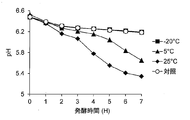
- the unit H of the fermentation time on the horizontal axis is time [hour (s)] (the same applies hereinafter). It is a figure which shows the influence of the temperature with respect to the S. thermophilus fermentation promotion effect of a lactose-NaOH solution (addition rate: 0.0125% (vol / wt)). Black square: -20 °C, black triangle: 5 °C, black diamond: 25 °C, white circle: ⁇ contrast. It is a figure which shows the S. thermophilus fermentation promotion effect (addition rate of a lactose-NaOH solution 1%) of a 0.1% lactose solution prepared using a 0.1% NaOH solution.
- Black square Amber unheated lactose-NaOH solution
- Black triangle Amber heated lactose-NaOH solution
- White circle Amber control. It is a figure which shows the S. thermophilus fermentation promotion effect (addition rate of a lactose-NaOH solution 10%) of a 0.1% lactose solution prepared using a 0.1% NaOH solution.
- Black square Amber unheated lactose-NaOH solution
- Black triangle Amber heated lactose-NaOH solution
- White circle Amber control. It is a figure which shows the influence which the density
- Black square 0% NaOH, black triangle: 0.8% NaOH, black diamond: 1.6% NaOH, black circle: 8% NaOH, ⁇ : 27% NaOH, white circle: control. It is a figure which shows the influence which the density
- thermophilus fermentation promotion effect of the sugar-alkali solution prepared using various sugars Black square: Black lactulose, Black triangle: Black sucrose, Black diamond: Black trehalose, Black circle: Black dextrin, White circle: Black contrast. It is a figure which shows the S. thermophilus fermentation promotion effect of the sugar-alkali solution prepared using various sugars.
- A is a sugar-alkali solution prepared using glucose, galactose, fructose, xylose, arabinose and rhamnose in order from the left
- B is a sugar-alkali solution prepared using xylitol, mannitol and sorbitol in order from the left.
- 2 is a photograph showing the color tone after heating of a sugar-alkali solution prepared using various sugars. It is a figure which shows the S. thermophilus fermentation promotion effect of the solution which added NaOH and heated to grape 100% fruit juice. Black square: strawberry grape juice, black triangle: strawberry grape juice + 10% NaOH, white circle: strawberry control. It is a figure which shows the S.
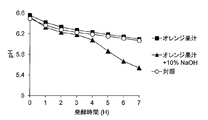
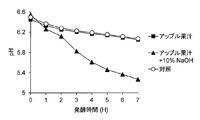
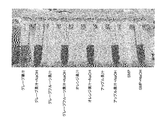
- thermophilus fermentation promotion effect of the solution which added and heated NaOH to grapefruit 100% fruit juice Black square: strawberry grapefruit juice, black triangle: strawberry grapefruit juice + 10% NaOH, white circle: strawberry contrast. It is a figure which shows the S. thermophilus fermentation promotion effect of the solution which added NaOH and heated to 100% orange fruit juice. Black square: strawberry orange juice, black triangle: strawberry orange juice + 10% NaOH, white circle: strawberry control. It is a figure which shows the S. thermophilus fermentation promotion effect of the solution which added NaOH and heated to 100% apple juice. Black square: strawberry apple juice, black triangle: strawberry apple juice + 10% NaOH, white circle: strawberry control. It is a photograph which shows the color tone after a heating of the solution which added NaOH to fruit juice or reduced skim milk (SMP).
- SMP reduced skim milk
- an alkaline solution containing reducing sugar (hereinafter sometimes referred to as “sugar-alkaline solution”) causes a color reaction at a temperature of 5 ° C. or higher, the solution causes the fermentation of Streptococcus thermophilus. Based on the knowledge found by the present inventors that it has a promoting action.
- the present invention provides a fermentation enhancement for Streptococcus thermophilus comprising a solution prepared by exposing an alkaline solution containing a reducing sugar to a temperature typically between 5 ° C. and 135 ° C. to cause a coloring reaction of the sugar. It relates to the agent.
- reducing sugar refers to a sugar that generates an aldehyde group or a ketone group (reducing end) in a basic solution.
- the reducing sugar is a monosaccharide, disaccharide, oligosaccharide (in the present invention, the average degree of polymerization is 3 to 30), or polysaccharide (average degree of polymerization: 31 or more, for example, 31 to 1000). Or any combination thereof.
- the monosaccharide reducing sugar may be hexose (aldohexose or ketohexose) or aldose.
- Preferable examples of monosaccharide reducing sugars include, but are not limited to, glucose, galactose, fructose, arabinose, rhamnose, xylose, and the like.
- Preferable examples of disaccharide reducing sugars include, but are not limited to, lactose, lactulose, maltose, and the like.
- Preferred examples of oligosaccharide reducing sugars include, but are not limited to, galactooligosaccharides, xylo-oligosaccharides, isomaltoligosaccharides, and the like.
- Preferable examples of polysaccharide reducing sugars include, but are not limited to, dextrin and the like.
- the solution containing reducing sugar and alkali according to the present invention may contain one or more reducing sugars.
- a food material containing a reducing sugar may be used for preparing a sugar-alkali solution. That is, the sugar-alkali solution according to the present invention may contain one or more food materials containing a reducing sugar, and in that case, the solution also includes “reducing sugar”.
- the “food material” means a raw material used for food production, and may or may not be used alone as a food or food additive.
- the food material containing the reducing sugar may be in any shape such as liquid, semi-liquid, or solid (powder, granule, etc.), but is preferably one that can be dissolved in an aqueous solution.
- Examples of food materials containing reducing sugar include fruit juice, vegetable juice, reduced skim milk, milk, whey (whey), whey protein concentrate (WPC), whey permeate, other milk materials, and reduced sugar-containing beverages.
- milk materials such as whey (whey), whey protein concentrate, and whey permeate contain lactose, which is a reducing sugar, at a high concentration, and are preferably used in the present invention.
- fruit juice includes fruit juices and processed products thereof (concentrates, concentrated reduced products, diluted products, and sweetened products thereof).
- fruit juice contains abundant reducing sugars such as fructose and glucose.
- fruit juices include, but are not limited to, orange, grapefruit, citrus fruit juices such as Wenzhou oranges, grape juice, apple juice, mango juice, peach juice, pineapple juice, strawberry juice, None juice, lemon juice, banana juice, melon juice and so on.
- the fruit juice may also be a mixed juice of two or more fruit juices.
- food materials containing reducing sugar include mixed juice of fruit juice and vegetable juice.
- “Vegetable juice” includes juices of vegetables (for example, tomatoes, carrots, etc.) and processed products thereof (concentrates, concentrated reductants, dilutions, and sweetened products thereof).
- the sugar-alkali solution of the present invention may comprise at least one of fruit juice, reduced skim milk, whey (whey), whey protein concentrate, and whey permeate.
- the reducing sugar is usually 0.05% by weight or more, preferably 0.05 to 80% by weight, such as 5% to 75% by weight, or 10% to 70% by weight, based on the total weight of the solution. Contains weight percent.
- the sugar-alkali solution of the present invention preferably contains a reducing sugar at a high concentration, for example, 20% by weight or more, or 50% by weight or more, based on the total weight of the solution. The concentration of these reducing sugars is the final concentration after solution preparation.
- weight% (w / w%) with respect to the total weight may be expressed as% (wt / wt) or wt / wt (%).
- an “alkali solution” refers to an aqueous solution (for example, an aqueous solution of hydroxide) in which a hydroxide (hydroxide salt) is dissolved.
- the alkaline solution can be prepared by adding a hydroxide to the aqueous solution and dissolving it. That is, the sugar-alkali solution of the present invention contains a reducing sugar and a hydroxide.
- the hydroxide used for the preparation of the sugar-alkali solution of the present invention is preferably a hydroxide that can be used for food production, and may be an alkali metal hydroxide, typically a hydroxide. Sodium oxide or potassium hydroxide. It is preferable that at least one of sodium hydroxide and potassium hydroxide is dissolved in the sugar-alkali solution of the present invention.
- the sugar-alkali solution of the present invention contains a hydroxide.
- the hydroxide is usually 0.05% by weight or more, preferably 40% by weight or less, more preferably 0.05% by weight based on the total weight of the solution. Up to 30%, such as 0.5% or more, 0.5% to 30%, 5% to 25%, or 10% to 20%.
- the sugar-alkali solution of the present invention may contain a high concentration of hydroxide, for example 20% by weight or more, based on the total weight of the solution. The concentration of these hydroxides is the final concentration after preparation of the sugar-alkali solution.
- the sugar-alkali solution of the present invention contains lactose as a reducing sugar and contains sodium hydroxide or potassium hydroxide as a hydroxide.
- the hydroxide concentration is as described above, and may be, for example, 0.05 to 30% by weight.
- the concentration of reducing sugar is as described above, and may be, for example, 0.05 to 80% by weight.
- the sugar-alkali solution of the present invention can be prepared by a conventional method.
- the sugar-alkali solution of the present invention may be, for example, a solution prepared by adding reducing sugar or a food material containing reducing sugar to an alkaline solution.
- the sugar-alkali solution of the present invention can also be prepared by dissolving hydroxide in an aqueous solution containing reducing sugar or a liquid food material containing reducing sugar.
- the sugar-alkali solution of the present invention can be prepared by dissolving reducing sugar or a food material containing a reducing sugar and a hydroxide in an aqueous solution.
- the sugar-alkali solution of the present invention may be prepared under a temperature condition of less than 5 ° C., or may be prepared under a temperature condition of 5 ° C. or more, for example, normal temperature (20-25 ° C., etc.).
- “solution” means a liquid in which a solute is uniformly dispersed in a solvent by visual observation, a liquid in which a solute is dispersed in a single molecular unit in the solvent, and an association or colloid of the solute. Includes liquids (such as colloids) in which particles are dispersed in a solvent.
- solution in which a part of the solute or insoluble component is not dissolved but is further present as a precipitate in such a liquid in which the solute is uniformly dispersed in the solvent is also referred to as “solution” in the present invention. To be included.
- the sugar-alkali solution of the present invention is an alkaline solution (usually 0.05 wt% or more, preferably 0.5 to 50 wt%, more preferably 1 to 40 wt%, such as 5 to 20 wt% or 20 to 50 wt% alkali).
- the solution may be prepared by adding a reducing sugar to the solution and dissolving it. It is also preferable to use the solution thus obtained containing, for example, 0.05 to 80% by weight, for example 10% to 70% by weight, of reducing sugar as the sugar-alkali solution in the present invention.
- the sugar-alkali solution of the present invention may contain other components in addition to water, reducing sugar and hydroxide.
- the sugar-alkali solution of the present invention when the sugar-alkali solution of the present invention is prepared using a food material containing a reducing sugar, components other than the reducing sugar contained in the food material are present in the sugar-alkali solution of the present invention. To do.
- the sugar-alkali solution of the present invention does not need to contain amino compounds (amino acids, peptides, and proteins) for the coloring reaction, and does not need to contain an amino compound in an amount capable of causing coloring by the Maillard reaction. It may be free of amino compounds.
- the sugar-alkali solution of the present invention also does not contain an alkaline copper reagent for sugar determination.
- the sugar-alkali solution as described above is preferably 5 ° C. or higher, typically 5 ° C. or higher and 135 ° C. or lower (in one embodiment, 20 ° C. or higher, preferably 35 ° C. or higher, more preferably Exposure to temperatures of 50 ° C. or higher, more preferably 80 ° C. or higher, and / or 100 ° C. or lower, preferably 99 ° C. or lower, more preferably 98 ° C. or lower).
- the temperature at which the sugar-alkaline solution is exposed is typically below 5 ° C. to 135 ° C.
- “Exposing a sugar-alkaline solution to a temperature of 5 ° C. or higher and 135 ° C. or lower” means that the temperature of the solution is a predetermined temperature or temperature range of 5 ° C. or higher and 135 ° C. or lower over a certain period of time by refrigeration, heat retention, storage, etc Or the solution is heated at a predetermined temperature of 5 ° C. or higher and 135 ° C. or lower for a predetermined time. Such exposure to temperature may be performed, for example, by heating the sugar-alkali solution at 35-100 ° C.
- the expression “exposing a sugar-alkaline solution to a temperature below the melting point” of the sugar used in the solution is interpreted in the same manner except that a temperature below the melting point is used.
- the sugar coloring reaction is caused by the heat of dissolution of sugar (heat generated when the sugar is dissolved in a liquid) and / or heat applied artificially. And the reaction is promoted.
- the sugar-alkali solution of the present invention is 5 ° C. or higher, preferably 5 ° C. to 50 ° C., more preferably 20 ° C. or higher, eg 35 ° C. to 40 ° C., for a certain time, eg 10 minutes to 24 hours, preferably 1 hour. By holding for -12 hours, more preferably 3-6 hours, a color reaction can be caused.
- “holding” the temperature includes not only keeping the same temperature for the sugar-alkali solution but also ensuring that the temperature falls within a certain range (eg, 35 ° C. to 40 ° C.).
- the container containing the sugar-alkali solution of the present invention may be refrigerated, stored at room temperature or at room temperature, or an incubator or the like. You may heat-retain using an incubator.
- the sugar-alkali solution of the present invention is 30 ° C. or higher, typically 35 ° C. or higher and 135 ° C. or lower (ie 35 ° C. to 135 ° C.), preferably 35 ° C.
- the sugar-alkali solution of the present invention may be heated at the above temperature after being held at a temperature of 5 ° C. or higher, for example, 5 ° C. to 35 ° C., and preferably 35 to 135 ° C., for example 35 to 35 ° C. You may heat at the temperature of 100 degreeC.
- heating the sugar-alkali solution at the above temperature means applying heat to the solution so that the sugar-alkali solution reaches the above temperature.
- causes a sugar coloring reaction means to cause a sugar coloring reaction, resulting in coloring of a sugar-alkali solution.
- the sugar-alkali solution changes from colorless or other colors to brown to black or becomes darker brown to black than the original color of the solution (brown / blackening) due to the coloring reaction of sugar. .
- the coloring reaction of sugar in the solution can also be promoted.
- the sugar-alkali solution may be heated after the coloring reaction has started in the sugar-alkali solution, for example, by heat of dissolution.
- a brown-black colored solution can be prepared from a sugar-alkali solution.
- This coloring liquid has the effect
- the present invention provides a fermentation accelerator for Streptococcus thermophilus comprising the colored liquid prepared as described above (hereinafter referred to as fermentation promotion liquid).
- This fermentation promotion liquid may be a composition containing a reducing sugar, a hydroxide, water, a product generated along with a coloring reaction, and a component derived from a food material containing a reducing sugar in some cases.
- Streptococcus thermophilus is cultured in a fermentation substrate to which the fermentation promotion liquid or fermentation accelerator of the present invention is added, and an index indicating the progress of the fermentation state is examined over time. As a result, a control (fermentation promotion liquid or fermentation promoter) is obtained. In the case where the fermentation proceeds faster than the non-added group), it can be confirmed that the fermentation promoting liquid or the fermentation promoting agent has a fermentation promoting action.
- an index indicating the progress of the fermentation state for example, an increase in the amount of L-lactic acid produced by Streptococcus thermophilus by fermentation, an increase in acidity of the fermented product accompanying an increase in the amount of L-lactic acid, or a decrease in pH value should be used.
- the indicator is not limited to these.
- the index value indicating the progress of the fermentation state is improved compared to the control, and the difference in the index value compared to the control increases over time during the fermentation (preferably over at least 2 hours), and thereafter for a certain time (for example, when the index value improved as compared with the control over at least 1 hour or more), it can be determined that the fermentation promoting liquid or the fermentation promoting agent has a fermentation promoting effect on Streptococcus thermophilus.
- L NaOH is determined and can be calculated from it by conventional methods.
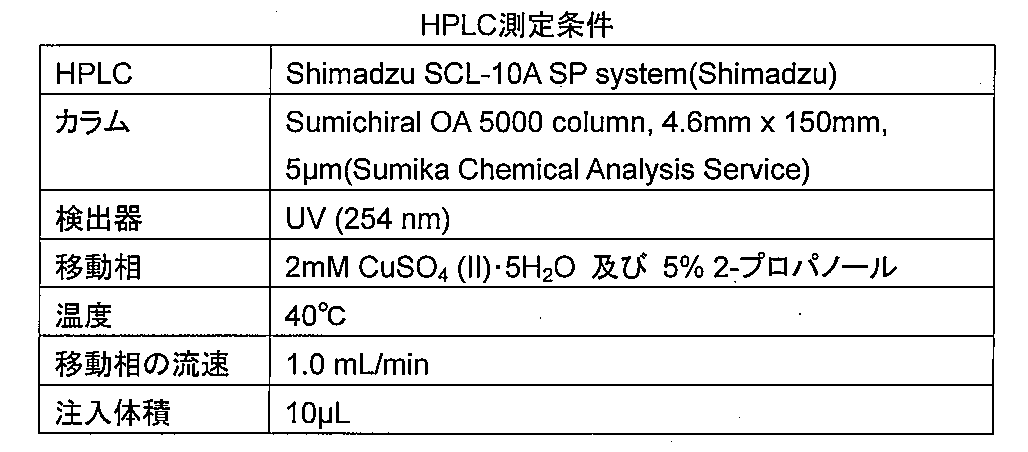
- the L-lactic acid concentration can be measured, for example, by high performance liquid chromatography (HPLC) using a temperature of 40 ° C. and a mobile phase of 2 mM CuSO 4 (II) ⁇ 5H 2 O and 5% 2-propanol.
- HPLC high performance liquid chromatography
- the fermentation promotion liquid of the present invention can also promote the growth of Streptococcus thermophilus. Therefore, the fermentation promotion liquid or fermentation promoter of the present invention can also be used as a growth promoter for Streptococcus thermophilus.
- the present invention also provides a growth promoter for Streptococcus thermophilus comprising the fermentation promoter or fermentation promoter of the present invention.
- the fermentation promotion liquid of the present invention can be used as an active ingredient of a fermentation promoter for Streptococcus thermophilus of the present invention. You may use the fermentation promotion liquid of this invention as an active ingredient of the fermentation promoter for Streptococcus thermophilus of this invention with the form of the colored liquid prepared as mentioned above.
- the fermentation promotion liquid of the present invention is a fermentative promoter for Streptococcus thermophilus after processing such as concentration, dilution, filtration, sterilization, homogenization, drying, gelation, granulation, and / or powdering. It may be used as an active ingredient. These treatments usually do not result in irreversible inactivation of the fermentation promoting action.
- the fermentation promoter for Streptococcus thermophilus according to the present invention includes not only a preparation directly using the prepared colored liquid but also a preparation containing such a processed liquid that has been subjected to such treatment.
- the fermentation promoter or growth promoter for Streptococcus thermophilus is used in the technical field of production of other ingredients, typically foods or food additives such as carriers, excipients, or preservatives. It may further contain adjuvants.
- the fermentation promoter or growth promoter for Streptococcus thermophilus may be a composition further comprising such other components.
- the fermentation promoter for Streptococcus thermophilus may be liquid, but may be in any other form such as powder, granule, gel, solid, encapsulated body. Powdering, granulating, gelling, solidifying, encapsulating and the like can be performed according to known pharmaceutical techniques.
- the present invention exposes an alkaline solution containing a reducing sugar to a temperature of 5 ° C. or higher, typically 5 ° C. or higher and 135 ° C. or lower to cause a sugar coloring reaction, thereby preventing Streptococcus thermophilus.
- a method for producing a fermentation promoter for Streptococcus thermophilus which comprises preparing a solution having a fermentation promoting action (fermentation promoting solution).
- various conditions such as the type and concentration of reducing sugar and hydroxide to be used, the temperature at which the alkaline solution containing reducing sugar is exposed, the composition and preparation method of the alkaline solution containing reducing sugar, and the like are as described above. is there.
- This production method may include a step of formulating the above-mentioned fermentation promoting liquid having a fermentation promoting effect on Streptococcus thermophilus into a fermentation promoter as an active ingredient.
- This production method may include subjecting the fermentation promotion liquid to a treatment such as concentration, dilution, filtration, sterilization, homogenization, drying, gelation, granulation, and / or powdering. These treatments usually do not result in irreversible inactivation of the fermentation promoting action.
- the present invention also provides a method for promoting fermentation by Streptococcus thermophilus using the fermentation promoter of the present invention. More specifically, the present invention provides a fermentation with Streptococcus thermophilus comprising adding the fermentation promoter of the present invention to a fermentation substrate, culturing Streptococcus thermophilus on the fermentation substrate and fermenting the fermentation substrate. It also provides a way to promote. Alternatively, the present invention also relates to a fermentation method using Streptococcus thermophilus comprising adding the fermentation promoter of the present invention to a fermentation substrate and culturing Streptococcus thermophilus on the fermentation substrate.
- the present invention also includes adding the fermentation promoter of the present invention to a fermentation substrate, culturing Streptococcus thermophilus on the fermentation substrate, and recovering the lactic acid bacteria product produced by Streptococcus thermophilus It also relates to a method for manufacturing a product. Furthermore, this invention also provides the growth method of Streptococcus thermophilus including promoting the proliferation of Streptococcus thermophilus using the fermentation promoter of this invention. In these methods, Streptococcus thermophilus may be inoculated into the fermentation substrate before adding the fermentation promoter of the present invention to the fermentation substrate, or at the same time as or after the addition to the fermentation substrate. May be inoculated.
- Fermentation substrate means a substrate compound (such as a carbohydrate) or a substrate material that can be used for fermentation of Streptococcus thermophilus.
- Fermentation substrates include, but are not limited to, milk, milk-derived products, cereal saccharified products, soy milk, soy extract, fruits, vegetables, fruit juices, vegetable juices, fruit or vegetable extracts, or at least one of them. Examples thereof include a fermentation base (for example, a yogurt base).
- “Milk” in the present invention is raw milk, raw milk after component adjustment (component standardization), milk from which milk fat has been removed or reduced (eg, skim milk), powdered milk such as skim milk powder and whole milk powder, reduced skim milk, dilution Includes milk, concentrated milk, and other processed milk.
- the “milk” may be pretreated for use in food production, such as homogenization, sterilization / cooling, and / or filtration.
- the “milk” in the present invention may be milk (animal milk) of any non-human mammal, for example, cow milk, goat milk, buffalo milk, horse milk, camel milk, sheep milk, and the like.
- the “milk-derived product” may or may not contain lactose, but preferably contains lactose.
- milk-derived product examples include curd (curd), cream, buttermilk, buttermilk powder, whey, milk protein (casein, whey protein, etc.), and degradation products thereof (casein-degrading peptide, etc.).
- one or more fermentation substrates may be used in combination.
- the fermentation promotion liquid or fermentation promoter of the present invention basically shows a higher fermentation promotion effect as the concentration of sugar and hydroxide used for the preparation of the fermentation promotion liquid increases. Therefore, the addition amount of the fermentation promotion liquid or fermentation accelerator of the present invention required for promoting the fermentation of Streptococcus thermophilus can be reduced as the sugar and hydroxide concentrations used in the preparation of the fermentation promotion liquid are higher. Those skilled in the art can appropriately adjust the specific addition amount.
- the fermentation accelerator of the present invention has a fermentation promotion liquid of 0.0001% (vol / wt) or more, preferably 20% (vol / wt) or less, more preferably 0.0005 to less than the total weight of the fermentation substrate.
- the fermentation promotion liquid or fermentation promoter of the present invention can promote the fermentation of Streptococcus thermophilus with the addition of a very small amount. This means that not only the production cost of the fermented food can be suppressed, but also the influence on the flavor of the fermented food can be significantly reduced or prevented.
- the fermentation promoter of the present invention can be used for any Streptococcus thermophilus strain.
- Streptococcus thermophilus strains include, for example, S. thermophilus OLS3059 strain (Accession number FERM BP-10740), S. thermophilus OLS3294 strain (Accession number NITE P-77), S. thermophilus OLS3289 strain (ATCC 19258), S. ⁇ ⁇ thermophilus OLS3469 strain (IFO 13957 / NBRC 13957), S. thermophilus OLS3058 strain, and S. thermophilus OLS3290 strain (accession number FERM BP-19638) are included, but not limited thereto.
- S. thermophilus ⁇ OLS3059 is an independent administrative agency, National Institute for Product Evaluation Technology (NITE-IPOD) dated February 29, 1996 (original deposit date), 2-5 Kazusa Kamashika, Kisarazu City, Chiba Prefecture, Japan ⁇ 8 Room 120) is deposited internationally under the Budapest Treaty under the accession number FERM BP-10740. The deposited strain was transferred from domestic deposit (original deposit) to international deposit based on the Budapest Treaty on November 29, 2006.
- thermophilus OLS3294 is an independent administrative agency, National Institute of Technology and Evaluation, Patent Microorganism Depositary Center (NPMD), dated February 10, 2005 (2-5-8, Kazusa Kamashi, Kisarazu City, Chiba Prefecture, Japan 122) Room No.) is deposited under the deposit number NITE P-77.
- NPMD Patent Microorganism Depositary Center
- S. thermophilus OLS3290 strain was founded on January 19, 2004 (original deposit date), and is an independent administrative corporation, Product Evaluation Technology Foundation, Patent Biological Depositary Center (NITE-IPOD) (Kazusa Kamashika, Kisarazu City, Chiba Prefecture, Japan) 5-8 Room 120) is deposited internationally under the Budapest Treaty under the accession number FERM BP-19638. The deposited strain was transferred from domestic deposit (original deposit) to international deposit based on the Budapest Treaty on September 30, 2013.
- thermophilus OLS3289 strain American Type Culture Collection; from (American Type Culture Collection ATCC), is the same as the bacterium can be obtained under ATCC (R) catalog number 19258.
- thermophilus OLS3469 strain can be obtained under the NBRC number 13957 from the National Institute of Technology and Evaluation Biotechnology Center (NBRC) (2-5-8 Kazusa Kamashi, Kisarazu City, Chiba Prefecture, Japan) It is the same as bacteria.
- NBRC National Institute of Technology and Evaluation Biotechnology Center
- the fermentation (cultivation) conditions for Streptococcus thermophilus can be set according to conventional methods.
- the fermentation can be carried out usually at 35 to 50 ° C., preferably 40 to 45 ° C.
- the fermentation time varies depending on the fermentation substrate and fermentation conditions, but can be, for example, about 2 to 24 hours.
- the pH of the fermentation substrate may be appropriately adjusted before fermentation (for example, adjusted to around pH 6.5).
- Streptococcus thermophilus can be prepared according to a conventional method.
- the inoculation amount of Streptococcus thermophilus may be any inoculation amount that can be used for fermentation of Streptococcus thermophilus.
- the inoculation amount (ml) relative to the total weight (g) of the fermentation substrate is 0.01 to 5 It can be set in the range of% (v / w%).
- the volume ratio% (v / w%) to the total weight may be expressed as% (vol / wt) or vol / wt (%).
- the inoculated amount of Streptococcus thermophilus is, for example, 1/10 to 2 of the general inoculated amount (number of inoculated bacteria) It can also be reduced to about / 3.
- the fermentation promotion liquid or fermentation promoter of the present invention can promote fermentation by Streptococcus thermophilus even in mixed culture of Streptococcus thermophilus and Lactobacillus bulgaricus.
- the mixed culture of Streptococcus thermophilus and Lactobacillus bulgaricus is performed using a fermentation substrate containing milk or a milk-derived product.
- the present invention also provides a method for producing a fermented food by fermenting a fermentation substrate by the method for promoting fermentation of Streptococcus thermophilus according to the present invention.
- Streptococcus thermophilus is generally used as a starter in the production of fermented foods.
- the fermentation substrate used in the fermented food is preferably edible per se (for example, for non-human mammals such as humans or livestock). In the method for producing fermented foods, one or more fermentation substrates may be used in combination.
- the present invention relates to a method for producing a fermented milk food, comprising fermenting a fermentation substrate containing milk or a milk-derived product by the method for promoting fermentation of Streptococcus thermophilus according to the present invention.
- the fermentation substrate is fermented using Streptococcus thermophilus or a microorganism containing Streptococcus thermophilus.
- the fermentation substrate comprising milk or milk-derived product may be milk or milk-derived product itself.
- the definitions of milk and milk-derived products are as described above.
- the fermentation substrate containing milk or milk-derived products may also be milk or milk-derived products with other substrate compounds (such as carbohydrates) or substrate materials, or other ingredients added.
- fermented foods produced by this method include, but are not limited to, fermented milk, fermented milk containing lactic acid bacteria, cheese, fermented cream, and fermented butter.
- fermented milk refers to fermented milk using lactic acid bacteria or lactic acid bacteria and other fermenting microorganisms (typically yeast).
- fermented milk include yogurt.
- yogurt refers to a product obtained by fermenting milk with Streptococcus thermophilus and Lactobacillus (Lactobacillus bulgaricus, etc.).
- the cheese include mozzarella cheese, camembert cheese, quark cheese, gouda cheese, and cheddar cheese.
- one or more fermentation substrates may be used in combination.
- milk and milk-derived products may be used in combination as a fermentation substrate, for example, raw milk, skim milk powder and whey protein may be used in combination.
- a fermentation base in which a necessary amount of water or other components such as sweeteners are added to and mixed with these fermentation substrates can also be used as the fermentation substrate.
- the method for producing a milk fermented food according to the present invention is basically a conventional milk fermentation except that the fermentation promoter of the present invention is added to the fermentation system in an appropriate amount to promote the fermentation of Streptococcus thermophilus. It can be carried out by the same method as the method for producing food. After completing the fermentation to a state suitable for each milk fermented food, the fermented product may be processed, filled in a container, etc. to produce the fermented milk food.
- fermented milk can be manufactured by inoculating and fermenting lactic acid bacteria containing Streptococcus thermophilus to milk added with the fermentation promoter of the present invention according to the above-mentioned fermentation promotion method.
- Common yogurt is obtained by inoculating milk to which the fermentation promoter of the present invention has been added according to the above-mentioned fermentation promotion method with Streptococcus thermophilus and Lactobacillus (typically Lactobacillus bulgaricus). It can be produced by fermenting milk in a mixed culture. However, the production procedure of fermented milk including yogurt is not limited to these.
- lactic acid bacteria known to be used for the production of fermented food can be suitably used together with Streptococcus thermophilus.
- Lactobacillus bulgaricus Lactobacillus bulgaricus or Lactobacillus delbrueckii subsp. Bulgaricus
- any strain that can be used for the production of fermented food can be used. 1 strain (Accession No. FERM BP-10741), Lactobacillus bulgaricus OLL1181 (Accession No. FERM BP-11269), L. bulgaricus OLL1255 (Accession No. NITE BP-76) and the like.
- Lactobacillus bulgaricus OLL1073R-1 was founded on February 22, 1999 (original deposit date), the National Institute for Product Evaluation Technology, Patent Biological Depositary Center (NITE-IPOD) (Kazusa Kamashika, Kisarazu City, Chiba Prefecture, Japan) 5-8 120)) under the accession number FERM BP-10741 under the Budapest Treaty. This strain was transferred from domestic deposit (original deposit) to international deposit on November 29, 2006.
- Lactobacillus bulgaricus OLL1181 strain dated July 16, 2010 (original deposit date), National Institute of Technology and Evaluation, Patent Biological Deposit Center (NITE-IPOD) (Kazusa Kamashika, Kisarazu City, Chiba Prefecture, Japan) Room 8-8120) is deposited internationally under the Budapest Treaty under the accession number FERM BP-11269.
- Lactobacillus bulgaricus OLL1255 strain dated February 10, 2005 (original deposit date), National Institute of Technology and Evaluation, Patent Microorganism Depositary Center (NPMD) (2-5-8 Kazusa Kama feet, Kisarazu City, Chiba Prefecture, Japan 122 Is deposited internationally under the Budapest Treaty under the deposit number NITE BP-76. This strain was transferred from domestic deposit (original deposit) to international deposit on April 1, 2009.
- NPMD Patent Microorganism Depositary Center
- Lactobacillus bulgaricus OLL1073R-1 The current depositor of Lactobacillus bulgaricus OLL1073R-1, Lactobacillus bulgaricus OLL1181, and Lactobacillus bulgaricus OLL1255 is Meiji Co., Ltd.
- ingredients may be added in addition to milk at an appropriate stage.
- Other ingredients include sweeteners (sucrose, stevia, sucralose, etc.), acidulants, preservatives, flavors, thickeners, food additives such as calcium lactate, agar, gelatin, fruit juice, pulp, fruit sauce, cream , Aloe mesophyll, jam and the like.
- sweeteners saccharide, stevia, sucralose, etc.
- acidulants preservatives
- flavors thickeners
- food additives such as calcium lactate, agar, gelatin, fruit juice, pulp, fruit sauce, cream , Aloe mesophyll, jam and the like.
- a yeast extract known as a bifidobacteria growth promoter.
- Production of fermented milk such as yogurt may be performed by either a pre-fermentation type or a post-fermentation type.
- milk is inoculated with a lactic acid bacterium (starter) containing Streptococcus thermophilus, and after the fermentation is completed, the container is filled. Before filling into the container, homogenization, addition of other raw materials such as pulp, freezing and the like may be performed.
- starter lactic acid bacterium
- the container is filled with milk, lactic acid bacteria and other raw materials, and then fermented.
- the mixed culture of Lactobacillus species such as Streptococcus thermophilus and Lactobacillus bulgaricus is usually performed at 35 to 50 ° C., preferably 40 to 45 ° C.
- fermented milk it is not limited to the following method, but usually fermented until the acidity reaches 0.7 to 0.8%, and then cooled to 10 ° C. or lower to stop the fermentation.
- the fermentation time can be, for example, about 1 to 24 hours, more generally about 3 to 7 hours.
- cheese is inoculated with lactic acid bacteria (starter) containing Streptococcus thermophilus in milk to which the fermentation promoter of the present invention has been added according to the above-described fermentation promotion method, and then fermented, and then rennet (milk-clotting enzyme) Can be produced by coagulating milk, separating the coagulated product (curd) from whey, molding, sterilizing, and / or fermentation / aging.
- starter lactic acid bacteria
- rennet milk-clotting enzyme
- ⁇ / RTI> fermentation by lactic acid bacteria can be significantly promoted, so that the fermentation time can be shortened compared to the case where the fermentation promoter of the present invention is not used.
- the fermentation time can be shortened by preferably 1 to 4 hours as compared with the case where the fermentation promoter of the present invention is not used. Since it changes, the shortening time is not limited to this.
- the fermentation process in the production of the milk fermented food can be completed at an early stage, and the production of the milk fermented food can be made efficient.
- the flavor (acidity, sweetness, presence / absence of bitterness or pungent taste, etc.) is compared with a milk fermented food produced in the same manner except that the fermentation accelerator of the present invention is not added. ), Physical properties (smoothness, hardness, etc.) are almost the same, or an excellent fermented milk food can be produced.
- Lactose was dissolved in 25% (wt / wt) NaOH solution (NaOH aqueous solution) to prepare a 50% (wt / wt) lactose solution (hereinafter referred to as “Lactose solution”).
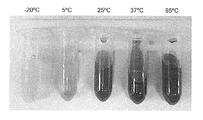
- a sodium hydroxide (NaOH) solution in which lactose is dissolved is also referred to as “lactose-NaOH solution”). Lactose dissolution was performed in ice water. The obtained lactose-NaOH solution was a transparent liquid with a slightly yellowish green color.
- the obtained lactose-NaOH solution was held at ⁇ 20 ° C., 5 ° C., 25 ° C., or 37 ° C. for 4 hours.
- the obtained lactose-NaOH solution was heated at 95 ° C. for 30 minutes immediately after preparation and then stored at a low temperature. Thereafter, the appearance of the solution maintained or heated was observed.
- Each lactose-NaOH solution was added at 0.0025% (vol / wt) to UHT pasteurized milk (milk sterilized by UHT method (ultra-high temperature sterilization method); pasteurized at 130 ° C. for 2 seconds) and heated to 43 ° C. 1% (vol / wt) of the Streptococcus thermophilus (Streptococcus thermophilus or S. thermophilus) OLS3059 strain (Accession No. FERM BP-10740) as a starter (1 to 2 ⁇ 10 7 cfu in the cell concentration) / mL) and inoculated and started fermentation at 43 ° C.
- UHT pasteurized milk milk sterilized by UHT method (ultra-high temperature sterilization method); pasteurized at 130 ° C. for 2 seconds
- S. thermophilus OLS3059 strain used the microbial cell obtained by culture
- S. thermophilus prepared by the same method is used as a starter unless otherwise specified.
- the pH of the fermentation broth was measured over time.
- a decrease in pH in the culture medium of lactic acid bacteria means an increase in the amount of lactic acid produced with the fermentation of lactic acid bacteria, and is used as an indicator of the progress of fermentation of lactic acid bacteria.
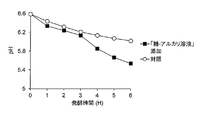
- the measurement results are shown in FIG.
- a lactose-NaOH solution maintained at ⁇ 20 ° C., 5 ° C., and 25 ° C. was added, no pH decrease was observed compared to the control, and no fermentation promoting effect was observed.
- a lactose-NaOH solution maintained at 37 ° C. was added, the pH was greatly reduced as compared with the control, and therefore, promotion of fermentation by S. thermophilus was observed.
- the lactose-NaOH solution heated at 95 ° C. for 30 minutes showed a higher fermentation promoting effect than the lactose-NaOH solution held at 37 ° C.
- the lactose-NaOH solution held at -20 ° C, 5 ° C, and 25 ° C is added to UHT pasteurized milk, 0.0125% (vol / wt), which is 5 times the above amount, and the same test as above is performed. Carried out.
- the lactose-NaOH solution maintained at ⁇ 20 ° C. did not show a fermentation promoting effect.
- the lactose-NaOH solution held at 5 ° C and 25 ° C shows a fermentation promotion effect, and the lactose-NaOH solution held at 5 ° C has a higher fermentation promotion effect than the lactose-NaOH solution held at 5 ° C. Was obtained (FIG. 3).
- Example 2 Effect of low-concentration lactose solution prepared with low-concentration NaOH solution Lactose was dissolved in 0.1% (wt / wt) NaOH solution to prepare a 0.1% (wt / wt) lactose solution. A sample of this 0.1% lactose solution was stored refrigerated at 5 ° C. (unheated lactose-NaOH solution), but no coloration was observed. On the other hand, when a sample of the prepared 0.1% lactose solution was heated at 95 ° C. for 30 minutes to prepare a heated lactose-NaOH solution, the resulting solution was slightly browned.
- Example 3 Correlation between fermentation promotion effect, sugar concentration and NaOH concentration 25% (wt / wt) by dissolving lactose in 0%, 0.8%, 1.6%, 8%, 27% (wt / wt) NaOH solution wt) lactose solution was prepared. When a 27% NaOH solution was used, it naturally generated heat after dissolution of lactose and turned black. The prepared 25% lactose solution was heat-treated at 95 ° C. for 30 minutes. The obtained heated lactose-NaOH solution was added to UHT pasteurized milk at 0.01% (vol / wt) and heated to 43 ° C.
- the pH of the fermentation broth was measured over time. The measurement results are shown in FIG. It was shown that the fermentation promotion effect increases as the concentration of the NaOH solution used to dissolve lactose increases. In addition, in the lactose solution which melt
- lactose-NaOH solutions with different concentrations of sugar and alkaline solution were prepared for further tests.
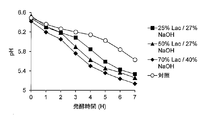
- lactose was dissolved in 27% (wt / wt) NaOH solution to prepare a 25% (wt / wt) lactose solution (NaOH final concentration: 20.3%) (hereinafter referred to as “25% Lac / 27% NaOH”). Called).
- lactose was dissolved in 27% (wt / wt) ⁇ NaOH solution to prepare 50% (wt / wt) lactose solution (NaOH final concentration: 13.5%) (hereinafter referred to as “50% Lac / 27% NaOH”) ).
- lactose was dissolved in 40% (wt / wt) NaOH solution to prepare a 70% (wt / wt) lactose solution (NaOH final concentration: 12%) (hereinafter referred to as “70% Lac / 40% NaOH”). ). All these lactose-NaOH solutions spontaneously exothermed and became black after dissolution.
- the pH of the fermentation broth was measured over time. The measurement results are shown in FIG. It was shown that the fermentation promoting effect increases as the concentration of the lactose and the concentration of the NaOH solution used to dissolve the lactose increase.
- Example 4 Influence of Kind of Alkaline Solution on Fermentation Promoting Effect
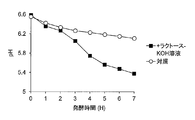
- a KOH solution was used as an alkaline solution in place of the NaOH solution.
- lactose was dissolved in 10% (wt / wt) KOH solution to prepare a 10% (wt / wt) lactose solution, heated at 95 ° C. for 30 minutes, and then 0.025% in UHT pasteurized milk. Added and warmed to 43 ° C. After heating, UHT pasteurized milk was inoculated with 1% (vol / wt) of S. thermophilus OLS3059 strain and fermentation was started at 43 ° C. As a control, a similar test was performed using UHT pasteurized milk without the addition of heated lactose-KOH solution.
- Example 5 Influence of Sugar Type on Fermentation Promoting Effect A similar test was conducted using different types of sugar instead of lactose.
- As the monosaccharide glucose, galactose, fructose, arabinose, rhamnose, xylose, xylitol, mannitol, or sorbitol was used.
- Lactulose, sucrose, or trehalose was used as the disaccharide.
- Galactooligosaccharide or fructooligosaccharide was used as the oligosaccharide, and dextrin was used as the polysaccharide.
- Each sugar was dissolved in a 25% (wt / wt) NaOH solution at a concentration of 12.5% (wt / wt) to prepare a sugar-NaOH solution and heated at 95 ° C. for 30 minutes. The appearance of the sugar-NaOH solution after heating was observed. After heating, add 0.035% (vol / wt) of each sugar solution individually to UHT pasteurized milk, warm UHT pasteurized milk to 43 ° C, and then inoculate 1% (vol / wt) of S. thermophilus 1131 strain Then, fermentation was started at 43 ° C. As a control, a similar test was performed using sterilized water instead of the heated sugar-NaOH solution.
- the pH of the fermentation broth was measured (monitored) over time.
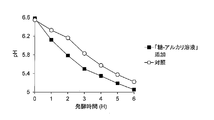
- the measurement results are shown in FIGS. Fermentation promoting effects were obtained when glucose, galactose, fructose, arabinose, rhamnose, xylose were used for monosaccharides, lactulose was used for disaccharides, and galactooligosaccharides and dextrins were used for polysaccharides (FIGS. 10, 11, and 12).
- FIGS. 13 The color tone of the sugar-NaOH solution after heating is shown in FIGS.
- Monosaccharides (reducing sugars) with a fermentation-promoting effect were blackened by heating after dissolving in a NaOH solution, but monosaccharides (non-reducing sugars) with no fermentation-promoting effect were thinly browned Or remained clear and colorless (FIG. 13). Similar results were obtained with disaccharides and polysaccharides (FIG. 14).
- Reduced skim milk is prepared by dissolving skim milk powder (dry powder) in water or the like, and is known to contain lactose.
- 10% reduced skim milk was prepared by adding NaOH at a reduced concentration of 5% (wt / wt) to reduced skim milk (Meijikan skim milk powder), and heat-treated at 95 ° C. for 15 minutes.
- 0.005% (vol / wt) of reduced skim milk heated with NaOH added was added to UHT pasteurized milk and heated to 43 ° C. After heating, UHT pasteurized milk was inoculated with 1% (vol / wt) of S. thermophilus OLS3059 strain, and fermentation was started at 43 ° C.
- a similar test was performed using reduced skim milk heated without adding NaOH instead of heated reduced skim milk with addition of NaOH.
- a similar test was performed using sterilized water instead of reduced skim milk heated with NaOH.
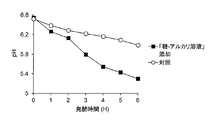
- the pH of the fermentation broth was measured over time. The measurement results are shown in FIG. Reduced skim milk heated without adding NaOH did not show a fermentation promoting effect, while reduced skim milk heated with NaOH added showed a fermentation promoting effect. Moreover, the reduced skim milk to which NaOH was added was blackened by heating without causing precipitation or the like (FIG. 19).
- composition prepared by dissolving food materials containing sugars such as fructose and lactose such as fruit juice and reduced skim milk in an alkaline solution can also promote the fermentation of S. thermophilus Became clear.
- Example 7 Fermentation promoting effect of sugar-alkali solution on various Streptococcus thermophilus strains According to Example 3, "50% Lac / 25% NaOH" was prepared and heated at 95 ° C for 30 minutes. The obtained solution was added to UHT pasteurized milk at 0.005% (vol / wt) and heated to 43 ° C. After warming, the UHT pasteurized milk was inoculated with S. thermophilus and fermentation was started at 43 ° C. As a control, a similar test was performed using UHT pasteurized milk without the addition of heated “50% Lac / 25% NaOH”.
- S. thermophilus includes S. thermophilus OLS3059 strain (Accession number FERM BP-10740), S. thermophilus OLS3294 strain (Accession number NITE P-77), S. thermophilus OLS3289 strain (ATCC 19258), S. thermophilus OLS3469 strain ( IFO 13957 / NBRC 13957), S. thermophilus OLS3058 strain, and S. thermophilus OLS 3290 strain (accession number FERM BP-19638) were used individually.
- S.Sthermophilus 6 strain was prepared according to the preparation method of S. thermophilus OLS3059 described in Example 1. In order to add the same number of bacteria, 1% (vol / wt) for OLS3059 and OLS3294 ⁇ , 1.5% (vol / wt) for OLS3289, OLS3469, OLS3058, and 3% (vol / wt) for OLS3290 / wt) inoculated into UHT pasteurized milk.
- the pH of the fermentation broth was measured (monitored) over time.
- the measurement results are shown in FIGS. Fermentation promoting effects were observed for all S. Sthermophilus strains tested. From this, it was shown that the sugar-alkali solution according to the present invention exerts a fermentation promoting effect on various S. thermophilus strains.
- Example 8 Fermentation promoting effect of sugar-alkaline solution in mixed fermentation of S. thermophilus and L. bulgaricus
- bacterial species Streptococcus thermophilus S. thermophilus
- Lactobacillus The fermentation promoting effect of the sugar-alkali solution on S. thermophilus in mixed culture (co-culture) using bulgaricus (Lactobacillus bulgaricus or Lactobacillus delbrueckii subsp. Bulgaricus; L. bulgaricus) was tested.
- Example 3 “50% Lac / 25% NaOH” was prepared and heated at 95 ° C. for 30 minutes. The resulting heated sugar-alkali solution was added to UHT pasteurized milk in an amount of 0.005% (vol / wt) and heated to 43 ° C. After heating, the UHT pasteurized milk was inoculated with 1% (vol / wt) of S. thermophilus OLS3059 strain and 0.2% (vol / wt) of L. bulgaricus OLL1073R-1 strain (accession number FERM BP-10741). Fermentation was started at 0 ° C. As a control, fermentation using UHT pasteurized milk without added sugar-alkali heated solution was also performed. The L. bulgaricus OLL1073R-1 strain was prepared according to the method for preparing the S. thermophilus OLS3059 strain described in Example 1.
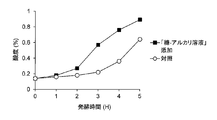
- the acidity of the fermentation broth was measured over time. Specifically, after adding 0.5 mL of phenolphthalein to 9 g of the fermentation broth, neutralization titration was performed by adding 0.1 N NaOH until the fermentation broth turned light red, and the total amount of 0.1 N NaOH required was considered to correspond to the amount of lactic acid, and the concentration (%) of lactic acid in the fermentation broth was calculated and used as the acidity. The results are shown in FIG. The addition of the heated sugar-alkali solution significantly increased the acidity compared to the control, indicating that the fermentation was accelerated.
- the sugar-alkali solution of the present invention can be used for promoting fermentation in the production of yogurt.
- Example 9 Effect of sugar-alkaline solution on flavor in yogurt fermentation
- "50% Lac / 25% NaOH” was prepared and heated at 95 ° C for 30 minutes.
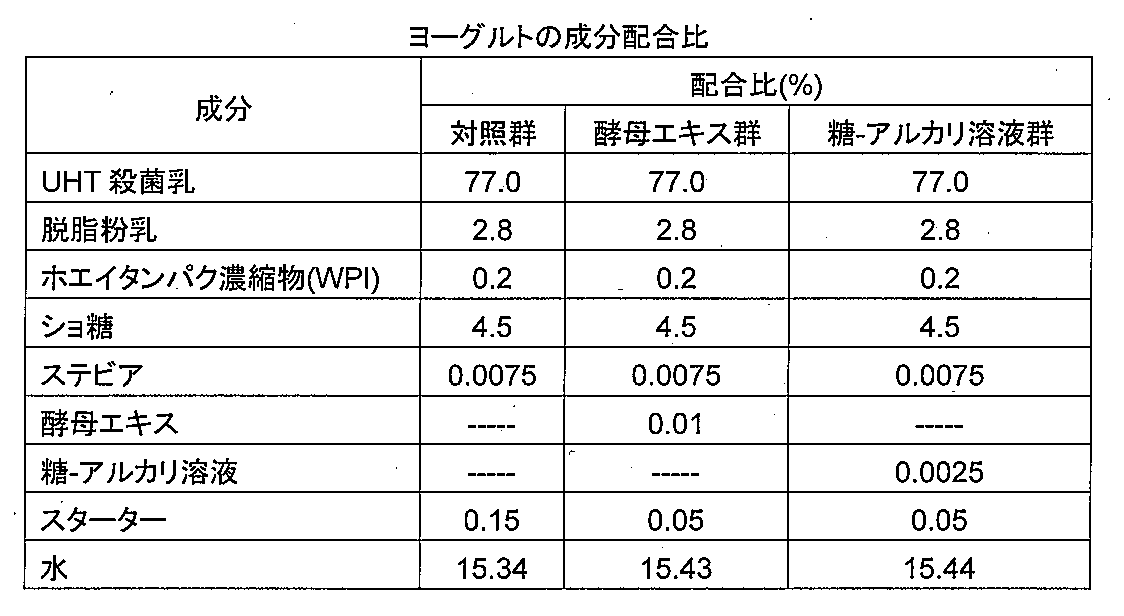
- yogurt was prepared according to the blending ratio shown in Table 2.
- a yogurt base is prepared by mixing components other than yeast extract and sugar-alkali heated solution (Table 2), sterilized at 95 ° C, cooled to 40-45 ° C, and then added to the sugar-alkali heated solution. (Sugar-alkali solution group).
- yeast extract group in which yeast extract was added instead of sugar-alkaline heated solution as a fermentation accelerator
- control group in which neither sugar-alkali heated solution nor yeast extract was added
- L. bulgaricus OLL1255 strain (Accession number NITE BP-76) (cell concentration 1 ⁇ 10 9 cfu / mL) and S. thermophilus OLS3294 strain (Accession number NITE P-77) (cell concentration 3 ⁇ 10 9 cfu / mL) )
- the starter was inoculated with 0.05% (vol / wt) in the yeast extract group and sugar-alkaline solution group, and 0.15% (vol / wt) in the control group. After starter inoculation, fermentation was performed at 43 ° C. until the acidity reached 0.75%, and then cooled at 5 ° C. to prepare yogurt.
- the taste of the prepared yogurt was evaluated by five panelists who were skilled in yogurt sensuality.
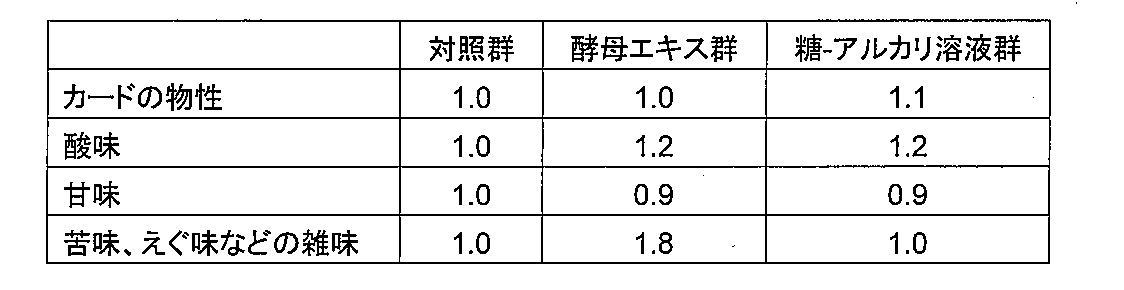
- yogurt the yeast extract group and the sugar-alkaline solution group when the evaluation items of the physical properties, sourness, sweetness, and miscellaneousness of the card are scored in a five-step evaluation, and the average score of the control group of each evaluation item is 1. The relative average score was calculated.
- Card physical properties were evaluated in consideration of “smoothness” and “hardness”. The results are shown in Table 3.
- yogurt in the yeast extract group was clearly inferior, while yogurt in the sugar-alkaline solution group was not different from the control group.
- yeast extract As with the yoghurt (control) prepared without the addition of the sugar-alkaline heated solution, no panelists felt mischievous.
- the heated sugar-alkali solution is superior to the yeast extract in that it hardly affects the flavor of yogurt.
- the present invention it is possible to provide a material that can promote the fermentation of S. thermophilus in a very small amount. If this material is used, the fermentation process can be shortened in the production of fermented foods with little influence on the flavor of fermented foods such as fermented milk.
Landscapes
- Life Sciences & Earth Sciences (AREA)
- Chemical & Material Sciences (AREA)
- Engineering & Computer Science (AREA)
- Health & Medical Sciences (AREA)
- Organic Chemistry (AREA)
- Microbiology (AREA)
- Food Science & Technology (AREA)
- Polymers & Plastics (AREA)
- Bioinformatics & Cheminformatics (AREA)
- Genetics & Genomics (AREA)
- Zoology (AREA)
- Wood Science & Technology (AREA)
- Biotechnology (AREA)
- Biochemistry (AREA)
- Biomedical Technology (AREA)
- Virology (AREA)
- Tropical Medicine & Parasitology (AREA)
- Medicinal Chemistry (AREA)
- General Engineering & Computer Science (AREA)
- General Health & Medical Sciences (AREA)
- Nutrition Science (AREA)
- Micro-Organisms Or Cultivation Processes Thereof (AREA)
- Coloring Foods And Improving Nutritive Qualities (AREA)
- Dairy Products (AREA)
- Compounds Of Unknown Constitution (AREA)
- Medicines Containing Material From Animals Or Micro-Organisms (AREA)
- Preparation Of Compounds By Using Micro-Organisms (AREA)
Abstract
Description
[1] 還元糖を含むアルカリ溶液を5℃以上135℃以下の温度に曝露して糖の着色反応を引き起こすことにより調製される溶液を含む、ストレプトコッカス・サーモフィルス用の発酵促進剤。
[2] 前記温度が35℃以上である、上記[1]に記載の発酵促進剤。
[3] 前記溶液が、還元糖を含むアルカリ溶液を35~100℃で加熱することにより調製される、上記[1]又は[2]に記載の発酵促進剤。
[4] 還元糖を含むアルカリ溶液が還元糖を0.05~80重量%含む、上記[1]~[3]のいずれかに記載の発酵促進剤。
[5] 還元糖がグルコース、ガラクトース、フルクトース、アラビノース、ラムノース、キシロース、ラクトース、ラクツロース、ガラクトオリゴ糖、及びデキストリンからなる群から選択される少なくとも1つである、上記[1]~[4]のいずれかに記載の発酵促進剤。
[6] 還元糖を含むアルカリ溶液が、水酸化物を0.05~30重量%含む、上記[1]~[5]のいずれかに記載の発酵促進剤。
[7] 還元糖を含むアルカリ溶液が水酸化ナトリウム及び水酸化カリウムの少なくとも一方を水酸化物として含む、上記[1]~[6]のいずれかに記載の発酵促進剤。
[8] 還元糖がラクトースであり、水酸化物が水酸化ナトリウム又は水酸化カリウムである、上記[7]に記載の発酵促進剤。
[9] 還元糖を含むアルカリ溶液が、還元糖を含有する食品素材を含む、上記[1]~[8]のいずれかに記載の発酵促進剤。
[10] 前記食品素材が果汁及び還元脱脂乳の少なくとも一方である、上記[9]に記載の発酵促進剤。
[11] 還元糖を含むアルカリ溶液を5℃以上135℃以下の温度に曝露して糖の着色反応を引き起こし、それによりストレプトコッカス・サーモフィルスに対する発酵促進作用を有する溶液を調製することを含む、ストレプトコッカス・サーモフィルス用の発酵促進剤の製造方法。
[12] 前記温度が35℃以上である、上記[11]に記載の方法。
[13] 前記溶液を、還元糖を含むアルカリ溶液を35~100℃で加熱することにより調製する、上記[11]又は[12]に記載の方法。
[14] 還元糖を含むアルカリ溶液が還元糖を0.05~80重量%含む、上記[11]~[13]のいずれかに記載の方法。
[15] 還元糖がグルコース、ガラクトース、フルクトース、アラビノース、ラムノース、キシロース、ラクトース、ラクツロース、ガラクトオリゴ糖、及びデキストリンからなる群から選択される少なくとも1つである、上記[11]~[14]のいずれかに記載の方法。
[16] 還元糖を含むアルカリ溶液が、水酸化物を0.05~30重量%含む、上記[11]~[15]のいずれかに記載の方法。
[17] 還元糖を含むアルカリ溶液が水酸化ナトリウム及び水酸化カリウムの少なくとも一方を水酸化物として含む、上記[11]~[16]のいずれかに記載の方法。
[18] 還元糖がラクトースであり、水酸化物が水酸化ナトリウム又は水酸化カリウムである、上記[17]に記載の方法。
[19] 還元糖を含むアルカリ溶液が、還元糖を含有する食品素材を含む、上記[11]~[18]のいずれかに記載の方法。
[20] 前記食品素材が果汁及び還元脱脂乳の少なくとも一方である、上記[19]に記載の方法。
[21] 上記[1]~[10]のいずれかに記載の発酵促進剤を発酵基質に添加し、その発酵基質においてストレプトコッカス・サーモフィルスを培養し発酵させることを含む、ストレプトコッカス・サーモフィルスによる発酵を促進する方法。
[22] 前記発酵基質において、ストレプトコッカス・サーモフィルスとラクトバチルス・ブルガリクスを混合培養する、上記[21]に記載の方法。
[23] 上記[21]又は[22]に記載の方法により、乳又は乳由来産物を含む発酵基質の発酵を行うことを含む、乳発酵食品の製造方法。
[24] 乳発酵製品が発酵乳である、上記[23]に記載の方法。
25%(wt/wt)のNaOH溶液(NaOH水溶液)にラクトースを溶解して50%(wt/wt)のラクトース溶液を調製した(以下、ラクトースを溶解した水酸化ナトリウム(NaOH)溶液を、「ラクトース-NaOH溶液」とも称する)。ラクトースの溶解は氷水中で実施した。得られたラクトース-NaOH溶液は、やや黄緑色を呈した透明な液体であった。
0.1%(wt/wt)のNaOH溶液にラクトースを溶解して0.1%(wt/wt)ラクトース溶液を調製した。この0.1%ラクトース溶液のサンプルを5℃で冷蔵保存した(非加熱ラクトース-NaOH溶液)が、着色は見られなかった。一方、調製した0.1%ラクトース溶液のサンプルを、95℃で30分加熱して、加熱ラクトース-NaOH溶液を調製したところ、得られた溶液はやや褐色化した。これらのラクトース-NaOH溶液を、UHT殺菌乳に1%又は10%(vol/wt)添加し、43℃に加温した。加温後にそのUHT殺菌乳にS. thermophilus OLS3059株をスターターとして1%(vol/wt)接種して、43℃で発酵を開始した。対照として、殺菌水をUHT殺菌乳に1%又は10%(vol/wt)添加し、43℃に加温し、加温後にS. thermophilus OLS3059株をスターターとして1%(vol/wt)接種し、43℃で発酵を開始した。
0%、0.8%、1.6%、8%、27%(wt/wt)のNaOH溶液にラクトースを溶解して25%(wt/wt)ラクトース溶液を調製した。なお27% NaOH溶液を使用した場合、ラクトースの溶解後に自然に発熱し、黒色化した。調製した25%ラクトース溶液を95℃で30分加熱処理した。得られた加熱ラクトース-NaOH溶液を、UHT殺菌乳に0.01%(vol/wt)添加し、43℃に加温した。加温後、そのUHT殺菌乳にS. thermophilus OLS3059株をスターターとして1%(vol/wt)接種して43℃で発酵を開始した。対照として、加熱ラクトース-NaOH溶液を添加していないUHT殺菌乳を用いて、同様の試験を実施した。
NaOH溶液に代わるアルカリ溶液としてKOH溶液を用いた。具体的には、10%(wt/wt) KOH溶液にラクトースを溶解して10%(wt/wt)ラクトース溶液を調製し、95℃で30分加熱した後、それをUHT殺菌乳に0.025%添加し、43℃に加温した。加温後、UHT殺菌乳にS. thermophilus OLS3059株を1%(vol/wt)接種して43℃で発酵を開始した。対照として、加熱ラクトース-KOH溶液を添加していないUHT殺菌乳を用いて、同様の試験を実施した。
ラクトースの代わりに異なる種類の糖を使用して同様の試験を行った。単糖としてはグルコース、ガラクトース、フルクトース、アラビノース、ラムノース、キシロース、キシリトール、マンニトール、又はソルビトールを用いた。二糖としてはラクツロース、スクロース、又はトレハロースを用いた。オリゴ糖としてはガラクトオリゴ糖又はフラクトオリゴ糖、多糖としてはデキストリンを用いた。それぞれの糖を25%(wt/wt) NaOH溶液に12.5%(wt/wt)濃度で溶解して糖-NaOH溶液を調製し、95℃で30分加熱した。加熱後の糖-NaOH溶液の外観を観察した。加熱後、各糖溶液を個別にUHT殺菌乳に0.035%(vol/wt)添加し、UHT殺菌乳を43℃に加温してから、S. thermophilus 1131株を1%(vol/wt)接種して43℃で発酵を開始した。対照として、加熱した糖-NaOH溶液の代わりに殺菌水を用いて、同様の試験を実施した。
糖の代わりに果汁を用いて同様に糖-アルカリ溶液の発酵促進効果について試験した。果汁はフルクトース等の糖類を多く含むことが知られている。果汁としては、グレープ(ブドウ)100%ジュース(セブンアンドアイ社;炭水化物量24.7g/200ml)、グレープフルーツ100%ジュース(ドール社;炭水化物量16.8g/200ml)、オレンジ100%ジュース(セブンアンドアイ社;炭水化物量20.7g/200ml)、アップル(リンゴ)100%ジュース(セブンアンドアイ社;炭水化物量22.1g/200ml)を用いた。比較群では、果汁を95℃で15分加熱した。試験群では、果汁にNaOHを10%(wt/wt)添加してから95℃で15分加熱した。
実施例3に従って、「50% Lac / 25% NaOH」を調製し、95℃で30分加熱した。得られた溶液をUHT殺菌乳に0.005%(vol/wt)添加し、43℃に加温した。加温後、そのUHT殺菌乳に、S. thermophilusを接種して43℃で発酵を開始した。対照として、加熱した「50% Lac / 25% NaOH」を添加していないUHT殺菌乳を用いて、同様の試験を実施した。
本実施例では、ヨーグルトの製造に用いられる菌種ストレプトコッカス・サーモフィルス(S. thermophilus)とラクトバチルス・ブルガリクス(Lactobacillus bulgaricus又はLactobacillus delbrueckii subsp. bulgaricus; L. bulgaricus)を用いた混合培養(共培養)における、S. thermophilusに対する糖-アルカリ溶液の発酵促進効果を試験した。
実施例3に従って、「50% Lac / 25% NaOH」を調製し、95℃で30分加熱した。この糖-アルカリ加熱溶液を用いて、表2の配合比に従ってヨーグルトを調製した。まず酵母エキス及び糖-アルカリ加熱溶液以外の成分(表2)を混合してヨーグルトベースを調製し、95℃で殺菌し、40~45℃に冷却した後、そこに糖-アルカリ加熱溶液を添加した(糖-アルカリ溶液群)。風味の比較のため、発酵促進剤として糖-アルカリ加熱溶液の代わりに酵母エキスを添加した試験群(酵母エキス群)、糖-アルカリ加熱溶液も酵母エキスも添加しない対照群も用意した(表2)。これらはスターター接種前に90℃で殺菌した。
Claims (24)
- 還元糖を含むアルカリ溶液を5℃以上135℃以下の温度に曝露して糖の着色反応を引き起こすことにより調製される溶液を含む、ストレプトコッカス・サーモフィルス用の発酵促進剤。
- 前記温度が35℃以上である、請求項1に記載の発酵促進剤。
- 前記溶液が、還元糖を含むアルカリ溶液を35~100℃で加熱することにより調製される、請求項1又は2に記載の発酵促進剤。
- 還元糖を含むアルカリ溶液が還元糖を0.05~80重量%含む、請求項1~3のいずれか1項に記載の発酵促進剤。
- 還元糖がグルコース、ガラクトース、フルクトース、アラビノース、ラムノース、キシロース、ラクトース、ラクツロース、ガラクトオリゴ糖、及びデキストリンからなる群から選択される少なくとも1つである、請求項1~4のいずれか1項に記載の発酵促進剤。
- 還元糖を含むアルカリ溶液が、水酸化物を0.05~30重量%含む、請求項1~5のいずれか1項に記載の発酵促進剤。
- 還元糖を含むアルカリ溶液が水酸化ナトリウム及び水酸化カリウムの少なくとも一方を水酸化物として含む、請求項1~6のいずれか1項に記載の発酵促進剤。
- 還元糖がラクトースであり、水酸化物が水酸化ナトリウム又は水酸化カリウムである、請求項7に記載の発酵促進剤。
- 還元糖を含むアルカリ溶液が、還元糖を含有する食品素材を含む、請求項1~8のいずれか1項に記載の発酵促進剤。
- 前記食品素材が果汁及び還元脱脂乳の少なくとも一方である、請求項9に記載の発酵促進剤。
- 還元糖を含むアルカリ溶液を5℃以上135℃以下の温度に曝露して糖の着色反応を引き起こし、それによりストレプトコッカス・サーモフィルスに対する発酵促進作用を有する溶液を調製することを含む、ストレプトコッカス・サーモフィルス用の発酵促進剤の製造方法。
- 前記温度が35℃以上である、請求項11に記載の方法。
- 前記溶液を、還元糖を含むアルカリ溶液を35~100℃で加熱することにより調製する、請求項11又は12に記載の方法。
- 還元糖を含むアルカリ溶液が還元糖を0.05~80重量%含む、請求項11~13のいずれか1項に記載の方法。
- 還元糖がグルコース、ガラクトース、フルクトース、アラビノース、ラムノース、キシロース、ラクトース、ラクツロース、ガラクトオリゴ糖、及びデキストリンからなる群から選択される少なくとも1つである、請求項11~14のいずれか1項に記載の方法。
- 還元糖を含むアルカリ溶液が、水酸化物を0.05~30重量%含む、請求項11~15のいずれか1項に記載の方法。
- 還元糖を含むアルカリ溶液が水酸化ナトリウム及び水酸化カリウムの少なくとも一方を水酸化物として含む、請求項11~16のいずれか1項に記載の方法。
- 還元糖がラクトースであり、水酸化物が水酸化ナトリウム又は水酸化カリウムである、請求項17に記載の方法。
- 還元糖を含むアルカリ溶液が、還元糖を含有する食品素材を含む、請求項11~18のいずれか1項に記載の方法。
- 前記食品素材が果汁及び還元脱脂乳の少なくとも一方である、請求項19に記載の方法。
- 請求項1~10のいずれか1項に記載の発酵促進剤を発酵基質に添加し、その発酵基質においてストレプトコッカス・サーモフィルスを培養し発酵させることを含む、ストレプトコッカス・サーモフィルスによる発酵を促進する方法。
- 前記発酵基質において、ストレプトコッカス・サーモフィルスとラクトバチルス・ブルガリクスを混合培養する、請求項21に記載の方法。
- 請求項21又は22に記載の方法により、乳又は乳由来産物を含む発酵基質の発酵を行うことを含む、乳発酵食品の製造方法。
- 乳発酵食品が発酵乳である、請求項23に記載の方法。
Priority Applications (6)
| Application Number | Priority Date | Filing Date | Title |
|---|---|---|---|
| SG11201810978VA SG11201810978VA (en) | 2016-06-16 | 2017-06-16 | Streptococcus thermophilus fermentation promoting agent |
| CN201780044456.XA CN109563467B (zh) | 2016-06-16 | 2017-06-16 | 嗜热链球菌发酵促进剂 |
| US16/309,519 US20190307140A1 (en) | 2016-06-16 | 2017-06-16 | Streptococcus thermophilus fermentation promoting agent |
| NZ749988A NZ749988A (en) | 2016-06-16 | 2017-06-16 | Streptococcus thermophilus fermentation promoting agent |
| AU2017285772A AU2017285772B2 (en) | 2016-06-16 | 2017-06-16 | Streptococcus thermophilus fermentation promoter |
| US17/144,282 US20210127696A1 (en) | 2016-06-16 | 2021-01-08 | Streptococcus thermophilus fermentation promoting agent |
Applications Claiming Priority (2)
| Application Number | Priority Date | Filing Date | Title |
|---|---|---|---|
| JP2016-120216 | 2016-06-16 | ||
| JP2016120216A JP6396948B2 (ja) | 2016-06-16 | 2016-06-16 | ストレプトコッカス・サーモフィルス発酵促進剤 |
Related Child Applications (2)
| Application Number | Title | Priority Date | Filing Date |
|---|---|---|---|
| US16/309,519 A-371-Of-International US20190307140A1 (en) | 2016-06-16 | 2017-06-16 | Streptococcus thermophilus fermentation promoting agent |
| US17/144,282 Division US20210127696A1 (en) | 2016-06-16 | 2021-01-08 | Streptococcus thermophilus fermentation promoting agent |
Publications (1)
| Publication Number | Publication Date |
|---|---|
| WO2017217533A1 true WO2017217533A1 (ja) | 2017-12-21 |
Family
ID=60664187
Family Applications (1)
| Application Number | Title | Priority Date | Filing Date |
|---|---|---|---|
| PCT/JP2017/022287 Ceased WO2017217533A1 (ja) | 2016-06-16 | 2017-06-16 | ストレプトコッカス・サーモフィルス発酵促進剤 |
Country Status (7)
| Country | Link |
|---|---|
| US (2) | US20190307140A1 (ja) |
| JP (1) | JP6396948B2 (ja) |
| CN (1) | CN109563467B (ja) |
| AU (1) | AU2017285772B2 (ja) |
| NZ (1) | NZ749988A (ja) |
| SG (1) | SG11201810978VA (ja) |
| WO (1) | WO2017217533A1 (ja) |
Families Citing this family (3)
| Publication number | Priority date | Publication date | Assignee | Title |
|---|---|---|---|---|
| WO2019240218A1 (ja) * | 2018-06-14 | 2019-12-19 | 株式会社明治 | 免疫チェックポイント阻害療法を促進するための組成物 |
| CN112314707B (zh) * | 2020-11-07 | 2022-08-19 | 浙江华康药业股份有限公司 | 一种含乳酸菌饮料的制备方法 |
| CN116445375B (zh) * | 2023-06-15 | 2023-08-29 | 微康益生菌(苏州)股份有限公司 | 一种高活性、高稳定性的直投式酸奶发酵剂的制备方法及其应用 |
Citations (5)
| Publication number | Priority date | Publication date | Assignee | Title |
|---|---|---|---|---|
| JPS60164450A (ja) * | 1984-02-03 | 1985-08-27 | House Food Ind Co Ltd | 豆乳発酵食品の製造法 |
| JP2002330725A (ja) * | 2001-03-07 | 2002-11-19 | Ryukyu Bio Resource Kaihatsu:Kk | 発酵食材、その製造方法、飲食物及び抽出エキス |
| JP2005006540A (ja) * | 2003-06-18 | 2005-01-13 | Miki Foods Co Ltd | 醗酵促進剤および醗酵乳 |
| JP2006199591A (ja) * | 2005-01-17 | 2006-08-03 | Toyo Shinyaku:Kk | 肝機能改善剤 |
| WO2010047230A1 (ja) * | 2008-10-23 | 2010-04-29 | 明治乳業株式会社 | 発酵ホエイ調製物およびその製造法 |
Family Cites Families (16)
| Publication number | Priority date | Publication date | Assignee | Title |
|---|---|---|---|---|
| JPS522984B1 (ja) * | 1971-05-22 | 1977-01-25 | ||
| JPS5937059B2 (ja) * | 1978-01-10 | 1984-09-07 | 不二製油株式会社 | 食用着色料及びそれを含む飲食品 |
| US6695924B1 (en) * | 2000-07-25 | 2004-02-24 | Michael Francis Dube | Method of improving flavor in smoking article |
| US20100120667A1 (en) * | 2007-04-27 | 2010-05-13 | Nisshin Pharma Inc. | Composition for preventing and/or treating peptic ulcers |
| CN102258080A (zh) * | 2011-07-15 | 2011-11-30 | 帝斯曼知识产权资产管理有限公司 | 一种谷物酸奶及其制备方法 |
| JP5943383B2 (ja) * | 2011-07-21 | 2016-07-05 | パウダーテック株式会社 | 酸素検知剤および酸素検知溶液 |
| CN103392798A (zh) * | 2013-08-20 | 2013-11-20 | 山东得益乳业股份有限公司 | 褐色脱脂饮用型益生菌酸奶及其制备方法 |
| US20170027205A1 (en) * | 2014-04-29 | 2017-02-02 | International Flavors & Fragrances Inc. | Method for drying reaction flavor mixtures |
| SG11201610705QA (en) * | 2014-07-14 | 2017-01-27 | Meiji Co Ltd | Fermented milk having enhanced lactobacillus bulgaricus growth and method for producing same |
| CN104957255B (zh) * | 2015-06-05 | 2019-01-15 | 光明乳业股份有限公司 | 一种褐色益生菌酸奶及其制备方法 |
| JP6912166B2 (ja) * | 2016-06-16 | 2021-07-28 | 株式会社明治 | 乳酸菌発酵促進剤 |
| CN108056165A (zh) * | 2016-11-09 | 2018-05-22 | 内蒙古伊利实业集团股份有限公司 | 乳糖酶在缩短褐色发酵乳制品的发酵时间中的应用 |
| CN107019044A (zh) * | 2017-04-17 | 2017-08-08 | 安徽华园乳业有限责任公司 | 一种牧场褐色酸牛奶的生产方法 |
| CN107094889A (zh) * | 2017-04-28 | 2017-08-29 | 四川菊乐食品股份有限公司 | 一种碳咖酸奶及生产工艺 |
| CN107125316A (zh) * | 2017-04-28 | 2017-09-05 | 四川菊乐食品股份有限公司 | 一种褐色搅拌型酸奶及生产工艺 |
| CN107937322B (zh) * | 2018-01-09 | 2021-01-26 | 倪同艳 | 一种碱性培养基及其应用 |
-
2016
- 2016-06-16 JP JP2016120216A patent/JP6396948B2/ja active Active
-
2017
- 2017-06-16 SG SG11201810978VA patent/SG11201810978VA/en unknown
- 2017-06-16 US US16/309,519 patent/US20190307140A1/en not_active Abandoned
- 2017-06-16 AU AU2017285772A patent/AU2017285772B2/en active Active
- 2017-06-16 WO PCT/JP2017/022287 patent/WO2017217533A1/ja not_active Ceased
- 2017-06-16 NZ NZ749988A patent/NZ749988A/en unknown
- 2017-06-16 CN CN201780044456.XA patent/CN109563467B/zh active Active
-
2021
- 2021-01-08 US US17/144,282 patent/US20210127696A1/en not_active Abandoned
Patent Citations (5)
| Publication number | Priority date | Publication date | Assignee | Title |
|---|---|---|---|---|
| JPS60164450A (ja) * | 1984-02-03 | 1985-08-27 | House Food Ind Co Ltd | 豆乳発酵食品の製造法 |
| JP2002330725A (ja) * | 2001-03-07 | 2002-11-19 | Ryukyu Bio Resource Kaihatsu:Kk | 発酵食材、その製造方法、飲食物及び抽出エキス |
| JP2005006540A (ja) * | 2003-06-18 | 2005-01-13 | Miki Foods Co Ltd | 醗酵促進剤および醗酵乳 |
| JP2006199591A (ja) * | 2005-01-17 | 2006-08-03 | Toyo Shinyaku:Kk | 肝機能改善剤 |
| WO2010047230A1 (ja) * | 2008-10-23 | 2010-04-29 | 明治乳業株式会社 | 発酵ホエイ調製物およびその製造法 |
Non-Patent Citations (2)
| Title |
|---|
| NORIHARU GOMYO: "Front Line of Miso Science . Brown Pigment of Miso Expective for Diabetes Improving Effects and Cancer Preventive Effects", THE FOOD INDUSTRY, vol. 42, no. 7, 15 April 1999 (1999-04-15), pages 91 - 97 * |
| NORIHARU GOMYO: "The brown pigment of miso that is expected to improve diabetes mellitus and prevent cancer", MISO SCIENCE AND TECHNOLOGY, vol. 47, no. 6, 10 June 1999 (1999-06-10), pages 205 - 215 * |
Also Published As
| Publication number | Publication date |
|---|---|
| SG11201810978VA (en) | 2019-01-30 |
| AU2017285772A1 (en) | 2019-02-07 |
| AU2017285772B2 (en) | 2023-03-09 |
| CN109563467B (zh) | 2022-04-26 |
| JP6396948B2 (ja) | 2018-09-26 |
| CN109563467A (zh) | 2019-04-02 |
| US20210127696A1 (en) | 2021-05-06 |
| JP2017221156A (ja) | 2017-12-21 |
| NZ749988A (en) | 2023-03-31 |
| US20190307140A1 (en) | 2019-10-10 |
Similar Documents
| Publication | Publication Date | Title |
|---|---|---|
| JP6656191B2 (ja) | 風味が改善された発酵乳およびその製造方法 | |
| EP3393260B1 (en) | Process of making sweetened dairy products comprising steviol glycoside and lactase enzyme | |
| JPWO2014192905A1 (ja) | 酸度上昇が抑制された発酵乳およびその製造方法 | |
| US20210127696A1 (en) | Streptococcus thermophilus fermentation promoting agent | |
| JP5909200B2 (ja) | 乳酸菌含有飲食品及びその製造方法 | |
| JP6777695B2 (ja) | ストレプトコッカス・サーモフィルス発酵促進剤 | |
| CN101304663B (zh) | 酸性乳饮料及其制造方法 | |
| JP7292022B2 (ja) | 発酵乳の製造方法、発酵乳の製造時間を短縮させる方法、発酵乳の酸度を高める方法 | |
| TW201906537A (zh) | 含有微生物菌體之非碳酸液態飲食品、及提高飲食品中微生物菌體粉末之沉澱物或凝聚物之分散性之方法 | |
| JP6641275B2 (ja) | ブルガリア菌の増殖が促進された発酵乳及びその製造方法 | |
| JP7232177B2 (ja) | 乳酸菌スターター及び発酵乳の製造方法 | |
| JP6901350B2 (ja) | 発酵乳飲料の製造方法 | |
| JP2011036220A (ja) | 乳酸菌発酵乳エキス及びこれを含有する発酵乳製品 | |
| JP7825943B2 (ja) | 乳酸菌飲料及びその製造方法 | |
| JP7398202B2 (ja) | 乳飲食品及びその苦味低減方法 | |
| HK40000207B (zh) | 嗜热链球菌发酵促进剂 | |
| HK40000207A (en) | Streptococcus thermophilus fermentation promoter | |
| JP7846955B2 (ja) | 酸性豆乳含有飲料、及びその製造方法 | |
| JP6817075B2 (ja) | 優れた焼成適性を有するクリームチーズおよびその製造方法 | |
| JP6954731B2 (ja) | 酸凝固性の乳食品用の乳タンパク質濃縮物の製造方法及び酸凝固性の乳食品の製造方法 | |
| CA3009175C (en) | Sweetened dairy products with steviol glycosides and lactase enzyme | |
| US20230210122A1 (en) | Fermented milk, manufacturing method therefor, and dephosphorylated milk | |
| JP6954732B2 (ja) | 酸凝固性の乳食品用の乳タンパク濃縮物の製造方法及び酸凝固性の乳食品の製造方法 | |
| JP2014143987A (ja) | 乳酸菌含有飲食品のまろやかさ向上方法 | |
| KR20220155318A (ko) | 신규한 고단백질, 산성화된 유제품, 이의 생산 방법 및 산성화된 유제품을 생산하기 위한 신규한 유청 단백질 분말 |
Legal Events
| Date | Code | Title | Description |
|---|---|---|---|
| 121 | Ep: the epo has been informed by wipo that ep was designated in this application |
Ref document number: 17813427 Country of ref document: EP Kind code of ref document: A1 |
|
| NENP | Non-entry into the national phase |
Ref country code: DE |
|
| ENP | Entry into the national phase |
Ref document number: 2017285772 Country of ref document: AU Date of ref document: 20170616 Kind code of ref document: A |
|
| 122 | Ep: pct application non-entry in european phase |
Ref document number: 17813427 Country of ref document: EP Kind code of ref document: A1 |