WO2017188296A1 - 処理液及び処理液収容体 - Google Patents
処理液及び処理液収容体 Download PDFInfo
- Publication number
- WO2017188296A1 WO2017188296A1 PCT/JP2017/016479 JP2017016479W WO2017188296A1 WO 2017188296 A1 WO2017188296 A1 WO 2017188296A1 JP 2017016479 W JP2017016479 W JP 2017016479W WO 2017188296 A1 WO2017188296 A1 WO 2017188296A1
- Authority
- WO
- WIPO (PCT)
- Prior art keywords
- group
- treatment liquid
- mass
- content
- liquid
- Prior art date
- Legal status (The legal status is an assumption and is not a legal conclusion. Google has not performed a legal analysis and makes no representation as to the accuracy of the status listed.)
- Ceased
Links
Images

Classifications
-
- G—PHYSICS
- G03—PHOTOGRAPHY; CINEMATOGRAPHY; ANALOGOUS TECHNIQUES USING WAVES OTHER THAN OPTICAL WAVES; ELECTROGRAPHY; HOLOGRAPHY
- G03F—PHOTOMECHANICAL PRODUCTION OF TEXTURED OR PATTERNED SURFACES, e.g. FOR PRINTING, FOR PROCESSING OF SEMICONDUCTOR DEVICES; MATERIALS THEREFOR; ORIGINALS THEREFOR; APPARATUS SPECIALLY ADAPTED THEREFOR
- G03F7/00—Photomechanical, e.g. photolithographic, production of textured or patterned surfaces, e.g. printing surfaces; Materials therefor, e.g. comprising photoresists; Apparatus specially adapted therefor
- G03F7/26—Processing photosensitive materials; Apparatus therefor
- G03F7/30—Imagewise removal using liquid means
- G03F7/32—Liquid compositions therefor, e.g. developers
-
- G—PHYSICS
- G03—PHOTOGRAPHY; CINEMATOGRAPHY; ANALOGOUS TECHNIQUES USING WAVES OTHER THAN OPTICAL WAVES; ELECTROGRAPHY; HOLOGRAPHY
- G03F—PHOTOMECHANICAL PRODUCTION OF TEXTURED OR PATTERNED SURFACES, e.g. FOR PRINTING, FOR PROCESSING OF SEMICONDUCTOR DEVICES; MATERIALS THEREFOR; ORIGINALS THEREFOR; APPARATUS SPECIALLY ADAPTED THEREFOR
- G03F7/00—Photomechanical, e.g. photolithographic, production of textured or patterned surfaces, e.g. printing surfaces; Materials therefor, e.g. comprising photoresists; Apparatus specially adapted therefor
- G03F7/26—Processing photosensitive materials; Apparatus therefor
- G03F7/30—Imagewise removal using liquid means
- G03F7/32—Liquid compositions therefor, e.g. developers
- G03F7/322—Aqueous alkaline compositions
-
- H—ELECTRICITY
- H10—SEMICONDUCTOR DEVICES; ELECTRIC SOLID-STATE DEVICES NOT OTHERWISE PROVIDED FOR
- H10P—GENERIC PROCESSES OR APPARATUS FOR THE MANUFACTURE OR TREATMENT OF DEVICES COVERED BY CLASS H10
- H10P76/00—Manufacture or treatment of masks on semiconductor bodies, e.g. by lithography or photolithography
- H10P76/20—Manufacture or treatment of masks on semiconductor bodies, e.g. by lithography or photolithography of masks comprising organic materials
-
- C—CHEMISTRY; METALLURGY
- C11—ANIMAL OR VEGETABLE OILS, FATS, FATTY SUBSTANCES OR WAXES; FATTY ACIDS THEREFROM; DETERGENTS; CANDLES
- C11D—DETERGENT COMPOSITIONS; USE OF SINGLE SUBSTANCES AS DETERGENTS; SOAP OR SOAP-MAKING; RESIN SOAPS; RECOVERY OF GLYCEROL
- C11D7/00—Compositions of detergents based essentially on non-surface-active compounds
- C11D7/02—Inorganic compounds
-
- C—CHEMISTRY; METALLURGY
- C11—ANIMAL OR VEGETABLE OILS, FATS, FATTY SUBSTANCES OR WAXES; FATTY ACIDS THEREFROM; DETERGENTS; CANDLES
- C11D—DETERGENT COMPOSITIONS; USE OF SINGLE SUBSTANCES AS DETERGENTS; SOAP OR SOAP-MAKING; RESIN SOAPS; RECOVERY OF GLYCEROL
- C11D7/00—Compositions of detergents based essentially on non-surface-active compounds
- C11D7/50—Solvents
- C11D7/5004—Organic solvents
- C11D7/5022—Organic solvents containing oxygen
-
- G—PHYSICS
- G03—PHOTOGRAPHY; CINEMATOGRAPHY; ANALOGOUS TECHNIQUES USING WAVES OTHER THAN OPTICAL WAVES; ELECTROGRAPHY; HOLOGRAPHY
- G03F—PHOTOMECHANICAL PRODUCTION OF TEXTURED OR PATTERNED SURFACES, e.g. FOR PRINTING, FOR PROCESSING OF SEMICONDUCTOR DEVICES; MATERIALS THEREFOR; ORIGINALS THEREFOR; APPARATUS SPECIALLY ADAPTED THEREFOR
- G03F7/00—Photomechanical, e.g. photolithographic, production of textured or patterned surfaces, e.g. printing surfaces; Materials therefor, e.g. comprising photoresists; Apparatus specially adapted therefor
- G03F7/004—Photosensitive materials
- G03F7/039—Macromolecular compounds which are photodegradable, e.g. positive electron resists
- G03F7/0392—Macromolecular compounds which are photodegradable, e.g. positive electron resists the macromolecular compound being present in a chemically amplified positive photoresist composition
- G03F7/0397—Macromolecular compounds which are photodegradable, e.g. positive electron resists the macromolecular compound being present in a chemically amplified positive photoresist composition the macromolecular compound having an alicyclic moiety in a side chain
-
- G—PHYSICS
- G03—PHOTOGRAPHY; CINEMATOGRAPHY; ANALOGOUS TECHNIQUES USING WAVES OTHER THAN OPTICAL WAVES; ELECTROGRAPHY; HOLOGRAPHY
- G03F—PHOTOMECHANICAL PRODUCTION OF TEXTURED OR PATTERNED SURFACES, e.g. FOR PRINTING, FOR PROCESSING OF SEMICONDUCTOR DEVICES; MATERIALS THEREFOR; ORIGINALS THEREFOR; APPARATUS SPECIALLY ADAPTED THEREFOR
- G03F7/00—Photomechanical, e.g. photolithographic, production of textured or patterned surfaces, e.g. printing surfaces; Materials therefor, e.g. comprising photoresists; Apparatus specially adapted therefor
- G03F7/26—Processing photosensitive materials; Apparatus therefor
- G03F7/30—Imagewise removal using liquid means
- G03F7/32—Liquid compositions therefor, e.g. developers
- G03F7/325—Non-aqueous compositions
-
- G—PHYSICS
- G03—PHOTOGRAPHY; CINEMATOGRAPHY; ANALOGOUS TECHNIQUES USING WAVES OTHER THAN OPTICAL WAVES; ELECTROGRAPHY; HOLOGRAPHY
- G03F—PHOTOMECHANICAL PRODUCTION OF TEXTURED OR PATTERNED SURFACES, e.g. FOR PRINTING, FOR PROCESSING OF SEMICONDUCTOR DEVICES; MATERIALS THEREFOR; ORIGINALS THEREFOR; APPARATUS SPECIALLY ADAPTED THEREFOR
- G03F7/00—Photomechanical, e.g. photolithographic, production of textured or patterned surfaces, e.g. printing surfaces; Materials therefor, e.g. comprising photoresists; Apparatus specially adapted therefor
- G03F7/26—Processing photosensitive materials; Apparatus therefor
- G03F7/40—Treatment after imagewise removal, e.g. baking
-
- G—PHYSICS
- G03—PHOTOGRAPHY; CINEMATOGRAPHY; ANALOGOUS TECHNIQUES USING WAVES OTHER THAN OPTICAL WAVES; ELECTROGRAPHY; HOLOGRAPHY
- G03F—PHOTOMECHANICAL PRODUCTION OF TEXTURED OR PATTERNED SURFACES, e.g. FOR PRINTING, FOR PROCESSING OF SEMICONDUCTOR DEVICES; MATERIALS THEREFOR; ORIGINALS THEREFOR; APPARATUS SPECIALLY ADAPTED THEREFOR
- G03F7/00—Photomechanical, e.g. photolithographic, production of textured or patterned surfaces, e.g. printing surfaces; Materials therefor, e.g. comprising photoresists; Apparatus specially adapted therefor
- G03F7/26—Processing photosensitive materials; Apparatus therefor
- G03F7/42—Stripping or agents therefor
-
- H—ELECTRICITY
- H10—SEMICONDUCTOR DEVICES; ELECTRIC SOLID-STATE DEVICES NOT OTHERWISE PROVIDED FOR
- H10P—GENERIC PROCESSES OR APPARATUS FOR THE MANUFACTURE OR TREATMENT OF DEVICES COVERED BY CLASS H10
- H10P76/00—Manufacture or treatment of masks on semiconductor bodies, e.g. by lithography or photolithography
- H10P76/20—Manufacture or treatment of masks on semiconductor bodies, e.g. by lithography or photolithography of masks comprising organic materials
- H10P76/204—Manufacture or treatment of masks on semiconductor bodies, e.g. by lithography or photolithography of masks comprising organic materials of organic photoresist masks
- H10P76/2041—Photolithographic processes
Definitions
- the present invention relates to a processing liquid for a semiconductor device and a processing liquid container.
- semiconductor devices such as a CCD (Charge-Coupled Device) and a memory are manufactured by forming a fine electronic circuit pattern on a substrate using a photolithography technique.
- a contact hole and a trench pattern may be formed in an insulating film formed on a substrate.
- the photoresist film is exposed to light, exposed to light, developed using a developer, and rinsed using a rinse.
- a patterned photoresist film is obtained.
- the insulating film is etched to obtain a substrate on which a contact hole or trench pattern is formed.
- Patent Document 1 discloses a developing solution containing various organic solvents such as ethers and ketones. (Claim 21 etc.).
- the processing liquid other than the developer and the rinsing liquid include a pre-wet liquid for improving the coating property of the photoresist film and a removing liquid for removing the photoresist film.
- a processing liquid used for manufacturing a semiconductor device is used for processing a metal material (for example, metal wiring).
- a metal material for example, metal wiring
- a treatment liquid mainly composed of an organic solvent can suppress the corrosion of the metal material.
- the organic solvent contains a small amount of moisture, which may cause the corrosion of the metal material. is there. Therefore, the present inventors have found that the wettability of the processing liquid is reduced when the processing liquid in which water is removed from the organic solvent as much as described in Patent Document 1 is used for manufacturing a semiconductor device. .
- the present inventors set the content of the specific metal component within the predetermined range and the water content within the predetermined range in the treatment liquid containing the specific organic solvent. As a result, it was found that the occurrence of defects in the semiconductor device can be suppressed and the corrosion resistance and wettability are excellent, and the present invention has been achieved. That is, the present inventors have found that the above problem can be solved by the following configuration.
- the metal component includes a particulate metal component, The treatment liquid according to the above [1], wherein the content of the particulate metal component in the treatment liquid is 1 mass ppq to 1 mass ppb.
- the above ethers are diethylene glycol dimethyl ether, tetrahydrofuran, ethylene glycol monomethyl ether, ethylene glycol monoethyl ether, methyl cellosolve acetate, ethyl cellosolve acetate, diethylene glycol monomethyl ether, diethylene glycol monoethyl ether, diethylene glycol monobutyl ether, propylene glycol monomethyl ether, propylene glycol monomethyl ether, propylene glycol monomethyl
- ketones are selected from the group consisting of methyl ethyl ketone, cyclohexanone, cyclopentanone, 2-heptanone, 3-heptanone, 4-heptanone, N-methyl-2-pyrrolidone, methyl propyl ketone, methyl-n-butyl ketone and methyl isobutyl ketone.
- the treatment liquid according to any one of [1] to [4], which is at least one selected.
- the organic solvent contains lactones, it further contains at least one acid component selected from inorganic acids and organic acids
- a processing liquid container comprising: a container; and the processing liquid according to any one of [1] to [11] stored in the container.
- the treatment liquid container according to [12] wherein the inner wall of the container is made of at least one material selected from a fluororesin, quartz, and an electropolished metal material.
- a process liquid container can be provided.
- a container for accommodating the processing liquid for example, 30 nm node or less, further 10 nm node or less.
- a numerical range expressed using “to” means a range including numerical values described before and after “to” as a lower limit value and an upper limit value.
- the term “preparation” in the present specification means that a specific material is synthesized or blended, and a predetermined item is procured by purchase or the like.
- ppm means “parts-per-million (10 ⁇ 6 )”
- ppb means “parts-per-billion (10 ⁇ 9 )”
- ppt Means “parts-per-quadrillion (10 ⁇ 12 )”
- ppq means “parts-per-quadrillion (10 ⁇ 15 )”.
- the treatment liquid of the present invention comprises at least one organic solvent selected from the group consisting of ethers, ketones and lactones (hereinafter also referred to as “specific organic solvent”), water, Na, K, Ca. , Fe, Cu, Mg, Mn, Li, Al, Cr, Ni, Ti, and a metal component containing at least one metal element selected from the group consisting of Ti and Zn (hereinafter also referred to as “specific metal component”).
- a content of the water in the treatment liquid is 100 mass ppb to 100 mass ppm
- a content of the metal component in the treatment liquid is 10 ppm.
- the mass is ppq to 10 mass ppb.
- the treatment liquid of the present invention the occurrence of defects in the semiconductor device can be suppressed, and the corrosion resistance and wettability are excellent. The details of this reason are not yet clear, This is presumably due to the following reasons.
- the content of the specific metal component in the treatment liquid is large, when the treatment liquid is applied to a semiconductor device, it may be in a form (for example, a solid particle state) with the specific metal component as a core. It is presumed that defects are likely to be caused. Therefore, it has been thought that the smaller the content of the metal element constituting the specific metal component in the treatment liquid, the more the defects of the semiconductor device can be suppressed. It has been found that when the content is less than a predetermined amount, defects of the semiconductor device cannot be suppressed.
- this phenomenon for example, when a treatment liquid is applied to a Si substrate, the interaction between the treatment liquid and a very small amount of silanol groups present on the surface of the Si substrate is less likely to occur, and wetting unevenness occurs. Is mentioned. Thereby, it is considered that the removability of particles adhering to the difficult-to-wet portion of the material used at the time of manufacturing the semiconductor device is lowered, and the defect of the semiconductor device is easily caused. Therefore, it is presumed that by making the content of water in the treatment liquid within a predetermined range, the corrosion resistance and wettability of the treatment liquid become excellent, and the occurrence of defects in the semiconductor device can be suppressed.
- the treatment liquid of the present invention contains a specific organic solvent.
- the specific organic solvent is at least one organic solvent selected from the group consisting of ethers, ketones, and lactones.
- a specific organic solvent may be used individually by 1 type, and may use 2 or more types together.
- Ethers are a general term for organic solvents having an ether bond.
- ethers include diethylene glycol dimethyl ether, tetrahydrofuran, ethylene glycol monomethyl ether, ethylene glycol monoethyl ether, methyl cellosolve acetate, ethyl cellosolve acetate, diethylene glycol monomethyl ether, diethylene glycol monoethyl ether, diethylene glycol monobutyl ether, propylene glycol monomethyl ether, propylene glycol monomethyl Ether acetate, propylene glycol monoethyl ether acetate, propylene glycol monopropyl ether acetate and the like are preferably used.
- propylene glycol monomethyl ether acetate, propylene glycol monomethyl ether, diethylene glycol monomethyl ether, diethylene glycol monoethyl ether, and diethylene glycol monobutyl ether are preferable, propylene glycol monomethyl ether acetate and propylene glycol monomethyl Ether and diethylene glycol monobutyl ether are more preferable.
- Ethers may be used alone or in combination of two or more.
- Ketones are a general term for organic solvents having a ketone structure. Ketones include methyl ethyl ketone (2-butanone), cyclohexanone, cyclopentanone, 2-heptanone, 3-heptanone, 4-heptanone, N-methyl-2-pyrrolidone, methyl propyl ketone (2-pentanone), methyl-n -Butyl ketone (2-hexanone) and methyl isobutyl ketone (4-methyl-2-pentanone) are preferably used.
- ketones methyl ethyl ketone, methyl propyl ketone, methyl isobutyl ketone, and cyclohexanone are preferable, and methyl ethyl ketone, methyl propyl ketone, and cyclohexanone are more preferable from the viewpoint that the occurrence of defects in semiconductor devices can be further improved.
- Ketones may be used alone or in combination of two or more.
- Lactones are aliphatic cyclic esters having 3 to 12 carbon atoms.
- lactones for example, ⁇ -propiolactone, ⁇ -butyrolactone, ⁇ -valerolactone, ⁇ -valerolactone, ⁇ -caprolactone and ⁇ -caprolactone are preferably used.
- lactones ⁇ -butyrolactone and ⁇ -caprolactone are preferable, and ⁇ -butyrolactone is more preferable, from the viewpoint that the occurrence of defects in semiconductor devices can be further improved.
- Lactones may be used alone or in combination of two or more.
- the combined ethers are preferably propylene glycol monomethyl ether acetate, propylene glycol monomethyl ether, diethylene glycol monomethyl ether, diethylene glycol monoethyl ether, and diethylene glycol monobutyl ether.
- a combination (mixed solvent) of propylene glycol monomethyl ether acetate and propylene glycol monomethyl ether is preferable.
- the mixing ratio of propylene glycol monomethyl ether acetate and propylene glycol monomethyl ether is preferably in the range of 1: 5 to 5: 1.
- the treatment liquid of the present invention contains water.
- the water may be water inevitably contained in each component (raw material) contained in the treatment liquid, may be water inevitably contained during the production of the treatment liquid, or added intentionally. It may be a thing.
- the content of water in the treatment liquid is 100 mass ppb to 100 mass ppm, preferably 100 mass ppb to 10 mass ppm, and more preferably 100 mass ppb to 1 mass ppm.
- the water content is 100 mass ppb or more, the wettability of the treatment liquid is improved, and the occurrence of defects in the semiconductor device can be suppressed.
- the corrosion resistance of a process liquid becomes favorable because content of water is 100 mass ppm or less.
- the content of water in the treatment liquid is measured by the method described in the Examples section described later using an apparatus whose measurement principle is the Karl Fischer moisture measurement method (coulometric titration method).
- One method for bringing the content of water in the treatment liquid within the above range is to place the treatment liquid in a desiccator replaced with nitrogen gas and maintain the desiccator at a positive pressure while keeping the treatment liquid at a positive pressure.
- the method of heating in a desiccator is mentioned.
- the water in a process liquid can be adjusted to a desired range also by the method quoted in the refinement
- the treatment liquid of the present invention contains a specific metal component.
- the specific metal component is at least one metal element selected from the group consisting of Na, K, Ca, Fe, Cu, Mg, Mn, Li, Al, Cr, Ni, Ti, and Zn.
- the specific metal component may be included singly or in combination of two or more.
- the specific metal component may be in any form such as ions, complex compounds, metal salts, and alloys.
- the specific metal component may be in a particle state.
- the specific metal component may be a metal component inevitably contained in each component (raw material) contained in the treatment liquid, or may be a metal component inevitably contained during the production of the treatment liquid. , May be added intentionally.
- the content of the specific metal component in the treatment liquid is 10 mass ppq to 10 mass ppb, preferably 10 mass ppq to 300 mass ppt, more preferably 10 mass ppq to 100 mass ppt, and 20 mass ppt to 100 mass ppt. Is more preferable.
- production of the defect of a semiconductor device can be suppressed because content of a specific metal component exists in the said range.
- content of the said specific metal component means the sum total of content of 2 or more types of specific metal components.
- the content of the specific metal component in the treatment liquid is measured by an ICP-MS method (inductively coupled plasma mass spectrometry).
- the measurement of the content of the specific metal component by the ICP-MS method can be performed, for example, using an apparatus according to NexION 350 (product name, manufactured by PerkinElmer).
- NexION 350 product name, manufactured by PerkinElmer
- Agilent 8800 triple quadrupole ICP-MS inductively coupled plasma mass spectrometry, for semiconductor analysis, option # 200 manufactured by Agilent Technologies is used for the content of the specific metal component in the processing solution. Can be measured.
- content of the specific metal component in a process liquid can be measured also using Agilent 8900 by Agilent Technologies.
- the total mass of the specific metal component in the treatment liquid that is, the total of the ionic metal (metal ion) and the nonionic metal (particulate specific metal component, that is, metal particles). Quantified as mass (also referred to as “total metal content”). Therefore, in the present invention, simply referring to “content of the specific metal component in the treatment liquid” refers to the total content of the specific metal component in the treatment liquid (total metal, regardless of the form of the specific metal component described above). Amount).
- the specific metal component in the treatment liquid may contain a particulate specific metal component.
- the content of the particulate specific metal component (metal particles) in the treatment liquid is preferably 1 mass ppq to 1 mass ppb, more preferably 1 mass ppq to 30 mass ppt, and 1 mass ppq to 10 mass ppt. Is more preferable, and 2 mass ppt to 10 mass ppt is particularly preferable.
- production of the defect of a semiconductor device reduces more because content of a particulate specific metal component exists in the said range.
- SP-ICP-MS method Single Particle-Inductively Coupled Plasma-Mass Spectrometry
- a metal particle (nonionic metal) is a component that does not dissolve in a solution (treatment liquid) and exists as a solid.
- the content of the specific metal component (metal particles) in the treatment liquid is measured by changing the software to the SP-ICP-MS method using the equipment listed in the ICP-MS method described above. Is done. That is, the ICP-MS method and the SP-ICP-MS method differ only in data analysis and are performed using the same apparatus. Moreover, according to the said apparatus, not only the total content of a specific metal component but content for every kind of metal element which comprises a specific metal component can be measured. A method for setting the content of the specific metal component in the treatment liquid within the above range will be described later.
- the treatment liquid may further contain alkenes.
- Alkenes may be mixed in ethers as a by-product when producing ethers among the organic solvents described above. For this reason, when ethers are used as the organic solvent, alkenes mixed in the ethers may be contained in the treatment liquid.
- Alkenes include ethylene, propylene, butene, pentene, heptene, octene, nonene and decene. Alkenes may be included singly or in combination of two or more.
- the content of the alkene in the treatment liquid is preferably 0.1 mass ppb to 100 mass ppb, and more preferably 0.1 mass ppb to 10 mass ppb.
- content of the said alkenes means the sum total of content of 2 or more types of alkenes.
- the content of alkenes in the treatment liquid can be measured by a gas chromatograph mass spectrometer (GC-MS).
- GC-MS gas chromatograph mass spectrometer
- the treatment liquid may further contain at least one acid component selected from inorganic acids and organic acids. Since the acid component is used as an acid catalyst in producing the lactone among the organic solvents described above, it may be mixed in the lactone. Therefore, when a lactone is used as the organic solvent, an acid component mixed in the lactone may be contained in the treatment liquid.
- the acid component include at least one selected from inorganic acids and organic acids.
- the inorganic acid include, but are not limited to, hydrochloric acid, phosphoric acid, sulfuric acid, and perchloric acid.
- the organic acid examples include, but are not limited to, formic acid, methanesulfonic acid, trifluoroacetic acid, and p-toluenesulfonic acid.
- the content of the acid component in the treatment liquid is preferably 0.1 mass ppb to 100 mass ppb, more preferably 0.1 mass ppb to 10 mass ppb, More preferably, 0.1 mass ppb to 1 mass ppb.
- the content of the acid component is within the above range, the interaction between the metal component and the acid component can be suppressed, and the performance of the treatment liquid is exhibited better.
- content of the said acid component means the sum total of content of 2 or more types of acid components.
- the content of the acid component in the treatment liquid is measured by a neutralization titration method. Specifically, the measurement by the neutralization titration method is performed using a potentiometric automatic titrator (product name “MKA-610”, manufactured by Kyoto Electronics Industry Co., Ltd.).
- a potentiometric automatic titrator product name “MKA-610”, manufactured by Kyoto Electronics Industry Co., Ltd.
- the treatment liquid of the present invention may contain components other than those described above (hereinafter also referred to as “other components”) depending on the application.
- other additives include surfactants, antifoaming agents, and chelating agents.
- the treatment liquid of the present invention preferably contains substantially no coarse particles.
- Coarse particles refer to particles having a diameter of 0.2 ⁇ m or more, for example, when the shape of the particles is regarded as a sphere.
- the fact that coarse particles are substantially not included means that particles of 0.2 ⁇ m or more in 1 mL of the processing liquid are measured when measuring the processing liquid using a commercially available measuring device in the light scattering type in-liquid particle measurement method. Means 10 or less.
- the coarse particles contained in the treatment liquid are particles such as dust, dust, organic solids and inorganic solids contained as impurities in the raw material, and dust, dust and organics brought in as contaminants during the preparation of the treatment liquid.
- the particles include solids and inorganic solids, which finally exist as particles without being dissolved in the treatment liquid.
- the amount of coarse particles present in the treatment liquid can be measured in a liquid phase using a commercially available measuring apparatus in a light scattering type in-liquid particle measurement method using a laser as a light source.
- Examples of the method for removing coarse particles include processing such as filtering described later.
- the treatment liquid of the present invention may contain organic impurities
- the content of organic impurities in the treatment liquid is 10 mass ppb to 0.5 mass from the viewpoint of further suppressing the occurrence of defects in the semiconductor device. % Is preferred.
- the organic impurity means an organic substance other than the organic solvent.
- the organic impurities include stabilizers and unreacted raw materials used during the production of the organic solvent, structural isomers and by-products generated during the production of the organic solvent, and production used during the production of the organic solvent. Examples include eluate from a member constituting the apparatus (for example, a plasticizer eluted from a rubber member such as an O-ring).
- a gas chromatograph mass spectrometer (product name “GCMS-2020”, manufactured by Shimadzu Corporation) can be used for measuring the content of organic impurities.
- the organic impurity is a high molecular weight compound, it is not limited to this, but Py-QTOF / MS (Pyrolyzer Quadrupole Time-of-Flight Mass Spectrometry), Py-IT / MS (Pyrolyzer Ion Trap Mass Spectrometry) ), Py-Sector / MS (Pyrolyzer Magnetic Field Mass Spectrometry), Py-FTICR / MS (Pyrolyzer Fourier Transform Ion Cyclotron Mass Spectrometry), Py-Q / MS (Pyrolyzer Quadrupole Mass Spectrometry), and , Py-IT-TOF / MS (Pyrolyzer ion trap time-of-flight mass spectrometry) may be
- the treatment liquid of the present invention can be obtained by carrying out the following purification step in order to bring the contents of the metal component and water into the desired ranges.
- the purification step is a step of purifying the components (for example, the metal component, water, alkenes, acid component, etc.) mixed during the production of each component and the mixing of each component so as to have the desired content described above. It is.
- the purification step may be performed at any timing.
- Examples of the purification step include the following purification treatments I to IV. That is, the purification process I is a process for purifying raw materials (for example, raw materials used for manufacturing the specific organic solvent) before manufacturing components (for example, the specific organic solvent) used for manufacturing the processing liquid. It is.
- the purification treatment II is a treatment for purifying a component (for example, a specific organic solvent) used for the production of the treatment liquid during and / or after the production.
- the purification treatment III is a treatment in which purification is performed for each component before mixing two or more kinds of components (for example, two or more kinds of specific organic solvents) during the production of the treatment liquid.
- the purification treatment IV is a treatment for purifying the mixture after mixing two or more kinds of components (for example, two or more kinds of specific organic solvents) during the production of the treatment liquid.
- the purification treatment III and the purification treatment IV are performed among the purification treatments I to IV, and at least the purification treatment I, the purification treatment III, and It is more preferable to perform all of the purification treatment IV, and it is more preferable to perform all of the purification treatment I to the purification treatment IV.
- Each of the purification treatments I to IV may be performed only once, or may be performed twice or more.
- a raw material of components for example, a specific organic solvent
- components for example, a specific organic solvent
- a high purity grade product particularly, a specific metal component, water, Alkenes and those having a low content of acid components, etc.
- the above-described purification treatment can be performed on them.
- the object to be purified in the purification process (that is, each component used in the production of the treatment liquid, a mixture obtained by mixing each component used in the production of the treatment liquid, etc.) is simply referred to as “to be purified”.
- a first ion exchange treatment for performing ion exchange treatment of a liquid to be purified a dehydration treatment for dehydrating the liquid to be purified after the first ion exchange treatment, and distillation for performing distillation of the liquid to be purified after the dehydration treatment.
- the aspect which implements a process and the 2nd ion exchange process which performs the ion exchange process of the to-be-purified liquid after a distillation process in this order is mentioned.
- first ion exchange means such as an ion exchange resin is used.
- an ion exchange resin a cation exchange resin or anion exchange resin provided in a single bed, a cation exchange resin and an anion exchange resin provided in multiple beds, or a mixed bed of a cation exchange resin and an anion exchange resin Any of those provided in (1) may be used.
- the ion exchange resin include Diaion (trade name) series manufactured by Mitsubishi Chemical Corporation.
- the ion exchange resin it is preferable to use a dry resin containing as little water as possible in order to reduce water elution from the ion exchange resin.
- Commercially available products can be used as such dry resins, such as 15JS-HG ⁇ DRY (trade name, dry cation exchange resin, moisture 2% or less) and MSPS2-1 ⁇ DRY (trade name) manufactured by Organo Corporation. , Mixed bed resin, water content of 10% or less).
- water in the liquid to be purified can be removed.
- olefins can also be removed in the case of using a zeolite described later in the dehydration process (in particular, a molecular sieve (trade name) manufactured by Union Showa).
- the dehydration means used in the dehydration process include a dehydration membrane, a water adsorbent that is insoluble in the liquid to be purified, an aeration apparatus using a dry inert gas, and a heating or vacuum heating apparatus.
- PV pervaporation
- VP vapor permeation
- a dehydration membrane is constituted as a water-permeable membrane module, for example.
- a membrane made of a polymer material such as polyimide, cellulose, and polyvinyl alcohol, or an inorganic material such as zeolite can be used.
- the water adsorbent is added to the liquid to be purified. Examples of the water adsorbent include zeolite, phosphorus pentoxide, silica gel, calcium chloride, sodium sulfate, magnesium sulfate, anhydrous zinc chloride, fuming sulfuric acid, and soda lime.
- the distillation means is constituted by, for example, a single-stage distillation apparatus. Impurities are concentrated in the distillation apparatus or the like by the distillation process. In order to prevent some of the concentrated impurities from flowing out, the distillation means periodically contains a part of the liquid in which the impurities are concentrated, Alternatively, it is preferable to provide means for constantly discharging to the outside.
- the second ion exchange treatment impurities accumulated in the distillation apparatus can be removed when they flow out, and effluent from a pipe such as stainless steel (SUS) used as a liquid feed line can be removed.
- the second ion exchange means include an ion-exchange resin filled in a tower-like container and an ion adsorption film, and an ion adsorption film is preferable from the viewpoint that processing at a high flow rate is possible.
- An example of the ion adsorption film is Neoceptor (trade name, manufactured by Astom).
- each treatment described above is preferably performed in an airtight state and in an inert gas atmosphere where there is a low possibility that water will be mixed into the liquid to be purified.
- each treatment is preferably performed in an inert gas atmosphere having a dew point temperature of ⁇ 70 ° C. or lower in order to suppress the mixing of moisture as much as possible. This is because, under an inert gas atmosphere of ⁇ 70 ° C. or less, the moisture concentration in the gas phase is 2 mass ppm or less, so that the possibility of moisture entering the treatment liquid (liquid to be purified) is reduced.
- the to-be-purified liquid obtained by obtaining each of these treatments can be used for the production of the treatment liquid of the present invention, or can be used as the treatment liquid of the present invention itself.
- Each said process may be performed independently and may carry out combining the said process in multiple numbers. . Moreover, each said process may be performed once and may be performed in multiple times.
- a “container” containing raw materials used for the production of the treatment liquid for example, a container with less elution of impurities as described for the container for storing the treatment liquid may be used.
- a method of lining the inner wall of the pipe with a fluororesin so that the metal component does not elute from the “pipe” at the time of manufacturing the treatment liquid.
- FIG. 1 is a schematic view showing an embodiment of a production apparatus that can be used in the method for producing a treatment liquid of the present invention.
- the manufacturing apparatus 100 includes a tank 101, and the tank 101 includes a supply port 102 for supplying a cleaning liquid and / or an organic solvent described later.
- the manufacturing apparatus 100 includes a filtration device 105.
- the tank 101 and the filtration device 105 are connected by a supply pipe 109, and fluid (cleaning liquid, organic solvent, processing liquid, etc.) is connected between the tank 101 and the filtration device 105. ) Can be transported.
- a valve 103 and a pump 104 are arranged in the supply line 109. In FIG.
- the manufacturing apparatus 100 includes a tank 101 and a filtration apparatus 105, but the manufacturing apparatus used in the method for manufacturing a processing liquid of the present invention is not limited to this.
- the manufacturing apparatus may further include one or more filtration devices in addition to the filtration device 105.
- the installation position of the filtration device other than the filtration device 105 is not particularly limited.
- the fluid supplied from the supply port 102 flows into the filtration device 105 through the valve 103 and the pump 104.
- the fluid discharged from the filtration device 105 is accommodated in the tank 101 via the circulation pipe 110.
- the manufacturing apparatus 100 includes a discharge unit 111 that discharges the processing liquid to the circulation line 110.
- the discharge unit 1111 includes a valve 107 and a container 108, and the manufactured processing liquid can be accommodated in the container 108 by switching the valve 106 provided in the circulation line and the valve 107.
- a switchable pipe line 113 is connected to the valve 107, and the cleaning liquid after circulation cleaning can be discharged out of the manufacturing apparatus 100 through the pipe line 113.
- the cleaning liquid after the circulation cleaning may contain impurities and the like, and according to the manufacturing apparatus 100 including the pipe 113 for discharging the cleaning liquid to the outside of the apparatus, the filling portion of the container 108 and the like are not contaminated. Thus, it is possible to obtain a treatment liquid having more excellent defect suppression performance.
- the manufacturing apparatus 100 includes a cleaning liquid monitoring unit 112 in the circulation pipe 110.
- the manufacturing apparatus 100 includes a cleaning liquid monitoring unit 112 in the circulation pipe 110, but the manufacturing apparatus that can be used in the processing liquid manufacturing method of the present invention is not limited thereto.
- the cleaning liquid monitoring unit 112 may be provided in the supply pipeline 109, or may be provided in the supply pipeline 109 and the circulation pipeline 110. In the manufacturing apparatus 100, the cleaning liquid monitoring unit 112 is directly provided in the circulation pipe 110. However, the manufacturing apparatus that can be used in the processing liquid manufacturing method of the present invention is not limited thereto.
- the cleaning liquid monitoring unit 112 may be provided in a temporary storage tank (not shown) of the fluid (not shown) provided in the pipeline.
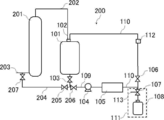
- FIG. 2 is a schematic view showing another embodiment of a production apparatus that can be used in the method for producing a treatment liquid of the present invention.
- the manufacturing apparatus 200 includes a tank 101 and a filtration device 105, and is further connected to the tank 101 with a pipe line 202, a pipe line 204, and a pipe line 203, and fluid between the tank 101 through each of the pipe lines. Is provided with a distillation column 201 arranged so that it can be transferred.
- the filtration apparatus 105 and / or the distillation column 201 may not necessarily be provided. You may provide the reaction container etc. which were connected with the distillation column 201 by the path
- the fluid supplied to the distillation column 201 through the pipe line 203 is distilled in the distillation column 201.
- the distilled fluid is accommodated in the tank 101 via the pipe line 202.
- the supply pipe 109 is provided with a valve 103 and a valve 206, and the fluid discharged from the tank 101 can flow into the filtration device 105 by switching to the valve 205 provided in the pipe 204. ing.
- the fluid discharged from the tank 101 can also flow into the distillation column 201 again. In that case, the fluid flows into the distillation column 201 from the pipe line 204 through the valve 207 and the pipe line 203 by switching the valve 103, the valve 206, and the valve 205 described above.
- the manufacturing apparatus 200 may further include one or more filtration devices (not shown) in addition to the filtration device 105.
- the installation position of filtration apparatuses other than the filtration apparatus 105 is not specifically limited, For example, it can install in the upstream of the pipe line 203.
- FIG. The case where the manufacturing apparatus 200 has two filtration apparatuses on the upstream side of the pipe line 203 will be described in detail.
- the fluid is supplied to a first filtration device (for example, first ion exchange means, not shown) disposed on the upstream side of the pipe line 203.
- the fluid that has flowed out of the first filtration device is upstream of the pipe line 203 and is supplied to a second filtration device (for example, dehydrating means, not shown) installed on the downstream side of the first filtration device. Supplied.
- the fluid that has flowed out of the second filtration device is supplied to the distillation column 201 via the pipe line 203.
- the fluid distilled in the distillation column 201 is supplied to the filtration device 105 (for example, the second ion exchange means) through the tank 101. In this way, the treatment liquid of the present invention can be obtained.
- the fluid supplied to the filtration device 105 may be supplied to the upstream side of the first filtration device via the tank 101, the pipe line 204, and a pipeline (not shown), or on the downstream side of the first filtration device. Then, it may be supplied to the upstream side of the second filtration device.
- the fluid flowing out from the first filtration device may be supplied again to the first filtration device by using a pipe line and a valve (not shown).
- the example in which the fluid flowing out from the second filtration device is supplied to the distillation column 201 has been shown.
- the fluid flowing out from the second filtration device can be supplied to the second column using a pipe and a valve (not shown). It may be supplied again to the filtration device.
- the material of the wetted part of the manufacturing apparatus (the definition of the wetted part will be described later) is not particularly limited, but a non-metallic material and electrolysis can be obtained in that a treatment liquid having better defect suppression performance can be obtained. It is preferably formed from at least one selected from the group consisting of polished metal materials.
- the “wetted part” is a part (for example, tank inner surface, pipe inner surface, etc.) where the fluid may come into contact, and a region having a thickness of 100 nm from the surface is intended. .
- the non-metallic material is not particularly limited, but is preferably a fluorine-containing resin material such as polyethylene resin, polypropylene resin, polyethylene-polypropylene resin, and perfluoro resin. It is preferable that it is a containing resin.
- fluorine-containing resins include perfluororesins, such as tetrafluoroethylene resin (PTFE), tetrafluoroethylene / perfluoroalkyl vinyl ether copolymer (PFA), and tetrafluoroethylene-hexafluoropropylene copolymer.
- Resin FEP
- Tetrafluoroethylene-ethylene copolymer resin ETFE
- Trifluoroethylene chloride-ethylene copolymer resin ECTFE
- Vinylidene fluoride resin PVDF
- PCTFE vinyl fluoride resin
- PVF vinyl fluoride resin
- Particularly preferable fluorine-containing resins include tetrafluoroethylene resin, tetrafluoroethylene / perfluoroalkyl vinyl ether copolymer, and tetrafluoroethylene-hexafluoropropylene copolymer resin.
- the metal material is not particularly limited, and a known material can be used.
- the metal material include a metal material having a total content of chromium and nickel of more than 25% by mass with respect to the total mass of the metal material, and more preferably 30% by mass or more.
- the upper limit of the total content of chromium and nickel in the metal material is not particularly limited, but is generally preferably 90% by mass or less.
- the metal material include stainless steel, carbon steel, alloy steel, nickel chrome molybdenum steel, chrome steel, chrome molybdenum steel, manganese steel, and nickel-chromium alloy.
- Stainless steel is not particularly limited, and known stainless steel can be used. Especially, the alloy containing 8 mass% or more of nickel is preferable, and the austenitic stainless steel containing 8 mass% or more of nickel is more preferable.
- austenitic stainless steel for example, SUS (Steel Use Stainless) 304 (Ni content 8 mass%, Cr content 18 mass%), SUS304L (Ni content 9 mass%, Cr content 18 mass%), SUS316 ( Ni content 10 mass%, Cr content 16 mass%), SUS316L (Ni content 12 mass%, Cr content 16 mass%), etc. are mentioned.
- the nickel-chromium alloy is not particularly limited, and a known nickel-chromium alloy can be used. Among these, a nickel-chromium alloy having a nickel content of 40 to 75% by mass and a chromium content of 1 to 30% by mass is preferable.
- the nickel-chromium alloy include Hastelloy (trade name, the same applies hereinafter), Monel (trade name, the same applies hereinafter), Inconel (product name, the same applies hereinafter), and the like. More specifically, Hastelloy C-276 (Ni content 63 mass%, Cr content 16 mass%), Hastelloy-C (Ni content 60 mass%, Cr content 17 mass%), Hastelloy C-22 ( Ni content 61 mass%, Cr content 22 mass%) etc. are mentioned. Further, the nickel-chromium alloy may further contain boron, silicon, tungsten, molybdenum, copper, cobalt, and the like in addition to the above-described alloy as necessary.
- the method for electropolishing the metal material is not particularly limited, and a known method can be used.
- a known method can be used.
- the methods described in JP-A-2015-227501, paragraphs 0011 to 0014 and JP-A-2008-264929, paragraphs 0036 to 0042 can be used.
- the metal material is electropolished so that the chromium content in the passive layer on the surface is higher than the chromium content in the parent phase. Therefore, from the distillation tower formed from the metal material whose wetted part is electropolished, it is difficult for metal impurities containing metal atoms to flow out into the organic solvent. It is estimated that can be obtained.
- the metal material may be buffed.
- the buffing method is not particularly limited, and a known method can be used.
- the size of the abrasive grains used for buffing finishing is not particularly limited, but is preferably # 400 or less in that the unevenness on the surface of the metal material tends to be smaller.
- the buffing is preferably performed before the electrolytic polishing.
- the wetted part is preferably formed from electropolished stainless steel in that a treatment liquid having better defect suppression performance can be obtained.
- the manufacturing apparatus includes a tank
- the liquid contact portion of the tank is formed of stainless steel that has been electropolished.
- the mass ratio of the Cr content to the Fe content in the wetted part (hereinafter, also referred to as “Cr / Fe”) is not particularly limited, but is generally preferably 0.5 to 4, and in particular, the treatment In the point which a metal impurity and / or an organic impurity do not elute more easily in a liquid, 0.5 and less than 3.5 are more preferable, and 0.7 or more and 3.0 or less are more preferable.
- the method for adjusting Cr / Fe in the metal material is not particularly limited.
- the metal material may be applied with a coating technique.
- coating technology includes metal coating (various plating), inorganic coating (various chemical conversion treatment, glass, concrete, ceramics, etc.) and organic coating (rust prevention oil, paint, rubber, or plastics). It has been separated.
- Preferable film technology includes rust preventive oil, rust preventive agent, corrosion inhibitor, chelate compound, peelable plastic, and surface treatment with a lining agent.
- the filtration member included in the filtration device of the production apparatus is not particularly limited, but the above-described first ion exchange means (for example, ion exchange resin), the above-described dehydration means (for example, a dehydration membrane and a water adsorbent), and The 2nd ion exchange means (for example, ion exchange resin and ion adsorption film) mentioned above is mentioned, What combined these 2 or more types may be used. Moreover, you may use for a filtration member at least 1 sort (s) selected from the group which consists of a filter with a particle removal diameter of 20 nm or less, and a metal ion adsorption member. The metal ion adsorption member may be used as the first ion exchange means and the second ion exchange means.
- first ion exchange means for example, ion exchange resin
- dehydration means for example, a dehydration membrane and a water adsorbent
- the 2nd ion exchange means for example,
- the filter having a particle removal diameter of 20 nm or less has a function of efficiently removing particles having a diameter of 20 nm or more from an organic solvent or the like that is a raw material for the treatment liquid.
- the particle removal diameter of the filter is preferably 1 to 15 nm, and more preferably 1 to 12 nm. When the particle removal diameter is 15 nm or less, finer particles can be removed, and when the particle removal diameter is 1 nm or more, the filtration efficiency is improved.
- the particle removal diameter means the minimum particle size that can be removed by the filter. For example, when the particle removal diameter of the filter is 20 nm, particles having a diameter of 20 nm or more can be removed.
- the filter material examples include nylon such as 6-nylon and 6,6-nylon, polyethylene, polypropylene, polystyrene, polyimide, polyamideimide, and fluororesin.
- the polyimide and / or the polyamideimide may have at least one selected from the group consisting of a carboxy group, a salt-type carboxy group, and an NH— bond.
- fluororesin, polyimide and / or polyamideimide are excellent. From the viewpoint of adsorbing metal ions, nylons such as 6-nylon and 6,6-nylon are particularly preferable.
- the filtration device may contain a plurality of the filters.
- the other filter is not particularly limited, but a filter having a particle removal diameter of 50 nm or more (for example, a microfiltration membrane for removing fine particles having a pore diameter of 50 nm or more) is preferable.
- a filter having a particle removal diameter of 20 nm or less for example, Before filtration using a microfiltration membrane having a pore diameter of 20 nm or less, the material to be purified is filtered using a filter having a particle removal diameter of 50 nm or more (for example, a microfiltration membrane for removing fine particles having a pore diameter of 50 nm or more).
- the filtration efficiency of a filter having a particle removal diameter of 20 nm or less is improved, and the particle removal performance is further improved.
- the filtration apparatus may have a filter described in the “filtering” section described later, and the “filter having a particle removal diameter of 20 nm or less” also serves as the filter described in the “filtering” section described later. May be.
- Metal ion adsorption filter It does not restrict
- the metal metal to be adsorbed is preferably the specific metal component because it tends to cause defects in the semiconductor device.
- the metal ion adsorption filter preferably contains an acid group on the surface from the viewpoint of improving the adsorption performance of metal ions. Examples of the acid group include a sulfo group and a carboxy group.
- Examples of the base material (material) constituting the metal ion adsorption filter include cellulose, diatomaceous earth, nylon, polyethylene, polypropylene, polystyrene, and fluororesin. Nylon is particularly preferable from the viewpoint of the efficiency of adsorbing metal ions.
- the metal ion adsorption filter may be made of a material containing polyimide and / or polyamideimide.
- the metal ion adsorption filter include a polyimide and / or polyamide-imide porous film described in JP 2016-155121 A (JP 2016-155121).
- the polyimide and / or polyamideimide porous membrane may contain at least one selected from the group consisting of a carboxy group, a salt-type carboxy group, and an —NH— bond.
- the metal ion adsorption filter is made of fluororesin, polyimide, and / or polyamideimide, it has better solvent resistance.
- the filtration device may further include an organic impurity adsorption filter. It does not restrict
- an organic impurity adsorption filter has an organic skeleton capable of interacting with organic impurities on the surface in terms of improving the adsorption performance of organic impurities (in other words, the surface by an organic skeleton capable of interacting with organic impurities. Is preferably modified).
- Examples of the organic skeleton capable of interacting with the organic impurities include a chemical structure that can react with the organic impurities and trap the organic impurities in the organic impurity adsorption filter.
- the organic skeleton when n-long chain alkyl alcohol (structural isomer when 1-long chain alkyl alcohol is used as the organic solvent) is included as the organic impurity, the organic skeleton includes an alkyl group. .
- the organic skeleton when dibutylhydroxytoluene (BHT) is included as an organic impurity, the organic skeleton includes a phenyl group.
- BHT dibutylhydroxytoluene
- the organic skeleton includes a phenyl group.
- the base material (material) constituting the organic impurity adsorption filter include cellulose, diatomaceous earth, nylon, polyethylene, polypropylene, polystyrene, and fluororesin that support activated carbon.
- the organic impurity adsorption filter a filter in which activated carbon described in JP-A-2002-273123 and JP-A-2013-150979 is fixed to a nonwoven fabric can be used.
- a physical adsorption method can be applied in addition to the above-described chemical adsorption (adsorption using an organic impurity adsorption filter having an organic substance skeleton capable of interacting with organic impurities on the surface).
- the treatment liquid of the present invention may be obtained through a process of cleaning the manufacturing apparatus using a cleaning liquid.
- the process of cleaning the manufacturing apparatus is performed by supplying the cleaning liquid from the supply port 102 of the tank 101.
- the supply amount of the cleaning liquid is not particularly limited, but is preferably an amount that can sufficiently clean the liquid contact portion of the tank 101, and the volume of the supplied cleaning liquid is preferably 30% by volume or more with respect to the capacity of the tank 101.
- the valve 103 may be closed or open. However, when supplying the cleaning liquid from the supply port 102, the valve 103 is closed because the tank 101 can be easily cleaned. It is preferable.
- the cleaning liquid supplied to the tank 101 may be immediately transferred through the manufacturing apparatus, or may be transferred through the manufacturing apparatus (for example, through the supply line 109) after cleaning the tank 101.
- the method for cleaning the inside of the tank 101 using the cleaning liquid is not particularly limited, and examples thereof include a method for cleaning by rotating a stirring blade (not shown) provided in the tank 101.
- the time for cleaning the tank with the cleaning liquid is not particularly limited, and may be appropriately selected according to the material of the liquid contact portion of the tank 101, the type of processing liquid to be manufactured, the possibility of contamination, and the like. Generally, about 0.1 second to 48 hours is preferable.
- the cleaning liquid after cleaning may be discharged from a discharge port (not shown) provided at the bottom of the tank.
- a method for cleaning the supply pipe 109 of the manufacturing apparatus 100 using the cleaning liquid is not particularly limited, but the valve 103 and the valve 106 are opened, the valve 107 is closed, the pump 104 is operated, and the cleaning liquid is cleaned. Is preferably circulated in the production apparatus through the supply line 109 and the circulation line 110 (hereinafter also referred to as “circulation cleaning”).
- circulation cleaning preferably circulated in the production apparatus through the supply line 109 and the circulation line 110
- the cleaning method is more preferably circulating cleaning.
- An example of circulating cleaning will be described with reference to FIG.
- the cleaning liquid supplied from the tank 101 through the valve 103 into the manufacturing apparatus returns to the tank 101 through the supply pipe 109 (through the filtration device 105, the circulation pipe 110, and the valve 106) (circulation). To do).
- the cleaning liquid is filtered by the filtration device 105, and particles and the like dissolved and dispersed in the cleaning liquid are removed, so that the cleaning effect can be further enhanced.
- the valve 103 and the valve 107 are opened, the valve 106 is closed, the pump 104 is operated, and the cleaning liquid supplied from the supply port 102 of the tank 101 into the manufacturing apparatus is supplied.
- a method of discharging the cleaning liquid to the outside of the manufacturing apparatus through the valve 107 without circulating the cleaning liquid (hereinafter referred to as “batch cleaning” in this specification). May also be used.
- the cleaning liquid may be intermittently supplied into the manufacturing apparatus or may be continuously supplied into the manufacturing apparatus.
- the cleaning liquid used for cleaning the manufacturing apparatus is not particularly limited, and a known cleaning liquid can be used.
- the cleaning liquid may have, for example, water, alkylene glycol monoalkyl ether carboxylate, alkylene glycol monoalkyl ether, alkyl lactate ester, alkyl alkoxypropionate, cyclic lactone (preferably having 4 to 10 carbon atoms), or a ring. Examples thereof include monoketone compounds (preferably having 4 to 10 carbon atoms), alkylene carbonates, alkyl alkoxyacetates, and alkyl pyruvates.
- the cleaning liquid for example, those described in JP-A-2016-57614, JP-A-2014-219664, JP-A-2016-138219, and JP-A-2015-135379 may be used. .
- propylene glycol monomethyl ether PGME
- cyclopentane CyPe
- cyclopentanone CyPn
- butyl acetate nBA
- propylene glycol monomethyl ether acetate PGMEA
- cyclohexanone CyHe
- ethyl lactate EL
- HBM Methyl 2-hydroxyisobutyrate
- DBCPN cyclopentanone dimethyl acetal
- ⁇ BL dimethyl sulfoxide
- EC propylene carbonate
- NMP pyrrolidone
- iAA isoamyl acetate
- IPA 2-propanol
- MEK methyl eth
- examples of the cleaning liquid include alcohols such as methanol, ethanol, propanol, butanol, methoxyethanol, butoxyethanol, methoxypropanol, and ethoxypropanol; ketones such as acetone; tetrahydrofuran, dioxane, ethylene glycol dimethyl ether And ether systems such as diethylene glycol dimethyl ether; ester systems such as ethyl acetate and ethyl cellosolve acetate; aromatic compounds such as benzene, toluene and xylene; chlorinated hydrocarbons such as dichloromethane, dichloroethane, dichloroethylene, and trichloroethylene And the like.
- alcohols such as methanol, ethanol, propanol, butanol, methoxyethanol, butoxyethanol, methoxypropanol, and ethoxypropanol
- ketones such as acetone
- the treatment liquid of the present invention may be a kit for separately adding other raw materials.
- an organic solvent and other compounds can be mixed and used depending on the application.
- the organic solvent that can be used in this case is such that each content of the metal component and water contained therein is within the range of the specific value of the present invention described above. The desired effect of the present invention is remarkably obtained.
- the treatment liquid of the present invention can be stored, transported and used in any container as long as corrosivity does not matter (whether or not it is a kit).
- a container having a high cleanliness in the container and little impurity elution is preferable for semiconductor applications.
- Examples of containers that can be used include, but are not limited to, “Clean Bottle” series manufactured by Aicero Chemical Co., Ltd., “Pure Bottle” manufactured by Kodama Resin Co., Ltd., and the like.
- the inner wall of the container (that is, the wetted part in contact with the treatment liquid) is made of a nonmetallic material (for example, one or more resins selected from the group consisting of polyethylene resin, polypropylene resin, and polyethylene-polypropylene resin, and Are different resins) or a metal material that has been subjected to rust prevention and metal elution prevention treatment, such as stainless steel, Hastelloy, Inconel and Monel.
- a nonmetallic material for example, one or more resins selected from the group consisting of polyethylene resin, polypropylene resin, and polyethylene-polypropylene resin, and Are different resins
- a metal material that has been subjected to rust prevention and metal elution prevention treatment such as stainless steel, Hastelloy, Inconel and Monel.
- a fluororesin perfluoro resin
- a fluororesin perfluoro resin
- elution of an ethylene or propylene oligomer is achieved compared to the case where a container whose inner wall is made of polyethylene resin, polypropylene resin, or polyethylene-polypropylene resin.
- the occurrence of defects can be suppressed.
- Specific examples of the fluorine-based resin include “fluorine-containing resin” described in the liquid contact portion of the above-described manufacturing apparatus.
- a container whose inner wall is made of a fluororesin for example, a FluoroPure PFA composite drum manufactured by Entegris may be mentioned. Also described on page 4 of JP-T-3-502677, page 3 of WO 2004/016526, page 9 and page 16 of WO 99/46309, etc. These containers can also be used. In addition, when using it as the inner wall of a nonmetallic material, it is preferable that the elution of the nonmetallic material into a process liquid is suppressed.
- quartz and electropolished metal material are also preferably used for the inner wall of the container.
- the specific metal component and / or organic impurities are less likely to elute in the processing liquid stored in the container.
- the metal material used for manufacturing the electropolished metal material contains at least one selected from the group consisting of chromium and nickel, and the total content of chromium and nickel is 25 with respect to the total mass of the metal material.
- a metal material exceeding mass% is preferable, and examples thereof include stainless steel and nickel-chromium alloy.
- the total content of chromium and nickel in the metal material is preferably 25% by mass or more, and more preferably 30% by mass or more with respect to the total mass of the metal material.
- the upper limit of the total content of chromium and nickel in the metal material is not particularly limited, but generally 90% by mass or less is preferable.
- Stainless steel is not particularly limited, and known stainless steel can be used. Especially, the alloy containing 8 mass% or more of nickel is preferable, and the austenitic stainless steel containing 8 mass% or more of nickel is more preferable.
- austenitic stainless steel for example, SUS (Steel Use Stainless) 304 (Ni content 8 mass%, Cr content 18 mass%), SUS304L (Ni content 9 mass%, Cr content 18 mass%), SUS316 ( Ni content 10 mass%, Cr content 16 mass%), SUS316L (Ni content 12 mass%, Cr content 16 mass%), etc. are mentioned.
- the nickel-chromium alloy is not particularly limited, and a known nickel-chromium alloy can be used. Among these, a nickel-chromium alloy having a nickel content of 40 to 75% by mass and a chromium content of 1 to 30% by mass is preferable.
- the nickel-chromium alloy include Hastelloy (trade name, the same applies hereinafter), Monel (trade name, the same applies hereinafter), Inconel (product name, the same applies hereinafter), and the like. More specifically, Hastelloy C-276 (Ni content 63 mass%, Cr content 16 mass%), Hastelloy-C (Ni content 60 mass%, Cr content 17 mass%), Hastelloy C-22 ( Ni content 61 mass%, Cr content 22 mass%) etc. are mentioned. Further, the nickel-chromium alloy may further contain boron, silicon, tungsten, molybdenum, copper, cobalt, and the like in addition to the above-described alloy as necessary.
- the method for electropolishing the metal material is not particularly limited, and a known method can be used.
- a known method can be used.
- the methods described in paragraphs [0011]-[0014] of JP-A-2015-227501 and paragraphs [0036]-[0042] of JP-A-2008-264929 can be used.
- the metal material is electropolished so that the chromium content in the passive layer on the surface is higher than the chromium content in the parent phase. Therefore, from the inner wall covered with the electropolished metal material, the metal component is unlikely to flow out into the processing liquid, so that it is presumed that a semiconductor processing liquid with a reduced specific metal component can be obtained.
- the metal material is preferably buffed.
- the buffing method is not particularly limited, and a known method can be used.
- the size of the abrasive grains used for buffing finishing is not particularly limited, but is preferably # 400 or less in that the unevenness on the surface of the metal material tends to be smaller.
- the buffing is preferably performed before the electrolytic polishing.
- the metal material may be processed by combining one or two or more of buff polishing, acid cleaning, magnetic fluid polishing, and the like performed at different stages such as the size of the abrasive grains. .
- what has the said container and the said process liquid accommodated in this container may be called a process liquid container.
- the metal component contained in the liquid used for cleaning is preferably within the range of the content of the metal component in the treatment liquid.
- the liquid may be appropriately selected depending on the application, but other organic solvents are refined so that the content of the metal component is within the same range as the above treatment liquid, the treatment liquid itself of the present invention, The effect of the present invention is remarkably obtained when the treatment liquid is diluted or a liquid containing at least one component added to the treatment liquid of the present invention. It is preferable that the inside of the container is cleaned before storing the treatment liquid.
- the cleaning liquid, the processing liquid itself, or a solution obtained by diluting the processing liquid is preferable.
- the treatment liquid of the present invention may be transported and stored by bottling into a container such as a gallon bottle or a coated bottle after production.
- the gallon bottle may be one using a glass material or the other.
- the inside of the container may be replaced with an inert gas (such as nitrogen or argon) having a purity of 99.99995 volume% or more.
- an inert gas such as nitrogen or argon
- a gas having a low moisture content is preferable.
- the temperature may be normal temperature, but the temperature may be controlled in the range of ⁇ 20 ° C. to 20 ° C. in order to prevent deterioration.
- the clean room preferably meets the 14644-1 clean room criteria. It is preferable to satisfy any of ISO (International Organization for Standardization) class 1, ISO class 2, ISO class 3, and ISO class 4, more preferably ISO class 1 or ISO class 2, and ISO class 1 Further preferred.
- ISO International Organization for Standardization
- the treatment liquid of the present invention is preferably filtered in order to bring the contents of the metal component and water into the desired ranges and to remove foreign substances and coarse particles.
- the filter used for filtering can be used without particular limitation as long as it has been conventionally used for filtering.
- Examples of the material constituting the filter include fluorine resins such as PTFE (polytetrafluoroethylene), polyamide resins such as nylon, polyethylene resins, and polyolefin resins such as polypropylene (PP) (including high density and ultra high molecular weight). ) And the like.
- polyamide-based resin, PTFE, and polypropylene are preferable, and by using a filter formed of these materials, a highly polar foreign substance that easily causes residue defects or particle defects. Can be more effectively removed, and the amount of the specific metal component of the present invention can be reduced more efficiently.
- the critical surface tension of the filter is preferably 70 mN / m or more as the lower limit. As an upper limit, 95 mN / m or less is preferable. In particular, the critical surface tension of the filter is preferably 75 mN / m or more and 85 mN / m or less. In addition, the value of critical surface tension is a manufacturer's nominal value.
- the pore diameter of the filter is preferably about 0.001 to 1.0 ⁇ m, more preferably about 0.02 to 0.5 ⁇ m, and further preferably about 0.01 to 0.1 ⁇ m.
- the pore size of the filter is preferably 0.05 ⁇ m or less.
- the pore size of the filter when adjusting the amount of the specific metal component is more preferably 0.005 ⁇ m or more and 0.04 ⁇ m or less, and further preferably 0.01 ⁇ m or more and 0.02 ⁇ m or less.
- the filtering by the first filter may be performed only once or may be performed twice or more.
- the filters may be of the same type or of different types, but of different types. It is preferable.
- the first filter and the second filter are preferably different in at least one of the hole diameter and the constituent material. It is preferable that the second and subsequent pore diameters are the same or smaller than the first filtering pore diameter.
- the pore diameter here can refer to the nominal value of the filter manufacturer.
- P-nylon filter (pore size 0.02 ⁇ m, critical surface tension 77 mN / m) made of polyamide; (manufactured by Nippon Pole Co., Ltd.), “PE / clean filter (pore size 0.02 ⁇ m)” made of high-density polyethylene; (Manufactured by Nippon Pole Co., Ltd.) and “PE / clean filter (pore diameter 0.01 ⁇ m)” made of high-density polyethylene; (Nippon Pole Co., Ltd.) can also be used.
- the second filter a filter formed of the same material as the first filter described above can be used.
- the thing with the same hole diameter as the 1st filter mentioned above can be used.
- the ratio of the second filter hole diameter to the first filter hole diameter Is preferably from 0.01 to 0.99, more preferably from 0.1 to 0.9, and even more preferably from 0.3 to 0.9.
- the filtering by the first filter is performed with a mixed solution containing a part of the components of the processing liquid, the remaining components are mixed with this to prepare the processing liquid, and then the second filtering is performed. Also good.
- the used filter is processed before the processing liquid is filtered.
- the liquid used for this treatment is not particularly limited, but the organic solvent is purified to make the content of the metal component within the same range as the above treatment liquid, the treatment liquid of the present invention, the treatment liquid of the present invention.
- the desired effect of the present application is remarkably obtained when the liquid is diluted or liquid containing the components contained in the treatment liquid.
- the upper limit of the temperature during filtering is preferably room temperature (25 ° C.) or less, more preferably 23 ° C. or less, and even more preferably 20 ° C. or less. Moreover, 0 degreeC or more is preferable, as for the lower limit of the temperature at the time of filtering, 5 degreeC or more is more preferable, and 10 degreeC or more is further more preferable. Filtering can remove particulate foreign matter and impurities, but if performed at the above temperature, the amount of particulate foreign matter and impurities dissolved in the treatment liquid is reduced, so filtering is performed more efficiently. .
- the treatment liquid of the present invention containing an extremely small amount of a specific metal component, it is preferable to filter at the above temperature.
- the mechanism is not clear, it is considered that many of the specific metal components are present in a particulate colloidal state.
- a part of the specific metal component floating in a colloidal state aggregates, so this agglomerated material is efficiently removed by filtering, so the content of the specific metal component is reduced. It is conceivable that the desired amount can be easily adjusted.
- the used filter is processed before the processing liquid is filtered.
- the liquid used in this treatment is not particularly limited, but the content of the specific metal component described above is preferably less than 0.001 mass ppt.
- other organic solvents are purified.
- the above-mentioned content of the specific metal component is in the above range, or the treatment liquid of the present invention itself, or a dilution of the treatment liquid, further refined, the specific metal component, impurities, coarse particles, etc. The desired effect of the present invention is remarkably obtained when the liquid has a reduced content.
- the processing liquid of the present invention is a processing liquid for semiconductor devices.
- “for a semiconductor device” means used in the manufacture of a semiconductor device.
- the treatment liquid of the present invention can be used in any process for producing a semiconductor device (for example, a lithography process, an etching process, an ion implantation process, a peeling process, etc.), for example, an insulating film present on a substrate. , Resist film, etching residue, antireflection film, ashing residue and the like.
- the treatment liquid may be a pre-wet liquid, a metal film, or a pre-wet liquid applied on the substrate in order to improve the application property of the composition before the step of forming a resist film using the actinic ray-sensitive or radiation-sensitive composition.
- Cleaning liquid for example, rinsing liquid
- solutions for example, removing liquid and stripping liquid
- a permanent film for example, a color filter, a transparent insulating film, a resin lens
- a solution for example, a removing liquid and a stripping liquid used for removing from the semiconductor substrate.
- the treatment liquid can also be used as a developer for various resists for pattern formation.
- the treatment liquid can also be used for rinsing edge-alignment of the semiconductor substrate before and after resist coating. Further, the treatment liquid can also be used as a diluted resin solution contained in a resist liquid (described later). That is, it can also be used as a solvent contained in an actinic ray-sensitive or radiation-sensitive composition.
- the semiconductor substrate after removal of the permanent film may be used again for use of the semiconductor device, the removal of the permanent film is included in the manufacturing process of the semiconductor device.
- the treatment liquid of the present invention is preferably used as at least one of a rinse liquid and a pre-wet liquid.
- the treatment liquid of the present invention can be suitably used in other applications other than semiconductor applications, and can also be used as a developing solution or rinsing solution for polyimide, a sensor resist, a lens resist, and the like.
- the treatment liquid of the present invention can also be used as a solvent for medical use or cleaning use. In particular, it can be suitably used for cleaning containers, piping, substrates (for example, wafers, glass, etc.) and the like.
- the treatment liquid of the present invention is used for a developer, a rinsing liquid, a pre-wet liquid, a stripping liquid, and the like in a semiconductor device manufacturing method.
- the processing liquid is developed in a pattern forming method included in the semiconductor device manufacturing method. It is preferably used as a liquid, a rinse liquid or a pre-wet liquid, and more preferably used as a rinse liquid or a pre-wet liquid.
- an actinic ray-sensitive or radiation-sensitive film (hereinafter referred to as “resist composition”) is applied to a substrate.
- a resist film also referred to as a “resist film”.
- a processing step of processing with a liquid is also referred to as “resist composition”.
- the processing liquid of the present invention may be used as any one of a developer, a rinse liquid and a pre-wet liquid.
- the pattern formation method using the treatment liquid of the present invention is a prewetting liquid on a substrate in order to improve the coating property before the step of forming a resist film using an actinic ray-sensitive or radiation-sensitive composition.
- a pre-wet process for applying the coating material in advance may be included.
- the pre-wet process is described in JP 2014-220301 A, and these are incorporated.
- the resist film forming step is a step of forming a resist film using an actinic ray-sensitive or radiation-sensitive composition, and can be performed, for example, by the following method.
- each component described later is dissolved in a solvent and activated.
- a light-sensitive or radiation-sensitive composition is prepared, filtered as necessary, and then applied onto a substrate.
- the filter is preferably made of polytetrafluoroethylene, polyethylene, or nylon having a pore size of 0.1 ⁇ m or less, more preferably 0.05 ⁇ m or less, and still more preferably 0.03 ⁇ m or less.
- the actinic ray-sensitive or radiation-sensitive composition is applied to a substrate (eg, silicon or silicon dioxide coating) used for manufacturing an integrated circuit element by an appropriate application method such as a spinner. Thereafter, it is dried to form a resist film. If necessary, various base films (inorganic films, organic films, antireflection films) may be formed under the resist film.
- a substrate eg, silicon or silicon dioxide coating
- an appropriate application method such as a spinner.
- Heating can be performed by means provided in a normal exposure machine and developing machine, and may be performed using a hot plate or the like.
- the heating temperature is preferably 80 to 180 ° C, more preferably 80 to 150 ° C, still more preferably 80 to 140 ° C, and particularly preferably 80 to 130 ° C.
- the heating time is preferably 30 to 1000 seconds, more preferably 60 to 800 seconds, and even more preferably 60 to 600 seconds.
- the film thickness of the resist film is generally 200 nm or less, preferably 100 nm or less.
- the thickness of the resist film to be formed is preferably 50 nm or less. If the film thickness is 50 nm or less, pattern collapse is less likely to occur when a development process described later is applied, and better resolution performance is obtained.
- the film thickness ranges from 15 nm to 45 nm. If the film thickness is 15 nm or more, sufficient etching resistance can be obtained. More preferably, the film thickness ranges from 15 nm to 40 nm. When the film thickness is within this range, etching resistance and better resolution performance can be satisfied at the same time.
- an upper layer film (top coat film) may be formed on the resist film.
- the upper film can be formed using, for example, an upper film forming composition containing a hydrophobic resin, an acid generator, and a basic compound.
- the upper layer film and the composition for forming the upper layer film are as described below.
- An exposure process is a process of exposing the said resist film, for example, can be performed with the following method.
- the actinic ray or radiation is irradiated to the resist film formed as described above through a predetermined mask. Note that in electron beam irradiation, drawing (direct drawing) without using a mask is common.
- the actinic ray or radiation is not particularly limited, and examples thereof include a KrF excimer laser, an ArF excimer laser, EUV light (Extreme Ultra Violet), and an electron beam (EB, Electron Beam).
- the exposure may be immersion exposure.
- ⁇ Bake> In the pattern forming method using the processing liquid of the present invention, it is preferable to perform baking (heating) after exposure and before development. The reaction of the exposed part is promoted by baking, and the sensitivity and pattern shape become better.
- the heating temperature is preferably 80 to 150 ° C, more preferably 80 to 140 ° C, still more preferably 80 to 130 ° C.
- the heating time is preferably 30 to 1000 seconds, more preferably 60 to 800 seconds, and still more preferably 60 to 600 seconds.
- the heating can be performed by means provided in a normal exposure machine and developing machine, and may be performed using a hot plate or the like.
- the development step is a step of developing the exposed resist film with a developer.
- a developing method for example, a method in which a substrate is immersed in a tank filled with a developer for a certain period of time (dip method), a method in which the developer is raised on the surface of the substrate by surface tension and is left stationary for a certain time (paddle) Method), a method of spraying a developer on the substrate surface (spray method), and a method of continuously discharging the developer while scanning the developer discharge nozzle at a constant speed on a substrate rotating at a constant speed (dynamic dispensing). Law) and the like can be applied.
- a step of stopping development may be performed while substituting with another solvent.
- the development time is not particularly limited as long as the resin in the unexposed area is sufficiently dissolved, and is usually 10 to 300 seconds, preferably 20 to 120 seconds.
- the temperature of the developer is preferably 0 to 50 ° C, more preferably 15 to 35 ° C.
- the developer used in the developing step it is preferable to use the above-described processing solution.
- the developer is as described above.
- development with an alkaline developer may be performed (so-called double development).
- the rinsing step is a step of rinsing (rinsing) with a rinsing liquid after the developing step.
- the developed wafer is cleaned using the above rinse solution.
- the method of the cleaning process is not particularly limited.
- a method of continuously discharging the rinse liquid onto the substrate rotating at a constant speed (rotary discharge method), or immersing the substrate in a tank filled with the rinse liquid for a certain period of time.
- the method (dip method) and the method of spraying the rinse liquid on the substrate surface can be applied.
- the cleaning treatment is performed by the rotary discharge method, and the substrate is rotated at 2000 rpm to 4000 rpm after the cleaning. It is preferable to remove the rinse liquid from the substrate by rotating the film by a number.
- the rinse time is not particularly limited, but is usually 10 to 300 seconds.
- the time is preferably 10 seconds to 180 seconds, and most preferably 20 seconds to 120 seconds.
- the temperature of the rinse liquid is preferably 0 to 50 ° C., more preferably 15 to 35 ° C.
- the heating temperature is not particularly limited as long as a good resist pattern can be obtained, and is usually 40 to 160 ° C.
- the heating temperature is preferably 50 to 150 ° C, and most preferably 50 to 110 ° C.
- the heating time is not particularly limited as long as a good resist pattern can be obtained, but it is usually 15 to 300 seconds, and preferably 15 to 180 seconds.
- the rinse liquid it is preferable to use the above-described treatment liquid.
- the explanation of the rinse liquid is as described above.
- the pattern forming method using the processing solution of the present invention may be any one of the developing solution, the rinsing solution, and the pre-wet solution as long as the processing solution of the present invention described above.
- Any two of the prewetting liquids may be the processing liquid of the present invention, and three of the developing liquid, the rinsing liquid and the prewetting liquid may be the processing liquid of the present invention.
- the treatment liquid used in the pattern forming method using the treatment liquid of the present invention and the actinic ray-sensitive or radiation-sensitive resin composition preferably satisfy the following relationship in one embodiment.
- the dissolution rate of the actinic ray-sensitive or radiation-sensitive film formed using the actinic ray-sensitive or radiation-sensitive resin composition in the treatment liquid of the present invention is 0.0016 to 0.33 nm / second. It is preferable to use the actinic ray-sensitive or radiation-sensitive resin composition that satisfies a certain relationship and the treatment liquid of the present invention.
- the dissolution rate of the actinic ray-sensitive or radiation-sensitive film in the treatment liquid of the present invention is a film when the actinic ray-sensitive or radiation-sensitive film is formed and then immersed in the treatment liquid of the present invention. This is the rate of decrease in thickness, and in the present invention, it is the dissolution rate at 23 ° C.
- the dissolution rate is more preferably 0.0016 to 0.16 nm / second, and further preferably 0.0016 to 0.08 nm / second.
- Resin (A) Resin
- the actinic ray-sensitive or radiation-sensitive composition preferably used in combination with the treatment liquid of the present invention preferably contains a resin (A).
- Resin (A) is at least (i) a repeating unit having a group that decomposes by the action of an acid to generate a carboxyl group (may further have a repeating unit having a phenolic hydroxyl group), or at least (ii) It has a repeating unit having a phenolic hydroxyl group.
- Examples of the repeating unit having a phenolic hydroxyl group contained in the resin (A) include a repeating unit represented by the following general formula (I).
- R 41 , R 42 and R 43 each independently represents a hydrogen atom, an alkyl group, a halogen atom, a cyano group or an alkoxycarbonyl group.
- R 42 may form a ring with Ar 4, R 42 in this case represents a single bond or an alkylene group.
- X 4 represents a single bond, —COO—, or —CONR 64 —, and R 64 represents a hydrogen atom or an alkyl group.
- L 4 represents a single bond or an alkylene group.
- Ar 4 represents an (n + 1) -valent aromatic ring group, and when bonded to R 42 to form a ring, represents an (n + 2) -valent aromatic ring group.
- N represents an integer of 1 to 5.
- the alkyl group represented by R 41 , R 42 and R 43 in the general formula (I) is preferably a methyl group, ethyl group, propyl group, isopropyl group, n-butyl group, sec- Examples thereof include alkyl groups having 20 or less carbon atoms such as butyl group, hexyl group, 2-ethylhexyl group, octyl group and dodecyl group, more preferably alkyl groups having 8 or less carbon atoms, particularly preferably alkyl groups having 3 or less carbon atoms. Can be mentioned.
- the cycloalkyl group represented by R 41 , R 42 and R 43 in the general formula (I) may be monocyclic or polycyclic.
- Preferred examples include a monocyclic cycloalkyl group having 3 to 8 carbon atoms such as a cyclopropyl group, a cyclopentyl group, and a cyclohexyl group, which may have a substituent.
- Examples of the halogen atom of R 41 , R 42 and R 43 in the general formula (I) include a fluorine atom, a chlorine atom, a bromine atom and an iodine atom, and a fluorine atom is particularly preferable.
- alkyl group contained in the alkoxycarbonyl group of R 41 , R 42 and R 43 in the general formula (I) the same alkyl groups as those described above for R 41 , R 42 and R 43 are preferable.
- Preferred substituents in each of the above groups include, for example, alkyl groups, cycloalkyl groups, aryl groups, amino groups, amide groups, ureido groups, urethane groups, hydroxyl groups, carboxyl groups, halogen atoms, alkoxy groups, thioether groups, acyls. Groups, acyloxy groups, alkoxycarbonyl groups, cyano groups, nitro groups and the like, and the substituent preferably has 8 or less carbon atoms.
- Ar 4 represents an (n + 1) -valent aromatic ring group.
- the divalent aromatic ring group in the case where n is 1 may have a substituent, for example, an arylene group having 6 to 18 carbon atoms such as a phenylene group, a tolylene group, a naphthylene group, an anthracenylene group, or the like.
- Examples of preferred aromatic ring groups include heterocycles such as thiophene, furan, pyrrole, benzothiophene, benzofuran, benzopyrrole, triazine, imidazole, benzimidazole, triazole, thiadiazole, and thiazole.
- n + 1) -valent aromatic ring group in the case where n is an integer of 2 or more include (n-1) arbitrary hydrogen atoms removed from the above-described specific examples of the divalent aromatic ring group.
- the group formed can be preferably mentioned.
- the (n + 1) -valent aromatic ring group may further have a substituent.
- Examples of the substituent that the above-described alkyl group, cycloalkyl group, alkoxycarbonyl group, alkylene group, and (n + 1) -valent aromatic ring group may have include R 41 , R 42 , and R 43 in formula (I).
- Examples include alkyl groups such as alkyl groups, methoxy groups, ethoxy groups, hydroxyethoxy groups, propoxy groups, hydroxypropoxy groups, and butoxy groups; aryl groups such as phenyl groups; and the like.
- R 64 represents a hydrogen atom, an alkyl group
- the alkyl group for R 64 in, preferably an optionally substituted methyl group, an ethyl group, a propyl group ,
- an alkyl group having a carbon number of 8 or less is more preferable.
- X 4 is preferably a single bond, —COO— or —CONH—, and more preferably a single bond or —COO—.
- the alkylene group for L 4 is preferably an alkylene group having 1 to 8 carbon atoms such as an optionally substituted methylene group, ethylene group, propylene group, butylene group, hexylene group and octylene group.
- an optionally substituted aromatic ring group having 6 to 18 carbon atoms is more preferable, and a benzene ring group, a naphthalene ring group, and a biphenylene ring group are particularly preferable.
- the repeating unit represented by the general formula (I) preferably has a hydroxystyrene structure. That is, Ar 4 is preferably a benzene ring group.
- Preferred examples of the repeating unit having a phenolic hydroxyl group that the resin (A) has include a repeating unit represented by the following general formula (p1).
- R represents a hydrogen atom, a halogen atom or a linear or branched alkyl group having 1 to 4 carbon atoms. A plurality of R may be the same or different. As R in the general formula (p1), a hydrogen atom is particularly preferable.
- Ar in the general formula (p1) represents an aromatic ring, for example, an aromatic carbon which may have a substituent having 6 to 18 carbon atoms such as a benzene ring, a naphthalene ring, an anthracene ring, a fluorene ring, a phenanthrene ring.
- a hydrogen ring or a heterocycle such as a thiophene ring, furan ring, pyrrole ring, benzothiophene ring, benzofuran ring, benzopyrrole ring, triazine ring, imidazole ring, benzimidazole ring, triazole ring, thiadiazole ring, thiazole ring, etc.
- aromatic ring heterocycles is especially, a benzene ring is most preferable.
- M in the general formula (p1) represents an integer of 1 to 5, preferably 1.
- the content of the repeating unit having a phenolic hydroxyl group is preferably from 0 to 50 mol%, more preferably from 0 to 45 mol%, still more preferably from 0 to 40 mol%, based on all repeating units in the resin (A). is there.
- the repeating unit having a group that decomposes by the action of an acid and generates a carboxyl group in the resin (A) is a repeating unit having a group in which a hydrogen atom of the carboxyl group is substituted with a group that decomposes and leaves by the action of an acid It is.
- Examples of the group capable of leaving with an acid include -C (R 36 ) (R 37 ) (R 38 ), -C (R 36 ) (R 37 ) (OR 39 ), -C (R 01 ) (R 02 ). ) (OR 39 ) and the like.
- R 36 to R 39 each independently represents an alkyl group, a cycloalkyl group, an aryl group, an aralkyl group or an alkenyl group.
- R 36 and R 37 may be bonded to each other to form a ring.
- R 01 and R 02 each independently represents a hydrogen atom, an alkyl group, a cycloalkyl group, an aryl group, an aralkyl group or an alkenyl group.
- the resin (A) is preferably a repeating unit represented by the following general formula (AI).
- Xa 1 represents a hydrogen atom or an alkyl group which may have a substituent.
- T represents a single bond or a divalent linking group.
- Rx 1 to Rx 3 each independently represents an alkyl group (straight or branched) or a cycloalkyl group (monocyclic or polycyclic). However, when all of Rx 1 to Rx 3 are alkyl groups (linear or branched), at least two of Rx 1 to Rx 3 are preferably methyl groups.
- Rx 1 to Rx 3 may combine to form a cycloalkyl group (monocyclic or polycyclic).
- Examples of the optionally substituted alkyl group represented by Xa 1 include a methyl group or a group represented by —CH 2 —R 11 .
- R 11 represents a halogen atom (such as a fluorine atom), a hydroxyl group or a monovalent organic group, and examples thereof include an alkyl group having 5 or less carbon atoms and an acyl group having 5 or less carbon atoms, preferably 3 or less carbon atoms. And more preferably a methyl group.
- Xa 1 is preferably a hydrogen atom, a methyl group, a trifluoromethyl group, a hydroxymethyl group, or the like.
- Examples of the divalent linking group of T include an alkylene group, —COO—Rt— group, —O—Rt— group and the like.
- Rt represents an alkylene group or a cycloalkylene group.
- T is preferably a single bond or a —COO—Rt— group.
- Rt is preferably an alkylene group having 1 to 5 carbon atoms, more preferably a —CH 2 — group, — (CH 2 ) 2 — group, or — (CH 2 ) 3 — group.
- the alkyl group of Rx 1 to Rx 3 is preferably an alkyl group having 1 to 4 carbon atoms such as a methyl group, an ethyl group, an n-propyl group, an isopropyl group, an n-butyl group, an isobutyl group, or a t-butyl group.
- Examples of the cycloalkyl group of Rx 1 to Rx 3 include monocyclic cycloalkyl groups such as cyclopentyl group and cyclohexyl group, polycyclic cycloalkyl groups such as norbornyl group, tetracyclodecanyl group, tetracyclododecanyl group and adamantyl group. Groups are preferred.
- Examples of the cycloalkyl group formed by combining two of Rx 1 to Rx 3 include a monocyclic cycloalkyl group such as a cyclopentyl group and a cyclohexyl group, a norbornyl group, a tetracyclodecanyl group, a tetracyclododecanyl group, an adamantyl group
- a polycyclic cycloalkyl group such as a group is preferred.
- a monocyclic cycloalkyl group having 5 to 6 carbon atoms is particularly preferred.
- the cycloalkyl group formed by combining two of Rx 1 to Rx 3 is, for example, a group in which one of the methylene groups constituting the ring has a heteroatom such as an oxygen atom or a heteroatom such as a carbonyl group. It may be replaced.
- the repeating unit represented by the general formula (AI) preferably has, for example, an embodiment in which Rx 1 is a methyl group or an ethyl group, and Rx 2 and Rx 3 are bonded to form the above-described cycloalkyl group.
- Each of the above groups may have a substituent.
- substituents include an alkyl group (1 to 4 carbon atoms), a halogen atom, a hydroxyl group, an alkoxy group (1 to 4 carbon atoms), a carboxyl group, an alkoxy group.
- substituents include carbonyl groups (having 2 to 6 carbon atoms), and those having 8 or less carbon atoms are preferred.
- the repeating unit represented by formula (AI) is preferably an acid-decomposable (meth) acrylic acid tertiary alkyl ester-based repeating unit (Xa 1 represents a hydrogen atom or a methyl group, and T is a single bond. Is a repeating unit).
- Xa 1 represents a hydrogen atom or a methyl group
- T is a single bond.
- Rx 1 ⁇ Rx 3 each a repeating unit represents a linear or branched alkyl group, more preferably, that each independently is Rx 1 ⁇ Rx 3, represents a linear alkyl group Unit.
- repeating unit having a group capable of decomposing by the action of an acid to generate a carboxyl group included in the resin (A) are shown below, but the present invention is not limited thereto.
- Rx and Xa 1 represent a hydrogen atom, CH 3 , CF 3 , or CH 2 OH.
- Rxa and Rxb each represents an alkyl group having 1 to 4 carbon atoms.
- Z represents a substituent containing a polar group, and when there are a plurality of them, each is independent.
- p represents 0 or a positive integer.
- the substituent containing a polar group represented by Z include a linear or branched alkyl group having a hydroxyl group, a cyano group, an amino group, an alkylamide group, or a sulfonamide group, and a cycloalkyl group. Is an alkyl group having a hydroxyl group.
- the branched alkyl group an isopropyl group is particularly preferable.
- the content of the repeating unit having a group capable of decomposing by the action of an acid to generate a carboxyl group is preferably from 15 to 90 mol%, more preferably from 20 to 90 mol%, based on all repeating units in the resin (A). 25 to 80 mol% is more preferable, and 30 to 70 mol% is even more preferable.
- Resin (A) preferably further contains a repeating unit having a lactone group.
- any group can be used as long as it contains a lactone structure, but a group containing a 5- to 7-membered ring lactone structure is preferred, and a bicyclo structure is added to the 5- to 7-membered ring lactone structure, Those in which other ring structures are condensed to form a spiro structure are preferred.
- LC1-1 a group having a lactone structure represented by any of the following general formulas (LC1-1) to (LC1-16). Further, a group having a lactone structure may be directly bonded to the main chain.
- Preferred lactone structures are groups represented by general formulas (LC1-1), (LC1-4), (LC1-5), (LC1-6), (LC1-13), and (LC1-14).
- the lactone structure portion may or may not have a substituent (Rb 2 ).
- Preferred substituents (Rb 2 ) include an alkyl group having 1 to 8 carbon atoms, a cycloalkyl group having 4 to 7 carbon atoms, an alkoxy group having 1 to 8 carbon atoms, an alkoxycarbonyl group having 1 to 8 carbon atoms, and a carboxyl group. , Halogen atom, hydroxyl group, cyano group, acid-decomposable group and the like.
- n2 represents an integer of 0 to 4. When n2 is 2 or more, a plurality of Rb 2 may be the same or different, and a plurality of Rb 2 may be bonded to form a ring.
- Examples of the repeating unit having a group having a lactone structure represented by any of the general formulas (LC1-1) to (LC1-16) include a repeating unit represented by the following general formula (AI). Can do.
- Rb 0 represents a hydrogen atom, a halogen atom, or an alkyl group having 1 to 4 carbon atoms.
- Preferred substituents that the alkyl group represented by Rb 0 may have include a hydroxyl group and a halogen atom.
- halogen atom for Rb 0 examples include a fluorine atom, a chlorine atom, a bromine atom, and an iodine atom.
- Rb 0 is preferably a hydrogen atom or a methyl group.
- Ab is a single bond, an alkylene group, a divalent linking group having a monocyclic or polycyclic alicyclic hydrocarbon structure, an ether group, an ester group, a carbonyl group, a carboxyl group, or a divalent group obtained by combining these.
- Preferred is a single bond or a linking group represented by —Ab 1 —CO 2 —.
- Ab 1 is a linear, branched alkylene group, monocyclic or polycyclic cycloalkylene group, preferably a methylene group, an ethylene group, a cyclohexylene group, an adamantylene group or a norbornylene group.
- V represents a group represented by any one of formulas (LC1-1) to (LC1-16).
- the repeating unit having a group having a lactone structure usually has an optical isomer, but any optical isomer may be used.
- One optical isomer may be used alone, or a plurality of optical isomers may be mixed and used.
- the optical purity (ee) thereof is preferably 90 or more, more preferably 95 or more.
- repeating unit having a group having a lactone structure examples include:
- the content of the repeating unit having a lactone group is preferably from 1 to 65 mol%, more preferably from 1 to 30 mol%, still more preferably from 5 to 25 mol%, based on all repeating units in the resin (A). Even more preferred is ⁇ 20 mol%.
- Resin (A) may further have a repeating unit containing an organic group having a polar group, particularly a repeating unit having an alicyclic hydrocarbon structure substituted with a polar group.
- the alicyclic hydrocarbon structure of the alicyclic hydrocarbon structure substituted with a polar group is preferably an adamantyl group, a diamantyl group, or a norbornane group.
- the polar group is preferably a hydroxyl group or a cyano group.
- the content thereof is preferably 1 to 50 mol% with respect to all repeating units in the resin (A), and preferably 1 to 30 mol. % Is more preferable, 5 to 25 mol% is still more preferable, and 5 to 20 mol% is still more preferable.
- a repeating unit having a group capable of generating an acid (photoacid generating group) upon irradiation with actinic rays or radiation can be included.
- the repeating unit having this photoacid-generating group corresponds to the compound (B) that generates an acid upon irradiation with actinic rays or radiation described later.
- repeating unit examples include a repeating unit represented by the following general formula (4).
- R 41 represents a hydrogen atom or a methyl group.
- L 41 represents a single bond or a divalent linking group.
- L 42 represents a divalent linking group.
- W represents a structural site that decomposes upon irradiation with actinic rays or radiation to generate an acid in the side chain.
- examples of the repeating unit represented by the general formula (4) include repeating units described in paragraphs [0094] to [0105] of JP-A No. 2014-041327.
- the content of the repeating unit having a photoacid-generating group is preferably 1 to 40 mol% with respect to all the repeating units in the resin (A). More preferably, it is 5 to 35 mol%, and still more preferably 5 to 30 mol%.
- Resin (A) can be synthesized according to a conventional method (for example, radical polymerization).
- a conventional method for example, radical polymerization
- a monomer polymerization method in which a monomer species and an initiator are dissolved in a solvent and the polymerization is performed by heating, and a solution of the monomer species and the initiator is dropped into the heating solvent over 1 to 10 hours.
- the dropping polymerization method is added, and the dropping polymerization method is preferable.
- reaction solvent examples include ethers such as tetrahydrofuran, 1,4-dioxane and diisopropyl ether; ketones such as methyl ethyl ketone and methyl isobutyl ketone; ester solvents such as ethyl acetate; amide solvents such as dimethylformamide and dimethylacetamide; And a solvent that dissolves an actinic ray-sensitive or radiation-sensitive composition such as propylene glycol monomethyl ether acetate, propylene glycol monomethyl ether, and cyclohexanone. More preferably, the polymerization is performed using the same solvent as that used in the actinic ray-sensitive or radiation-sensitive composition. Thereby, generation
- the polymerization reaction is preferably performed in an inert gas atmosphere such as nitrogen or argon.
- a polymerization initiator a commercially available radical initiator (azo initiator, peroxide, etc.) is used to initiate the polymerization.
- azo initiator an azo initiator is preferable, and an azo initiator having an ester group, a cyano group, or a carboxyl group is preferable.
- Preferred initiators include azobisisobutyronitrile, azobisdimethylvaleronitrile, dimethyl 2,2'-azobis (2-methylpropionate) and the like.
- an initiator is added or added in portions, and after completion of the reaction, it is put into a solvent and a desired polymer is recovered by a method such as powder or solid recovery.
- the concentration of the reaction is 5 to 50% by mass, preferably 10 to 30% by mass.
- the reaction temperature is usually 10 ° C. to 150 ° C., preferably 30 ° C. to 120 ° C., more preferably 60 to 100 ° C.
- Purification can be accomplished by using a liquid-liquid extraction method that removes residual monomers and oligomer components by washing with water or an appropriate solvent, and a purification method in a solution state such as ultrafiltration that extracts and removes only those having a specific molecular weight or less.
- a solution state such as ultrafiltration that extracts and removes only those having a specific molecular weight or less.
- a solid state such as reprecipitation method by removing the residual monomer by coagulating the resin in the poor solvent by dropping the resin solution into the poor solvent, or washing the filtered resin slurry with the poor solvent
- Ordinary methods such as the purification method can be applied.
- the weight average molecular weight of the resin (A) is preferably from 1,000 to 200,000, more preferably from 3,000 to 20,000, most preferably from 5,000 to 15, as a polystyrene converted value by the GPC method. 000.
- the weight average molecular weight is preferably from 1,000 to 200,000, more preferably from 3,000 to 20,000, most preferably from 5,000 to 15, as a polystyrene converted value by the GPC method. 000.
- Another particularly preferable form of the weight average molecular weight of the resin (A) is 3,000 to 9,500 in terms of polystyrene by GPC method.
- resist residues hereinafter also referred to as “scum”
- the degree of dispersion (molecular weight distribution) is usually 1 to 5, preferably 1 to 3, more preferably 1.2 to 3.0, and particularly preferably 1.2 to 2.0. .
- the content of the resin (A) is preferably 50 to 99.9% by mass, more preferably 60 to 99.0% by mass, based on the total solid content.
- the resin (A) may be used alone or in combination.
- the resin (A) may contain a repeating unit represented by the following general formula (VI).
- R 61 , R 62 and R 63 each independently represents a hydrogen atom, an alkyl group, a cycloalkyl group, a halogen atom, a cyano group or an alkoxycarbonyl group.
- R 62 may be bonded to Ar 6 to form a ring, and R 62 in this case represents a single bond or an alkylene group.
- X 6 represents a single bond, —COO—, or —CONR 64 —.
- R 64 represents a hydrogen atom or an alkyl group.
- L 6 represents a single bond or an alkylene group.
- Ar 6 represents an (n + 1) -valent aromatic ring group, and represents an (n + 2) -valent aromatic ring group when bonded to R 62 to form a ring.
- Y 2 independently represents a hydrogen atom or a group capable of leaving by the action of an acid when n ⁇ 2. However, at least one of Y 2 represents a group capable of leaving by the action of an acid.
- N represents an integer of 1 to 4.
- L 1 and L 2 each independently represent a hydrogen atom, an alkyl group, a cycloalkyl group, an aryl group, or a group in which an alkylene group and an aryl group are combined.
- M represents a single bond or a divalent linking group.
- Q represents an alkyl group, a cycloalkyl group which may contain a hetero atom, an aryl group which may contain a hetero atom, an amino group, an ammonium group, a mercapto group, a cyano group or an aldehyde group.
- At least two of Q, M, and L 1 may combine to form a ring (preferably a 5-membered or 6-membered ring).
- the repeating unit represented by the general formula (VI) is preferably a repeating unit represented by the following general formula (3).
- Ar 3 represents an aromatic ring group.
- R 3 represents a hydrogen atom, an alkyl group, a cycloalkyl group, an aryl group, an aralkyl group, an alkoxy group, an acyl group, or a heterocyclic group.
- M 3 represents a single bond or a divalent linking group.
- Q 3 represents an alkyl group, a cycloalkyl group, an aryl group or a heterocyclic group.
- At least two of Q 3 , M 3 and R 3 may be bonded to form a ring.
- the aromatic ring group represented by Ar 3 is the same as Ar 6 in the general formula (VI) when n in the general formula (VI) is 1, more preferably a phenylene group or a naphthylene group, A phenylene group is preferred.
- repeating unit represented by the general formula (VI) are shown below, but the present invention is not limited thereto.
- Resin (A) preferably contains a repeating unit represented by the following general formula (4).
- R 41 , R 42 and R 43 each independently represents a hydrogen atom, an alkyl group, a cycloalkyl group, a halogen atom, a cyano group or an alkoxycarbonyl group.
- R 42 may be bonded to L 4 to form a ring, and R 42 in this case represents an alkylene group.
- L 4 represents a single bond or a divalent linking group, and in the case of forming a ring with R 42 , represents a trivalent linking group.
- R 44 and R 45 represent a hydrogen atom, an alkyl group, a cycloalkyl group, an aryl group, an aralkyl group, an alkoxy group, an acyl group, or a heterocyclic group.
- M 4 represents a single bond or a divalent linking group.
- Q 4 represents an alkyl group, a cycloalkyl group, an aryl group, or a heterocyclic group.
- At least two of Q 4 , M 4 and R 44 may be bonded to form a ring.
- R 41 , R 42 and R 43 have the same meanings as R 51 , R 52 and R 53 in the general formula (V), and preferred ranges are also the same.
- L 4 has the same meaning as L 5 in the general formula (V), and the preferred range is also the same.
- R 44 and R 45 have the same meaning as R 3 in the general formula (3), and the preferred range is also the same.
- M 4 has the same meaning as M 3 in the general formula (3), and the preferred range is also the same.
- Q 4 has the same meaning as Q 3 in the general formula (3), and the preferred range is also the same.
- Examples of the ring formed by combining at least two of Q 4 , M 4 and R 44 include rings formed by combining at least two of Q 3 , M 3 and R 3 , and the preferred range is the same. It is.
- the resin (A) may contain a repeating unit represented by the following general formula (BZ).
- AR represents an aryl group.
- Rn represents an alkyl group, a cycloalkyl group, or an aryl group.
- Rn and AR may be bonded to each other to form a non-aromatic ring.
- R 1 represents a hydrogen atom, an alkyl group, a cycloalkyl group, a halogen atom, a cyano group or an alkyloxycarbonyl group.
- repeating unit represented by the general formula (BZ) are shown below, but are not limited thereto.
- the above repeating unit having an acid-decomposable group may be one type or a combination of two or more types.
- the content of the repeating unit having an acid-decomposable group in the resin (A) (when there are a plurality of types) is 5 mol% or more and 80 mol% or less with respect to all the repeating units in the resin (A). It is preferably 5 mol% or more and 75 mol% or less, more preferably 10 mol% or more and 65 mol% or less.
- Resin (A) may contain a repeating unit represented by the following general formula (V) or the following general formula (VI).
- R 6 and R 7 are each independently a hydrogen atom, a hydroxy group, a linear, branched or cyclic alkyl group having 1 to 10 carbon atoms, an alkoxy group or an acyloxy group, a cyano group, a nitro group, an amino group, It represents a halogen atom, an ester group (—OCOR or —COOR: R is an alkyl group having 1 to 6 carbon atoms or a fluorinated alkyl group), or a carboxyl group.
- n 3 represents an integer of 0 to 6.
- n 4 represents an integer of 0 to 4.
- X 4 is a methylene group, an oxygen atom or a sulfur atom.
- Specific examples of the repeating unit represented by the general formula (V) or the general formula (VI) are shown below, but are not limited thereto.
- Resin (A) may further have a repeating unit having a silicon atom in the side chain.
- the repeating unit having a silicon atom in the side chain include a (meth) acrylate-based repeating unit having a silicon atom and a vinyl-based repeating unit having a silicon atom.
- the repeating unit having a silicon atom in the side chain is typically a repeating unit having a group having a silicon atom in the side chain. Examples of the group having a silicon atom include a trimethylsilyl group, a triethylsilyl group, and triphenyl.
- Silyl group tricyclohexylsilyl group, tristrimethylsiloxysilyl group, tristrimethylsilylsilyl group, methylbistrimethylsilylsilyl group, methylbistrimethylsiloxysilyl group, dimethyltrimethylsilylsilyl group, dimethyltrimethylsiloxysilyl group, or cyclic or Examples include linear polysiloxanes, cage-type, ladder-type or random-type silsesquioxane structures.
- R and R1 each independently represent a monovalent substituent. * Represents a bond.
- repeating unit having the above group for example, a repeating unit derived from an acrylate or methacrylate compound having the above group or a repeating unit derived from a compound having the above group and a vinyl group can be preferably exemplified.
- the repeating unit having a silicon atom is preferably a repeating unit having a silsesquioxane structure, whereby it is ultrafine (for example, a line width of 50 nm or less), and the cross-sectional shape has a high aspect ratio (for example, In the formation of a pattern having a film thickness / line width of 3 or more, a very excellent collapse performance can be exhibited.
- silsesquioxane structure examples include a cage-type silsesquioxane structure, a ladder-type silsesquioxane structure (ladder-type silsesquioxane structure), a random-type silsesquioxane structure, and the like. Of these, a cage-type silsesquioxane structure is preferable.
- the cage silsesquioxane structure is a silsesquioxane structure having a cage structure.
- the cage silsesquioxane structure may be a complete cage silsesquioxane structure or an incomplete cage silsesquioxane structure, but may be a complete cage silsesquioxane structure. preferable.
- the ladder-type silsesquioxane structure is a silsesquioxane structure having a ladder-like skeleton.
- the random silsesquioxane structure is a silsesquioxane structure having a random skeleton.
- the cage silsesquioxane structure is preferably a siloxane structure represented by the following formula (S).
- R represents a monovalent organic group.
- a plurality of R may be the same or different.
- the organic group is not particularly limited, and specific examples include a hydroxy group, a nitro group, a carboxy group, an alkoxy group, an amino group, a mercapto group, a blocked mercapto group (for example, a mercapto group blocked (protected) with an acyl group) ), An acyl group, an imide group, a phosphino group, a phosphinyl group, a silyl group, a vinyl group, a hydrocarbon group optionally having a hetero atom, a (meth) acryl group-containing group, and an epoxy group-containing group.
- hetero atom of the hydrocarbon group that may have a hetero atom include an oxygen atom, a nitrogen atom, a sulfur atom, and a phosphorus atom.
- hydrocarbon group of the hydrocarbon group that may have a heteroatom examples include an aliphatic hydrocarbon group, an aromatic hydrocarbon group, or a group combining these.
- the aliphatic hydrocarbon group may be linear, branched or cyclic. Specific examples of the aliphatic hydrocarbon group include a linear or branched alkyl group (particularly 1 to 30 carbon atoms), a linear or branched alkenyl group (particularly 2 to 30 carbon atoms), Examples thereof include a linear or branched alkynyl group (particularly, having 2 to 30 carbon atoms).
- aromatic hydrocarbon group examples include aromatic hydrocarbon groups having 6 to 18 carbon atoms such as a phenyl group, a tolyl group, a xylyl group, and a naphthyl group.
- the content thereof is preferably 1 to 30 mol% with respect to all repeating units in the resin (A), and 5 to 25 mol%. Is more preferably 5 to 20 mol%.
- the actinic ray-sensitive or radiation-sensitive resin composition preferably contains a compound that generates an acid by actinic rays or radiation (hereinafter also referred to as “photo acid generator ⁇ PAG: Photo Acid Generator”).
- the photoacid generator may be in the form of a low molecular compound or may be incorporated in a part of the polymer. Moreover, you may use together the form incorporated in a part of polymer and the form of a low molecular compound.
- the molecular weight is preferably 3000 or less, more preferably 2000 or less, and even more preferably 1000 or less.
- the photoacid generator When the photoacid generator is incorporated in a part of the polymer, it may be incorporated in a part of the resin (A) or in a resin different from the resin (A).
- the photoacid generator is preferably in the form of a low molecular compound.
- the photoacid generator is not particularly limited as long as it is a known one, but upon irradiation with actinic rays or radiation, preferably electron beams or extreme ultraviolet rays, an organic acid such as sulfonic acid, bis (alkylsulfonyl) imide, or Compounds that generate at least one of tris (alkylsulfonyl) methides are preferred.
- R 201 , R 202 and R 203 each independently represents an organic group.
- the organic group as R 201 , R 202 and R 203 generally has 1 to 30 carbon atoms, preferably 1 to 20 carbon atoms.
- R 201 to R 203 may be bonded to form a ring structure, and the ring may contain an oxygen atom, a sulfur atom, an ester bond, an amide bond, or a carbonyl group.
- Examples of the group formed by combining two members out of R 201 to R 203 include an alkylene group (eg, butylene group, pentylene group).
- Z ⁇ represents a non-nucleophilic anion (an anion having an extremely low ability to cause a nucleophilic reaction).
- Non-nucleophilic anions include, for example, sulfonate anions (aliphatic sulfonate anions, aromatic sulfonate anions, camphor sulfonate anions, etc.), carboxylate anions (aliphatic carboxylate anions, aromatic carboxylate anions, aralkyls). Carboxylate anion, etc.), sulfonylimide anion, bis (alkylsulfonyl) imide anion, tris (alkylsulfonyl) methide anion and the like.
- the aliphatic moiety in the aliphatic sulfonate anion and aliphatic carboxylate anion may be an alkyl group or a cycloalkyl group, preferably a linear or branched alkyl group having 1 to 30 carbon atoms and a carbon number. Examples include 3 to 30 cycloalkyl groups.
- the aromatic group in the aromatic sulfonate anion and aromatic carboxylate anion is preferably an aryl group having 6 to 14 carbon atoms, such as a phenyl group, a tolyl group, and a naphthyl group.
- the alkyl group, cycloalkyl group and aryl group mentioned above may have a substituent. Specific examples thereof include nitro groups, halogen atoms such as fluorine atoms, carboxyl groups, hydroxyl groups, amino groups, cyano groups, alkoxy groups (preferably having 1 to 15 carbon atoms), cycloalkyl groups (preferably having 3 to 15 carbon atoms). ), An aryl group (preferably 6 to 14 carbon atoms), an alkoxycarbonyl group (preferably 2 to 7 carbon atoms), an acyl group (preferably 2 to 12 carbon atoms), an alkoxycarbonyloxy group (preferably 2 to 2 carbon atoms).
- an alkylthio group preferably having 1 to 15 carbon atoms
- an alkylsulfonyl group preferably having 1 to 15 carbon atoms
- an alkyliminosulfonyl group preferably having 1 to 15 carbon atoms
- an aryloxysulfonyl group preferably having carbon atoms Number 6 to 20
- alkylaryloxysulfonyl group preferably having 7 to 20 carbon atoms
- cycloalkylary Examples thereof include an oxysulfonyl group (preferably having 10 to 20 carbon atoms), an alkyloxyalkyloxy group (preferably having 5 to 20 carbon atoms), a cycloalkylalkyloxyalkyloxy group (preferably having 8 to 20 carbon atoms), and the like. .
- examples of the substituent further include an alkyl group (preferably having a carbon number of 1 to 15).
- aralkyl group in the aralkyl carboxylate anion preferably an aralkyl group having 7 to 12 carbon atoms such as benzyl group, phenethyl group, naphthylmethyl group, naphthylethyl group, naphthylbutyl group and the like can be mentioned.
- Examples of the sulfonylimide anion include saccharin anion.
- the alkyl group in the bis (alkylsulfonyl) imide anion and tris (alkylsulfonyl) methide anion is preferably an alkyl group having 1 to 5 carbon atoms.
- substituents for these alkyl groups include halogen atoms, alkyl groups substituted with halogen atoms, alkoxy groups, alkylthio groups, alkyloxysulfonyl groups, aryloxysulfonyl groups, cycloalkylaryloxysulfonyl groups, and the like.
- a fluorine atom or an alkyl group substituted with a fluorine atom is preferred.
- alkyl groups in the bis (alkylsulfonyl) imide anion may be bonded to each other to form a ring structure. This increases the acid strength.
- non-nucleophilic anions examples include fluorinated phosphorus (eg, PF 6 ⁇ ), fluorinated boron (eg, BF 4 ⁇ ), fluorinated antimony (eg, SbF 6 ⁇ ), and the like. .
- non-nucleophilic anion examples include an aliphatic sulfonate anion in which at least ⁇ -position of the sulfonic acid is substituted with a fluorine atom, an aromatic sulfonate anion substituted with a fluorine atom or a group having a fluorine atom, and an alkyl group having a fluorine atom And a tris (alkylsulfonyl) methide anion in which the alkyl group is substituted with a fluorine atom.
- the non-nucleophilic anion is more preferably a perfluoroaliphatic sulfonate anion (more preferably 4 to 8 carbon atoms), a benzenesulfonate anion having a fluorine atom, still more preferably a nonafluorobutanesulfonate anion, or perfluorooctane.
- the pKa of the generated acid is preferably ⁇ 1 or less in order to improve sensitivity.
- an anion represented by the following general formula (AN1) can be mentioned as a preferred embodiment.
- Xf each independently represents a fluorine atom or an alkyl group substituted with at least one fluorine atom.
- R 1 and R 2 each independently represent a hydrogen atom, a fluorine atom or an alkyl group, and when there are a plurality of R 1 and R 2 , they may be the same or different.
- L represents a divalent linking group, and when there are a plurality of L, L may be the same or different.
- A represents a cyclic organic group.
- X represents an integer of 1 to 20
- y represents an integer of 0 to 10
- z represents an integer of 0 to 10.
- the alkyl group in the alkyl group substituted with a fluorine atom of Xf preferably has 1 to 10 carbon atoms, more preferably 1 to 4 carbon atoms.
- the alkyl group substituted with a fluorine atom of Xf is preferably a perfluoroalkyl group.
- Xf is preferably a fluorine atom or a perfluoroalkyl group having 1 to 4 carbon atoms.
- Specific examples of Xf include fluorine atom, CF 3 , C 2 F 5 , C 3 F 7 , C 4 F 9 , CH 2 CF 3 , CH 2 CH 2 CF 3 , CH 2 C 2 F 5 , CH 2 CH 2 C 2 F 5 , CH 2 C 3 F 7 , CH 2 CH 2 C 3 F 7 , CH 2 C 4 F 9 , CH 2 CH 2 C 4 F 9 may be mentioned, among which a fluorine atom and CF 3 are preferable.
- both Xf are fluorine atoms.
- the alkyl group of R 1 and R 2 may have a substituent (preferably a fluorine atom), and preferably has 1 to 4 carbon atoms. More preferred is a perfluoroalkyl group having 1 to 4 carbon atoms. Specific examples of the alkyl group having a substituent for R 1 and R 2 include CF 3 , C 2 F 5 , C 3 F 7 , C 4 F 9 , C 5 F 11 , C 6 F 13 , and C 7 F 15.
- C 8 F 17, CH 2 CF 3, CH 2 CH 2 CF 3, CH 2 C 2 F 5, CH 2 CH 2 C 2 F 5, CH 2 C 3 F 7, CH 2 CH 2 C 3 F 7, CH 2 C 4 F 9 and CH 2 CH 2 C 4 F 9 can be mentioned, among which CF 3 is preferable.
- R 1 and R 2 are preferably a fluorine atom or CF 3 .
- X is preferably 1 to 10, and more preferably 1 to 5.
- Y is preferably 0 to 4, more preferably 0.
- Z is preferably from 0 to 5, and more preferably from 0 to 3.
- the divalent linking group of L is not particularly limited, and is —COO—, —OCO—, —CO—, —O—, —S—, —SO—, —SO 2 —, an alkylene group, a cycloalkylene group, An alkenylene group or a linking group in which a plurality of these groups are linked can be exemplified, and a linking group having a total carbon number of 12 or less is preferred. Of these, —COO—, —OCO—, —CO—, and —O— are preferable, and —COO— and —OCO— are more preferable.
- combinations of partial structures other than A include SO 3 —CF 2 —CH 2 —OCO—, SO 3 —CF 2 —CHF—CH 2 —OCO—, and SO 3 —CF.
- 2 -COO-, SO 3- -CF 2 -CF 2 -CH 2 -, SO 3- -CF 2 -CH (CF 3) -OCO- are mentioned as preferred.
- the cyclic organic group of A is not particularly limited as long as it has a cyclic structure, and is not limited to alicyclic groups, aryl groups, and heterocyclic groups (not only those having aromaticity but also aromaticity). And the like).
- the alicyclic group may be monocyclic or polycyclic, and may be a monocyclic cycloalkyl group such as a cyclopentyl group, a cyclohexyl group, or a cyclooctyl group, a norbornyl group, a tricyclodecanyl group, a tetracyclodecanyl group, or a tetracyclododecane group.
- a polycyclic cycloalkyl group such as a nyl group and an adamantyl group is preferred.
- an alicyclic group having a bulky structure having 7 or more carbon atoms such as a norbornyl group, a tricyclodecanyl group, a tetracyclodecanyl group, a tetracyclododecanyl group, an adamantyl group, or the like is present in the film in the post-exposure heating step. It is preferable from the viewpoint of improving diffusibility and improving MEEF (mask error enhancement factor).
- aryl group examples include a benzene ring, a naphthalene ring, a phenanthrene ring, and an anthracene ring.
- heterocyclic group examples include those derived from a furan ring, a thiophene ring, a benzofuran ring, a benzothiophene ring, a dibenzofuran ring, a dibenzothiophene ring, and a pyridine ring. Of these, those derived from a furan ring, a thiophene ring and a pyridine ring are preferred.
- examples of the cyclic organic group include lactone structures, and specific examples include lactone structures represented by the following general formulas (LC1-1) to (LC1-17).
- the cyclic organic group may have a substituent, and examples of the substituent include an alkyl group (which may be linear, branched or cyclic, preferably having 1 to 12 carbon atoms), cyclo Alkyl group (which may be monocyclic, polycyclic or spiro ring, preferably having 3 to 20 carbon atoms), aryl group (preferably having 6 to 14 carbon atoms), hydroxy group, alkoxy group, ester group, amide Group, urethane group, ureido group, thioether group, sulfonamide group, sulfonic acid ester group and the like.
- the carbon constituting the cyclic organic group (carbon contributing to ring formation) may be a carbonyl carbon.
- n2 represents an integer of 0 to 4.
- n2 is 2 or more, a plurality of Rb 2 may be the same or different, and a plurality of Rb 2 may be bonded to form a ring.
- examples of the organic group represented by R 201 , R 202, and R 203 include an aryl group, an alkyl group, and a cycloalkyl group.
- R 201 , R 202 and R 203 at least one is preferably an aryl group, more preferably all three are aryl groups.
- aryl group in addition to a phenyl group, a naphthyl group, and the like, a heteroaryl group such as an indole residue and a pyrrole residue can be used.
- Preferred examples of the alkyl group and cycloalkyl group represented by R 201 to R 203 include a straight-chain or branched alkyl group having 1 to 10 carbon atoms and a cycloalkyl group having 3 to 10 carbon atoms.
- alkyl group More preferable examples of the alkyl group include a methyl group, an ethyl group, an n-propyl group, an i-propyl group, and an n-butyl group. More preferable examples of the cycloalkyl group include a cyclopropyl group, a cyclobutyl group, a cyclopentyl group, a cyclohexyl group, and a cycloheptyl group. These groups may further have a substituent.
- substituents examples include nitro groups, halogen atoms such as fluorine atoms, carboxyl groups, hydroxyl groups, amino groups, cyano groups, alkoxy groups (preferably having 1 to 15 carbon atoms), cycloalkyl groups (preferably having 3 to 15 carbon atoms). ), An aryl group (preferably 6 to 14 carbon atoms), an alkoxycarbonyl group (preferably 2 to 7 carbon atoms), an acyl group (preferably 2 to 12 carbon atoms), an alkoxycarbonyloxy group (preferably 2 to 2 carbon atoms). 7) and the like, but are not limited thereto.
- halogen atoms such as fluorine atoms, carboxyl groups, hydroxyl groups, amino groups, cyano groups, alkoxy groups (preferably having 1 to 15 carbon atoms), cycloalkyl groups (preferably having 3 to 15 carbon atoms).
- An aryl group preferably 6 to 14 carbon atoms
- an alkoxycarbonyl group preferably 2
- R 204 to R 207 each independently represents an aryl group, an alkyl group, or a cycloalkyl group.
- the aryl group of R 204 to R 207 is preferably a phenyl group or a naphthyl group, more preferably a phenyl group.
- the aryl group of R 204 to R 207 may be an aryl group having a heterocyclic structure having an oxygen atom, a nitrogen atom, a sulfur atom, or the like. Examples of the skeleton of the aryl group having a heterocyclic structure include pyrrole, furan, thiophene, indole, benzofuran, and benzothiophene.
- the alkyl group and cycloalkyl group in R 204 to R 207 are preferably a linear or branched alkyl group having 1 to 10 carbon atoms (for example, methyl group, ethyl group, propyl group, butyl group, pentyl group), carbon Examples thereof include cycloalkyl groups having a number of 3 to 10 (cyclopentyl group, cyclohexyl group, norbornyl group).
- the aryl group, alkyl group, and cycloalkyl group of R 204 to R 207 may have a substituent.
- substituents that the aryl group, alkyl group, and cycloalkyl group of R 204 to R 207 may have include an alkyl group (eg, having 1 to 15 carbon atoms) and a cycloalkyl group (eg, having 3 to 15 carbon atoms). ), Aryl groups (for example, having 6 to 15 carbon atoms), alkoxy groups (for example, having 1 to 15 carbon atoms), halogen atoms, hydroxyl groups, phenylthio groups, and the like.
- Z ⁇ represents a non-nucleophilic anion. Specifically, it is the same as that described as Z ⁇ in the general formula (ZI), and the preferred form is also the same.
- the photoacid generator has a volume of 130 to 3 or more by irradiation with an electron beam or extreme ultraviolet rays from the viewpoint of suppressing the diffusion of the acid generated by exposure to the non-exposed portion and improving the resolution.
- the volume is preferably 2000 3 or less, and more preferably 1500 3 or less.
- the volume value was determined using “WinMOPAC” manufactured by Fujitsu Limited. That is, first, the chemical structure of the acid according to each example is input, and then the most stable conformation of each acid is determined by molecular force field calculation using the MM3 method with this structure as the initial structure. By performing molecular orbital calculation using the PM3 method for these most stable conformations, the “accessible volume” of each acid can be calculated.
- produces the acid illustrated below by irradiation of actinic light or a radiation is preferable.
- the calculated value of the volume is appended to a part of the example (unit 3 3 ).
- required here is a volume value of the acid which the proton couple
- the photoacid generator can be used alone or in combination of two or more.
- the content of the photoacid generator in the actinic ray-sensitive or radiation-sensitive resin composition is preferably 0.1 to 50% by mass, more preferably 5 to 50% by mass, based on the total solid content of the composition. More preferably, it is 8 to 40% by mass.
- the content of the photoacid generator is preferably high, more preferably 10 to 40% by mass, and most preferably 10 to 35% by mass.
- (C) Solvent When preparing the actinic ray-sensitive or radiation-sensitive resin composition by dissolving the above-described components, a solvent can be used.
- the solvent that can be used include alkylene glycol monoalkyl ether carboxylate, alkylene glycol monoalkyl ether, alkyl lactate ester, alkyl alkoxypropionate, cyclic lactone having 4 to 10 carbon atoms, and ring having 4 to 10 carbon atoms.
- examples thereof may include organic solvents such as monoketone compounds, alkylene carbonates, alkyl alkoxyacetates and alkyl pyruvates.
- alkylene glycol monoalkyl ether carboxylate examples include propylene glycol monomethyl ether acetate, propylene glycol monoethyl ether acetate, propylene glycol monopropyl ether acetate, propylene glycol monobutyl ether acetate, propylene glycol monomethyl ether propionate, propylene glycol monoethyl Preferred examples include ether propionate, ethylene glycol monomethyl ether acetate, and ethylene glycol monoethyl ether acetate.
- alkylene glycol monoalkyl ether examples include propylene glycol monomethyl ether, propylene glycol monoethyl ether, propylene glycol monopropyl ether, propylene glycol monobutyl ether, ethylene glycol monomethyl ether, and ethylene glycol monoethyl ether.
- alkyl lactate examples include methyl lactate, ethyl lactate, propyl lactate and butyl lactate.
- alkyl alkoxypropionate examples include ethyl 3-ethoxypropionate, methyl 3-methoxypropionate, methyl 3-ethoxypropionate and ethyl 3-methoxypropionate.
- Examples of the cyclic lactone having 4 to 10 carbon atoms include ⁇ -propiolactone, ⁇ -butyrolactone, ⁇ -butyrolactone, ⁇ -methyl- ⁇ -butyrolactone, ⁇ -methyl- ⁇ -butyrolactone, ⁇ -valerolactone, ⁇ - Preferred are caprolactone, ⁇ -octanoic lactone, and ⁇ -hydroxy- ⁇ -butyrolactone.
- Examples of the monoketone compound having 4 to 10 carbon atoms and optionally containing a ring include 2-butanone, 3-methylbutanone, pinacolone, 2-pentanone, 3-pentanone, 3-methyl-2-pentanone, 4- Methyl-2-pentanone, 2-methyl-3-pentanone, 4,4-dimethyl-2-pentanone, 2,4-dimethyl-3-pentanone, 2,2,4,4-tetramethyl-3-pentanone, 2 -Hexanone, 3-hexanone, 5-methyl-3-hexanone, 2-heptanone, 3-heptanone, 4-heptanone, 2-methyl-3-heptanone, 5-methyl-3-heptanone, 2,6-dimethyl-4 -Heptanone, 2-octanone, 3-octanone, 2-nonanone, 3-nonanone, 5-nonanone, 2-decanone, 3-decanone, 4-decanone, 5- Xen-2-one, 3-
- alkylene carbonate examples include propylene carbonate, vinylene carbonate, ethylene carbonate, and butylene carbonate.
- alkyl alkoxyacetate examples include 2-methoxyethyl acetate, 2-ethoxyethyl acetate, 2- (2-ethoxyethoxy) ethyl acetate, 3-methoxy-3-methylbutyl acetate, and 1-methoxy-acetate. 2-propyl is preferred.
- alkyl pyruvate examples include methyl pyruvate, ethyl pyruvate, and propyl pyruvate.
- a solvent having a boiling point of 130 ° C. or higher under normal temperature and normal pressure can be mentioned.
- Examples include -2- (2-ethoxyethoxy) ethyl and propylene carbonate.
- the above solvents may be used alone or in combination of two or more.
- a mixed solvent obtained by mixing a solvent containing a hydroxyl group in the structure and a solvent not containing a hydroxyl group may be used as the organic solvent.
- solvent containing a hydroxyl group examples include ethylene glycol, ethylene glycol monomethyl ether, ethylene glycol monoethyl ether, propylene glycol, propylene glycol monomethyl ether, propylene glycol monoethyl ether, ethyl lactate, and the like. Particularly preferred are propylene glycol monomethyl ether and ethyl lactate.
- Examples of the solvent not containing a hydroxyl group include propylene glycol monomethyl ether acetate, ethyl ethoxypropionate, 2-heptanone, ⁇ -butyrolactone, cyclohexanone, butyl acetate, N-methylpyrrolidone, N, N-dimethylacetamide, dimethyl sulfoxide, etc.
- propylene glycol monomethyl ether acetate, ethyl ethoxypropionate, 2-heptanone, ⁇ -butyrolactone, cyclohexanone, and butyl acetate are particularly preferable, and propylene glycol monomethyl ether acetate, ethyl ethoxypropionate.
- 2-heptanone is most preferred.
- the mixing ratio (mass) of the solvent containing a hydroxyl group and the solvent not containing a hydroxyl group is preferably 1/99 to 99/1, more preferably 10/90 to 90/10, still more preferably 20/80 to 60 /. 40.
- a mixed solvent containing 50% by mass or more of a solvent not containing a hydroxyl group is particularly preferred from the viewpoint of coating uniformity.
- the solvent is preferably a mixed solvent of two or more containing propylene glycol monomethyl ether acetate.
- the solvent for example, the solvents described in JP-A-2014-219664, paragraphs 0013 to 0029 can also be used.
- the actinic ray-sensitive or radiation-sensitive resin composition preferably contains a basic compound (D) in order to reduce a change in performance over time from exposure to heating.
- Preferred examples of the basic compound (D) include compounds having structures represented by the following formulas (A) to (E).
- R 200 , R 201 and R 202 may be the same or different, and are a hydrogen atom, an alkyl group (preferably having a carbon number of 1 to 20), a cycloalkyl group (preferably a carbon atom). 3 to 20) or an aryl group (preferably having 6 to 20 carbon atoms), wherein R 201 and R 202 may be bonded to each other to form a ring.
- the alkyl group having a substituent is preferably an aminoalkyl group having 1 to 20 carbon atoms, a hydroxyalkyl group having 1 to 20 carbon atoms, or a cyanoalkyl group having 1 to 20 carbon atoms.
- R 203 , R 204 , R 205 and R 206 may be the same or different and each represents an alkyl group having 1 to 20 carbon atoms.
- alkyl groups in general formulas (A) and (E) are more preferably unsubstituted.
- Preferred compounds include guanidine, aminopyrrolidine, pyrazole, pyrazoline, piperazine, aminomorpholine, aminoalkylmorpholine, piperidine and the like, and more preferred compounds include imidazole structure, diazabicyclo structure, onium hydroxide structure, onium carboxylate Examples thereof include a compound having a structure, a trialkylamine structure, an aniline structure or a pyridine structure, an alkylamine derivative having a hydroxyl group and / or an ether bond, and an aniline derivative having a hydroxyl group and / or an ether bond.
- Examples of the compound having an imidazole structure include imidazole, 2,4,5-triphenylimidazole, and benzimidazole.
- Examples of the compound having a diazabicyclo structure include 1,4-diazabicyclo [2,2,2] octane, 1,5-diazabicyclo [4,3,0] non-5-ene, and 1,8-diazabicyclo [5,4,0. And undeca-7-ene.
- Examples of the compound having an onium hydroxide structure include triarylsulfonium hydroxide, phenacylsulfonium hydroxide, sulfonium hydroxide having a 2-oxoalkyl group, specifically, triphenylsulfonium hydroxide, tris (t-butylphenyl) sulfonium.
- Examples thereof include hydroxide, bis (t-butylphenyl) iodonium hydroxide, phenacylthiophenium hydroxide, and 2-oxopropylthiophenium hydroxide.
- the compound having an onium carboxylate structure is a compound having an onium hydroxide structure in which the anion moiety is converted to a carboxylate, and examples thereof include acetate, adamantane-1-carboxylate, and perfluoroalkylcarboxylate.
- Examples of the compound having a trialkylamine structure include tri (n-butyl) amine and tri (n-octyl) amine.
- aniline compounds include 2,6-diisopropylaniline, N, N-dimethylaniline, N, N-dibutylaniline, N, N-dihexylaniline and the like.
- alkylamine derivatives having a hydroxyl group and / or an ether bond examples include ethanolamine, diethanolamine, triethanolamine, and tris (methoxyethoxyethyl). An amine etc. can be mentioned.
- aniline derivatives having a hydroxyl group and / or an ether bond examples include N, N-bis (hydroxyethyl) aniline.
- Preferred examples of the basic compound further include an amine compound having a phenoxy group and an ammonium salt compound having a phenoxy group.
- amine compound a primary, secondary, or tertiary amine compound can be used, and an amine compound in which at least one alkyl group is bonded to a nitrogen atom is preferable.
- the amine compound is more preferably a tertiary amine compound.
- the amine compound has an cycloalkyl group (preferably having 3 to 20 carbon atoms) or an aryl group (preferably having 3 to 20 carbon atoms).
- 6 to 12 carbon atoms may be bonded to the nitrogen atom.
- the amine compound preferably has an oxygen atom in the alkyl chain and an oxyalkylene group is formed.
- the number of oxyalkylene groups is one or more in the molecule, preferably 3 to 9, and more preferably 4 to 6.
- an oxyethylene group (—CH 2 CH 2 O—) or an oxypropylene group (—CH (CH 3 ) CH 2 O— or —CH 2 CH 2 CH 2 O—) is preferable, and more preferably an oxyalkylene group Ethylene group.
- ammonium salt compound a primary, secondary, tertiary, or quaternary ammonium salt compound can be used, and an ammonium salt compound in which at least one alkyl group is bonded to a nitrogen atom is preferable.
- the ammonium salt compound may be a cycloalkyl group (preferably having 3 to 20 carbon atoms) or an aryl group, provided that at least one alkyl group (preferably having 1 to 20 carbon atoms) is bonded to the nitrogen atom. (Preferably having 6 to 12 carbon atoms) may be bonded to a nitrogen atom.
- the ammonium salt compound preferably has an oxygen atom in the alkyl chain and an oxyalkylene group is formed.
- the number of oxyalkylene groups is one or more in the molecule, preferably 3 to 9, and more preferably 4 to 6.
- an oxyethylene group (—CH 2 CH 2 O—) or an oxypropylene group (—CH (CH 3 ) CH 2 O— or —CH 2 CH 2 CH 2 O—) is preferable, and more preferably an oxyalkylene group Ethylene group.
- Examples of the anion of the ammonium salt compound include halogen atoms, sulfonates, borates, and phosphates. Among them, halogen atoms and sulfonates are preferable.
- the halogen atom is particularly preferably chloride, bromide or iodide
- the sulfonate is particularly preferably an organic sulfonate having 1 to 20 carbon atoms.
- Examples of the organic sulfonate include alkyl sulfonates having 1 to 20 carbon atoms and aryl sulfonates.
- the alkyl group of the alkyl sulfonate may have a substituent, and examples of the substituent include fluorine, chlorine, bromine, alkoxy groups, acyl groups, and aryl groups.
- substituent include fluorine, chlorine, bromine, alkoxy groups, acyl groups, and aryl groups.
- Specific examples of the alkyl sulfonate include methane sulfonate, ethane sulfonate, butane sulfonate, hexane sulfonate, octane sulfonate, benzyl sulfonate, trifluoromethane sulfonate, pentafluoroethane sulfonate, and nonafluorobutane sulfonate.
- Examples of the aryl group of the aryl sulfonate include a benzene ring, a naphthalene ring, and an anthracene ring.
- the benzene ring, naphthalene ring and anthracene ring may have a substituent, and the substituent is preferably a linear or branched alkyl group having 1 to 6 carbon atoms or a cycloalkyl group having 3 to 6 carbon atoms.
- linear or branched alkyl group and cycloalkyl group include methyl, ethyl, n-propyl, isopropyl, n-butyl, i-butyl, t-butyl, n-hexyl, cyclohexyl and the like.
- substituents include an alkoxy group having 1 to 6 carbon atoms, a halogen atom, cyano, nitro, an acyl group, and an acyloxy group.
- An amine compound having a phenoxy group and an ammonium salt compound having a phenoxy group are those having a phenoxy group at the terminal opposite to the nitrogen atom of the alkyl group of the amine compound or ammonium salt compound.
- the phenoxy group may have a substituent.
- the substituent of the phenoxy group include an alkyl group, an alkoxy group, a halogen atom, a cyano group, a nitro group, a carboxyl group, a carboxylic acid ester group, a sulfonic acid ester group, an aryl group, an aralkyl group, an acyloxy group, and an aryloxy group.
- the substitution position of the substituent may be any of the 2-6 positions.
- the number of substituents may be any in the range of 1 to 5.
- oxyalkylene group between the phenoxy group and the nitrogen atom.
- the number of oxyalkylene groups is one or more in the molecule, preferably 3 to 9, and more preferably 4 to 6.
- an oxyethylene group (—CH 2 CH 2 O—) or an oxypropylene group (—CH (CH 3 ) CH 2 O— or —CH 2 CH 2 CH 2 O—) is preferable, and more preferably an oxyalkylene group Ethylene group.
- the amine compound having a phenoxy group is prepared by reacting a primary or secondary amine having a phenoxy group with a haloalkyl ether by heating, and then adding an aqueous solution of a strong base such as sodium hydroxide, potassium hydroxide or tetraalkylammonium. It can be obtained by extraction with an organic solvent such as ethyl acetate or chloroform.
- a strong base such as sodium hydroxide, potassium hydroxide, tetraalkylammonium, etc.
- an organic solvent such as chloroform.
- composition according to the present invention has a proton acceptor functional group as a basic compound, and is decomposed by irradiation with actinic rays or radiation, resulting in a decrease, disappearance, or a proton acceptor property. It may further contain a compound that generates a compound that has been changed to acidity (hereinafter also referred to as compound (PA)).
- PA acidic property
- the proton acceptor functional group is a group that can interact electrostatically with a proton or a functional group having an electron.
- a functional group having a macrocyclic structure such as a cyclic polyether or a ⁇ -conjugated group. It means a functional group having a nitrogen atom with an unshared electron pair that does not contribute.
- the nitrogen atom having an unshared electron pair that does not contribute to ⁇ conjugation is, for example, a nitrogen atom having a partial structure represented by the following general formula.
- Examples of a preferable partial structure of the proton acceptor functional group include a crown ether, an azacrown ether, a primary to tertiary amine, a pyridine, an imidazole, and a pyrazine structure.
- the compound (PA) is decomposed by irradiation with actinic rays or radiation to generate a compound whose proton acceptor property is lowered, disappeared, or changed from proton acceptor property to acidity.
- the decrease or disappearance of the proton acceptor property or the change from the proton acceptor property to the acid is a change in the proton acceptor property caused by the addition of a proton to the proton acceptor functional group.
- a proton adduct is formed from a compound having a proton acceptor functional group (PA) and a proton, the equilibrium constant in the chemical equilibrium is reduced.
- Specific examples of the compound (PA) include the following compounds. Furthermore, as specific examples of the compound (PA), for example, those described in paragraphs 0421 to 0428 of JP2014-41328A and paragraphs 0108 to 0116 of JP2014-134686A can be used. The contents of which are incorporated herein.
- the amount of the basic compound used is usually 0.001 to 10% by mass, preferably 0.01 to 5% by mass, based on the solid content of the actinic ray-sensitive or radiation-sensitive composition.
- the molar ratio is preferably 2.5 or more from the viewpoint of sensitivity and resolution, and is preferably 300 or less from the viewpoint of suppressing the reduction in resolution due to the thickening of the resist pattern over time until post-exposure heat treatment.
- the photoacid generator / basic compound (molar ratio) is more preferably from 5.0 to 200, still more preferably from 7.0 to 150.
- the actinic ray-sensitive or radiation-sensitive resin composition may have a hydrophobic resin (A ′) separately from the resin (A).
- the hydrophobic resin is preferably designed to be unevenly distributed on the surface of the resist film.
- the surfactant it is not always necessary to have a hydrophilic group in the molecule, and the polar / nonpolar substance is uniformly mixed. There is no need to contribute.
- Examples of the effect of adding the hydrophobic resin include control of the static / dynamic contact angle of the resist film surface with respect to water, suppression of outgas, and the like.
- the hydrophobic resin has at least one of “fluorine atom”, “silicon atom”, and “CH 3 partial structure contained in the side chain portion of the resin” from the viewpoint of uneven distribution in the film surface layer. It is preferable to have two or more types.
- the hydrophobic resin preferably contains a hydrocarbon group having 5 or more carbon atoms. These groups may be present in the main chain of the resin or may be substituted on the side chain.
- the fluorine atom and / or silicon atom in the hydrophobic resin may be contained in the main chain of the resin or in the side chain. It may be.
- the hydrophobic resin contains a fluorine atom
- it may be a resin having an alkyl group having a fluorine atom, a cycloalkyl group having a fluorine atom, or an aryl group having a fluorine atom as a partial structure having a fluorine atom. preferable.
- the alkyl group having a fluorine atom (preferably having 1 to 10 carbon atoms, more preferably 1 to 4 carbon atoms) is a linear or branched alkyl group in which at least one hydrogen atom is substituted with a fluorine atom. It may have a substituent other than.
- the cycloalkyl group having a fluorine atom is a monocyclic or polycyclic cycloalkyl group in which at least one hydrogen atom is substituted with a fluorine atom, and may further have a substituent other than a fluorine atom.
- aryl group having a fluorine atom examples include those in which at least one hydrogen atom of an aryl group such as a phenyl group or a naphthyl group is substituted with a fluorine atom, and may further have a substituent other than a fluorine atom. .
- Examples of the repeating unit having a fluorine atom or a silicon atom include those exemplified in paragraph 0519 of US2012 / 0251948A1.
- the hydrophobic resin preferably includes a CH 3 partial structure in the side chain portion.
- CH 3 partial structure contained in the side chain portion of the hydrophobic resin is intended to encompass CH 3 partial structure an ethyl group, and a propyl group having.
- methyl groups directly bonded to the main chain of the hydrophobic resin (for example, ⁇ -methyl groups of repeating units having a methacrylic acid structure) contribute to the uneven distribution of the surface of the hydrophobic resin due to the influence of the main chain. Since it is small, it is not included in the CH 3 partial structure in the present invention.
- hydrophobic resin those described in JP 2011-248019 A, JP 2010-175859 A, and JP 2012-032544 A can also be preferably used.
- the actinic ray-sensitive or radiation-sensitive resin composition may further contain a surfactant (E).
- a surfactant By containing a surfactant, when an exposure light source having a wavelength of 250 nm or less, particularly 220 nm or less, is used, it is possible to form a pattern with less adhesion and development defects with good sensitivity and resolution. Become.
- the surfactant it is particularly preferable to use a fluorine-based and / or silicon-based surfactant.
- fluorine-based and / or silicon-based surfactant examples include surfactants described in [0276] of US Patent Application Publication No. 2008/0248425.
- F-top EF301 or EF303 manufactured by Shin-Akita Kasei Co., Ltd.
- Florard FC430, 431 or 4430 manufactured by Sumitomo 3M Co., Ltd.
- R08 manufactured by DIC Corporation
- Surflon S-382, SC101, 102, 103, 104, 105 or 106 manufactured by Asahi Glass Co., Ltd.
- Troisol S-366 manufactured by Troy Chemical Co., Ltd.
- GF-300 or GF-150 manufactured by Toa Gosei Chemical Co., Ltd.
- Surflon S-39 3 manufactured by Seimi Chemical Co., Ltd.
- the surfactant is a fluoroaliphatic compound produced by a telomerization method (also referred to as a telomer method) or an oligomerization method (also referred to as an oligomer method). You may synthesize. Specifically, a polymer having a fluoroaliphatic group derived from this fluoroaliphatic compound may be used as a surfactant. This fluoroaliphatic compound can be synthesized, for example, by the method described in JP-A-2002-90991.
- surfactants other than fluorine-based and / or silicon-based surfactants described in [0280] of US Patent Application Publication No. 2008/0248425 may be used.
- surfactants may be used alone or in combination of two or more.
- the actinic ray-sensitive or radiation-sensitive resin composition contains a surfactant
- the content thereof is preferably 0 to 2% by mass, more preferably 0.0001, based on the total solid content of the composition. It is ⁇ 2 mass%, more preferably 0.0005 to 1 mass%.
- the actinic ray-sensitive or radiation-sensitive resin composition is a compound that promotes solubility in a dissolution inhibiting compound, a dye, a plasticizer, a photosensitizer, a light absorber, and / or a developer.
- a phenol compound having a molecular weight of 1000 or less, or an alicyclic or aliphatic compound containing a carboxy group may further be included.
- the actinic ray-sensitive or radiation-sensitive resin composition may further contain a dissolution inhibiting compound.
- the “dissolution-inhibiting compound” is a compound having a molecular weight of 3000 or less, which is decomposed by the action of an acid to reduce the solubility in an organic developer.
- the actinic ray-sensitive or radiation-sensitive resin composition may contain a quencher.
- the quencher is not particularly limited, and a known quencher can be used.
- the quencher is a basic compound and has a function of suppressing unintentional decomposition of the acid-decomposable resin by an acid diffused from the exposed region in the unexposed region.
- the quencher content in the actinic ray-sensitive or radiation-sensitive resin composition is not particularly limited, but is generally 0.1 to 0.1% based on the total solid content of the actinic ray-sensitive or radiation-sensitive resin composition. 15% by mass is preferable, and 0.5 to 8% by mass is more preferable.
- a quencher may be used individually by 1 type, or may use 2 or more types together. When two or more quenchers are used in combination, the total content is preferably within the above range.
- quenchers examples include those described in JP2016-57614A, JP2014-219664A, JP2016-138219A, and JP2015-135379A.
- an upper layer film (top coat film) may be formed as an upper layer of the resist film.
- the upper layer film is not mixed with the resist film and can be uniformly applied to the upper layer of the resist film.
- the upper layer film is not particularly limited, and a conventionally known upper layer film can be formed by a conventionally known method.
- the upper layer film can be formed based on the description in paragraphs 0072 to 0082 of JP-A-2014-059543.
- a hydrophobic resin or the like can be used in addition to the polymer described in paragraph 0072 of JP-A-2014-059543.
- the hydrophobic resin for example, the above-described hydrophobic resin (A ′) can be used.
- JP-A-201 201 it is preferable to form an upper layer film containing a basic compound as described in JP-A-3-61648 on the resist film.
- Specific examples of the basic compound that can be contained in the upper layer film include a basic compound (E).
- the upper layer film preferably contains a compound containing at least one group or bond selected from the group consisting of an ether bond, a thioether bond, a hydroxyl group, a thiol group, a carbonyl bond and an ester bond.
- the upper layer film may contain a photoacid generator.
- a photo-acid generator the thing similar to the photo-acid generator (for example, photo acid generator (B) mentioned above) which can be contained in actinic-ray-sensitive or radiation-sensitive composition can be used.
- top coat film a resin preferably used for the upper layer film (top coat film) will be described.
- the composition for forming an upper layer film preferably contains a resin.
- the resin that can be contained in the composition for forming an upper layer film is not particularly limited, but is a hydrophobic resin that can be included in the actinic ray-sensitive or radiation-sensitive composition (for example, the above-described hydrophobic resin (A ′)) ) Can be used.
- the composition for forming an upper layer film preferably contains a resin containing a repeating unit having an aromatic ring.
- a resin containing a repeating unit having an aromatic ring By containing a repeating unit having an aromatic ring, the generation efficiency of secondary electrons and the efficiency of acid generation from a compound that generates an acid by actinic rays or radiation, particularly during electron beam or EUV exposure, are increased. The effect of high sensitivity and high resolution can be expected at the time of formation.
- the weight average molecular weight of the resin is preferably 3000 to 100,000, more preferably 3000 to 30000, and most preferably 5000 to 20000.
- the amount of the resin in the composition for forming the upper layer film is preferably 50 to 99.9% by mass, more preferably 60 to 99.0% by mass, and still more preferably 70 to 99.7% by mass in the total solid content. 80 to 99.5% by mass is even more preferable.
- topcoat composition contains a plurality of resins
- the preferred range of the content of fluorine atoms and silicon atoms contained in the resin (XA) is preferably such that the repeating unit containing fluorine atoms and / or silicon atoms is 10 to 100% by mass in the resin (XA). It is preferably ⁇ 99 mol%, more preferably 20 to 80 mol%.
- the composition for forming an upper layer film includes at least one resin (XA) having a fluorine atom and / or a silicon atom and a resin (XB) having a fluorine atom and / or silicon atom content smaller than the resin (XA). Is more preferable. Thereby, when the upper layer film is formed, the resin (XA) is unevenly distributed on the surface of the upper layer film, so that performance such as development characteristics and immersion liquid followability can be improved.
- the content of the resin (XA) is preferably 0.01 to 30% by mass, more preferably 0.1 to 10% by mass, based on the total solid content contained in the upper layer film-forming composition, 8% by mass is more preferable, and 0.1 to 5% by mass is particularly preferable.
- the content of the resin (XB) is preferably 50.0 to 99.9% by mass, more preferably 60 to 99.9% by mass, based on the total solid content contained in the composition for forming an upper layer film, and 70 to 99.9% by mass is more preferable, and 80 to 99.9% by mass is particularly preferable.
- the resin (XB) a form that substantially does not contain a fluorine atom and a silicon atom is preferable.
- the total content of the repeating unit having a fluorine atom and the repeating unit having a silicon atom is, It is preferably 0 to 20 mol%, more preferably 0 to 10 mol%, still more preferably 0 to 5 mol%, particularly preferably 0 to 3 mol%, ideally with respect to all repeating units in the resin (XB). Is 0 mol%, that is, does not contain fluorine atoms or silicon atoms.
- the composition for forming an upper layer film is preferably filtered by dissolving each component in a solvent.
- the filter is preferably made of polytetrafluoroethylene, polyethylene, or nylon having a pore size of 0.1 ⁇ m or less, more preferably 0.05 ⁇ m or less, and still more preferably 0.03 ⁇ m or less. Note that a plurality of types of filters may be connected in series or in parallel.
- the composition may be filtered a plurality of times, and the step of filtering a plurality of times may be a circulation filtration step. Furthermore, you may perform a deaeration process etc.
- the composition for forming an upper layer film does not contain impurities such as metals.
- the content of the metal component contained in these materials is preferably 10 ppm or less, more preferably 5 ppm or less, still more preferably 1 ppm or less, and particularly preferably (not more than the detection limit of the measuring device). .
- the upper layer film when the exposure is immersion exposure, the upper layer film is disposed between the actinic ray-sensitive or radiation-sensitive film and the immersion liquid, and the actinic ray-sensitive or radiation-sensitive film. It also functions as a layer that does not come into direct contact with the immersion liquid.
- preferable properties of the upper layer film include suitability for application to an actinic ray-sensitive or radiation-sensitive film, transparency to radiation, particularly 193 nm, and immersion liquid (preferably Poorly soluble in water). Further, it is preferable that the upper layer film is not mixed with the actinic ray-sensitive or radiation-sensitive film and can be uniformly applied to the surface of the actinic-ray-sensitive or radiation-sensitive film.
- the composition for forming the upper layer film is used.
- the composition for forming the upper layer film is used.
- the solvent that does not dissolve the actinic ray-sensitive or radiation-sensitive film it is more preferable to use a solvent having a component different from that of the developer containing the organic solvent (organic developer).
- the method for applying the composition for forming the upper layer film is not particularly limited, and a conventionally known spin coat method, spray method, roller coat method, dipping method, or the like can be used.
- the thickness of the upper layer film is not particularly limited, but is usually 5 nm to 300 nm, preferably 10 nm to 300 nm, more preferably 20 nm to 200 nm, still more preferably 30 nm to 100 nm from the viewpoint of transparency to the exposure light source. .
- the substrate After forming the upper layer film, the substrate is heated (PB) if necessary.
- the refractive index of the upper layer film is preferably close to the refractive index of the actinic ray-sensitive or radiation-sensitive film from the viewpoint of resolution.
- the upper film is preferably insoluble in the immersion liquid, and more preferably insoluble in water.
- the receding contact angle of the upper layer film is preferably 50 to 100 degrees, more preferably 80 to 100 degrees, from the viewpoint of immersion liquid followability. More preferred.
- the immersion head In immersion exposure, the immersion head needs to move on the wafer following the movement of the exposure head to scan the wafer at high speed to form an exposure pattern.
- the contact angle of the immersion liquid with respect to the light-sensitive or radiation-sensitive film is important, and in order to obtain better resist performance, it is preferable to have a receding contact angle in the above range.
- an organic developer may be used, or a separate peeling solution may be used.
- a solvent having a small penetration into the actinic ray-sensitive or radiation-sensitive film is preferable. It is preferable that the upper layer film can be peeled off with an organic developer in that the upper layer film can be peeled off simultaneously with the development of the actinic ray-sensitive or radiation-sensitive film.
- the organic developer used for peeling is not particularly limited as long as it can dissolve and remove the low-exposed portion of the actinic ray-sensitive or radiation-sensitive film.
- the upper layer film preferably has a dissolution rate in the organic developer of 1 to 300 nm / sec, more preferably 10 to 100 nm / sec.
- the dissolution rate of the upper layer film with respect to the organic developer is a rate of film thickness reduction when the upper layer film is formed and then exposed to the developer.
- the film was immersed in butyl acetate at 23 ° C. Speed.
- the dissolution rate of the upper layer film in the organic developer By setting the dissolution rate of the upper layer film in the organic developer to 1 / sec or more, preferably 10 nm / sec or more, there is an effect of reducing development defects after developing the actinic ray-sensitive or radiation-sensitive film. is there. Further, by setting it to 300 nm / sec or less, preferably 100 nm / sec, the line edge of the pattern after developing the actinic ray-sensitive or radiation-sensitive film probably due to the effect of reducing the exposure unevenness during the immersion exposure. There is an effect that the roughness becomes better.
- the upper layer film may be removed using another known developer, for example, an alkaline aqueous solution.
- an alkaline aqueous solution for example, an alkaline aqueous solution.
- aqueous alkali solution that can be used include an aqueous solution of tetramethylammonium hydroxide.
- the process liquid of this invention can be used also for the manufacturing method of an electronic device containing the pattern formation method using the process liquid of above-described this invention.
- the electronic device manufactured by the above-described electronic device manufacturing method is suitably mounted on an electric / electronic device (home appliance, OA (Office Automation), media-related device, optical device, communication device, etc.).
- each organic solvent used was a high-purity grade having a purity of 99% by mass or more as a raw material used for producing the organic solvent, and the raw material was purified in advance by distillation, ion exchange, filtration, or the like. Using the raw materials thus obtained, each organic solvent was produced according to a known method, and each obtained organic solvent was used in the following purification step.
- PGMEA Propylene glycol monomethyl ether acetate
- MEK Methyl ethyl ketone
- MPK Methyl propyl ketone
- a first ion exchange treatment for performing an ion exchange treatment of the organic solvent a dehydration treatment for dehydrating the organic solvent after the first ion exchange treatment, a distillation treatment for performing distillation of the organic solvent after the dehydration treatment, and The 2nd ion exchange process which performs the ion exchange process of the organic solvent after a distillation process was implemented in this order.
- Diaion made by Mitsubishi Chemical Corporation
- the dehydration treatment was performed in an inert gas atmosphere having a dew point temperature of ⁇ 70 ° C.
- the content of the metal component was measured not by the SP-ICP-MS method described later but by the usual ICP-MS method.
- software for ICP-MS was used as software used for analysis of metal components.
- (Measurement conditions by ICP-MS method) ((Standard substance)) Ultrapure water is weighed into a clean glass container, and metal particles to be measured with a median diameter of 50 nm are added to a concentration of 10,000 particles / ml, and then the dispersion treated for 30 minutes with an ultrasonic cleaner is transported. Used as a standard for efficiency measurement.
- ICP-MS equipment used Manufacturer: PerkinElmer Model: NexION350S ((ICP-MS measurement conditions))
- ICP-MS used a coaxial nebulizer made of PFA, a quartz cyclone spray chamber, and a quartz 1 mm inner diameter torch injector, and the liquid to be measured was sucked at about 0.2 mL / min.
- the oxygen addition amount was 0.1 L / min, the plasma output was 1600 W, and cell purge with ammonia gas was performed.
- the analysis was performed at a time resolution of 50 ⁇ s. ((software))
- the content of the metal component was measured using the following analysis software attached to the manufacturer. Syngistix for ICP-MS software
- the foreign matter newly increased after spin-drying the treatment liquid is subjected to EDX (Energy dispersive X-ray spectrometry) using a defect analysis apparatus (SEM VISION G6, manufactured by APPLIED MATERIALS). ) Elemental analysis. Na, K, Ca, Fe, Cu, Mg, Mn, Li, Al, Cr, Ni, Ti, and Zn were counted as target metal elements, and foreign matters containing the target metal elements were counted as particles. The number of particles obtained was evaluated according to the following evaluation criteria. The results are shown in Table 1. A: The number of particles having a diameter of 32 nm or more containing the target metal element is 0 or more and less than 100.
- B The number of particles having a diameter of 32 nm or more containing the target metal element is 100 or more and less than 500.
- C The number of particles having a diameter of 32 nm or more containing the target metal element is 500 or more and less than 1000.
- D The number of particles having a diameter of 32 nm or more containing the target metal element is 1000 or more.
- Example 1 For the other examples and comparative examples, the number of foreign substances and addresses were compared in the same manner as in Example 1.
- the evaluation criteria are as follows. A: No difference in the number of foreign matters and addresses between the wafers were observed. B: Differences in the number of foreign matters and addresses between wafers were observed, and the increase or decrease in foreign matters was observed particularly at the center and / or edge portions of the wafer.
- Table 1 (No. 2) shows the content for each metal element in the treatment liquid and the content for each metal particle in the treatment liquid.
- the water content in the treatment liquid is in the range of 100 mass ppb to 100 mass ppm, and the metal component content in the treatment liquid is 10 mass ppq to 10 mass ppb.
- the process liquid of the Example was used as the rinse liquid and pre-wet liquid for semiconductor devices, it turned out that it is excellent in corrosion resistance and wettability, and can suppress generation
- a treatment liquid A was obtained according to the method for preparing the treatment liquid described in Table 1 above.
- the composition of the treatment liquid A is as shown in Table 2.
- the obtained treatment liquid A was accommodated in each container described in Table 2, and each container was sealed.
- the treatment liquid containers of Examples 2-1 to 2-6 in which the treatment liquid A was accommodated in each container were obtained.
- a liquid contact portion a region where the inner wall of the container and the processing liquid are in contact
- a liquid contact portion a region where the inner wall of the container and the processing liquid are in contact
- a liquid contact portion a region where the inner wall of the container and the processing liquid are in contact
- quartz quartz
- PTFE polytetrafluoroethylene
- PFA tetrafluoroethylene
- Pre-wet performance The suitability of the treatment liquid as a pre-wet liquid for the resist composition was evaluated by resist resistance of the resist composition after the treatment liquid was applied. When the resist film has excellent resist saving properties, it indicates that the treatment liquid is suitable as a pre-wet liquid. In the present specification, having excellent resist-saving properties means a state having excellent uniformity and excellent film thickness controllability.
- ⁇ Uniformity> First, as a control, the following resist composition 1 was directly applied on a silicon wafer having a diameter of about 30 cm (12 inches) provided with an antireflection film.
- a spin coater (trade name “LITIUS”, manufactured by Tokyo Electron Ltd.) was used.
- the obtained resist film was baked at 90 ° C.
- 59 point map was measured using Dainippon Screen Co., Ltd. film thickness measuring apparatus Lambda Ace, and it confirmed that the coating spot did not generate
- the application spots are 59 points measured in a circle from the resist film to be measured, and the measurement results of the resist film thickness at each measurement point are two-dimensionally arranged and observed at each measurement point.
- the resist film has no uneven thickness.
- a silicon wafer having a diameter of about 30 cm (12 inches) provided with an antireflection film was separately prepared, and the processing solutions of Examples 1 to 3 and Comparative Examples 1 to 5 were dropped. Thereafter, the same amount of resist composition as that of the control was applied and baked at 90 ° C. About the obtained resist film, it observed by the method similar to the above, and confirmed that the coating spot did not generate
- A Even if the usage-amount of the resist composition was reduced to 30 mass% and 50 mass% of the control
- Acid-decomposable resin (resin represented by the following formula (weight average molecular weight (Mw): 7500): the numerical value described in each repeating unit means mol%): 100 parts by mass
- Quencher shown below 5 parts by mass (mass ratio was set to 1: 3: 3: 2 in order from the left)
- the polymer type has a weight average molecular weight (Mw) of 5000.
- the numerical value described in each repeating unit means molar ratio.
- Hydrophobic resin shown below 4 parts by mass (mass ratio is 0.5: 0.5 in order from the left)
- the hydrophobic resin on the left side has a weight average molecular weight. (Mw) is 7000, and the weight average molecular weight (Mw) of the hydrophobic resin on the right side is 8000.
- the numerical value described in each repeating unit means a molar ratio.
- 3 ⁇ was determined from the standard deviation. The results were evaluated according to the following criteria and are shown in Table 3.
Landscapes
- Physics & Mathematics (AREA)
- General Physics & Mathematics (AREA)
- Spectroscopy & Molecular Physics (AREA)
- Chemical & Material Sciences (AREA)
- Wood Science & Technology (AREA)
- Engineering & Computer Science (AREA)
- Chemical Kinetics & Catalysis (AREA)
- Oil, Petroleum & Natural Gas (AREA)
- Life Sciences & Earth Sciences (AREA)
- Organic Chemistry (AREA)
- Inorganic Chemistry (AREA)
- Health & Medical Sciences (AREA)
- Emergency Medicine (AREA)
- Photosensitive Polymer And Photoresist Processing (AREA)
- Cleaning Or Drying Semiconductors (AREA)
- Exposure Of Semiconductors, Excluding Electron Or Ion Beam Exposure (AREA)
Abstract
Description
このような電子回路パターンの製造において、例えば、基板上に形成された絶縁膜にコンタクトホール及びトレンチパターンが形成されることがある。具体的には、絶縁膜上にフォトレジスト膜を形成した後、フォトレジスト膜に対して、光を照射する露光処理、現像液を用いた現像処理、及びリンス液を用いたリンス処理などの各種処理を行うことにより、パターン状のフォトレジスト膜が得られる。このようにして得られたパターン状のフォトレジスト膜をマスクとして、絶縁膜にエッチング処理を施すことにより、コンタクトホール又はトレンチパターンが形成された基板が得られる。
このように半導体デバイスの製造において、現像液及びリンス液などの各種処理液が用いられており、例えば、特許文献1には、エーテル類及びケトン類などの各種有機溶剤を含有する現像液が開示されている(請求項21など)。
また、現像液及びリンス液以外の処理液としては、例えば、フォトレジスト膜の塗布性を向上するためのプリウェット液、及び、フォトレジスト膜を除去するための除去液などがある。
ここで、本発明者らが、特許文献1に記載されているような有機溶剤を主成分とする処理液を半導体デバイスの製造に用いたところ、半導体デバイスの製造に使用する材料に不純物が付着して、欠陥が生じることを知見した。
この理由としては、処理液に含まれる金属成分などの不純物が核となって形成された粒子(パーティクル)が、パターン形成を阻害したり、パターンに残留したりするためと考えられる。このような不純物による問題は、半導体デバイスの高集積化及び微細化にともなってより顕著になる。上述したように30nmノード以下(さらには10nmノード以下)の半導体デバイスの製造も検討されており、この場合には上記問題がさらに顕著になる。
そこで、本発明者らが、特許文献1に記載されているような有機溶剤から水を極力除去した処理液を半導体デバイスの製造に用いたところ、処理液の濡れ性が低下することを知見した。水を除去しすぎると、半導体デバイスの製造時に用いられる材料(例えば、基板、絶縁膜、及びレジスト膜など)に対する処理液の濡れ性が不十分となって、処理液としての性能が十分に発揮できなくなったためと考えられる。
このように、耐食性と濡れ性を両立することは困難であった。
すなわち、本発明者らは、以下の構成により上記課題が解決できることを見出した。
エーテル類、ケトン類及びラクトン類からなる群より選択される少なくとも1種の有機溶剤と、
水と、
Na、K、Ca、Fe、Cu、Mg、Mn、Li、Al、Cr、Ni、Ti及びZnからなる群より選択される少なくとも1種の金属元素を含む金属成分と、
を含有する半導体デバイス用の処理液であって、
上記処理液中の上記水の含有量が、100質量ppb~100質量ppmであり、
上記処理液中の上記金属成分の含有量が、10質量ppq~10質量ppbである、処理液。
[2]
上記金属成分が、粒子状の金属成分を含み、
上記処理液中の上記粒子状の金属成分の含有量が、1質量ppq~1質量ppbである、上記[1]に記載の処理液。
[3]
リンス液及びプリウェット液の少なくとも一方に使用される、上記[1]又は[2]に記載の処理液。
[4]
上記エーテル類が、ジエチレングリコールジメチルエーテル、テトラヒドロフラン、エチレングリコールモノメチルエーテル、エチレングリコールモノエチルエーテル、メチルセロソルブアセテート、エチルセロソルブアセテート、ジエチレングリコールモノメチルエーテル、ジエチレングリコールモノエチルエーテル、ジエチレングリコールモノブチルエーテル、プロピレングリコールモノメチルエーテル、プロピレングリコールモノメチルエーテルアセテート、プロピレングリコールモノエチルエーテルアセテート及びプロピレングリコールモノプロピルエーテルアセテートからなる群より選択される少なくとも1種である、上記[1]~[3]のいずれか1つに記載の処理液。
[5]
上記ケトン類が、メチルエチルケトン、シクロヘキサノン、シクロペンタノン、2-ヘプタノン、3-ヘプタノン、4-ヘプタノン、N-メチル-2-ピロリドン、メチルプロピルケトン、メチル-n-ブチルケトン及びメチルイソブチルケトンからなる群より選択される少なくとも1種である、上記[1]~[4]のいずれか1つに記載の処理液。
[6]
上記ラクトン類が、β-プロピオラクトン、γ-ブチロラクトン、γ-バレロラクトン、δ-バレロラクトン、γ-カプロラクトン及びε-カプロラクトンからなる群より選択される少なくとも1種である、上記[1]~[5]のいずれか1つに記載の処理液。
[7]
上記有機溶剤がエーテル類を含む場合には、さらにアルケン類を含有し、
上記処理液中の上記アルケン類の含有量が、0.1質量ppb~100質量ppbである、上記[1]~[6]のいずれか1つに記載の処理液。
[8]
上記有機溶剤がラクトン類を含む場合には、さらに無機酸及び有機酸から選択される少なくとも1種の酸成分を含有し、
上記処理液中の上記酸成分の含有量が、0.1質量ppb~100質量ppbである、上記[1]~[7]のいずれか1つに記載の処理液。
[9]
上記処理液中の上記水の含有量が、100質量ppb~10質量ppmである、上記[1]~[8]のいずれか1つに記載の処理液。
[10]
上記処理液中の上記水の含有量が、100質量ppb~1質量ppmである、上記[1]~[9]のいずれか1つに記載の処理液。
[11]
上記有機溶剤が少なくともエーテル類を含む、上記[1]~[10]のいずれか1つに記載の処理液。
[12]
容器と、上記容器内に収容された上記[1]~[11]のいずれか1つに記載の処理液と、を有する、処理液収容体。
[13]
上記容器の内壁が、フッ素系樹脂、石英及び電解研磨された金属材料の中から選択される少なくとも1種の材質で構成される、上記[12]に記載の処理液収容体。
特に、本発明によれば、近年の超微細パターン(例えば、30nmノード以下、さらには10nmノード以下)の半導体デバイス形成においても欠陥の発生を抑制でき、耐食性及び濡れ性に優れた処理液を提供すること及びその処理液を収容する収容体を提供できる。
なお、本明細書において「~」を用いて表される数値範囲は、「~」の前後に記載される数値を下限値及び上限値として含む範囲を意味する。
また、本明細書において「準備」というときには、特定の材料を合成ないし調合等して備えることのほか、購入等により所定の物を調達することを含む意味である。
また、本明細書において、「ppm」は「parts-per-million(10-6)」を意味し、「ppb」は「parts-per-billion(10-9)」を意味し、「ppt」は「parts-per-trillion(10-12)」を意味し、「ppq」は「parts-per-quadrillion(10-15)」を意味する。
本発明の処理液は、エーテル類、ケトン類及びラクトン類からなる群より選択される少なくとも1種の有機溶剤(以下、「特定有機溶剤」ともいう。)と、水と、Na、K、Ca、Fe、Cu、Mg、Mn、Li、Al、Cr、Ni、Ti及びZnからなる群より選択される少なくとも1種の金属元素を含む金属成分(以下、「特定金属成分」ともいう。)と、を含有する半導体デバイス用の処理液であって、上記処理液中の上記水の含有量が、100質量ppb~100質量ppmであり、上記処理液中の上記金属成分の含有量が、10質量ppq~10質量ppbである。
以下の理由によるものと推測される。
そのため、処理液中において特定金属成分を構成する金属元素の含有量が少なければ少ないほど、半導体デバイスの欠陥を抑制できると考えられていたが、本発明者らが検討したところ、特定金属成分の含有量が所定量未満になると、半導体デバイスの欠陥を抑制できないこと見出した。
この理由の詳細は明らかになっていないが、例えば、基板に付与した処理液を取り除く際に、特定金属成分がある程度の量でまとまった状態にあると除去されやすくなり、特定金属成分の含有量が少なすぎると、特定金属成分がまとまった状態になりにくく、特定金属成分が基板に付着したままになると考えられる。
このように理由により、処理液中の特定金属成分の含有量を所定範囲内にすることで、半導体デバイスの欠陥の発生を抑制できたと推測される。
また、水を除去しすぎると、半導体デバイスの製造時に用いられる材料に対する処理液の濡れ性が低下して、処理液の濡れムラが生じる傾向にある。この現象の一例としては、例えばSi基板に処理液を付与した場合に、処理液と、Si基板の表面に存在する超微量のシラノール基との相互作用が生じにくくなり、濡れムラが発生する現象が挙げられる。
これにより、半導体デバイスの製造時に用いられる材料の濡れにくい部分に付着したパーティクルの除去性が低下して、半導体デバイスの欠陥を引き起こしやすくなると考えられる。
そこで、処理液中の水の含有量を所定範囲内にすることで、処理液の耐食性及び濡れ性が優れたものになり、半導体デバイスの欠陥の発生も抑制できたと推測される。
本発明の処理液は、特定有機溶剤を含有する。特定有機溶剤とは、上記のように、エーテル類、ケトン類及びラクトン類からなる群より選択される少なくとも1種の有機溶剤である。
特定有機溶剤は、1種単独で用いてもよいし、2種以上を併用してもよい。
上記のエーテル類の中でも、残渣改良という観点から、プロピレングリコールモノメチルエーテルアセテート、プロピレングリコールモノメチルエーテル、ジエチレングリコールモノメチルエーテル、ジエチレングリコールモノエチルエーテル、及び、ジエチレングリコールモノブチルエーテルが好ましく、プロピレングリコールモノメチルエーテルアセテート及びプロピレングリコールモノメチルエーテル、及び、ジエチレングリコールモノブチルエーテルがより好ましい。
エーテル類は、1種単独で使用してもよいし、2種以上を併用してもよい。
上記ケトン類の中でも、半導体デバイスの欠陥の発生をより改良できるという観点から、メチルエチルケトン、メチルプロピルケトン、メチルイソブチルケトン及びシクロヘキサノンが好ましく、メチルエチルケトン、メチルプロピルケトン、及び、シクロヘキサノンがより好ましい。
ケトン類は、1種単独で使用してもよいし、2種以上を併用してもよい。
上記ラクトン類の中でも、半導体デバイスの欠陥の発生をより改良できるという観点から、γ-ブチロラクトン、及び、γ-カプロラクトンが好ましく、γ-ブチロラクトンがより好ましい。
ラクトン類は、1種単独で使用してもよいし、2種以上を併用してもよい。
2種以上のエーテル類を組み合わせる場合には、組み合わせるエーテル類としては、プロピレングリコールモノメチルエーテルアセテート、プロピレングリコールモノメチルエーテル、ジエチレングリコールモノメチルエーテル、ジエチレングリコールモノエチルエーテル、及び、ジエチレングリコールモノブチルエーテルが好ましい。
これらの中でも、プロピレングリコールモノメチルエーテルアセテートと、プロピレングリコールモノメチルエーテルと、の組み合わせ(混合溶剤)が好ましい。この場合において、プロピレングリコールモノメチルエーテルアセテートと、プロピレングリコールモノメチルエーテルと、の混合割合は、1:5~5:1の範囲であることが好ましい。
本発明の処理液は、水を含有する。水は、処理液に含まれる各成分(原料)に不可避的に含まれる水分であってもよいし、処理液の製造時に不可避的に含まれる水分であってもよいし、意図的に添加したものであってもよい。
処理液中の水の含有量は、100質量ppb~100質量ppmであり、100質量ppb~10質量ppmが好ましく、100質量ppb~1質量ppmがより好ましい。水の含有量が100質量ppb以上であることで、処理液の濡れ性が良好となり、半導体デバイスの欠陥の発生も抑制できる。また、水の含有量が100質量ppm以下であることで、処理液の耐食性が良好となる。
処理液中の水の含有量は、カールフィッシャー水分測定法(電量滴定法)を測定原理とする装置を用いて、後述する実施例欄に記載の方法で測定される。
処理液中の水の含有量を上記範囲内にする方法の一つとしては、窒素ガスで置換されたデシケータ内に処理液を載置し、デシケータ内を陽圧で保持しながら、処理液をデシケータ内で加温する方法が挙げられる。また、後述する精製工程で挙げる方法によっても、処理液中の水を所望の範囲に調整することができる。
本発明の処理液は、特定金属成分を含有する。特定金属成分とは、上述したように、Na、K、Ca、Fe、Cu、Mg、Mn、Li、Al、Cr、Ni、Ti及びZnからなる群より選択される少なくとも1種の金属元素を含む金属成分である。
特定金属成分は、1種単独で含まれていてもよいし、2種以上含まれていてもよい。
ここで、特定金属成分は、イオン、錯化合物、金属塩及び合金など、いずれの形態であってもよい。また、特定金属成分は、粒子(パーティクル)状態であってもよい。
特定金属成分は、処理液に含まれる各成分(原料)に不可避的に含まれている金属成分であってもよいし、処理液の製造時に不可避的に含まれる金属成分であってもよいし、意図的に添加したものであってもよい。
処理液中の特定金属成分の含有量は、10質量ppq~10質量ppbであり、10質量ppq~300質量pptが好ましく、10質量ppq~100質量pptがより好ましく、20質量ppt~100質量pptがさらに好ましい。特定金属成分の含有量が上記範囲内にあることで、半導体デバイスの欠陥の発生を抑制できる。
なお、処理液中に2種以上の特定金属成分を含有する場合において、上記特定金属成分の含有量は、2種以上の特定金属成分の含有量の合計を意味する。
また、処理液中の特定金属成分の含有量は、上記装置の他に、アジレントテクノロジー社製、Agilent 8800 トリプル四重極ICP-MS(inductively coupled plasma mass spectrometry、半導体分析用、オプション#200)を用いて測定できる。また、処理液中の特定金属成分の含有量は、アジレントテクノロジー社製のAgilent 8900も用いて測定できる。
ここで、ICP-MS法では、処理液中の特定金属成分の総質量、すなわち、イオン性金属(金属イオン)と非イオン性金属(粒子状の特定金属成分。すなわち金属粒子。)との合計質量(「総メタル量」ともいう。)として定量される。したがって、本発明において、単に「処理液中の特定金属成分の含有量」という場合には、上述した特定金属成分の形態に関わらず、処理液中の上記特定金属成分の総含有量(総メタル量)を指す。
ここで、最近開発されたSP-ICP-MS法(単一粒子誘導結合プラズマ質量分析法、Single Particle-Inductively Coupled Plasma-Mass Spectrometry)による測定によれば、溶液中に存在する金属元素の量を、金属イオン(イオン性金属)と金属粒子(非イオン性金属)とに分けて測定することが可能である。金属粒子(非イオン性金属)とは、溶液(処理液)中で溶解せず固体として存在している成分である。
処理液中の粒子状の特定金属成分(金属粒子)の含有量は、上述したICP-MS法で挙げた装置を用いて、そのソフトウェアをSP-ICP-MS法によるものに変更することで測定される。すなわち、ICP-MS法とSP-ICP-MS法とでは、データ分析のみが異なり、同一の装置を用いて行われる。
また、上記装置によれば、特定金属成分の総含有量のみならず、特定金属成分を構成する金属元素の種類毎の含有量も測定できる。
処理液中の特定金属成分の含有量を上記範囲内にする方法については、後述する。
有機溶剤がエーテル類を含む場合には、処理液は、さらにアルケン類を含有してもよい。アルケン類は、上述した有機溶剤のうちエーテル類を製造する際の副生成物として、エーテル類に混入していることがある。そのため、有機溶剤としてエーテル類を使用した際に、エーテル類に混入したアルケン類が処理液に含まれる場合がある。
アルケン類としては、エチレン、プロピレン、ブテン、ペンテン、ヘプテン、オクテン、ノネン及びデセンなどが挙げられる。アルケン類は、1種単独で含まれていてもよいし、2種以上が含まれていてもよい。
処理液中にアルケン類が含有される場合には、処理液中のアルケン類の含有量は、0.1質量ppb~100質量ppbが好ましく、0.1質量ppb~10質量ppbがより好ましい。アルケン類の含有量が上記範囲内にあることで、金属成分とアルケン類との相互作用を抑制でき、処理液の性能がより良好に発揮される。
なお、処理液中に2種以上のアルケン類が含有される場合において、上記アルケン類の含有量は、2種以上のアルケン類の含有量の合計を意味する。
処理液中のアルケン類の含有量は、ガスクロマトグラフ質量分析計(GC-MS)によって測定できる。
なお、処理液中のアルケン類の含有量を上記範囲内にする方法については、後述する。
有機溶剤がラクトン類を含む場合には、処理液は、さらに無機酸及び有機酸から選択される少なくとも1種の酸成分を含有してもよい。
酸成分は、上述した有機溶剤のうちラクトン類を製造する際の酸触媒として用いられるため、ラクトン類に混入していることがある。そのため、有機溶剤としてラクトン類を使用した際に、ラクトン類に混入した酸成分が処理液に含まれる場合がある。
酸成分としては、無機酸及び有機酸から選択される少なくとも1種が挙げられる。無機酸としては、これに限定されないが、例えば、塩酸、リン酸、硫酸及び過塩素酸などが挙げられる。有機酸としては、これに限定されないが、例えば、ギ酸、メタンスルホン酸、トリフルオロ酢酸及びp-トルエンスルホン酸などが挙げられる。
処理液中に酸成分が含有される場合には、処理液中の酸成分の含有量は、0.1質量ppb~100質量ppbが好ましく、0.1質量ppb~10質量ppbがより好ましく、0.1質量ppb~1質量ppbがさらに好ましい。酸成分の含有量が上記範囲内にあることで、金属成分と酸成分との相互作用を抑制でき、処理液の性能がより良好に発揮される。
なお、処理液中に2種以上の酸成分が含有される場合において、上記酸成分の含有量は、2種以上の酸成分の含有量の合計を意味する。
処理液中の酸成分の含有量は、中和滴定法により測定される。中和滴定法による測定は、具体的には、電位差自動滴定装置(製品名「MKA-610」、京都電子工業社製)を用いて測定される。
なお、処理液中の酸成分の含有量を上記範囲内にする方法については、電気脱イオン、及び、後述する精製工程における蒸留処理を繰り返すことが挙げられる。
本発明の処理液は、その用途に応じて、上記以外の成分(以下、「他の成分」ともいう。)を含有してもよい。他の添加剤としては、例えば、界面活性剤、消泡剤、及び、キレート剤などが挙げられる。
本発明の処理液は、粗大粒子を実質的に含まないことが好ましい。
粗大粒子とは、例えば、粒子の形状を球体とみなした場合において、直径0.2μm以上の粒子を指す。また、粗大粒子を実質的に含まないとは、光散乱式液中粒子測定方式における市販の測定装置を用いた処理液の測定を行った際に、処理液1mL中の0.2μm以上の粒子が10個以下であることをいう。
なお、処理液に含まれる粗大粒子とは、原料に不純物として含まれる塵、埃、有機固形物、無機固形物などの粒子や、処理液の調製中に汚染物として持ち込まれる塵、埃、有機固形物、無機固形物などの粒子などであり、最終的に処理液中で溶解せずに粒子として存在するものが該当する。
処理液中に存在する粗大粒子の量は、レーザを光源とした光散乱式液中粒子測定方式における市販の測定装置を利用して液相で測定することができる。
粗大粒子の除去方法としては、例えば、後述するフィルタリング等の処理が挙げられる。
本発明の処理液は、有機不純物を含有する場合があるが、半導体デバイスの欠陥の発生をより抑制できる観点等から、処理液中の有機不純物の含有量は、10質量ppb~0.5質量%が好ましい。
ここで、有機不純物とは、有機溶剤以外の有機物のことをいう。具体的には、有機不純物としては、有機溶剤の製造時に使用する安定化剤及び未反応の原料、有機溶剤の製造時に生じる構造異性体及び副生成物、ならびに、有機溶剤の製造時に使用する製造装置を構成する部材などからの溶出物(例えば、Oリングなどのゴム部材から溶出した可塑剤)などが挙げられる。このように、有機不純物の定義には、上述したアルケン類が含まれる。
なお、有機不純物の含有量の測定には、ガスクロマトグラフ質量分析計(製品名「GCMS-2020」、島津製作所社製)を用いることができる。また、有機不純物が高分子量化合物の場合には、これに制限されないが、Py-QTOF/MS(パイロライザー四重極飛行時間型質量分析)、Py-IT/MS(パイロライザーイオントラップ型質量分析)、Py-Sector/MS(パイロライザー磁場型質量分析)、Py-FTICR/MS(パイロライザーフーリエ変換イオンサイクロトロン型質量分析)、Py-Q/MS(パイロライザー四重極型質量分析)、及び、Py-IT-TOF/MS(パイロライザーイオントラップ飛行時間型質量分析)等の手法で、分解物から構造の同定及び濃度の定量をしてもよい。例えば、Py-QTOF/MSには、島津製作所社製等の装置を用いることができる。
有機不純物の除去方法としては、例えば、後述する有機不純物吸着フィルタを用いた処理が挙げられる。
本発明の処理液は、金属成分及び水の含有量を所望の範囲内にするために、以下の精製工程を実施することにより得られる。
精製工程とは、各成分の製造時及び各成分の混合時に混入する成分(例えば、上記金属成分、水、アルケン類及び酸成分など)が、上述した所望の含有量になるように精製する工程である。
精製工程は、いずれのタイミングで実施されてもよい。精製工程としては、例えば、以下の精製処理I~IVが挙げられる。
すなわち、精製処理Iは、処理液の製造に使用する成分(例えば、特定有機溶剤など)の製造前において、原材料(例えば、特定有機溶剤の製造に使用される原材料)に対して精製を行う処理である。
また、精製処理IIは、処理液の製造に使用する成分(例えば、特定有機溶剤など)の製造時及び/又は製造後に、これの精製を行う処理である。
また、精製処理IIIは、処理液の製造時において、2種以上の成分(例えば、2種以上の特定有機溶剤)を混合する前に、成分毎に精製を行う処理である。
また、精製処理IVは、処理液の製造時において、2種以上の成分(例えば、2種以上の特定有機溶剤)を混合した後に、混合物の精製を行う処理である。
処理液の製造時に2種以上の成分を用いる場合には、上記精製処理I~IVのうち、少なくとも精製処理III及び精製処理IVの両方を行うことが好ましく、少なくとも精製処理I、精製処理III及び精製処理IVの全てを行うことがより好ましく、精製処理I~精製処理IVの全てを行うことがさらに好ましい。
精製処理I~IVは、それぞれ、1回のみ実施されてもよいし、2回以上実施されてもよい。
精製工程の一例として、被精製液のイオン交換処理を行う第1イオン交換処理、第1イオン交換処理後の被精製液の脱水を行う脱水処理、脱水処理後の被精製液の蒸留を行う蒸留処理、及び、蒸留処理後の被精製液のイオン交換処理を行う第2イオン交換処理、をこの順に実施する態様が挙げられる。
第1イオン交換処理では、イオン交換樹脂などの第1イオン交換手段が用いられる。イオン交換樹脂としては、カチオン交換樹脂もしくはアニオン交換樹脂を単床で設けたもの、カチオン交換樹脂とアニオン交換樹脂とを複床で設けたもの、又は、カチオン交換樹脂とアニオン交換樹脂とを混床で設けたものいずれであってもよい。イオン交換樹脂としては、三菱ケミカル株式会社製のダイヤイオン(商品名)シリーズなどが挙げられる。
また、イオン交換樹脂としては、イオン交換樹脂からの水分溶出を低減させるために、極力水分を含まない乾燥樹脂を使用することが好ましい。このような乾燥樹脂としては、市販品を用いることができ、オルガノ社製の15JS-HG・DRY(商品名、乾燥カチオン交換樹脂、水分2%以下)、及び、MSPS2-1・DRY(商品名、混床樹脂、水分10%以下)などが挙げられる。
脱水処理に使用される脱水手段としては、脱水膜、被精製液に不溶である水吸着剤、乾燥した不活性ガスを用いたばっ気置換装置、及び、加熱又は真空加熱装置などが挙げられる。
脱水膜を用いる場合には、浸透気化(PV)あるいは蒸気透過(VP)による膜脱水を行う。脱水膜は、例えば、透水性膜モジュールとして構成されるものである。脱水膜としては、ポリイミド系、セルロース系及びポリビニルアルコール系等の高分子系又はゼオライト等の無機系の素材からなる膜を用いることができる。
水吸着剤は、被精製液に添加して用いられる。水吸着剤としては、ゼオライト、5酸化2リン、シリカゲル、塩化カルシウム、硫酸ナトリウム、硫酸マグネシウム、無水塩化亜鉛、発煙硫酸及びソーダ石灰などが挙げられる。
蒸留手段は、例えば、単段の蒸留装置によって構成される。蒸留処理によって蒸留装置内などで不純物が濃縮するが、この濃縮された不純物の一部が流出することを防ぐために、蒸留手段には、不純物が濃縮されている液の一部を定期的に、又は、定常的に外部に排出する手段を設けることが好ましい。
第2イオン交換手段としては、塔状の容器内にイオン交換樹脂を充填したもの、及び、イオン吸着膜が挙げられ、高流速での処理が可能である点からイオン吸着膜が好ましい。イオン吸着膜としては、ネオセプタ(商品名、アストム社製)が挙げられる。
また、各処理は、水分の混入を極力抑えるために、露点温度が-70℃以下の不活性ガス雰囲気下で行うことが好ましい。-70℃以下の不活性ガス雰囲気下では、気相中の水分濃度が2質量ppm以下であるため、処理液(被精製液)中に水分が混入する可能性が低くなるためである。
なお、上述した精製工程の一例として、各処理が全て行われる場合を示したが、これに限定されず、上記各処理を単独で行ってもよいし、上記処理を複数組み合わせて行ってもよい。また、上記各処理は、1回行われてもよいし、複数回行われてもよい。
図1は、本発明の処理液の製造方法に用いることができる製造装置の一形態を表す概略図である。製造装置100は、タンク101を備え、タンク101は後述する洗浄液、及び/又は、有機溶剤を供給するための供給口102を備える。製造装置100は、ろ過装置105を備え、タンク101とろ過装置105とは、供給管路109で連結され、タンク101とろ過装置105との間で流体(洗浄液、有機溶剤、及び、処理液等)を移送できる。供給管路109には、弁103、及び、ポンプ104が配置されている。
図1において、製造装置100は、タンク101と、ろ過装置105とを備えるが、本発明の処理液の製造方法に用いられる製造装置としては、これに制限されない。例えば、製造装置は、ろ過装置105に加えて、さらにろ過装置を1つ以上備えていてもよい。この場合、ろ過装置105以外のろ過装置の設置位置は、特に限定されない。
製造装置100は、循環管路110に処理液を排出する排出部111を備える。排出部1111は、弁107と、容器108を備え、循環管路に設けられた弁106と、上記弁107の切り替えによって、製造された処理液を容器108に収容できる。また、弁107には切り替え可能な管路113が接続されており、この管路113を経て循環洗浄後の洗浄液を製造装置100外へと排出できる。循環洗浄後の洗浄液には、不純物等が含有されている場合があり、洗浄液を装置外へ排出する管路113を備える製造装置100によれば、容器108の充填部分等を汚染することがなく、より優れた欠陥抑制性能を有する処理液を得ることができる。
また、製造装置200においては、タンク101から排出された流体を再び蒸留塔201に流入することもできる。その場合、上記の弁103、弁206、及び、弁205の切り替えによって、管路204から、弁207、及び、管路203を経て流体が蒸留塔201に流入する。
製造装置200が管路203の上流側に2つのろ過装置を有する場合について詳述する。
まず、流体は、管路203の上流側に配置された第1ろ過装置(例えば、第1イオン交換手段。図示せず。)に供給される。次に、第1ろ過装置から流出した流体は、管路203の上流側であって、第1ろ過装置の下流側に設置された第2ろ過装置(例えば、脱水手段。図示せず。)に供給される。次に、第2ろ過装置から流出した流体は、管路203を経て蒸留塔201に供給される。蒸留塔201で蒸留された流体は、上述したように、タンク101を経て、ろ過装置105(例えば、第2イオン交換手段)に供給される。このようにして、本発明の処理液を得ることができる。
なお、ろ過装置105に供給された流体は、タンク101、管路204及び図示しない管路を経て、第1ろ過装置の上流側に供給されてもよいし、第1ろ過装置の下流側であって、第2ろ過装置の上流側に供給されてもよい。
また、第1ろ過装置から流出した流体が、第2ろ過装置に供給される例を示したが、これに限定されない。例えば、第1ろ過装置から流出した流体は、図示しない管路及び弁等を利用して、第1ろ過装置に再度供給されてもよい。同様に、第2ろ過装置から流出した流体が、蒸留塔201に供給される例を示したが、第2ろ過装置から流出した流体が、図示しない管路及び弁等を利用して、第2ろ過装置に再度供給されてもよい。
特に好ましいフッ素含有樹脂としては、四フッ化エチレン樹脂、四フッ化エチレン・パーフルオロアルキルビニルエーテル共重合体、四フッ化エチレン-六フッ化プロピレン共重合樹脂を挙げることができる。
金属材料としては、例えば、クロム及びニッケルの含有量の合計が金属材料全質量に対して25質量%超である金属材料が挙げられ、なかでも、30質量%以上がより好ましい。金属材料におけるクロム及びニッケルの含有量の合計の上限値としては特に制限されないが、一般に90質量%以下が好ましい。
金属材料としては例えば、ステンレス鋼、炭素鋼、合金鋼、ニッケルクロムモリブデン鋼、クロム鋼、クロムモリブデン鋼、マンガン鋼、及びニッケル-クロム合金等が挙げられる。
ニッケル-クロム合金としては、例えば、ハステロイ(商品名、以下同じ。)、モネル(商品名、以下同じ)、及びインコネル(商品名、以下同じ)等が挙げられる。より具体的には、ハステロイC-276(Ni含有量63質量%、Cr含有量16質量%)、ハステロイ-C(Ni含有量60質量%、Cr含有量17質量%)、ハステロイC-22(Ni含有量61質量%、Cr含有量22質量%)等が挙げられる。
また、ニッケル-クロム合金は、必要に応じて、上記した合金の他に、更に、ホウ素、ケイ素、タングステン、モリブデン、銅、及びコバルト等を含有していてもよい。
なお、金属材料はバフ研磨されていてもよい。バフ研磨の方法は特に制限されず、公知の方法を用いることができる。バフ研磨の仕上げに用いられる研磨砥粒のサイズは特に制限されないが、金属材料の表面の凹凸がより小さくなりやすい点で、#400以下が好ましい。なお、バフ研磨は、電解研磨の前に行われることが好ましい。
上記金属材料中のCr/Feを調整する方法としては特に制限されず、金属材料中のCr原子の含有量を調整する方法、及び、電解研磨により、研磨表面の不動態層におけるクロムの含有量が、母相のクロムの含有量よりも多くする方法等が挙げられる。
皮膜技術には、金属被覆(各種メッキ)、無機被覆(各種化成処理、ガラス、コンクリート、又は、セラミックスなど)及び有機被覆(さび止め油、塗料、ゴム、又は、プラスチックス)の3種に大別されている。
好ましい皮膜技術としては、錆止め油、錆止め剤、腐食抑制剤、キレート化合物、可剥性プラスチック及びライニング剤による表面処理等が挙げられる。
中でも、各種のクロム酸塩、亜硝酸塩、ケイ酸塩、燐酸塩、オレイン酸、ダイマー酸、ナフテン酸等のカルボン酸、カルボン酸金属石鹸、スルホン酸塩、アミン塩、エステル(高級脂肪酸のグリセリンエステルや燐酸エステル)などの腐食抑制剤、エチレンジアンテトラ酢酸、グルコン酸、ニトリロトリ酢酸、ヒドロキシエチルエチオレンジアミン三酢酸及びジエチレントリアミン五酢酸などのキレート化合物、ならびに、フッ素樹脂ライニングが好ましい。特に好ましいのは、燐酸塩処理とフッ素樹脂ライニングである。
なお、金属イオン吸着部材は、第1イオン交換手段及び第2イオン交換手段として用いてもよい。
除粒子径が20nm以下のフィルタは、処理液の原料となる有機溶剤等から、直径20nm以上の粒子を効率的に除去する機能を有する。
なお、フィルタの除粒子径としては、1~15nmが好ましく、1~12nmがより好ましい。除粒子径が15nm以下だと、より微細な粒子を除去でき、除粒子径が1nm以上だと、ろ過効率が向上する。
ここで、除粒子径とは、フィルタが除去可能な粒子の最小サイズを意味する。例えば、フィルタの除粒子径が20nmである場合には、直径20nm以上の粒子を除去可能である。
フィルタの材質としては、例えば、6-ナイロン、及び6、6-ナイロンなどのナイロン、ポリエチレン、ポリプロピレン、ポリスチレン、ポリイミド、ポリアミドイミド、並びに、フッ素樹脂等が挙げられる。ポリイミド、及び/又は、ポリアミドイミドは、カルボキシ基、塩型カルボキシ基及びNH-結合からなる群より選択される少なくとも1つを有するものであってもよい。耐溶剤性については、フッ素樹脂、ポリイミド及び/又はポリアミドイミドが優れる。また、金属イオンを吸着する観点からは、6-ナイロン、及び6、6-ナイロンなどのナイロンが特に好ましい。
また、ろ過装置は、後述の「フィルタリング」の項で説明するフィルタを有していてもよく、上記「除粒子径が20nm以下のフィルタ」が後述する「フィルタリング」の項で説明するフィルタを兼ねてもよい。
金属イオン吸着フィルタとしては、特に制限されず、公知の金属イオン吸着フィルタが挙げられる。
なかでも、金属イオン吸着フィルタとしては、イオン交換可能なフィルタが好ましい。ここで、吸着対象となる金属イオンは、半導体デバイスの欠陥の原因になりやすいという点から、上記特定金属成分が好ましい。
金属イオン吸着フィルタは、金属イオンの吸着性能が向上するという観点から、表面に酸基を含有することが好ましい。酸基としては、スルホ基、及び、カルボキシ基等が挙げられる。
金属イオン吸着フィルタを構成する基材(材質)としては、セルロース、ケイソウ土、ナイロン、ポリエチレン、ポリプロピレン、ポリスチレン、及び、フッ素樹脂等が挙げられる。金属イオンを吸着する効率の観点からは、ナイロンが特に好ましい。
上記ポリイミド及び/又はポリアミドイミド多孔質膜は、カルボキシ基、塩型カルボキシ基、及び、-NH-結合からなる群より選択される少なくとも1つを含有するものであってもよい。金属イオン吸着フィルタが、フッ素樹脂、ポリイミド、及び/又は、ポリアミドイミドからなると、より優れた耐溶剤性を有する。
ろ過装置は、有機不純物吸着フィルタを更に有してもよい。
有機不純物吸着フィルタとしては特に制限されず、公知の有機不純物吸着フィルタが挙げられる。
なかでも、有機不純物吸着フィルタとしては、有機不純物の吸着性能が向上する点で、有機不純物と相互作用可能な有機物骨格を表面に有すること(言い換えれば、有機不純物と相互作用可能な有機物骨格によって表面が修飾されていること)が好ましい。有機不純物と相互作用可能な有機物骨格としては、例えば、有機不純物と反応して有機不純物を有機不純物吸着フィルタに捕捉できるような化学構造が挙げられる。より具体的には、有機不純物としてn-長鎖アルキルアルコール(有機溶剤として1-長鎖アルキルアルコールを用いた場合の構造異性体)を含む場合には、有機物骨格としては、アルキル基が挙げられる。また、有機不純物としてジブチルヒドロキシトルエン(BHT)を含む場合には、有機物骨格としてはフェニル基が挙げられる。
有機不純物吸着フィルタを構成する基材(材質)としては、活性炭を担持したセルロース、ケイソウ土、ナイロン、ポリエチレン、ポリプロピレン、ポリスチレン、及び、フッ素樹脂等が挙げられる。
また、有機不純物吸着フィルタには、特開2002-273123号公報及び特開2013-150979号公報に記載の活性炭を不織布に固着したフィルタも使用できる。
例えば、有機不純物としてBHTを含む場合、BHTの構造は10オングストローム(=1nm)よりも大きい。そのため、孔径が1nmの有機不純物吸着フィルタを用いることで、BHTはフィルタの孔を通過できない。つまり、BHTは、フィルタによって物理的に捕捉されるので、被精製物中から除去される。このように、有機不純物の除去は、化学的な相互作用だけでなく物理的な除去方法を適用することでも可能である。
製造装置を洗浄する場合に用いられる洗浄液としては、特に制限されず、公知の洗浄液を用いることができる。
洗浄液としては、例えば、水、アルキレングリコールモノアルキルエーテルカルボキシレート、アルキレングリコールモノアルキルエーテル、乳酸アルキルエステル、アルコキシプロピオン酸アルキル、環状ラクトン(好ましくは炭素数4~10)、環を有してもよいモノケトン化合物(好ましくは炭素数4~10)、アルキレンカーボネート、アルコキシ酢酸アルキル、及び、ピルビン酸アルキル等が挙げられる。
また、洗浄液としては、例えば、特開2016-57614号公報、特開2014-219664号公報、特開2016-138219号公報、及び、特開2015-135379号公報に記載のものを用いてもよい。
なお、洗浄液は1種を単独で用いても、2種以上を併用してもよい。
本発明の処理液は、他の原料を別途添加するキットとしてもよい。この場合、使用の際に別途添加する他の原料として、有機溶剤、及び、用途に応じて他の化合物を混合して使用することができる。本発明の効果が顕著に得られる観点から、この際に使用され得る有機溶剤は、これに含まれる金属成分及び水の各含有量が、上述した本発明の特定の値の範囲であると、本発明所望の効果が顕著に得られる。
本発明の処理液は、(キットであるか否かに関わらず)腐食性等が問題とならない限り、任意の容器に充填して保管、運搬、そして使用することができる。容器としては、半導体用途向けに、容器内のクリーン度が高く、不純物の溶出が少ないものが好ましい。
使用可能な容器としては、アイセロ化学(株)製の「クリーンボトル」シリーズ、及び、コダマ樹脂工業製の「ピュアボトル」などが挙げられるが、これらに限定されない。
容器の内壁(すなわち、処理液と接触する接液部)は、非金属材料(例えば、ポリエチレン樹脂、ポリプロピレン樹脂及びポリエチレン-ポリプロピレン樹脂からなる群より選択される1種以上の樹脂、ならびに、これとは異なる樹脂)、又は、ステンレス、ハステロイ、インコネル及びモネルなど、防錆及び金属溶出防止処理が施された金属材料から形成されるのが好ましい。
フッ素系樹脂の具体例としては、上述した製造装置の接液部で述べた「フッ素含有樹脂」が挙げられる。
このような内壁がフッ素系樹脂である容器の具体例としては、例えば、Entegris社製 FluoroPurePFA複合ドラム等が挙げられる。また、特表平3-502677号公報の第4頁等、国際公開第2004/016526号パンフレットの第3頁等、及び、国際公開第99/46309号パンフレットの第9頁及び16頁等に記載の容器も用いることができる。なお、非金属材料の内壁とする場合、処理液中への非金属材料の溶出が抑制されているのが好ましい。
上記電解研磨された金属材料の製造に用いられる金属材料は、クロム及びニッケルからなる群から選択される少なくとも1種を含有し、クロム及びニッケルの含有量の合計が金属材料全質量に対して25質量%超である金属材料であることが好ましく、例えばステンレス鋼、及びニッケル-クロム合金等が挙げられる。
金属材料におけるクロム及びニッケルの含有量の合計は、金属材料全質量に対して25質量%以上が好ましく、30質量%以上がより好ましい。
なお、金属材料におけるクロム及びニッケルの含有量の合計の上限値としては特に制限されないが、一般的に90質量%以下が好ましい。
ニッケル-クロム合金としては、例えば、例えば、ハステロイ(商品名、以下同じ。)、モネル(商品名、以下同じ)、及びインコネル(商品名、以下同じ)等が挙げられる。より具体的には、ハステロイC-276(Ni含有量63質量%、Cr含有量16質量%)、ハステロイ-C(Ni含有量60質量%、Cr含有量17質量%)、ハステロイC-22(Ni含有量61質量%、Cr含有量22質量%)等が挙げられる。
また、ニッケル-クロム合金は、必要に応じて、上記した合金の他に、更に、ホウ素、ケイ素、タングステン、モリブデン、銅、及びコバルト等を含有していてもよい。
なお、金属材料はバフ研磨されていることが好ましい。バフ研磨の方法は特に制限されず、公知の方法を用いることができる。バフ研磨の仕上げに用いられる研磨砥粒のサイズは特に制限されないが、金属材料の表面の凹凸がより小さくなりやすい点で、#400以下が好ましい。
なお、バフ研磨は、電解研磨の前に行われることが好ましい。
また、金属材料は、研磨砥粒のサイズなどの番手を変えて行われる複数段階のバフ研磨、酸洗浄、及び磁性流体研磨などを、1又は2以上組み合わせて処理されたものであってもよい。
容器は、処理液を収容前にその内部が洗浄されることが好ましい。洗浄に用いる液体としては、上記洗浄液、上記処理液そのもの、又は、上記処理液を希釈したものが好ましい。
また、容器を洗浄する前に各種容器のふたを酸や有機溶剤で洗浄するなどして、ふたに付着している異物の除去をすれば、ふたからの異物混入を防げるので好ましい。
本発明の処理液は、製造後にガロン瓶やコート瓶などの容器にボトリングし、輸送、保管されてもよい。ガロン瓶はガラス材料を使用したものであってもそれ以外であってもよい。
本発明の処理液の製造、収容容器の開封及び/又は洗浄、処理液の充填などを含めた取り扱い、処理分析、及び、測定は、全てクリーンルームで行うことが好ましい。クリーンルームは、14644-1クリーンルーム基準を満たすことが好ましい。ISO(国際標準化機構)クラス1、ISOクラス2、ISOクラス3、ISOクラス4のいずれかを満たすことが好ましく、ISOクラス1又はISOクラス2を満たすことがより好ましく、ISOクラス1を満たすことがさらに好ましい。
本発明の処理液は、金属成分及び水の含有量を所望の範囲内にしたり、異物及び粗大粒子などを除去したりするために、フィルタリングされたものであることが好ましい。
フィルタリングに使用されるフィルタは、従来からろ過用途等に用いられているものであれば特に限定されることなく用いることができる。フィルタを構成する材料としては、例えば、PTFE(ポリテトラフルオロエチレン)等のフッ素樹脂、ナイロン等のポリアミド系樹脂、ポリエチレン、及び、ポリプロピレン(PP)等のポリオレフィン樹脂(高密度、超高分子量を含む)等が挙げられる。これらの中でも、ポリアミド系樹脂、PTFE、及び、ポリプロピレン(高密度ポリプロピレンを含む)が好ましく、これらの素材により形成されたフィルタを使用することで、残渣欠陥やパーティクル欠陥の原因となり易い極性の高い異物をより効果的に除去できる他、本願発明の特定金属成分の量をより効率的に減らすことができる。
なお、臨界表面張力の値は、製造メーカーの公称値である。臨界表面張力が上記範囲のフィルタを使用することで、残渣欠陥やパーティクル欠陥の原因となり易い極性の高い異物をより効果的に除去できる他、本願発明の特定金属成分の量をより効率的に減らすことができる。
さらに、本願発明の特定金属成分の量を低減する観点からは、フィルタの孔径を0.05μm以下とすることが好ましい。特定金属成分の量を調整する場合のフィルタの孔径としては、0.005μm以上0.04μm以下がより好ましく、0.01μm以上0.02μm以下がさらに好ましい。上記の範囲内であると、ろ過に必要な圧力が低く維持ができ、効率良くろ過することができ、本願所望の効果を顕著に得ることができる。
1回目のフィルタリングの孔径より2回目以降の孔径が同じ、又は、小さい方が好ましい。また、上述した範囲内で異なる孔径の第1のフィルタを組み合わせてもよい。ここでの孔径は、フィルタメーカーの公称値を参照できる。市販のフィルタとしては、例えば、日本ポール株式会社、アドバンテック東洋株式会社、日本インテグリス株式会社(旧日本マイクロリス株式会社)又は株式会社キッツマイクロフィルタ等が提供する各種フィルタの中から選択できる。また、ポリアミド製の「P-ナイロンフィルター(孔径0.02μm、臨界表面張力77mN/m)」;(日本ポール株式会社製)、高密度ポリエチレン製の「PE・クリーンフィルタ(孔径0.02μm)」;(日本ポール株式会社製)、及び高密度ポリエチレン製の「PE・クリーンフィルタ(孔径0.01μm)」;
(日本ポール株式会社製)も使用することができる。
フィルタリングでは、粒子性の異物や不純物が除去できるが、上記温度で行われると、処理液中に溶解している粒子性の異物や不純物の量が少なくなるため、フィルタリングがより効率的に行われる。
本発明の処理液は、半導体デバイス用の処理液である。本発明においては、「半導体デバイス用」とは、半導体デバイスの製造の際に用いられるという意味である。本発明の処理液は、半導体デバイスを製造するためのいずれの工程(例えば、リソグラフィ工程、エッチング工程、イオン注入工程及び剥離工程等)にも用いることができ、例えば、基板上に存在する絶縁膜、レジスト膜、エッチング残渣物、反射防止膜、及び、アッシング残渣物などの処理に用いることができる。
処理液は、感活性光線性又は感放射線性組成物を用いてレジスト膜を形成する工程の前に、組成物の塗布性を改良するために基板上に塗布されるプリウェット液、金属膜又は絶縁膜上に付着したエッチング残渣物等の残渣物の除去などに用いられる洗浄液(例えば、リンス液など)、パターン形成用の各種レジスト膜の除去に用いられる溶液(例えば、除去液及び剥離液など)、及び、永久膜(例えば、カラーフィルタ、透明絶縁膜、樹脂製のレンズ)等を半導体基板から除去するために用いられる溶液(例えば、除去液及び剥離液など)、などとして用いられる。また、パターン形成用の各種レジストの現像液としても使用できる。また、処理液は、レジスト塗布前後の半導体基板のエッジエラインのリンスにも使用することができる。また、処理液は、レジスト液(後述する)に含有される樹脂の希釈液としても用いることができる。すなわち、感活性光線性又は感放射線性組成物に含有される溶剤としても用いることができる。
なお、永久膜の除去後の半導体基板は、再び半導体デバイスの使用に用いられることがあるため、永久膜の除去は、半導体デバイスの製造工程に含むものとする。
ここで、リンス液及びプリウェット液に不純物が多く含まれていると、他の液(例えば、現像液など)と比較して、不純物及び不純物に由来する成分が最終的に得られる半導体デバイスに残留し、欠陥が発生しやすくなる。このような問題に対して、本発明の処理液は不純物の含有量が少ないため、リンス液及びプリウェット液に使用した場合、本発明の効果がより一層顕著に奏される。このような観点から、本発明の処理液は、リンス液及びプリウェット液の少なくとも一方に使用されることが好ましい。
また、本発明の処理液は、医療用途又は洗浄用途の溶媒としても使用できる。特に、容器、配管、及び、基板(例えば、ウェハ、及び、ガラス等)等の洗浄に好適に使用できる。
本発明の処理液は、半導体デバイスの製造方法において、現像液、リンス液、プリウェット液及び剥離液などに用いられ、その一態様において、半導体デバイスの製造方法に含まれるパターン形成方法において、現像液、リンス液又はプリウェット液として用いるのが好ましく、リンス液又はプリウェット液として用いるのがより好ましい。
本発明の処理液を使用したパターン形成方法は、感活性光線性又は感放射線性組成物を用いてレジスト膜を形成する工程の前に、塗布性を改良する為に、基板上にプリウェット液を予め塗布するプリウェット工程を含んでいてもよい。例えば、プリウェット工程については特開2014-220301号公報に記載があり、これらが援用される。
レジスト膜形成工程は、感活性光線性又は感放射線性組成物を用いてレジスト膜を形成する工程であり、例えば次の方法により行うことができる。
露光工程は、上記レジスト膜を露光する工程であり、例えば次の方法により行うことができる。
本発明の処理液を使用したパターン形成方法においては、露光後、現像を行う前にベーク(加熱)を行うことが好ましい。ベークにより露光部の反応が促進され、感度やパターン形状がより良好となる。
現像工程は、露光された上記レジスト膜を現像液によって現像する工程である。
リンス工程は、上記現像工程の後にリンス液によって洗浄(リンス)する工程である。
次に、本発明の処理液を組み合わせて用いることが好ましい感活性光線性又は感放射線性組成物について詳細に説明する。
本発明の処理液と組み合わせて用いることが好ましい感活性光線性又は感放射線性組成物としては、樹脂(A)を含有することが好ましい。樹脂(A)は、少なくとも(i)酸の作用により分解してカルボキシル基を生じる基を有する繰り返し単位(更に、フェノール性水酸基を有する繰り返し単位を有してもよい)、又は、少なくとも(ii)フェノール系水酸基を有する繰り返し単位を有する。

R41、R42及びR43は、各々独立に、水素原子、アルキル基、ハロゲン原子、シアノ基又はアルコキシカルボニル基を表す。但し、R42はAr4と結合して環を形成していてもよく、その場合のR42は単結合又はアルキレン基を表す。
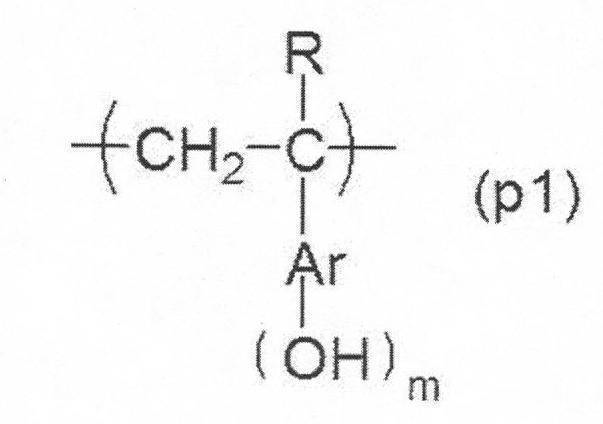
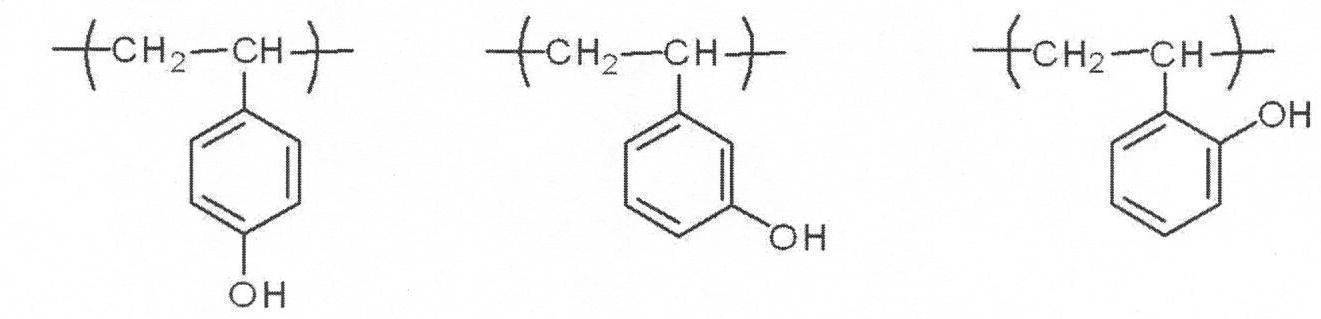


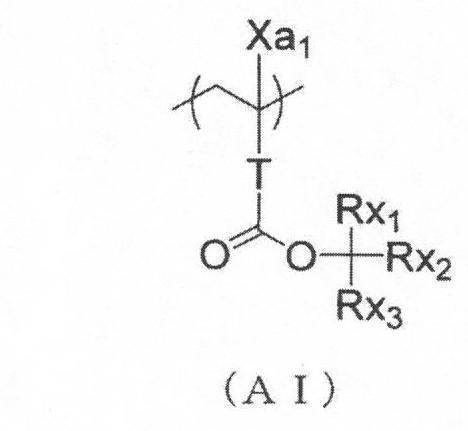
Xa1は、水素原子、置換基を有していてもよいアルキル基を表す。
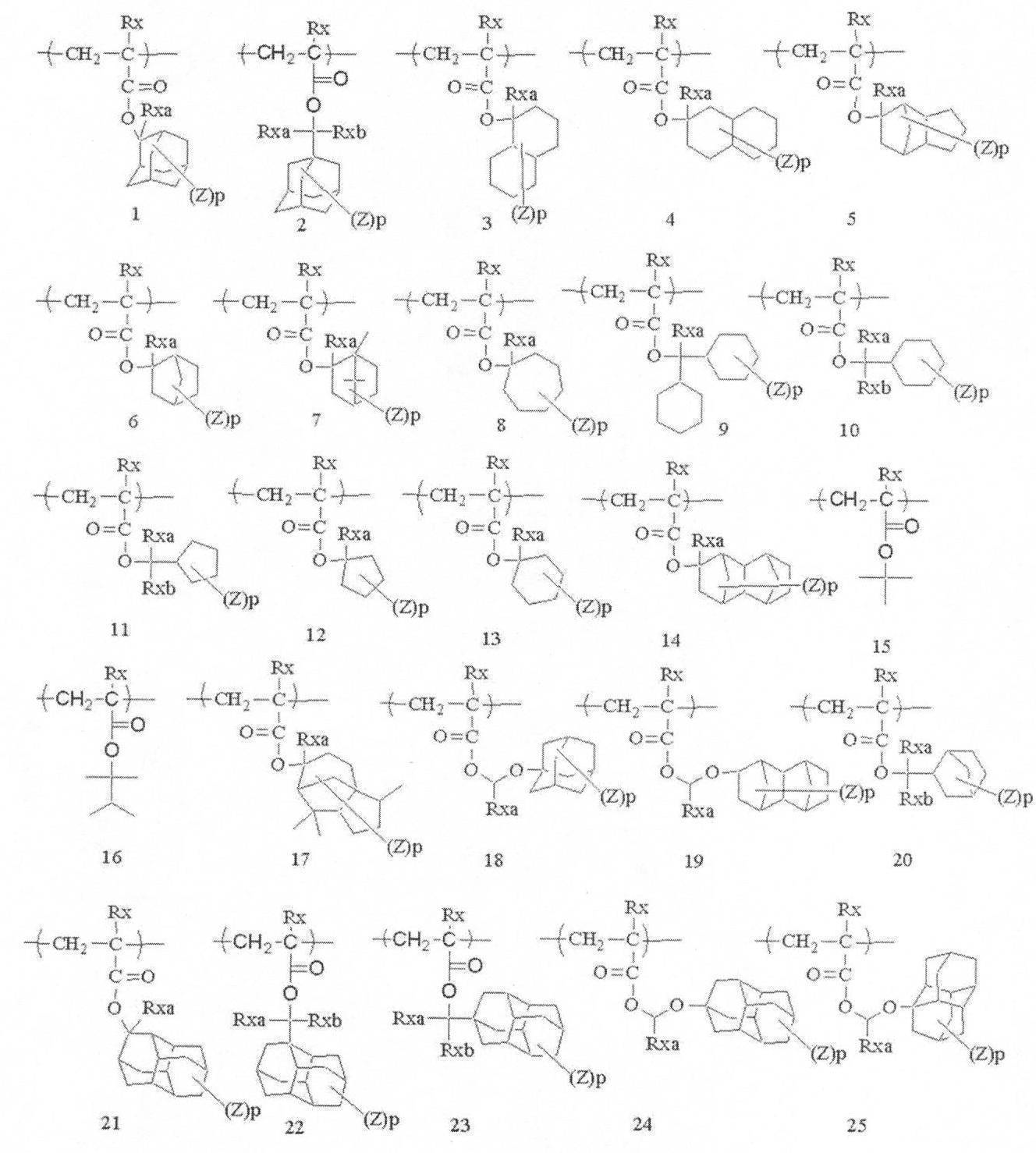

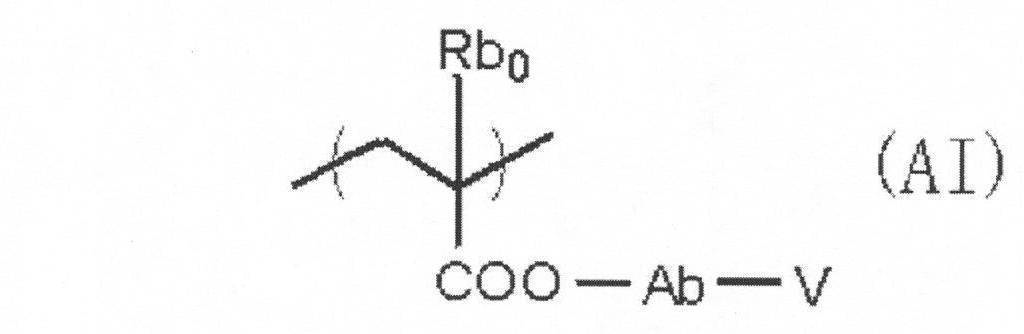
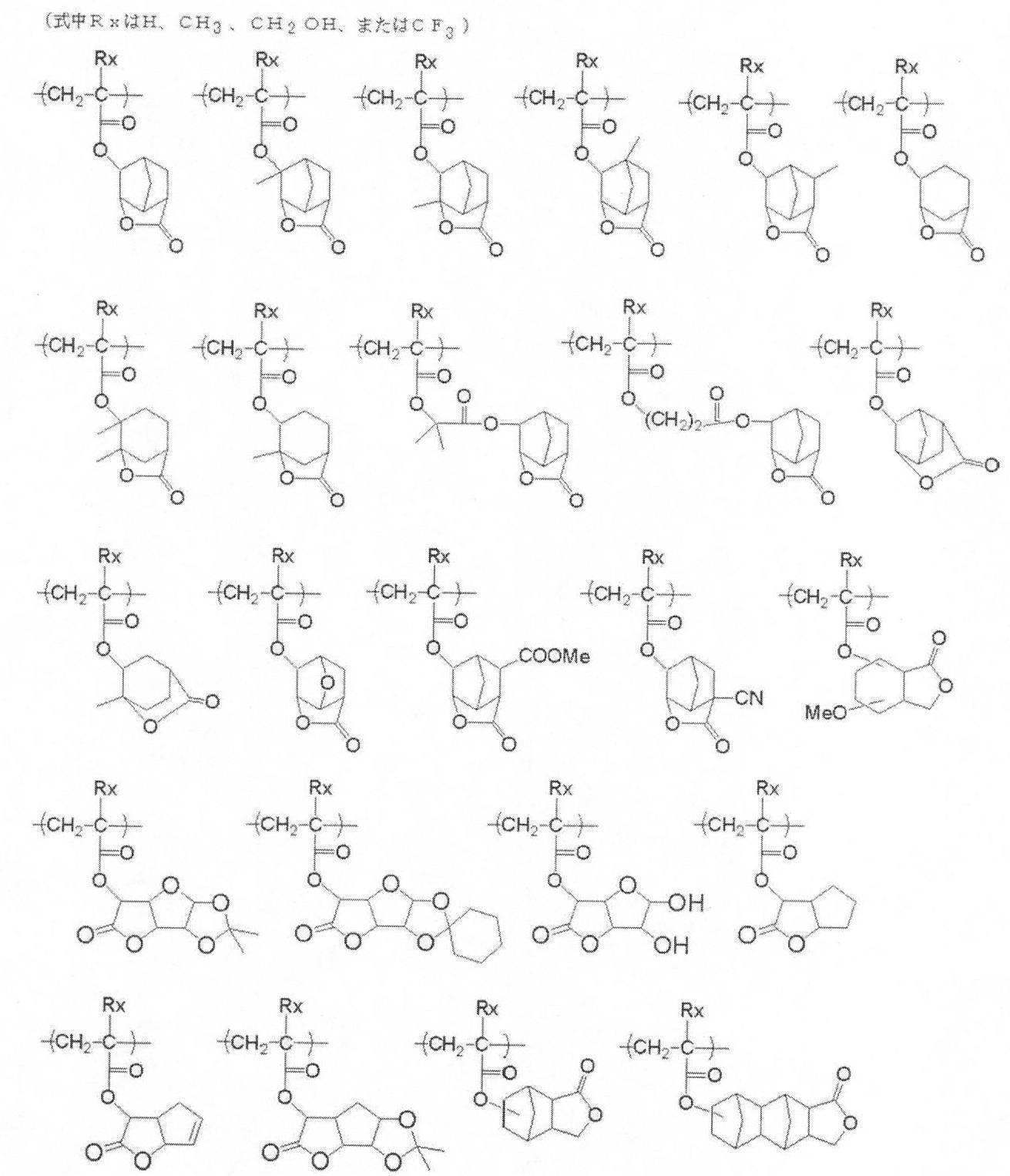
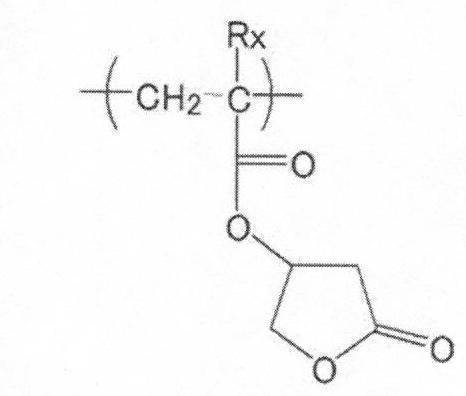
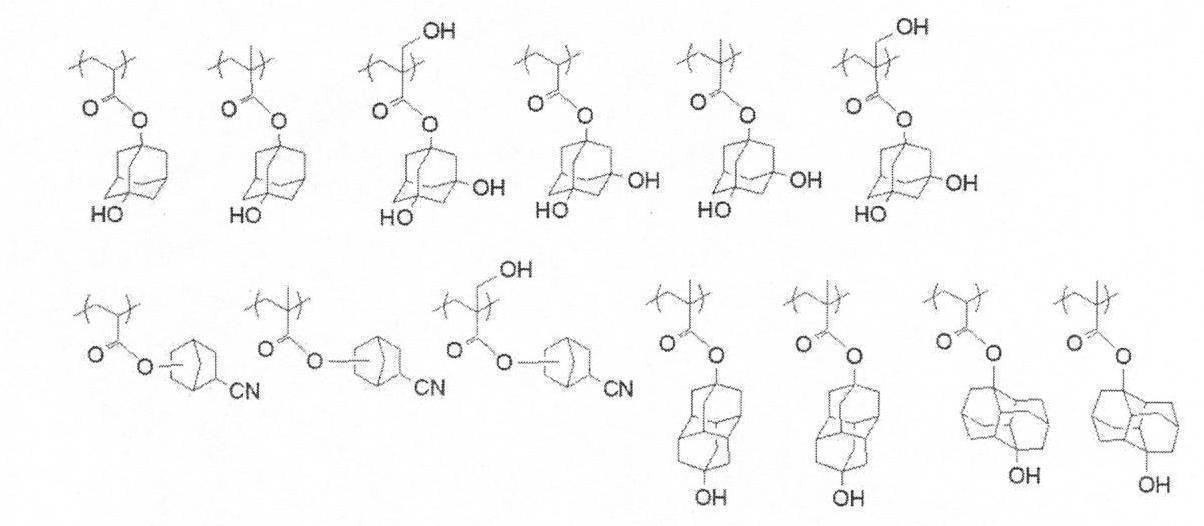


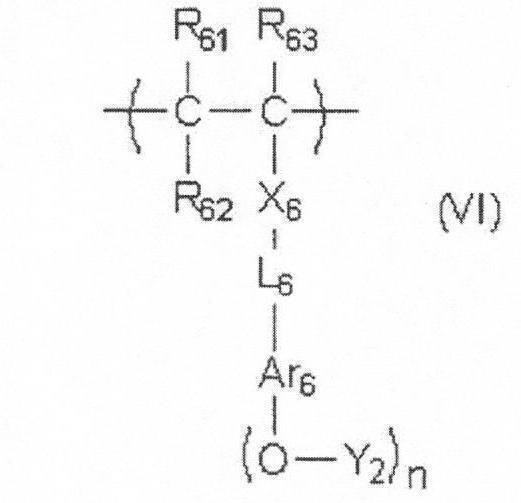
R61、R62及びR63は、各々独立に、水素原子、アルキル基、シクロアルキル基、ハロゲン原子、シアノ基、又はアルコキシカルボニル基を表す。但し、R62はAr6と結合して環を形成していてもよく、その場合のR62は単結合又はアルキレン基を表す。
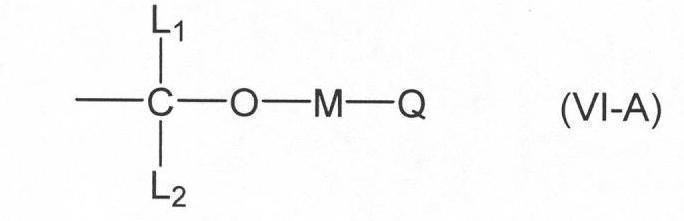

Ar3は、芳香環基を表す。
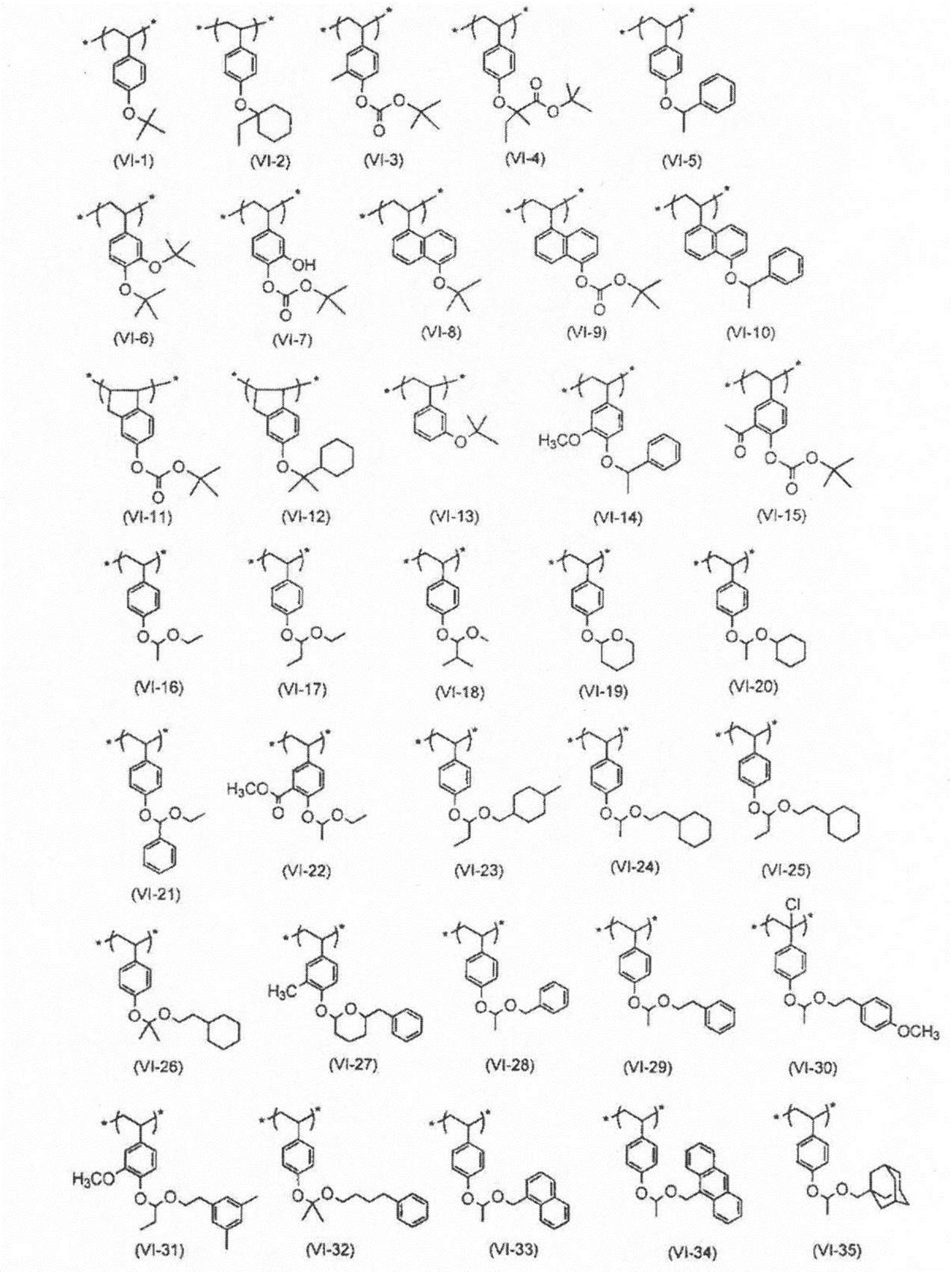

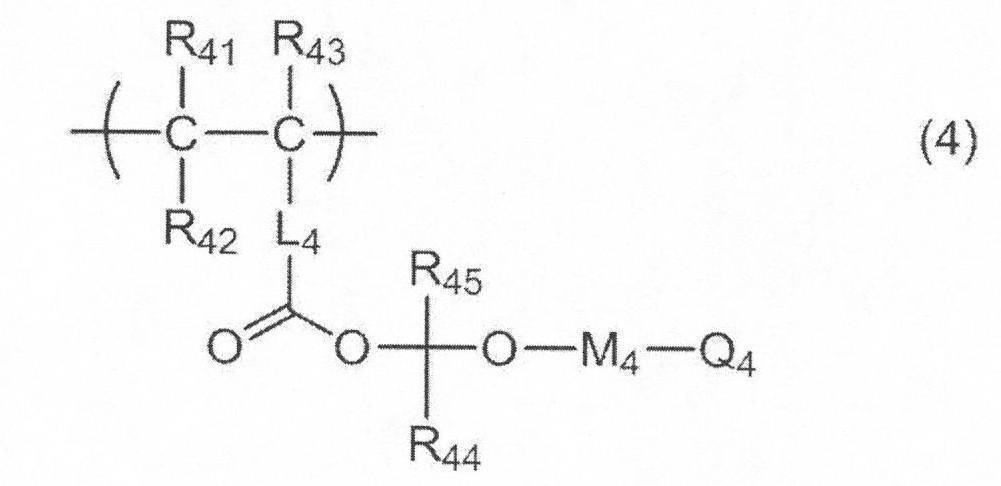
R41、R42及びR43は、各々独立に、水素原子、アルキル基、シクロアルキル基、ハロゲン原子、シアノ基又はアルコキシカルボニル基を表す。R42はL4と結合して環を形成していてもよく、その場合のR42はアルキレン基を表す。


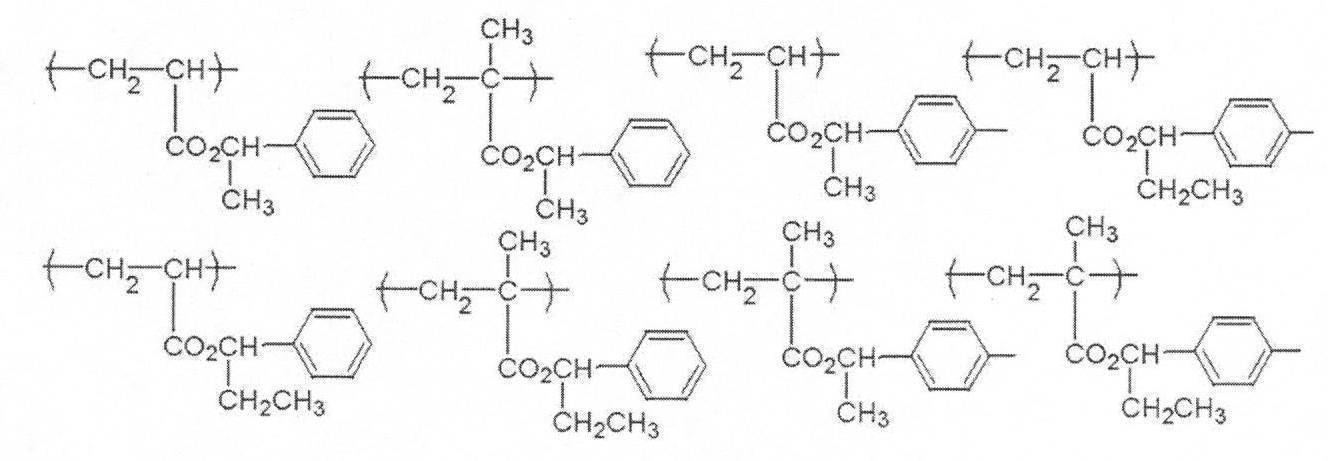


R6及びR7は、それぞれ独立に、水素原子、ヒドロキシ基、炭素数1~10の直鎖状、分岐状又は環状のアルキル基、アルコキシ基又はアシロキシ基、シアノ基、ニトロ基、アミノ基、ハロゲン原子、エステル基(-OCOR又は-COOR:Rは炭素数1~6のアルキル基又はフッ素化アルキル基)、又はカルボキシル基を表す。
一般式(V)又は一般式(VI)で表される繰り返し単位の具体例を下記に示すが、これらに限定されない。
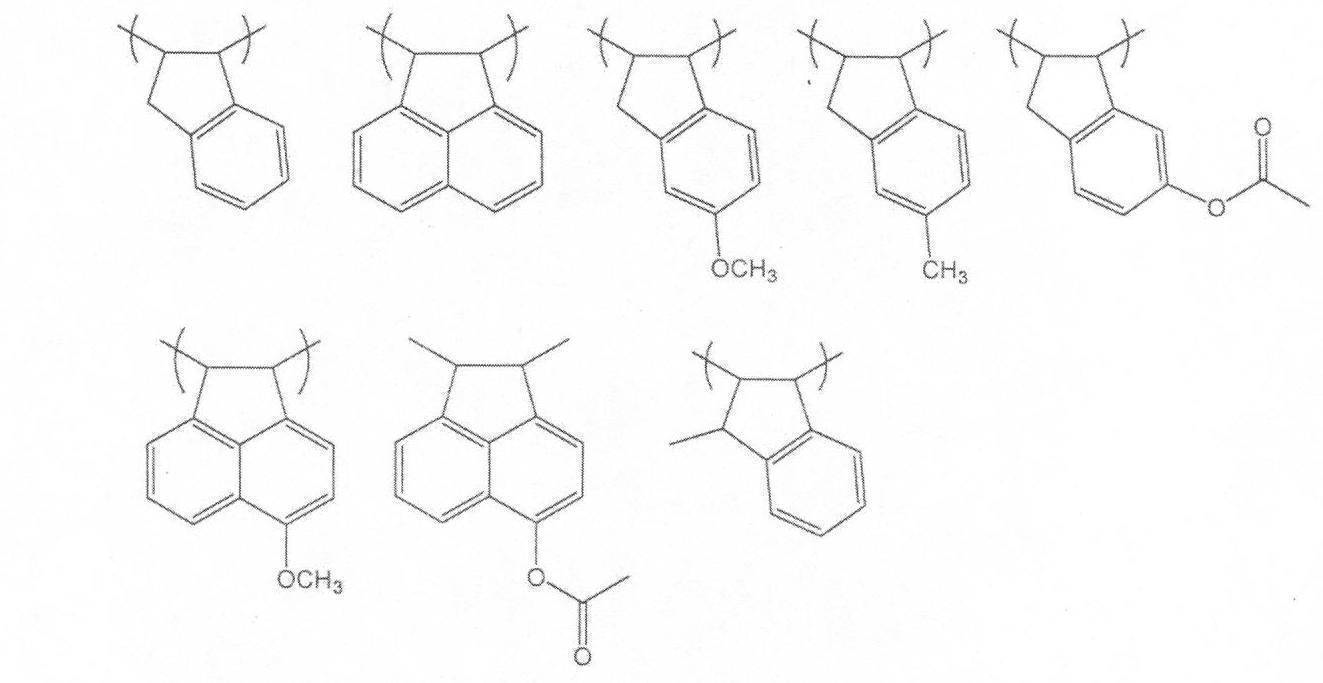
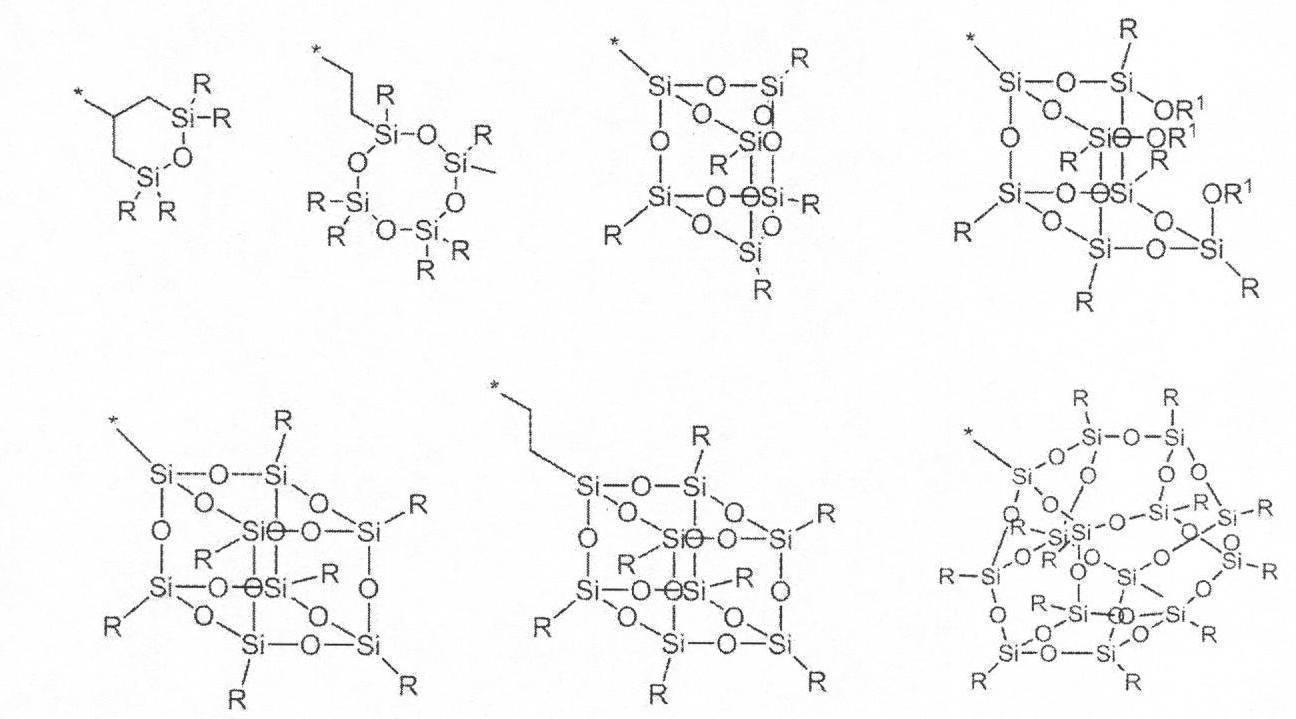
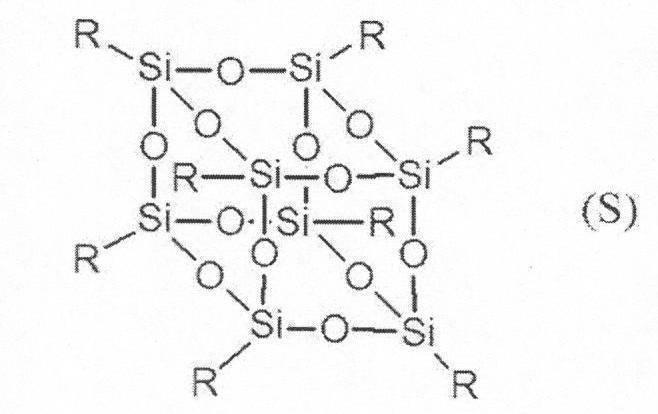
感活性光線性又は感放射線性樹脂組成物は、活性光線又は放射線により酸を発生する化合物(以下、「光酸発生剤《PAG:Photo Acid Generator》」ともいう)を含有することが好ましい。

R201、R202及びR203は、各々独立に、有機基を表す。
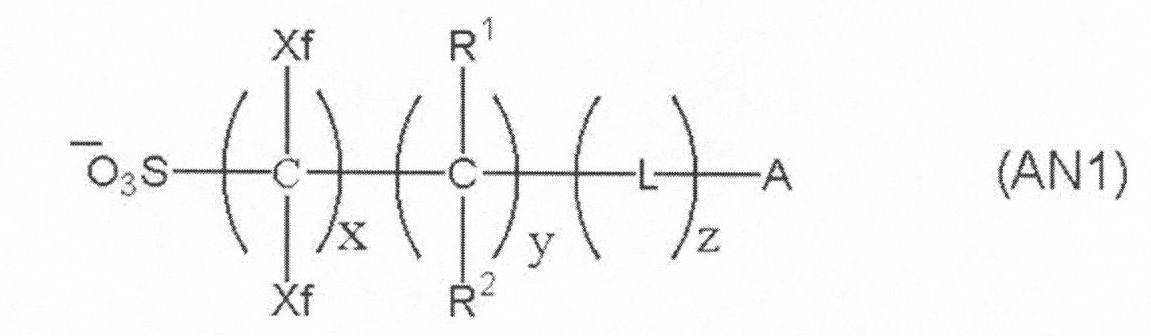
Xfは、それぞれ独立に、フッ素原子、又は少なくとも1つのフッ素原子で置換されたアルキル基を表す。
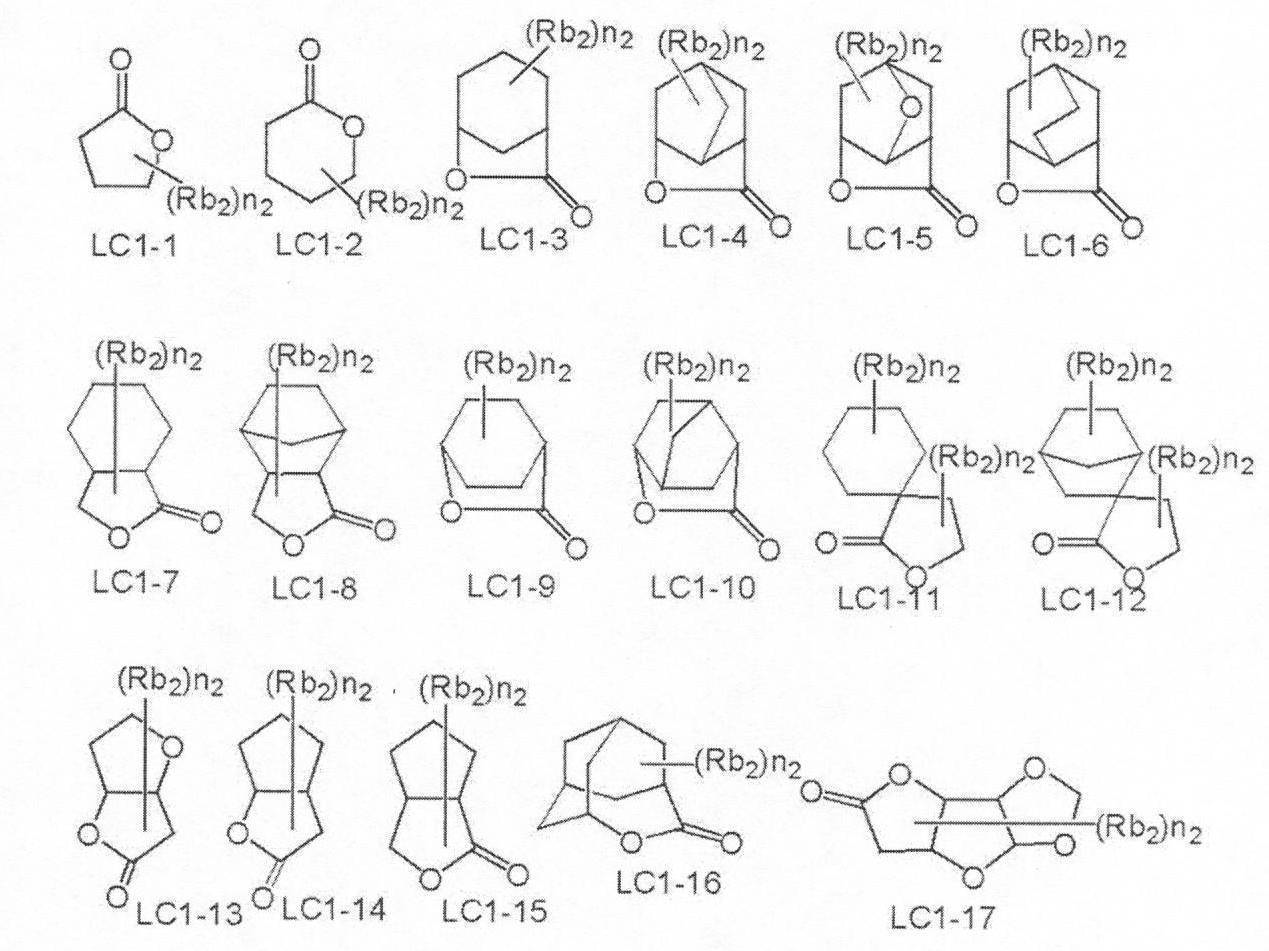


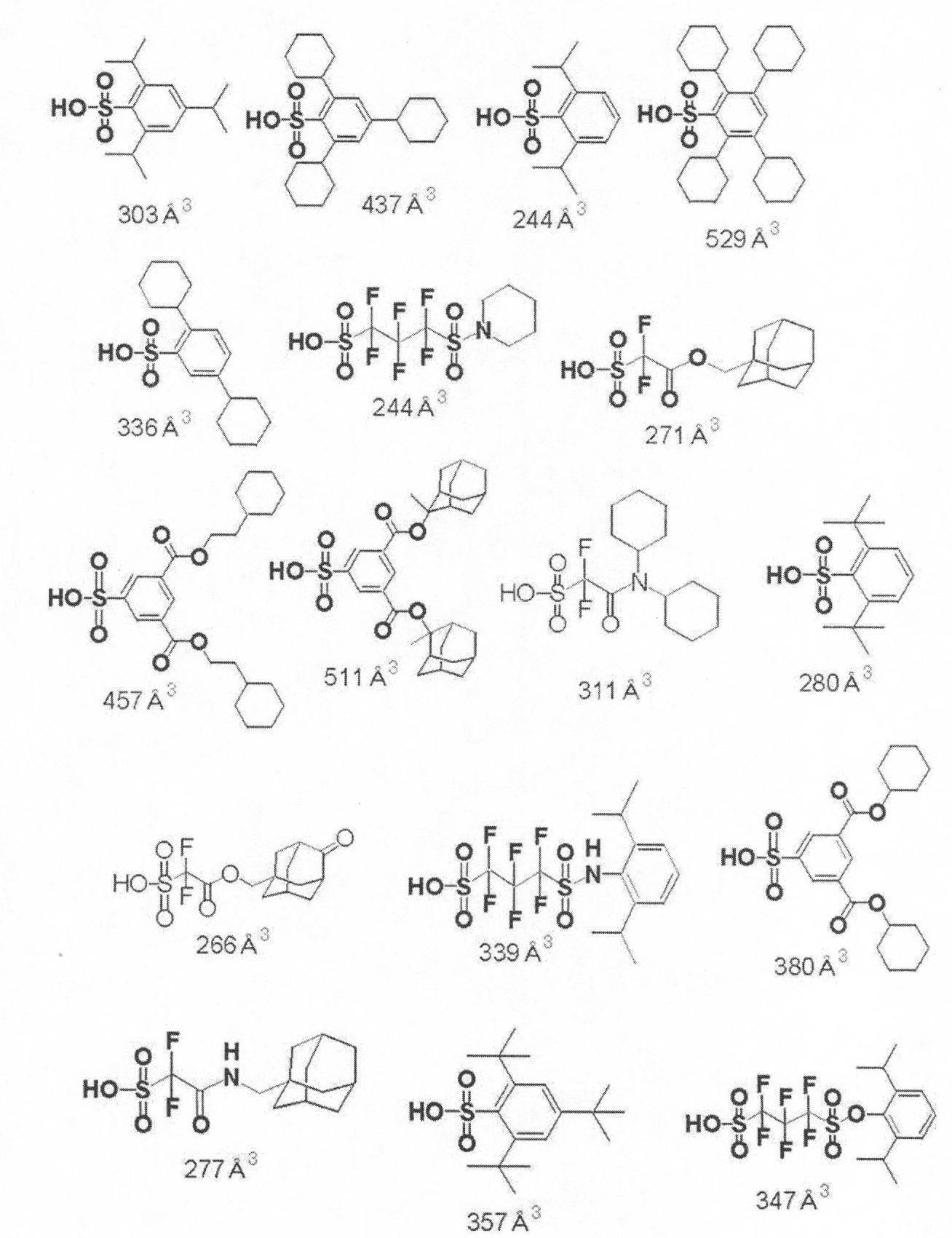

上述した各成分を溶解させて感活性光線性又は感放射線性樹脂組成物を調製する際には、溶剤を使用できる。使用できる溶剤としては、例えば、アルキレングリコールモノアルキルエーテルカルボキシレート、アルキレングリコールモノアルキルエーテル、乳酸アルキルエステル、アルコキシプロピオン酸アルキル、炭素数4~10の環状ラクトン、炭素数4~10の、環を含有してもよいモノケトン化合物、アルキレンカーボネート、アルコキシ酢酸アルキル、ピルビン酸アルキル等の有機溶剤を挙げることができる。
感活性光線性又は感放射線性樹脂組成物は、露光から加熱までの経時による性能変化を低減するために、塩基性化合物(D)を含有することが好ましい。

アミン等を挙げることができる。水酸基及び/又はエーテル結合を有するアニリン誘導体としては、N,N-ビス(ヒドロキシエチル)アニリン等を挙げることができる。
本発明に係る組成物は、塩基性化合物として、プロトンアクセプター性官能基を有し、かつ、活性光線又は放射線の照射により分解してプロトンアクセプター性が低下、消失、又はプロトンアクセプター性から酸性に変化した化合物を発生する化合物〔以下、化合物(PA)ともいう〕を更に含んでいてもよい。

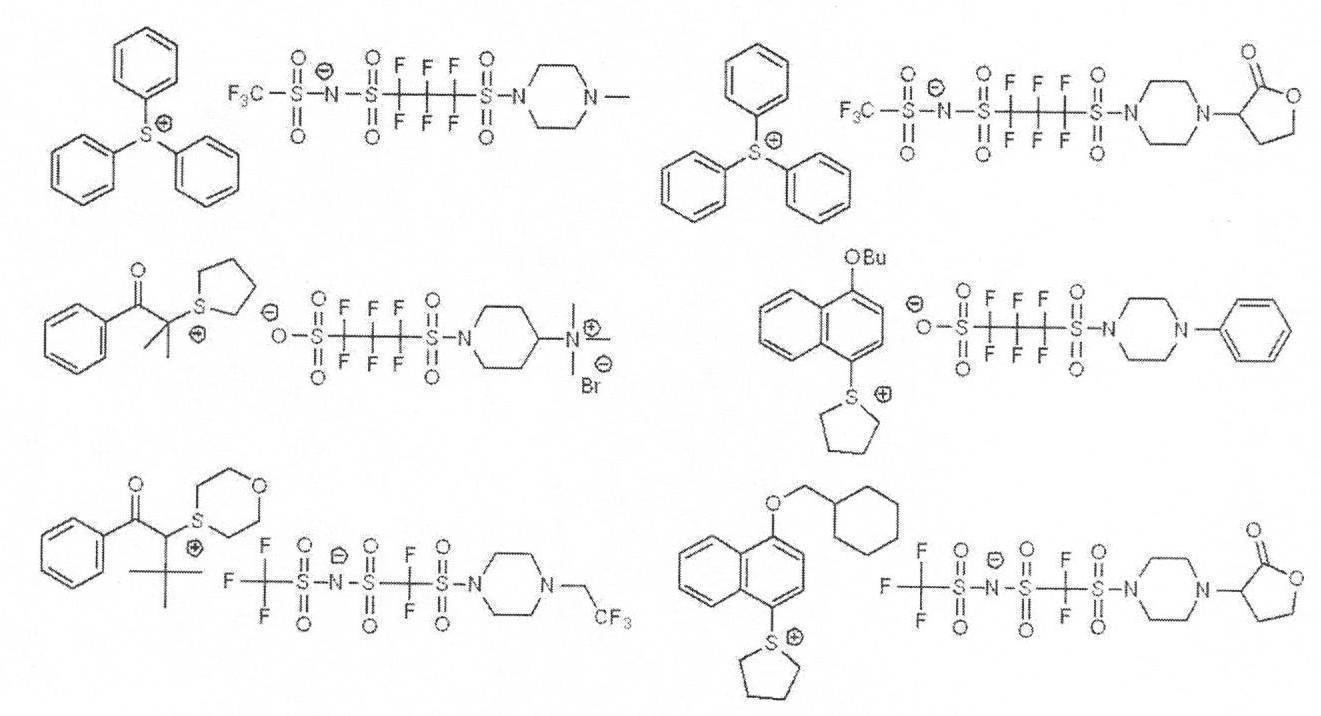
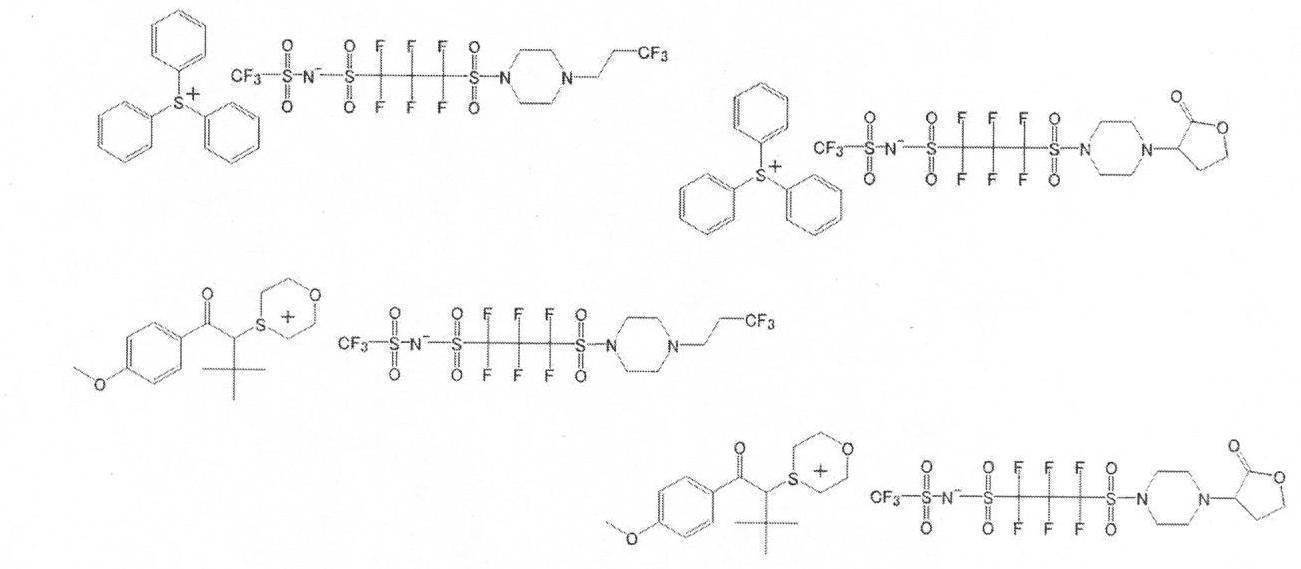
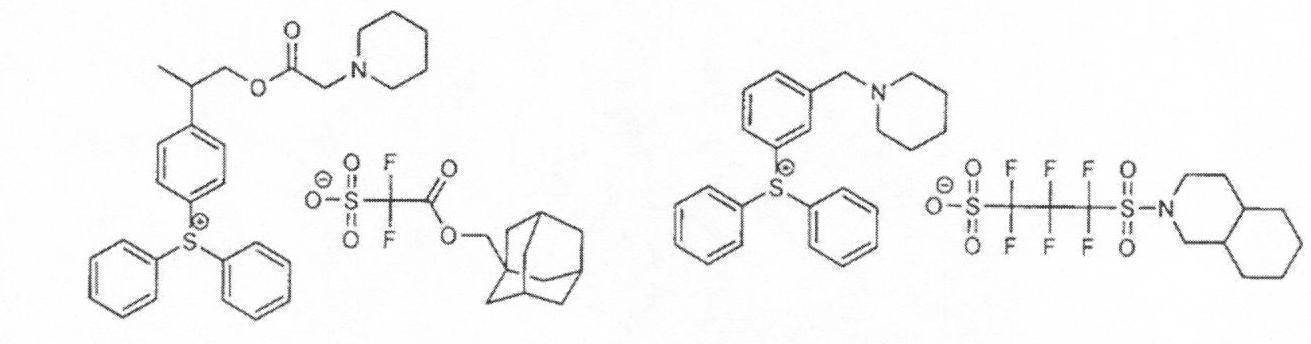
感活性光線性又は感放射線性樹脂組成物は、上記樹脂(A)とは別に疎水性樹脂(A’)を有していてもよい。
感活性光線性又は感放射線性樹脂組成物は、界面活性剤(E)を更に含んでいてもよい。界面活性剤を含有することにより、波長が250nm以下、特には220nm以下の露光光源を使用した場合に、良好な感度及び解像度で、密着性及び現像欠陥のより少ないパターンを形成することが可能となる。
3(セイミケミカル(株)製);エフトップEF121、EF122A、EF122B、RF122C、EF125M、EF135M、EF351、EF352、EF801、EF802若しくはEF601((株)ジェムコ製);PF636、PF656、PF6320若しくはPF6520(OMNOVA社製);又は、FTX-204G、208G、218G、230G、204D、208D、212D、218D若しくは222D((株)ネオス製)を用いてもよい。なお、ポリシロキサンポリマーKP-341(信越化学工業(株)製)も、シリコン系界面活性剤として用いることができる。
感活性光線性又は感放射線性樹脂組成物は、溶解阻止化合物、染料、可塑剤、光増感剤、光吸収剤、及び/又は現像液に対する溶解性を促進させる化合物(例えば、分子量1000以下のフェノール化合物、又はカルボキシ基を含んだ脂環族若しくは脂肪族化合物)を更に含んでいてもよい。
クエンチャーとは、塩基性化合物であって、未露光領域において、露光領域から拡散した酸によって、酸分解性樹脂が意図せず分解するのを抑制する機能を有する。
本発明の処理液を使用したパターン形成方法においては、レジスト膜の上層に上層膜(トップコート膜)を形成してもよい。
3-61648号公報に記載されたような塩基性化合物を含有する上層膜をレジスト膜上に形成することが好ましい。上層膜が含み得る塩基性化合物の具体的な例は、塩基性化合物(E)が挙げられる。
上層膜形成用組成物は樹脂を含有することが好ましい。上層膜形成用組成物が含有することができる樹脂としては、特に限定されないが、感活性光線性又は感放射線性組成物に含まれ得る疎水性樹脂(例えば、上述した疎水性樹脂(A’))と同様のものを使用することができる。
樹脂の重量平均分子量は好ましくは3000~100000であり、更に好ましくは3000~30000であり、最も好ましくは5000~20000である。上層膜形成用組成物中の樹脂の配合量は、全固形分中、50~99.9質量%が好ましく、60~99.0質量%がより好ましく、70~99.7質量%が更に好ましく、80~99.5質量%が更により好ましい。
上層膜形成用組成物は、各成分を溶剤に溶解し、フィルタろ過することが好ましい。フィルタとしては、ポアサイズ0.1μm以下、より好ましくは0.05μm以下、更に好ましくは0.03μm以下のポリテトラフロロエチレン製、ポリエチレン製、ナイロン製のものが好ましい。なお、フィルタは、複数種類を直列又は並列に接続して用いてもよい。また、組成物を複数回ろ過してもよく、複数回ろ過する工程が循環ろ過工程であっても良い。さらに、フィルタろ過の前後で、組成物に対して脱気処理などを行ってもよい。上層膜形成用組成物は、金属等の不純物を含まないことが好ましい。これら材料に含まれる金属成分の含有量としては、10ppm以下が好ましく、5ppm以下がより好ましく、1ppm以下が更に好ましく、実質的に含まないこと(測定装置の検出限界以下であること)が特に好ましい。
上記電子デバイスの製造方法により製造される電子デバイスは、電気電子機器(家電、OA(Office Automation)、メディア関連機器、光学用機器及び通信機器等)に、好適に搭載されるものである。
実施例及び比較例の処理液の製造にあたって、以下の有機溶剤を準備した。各有機溶剤は、これを製造する際に使用される原材料として、純度99質量%以上の高純度グレードを用い、さらに事前に、原材料を蒸留、イオン交換及びろ過等によって精製した。このようにして得られた原材料を用いて、公知の方法にしたがって各有機溶剤を製造し、得られた各有機溶剤を以下の精製工程に用いた。
・プロピレングリコールモノメチルエーテルアセテート(PGMEA)
・プロピレングリコールモノメチルエーテル(PGME)
・メチルエチルケトン(MEK)
・メチルプロピルケトン(MPK)
・γ-ブチロラクトン(γBL)
ここで、第1イオン交換処理は、イオン交換樹脂としてダイヤイオン(三菱化学株式会社製)を用いた。また、脱水処理は、水吸着剤としてのモレキュラーシーブ3A、4A、5A及び13X(いずれもユニオン昭和社製)を単独又は組み合わせて用い、露点温度-70℃の不活性ガス雰囲気下で行った。また、蒸留処理は、単段の蒸留装置を用いて行った。また、第2イオン交換処理は、イオン吸着膜(商品名「ネオセプタ」、アストム社製)を用いた。
その後、必要に応じて有機溶剤を混合することにより、実施例及び比較例の処理液を得た。なお、混合は密閉容器内で行った。
また、実施例及び比較例における処理液中の金属成分及び水の含有量の調製は、各処理の回数を適宜変えることにより行った。
実施例及び比較例の処理液を用いて、各成分の含有量の測定及び各種評価試験を実施した。ここで、以下の測定及び評価試験は、全てISOクラス2以下を満たすレベルのクリーンルームで行った。測定精度向上のため、金属成分の含有量の測定、水の含有量の測定、アルケン類の含有量の測定、及び、酸成分の含有量の測定において、通常の測定で検出限界以下である場合は、体積換算で100分の1に濃縮して測定を行い、濃縮前の処理液の濃度に換算して含有量の算出を行なった。
実施例及び比較例の処理液を用いて、処理液中の金属成分(Na、K、Ca、Fe、Cu、Mg、Mn、Li、Al、Cr、Ni、Ti及びZn)の含有量を測定した。具体的には、実施例及び比較例の各処理液を用いて、NexION350(商品名、PerkinElmer社製)を用いて、ICP-MS法により行った。測定結果を第1表に示す。
ICP-MS法による具体的な測定条件は、次の通りである。なお、濃度既知の標準液に対するピーク強度にて検出量を測定して、金属成分の質量に換算し、測定に使用した処理液中の金属成分の含有量(総メタル含有量)を算出した。
金属成分の含有量は、後述するSP-ICP-MS法ではなく、通常のICP-MS法により測定した。具体的には、金属成分の分析に使用するソフトウェアとして、ICP-MS用のソフトウェアを用いた。
(ICP-MS法による測定条件)
((標準物質))
清浄なガラス容器内へ超純水を計量投入し、メディアン径50nmの測定対象金属粒子を10000個/mlの濃度となるように添加した後、超音波洗浄機で30分間処理した分散液を輸送効率測定用の標準物質として用いた。
((使用したICP-MS装置))
メーカー:PerkinElmer
型式:NexION350S
((ICP-MSの測定条件))
ICP-MSはPFA製同軸型ネブライザ、石英製サイクロン型スプレーチャンバ、石英製内径1mmトーチインジェクタを用い、測定対象液を約0.2mL/minで吸引した。酸素添加量は0.1L/min、プラズマ出力1600W、アンモニアガスによるセルパージを行った。時間分解能は50μsにて解析を行った。
((ソフトウェア))
金属成分の含有量は、メーカー付属の下記解析ソフトを用いて計測した。
Syngistix for ICP-MS ソフトウエア
実施例及び比較例の処理液を用いて、処理液中の金属成分(Na、K、Ca、Fe、
Cu、Mg、Mn、Li、Al、Cr、Ni、Ti及びZn)のうち、粒子状の金属成分(金属粒子)の含有量を測定した。具体的には、上記「金属成分の含有量(総メタル含有量)の測定」における測定装置において、「ICP-MS」用のソフトウェアを「SP-ICP-MS」用のソフトウェア(ナノ粒子分析“SP-ICP-MS”専用Syngistix ナノアプリケーションモジュール)に代えた以外は同様にして、SP-ICP-MS法による測定を行った。
測定結果を第1表に示す。
実施例及び比較例の処理液を用いて、各処理液中の水の含有量を測定した。測定には、カールフィッシャー水分計(製品名「MKC-710M」、京都電子工業社製、カールフィッシャー電量滴定式)を用いた。測定結果を第1表に示す。
実施例及び比較例の処理液を用いて、処理液中のアルケン類の含有量を測定した。測定には、ガスクロマトグラフ質量分析計(GC-MS)を用いた。測定結果を第1表に示す。
実施例及び比較例の処理液を用いて、処理液中の酸成分の含有量を中和滴定法により測定した。具体的には、電位差自動滴定装置(製品名「MKA-610」、京都電子工業社製)を用いて測定した。測定結果を第1表に示す。
ウェハ上表面検査装置(SP-5、KLA-Tencor社製)により、直径300mmのシリコン基板表面に存在する直径32nm以上の異物数及び各異物のアドレスを計測した。
そして、スピン回転ウェハ処理装置(イーケーシーテクノロジーズ社製)に、シリコン基板表面に存在する異物数を計測したウェハをセットした。
次に、セットされたウェハの表面に、実施例及び比較例の各処理液を1.5L/minの流量で1分間吐出した。その後、ウェハのスピン乾燥を行った。
得られた乾燥後のウェハについて、ウェハ上表面検査装置を用いて、ウェハ上の異物数及びアドレスを計測した。
そして、上記処理液をスピン乾燥した後に新たに増加した異物に対して、欠陥解析装置(SEM VISION G6、APPLIED MATERIALS社製)を用いてEDX(Energy dispersive X-ray spectrometry:エネルギー分散型X線分析)による元素解析を行った。Na、K、Ca、Fe、Cu、Mg、Mn、Li、Al、Cr、Ni、Ti及びZnを対象金属元素として、対象金属元素を含む異物をパーティクルとしてカウントした。得られたパーティクルの数を以下の評価基準に従って評価した。結果を第1表に示す。
A:対象金属元素を含有した直径32nm以上のパーティクルの数が0個以上100個未満である。
B:対象金属元素を含有した直径32nm以上のパーティクルの数が100個以上500個未満である。
C:対象金属元素を含有した直径32nm以上のパーティクルの数が500個以上1000個未満である。
D:対象金属元素を含有した直径32nm以上のパーティクルの数が1000個以上である。
スピン回転ウェハ処理装置(イーケーシーテクノロジーズ社製)に、シリコンウェハをセットした。次に、セットされたウェハの表面に、実施例1の処理液を1.5L/minの流量で1分間吐出した。
そして、実施例1の処理液で処理されたウェハについて、スピン乾燥における回転数を変更して、異なる回転数で乾燥させた2つのウェハを得た。乾燥後の2つのウェハについて、上記「欠陥の評価試験」で用いたウェハ上表面検査装置を用いて、ウェハ上の異物数及びアドレスを計測した。このとき、ウェハ間で異物数及びアドレスに差がなければ、処理液が均一に濡れやすい性質を持つといえる。
他の実施例及び比較例についても、実施例1と同様にして、異物数及びアドレスの比較を行った。
評価基準は以下の通りである。
A:ウェハ間で異物数及びアドレスの差が見られなかった。
B:ウェハ間で異物数及びアドレスの差が見られ、特にウェハの中央部及び/又はエッジ部で異物の増減が見られた。
シリコン基板を5%フッ化水素酸水溶液へ1分間浸漬した後、超純水リンス及び窒素ブロー乾燥をして、シリコン基板Aを準備した。
上記シリコン基板Aを、実施例及び比較例の各処理液中に、25℃で30日間浸漬させた。処理液に浸漬した後のシリコン基板Aの表面酸化膜の厚みの増加量を、エリプソメーターで測定した。
A:表面酸化膜の厚みの増加量が0.5nm以下
B:表面酸化膜の厚みの増加量が0.5nm超1nm以下
C:表面酸化膜の厚みの増加量が1nm超2nm以下
D:表面酸化膜の厚みの増加量が2nm超
以上の評価の結果を第1表に示す。なお、第1表(その2)では、処理液中の金属元素毎の含有量、及び、処理液中の金属粒子毎の含有量を示した。

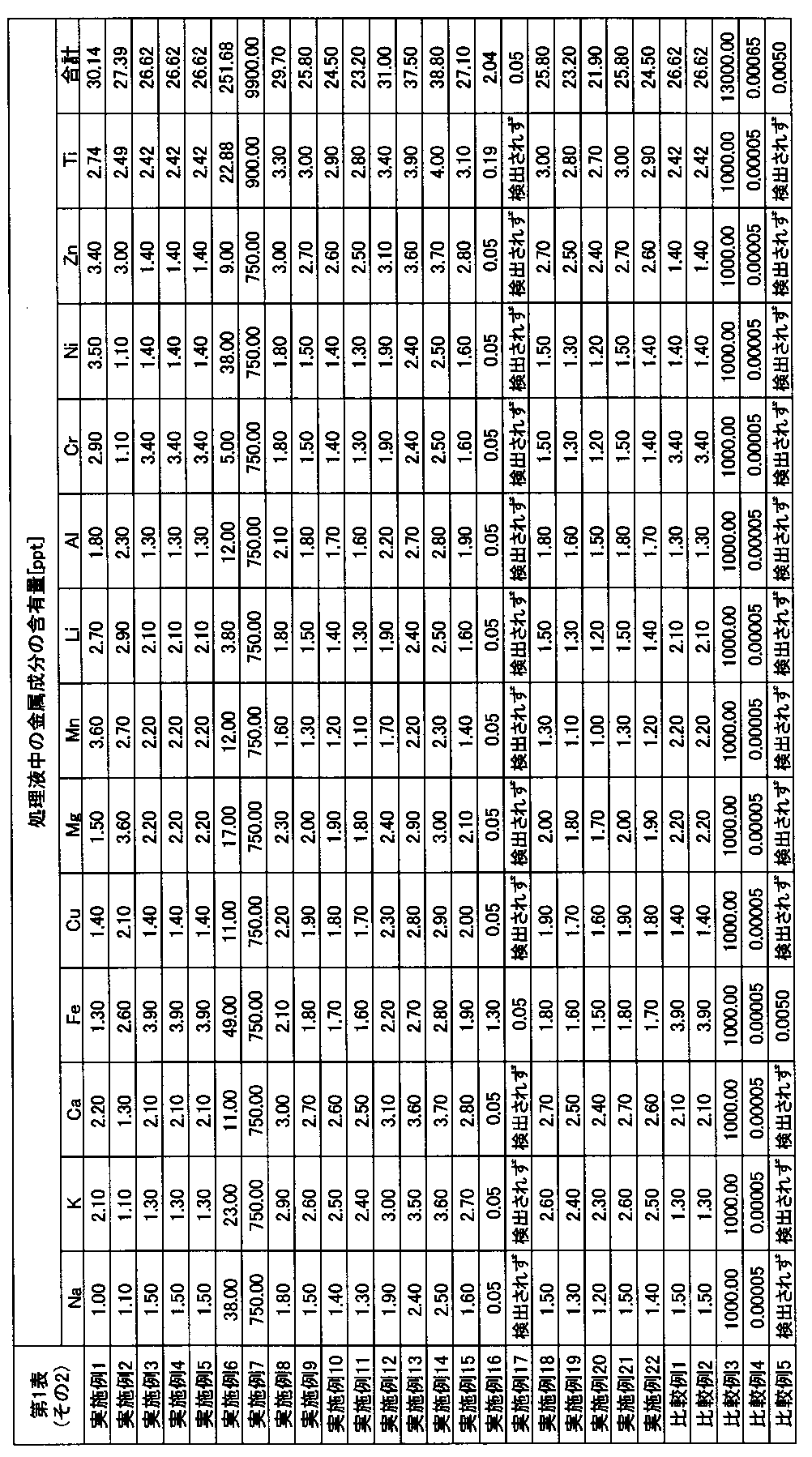

また、実施例の処理液を半導体デバイス用のリンス液及びプリウェット液として使用したところ、耐食性及び濡れ性に優れ、半導体デバイスの欠陥の発生を抑制できることがわかった。
一方、処理液中の水の含有量が100質量ppb未満であると、処理液の濡れ性が劣り、半導体デバイスの欠陥の発生も顕著になることが示された(比較例1)。
また、処理液中の水の含有量が100質量ppmを超えると、処理液の耐食性が劣ることが示された(比較例2)。
また、処理液中の金属成分の含有量が10質量ppq~10質量ppbの範囲外であると、半導体デバイスの欠陥の発生が顕著になることが示された(比較例3~5)。
得られた処理液Aを第2表に記載の各容器内に収容して、各容器を密閉した。このようにして、処理液Aが各容器内に収容された実施例2-1~2-6の処理液収容体を得た。
ここで、処理液Aの収容に用いた容器としては、容器内部の接液部(容器の内壁と処理液とが接触する領域)が、石英、PTFE(ポリテトラフルオロエチレン)、PFA(テトラフルオロエチレンとペルフルオロエーテルとの共重合体)、SUS316(ステンレス鋼材。表面が電解研磨されたものを用いた。)、又は、SUS316(ステンレス鋼材。表面をバフ研磨した後、さらに電解研磨したものを用いた。)であるものを用いた。
実施例2-2~2-5の各処理液収容体については、室温(25℃)で30日間保存した後、上述した第1表に記載の処理液と同様の方法にて、処理液中の金属成分の含有量の測定、処理液中の水の含有量の測定及び各種評価試験を行った。一方、実施例2-1の処理液収容体については、保存せずに、直ちに実施例2-2~2-6と同様の含有量の測定及び評価試験を行った。
以上の評価試験の結果を下記第2表に示す。
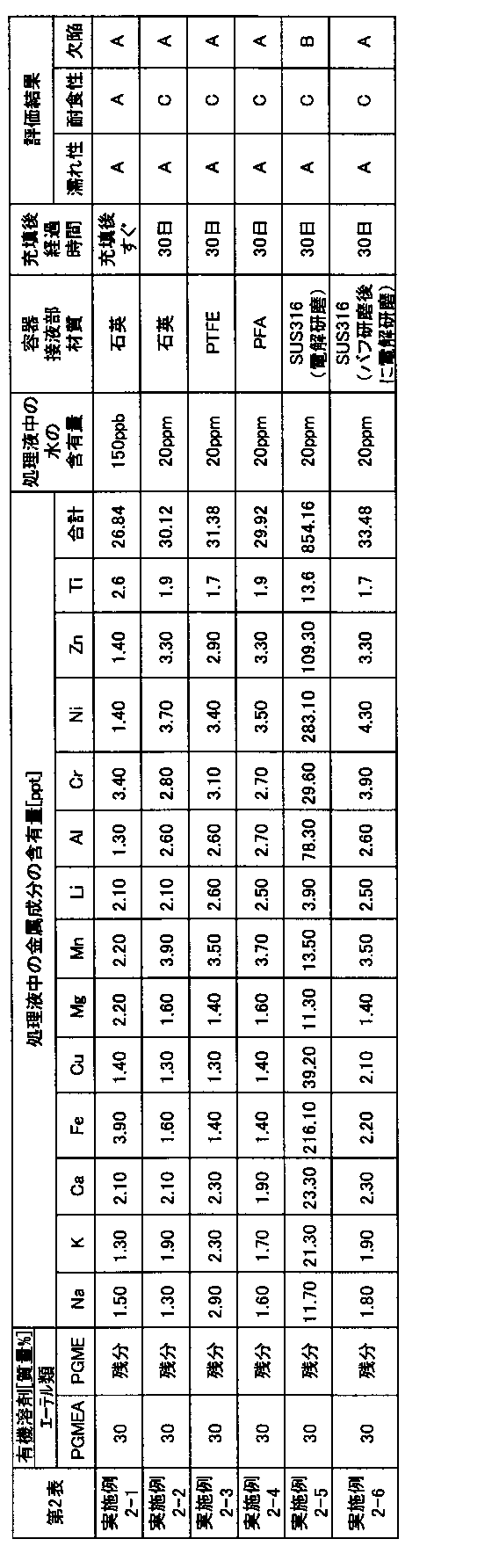
処理液のレジスト組成物のプリウェット液としての適性について、処理液を塗布した後のレジスト組成物の省レジスト性によって評価した。レジスト膜が優れた省レジスト性を有する場合、処理液がプリウェット液として好適であることを示す。なお、本明細書において、優れた省レジスト性を有する、とは、優れた均一性と、優れた膜厚制御性とを有する状態を意図する。
まず、対照として、反射防止膜を備える直径約30cm(12インチ)のシリコンウェハ上に下記レジスト組成物1を直接塗布した。なお、塗布には、スピンコータ(商品名「LITHIUS」、東京エレクトロン社製)を用いた。得られたレジスト膜は90℃でベークした。ベーク後のレジスト膜について、大日本スクリーン社製膜厚測定装置Lambda Aceを用いて59ポイントmap測定して、塗布斑が発生していないことを確認した。なお、塗布斑とは、測定対象のレジスト膜から円状に59点の測定点を抽出し、各測定点におけるレジスト膜の厚みの測定結果を、測定点ごとに二次元的に配置して観察した場合に、レジスト膜の厚みにムラがない状態を意図する。
次に、反射防止膜を備える直径約30cm(12インチ)のシリコンウェハを別に準備し、上記実施例1~3及び比較例1~5の各処理液を滴下した。その後、対照と同量のレジスト組成物を塗布して90℃でベークした。得られたレジスト膜について、上記と同様の方法で観察し、塗布斑が発生していないことを確認した。次に、使用するレジスト組成物を対照の50質量%、及び、30質量%に減量して上記と同様の試験を行い、塗布斑が発生するかを調べた。
結果は以下の基準により評価し結果を第3表に示した。
A:レジスト組成物の使用量を対照の30質量%、及び、50質量%に減量しても、いずれも塗布斑が発生しなかった。
B:レジスト組成物の使用量を対照の50質量%に減量しても、塗布斑が発生しなかったが、対照の30質量%に減量すると、塗布斑が発生した。
C:レジスト組成物の使用量を対照の30質量%、及び、50質量%に減量すると、いずれも塗布斑が発生した。
酸分解性樹脂(下記式で表される樹脂(重量平均分子量(Mw):7500):各繰り返し単位に記載される数値はモル%を意味する。):100質量部
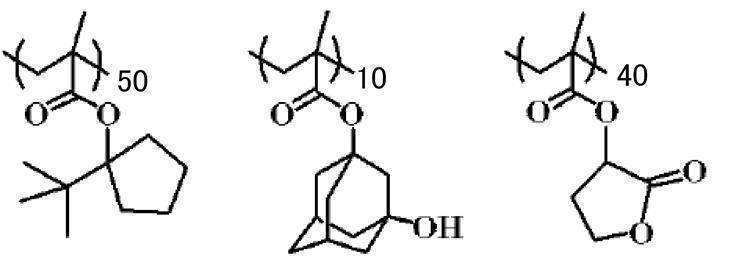

なお、下記のクエンチャーのうち、ポリマータイプのものは、重量平均分子量(Mw)が5000である。また、各繰り返し単位に記載される数値はモル比を意味する。


PGMEA:3質量部
CyHe:600質量部
γBL:100質量部
反射防止膜を備える直径約30cm(12インチ)のシリコンウェハ上に、上記実施例1~3及び比較例1~5の各処理液を滴下した。その後、得られるレジスト膜の厚みが8.5nmとなるよう、均一性の試験で用いた上記レジスト組成物1を直接塗布した。なお、塗布には、スピンコータ(商品名「LITHIUS」、東京エレクトロン社製)を用いた。得られたレジスト膜は90℃でベークした。ベーク後のレジスト膜について、大日本スクリーン社製膜厚測定装置Lambda Aceを用いて59ポイントmap測定し、レジスト膜の厚みの標準偏差(以下「σ」ともいう。)を求めた。次に、標準偏差から3σを求めた。
結果は以下の基準により評価し、第3表に示した。
A:3σが0.15nm未満だった。
B:3σが0.15nm以上、0.2nm未満だった。
C:3σが0.2nm以上だった。
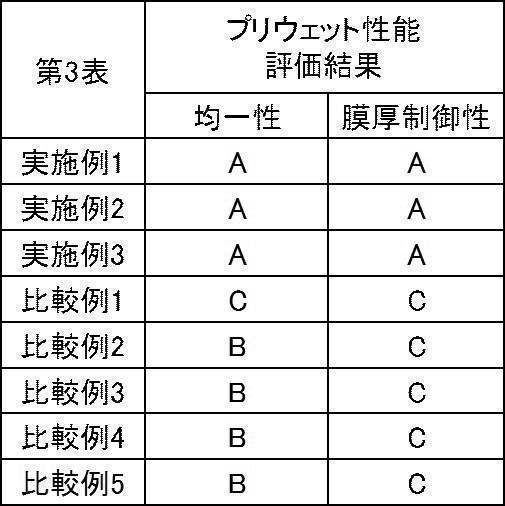
101 タンク
102 供給口
103、106、107 弁
104 ポンプ
105 ろ過装置
108 容器
109 供給管路
110 循環管路
111 排出部
112 洗浄液モニタリング部
113 管路
201 蒸留塔
202、203、204 管路
205、206、207 弁
Claims (13)
- エーテル類、ケトン類及びラクトン類からなる群より選択される少なくとも1種の有機溶剤と、
水と、
Na、K、Ca、Fe、Cu、Mg、Mn、Li、Al、Cr、Ni、Ti及びZnからなる群より選択される少なくとも1種の金属元素を含む金属成分と、
を含有する半導体デバイス用の処理液であって、
前記処理液中の前記水の含有量が、100質量ppb~100質量ppmであり、
前記処理液中の前記金属成分の含有量が、10質量ppq~10質量ppbである、処理液。 - 前記金属成分が、粒子状の金属成分を含み、
前記処理液中の前記粒子状の金属成分の含有量が、1質量ppq~1質量ppbである、請求項1に記載の処理液。 - リンス液及びプリウェット液の少なくとも一方に使用される、請求項1又は2に記載の処理液。
- 前記エーテル類が、ジエチレングリコールジメチルエーテル、テトラヒドロフラン、エチレングリコールモノメチルエーテル、エチレングリコールモノエチルエーテル、メチルセロソルブアセテート、エチルセロソルブアセテート、ジエチレングリコールモノメチルエーテル、ジエチレングリコールモノエチルエーテル、ジエチレングリコールモノブチルエーテル、プロピレングリコールモノメチルエーテル、プロピレングリコールモノメチルエーテルアセテート、プロピレングリコールモノエチルエーテルアセテート及びプロピレングリコールモノプロピルエーテルアセテートからなる群より選択される少なくとも1種である、請求項1~3のいずれか1項に記載の処理液。
- 前記ケトン類が、メチルエチルケトン、シクロヘキサノン、シクロペンタノン、2-ヘプタノン、3-ヘプタノン、4-ヘプタノン、N-メチル-2-ピロリドン、メチルプロピルケトン、メチル-n-ブチルケトン及びメチルイソブチルケトンからなる群より選択される少なくとも1種である、請求項1~4のいずれか1項に記載の処理液。
- 前記ラクトン類が、β-プロピオラクトン、γ-ブチロラクトン、γ-バレロラクトン、δ-バレロラクトン、γ-カプロラクトン及びε-カプロラクトンからなる群より選択される少なくとも1種である、請求項1~5のいずれか1項に記載の処理液。
- 前記有機溶剤がエーテル類を含む場合には、さらにアルケン類を含有し、
前記処理液中の前記アルケン類の含有量が、0.1質量ppb~100質量ppbである、請求項1~6のいずれか1項に記載の処理液。 - 前記有機溶剤がラクトン類を含む場合には、さらに無機酸及び有機酸から選択される少なくとも1種の酸成分を含有し、
前記処理液中の前記酸成分の含有量が、0.1質量ppb~100質量ppbである、請求項1~7のいずれか1項に記載の処理液。 - 前記処理液中の前記水の含有量が、100質量ppb~10質量ppmである、請求項1~8のいずれか1項に記載の処理液。
- 前記処理液中の前記水の含有量が、100質量ppb~1質量ppmである、請求項1~9のいずれか1項に記載の処理液。
- 前記有機溶剤が少なくともエーテル類を含む、請求項1~10のいずれか1項に記載の処理液。
- 容器と、前記容器内に収容された請求項1~11のいずれか1項に記載の処理液と、を有する、処理液収容体。
- 前記容器の内壁が、フッ素系樹脂、石英及び電解研磨された金属材料の中から選択される少なくとも1種の材質で構成される、請求項12に記載の処理液収容体。
Priority Applications (4)
| Application Number | Priority Date | Filing Date | Title |
|---|---|---|---|
| KR1020187030246A KR102088653B1 (ko) | 2016-04-28 | 2017-04-26 | 처리액 및 처리액 수용체 |
| CN201780025775.6A CN109075035B (zh) | 2016-04-28 | 2017-04-26 | 处理液及处理液收容体 |
| JP2018514652A JP6618613B2 (ja) | 2016-04-28 | 2017-04-26 | 処理液及び処理液収容体 |
| US16/172,027 US11175585B2 (en) | 2016-04-28 | 2018-10-26 | Treatment liquid and treatment liquid housing body |
Applications Claiming Priority (4)
| Application Number | Priority Date | Filing Date | Title |
|---|---|---|---|
| JP2016092057 | 2016-04-28 | ||
| JP2016-092057 | 2016-04-28 | ||
| JP2017084479 | 2017-04-21 | ||
| JP2017-084479 | 2017-04-21 |
Related Child Applications (1)
| Application Number | Title | Priority Date | Filing Date |
|---|---|---|---|
| US16/172,027 Continuation US11175585B2 (en) | 2016-04-28 | 2018-10-26 | Treatment liquid and treatment liquid housing body |
Publications (1)
| Publication Number | Publication Date |
|---|---|
| WO2017188296A1 true WO2017188296A1 (ja) | 2017-11-02 |
Family
ID=60159660
Family Applications (1)
| Application Number | Title | Priority Date | Filing Date |
|---|---|---|---|
| PCT/JP2017/016479 Ceased WO2017188296A1 (ja) | 2016-04-28 | 2017-04-26 | 処理液及び処理液収容体 |
Country Status (6)
| Country | Link |
|---|---|
| US (1) | US11175585B2 (ja) |
| JP (1) | JP6618613B2 (ja) |
| KR (1) | KR102088653B1 (ja) |
| CN (1) | CN109075035B (ja) |
| TW (1) | TWI714760B (ja) |
| WO (1) | WO2017188296A1 (ja) |
Cited By (11)
| Publication number | Priority date | Publication date | Assignee | Title |
|---|---|---|---|---|
| WO2020013111A1 (ja) * | 2018-07-11 | 2020-01-16 | 富士フイルム株式会社 | 薬液、薬液収容体 |
| WO2020013218A1 (ja) * | 2018-07-13 | 2020-01-16 | 富士フイルム株式会社 | 薬液、キット、パターン形成方法、薬液の製造方法及び薬液収容体 |
| WO2020071261A1 (ja) * | 2018-10-03 | 2020-04-09 | 富士フイルム株式会社 | 薬液及び薬液収容体 |
| WO2020106567A1 (en) | 2018-11-20 | 2020-05-28 | Fujifilm Electronic Materials U.S.A., Inc. | Systems and methods for purifying solvents |
| US11326048B2 (en) * | 2017-07-05 | 2022-05-10 | Fujifilm Corporation | Member, container, chemical liquid storage body, chemical liquid purification device, and manufacturing tank |
| EP4025319A4 (en) * | 2019-09-03 | 2022-08-03 | FUJIFILM Electronic Materials U.S.A, Inc. | SYSTEMS AND PROCESSES FOR PURIFICATION OF SOLVENTS |
| JP2022173352A (ja) * | 2018-08-21 | 2022-11-18 | 富士フイルム株式会社 | 薬液、薬液収容体 |
| JP2024003073A (ja) * | 2019-09-27 | 2024-01-11 | 富士フイルム株式会社 | プリウェット液、レジスト膜形成方法、パターン形成方法、キット |
| JP2024047510A (ja) * | 2022-09-26 | 2024-04-05 | 南亞塑膠工業股▲分▼有限公司 | 回路板のクリーニングシステム |
| WO2025094856A1 (ja) * | 2023-10-31 | 2025-05-08 | 東京応化工業株式会社 | 洗浄液及び洗浄方法 |
| WO2025094855A1 (ja) * | 2023-10-31 | 2025-05-08 | 東京応化工業株式会社 | 洗浄液及び洗浄方法 |
Families Citing this family (16)
| Publication number | Priority date | Publication date | Assignee | Title |
|---|---|---|---|---|
| CN109075035B (zh) * | 2016-04-28 | 2023-06-13 | 富士胶片株式会社 | 处理液及处理液收容体 |
| KR102267799B1 (ko) * | 2016-11-18 | 2021-06-22 | 후지필름 가부시키가이샤 | 약액, 패턴 형성 방법, 및 키트 |
| JP2019053228A (ja) * | 2017-09-15 | 2019-04-04 | 東芝メモリ株式会社 | パターン形成方法及びパターン形成材料 |
| JPWO2019181386A1 (ja) * | 2018-03-22 | 2021-02-18 | 富士フイルム株式会社 | ろ過装置、精製装置、薬液の製造方法 |
| TWI800623B (zh) * | 2018-03-23 | 2023-05-01 | 日商東京威力科創股份有限公司 | 液處理裝置及液處理方法 |
| IL275879B2 (en) * | 2018-03-30 | 2024-11-01 | Fujifilm Electronic Mat Usa Inc | Chemical liquid manufacturing apparatus |
| JP7162541B2 (ja) * | 2019-01-22 | 2022-10-28 | 東京エレクトロン株式会社 | 基板処理装置、及び基板処理方法、及び記憶媒体 |
| WO2020257767A1 (en) | 2019-06-21 | 2020-12-24 | Watlow Electric Manufacturing Company | System and method for predicting and controlling gas line performance |
| US10569278B1 (en) * | 2019-10-02 | 2020-02-25 | Nanostar, Inc. | System for reducing oxygen contamination of milled silicon |
| WO2021146500A1 (en) * | 2020-01-16 | 2021-07-22 | Fujifilm Electronic Materials U.S.A., Inc. | Systems and methods for purifying solvents |
| WO2022032478A1 (en) * | 2020-08-11 | 2022-02-17 | Showa Denko K.K. | Solvent composition |
| KR20220083186A (ko) | 2020-12-11 | 2022-06-20 | 동우 화인켐 주식회사 | 고분자 처리용 공정액 |
| KR102925424B1 (ko) | 2021-03-16 | 2026-02-11 | 동우 화인켐 주식회사 | 고분자 처리용 공정액 조성물 |
| CN112999694A (zh) * | 2021-03-24 | 2021-06-22 | 沧州信联化工有限公司 | 一种四甲基氢氧化铵加工用原料精制装置及其使用方法 |
| US12601975B2 (en) * | 2021-06-17 | 2026-04-14 | Taiwan Semiconductor Manufacturing Co., Ltd. | Compositions for reducing resist consumption of extreme ultraviolet metallic type resist |
| CN114217513B (zh) * | 2021-12-17 | 2024-12-27 | 上海盛剑微电子有限公司 | 一种光刻胶剥离液、其制备方法及应用 |
Citations (4)
| Publication number | Priority date | Publication date | Assignee | Title |
|---|---|---|---|---|
| JPH08503983A (ja) * | 1992-11-25 | 1996-04-30 | ヘキスト、セラニーズ、コーポレーション | フォトレジスト用底部反射防止塗料における金属イオンの低減 |
| JP2006505132A (ja) * | 2002-11-05 | 2006-02-09 | メルク パテント ゲゼルシャフト ミット ベシュレンクテル ハフトング | 半導体の表面処理およびそれに使用される混合物 |
| JP2011082261A (ja) * | 2009-10-05 | 2011-04-21 | Kurita Water Ind Ltd | ウエハ用洗浄水及びウエハの洗浄方法 |
| JP2015166848A (ja) * | 2014-02-17 | 2015-09-24 | 富士フイルム株式会社 | パターン形成方法、エッチング方法、電子デバイスの製造方法、及び、電子デバイス |
Family Cites Families (20)
| Publication number | Priority date | Publication date | Assignee | Title |
|---|---|---|---|---|
| JPH11133628A (ja) * | 1997-10-30 | 1999-05-21 | Tokuyama Corp | フォトレジスト洗浄除去剤 |
| JP4344855B2 (ja) * | 1999-08-06 | 2009-10-14 | 野村マイクロ・サイエンス株式会社 | 電子デバイス用基板の有機汚染防止法及び有機汚染を防止した電子デバイス用基板 |
| JP4582602B2 (ja) * | 2000-03-24 | 2010-11-17 | ビーエーエスエフ ソシエタス・ヨーロピア | ヒドロキシルアミン水溶液およびその製造方法 |
| CN1639846A (zh) * | 2002-01-28 | 2005-07-13 | 三菱化学株式会社 | 半导体器件用基板的清洗液及清洗方法 |
| JP4620680B2 (ja) * | 2003-10-29 | 2011-01-26 | マリンクロッド・ベイカー・インコーポレイテッド | ハロゲン化金属の腐食阻害剤を含有するアルカリ性のプラズマエッチング/灰化後の残渣の除去剤およびフォトレジスト剥離組成物 |
| KR100593668B1 (ko) * | 2004-01-20 | 2006-06-28 | 삼성전자주식회사 | 세정액 조성물 및 이를 이용한 반도체 장치의 세정방법 |
| US20070099810A1 (en) * | 2005-10-27 | 2007-05-03 | Hiroshi Matsunaga | Cleaning liquid and cleaning method |
| JP5428200B2 (ja) * | 2007-05-18 | 2014-02-26 | 三菱化学株式会社 | 半導体デバイス用基板洗浄液、半導体デバイス用基板の洗浄方法及び半導体デバイス用基板の製造方法 |
| JP2009014938A (ja) * | 2007-07-03 | 2009-01-22 | Toagosei Co Ltd | レジスト剥離剤組成物 |
| US8282842B2 (en) * | 2007-11-29 | 2012-10-09 | United Microelectronics Corp. | Cleaning method following opening etch |
| JP5728883B2 (ja) * | 2010-10-20 | 2015-06-03 | Jsr株式会社 | 感放射線性樹脂組成物 |
| JP2013045086A (ja) | 2011-08-26 | 2013-03-04 | Jsr Corp | パターン形成方法 |
| WO2013173743A2 (en) * | 2012-05-18 | 2013-11-21 | Advanced Technology Materials, Inc. | Aqueous clean solution with low copper etch rate for organic residue removal improvement |
| JP5764589B2 (ja) * | 2012-10-31 | 2015-08-19 | 富士フイルム株式会社 | 化学増幅型レジスト膜のパターニング用有機系処理液の収容容器、並びに、これらを使用したパターン形成方法及び電子デバイスの製造方法 |
| JP6060012B2 (ja) * | 2013-03-15 | 2017-01-11 | 富士フイルム株式会社 | パターン形成方法、及び、電子デバイスの製造方法 |
| JP5728517B2 (ja) * | 2013-04-02 | 2015-06-03 | 富士フイルム株式会社 | 化学増幅型レジスト膜のパターニング用有機系処理液の製造方法、パターン形成方法、及び、電子デバイスの製造方法 |
| KR102256773B1 (ko) * | 2013-11-08 | 2021-05-27 | 후지 필름 일렉트로닉 머트리얼즈 가부시키가이샤 | 반도체 기판용 세정제 및 반도체 기판 표면의 처리방법 |
| JP2015118125A (ja) * | 2013-11-18 | 2015-06-25 | 富士フイルム株式会社 | 変性レジストの剥離液、これを用いた変性レジストの剥離方法および半導体基板製品の製造方法 |
| CN109075035B (zh) * | 2016-04-28 | 2023-06-13 | 富士胶片株式会社 | 处理液及处理液收容体 |
| JP6808730B2 (ja) * | 2016-06-03 | 2021-01-06 | 富士フイルム株式会社 | 処理液、基板洗浄方法およびレジストの除去方法 |
-
2017
- 2017-04-26 CN CN201780025775.6A patent/CN109075035B/zh active Active
- 2017-04-26 WO PCT/JP2017/016479 patent/WO2017188296A1/ja not_active Ceased
- 2017-04-26 KR KR1020187030246A patent/KR102088653B1/ko active Active
- 2017-04-26 JP JP2018514652A patent/JP6618613B2/ja active Active
- 2017-04-27 TW TW106114017A patent/TWI714760B/zh active
-
2018
- 2018-10-26 US US16/172,027 patent/US11175585B2/en active Active
Patent Citations (4)
| Publication number | Priority date | Publication date | Assignee | Title |
|---|---|---|---|---|
| JPH08503983A (ja) * | 1992-11-25 | 1996-04-30 | ヘキスト、セラニーズ、コーポレーション | フォトレジスト用底部反射防止塗料における金属イオンの低減 |
| JP2006505132A (ja) * | 2002-11-05 | 2006-02-09 | メルク パテント ゲゼルシャフト ミット ベシュレンクテル ハフトング | 半導体の表面処理およびそれに使用される混合物 |
| JP2011082261A (ja) * | 2009-10-05 | 2011-04-21 | Kurita Water Ind Ltd | ウエハ用洗浄水及びウエハの洗浄方法 |
| JP2015166848A (ja) * | 2014-02-17 | 2015-09-24 | 富士フイルム株式会社 | パターン形成方法、エッチング方法、電子デバイスの製造方法、及び、電子デバイス |
Cited By (45)
| Publication number | Priority date | Publication date | Assignee | Title |
|---|---|---|---|---|
| US11326048B2 (en) * | 2017-07-05 | 2022-05-10 | Fujifilm Corporation | Member, container, chemical liquid storage body, chemical liquid purification device, and manufacturing tank |
| US12030713B2 (en) | 2018-07-11 | 2024-07-09 | Fujifilm Corporation | Chemical liquid and chemical liquid storage body |
| US12454405B2 (en) | 2018-07-11 | 2025-10-28 | Fujifilm Corporation | Chemical liquid and chemical liquid storage body |
| WO2020013111A1 (ja) * | 2018-07-11 | 2020-01-16 | 富士フイルム株式会社 | 薬液、薬液収容体 |
| KR20230050482A (ko) * | 2018-07-11 | 2023-04-14 | 후지필름 가부시키가이샤 | 약액, 약액 수용체 |
| KR20210016621A (ko) * | 2018-07-11 | 2021-02-16 | 후지필름 가부시키가이샤 | 약액, 약액 수용체 |
| KR102519818B1 (ko) * | 2018-07-11 | 2023-04-10 | 후지필름 가부시키가이샤 | 약액, 약액 수용체 |
| KR102639399B1 (ko) * | 2018-07-11 | 2024-02-22 | 후지필름 가부시키가이샤 | 약액, 약액 수용체 |
| JP2024061780A (ja) * | 2018-07-13 | 2024-05-08 | 富士フイルム株式会社 | 薬液、キット、パターン形成方法、薬液の製造方法及び薬液収容体 |
| JPWO2020013218A1 (ja) * | 2018-07-13 | 2021-08-02 | 富士フイルム株式会社 | 薬液、キット、パターン形成方法、薬液の製造方法及び薬液収容体 |
| US20210132503A1 (en) * | 2018-07-13 | 2021-05-06 | Fujifilm Corporation | Chemical liquid, kit, pattern forming method, chemical liquid manufacturing method, and chemical liquid storage body |
| WO2020013218A1 (ja) * | 2018-07-13 | 2020-01-16 | 富士フイルム株式会社 | 薬液、キット、パターン形成方法、薬液の製造方法及び薬液収容体 |
| KR102613209B1 (ko) * | 2018-07-13 | 2023-12-13 | 후지필름 가부시키가이샤 | 약액, 키트, 패턴 형성 방법, 약액의 제조 방법 및 약액 수용체 |
| KR102828756B1 (ko) | 2018-07-13 | 2025-07-03 | 후지필름 가부시키가이샤 | 약액, 키트, 패턴 형성 방법, 약액의 제조 방법 및 약액 수용체 |
| JP7453435B2 (ja) | 2018-07-13 | 2024-03-19 | 富士フイルム株式会社 | 薬液、キット、パターン形成方法、薬液の製造方法及び薬液収容体 |
| CN112384858A (zh) * | 2018-07-13 | 2021-02-19 | 富士胶片株式会社 | 药液、试剂盒、图案形成方法、药液的制造方法及药液收容体 |
| KR20210019081A (ko) * | 2018-07-13 | 2021-02-19 | 후지필름 가부시키가이샤 | 약액, 키트, 패턴 형성 방법, 약액의 제조 방법 및 약액 수용체 |
| KR20230175315A (ko) * | 2018-07-13 | 2023-12-29 | 후지필름 가부시키가이샤 | 약액, 키트, 패턴 형성 방법, 약액의 제조 방법 및 약액 수용체 |
| JP2023052469A (ja) * | 2018-07-13 | 2023-04-11 | 富士フイルム株式会社 | 薬液、キット、パターン形成方法、薬液の製造方法及び薬液収容体 |
| CN112384858B (zh) * | 2018-07-13 | 2025-03-11 | 富士胶片株式会社 | 药液、试剂盒、图案形成方法、药液的制造方法及药液收容体 |
| JP2024026548A (ja) * | 2018-08-21 | 2024-02-28 | 富士フイルム株式会社 | 薬液、薬液収容体 |
| JP2022173352A (ja) * | 2018-08-21 | 2022-11-18 | 富士フイルム株式会社 | 薬液、薬液収容体 |
| TWI844447B (zh) * | 2018-08-21 | 2024-06-01 | 日商富士軟片股份有限公司 | 圖案形成方法及半導體元件的製造方法 |
| JP7629083B2 (ja) | 2018-08-21 | 2025-02-12 | 富士フイルム株式会社 | 薬液、薬液収容体 |
| JP7416883B2 (ja) | 2018-08-21 | 2024-01-17 | 富士フイルム株式会社 | 薬液、薬液収容体 |
| JP7446498B2 (ja) | 2018-10-03 | 2024-03-08 | 富士フイルム株式会社 | 薬液及び薬液収容体 |
| JP2023052440A (ja) * | 2018-10-03 | 2023-04-11 | 富士フイルム株式会社 | 薬液及び薬液収容体 |
| JPWO2020071261A1 (ja) * | 2018-10-03 | 2021-09-24 | 富士フイルム株式会社 | 薬液及び薬液収容体 |
| WO2020071261A1 (ja) * | 2018-10-03 | 2020-04-09 | 富士フイルム株式会社 | 薬液及び薬液収容体 |
| IL283235B1 (en) * | 2018-11-20 | 2025-11-01 | Fujifilm Electronic Mat Usa Inc | Systems and methods for purifying solvents |
| IL283235B2 (en) * | 2018-11-20 | 2026-03-01 | Fujifilm Electronic Mat Usa Inc | Solvent purification systems and methods |
| EP3883676A4 (en) * | 2018-11-20 | 2022-10-05 | FUJIFILM Electronic Materials U.S.A, Inc. | SYSTEMS AND PROCESSES FOR PURIFICATION OF SOLVENTS |
| US10773210B2 (en) | 2018-11-20 | 2020-09-15 | Fujifilm Electronic Materials U.S.A., Inc. | Systems and methods for purifying solvents |
| WO2020106567A1 (en) | 2018-11-20 | 2020-05-28 | Fujifilm Electronic Materials U.S.A., Inc. | Systems and methods for purifying solvents |
| EP4025319A4 (en) * | 2019-09-03 | 2022-08-03 | FUJIFILM Electronic Materials U.S.A, Inc. | SYSTEMS AND PROCESSES FOR PURIFICATION OF SOLVENTS |
| TWI873174B (zh) * | 2019-09-03 | 2025-02-21 | 美商富士軟片電子材料美國股份有限公司 | 用於純化溶劑之系統及方法 |
| JP7719057B2 (ja) | 2019-09-03 | 2025-08-05 | フジフイルム エレクトロニック マテリアルズ ユー.エス.エー., インコーポレイテッド | 溶媒を精製するためのシステムおよび方法 |
| US11679375B2 (en) | 2019-09-03 | 2023-06-20 | Fujifilm Electronic Materials U.S.A., Inc. | Methods for purifying solvents |
| JP2022547064A (ja) * | 2019-09-03 | 2022-11-10 | フジフイルム エレクトロニック マテリアルズ ユー.エス.エー., インコーポレイテッド | 溶媒を精製するためのシステムおよび方法 |
| IL290395B1 (en) * | 2019-09-03 | 2026-04-01 | Fujifilm Electronic Mat Usa Inc | Solvent purification systems and methods |
| JP2024003073A (ja) * | 2019-09-27 | 2024-01-11 | 富士フイルム株式会社 | プリウェット液、レジスト膜形成方法、パターン形成方法、キット |
| JP7511624B2 (ja) | 2022-09-26 | 2024-07-05 | 南亞塑膠工業股▲分▼有限公司 | 回路板のクリーニングシステム |
| JP2024047510A (ja) * | 2022-09-26 | 2024-04-05 | 南亞塑膠工業股▲分▼有限公司 | 回路板のクリーニングシステム |
| WO2025094856A1 (ja) * | 2023-10-31 | 2025-05-08 | 東京応化工業株式会社 | 洗浄液及び洗浄方法 |
| WO2025094855A1 (ja) * | 2023-10-31 | 2025-05-08 | 東京応化工業株式会社 | 洗浄液及び洗浄方法 |
Also Published As
| Publication number | Publication date |
|---|---|
| CN109075035A (zh) | 2018-12-21 |
| TWI714760B (zh) | 2021-01-01 |
| JP6618613B2 (ja) | 2019-12-11 |
| JPWO2017188296A1 (ja) | 2019-02-28 |
| KR102088653B1 (ko) | 2020-03-13 |
| US11175585B2 (en) | 2021-11-16 |
| TW201807512A (zh) | 2018-03-01 |
| KR20180122709A (ko) | 2018-11-13 |
| US20190064672A1 (en) | 2019-02-28 |
| CN109075035B (zh) | 2023-06-13 |
Similar Documents
| Publication | Publication Date | Title |
|---|---|---|
| JP6618613B2 (ja) | 処理液及び処理液収容体 | |
| JP7823244B2 (ja) | 半導体製造用処理液 | |
| JP6961573B2 (ja) | 処理液、その製造方法、パターン形成方法及び電子デバイスの製造方法 | |
| JP2023016885A (ja) | 半導体製造用処理液、半導体製造用処理液が収容された収容容器、パターン形成方法及び電子デバイスの製造方法 | |
| KR102952807B1 (ko) | 반도체 제조용 처리액, 그 제조 방법, 패턴 형성 방법 및 전자 디바이스의 제조 방법 |
Legal Events
| Date | Code | Title | Description |
|---|---|---|---|
| ENP | Entry into the national phase |
Ref document number: 2018514652 Country of ref document: JP Kind code of ref document: A |
|
| ENP | Entry into the national phase |
Ref document number: 20187030246 Country of ref document: KR Kind code of ref document: A |
|
| NENP | Non-entry into the national phase |
Ref country code: DE |
|
| 121 | Ep: the epo has been informed by wipo that ep was designated in this application |
Ref document number: 17789578 Country of ref document: EP Kind code of ref document: A1 |
|
| 122 | Ep: pct application non-entry in european phase |
Ref document number: 17789578 Country of ref document: EP Kind code of ref document: A1 |