WO2017029883A1 - 防草材及びその使用方法 - Google Patents
防草材及びその使用方法 Download PDFInfo
- Publication number
- WO2017029883A1 WO2017029883A1 PCT/JP2016/068703 JP2016068703W WO2017029883A1 WO 2017029883 A1 WO2017029883 A1 WO 2017029883A1 JP 2016068703 W JP2016068703 W JP 2016068703W WO 2017029883 A1 WO2017029883 A1 WO 2017029883A1
- Authority
- WO
- WIPO (PCT)
- Prior art keywords
- mass
- parts
- weed control
- control material
- calcium aluminate
- Prior art date
- Legal status (The legal status is an assumption and is not a legal conclusion. Google has not performed a legal analysis and makes no representation as to the accuracy of the status listed.)
- Ceased
Links
Images
Classifications
-
- A—HUMAN NECESSITIES
- A01—AGRICULTURE; FORESTRY; ANIMAL HUSBANDRY; HUNTING; TRAPPING; FISHING
- A01G—HORTICULTURE; CULTIVATION OF VEGETABLES, FLOWERS, RICE, FRUIT, VINES, HOPS OR SEAWEED; FORESTRY; WATERING
- A01G13/00—Protection of plants
-
- A—HUMAN NECESSITIES
- A01—AGRICULTURE; FORESTRY; ANIMAL HUSBANDRY; HUNTING; TRAPPING; FISHING
- A01M—CATCHING, TRAPPING OR SCARING OF ANIMALS; APPARATUS FOR THE DESTRUCTION OF NOXIOUS ANIMALS OR NOXIOUS PLANTS
- A01M21/00—Apparatus for the destruction of unwanted vegetation, e.g. weeds
-
- C—CHEMISTRY; METALLURGY
- C04—CEMENTS; CONCRETE; ARTIFICIAL STONE; CERAMICS; REFRACTORIES
- C04B—LIME, MAGNESIA; SLAG; CEMENTS; COMPOSITIONS THEREOF, e.g. MORTARS, CONCRETE OR LIKE BUILDING MATERIALS; ARTIFICIAL STONE; CERAMICS; REFRACTORIES; TREATMENT OF NATURAL STONE
- C04B7/00—Hydraulic cements
- C04B7/32—Aluminous cements
-
- E—FIXED CONSTRUCTIONS
- E01—CONSTRUCTION OF ROADS, RAILWAYS, OR BRIDGES
- E01H—STREET CLEANING; CLEANING OF PERMANENT WAYS; CLEANING BEACHES; DISPERSING OR PREVENTING FOG IN GENERAL CLEANING STREET OR RAILWAY FURNITURE OR TUNNEL WALLS
- E01H11/00—Control of undesirable vegetation on roads or similar surfaces or permanent ways of railways, e.g. devices for scorching weeds or for applying herbicides; Applying liquids, e.g. water, weed-killer bitumen, to permanent ways
Definitions
- the present invention relates to a herbicidal material that suppresses the growth of weeds such as river banks, the banks of fields, or the slopes of embankments such as railways and roads, and a method of using the same.
- Patent Documents 1, 2, and 3 disclose weed growth prevention materials mainly composed of magnesium oxide and blast furnace slag are mixed with the soil on the target ground surface, pressed and pressed, and then sprinkled on it to harden magnesium oxide or the like. A method of forming a layer. For this reason, labor is required for construction, and since initial strength development is low, it is easy to be washed away by rainfall after construction, and the effect of suppressing weeds in the breeding season is likely to be reduced.
- Patent Documents 2 and 3 are the same magnesium oxide-based solidifying material as Patent Document 1, the initial strength development is low, and the effect of suppressing weeds in the breeding season is likely to decrease. Furthermore, the problem with these magnesium oxide-based herbicides in general is that because of the long curing time, the slope with a strong slope may not be able to reach a certain thickness due to watering during construction or raining during rainfall. There was a case where it did not harden in some places. In addition, since the initial strength development is low, plants such as cedar, reed, cocoon, and chigaya that have high penetrating ability are likely to penetrate and grow easily.
- Patent Document 4 is a herbicidal construction method in which aggregates of incinerated ash, slag, and coal ash are spread, and a fixing material such as chloroprene latex, ethylene vinyl acetate copolymer emulsion, acrylic emulsion is sprayed thereon and fixed. It is an environmentally friendly herbicidal method because it does not use cement or basic substances. However, since it is necessary to spread the latex and emulsion uniformly over 3 to 20 cm in thickness by human power and heavy machinery, a great deal of labor is required.
- the object of the present invention is to provide a novel herbicidal material that can reduce the labor of mowing and ensure the sustainability of the herbicidal and environmental conservation, and a method of using the same.
- the present invention achieves the above problems and has the following gist.
- Vitrification rate (%) 100 ⁇ (1 ⁇ S / S 0 ) (Wherein S is the main peak area by powder X-ray diffraction method, S 0 is powder X-ray diffraction after heating at 1000 ° C.
- the curing time is short, the initial strength development is high, the carbon dioxide in the atmosphere is absorbed and cured, and the long-term strength development is high. Because of its low pH and the absence of Portland cement, hexavalent chromium does not elute, and even if the thickness of the ground coating is thin, a sufficient herbicidal effect can be obtained, and by using it, the labor of mowing is reduced. It is possible to secure the sustainability of the weed protection and environmental conservation.
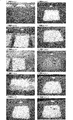
- Experiment No. 4 in Experimental Example 4 4 is a photograph showing how weeds grow after 3 months from the start of tests in 4-1 to 4-10.
- Calcium aluminate used in the present invention is a general term for substances having hydration activity mainly composed of CaO and Al 2 O 3, and is a material having a fast curing time and high initial strength.
- a calcia raw material and an alumina raw material are mixed and fired in a kiln, or melted and cooled in an electric furnace.
- a typical example of calcium aluminate is alumina cement, and commercially available examples such as alumina cement No. 1 and alumina cement No. 2 can be used.
- Amorphous calcium aluminate which is hardened in a shorter time than alumina cement and has a high initial strength after that, and is rapidly cooled after melting, is preferable.
- the molar ratio of CaO to Al 2 O 3 (CaO / Al 2
- the O 3 molar ratio) is preferably 1.0 to 3.0, more preferably 1.7 to 2.5.
- the molar ratio is 1.0 to 1.7, it is possible to improve the initial strength development by further shortening the setting time by adding cement, slaked lime and quicklime.
- a part of CaO and Al 2 O 3 in calcium aluminate is alkali metal oxide, alkaline earth metal oxide, silicon oxide, titanium oxide, iron oxide, alkali metal halide, alkaline earth metal halogen. Also used are compounds substituted with compounds such as chemical compounds, alkali metal sulfates, alkaline earth metal sulfates, etc., or those containing CaO and Al 2 O 3 as main components and a small amount of the above compounds in solid solution. it can.
- the vitrification rate of calcium aluminate is preferably 70% or more, more preferably 90% or more in terms of reaction activity. If it is 70% or less, the initial strength development may be lowered.
- the vitrification rate ⁇ (%) is determined by measuring the main peak area S of the crystalline mineral in advance by powder X-ray diffractometry for the sample before heating, then heating at 1000 ° C. for 2 hours, and then cooling rate of 1-10 ° C./min in gradually cooled to obtain the main peak area S 0 of the crystal minerals after heating by powder X-ray diffraction method, it is calculated using the following equation.
- Vitrification rate ⁇ (%) 100 ⁇ (1 ⁇ S / S 0 )
- the particle size of the calcium aluminate, in terms of initial strength development is preferably more than Blaine specific surface area 3000cm 2 / g, 5000cm 2 / g or more is more preferable. If it is less than 3000 cm 2 / g, the curing time becomes long and the initial strength development may be lowered.
- gypsum in the present invention hemihydrate gypsum and anhydrous gypsum can be used.
- anhydrous gypsum is preferable.
- hydrofluoric acid byproduct anhydrous gypsum and natural anhydrous gypsum can be used.
- the pH when the gypsum is immersed in water is preferably from a weak alkali having a pH of 8 or less to acidic. When the pH is high, the solubility of the gypsum component becomes high, which may inhibit the initial strength development.
- the pH here refers to the pH of the diluted slurry at 20 ° C.
- the particle size of the gypsum preferably 3000 cm 2 / g or more in Blaine specific surface area value, from the viewpoint of the 5000 cm 2 / g or higher initial strength development, the proper work time is obtained.
- the Blaine specific surface area value is preferably 8000 cm 2 / g or less for reasons of production cost.
- Anhydrous gypsum is effective for suppressing the hydration activity of calcium aluminate to ensure the setting time, to increase strength development, and to lower the elution pH.
- anhydrous gypsum is not blended, the curing time is shortened. Therefore, when kneaded, the working time may not be obtained, and the elution pH may be increased.
- the molar ratio of CaO of calcium aluminate to Al 2 O 3 is high, it is effective to add anhydrous gypsum.
- the amount of gypsum used is preferably 40 to 250 parts by mass with respect to 100 parts by mass of calcium aluminate. If the amount is less than 40 parts by mass, it may be difficult to obtain working time, strength development may be reduced, and the elution pH from the cured product may exceed 12. It is preferable that the amount of gypsum increases because the elution pH from the cured product is 11 or less. If it exceeds 250 parts by mass, sufficient working time can be taken, but initial strength may not be obtained.
- the compressive strength at which weeds are difficult to grow is preferably 2 N / mm 2 or more, and particularly preferably 3 N / mm 2 or more. Therefore, if the compressive strength is high, the coating thickness can be reduced, and weed germination In order to suppress it, it is preferable to develop the strength as early as possible, and it is more preferable to maintain the strength for a long time.
- ⁇ -2CaO ⁇ SiO 2 used in the present invention among the compounds represented by 2CaO ⁇ SiO 2, is what is known as a low temperature phase, ⁇ -2CaO ⁇ SiO 2 and beta-2CaO ⁇ is a high temperature phase It is different from SiO 2 .
- These ⁇ , ⁇ , and ⁇ types are all 2CaO ⁇ SiO 2 and have the same chemical composition, but their crystal structures are different.
- 2CaO ⁇ SiO 2 present in the cement clinker is ⁇ -2CaO ⁇ SiO 2 .
- ⁇ -2CaO ⁇ SiO 2 has hydraulic properties
- ⁇ -2CaO ⁇ SiO 2 in the present invention does not have hydraulic properties, but has been found to have a property of absorbing and curing carbon dioxide in the atmosphere.
- the particle size of the ⁇ -2CaO ⁇ SiO 2 is not particularly limited but is preferably 3000 cm 2 / g or more in Blaine specific surface area value, and more preferably 4000 ⁇ 8000cm 2 / g. If the Blaine specific surface area value is less than 3000 cm 2 / g, the carbon dioxide in the atmosphere may be absorbed and sufficient strength may not be obtained. Even if it exceeds 8000 cm 2 / g, further enhancement of the effect cannot be expected.
- the method for producing ⁇ -2CaO ⁇ SiO 2 used in the present invention is not particularly limited, but preferably (1) a calcium source such as quick lime, slaked lime, and / or calcium carbonate, and (2) aluminum oxide, hydroxide Examples include a method of heat-treating a mixture with aluminum and / or an aluminum source such as bauxite.
- the heat treatment temperature is not particularly limited, and varies depending on the raw materials used, but is usually about 850 to 1600 ° C., preferably about 1000 to 1500 ° C. from the viewpoint of heat treatment efficiency.
- slag containing ⁇ -2CaO ⁇ SiO 2 such as steelmaking slag such as hot metal pretreatment slag, converter slag, or reduction slag, and stainless slag is used. May be.
- impurities in ⁇ -2CaO ⁇ SiO 2 used in the present invention and the coexisting compound are not particularly problematic as long as the object of the present invention is not substantially inhibited.
- impurities include Al 2 O 3 , MgO, TiO 2 , MnO, Na 2 O, S, P 2 O 5 , and Fe 2 O 3 .
- the compound coexist, tri calcium silicate 3CaO ⁇ SiO 2, rankinite night 3CaO ⁇ 2SiO 2, and ⁇ -2CaO ⁇ SiO 2 other than calcium silicate such as Wollastonite CaO ⁇ SiO 2, Meruvi night 3CaO ⁇ MgO ⁇ 2SiO 2, Akerumanaito 2CaO ⁇ MgO ⁇ 2SiO 2, and calcium magnesium silicate, such as Monte celite CaO ⁇ MgO ⁇ SiO 2, such as gehlenite 2CaO ⁇ Al 2 O 3 ⁇ SiO 2 and anorthite CaO ⁇ Al 2 O 3 ⁇ 2SiO 2 Calcium aluminosilicate, akermanite 2CaO ⁇ MgO ⁇ 2SiO 2 and gelenite 2CaO ⁇ Al 2 O 3 ⁇ SiO 2 mixed crystals, mellilite such as MgO ⁇ SiO 2 and 2MgO ⁇ SiO 2 Nitrosium si
- the proportion of ⁇ -2CaO ⁇ SiO 2 used in the herbicidal material of the present invention is preferably 90 to 10 parts by weight, and 30 to 70 parts by weight of ⁇ -2CaO ⁇ SiO 2 with respect to 100 parts by weight as a total of calcium aluminate and gypsum. Part by mass is more preferable. If the amount of ⁇ -2CaO ⁇ SiO 2 is small, the elution pH tends to be low, and if there is too much calcium aluminate and gypsum, the elution pH tends to be high. Therefore, the elution pH may be lowest when the amount is equal.
- the content of aggregate with respect to a total of 100 parts by mass of calcium aluminate, calcium aluminate and gypsum, or calcium aluminate, gypsum, and ⁇ -2CaO ⁇ SiO 2 in the herbicidal material of the present invention is particularly limited. Although it is not intended, it is usually preferably 100 to 1000 parts by mass, more preferably 200 to 800 parts by mass. In the case where a herbicidal material is spread and water is sprayed thereon, it is preferably 200 to 800 parts by mass with good water permeability. If the aggregate exceeds 800 parts by mass, the strength development is low, so that a sufficient herbicidal effect may not be obtained.
- the amount is preferably 100 to 300 parts by mass, and can be used in combination with fly ash to improve the pumpability.
- the aggregate used in the present invention can be aggregate in concrete, including sand, incinerated ash, slag, coal ash, recycled aggregate and the like.
- the size may be within the range of the particle size distribution prescribed by the Japan Society of Civil Engineers, but those having a particle size of preferably 0.1 to 25 mm can be used.
- sand having a maximum particle size of 5 mm or less is preferable in terms of workability and smoothness of the finished surface.
- premix mortar in the present invention, a mixture of calcium aluminate and the like and aggregate is referred to as premix mortar.
- premix mortar in order to increase the covering volume for preventing grass, lightweight aggregate can be used, and rice husks that are produced in large quantities by farmers, or wood chips that are obtained by cutting down forest roads may be added.
- the herbicidal material of the present invention includes admixtures such as limestone fine powder, fly ash, kaolin, shirasu, diatomaceous earth, and silica fume, antifoaming agents, thickeners, rust inhibitors, and antifreeze agents.
- the herbicidal material of the present invention is blended with various portland cements such as ordinary, early strength, ultra-early strength, low heat, or moderate heat, and various portland cements mixed with blast furnace slag, fly ash or silica.
- various portland cements such as ordinary, early strength, ultra-early strength, low heat, or moderate heat
- various portland cements mixed with blast furnace slag, fly ash or silica.
- use in agricultural land or residential areas where elution of alkali or elution of hexavalent chromium is a problem is not preferable.
- each component material in the herbicidal material of the present invention is not particularly limited, and each component material may be mixed at the time of construction, or a part or all of them may be mixed in advance. There is no problem.
- a premix mortar in which each component material is mixed in advance is particularly preferable.
- any existing apparatus can be used. For example, a tilting cylinder mixer, an omni mixer, a Henschel mixer, a V-type mixer, and a Nauta mixer can be used.
- the method of using the herbicidal material of the present invention is not particularly limited, but the following method is preferably used. If weeds are already present on the ground to be weeded, weed the weeds with a mower, etc., preferably to about 1 cm or less, remove the cut weeds, and spread the premix mortar of the herbicidal material of the present invention. Sprinkle water to coat. Moreover, the method etc. which spray and coat
- the amount of water when the herbicidal material of the present invention is used is not particularly limited.
- calcium aluminate, gypsum, ⁇ - The amount is preferably 15 to 30 parts by mass, more preferably 15 to 25 parts by mass with respect to 100 parts by mass in total of 2CaO ⁇ SiO 2 and aggregate. If the amount of water is less than 15 parts by mass, the entire herbicidal material may not permeate and strength development may be reduced. If the amount exceeds 30 parts by mass, the above range of compression necessary to prevent weed growth is required. Strength may not be obtained.
- the amount of water in the case where the herbicidal material is used by spraying it on the ground to be grassed by mixing with water is not particularly limited, but calcium aluminate, gypsum, ⁇ -2CaO ⁇ SiO 2 , and aggregate
- the amount is preferably 15 to 25 parts by mass, more preferably 20 to 25 parts by mass with respect to 100 parts by mass in total. If the amount of water is less than 15 parts by mass, it may be difficult to pump the kneaded product. If the amount exceeds 25 parts by mass, the mortar flow will increase. is there.
- the premixed mortar When premixed mortar is spread on mowing ground and sprayed with water to solidify the surface, the premixed mortar is spread on the ground and sprayed with a watering machine, watering machine, etc. Is preferred.
- the thickness for spreading the premix mortar is not particularly limited, and a thickness of 1 to 3 cm is preferable at the convex portion of the ground. If it is 1 cm or less, it becomes difficult to cover the whole, so that the herbicidal effect may be lowered. If it is 3 cm or more, the herbicidal effect is high, but the material cost is high, and a great deal of labor is required.
- the amount of water used for kneading should be such that, for example, the flow value (conforms to JIS R 5201-1998) is preferably 170 to 230 mm so that fluidity that can be pumped with a pump is obtained. Is preferred.
- the pump for pumping the kneaded mortar is not particularly limited.
- a pump such as a piston pump, a squeeze pump, or a snake pump can be used.
- the supplied premix mortar is kneaded with water that is press-fitted with the blades at the tip of the mixer, and then kneaded with a continuous kneading and feeding device that continuously pumps with a snake-type pump connected to the water. This method is preferable from the viewpoint of workability.
- the mortar that has been kneaded and pumped is blown by inserting compressed air with a spray nozzle at the tip. Further, on a slope with a strong slope, a method of spraying mixed air with a liquid plasticizer or an acidic liquid quick-setting agent can be used.
- a method of adding a liquid plasticizer or an acidic liquid quick-setting agent is not particularly limited, and examples thereof include a method of adding to a mortar using a showering tube or a Y-shaped tube.
- the thickness for spraying the mortar is not particularly limited, and a thickness of 1 to 3 cm at the convex portion of the ground is preferable. If it is 1 cm or less, it becomes difficult to coat uniformly, so the herbicidal effect may be low. If it is 3 cm or more, the herbicidal effect is high, but it is not economically preferable.
- Experiment 1 As shown in Table 1, in Experiments No. 1-1 to No. 1-7, 100 parts by mass of calcium aluminate in which the CaO / Al 2 O 3 molar ratio was changed, and the aggregate mixed in different amounts were used. A premix mortar made of JIS R 5201 was filled, and 20 parts by mass of water was sprinkled from a total of 100 parts by mass of calcium aluminate and aggregate to prepare a mortar. Similarly, in Experiment No. 1-8, 20 parts by mass of water was sprinkled into a premix mortar in which 400 parts by mass of aggregate was mixed with 100 parts by mass of alumina cement and aggregate to prepare a mortar. Experiment No. 1-1 is a case where no aggregate is used in Experiment No. 1-1 to No. 1-7 for comparison. These results are also shown in Table 1.
- Calcium aluminate 3% of silica is added to a mixture of calcium carbonate and aluminum oxide with different CaO / Al 2 O 3 molar ratio, and the mixture is melted at 1650 ° C. and rapidly cooled.
- Alumina cement Alumina cement No. 1 (Denka Co., CaO / Al 2 O 3 molar ratio 1.17)
- Penetration time In a room at 20 ° C and relative humidity 80%, 200 g of premixed mortar was filled in a cylindrical form with a diameter of 5 cm and a depth of 10 cm. It was measured. Curing time: The time when the temperature of the mortar cured by water penetration was increased by 2 ° C. was measured.
- Compressive strength JIS R 5201 triple mold is filled with premixed mortar, water is sprinkled from above and water is infiltrated to produce a rectangular parallelepiped specimen having a length of 4 cm, a width of 4 cm, and a height of 16 cm. Measure strength at 1 day and 28 days of age according to JIS R 5201. However, it was demolded at a material age of 1 day and air-dried at 20 ° C. until the material age was 28 days.
- Example 2 As shown in Table 2, a mixture of 400 parts by mass of aggregate with respect to a total of 100 parts by mass of calcium aluminate and gypsum with different ratios of calcium aluminate and gypsum is used as a premix mortar. A test similar to Experimental Example 1 was conducted except that mortar was prepared by sprinkling 20 parts by mass of water with respect to 100 parts by mass of mortar. Here, compressive strength, H.P. T (pot life) and elution pH were measured. The results are shown in Table 2.
- Calcium aluminate CaO / Al 2 O 3 molar ratio 2.2, amorphous, vitrification 97%, Blaine specific surface area value 5000 cm 2 / g Gypsum: natural anhydrous gypsum, Blaine specific surface area value 5000 cm 2 / g
- T pot life
- Elution pH After crushing after measuring the compressive strength on the age of 28 days, and adjusting the particle size to be 0.5 mm or more and 5 mm or less, a sample for dissolution test was prepared. In the dissolution test, 50 g of a sample and 500 g of pure water were put into a plastic bottle having a capacity of 1000 ml, and shaken continuously for 6 hours with a shaker adjusted to a rotational speed of 200 rpm, and the pH value of the supernatant was measured.
- Example 3 As shown in Table 3, 400 parts by mass of aggregate was mixed with 100 parts by mass of a mixture (promoter) composed of 50 parts by mass of calcium aluminate and 50 parts by mass of gypsum and ⁇ -2CaO ⁇ SiO 2 .
- the same test as Experimental Example 1 was carried out except that the premix mortar was prepared and mortar was prepared by sprinkling 20 parts by mass of water with respect to 100 parts by mass of the premix mortar.
- an accelerated neutralization test was conducted on the cured material of the mortar having an age of 1 day.
- ⁇ Materials used> ⁇ -2CaO.SiO 2 : 2 mol of calcium carbonate and 1 mol of silicon dioxide were mixed and pulverized, then calcined at 1450 ° C. for 3 hours in an electric furnace, taken out of the furnace, cooled by natural cooling, and synthesized. At this time, dusting was performed and the powder was pulverized to a brain specific surface area value of 1800 cm 2 / g. This was further ground to a Blaine specific surface area value of 4000 cm 2 / g. Accelerator: calcium aluminate / anhydrous gypsum 1/1 (mass ratio)
- Accelerated neutralization Using the mortar, a rectangular parallelepiped specimen having a length of 4 cm, a width of 4 cm, and a height of 16 cm was prepared, demolded at a material age of 1 day, 20 ° C., relative humidity 60%, and carbonic acid. Accelerated neutralization was performed for 2 weeks in an environment with a gas concentration of 20%, and the compressive strength was measured. Strength decrease rate after accelerated neutralization (%): ((air-dried curing strength-accelerated curing strength) / air-dried curing strength) x 100
- Experimental example 4" ⁇ Test method> The ground weeds used in the test were mowed with a mower to a length of 0.5 cm or less in advance and used for the experiment.
- the premix mortar mixed for kneading was 20 parts by mass with respect to 100 parts by mass of the premix mortar using a PFT G4 continuous mixer pump. Then, the water was kneaded to a flow value of 200 to 220 mm and pumped, and 1 m 3 / min of compressed air was inserted at the tip and sprayed on a ground of about 1 m square to a thickness of 1 cm to cover the ground.
- Experiment No. 4-2 100 parts by mass of 50 parts by mass of calcium aluminate and 50 parts by mass of anhydrous gypsum used in Experiment No. 2-2, 100 parts by mass of fly ash (Techno Chubu Co., Ltd. Type II product), bone 400 parts by mass of material
- Experiment No. 4-3 50 parts by mass of calcium aluminate and 50 parts by mass of anhydrous gypsum used in Experiment No. 2-2, 100 parts by mass of ⁇ -2CaO ⁇ SiO 2 , fly ash (Techno Chubu Co., Ltd., Type II product) 200 parts by mass, aggregate 800 parts by mass
- Experiment No. 4-4 Experiment No. 1-8, 100 parts by mass of alumina cement, fly ash (Techno Chubu Co., Ltd., Type II product) 100 Mass part, 400 parts of aggregate
- Experiment No.4-5 Premix mortar of Experiment No.2-2
- Experiment No.4-6 Premix mortar in which 800 parts by mass of aggregate is mixed with 100 parts by mass of the accelerator of Experiment No.2-2
- Experiment No.4-7 Premix mortar of Experiment No.1-8
- Experiment No.4-8 Commercially available magnesium oxide herbicide (manufactured by Yamaichi Kenki Co., Geomix)
- Experiment No.4-9 Commercially available emulsion: EVA system (solid content concentration 20% by mass, Denka EVA, Denka EVA)
- Experiment No. 4-10 Commercial latex: Chloroprene-based (solid content concentration 20% by mass, Denka CR Latex)
- the herbicidal material of the present invention and the method of using the same can reduce the labor of mowing and have the effects of ensuring the sustainability and environmental conservation of the weeds, so the banks of rivers, the shores of fields, or railways, Growth of weeds such as the slope of embankments such as roads can be suppressed.
Landscapes
- Engineering & Computer Science (AREA)
- Life Sciences & Earth Sciences (AREA)
- Chemical & Material Sciences (AREA)
- Environmental Sciences (AREA)
- Structural Engineering (AREA)
- Ceramic Engineering (AREA)
- Wood Science & Technology (AREA)
- Organic Chemistry (AREA)
- Architecture (AREA)
- Civil Engineering (AREA)
- Insects & Arthropods (AREA)
- Pest Control & Pesticides (AREA)
- Zoology (AREA)
- Materials Engineering (AREA)
- Health & Medical Sciences (AREA)
- General Health & Medical Sciences (AREA)
- Toxicology (AREA)
- Catching Or Destruction (AREA)
- Agricultural Chemicals And Associated Chemicals (AREA)
Abstract
硬化時間が短く、初期強度発現性が高く、長期強度発現性が高く、かつ雨水による溶出水のpHが低く、ポルトランドセメントを含まないため6価クロムの溶出がなく、地面に被覆する厚さが薄くても十分な防草効果を奏すると共に、草刈の労力を軽減でき、防草の持続性と環境保全が確保できる防草材及びその使用方法を提供する。 カルシウムアルミネート及び骨材を含有してなる防草材であり、さらに、石膏やγ-2CaO・SiO2を含有してなる前記防草材であり、カルシウムアルミネートのCaO/Al2O3モル比が1.7~3である前記防草材が好ましく、前記防草材を地面に敷き詰めてその上に散水して被覆することを特徴とする防草材の使用方法であり、前記防草材を水で練混ぜて地面に吹き付けて被覆する防草材の使用方法、である。
Description
本発明は、河川の土手、田畑の畦畔、あるいは、鉄道、道路等の盛土ののり面などの雑草の生育を抑制する防草材及びその使用方法に関する。
河川の土手、鉄道、道路等の盛土ののり面や田畑の畦畔等では雑草が繁茂するが、田畑の畦畔等では病害虫が発生し農作物に悪影響を与えることから、頻繁な草刈りや除草剤の散布が必要であった。草の刈取りには多大の労力を必要するため、一般的には除草剤を散布する方法が行われている。
しかしながら、除草剤の散布は、農作物への影響の面から好ましくない。また、ポルトランドセメントを含有する防草材を振り撒いて散水して地面を被覆する方法も提案されているが、雨水とともにアルカリと6価クロムが溶出することから、農地や住宅地での使用は好ましいものではない。
しかしながら、除草剤の散布は、農作物への影響の面から好ましくない。また、ポルトランドセメントを含有する防草材を振り撒いて散水して地面を被覆する方法も提案されているが、雨水とともにアルカリと6価クロムが溶出することから、農地や住宅地での使用は好ましいものではない。
そのため、ポルトランドセメントを含まない酸化マグネシウム系固化材を散布、または土壌に混合し、散水して固化させて雑草の繁殖を防止する方法や、雑草を抑草する抑草材やその方法が提案されている(特許文献1、2、3)。
特許文献1は、酸化マグネシウムと高炉スラグなどを主成分する雑草繁殖防止材を、対象とする地表面の土壌と混合して転圧して押し固めて、その上に散水して酸化マグネシウムなどの硬化層を形成する方法である。このため、施工に労力を必要とし、また、初期強度発現性が低いため、施工後の降雨で流失し易く、繁殖期の雑草を抑草する効果が低下し易い。
特許文献1は、酸化マグネシウムと高炉スラグなどを主成分する雑草繁殖防止材を、対象とする地表面の土壌と混合して転圧して押し固めて、その上に散水して酸化マグネシウムなどの硬化層を形成する方法である。このため、施工に労力を必要とし、また、初期強度発現性が低いため、施工後の降雨で流失し易く、繁殖期の雑草を抑草する効果が低下し易い。
特許文献2、3も特許文献1と同様の酸化マグネシウム系固化材であるため、初期強度発現性が低く、繁殖期の雑草を抑草する効果が低下し易い。さらに、これら酸化マグネシウム系抑草材全般に関する課題は、硬化時間が長いため傾斜の強い法面では、施工時の散水や降雨時に流されたりして一定の厚さにできない場合があり、水溜りがある場所では硬化しない場合があった。また、初期強度発現性が低いため、貫通力の高いスギナ、ヨシ、笹、チガヤといった植物は貫通して繁茂しやすいことがあげられる。
特許文献4は、焼却灰、スラグ、及び石炭灰の骨材を敷き詰め、その上にクロロプレン系ラテックス、エチレン酢酸ビニル共重合体系エマルジョン、アクリル系エマルジョンなどの固着材を散布して固着する防草工法であり、セメントや塩基性物質を使わないため環境にやさしい防草方法である。しかしながら、人力や重機で3~20cmの厚さに敷き詰め、その上に均一にラテックスやエマルジョンを散布する必要があるため、多大な労力を必要とする。
本発明は、草刈の労力を軽減でき、防草の持続性と環境保全が確保できる新規な防草材及びその使用方法を提供することを目的とする。
本発明は、上記課題を達成するものであり、以下の要旨を有する。
(1)カルシウムアルミネート及び骨材を含有してなる防草材。
(2)前記カルシウムアルミネートのCaO/Al2O3モル比が1.0~3.0である上記(1)に記載の防草材。
(3)前記カルシウムアルミネートが、下記式で求められるガラス化率が70%以上の非晶質である上記(1)又は(2)に記載の防草材。
ガラス化率(%)=100×(1-S/S0)
(式中、Sは、粉末X線回折法によるメインピーク面積であり、S0は、1000℃で2時間加熱し、(1~10℃)/分の速度で冷却した後における粉末X線回折法によるメインピーク面積である。)
(4)さらに、石膏を含有してなる上記(1)~(3)のいずれか1項に記載の防草材。
(5)前記石膏が無水石膏である上記(4)に記載の防草材。
(6)前記石膏の含有量が、カルシウムアルミネート100質量部に対して40~250質量部である上記(4)に記載の防草材。
(7)さらに、γ-2CaO・SiO2を含有してなる上記(1)~(6)のいずれか1項に記載の防草材。
(8)前記γ-2CaO・SiO2の含有量が、カルシウムアルミネート及び石膏の合計100質量部に対して10~90質量部である上記(7)に記載の防草材。
(9)前記骨材の含有量が、カルシウムアルミネート、石膏、及びγ-2CaO・SiO2の合計100質量部に対して100~1000質量部である上記(1)~(6)のいずれか1項に記載の防草材。
(10)上記(1)~(9)のいずれか1項に記載の防草材を、防草すべき地面に敷き詰めてその上に散水して被覆する防草材の使用方法。
(11)上記(1)~(9)のいずれか1項に記載の防草材を水で練り混ぜて、防草すべき地面に吹き付けて被覆する防草材の使用方法。
(1)カルシウムアルミネート及び骨材を含有してなる防草材。
(2)前記カルシウムアルミネートのCaO/Al2O3モル比が1.0~3.0である上記(1)に記載の防草材。
(3)前記カルシウムアルミネートが、下記式で求められるガラス化率が70%以上の非晶質である上記(1)又は(2)に記載の防草材。
ガラス化率(%)=100×(1-S/S0)
(式中、Sは、粉末X線回折法によるメインピーク面積であり、S0は、1000℃で2時間加熱し、(1~10℃)/分の速度で冷却した後における粉末X線回折法によるメインピーク面積である。)
(4)さらに、石膏を含有してなる上記(1)~(3)のいずれか1項に記載の防草材。
(5)前記石膏が無水石膏である上記(4)に記載の防草材。
(6)前記石膏の含有量が、カルシウムアルミネート100質量部に対して40~250質量部である上記(4)に記載の防草材。
(7)さらに、γ-2CaO・SiO2を含有してなる上記(1)~(6)のいずれか1項に記載の防草材。
(8)前記γ-2CaO・SiO2の含有量が、カルシウムアルミネート及び石膏の合計100質量部に対して10~90質量部である上記(7)に記載の防草材。
(9)前記骨材の含有量が、カルシウムアルミネート、石膏、及びγ-2CaO・SiO2の合計100質量部に対して100~1000質量部である上記(1)~(6)のいずれか1項に記載の防草材。
(10)上記(1)~(9)のいずれか1項に記載の防草材を、防草すべき地面に敷き詰めてその上に散水して被覆する防草材の使用方法。
(11)上記(1)~(9)のいずれか1項に記載の防草材を水で練り混ぜて、防草すべき地面に吹き付けて被覆する防草材の使用方法。
本発明の防草材及びその使用方法によれば、硬化時間が短く、初期強度発現性が高く、大気中の二酸化炭素を吸収して硬化するため長期強度発現性が高く、しかも雨水による溶出水のpHが低く、ポルトランドセメントを含まないため6価クロムの溶出がなく、地面に被覆する厚さが薄くても十分な防草効果が得られるとともに、それを用いることで、草刈の労力を軽減でき、防草の持続性と環境保全が確保できる。
本発明に使用するカルシウムアルミネートは、CaOとAl2O3とを主成分とする水和活性を有する物質の総称であり、硬化時間が早く、初期強度発現性が高い材料である。カルシア原料とアルミナ原料などを混合して、キルンで焼成し、あるいは、電気炉で溶融し冷却して得られる。カルシウムアルミネートの代表的なものとしては、アルミナセメントが挙げられ、通常市販されている、例えば、アルミナセメント1号、アルミナセメント2号などが使用できる。
アルミナセメントよりも短時間で硬化し、その後の初期強度発現性が高い点から、溶融後に急冷した非晶質のカルシウムアルミネートが好ましく、CaOとAl2O3とのモル比(CaO/Al2O3モル比)は、1.0~3.0が好ましく、1.7~2.5がより好ましい。該モル比が1.0~1.7の場合は、セメントや消石灰及び生石灰を配合する事で硬化時間をより短縮して初期強度発現性を高める事が可能である。
アルミナセメントよりも短時間で硬化し、その後の初期強度発現性が高い点から、溶融後に急冷した非晶質のカルシウムアルミネートが好ましく、CaOとAl2O3とのモル比(CaO/Al2O3モル比)は、1.0~3.0が好ましく、1.7~2.5がより好ましい。該モル比が1.0~1.7の場合は、セメントや消石灰及び生石灰を配合する事で硬化時間をより短縮して初期強度発現性を高める事が可能である。
本発明では、カルシウムアルミネートにおけるCaOやAl2O3の一部が、アルカリ金属酸化物、アルカリ土類金属酸化物、酸化ケイ素、酸化チタン、酸化鉄、アルカリ金属ハロゲン化物、アルカリ土類金属ハロゲン化物、アルカリ金属硫酸塩、アルカリ土類金属硫酸塩などの化合物で置換されたもの、あるいは、CaOとAl2O3とを主成分とするものに、上記の化合物が少量固溶したものも使用できる。
カルシウムアルミネートのガラス化率は、反応活性の面で70%以上が好ましく、90%以上がより好ましい。70%以下であると初期強度発現性が低下する場合がある。
カルシウムアルミネートのガラス化率は、反応活性の面で70%以上が好ましく、90%以上がより好ましい。70%以下であると初期強度発現性が低下する場合がある。
ガラス化率χ(%)は加熱前のサンプルについて、粉末X線回折法により結晶鉱物のメインピーク面積Sを予め測定し、その後1000℃で2時間加熱後、1~10℃/分の冷却速度で徐冷し、粉末X線回折法による加熱後の結晶鉱物のメインピーク面積S0を求め、次の式を用いて算出される。
ガラス化率χ(%)=100×(1-S/S0)
カルシウムアルミネートの粒度は、初期強度発現性の面で、ブレーン比表面積値3000cm2/g以上が好ましく、5000cm2/g以上がより好ましい。3000cm2/g未満であると硬化時間が長くなり初期強度発現性が低下する場合がある。
ガラス化率χ(%)=100×(1-S/S0)
カルシウムアルミネートの粒度は、初期強度発現性の面で、ブレーン比表面積値3000cm2/g以上が好ましく、5000cm2/g以上がより好ましい。3000cm2/g未満であると硬化時間が長くなり初期強度発現性が低下する場合がある。
本発明における石膏としては、半水石膏や無水石膏が使用できる。強度発現性の面では無水石膏が好ましく、例えば、弗酸副生無水石膏や天然無水石膏が使用できる。石膏を水に浸漬させたときのpHは、pH8以下の弱アルカリから酸性のものが好ましい。pHが高い場合、石膏成分の溶解度が高くなり、初期の強度発現性を阻害する場合がある。ここでいうpHは、石膏/イオン交換水=1g/100gの20℃における希釈スラリーのpHをイオン交換電極などを用いて測定したものである。
石膏の粒度は、ブレーン比表面積値で3000cm2/g以上が好ましく、5000cm2/g以上が初期強度発現性と、適正な作業時間が得られる観点から好ましい。該ブレーン比表面積値は、製造コストの理由からして8000cm2/g以下が好ましい。
石膏の粒度は、ブレーン比表面積値で3000cm2/g以上が好ましく、5000cm2/g以上が初期強度発現性と、適正な作業時間が得られる観点から好ましい。該ブレーン比表面積値は、製造コストの理由からして8000cm2/g以下が好ましい。
無水石膏は、カルシウムアルミネートの水和活性を抑制して硬化時間を確保し、強度発現性を高め、溶出pHを下げるために有効である。無水石膏を配合しない場合は、硬化時間が短くなるため、練り混ぜた場合は作業時間が取れなくなる場合があり、溶出pHが高くなる場合がある。特にカルシウムアルミネートのCaOとAl2O3とのモル比が高い場合は無水石膏を配合すると有効である。
石膏の使用量は、カルシウムアルミネート100質量部に対して、40~250質量部が好ましい。40質量部未満では作業時間が取れにくくなり、強度発現性が低下する場合があり、硬化体からの溶出pHが12を超える場合がある。石膏が多くなると硬化体からの溶出pHが11以下になるため好ましい。250質量部を超えると作業時間は十分に取れるが、初期強度が得られない場合がある。一般的に雑草が生えにくい圧縮強度は好ましくは2N/mm2以上であり、特に好ましくは3N/mm2以上であり、そのため圧縮強度が高いと被覆厚を薄くすることができ、雑草の発芽を抑えるためにもできるだけ初期に強度発現することが好ましく、長期間維持することがより好ましい。
本発明で使用するγ-2CaO・SiO2は、2CaO・SiO2で表される化合物の中で、低温相として知られるものであり、高温相であるα-2CaO・SiO2やβ-2CaO・SiO2とは異なるものである。これらのα、β、及びγ型は、いずれも2CaO・SiO2で同じ化学組成を有するが、結晶構造は異なっている。セメントクリンカ中に存在する2CaO・SiO2はβ-2CaO・SiO2である。β-2CaO・SiO2は水硬性を有するが、本発明におけるγ-2CaO・SiO2は水硬性を持たないが、大気中の二酸化炭素を吸収して硬化する特性があることを見出した。
γ-2CaO・SiO2の粒度は、特に制限されないが、ブレーン比表面積値で3000cm2/g以上が好ましく、4000~8000cm2/gがより好ましい。ブレーン比表面積値が3000cm2/g未満では、大気中の二酸化炭素を吸収して強度が充分に得られない場合がある。8000cm2/gを超えても更なる効果の増進が期待できない。
本発明で使用するγ-2CaO・SiO2の製造方法は、特に限定されないが、好ましくは、(1)生石灰、消石灰、及び/または炭酸カルシウムなどのカルシウム源と、(2)酸化アルミニウム、水酸化アルミニウム、及び/またはボーキサイトなどのアルミニウム源との混合物を熱処理する方法などが挙げられる。熱処理温度は、特に限定されるものではなく、使用する原料によっても異なるが、通常、850~1600℃程度、好ましくは1000~1500℃程度が熱処理効率の面から好適である。
本発明で使用するγ-2CaO・SiO2の製造方法は、特に限定されないが、好ましくは、(1)生石灰、消石灰、及び/または炭酸カルシウムなどのカルシウム源と、(2)酸化アルミニウム、水酸化アルミニウム、及び/またはボーキサイトなどのアルミニウム源との混合物を熱処理する方法などが挙げられる。熱処理温度は、特に限定されるものではなく、使用する原料によっても異なるが、通常、850~1600℃程度、好ましくは1000~1500℃程度が熱処理効率の面から好適である。
また、本発明におけるγ-2CaO・SiO2としては、溶銑予備処理スラグ、転炉スラグ、または還元期スラグなどの製鋼スラグやステンレススラグなどの、γ-2CaO・SiO2を含有するスラグ類を用いてもよい。また、本発明で使用されるγ-2CaO・SiO2における不純物の存在や共存する化合物は、本発明の目的を実質的に阻害しない範囲では特に問題にならない。不純物の具体例としては、例えば、Al2O3、MgO、TiO2、MnO、Na2O、S、P2O5、及びFe2O3などが挙げられる。
また、共存する化合物としては、トライカルシウムシリケート3CaO・SiO2、ランキナイト3CaO・2SiO2、及びワラストナイトCaO・SiO2などのγ-2CaO・SiO2以外のカルシウムシリケート、メルヴィナイト3CaO・MgO・2SiO2、アケルマナイト2CaO・MgO・2SiO2、及びモンチセライトCaO・MgO・SiO2などのカルシウムマグネシウムシリケート、ゲーレナイト2CaO・Al2O3・SiO2やアノーサイトCaO・Al2O3・2SiO2などのカルシウムアルミノシリケート、アケルマナイト2CaO・MgO・2SiO2とゲーレナイト2CaO・Al2O3・SiO2の混晶であるメリライト、MgO・SiO2や2MgO・SiO2などのマグネシウムシリケート、遊離石灰、遊離マグネシア、カルシウムフェライト2CaO・Fe2O3、カルシウムアルミノフェライト4CaO・Al2O3・Fe2O3、リューサイト(K2O、Na2O)・Al2O3・SiO2、スピネルMgO・Al2O3、並びにマグネタイトFe3O4を含む場合がある。
本発明の防草材で使用するγ-2CaO・SiO2の割合は、カルシウムアルミネート及び石膏の合計100質量部に対してγ-2CaO・SiO2が90~10質量部が好ましく、30~70質量部がより好ましい。γ-2CaO・SiO2が少ないと溶出pHが低くなる傾向を有し、カルシウムアルミネートと石膏が多すぎると逆に溶出pHが高くなる傾向にある。そのため、等量であると最も溶出pHが低い場合がある。供試体を高濃度の二酸化炭素で促進養生すると、カルシウムアルミネートと石膏が多いと、二酸化炭素を吸収して強度が低下する傾向がある。γ-2CaO・SiO2が多いと溶出pHが高くなり、初期強度発現性が低くなる場合があるが、γ-2CaO・SiO2が二酸化炭素を吸収してpHが下がり、長期強度発現性が高くなるため強度低下が少なくなる。
本発明の防草材中のカルシウムアルミネート、または、カルシウムアルミネート及び石膏、あるいは、カルシウムアルミネート、石膏、及びγ-2CaO・SiO2の合計100質量部に対する骨材の含有量は特に限定されるものではないが、通常、好ましくは100~1000質量部、より好ましくは200~800質量部である。防草材を敷き詰めてその上に散水する場合は、水の浸透性が良い200~800質量部が好ましい。骨材が800質量部を超えると強度発現性が低いため十分な防草効果が得られない場合があり、200質量部未満であると強度発現性は高いが、経済的にも好ましくない。防草材と水を練り混ぜてポンプ圧送する場合は、100~300質量部が好ましく、圧送性を改善するためにはフライアッシュとの併用が可能である。
本発明で使用する骨材は、砂、焼却灰、スラグ、石炭灰、再生骨材などを含めて、コンクリートなどにおける骨材が使用できる。そのサイズも土木学会で規定されている粒度分布の範囲内であればよいが、粒径が好ましくは0.1~25mmのものが使用できる。特に、施工性や仕上がり面の平滑性の点で最大粒径5mm以下の砂が好ましい。また、粒度調整のためにフライアッシュや石灰石微粉末を配合してもよい。プレミックスモルタル(本発明では、カルシウムアルミネートなどと骨材を混合したものをプレミックスモルタルと言う。)とする場合の骨材は、十分に乾燥させるのが好ましい。また、防草するための被覆体積を増やすには、軽量骨材も使用でき、農家で多量に出る籾殻、または林道整備の伐採で出るウッドチップを配合してもよい。
本発明の防草材には、上記の成分のほかに、石灰石微粉末、フライアッシュ、カオリン、シラス、珪藻土、及びシリカフュームなどの混和材料、消泡剤、増粘剤、防錆剤、防凍剤、ポリマー、凝結調整剤、ベントナイトなどの粘土鉱物、ハイドロタルサイトなどのアニオン交換体、ビニロン繊維、ポリプロピレン繊維、ガラス繊維などの好ましくは長さ10mm以下の短繊維などを1種または2種以上、本発明の目的を実質的に阻害しない範囲で配合することが可能である。
また、本発明の防草材には、普通、早強、超早強、低熱、又は中庸熱などの各種ポルトランドセメント、これらポルトランドセメントに高炉スラグ、フライアッシュ又はシリカを混合した各種セメントを配合してもよいが、アルカリの溶出や6価クロムの溶出が問題となる農地や住宅地での使用は好ましくない。
本発明の防草材における各成分材料の混合方法は、特に限定されるものではなく、それぞれの成分材料を施工時に混合してもよく、予め一部を、あるいは全部を混合しておいても差し支えない。本発明では、特に、各成分材料を事前に混合したプレミックスモルタルが好ましい。
本発明で各成分材料を混合する混合装置としては、既存のいかなる装置も使用可能であり、例えば、傾胴ミキサ、オムニミキサ、ヘンシェルミキサ、V型ミキサ、ナウタミキサなどの使用が可能である。
本発明で各成分材料を混合する混合装置としては、既存のいかなる装置も使用可能であり、例えば、傾胴ミキサ、オムニミキサ、ヘンシェルミキサ、V型ミキサ、ナウタミキサなどの使用が可能である。
本発明の防草材を使用する方法は、特に限定されないが、好ましくは、下記の方法が使用される。防草すべき地面に既に雑草がある場合には、雑草を草刈機等で好ましくは1cm以下程度に草刈し、刈り取った雑草を取り除いた上に、本発明の防草材のプレミックスモルタルを敷き詰めて散水して被覆する方法。また、本発明の防草材のプレミックスモルタルに水を添加して練り混ぜたモルタルを防草すべき地面に吹き付けて被覆する方法などが挙げられる。
本発明の防草材を使用するときの水の量は、特に限定されないが、例えば、防草材を敷き詰めてその上に散水する場合、防草材に含まれるカルシウムアルミネート、石膏、γ-2CaO・SiO2、及び骨材の合計100質量部に対して、15~30質量部が好ましく、15~25質量部がより好ましい。水の量が15質量部未満では防草材全体に水が浸透せず強度発現性が低下する場合があり、30質量部を超えると雑草の成長を防止するのに必要な上記した範囲の圧縮強度が得られない場合がある。
また、防草材を水と練り混ぜて防草する地面などに吹き付けて使用する場合における水の量は、特に限定されないが、カルシウムアルミネート、石膏、γ-2CaO・SiO2、及び骨材の合計100質量部に対して15~25質量部が好ましく、20~25質量部がより好ましい。水の量が15質量部未満では混練物の圧送が困難となる場合があり、25質量部を超えると、モルタルフローが上がるため、のり面に吹き付けるとダレて一定の厚さに吹き付けできない場合がある。
プレミックスモルタルを草刈した地面に敷き詰めて、その上に散水して表面を固化させて被覆する場合は、地面にプレミックスモルタルを敷き詰めてならし、その上にジョウロ、散水機等で散水する方法が好ましい。プレミックスモルタルを敷き詰める厚さは特に限定されるものではなく、地面の凸部で1~3cmの厚さが好ましい。1cm以下であると全体に被覆することができにくくなるため、防草効果が低くなる場合があり、3cm以上では防草効果は高いが材料費が高くなり、多大な労力を要するため好ましくない。
防草材のプれミックスモルタルに水を添加して練り混ぜたモルタルを草刈した地面に吹き付けて表面を固化させて被覆する場合は、プレミックスモルタルに連続的に水を供給する連続練りミキサーを使用して、練混ぜたモルタルを圧送し、先端で圧縮空気を挿入して吹き付ける方法が施工性の点で好ましい。防草されるのり面等の傾斜がある場合は、さらに先端で可塑剤や液体急結剤を添加しても良い。練混ぜに使用する水の量は、ポンプで圧送が可能な流動性が得られるように、例えば、フロー値(JIS R 5201-1998準拠)が好ましくは170~230mmになるように水を加えることが好ましい。
上記練り混ぜたモルタルを圧送するポンプは、特に限定されるものではなく、例えば、ピストン式ポンプ、スクイズ式ポンプ、スネイク式ポンプなどのポンプを使用できる。なかでも、例えば、供給されたプレミックスモルタルを混合機の先端の羽根で圧入された水と練り混ぜし、それに連結しているスネイク式のポンプで連続的に圧送する連続練り圧送装置で練混ぜて圧送する方法が作業性の面で好ましい。
練り混ぜて圧送されたモルタルは、先端の吹付けノズルで圧縮空気を挿入して吹き付ける方法が行われる。また、傾斜の強いのり面などでは、圧縮空気に液体の可塑剤や酸性液体急結剤と混合して吹き付けする方法も使用できる。液体の可塑剤や酸性液体急結剤を添加する方法は、特に限定されるものではないが、シャワリング管やY字管を用いてモルタルに添加する方法などがある。
上記のモルタルを吹き付ける厚さは、特に限定されるものではなく、地面の凸部で1~3cmの厚さが好ましい。1cm以下であると均一に被覆することができにくくなるため、防草効果が低くなる場合があり、3cm以上では防草効果は高いが経済的に好ましくない。
上記のモルタルを吹き付ける厚さは、特に限定されるものではなく、地面の凸部で1~3cmの厚さが好ましい。1cm以下であると均一に被覆することができにくくなるため、防草効果が低くなる場合があり、3cm以上では防草効果は高いが経済的に好ましくない。
以下、本発明の実験例に基づいて具体的に説明するが、本発明は、これに限定されるものではない。
「実験例1」
表1に示すように、実験No.1-1~No.1-7では、CaO/Al2O3モル比を変えたカルシウムアルミネート100質量部と、使用量を変えて混合した骨材とからなるプレミックスモルタルをJIS R 5201用型枠に充填し、その上からカルシウムアルミネートと骨材の合計100質量部に対して水を20質量部散水してモルタルを調製した。
同様に、実験No.1-8では、アルミナセメントと骨材の合計100質量部に対して骨材400質量部を混合したプレミックスモルタルに水を20質量部散水してモルタルを調製した。
なお、実験No.1-1では、比較のために、実験No.1-1~No.1-7において骨材を使用しない場合である。これらの結果を表1に併記した。
表1に示すように、実験No.1-1~No.1-7では、CaO/Al2O3モル比を変えたカルシウムアルミネート100質量部と、使用量を変えて混合した骨材とからなるプレミックスモルタルをJIS R 5201用型枠に充填し、その上からカルシウムアルミネートと骨材の合計100質量部に対して水を20質量部散水してモルタルを調製した。
同様に、実験No.1-8では、アルミナセメントと骨材の合計100質量部に対して骨材400質量部を混合したプレミックスモルタルに水を20質量部散水してモルタルを調製した。
なお、実験No.1-1では、比較のために、実験No.1-1~No.1-7において骨材を使用しない場合である。これらの結果を表1に併記した。
<使用材料>
カルシウムアルミネート:炭酸カルシウムと酸化アルミニウムとのCaO/Al2O3モル比を変えた混合物にシリカを3%加えて、1650℃で溶融して急冷したものである。非晶質、ガラス化率97%、ブレーン比表面積値5000cm2
アルミナセメント:アルミナセメント1号(デンカ社製、CaO/Al2O3モル比1.17)
骨材:糸魚川姫川産の川砂乾燥品、1.2mm篩下
水:水道水
カルシウムアルミネート:炭酸カルシウムと酸化アルミニウムとのCaO/Al2O3モル比を変えた混合物にシリカを3%加えて、1650℃で溶融して急冷したものである。非晶質、ガラス化率97%、ブレーン比表面積値5000cm2
アルミナセメント:アルミナセメント1号(デンカ社製、CaO/Al2O3モル比1.17)
骨材:糸魚川姫川産の川砂乾燥品、1.2mm篩下
水:水道水
<測定方法>
浸透時間:20℃、相対湿度80%の室内で、直径5cm、深さ10cmの円柱型枠にプレミックスモルタルを200g充填し、その上から水を40cc注水して全ての水が浸透した時間を測定した。
硬化時間:水を浸透させて硬化させたモルタルの温度が2℃上昇した時間を測定した。
圧縮強度:JIS R 5201の三連型枠にプレミックスモルタルを充填して、その上から散水して水を浸透させて縦4cm×横4cm×高さ16cmの直方体形状の供試体を作製し、JIS R 5201に準じて材齢1日と28日強度を測定。ただし、材齢1日で脱型し、材齢28日まで20℃で気乾養生した。
浸透時間:20℃、相対湿度80%の室内で、直径5cm、深さ10cmの円柱型枠にプレミックスモルタルを200g充填し、その上から水を40cc注水して全ての水が浸透した時間を測定した。
硬化時間:水を浸透させて硬化させたモルタルの温度が2℃上昇した時間を測定した。
圧縮強度:JIS R 5201の三連型枠にプレミックスモルタルを充填して、その上から散水して水を浸透させて縦4cm×横4cm×高さ16cmの直方体形状の供試体を作製し、JIS R 5201に準じて材齢1日と28日強度を測定。ただし、材齢1日で脱型し、材齢28日まで20℃で気乾養生した。

「実験例2」
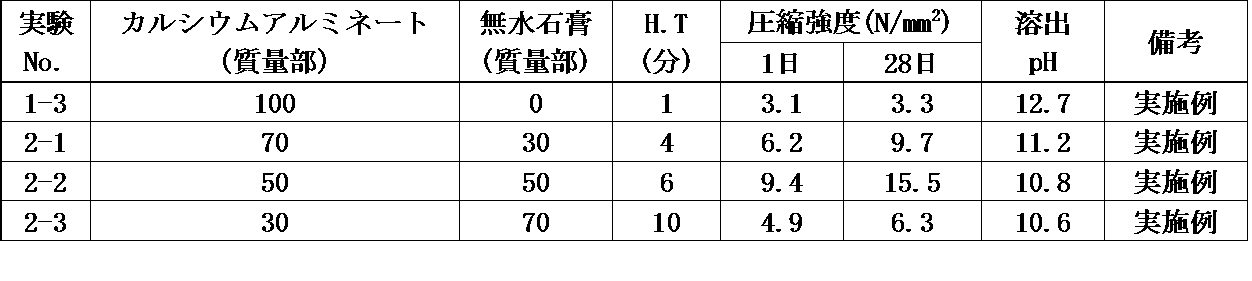
表2に示すように、カルシウムアルミネートと石膏の割合を変えた、カルシウムアルミネートと石膏の合計100質量部に対して、骨材400質量部を混合したものをプレミックスモルタルとし、該プレミックスモルタル100質量部に対して水を20質量部散水してモルタルを調製した以外は実験例1と同様な試験を実施した。ここでは、圧縮強度、H.T(可使時間)及び溶出pHを測定した。結果を表2に併記した。
表2に示すように、カルシウムアルミネートと石膏の割合を変えた、カルシウムアルミネートと石膏の合計100質量部に対して、骨材400質量部を混合したものをプレミックスモルタルとし、該プレミックスモルタル100質量部に対して水を20質量部散水してモルタルを調製した以外は実験例1と同様な試験を実施した。ここでは、圧縮強度、H.T(可使時間)及び溶出pHを測定した。結果を表2に併記した。
<使用材料>
カルシウムアルミネート:CaO/Al2O3モル比2.2、非晶質、ガラス化率97%、ブレーン比表面積値5000cm2/g
石膏:天然無水石膏、ブレーン比表面積値5000cm2/g
カルシウムアルミネート:CaO/Al2O3モル比2.2、非晶質、ガラス化率97%、ブレーン比表面積値5000cm2/g
石膏:天然無水石膏、ブレーン比表面積値5000cm2/g
<測定方法>
H.T(可使時間):モルタルの温度が1℃上昇した時間を測定した。
溶出pH:材齢28日の圧縮強度測定後に粉砕し、粒径0.5mm以上5mm以下になるように調整した後、溶出試験用の試料とした。溶出試験は、容量1000mlのプラスチック製ビンに50gの試料と純水500gを投入し、回転速度200rpmに調整した振とう機で6時間連続振とうして、その上澄み液のpH値を測定した。
H.T(可使時間):モルタルの温度が1℃上昇した時間を測定した。
溶出pH:材齢28日の圧縮強度測定後に粉砕し、粒径0.5mm以上5mm以下になるように調整した後、溶出試験用の試料とした。溶出試験は、容量1000mlのプラスチック製ビンに50gの試料と純水500gを投入し、回転速度200rpmに調整した振とう機で6時間連続振とうして、その上澄み液のpH値を測定した。
「実験例3」
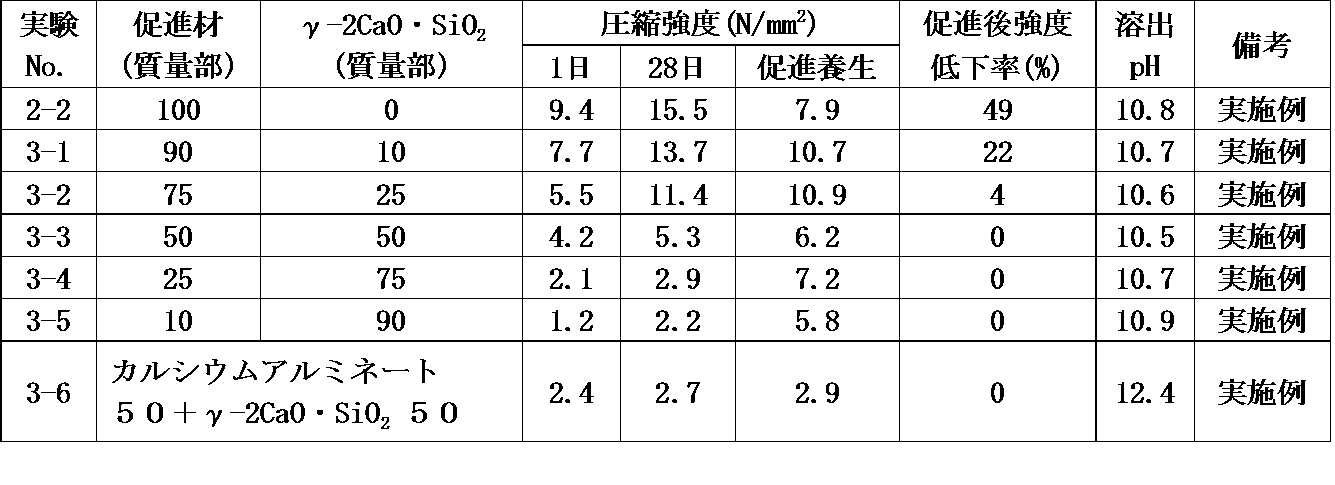
表3に示すように、カルシウムアルミネート50質量部と石膏50質量部とからなる混合物(促進材)及びγ-2CaO・SiO2の合計100質量部に対して、骨材400質量部を混合したものをプレミックスモルタルとし、該プレミックスモルタル100質量部に対して水を20質量部散水してモルタルを調製したこと以外は実験例1と同様の試験を実施した。ここでは、実験例2と同様に圧縮強度及び溶出pHを求めたほかは、上記モルタルの材齢1日の硬化体について、促進中性化の試験を行った。
また、カルシウムアルミネート50質量部とγ-2CaO・SiO250質量部の合計100質量部に対して、骨材400質量部を混合したプレミックスモルタルを使用した場合についても同様の実験を行った(実験No.3-6)。
これらの結果を表3に併記した。
表3に示すように、カルシウムアルミネート50質量部と石膏50質量部とからなる混合物(促進材)及びγ-2CaO・SiO2の合計100質量部に対して、骨材400質量部を混合したものをプレミックスモルタルとし、該プレミックスモルタル100質量部に対して水を20質量部散水してモルタルを調製したこと以外は実験例1と同様の試験を実施した。ここでは、実験例2と同様に圧縮強度及び溶出pHを求めたほかは、上記モルタルの材齢1日の硬化体について、促進中性化の試験を行った。
また、カルシウムアルミネート50質量部とγ-2CaO・SiO250質量部の合計100質量部に対して、骨材400質量部を混合したプレミックスモルタルを使用した場合についても同様の実験を行った(実験No.3-6)。
これらの結果を表3に併記した。
<使用材料>
γ-2CaO・SiO2:炭酸カルシウム2モル及び二酸化ケイ素1モルを混合粉砕した後、電気炉で1450℃にて3時間焼成し、炉外に取り出して自然放冷により冷却して合成した。この時ダスティングし、ブレーン比表面積値1800cm2/gまで粉化した。これをさらにブレーン比表面積値4000cm2/gまで粉砕した。
促進材:カルシウムアルミネート/無水石膏=1/1(質量比)
γ-2CaO・SiO2:炭酸カルシウム2モル及び二酸化ケイ素1モルを混合粉砕した後、電気炉で1450℃にて3時間焼成し、炉外に取り出して自然放冷により冷却して合成した。この時ダスティングし、ブレーン比表面積値1800cm2/gまで粉化した。これをさらにブレーン比表面積値4000cm2/gまで粉砕した。
促進材:カルシウムアルミネート/無水石膏=1/1(質量比)
<測定方法>
促進中性化:上記モルタルを使用して、縦4cm×横4cm×高さ16cmの直方体形状の供試体を作製し、材齢1日で脱型して、20℃、相対湿度60%、炭酸ガス濃度20%の環境で2週間、促進中性化を行い、圧縮強度を測定した。
促進中性化後の強度低下率(%):((気乾養生強度-促進養生強度)/気乾養生強度)×100
促進中性化:上記モルタルを使用して、縦4cm×横4cm×高さ16cmの直方体形状の供試体を作製し、材齢1日で脱型して、20℃、相対湿度60%、炭酸ガス濃度20%の環境で2週間、促進中性化を行い、圧縮強度を測定した。
促進中性化後の強度低下率(%):((気乾養生強度-促進養生強度)/気乾養生強度)×100
促進中性化後の強度低下率:(気乾養生強度-促進養生強度)/気乾養生強度*100
「実験例4」
<試験方法>
試験に用いた地面の雑草は、予め長さ0.5cm以下に草刈機で草刈して実験に供した。
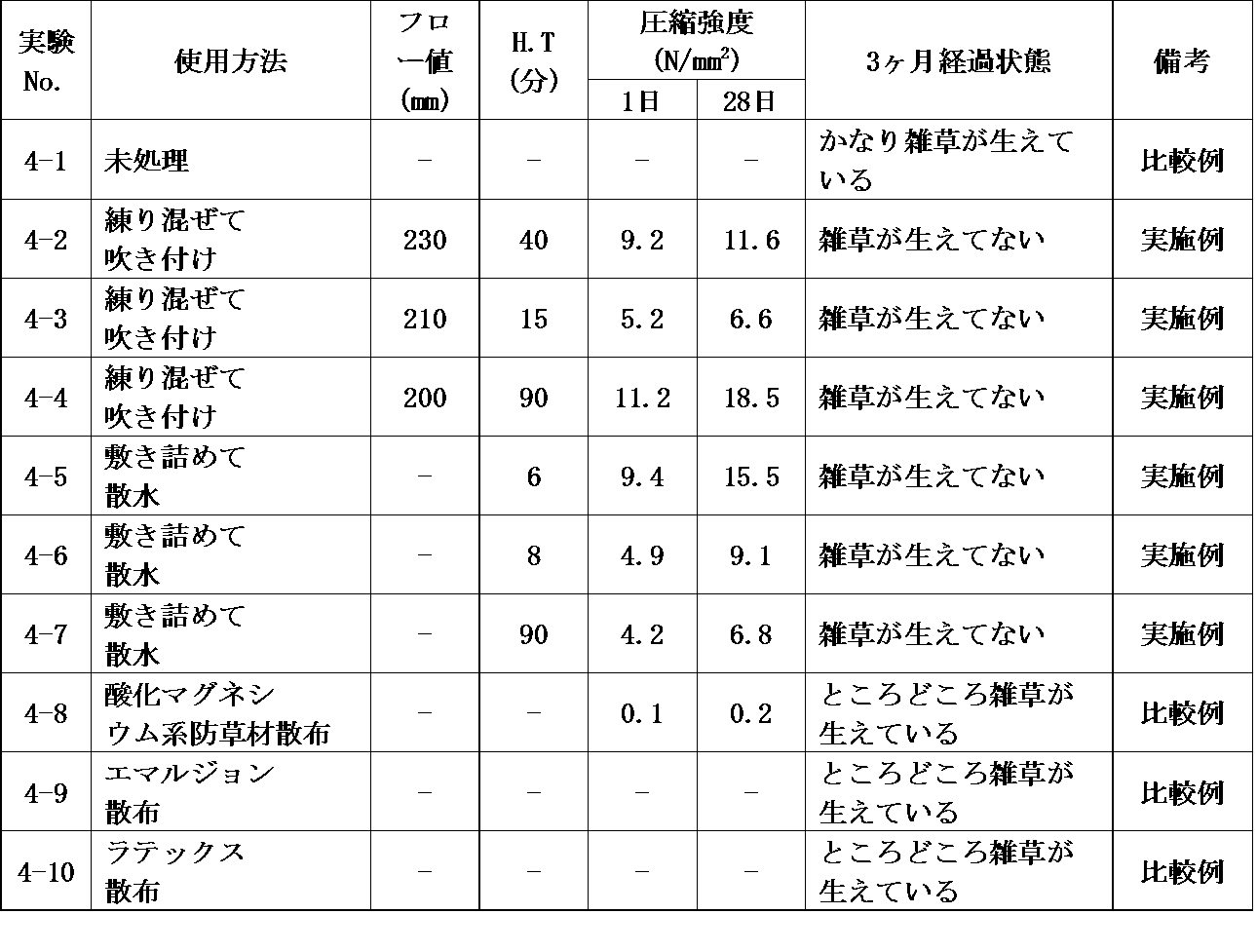
実験No.4-2、4-3、4-4では、練り混ぜ用に混合したプレミックスモルタルを、PFT社製G4連続ミキサポンプを使用して、プレミックスモルタル100質量部に対して20質量部の水を供給してフロー値200~220mmに練り混ぜて圧送し、先端で1m3/minの圧縮空気を挿入して約1m角の地面に1cmの厚さに吹き付けて地面を被覆した。
実験No.4-5、4-6、4-7では、敷き詰め散水用に混合したプレミックスモルタルを、約1m角に2cmの厚さに敷き詰めて、その上に敷き詰めた材料100質量部に対して20質量部の水をジョウロで均一に散水した。
実験No.4-8では、酸化マグネシウム系防草材の100質量部に対して10質量部の水をジョウロで均一に散水した。
実験No.4-9、4-10では、上記実験例1で用いた細骨材を約1m角に厚さ3cmで敷き詰めて平にならし、その上にエマルジョン、又はラテックスを三倍に希釈した液を2kg散布した。
<試験方法>
試験に用いた地面の雑草は、予め長さ0.5cm以下に草刈機で草刈して実験に供した。
実験No.4-2、4-3、4-4では、練り混ぜ用に混合したプレミックスモルタルを、PFT社製G4連続ミキサポンプを使用して、プレミックスモルタル100質量部に対して20質量部の水を供給してフロー値200~220mmに練り混ぜて圧送し、先端で1m3/minの圧縮空気を挿入して約1m角の地面に1cmの厚さに吹き付けて地面を被覆した。
実験No.4-5、4-6、4-7では、敷き詰め散水用に混合したプレミックスモルタルを、約1m角に2cmの厚さに敷き詰めて、その上に敷き詰めた材料100質量部に対して20質量部の水をジョウロで均一に散水した。
実験No.4-8では、酸化マグネシウム系防草材の100質量部に対して10質量部の水をジョウロで均一に散水した。
実験No.4-9、4-10では、上記実験例1で用いた細骨材を約1m角に厚さ3cmで敷き詰めて平にならし、その上にエマルジョン、又はラテックスを三倍に希釈した液を2kg散布した。
<防草材>
実験No.4-2:実験No.2-2で用いたカルシウムアルミネート50質量部と無水石膏50質量部の合計100質量部、フライアッシュ(テクノ中部社製II種品)100質量部、骨材400質量部
実験No.4-3:実験No.2-2で用いたカルシウムアルミネート50質量部と無水石膏50質量部の合計100質量部、γ-2CaO・SiO2100質量部、フライアッシュ(テクノ中部社製II種品)200質量部、骨材800質量部
実験No.4-4:実験No.1-8のアルミナセメント100質量部、フライアッシュ(テクノ中部社製II種品)100質量部、骨材400質部
実験No.4-2:実験No.2-2で用いたカルシウムアルミネート50質量部と無水石膏50質量部の合計100質量部、フライアッシュ(テクノ中部社製II種品)100質量部、骨材400質量部
実験No.4-3:実験No.2-2で用いたカルシウムアルミネート50質量部と無水石膏50質量部の合計100質量部、γ-2CaO・SiO2100質量部、フライアッシュ(テクノ中部社製II種品)200質量部、骨材800質量部
実験No.4-4:実験No.1-8のアルミナセメント100質量部、フライアッシュ(テクノ中部社製II種品)100質量部、骨材400質部
実験No.4-5:実験No.2-2のプレミックスモルタル
実験No.4-6:実験No.2-2の促進材100質量部に対して骨材800質量部を混合したプレミックスモルタル
実験No.4-7:実験No.1-8のプレミックスモルタル
実験No.4-8:市販の酸化マグネシウム系防草材(山一建機社製、ジオミックス)
実験No.4-9:市販のエマルジョン:EVA系(固形分濃度20質量%、デンカ社製、デンカEVA)
実験No.4-10:市販のラテックス:クロロプレン系(固形分濃度20質量%、デンカ社製、デンカCRラテックス)
実験No.4-6:実験No.2-2の促進材100質量部に対して骨材800質量部を混合したプレミックスモルタル
実験No.4-7:実験No.1-8のプレミックスモルタル
実験No.4-8:市販の酸化マグネシウム系防草材(山一建機社製、ジオミックス)
実験No.4-9:市販のエマルジョン:EVA系(固形分濃度20質量%、デンカ社製、デンカEVA)
実験No.4-10:市販のラテックス:クロロプレン系(固形分濃度20質量%、デンカ社製、デンカCRラテックス)
<試験結果>
各防草効果は、試験開始3ヶ月後における雑草の生えかたで確認した(図1参照)。
その結果、実験No.4-1の未処理の所はかなり雑草が生えていたが(図1(1)参照)、本発明の実験No.4-2、4-3、4-4のプレミックスモルタルで被覆した所は、練混ぜて吹き付けた方法、及び本発明の実験No.4-5、4-6、4-7の敷き詰めて散水した方法では、いずれも雑草が生えなかった(図1(2)~図1(7)参照)。
一方、実験No.4-8の酸化マグネシウム系防草材や、実験No.4-9、4-10のエマルジョンまたはラテックスを散布した方法では、ところどころに雑草が生えていた(図1(8)~図1(10)参照)。
各防草効果は、試験開始3ヶ月後における雑草の生えかたで確認した(図1参照)。
その結果、実験No.4-1の未処理の所はかなり雑草が生えていたが(図1(1)参照)、本発明の実験No.4-2、4-3、4-4のプレミックスモルタルで被覆した所は、練混ぜて吹き付けた方法、及び本発明の実験No.4-5、4-6、4-7の敷き詰めて散水した方法では、いずれも雑草が生えなかった(図1(2)~図1(7)参照)。
一方、実験No.4-8の酸化マグネシウム系防草材や、実験No.4-9、4-10のエマルジョンまたはラテックスを散布した方法では、ところどころに雑草が生えていた(図1(8)~図1(10)参照)。
<測定方法>
圧縮強度:敷き詰めて散水したモルタル、及び酸化マグネシウム系防草材の圧縮強度は、JIS R 5201の三連型枠にプレミックスモルタルを充填して、その上から散水して供試体を作製し、脱型後20℃・相対湿度60%の環境で養生した。なお、エマルジョンやラテックスは測定できる強度が出ないため実施しなかった。結果を表4に併記する。 フロー値:JIS R 5201に準じて測定した。
H.I(分):実験例2と同じである。
圧縮強度:敷き詰めて散水したモルタル、及び酸化マグネシウム系防草材の圧縮強度は、JIS R 5201の三連型枠にプレミックスモルタルを充填して、その上から散水して供試体を作製し、脱型後20℃・相対湿度60%の環境で養生した。なお、エマルジョンやラテックスは測定できる強度が出ないため実施しなかった。結果を表4に併記する。 フロー値:JIS R 5201に準じて測定した。
H.I(分):実験例2と同じである。
本発明の防草材及びその使用方法により、草刈の労力を軽減でき、防草の持続性と環境保全が確保できるなどの効果を奏するので、河川の土手、田畑の畦畔、あるいは、鉄道、道路等の盛土ののり面などの雑草の生育を抑制することができる。
なお、2015年8月20日に出願された日本特許出願2015-162562号の明細書、特許請求の範囲、図面、及び要約書の全内容をここに引用し、本発明の明細書の開示として、取り入れるものである。
Claims (11)
- カルシウムアルミネート及び骨材を含有してなる防草材。
- 前記カルシウムアルミネートのCaO/Al2O3モル比が1.0~3.0である請求項1に記載の棒惣菜。」
- 前記カルシウムアルミネートが、下記式で求められるガラス化率が70%以上の非晶質である請求項1又は2に記載の防草材。
ガラス化率(%)=100×(1-S/S0)
(式中、Sは、粉末X線回折法によるメインピーク面積であり、S0は、1000℃で2時間加熱し、(1~10℃)/分の速度で冷却した後における粉末X線回折法によるメインピーク面積である。) - さらに、石膏を含有してなる請求項1~3のいずれか1項に記載の防草材。
- 前記石膏が無水石膏である請求項4に記載の防草材。
- 前記石膏の含有量が、カルシウムアルミネート100質量部に対して40~250質量部である請求項4に記載の防草材。
- さらに、γ-2CaO・SiO2を含有してなる請求項1~6のいずれか1項に記載の防草材。
- 前記γ-2CaO・SiO2の含有量が、カルシウムアルミネート及び石膏の合計100質量部に対して10~90質量部である請求項7に記載の防草材。
- 前記骨材の含有量が、カルシウムアルミネート、石膏、及びγ-2CaO・SiO2の合計100質量部に対して100~1000質量部である請求項1~6のいずれか1項に記載の防草材。
- 請求項1~9のいずれか1項に記載の防草材を、防草すべき地面に敷き詰めてその上に散水して被覆する防草材の使用方法。
- 請求項1~9のいずれか1項に記載の防草材を水で練り混ぜて、防草すべき地面に吹き付けて被覆する防草材の使用方法。
Priority Applications (1)
| Application Number | Priority Date | Filing Date | Title |
|---|---|---|---|
| JP2017535277A JP6785771B2 (ja) | 2015-08-20 | 2016-06-23 | 防草材及びその使用方法 |
Applications Claiming Priority (2)
| Application Number | Priority Date | Filing Date | Title |
|---|---|---|---|
| JP2015162562 | 2015-08-20 | ||
| JP2015-162562 | 2015-08-20 |
Publications (1)
| Publication Number | Publication Date |
|---|---|
| WO2017029883A1 true WO2017029883A1 (ja) | 2017-02-23 |
Family
ID=58050929
Family Applications (1)
| Application Number | Title | Priority Date | Filing Date |
|---|---|---|---|
| PCT/JP2016/068703 Ceased WO2017029883A1 (ja) | 2015-08-20 | 2016-06-23 | 防草材及びその使用方法 |
Country Status (2)
| Country | Link |
|---|---|
| JP (1) | JP6785771B2 (ja) |
| WO (1) | WO2017029883A1 (ja) |
Cited By (6)
| Publication number | Priority date | Publication date | Assignee | Title |
|---|---|---|---|---|
| JP2018164419A (ja) * | 2017-03-28 | 2018-10-25 | デンカ株式会社 | 防草材及びそれの使用方法 |
| JP2019058091A (ja) * | 2017-09-26 | 2019-04-18 | デンカ株式会社 | 防草材及びそれの使用方法 |
| JP2019149999A (ja) * | 2018-03-06 | 2019-09-12 | デンカ株式会社 | 防草・防蟻組成物及び防草・防蟻方法 |
| EP3597616A1 (de) | 2018-07-17 | 2020-01-22 | Markus Fleischanderl | Zementäres bindemittel zur herstellung eines auf hartgesteinsplitt basierenden freiflächenbelags |
| JP2021138655A (ja) * | 2020-03-05 | 2021-09-16 | 株式会社M.I.T | 枯草剤および防草剤 |
| JP2023149849A (ja) * | 2022-03-31 | 2023-10-16 | デンカ株式会社 | 吹付け用粉体材料及び吹付材料 |
Citations (6)
| Publication number | Priority date | Publication date | Assignee | Title |
|---|---|---|---|---|
| JP2003047388A (ja) * | 2001-08-06 | 2003-02-18 | Ybk Kogyo:Kk | 雑草繁殖防止材とこれを使用して地面に雑草繁殖防止層を施工する方法 |
| JP2007029045A (ja) * | 2005-07-29 | 2007-02-08 | Kamigakigumi:Kk | 雑草成長抑制方法及び雑草成長抑制材 |
| JP2007262861A (ja) * | 2006-03-30 | 2007-10-11 | Ube Ind Ltd | 防草材 |
| JP4360861B2 (ja) * | 2003-07-29 | 2009-11-11 | 電気化学工業株式会社 | 水硬性セメント組成物およびそれを使用してなるセメントコンクリート |
| JP2014201462A (ja) * | 2013-04-02 | 2014-10-27 | 電気化学工業株式会社 | 超速硬性クリンカー粉砕物、それを用いたセメント組成物、及びその製造方法 |
| JP2015074896A (ja) * | 2013-10-08 | 2015-04-20 | 電気化学工業株式会社 | 地盤固化方法 |
-
2016
- 2016-06-23 WO PCT/JP2016/068703 patent/WO2017029883A1/ja not_active Ceased
- 2016-06-23 JP JP2017535277A patent/JP6785771B2/ja active Active
Patent Citations (6)
| Publication number | Priority date | Publication date | Assignee | Title |
|---|---|---|---|---|
| JP2003047388A (ja) * | 2001-08-06 | 2003-02-18 | Ybk Kogyo:Kk | 雑草繁殖防止材とこれを使用して地面に雑草繁殖防止層を施工する方法 |
| JP4360861B2 (ja) * | 2003-07-29 | 2009-11-11 | 電気化学工業株式会社 | 水硬性セメント組成物およびそれを使用してなるセメントコンクリート |
| JP2007029045A (ja) * | 2005-07-29 | 2007-02-08 | Kamigakigumi:Kk | 雑草成長抑制方法及び雑草成長抑制材 |
| JP2007262861A (ja) * | 2006-03-30 | 2007-10-11 | Ube Ind Ltd | 防草材 |
| JP2014201462A (ja) * | 2013-04-02 | 2014-10-27 | 電気化学工業株式会社 | 超速硬性クリンカー粉砕物、それを用いたセメント組成物、及びその製造方法 |
| JP2015074896A (ja) * | 2013-10-08 | 2015-04-20 | 電気化学工業株式会社 | 地盤固化方法 |
Cited By (9)
| Publication number | Priority date | Publication date | Assignee | Title |
|---|---|---|---|---|
| JP2018164419A (ja) * | 2017-03-28 | 2018-10-25 | デンカ株式会社 | 防草材及びそれの使用方法 |
| JP2019058091A (ja) * | 2017-09-26 | 2019-04-18 | デンカ株式会社 | 防草材及びそれの使用方法 |
| JP7060935B2 (ja) | 2017-09-26 | 2022-04-27 | デンカ株式会社 | 防草材及びそれの使用方法 |
| JP2019149999A (ja) * | 2018-03-06 | 2019-09-12 | デンカ株式会社 | 防草・防蟻組成物及び防草・防蟻方法 |
| EP3597616A1 (de) | 2018-07-17 | 2020-01-22 | Markus Fleischanderl | Zementäres bindemittel zur herstellung eines auf hartgesteinsplitt basierenden freiflächenbelags |
| EP3597616B1 (de) * | 2018-07-17 | 2021-06-09 | Markus Fleischanderl | Zementäres bindemittel zur herstellung eines auf hartgesteinsplitt basierenden freiflächenbelags |
| JP2021138655A (ja) * | 2020-03-05 | 2021-09-16 | 株式会社M.I.T | 枯草剤および防草剤 |
| JP2023149849A (ja) * | 2022-03-31 | 2023-10-16 | デンカ株式会社 | 吹付け用粉体材料及び吹付材料 |
| JP7834538B2 (ja) | 2022-03-31 | 2026-03-24 | デンカ株式会社 | 吹付け用粉体材料及び吹付材料 |
Also Published As
| Publication number | Publication date |
|---|---|
| JPWO2017029883A1 (ja) | 2018-07-12 |
| JP6785771B2 (ja) | 2020-11-18 |
Similar Documents
| Publication | Publication Date | Title |
|---|---|---|
| JP6785771B2 (ja) | 防草材及びその使用方法 | |
| JP7060935B2 (ja) | 防草材及びそれの使用方法 | |
| JP6649774B2 (ja) | 防草材及びそれの使用方法 | |
| JP2019149999A (ja) | 防草・防蟻組成物及び防草・防蟻方法 | |
| JP6827303B2 (ja) | 防草材及びそれの使用方法 | |
| JP2018096139A (ja) | 土壌舗装材料 | |
| JP6948263B2 (ja) | 防草材及びその使用方法 | |
| JPH10152363A (ja) | 植栽用コンクリート基盤の製造方法及び植栽用コンクリート 製品 | |
| JP6876408B2 (ja) | 防草材及びそれの使用方法 | |
| JP6809820B2 (ja) | 防草材及びそれの使用方法 | |
| JP6722509B2 (ja) | 防草材及びそれの使用方法 | |
| JP6722510B2 (ja) | 防草材及びそれの使用方法 | |
| JP6723130B2 (ja) | 防草材及びそれの使用方法 | |
| SK288106B6 (sk) | Antimicrobial effective substance, method of production thereof and use | |
| JP6654470B2 (ja) | 防草材及びそれの使用方法 | |
| JP2018050528A (ja) | 防草材及びそれの使用方法 | |
| JP6809821B2 (ja) | 防草材及びそれの使用方法 | |
| JP7014511B2 (ja) | 防草材及びそれの使用方法 | |
| JP6914071B2 (ja) | 防草材及びそれの使用方法 | |
| JP6865026B2 (ja) | 防草材及びそれの使用方法 | |
| JP2018093739A (ja) | 防草材及びそれの使用方法 | |
| JP2017160663A (ja) | 土壌舗装材料及びそれを用いた土壌舗装方法 | |
| JP2018068239A (ja) | 防草材及びそれの使用方法 | |
| JP6893425B2 (ja) | 土壌舗装材料 | |
| JP7158935B2 (ja) | 防草固化材の施工方法 |
Legal Events
| Date | Code | Title | Description |
|---|---|---|---|
| 121 | Ep: the epo has been informed by wipo that ep was designated in this application |
Ref document number: 16836875 Country of ref document: EP Kind code of ref document: A1 |
|
| ENP | Entry into the national phase |
Ref document number: 2017535277 Country of ref document: JP Kind code of ref document: A |
|
| NENP | Non-entry into the national phase |
Ref country code: DE |
|
| 122 | Ep: pct application non-entry in european phase |
Ref document number: 16836875 Country of ref document: EP Kind code of ref document: A1 |