WO2016170747A1 - 伝動ベルト - Google Patents
伝動ベルト Download PDFInfo
- Publication number
- WO2016170747A1 WO2016170747A1 PCT/JP2016/001946 JP2016001946W WO2016170747A1 WO 2016170747 A1 WO2016170747 A1 WO 2016170747A1 JP 2016001946 W JP2016001946 W JP 2016001946W WO 2016170747 A1 WO2016170747 A1 WO 2016170747A1
- Authority
- WO
- WIPO (PCT)
- Prior art keywords
- rubber
- transmission belt
- rubber composition
- core wire
- power transmission
- Prior art date
- Legal status (The legal status is an assumption and is not a legal conclusion. Google has not performed a legal analysis and makes no representation as to the accuracy of the status listed.)
- Ceased
Links
Images


Classifications
-
- F—MECHANICAL ENGINEERING; LIGHTING; HEATING; WEAPONS; BLASTING
- F16—ENGINEERING ELEMENTS AND UNITS; GENERAL MEASURES FOR PRODUCING AND MAINTAINING EFFECTIVE FUNCTIONING OF MACHINES OR INSTALLATIONS; THERMAL INSULATION IN GENERAL
- F16G—BELTS, CABLES, OR ROPES, PREDOMINANTLY USED FOR DRIVING PURPOSES; CHAINS; FITTINGS PREDOMINANTLY USED THEREFOR
- F16G5/00—V-belts, i.e. belts of tapered cross-section
- F16G5/04—V-belts, i.e. belts of tapered cross-section made of rubber
- F16G5/06—V-belts, i.e. belts of tapered cross-section made of rubber with reinforcement bonded by the rubber
- F16G5/08—V-belts, i.e. belts of tapered cross-section made of rubber with reinforcement bonded by the rubber with textile reinforcement
-
- B—PERFORMING OPERATIONS; TRANSPORTING
- B32—LAYERED PRODUCTS
- B32B—LAYERED PRODUCTS, i.e. PRODUCTS BUILT-UP OF STRATA OF FLAT OR NON-FLAT, e.g. CELLULAR OR HONEYCOMB, FORM
- B32B25/00—Layered products comprising a layer of natural or synthetic rubber
- B32B25/02—Layered products comprising a layer of natural or synthetic rubber with fibres or particles being present as additives in the layer
-
- B—PERFORMING OPERATIONS; TRANSPORTING
- B32—LAYERED PRODUCTS
- B32B—LAYERED PRODUCTS, i.e. PRODUCTS BUILT-UP OF STRATA OF FLAT OR NON-FLAT, e.g. CELLULAR OR HONEYCOMB, FORM
- B32B25/00—Layered products comprising a layer of natural or synthetic rubber
- B32B25/04—Layered products comprising a layer of natural or synthetic rubber comprising rubber as the main or only constituent of a layer, which is next to another layer of the same or of a different material
- B32B25/042—Layered products comprising a layer of natural or synthetic rubber comprising rubber as the main or only constituent of a layer, which is next to another layer of the same or of a different material of natural rubber or synthetic rubber
-
- B—PERFORMING OPERATIONS; TRANSPORTING
- B32—LAYERED PRODUCTS
- B32B—LAYERED PRODUCTS, i.e. PRODUCTS BUILT-UP OF STRATA OF FLAT OR NON-FLAT, e.g. CELLULAR OR HONEYCOMB, FORM
- B32B25/00—Layered products comprising a layer of natural or synthetic rubber
- B32B25/10—Layered products comprising a layer of natural or synthetic rubber next to a fibrous or filamentary layer
-
- B—PERFORMING OPERATIONS; TRANSPORTING
- B32—LAYERED PRODUCTS
- B32B—LAYERED PRODUCTS, i.e. PRODUCTS BUILT-UP OF STRATA OF FLAT OR NON-FLAT, e.g. CELLULAR OR HONEYCOMB, FORM
- B32B25/00—Layered products comprising a layer of natural or synthetic rubber
- B32B25/14—Layered products comprising a layer of natural or synthetic rubber comprising synthetic rubber copolymers
-
- B—PERFORMING OPERATIONS; TRANSPORTING
- B32—LAYERED PRODUCTS
- B32B—LAYERED PRODUCTS, i.e. PRODUCTS BUILT-UP OF STRATA OF FLAT OR NON-FLAT, e.g. CELLULAR OR HONEYCOMB, FORM
- B32B25/00—Layered products comprising a layer of natural or synthetic rubber
- B32B25/16—Layered products comprising a layer of natural or synthetic rubber comprising polydienes homopolymers or poly-halodienes homopolymers
-
- B—PERFORMING OPERATIONS; TRANSPORTING
- B32—LAYERED PRODUCTS
- B32B—LAYERED PRODUCTS, i.e. PRODUCTS BUILT-UP OF STRATA OF FLAT OR NON-FLAT, e.g. CELLULAR OR HONEYCOMB, FORM
- B32B3/00—Layered products comprising a layer with external or internal discontinuities or unevennesses, or a layer of non-planar shape; Layered products comprising a layer having particular features of form
- B32B3/26—Layered products comprising a layer with external or internal discontinuities or unevennesses, or a layer of non-planar shape; Layered products comprising a layer having particular features of form characterised by a particular shape of the outline of the cross-section of a continuous layer; characterised by a layer with cavities or internal voids ; characterised by an apertured layer
- B32B3/30—Layered products comprising a layer with external or internal discontinuities or unevennesses, or a layer of non-planar shape; Layered products comprising a layer having particular features of form characterised by a particular shape of the outline of the cross-section of a continuous layer; characterised by a layer with cavities or internal voids ; characterised by an apertured layer characterised by a layer formed with recesses or projections, e.g. hollows, grooves, protuberances, ribs
-
- B—PERFORMING OPERATIONS; TRANSPORTING
- B32—LAYERED PRODUCTS
- B32B—LAYERED PRODUCTS, i.e. PRODUCTS BUILT-UP OF STRATA OF FLAT OR NON-FLAT, e.g. CELLULAR OR HONEYCOMB, FORM
- B32B5/00—Layered products characterised by the non- homogeneity or physical structure, i.e. comprising a fibrous, filamentary, particulate or foam layer; Layered products characterised by having a layer differing constitutionally or physically in different parts
- B32B5/02—Layered products characterised by the non- homogeneity or physical structure, i.e. comprising a fibrous, filamentary, particulate or foam layer; Layered products characterised by having a layer differing constitutionally or physically in different parts characterised by structural features of a fibrous or filamentary layer
- B32B5/022—Non-woven fabric
-
- B—PERFORMING OPERATIONS; TRANSPORTING
- B32—LAYERED PRODUCTS
- B32B—LAYERED PRODUCTS, i.e. PRODUCTS BUILT-UP OF STRATA OF FLAT OR NON-FLAT, e.g. CELLULAR OR HONEYCOMB, FORM
- B32B5/00—Layered products characterised by the non- homogeneity or physical structure, i.e. comprising a fibrous, filamentary, particulate or foam layer; Layered products characterised by having a layer differing constitutionally or physically in different parts
- B32B5/02—Layered products characterised by the non- homogeneity or physical structure, i.e. comprising a fibrous, filamentary, particulate or foam layer; Layered products characterised by having a layer differing constitutionally or physically in different parts characterised by structural features of a fibrous or filamentary layer
- B32B5/024—Woven fabric
-
- B—PERFORMING OPERATIONS; TRANSPORTING
- B32—LAYERED PRODUCTS
- B32B—LAYERED PRODUCTS, i.e. PRODUCTS BUILT-UP OF STRATA OF FLAT OR NON-FLAT, e.g. CELLULAR OR HONEYCOMB, FORM
- B32B5/00—Layered products characterised by the non- homogeneity or physical structure, i.e. comprising a fibrous, filamentary, particulate or foam layer; Layered products characterised by having a layer differing constitutionally or physically in different parts
- B32B5/02—Layered products characterised by the non- homogeneity or physical structure, i.e. comprising a fibrous, filamentary, particulate or foam layer; Layered products characterised by having a layer differing constitutionally or physically in different parts characterised by structural features of a fibrous or filamentary layer
- B32B5/026—Knitted fabric
-
- B—PERFORMING OPERATIONS; TRANSPORTING
- B32—LAYERED PRODUCTS
- B32B—LAYERED PRODUCTS, i.e. PRODUCTS BUILT-UP OF STRATA OF FLAT OR NON-FLAT, e.g. CELLULAR OR HONEYCOMB, FORM
- B32B7/00—Layered products characterised by the relation between layers; Layered products characterised by the relative orientation of features between layers, or by the relative values of a measurable parameter between layers, i.e. products comprising layers having different physical, chemical or physicochemical properties; Layered products characterised by the interconnection of layers
- B32B7/04—Interconnection of layers
- B32B7/12—Interconnection of layers using interposed adhesives or interposed materials with bonding properties
-
- C—CHEMISTRY; METALLURGY
- C08—ORGANIC MACROMOLECULAR COMPOUNDS; THEIR PREPARATION OR CHEMICAL WORKING-UP; COMPOSITIONS BASED THEREON
- C08J—WORKING-UP; GENERAL PROCESSES OF COMPOUNDING; AFTER-TREATMENT NOT COVERED BY SUBCLASSES C08B, C08C, C08F, C08G or C08H
- C08J5/00—Manufacture of articles or shaped materials containing macromolecular substances
- C08J5/04—Reinforcing macromolecular compounds with loose or coherent fibrous material
- C08J5/06—Reinforcing macromolecular compounds with loose or coherent fibrous material using pretreated fibrous materials
-
- C—CHEMISTRY; METALLURGY
- C08—ORGANIC MACROMOLECULAR COMPOUNDS; THEIR PREPARATION OR CHEMICAL WORKING-UP; COMPOSITIONS BASED THEREON
- C08L—COMPOSITIONS OF MACROMOLECULAR COMPOUNDS
- C08L1/00—Compositions of cellulose, modified cellulose or cellulose derivatives
- C08L1/02—Cellulose; Modified cellulose
-
- C—CHEMISTRY; METALLURGY
- C09—DYES; PAINTS; POLISHES; NATURAL RESINS; ADHESIVES; COMPOSITIONS NOT OTHERWISE PROVIDED FOR; APPLICATIONS OF MATERIALS NOT OTHERWISE PROVIDED FOR
- C09J—ADHESIVES; NON-MECHANICAL ASPECTS OF ADHESIVE PROCESSES IN GENERAL; ADHESIVE PROCESSES NOT PROVIDED FOR ELSEWHERE; USE OF MATERIALS AS ADHESIVES
- C09J101/00—Adhesives based on cellulose, modified cellulose, or cellulose derivatives
-
- C—CHEMISTRY; METALLURGY
- C09—DYES; PAINTS; POLISHES; NATURAL RESINS; ADHESIVES; COMPOSITIONS NOT OTHERWISE PROVIDED FOR; APPLICATIONS OF MATERIALS NOT OTHERWISE PROVIDED FOR
- C09J—ADHESIVES; NON-MECHANICAL ASPECTS OF ADHESIVE PROCESSES IN GENERAL; ADHESIVE PROCESSES NOT PROVIDED FOR ELSEWHERE; USE OF MATERIALS AS ADHESIVES
- C09J121/00—Adhesives based on unspecified rubbers
-
- D—TEXTILES; PAPER
- D06—TREATMENT OF TEXTILES OR THE LIKE; LAUNDERING; FLEXIBLE MATERIALS NOT OTHERWISE PROVIDED FOR
- D06M—TREATMENT, NOT PROVIDED FOR ELSEWHERE IN CLASS D06, OF FIBRES, THREADS, YARNS, FABRICS, FEATHERS OR FIBROUS GOODS MADE FROM SUCH MATERIALS
- D06M15/00—Treating fibres, threads, yarns, fabrics, or fibrous goods made from such materials, with macromolecular compounds; Such treatment combined with mechanical treatment
- D06M15/693—Treating fibres, threads, yarns, fabrics, or fibrous goods made from such materials, with macromolecular compounds; Such treatment combined with mechanical treatment with natural or synthetic rubber, or derivatives thereof
-
- F—MECHANICAL ENGINEERING; LIGHTING; HEATING; WEAPONS; BLASTING
- F16—ENGINEERING ELEMENTS AND UNITS; GENERAL MEASURES FOR PRODUCING AND MAINTAINING EFFECTIVE FUNCTIONING OF MACHINES OR INSTALLATIONS; THERMAL INSULATION IN GENERAL
- F16G—BELTS, CABLES, OR ROPES, PREDOMINANTLY USED FOR DRIVING PURPOSES; CHAINS; FITTINGS PREDOMINANTLY USED THEREFOR
- F16G1/00—Driving-belts
- F16G1/06—Driving-belts made of rubber
- F16G1/08—Driving-belts made of rubber with reinforcement bonded by the rubber
- F16G1/10—Driving-belts made of rubber with reinforcement bonded by the rubber with textile reinforcement
-
- F—MECHANICAL ENGINEERING; LIGHTING; HEATING; WEAPONS; BLASTING
- F16—ENGINEERING ELEMENTS AND UNITS; GENERAL MEASURES FOR PRODUCING AND MAINTAINING EFFECTIVE FUNCTIONING OF MACHINES OR INSTALLATIONS; THERMAL INSULATION IN GENERAL
- F16G—BELTS, CABLES, OR ROPES, PREDOMINANTLY USED FOR DRIVING PURPOSES; CHAINS; FITTINGS PREDOMINANTLY USED THEREFOR
- F16G1/00—Driving-belts
- F16G1/28—Driving-belts with a contact surface of special shape, e.g. toothed
-
- F—MECHANICAL ENGINEERING; LIGHTING; HEATING; WEAPONS; BLASTING
- F16—ENGINEERING ELEMENTS AND UNITS; GENERAL MEASURES FOR PRODUCING AND MAINTAINING EFFECTIVE FUNCTIONING OF MACHINES OR INSTALLATIONS; THERMAL INSULATION IN GENERAL
- F16G—BELTS, CABLES, OR ROPES, PREDOMINANTLY USED FOR DRIVING PURPOSES; CHAINS; FITTINGS PREDOMINANTLY USED THEREFOR
- F16G5/00—V-belts, i.e. belts of tapered cross-section
- F16G5/20—V-belts, i.e. belts of tapered cross-section with a contact surface of special shape, e.g. toothed
-
- B—PERFORMING OPERATIONS; TRANSPORTING
- B32—LAYERED PRODUCTS
- B32B—LAYERED PRODUCTS, i.e. PRODUCTS BUILT-UP OF STRATA OF FLAT OR NON-FLAT, e.g. CELLULAR OR HONEYCOMB, FORM
- B32B2260/00—Layered product comprising an impregnated, embedded, or bonded layer wherein the layer comprises an impregnation, embedding, or binder material
- B32B2260/02—Composition of the impregnated, bonded or embedded layer
- B32B2260/021—Fibrous or filamentary layer
-
- B—PERFORMING OPERATIONS; TRANSPORTING
- B32—LAYERED PRODUCTS
- B32B—LAYERED PRODUCTS, i.e. PRODUCTS BUILT-UP OF STRATA OF FLAT OR NON-FLAT, e.g. CELLULAR OR HONEYCOMB, FORM
- B32B2260/00—Layered product comprising an impregnated, embedded, or bonded layer wherein the layer comprises an impregnation, embedding, or binder material
- B32B2260/04—Impregnation, embedding, or binder material
- B32B2260/048—Natural or synthetic rubber
-
- B—PERFORMING OPERATIONS; TRANSPORTING
- B32—LAYERED PRODUCTS
- B32B—LAYERED PRODUCTS, i.e. PRODUCTS BUILT-UP OF STRATA OF FLAT OR NON-FLAT, e.g. CELLULAR OR HONEYCOMB, FORM
- B32B2262/00—Composition or structural features of fibres which form a fibrous or filamentary layer or are present as additives
- B32B2262/02—Synthetic macromolecular fibres
-
- B—PERFORMING OPERATIONS; TRANSPORTING
- B32—LAYERED PRODUCTS
- B32B—LAYERED PRODUCTS, i.e. PRODUCTS BUILT-UP OF STRATA OF FLAT OR NON-FLAT, e.g. CELLULAR OR HONEYCOMB, FORM
- B32B2262/00—Composition or structural features of fibres which form a fibrous or filamentary layer or are present as additives
- B32B2262/02—Synthetic macromolecular fibres
- B32B2262/0223—Vinyl resin fibres
-
- B—PERFORMING OPERATIONS; TRANSPORTING
- B32—LAYERED PRODUCTS
- B32B—LAYERED PRODUCTS, i.e. PRODUCTS BUILT-UP OF STRATA OF FLAT OR NON-FLAT, e.g. CELLULAR OR HONEYCOMB, FORM
- B32B2262/00—Composition or structural features of fibres which form a fibrous or filamentary layer or are present as additives
- B32B2262/02—Synthetic macromolecular fibres
- B32B2262/0261—Polyamide fibres
-
- B—PERFORMING OPERATIONS; TRANSPORTING
- B32—LAYERED PRODUCTS
- B32B—LAYERED PRODUCTS, i.e. PRODUCTS BUILT-UP OF STRATA OF FLAT OR NON-FLAT, e.g. CELLULAR OR HONEYCOMB, FORM
- B32B2262/00—Composition or structural features of fibres which form a fibrous or filamentary layer or are present as additives
- B32B2262/02—Synthetic macromolecular fibres
- B32B2262/0261—Polyamide fibres
- B32B2262/0269—Aromatic polyamide fibres
-
- B—PERFORMING OPERATIONS; TRANSPORTING
- B32—LAYERED PRODUCTS
- B32B—LAYERED PRODUCTS, i.e. PRODUCTS BUILT-UP OF STRATA OF FLAT OR NON-FLAT, e.g. CELLULAR OR HONEYCOMB, FORM
- B32B2262/00—Composition or structural features of fibres which form a fibrous or filamentary layer or are present as additives
- B32B2262/02—Synthetic macromolecular fibres
- B32B2262/0276—Polyester fibres
- B32B2262/0284—Polyethylene terephthalate [PET] or polybutylene terephthalate [PBT]
-
- B—PERFORMING OPERATIONS; TRANSPORTING
- B32—LAYERED PRODUCTS
- B32B—LAYERED PRODUCTS, i.e. PRODUCTS BUILT-UP OF STRATA OF FLAT OR NON-FLAT, e.g. CELLULAR OR HONEYCOMB, FORM
- B32B2262/00—Composition or structural features of fibres which form a fibrous or filamentary layer or are present as additives
- B32B2262/06—Vegetal fibres
- B32B2262/062—Cellulose fibres, e.g. cotton
-
- B—PERFORMING OPERATIONS; TRANSPORTING
- B32—LAYERED PRODUCTS
- B32B—LAYERED PRODUCTS, i.e. PRODUCTS BUILT-UP OF STRATA OF FLAT OR NON-FLAT, e.g. CELLULAR OR HONEYCOMB, FORM
- B32B2262/00—Composition or structural features of fibres which form a fibrous or filamentary layer or are present as additives
- B32B2262/10—Inorganic fibres
- B32B2262/101—Glass fibres
-
- B—PERFORMING OPERATIONS; TRANSPORTING
- B32—LAYERED PRODUCTS
- B32B—LAYERED PRODUCTS, i.e. PRODUCTS BUILT-UP OF STRATA OF FLAT OR NON-FLAT, e.g. CELLULAR OR HONEYCOMB, FORM
- B32B2262/00—Composition or structural features of fibres which form a fibrous or filamentary layer or are present as additives
- B32B2262/10—Inorganic fibres
- B32B2262/106—Carbon fibres, e.g. graphite fibres
-
- B—PERFORMING OPERATIONS; TRANSPORTING
- B32—LAYERED PRODUCTS
- B32B—LAYERED PRODUCTS, i.e. PRODUCTS BUILT-UP OF STRATA OF FLAT OR NON-FLAT, e.g. CELLULAR OR HONEYCOMB, FORM
- B32B2270/00—Resin or rubber layer containing a blend of at least two different polymers
-
- B—PERFORMING OPERATIONS; TRANSPORTING
- B32—LAYERED PRODUCTS
- B32B—LAYERED PRODUCTS, i.e. PRODUCTS BUILT-UP OF STRATA OF FLAT OR NON-FLAT, e.g. CELLULAR OR HONEYCOMB, FORM
- B32B2307/00—Properties of the layers or laminate
- B32B2307/70—Other properties
- B32B2307/748—Releasability
-
- B—PERFORMING OPERATIONS; TRANSPORTING
- B32—LAYERED PRODUCTS
- B32B—LAYERED PRODUCTS, i.e. PRODUCTS BUILT-UP OF STRATA OF FLAT OR NON-FLAT, e.g. CELLULAR OR HONEYCOMB, FORM
- B32B2433/00—Closed loop articles
-
- C—CHEMISTRY; METALLURGY
- C08—ORGANIC MACROMOLECULAR COMPOUNDS; THEIR PREPARATION OR CHEMICAL WORKING-UP; COMPOSITIONS BASED THEREON
- C08J—WORKING-UP; GENERAL PROCESSES OF COMPOUNDING; AFTER-TREATMENT NOT COVERED BY SUBCLASSES C08B, C08C, C08F, C08G or C08H
- C08J2323/00—Characterised by the use of homopolymers or copolymers of unsaturated aliphatic hydrocarbons having only one carbon-to-carbon double bond; Derivatives of such polymers
- C08J2323/02—Characterised by the use of homopolymers or copolymers of unsaturated aliphatic hydrocarbons having only one carbon-to-carbon double bond; Derivatives of such polymers not modified by chemical after treatment
- C08J2323/16—Ethene-propene or ethene-propene-diene copolymers
-
- C—CHEMISTRY; METALLURGY
- C08—ORGANIC MACROMOLECULAR COMPOUNDS; THEIR PREPARATION OR CHEMICAL WORKING-UP; COMPOSITIONS BASED THEREON
- C08J—WORKING-UP; GENERAL PROCESSES OF COMPOUNDING; AFTER-TREATMENT NOT COVERED BY SUBCLASSES C08B, C08C, C08F, C08G or C08H
- C08J2401/00—Characterised by the use of cellulose, modified cellulose or cellulose derivatives
- C08J2401/02—Cellulose; Modified cellulose
-
- C—CHEMISTRY; METALLURGY
- C08—ORGANIC MACROMOLECULAR COMPOUNDS; THEIR PREPARATION OR CHEMICAL WORKING-UP; COMPOSITIONS BASED THEREON
- C08J—WORKING-UP; GENERAL PROCESSES OF COMPOUNDING; AFTER-TREATMENT NOT COVERED BY SUBCLASSES C08B, C08C, C08F, C08G or C08H
- C08J2467/00—Characterised by the use of polyesters obtained by reactions forming a carboxylic ester link in the main chain; Derivatives of such polymers
-
- C—CHEMISTRY; METALLURGY
- C08—ORGANIC MACROMOLECULAR COMPOUNDS; THEIR PREPARATION OR CHEMICAL WORKING-UP; COMPOSITIONS BASED THEREON
- C08J—WORKING-UP; GENERAL PROCESSES OF COMPOUNDING; AFTER-TREATMENT NOT COVERED BY SUBCLASSES C08B, C08C, C08F, C08G or C08H
- C08J2475/00—Characterised by the use of polyureas or polyurethanes; Derivatives of such polymers
- C08J2475/04—Polyurethanes
-
- C—CHEMISTRY; METALLURGY
- C08—ORGANIC MACROMOLECULAR COMPOUNDS; THEIR PREPARATION OR CHEMICAL WORKING-UP; COMPOSITIONS BASED THEREON
- C08J—WORKING-UP; GENERAL PROCESSES OF COMPOUNDING; AFTER-TREATMENT NOT COVERED BY SUBCLASSES C08B, C08C, C08F, C08G or C08H
- C08J2477/00—Characterised by the use of polyamides obtained by reactions forming a carboxylic amide link in the main chain; Derivatives of such polymers
- C08J2477/06—Polyamides derived from polyamines and polycarboxylic acids
-
- C—CHEMISTRY; METALLURGY
- C08—ORGANIC MACROMOLECULAR COMPOUNDS; THEIR PREPARATION OR CHEMICAL WORKING-UP; COMPOSITIONS BASED THEREON
- C08L—COMPOSITIONS OF MACROMOLECULAR COMPOUNDS
- C08L2205/00—Polymer mixtures characterised by other features
- C08L2205/14—Polymer mixtures characterised by other features containing polymeric additives characterised by shape
- C08L2205/16—Fibres; Fibrils
-
- C—CHEMISTRY; METALLURGY
- C08—ORGANIC MACROMOLECULAR COMPOUNDS; THEIR PREPARATION OR CHEMICAL WORKING-UP; COMPOSITIONS BASED THEREON
- C08L—COMPOSITIONS OF MACROMOLECULAR COMPOUNDS
- C08L23/00—Compositions of homopolymers or copolymers of unsaturated aliphatic hydrocarbons having only one carbon-to-carbon double bond; Compositions of derivatives of such polymers
- C08L23/02—Compositions of homopolymers or copolymers of unsaturated aliphatic hydrocarbons having only one carbon-to-carbon double bond; Compositions of derivatives of such polymers not modified by chemical after-treatment
- C08L23/16—Ethylene-propylene or ethylene-propylene-diene copolymers
-
- C—CHEMISTRY; METALLURGY
- C08—ORGANIC MACROMOLECULAR COMPOUNDS; THEIR PREPARATION OR CHEMICAL WORKING-UP; COMPOSITIONS BASED THEREON
- C08L—COMPOSITIONS OF MACROMOLECULAR COMPOUNDS
- C08L97/00—Compositions of lignin-containing materials
- C08L97/02—Lignocellulosic material, e.g. wood, straw or bagasse
Definitions
- the present invention relates to a transmission belt.
- Patent Document 1 discloses that a rubber composition in which a cellulose-based fine fiber having a carboxy group having an average fiber diameter of 0.1 to 200 nm is subjected to a hydrophobic modification treatment is applied to a transmission belt.
- Patent Document 2 discloses that a rubber composition containing cellulose nanofibers is applied to an inner surface rubber layer of a flat belt.
- the present invention is a transmission belt embedded in a rubber belt body so that a core wire forms a spiral having a pitch in the belt width direction, and the core wire includes a rubber component formed by an adhesion process. It is coat
- FIG. 3 is a perspective view of a V-ribbed belt according to Embodiment 1.
- FIG. 3 is a cross-sectional view showing an interface structure between a core wire and an adhesive rubber layer in Embodiment 1.
- FIG. It is a figure which shows the pulley layout of the auxiliary drive belt transmission device of the motor vehicle using the V-ribbed belt which concerns on Embodiment 1.
- FIG. 5 is a first explanatory view showing a method for manufacturing the V-ribbed belt according to the first embodiment.
- FIG. 6 is a second explanatory view showing the method for manufacturing the V-ribbed belt according to the first embodiment.
- FIG. 6 is a third explanatory view showing the method for manufacturing the V-ribbed belt according to the first embodiment.
- FIG. 6 is a fourth explanatory view showing the method for manufacturing the V-ribbed belt according to the first embodiment.
- FIG. 9 is a fifth explanatory view showing the method for manufacturing the V-ribbed belt according to the first embodiment.
- It is sectional drawing which shows the interface structure of the core wire and adhesive rubber layer in Embodiment 2. It is a perspective view of the test piece for adhesion tests. It is a figure which shows the pulley layout of a belt test traveling machine.
- FIG. 1 shows a V-ribbed belt B (power transmission belt) according to the first embodiment.
- the V-ribbed belt B according to the first embodiment is an endless power transmission member used, for example, in an accessory drive belt transmission device provided in an engine room of an automobile.
- the V-ribbed belt B according to Embodiment 1 has, for example, a belt circumferential length of 700 to 3000 mm, a belt width of 10 to 36 mm, and a belt thickness of 4.0 to 5.0 mm.
- the V-ribbed belt B includes a rubber-made V-ribbed belt body 10 having a two-layer structure including an adhesive rubber layer 11 on the belt outer peripheral side and a compressed rubber layer 12 forming a pulley contact portion on the belt inner peripheral side. ing.
- a core wire 13 is embedded in an intermediate portion in the belt thickness direction of the adhesive rubber layer 11 in the V-ribbed belt body 10 so as to form a spiral having a pitch in the belt width direction.
- a back reinforcing cloth 14 is attached to the belt outer peripheral side of the adhesive rubber layer 11 in the V-ribbed belt body 10. A configuration in which a back rubber layer is provided instead of the back reinforcing cloth 14 may be used.
- the adhesive rubber layer 11 is formed in a band shape having a horizontally long cross section and has a thickness of, for example, 1.0 to 2.5 mm.
- the compressed rubber layer 12 is provided such that a plurality of V ribs 15 hang down to the inner peripheral side of the belt.
- the plurality of V ribs 15 are each formed in a ridge having a substantially inverted triangular cross section extending in the belt length direction, and arranged in parallel in the belt width direction.
- Each V-rib 15 has, for example, a rib height of 2.0 to 3.0 mm and a width between base ends of 1.0 to 3.6 mm.
- the number of V ribs 15 is, for example, 3 to 6 (6 in FIG. 1).
- the adhesive rubber layer 11 and the compressed rubber layer 12 are formed of a rubber composition in which an uncrosslinked rubber composition in which various rubber compounding agents are blended with a rubber component and kneaded is heated and pressurized to be crosslinked with the crosslinking agent. Yes.
- the adhesive rubber layer 11 and the compressed rubber layer 12 may be formed of a rubber composition having a different composition, or may be formed of a rubber composition having the same composition.
- Examples of the rubber component of the rubber composition forming the adhesive rubber layer 11 and the compressed rubber layer 12 include ethylene / propylene copolymer (EPR), ethylene / propylene / diene terpolymer (EPDM), ethylene / octene copolymer, and ethylene / butene. Examples thereof include ethylene- ⁇ -olefin elastomers such as copolymers; chloroprene rubber (CR); chlorosulfonated polyethylene rubber (CSM); hydrogenated acrylonitrile rubber (H-NBR).
- the rubber component of the rubber composition that forms the adhesive rubber layer 11 and the compressed rubber layer 12 is preferably one or two or more of these blend rubbers.
- the rubber components of the rubber composition forming the adhesive rubber layer 11 and the compressed rubber layer 12 are preferably the same.
- Examples of rubber compounding agents include reinforcing materials, fillers, anti-aging agents, softeners, crosslinking agents, and vulcanization accelerators.
- Short fibers may be blended in the rubber composition forming the compressed rubber layer 12. In that case, the short fibers are preferably included in the compressed rubber layer 12 so as to be oriented in the belt width direction, and the short fibers are preferably provided so as to protrude from the surface of the compressed rubber layer 12. .
- the structure by which the short fiber was adhering to the surface of the compression rubber layer 12 by flocking etc. may be sufficient instead of the structure by which the short fiber was mix
- the core wire 13 is composed of a twisted yarn formed of polyamide fiber, polyester fiber, aramid fiber, polyamide fiber or the like.
- the diameter of the core wire 13 is, for example, 0.5 to 2.5 mm, and the dimension between the centers of adjacent core wires 14 in the cross section is, for example, 0.05 to 0.20 mm.
- Examples of the fiber material that forms the core wire 13 include polyester fiber (PET), aromatic polyamide fiber (aramid fiber), nylon fiber, glass fiber, carbon fiber, polyketone fiber, polyethylene naphthalate fiber (PEN), and vinylon fiber. , PBO fiber, cotton and the like.
- the core wire 13 has been subjected to an adhesive treatment before molding in order to impart adhesiveness to the V-ribbed belt body 10. Specifically, as described later, the core wire 13 is dipped in a resorcin / formalin / latex aqueous solution (hereinafter referred to as “RFL aqueous solution”) and heated, and dipped in rubber paste and dried. Rubber glue adhesion treatment is applied in order. As a result, as shown in FIG. 2, the core wire 13 is covered with the RFL adhesive layer 16 formed by the RFL adhesive process and also with the rubber adhesive adhesive layer 17 formed by the rubber adhesive adhesive process. Yes. Further, the rubber glue adhesive layer 17 is in contact with the adhesive rubber layer 11 of the V-ribbed belt main body 10.
- RFL aqueous solution resorcin / formalin / latex aqueous solution
- a base adhesion treatment liquid comprising a solution obtained by dissolving a ground adhesion treatment agent such as epoxy resin or isocyanate resin (block isocyanate) in a solvent such as toluene, or a dispersion dispersed in water.
- a ground adhesion treatment agent such as epoxy resin or isocyanate resin (block isocyanate)
- a solvent such as toluene, or a dispersion dispersed in water.
- the base adhesion process which is immersed in and heated may be performed, and the base adhesive layer may be provided under the RFL adhesive layer 16.
- the RFL adhesive layer 16 is formed of a solid content contained in the RFL aqueous solution, and contains a resorcin / formalin resin and a rubber component derived from rubber latex.
- the rubber paste adhesive layer 17 is formed of a solid rubber composition contained in the rubber paste, and the rubber composition forming the rubber paste adhesive layer 17 includes cellulosic fine fibers. Therefore, the core wire 13 is covered with an RFL adhesive layer 16 containing a rubber component, and the RFL adhesive layer 16 is in contact with a rubber paste adhesive layer 17 formed of a rubber composition containing cellulosic fine fibers. .
- the RFL adhesive layer 16 including the rubber component is in contact with the rubber paste adhesive layer 17 formed of the rubber composition including the cellulosic fine fibers, so that the adhesive rubber of the V-ribbed belt main body 10 of the cord 13 is obtained.
- High adhesion to the layer 11 can be obtained.
- fine fiber in the present application means a fiber having a fiber diameter of 1.0 ⁇ m or less.
- the rubber composition for forming the rubber paste adhesive layer 17 is obtained by heating and pressing an uncrosslinked rubber composition in which various rubber compounding agents are blended with the rubber component in addition to the cellulosic fine fibers, Cross-linked.
- Examples of the rubber component of the rubber composition forming the rubber paste adhesive layer 17 include ethylene / propylene copolymer (EPR), ethylene / propylene / diene terpolymer (EPDM), ethylene / octene copolymer, ethylene / butene copolymer and the like. - ⁇ -olefin elastomer; chloroprene rubber (CR); chlorosulfonated polyethylene rubber (CSM); hydrogenated acrylonitrile rubber (H-NBR).
- the rubber component of the rubber composition that forms the rubber paste adhesive layer 17 is preferably one or more of these blend rubbers.
- the rubber component of the rubber composition forming the rubber paste adhesive layer 17 is preferably the same as the rubber component of the rubber composition forming the adhesive rubber layer 11 with which the rubber paste adhesive layer 17 contacts.
- Cellulosic fine fiber is a fiber material derived from cellulose fine fiber composed of a skeletal component of a plant cell wall obtained by finely loosening plant fiber.
- Examples of the cellulosic fine fiber plant include wood, bamboo, rice (rice straw), potato, sugar cane (bagasse), aquatic plants, seaweed and the like. Of these, wood is preferred.
- the cellulose-based fine fiber may be either the cellulose fine fiber itself or a hydrophobic cellulose fine fiber that has been subjected to a hydrophobic treatment. Moreover, you may use together cellulose fine fiber itself and hydrophobized cellulose fine fiber as a cellulosic fine fiber. From the viewpoint of dispersibility, the cellulosic fine fibers preferably include hydrophobized cellulose fine fibers. Examples of the hydrophobized cellulose fine fibers include cellulose fine fibers in which some or all of the hydroxyl groups of cellulose are substituted with hydrophobic groups, and cellulose fine fibers that have been subjected to a hydrophobized surface treatment with a surface treatment agent.
- hydrophobization for obtaining cellulose fine fibers in which part or all of the hydroxyl groups of cellulose are substituted with hydrophobic groups include esterification (acylation) (alkyl esterification, complex esterification, ⁇ -ketoesterification, etc.) ), Alkylation, tosylation, epoxidation, arylation and the like. Of these, esterification is preferred.
- esterification is preferred.
- part or all of the hydroxyl groups of cellulose are carboxylic acids such as acetic acid, acetic anhydride, propionic acid, butyric acid, or halides thereof (particularly chlorides). It is the cellulose fine fiber acylated by.
- the surface treatment agent for obtaining cellulose fine fibers hydrophobized and surface-treated with the surface treatment agent include silane coupling agents.
- the cellulose fine fibers preferably have a wide fiber diameter distribution from the viewpoint of obtaining high adhesion to the adhesive rubber layer 11 of the V-ribbed belt body 10 of the core wire 13.
- the lower limit of the fiber diameter distribution is preferably 50 nm or less, more preferably 20 nm or less, and still more preferably 10 nm or less.
- the upper limit is preferably 500 nm or more, more preferably 700 nm or more, and still more preferably 1 ⁇ m or more.
- the fiber diameter distribution range of the cellulosic fine fibers preferably includes 50 to 500 nm, and preferably includes 20 nm to 700 mm, from the viewpoint of obtaining high adhesion to the adhesive rubber layer 11 of the V-ribbed belt body 10 of the core wire 13. Is more preferable, and 10 nm to 1 ⁇ m is more preferable.
- the average fiber diameter of the cellulosic fine fibers contained in the rubber composition forming the rubber paste adhesive layer 17 is preferably from the viewpoint of obtaining high adhesion to the adhesive rubber layer 11 of the V-ribbed belt body 10 of the core wire 13. It is 10 nm or more, more preferably 20 nm or more, and preferably 700 nm or less, more preferably 100 nm or less.
- the distribution of the fiber diameter of the cellulosic fine fibers was determined by freeze-grinding a sample of the rubber composition forming the rubber paste adhesive layer 17 and then observing the cross section with a transmission electron microscope (TEM). A fine fiber is arbitrarily selected, the fiber diameter is measured, and obtained based on the measurement result. The average fiber diameter of the cellulosic fine fibers is obtained as the number average of the fiber diameters of 50 arbitrarily selected cellulosic fine fibers.
- the cellulosic fine fibers may be either high aspect ratio manufactured by mechanical defibrating means, or needle-shaped crystals manufactured by chemical defibrating means. Among these, those manufactured by mechanical defibrating means are preferable from the viewpoint of wide fiber diameter distribution. Moreover, you may use together what was manufactured by the mechanical defibration means, and what was manufactured by the chemical defibration means as a cellulose fine fiber.
- the defibrating apparatus used for the mechanical defibrating means include a kneader such as a twin-screw kneader, a high-pressure homogenizer, a grinder, and a bead mill.
- the treatment used for the chemical defibrating means include acid hydrolysis treatment.
- the cellulosic fine fibers are not oriented in a specific direction and are not oriented.
- the content of the cellulosic fine fibers in the rubber composition forming the rubber paste adhesive layer 17 is such that the rubber component of the rubber composition is obtained from the viewpoint of obtaining high adhesion to the adhesive rubber layer 11 of the V-ribbed belt body 10 of the core wire 13.
- the amount is preferably 1 part by mass or more, more preferably 3 parts by mass or more, still more preferably 5 parts by mass or more, and preferably 30 parts by mass or less, more preferably 20 parts by mass or less, with respect to 100 parts by mass. Preferably it is 10 mass parts or less.
- rubber compounding agents include reinforcing materials, oils, processing aids, vulcanization acceleration aids, crosslinking agents, and vulcanization accelerators.
- carbon black for example, channel black; furnace black such as SAF, ISAF, N-339, HAF, N-351, MAF, FEF, SRF, GPF, ECF, N-234; FT, MT, etc. Thermal black; acetylene black and the like.
- Silica is also mentioned as the reinforcing material. It is preferable that a reinforcing material is 1 type, or 2 or more types among these. The content of the reinforcing material is preferably 50 to 90 parts by mass with respect to 100 parts by mass of the rubber component of the rubber composition.
- Oils include, for example, petroleum-based softeners, mineral oils such as paraffin wax, castor oil, cottonseed oil, linseed oil, rapeseed oil, soybean oil, palm oil, palm oil, fall raw oil, wax, rosin, pine And vegetable oils such as oil.
- the oil is preferably one or more of these.
- the oil content is, for example, 20 to 40 parts by mass with respect to 100 parts by mass of the rubber component of the rubber composition.
- processing aids include stearic acid, polyethylene wax, and fatty acid metal salts.
- the processing aid is preferably one or more.
- the content of the processing aid is, for example, 0.5 to 2 parts by mass with respect to 100 parts by mass of the rubber component of the rubber composition.
- the vulcanization acceleration aid examples include metal oxides such as magnesium oxide and zinc oxide (zinc white), metal carbonates, fatty acids and derivatives thereof.
- the vulcanization acceleration aid is preferably one or more.
- the content of the vulcanization acceleration aid is, for example, 3 to 7 parts by mass with respect to 100 parts by mass of the rubber component of the rubber composition.
- crosslinking agent examples include sulfur and organic peroxides.
- sulfur may be blended, an organic peroxide may be blended, or both of them may be used in combination.
- the amount of the crosslinking agent is, for example, 1 to 5 parts by mass with respect to 100 parts by mass of the rubber component of the rubber composition in the case of sulfur, and 100 parts by mass of the rubber component of the rubber composition with respect to the organic peroxide. For example, 1 to 5 parts by mass.
- vulcanization accelerator examples include thiazole type (eg MBT, MBTS etc.), thiuram type (eg TT, TRA etc.), sulfenamide type (eg CZ etc.), dithiocarbamate type (eg BZ-P etc.) And the like. It is preferable that a vulcanization accelerator is 1 type, or 2 or more types among these. The content of the vulcanization accelerator is, for example, 2 to 5 parts by mass with respect to 100 parts by mass of the rubber component of the rubber composition.
- the rubber composition forming the rubber paste adhesive layer 17 preferably does not contain short fibers having a fiber diameter of 10 ⁇ m or more, but the core wire 13 is bonded to the adhesive rubber layer 11 of the V-ribbed belt body 10. Such short fibers may be included as long as the properties are not impaired. Further, the rubber composition forming the adhesive rubber layer 11 may or may not contain short fibers having a fiber diameter of 10 ⁇ m or more. Furthermore, the rubber composition forming the adhesive rubber layer 11 may or may not contain cellulosic fine fibers.
- the back reinforcing cloth 14 is made of, for example, a cloth material such as a woven fabric, a knitted fabric, or a non-woven fabric formed of yarns such as cotton, polyamide fiber, polyester fiber, and aramid fiber.
- the back reinforcing cloth 14 is subjected to an adhesion treatment for adhesion to the V-ribbed belt main body 10.
- a core wire is normally embedded in a rubber belt body so as to form a spiral having a pitch in the belt width direction.
- this core wire has been subjected to bonding treatment for bonding with the belt body, when used under severe conditions, tension is concentrated on the core wires on both sides in the belt width direction due to the warping phenomenon. There is a problem in that separation from the belt body results in separation between layers.
- the V-ribbed belt B according to the first embodiment having the above-described configuration the RFL adhesive layer 16 including the rubber component covering the core wire 13 is bonded to the rubber paste formed of the rubber composition including the cellulosic fine fibers. Since it is in contact with the layer 17, high adhesion to the adhesive rubber layer 11 of the V-ribbed belt main body 10 of the core wire 13 is obtained, and as a result, generation of separation between layers during belt running can be suppressed.
- FIG. 3 shows a pulley layout of the auxiliary drive belt transmission device 20 for an automobile using the V-ribbed belt B according to the first embodiment.
- the accessory drive belt transmission device 20 is of a serpentine drive type in which a V-ribbed belt B is wound around six pulleys of four rib pulleys and two flat pulleys to transmit power.
- a rib pulley power steering pulley 21 is provided at the uppermost position, and a rib pulley AC generator pulley 22 is provided below the power steering pulley 21.
- a flat pulley tensioner pulley 23 is provided at the lower left of the power steering pulley 21, and a flat pulley water pump pulley 24 is provided below the tensioner pulley 23.
- a rib pulley crankshaft pulley 25 is provided on the lower left side of the tensioner pulley 23, and a rib pulley air conditioner pulley 26 is provided on the lower right side of the crankshaft pulley 25.
- These pulleys are made of, for example, a metal stamped product, a casting, or a resin molded product such as nylon resin or phenol resin, and have a pulley diameter of ⁇ 50 to 150 mm.
- the V-ribbed belt B is wound around the power steering pulley 21 so that the V-rib 15 side comes into contact, and then around the tensioner pulley 23 so that the back surface of the belt comes into contact. After that, it is wound around the crankshaft pulley 25 and the air conditioner pulley 26 in order so that the V-rib 15 side comes into contact, and is further wound around the water pump pulley 24 so that the back surface of the belt comes into contact. Thus, it is wound around the AC generator pulley 22 and finally returned to the power steering pulley 21.
- the belt span length which is the length of the V-ribbed belt B spanned between the pulleys, is, for example, 50 to 300 mm. Misalignment that can occur between pulleys is 0-2 °.
- the manufacturing method of the V-ribbed belt B according to the first embodiment includes a material preparation process, a molding process, a crosslinking process, a grinding process, and a finishing process.
- ⁇ Material preparation process> Uncrosslinked rubber sheet 11 ', 12' for adhesive rubber layer and compressed rubber layer-
- Various rubber compounding agents are blended into the rubber component and kneaded with a kneader such as a kneader or Banbury mixer, and the resulting uncrosslinked rubber composition is molded into a sheet by calendering or the like and used for an adhesive rubber layer and compressed rubber
- Non-crosslinked rubber sheets 11 ′ and 12 ′ for the layers are prepared.
- the short fiber is included in the uncrosslinked rubber sheet 12 ′.
- the core wire 13 ′ is subjected to an RFL adhesion treatment in which it is immersed in an RFL aqueous solution and heated, and a rubber glue adhesion treatment in which it is immersed in rubber glue and dried. Further, if necessary, a base adhesion treatment in which the substrate is immersed in a base adhesion treatment solution and heated is performed before the RFL adhesion treatment.
- the base adhesion treatment liquid is, for example, a solution obtained by dissolving a base adhesion treatment agent such as epoxy resin or isocyanate resin (block isocyanate) in a solvent such as toluene, or a dispersion liquid dispersed in water.
- the temperature of the base adhesion treatment liquid is, for example, 20 to 30 ° C.
- the solid content concentration of the base adhesion treatment liquid is preferably 20% by mass or less.
- the immersion time in the substrate bonding treatment solution is, for example, 1 to 3 seconds.
- the heating temperature (furnace temperature) after immersion in the base adhesion treatment liquid is, for example, 200 to 250 ° C.
- the heating time (residence time in the furnace) is, for example, 1 to 3 minutes.
- the number of times of base adhesion treatment may be only once or may be two or more.
- the base adhesive treatment agent adheres to the core wire 13 ′, and the attached amount (weight per unit area) is, for example, 0.5 to 8 mass% based on the mass of the fiber material forming the core wire 13 ′.
- the RFL aqueous solution is an aqueous solution in which a rubber latex is mixed with an initial condensate of resorcin and formaldehyde.
- the liquid temperature of the RFL aqueous solution is, for example, 20 to 30 ° C.
- the solid content concentration of the RFL aqueous solution is preferably 30% by mass or less.
- the rubber latex include vinylpyridine / styrene / butadiene rubber latex (Vp / St / SBR), chloroprene rubber latex (CR), chlorosulfonated polyethylene rubber latex (CSM), and the like.
- the immersion time in the RFL aqueous solution is, for example, 1 to 3 seconds.
- the heating temperature (furnace temperature) after immersion in the RFL aqueous solution is, for example, 200 to 250 ° C.
- the heating time (residence time in the furnace) is, for example, 1 to 3 minutes.
- the number of RFL adhesion treatments may be only once, or may be two or more.
- the RFL adhesive layer 16 adheres to the core wire 13 ', and the attached amount (weight per unit area) is, for example, 2 to 5% by mass based on the fiber material forming the core wire 13'.
- the rubber paste is a solution in which an uncrosslinked rubber composition before crosslinking of a rubber composition containing cellulosic fine fibers forming the rubber paste adhesive layer 17 is dissolved in a solvent such as toluene.
- the rubber paste is produced as follows.
- cellulosic fine fibers are put into a kneaded rubber component and dispersed by kneading.
- a method for dispersing the cellulose-based fine fibers in the rubber component for example, a dispersion (gel) in which the cellulose-based fine fibers are dispersed in water is added to the rubber component kneaded with an open roll, A method of vaporizing moisture while kneading them, a master of cellulose fine fibers / rubber obtained by mixing a dispersion (gel) in which cellulosic fine fibers are dispersed in water and rubber latex to vaporize the moisture
- an uncrosslinked rubber composition obtained by kneading is put into a solvent and stirred until a uniform solution is obtained, thereby producing a rubber paste.
- the temperature of the rubber paste is, for example, 20 to 30 ° C.
- the solid content concentration of the rubber paste is preferably 3% by mass or more, more preferably 5% by mass or more, and preferably 14% by mass or less, more preferably 12% by mass or less.
- the immersion time in rubber glue is, for example, 1 to 3 seconds.
- the drying temperature (furnace temperature) after immersion in rubber paste is, for example, 50 to 100 ° C.
- the drying time (residence time in the furnace) is, for example, 1 to 3 minutes.
- the number of times of the rubber paste adhesion treatment may be only once or may be two or more times.
- the rubber glue adhesive layer 17 adheres to the core wire 13 '.
- the amount of attachment (weight per unit area) is, for example, 2 to 5% by mass based on the mass of the fiber material forming the core wire 13'.
- -Back reinforcement cloth 14 '- Adhesive treatment is applied to the back reinforcing cloth 14 '.
- a base adhesion treatment that is immersed and heated in a base adhesion treatment liquid
- an RFL adhesion treatment that is heated by immersion in an RFL aqueous solution
- a soaking rubber that is immersed in rubber glue and dried.
- One or two or more types of adhesive treatments are applied among the adhesive adhesion treatment and the coating rubber adhesive adhesion treatment in which the surface on the V-ribbed belt main body 10 side is coated with rubber paste and dried.
- a back reinforcing cloth 14 ′ and an uncrosslinked rubber sheet 11 ′ for an adhesive rubber layer are wound in order on the outer periphery of a cylindrical mold 31 and laminated, and a core wire 13 ′ is formed on the cylindrical mold 31 31 is wound by applying a certain tension in a spiral manner, and further, an uncrosslinked rubber sheet 11 ′ for an adhesive rubber layer and an uncrosslinked rubber sheet 12 ′ for a compression rubber layer are wound and laminated thereon in order.
- the belt-forming molded body B ′ is molded.
- the belt-forming molded body B ′ is covered with a rubber sleeve 32, placed in a vulcanizing can and sealed, and filled with high-temperature and high-pressure steam into the vulcanizing can. Only for the molding time. At this time, the crosslinking of the uncrosslinked rubber sheets 11 ′ and 12 ′ proceeds and is integrated and combined with the core wire 13 ′ and the back reinforcing cloth 14 ′, and finally, as shown in FIG. A belt slab S is molded.
- the V-ribbed belt B is manufactured by cutting the belt slab S formed with the V-ribs 15 by grinding into a predetermined width and turning it upside down.
- V-ribbed belt B (transmission belt) according to the second embodiment has the same external configuration as that of the first embodiment, and will be described below with reference to FIG.
- the adhesive rubber layer 11 included in the V-ribbed belt main body 10 is an uncrosslinked rubber composition in which various rubber compounding agents are blended in the rubber component in addition to the cellulosic fine fibers. Is formed of a rubber composition that is heated and pressurized and crosslinked with a crosslinking agent.
- the configuration of the rubber composition forming the adhesive rubber layer 11 is the same as the configuration of the rubber composition forming the rubber paste adhesive layer 17 in the first embodiment.
- the core wire 13 is subjected to an RFL adhesion treatment in which it is immersed in an RFL aqueous solution and heated.
- the core wire 13 is covered with the RFL adhesive layer 16 containing the rubber component formed by the RFL adhesive treatment, and the RFL adhesive layer 16 is a rubber containing cellulosic fine fibers.
- the adhesive rubber layer 11 formed of the composition is in contact.
- the core wire 13 may be subjected to a rubber glue bonding process in which the core wire 13 is dipped in rubber glue and dried.
- the core wire 13 is covered with the RFL adhesive layer 16 formed by the RFL adhesion process, and the rubber component formed by the rubber glue adhesion process is used.
- the rubber paste adhesive layer 17 is also covered, and the rubber paste adhesive layer 17 is in contact with the adhesive rubber layer 11 formed of a rubber composition containing cellulosic fine fibers.
- the rubber paste adhesive layer 17 may or may not contain cellulosic fine fibers as in the first embodiment.
- the rubber component of the rubber composition forming the rubber paste adhesive layer 17 is preferably the same as the rubber component of the rubber composition forming the adhesive rubber layer 11 with which the rubber paste adhesive layer 17 contacts.
- the core 13 has a solution in which a base adhesion treatment agent such as an epoxy resin or an isocyanate resin (block isocyanate) is dissolved in a solvent such as toluene or water before the RFL adhesion treatment.
- a base adhesion treatment may be performed in which the base adhesion treatment is performed by immersing the substrate in a base adhesion treatment liquid composed of the dispersion liquid and heated under the RFL adhesive layer 16.
- the RFL adhesive layer 16 or the rubber paste adhesive layer 17 containing the rubber component that covers the core wire 13 is formed of a rubber composition containing cellulosic fine fibers. Since it is in contact with the adhesive rubber layer 11, high adhesion to the adhesive rubber layer 11 of the V-ribbed belt body 10 of the core wire 13 can be obtained, and as a result, the occurrence of separation between layers during belt running can be suppressed. Can do.
- cellulosic fine fibers are put into a kneaded rubber component and dispersed by kneading.
- a method for dispersing the cellulose-based fine fibers in the rubber component for example, a dispersion (gel) in which the cellulose-based fine fibers are dispersed in water is added to the rubber component kneaded with an open roll, A method of vaporizing moisture while kneading them, a master of cellulose fine fibers / rubber obtained by mixing a dispersion (gel) in which cellulosic fine fibers are dispersed in water and rubber latex to vaporize the moisture Obtained by mixing the batch into a rubber component that has been masticated, mixing a dispersion in which cellulosic fine fibers are dispersed in a solvent and a solution in which the rubber component is dissolved in the solvent, and evaporating the solvent Cellulose fine fiber / rubber masterbatch is put into the kneaded rubber component, dispersion (gel) in which cellulose fine fiber is dispersed in water is freeze-dried and pulverized And what, how to put
- the uncrosslinked rubber composition is molded into a sheet by calendar molding or the like.
- the uncrosslinked rubber sheet 11 ′ for the adhesive rubber layer manufactured as described above is arranged so that the direction of the line corresponds to the belt length direction. It may be used, or it may be used so that the line direction corresponds to the belt width direction.
- the V-ribbed belt B is shown as the power transmission belt.
- the belt is not particularly limited thereto, and may be a low edge V belt, a wrapped V belt, a flat belt, or a toothed belt.
- ⁇ Rubber 1> Prepare a dispersion in which powdered cellulose (trade name: KC Flock W-50GK, manufactured by Nippon Paper Industries Co., Ltd.) made of wood as a raw material in toluene is dispersed. The fine fibers were defibrated to obtain a dispersion in which cellulose fine fibers were dispersed in toluene. Accordingly, the cellulose fine fibers are produced by mechanical defibrating means and are not subjected to a hydrophobic treatment.
- powdered cellulose trade name: KC Flock W-50GK, manufactured by Nippon Paper Industries Co., Ltd.
- EPDM was masticated, and a master batch was added thereto for kneading.
- the input amount of the master batch was such that the cellulose fine fiber content was 1 part by mass when the total EPDM was 100 parts by mass.
- the rubber 2 was an uncrosslinked rubber composition produced by the same method as that for the rubber 1 except that the content of cellulose fine fibers was 3 parts by mass when the EPDM was 100 parts by mass.
- Rubber 3 was an uncrosslinked rubber composition produced by the same method as that for rubber 1 except that the content of cellulose fine fiber was 5 parts by mass when EPDM was 100 parts by mass.
- ⁇ Rubber 4> In addition to masticating EPDM, with respect to 100 parts by mass of EPDM, 70 parts by mass of GPF carbon black as a reinforcing material, 30 parts by mass of oil, 1 part by mass of stearic acid as a processing aid, 5 parts by mass of zinc oxide, 3 parts by mass of sulfur as a crosslinking agent, 2.5 parts by mass of a vulcanization accelerator, and 3 parts by mass of polyester short fiber (trade name: Tetron, manufactured by Teijin Ltd.) are respectively added and kneaded. This produced an uncrosslinked rubber composition. The uncrosslinked rubber composition was designated as rubber 4.
- Rubber 5 was an uncrosslinked rubber composition produced in the same manner as rubber 4 except that the polyester short fiber content was 5 parts by mass when EPDM was 100 parts by mass.
- Rubber 7 was an uncrosslinked rubber composition produced by the same method as rubber 5 except that nylon 66 short fibers (trade name: Leona manufactured by Asahi Kasei Co., Ltd.) were used instead of the polyester short fibers.
- ⁇ Rubber 8> In addition to masticating EPDM, with respect to 100 parts by mass of EPDM, 70 parts by mass of GPF carbon black as a reinforcing material, 30 parts by mass of oil, 1 part by mass of stearic acid as a processing aid, An uncrosslinked rubber composition was prepared by adding 5 parts by mass of zinc oxide, 3 parts by mass of sulfur as a crosslinking agent, and 2.5 parts by mass of a vulcanization accelerator. The uncrosslinked rubber composition was designated as rubber 8.
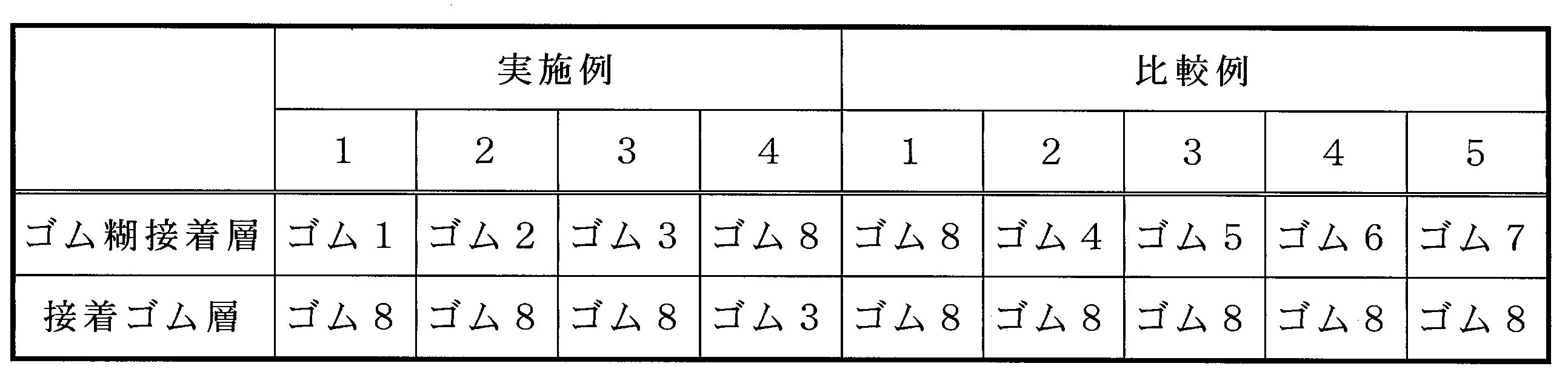
- V-ribbed belt V-ribbed belts of Examples 1 to 4 and Comparative Examples 1 to 5 below were produced. Each configuration is also shown in Table 2.
- Example 1 The core wire is formed of various twisted yarns of polyester fiber, and the core wire is subjected to the following base adhesion treatment, RFL adhesion treatment, and rubber paste adhesion treatment, and in the same manner as in the first embodiment, V A V-ribbed belt of Example 1 having three ribs was produced.
- the base adhesion treatment a solution obtained by dissolving an isocyanate resin (trade name: Sumidur, manufactured by Sumitomo Bayer Urethane Co., Ltd.) as a base adhesion treatment agent in a solvent toluene was used as the base adhesion treatment liquid.
- the liquid temperature of the base bonding treatment liquid was 25 ° C.
- the immersion time in the base adhesion treatment liquid was 5 seconds.
- the heating temperature after immersion in the base adhesion treatment liquid was 250 ° C. and the heating time was 40 seconds.
- the number of base adhesion treatments was one.
- the adhesion amount (weight per unit area) of the base adhesive treatment agent attached to the core wire by the base adhesive treatment was 4% by mass based on the mass of the polyester fiber forming the core wire.
- the liquid temperature of the RFL aqueous solution was 25 ° C.
- the immersion time in the RFL aqueous solution was 5 seconds.
- the heating temperature after immersion in the RFL aqueous solution was 250 ° C. and the heating time was 40 seconds.
- the number of RFL adhesion treatments was two.
- the adhesion amount (weight per unit area) of the RFL adhesion layer adhered to the core wire by the RFL adhesion treatment was 4% by mass based on the mass of the polyester fiber forming the core wire.
- rubber paste adhesion treatment rubber paste having a solid content concentration of 10% by mass obtained by dissolving rubber 1 in toluene as a solvent was used.
- the liquid temperature of the rubber paste was 25 ° C.
- the immersion time in the rubber paste was 5 seconds.
- the drying temperature after immersion in rubber paste was 100 ° C. and the drying time was 40 seconds.
- the number of times of the rubber paste adhesion treatment was set to 1.
- the adhesion amount (weight per unit area) of the rubber glue adhesion layer 17 adhered to the core wire by the rubber glue adhesion treatment was 4% by mass based on the mass of the polyester fiber forming the core wire.
- the rubber paste adhesive layer is formed of a rubber composition containing cellulose fine fibers.
- the adhesive rubber layer was formed using rubber 8, and the compressed rubber layer was formed of another EPDM composition containing nylon short fibers.
- the back reinforcing fabric was formed of nylon fiber woven fabric. The back reinforcing fabric was subjected to RFL adhesion treatment and soaking rubber glue adhesion treatment.
- Example 2 A V-ribbed belt of Example 2 having the same configuration as that of Example 1 was produced except that rubber 2 dissolved in toluene was used as the rubber glue used for the adhesive bonding of the core wire. Therefore, in the V-ribbed belt of Example 2, the rubber paste adhesive layer is formed of a rubber composition containing cellulose fine fibers.
- Example 3 A V-ribbed belt of Example 3 having the same configuration as that of Example 1 was prepared except that rubber 3 dissolved in toluene was used as the rubber paste used for the adhesive bonding of the core wire. Therefore, in the V-ribbed belt of Example 3, the rubber paste adhesive layer is formed of a rubber composition containing cellulose fine fibers.
- Example 4 The adhesive rubber layer is formed using rubber 1 and has the same configuration as that of Example 1 except that rubber 8 in which rubber 8 is dissolved in toluene is used as the rubber glue used for the adhesive bonding of the core wire.
- a V-ribbed belt was taken as Example 4. Therefore, in the V-ribbed belt of Example 4, the rubber paste adhesive layer is formed of a rubber composition not containing cellulose fine fibers, but the adhesive rubber layer is formed of a rubber composition containing cellulose fine fibers.
- Example 3 A V-ribbed belt of Comparative Example 3 having the same configuration as that of Example 1 was produced except that rubber 5 in which toluene was dissolved in toluene was used as the rubber paste used for the adhesive treatment of the core wire. Therefore, in the V-ribbed belt of Comparative Example 3, the rubber paste adhesive layer is formed of a rubber composition containing polyester short fibers.
- Example 5 A V-ribbed belt of Comparative Example 5 having the same configuration as that of Example 1 was produced except that rubber 7 in which toluene was dissolved in toluene was used as the rubber paste used for bonding the core wire with rubber paste. Therefore, in the V-ribbed belt of Comparative Example 5, the rubber paste adhesive layer is formed of a rubber composition containing nylon short fibers.
- ⁇ Average fiber diameter / fiber diameter distribution> For each of the rubbers 3 and 5 to 7, after freezing and pulverizing a sample of the crosslinked rubber composition, the cross section thereof was observed with a transmission electron microscope (TEM), and 50 fibers were arbitrarily selected. The diameter was measured, and the number average was obtained to obtain the average fiber diameter.
- TEM transmission electron microscope
- ⁇ Peel adhesion> The surface layer of the plate-like rubber 41 as shown in FIG. 10 by the uncrosslinked rubber sheet for the adhesive rubber layer used for the production of the V-ribbed belts of Examples 1 to 4 and Comparative Examples 1 to 5 and the core wire subjected to the adhesion treatment.
- the press molding conditions were a temperature of 160 ° C., a pressure of 2.9 MPa, and a time of 30 minutes.
- the plate rubber 41 is fixed to one chuck of the tensile tester, and every other one of the seven core wires 42 embedded in the plate rubber 41 on the other chuck.
- the three core wires 42 arranged are pulled out and fixed in a direction forming an angle of 90 ° with respect to the plate rubber 41, the peeling speed is 50 mm / min, and the three core wires 42 from the plate rubber 41 are 100 mm. It peeled. The average of the peak values between the peeling lengths of 10 to 100 mm was taken as the peeling adhesive strength. Moreover, it was visually confirmed and evaluated whether the fracture mode after peeling the core wire was rubber cohesive failure or interface peeling.
- FIG. 11 shows a pulley layout of the belt running test machine 50.
- the belt running test machine 50 includes a first driven rib pulley 51 with a pulley diameter of ⁇ 120 mm provided at the uppermost position, a drive rib pulley 52 with a pulley diameter of ⁇ 120 mm provided so as to line up with the first driven rib pulley 51, and an intermediate between them. And an idler pulley 53 with a pulley diameter of ⁇ 80 mm and a second driven rib pulley 54 with a pulley diameter of ⁇ 55 mm provided on the right side of the idler pulley 53.
- the V-ribbed belt B is in contact with the first driven rib pulley 51, the driving rib pulley 52, and the second driven rib pulley 54 on the V rib side, and the belt back surface is in contact with the idler pulley 53, and the winding angle around the second driven rib pulley 54 Is wound at 90 ° and the winding angle around the idler pulley 53 is 120 °.
- the V-ribbed belt B of each of Examples 1 to 4 and Comparative Examples 1 to 5 is wound around the first driven rib pulley 51, the drive rib pulley 52, the idler pulley 53, and the second driven rib pulley 54 of the belt running test machine 50.
- a dead weight of 785 N is loaded so as to pull the driven rib pulley 54 to the side, a rotational power load of 11.8 kW is applied to the first driven rib pulley 51, and the driving rib pulley 52 is rotated counterclockwise at an ambient temperature of 120 ° C. It was rotated at a rotational speed of 4900 rpm. Then, the belt travels until separation between layers occurs in the V-ribbed belt B and the belt cannot be traveled, and the belt travel time up to that time is defined as the belt durability life.
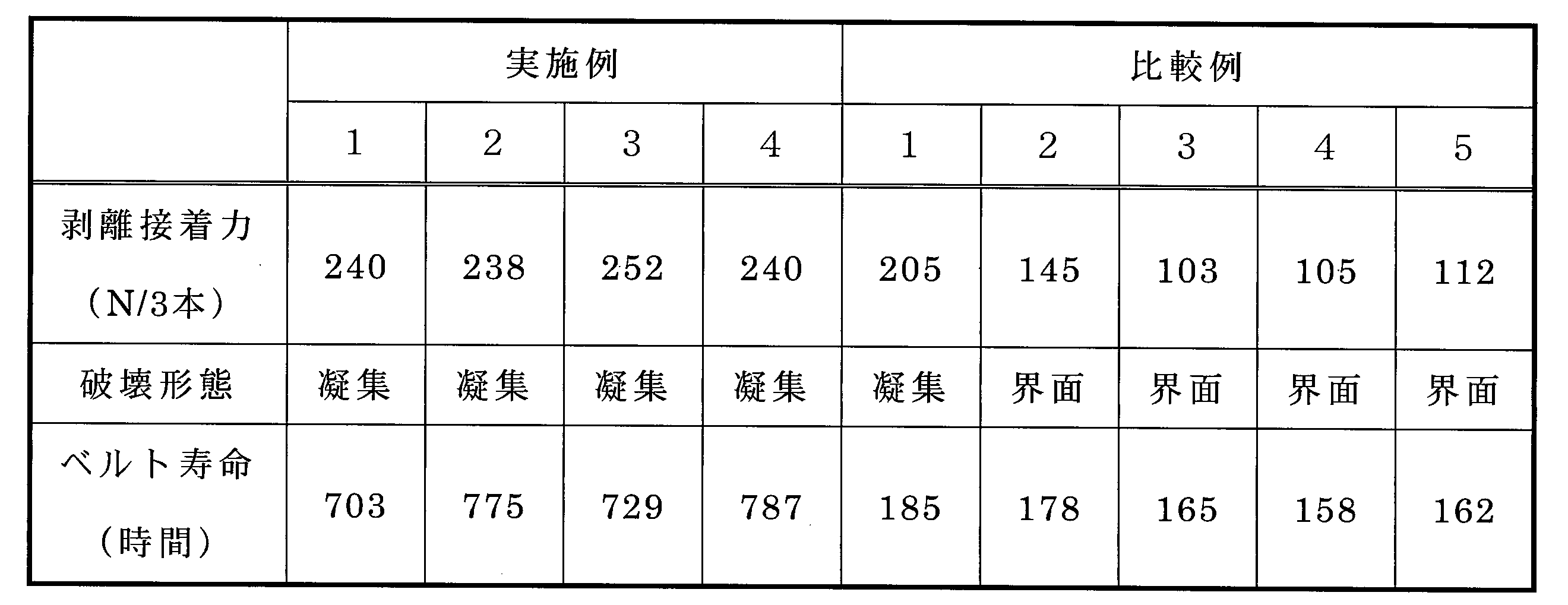
- Test evaluation results The test results are shown in Tables 3 and 4.
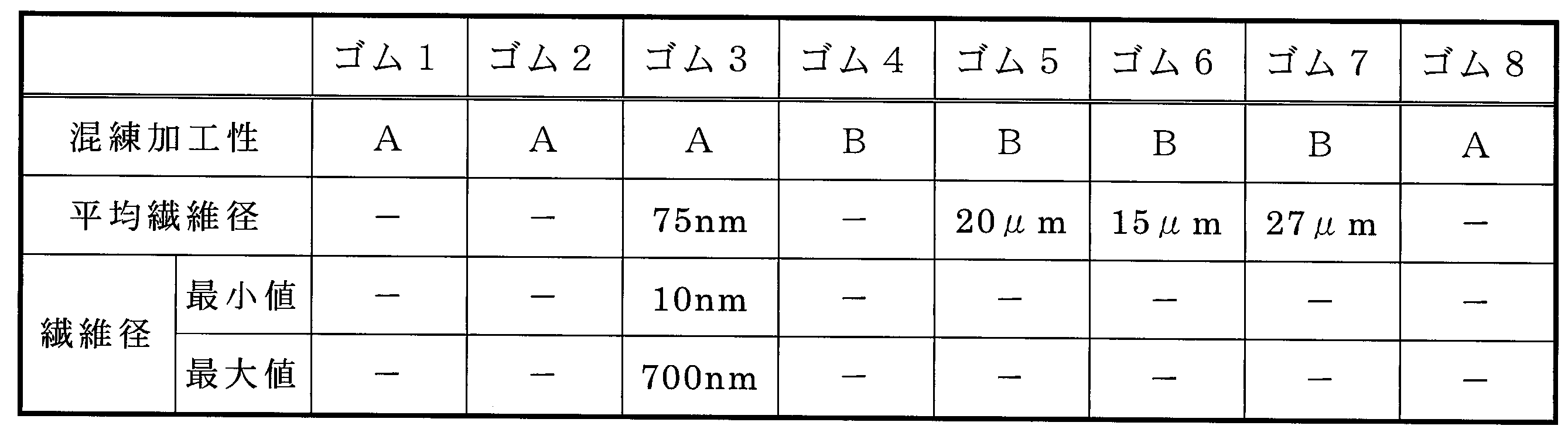
- rubbers 1 to 3 containing fine cellulose fibers are excellent in kneadability, whereas rubbers 4 and 5 containing polyester short fibers, rubber 6 containing cotton short fibers, and nylon 66 short fibers are included. It can be seen that the rubber 7 has poor kneadability.
- the rubber 8 is excellent in kneadability because it contains neither cellulose fine fibers nor other short fibers. It can also be seen that the cellulose fine fibers of the rubber 3 have a wide fiber diameter distribution.
- the rubber glue adhesive layer was formed of rubbers 1 to 3 containing fine cellulose fibers
- Example 4 in which the adhesive rubber layer was formed of rubber 3, it was relatively peeled.
- the adhesive strength is high and the belt life is also long, so that the separation resistance is excellent.
- the rubber adhesive layer is composed of rubbers 4 and 5 containing polyester short fibers, rubber 6 containing cotton short fibers, and nylon 66.
- Comparative Examples 2 to 5 formed of rubber 7 containing short fibers, it can be seen that the peel resistance is relatively low and the belt life is short, so that the separation resistance is poor.
- Comparative Example 1 in which the rubber glue adhesive layer and the adhesive rubber layer are formed of rubber 8 containing neither cellulose fine fibers nor other short fibers, although the peel adhesion is relatively high, the belt life is short and the separation resistance is high. You can see that it is inferior.
- the present invention is useful in the technical field of transmission belts.
Landscapes
- Engineering & Computer Science (AREA)
- General Engineering & Computer Science (AREA)
- Chemical & Material Sciences (AREA)
- Textile Engineering (AREA)
- Mechanical Engineering (AREA)
- Organic Chemistry (AREA)
- Medicinal Chemistry (AREA)
- Polymers & Plastics (AREA)
- Chemical Kinetics & Catalysis (AREA)
- Health & Medical Sciences (AREA)
- Materials Engineering (AREA)
- Manufacturing & Machinery (AREA)
- Compositions Of Macromolecular Compounds (AREA)
- Laminated Bodies (AREA)
Abstract
Description
(VリブドベルトB)
図1は、実施形態1に係るVリブドベルトB(伝動ベルト)を示す。実施形態1に係るVリブドベルトBは、例えば、自動車のエンジンルーム内に設けられる補機駆動ベルト伝動装置等に用いられるエンドレスの動力伝達部材である。実施形態1に係るVリブドベルトBは、例えば、ベルト周長が700~3000mm、ベルト幅が10~36mm、及びベルト厚さが4.0~5.0mmである。
実施形態1に係るVリブドベルトBの製造方法は、材料準備工程、成形工程、架橋工程、研削工程、及び仕上げ工程を有する。
-接着ゴム層用及び圧縮ゴム層用の未架橋ゴムシート11’,12’-
ゴム成分に各種のゴム配合剤を配合し、ニーダー、バンバリーミキサー等の混練機で混練し、得られた未架橋ゴム組成物をカレンダー成形等によってシート状に成形して接着ゴム層用及び圧縮ゴム層用の未架橋ゴムシート11’,12’を作製する。なお、圧縮ゴム層12に短繊維を含める場合には、未架橋ゴムシート12’に短繊維を含める。
心線13’に対して接着処理を施す。具体的には、心線13’に、RFL水溶液に浸漬して加熱するRFL接着処理、及びゴム糊に浸漬して乾燥させるゴム糊接着処理を施す。また、必要に応じて、RFL接着処理前に下地接着処理液に浸漬して加熱する下地接着処理を施す。
下地接着処理液は、例えば、エポキシ樹脂やイソシアネート樹脂(ブロックイソシアネート)等の下地接着処理剤をトルエン等の溶剤に溶解させた溶液、或いは、水に分散させた分散液である。下地接着処理液の液温は例えば20~30℃である。下地接着処理液の固形分濃度は、好ましくは20質量%以下である。
RFL水溶液は、レゾルシンとホルムアルデヒドとの初期縮合物にゴムラテックスを混合した水溶液である。RFL水溶液の液温は例えば20~30℃である。RFL水溶液の固形分濃度は、好ましくは30質量%以下である。
ゴム糊は、ゴム糊接着層17を形成するセルロース系微細繊維を含むゴム組成物の架橋前の未架橋ゴム組成物をトルエン等の溶剤に溶解させた溶液である。ゴム糊の作製は以下のようにして行う。
背面補強布14’に対して接着処理を施す。具体的には、背面補強布14’に対して、下地接着処理液に浸漬して加熱する下地接着処理、RFL水溶液に浸漬して加熱するRFL接着処理、ゴム糊に浸漬して乾燥させるソーキングゴム糊接着処理、及びVリブドベルト本体10側となる面にゴム糊をコーティングして乾燥させるコーティングゴム糊接着処理のうち1種又は2種以上の接着処理を施す。
図4に示すように、円筒型31の外周上に、背面補強布14’、及び接着ゴム層用の未架橋ゴムシート11’を順に巻き付けて積層し、その上に心線13’を円筒型31に対して螺旋状に一定の張力を付与して巻き付け、更に、その上に接着ゴム層用の未架橋ゴムシート11’及び圧縮ゴム層用の未架橋ゴムシート12’を順に巻き付けて積層することによりベルト形成用成形体B’を成形する。
図5に示すように、ベルト形成用成形体B’にゴムスリーブ32を被せ、それを加硫缶内に配置して密閉すると共に、加硫缶内に高温及び高圧の蒸気を充填して所定の成型時間だけ保持する。このとき、未架橋ゴムシート11’,12’の架橋が進行して一体化すると共に心線13’及び背面補強布14’と複合化し、図6に示すように、最終的に、円筒状のベルトスラブSが成型される。
加硫缶内から蒸気を排出して密閉を解き、円筒型31上に成型されたベルトスラブSを型抜きし、図7に示すように、ベルトスラブSを一対のスラブ掛け渡し軸33間に掛け渡すと共に、ベルトスラブSの外周面に対し、周方向に延びるVリブ形状溝が外周面の軸方向に連設された研削砥石34を回転させながら当接させ、また、ベルトスラブSも一対のスラブ掛け渡し軸33間で回転させることにより、その外周面を全周に渡って研削する。このとき、図8に示すように、ベルトスラブSの外周面にはVリブ15が形成される。なお、ベルトスラブSは、必要に応じて長さ方向に分割して研削を行ってもよい。
研削によりVリブ15を形成したベルトスラブSを所定幅に幅切りして表裏を裏返すことによりVリブドベルトBが製造される。
(VリブドベルトB)
実施形態2に係るVリブドベルトB(伝動ベルト)は、外観構成が実施形態1と同一であるので、以下では図1に基づいて説明する。
実施形態2に係るVリブドベルトBの製造方法では、材料準備工程における接着ゴム層用の11’の作製を以下のようにして行う。
実施形態1及び2では、伝動ベルトとしてVリブドベルトBを示したが、特にこれに限定されるものではなく、ローエッジVベルト、ラップドVベルト、平ベルト、歯付ベルトであってもよい。
以下のゴム1~8の未架橋ゴム組成物を作製した。それぞれの構成は表1にも示す。
トルエンに木材を原料とする粉末セルロース(日本製紙社製 商品名:KCフロック W-50GK)を分散させた分散体を調製し、高圧ホモジナイザーを用い、その分散体同士を衝突させて粉末セルロースをセルロース微細繊維に解繊して、トルエンにセルロース微細繊維が分散した分散体を得た。従って、セルロース微細繊維は、機械的解繊手段によって製造され、また、疎水化処理されていないものである。
EPDMを100質量部としたときのセルロース微細繊維の含有量が3質量部となるようにしたことを除いて、ゴム1と同様の方法で作製した未架橋ゴム組成物をゴム2とした。
EPDMを100質量部としたときのセルロース微細繊維の含有量が5質量部となるようにしたことを除いて、ゴム1と同様の方法で作製した未架橋ゴム組成物をゴム3とした。
EPDMを素練りすると共に、そこに、EPDM100質量部に対し、補強材のGPFカーボンブラックを70質量部、オイルを30質量部、加工助剤のステアリン酸を1質量部、加硫促進助剤の酸化亜鉛を5質量部、架橋剤の硫黄を3質量部、加硫促進剤を2.5質量部、及びポリエステル短繊維(帝人社製 商品名:テトロン)を3質量部それぞれ投入して混練することにより未架橋ゴム組成物を作製した。その未架橋ゴム組成物をゴム4とした。
EPDMを100質量部としたときのポリエステル短繊維の含有量が5質量部となるようにしたことを除いて、ゴム4と同様の方法で作製した未架橋ゴム組成物をゴム5とした。
ポリエステル短繊維の代わりに、綿肌着を粉砕機によって60メッシュの大きさに粉砕したものを用いたことを除いて、ゴム5と同様の方法で作製した未架橋ゴム組成物をゴム6とした。
ポリエステル短繊維の代わりに、ナイロン66短繊維(旭化成社製 商品名:レオナ)を用いたことを除いて、ゴム5と同様の方法で作製した未架橋ゴム組成物をゴム7とした。
EPDMを素練りすると共に、そこに、EPDM100質量部に対し、補強材のGPFカーボンブラックを70質量部、オイルを30質量部、加工助剤のステアリン酸を1質量部、加硫促進助剤の酸化亜鉛を5質量部、架橋剤の硫黄を3質量部、及び加硫促進剤を2.5質量部それぞれ投入して混練することにより未架橋ゴム組成物を作製した。その未架橋ゴム組成物をゴム8とした。

以下の実施例1~4及び比較例1~5のVリブドベルトを作製した。それぞれの構成は表2にも示す。
心線をポリエステル繊維の諸撚り糸で形成し、また、心線に、下記の下地接着処理、RFL接着処理、及びゴム糊接着処理を施したものを用い、上記実施形態1と同様にして、Vリブの数が3個の実施例1のVリブドベルトを作製した。
心線のゴム糊接着処理に用いるゴム糊として、ゴム2をトルエンに溶解させたものを用いたことを除いて実施例1と同一構成の実施例2のVリブドベルトを作製した。従って、実施例2のVリブドベルトでは、ゴム糊接着層がセルロース微細繊維を含むゴム組成物で形成されている。
心線のゴム糊接着処理に用いるゴム糊として、ゴム3をトルエンに溶解させたものを用いたことを除いて実施例1と同一構成の実施例3のVリブドベルトを作製した。従って、実施例3のVリブドベルトでは、ゴム糊接着層がセルロース微細繊維を含むゴム組成物で形成されている。
接着ゴム層を、ゴム1を用いて形成すると共に、心線のゴム糊接着処理に用いるゴム糊として、ゴム8をトルエンに溶解させたものを用いたことを除いて実施例1と同一構成のVリブドベルトを実施例4とした。従って、実施例4のVリブドベルトでは、ゴム糊接着層がセルロース微細繊維を含まないゴム組成物で形成されているが、接着ゴム層がセルロース微細繊維を含むゴム組成物で形成されている。
心線のゴム糊接着処理に用いるゴム糊として、ゴム8をトルエンに溶解させたものを用いたことを除いて実施例1と同一構成の比較例1のVリブドベルトを作製した。従って、比較例1のVリブドベルトでは、接着ゴム層及びゴム糊接着層のいずれもセルロース微細繊維を含まないゴム組成物で形成されている。
心線のゴム糊接着処理に用いるゴム糊として、ゴム4をトルエンに溶解させたものを用いたことを除いて実施例1と同一構成の比較例2のVリブドベルトを作製した。従って、比較例2のVリブドベルトでは、ゴム糊接着層がポリエステル短繊維を含むゴム組成物で形成されている。
心線のゴム糊接着処理に用いるゴム糊として、ゴム5をトルエンに溶解させたものを用いたことを除いて実施例1と同一構成の比較例3のVリブドベルトを作製した。従って、比較例3のVリブドベルトでは、ゴム糊接着層がポリエステル短繊維を含むゴム組成物で形成されている。
心線のゴム糊接着処理に用いるゴム糊として、ゴム6をトルエンに溶解させたものを用いたことを除いて実施例1と同一構成の比較例4のVリブドベルトを作製した。従って、比較例4のVリブドベルトでは、ゴム糊接着層が綿短繊維を含むゴム組成物で形成されている。
心線のゴム糊接着処理に用いるゴム糊として、ゴム7をトルエンに溶解させたものを用いたことを除いて実施例1と同一構成の比較例5のVリブドベルトを作製した。従って、比較例5のVリブドベルトでは、ゴム糊接着層がナイロン短繊維を含むゴム組成物で形成されている。
<混練加工性>
ゴム1~7のそれぞれについて、混練加工性が優れるものをA及び劣るものをBとそれぞれ評価した。
ゴム3及び5~7のそれぞれについて、架橋させたゴム組成物の試料を凍結粉砕した後、その断面を透過型電子顕微鏡(TEM)で観察すると共に、50本の繊維を任意に選択して繊維径を測定し、その数平均を求めて平均繊維径とした。
実施例1~4及び比較例1~5のそれぞれのVリブドベルトの作製に用いた接着ゴム層用の未架橋ゴムシート及び接着処理した心線により、図10に示すような板状ゴム41の表層に7本の心線42が間隔をおいて平行に延びるように埋設された接着試験用試験片40をプレス成型した。なお、プレス成型条件は、温度160℃、圧力2.9MPa、及び時間30分とした。
図11は、ベルト走行試験機50のプーリレイアウトを示す。
試験結果を表3及び4に示す。
10 Vリブドベルト本体
13,13’ 心線
16 RFL接着層
17 ゴム糊接着層
Claims (14)
- ゴム製のベルト本体に心線がベルト幅方向にピッチを有する螺旋を形成するように埋設された伝動ベルトであって、
前記心線は、接着処理により形成されたゴム成分を含む接着層で被覆されており、前記接着層は、セルロース系微細繊維を含むゴム組成物に接触している伝動ベルト。 - 請求項1に記載された伝動ベルトにおいて、
前記セルロース系微細繊維の繊維径の分布範囲が50~500nmを含む伝動ベルト。 - 請求項1又は2に記載された伝動ベルトにおいて、
前記セルロース系微細繊維の平均繊維径が10~100nmである伝動ベルト。 - 請求項1乃至3のいずれかに記載された伝動ベルトにおいて、
前記セルロース系微細繊維が機械的解繊手段によって製造されたものである伝動ベルト。 - 請求項1乃至4のいずれかに記載された伝動ベルトにおいて、
前記セルロース系微細繊維が疎水化処理されていないものである伝動ベルト。 - 請求項1乃至5のいずれかに記載された伝動ベルトにおいて、
前記ゴム組成物における前記セルロース系微細繊維の含有量が、前記ゴム組成物のゴム成分100質量部に対して1~30質量部である伝動ベルト。 - 請求項1乃至6のいずれかに記載された伝動ベルトにおいて、
前記ゴム組成物に含まれるセルロース系微細繊維が無配向である伝動ベルト。 - 請求項1乃至7のいずれかに記載された伝動ベルトにおいて、
前記セルロース系微細繊維を含むゴム組成物には、繊維径が10μm以上の短繊維が含まれていない伝動ベルト。 - 請求項1乃至8のいずれかに記載された伝動ベルトにおいて、
前記接着層が、前記心線のRFL接着処理により形成されたRFL接着層である伝動ベルト。 - 請求項9に記載された伝動ベルトにおいて、
前記ゴム組成物が、前記心線のゴム糊接着処理により形成されたゴム糊接着層を形成するゴム組成物である伝動ベルト。 - 請求項9に記載された伝動ベルトにおいて、
前記ゴム組成物が、前記ベルト本体に含まれる前記心線が埋設された接着ゴム層を形成するゴム組成物である伝動ベルト。 - 請求項1乃至8のいずれかに記載された伝動ベルトにおいて、
前記接着層が、前記心線のゴム糊接着処理により形成されたゴム糊接着層である伝動ベルト。 - 請求項12に記載された伝動ベルトにおいて、
前記ゴム組成物が、前記ベルト本体に含まれる前記心線が埋設された接着ゴム層を形成するゴム組成物である伝動ベルト。 - 請求項13に記載された伝動ベルトにおいて、
前記ゴム糊接着層を形成するゴム組成物のゴム成分が、前記接着ゴム層を形成するゴム組成物のゴム成分と同一である伝動ベルト。
Priority Applications (4)
| Application Number | Priority Date | Filing Date | Title |
|---|---|---|---|
| JP2017513955A JP6487037B2 (ja) | 2015-04-24 | 2016-04-07 | 伝動ベルト |
| CN201680022790.0A CN107532680B (zh) | 2015-04-24 | 2016-04-07 | 传动带 |
| DE112016001875.4T DE112016001875T5 (de) | 2015-04-24 | 2016-04-07 | Treibriemen |
| US15/791,914 US10746257B2 (en) | 2015-04-24 | 2017-10-24 | Transmission belt |
Applications Claiming Priority (2)
| Application Number | Priority Date | Filing Date | Title |
|---|---|---|---|
| JP2015089543 | 2015-04-24 | ||
| JP2015-089543 | 2015-04-24 |
Related Child Applications (1)
| Application Number | Title | Priority Date | Filing Date |
|---|---|---|---|
| US15/791,914 Continuation US10746257B2 (en) | 2015-04-24 | 2017-10-24 | Transmission belt |
Publications (1)
| Publication Number | Publication Date |
|---|---|
| WO2016170747A1 true WO2016170747A1 (ja) | 2016-10-27 |
Family
ID=57143001
Family Applications (1)
| Application Number | Title | Priority Date | Filing Date |
|---|---|---|---|
| PCT/JP2016/001946 Ceased WO2016170747A1 (ja) | 2015-04-24 | 2016-04-07 | 伝動ベルト |
Country Status (5)
| Country | Link |
|---|---|
| US (1) | US10746257B2 (ja) |
| JP (1) | JP6487037B2 (ja) |
| CN (1) | CN107532680B (ja) |
| DE (1) | DE112016001875T5 (ja) |
| WO (1) | WO2016170747A1 (ja) |
Cited By (2)
| Publication number | Priority date | Publication date | Assignee | Title |
|---|---|---|---|---|
| CN108689276A (zh) * | 2017-04-03 | 2018-10-23 | 奥的斯电梯公司 | 具有附加层的电梯皮带 |
| JPWO2020175404A1 (ja) * | 2019-02-27 | 2020-09-03 |
Families Citing this family (5)
| Publication number | Priority date | Publication date | Assignee | Title |
|---|---|---|---|---|
| JP6616793B2 (ja) * | 2016-04-15 | 2019-12-04 | 三ツ星ベルト株式会社 | 摩擦伝動ベルト |
| JP6884280B1 (ja) * | 2019-06-07 | 2021-06-09 | バンドー化学株式会社 | 伝動ベルト |
| CN113939670B (zh) | 2019-06-07 | 2023-06-20 | 阪东化学株式会社 | 传动带 |
| CN113906241B (zh) * | 2019-06-07 | 2022-07-12 | 阪东化学株式会社 | 传动带 |
| CN116733906B (zh) * | 2020-07-03 | 2025-10-17 | 阪东化学株式会社 | 传动带 |
Citations (6)
| Publication number | Priority date | Publication date | Assignee | Title |
|---|---|---|---|---|
| JPH10158612A (ja) * | 1996-11-29 | 1998-06-16 | Mitsuboshi Belting Ltd | ゴムと繊維との接着方法および動力伝動用ベルト |
| JP2009030728A (ja) * | 2007-07-27 | 2009-02-12 | Bando Chem Ind Ltd | 摩擦伝動ベルト及びそれを用いた自動車の補機駆動ベルト伝動装置 |
| JP2011064257A (ja) * | 2009-09-16 | 2011-03-31 | Bando Chemical Industries Ltd | 伝動ベルト |
| JP2012045895A (ja) * | 2010-08-30 | 2012-03-08 | Mitsuboshi Belting Ltd | 積層体及びその製造方法並びに動力伝動用ベルト |
| JP2015048375A (ja) * | 2013-08-30 | 2015-03-16 | Dic株式会社 | 樹脂組成物、繊維強化複合材料及び成形品 |
| WO2015045256A1 (ja) * | 2013-09-30 | 2015-04-02 | バンドー化学株式会社 | 平ベルト及びその製造方法 |
Family Cites Families (18)
| Publication number | Priority date | Publication date | Assignee | Title |
|---|---|---|---|---|
| US2491188A (en) * | 1945-12-22 | 1949-12-13 | Graton & Knight Company | Flat power transmission belt |
| JPS5757243Y2 (ja) * | 1979-02-08 | 1982-12-08 | ||
| JPS596279Y2 (ja) * | 1980-09-26 | 1984-02-27 | 三ツ星ベルト株式会社 | Vベルト |
| JPH0772578B2 (ja) * | 1991-05-08 | 1995-08-02 | 三ツ星ベルト株式会社 | アラミド繊維コード及びこれを用いた動力伝動用ベルト |
| JP2006144988A (ja) * | 2004-11-24 | 2006-06-08 | Bando Chem Ind Ltd | Vリブドベルト及びそれを用いた自動車の補機駆動用ベルト伝動装置 |
| JP4745789B2 (ja) * | 2004-12-27 | 2011-08-10 | 三ツ星ベルト株式会社 | Vリブドベルト及びvリブドベルトの製造方法 |
| CN101326386B (zh) * | 2006-07-14 | 2011-04-06 | 坂东化学株式会社 | 摩擦传动带及其制造方法 |
| JP4214161B2 (ja) * | 2006-12-05 | 2009-01-28 | バンドー化学株式会社 | 伝動ベルトの製造方法 |
| JP4768893B2 (ja) * | 2009-12-14 | 2011-09-07 | バンドー化学株式会社 | 摩擦伝動ベルト |
| JP5829614B2 (ja) * | 2010-10-21 | 2015-12-09 | バンドー化学株式会社 | 摩擦伝動ベルト |
| KR101950541B1 (ko) * | 2011-10-28 | 2019-02-20 | 반도 카가쿠 가부시키가이샤 | 마찰 전동 벨트 및 그 제조방법 |
| JP5885240B2 (ja) * | 2011-11-21 | 2016-03-15 | ゲイツ・ユニッタ・アジア株式会社 | 伝動ベルト |
| WO2013105191A1 (ja) * | 2012-01-11 | 2013-07-18 | バンドー化学株式会社 | 摩擦伝動ベルト及びその製造方法、並びにベルト伝動装置 |
| JP5711167B2 (ja) * | 2012-02-22 | 2015-04-30 | 三ツ星ベルト株式会社 | アラミド心線及び伝動ベルト |
| DE112013002719B4 (de) * | 2012-06-01 | 2020-03-26 | Bando Chemical Industries, Ltd. | Verfahren zum Messen der Spannung im stabilen Zustand eines Kraftübertragungsriemens |
| JP6209524B2 (ja) * | 2012-10-23 | 2017-10-04 | バンドー化学株式会社 | 伝動ベルト |
| JP6082591B2 (ja) | 2012-12-27 | 2017-02-15 | 花王株式会社 | ゴム組成物 |
| JP2015031315A (ja) | 2013-07-31 | 2015-02-16 | バンドー化学株式会社 | 平ベルト |
-
2016
- 2016-04-07 JP JP2017513955A patent/JP6487037B2/ja active Active
- 2016-04-07 WO PCT/JP2016/001946 patent/WO2016170747A1/ja not_active Ceased
- 2016-04-07 CN CN201680022790.0A patent/CN107532680B/zh active Active
- 2016-04-07 DE DE112016001875.4T patent/DE112016001875T5/de active Pending
-
2017
- 2017-10-24 US US15/791,914 patent/US10746257B2/en active Active
Patent Citations (6)
| Publication number | Priority date | Publication date | Assignee | Title |
|---|---|---|---|---|
| JPH10158612A (ja) * | 1996-11-29 | 1998-06-16 | Mitsuboshi Belting Ltd | ゴムと繊維との接着方法および動力伝動用ベルト |
| JP2009030728A (ja) * | 2007-07-27 | 2009-02-12 | Bando Chem Ind Ltd | 摩擦伝動ベルト及びそれを用いた自動車の補機駆動ベルト伝動装置 |
| JP2011064257A (ja) * | 2009-09-16 | 2011-03-31 | Bando Chemical Industries Ltd | 伝動ベルト |
| JP2012045895A (ja) * | 2010-08-30 | 2012-03-08 | Mitsuboshi Belting Ltd | 積層体及びその製造方法並びに動力伝動用ベルト |
| JP2015048375A (ja) * | 2013-08-30 | 2015-03-16 | Dic株式会社 | 樹脂組成物、繊維強化複合材料及び成形品 |
| WO2015045256A1 (ja) * | 2013-09-30 | 2015-04-02 | バンドー化学株式会社 | 平ベルト及びその製造方法 |
Cited By (8)
| Publication number | Priority date | Publication date | Assignee | Title |
|---|---|---|---|---|
| CN108689276A (zh) * | 2017-04-03 | 2018-10-23 | 奥的斯电梯公司 | 具有附加层的电梯皮带 |
| CN108689276B (zh) * | 2017-04-03 | 2021-11-30 | 奥的斯电梯公司 | 具有附加层的电梯皮带 |
| JPWO2020175404A1 (ja) * | 2019-02-27 | 2020-09-03 | ||
| WO2020175404A1 (ja) * | 2019-02-27 | 2020-09-03 | 株式会社クラレ | 補強繊維及びその製造方法、並びにそれを用いた成形体 |
| KR20210129076A (ko) * | 2019-02-27 | 2021-10-27 | 주식회사 쿠라레 | 보강 섬유 및 그 제조 방법, 그리고 그것을 사용한 성형체 |
| US11884788B2 (en) | 2019-02-27 | 2024-01-30 | Kuraray Co., Ltd. | Reinforcing fiber, method for manufacturing same, and molded body using same |
| JP7458367B2 (ja) | 2019-02-27 | 2024-03-29 | 株式会社クラレ | 補強繊維及びその製造方法、並びにそれを用いた成形体 |
| KR102827357B1 (ko) * | 2019-02-27 | 2025-06-30 | 주식회사 쿠라레 | 보강 섬유 및 그 제조 방법, 그리고 그것을 사용한 성형체 |
Also Published As
| Publication number | Publication date |
|---|---|
| JPWO2016170747A1 (ja) | 2018-02-15 |
| US20180045273A1 (en) | 2018-02-15 |
| DE112016001875T5 (de) | 2018-01-04 |
| US10746257B2 (en) | 2020-08-18 |
| CN107532680B (zh) | 2022-03-11 |
| JP6487037B2 (ja) | 2019-03-20 |
| CN107532680A (zh) | 2018-01-02 |
Similar Documents
| Publication | Publication Date | Title |
|---|---|---|
| JP6487037B2 (ja) | 伝動ベルト | |
| JP6529327B2 (ja) | 伝動ベルト | |
| US9709129B2 (en) | Transmission belt | |
| WO2016170788A1 (ja) | ゴム組成物、伝動ベルト及びその製造方法 | |
| JP6487124B1 (ja) | 伝動ベルト | |
| JP6427302B1 (ja) | 伝動ベルト | |
| CN107532681B (zh) | 传动带 | |
| JP6680464B2 (ja) | ゴム組成物 | |
| JP6539099B2 (ja) | 伝動ベルト | |
| JP6529323B2 (ja) | 歯付ベルト | |
| WO2016194371A1 (ja) | 伝動ベルト | |
| JP6527009B2 (ja) | 伝動ベルト | |
| JP6918047B2 (ja) | 伝動ベルト | |
| JP2019143813A (ja) | 歯付ベルト | |
| JP2019143166A (ja) | ゴム組成物 | |
| JP6884280B1 (ja) | 伝動ベルト | |
| JP2016211587A (ja) | 伝動ベルト及びその製造方法 | |
| JP2021076253A (ja) | 伝動ベルト | |
| JP2021059743A (ja) | ゴム組成物 |
Legal Events
| Date | Code | Title | Description |
|---|---|---|---|
| 121 | Ep: the epo has been informed by wipo that ep was designated in this application |
Ref document number: 16782774 Country of ref document: EP Kind code of ref document: A1 |
|
| ENP | Entry into the national phase |
Ref document number: 2017513955 Country of ref document: JP Kind code of ref document: A |
|
| WWE | Wipo information: entry into national phase |
Ref document number: 112016001875 Country of ref document: DE |
|
| 122 | Ep: pct application non-entry in european phase |
Ref document number: 16782774 Country of ref document: EP Kind code of ref document: A1 |