WO2016143852A1 - 熱膨張性マイクロカプセル複合体、その製造方法、該複合体を配合してなるゴム組成物および該組成物を用いた空気入りタイヤ - Google Patents
熱膨張性マイクロカプセル複合体、その製造方法、該複合体を配合してなるゴム組成物および該組成物を用いた空気入りタイヤ Download PDFInfo
- Publication number
- WO2016143852A1 WO2016143852A1 PCT/JP2016/057583 JP2016057583W WO2016143852A1 WO 2016143852 A1 WO2016143852 A1 WO 2016143852A1 JP 2016057583 W JP2016057583 W JP 2016057583W WO 2016143852 A1 WO2016143852 A1 WO 2016143852A1
- Authority
- WO
- WIPO (PCT)
- Prior art keywords
- cellulose
- thermally expandable
- mass
- parts
- expandable microcapsule
- Prior art date
- Legal status (The legal status is an assumption and is not a legal conclusion. Google has not performed a legal analysis and makes no representation as to the accuracy of the status listed.)
- Ceased
Links
Images


Classifications
-
- C—CHEMISTRY; METALLURGY
- C08—ORGANIC MACROMOLECULAR COMPOUNDS; THEIR PREPARATION OR CHEMICAL WORKING-UP; COMPOSITIONS BASED THEREON
- C08J—WORKING-UP; GENERAL PROCESSES OF COMPOUNDING; AFTER-TREATMENT NOT COVERED BY SUBCLASSES C08B, C08C, C08F, C08G or C08H
- C08J9/00—Working-up of macromolecular substances to porous or cellular articles or materials; After-treatment thereof
- C08J9/32—Working-up of macromolecular substances to porous or cellular articles or materials; After-treatment thereof from compositions containing microballoons, e.g. syntactic foams
-
- B—PERFORMING OPERATIONS; TRANSPORTING
- B01—PHYSICAL OR CHEMICAL PROCESSES OR APPARATUS IN GENERAL
- B01J—CHEMICAL OR PHYSICAL PROCESSES, e.g. CATALYSIS OR COLLOID CHEMISTRY; THEIR RELEVANT APPARATUS
- B01J13/00—Colloid chemistry, e.g. the production of colloidal materials or their solutions, not otherwise provided for; Making microcapsules or microballoons
- B01J13/02—Making microcapsules or microballoons
- B01J13/20—After-treatment of capsule walls, e.g. hardening
- B01J13/206—Hardening; drying
-
- B—PERFORMING OPERATIONS; TRANSPORTING
- B60—VEHICLES IN GENERAL
- B60C—VEHICLE TYRES; TYRE INFLATION; TYRE CHANGING; CONNECTING VALVES TO INFLATABLE ELASTIC BODIES IN GENERAL; DEVICES OR ARRANGEMENTS RELATED TO TYRES
- B60C1/00—Tyres characterised by the chemical composition or the physical arrangement or mixture of the composition
- B60C1/0016—Compositions of the tread
-
- C—CHEMISTRY; METALLURGY
- C08—ORGANIC MACROMOLECULAR COMPOUNDS; THEIR PREPARATION OR CHEMICAL WORKING-UP; COMPOSITIONS BASED THEREON
- C08J—WORKING-UP; GENERAL PROCESSES OF COMPOUNDING; AFTER-TREATMENT NOT COVERED BY SUBCLASSES C08B, C08C, C08F, C08G or C08H
- C08J9/00—Working-up of macromolecular substances to porous or cellular articles or materials; After-treatment thereof
- C08J9/0061—Working-up of macromolecular substances to porous or cellular articles or materials; After-treatment thereof characterized by the use of several polymeric components
-
- C—CHEMISTRY; METALLURGY
- C08—ORGANIC MACROMOLECULAR COMPOUNDS; THEIR PREPARATION OR CHEMICAL WORKING-UP; COMPOSITIONS BASED THEREON
- C08J—WORKING-UP; GENERAL PROCESSES OF COMPOUNDING; AFTER-TREATMENT NOT COVERED BY SUBCLASSES C08B, C08C, C08F, C08G or C08H
- C08J9/00—Working-up of macromolecular substances to porous or cellular articles or materials; After-treatment thereof
- C08J9/0066—Use of inorganic compounding ingredients
-
- C—CHEMISTRY; METALLURGY
- C08—ORGANIC MACROMOLECULAR COMPOUNDS; THEIR PREPARATION OR CHEMICAL WORKING-UP; COMPOSITIONS BASED THEREON
- C08J—WORKING-UP; GENERAL PROCESSES OF COMPOUNDING; AFTER-TREATMENT NOT COVERED BY SUBCLASSES C08B, C08C, C08F, C08G or C08H
- C08J9/00—Working-up of macromolecular substances to porous or cellular articles or materials; After-treatment thereof
- C08J9/0085—Use of fibrous compounding ingredients
-
- C—CHEMISTRY; METALLURGY
- C08—ORGANIC MACROMOLECULAR COMPOUNDS; THEIR PREPARATION OR CHEMICAL WORKING-UP; COMPOSITIONS BASED THEREON
- C08J—WORKING-UP; GENERAL PROCESSES OF COMPOUNDING; AFTER-TREATMENT NOT COVERED BY SUBCLASSES C08B, C08C, C08F, C08G or C08H
- C08J9/00—Working-up of macromolecular substances to porous or cellular articles or materials; After-treatment thereof
- C08J9/009—Use of pretreated compounding ingredients
-
- C—CHEMISTRY; METALLURGY
- C08—ORGANIC MACROMOLECULAR COMPOUNDS; THEIR PREPARATION OR CHEMICAL WORKING-UP; COMPOSITIONS BASED THEREON
- C08J—WORKING-UP; GENERAL PROCESSES OF COMPOUNDING; AFTER-TREATMENT NOT COVERED BY SUBCLASSES C08B, C08C, C08F, C08G or C08H
- C08J9/00—Working-up of macromolecular substances to porous or cellular articles or materials; After-treatment thereof
- C08J9/0095—Mixtures of at least two compounding ingredients belonging to different one-dot groups
-
- C—CHEMISTRY; METALLURGY
- C08—ORGANIC MACROMOLECULAR COMPOUNDS; THEIR PREPARATION OR CHEMICAL WORKING-UP; COMPOSITIONS BASED THEREON
- C08J—WORKING-UP; GENERAL PROCESSES OF COMPOUNDING; AFTER-TREATMENT NOT COVERED BY SUBCLASSES C08B, C08C, C08F, C08G or C08H
- C08J9/00—Working-up of macromolecular substances to porous or cellular articles or materials; After-treatment thereof
- C08J9/36—After-treatment
-
- C—CHEMISTRY; METALLURGY
- C08—ORGANIC MACROMOLECULAR COMPOUNDS; THEIR PREPARATION OR CHEMICAL WORKING-UP; COMPOSITIONS BASED THEREON
- C08L—COMPOSITIONS OF MACROMOLECULAR COMPOUNDS
- C08L1/00—Compositions of cellulose, modified cellulose or cellulose derivatives
- C08L1/02—Cellulose; Modified cellulose
-
- C—CHEMISTRY; METALLURGY
- C08—ORGANIC MACROMOLECULAR COMPOUNDS; THEIR PREPARATION OR CHEMICAL WORKING-UP; COMPOSITIONS BASED THEREON
- C08L—COMPOSITIONS OF MACROMOLECULAR COMPOUNDS
- C08L21/00—Compositions of unspecified rubbers
-
- C—CHEMISTRY; METALLURGY
- C08—ORGANIC MACROMOLECULAR COMPOUNDS; THEIR PREPARATION OR CHEMICAL WORKING-UP; COMPOSITIONS BASED THEREON
- C08L—COMPOSITIONS OF MACROMOLECULAR COMPOUNDS
- C08L7/00—Compositions of natural rubber
-
- C—CHEMISTRY; METALLURGY
- C08—ORGANIC MACROMOLECULAR COMPOUNDS; THEIR PREPARATION OR CHEMICAL WORKING-UP; COMPOSITIONS BASED THEREON
- C08L—COMPOSITIONS OF MACROMOLECULAR COMPOUNDS
- C08L9/00—Compositions of homopolymers or copolymers of conjugated diene hydrocarbons
-
- B—PERFORMING OPERATIONS; TRANSPORTING
- B60—VEHICLES IN GENERAL
- B60C—VEHICLE TYRES; TYRE INFLATION; TYRE CHANGING; CONNECTING VALVES TO INFLATABLE ELASTIC BODIES IN GENERAL; DEVICES OR ARRANGEMENTS RELATED TO TYRES
- B60C11/00—Tyre tread bands; Tread patterns; Anti-skid inserts
- B60C11/14—Anti-skid inserts, e.g. vulcanised into the tread band
- B60C2011/145—Discontinuous fibres
-
- B—PERFORMING OPERATIONS; TRANSPORTING
- B60—VEHICLES IN GENERAL
- B60C—VEHICLE TYRES; TYRE INFLATION; TYRE CHANGING; CONNECTING VALVES TO INFLATABLE ELASTIC BODIES IN GENERAL; DEVICES OR ARRANGEMENTS RELATED TO TYRES
- B60C11/00—Tyre tread bands; Tread patterns; Anti-skid inserts
- B60C11/14—Anti-skid inserts, e.g. vulcanised into the tread band
- B60C2011/147—Foamed rubber or sponge rubber on the tread band
-
- C—CHEMISTRY; METALLURGY
- C08—ORGANIC MACROMOLECULAR COMPOUNDS; THEIR PREPARATION OR CHEMICAL WORKING-UP; COMPOSITIONS BASED THEREON
- C08J—WORKING-UP; GENERAL PROCESSES OF COMPOUNDING; AFTER-TREATMENT NOT COVERED BY SUBCLASSES C08B, C08C, C08F, C08G or C08H
- C08J2201/00—Foams characterised by the foaming process
- C08J2201/02—Foams characterised by the foaming process characterised by mechanical pre- or post-treatments
- C08J2201/026—Crosslinking before of after foaming
-
- C—CHEMISTRY; METALLURGY
- C08—ORGANIC MACROMOLECULAR COMPOUNDS; THEIR PREPARATION OR CHEMICAL WORKING-UP; COMPOSITIONS BASED THEREON
- C08J—WORKING-UP; GENERAL PROCESSES OF COMPOUNDING; AFTER-TREATMENT NOT COVERED BY SUBCLASSES C08B, C08C, C08F, C08G or C08H
- C08J2203/00—Foams characterized by the expanding agent
- C08J2203/22—Expandable microspheres, e.g. Expancel®
-
- C—CHEMISTRY; METALLURGY
- C08—ORGANIC MACROMOLECULAR COMPOUNDS; THEIR PREPARATION OR CHEMICAL WORKING-UP; COMPOSITIONS BASED THEREON
- C08J—WORKING-UP; GENERAL PROCESSES OF COMPOUNDING; AFTER-TREATMENT NOT COVERED BY SUBCLASSES C08B, C08C, C08F, C08G or C08H
- C08J2207/00—Foams characterised by their intended use
-
- C—CHEMISTRY; METALLURGY
- C08—ORGANIC MACROMOLECULAR COMPOUNDS; THEIR PREPARATION OR CHEMICAL WORKING-UP; COMPOSITIONS BASED THEREON
- C08J—WORKING-UP; GENERAL PROCESSES OF COMPOUNDING; AFTER-TREATMENT NOT COVERED BY SUBCLASSES C08B, C08C, C08F, C08G or C08H
- C08J2301/00—Characterised by the use of cellulose, modified cellulose or cellulose derivatives
- C08J2301/02—Cellulose; Modified cellulose
-
- C—CHEMISTRY; METALLURGY
- C08—ORGANIC MACROMOLECULAR COMPOUNDS; THEIR PREPARATION OR CHEMICAL WORKING-UP; COMPOSITIONS BASED THEREON
- C08J—WORKING-UP; GENERAL PROCESSES OF COMPOUNDING; AFTER-TREATMENT NOT COVERED BY SUBCLASSES C08B, C08C, C08F, C08G or C08H
- C08J2307/00—Characterised by the use of natural rubber
-
- C—CHEMISTRY; METALLURGY
- C08—ORGANIC MACROMOLECULAR COMPOUNDS; THEIR PREPARATION OR CHEMICAL WORKING-UP; COMPOSITIONS BASED THEREON
- C08J—WORKING-UP; GENERAL PROCESSES OF COMPOUNDING; AFTER-TREATMENT NOT COVERED BY SUBCLASSES C08B, C08C, C08F, C08G or C08H
- C08J2319/00—Characterised by the use of rubbers not provided for in groups C08J2307/00 - C08J2317/00
-
- C—CHEMISTRY; METALLURGY
- C08—ORGANIC MACROMOLECULAR COMPOUNDS; THEIR PREPARATION OR CHEMICAL WORKING-UP; COMPOSITIONS BASED THEREON
- C08J—WORKING-UP; GENERAL PROCESSES OF COMPOUNDING; AFTER-TREATMENT NOT COVERED BY SUBCLASSES C08B, C08C, C08F, C08G or C08H
- C08J2401/00—Characterised by the use of cellulose, modified cellulose or cellulose derivatives
- C08J2401/02—Cellulose; Modified cellulose
-
- C—CHEMISTRY; METALLURGY
- C08—ORGANIC MACROMOLECULAR COMPOUNDS; THEIR PREPARATION OR CHEMICAL WORKING-UP; COMPOSITIONS BASED THEREON
- C08J—WORKING-UP; GENERAL PROCESSES OF COMPOUNDING; AFTER-TREATMENT NOT COVERED BY SUBCLASSES C08B, C08C, C08F, C08G or C08H
- C08J2431/00—Characterised by the use of copolymers of compounds having one or more unsaturated aliphatic radicals, each having only one carbon-to-carbon double bond, and at least one being terminated by an acyloxy radical of a saturated carboxylic acid, or carbonic acid, or of a haloformic acid
- C08J2431/02—Characterised by the use of omopolymers or copolymers of esters of monocarboxylic acids
- C08J2431/04—Homopolymers or copolymers of vinyl acetate
-
- C—CHEMISTRY; METALLURGY
- C08—ORGANIC MACROMOLECULAR COMPOUNDS; THEIR PREPARATION OR CHEMICAL WORKING-UP; COMPOSITIONS BASED THEREON
- C08J—WORKING-UP; GENERAL PROCESSES OF COMPOUNDING; AFTER-TREATMENT NOT COVERED BY SUBCLASSES C08B, C08C, C08F, C08G or C08H
- C08J2435/00—Characterised by the use of homopolymers or copolymers of compounds having one or more unsaturated aliphatic radicals, each having only one carbon-to-carbon double bond, and at least one being terminated by a carboxyl radical, and containing at least one other carboxyl radical in the molecule, or of salts, anhydrides, esters, amides, imides or nitriles thereof; Derivatives of such polymers
-
- C—CHEMISTRY; METALLURGY
- C08—ORGANIC MACROMOLECULAR COMPOUNDS; THEIR PREPARATION OR CHEMICAL WORKING-UP; COMPOSITIONS BASED THEREON
- C08L—COMPOSITIONS OF MACROMOLECULAR COMPOUNDS
- C08L2203/00—Applications
- C08L2203/14—Applications used for foams
-
- C—CHEMISTRY; METALLURGY
- C08—ORGANIC MACROMOLECULAR COMPOUNDS; THEIR PREPARATION OR CHEMICAL WORKING-UP; COMPOSITIONS BASED THEREON
- C08L—COMPOSITIONS OF MACROMOLECULAR COMPOUNDS
- C08L2205/00—Polymer mixtures characterised by other features
- C08L2205/14—Polymer mixtures characterised by other features containing polymeric additives characterised by shape
- C08L2205/16—Fibres; Fibrils
Definitions
- the present invention relates to a thermally expandable microcapsule composite, a method for producing the same, a rubber composition obtained by blending the composite, and a pneumatic tire using the composition, and in particular, maintains wear resistance.
- the present invention relates to a thermally expandable microcapsule composite capable of dramatically improving performance on ice, a method for producing the same, a rubber composition obtained by blending the composite, and a pneumatic tire using the composition.
- An object of the present invention is to provide a thermally expandable microcapsule composite capable of dramatically improving performance on ice while maintaining wear resistance, a method for producing the same, a rubber composition containing the composite, and the composition. It is to provide a used pneumatic tire.
- the present inventors have found that the above-described problems can be solved by using a composite obtained by attaching a plurality of thermally expandable microcapsules on cellulose fibers, thereby completing the present invention. I was able to. That is, the present invention is as follows.
- a thermally expandable microcapsule composite characterized by having a structure in which a plurality of thermally expandable microcapsules are attached to cellulose fibers.
- 2. The thermally expandable microcapsule composite according to 1 above, wherein a plurality of the thermally expandable microcapsules are connected in a linear shape, a strip shape, or a tuft shape on the cellulose fiber. 3.
- 2. The heat-expandable microcapsule composite as described in 1 above, wherein the cellulose fiber is cellulose microfibril. 4).
- the cellulose microfibril is a cellulose microfibril fibrous body comprising a nanostructure comprising a cellulose crystal having a thickness of 10 nm to 100 nm and a length of about 100 nm to 500 nm and / or a cellulose nanofiber having a thickness of 3 nm to 100 nm and a length of 5 ⁇ m or more. 4.
- a step of preparing an aqueous solution of a water-soluble polymer having a concentration of 5.1 to 30% by mass Adding 5 to 60 parts by weight of cellulose fiber to 100 parts by weight of the aqueous solution to prepare dispersion (1); Adding 10 to 200 parts by mass of thermally expandable microcapsules to the dispersion (1) to prepare the dispersion (2); 2.
- the method for producing a thermally expandable microcapsule composite according to 1 above which comprises a step of evaporating water in the dispersion (2). 6). 6.
- the polar solvent is at least one selected from the group consisting of dimethyl sulfoxide, nitrilotriethanol, propylene carbonate, ⁇ -butyrolactone, N-methyl-2-pyrrolidone, N, N-dimethylacetamide, dimethylformamide, acetonitrile and dimethyl sulfoxide.
- a dispersion liquid (1 ′) obtained by adding 5 to 40 parts by mass of the water-soluble polymer aqueous solution and 5 to 60 parts by mass of the cellulose fiber to 100 parts by mass of the nonvolatile liquid compound. 6.
- the water-soluble polymer is at least one selected from polyacrylic acid, polyacrylamide, polyethylene oxide, polyvinyl alcohol, carboxymethylcellulose, starch, agar, gelatin and glue. . 10. 6. The production method according to 5 above, wherein the cellulose fiber is cellulose microfibril. 11.
- the cellulose microfibril is a cellulose microfibril fibrous body comprising a nanostructure comprising a cellulose crystal having a thickness of 10 nm to 100 nm and a length of about 100 nm to 500 nm and / or a cellulose nanofiber having a thickness of 3 nm to 100 nm and a length of 5 ⁇ m or more. 11.
- 12 A rubber composition comprising 1 to 30 parts by mass of the heat-expandable microcapsule composite described in 1 above with respect to 100 parts by mass of a rubber component. 13 13.
- 13 A pneumatic tire comprising the rubber composition vulcanized product according to 12. 14 14.
- 15. 15 The pneumatic tire according to 14, which is a studless tire.
- the thermally expandable microcapsule composite of the present invention has a structure in which a plurality of thermally expandable microcapsules are attached to cellulose fibers, and the thermally expandable microcapsule composite having the structure is blended in a rubber composition.
- the thermally expandable microcapsule composite of the present invention can be produced simply and at low cost.
- Example 2 is a photomicrograph of the thermally expandable microcapsule composite prepared in Example 1.
- 2 is a photomicrograph of the thermally expandable microcapsule composite prepared in Example 2.
- 4 is a photomicrograph of the thermally expandable microcapsule composite prepared in Example 3.
- 4 is a photomicrograph of the thermally expandable microcapsule composite prepared in Example 4.
- the heat-expandable microcapsule composite of the present invention has a structure in which a plurality of heat-expandable microcapsules are attached on cellulose fibers, and preferably, the plurality of heat-expandable microcapsules are linear or strip-shaped on cellulose fibers. Or it has the structure connected in the shape of a tuft.
- Cellulose fibers are not particularly limited, and for example, cellulose fibers obtained by known methods using wood, bamboo, hemp, jute, kenaf, recycled pulp, waste paper, bacterial cellulose, etc. as raw materials can be used, but cellulose microfibrils are used. It is preferable to do this. Methods for preparing cellulose microfibrils are known.
- a chemical such as sodium hydroxide, a refiner, a twin-screw kneader (a twin-screw extruder), a twin-screw kneader, a high pressure
- a chemical such as sodium hydroxide, a refiner, a twin-screw kneader (a twin-screw extruder), a twin-screw kneader, a high pressure
- a method of mechanically grinding or beating using a homogenizer, a medium stirring mill, a stone mill, a grinder, a vibration mill, a sand grinder or the like examples thereof include a method of mechanically grinding or beating using a homogenizer, a medium stirring mill, a stone mill, a grinder, a vibration mill, a sand grinder or the like.
- the cellulose microfibril is a cellulose microfibril including a nanostructure such as a cellulose crystal having a thickness of about 10 nm to 100 nm and a length of about 100 nm to 500 nm and / or a cellulose nanofiber having a thickness of 3 nm to 100 nm and a length of 5 ⁇ m or more.
- the fiber width of the microfibril body is preferably 0.1 ⁇ m or more, preferably about 1.0 ⁇ m to 20 ⁇ m, and the length of the fiber body is 0.5 ⁇ m or more, preferably 5 ⁇ m to 300 ⁇ m. is there.
- the thickness and length can be measured as average values by image analysis of various micrographs.
- commercially available cellulose fiber can also be used, for example, Daicel Finechem Co., Ltd. brand name serish series can be employ
- the thermally expandable microcapsule has a configuration in which a thermally expandable substance is encapsulated in a shell formed of a thermoplastic resin.
- the shell material of the thermally expandable microcapsule can be formed of a nitrile polymer.
- the thermally expandable substance encapsulated in the shell of the microcapsule has a property of being vaporized or expanded by heat, and examples thereof include at least one selected from the group consisting of hydrocarbons such as isoalkane and normal alkane.
- isoalkanes examples include isobutane, isopentane, 2-methylpentane, 2-methylhexane, 2,2,4-trimethylpentane, etc.
- normal alkanes include n-butane, n-propane, n-hexane, Examples thereof include n-heptane and n-octane.
- These hydrocarbons may be used alone or in combination.
- a substance obtained by dissolving a hydrocarbon which is gaseous at normal temperature in a hydrocarbon which is liquid at normal temperature is preferable.
- thermally expandable microcapsules include trade names “EXPANCEL 091DU-80” and “EXPANEL 092DU-120” manufactured by EXPANSEL, Sweden, or trade names “Matsumoto Micros Co., Ltd.” manufactured by Matsumoto Yushi Seiyaku Co., Ltd. “Fair F-85D” or “Matsumoto Microsphere F-100D” can be used.
- an aqueous solution of a water-soluble polymer having a concentration of 1 to 30% by mass is prepared.
- the water-soluble polymer acts as a binder between the cellulose fiber and the heat-expandable microcapsule, and can increase the adhesion strength between them.
- the water-soluble polymer is not particularly limited as long as this object can be achieved.
- the concentration of the water-soluble polymer in the aqueous solution is more preferably 1 to 10% by mass.
- a dispersion (1) 5 to 60 parts by mass of cellulose fiber is added to 100 parts by mass of the prepared aqueous solution to prepare a dispersion (1).
- the water-soluble polymer adheres to the cellulose fiber.
- this process can be implemented using a well-known stirrer.
- thermally expandable microcapsules 10 to 200 parts by mass of thermally expandable microcapsules are added to the prepared dispersion (1) to prepare dispersion (2).
- a plurality of thermally expandable microcapsules adhere along the cellulose fiber, and typically, the plurality of thermally expandable microcapsules are connected in a linear shape, a strip shape, or a tuft shape.
- this process can be implemented using a well-known stirrer.
- the water in the prepared dispersion liquid (2) is evaporated.
- a known method may be adopted, and for example, it can be performed using a hot air jet dryer or the like.
- a polar solvent examples include dimethyl sulfoxide, nitrilotriethanol, propylene carbonate, ⁇ -butyrolactone, N-methyl-2-pyrrolidone, N, N-dimethylacetamide, dimethylformamide, acetonitrile, dimethyl sulfoxide and the like. These solvents may be used alone or in combination of two or more.
- the dispersion liquid (1) instead of the dispersion liquid (1), 5 to 40 parts by mass of the water-soluble polymer aqueous solution and 5 to 60 parts by mass of the cellulose fiber are added to 100 parts by mass of the nonvolatile liquid compound.
- the added dispersion (1 ′) can also be used.
- the non-volatile liquid compound means a liquid compound that is non-volatile at the heating temperature applied in the subsequent water evaporation step, for example, a petroleum-based non-volatile solvent is preferable, and examples thereof include liquid paraffin and various waxes. it can.
- Nonvolatile liquid compounds such as oils, plasticizers and oligomers may also be used. This operation has an effect of facilitating the subsequent water evaporation process.
- a composite having a structure in which a plurality of thermally expandable microcapsules are connected in a linear shape, a strip shape, or a tuft shape on cellulose fibers can be obtained.
- the rubber composition of the present invention comprises 1 to 30 parts by mass, preferably 1 to 15 parts by mass of the thermally expandable microcapsule composite per 100 parts by mass of the rubber component.
- the rubber component used in the rubber composition of the present invention includes, for example, each diene rubber used in the tire rubber composition.
- each diene rubber used in the tire rubber composition For example, natural rubber (NR), isoprene rubber (IR), butadiene rubber (BR) ), Styrene-butadiene copolymer rubber (SBR), acrylonitrile-butadiene copolymer rubber (NBR), ethylene-propylene-diene terpolymer (EPDM), and the like. These may be used alone or in combination of two or more.
- the molecular weight and microstructure are not particularly limited, and may be terminally modified with an amine, amide, silyl, alkoxysilyl, carboxyl, hydroxyl group or the like, or may be epoxidized. Among these, it is preferable to use NR and BR together for the reason that the performance on ice becomes better.
- the rubber composition of the present invention includes a vulcanization or crosslinking agent; a vulcanization or crosslinking accelerator; various fillers such as carbon black, silica, clay and calcium carbonate; an anti-aging agent; and a rubber composition such as a plasticizer.
- Various additives that are generally blended can be blended, and such additives can be kneaded by a general method to form a composition, which can be used for vulcanization or crosslinking.
- the blending amounts of these additives can be set to conventional general blending amounts as long as the object of the present invention is not violated.
- the rubber composition of the present invention can be produced through a vulcanization process according to a conventional method for producing a pneumatic tire, and is preferably applied to a tread of a studless tire, particularly a cap tread.
- Example 2 1.5 g of polyvinyl alcohol: Poval 115 was dissolved in 100 g of water, and 120 g of cellulose microfibril-containing 10% serisch KY100G (manufactured by Daicel FineChem) was added thereto and stirred for 5 minutes at a rotation speed of 600 rpm with a stirrer with a dissolver.
- Example 3 In 100 g of water, 1.5 g of polyacrylic acid was dissolved, and 120 g of cellulose microfibril containing 15%: serisch KY110N (manufactured by Daicel Finechem) was added thereto and stirred for 5 minutes at a rotation speed of 600 rpm with a stirrer with a dissolver.
- serisch KY110N manufactured by Daicel Finechem
- Example 4 10 g of 15% polyacrylic acid solution and 8 g of 2,2,2-nitrilotriethanol were added to 100 g of liquid paraffin, and the mixture was stirred for 3 minutes at a rotation speed of 600 rpm with a stirrer equipped with a dissolver. Next, 15 g of cellulose microfibril content: 120 g of serisch KY110N (manufactured by Daicel Finechem) was added, and the mixture was stirred for 5 minutes at 600 rpm with a stirrer with a dissolver.
- serisch KY110N manufactured by Daicel Finechem
- thermally expandable microcapsule composite having a structure in which a plurality of thermally expandable microcapsules are connected in a linear, belt-like or tufted shape on cellulose fibers. There was found.
- Performance on ice Pneumatic tires of tire size 215 / 60R16 with various vulcanized rubber test pieces incorporated in the tread are assembled into a 16 ⁇ 7J rim, filled with air pressure (220 [kPa]), and tested vehicle (domestic 2 liters) It was mounted on a sedan FF vehicle. Subsequently, the braking distance from the initial speed of 40 [km / h] to the complete stop was measured by the test vehicle on the test course which is an ice board road. The results are shown as an index with Comparative Example 1 as 100. A larger index means better performance on ice. Abrasion resistance: Measured at room temperature according to JIS K6264. The results are shown as an index with Comparative Example 1 as 100. It shows that abrasion resistance is so favorable that this value is large. The results are also shown in Table 1.
- Comparative Examples 2 to 3 are examples in which the heat-expandable microcapsule composite of the present invention is not blended, but are simply blended with heat-expandable microcapsules, so that both wear resistance and performance on ice cannot be achieved. Met.
Landscapes
- Chemical & Material Sciences (AREA)
- Organic Chemistry (AREA)
- Chemical Kinetics & Catalysis (AREA)
- Health & Medical Sciences (AREA)
- Medicinal Chemistry (AREA)
- Polymers & Plastics (AREA)
- Engineering & Computer Science (AREA)
- Materials Engineering (AREA)
- Mechanical Engineering (AREA)
- Inorganic Chemistry (AREA)
- Dispersion Chemistry (AREA)
- Compositions Of Macromolecular Compounds (AREA)
- Manufacture Of Porous Articles, And Recovery And Treatment Of Waste Products (AREA)
- Tires In General (AREA)
- Manufacturing Of Micro-Capsules (AREA)
- Processes Of Treating Macromolecular Substances (AREA)
Abstract
スタッドレスタイヤの氷上での制動性を向上させるため、例えばゴムに中空粒子を配合する技術があるが、この場合、耐摩耗性が低下するという問題点がある。本発明では、耐摩耗性を維持しつつ、氷上性能を飛躍的に高め得る組成物を提供するため、1~30質量%濃度の水溶性高分子の水溶液を調製し、前記水溶液100質量部に対しセルロース繊維を5~60質量部加え分散液(1)を調製し、前記分散液(1)に熱膨張性マイクロカプセルを10~200質量部加え分散液(2)を調製し、前記分散液(2)の水分を蒸発させることにより得た熱膨張性マイクロカプセル複合体を、ゴム成分に配合した。
Description
本発明は、熱膨張性マイクロカプセル複合体、その製造方法、該複合体を配合してなるゴム組成物および該組成物を用いた空気入りタイヤに関するものであり、詳しくは、耐摩耗性を維持しつつ、氷上性能を飛躍的に高め得る熱膨張性マイクロカプセル複合体、その製造方法、該複合体を配合してなるゴム組成物および該組成物を用いた空気入りタイヤに関するものである。
従来、スタッドレスタイヤの氷上性能(氷上での制動性)を向上させるために多くの手段が提案されている。例えば、ゴムに硬質異物や中空粒子を配合し、これによりゴム表面にミクロな凹凸を形成することによって氷の表面に発生する水膜を除去し、氷上摩擦を向上させる手法が知られている(例えば特許文献1参照)。また、ゴム組成物中の補強用充填剤の量を減じ、柔軟性を高めて摩擦力を向上させる方法や、ゴム中に空孔を形成する特殊な配合剤を配合して氷上路面上の水を吸水させ、ゴムと氷との密着性を高めて摩擦力を向上させる方法等がある。
しかし、ゴムに例えば中空粒子を配合するとトレッドゴム中に空洞が形成され、耐摩耗性が低下するという問題点がある。
しかし、ゴムに例えば中空粒子を配合するとトレッドゴム中に空洞が形成され、耐摩耗性が低下するという問題点がある。
本発明の目的は、耐摩耗性を維持しつつ、氷上性能を飛躍的に高め得る熱膨張性マイクロカプセル複合体、その製造方法、該複合体を配合してなるゴム組成物および該組成物を用いた空気入りタイヤを提供することにある。
本発明者らは鋭意研究を重ねた結果、セルロース繊維上に複数の熱膨張性マイクロカプセルを付着させて得た複合体を用いることにより、上記課題を解決できることを見出し、本発明を完成することができた。
すなわち本発明は以下のとおりである。
すなわち本発明は以下のとおりである。
1.セルロース繊維上に複数の熱膨張性マイクロカプセルが付着した構造を有することを特徴とする熱膨張性マイクロカプセル複合体。
2.前記セルロース繊維上に複数の前記熱膨張性マイクロカプセルが、線状、帯状または房状に連結した構造を有することを特徴とする前記1に記載の熱膨張性マイクロカプセル複合体。
3.前記セルロース繊維が、セルロースミクロフィブリルであることを特徴とする前記1に記載の熱膨張性マイクロカプセル複合体。
4.前記セルロースミクロフィブリルは、太さ10nm~100nm、長さ100nm~500nm程度のセルロースクリスタル及び/または太さ3nm~100nm、長さ5μm以上のセルロースナノファイバーからなるナノ構造体を含むセルロースミクロフィブリル繊維体であり、該ミクロフィブリル繊維体としての繊維幅が0.1μm以上であり、長さが0.5μm以上であることを特徴とする前記3に記載の熱膨張性マイクロカプセル複合体。
5.1~30質量%濃度の水溶性高分子の水溶液を調製する工程と、
前記水溶液100質量部に対しセルロース繊維を5~60質量部加え分散液(1)を調製する工程と、
前記分散液(1)に熱膨張性マイクロカプセルを10~200質量部加え分散液(2)を調製する工程と、
前記分散液(2)の水分を蒸発させる工程と
を有する前記1に記載の熱膨張性マイクロカプセル複合体を製造する方法。
6.前記分散液(1)または前記分散液(2)を調製する工程において、前記熱膨張性マイクロカプセルに対し、極性溶剤を1~10質量%配合することを特徴とする前記5に記載の製造方法。
7.前記極性溶剤が、ジメチルスルホキシド、ニトリロトリエタノール、プロピレンカーボネート、γ-ブチロラクトン、N-メチル-2-ピロリドン、N,N-ジメチルアセトアミド、ジメチルホルムアミド、アセトニトリルおよびジメチルスルホキシドからなる群から選択された少なくとも1種であることを特徴とする前記6に記載の製造方法。
8.前記分散液(1)の代わりに、不揮発性液状化合物100質量部に対し、前記水溶性高分子の水溶液5~40質量部およびセルロース繊維5~60質量部を加えた分散液(1’)を用いる前記5に記載の製造方法。
9.前記水溶性高分子が、ポリアクリル酸、ポリアクリルアミド、ポリエチレンオキシド、ポリビニルアルコール、カルボキシメチルセルロース、デンプン、寒天、ゼラチンおよびにかわから選択された少なくとも1種であること特徴とする前記5に記載の製造方法。
10.前記セルロース繊維が、セルロースミクロフィブリルであることを特徴とする前記5に記載の製造方法。
11.前記セルロースミクロフィブリルは、太さ10nm~100nm、長さ100nm~500nm程度のセルロースクリスタル及び/または太さ3nm~100nm、長さ5μm以上のセルロースナノファイバーからなるナノ構造体を含むセルロースミクロフィブリル繊維体であり、該ミクロフィブリル繊維体としての繊維幅が0.1μm以上であり、長さが0.5μm以上であることを特徴とする前記10に記載の製造方法。
12.ゴム成分100質量部に対し、前記1に記載の熱膨張性マイクロカプセル複合体を1~30質量部配合してなることを特徴とするゴム組成物。
13.前記12に記載のゴム組成物の加硫物を用いてなる空気入りタイヤ。
14.前記12に記載のゴム組成物の加硫物をドレッドに用いてなる前記13に記載の空気入りタイヤ。
15.スタッドレスタイヤである前記14に記載の空気入りタイヤ。
2.前記セルロース繊維上に複数の前記熱膨張性マイクロカプセルが、線状、帯状または房状に連結した構造を有することを特徴とする前記1に記載の熱膨張性マイクロカプセル複合体。
3.前記セルロース繊維が、セルロースミクロフィブリルであることを特徴とする前記1に記載の熱膨張性マイクロカプセル複合体。
4.前記セルロースミクロフィブリルは、太さ10nm~100nm、長さ100nm~500nm程度のセルロースクリスタル及び/または太さ3nm~100nm、長さ5μm以上のセルロースナノファイバーからなるナノ構造体を含むセルロースミクロフィブリル繊維体であり、該ミクロフィブリル繊維体としての繊維幅が0.1μm以上であり、長さが0.5μm以上であることを特徴とする前記3に記載の熱膨張性マイクロカプセル複合体。
5.1~30質量%濃度の水溶性高分子の水溶液を調製する工程と、
前記水溶液100質量部に対しセルロース繊維を5~60質量部加え分散液(1)を調製する工程と、
前記分散液(1)に熱膨張性マイクロカプセルを10~200質量部加え分散液(2)を調製する工程と、
前記分散液(2)の水分を蒸発させる工程と
を有する前記1に記載の熱膨張性マイクロカプセル複合体を製造する方法。
6.前記分散液(1)または前記分散液(2)を調製する工程において、前記熱膨張性マイクロカプセルに対し、極性溶剤を1~10質量%配合することを特徴とする前記5に記載の製造方法。
7.前記極性溶剤が、ジメチルスルホキシド、ニトリロトリエタノール、プロピレンカーボネート、γ-ブチロラクトン、N-メチル-2-ピロリドン、N,N-ジメチルアセトアミド、ジメチルホルムアミド、アセトニトリルおよびジメチルスルホキシドからなる群から選択された少なくとも1種であることを特徴とする前記6に記載の製造方法。
8.前記分散液(1)の代わりに、不揮発性液状化合物100質量部に対し、前記水溶性高分子の水溶液5~40質量部およびセルロース繊維5~60質量部を加えた分散液(1’)を用いる前記5に記載の製造方法。
9.前記水溶性高分子が、ポリアクリル酸、ポリアクリルアミド、ポリエチレンオキシド、ポリビニルアルコール、カルボキシメチルセルロース、デンプン、寒天、ゼラチンおよびにかわから選択された少なくとも1種であること特徴とする前記5に記載の製造方法。
10.前記セルロース繊維が、セルロースミクロフィブリルであることを特徴とする前記5に記載の製造方法。
11.前記セルロースミクロフィブリルは、太さ10nm~100nm、長さ100nm~500nm程度のセルロースクリスタル及び/または太さ3nm~100nm、長さ5μm以上のセルロースナノファイバーからなるナノ構造体を含むセルロースミクロフィブリル繊維体であり、該ミクロフィブリル繊維体としての繊維幅が0.1μm以上であり、長さが0.5μm以上であることを特徴とする前記10に記載の製造方法。
12.ゴム成分100質量部に対し、前記1に記載の熱膨張性マイクロカプセル複合体を1~30質量部配合してなることを特徴とするゴム組成物。
13.前記12に記載のゴム組成物の加硫物を用いてなる空気入りタイヤ。
14.前記12に記載のゴム組成物の加硫物をドレッドに用いてなる前記13に記載の空気入りタイヤ。
15.スタッドレスタイヤである前記14に記載の空気入りタイヤ。
本発明の熱膨張性マイクロカプセル複合体は、セルロース繊維上に複数の熱膨張性マイクロカプセルが付着した構造を有し、該構造を有する熱膨張性マイクロカプセル複合体をゴム組成物に配合することにより、耐摩耗性を維持したまま、吸水作用を著しく高めることができ、氷上性能を向上させることができる。
また本発明の製造方法によれば、本発明の熱膨張性マイクロカプセル複合体を簡便かつ低コストでもって製造することができる。
また本発明の製造方法によれば、本発明の熱膨張性マイクロカプセル複合体を簡便かつ低コストでもって製造することができる。
以下、本発明をさらに詳細に説明する。
本発明の熱膨張性マイクロカプセル複合体は、セルロース繊維上に複数の熱膨張性マイクロカプセルが付着した構造を有し、好ましくは、セルロース繊維上に複数の熱膨張性マイクロカプセルが線状、帯状または房状に連結した構造を有する。
本発明の熱膨張性マイクロカプセル複合体は、セルロース繊維上に複数の熱膨張性マイクロカプセルが付着した構造を有し、好ましくは、セルロース繊維上に複数の熱膨張性マイクロカプセルが線状、帯状または房状に連結した構造を有する。
セルロース繊維としてはとくに制限されず、例えば木材、竹、麻、ジュート、ケナフ、再生パルプ、古紙、バクテリアセルロース等を原料として公知の方法により得られたセルロース繊維を使用できるが、セルロースミクロフィブリルを使用するのが好ましい。セルロースミクロフィブリルの調製方法は公知であり、例えば、上記原料を水酸化ナトリウム等の薬品で化学処理した後、リファイナー、二軸混錬機(二軸押出機)、二軸混錬押出機、高圧ホモジナイザー、媒体撹拌ミル、石臼、グラインダー、振動ミル、サンドグラインダー等により機械的に磨砕ないし叩解する方法が挙げられる。
セルロースミクロフィブリルは、太さ10nm~100nm、長さ100nm~500nm程度のセルロースクリスタル及び/または太さ3nm~100nm、長さ5μm以上のセルロースナノファイバー等のナノ構造体を含むセルロースミクロフィブリル体であり、そのミクロフィブリル体としての繊維幅としては、0.1μm以上、好ましくは1.0μm~20μm程度であることが望ましく、その繊維体としての長さは0.5μm以上、好ましくは5μm~300μmである。該太さおよび長さは、各種顕微鏡写真の画像解析によってその平均値として測定することができる。
なお市販されているセルロース繊維を使用することもでき、例えばダイセルファインケム(株)製の商品名セリッシュシリーズを適宜採用することができる。
セルロースミクロフィブリルは、太さ10nm~100nm、長さ100nm~500nm程度のセルロースクリスタル及び/または太さ3nm~100nm、長さ5μm以上のセルロースナノファイバー等のナノ構造体を含むセルロースミクロフィブリル体であり、そのミクロフィブリル体としての繊維幅としては、0.1μm以上、好ましくは1.0μm~20μm程度であることが望ましく、その繊維体としての長さは0.5μm以上、好ましくは5μm~300μmである。該太さおよび長さは、各種顕微鏡写真の画像解析によってその平均値として測定することができる。
なお市販されているセルロース繊維を使用することもでき、例えばダイセルファインケム(株)製の商品名セリッシュシリーズを適宜採用することができる。
熱膨張性マイクロカプセルは、熱可塑性樹脂で形成された殻材中に、熱膨張性物質を内包した構成からなる。熱膨張性マイクロカプセルの殻材はニトリル系重合体により形成することができる。
またマイクロカプセルの殻材中に内包する熱膨張性物質は、熱によって気化または膨張する特性をもち、例えば、イソアルカン、ノルマルアルカン等の炭化水素からなる群から選ばれる少なくとも1種類が例示される。イソアルカンとしては、イソブタン、イソペンタン、2-メチルペンタン、2-メチルヘキサン、2,2,4-トリメチルペンタン等を挙げることができ、ノルマルアルカンとしては、n-ブタン、n-プロパン、n-ヘキサン、n-ヘプタン、n-オクタン等を挙げることができる。これらの炭化水素は、それぞれ単独で使用しても複数を組み合わせて使用してもよい。熱膨張性物質の好ましい形態としては、常温で液体の炭化水素に、常温で気体の炭化水素を溶解させたものがよい。このような炭化水素の混合物を使用することにより、未加硫タイヤの加硫成形温度域(150℃~190℃)において、低温領域から高温領域にかけて十分な膨張力を得ることができる。
このような熱膨張性マイクロカプセルとしては、例えばスェーデン国エクスパンセル社製の商品名「EXPANCEL 091DU-80」または「EXPANCEL 092DU-120」等、或いは松本油脂製薬社製の商品名「マツモトマイクロスフェアー F-85D」または「マツモトマイクロスフェアー F-100D」等を使用することができる。
またマイクロカプセルの殻材中に内包する熱膨張性物質は、熱によって気化または膨張する特性をもち、例えば、イソアルカン、ノルマルアルカン等の炭化水素からなる群から選ばれる少なくとも1種類が例示される。イソアルカンとしては、イソブタン、イソペンタン、2-メチルペンタン、2-メチルヘキサン、2,2,4-トリメチルペンタン等を挙げることができ、ノルマルアルカンとしては、n-ブタン、n-プロパン、n-ヘキサン、n-ヘプタン、n-オクタン等を挙げることができる。これらの炭化水素は、それぞれ単独で使用しても複数を組み合わせて使用してもよい。熱膨張性物質の好ましい形態としては、常温で液体の炭化水素に、常温で気体の炭化水素を溶解させたものがよい。このような炭化水素の混合物を使用することにより、未加硫タイヤの加硫成形温度域(150℃~190℃)において、低温領域から高温領域にかけて十分な膨張力を得ることができる。
このような熱膨張性マイクロカプセルとしては、例えばスェーデン国エクスパンセル社製の商品名「EXPANCEL 091DU-80」または「EXPANCEL 092DU-120」等、或いは松本油脂製薬社製の商品名「マツモトマイクロスフェアー F-85D」または「マツモトマイクロスフェアー F-100D」等を使用することができる。
次に、本発明の熱膨張性マイクロカプセル複合体を製造する方法について説明する。
該製造方法において、まず、1~30質量%濃度の水溶性高分子の水溶液が調製される。水溶性高分子は、セルロース繊維および熱膨張性マイクロカプセル間のバインダーとして作用し、両者の付着強さを高めることができる。
水溶性高分子としては、この目的を達成できる限りとくに制限はないが、例えば、ポリアクリル酸、ポリアクリルアミド、ポリエチレンオキシド、ポリビニルアルコール、カルボキシメチルセルロース、デンプン、寒天、ゼラチンおよびにかわから選択された少なくとも1種であるのが好ましい。
また、該水溶液中の水溶性高分子の濃度は、1~10質量%であるのがさらに好ましい。
該製造方法において、まず、1~30質量%濃度の水溶性高分子の水溶液が調製される。水溶性高分子は、セルロース繊維および熱膨張性マイクロカプセル間のバインダーとして作用し、両者の付着強さを高めることができる。
水溶性高分子としては、この目的を達成できる限りとくに制限はないが、例えば、ポリアクリル酸、ポリアクリルアミド、ポリエチレンオキシド、ポリビニルアルコール、カルボキシメチルセルロース、デンプン、寒天、ゼラチンおよびにかわから選択された少なくとも1種であるのが好ましい。
また、該水溶液中の水溶性高分子の濃度は、1~10質量%であるのがさらに好ましい。
続いて、調製された前記水溶液100質量部に対しセルロース繊維を5~60質量部加え分散液(1)を調製する。この工程により、セルロース繊維に水溶性高分子が付着する。またこの工程は公知の攪拌機を使用して実施することができる。なお分散液(1)において、前記水溶液100質量部に対しセルロース繊維を5~30質量部配合するのがさらに好ましい。
次に、調製された前記分散液(1)に熱膨張性マイクロカプセルを10~200質量部加え分散液(2)を調製する。この工程により、セルロース繊維上に沿うように、複数の熱膨張性マイクロカプセルが付着し、典型的には、複数の熱膨張性マイクロカプセルが線状、帯状または房状に連結する。またこの工程は公知の攪拌機を使用して実施することができる。なお分散液(2)において、前記水溶液100質量部に対し熱膨張性マイクロカプセルを20~100質量部配合するのがさらに好ましい。
さらに続いて、調製された前記分散液(2)の水分を蒸発させる。乾燥方法は、公知の方法を採用すればよく、例えば熱風噴射乾燥器等を用いて行うことができる。
本発明の製造方法においては、前記分散液(1)または前記分散液(2)を調製する工程において、熱膨張性マイクロカプセルに対し、極性溶剤を1~10質量%配合することが好ましい。この操作により、熱膨張性マイクロカプセルの表面が若干溶解され、複数のカプセル同士が連結し易くなる。このような極性溶剤としては、例えばジメチルスルホキシド、ニトリロトリエタノール、プロピレンカーボネート、γ-ブチロラクトン、N-メチル-2-ピロリドン、N,N-ジメチルアセトアミド、ジメチルホルムアミド、アセトニトリル、ジメチルスルホキシド等が挙げられる。これらの溶剤は、単独で用いても、2種以上を組み合わせて用いてもよい。
また本発明の製造方法においては、前記分散液(1)の代わりに、不揮発性液状化合物100質量部に対し、前記水溶性高分子の水溶液5~40質量部およびセルロース繊維5~60質量部を加えた分散液(1’)を用いることもできる。不揮発性液状化合物とは、続く水分の蒸発工程時に施される加熱温度において不揮発性である液状化合物を意味し、例えば石油系の不揮発性溶剤が好ましく、流動パラフィンや各種ワックス類を例示することができる。また、オイル、可塑剤、オリゴマー等の不揮発性液状化合物を用いてもよい。この操作により、続く水分の蒸発工程を容易にするという効果を奏する。
前記製造方法によれば、セルロース繊維上に複数の熱膨張性マイクロカプセルが線状、帯状または房状に連結した構造を有する複合体を得ることができる。
また本発明のゴム組成物は、ゴム成分100質量部に対し、前記熱膨張性マイクロカプセル複合体を1~30質量部、好ましくは1~15質量部配合してなる。
本発明のゴム組成物で使用されるゴム成分は、例えばタイヤ用ゴム組成物で使用される各ジエン系ゴムが挙げられ、例えば、天然ゴム(NR)、イソプレンゴム(IR)、ブタジエンゴム(BR)、スチレン-ブタジエン共重合体ゴム(SBR)、アクリロニトリル-ブタジエン共重合体ゴム(NBR)、エチレン-プロピレン-ジエンターポリマー(EPDM)等が挙げられる。これらは、単独で用いてもよく、2種以上を併用してもよい。また、その分子量やミクロ構造はとくに制限されず、アミン、アミド、シリル、アルコキシシリル、カルボキシル、ヒドロキシル基等で末端変性されていても、エポキシ化されていてもよい。
これらのうち、氷上性能がより良好となる理由から、NRおよびBRを併用するのが好ましい。
これらのうち、氷上性能がより良好となる理由から、NRおよびBRを併用するのが好ましい。
本発明のゴム組成物には、加硫又は架橋剤;加硫又は架橋促進剤;カーボンブラック、シリカ、クレイ、炭酸カルシウムのような各種充填剤;老化防止剤;可塑剤などのゴム組成物に一般的に配合されている各種添加剤を配合することができ、かかる添加剤は一般的な方法で混練して組成物とし、加硫又は架橋するのに使用することができる。これらの添加剤の配合量も、本発明の目的に反しない限り、従来の一般的な配合量とすることができる。
また本発明のゴム組成物は従来の空気入りタイヤの製造方法に従い、加硫工程を経て空気入りタイヤを製造することができ、スタッドレスタイヤの、トレッド、とくにキャップトレッドに適用するのがよい。
以下、本発明を実施例および比較例によりさらに説明するが、本発明は下記例に制限されるものではない。
熱膨張性マイクロカプセル複合体の製造
実施例1
水120gにポリアクリル酸1.2gを溶解させ、そこにセルロースミクロフィブリル15%含有物:セリッシュKY110N(ダイセルファインケム社製)80gを投入しディゾルバー付攪拌機で回転数600rpmで5分間攪拌した。次いで2,2,2-ニトリロトリエタノール5gを投入しさらに5分間同条件で攪拌した後、ディゾルバー付攪拌機から、バタフライ型攪拌機に移し、熱膨張マイクロカプセル:マツモトマイクロスフェアーF(松本油脂製薬(株)製)80gを投入し、36rpmの回転速度で2分間攪拌した。得られた液状物を噴射乾燥機により、熱風温度90℃で噴射乾燥させることで、白色粉末を得た。得られた白色粉末の顕微鏡写真を図1に示す。
実施例1
水120gにポリアクリル酸1.2gを溶解させ、そこにセルロースミクロフィブリル15%含有物:セリッシュKY110N(ダイセルファインケム社製)80gを投入しディゾルバー付攪拌機で回転数600rpmで5分間攪拌した。次いで2,2,2-ニトリロトリエタノール5gを投入しさらに5分間同条件で攪拌した後、ディゾルバー付攪拌機から、バタフライ型攪拌機に移し、熱膨張マイクロカプセル:マツモトマイクロスフェアーF(松本油脂製薬(株)製)80gを投入し、36rpmの回転速度で2分間攪拌した。得られた液状物を噴射乾燥機により、熱風温度90℃で噴射乾燥させることで、白色粉末を得た。得られた白色粉末の顕微鏡写真を図1に示す。
実施例2
水100gにポリビニルアルコール:ポバール115を1.5gを溶解させ、そこにセルロースミクロフィブリル10%含有物:セリッシュKY100G(ダイセルファインケム社製)120gを投入しディゾルバー付攪拌機で回転数600rpmで5分間攪拌した。次いで2,2,2-ニトリロトリエタノール5gを投入しさらに5分間同条件で攪拌した後、ディゾルバー付攪拌機から、バタフライ型攪拌機に移し、熱膨張マイクロカプセル:マツモトマイクロスフェアーF(松本油脂製薬(株)製)100gを投入し、36rpmの回転速度で2分間攪拌した。得られた液状物を噴射乾燥機により、熱風温度90℃で噴射乾燥させることで、白色粉末を得た。得られた白色粉末の顕微鏡写真を図2に示す。
水100gにポリビニルアルコール:ポバール115を1.5gを溶解させ、そこにセルロースミクロフィブリル10%含有物:セリッシュKY100G(ダイセルファインケム社製)120gを投入しディゾルバー付攪拌機で回転数600rpmで5分間攪拌した。次いで2,2,2-ニトリロトリエタノール5gを投入しさらに5分間同条件で攪拌した後、ディゾルバー付攪拌機から、バタフライ型攪拌機に移し、熱膨張マイクロカプセル:マツモトマイクロスフェアーF(松本油脂製薬(株)製)100gを投入し、36rpmの回転速度で2分間攪拌した。得られた液状物を噴射乾燥機により、熱風温度90℃で噴射乾燥させることで、白色粉末を得た。得られた白色粉末の顕微鏡写真を図2に示す。
実施例3
水100gにポリアクリル酸1.5gを溶解させ、そこにセルロースミクロフィブリル15%含有物:セリッシュKY110N(ダイセルファインケム社製)120gを投入しディゾルバー付攪拌機で回転数600rpmで5分間攪拌した。次いでジメチルスルフォキシド:DMSO5gを投入しさらに5分間同条件で攪拌した後、ディゾルバー付攪拌機から、バタフライ型攪拌機に移し、熱膨張マイクロカプセル:マツモトマイクロスフェアーF(松本油脂製薬(株)製)90gを投入し、36rpmの回転速度で2分間攪拌した。得られた液状物を噴射乾燥機により、熱風温度90℃で噴射乾燥させることで、白色粉末を得た。得られた白色粉末の顕微鏡写真を図3に示す。
水100gにポリアクリル酸1.5gを溶解させ、そこにセルロースミクロフィブリル15%含有物:セリッシュKY110N(ダイセルファインケム社製)120gを投入しディゾルバー付攪拌機で回転数600rpmで5分間攪拌した。次いでジメチルスルフォキシド:DMSO5gを投入しさらに5分間同条件で攪拌した後、ディゾルバー付攪拌機から、バタフライ型攪拌機に移し、熱膨張マイクロカプセル:マツモトマイクロスフェアーF(松本油脂製薬(株)製)90gを投入し、36rpmの回転速度で2分間攪拌した。得られた液状物を噴射乾燥機により、熱風温度90℃で噴射乾燥させることで、白色粉末を得た。得られた白色粉末の顕微鏡写真を図3に示す。
実施例4
流動パラフィン100gに15%ポリアクリル酸溶液10gと2,2,2-ニトリロトリエタノール8gを投入しディゾルバー付攪拌機で回転数600rpmで3分間攪拌した。次にセルロースミクロフィブリル15%含有物:セリッシュKY110N(ダイセルファインケム社製)120gを投入しディゾルバー付攪拌機で回転数600rpmで5分間攪拌した。次いでディゾルバー付攪拌機から、バタフライ型攪拌機に移し、熱膨張マイクロカプセル:マツモトマイクロスフェアーF(松本油脂製薬(株)製)100gを投入し、36rpmの回転速度で2分間攪拌した。その後攪拌を続けながら徐々に90℃まで昇温し、90分間攪拌を続けると、やや湿った凝集粉末状の組成物を得た。得られた組成物の顕微鏡写真を図4に示す。
流動パラフィン100gに15%ポリアクリル酸溶液10gと2,2,2-ニトリロトリエタノール8gを投入しディゾルバー付攪拌機で回転数600rpmで3分間攪拌した。次にセルロースミクロフィブリル15%含有物:セリッシュKY110N(ダイセルファインケム社製)120gを投入しディゾルバー付攪拌機で回転数600rpmで5分間攪拌した。次いでディゾルバー付攪拌機から、バタフライ型攪拌機に移し、熱膨張マイクロカプセル:マツモトマイクロスフェアーF(松本油脂製薬(株)製)100gを投入し、36rpmの回転速度で2分間攪拌した。その後攪拌を続けながら徐々に90℃まで昇温し、90分間攪拌を続けると、やや湿った凝集粉末状の組成物を得た。得られた組成物の顕微鏡写真を図4に示す。
図1~4の結果から、上記各製造方法により、セルロース繊維上に複数の熱膨張性マイクロカプセルが線状、帯状または房状に連結した構造を有する熱膨張性マイクロカプセル複合体が得られることが判明した。
実施例5~9および比較例1~3
サンプルの調製
表1に示す配合(質量部)において、加硫促進剤と硫黄を除く成分を1.7リットルの密閉式バンバリーミキサーで5分間混練した後、ゴムをミキサー外に放出して室温冷却させた。ついで、同バンバリーミキサーに該ゴム、加硫促進剤および硫黄を加えてさらに混練し、ゴム組成物を得た。次に得られたゴム組成物を所定の金型中で170℃、10分間プレス加硫して加硫ゴム試験片を得、以下に示す試験法で加硫ゴム試験片の物性を測定した。
サンプルの調製
表1に示す配合(質量部)において、加硫促進剤と硫黄を除く成分を1.7リットルの密閉式バンバリーミキサーで5分間混練した後、ゴムをミキサー外に放出して室温冷却させた。ついで、同バンバリーミキサーに該ゴム、加硫促進剤および硫黄を加えてさらに混練し、ゴム組成物を得た。次に得られたゴム組成物を所定の金型中で170℃、10分間プレス加硫して加硫ゴム試験片を得、以下に示す試験法で加硫ゴム試験片の物性を測定した。
氷上性能:各種加硫ゴム試験片をトレッドに組み込んだタイヤサイズ215/60R16の空気入りタイヤを、16×7Jのリムに組み付け、空気圧(220[kPa])を充填し、試験車両(国産2リットルセダンFF車)に装着した。続いて、氷盤路であるテストコースにて上記試験車両により初速40[km/h]から急制動して、完全停止するまでの制動距離を測定した。結果は、比較例1を100として指数で示した。指数が大きいほど、氷上性能に優れることを意味する。
耐摩耗性:JIS K6264に準拠し、室温で測定した。結果は、比較例1を100として指数で示した。この値が大きいほど、耐摩耗性が良好であることを示す。
結果を表1に併せて示す。
耐摩耗性:JIS K6264に準拠し、室温で測定した。結果は、比較例1を100として指数で示した。この値が大きいほど、耐摩耗性が良好であることを示す。
結果を表1に併せて示す。
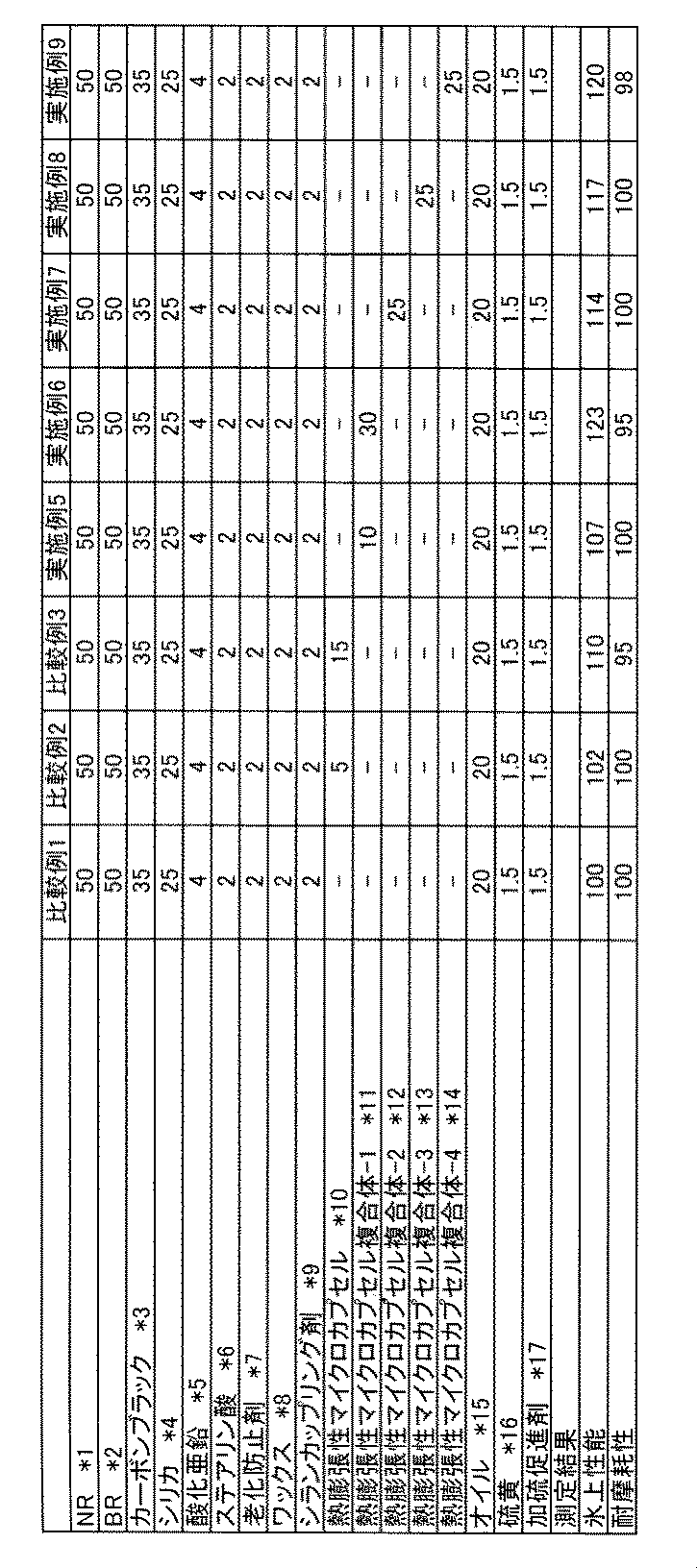
*1:NR(RSS#3)
*2:BR(日本ゼオン(株)製Nipol BR1220)
*3:カーボンブラック(キャボットジャパン(株)製N339)
*4:シリカ(ローディア社製ZEOSIL 1165MP)
*5:酸化亜鉛(正同化学工業(株)製酸化亜鉛3種)
*6:ステアリン酸(日油(株)製ビーズステアリン酸)
*7:老化防止剤(FLEXSYS製SANTOFLEX6PPD)
*8:ワックス(大内新興化学工業(株)製パラフィンワックス)
*9:シランカップリング剤(エボニックジャパン(株)製Si69)
*10:熱膨張性マイクロカプセル(松本油脂製薬(株)製マツモトマイクロスフェアー F)
*11:熱膨張性マイクロカプセル複合体-1(前記実施例1で製造した複合体)
*12:熱膨張性マイクロカプセル複合体-2(前記実施例2で製造した複合体)
*13:熱膨張性マイクロカプセル複合体-3(前記実施例3で製造した複合体)
*14:熱膨張性マイクロカプセル複合体-4(前記実施例4で製造した複合体)
*15:オイル(昭和シェル石油(株)製エキストラクト4号S)
*16:硫黄(鶴見化学工業(株)製金華印油入微粉硫黄)
*17:加硫促進剤(大内新興化学工業(株)製ノクセラーCZ-G)
*2:BR(日本ゼオン(株)製Nipol BR1220)
*3:カーボンブラック(キャボットジャパン(株)製N339)
*4:シリカ(ローディア社製ZEOSIL 1165MP)
*5:酸化亜鉛(正同化学工業(株)製酸化亜鉛3種)
*6:ステアリン酸(日油(株)製ビーズステアリン酸)
*7:老化防止剤(FLEXSYS製SANTOFLEX6PPD)
*8:ワックス(大内新興化学工業(株)製パラフィンワックス)
*9:シランカップリング剤(エボニックジャパン(株)製Si69)
*10:熱膨張性マイクロカプセル(松本油脂製薬(株)製マツモトマイクロスフェアー F)
*11:熱膨張性マイクロカプセル複合体-1(前記実施例1で製造した複合体)
*12:熱膨張性マイクロカプセル複合体-2(前記実施例2で製造した複合体)
*13:熱膨張性マイクロカプセル複合体-3(前記実施例3で製造した複合体)
*14:熱膨張性マイクロカプセル複合体-4(前記実施例4で製造した複合体)
*15:オイル(昭和シェル石油(株)製エキストラクト4号S)
*16:硫黄(鶴見化学工業(株)製金華印油入微粉硫黄)
*17:加硫促進剤(大内新興化学工業(株)製ノクセラーCZ-G)
上記の表1から明らかなように、実施例5~9で調製されたゴム組成物は、本発明の熱膨張性マイクロカプセル複合体を配合しているので、従来の代表的な比較例1に比べ、耐摩耗性を維持したまま、氷上性能が顕著に向上していることが分かる。
これに対し、比較例2~3は、本発明の熱膨張性マイクロカプセル複合体を配合せず、単なる熱膨張性マイクロカプセルを配合した例であるので、耐摩耗性および氷上性能の両立が不可であった。
これに対し、比較例2~3は、本発明の熱膨張性マイクロカプセル複合体を配合せず、単なる熱膨張性マイクロカプセルを配合した例であるので、耐摩耗性および氷上性能の両立が不可であった。
Claims (15)
- セルロース繊維上に複数の熱膨張性マイクロカプセルが付着した構造を有することを特徴とする熱膨張性マイクロカプセル複合体。
- 前記セルロース繊維上に複数の前記熱膨張性マイクロカプセルが、線状、帯状または房状に連結した構造を有することを特徴とする請求項1に記載の熱膨張性マイクロカプセル複合体。
- 前記セルロース繊維が、セルロースミクロフィブリルであることを特徴とする請求項1に記載の熱膨張性マイクロカプセル複合体。
- 前記セルロースミクロフィブリルは、太さ10nm~100nm、長さ100nm~500nm程度のセルロースクリスタル及び/または太さ3nm~100nm、長さ5μm以上のセルロースナノファイバーからなるナノ構造体を含むセルロースミクロフィブリル繊維体であり、該ミクロフィブリル繊維体としての繊維幅が0.1μm以上であり、長さが0.5μm以上であることを特徴とする請求項3に記載の熱膨張性マイクロカプセル複合体。
- 1~30質量%濃度の水溶性高分子の水溶液を調製する工程と、
前記水溶液100質量部に対しセルロース繊維を5~60質量部加え分散液(1)を調製する工程と、
前記分散液(1)に熱膨張性マイクロカプセルを10~200質量部加え分散液(2)を調製する工程と、
前記分散液(2)の水分を蒸発させる工程と
を有する請求項1に記載の熱膨張性マイクロカプセル複合体を製造する方法。 - 前記分散液(1)または前記分散液(2)を調製する工程において、前記熱膨張性マイクロカプセルに対し、極性溶剤を1~10質量%配合することを特徴とする請求項5に記載の製造方法。
- 前記極性溶剤が、ジメチルスルホキシド、ニトリロトリエタノール、プロピレンカーボネート、γ-ブチロラクトン、N-メチル-2-ピロリドン、N,N-ジメチルアセトアミド、ジメチルホルムアミド、アセトニトリルおよびジメチルスルホキシドからなる群から選択された少なくとも1種であることを特徴とする請求項6に記載の製造方法。
- 前記分散液(1)の代わりに、不揮発性液状化合物100質量部に対し、前記水溶性高分子の水溶液5~40質量部およびセルロース繊維5~60質量部を加えた分散液(1’)を用いる請求項5に記載の製造方法。
- 前記水溶性高分子が、ポリアクリル酸、ポリアクリルアミド、ポリエチレンオキシド、ポリビニルアルコール、カルボキシメチルセルロース、デンプン、寒天、ゼラチンおよびにかわから選択された少なくとも1種であること特徴とする請求項5に記載の製造方法。
- 前記セルロース繊維が、セルロースミクロフィブリルであることを特徴とする請求項5に記載の製造方法。
- 前記セルロースミクロフィブリルは、太さ10nm~100nm、長さ100nm~500nm程度のセルロースクリスタル及び/または太さ3nm~100nm、長さ5μm以上のセルロースナノファイバーからなるナノ構造体を含むセルロースミクロフィブリル繊維体であり、該ミクロフィブリル繊維体としての繊維幅が0.1μm以上であり、長さが0.5μm以上であることを特徴とする請求項10に記載の製造方法。
- ゴム成分100質量部に対し、請求項1に記載の熱膨張性マイクロカプセル複合体を1~30質量部配合してなることを特徴とするゴム組成物。
- 請求項12に記載のゴム組成物の加硫物を用いてなる空気入りタイヤ。
- 請求項12に記載のゴム組成物の加硫物をドレッドに用いてなる請求項13に記載の空気入りタイヤ。
- スタッドレスタイヤである請求項14に記載の空気入りタイヤ。
Priority Applications (3)
| Application Number | Priority Date | Filing Date | Title |
|---|---|---|---|
| US15/557,791 US10557009B2 (en) | 2015-03-12 | 2016-03-10 | Thermally expandable microcapsule complex, method for manufacturing same, rubber composition in which complex is blended, and pneumatic tire using composition |
| CN201680010516.1A CN107250241B (zh) | 2015-03-12 | 2016-03-10 | 热膨胀性微囊复合体、其制造方法、配合有该复合体的橡胶组合物及使用了该组合物的充气轮胎 |
| DE112016001159.8T DE112016001159B4 (de) | 2015-03-12 | 2016-03-10 | Kautschukzusammensetzung enthaltend einen thermisch ausdehnbaren Mikrokapsel-Komplex, Verfahren zur Herstellung des thermisch ausdehnbaren Mikrokapsel-Komplexes und Luftreifen, der die Zusammensetzung verwendet |
Applications Claiming Priority (2)
| Application Number | Priority Date | Filing Date | Title |
|---|---|---|---|
| JP2015049253A JP6094614B2 (ja) | 2015-03-12 | 2015-03-12 | タイヤ用ゴム組成物、熱膨張性マイクロカプセル複合体の製造方法および該組成物を用いた空気入りタイヤ |
| JP2015-049253 | 2015-03-12 |
Publications (1)
| Publication Number | Publication Date |
|---|---|
| WO2016143852A1 true WO2016143852A1 (ja) | 2016-09-15 |
Family
ID=56879520
Family Applications (1)
| Application Number | Title | Priority Date | Filing Date |
|---|---|---|---|
| PCT/JP2016/057583 Ceased WO2016143852A1 (ja) | 2015-03-12 | 2016-03-10 | 熱膨張性マイクロカプセル複合体、その製造方法、該複合体を配合してなるゴム組成物および該組成物を用いた空気入りタイヤ |
Country Status (5)
| Country | Link |
|---|---|
| US (1) | US10557009B2 (ja) |
| JP (1) | JP6094614B2 (ja) |
| CN (1) | CN107250241B (ja) |
| DE (1) | DE112016001159B4 (ja) |
| WO (1) | WO2016143852A1 (ja) |
Cited By (2)
| Publication number | Priority date | Publication date | Assignee | Title |
|---|---|---|---|---|
| CN107936313A (zh) * | 2016-10-12 | 2018-04-20 | 住友橡胶工业株式会社 | 无钉防滑轮胎用橡胶组合物以及无钉防滑轮胎 |
| US11685190B2 (en) | 2018-03-22 | 2023-06-27 | The Yokohama Rubber Co., Ltd. | Rubber composition for tire and studless tire |
Families Citing this family (5)
| Publication number | Priority date | Publication date | Assignee | Title |
|---|---|---|---|---|
| JP7069950B2 (ja) * | 2018-03-28 | 2022-05-18 | 横浜ゴム株式会社 | タイヤ用ゴム組成物およびそれを用いたスタッドレスタイヤ |
| JP7686364B2 (ja) * | 2018-09-12 | 2025-06-02 | 住友ゴム工業株式会社 | タイヤ用ゴム組成物及びタイヤ |
| EP3812419A1 (en) * | 2019-10-23 | 2021-04-28 | Weidmann Holding AG | Microfibrillated cellulose-loaded foam, method of producing such foam and use of such a foam |
| JP7373164B2 (ja) * | 2019-12-20 | 2023-11-02 | 株式会社日新化学研究所 | エマルション型消泡剤 |
| WO2025008196A1 (en) | 2023-07-06 | 2025-01-09 | Cellofibers Sweden Ab | A material useful for a package and a method for making such material |
Citations (7)
| Publication number | Priority date | Publication date | Assignee | Title |
|---|---|---|---|---|
| JP2008013621A (ja) * | 2006-07-04 | 2008-01-24 | Sekisui Chem Co Ltd | セルロース繊維強化成形体とその製造方法 |
| JP2011012248A (ja) * | 2009-06-01 | 2011-01-20 | Yokohama Rubber Co Ltd:The | タイヤ用ゴム組成物 |
| JP2012122019A (ja) * | 2010-12-09 | 2012-06-28 | Yokohama Rubber Co Ltd:The | タイヤ用ゴム組成物 |
| JP2014152289A (ja) * | 2013-02-12 | 2014-08-25 | Sumitomo Rubber Ind Ltd | タイヤ用ゴム組成物及び空気入りタイヤ |
| JP2015010136A (ja) * | 2013-06-27 | 2015-01-19 | 住友ゴム工業株式会社 | タイヤ用ゴム組成物およびそれを用いた空気入りタイヤ |
| JP2015221854A (ja) * | 2014-05-22 | 2015-12-10 | 横浜ゴム株式会社 | タイヤ用ゴム組成物およびスタッドレスタイヤ |
| JP2016074801A (ja) * | 2014-10-06 | 2016-05-12 | 横浜ゴム株式会社 | スタッドレスタイヤ用ゴム組成物およびそれを用いたスタッドレスタイヤ |
Family Cites Families (8)
| Publication number | Priority date | Publication date | Assignee | Title |
|---|---|---|---|---|
| DE69628235T2 (de) * | 1995-07-03 | 2004-03-25 | Sony Corp. | Verfahren zur Herstellung eines aus Fasern bestehenden Formteils |
| JP3352627B2 (ja) | 1997-05-19 | 2002-12-03 | 横浜ゴム株式会社 | 氷上摩擦力を高めたタイヤトレッド用ゴム組成物及び空気入りタイヤ |
| US7992209B1 (en) * | 2007-07-19 | 2011-08-02 | Owl Computing Technologies, Inc. | Bilateral communication using multiple one-way data links |
| US7902265B2 (en) * | 2007-10-17 | 2011-03-08 | The Yokohama Rubber Co., Ltd. | Rubber composition for tire |
| ES2777888T3 (es) * | 2010-03-26 | 2020-08-06 | Sekisui Chemical Co Ltd | Microcápsula térmicamente expansible |
| JP5508148B2 (ja) * | 2010-06-03 | 2014-05-28 | 住友ゴム工業株式会社 | ベーストレッド用ゴム組成物及び空気入りタイヤ |
| WO2013132017A1 (en) * | 2012-03-09 | 2013-09-12 | Philip Morris Products S.A. | Layered sheetlike material comprising cellulose fibres |
| CN106459507B (zh) | 2014-05-22 | 2018-05-01 | 横滨橡胶株式会社 | 轮胎用橡胶组合物及无钉轮胎 |
-
2015
- 2015-03-12 JP JP2015049253A patent/JP6094614B2/ja not_active Expired - Fee Related
-
2016
- 2016-03-10 DE DE112016001159.8T patent/DE112016001159B4/de not_active Expired - Fee Related
- 2016-03-10 WO PCT/JP2016/057583 patent/WO2016143852A1/ja not_active Ceased
- 2016-03-10 US US15/557,791 patent/US10557009B2/en not_active Expired - Fee Related
- 2016-03-10 CN CN201680010516.1A patent/CN107250241B/zh not_active Expired - Fee Related
Patent Citations (7)
| Publication number | Priority date | Publication date | Assignee | Title |
|---|---|---|---|---|
| JP2008013621A (ja) * | 2006-07-04 | 2008-01-24 | Sekisui Chem Co Ltd | セルロース繊維強化成形体とその製造方法 |
| JP2011012248A (ja) * | 2009-06-01 | 2011-01-20 | Yokohama Rubber Co Ltd:The | タイヤ用ゴム組成物 |
| JP2012122019A (ja) * | 2010-12-09 | 2012-06-28 | Yokohama Rubber Co Ltd:The | タイヤ用ゴム組成物 |
| JP2014152289A (ja) * | 2013-02-12 | 2014-08-25 | Sumitomo Rubber Ind Ltd | タイヤ用ゴム組成物及び空気入りタイヤ |
| JP2015010136A (ja) * | 2013-06-27 | 2015-01-19 | 住友ゴム工業株式会社 | タイヤ用ゴム組成物およびそれを用いた空気入りタイヤ |
| JP2015221854A (ja) * | 2014-05-22 | 2015-12-10 | 横浜ゴム株式会社 | タイヤ用ゴム組成物およびスタッドレスタイヤ |
| JP2016074801A (ja) * | 2014-10-06 | 2016-05-12 | 横浜ゴム株式会社 | スタッドレスタイヤ用ゴム組成物およびそれを用いたスタッドレスタイヤ |
Non-Patent Citations (1)
| Title |
|---|
| HIROAKI OTSUKA: "High bulky paperboard using thermally expansive microcapsules", MATERIAL STAGE, vol. 10, no. 3, 2010, pages 23 - 25 * |
Cited By (3)
| Publication number | Priority date | Publication date | Assignee | Title |
|---|---|---|---|---|
| CN107936313A (zh) * | 2016-10-12 | 2018-04-20 | 住友橡胶工业株式会社 | 无钉防滑轮胎用橡胶组合物以及无钉防滑轮胎 |
| CN107936313B (zh) * | 2016-10-12 | 2022-07-19 | 住友橡胶工业株式会社 | 无钉防滑轮胎用橡胶组合物以及无钉防滑轮胎 |
| US11685190B2 (en) | 2018-03-22 | 2023-06-27 | The Yokohama Rubber Co., Ltd. | Rubber composition for tire and studless tire |
Also Published As
| Publication number | Publication date |
|---|---|
| JP2016169278A (ja) | 2016-09-23 |
| DE112016001159T5 (de) | 2017-11-23 |
| JP6094614B2 (ja) | 2017-03-15 |
| CN107250241A (zh) | 2017-10-13 |
| US10557009B2 (en) | 2020-02-11 |
| DE112016001159B4 (de) | 2021-05-06 |
| US20180072860A1 (en) | 2018-03-15 |
| CN107250241B (zh) | 2019-01-11 |
Similar Documents
| Publication | Publication Date | Title |
|---|---|---|
| JP6094614B2 (ja) | タイヤ用ゴム組成物、熱膨張性マイクロカプセル複合体の製造方法および該組成物を用いた空気入りタイヤ | |
| TWI586733B (zh) | 改良之彈性體調配物(一) | |
| JP2023524646A (ja) | カーボンナノ構造フィラーを含むエラストマー組成物 | |
| CN105985540B (zh) | 橡胶组合物和轮胎 | |
| CN108623856A (zh) | 充气轮胎 | |
| JP5658142B2 (ja) | 樹脂伸展イソプレンゴムの製造方法、その方法で得られたゴム組成物及び空気入りタイヤ | |
| WO2012127728A1 (ja) | 未加硫ゴム組成物およびその製造方法、ならびに空気入りタイヤ | |
| CN108779299A (zh) | 橡胶组合物和充气轮胎 | |
| JP7125883B2 (ja) | ゴムウエットマスターバッチの製造方法 | |
| CN108976487A (zh) | 具有外贴三角胶的充气轮胎 | |
| JP6651333B2 (ja) | ウェットマスターバッチの製造方法及びタイヤの製造方法 | |
| CN107955192B (zh) | 轮胎材料的制造方法 | |
| JP6880657B2 (ja) | マスターバッチの製造方法 | |
| JP6180948B2 (ja) | タイヤ用加硫ゴム組成物 | |
| JP7081709B2 (ja) | スタッドレスタイヤ用ゴム組成物およびそれを用いたスタッドレスタイヤ | |
| JP2019163414A (ja) | ゴム/フィラー複合体の製造方法 | |
| WO2022050381A1 (ja) | スタッドレスタイヤ用ゴム組成物およびそれを用いたスタッドレスタイヤ | |
| JP7255124B2 (ja) | フィラー・ゴム複合体 | |
| JP6205227B2 (ja) | タイヤ用ゴム組成物 | |
| JP7844811B2 (ja) | 担持体の製造方法及び担持体 | |
| JP6244154B2 (ja) | タイヤ用ゴム組成物 | |
| JP6421614B2 (ja) | 冬用タイヤ用ゴム組成物およびそれを用いた空気入りタイヤ | |
| JP6821382B2 (ja) | タイヤ部材の製造方法 | |
| JP2023134371A (ja) | タイヤ | |
| JP2022180911A (ja) | 複合体の製造方法及び複合体 |
Legal Events
| Date | Code | Title | Description |
|---|---|---|---|
| 121 | Ep: the epo has been informed by wipo that ep was designated in this application |
Ref document number: 16761818 Country of ref document: EP Kind code of ref document: A1 |
|
| WWE | Wipo information: entry into national phase |
Ref document number: 15557791 Country of ref document: US Ref document number: 112016001159 Country of ref document: DE |
|
| 122 | Ep: pct application non-entry in european phase |
Ref document number: 16761818 Country of ref document: EP Kind code of ref document: A1 |