WO2015156274A1 - 微生物農薬組成物、その製造方法及び微生物農薬の安定化方法 - Google Patents
微生物農薬組成物、その製造方法及び微生物農薬の安定化方法 Download PDFInfo
- Publication number
- WO2015156274A1 WO2015156274A1 PCT/JP2015/060816 JP2015060816W WO2015156274A1 WO 2015156274 A1 WO2015156274 A1 WO 2015156274A1 JP 2015060816 W JP2015060816 W JP 2015060816W WO 2015156274 A1 WO2015156274 A1 WO 2015156274A1
- Authority
- WO
- WIPO (PCT)
- Prior art keywords
- microbial pesticide
- bacillus
- pesticide composition
- calcium chloride
- mixing
- Prior art date
- Legal status (The legal status is an assumption and is not a legal conclusion. Google has not performed a legal analysis and makes no representation as to the accuracy of the status listed.)
- Ceased
Links
Images

Classifications
-
- A—HUMAN NECESSITIES
- A01—AGRICULTURE; FORESTRY; ANIMAL HUSBANDRY; HUNTING; TRAPPING; FISHING
- A01N—PRESERVATION OF BODIES OF HUMANS OR ANIMALS OR PLANTS OR PARTS THEREOF; BIOCIDES, e.g. AS DISINFECTANTS, AS PESTICIDES OR AS HERBICIDES; PEST REPELLANTS OR ATTRACTANTS; PLANT GROWTH REGULATORS
- A01N25/00—Biocides, pest repellants or attractants, or plant growth regulators, characterised by their forms, or by their non-active ingredients or by their methods of application, e.g. seed treatment or sequential application; Substances for reducing the noxious effect of the active ingredients to organisms other than pests
- A01N25/02—Biocides, pest repellants or attractants, or plant growth regulators, characterised by their forms, or by their non-active ingredients or by their methods of application, e.g. seed treatment or sequential application; Substances for reducing the noxious effect of the active ingredients to organisms other than pests containing liquids as carriers, diluents or solvents
- A01N25/04—Dispersions, emulsions, suspoemulsions, suspension concentrates or gels
-
- A—HUMAN NECESSITIES
- A01—AGRICULTURE; FORESTRY; ANIMAL HUSBANDRY; HUNTING; TRAPPING; FISHING
- A01N—PRESERVATION OF BODIES OF HUMANS OR ANIMALS OR PLANTS OR PARTS THEREOF; BIOCIDES, e.g. AS DISINFECTANTS, AS PESTICIDES OR AS HERBICIDES; PEST REPELLANTS OR ATTRACTANTS; PLANT GROWTH REGULATORS
- A01N25/00—Biocides, pest repellants or attractants, or plant growth regulators, characterised by their forms, or by their non-active ingredients or by their methods of application, e.g. seed treatment or sequential application; Substances for reducing the noxious effect of the active ingredients to organisms other than pests
- A01N25/22—Biocides, pest repellants or attractants, or plant growth regulators, characterised by their forms, or by their non-active ingredients or by their methods of application, e.g. seed treatment or sequential application; Substances for reducing the noxious effect of the active ingredients to organisms other than pests containing ingredients stabilising the active ingredients
-
- A—HUMAN NECESSITIES
- A01—AGRICULTURE; FORESTRY; ANIMAL HUSBANDRY; HUNTING; TRAPPING; FISHING
- A01N—PRESERVATION OF BODIES OF HUMANS OR ANIMALS OR PLANTS OR PARTS THEREOF; BIOCIDES, e.g. AS DISINFECTANTS, AS PESTICIDES OR AS HERBICIDES; PEST REPELLANTS OR ATTRACTANTS; PLANT GROWTH REGULATORS
- A01N59/00—Biocides, pest repellants or attractants, or plant growth regulators containing elements or inorganic compounds
- A01N59/06—Aluminium; Calcium; Magnesium; Compounds thereof
-
- A—HUMAN NECESSITIES
- A01—AGRICULTURE; FORESTRY; ANIMAL HUSBANDRY; HUNTING; TRAPPING; FISHING
- A01N—PRESERVATION OF BODIES OF HUMANS OR ANIMALS OR PLANTS OR PARTS THEREOF; BIOCIDES, e.g. AS DISINFECTANTS, AS PESTICIDES OR AS HERBICIDES; PEST REPELLANTS OR ATTRACTANTS; PLANT GROWTH REGULATORS
- A01N63/00—Biocides, pest repellants or attractants, or plant growth regulators containing microorganisms, viruses, microbial fungi, animals or substances produced by, or obtained from, microorganisms, viruses, microbial fungi or animals, e.g. enzymes or fermentates
- A01N63/20—Bacteria; Substances produced thereby or obtained therefrom
- A01N63/22—Bacillus
Definitions
- the present invention relates to the stabilization of microbial pesticides. More specifically, the present invention relates to a microbial pesticide composition that retains the plant control effect of bacteria belonging to the genus Bacillus for a long period of time, a method for producing the same, and a method for stabilizing a microbial pesticide containing a bacterium belonging to the genus Bacillus as an active ingredient. .
- JP 2011-184370 A JP 2011-184370 A
- Patent Document 1 JP 2011-184370 A
- Patent Document 2 proposes a microorganism containing a microorganism, a clay mineral, a surfactant and a desiccant.
- the desiccant include silica gel, calcium chloride, and type III anhydrous gypsum.
- Patent Document 3 discloses a method for obtaining a dried microorganism product having good viability recovery and storage stability by mixing trehalose with a bacterium belonging to the genus Pseudomonas and then freeze-drying it. It is shown. Further, as an improved method of this method, Japanese Patent Application Laid-Open No.
- Patent Document 4 describes a method in which Pseudomonas bacteria are mixed with trehalose or sucrose and mixed with sodium chloride and potassium chloride and then frozen. A method for improving the storage stability of the packaging material by drying is disclosed.
- JP 2000-264807 A (Patent Document 5) and JP 2000-264808 A (Patent Document 6) both add zeolite, molecular sieves, silica gel or the like as an adsorbent having ammonia adsorption ability. by, it has been shown to save Erwinia (Erwinia) bacteria, Pseudomonas (Pseudomonas) bacteria in a stable state.
- Erwinia Erwinia
- Pseudomonas Pseudomonas
- filamentous fungus spores as an active ingredient, examples of the storage stability of the improved microbial pesticide formulation, Japanese 2010-143856 (Patent Document 7), the viable cells of the Fusarium (Fusarium) genus A method for improving storage stability by adding amorphous silica and further adding calcium carbonate / magnesium sulfate is shown.
- An object of the present invention is to provide a microbial pesticide composition that has a stable active ingredient even when stored at room temperature for a long period of time and maintains a sufficient plant disease control effect.
- the present inventors added calcium chloride and / or magnesium sulfate to a culture solution of a bacterium belonging to the genus Bacillus, which is a microorganism for controlling plant diseases,
- the present inventors have found that a dried microbial cell product obtained by freeze-drying or spray-drying has excellent storage stability and retains a sufficient plant control effect for a long period of time, thereby completing the present invention.
- the present invention provides the following microbial pesticide compositions (1) to (9), methods for producing the microbial pesticide compositions (10) to (11), and stabilization of the microbial pesticide compositions (12) to (13) It relates to the conversion method.
- a microbial pesticide composition comprising a dried product of Bacillus bacteria and calcium chloride and / or magnesium sulfate.
- the microbial pesticide composition according to (1) comprising a dried product of Bacillus bacteria and calcium chloride.
- the microbial pesticide composition according to (1) comprising a dried cell of Bacillus bacteria and magnesium sulfate.
- Bacillus (Bacillus) bacterium is claimed in any one of Bacillus subtilis (Bacillus subtilis), Bacillus amyloliquefaciens (Bacillus amyloliquefaciens), or mutants thereof (1) to (4) Microbial pesticide composition.
- Bacillus (Bacillus) bacteria of the genus microbial pesticide according to any one of Bacillus amyloliquefaciens AT-332 (Bacillus amyloliquefaciens AT- 332) strain, or a mutant strain thereof (1) to (5) Composition.
- a step of adjusting pH to 3.0 to 5.0 (pH adjustment step) and a step of mixing calcium chloride and / or magnesium sulfate (mixing step) with respect to a culture solution of bacteria belonging to the genus Bacillus
- a mixing step is carried out after the pH adjusting step, a pH adjusting step and a mixing step are carried out simultaneously, or a pH adjusting step is carried out after the mixing step and a drying step is carried out
- the microbial pesticide composition is obtained by a method in which a mixing step is carried out after the pH adjusting step, a pH adjusting step and a mixing step are carried out simultaneously, or a pH adjusting step is carried out after the mixing step and a drying step is carried out.
- the microbial pesticide composition according to any one of (1) to (8), wherein the pH of the aqueous suspension in which the pesticide composition is suspended in distilled water is 3.0 to 5.0.
- a step of adjusting the pH to 3.0 to 5.0 (pH adjustment step) and a step of mixing calcium chloride and / or magnesium sulfate (mixing step) with respect to a culture solution of Bacillus bacteria A method for producing a microbial pesticide composition comprising a step of freeze-drying or spray-drying (drying step).
- the mixing process is performed after the pH adjusting process, the pH adjusting process and the mixing process are performed simultaneously, or the drying process is performed after the pH adjusting process is performed after the mixing process.
- a method for producing a microbial pesticide composition (12) A step of adjusting the pH to 3.0 to 5.0 (pH adjustment step) and a step of mixing calcium chloride and / or magnesium sulfate (mixing step) with respect to a culture solution of Bacillus bacteria
- a method for stabilizing a microbial pesticide comprising a step of freeze-drying or spray-drying (drying step).
- the mixing step is performed after the pH adjusting step, the pH adjusting step and the mixing step are simultaneously performed, or the drying step is performed after the pH adjusting step is performed after the mixing step.
- a method for stabilizing microbial pesticides (12) A step of adjusting the pH to 3.0 to 5.0 (pH adjustment step) and a step of mixing calcium chloride and / or magnesium sulfate (mixing step) with respect to a culture solution of Bacillus bacteria
- a method for stabilizing a microbial pesticide comprising a step of freeze-drying or spray-drying (drying step).
- the active ingredient (Bacteria body dried material of Bacillus genus bacteria) in a microbial pesticide composition can be kept stable, and the state which has sufficient plant disease control effect is maintained for a long period of time. Can do.
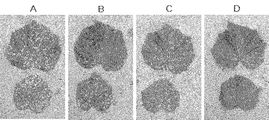
- AD are photographs showing the results of a control effect test (Example 2) against cucumber powdery mildew of the microbial pesticide composition (formulation) of the present invention.
- D Calcium chloride 5% added / pH 4.0 group .
- AD are photographs showing the results of a control effect test (Example 3) against cucumber powdery mildew of the microbial pesticide composition (formulation) of the present invention.
- D 5% calcium chloride added group.
- the microbial pesticide composition of the present invention is characterized by containing an active ingredient dried product of Bacillus bacteria and further containing calcium chloride and / or magnesium sulfate. This will be described in detail below.
- the bacterium belonging to the genus Bacillus used as the dried microorganism in the microbial pesticide composition of the present invention is not particularly limited, but may be a bacterium belonging to the genus Bacillus having an ability to control plant diseases. preferable.
- Bacillus subtilis Bacillus subtilis
- Bacillus amyloliquefaciens Bacillus amyloliquefaciens
- Bacillus pumilus Bacillus pumilus
- Bacillus cereus Bacillus cereus
- Bacillus licheniformis Bacillus licheniformis
- Bacillus Berezenshisu Bacillus velezensis
- Bacillus sp. Bacillus sp.
- Bacillus sub for plant disease Tirith Bacillus subtilis
- Bacillus amyloliquefaciens Bacillus amyloliquefaciens
- Bacillus amyloliquefaciens AT-332 Bacillus amyloliquefaciens AT-332 strain and mutants thereof.
- the bacteria of the genus Bacillus that can be used in the present invention are not limited to these examples, and may be bacteria of other genus Bacillus . There is no problem even if one or more bacteria are used in combination.
- the microbial pesticide composition used in the present invention contains a dried microbial cell product obtained by freeze-drying or spray-drying a microorganism culture solution.
- the microorganism culture solution can be dried after adding calcium chloride and / or magnesium sulfate and adjusting the pH to 3.0 to 5.0.
- the microbial pesticide composition of the present invention comprises a step of adjusting the pH to 3.0 to 5.0 (pH adjustment step), a step of mixing calcium chloride and / or magnesium sulfate (mixing step), lyophilization or spraying.
- a dried microbial cell product prepared by a method including a drying step (drying step) is included.
- the dried microbial cells are either (1) mixed with calcium chloride and / or magnesium sulfate in a microorganism culture solution, adjusted to pH 3.0 to 5.0 and then dried, or (2) a microorganism culture solution. Is adjusted to pH 3.0-5.0 and then mixed with calcium chloride and / or magnesium sulfate and then dried, or (3) calcium chloride while adjusting to pH 3.0-5.0 of the microorganism culture solution And / or magnesium sulfate and then drying.
- Calcium chloride and / or magnesium sulfate is preferably added at a concentration of 1 to 5% by mass with respect to the microbial pesticide composition (hereinafter sometimes referred to as “microbial pesticide preparation”). More preferably, it is added to a concentration of 2.5 to 5% by mass.
- microbial pesticide preparation microbial pesticide preparation
- the addition amount of calcium chloride and / or magnesium sulfate is less than 1% by mass with respect to the microbial pesticide preparation, a sufficient storage stability improvement effect cannot be obtained due to the lack of the addition amount.
- a formulation added in an amount exceeding 5% by mass with respect to the microbial pesticide formulation is not suitable because the formulation tends to solidify due to the hygroscopicity of calcium chloride and / or magnesium sulfate, and the effect of the original microbial pesticide formulation cannot be obtained. It is. Calcium chloride and magnesium sulfate can be used alone or in combination.
- the microbial pesticide preparation of the present invention may contain other optional components depending on the desired dosage form and effect.
- the dosage form include granules, powders, granule wettable powders, wettable powders, aqueous solvents, suspension preparations, emulsions, etc., among which granule wettable powders, wettable powders, aqueous solvents, granules are preferred, A wettable powder is more preferred.
- the optional component is not particularly limited as long as the effects of the present invention are not impaired, and examples thereof include a carrier, a surfactant, a dispersant, an adjuvant, and a protective agent.
- the carrier examples include porous solid carriers such as talc, bentonite, kaolin, clay, diatomaceous earth, white carbon, vermiculite, slaked lime, ammonium sulfate, silica sand, urea, water, isopropyl alcohol, methylnaphthalene, xylene, cyclohexanone, alkylene glycol. And liquid carriers.
- porous solid carriers such as talc, bentonite, kaolin, clay, diatomaceous earth, white carbon, vermiculite, slaked lime, ammonium sulfate, silica sand, urea, water, isopropyl alcohol, methylnaphthalene, xylene, cyclohexanone, alkylene glycol.
- liquid carriers such as talc, bentonite, kaolin, clay, diatomaceous earth, white carbon, vermiculite, slaked lime, ammonium sulfate,
- Surfactants and dispersants include, for example, dinaphthylmethane sulfonate, alcohol sulfate ester salt, lignin sulfonate, alkylaryl sulfonate, polyoxyethylene glycol ether, polyoxyethylene sorbitan monoalkylate, polyoxyethylene Examples thereof include alkyl aryl ethers.
- auxiliary agents include carboxymethylcellulose, polyethylene glycol, propylene glycol, gum arabic, and xanthan gum
- protective agents include skim milk and pH buffering agents.
- the microbial pesticide composition of the present invention contains microorganisms as dried microbial cells.
- a dried microbial cell product can be obtained by a known apparatus and conditions.
- the microorganism is Bacillus amyloliquefaciens AT-332 (Bacillus amyloliquefaciens AT- 332) strain, a liquid standard medium (polypeptone 0.5%, 0.1% glucose, 0.5% yeast extract, pH 7. After the microorganism is shaken and cultured in 0), calcium chloride and / or magnesium sulfate is mixed, the pH is adjusted to 3.0 to 5.0, and freeze drying or spray drying is performed.
- Freeze-drying or spray-drying can be carried out under the conditions of a known apparatus to obtain a powdered dried microbial cell product.
- a microbial pesticide composition (formulation) can be obtained by selecting and mixing arbitrary components according to a desired dosage form in the obtained dried microbial cell product.
- the microbial pesticide composition of the present invention can be applied directly as it is, or diluted with water or the like.
- the pH of the aqueous suspension suspended in distilled water is preferably 3.0 to 5.0.
- the application method of the microbial pesticide composition is not particularly limited, for example, a method of spraying directly on plants, a method of spraying on soil, a method of directly applying to plant seeds, adding to water or fertilizer added to plants or soil The method etc. are mentioned.
- the dosage of the preparation varies depending on the target disease, target crop, application method, tendency of occurrence, degree of damage, environmental conditions, dosage form to be used, etc., and thus it is preferable to adjust appropriately.
- the microbial pesticide composition of the present invention exhibits excellent control power against a wide variety of bacteria and filamentous fungi.
- plant diseases that can be controlled by the microbial pesticide composition of the present invention include: Rice blast fungus ( Pyricularia oryzae ), sesame leaf blight fungus ( Cochliobolus miyabeanus ), blight fungus ( Rhizoctonia solani ), idiot seedling fungus ( Gibberella fujikuroi ), "Wheat” powdery mildew ( Erysiphe graminis f.sp. hordei , Erysiphe graminis f.sp.
- Puccinia striiformis Puccinia graminis
- Puccinia recondita f.sp. tritici Puccinia hordei ) (Gibberella zeae)
- net plaques fungus Pyrenophora teres
- snow molds Typhula incarnata, Typhula ishikariensis, Sclerotiniaborealis , Micronectriella nivalis), loose smut fungus (Ustilago nuda), fishy smell smut (Tilletia caries, Tilletia toetida), Memon fungus (Tapesia yallundea), scald fungus (Phynchosporium secalis f.sp.
- soot point fungus Zygophiala jamaicensis
- soot spots fungus Gloeodes pomigena
- black spot fungus Mycosphaerella pomi
- anthracnose fungus Glomerella cingulata
- brown spot fungus Diplocarpon mali
- "Pear" black rot fungus Venturia nashicola
- black spot rot fungus Alternaria alternatajapanese pear pathotype
- ring rot fungus Physalospora piricola
- red rot fungus Gymnosporangium asiaticum
- "Peach” asbestosis Monilinia fructicola
- black rot Cladosporium carpophilum
- Example 1 The effect of improving the storage stability of a microbial pesticide preparation produced by adding various calcium compounds or magnesium compounds to a microorganism culture solution after completion of culture using a bacterium belonging to the genus Bacillus was examined.
- Manufacture of microbial pesticide preparations 1. Preparation of microorganism culture solution 100 ml of liquid standard medium (0.5% by weight of polypeptone, 0.1% by weight of glucose, 0.5% by weight of yeast extract, pH 7.0) was placed in a 500 ml Erlenmeyer flask and sterilized by heating.
- Bacillus Bacillus (Bacillus) bacteria belonging to the genus (Bacillus amyloliquefaciens AT-332 (Bacillus amyloliquefaciens AT- 332) Co., Ltd.), 30 °C, and cultured with shaking 64hr at 150rpm.
- This culture broth 75.1% by mass was mixed and pulverized with trisodium citrate 4% by mass, sodium citrate 2% by mass, sodium chloride 15.9% by mass, alkyl sulfate metal salt 3% by mass, and microbial pesticide.
- a preparation comprising the composition was obtained.
- the control value was calculated by the following formula (Equation 1), and the residual activity shown in the table was calculated by the following equation (Equation 2).
- the residual activity is a ratio when the control value when the microbial pesticide preparation prepared without adding calcium compound or magnesium compound in the preparation is treated at 4 ° C. for 3 weeks is defined as 100.
- the results of the biological effect test are shown in Table 1.
- calcium chloride or magnesium sulfate with a residual activity of 60% or more retains the effects of the original microbial pesticide formulation even when heat-treated at 54 ° C for 3 weeks by adding it to the formulation, improving storage stability It was shown that the effect and the control effect with respect to a disease are acquired.
- Example 2 It was investigated what kind of storage stability improvement effect can be obtained by adding two kinds of compounds, calcium chloride and magnesium sulfate, to the microbial pesticide preparation and adjusting the pH.
- a culture solution of Bacillus amyloliquefaciens AT-332 strain calcium chloride or magnesium sulfate is added to 5% in the preparation, and the pH of the culture solution is adjusted to 5N hydrochloric acid or 5N. It adjusted to 3.0, 3.5, 4.0, 4.5, 5.0, 5.5, 6.0, 9.0 using sodium hydroxide, and freeze-dried.
- Other operations were prepared in the same manner as in Example 1, and the resulting preparation was evaluated against cucumber powdery mildew. The results are shown in Table 2.
- Example 2 a preparation in which calcium chloride was added to the preparation and the pH was adjusted to 4.0 was subjected to a storage stability test at 54 ° C. for 3 weeks.
- A is an untreated group
- B is a test group that has been subjected to a storage stability test at 54 ° C. for 3 weeks after addition of calcium chloride and pH adjustment
- C is a calcium chloride formulation
- D was added to a final concentration of 5% and subjected to a storage stability test at 54 ° C. for 3 weeks, and D was not adjusted for pH.
- Example 3 We examined the concentration of calcium chloride that provides sufficient storage stability and plant disease control. 1. The final concentration (mass%) of calcium chloride or magnesium sulfate in the preparation is 0.5%, 1.0%, or 0.5% in the culture solution of Bacillus amyloliquefaciens AT-332 strain. It was added to 5% and 5%, and the pH of the culture solution was adjusted to 4.0 using 5N hydrochloric acid and freeze-dried. Other operations were prepared in the same manner as in Example 1, and the resulting preparation was evaluated against cucumber powdery mildew. The results are shown in Table 3.
- B is a preparation adjusted to pH 4.0 by adding calcium chloride to the culture solution to a final concentration of 1%
- C calcium chloride so that the final concentration in the preparation is 2.5% by mass in the culture solution.
- D was adjusted to pH 4.0, and D shows the result of evaluating each by adding calcium chloride to the culture solution so that the final concentration in the formulation is 5% by mass and adjusting to pH 4.0.
- Example 4 We examined whether the same preservation stability improvement effect could be obtained for diseases other than cucumber powdery mildew. The same method as in Example 1 was used, except that the preparation subjected to the storage stability test was evaluated for the biological effect of cucumber gray mold. Details of the biological effect test by cucumber gray mold are shown below. The preparation was diluted with tap water to a predetermined magnification. 50 ⁇ l of the diluted solution was dropped on a paper disc for antibiotic test, and the solution was left on the surface of the cucumber cotyledon with the surface soaked with the solution facing down. Next, conidia were collected from gray mold fungi ( Botrytis cinerea ) grown on PDA agar medium and adjusted to 4 ⁇ 10 5 / ml with distilled water.
- gray mold fungi Botrytis cinerea
- the microbial pesticide preparation obtained from the present invention has a control effect against cucumber gray mold disease even after heat treatment at 54 ° C. for 3 weeks, and is limited by the type of disease It became clear that it was not done.
- Example 5 It was investigated whether or not the same effect could be obtained for bacteria belonging to the genus Bacillus other than Bacillus amyloliquefaciens AT-332 strain.
- Bacillus subtilis QST-713 strain isolated from SDS impression
- Bacillus subtilis MBI-600 strain isolated from Idemitsu Kotobo botkiller
- Bacillus subtilis HAI-0404 strain isolated from Nippon Soda Co., Ltd.
Landscapes
- Life Sciences & Earth Sciences (AREA)
- General Health & Medical Sciences (AREA)
- Health & Medical Sciences (AREA)
- Zoology (AREA)
- Engineering & Computer Science (AREA)
- Dentistry (AREA)
- Wood Science & Technology (AREA)
- Plant Pathology (AREA)
- Pest Control & Pesticides (AREA)
- Agronomy & Crop Science (AREA)
- Environmental Sciences (AREA)
- Biotechnology (AREA)
- Microbiology (AREA)
- Virology (AREA)
- Chemical & Material Sciences (AREA)
- Toxicology (AREA)
- Inorganic Chemistry (AREA)
- Dispersion Chemistry (AREA)
- Agricultural Chemicals And Associated Chemicals (AREA)
- Micro-Organisms Or Cultivation Processes Thereof (AREA)
Abstract
Description
また、特開2004-35421号公報(特許文献2)には、微生物、粘土鉱物、界面活性剤及び乾燥剤を含有する微生物が提案されている。乾燥剤としては、シリカゲル、塩化カルシウム、III型無水石膏が具体的に示されている。
(1) バチルス(Bacillus)属細菌の菌体乾燥物と塩化カルシウム及び/または硫酸マグネシウムを含有することを特徴とする微生物農薬組成物。
(2) バチルス(Bacillus)属細菌の菌体乾燥物と塩化カルシウムを含有する(1)に記載の微生物農薬組成物。
(3) バチルス(Bacillus)属細菌の菌体乾燥物と硫酸マグネシウムを含有する(1)に記載の微生物農薬組成物。
(4) 塩化カルシウム及び/または硫酸マグネシウムを1~5質量%含有する(1)~(3)のいずれかに記載の微生物農薬組成物。
(5) バチルス(Bacillus)属細菌が、バチルス・サブティリス(Bacillus subtilis)、バチルス・アミロリケファシエンス(Bacillus amyloliquefaciens)、またはそれらの変異株である(1)~(4)のいずれかに記載の微生物農薬組成物。
(6) バチルス(Bacillus)属細菌が、バチルス・アミロリケファシエンスAT-332(Bacillus amyloliquefaciens AT-332)株、またはその変異株である(1)~(5)のいずれかに記載の微生物農薬組成物。
(7) バチルス(Bacillus)属細菌の培養液について、pHを3.0~5.0に調整する工程(pH調整工程)と、塩化カルシウム及び/または硫酸マグネシウムを混合する工程(混合工程)と、凍結乾燥またはスプレードライする工程(乾燥工程)を含む方法によって得られる(1)~(6)のいずれかに記載の微生物農薬組成物。
(8) pH調整工程の後に混合工程を実施するか、pH調整工程と混合工程を同時に実施するか、または混合工程の後にpH調整工程を実施した後に乾燥工程を実施する方法によって得られる(7)に記載の微生物農薬組成物。
(9) 農薬組成物を蒸留水に懸濁した懸濁水溶液のpHが3.0~5.0である(1)~(8)のいずれかに記載の微生物農薬組成物。
(10) バチルス(Bacillus)属細菌の培養液について、pHを3.0~5.0に調整する工程(pH調整工程)と、塩化カルシウム及び/または硫酸マグネシウムを混合する工程(混合工程)と、凍結乾燥またはスプレードライする工程(乾燥工程)を含むことを特徴とする微生物農薬組成物の製造方法。
(11) pH調整工程の後に混合工程を実施するか、pH調整工程と混合工程を同時に実施するか、または混合工程の後にpH調整工程を実施した後に乾燥工程を実施する(10)に記載の微生物農薬組成物の製造方法。
(12) バチルス(Bacillus)属細菌の培養液について、pHを3.0~5.0に調整する工程(pH調整工程)と、塩化カルシウム及び/または硫酸マグネシウムを混合する工程(混合工程)と、凍結乾燥またはスプレードライする工程(乾燥工程)を含むことを特徴とする微生物農薬の安定化方法。
(13) pH調整工程の後に混合工程を実施するか、pH調整工程と混合工程を同時に実施するか、または混合工程の後にpH調整工程を実施した後に乾燥工程を実施する(12)に記載の微生物農薬の安定化方法。
本発明の微生物農薬組成物に菌体乾燥物として用いるバチルス(Bacillus)属の細菌は、特に限定されるものではないが、植物病害に対する防除能を有するバチルス(Bacillus)属の細菌であることが好ましい。例えば、バチルス・サブティリス(Bacillus subtilis)、バチルス・アミロリケファシエンス(Bacillus amyloliquefaciens)、バチルス・プミルス(Bacillus pumilus)、バチルス・セレウス(Bacillus cereus)、バチルス・リケニフォルミス(Bacillus licheniformis)、バチルス・ベレゼンシス(Bacillus velezensis)、バチルス・エスピー(Bacillus sp.)、及びこれらの変異株などが挙げられる。中でも植物病害に対する防除能が高いバチルス・サブティリス(Bacillus subtilis)、バチルス・アミロリケファシエンス(Bacillus amyloliquefaciens)及びその変異株が好ましく、さらに好ましくは、バチルス・アミロリケファシエンスAT-332(Bacillus amyloliquefaciens AT-332)株、及びその変異株が挙げられる。
本発明で用いる微生物農薬組成物は、微生物培養液を凍結乾燥またはスプレードライのいずれかの方法で得られた菌体乾燥物を含有する。
微生物培養液の乾燥は、塩化カルシウム及び/または硫酸マグネシウムの添加及びpH3.0~5.0の調整を行った後に行うことができる。
本発明の微生物農薬組成物は、pHを3.0~5.0に調整する工程(pH調整工程)と、塩化カルシウム及び/または硫酸マグネシウムを混合する工程(混合工程)と、凍結乾燥またはスプレードライする工程(乾燥工程)を含む方法によって調製される菌体乾燥物を含む。菌体乾燥物は、具体的には、(1)微生物培養液に塩化カルシウム及び/または硫酸マグネシウムを混合し、pH3.0~5.0に調整した後乾燥するか、(2)微生物培養液をpH3.0~5.0に調整した後に、塩化カルシウム及び/または硫酸マグネシウムを混合し、次いで乾燥するか、または(3)微生物培養液のpH3.0~5.0に調整しながら塩化カルシウム及び/または硫酸マグネシウムを混合した後乾燥するかして得ることができる。
塩化カルシウム及び硫酸マグネシウムは、各々を単独で、もしくは両者を組み合わせて用いることができる。
剤形としては、粒剤、粉剤、顆粒水和剤、水和剤、水溶剤、懸濁製剤、乳剤等が挙げられ、中でも顆粒水和剤、水和剤、水溶剤、粒剤が好ましく、水和剤がより好ましい。
任意成分としては、本発明の効果を損なわない限り特に制限はないが、担体、界面活性剤、分散剤、補助剤、保護剤等が挙げられる。これらの任意成分は、バチルス(Bacillus)属細菌の培養液のpH調整に影響を与えないものであれば、微生物農薬組成物を製造する際、凍結乾燥前に塩化カルシウム及び/または硫酸マグネシウムと共に添加することができるが、通常は菌体乾燥物に添加し混合した後、所望の剤形に加工する。
本発明の微生物農薬組成物は、微生物を菌体乾燥物として含有する。微生物の菌体乾燥物は公知の装置及び条件によって得ることができる。
例えば、微生物がバチルス・アミロリケファシエンスAT-332(Bacillus amyloliquefaciens AT-332)株である場合、液体標準培地(ポリペプトン0.5%、グルコース0.1%、酵母エキス0.5%、pH7.0)で当該微生物を振とう培養した後、塩化カルシウム及び/または硫酸マグネシウムを混合、かつpHを3.0~5.0に調整し、凍結乾燥またはスプレードライを行うことによって得られる。
凍結乾燥またはスプレードライは公知の装置の条件によって行い、粉末の菌体乾燥物を得ることができる。
得られた菌体乾燥物に所望の剤形に応じた任意成分を選択して混合することより、微生物農薬組成物(製剤)とすることができる。
本発明の微生物農薬組成物は、そのまま直接施用するか、あるいは水などで希釈して施用することができる。本発明の微生物農薬組成物は、蒸留水に懸濁した懸濁水溶液のpHが3.0~5.0であることが好ましい。
微生物農薬組成物の施用方法は、特に限定されず、例えば、直接植物に散布する方法、土壌に散布する方法、植物の種子に直接塗布する方法、植物や土壌に添加する水や肥料に添加する方法などが挙げられる。その他、製剤の施用量は、対象病害、対象作物、施用方法、発生傾向、被害の程度、環境条件、使用する剤形などによって変動するので、適宜調整することが好ましい。
「イネ」のいもち病菌(Pyricularia oryzae)、ごま葉枯病菌(Cochliobolus miyabeanus)、紋枯病菌(Rhizoctonia solani)、馬鹿苗病菌(Gibberella fujikuroi)、
「ムギ類」のうどんこ病菌(Erysiphe graminis f.sp. hordei, Erysiphe graminis f.sp. tritici )、さび病菌(Puccinia striiformis, Puccinia graminis, Puccinia recondita f.sp.tritici, Puccinia hordei)、赤かび病菌(Gibberella zeae)、網斑病菌(Pyrenophora teres)、雪腐病菌(Typhula incarnata, Typhula ishikariensis, Sclerotiniaborealis, Micronectriella nivalis)、裸黒穂病菌(Ustilago nuda)、なまぐさ黒穂病菌(Tilletia caries, Tilletia toetida)、眼紋病菌(Tapesia yallundea)、雲形病菌(Phynchosporium secalis f.sp. hordei)、葉枯病菌(Septoria tritici)、ふ枯病菌(Lentosphaeria nodorum)、
「カンキツ」の黒点病菌(Diaporthe citri)、そうか病菌(Elsinoe fawcettii)、褐色腐敗病菌(Phytophthora citrophthora)、緑かび病菌(Penicillium digitatum)、青かび病菌(Penicillium italicum)、
「リンゴ」のモニリア病菌(Monilinia mali)、腐らん病菌(Valsa ceratosperma)、うどんこ病菌(Podosphaera leucotricha)、斑点落葉病菌(Alternaria alternate pathotype apple)、黒星病菌(Venturia inaequalis)、赤星病菌(Gymnosporangium yamadae)、輪紋病菌(Botriophaeria berengeriana f.sp. piricola)、すす点病菌(Zygophiala jamaicensis)、すす斑病菌(Gloeodes pomigena)、黒点病菌(Mycosphaerella pomi)、炭そ病菌(Glomerella cingulata)、褐斑病菌(Diplocarpon mali)、
「ナシ」 の黒星病菌(Venturia nashicola)、黒斑病菌(Alternaria alternatajapanese pear pathotype)、輪紋病菌(Physalospora piricola)、赤星病菌(Gymnosporangium asiaticum)、
「モモ」の灰星病菌(Monilinia fructicola)、黒星病菌(Cladosporium carpophilum)、フォモプシス腐敗病菌(Phomopsis sp.)、
「ブドウ」の褐斑病菌(Pseudocercospora vitis)、輪紋病菌(Marssonina viticola)、黒とう病菌(Elsinoe ampelina)、晩腐病菌(Glomerella cingulata)、うどんこ病菌(Uncinula necator)、さび病菌(Phakopsora ampelopsidis)、枝膨病菌(Phomopsis sp.)、
「カキ」のうどんこ病菌(Phyllactinia kakicola)、炭そ病菌(Colletotrichum gloeosporioides)、角斑落葉病菌(Cercospora kaki)、丸星落葉病菌(Mycosphaerella nawae)、
「ウメ」の黒星病菌(Cladosporium carpophilum)、
「オウトウ」の灰星病菌(Monilinia fructicola)、
「ウリ類」のうどんこ病菌(Sphaerotheca fuliginea)、つる枯病菌(Didymella bryoniae)、炭そ病菌(Colletotorichum legenarium)、
「トマト」の輪紋病菌(Alternaria solani)、葉かび病菌(Cladosporium fulvum)、
「ナス」の褐紋病菌(Phomopsis vexans)、うどんこ病菌(Erysiphe cichoracearum)、
「アブラナ科野菜」 の黒斑病菌(Alternaria japonica, Alternaria bracicae, Alternaria brassicicola)、白斑病菌(Cercosporella brassicae)、
「ネギ」のさび病菌(Pucciniaallii)、
「ショウガ」の根茎腐敗病菌(Pythium ultimum, Pythium zigiberis)、
「イチゴ」のうどんこ病菌(Sphaerotheca humuli)、炭そ病菌(Glomerella cingulata)、
「ダイズ」の紫斑病菌(Cercospora kikuchii)、黒とう病菌(Elsinoe glycines)、黒点病菌(Diaporthe phaseolorum var. sojae)、
「アズキ」の褐斑病菌(Cercospora canescens)、さび病菌(Uromyces phaseoli var. azukicola)、
「インゲン」の炭そ病菌(Colletotrichum lindemuthianum)、
「ラッカセイ」の黒渋病菌(Cercosporidium personatum)、褐斑病菌(Cercospora arachidicola)、そうか病菌(Shaceloma arachidis)、
「エンドウ」のうどんこ病菌(Erysiphe pisi)、
「ジャガイモ」の夏疫病菌(Alternaria solani)、
「チャ」の網もち病菌(Exobasidium reticulatum)、白星病菌(Elsinoe leucospila)、輪斑病菌(Pestalotiopsis theae, Pestalotiopsis longiseta)、
「タバコ」の赤星病菌(Alternaria longipes)、うどんこ病菌(Erysiphe cichoracearum)、炭そ病菌(Colletotrichum gloeosporioides)、
「テンサイ」の褐斑病菌(Cercospora beticola)、
「シバ」のカーブラリア葉枯病菌(Curvularia geniculata)、疑似葉枯病菌(Ceratobasidium spp.)、
「バラ」の黒星病菌(Diplocarpon rosae)、うどんこ病菌(Shaerotheca pannosa)、
「キク」の褐斑病菌(Septoria obesa)、白さび病菌(Puccinia horiana)、
「種々の作物」の灰色かび病菌(Botrytis cinerea)、菌核病菌(Sclerotinia sclerotiorum)等を挙げることができるが、これらの例により限定されるものではない。
バチルス(Bacillus)属細菌を用い、培養終了後の微生物培養液に各種のカルシウム化合物またはマグネシウム化合物を添加することによって製造した微生物農薬製剤の保存安定性改善効果を調べた。
[微生物農薬製剤の製造]
1.微生物培養液の調製
500ml容三角フラスコに100mlの液体標準培地(ポリペプトン0.5質量%、グルコース0.1質量%、酵母エキス0.5質量%、pH7.0)を入れ、加熱滅菌した。バチルス(Bacillus)属の細菌(バチルス・アミロリケファシエンスAT-332(Bacillus amyloliquefaciens AT-332)株)の前培養物100μlを植菌し、30℃、150rpmで64hr振とう培養した。
バチルス・アミロリケファシエンスAT-332(Bacillus amyloliquefaciens AT-332)株の培養液に、表1に示したカルシウム化合物(塩化カルシウム、酢酸カルシウム、炭酸カルシウム、硫酸カルシウム、クエン酸カルシウム、リン酸水素カルシウム、シュウ酸カルシウム、及びパントテン酸カルシウム)またはマグネシウム化合物(硫酸マグネシウム、塩化マグネシウム、及びステアリン酸マグネシウム)を製剤中に終濃度5質量%になるように加え、5Nの塩酸を用いて、pH5.7に調整し、凍結乾燥機を用いて乾燥した。比較例として、カルシウム化合物またはマグネシウム化合物を添加しない培養液乾燥物を調製した。この培養液の乾燥物75.1質量%に、クエン酸三ナトリウム4質量%、クエン酸ナトリウム2質量%、塩化ナトリウム15.9質量%、アルキルサルフェート金属塩3質量%を混合粉砕し、微生物農薬組成物からなる製剤を得た。
アルミラミネート袋に上記で調製した5gの製剤を入れ、ヒートシールで密栓した。これを54℃で静置し、静置開始から3週間経過時にアルミラミネート袋から取り出し、各製剤の各種病害に対する防除効果を比較した。比較例として、4℃で3週間保存した製剤を調製した。
各製剤を水道水で所定倍率に希釈調整し、薬液を調製した。調製後の希釈溶液をキュウリ3ポット当たり40mlの割合でハンドスプレーヤーを用いて散布し、風乾後温室内にて管理した。翌日、キュウリ葉上で継代培養したキュウリうどんこ病菌の分生胞子をTween(TWEEN;登録商標)20の10000倍希釈溶液に懸濁し、同溶液で5×10³cell/mlに調整した。この胞子懸濁液を1ポット当たり約8mlハンドスプレーヤーを用いて噴霧接種した。接種後、室内にて風乾させ、調査まで温室内にて管理した。接種10~14日後に発病面積率を調査し、平均発病率を算出した。発病面積率は目視により判定した。また、防除価は下記式(数1)により算出し、また表中に示した残存活性は、下記式(数2)により算出した。残存活性は、製剤中にカルシウム化合物またはマグネシウム化合物を添加せず調製した微生物農薬製剤を、4℃、3週間処理した際の防除価を100とした時の比である。生物効果試験の結果を表1に示す。


塩化カルシウムと硫酸マグネシウムの2種類の化合物を微生物農薬製剤中に添加し、かつpHを調整することによって、どのような保存安定性改善効果が得られるかについて調べた。
バチルス・アミロリケファシエンスAT-332(Bacillus amyloliquefaciens AT-332)株の培養液に、塩化カルシウムまたは硫酸マグネシウムを製剤中に5%になるように加え、培養液のpHを5Nの塩酸または5Nの水酸化ナトリウムを用いて、3.0、3.5、4.0、4.5、5.0、5.5、6.0、9.0に調整し、凍結乾燥した。その他の操作は実施例1と同じ手法により調製し、得られた製剤をキュウリうどんこ病に対して評価した。結果を表2に示す。

保存安定性効果と植物病害防除効果が充分に得られる塩化カルシウムの濃度を検討した。
バチルス・アミロリケファシエンスAT-332(Bacillus amyloliquefaciens AT-332)株の培養液に、塩化カルシウムまたは硫酸マグネシウムを製剤中の終濃度(質量%)が0.5%、1.0%、2.5%、5%になるように加え、培養液のpHを5Nの塩酸を用いて4.0に調整し、凍結乾燥した。その他の操作は実施例1と同じ手法により調製し、得られた製剤をキュウリうどんこ病に対して評価した。結果を表3に示す。

キュウリうどんこ病以外の病害について、同様の保存安定性改善効果が得られるかどうかを検討した。
保存安定性試験に供した製剤をキュウリ灰色かび病による生物効果を評価した以外は、実施例1と同様の方法を用いた。以下にキュウリ灰色かび病による生物効果試験の詳細を示した。
製剤を水道水で所定倍率に希釈調整した。希釈溶液50μlを抗生物質検定用のペーパーディスクにドロップし、溶液の染み込んだ面を下にしてキュウリ子葉表面に静置した。次にPDA寒天培地上で生育させた灰色かび病菌(Botrytis cinerea)から分生胞子を採取し、蒸留水で4×10⁵/mlに調整した。この胞子懸濁液に対して栄養液(2%スクロース、0.4%酵母エキス)を等量加え、最終的には2×105/mlに調整した。この胞子懸濁液50μlをキュウリ子葉上に並べたペーパーディスクにドロップし、21℃で3日間保温後、各病斑の直径を測定した。無処理区病斑直径と比較することによって、各薬剤の防除価を下記式(数3)により算出した。残存活性率は、製剤中に補助剤を添加せず、4℃、3週間処理した製剤の防除価を100とした時の比として、下記式(数4)により算出した。結果を表4に示す。


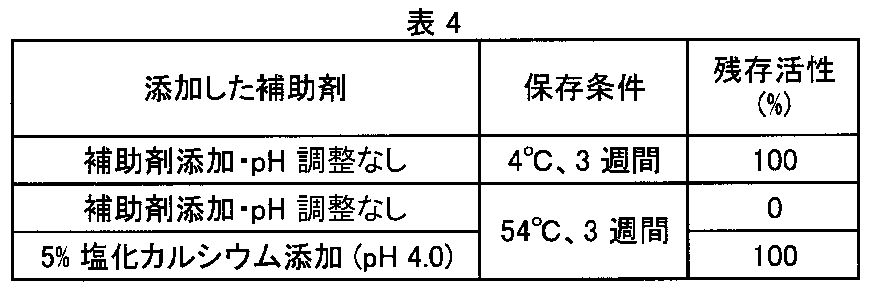
バチルス・アミロリケファシエンスAT-332(Bacillus amyloliquefaciens AT-332)株以外のバチルス(Bacillus)属の細菌について、同様の効果が得られるか否か検討した。
Bacillus subtilis QST-713 株(SDS社製インプレッションより分離)、Bacillus subtilis MBI-600株(出光興産社製ボトキラーより分離)、Bacillus subtilis HAI-0404株(日本曹達社製アグロケアから分離)及びBacillus amyloliquefaciens D747株(クミアイ化学工業社製エコショットより分離)の培養液に、塩化カルシウムを製剤中に終濃度5%になるように加え、pHを5Nの塩酸を用いて4.0に調整し、凍結乾燥した。その他の操作は実施例1と同じ手法により調製し、得られた製剤をキュウリうどんこ病に対して評価した。結果を表5に示す。

Claims (13)
- バチルス(Bacillus)属細菌の菌体乾燥物と塩化カルシウム及び/または硫酸マグネシウムを含有することを特徴とする微生物農薬組成物。
- バチルス(Bacillus)属細菌の菌体乾燥物と塩化カルシウムを含有する請求項1に記載の微生物農薬組成物。
- バチルス(Bacillus)属細菌の菌体乾燥物と硫酸マグネシウムを含有する請求項1に記載の微生物農薬組成物。
- 塩化カルシウム及び/または硫酸マグネシウムを1~5質量%含有する請求項1~3のいずれかに記載の微生物農薬組成物。
- バチルス(Bacillus)属細菌が、バチルス・サブティリス(Bacillus subtilis)、バチルス・アミロリケファシエンス(Bacillus amyloliquefaciens)、またはそれらの変異株である請求項1~4のいずれかに記載の微生物農薬組成物。
- バチルス(Bacillus)属細菌が、バチルス・アミロリケファシエンスAT-332(Bacillus amyloliquefaciens AT-332)株、またはその変異株である請求項1~5のいずれかに記載の微生物農薬組成物。
- バチルス(Bacillus)属細菌の培養液について、pHを3.0~5.0に調整する工程(pH調整工程)と、塩化カルシウム及び/または硫酸マグネシウムを混合する工程(混合工程)と、凍結乾燥またはスプレードライする工程(乾燥工程)を含む方法によって得られる請求項1~6のいずれかに記載の微生物農薬組成物。
- pH調整工程の後に混合工程を実施するか、pH調整工程と混合工程を同時に実施するか、または混合工程の後にpH調整工程を実施した後に乾燥工程を実施する方法によって得られる請求項7に記載の微生物農薬組成物。
- 農薬組成物を蒸留水に懸濁した懸濁水溶液のpHが3.0~5.0である請求項1~8のいずれかに記載の微生物農薬組成物。
- バチルス(Bacillus)属細菌の培養液について、pHを3.0~5.0に調整する工程(pH調整工程)と、塩化カルシウム及び/または硫酸マグネシウムを混合する工程(混合工程)と、凍結乾燥またはスプレードライする工程(乾燥工程)を含むことを特徴とする微生物農薬組成物の製造方法。
- pH調整工程の後に混合工程を実施するか、pH調整工程と混合工程を同時に実施するか、または混合工程の後にpH調整工程を実施した後に乾燥工程を実施する請求項10に記載の微生物農薬組成物の製造方法。
- バチルス(Bacillus)属細菌の培養液について、pHを3.0~5.0に調整する工程(pH調整工程)と、塩化カルシウム及び/または硫酸マグネシウムを混合する工程(混合工程)と、凍結乾燥またはスプレードライする工程(乾燥工程)を含むことを特徴とする微生物農薬の安定化方法。
- pH調整工程の後に混合工程を実施するか、pH調整工程と混合工程を同時に実施するか、または混合工程の後にpH調整工程を実施した後に乾燥工程を実施する請求項12に記載の微生物農薬の安定化方法。
Priority Applications (4)
| Application Number | Priority Date | Filing Date | Title |
|---|---|---|---|
| US15/302,695 US10111423B2 (en) | 2014-04-09 | 2015-04-07 | Microbial pesticide composition of dried Bacillus |
| CN201580018793.2A CN106231907B (zh) | 2014-04-09 | 2015-04-07 | 微生物农药组合物、其制造方法及微生物农药的稳定化方法 |
| KR1020167026176A KR101923413B1 (ko) | 2014-04-09 | 2015-04-07 | 미생물 농약 조성물, 그 제조 방법 및 미생물 농약의 안정화 방법 |
| JP2016512738A JP6539257B2 (ja) | 2014-04-09 | 2015-04-07 | 微生物農薬組成物、その製造方法及び微生物農薬の安定化方法 |
Applications Claiming Priority (2)
| Application Number | Priority Date | Filing Date | Title |
|---|---|---|---|
| JP2014080228 | 2014-04-09 | ||
| JP2014-080228 | 2014-04-09 |
Publications (1)
| Publication Number | Publication Date |
|---|---|
| WO2015156274A1 true WO2015156274A1 (ja) | 2015-10-15 |
Family
ID=54287850
Family Applications (1)
| Application Number | Title | Priority Date | Filing Date |
|---|---|---|---|
| PCT/JP2015/060816 Ceased WO2015156274A1 (ja) | 2014-04-09 | 2015-04-07 | 微生物農薬組成物、その製造方法及び微生物農薬の安定化方法 |
Country Status (5)
| Country | Link |
|---|---|
| US (1) | US10111423B2 (ja) |
| JP (2) | JP6539257B2 (ja) |
| KR (1) | KR101923413B1 (ja) |
| CN (1) | CN106231907B (ja) |
| WO (1) | WO2015156274A1 (ja) |
Cited By (5)
| Publication number | Priority date | Publication date | Assignee | Title |
|---|---|---|---|---|
| JP2017176067A (ja) * | 2016-03-31 | 2017-10-05 | シーシーアイ株式会社 | 生菌製剤の製造方法、ならびに生菌製剤およびこれを用いた排水処理方法 |
| JP2020515569A (ja) * | 2017-03-27 | 2020-05-28 | テンフォールド テクノロジーズ リミティッド ライアビリティ カンパニー | 植物病を予防又は制御するための方法及び農業用組成物 |
| JP2022502404A (ja) * | 2018-09-28 | 2022-01-11 | バイエル・アクチエンゲゼルシヤフト | 細菌の生物学的防除剤と脂肪酸の併用 |
| CN116121123A (zh) * | 2022-12-09 | 2023-05-16 | 青岛农业大学 | 一株贝莱斯芽孢杆菌及其在葡萄灰霉病和葡萄保鲜中的应用 |
| US12274732B2 (en) | 2017-03-27 | 2025-04-15 | Tenfold Technologies, LLC | Anti-pathogen composition and methods of use thereof |
Families Citing this family (9)
| Publication number | Priority date | Publication date | Assignee | Title |
|---|---|---|---|---|
| KR20210078504A (ko) * | 2018-10-18 | 2021-06-28 | 이데미쓰 고산 가부시키가이샤 | 바실러스·푸밀러스 ks-c4주의 액체 배양물을 사용한 식물 잔류물 분해제 |
| KR102248585B1 (ko) * | 2019-12-06 | 2021-05-06 | (주)제일그린산업 | 고사리 신규 마름병균의 길항 미생물을 이용한 천연 미생물 방제제 개발 |
| CN112553129B (zh) * | 2020-12-30 | 2022-05-20 | 山西农业大学 | 一株贝莱斯芽孢杆菌ln9-2及其应用 |
| CN114763311A (zh) * | 2022-03-25 | 2022-07-19 | 中诚国联(河南)生物科技有限公司 | 一种防治果蔬细菌病害的复合微生物菌剂及其制备方法和应用 |
| CN115594542B (zh) * | 2022-08-16 | 2024-03-12 | 南京农业大学 | 一种芽孢杆菌Bacillus sp.Za的菌剂保护剂及其应用 |
| WO2024075782A1 (ja) * | 2022-10-05 | 2024-04-11 | 住友化学株式会社 | 安定化有害生物防除剤、及び、安定化有害生物防除剤の製造方法 |
| KR102801856B1 (ko) * | 2022-11-14 | 2025-05-14 | 주식회사 푸르네 | 미생물 농약용 배지에서 배양된 포자를 이용한 미생물 농약 및 그 제조방법 |
| KR102939685B1 (ko) * | 2023-03-08 | 2026-03-17 | (주) 제일그린산업 | 벼 키다리 및 줄기마름 증상을 일으키는 두 가지 형태 병원균 푸자리움 후지쿠로이의 길항 미생물을 이용한 키다리병 생물적 방제제 개발 |
| CN119344151B (zh) * | 2024-12-23 | 2025-04-04 | 湖南省植物园 | 一种利用微生物菌肥防治青钱柳病害的栽培方法 |
Citations (8)
| Publication number | Priority date | Publication date | Assignee | Title |
|---|---|---|---|---|
| JPS60180588A (ja) * | 1984-02-27 | 1985-09-14 | Sumitomo Ringyo Kk | 植物病原菌防除活性のある微生物の固定化複合体の製造法 |
| JPH08175919A (ja) * | 1994-12-20 | 1996-07-09 | Idemitsu Kosan Co Ltd | バチルス属胞子画分及びその胞子画分を利用する植物病害防除法 |
| JP2004035421A (ja) * | 2002-06-28 | 2004-02-05 | Idemitsu Kosan Co Ltd | 保存安定性のよい微生物農薬 |
| US20100272701A1 (en) * | 2007-01-17 | 2010-10-28 | Bion Tech Inc. | Method for producing bactericide or soil conditioner containing bacillus subtilis |
| JP2012527898A (ja) * | 2009-05-26 | 2012-11-12 | アドバンスド バイオニュートリション コーポレーション | 生物学的に活性な微生物および/または生物活性材料を含む安定な乾燥粉末組成物およびその製造方法 |
| WO2012161160A1 (ja) * | 2011-05-26 | 2012-11-29 | 株式会社エス・ディー・エス バイオテック | バチルス属に属する菌株、微生物製剤、及び植物の栽培方法 |
| CN102919272A (zh) * | 2012-11-07 | 2013-02-13 | 湖北省生物农药工程研究中心 | 一种枯草芽孢杆菌水分散粒剂及其制备方法 |
| CN104247717A (zh) * | 2013-06-25 | 2014-12-31 | 中国科学院沈阳应用生态研究所 | 一种抑制植物病虫害的微生物菌剂及其制备方法和应用 |
Family Cites Families (9)
| Publication number | Priority date | Publication date | Assignee | Title |
|---|---|---|---|---|
| JPS60180589A (ja) * | 1984-02-27 | 1985-09-14 | Sumitomo Ringyo Kk | 植物病原菌防除活性のある固定化微生物複合体の製造法 |
| JP3801378B2 (ja) | 1999-03-16 | 2006-07-26 | セントラル硝子株式会社 | 微生物農薬製剤中の微生物の保存性の安定化方法および微生物農薬製剤 |
| JP3614700B2 (ja) | 1999-03-16 | 2005-01-26 | セントラル硝子株式会社 | 微生物農薬製剤およびその製造方法 |
| JP2005325077A (ja) | 2004-05-17 | 2005-11-24 | Mitsui Chemicals Inc | シュードモナス属細菌の固定化物及びその固定化方法、及びその固定化物から成る、植物の地上部病害防除剤の製剤化方法 |
| JP5193626B2 (ja) | 2008-02-20 | 2013-05-08 | 日本曹達株式会社 | 微生物農薬製剤の保存方法 |
| JP5302653B2 (ja) | 2008-12-18 | 2013-10-02 | 北興化学工業株式会社 | 保存安定性の改良された微生物農薬製剤 |
| EP2468850A4 (en) * | 2009-08-19 | 2013-02-20 | Takara Bio Inc | CELL PRESERVATION PROCESS |
| JP5602463B2 (ja) | 2010-03-09 | 2014-10-08 | 日本曹達株式会社 | 微生物農薬組成物および汚れの少ない農作物の生産方法 |
| CN103483073B (zh) * | 2013-09-14 | 2015-01-07 | 青岛深蓝肥业有限公司 | 花生专用复合微生物菌肥及其生产方法 |
-
2015
- 2015-04-07 CN CN201580018793.2A patent/CN106231907B/zh active Active
- 2015-04-07 US US15/302,695 patent/US10111423B2/en active Active
- 2015-04-07 JP JP2016512738A patent/JP6539257B2/ja active Active
- 2015-04-07 KR KR1020167026176A patent/KR101923413B1/ko active Active
- 2015-04-07 WO PCT/JP2015/060816 patent/WO2015156274A1/ja not_active Ceased
-
2019
- 2019-04-26 JP JP2019084882A patent/JP6752327B2/ja active Active
Patent Citations (8)
| Publication number | Priority date | Publication date | Assignee | Title |
|---|---|---|---|---|
| JPS60180588A (ja) * | 1984-02-27 | 1985-09-14 | Sumitomo Ringyo Kk | 植物病原菌防除活性のある微生物の固定化複合体の製造法 |
| JPH08175919A (ja) * | 1994-12-20 | 1996-07-09 | Idemitsu Kosan Co Ltd | バチルス属胞子画分及びその胞子画分を利用する植物病害防除法 |
| JP2004035421A (ja) * | 2002-06-28 | 2004-02-05 | Idemitsu Kosan Co Ltd | 保存安定性のよい微生物農薬 |
| US20100272701A1 (en) * | 2007-01-17 | 2010-10-28 | Bion Tech Inc. | Method for producing bactericide or soil conditioner containing bacillus subtilis |
| JP2012527898A (ja) * | 2009-05-26 | 2012-11-12 | アドバンスド バイオニュートリション コーポレーション | 生物学的に活性な微生物および/または生物活性材料を含む安定な乾燥粉末組成物およびその製造方法 |
| WO2012161160A1 (ja) * | 2011-05-26 | 2012-11-29 | 株式会社エス・ディー・エス バイオテック | バチルス属に属する菌株、微生物製剤、及び植物の栽培方法 |
| CN102919272A (zh) * | 2012-11-07 | 2013-02-13 | 湖北省生物农药工程研究中心 | 一种枯草芽孢杆菌水分散粒剂及其制备方法 |
| CN104247717A (zh) * | 2013-06-25 | 2014-12-31 | 中国科学院沈阳应用生态研究所 | 一种抑制植物病虫害的微生物菌剂及其制备方法和应用 |
Non-Patent Citations (1)
| Title |
|---|
| YANEZ-MENDIZABAL ET AL.: "Formulation development of the biocontrol agent Bacillus subtilis strain CPA-8 by spray-drying", JOURNAL OF APPLIED MICROBIOLOGY, vol. 112, no. 5, 2012, pages 954 - 965, XP055230197, ISSN: 1364-5072 * |
Cited By (9)
| Publication number | Priority date | Publication date | Assignee | Title |
|---|---|---|---|---|
| JP2017176067A (ja) * | 2016-03-31 | 2017-10-05 | シーシーアイ株式会社 | 生菌製剤の製造方法、ならびに生菌製剤およびこれを用いた排水処理方法 |
| JP2020515569A (ja) * | 2017-03-27 | 2020-05-28 | テンフォールド テクノロジーズ リミティッド ライアビリティ カンパニー | 植物病を予防又は制御するための方法及び農業用組成物 |
| JP7084414B2 (ja) | 2017-03-27 | 2022-06-14 | テンフォールド テクノロジーズ リミティッド ライアビリティ カンパニー | 植物病を予防又は制御するための方法及び農業用組成物 |
| US11920125B2 (en) | 2017-03-27 | 2024-03-05 | Tenfold Technologies, LLC | Methods and agricultural compositions for preventing or controlling plant diseases |
| US12274732B2 (en) | 2017-03-27 | 2025-04-15 | Tenfold Technologies, LLC | Anti-pathogen composition and methods of use thereof |
| JP2022502404A (ja) * | 2018-09-28 | 2022-01-11 | バイエル・アクチエンゲゼルシヤフト | 細菌の生物学的防除剤と脂肪酸の併用 |
| US12538926B2 (en) | 2018-09-28 | 2026-02-03 | Bayer Aktiengesellschaft | Combination of bacterial biological control agent and fatty acids |
| CN116121123A (zh) * | 2022-12-09 | 2023-05-16 | 青岛农业大学 | 一株贝莱斯芽孢杆菌及其在葡萄灰霉病和葡萄保鲜中的应用 |
| CN116121123B (zh) * | 2022-12-09 | 2024-04-09 | 青岛农业大学 | 一株贝莱斯芽孢杆菌及其在葡萄灰霉病和葡萄保鲜中的应用 |
Also Published As
| Publication number | Publication date |
|---|---|
| JP2019131613A (ja) | 2019-08-08 |
| JPWO2015156274A1 (ja) | 2017-04-13 |
| KR20160122848A (ko) | 2016-10-24 |
| CN106231907A (zh) | 2016-12-14 |
| JP6752327B2 (ja) | 2020-09-09 |
| CN106231907B (zh) | 2019-10-18 |
| US20170027166A1 (en) | 2017-02-02 |
| US10111423B2 (en) | 2018-10-30 |
| JP6539257B2 (ja) | 2019-07-03 |
| KR101923413B1 (ko) | 2018-11-29 |
Similar Documents
| Publication | Publication Date | Title |
|---|---|---|
| JP6752327B2 (ja) | 微生物農薬組成物、その製造方法及び微生物農薬の安定化方法 | |
| Anand et al. | Integrated control of fruit rot and powdery mildew of chilli using the biocontrol agent Pseudomonas fluorescens and a chemical fungicide | |
| KR101227714B1 (ko) | 신규 페니바실러스 속 균주 및 이들 균주 또는 이의 배양물질을 이용한 식물 병해 방제 | |
| JP2022501395A (ja) | バシラス・アミロリクエファシエンスfcc1256組成物および植物病原菌の防除方法 | |
| WO2012161160A1 (ja) | バチルス属に属する菌株、微生物製剤、及び植物の栽培方法 | |
| JP6276492B1 (ja) | 農園芸用殺菌組成物及び植物病害防除方法 | |
| KR101884637B1 (ko) | 식물 병해 방제제 | |
| CN106062175B (zh) | 新型微生物及其用途 | |
| US11903388B2 (en) | Lichen compounds that inhibit mycotoxin production | |
| TW201605348A (zh) | 細黃鏈黴菌菌株及其用於控制植物疾症及有害生物之方法 | |
| CN107041384B (zh) | 一种含解淀粉芽孢杆菌和嘧菌酯的杀菌组合物及其应用 | |
| JPH08175921A (ja) | 農園芸用殺菌剤組成物 | |
| WO2026067309A1 (zh) | 一株芽孢杆菌、由该芽孢杆菌制成的生防菌剂及其应用 | |
| WO2009113648A1 (ja) | 農園芸植物の病虫害防除剤 | |
| JP2006096753A (ja) | 植物の病害を防除する農園芸用殺菌剤組成物 | |
| JPH0551305A (ja) | バチルス属に属するsc−3菌株による植物病害防除方法および使用される細菌 | |
| JP4737671B2 (ja) | 農園芸用殺菌剤組成物 | |
| JP2011223990A (ja) | 凍結乾燥菌体の製造方法 | |
| JP3527557B2 (ja) | 農園芸用殺菌剤組成物 | |
| JPH0551397A (ja) | 環状ペプチド系化合物、その製造法およびそれを有効成分として含有する抗かび剤ならびに培養物 | |
| JP2003277210A (ja) | バチルス属細菌による植物病害防除剤およびその防除方法 | |
| JP4605999B2 (ja) | 農園芸用殺菌剤組成物 | |
| JP2018139533A (ja) | ディシーマ・プルビナータ(Dicyma pulvinata)を用いた植物病害防除資材 | |
| WO2022239840A1 (ja) | 植物保護能を有する微生物の保存 | |
| CN105191950A (zh) | 杀菌组合物及其应用 |
Legal Events
| Date | Code | Title | Description |
|---|---|---|---|
| 121 | Ep: the epo has been informed by wipo that ep was designated in this application |
Ref document number: 15777088 Country of ref document: EP Kind code of ref document: A1 |
|
| ENP | Entry into the national phase |
Ref document number: 2016512738 Country of ref document: JP Kind code of ref document: A |
|
| ENP | Entry into the national phase |
Ref document number: 20167026176 Country of ref document: KR Kind code of ref document: A |
|
| WWE | Wipo information: entry into national phase |
Ref document number: 15302695 Country of ref document: US |
|
| NENP | Non-entry into the national phase |
Ref country code: DE |
|
| 122 | Ep: pct application non-entry in european phase |
Ref document number: 15777088 Country of ref document: EP Kind code of ref document: A1 |