WO2015115658A1 - アクリル系接着剤の反応率測定方法、及びアクリル系接着剤 - Google Patents
アクリル系接着剤の反応率測定方法、及びアクリル系接着剤 Download PDFInfo
- Publication number
- WO2015115658A1 WO2015115658A1 PCT/JP2015/052928 JP2015052928W WO2015115658A1 WO 2015115658 A1 WO2015115658 A1 WO 2015115658A1 JP 2015052928 W JP2015052928 W JP 2015052928W WO 2015115658 A1 WO2015115658 A1 WO 2015115658A1
- Authority
- WO
- WIPO (PCT)
- Prior art keywords
- group
- acrylic adhesive
- reaction rate
- compound
- fluorene
- Prior art date
- Legal status (The legal status is an assumption and is not a legal conclusion. Google has not performed a legal analysis and makes no representation as to the accuracy of the status listed.)
- Ceased
Links
Images


Classifications
-
- G—PHYSICS
- G01—MEASURING; TESTING
- G01N—INVESTIGATING OR ANALYSING MATERIALS BY DETERMINING THEIR CHEMICAL OR PHYSICAL PROPERTIES
- G01N30/00—Investigating or analysing materials by separation into components using adsorption, absorption or similar phenomena or using ion-exchange, e.g. chromatography or field flow fractionation
- G01N30/02—Column chromatography
- G01N30/88—Integrated analysis systems specially adapted therefor, not covered by a single one of the groups G01N30/04 - G01N30/86
-
- C—CHEMISTRY; METALLURGY
- C09—DYES; PAINTS; POLISHES; NATURAL RESINS; ADHESIVES; COMPOSITIONS NOT OTHERWISE PROVIDED FOR; APPLICATIONS OF MATERIALS NOT OTHERWISE PROVIDED FOR
- C09J—ADHESIVES; NON-MECHANICAL ASPECTS OF ADHESIVE PROCESSES IN GENERAL; ADHESIVE PROCESSES NOT PROVIDED FOR ELSEWHERE; USE OF MATERIALS AS ADHESIVES
- C09J133/00—Adhesives based on homopolymers or copolymers of compounds having one or more unsaturated aliphatic radicals, each having only one carbon-to-carbon double bond, and at least one being terminated by only one carboxyl radical, or of salts, anhydrides, esters, amides, imides, or nitriles thereof; Adhesives based on derivatives of such polymers
- C09J133/04—Homopolymers or copolymers of esters
-
- C—CHEMISTRY; METALLURGY
- C09—DYES; PAINTS; POLISHES; NATURAL RESINS; ADHESIVES; COMPOSITIONS NOT OTHERWISE PROVIDED FOR; APPLICATIONS OF MATERIALS NOT OTHERWISE PROVIDED FOR
- C09J—ADHESIVES; NON-MECHANICAL ASPECTS OF ADHESIVE PROCESSES IN GENERAL; ADHESIVE PROCESSES NOT PROVIDED FOR ELSEWHERE; USE OF MATERIALS AS ADHESIVES
- C09J133/00—Adhesives based on homopolymers or copolymers of compounds having one or more unsaturated aliphatic radicals, each having only one carbon-to-carbon double bond, and at least one being terminated by only one carboxyl radical, or of salts, anhydrides, esters, amides, imides, or nitriles thereof; Adhesives based on derivatives of such polymers
- C09J133/04—Homopolymers or copolymers of esters
- C09J133/06—Homopolymers or copolymers of esters of esters containing only carbon, hydrogen and oxygen, the oxygen atom being present only as part of the carboxyl radical
-
- C—CHEMISTRY; METALLURGY
- C09—DYES; PAINTS; POLISHES; NATURAL RESINS; ADHESIVES; COMPOSITIONS NOT OTHERWISE PROVIDED FOR; APPLICATIONS OF MATERIALS NOT OTHERWISE PROVIDED FOR
- C09J—ADHESIVES; NON-MECHANICAL ASPECTS OF ADHESIVE PROCESSES IN GENERAL; ADHESIVE PROCESSES NOT PROVIDED FOR ELSEWHERE; USE OF MATERIALS AS ADHESIVES
- C09J9/00—Adhesives characterised by their physical nature or the effects produced, e.g. glue sticks
- C09J9/02—Electrically-conducting adhesives
-
- G—PHYSICS
- G01—MEASURING; TESTING
- G01N—INVESTIGATING OR ANALYSING MATERIALS BY DETERMINING THEIR CHEMICAL OR PHYSICAL PROPERTIES
- G01N30/00—Investigating or analysing materials by separation into components using adsorption, absorption or similar phenomena or using ion-exchange, e.g. chromatography or field flow fractionation
- G01N30/02—Column chromatography
- G01N30/04—Preparation or injection of sample to be analysed
-
- G—PHYSICS
- G01—MEASURING; TESTING
- G01N—INVESTIGATING OR ANALYSING MATERIALS BY DETERMINING THEIR CHEMICAL OR PHYSICAL PROPERTIES
- G01N30/00—Investigating or analysing materials by separation into components using adsorption, absorption or similar phenomena or using ion-exchange, e.g. chromatography or field flow fractionation
- G01N30/02—Column chromatography
- G01N30/62—Detectors specially adapted therefor
- G01N30/74—Optical detectors
-
- G—PHYSICS
- G01—MEASURING; TESTING
- G01N—INVESTIGATING OR ANALYSING MATERIALS BY DETERMINING THEIR CHEMICAL OR PHYSICAL PROPERTIES
- G01N30/00—Investigating or analysing materials by separation into components using adsorption, absorption or similar phenomena or using ion-exchange, e.g. chromatography or field flow fractionation
- G01N30/02—Column chromatography
- G01N30/88—Integrated analysis systems specially adapted therefor, not covered by a single one of the groups G01N30/04 - G01N30/86
- G01N2030/8809—Integrated analysis systems specially adapted therefor, not covered by a single one of the groups G01N30/04 - G01N30/86 analysis specially adapted for the sample
- G01N2030/884—Integrated analysis systems specially adapted therefor, not covered by a single one of the groups G01N30/04 - G01N30/86 analysis specially adapted for the sample organic compounds
- G01N2030/8854—Integrated analysis systems specially adapted therefor, not covered by a single one of the groups G01N30/04 - G01N30/86 analysis specially adapted for the sample organic compounds involving hydrocarbons
Definitions
- the present invention relates to a method for measuring a reaction rate of an acrylic adhesive containing a radical polymerizable compound, and an acrylic adhesive.
- anisotropic conductive films are widely used as electric circuit materials.
- ACF Anisotropic Conductive Film
- anisotropic conductive connection in order to connect many electrodes at once and uniformly, there is a difference in the reaction rate between the electrodes with relatively high thermal conductivity and between the electrodes with relatively low thermal conductivity. Seems to occur.
- the present invention has been proposed in view of such a conventional situation.
- a reaction rate measuring method capable of accurately measuring a reaction rate of an acrylic adhesive even with a small amount of sample, and an acrylic adhesive. provide.
- reaction rate can be accurately measured even with a very small amount of sample by using a compound having a fluorene skeleton as an internal standard substance.
- the reaction rate measurement method uses a compound having a fluorene skeleton represented by the following formula (1) as an internal standard substance, separates a sample solution containing an acrylic adhesive by liquid chromatography, and detects ultraviolet rays. An unreacted radical polymerizable compound is detected by a vessel.
- R 1 is a group selected from the group consisting of a hydrogen atom, an alkyl group having 1 to 3 carbon atoms, and an alkoxy group having 1 to 3 carbon atoms
- R 2 is a hydroxyl group, having 1 to 3 carbon atoms.
- the acrylic adhesive according to the present invention is characterized by containing a compound having a fluorene skeleton represented by the formula (1), a radical polymerizable compound, and a reaction initiator.
- the anisotropic conductive adhesive according to the present invention is characterized in that conductive particles are dispersed in the acrylic adhesive.
- the compound having a fluorene skeleton exhibits high sensitivity to the ultraviolet detector, the reaction rate can be accurately measured even with a very small amount of sample. Further, since the compound having a fluorene skeleton does not participate in the curing reaction of the acrylic adhesive, it can be blended in advance with the acrylic adhesive.
- FIG. 1 is a chromatogram showing an example of an analysis result of an acrylic adhesive before curing.
- FIG. 2 is a chromatogram showing an example of the analysis result of the acrylic adhesive after curing.
- Method for measuring reaction rate of acrylic adhesive In the method for measuring the reaction rate of an acrylic adhesive according to the present embodiment, a compound having a fluorene skeleton represented by the following formula (1) is used as an internal standard substance, and a sample solution containing the acrylic adhesive is subjected to liquid chromatography. Separate and detect unreacted radical polymerizable compound by ultraviolet detector.
- BPEF bisphenoxyethanol fluorene
- BCF biscresol fluorene
- BHT dibutylhydroxytoluene
- BTZ benzotriazole
- BHT has low versatility because the peak detection position overlaps with bisphenoxyethanol fluorene acrylate (BPEFA) and BTZ with 4-hydroxybutyl acrylate (4-HBA).
- Liquid chromatography is high-performance liquid chromatography (HPLC: High Performance Liquid Chromatography), and the sample solution is passed through a separation column packed with a separation agent, and the difference in distribution to the separation agent, the degree of ease of adsorption, etc. Is separated into a plurality of components.
- HPLC High Performance Liquid Chromatography
- the separating agent examples include silica gel having a particle size of about 2 to 30 ⁇ m for HPLC, chemically bonded silica gel bonded with a group such as octadecyl group, cyanopropyl group, porous polymer, ion exchange resin, and the like. Can do.
- the ultraviolet detector is not particularly limited as long as it irradiates the sample solution with ultraviolet light and measures the absorbance of the sample solution, and an ultraviolet absorbance detector that is widely used for analysis by HPLC should be used. Can do.
- a predetermined amount of a compound having a fluorene skeleton may be added to an acrylic adhesive in advance, or a predetermined amount of a compound having a fluorene skeleton may be added to a sample solution of the acrylic adhesive.
- a solvent for dissolving the acrylic adhesive acetonitrile, acetone or the like can be used.
- FIG. 1 and FIG. 2 are chromatograms showing examples of the analysis results of the acrylic adhesive before and after curing, respectively.
- the peak intensity of the chromatogram obtained by the ultraviolet detector is usually represented by the peak area or peak height.
- a method for calculating the reaction rate based on the peak height will be described.
- the strength ratio between the internal standard substance and the unreacted monomer is determined from the chromatograms of the acrylic adhesive before curing and the acrylic adhesive after complete curing.
- the curing rate is 0% before curing and complete curing.
- a relationship line between the intensity ratio and the reaction rate is created.
- the intensity ratio between the internal standard substance and the unreacted monomer can be obtained from the chromatogram of the unknown sample, and the reaction rate can be obtained from the created relationship line.
- reaction rate can be accurately measured even with a small amount of sample.
- the acrylic adhesive according to the present embodiment contains a compound having a fluorene skeleton represented by the following formula (1), a radical polymerizable compound, and a reaction initiator.
- an anisotropic conductive adhesive in which conductive particles are dispersed in an acrylic adhesive will be described. Even if the compound having a fluorene skeleton represented by the formula (1) is blended in an anisotropic conductive adhesive, it does not decompose during thermocompression bonding and does not participate in the curing reaction. High sensitivity can be shown to the detector. For this reason, if this anisotropic conductive adhesive is used, the reaction rate of minute regions on the electrodes and between the electrodes can be accurately measured.
- the compounding amount of the compound having a fluorene skeleton is preferably 0.01 wt% or more and 5.0 wt% or less, and more preferably 0.2 wt% or more and 1.0 wt% or less.
- the blending amount is too small, the measurement peak becomes small and does not function as an internal standard substance.
- the blending amount is too large, the characteristics as an anisotropic conductive film are deteriorated.
- radical polymerizable compound a monofunctional (meth) acrylate monomer, a polyfunctional (meth) acrylate monomer, or a modified monofunctional in which an epoxy group, a urethane group, an amino group, an ethylene oxide group, a propylene oxide group, or the like is introduced, Alternatively, a polyfunctional (meth) acrylate monomer can be used. Moreover, the radically polymerizable compound can be used in any state of a monomer or an oligomer, and a monomer and an oligomer can be used in combination.
- Examples of the (meth) acrylate monomer include (meth) acrylate resins having at least one (meth) acryloyl group in one molecule and modified products thereof.
- Examples of the modified products include tetrahydrofurfuryl acrylate, isobornyl acrylate, methyl methacryl acrylate, ethyl methacryl acrylate, tricyclodecane dimethanol diacrylate, tricyclodecane dimethanol dimethacrylate, ethoxylated bisphenol A diacrylate, Examples include propoxylated bisphenol A diacrylate, pentaerythritol triacrylate, and ethoxylated isocyanuric acid triacrylate. You may use these 1 type or in mixture of 2 or more types.
- an organic peroxide As the reaction initiator, an organic peroxide, a photo radical polymerization initiator, or the like can be used.
- an organic peroxide 1 type (s) or 2 or more types can be used from diacyl peroxide, dialkyl peroxide, peroxy dicarbonate, peroxy ester, peroxy ketal, hydroperoxide, silyl peroxide, and the like.
- Photo radical polymerization initiators include benzoin ethers such as benzoin ethyl ether and isopropyl benzoin ether, benzyl ketals such as benzyl and hydroxycyclohexyl phenyl ketone, ketones such as benzophenone and acetophenone and derivatives thereof, thioxanthones, and bisimidazoles. 1 type, or 2 or more types can be used from these.
- conductive particles used in conventional anisotropic conductive films can be used.
- metal particles such as gold particles, silver particles and nickel particles, resins such as benzoguanamine resins and styrene resins.
- Metal-coated resin particles whose surfaces are coated with a metal such as gold, nickel, or zinc can be used.
- the average particle size of such conductive particles is usually 1 to 10 ⁇ m, more preferably 2 to 6 ⁇ m.
- the anisotropic conductive adhesive may contain a film-forming resin, a silane coupling agent, a phosphate ester, an inorganic filler, a stress relaxation agent, and the like.
- the film-forming resin include phenoxy resin, polyvinyl acetal resin, polyvinyl butyral resin, alkylated cellulose resin, polyester resin, acrylic resin, styrene resin, urethane resin, and polyethylene terephthalate resin.
- silane coupling agents include ⁇ -glycidpropyltrimethoxysilane, ⁇ -mercaptopropyltrimethoxysilane, ⁇ -aminopropyltriethoxysilane, ⁇ -ureidopropyltriethoxysilane, N- ⁇ -aminoethyl- ⁇ -amino.
- Examples thereof include propyltrimethoxysilane and ⁇ -methacryloxypropyltrimethoxysilane.
- Example> Examples of the present invention will be described below.
- bisphenol ethanol fluorene (BPEF) was used as an internal standard substance
- the reaction rate of the acrylic anisotropic conductive adhesive was measured by HPLC (High performance liquid chromatography), and the standard deviation was evaluated.
- the standard deviation of the reaction rate measured by DSC (Differential scanning calorimetry) and FT-IR (Fourier Transform Infrared Spectroscopy) was also evaluated.
- DSC Different scanning calorimetry
- FT-IR Fastier Transform Infrared Spectroscopy
- An anisotropic conductive film and a mounting body were produced as follows.
- anisotropic conductive adhesive having the following composition was used.
- the formulation is 40 parts by mass of phenoxy resin (trade name: YP50, Nippon Steel & Sumikin Chemical Co., Ltd.), 40 parts by mass of polyurethane (trade name: N-5196, Nippon Polyurethane Industry Co., Ltd.), phosphate ester (trade name: PM -2, Nippon Kayaku Co., Ltd.) 2 parts by weight, Silane coupling agent (trade name: A-187, Momentive Performance Materials Co., Ltd.) 2 parts by weight, bifunctional acrylate (trade name: DCP, Shin Nakamura) Chemical Industry Co., Ltd.) 3 parts by mass, acrylic ester (trade name: SG-P3, (Nagase Chemtex Co., Ltd.) 5 parts by mass, diacyl peroxide (trade name: Parroyl L, Nippon Oil & Fats Co., Ltd.) 5 parts by mass And a total of 100 parts
- a glass substrate ITO solid glass, 10 ⁇ / ⁇ , 0.7 mmt
- An anisotropic conductive film was affixed on a glass substrate and heated and pressurized under the conditions of 45 ° C., 1 MPa, and 2 seconds, and then the PET was peeled off and temporarily bonded.
- An FPC was placed on the anisotropic conductive film and heated and pressed under the conditions of a predetermined temperature, 2 MPa, and 5 seconds to obtain a mounted body.
- HPLC HPLC
- Waters UPLC UV detector connection
- a 0.005 mg sample for measurement was dissolved in acetonitrile, and this was injected into a separation column (10 cm, 40 ° C.) to obtain a chromatogram.
- the analysis conditions were as follows.
- the measured intensity ratio between BPEF and acrylic monomer was determined from the obtained chromatogram, and the reaction rate was determined from the relationship line between the measured intensity ratio between BPEF and acrylic monomer prepared in advance and the reaction rate. The above operation was repeated three times.
- the measurement results of the reaction rate when the pressure bonding temperature is 130 ° C. are 78.5% for the first time, 79.4% for the second time, and 79.2% for the third time, and the standard deviation is 0.4726.
- the measurement results of the reaction rate when the pressure bonding temperature is 140 ° C. are 86.3% for the first time, 86.8% for the second time, and 85.2% for the third time, and the standard deviation is 0.8185. It was.
- the measurement results of the reaction rate when the pressure bonding temperature was 150 ° C. were 91.1% for the first time, 92.0% for the second time, and 91.0% for the third time, and the standard deviation was 0.5508.
- An uncured (before crimping) sample was used as a reference.
- the difference between the calorific value of the uncured sample and the calorific value of the unknown sample after pressure bonding was determined, and the calorific value of the uncured sample was taken as 1, and the reaction rate of the unknown sample was calculated.
- the emitted-heat amount was calculated
- the measurement results of the reaction rate when the pressure bonding temperature is 130 ° C. are 72.0% for the first time, 83.2% for the second time, and 75.7% for the third time, and the standard deviation is 5.7064.
- the measurement results of the reaction rate when the pressure bonding temperature is 140 ° C. are 82.6% for the first time, 78.9% for the second time, and 88.1% for the third time, and the standard deviation is 4.6293. It was.
- the measurement results of the reaction rate when the pressure bonding temperature was 150 ° C. were 94.2% for the first time, 86.8% for the second time, and 90.2% for the third time, and the standard deviation was 3.7041.
- FT-IR Using a Fourier transform infrared spectrophotometer (FT / IR-4100, manufactured by JASCO Corporation), 0.02 mg of a measurement sample was measured by the transmission method.
- the reaction rate of the unknown sample was calculated from the ratio of the measured strength of the acrylic monomer (unsaturated group) of the uncured (before pressure bonding) sample to the measured strength of the acrylic monomer (unsaturated group) of the unknown sample after pressure bonding. .
- the measurement results of the reaction rate when the pressure bonding temperature is 130 ° C. are the first time 68.7%, the second time 79.6%, and the third time 74.2%, and the standard deviation is 5.4501.
- the measurement results of the reaction rate when the pressure bonding temperature is 140 ° C. are 77.8% for the first time, 82.0% for the second time, and 89.7% for the third time, and the standard deviation is 6.0352. It was.
- the measurement results of the reaction rate when the pressure bonding temperature was 150 ° C. were 88.8% for the first time, 87.3% for the second time, and 93.8% for the third time, and the standard deviation was 3.4034.
- a mounting body was prepared using an anisotropic conductive film containing 0.5 wt% of BPEF, and then the reaction rate of the anisotropic conductive film was measured using HPLC.
- the FPC is peeled off from the mounting body, and the measurement sample on the wiring of 2.0 mm ⁇ 0.2 mm, the measurement sample of the inter-wiring measurement of 2.0 mm ⁇ 0.2 mm, and the measurement sample on the wiring and between the wirings Sampling was performed.
- HPLC HPLC
- Waters UPLC UV detector connection
- a 0.005 mg sample for measurement was dissolved in acetonitrile, and this was injected into a separation column (10 cm, 40 ° C.) to obtain a chromatogram.
- the analysis conditions were as follows.
- the measured intensity ratio between BPEF and acrylic monomer was determined from the obtained chromatogram, and the reaction rate was determined from the relationship line between the measured intensity ratio between BPEF and acrylic monomer prepared in advance and the reaction rate. The above operation was repeated a total of 3 times to obtain an average value.
- an environmental test 60 ° C., 95%, 500 hr was performed on the mounting body manufactured using the anisotropic conductive film containing 0.5 wt% of BPEF, and the conduction resistance was measured.
- the conduction resistance was measured by a 4-terminal method using a digital multimeter (digital multimeter 7561, manufactured by Yokogawa Electric Corporation).
- the reliability test was evaluated as “NG” when the conduction resistance was 3 ⁇ or more and “OK” when the conduction resistance was less than 3 ⁇ .
- the evaluation of the appearance of the anisotropic conductive film part of the mounting body was visually observed as “ ⁇ ” when there was no bubble, “ ⁇ ” when there was a small bubble, “ ⁇ ” when there was a large bubble, and floating. The case was set as “x”.
- the peel strength (JIS K6854) of the mounted body is evaluated as “ ⁇ ”when the 90 ° peel strength is 10 N / 25 mm or more, and“ ⁇ ”when the 90 ° peel strength is 8 N / 25 mm or more and less than 10 N / 25 mm.
- the evaluation of indentation is “ ⁇ ” when the conduction resistance of the mounting body is 1 ⁇ or less, “ ⁇ ” when it is 1 ⁇ or more and less than 2 ⁇ , “ ⁇ ” when it is 2 ⁇ or more and less than 5 ⁇ , “ ⁇ ”, 5 ⁇ or more The thing which is made into "x”.
- the conduction resistance was measured by a 4-terminal method using a digital multimeter (digital multimeter 7561, manufactured by Yokogawa Electric Corporation).
- the blending amount is preferably 0.01 wt% or more and 5.0 wt% or less, and 0.2 wt% or more and 1. It turned out that it is more preferable that it is 0 wt% or less. It has been found that when the blending amount of BPEF increases, the ease of measurement is improved, but bubbles are generated in the ACF at the time of pressure bonding, and the peel strength and indentability are deteriorated.
Landscapes
- Chemical & Material Sciences (AREA)
- Organic Chemistry (AREA)
- Physics & Mathematics (AREA)
- General Physics & Mathematics (AREA)
- Health & Medical Sciences (AREA)
- Life Sciences & Earth Sciences (AREA)
- Analytical Chemistry (AREA)
- Biochemistry (AREA)
- General Health & Medical Sciences (AREA)
- Immunology (AREA)
- Pathology (AREA)
- Spectroscopy & Molecular Physics (AREA)
- Adhesives Or Adhesive Processes (AREA)
Abstract
微量のサンプルでも精度良くアクリル系接着剤の反応率測定を行うことができる反応率測定方法、及びアクリル系接着剤を提供する。フルオレン骨格を有する化合物を内標準物質として用い、アクリル系接着剤を含む試料溶液を液体クロマトグラフィーにて分離し、紫外検出器により未反応のラジカル重合性化合物を検出する。フルオレン骨格を有する化合物が、紫外検出器に高い感度を示すため、微量のサンプルでも精度良く反応率を測定することができる。また、フルオレン骨格を有する化合物は、アクリル系接着剤の硬化反応に関与しないため、予めアクリル系接着剤に配合することが可能となる。
Description
本発明は、ラジカル重合性化合物を含有するアクリル系接着剤の反応率測定方法、及びアクリル系接着剤に関する。本出願は、日本国において2014年2月3日に出願された日本特許出願番号特願2014-18388を基礎として優先権を主張するものであり、この出願は参照されることにより、本出願に援用される。
従来、電気回路材料として、異方性導電フィルム(ACF:Anisotropic Conductive Film)などが広く使われている。ACFの不良発生の要因としては、回路電極内での硬化度のバラツキが推測されている。異方性導電接続では、多数の電極を一括に且つ均一に接続させるため、相対的に熱伝導性の大きい電極上と、相対的に熱伝導性の低い電極間の部位で、反応率に差が生じるものと思われる。
しかしながら、従来のDSC、FT-IRなどによる分析では、必要となるサンプル量が多く、電極上、電極間などの微小領域の反応率を精度良く測定することは困難であった。
本発明は、このような従来の実情に鑑みて提案されたものであり、微量のサンプルでも精度良くアクリル系接着剤の反応率測定を行うことができる反応率測定方法、及びアクリル系接着剤を提供する。
本発明者は、鋭意検討を行った結果、内標準物質としてフルオレン骨格を有する化合物を用いることにより、微量のサンプルでも精度良く反応率測定を行うことができることを見出した。
すなわち、本発明に係る反応率測定方法は、下記(1)式に示すフルオレン骨格を有する化合物を内標準物質として用い、アクリル系接着剤を含む試料溶液を液体クロマトグラフィーにて分離し、紫外検出器により未反応のラジカル重合性化合物を検出することを特徴とする。
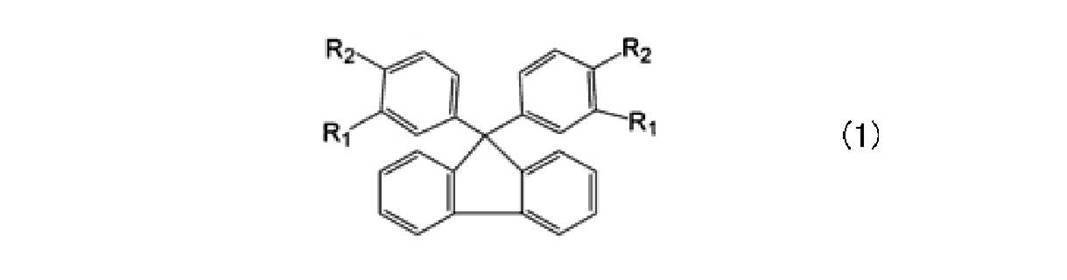
式中、R1は、水素原子、炭素数1~3のアルキル基、炭素数1~3のアルコキシ基からなる群より選択される基であり、R2は、ヒドロキシル基、炭素数1~3のヒドロキシアルキル基、炭素数1~3のヒドロキシアルコキシ基からなる群より選択される基である。
また、本発明に係るアクリル系接着剤は、前記(1)式に示すフルオレン骨格を有する化合物と、ラジカル重合性化合物と、反応開始剤とを含有することを特徴とする。
また、本発明に係る異方性導電接着剤は、前記アクリル系接着剤に導電性粒子が分散されてなることを特徴とする。
本発明によれば、フルオレン骨格を有する化合物が、紫外検出器に高い感度を示すため、微量のサンプルでも精度良く反応率を測定することができる。また、フルオレン骨格を有する化合物は、アクリル系接着剤の硬化反応に関与しないため、予めアクリル系接着剤に配合することが可能となる。
以下、本発明の実施の形態について、図面を参照しながら下記順序にて詳細に説明する。
1.アクリル系接着剤の反応率測定方法
2.アクリル系接着剤
3.実施例
1.アクリル系接着剤の反応率測定方法
2.アクリル系接着剤
3.実施例
<1.アクリル系接着剤の反応率測定方法>
本実施の形態に係るアクリル系接着剤の反応率測定方法は、下記(1)式に示すフルオレン骨格を有する化合物を内標準物質として用い、アクリル系接着剤を含む試料溶液を液体クロマトグラフィーにて分離し、紫外検出器により未反応のラジカル重合性化合物を検出する。
本実施の形態に係るアクリル系接着剤の反応率測定方法は、下記(1)式に示すフルオレン骨格を有する化合物を内標準物質として用い、アクリル系接着剤を含む試料溶液を液体クロマトグラフィーにて分離し、紫外検出器により未反応のラジカル重合性化合物を検出する。

式中、R1は、水素原子(-H)、炭素数1~3のアルキル基(-CnH2n+1:n=1~3)、炭素数1~3のアルコキシ基(-OCnH2n+1:n=1~3)からなる群より選択される基であり、R2は、ヒドロキシル基(-OH)、炭素数1~3のヒドロキシアルキル基(-CnH2nOH:n=1~3)、炭素数1~3のヒドロキシアルコキシ基(-OCnH2nOH:n=1~3)からなる群より選択される基である。
(1)式に示すフルオレン骨格を有する化合物の具体例としては、ビスフェノキシエタノールフルオレン(BPEF:R1=H、R2=OC2H4OH)、ビスフェノールフルオレン(BPF:R1=H、R2=OH)、ビスクレゾールフルオレン(BCF:R1=CH3、R2=OH)などが挙げられる。(1)式に示すフルオレン骨格を有する化合物は、紫外線吸収能が高いため、紫外検出器に高い感度を示し、微量のサンプルでも精度良く反応率を測定することができる。
なお、紫外検出器で検出可能な一般的な内標準物質として、ジブチルヒドロキシトルエン(BHT)、ベンゾトリアゾール(BTZ)などがあるが、検出感度が十分ではなく、多量に添加しなければならない。また、BHTは、ビスフェノキシエタノールフルオレンアクリレート(BPEFA)と、BTZは、4-ヒドロキシブチルアクリレート(4-HBA)とピーク検出位置が重なるため、汎用性が低い。
液体クロマトグラフィーは、高速液体クロマトグラフィー(HPLC:High Performance liquid Chromatography)であり、試料溶液を分離剤が充填された分離カラムに通過させ、分離剤に対する分配、吸着のしやすさの程度などの差から、これを複数の成分に分離する。
分離剤(充填剤)としては、HPLC用の粒径が2~30μm程度のシリカゲル、オクタデシル基、シアノプロピル基などの基で結合された化学結合型シリカゲル、ポーラスポリマー、イオン交換樹脂などを挙げることができる。
紫外検出器としては、試料溶液に紫外光を照射し、試料溶液による吸光度を測定するものであれば、特に限定されるものではなく、HPLCによる分析で汎用されている紫外吸光度検出器を用いることができる。
次に、反応率測定の詳細について説明する。本技術は、予めアクリル系接着剤にフルオレン骨格を有する化合物を所定量配合しても、アクリル系接着剤の試料溶液にフルオレン骨格を有する化合物を所定量添加しても良い。アクリル系接着剤を溶解させる溶媒としては、アセトニトリル、アセトンなどを用いることができる。
図1及び図2は、それぞれ硬化前及び硬化後のアクリル系接着剤の分析結果の一例を示すクロマトグラムである。紫外検出器によって得られたクロマトグラムのピーク強度は、通常ピーク面積又はピーク高さで表されるが、以下では、ピーク高さによる反応率の算出方法について説明する。
先ず、硬化前のアクリル系接着剤、及び完全硬化後のアクリル系接着剤のクロマトグラムから内標準物質と未反応モノマーとの強度比を求め、例えば、硬化前を反応率0%とし、完全硬化後を反応率100%として、強度比と反応率との関係線を作成する。そして、未知試料のクロマトグラムから内標準物質と未反応モノマーとの強度比を求め、作成した関係線から反応率を求めることができる。
このように(1)式に示すフルオレン骨格を有する化合物を内標準物質として用いることにより、微量のサンプルでも精度良く反応率を測定することができる。
<2.アクリル系接着剤>
本実施の形態に係るアクリル系接着剤は、下記(1)式に示すフルオレン骨格を有する化合物と、ラジカル重合性化合物と、反応開始剤とを含有する。
本実施の形態に係るアクリル系接着剤は、下記(1)式に示すフルオレン骨格を有する化合物と、ラジカル重合性化合物と、反応開始剤とを含有する。

式中、R1は、水素原子(-H)、炭素数1~3のアルキル基(-CnH2n+1:n=1~3)、炭素数1~3のアルコキシ基(-OCnH2n+1:n=1~3)からなる群より選択される基であり、R2は、ヒドロキシル基(-OH)、炭素数1~3のヒドロキシアルキル基(-CnH2nOH:n=1~3)、炭素数1~3のヒドロキシアルコキシ基(-OCnH2nOH:n=1~3)からなる群より選択される基である。
(1)式に示すフルオレン骨格を有する化合物の具体例としては、ビスフェノキシエタノールフルオレン(BPEF:R1=H、R2=OC2H4OH)、ビスフェノールフルオレン(BPF:R1=H、R2=OH)、ビスクレゾールフルオレン(BCF:R1=CH3、R2=OH)などが挙げられる。
以下では、アクリル系接着剤に導電性粒子が分散されてなる異方性導電接着剤について説明する。(1)式に示すフルオレン骨格を有する化合物は、異方性導電接着剤に配合されても、熱圧着時に分解せず、また、硬化反応に関与しないため、反応率測定の際には、紫外検出器に高い感度を示すことができる。このため、この異方性導電接着剤を用いれば、電極上、電極間などの微小領域の反応率を精度良く測定することができる。
フルオレン骨格を有する化合物の配合量は、0.01wt%以上5.0wt%以下であることが好ましく、0.2wt%以上1.0wt%以下であることがより好ましい。配合量が少なすぎる場合、測定ピークが小さくなり、内標準物質として機能せず、配合量が多すぎる場合、異方性導電フィルムとしての特性が悪化してしまう。
ラジカル重合性化合物としては、単官能(メタ)アクリレートモノマー、多官能(メタ)アクリレートモノマー、若しくはそれらにエポキシ基、ウレタン基、アミノ基、エチレンオキサイド基、プロピレンオキサイド基等を導入した変性単官能、又は多官能(メタ)アクリレートモノマーを用いることができる。また、ラジカル重合性化合物は、モノマー、オリゴマーいずれの状態で用いることが可能であり、モノマーとオリゴマーを併用することも可能である。
(メタ)アクリレートモノマーとしては、少なくとも1分子中に1個以上の(メタ)アクリロイル基を有する(メタ)アクリレート樹脂やこれらの変性物等が挙げられる。また、それらの変性物としては、テトラヒドロフルフリルアクリレート、イソボルニルアクリレート、メチルメタクリルアクリレート、エチルメタクリルアクリレート、トリシクロデカンジメタノールジアクリレート、トリシクロデカンジメタノールジメタクリレート、エトキシ化ビスフェノールAジアクリレート、プロポキシ化ビスフェノールAジアクリレート、ペンタエリスリトールトリアクリレート、エトキシ化イソシアヌル酸トリアクリレート等が挙げられる。これらは1種あるいは2種類以上を混合して用いてもよい。
反応開始剤としては、有機過酸化物、光ラジカル重合開始剤などを用いることができる。有機過酸化物としては、ジアシルパーオキサイド、ジアルキルパーオキサイド、パーオキシジカーボネート、パーオキシエステル、パーオキシケタール、ハイドロパーオキサイド、シリルパーオキサイド等から1種または2種以上を用いることができる。また、光ラジカル重合開始剤としては、ベンゾインエチルエーテル、イソプロピルベンゾインエーテル等のベンゾインエーテル、ベンジル、ヒドロキシシクロヘキシルフェニルケトン等のベンジルケタール、ベンゾフェノン、アセトフェノン等のケトン類およびその誘導体、チオキサントン類、ビスイミダゾール類等から1種または2種以上を用いることができる。
導電性粒子は、従来の異方性導電フィルムで用いられている導電性粒子を使用することができ、例えば、金粒子、銀粒子、ニッケル粒子等の金属粒子、ベンゾグアナミン樹脂やスチレン樹脂等の樹脂粒子の表面を金、ニッケル、亜鉛等の金属で被覆した金属被覆樹脂粒子等を使用することができる。このような導電性粒子の平均粒径としては、通常1~10μm、より好ましくは2~6μmである。
また、異方性導電接着剤は、膜形成樹脂、シランカップリング剤、リン酸エステル、無機フィラー、応力緩和剤などを含有しても良い。膜形成樹脂としては、フェノキシ樹脂、ポリビニルアセタール樹脂、ポリビニルブチラール樹脂、アルキル化セルロース樹脂、ポリエステル樹脂、アクリル樹脂、スチレン樹脂、ウレタン樹脂、ポリエチレンテレフタレート樹脂等が挙げられる。シランカップリング剤としては、γ-グリシドプロピルトリメトキシシラン、γ-メルカプトプロピルトリメトキシシラン、γ-アミノプロピルトリエトキシシラン、γ-ウレイドプロピルトリエトキシシラン、N-β-アミノエチル-γ-アミノプロピルトリメトキシシラン、γ-メタクリロキシプロピルトリメトキシシラン等が挙げられる。
このような異方性導電接着剤を用いれば、電極上、電極間などの微小領域の反応率を精度良く測定することができるため、安定した接合条件を短時間で得ることが可能となる。
<3.実施例>
以下、本発明の実施例について説明する。本実施例では、内標準物質としてビスフェノールエタノールフルオレン(BPEF)を用い、HPLC(High performance liquid chromatography)にてアクリル系の異方性導電接着剤の反応率を測定し、標準偏差について評価した。また、比較例として、DSC(Differential scanning calorimetry)、FT-IR(Fourier Transform Infrared Spectroscopy)にて測定した反応率の標準偏差についても評価した。また、本技術を使用して、実装体の配線上、配線間の反応率を測定し、接続信頼性の評価を行った。さらに、BPEFの添加量について検討を行った。なお、本発明はこれらの実施例に限定されるものではない。
以下、本発明の実施例について説明する。本実施例では、内標準物質としてビスフェノールエタノールフルオレン(BPEF)を用い、HPLC(High performance liquid chromatography)にてアクリル系の異方性導電接着剤の反応率を測定し、標準偏差について評価した。また、比較例として、DSC(Differential scanning calorimetry)、FT-IR(Fourier Transform Infrared Spectroscopy)にて測定した反応率の標準偏差についても評価した。また、本技術を使用して、実装体の配線上、配線間の反応率を測定し、接続信頼性の評価を行った。さらに、BPEFの添加量について検討を行った。なお、本発明はこれらの実施例に限定されるものではない。
異方性導電フィルム、及び実装体は、次のように作製した。
[異方性導電フィルムの作製]
下記配合の異方性導電接着剤を使用した。配合は、フェノキシ樹脂(商品名:YP50、新日鉄住金化学(株))40質量部、ポリウレタン(商品名:N-5196、日本ポリウレタン工業(株))40質量部、リン酸エステル(商品名:PM-2、日本化薬(株))2質量部、シランカップリング剤(商品名:A-187、モメンティブ・パフォーマンスマテリアルズ(株))2質量部、2官能アクリレート(商品名:DCP、新中村化学工業(株))3質量部、アクリル酸エステル(商品名:SG-P3、(長瀬ケムテックス(株))5質量部、ジアシルパーオキサイド(商品名:パーロイルL、日本油脂(株))5質量部、及び平均粒子径(D50)10μmの導電性粒子(積水化学(株))3質量部の合計100質量部とした。この配合にBPEFを所定量添加した組成物をPET(Polyethylene Terephthalate)に塗布し、60℃の熱風で4分間乾燥させることにより、厚み16μmのフィルム状の異方性導電接着剤を得た。
下記配合の異方性導電接着剤を使用した。配合は、フェノキシ樹脂(商品名:YP50、新日鉄住金化学(株))40質量部、ポリウレタン(商品名:N-5196、日本ポリウレタン工業(株))40質量部、リン酸エステル(商品名:PM-2、日本化薬(株))2質量部、シランカップリング剤(商品名:A-187、モメンティブ・パフォーマンスマテリアルズ(株))2質量部、2官能アクリレート(商品名:DCP、新中村化学工業(株))3質量部、アクリル酸エステル(商品名:SG-P3、(長瀬ケムテックス(株))5質量部、ジアシルパーオキサイド(商品名:パーロイルL、日本油脂(株))5質量部、及び平均粒子径(D50)10μmの導電性粒子(積水化学(株))3質量部の合計100質量部とした。この配合にBPEFを所定量添加した組成物をPET(Polyethylene Terephthalate)に塗布し、60℃の熱風で4分間乾燥させることにより、厚み16μmのフィルム状の異方性導電接着剤を得た。
[実装体の作製]
評価基材として、FPC(200μmP、L/S=1/1、PI/Cu=25/12μm、Auメッキ)、及びガラス基板(ITOベタガラス、10Ω/□、0.7mmt)を用いて実装体を作製した。ガラス基板上に異方性導電フィルムを貼り付け、45℃、1MPa、2secの条件で加熱加圧した後、PETを剥離し、仮圧着を行った。異方性導電フィルム上にFPCを配置し、所定温度、2MPa、5secの条件で加熱加圧し、実装体を得た。
評価基材として、FPC(200μmP、L/S=1/1、PI/Cu=25/12μm、Auメッキ)、及びガラス基板(ITOベタガラス、10Ω/□、0.7mmt)を用いて実装体を作製した。ガラス基板上に異方性導電フィルムを貼り付け、45℃、1MPa、2secの条件で加熱加圧した後、PETを剥離し、仮圧着を行った。異方性導電フィルム上にFPCを配置し、所定温度、2MPa、5secの条件で加熱加圧し、実装体を得た。
<3.1 測定値の標準偏差>
前述のように0.5wt%のBPEFを配合した異方性導電フィルムを用いて実装体を作製した後、HPLC、DSC、及びFT-IRを用いて、異方性導電フィルムの反応率の測定を行った。実装体からFPCを引き剥がし、2.0mm×0.2mmの配線上、及び2.0mm×0.2mmの配線間から測定用サンプルのサンプリングを行った。
前述のように0.5wt%のBPEFを配合した異方性導電フィルムを用いて実装体を作製した後、HPLC、DSC、及びFT-IRを用いて、異方性導電フィルムの反応率の測定を行った。実装体からFPCを引き剥がし、2.0mm×0.2mmの配線上、及び2.0mm×0.2mmの配線間から測定用サンプルのサンプリングを行った。
[HPLC]
HPLC分析装置として、Waters社製UPLC(UV検出器接続)を用いた。測定用サンプル0.005mgをアセトニトリルに溶解し、これを分離カラム(10cm、40℃)に注入し、クロマトグラムを得た。分析条件は以下の通りとした。
HPLC分析装置として、Waters社製UPLC(UV検出器接続)を用いた。測定用サンプル0.005mgをアセトニトリルに溶解し、これを分離カラム(10cm、40℃)に注入し、クロマトグラムを得た。分析条件は以下の通りとした。
アセトニトリル常温抽出-HPLC/DAD法
抽出:アセトニトリル 30μL
グラジェント条件:A60%、B40%(1分間保持)→5分後にA1%、B99%(6分間保持)、A=H2O、B=ACN
流量:0.4mL/min
注入量:5μL
解析波長:210-400nm
抽出:アセトニトリル 30μL
グラジェント条件:A60%、B40%(1分間保持)→5分後にA1%、B99%(6分間保持)、A=H2O、B=ACN
流量:0.4mL/min
注入量:5μL
解析波長:210-400nm
得られたクロマトグラムからBPEFとアクリルモノマーとの測定強度比を求め、予め作成したBPEFとアクリルモノマーとの測定強度比と反応率との関係線より、反応率を求めた。上記操作を計3回繰り返した。
表1に示すように、圧着温度が130℃の場合の反応率の測定結果は、1回目78.5%、2回目79.4%、及び3回目79.2%であり、標準偏差は、0.4726であった。また、圧着温度が140℃の場合の反応率の測定結果は、1回目86.3%、2回目86.8%、及び3回目85.2%であり、標準偏差は、0.8185であった。圧着温度が150℃の場合の反応率の測定結果は、1回目91.1%、2回目92.0%、及び3回目91.0%であり、標準偏差は、0.5508であった。
[DSC]
示差熱分析装置(DSC6200、セイコーインスツルメント(株))を用いて、測定用サンプル5.0mgを、30℃から250℃まで10℃/minで昇温させ、DSCチャートを得た。
示差熱分析装置(DSC6200、セイコーインスツルメント(株))を用いて、測定用サンプル5.0mgを、30℃から250℃まで10℃/minで昇温させ、DSCチャートを得た。
未硬化(圧着前)のサンプルをリファレンスとした。未硬化のサンプルの発熱量と圧着後の未知サンプルの発熱量との差分を求め、未硬化のサンプルの発熱量を1として未知サンプルの反応率を算出した。未知サンプルの測定は、3回(N=3)行った。なお、発熱量は、DSCチャートの面積より求めた。
表1に示すように、圧着温度が130℃の場合の反応率の測定結果は、1回目72.0%、2回目83.2%、及び3回目75.7%であり、標準偏差は、5.7064であった。また、圧着温度が140℃の場合の反応率の測定結果は、1回目82.6%、2回目78.9%、及び3回目88.1%であり、標準偏差は、4.6293であった。圧着温度が150℃の場合の反応率の測定結果は、1回目94.2%、2回目86.8%、及び3回目90.2%であり、標準偏差は、3.7041であった。
[FT-IR]
フーリエ変換赤外分光光度計(FT/IR-4100、日本分光社製)を用いて、測定用サンプル0.02mgを、透過法にて測定した。
フーリエ変換赤外分光光度計(FT/IR-4100、日本分光社製)を用いて、測定用サンプル0.02mgを、透過法にて測定した。
未硬化(圧着前)のサンプルのアクリルモノマー(不飽和基)の測定強度と、圧着後の未知サンプルのアクリルモノマー(不飽和基)の測定強度との比から、未知サンプルの反応率を算出した。未知サンプルの測定は、3回(N=3)行った。
表1に示すように、圧着温度が130℃の場合の反応率の測定結果は、1回目68.7%、2回目79.6%、及び3回目74.2%であり、標準偏差は、5.4501であった。また、圧着温度が140℃の場合の反応率の測定結果は、1回目77.8%、2回目82.0%、及び3回目89.7%であり、標準偏差は、6.0352であった。圧着温度が150℃の場合の反応率の測定結果は、1回目88.8%、2回目87.3%、及び3回目93.8%であり、標準偏差は、3.4034であった。
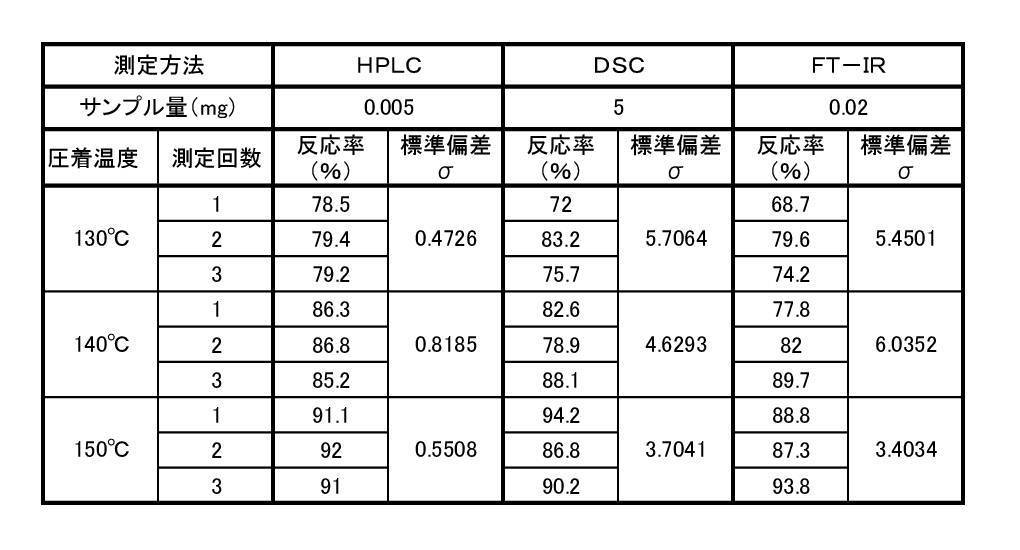
表1に示すように、DSC、FT-IRを用いた測定では、測定値の標準偏差が大きくなり、精度が低かった。また、サンプル量が多く必要であり、後述するような配線上、配線間の反応率の測定は困難である。一方、HPLC-UV検出を用いた測定では、UV検出に対する感度が高いBPEFにより、少量のサンプルで精度の良い反応率測定を行うことができた。
<3.2 実装体の配線上、配線間の反応率の測定>
前述のように0.5wt%のBPEFを配合した異方性導電フィルムを用いて実装体を作製した後、HPLCを用いて、異方性導電フィルムの反応率の測定を行った。実装体からFPCを引き剥がし、2.0mm×0.2mmの配線上の測定用サンプル、2.0mm×0.2mmの配線間測の定用サンプル、及び配線上と配線間の測定用サンプルのサンプリングを行った。
前述のように0.5wt%のBPEFを配合した異方性導電フィルムを用いて実装体を作製した後、HPLCを用いて、異方性導電フィルムの反応率の測定を行った。実装体からFPCを引き剥がし、2.0mm×0.2mmの配線上の測定用サンプル、2.0mm×0.2mmの配線間測の定用サンプル、及び配線上と配線間の測定用サンプルのサンプリングを行った。
[HPLC]
HPLC分析装置として、Waters社製UPLC(UV検出器接続)を用いた。測定用サンプル0.005mgをアセトニトリルに溶解し、これを分離カラム(10cm、40℃)に注入し、クロマトグラムを得た。分析条件は以下の通りとした。
HPLC分析装置として、Waters社製UPLC(UV検出器接続)を用いた。測定用サンプル0.005mgをアセトニトリルに溶解し、これを分離カラム(10cm、40℃)に注入し、クロマトグラムを得た。分析条件は以下の通りとした。
アセトニトリル常温抽出-HPLC/DAD法
抽出:アセトニトリル 30μL
グラジェント条件:A60%、B40%(1分間保持)→5分後にA1%、B99%(6分間保持)、A=H2O、B=ACN
流量:0.4mL/min
注入量:5μL
解析波長:210-400nm
抽出:アセトニトリル 30μL
グラジェント条件:A60%、B40%(1分間保持)→5分後にA1%、B99%(6分間保持)、A=H2O、B=ACN
流量:0.4mL/min
注入量:5μL
解析波長:210-400nm
得られたクロマトグラムからBPEFとアクリルモノマーとの測定強度比を求め、予め作成したBPEFとアクリルモノマーとの測定強度比と反応率との関係線より、反応率を求めた。上記操作を計3回繰り返し、平均値を求めた。
また、0.5wt%のBPEFを配合した異方性導電フィルムを用いて作製した実装体に対し、環境試験(60℃、95%、500hr)を行い、導通抵抗を測定した。導通抵抗は、デジタルマルチメータ(デジタルマルチメータ7561、横河電機社製)を用いて4端子法にて測定した。信頼性試験の評価は、導通抵抗が3Ω以上であるものを「NG」、3Ω未満であるものを「OK」とした。
表2に示すように、圧着温度が130℃の場合、配線上の反応率は75%、配線間の反応率は82%、配線上及び配線間の反応率は80%であり、信頼性試験の評価はNGであった。また、圧着温度が140℃の場合、配線上の反応率は83%、配線間の反応率は89%、配線上及び配線間の反応率は86%であり、信頼性試験の評価はOKであった。また、圧着温度が150℃の場合、配線上の反応率は88%、配線間の反応率は93%、配線上及び配線間の反応率は90%であり、信頼性試験の評価はOKであった。
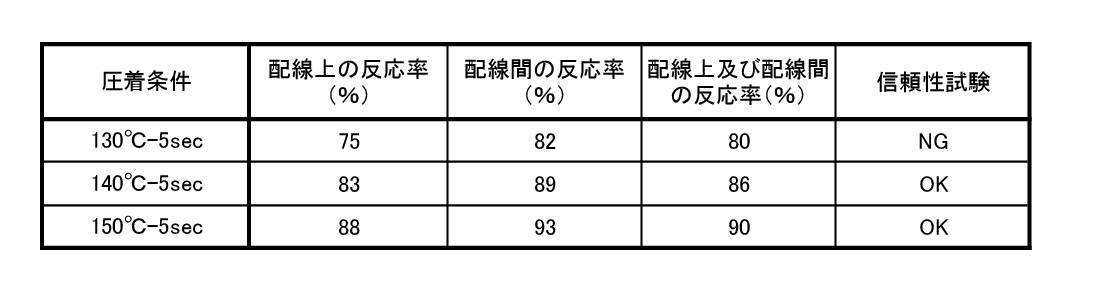
表2に示すように、配線上は、銅などの金属の高い熱伝導率の影響で熱逃げが大きく、蓄熱しないため、配線間に比べ、ACFの硬化がし難い傾向にあることが分かった。このように、本技術では、サンプルが少量でよいため、配線上、配線間などの局所的な反応率を精度良く測定することができる。
<3.3 BPEFの添加量>
次に、異方性導電フィルムに配合されるBPEFの添加量の影響について検討した。異方性導電フィルム、及び実装体は、前述と同様のものを使用し、異方性導電フィルムへのBPEFの添加量を変え、実装体の異方性導電フィルム部分の外観、ピール強度、押し込み性、及び測定のし易さについて評価した。
次に、異方性導電フィルムに配合されるBPEFの添加量の影響について検討した。異方性導電フィルム、及び実装体は、前述と同様のものを使用し、異方性導電フィルムへのBPEFの添加量を変え、実装体の異方性導電フィルム部分の外観、ピール強度、押し込み性、及び測定のし易さについて評価した。
実装体の異方性導電フィルム部分の外観の評価は、目視により気泡無しの場合を「◎」、小さい気泡ありの場合を「○」、大きい気泡ありの場合を「△」、浮きが生じた場合を「×」とした。また、実装体のピール強度(JIS K6854)の評価は、90°ピール強度が10N/25mm以上の場合を「◎」、90°ピール強度が8N/25mm以上10N/25mm未満の場合を「○」、90°ピール強度が6N/25mm以上8N/25mm未満の場合を「△」、90°ピール強度が6N/25mm未満の場合を「×」とした。また、押し込み性の評価は、実装体の導通抵抗が1Ω以下であるものを「◎」、1Ω以上2Ω未満であるものを「○」、2Ω以上5Ω未満であるものを「△」、5Ω以上であるものを「×」とした。導通抵抗は、デジタルマルチメータ(デジタルマルチメータ7561、横河電機社製)を用いて4端子法にて測定した。また、測定のし易さの評価は、目視によりクラムトグラムのピークが見易い場合を「◎」、ピークが普通に見える場合を「○」、ピークが見え難い場合を「△」、見えない場合を「×」とした。
表3に示すように、BPEFの添加量が0.01wt%の場合、外観の評価は◎、ピール強度の評価は◎、押し込み性の評価は◎、測定のし易さは△であった。また、BPEFの添加量が0.1wt%の場合、外観の評価は◎、ピール強度の評価は◎、押し込み性の評価は◎、測定のし易さは○であった。また、BPEFの添加量が0.2wt%の場合、外観の評価は◎、ピール強度の評価は◎、押し込み性の評価は◎、測定のし易さは◎であった。また、BPEFの添加量が0.5wt%の場合、外観の評価は◎、ピール強度の評価は◎、押し込み性の評価は◎、測定のし易さは◎であった。また、BPEFの添加量が1.0wt%の場合、外観の評価は◎、ピール強度の評価は◎、押し込み性の評価は○、測定のし易さは◎であった。また、BPEFの添加量が5.0wt%の場合、外観の評価は○、ピール強度の評価は△、押し込み性の評価は△、測定のし易さは◎であった。また、BPEFの添加量が10.0wt%の場合、外観の評価は△、ピール強度の評価は×、押し込み性の評価は×、測定のし易さは◎であった。また、BPEFの添加量が30.0wt%の場合、外観の評価は×、ピール強度の評価は×、押し込み性の評価は×、測定のし易さは◎であった。

表3に示すように、BPEFを異方性導電フィルムに配合して使用する場合、その配合量は、0.01wt%以上5.0wt%以下であることが好ましく、0.2wt%以上1.0wt%以下であることがより好ましいことが分かった。BPEFの配合量が大きくなると、測定のし易さは向上するものの、圧着時にACFに気泡が発生し、ピール強度、及び押し込み性を悪化させてしまうことが分かった。
Claims (8)
- 下記(1)式に示すフルオレン骨格を有する化合物を内標準物質として用い、アクリル系接着剤を含む試料溶液を液体クロマトグラフィーにて分離し、紫外検出器により未反応のラジカル重合性化合物を検出する反応率測定方法。

式中、R1は、水素原子、炭素数1~3のアルキル基、炭素数1~3のアルコキシ基からなる群より選択される基であり、R2は、ヒドロキシル基、炭素数1~3のヒドロキシアルキル基、炭素数1~3のヒドロキシアルコキシ基からなる群より選択される基である。 - 前記フルオレン骨格を有する化合物が、ビスフェノキシエタノールフルオレン(BPEF)、ビスフェノールフルオレン(BPFL)、ビスクレゾールフルオレン(BCF)からなる群より選択される1種以上である請求項1記載の反応率測定方法。
- 前記アクリル系接着剤が、前記フルオレン骨格を有する化合物を含有する請求項1又は2記載の反応率測定方法。
- 前記フルオレン骨格を有する化合物の配合量が、0.01wt%以上5.0wt%以下である請求項3記載の反応率測定方法。
- 下記(1)式に示すフルオレン骨格を有する化合物と、ラジカル重合性化合物と、反応開始剤とを含有するアクリル系接着剤。
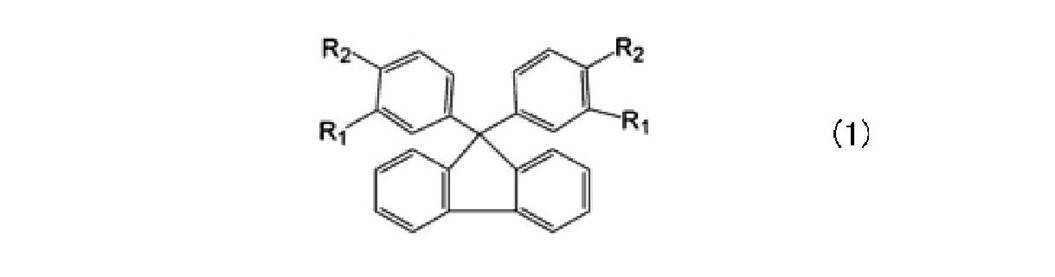
式中、R1は、水素原子、炭素数1~3のアルキル基、炭素数1~3のアルコキシ基からなる群より選択される基であり、R2は、ヒドロキシル基、炭素数1~3のヒドロキシアルキル基、炭素数1~3のヒドロキシアルコキシ基からなる群より選択される基である。 - 前記フルオレン骨格を有する化合物が、ビスフェノキシエタノールフルオレン(BPEF)、ビスフェノールフルオレン(BPFL)、ビスクレゾールフルオレン(BCF)からなる群より選択される1種以上である請求項5記載のアクリル系接着剤。
- 前記フルオレン骨格を有する化合物の配合量が、0.01wt%以上5.0wt%以下である請求項5又は6記載のアクリル系接着剤。
- 請求項5乃至7のいずれか1項に記載のアクリル系接着剤に導電性粒子が分散されてなる異方性導電接着剤。
Priority Applications (2)
| Application Number | Priority Date | Filing Date | Title |
|---|---|---|---|
| CN201580007074.0A CN105940299B (zh) | 2014-02-03 | 2015-02-03 | 丙烯酸系粘合剂的反应率测定方法和丙烯酸系粘合剂 |
| KR1020167015172A KR102368125B1 (ko) | 2014-02-03 | 2015-02-03 | 아크릴계 접착제의 반응률 측정 방법, 및 아크릴계 접착제 |
Applications Claiming Priority (2)
| Application Number | Priority Date | Filing Date | Title |
|---|---|---|---|
| JP2014-018388 | 2014-02-03 | ||
| JP2014018388A JP6231394B2 (ja) | 2014-02-03 | 2014-02-03 | アクリル系接着剤の反応率測定方法、及びアクリル系接着剤 |
Publications (1)
| Publication Number | Publication Date |
|---|---|
| WO2015115658A1 true WO2015115658A1 (ja) | 2015-08-06 |
Family
ID=53757223
Family Applications (1)
| Application Number | Title | Priority Date | Filing Date |
|---|---|---|---|
| PCT/JP2015/052928 Ceased WO2015115658A1 (ja) | 2014-02-03 | 2015-02-03 | アクリル系接着剤の反応率測定方法、及びアクリル系接着剤 |
Country Status (5)
| Country | Link |
|---|---|
| JP (1) | JP6231394B2 (ja) |
| KR (1) | KR102368125B1 (ja) |
| CN (2) | CN105940299B (ja) |
| TW (1) | TWI659079B (ja) |
| WO (1) | WO2015115658A1 (ja) |
Cited By (1)
| Publication number | Priority date | Publication date | Assignee | Title |
|---|---|---|---|---|
| TWI636999B (zh) * | 2016-09-29 | 2018-10-01 | Taiwan Textile Research Institute | 具有高折射率的阻燃材料及其製造方法及具有高折射率的阻燃聚合物 |
Citations (6)
| Publication number | Priority date | Publication date | Assignee | Title |
|---|---|---|---|---|
| JPH1067977A (ja) * | 1996-08-28 | 1998-03-10 | Nippon Steel Chem Co Ltd | 光ディスク用接着剤及び光ディスク |
| JP2003301155A (ja) * | 2002-04-11 | 2003-10-21 | Asahi Kasei Corp | 粘接着性組成物 |
| JP2004233199A (ja) * | 2003-01-30 | 2004-08-19 | Nof Corp | 官能基導入反応生成物の反応率分析方法 |
| JP2007056110A (ja) * | 2005-08-23 | 2007-03-08 | Bridgestone Corp | 接着剤組成物 |
| JP2012204059A (ja) * | 2011-03-24 | 2012-10-22 | Hitachi Chem Co Ltd | 回路接続材料及びそれを用いた回路接続構造体 |
| JP2014017368A (ja) * | 2012-07-09 | 2014-01-30 | Dexerials Corp | 太陽電池用導電性接着剤、並びに太陽電池モジュール、及びその製造方法 |
Family Cites Families (14)
| Publication number | Priority date | Publication date | Assignee | Title |
|---|---|---|---|---|
| MY130910A (en) * | 1996-12-04 | 2007-07-31 | Samsung Display Devices Co Ltd | A composition of photoconductive layer for a color display panel. |
| JP2000265145A (ja) * | 1999-03-17 | 2000-09-26 | Sekisui Chem Co Ltd | 光硬化型粘接着剤組成物及び接合方法 |
| JP3911154B2 (ja) * | 2001-03-16 | 2007-05-09 | 日本碍子株式会社 | 接着体及びその製造方法 |
| CN1315907C (zh) * | 2002-11-14 | 2007-05-16 | 帝人化成株式会社 | 聚碳酸酯共聚物、树脂组合物及成型品 |
| CN102533136B (zh) * | 2006-08-04 | 2015-04-08 | 日立化成株式会社 | 粘接剂组合物和电路部件的连接结构 |
| WO2010004793A1 (ja) * | 2008-07-11 | 2010-01-14 | ソニーケミカル&インフォメーションデバイス株式会社 | 異方性導電フィルム |
| JP2011190336A (ja) * | 2010-03-15 | 2011-09-29 | Adeka Corp | 粘着剤組成物及び粘着シート |
| JP5543818B2 (ja) * | 2010-03-25 | 2014-07-09 | 大日本印刷株式会社 | ガスバリア性フィルム、ガスバリア層、装置及びガスバリア性フィルムの製造方法 |
| JP2010251789A (ja) * | 2010-06-22 | 2010-11-04 | Sony Chemical & Information Device Corp | 接合体及びその製造方法 |
| JP5293779B2 (ja) * | 2010-07-20 | 2013-09-18 | 日立化成株式会社 | 接着剤組成物、回路接続構造体、半導体装置及び太陽電池モジュール |
| WO2013022065A1 (ja) * | 2011-08-11 | 2013-02-14 | 大阪ガスケミカル株式会社 | フルオレン骨格を有する多官能性(メタ)アクリレートおよびその硬化性組成物 |
| KR101381118B1 (ko) * | 2011-11-04 | 2014-04-04 | 제일모직주식회사 | 이방 전도성 접착 필름용 조성물 및 이를 이용한 이방 전도성 접착 필름 |
| JP6231257B2 (ja) * | 2011-12-15 | 2017-11-15 | デクセリアルズ株式会社 | 導電性接着剤、及び電子部品の接続方法 |
| CN103524650A (zh) * | 2013-09-26 | 2014-01-22 | 南京邮电大学 | 不对称两嵌段聚合物及其制备应用 |
-
2014
- 2014-02-03 JP JP2014018388A patent/JP6231394B2/ja active Active
-
2015
- 2015-02-03 TW TW104103516A patent/TWI659079B/zh active
- 2015-02-03 KR KR1020167015172A patent/KR102368125B1/ko active Active
- 2015-02-03 WO PCT/JP2015/052928 patent/WO2015115658A1/ja not_active Ceased
- 2015-02-03 CN CN201580007074.0A patent/CN105940299B/zh active Active
- 2015-02-03 CN CN201810106437.1A patent/CN108384486B/zh active Active
Patent Citations (6)
| Publication number | Priority date | Publication date | Assignee | Title |
|---|---|---|---|---|
| JPH1067977A (ja) * | 1996-08-28 | 1998-03-10 | Nippon Steel Chem Co Ltd | 光ディスク用接着剤及び光ディスク |
| JP2003301155A (ja) * | 2002-04-11 | 2003-10-21 | Asahi Kasei Corp | 粘接着性組成物 |
| JP2004233199A (ja) * | 2003-01-30 | 2004-08-19 | Nof Corp | 官能基導入反応生成物の反応率分析方法 |
| JP2007056110A (ja) * | 2005-08-23 | 2007-03-08 | Bridgestone Corp | 接着剤組成物 |
| JP2012204059A (ja) * | 2011-03-24 | 2012-10-22 | Hitachi Chem Co Ltd | 回路接続材料及びそれを用いた回路接続構造体 |
| JP2014017368A (ja) * | 2012-07-09 | 2014-01-30 | Dexerials Corp | 太陽電池用導電性接着剤、並びに太陽電池モジュール、及びその製造方法 |
Cited By (1)
| Publication number | Priority date | Publication date | Assignee | Title |
|---|---|---|---|---|
| TWI636999B (zh) * | 2016-09-29 | 2018-10-01 | Taiwan Textile Research Institute | 具有高折射率的阻燃材料及其製造方法及具有高折射率的阻燃聚合物 |
Also Published As
| Publication number | Publication date |
|---|---|
| CN108384486B (zh) | 2020-05-19 |
| JP6231394B2 (ja) | 2017-11-15 |
| JP2015145815A (ja) | 2015-08-13 |
| KR20160115909A (ko) | 2016-10-06 |
| KR102368125B1 (ko) | 2022-02-25 |
| TW201538653A (zh) | 2015-10-16 |
| HK1259332A1 (zh) | 2019-11-29 |
| TWI659079B (zh) | 2019-05-11 |
| CN105940299B (zh) | 2018-03-09 |
| CN105940299A (zh) | 2016-09-14 |
| CN108384486A (zh) | 2018-08-10 |
Similar Documents
| Publication | Publication Date | Title |
|---|---|---|
| EP1723197B1 (en) | Thermally conductive two-part adhesive composition | |
| CN104540913B (zh) | 包含复合粒子的可固化组合物 | |
| KR20090096489A (ko) | 접착제 및 이것을 이용한 접속 구조체 | |
| BR112012011798B1 (pt) | material para conexão de circuito, estrutura para conexão que usa o mesmo e método de ligação por pressão temporária | |
| JP6231394B2 (ja) | アクリル系接着剤の反応率測定方法、及びアクリル系接着剤 | |
| KR100996035B1 (ko) | 필름상 회로접속재료, 회로부재의 접속구조물 및 그 제조방법 | |
| CN106366983B (zh) | 丙烯酸酯电磁屏蔽压敏胶及其制备方法 | |
| JP6438102B2 (ja) | 接続体、及び接続体の製造方法 | |
| Saiki et al. | UV/heat dual‐curable adhesive tapes for fabricating stacked packages of semiconductors | |
| TWI716445B (zh) | 導電性接著劑、電子零件以及電子零件之製造方法 | |
| JP2001176335A (ja) | 異方性導電フィルム | |
| HK1259332B (en) | Reaction rate measurement method for acrylic adhesive, and acrylic adhesive | |
| JPH09118860A (ja) | 異方性導電フィルム | |
| JP2010024384A (ja) | 異方導電性組成物 | |
| JP5111711B2 (ja) | 接着剤組成物、回路接続用接着剤組成物及び回路接続方法 | |
| WO2005111168A1 (ja) | 電子部品用接着剤組成物及び接着用フィルム | |
| HK1227102B (en) | Reaction rate measurement method for acrylic adhesive, and acrylic adhesive | |
| JP5002876B2 (ja) | 異方導電フィルム、接続体及び半導体装置 | |
| HK1227102A1 (en) | Reaction rate measurement method for acrylic adhesive, and acrylic adhesive | |
| CN105593945B (zh) | 对人体无害的异向性导电膜组成物及异向性导电膜 | |
| KR20210034019A (ko) | 접속 구조체의 제조 방법 및 접속 필름 | |
| JPWO2016114317A1 (ja) | 接着層形成用の組成物、接着層、接着層の製造方法、複合材、シート、放熱部材、電子デバイス、バッテリー、キャパシタ、自動車用部品および機械機構部品 | |
| JP2011111474A (ja) | 回路接続材料 | |
| JP2012126915A (ja) | 異方導電フィルム、接続体及び半導体装置 | |
| JPH10338842A (ja) | 異方性導電フィルム |
Legal Events
| Date | Code | Title | Description |
|---|---|---|---|
| 121 | Ep: the epo has been informed by wipo that ep was designated in this application |
Ref document number: 15743265 Country of ref document: EP Kind code of ref document: A1 |
|
| ENP | Entry into the national phase |
Ref document number: 20167015172 Country of ref document: KR Kind code of ref document: A |
|
| NENP | Non-entry into the national phase |
Ref country code: DE |
|
| 122 | Ep: pct application non-entry in european phase |
Ref document number: 15743265 Country of ref document: EP Kind code of ref document: A1 |