WO2015030098A1 - 熱伝導性複合粒子および樹脂成形体 - Google Patents
熱伝導性複合粒子および樹脂成形体 Download PDFInfo
- Publication number
- WO2015030098A1 WO2015030098A1 PCT/JP2014/072541 JP2014072541W WO2015030098A1 WO 2015030098 A1 WO2015030098 A1 WO 2015030098A1 JP 2014072541 W JP2014072541 W JP 2014072541W WO 2015030098 A1 WO2015030098 A1 WO 2015030098A1
- Authority
- WO
- WIPO (PCT)
- Prior art keywords
- particles
- particle
- resin
- inorganic fine
- conductive composite
- Prior art date
- Legal status (The legal status is an assumption and is not a legal conclusion. Google has not performed a legal analysis and makes no representation as to the accuracy of the status listed.)
- Ceased
Links
Images



Classifications
-
- C—CHEMISTRY; METALLURGY
- C08—ORGANIC MACROMOLECULAR COMPOUNDS; THEIR PREPARATION OR CHEMICAL WORKING-UP; COMPOSITIONS BASED THEREON
- C08J—WORKING-UP; GENERAL PROCESSES OF COMPOUNDING; AFTER-TREATMENT NOT COVERED BY SUBCLASSES C08B, C08C, C08F, C08G or C08H
- C08J3/00—Processes of treating or compounding macromolecular substances
- C08J3/12—Powdering or granulating
- C08J3/128—Polymer particles coated by inorganic and non-macromolecular organic compounds
-
- C—CHEMISTRY; METALLURGY
- C08—ORGANIC MACROMOLECULAR COMPOUNDS; THEIR PREPARATION OR CHEMICAL WORKING-UP; COMPOSITIONS BASED THEREON
- C08K—Use of inorganic or non-macromolecular organic substances as compounding ingredients
- C08K3/00—Use of inorganic substances as compounding ingredients
- C08K3/38—Boron-containing compounds
-
- C—CHEMISTRY; METALLURGY
- C08—ORGANIC MACROMOLECULAR COMPOUNDS; THEIR PREPARATION OR CHEMICAL WORKING-UP; COMPOSITIONS BASED THEREON
- C08K—Use of inorganic or non-macromolecular organic substances as compounding ingredients
- C08K9/00—Use of pretreated ingredients
- C08K9/12—Adsorbed ingredients, e.g. ingredients on carriers
-
- C—CHEMISTRY; METALLURGY
- C08—ORGANIC MACROMOLECULAR COMPOUNDS; THEIR PREPARATION OR CHEMICAL WORKING-UP; COMPOSITIONS BASED THEREON
- C08J—WORKING-UP; GENERAL PROCESSES OF COMPOUNDING; AFTER-TREATMENT NOT COVERED BY SUBCLASSES C08B, C08C, C08F, C08G or C08H
- C08J2301/00—Characterised by the use of cellulose, modified cellulose or cellulose derivatives
- C08J2301/02—Cellulose; Modified cellulose
-
- C—CHEMISTRY; METALLURGY
- C08—ORGANIC MACROMOLECULAR COMPOUNDS; THEIR PREPARATION OR CHEMICAL WORKING-UP; COMPOSITIONS BASED THEREON
- C08J—WORKING-UP; GENERAL PROCESSES OF COMPOUNDING; AFTER-TREATMENT NOT COVERED BY SUBCLASSES C08B, C08C, C08F, C08G or C08H
- C08J2333/00—Characterised by the use of homopolymers or copolymers of compounds having one or more unsaturated aliphatic radicals, each having only one carbon-to-carbon double bond, and only one being terminated by only one carboxyl radical, or of salts, anhydrides, esters, amides, imides, or nitriles thereof; Derivatives of such polymers
- C08J2333/04—Characterised by the use of homopolymers or copolymers of compounds having one or more unsaturated aliphatic radicals, each having only one carbon-to-carbon double bond, and only one being terminated by only one carboxyl radical, or of salts, anhydrides, esters, amides, imides, or nitriles thereof; Derivatives of such polymers esters
- C08J2333/06—Characterised by the use of homopolymers or copolymers of compounds having one or more unsaturated aliphatic radicals, each having only one carbon-to-carbon double bond, and only one being terminated by only one carboxyl radical, or of salts, anhydrides, esters, amides, imides, or nitriles thereof; Derivatives of such polymers esters of esters containing only carbon, hydrogen, and oxygen, the oxygen atom being present only as part of the carboxyl radical
Definitions
- the present invention relates to a thermally conductive composite particle used as a filler for improving thermal conductivity, and a resin molded product filled with the thermally conductive composite particle as a filler.
- Resins excellent in insulation and formability are used in various places of electronic parts that generate heat, such as electronic parts such as electronic circuit boards and insulating materials, adhesives for bonding elements mounted on electronic parts, etc. ing.
- the resin is filled with a filler made of an inorganic material excellent in thermal conductivity such as alumina or silica, the heat transfer network is formed by the fillers in contact with each other inside the resin, and heat is dissipated through the heat conductive network. It is like that.
- Patent Document 1 an assembly of shell-core particles including core particles containing a polymer compound and shells containing a thermally conductive and insulating inorganic compound is pressurized and / or heated. It has been proposed to mold a resin molding.
- the present invention has been proposed to suitably solve these, and it is possible to provide a resin molded body with a good thermal conductivity and a thermally conductive composite particle, and An object of the present invention is to provide a resin molded product that exhibits better thermal conductivity by the thermally conductive composite particles.
- the thermally conductive composite particles of the invention according to claim 1 of the present application are:
- the gist of the present invention is to have a shell-core structure composed of a mother particle made of a polymer compound having a crosslinked structure and an inorganic fine particle carried on the front side of the mother particle and having thermal conductivity.
- the base particles are a polymer compound having a cross-linked structure
- the base particles are infusible to heat, thereby making the composite particles Maintain the shell-core structure of
- the composite particles can form a network for heat conduction in the resin molding with a relatively small amount of inorganic fine particles loaded, and the inorganic material unit filled in the resin molding.
- the thermal conductivity per quantity can be improved.
- the inorganic fine particles are scaly.
- the composite particles are filled in the resin, and the base particles are applied by applying pressure from a certain direction.
- the inorganic fine particles are boron nitride.
- the network for heat conduction can be suitably formed on the resin molded body by the boron nitride excellent in heat conductivity.
- the above-mentioned mother particle is constituted by polysaccharide which has a crosslinked structure.
- the shape of the mother particle is deformed in the resin by the elasticity unique to the polysaccharide, and pressure is applied at the time of molding.
- the gaps between the composite particles can be eliminated to form the heat conduction network more suitably.
- the amount of the inorganic fine particles carried can be increased by forming the base particles with spherical particles of cellulose. It is characterized in that 100% or more of the inorganic fine particles can be supported with respect to the weight of cellulose by hydrogen bonding with the surface functional group of the inorganic fine particles.
- the base particles are made of a synthetic polymer having a crosslinked structure.
- the base particles by forming the base particles from a synthetic polymer having a cross-linked structure, the base particles can be rendered insoluble in heat upon molding and insoluble in a solvent or water.
- the base particles are formed spherically from a crosslinked poly (meth) acrylate having an anionic group or a cationic group on the surface.
- the inorganic base particles can be supported by forming the base particles with a crosslinked poly (meth) acrylic acid ester having an anionic group or a cationic group on the surface, and anionic property can be obtained.
- the amount of the group or the cationic group is increased, the loading amount of the inorganic fine particles can be increased.
- the resin molded product of the invention according to claim 8 of the present application is:
- the gist is that the thermally conductive composite particles according to any one of claims 1 to 7 are filled as a filler.
- a composite having a shell-core structure composed of a mother particle made of a polymer compound having a crosslinked structure and an inorganic fine particle carried on the front side of the mother particle and having thermal conductivity.
- a composite having a shell-core structure composed of mother particles made of a polymer compound having a crosslinked structure and inorganic fine particles carried on the front side of the mother particles and having thermal conductivity. It is possible to form a good heat transfer network by using the particles as a filler and compression forming to eliminate the gaps between the composite particles.
- thermally conductive composite particles of the present invention it is possible to impart good thermal conductivity to the resin molded body. Moreover, according to the resin molding concerning this invention, a favorable thermal conductivity is shown.
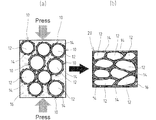
- (a) is explanatory drawing which shows the state which filled the composite material with the resin raw material
- (b) is explanatory drawing which shows the composite particle in the resin molding obtained by compression molding.
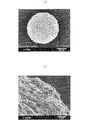
- It is an electron micrograph which shows the composite particle of Example 1 and 2 (a) is 500 times of magnification, (b) is 5000 times of magnification.
- thermally conductive composite particles are simply referred to as composite particles.
- the composite particle according to the present invention is composed of a base particle made of a polymer compound having a crosslinked structure, and inorganic fine particles supported on the front side of this base particle and having thermal conductivity.
- the composite particle has a so-called shell-core structure in which the surface of the base particle is covered with a shell layer consisting of a large number of inorganic fine particles, and it is desirable that the composite particle be formed into a sphere as a whole.
- the base particles have a shape in which the surface such as a sphere or an ellipsoid is curved.
- the mother particles may be any of homopolymers and copolymers as long as they can support inorganic fine particles and have a crosslinked structure, addition polymers such as vinyl polymers and acrylic polymers, and condensation polymers such as polyester and nylon And synthetic polymers, or natural polymers such as polysaccharides.
- the base particles preferably have electrical insulating properties.
- the crosslinked structure as referred to herein means a secondary bond such as an intermolecular hydrogen bond or a covalent bond, an ionic bond or a coordinate bond which brings about a crosslinked structure between molecules by another crosslinking agent.
- the mother particles preferably have an average particle size in the range of 1.0 ⁇ m to 1000 ⁇ m, more preferably in the range of 10 ⁇ m to 700 ⁇ m.
- the average particle size of the base particles is smaller than 1.0 ⁇ m, only inorganic particles of up to several hundreds of nm can be supported, and when small inorganic particles are filled in the resin, grain boundaries (interstices between particles) increase and phonons are dispersed. And the thermal conductivity decreases.
- the average particle size of the base particles is larger than 1000 ⁇ m, not only the filling property to the composite particles and the flowability of the resin are deteriorated, but also the heat conduction network in the resin is reduced and good heat conductivity is obtained. You can not get it.
- cellulose, chitin, chitosan, glucomannan etc. which can keep shape by an intermolecular hydrogen bond
- polysaccharides such as pullulan, starch, agarose, dextran, and sacran, which can not maintain a cross-linked structure by intermolecular hydrogen bonds, can maintain their shape by intermolecular cross-linking by a cross-linking agent, and these polysaccharides may be used. Absent.
- an epoxy-based crosslinking agent such as epichlorohydrin, an aldehyde-based crosslinking agent such as glutaraldehyde, an acid chloride-based crosslinking agent such as adipic acid dichloride, an ionic bond such as boric acid, citric acid or sulfuric acid And the like.
- the synthetic polymer that can constitute the matrix particle is not particularly limited as long as it is a polymer that can form an anionic group or a cationic group, but in this case polyvinyl alcohol, polyallylamine, poly (meta (meta) ) Acrylic acid ester, polystyrene, nylon, poly (meth) acrylamide, melamine resin, poly amino acid, silicone resin, polyamide, polyimide, polyolefin, phenol resin, vinyl polycarboxylate, poly (meth) acrylic acid, polyethylene imine, polycarbonate etc Can be adopted.
- the inorganic fine particles include nitrides such as diamond, aluminum nitride (AlN), silicon nitride (Si 3 N 4 ), magnesium oxide (MgO), zinc oxide (ZnO), alumina (Al 2 O 3 ), silicon dioxide Oxides such as SiO 2 ), carbides such as silicon carbide (SiC), silicate minerals such as mica, boron nitride (h-BN, c-BN), titanium boride (TiB 2 ), boron carbide (B 4) What has thermal conductivity, such as borides, such as C), can be used.
- the inorganic fine particles preferably have electrical insulation.
- the inorganic fine particles preferably have an average particle diameter in the range of 0.2 ⁇ m to 40 ⁇ m, more preferably in the range of 8 ⁇ m to 20 ⁇ m.
- the average particle diameter of the inorganic fine particles is smaller than 0.2 ⁇ m, the grain boundaries (the gaps between the particles) increase, the phonons are dispersed, and the thermal conductivity is reduced.
- the average particle diameter of the inorganic fine particles is larger than 40 ⁇ m, the contact points between the particles are reduced, and the thermal conductivity is deteriorated.
- the inorganic fine particles are supported on the front side of the base particles so as to be directly or over the other inorganic fine particles on the base particles.
- inorganic fine particles are supported on the curved curved front side of the base particles, and the entire composite particle is substantially spherical. That is, the outer shape of the composite particle is roughly derived from the outer shape of the base particle.
- the content of the inorganic fine particles in the composite particles is preferably in the range of 10% to 90%, more preferably 30% to 80%. If the content of the inorganic fine particles is lower than 10%, a shell sufficient to provide heat conduction can not be sufficiently formed, and if the content of the inorganic fine particles is higher than 90%, the structure of the composite particles is maintained. Can not
- composite particles are formed by performing a granulation method (referred to as a phase separation method) of producing polysaccharides from polysaccharide derivatives using phase separation in the presence of inorganic fine particles.
- a phase separation method a granulation method of producing polysaccharides from polysaccharide derivatives using phase separation in the presence of inorganic fine particles.
- composite particles can be produced by a tumbling granulation method from a mixture of polysaccharides and inorganic fine particles.
- a polysaccharide derivative having a negative polarity of the redox potential is used, and an alkaline solution having a negative polarity of the redox potential is used as a dispersion medium for dispersing the polysaccharide derivative. It is used.
- the inorganic fine particles those in which the polarity of the peak value of the zeta potential at pH 13 is negative and the upper limit value of the zeta potential at pH 13 is 30 mV or less in the dispersion medium are used.
- the zeta potential fluctuates depending on the pH of the liquid substance in which the inorganic fine particles are dispersed
- the zeta potential is represented by the value when the pH of the dispersion medium is 13, and it is premised that the inorganic fine particles are always dispersed in the liquid substance of pH 13. It does not mean.
- the dispersion medium for example, an aqueous solution of metal salt of a polymer having a carboxylic acid can be used, and as such an aqueous solution of metal salt, an aqueous solution of sodium polyacrylate is exemplified.
- insoluble cellulose when insoluble cellulose is used as a starting material and water is used as a solvent, for example, (1) cellulose is dissolved in an aqueous solution of an alkali metal salt of xanthogen acid, or (2) cellulose is dissolved in an aqueous solution of rhodanate metal salt
- a soluble cellulose derivative (viscose) can be produced as a polysaccharide derivative by (3) coordinating both of ammonia and copper as a complex to cellulose.
- the inorganic fine particles are mixed with the polysaccharide derivative dissolved in the solvent to prepare a pre-mixture, and the pre-mixture is added dropwise to the dispersion medium with stirring.
- the polysaccharide derivative is viscose, when the dispersion medium is an aqueous solution of sodium polyacrylate, CSS viscose - between (carboxyl group) - and (xanthate group), sodium polyacrylate COO
- the polysaccharide derivative is spheroidized (the viscose phase separation method) due to the charge repulsion generated in the above and the cohesion of the polysaccharide derivative.
- the immobilization treatment is performed to generate composite particles.
- the polysaccharide derivative is viscose
- the viscose is first desulfurized. Thereafter, a cross-linked structure is formed by hydrogen bonds between hydroxyl groups of viscose, and regenerated cellulose is produced.
- the inorganic fine particles localized on the surface of viscose are firmly fixed to the surface of the regenerated cellulose by this hydrogen bond, and composite particles are produced.
- the composite particles obtained by the viscose phase separation method are characterized by being capable of supporting 100% or more of the inorganic fine particles with respect to the weight of cellulose by hydrogen bonding with the surface functional group of the inorganic fine particles.
- a synthetic polymer When a synthetic polymer is used for the base particles, it is preferable to use a crosslinked polyacrylic ester represented by the following chemical formula 1 or a derivative of a crosslinked polymethacrylic ester represented by the following chemical formula 2.
- R in the chemical formula 1 and the chemical formula 2 is an alkyl group such as methyl, ethyl, propyl and butyl, a phenyl group, a benzyl group and the like, and a hydrophobic functional group selected from aliphatic or aromatic hydrocarbon groups Represents a group.
- the polyacrylic acid ester and the crosslinked polymethacrylic acid ester are collectively referred to as poly (meth) acrylic acid ester particles hereinafter.
- the mother particles are basically composed of crosslinked poly (meth) acrylate particles, and the mother particles having an anionic group are a part of carboxylic acid esters in the crosslinked poly (meth) acrylates. It has a hydrolyzed structure.
- a mother particle having a cationic group has, for example, a structure in which an amino group is introduced to a part of a carboxylic acid ester by an aminolysis reaction with an amine compound.
- an amine compound a diamine type compound, a dimethylamino type compound, etc. are mentioned.
- the base particles have a spherical shape, and the shape of the crosslinked poly (meth) acrylate particles formed in the spherical shape is roughly maintained.
- the carboxylic acid ester on the spherical surface of the crosslinked poly (meth) acrylate particle is hydrolyzed to form a carboxyl group or an amino group on the spherical surface, and a hydrophobic group on the spherical inner portion. It is configured that a carboxylic ester having is present.
- R represents a hydrophobic functional group selected from aliphatic or aromatic hydrocarbon groups.
- crosslinked poly (meth) acrylic acid ester particles used as the starting material of the above-mentioned base particles particles made of fine spherical particles by crosslinking acrylic acid ester monomers with a crosslinking agent are used.
- a method for producing sphere-shaped crosslinked poly (meth) acrylate particles alkanediacrylate, phenyldiacrylate, alkanetriacrylate, alkanetetraacrylate or alkanedimethacrylate, alkanetrimethacrylate, alkanetetramethacrylate, as a crosslinking agent.
- examples include emulsion copolymerization and suspension copolymerization of acrylic acid esters using a polyfunctional or higher functional crosslinking agent such as phenyl dimethacrylate and divinyl benzene.
- the acrylic resin includes methacrylic acid ester and acrylic acid ester, but any of acrylic acid ester and methacrylic acid ester may be used as a starting material.
- the mother particles have a structure in which a part or all of the carboxylic acid formed by partially hydrolyzing crosslinked poly (meth) acrylate particles is metallized with an alkali metal and is insoluble in water. is there.
- the alkali metal it is preferable to use an alkali metal or alkaline earth metal of hydroxide, and particularly, sodium by sodium hydroxide, potassium by potassium hydroxide, magnesium by magnesium hydroxide and the like are preferable.
- the crosslinked poly (meth) acrylate particles described above are prepared.
- a reaction solvent in which an alkaline solution and an organic solvent are mixed is separately prepared.
- the alkali solution used here is obtained by dispersing alkali metal, alkaline earth metal hydroxide or the like in water.
- the organic solvent one or more kinds of alcohols such as ethanol and methanol, protic solvents mixed with them, or aprotic solvents such as acetone, tetrahydrofuran and dioxane are used.
- the poly (meth) acrylic acid ester particles are immersed in a reaction solvent comprising an alkali solution and an organic solvent, and the carboxylic acid ester in the poly (meth) acrylic acid ester particles is hydrolyzed under the predetermined temperature conditions of the reaction solvent.
- the base particles obtained from the reaction solvent are taken out and subjected to predetermined treatments such as washing, drying, separation and the like to obtain base particles.
- predetermined treatments such as washing, drying, separation and the like to obtain base particles.
- an electrostatic interaction occurs to cause an ion exchange reaction on the surface of the mother particles, thereby making the surface of the mother particles inorganic.
- the fine particles are collected to form composite particles in which the surface of the mother particle is coated with a plurality of inorganic fine particles. It is also possible to increase the loading amount of the inorganic fine particles on the base particle by increasing the functional group of the crosslinked poly (meth) acrylate forming the base particle.
- the base particles are a polymer compound having a cross-linked structure
- the base particles when the composite particles are filled in a resin and molded, the base particles are infusible to heat, thereby maintaining the shell-core structure of the composite particles. it can.
- the composite particles By maintaining the shell-core structure in the resin molding, the composite particles can form a network for heat conduction in the resin molding with a relatively small amount of inorganic fine particles loaded, and the inorganic material unit filled in the resin molding. The thermal conductivity per quantity can be improved.
- the composite particles 10 are filled in the resin 16 and pressure is applied from a certain direction to form mother particles. 12 is crushed, and the surface of the scale-like inorganic fine particles 14 is aligned along a direction intersecting with the direction (compression direction) in which pressure is applied, and the heat conductivity in the direction intersecting the direction in which pressure is applied is high.
- the resin molded body 20 can be obtained.
- boron nitride is used as the inorganic fine particles, a network for heat conduction can be suitably formed on the resin molded body by the boron nitride excellent in heat conductivity.
- the base particles By forming the base particles from a polysaccharide having a cross-linked structure, the shape of the base particles in the resin is deformed due to the elasticity unique to polysaccharides, and pressure is applied at the time of molding to eliminate gaps between composite particles.
- the conduction network can be more suitably formed.
- the base particles are formed of spherical particles made of cellulose, the amount of the inorganic fine particles supported can be increased.
- the base particles By forming the base particles from a synthetic polymer having a cross-linked structure, the base particles can be rendered insoluble in heat upon molding and insoluble in solvent or water.
- the matrix particles with crosslinked poly (meth) acrylic acid ester having an anionic group or a cationic group on the surface, the inorganic matrix particles can be supported, and the amount of the anionic group or the cationic group can be When it is increased, the loading amount of the inorganic fine particles can be increased.
- the composite particles according to the present invention described above are filled in a resin as a filler to form a resin molded product according to the present invention.
- the resin molded body is formed, for example, in an appropriate shape such as a sheet or a block.
- the resin to be filled with the composite particles may be any of thermoplastic, thermosetting, and engineering plastic as long as the resin can be composited with the composite particles, polyvinyl chloride, polyvinylidene chloride, polystyrene, polyethylene, Polypropylene, polyethylene-vinyl acetate copolymer, polyethylene-vinyl acetate alcohol copolymer, poly (meth) acrylic resin, silicone resin, nylon-6, nylon-6,6, nylon-6,10, nylon-6,12 Such as polyamide, polyimide resin, polyurethane, epoxy resin, phenol resin, melamine resin, polycarbonate, cellulose triacetate, cellulose acetate butyrate, vinylon, polyvinyl butyral and the like can be adopted.
- the filling ratio of the composite particles to the resin is preferably 30 wt% to 95 wt% of the resin molding, and more preferably 70 wt% to 90 wt%. If the filling rate of the composite particles is less than 30 wt%, a heat conduction network is difficult to be formed, and a suitable heat conduction action by the inorganic fine particles can not be obtained. In addition, when the filling rate of the composite particles is more than 95 wt%, problems such as embrittlement of the resin molded product occur.
- the resin particles can be obtained by mixing the composite particles with the epoxy resin raw material exhibiting fluidity or improving the fluidity and molding the mixture.
- the fluidity of the resin raw material can be improved by adding a solvent in which the resin raw material can be dissolved.
- a solvent chloroform, methylene chloride, toluene, acetone, ethyl acetate, ethanol, methanol, isopropyl alcohol and the like can be employed.
- chloroform, methylene chloride, toluene, acetone, ethyl acetate, ethanol, methanol, isopropyl alcohol and the like can be employed.
- chloroform, methylene chloride, toluene, acetone, ethyl acetate, ethanol, methanol, isopropyl alcohol and the like can be employed.
- the degassing method may be centrifugal degassing method, vacuum degassing method, vacuum centrifugal degassing method,
- the resin molded body be compression-molded by heating and pressing a resin raw material.
- a mixture of a thermosetting resin and a curing agent and a thermally conductive composite particle is filled in a mold and hot pressed to obtain a resin molded body.
- the heating temperature during molding is preferably 20 ° C. to 300 ° C., more preferably 100 ° C. to 170 ° C.
- the heating temperature at the time of molding is less than 20 ° C., the workability is poor, for example, the curing takes a long time.
- the heating temperature at the time of molding is higher than 300 ° C., the resin may be decomposed or burned.
- the weight at the time of molding is preferably 100 kg / cm 2 or more, more preferably 500 kg / cm 2 or more.
- the thermal conductivity decreases due to the reduction in the contact area between shells without deformation of the mother particles.
- the composite particles of Examples 1 and 2 each have a shell comprising a mother particle made of cellulose obtained by the viscose phase separation method, and an inorganic fine particle made of boron nitride (BN) supported on the front side of the mother particle. It has a core structure.
- BN boron nitride
- an aqueous solution of sodium polyacrylate was used as the dispersion medium.
- the dispersion medium was prepared by adding 600 g of pure water to 200 g of a 35% aqueous solution of sodium polyacrylate (trade name Aqualic DL522: made by Nippon Shokuhin (molecular weight 50000)) in a beaker, and CaCO 3 (trade name TP221G as a dispersant) After adding 40 g of Okutama Kogyo Co., Ltd.) and 24 g of a 33% by weight aqueous solution of NaOH, it was prepared by stirring under the condition of rotation number 120 rpm.
- a 35% aqueous solution of sodium polyacrylate trade name Aqualic DL522: made by Nippon Shokuhin (molecular weight 50000)
- CaCO 3 trade name TP221G as a dispersant
- Examples 1 and 2 those having a median diameter (D50) of 8.0 ⁇ m were used as BN fine particles (trade name: Denka boron nitride GP: manufactured by Denki Kagaku Kogyo Co., Ltd.).
- Example 1 was used using BN fine particles (trade name Denka boron nitride SP-2: manufactured by Denki Kagaku Kogyo Co., Ltd.) having a median diameter (D50) of 4.0 ⁇ m. And 2 different composite particles were produced.
- BN fine particles trade name Denka boron nitride SP-2: manufactured by Denki Kagaku Kogyo Co., Ltd.
- D50 median diameter
- BN fine particles are supported on the front side of the base particles made of spherical cellulose, and a shell-core structure consisting of BN fine particles and cellulose is configured. It can be confirmed that it is done.
- BN fine particles are supported on the front side of the base particle made of spherical cellulose, and it consists of BN fine particles and cellulose. It can be confirmed that the shell core structure is configured.
- the composite particles of Examples 3 to 5 are the shell particles in which the inorganic fine particles are supported on the front side of the base particles by the tumbling granulation method, using the commercially available base particles of cellulose and the inorganic fine particles of boron nitride (BN). It constitutes the core structure.
- a cellulose dispersion is prepared by dispersing 25 g of spherical cellulose particles having an average particle diameter of 44 to 105 ⁇ m (trade name Celfine GC-15-m: manufactured by JNC Corporation) in 250 ml of pure water.
- a BN dispersion was prepared by dispersing 7.5 g of BN fine particles (trade name Denka boron nitride GP: manufactured by Denki Kagaku Kogyo Co., Ltd.) having a median diameter (D50) of 8.0 ⁇ m in 75 ml of pure water.
- the cellulose dispersion is poured into a pan-type granulator (made by As One Corporation) and rotated at 60 rpm while heating at 50 ° C.
- a BN dispersion is added to this, and heated at 50 ° C. at 60 rpm Continue to rotate. Then, after the water was completely evaporated, the composite particles of Examples 3 to 5 were recovered.
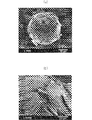
- BN fine particles are supported on the front side of the base particles made of spherical cellulose, and a shell-core structure consisting of BN fine particles and cellulose is configured. It can be confirmed that it is done.
- the composite particles of Example 6 are boron nitride (BN) supported on the front side of mother particles composed of crosslinked polyacrylate particles (referred to as PAA-PMA particles) having a structure in which a part of carboxylic acid ester is hydrolyzed. And a shell-core structure composed of inorganic fine particles.
- PAA-PMA particles which are mother particles of the composite particles of Example 6, will be described.
- a solution of 48.825 g of sodium hydroxide (NaOH) is dissolved in 325.125 g of pure water, and 125 ml of ethanol is further added to prepare a reaction solution.
- a mixed solution is prepared by adding 50 g of methyl polyacrylate particles (trade name Techno Polymer ARX-15: manufactured by Sekisui Plastics Co., Ltd., average particle diameter 15 ⁇ m) as a starting material to this reaction solution.
- the mixture is heated to 60 ° C., and the surface of the methyl polyacrylate particles is subjected to hydrolysis while being stirred at 300 rpm for 2 hours. Thereafter, centrifugation (rotational speed 3500 rpm, 3 minutes) is repeated 10 times using distilled water, and solid-liquid separation is performed to perform washing until the pH of the washing solution becomes neutral.
- methyl polyacrylate particles (referred to as NaPAA-PMA particles) having a structure in which a part of carboxylic acid ester is hydrolyzed are obtained. Furthermore, after washing the NaPAA-PMA particles with 0.1 M hydrochloric acid, centrifugation is repeated using distilled water, and solid-liquid separation is performed to perform washing until the pH of the washing solution becomes neutral. Then, the recovered particles are lyophilized to obtain crosslinked polyacrylate particles having a structure in which a part of the carboxylic acid ester is hydrolyzed.
- BN fine particles having a median diameter (D50) of 4.0 ⁇ m (trade name Denka boron nitride SP-2: manufactured by Denki Kagaku Kogyo Co., Ltd.) 7.5 g Is added, and the dispersion medium is adjusted to pH 3 by the addition of hydrochloric acid.
- Stirring at 300 rpm for 2 hours at a temperature of the dispersion medium of 60 ° C. produces the shell-core type composite particles of Example 6 in which the surface of PAA-PMA particles is coated with BN fine particles.
- BN fine particles (trade name Denkaboron nitride GP: manufactured by Denki Kagaku Kogyo Co., Ltd.) are replaced with those having a dian diameter (D50) of 8.0 ⁇ m and composite particles according to another example of Example 6 are processed in the same procedure. Made.
- BN fine particles are supported on the front side of the base particle made of spherical PAA-PMA particles, and the shell is made of BN fine particles and PAA-PMA particles. It can be confirmed that the core structure is configured.
- BN fine particles are supported on the front side of the base particles made of spherical PAA-PMA, and the shell is made of BN fine particles and PAA-PMA particles. -It can be confirmed that the core structure is configured.
- Comparative Example 1 consisting of an epoxy resin not filled with filler, BN fine particles having a median diameter (D50) of 8.0 ⁇ m (trade name: DENKA) for comparison with resin moldings filled with composite particles of Examples 1 to 6
- Comparative Examples 2 to 7 in which boron nitride nitride GP: manufactured by Denki Kagaku Kogyo Co., Ltd.
- BN fine particles having a median diameter (D50) of 4.0 ⁇ m (trade name Denka boron nitride SP-2: electric chemical industry shares Comparative Examples 8 to 10 were prepared by filling in an epoxy resin with a company product).
- an organic solvent ethyl acetate or acetone
- filler to the solution.
- the filler filling rate is 90 wt%
- 1.80 g of filler, 0.18 g of epoxy resin, 0.02 g of curing agent, and about 5 ml of organic solvent are used.
- the mixture to which the filler is added is repeated by stirring for 2 minutes 5 times by revolving revolution degassing degassing apparatus (Kakuhunter SK-300 SV, manufactured by Photographic Chemical Co., Ltd.), defoaming and removing the solvent, and completely removing the solvent. Volatilize.
- the mixture (resin material) is filled in a mold (copper material 50 mm ⁇ 50 mm ⁇ 20 mm with 1 mm square through holes), and hot pressed using a hot press (trade name AH-10TD, manufactured by As One Corporation) Weighting 2 t / cm 2 , 120 ° C., 30 minutes) is carried out to prepare resin molded articles of Examples 1 to 6 and Comparative Examples 1 to 10. And the obtained resin molded object was cut
- the thermal conductivity was measured at room temperature for each test piece by a laser flash method thermophysical property measuring apparatus (trade name LFA-502: manufactured by Kyoto Denshi Kogyo Co., Ltd.).
- the BN fine particle content in the filler is determined by completely burning the particle sample using a fully automatic elemental analyzer (trade name: vario MICRO cube: manufactured by Elemental), and determining N, C, H, S from the generated gas.
- the content of BN fine particles in the filler was calculated from N and N (wt%).
- the measurement results of the thermal conductivity are shown in Table 1 below.
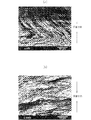
- the value of the heat conductivity of Table 1 is the heat conductivity of the direction which cross
Landscapes
- Chemical & Material Sciences (AREA)
- Health & Medical Sciences (AREA)
- Chemical Kinetics & Catalysis (AREA)
- Medicinal Chemistry (AREA)
- Polymers & Plastics (AREA)
- Organic Chemistry (AREA)
- Inorganic Chemistry (AREA)
- Compositions Of Macromolecular Compounds (AREA)
- Manufacture Of Macromolecular Shaped Articles (AREA)
- Processes Of Treating Macromolecular Substances (AREA)
Applications Claiming Priority (2)
| Application Number | Priority Date | Filing Date | Title |
|---|---|---|---|
| JP2013178652A JP5887624B2 (ja) | 2013-08-29 | 2013-08-29 | 熱伝導性複合粒子、樹脂成形体およびその製造方法 |
| JP2013-178652 | 2013-08-29 |
Publications (1)
| Publication Number | Publication Date |
|---|---|
| WO2015030098A1 true WO2015030098A1 (ja) | 2015-03-05 |
Family
ID=52586647
Family Applications (1)
| Application Number | Title | Priority Date | Filing Date |
|---|---|---|---|
| PCT/JP2014/072541 Ceased WO2015030098A1 (ja) | 2013-08-29 | 2014-08-28 | 熱伝導性複合粒子および樹脂成形体 |
Country Status (2)
| Country | Link |
|---|---|
| JP (1) | JP5887624B2 (enExample) |
| WO (1) | WO2015030098A1 (enExample) |
Cited By (2)
| Publication number | Priority date | Publication date | Assignee | Title |
|---|---|---|---|---|
| WO2021065248A1 (ja) * | 2019-10-02 | 2021-04-08 | 株式会社オートネットワーク技術研究所 | 熱伝導性フィラー、熱伝導性複合材料、ワイヤーハーネス、および熱伝導性フィラーの製造方法 |
| JPWO2023149472A1 (enExample) * | 2022-02-04 | 2023-08-10 |
Families Citing this family (9)
| Publication number | Priority date | Publication date | Assignee | Title |
|---|---|---|---|---|
| JP6171257B2 (ja) * | 2013-10-09 | 2017-08-02 | 株式会社豊田中央研究所 | 複合材料及びその製造方法 |
| WO2016043145A1 (ja) | 2014-09-17 | 2016-03-24 | 国立大学法人名古屋大学 | 導電性組成物及びその製造方法 |
| JP2016192474A (ja) * | 2015-03-31 | 2016-11-10 | 住友ベークライト株式会社 | 造粒粉、放熱用樹脂組成物、放熱シート、放熱部材、および半導体装置 |
| JP6683563B2 (ja) * | 2015-07-21 | 2020-04-22 | 積水化学工業株式会社 | 接着シート |
| JP6718761B2 (ja) * | 2015-07-21 | 2020-07-08 | 積水化学工業株式会社 | 接着シート |
| JP7046689B2 (ja) * | 2018-04-13 | 2022-04-04 | 株式会社Kri | 熱伝導性複合粒子およびこれを含む樹脂組成物 |
| JP7249630B2 (ja) * | 2019-03-28 | 2023-03-31 | 国立研究開発法人産業技術総合研究所 | 熱伝導性ビーズ、その製造方法、樹脂組成物及び成形体 |
| JP7333914B2 (ja) * | 2019-05-31 | 2023-08-28 | 国立研究開発法人産業技術総合研究所 | 熱伝導性樹脂成形体とその製造方法 |
| JP7150279B2 (ja) * | 2019-07-30 | 2022-10-11 | 国立研究開発法人産業技術総合研究所 | 熱伝導性複合材料及びその製造方法 |
Citations (3)
| Publication number | Priority date | Publication date | Assignee | Title |
|---|---|---|---|---|
| JP2000169137A (ja) * | 1998-12-11 | 2000-06-20 | Denki Kagaku Kogyo Kk | ホウ酸塩粒子、その粒子を含む無機粉末の製法及び用途 |
| JP2001122615A (ja) * | 1999-10-27 | 2001-05-08 | Denki Kagaku Kogyo Kk | 窒化ホウ素被覆球状ホウ酸塩粒子とそれを含む混合粉末、及びそれらの製造方法 |
| JP2010116455A (ja) * | 2008-11-12 | 2010-05-27 | Nitto Denko Corp | 有機−無機複合成形体 |
-
2013
- 2013-08-29 JP JP2013178652A patent/JP5887624B2/ja active Active
-
2014
- 2014-08-28 WO PCT/JP2014/072541 patent/WO2015030098A1/ja not_active Ceased
Patent Citations (3)
| Publication number | Priority date | Publication date | Assignee | Title |
|---|---|---|---|---|
| JP2000169137A (ja) * | 1998-12-11 | 2000-06-20 | Denki Kagaku Kogyo Kk | ホウ酸塩粒子、その粒子を含む無機粉末の製法及び用途 |
| JP2001122615A (ja) * | 1999-10-27 | 2001-05-08 | Denki Kagaku Kogyo Kk | 窒化ホウ素被覆球状ホウ酸塩粒子とそれを含む混合粉末、及びそれらの製造方法 |
| JP2010116455A (ja) * | 2008-11-12 | 2010-05-27 | Nitto Denko Corp | 有機−無機複合成形体 |
Non-Patent Citations (2)
| Title |
|---|
| HIROTAKA IHARA ET AL.: "Kokino Biryushi no Sekkei ~ Core Shell-gata Micro Biryushi o Chushin to shite", DAI 21 KAI POLYMER MATERIAL FORUM YOKOSHU, THE SOCIETY OF POLYMER SCIENCE, 2012, JAPAN, pages 137 - 138 * |
| NORIHIRO SHIMIZU: "Konetsu Dendosei o Jitsugen suru Yuki . Muki Hybrid Technology - Muki Ryushi no Haiko Seigyo Oyobi Hyomen Kagaku Shushoku ni yoru Saisentan Honetsu Zairyo Sekkei", NETWORK POLYMER, vol. 32, no. 4, 2011, pages 205 - 209 * |
Cited By (4)
| Publication number | Priority date | Publication date | Assignee | Title |
|---|---|---|---|---|
| WO2021065248A1 (ja) * | 2019-10-02 | 2021-04-08 | 株式会社オートネットワーク技術研究所 | 熱伝導性フィラー、熱伝導性複合材料、ワイヤーハーネス、および熱伝導性フィラーの製造方法 |
| JPWO2023149472A1 (enExample) * | 2022-02-04 | 2023-08-10 | ||
| WO2023149472A1 (ja) * | 2022-02-04 | 2023-08-10 | 国立大学法人東海国立大学機構 | 樹脂成形体及びその製造方法 |
| JP7837515B2 (ja) | 2022-02-04 | 2026-03-31 | 国立大学法人東海国立大学機構 | 樹脂成形体及びその製造方法 |
Also Published As
| Publication number | Publication date |
|---|---|
| JP5887624B2 (ja) | 2016-03-16 |
| JP2015048358A (ja) | 2015-03-16 |
Similar Documents
| Publication | Publication Date | Title |
|---|---|---|
| JP5887624B2 (ja) | 熱伝導性複合粒子、樹脂成形体およびその製造方法 | |
| CN109181301B (zh) | 一种掺杂量子点功能化氮化硼聚合物导热复合膜及制备方法 | |
| JP5075180B2 (ja) | 導電性粒子及びこれを含む異方性導電フィルム | |
| JP2015048358A5 (enExample) | ||
| JP6718280B2 (ja) | 導電粒子、異方導電材料及び接続構造体 | |
| CN101392090A (zh) | 一种压电导电环氧树脂复合阻尼材料及其制备方法 | |
| CN101065421A (zh) | 聚合物颗粒、导电颗粒以及含有该导电颗粒的各向异性导电封装材料 | |
| CN101550213B (zh) | 一种金属/聚合物复合粒子及其制备方法 | |
| JP5967002B2 (ja) | 易変形性凝集体、熱伝導性樹脂組成物、熱伝導性部材、および熱伝導性接着シート | |
| CN106243715A (zh) | 一种高导热聚酰亚胺/氮化硼复合材料及其制备方法 | |
| CN115197472A (zh) | 一种功能化交联网络改性纳米滑石粉的制备方法及应用 | |
| Wu et al. | Synthesis and characterization of novel epoxy resins‐filled microcapsules with organic/inorganic hybrid shell for the self‐healing of high performance resins | |
| KR20200010459A (ko) | 고농도 입자 함유 필름 및 그 제조 방법 | |
| CN108889959A (zh) | 一种rGO/Cu复合材料及其制备方法 | |
| CN111378299B (zh) | 一种利用多巴胺诱导过渡金属离子对氢氧化镁表面改性方法 | |
| CN115850751A (zh) | 一种led封装材料及其制备方法 | |
| CN110004712B (zh) | 一种基于凯夫拉纳米纤维的高强度导热膜的制备方法 | |
| WO2010039623A2 (en) | Shear-and/or pressure-resistant microspheres | |
| JP6679870B2 (ja) | 放熱シート | |
| JP7471197B2 (ja) | 熱伝導性フィラー、熱伝導性複合材料、ワイヤーハーネス、および熱伝導性フィラーの製造方法 | |
| TWI774675B (zh) | 導電材料、連接構造體及連接構造體之製造方法 | |
| TWI424875B (zh) | 雷射直接成型材料及其製造方法 | |
| CN109251360B (zh) | 球形石墨导热填料、球形石墨/高分子导热复合材料及其制备方法 | |
| JPH0519241B2 (enExample) | ||
| JPH0539313A (ja) | 脱イオン方法 |
Legal Events
| Date | Code | Title | Description |
|---|---|---|---|
| 121 | Ep: the epo has been informed by wipo that ep was designated in this application |
Ref document number: 14841011 Country of ref document: EP Kind code of ref document: A1 |
|
| NENP | Non-entry into the national phase |
Ref country code: DE |
|
| 122 | Ep: pct application non-entry in european phase |
Ref document number: 14841011 Country of ref document: EP Kind code of ref document: A1 |