WO2014192492A1 - 粘着剤用組成物および粘着シート - Google Patents
粘着剤用組成物および粘着シート Download PDFInfo
- Publication number
- WO2014192492A1 WO2014192492A1 PCT/JP2014/061983 JP2014061983W WO2014192492A1 WO 2014192492 A1 WO2014192492 A1 WO 2014192492A1 JP 2014061983 W JP2014061983 W JP 2014061983W WO 2014192492 A1 WO2014192492 A1 WO 2014192492A1
- Authority
- WO
- WIPO (PCT)
- Prior art keywords
- group
- polymer
- meth
- pressure
- formula
- Prior art date
- Legal status (The legal status is an assumption and is not a legal conclusion. Google has not performed a legal analysis and makes no representation as to the accuracy of the status listed.)
- Ceased
Links
- 0 C*(C)CN*CC(*)* Chemical compound C*(C)CN*CC(*)* 0.000 description 1
Classifications
-
- C—CHEMISTRY; METALLURGY
- C09—DYES; PAINTS; POLISHES; NATURAL RESINS; ADHESIVES; COMPOSITIONS NOT OTHERWISE PROVIDED FOR; APPLICATIONS OF MATERIALS NOT OTHERWISE PROVIDED FOR
- C09J—ADHESIVES; NON-MECHANICAL ASPECTS OF ADHESIVE PROCESSES IN GENERAL; ADHESIVE PROCESSES NOT PROVIDED FOR ELSEWHERE; USE OF MATERIALS AS ADHESIVES
- C09J133/00—Adhesives based on homopolymers or copolymers of compounds having one or more unsaturated aliphatic radicals, each having only one carbon-to-carbon double bond, and at least one being terminated by only one carboxyl radical, or of salts, anhydrides, esters, amides, imides, or nitriles thereof; Adhesives based on derivatives of such polymers
- C09J133/04—Homopolymers or copolymers of esters
- C09J133/06—Homopolymers or copolymers of esters of esters containing only carbon, hydrogen and oxygen, the oxygen atom being present only as part of the carboxyl radical
- C09J133/08—Homopolymers or copolymers of acrylic acid esters
-
- C—CHEMISTRY; METALLURGY
- C09—DYES; PAINTS; POLISHES; NATURAL RESINS; ADHESIVES; COMPOSITIONS NOT OTHERWISE PROVIDED FOR; APPLICATIONS OF MATERIALS NOT OTHERWISE PROVIDED FOR
- C09J—ADHESIVES; NON-MECHANICAL ASPECTS OF ADHESIVE PROCESSES IN GENERAL; ADHESIVE PROCESSES NOT PROVIDED FOR ELSEWHERE; USE OF MATERIALS AS ADHESIVES
- C09J133/00—Adhesives based on homopolymers or copolymers of compounds having one or more unsaturated aliphatic radicals, each having only one carbon-to-carbon double bond, and at least one being terminated by only one carboxyl radical, or of salts, anhydrides, esters, amides, imides, or nitriles thereof; Adhesives based on derivatives of such polymers
- C09J133/04—Homopolymers or copolymers of esters
-
- C—CHEMISTRY; METALLURGY
- C08—ORGANIC MACROMOLECULAR COMPOUNDS; THEIR PREPARATION OR CHEMICAL WORKING-UP; COMPOSITIONS BASED THEREON
- C08G—MACROMOLECULAR COMPOUNDS OBTAINED OTHERWISE THAN BY REACTIONS ONLY INVOLVING UNSATURATED CARBON-TO-CARBON BONDS
- C08G18/00—Polymeric products of isocyanates or isothiocyanates
- C08G18/06—Polymeric products of isocyanates or isothiocyanates with compounds having active hydrogen
- C08G18/28—Polymeric products of isocyanates or isothiocyanates with compounds having active hydrogen characterised by the compounds used containing active hydrogen
- C08G18/40—High-molecular-weight compounds
- C08G18/42—Polycondensates having carboxylic or carbonic ester groups in the main chain
- C08G18/46—Polycondensates having carboxylic or carbonic ester groups in the main chain having heteroatoms other than oxygen
- C08G18/4676—Polycondensates having carboxylic or carbonic ester groups in the main chain having heteroatoms other than oxygen containing sulfur
-
- C—CHEMISTRY; METALLURGY
- C09—DYES; PAINTS; POLISHES; NATURAL RESINS; ADHESIVES; COMPOSITIONS NOT OTHERWISE PROVIDED FOR; APPLICATIONS OF MATERIALS NOT OTHERWISE PROVIDED FOR
- C09J—ADHESIVES; NON-MECHANICAL ASPECTS OF ADHESIVE PROCESSES IN GENERAL; ADHESIVE PROCESSES NOT PROVIDED FOR ELSEWHERE; USE OF MATERIALS AS ADHESIVES
- C09J133/00—Adhesives based on homopolymers or copolymers of compounds having one or more unsaturated aliphatic radicals, each having only one carbon-to-carbon double bond, and at least one being terminated by only one carboxyl radical, or of salts, anhydrides, esters, amides, imides, or nitriles thereof; Adhesives based on derivatives of such polymers
- C09J133/04—Homopolymers or copolymers of esters
- C09J133/14—Homopolymers or copolymers of esters of esters containing halogen, nitrogen, sulfur or oxygen atoms in addition to the carboxy oxygen
-
- C—CHEMISTRY; METALLURGY
- C09—DYES; PAINTS; POLISHES; NATURAL RESINS; ADHESIVES; COMPOSITIONS NOT OTHERWISE PROVIDED FOR; APPLICATIONS OF MATERIALS NOT OTHERWISE PROVIDED FOR
- C09J—ADHESIVES; NON-MECHANICAL ASPECTS OF ADHESIVE PROCESSES IN GENERAL; ADHESIVE PROCESSES NOT PROVIDED FOR ELSEWHERE; USE OF MATERIALS AS ADHESIVES
- C09J141/00—Adhesives based on homopolymers or copolymers of compounds having one or more unsaturated aliphatic radicals, each having only one carbon-to-carbon double bond, and at least one being terminated by a bond to sulfur or by a heterocyclic ring containing sulfur; Adhesives based on derivatives of such polymers
-
- C—CHEMISTRY; METALLURGY
- C09—DYES; PAINTS; POLISHES; NATURAL RESINS; ADHESIVES; COMPOSITIONS NOT OTHERWISE PROVIDED FOR; APPLICATIONS OF MATERIALS NOT OTHERWISE PROVIDED FOR
- C09J—ADHESIVES; NON-MECHANICAL ASPECTS OF ADHESIVE PROCESSES IN GENERAL; ADHESIVE PROCESSES NOT PROVIDED FOR ELSEWHERE; USE OF MATERIALS AS ADHESIVES
- C09J175/00—Adhesives based on polyureas or polyurethanes; Adhesives based on derivatives of such polymers
- C09J175/04—Polyurethanes
- C09J175/14—Polyurethanes having carbon-to-carbon unsaturated bonds
- C09J175/16—Polyurethanes having carbon-to-carbon unsaturated bonds having terminal carbon-to-carbon unsaturated bonds
-
- C—CHEMISTRY; METALLURGY
- C09—DYES; PAINTS; POLISHES; NATURAL RESINS; ADHESIVES; COMPOSITIONS NOT OTHERWISE PROVIDED FOR; APPLICATIONS OF MATERIALS NOT OTHERWISE PROVIDED FOR
- C09J—ADHESIVES; NON-MECHANICAL ASPECTS OF ADHESIVE PROCESSES IN GENERAL; ADHESIVE PROCESSES NOT PROVIDED FOR ELSEWHERE; USE OF MATERIALS AS ADHESIVES
- C09J7/00—Adhesives in the form of films or foils
- C09J7/30—Adhesives in the form of films or foils characterised by the adhesive composition
- C09J7/38—Pressure-sensitive adhesives [PSA]
- C09J7/381—Pressure-sensitive adhesives [PSA] based on macromolecular compounds obtained by reactions involving only carbon-to-carbon unsaturated bonds
- C09J7/385—Acrylic polymers
-
- C—CHEMISTRY; METALLURGY
- C09—DYES; PAINTS; POLISHES; NATURAL RESINS; ADHESIVES; COMPOSITIONS NOT OTHERWISE PROVIDED FOR; APPLICATIONS OF MATERIALS NOT OTHERWISE PROVIDED FOR
- C09J—ADHESIVES; NON-MECHANICAL ASPECTS OF ADHESIVE PROCESSES IN GENERAL; ADHESIVE PROCESSES NOT PROVIDED FOR ELSEWHERE; USE OF MATERIALS AS ADHESIVES
- C09J2301/00—Additional features of adhesives in the form of films or foils
- C09J2301/30—Additional features of adhesives in the form of films or foils characterized by the chemical, physicochemical or physical properties of the adhesive or the carrier
- C09J2301/302—Additional features of adhesives in the form of films or foils characterized by the chemical, physicochemical or physical properties of the adhesive or the carrier the adhesive being pressure-sensitive, i.e. tacky at temperatures inferior to 30°C
-
- C—CHEMISTRY; METALLURGY
- C09—DYES; PAINTS; POLISHES; NATURAL RESINS; ADHESIVES; COMPOSITIONS NOT OTHERWISE PROVIDED FOR; APPLICATIONS OF MATERIALS NOT OTHERWISE PROVIDED FOR
- C09J—ADHESIVES; NON-MECHANICAL ASPECTS OF ADHESIVE PROCESSES IN GENERAL; ADHESIVE PROCESSES NOT PROVIDED FOR ELSEWHERE; USE OF MATERIALS AS ADHESIVES
- C09J2433/00—Presence of (meth)acrylic polymer
-
- C—CHEMISTRY; METALLURGY
- C09—DYES; PAINTS; POLISHES; NATURAL RESINS; ADHESIVES; COMPOSITIONS NOT OTHERWISE PROVIDED FOR; APPLICATIONS OF MATERIALS NOT OTHERWISE PROVIDED FOR
- C09J—ADHESIVES; NON-MECHANICAL ASPECTS OF ADHESIVE PROCESSES IN GENERAL; ADHESIVE PROCESSES NOT PROVIDED FOR ELSEWHERE; USE OF MATERIALS AS ADHESIVES
- C09J2467/00—Presence of polyester
- C09J2467/006—Presence of polyester in the substrate
-
- C—CHEMISTRY; METALLURGY
- C09—DYES; PAINTS; POLISHES; NATURAL RESINS; ADHESIVES; COMPOSITIONS NOT OTHERWISE PROVIDED FOR; APPLICATIONS OF MATERIALS NOT OTHERWISE PROVIDED FOR
- C09J—ADHESIVES; NON-MECHANICAL ASPECTS OF ADHESIVE PROCESSES IN GENERAL; ADHESIVE PROCESSES NOT PROVIDED FOR ELSEWHERE; USE OF MATERIALS AS ADHESIVES
- C09J4/00—Adhesives based on organic non-macromolecular compounds having at least one polymerisable carbon-to-carbon unsaturated bond ; adhesives, based on monomers of macromolecular compounds of groups C09J183/00 - C09J183/16
- C09J4/06—Organic non-macromolecular compounds having at least one polymerisable carbon-to-carbon unsaturated bond in combination with a macromolecular compound other than an unsaturated polymer of groups C09J159/00 - C09J187/00
Definitions
- the present invention relates to a pressure-sensitive adhesive composition containing a (meth) acrylic acid ester polymer having hydroxyl groups at both ends and an isocyanate-based crosslinking agent, and a pressure-sensitive adhesive sheet having a pressure-sensitive adhesive layer made of the composition.
- an acrylic polymer contained in a conventional pressure-sensitive adhesive composition has a weight average molecular weight (Mw) of 500,000 to 1,500,000, and the performance is adjusted by adding an isocyanate-based crosslinking agent to the acrylic polymer. Since low molecular weight substances remain, these remaining components migrate to the surface of the pressure-sensitive adhesive layer over time or under heat-resistant conditions, causing contamination.
- Mw weight average molecular weight
- Patent Document 1 a RAFT polymerization agent obtained by a Reversible Addition-Fragmentation chain Transfer (RAFT) polymerization method using a dibenzyltrithiocarbonate derivative having a hydroxyl group at both ends is used as a starting material, and a vinyl monomer is used for RAFT polymerization.
- the RAFT polymer obtained by attaching is described.
- the polymer obtained by making a diisocyanate compound react with the hydroxyl group of this RAFT polymer is described.
- Patent Document 1 does not particularly examine the use of a polymer obtained by reacting a diisocyanate compound with the hydroxyl group of the RAFT polymer as an adhesive.
- Patent Document 2 discloses a curable composition containing a (meth) acrylic polymer having a hydroxyl group at a terminal and a compound having at least two functional groups capable of reacting with a hydroxyl group, such as a polyvalent isocyanate compound. Are listed.
- the number average molecular weight (Mn) of the polymer obtained in the examples is 10,000 or less, and this polymer is crosslinked.
- Mn number average molecular weight
- Patent Document 3 discloses that at least 2 functional groups Y that can be added to a linking reaction in the form of addition or substitution reaction together with the functional groups X are added to polyacrylates whose chain ends are functionalized with appropriate groups X.
- a method for increasing the molecular weight of a polyacrylate is described which comprises reacting with an individual compound X. It is also described that the polyacrylate obtained by this method is used as a pressure-sensitive adhesive.
- An object of the present invention is to provide a pressure-sensitive adhesive having basic physical properties as a pressure-sensitive adhesive such as pressure-sensitive adhesive force, holding power, and constant load, and capable of forming a pressure-sensitive adhesive that reduces contamination of an adherend when the pressure-sensitive adhesive sheet is peeled off. It is to provide a composition.
- the present inventors diligently studied to solve the above problems. As a result, the inventors found that the above problems can be solved by a composition for pressure-sensitive adhesive containing a specific (meth) acrylic acid ester polymer and an isocyanate compound having an average number of isocyanate groups exceeding 2 in one molecule, and completed the present invention. It came to do.
- the present invention includes, for example, the following [1] to [6].
- [1] (A) It has a structure represented by the formula (a1) described later, has hydroxyl groups at both ends of the molecule, and has a weight average molecular weight (Mw) of 50 measured by gel permeation chromatography.
- a composition for pressure-sensitive adhesives comprising a (meth) acrylic acid ester polymer of 1,000,000 to 300,000 and (B) an isocyanate compound having an average number of isocyanate groups exceeding 2 in one molecule.
- composition for pressure-sensitive adhesives according to [1] or [2], wherein the (meth) acrylic acid ester polymer (A) is a RAFT polymer represented by the formula (A1-1) described later.
- the (meth) acrylic acid ester polymer (A) is selected from a RAFT polymer represented by the formula (A2-1) described later and a RAFT polymer represented by the formula (A3-1) described later. 4.
- the pressure-sensitive adhesive composition according to any one of the above [1] to [3], which is at least one kind.
- a pressure-sensitive adhesive sheet comprising a base material and a pressure-sensitive adhesive layer comprising the composition according to any one of [1] to [5].
- a composition which can form the adhesive which has the basic physical properties as adhesives, such as adhesive force, holding power, and constant load property, and can reduce the contamination with respect to the adherend at the time of adhesive sheet peeling
- a composition can be provided.
- the said composition can form the adhesive with a small peeling rate dependence and peeling temperature dependence of peeling force.
- composition for pressure-sensitive adhesives the pressure-sensitive adhesive, and the pressure-sensitive adhesive sheet of the present invention will be described.
- polymer is used to include homopolymers and copolymers
- polymerization is used to include homopolymerization and copolymerization.
- composition for pressure-sensitive adhesives of the present invention comprises a specific (meth) acrylic acid ester polymer (A) and an isocyanate compound (B) having an average number of isocyanate groups in one molecule exceeding 2 (hereinafter referred to as “polyfunctional isocyanate compound (B ) ”))).
- composition for pressure-sensitive adhesives of the present invention has the following constitution, the basic pressure-sensitive physical properties are almost the same as or higher than those of existing products, and it has excellent heat resistance and is capable of sticking under low to high temperature conditions. A high-functional pressure-sensitive adhesive that exhibits low contamination during sheet peeling can be formed.
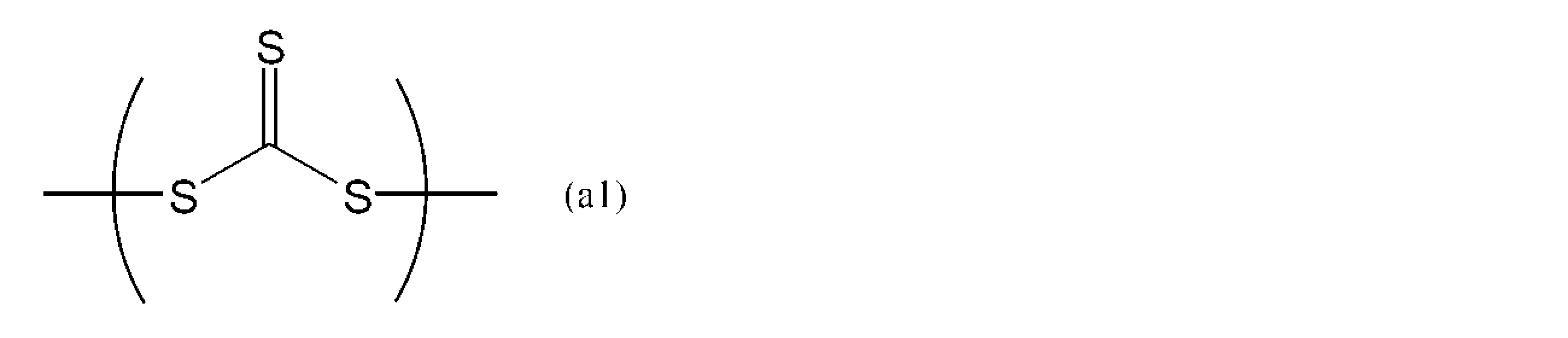
- the (meth) acrylic acid ester polymer (A) has a structure represented by the formula (a1), has a hydroxyl group at both ends of the molecule, and is measured by gel permeation chromatography. (Mw) is 50,000 to 300,000.
- the polymer (A) has a structure represented by the formula (a1) (hereinafter also referred to as “trithiocarbonate structure”).
- the polymer (A) has hydroxyl groups at both ends of the molecule, and Mw / Mn is preferably in the range described below. For this reason, it is considered that the crosslinked body (network polymer) formed from the polymer (A) and the compound (B) has a uniform distance between crosslinking points and a structure with few defects in the crosslinked structure (network structure). Therefore, the pressure-sensitive adhesive layer made of the composition of the present invention has excellent mechanical properties such as high elasticity and high elongation.
- the weight average molecular weight (Mw) measured by the gel permeation chromatography method of the polymer (A) is 50,000 to 300,000, preferably 70,000 to 280,000, more preferably 100,000. ⁇ 250,000.
- the polymer Mw needs to be 500,000 or more in order to ensure cohesion. This is because the molecular weight of the polymer to be crosslinked varies.
- the composition for pressure-sensitive adhesives of the present invention exhibits excellent cohesive strength even when the polymer Mw is 300,000 or less. This is because the variation in the molecular weight of the polymer to be crosslinked is small as will be described later.
- the molecular weight distribution (Mw / Mn) of the polymer (A) is preferably 1 to 3.5, more preferably 1.2 to 3.5, and still more preferably 1.5 to 2.5. Since the polymer (A) having Mw / Mn in the above range has a uniform molecular weight and a small number of low molecular weight substances, the resulting crosslinked product is excellent in heat resistance and low in peeling the pressure sensitive adhesive sheet from low temperature to high temperature conditions. Contamination of the adherend due to the molecular weight can be suppressed.
- the polymer (A) is a polymer obtained by polymerizing a compound represented by the formula (A1) (hereinafter also referred to as “compound (A1)” with a vinyl monomer such as (meth) acrylic acid ester by the RAFT polymerization method. It is preferably a coalescence.
- each R 1 is independently a divalent organic group.
- Compound (A1) has a trithiocarbonate structure near the center or center of the molecule, and has hydroxyl groups at both ends of the molecule.
- Compound (A1) can be synthesized, for example, according to the method described in JP-A-2007-230947. By using the compound (A1) having the above structure, a telechelic structure can be formed without containing harmful organic metals.
- Examples of the compound (A1) include a compound represented by the formula (A2) (hereinafter also referred to as “compound (A2)”) and a compound represented by the formula (A3) (hereinafter also referred to as “compound (A3)”. ).
- Compound (A2) has a trithiocarbonate structure near the center or center of the molecule, and one hydroxyl group at each end of the molecule.
- Examples of the compound (A2) include RAFT-NT manufactured by Nippon Terpene Chemical Co., Ltd.
- each X is independently —COO—, —CONR 3 — or a direct bond
- each R 3 is independently an alkyl group, and the alkyl group preferably has 1 to 4 carbon atoms.
- R 2 is independently an alkylene group, and the alkylene group preferably has 1 to 4 carbon atoms, more preferably 1 to 3 carbon atoms;
- Ar is each independently a phenylene group or naphthylene; Or a group formed by substituting at least one of the aromatic ring hydrogen contained in the phenylene group or naphthylene group with a substituent. Examples of the substituent include an alkyl group and an alkoxy group.
- a carbonyl group in —COO— and —CONR 3 — is bonded to Ar.
- Two X are preferably the same group, two R 2 are preferably the same group, two R 3 are preferably the same group, and two Ar are the same group It is preferable.
- Compound (A3) has a trithiocarbonate structure near the center or center of the molecule, and has two hydroxyl groups at both ends of the molecule.
- Examples of the compound (A3) include RAFT-DiOH manufactured by Nippon Terpene Chemical Co., Ltd.
- X and Ar have the same meanings as the same symbols in the formula (A2); each R 4 independently represents an alkylene group, each R 5 independently represents a direct bond or an alkylene group,
- the alkylene group preferably has 1 to 4 carbon atoms, more preferably 1 to 3 carbon atoms.
- Two X are preferably the same group, two R 4 are preferably the same group, two R 5 are preferably the same group, and two Ar are the same group It is preferable.
- Specific examples of the compound (A1) are shown below.
- one or more vinyl monomers are polymerized in the presence of the compound (A1).
- the amount of compound (A1) to be used is generally 0.05 to 20 parts by mass, preferably 0.05 to 10 parts by mass with respect to 100 parts by mass of the total amount of vinyl monomers. If the amount of the compound (A1) used is not less than the lower limit of the range, the reaction control is easy, and if it is not more than the upper limit of the range, it is easy to adjust the weight average molecular weight of the resulting polymer to the above range. It is.
- a polymer represented by the formula (A1-1) reacts such that a vinyl monomer is inserted between a sulfur atom in the compound (A1) and a methylene group adjacent to the sulfur atom.
- polymer (A1-1) specific examples include polymers represented by formula (A2-1) or formula (A3-1) (hereinafter referred to as “polymer (A2-1)”, “polymer ( A3-1) ”) is generated.
- R 1 has the same meaning as the same symbol in the formula (A1), and (A) is a divalent group derived from a polymer composed of a vinyl monomer (a compound composed of a vinyl monomer). And at least a part of the vinyl monomer is a (meth) acrylic acid ester.
- X, R 2 and Ar have the same meanings as the same symbols in the formula (A2), and (A) is a divalent group (vinyl) derived from a polymer composed of a vinyl monomer.
- a polymer chain composed of monomers), and at least a part of the vinyl monomer is a (meth) acrylic acid ester.
- X, R 4 , R 5 and Ar have the same meanings as the same symbols in the formula (A3), and (A) is a divalent polymer derived from a polymer composed of a vinyl monomer.
- A (a divalent group derived from a polymer) may be either a homopolymer structure or a copolymer structure of a vinyl monomer, or a copolymer structure. Any of a random copolymer structure of vinyl monomers and a block copolymer structure may be used.
- the number of repeating structural units derived from the vinyl monomer is such that the Mw of the polymer (A) is in the above range.
- Mw of the polymer (A) is in the above range.
- a vinyl monomer is added to the compound (A1) to perform the first RAFT polymerization, and an additional vinyl monomer is added to the obtained polymer to perform the second RAFT polymerization.
- a polymer represented by formula (A1-2) specifically, a polymer represented by formula (A2-2) or formula (A3-2) (hereinafter referred to as “polymer (A1-2)”, “polymer (A2-2)” And “polymer (A3-2)”.
- R 1 has the same meaning as the same symbol in formula (A1), and (A 1 ) and (A 2 ) are each independently a divalent group derived from a polymer comprising a vinyl monomer. (Polymer chain made of vinyl monomer), and at least a part of the vinyl monomer is a (meth) acrylic acid ester.
- X, R 2 and Ar have the same meanings as the same symbols in the formula (A2), and (A 1 ) and (A 2 ) are each independently derived from a polymer comprising a vinyl monomer. It is a divalent group (polymer chain made of a vinyl monomer), and at least a part of the vinyl monomer is a (meth) acrylic acid ester.
- X, R 4 , R 5 and Ar have the same meanings as the same symbols in the formula (A3), and (A 1 ) and (A 2 ) are each independently a vinyl monomer It is a divalent group (polymer chain made of vinyl monomer) derived from the coalescence, and at least a part of the vinyl monomer is a (meth) acrylic acid ester.
- the number of repeating structural units derived from a vinyl monomer is preferably 1 to 3559, more preferably Is 1 to 3399, more preferably 1 to 2999.
- the polymer (A) is a polymer having a block copolymer structure in which a polymer chain composed of a vinyl monomer, for example, the polymers (A1-2) to (A3-2) are used, the resulting adhesive is used.
- the composition has a balance of hydrophobicity-hydrophilicity, flexibility-rigidity and the like according to the purpose.
- the (meth) acrylic acid ester polymer obtained by living polymerization of (meth) acrylic acid ester by RAFT polymerization in the presence of compound (A1) is linear and has hydroxyl groups at both ends of the molecule. is doing.
- the RAFT polymerization method has a narrow molecular weight distribution and a small amount of low molecular weight materials. Can be suppressed.
- the RAFT polymer having the above structure has a soft segment derived from a polymer chain made of a vinyl monomer. Therefore, since the isocyanate group of the polyfunctional isocyanate compound tends to approach the terminal hydroxyl group of the RAFT polymer, it is considered that the formation of urethane bonds proceeds efficiently.
- a polymer (A) can be used individually by 1 type or in combination of 2 or more types.
- the content of the (meth) acrylic acid ester polymer (A) in the pressure-sensitive adhesive composition is usually 80 to 99% by mass, more preferably 85 to 96% by mass in 100% by mass of the solid content excluding the solvent of the composition. %, Particularly preferably 90 to 93% by mass.
- content of a polymer (A) exists in the said range, the performance as an adhesive is balanced and it is excellent in an adhesive characteristic.
- RAFT polymerization method at least (meth) acrylic acid ester is used as the vinyl monomer.
- functional group-containing monomers and other copolymerizable monomers can be used.
- (meth) acrylic acid ester examples include alkyl (meth) acrylate, alkoxyalkyl (meth) acrylate, alkoxypolyalkylene glycol mono (meth) acrylate, alicyclic group, and aromatic ring-containing (meth) acrylate.
- functional group-containing (meth) acrylates such as carboxyl group-containing (meth) acrylate, hydroxyl group-containing (meth) acrylate, and amino group-containing (meth) acrylate are excluded from (meth) acrylic acid esters.
- the number of carbon atoms of the alkyl group in the alkyl (meth) acrylate is preferably 1-20.
- the alkyl (meth) acrylate include methyl (meth) acrylate, ethyl (meth) acrylate, n-propyl (meth) acrylate, iso-propyl (meth) acrylate, n-butyl (meth) acrylate, iso-butyl ( (Meth) acrylate, tert-butyl (meth) acrylate, pentyl (meth) acrylate, hexyl (meth) acrylate, heptyl (meth) acrylate, 2-ethylhexyl (meth) acrylate, octyl (meth) acrylate, nonyl (meth) acrylate, Decyl (meth) acrylate, undeca (meth) acrylate, lauryl (meth) acrylate, o
- alkoxyalkyl (meth) acrylate examples include methoxymethyl (meth) acrylate, 2-methoxyethyl (meth) acrylate, 2-ethoxyethyl (meth) acrylate, 3-methoxypropyl (meth) acrylate, 3-ethoxypropyl ( And (meth) acrylate, 4-methoxybutyl (meth) acrylate, and 4-ethoxybutyl (meth) acrylate.
- alkoxypolyalkylene glycol mono (meth) acrylate examples include methoxydiethylene glycol mono (meth) acrylate, methoxydipropylene glycol mono (meth) acrylate, ethoxytriethylene glycol mono (meth) acrylate, ethoxydiethylene glycol mono (meth) acrylate, And methoxytriethylene glycol mono (meth) acrylate.
- Examples of the alicyclic group or aromatic ring-containing (meth) acrylate include cyclohexyl (meth) acrylate, benzyl (meth) acrylate, and phenyl (meth) acrylate.
- the (meth) acrylic acid ester can be used alone or in combination of two or more.
- the amount of (meth) acrylic acid ester used in the RAFT polymerization method is usually 70% by mass or more, preferably 80% by mass or more, and more preferably 90% by mass or more with respect to 100% by mass of all vinyl monomers.
- the vinyl monomer forming each of A 1 and A 2 is (meth) acrylic.
- Two different types are preferably selected from the acid esters.
- Examples of the functional group-containing monomer include an acid group-containing monomer, a hydroxyl group-containing monomer, an amino group-containing monomer, an amide group-containing monomer, a nitrogen-based heterocyclic ring-containing monomer, and a cyano group-containing monomer.
- Examples of the acid group include a carboxyl group, an acid anhydride group, a phosphoric acid group, and a sulfuric acid group.
- carboxyl group-containing monomer examples include ⁇ -carboxyethyl (meth) acrylate, 5-carboxypentyl (meth) acrylate, mono (meth) acryloyloxyethyl ester succinate, and ⁇ -carboxypolycaprolactone mono (meth) acrylate.
- Carboxyl group-containing (meth) acrylates such as acrylic acid, methacrylic acid, itaconic acid, crotonic acid, fumaric acid, and maleic acid.
- acid anhydride group-containing monomer examples include phthalic acid, maleic anhydride, and succinic acid.
- Examples of the phosphate group-containing monomer include (meth) acrylic monomers having a phosphate group in the side chain, and examples of the sulfate group-containing monomer include (meth) acrylic monomers having a sulfate group in the side chain.
- hydroxyl group-containing monomer examples include 2-hydroxyethyl (meth) acrylate, 3-hydroxypropyl (meth) acrylate, 4-hydroxybutyl (meth) acrylate, 6-hydroxyhexyl (meth) acrylate, 8-hydroxyoctyl ( Examples include hydroxyl group-containing (meth) acrylates such as (meth) acrylate.
- amino group-containing monomer examples include amino group-containing (meth) acrylates such as dimethylaminoethyl (meth) acrylate and diethylaminoethyl (meth) acrylate.
- Examples of the amide group-containing monomer include (meth) acrylamide, N-methyl (meth) acrylamide, N-ethyl (meth) acrylamide, N-propyl (meth) acrylamide, and N-hexyl (meth) acrylamide.
- Examples of the nitrogen heterocycle-containing monomer include vinyl pyrrolidone, acryloyl morpholine, and vinyl caprolactam.
- Examples of the cyano group-containing monomer include cyano (meth) acrylate and (meth) acrylonitrile.
- the total use amount of the functional group-containing monomer is preferably 0 to 10% by mass with respect to the total mass of all monomers constituting the polymer (A).
- the molecular weight between crosslinking points becomes non-uniform due to isocyanate crosslinking.
- the component amount of the monomer containing a reactive functional group is suitably 0.1% by mass or less.
- the functional group-containing monomer can be used alone or in combination of two or more.
- Copolymerizable monomers examples include styrene, methyl styrene, dimethyl styrene, trimethyl styrene, propyl styrene, butyl styrene, hexyl styrene, heptyl styrene, octyl styrene, and other alkyl styrenes, fluorostyrene, chlorostyrene, bromostyrene, dibromo.
- styrene monomers such as styrene, iodinated styrene, nitrostyrene, acetylstyrene, and methoxystyrene, and vinyl acetate.
- the copolymerizable monomer can be used alone or in combination of two or more.
- the RAFT polymerization method can be performed by simply heating in the absence of a polymerization initiator, but is preferably performed in the presence of a polymerization initiator.
- the polymerization initiator include ordinary inorganic polymerization initiators and / or organic polymerization initiators, and specifically, persulfates such as potassium persulfate and ammonium persulfate, benzoyl peroxide, and peroxides. Examples thereof include peroxides such as laurium and azo compounds such as 2,2′-isobisisobutyronitrile. Among these, an azo compound is preferable.
- azo compound examples include 2,2′-azobisisobutyronitrile, 2,2′-azobis (4-methoxy-2,4-dimethylvaleronitrile), 2,2′-azobis (2-cyclopropyl). Propionitrile), 2,2'-azobis (2,4-dimethylvaleronitrile), 2,2'-azobis (2-methylbutyronitrile), 1,1'-azobis (cyclohexane-1-carbonitrile) 2- (carbamoylazo) isobutyronitrile, 2-phenylazo-4-methoxy-2,4-dimethylvaleronitrile, 2,2′-azobis (2-amidinopropane) dihydrochloride, 2,2′-azobis ( N, N′-dimethyleneisobutylamidine), 2,2′-azobis [2-methyl-N- (2-hydroxyethyl) -propionamide], , 2′-azobis (isobutyramide) dihydrate, 4,4′-azobis (4-cyan
- the polymerization initiator can be used alone or in combination of two or more.
- the amount of the polymerization initiator used is usually 0.001 to 2 parts by mass, preferably 0.002 to 1 part by mass with respect to 100 parts by mass of the vinyl monomer.
- the reaction temperature in the RAFT polymerization method is usually 60 to 120 ° C., preferably 80 to 110 ° C., and is usually carried out in an inert gas atmosphere such as nitrogen gas.
- the reaction can be performed under any conditions, and is usually performed at normal pressure.
- the reaction time is usually 1 to 14 hours, preferably 2 to 8 hours.
- polymerization conditions for example, JP-A-2007-230947 and JP-A-2011-52057 can be referred to.
- the reaction is usually carried out without using a reaction solvent, but a reaction solvent may be used if necessary.
- reaction solvent examples include aromatic hydrocarbons such as benzene, toluene and xylene; aliphatic hydrocarbons such as n-pentane, n-hexane, n-heptane and n-octane; cyclopentane, cyclohexane and cycloheptane.
- Cycloaliphatic hydrocarbons such as cyclooctane; ethers such as diethyl ether, diisopropyl ether, 1,2-dimethoxyethane, dibutyl ether, tetrahydrofuran, dioxane, anisole, phenylethyl ether, diphenyl ether; chloroform, carbon tetrachloride, Halogenated hydrocarbons such as 1,2-dichloroethane and chlorobenzene; esters such as ethyl acetate, propyl acetate, butyl acetate and methyl propionate; acetone, methyl ethyl ketone, diethyl ketone, methyl isobutyl ketone, cyclohexane Ketones such as non; amides such as N, N-dimethylformamide, N, N-dimethylacetamide and N-methylpyrrolidone; nitriles such as ace
- Polyfunctional isocyanate compound (B) As a polyfunctional isocyanate compound (B), 1 type, or 2 or more types selected from the isocyanate compound in which the average number of isocyanate groups in 1 molecule exceeds 2 can be used. A crosslinked body (network polymer) can be formed by crosslinking the polymer (A) with the compound (B). The isocyanate compound is low in toxicity and excellent in safety.
- the polyfunctional isocyanate compound (B) a compound having a weight average molecular weight (Mw) of usually 200 to 2,000, particularly 350 to 1,000 is preferably used. Since the cross-linking agent having Mw of 350 or more has low volatility, the odor derived from the cross-linking agent can be reduced.
- polyfunctional isocyanate compound (B) examples include multimers (for example, dimers or trimers, isocyanurates), derivatives (for example, polyhydric alcohols and two molecules) of difunctional or trifunctional or higher functional isocyanate compounds. Examples of addition reaction products with the above bifunctional isocyanates) and polymers. Moreover, aromatic polyisocyanate, aliphatic polyisocyanate, and alicyclic polyisocyanate having 3 or more isocyanate groups can also be mentioned.
- bifunctional isocyanate compound in the multimer, the derivative and the polymer examples include ethylene diisocyanate, tetramethylene diisocyanate, pentamethylene diisocyanate, hexamethylene diisocyanate, 2-methyl-1,5-pentane diisocyanate, 3-methyl- C4-C30 aliphatic diisocyanates such as 1,5-pentane diisocyanate, 2,2,4-trimethyl-1,6-hexamethylene diisocyanate; isophorone diisocyanate, cyclopentyl diisocyanate, cyclohexyl diisocyanate, hydrogenated xylylene diisocyanate, hydrogen Carbon such as added tolylene diisocyanate, hydrogenated diphenylmethane diisocyanate, hydrogenated tetramethylxylene diisocyanate 7-30 alicyclic diisocyanate; phenylene diisocyanate, tolylene diisocyanate, x
- polyhydric alcohol in the above derivative examples include trivalent or higher alcohols such as trimethylolpropane, glycerin, and pentaerythritol as low molecular weight polyhydric alcohols; examples of high molecular weight polyhydric alcohols include polyether polyols, A polyester polyol is mentioned.
- diphenylmethane diisocyanate dimer or trimer hexamethylene diisocyanate isocyanurate (isocyanurate structure trimer adduct), reaction product of trimethylolpropane and tolylene diisocyanate, trimethylol Reaction product of propane and hexamethylene diisocyanate, polymethylene polyphenyl isocyanate, polyether polyisocyanate, polyester polyisocyanate, 2,4,6-triisocyanate toluene, 1,3,5-triisocyanate benzene, 4,4 ' 4,4 "-triphenylmethane triisocyanate.
- polyfunctional isocyanate compound (B) examples include, for example, a trade name “L-45” manufactured by Soken Chemical Co., Ltd., a trade name “Duranate TPA-100” manufactured by Asahi Kasei Chemicals Corporation, and a product name manufactured by Nippon Polyurethane Industry Co., Ltd. "Coronate L”, “Coronate HL”, “Coronate HK”, “Coronate HX”, “Coronate 2096", and "Millionate MR200".
- the average number of isocyanate groups in the polyfunctional isocyanate compound (B) means the number of isocyanate groups that the isocyanate compound statistically has in one molecule.
- the method for calculating the average number of functional groups is disclosed in JP-A-10-231347 and is based on the following formula.
- the isocyanate group weight concentration is the weight of the isocyanate group (formula weight 42) contained in 1 g of the isocyanate compound.
- the number average molecular weight and weight average molecular weight of the isocyanate compound can also be measured based on the method disclosed in JP-A-10-231347.
- the average number of isocyanate groups means the number of isocyanate groups that the polyfunctional isocyanate compound (B) has briefly.
- the average number of isocyanate functional groups of the polyfunctional isocyanate compound (B) is more than 2, preferably 2.3 or more, more preferably 2.3 to 4.0, still more preferably 2.3 to 3.5. . When the average number of isocyanate groups is within the above range, it is preferable in terms of maintaining the flexibility of the pressure-sensitive adhesive.
- the content of the polyfunctional isocyanate compound (B) in the pressure-sensitive adhesive composition is such that the total amount of the isocyanate groups of the compound (B) is usually 1 to 100 mol, preferably 10 with respect to 1 mol of the terminal hydroxyl group of the polymer (A). It is in the range of ⁇ 90 mol, more preferably 20 ⁇ 80 mol.
- content of a compound (B) exists in the said range, the cohesiveness of the composition obtained will not fall and it is excellent in the balance of the adhesive physical property of the composition obtained.
- the compound (B) is used at the lower limit or more, the reaction rate between the terminal hydroxyl group and the isocyanate group is improved.
- the amount is less than the lower limit, curing may be insufficient and adhesive performance may not be exhibited.
- the composition of the present invention may contain an isocyanate compound having an average isocyanate group number of 2 or less in addition to the polyfunctional isocyanate compound (B).
- the compound having an average isocyanate group number of 2 or less include aromatic diisocyanates, aliphatic diisocyanates, and alicyclic diisocyanates.
- a preferred use amount of the isocyanate compound having an average number of isocyanate groups of 2 or less is such that the total amount of the isocyanate groups is 0.01 to 100 mol with respect to 1 mol of the terminal hydroxyl group of the polymer (A).
- the composition for pressure-sensitive adhesives of the present invention is an organic solvent, an antistatic agent, an ultraviolet absorber, an antioxidant, a tackifying resin, in addition to the above components, as long as the transparency, visibility and effects of the present invention are not impaired.
- 1 type (s) or 2 or more types selected from a plasticizer, an antifoaming agent, a filler, a stabilizer, a softening agent, and a wettability adjusting agent may be contained.
- the organic solvent the reaction solvent described in the “polymerization conditions” column of RAFT polymerization can be used.
- preparing a composition for pressure-sensitive adhesives by mixing a polymer solution containing a (meth) acrylic acid ester polymer (A) and a reaction solvent obtained by RAFT polymerization and a polyfunctional isocyanate compound (B).
- the content of the organic solvent is usually 0 to 90% by mass, preferably 10 to 80% by mass.
- the pressure-sensitive adhesive of the present invention is obtained by crosslinking the above-mentioned pressure-sensitive adhesive composition, specifically, by crosslinking the (meth) acrylic acid ester polymer (A) with a polyfunctional isocyanate compound (B). .
- the pressure-sensitive adhesive thus obtained has conventional basic physical properties, such as adhesive strength, holding power and constant load, and has excellent functions, for example, a low degree of contamination on the adherend when peeling the pressure-sensitive adhesive sheet. It has a function that the peeling rate dependency and the peeling temperature dependency of force are small.
- the conditions for forming the pressure-sensitive adhesive are as follows.
- the composition is applied onto a support and dried at 60 to 120 ° C., preferably 70 to 110 ° C., usually for 1 to 5 minutes, preferably 2 to 4 minutes to form a coating film.
- the pressure-sensitive adhesive is preferably formed under the following conditions. After applying the composition on a support and applying a cover film on the coating film formed under the above conditions, it is usually 3 days or more, preferably 7 to 10 days, usually 5 to 60 ° C., preferably 15 to Curing is performed in an environment of 40 ° C., usually 30 to 70% RH, preferably 40 to 70% RH. When crosslinking is performed under the aging conditions as described above, a crosslinked body (network polymer) can be efficiently formed.
- polyester films such as polyethylene terephthalate film
- plastic films such as polyethylene, polypropylene, and ethylene-vinyl acetate copolymer.
- the pressure-sensitive adhesive sheet of the present invention has a base material and a pressure-sensitive adhesive layer made of the above-described pressure-sensitive adhesive composition.
- This pressure-sensitive adhesive sheet may have a protective film on the pressure-sensitive adhesive layer.
- the thickness of the pressure-sensitive adhesive layer is usually 3 to 100 ⁇ m, preferably 5 to 50 ⁇ m.
- the thickness of the substrate and the protective film is not particularly limited, but is usually 10 to 100 ⁇ m, preferably 25 to 50 ⁇ m.
- polyester films such as polyethylene terephthalate film
- plastic films such as polyethylene, polypropylene, and ethylene-vinyl acetate copolymer.
- the pressure-sensitive adhesive sheet of the present invention has a good balance of pressure-sensitive adhesive performance, and has a feature that there is little contamination of the adherend when it is peeled off after being affixed to the adherend. Furthermore, there is no great difference in the peeling force between the case where the pressure-sensitive adhesive sheet is peeled off at a low speed and the case where the pressure-sensitive adhesive sheet is peeled off at a high speed, and the sticking and peeling can be performed with a substantially constant force even at a constant speed or a variable speed.
- the pressure-sensitive adhesive sheet of the present invention does not depend on the temperature because there is no significant difference in the peeling force between the case of peeling in a high temperature environment and the case of peeling in a low temperature environment. Can be applied and peeled off with almost constant force.
- the pressure-sensitive adhesive sheet of the present invention can be widely used as an industrial pressure-sensitive adhesive sheet, it can be used particularly for re-peeling and optical protective films.
- HLC-8120GPC manufactured by Tosoh Corporation
- -GPC column configuration The following five columns (all manufactured by Tosoh Corporation) (1) TSK-GEL HXL-H (guard column) (2) TSK-GEL G7000HXL (3) TSK-GEL GMHXL (4) TSK-GEL GMHXL (5) TSK-GEL G2500HXL Sample Concentration: As will be 1.0 mg / cm 3, diluting and mobile phase solvent with tetrahydrofuran: tetrahydrofuran Flow rate: 1.0 cm 3 / min -Column temperature: 40 ° C
- Nonvolatile content (%) 100 x [weight after heating (n3-n1) / weight before heating (n2-n1)]
- AIBN 2,2′-azobisisobutyronitrile
- a polymer solution containing the acrylic polymer (1) was obtained.
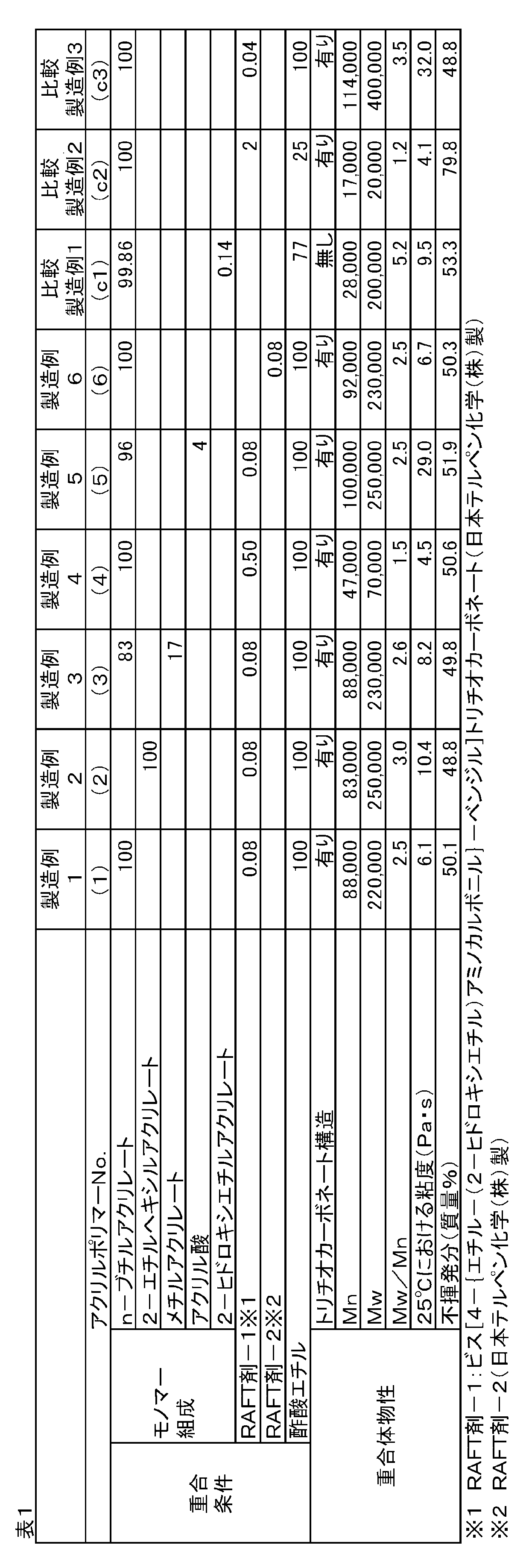
- the molecular weights measured by GPC for the acrylic polymer (1) contained in the obtained polymer solution were Mn: 88,000, Mw: 220,000, and Mw / Mn: 2.5.
- the viscosity of the obtained polymer solution at 25 ° C. was 6.1 Pa ⁇ s, and the nonvolatile content was 50.1% by mass.
- Example 1 The polymer solution containing the acrylic polymer (1) obtained in Production Example 1 and L-45 (manufactured by Soken Chemical Co., Ltd.) as the isocyanate compound were mixed in an amount of L-45 with respect to 100 parts of the acrylic polymer (1). Mixing at a ratio of 9 parts (solid content ratio), a pressure-sensitive adhesive composition was obtained. This blending ratio was designed so that the total amount of isocyanate groups of the isocyanate compound was 50 moles per mole of terminal hydroxyl groups of the acrylic polymer (1).
- the adhesive composition was applied to a polyethylene terephthalate (PET) separator (trade name: Therapy MFA; manufactured by Toray Film Co., Ltd.) using a doctor blade so that the dry film thickness was 25 ⁇ m.
- PET polyethylene terephthalate
- a coating film was formed on the PET separator by drying at 80 ° C. for 3 minutes. After the drying, a PET film having a thickness of 25 ⁇ m is pasted on the surface of the coating film opposite to the PET separator, and left to stand for 7 days under conditions of a room temperature of 23 ° C. and a humidity of 65%, whereby a PET separator / adhesive layer / The adhesive sheet which consists of PET films was obtained.
- Example 1 Comparative Examples 1 to 4
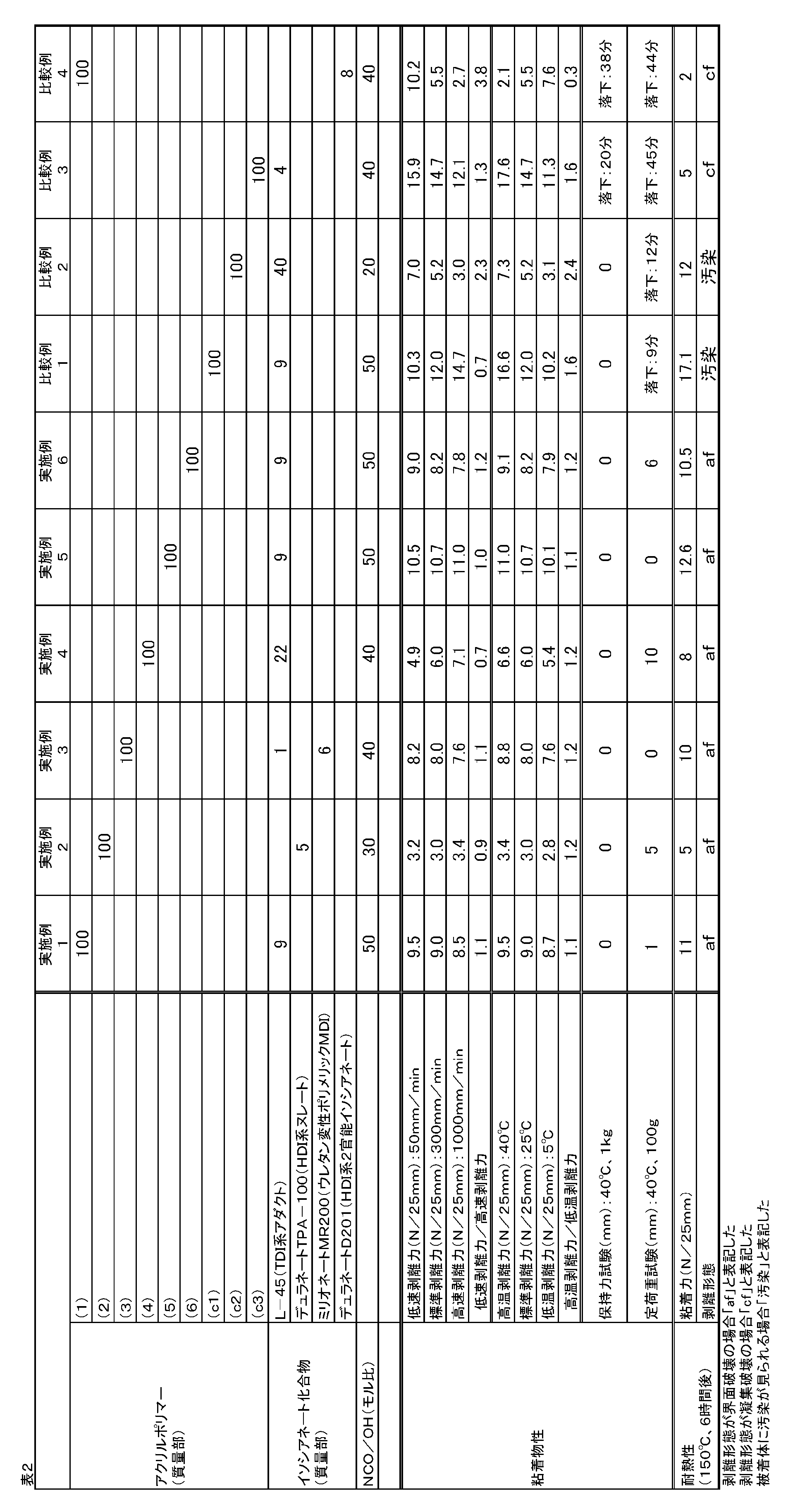
- Example 1 the composition for adhesives and an adhesive sheet were obtained similarly to Example 1 except having changed the kind and compounding quantity of an acrylic polymer and an isocyanate compound as having described in Table 2.
- Constant load test> Under the conditions of 23 ° C. and 50% RH, the PET film of the pressure-sensitive adhesive sheet obtained in Examples and the like was peeled off, and the SUS plate was pressure-bonded to the exposed pressure-sensitive adhesive layer surface using a 2 kg roller. The application area was 20 mm wide ⁇ 40 mm. 20 minutes after application, a 100 g load was applied in the 90 ° direction at 40 ° C. under dry conditions, and the peel length (mm) after 60 minutes was measured. When the test piece fell from the SUS plate within the measurement time, the time required for the drop was measured. When dropped, it was described as “falling”.
- the isocyanate compounds used in Examples and the like are as follows. As the molecular weight of the isocyanate compound, a calculated value or a catalog value based on the structural formula is described here.
Landscapes
- Chemical & Material Sciences (AREA)
- Organic Chemistry (AREA)
- Chemical Kinetics & Catalysis (AREA)
- Health & Medical Sciences (AREA)
- Medicinal Chemistry (AREA)
- Polymers & Plastics (AREA)
- Adhesives Or Adhesive Processes (AREA)
- Adhesive Tapes (AREA)
- Polymerisation Methods In General (AREA)
- Addition Polymer Or Copolymer, Post-Treatments, Or Chemical Modifications (AREA)
Abstract
Description
特許文献1には、両末端に水酸基を有するジベンジルトリチオカーボネート誘導体を用いて Reversible Addition-Fragmentation chain Transfer (RAFT)重合法により得られたRAFT重合剤を出発物質として、ビニルモノマーをRAFT重合に付することにより得られたRAFT重合体が記載されている。また、このRAFT重合体の水酸基にジイソシアネート化合物を反応させて得られるポリマーが記載されている。
[1](A)後述する式(a1)で表される構造を有し、分子の両末端に水酸基を有し、かつゲルパーミエーションクロマトグラフィー法により測定される重量平均分子量(Mw)が50,000~300,000である(メタ)アクリル酸エステル重合体と、(B)1分子中の平均イソシアネート基数が2を超えるイソシアネート化合物とを含有する粘着剤用組成物。
なお、本明細書において、「重合体」とは単独重合体および共重合体を包含する意味で用い、また、「重合」とは単独重合および共重合を包含する意味で用いる。
本発明の粘着剤用組成物は、特定の(メタ)アクリル酸エステル重合体(A)と、1分子中の平均イソシアネート基数が2を超えるイソシアネート化合物(B)(以下「多官能イソシアネート化合物(B)」ともいう。)とを含有する。
(メタ)アクリル酸エステル重合体(A)は、式(a1)で表される構造を有し、分子の両末端に水酸基を有し、かつゲルパーミエーションクロマトグラフィー法により測定される重量平均分子量(Mw)が50,000~300,000である。



化合物(A1)の具体例を以下に示す。

例えば、化合物(A1)中の硫黄原子と当該硫黄原子に隣接するメチレン基との間にビニルモノマーが挿入するように反応して、式(A1-1)で表される重合体(以下「重合体(A1-1)」ともいう。)、具体例としては式(A2-1)または式(A3-1)で表される重合体(以下「重合体(A2-1)」「重合体(A3-1)」ともいう。)を生成する。






粘着剤用組成物中の(メタ)アクリル酸エステル重合体(A)の含有量は、組成物の溶媒を除く固形分100質量%中、通常80~99質量%、より好ましくは85~96質量%、特に好ましくは90~93質量%である。重合体(A)の含有量が前記範囲にあると、粘着剤としての性能のバランスがとれ、粘着特性に優れる。
RAFT重合法において、ビニルモノマーとしては、少なくとも(メタ)アクリル酸エステルが用いられる。そのほか、官能基含有モノマーや、これら以外の共重合性モノマーを用いることができる。
(メタ)アクリル酸エステルとしては、例えば、アルキル(メタ)アクリレート、アルコキシアルキル(メタ)アクリレート、アルコキシポリアルキレングリコールモノ(メタ)アクリレート、脂環式基または芳香環含有(メタ)アクリレートが挙げられる。ただし、(メタ)アクリル酸エステルからは、カルボキシル基含有(メタ)アクリレート、水酸基含有(メタ)アクリレート、アミノ基含有(メタ)アクリレート等の官能基含有(メタ)アクリレートを除く。
RAFT重合法での(メタ)アクリル酸エステルの使用量は、全ビニルモノマー100質量%に対して、通常70質量%以上、好ましくは80質量%以上、より好ましくは90質量%以上である。
官能基含有モノマーとしては、例えば、酸基含有モノマー、水酸基含有モノマー、アミノ基含有モノマー、アミド基含有モノマー、窒素系複素環含有モノマー、シアノ基含有モノマーが挙げられる。酸基としては、例えば、カルボキシル基、酸無水物基、リン酸基、硫酸基が挙げられる。
官能基含有モノマーは1種単独で、または2種以上を使用することができる。
共重合性モノマーとしては、例えば、スチレン、メチルスチレン、ジメチルスチレン、トリメチルスチレン、プロピルスチレン、ブチルスチレン、へキシルスチレン、ヘプチルスチレンおよびオクチルスチレン等のアルキルスチレン、フロロスチレン、クロロスチレン、ブロモスチレン、ジブロモスチレン、ヨウ化スチレン、ニトロスチレン、アセチルスチレンおよびメトキシスチレン等のスチレン系単量体、酢酸ビニルが挙げられる。
共重合性モノマーは1種単独で、または2種以上を使用することができる。
RAFT重合法では、重合開始剤の非存在下に、単に加熱することにより行うこともできるが、重合開始剤の存在下に行うことが好ましい。重合開始剤としては、例えば、通常の無機系重合開始剤および/または有機系重合開始剤が挙げられ、具体的には、過硫酸カリウム、過硫酸アンモニウム等の過硫酸塩、過酸化ベンゾイル、過酸化ラウリウム等の過酸化物、2,2’-アソビスイソブチロニトリル等のアゾ化合物が挙げられる。これらの中でも、アゾ化合物が好ましい。
重合開始剤の使用量は、ビニルモノマー100質量部に対して、通常0.001~2質量部、好ましくは0.002~1質量部である。
RAFT重合法での反応温度は、通常60~120℃、好ましくは80~110℃であり、通常は窒素ガス等の不活性ガス雰囲気下で行われる、この反応は常圧、加圧および減圧のいずれの条件で行うこともでき、通常は常圧で行われる。また、反応時間は通常1~14時間、好ましくは2~8時間である。重合条件については、例えば、特開2007-230947号公報および特開2011-52057号公報を参照することができる。
なお、RAFT重合は、通常は反応溶媒を用いずに反応させるが、必要により反応溶媒を使用してもよい。反応溶媒としては、例えば、ベンゼン、トルエン、キシレン等の芳香族炭化水素類;n-ペンタン、n-ヘキサン、n-ヘプタン、n-オクタン等の脂肪族炭化水素類;シクロペンタン、シクロヘキサン、シクロヘプタン、シクロオクタン等の脂環式炭化水素類;ジエチルエーテル、ジイソプロピルエーテル、1,2-ジメトキシエタン、ジブチルエーテル、テトラヒドロフラン、ジオキサン、アニソール、フェニルエチルエーテル、ジフェニルエーテル等のエーテル類;クロロホルム、四塩化炭素、1,2-ジクロロエタン、クロロベンゼン等のハロゲン化炭化水素類;酢酸エチル、酢酸プロピル、酢酸ブチル、プロピオン酸メチル等のエステル類;アセトン、メチルエチルケトン、ジエチルケトン、メチルイソブチルケトン、シクロヘキサノン等のケトン類;N,N-ジメチルホルムアミド、N,N-ジメチルアセタミド、N-メチルピロリドン等のアミド類;アセトニトリル、ベンゾニトリル等のニトリル類;ジメチルスルホキシド、スルホラン等のスルホキシド類等が挙げられる。これらの溶媒は1種単独で、または2種以上を使用することができる。
多官能イソシアネート化合物(B)としては、1分子中の平均イソシアネート基数が2を超えるイソシアネート化合物から選択される1種または2種以上を用いることができる。化合物(B)により重合体(A)を架橋することで、架橋体(ネットワークポリマー)を形成することができる。前記イソシアネート化合物は、毒性が低く安全性に優れる。
上記多量体、上記誘導体および上記重合物における2官能イソシアネート化合物としては、例えば、エチレンジイソシアネート、テトラメチレンジイソシアネート、ペンタメチレンジイソシアネート、ヘキサメチレンジイソシアネート、2-メチル-1,5-ペンタンジイソシアネート、3-メチル-1,5-ペンタンジイソシアネート、2,2,4-トリメチル-1,6-ヘキサメチレンジイソシアネート等の炭素数4~30の脂肪族ジイソシアネート;イソホロンジイソシアネート、シクロペンチルジイソシアネート、シクロヘキシルジイソシアネート、水素添加キシリレンジイソシアネート、水素添加トリレンジイソシアネート、水素添加ジフェニルメタンジイソシアネート、水素添加テトラメチルキシレンジイソシアネート等の炭素数7~30の脂環族ジイソシアネート;フェニレンジイソシアネート、トリレンジイソシアネート、キシリレンジイソシアネート、ナフチレンジイソシアネート、ジフェニルエーテルジイソシアネート、ジフェニルメタンジイソシアネート、ジフェニルプロパンジイソシアネート等の炭素数8~30の芳香族ジイソシアネートが挙げられる。
上記誘導体における多価アルコールとしては、低分子量多価アルコールとして、例えば、トリメチロールプロパン、グリセリン、ペンタエリトリトール等の3価以上のアルコールが挙げられ;高分子量多価アルコールとして、例えば、ポリエーテルポリオール、ポリエステルポリオールが挙げられる。

なお、多官能イソシアネート化合物(B)が単一化合物であるときは、平均イソシアネート基数とは、端的に多官能イソシアネート化合物(B)が有するイソシアネート基数を意味する。
本発明の粘着剤用組成物は、上記成分のほか、さらに透明性、視認性および本発明の効果を損なわない範囲で、有機溶媒、帯電防止剤、紫外線吸収剤、酸化防止剤、粘着付与樹脂、可塑剤、消泡剤、充填剤、安定剤、軟化剤、および濡れ性調整剤から選択される1種または2種以上を含有していてもよい。
有機溶媒としては、RAFT重合の《重合条件》の欄で説明した反応溶媒を用いることができる。例えば、RAFT重合で得られた、(メタ)アクリル酸エステル重合体(A)および反応溶媒を含むポリマー溶液と、多官能イソシアネート化合物(B)とを混合して粘着剤用組成物を調製することができる。本発明の粘着剤用組成物において、有機溶媒の含有量は、通常0~90質量%であり、好ましくは10~80質量%である。
本発明の粘着剤は、上述の粘着剤用組成物を架橋することにより、具体的には(メタ)アクリル酸エステル重合体(A)を多官能イソシアネート化合物(B)で架橋することにより得られる。このようにして得られる粘着剤は、従来の基本物性、例えば粘着力、保持力および定荷重性を備えており、優れた機能、例えば粘着シート剥離時の被着体に対する汚染度が小さい、剥離力の剥離速度依存性および剥離温度依存性が小さいといった機能を有する。
本発明の粘着シートは、基材と、上述の粘着剤用組成物からなる粘着剤層とを有する。この粘着シートは、粘着剤層上に保護フィルムを有していてもよい。
粘着剤層の膜厚は、通常3~100μm、好ましくは5~50μmである。基材および保護フィルムの膜厚は、特に限定されないが、通常10~100μm、好ましくは25~50μmである。
〔(メタ)アクリル酸エステル重合体〕
<1.分子量および分子量分布>
(メタ)アクリル酸エステル重合体について、ゲルパーミエーションクロマトグラフィー(GPC)法により、下記条件で標準ポリスチレン換算による重量平均分子量(Mw)および数平均分子量(Mn)を求めた。
・測定装置:HLC-8120GPC(東ソー(株)製)
・GPCカラム構成:以下の5連カラム(すべて東ソー(株)製)
(1)TSK-GEL HXL-H (ガードカラム)
(2)TSK-GEL G7000HXL
(3)TSK-GEL GMHXL
(4)TSK-GEL GMHXL
(5)TSK-GEL G2500HXL
・サンプル濃度:1.0mg/cm3となるように、テトラヒドロフランで希釈
・移動相溶媒:テトラヒドロフラン
・流量:1.0cm3/min
・カラム温度:40℃
実施例等で得られた(メタ)アクリル酸エステル重合体を含む溶液について、ワニス入りの500ml瓶を25℃の恒温水槽に浸し12時間静置後、B型粘時計の測定方法に従い、粘度を測定した。
精秤したブリキシャーレ(n1)にアクリルポリマー溶液1gを入れ、合計重量(n2)を精秤した後、105℃で3時間加熱した。その後、当該ブリキシャーレを室温のデシケータ内に1時間静置し、次いで再度精秤し、加熱後の合計重量(n3)を測定した。得られた重量測定値(n1~n3)を用いて、下記式から不揮発分を算出した。
不揮発分(%) = 100 × [加熱後重量(n3-n1)/ 加熱前重量(n2-n1)]
[製造例1]
攪拌装置、窒素ガス導入管、温度計および還流冷却管を備えたフラスコに、n-ブチルアクリレート100部と、下記式で表されるビス[4-{エチル-(2-ヒドロキシエチル)アミノカルボニル}-ベンジル]トリチオカーボネート(日本テルペン化学(株)製)(以下「RAFT剤-1」ともいう。)0.08部とを仕込み、フラスコ内に窒素ガスを導入しながらフラスコの内容物を80℃に加熱した。

得られたポリマー溶液に含まれるアクリルポリマー(1)についてGPCにより測定した分子量は、Mn:88,000、Mw:220,000、Mw/Mn:2.5であった。得られたポリマー溶液の25℃における粘度は6.1Pa・sであり、不揮発分は50.1質量%であった。
製造例1において、モノマーの種類・量およびRAFT剤の種類・量を表1に記載したとおりに変更したこと以外は製造例1と同様にして、アクリルポリマー(2),(4),(5)もしくは(6)、またはアクリルポリマー(c3)を含むポリマー溶液を得た。
なお、RAFT剤-2は、下記式で表される。

攪拌装置、窒素ガス導入管、温度計および還流冷却管を備えたフラスコに、メチルアクリレート17部と、前記RAFT剤-1 0.08部とを仕込み、フラスコ内に窒素ガスを導入しながらフラスコの内容物を80℃に加熱した。
以上のようにして、アクリルポリマー(3)を含むポリマー溶液を得た。
攪拌装置、窒素ガス導入管、温度計および還流冷却管を備えたフラスコに、n-ブチルアクリレート99.86部と、2-ヒドロキシエチルアクリレート0.14部と、N-ドデシルメルカプタン0.15部と、酢酸エチル77部とを仕込み、フラスコ内に窒素ガスを導入しながらフラスコの内容物を66~67℃に加熱した。次いで、ジメチル-2,2’-アゾビス(2-メチルプロピオネート)(V-601;和光純薬工業(株)製)0.1部を攪拌下にフラスコ内に添加した。フラスコ内の内容物の温度を66~67℃に維持できるように加熱および冷却を4時間行った。このようにして、アクリルポリマー(c1)を含むポリマー溶液を得た。
攪拌装置、窒素ガス導入管、温度計および還流冷却管を備えたフラスコに、n-ブチルアクリレート100部と、前記RAFT剤-1 2部とを仕込み、フラスコ内に窒素ガスを導入しながらフラスコの内容物を80℃に加熱した。次いで、AIBN0.03部を攪拌下にフラスコ内に添加し、フラスコ内の内容物の温度を80℃に維持できるように加熱および冷却を4時間行い、最後に酢酸エチル25部を添加した。このようにして、アクリルポリマー(c2)を含むポリマー溶液を得た。
アクリルポリマーの評価結果を表1に示す。
製造例1で得られたアクリルポリマー(1)を含むポリマー溶液と、イソシアネート化合物としてL-45(綜研化学(株)製)とを、アクリルポリマー(1)100部に対するL-45の配合量が9部となる割合(固形分比)で混合し、粘着剤用組成物を得た。この配合比は、アクリルポリマー(1)の末端水酸基数1モルに対して、イソシアネート化合物のイソシアネート基の総量が50モルとなるよう設計した。
実施例1において、アクリルポリマーおよびイソシアネート化合物の種類および配合量を表2に記載したとおりに変更したこと以外は実施例1と同様にして、粘着剤用組成物および粘着シートを得た。
<1.剥離力(N/25mm)>
23℃、50%RH条件下で、実施例等で得られた粘着シートのPETフィルムを剥がし、露出した粘着剤層面にSUS板を2kgのローラーを用いて圧着した。貼付から20分後に、SUS板から粘着シートを25℃、剥離角度180°の条件で、剥離速度50mm/min、300mm/minまたは1000mm/minで剥離し、粘着シートの粘着剤層の剥離力(粘着力)をそれぞれ測定した。剥離速度300mm/minで剥離する場合は、40℃、25℃および5℃の条件で行った。
23℃、50%RH条件下で、実施例等で得られた粘着シートのPETフィルムを剥がし、露出した粘着剤層面にSUS板を2kgのローラーを用いて圧着した。貼付面積は20mm×20mmとした。貼付から20分後に、40℃かつ乾燥条件で1kgの荷重をかけ、1時間後のもとの位置からのズレの距離を測定した。測定時間内に試験片がSUS板から落下した場合は、落下までに要した時間を測定した。落下した場合は「落下」と記載した。
23℃、50%RH条件下で、実施例等で得られた粘着シートのPETフィルムを剥がし、露出した粘着剤層面にSUS板を2kgのローラーを用いて圧着した。貼付面積は20mm幅×40mmとした。貼付から20分後に、40℃かつ乾燥条件で100gの荷重を90°方向にかけ、60分後のはがれ長さ(mm)を測定した。測定時間内に試験片がSUS板から落下した場合は、落下までに要した時間を測定した。落下した場合は「落下」と記載した。
23℃、50%RH条件下で、実施例等で得られた粘着シートのPETフィルムを剥がし、露出した粘着剤層面にSUS板を2kgのローラーを用いて圧着した。貼付から20分後に、150℃かつ乾燥条件に6時間静置した。さらに、23℃、50%RH条件下に20分静置した後、SUS板から粘着シートを25℃、剥離角度180°の条件で、剥離速度300mm/minで剥離し、粘着シートの粘着剤層の剥離力(粘着力)を測定した。また、剥離後の被着体の状態を目視で観察した。

Claims (6)
- (A)式(a1)で表される構造を有し、分子の両末端に水酸基を有し、かつゲルパーミエーションクロマトグラフィー法により測定される重量平均分子量(Mw)が50,000~300,000である(メタ)アクリル酸エステル重合体と、
(B)1分子中の平均イソシアネート基数が2を超えるイソシアネート化合物と
を含有する粘着剤用組成物。

- (メタ)アクリル酸エステル重合体(A)の分子量分布(Mw/Mn)が、1~3.5である請求項1に記載の粘着剤用組成物。
- (メタ)アクリル酸エステル重合体(A)が、式(A1-1)で表されるRAFT重合体である請求項1または2に記載の粘着剤用組成物。

- (メタ)アクリル酸エステル重合体(A)が、式(A2-1)で表されるRAFT重合体および式(A3-1)で表されるRAFT重合体から選択される少なくとも1種である請求項1~3のいずれか1項に記載の粘着剤用組成物。


- (メタ)アクリル酸エステル重合体(A)とイソシアネート化合物(B)とを、重合体(A)の末端水酸基1モルに対する化合物(B)のイソシアネート基の総量が1~100モルとなる範囲で含有する請求項1~4のいずれか1項に記載の粘着剤用組成物。
- 基材と、
請求項1~5のいずれか1項に記載の組成物からなる粘着剤層と
を有する粘着シート。
Priority Applications (4)
| Application Number | Priority Date | Filing Date | Title |
|---|---|---|---|
| CN201480030012.7A CN105247004B (zh) | 2013-05-28 | 2014-04-30 | 粘合剂用组合物及粘合片 |
| US14/892,230 US20160083630A1 (en) | 2013-05-28 | 2014-04-30 | Composition for Pressure-Sensitive Adhesive and Pressure-Sensitive Adhesive Sheet |
| JP2015519753A JP5974173B2 (ja) | 2013-05-28 | 2014-04-30 | 粘着剤用組成物および粘着シート |
| KR1020157035047A KR20160010502A (ko) | 2013-05-28 | 2014-04-30 | 점착제용 조성물 및 점착 시트 |
Applications Claiming Priority (2)
| Application Number | Priority Date | Filing Date | Title |
|---|---|---|---|
| JP2013111685 | 2013-05-28 | ||
| JP2013-111685 | 2013-05-28 |
Publications (1)
| Publication Number | Publication Date |
|---|---|
| WO2014192492A1 true WO2014192492A1 (ja) | 2014-12-04 |
Family
ID=51988530
Family Applications (1)
| Application Number | Title | Priority Date | Filing Date |
|---|---|---|---|
| PCT/JP2014/061983 Ceased WO2014192492A1 (ja) | 2013-05-28 | 2014-04-30 | 粘着剤用組成物および粘着シート |
Country Status (5)
| Country | Link |
|---|---|
| US (1) | US20160083630A1 (ja) |
| JP (1) | JP5974173B2 (ja) |
| KR (1) | KR20160010502A (ja) |
| CN (1) | CN105247004B (ja) |
| WO (1) | WO2014192492A1 (ja) |
Cited By (7)
| Publication number | Priority date | Publication date | Assignee | Title |
|---|---|---|---|---|
| WO2015098314A1 (ja) * | 2013-12-24 | 2015-07-02 | 綜研化学株式会社 | 粘着剤用組成物、粘着剤および粘着シート |
| JP2017019926A (ja) * | 2015-07-10 | 2017-01-26 | 綜研化学株式会社 | (メタ)アクリル系重合体、部分重合物、粘着剤層、粘着テープおよび(メタ)アクリル系重合体の製造方法 |
| WO2017115631A1 (ja) * | 2015-12-28 | 2017-07-06 | 綜研化学株式会社 | 粘着剤用組成物、粘着剤層および表面保護シート |
| WO2017115632A1 (ja) * | 2015-12-28 | 2017-07-06 | 綜研化学株式会社 | 粘着剤用組成物、粘着剤層および粘着シート |
| JP2017119758A (ja) * | 2015-12-28 | 2017-07-06 | 綜研化学株式会社 | 粘着剤用組成物、粘着剤層および粘着シート |
| WO2018025807A1 (ja) * | 2016-08-03 | 2018-02-08 | 綜研化学株式会社 | (メタ)アクリル系共重合体およびその製造方法、粘着剤組成物ならびに粘着シート |
| WO2018025808A1 (ja) * | 2016-08-03 | 2018-02-08 | 綜研化学株式会社 | (メタ)アクリル系トリブロック共重合体およびその製造方法、粘着剤組成物ならびに粘着シート |
Families Citing this family (5)
| Publication number | Priority date | Publication date | Assignee | Title |
|---|---|---|---|---|
| TWI521037B (zh) * | 2015-04-10 | 2016-02-11 | 博威電子股份有限公司 | 光學膠組成物、光學膠膜以及光學積層板 |
| JP6015877B1 (ja) * | 2015-09-25 | 2016-10-26 | 東洋インキScホールディングス株式会社 | 加飾フィルムおよびその製造方法、並びに加飾成型体 |
| JP6676571B2 (ja) * | 2017-03-28 | 2020-04-08 | 藤倉化成株式会社 | 可逆的付加開裂連鎖移動重合方法、及びアクリル系ブロック共重合体 |
| JP6729660B2 (ja) * | 2018-10-30 | 2020-07-22 | 藤倉化成株式会社 | アクリル系重合体 |
| CN112940161B (zh) * | 2021-01-29 | 2022-11-01 | 苏州中世惠华合成材料有限公司 | 聚(甲基)丙烯酸酯二元醇及由其合成的聚氨酯型粘合剂 |
Citations (7)
| Publication number | Priority date | Publication date | Assignee | Title |
|---|---|---|---|---|
| JPH10231347A (ja) | 1997-02-19 | 1998-09-02 | Asahi Chem Ind Co Ltd | 多官能水性ブロックポリイソシアネート組成物 |
| JPH1180249A (ja) | 1996-11-28 | 1999-03-26 | Kanegafuchi Chem Ind Co Ltd | 末端に水酸基を有する(メタ)アクリル系重合体の 製造方法 |
| JP2005510597A (ja) | 2001-11-24 | 2005-04-21 | テサ・アクチエンゲゼルシヤフト | 末端官能化ポリアクリレートの2成分架橋 |
| JP2007230947A (ja) | 2006-03-02 | 2007-09-13 | Nippon Terupen Kagaku Kk | ジベンジルトリチオカーボネート誘導体、その製造方法およびそれを用いた重合体 |
| JP2011052057A (ja) | 2009-08-31 | 2011-03-17 | Nippon Terupen Kagaku Kk | Raft重合体の製造方法、raft重合体およびそれを用いたポリマー |
| JP2014009341A (ja) * | 2012-07-02 | 2014-01-20 | Soken Chem & Eng Co Ltd | 樹脂組成物および重合体の製造方法 |
| JP2014009340A (ja) * | 2012-07-02 | 2014-01-20 | Soken Chem & Eng Co Ltd | 樹脂組成物、粘着剤および重合体の製造方法 |
Family Cites Families (6)
| Publication number | Priority date | Publication date | Assignee | Title |
|---|---|---|---|---|
| JP4673952B2 (ja) * | 2000-03-14 | 2011-04-20 | リンテック株式会社 | 粘着剤組成物、それを用いた粘着シート及び粘着性光学部材 |
| JP2003253224A (ja) * | 2002-02-27 | 2003-09-10 | Sekisui Chem Co Ltd | 両面粘着テープ |
| JP4686960B2 (ja) * | 2003-06-30 | 2011-05-25 | 綜研化学株式会社 | 表面保護フィルム用粘着剤および表面保護フィルム |
| JP2010265388A (ja) * | 2009-05-15 | 2010-11-25 | Toyo Ink Mfg Co Ltd | 制電性粘着剤および粘着シート |
| JP5474452B2 (ja) * | 2009-09-02 | 2014-04-16 | 株式会社日本触媒 | 溶剤型再剥離用粘着剤組成物 |
| DE102011086503A1 (de) * | 2011-11-16 | 2013-05-16 | Tesa Se | Verfahren zur Herstellung von kohäsiven Polyacrylatklebemassen mit enger Molmassenverteilung |
-
2014
- 2014-04-30 KR KR1020157035047A patent/KR20160010502A/ko not_active Ceased
- 2014-04-30 WO PCT/JP2014/061983 patent/WO2014192492A1/ja not_active Ceased
- 2014-04-30 CN CN201480030012.7A patent/CN105247004B/zh active Active
- 2014-04-30 US US14/892,230 patent/US20160083630A1/en not_active Abandoned
- 2014-04-30 JP JP2015519753A patent/JP5974173B2/ja active Active
Patent Citations (7)
| Publication number | Priority date | Publication date | Assignee | Title |
|---|---|---|---|---|
| JPH1180249A (ja) | 1996-11-28 | 1999-03-26 | Kanegafuchi Chem Ind Co Ltd | 末端に水酸基を有する(メタ)アクリル系重合体の 製造方法 |
| JPH10231347A (ja) | 1997-02-19 | 1998-09-02 | Asahi Chem Ind Co Ltd | 多官能水性ブロックポリイソシアネート組成物 |
| JP2005510597A (ja) | 2001-11-24 | 2005-04-21 | テサ・アクチエンゲゼルシヤフト | 末端官能化ポリアクリレートの2成分架橋 |
| JP2007230947A (ja) | 2006-03-02 | 2007-09-13 | Nippon Terupen Kagaku Kk | ジベンジルトリチオカーボネート誘導体、その製造方法およびそれを用いた重合体 |
| JP2011052057A (ja) | 2009-08-31 | 2011-03-17 | Nippon Terupen Kagaku Kk | Raft重合体の製造方法、raft重合体およびそれを用いたポリマー |
| JP2014009341A (ja) * | 2012-07-02 | 2014-01-20 | Soken Chem & Eng Co Ltd | 樹脂組成物および重合体の製造方法 |
| JP2014009340A (ja) * | 2012-07-02 | 2014-01-20 | Soken Chem & Eng Co Ltd | 樹脂組成物、粘着剤および重合体の製造方法 |
Cited By (18)
| Publication number | Priority date | Publication date | Assignee | Title |
|---|---|---|---|---|
| WO2015098314A1 (ja) * | 2013-12-24 | 2015-07-02 | 綜研化学株式会社 | 粘着剤用組成物、粘着剤および粘着シート |
| JPWO2015098314A1 (ja) * | 2013-12-24 | 2017-03-23 | 綜研化学株式会社 | 粘着剤用組成物、粘着剤および粘着シート |
| JP2017019926A (ja) * | 2015-07-10 | 2017-01-26 | 綜研化学株式会社 | (メタ)アクリル系重合体、部分重合物、粘着剤層、粘着テープおよび(メタ)アクリル系重合体の製造方法 |
| CN108350331A (zh) * | 2015-12-28 | 2018-07-31 | 综研化学株式会社 | 粘合剂用组合物、粘合剂层和粘合片 |
| TWI716513B (zh) * | 2015-12-28 | 2021-01-21 | 日商綜研化學股份有限公司 | 黏著劑用組成物、黏著劑層以及表面保護片 |
| JP2017119758A (ja) * | 2015-12-28 | 2017-07-06 | 綜研化学株式会社 | 粘着剤用組成物、粘着剤層および粘着シート |
| KR102276988B1 (ko) * | 2015-12-28 | 2021-07-12 | 소켄 케미칼 앤드 엔지니어링 캄파니, 리미티드 | 점착제용 조성물, 점착제층 및 표면 보호 시트 |
| KR102266186B1 (ko) * | 2015-12-28 | 2021-06-17 | 소켄 케미칼 앤드 엔지니어링 캄파니, 리미티드 | 점착제용 조성물, 점착제층 및 점착 시트 |
| WO2017115631A1 (ja) * | 2015-12-28 | 2017-07-06 | 綜研化学株式会社 | 粘着剤用組成物、粘着剤層および表面保護シート |
| KR20180098522A (ko) | 2015-12-28 | 2018-09-04 | 소켄 케미칼 앤드 엔지니어링 캄파니, 리미티드 | 점착제용 조성물, 점착제층 및 점착 시트 |
| KR20180099628A (ko) | 2015-12-28 | 2018-09-05 | 소켄 케미칼 앤드 엔지니어링 캄파니, 리미티드 | 점착제용 조성물, 점착제층 및 표면 보호 시트 |
| WO2017115632A1 (ja) * | 2015-12-28 | 2017-07-06 | 綜研化学株式会社 | 粘着剤用組成物、粘着剤層および粘着シート |
| JPWO2018025807A1 (ja) * | 2016-08-03 | 2019-05-30 | 綜研化学株式会社 | (メタ)アクリル系共重合体およびその製造方法、粘着剤組成物ならびに粘着シート |
| JPWO2018025808A1 (ja) * | 2016-08-03 | 2019-05-30 | 綜研化学株式会社 | (メタ)アクリル系トリブロック共重合体およびその製造方法、粘着剤組成物ならびに粘着シート |
| WO2018025808A1 (ja) * | 2016-08-03 | 2018-02-08 | 綜研化学株式会社 | (メタ)アクリル系トリブロック共重合体およびその製造方法、粘着剤組成物ならびに粘着シート |
| WO2018025807A1 (ja) * | 2016-08-03 | 2018-02-08 | 綜研化学株式会社 | (メタ)アクリル系共重合体およびその製造方法、粘着剤組成物ならびに粘着シート |
| JP6993974B2 (ja) | 2016-08-03 | 2022-02-10 | 綜研化学株式会社 | (メタ)アクリル系共重合体およびその製造方法、粘着剤組成物ならびに粘着シート |
| JP7089471B2 (ja) | 2016-08-03 | 2022-06-22 | 綜研化学株式会社 | (メタ)アクリル系トリブロック共重合体およびその製造方法、粘着剤組成物ならびに粘着シート |
Also Published As
| Publication number | Publication date |
|---|---|
| CN105247004B (zh) | 2017-09-26 |
| KR20160010502A (ko) | 2016-01-27 |
| JPWO2014192492A1 (ja) | 2017-02-23 |
| US20160083630A1 (en) | 2016-03-24 |
| CN105247004A (zh) | 2016-01-13 |
| JP5974173B2 (ja) | 2016-08-23 |
Similar Documents
| Publication | Publication Date | Title |
|---|---|---|
| JP5974173B2 (ja) | 粘着剤用組成物および粘着シート | |
| JP5982068B2 (ja) | 粘着剤用組成物、粘着剤および粘着シート | |
| JP6792570B2 (ja) | 粘着剤用組成物、粘着剤層および粘着シート | |
| JP5671500B2 (ja) | 樹脂組成物、粘着剤および重合体の製造方法 | |
| JP6948136B2 (ja) | 粘着剤組成物および粘着シート | |
| JP6747661B2 (ja) | 粘着剤用組成物、粘着剤層および粘着シート | |
| JP6792569B2 (ja) | 粘着剤用組成物、粘着剤層および表面保護シート | |
| CN111742022B (zh) | 双面粘合片及其用途 | |
| JP6993974B2 (ja) | (メタ)アクリル系共重合体およびその製造方法、粘着剤組成物ならびに粘着シート | |
| JP7089471B2 (ja) | (メタ)アクリル系トリブロック共重合体およびその製造方法、粘着剤組成物ならびに粘着シート | |
| JP6847040B2 (ja) | (メタ)アクリル系重合体の製造方法および粘着剤層の製造方法 | |
| JP7198576B2 (ja) | 粘着剤組成物及び粘着シート | |
| JP6004788B2 (ja) | 樹脂組成物および重合体の製造方法 | |
| CN111742024B (zh) | 粘合带 | |
| JP2021070744A (ja) | 粘着剤組成物および粘着シート | |
| JP2023145944A (ja) | 粘着剤組成物 | |
| JPWO2019187788A1 (ja) | 粘着テープ |
Legal Events
| Date | Code | Title | Description |
|---|---|---|---|
| 121 | Ep: the epo has been informed by wipo that ep was designated in this application |
Ref document number: 14804553 Country of ref document: EP Kind code of ref document: A1 |
|
| ENP | Entry into the national phase |
Ref document number: 2015519753 Country of ref document: JP Kind code of ref document: A |
|
| WWE | Wipo information: entry into national phase |
Ref document number: 14892230 Country of ref document: US |
|
| NENP | Non-entry into the national phase |
Ref country code: DE |
|
| ENP | Entry into the national phase |
Ref document number: 20157035047 Country of ref document: KR Kind code of ref document: A |
|
| WWE | Wipo information: entry into national phase |
Ref document number: 2014804553 Country of ref document: EP |