WO2014175353A1 - 洗浄剤組成物 - Google Patents
洗浄剤組成物 Download PDFInfo
- Publication number
- WO2014175353A1 WO2014175353A1 PCT/JP2014/061481 JP2014061481W WO2014175353A1 WO 2014175353 A1 WO2014175353 A1 WO 2014175353A1 JP 2014061481 W JP2014061481 W JP 2014061481W WO 2014175353 A1 WO2014175353 A1 WO 2014175353A1
- Authority
- WO
- WIPO (PCT)
- Prior art keywords
- mass
- cleaning
- water
- cleaning composition
- nonionic surfactant
- Prior art date
- Legal status (The legal status is an assumption and is not a legal conclusion. Google has not performed a legal analysis and makes no representation as to the accuracy of the status listed.)
- Ceased
Links
Images


Classifications
-
- C—CHEMISTRY; METALLURGY
- C11—ANIMAL OR VEGETABLE OILS, FATS, FATTY SUBSTANCES OR WAXES; FATTY ACIDS THEREFROM; DETERGENTS; CANDLES
- C11D—DETERGENT COMPOSITIONS; USE OF SINGLE SUBSTANCES AS DETERGENTS; SOAP OR SOAP-MAKING; RESIN SOAPS; RECOVERY OF GLYCEROL
- C11D1/00—Detergent compositions based essentially on surface-active compounds; Use of these compounds as a detergent
- C11D1/66—Non-ionic compounds
- C11D1/83—Mixtures of non-ionic with anionic compounds
-
- C—CHEMISTRY; METALLURGY
- C11—ANIMAL OR VEGETABLE OILS, FATS, FATTY SUBSTANCES OR WAXES; FATTY ACIDS THEREFROM; DETERGENTS; CANDLES
- C11D—DETERGENT COMPOSITIONS; USE OF SINGLE SUBSTANCES AS DETERGENTS; SOAP OR SOAP-MAKING; RESIN SOAPS; RECOVERY OF GLYCEROL
- C11D1/00—Detergent compositions based essentially on surface-active compounds; Use of these compounds as a detergent
- C11D1/02—Anionic compounds
- C11D1/12—Sulfonic acids or sulfuric acid esters; Salts thereof
- C11D1/123—Sulfonic acids or sulfuric acid esters; Salts thereof derived from carboxylic acids, e.g. sulfosuccinates
-
- C—CHEMISTRY; METALLURGY
- C11—ANIMAL OR VEGETABLE OILS, FATS, FATTY SUBSTANCES OR WAXES; FATTY ACIDS THEREFROM; DETERGENTS; CANDLES
- C11D—DETERGENT COMPOSITIONS; USE OF SINGLE SUBSTANCES AS DETERGENTS; SOAP OR SOAP-MAKING; RESIN SOAPS; RECOVERY OF GLYCEROL
- C11D1/00—Detergent compositions based essentially on surface-active compounds; Use of these compounds as a detergent
- C11D1/02—Anionic compounds
- C11D1/12—Sulfonic acids or sulfuric acid esters; Salts thereof
- C11D1/28—Sulfonation products derived from fatty acids or their derivatives, e.g. esters, amides
-
- C—CHEMISTRY; METALLURGY
- C11—ANIMAL OR VEGETABLE OILS, FATS, FATTY SUBSTANCES OR WAXES; FATTY ACIDS THEREFROM; DETERGENTS; CANDLES
- C11D—DETERGENT COMPOSITIONS; USE OF SINGLE SUBSTANCES AS DETERGENTS; SOAP OR SOAP-MAKING; RESIN SOAPS; RECOVERY OF GLYCEROL
- C11D1/00—Detergent compositions based essentially on surface-active compounds; Use of these compounds as a detergent
- C11D1/66—Non-ionic compounds
- C11D1/667—Neutral esters, e.g. sorbitan esters
-
- C—CHEMISTRY; METALLURGY
- C11—ANIMAL OR VEGETABLE OILS, FATS, FATTY SUBSTANCES OR WAXES; FATTY ACIDS THEREFROM; DETERGENTS; CANDLES
- C11D—DETERGENT COMPOSITIONS; USE OF SINGLE SUBSTANCES AS DETERGENTS; SOAP OR SOAP-MAKING; RESIN SOAPS; RECOVERY OF GLYCEROL
- C11D17/00—Detergent materials or soaps characterised by their shape or physical properties
- C11D17/0008—Detergent materials or soaps characterised by their shape or physical properties aqueous liquid non soap compositions
- C11D17/0017—Multi-phase liquid compositions
- C11D17/0021—Aqueous microemulsions
-
- C—CHEMISTRY; METALLURGY
- C11—ANIMAL OR VEGETABLE OILS, FATS, FATTY SUBSTANCES OR WAXES; FATTY ACIDS THEREFROM; DETERGENTS; CANDLES
- C11D—DETERGENT COMPOSITIONS; USE OF SINGLE SUBSTANCES AS DETERGENTS; SOAP OR SOAP-MAKING; RESIN SOAPS; RECOVERY OF GLYCEROL
- C11D3/00—Other compounding ingredients of detergent compositions covered in group C11D1/00
- C11D3/16—Organic compounds
- C11D3/18—Hydrocarbons
-
- C—CHEMISTRY; METALLURGY
- C11—ANIMAL OR VEGETABLE OILS, FATS, FATTY SUBSTANCES OR WAXES; FATTY ACIDS THEREFROM; DETERGENTS; CANDLES
- C11D—DETERGENT COMPOSITIONS; USE OF SINGLE SUBSTANCES AS DETERGENTS; SOAP OR SOAP-MAKING; RESIN SOAPS; RECOVERY OF GLYCEROL
- C11D3/00—Other compounding ingredients of detergent compositions covered in group C11D1/00
- C11D3/16—Organic compounds
- C11D3/18—Hydrocarbons
- C11D3/181—Hydrocarbons linear
-
- C—CHEMISTRY; METALLURGY
- C23—COATING METALLIC MATERIAL; COATING MATERIAL WITH METALLIC MATERIAL; CHEMICAL SURFACE TREATMENT; DIFFUSION TREATMENT OF METALLIC MATERIAL; COATING BY VACUUM EVAPORATION, BY SPUTTERING, BY ION IMPLANTATION OR BY CHEMICAL VAPOUR DEPOSITION, IN GENERAL; INHIBITING CORROSION OF METALLIC MATERIAL OR INCRUSTATION IN GENERAL
- C23G—CLEANING OR DE-GREASING OF METALLIC MATERIAL BY CHEMICAL METHODS OTHER THAN ELECTROLYSIS
- C23G5/00—Cleaning or de-greasing metallic material by other methods; Apparatus for cleaning or de-greasing metallic material with organic solvents
- C23G5/06—Cleaning or de-greasing metallic material by other methods; Apparatus for cleaning or de-greasing metallic material with organic solvents using emulsions
Definitions
- the present invention relates to a cleaning composition, in particular, parts handled in various industrial fields such as automobiles, machines, precision equipment, electricity, electronics, optics, piping and devices of various factories such as oil refineries and chemical plants, automobiles,
- the present invention relates to a detergent composition used for washing various articles such as parts dismantled from industrial machinery and the like, metal products used in daily life, resin products, and textiles.
- oil-based processing oil mainly composed of mineral oil, (ii) interface with mineral oil, etc.
- Water-soluble processing oil added with an active agent and emulsified in water, (iii) fine particles, and the like are used.
- water-soluble processing oil is often used mainly for cutting and grinding, and the processing oil used for each process may differ depending on the part manufactured through multiple processing steps. Since the processing oil, fine particles, and processing scraps are adhering to the surface of the parts, various stains ranging from organic to inorganic are often attached in combination.
- a non-aqueous cleaning agent such as a hydrocarbon-based cleaning agent, a surfactant, a polar solvent, and water are contained in a predetermined ratio, and a W / O microemulsion or A cleaning composition that forms a solubilized W / O emulsion has been proposed (see, for example, Patent Document 1).
- a polar solvent is used for forming a microemulsion, it cannot be used for cleaning a plastic or rubber material having low resistance to the polar solvent, A plastic or rubber material having low resistance to polar solvents could not be used as a cleaning jig.
- a neutral aqueous liquid detergent composition for liquid crystal panel terminals comprising an alkyl ether of a fatty acid alkylene oxide adduct, a glycol ether compound, an aliphatic hydrocarbon having 8 to 18 carbon atoms, and a dialkyl ester salt of sulfosuccinic acid.
- the glycol ether compound which is a polar solvent is used for the liquid stability, the cleaning composition of Patent Document 2 can also be used for cleaning plastics and rubber materials having low resistance to the polar solvent. It was not possible to use a plastic or rubber material having low resistance to polar solvents as a cleaning jig. Moreover, since water is used in the replacement step subsequent to the cleaning step, it is difficult to dry and inferior in economic efficiency.
- a cleaning method using a microemulsion-type cleaning composition comprising an organic solvent selected from aliphatic hydrocarbons, alkylene glycol monoethers, and dialkylene glycol monoethers, water, and a surfactant is also proposed.
- the cleaning composition of Patent Document 3 has a large amount of water of 30 to 70 parts by weight, particularly 35 to 60 parts by weight, so that the cleaning ability of organic dirt is insufficient and after cleaning with the cleaning composition.
- a step of removing water adhering to the surface is necessary, and the cleaning step takes time.
- a W / O emulsion type hydrocarbon-based cleaning agent composed of a monocarboxylic acid, a monoalkylamine, a hydrocarbon, a nonionic surfactant, and water has been proposed (for example, see Patent Document 4).
- the cleaning liquid after the cleaning treatment must be separated into layers, and the aqueous layer must be extracted, which is inefficient.
- a hydrocarbon-based cleaning agent comprising a saturated hydrocarbon-based compound and a glycol ether and a cleaning method therefor have been proposed (for example, see Patent Document 5). Since the hydrocarbon-based cleaning agent of Patent Document 5 has a volume resistivity of 1 ⁇ 10 8 ⁇ ⁇ cm or more and 1 ⁇ 10 13 ⁇ ⁇ cm or less, it is difficult to be charged, and when a charged object to be cleaned is washed However, the object to be cleaned is not charged and can be used safely. However, since the volume resistivity is not sufficiently low, there is a possibility of charging, and since polar solvents such as glycol ether are used, it should be used for cleaning plastics and rubber materials that have low resistance to polar solvents. In addition, a plastic or rubber material having low resistance to polar solvents could not be used as a cleaning jig.
- the present invention has been made in view of the above, and an object of the present invention is to provide a cleaning composition that can clean a wide range of soils from organic to inorganic and that can be washed safely while preventing electrification.
- the cleaning composition of the present invention comprises a saturated aliphatic hydrocarbon (A), an anionic surfactant (B), a nonionic surfactant ( C) and water (D), the saturated aliphatic hydrocarbon (A) is 60.0 to 85.0% by mass, and the anionic surfactant (B) is 8.0 to 15.0% by mass.
- the nonionic surfactant (C) is contained in an amount of 2.0 to 5.0% by mass, and the water (D) is contained in an amount of 1.0 to 20.0% by mass, and a W / O microemulsion or A solubilized W / O emulsion is formed, and a volume resistivity is 1 ⁇ 10 9 ⁇ ⁇ cm or less.
- the cleaning composition of the present invention is characterized in that, in the above invention, the saturated aliphatic hydrocarbon (A) is a paraffinic hydrocarbon having 9 to 13 carbon atoms.
- the cleaning composition of the present invention contains 10.0 to 20.0% by mass of the total amount of the anionic surfactant (B) and the nonionic surfactant (C) in the above invention.
- the anionic surfactant (B) and the nonionic surfactant (C) are blended in a ratio (mass ratio) of 2.0 to 5.0: 1.
- the cleaning composition of the present invention is characterized in that, in the above invention, the saturated water content measured by turbidity is 10.0% by mass or more.
- the anionic surfactant (B) is a dialkylsulfosuccinic acid ester salt
- the nonionic surfactant (C) is a sorbitan fatty acid ester. It is characterized by.
- the cleaning composition of the present invention is characterized in that, in the above invention, the cleaning liquid composition does not contain a polar solvent.
- the cleaning composition according to the present invention comprises a saturated aliphatic hydrocarbon (A), an anionic surfactant (B), a nonionic surfactant (C), and water (C) in a predetermined ratio.
- A saturated aliphatic hydrocarbon
- B anionic surfactant
- C nonionic surfactant
- C water
- C water
- FIG. 1 is a graph showing the relationship between water concentration, turbidity, and average micelle diameter in the cleaning composition of the present invention.
- FIG. 2 is a graph showing the relationship between water concentration and volume resistivity in the cleaning composition of the present invention.
- the cleaning composition of the present invention contains a saturated aliphatic hydrocarbon (A), an anionic surfactant (B), a nonionic surfactant (C), and water (D) in a predetermined ratio. , Forming a W / O microemulsion or a solubilized W / O emulsion.
- the saturated aliphatic hydrocarbon (A) used in the present invention preferably has 9 to 13 carbon atoms. If the saturated aliphatic hydrocarbon (A) has a carbon number of less than 9, the flash point of the cleaning liquid composition will be low, and the risk of ignition will increase. Moreover, when carbon number becomes larger than 14, the viscosity of a cleaning composition will become high and there exists a possibility that cleaning efficiency may fall.
- the saturated aliphatic hydrocarbon (A) preferably has 10 to 13 carbon atoms, particularly preferably 10 to 12 carbon atoms.
- the saturated aliphatic hydrocarbon (A) is preferably a paraffinic hydrocarbon. It is preferable that the saturated aliphatic hydrocarbon (A) is a paraffinic hydrocarbon because a stable W / O microemulsion or a solubilized W / O emulsion can be formed.
- saturated aliphatic hydrocarbon (A) examples include normal paraffin carbonization such as normal heptane, normal octane, normal nonane, normal decane, normal undecane, normal dodecane, normal tridecane, normal tetradecane, and normal pentadecane.
- Isoparaffinic hydrocarbons such as hydrogen, isoheptane, isooctane, isononane, isodecane, isoundecane, isododecane, isotridecane, isotetradecane, and isopentadecane can be used. These may be used alone or in combination of two or more. Among these, normal decane, normal undecane, normal dodecane, isodecane, isoundecane, and isododecane are preferable in terms of achieving both safety and washing efficiency.
- the blending amount of the saturated aliphatic hydrocarbon (A) is 60.0 to 85.0% by mass.
- the blending amount of the saturated aliphatic hydrocarbon (A) is preferably 75.0 to 80.0% by mass.
- the anionic surfactant (B) used in the present invention can be appropriately selected according to the purpose.
- examples thereof include sulfonates such as petroleum sulfonate and funnel oil, sulfate salts, and carboxylates. Can be illustrated.
- sulfonate a hydrocarbon sulfonate having 8 to 22 carbon atoms is preferable.
- sulfate ester salt a sulfated oil having 8 to 18 carbon atoms and an alkyl sulfate ester salt having 8 to 18 carbon atoms are preferable.
- Carboxylic acid salts include dialkylsulfosuccinic acid ester salts having 6 to 13 carbon atoms in the alkyl group, alkyl disalts having 6 to 13 carbon atoms, polyoxyethylene alkylsulfosuccinic acid having 6 to 13 carbon atoms in the alkyl group. Acid disalts are preferred.
- the anionic surfactant (B) is preferable because it can form a stable W / O microemulsion or a solubilized W / O emulsion.
- dialkylsulfosuccinic acid ester salts having 6 to 13 carbon atoms in the alkyl group such as sodium di (2-ethylhexyl) sulfosuccinate form more stable W / O microemulsions or solubilized W / O emulsions. Therefore, it is preferably used.
- the anionic activator (B) it is preferable to use a substance other than the alkylbenzene sulfonate because it reduces the influence on the environment and facilitates management.
- Examples of the salt of the surfactant used as the anionic surfactant (B) include alkali metal salts, alkaline earth metal salts, ammonium salts, and alkanolamine salts having 1 to 5 carbon atoms. Acid forms such as sulfuric acid esters and carboxylic acids can also be used.
- the surfactants exemplified above may be used alone or in combination of two or more.
- the amount of the anionic surfactant (B) is 8.0 to 15.0% by mass. If the amount of the anionic surfactant (B) is less than 8.0% by mass, the detergency against inorganic dirt may be lowered. If it is greater than 15.0% by mass, washing against organic dirt will occur. May decrease.
- the amount of the anionic surfactant (B) is preferably 9.0 to 15.0% by mass.
- the nonionic surfactant (C) used in the present invention can be appropriately selected according to the purpose, and examples thereof include polyalkylene glycols and fatty acid esters.
- fatty acid esters are preferred because they can form stable W / O microemulsions or solubilized W / O emulsions.
- polyalkylene glycols used as the nonionic surfactant (C) include polyoxyethylene polyoxypropylene block copolymers and polyoxyethylene polyoxypropylene alkyl ethers.
- polyalkylene glycols are used as the nonionic surfactant (C)
- the thermal stability can be improved.
- the polyoxyethylene polyoxypropylene block copolymer is a compound represented by the following formula (1) or formula (2).
- a is preferably 2 to 160
- b is preferably 10 to 60
- c is preferably 2 to 160.
- the polyoxyethylene polyoxypropylene block copolymer used as the nonionic surfactant (C) preferably has a polyoxypropylene moiety having a molecular weight of 3500 or less and a polyethylene oxide moiety of 50% by mass or less.
- Polyoxyethylene polyoxypropylene alkyl ether is a compound represented by the following formula (3).
- R 1 is an alkyl group having 6 to 16 carbon atoms, and n and m are preferably 2 to 16.
- polyalkylene glycols used as the nonionic activator (C) it is possible to use substances other than polyoxyethylene alkyl ether and polyoxyethylene alkyl phenyl ether to reduce the influence on the environment and to manage them. Is preferable because it becomes easy.
- fatty acid esters used as the nonionic surfactant (C) include sorbitan fatty acid esters, ethylene glycol fatty acid esters, glycerin fatty acid esters, propylene glycol fatty acid esters, polyoxy fatty acid esters, and the like. Fatty acid esters are preferred because they can improve detergency. Among these, sorbitan fatty acid esters are preferable because they can form more stable W / O microemulsions or solubilized W / O emulsions.
- the blending amount of the nonionic surfactant (C) is 2.0 to 5.0% by mass.
- the blending amount of the nonionic surfactant (C) is less than 2.0% by mass, the detergency with respect to inorganic stains may be deteriorated. Detergency may be reduced.
- the blending amount of the nonionic surfactant (C) is preferably 3.0 to 5.0% by mass.
- the water (D) used in the present invention distilled water, ion-exchanged water or the like can be used.
- the amount of water (D) is 1.0 to 20.0 mass%.
- the blending amount of water (D) is preferably 5.0 to 15.0 mass%, particularly preferably 5.0 to 10.0 mass%.
- the cleaning composition of the present invention can be cleaned by bringing the cleaning object into contact therewith, but the cleaning composition with a reduced amount of moisture (D) or a cleaning composition with a predetermined mixing amount. In addition, if it is within the range of the amount of water (D) described above, it is also possible to wash by adding water (D) before washing.
- the cleaning composition of the present invention can obtain high detergency while suppressing quality fluctuations during storage and transportation, storage space, and transportation costs by additionally blending water (D) during use.
- the cleaning composition of the present invention forms a W / O microemulsion or a solubilized W / O emulsion.
- a W / O microemulsion or a solubilized W / O emulsion By forming a W / O microemulsion or a solubilized W / O emulsion, cleaning unevenness can be prevented.
- the cleaning composition of the present invention forms a stable W / O microemulsion or solubilized W / O emulsion even at a low temperature, it can exhibit high detergency without heating, Weak material can be cleaned.
- a non-aqueous cleaning agent that becomes an oil layer
- a surfactant such as glycols and polyoxyalkylene alkyl ethers
- Polar solvents such as glycols and polyoxyalkylene alkyl ethers
- cleaning compositions using polar solvents erode specific resins and rubber materials such as ABS resin, acrylic resin, vinyl chloride, nitrile rubber, urethane rubber, fluoro rubber, etc., so these materials are used. It was difficult to use for cleaning the objects to be cleaned. In addition, special consideration was required for the material of the resin cleaning jig.
- saturated aliphatic hydrocarbon A
- anionic surfactant B
- nonionic surfactant C
- water D
- a detergent composition containing a predetermined amount can form a stable W / O microemulsion or a solubilized W / O emulsion without using a polar solvent.
- the cleaning composition of the present invention forms a stable W / O microemulsion or a solubilized W / O emulsion, so that only a non-aqueous cleaning agent such as a saturated aliphatic hydrocarbon (A) has a cleaning effect. Even for inorganic soils having a low level, it has an extremely excellent effect that a high cleaning effect can be exhibited without using a polar solvent.
- the W / O microemulsion means that water (D) and a surfactant form micelles having an average particle diameter of about 10 to 100 nm, and an oil layer, saturated aliphatic hydrocarbon (A ) In a semi-transparent or transparent liquid state.
- the solubilized W / O emulsion forms micelles having an average particle diameter of about 1 to 10 nm of water (D) and a surfactant, and is dispersed in the oil layer, saturated aliphatic hydrocarbon (A) in the present invention. It is in a clear liquid state.
- the W / O microemulsion or the solubilized W / O emulsion has a small particle size of the dispersed water (D), and therefore, the layer does not separate even when left for a long period of time.
- the average particle diameter of the micelle is measured by a zeta potential / particle diameter / molecular weight measuring apparatus.
- Zetasizer Nano produced by Seppetris Co., Ltd. is used, but the present invention is not limited to this.
- the formation of the W / O microemulsion or the solubilized W / O emulsion can be determined by measuring the average particle size of micelles.
- the average particle size of micelles and the turbidity of the detergent composition JIS K0101
- the presence or absence of the formation of the W / O microemulsion or the solubilized W / O emulsion was determined by measuring the turbidity of the detergent composition.
- the turbidity of the cleaning composition of the present invention is 100 NTU or less, a W / O microemulsion or a solubilized W / O emulsion is formed.
- required similarly by turbidity also about the upper limit (saturated water content, the mass%) of the water (D) which can be contained.
- the detergent composition of the present invention has a volume resistivity of 1 ⁇ 10 9 ⁇ ⁇ cm or less, preferably 2 ⁇ 10 8 ⁇ ⁇ cm or less, particularly preferably less than 1 ⁇ 10 8 ⁇ ⁇ cm.
- the volume resistivity was obtained from an insulation resistance value after 1 minute by applying a DC voltage of 250 V to a sample at a temperature of 25 ° C. using an insulation resistance measuring instrument based on JIS C 2320.
- the volume resistivity is 1 ⁇ 10 9 ⁇ ⁇ cm or less, easily charged materials such as plastic can be safely washed.
- the volumetric resistivity of the cleaning composition of the present invention is low, not only immersion cleaning but also spray cleaning can be performed safely. Further, the object to be cleaned can be polished and cleaned simultaneously, and charging of the object to be cleaned and the cleaned dirt can be prevented, so that the reattachment of the dirt to the object to be cleaned can be suppressed.
- the cleaning composition of the present invention contains 10.0 to 20.0 mass% of the anionic surfactant (B) and the nonionic surfactant (C) in total, and the anionic surfactant It is preferable that (B) and the nonionic surfactant (C) are blended at a ratio (mass ratio) of 2.0 to 5.0: 1.
- the cleaning efficiency for inorganic stains May be low.
- the total blending amount is larger than 20.0% by mass, the cleaning efficiency with respect to organic dirt may be lowered.
- the total amount of the anionic surfactant (B) and the nonionic surfactant (C) is preferably 12.0 to 20.0% by mass.
- the mixing ratio (mass ratio) of the anionic surfactant (B) and the nonionic surfactant (C) was set to 1 for the nonionic surfactant (C).
- the anionic surfactant (B) is preferably 2.0 to 5.0 times.
- the blending ratio of the anionic surfactant (B) is less than 2.0 times or more than 5.0 times that of the nonionic surfactant, there is a possibility that the cleaning efficiency with respect to the inorganic dirt is lowered.
- the saturated moisture content of the cleaning composition of the present invention is preferably 10% by mass or more.
- the saturated moisture content of the cleaning composition of the present invention is preferably 10% by mass or more, more preferably 10 to 35% by mass.
- the water content of the cleaning composition is such that water (D) is blended in a composition comprising a saturated aliphatic hydrocarbon (A), an anionic surfactant (B) and a nonionic surfactant (C). And the ratio (mass%) in the cleaning composition of water (D) when the turbidity (JIS K0101) of the cleaning composition after addition of water (D) becomes 100 NTU.
- the turbidity of the cleaning composition used was a portable turbidimeter 2100P type (manufactured by Central Science Co., Ltd.), but is not limited thereto.
- the cleaning composition of the present invention includes: Other detergent components, various additives, and the like may be added as long as the effects are not impaired.
- hydrocarbons other than saturated aliphatic hydrocarbon (A) for example, alkylbenzenes such as trimethylbenzene, ethyltoluene, tetramethylbenzene, alkyls such as methylnaphthalene, ethylnaphthalene, dimethylnaphthalene, etc. Naphthalene is exemplified.
- additives include rust preventives, antioxidants, preservatives, chelating agents, alkali agents, bleaching agents, and odorants.
- rust preventive include fatty acid ester rust preventives such as pentaerythritol monoester and sorbitan monooleate, amine rust preventives such as amines and amine salts, aromatic carboxylic acids, alkenyl succinic acids, and naphthenates.
- carboxylic acid rust preventives organic sulfonic acid rust preventives such as petroleum sulfonate, organic phosphate ester rust preventives, and oxidized paraffin rust preventives.
- the blending amount of the above-mentioned other components into the cleaning composition is not limited as long as the effects of the present invention are not impaired, but in the cleaning composition, 10.0% by mass or less is preferable, and 5.0 The content is more preferably at most mass%, further preferably at most 1.0 mass%.
- the blending amount of other components exceeds 10.0% by mass, the cleaning effect on inorganic dirt may be reduced, and formation of a stable W / O microemulsion or a solubilized W / O emulsion may occur. May be disturbed.
- the cleaning composition of the present invention can be produced by measuring a predetermined amount of each of the above components, mixing and stirring.
- a detergent composition that forms a stable W / O microemulsion or a solubilized W / O emulsion by mixing and stirring a predetermined proportion of each component. Can be manufactured.
- the cleaning method using the cleaning composition of the present invention includes immersing the object to be cleaned in the cleaning composition of the present invention, spraying the cleaning composition on the object to be cleaned, and impregnating the cleaning composition.
- the surface of the object to be cleaned can be wiped with a sponge.
- the cleaning effect can be improved by performing ultrasonic waves, stirring, air bubbling, rocking of the object to be cleaned, and the like.
- the cleaning effect can be improved by heating and cleaning the cleaning composition.
- the detergent composition of the present invention is used for the purpose of removing the detergent composition remaining on the surface of the article to be cleaned and the surfactant blended in the detergent composition after washing the article to be cleaned with the detergent composition of the present invention. It is preferable to perform rinsing with a saturated aliphatic hydrocarbon (A) used as a product or a hydrocarbon having a boiling point lower than that of the saturated aliphatic hydrocarbon (A), for example, normal decane. The rinse may be performed once or may be performed twice or more.
- Example 1 As saturated aliphatic hydrocarbon (A), 31.1 parts by weight of normal undecane and 31.0 parts by weight of normal dodecane, and as the anionic surfactant (B), 8.9 parts by weight of sodium di (2-ethylhexyl) sulfosuccinate Part, 3.0 parts by mass of sorbitan trioleate as a nonionic surfactant (C) are weighed and mixed in a container, water (D) is added to the mixture, and the amount of water added (washing) The relationship between the average particle size of micelles and the turbidity by mass% of water in the agent composition) was measured. The results are shown in FIG. Further, the relationship between the amount of water added and the volume resistivity was measured. The results are shown in FIG. The saturated water content of the cleaning composition (mass% of water in the cleaning composition when the turbidity was 100 NTU) was 26 mass%.
- iron powder electrolytic iron, manufactured by Kanto Kagaku Co., Ltd.
- iron plate coated with processing oil 0.02g
- SPHH-201 Hot air dryer
- ESPEC Electronics Co., Ltd.
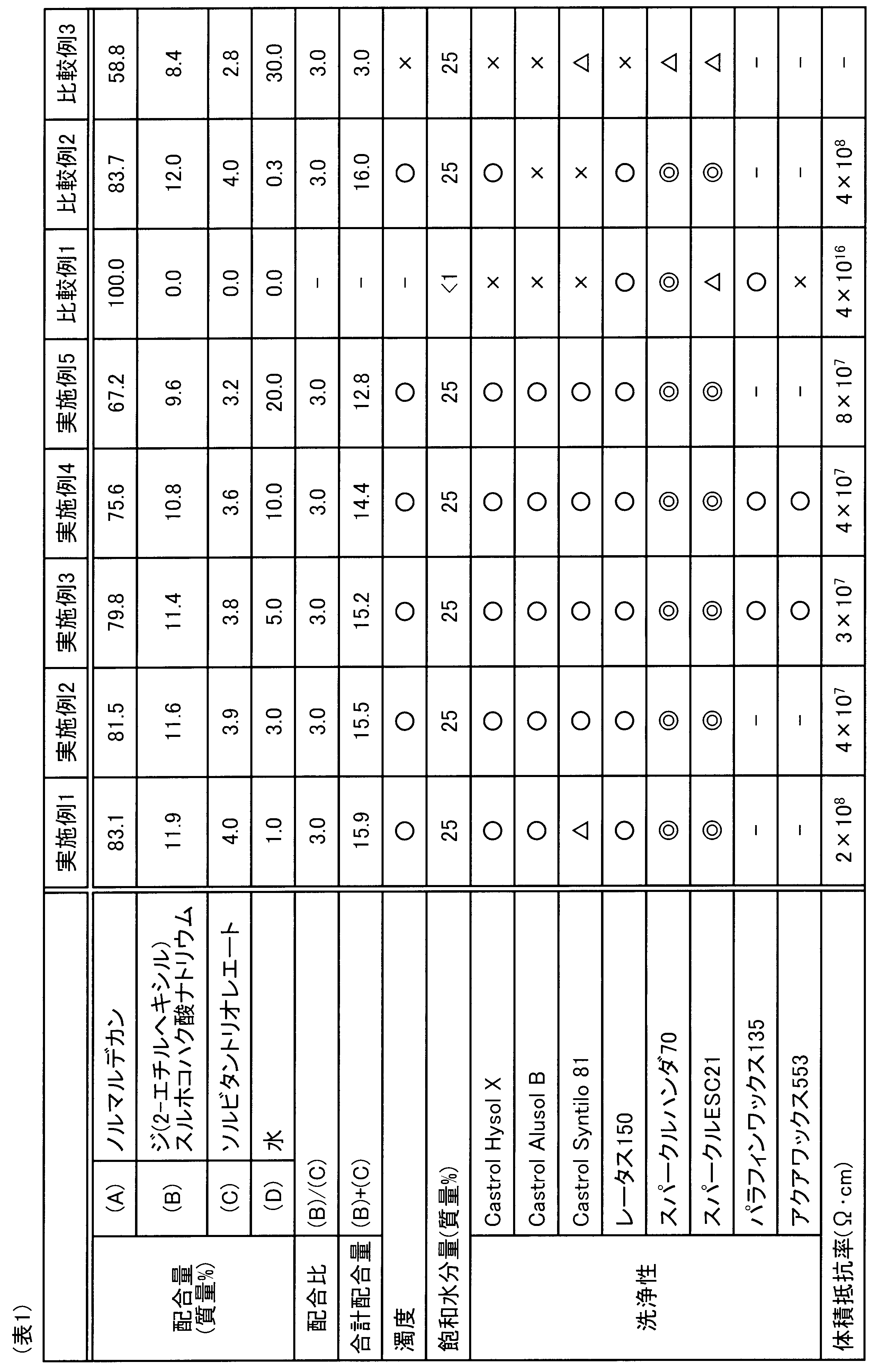
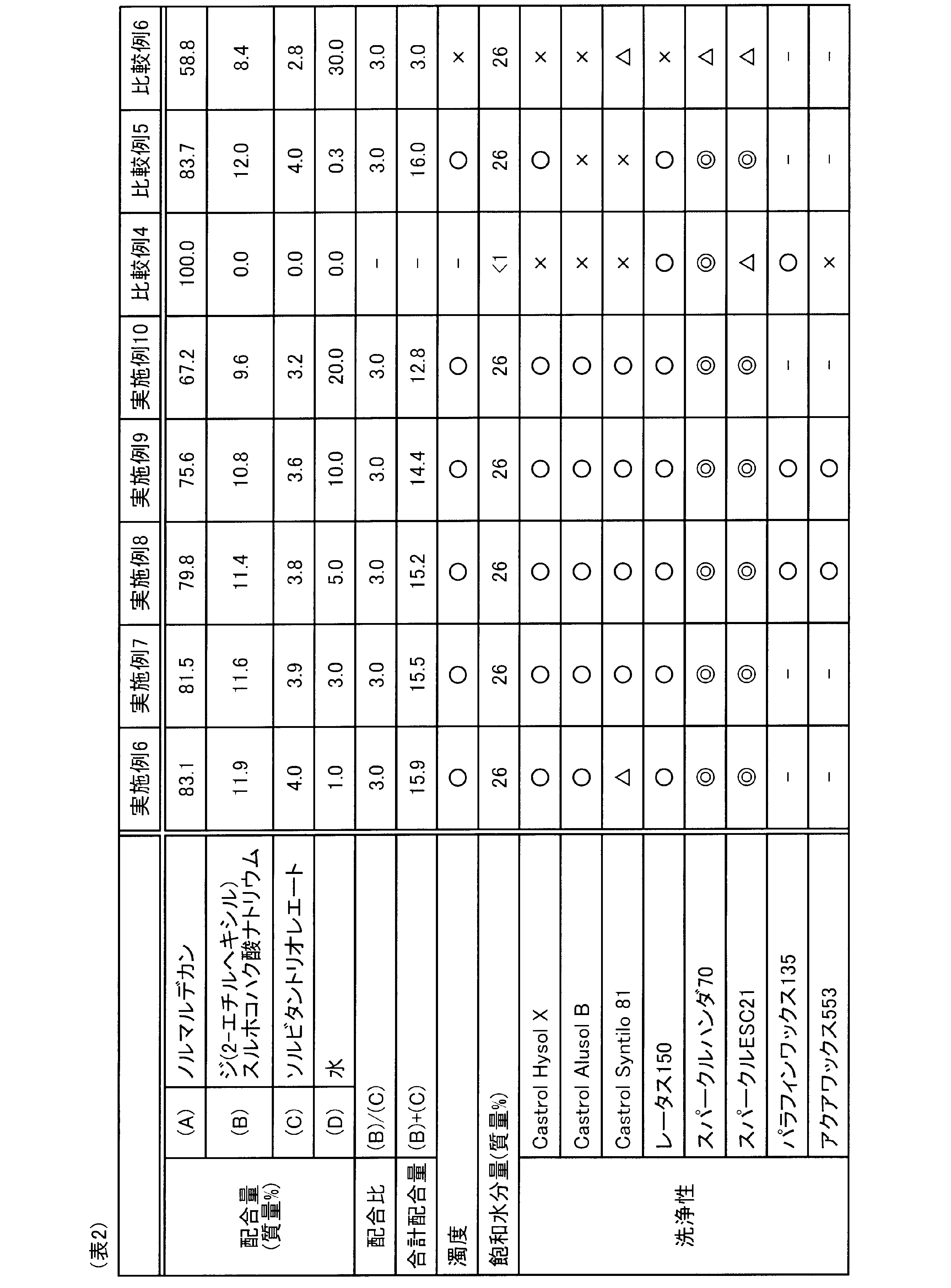
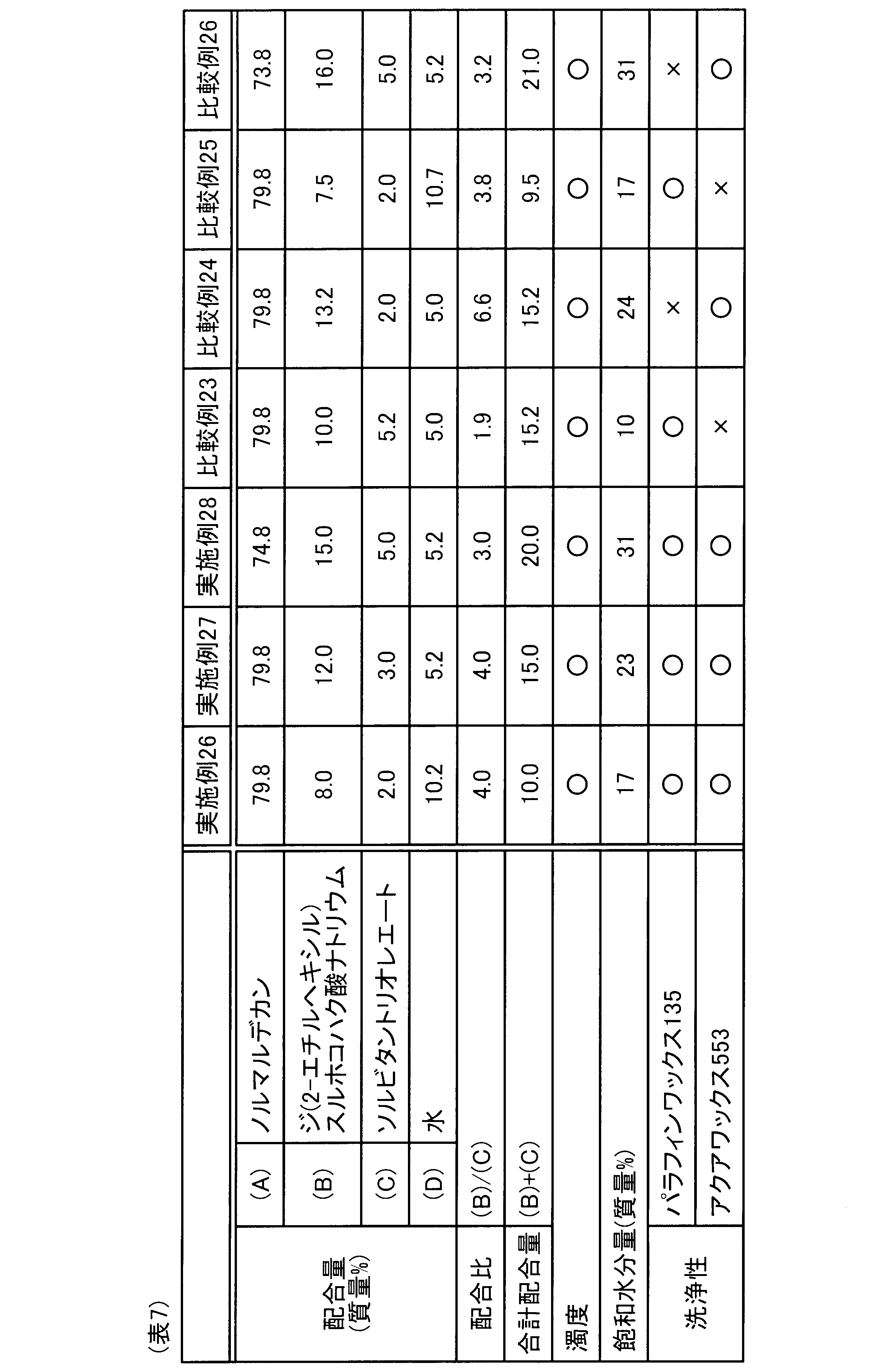
- An object to be cleaned is immersed in the cleaning compositions of Examples 1 to 10 and Comparative Examples 1 to 6 shown in Tables 1 and 2, and an ultrasonic cleaner (trade name: W-113 (Honda Electronics Co., Ltd.).
- W-113 Honda Electronics Co., Ltd.
- the objects to be cleaned are immersed in the cleaning compositions of Examples 1 to 10 and Comparative Examples 1 to 6 shown in Table 1 and Table 2, washed for 2 minutes, and then immersed in normal decane at 25 ° C. for 10 seconds to rinse. did.
- the object to be cleaned was dried at 70 ° C. for 40 minutes using a hot air dryer (trade name: SPHH-201 (manufactured by ESPEC)), and then the residual oil content was measured. The results are shown in Tables 1 and 2.
- ⁇ Removal rate is less than 99% by mass
- the saturated aliphatic hydrocarbon (A) is 60.0 to 85.0% by mass
- the anionic surfactant (B) is 8.0 to 15.0% by mass
- nonionic Surfactant (C) is contained in a proportion of 2.0 to 5.0% by mass
- water (D) is contained in a proportion of 1.0 to 20.0% by mass
- W / O microemulsion or solubilized W / O The cleaning composition of the present invention that forms an emulsion can clean a wide range of soils from organic to inorganic.
- the volume resistivity of the cleaning composition of the present invention is 1 ⁇ 10 9 ⁇ ⁇ cm or less, static electricity is caused by friction caused by rubbing between objects to be cleaned.
- the cleaning composition of the present invention stably forms a W / O microemulsion or a solubilized W / O emulsion, the detergency does not deteriorate. Furthermore, since the cleaning composition of the present invention does not use a polar solvent, it can be used for cleaning plastics and rubber materials having low resistance to polar solvents, and also from plastics and rubber materials having low resistance to polar solvents. A cleaning jig can be used.
- the cleaning composition of the present invention includes parts used in various industrial fields such as automobiles, machines, precision equipment, electricity, electronics, optics, pipes and devices of various factories such as oil refineries and chemical plants, automobiles and industrial machines. Etc., and can be suitably used for cleaning various articles such as metal products, resin products and textiles used in daily life.
Landscapes
- Chemical & Material Sciences (AREA)
- Organic Chemistry (AREA)
- Engineering & Computer Science (AREA)
- Chemical Kinetics & Catalysis (AREA)
- Oil, Petroleum & Natural Gas (AREA)
- Wood Science & Technology (AREA)
- Life Sciences & Earth Sciences (AREA)
- General Chemical & Material Sciences (AREA)
- Materials Engineering (AREA)
- Mechanical Engineering (AREA)
- Metallurgy (AREA)
- Detergent Compositions (AREA)
- Cleaning By Liquid Or Steam (AREA)
- Cleaning And De-Greasing Of Metallic Materials By Chemical Methods (AREA)
- Cosmetics (AREA)
Abstract
Description
HO-(C2H4O)a-(C3H6O)b-(C2H4O)c-H (1)
HO-(C3H6O)a-(C2H4O)b-(C3H6O)c-H (2)
上記式(1)および式(2)において、aは2~160、bは10~60、cは2~160が好ましい。
非イオン性界面活性剤(C)として使用するポリオキシエチレンポリオキシプロピレンブロックコポリマーは、ポリオキシプロピレン部分の分子量が3500以下であるとともに、ポリエチレンオキサイド部分が50質量%以下であることが好ましい。
R1-O-(C3H6O)m-(C2H4O)n-H (3)
上記式(3)において、R1は炭素数6~16のアルキル基であり、nおよびmは2~16が好ましい。
本発明の洗浄剤組成物において、水(D)の配合量は、1.0~20.0質量%である。水(D)の配合量が、1.0質量%未満であると、無機の汚れに対する洗浄性が低下する場合があり、20.0質量%より多い場合、有機の汚れに対する洗浄性が低下するおそれがある。水(D)の配合量は、5.0~15.0質量%であることが好ましく、5.0~10.0質量%であることが特に好ましい。
飽和脂肪族炭化水素(A)として、ノルマルウンデカン31.1質量部、およびノルマルドデカン31.0質量部、アニオン性界面活性剤(B)として、ジ(2-エチルヘキシル)スルホコハク酸ナトリウム8.9質量部、非イオン性界面活性剤(C)として、ソルビタントリオレエート3.0質量部を容器内に計量して混合し、該混合物中に、水(D)を添加し、水の添加量(洗浄剤組成物中の水の質量%)によるミセルの平均粒径と濁度の関係を測定した。結果を図1に示す。また、水の添加量と体積抵抗率の関係を測定した。結果を図2に示す。洗浄剤組成物の飽和水分量(濁度が100NTUとなった際の洗浄剤組成物中の水の質量%)は、26質量%であった。
下記の水溶性加工油(I)および(II)をそれぞれ蒸留水で2倍に希釈した。脱脂した質量既知のSUS製の部品(爪付波型保持器:被洗浄物)を、希釈した水溶性加工油(I)および(II)に浸漬し、温風乾燥機(商品名:SPHH-201(ESPEC製))を用いて、40℃で3時間風乾した。表1および表2に示す実施例1~10および比較例1~6の洗浄剤組成物中に被洗浄物を浸漬し、超音波洗浄器(商品名:W-113(本多電子(株)製))を用いて、28KHz、25℃で3分間洗浄した後、ノルマルデカンにより25℃で1分間、被洗浄物を揺動しながらリンスした。被洗浄物を温風乾燥機(商品名:SPHH-201(ESPEC製))を用いて、80℃で20分間乾燥した後、残留油分を測定した。結果を表1および表2に示す。
評価基準
○:残留油分が0.001g未満
×:残留油分が0.001g以上
使用した水溶性加工油
(I)Castrol Hysol X(分類:A1種2号;BPジャパン(株)製)
(II)Castrol Alusl B(分類:A2種2号;BPジャパン(株)製)
水溶性加工油Castrol Syntilo 81(分類:A3種2号;BPジャパン(株)製)の10質量%水溶液を調整した(水溶性加工油(III))。脱脂した鉄板(SPCC-SB、JIS G3141、30mm×30mm×1mmを#240番で研磨、被洗浄物)に、調整した水溶性加工油(III)の10質量%水溶液を一滴塗布した。加工油を塗布した鉄板上に、鉄粉(電解鉄、関東科学(株)製)を0.02g散布し、鉄板の縁から5mm程度まで延ばし広げ、温風乾燥機(商品名:SPHH-201(ESPEC製))を用いて、120℃で3時間乾燥した。表1および表2に示す実施例1~10および比較例1~6の洗浄剤組成物中に被洗浄物を浸漬し、超音波洗浄器(商品名:W-113(本多電子(株)製))を用いて、45KHz、25℃で3分間洗浄した。被洗浄物を洗浄剤組成物から引き上げ、液切りした後、表面に残存する鉄粉を目視観察した。結果を表1および表2に示す。下記の評価基準で◎~△を合格とした。
評価基準
◎:鉄粉が確認できない
○:数個の鉄粉が残留
△:数十個の鉄粉が残留
×:数百個の鉄粉が残留
質量既知の脱脂後の鉄板(SPCC-SB、JIS G3141、30mm×30mm×1mmを#240番で研磨、被洗浄物)を、工業性汎用油レータス150(JX日鉱日石エネルギー(株)製)に浸漬し、温風乾燥機(商品名:SPHH-201(ESPEC製))を用いて、120℃で3時間乾燥し、放冷後、付着した油分量を測定した。表1および表2に示す実施例1~10および比較例1~6の洗浄剤組成物中に被洗浄物を浸漬し、2分間洗浄した後、ノルマルデカンに25℃で10秒間浸漬してリンスした。被洗浄物を温風乾燥機(商品名:SPHH-201(ESPEC製))を用いて、70℃で40分間乾燥した後、残留油分を測定した。結果を表1および表2に示す。
評価基準
○:除去率が99質量%以上
×:除去率が99質量%未満
下記の糸はんだ(I)、(II)を、半田ごてで基板(ICB-96PU、被洗浄物)に半田つけした。表1および表2に示す実施例1~10および比較例1~6の洗浄剤組成物中に被洗浄物を浸漬し、超音波洗浄器(商品名:W-113(本多電子(株)製))を用いて、28KHz、25℃で2分間洗浄した。洗浄後の基板を実体顕微鏡Stemi DV4(Carl Zeiss製)にて目視観察した。結果を表1および表2に示す。下記の評価基準で○以上を合格とした。
評価基準
◎:残渣なし
○:わずかに残渣あり
△:一部残渣あり
×:白色残渣あり
使用した糸はんだ
(I)スパークルハンダ70(千住金属工業(株)製)
(II)スパークルESC21(千住金属工業(株)製)
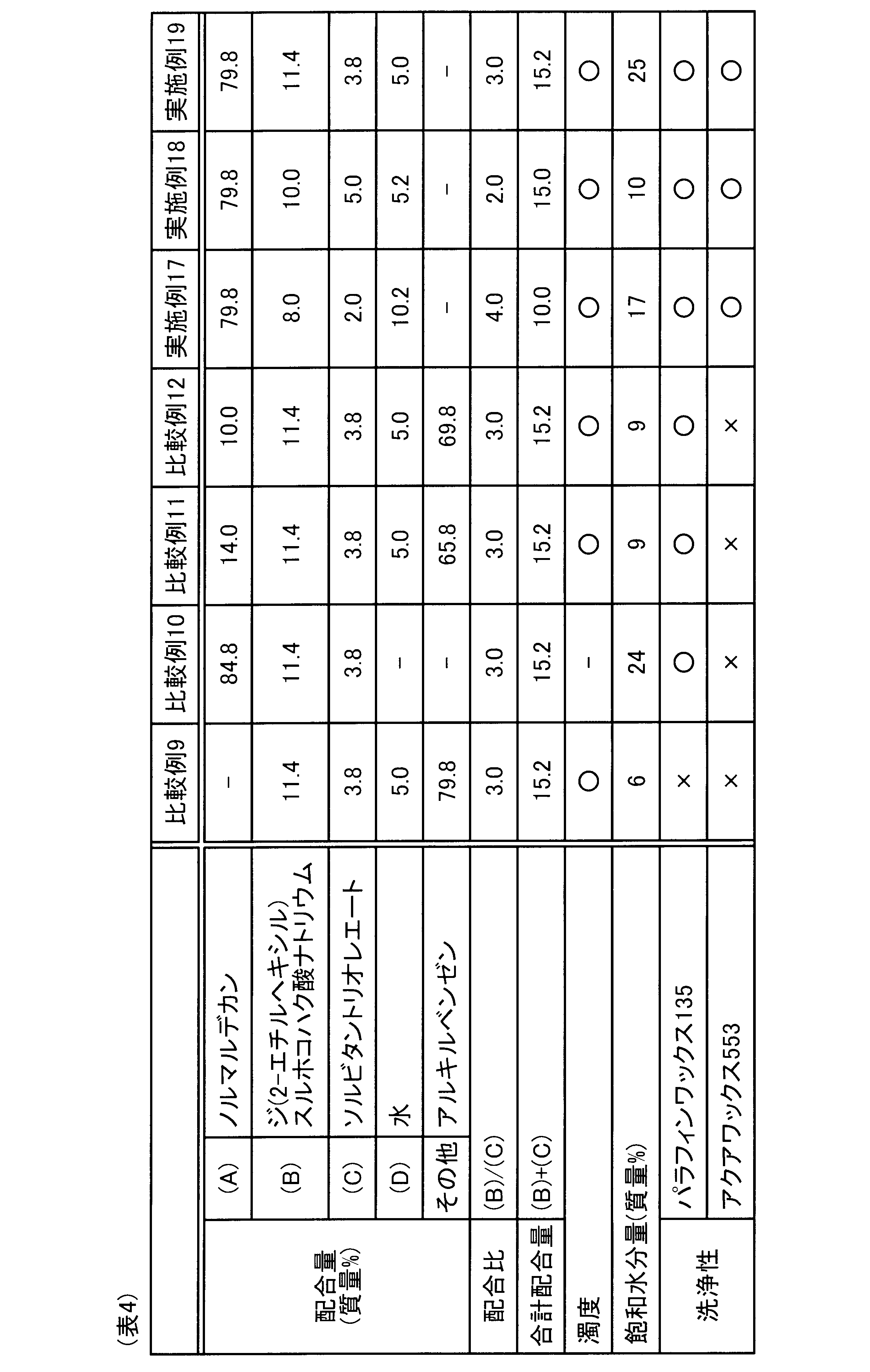
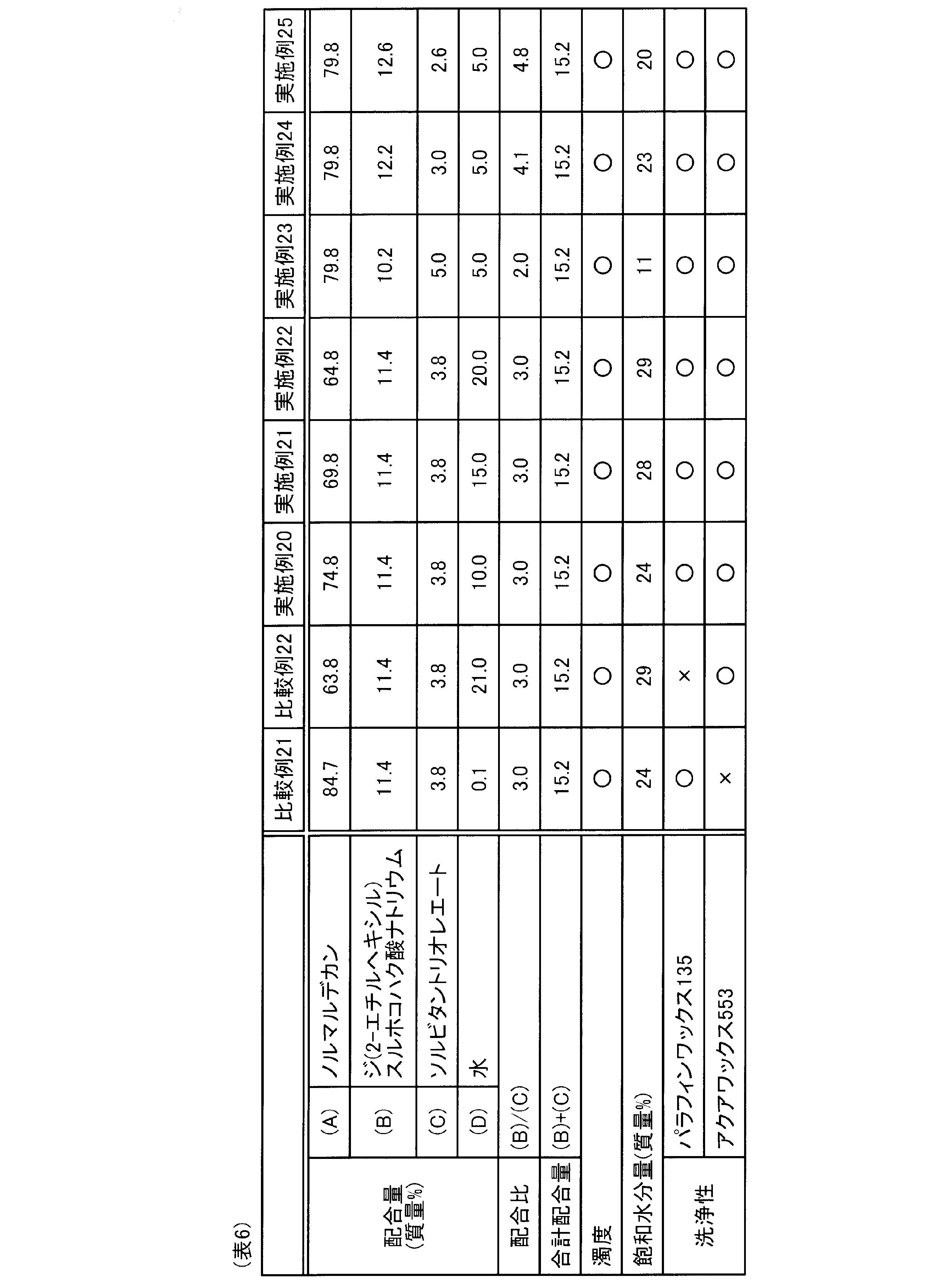
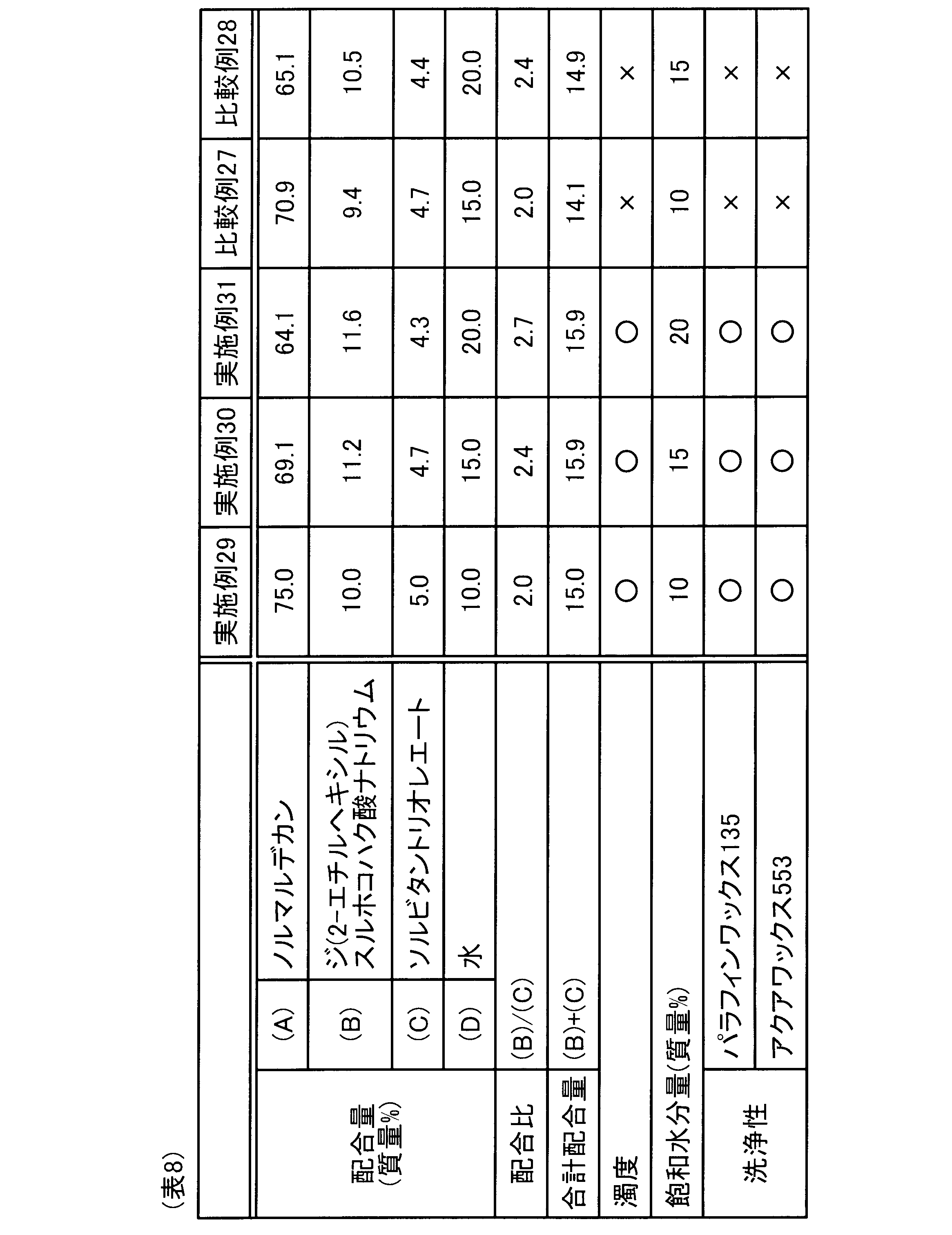
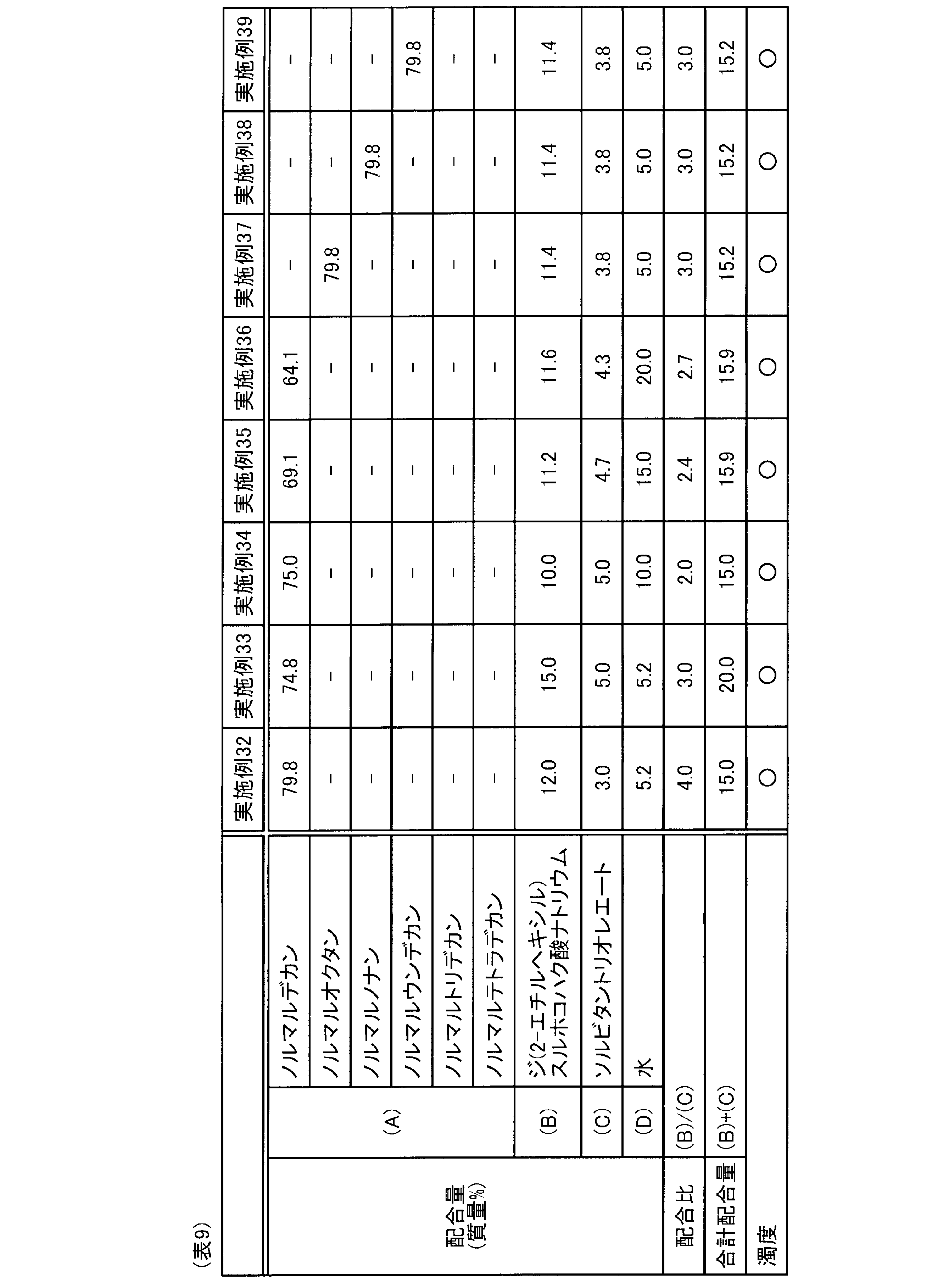
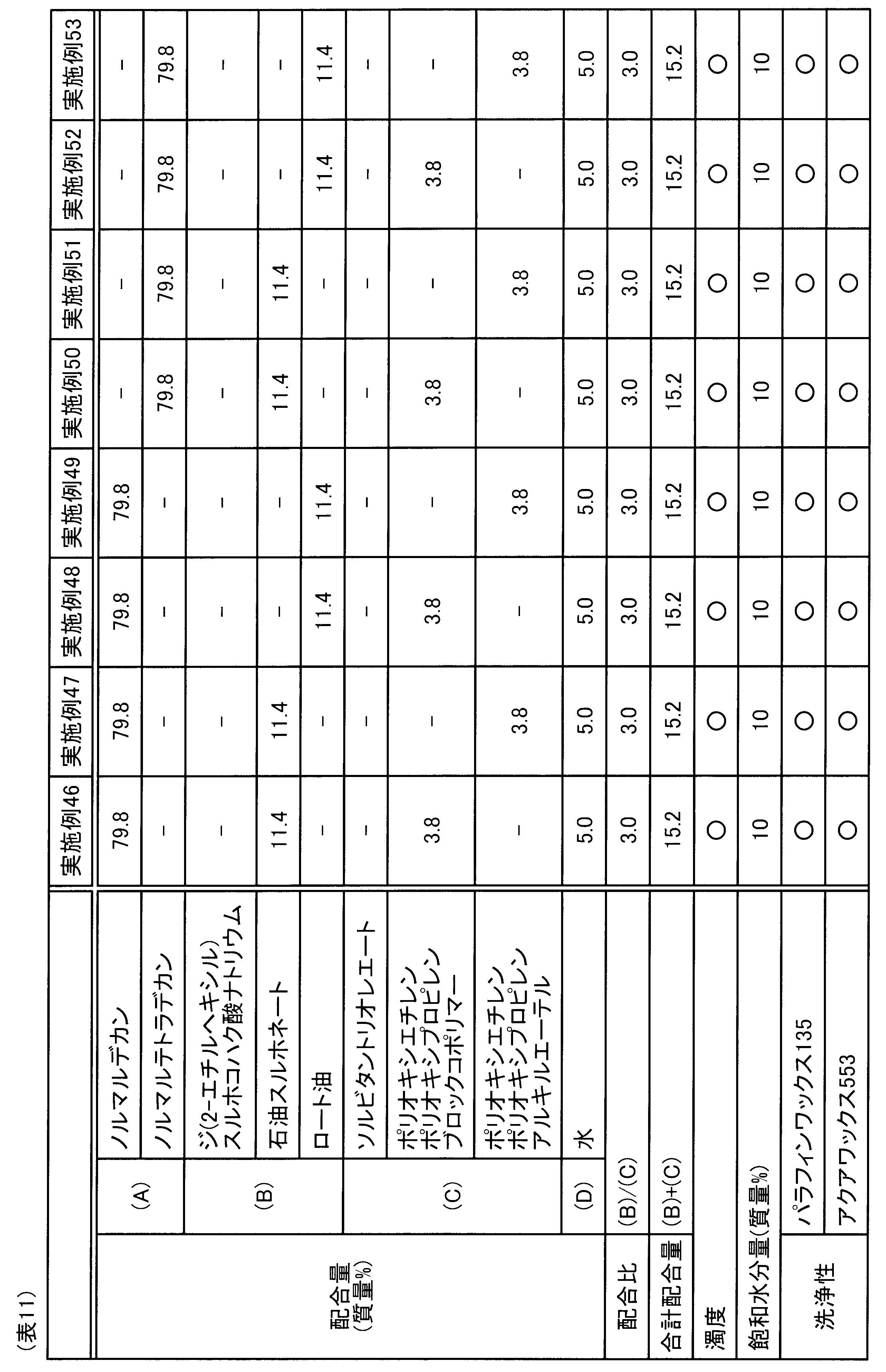
表1~表11に示す実施例および比較例の洗浄剤組成物の濁度を、携帯用濁度計2100P(セントラル科学(株)製)を用いて測定した。濁度が100NTU以下の洗浄剤組成物が、W/Oマイクロエマルションまたは可溶化型W/Oエマルションを形成したと認定した。
評価基準
○:濁度100NTU以下
×:濁度100NTUより大
表1~表8に示す割合で、飽和脂肪族炭化水素(A)、アニオン性界面活性剤(B)、非イオン性界面活性剤(C)、および使用する場合はその他の成分を混合し、該混合物に水(D)を添加した際の濁度を、携帯用濁度計2100P(セントラル科学(株)製)を用いて測定した。濁度が100NTUになるまで水(D)を添加し、濁度が100NTUのときの水の添加量(洗浄剤組成物中の割合、質量%)を求めることにより、飽和水分量を算出した。
下記のワックス(I)、(II)を銅板(C1100P、JIS H3100、75mm×12.5mm×3.0mm、被洗浄物)に塗布した。表1~表8、および表11に示す実施例および比較例の洗浄剤組成物中に被洗浄物を浸漬し、超音波洗浄器(商品名:W-113(本多電子(株)製))を用いて、28KHz、25℃で2分間洗浄した後、ノルマルデカンに25℃で30秒間浸漬してリンスした。洗浄後の銅板表面を目視観察した。結果を表1~表8、および表11に示す。
評価基準
○:残渣なし
×:残渣あり
使用したワックス
(I)パラフィンワックス135(日本精鑞(株)製)
(II)アクアワックス553(日本精工(株)製)



Claims (6)
- 飽和脂肪族炭化水素(A)と、
アニオン性界面活性剤(B)と、
非イオン性界面活性剤(C)と、
水(D)とを含み、
前記飽和脂肪族炭化水素(A)を60.0~85.0質量%、前記アニオン性界面活性剤(B)を8.0~15.0質量%、前記非イオン性界面活性剤(C)を2.0~5.0質量%、前記水(D)を1.0~20.0質量%の割合で含有し、
W/Oマイクロエマルションまたは可溶化型W/Oエマルションを形成するとともに、体積抵抗率が1×109Ω・cm以下であることを特徴とする洗浄剤組成物。 - 前記飽和脂肪族炭化水素(A)は、炭素数が9~13のパラフィン系炭化水素であることを特徴とする請求項1に記載の洗浄剤組成物。
- 前記アニオン性界面活性剤(B)と前記非イオン性界面活性剤(C)とを合計で10.0~20.0質量%含むとともに、前記アニオン性界面活性剤(B)と前記非イオン性界面活性剤(C)とが、2.0~5.0:1の割合(質量比)で配合されることを特徴とする請求項1または2に記載の洗浄剤組成物。
- 濁度により測定した飽和水分量が10質量%以上であることを特徴とする請求項1~3のいずれか一つに記載の洗浄剤組成物。
- 前記アニオン性界面活性剤(B)がジアルキルスルホコハク酸エステル塩であり、
前記非イオン性界面活性剤(C)がソルビタン脂肪酸エステルであることを特徴とする請求項1~4のいずれか一つに記載の洗浄剤組成物。 - 極性溶剤を含まないことを特徴とする請求項1~5のいずれか一つに記載の洗浄剤組成物。
Priority Applications (3)
| Application Number | Priority Date | Filing Date | Title |
|---|---|---|---|
| US14/785,654 US9725677B2 (en) | 2013-04-25 | 2014-04-23 | Cleaner composition |
| CN201480023146.6A CN105143426B (zh) | 2013-04-25 | 2014-04-23 | 清洗剂组合物 |
| MX2015014849A MX378600B (es) | 2013-04-25 | 2014-04-23 | Composicion limpiadora. |
Applications Claiming Priority (2)
| Application Number | Priority Date | Filing Date | Title |
|---|---|---|---|
| JP2013092876A JP6023641B2 (ja) | 2013-04-25 | 2013-04-25 | 洗浄剤組成物 |
| JP2013-092876 | 2013-04-25 |
Publications (1)
| Publication Number | Publication Date |
|---|---|
| WO2014175353A1 true WO2014175353A1 (ja) | 2014-10-30 |
Family
ID=51791920
Family Applications (1)
| Application Number | Title | Priority Date | Filing Date |
|---|---|---|---|
| PCT/JP2014/061481 Ceased WO2014175353A1 (ja) | 2013-04-25 | 2014-04-23 | 洗浄剤組成物 |
Country Status (5)
| Country | Link |
|---|---|
| US (1) | US9725677B2 (ja) |
| JP (1) | JP6023641B2 (ja) |
| CN (1) | CN105143426B (ja) |
| MX (1) | MX378600B (ja) |
| WO (1) | WO2014175353A1 (ja) |
Cited By (1)
| Publication number | Priority date | Publication date | Assignee | Title |
|---|---|---|---|---|
| CN106398877A (zh) * | 2016-08-30 | 2017-02-15 | 成都市翻鑫家科技有限公司 | 一种环保电子产品清洁剂 |
Families Citing this family (9)
| Publication number | Priority date | Publication date | Assignee | Title |
|---|---|---|---|---|
| JP2017031326A (ja) * | 2015-07-31 | 2017-02-09 | Jxエネルギー株式会社 | W/oマイクロエマルション型洗浄剤の洗浄性の評価方法、w/oマイクロエマルション型洗浄剤による洗浄方法、および被膜形成方法 |
| JP6630111B2 (ja) * | 2015-10-15 | 2020-01-15 | Jxtgエネルギー株式会社 | 洗浄剤組成物 |
| JP6864530B2 (ja) * | 2017-04-13 | 2021-04-28 | Eneos株式会社 | 洗浄剤組成物 |
| WO2019008841A1 (ja) * | 2017-07-05 | 2019-01-10 | Jxtgエネルギー株式会社 | W/o型エマルション洗浄剤組成物、およびw/o型エマルション洗浄剤組成物を使用する洗浄方法 |
| WO2019009142A1 (ja) * | 2017-07-05 | 2019-01-10 | Jxtgエネルギー株式会社 | W/o型エマルション洗浄剤組成物、w/o型エマルション洗浄剤組成物を使用する洗浄方法、およびw/o型エマルション洗浄剤組成物の製造方法 |
| CN114437884A (zh) * | 2022-01-21 | 2022-05-06 | 麦达可尔(湖北)工业有限公司 | 一种环保碳氢清洗剂及其制备方法 |
| JP2023147905A (ja) * | 2022-03-30 | 2023-10-13 | 花王株式会社 | 繊維製品用化粧品汚れ洗浄剤組成物 |
| CN115975741A (zh) * | 2022-12-28 | 2023-04-18 | 宁波坚锋新材料有限公司 | 一种用于废弃abs回收的清洗剂及用该清洗剂回收清洗废弃abs的方法 |
| CN116727321A (zh) * | 2023-05-12 | 2023-09-12 | 深圳市鑫承诺环保产业股份有限公司 | 一种全自动刀片电池铝壳清洗装置及工艺 |
Citations (6)
| Publication number | Priority date | Publication date | Assignee | Title |
|---|---|---|---|---|
| JPH09125099A (ja) * | 1995-10-31 | 1997-05-13 | Olympus Optical Co Ltd | 洗浄組成物 |
| JPH09125093A (ja) * | 1995-10-31 | 1997-05-13 | Olympus Optical Co Ltd | 洗浄組成物 |
| JPH09157698A (ja) * | 1995-12-05 | 1997-06-17 | Olympus Optical Co Ltd | 洗浄組成物及び洗浄方法 |
| JP2002256285A (ja) * | 2001-03-02 | 2002-09-11 | Japan Energy Corp | 光学部品用洗浄液組成物 |
| JP2008049235A (ja) * | 2006-08-22 | 2008-03-06 | Tosoh Corp | 炭化水素系洗浄剤を用いた洗浄方法 |
| JP2010174106A (ja) * | 2009-01-28 | 2010-08-12 | Tosoh Corp | 水溶性汚れの除去方法 |
Family Cites Families (25)
| Publication number | Priority date | Publication date | Assignee | Title |
|---|---|---|---|---|
| US4749516A (en) * | 1985-09-24 | 1988-06-07 | S. C. Johnson & Son, Inc. | Anionic emulsion pre-spotting composition |
| US5035826A (en) | 1989-09-22 | 1991-07-30 | Colgate-Palmolive Company | Liquid crystal detergent composition |
| AU657500B2 (en) * | 1990-10-17 | 1995-03-16 | Bush Boake Allen Limited | Composition containing c7-c10 organic polar compound, and method of cleaning articles using the same |
| US5249446A (en) * | 1991-07-19 | 1993-10-05 | Aluminum Company Of America | Process for making an aluminum alloy finstock lubricated by a water-microemulsifiable composition |
| US5277836A (en) * | 1992-02-14 | 1994-01-11 | Bio-Safe Specialty Products, Inc. | Terpene cleaning compositions and methods of using the same |
| JPH08173787A (ja) * | 1994-08-12 | 1996-07-09 | Lion Corp | 界面活性剤組成物 |
| WO1996038522A1 (en) * | 1995-06-02 | 1996-12-05 | Ashland Inc. | Stable microemulsion cleaners having low volatile organic content |
| US5663135A (en) * | 1995-08-10 | 1997-09-02 | Corpex Technologies, Inc. | Terpene-based cleaning composition |
| US5817186A (en) * | 1995-08-10 | 1998-10-06 | Corpex Technologies, Inc | Cleaning composition for metal objects |
| JPH09176700A (ja) * | 1995-12-18 | 1997-07-08 | Shell Internatl Res Maatschappij Bv | 脱脂組成物 |
| US5814594A (en) * | 1997-11-17 | 1998-09-29 | Citra Science Ltd. | Heavy oil remover |
| JP4596402B2 (ja) * | 2000-09-22 | 2010-12-08 | Jx日鉱日石エネルギー株式会社 | 石油製品製造装置用洗浄剤組成物及び洗浄方法 |
| FR2819201B1 (fr) | 2001-01-09 | 2003-02-21 | Atofina | Procede de nettoyage d'une surface solide par elimination de salissures organiques et/ou minerales au moyen d'une microemulsion |
| JP2002241793A (ja) * | 2001-02-20 | 2002-08-28 | Sanyo Chem Ind Ltd | 電子部品用洗浄剤 |
| JP3745641B2 (ja) * | 2001-04-26 | 2006-02-15 | 花王株式会社 | 非水系洗浄剤組成物 |
| JP2003073692A (ja) * | 2001-08-31 | 2003-03-12 | Showa Denko Kk | 洗浄剤組成物およびそれを用いる洗浄方法 |
| JP2003247160A (ja) * | 2002-02-25 | 2003-09-05 | Nof Corp | ドライクリーニング用洗浄剤組成物 |
| JP4278037B2 (ja) * | 2002-08-30 | 2009-06-10 | 株式会社ジャパンエナジー | 光学部品用洗浄液組成物 |
| JP4114052B2 (ja) * | 2002-12-10 | 2008-07-09 | ライオン株式会社 | 水系洗浄剤組成物 |
| JP2005154644A (ja) * | 2003-11-27 | 2005-06-16 | Fuji Photo Film Co Ltd | 平版印刷版用版面洗浄剤及び平版印刷版の洗浄方法 |
| JP2006225489A (ja) | 2005-02-17 | 2006-08-31 | Lion Corp | 水系液体洗浄剤組成物およびスペーサ粒子の洗浄除去方法 |
| JP4912755B2 (ja) * | 2005-06-22 | 2012-04-11 | 花王株式会社 | 液体洗浄剤組成物 |
| EP2361286A4 (en) * | 2008-12-22 | 2012-05-23 | Henkel Ag & Co Kgaa | WATER-BASED CLEANING AGENT FOR CLEANING COLORS ON SOLVENT BASIS |
| JP5400601B2 (ja) * | 2009-12-22 | 2014-01-29 | 花王株式会社 | 圧延機廻り用洗浄剤組成物 |
| CN102732394A (zh) | 2012-05-13 | 2012-10-17 | 合肥市朗清设备清洗有限公司 | 环境友好型多功能电力电气设备带电清洗剂 |
-
2013
- 2013-04-25 JP JP2013092876A patent/JP6023641B2/ja not_active Expired - Fee Related
-
2014
- 2014-04-23 CN CN201480023146.6A patent/CN105143426B/zh active Active
- 2014-04-23 US US14/785,654 patent/US9725677B2/en active Active
- 2014-04-23 WO PCT/JP2014/061481 patent/WO2014175353A1/ja not_active Ceased
- 2014-04-23 MX MX2015014849A patent/MX378600B/es unknown
Patent Citations (6)
| Publication number | Priority date | Publication date | Assignee | Title |
|---|---|---|---|---|
| JPH09125099A (ja) * | 1995-10-31 | 1997-05-13 | Olympus Optical Co Ltd | 洗浄組成物 |
| JPH09125093A (ja) * | 1995-10-31 | 1997-05-13 | Olympus Optical Co Ltd | 洗浄組成物 |
| JPH09157698A (ja) * | 1995-12-05 | 1997-06-17 | Olympus Optical Co Ltd | 洗浄組成物及び洗浄方法 |
| JP2002256285A (ja) * | 2001-03-02 | 2002-09-11 | Japan Energy Corp | 光学部品用洗浄液組成物 |
| JP2008049235A (ja) * | 2006-08-22 | 2008-03-06 | Tosoh Corp | 炭化水素系洗浄剤を用いた洗浄方法 |
| JP2010174106A (ja) * | 2009-01-28 | 2010-08-12 | Tosoh Corp | 水溶性汚れの除去方法 |
Cited By (1)
| Publication number | Priority date | Publication date | Assignee | Title |
|---|---|---|---|---|
| CN106398877A (zh) * | 2016-08-30 | 2017-02-15 | 成都市翻鑫家科技有限公司 | 一种环保电子产品清洁剂 |
Also Published As
| Publication number | Publication date |
|---|---|
| CN105143426B (zh) | 2018-06-26 |
| CN105143426A (zh) | 2015-12-09 |
| JP6023641B2 (ja) | 2016-11-09 |
| MX2015014849A (es) | 2016-03-09 |
| MX378600B (es) | 2025-03-10 |
| US20160090550A1 (en) | 2016-03-31 |
| US9725677B2 (en) | 2017-08-08 |
| JP2014214228A (ja) | 2014-11-17 |
Similar Documents
| Publication | Publication Date | Title |
|---|---|---|
| JP6023641B2 (ja) | 洗浄剤組成物 | |
| JP5893519B2 (ja) | 洗浄液組成物 | |
| JP5336173B2 (ja) | 硬質表面用洗浄剤組成物 | |
| JP2652298B2 (ja) | 精密部品又は治工具類用洗浄剤組成物 | |
| JP2017179287A (ja) | 洗浄剤組成物 | |
| JP6113034B2 (ja) | 水切り洗浄方法および水切り洗浄剤組成物 | |
| JP6113035B2 (ja) | 耐水性の低い材質を含む被洗浄物の洗浄方法 | |
| JP2017031326A (ja) | W/oマイクロエマルション型洗浄剤の洗浄性の評価方法、w/oマイクロエマルション型洗浄剤による洗浄方法、および被膜形成方法 | |
| JP2016196693A (ja) | 銅、亜鉛、またはこれらの金属を含む合金用洗浄剤組成物、銅、亜鉛、またはこれらの金属を含む合金からなる被洗浄物の洗浄方法、および銅、亜鉛、またはこれらの金属を含む合金からなる微粒子の除去方法 | |
| JPH03162496A (ja) | 洗浄剤組成物 | |
| JP2022098039A (ja) | 低浸食性洗浄剤組成物 | |
| JP2003073692A (ja) | 洗浄剤組成物およびそれを用いる洗浄方法 | |
| JPH0457897A (ja) | 洗浄剤組成物 | |
| JPH07195044A (ja) | 洗浄方法 | |
| JPH0362896A (ja) | 洗浄剤組成物 | |
| JP6630111B2 (ja) | 洗浄剤組成物 | |
| JP6100669B2 (ja) | 洗浄液組成物 | |
| JPH03140486A (ja) | 洗浄剤組成物 | |
| JP7123045B2 (ja) | W/o型エマルション洗浄剤組成物、w/o型エマルション洗浄剤組成物を使用する洗浄方法、およびw/o型エマルション洗浄剤組成物の製造方法 | |
| JP6864530B2 (ja) | 洗浄剤組成物 | |
| JPH0394082A (ja) | 洗浄剤組成物 | |
| WO2019009142A1 (ja) | W/o型エマルション洗浄剤組成物、w/o型エマルション洗浄剤組成物を使用する洗浄方法、およびw/o型エマルション洗浄剤組成物の製造方法 | |
| JP2893497B2 (ja) | 精密部品又は治工具類用洗浄剤組成物 | |
| JPH09241686A (ja) | 工業用脱脂洗浄剤 | |
| JPH0673399A (ja) | 洗浄剤組成物 |
Legal Events
| Date | Code | Title | Description |
|---|---|---|---|
| WWE | Wipo information: entry into national phase |
Ref document number: 201480023146.6 Country of ref document: CN |
|
| 121 | Ep: the epo has been informed by wipo that ep was designated in this application |
Ref document number: 14787724 Country of ref document: EP Kind code of ref document: A1 |
|
| WWE | Wipo information: entry into national phase |
Ref document number: 14785654 Country of ref document: US |
|
| WWE | Wipo information: entry into national phase |
Ref document number: MX/A/2015/014849 Country of ref document: MX |
|
| NENP | Non-entry into the national phase |
Ref country code: DE |
|
| WWE | Wipo information: entry into national phase |
Ref document number: IDP00201507606 Country of ref document: ID |
|
| 122 | Ep: pct application non-entry in european phase |
Ref document number: 14787724 Country of ref document: EP Kind code of ref document: A1 |