WO2014157175A1 - 樹脂組成物 - Google Patents
樹脂組成物 Download PDFInfo
- Publication number
- WO2014157175A1 WO2014157175A1 PCT/JP2014/058235 JP2014058235W WO2014157175A1 WO 2014157175 A1 WO2014157175 A1 WO 2014157175A1 JP 2014058235 W JP2014058235 W JP 2014058235W WO 2014157175 A1 WO2014157175 A1 WO 2014157175A1
- Authority
- WO
- WIPO (PCT)
- Prior art keywords
- resin composition
- acid
- composition according
- mass
- meth
- Prior art date
- Legal status (The legal status is an assumption and is not a legal conclusion. Google has not performed a legal analysis and makes no representation as to the accuracy of the status listed.)
- Ceased
Links
Classifications
-
- C—CHEMISTRY; METALLURGY
- C09—DYES; PAINTS; POLISHES; NATURAL RESINS; ADHESIVES; COMPOSITIONS NOT OTHERWISE PROVIDED FOR; APPLICATIONS OF MATERIALS NOT OTHERWISE PROVIDED FOR
- C09J—ADHESIVES; NON-MECHANICAL ASPECTS OF ADHESIVE PROCESSES IN GENERAL; ADHESIVE PROCESSES NOT PROVIDED FOR ELSEWHERE; USE OF MATERIALS AS ADHESIVES
- C09J9/00—Adhesives characterised by their physical nature or the effects produced, e.g. glue sticks
-
- C—CHEMISTRY; METALLURGY
- C08—ORGANIC MACROMOLECULAR COMPOUNDS; THEIR PREPARATION OR CHEMICAL WORKING-UP; COMPOSITIONS BASED THEREON
- C08K—Use of inorganic or non-macromolecular organic substances as compounding ingredients
- C08K3/00—Use of inorganic substances as compounding ingredients
- C08K3/01—Use of inorganic substances as compounding ingredients characterized by their specific function
- C08K3/013—Fillers, pigments or reinforcing additives
-
- C—CHEMISTRY; METALLURGY
- C08—ORGANIC MACROMOLECULAR COMPOUNDS; THEIR PREPARATION OR CHEMICAL WORKING-UP; COMPOSITIONS BASED THEREON
- C08K—Use of inorganic or non-macromolecular organic substances as compounding ingredients
- C08K3/00—Use of inorganic substances as compounding ingredients
- C08K3/02—Elements
- C08K3/08—Metals
-
- C—CHEMISTRY; METALLURGY
- C08—ORGANIC MACROMOLECULAR COMPOUNDS; THEIR PREPARATION OR CHEMICAL WORKING-UP; COMPOSITIONS BASED THEREON
- C08K—Use of inorganic or non-macromolecular organic substances as compounding ingredients
- C08K3/00—Use of inorganic substances as compounding ingredients
- C08K3/18—Oxygen-containing compounds, e.g. metal carbonyls
- C08K3/20—Oxides; Hydroxides
- C08K3/22—Oxides; Hydroxides of metals
-
- C—CHEMISTRY; METALLURGY
- C08—ORGANIC MACROMOLECULAR COMPOUNDS; THEIR PREPARATION OR CHEMICAL WORKING-UP; COMPOSITIONS BASED THEREON
- C08K—Use of inorganic or non-macromolecular organic substances as compounding ingredients
- C08K5/00—Use of organic ingredients
- C08K5/0008—Organic ingredients according to more than one of the "one dot" groups of C08K5/01 - C08K5/59
- C08K5/005—Stabilisers against oxidation, heat, light, ozone
-
- C—CHEMISTRY; METALLURGY
- C08—ORGANIC MACROMOLECULAR COMPOUNDS; THEIR PREPARATION OR CHEMICAL WORKING-UP; COMPOSITIONS BASED THEREON
- C08K—Use of inorganic or non-macromolecular organic substances as compounding ingredients
- C08K5/00—Use of organic ingredients
- C08K5/04—Oxygen-containing compounds
- C08K5/09—Carboxylic acids; Metal salts thereof; Anhydrides thereof
-
- C—CHEMISTRY; METALLURGY
- C08—ORGANIC MACROMOLECULAR COMPOUNDS; THEIR PREPARATION OR CHEMICAL WORKING-UP; COMPOSITIONS BASED THEREON
- C08K—Use of inorganic or non-macromolecular organic substances as compounding ingredients
- C08K5/00—Use of organic ingredients
- C08K5/04—Oxygen-containing compounds
- C08K5/09—Carboxylic acids; Metal salts thereof; Anhydrides thereof
- C08K5/098—Metal salts of carboxylic acids
-
- C—CHEMISTRY; METALLURGY
- C08—ORGANIC MACROMOLECULAR COMPOUNDS; THEIR PREPARATION OR CHEMICAL WORKING-UP; COMPOSITIONS BASED THEREON
- C08K—Use of inorganic or non-macromolecular organic substances as compounding ingredients
- C08K5/00—Use of organic ingredients
- C08K5/54—Silicon-containing compounds
- C08K5/548—Silicon-containing compounds containing sulfur
-
- C—CHEMISTRY; METALLURGY
- C09—DYES; PAINTS; POLISHES; NATURAL RESINS; ADHESIVES; COMPOSITIONS NOT OTHERWISE PROVIDED FOR; APPLICATIONS OF MATERIALS NOT OTHERWISE PROVIDED FOR
- C09J—ADHESIVES; NON-MECHANICAL ASPECTS OF ADHESIVE PROCESSES IN GENERAL; ADHESIVE PROCESSES NOT PROVIDED FOR ELSEWHERE; USE OF MATERIALS AS ADHESIVES
- C09J11/00—Features of adhesives not provided for in group C09J9/00, e.g. additives
- C09J11/02—Non-macromolecular additives
-
- H—ELECTRICITY
- H10—SEMICONDUCTOR DEVICES; ELECTRIC SOLID-STATE DEVICES NOT OTHERWISE PROVIDED FOR
- H10W—GENERIC PACKAGES, INTERCONNECTIONS, CONNECTORS OR OTHER CONSTRUCTIONAL DETAILS OF DEVICES COVERED BY CLASS H10
- H10W40/00—Arrangements for thermal protection or thermal control
- H10W40/20—Arrangements for cooling
- H10W40/25—Arrangements for cooling characterised by their materials
- H10W40/251—Organics
-
- H—ELECTRICITY
- H10—SEMICONDUCTOR DEVICES; ELECTRIC SOLID-STATE DEVICES NOT OTHERWISE PROVIDED FOR
- H10W—GENERIC PACKAGES, INTERCONNECTIONS, CONNECTORS OR OTHER CONSTRUCTIONAL DETAILS OF DEVICES COVERED BY CLASS H10
- H10W70/00—Package substrates; Interposers; Redistribution layers [RDL]
- H10W70/40—Leadframes
- H10W70/411—Chip-supporting parts, e.g. die pads
- H10W70/417—Bonding materials between chips and die pads
-
- C—CHEMISTRY; METALLURGY
- C08—ORGANIC MACROMOLECULAR COMPOUNDS; THEIR PREPARATION OR CHEMICAL WORKING-UP; COMPOSITIONS BASED THEREON
- C08K—Use of inorganic or non-macromolecular organic substances as compounding ingredients
- C08K5/00—Use of organic ingredients
- C08K5/36—Sulfur-, selenium-, or tellurium-containing compounds
- C08K5/37—Thiols
- C08K5/372—Sulfides, e.g. R-(S)x-R'
-
- H—ELECTRICITY
- H10—SEMICONDUCTOR DEVICES; ELECTRIC SOLID-STATE DEVICES NOT OTHERWISE PROVIDED FOR
- H10W—GENERIC PACKAGES, INTERCONNECTIONS, CONNECTORS OR OTHER CONSTRUCTIONAL DETAILS OF DEVICES COVERED BY CLASS H10
- H10W72/00—Interconnections or connectors in packages
- H10W72/071—Connecting or disconnecting
- H10W72/074—Connecting or disconnecting of anisotropic conductive adhesives
-
- H—ELECTRICITY
- H10—SEMICONDUCTOR DEVICES; ELECTRIC SOLID-STATE DEVICES NOT OTHERWISE PROVIDED FOR
- H10W—GENERIC PACKAGES, INTERCONNECTIONS, CONNECTORS OR OTHER CONSTRUCTIONAL DETAILS OF DEVICES COVERED BY CLASS H10
- H10W72/00—Interconnections or connectors in packages
- H10W72/30—Die-attach connectors
- H10W72/321—Structures or relative sizes of die-attach connectors
- H10W72/325—Die-attach connectors having a filler embedded in a matrix
-
- H—ELECTRICITY
- H10—SEMICONDUCTOR DEVICES; ELECTRIC SOLID-STATE DEVICES NOT OTHERWISE PROVIDED FOR
- H10W—GENERIC PACKAGES, INTERCONNECTIONS, CONNECTORS OR OTHER CONSTRUCTIONAL DETAILS OF DEVICES COVERED BY CLASS H10
- H10W72/00—Interconnections or connectors in packages
- H10W72/30—Die-attach connectors
- H10W72/351—Materials of die-attach connectors
-
- H—ELECTRICITY
- H10—SEMICONDUCTOR DEVICES; ELECTRIC SOLID-STATE DEVICES NOT OTHERWISE PROVIDED FOR
- H10W—GENERIC PACKAGES, INTERCONNECTIONS, CONNECTORS OR OTHER CONSTRUCTIONAL DETAILS OF DEVICES COVERED BY CLASS H10
- H10W72/00—Interconnections or connectors in packages
- H10W72/30—Die-attach connectors
- H10W72/351—Materials of die-attach connectors
- H10W72/352—Materials of die-attach connectors comprising metals or metalloids, e.g. solders
-
- H—ELECTRICITY
- H10—SEMICONDUCTOR DEVICES; ELECTRIC SOLID-STATE DEVICES NOT OTHERWISE PROVIDED FOR
- H10W—GENERIC PACKAGES, INTERCONNECTIONS, CONNECTORS OR OTHER CONSTRUCTIONAL DETAILS OF DEVICES COVERED BY CLASS H10
- H10W72/00—Interconnections or connectors in packages
- H10W72/30—Die-attach connectors
- H10W72/351—Materials of die-attach connectors
- H10W72/353—Materials of die-attach connectors not comprising solid metals or solid metalloids, e.g. ceramics
-
- H—ELECTRICITY
- H10—SEMICONDUCTOR DEVICES; ELECTRIC SOLID-STATE DEVICES NOT OTHERWISE PROVIDED FOR
- H10W—GENERIC PACKAGES, INTERCONNECTIONS, CONNECTORS OR OTHER CONSTRUCTIONAL DETAILS OF DEVICES COVERED BY CLASS H10
- H10W72/00—Interconnections or connectors in packages
- H10W72/30—Die-attach connectors
- H10W72/351—Materials of die-attach connectors
- H10W72/353—Materials of die-attach connectors not comprising solid metals or solid metalloids, e.g. ceramics
- H10W72/354—Materials of die-attach connectors not comprising solid metals or solid metalloids, e.g. ceramics comprising polymers
-
- H—ELECTRICITY
- H10—SEMICONDUCTOR DEVICES; ELECTRIC SOLID-STATE DEVICES NOT OTHERWISE PROVIDED FOR
- H10W—GENERIC PACKAGES, INTERCONNECTIONS, CONNECTORS OR OTHER CONSTRUCTIONAL DETAILS OF DEVICES COVERED BY CLASS H10
- H10W72/00—Interconnections or connectors in packages
- H10W72/90—Bond pads, in general
- H10W72/951—Materials of bond pads
- H10W72/952—Materials of bond pads comprising metals or metalloids, e.g. PbSn, Ag or Cu
-
- H—ELECTRICITY
- H10—SEMICONDUCTOR DEVICES; ELECTRIC SOLID-STATE DEVICES NOT OTHERWISE PROVIDED FOR
- H10W—GENERIC PACKAGES, INTERCONNECTIONS, CONNECTORS OR OTHER CONSTRUCTIONAL DETAILS OF DEVICES COVERED BY CLASS H10
- H10W74/00—Encapsulations, e.g. protective coatings
-
- H—ELECTRICITY
- H10—SEMICONDUCTOR DEVICES; ELECTRIC SOLID-STATE DEVICES NOT OTHERWISE PROVIDED FOR
- H10W—GENERIC PACKAGES, INTERCONNECTIONS, CONNECTORS OR OTHER CONSTRUCTIONAL DETAILS OF DEVICES COVERED BY CLASS H10
- H10W90/00—Package configurations
- H10W90/701—Package configurations characterised by the relative positions of pads or connectors relative to package parts
- H10W90/731—Package configurations characterised by the relative positions of pads or connectors relative to package parts of die-attach connectors
- H10W90/734—Package configurations characterised by the relative positions of pads or connectors relative to package parts of die-attach connectors between a chip and a stacked insulating package substrate, interposer or RDL
-
- H—ELECTRICITY
- H10—SEMICONDUCTOR DEVICES; ELECTRIC SOLID-STATE DEVICES NOT OTHERWISE PROVIDED FOR
- H10W—GENERIC PACKAGES, INTERCONNECTIONS, CONNECTORS OR OTHER CONSTRUCTIONAL DETAILS OF DEVICES COVERED BY CLASS H10
- H10W90/00—Package configurations
- H10W90/701—Package configurations characterised by the relative positions of pads or connectors relative to package parts
- H10W90/731—Package configurations characterised by the relative positions of pads or connectors relative to package parts of die-attach connectors
- H10W90/736—Package configurations characterised by the relative positions of pads or connectors relative to package parts of die-attach connectors between a chip and a stacked lead frame, conducting package substrate or heat sink
Definitions
- the present invention relates to a resin composition, a die attach paste containing the resin composition or an adhesive for a heat dissipation member, and a semiconductor device manufactured using the die attach paste or the adhesive for a heat dissipation member.
- thermosetting resin In the manufacture of semiconductor devices, it contains a thermosetting resin, a curing agent, and an inorganic filler in order to adhere a semiconductor element such as IC or LSI to a lead frame or the like, or to adhere a heat dissipation member to a semiconductor element or a lead frame.
- a resin composition is used (Patent Document 1).
- the former which is known as a die attach paste, is used to bond a semiconductor element to a support member, wire bonding, sealing to obtain a semiconductor device, and then mounting the semiconductor device on a printed wiring board Can be solder mounted.
- the die attach paste is required to exhibit excellent adhesive strength, and in particular, it is required that the cured product does not peel off in a high-temperature process such as wire bonding or solder reflow.
- a polysulfide compound to a resin composition, it has been proposed to improve adhesion and reflow resistance and to use as a die attach paste or an adhesive for a heat dissipation member (see Patent Documents 2 to 3). ).
- lead frames and substrates that have been subjected to noble metal plating such as silver plating have been conventionally used as support members.
- noble metal plating such as silver plating
- copper leads Frames and copper substrates have been used, and die attach pastes are particularly required to have excellent adhesion to copper and to be free from peeling of the cured product in a high temperature process.
- the present invention has been made from the above viewpoint, and an object thereof is to provide a resin composition that exhibits excellent adhesive strength and suppresses peeling of a cured product in a high-temperature process. Another object of the present invention is to provide a resin composition that exhibits excellent adhesive strength when the support member is copper and suppresses the peeling of the cured product in a high-temperature process.
- the present invention (A) an inorganic filler; (B) a thermosetting resin; (C) a curing agent; (D) (D1) a metal salt of an organic acid having a boiling point of 200 ° C. or higher, and / or (D2) a combination of an organic acid having a boiling point of 200 ° C. or higher and metal particles and / or metal oxide particles,
- the component (D) is based on the knowledge that the substance that inhibits the adhesiveness of the surface of the support member can be removed to provide good adhesiveness.
- the inorganic filler may be a conductive filler or an insulating filler, and can be appropriately selected depending on the application and performance, and an insulating filler can be used.
- the present invention [1] (A) an inorganic filler; (B) a thermosetting resin; (C) a curing agent; (D) (D1) a metal salt of an organic acid having a boiling point of 200 ° C. or higher, and / or (D2) a combination of an organic acid having a boiling point of 200 ° C. or higher and metal particles and / or metal oxide particles, (E) It is related with the resin composition containing a polysulfide compound. As described above, the addition of a polysulfide compound is useful for noble metals, but for copper, it can reduce adhesion and cause delamination in a high temperature process. It was found.
- the polysulfide compound excessively sulfidizes copper on the surface of the support member.
- the metal part of (D) is made of copper. It is considered that excessive sulfuration is suppressed, and as a result, a decrease in adhesion in copper is avoided.
- the adhesiveness it has also been found that the combined use of (D) improves the adhesiveness to the noble metal as compared with the case where the polysulfide compound is used alone. Such an effect is remarkable about the resin composition of this invention [1] whose (A) is a conductive filler.
- the insulating filler is usually used for the purpose of not requiring conductivity and for the purpose of reducing the cost. From the viewpoint of cost reduction, it is preferable to use a resin substrate or a copper lead frame rather than a lead frame or substrate on which noble metal plating is applied.
- the present invention [2] relates to the resin composition of the present invention [1], wherein (E) is a compound having a bond selected from the group consisting of a disulfide bond, a trisulfide bond and a tetrasulfide bond.
- the present invention [3] relates to the resin composition of the present invention [2], wherein (E) is a silane compound having a polysulfide bond and / or an amine compound having a polysulfide bond.
- (D) is 0.05 to 5 parts by mass with respect to a total of 100 parts by mass of (A) to (E), and (E) is (A) to (E).
- the resin composition according to any one of [1] to [3] of the present invention which is 0.02 to 2.0 parts by mass in terms of sulfur with respect to 100 parts by mass in total.
- the present invention [5] further relates to the resin composition according to any one of the present invention [1] to [4], further comprising a metal salt of (F) (meth) acrylic acid.
- the present invention [6] (A) an inorganic filler; (B) a thermosetting resin; (C) a curing agent; (D) (D1) a metal salt of an organic acid having a boiling point of 200 ° C. or higher, and / or (D2) a combination of an organic acid having a boiling point of 200 ° C. or higher and metal particles and / or metal oxide particles, (E ′) A resin composition containing a secondary antioxidant.
- the resin composition of the present invention [6] comprises (D) (D1) a metal salt of an organic acid having a boiling point of 200 ° C. or higher, and / or (D2) an organic acid, metal particles and / or metal having a boiling point of 200 ° C. or higher.
- a combination with oxide particles and (E ′) a secondary antioxidant are blended.
- the excellent adhesion strength of the present invention and the suppression of the delamination of the cured product in the high temperature process are as follows. This is considered to be caused in combination with decomposing hydroperoxide that can promote deterioration of the cured product.
- the present invention [7] relates to the resin composition of the present invention [6], wherein (E ′) is a sulfur-based secondary antioxidant and / or a phosphorus-based secondary antioxidant.
- the present invention [8] relates to the resin composition of the present invention [7], wherein (E ′) is a sulfur secondary antioxidant containing thiol and / or thioether.
- the present invention [9] further relates to the resin composition according to any one of the present invention [6] to [8], further comprising (F ′) a primary antioxidant.
- (D) is 0.10 to 5.0 parts by mass with respect to a total of 100 parts by mass of (A) to (D) and (E ′), and (E ′) is , (A) to (D) and (E ′), the resin composition according to any one of [6] to [9] of the present invention, which is 0.03 to 5.0 parts by mass with respect to 100 parts by mass in total.
- the present invention [11] relates to the resin composition according to any one of the present invention [1] to [10], wherein (A) is a conductive filler.
- the present invention [12] relates to the resin composition of the present invention [11], wherein (A) is a particle selected from the group consisting of silver, gold, copper, palladium and alloys thereof.
- the present invention [13] relates to the resin composition according to any one of the present invention [1] to [12], wherein (A) is an insulating filler.
- (D1) is a metal salt of an organic acid selected from the group consisting of 2-ethylhexanoic acid, naphthenic acid and cyclopentanecarboxylic acid
- (D2) is 2-ethylhexanoic acid.
- the resin composition according to any one of [1] to [13] of the present invention which is a combination of an organic acid selected from the group consisting of xanthic acid, naphthenic acid and cyclopentanecarboxylic acid, and metal particles and / or metal oxide particles Related to things.
- the present invention [15] is a salt in which the metal salt in (D1) is selected from the group consisting of a zinc salt, a cobalt salt, a nickel salt, a magnesium salt, a manganese salt, and a tin salt,
- the present invention relates to the resin composition according to the present invention [14], wherein the metal oxide particles are particles selected from the group consisting of zinc, cobalt, nickel, magnesium, manganese, tin, and oxides thereof.
- the present invention [16] relates to a die attach paste comprising the resin composition of any one of the present invention [1] to [15].
- the present invention [17] relates to an adhesive for a heat radiation member comprising the resin composition according to any one of the present invention [1] to [15].
- the present invention [18] relates to a semiconductor device manufactured using the die attach paste of the present invention [16] or the heat radiation member adhesive of the present invention [17].
- the present invention [19] relates to the semiconductor device of the present invention [18], wherein the surface to which the die attach paste of the present invention [16] or the adhesive for a heat radiation member of the present invention [17] is applied is copper.
- the resin composition of the present invention exhibits excellent adhesive strength and can suppress peeling of a cured product in a high temperature process, and is suitable as a die attach paste or an adhesive for a heat dissipation member.
- the cured product of the resin composition of the present invention has suppressed strength deterioration due to moisture absorption, and a semiconductor device manufactured using these has excellent moisture absorption reflow properties and high reliability.
- the resin composition of the present invention can exhibit these effects and is highly useful.
- the resin composition of the present invention comprises: (A) an inorganic filler; (B) a thermosetting resin; (C) a curing agent; (D) (D1) a metal salt of an organic acid having a boiling point of 200 ° C. or higher, and / or (D2) a combination of an organic acid having a boiling point of 200 ° C. or higher and metal particles and / or metal oxide particles, (E) a polysulfide compound.
- Inorganic filler (A) is not particularly limited, and may be a conductive filler or an insulating filler, and can be appropriately selected depending on the application and performance, but a conductive filler is preferable.
- Examples of the conductive filler include metals having a standard electrode potential of 0 V or more, or metal particles of these alloys. By using a standard electrode potential of 0 V or more, the influence of (A) on the organic acid component contained in (D) described later is reduced.
- Examples of the metal having a standard electrode potential of 0 V or more include silver, gold, copper, and palladium.
- As the conductive filler metal particles of silver, gold, copper, palladium and alloys thereof; particles provided with at least a surface of silver, gold, copper, palladium and alloys thereof, for example, coated with these metals or alloys An inorganic filler is mentioned.
- silver or an alloy containing silver, or a particle having silver or an alloy containing silver on the surface thereof is preferable.
- the alloy of silver, gold, copper, and palladium include an alloy containing at least one selected from silver, gold, copper, and palladium, and examples thereof include a silver-copper alloy and a silver-tin alloy.
- Examples of the insulating filler include silica, alumina, titania, zirconia, glass, silicon carbide, aluminum nitride, and boron nitride particles, and silica is preferable.
- the shape of the inorganic filler is not particularly limited, and examples thereof include a spherical shape and a flake shape.
- the flake shape can be used.
- the average particle diameter can be 0.05 to 50 ⁇ m, preferably 0.1 to 30 ⁇ m, and more preferably 0.5 to 15 ⁇ m.
- the average particle diameter refers to a volume-based median diameter measured by a laser diffraction method.
- (A) may be used alone or in combination of two or more.
- thermosetting resin (B)
- a thermosetting resin is not specifically limited, It is preferable that it is liquid at room temperature (25 degreeC).
- the thermosetting resin include an epoxy resin, a (meth) acrylic resin, and a maleimide resin.
- the epoxy resin is a compound having at least one glycidyl group in the molecule, and can form a three-dimensional network structure by the reaction of the glycidyl group by heating and can be cured. It is preferable that two or more glycidyl groups are contained in one molecule from the viewpoint of cured product characteristics.
- epoxy resin examples include bisphenol compounds such as bisphenol A, bisphenol F, and biphenol or derivatives thereof (for example, alkylene oxide adducts), hydrogenated bisphenol A, hydrogenated bisphenol F, hydrogenated biphenol, cyclohexanediol, cyclohexanedimethanol, Difunctional epoxy resin obtained by epoxidizing aliphatic diols such as butanediol, hexanediol, octanediol, nonanediol, decanediol, etc.
- bisphenol compounds such as bisphenol A, bisphenol F, and biphenol or derivatives thereof (for example, alkylene oxide adducts)
- hydrogenated bisphenol A hydrogenated bisphenol F
- hydrogenated biphenol hydrogenated biphenol
- cyclohexanediol hydrogenated biphenol
- cyclohexanediol cyclohexanedimethanol
- Difunctional epoxy resin obtained by e
- Trifunctional phenyl methane skeleton trifunctional epoxy resin having aminophenol skeleton
- phenol novolak resin cresol novolak resin
- phenol aralkyl Fat phenol aralkyl Fat
- biphenyl aralkyl resins polyfunctional epoxy resins obtained by epoxidizing a naphthol aralkyl resin and the like, without limitation.
- the epoxy resin is preferably in a liquid state at room temperature (25 ° C.), and can be in a liquid state at room temperature alone or as a mixture.
- a reactive diluent can be used to make it liquid.
- the reactive diluent include monofunctional aromatic glycidyl ethers such as phenyl glycidyl ether and cresyl glycidyl ether, and aliphatic glycidyl ethers. Can be mentioned.
- the (meth) acrylic resin can be used as the thermosetting resin.
- the (meth) acrylic resin can be a compound having a (meth) acryloyl group in the molecule, and a (meth) acryloyl group reacts to form a three-dimensional network structure and can be cured.
- (Meth) acrylic resins include methyl (meth) acrylate, ethyl (meth) acrylate, n-butyl (meth) acrylate, isobutyl (meth) acrylate, tertiary butyl (meth) acrylate, isodecyl (meth) acrylate, lauryl ( (Meth) acrylate, tridecyl (meth) acrylate, cetyl (meth) acrylate, stearyl (meth) acrylate, isoamyl (meth) acrylate, isostearyl (meth) acrylate, behenyl (meth) acrylate, 2-ethylhexyl (meth) acrylate, others Alkyl (meth) acrylate, cyclohexyl (meth) acrylate, tertiary butyl cyclohexyl (meth) acrylate, tetrahydrofurfuryl (meth
- (Meth) acrylamides such as N, N'-methylenebis (meth) acrylamide, N, N'-ethylenebis (meth) acrylamide, 1,2-di (meth) acrylamide ethylene glycol can also be used. It is also possible to use vinyl compounds such as n-vinyl-2-pyrrolidone, styrene derivatives, ⁇ -methylstyrene derivatives and the like.
- Poly (meth) acrylate can be used as the (meth) acrylic resin.
- the poly (meth) acrylate is preferably a copolymer of (meth) acrylic acid and (meth) acrylate, or a copolymer of (meth) acrylate having a hydroxyl group and (meth) acrylate having no polar group. .
- Examples of (meth) acrylic resins include 2-hydroxyethyl (meth) acrylate, 2-hydroxypropyl (meth) acrylate, 3-hydroxypropyl (meth) acrylate, 2-hydroxybutyl (meth) acrylate, 3-hydroxybutyl ( (Meth) acrylate, 4-hydroxybutyl (meth) acrylate, 1,2-cyclohexanediol mono (meth) acrylate, 1,3-cyclohexanediol mono (meth) acrylate, 1,4-cyclohexanediol mono (meth) acrylate, 1 , 2-cyclohexanedimethanol mono (meth) acrylate, 1,3-cyclohexanedimethanol mono (meth) acrylate, 1,4-cyclohexanedimethanol mono (meth) acrylate, 1,2-cyclohexanedi Tanol mono (meth) acrylate, 1,3-cyclohexanediethanol mono
- (Meth) acrylates and (meth) acrylates having carboxy groups obtained by reacting (meth) acrylates having these hydroxyl groups with dicarboxylic acids or their derivatives It is also possible to use and the like.
- dicarboxylic acid usable here include oxalic acid, malonic acid, succinic acid, glutaric acid, adipic acid, pimelic acid, suberic acid, azelaic acid, sebacic acid, maleic acid, fumaric acid, phthalic acid, and tetrahydrophthalic acid. , Hexahydrophthalic acid and derivatives thereof.
- Maleimide resin can be used as the thermosetting resin.
- the maleimide resin is a compound containing one or more maleimide groups in one molecule, and can be cured by forming a three-dimensional network structure by reacting the maleimide group by heating.
- a bismaleimide resin such as propane may be mentioned.
- More preferred maleimide resins are compounds obtained by reaction of dimer acid diamine and maleic anhydride, and compounds obtained by reaction of maleimidated amino acids such as maleimide acetic acid and maleimide caproic acid with polyols.
- the maleimidated amino acid is obtained by reacting maleic anhydride with aminoacetic acid or aminocaproic acid.
- polyol polyether polyol, polyester polyol, polycarbonate polyol, poly (meth) acrylate polyol is preferable, and an aromatic ring is formed. What does not contain is especially preferable.
- the maleimide group can react with an allyl group, the combined use with an allyl ester resin is also preferable.
- the allyl ester resin is preferably an aliphatic one, and particularly preferred is a compound obtained by transesterification of a cyclohexane diallyl ester and an aliphatic polyol.
- composition of this invention contains a hardening
- the curing agent include aliphatic amines, aromatic amines, dicyandiamide, dihydrazide compounds, acid anhydrides, phenol resins, and the like, and can be suitably used when an epoxy resin is used as the thermosetting resin. .
- aliphatic amines include aliphatic polyamines such as diethylenetriamine, triethylenetetraamine, tetraethylenepentamine, trimethylhexamethylenediamine, m-xylenediamine, and 2-methylpentamethylenediamine, isophoronediamine, and 1,3-bisamino.
- Cycloaliphatic polyamines such as methylcyclohexane, bis (4-aminocyclohexyl) methane, norbornenediamine, 1,2-diaminocyclohexane, N-aminoethylpiperazine, 1,4-bis (2-amino-2-methylpropyl) piperazine And piperazine type polyamines such as Aromatic amines include aromatic polyamines such as diaminodiphenylmethane, m-phenylenediamine, diaminodiphenylsulfone, diethyltoluenediamine, trimethylenebis (4-aminobenzoate), polytetramethylene oxide-di-p-aminobenzoate, and the like.
- dihydrazide compound examples include carboxylic acid dihydrazides such as adipic acid dihydrazide, dodecanoic acid dihydrazide, isophthalic acid dihydrazide, and p-oxybenzoic acid dihydrazide.
- acid anhydrides include phthalic anhydride, tetrahydrophthalic anhydride, hexahydrophthalic anhydride, endomethylenetetrahydrophthalic anhydride, dodecenyl succinic anhydride, a reaction product of maleic anhydride and polybutadiene, and a combination of maleic anhydride and styrene.
- a polymer etc. are mentioned.
- the phenol resin a compound having two or more phenolic hydroxyl groups in one molecule can be used from the viewpoint of cured product characteristics, and the number of phenolic hydroxyl groups is preferably 2 to 5.
- the range of the phenolic hydroxyl group is within this range, the viscosity of the resin composition can be controlled to an appropriate range.
- the number of phenolic hydroxyl groups in one molecule is more preferably 2 or 3.
- Such compounds include bisphenol F, bisphenol A, bisphenol S, tetramethyl bisphenol A, tetramethyl bisphenol F, tetramethyl bisphenol S, dihydroxy diphenyl ether, dihydroxy benzophenone, tetramethyl biphenol, ethylidene bisphenol, methyl ethylidene bis (methyl phenol).
- Bisphenols such as cyclohexylidene bisphenol and biphenol and derivatives thereof, trifunctional phenols such as tri (hydroxyphenyl) methane and tri (hydroxyphenyl) ethane and derivatives thereof, and phenols such as phenol novolac and cresol novolac A compound obtained by reacting formaldehyde with formaldehyde and its main compound and its derivatives. And the like.
- a polymerization initiator such as a thermal radical polymerization initiator
- a (meth) acrylic resin it can be suitably used.
- a well-known thing can be used as a polymerization initiator.
- Specific examples of the thermal radical polymerization initiator include methyl ethyl ketone peroxide, methylcyclohexanone peroxide, methyl acetoacetate peroxide, acetylacetone peroxide, 1,1-bis (t-butylperoxy) 3,3,5-trimethylcyclohexane.
- the composition of the present invention can contain a curing accelerator.
- a curing accelerator examples thereof include imidazoles, triphenylphosphine, and tetraphenylphosphine salts.
- An imidazole compound such as 2-C 11 H 23 -imidazole, an adduct of 2-methylimidazole and 2,4-diamino-6-vinyltriazine is preferable.
- Modified imidazole compounds can also be used, and epoxy-imidazole adduct compounds and acrylate-imidazole adduct compounds can be used.
- epoxy-imidazole adduct compounds examples include “Amure PN-23” manufactured by Ajinomoto Fine Techno Co., “Amure PN-40” manufactured by the same company, “Novacure HX-3721” manufactured by Asahi Kasei Co., Ltd., and Fuji Kasei Kogyo. “Fujicure FX-1000” manufactured by the company may be mentioned.
- Examples of commercially available acrylate-imidazole adduct compounds include “EH2021” manufactured by ADEKA. “Novacure HX-3088” manufactured by Asahi Kasei Corporation can also be used.
- (B) is preferably an epoxy resin or a (meth) acrylic resin, and more preferably used in combination with an epoxy resin and a (meth) acrylic resin.
- the amount of the epoxy resin and the (meth) acrylic resin used is preferably 95: 5 to 40:60, more preferably 90:10 to 51:51, by mass ratio (epoxy resin: (meth) acrylic resin). 49.
- (D) (D1) a metal salt of an organic acid having a boiling point of 200 ° C. or higher and / or (D2) a combination of an organic acid having a boiling point of 200 ° C. or higher and metal particles and / or metal oxide particles (D1) having a boiling point
- the organic acid in the metal salt of an organic acid having a temperature of 200 ° C. or higher has a boiling point of 200 ° C. or higher, and examples thereof include organic acids having a boiling point of 200 to 300 ° C. By using the one having a boiling point of 200 ° C. or higher, generation of voids in the heat curing process is suppressed.
- the boiling point is a numerical value under atmospheric pressure.
- saturated monocarboxylic acids and saturated monocarboxylic acids that are liquid at room temperature (25 ° C.) are preferable.
- Saturated monocarboxylic acids include branched or straight-chain carboxylic acids, which may have an alicyclic group (such as a cyclopentane residue or a cyclohexane residue).
- branched saturated monocarboxylic acids such as 2-ethylhexanoic acid and cycloalkane monocarboxylic acids such as cyclopentanecarboxylic acid.
- a mixture of carboxylic acids such as naphthenic acid having a boiling point of 200 ° C. or higher can also be used as the organic acid in (D1).
- 2-Ethylhexanoic acid, cyclopentanecarboxylic acid, and naphthenic acid are preferable.
- Examples of the metal salt in the metal salt of an organic acid having a boiling point of 200 ° C. or higher include a metal salt having a standard electrode potential of less than 0V.
- Examples of metals whose standard electrode potential is less than 0 V include zinc, cobalt, nickel, magnesium, manganese, and tin. These metal salts (zinc salt, cobalt salt, nickel salt, magnesium salt, manganese salt, tin salt) are included. Can be mentioned. Zinc salts and cobalt salts are preferable.
- the outflow of copper from the support member can be prevented by using copper or a material having a higher ionization tendency than copper.
- (D1) includes zinc 2-ethylhexanoate, cobalt 2-ethylhexanoate, nickel 2-ethylhexanoate, magnesium 2-ethylhexanoate, manganese 2-ethylhexanoate, and 2-ethylhexanoate.
- the organic acid having a boiling point of 200 ° C. or higher in (D2) the organic acids mentioned in relation to (D1) can be used.
- 2-Ethylhexanoic acid, cyclopentanecarboxylic acid, and naphthenic acid are preferable.
- Examples of the metal particles include metal particles having a standard electrode potential of less than 0 V.
- particles of zinc, cobalt, nickel, magnesium, manganese, tin, and alloys thereof can be used.
- Examples of the alloy of zinc, cobalt, nickel, magnesium, manganese, and tin include an alloy containing at least one selected from zinc, cobalt, nickel, magnesium, manganese, and tin, and examples thereof include a zinc aluminum alloy and brass.
- Zinc particles, cobalt particles, and zinc alloy particles are preferable.
- metal oxide particles examples include metal oxide particles having a standard electrode potential of less than 0 V, such as zinc, cobalt, nickel, magnesium, manganese, and tin oxide particles. Zinc oxide particles are preferable.
- the shape of the metal particles and metal oxide particles in (D2) is not particularly limited, and examples thereof include a spherical shape and a scale shape.
- the average particle diameter can be 0.05 to 20 ⁇ m, preferably 0.05 to 15 ⁇ m, and more preferably 0.1 to 8 ⁇ m.
- the average particle diameter refers to a volume-based median diameter measured by a laser diffraction method.
- (D2) may be a combination of an organic acid having a boiling point of 200 ° C or higher and metal particles, a combination of an organic acid having a boiling point of 200 ° C or higher and metal oxide particles, or an organic acid having a boiling point of 200 ° C or higher.
- a combination of metal particles and metal oxide particles may be used.
- the use amount of the organic acid having a boiling point of 200 ° C. or higher and the metal particles and / or metal oxide particles is a mass ratio (organic acid having a boiling point of 200 ° C. or higher: metal particles and / or metal oxide particles. ) Is preferably 10:90 to 90:10, more preferably 20:80 to 60:40.
- (D) Only (D1) or (D2) may be used, or (D1) and (D2) may be used in combination.
- the amount of the organic acid can be easily controlled, and the organic acid can be prevented from bleeding during curing, which is convenient.
- the composition of the present invention comprises (E) a polysulfide compound.
- (E) is not particularly limited as long as it is a compound having two or more sulfide bonds, and examples thereof include disulfide compounds, trisulfide compounds, tetrasulfide compounds, and pentasulfide compounds.
- a silane compound having a polysulfide bond as (E).
- a silane compound having a polysulfide bond for example, bis (trimethoxysilylpropyl) tetrasulfide, bis (triethoxysilylpropyl) tetrasulfide, bis ( Tributoxysilylpropyl) tetrasulfide, bis (dimethoxymethylsilylpropyl) tetrasulfide, bis (diethoxymethylsilylpropyl) tetrasulfide, bis (dibutoxymethylsilylpropyl) tetrasulfide, bis (trimethoxysilylpropyl) disulfide, bis (Triethoxysilylpropyl) disulfide, bis (tributoxysilylpropyl) disulfide, bis (dimethoxymethylsilylpropyl) disulfide, bis (diethoxymethylsilylpropiy
- An amine compound having a polysulfide bond can also be preferably used when an epoxy compound is used for (B) a thermosetting resin in that it has both functions of (C) a curing agent and (E) a polysulfide compound. Examples thereof include 4,4′-diaminodiphenyl disulfide and the like.
- (E) may be used alone or in combination of two or more.
- (A) can be 40 to 90 parts by mass, and more preferably 55 to 90 parts by mass with respect to 100 parts by mass in total of (A) to (E). Yes, more preferably 60 to 88 parts by mass, and (B) can be 5 to 55 parts by mass, more preferably 5 to 50 parts by mass from the viewpoint of thermosetting. Is 10 to 40 parts by mass, and (C) can be 1 to 50 parts by mass, more preferably 2 to 40 parts by mass, and further preferably 2 to 20 parts by mass from the viewpoint of curability.
- (D) can be 0.05 to 5 parts by weight, and is more preferably 0.1 to 2 parts by weight from the viewpoint of the effect of suppressing delamination of the cured product in a high-temperature process, More preferably, it is 0.1 to 1 part by mass, and (E) is 0.075 to 8.5. It can be an amount unit, from the viewpoint of preventing excessive contamination of surrounding members, more preferably from 0.075 to 4.5 parts by weight, more preferably from 0.075 to .85 parts by weight.
- the sulfur conversion amount can be 0.02 to 2.0 parts by mass, 0.02 to 1.0 parts by mass, and more preferably 0.02 to 0.2 parts by mass.
- the mass ratio of (D) and (E) ((D) :( E)) is preferably 50: 1 to 1:10, more preferably, 10: 1 to 1:10.
- the mass ratio of (D) and (E) ((D) :( E)) is preferably 10: 1 to 1:50, more preferably 3 : 1 to 1:50.
- the composition of this invention can contain (F) zinc diacrylate.
- (F) Zinc diacrylate
- the composition of this invention can contain (F) zinc diacrylate.
- (F) Zinc diacrylate
- deterioration of the cured product in a high-temperature process due to moisture absorption can be suppressed, and the adhesive strength can be further improved.
- (F) is preferable because (D) can improve the die shear strength when (B) contains an acrylic resin. This is considered to be because the acrylate portion of (F) and the (meth) acrylic group of (B) react to improve the strength of the cured product.
- (F) can be 0.05 to 5 parts by mass, more preferably 0.05 to 2 parts by mass, and still more preferably 100 parts by mass in total of (A) to (E). Is 0.1 to 1 part by mass.
- the composition of the present invention comprises an antioxidant (primary antioxidant, secondary antioxidant), a metal deactivator, a coupling agent (such as a silane coupling agent, a titanium coupling agent), a colorant, and an antifoaming agent. Further, additives such as a surfactant and a polymerization inhibitor can be contained.
- the resin composition of the present invention comprises: (A) an inorganic filler; (B) a thermosetting resin; (C) a curing agent; (D) (D1) a metal salt of an organic acid having a boiling point of 200 ° C. or higher, and / or (D2) a combination of an organic acid having a boiling point of 200 ° C. or higher and metal particles and / or metal oxide particles, (E ′) a secondary antioxidant.
- the composition of the present invention comprises (E ′) a secondary antioxidant.
- Antioxidants are generally classified into primary antioxidants (radical scavengers) and secondary antioxidants (peroxide decomposers), but (E ′) is a secondary antioxidant, Specifically, sulfur secondary antioxidants and phosphorus secondary antioxidants can be mentioned.
- dilauryl-3,3′-thiodipropionate ditridecyl-3,3′-thiodipropionate, dimyristyl-3,3′-thiodipropionate, distearyl-3,3′-thio Dipropionate, tetrakis-methylene-3-laurylthiopropionate methane, distearyl-3,3′-methyl-3,3′-thiodipropionate, laurylstearyl-3,3′-thiodipropionate, Bis [2-methyl-4- (3-n-alkylthiopropionyloxy) -5-tert-butylphenyl] sulfide, ⁇ -laurylthiopropionate, 2-mercaptobenzimidazole, 2-mercapto-5-methylbenzimidazole , Sulfur secondary antioxidants such as thiocyanuric acid; tris (isodecyl) phosphite, tri (Tridecy
- a sulfur-based secondary antioxidant is preferable, and among them, a thiol-based and / or thioether-based secondary antioxidant is preferable from the viewpoint of the effect of suppressing peeling of a cured product after a high-temperature process.
- 2-mercaptobenzimidazole, 2-mercapto-5-methylbenzimidazole, thiocyanuric acid, ditridecyl-3,3′-thiodipropionate and the like can be mentioned.
- the secondary antioxidants may be used alone or in combination of two or more.
- (A) can be 40 to 90 parts by mass, more preferably 55 to 100 parts by mass in total of (A) to (D) and (E ′). Is 90 to 90 parts by mass, more preferably 60 to 88 parts by mass, and (B) can be 5 to 55 parts by mass, and more preferably 5 to 50 parts by mass from the viewpoint of thermosetting. More preferably, it is 10 to 40 parts by mass, and (C) can be 1 to 50 parts by mass, more preferably 2 to 40 parts by mass, and still more preferably from the viewpoint of curability.
- Can ⁇ is 5 parts by mass, from the viewpoint of storage stability, and more preferably, 0.03 to 1 part by mass, more preferably 0.03 to 0.5 part by weight.
- composition of the present invention may contain (F ′) a primary antioxidant and / or a metal deactivator, whereby adhesion It is possible to further improve the strength and further suppress the peeling of the cured product in a high temperature process.
- primary antioxidants examples include phenolic primary antioxidants and amine primary antioxidants.
- hydroquinone methoxyhydroquinone, benzoquinone, pt-butylcatechol, chloranil, 2-t-butylhydroquinone, 2,5-di-t-butylhydroquinone, 2,6-di-t-butylphenol, 2 , 4-di-t-butylphenol, 2-t-butylmethoxyhydroquinone, 2-t-butyl-4,6-dimethylphenol, 2,6-di-t-butyl-4-methylphenol, 2,6-di -T-butyl-4-ethylphenol, 2,4,6-tri-t-butylphenol, 2,6-t-butyl-4-hydroxymethylphenol, 2,6-di-t-butyl-p-cresol, 2,6-di-t-butyl-2-dimethylamino-p-cresol, 2,5-di-t-butylhydroquinone, 2,5-di-t-amin
- metal deactivators examples include triazine compounds, polyvalent amine compounds, hydrazine compounds, oxalic acid compounds, salicylic acid compounds, and the like.
- triazole compound examples include benzotriazole, 3- (N-salicyloyl) amino-1,2,4-triazole, and the like.
- polyvalent amine examples include 3,9-bis [2- (3,5-diamino-2,4,6-triazaphenyl) ethyl] -2,4,8,10-tetraoxaspiro [5 .5]
- Undecane ethylenediamine-tetraacetic acid, alkali metal salt (Li, Na, K) of ethylenediamine-tetraacetic acid, N, N′-disalicylidene-ethylenediamine, N, N′-disalicylidene-1, -Propylenediamine, N, N ′′ -disalicylidene-N′-methyl-dipropylenetriamine, 3-salicyloylamino-1,2,4-triazole and the like.
- hydrazine-based compound examples include decamethylene dicarboxylic acid-bis (N′-salicyloylhydrazide), nickel-bis (1-phenyl-3-methyl-4-decanoyl-5-pyrazolate), 2- Ethoxy-2′-ethyloxanilide, 5-t-butyl-2-ethoxy-2′-ethyloxanilide, N, N-diethyl-N ′, N′-diphenyloxamide, N, N′-diethyl -N, N'-diphenyloxamide, oxalic acid-bis (benzylidenehydrazide), thiodipropionic acid-bis (benzylidenehydrazide), isophthalic acid-bis (2-phenoxypropionylhydrazide), bis (salicyloyl) Hydrazine), N-salicylidene-N′-salicyloylhydrazone, N, N -Bis [3- (3- (3
- (F ′) is preferably a phenol-based primary antioxidant, an amine-based primary antioxidant, or a hydrazine-based compound.
- (F ′) can be 0.05 to 5.0 parts by mass with respect to a total of 100 parts by mass of (A) to (D) and (E ′). From the viewpoint of bleedout blooming, More preferred is 0.05 to 1.0 part by mass, and still more preferred is 0.05 to 0.5 part by mass.
- composition of the present invention can contain additives such as a coupling agent (such as a silane coupling agent and a titanium coupling agent), a colorant, an antifoaming agent, a surfactant, and a polymerization inhibitor.
- a coupling agent such as a silane coupling agent and a titanium coupling agent
- the resin composition of the present invention can be prepared by mixing components other than (C), kneading using a three-roll disperser, and then adding (C) and mixing uniformly. .
- the resin composition of the present invention can be suitably used as a die attach paste and an adhesive for a heat dissipation member.
- a die attach paste containing the resin composition of the present invention or an adhesive for a heat radiating member is applied to a lead frame, a substrate, etc., a semiconductor element or a heat radiating member is mounted, heat cured, and bonded.
- the conditions for heat curing can be appropriately selected. For example, heating can be performed at a peak temperature of 100 to 200 ° C.
- the semiconductor device can be obtained by sealing through wire bonding. This semiconductor device can be mounted on a printed wiring board by soldering to form various electronic components.
- the cured product of the resin composition of the present invention is excellent in adhesive strength, hardly peels off even in a high-temperature process, and suppresses strength deterioration in a high-temperature process due to moisture absorption. Furthermore, even when the support member is a copper lead frame or a copper substrate, these effects can be exhibited and the utility is high.
- Examples 1 to 19 Of Examples 1 to 19, Examples 1 to 8 and 13 to 19 are examples, and Examples 9 to 12 are comparative examples.
- Each component used in each example is as follows.
- the average particle diameter is a volume-based median diameter measured by a laser diffraction method.
- a1 Silver particles (average particle size 7.3 ⁇ m)
- a2 Silver particles (average particle size 8.3 ⁇ m)
- a3 Alumina filler silver plated particles (average particle diameter 20 ⁇ m, silver plating thickness 0.1 ⁇ m)
- b1 Bisphenol F type epoxy resin (epoxy equivalent 155 to 163 g / eq)
- b3 cyclohexanedimethanol diglycidyl ether
- b5 glycerin dimethacrylate
- c2 Dicyandiamide
- c3 NovaCure HX3088
- the resin composition of each example was mixed with b1 to b3 in Tables 1 and 2, heated to 100 ° C., added with c1, dissolved by heating, cooled to room temperature, and then a1 to a3. And components other than c3 to c4 were added and mixed uniformly using a stirrer with a stirring blade. Furthermore, a1 to a3 were added and dispersed using a three-roll disperser, and then c3 to c4 were added and mixed uniformly using a stirrer with a stirring blade to obtain a resin composition.
- the die shear strength before moisture absorption treatment was performed according to the following procedure. A silicon chip of 3 mm ⁇ 3 mm was mounted on a copper lead frame or a silver-plated copper frame using the resin composition of each example, heated from room temperature to 175 ° C. in 30 minutes, and held at 175 ° C. for 30 minutes, Adhesive curing was performed. About the obtained sample, the die shear intensity
- a silicon chip of 3 mm ⁇ 3 mm is mounted on a copper lead frame or a silver-plated copper frame using the resin composition of each example, heated from room temperature to 175 ° C. in 30 minutes, and heated at 175 ° C. for 30 minutes. Holding and curing the adhesive.
- (2) The obtained sample was treated for 96 hours in a constant temperature bath of 85 ° C./85% RH, and then quickly measured for die shear strength when heated at 260 ° C. using a die shear tester (manufactured by Dage). did.
- compositions of Examples 1 to 8 and 13 to 19 corresponding to the examples exhibits excellent adhesive strength with respect to both copper and silver, generation of voids after curing, and high temperature process. Separation of the cured product was also suppressed.
- Each component used in the examples is as follows.
- c2 ′ NovaCure HX3088 (Asahi Kasei Materials Co., Ltd., microencapsulated imidazole)
- c3 ′ Dicyandiamide
- c4 ′ 1,1,3,3-tetramethylbutylperoxy 2-ethylhexanoate
- d1 ′ 2-ethylhexanoic acid (boiling point 228 ° C.)
- d2 ′ Zinc oxide particles (average particle size 0.60 ⁇ m)
- d3 ′ zinc 2-ethylhexanoate (zinc content 22 mass%)
- d4 ′ Zinc particles (average particle 3.7 ⁇ m)
- d5 ′ cobalt naphthenate (cobalt content 8 mass%)
- d6 ′ bis (2-ethylhexanoic acid) cobalt (II) (cobalt content 8 mass%)
- d7 ′ Naphthenic acid (boiling point
- d8 ′ propionic acid (boiling point 141 ° C.)
- e1 ′ 2-mercaptobenzimidazole
- e2 ′ 2,4,6-trimercapto-s-triazine
- e3 ′ ditridecyl-3,3′-thiodipropionate
- f1 ′ 2,2′-methylenebis (6-tert -Butyl-4-ethyl-phenol)
- f2 ′ N, N′-di-2-naphthyl-p-phenylenediamine
- f3 ′ 2,3-bis (3- (3,5-di-tert-butyl-4-hydroxyphenyl) propionyl) propionohydrazide
- f4 ′ decamethylene dicarboxylic acid disalicyloyl hydrazide
- g1 ′ 3-glycidoxypropyltrimethoxysilane
- g2 ′ bis (tri
- the resin composition of each example was mixed with b1 ′ to b3 ′ in Tables 1 and 2, heated to 100 ° C., added with c1 ′, dissolved by heating, cooled to room temperature, Components other than c2 ′, c4 ′, and a1 ′ to a3 ′ were added and mixed uniformly using a stirrer with a stirring blade. Further, a1 ′ to a3 ′ are added and dispersed using a three-roll disperser, then c2 ′ and c4 ′ are added, and the mixture is uniformly mixed using a stirrer with a stirring blade. Got.
- test member of (3) was cooled to room temperature without being dried (in water). Thereafter, the test member was heated at a solder reflow temperature (270 ° C.).
- the peeled state of the test member of (4) was observed using a scanning ultrasonic microscope manufactured by SONIX, and the ratio of the adhesion area to the chip area was determined from the obtained image.
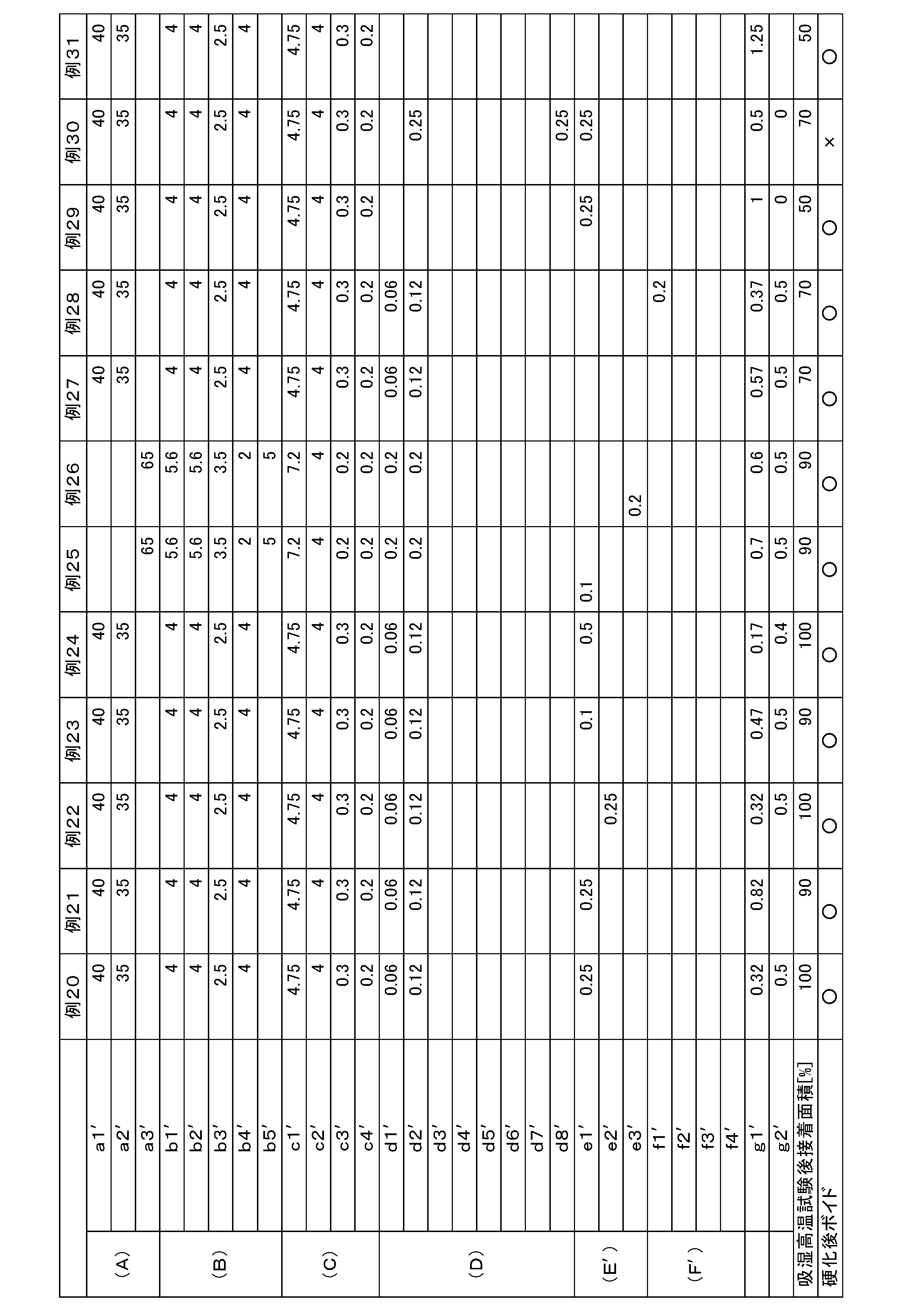
- Examples 20 to 26 and 32 to 42 corresponding to the resin composition of the present invention exhibited a good bond strength after the moisture absorption high temperature test, and voids were suppressed after curing.
- Example 31 lacking the components (D) and (E ′)
- the adhesive strength is greatly reduced after the hygroscopic high temperature test, and instead of Example 27, (E ′) containing (D) but lacking (E ′).
- Example 28 containing a primary antioxidant and Example 29 containing (E ′) but lacking (D) also had reduced adhesive strength after the hygroscopic high temperature test.
- Example 30 in which propionic acid, which is an organic acid having a boiling point of less than 200 ° C., was used, voids were generated after curing, and the adhesive strength was also lowered after the hygroscopic high temperature test.
- propionic acid which is an organic acid having a boiling point of less than 200 ° C.
- the present invention it is possible to provide a resin composition that exhibits excellent adhesive strength and can suppress peeling of a cured product in a high-temperature process, and is suitable as a die attach paste or an adhesive for a heat dissipation member.
- the cured product of the resin composition of the present invention has suppressed strength deterioration due to moisture absorption, and a semiconductor device manufactured using these has excellent moisture absorption reflow properties and high reliability.
- the resin composition of the present invention can exhibit these effects and is highly useful.
Landscapes
- Chemical & Material Sciences (AREA)
- Organic Chemistry (AREA)
- Health & Medical Sciences (AREA)
- Chemical Kinetics & Catalysis (AREA)
- Medicinal Chemistry (AREA)
- Polymers & Plastics (AREA)
- Adhesives Or Adhesive Processes (AREA)
- Compositions Of Macromolecular Compounds (AREA)
- Life Sciences & Earth Sciences (AREA)
- Sustainable Development (AREA)
- Engineering & Computer Science (AREA)
- Materials Engineering (AREA)
Abstract
Description
(A)無機フィラーと、
(B)熱硬化性樹脂と、
(C)硬化剤と、
(D)(D1)沸点が200℃以上の有機酸の金属塩、並びに/又は(D2)沸点が200℃以上の有機酸と金属粒子及び/若しくは金属酸化物粒子との組み合わせと、
を含む樹脂組成物において、(D)成分が支持部材表面の接着性を阻害する物質を除去し、良好な接着性をもたらすことができるとの知見に基きなされたものである。ここで、無機フィラーは、導電フィラーであっても、絶縁フィラーであってもよく、用途や性能によって、適宜、選択することができ、絶縁フィラーを使用することができる。
(A)無機フィラーと、
(B)熱硬化性樹脂と、
(C)硬化剤と、
(D)(D1)沸点が200℃以上の有機酸の金属塩、並びに/又は(D2)沸点が200℃以上の有機酸と金属粒子及び/若しくは金属酸化物粒子との組み合わせと、
(E)ポリスルフィド化合物と
を含む樹脂組成物に関する。
上述のとおり、ポリスルフィド化合物の添加は、貴金属に対しては有用ではあるものの、銅に対しては、接着性を低下させ、高温プロセスで剥離を生じさせうることが、本発明者らの検討により見出された。これは、ポリスルフィド化合物が、支持部材表面の銅を過度に硫化させることが一因であり、本発明〔1〕では、(D)を併用することにより、(D)の金属部分が、銅の過度な硫化を抑制し、この結果、銅における接着性の低下が回避されると考えられる。さらに、接着性については、(D)の併用により、ポリスルフィド化合物を単独で使用する場合よりも、貴金属に対する接着性が向上することも見出された。このような効果は、(A)が導電フィラーである、本発明〔1〕の樹脂組成物について顕著である。一方、絶縁フィラーは、導電性を必要としない用途や、低コスト化を目的として、通常、用いられる。低コスト化の観点からは、貴金属メッキが施されたリードフレームや基板より、樹脂基板や銅リードフレームの使用が好ましい。
本発明〔3〕は、(E)が、ポリスルフィド結合を有するシラン化合物及び/又はポリスルフィド結合を有するアミン化合物である、本発明〔2〕の樹脂組成物に関する。
本発明〔4〕は、(D)が、(A)~(E)の合計100質量部に対して、0.05~5質量部であり、(E)が、(A)~(E)の合計100質量部に対して、イオウ換算量にして0.02~2.0質量部である、本発明〔1〕~〔3]のいずれかの樹脂組成物に関する。
本発明〔5〕は、さらに、(F)(メタ)アクリル酸の金属塩を含む、本発明〔1〕~〔4〕のいずれかの樹脂組成物に関する。
(A)無機フィラーと、
(B)熱硬化性樹脂と、
(C)硬化剤と、
(D)(D1)沸点が200℃以上の有機酸の金属塩、並びに/又は(D2)沸点が200℃以上の有機酸と金属粒子及び/若しくは金属酸化物粒子との組み合わせと、
(E’)二次酸化防止剤と
を含む樹脂組成物である。
本発明〔6〕の樹脂組成物は、(D)(D1)沸点が200℃以上の有機酸の金属塩、並びに/又は(D2)沸点が200℃以上の有機酸と金属粒子及び/若しくは金属酸化物粒子との組み合わせと、(E’)二次酸化防止剤とを配合することを特徴とする。本発明の優れた接着強度や高温プロセスでの硬化物の剥離の抑制は、(D)が、支持部材表面の接着性を阻害する物質を除去するとともに、(E’)が、高温プロセスで発生する、硬化物の劣化を促進させうるハイドロパーオキサイドを分解することと相俟ってもたらされると考えられる。
本発明〔8〕は、(E’)が、チオール及び/又はチオエーテルを含有するイオウ系二次酸化防止剤である、本発明〔7〕の樹脂組成物に関する。
本発明〔9〕は、さらに、(F’)一次酸化防止剤を含む、本発明〔6〕~〔8〕のいずれかの樹脂組成物に関する。
本発明〔10〕は、(D)が、(A)~(D)及び(E’)の合計100質量部に対して、0.10~5.0質量部であり、(E’)が、(A)~(D)及び(E’)の合計100質量部に対して、0.03~5.0質量部である、本発明〔6〕~〔9〕のいずれかの樹脂組成物に関する。
本発明〔11〕は、(A)が導電フィラーである、本発明〔1〕~〔10〕のいずれかの樹脂組成物に関する。
本発明〔12〕は、(A)が、銀、金、銅、パラジウム及びこれらの合金からなる群より選択される粒子である、本発明〔11〕の樹脂組成物に関する。
本発明〔13〕は、(A)が絶縁フィラーである、本発明〔1〕~〔12〕のいずれかの樹脂組成物に関する。
本発明〔14〕は、(D1)が、2-エチルへキサン酸、ナフテン酸及びシクロペンタンカルボン酸からなる群より選択される有機酸の金属塩であり、(D2)が、2-エチルへキサン酸、ナフテン酸及びシクロペンタンカルボン酸からなる群より選択される有機酸と金属粒子及び/若しくは金属酸化物粒子との組み合わせである、本発明〔1〕~〔13〕のいずれかの樹脂組成物に関する。
本発明〔15〕は、(D1)における金属塩が、亜鉛塩、コバルト塩、ニッケル塩、マグネシウム塩、マンガン塩及びスズ塩からなる群より選択される塩であり、(D2)における金属粒子及び/若しくは金属酸化物粒子が、亜鉛、コバルト、ニッケル、マグネシウム、マンガン、スズ及びこれらの酸化物からなる群より選択される粒子である、本発明〔14〕の樹脂組成物に関する。
本発明〔17〕は、本発明〔1〕~〔15〕のいずれかの樹脂組成物を含む放熱部材用接着剤に関する。
本発明〔18〕は、本発明〔16〕のダイアタッチペースト、又は本発明〔17〕の放熱部材用接着剤を用いて作製された半導体装置に関する。
本発明〔19〕は、本発明〔16〕のダイアタッチペースト、又は本発明〔17〕の放熱部材用接着剤を適用した表面が銅である、本発明〔18〕の半導体装置に関する。
第一の態様において、本発明の樹脂組成物は、
(A)無機フィラーと、
(B)熱硬化性樹脂と、
(C)硬化剤と、
(D)(D1)沸点が200℃以上の有機酸の金属塩、並びに/又は(D2)沸点が200℃以上の有機酸と金属粒子及び/若しくは金属酸化物粒子との組み合わせと、
(E)ポリスルフィド化合物と
を含む。
(A)は、特に限定されず、導電フィラーであっても、絶縁フィラーであってもよく、用途や性能によって、適宜、選択することができるが、導電フィラーが好ましい。
(B)熱硬化性樹脂は、特に限定されないが、室温(25℃)で液状であることが好ましい。熱硬化性樹脂としては、エポキシ樹脂、(メタ)アクリル樹脂、マレイミド樹脂が挙げられる。
本発明の組成物は、硬化剤を含む。硬化剤としては、例えば、脂肪族アミン、芳香族アミン、ジシアンジアミド、ジヒドラジド化合物、酸無水物、フェノール樹脂等が挙げられ、熱硬化性樹脂としてエポキシ樹脂を使用する場合、好適に使用することができる。
ジヒドラジド化合物としては、アジピン酸ジヒドラジド、ドデカン酸ジヒドラジド、イソフタル酸ジヒドラジド、p-オキシ安息香酸ジヒドラジド等のカルボン酸ジヒドラジド等が挙げられる。酸無水物としては、フタル酸無水物、テトラヒドロ無水フタル酸、ヘキサヒドロ無水フタル酸、エンドメチレンテトラヒドロフタル酸無水物、ドデセニルコハク酸無水物、無水マレイン酸とポリブタジエンの反応物、無水マレイン酸とスチレンの共重合体等が挙げられる。フェノール樹脂としては、硬化物特性の点から、1分子内にフェノール性水酸基を2つ以上有する化合物を使用することができ、好ましいフェノール性水酸基の数は2~5である。フェノール性水酸基の範囲がこの範囲であれば、樹脂組成物の粘度を適切な範囲に制御することができる。より好ましい1分子内のフェノール性水酸基数は2つまたは3つである。このような化合物としては、ビスフェノールF、ビスフェノールA、ビスフェノールS、テトラメチルビスフェノールA、テトラメチルビスフェノールF、テトラメチルビスフェノールS、ジヒドロキシジフェニルエーテル、ジヒドロキシベンゾフェノン、テトラメチルビフェノール、エチリデンビスフェノール、メチルエチリデンビス(メチルフェノール)、シクロへキシリデンビスフェノール、ビフェノールなどのビスフェノール類及びその誘導体、トリ(ヒドロキシフェニル)メタン、トリ(ヒドロキシフェニル)エタン等の3官能のフェノール類及びその誘導体、フェノールノボラック、クレゾールノボラック等のフェノール類とホルムアルデヒドを反応することで得られる化合物で2核体又は3核体がメインのもの及びその誘導体等が挙げられる。
(D1)沸点が200℃以上の有機酸の金属塩における有機酸は、沸点が200℃以上であり、例えば、沸点が200~300℃の有機酸が挙げられる。沸点が200℃以上のものを使用することにより、加熱硬化工程でのボイドの発生が抑制される。沸点は、大気圧下における数値である。
第一の態様において、本発明の組成物は、(E)ポリスルフィド化合物を含む。(E)は、スルフィド結合を2個以上有する化合物であれば、特に限定されず、ジスルフィド化合物、トリスルフィド化合物、テトラスルフィド化合物、ペンタスルフィド化合物等が挙げられる。(E)を(D)と一緒に配合することにより、貴金属のみならず、銅に対しても、良好な接着特性を得ることができる。
本発明の組成物は、(F)亜鉛ジアクリレートを含有することができる。(F)の配合により、吸湿による高温プロセスでの硬化物の劣化を抑制し、接着強度を一層向上させることができる。特に、(F)は、(B)がアクリル樹脂を含む場合、ダイシェア強度を向上させることができ、好ましい。これは、(F)のアクリレート部分と、(B)の(メタ)アクリル基とが反応し、硬化物の強度を向上させることができるためと考えられる。
(A)無機フィラーと、
(B)熱硬化性樹脂と、
(C)硬化剤と、
(D)(D1)沸点が200℃以上の有機酸の金属塩、並びに/又は(D2)沸点が200℃以上の有機酸と金属粒子及び/若しくは金属酸化物粒子との組み合わせと、
(E’)二次酸化防止剤と
を含む。
第二の態様において、本発明の組成物は(E’)二次酸化防止剤を含む。酸化防止剤は、一般に、一次酸化防止剤(ラジカル捕捉剤)と二次酸化防止剤(過酸化物分解剤)に分類されるが、(E’)は、二次酸化防止剤であり、具体的にはイオウ系二次酸化防止剤、リン系二次酸化防止剤が挙げられる。
本発明の組成物は、(F’)一次酸化防止剤及び/又は金属不活性化剤を含有することができ、これにより、接着強度の一層の改善や高温プロセスでの硬化物の一層の剥離抑制を図ることができる。
本発明の樹脂組成物は、(C)以外の各成分を混合した後、3本ロール分散機を用いて混練し、次いで(C)を添加して均一に混合することにより調製することができる。
本発明の樹脂組成物は、ダイアタッチペースト、放熱部材用接着剤として好適に使用することができる。具体的には、本発明の樹脂組成物を含有するダイアタッチペーストや放熱部材用接着剤を、リードフレームや基板等に適用し、半導体素子や放熱部材等をマウントし、加熱硬化させて、接着を行なうことができる。加熱硬化の条件は、適宜、選択することができ、例えば、100~200℃のピーク温度で加熱することができる。次いで、ワイヤボンディングを経て、封止することにより、半導体装置を得ることができる。この半導体装置は、プリント配線基板上にはんだ実装して、各種の電子部品とすることができる。本発明の樹脂組成物の硬化物は、接着強度に優れ、高温プロセスにおいても剥離しにくく、吸湿による高温プロセスでの強度劣化も抑制されている。更に、支持部材が、銅リードフレームや銅基板である場合にも、これらの効果を発揮することができ、有用性が高い。
例1~19のうち、例1~8、13~19が実施例であり、例9~12が比較例である。
各例で使用した各成分は、以下のとおりである。平均粒子径は、レーザー回折法によって測定した体積基準のメジアン径である。
a1:銀粒子(平均粒子径7.3μm)
a2:銀粒子(平均粒子径8.3μm)
a3:アルミナフィラー銀メッキ粒子(平均粒子径20μm、銀メッキ厚さ0.1μm)
b1:ビスフェノールF型エポキシ樹脂(エポキシ当量155~163g/eq)
b2:ビスフェノールAプロピレンオキシド付加物のポリグリシジルエーテル(エポキシ当量=320g/eq、水酸基当量=1120)
b3:シクロヘキサンジメタノールジグリシジルエーテル
b4:ネオペンチルグリコールジメタクリレート
b5:グリセリンジメタクリレート
c1:クレゾールノボラック樹脂(水酸基当量=118g/eq 軟化点105~115℃)
c2:ジシアンジアミド
c3:ノバキュアHX3088(旭化成イ-マテリアルズ社製、マイクロカプセル化イミダゾール)
c4:1,1,3,3-テトラメチルブチルペルオキシ2-エチルヘキサノアート
d1:2-エチルへキサン酸亜鉛(亜鉛含有量22質量%)
d2:ナフテン酸コバルト(コバルト含有量8質量%)
d3:ビス(2-エチルヘキサン酸)コバルト(II)(コバルト含有量8質量%)
d4:2-エチルへキサン酸
d5:酸化亜鉛粒子(平均粒子径0.60μm)
d6:酸化銅(I)粒子(平均粒子径5μm)
d7:亜鉛粒子(平均粒子径3.7μm)
d8:スズ粒子(平均粒子径5μm)
d9:プロピオン酸(沸点141℃)
e1:ビス(トリエトキシシリルプロピル)テトラスルフィド
e2:4,4’-ジアミノジフェニルジスルフィド
f1:亜鉛ジアクリレート(Sartomer社製 SR633)
g1:3-グリシドキシプロピルトリメトキシシラン
1.ダイシェア強度
吸湿処理前のダイシェア強度は、下記の手順に従って行った。
3mm×3mmのシリコンチップを、各例の樹脂組成物を用いて銅リードフレーム又は銀メッキ銅フレーム上にマウントし、室温から175℃まで30分で昇温し、175℃で30分間保持し、接着硬化をさせた。得られた試料について、ダイシェアテスター(Dage社製)を用いて、260℃の熱時のダイシェア強度を測定した。
吸湿処理後のダイシェア強度は、下記の手順(1)~(2)に従って行った。
(1)3mm×3mmのシリコンチップを、各例の樹脂組成物を用いて銅リードフレーム又は銀メッキ銅フレーム上にマウントし、室温から175℃まで30分で昇温し、175℃で30分間保持し、接着硬化をさせた。
(2)得られた試料を、85℃/85%RHの恒温槽中で96時間処理した後、速やかにダイシェアテスター(Dage社製)を用いて、260℃の熱時のダイシェア強度を測定した。
10mm×10mmのシリコンチップを、各例の樹脂組成物を用いて銅リードフレーム上にマウントし、室温から175℃まで30分で昇温し、175℃で30分間保持し、接着硬化をさせた。得られた試料をSONIX社製の走査型超音波顕微鏡を用いて観察し、得られた画像からボイドの面積を求めた。チップ面積に対するボイドの面積が、10%未満であれば○、10%以上であれば×とした。
「2.硬化後のボイド」の評価後、同試料を用い、シリコンチップ周囲に位置する硬化物の最外周から、リードフレーム表面上に滲み出た異常部(ブリード)の最外周までの距離を光学顕微鏡を用いて求め、この距離をブリード量とした。表にはブリード量の最大値を記載した。

例20~42のうち、例20~26、32~42が実施例であり、例27~31が比較例である。
実施例で使用した各成分は、以下のとおりである。
a1’:銀粒子(平均粒子径7.3μm)
a2’:銀粒子(平均粒子径8.3μm)
a3’:アルミナフィラー銀メッキ粒子(平均粒子径20μm、銀メッキ厚さ0.1μm)
b1’:ビスフェノールAプロピレンオキシド付加物のポリグリシジルエーテル(エポキシ当量=320g/eq、水酸基当量=1120)
b2’:シクロヘキサンジメタノールジグリシジルエーテル
b3’:ビスフェノールF型エポキシ樹脂(エポキシ当量155~163g/eq)
b4’:ネオペンチルグリコールジメタクリレート
b5’:N-アクリロイルオキシエチルヘキサヒドロフタルイミド
c1’:クレゾールノボラック樹脂 水酸基当量=118g/eq 軟化点105~115℃
c2’:ノバキュアHX3088(旭化成イ-マテリアルズ社製、マイクロカプセル化イミダゾール)
c3’:ジシアンジアミド
c4’:1,1,3,3-テトラメチルブチルペルオキシ2-エチルヘキサノアート
d1’:2-エチルへキサン酸(沸点228℃)
d2’:酸化亜鉛粒子(平均粒子径0.60μm)
d3’:2-エチルヘキサン酸亜鉛(亜鉛含有量22質量%)
d4’:亜鉛粒子(平均粒子3.7μm)
d5’:ナフテン酸コバルト(コバルト含有量8質量%)
d6’:ビス(2-エチルヘキサン酸)コバルト(II)(コバルト含有量8質量%)
d7’:ナフテン酸(沸点200℃以上)
d8’:プロピオン酸(沸点141℃)
e1’:2-メルカプトベンゾイミダゾール
e2’:2,4,6-トリメルカプト-s-トリアジン
e3’:ジトリデシル-3,3’-チオジプロピオネート
f1’:2,2’-メチレンビス(6-tert-ブチル-4-エチル-フェノール)
f2’:N,N’-ジ-2-ナフチル-p-フェニレンジアミン
f3’:2,3-ビス(3-(3,5-ジ-tert-ブチル-4-ヒドロキシフェニル)プロピオニル)プロピオノヒドラジド
f4’:デカメチレンジカルボン酸ジサリチロイルヒドラジド
g1’:3-グリシドキシプロピルトリメトキシシラン
g2’:ビス(トリエトキシシリルプロピル)テトラスルフィド
1.吸湿高温試験後の剥離
吸湿処理後に高温曝露時に発生する剥離の観察は、下記の手順(1)~(5)に従って行った。
(1)3mm×3mmのシリコンチップを、実施例・比較例の各樹脂組成物を用いて銅リードフレーム上にマウントし、室温から175℃まで30分で昇温し、175℃で30分間保持し、接着硬化をさせた。
(2)エポキシモールディングコンパウンドにて被覆されることを想定して、一般的なエポキシモールディングコンパウンドの硬化条件(175℃、4時間)によって、(1)の処理を行った試験部材を加熱した。
(3)(2)の試験部材を沸騰水中に2時間浸した。
(4)(3)の試験部材を乾燥させない状態(水中)で室温まで冷却した。その後、この試験部材をはんだリフロー温度(270℃)にて加熱した。
(5)(4)の試験部材の剥離状態をSONIX社製の走査型超音波顕微鏡を用いて観察し、得られた画像からチップ面積に対する接着面積の割合を求めた。
10mm×10mmのシリコンチップを、実施例・比較例の各樹脂組成物を用いて銅リードフレーム上にマウントし、室温から175℃まで30分で昇温し、175℃で30分間保持し、接着硬化をさせた。得られた試料をSONIX社製の走査型超音波顕微鏡を用いて観察し、得られた画像からボイドの面積を求めた。チップ面積に対するボイドの面積が、10%未満であれば○、10%以上であれば×とした。

Claims (19)
- (A)無機フィラーと、
(B)熱硬化性樹脂と、
(C)硬化剤と、
(D)(D1)沸点が200℃以上の有機酸の金属塩、並びに/又は(D2)沸点が200℃以上の有機酸と金属粒子及び/若しくは金属酸化物粒子との組み合わせと、
(E)ポリスルフィド化合物と
を含む樹脂組成物。 - (E)が、ジスルフィド結合、トリスルフィド結合及びテトラスルフィド結合からなる群より選択される結合を有する化合物である、請求項1記載の樹脂組成物。
- (E)が、ポリスルフィド結合を有するシラン化合物及び/又はポリスルフィド結合を有するアミン化合物である、請求項2記載の樹脂組成物。
- (D)が、(A)~(E)の合計100質量部に対して、0.05~5質量部であり、(E)が、(A)~(E)の合計100質量部に対して、イオウ換算量にして0.02~2.0質量部である、請求項1~3のいずれか1項記載の樹脂組成物。
- さらに、(F)(メタ)アクリル酸の金属塩を含む、請求項1~4のいずれか1項記載の樹脂組成物。
- (A)無機フィラーと、
(B)熱硬化性樹脂と、
(C)硬化剤と、
(D)(D1)沸点が200℃以上の有機酸の金属塩、並びに/又は(D2)沸点が200℃以上の有機酸と金属粒子及び/若しくは金属酸化物粒子との組み合わせと、
(E’)二次酸化防止剤と
を含む樹脂組成物。 - (E’)が、イオウ系二次酸化防止剤及び/又はリン系二次酸化防止剤である、請求項6記載の樹脂組成物。
- (E’)が、チオール及び/又はチオエーテルを含有するイオウ系二次酸化防止剤である、請求項7記載の樹脂組成物。
- さらに、(F’)一次酸化防止剤を含む、請求項6~8のいずれか1項記載の樹脂組成物。
- (D)が、(A)~(D)及び(E’)の合計100質量部に対して、0.1~5質量部であり、(E’)が、(A)~(D)及び(E’)の合計100質量部に対して、0.03~5質量部である、請求項6~9のいずれか1項記載の樹脂組成物。
- (A)が導電フィラーである、請求項1~10のいずれか1項記載の樹脂組成物。
- (A)が、銀、金、銅、パラジウム及びこれらの合金からなる群より選択される粒子である、請求項11記載の樹脂組成物。
- (A)が絶縁フィラーである、請求項1~10のいずれか1項記載の樹脂組成物。
- (D1)が、2-エチルへキサン酸、ナフテン酸及びシクロペンタンカルボン酸からなる群より選択される有機酸の金属塩であり、(D2)が、2-エチルへキサン酸、ナフテン酸及びシクロペンタンカルボン酸からなる群より選択される有機酸と金属粒子及び/若しくは金属酸化物粒子との組み合わせである、請求項1~13のいずれか1項記載の樹脂組成物。
- (D1)における金属塩が、亜鉛塩、コバルト塩、ニッケル塩、マグネシウム塩、マンガン塩及びスズ塩からなる群より選択される塩であり、
(D2)における金属粒子及び/若しくは金属酸化物粒子が、亜鉛、コバルト、ニッケル、マグネシウム、マンガン、スズ及びこれらの酸化物からなる群より選択される粒子である、請求項14記載の樹脂組成物。 - 請求項1~15のいずれか1項記載の樹脂組成物を含むダイアタッチペースト。
- 請求項1~15のいずれか1項記載の樹脂組成物を含む放熱部材用接着剤。
- 請求項16記載のダイアタッチペースト、又は請求項17記載の放熱部材用接着剤を用いて作製された半導体装置。
- 請求項16記載のダイアタッチペースト、又は請求項17記載の放熱部材用接着剤を適用した表面が銅である、請求項18記載の半導体装置。
Priority Applications (2)
| Application Number | Priority Date | Filing Date | Title |
|---|---|---|---|
| CN201480018790.4A CN105073901B (zh) | 2013-03-29 | 2014-03-25 | 树脂组合物 |
| KR1020157026668A KR102168846B1 (ko) | 2013-03-29 | 2014-03-25 | 수지 조성물 |
Applications Claiming Priority (4)
| Application Number | Priority Date | Filing Date | Title |
|---|---|---|---|
| JP2013073409A JP6069071B2 (ja) | 2013-03-29 | 2013-03-29 | 樹脂組成物 |
| JP2013-073409 | 2013-03-29 | ||
| JP2013-073408 | 2013-03-29 | ||
| JP2013073408A JP6106007B2 (ja) | 2013-03-29 | 2013-03-29 | 樹脂組成物 |
Publications (1)
| Publication Number | Publication Date |
|---|---|
| WO2014157175A1 true WO2014157175A1 (ja) | 2014-10-02 |
Family
ID=51624146
Family Applications (1)
| Application Number | Title | Priority Date | Filing Date |
|---|---|---|---|
| PCT/JP2014/058235 Ceased WO2014157175A1 (ja) | 2013-03-29 | 2014-03-25 | 樹脂組成物 |
Country Status (4)
| Country | Link |
|---|---|
| KR (1) | KR102168846B1 (ja) |
| CN (1) | CN105073901B (ja) |
| TW (1) | TWI648324B (ja) |
| WO (1) | WO2014157175A1 (ja) |
Cited By (2)
| Publication number | Priority date | Publication date | Assignee | Title |
|---|---|---|---|---|
| WO2016052664A1 (ja) * | 2014-10-01 | 2016-04-07 | ナミックス株式会社 | 樹脂組成物 |
| EP4279540A1 (en) * | 2022-05-17 | 2023-11-22 | ALLNEX GERMANY GmbH | Adhesion-promoting system for a rubber composition |
Families Citing this family (3)
| Publication number | Priority date | Publication date | Assignee | Title |
|---|---|---|---|---|
| CN112750551B (zh) * | 2019-10-31 | 2022-10-18 | 东莞华科电子有限公司 | 电极膏、电极、包含其的陶瓷电子元件及该元件的制法 |
| CN112951482B (zh) * | 2021-02-26 | 2022-05-17 | 无锡帝科电子材料股份有限公司 | 一种电子元器件浆料及加工工艺 |
| CN118055972B (zh) * | 2021-10-04 | 2024-11-19 | 东京油墨株式会社 | 散热性间隙填料用树脂组合物、散热性间隙填料和物品 |
Citations (7)
| Publication number | Priority date | Publication date | Assignee | Title |
|---|---|---|---|---|
| JPH10147764A (ja) * | 1996-11-20 | 1998-06-02 | Sumitomo Bakelite Co Ltd | ダイアタッチペースト及び半導体装置 |
| JP2000203876A (ja) * | 1998-12-28 | 2000-07-25 | Nippon Sheet Glass Co Ltd | 抗菌性ガラス及びそのガラスを含有する樹脂組成物 |
| JP2001139615A (ja) * | 1999-11-12 | 2001-05-22 | Nof Corp | 有機過酸化物組成物及びその用途 |
| JP2004175817A (ja) * | 2002-11-22 | 2004-06-24 | Nippon Petrochemicals Co Ltd | 熱硬化性樹脂組成物 |
| JP2006298953A (ja) * | 2005-04-15 | 2006-11-02 | Nof Corp | 熱硬化性樹脂組成物及びその硬化方法 |
| JP2007314793A (ja) * | 2007-06-07 | 2007-12-06 | Sumitomo Bakelite Co Ltd | 半導体用樹脂ペースト及び半導体装置 |
| JP2009191214A (ja) * | 2008-02-18 | 2009-08-27 | Sumitomo Bakelite Co Ltd | 熱伝導性樹脂組成物、接着剤層、及びそれらを用いて作製した半導体装置。 |
Family Cites Families (7)
| Publication number | Priority date | Publication date | Assignee | Title |
|---|---|---|---|---|
| US7605220B2 (en) * | 2003-05-12 | 2009-10-20 | Kaneka Corporation | Curing composition |
| CN101370836A (zh) * | 2006-01-20 | 2009-02-18 | 日立化成工业株式会社 | 树脂组合物及使用其固化物的光学部件 |
| JP5207595B2 (ja) | 2006-03-28 | 2013-06-12 | 住友ベークライト株式会社 | 樹脂組成物及び樹脂組成物を使用して作製した半導体装置 |
| KR101195693B1 (ko) * | 2007-10-29 | 2012-10-30 | 스미토모 베이클리트 컴퍼니 리미티드 | 반도체용 접착제 조성물 및 그것을 이용하여 제조한 반도체 장치 |
| JP5266719B2 (ja) * | 2007-10-29 | 2013-08-21 | 住友ベークライト株式会社 | 樹脂組成物及び樹脂組成物を使用して作製した半導体装置 |
| JP2011086669A (ja) | 2009-10-13 | 2011-04-28 | Asahi Kasei E-Materials Corp | ダイボンディングペースト、及び該ダイボンディングペーストを用いた半導体装置 |
| CN102181043B (zh) * | 2011-03-23 | 2012-10-24 | 吴江固德电材系统股份有限公司 | 具有数倍贮存稳定性的潜伏性固化剂 |
-
2014
- 2014-03-25 WO PCT/JP2014/058235 patent/WO2014157175A1/ja not_active Ceased
- 2014-03-25 KR KR1020157026668A patent/KR102168846B1/ko active Active
- 2014-03-25 CN CN201480018790.4A patent/CN105073901B/zh active Active
- 2014-03-27 TW TW103111411A patent/TWI648324B/zh active
Patent Citations (7)
| Publication number | Priority date | Publication date | Assignee | Title |
|---|---|---|---|---|
| JPH10147764A (ja) * | 1996-11-20 | 1998-06-02 | Sumitomo Bakelite Co Ltd | ダイアタッチペースト及び半導体装置 |
| JP2000203876A (ja) * | 1998-12-28 | 2000-07-25 | Nippon Sheet Glass Co Ltd | 抗菌性ガラス及びそのガラスを含有する樹脂組成物 |
| JP2001139615A (ja) * | 1999-11-12 | 2001-05-22 | Nof Corp | 有機過酸化物組成物及びその用途 |
| JP2004175817A (ja) * | 2002-11-22 | 2004-06-24 | Nippon Petrochemicals Co Ltd | 熱硬化性樹脂組成物 |
| JP2006298953A (ja) * | 2005-04-15 | 2006-11-02 | Nof Corp | 熱硬化性樹脂組成物及びその硬化方法 |
| JP2007314793A (ja) * | 2007-06-07 | 2007-12-06 | Sumitomo Bakelite Co Ltd | 半導体用樹脂ペースト及び半導体装置 |
| JP2009191214A (ja) * | 2008-02-18 | 2009-08-27 | Sumitomo Bakelite Co Ltd | 熱伝導性樹脂組成物、接着剤層、及びそれらを用いて作製した半導体装置。 |
Cited By (3)
| Publication number | Priority date | Publication date | Assignee | Title |
|---|---|---|---|---|
| WO2016052664A1 (ja) * | 2014-10-01 | 2016-04-07 | ナミックス株式会社 | 樹脂組成物 |
| EP4279540A1 (en) * | 2022-05-17 | 2023-11-22 | ALLNEX GERMANY GmbH | Adhesion-promoting system for a rubber composition |
| WO2023222427A1 (en) * | 2022-05-17 | 2023-11-23 | Allnex Germany Gmbh | Adhesion-promoting system for a rubber composition |
Also Published As
| Publication number | Publication date |
|---|---|
| TW201443122A (zh) | 2014-11-16 |
| CN105073901B (zh) | 2018-08-28 |
| TWI648324B (zh) | 2019-01-21 |
| CN105073901A (zh) | 2015-11-18 |
| KR102168846B1 (ko) | 2020-10-22 |
| KR20150139843A (ko) | 2015-12-14 |
Similar Documents
| Publication | Publication Date | Title |
|---|---|---|
| JP6069071B2 (ja) | 樹脂組成物 | |
| JP4967655B2 (ja) | 樹脂組成物及び該樹脂組成物を使用して作製した半導体装置 | |
| JP6106007B2 (ja) | 樹脂組成物 | |
| JP7100651B2 (ja) | ペースト組成物、半導体装置及び電気・電子部品 | |
| KR102703151B1 (ko) | 수지 조성물과 그 경화물, 접착제, 반도체 장치, 및 전자 부품 | |
| JPWO2012165375A1 (ja) | 樹脂組成物、それを用いた半導体装置および半導体装置の製造方法 | |
| KR102168846B1 (ko) | 수지 조성물 | |
| EP2717301A1 (en) | Semiconductor device | |
| JP6119603B2 (ja) | 半導体装置 | |
| JP6700653B2 (ja) | 半導体接着用樹脂組成物及び半導体装置 | |
| JP6244124B2 (ja) | ダイアタッチ用樹脂組成物 | |
| JP2010202687A (ja) | 樹脂組成物、および樹脂組成物を用いて作製した半導体装置 | |
| JP4983166B2 (ja) | 樹脂組成物及び樹脂組成物を使用して作製した半導体装置 | |
| KR102325095B1 (ko) | 수지 조성물 | |
| JP6420121B2 (ja) | 半導体接着用樹脂組成物及び半導体装置 | |
| JP6111535B2 (ja) | 熱硬化性樹脂組成物、半導体装置および半導体装置の製造方法 | |
| JP4973120B2 (ja) | 液状樹脂組成物の製造方法、液状樹脂組成物および半導体装置 | |
| JP4857574B2 (ja) | 樹脂組成物及び樹脂組成物を使用して作製した半導体装置 | |
| JP4835229B2 (ja) | 樹脂組成物及び樹脂組成物を使用して作製した半導体装置 | |
| US20260062595A1 (en) | Conductive die attach compositions | |
| JP2017119880A (ja) | 熱硬化性樹脂組成物および半導体装置 |
Legal Events
| Date | Code | Title | Description |
|---|---|---|---|
| WWE | Wipo information: entry into national phase |
Ref document number: 201480018790.4 Country of ref document: CN |
|
| 121 | Ep: the epo has been informed by wipo that ep was designated in this application |
Ref document number: 14776258 Country of ref document: EP Kind code of ref document: A1 |
|
| ENP | Entry into the national phase |
Ref document number: 20157026668 Country of ref document: KR Kind code of ref document: A |
|
| NENP | Non-entry into the national phase |
Ref country code: DE |
|
| 122 | Ep: pct application non-entry in european phase |
Ref document number: 14776258 Country of ref document: EP Kind code of ref document: A1 |