WO2014133041A1 - セルロースアシレートフィルム、新規化合物、偏光板および液晶表示装置 - Google Patents
セルロースアシレートフィルム、新規化合物、偏光板および液晶表示装置 Download PDFInfo
- Publication number
- WO2014133041A1 WO2014133041A1 PCT/JP2014/054762 JP2014054762W WO2014133041A1 WO 2014133041 A1 WO2014133041 A1 WO 2014133041A1 JP 2014054762 W JP2014054762 W JP 2014054762W WO 2014133041 A1 WO2014133041 A1 WO 2014133041A1
- Authority
- WO
- WIPO (PCT)
- Prior art keywords
- group
- general formula
- formula
- represented
- cellulose acylate
- Prior art date
- Legal status (The legal status is an assumption and is not a legal conclusion. Google has not performed a legal analysis and makes no representation as to the accuracy of the status listed.)
- Ceased
Links
- 0 CC(C)(C)*(*)C1*CCC1 Chemical compound CC(C)(C)*(*)C1*CCC1 0.000 description 3
- PAYUKCSZQPGCQW-UHFFFAOYSA-N CC(C)(C1)CC(C)(CNC(OCCC(OC2CCCCC2)=O)=O)CC1NC(OCCC(OC1CCCCC1)=O)=O Chemical compound CC(C)(C1)CC(C)(CNC(OCCC(OC2CCCCC2)=O)=O)CC1NC(OCCC(OC1CCCCC1)=O)=O PAYUKCSZQPGCQW-UHFFFAOYSA-N 0.000 description 1
- LPAGKPQYRYNALG-UHFFFAOYSA-N CC(C)CCCC(C)C(CC1)C(C)(CC2)C1C1C2C(C)(CCC(C2)OC(Nc3nc(NC(c4cccc(C(Nc5cccc(NC(OC6CC7=CCC(C(CC8)C(C)(CC9)C8C(C)CCCC(C)C)C9C7(C)CC6)=O)n5)=O)c4)=O)ccc3)=O)C2=CC1 Chemical compound CC(C)CCCC(C)C(CC1)C(C)(CC2)C1C1C2C(C)(CCC(C2)OC(Nc3nc(NC(c4cccc(C(Nc5cccc(NC(OC6CC7=CCC(C(CC8)C(C)(CC9)C8C(C)CCCC(C)C)C9C7(C)CC6)=O)n5)=O)c4)=O)ccc3)=O)C2=CC1 LPAGKPQYRYNALG-UHFFFAOYSA-N 0.000 description 1
- IDFJJFFEZOPMGK-UHFFFAOYSA-N CC(COC(c1ccccc1)=O)OC(NCC(C)(C1)CC(C)(C)CC1NC(OCC(C)OC(NC1CC(C)(CN[NH+]([O-])OC(C)COC(c2ccccc2)=O)CC(C)(C)C1)=O)=O)=O Chemical compound CC(COC(c1ccccc1)=O)OC(NCC(C)(C1)CC(C)(C)CC1NC(OCC(C)OC(NC1CC(C)(CN[NH+]([O-])OC(C)COC(c2ccccc2)=O)CC(C)(C)C1)=O)=O)=O IDFJJFFEZOPMGK-UHFFFAOYSA-N 0.000 description 1
- OMAOQBWCWWZIQA-UHFFFAOYSA-N CC(COC(c1ccccc1)=O)OC(NCc1cc(CNC(OC)=O)ccc1)=O Chemical compound CC(COC(c1ccccc1)=O)OC(NCc1cc(CNC(OC)=O)ccc1)=O OMAOQBWCWWZIQA-UHFFFAOYSA-N 0.000 description 1
- QDCWMPHJELLHBD-UHFFFAOYSA-N CCC1(C)CC(C)(C)CC(C)C1 Chemical compound CCC1(C)CC(C)(C)CC(C)C1 QDCWMPHJELLHBD-UHFFFAOYSA-N 0.000 description 1
- KSYGMOQBLIEVDJ-UHFFFAOYSA-N COC(NCc1cc(CNC(OCCOC(c2ccccc2)=O)=O)ccc1)=O Chemical compound COC(NCc1cc(CNC(OCCOC(c2ccccc2)=O)=O)ccc1)=O KSYGMOQBLIEVDJ-UHFFFAOYSA-N 0.000 description 1
- YXFVVABEGXRONW-UHFFFAOYSA-N Cc1ccccc1 Chemical compound Cc1ccccc1 YXFVVABEGXRONW-UHFFFAOYSA-N 0.000 description 1
- SAEOGLZDGLYLJM-UHFFFAOYSA-N O=C(COC(NCc1cc(CNC(OCC(OC2CCCCC2)=O)=O)ccc1)=O)OC1CCCCC1 Chemical compound O=C(COC(NCc1cc(CNC(OCC(OC2CCCCC2)=O)=O)ccc1)=O)OC1CCCCC1 SAEOGLZDGLYLJM-UHFFFAOYSA-N 0.000 description 1
- UHOVQNZJYSORNB-UHFFFAOYSA-N c1ccccc1 Chemical compound c1ccccc1 UHOVQNZJYSORNB-UHFFFAOYSA-N 0.000 description 1
Images

Classifications
-
- C—CHEMISTRY; METALLURGY
- C07—ORGANIC CHEMISTRY
- C07C—ACYCLIC OR CARBOCYCLIC COMPOUNDS
- C07C271/00—Derivatives of carbamic acids, i.e. compounds containing any of the groups, the nitrogen atom not being part of nitro or nitroso groups
- C07C271/06—Esters of carbamic acids
- C07C271/08—Esters of carbamic acids having oxygen atoms of carbamate groups bound to acyclic carbon atoms
- C07C271/10—Esters of carbamic acids having oxygen atoms of carbamate groups bound to acyclic carbon atoms with the nitrogen atoms of the carbamate groups bound to hydrogen atoms or to acyclic carbon atoms
- C07C271/20—Esters of carbamic acids having oxygen atoms of carbamate groups bound to acyclic carbon atoms with the nitrogen atoms of the carbamate groups bound to hydrogen atoms or to acyclic carbon atoms to carbon atoms of hydrocarbon radicals substituted by nitrogen atoms not being part of nitro or nitroso groups
-
- C—CHEMISTRY; METALLURGY
- C07—ORGANIC CHEMISTRY
- C07C—ACYCLIC OR CARBOCYCLIC COMPOUNDS
- C07C271/00—Derivatives of carbamic acids, i.e. compounds containing any of the groups, the nitrogen atom not being part of nitro or nitroso groups
- C07C271/06—Esters of carbamic acids
-
- C—CHEMISTRY; METALLURGY
- C07—ORGANIC CHEMISTRY
- C07C—ACYCLIC OR CARBOCYCLIC COMPOUNDS
- C07C271/00—Derivatives of carbamic acids, i.e. compounds containing any of the groups, the nitrogen atom not being part of nitro or nitroso groups
- C07C271/06—Esters of carbamic acids
- C07C271/08—Esters of carbamic acids having oxygen atoms of carbamate groups bound to acyclic carbon atoms
- C07C271/26—Esters of carbamic acids having oxygen atoms of carbamate groups bound to acyclic carbon atoms with the nitrogen atom of at least one of the carbamate groups bound to a carbon atom of a six-membered aromatic ring
- C07C271/28—Esters of carbamic acids having oxygen atoms of carbamate groups bound to acyclic carbon atoms with the nitrogen atom of at least one of the carbamate groups bound to a carbon atom of a six-membered aromatic ring to a carbon atom of a non-condensed six-membered aromatic ring
-
- C—CHEMISTRY; METALLURGY
- C07—ORGANIC CHEMISTRY
- C07C—ACYCLIC OR CARBOCYCLIC COMPOUNDS
- C07C271/00—Derivatives of carbamic acids, i.e. compounds containing any of the groups, the nitrogen atom not being part of nitro or nitroso groups
- C07C271/06—Esters of carbamic acids
- C07C271/32—Esters of carbamic acids having oxygen atoms of carbamate groups bound to carbon atoms of rings other than six-membered aromatic rings
- C07C271/36—Esters of carbamic acids having oxygen atoms of carbamate groups bound to carbon atoms of rings other than six-membered aromatic rings with the nitrogen atom of at least one of the carbamate groups bound to a carbon atom of a ring other than a six-membered aromatic ring
-
- C—CHEMISTRY; METALLURGY
- C07—ORGANIC CHEMISTRY
- C07C—ACYCLIC OR CARBOCYCLIC COMPOUNDS
- C07C271/00—Derivatives of carbamic acids, i.e. compounds containing any of the groups, the nitrogen atom not being part of nitro or nitroso groups
- C07C271/06—Esters of carbamic acids
- C07C271/40—Esters of carbamic acids having oxygen atoms of carbamate groups bound to carbon atoms of six-membered aromatic rings
- C07C271/56—Esters of carbamic acids having oxygen atoms of carbamate groups bound to carbon atoms of six-membered aromatic rings with the nitrogen atom of at least one of the carbamate groups bound to a carbon atom of a ring other than a six-membered aromatic ring
-
- C—CHEMISTRY; METALLURGY
- C07—ORGANIC CHEMISTRY
- C07D—HETEROCYCLIC COMPOUNDS
- C07D295/00—Heterocyclic compounds containing polymethylene-imine rings with at least five ring members, 3-azabicyclo [3.2.2] nonane, piperazine, morpholine or thiomorpholine rings, having only hydrogen atoms directly attached to the ring carbon atoms
- C07D295/16—Heterocyclic compounds containing polymethylene-imine rings with at least five ring members, 3-azabicyclo [3.2.2] nonane, piperazine, morpholine or thiomorpholine rings, having only hydrogen atoms directly attached to the ring carbon atoms acylated on ring nitrogen atoms
- C07D295/20—Heterocyclic compounds containing polymethylene-imine rings with at least five ring members, 3-azabicyclo [3.2.2] nonane, piperazine, morpholine or thiomorpholine rings, having only hydrogen atoms directly attached to the ring carbon atoms acylated on ring nitrogen atoms by radicals derived from carbonic acid, or sulfur or nitrogen analogues thereof
-
- C—CHEMISTRY; METALLURGY
- C08—ORGANIC MACROMOLECULAR COMPOUNDS; THEIR PREPARATION OR CHEMICAL WORKING-UP; COMPOSITIONS BASED THEREON
- C08J—WORKING-UP; GENERAL PROCESSES OF COMPOUNDING; AFTER-TREATMENT NOT COVERED BY SUBCLASSES C08B, C08C, C08F, C08G or C08H
- C08J5/00—Manufacture of articles or shaped materials containing macromolecular substances
- C08J5/18—Manufacture of films or sheets
-
- C—CHEMISTRY; METALLURGY
- C08—ORGANIC MACROMOLECULAR COMPOUNDS; THEIR PREPARATION OR CHEMICAL WORKING-UP; COMPOSITIONS BASED THEREON
- C08K—Use of inorganic or non-macromolecular organic substances as compounding ingredients
- C08K5/00—Use of organic ingredients
- C08K5/16—Nitrogen-containing compounds
-
- C—CHEMISTRY; METALLURGY
- C08—ORGANIC MACROMOLECULAR COMPOUNDS; THEIR PREPARATION OR CHEMICAL WORKING-UP; COMPOSITIONS BASED THEREON
- C08K—Use of inorganic or non-macromolecular organic substances as compounding ingredients
- C08K5/00—Use of organic ingredients
- C08K5/16—Nitrogen-containing compounds
- C08K5/205—Compounds containing groups, e.g. carbamates
-
- G—PHYSICS
- G02—OPTICS
- G02B—OPTICAL ELEMENTS, SYSTEMS OR APPARATUS
- G02B1/00—Optical elements characterised by the material of which they are made; Optical coatings for optical elements
- G02B1/10—Optical coatings produced by application to, or surface treatment of, optical elements
- G02B1/14—Protective coatings, e.g. hard coatings
-
- G—PHYSICS
- G02—OPTICS
- G02B—OPTICAL ELEMENTS, SYSTEMS OR APPARATUS
- G02B5/00—Optical elements other than lenses
- G02B5/30—Polarising elements
-
- B—PERFORMING OPERATIONS; TRANSPORTING
- B32—LAYERED PRODUCTS
- B32B—LAYERED PRODUCTS, i.e. PRODUCTS BUILT-UP OF STRATA OF FLAT OR NON-FLAT, e.g. CELLULAR OR HONEYCOMB, FORM
- B32B2457/00—Electrical equipment
- B32B2457/20—Displays, e.g. liquid crystal displays, plasma displays
- B32B2457/202—LCD, i.e. liquid crystal displays
-
- C—CHEMISTRY; METALLURGY
- C08—ORGANIC MACROMOLECULAR COMPOUNDS; THEIR PREPARATION OR CHEMICAL WORKING-UP; COMPOSITIONS BASED THEREON
- C08J—WORKING-UP; GENERAL PROCESSES OF COMPOUNDING; AFTER-TREATMENT NOT COVERED BY SUBCLASSES C08B, C08C, C08F, C08G or C08H
- C08J2301/00—Characterised by the use of cellulose, modified cellulose or cellulose derivatives
- C08J2301/08—Cellulose derivatives
- C08J2301/10—Esters of organic acids
-
- C—CHEMISTRY; METALLURGY
- C08—ORGANIC MACROMOLECULAR COMPOUNDS; THEIR PREPARATION OR CHEMICAL WORKING-UP; COMPOSITIONS BASED THEREON
- C08J—WORKING-UP; GENERAL PROCESSES OF COMPOUNDING; AFTER-TREATMENT NOT COVERED BY SUBCLASSES C08B, C08C, C08F, C08G or C08H
- C08J2301/00—Characterised by the use of cellulose, modified cellulose or cellulose derivatives
- C08J2301/08—Cellulose derivatives
- C08J2301/10—Esters of organic acids
- C08J2301/12—Cellulose acetate
-
- C—CHEMISTRY; METALLURGY
- C09—DYES; PAINTS; POLISHES; NATURAL RESINS; ADHESIVES; COMPOSITIONS NOT OTHERWISE PROVIDED FOR; APPLICATIONS OF MATERIALS NOT OTHERWISE PROVIDED FOR
- C09K—MATERIALS FOR MISCELLANEOUS APPLICATIONS, NOT PROVIDED FOR ELSEWHERE
- C09K2323/00—Functional layers of liquid crystal optical display excluding electroactive liquid crystal layer characterised by chemical composition
- C09K2323/03—Viewing layer characterised by chemical composition
- C09K2323/031—Polarizer or dye
-
- Y—GENERAL TAGGING OF NEW TECHNOLOGICAL DEVELOPMENTS; GENERAL TAGGING OF CROSS-SECTIONAL TECHNOLOGIES SPANNING OVER SEVERAL SECTIONS OF THE IPC; TECHNICAL SUBJECTS COVERED BY FORMER USPC CROSS-REFERENCE ART COLLECTIONS [XRACs] AND DIGESTS
- Y10—TECHNICAL SUBJECTS COVERED BY FORMER USPC
- Y10T—TECHNICAL SUBJECTS COVERED BY FORMER US CLASSIFICATION
- Y10T428/00—Stock material or miscellaneous articles
- Y10T428/31504—Composite [nonstructural laminate]
- Y10T428/31971—Of carbohydrate
Definitions
- the present invention relates to a cellulose acylate film, a polarizing plate, and a liquid crystal display device.
- the present invention relates to a cellulose acylate film useful as a polarizing plate protective film, a polarizing plate using the same, and a liquid crystal display device having the polarizing plate.
- the present invention further relates to a novel compound useful as an additive for cellulose acylate films.
- Cellulose acylate films are widely used as optical compensation films, protective films, substrate films, etc. for display devices such as liquid crystal display devices.
- Patent Documents 1 and 2 propose to add an additive for improving the performance of such a cellulose acylate film.
- JP 2004-175971 A Japanese Patent Laid-Open No. 2005-272566
- Patent Document 1 describes an additive for improving the toughness of the film.
- Patent Document 2 describes an additive for improving the retardation (Rth) in the thickness direction of the film, but when the film is thinned, there is a possibility that whitening of the film due to volatilization may occur. .
- the additive for cellulose acylate film is required not to induce photo-coloring property of the film and to have low volatility.
- Patent Document 1 describes that the strength of the entire cellulose acylate film can be improved by adding the additive described in this document, but does not disclose improvement in surface hardness. Further, Patent Document 2 does not disclose any mechanical properties of the film.
- One aspect of the present invention is to solve the problems of the prior art, and is a cellulose acylate film in which photocolorability is suppressed, the volatility of additives is low, and the surface hardness is excellent.
- the purpose is to provide.
- the present inventors have a urethane bond (a bond represented by —O—C ( ⁇ O) —NH—) at a predetermined ratio, which will be described later, and a specific structure.
- the surface hardness of the cellulose acylate film is improved by interacting with local sites and molecular chains such as ester bonds and hydroxyl groups of cellulose acylate and reducing the free volume.
- the present inventors have found that a predetermined divalent linking group contained in a compound described later interacts with a local site such as an ester bond or a hydroxyl group of cellulose acylate or a molecular chain. It is presumed that the surface hardness of the cellulose acylate film is improved by reducing the free volume.
- the above compound has low volatility, and that the film to which this compound is added has low photo-colorability.
- the present invention has been completed based on the above findings.
- One aspect (first aspect) of the present invention includes: Equivalent U, which is obtained by dividing the molecular weight by the number of divalent linking groups represented by the following general formula (I) and represented by —O—C ( ⁇ O) —NH— contained in one molecule.
- U [(molecular weight) / (number of divalent linking groups represented by —O—C ( ⁇ O) —NH— contained in one molecule)]) is a compound having a value of 515 or less.
- L 11 and L 21 each independently represent an alkylene group, and the alkylene group may have a substituent
- L 12 and L 22 each independently represent a single bond or —O —, —NR 1 —, —S—, —C ( ⁇ O) —, or a combination thereof
- R 1 represents a hydrogen atom or a substituent
- n1 and n2 are each independently Represents an integer of 0 to 20, and one of n1 and n2 is an integer of 1 or more, and when there are a plurality of L 11 , L 12 , L 21 and L 22 , they may be the same or different from each other Q 1 and Q 2 each independently represent a substituent, and at least one of Q 1 and Q 2 includes a cyclic structure.
- the compound represented by the general formula (I) includes 1 to 6 divalent linking groups represented by —O—C ( ⁇ O) —NH— in one molecule.
- the molecular weight of the compound represented by the general formula (I) is in the range of 230-2000.
- the compound represented by the general formula (I) is a compound represented by the following general formula (I-1).
- Formula (I-1) Q 3- (L 32 -L 31 ) n3 -A- (L 41 -L 42 ) n4 ) m -Z 1
- L 31 and L 41 each independently represent an alkylene group, and the alkylene group may have a substituent
- L 32 and L 42 each independently represent a single bond or —O—, —NR 1 —, —S—, —C ( ⁇ O) — represents a group consisting of any combination thereof
- R 1 represents a hydrogen atom or a substituent
- n3 and n4 are Each independently represents an integer of 0 to 20, and any one of n3 and n4 is an integer of 1 or more, and when there are a plurality of L 31 , L 32 , L 41 and L 42 , they are the same or different from each other
- Q 3 represents a substituent
- Z 1 represents an an integer of
- the compound represented by the general formula (I-1) includes a cyclic structure in at least one of Q 3 and Z 1 , and has a total of two or three cyclic structures in one molecule.
- any one of a plurality of Q 3 has an aromatic group, or Z 1 has a cyclic aliphatic group or an aromatic group.
- Q 3 has an aromatic group, or Z 1 has a cyclic aliphatic group.
- the compound represented by the general formula (I) is a compound represented by the following general formula (I-2).
- Formula (I-2) Q 4 - (L 52 -L 51) n5 -A- (L 61 -L 62) n6) m1 -Z 2
- L 51 and L 61 each independently represent an alkylene group, and the alkylene group may have a substituent
- L 52 and L 62 each independently represent a single bond or —O—, —NR 1 —, —S—, —C ( ⁇ O) — represents a group consisting of any combination thereof
- R 1 represents a hydrogen atom or a substituent
- n5 and n6 are Each independently represents an integer of 0 to 20, but one of n5 and n6 is an integer of 1 or more, and when a plurality of L 51 , L 52 , L 61 and L 62 are present, they are the same or different from each other Q 4 represents a substituted or unsub
- L 51 represents an alkylene group
- L 52 represents a single bond or —O—.
- Q 4 represents an unsubstituted phenyl group.
- Z 2 in the general formula (I-2) is a group containing at least one of a cyclic aliphatic group and an aromatic group.
- the compound represented by the general formula (I) includes a compound represented by the following general formula (I-3), a compound represented by the following general formula (I-4), and the following general formula (I -5) selected from the group consisting of compounds represented by:
- L 71 and L 81 each independently represent an alkylene group, and the alkylene group may have a substituent
- L 72 and L 82 each independently represent a single bond or —O—, —NR
- 1 represents a group consisting of any one of —, —S—, and —C ( ⁇ O) — or a combination thereof
- R 1 represents a hydrogen atom or a substituent
- n7 and n8 each independently represents 0 to Represents an integer of 20, one of n7 and n8 is an integer of 1 or more, and when a plurality of L 71 , L 72 , L 81 and L 82 are present, they may be the same or different from each other
- Q 5 represents a substituted or unsubstituted phenyl group, a substituted or unsubstituted cyclohexyl group, a methyl group, or a t-butyl group
- A represents * —O—C ( ⁇ O) —NH—
- R 2a and R 2b each represents an alkyl group independently having a carbon number of 1 to 3;
- m @ 2 represents an integer of 2 or 3, there exist a plurality of Q 5 and A are each A represents an integer of 0 to 10, and when a is an integer of 1 or more, a plurality of R 2a may be the same or different from each other; And when b is an integer of 1 or more, a plurality of R 2b s may be the same as or different from each other;
- m3 represents 1 or 2, and a plurality of m3s may be the same as each other
- R 3 and R 4 each independently represents a hydrogen atom or a methyl group.
- the compound represented by the general formula (I) is selected from the group consisting of a compound represented by the following general formula (II) and a compound represented by the following general formula (III).
- R 100 represents a hydrogen atom or a substituent
- L 101 and L 103 each independently represent an alkylene group, and the alkylene group may have a substituent
- L 102 And L 104 each independently represents a single bond or a group consisting of any of —O—, —NR 100a —, —S—, —C ( ⁇ O) —, or a combination thereof
- R 100a represents a hydrogen atom or Represents a substituent.
- na and nb each independently represent an integer of 0 to 20, and when a plurality of L 101 , L 102 , L 103 and L 104 are present, they may be the same or different from each other;
- Q A and Q B are Each independently represents a substituent, and at least one of Q A and Q B contains a cyclic structure; when na represents zero and Q A contains a cyclic structure, the cyclic structure contained in Q A is —NR 100 It may be a cyclic structure formed with R 100 in the group; provided that the number of divalent linking groups represented by —NH— (C ⁇ O) —NH— in one molecule is 0 or 1 is there. ) About.
- the compound represented by the general formula (A-100) is represented by —NH— (C ⁇ O) —NR— in one molecule, and R represents a hydrogen atom or a substituent. Or two or more divalent linking groups represented by —NH—C ( ⁇ O) —O—.
- the molecular weight of the compound represented by the general formula (A-100) is in the range of 230 to 2000.
- the compound represented by the general formula (A-100) is a compound represented by the following general formula (A-1).
- Formula (A-101) Q 103 - (L 132 -L 131) n103 -A 100 - (L 141 -L 142) n104) m -Z 101
- L 131 and L 141 each independently represent an alkylene group, and the alkylene group may have a substituent
- L 132 and L 142 each independently represent a single bond or —O—, —NR 100a —, —S—, —C ( ⁇ O) — represents a group consisting of any combination thereof
- R 100a represents a hydrogen atom or a substituent
- n103 and n104 are each independently represent an integer of 0 ⁇ 20, L 131, L 132, L 141 and L 142 if there is a plurality, may be the same or different from each other
- Q 103 represents a substituent
- Z 101 Represents an m
- R 100 represents a hydrogen atom or a substituent.
- * Represents a bonding position with L 141 or Z 101 ;
- m represents an integer of 2 to 6, and a plurality of Q 103 and A 100 may be the same as or different from each other;
- Z 101 has a cyclic aliphatic group or a cyclic aromatic group.
- n103 represents zero
- -NR 100 - represents a cyclic structure contained in Q 103 is the A 100
- the nitrogen-containing 6-membered heterocyclic ring is a morpholine ring.
- one or more of the plurality of Q 103 represent a cyclic group selected from the group consisting of an aromatic group and a cycloalkyl group.
- one or more of Q 103 present in general formula (A-100) represent an unsubstituted phenyl group or an unsubstituted cyclohexyl group.
- one or more of Q 103 present in general formula (A-100) represent an alkyl group.
- the compound represented by the general formula (A-100) is a compound represented by the following general formula (A-104-A), a compound represented by the following general formula (A-104-B), And selected from the group consisting of compounds represented by the following formula (A-105).
- L 101a is a single bond, an alkylene group, or a group represented by any one of the following general formulas (2A) to (2F) 1 or a group consisting of an alkylene group and a combination of one or more groups represented by any of the following general formulas (2A) to (2F) and one or more alkylene groups
- Q 101a represents a substituent G 101 represents an atomic group that forms a cyclic structure with the connecting nitrogen atom, provided that the number of divalent linking groups represented by —NH— (C ⁇ O) —NH— in one molecule. Is 0 or 1.
- L 102a and L 103a are each independently a single bond, an alkylene group, or one of the groups represented by any of the following general formulas (2A) to (2F): Or a group consisting of a combination of one or more groups represented by any one of the following general formulas (2A) to (2F) and one or more alkylene groups, and Q 102a and Q 103a are each independently represents a substituent; X 2 and X 3, X 2 and X 3 are each independently -NR 100 - represents or -O- and, R 100 represents a hydrogen atom or a substituent; provided that in one molecule
- the molecular weight of the compound represented by the general formula (A-100) is equal to the divalent linking group represented by —NH— (C ⁇ O) —NR— and —NH—C contained in one molecule.
- Equivalent U (U [(molecular weight) / (— NH— (C ⁇ O) contained in one molecule) obtained by dividing by the total number of divalent linking groups represented by ( ⁇ O) —O—.
- the total number of divalent linking groups represented by —NR— and divalent linking groups represented by —NH—C ( ⁇ O) —O—)) is 515 or less.
- the content of the compound represented by the general formula (I) and the compound represented by the general formula (A-100) in the cellulose acylate film (when a plurality of compounds are included, the total content thereof) ) Is 0.1 to 50 parts by mass with respect to 100 parts by mass of cellulose acylate.
- a further aspect of the invention provides: A polarizing plate comprising the cellulose acylate film and a polarizer; About.
- a further aspect of the invention provides: A liquid crystal display device having the polarizing plate, About.
- the polarizing plate is provided at least on the viewing side of the liquid crystal display device.
- a further aspect of the present invention relates to a compound represented by the following general formula (II-1).
- a further aspect of the present invention relates to a compound represented by the following general formula (III-1).
- a further aspect of the present invention relates to a compound represented by the following general formula (A-104-A) or (A-104-B).
- L 1a is a single bond, an alkylene group, or any one of the following general formulas (2A-1) to (2C-1)
- Q 1a represents a substituent
- G 1 represents an atomic group that forms a cyclic structure together with the nitrogen atom to be linked
- Formula (2A-1)- ⁇ (CR a R c ) ja -O- (C O) ⁇ -*
- Formula (2C-1)- ⁇ (CR a R c ) ja- (C O) O- ⁇ -*
- * represents a bonding position with the substituent represented by Q 1a
- R a and R c are each independently a hydrogen atom or a carbon number of 1 to represents 3 alkyl groups, ja represents an integer of 1 or more, R a, if R c there are a pluralityl groups
- a further aspect of the present invention relates to a compound represented by the following general formula (A-105).
- L 102a and L 103a are each independently one of the groups represented by any of the following general formulas (2A-1) to (2F-1): A group comprising a combination of two or more groups represented by any one of (2A-1) to (2F-1), or any one of the following general formulas (2A-1) to (2F-1) Q 102a and Q 103a each independently represents a substituent; and X 2 and X 3 are X 2 and X 3 are each a group consisting of a combination of one or more of the above groups and one or more of the alkylene groups.
- a cellulose acylate film that is excellent in photo-colorability, has little volatilization of added compounds, and has high surface hardness.
- the first aspect and the second aspect will be sequentially described. Unless stated otherwise, the description of one aspect is also applicable to the other aspect.
- the group described may have a substituent. Examples of the substituent include various substituents described in the substituent group T described later.
- L 11 and L 21 each independently represent an alkylene group, and the alkylene group may have a substituent.
- L 12 and L 22 each independently represent a single bond or —O —, —NR 1 —, —S—, —C ( ⁇ O) —, or a combination thereof
- R 1 represents a hydrogen atom or a substituent
- n1 and n2 are each independently Represents an integer of 0 to 20, and one of n1 and n2 is an integer of 1 or more, and when there are a plurality of L 11 , L 12 , L 21 and L 22 , they may be the same or different from each other Q 1 and Q 2 each independently represent a substituent, and at least one of Q 1 and Q 2 includes a cyclic structure.
- the alkylene group represented by L 11 and L 21 may be linear, branched or cyclic, and may be one or more cyclic alkylene groups (cycloalkylene groups) and one or more linear or branched groups.
- An alkylene group linked to an alkylene group may be used.
- Specific examples of the linear or branched alkylene group include a methylene group, an ethylene group, a propylene group, a butylene group, a pentylene group, and a hexylene group.
- the linear or branched alkylene group includes 1 to 20 alkylene groups are preferred, alkylene groups having 1 to 12 carbon atoms are more preferred, alkylene groups having 1 to 8 carbon atoms are more preferred, alkylene groups having 1 to 3 carbon atoms are particularly preferred, a methylene group, an ethylene group, or A propylene group is most preferred.
- the cyclic alkylene group is preferably a cyclohexylene group which may have a substituent.
- the alkylene group may have a substituent. Examples of the substituent that the alkylene group may have include the following substituent group T.
- an alkylene group an alkyl group, an acyl group, an aryl group, an alkoxy group, and a carbonyl group are preferable. It is preferable that the linear or branched alkylene group does not have a substituent.
- the cyclic alkylene group preferably has a substituent.
- L 12 and L 22 each independently represents a single bond or a group consisting of any of —O—, —NR 1 —, —S—, —C ( ⁇ O) —, or a combination thereof. It is preferably an atom, —NR 1 —, or —C ( ⁇ O) —.
- R 1 represents a hydrogen atom or a substituent, and examples of the substituent include an alkyl group, an alkenyl group, an aryl group, and an acyl group.
- L 12 and L 22 are a single bond, —O— *, —OC ( ⁇ O) — *, —C ( ⁇ O) O— *, —NR 1 — *, —R 1 N— *. It is preferable that Where * represents a bonding position, or point of attachment with adjacent groups and Q 1 or Q 2 side of the Q 1 or Q 2.
- L 12 and L 22 are —OC ( ⁇ O) — *, —C ( ⁇ O) O— *, — (L 12 -L 11 ) — or — (L 21 —L 22 ) — is Specific examples of the linking group to be represented include structures represented by the following general formula (2A) or (2C).
- linking group represented by-(L 12 -L 11 )-or-(L 21 -L 22 )-when L 12 and L 22 are oxygen atoms include those represented by the following general formula (2B).
- the structure represented is illustrated.
- L 12 and L 22 are —NR 1 —OC ( ⁇ O) — *, —NR 1 —C ( ⁇ O) O— *, — (L 12 —L 11 ) — or —
- L 21 Specific examples of the linking group represented by —L 22 ) — include structures represented by the following general formula (2D) or (2E).
- R a and R c When there are a plurality of a and R c , the plurality of R a and R c may be the same or different, and R b is substituted with one or more alkyl groups having 1 to 3 carbon atoms.
- R b represents a cycloalkylene group, preferably a cyclohexylene group which may be substituted with 1 to 3 alkyl groups having 1 to 3 carbon atoms, and jb is 0 or 1.
- R 1 is a hydrogen atom or substituted Represents a hydrogen atom or an atom having 1 to 4 carbon atoms. Is preferably a kill group, alkyl group may be different even respectively same case, a plurality of R 1 is more preferably .R 1 be methyl group there are multiple.
- R a and R c are all hydrogen atoms, or R a or R It is preferable that at least one of c is an alkyl group.
- linking group represented by the general formula (2B) examples include a methyleneoxy group, an ethyleneoxy group, a propyleneoxy group, a butyleneoxy group, a pentyleneoxy group, a hexyleneoxy group, -C (CH 3 ) 2 -O-, -(Cyclohexylene group substituted with 1 to 3 alkyl groups having 1 to 3 carbon atoms) -CH 2 -O-, -(Cyclohexylene group substituted with 1 to 3 alkyl groups having 1 to 3 carbon atoms) -CH 2 CH 2 -O-, -(Cyclohexylene group substituted with 1 to 3 alkyl groups having 1 to 3 carbon atoms) -CH 2 CH 2 CH 2 -O-, -(Cyclohexylene group substituted with 1 to 3 carbon atoms having 1 to 3 carbon atoms) -CH 2 CH 2 CH 2 -O-, -(Cyclohexylene group substituted
- linking group represented by the general formula (2D) include — (Cyclohexylene group substituted with 1 to 3 alkyl groups having 1 to 3 carbon atoms) —CH 2 —NR 1 (C ⁇ O) O— —CH 2 —NR 1 (C ⁇ O) —O—, —CH 2 CH 2 —NR 1 (C ⁇ O) —O—, —CH 2 CH 2 CH 2 —NR 1 (C ⁇ O) —O—, —CH 2 CH (CH 3 ) —NR 1 (C ⁇ O) —O—, —CH (CH 3 ) CH 2 —NR 1 (C ⁇ O) —O—, Etc.
- linking group represented by the general formula (2E) examples include — (Cyclohexylene group substituted with 1 to 3 alkyl groups having 1 to 3 carbon atoms) —CH 2 —O— (C ⁇ O) NR 1 — —CH 2 —NR 1 (C ⁇ O) —O—, —CH 2 CH 2 —NR 1 (C ⁇ O) —O—, —CH 2 CH 2 CH 2 —NR 1 (C ⁇ O) —O—, —CH 2 CH (CH 3 ) —NR 1 (C ⁇ O) —O—, —CH (CH 3 ) CH 2 —NR 1 (C ⁇ O) —O—, Etc.
- Preferred embodiments of the linking group represented by (L 12 -L 11 ) and (L 21 -L 22 ) include an alkylene group or a group represented by any one of the general formulas (2A) to (2E). .
- a more preferred embodiment includes an alkylene group or a group represented by the general formula (2A) or (2B).
- a group represented by the general formula (2D) or (2E) is a more preferable embodiment.
- (L 12 -L 11 ) and (L 21 -L 22 ) are alkylene groups, that is, L 11 and L 21 represent an alkylene group, and L 12 and L 22 represent a single bond. means.
- n1 and n2 are integers of 1 or more (that is, an integer in the range of 1 to 20), a plurality of (L 12 -L 11 ), (L 21 -L 22 ) is included.
- the plurality of (L 12 -L 11 ) and the plurality of (L 21 -L 22 ) may have the same structure or may be different.
- the plurality of (L 12 -L 11 ) and the plurality of (L 21 -L 22 ) include an alkylene group and one or more groups represented by any one of the general formulas (2A) to (2E) It is preferable that the combination of these is included.
- Substituent group T An alkyl group (preferably having 1 to 20 carbon atoms, more preferably 1 to 12 carbon atoms, particularly preferably 1 to 8 carbon atoms such as methyl group, ethyl group, isopropyl group, tert-butyl group, n-octyl group, n -Decyl group, n-hexadecyl group, cyclopropyl group, cyclopentyl, cyclohexyl group, etc.), alkenyl group (preferably having 2 to 20, more preferably 2 to 12, particularly preferably 2 to 8 carbon atoms).
- alkyl group preferably having 1 to 20 carbon atoms, more preferably 1 to 12 carbon atoms, particularly preferably 1 to 8 carbon atoms such as methyl group, ethyl group, isopropyl group, tert-butyl group, n-octyl group, n -Decyl group, n-hexade
- alkynyl group preferably having 2 to 20 carbon atoms, more preferably 2 to 12 carbon atoms, particularly preferably 2 to 8 carbon atoms.
- alkynyl group preferably having 2 to 20 carbon atoms, more preferably 2 to 12 carbon atoms, particularly preferably 2 to 8 carbon atoms.
- a propargyl group, a 3-pentynyl group, etc. an aryl group (preferably having 6 to 30 carbon atoms, more preferably 6 to 20 carbon atoms, 6 to 12, for example, a phenyl group, a biphenyl group, a naphthyl group, etc.), an amino group (preferably having a carbon number of 0 to 20, more preferably 0 to 10, particularly preferably 0 to 6).
- an amino group a methylamino group, a dimethylamino group, a diethylamino group, a dibenzylamino group, etc.
- an alkoxy group preferably having a carbon number of 1 to 20, more preferably 1 to 12, particularly preferably 1).
- -8 for example, methoxy group, ethoxy group, butoxy group, etc.
- aryloxy group preferably 6-20, more preferably 6-16, particularly preferably 6-12, Phenyloxy group, 2-naphthyloxy group, etc.
- acyl group preferably having 1 to 20 carbon atoms, more preferably 1 to 16 carbon atoms.
- Particularly preferred is 1 to 12, for example, acetyl group, benzoyl group, formyl group, pivaloyl group, etc.), alkoxycarbonyl group (preferably having 2 to 20 carbon atoms, more preferably 2 to 16 carbon atoms, particularly preferably 2 to 12, for example, a methoxycarbonyl group, an ethoxycarbonyl group, etc.), an aryloxycarbonyl group (preferably having a carbon number of 7 to 20, more preferably 7 to 16, particularly preferably 7 to 10, For example, a phenyloxycarbonyl group, etc.), an acyloxy group (preferably having a carbon number of 2-20, more preferably 2-16, particularly preferably 2-10, such as an acetoxy group, a benzoyloxy group, etc.).
- alkoxycarbonyl group preferably having 2 to 20 carbon atoms, more preferably 2 to 16 carbon atoms, particularly preferably 2 to 12, for example, a methoxycarbonyl group, an ethoxy
- An acylamino group (preferably having 2 to 20 carbon atoms, more preferably 2 to 16 carbon atoms, Particularly preferred is 2 to 10, and examples thereof include an acetylamino group and a benzoylamino group. ), An alkoxycarbonylamino group (preferably having 2 to 20 carbon atoms, more preferably 2 to 16 carbon atoms, particularly preferably 2 to 12 carbon atoms such as a methoxycarbonylamino group), an aryloxycarbonylamino group (preferably Has 7 to 20 carbon atoms, more preferably 7 to 16 carbon atoms, particularly preferably 7 to 12 carbon atoms, such as a phenyloxycarbonylamino group, and a sulfonylamino group (preferably 1 to 20 carbon atoms, more preferably Is 1 to 16, particularly preferably 1 to 12, and examples thereof include a methanesulfonylamino group and a benzenesulfonylamino group.), A
- An arylthio group (preferably having 6 to 20 carbon atoms, more preferably 6 to 16 carbon atoms, particularly preferably 6 to 12 carbon atoms such as a phenylthio group), a sulfonyl group (preferably a carbon atom).
- the number is 1 to 20, more preferably 1 to 16, particularly preferably 1 to 12, and examples Mesyl group, tosyl group, etc.), sulfinyl group (preferably having 1 to 20, more preferably 1 to 16, and particularly preferably 1 to 12 carbon atoms such as methanesulfinyl group and benzenesulfinyl group).
- Urethane group ureido group (preferably having 1 to 20 carbon atoms, more preferably 1 to 16 carbon atoms, particularly preferably 1 to 12 carbon atoms such as ureido group, methylureido group, and phenylureido group).
- Phosphoric acid amide groups preferably having 1 to 20 carbon atoms, more preferably 1 to 16 carbon atoms, particularly preferably 1 to 12 carbon atoms such as diethyl phosphoric acid amide and phenyl phosphoric acid amide
- hydroxyl Group mercapto group, halogen atom (eg fluorine atom, chlorine atom, bromine atom, iodine atom), cyano group, sulfur atom Pho group, carboxyl group, nitro group, hydroxamic acid group, sulfino group, hydrazino group, imino group, heterocyclic group (preferably having 1 to 30 carbon atoms, more preferably 1 to 12 carbon atoms.
- Atoms, oxygen atoms, sulfur atoms specifically, for example, imidazolyl group, pyridyl group, quinolyl group, furyl group, piperidyl group, morpholino group, benzoxazolyl group, benzimidazolyl group, benzthiazolyl group and the like can be mentioned.
- a silyl group preferably having 3 to 40 carbon atoms, more preferably 3 to 30 carbon atoms, particularly preferably 3 to 24 carbon atoms, such as a trimethylsilyl group and a triphenylsilyl group.
- substituents may be further substituted.
- the two or more substituents may be the same or different. If possible, they may be linked together to form a ring.
- Q 1 and Q 2 each independently represent a substituent, and at least one of Q 1 and Q 2 includes a cyclic structure.
- substituents include the above-mentioned substituent group T, an aryl group having 6 to 30 carbon atoms (more preferably 6 to 20, more preferably 6 to 10), and 1 to 12 carbon atoms (more preferably 1). To 10 and more preferably 1 to 5) alkyl group (provided that an oxygen atom may be present in the alkyl chain) and a carbon number of 2 to 12 (more preferably 2 to 10, more preferably 2 to 5). ) And an alkoxy group having 1 to 12 carbon atoms (more preferably 1 to 10, more preferably 1 to 5 carbon atoms).
- Q 1 and Q 2 may further have a substituent.
- substituents include the substituent group T described above, and an aryl group, an alkyl group, and an acyl group are preferable.
- the said aryl group shall mean an aromatic hydrocarbon group.
- the cyclic structure contained in one or both of Q 1 and Q 2 include an aliphatic ring (such as a cyclohexane ring) and an aromatic ring (such as a benzene ring and a naphthalene ring), and has a plurality of types of rings. Or a condensed ring.
- the cyclic structure is preferably not a cyclic imide group.
- At least one of Q 1 and Q 2 are not polar groups.
- the polar group refers to a substituent having a ClogP value of 0.85 or less.
- the ClogP value will be described later.
- ClogP value of Q 1, Q 2 are compounds the substituent is linked to a hydrogen Q 1 -H, obtained as ClogP value of Q 2 -H. Even for a compound having a structure that does not actually exist, the ClogP value can be obtained as a value estimated by a computational chemical method or an empirical method.
- Specific examples of the substituent having a ClogP value of 0.85 or less include a cyano group and an imide group.
- the cyclic structure contained in one or both of Q 1 and Q 2 is preferably an aliphatic carbocyclic ring or an aromatic carbocyclic ring, more preferably a cyclohexane ring or a benzene ring, and still more preferably a benzene ring.
- the compound represented by the general formula (I) preferably contains 2 to 4 cyclohexane rings or benzene rings in one molecule. Is more preferable.
- the cyclic structure contained as a molecular end group is selected from the group consisting of —O—C ( ⁇ O) —, —C ( ⁇ O) —, and —O—. It is preferable to couple
- the benzene ring is preferably contained in Q A or Q B as a molecular end group.
- the substituent is preferably an alkyl group having 1 to 3 carbon atoms or an alkoxy group having 1 to 3 carbon atoms.
- Q 1 is a monovalent substituent represented by the following general formula (a), or one or more of the monovalent substituents is a substituent bonded to L 2 via a linking group. It is also preferable that there is.
- Formula (a) *-(L 12 -L 11 ) n1 -OC ( O) -NH- (L 21 -L 22 ) n2 -Q 2
- Q 2 is a monovalent substituent represented by the following general formula (b), or one or more of the monovalent substituents is a substituent bonded to L 4 via a linking group. It is also preferable that there is.
- the compound represented by the general formula (I) may have at least one divalent linking group represented by —NH—C ( ⁇ O) —O—, and has at least two. Also good.
- the number of divalent linking groups represented by —NH—C ( ⁇ O) —O— is preferably 1 to 6. In one aspect, two or three is more preferable. In another embodiment, the number is more preferably 2-4.
- the compound represented by the general formula (I) includes —NR 1 —C () in addition to a divalent linking group represented by —NH—C ( ⁇ O) —O—.
- a divalent linking group represented by ⁇ O) —O— can be contained.
- a total of divalent linking groups represented by —NH—C ( ⁇ O) —O— and divalent linking groups represented by —NR 1 —C ( ⁇ O) —O—, for example 2 to 6 2 to 4 are preferable.
- the compound represented by the general formula (I) does not include a divalent linking group represented by —NR 1 —C ( ⁇ O) —NR 1 — in a portion other than the cyclic structure. Details of R 1 are as described above. The same applies to the compounds represented by the general formulas described in detail below.
- the equivalent U means that the smaller the value, the higher the content of the divalent linking group represented by —O—C ( ⁇ O) —NH— per molecule.
- the cellulose acylate film which has high surface hardness can be obtained.
- the equivalent U is preferably 450 or less, more preferably 420 or less, and even more preferably 300 or less. Although it does not specifically limit about a lower limit, For example, it is 100 or more.
- a preferred embodiment of the compound represented by the general formula (I) includes a group represented by —NH—C ( ⁇ O) —NR— or —NR—C ( ⁇ O) —NH— in the molecule.
- R represents a hydrogen atom or a substituent. Examples of the substituent include those exemplified as the substituent group T.
- the compound represented by the general formula (I) preferably does not include a structure represented by “—aromatic ring—NH—C ( ⁇ O) —O—”. By setting it as such a structure, it can suppress that a cellulose acylate film shows photochromic property especially.
- the compound represented by the general formula (I) may include a structure represented by “—aromatic ring—NH—C ( ⁇ O) —O—”.
- N1 and n2 each independently represents an integer of 0 to 20, and one of n1 and n2 is an integer of 1 or more.
- n1 and n2 are preferably an integer of 0 to 10, more preferably an integer of 0 to 5, and more preferably an integer of 0 to 3.
- the compound represented by the general formula (I) is preferably a compound represented by the following general formula (I-1).
- Formula (I-1) Q 3- (L 32 -L 31 ) n3 -A- (L 41 -L 42 ) n4 ) m -Z 1
- L 31 and L 41 each independently represent an alkylene group, and the alkylene group may have a substituent.
- R 1 represents a hydrogen atom or a substituent
- n3 and n4 represent Each independently represents an integer of 0 to 20, and any one of n3 and n4 is an integer of 1 or more, and when there are a plurality of L 31 , L 32 , L 41 and L 42 , they are the same or different from each other
- Q 3 represents a substituent
- Z 1 represents an m-valent linking group
- A represents * —O—C ( ⁇ O) —NH—, or * —NH—C ( ⁇ O). It represents an -O- (* represents a binding position with the L 41) .
- m is an integer of 2-6, to plurality of Q 3 and A may each be the same or different.
- At least one of Q 3 and Z 1 comprises a cyclic structure.
- L 31 and L 41 are each independently synonymous with L 11 and L 21 in formula (I).
- at least one of L 31 or L 41 is L 11, L 21 synonymous alkylene group in formula (I), both in the general formula (I) L 11, L 21 synonymous alkylene More preferably, it is a group.
- L 32 and L 42 are each independently synonymous with L 12 and L 22 in the general formula (I), and the preferred range is also the same.
- the linking group represented by (L 41 -L 42 ) is preferably a single bond or an alkylene group
- the linking group represented by (L 32 -L 31 ) is a single bond, an alkylene group, or the following general formula (2A) to The group represented by any one of (2E) is preferable.
- n3 and n4 have the same meanings as n1 and n2 in formula (I), and the preferred ranges are also the same.
- m represents an integer of 2 to 6, and an integer of 2 to 3 is preferable.
- Q 3 represents a substituent, preferably a linear or branched alkyl group having 1 to 30 carbon atoms, or a cyclic group having 6 to 30 carbon atoms, and preferably comprises only a cyclic group.
- Q 3 may further have a substituent.
- Specific examples of the substituent include the substituent group T, and an aryl group, an alkyl group, an acyl group, and an alkoxy group are preferable.
- Q 3 preferably has no substituent.
- the cyclic group contained in Q 3 may be a condensed ring, but is preferably a single ring.
- Q 3 is an aryl group having 6 to 30 carbon atoms (more preferably 6 to 20, more preferably 6 to 10) or 5 to 30 carbon atoms (more preferably 6 to 20 carbon atoms and 6 to 30 carbon atoms (more An aryl group of 6 to 20, more preferably 6 to 10) is more preferred, and a benzene ring is particularly preferred.
- any of the m Q 3 preferably contains a ring structure, preferably all contain a ring structure, and more preferably contain an aromatic group. At least one of Q 3 and Z 1 includes one or more cyclic structures, but it is more preferable that both Q 3 and Z 1 include a cyclic structure. Further, it is preferable that one or both of Q 3 and Z 1 have a cyclic structure, and preferably have a total of 2 to 4 cyclic structures in one molecule, and more preferably have 2 or 3 cyclic structures.
- A represents * —O—C ( ⁇ O) —NH— or * —NH—C ( ⁇ O) —O— (* represents the bonding position with L 41 ).
- Z 1 represents an m-valent linking group, preferably a divalent to hexavalent linking group, more preferably a divalent to trivalent linking group, and even more preferably a divalent linking group.
- Z 1 is preferably a group containing at least one kind of a linear, branched or cyclic aliphatic group and an aromatic group, and a group containing at least one kind of a branched or cyclic aliphatic group and an aromatic group Is more preferable, a group including at least one of a cyclic aliphatic group and an aromatic group is further preferable, and a group including a cyclic aliphatic group is particularly preferable.
- Z 1 may consist of at least one of a linear, branched or cyclic aliphatic group and an aromatic group, or a combination of these groups with an oxygen atom, a linear or branched alkylene group. It is also preferable that there is.
- the aliphatic group contained as Z 1 is preferably a saturated aliphatic group. By using a group containing at least one of a branched or cyclic aliphatic group and aromatic group, a rigid structure is obtained, and the inclusion of this compound tends to further improve the surface hardness of the film.
- the number of carbon atoms constituting Z 1 is preferably 3-20, and more preferably 4-15.
- Z 1 may have a substituent, and specific examples of the substituent include the above substituent group T, but it is preferable that Z 1 does not have a substituent.
- the linking groups exemplified below are preferable.
- * represents the position couple
- the compound represented by the general formula (I-1) preferably contains an aliphatic carbocyclic ring or an aromatic carbocyclic ring as the cyclic structure.
- all of Q 3 have an aromatic group (preferably a benzene ring), or Z 1 has a cyclic aliphatic group or an aromatic group.
- all of Q 3 consist of an unsubstituted aromatic group (preferably an unsubstituted benzene ring), or more preferably, Z 1 has a cyclic aliphatic group, and Q 3 is an unsubstituted aromatic group.
- Z 1 is a cyclic aliphatic group.
- the compound represented by the general formula (I) is preferably a compound represented by the following general formula (I-2).
- Formula (I-2) Q 4 - (L 52 -L 51) n5 -A- (L 61 -L 62) n6) m1 -Z 2
- L 51 and L 61 each independently represent an alkylene group, and the alkylene group may have a substituent.
- L 52 and L 62 may be a single bond or —O—.
- R 1 represents a hydrogen atom or a substituent
- n5 and n6 each represents 0
- one of n5 and n6 is an integer of 1 or more, and when there are a plurality of L 51 , L 52 , L 61 and L 62 , they may be the same or different from each other.
- Q 4 represents a substituted or unsubstituted phenyl group, a substituted or unsubstituted cyclohexyl group, a methyl group, an ethyl group, a propyl group, an isopropyl group or a t-butyl group
- Z 2 represents a linear, branched or cyclic group
- L 51 and L 61 each independently have the same meaning as L 11 and L 21 in formula (I), and the preferred ranges are also the same.
- L 52 and L 62 each independently have the same meaning as L 12 and L 22 in formula (I), and the preferred ranges are also the same.
- the linking group represented by (L 61 -L 62 ) is preferably a single bond or an alkylene group.
- the linking group represented by (L 52 -L 51 ) is preferably a single bond, an alkylene group, or a group represented by any one of the following general formulas (2A) to (2E). Details of the general formulas (2A) to (2E) are as described above.
- Q 4 represents a substituted or unsubstituted phenyl group, a substituted or unsubstituted cyclohexyl group, a methyl group, an ethyl group, a propyl group, an isopropyl group, or a t-butyl group.
- m1 represents an integer of 2 or 3
- the compound represented by the general formula (1-2) includes a plurality (m) of Q 4 .
- At least one of the plurality of Q 4 and Z 2 includes a cyclic structure.
- the phenyl group represented by Q 4 may have a substituent, may be unsubstituted, and is preferably an unsubstituted phenyl group.
- the cyclohexyl group represented by Q 4 may also have a substituent, may be unsubstituted, and is preferably an unsubstituted cyclohexyl group.
- Specific examples of the substituent that may be substituted on the phenyl group or the cyclohexyl group include the above substituent group T. There is no restriction
- the substituent is preferably a halogen atom, an alkyl group or an alkoxy group, more preferably an alkyl group having 1 to 3 carbon atoms or an alkoxy group having 1 to 3 carbon atoms.
- Q 4 an unsubstituted phenyl group, an unsubstituted cyclohexyl group, or a methyl group is mentioned as a more preferred example.
- Z 2 is a group containing at least one of a branched or cyclic aliphatic group and an aromatic group, and preferably a group containing at least one of a cyclic aliphatic group and an aromatic group. A group containing a group is particularly preferred.
- the cyclic structure contained in Z 2 is preferably an aliphatic carbocyclic ring or an aromatic carbocyclic ring.
- Z 2 may consist of at least one of a branched or cyclic aliphatic group and an aromatic group, or may be a combination of these groups with an oxygen atom, a linear or branched alkylene group. preferable.
- the aliphatic group contained as Z 2 is preferably a saturated aliphatic group.
- the number of carbon atoms constituting Z 2 is preferably 3 to 20, and more preferably 4 to 15.
- Z 2 may have a substituent, and specific examples of the substituent include the above-described substituent group T, but it is preferable that Z 2 has no substituent.
- Specific examples of Z 2 include groups including at least one of a branched or cyclic aliphatic group and aromatic group in Z 1 described above.
- n5 and n6 are synonymous with n1 and n2 in the general formula (I), and preferred ranges thereof are also the same.
- m1 represents an integer of 2 to 3, and 2 is preferable.
- L 71 and L 81 each independently represents an alkylene group, and the alkylene group may have a substituent.
- R 2a is representing an alkyl group having 1 to 3 carbon atoms, a 2 or 3 integer
- a plurality of Q 5 and A may be the same or different from each other, a represents an integer of 0 to 10, and when a is an integer of 1 or more, a plurality of R 2a is They may be the same or different.
- L 71 and L 81 each independently have the same meaning as L 11 and L 21 in formula (I), and the preferred ranges are also the same.
- L 72 and L 82 are each independently synonymous with L 12 and L 22 in the general formula (I), and preferred ranges are also the same.
- n7 and n8 are each independently synonymous with n1 and n2 in the general formula (I), and preferred ranges thereof are also the same.
- the linking group represented by (L 72 -L 71 ) has the same definition as the linking group represented by (L 52 -L 51 ) in formula (I-2), and the preferred range is also the same.
- the linking group represented by (L 81 -L 82 ) has the same meaning as (L 62 -L 61 ) in formula (I-2), and the preferred range is also the same.
- the linking group represented by (L 72 -L 71 ) and the linking group represented by (L 81 -L 82 ) are, in one embodiment, the above-described general formula (2A) or general formula A linking group represented by (2B) is preferred. In another embodiment, the linking group represented by General Formula (2D) or General Formula (2E) is preferable.
- R 2a represents an alkyl group having 1 to 3 carbon atoms, and examples thereof include a methyl group, an ethyl group, a propyl group, and an isopropyl group.
- R 2a is preferably a methyl group.
- M2 represents an integer of 2 or 3, and 2 is preferable.
- a represents an integer of 0 to 10 and is preferably 0 to 6 because the effects of the present invention are effectively expressed.
- Q 5 has the same meaning as Q 4 in formula (I-2), and the preferred range is also the same.
- the cyclohexane ring preferably has the structure shown below.
- R 1a represents an alkyl group having 1 to 3 carbon atoms or an alkoxy group having 1 to 3 carbon atoms.
- A1 represents an integer of 0 to 5, and a1 is 1 or more.
- a plurality of R 1a s may be the same or different from each other, L 71 , L 72 , L 81 , L 82 , n7, n8, m2, R 2a , and a are each represented by the general formula (I -3) and the preferred range is also the same.)
- R 1a represents an alkyl group having 1 to 3 carbon atoms or an alkoxy group having 1 to 3 carbon atoms, and examples thereof include a methyl group, an ethyl group, a propyl group, an isopropyl group, a methoxy group, and an ethoxy group. Group, a methoxy group.
- A1 represents an integer of 0 to 5, preferably 0 to 3, and more preferably 0.
- Preferred examples of the compound represented by the general formula (I) include compounds represented by the following general formula (I-4).
- R 2b represents an alkyl group having 1 to 3 carbon atoms.
- b represents an integer of 0 to 5, and when b is an integer of 1 or more, a plurality of R 2b may be the same or different from each other.
- the linking group represented by (L 72 -L 71 ) n7 has the same meaning as the linking group represented by (L 52 -L 51 ) n5 in general formula (I-2), and a preferred range Is the same.
- the linking group represented by (L 81 -L 82 ) n8 has the same meaning as (L 62 -L 61 ) n6 in general formula (I-2), and the preferred range is also the same. .
- the linking group represented by (L 72 -L 71 ) and the linking group represented by (L 81 -L 82 ) are, in one embodiment, the above-described general formula (2A) or general formula A linking group represented by (2B) is preferred. In another embodiment, the linking group represented by General Formula (2D) or General Formula (2E) is preferable.
- R 2b represents an alkyl group having 1 to 3 carbon atoms, and examples thereof include a methyl group, an ethyl group, a propyl group, and an isopropyl group.
- R 2b is preferably a methyl group.
- B represents an integer of 0 to 5, more preferably 0 to 2, and even more preferably 0 from the viewpoint of suppression of photo-coloring.
- R 1b represents an alkyl group having 1 to 3 carbon atoms or an alkoxy group having 1 to 3 carbon atoms.
- B1 represents an integer of 0 to 5, and b1 is 1 or more.
- a plurality of R 1b s may be the same or different from each other, L 71 , L 72 , L 81 , L 82 , n7, n8, m2, R 2b , and b are each represented by the general formula (I -4) and the preferred range is also the same.)
- R 1b represents an alkyl group having 1 to 3 carbon atoms or an alkoxy group having 1 to 3 carbon atoms, and examples thereof include a methyl group, an ethyl group, a propyl group, an isopropyl group, a methoxy group, and an ethoxy group. Group, a methoxy group.
- B1 represents an integer of 0 to 5, preferably 0 to 3, and more preferably 0.
- the linking group represented by (L 72 -L 71 ) n7 has the same meaning as the linking group represented by (L 52 -L 51 ) n5 in general formula (I-2), and a preferred range Is the same.
- the linking group represented by (L 81 -L 82 ) n8 has the same meaning as (L 62 -L 61 ) n6 in general formula (I-2), and the preferred range is also the same. .
- m3 represents 1 or 2, and preferably 1.
- R 3 and R 4 each independently represent a hydrogen atom or a methyl group, and R 3 and R 4 are a hydrogen atom, or R 3 and R 4 are a methyl group. It is preferable.
- a plurality of Q 5 , L 71 , L 72 , L 81 , L 82 , A, n7, n8, and m3 may be the same as or different from each other.
- Preferred examples of the compound represented by the general formula (I-5) include the following general formula (I-5-1).
- Preferred embodiments of the compound represented by the general formula (I) include a compound represented by the following general formula (II) and a compound represented by the following general formula (III). These compounds are useful as additives for cellulose acylate films.
- L 1a and L 1b are each independently a single bond, an alkylene group, or a group 1 represented by any one of the general formulas (2A) to (2E) described above. Or a group consisting of two or three combinations of a group represented by any of the general formulas (2A) to (2E) and an alkylene group, and Q 1a and Q 1b each independently represent a substituent. However, at least one of Q 1a and Q 1b represents a phenyl group which may be substituted with an alkyl group having 1 to 3 carbon atoms or an alkoxy group having 1 to 3 carbon atoms.
- L 1a and L 1b are each independently a single bond, an alkylene group, or any one of the following general formulas (2A-1) to (2E-1) Or a combination of one or more groups represented by any one of the following general formulas (2A-1) to (2E-1) and one or more alkylene groups, such as two or three Represents a group consisting of two combinations.
- L 1a and L 1b are each independently a single bond, an alkylene group, one of the groups represented by any of the following general formulas (2A-1) to (2E-1), or the following general formula (2A-1 ) To (2E-1) and a group consisting of a combination of two or more, for example, two or three of the alkylene groups.
- Ra in formula (2A-1) ⁇ (2E -1) the R c, R 1, niv is the same as Ra, R c, R 1, niv in formula (2A) ⁇ (2E).
- the alkylene group include a methylene group and an ethylene group.
- L 1a and L 1b are represented by one of the groups represented by any one of the general formulas (2A-1) to (2E-1) and any one of the general formulas (2A-1) to (2E-1) Or a combination of one or more groups represented by any one of the following general formulas (2A-1) to (2E-1) and one or more alkylene groups:
- a group consisting of The combination is, for example, a combination of two or three of the above groups.
- Q 1a and Q 1b each independently represent a substituent, and examples of the substituent include the substituent group T.
- Q 1a and Q 1b an alkyl group or a phenyl group which may be substituted by an alkoxy group having 1 to 3 carbon atoms having 1 to 3 carbon atoms
- both Q 1a and Q 1b is, It preferably represents a phenyl group which may be substituted by an alkyl group having 1 to 3 carbon atoms or an alkoxy group having 1 to 3 carbon atoms. More preferably, both Q 1a and Q 1b are unsubstituted phenyl groups.
- ja preferably represents an integer of 2 or more, and an integer in the range of 2 to 5 Is more preferable, and 2 or 3 is more preferable.
- jc preferably represents an integer of 1 to 3, and more preferably 1 or 2.
- L 11a and L 11b are each independently a single bond, an alkylene group, or a group represented by any one of the following General Formulas (2A-1) to (2E-1) 1, a group comprising a combination of two or more groups represented by any one of the following general formulas (2A-1) to (2E-1), or the following general formulas (2A-1) to (2E-1) And a group consisting of a combination of one or more groups represented by any one of the above and one or more alkylene groups, Q 11a and Q 11b each independently represent a substituent, provided that Q 11a and Q 11b At least one represents a phenyl group which may be substituted with an alkyl group having 1 to 3 carbon atoms or an alkoxy group having 1 to 3 carbon atoms.
- L 11a and L 11b each independently represent one of the groups represented by any of the following general formulas (2A-1) to (2E-1), the following general formula (2A-1) to (2E-1) a group consisting of a combination of two or more groups represented by any one, or one or more groups represented by any one of the following general formulas (2A-1) to (2E-1) And a group consisting of a combination of one or more alkylene groups.
- the combination consists of two or three combinations of the above-mentioned groups, for example.
- L 11a and L 11b are each independently a single bond, an alkylene group, any one of the following general formulas (2A-1) or (2C-1) to (2E-1)
- Q 11a and Q 11b independently represents a substituent, and at least one of Q 11a and Q 11b represents a phenyl group which may be substituted with an alkyl group having 1 to 3 carbon atoms or an alkoxy group having 1 to 3 carbon atoms.
- L 11a and L 11b each independently represent one of the groups represented by any of the following general formulas (2A-1) to (2E-1), the following general formula (2A-1) to (2E-1) a group consisting of a combination of two or more groups represented by any one, or one or more groups represented by any one of the following general formulas (2A-1) to (2E-1) And a group consisting of a combination of one or more alkylene groups.
- the combination consists of two or three combinations of the above-mentioned groups, for example.
- the compound represented by the general formula (I) can be produced by a known method. For example, it can be obtained by addition reaction of alcohol to alkyl or aryl isocyanate or condensation reaction of amine and carbonate. In addition reaction of alcohol to alkyl or aryl isocyanate, it is also preferable to use a catalyst.
- a catalyst metal organic acid salt or metal chelate compound such as amines, zinc and tin, organometallic compound such as zinc, tin and bismuth.
- a conventionally known urethanization catalyst such as can be used.
- the urethanization catalyst for example, dibutyltin dilaurate, dibutyltin diacetate and the like are preferably used.
- any combination of a polyvalent isocyanate (diisocyanate, triisocyanate, etc.) and a monohydric alcohol and a combination of a polyhydric alcohol and a monovalent isocyanate is preferably used. be able to.
- polyvalent isocyanate component examples include aliphatic diisocyanates such as ethylene diisocyanate, trimethylene diisocyanate, tetramethylene diisocyanate, hexamethylene diisocyanate, isophorone diisocyanate, p-phenylene diisocyanate, tolylene diisocyanate, p ⁇ p'- Examples thereof include aromatic diisocyanates such as diphenylmethane diisocyanate, 1,5-naphthylene diisocyanate, and m-xylylene diisocyanate, but are not limited thereto.
- aliphatic diisocyanate and m-xylylene diisocyanate whose conjugated system is cleaved are preferable from the viewpoint of suppression of photocoloring.
- monovalent isocyanate components include, but are not limited to, phenyl isocyanate, benzyl isocyanate, butyl isocyanate and the like.
- polyhydric alcohols examples include ethylene glycol, diethylene glycol, triethylene glycol, tetraethylene glycol, 1,2-propanediol, 1,3-propanediol, dipropylene glycol, tripropylene glycol, 1,3-butanediol, Examples include 1,4-butanediol, 1,5-pentanediol, 1,6-hexanediol, trimethylolpropane, trimethylolethane, and glycerin.
- monohydric alcohols include substituted or unsubstituted alcohols.
- the alcohol component preferably contains an aromatic ring, and examples thereof include benzyl alcohol, phenethyl alcohol, and phenoxyethanol.
- the molecular weight of the compound represented by the general formula (I) is preferably in the range of 230 to 2000, more preferably in the range of 250 to 1500, still more preferably in the range of 300 to 1000, A range of 350 to 800 is more preferable. If the molecular weight is 230 or more, it is excellent in suppressing volatilization from the film, and if the molecular weight is 2000 or less, compatibility with cellulose acylate is sufficient and haze increase can be prevented.
- the degree of hydrophilicity of the compound represented by formula (I) can be expressed as a LogP value.
- P in LogP represents a partition coefficient in an n-octanol-water system, and can be measured using n-octanol and water.
- These partition coefficients are calculated by a ClogP value estimation program (PC of Daylight Chemical Information Systems, Inc.). It is also possible to obtain an estimated value CLogP value using a CLOGP program incorporated in Models.
- ClogP is preferably -1.0 to 12.0, more preferably 1.0 to 10.0, and still more preferably 2.0 to 8.0.
- the melting point of the compound represented by the general formula (I) is preferably ⁇ 50 to 250 ° C., more preferably ⁇ 30 to 200 ° C.
- the cellulose acylate film of the second embodiment contains a compound represented by the following general formula (A-100).
- A-100 a compound represented by the following general formula
- R 100 represents a hydrogen atom or a substituent
- L 101 and L 103 each independently represent an alkylene group, and the alkylene group may have a substituent.
- 102 and L 104 each independently represents a single bond or a group consisting of —O—, —NR 100a —, —S—, —C ( ⁇ O) —, or a combination thereof, and R 100a represents a hydrogen atom.
- na and nb each independently represents an integer of 0 to 20, and when a plurality of L 101 , L 102 , L 103 and L 104 are present, they may be the same or different from each other.
- a and Q B each independently represent a substituent, and at least one of Q A and Q B contains a cyclic structure, and when na represents zero and Q A contains a cyclic structure, the cyclic contained in Q A Structure formed with R 100 in —NR 100 — (However, the number of divalent linking groups represented by —NH— (C ⁇ O) —NH— in one molecule is 0 or 1.)
- the alkylene group represented by L 101 and L 103 is preferably an alkylene group having 1 to 20 carbon atoms, more preferably an alkylene group having 1 to 12 carbon atoms, still more preferably an alkylene group having 1 to 8 carbon atoms, and 1 carbon atom.
- An alkylene group of 1 to 3 is particularly preferred, and a methylene group, an ethylene group or a propylene group is most preferred.
- the alkylene group may be linear, branched or cyclic, and is preferably linear or branched. Specific examples of the alkylene group include a methylene group, an ethylene group, a propylene group, a butylene group, a pentylene group, and a hexylene group.
- the alkylene group may have a substituent.
- substituent group T examples of the substituent group T.
- substituent group T examples of substituent group T.
- substituent which an alkylene group has an alkyl group, an acyl group, an aryl group, an alkoxy group, and a carbonyl group are preferable.
- L 102 and L 104 each independently represents a single bond or a group consisting of any of —O—, —NR 100a —, —S—, —C ( ⁇ O) —, or a combination thereof.
- An atom is preferred.
- R 100a represents a hydrogen atom or a substituent, and examples of the substituent include an alkyl group, an alkenyl group, an aryl group, and an acyl group.
- L 102 and L 104 are preferably a single bond, —O— *, —OC ( ⁇ O) — *, —C ( ⁇ O) O— *.
- * represents a bonding position, or point of attachment with adjacent groups and Q A or Q B side of the Q A or Q B.
- specific examples of the linking group represented by (L 102 -L 101 ) or (L 103 -L 104 ) are represented by the following general formula (2F) in addition to the following general formulas (2A) to (2E). The structure is illustrated.
- Preferable embodiments of the linking group represented by (L 102 -L 101 ) and (L 103 -L 104 ) include an alkylene group or a group represented by any one of the general formulas (2A) to (2E). .
- a more preferred embodiment includes an alkylene group or a group represented by the general formula (2A) or (2B).
- groups represented by the general formulas (2D) to (2F) are mentioned as more preferable embodiments.
- (L 102 -L 101 ) and (L 103 -L 104 ) are alkylene groups, that is, L 102 and L 104 represent a single bond, and L 101 and L 103 represent an alkylene group. means.
- Q A and Q B each independently represent a substituent, and at least one of Q A and Q B includes a cyclic structure.
- substituents include the above-mentioned substituent group T, an aryl group having 6 to 30 carbon atoms (more preferably 6 to 20, more preferably 6 to 10), and 1 to 12 carbon atoms (more preferably 1).
- alkyl group (provided that the alkyl chain may contain an oxygen atom or a cycloalkyl group) and has 2 to 12 carbon atoms (more preferably 2 to 10, More preferably, the alkenyl group having 2 to 5), the alkoxy group having 1 to 12 carbon atoms (more preferably 1 to 10, more preferably 1 to 5), or 1 to 30 carbon atoms (more preferably 1 to 12), More preferably, 1-5) heterocyclic groups (for example, nitrogen atom, oxygen atom, sulfur atom, specifically piperidyl group, morpholino group, etc.) are mentioned.
- heterocyclic groups for example, nitrogen atom, oxygen atom, sulfur atom, specifically piperidyl group, morpholino group, etc.
- Q A and Q B represents an aryl group having 6 to 10 carbon atoms and an alkyl group having 1 to 10 carbon atoms.
- Q A and Q B may further have a substituent.
- substituent include the substituent group T described above, and an aryl group, an alkyl group, and an acyl group are preferable.
- the cyclic structure contained in one or both of Q A and Q B include an aliphatic ring (such as a cyclohexane ring), an aromatic ring (such as a benzene ring and a naphthalene ring), and a hetero ring (such as a piperidine ring and a morpholine ring).
- the cyclic structure is preferably not a cyclic imide group.
- the polar group refers to a substituent having a ClogP value of 0.85 or less.
- the ClogP value will be described later.
- ClogP value of Q A, Q B is the compound the substituents are linked to hydrogen Q A -H, obtained as ClogP value of Q B -H. Even for a compound having a structure that does not actually exist, the clogP value can be obtained as a value estimated by a computational chemical method or an empirical method.
- Specific examples of the substituent having a ClogP value of 0.85 or less include a cyano group and an imide group.
- the cyclic structure contained in one or both of Q A and Q B is preferably an aliphatic carbocyclic ring, an aromatic carbocyclic ring, or a heterocyclic ring (more preferably a nitrogen-containing 6-membered heterocyclic ring), more preferably a cyclohexane ring. , A benzene ring and a morpholine ring.
- the cyclic structure contained in Q A is a cyclic structure (nitrogen-containing heterocyclic ring) formed together with R in —NR—. ).
- the cyclic structure thus formed is preferably a nitrogen-containing 6-membered heterocyclic ring, and more preferably a morpholine ring.
- the nitrogen-containing heterocycle may have a substituent or may be unsubstituted. An unsubstituted nitrogen-containing heterocyclic ring is preferable.
- Examples of the substituent substituted on the nitrogen-containing heterocycle include those exemplified in the above-mentioned substituent group T.
- the compound represented by the general formula (A) preferably contains 2 to 4 cyclic structures in one molecule, and more preferably contains 2 or 3 cyclic structures. preferable.
- G represents an atomic group that forms a cyclic structure with the connecting nitrogen atom
- L 103 , L 104 , nb, and Q B are the general formula (A-100). Is synonymous with.
- the cyclic structure (nitrogen-containing heterocyclic ring) formed by G is a substituted or unsubstituted nitrogen-containing heterocyclic ring, and preferably a substituted or unsubstituted nitrogen-containing 6-membered heterocyclic ring. More preferred is a morpholino group. As described above, the nitrogen-containing heterocycle is preferably unsubstituted.
- the compound represented by the general formula (A-100) and having an unsubstituted morpholino group is represented by the following general formula (A-100-2).
- Q A is a monovalent substituent represented by the following general formula (a), or one or more of the monovalent substituents is a substituent bonded to L 102 via a linking group. It is also preferable that there is.
- Formula (a) *-(L 102 -L 101 ) na -NR 100 -C ( O) -NH- (L 103 -L 104 ) nb -Q B
- Q B is a monovalent substituent represented by the following general formula (b), or one or more of the monovalent substituents is a substituent bonded to L 104 via a linking group. It is also preferable that there is.
- the compound represented by the general formula (A-100) may have at least one divalent linking group represented by —NR 100 —C ( ⁇ O) —NH—, and has two or more. You can also.
- R 100 represents a hydrogen atom or a substituent. Examples of the substituent represented by R 100 include those described above as the substituent group T.
- An alkyl group is preferable, an alkyl group having 1 to 3 carbon atoms is more preferable, and a methyl group is still more preferable.
- the alkyl group may have a substituent, and preferred examples of the substituent include an aryl group such as a phenyl group.
- the compound represented by the general formula (A-100) does not include two or more divalent linking groups in which R 100 is a hydrogen atom. That is, in the compound represented by the general formula (A-100), the number of divalent linking groups represented by —NH— (C ⁇ O) —NH— in one molecule is 0 or 1.
- a compound having a structure represented by the general formula (A-100) but containing two or more divalent linking groups represented by —NH— (C ⁇ O) —NH— in one molecule is cellulose acylate. This is because the compatibility with the rate is poor.
- the compound represented by the general formula (A-100) may include a divalent linking group represented by —NH—C ( ⁇ O) —O— in addition to the above divalent linking group.
- the divalent linking group represented by —NR 100 —C ( ⁇ O) —O— and the divalent linking group represented by —NH—C ( ⁇ O) —O— It is a group that can act.
- the present inventors have found that the above-mentioned compounds can interact with local sites and molecular chains such as ester bonds and hydroxyl groups of cellulose acylate to reduce the free volume, thereby reducing the cellulose acylate film. We think that it contributes to surface hardness improvement.
- the linking group contributes to the improvement of the surface hardness of the cellulose acylate film by interacting with the cellulose acylate, and the linking group generally contains the linking group at a ratio such that the equivalent U is 515 or less.
- the surface hardness of cellulose acylate can be further increased.
- the value of the equivalent U is preferably 450 or less, more preferably 420 or less, and even more preferably 300 or less. Although it does not specifically limit about a lower limit, For example, it is 100 or more.
- the compound represented by the general formula (A-100) has two or more divalent linking groups represented by —NH— (C ⁇ O) —NR 100 — in one molecule, and more Preferably there are two. In another preferred embodiment, 2 to 4 are provided. In another preferred embodiment, the compound represented by the general formula (A) includes a divalent linking group represented by —NH— (C ⁇ O) —NR— and —NH—C ( Each has one or more divalent linking groups represented by ⁇ O) —O—, preferably one each.
- the divalent linking group represented by —NH— (C ⁇ O) —NR 100 — is substituted with an aromatic ring by a nitrogen atom. Not directly connected to.
- the divalent linking group represented by —NH—C ( ⁇ O) —O— is aromatic by a nitrogen atom or an oxygen atom. Do not connect directly to the ring. According to the preferable aspect described above, the photocolorability can be more effectively suppressed. More preferably, two or more of the above divalent linking groups are not directly connected to the same aromatic ring.
- Na and nb each independently represents an integer of 0 to 20. Both na and nb may be zero, or one of na and nb is an integer of 1 or more. na and nb are preferably integers of 0 to 10, more preferably 0 to 5, and even more preferably 0 to 3.
- the compound represented by the general formula (A-100) is preferably a compound represented by the following general formula (A-101).
- Formula (A-101) Q 103 - (L 132 -L 131) n103 -A- (L 141 -L 142) n104) m -Z 101 (In General Formula (A-101), L 131 and L 141 each independently represent an alkylene group, and the alkylene group may have a substituent.
- L 132 and L 142 each independently represent a single bond or Represents a group consisting of any one of —O—, —NR 100a —, —S—, —C ( ⁇ O) —, or a combination thereof
- R 100a represents a hydrogen atom or a substituent
- n103 and n104 represent Each independently represents an integer of 0 to 20, and when there are a plurality of L 131 , L 132 , L 141 and L 142 , they may be the same or different from each other
- Q 103 represents a substituent
- Z 101 Represents an m-valent linking group
- A represents * —NR 100 —C ( ⁇ O) —NH—, * —NH—C ( ⁇ O) —NR 100 —, * —O—C ( ⁇ O) —.
- R 100 represents a hydrogen atom or a substituent * Represents a bonding position with L 141 or Z 101.
- m represents an integer of 2 to 6, and a plurality of Q 103 and A may be the same or different from each other, provided that at least One A represents * —NR 100 —C ( ⁇ O) —NH— or * —NH—C ( ⁇ O) —NR 100 —, and at least one of Q 103 and Z 101 contains a cyclic structure. .
- L 131 and L 141 are each independently synonymous with L 101 and L 103 in formula (A-100). At least one of L 131 and L 141 is preferably an alkylene group having the same meaning as L 101 and L 103 in formula (A-100), and both are L 101 and L 103 in formula (A-100). It is more preferable that the alkylene group has the same meaning as L 132 and L 142 are each independently synonymous with L 102 and L 104 in formula (A-100), and preferred ranges are also the same.
- the linking group represented by (L 141 -L 142 ) is preferably a single bond or an alkylene group
- the linking group represented by (L 32 -L 31 ) is a single bond, an alkylene group, or a group represented by the following general formula (2A) to A group represented by any one of (2F) is preferable. Details of the general formulas (2A) to (2F) are as described above.
- n103 and n104 have the same meanings as na and nb in formula (A-100), and preferred ranges are also the same.
- m represents an integer of 2 to 6, and an integer of 2 to 3 is preferable.
- Q 103 represents a substituent, and is preferably a linear or branched alkyl group having 1 to 30 carbon atoms or a cyclic group having 6 to 30 carbon atoms.
- Q 3 may further have a substituent.
- Specific examples of the substituent include the substituent group T, and an aryl group, an alkyl group, an acyl group, and an alkoxy group are preferable. However, Q 3 preferably has no substituent.
- Cyclic group Q 103 includes, although may be a condensed ring, towards the single ring.
- aliphatic ring cyclohexane ring, etc.
- aromatic ring benzene ring, naphthalene ring, etc.
- hetero ring morpholine ring, piperidine ring, piperazine ring, pyridine ring, pyrimidine ring, triazine ring, furan ring, etc.
- the compound represented by the general formula (A-101) includes a plurality of (m) Q 103 .
- a plurality of Q 103 may be the same as or different from each other.
- a plurality of Q 103 may be all cyclic structures or a combination of a cyclic structure and an acyclic structure such as an alkyl group.
- the cyclic structure preferably contains an aliphatic ring group, an aromatic group, or a nitrogen-containing 6-membered heterocycle.
- Examples of the cyclic group represented by Q 3 include a cycloalkyl group having 6 to 30 carbon atoms (more preferably 6 to 20, more preferably 6 to 10), and 6 to 30 carbon atoms (more preferably 6 to 20 carbon atoms).
- the aryl group of 6 to 10) or a nitrogen-containing 6-membered heterocyclic group is preferable, and a cyclohexyl group, a phenyl group or a morpholino group is more preferable.
- the acyclic structure is preferably a linear or branched alkyl group having 1 to 30 carbon atoms, more preferably an alkyl group having 1 to 3 carbon atoms, still more preferably a methyl group or ethyl group. It is a group.
- At least one of Q 103 and Z 101 includes one or more cyclic structures, but it is more preferable that one or more of Q 103 and a plurality of Z 101 include a cyclic structure.
- Q 103 and Z 101 preferably have a total of 2 to 4 cyclic structures, more preferably 2 or 3 cyclic structures.
- A represents * —NR 100 —C ( ⁇ O) —NH—, * —NH—C ( ⁇ O) —NR 100 —, * —O—C ( ⁇ O) —NH—, or * —NH—C. ( ⁇ O) —O—, and * represents a bonding position with L 141 or Z 101 .
- m represents an integer of 2 to 6
- the compound represented by the general formula (A-101) includes a plurality of (m) A.
- a plurality of A's may be the same or different from each other.
- at least one A represents * —NR 100 —C ( ⁇ O) —NH— or * —NH—C ( ⁇ O) —NR 100 —.
- R 100 is as described above.
- Z 101 represents an m-valent linking group. Since m is an integer in the range of 2 to 6, Z 101 is a divalent to hexavalent linking group. A divalent linking group is preferable, and a divalent linking group is more preferable.
- Z 101 is preferably a group containing at least one kind of linear, branched or cyclic aliphatic group and aromatic group, and a group containing at least one kind of branched or cyclic aliphatic group and aromatic group. It is more preferable that Z 101 may consist of at least one of a linear, branched or cyclic aliphatic group and an aromatic group, or a combination of these groups with an oxygen atom, a linear or branched alkylene group. It is also preferable that there is.
- the aliphatic group contained as Z 101 is preferably a saturated aliphatic group.
- the number of carbon atoms constituting Z 1 is preferably 3-20, and more preferably 4-15.
- Z 101 may have a substituent, and specific examples of the substituent include the above-described substituent group T, but it is preferable that Z 101 does not have a substituent.
- the linking groups exemplified below are preferable. Note that * represents a position where L 142 is coupled (directly coupled to A when L 141 is not present).
- the compound represented by the general formula (A-101) preferably includes a cyclic structure selected from the group consisting of an aliphatic carbocycle, an aromatic carbocycle, and a heterocycle.
- all of Q 103 are cycloalkyl group (preferably cyclohexyl group), aromatic group (preferably phenyl group) and nitrogen-containing heterocyclic group (preferably A cyclic group selected from the group consisting of a nitrogen-containing 6-membered heterocyclic ring, more preferably a morpholino group, and preferably represents such a cyclic group, or Z 101 has a cyclic aliphatic group or an aromatic group. Is preferred.
- cycloalkyl group an unsubstituted cycloalkyl group is preferable and an unsubstituted cyclohexyl group is more preferable.
- aromatic group an unsubstituted aromatic group is preferable and an unsubstituted phenyl group is more preferable.
- Z 101 is an aliphatic group of cyclic, it is more preferred that Z 101 is an aliphatic group of cyclic.
- the above-described embodiment having a nitrogen-containing heterocycle may have the following partial structure.
- G represents an atomic group that forms a cyclic structure (nitrogen-containing heterocycle) together with the nitrogen atom to be linked
- * represents another structure constituting the compound represented by formula (A-101) Indicates the bonding position.
- the nitrogen-containing heterocyclic ring formed by G is a substituted or unsubstituted nitrogen-containing heterocyclic ring, preferably a substituted or unsubstituted nitrogen-containing 6-membered heterocyclic ring, and is a substituted or unsubstituted morpholino group. It is more preferable.
- the nitrogen-containing heterocycle is preferably unsubstituted.
- the compound represented by the general formula (A-101) and having an unsubstituted morpholino group can have the following partial structure. In the following partial structure, * represents a bonding position with another structure constituting the compound represented by the general formula (A-101).
- the compound represented by the general formula (A-101) is preferably a compound represented by the following general formula (A-102).
- L 151 and L 161 each independently represent an alkylene group, and the alkylene group may have a substituent.
- R 100a represents a hydrogen atom or a substituent
- n105 and n106 represent Each independently represents an integer of 0 to 20, and when there are a plurality of L 151 , L 152 , L 161 and L 162 , they may be the same or different from each other
- Q 104 represents a substituent
- R 100 represents a hydrogen atom or a substituent
- * represents L 161 or (R 111 ) represents a bonding site to a cyclohexane ring which may
- Q 104 includes a cyclic structure, and A represents * —NH—C ( ⁇ O) —NR 100 —, the cyclic structure included in Q 104 is included in A A cyclic structure formed with R 100 in —NR 100 — may be used, provided that the number of divalent linking groups represented by —NH— (C ⁇ O) —NH— in one molecule is 0. Or 1.
- a represents an integer in the range of 0 to 10, and a is an integer of 1 or more. In this case, a plurality of R 111 may be the same as or different from each other.
- Q 104 represents a substituent and has the same meaning as Q A in formula (A-100), and the preferred range is also the same.
- L 151 and L 161 are each independently synonymous with L 101 and L 103 in formula (A-100), and preferred ranges are also the same.
- L 152 and L 162 are each independently synonymous with L 102 and L 104 in formula (A-100), and preferred ranges are also the same.
- n105 and n106 are each independently synonymous with na and nb in formula (A-100), and preferred ranges are also the same.
- the linking group represented by (L 152 -L 51 ) has the same meaning as the linking group represented by (L 32 -L 31 ) in formula (A-101), and the preferred range is also the same.
- the linking group represented by (L 161 -L 162 ) has the same meaning as (L 141 -L 142 ) in formula (A-101), and the preferred range is also the same.
- R 111 represents an alkyl group having 1 to 3 carbon atoms, and examples thereof include a methyl group, an ethyl group, a propyl group, and an isopropyl group.
- R 11 is preferably a methyl group.
- M1 represents 2 or 3, and 2 is preferable.
- a represents an integer of 0 to 10, preferably 0 to 5, more preferably 0 to 3, and still more preferably 1 to 3.
- the cyclohexane ring preferably has the structure shown below.
- L 171 and L 181 each independently represent an alkylene group, and the alkylene group may have a substituent.
- R 100a represents a hydrogen atom or a substituent, and n107 and n108 represent Each independently represents an integer of 0 to 20, and when there are a plurality of L 171 , L 172 , L 181 and L 182 , they may be the same or different from each other,
- Q 105 represents a substituent, and
- R 100 represents a hydrogen atom or a substitu
- R 112 represents an alkyl group having 1 to 3 carbon atoms, m2 represents 2 or 3, and a plurality of Q 105 and A are Each may be the same as or different from each other, provided that at least one A represents * —NR 100 —C ( ⁇ O) —NH— or * —NH—C ( ⁇ O) —NR 100 —.
- Q 105 includes a cyclic structure, and A represents * —NH—C ( ⁇ O) —NR—, the cyclic structure included in Q 105 is included in A
- a cyclic structure formed with R 100 in —NR 100 — may be used, provided that the number of divalent linking groups represented by —NH— (C ⁇ O) —NH— in one molecule is 0.
- b is an integer in the range of 0 to 5, and b is an integer of 1 or more.
- a plurality of R 112 may be the same as or different from each other.
- Q 105 represents a substituent and has the same meaning as Q A in formula (A-100), and the preferred range is also the same.
- L 171 and L 181 are each independently synonymous with L 101 and L 103 in formula (A-100), and preferred ranges are also the same.
- L 172 and L 182 are each independently synonymous with L 102 and L 104 in formula (A-100), and preferred ranges are also the same.
- n107 and n108 are each independently synonymous with na and nb in the general formula (A), and preferred ranges thereof are also the same.
- the linking group represented by (L 72 -L 71 ) has the same meaning as the linking group represented by (L 132 -L 131 ) in formula (A-101), and the preferred range is also the same.
- the linking group represented by (L 181 -L 182 ) n8 has the same meaning as (L 141 -L 142 ) in formula (A-101), and the preferred range is also the same.
- R 112 represents an alkyl group having 1 to 3 carbon atoms, and examples thereof include a methyl group, an ethyl group, a propyl group, and an isopropyl group.
- R 112 is preferably a methyl group.
- M2 represents 2 or 3, and 2 is preferable.
- B represents an integer of 0 to 5, preferably 0 to 3, particularly preferably 0.
- the compound represented by the general formula (A-103) described above preferably has the following partial structure.
- the compound represented by the general formula (A-102) and the compound represented by the general formula (A-103) preferably include the partial structure containing the nitrogen-containing heterocycle described above.
- Preferred embodiments of the compound represented by the general formula (A-100) include a compound represented by the following general formula (A-104-A), a compound represented by the following general formula (A-104-B), and A compound represented by the following general formula (A-105) can also be exemplified.
- L 101a represents a single bond, an alkylene group, or one of the groups represented by any one of the following general formulas (2A) to (2F) Or a group comprising two or three combinations of an alkylene group and a group represented by any one of the following general formulas (2A) to (2F). Details of the general formulas (2A) to (2F) are as described above.
- L 101a is any one of a single bond, a methylene group, an ethylene group, one of the general formulas (2A) to (2F), or an alkylene group and the general formulas (2A) to (2F). It is preferably a group consisting of a combination of two or three groups represented by
- Q 101a represents a substituent. The details of Q 101a are as described for Q A in formula (A-100).
- G 101 represents an atomic group that forms a cyclic structure with the connecting nitrogen atom.
- the details of G 101 are as described for G in the partial structure that can be included in formula (A-1).
- L 101a represents a single bond, an alkylene group, or any one of the following general formulas (2A-1) to (2F-1)
- a group consisting of a combination of two or more groups represented by any one of the following general formulas (2A-1) to (2F-1), or a group represented by the following general formula (2A-1) Represents a group consisting of a combination of one or more groups represented by any one of (2F-1) and one or more alkylene groups.
- the combination is, for example, a combination of two or three of the above groups.
- L 101a is preferably a single bond, an alkylene group, or a group consisting of two combinations of groups represented by any one of the general formulas (2A-1) to (2F-1), An alkylene group or a group represented by any one of the general formulas (2A-1) to (2C-1) is more preferable.
- L 102a and L 103a each independently represent a single bond, an alkylene group, or a combination of two or more groups represented by any of the following general formulas (2A) to (2F) Or a group composed of a combination of one or more groups represented by any one of the following general formulas (2A) to (2F) and one or more alkylene groups.
- the combination is, for example, a combination of two or three of the above groups. Details of the general formulas (2A) to (2F) are as described above.
- L 102a and L 103a each independently represent a single bond, a methylene group, an ethylene group, one of the groups represented by general formulas (2A) to (2F), or an alkylene group and a general formula (2A ) To (2F), and a group consisting of a combination of two or three of the groups represented by any one of (2F) is preferred.
- Q 102a and Q 103a each independently represent a substituent.
- the details of Q 102a and Q 103a are as described for Q A in formula (A-100).
- X 2 and X 3 each independently represents —NR 100 — or —O—.
- X 2 and X 3 both represent —NR 100 —.
- one of X 2 and X 3 represents —NR 100 — and the other represents —O—.
- X 2 and X 3 both represent —O—.
- R 100 represents a hydrogen atom or a substituent.
- R 100 is as described for R 100 in formula (A-100).
- one or both of L 102a and L 103a includes a divalent linking group represented by —NR 100a —C ( ⁇ O) —NH—.
- R 100a represents a hydrogen atom or an alkyl group having 1 to 4 carbon atoms.
- the number of divalent linking groups represented by —NH— (C ⁇ O) —NH— in one molecule is 0 or 1.
- L 102a and L 103a are each independently represented by a single bond, an alkylene group, or any one of the following general formulas (2A-1) to (2F-1)
- a group consisting of a combination of two or more groups represented by any one of the following general formulas (2A-1) to (2F-1), or the following general formulas (2A-1) to (2F) -1) represents a group consisting of a combination of one or more groups represented by any one of the above and one or more alkylene groups.
- the combination is, for example, a combination of two or three of the above groups.
- L 102a and L 103a each independently represent a group consisting of two combinations of a single bond, an alkylene group, and a divalent linking group represented by any one of the general formulas (2A-1) to (2F-1).
- L 102a and L 103a each independently represent one of the groups represented by any of the following general formulas (2A-1) to (2F-1), the following general formula (2A-1) to A group comprising a combination of two or more groups represented by any one of (2F-1), or one or more groups represented by any one of the following general formulas (2A-1) to (2F-1) And a group consisting of a combination of one or more alkylene groups.
- the combination is, for example, a combination of two or three of the above groups.
- the above compound can be produced by a known method. For example, it can be obtained by an addition reaction of an amine to alkyl or aryl isocyanate. In addition reaction of amine to alkyl or aryl isocyanate, it is also preferable to use a catalyst.
- a catalyst metal organic acid salt or metal chelate compound such as amines, zinc and tin, organometallic compound such as zinc, tin and bismuth.
- a conventionally known urethanization catalyst such as can be used.
- the urethanization catalyst for example, dibutyltin dilaurate, dibutyltin diacetate and the like are preferably used.
- a component for introducing a divalent linking group represented by —NH— (C ⁇ O) —O— and a group represented by —NH— (C ⁇ O) —NR— are represented.
- a component for introducing a divalent linking group it contains only one or more divalent linking groups represented by —NH— (C ⁇ O) —NR— among the above two types of linking groups.
- a compound having a structure and a compound having a structure containing one or more of each may be obtained.
- the mixture of the compound from which the number of the said connection group contained differs respectively may be obtained.
- a compound having a target structure can be purified from a mixture by a known method and used as a single product.
- the compound represented by the general formula (A-100) includes any combination of a polyvalent isocyanate (diisocyanate, triisocyanate, etc.) and a monovalent amine, and a combination of a polyvalent amine and a monovalent isocyanate. It can be preferably used.
- Examples of the polyvalent isocyanate component and examples of the monovalent isocyanate component are as described above for the compound represented by the general formula (I).
- Examples of the polyvalent amine include ethylenediamine, xylylenediamine, 4,4′-diaminodiphenylmethane, and the like.
- Examples of monovalent amines include substituted or unsubstituted amines such as methylamine, dimethylamine, diethylamine, aniline, benzylamine, cyclohexylamine, morpholine, and piperidine.
- An amino alcohol can also be used, and examples thereof include 2-aminoethanol, 1-amino-2-propanol and the like.
- the molecular weight of the compound represented by the general formula (A-100) is preferably in the range of 230 to 2000, more preferably in the range of 250 to 1500, and further in the range of 300 to 1000. A range of 350 to 800 is more preferable. If the molecular weight is 230 or more, it is excellent in suppressing volatilization from the film, and if the molecular weight is 2000 or less, compatibility with cellulose acylate is sufficient and haze increase can be prevented.
- the degree of hydrophilicity of the compound represented by the general formula (A-100) can be expressed as a LogP value.
- P in LogP represents a partition coefficient in an n-octanol-water system, and can be measured using n-octanol and water.
- These partition coefficients are calculated using a clogP value estimation program (PC of Daylight Chemical Information Systems, Inc.). It is also possible to obtain the estimated value cLogP value using a CLOGP program incorporated in Models.
- ClogP is preferably -1.0 to 12.0, more preferably 1.0 to 10.0, and still more preferably 2.0 to 8.0.
- the melting point of the compound represented by the general formula (A-100) is preferably ⁇ 50 to 250 ° C., more preferably ⁇ 30 to 200 ° C. By setting it as such a range, it exists in the tendency for the effect of this invention to be exhibited more effectively.
- the method for measuring the melting point is as described above.
- the degree of substitution of cellulose acylate means the ratio of acylation of three hydroxyl groups present in the structural unit of cellulose (glucose having a ( ⁇ ) 1,4-glycoside bond).
- the degree of substitution can be calculated by measuring the amount of bound fatty acid per unit mass of cellulose.
- the degree of substitution of the cellulose body is determined from the peak intensity ratio of the carbonyl carbon in the acyl group by dissolving the cellulose body in a solvent such as deuterated dimethyl sulfoxide and measuring the 13 C-NMR spectrum. This can be calculated.
- the degree of substitution of the cellulose acylate used in the present invention is preferably 1.5 or more and 3.0 or less, more preferably 2.00 to 2.97, and 2.50 or more and less than 2.97. More preferably, it is more preferably 2.70 to 2.95.
- the degree of substitution is 2.0 or more in that the effect of improving the surface hardness of the film by the compound represented by formula (I) is large. It is preferably 3.0 or less, more preferably 2.3 to 3.0, still more preferably 2.60 to 3.0, and further preferably 2.6 to 2.97. It is preferably 2.70 to 2.95, particularly preferably.
- the acyl group of cellulose acylate that can be used in the present invention is particularly preferably an acetyl group, a propionyl group, or a butyryl group, and more preferably an acetyl group.
- a mixed fatty acid ester composed of two or more kinds of acyl groups can also be preferably used as the cellulose acylate in the present invention.
- the acyl group is preferably an acetyl group and an acyl group having 3 to 4 carbon atoms.
- the degree of substitution when an acetyl group is included as an acyl group is preferably less than 2.5, and more preferably less than 1.9.
- the degree of substitution is preferably 0.1 to 1.5, more preferably 0.2 to 1.2, and 0.5 to 1 .1 is particularly preferred.
- two types of cellulose acylates having different substituents and / or degree of substitution may be used in combination, mixed, or from a plurality of layers composed of different cellulose acylates by the co-casting method described later.
- a film may be formed.
- mixed acid esters having fatty acid acyl groups and substituted or unsubstituted aromatic acyl groups described in paragraphs 0023 to 0038 of JP-A-2008-20896 can also be preferably used in the present invention.
- the cellulose acylate used in the present invention preferably has an average degree of polymerization of 250 to 800, more preferably an average degree of polymerization of 300 to 600.
- the cellulose acylate used in the present invention preferably has a weight average molecular weight of 40000 to 230,000, more preferably has a weight average molecular weight of 60000 to 230,000, and most preferably has a weight average molecular weight of 75,000 to 200000. preferable.
- the cellulose acylate used in the present invention can be synthesized using an acid anhydride or acid chloride as an acylating agent.
- an organic acid for example, acetic acid
- methylene chloride is used as a reaction solvent.
- a protic catalyst such as sulfuric acid can be used as the catalyst.
- the acylating agent is an acid chloride
- a basic compound can be used as a catalyst.
- the most common synthetic method in the industry uses cellulose for organic acids corresponding to acetyl groups and other acyl groups (acetic acid, propionic acid, butyric acid) or their acid anhydrides (acetic anhydride, propionic anhydride, butyric anhydride).
- Cellulose acylate is synthesized by esterification with a mixed organic acid component containing.
- cellulose such as cotton linter and wood pulp is activated with an organic acid such as acetic acid, and then esterified using a mixture of organic acid components as described above in the presence of a sulfuric acid catalyst.
- the organic acid anhydride component is generally used in excess relative to the amount of hydroxyl groups present in the cellulose.
- a hydrolysis reaction depolymerization reaction
- the degree of polymerization of the cellulose acylate is lowered, and the physical properties of the cellulose acylate film to be produced are lowered.
- the reaction conditions such as the reaction temperature are preferably determined in consideration of the degree of polymerization and molecular weight of the cellulose acylate obtained.
- the compound represented by the general formula (I) described for the first embodiment and the compound represented by the general formula (A-100) described for the second embodiment may be used singly or arbitrarily. Two or more different compounds may be used in combination. When these compounds are used in combination, the ratio of the compound represented by the general formula (I) and the compound represented by the general formula (A-100) is [compound represented by the general formula (I) / general formula The mass ratio of (A-100)] is preferably 25/75 to 75/25.
- the addition amount of these compounds is not particularly limited, but is preferably 0.1 to 50 parts by weight, more preferably 0.5 to 30 parts by weight, with respect to 100 parts by weight of cellulose acylate. The amount is more preferably 20 parts by mass, and particularly preferably 2 to 15 parts by mass. For an embodiment in which two or more kinds of compounds are used in combination, the amount added is the total amount of the plurality of compounds.
- the cellulose acylate film of the present invention may contain other additives in addition to cellulose acylate and one or more of the compounds described above.
- additives include known plasticizers, organic acids, dyes, polymers, retardation adjusting agents, ultraviolet absorbers, antioxidants, matting agents, and the like.
- the total amount of these components is preferably 50% by mass or less, more preferably 30% by mass or less, based on cellulose acylate.
- the method for producing the cellulose acylate film of the present invention is not particularly limited, but it is preferably produced by a melt casting method or a solution casting method (solvent casting method), and a solution casting method (solvent casting method). Is more preferable. Examples of production of a cellulose acylate film using a solvent cast method are described in U.S. Pat. Nos. 2,336,310, 2,367,603, 2,492,078, and 2,492. No. 977, No. 2,492,978, No. 2,607,704, No. 2,739,069 and No. 2,739,070, British Patent No. 640731 and Refer to each specification of No.
- the cellulose acylate film may be subjected to a stretching treatment.
- the stretching method and conditions refer to, for example, JP-A-62-115035, JP-A-4-152125, 4-284221, 4-298310, and 11-48271. can do.
- a solution casting method As a solution casting method, a method in which the prepared dope is uniformly extruded from a pressure die onto a metal support, and a method using a doctor blade in which the dope once cast on the metal support is adjusted with a blade is used. There is a method using a reverse roll coater that adjusts with a reverse rotating roll, and a method using a pressure die is preferable.
- the pressure die includes a coat hanger type and a T die type, and any of them can be preferably used. In addition to the methods listed here, it can be carried out by various methods for casting a cellulose acylate solution known in the art. Can be set.
- a lamination casting method such as a co-casting method, a sequential casting method, and a coating method. It is particularly preferable from the viewpoint of reducing production costs.
- a cellulose acetate solution (dope) for each layer is prepared.
- the dope for casting of each layer (which may be three layers or more) is simultaneously pressed from another slit or the like on a casting support (band or drum).
- a co-casting giusa three layers of the surface layer dope and the core layer dope can be extruded simultaneously on the casting support.
- the casting dope for the first layer is first extruded from the casting giusa on the casting support, cast, and dried on the second layer without drying or drying.
- the dope for casting is extruded from the casting gear, and if necessary, the dope is successively cast and laminated to the third layer or more, and peeled off from the support at an appropriate time and dried.
- This is a casting method for forming a cellulose acylate film.
- the core layer is formed into a film by a solution casting method, and a coating solution is prepared to be applied to the surface layer.
- a liquid is applied and dried to form a cellulose acylate film having a laminated structure.
- a cellulose acylate film having a high surface hardness can be obtained by incorporating the above-mentioned compound into any one or more of these layers or all of them.
- Extension process In the manufacturing method of a cellulose acylate film, it is preferable to include the process of extending
- the stretching direction of the cellulose acylate film is preferably either the cellulose acylate film transport direction (MD direction) or the direction orthogonal to the transport direction (TD direction), but the direction orthogonal to the cellulose acylate film transport direction (TD direction). It is particularly preferable from the viewpoint of the subsequent polarizing plate processing process using the cellulose acylate film.
- Methods for stretching in the TD direction are described in, for example, JP-A-62-115035, JP-A-4-152125, JP-A-2842211, JP-A-298310, and JP-A-11-48271. Yes.
- the cellulose acylate film can be wound faster than the cellulose acylate film stripping speed. Is stretched.
- the cellulose acylate film can also be stretched by conveying while holding the width of the cellulose acylate film with a tenter and gradually widening the width of the tenter. After the cellulose acylate film is dried, it can be stretched using a stretching machine (preferably uniaxial stretching using a long stretching machine).
- the transmission axis of the polarizer and the in-plane slow axis of the cellulose acylate film are used to suppress light leakage when the polarizing plate is viewed from an oblique direction. Need to be placed in parallel. Since the transmission axis of the roll film-like polarizer produced continuously is generally parallel to the width direction of the roll film, it is composed of the roll film-like polarizer and the roll film-like cellulose acylate film. In order to continuously bond the protective film, the in-plane slow axis of the roll film-shaped protective film needs to be parallel to the width direction of the cellulose acylate film. Therefore, it is preferable to stretch more in the TD direction. The stretching process may be performed in the middle of the film forming process, or the original fabric that has been formed and wound may be stretched.
- Stretching in the TD direction is preferably 5 to 100%, more preferably 5 to 80%, particularly preferably 5 to 40%.
- unstretched means that stretching is 0%.
- the cellulose acylate film of the present invention can have a high surface hardness by containing the above-mentioned compound.
- the surface hardness of the cellulose acylate film can be adjusted by the type or content of the compound represented by the general formula (A).
- Knoop hardness can be used as an index of the surface hardness of the cellulose acylate film. Knoop hardness can be measured by the method shown in the below-mentioned Example.
- Elastic modulus The cellulose acylate film exhibits a practically sufficient elastic modulus.
- the range of the elastic modulus is not particularly limited, but is preferably 1.0 to 6.0 GPa and more preferably 2.0 to 5.0 GPa from the viewpoints of manufacturability and handling properties.
- the above-mentioned compound When the above-mentioned compound is added to the cellulose acylate film, it has the effect of improving the elastic modulus by hydrophobizing the cellulose acylate film, which is also an advantage in the present invention.
- the absolute value of the photoelastic coefficient of the cellulose acylate film is preferably 8.0 ⁇ 10 ⁇ 12 m 2 / N or less, more preferably 6 ⁇ 10 ⁇ 12 m 2 / N or less, and even more preferably 5 ⁇ 10 ⁇ 12. m 2 / N or less.
- the photoelastic coefficient is measured and calculated by the following method unless otherwise specified.
- the lower limit of the photoelastic modulus is not particularly limited, it is practical that it is 0.1 ⁇ 10 ⁇ 12 m 2 / N or more.
- a cellulose acylate film was cut into 3.5 cm ⁇ 12 cm, and Re was measured with an ellipsometer (M150, JASCO Corporation) at no load, 250 g, 500 g, 1000 g, and 1500 g.
- the photoelastic coefficient is measured by calculating from the slope of the straight line of the Re change with respect to the stress.
- Moisture content The moisture content of the cellulose acylate film can be evaluated by measuring the equilibrium moisture content at a constant temperature and humidity.
- the equilibrium moisture content is calculated by measuring the moisture content of the sample that reached equilibrium after being left at the above temperature and humidity for 24 hours by the Karl Fischer method and dividing the moisture content (g) by the sample mass (g). .
- the moisture content of the cellulose acylate film at 25 ° C. and 80% relative humidity is preferably 5% by mass or less, more preferably 4% by mass or less, and still more preferably less than 3% by mass.
- the cellulose acylate film of the present invention By reducing the water content of the cellulose acylate film, when the cellulose acylate film of the present invention is incorporated into a liquid crystal display device as a polarizing plate protective film, display unevenness of the liquid crystal display device under high temperature and high humidity is less likely to occur. can do.
- the lower limit of the moisture content is not particularly limited, but is practically 0.1% by mass or more.
- Moisture permeability The moisture permeability of the cellulose acylate film is determined according to the moisture permeability test (cup method) of JIS Z0208 by measuring the mass of water vapor passing through the sample for 24 hours in an atmosphere at a temperature of 40 ° C. and a relative humidity of 90% RH. It can evaluate by converting into the value per 1 m ⁇ 2 > area.
- the moisture permeability of the cellulose acylate film is preferably 500 to 2000 g / m 2 ⁇ day, more preferably 900 to 1300 g / m 2 ⁇ day, and more preferably 1000 to 1200 g / m 2 ⁇ day. Particularly preferred.
- the cellulose acylate film preferably has a haze of 1% or less, more preferably 0.7% or less, and particularly preferably 0.5% or less.
- haze is measured and calculated by the following method.
- the lower limit of haze is not particularly limited, but is practically 0.001% or more.
- the haze is measured in accordance with JIS K7136 using a haze meter (HGM-2DP, Suga Tester) in an environment of 25 ° C. and 60% relative humidity in a cellulose acylate film 40 mm ⁇ 80 mm.
- the average film thickness of the cellulose acylate film can be appropriately determined according to the application, but is, for example, 20 to 100 ⁇ m.
- the average film thickness of the cellulose acylate film is preferably 10 to 100 ⁇ m, more preferably 15 to 80 ⁇ m, and even more preferably 20 to 70 ⁇ m.
- the handling property when producing a web-like film is improved, which is preferable.
- the film thickness of the core layer is preferably 3 to 70 ⁇ m, more preferably 5 to 60 ⁇ m.
- the core layer refers to a layer located at the center in a three-layer structure
- the skin layer refers to a layer located outside in a three-layer structure.
- the cellulose acylate film preferably has a width of 700 to 3000 mm, more preferably 1000 to 2800 mm, and particularly preferably 1300 to 2500 mm.
- the cellulose acylate film can be used as a polarizing plate protective film by being subjected to an alkali saponification treatment to impart adhesion to a polarizer material such as polyvinyl alcohol.
- a polarizer material such as polyvinyl alcohol.
- the methods described in paragraphs 0211 and 0212 of JP-A-2007-86748 can be used.
- the alkali saponification treatment for the cellulose acylate film is preferably performed in a cycle in which the film surface is immersed in an alkali solution, neutralized with an acidic solution, washed with water and dried.
- the alkaline solution include a potassium hydroxide solution and a sodium hydroxide solution, and the concentration of hydroxide ions is preferably in the range of 0.1 to 5.0 mol / L, and preferably 0.5 to 4.0 mol / L. More preferably, it is in the range of L.
- the alkaline solution temperature is preferably in the range of room temperature to 90 ° C, and more preferably in the range of 40 to 70 ° C.
- the polarizing plate of the present invention has the above-described cellulose acylate film and a polarizer.
- the cellulose acylate film of the present invention is contained in a polarizing plate as a protective film.
- the polarizing plate concerning this aspect contains a polarizer and two polarizing plate protective films (transparent film) which protect both surfaces, and has the cellulose acylate film of this invention as at least one polarizing plate protective film.
- the cellulose acylate film of the present invention is particularly preferably used as a protective film on the viewing side of the upper polarizing plate 10.
- 1 is a schematic view showing an embodiment of the positional relationship between the polarizing plate of the present invention and a liquid crystal display device, wherein 1 is a cellulose acylate film of the present invention, 2 is a polarizer, and 3 is a retardation film. 4 indicates a liquid crystal cell. Moreover, the upper side of FIG.
- the retardation film 3 is preferably used as the polarizing plate protective film on the side where the cellulose acylate film of the present invention is not used.
- the retardation film various cellulose acylate films may be used. Examples thereof include a retardation film in which an additive is blended or stretched to express a desired retardation, and a retardation film having an optically anisotropic layer made of a liquid crystal composition on the surface of a support.
- JP-A-2008-262161 can be referred to, and the contents thereof are incorporated in the present specification.
- the polarizer for example, a film obtained by immersing and stretching a polyvinyl alcohol film in an iodine solution can be used.
- the surface-treated surface of the cellulose acylate film of the present invention can be directly bonded to at least one surface of the polarizer using an adhesive.
- an aqueous solution of polyvinyl alcohol or polyvinyl acetal (for example, polyvinyl butyral) or a latex of vinyl polymer (for example, polybutyl acrylate) can be used.
- a particularly preferred adhesive is an aqueous solution of fully saponified polyvinyl alcohol.
- the polarizing plate protective film is preferably bonded to the polarizer so that the transmission axis of the polarizer and the slow axis of the polarizing plate protective film are substantially parallel.
- the measurement of the slow axis can be performed by various known methods, for example, using a birefringence meter (KOBRA DH, manufactured by Oji Scientific Instruments).
- being substantially parallel means that the deviation between the direction of the main refractive index nx of the polarizing plate protective film and the direction of the transmission axis of the polarizing plate is within 5 °, within 1 °, The angle is preferably within 0.5 °. If the deviation is within 1 °, the polarization degree performance under the polarizing plate crossed Nicol is unlikely to deteriorate, and light leakage is less likely to occur.
- the polarizing plate of the present invention includes an antireflection film for improving display visibility, a brightness enhancement film, a hard coat layer, a forward scattering layer, an antiglare (antiglare) layer, and the like without departing from the spirit of the present invention. It is also preferably used as a functionalized polarizing plate combined with an optical film having a functional layer.
- an antireflection film for improving display visibility
- a brightness enhancement film for improving display visibility
- a hard coat layer a forward scattering layer
- an antiglare (antiglare) layer and the like without departing from the spirit of the present invention.
- It is also preferably used as a functionalized polarizing plate combined with an optical film having a functional layer.
- the hard coat layer optionally provided on the cellulose acylate film is a layer for imparting hardness and scratch resistance to the polarizing plate of the present invention.
- the hard coat layer can be formed on the cellulose acylate film by applying the coating composition onto the cellulose acylate film and curing it.
- mechanical performance such as mechanical, electrical and optical physical properties and chemical performance such as water and oil repellency can be imparted to the hard coat layer itself.
- the thickness of the hard coat layer is preferably in the range of 0.1 to 6 ⁇ m, more preferably in the range of 3 to 6 ⁇ m.
- the hard coat layer is preferably formed by curing the curable composition.
- the curable composition is preferably prepared as a liquid coating composition.
- An example of a coating composition contains a monomer or oligomer for matrix-forming binder, polymers and an organic solvent.
- a hard coat layer can be formed by curing the coating composition after coating. For curing, a crosslinking reaction or a polymerization reaction can be used. Details of these can be referred to the descriptions in paragraphs 0088 to 0101 of JP2012-215812A, the contents of which are incorporated herein.
- a curable composition particularly suitable for the formation of the hard coat layer is a composition containing a (meth) acrylate compound as used in Examples described later.
- the curable composition is preferably prepared as a coating solution.
- the coating liquid can be prepared by dissolving and / or dispersing the above-described components in an organic solvent.
- the hard coat layer formed on the cellulose acylate film preferably has high adhesion to the cellulose acylate film.
- the hard coat layer formed of the above-mentioned suitable curable composition on the cellulose acylate film containing the above-mentioned compound has a high curable composition and the cellulose acylate film in combination with the above-mentioned compound. Adhesion can be shown. Since the polarizing plate of the present invention has such a cellulose acylate film and a hard coat layer, the adhesiveness between the cellulose acylate film and the hard coat layer can be maintained even by light irradiation or the like. The light durability can be shown.
- the hard coat layer is preferably excellent in scratch resistance. Specifically, it is preferable to achieve 3H or higher when a pencil hardness test is performed as an index of scratch resistance.
- the liquid crystal display device of the present invention includes at least one polarizing plate of the present invention. Details of the liquid crystal display device can be referred to the descriptions in paragraphs 0251 to 0260 of JP2012-082235A, the contents of which are incorporated in the present specification.
- This oil solution is placed in a 500 ml three-necked flask equipped with a mechanical stirrer, thermometer, condenser, and dropping funnel. After adding 200 ml of THF and 23.0 ml of triethylamine, 19.32 ml of benzoyl chloride is slowly added under ice cooling. It was dripped. Then, after making it react at 40 degreeC for 2 hours and cooling to room temperature, ethyl acetate and water were added and the organic phase was fractionated. The organic phase was washed with 1N aqueous hydrochloric acid and brine, dried over magnesium sulfate, and the solvent was evaporated under reduced pressure.
- reaction solution After returning the reaction solution to room temperature, it was added to 500 mL of ethyl acetate and 1000 mL of brine and extracted with ethyl acetate. After washing twice with brine, it was dried over magnesium sulfate, and the solvent was distilled off under reduced pressure.
- the reaction mixture was purified by silica gel column chromatography (solvent: ethyl acetate / n-hexane), and then the resulting white solid was dispersed and washed with hexane, collected by filtration and dried to give compound 2-3. 70 g of -1 was obtained. (Yield 53%).
- organotin catalyst Nitto Kasei Co., Ltd. (0.32 g)
- 262 mL of ethyl acetate and 158 mL of hexane were added, and the internal temperature was cooled to 5 ° C.
- m-xylylene diisocyanate (17.5 g) was added dropwise, and reacted at 70 ° C. for 2 hours after the completion of the addition. Thereafter, the internal temperature was lowered to 60 ° C., and 8 mL of methanol was added. After reacting for 1 hour, it was cooled to 45 ° C. and filtered.
- Example 1 -Film formation of cellulose acylate film- (Preparation of cellulose acylate solution) The following composition was put into a mixing tank and stirred to dissolve each component to prepare a cellulose acylate solution.
- composition of cellulose acylate solution ⁇ 100.0 parts by mass of cellulose acetate having an acetyl substitution degree of 2.87 and a polymerization degree of 370
- Compounds listed in Table 2 10.0 parts by mass Methylene chloride (first solvent) 353.9 parts by mass Methanol (second solvent) 89.6 parts by mass n-butanol (third solvent) 4.5 parts by mass ⁇
- the cellulose acylate solution prepared above was cast using a drum casting apparatus.
- the dope was peeled off in a state where the residual solvent amount in the dope was approximately 70% by mass, and dried in a state where the residual solvent amount was 3-5% by mass. Then, it dried further by conveying between the rolls of the heat processing apparatus, and the cellulose acylate film of Example 1 was obtained.
- the film thickness of the produced cellulose acylate film was 60 ⁇ m, and other films were produced in the same manner.
- the direction of the minor axis of the indenter is relative to the transport direction (longitudinal direction; test direction in the pencil hardness test) when the cellulose acylate film is formed.
- the sample surface fixed to the glass substrate was measured with a Knoop indenter arranged in parallel under the conditions of a load time of 10 sec, a creep time of 5 sec, an unload time of 10 sec, and a maximum load of 50 mN.
- the hardness was calculated from the relationship between the contact area between the indenter and the sample obtained from the indentation depth and the maximum load, and the average value of these five points was defined as the surface hardness.
- a sample surface fixed to a glass substrate in accordance with the method of JIS Z 2251 using a “Fuscherscope H100Vp hardness tester” manufactured by Fisher Instruments Co., Ltd. has a loading time of 10 sec, a creep time of 5 sec, an unloading time of 10 sec, Measurement was performed under the condition of an indentation load of 50 mN, and the hardness was calculated from the relationship between the contact area between the indenter and the sample obtained from the indentation depth and the maximum load.
- JIS Z 2251 is a Japanese industry standard created based on ISO4545. Further, the Knoop hardness of all directions was measured by rotating the Knoop indenter at 10 ° increments at the same indentation position, and measuring the Knoop hardness in all directions, and the minimum value was obtained. The orientation of the minor axis of the film coincided with the surface hardness measured by placing it in parallel to the transport direction (longitudinal direction; test direction in the pencil hardness test) during film formation of the cellulose acylate film. The unit is represented by N / mm 2 , and the results of evaluation according to the following criteria are shown in the table.
- a + Knoop hardness 220 N / mm 2 or more A: Knoop Hardness 210N / mm 2 or more 220 N / mm 2 under B: Knoop hardness 200 N / mm 2 or more 210N / mm 2 lower than C: Knoop hardness 190 N / mm 2 or more 200 N / mm 2 Less than D: Knoop hardness less than 190 N / mm 2
- Comparative compound 1 is compound A-23 (molecular weight 484) described in JP-A-2005-272566, comparative compound 2 is same A-32 (molecular weight 221.3), and comparative compound 3 is same A-29 (molecular weight 225.3). It is.
- Comparative compound 4 is a polyurethane (condensation product of polyethylene glycol / 1,4-butylene glycol / succinic acid (molecular weight 2000) and tolylene diisocyanate, as described in paragraph 0043 of JP-A-2004-175971. It is a quality agent C1).
- Comparative compound 5 is compound (48) described in JP-A No. 2002-322294.
- Knoop hardness is an index representing the surface hardness of a film. As shown in Table 2, all of the compounds used in the examples enable formation of a film having higher surface hardness than Comparative Compound 3 and Comparative Compound 4. Compared with Comparative Compound 4 and Comparative Compound 5, the compound represented by General Formula (I) used in the Examples has a small equivalent U value.
- the content of the divalent linking group represented by —O—C ( ⁇ O) —NH—, ie, the content of the group that interacts with cellulose acylate is high, so that the side chain of cellulose acylate can be efficiently formed. Hydrogen bonds can be formed, and the movement of the molecular chain of cellulose acylate can be suppressed.
- a film containing a compound in which a benzene ring is directly bonded to only a nitrogen atom has a much better evaluation result for suppression of photocoloring (Evaluations B and C).
- a film (evaluation B) including a film in which a benzene ring directly connected to a nitrogen atom does not have a substituent film No. 101-107) or a film having an alkyl group or an alkoxy group (film No. 113, 114)
- the evaluation result was favorable about suppression of photocoloring with respect to the film containing what has a conjugated substituent (No. 111, 112) (evaluation C).
- Comparative Compound 2 and Comparative Compound 3 were greatly inferior. In contrast, the compounds used in the examples were also found to have low volatility.
- Example 1-2 A cellulose acylate film was produced in the same manner as in Example 1 except that the type and amount of each additive were changed as shown in the table below. Each characteristic was evaluated in the same manner as in Example 1. The results are shown in Table 3 below.
- Example 2 A cellulose acylate film was produced in the same manner as in Example 1 except that the substitution degree of cellulose acylate and the type of each additive were changed as shown in the table below. Each characteristic was evaluated in the same manner as in Example 1.
- the Knoop hardness value of each film was evaluated according to the following criteria in comparison with the Knoop hardness value of a film prepared without adding an additive. A: 1.15 times or more the Knoop hardness value when no additive is added B: 1.05 times or more and less than 1.15 times the Knoop hardness value when no additive is added C: Additive 1.00 times to less than 1.05 times the Knoop hardness value when not added D: Less than 1.00 times the Knoop hardness value when no additive is added .
- Example 3 A cellulose acylate film was produced in the same manner as in Example 1 except that the type of cellulose acylate, the type of each additive, and the film thickness of the cellulose acylate film were changed as shown in the table below. Each characteristic was evaluated in the same manner as in Example 1. However, when evaluating the surface hardness, as described below, the film having a film thickness of 40 ⁇ m or less was measured by changing the indentation load to 20 mN.
- the surface hardness of the cellulose acylate film obtained above was measured in the same manner as described in Example 1 except that the indentation load was changed as described above. The unit was expressed in N / mm 2 .
- the Knoop hardness value of each film was evaluated according to the following criteria in comparison with the Knoop hardness value of a film prepared without adding an additive. A: 1.15 times or more the Knoop hardness value when no additive is added B: 1.05 times or more and less than 1.15 times the Knoop hardness value when no additive is added C: Additive 1.00 times or more and less than 1.05 times the value of Knoop hardness when not added D: Less than 1.00 times the value of Knoop hardness when no additive is added
- the film of the example can exhibit a preferable surface hardness even when it is thinned.
- Example 4 Provide of optical film with hard coat layer- A hard coat layer solution of the following cured composition was applied to the surface of a single-layer optical film made of each cellulose acylate prepared above, and cured by irradiating with ultraviolet rays to form a hard coat layer having a thickness of 6 ⁇ m. An optical film with a coating layer was produced.
- Hard-coating layer solution curing composition ⁇ Monomer Pentaerythritol triacrylate / Pentaerythritol tetraacrylate (mixing mass ratio 3/2) 53.5 parts by mass UV initiator IrgacureTM907 (Ciba Specialty Chemicals Co., Ltd.) 1.5 parts by mass Ethyl acetate 45 parts by mass ⁇ ⁇
- Example 5 -Production of polarizing plate- Saponification Treatment of Polarizing Plate Protective Film
- cellulose acylate film obtained in Example 1 was immersed in a 2.3 mol / L aqueous sodium hydroxide solution at 55 ° C. for 3 minutes. It wash
- Polarizing Plate Iodine was adsorbed on a stretched polyvinyl alcohol film to produce a polarizer.
- the saponified cellulose acylate film was attached to one side of the polarizer using a polyvinyl alcohol-based adhesive. What is the side on which each cellulose acylate film created above is pasted using a polyvinyl alcohol adhesive by performing a similar saponification treatment on a commercially available cellulose triacetate film (Fujitac TD80UF, manufactured by Fuji Film Co., Ltd.)? A commercially available cellulose triacetate film after saponification treatment was attached to the surface of the opposite polarizer.
- each polarizing plate was produced.
- the polarizing plate durability test was performed as follows in a form in which the polarizing plate was attached to glass through an adhesive. Two samples (about 5 cm ⁇ 5 cm) in which a polarizing plate was attached on a glass so that the cellulose acylate film of the example obtained in Example 1 was on the air interface side were prepared. In the single plate orthogonal transmittance measurement, the sample was set with the cellulose acylate film side of the example obtained in Example 1 facing the light source and measured. The measurement was performed in the range of 380 nm to 780 nm using an automatic polarizing film measuring device VAP-7070 manufactured by JASCO Corporation, and the measured value at 410 nm was adopted.
- Example 6> Provide of liquid crystal display devices-
- the polarizing plate on the viewing side of a commercially available liquid crystal television (Sony Co., Ltd. BRAVIA J5000) is peeled off, and the polarizing plate protective film of each of the above examples is used as the polarizing plate of the present invention.
- a liquid crystal display device was obtained by attaching one sheet at a time to the viewer side via an adhesive so as to be opposite to the liquid crystal cell side.
- Example 101 A cellulose acylate film was formed and evaluated in the same manner as in Example 1 except that the compounds listed in Table 6 were used instead of the compounds listed in Table 2.
- Example 101 The haze in each film obtained in Example 101 was measured and evaluated according to the following criteria. The haze was measured according to JIS K-7136 using a haze meter trade name “HGM-2DP” (manufactured by Suga Test Instruments Co., Ltd.). The results are shown in the table. A: Haze is less than 0.5% B: Haze is 0.5% or more and less than 0.7% C: Haze is 0.7% or more
- Comparative compound 101 is the compound (A-26) described in JP-A No. 2005-272566, and Comparative compounds 102 and 103 are the compounds (53) and (35) described in JP-A No. 2002-322294.
- the films of the examples all had a lower haze than the film of the comparative example and had high transparency.
- Comparative compounds in particular, Comparative Compounds 102 and 103 having two groups represented by —NH—CO—NH— in the molecule have low solubility in a film-forming solvent, and transparent cellulose acylate compositions and films It was difficult to produce.
- the comparative compound 102 was able to produce a film with a small addition amount, but the haze value was high.
- the film of an Example has expressed high Knoop hardness.
- Proton sites in the divalent linking group represented by the group represented by —NH—CO—NR 100 — or —NH—CO—O— effectively act on the acetyl group and hydroxyl group of cellulose acylate. It is considered that the formation of hydrogen bonds and the suppression of the movement of molecular chains of cellulose acylate contributed to the improvement of surface hardness (Knoop hardness).
- a film containing a compound in which a benzene ring is directly bonded to only one nitrogen atom has a better photo-coloring suppression effect (Evaluation B, C), and further includes a compound in which a benzene ring is not directly bonded to a nitrogen atom. Even in the film, the effect of suppressing photo-coloring was good.
- Example 102 A cellulose acylate film was produced in the same manner as in Example 101 except that the type of cellulose acylate, the type of each additive, and the film thickness of the cellulose acylate film were changed as shown in Table 7 below. Each characteristic was evaluated in the same manner as in Example 101. However, when evaluating the surface hardness, as described below, the film having a film thickness of 40 ⁇ m or less was measured by changing the indentation load to 20 mN.
- Comparative compound 11 having two groups represented by —NH—CO—NH— had low solubility in a film-forming solvent, and it was difficult to produce a transparent cellulose acylate composition and film.
- Example 103> Provides optical film with hard coat layer- A hard coat layer having a thickness of 6 ⁇ m was formed on the surface of the single-layer optical film made of cellulose acylate of each Example prepared above by the same method as in Example 4 to prepare optical films with a hard coat layer.
- Example 104 Preparation of polarizing plate and evaluation of polarizing plate durability- Using each cellulose acylate film obtained in Example 101, a polarizing plate was prepared and polarizing plate durability was evaluated in the same manner as in Example 5 described above. Film No. 1 of the comparative example of Example 100 not containing the compound represented by the general formula (A-100) No. 526, film No. 510 and no. In No. 509, the change in the orthogonal transmittance before and after aging was small, and it was found that the compound represented by the general formula (A-100) improved the durability of the polarizing plate.
- Example 105 Provides liquid crystal display devices-
- the polarizing plate on the viewing side of a commercially available liquid crystal television (Sony Co., Ltd. BRAVIA J5000) is peeled off, and the polarizing plate produced in each of the above examples is separated from the liquid crystal cell side on the polarizing plate protective film. In this way, a liquid crystal display device was obtained by sticking one by one to the observer side via an adhesive.
Landscapes
- Chemical & Material Sciences (AREA)
- Organic Chemistry (AREA)
- Chemical Kinetics & Catalysis (AREA)
- Polymers & Plastics (AREA)
- Medicinal Chemistry (AREA)
- Health & Medical Sciences (AREA)
- Physics & Mathematics (AREA)
- Engineering & Computer Science (AREA)
- Manufacturing & Machinery (AREA)
- Optics & Photonics (AREA)
- General Physics & Mathematics (AREA)
- Materials Engineering (AREA)
- Polarising Elements (AREA)
- Manufacture Of Macromolecular Shaped Articles (AREA)
- Compositions Of Macromolecular Compounds (AREA)
- Liquid Crystal (AREA)
- Organic Low-Molecular-Weight Compounds And Preparation Thereof (AREA)
- Polysaccharides And Polysaccharide Derivatives (AREA)
Abstract
Description
更に本発明は、セルロースアシレートフィルム用添加剤として有用な新規化合物に関する。
しかし、特許文献1には、この文献に記載の添加剤を添加することでセルロースアシレートフィルムの膜全体の強度を向上できると記載されているものの、表面硬度の向上については開示されていない。また、特許文献2には、膜の力学特性に関してはまったく開示されていない。
本発明は、以上の知見に基づき完成された。
下記一般式(I)で表され、かつ分子量を一分子中に含まれる-O-C(=O)-NH-で表される2価の連結基の個数で除した値として求められる当量U(U=[(分子量)/(一分子中に含まれる-O-C(=O)-NH-で表される2価の連結基の個数)])が515以下である化合物を含有する、セルロースアシレートフィルム:
一般式(I)
Q1-(L12-L11)n1-O-C(=O)-NH-(L21-L22)n2-Q2
(一般式(I)中、L11およびL21は、それぞれ独立にアルキレン基を表し、アルキレン基は置換基を有していてもよい;L12およびL22はそれぞれ独立に単結合または-O-、-NR1-、-S-、-C(=O)-のいずれかまたはこれらの組み合わせからなる基を表す;R1は、水素原子または置換基を表す;n1およびn2は、それぞれ独立に0~20の整数を表し、n1およびn2のいずれか一方は1以上の整数であり、L11、L12、L21およびL22が複数存在する場合は、互いに同一でも異なっていてもよい;Q1およびQ2は、それぞれ独立に置換基を表し、Q1およびQ2の少なくとも一方は環状構造を含む。)
に関する。
一般式(I-1)
(Q3-(L32-L31)n3-A-(L41-L42)n4)m-Z1
(一般式(I-1)中、L31およびL41は、それぞれ独立にアルキレン基を表し、アルキレン基は置換基を有していてもよい;L32およびL42はそれぞれ独立に単結合または-O-、-NR1-、-S-、および-C(=O)-のいずれかまたはこれらの組み合わせからなる基を表す;R1は、水素原子または置換基を表す;n3およびn4は、それぞれ独立に0~20の整数を表し、n3およびn4のいずれか一方は1以上の整数であり、L31、L32、L41およびL42が複数存在する場合は、互いに同一でも異なっていてもよい;Q3は、置換基を表し、Z1はm価の連結基を表し、Aは、*-O-C(=O)-NH-、または*-NH-C(=O)-O-を表し、*はL41との結合位置を表す;mは、2~6の整数を表し、複数存在するQ3およびAは、それぞれ、互いに同一でも異なっていてもよい;Q3およびZ1の少なくとも一種は環状構造を含む。)
一般式(I-2)
(Q4-(L52-L51)n5-A-(L61-L62)n6)m1-Z2
(一般式(I-2)中、L51およびL61は、それぞれ独立にアルキレン基を表し、アルキレン基は置換基を有していてもよい;L52およびL62はそれぞれ独立に単結合または-O-、-NR1-、-S-、および-C(=O)-のいずれかまたはこれらの組み合わせからなる基を表す;R1は、水素原子または置換基を表す;n5およびn6は、それぞれ独立に0~20の整数を表すが、n5およびn6のいずれか一方は1以上の整数であり、L51、L52、L61およびL62が複数存在する場合は、互いに同一でも異なっていてもよい;Q4は、置換もしくは無置換のフェニル基、置換もしくは無置換のシクロヘキシル基、メチル基、またはt-ブチル基を表す;Z2は、直鎖、分岐または環状の脂肪族基および芳香族基の少なくとも1種を含む基を表し、Aは、*-O-C(=O)-NH-、または*-NH-C(=O)-O-を表し、*はL61との結合位置を表す;m1は、2または3の整数を表し、複数存在するQ4およびAは、それぞれ、互いに同一でも異なっていてもよい;Z2および複数のQ4の少なくとも1つは、環状構造を含む。)


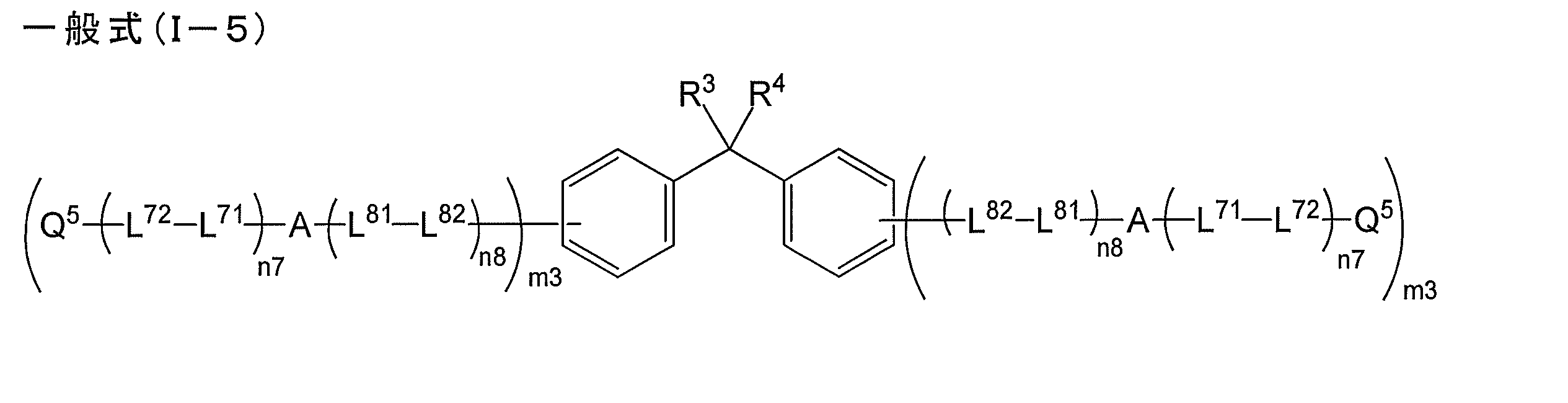


一般式(2A) -{Rb jb(CRaRc)ja-O-(C=O)}-*
一般式(2B) -{Rb jb(CRaRc)ja-O}-*
一般式(2C) -{Rb jb(CRaRc)ja-(C=O)O-}-*
一般式(2D) -{Rb jb(CRaRc)ja-NR1(C=O)O-}-*
一般式(2E) -{Rb jb(CRaRc)ja-O-(C=O)NR1}-*
一般式(2A)~(2E)中、*は、Q1aもしくはQ1bとの結合位置または隣接する基とQ1aもしくはQ1b側で結合する位置を表し、RaおよびRcは、それぞれ独立に水素原子または炭素数1~3のアルキル基を表し、jaは1以上の整数を表し、RaおよびRcが複数存在する場合、複数のRaおよびRcはそれぞれ同一であっても異なっていてもよい;Rbは1つ以上の炭素数1~3のアルキル基で置換されていてもよいシクロアルキレン基を表し、jbは0または1である;R1は水素原子または炭素数1~4のアルキル基を表し、R1が複数存在する場合、複数のR1はそれぞれ同一であっても異なっていてもよい。)
下記一般式(A-100)で表される化合物を含有する、セルロースアシレートフィルム:
一般式(A-100)
(QA-(L102-L101)na-NR100-C(=O)-NH-(L103-L104)nb-QB
一般式(A-100)中、R100は水素原子または置換基を表す;L101およびL103は、それぞれ独立にアルキレン基を表し、アルキレン基は置換基を有していてもよい;L102およびL104はそれぞれ独立に単結合または-O-、-NR100a-、-S-、-C(=O)-のいずれかまたはこれらの組み合わせからなる基を表す;R100aは、水素原子または置換基を表す。naおよびnbは、それぞれ独立に0~20の整数を表し、L101、L102、L103およびL104が複数存在する場合は、互いに同一でも異なっていてもよい;QAおよびQBは、それぞれ独立に置換基を表し、QAおよびQBの少なくとも一方は環状構造を含む;naがゼロを表し、かつQAが環状構造を含む場合、QAに含まれる環状構造は、-NR100-中のR100とともに形成された環状構造であってもよい;ただし、一分子中の-NH-(C=O)-NH-で表される2価の連結基の数は0または1である。)
に関する。
一般式(A-101)
(Q103-(L132-L131)n103-A100-(L141-L142)n104)m-Z101
(一般式(A-101)中、L131およびL141は、それぞれ独立にアルキレン基を表し、アルキレン基は置換基を有していてもよい;L132およびL142はそれぞれ独立に単結合または-O-、-NR100a-、-S-、および-C(=O)-のいずれかまたはこれらの組み合わせからなる基を表す;R100aは、水素原子または置換基を表す;n103およびn104は、それぞれ独立に0~20の整数を表し、L131、L132、L141およびL142が複数存在する場合は、互いに同一でも異なっていてもよい;Q103は、置換基を表し、Z101はm価の連結基を表し、A100は、*-NR-C(=O)-NH-、*-NH-C(=O)-NR-、*-O-C(=O)-NH-、または*-NH-C(=O)-O-を表し、R100は水素原子または置換基を表し、*はL141またはZ101との結合位置を表す;mは、2~6の整数を表し、複数存在するQ103およびA100は、それぞれ、互いに同一でも異なっていてもよい;ただし少なくとも1つのA100は、*-NR-C(=O)-NH-または*-NH-C(=O)-NR100-を表す;また、Q103およびZ101の少なくとも一種は環状構造を含む;少なくとも1つのn103がゼロを表し、Q103が環状構造を含み、かつA100が*-NH-C(=O)-NR100-を表す場合、Q103に含まれる環状構造は、A100に含まれる-NR100-中のRとともに形成された環状構造であってもよい。ただし、一分子中の-NH-(C=O)-NH-で表される2価の連結基の数は0または1である。)
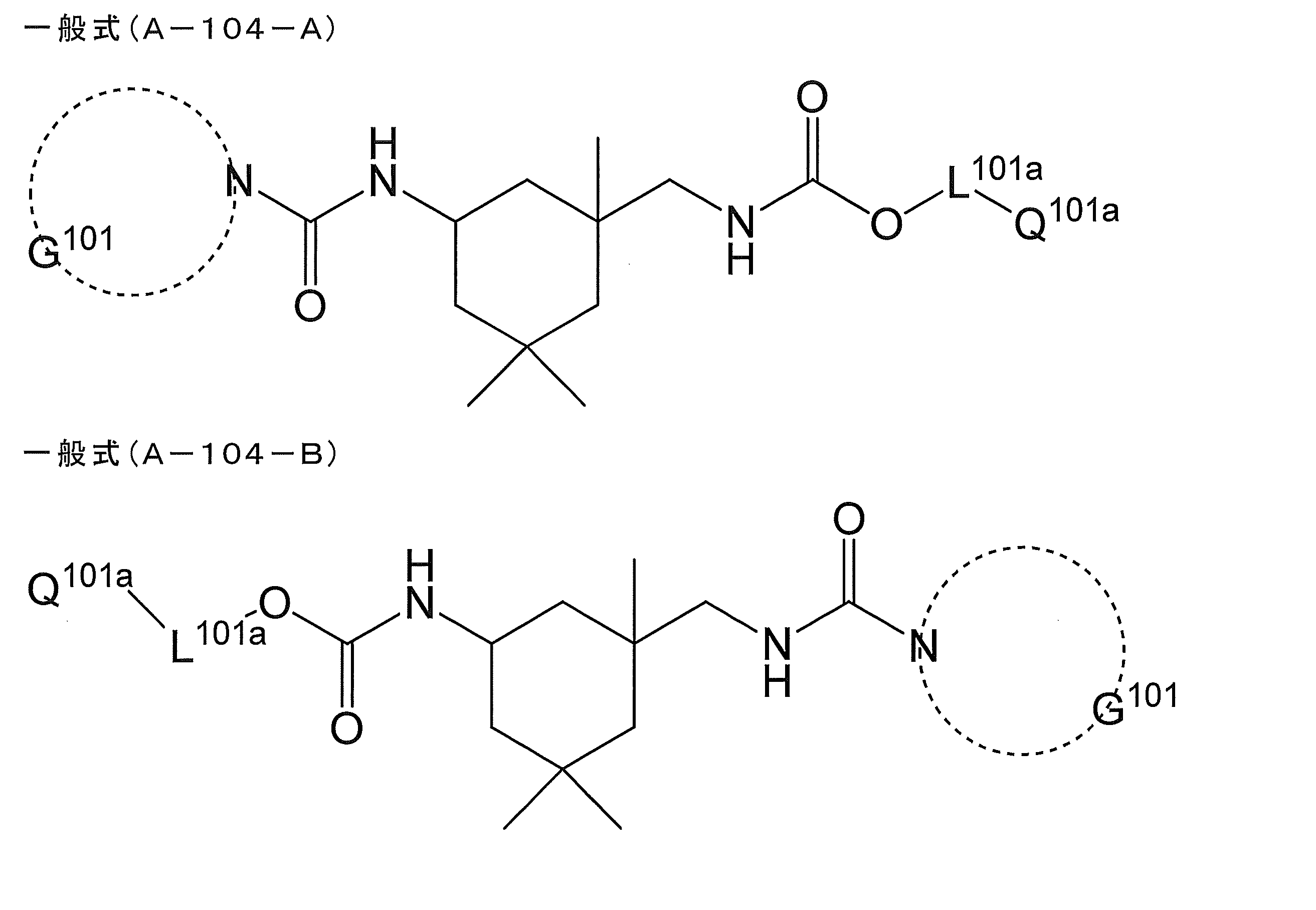
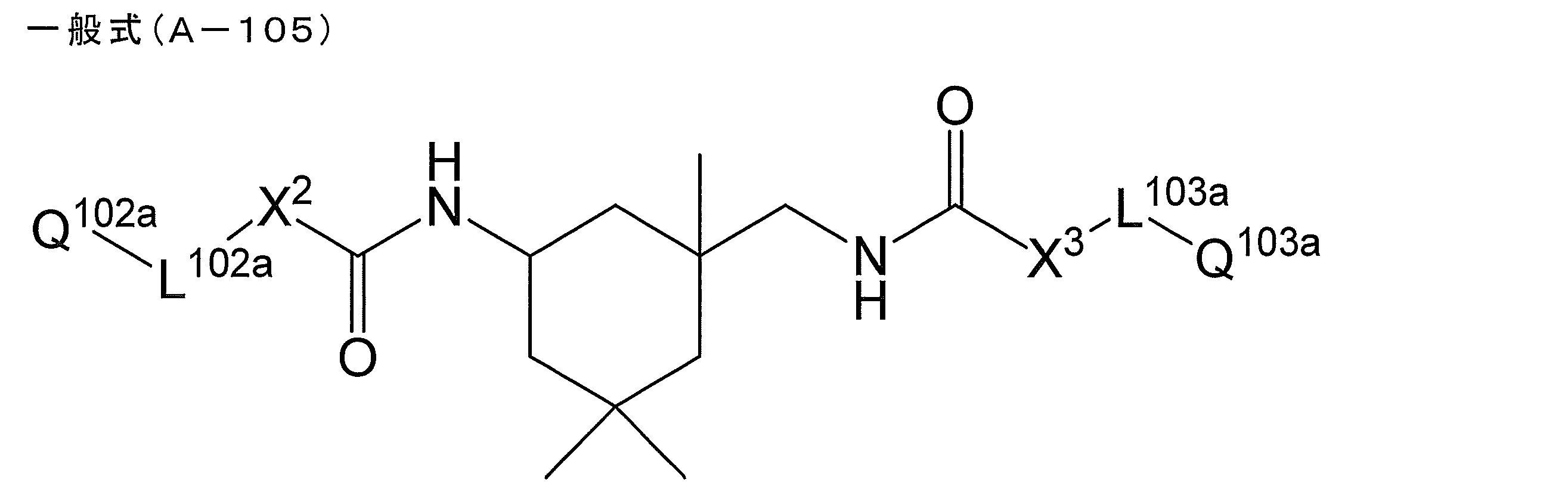
一般式(2A) -{Rb jb(CRaRc)ja-O-(C=O)}-*
一般式(2B) -{Rb jb(CRaRc)ja-O}-*
一般式(2C) -{Rb jb(CRaRc)ja-(C=O)O-}-*
一般式(2D) -{Rb jb(CRaRc)ja-NR100a(C=O)O-}-*
一般式(2E) -{Rb jb(CRaRc)ja-O-(C=O)NR100a}-*
一般式(2F) -{Rb jb(CRaRc)ja-NR100a(C=O)NR100a}-*
一般式(2A)~(2F)中、*は、Q101a、Q102aもしくはQ103aとの結合位置または隣接する基とQ101a、Q102aもしくはQ103a側で結合する位置を表し、RaおよびRcは、それぞれ独立に水素原子または炭素数1~3のアルキル基を表し、jaは1以上の整数を表し、RaおよびRcが複数存在する場合、複数のRaおよびRcはそれぞれ同一であっても異なっていてもよい;Rbは1つ以上の炭素数1~3のアルキル基で置換されていてもよいシクロアルキレン基を表し、jbは0または1である;R100aは水素原子または炭素数1~4のアルキル基を表し、R100aが複数存在する場合、複数のR100aはそれぞれ同一であっても異なっていてもよい。ただし、X2およびX3がともに-O-を表す場合、L102aおよびL103aの一方または両方は、-NR100a-C(=O)-NH-で表される2価の連結基を含む。)
上記セルロースアシレートフィルムと偏光子とを有する偏光板、
に関する。
上記偏光板を有する液晶表示装置、
に関する。

一般式(2A-1) -{(CRaRc)ja-O-(C=O)}-*
一般式(2B-1) -{(CRaRc)ja-O}-*
一般式(2C-1) -{(CRaRc)ja-(C=O)O-}-*
一般式(2D-1) -{(CRaRc)ja-NR1(C=O)O-}-*
一般式(2E-1) -{(CRaRc)ja-O-(C=O)NR1}-*
一般式(2A-1)~(2E-1)中、*は、Q11aもしくはQ11bとの結合位置または隣接する基とQ11aもしくはQ11b側で結合する位置を表し、RaおよびRcは、それぞれ独立に水素原子または炭素数1~3のアルキル基を表し、R1は、水素原子または炭素数1~4のアルキル基を表し、jaは1以上の整数を表し、Ra、Rc、R1が複数存在する場合、複数のRa、Rc、R1はそれぞれ同一であっても異なっていてもよい。)

一般式(2A-1) -{(CRaRc)ja-O-(C=O)}-*
一般式(2C-1) -{(CRaRc)ja-(C=O)O-}-*
一般式(2D-1) -{(CRaRc)ja-NR1(C=O)O-}-*
一般式(2E-1) -{(CRaRc)ja-O-(C=O)NR1}-*
一般式(2A-1)、(2C-1)~(2E-1)中、*は、Q11aもしくはQ11bとの結合位置または隣接する基とQ11aもしくはQ11b側で結合する位置を表し、RaおよびRcは水素原子または炭素数1~3のアルキル基を表し、jaは1以上の整数を表し、R1は、水素原子または炭素数1~4のアルキル基を表し、Ra、Rc、R1が複数存在する場合、複数のRa、Rc、R1はそれぞれ同一であっても異なっていてもよい。)

一般式(2A-1) -{(CRaRc)ja-O-(C=O)}-*
一般式(2B-1) -{(CRaRc)ja-O}-*
一般式(2C-1) -{(CRaRc)ja-(C=O)O-}-*
一般式(2A-1)~(2C-1)中、*は、Q1aで表される置換基との結合位置を表し、RaおよびRcは、それぞれ独立に水素原子または炭素数1~3のアルキル基を表し、jaは1以上の整数を表し、Ra、Rcが複数存在する場合、複数のRa、Rcはそれぞれ同一であっても異なっていてもよい。)

一般式(2A-1) -{(CRaRc)ja-O-(C=O)}-*
一般式(2B-1) -{(CRaRc)ja-O}-*
一般式(2C-1) -{(CRaRc)ja-(C=O)O-}-*
一般式(2D-1) -{(CRaRc)ja-NR100a(C=O)O-}-*
一般式(2E-1) -{(CRaRc)ja-O-(C=O)NR100a}-*
一般式(2F-1) -{(CRaRc)ja-NR100a(C=O)NR100a}-*
一般式(2A-1)~(2F-1)中、*は、Q102aもしくはQ103aとの結合位置または隣接する基とQ102aもしくはQ103a側で結合する位置を表し、RaおよびRcは、それぞれ独立に水素原子または炭素数1~3のアルキル基を表し、jaは1以上の整数を表し、RaおよびRcが複数存在する場合、複数のRaおよびRcはそれぞれ同一であっても異なっていてもよい;R100aは水素原子または炭素数1~4のアルキル基を表し、R100aが複数存在する場合、複数のR100aはそれぞれ同一であっても異なっていてもよい。ただし、X2およびX3がともに-O-を表す場合、L102aおよびL103aの一方または両方は、-NR100a-C(=O)-NH-で表される2価の連結基を含む。)
第一の態様のセルロースアシレートフィルムは、一般式(I)で表され、かつU=[(分子量)/(一分子中に含まれる-O-C(=O)-NH-で表される2価の連結基の個数)]として求められる当量Uが515以下である化合物を含有する。このような化合物を用いることにより、セルロースアシレートフィルムの表面硬度を発現させることが可能となり、更に、光着色性の弊害を低減することもできる。加えて上記化合物は、低揮散性を示すことができるため、透明性の高いフィルムの提供にも寄与することができる。
一般式(I)
Q1-(L12-L11)n1-O-C(=O)-NH-(L21-L22)n2-Q2
(一般式(I)中、L11およびL21は、それぞれ独立にアルキレン基を表し、アルキレン基は置換基を有していてもよい。L12およびL22はそれぞれ独立に単結合または-O-、-NR1-、-S-、-C(=O)-のいずれかまたはこれらの組み合わせからなる基を表す。R1は、水素原子または置換基を表す。n1およびn2は、それぞれ独立に0~20の整数を表し、n1およびn2のいずれか一方は1以上の整数であり、L11、L12、L21およびL22が複数存在する場合は、互いに同一でも異なっていてもよい。Q1およびQ2は、それぞれ独立に置換基を表し、Q1およびQ2の少なくとも一方は環状構造を含む。)
直鎖または分岐のアルキレン基は置換基を有していない方が好ましい。環状アルキレン基は置換基を有していることが好ましい。
一方、L12およびL22が-OC(=O)-*、-C(=O)O-*である場合の-(L12-L11)-または-(L21-L22)-が表す連結基の具体例としては、下記一般式(2A)または(2C)で表される構造が例示される。
また、L12およびL22が酸素原子である場合の-(L12-L11)-または-(L21-L22)-が表す連結基の具体例としては、下記一般式(2B)で表される構造が例示される。
また、L12およびL22が-NR1-OC(=O)-*、-NR1-C(=O)O-*である場合の-(L12-L11)-または-(L21-L22)-が表す連結基の具体例としては、下記一般式(2D)または(2E)で表される構造が例示される。
一般式(2A) -{Rb jb(CRaRc)ja-O-(C=O)}-*
一般式(2B) -{Rb jb(CRaRc)ja-O}-*
一般式(2C) -{Rb jb(CRaRc)ja-(C=O)O-}-*
一般式(2D) -{Rb jb(CRaRc)ja-NR1(C=O)O-}-*
一般式(2E) -{Rb jb(CRaRc)ja-O-(C=O)NR1}-*
(一般式(2A)~(2E)中、*は、Q1もしくはQ2との結合位置、または隣接する基とQ1もしくはQ2側で結合する位置を表し、RaおよびRcは、それぞれ独立に水素原子またはアルキル基(例えば炭素数1~3のアルキル基、好ましくはメチル基)を表し、jaは1以上の整数を表し、1~3の範囲の整数であることが好ましい。RaおよびRcが複数存在する場合、複数のRaおよびRcはそれぞれ同一であっても異なっていてもよい。Rbは1つ以上の炭素数1~3のアルキル基で置換されていてもよいシクロアルキレン基を表し、好ましくは1~3つの炭素数1~3のアルキル基で置換されていてもよいシクロヘキシレン基であり、jbは0または1である。R1は水素原子または置換基を表し、水素原子または炭素数1~4のアルキル基であることが好ましく、アルキル基はメチル基であることがより好ましい。R1が複数存在する場合、複数のR1はそれぞれ同一であっても異なっていてもよい。)
-C(CH3)2-O-(C=O)-、
-CH2CH2-O-(C=O)-、
-CH2CH2CH2-O-(C=O)-、
-CH2CH(CH3)-O-(C=O)-、
-CH(CH3)CH2-O-(C=O)-、
-(1~3つの炭素数1~3のアルキル基で置換されているシクロへキシレン基)-CH2-O-(C=O)-、
-(1~3つの炭素数1~3のアルキル基で置換されているシクロへキシレン基)-CH2CH2-O-(C=O)-、
-(1~3つの炭素数1~3のアルキル基で置換されているシクロへキシレン基)-CH2CH2CH2-O-(C=O)-、
-(1~3つの炭素数1~3のアルキル基で置換されているシクロへキシレン基)-CH2CH(CH3)-O-(C=O)-、
-(1~3つの炭素数1~3のアルキル基で置換されているシクロへキシレン基)-CH(CH3)CH2-O-(C=O)-、
などが挙げられる。
-C(CH3)2-O-、
-(1~3つの炭素数1~3のアルキル基で置換されているシクロへキシレン基)-CH2-O-、
-(1~3つの炭素数1~3のアルキル基で置換されているシクロへキシレン基)-CH2CH2-O-、
-(1~3つの炭素数1~3のアルキル基で置換されているシクロへキシレン基)-CH2CH2CH2-O-、
-(1~3つの炭素数1~3のアルキル基で置換されているシクロへキシレン基)-CH2CH(CH3)-O-、
-(1~3つの炭素数1~3のアルキル基で置換されているシクロへキシレン基)-CH(CH3)CH2-O-、
などが挙げられる。
-C(CH3)2-(C=O)-O-、
-CH2CH2-(C=O)-O-、
-CH2CH2CH2-(C=O)-O-、
-CH2CH(CH3)-(C=O)-O-、
-CH(CH3)CH2-(C=O)-O-、
-(1~3つの炭素数1~3のアルキル基で置換されているシクロヘキシレン基)-CH2-(C=O)-O-、
-(1~3つの炭素数1~3のアルキル基で置換されているシクロヘキシレン基)-CH2CH2-(C=O)-O-、
-(1~3つの炭素数1~3のアルキル基で置換されているシクロヘキシレン基)-CH2CH2CH2-(C=O)-O-、
-(1~3つの炭素数1~3のアルキル基で置換されているシクロヘキシレン基)-CH2CH(CH3)-(C=O)-O-、
-(1~3つの炭素数1~3のアルキル基で置換されているシクロヘキシレン基)-CH(CH3)CH2-(C=O)-O-、
などが挙げられる。
-(1~3つの炭素数1~3のアルキル基で置換されているシクロヘキシレン基)-CH2-NR1(C=O)O-
-CH2-NR1(C=O)-O-、
-CH2CH2-NR1(C=O)-O-、
-CH2CH2CH2-NR1(C=O)-O-、
-CH2CH(CH3)-NR1(C=O)-O-、
-CH(CH3)CH2-NR1(C=O)-O-、
などが挙げられる。
-(1~3つの炭素数1~3のアルキル基で置換されているシクロヘキシレン基)-CH2―O-(C=O)NR1-
-CH2-NR1(C=O)-O-、
-CH2CH2-NR1(C=O)-O-、
-CH2CH2CH2-NR1(C=O)-O-、
-CH2CH(CH3)-NR1(C=O)-O-、
-CH(CH3)CH2-NR1(C=O)-O-、
などが挙げられる。
アルキル基(好ましくは炭素数1~20、より好ましくは1~12、特に好ましくは1~8のものであり、例えばメチル基、エチル基、イソプロピル基、tert-ブチル基、n-オクチル基、n-デシル基、n-ヘキサデシル基、シクロプロピル基、シクロペンチル、シクロヘキシル基などが挙げられる。)、アルケニル基(好ましくは炭素数2~20、より好ましくは2~12、特に好ましくは2~8であり、例えばビニル基、アリル基、2-ブテニル基、3-ペンテニル基などが挙げられる。)、アルキニル基(好ましくは炭素数2~20、より好ましくは2~12、特に好ましくは2~8であり、例えばプロパルギル基、3-ペンチニル基などが挙げられる。)、アリール基(好ましくは炭素数6~30、より好ましくは6~20、特に好ましくは6~12であり、例えばフェニル基、ビフェニル基、ナフチル基などが挙げられる。)、アミノ基(好ましくは炭素数0~20、より好ましくは0~10、特に好ましくは0~6であり、例えばアミノ基、メチルアミノ基、ジメチルアミノ基、ジエチルアミノ基、ジベンジルアミノ基などが挙げられる。)、アルコキシ基(好ましくは炭素数1~20、より好ましくは1~12、特に好ましくは1~8であり、例えばメトキシ基、エトキシ基、ブトキシ基などが挙げられる。)、アリールオキシ基(好ましくは炭素数6~20、より好ましくは6~16、特に好ましくは6~12であり、例えばフェニルオキシ基、2-ナフチルオキシ基などが挙げられる。)、アシル基(好ましくは炭素数1~20、より好ましくは1~16、特に好ましくは1~12であり、例えばアセチル基、ベンゾイル基、ホルミル基、ピバロイル基などが挙げられる。)、アルコキシカルボニル基(好ましくは炭素数2~20、より好ましくは2~16、特に好ましくは2~12であり、例えばメトキシカルボニル基、エトキシカルボニル基などが挙げられる。)、アリールオキシカルボニル基(好ましくは炭素数7~20、より好ましくは7~16、特に好ましくは7~10であり、例えばフェニルオキシカルボニル基などが挙げられる。)、アシルオキシ基(好ましくは炭素数2~20、より好ましくは2~16、特に好ましくは2~10であり、例えばアセトキシ基、ベンゾイルオキシ基などが挙げられる。)、アシルアミノ基(好ましくは炭素数2~20、より好ましくは2~16、特に好ましくは2~10であり、例えばアセチルアミノ基、ベンゾイルアミノ基などが挙げられる。)、アルコキシカルボニルアミノ基(好ましくは炭素数2~20、より好ましくは2~16、特に好ましくは2~12であり、例えばメトキシカルボニルアミノ基などが挙げられる。)、アリールオキシカルボニルアミノ基(好ましくは炭素数7~20、より好ましくは7~16、特に好ましくは7~12であり、例えばフェニルオキシカルボニルアミノ基などが挙げられる。)、スルホニルアミノ基(好ましくは炭素数1~20、より好ましくは1~16、特に好ましくは1~12であり、例えばメタンスルホニルアミノ基、ベンゼンスルホニルアミノ基などが挙げられる。)、スルファモイル基(好ましくは炭素数0~20、より好ましくは0~16、特に好ましくは0~12であり、例えばスルファモイル基、メチルスルファモイル基、ジメチルスルファモイル基、フェニルスルファモイル基などが挙げられる。)、カルバモイル基(好ましくは炭素数1~20、より好ましくは1~16、特に好ましくは1~12であり、例えばカルバモイル基、メチルカルバモイル基、ジエチルカルバモイル基、フェニルカルバモイル基などが挙げられる。)、アルキルチオ基(好ましくは炭素数1~20、より好ましくは1~16、特に好ましくは1~12であり、例えばメチルチオ基、エチルチオ基などが挙げられる。)、アリールチオ基(好ましくは炭素数6~20、より好ましくは6~16、特に好ましくは6~12であり、例えばフェニルチオ基などが挙げられる。)、スルホニル基(好ましくは炭素数1~20、より好ましくは1~16、特に好ましくは1~12であり、例えばメシル基、トシル基などが挙げられる。)、スルフィニル基(好ましくは炭素数1~20、より好ましくは1~16、特に好ましくは1~12であり、例えばメタンスルフィニル基、ベンゼンスルフィニル基などが挙げられる。)、ウレタン基、ウレイド基(好ましくは炭素数1~20、より好ましくは1~16、特に好ましくは1~12であり、例えばウレイド基、メチルウレイド基、フェニルウレイド基などが挙げられる。)、リン酸アミド基(好ましくは炭素数1~20、より好ましくは1~16、特に好ましくは1~12であり、例えばジエチルリン酸アミド、フェニルリン酸アミドなどが挙げられる。)、ヒドロキシル基、メルカプト基、ハロゲン原子(例えばフッ素原子、塩素原子、臭素原子、ヨウ素原子)、シアノ基、スルホ基、カルボキシル基、ニトロ基、ヒドロキサム酸基、スルフィノ基、ヒドラジノ基、イミノ基、ヘテロ環基(好ましくは炭素数1~30、より好ましくは1~12であり、ヘテロ原子としては、例えば窒素原子、酸素原子、硫黄原子、具体的には例えばイミダゾリル基、ピリジル基、キノリル基、フリル基、ピペリジル基、モルホリノ基、ベンゾオキサゾリル基、ベンズイミダゾリル基、ベンズチアゾリル基などが挙げられる。)、及びシリル基(好ましくは、炭素数3~40、より好ましくは3~30、特に好ましくは3~24であり、例えば、トリメチルシリル基、トリフェニルシリル基などが挙げられる)。
これらの置換基は更に置換されてもよい。また、置換基が2つ以上ある場合は、2つ以上の置換基は、同じでも異なってもよい。また、可能な場合には互いに連結して環を形成してもよい。
置換基としては、上記置換基群Tが挙げられ、炭素数が6~30(より好ましくは6~20、さらに好ましくは6~10)のアリール基、炭素数が1~12(より好ましくは1~10、さらに好ましくは1~5)のアルキル基(但し、アルキル鎖中に酸素原子が入っていても良い)、炭素数が2~12(より好ましくは2~10、さらに好ましくは2~5)のアルケニル基、炭素数が1~12(より好ましくは1~10、さらに好ましくは1~5)のアルコキシ基が挙げられる。Q1およびQ2は、さらに置換基を有していてもよく、置換基の具体例としては、上記置換基群Tが挙げられ、アリール基、アルキル基、アシル基が好ましい。なお上記アリール基とは、芳香族炭化水素基を意味するものとする。
Q1、Q2の一方または両方に含まれる環状構造としては、脂肪族環(シクロヘキサン環など)、芳香環(ベンゼン環、ナフタレン環など)などが挙げられ、複数種の環を有していてもよく、縮合環であってもよい。一態様では、上記環状構造は、環状イミド基ではないことが好ましい。また他の一態様では、Q1およびQ2の少なくとも一方、望ましくは両方が、極性基ではないことが好ましい。ここで極性基とは、ClogP値が0.85以下の置換基をいうものとする。ClogP値については後述する。本明細書において、Q1、Q2のClogP値は、当該置換基が水素に連結した化合物Q1―H、Q2-HのClogP値として求める。実際には存在しない構造の化合物であっても、計算化学的手法または経験的方法により見積もられる値として、ClogP値を求めることができる。ClogP値が0.85以下の置換基の具体例としては、シアノ基、イミド基が挙げられる。
一般式(a)
*-(L12-L11)n1-O-C(=O)-NH-(L21-L22)n2-Q2
一般式(b)
Q1-(L12-L11)n1-O-C(=O)-NH-(L21-L22)n2-*
-(L12-L11)n1-O-C(=O)-NH-(L21-L22)n2-
で表される構造を、一分子中に2つ以上有することが好ましい。なお 上記一般式(a)、(b)中、L11~L22、n1、n2、Q1およびQ2は、一般式(I)と同義である。 上記好ましい態様にかかる化合物の具体的態様については、後述する。上記連結基としては、一般式(I-1)中のZ1について記載するものを挙げることができる。
または、他の一態様では、一般式(I)で表される化合物は、-NH-C(=O)-O-で表される2価の連結基に加えて、-NR1-C(=O)-O-で表される2価の連結基を含むことができる。-NH-C(=O)-O-で表される2価の連結基および-NR1-C(=O)-O-で表される2価の連結基を合計で、例えば2~6つ有することができ、2~4つ有することが好ましい。
当量Uは、この値が小さいほど、一分子あたりの-O-C(=O)-NH-で表される2価の連結基の含有率が高いことを意味する。そして当量Uが515以下である一般式(I)で表される化合物によれば、高い表面硬度を有するセルロースアシレートフィルムを得ることができる。当量Uは、好ましくは450以下であり、より好ましくは420以下であり、さらに好ましくは300以下である。下限値については、特に限定されるものではないが、例えば100以上である。なお一般式(I)で表される化合物の好ましい一態様は、分子中に-NH-C(=O)-NR-または-NR-C(=O)-NH-で表される基を含まない。ここでRは水素原子または置換基を表す。置換基としては、置換基群Tとして例示したものを挙げることができる。また、一般式(I)で表される化合物は、一態様では、「-芳香族環-NH-C(=O)-O-」で表される構造を含まない方が好ましい。このような構造とすることにより、特にセルロースアシレートフィルムが光着色性を示すことを抑制することができる。また他の一態様では、一般式(I)で表される化合物は、「-芳香族環-NH-C(=O)-O-」で表される構造を含んでもよい。
一般式(I-1)
(Q3-(L32-L31)n3-A-(L41-L42)n4)m-Z1
(一般式(I-1)中、L31およびL41は、それぞれ独立にアルキレン基を表し、アルキレン基は置換基を有していてもよい。L32およびL42はそれぞれ独立に単結合または-O-、-NR1-、-S-、および-C(=O)-のいずれかまたはこれらの組み合わせからなる基を表す。R1は、水素原子または置換基を表す。n3およびn4は、それぞれ独立に0~20の整数を表し、n3およびn4のいずれか一方は1以上の整数であり、L31、L32、L41およびL42が複数存在する場合は、互いに同一でも異なっていてもよい。Q3は、置換基を表し、Z1はm価の連結基を表し、Aは、*-O-C(=O)-NH-、または*-NH-C(=O)-O-を表す(*はL41との結合位置を表す)。mは、2~6の整数を表し、複数存在するQ3およびAは、それぞれ、互いに同一でも異なっていてもよい。また、Q3およびZ1の少なくとも一種は環状構造を含む。)
L32、L42は、それぞれ独立に一般式(I)中のL12、L22と同義であり、好まましい範囲も同様である。
特に、(L41-L42)が表す連結基は、単結合またはアルキレン基が好ましく、(L32-L31)が表す連結基は、単結合、アルキレン基、または下記一般式(2A)~ (2E)のいずれかで表される基であることが好ましい。一般式(2A)~ (2E)の詳細は、上述の通りである。
一般式(2A) -{Rb jb(CRaRc)ja-O-(C=O)}-*
一般式(2B) -{Rb jb(CRaRc)ja-O}-*
一般式(2C) -{Rb jb(CRaRc)ja-(C=O)O-}-*
一般式(2D) -{Rb jb(CRaRc)ja-NR1(C=O)O-}-*
一般式(2E) -{Rb jb(CRaRc)ja-O-(C=O)NR1}-*
(一般式(2A)~(2E)中、*は、Q3もしくはZ1との結合位置、または隣接する基とQ3もしくはZ1側で結合する位置を表し、Ra等の詳細は、先に記載した通りである。)
mは、2~6の整数を表し、2~3の整数が好ましい。
Q3が含む環状基は、縮合環でもよいが、単環の方が好ましい。具体的には、脂肪族環(シクロヘキサン環など)、芳香環(ベンゼン環、ナフタレン環など)、などが挙げられ、芳香環が好ましく、芳香族炭素環がより好ましい。
Q3は炭素数が6~30(より好ましくは6~20、さらに好ましくは6~10)のアリール基または炭素数が5~30(より好ましくは6~20、炭素数が6~30(より好ましくは6~20、さらに好ましくは6~10)のアリール基がさらに好ましく、ベンゼン環が特に好ましい。
m個のQ3はいずれかが環構造を含むことが好ましく、いずれも環構造を含むことが好ましく、芳香族基を含むことがより好ましい。
Q3およびZ1の少なくとも一種は1つ以上の環状構造を含むが、Q3およびZ1のいずれもが環状構造を含むことがより好ましい。また、Q3およびZ1の一方または両方に環状構造を含み、かつ一分子中に合計2~4つの環状構造を有することが好ましく、2つまたは3つの環状構造を有することがより好ましい。
Z1は、直鎖、分岐または環状の脂肪族基および芳香族基の少なくとも1種のみからなっていてもよいし、これらの基と、酸素原子、直鎖または分岐のアルキレン基との組み合わせであることも好ましい。Z1として含まれる脂肪族基は飽和脂肪族基であることが好ましい。
分岐または環状の脂肪族基および芳香族基の少なくとも1種を含む基とすることにより、剛直な構造となるため、この化合物を含むことでフィルムの表面硬度が更に向上する傾向にある。Z1を構成する炭素数は3~20が好ましく、4~15がより好ましい。
Z1は、置換基を有していてもよく、置換基の具体例としては、上記置換基群Tが挙げられるが、置換基を有さない方が好ましい。
具体的には、以下に例示される連結基が好ましい。なお、*はL41と結合する位置を表す。


一般式(I-2)
(Q4-(L52-L51)n5-A-(L61-L62)n6)m1-Z2
(一般式(I-2)中、L51およびL61は、それぞれ独立にアルキレン基を表し、アルキレン基は置換基を有していてもよい。L52およびL62は単結合または-O-、-NR1-、-S-、および-C(=O)-のいずれかまたはこれらの組み合わせからなる基を表す。R1は、水素原子または置換基を表す。n5およびn6は、それぞれ0~20の整数を表すが、n5およびn6のどちらか一方は1以上の整数であり、L51、L52、L61およびL62が複数存在する場合は、互いに同一でも異なっていてもよい。Q4は、置換もしくは無置換のフェニル基、置換もしくは無置換のシクロヘキシル基、メチル基、エチル基、プロピル基、イソプロピル基またはt-ブチル基を表し、Z2は、直鎖、分岐または環状の脂肪族基および芳香族基の少なくとも1種を含む基を表し、Aは、*-O-C(=O)-NH-、または*-NH-C(=O)-O-を表す(*はL61との結合位置を表す)。m1は、2または3の整数を表し、複数存在するQ4およびAは、それぞれ、互いに同一でも異なっていてもよい。また、Z2および複数存在するQ4の少なくとも1つは環状構造を含む。)
L52、L62は、それぞれ独立に一般式(I)中のL12、L22と同義であり、好ましい範囲も同様である。
特に、(L61-L62)が表す連結基は、単結合またはアルキレン基が好ましい。(L52-L51)が表す連結基は、単結合、アルキレン基、または下記一般式(2A)~(2E)のいずれかで表される基であることが好ましい。一般式(2A)~(2E)の詳細は、上述の通りである。
一般式(2A) -{Rb jb(CRaRc)ja-O-(C=O)}-*
一般式(2B) -{Rb jb(CRaRc)ja-O}-*
一般式(2C) -{Rb jb(CRaRc)ja-(C=O)O-}-*
一般式(2D) -{Rb jb(CRaRc)ja-NR1(C=O)O-}-*
一般式(2E) -{Rb jb(CRaRc)ja-O-(C=O)NR1}-*
(一般式(2A)~(2E)中、*は、Q4またはZ2との結合位置、または隣接する基とQ4もしくはZ2側で結合する位置を表し、Ra等の詳細は、先に記載した通りである。)
Q4で表されるシクロヘキシル基も、置換基を有していてもよく、無置換であってもよく、無置換のシクロヘキシル基であることが好ましい。
フェニル基、シクロヘキシル基に置換してもよい置換基の具体例としては、上記置換基群Tが挙げられる。
置換基群Tの置換位置については特に制限はなく、オルト、メタ及びパラ位のいずれの位置が置換されていてもよい。置換基は、ハロゲン原子、アルキル基、アルコキシ基が好ましく、炭素数1~3のアルキル基または炭素数1~3のアルコキシ基がより好ましい。
Q4としては、無置換のフェニル基、無置換のシクロヘキシル基、またはメチル基が、より好ましい例として挙げられる。
Z2は、分岐または環状の脂肪族基および芳香族基の少なくとも1種のみからなっていてもよいし、これらの基と、酸素原子、直鎖または分岐のアルキレン基との組み合わせであることも好ましい。Z2として含まれる脂肪族基は飽和脂肪族基であることが好ましい。
Z2を構成する炭素数は3~20が好ましく、4~15がより好ましい。
Z2は、置換基を有していてもよく、置換基の具体例としては、上記置換基群Tが挙げられるが、置換基を有さない方が好ましい。
Z2の具体例は、上述のZ1のうち、分岐または環状の脂肪族基および芳香族基の少なくとも1種を含む基が例示される。
m1は、2~3の整数を表し、2が好ましい。

L72、L82は、それぞれ独立に一般式(I)中のL12、L22と同義であり、好ましい範囲も同様である。
n7、n8は、それぞれ独立に一般式(I)中のn1、n2と同義であり、好ましい範囲も同様である。
(L81-L82)が表す連結基は、一般式(I-2)における(L62-L61)と同義であり、好ましい範囲も同様である。
中でも、一般式(I-3)において、(L72-L71)が表す連結基および(L81-L82)が表す連結基は、一態様では、前述の一般式(2A)または一般式(2B)で表される連結基であることが好ましい。他の一態様では、前述の一般式(2D)または一般式(2E)で表される連結基が好ましい。
下記の*は

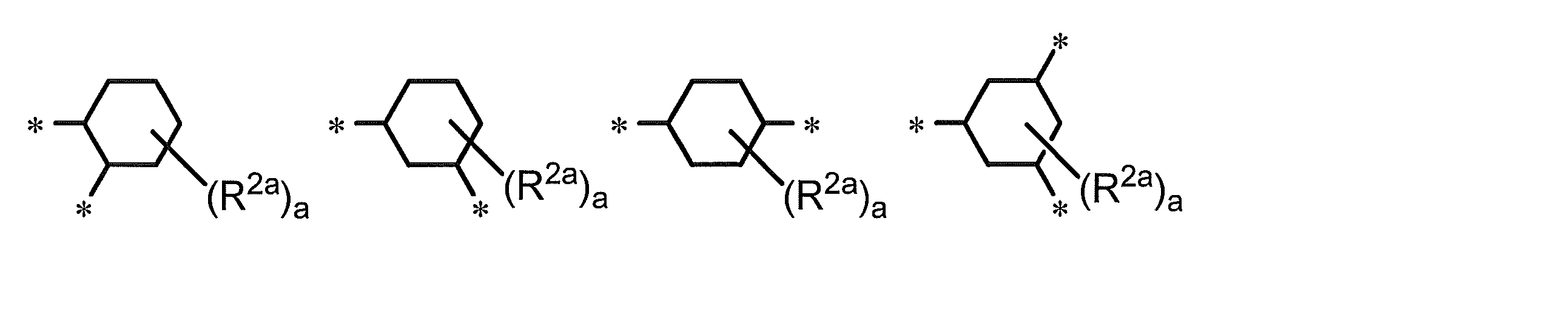


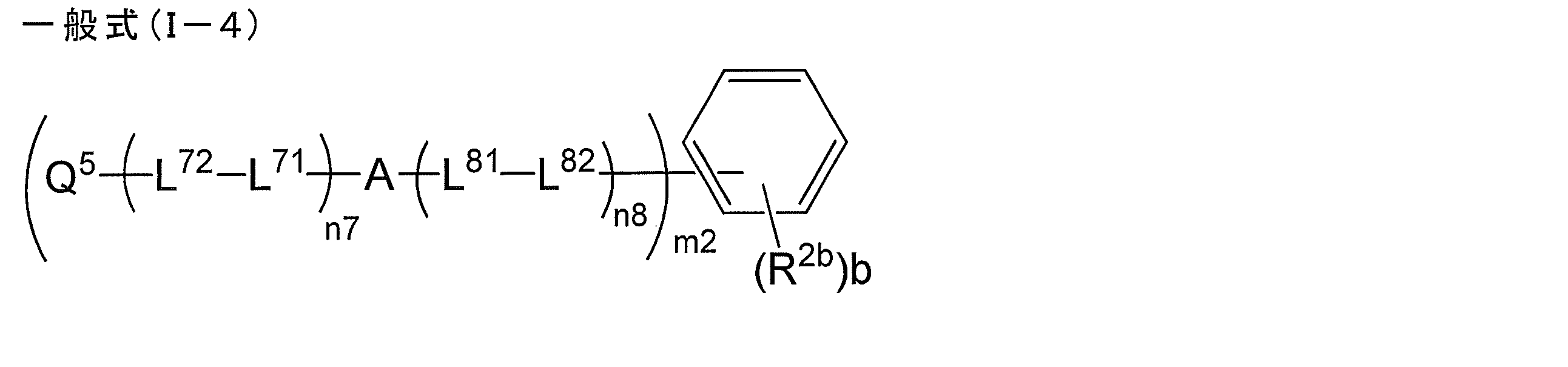
一般式(I-4)中、(L81-L82)n8が表す連結基は、一般式(I-2)における(L62-L61)n6と同義であり、好ましい範囲も同様である。
中でも、一般式(I-4)において、(L72-L71)が表す連結基および(L81-L82)が表す連結基は、一態様では、前述の一般式(2A)または一般式(2B)で表される連結基であることが好ましい。他の一態様では、前述の一般式(2D)または一般式(2E)で表される連結基が好ましい。
下記の*は

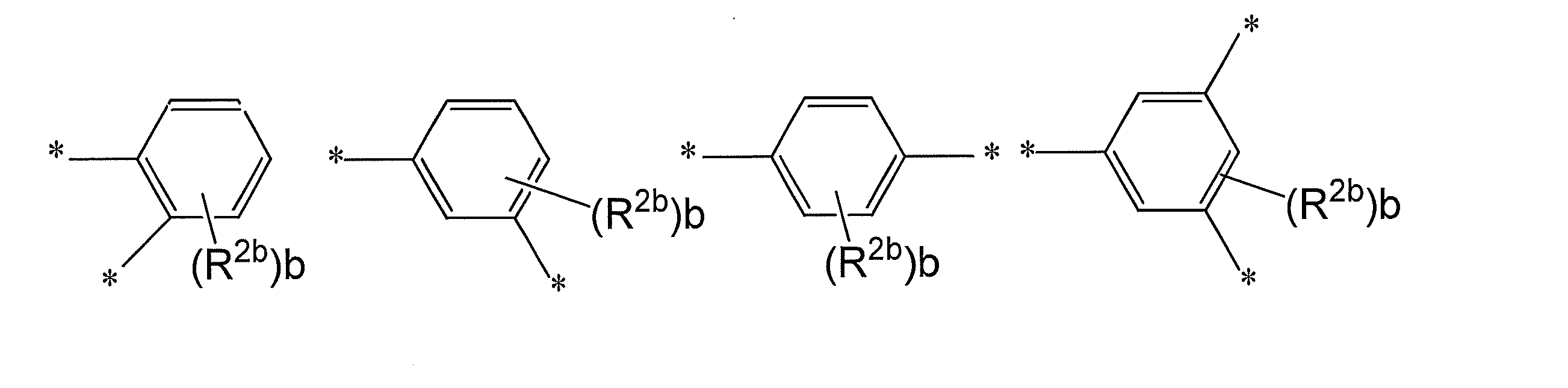
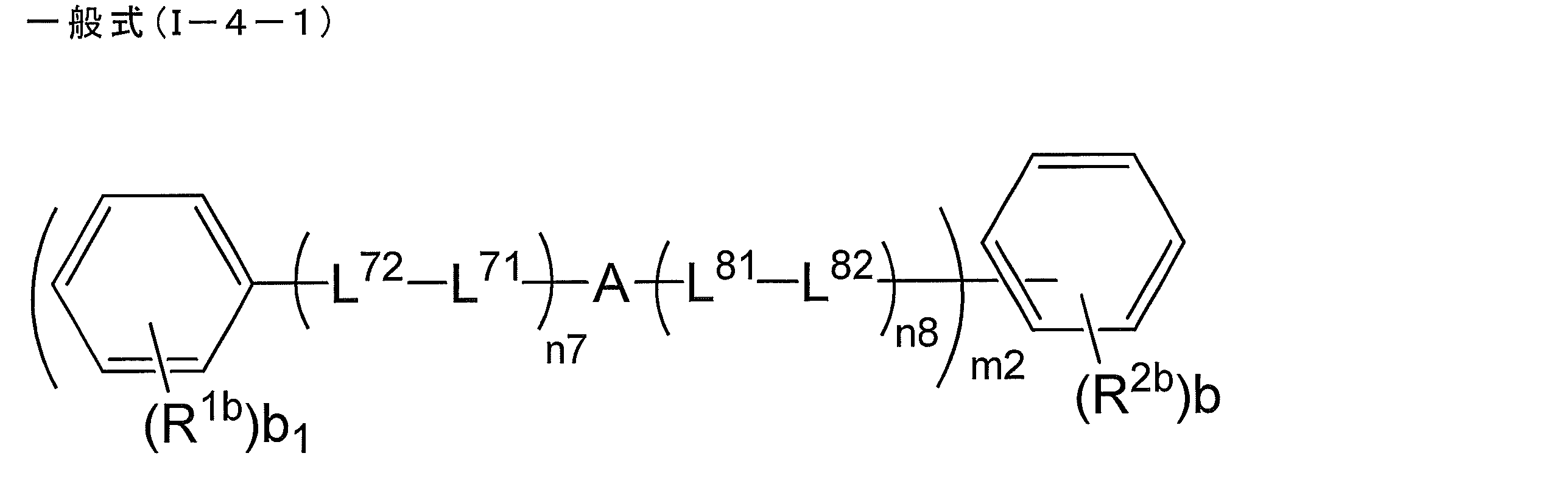
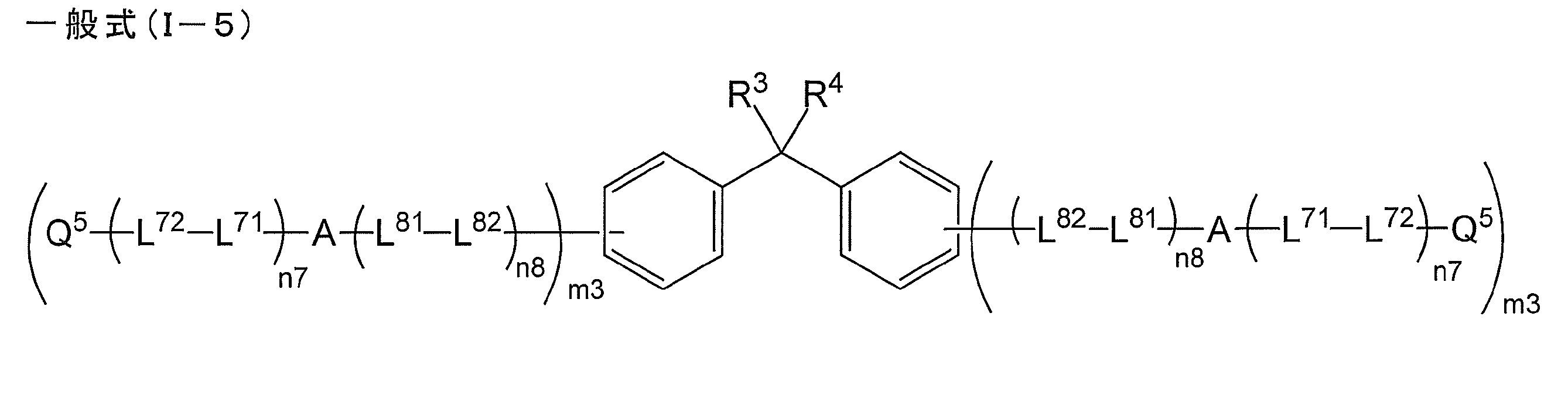
一般式(I-5)中、(L81-L82)n8が表す連結基は、一般式(I-2)における(L62-L61)n6と同義であり、好ましい範囲も同様である。
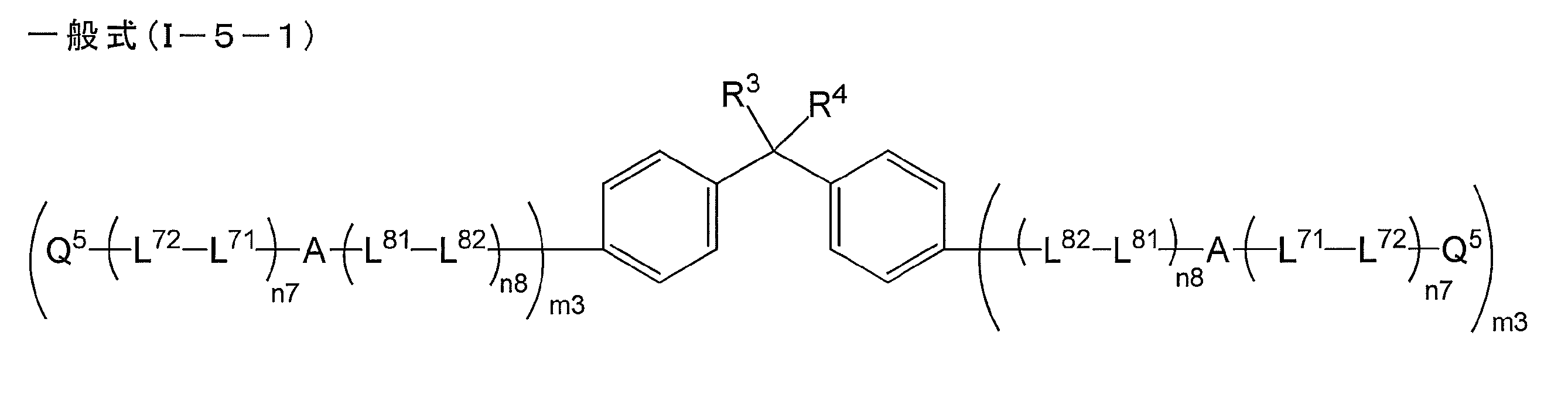


一般式(2A-1) -{(CRaRc)ja-O-(C=O)}-*
一般式(2B-1) -{(CRaRc)ja-O}-*
一般式(2C-1) -{(CRaRc)ja-(C=O)O-}-*
一般式(2D-1) -{(CRaRc)ja-NR1(C=O)O-}-*
一般式(2E-1) -{(CRaRc)ja-O-(C=O)NR1}-*
(一般式(2A-1)~(2E-1)中、*は、Q1aもしくはQ1bとの結合位置または隣接する基とQ1aもしくはQ1b側で結合する位置を表し、RaおよびRcは、それぞれ独立に水素原子または炭素数1~3のアルキル基を表し、jaは1以上の整数を表し、Ra、Rcが複数存在する場合、複数のRa、Rcはそれぞれ同一であっても異なっていてもよい。R1は、水素原子または炭素数1~4のアルキル基を表し、R1が複数存在する場合、複数のR1はそれぞれ同一であっても異なっていてよい。)
上記アルキレン基としては、メチレン基、エチレン基等を挙げることができる。
L1aおよびL1bは、一般式(2A-1)~(2E-1)のいずれかで表される基の1つ、一般式(2A-1)~(2E-1)のいずれかで表される基の2つ以上の組み合わせからなる基、または下記一般式(2A-1)~(2E-1)のいずれかで表される基の1つ以上とアルキレン基の1つ以上との組み合わせからなる基であることが好ましい。上記組み合わせは、例えば、上述の基の2つまたは3つからなる組み合わせである。

一般式(2A-1) -{(CRaRc)ja-O-(C=O)}-*
一般式(2B-1) -{(CRaRc)ja-O}-*
一般式(2C-1) -{(CRaRc)ja-(C=O)O-}-*
一般式(2D-1) -{(CRaRc)ja-NR1(C=O)O-}-*
一般式(2E-1) -{(CRaRc)ja-O-(C=O)NR1}-*
(一般式(2A-1)~(2E-1)中、*は、Q11aもしくはQ11bとの結合位置または隣接する基とQ11aもしくはQ11b側で結合する位置を表し、RaおよびRcは、それぞれ独立に水素原子または炭素数1~3のアルキル基を表し、R1は、水素原子または炭素数1~4のアルキル基を表し、jaは1以上の整数を表し、Ra、Rc、R1が複数存在する場合、複数のRa、Rc、R1はそれぞれ同一であっても異なっていてもよい。)

一般式(2A-1) -{(CHRa)ja-O-(C=O)}jc-*
一般式(2C-1) -{(CHRa)ja-(C=O)O-}jc-*
一般式(2D-1) -{(CRaRc)ja-NR1(C=O)O-}-*
一般式(2E-1) -{(CRaRc)ja-O-(C=O)NR1}-*
一般式(2A-1)、(2C-1)~(2E-1)中、*は、Q11aもしくはQ11bとの結合位置または隣接する基とQ11aもしくはQ11b側で結合する位置を表し、RaおよびRcは水素原子または炭素数1~3のアルキル基を表し、jaは1以上の整数を表し、R1は、水素原子または炭素数1~4のアルキル基を表し、Ra、Rc、R1が複数存在する場合、複数のRa、Rc、R1はそれぞれ同一であっても異なっていてもよい。)
ここで、(1-1-k)における「k」は、化合物中のkの数と同一の数である。例えば、k=2のとき、化合物番号は、(1-1-2)となり、化合物中の-(CH2)k-のkが2であることを意味している。以下の化合物についても同様に考える。

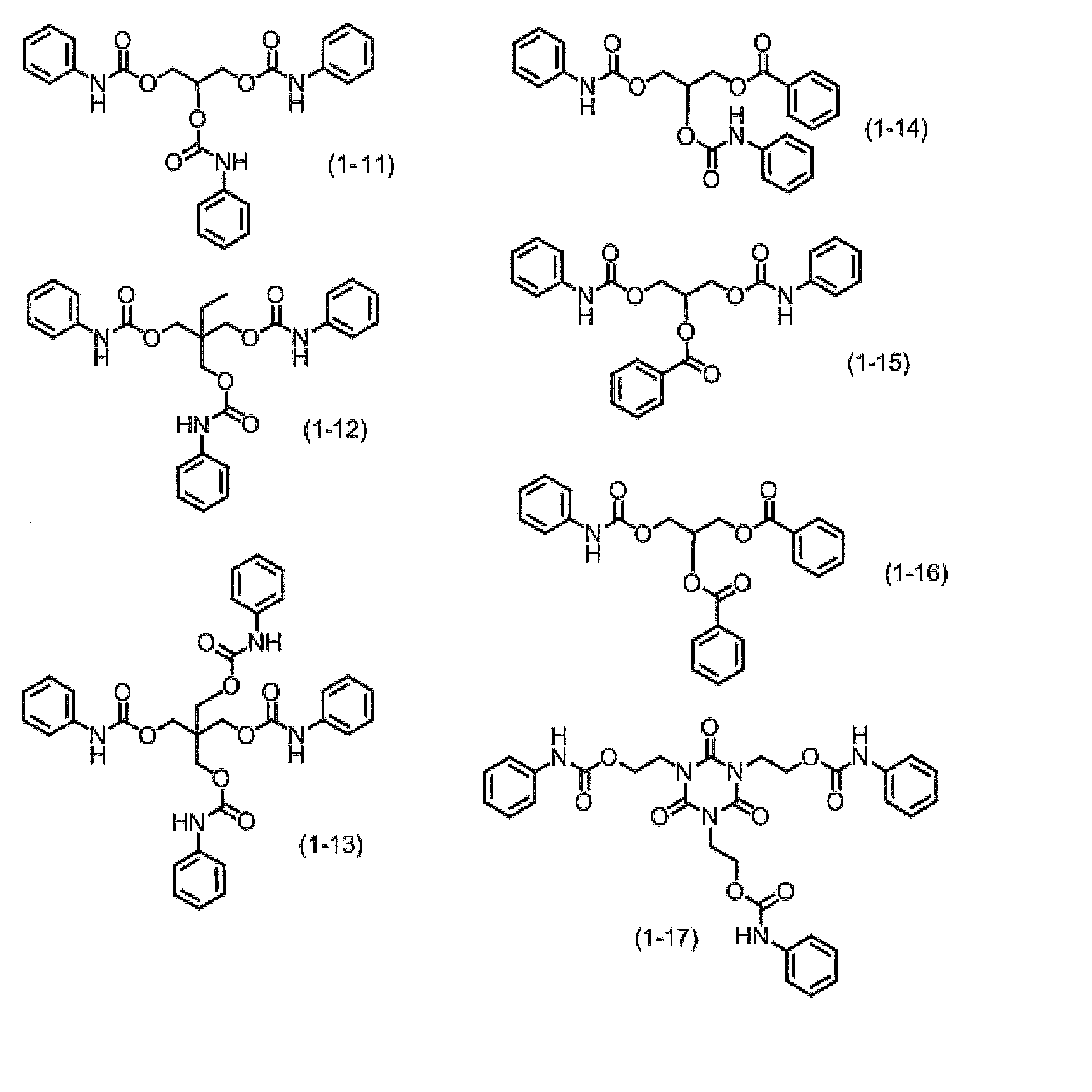
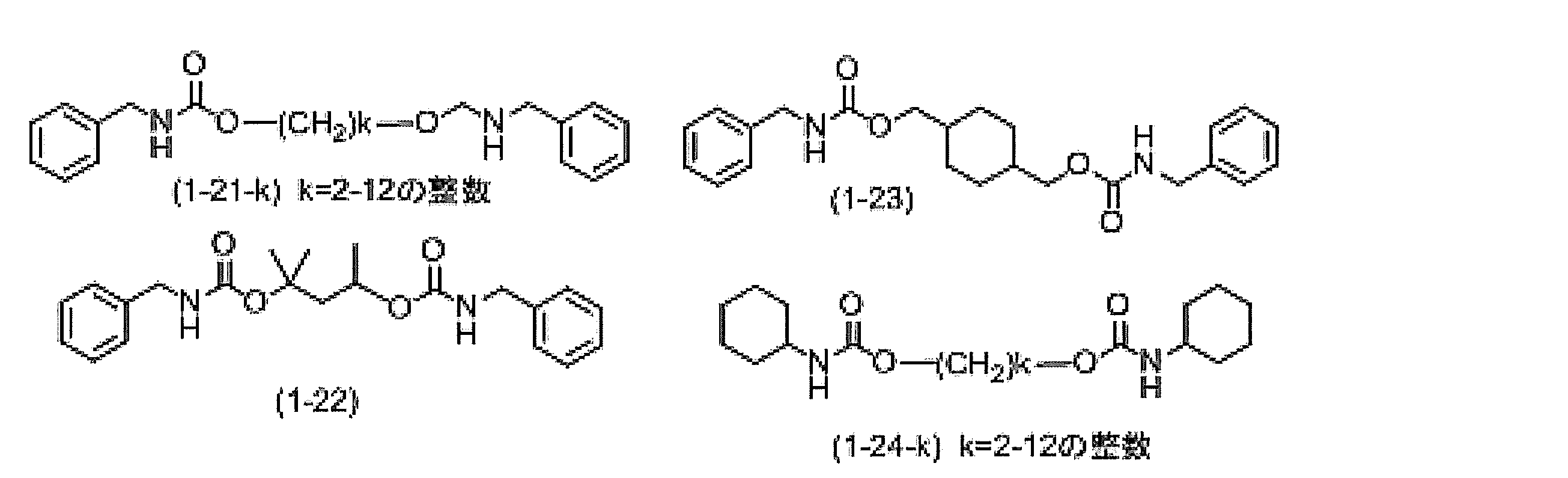

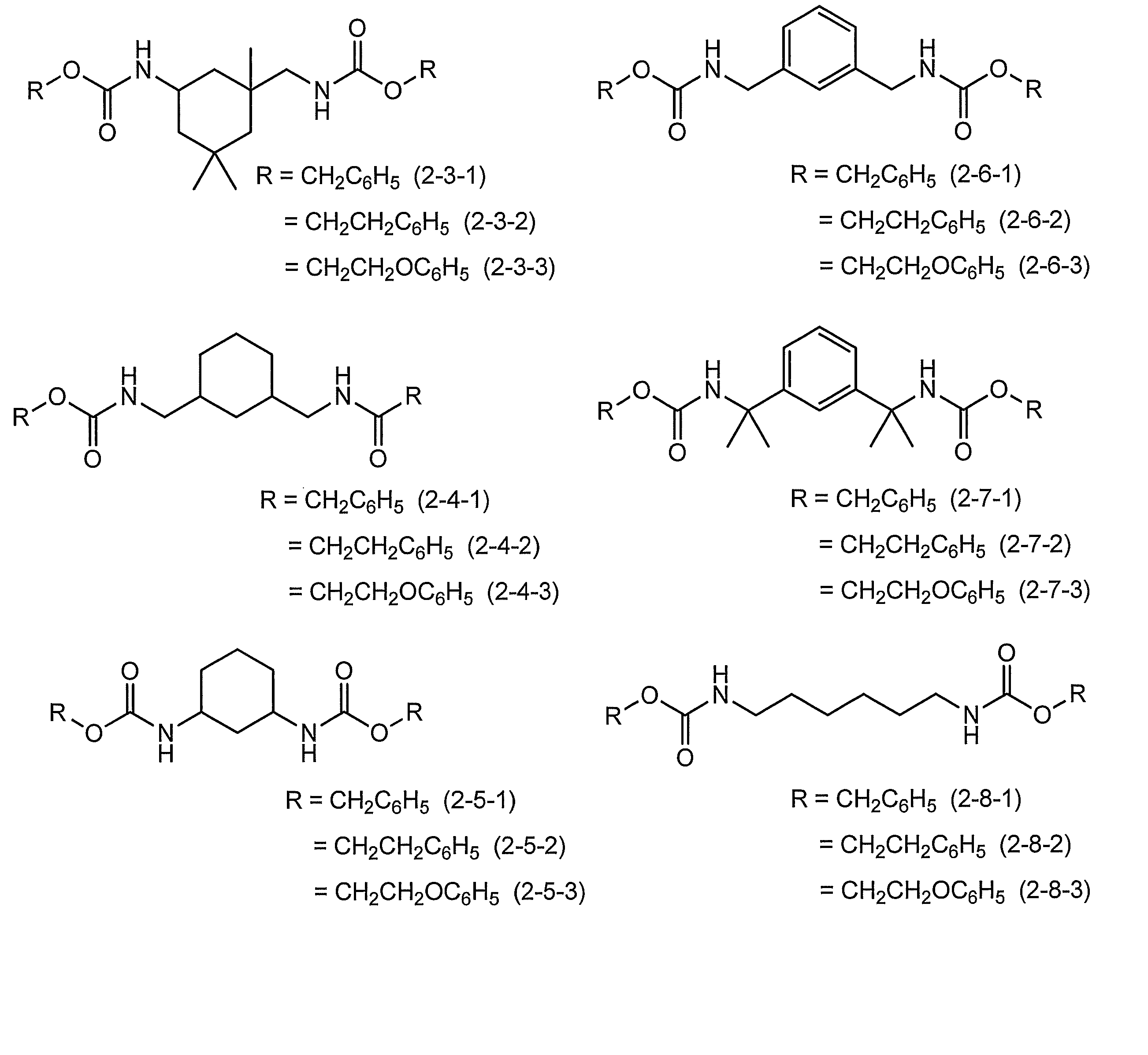
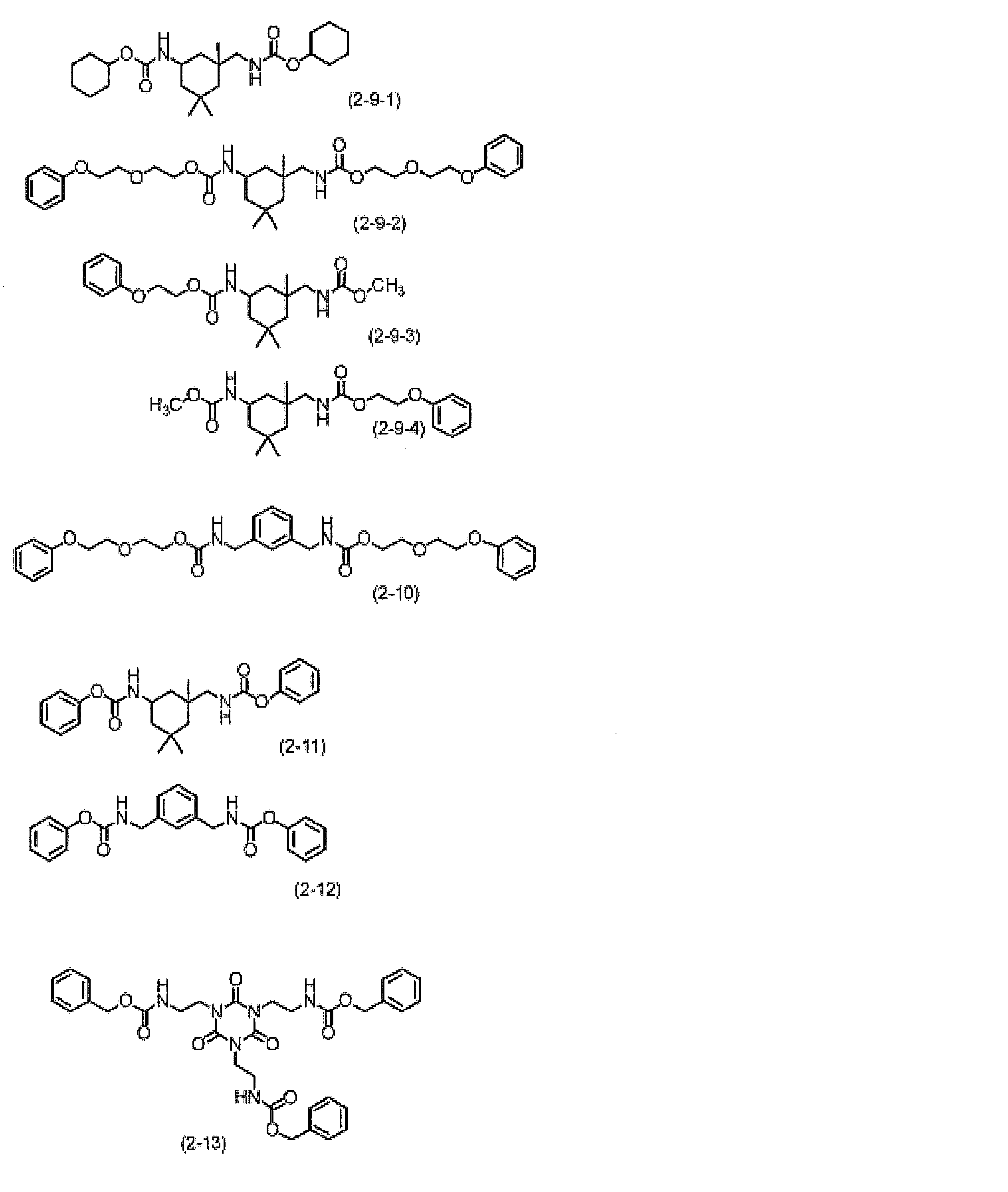

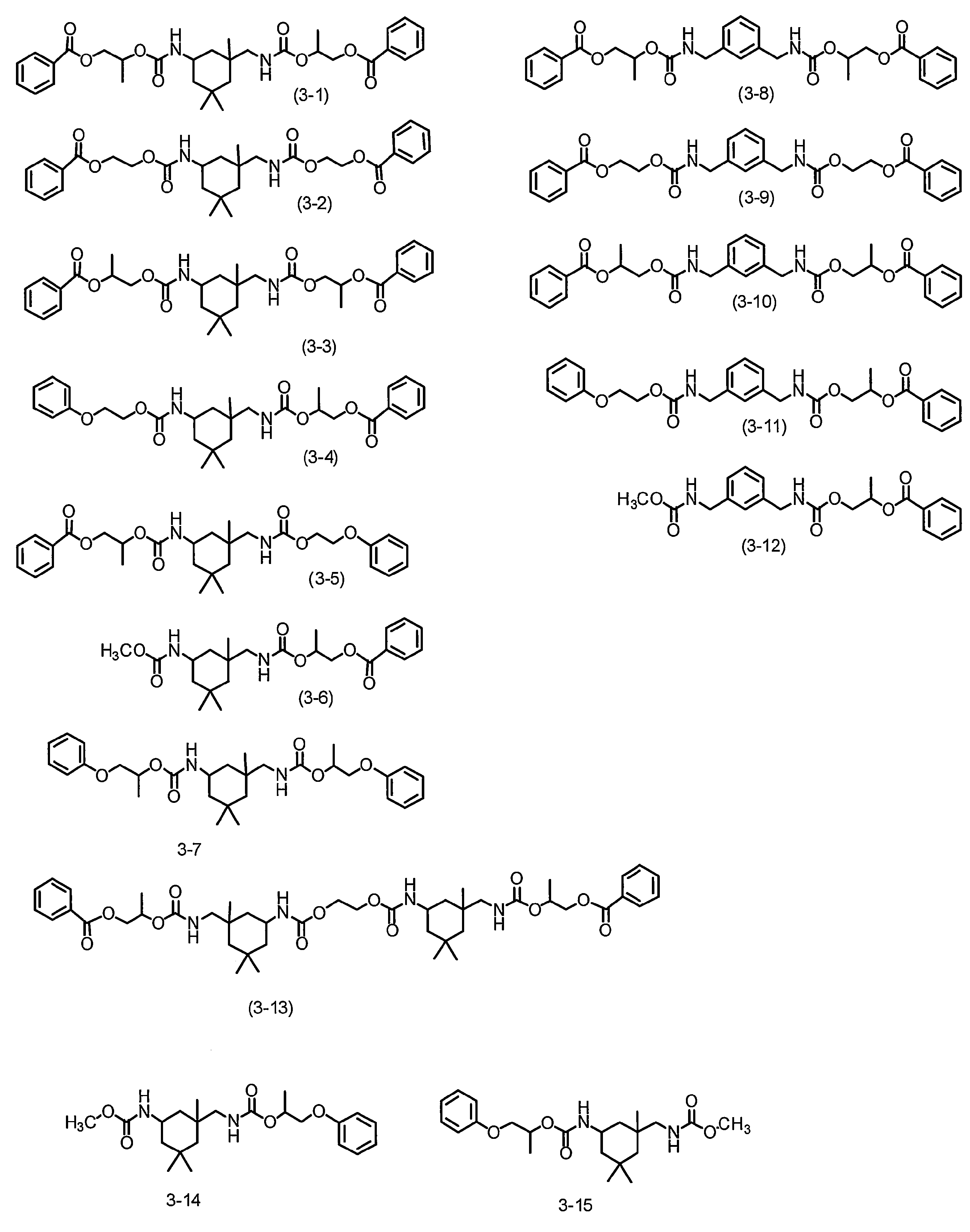
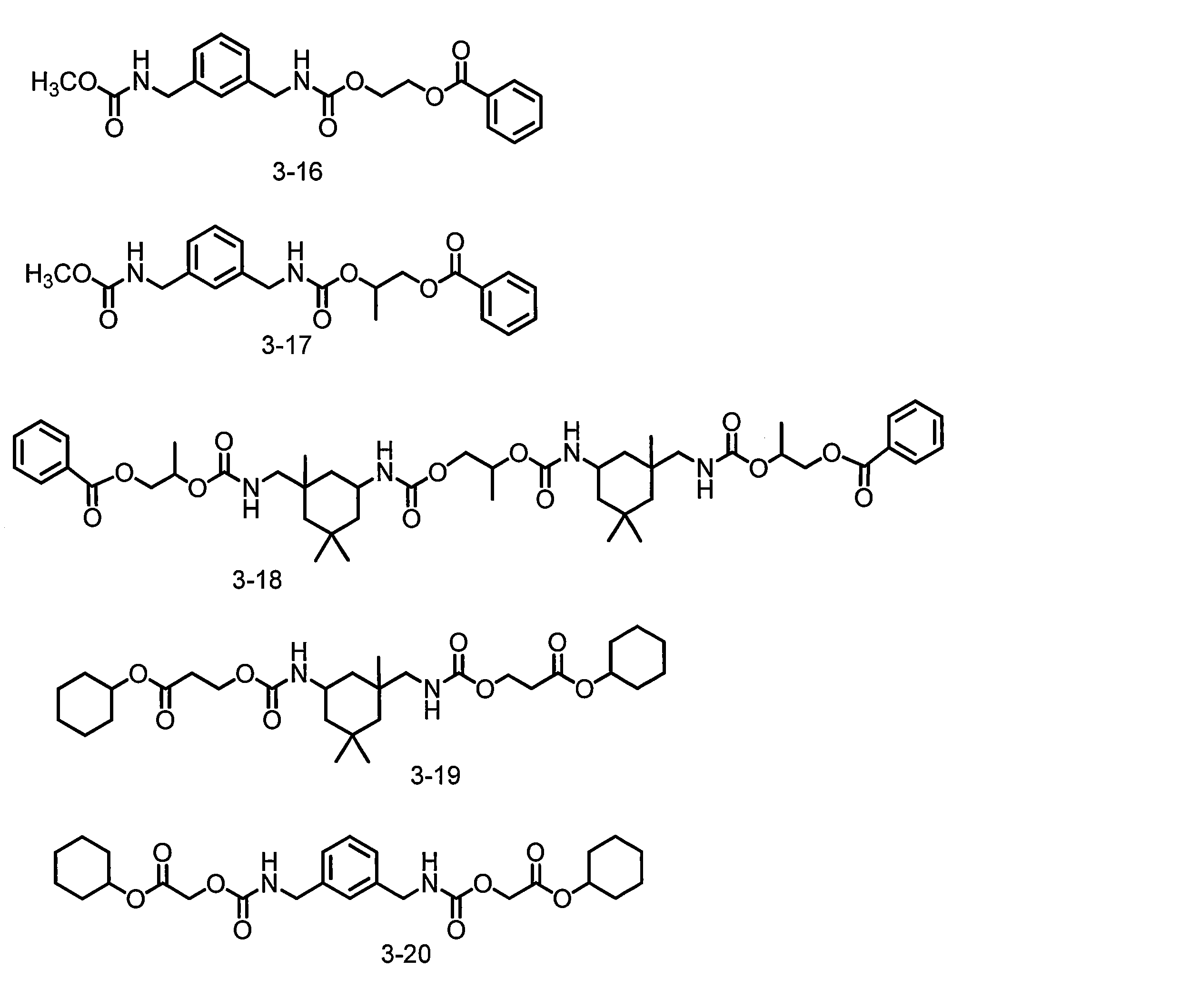
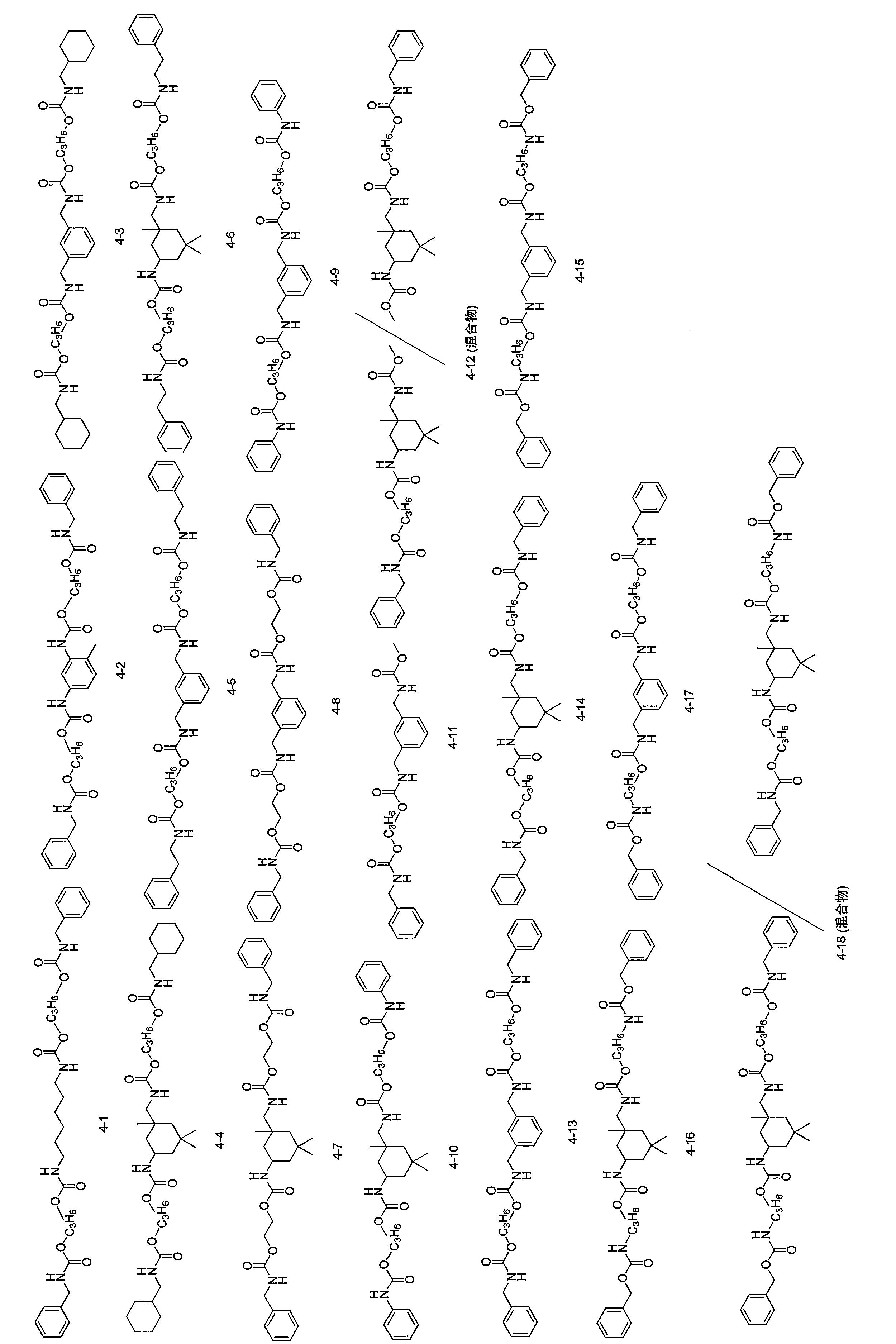
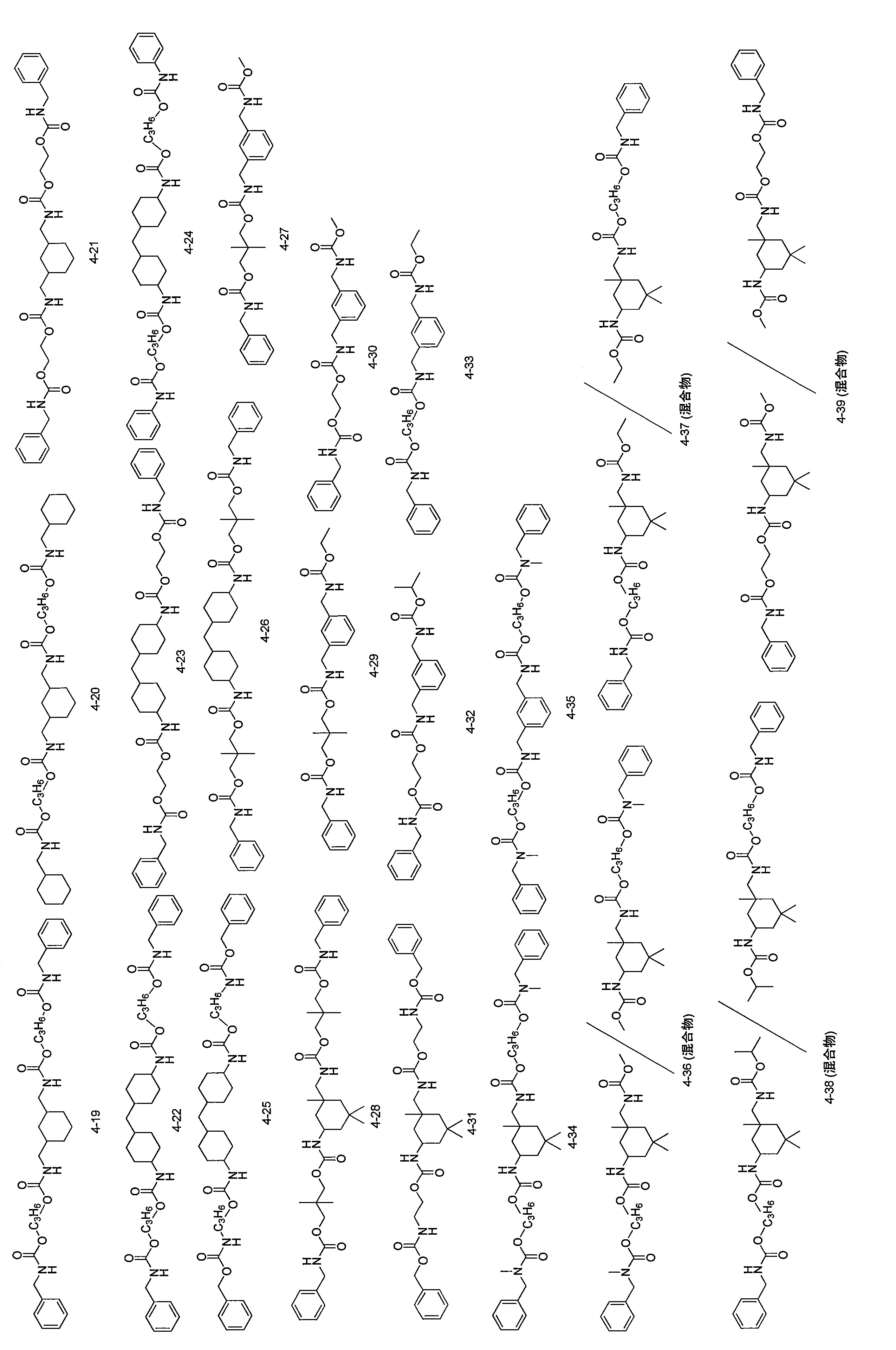
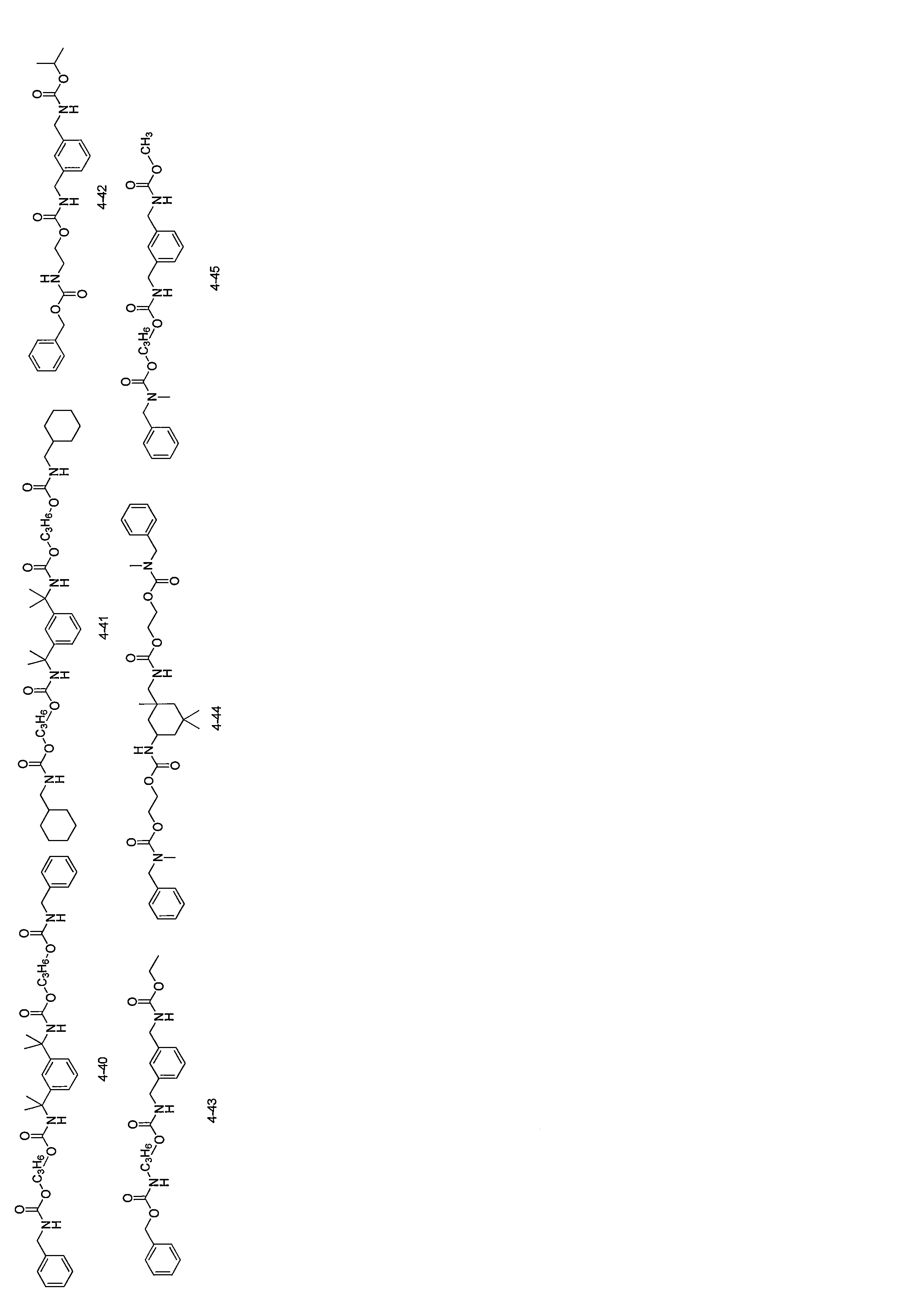
例えば、アルキルまたはアリールイソシアネートへのアルコールの付加反応、あるいはアミンとカーボネートの縮合反応などにより得ることができる。
アルキルまたはアリールイソシアネートへのアルコールの付加反応の際、触媒を用いることも好ましく、触媒として、アミン類、亜鉛、スズなどの金属有機酸塩もしくは金属キレート化合物、亜鉛、スズ、ビスマスなどの有機金属化合物などの従来公知のウレタン化触媒を使用できる。ウレタン化触媒としては、例えば、ジブチルスズジラウレート、ジブチルスズジアセテートなどが好ましく用いられる。
一価のイソシアネート成分の例としては、フェニルイソシアネート、ベンジルイソシアネート、ブチルイソシアネートなどが挙げられるが、これらに制限されるものではない。
多価アルコールの例としては、エチレングリコール、ジエチレングリコール、トリエチレングリコール、テトラエチレングリコール、1,2-プロパンジオール、1,3-プロパンジオール、ジプロピレングリコール、トリプロピレングリコール、1,3-ブタンジオール、1,4-ブタンジオール、1,5-ペンタンジオール、1,6-ヘキサンジオール、トリメチロールプロパン、トリメチロールエタン、グリセリン等を挙げることができる。
一価のアルコールの例としては、置換または無置換のアルコールがあげられる。アルコール成分として、芳香環を含むことも好ましく、ベンジルアルコール、フェネチルアルコール、フェノキシエタノールなどがあげられる。
分子量が230以上であればフィルムからの揮散を抑制するのに優れ、分子量が2000以下であればセルロースアシレートとの相溶性が十分となり、ヘイズの上昇を防ぐことができるので好ましい。
また、一般式(I)で表される化合物の融点は、-50~250℃であることが好ましく、-30~200℃であることがより好ましい。このような範囲とすることにより、本発明の効果がより効果的に発揮される傾向にある。
融点の測定方法としては、特に制限はなく、公知の方法の中から適宜選択することができるが、例えば、微量融点測定装置などを用いて測定する方法が挙げられる。
第二の態様のセルロースアシレートフィルムは、下記一般式(A-100)で表される化合物を含有する。このような化合物を用いることにより、セルロースアシレートフィルムの表面硬度を発現させることが可能となり、更に、光着色性の弊害を低減することもできる。加えて上記化合物は、低揮散性を示すことができるため、透明性の高いフィルムの提供にも寄与することができる。
一般式(A-100)
QA-(L102-L101)na-NR100-C(=O)-NH-(L103-L104)nb-QB
(一般式(A-100)中、R100は水素原子または置換基を表す;L101およびL103は、それぞれ独立にアルキレン基を表し、アルキレン基は置換基を有していてもよい。L102およびL104はそれぞれ独立に単結合または-O-、-NR100a-、-S-、-C(=O)-のいずれかまたはこれらの組み合わせからなる基を表す。R100aは、水素原子または置換基を表す。naおよびnbは、それぞれ独立に0~20の整数を表し、L101、L102、L103およびL104が複数存在する場合は、互いに同一でも異なっていてもよい。QAおよびQBは、それぞれ独立に置換基を表し、QAおよびQBの少なくとも一方は環状構造を含む。naがゼロを表し、かつQAが環状構造を含む場合、QAに含まれる環状構造は、-NR100-中のR100とともに形成された環状構造であってもよい。ただし、一分子中の-NH-(C=O)-NH-で表される2価の連結基の数は0または1である。)
一方、(L102-L101)または(L103-L104)が表す連結基の具体例としては、下記一般式(2A)~(2E)に加えて、下記一般式(2F)で表される構造が例示される。
一般式(2A) -{Rb jb(CRaRc)ja-O-(C=O)}-*
一般式(2B) -{Rb jb(CRaRc)ja-O}-*
一般式(2C) -{Rb jb(CRaRc)ja-(C=O)O-}-*
一般式(2D) -{Rb jb(CRaRc)ja-NR100a(C=O)O-}-*
一般式(2E) -{Rb jb(CRaRc)ja-O-(C=O)NR100a}-*
一般式(2F) -{Rb jb(CRaRc)ja-NR100a(C=O)NR100a}-*
(一般式(2A)~(2F)中、*は、QAもしくはQBとの結合位置または隣接する基とQAもしくはQB側で結合する位置を表し、Raは水素原子または炭素数1~3のアルキル基を表し、jaは1以上の整数を表し、Raが複数存在する場合、複数のRaはそれぞれ同一であっても異なっていてもよい。Rbは1つ以上の炭素数1~3のアルキル基で置換されていてもよいシクロアルキレン基を表し、jbは0または1である。R100aは水素原子または炭素数1~4のアルキル基を表し、R100aが複数存在する場合、複数のR100aはそれぞれ同一であっても異なっていてもよい。)
-(1~3つの炭素数1~3のアルキル基で置換されているシクロヘキシレン基)-CH2―NR100a(C=O)NR1-
-C(CH3)2-R1(C=O)NR100a-
-CH2-NR1(C=O)NR100a-、
-CH2CH2-NR1(C=O)NR100a-、
-CH2CH2CH2-NR1(C=O)NR100a-、
-CH2CH(CH3)-NR1(C=O)NR100a-、
-CH(CH3)CH2-NR1(C=O)NR100a-、
などが挙げられる。
置換基としては、上記置換基群Tが挙げられ、炭素数が6~30(より好ましくは6~20、さらに好ましくは6~10)のアリール基、炭素数が1~12(より好ましくは1~10、さらに好ましくは1~6)のアルキル基(但し、アルキル鎖中に酸素原子が入っていてもよく、シクロアルキル基でもよい)、炭素数が2~12(より好ましくは2~10、さらに好ましくは2~5)のアルケニル基、炭素数が1~12(より好ましくは1~10、さらに好ましくは1~5)のアルコキシ基、または炭素数1~30(より好ましくは1~12、さらに好ましくは1~5)のヘテロ環基(ヘテロ原子としては、例えば窒素原子、酸素原子、硫黄原子、具体的には例えばピペリジル基、モルホリノ基)が挙げられる。QAおよびQBは、一方または両方が、炭素数が6~10のアリール基、炭素数が1~10のアルキル基を表すことが特に好ましい。QAおよびQBは、さらに置換基を有していてもよく、置換基の具体例としては、上記置換基群Tが挙げられ、アリール基、アルキル基、アシル基が好ましい。
QA、QBの一方または両方に含まれる環状構造としては、脂肪族環(シクロヘキサン環など)、芳香環(ベンゼン環、ナフタレン環など)、ヘテロ環(ピペリジン環、モルホリン環など)などが挙げられ、複数種の環を有していてもよく、縮合環であってもよい。一態様では、上記環状構造は、環状イミド基ではないことが好ましい。また他の一態様では、QAおよびQBの少なくとも一方、望ましくは両方が、極性基ではないことが好ましい。ここで極性基とは、ClogP値が0.85以下の置換基をいうものとする。ClogP値については後述する。本明細書において、QA、QBのClogP値は、当該置換基が水素に連結した化合物QA―H、QB-HのClogP値として求める。実際には存在しない構造の化合物であっても、計算化学的手法または経験的方法により見積もられる値として、clogP値を求めることができる。ClogP値が0.85以下の置換基の具体例としては、シアノ基、イミド基が挙げられる。
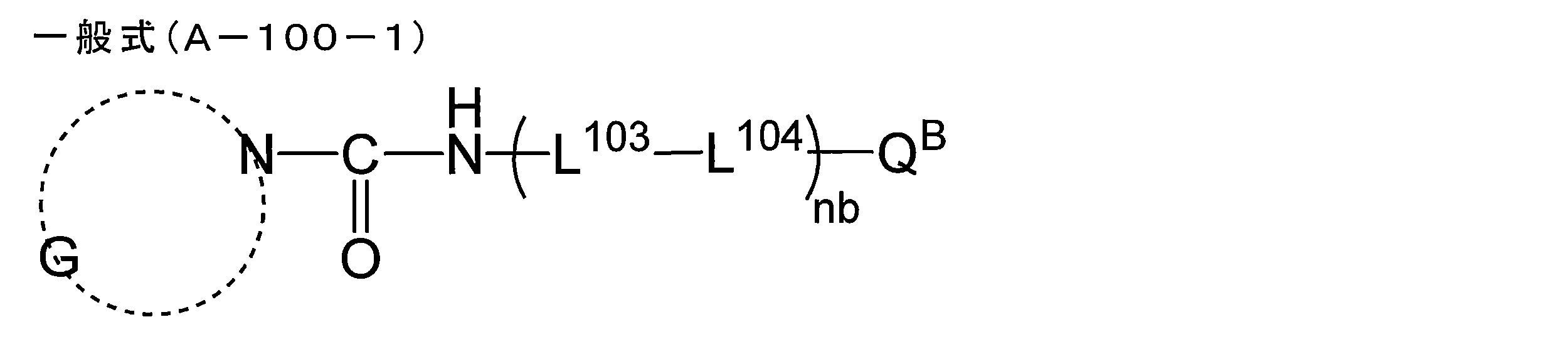
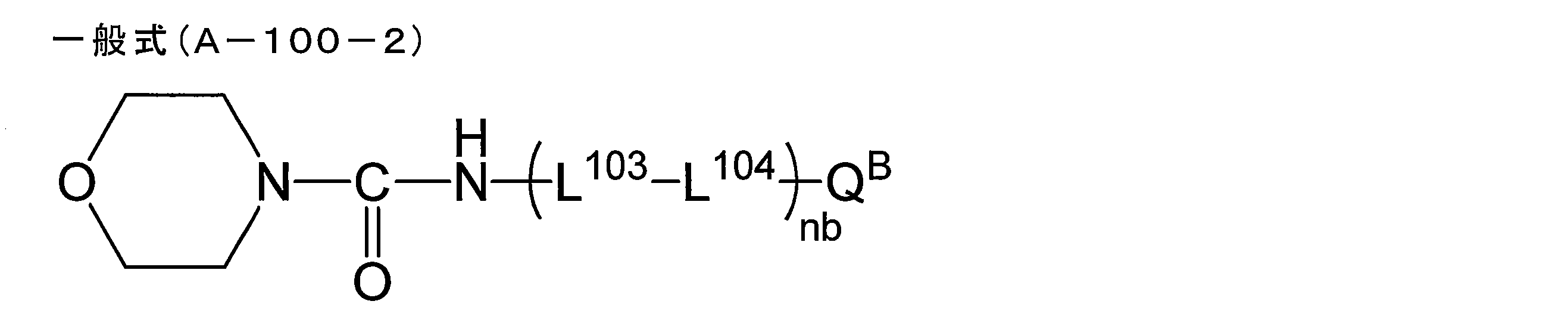
一般式(a)
*-(L102-L101)na-NR100-C(=O)-NH-(L103-L104)nb-QB
一般式(b)
QA-(L102-L101)na-NR100-C(=O)-NH-(L103-L104)nb-*
-(L102-L101)na-NR-C(=O)-NH-(L103-L104)nb-
で表される構造を、一分子中に2つ以上有することが好ましい。なお、上記一般式(a)、(b)中、L101~L104、na、nb、QAおよびQBは、一般式(A-100)と同義である。上記好ましい態様にかかる化合物の具体的態様については、後述する。上記連結基としては、一般式(A-101)中のZ101について記載するものを挙げることができる。
ただし一般式(A-100)で表される化合物は、上記2価の連結基として、R100が水素原子であるものを2つ以上含まない。即ち、一般式(A-100)で表される化合物において、一分子中の-NH-(C=O)-NH-で表される2価の連結基の数は0または1である。一般式(A-100)で表される構造を有するが、-NH-(C=O)-NH-で表される2価の連結基を一分子中に2つ以上含む化合物は、セルロースアシレートとの相溶性に劣るためである。
一般式(A-101)
(Q103-(L132-L131)n103-A-(L141-L142)n104)m-Z101
(一般式(A-101)中、L131およびL141は、それぞれ独立にアルキレン基を表し、アルキレン基は置換基を有していてもよい。L132およびL142はそれぞれ独立に単結合または-O-、-NR100a-、-S-、および-C(=O)-のいずれかまたはこれらの組み合わせからなる基を表す。R100aは、水素原子または置換基を表す。n103およびn104は、それぞれ独立に0~20の整数を表し、L131、L132、L141およびL142が複数存在する場合は、互いに同一でも異なっていてもよい。Q103は、置換基を表し、Z101はm価の連結基を表し、Aは、*-NR100-C(=O)-NH-、*-NH-C(=O)-NR100-、*-O-C(=O)-NH-、または*-NH-C(=O)-O-を表し、R100は水素原子または置換基を表し、*はL141またはZ101との結合位置を表す。mは、2~6の整数を表し、複数存在するQ103およびAは、それぞれ、互いに同一でも異なっていてもよい。ただし少なくとも1つのAは、*-NR100-C(=O)-NH-または*-NH-C(=O)-NR100-を表す。また、Q103およびZ101の少なくとも一種は環状構造を含む。少なくとも1つのn103がゼロを表し、Q103が環状構造を含み、かつAが*-NH-C(=O)-NR100-を表す場合、Q103に含まれる環状構造は、Aに含まれる-NR100-中のR100とともに形成された環状構造であってもよい。ただし、一分子中の-NH-(C=O)-NH-で表される2価の連結基の数は0または1である。)
L132、L142は、それぞれ独立に一般式(A-100)中のL102、L104と同義であり、好ましい範囲も同様である。
特に、(L141-L142)が表す連結基は、単結合またはアルキレン基が好ましく、(L32-L31)が表す連結基は、単結合、アルキレン基、または下記一般式(2A)~(2F)のいずれかで表される基であることが好ましい。一般式(2A)~(2F)の詳細は、上述の通りである。
一般式(2A) -{Rb jb(CRaRc)ja-O-(C=O)}-*
一般式(2B) -{Rb jb(CRaRc)ja-O}-*
一般式(2C) -{Rb jb(CRaRc)ja-(C=O)O-}-*
一般式(2D) -{Rb jb(CRaRc)ja-NR100a(C=O)O-}-*
一般式(2E) -{Rb jb(CRaRc)ja-O-(C=O)NR100a}-*
一般式(2F) -{Rb jb(CRaRc)ja-NR100a(C=O)NR100a}-*
(一般式(2A)~(2F)中、*は、Q103との結合位置または隣接する基とQ103側で結合する位置を表し、Ra、Rc、Rb、ja、jbについては、先に記載した通りである。
mは、2~6の整数を表し、2~3の整数が好ましい。
Q103が含む環状基は、縮合環でもよいが、単環の方が好ましい。具体的には、脂肪族環(シクロヘキサン環など)、芳香環(ベンゼン環、ナフタレン環など)、ヘテロ環(モルホリン環、ピペリジン環、ピペラジン環、ピリジン環、ピリミジン環、トリアジン環、フラン環、など)などが挙げられる。
一般式(A-101)中、mは2~6の範囲の整数であるため、一般式(A-101)で表される化合物には、複数の(m個の)Q103が含まれる。複数存在するQ103は、それぞれ、互いに同一であっても異なっていてもよい。複数存在するQ103は、すべて環状構造であってもよく、環状構造とアルキル基等の非環状構造との組み合わせであってもよい。環状構造としては、脂肪族環基、芳香族基または含窒素6員複素環を含むことが好ましい。Q3で表される環状基としては、炭素数が6~30(より好ましくは6~20、さらに好ましくは6~10)のシクロアルキル基、炭素数が6~30(より好ましくは6~20、さらに好ましくは6~10)のアリール基、または含窒素6員複素環基が好ましく、シクロヘキシル基、フェニル基またはモルホリノ基が更に好ましい。
一方、非環状構造として好ましくは、炭素数が1~30の直鎖状または分岐状のアルキル基であり、より好ましくは炭素数が1~3のアルキル基であり、更に好ましくはメチル基またはエチル基である。
Q103およびZ101の少なくとも一種は1つ以上の環状構造を含むが、複数存在するQ103の1つ以上およびZ101のいずれもが環状構造を含むことがより好ましい。また、Q103およびZ101に合計2つ~4つの環状構造を有することが好ましく、2つまたは3つの環状構造を有することがより好ましい。
Z101は、直鎖、分岐または環状の脂肪族基および芳香族基の少なくとも1種のみからなっていてもよいし、これらの基と、酸素原子、直鎖または分岐のアルキレン基との組み合わせであることも好ましい。Z101として含まれる脂肪族基は飽和脂肪族基であることが好ましい。
分岐または環状の脂肪族基および芳香族基の少なくとも1種を含む基とすることにより、剛直な構造となり、フィルムの表面硬度が向上する傾向にある。Z1を構成する炭素数は3~20が好ましく、4~15がより好ましい。
Z101は、置換基を有していてもよく、置換基の具体例としては、上述の置換基群Tが挙げられるが、置換基を有さない方が好ましい。
具体的には、以下に例示される連結基が好ましい。なお、*はL142に結合(L141が存在しない場合にはAに直結)する位置を表す。

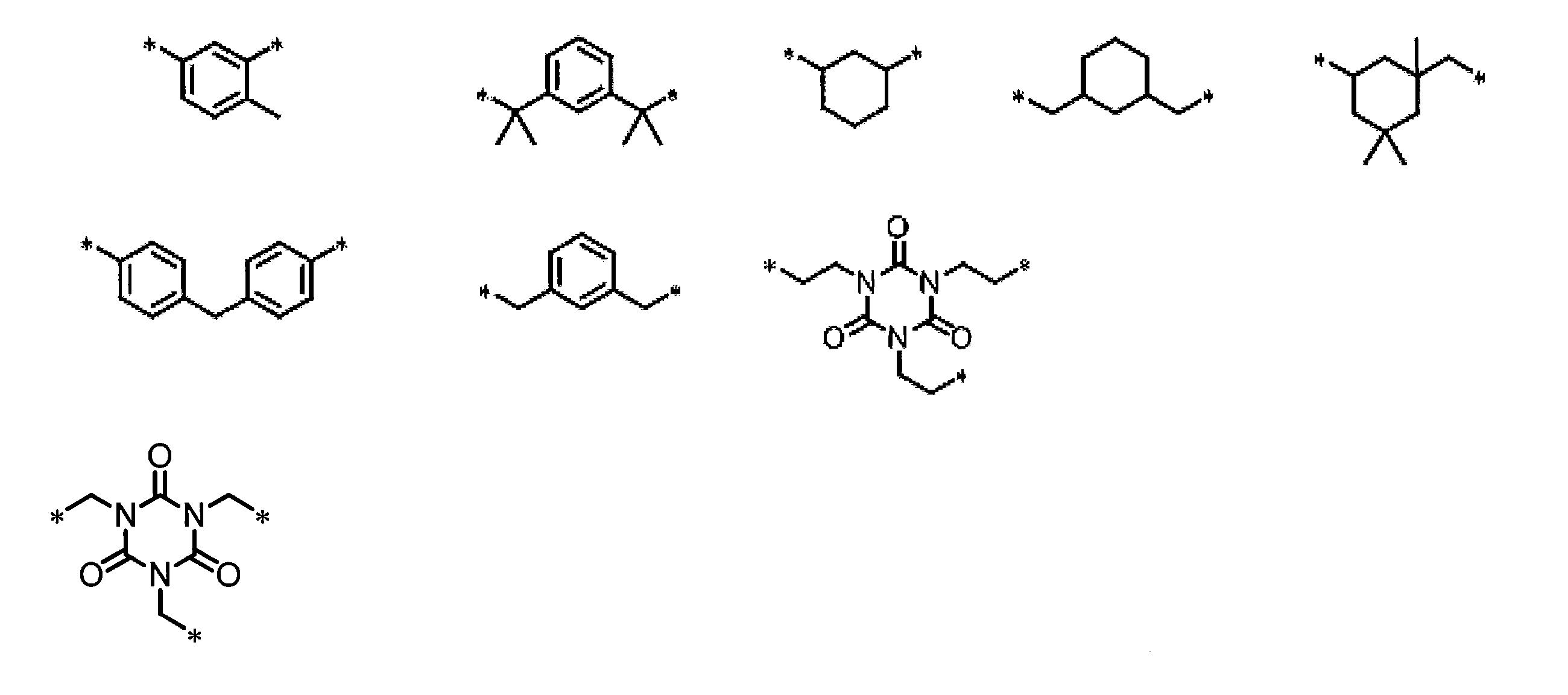


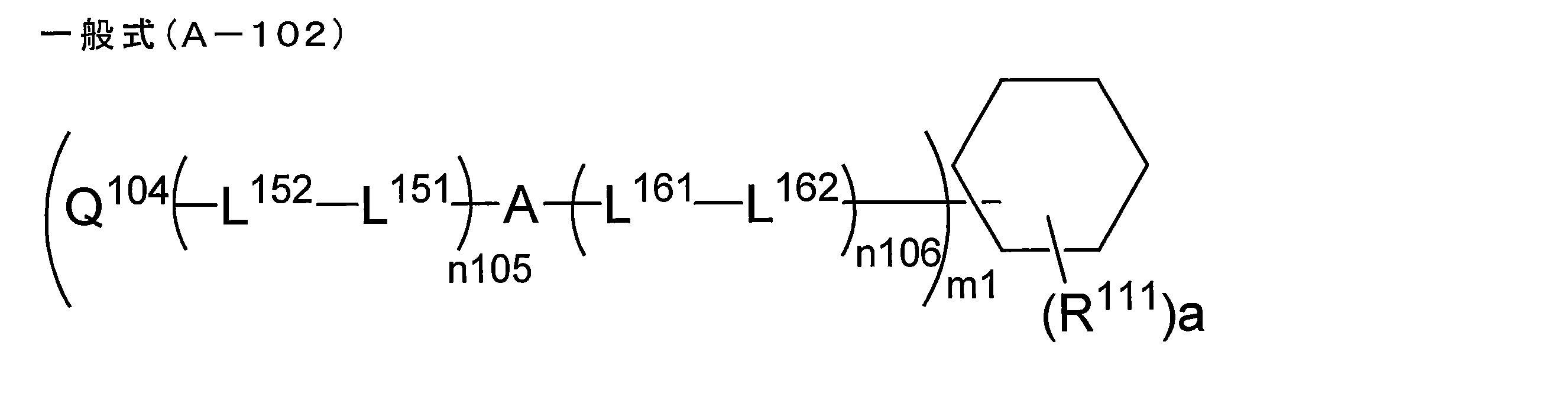
L152、L162は、それぞれ独立に一般式(A-100)中のL102、L104と同義であり、好ましい範囲も同様である。
n105、n106は、それぞれ独立に一般式(A-100)中のna、nbと同義であり、好ましい範囲も同様である。
(L161-L162)が表す連結基は、一般式(A-101)における(L141-L142)と同義であり、好ましい範囲も同様である。
下記の*は

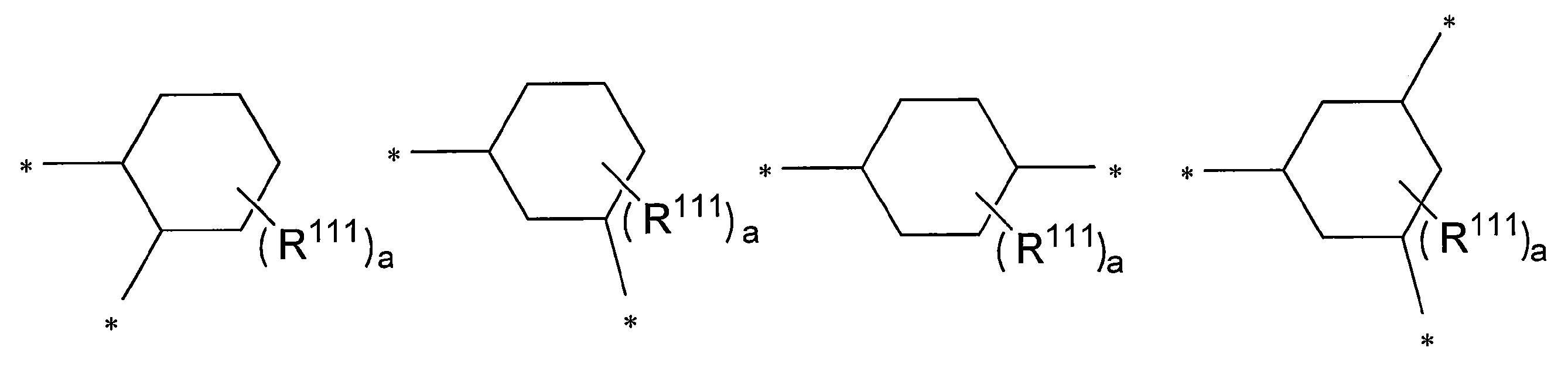


L172、L182は、それぞれ独立に一般式(A-100)中のL102、L104と同義であり、好ましい範囲も同様である。
n107、n108は、それぞれ独立に一般式(A)中のna、nbと同義であり、好ましい範囲も同様である。
(L181-L182)n8が表す連結基は、一般式(A-101)における(L141-L142)と同義であり、好ましい範囲も同様である。
下記の*は



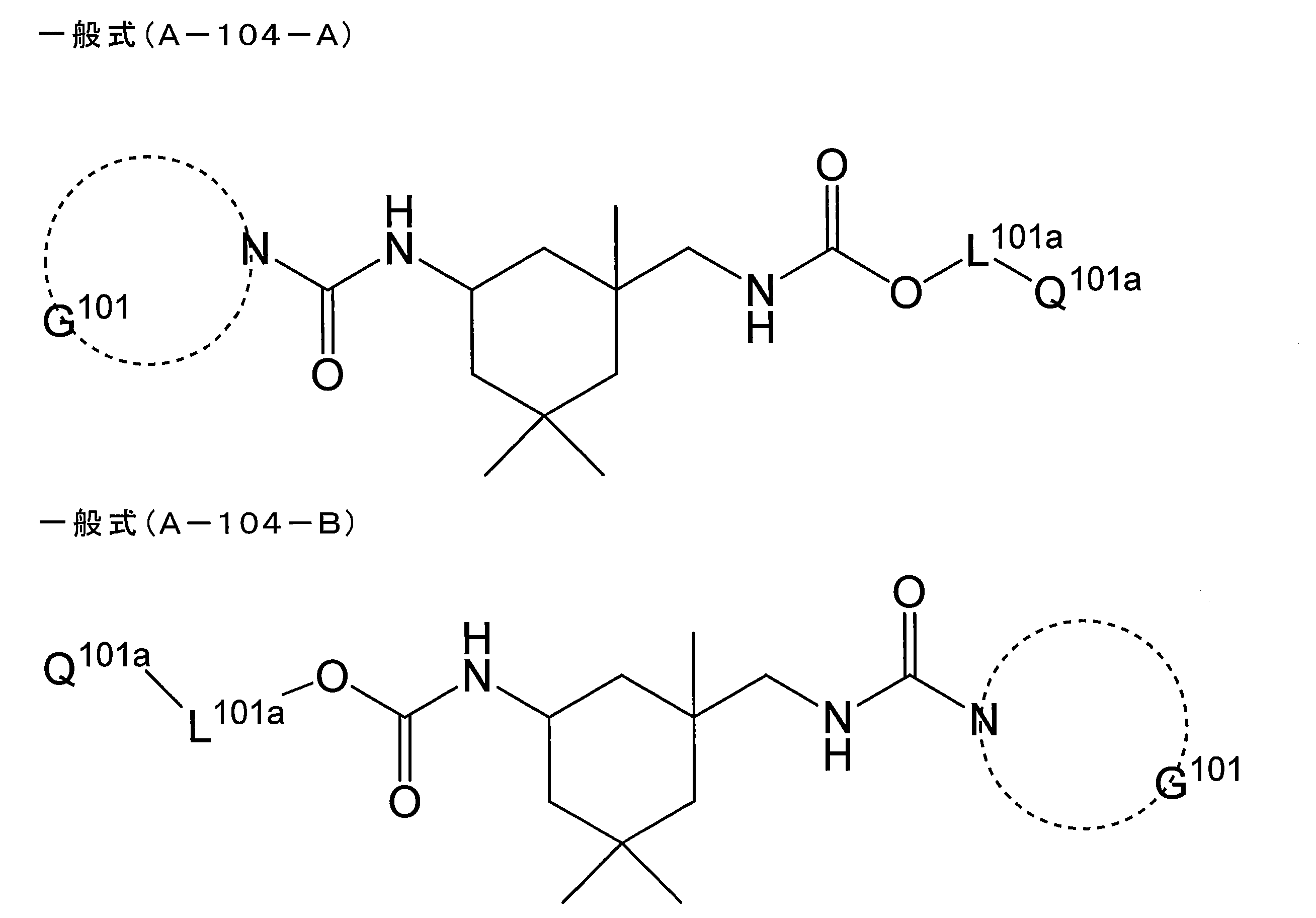
一般式(2A) -{Rb jb(CRaRc)ja-O-(C=O)}-*
一般式(2B) -{Rb jb(CRaRc)ja-O}-*
一般式(2C) -{Rb jb(CRaRc)ja-(C=O)O-}-*
一般式(2D) -{Rb jb(CRaRc)ja-NR100a(C=O)O-}-*
一般式(2E) -{Rb jb(CRaRc)ja-O-(C=O)NR100a}-*
一般式(2F) -{Rb jb(CRaRc)ja-NR100a(C=O)NR100a}-*
(一般式(2A)~(2F)中、*は、Q101aとの結合位置または隣接する基とQ101a側で結合する位置を表し、RaおよびRcは、それぞれ独立に水素原子または炭素数1~3のアルキル基を表し、jaは1以上の整数を表し、RaおよびRcが複数存在する場合、複数のRaおよびRcはそれぞれ同一であっても異なっていてもよい;Rbは1つ以上の炭素数1~3のアルキレン基で置換されていてもよいシクロアルキレン基を表し、jbは0または1である;R100aは水素原子または炭素数1~4のアルキル基を表し、R100aが複数存在する場合、複数のR100aはそれぞれ同一であっても異なっていてもよい。ただし、一分子中の-NH-(C=O)-NH-で表される2価の連結基の数は0または1である。)
一般式(2A-1) -{(CRaRc)ja-O-(C=O)}-*
一般式(2B-1) -{(CRaRc)ja-O}-*
一般式(2C-1) -{(CRaRc)ja-(C=O)O-}-*
一般式(2D-1) -{(CRaRc)ja-NR100a(C=O)O-}-*
一般式(2E-1) -{(CRaRc)ja-O-(C=O)NR100a}-*
一般式(2F-1) -{(CRaRc)ja-NR1(C=O)NR100a}-*
(一般式(2A-1)~(2F-1)中、*は、Q1aまたはQ1bとの結合位置または隣接する基とQ1aまたはQ1b側で結合する位置を表し、RaおよびRcは、それぞれ独立に水素原子または炭素数1~3のアルキル基を表し、jaは、それぞれ独立に1以上の整数を表し、Ra、Rcが複数存在する場合、複数のRa、Rcはそれぞれ同一であっても異なっていてもよい。R100aは、水素原子または炭素数1~4のアルキル基を表し、R100aが複数存在する場合、複数のR100aはそれぞれ同一であっても異なっていてよい。)

一般式(2A) -{Rb jb(CRaRc)ja-O-(C=O)}-*
一般式(2B) -{Rb jb(CRaRc)ja-O}-*
一般式(2C) -{Rb jb(CRaRc)ja-(C=O)O-}-*
一般式(2D) -{Rb jb(CRaRc)ja-NR100a(C=O)O-}-*
一般式(2E) -{Rb jb(CRaRc)ja-O-(C=O)NR100a}-*
一般式(2F) -{Rb jb(CRaRc)ja-NR100a(C=O)NR100a}-*
(一般式(2A)~(2F)中、*は、Q102a、Q103aとの結合位置または隣接する基とQ102a、Q103a側で結合する位置を表し、RaおよびRcは、それぞれ独立に水素原子または炭素数1~3のアルキル基を表し、jaは1以上の整数を表し、RaおよびRcが複数存在する場合、複数のRaおよびRcはそれぞれ同一であっても異なっていてもよい;Rbは1つ以上の炭素数1~3のアルキル基により置換されていてもよいシクロアルキレン基を表し、jbは0または1である;R100aは水素原子または炭素数1~4のアルキル基を表し、R100aが複数存在する場合、複数のR100aはそれぞれ同一であっても異なっていてもよい。ただし、一分子中の-NH-(C=O)-NH-で表される2価の連結基の数は0または1である。)
一般式(2A-1) -{(CRaRc)ja-O-(C=O)}-*
一般式(2B-1) -{(CRaRc)ja-O}-*
一般式(2C-1) -{(CRaRc)ja-(C=O)O-}-*
一般式(2D-1) -{(CRaRc)ja-NR100a(C=O)O-}-*
一般式(2E-1) -{(CRaRc)ja-O-(C=O)NR100a}-*
一般式(2F-1) -{(CRaRc)ja-NR1(C=O)NR100a}-*
(一般式(2A-1)~(2F-1)中、*は、Q102aもしくはQ103aとの結合位置または隣接する基とQ102aもしくはQ103a側で結合する位置を表し、RaおよびRcは、それぞれ独立に水素原子または炭素数1~3のアルキル基を表し、jaは1以上の整数を表し、RaおよびRcが複数存在する場合、複数のRaおよびRcはそれぞれ同一であっても異なっていてもよい;R100aは水素原子または炭素数1~4のアルキル基を表し、R100aが複数存在する場合、複数のR100aはそれぞれ同一であっても異なっていてもよい。)
一態様では、L102aおよびL103aは、それぞれ独立に、下記一般式(2A-1)~(2F-1)のいずれかで表される基の1つ、下記一般式(2A-1)~(2F-1)のいずれかで表される基の2つ以上の組み合わせからなる基、または下記一般式(2A-1)~(2F-1)のいずれかで表される基の1つ以上とアルキレン基の1つ以上との組み合わせからなる基を表す。上記組み合わせは、例えば、上述の基の2つまたは3つからなる組み合わせである。
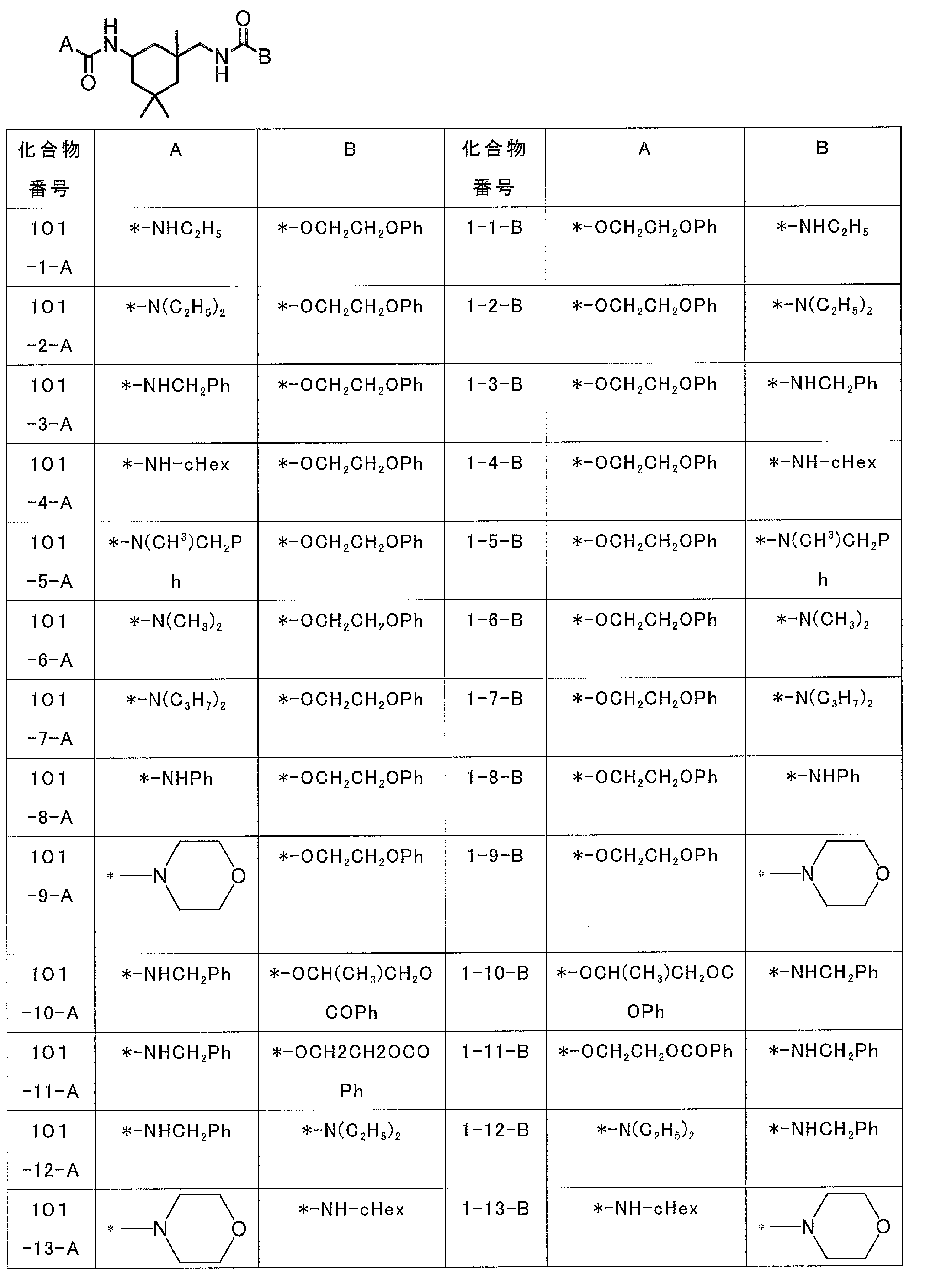
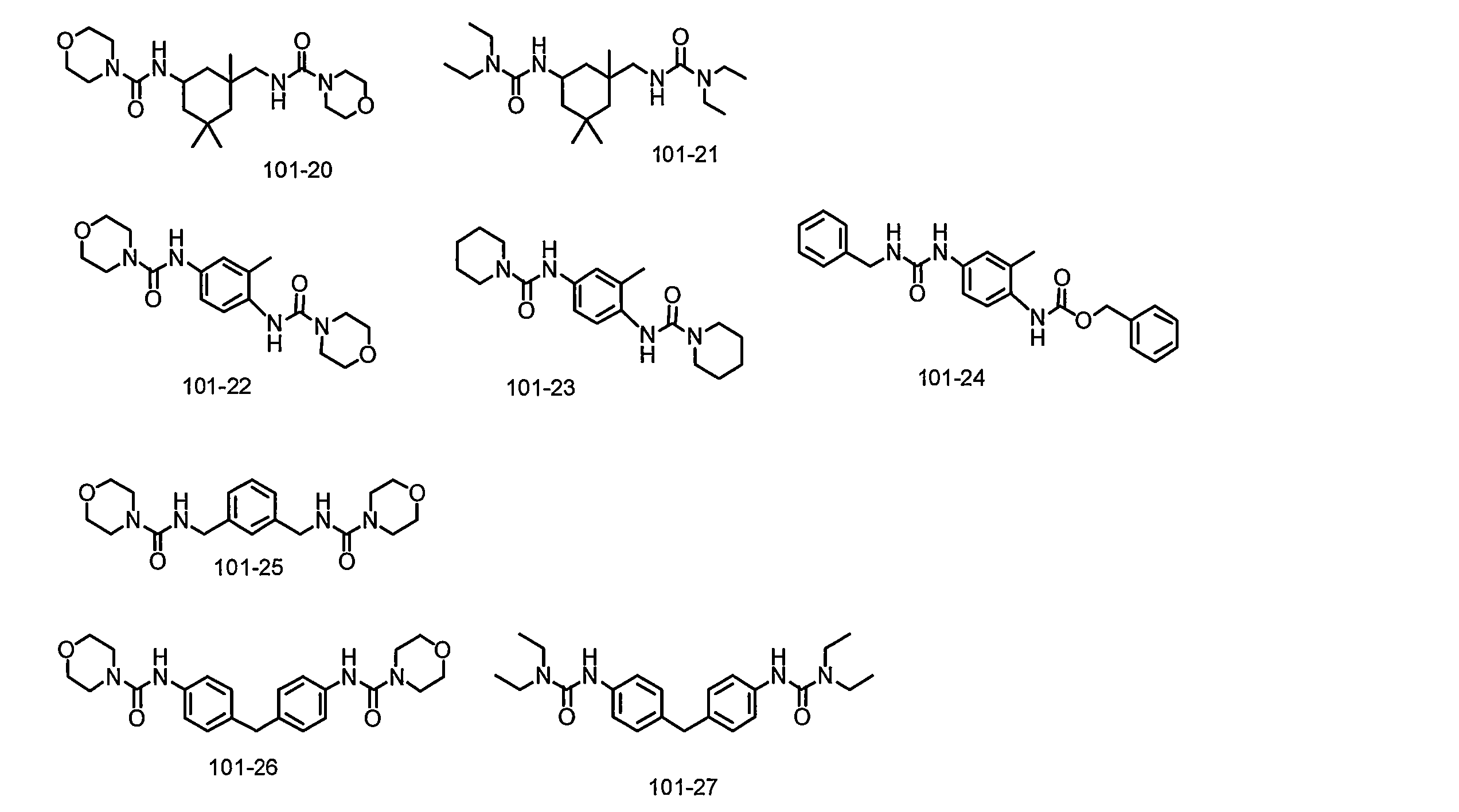
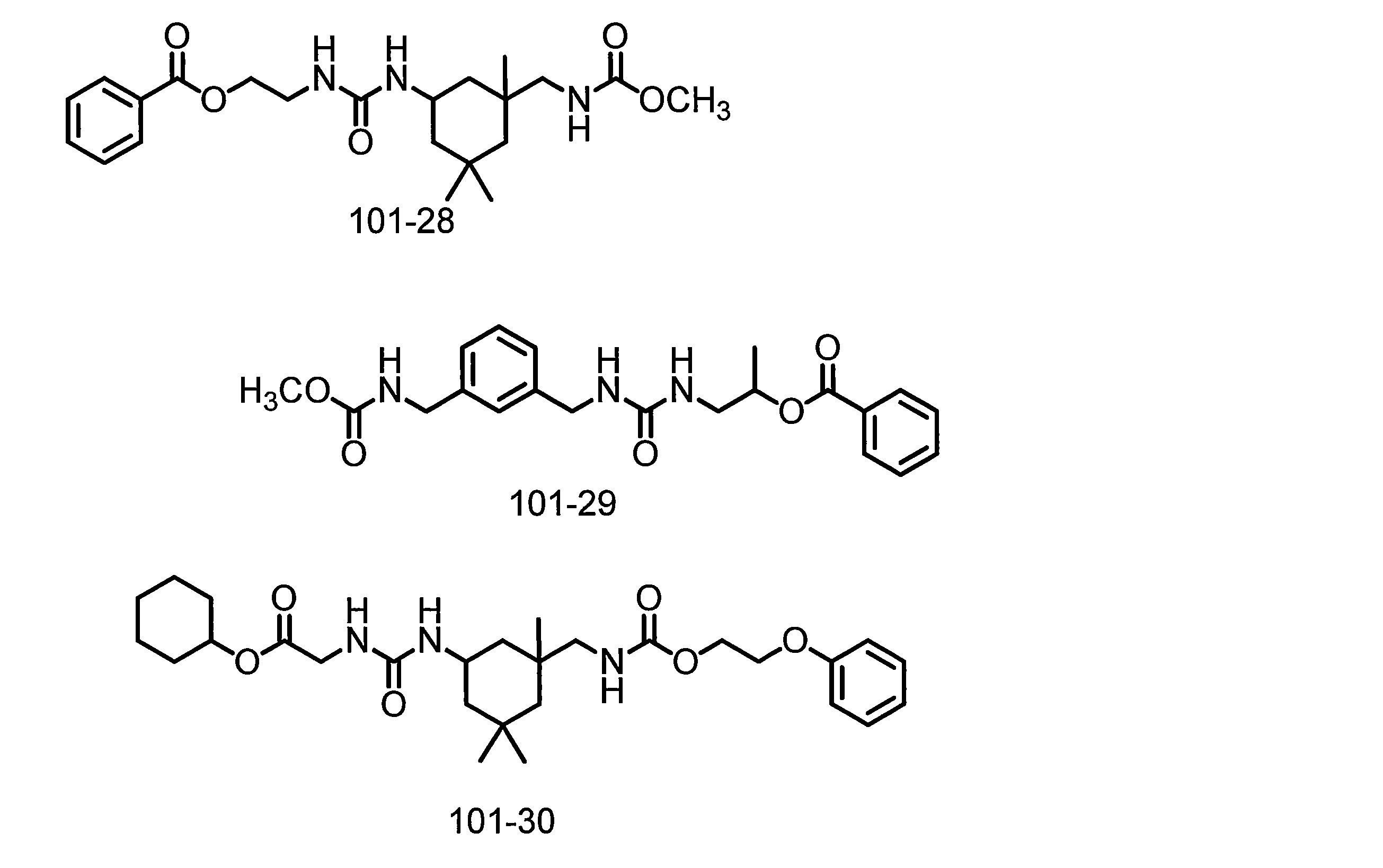
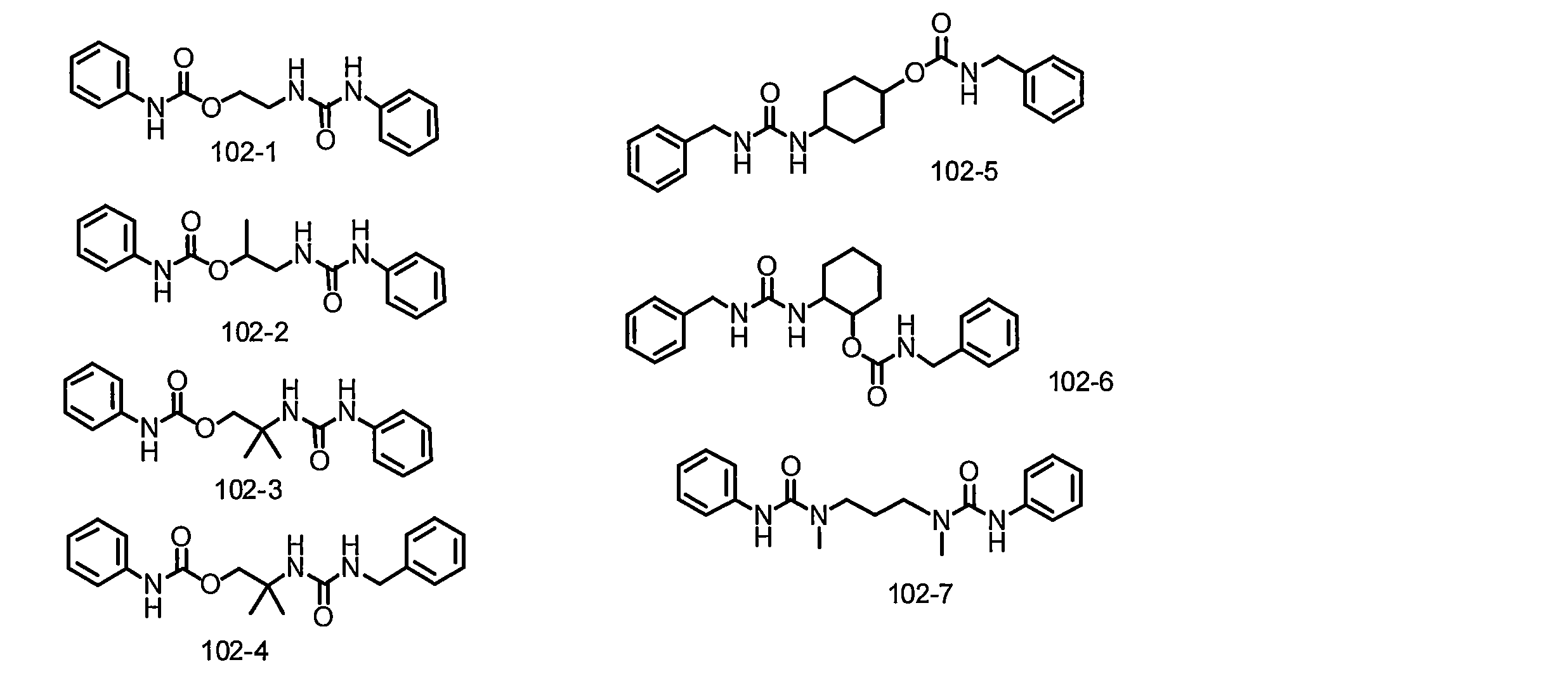
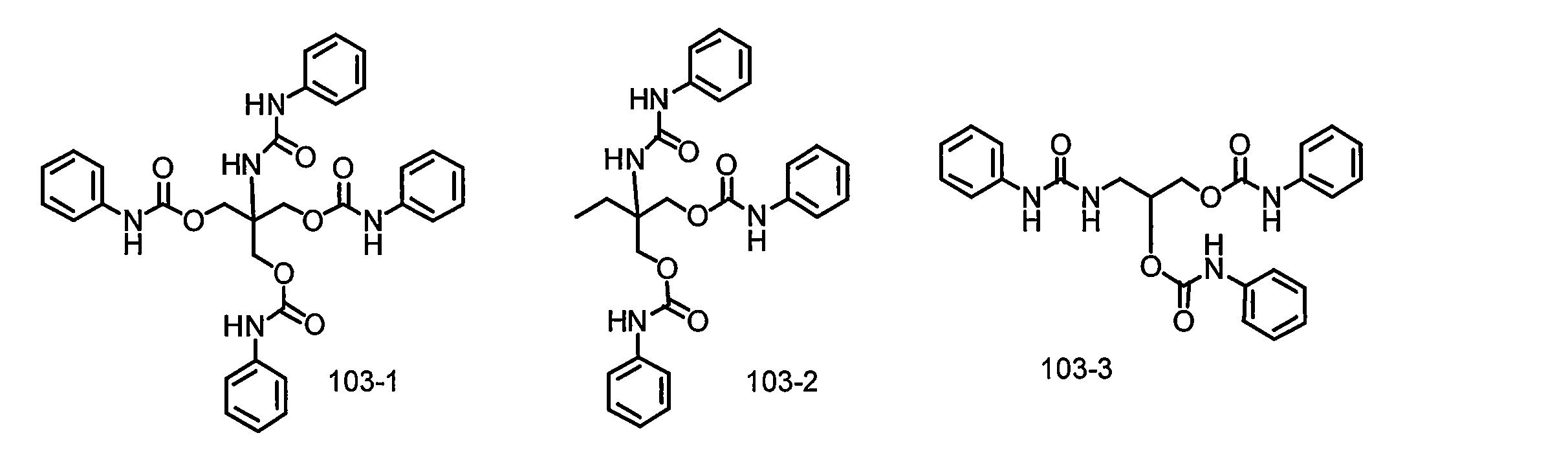

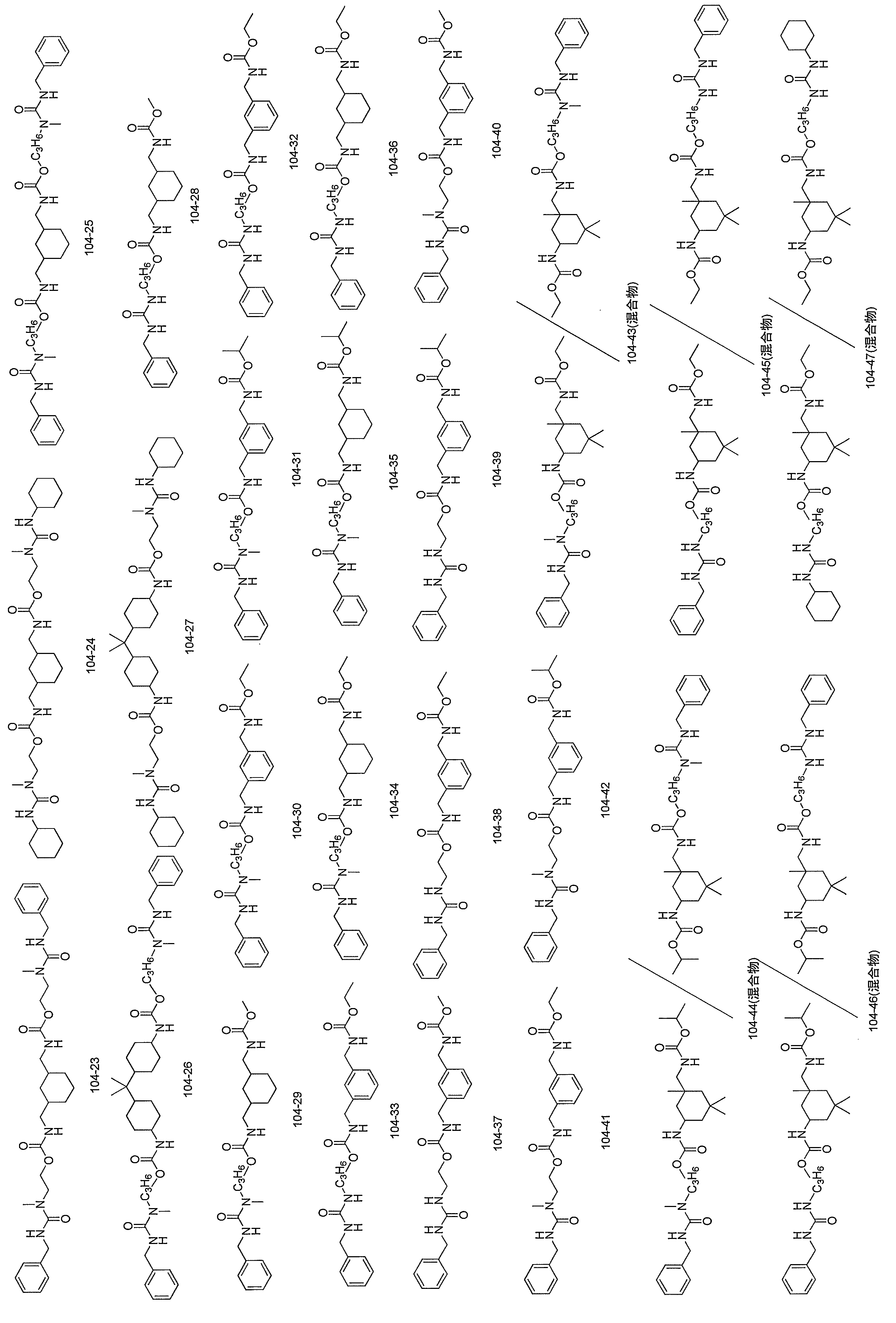
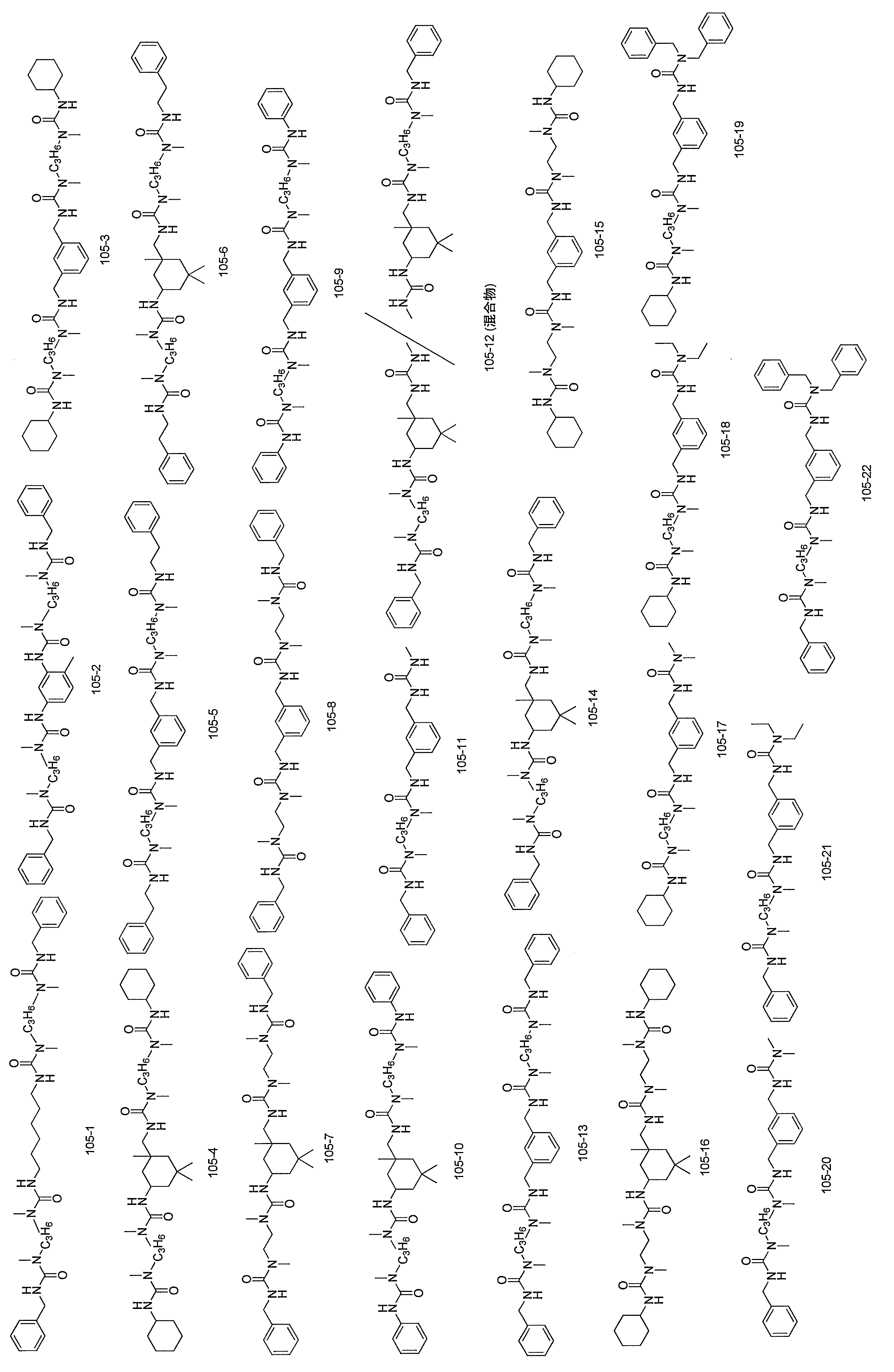
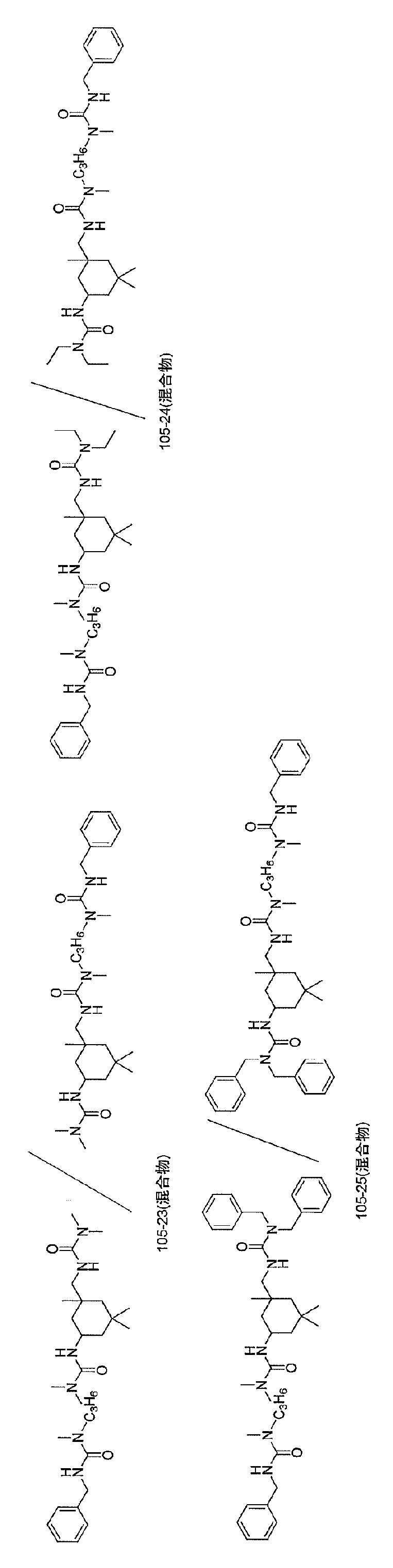
例えば、アルキルまたはアリールイソシアネートへのアミンの付加反応などにより得ることができる。
アルキルまたはアリールイソシアネートへのアミンの付加反応の際、触媒を用いることも好ましく、触媒として、アミン類、亜鉛、スズなどの金属有機酸塩もしくは金属キレート化合物、亜鉛、スズ、ビスマスなどの有機金属化合物などの従来公知のウレタン化触媒を使用できる。ウレタン化触媒としては、例えば、ジブチルスズジラウレート、ジブチルスズジアセテートなどが好ましく用いられる。
なお上記化合物の合成時、-NH-(C=O)-O-で表される2価の連結基を導入するための成分と、-NH-(C=O)-NR-で表される2価の連結基を導入するための成分とを併用すると、上記2種の連結基のうち-NH-(C=O)-NR-で表される2価の連結基のみを1つ以上含む構造を有する化合物と、両方をそれぞれ1つ以上含む構造の化合物が得られることがある。また、含まれる上記連結基の数がそれぞれ異なる化合物の混合物が得られることもある。本発明では、以上記載した各種化合物の混合物の状態で、セルロースアシレートフィルム製造のために用いることも可能である。または、混合物から目的の構造の化合物を公知の方法で精製し、単品として用いることもできる。
多価アミンの例としては、エチレンジアミン、キシリレンジアミン、4,4’-ジアミノジフェニルメタン等を挙げることができる。
一価のアミンの例としては、置換または無置換のアミンがあげられ、メチルアミン、ジメチルアミン、ジエチルアミン、アニリン、ベンジルアミン、シクロヘキシルアミン、モルホリン、ピペリジン等を挙げることができる。
またアミノアルコールを用いることもでき、その例としては、2-アミノエタノール、1-アミノ-2-プロパノール等を挙げることができる。
分子量が230以上であればフィルムからの揮散を抑制するのに優れ、分子量が2000以下であればセルロースアシレートとの相溶性が十分となり、ヘイズの上昇を防ぐことができるので好ましい。
また、一般式(A-100)で表される化合物の融点は、-50~250℃であることが好ましく、-30~200℃であることがより好ましい。このような範囲とすることにより、本発明の効果がより効果的に発揮される傾向にある。
融点の測定方法については、先に記載した通りである。
セルロースアシレートの置換度は、セルロースの構成単位((β)1,4-グリコシド結合しているグルコース)に存在している、3つのヒドロキシル基がアシル化されている割合を意味する。置換度(アシル化度)は、セルロースの構成単位質量当りの結合脂肪酸量を測定して算出することができる。本発明において、セルロース体の置換度はセルロース体を重水素置換されたジメチルスルフォキシド等の溶剤に溶解して13C-NMRスペクトルを測定し、アシル基中のカルボニル炭素のピーク強度比から求めることにより算出することができる。セルロースアシレートの残存ヒドロキシル基をセルロースアシレート自身が有するアシル基とは異なる他のアシル基に置換したのち、13C-NMR測定により求めることができる。測定方法の詳細については、手塚他(Carbohydrate.Res.,273(1995)83-91)に記載がある。
本発明に用いることができるセルロースアシレートのアシル基としては、アセチル基、プロピオニル基、ブチリル基が特に好ましく、アセチル基がより特に好ましい。
本発明においては、置換基および/または置換度の異なる2種のセルロースアシレートを併用、混合して用いてもよいし、後述の共流延法などにより、異なるセルロースアシレートからなる複数層からなるフィルムを形成してもよい。
第一の態様について記載した一般式(I)で表される化合物および第二の態様について記載した一般式(A-100)で表される化合物は、一種単独で用いてもよく、任意の組み合わせて異なる化合物を二種以上組み合わせて用いてもよい。これらの化合物を併用する場合は、一般式(I)で表される化合物と一般式(A-100)で表される化合物の割合が、[一般式(I)で表される化合物/一般式(A-100)]の質量比で、25/75~75/25であることが好ましい。これら化合物の添加量は特に限定されないが、セルロースアシレート100質量部に対して、0.1~50質量部であることが好ましく、0.5~30質量部であることがより好ましく、1~20質量部であることがさらに好ましく、2~15質量部であることが特に好ましい。二種以上の複数の化合物を併用する態様については、上記添加量は複数の化合物の合計量をいうものとする。
本発明のセルロースアシレートフィルムの製造方法は、特に限定されるものではないが、溶融製膜法または溶液製膜法(ソルベントキャスト法)により製造することが好ましく、溶液製膜法(ソルベントキャスト法)による製造がより好ましい。ソルベントキャスト法を利用したセルロースアシレートフィルムの製造例については、米国特許第2,336,310号、同第2,367,603号、同第2,492,078号、同第2,492,977号、同第2,492,978号、同第2,607,704号、同第2,739,069号および同第2,739,070号の各明細書、英国特許第640731号および同第736892号の各明細書、並びに特公昭45-4554号、同49-5614号、特開昭60-176834号、同60-203430号および同62-115035号等の各公報を参考にすることができる。また、セルロースアシレートフィルムは、延伸処理が施されていてもよい。延伸処理の方法および条件については、例えば、特開昭62-115035号、特開平4-152125号、同4-284211号、同4-298310号、同11-48271号等の各公報を参考にすることができる。
溶液の流延方法としては、調製されたドープを加圧ダイから金属支持体上に均一に押し出す方法、一旦金属支持体上に流延されたドープをブレードで膜厚を調節するドクターブレードによる方法、逆回転するロールで調節するリバースロールコーターによる方法等があり、加圧ダイによる方法が好ましい。加圧ダイにはコートハンガータイプやTダイタイプ等があるが、いずれも好ましく用いることができる。また、ここで挙げた方法以外にも、従来知られているセルロースアシレート溶液を流延製膜する種々の方法で実施することができ、用いる溶媒の沸点等の違いを考慮して各条件を設定することができる。
セルロースアシレートフィルムの形成においては、共流延法、逐次流延法、塗布法などの積層流延法を用いることが好ましく、特に同時共流延法を用いることが、安定製造および生産コスト低減の観点から特に好ましい。
共流延法および逐次流延法により製造する場合には、先ず、各層用のセルロースアセテート溶液(ドープ)を調製する。共流延法(重層同時流延)は、流延用支持体(バンドまたはドラム)の上に、各層(3層あるいはそれ以上でもよい)各々の流延用ドープを別のスリットなどから同時に押出す流延用ギーサからドープを押出して、各層同時に流延し、適当な時期に支持体から剥ぎ取って、乾燥しフィルムを成形する流延法である。共流延ギーサを用い、流延用支持体の上に表層用ドープとコア層用ドープを3層同時に押出して流延することができる。
上述の化合物をこれらの層のいずれか一層以上またはすべての層に含有させることにより、高い表面硬度を有するセルロースアシレートフィルムを得ることができる。
セルロースアシレートフィルムの製造方法では、製膜された延伸する工程を含むことが好ましい。セルロースアシレートフィルムの延伸方向はセルロースアシレートフィルム搬送方向(MD方向)と搬送方向に直交する方向(TD方向)のいずれでも好ましいが、セルロースアシレートフィルム搬送方向に直交する方向(TD方向)であることが、後に続く該セルロースアシレートフィルムを用いた偏光板加工プロセスの観点から特に好ましい。
上述の化合物を含有したセルロースアシレートフィルムに延伸処理を施すことで、フィルムの表面硬度をさらに高めることができる。
表面硬度:
本発明のセルロースアシレートフィルムは、上述の化合物を含有することにより、高い表面硬度を有することができる。セルロースアシレートフィルムの表面硬度は、一般式(A)で表される化合物の種類または含有量によって調整できる。セルロースアシレートフィルムの表面硬度の指標としては、ヌープ硬度を用いることができる。ヌープ硬度は、後述の実施例に示す方法によって測定することができる。
セルロースアシレートフィルムは実用上十分な弾性率を示す。弾性率の範囲は特に限定されないが、製造適性およびハンドリング性という観点から1.0~6.0GPaであることが好ましく、2.0~5.0GPaであることがより好ましい。上述の化合物は、セルロースアシレートフィルム中に添加されることにより、セルロースアシレートフィルムを疎水化することで弾性率を向上させる作用があり、その点も本発明における利点である。
セルロースアシレートフィルムの光弾性係数の絶対値は、好ましくは8.0×10⁻¹²m2/N以下、より好ましくは6×10-12m2/N以下、さらに好ましくは5×10-12m2/N以下である。セルロースアシレートフィルムの光弾性係数を小さくすることにより、本発明のセルロースアシレートフィルムを偏光板保護フィルムとして液晶表示装置に組み込んだ際に、高温高湿下におけるムラ発生を抑制できる。光弾性係数は、特に断らない限り、以下の方法により測定し算出するものとする。
光弾性率の下限値は特に限定されないが、0.1×10⁻¹²m2/N以上であることが実際的である。
セルロースアシレートフィルムの含水率は一定温湿度における平衡含水率を測定することにより評価することができる。平衡含水率は上記温湿度に24時間放置した後に、平衡に達した試料の水分量をカールフィッシャー法で測定し、水分量(g)を試料質量(g)で除して算出したものである。
セルロースアシレートフィルムの25℃相対湿度80%における含水率は5質量%以下であることが好ましく、4質量%以下がさらに好ましく、3質量%未満がさらに好ましい。セルロースアシレートフィルムの含水率を小さくすることにより、本発明のセルロースアシレートフィルムを偏光板保護フィルムとして液晶表示装置に組み込んだ際に、高温高湿下における液晶表示装置の表示ムラを発生しにくくすることができる。含水率の下限値は特に限定されないが、0.1質量%以上であることが実際的である。
セルロースアシレートフィルムの透湿度は、JIS Z0208の透湿度試験(カップ法)に準じ、温度40℃、相対湿度90%RHの雰囲気中、試料を24時間に通過する水蒸気の質量を測定し、試料面積1m2あたりの値に換算することにより評価することができる。
セルロースアシレートフィルムの透湿度は、500~2000g/m2・dayであることが好ましく、900~1300g/m2・dayであることがより好ましく、1000~1200g/m2・dayであることが特に好ましい。
セルロースアシレートフィルムは、ヘイズが1%以下であることが好ましく、0.7%以下であることがより好ましく、0.5%以下であることが特に好ましい。ヘイズを上記上限値以下とすることにより、セルロースアシレートフィルムの透明性がより高くなり、光学フィルムとしてより用いやすくなるという利点がある。ヘイズは、特に断らない限り、下記方法により測定し算出するものとする。ヘイズの下限値は特に限定されないが、0.001%以上であることが実際的である。
ヘイズは、セルロースアシレートフィルム40mm×80mmを、25℃、相対湿度60%の環境下で、ヘイズメーター(HGM-2DP、スガ試験機)を用いて、JIS K7136に従って測定する。
セルロースアシレートフィルムの平均膜厚は、用途に応じ適宜定めることができるが、例えば、20~100μmである。セルロースアシレートフィルムの平均膜厚は、10~100μmが好ましく、15~80μmがより好ましく、20~70μmがさらに好ましい。20μm以上とすることにより、ウェブ状のフィルムを作製する際のハンドリング性が向上し好ましい。また、70μm以下とすることにより、湿度変化に対応しやすく、光学特性を維持しやすくなる。
また、セルロースアシレートフィルムが3層以上の積層構造を有する場合、コア層の膜厚は3~70μmが好ましく、5~60μmがより好ましく、スキン層Aおよびスキン層Bの膜厚は、ともに0.5~20μmがより好ましく、0.5~10μmが特に好ましく、0.5~3μmが最も好ましい。コア層とは、3層構造で中心部に位置する層のことをいい、スキン層とは3層構造で外側に位置する層のことをいう。
セルロースアシレートフィルムは、幅が700~3000mmであることが好ましく、1000~2800mmであることがより好ましく、1300~2500mmであることが特に好ましい。
上記セルロースアシレートフィルムはアルカリ鹸化処理することによりポリビニルアルコールのような偏光子の材料との密着性を付与し、偏光板保護フィルムとして用いることができる。
鹸化の方法については、特開2007-86748号公報の段落0211と段落0212に記載される方法を用いることができる。
本発明の偏光板は、上述のセルロースアシレートフィルムと偏光子とを有する。
一態様では、本発明のセルロースアシレートフィルムは保護フィルムとして偏光板に含まれる。この態様にかかる偏光板は、偏光子とその両面を保護する二枚の偏光板保護フィルム(透明フィルム)とを含み、本発明のセルロースアシレートフィルムを少なくとも一方の偏光板保護フィルムとして有する。
本発明のセルロースアシレートフィルムは、特に、上側偏光板10の視認側の保護フィルムとして好ましく用いられる。図1は、本発明の偏光板と液晶表示装置の位置関係の一態様を示した概略図であって、1は本発明のセルロースアシレートフィルムを、2は偏光子を、3は位相差フィルムを、4は液晶セルをそれぞれ示している。また、図1の上側が視認側になる。
ここで、実質的に平行であるとは、偏光板保護フィルムの主屈折率nxの方向と偏光板の透過軸の方向とは、そのずれが5°以内であることをいい、1°以内、好ましくは0.5°以内であることが好ましい。ずれが1°以内であれば、偏光板クロスニコル下での偏光度性能が低下しにくく、光抜けが生じにくく好ましい。
本発明の偏光板には、本発明の趣旨を逸脱しない範囲で、ディスプレイの視認性向上のための反射防止フィルム、輝度向上フィルムや、ハードコート層、前方散乱層、アンチグレア(防眩)層等の機能層を有する光学フィルムと複合した機能化偏光板としても好ましく使用される。これらの詳細は、特開2012-082235号公報の段落0229~0242、段落0249~0250、特開2012-215812公報の段落0086~0103の記載を参酌でき、これらの内容は本願明細書に組み込まれる。
セルロースアシレートフィルム上に所望により設けられるハードコート層は、本発明の偏光板に硬度や耐傷性を付与するための層である。例えば、塗布組成物をセルロースアシレートフィルム上に塗布し、硬化させることによって、セルロースアシレートフィルム上にハードコート層を形成することができる。ハードコート層にフィラーや添加剤を加えることで、機械的、電気的、光学的な物理的な性能や撥水・撥油性などの化学的な性能をハードコート層自体に付与することもできる。ハードコート層の厚みは0.1~6μmの範囲であることが好ましく、3~6μmの範囲であることがさらに好ましい。このような範囲の薄いハードコート層を有することで、脆性やカール抑制などの物性改善、軽量化および製造コスト低減がなされたハードコート層を含む偏光板を得ることができる。
セルロースアシレートフィルム上に形成されるハードコート層は、セルロースアシレートフィルムと高い密着性を有していることが好ましい。上述の化合物を含むセルロースアシレートフィルム上に上記の好適な硬化性組成物で形成されたハードコート層は、その硬化性組成物が上述の化合物と相俟って、セルロースアシレートフィルムとの高い密着性を示すことができる。本発明の偏光板は、このようなセルロースアシレートフィルムとハードコート層とを有することで、光照射等によってもセルロースアシレートフィルムとハードコート層との密着性を維持することができるため、優れた光耐久性を示すことができる。
本発明の液晶表示装置は、本発明の偏光板を少なくとも1枚含むことを特徴とする。液晶表示装置の詳細は、特開2012-082235号公報の段落0251~0260の記載を参酌でき、これらの内容は本願明細書に組み込まれる。
すべての合成した化合物の同定は、1H-NMR(300MHz)、MALDI-TOF-MSを用いて行った。また、融点は、微量融点測定装置(ヤナコ製、MP-500D)を用いて測定した。
(化合物1-1-3の合成)
メカニカルスターラー、温度計、冷却管、滴下ロートをつけた1Lの三ツ口フラスコに15.7gの1,3-プロパンジオール、95mgのn-ジブチルスズジアセテートおよび200mlのTHFを量り取り、氷冷下52.9gのフェニルイソシアネートを三ツ口フラスコに滴下した後、室温で2時間反応させた。反応混合物を濃縮しn-ヘキサンを添加することにより、析出する白色固体をろ取し、乾燥することにより目的の化合物1-1-3を52g得た(収率78%)。
1H-NMR(300MHz、CDCl3):δ2.05(m、2H)、4.29(m、4H)、6.69(br、2H)、7.06(m、2H)、7.24-7.42(m、8H)
融点:140℃,分子量:314
(化合物1-2の合成)
メカニカルスターラー、温度計、冷却管、滴下ロートをつけた1Lの三ツ口フラスコに25gの2-メチルペンタンー2,4-ジオール、90mgのn-ジブチルスズジアセテートおよび500mlのTHFを量り取り、氷冷下52.9gのフェニルイソシアネートを三ツ口フラスコに滴下した後、40℃で2時間反応させた。反応混合物を濃縮しシリカゲルカラムクロマトグラフィー(溶媒 酢酸エチル/n-ヘキサン)により精製して得られた白色固体を、乾燥することにより目的の化合物1-2を40g得た(収率53%)。
1H-NMR(300MHz、CDCl3):δ1.31(d、3H)、1.52(s、3H)、1.58(s、3H)、1.88(d、1H)、2.51(dd、1H)、5.26(m、1H)、6.44(s、1H)、6.52(s、1H)、7.03(m、2H)、7.20-7.25(m、8H)
融点:139℃,分子量:356
(化合物1-3の合成)
2-メチルペンタンー2,4-ジオールをカテコールとした以外は合成例1-2と同様にして、化合物1-3を合成した(白色固体)。
1H-NMR(300MHz、DMSO-d6):δ1.60(d、12H)、6.96(t、2H)、7.25(t、4H)、7.45(m、4H)、9.34(br、2H)
分子量:356
(化合物1-11の合成)
メカニカルスターラー、温度計、冷却管、滴下ロートをつけた500mlの三ツ口フラスコに13.8gのグリセリン、100mgのn-ジブチルスズジアセテートおよび200mlのTHFを量り取り、氷冷下51.2mLのフェニルイソシアネートを三ツ口フラスコに滴下した後、40℃で2時間反応させた。反応混合物を濃縮したのちに、n-ヘキサンを添加することにより、析出する白色固体をろ取した。さらに得られた白色固体をメタノール/水にて再結晶した後、乾燥することにより目的の化合物1-11を54g得た(収率80%)。
1H-NMR(300MHz、DMSO-d6):δ4.3(m、2H)、4.46(m、2H)、5.23(m、1H)、7.00(t、3H)、7.27(t、6H)、7.46(m、6H)、9.76(br、2H)、9.80(br、1H)
融点186℃,分子量:449
(化合物1-12の合成)
グリセリンをトリメチロールプロパンとした以外は合成例1-4と同様にして、化合物1-12を合成した(白色固体、収率75%)。
1H-NMR(300MHz、DMSO-d6):δ0.94(t、3H)、1.54(m、2H)、4.15(s、6H)、6.98(t、3H)、7.27(t、6H)、7.46(m、6H)、9.64(br、3H)
融点104℃,分子量:491
(化合物1-5の合成)
2-メチルペンタンー2,4-ジオールをジエチレングリコールとした以外は合成例1-2と同様にして、化合物1-5を合成した。
融点115℃,分子量:372
(化合物1-14、1-15の混合物の合成)
メカニカルスターラー、温度計、冷却管、滴下ロートをつけた500mlの三ツ口フラスコに13.8gのグリセリン、90mgのn-ジブチルスズジアセテートおよび200mlのTHFを量り取り、氷冷下34.1mLのフェニルイソシアネートを三ツ口フラスコに滴下した後、40℃で2時間反応させた。反応混合物を濃縮したのちに、n-ヘキサンを添加することにより、分離した油状物をデカンテーションで分離し、そのまま次工程をおこなった。この油溶物をメカニカルスターラー、温度計、冷却管、滴下ロートをつけた500mlの三ツ口フラスコに入れ、THF200ml、トリエチルアミン23.0mLを添加したのちに、氷冷下で塩化ベンゾイルを19.32mLゆっくりと滴下した。その後、40℃で2時間反応させ、室温まで冷却したのちに、酢酸エチル、水を添加し、有機相を分取した。有機相を、1N塩酸水、食塩水で洗浄し、硫酸マグネシウムで乾燥したのちに、溶媒を減圧留去した。シリカゲルカラムクロマトグラフィー(溶離液;酢酸エチル/n-ヘキサン(1/4))にて精製し、n-ヘキサンで固化させることで、目的の化合物1-14と1-15の混合物を白色固体として25g得た。
融点103℃,1-14の分子量:362,1-15の分子量:434
(化合物1-22の合成)
フェニルイソシアネートをベンジルイソシアネートとした以外は合成例1-2と同様にして、化合物1-22を合成した。
融点99℃,分子量:384
(化合物1-25の合成)
フェニルイソシアネートをベンジルイソシアネート、2-メチルペンタンー2,4-ジオールをハイドロキノンとした以外は合成例1-2と同様にして、化合物1-25を合成した。
分子量:376
(化合物1-26の合成)
メカニカルスターラー、温度計、冷却管、滴下ロートをつけた500mLの三ツ口フラスコに22.8gのビスフェノールA、90mgのn-ジブチルスズジアセテートおよび200mLのTHFを量り取り、氷冷下26.6gのベンジルイソシアネートを三ツ口フラスコに滴下した後、40℃で2時間反応させた。反応混合物を濃縮しシリカゲルカラムクロマトグラフィー(溶媒 酢酸エチル/n-ヘキサン)により精製し、目的の化合物1-6を31g(収率63%)得た。
分子量:494
(化合物2-3-3の合成)
メカニカルスターラー、温度計、冷却管、滴下ロートをつけた2Lの三ツ口フラスコに157.1gのフェノキシエタノール、150mgのn-ジブチルスズジアセテートおよび500mLのTHFを量り取り、室温にて136.9gのイソホロンジイソシアネートの100mL THF溶液を30分かけて三ツ口フラスコに滴下した。その後、40℃で4時間反応させた。反応混合物を濃縮しシリカゲルカラムクロマトグラフィー(溶媒 酢酸エチル/n-ヘキサン)により精製して白色固体として、化合物2-3-3を238g得た(収率84%)。
1H-NMR(300MHz、DMSO-d6):δ0.75-1.16(m、13H)、1.43(br、2H)、2.71(br、2H)、3.60(br、1H)、4.12(m、4H)、4.25(m、4H)、6.93(m、6H)、7.28(m、4H)、7.08-7.35(m、2H)
融点96℃,分子量:499
(化合物2-3-1の合成)
メカニカルスターラー、温度計、冷却管、滴下ロートをつけた1Lの三ツ口フラスコに64.9mLのベンジルアルコール、50mgのn-ジブチルスズジアセテートおよび400mLのTHFを量り取り、室温にて62.9mLのイソホロンジイソシアネートの75mL THF溶液を30分かけて三ツ口フラスコに滴下した。その後、40℃で4時間反応させた。反応液を室温に戻した後に、酢酸エチル500mL、食塩水1000mL中に加え、酢酸エチルで抽出した。食塩水で二回洗浄した後に、硫酸マグネシウムで乾燥し、溶媒を減圧留去した。この反応混合物を、シリカゲルカラムクロマトグラフィー(溶媒 酢酸エチル/n-ヘキサン)にて精製したのちに、得られた白色固体をヘキサンにて分散洗浄し、ろ取、乾燥することで、化合物2-3-1を70g得た。(収率53%)。
1H-NMR(300MHz、DMSO-d6):δ0.88-1.15(m、13H)、1.48(br、2H)、2.74(d、2H)、3.61(br、1H)、5.00(m、4H)、7.12(br、1H)、7.30-7.36(m、11H)
融点105℃,分子量:426
(化合物2-3-2、2-9-1および2-11の合成)
合成例2-1において、フェノキシエタノールを、フェネチルアルコール、シクロヘキサノールおよびフェノールとした以外は同様にして、化合物2-3-2、2-9-1および2-11を合成した。
(2-3-2)ガラス状固体,分子量:467
(2-9-1)融点155℃,分子量:422
(2-11)融点168℃,分子量:410
(化合物2-1-1の合成)
合成例2-1において、イソホロンジイソシアネートをトルエンジイソシアネートとした以外は同様にして、化合物2-1-1を合成した。
融点141℃,分子量:449
(化合物2-2-3の合成)
合成例2-1において、イソホロンジイソシアネートを4,4’-ジフェニルメタンジイソシアネートに、フェノキシエタノールを1-メトキシ-2-プロパノールとしたほかは同様にして、化合物2-2-3を合成した。
分子量:416
(化合物2-2-4の合成)
合成例2-1において、イソホロンジイソシアネートを4,4’-ジフェニルメタンジイソシアネートに、フェノキシエタノールをt-ブタノールとしたほかは同様にして、化合物2-2-4を合成した。
分子量:398
(化合物2-1-2の合成)
合成例2-1において、イソホロンジイソシアネートをトリレンジイソシアネートに、フェノキシエタノールをベンジルアルコールとしたほかは同様にして、化合物2-1-2を合成した。
融点98℃,分子量:451
(化合物2-7-1の合成)
合成例2-1において、イソホロンジイソシアネートを1,3-ビス(2-イソシアナト-2-プロピル)に、フェノキシエタノールをベンジルアルコールとしたほかは同様にして、化合物2-7-1を合成した。
1H-NMR(300MHz、CDCl3):δ1.62(s、12H)、5.00(s、4H)、5.09(br、2H)、7.23-7.40(m、14H)
融点78℃,分子量:460
(化合物2-6-3の合成)
合成例2-1において、イソホロンジイソシアネートを1,3-キシリレンジイソシアネートとした以外は同様にして、化合物2-6-3を合成した。
1H-NMR(300MHz、CDCl3):δ4.15(m、4H)、4.32(m、4H),4.45(m、4H),5.09(br、2H)、6.85-6.98(m、6H)、7.12-7.30(m、8H)
分子量:465
(化合物2-4-3の合成)
合成例2-1において、イソホロンジイソシアネートを1,3-ビス(イソシアナトメチル)シクロヘキサンとした以外は同様にして、化合物2-4-3を合成した。
分子量:471
(化合物2-5-3の合成)
合成例2-1において、イソホロンジイソシアネートを1,3-シクロヘキシレンジイソシアナートとした以外は同様にして、化合物2-5-3を合成した。
分子量:443
(化合物2-9-2の合成)
合成例2-1において、フェノキシエタノールを、ジエチレングリコールモノフェニルエーテルとした以外は同様にして、化合物2-9-2を合成した。
分子量:586
(化合物2-9-3、2-9-4の混合物の合成)
メカニカルスターラー、温度計、冷却管、滴下ロートをつけた500mLの三ツ口フラスコに27.6gのフェノキシエタノール、100mgのn-ジブチルスズジアセテートおよび100mLのTHFを量り取り、室温にて44.4gのイソホロンジイソシアネートを三ツ口フラスコに滴下した。その後、40℃で2時間反応させたのちに、メタノール50mLを添加し、さらに2時間反応させた。反応混合物を濃縮しシリカゲルカラムクロマトグラフィー(溶媒 酢酸エチル/n-ヘキサン)により精製して透明粘調液体として、化合物2-9-3と2-9-4の混合物(34g)を得た(収率45%)。
分子量:392
(化合物2-6-1の合成)
合成例2-1において、イソホロンジイソシアネートをキシリレンジイソシアネートに、フェノキシエタノールをベンジルアルコールとしたほかは同様にして、化合物2-6-1を合成した。
1H-NMR(300MHz、CDCl3):δ4.38(m、4H)、5.07(br、2H),5.16(s、4H),7.16-7.40(m、14H)
融点138℃,分子量:404
(化合物3-7の合成)
合成例2-1において、フェノキシエタノールを、2-フェノキシプロパノールとした以外は同様にして、化合物3-7を合成した。
MALDI-TOFMS M+Na:549
(化合物3-1、3-2、3-4と3-5の混合物の合成)
合成例2-1において、フェノキシエタノールを、1-ベンゾイルオキシー2-プロパノール、1-ベンゾイルオキシエタノール、とした以外は同様にして、化合物3-1、3-2を合成した。
化合物3-1 MALDI-TOFMS M+Na:605
化合物3-2 MALDI-TOFMS M+Na:577
合成例2-1において、フェノキシエタノールのかわりに、フェノキシエタノールと1-ベンゾイルオキシー2-プロパノールの混合物を用いた以外は同様にして、化合物3-4、3-5の混合物を合成した。
化合物3-4と3-5の混合物 MALDI-TOFMS M+Na:563
(化合物3-8の合成)
合成例2-1において、フェノキシエタノールを、1-ベンゾイルオキシー2-プロパノール、イソホロンジイソシアネートをキシリレンジイソシアネートとした以外は同様にして、化合物3-8を合成した。
MALDI-TOFMS M+Na:571
1H-NMR(300MHz、DMSO-d6):δ1.25(d、6H)、4.10(d、4H),4.22(m、2H)、5.05(m、2H)、7.03(m、2H)、7.50(t、4H)、7.63(m、4H)、7.95(d、4H)
(化合物3-9の合成)
合成例2-1において、フェノキシエタノールを、1-ベンゾイルオキシエタノール、イソホロンジイソシアネートをキシリレンジイソシアネートとした以外は同様にして、化合物3-9を合成した。
化合物3-9 MALDI-TOFMS M+Na:543
(化合物3-14、3-15の混合物の合成)
合成例2-13において、フェノキシエタノールを、1-ベンゾイルオキシー2-プロパノールとした以外は同様にして、化合物3-14,3-15の混合物を合成した。
化合物3-16 MALDI-TOFMS M+Na:429
(化合物3-16の合成)
合成例2-13において、フェノキシエタノールを、1-ベンゾイルオキシエタノール、イソホロンジイソシアネートをキシリレンジイソシアネートとした以外は同様にして、化合物3-16を合成した。
化合物3-16 MALDI-TOFMS M+Na:409
(化合物4-13の合成)
メカニカルスターラー、温度計、冷却管、滴下ロートをつけた1Lの三ツ口フラスコに57.64gの炭酸プロピレン、55.00gのベンジルアミンを添加し、90℃で6時間反応させた。その後室温まで冷却し、トルエン210mL、水130mL、12N塩酸を2mL加えて分液操作した。さらに水140mLで分液操作し、得られた有機層を濃縮し、1-ヒドロキシプロパン-2-イル=ベンジルカルバマートと2-ヒドロキシプロピル=ベンジルカルバマートの混合物(107.4g)を得た。
次に、メカニカルスターラー、温度計、冷却管、滴下ロートをつけた500mLの三ツ口フラスコに、先に合成した1-ヒドロキシプロパン-2-イル=ベンジルカルバマートと2-ヒドロキシプロピル=ベンジルカルバマートの混合物(38g)、有機スズ触媒(日東化成社製ネオスタンU-830)(0.32g)、酢酸エチル262mL、ヘキサン158mLを加えて、内温を5℃に冷やした。そこへ、m-キシリレンジイソシアネート(17.5g)を滴下し、滴下終了後70℃で2時間反応した。その後、内温を60℃に下げ、メタノール8mLを追加した。1時間反応後45℃に冷やし、ろ過を行った。ヘキサン175mLで洗浄し、乾燥後、白色固体4-13(56g)を得た。
化合物4-13 1H-NMR(300MHz、DMSO):δ1.1-1.3(m、6H)、3.9-4.3(m、12H)、4.8(m、2H)、7.0-7.3(m、14H)、7.6-7.8(m、4H).
(化合物4-14の合成)
メカニカルスターラー、温度計、冷却管、滴下ロートをつけた500mLの三ツ口フラスコに、先に合成した1-ヒドロキシプロパン-2-イル=ベンジルカルバマートと2-ヒドロキシプロピル=ベンジルカルバマートの混合物(20.4g)、有機スズ触媒(日東化成社製ネオスタンU-830(0.15g)、酢酸エチル50mLを加えて、内温を5℃に冷やした。そこへ、イソホロンジイソシアネート(11.1g)を滴下し、滴下終了後70℃で5時間反応した。その後、室温まで下げて濃縮し、シリカゲルカラムクロマトグラフィーで単離精製し、粘性固体4-14(18g)を得た。
化合物4-14 1H-NMR(300MHz、DMSO):δ0.7-1.6(m、21H)、2.6-2.7(m、2H)、3.5-3.7(m、1H)、3.9-4.1(m、4H)、4.1-4.2(m、4H)、、4.7-5.0(m、2H)、6.9-7.4(m、12H)、7.6-7.7(m、2H).
(化合物101-20の合成)
メカニカルスターラー、温度計、冷却管、滴下ロートをつけた三ツ口フラスコに、44.3g(0.20mol)のイソホロンジイソシアネートと、150mLのTHFを量り取り、氷冷下で44.8gのモルホリンの50mL THF溶液を20℃以下で60分かけて三ツ口フラスコに滴下した。その後、室温にて2時間反応させた。反応終了後、ヘキサンを添加して得られた固体をろ取したのちに、この粗体を酢酸エチルと飽和食塩水により分液処理し、さらに、有機層を濃縮し再結晶により精製して、化合物101-20を35g得た(収率44%)。
MALDI-TOF-MS M+Na:419
(化合物101-9-Aと101-9-Bの混合物の合成)
メカニカルスターラー、温度計、冷却管、滴下ロートをつけた三ツ口フラスコに、44.4g(0.20mol)のイソホロンジイソシアネートと、150mLのTHFを量り取り、氷冷下で21.78g(0.25mol)のモルホリンの50mL THF溶液を10℃以下で滴下した。その後、室温で2時間攪拌したのちに、10mgのn-ジブチルスズジアセテートおよび20.7g(0.15mol)のフェノキシエタノールを室温にて滴下し、さらに40℃で4時間反応させた。反応終了後、溶媒を濃縮し、シリカゲルカラムクロマトグラフィー(溶媒 酢酸エチル/n-ヘキサン)により精製して、化合物101-9-Aと101-9-Bの混合物をガラス状固体として37g得た(収率40%)。
MALDI-TOF-MS M+Na:470
モルホリンに変えて、エチルアミン、ベンジルアミン、シクロヘキシルアミン、ジメチルアミン、ジプロピルアミン、アニリンをそれぞれ用いることにより、化合物101-1-A/101-1-B混合物、101-3-A/101-3-B混合物、101-4-A/101-4-B混合物、101-6-A/101-6-B混合物、101-7-A/101-7-B混合物、101-8-A/101-8-B混合物を合成した。
同様の合成法により、化合物101-25、102-6、101-24、102-4も合成した。
-セルロースアシレートフィルムの製膜-
(セルロースアシレート溶液の調製)
下記の組成物をミキシングタンクに投入し、攪拌して各成分を溶解し、セルロースアシレート溶液を調製した。
セルロースアシレート溶液の組成
―――――――――――――――――――――――――――――――――
アセチル置換度2.87、重合度370のセルロースアセテート100.0質量部
下記表2に記載の化合物 10.0質量部
メチレンクロライド(第1溶媒) 353.9質量部
メタノール(第2溶媒) 89.6質量部
n-ブタノール(第3溶媒) 4.5質量部
―――――――――――――――――――――――――――――――――
フィッシャーインスツルメンツ(株)社製“フッシャースコープH100Vp型硬度計”を用い、圧子の短軸の向きをセルロースアシレートフィルム製膜時の搬送方向(長手方向;鉛筆硬度試験での試験方向)に対して平行に配置したヌープ圧子により、ガラス基板に固定したサンプル表面を負荷時間10sec、クリープ時間5sec、除荷時間10sec、最大荷重50mNの条件で測定した。押し込み深さから求められる圧子とサンプルとの接触面積と最大荷重の関係より硬度を算出し、この5点の平均値を表面硬度とした。
また、フィッシャーインスツルメンツ(株)社製“フッシャースコープH100Vp型硬度計”を用い、JIS Z 2251の方法に準じてガラス基板に固定したサンプル表面を負荷時間10sec、クリープ時間5sec、除荷時間10sec、押し込み荷重50mNの条件で測定し、押し込み深さから求められる圧子とサンプルとの接触面積と最大荷重の関係より硬度を算出した。なお、JIS Z 2251はISO4545を基に作成した日本工業規格である。
さらに、同じ押し込み位置においてヌープ圧子を10°ずつ回転させて測定される合計18方位等角度回転させて測定して全方位のヌープ硬度の測定を行ない、最小値を求めたところ、上記のヌープ圧子の短軸の向きをセルロースアシレートフィルム製膜時の搬送方向(長手方向;鉛筆硬度試験での試験方向)に対して平行に配置して測定した表面硬度と一致した。
単位は、N/mm2で表し、下記の基準に沿って評価した結果を表中に記載した。
A+:ヌープ硬度220N/mm2以上
A:ヌープ硬度210N/mm2以上220N/mm2未満
B:ヌープ硬度200N/mm2以上210N/mm2未満
C:ヌープ硬度190N/mm2以上200N/mm2未満
D:ヌープ硬度190N/mm2未満
上記で得られた各セルロースアシレートフィルムにスーパーキセノンウェザーメーター(スガ試験機(株)製SX75)を用い、96時間光照射を行い、照射前後での色相b*の変化より、光着色の有無を評価した。評価は下記の基準に沿って行い、結果を表中に記載した。
フィルム色相b*は、島津製作所の分光光度計UV3150を用いて、色相b*を求めた。色相b*の値がマイナス側に大きくなると透過光は青味が増し、プラス側に大きくなると黄色味が増す。評価結果Dを示すほど光着色を示したフィルムは、実使用時にはフィルムの黄ばみが顕著である。
A:照射前後でのb*の変化幅が0.1以下
B:照射前後でのb*の変化幅が0.1を超え0.25以下
C:照射前後でのb*の変化幅が0.25を超え0.40以下
D:照射前後でのb*の変化幅が0.40を超える
TG/DTA測定装置(エスアイアイ・ナノテクノロジー株式会社製TG/DTA7200)を用い、各化合物を室温から140℃に昇温し、140℃1時間保持時の化合物の重量変化を測定し下記の条件で判断した。
測定によって得られた変化量が0.1%以下の場合は「なし」、それ以上変化した場合は「あり」として表中に記載した。
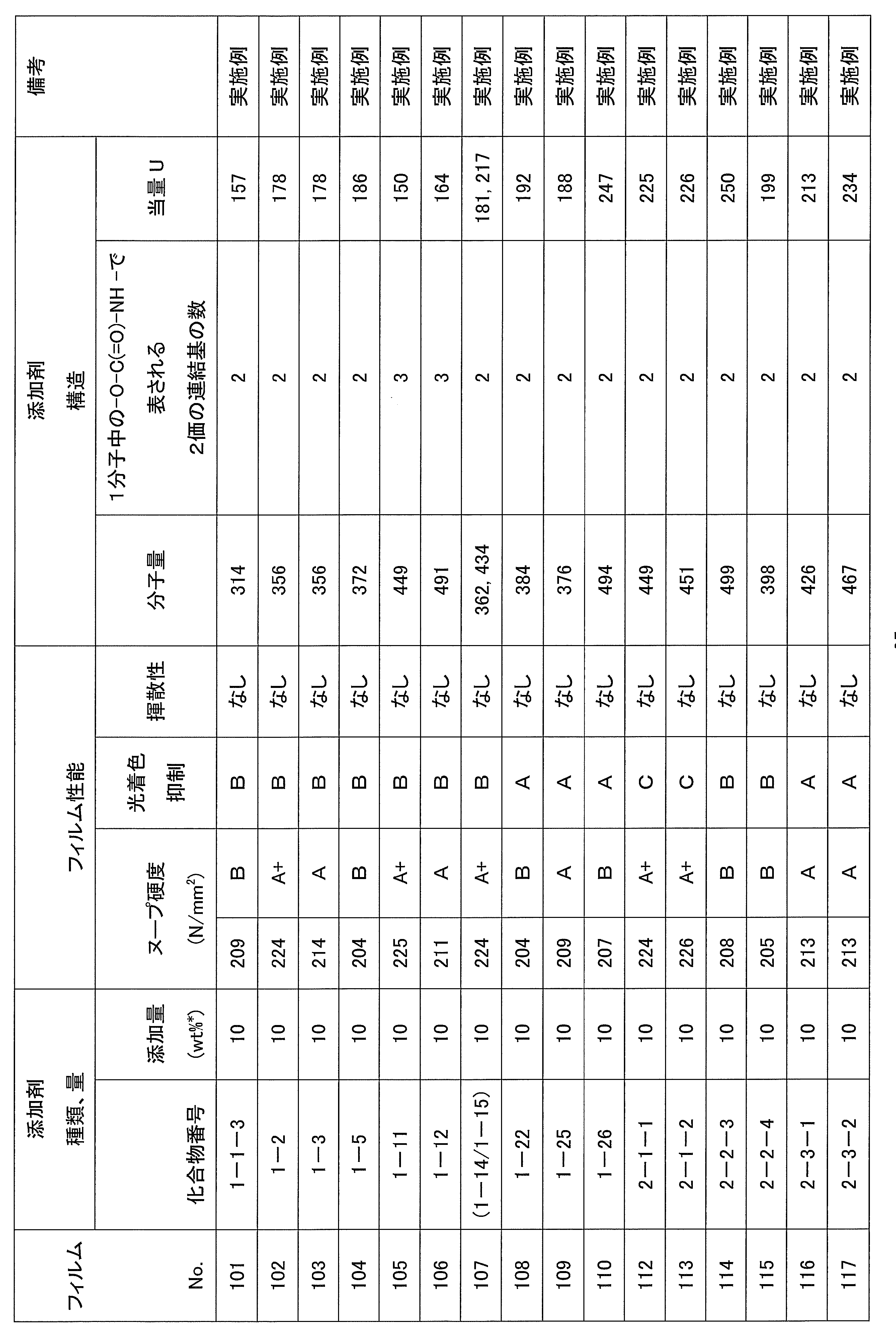
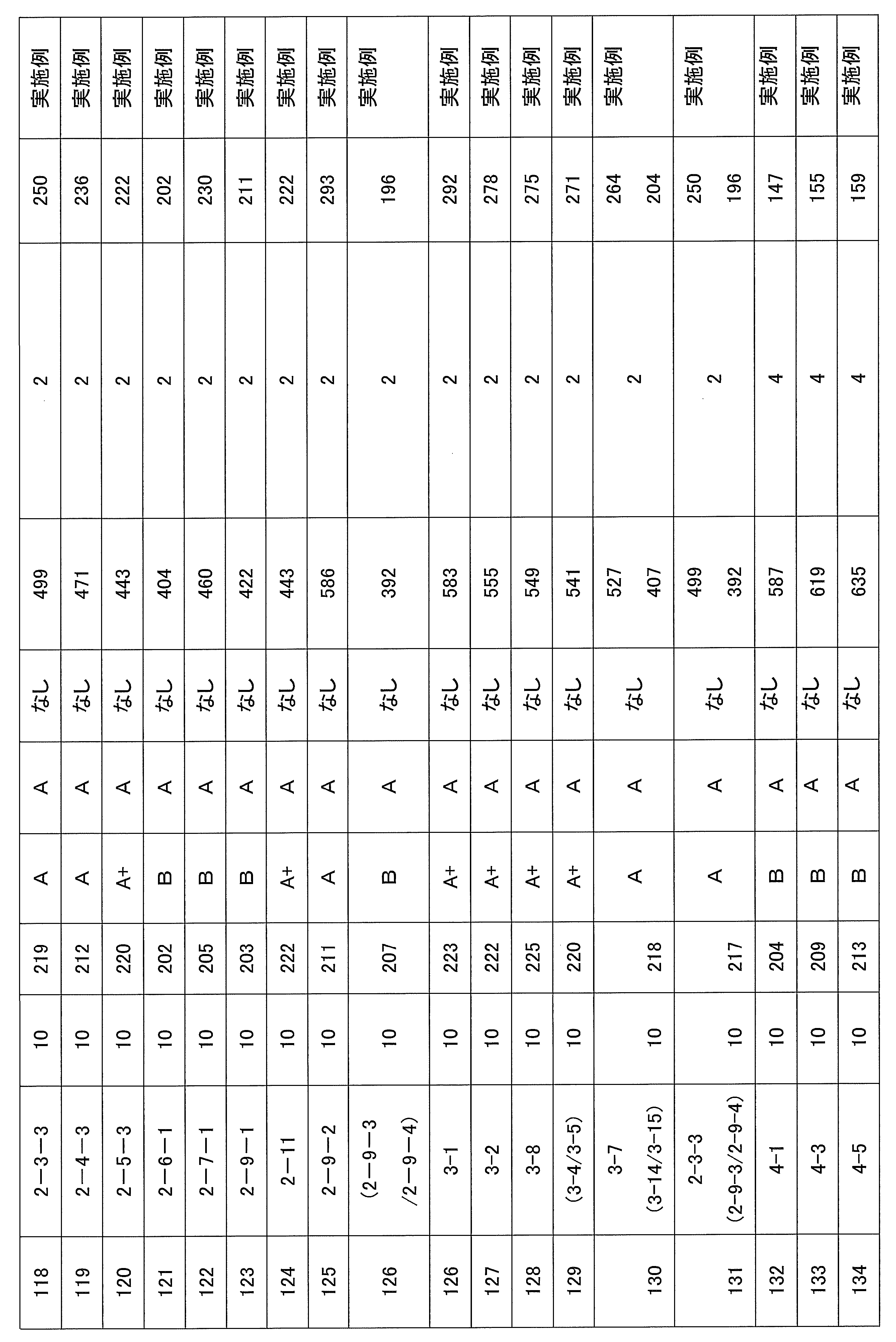

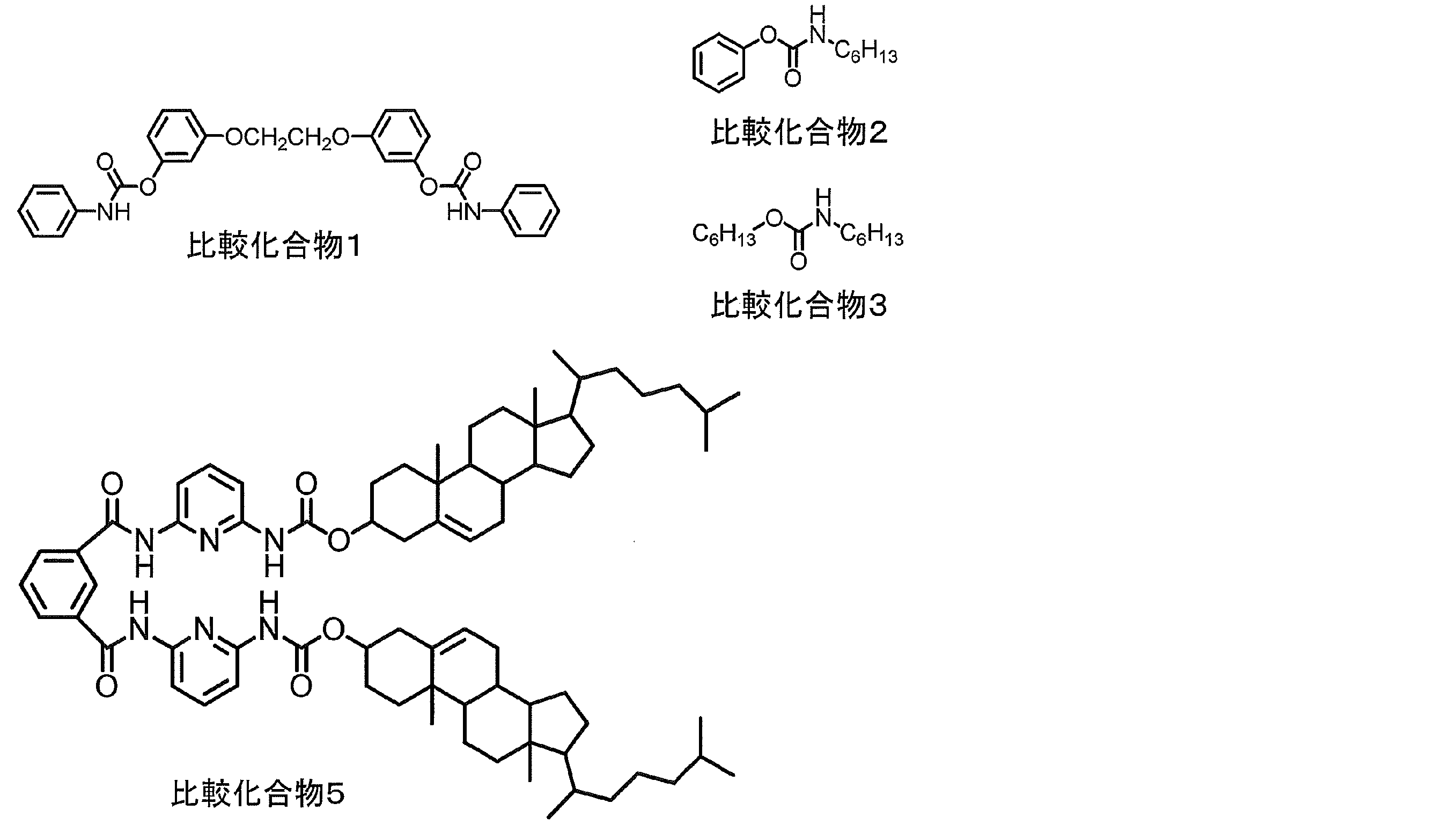
比較化合物4はポリエチレングリコール/1,4-ブチレングリコール/コハク酸からなるポリエステル(分子量2000)とトリレンジイソシアネートの縮合物であるポリウレタン(特開2004-175971号公報段落0043に記載のセルロースアセテート用改質剤C1)である。
比較化合物5は、特開2002-322294に記載の化合物(48)である。
窒素原子および酸素原子がベンゼン環に直結している比較化合物1、窒素原子および炭素原子がベンゼン環に直結している比較化合物5では光着色が特に大きく、光学フィルム用添加剤としては好ましくないことがわかった。これに対して、窒素原子のみにベンゼン環が直結する化合物を含むフィルムは、光着色の抑制について評価結果が一段良好であった(評価B、C)。さらに、窒素原子に直結するベンゼン環が置換基をもたないもの(フィルムNo.101-107)や、アルキル基やアルコキシ基をもつもの(フィルムNo.113、114)を含むフィルム(評価B)は、共役置換基をもつもの(No.111、112)(評価C)を含むフィルムに対して、光着色の抑制について評価結果が良好であった。
各添加剤の種類と添加量とを下表のとおりに変更した以外は、例1と同様にして、セルロースアシレートフィルムを作製した。
各特性の評価は例1と同様にして行った。結果を下記表3に示す。
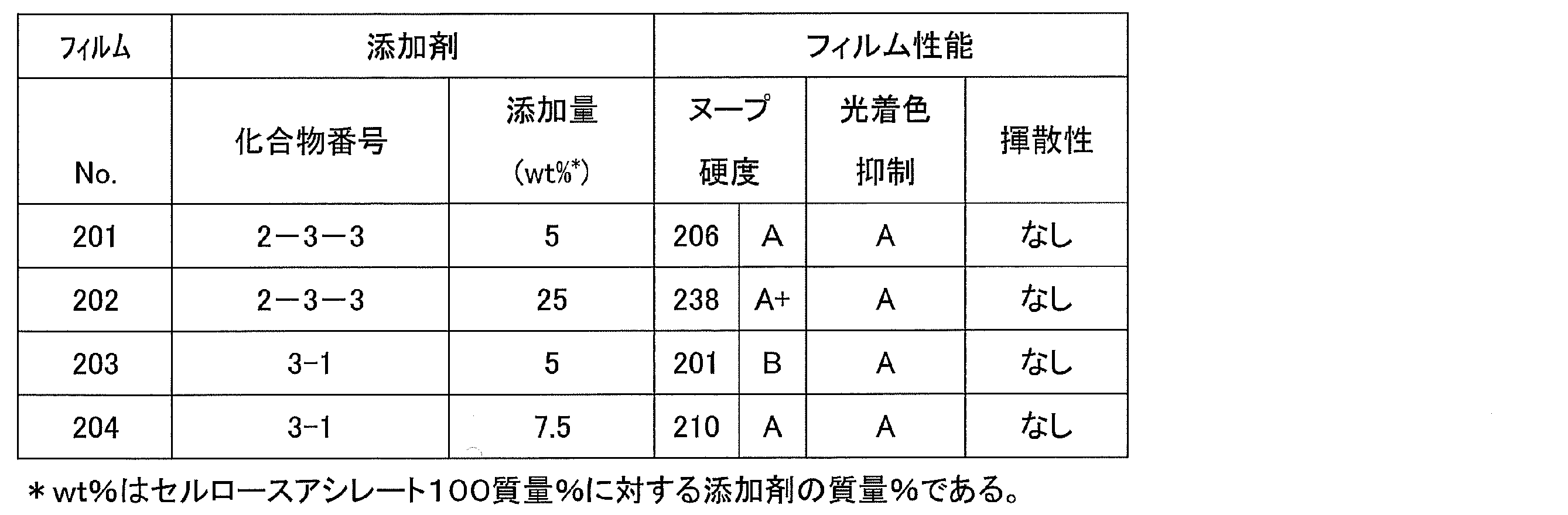
セルロースアシレートの置換度、各添加剤の種類とを下表のとおりに変更した以外は、例1と同様にして、セルロースアシレートフィルムを作製した。
各特性の評価は実施例1と同様にして行った。
それぞれのフィルムのヌープ硬度の値について添加剤を加えずに作製したフィルムのヌープ硬度の値と比較して、下記の基準で評価した。
A:添加剤を加えなかった場合のヌープ硬度の値の1.15倍以上
B:添加剤を加えなかった場合のヌープ硬度の値の1.05倍以上1.15倍未満
C:添加剤を加えなかった場合のヌープ硬度の値の1.00倍以上1.05倍未満
D:添加剤を加えなかった場合のヌープ硬度の値の1.00倍未満
以上の結果を、下記表4に示す。

セルロースアシレートの種類、各添加剤の種類、セルロースアシレートフィルムの膜厚を下表のとおりに変更した以外は、実施例1と同様にして、セルロースアシレートフィルムを作製した。
各特性の評価は実施例1と同様にして行った。ただし、表面硬度の評価に際しては、下記のとおり、膜厚40μm以下のフィルムについては、押し込み荷重を20mNに変更して測定した。
上記で得られたセルロースアシレートフィルムを、押し込み荷重を上記のように変更する以外は実施例1に記載の方法と同様にして、表面硬度を測定した。単位は、N/mm2で表した。
それぞれのフィルムのヌープ硬度の値について添加剤を加えずに作製したフィルムのヌープ硬度の値と比較して、下記の基準で評価した。
A:添加剤を加えなかった場合のヌープ硬度の値の1.15倍以上
B:添加剤を加えなかった場合のヌープ硬度の値の1.05倍以上1.15倍未満
C:添加剤を加えなかった場合のヌープ硬度の値の1.00倍以上1.05倍未満
D:添加剤を加えなかった場合のヌープ硬度の値の1.00倍未満
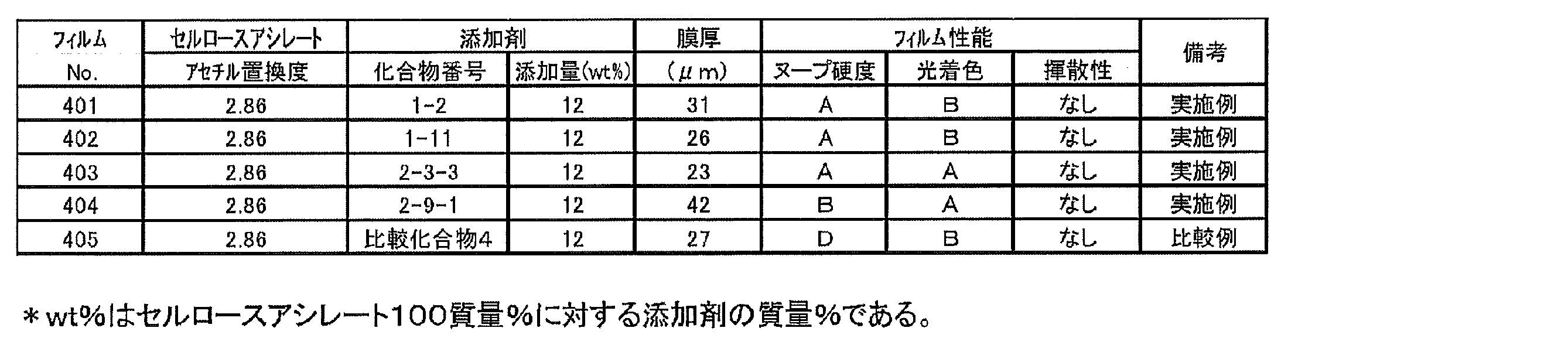
-ハードコート層付き光学フィルムの作製-
上記で作製した各セルロースアシレートからなる単層の光学フィルムの表面に下記の硬化組成物のハードコート層溶液を塗布し、紫外線を照射して硬化させ、厚み6μmのハードコート層を形成したハードコート層付き光学フィルムをそれぞれ作製した。
ハードコート層溶液の硬化組成物
―――――――――――――――――――――――――――――――――
モノマー ペンタエリスリトールトリアクリレート/
ペンタエリスリトールテトラアクリレート(混合質量比3/2) 53.5質量部
UV開始剤 IrgacureTM907
(チバ・スペシャリティ・ケミカルズ(株)製) 1.5質量部
酢酸エチル 45質量部
――――――――――――――――――――――――――――――――
各ハードコート付きセルロースアシレートフィルムを、25℃、相対湿度60%の条件で2時間調湿した後、JIS-S6006が規定する試験用鉛筆を用いて、JIS-K5400が規定する鉛筆硬度評価法に従い、500gのおもりを用いて各硬度の鉛筆でハードコート層表面を5回繰り返し引っ掻き、傷が1本までの硬度を測定した。なお、JIS-K5400で定義される傷は塗膜の破れ、塗膜のすり傷であり、塗膜のへこみは対象としないと記載されているが、本評価では、塗膜のへこみも含めて傷と判断した。実用上は、3H以上が好ましく、数値が高いほど、高硬度なため好ましい。その結果、一般式(I)で表される化合物を添加剤として加えたフィルムはいずれも3Hと高評価であることがわかった。
-偏光板の作製-
偏光板保護フィルムの鹸化処理
例1で得られた各セルロースアシレートフィルムを、2.3mol/Lの水酸化ナトリウム水溶液に、55℃で3分間浸漬した。室温の水洗浴槽中で洗浄し、30℃で0.05mol/Lの硫酸を用いて中和した。再度、室温の水洗浴槽中で洗浄し、さらに100℃の温風で乾燥した。このようにして、セルロースアシレートフィルムについて表面の鹸化処理を行った。
延伸したポリビニルアルコールフィルムにヨウ素を吸着させて偏光子を作製した。
鹸化処理したセルロースアシレートフィルムを、ポリビニルアルコール系接着剤を用いて、偏光子の片側に貼り付けた。市販のセルローストリアセテートフィルム(フジタックTD80UF、富士フイルム(株)製)に同様の鹸化処理を行い、ポリビニルアルコール系接着剤を用いて、上記で作成した各セルロースアシレートフィルムを貼り付けてある側とは反対側の偏光子の面に鹸化処理後の市販のセルローストリアセテートフィルムを貼り付けた。
この際、偏光子の透過軸と得られたセルロースアシレートフィルムの遅相軸とは平行するように配置した。また、偏光子の透過軸と市販のセルローストリアセテートフィルムの遅相軸については、直交するように配置した。
このようにして各偏光板を作製した。
偏光板耐久性試験は偏光板をガラスに粘着剤を介して貼り付けた形態で次のように行った。
ガラスの上に偏光板を、例1で得られた実施例のセルロースアシレートフィルムが空気界面側になるように貼り付けたサンプル(約5cm×5cm)を2つ作製した。単板直交透過率測定では、このサンプルの、例1で得られた実施例のセルロースアシレートフィルム側を光源に向けてセットして測定した。測定は、日本分光(株)製の自動偏光フィルム測定装置VAP-7070を用いて380nm~780nmの範囲で測定し、410nmにおける測定値を採用した。2つのサンプルをそれぞれ測定し、その平均値を偏光板の直交透過率とした。その後、80℃、相対湿度90%RHの環境下で各偏光板を120時間経時保存した後に同様の方法で直交透過率を測定した。経時前後の直交透過率の変化を求め、これを偏光板耐久性として評価した。なお、調湿なしの環境下での相対湿度は、0~20%RHの範囲であった。
一般式(I)で表される化合物を含まない例1の比較例のフィルムNo.148に対して、実施例のフィルムNo.112およびNo.116では、 経時前後の直交透過率の変化は小さくなっており、一般式(I)で表される化合物が、偏光板の耐久性を向上させていることがわかった。
-液晶表示装置の作製-
市販の液晶テレビ(SONY(株)のブラビアJ5000)の視認側の偏光板をはがし、本発明の偏光板として、上記実施例で作製した各偏光板を、上記各実施例の偏光板保護フィルムが液晶セル側と反対側となるように、粘着剤を介して、観察者側に一枚ずつ貼り付けて液晶表示装置を得た。
表2に記載の化合物に代えて、下記表6に記載の化合物を用いた点以外は例1と同様にセルロースアシレートフィルムの製膜および評価を行った。
例101で得られた各フィルム中のヘイズを測定し、下記の基準に沿って評価した。
ヘイズの測定は、各フィルムをヘイズメーター商品名“HGM-2DP”(スガ試験機(株)製)を用い、JIS K-7136に従って測定した。 結果を表中に記載した。
A:ヘイズが0.5%未満
B:ヘイズが0.5%以上、0.7%未満
C:ヘイズが0.7%以上
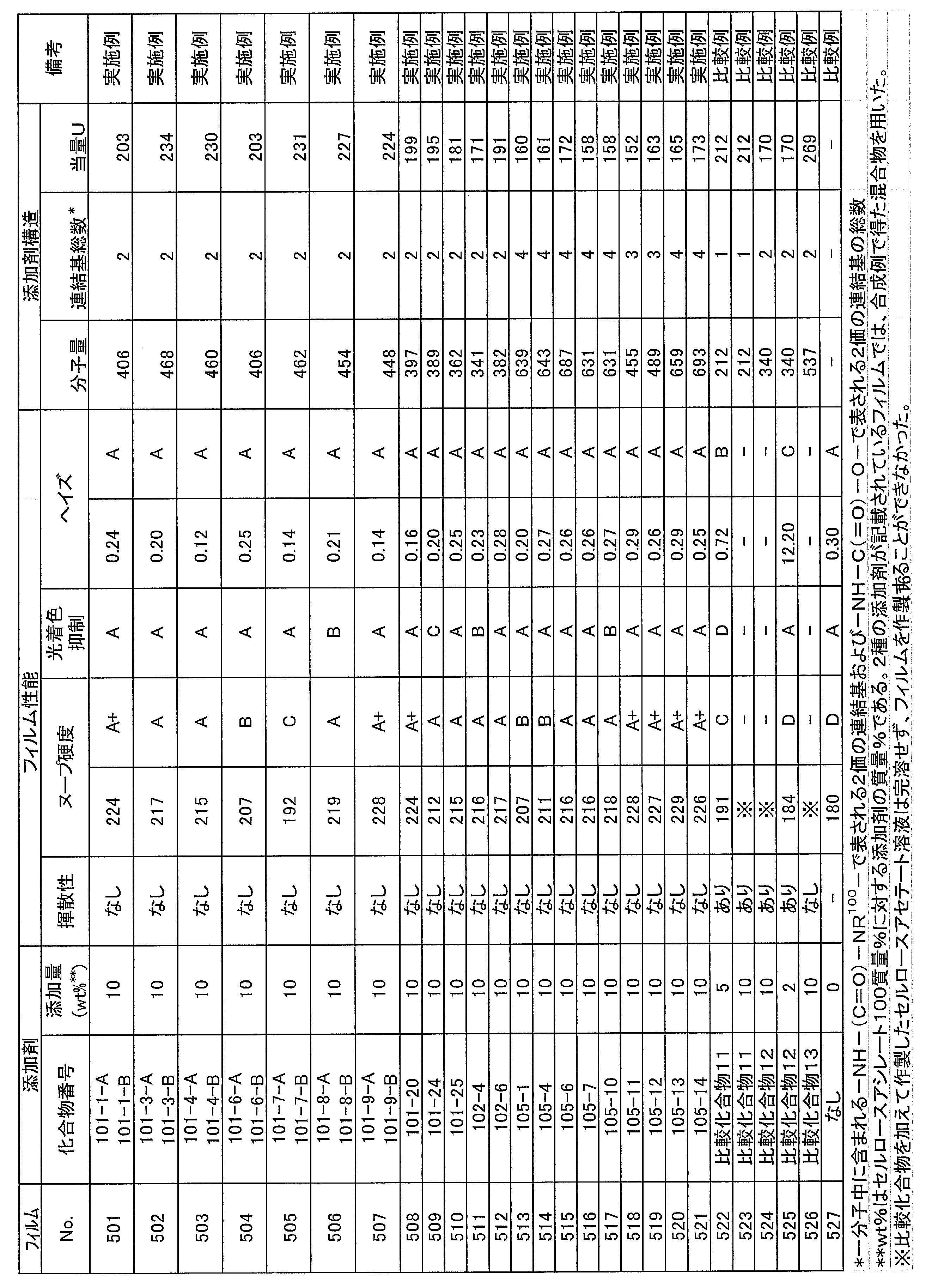

また、実施例のフィルムは、高いヌープ硬度を発現している。-NH-CO-NR100-または-NH-CO-O-で表される基で表わされる2価の連結基中のプロトン部位が効果的にセルロースアシレートのアセチル基、ヒドロキシル基に作用して水素結合を形成し、セルロースアシレートの分子鎖の動きを抑制したことが、表面硬度(ヌープ硬度)向上に寄与したと考えられる。
窒素原子が2つベンゼン環に直結している比較化合物11では光着色が特に大きく、光学フィルム用添加剤としては好ましくないことがわかった。これに対して、片側の窒素原子のみにベンゼン環が直結する化合物を含むフィルムは光着色抑制効果が一段良好であり(評価B、C)、さらに、窒素原子にベンゼン環が直結しない化合物を含むフィルムでも、光着色抑制効果は良好であった。
セルロースアシレートの種類、各添加剤の種類、セルロースアシレートフィルムの膜厚を下記表7のとおりに変更した以外は、例101と同様にして、セルロースアシレートフィルムを作製した。
各特性の評価は例101と同様にして行った。ただし、表面硬度の評価に際しては、下記のとおり、膜厚40μm以下のフィルムについては、押し込み荷重を20mNに変更して測定した。
上記で得られたセルロースアシレートフィルムを、押し込み荷重を上記のように変更する以外は例101に記載の方法と同様にして、表面硬度を測定した。単位は、N/mm2で表した。
それぞれのフィルムのヌープ硬度の値について添加剤を加えずに作製したフィルムのヌープ硬度の値と比較して、先に例2において用いた基準で評価した。
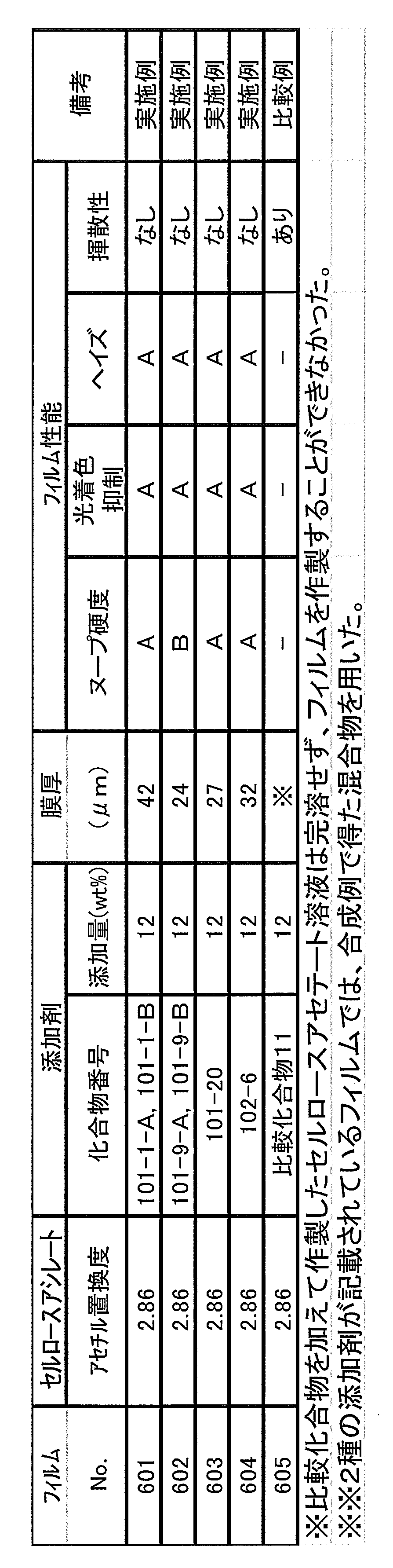
-ハードコート層付き光学フィルムの作製-
上記で作製した各実施例のセルロースアシレートからなる単層の光学フィルムの表面に、例4と同様の方法で厚み6μmのハードコート層を形成し、ハードコート層付き光学フィルムをそれぞれ作製した。
各ハードコート付きセルロースアシレートフィルムに対して、先に示した例4と同様の方法で鉛筆硬度評価を行った。その結果、一般式(A-100)で表される化合物を添加剤として加えたフィルムはいずれも3Hと高評価であることがわかった。
-偏光板の作製および偏光板耐久性評価-
例101で得られた各セルロースアシレートフィルムを用いて、先に示した例5と同様の方法で偏光板の作製および偏光板耐久性評価を行った。
一般式(A-100)で表される化合物を含まない例100の比較例のフィルムNo.526に対して、実施例のフィルムNo.510およびNo.509では、 経時前後の直交透過率の変化は小さくなっており、一般式(A-100)で表される化合物が、偏光板の耐久性を向上させていることがわかった。
-液晶表示装置の作製-
市販の液晶テレビ(SONY(株)のブラビアJ5000)の視認側の偏光板をはがし、上記実施例で作製した各偏光板を、上記各実施例の偏光板保護フィルムが液晶セル側と反対側となるように、粘着剤を介して、観察者側に一枚ずつ貼り付けて液晶表示装置を得た。
2 偏光子
3 位相差フィルム
4 液晶セル
10 上側偏光板
Claims (33)
- 下記一般式(I)で表され、かつ分子量を一分子中に含まれる-O-C(=O)-NH-で表される2価の連結基の個数で除した値として求められる当量Uが515以下である化合物を含有する、セルロースアシレートフィルム:
一般式(I)
Q1-(L12-L11)n1-O-C(=O)-NH-(L21-L22)n2-Q2
一般式(I)中、L11およびL21は、それぞれ独立にアルキレン基を表し、アルキレン基は置換基を有していてもよい;L12およびL22はそれぞれ独立に単結合または-O-、-NR1-、-S-、-C(=O)-のいずれかまたはこれらの組み合わせからなる基を表す;R1は、水素原子または置換基を表す;n1およびn2は、それぞれ独立に0~20の整数を表し、n1およびn2のいずれか一方は1以上の整数であり、L11、L12、L21およびL22が複数存在する場合は、互いに同一でも異なっていてもよい;Q1およびQ2は、それぞれ独立に置換基を表し、Q1およびQ2の少なくとも一方は環状構造を含む。 - 一般式(I)で表される化合物は、一分子中に-O-C(=O)-NH-で表される2価の連結基を1~6つ含む請求項1に記載のセルロースアシレートフィルム。
- 一般式(I)で表される化合物の分子量は、230~2000の範囲である請求項1または2に記載のセルロースアシレートフィルム。
- 一般式(I)で表される化合物が、下記一般式(I-1)で表される化合物である請求項1~3のいずれか1項に記載のセルロースアシレートフィルム:
一般式(I-1)
(Q3-(L32-L31)n3-A-(L41-L42)n4)m-Z1
一般式(I-1)中、L31およびL41は、それぞれ独立にアルキレン基を表し、アルキレン基は置換基を有していてもよい;L32およびL42はそれぞれ独立に単結合または-O-、-NR1-、-S-、および-C(=O)-のいずれかまたはこれらの組み合わせからなる基を表す;R1は、水素原子または置換基を表す;n3およびn4は、それぞれ独立に0~20の整数を表し、n3およびn4のいずれか一方は1以上の整数であり、L31、L32、L41およびL42が複数存在する場合は、互いに同一でも異なっていてもよい;Q3は、置換基を表し、Z1はm価の連結基を表し、Aは、*-O-C(=O)-NH-、または*-NH-C(=O)-O-を表し、*はL41との結合位置を表す;mは、2~6の整数を表し、複数存在するQ3およびAは、それぞれ、互いに同一でも異なっていてもよい;Q3およびZ1の少なくとも一種は環状構造を含む。 - 一般式(I-1)で表される化合物が、Q3およびZ1の少なくとも一方に環状構造を含み、かつ一分子中に合計2つまたは3つの環状構造を有する、請求項4に記載のセルロースアシレートフィルム。
- 一般式(I-1)において、複数存在するQ3のいずれかが芳香族基を有するか、Z1が環状の脂肪族基または芳香族基を有する、請求項4または5に記載のセルロースアシレートフィルム。
- 一般式(I-1)において、Q3が芳香族基を有するか、Z1が環状の脂肪族基を有する、請求項4~6のいずれか1項に記載のセルロースアシレートフィルム。
- 一般式(I)で表される化合物が、下記一般式(I-2)で表される化合物である請求項1~7のいずれか1項に記載のセルロースアシレートフィルム:
一般式(I-2)
(Q4-(L52-L51)n5-A-(L61-L62)n6)m1-Z2
一般式(I-2)中、L51およびL61は、それぞれ独立にアルキレン基を表し、アルキレン基は置換基を有していてもよい;L52およびL62はそれぞれ独立に単結合または-O-、-NR1-、-S-、および-C(=O)-のいずれかまたはこれらの組み合わせからなる基を表す;R1は、水素原子または置換基を表す;n5およびn6は、それぞれ独立に0~20の整数を表すが、n5およびn6のいずれか一方は1以上の整数であり、L51、L52、L61およびL62が複数存在する場合は、互いに同一でも異なっていてもよい;Q4は、置換もしくは無置換のフェニル基、置換もしくは無置換のシクロヘキシル基、メチル基、またはt-ブチル基を表す;Z2は、直鎖、分岐または環状の脂肪族基および芳香族基の少なくとも1種を含む基を表し、Aは、*-O-C(=O)-NH-、または*-NH-C(=O)-O-を表し、*はL61との結合位置を表す;m1は、2または3の整数を表し、複数存在するQ4およびAは、それぞれ、互いに同一でも異なっていてもよい;Z2および複数のQ4の少なくとも1つは、環状構造を含む。 - 一般式(I-2)中、L51はアルキレン基であり、L52は単結合または-O-である、請求項8に記載のセルロースアシレートフィルム。
- 一般式(I-2)中、Q4は無置換のフェニル基である、請求項8または9に記載のセルロースアシレートフィルム。
- 一般式(I-2)中、Z2は環状の脂肪族基および芳香族基の少なくとも一方を含む基である、請求項8~10のいずれか1項に記載のセルロースアシレートフィルム。
- 一般式(I)で表される化合物が、下記一般式(I-3)で表される化合物、下記一般式(I-4)で表される化合物、および下記一般式(I-5)で表される化合物からなる群から選択される請求項1~11のいずれか1項に記載のセルロースアシレートフィルム:



- 一般式(I)で表される化合物は、下記一般式(II)で表される化合物および下記一般式(III)で表される化合物からなる群から選択される請求項1~12のいずれか1項に記載のセルロースアシレートフィルム。


一般式(2A) -{Rb jb(CRaRc)ja-O-(C=O)}-*
一般式(2B) -{Rb jb(CRaRc)ja-O}-*
一般式(2C) -{Rb jb(CRaRc)ja-(C=O)O-}-*
一般式(2D) -{Rb jb(CRaRc)ja-NR1(C=O)O-}-*
一般式(2E) -{Rb jb(CRaRc)ja-O-(C=O)NR1}-*
一般式(2A)~(2E)中、*は、Q1aもしくはQ1bとの結合位置または隣接する基とQ1aもしくはQ1b側で結合する位置を表し、RaおよびRcは、それぞれ独立に水素原子または炭素数1~3のアルキル基を表し、jaは1以上の整数を表し、RaおよびRcが複数存在する場合、複数のRaおよびRcはそれぞれ同一であっても異なっていてもよい;Rbは1つ以上の炭素数1~3のアルキル基で置換されていてもよいシクロアルキレン基を表し、jbは0または1である;R1は水素原子または炭素数1~4のアルキル基を表し、R1が複数存在する場合、複数のR1はそれぞれ同一であっても異なっていてもよい。 - 下記一般式(A-100)で表される化合物を含有する、セルロースアシレートフィルム:
一般式(A-100)
QA-(L102-L101)na-NR100-C(=O)-NH-(L103-L104)nb-QB
一般式(A-100)中、R100は水素原子または置換基を表す;L101およびL103は、それぞれ独立にアルキレン基を表し、アルキレン基は置換基を有していてもよい;L102およびL104はそれぞれ独立に単結合または-O-、-NR100a-、-S-、-C(=O)-のいずれかまたはこれらの組み合わせからなる基を表す;R100aは、水素原子または置換基を表す。naおよびnbは、それぞれ独立に0~20の整数を表し、L101、L102、L103およびL104が複数存在する場合は、互いに同一でも異なっていてもよい;QAおよびQBは、それぞれ独立に置換基を表し、QAおよびQBの少なくとも一方は環状構造を含む;naがゼロを表し、かつQAが環状構造を含む場合、QAに含まれる環状構造は、-NR100-中のR100とともに形成された環状構造であってもよい;ただし、一分子中の-NH-(C=O)-NH-で表される2価の連結基の数は0または1である。 - 一般式(A-100)で表される化合物は、一分子中に-NH-(C=O)-NR-で表され、Rは水素原子または置換基を表す2価の連結基を2つ以上有するか、または前記2価の連結基および-NH-C(=O)-O-で表される2価の連結基をそれぞれ1つ以上有する請求項14に記載のセルロースアシレートフィルム。
- 一般式(A-100)で表される化合物の分子量は、230~2000の範囲である請求項14または15に記載のセルロースアシレートフィルム。
- 一般式(A-100)で表される化合物が、下記一般式(A-1)で表される化合物である請求項14~16のいずれか1項に記載のセルロースアシレートフィルム:
一般式(A-101)
(Q103-(L132-L131)n103-A100-(L141-L142)n104)m-Z101
一般式(A-101)中、L131およびL141は、それぞれ独立にアルキレン基を表し、アルキレン基は置換基を有していてもよい;L132およびL142はそれぞれ独立に単結合または-O-、-NR100a-、-S-、および-C(=O)-のいずれかまたはこれらの組み合わせからなる基を表す;R100aは、水素原子または置換基を表す;n103およびn104は、それぞれ独立に0~20の整数を表し、L131、L132、L141およびL142が複数存在する場合は、互いに同一でも異なっていてもよい;Q103は、置換基を表し、Z101はm価の連結基を表し、A100は、*-NR-C(=O)-NH-、*-NH-C(=O)-NR-、*-O-C(=O)-NH-、または*-NH-C(=O)-O-を表し、R100は水素原子または置換基を表し、*はL141またはZ101との結合位置を表す;mは、2~6の整数を表し、複数存在するQ103およびA100は、それぞれ、互いに同一でも異なっていてもよい;ただし少なくとも1つのA100は、*-NR-C(=O)-NH-または*-NH-C(=O)-NR100-を表す;また、Q103およびZ101の少なくとも一種は環状構造を含む;少なくとも1つのn103がゼロを表し、Q103が環状構造を含み、かつA100が*-NH-C(=O)-NR100-を表す場合、Q103に含まれる環状構造は、A100に含まれる-NR100-中のRとともに形成された環状構造であってもよい。ただし、一分子中の-NH-(C=O)-NH-で表される2価の連結基の数は0または1である。 - 一般式(A-101)において、Z101が環状の脂肪族基または環状の芳香族基を有する、請求項17に記載のセルロースアシレートフィルム。
- 一般式(A-101)において、n103はゼロを表し、A100は*-NH-C(=O)-NR100-を表し、Q103に含まれる環状構造は、A100に含まれる-NR100-中のR100とともに形成された含窒素6員複素環である請求項17または18に記載のセルロースアシレートフィルム。
- 前記含窒素6員複素環は、モルホリン環である請求項19に記載のセルロースアシレートフィルム。
- 一般式(A-100)において、複数存在するQ103の1つ以上が芳香族基およびシクロアルキル基からなる群から選ばれる環状基を表す請求項17または18に記載のセルロースアシレートフィルム。
- 一般式(A-100)において、複数存在するQ103の1つ以上が無置換のフェニル基または無置換のシクロヘキシル基を表す請求項17または18に記載のセルロースアシレートフィルム。
- 一般式(A-100)において、複数存在するQ103の1つ以上がアルキル基を表す請求項17または18に記載のセルロースアシレートフィルム。
- 一般式(A-100)で表される化合物は、下記一般式(A-104-A)で表される化合物、下記一般式(A-104-B)で表される化合物、および下記一般式(A-105)で表される化合物からなる群から選択される、請求項14~18のいずれか1項に記載のセルロースアシレートフィルム:


一般式(2A) -{Rb jb(CRaRc)ja-O-(C=O)}-*
一般式(2B) -{Rb jb(CRaRc)ja-O}-*
一般式(2C) -{Rb jb(CRaRc)ja-(C=O)O-}-*
一般式(2D) -{Rb jb(CRaRc)ja-NR100a(C=O)O-}-*
一般式(2E) -{Rb jb(CRaRc)ja-O-(C=O)NR100a}-*
一般式(2F) -{Rb jb(CRaRc)ja-NR100a(C=O)NR100a}-*
一般式(2A)~(2F)中、*は、Q101a、Q102aもしくはQ103aとの結合位置または隣接する基とQ101a、Q102aもしくはQ103a側で結合する位置を表し、RaおよびRcは、それぞれ独立に水素原子または炭素数1~3のアルキル基を表し、jaは1以上の整数を表し、RaおよびRcが複数存在する場合、複数のRaおよびRcはそれぞれ同一であっても異なっていてもよい;Rbは1つ以上の炭素数1~3のアルキル基で置換されていてもよいシクロアルキレン基を表し、jbは0または1である;R100aは水素原子または炭素数1~4のアルキル基を表し、R100aが複数存在する場合、複数のR100aはそれぞれ同一であっても異なっていてもよい;ただし、X2およびX3がともに-O-を表す場合、L102aおよびL103aの一方または両方は、-NR100a-C(=O)-NH-で表される2価の連結基を含む。 - 一般式(A-100)で表される化合物の分子量を一分子中に含まれる-NH-(C=O)-NR-で表される2価の連結基および-NH-C(=O)-O-で表される2価の連結基の総数で除した値として求められる当量Uは、515以下である請求項14~24のいずれか1項に記載のセルロースアシレートフィルム。
- 一般式(I)で表される化合物および一般式(A-100)で表される化合物からなる群から選ばれる化合物の含有量が、セルロースアシレート100質量部に対して、0.1~50質量部である請求項1~25のいずれか1項に記載のセルロースアシレートフィルム。
- 請求項1~26のいずれか1項に記載のセルロースアシレートフィルムと偏光子とを有する偏光板。
- 請求項27に記載の偏光板を有する液晶表示装置。
- 前記偏光板は、少なくとも、視認側に設けられている請求項28に記載の液晶表示装置。
- 下記一般式(II-1)で表される化合物:

一般式(2A-1) -{(CRaRc)ja-O-(C=O)}-*
一般式(2B-1) -{(CRaRc)ja-O}-*
一般式(2C-1) -{(CRaRc)ja-(C=O)O-}-*
一般式(2D-1) -{(CRaRc)ja-NR1(C=O)O-}-*
一般式(2E-1) -{(CRaRc)ja-O-(C=O)NR1}-*
一般式(2A-1)~(2E-1)中、*は、Q11aもしくはQ11bとの結合位置または隣接する基とQ11aもしくはQ11b側で結合する位置を表し、RaおよびRcは、それぞれ独立に水素原子または炭素数1~3のアルキル基を表し、R1は、水素原子または炭素数1~4のアルキル基を表し、jaは1以上の整数を表し、Ra、Rc、R1が複数存在する場合、複数のRa、Rc、R1はそれぞれ同一であっても異なっていてもよい。 - 下記一般式(III-1)で表される化合物:

一般式(2A-1) -{(CRaRc)ja-O-(C=O)}-*
一般式(2C-1) -{(CRaRc)ja-(C=O)O-}-*
一般式(2D-1) -{(CRaRc)ja-NR1(C=O)O-}-*
一般式(2E-1) -{(CRaRc)ja-O-(C=O)NR1}-*
一般式(2A-1)、(2C-1)~(2E-1)中、*は、Q11aもしくはQ11bとの結合位置または隣接する基とQ11aもしくはQ11b側で結合する位置を表し、RaおよびRcは水素原子または炭素数1~3のアルキル基を表し、jaは1以上の整数を表し、R1は、水素原子または炭素数1~4のアルキル基を表し、Ra、Rc、R1が複数存在する場合、複数のRa、Rc、R1はそれぞれ同一であっても異なっていてもよい。 - 下記一般式(A-104-A)または(A-104-B)で表される化合物:
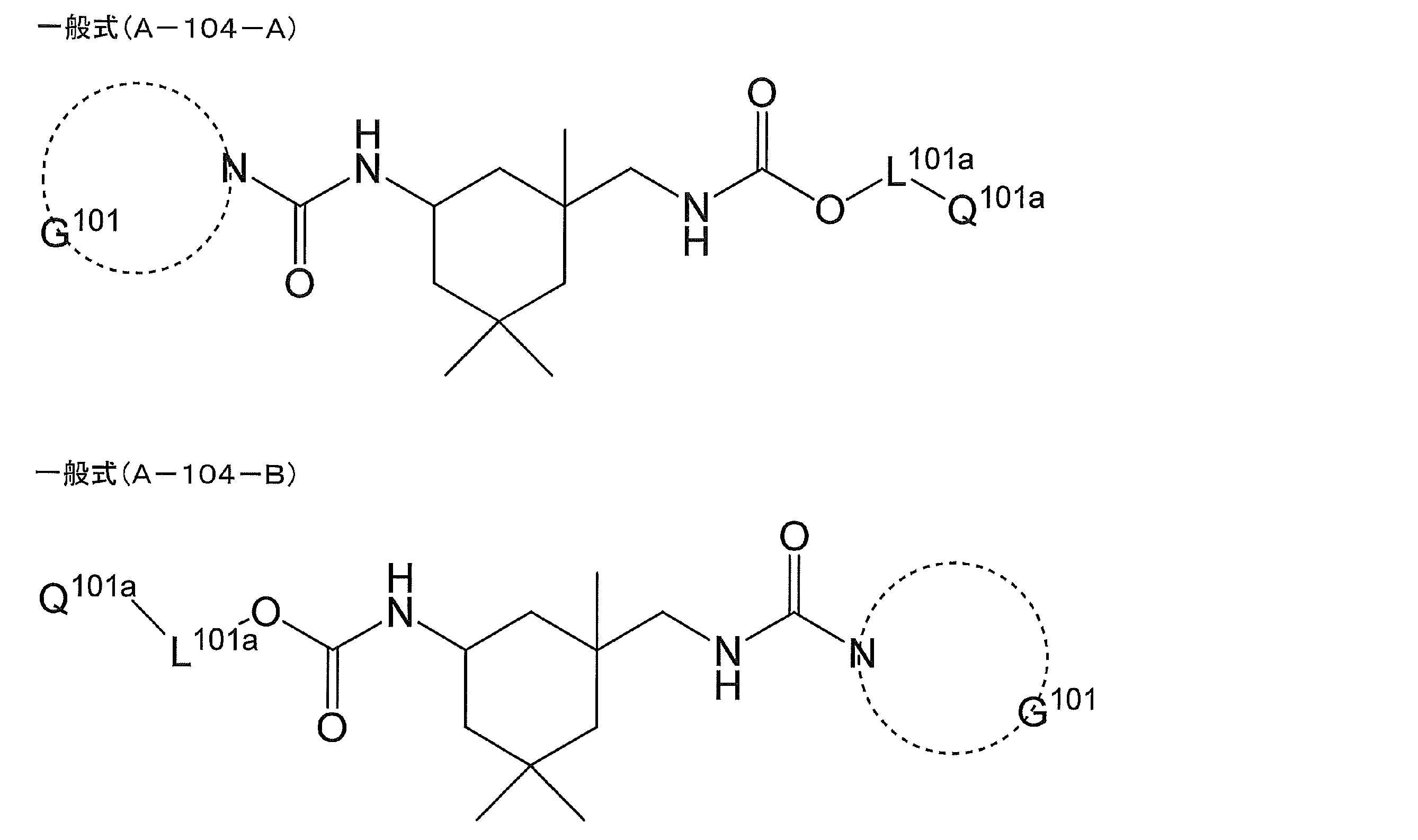
一般式(2A-1) -{(CRaRc)ja-O-(C=O)}-*
一般式(2B-1) -{(CRaRc)ja-O}-*
一般式(2C-1) -{(CRaRc)ja-(C=O)O-}-*
一般式(2A-1)~(2C-1)中、*は、Q1aで表される置換基との結合位置を表し、RaおよびRcは、それぞれ独立に水素原子または炭素数1~3のアルキル基を表し、jaは1以上の整数を表し、Ra、Rcが複数存在する場合、複数のRa、Rcはそれぞれ同一であっても異なっていてもよい。 - 下記一般式(A-105)で表される化合物;
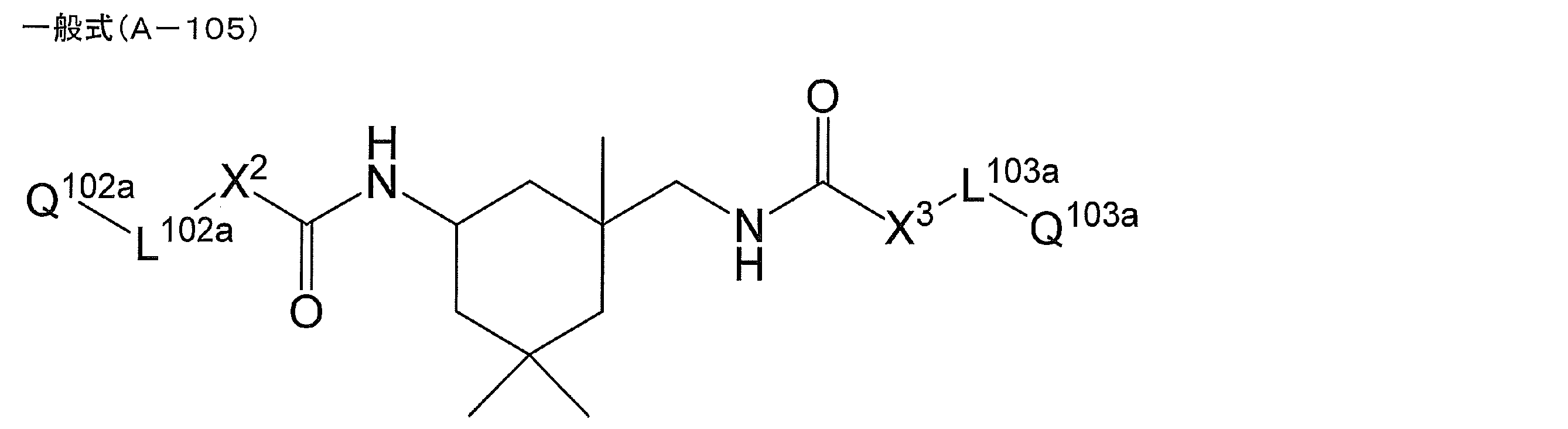
一般式(2A-1) -{(CRaRc)ja-O-(C=O)}-*
一般式(2B-1) -{(CRaRc)ja-O}-*
一般式(2C-1) -{(CRaRc)ja-(C=O)O-}-*
一般式(2D-1) -{(CRaRc)ja-NR100a(C=O)O-}-*
一般式(2E-1) -{(CRaRc)ja-O-(C=O)NR100a}-*
一般式(2F-1) -{(CRaRc)ja-NR100a(C=O)NR100a}-*
一般式(2A-1)~(2F-1)中、*は、Q102aもしくはQ103aとの結合位置または隣接する基とQ102aもしくはQ103a側で結合する位置を表し、RaおよびRcは、それぞれ独立に水素原子または炭素数1~3のアルキル基を表し、jaは1以上の整数を表し、RaおよびRcが複数存在する場合、複数のRaおよびRcはそれぞれ同一であっても異なっていてもよい;R100aは水素原子または炭素数1~4のアルキル基を表し、R100aが複数存在する場合、複数のR100aはそれぞれ同一であっても異なっていてもよい;ただし、X2およびX3がともに-O-を表す場合、L102aおよびL103aの一方または両方は、-NR100a-C(=O)-NH-で表される2価の連結基を含む。
Priority Applications (3)
| Application Number | Priority Date | Filing Date | Title |
|---|---|---|---|
| CN201480010577.9A CN105026479B (zh) | 2013-02-26 | 2014-02-26 | 纤维素酰化物膜、新化合物、偏振片及液晶显示装置 |
| JP2015502995A JP6095766B2 (ja) | 2013-02-26 | 2014-02-26 | セルロースアシレートフィルム、新規化合物、偏光板および液晶表示装置 |
| US14/835,165 US10040754B2 (en) | 2013-02-26 | 2015-08-25 | Cellulose acylate film, novel compound, polarizing plate and liquid crystal display device |
Applications Claiming Priority (6)
| Application Number | Priority Date | Filing Date | Title |
|---|---|---|---|
| JP2013-035377 | 2013-02-26 | ||
| JP2013035377 | 2013-02-26 | ||
| JP2013-156160 | 2013-07-26 | ||
| JP2013-156149 | 2013-07-26 | ||
| JP2013156149 | 2013-07-26 | ||
| JP2013156160 | 2013-07-26 |
Related Child Applications (1)
| Application Number | Title | Priority Date | Filing Date |
|---|---|---|---|
| US14/835,165 Continuation US10040754B2 (en) | 2013-02-26 | 2015-08-25 | Cellulose acylate film, novel compound, polarizing plate and liquid crystal display device |
Publications (1)
| Publication Number | Publication Date |
|---|---|
| WO2014133041A1 true WO2014133041A1 (ja) | 2014-09-04 |
Family
ID=51428301
Family Applications (1)
| Application Number | Title | Priority Date | Filing Date |
|---|---|---|---|
| PCT/JP2014/054762 Ceased WO2014133041A1 (ja) | 2013-02-26 | 2014-02-26 | セルロースアシレートフィルム、新規化合物、偏光板および液晶表示装置 |
Country Status (4)
| Country | Link |
|---|---|
| US (1) | US10040754B2 (ja) |
| JP (1) | JP6095766B2 (ja) |
| CN (1) | CN105026479B (ja) |
| WO (1) | WO2014133041A1 (ja) |
Cited By (6)
| Publication number | Priority date | Publication date | Assignee | Title |
|---|---|---|---|---|
| WO2015151683A1 (ja) * | 2014-03-31 | 2015-10-08 | 富士フイルム株式会社 | セルロースエステルフィルム、偏光板および液晶表示装置 |
| CN106349111A (zh) * | 2015-07-16 | 2017-01-25 | 中国石油化工股份有限公司 | 一种含苯基疏水交联单体及基于该单体的水凝胶 |
| JP2017068137A (ja) * | 2015-09-30 | 2017-04-06 | 富士フイルム株式会社 | セルロースアシレートフィルム、セルロースアシレートフィルムの製造方法、積層体、偏光板、及び液晶表示装置 |
| JP2017068136A (ja) * | 2015-09-30 | 2017-04-06 | 富士フイルム株式会社 | 偏光板保護フィルム、偏光板、液晶表示装置、及び偏光板保護フィルムの製造方法 |
| JP2017129792A (ja) * | 2016-01-21 | 2017-07-27 | 富士フイルム株式会社 | セルロースアシレートフィルム、偏光板、及び液晶表示装置 |
| US10113040B2 (en) | 2014-09-03 | 2018-10-30 | Fujifilm Corporation | Polymer film, polarizing plate and liquid crystal display device |
Families Citing this family (4)
| Publication number | Priority date | Publication date | Assignee | Title |
|---|---|---|---|---|
| JP6095766B2 (ja) | 2013-02-26 | 2017-03-15 | 富士フイルム株式会社 | セルロースアシレートフィルム、新規化合物、偏光板および液晶表示装置 |
| WO2015012407A1 (ja) * | 2013-07-26 | 2015-01-29 | 富士フイルム株式会社 | セルロースアシレートフィルム、新規化合物、偏光板および液晶表示装置 |
| JP6339530B2 (ja) * | 2014-09-03 | 2018-06-06 | 富士フイルム株式会社 | ポリマーフィルム、偏光板および液晶表示装置 |
| EP4083142B1 (en) | 2019-12-25 | 2025-08-13 | FUJIFILM Corporation | Resin composition, cured product, uv absorber, uv cut filter, lens, protective material, compound, and method for synthesizing compound |
Citations (5)
| Publication number | Priority date | Publication date | Assignee | Title |
|---|---|---|---|---|
| JP2004292696A (ja) * | 2003-03-27 | 2004-10-21 | Fuji Photo Film Co Ltd | セルロースアシレートフィルム、その製造方法、及び該フイルムを用いた光学フィルム |
| JP2005225990A (ja) * | 2004-02-13 | 2005-08-25 | Ipposha Oil Ind Co Ltd | 光学フィルム用添加剤、それを含む光学フィルム、それを用いた偏光板及び液晶表示装置 |
| JP2006096023A (ja) * | 2004-03-11 | 2006-04-13 | Fuji Photo Film Co Ltd | セルロースアシレートフィルム、その製造方法、光学補償フィルム、偏光板、及び液晶表示装置 |
| JP2006282748A (ja) * | 2005-03-31 | 2006-10-19 | Fuji Photo Film Co Ltd | セルロース誘導体組成物、セルロース誘導体フィルム、およびトリアルコキシ安息香酸誘導体化合物 |
| JP2006282979A (ja) * | 2005-03-11 | 2006-10-19 | Fuji Photo Film Co Ltd | セルロースアシレートフィルム、並びにそれを用いた偏光板及び液晶表示装置 |
Family Cites Families (50)
| Publication number | Priority date | Publication date | Assignee | Title |
|---|---|---|---|---|
| US3846442A (en) * | 1970-11-17 | 1974-11-05 | Ciba Geigy Ag | Glycidyl hydantoin compounds |
| DE2236514A1 (de) * | 1972-07-26 | 1974-02-07 | Degussa | Verfahren zur herstellung von pulverisierbaren, hitzehaertbaren ueberzugsmitteln |
| DE2361041C3 (de) * | 1973-12-07 | 1980-08-14 | Hoechst Ag, 6000 Frankfurt | Photopolymerisierbares Gemisch |
| JPS5119601A (ja) * | 1974-08-08 | 1976-02-17 | Kansai Paint Co Ltd | |
| GB1453429A (en) | 1974-08-08 | 1976-10-20 | Kansai Paint Co Ltd | Photocurable compositions |
| JPS5134265A (en) * | 1974-09-17 | 1976-03-23 | Sanyo Chemical Ind Ltd | Tsukisei oyobi toshitsuseinosuguretashiitozairyo no seizoho |
| JPS53285A (en) * | 1976-06-24 | 1978-01-05 | Gen Electric | Curable composition and coated substances |
| DE2729704A1 (de) * | 1977-07-01 | 1979-01-11 | Veba Chemie Ag | Verfahren zur herstellung von blockierten polyisocyanaten |
| DE2914984A1 (de) * | 1979-04-12 | 1980-11-13 | Consortium Elektrochem Ind | Verfahren zur herstellung von polymerisaten |
| US4218515A (en) * | 1979-05-14 | 1980-08-19 | Heckles John S | Acrylate-cyanoacetate-ureadiacetoacetamide-diacetoacetamide copolymers useful as protective surfaces |
| DE3015419A1 (de) | 1980-04-22 | 1981-10-29 | Basf Ag, 6700 Ludwigshafen | Zur herstellung von druck- und reliefformen geeignete mehrschichtelemente |
| JPS58187187A (ja) * | 1982-04-23 | 1983-11-01 | Ajinomoto Co Inc | 固定化l−アラニン生産菌、その固定化法およびそれを用いるl−アラニンの製造法 |
| EP0138769B1 (de) * | 1983-10-14 | 1988-06-01 | Ciba-Geigy Ag | Diurethandiharnstoffe und deren Verwendung |
| US4861853A (en) * | 1985-12-27 | 1989-08-29 | The Sherwin-Williams Company | Isocyanate functional polymers |
| US4983676A (en) * | 1985-12-27 | 1991-01-08 | The Sherwin-Williams Company | Isocyanate functional polymers |
| JPS6475515A (en) * | 1987-09-18 | 1989-03-22 | Kao Corp | Production of novel polyurethane resin |
| JPH01101325A (ja) * | 1987-10-14 | 1989-04-19 | Kao Corp | 新規な不飽和ポリエステルの製造方法 |
| DE3818214A1 (de) | 1988-05-28 | 1989-12-07 | Schering Ag | Imidazolyl-harnstoffverbindungen und deren verwendung als haertungsbeschleuniger in epoxidharzzusammensetzungen zur herstellung von formkoerpern |
| US5030754A (en) * | 1990-11-19 | 1991-07-09 | Texaco Chemical Company | Hydroxy-terminated substituted diurea derivatives |
| JPH05197073A (ja) * | 1991-06-27 | 1993-08-06 | Fuji Photo Film Co Ltd | ハロゲン化銀写真感光材料の劣化防止法 |
| JP2001187806A (ja) | 1999-12-28 | 2001-07-10 | Toagosei Co Ltd | 活性エネルギー線硬化型組成物 |
| JP4689128B2 (ja) | 1999-12-28 | 2011-05-25 | グンゼ株式会社 | 偏光板およびその製造方法 |
| DE10154350A1 (de) | 2001-11-06 | 2003-05-15 | Bayer Ag | Vernetzer auf Basis von Imiden |
| JP2004026742A (ja) | 2002-06-27 | 2004-01-29 | Nitto Denko Corp | 非線形光学材料 |
| JP4135076B2 (ja) * | 2002-11-07 | 2008-08-20 | Dic株式会社 | ポリアルキレンエーテル鎖含有ジオ−ル化合物、その製造法及びポリウレタン樹脂 |
| JP2004175971A (ja) | 2002-11-28 | 2004-06-24 | Dainippon Ink & Chem Inc | セルロースエステル用改質剤、その製造方法及びセルロースエステル組成物 |
| JP2005242566A (ja) * | 2004-02-25 | 2005-09-08 | Canon Inc | 画像合成装置及び方法 |
| JP2005272485A (ja) * | 2004-03-22 | 2005-10-06 | Fuji Photo Film Co Ltd | セルロースアシレートドープ組成物、セルロースアシレートフィルム及びこれを用いた光学フィルムと液晶表示装置 |
| JP4272092B2 (ja) * | 2004-03-24 | 2009-06-03 | 富士フイルム株式会社 | セルロース体組成物、セルロース体フイルム、セルロース体フイルム用改質剤、偏光板保護膜、液晶表示装置およびハロゲン化銀写真感光材料 |
| JP4456024B2 (ja) * | 2005-03-18 | 2010-04-28 | 東洋アルミニウム株式会社 | 型内被覆成形用組成物及び型内被覆成形品の製造方法 |
| WO2007008959A2 (en) * | 2005-07-11 | 2007-01-18 | Wood Coatings Research Group, Inc. | Aqueous dispersions utilizing carboxyalkyl cellulose esters and water reducible polymers |
| US20090119851A1 (en) * | 2005-12-29 | 2009-05-14 | Avon Products, Inc. | Novel Hair Dyeing Composition and Method |
| JP2008052041A (ja) * | 2006-08-24 | 2008-03-06 | Fujifilm Corp | 光学フィルム、偏光板、液晶表示装置 |
| JP5119767B2 (ja) | 2007-07-05 | 2013-01-16 | コニカミノルタアドバンストレイヤー株式会社 | 光学フィルム、偏光板、その製造方法及び液晶表示装置 |
| US7709572B2 (en) | 2007-10-13 | 2010-05-04 | Konica Minolta Opto, Inc. | Optical film, polarizing plate and display device using the same, and manufacturing method thereof |
| JP2009241397A (ja) * | 2008-03-31 | 2009-10-22 | Fujifilm Corp | セルロースアシレートフィルムとその製造方法、位相差フィルム、偏光板および液晶表示装置 |
| JP2009258410A (ja) | 2008-04-17 | 2009-11-05 | Konica Minolta Medical & Graphic Inc | 平版印刷版材料 |
| CN101445577A (zh) * | 2008-11-17 | 2009-06-03 | 中国科学院长春应用化学研究所 | 带封闭型异氰酸酯官能团的功能化聚烯烃的制备方法 |
| JP5427738B2 (ja) * | 2009-09-29 | 2014-02-26 | 富士フイルム株式会社 | セルロースアシレートフィルム、位相差フィルム、偏光板及び液晶表示装置 |
| KR20120115262A (ko) * | 2009-11-11 | 2012-10-17 | 쓰리엠 이노베이티브 프로퍼티즈 캄파니 | 중합체 조성물 및 그의 제조 방법 및 물품 |
| JP5631241B2 (ja) * | 2010-03-12 | 2014-11-26 | 富士フイルム株式会社 | 樹脂フィルムとその製造方法、偏光板および液晶表示装置 |
| JP5728921B2 (ja) | 2010-12-10 | 2015-06-03 | コニカミノルタ株式会社 | 光学フィルム、及びそれを用いた偏光板、液晶表示装置 |
| US8690305B2 (en) * | 2011-05-11 | 2014-04-08 | Xerox Corporation | High reactivity curable paste ink compositions |
| JP2013020223A (ja) | 2011-06-17 | 2013-01-31 | Fujifilm Corp | 高分子フィルム、セルロースエステルフィルム、偏光板、及び液晶表示装置 |
| JP2013076000A (ja) | 2011-09-30 | 2013-04-25 | Dainippon Printing Co Ltd | 樹脂組成物および硬化物 |
| CN104125996B (zh) | 2012-03-08 | 2016-08-24 | 东亚合成株式会社 | 不含卤素的阻燃性粘合剂组合物 |
| CN103709449B (zh) | 2012-09-28 | 2017-11-17 | 富士胶片株式会社 | 纤维素酯薄膜、偏振片及液晶显示装置 |
| JP6095766B2 (ja) | 2013-02-26 | 2017-03-15 | 富士フイルム株式会社 | セルロースアシレートフィルム、新規化合物、偏光板および液晶表示装置 |
| JP6193797B2 (ja) | 2013-04-19 | 2017-09-06 | 富士フイルム株式会社 | 光学フィルム、偏光板および液晶表示装置 |
| WO2015012407A1 (ja) | 2013-07-26 | 2015-01-29 | 富士フイルム株式会社 | セルロースアシレートフィルム、新規化合物、偏光板および液晶表示装置 |
-
2014
- 2014-02-26 JP JP2015502995A patent/JP6095766B2/ja active Active
- 2014-02-26 CN CN201480010577.9A patent/CN105026479B/zh active Active
- 2014-02-26 WO PCT/JP2014/054762 patent/WO2014133041A1/ja not_active Ceased
-
2015
- 2015-08-25 US US14/835,165 patent/US10040754B2/en active Active
Patent Citations (5)
| Publication number | Priority date | Publication date | Assignee | Title |
|---|---|---|---|---|
| JP2004292696A (ja) * | 2003-03-27 | 2004-10-21 | Fuji Photo Film Co Ltd | セルロースアシレートフィルム、その製造方法、及び該フイルムを用いた光学フィルム |
| JP2005225990A (ja) * | 2004-02-13 | 2005-08-25 | Ipposha Oil Ind Co Ltd | 光学フィルム用添加剤、それを含む光学フィルム、それを用いた偏光板及び液晶表示装置 |
| JP2006096023A (ja) * | 2004-03-11 | 2006-04-13 | Fuji Photo Film Co Ltd | セルロースアシレートフィルム、その製造方法、光学補償フィルム、偏光板、及び液晶表示装置 |
| JP2006282979A (ja) * | 2005-03-11 | 2006-10-19 | Fuji Photo Film Co Ltd | セルロースアシレートフィルム、並びにそれを用いた偏光板及び液晶表示装置 |
| JP2006282748A (ja) * | 2005-03-31 | 2006-10-19 | Fuji Photo Film Co Ltd | セルロース誘導体組成物、セルロース誘導体フィルム、およびトリアルコキシ安息香酸誘導体化合物 |
Cited By (9)
| Publication number | Priority date | Publication date | Assignee | Title |
|---|---|---|---|---|
| WO2015151683A1 (ja) * | 2014-03-31 | 2015-10-08 | 富士フイルム株式会社 | セルロースエステルフィルム、偏光板および液晶表示装置 |
| US10338290B2 (en) | 2014-03-31 | 2019-07-02 | Fujifilm Corporation | Cellulose ester film, polarizing plate, and liquid crystal display device |
| US10113040B2 (en) | 2014-09-03 | 2018-10-30 | Fujifilm Corporation | Polymer film, polarizing plate and liquid crystal display device |
| CN106349111A (zh) * | 2015-07-16 | 2017-01-25 | 中国石油化工股份有限公司 | 一种含苯基疏水交联单体及基于该单体的水凝胶 |
| JP2017068137A (ja) * | 2015-09-30 | 2017-04-06 | 富士フイルム株式会社 | セルロースアシレートフィルム、セルロースアシレートフィルムの製造方法、積層体、偏光板、及び液晶表示装置 |
| JP2017068136A (ja) * | 2015-09-30 | 2017-04-06 | 富士フイルム株式会社 | 偏光板保護フィルム、偏光板、液晶表示装置、及び偏光板保護フィルムの製造方法 |
| US10392484B2 (en) | 2015-09-30 | 2019-08-27 | Fujifilm Corporation | Cellulose acylate film, production method of cellulose acylate film, stack, polarizing plate, and liquid crystal display device |
| US10895775B2 (en) | 2015-09-30 | 2021-01-19 | Fujifilm Corporation | Polarizing plate protective film, polarizing plate, liquid crystal display device, and production method of polarizing plate protective film |
| JP2017129792A (ja) * | 2016-01-21 | 2017-07-27 | 富士フイルム株式会社 | セルロースアシレートフィルム、偏光板、及び液晶表示装置 |
Also Published As
| Publication number | Publication date |
|---|---|
| JPWO2014133041A1 (ja) | 2017-02-02 |
| US10040754B2 (en) | 2018-08-07 |
| JP6095766B2 (ja) | 2017-03-15 |
| CN105026479B (zh) | 2017-10-27 |
| US20150361036A1 (en) | 2015-12-17 |
| CN105026479A (zh) | 2015-11-04 |
Similar Documents
| Publication | Publication Date | Title |
|---|---|---|
| JP6095766B2 (ja) | セルロースアシレートフィルム、新規化合物、偏光板および液晶表示装置 | |
| JP6274673B2 (ja) | 偏光板用組成物、偏光板保護フィルム、セルロースアシレートフィルム、偏光子、偏光板および表示装置 | |
| JP6366426B2 (ja) | 偏光板用組成物、偏光板保護フィルム、偏光子、偏光板、液晶表示装置およびこれに用いる化合物 | |
| KR101852693B1 (ko) | 셀룰로오스 아실레이트 필름, 그것을 사용한 편광판 및 액정 표시 장치 | |
| CN105122100B (zh) | 光学薄膜、偏振片及液晶显示装置 | |
| JPWO2015012407A1 (ja) | セルロースアシレートフィルム、新規化合物、偏光板および液晶表示装置 | |
| CN105378518B (zh) | 光学膜、使用该光学膜的偏振片及液晶显示装置 | |
| JP6200071B2 (ja) | セルロースエステルフィルム、偏光板および液晶表示装置 | |
| JP6339530B2 (ja) | ポリマーフィルム、偏光板および液晶表示装置 | |
| JP6572081B2 (ja) | セルロースアシレートフィルム、偏光板および液晶表示装置 | |
| JP6001729B2 (ja) | セルロースエステルフィルム、偏光板および液晶表示装置 | |
| CN105051577B (zh) | 光学膜、使用该光学膜的偏振片及液晶显示装置 | |
| JP6277095B2 (ja) | セルロースアシレートフィルム、偏光板および液晶表示装置 | |
| CN105452913B (zh) | 光学膜、使用该光学膜的偏振片及液晶显示装置 | |
| WO2018020904A1 (ja) | セルロースエステルフィルム、偏光板および画像表示装置 | |
| WO2017195583A1 (ja) | セルロースアシレートフィルム、光学フィルム、偏光板及び液晶表示装置 |
Legal Events
| Date | Code | Title | Description |
|---|---|---|---|
| WWE | Wipo information: entry into national phase |
Ref document number: 201480010577.9 Country of ref document: CN |
|
| 121 | Ep: the epo has been informed by wipo that ep was designated in this application |
Ref document number: 14756514 Country of ref document: EP Kind code of ref document: A1 |
|
| ENP | Entry into the national phase |
Ref document number: 2015502995 Country of ref document: JP Kind code of ref document: A |
|
| NENP | Non-entry into the national phase |
Ref country code: DE |
|
| 122 | Ep: pct application non-entry in european phase |
Ref document number: 14756514 Country of ref document: EP Kind code of ref document: A1 |