WO2014088015A1 - 履物構成部材用プライマー、その製造方法、履物構成部材、および履物 - Google Patents
履物構成部材用プライマー、その製造方法、履物構成部材、および履物 Download PDFInfo
- Publication number
- WO2014088015A1 WO2014088015A1 PCT/JP2013/082521 JP2013082521W WO2014088015A1 WO 2014088015 A1 WO2014088015 A1 WO 2014088015A1 JP 2013082521 W JP2013082521 W JP 2013082521W WO 2014088015 A1 WO2014088015 A1 WO 2014088015A1
- Authority
- WO
- WIPO (PCT)
- Prior art keywords
- footwear
- primer
- acid
- polyolefin resin
- modified polyolefin
- Prior art date
- Legal status (The legal status is an assumption and is not a legal conclusion. Google has not performed a legal analysis and makes no representation as to the accuracy of the status listed.)
- Ceased
Links
Classifications
-
- C—CHEMISTRY; METALLURGY
- C09—DYES; PAINTS; POLISHES; NATURAL RESINS; ADHESIVES; COMPOSITIONS NOT OTHERWISE PROVIDED FOR; APPLICATIONS OF MATERIALS NOT OTHERWISE PROVIDED FOR
- C09D—COATING COMPOSITIONS, e.g. PAINTS, VARNISHES OR LACQUERS; FILLING PASTES; CHEMICAL PAINT OR INK REMOVERS; INKS; CORRECTING FLUIDS; WOODSTAINS; PASTES OR SOLIDS FOR COLOURING OR PRINTING; USE OF MATERIALS THEREFOR
- C09D123/00—Coating compositions based on homopolymers or copolymers of unsaturated aliphatic hydrocarbons having only one carbon-to-carbon double bond; Coating compositions based on derivatives of such polymers
- C09D123/02—Coating compositions based on homopolymers or copolymers of unsaturated aliphatic hydrocarbons having only one carbon-to-carbon double bond; Coating compositions based on derivatives of such polymers not modified by chemical after-treatment
- C09D123/18—Homopolymers or copolymers of hydrocarbons having four or more carbon atoms
- C09D123/20—Homopolymers or copolymers of hydrocarbons having four or more carbon atoms having four to nine carbon atoms
-
- A—HUMAN NECESSITIES
- A43—FOOTWEAR
- A43B—CHARACTERISTIC FEATURES OF FOOTWEAR; PARTS OF FOOTWEAR
- A43B9/00—Footwear characterised by the assembling of the individual parts
- A43B9/12—Stuck or cemented footwear
-
- C—CHEMISTRY; METALLURGY
- C09—DYES; PAINTS; POLISHES; NATURAL RESINS; ADHESIVES; COMPOSITIONS NOT OTHERWISE PROVIDED FOR; APPLICATIONS OF MATERIALS NOT OTHERWISE PROVIDED FOR
- C09D—COATING COMPOSITIONS, e.g. PAINTS, VARNISHES OR LACQUERS; FILLING PASTES; CHEMICAL PAINT OR INK REMOVERS; INKS; CORRECTING FLUIDS; WOODSTAINS; PASTES OR SOLIDS FOR COLOURING OR PRINTING; USE OF MATERIALS THEREFOR
- C09D123/00—Coating compositions based on homopolymers or copolymers of unsaturated aliphatic hydrocarbons having only one carbon-to-carbon double bond; Coating compositions based on derivatives of such polymers
- C09D123/02—Coating compositions based on homopolymers or copolymers of unsaturated aliphatic hydrocarbons having only one carbon-to-carbon double bond; Coating compositions based on derivatives of such polymers not modified by chemical after-treatment
- C09D123/04—Homopolymers or copolymers of ethene
- C09D123/08—Copolymers of ethene
- C09D123/0846—Copolymers of ethene with unsaturated hydrocarbons containing other atoms than carbon or hydrogen atoms
- C09D123/0869—Acids or derivatives thereof
-
- C—CHEMISTRY; METALLURGY
- C09—DYES; PAINTS; POLISHES; NATURAL RESINS; ADHESIVES; COMPOSITIONS NOT OTHERWISE PROVIDED FOR; APPLICATIONS OF MATERIALS NOT OTHERWISE PROVIDED FOR
- C09D—COATING COMPOSITIONS, e.g. PAINTS, VARNISHES OR LACQUERS; FILLING PASTES; CHEMICAL PAINT OR INK REMOVERS; INKS; CORRECTING FLUIDS; WOODSTAINS; PASTES OR SOLIDS FOR COLOURING OR PRINTING; USE OF MATERIALS THEREFOR
- C09D123/00—Coating compositions based on homopolymers or copolymers of unsaturated aliphatic hydrocarbons having only one carbon-to-carbon double bond; Coating compositions based on derivatives of such polymers
- C09D123/02—Coating compositions based on homopolymers or copolymers of unsaturated aliphatic hydrocarbons having only one carbon-to-carbon double bond; Coating compositions based on derivatives of such polymers not modified by chemical after-treatment
- C09D123/10—Homopolymers or copolymers of propene
- C09D123/14—Copolymers of propene
-
- C—CHEMISTRY; METALLURGY
- C09—DYES; PAINTS; POLISHES; NATURAL RESINS; ADHESIVES; COMPOSITIONS NOT OTHERWISE PROVIDED FOR; APPLICATIONS OF MATERIALS NOT OTHERWISE PROVIDED FOR
- C09D—COATING COMPOSITIONS, e.g. PAINTS, VARNISHES OR LACQUERS; FILLING PASTES; CHEMICAL PAINT OR INK REMOVERS; INKS; CORRECTING FLUIDS; WOODSTAINS; PASTES OR SOLIDS FOR COLOURING OR PRINTING; USE OF MATERIALS THEREFOR
- C09D151/00—Coating compositions based on graft polymers in which the grafted component is obtained by reactions only involving carbon-to-carbon unsaturated bonds; Coating compositions based on derivatives of such polymers
- C09D151/06—Coating compositions based on graft polymers in which the grafted component is obtained by reactions only involving carbon-to-carbon unsaturated bonds; Coating compositions based on derivatives of such polymers grafted on to homopolymers or copolymers of aliphatic hydrocarbons containing only one carbon-to-carbon double bond
-
- C—CHEMISTRY; METALLURGY
- C09—DYES; PAINTS; POLISHES; NATURAL RESINS; ADHESIVES; COMPOSITIONS NOT OTHERWISE PROVIDED FOR; APPLICATIONS OF MATERIALS NOT OTHERWISE PROVIDED FOR
- C09J—ADHESIVES; NON-MECHANICAL ASPECTS OF ADHESIVE PROCESSES IN GENERAL; ADHESIVE PROCESSES NOT PROVIDED FOR ELSEWHERE; USE OF MATERIALS AS ADHESIVES
- C09J123/00—Adhesives based on homopolymers or copolymers of unsaturated aliphatic hydrocarbons having only one carbon-to-carbon double bond; Adhesives based on derivatives of such polymers
- C09J123/26—Adhesives based on homopolymers or copolymers of unsaturated aliphatic hydrocarbons having only one carbon-to-carbon double bond; Adhesives based on derivatives of such polymers modified by chemical after-treatment
-
- C—CHEMISTRY; METALLURGY
- C09—DYES; PAINTS; POLISHES; NATURAL RESINS; ADHESIVES; COMPOSITIONS NOT OTHERWISE PROVIDED FOR; APPLICATIONS OF MATERIALS NOT OTHERWISE PROVIDED FOR
- C09J—ADHESIVES; NON-MECHANICAL ASPECTS OF ADHESIVE PROCESSES IN GENERAL; ADHESIVE PROCESSES NOT PROVIDED FOR ELSEWHERE; USE OF MATERIALS AS ADHESIVES
- C09J151/00—Adhesives based on graft polymers in which the grafted component is obtained by reactions only involving carbon-to-carbon unsaturated bonds; Adhesives based on derivatives of such polymers
- C09J151/06—Adhesives based on graft polymers in which the grafted component is obtained by reactions only involving carbon-to-carbon unsaturated bonds; Adhesives based on derivatives of such polymers grafted on to homopolymers or copolymers of aliphatic hydrocarbons containing only one carbon-to-carbon double bond
Definitions
- the present invention relates to a primer for adhering members constituting footwear.
- a technique for bonding a plurality of members having different chemical properties and mechanical properties is important.
- a technique for strongly bonding the constituent members to each other is required.
- each component is pre-treated with degreasing, buffing, primer coating, etc., as necessary, and then coated with an adhesive.
- an adhesive There is a method of bonding through the adhesive.
- the primer coating is responsible for the adhesion between the footwear component and the adhesive, and plays an important role as a footwear adhesion technique.
- Patent Documents 1 and 2 propose primers for footwear.
- Patent Documents 1 and 2 do not describe any adhesiveness or primer effect retention under such use conditions.
- the present invention eliminates the disadvantages of the prior art as described above, and can be bonded even if the component of the footwear is a polyolefin resin, and can be used for a long time in a harsh environment.
- An object of the present invention is to provide a primer for footwear constituent members that has sufficient adhesiveness and that has good adhesiveness even under a freezing environment.
- the present inventors have found that a primer containing an acid-modified polyolefin resin having a specific structure solves the above problems, and have reached the present invention. That is, the gist of the present invention is as follows.
- a primer containing an acid-modified polyolefin resin and a medium The acid-modified polyolefin resin is a copolymer containing an olefin unit and an unsaturated carboxylic acid unit as a copolymerization component,
- the olefin unit containing a propylene unit (A) and an olefin unit (B) other than the propylene unit,
- the mass ratio (A / B) of the propylene unit (A) to the olefin unit (B) other than the propylene unit is 60/40 to 95/5
- Footwear constituting member characterized in that the content of unsaturated carboxylic acid is 0.1 to 10 parts by mass with respect to 100 parts by mass in total of propylene units (A) and olefin units (B) other than propylene units Primer.
- the primer for footwear constituting member according to (1) wherein the residual amount of the unreacted unsaturated carboxylic acid monomer component contained in the acid-modified polyolefin resin is 10,000 ppm or less.
- the medium is an aqueous medium, the acid-modified polyolefin resin is dispersed in the aqueous medium, and the weight average particle diameter of the acid-modified polyolefin resin dispersed in the aqueous dispersion is 0.5 ⁇ m or less.
- the primer for footwear constituent members according to (1) or (2) The footwear component-forming primer according to any one of (1) to (3), wherein the olefin unit (B) other than the propylene unit is butene.
- the primer for footwear components according to any one of the above. Further, it contains a crosslinking agent, and the content of the crosslinking agent is 0.1 to 30 parts by mass with respect to 100 parts by mass of the acid-modified polyolefin resin (1) to (6) The primer for footwear components according to any one of the above.
- Footwear comprising the footwear constituent member according to (9) above.
- the primer for footwear constituent member of the present invention has excellent adhesion to footwear constituent members, particularly footwear constituent members made of polyolefin resin, and is provided on a primer layer obtained from this primer. It becomes possible to firmly combine (adhere) the footwear component in the footwear through the agent. Furthermore, the adhesiveness is sufficiently ensured even when used for a long time in a harsh environment. In addition, the primer for footwear constituent members of the present invention can sufficiently maintain the adhesiveness (hereinafter, sometimes referred to as “cold adhesiveness”) when bending is repeated below freezing. Therefore, it is possible to provide footwear that has good adhesion even when used in an extremely cold region, that is, the component material does not easily peel off even when used in an extremely cold region. Moreover, the material which comprises the primer for footwear structural members of this invention is a non-chlorine type.
- the primer for footwear constituent members of the present invention contains an acid-modified polyolefin resin and a medium.
- the acid-modified polyolefin resin in the present invention is a copolymer containing an olefin unit and an unsaturated carboxylic acid unit as a copolymerization component.
- the mass ratio (A / B) between the propylene unit (A) and the olefin unit (B) other than the propylene unit is a viewpoint of reducing the dispersed particle size when an aqueous dispersion described later is used, and footwear when coated From the viewpoint of improving the adhesion to the constituent members, it is necessary that the ratio is 60/40 to 95/5, and preferably 60/40 to 80/20.
- the proportion of the propylene unit (A) is less than 60% by mass, the adhesiveness to the footwear constituent member is lowered.
- it exceeds 95% by weight the dispersed particle size is increased or the adhesiveness to the footwear constituent member is increased. And cold adhesion may decrease.
- olefin units (B) other than propylene units examples include ethylene, 1-butene, isobutene, 1-pentene, 4-methyl-1-pentene, 3-methyl-1-pentene, 1-hexene, 1-octene and norbornenes. And alene such as butadiene, and dienes such as butadiene and isoprene. Of these, butenes such as 1-butene and isobutene are preferred from the viewpoint of ease of aqueous dispersion, adhesion to footwear components, particularly adhesion to footwear components made of polyolefin resin, cold adhesion, and the like. 1-butene is more preferred. A plurality of olefin units (B) other than the propylene unit may be used as necessary.
- the copolymerization form of the propylene unit (A) and the olefin unit (B) other than the propylene unit is not limited, and examples thereof include random copolymerization, block copolymerization, and graft copolymerization. Therefore, random copolymerization is preferable.
- the acid-modified polyolefin resin in the present invention is a copolymer containing the above-mentioned polyolefin units and unsaturated carboxylic acid units as copolymerization components.
- the content of the unsaturated carboxylic acid unit is determined based on propylene unit (A) and olefin units other than propylene unit (A) from the viewpoint of ease of aqueous dispersion, adhesion to footwear components, and adhesion to the adhesive used.
- B) is required to be 0.1 to 10 parts by weight, preferably 0.2 to 8 parts by weight, preferably 0.3 to 7 parts by weight with respect to 100 parts by weight (A + B) in total. More preferably, it is 0.5 to 7 parts by mass.
- the content of the unsaturated carboxylic acid unit is less than 0.1 parts by mass, the adhesion to the footwear component tends to be reduced, and it becomes difficult to disperse the acid-modified polyolefin resin in water, When content exceeds 10 mass parts, the adhesiveness to the footwear structural member may fall.
- unsaturated carboxylic acid units acrylic acid, methacrylic acid, maleic acid, maleic anhydride, itaconic acid, itaconic anhydride, aconitic acid, aconitic anhydride, fumaric acid, crotonic acid, citraconic acid, mesaconic acid, allyl succinic acid, etc.
- compounds having at least one carboxyl group or acid anhydride group in the molecule (in the monomer unit) such as unsaturated dicarboxylic acid half esters and half amides, can be used.
- maleic anhydride, acrylic acid, and methacrylic acid are preferred, and maleic anhydride is more preferred from the viewpoint of ease of introduction into the polyolefin resin.
- the acid anhydride unit introduced into the acid-modified polyolefin resin tends to take an acid anhydride structure in a dry state, and a part or all of the acid anhydride unit is ring-opened in an aqueous medium containing a basic compound to be described later. It tends to be an acid or its salt.
- the unsaturated carboxylic acid unit only needs to be copolymerized in the polyolefin resin, and examples thereof include random copolymerization, block copolymerization, and graft copolymerization. Among them, graft copolymerization is preferable from the viewpoint of productivity.
- the graft copolymerization method for introducing an unsaturated carboxylic acid unit into a polyolefin resin containing a propylene unit (A) and an olefin unit (B) other than the propylene unit is not particularly limited.
- the former method is preferable because the operation is simple.
- radical generator used for graft copolymerization examples include di-tert-butyl peroxide, dicumyl peroxide, tert-butyl hydroperoxide, tert-butyl cumyl peroxide, benzoyl peroxide, dilauryl peroxide, Examples thereof include organic peroxides such as cumene hydroperoxide, tert-butyl peroxybenzoate, ethyl ethyl ketone peroxide, and di-tert-butyl diperphthalate, and azonitriles such as azobisisobutyronitrile. These may be appropriately selected and used depending on the reaction temperature.
- the acid-modified polyolefin resin examples include propylene / 1-butene / maleic anhydride copolymer, propylene / isobutene / maleic anhydride copolymer, ethylene / propylene / maleic anhydride copolymer, ethylene / Examples thereof include propylene / 1-butene / maleic anhydride copolymer, propylene / octene / maleic anhydride copolymer, and among them, propylene / 1-butene / maleic anhydride copolymer is preferable from the viewpoint of adhesiveness.
- the acid-modified polyolefin resin these may be used alone, or a plurality of those having the structure defined in the present invention may be used in combination.
- the acid-modified polyolefin resin in the present invention may contain other units other than the above as necessary.
- Other units include: (meth) acrylic acid esters such as methyl (meth) acrylate, ethyl (meth) acrylate, butyl (meth) acrylate, maleic acid such as dimethyl maleate, diethyl maleate, dibutyl maleate Acid esters, (meth) acrylic amides, alkyl vinyl ethers such as methyl vinyl ether and ethyl vinyl ether, vinyl esters such as vinyl formate, vinyl acetate, vinyl propionate, vinyl pivalate, vinyl versatate and vinyl esters Vinyl alcohol, 2-hydroxyethyl acrylate, glycidyl (meth) acrylate, (meth) acrylonitrile, styrene, substituted styrene, vinyl halides, vinylidene halides, carbon monoxide, two Sulfur and the like, may be a mixture thereof.
- the residual amount of the unreacted unsaturated carboxylic acid monomer component contained in the acid-modified polyolefin resin is preferably 10,000 ppm or less, more preferably 5,000 ppm or less, More preferably, it is 1,000 ppm or less, particularly preferably 500 ppm or less, and most preferably 100 ppm or less.
- the residual amount of the unreacted unsaturated carboxylic acid monomer component is 10,000 ppm or less, the performance such as adhesion and adhesion under harsh environmental conditions tends to be improved.
- the residual amount of the unreacted unsaturated carboxylic acid monomer component means that the unsaturated carboxylic acid monomer component used as a raw material in the production of the acid-modified polyolefin resin is free of acid without reacting with the polyolefin resin. It means the amount of unsaturated carboxylic acid monomer component remaining in the modified polyolefin resin.
- the remaining amount of the unreacted unsaturated carboxylic acid monomer component contained in the acid-modified polyolefin resin is determined by, for example, heating and depressurizing the acid-modified polyolefin resin before preparing the primer from the acid-modified polyolefin resin and the medium.
- a method of distilling off the unsaturated carboxylic acid monomer component a method of separating the unreacted unsaturated carboxylic acid monomer component by dissolving the acid-modified polyolefin resin in a solvent and reprecipitation, an acid-modified polyolefin resin in the form of powder or pellets It can be reduced by a method such as a method of removing unreacted unsaturated carboxylic acid monomer components by washing with a liquid such as water or an organic solvent.
- a method of washing an acid-modified polyolefin resin in the form of powder or pellets with water or an organic solvent as a washing liquid is preferable because of its high reduction effect.
- the organic solvent used in the cleaning liquid it is preferable to select a solvent having poor solubility in an acid-modified polyolefin resin and excellent solubility in an unsaturated carboxylic acid monomer component.
- methanol, ethanol, propanol It is preferable to use alcohol such as butanol, acetone or the like.
- the residual amount of the unsaturated carboxylic acid component can be significantly reduced by using a cleaning liquid to which an organic amine is added.
- Organic amines that can be added to the cleaning liquid include triethylamine, N, N-dimethylethanolamine, isopropylamine, aminoethanol, dimethylaminoethanol, diethylaminoethanol, ethylamine, diethylamine, isobutylamine, dipropylamine, 3-ethoxypropylamine, 3 -Diethylaminopropylamine, sec-butylamine, propylamine, n-butylamine, 2-methoxyethylamine, 3-methoxypropylamine, 2,2-dimethoxyethylamine, monoethanolamine, morpholine, N-methylmorpholine, N-ethylmorpholine, Examples include pyrrole and pyridine.
- the content of the organic amine in the cleaning liquid is preferably 0.5 to 30 parts by mass with respect to 100 parts by mass of the cleaning liquid from the viewpoint of reducing efficiency of the unreacted unsaturated carboxylic acid monomer component. It is more preferable that As a specific cleaning method, for example, a method of mixing an acid-modified polyolefin resin in the form of powder or pellets with a cleaning liquid composed of water, an organic solvent, etc., and heating and stirring can be mentioned. Further, the remaining amount can be further reduced by increasing the number of times of cleaning.
- the amount of the cleaning liquid is preferably equal to or greater than that of the acid-modified polyolefin resin.
- the washing temperature is preferably high as long as the resin is not dissolved or deformed.
- the washing time is preferably 30 minutes or more, and more preferably 60 minutes or more. It is preferable that the acid-modified polyolefin resin after washing is dried by heating or decompression.
- the acid-modified polyolefin resin in the present invention has a weight average molecular weight of preferably 5,000 to 200,000, more preferably 10,000 to 150,000, and more preferably 20,000 to 120,000. More preferably, it is particularly preferably 30,000 to 120,000, and most preferably 40,000 to 120,000. If the weight average molecular weight of the acid-modified polyolefin resin is less than 5,000, the adhesion to the footwear component tends to decrease. On the other hand, if the weight average molecular weight exceeds 200,000, It tends to be difficult to process into the form of a coating agent, such as difficult to dissolve. In addition, the weight average molecular weight of acid-modified polyolefin resin can be calculated
- GPC gel permeation chromatography
- the acid-modified polyolefin resin in the present invention preferably has a melting point of 60 ° C. or higher and a Vicat softening point temperature of 50 ° C. or higher from the viewpoint of heat resistance.
- the primer for footwear members of the present invention contains the above acid-modified polyolefin resin and a medium, and the form thereof is one in which the acid-modified polyolefin resin is dispersed and / or dissolved in the medium.
- the medium include an organic solvent or an aqueous medium.
- the aqueous medium is water or a liquid containing water as a main component, and may contain a basic compound or an organic solvent described later.
- an organic solvent capable of dissolving the acid-modified polyolefin resin is selected, and a solution obtained by dissolving the acid-modified polyolefin resin is used as a primer for footwear members. It is preferable from the viewpoint of ease of operation.
- organic solvent examples include halogen-based organic solvents such as perchloroethylene, trichloroethylene, methylene chloride, and chloroform; hydrocarbon compounds such as hexane, heptane, and pentane; aromatic compounds such as benzene, toluene, and xylene; ethanol, 1 Alcohol compounds such as propanol, 2-propanol, 1-butanol and 2-butanol; ether compounds such as diethyl ether, tetrahydrofuran and t-butyl methyl ether; ketone compounds such as acetone, methyl ethyl ketone and methyl isobutyl ketone; ethyl formate, Non-halogen organic solvents such as ester compounds such as methyl acetate, ethyl acetate, propyl acetate, and isopropyl acetate; These may be used in combination.
- halogen-based organic solvents such as perchloro
- the primer for footwear members using the organic solvent as a medium does not need to use water intentionally as a raw material, inclusion of water is not excluded.
- the primer for footwear members may contain a small amount of water, for example, by using a material that has absorbed water.
- the water content in the footwear member primer is not particularly limited, but is preferably 1% by mass or less, more preferably 0.5% by mass or less, and more preferably 0.2% by mass based on the entire footwear member primer. It is particularly preferred that
- a method for dissolving the acid-modified polyolefin resin in an organic solvent a known method can be adopted. Specifically, a method in which the acid-modified polyolefin resin is added to an organic solvent, stirred, and heated as necessary. Is mentioned.
- the acid-modified polyolefin resin solution is preferably prepared in a uniform liquid state.
- an aqueous dispersion of the acid-modified polyolefin resin in which the acid-modified polyolefin resin is dispersed in the aqueous medium is used as a primer for footwear members from the viewpoint of ease of coating.
- An aqueous dispersion of an acid-modified polyolefin resin using an aqueous medium is preferable from the viewpoint of adhesiveness and cold adhesiveness as compared to an acid-modified polyolefin resin solution using an organic solvent, and is environmentally friendly. And from the viewpoint of health maintenance of workers.
- the aqueous dispersion of acid-modified polyolefin resin is preferably prepared in a uniform liquid state.
- the uniform liquid state means that, in terms of appearance, a portion where the solid content concentration is locally different from other portions such as precipitation, phase separation or skinning is not found in the aqueous dispersion.
- the said aqueous medium is water or the liquid which has water as a main component, and may contain the basic compound and the organic solvent.
- the aqueous medium in the aqueous dispersion in the present invention preferably contains a basic compound.
- the carboxyl group of the acid-modified polyolefin resin contained in the aqueous dispersion is neutralized by the basic compound, and the electric repulsive force between the generated carboxyl anions prevents aggregation between the fine particles, making the aqueous dispersion stable. Is granted.
- the basic compound is not particularly limited as long as it can neutralize the carboxyl group, but from the viewpoint of primer properties, it is preferable to use a volatile compound.
- organic amines include triethylamine, N, N-dimethylethanolamine, isopropylamine, aminoethanol, dimethylaminoethanol, diethylaminoethanol, ethylamine, diethylamine, isobutylamine, dipropylamine, 3-ethoxypropylamine, 3- Diethylaminopropylamine, sec-butylamine, propylamine, n-butylamine, 2-methoxyethylamine, 3-methoxypropylamine, 2,2-dimethoxyethylamine, monoethanolamine, morpholine, N-methylmorpholine, N-ethylmorpholine, pyrrole , Pyridine and the like.
- the compounding amount of the basic compound is preferably 0.5 to 10 times equivalent, more preferably 0.8 to 5 times equivalent to the carboxyl group in the acid-modified polyolefin resin, 0.9 to A 3.0-fold equivalent is particularly preferred.
- the compounding amount of the basic compound is less than 0.5 times equivalent, the addition effect of the basic compound is not recognized, whereas when the compounding amount exceeds 10 times equivalent, the drying time during primer layer formation becomes longer. Or the stability of the aqueous dispersion may be reduced.
- the aqueous medium in the aqueous dispersion in the present invention may further contain an organic solvent.
- an organic solvent By containing the organic solvent, the wettability to the footwear component can be improved. Furthermore, by adding an organic solvent during the aqueous dispersion of the acid-modified polyolefin resin described later, the aqueous dispersion can be promoted and the dispersed particle size can be reduced.
- the content of the organic solvent in the aqueous dispersion is preferably 50% by mass or less, more preferably 0.1 to 45% by mass, and more preferably 2 to 40% by mass with respect to the entire aqueous dispersion. More preferably, the content is 3 to 35% by mass.
- the organic solvent contained in the aqueous dispersion preferably has a solubility in water at 20 ° C. of 10 g / L or more, more preferably 20 g / L or more, from the viewpoint of aqueous dispersion promoting performance and dispersion stability. Preferably, it is 50 g / L or more.
- the boiling point of the organic solvent contained in the aqueous dispersion is 200 ° C. or less from the viewpoint of drying property when the footwear constituent member primer is dried to obtain the primer layer.
- An organic solvent having a boiling point exceeding 200 ° C. tends to remain in the primer layer. In particular, in a primer layer dried at a low temperature, water resistance and adhesion to footwear components may be reduced.
- Examples of the organic solvent contained in the aqueous dispersion include methanol, ethanol, n-propanol, isopropanol, n-butanol, isobutanol, sec-butanol, tert-butanol, n-amyl alcohol, isoamyl alcohol, sec-amyl alcohol.
- Alcohols such as tert-amyl alcohol, 1-ethyl-1-propanol, 2-methyl-1-butanol, n-hexanol and cyclohexanol, ketones such as methyl ethyl ketone, methyl isobutyl ketone, ethyl butyl ketone and cyclohexanone, tetrahydrofuran Ethers such as dioxane, ethyl acetate, n-propyl acetate, isopropyl acetate, n-butyl acetate, isobutyl acetate, sec-butyl acetate, 3-methoxybutyl acetate, pro Esters such as methyl onate, ethyl propionate, diethyl carbonate, dimethyl carbonate, ethylene glycol monomethyl ether, ethylene glycol monoethyl ether, ethylene glycol monopropyl ether, ethylene glycol monobuty
- ethanol, n-propanol, isopropanol, n-butanol, methyl ethyl ketone, cyclohexanone, tetrahydrofuran, dioxane, ethylene glycol monoethyl ether, ethylene glycol monopropyl ether, ethylene glycol monobutyl ether, diethylene glycol monomethyl ether are water-based acid-modified polyolefin resins. It is effective and effective in promoting dispersion. In the present invention, a mixture of these organic solvents may be used.
- the acid-modified polyolefin resin dispersed in the aqueous dispersion preferably has a weight average particle size of 0.5 ⁇ m or less, and from the viewpoint of adhesiveness and cold adhesiveness, 0.001 to 0 4 ⁇ m is more preferable, 0.002 to 0.2 ⁇ m is further preferable, 0.005 to 0.15 ⁇ m is particularly preferable, and 0.01 to 0.09 ⁇ m is most preferable. .
- the degree of dispersion (weight average particle size / number average particle size) of the particle size distribution of the acid-modified polyolefin resin in the aqueous dispersion is preferably 2.6 or less, and more preferably 2.0 or less. More preferably, it is more preferably 1.5 or less, and particularly preferably 1.3 or less. When the dispersity is out of the above range, the adhesiveness and cold adhesiveness may decrease.
- the content of the acid-modified polyolefin resin in the aqueous dispersion can be appropriately selected according to the coating conditions, coating thickness, performance, etc., and is not particularly limited.
- the viscosity of the aqueous dispersion is appropriately maintained. In view of exhibiting good coating properties, it is preferably 1 to 60% by mass, more preferably 3 to 55% by mass, and further preferably 5 to 50% by mass. It is particularly preferable that the content is% by mass.
- the viscosity of the aqueous dispersion in the present invention is not particularly limited, but the viscosity measured at 20 ° C. with a B-type viscometer is preferably 4 to 100,000 mPa ⁇ S.
- the pH of the aqueous dispersion is not particularly limited, but is preferably pH 6-12.
- the aqueous dispersion in the present invention preferably contains substantially no non-volatile aqueous dispersion aid.
- the present invention does not exclude the use of a non-volatile aqueous dispersion aid, but without using an aqueous dispersion aid, the acid-modified polyolefin resin can be used in an aqueous medium within a weight average particle diameter of 0.5 ⁇ m or less. Can be dispersed stably. Since the aqueous dispersion in the present invention does not substantially contain a non-volatile aqueous dispersion aid, it has excellent primer characteristics, particularly adhesion to footwear components, water resistance, etc., and these performances are long-term. Almost no change.
- aqueous dispersion aid is a drug or compound added for the purpose of promoting aqueous dispersion or stabilizing the aqueous dispersion in the production of the aqueous dispersion. Means that it does not have a boiling point at normal pressure or has a high boiling point (for example, 300 ° C. or higher) at normal pressure.
- “Substantially free of non-volatile aqueous dispersion aid” means that such an aid is not used at the time of production (at the time of aqueous dispersion of the acid-modified polyolefin resin), and the resulting aqueous dispersion results in this aid. This means that no agent is contained. Therefore, the content of such an aqueous dispersion aid is particularly preferably zero, but within a range not impairing the effects of the present invention, it is 5% by mass or less, preferably 2% by mass with respect to the acid-modified polyolefin resin component. Hereinafter, even more preferably less than about 0.5% by mass may be contained.
- non-volatile aqueous dispersion aid examples include an emulsifier described later, a compound having a protective colloid action, a modified wax, an acid-modified compound having a high acid value, and a water-soluble polymer.
- the emulsifier examples include a cationic emulsifier, an anionic emulsifier, a nonionic emulsifier, and an amphoteric emulsifier.
- surfactants are also included.
- anionic emulsifiers include higher alcohol sulfates, higher alkyl sulfonates, higher carboxylates, alkyl benzene sulfonates, polyoxyethylene alkyl sulfate salts, polyoxyethylene alkyl phenyl ether sulfate salts, vinyl sulfosuccinates.
- Nonionic emulsifiers include polyoxyethylene alkyl ether, polyoxyethylene alkyl phenyl ether, polyethylene glycol fatty acid ester, ethylene oxide propylene oxide block copolymer, polyoxyethylene fatty acid amide, ethylene oxide-propylene oxide.
- Compounds having a polyoxyethylene structure such as copolymers and sorbitan derivatives such as polyoxyethylene sorbitan fatty acid esters
- amphoteric emulsifiers lauryl betaine, lauryl dimethyl amine oxide, and the like.
- Compounds having protective colloid action, modified waxes, acid-modified compounds with high acid values, water-soluble polymers include polyvinyl alcohol, carboxyl group-modified polyvinyl alcohol, carboxymethyl cellulose, hydroxyethyl cellulose, hydroxypropyl cellulose, modified starch, polyvinyl pyrrolidone Polyacrylic acid and salts thereof, carboxyl group-containing polyethylene wax, carboxyl group-containing polypropylene wax, carboxyl group-containing polyethylene-propylene wax, and other acid-modified polyolefin waxes having a number average molecular weight of usually 5000 or less and salts thereof, acrylic acid-anhydride Maleic acid copolymer and salts thereof, styrene- (meth) acrylic acid copolymer, ethylene- (meth) acrylic acid copolymer, isobutylene-maleic anhydride
- aqueous dispersion in this invention a method of heating and stirring an acid-modified polyolefin resin and an aqueous medium (including an organic solvent and a basic compound as necessary) in a sealable container, etc. Can be used.
- a solid / liquid stirring apparatus or a container used as an emulsifier can be used, and an apparatus capable of pressurization of 0.1 MPa or more is preferably used.
- the stirring method and the rotation speed of stirring are not particularly limited, but may be stirring at a low speed such that the acid-modified polyolefin resin is in a floating state in an aqueous medium. Therefore, high-speed stirring (for example, 1000 rpm or more) and use of a homogenizer are not essential, and an aqueous dispersion can be produced with a simple apparatus.
- raw materials such as an acid-modified polyolefin resin, a basic compound, an organic solvent, and water are charged, and preferably stirred and mixed at a temperature of 40 ° C. or lower.
- stirring is continued until coarse particles disappear, preferably while maintaining the temperature in the tank at 80 to 240 ° C., preferably 100 to 220 ° C., more preferably 110 to 200 ° C., particularly preferably 100 to 190 ° C. (For example, 5 to 300 minutes).
- an acid-modified polyolefin resin dispersed in an aqueous medium is obtained.
- it is further further introduced into the system. It is preferable to add at least one selected from a basic compound, an organic solvent and water, and again heat and stir in a sealed container at a temperature of 80 to 240 ° C.
- the dispersion applied to the weight average particle size and particle size distribution of the acid-modified polyolefin resin in the aqueous dispersion is adjusted to a preferable range. be able to.
- the method of adding the basic compound, the organic solvent, and water is not particularly limited. However, the method of adding the product under pressure using a gear pump or the like, the method of adding the product after the system temperature is lowered to normal pressure, etc. There is. What is necessary is just to determine suitably the ratio of the basic compound to mix
- the total amount of the basic compound, organic solvent and water is preferably adjusted so that the solid content concentration after blending is 1 to 50% by mass, more preferably 2 to 45% by mass. An amount of 40% by weight is particularly preferred.
- the organic solvent is used during the production of the aqueous dispersion, after the aqueous dispersion, part or all of the organic solvent is distilled out of the system by a solvent removal process generally called “stripping”.
- the content of may be reduced. It is preferable from the viewpoint of the stability of the aqueous dispersion that the content of the organic solvent in the aqueous dispersion is 50% by mass or less by stripping.
- the stripping step substantially all of the organic solvent used for the aqueous dispersion can be distilled off.
- the lower limit of the organic solvent content is 0.01 mass.
- the stripping method include a method in which the aqueous dispersion is heated with stirring at normal pressure or reduced pressure to distill off the organic solvent.
- the solid content concentration is increased by distilling off the aqueous medium, for example, when the viscosity increases and the workability decreases, water is added to the aqueous dispersion in advance. Also good.
- the solid content concentration of the aqueous dispersion can be adjusted by distilling off the organic solvent by such stripping or diluting with an aqueous medium.
- the acid-modified polyolefin resin can be dispersed in an aqueous medium with little or no undispersed resin remaining in the aqueous medium.
- a filtration step may be provided when removing the aqueous dispersion from the apparatus in order to remove foreign substances in the container and a small amount of undispersed resin.
- the filtration method is not limited, For example, the method of carrying out pressure filtration (for example, air pressure 0.5MPa) with a 300 mesh stainless steel filter (wire diameter 0.035mm, plain weave) is mentioned.
- a crosslinking agent a resin other than acid-modified polyolefin (hereinafter sometimes referred to as “other resin”), inorganic particles, Pigments, dyes and the like can be added.
- a crosslinking agent having a self-crosslinking property As a crosslinking agent to be added to the primer for footwear component of the present invention, a crosslinking agent having a self-crosslinking property, a crosslinking agent having a plurality of functional groups that react with carboxyl groups in the molecule, and a metal complex having a polyvalent coordination site Etc. can be used.
- an oxazoline crosslinking agent, an isocyanate crosslinking agent (including a block type), an amine crosslinking agent, a carbodiimide crosslinking agent, a melamine crosslinking agent, a urea crosslinking agent, an epoxy crosslinking agent, a zirconium salt compound Examples thereof include silane coupling agents and organic peroxides.
- crosslinking agent having a plurality of functional groups that react with carboxyl groups in the molecule is more preferable.
- crosslinking agents include oxazoline crosslinking agents, epoxy crosslinking agents, carbodiimide crosslinking agents, isocyanate crosslinking agents, amine crosslinking agents, and melamine crosslinking agents.
- oxazoline-based crosslinking agents, isocyanate-based crosslinking agents, amine-based crosslinking agents, and carbodiimide-based crosslinking agents are preferred because the adhesive improvement effect and cold adhesion are maintained.
- Isocyanate-based crosslinking agents, amine-based crosslinking agents A crosslinking agent and an epoxy-based crosslinking agent are particularly preferable. These crosslinking agents may be used in combination.
- the crosslinking agent may be a low molecular weight compound or a polymer type.
- the addition amount of the crosslinking agent is preferably 0.1 to 30 parts by mass, preferably 0.2 to 30 parts by mass with respect to 100 parts by mass of the acid-modified polyolefin resin of the primer for footwear constituent members, from the viewpoint of sufficiently forming a crosslinked structure.
- the amount is more preferably 20 parts by mass, and further preferably 0.5 to 15 parts by mass.
- Examples of other resins added to the primer for footwear component of the present invention include, for example, polyvinyl acetate, ethylene-vinyl acetate copolymer, polyvinyl chloride, polyvinylidene chloride, ethylene- (meth) acrylic acid copolymer, Ethylene- (meth) acrylic acid ester-maleic anhydride copolymer, styrene-maleic acid resin, styrene-butadiene resin, butadiene resin, acrylonitrile-butadiene resin, poly (meth) acrylonitrile resin, (meth) acrylamide resin, chlorination
- Examples thereof include polyethylene resins, chlorinated polypropylene resins, polyester resins, modified nylon resins, polyurethane resins, rosin-based and terpene-based tackifier resins, phenol resins, silicone resins, epoxy resins, and the like.
- a polyurethane resin is preferable from the viewpoint of further improving the adhesive performance.
- the addition amount of the other resin is preferably 5 to 300 parts by mass, preferably 5 to 200 parts by mass with respect to 100 parts by mass of the acid-modified polyolefin resin of the primer for footwear component from the viewpoint of adhesion. More preferably, it is 10 to 150 parts by mass, and further preferably 20 to 100 parts by mass.
- the polyurethane resin preferably added as another resin to the primer for footwear component of the present invention is a polymer containing a urethane bond in the main chain, and is obtained, for example, by a reaction between a polyol compound and a polyisocyanate compound. It is.
- the polyurethane resin preferably has an anionic group from the viewpoint of adhesiveness and dispersibility in an aqueous medium.
- An anionic group is a functional group that becomes an anion in an aqueous medium, and examples thereof include a carboxyl group, a sulfonic acid group, a sulfuric acid group, and a phosphoric acid group. Among these, it is preferable to have a carboxyl group.
- the polyol component constituting the polyurethane resin is not particularly limited, and examples thereof include water, ethylene glycol, diethylene glycol, triethylene glycol, 1,3-butanediol, 1,4-butanediol, 1,2-propanediol, , 3-propanediol, 1,6-hexanediol, neopentyl glycol, 1,4-cyclohexanedimethanol, methyl-1,5-pentanediol, 1,8-octanediol, 2-ethyl-1,3-hexane
- Low molecular weight glycols such as diol, diethylene glycol, triethylene glycol, and dipropylene glycol; low molecular weight polyols such as trimethylolpropane, glycerin, and pentaerythritol; and polymers having ethylene oxide and propylene oxide units.
- polyisocyanate component constituting the polyurethane resin
- one or a mixture of two or more known aromatic, aliphatic and alicyclic diisocyanates can be used.
- diisocyanates include tolylene diisocyanate, 4,4′-diphenylmethane diisocyanate, 1,3-phenylene diisocyanate, hexamethylene diisocyanate, xylylene diisocyanate, 1,5-naphthylene diisocyanate, isophorone diisocyanate, dimaryl diisocyanate, Examples thereof include lysine diisocyanate, hydrogenated 4,4′-diphenylmethane diisocyanate, hydrogenated tolylene diisocyanate, dimerized isocyanate obtained by converting a carboxyl group of dimer acid into an isocyanate group, and adducts, biurets, and isocyanurates.
- diisocyanate trifunctional or higher functional polyisocyanates such as triphenylmethane triisocyanate and polymethylene polyphenyl isocyanate may be used. Of these, isophorone diisocyanate is preferred as the isocyanate component from the viewpoint of improving adhesiveness.
- a polyol component having a carboxyl group, a sulfonic acid group, a sulfuric acid group, a phosphoric acid group or the like may be used.
- a polyol compound having a carboxyl group 3,5 -Dihydroxybenzoic acid, 2,2-bis (hydroxymethyl) propionic acid, 2,2-bis (hydroxyethyl) propionic acid, 2,2-bis (hydroxypropyl) propionic acid, bis (hydroxymethyl) acetic acid, bis ( 4-hydroxyphenyl) acetic acid, 2,2-bis (4-hydroxyphenyl) pentanoic acid, tartaric acid, N, N-dihydroxyethylglycine, N, N-bis (2-hydroxyethyl) -3-carboxyl-propionamide, etc. Is mentioned.
- the molecular weight of the polyurethane resin can be appropriately adjusted using a chain extender.
- the chain extender include compounds having two or more active hydrogens such as amino groups and hydroxyl groups capable of reacting with isocyanate groups.
- diamine compounds, dihydrazide compounds, and glycols can be used.
- the diamine compound include ethylenediamine, propylenediamine, hexamethylenediamine, triethyltetramine, diethylenetriamine, isophoronediamine, dicyclohexylmethane-4,4′-diamine and the like.
- diamines having a hydroxyl group such as N-2-hydroxyethylethylenediamine and N-3-hydroxypropylethylenediamine
- dimer diamine obtained by converting the carboxyl group of dimer acid into an amino group.
- diamine type amino acids such as glutamic acid, asparagine, lysine, diaminopropionic acid, ornithine, diaminobenzoic acid and diaminobenzenesulfonic acid are also included.
- dihydrazide compounds include oxalic acid dihydrazide, malonic acid dihydrazide, succinic acid dihydrazide, glutaric acid dihydrazide, adipic acid dihydrazide, sebacin dihydrazide, etc., saturated aliphatic dihydrazide, maleic acid dihydrazide, and fumaric acid dihydrazide.
- unsaturated dihydrazides such as itaconic acid dihydrazide and phthalic acid dihydrazide, carbonic acid dihydrazide, carbodihydrazide, and thiocarbodihydrazide.
- glycols they can be appropriately selected from the aforementioned polyols.
- the polyurethane resin is preferably a polycarbonate type polyurethane resin, a polyether type polyurethane resin or a polyester type polyurethane resin from the viewpoint of adhesiveness, more preferably a polycarbonate type polyurethane resin or a polyether type polyurethane resin, and particularly preferably a polyether type polyurethane resin.
- the polyurethane resin in this invention is utilized as a coating agent disperse
- the one-pack type is preferable from the viewpoint of long pot life and excellent workability during use.
- a two-component polyurethane resin is a mixture of a main component mainly composed of a polyol component and a curing agent mainly composed of an isocyanate component immediately before use (until approximately 12 hours before use).
- a curing agent mainly composed of an isocyanate component immediately before use (until approximately 12 hours before use).
- the one-pack type polyurethane resin is a polyurethane resin that has a long pot life and does not require mixing of a plurality of components immediately before use, and is a type that forms a film even by evaporation of a medium alone. .
- inorganic particles added to the primer for footwear component of the present invention include metal oxides such as magnesium oxide, zinc oxide and tin oxide, inorganic particles such as calcium carbonate and silica, vermiculite, montmorillonite, hectorite and hydrotalcite. And lamellar inorganic compounds such as synthetic mica.
- the average particle diameter of these inorganic particles is preferably 0.005 to 10 ⁇ m, more preferably 0.005 to 5 ⁇ m, from the viewpoint of the stability of the aqueous dispersion.
- a plurality of inorganic particles may be mixed and used.
- Zinc oxide can be used for ultraviolet shielding, and tin oxide can be used for antistatic purposes.
- pigments and dyes added to the footwear component primer of the present invention include titanium oxide, zinc white, and carbon black, and any of disperse dyes, acid dyes, cationic dyes, reactive dyes, and the like should be used. Is possible.
- the primer for footwear constituent members of the present invention may further contain various agents such as a leveling agent, an antifoaming agent, an anti-waxing agent, a pigment dispersant, an ultraviolet absorber, a thickening agent, a weathering agent, a flame retardant, as necessary. It is also possible to add. These may be used alone or in combination of two or more.
- a primer layer is laminated on the surface of a footwear constituent member using the primer for footwear constituent member of the present invention. Specifically, after applying a known pretreatment such as degreasing or buffing to all or part of the surface of the footwear component as necessary, the primer for the footwear component is coated to a uniform thickness as much as possible. Then, if necessary, after setting at around room temperature, the medium contained in the footwear component primer is dried, and a part or all of the medium is volatilized to laminate a primer layer on the surface of the footwear component. In addition, the obtained primer layer is subjected to various treatments such as baking as necessary.
- a known pretreatment such as degreasing or buffing
- the primer for footwear component of the present invention can be coated by a known method.
- the coating method include brush coating, brush coating, knife coating, spray coating, dip coating, lip coating, curtain flow coating, gravure roll coating, reverse roll coating, and wire bar coating.
- methods such as brush coating and brush coating suitable for footwear production are preferable.
- the amount of the footwear constituent member coated on the surface of the footwear constituent member of the present invention is preferably 0.1 to 300 g / m 2 and preferably 1 to 200 g / m 2 as a primer layer after drying. More preferably, it is 5 to 100 g / m 2 , further preferably 10 to 80 g / m 2 . When the coating amount is out of the above range, the effect as a primer tends to decrease.
- a primer for footwear constituents adjusted to a concentration corresponding to the target coating amount in addition to appropriately selecting a coating method and its conditions.
- concentration of the primer for footwear components may be adjusted by the preparation composition at the time of preparation, and the primer for footwear components once prepared is appropriately diluted or concentrated by a method such as stripping. May be.
- a known device such as a hot air dryer or an infrared heater can be used.
- the temperature and time for drying are appropriately selected according to the characteristics of the footwear component as a coating object and the characteristics and blending amounts of various materials such as the aforementioned crosslinking agent that can be optionally blended in the primer for the footwear component.
- the drying temperature is preferably 30 to 150 ° C., more preferably 40 to 100 ° C., and further preferably 50 to 80 ° C.
- the drying time is preferably 1 to 60 minutes, more preferably 3 to 30 minutes, and even more preferably 5 to 20 minutes.
- stacked on at least one part of the surface is obtained.
- a method of using the footwear constituent member on which the primer layer is laminated with another footwear constituent member (the other adherend to be bonded to the footwear constituent member, hereinafter also referred to as “partner material”) explain.
- the primer for footwear constituent members of the present invention can be applied to a counterpart material, it is preferable to coat the primer layer of the present invention on the surface of the counterpart agent and laminate the primer layer.
- an adhesive is coated on the primer layer on the surface of the footwear component, dried to form an adhesive layer, and the adhesive material is bonded to the counterpart material through the adhesive layer.
- known footwear adhesives such as urethane-based adhesives and chloroprene-based adhesives can be used, and solvent-based or water-based adhesives can be used.
- urethane adhesives have more excellent adhesiveness.
- Urethane adhesives include a one-component type and a two-component curable type, and a two-component curable type is preferable from the viewpoint of adhesiveness.
- Examples of the two-component curable urethane-based adhesive include an adhesive that is used by mixing a liquid containing a polyol compound and a liquid containing a polyisocyanate.
- a known method can be adopted as a method of using these adhesives.
- a solvent-based two-component curable urethane adhesive is applied to the surface of the footwear constituent member of the present invention provided with a primer layer, and the amount of the adhesive layer after drying is preferably 20 to It is coated with a brush so as to be 200 g / m 2 , more preferably 50 to 150 g / m 2 .
- the same adhesive is also coated on the surface of the counterpart material.
- the drying temperature after coating is preferably 40 to 120 ° C, more preferably 50 to 100 ° C, and the drying time is preferably 1 to 30 minutes, more preferably 10 to 20 minutes.
- the adhesive is dried under the above conditions to form an adhesive layer.
- the temperature of the adhesive layer heated by drying is preferably 30 ° C. or higher, more preferably 40 ° C. or higher, and the adhesive layer provided on the footwear component and the counterpart material is provided.
- the adhesive layer is bonded to each other, and is preferably bonded by pressure bonding so that the footwear component and the counterpart material do not deform.
- footwear including the footwear constituent member of the present invention can be obtained by bonding the footwear constituent member of the present invention on which the primer layer is laminated to the counterpart material, and further processing.
- the footwear constituent member to which the primer for footwear constituent member of the present invention is applied is not particularly limited, but the outer sole, the midsole, the insole, the cushioning material provided on the sole, the shank, etc. Is mentioned.
- the material of the footwear constituent member is preferably one that exhibits good adhesiveness in which the adhesive strength between the footwear constituent member bonded with the footwear constituent member primer and the counterpart material is, for example, 20 N / 20 mm or more.
- the material of the footwear constituent member is not particularly limited, but is preferably a material made of a polyolefin-based resin and more preferably a material made of a polypropylene-based resin from the viewpoint of adhesiveness.
- the material comprising a polyolefin-based resin means a material containing at least a polyolefin resin or a polyolefin copolymer as a constituent material, which may be a polyolefin resin or a polyolefin copolymer alone, The component may be blended.
- the material made of polypropylene resin means a material containing at least a polypropylene resin or a polypropylene copolymer as a constituent material, which may be a polypropylene resin or a polypropylene copolymer alone, and other resins and components are blended. It may be done.
- the footwear of the present invention obtained by the above-mentioned adhesion method using the footwear constituent member primer of the present invention is excellent in adhesion between the footwear constituent member and the counterpart material.
- the strength (adhesion strength) required to peel off the footwear constituent member and the counterpart material bonded through the primer layer and the adhesive layer varies depending on the function, material, shape, etc. of the footwear constituent member. Usually, it is preferably 20 N / 20 mm or more, more preferably 30 N / 20 mm or more, further preferably 40 N / 20 mm or more, particularly preferably 60 N / 20 mm or more, and the footwear composition at the time of measurement. Most preferably, destruction of the member occurs. In addition, when the destruction of the member occurs at the time of measurement, it can be considered that the adhesive strength exceeds 100 N / 20 mm, although there are strengths depending on the type of the destroyed member.
- the footwear component and the counterpart material bonded through the footwear component primer and the adhesive layer of the present invention can be used under a freezing temperature or in a severe temperature or humidity environment for a long period of time.
- the adhesive strength after use under such conditions is preferably 20 N / 20 mm or more, more preferably 30 N / 20 mm or more, particularly preferably 40 N / 20 mm or more, and 60 N / 20 mm or more. More preferably, it is most preferable that the footwear component breaks during measurement.
- the primer of the present invention capable of bonding a footwear component with the above strength is suitable as a footwear component primer.
- Characteristics of acid-modified polyolefin resin (1) Content of unsaturated carboxylic acid unit The content of unsaturated carboxylic acid unit relative to the total of propylene unit (A) and olefin unit (B) other than propylene unit is infrared absorption spectrum. It was determined by analysis (Perkin Elmer System-2000 Fourier transform infrared spectrophotometer, resolution 4 cm ⁇ 1 ).
- Adhesiveness Adhesive strength
- a test piece in which various materials that can become footwear components are bonded together is prepared, and then a tensile tester (manufactured by Intesco, Intesco precision universal material testing machine 2020) is used.
- the strength (adhesive strength) required to peel off the footwear constituent member and the counterpart material in the test piece was measured under the conditions of a tensile speed of 50 mm / min, 180 ° peeling, and 25 ° C. The measurement was performed with 5 samples, and the adhesiveness was evaluated using the average value as the adhesive strength.
- rubber and EVA ethylene / vinyl acetate copolymer used in the methods (a) to (e) are materials generally used as footwear components such as outer soles and midsoles of footwear.
- a rubber sheet made of styrene / butadiene rubber [size: 100 mm ⁇ 50 mm ⁇ thickness 2 mm, buffed on one side, and a rubber primer on the buffing surface (P-740, Notape Kogyo Co., Ltd., urethane primer) , which also has the performance as a primer for EVA) and dried (hereinafter referred to as “SBR sheet”).
- a solvent-based two-component curable urethane-based adhesive (DB-1900 manufactured by Diabond Kogyo Co., Ltd.
- this two-component curable urethane adhesive is referred to as “PU”.
- PU this two-component curable urethane adhesive
- the adhesive layers of the footwear constituent member and the counterpart material were immediately bonded together, and the footwear constituent member and the counterpart material were pressure-bonded for 20 seconds with a press machine having a pressure of 0.1 MPa.
- a press machine having a pressure of 0.1 MPa.
- the adhesive structure was allowed to stand at room temperature for 24 hours, and then cut out to a width of 20 mm to obtain a test piece having a length of 20 mm ⁇ 100 mm.
- PE polyethylene resin
- SBR SBR
- PU is coated on the primer layer surface of the footwear component and the primer surface of the counterpart material with a brush so that the amount of the adhesive layer after drying is 120 g / m 2 , and then 60 ° C. in a hot air dryer. And dried for 20 minutes to laminate an adhesive layer.
- the adhesive layers of the footwear constituent member and the counterpart material were immediately bonded together, and the footwear constituent member and the counterpart material were pressure-bonded for 20 seconds with a press machine having a pressure of 0.1 MPa. In this way, an adhesion structure was obtained in which the footwear component PE and the counterpart rubber were bonded.
- the adhesive structure was allowed to stand at room temperature for 24 hours, and then cut out to a width of 20 mm to obtain a test piece having a length of 20 mm ⁇ 100 mm.
- the sheet was processed into a sheet having a size of 100 mm ⁇ 50 mm ⁇ 3 mm.
- One side of the processed sheet was degreased with acetone.
- the primer for footwear component is coated on the degreased surface of this Blend 1 sheet with a brush so that the amount of the primer layer after drying is 50 g / m 2 and dried at 60 ° C. for 20 minutes in a hot air dryer.
- the footwear component having the primer layer laminated thereon was obtained.
- an SBR sheet was prepared as a counterpart material.
- PU is coated on the primer layer surface of the footwear component and the primer surface of the counterpart material with a brush so that the amount of the adhesive layer after drying is 120 g / m 2 , and then 60 ° C. in a hot air dryer. And dried for 20 minutes to laminate an adhesive layer.
- the adhesive layers of the footwear constituent member and the counterpart material were immediately bonded together, and the footwear constituent member and the counterpart material were pressure-bonded for 20 seconds with a press machine having a pressure of 0.1 MPa. In this way, an adhesive structure in which the blend 1 as the footwear component and the rubber as the counterpart material were bonded was obtained.
- the adhesive structure was allowed to stand at room temperature for 24 hours, and then cut out to a width of 20 mm to obtain a test piece having a length of 20 mm ⁇ 100 mm.
- the sheet was processed into a sheet having a size of 100 mm ⁇ 50 mm ⁇ 3 mm.
- One side of the processed sheet was degreased with acetone.
- the primer for footwear component is coated on the degreased surface of this blend 2 sheet with a brush so that the amount of the primer layer after drying is 50 g / m 2 and dried at 60 ° C. for 20 minutes in a hot air dryer.
- the footwear component having the primer layer laminated thereon was obtained.
- an SBR sheet was prepared as a counterpart material.
- PU is coated on the primer layer surface of the footwear component and the primer surface of the counterpart material with a brush so that the amount of the adhesive layer after drying is 120 g / m 2 , and then 60 ° C. in a hot air dryer. And dried for 20 minutes to laminate an adhesive layer.
- the adhesive layers of the footwear constituent member and the counterpart material were immediately bonded together, and the footwear constituent member and the counterpart material were pressure-bonded for 20 seconds with a press machine having a pressure of 0.1 MPa. In this way, an adhesive structure in which the blend 2 as the footwear component and the rubber as the counterpart material were bonded was obtained.
- the adhesive structure was allowed to stand at room temperature for 24 hours, and then cut out to a width of 20 mm to obtain a test piece having a length of 20 mm ⁇ 100 mm.
- a foamed EVA sheet [foam of ethylene / vinyl acetate copolymer, size: 100 mm ⁇ 50 mm ⁇ 5 mm, one surface was degreased with acetone, and a primer for EVA (P- 740, urethane primer) coated and dried].
- PU is coated on the primer layer surface of the footwear component and the primer surface of the counterpart material with a brush so that the amount of the adhesive layer after drying is 120 g / m 2 , and then 60 ° C. in a hot air dryer. And dried for 20 minutes to laminate an adhesive layer.
- the adhesive layers of the footwear constituent member and the counterpart material were immediately bonded together, and the footwear constituent member and the counterpart material were pressure-bonded for 20 seconds with a press machine having a pressure of 0.1 MPa.
- a press machine having a pressure of 0.1 MPa.
- the adhesive structure was allowed to stand at room temperature for 24 hours, and then cut out to a width of 20 mm to obtain a test piece having a length of 20 mm ⁇ 100 mm.
- Adhesion retention was evaluated as “adhesion strength retention after cold bending”.
- Adhesive strength retention after cold bending (%) adhesive strength after cold bending / adhesive strength ⁇ 100 The higher the adhesive strength retention after cold bending, the better the adhesive retention.
- the retention rate was calculated
- the strength required to peel the footwear constituent member and the counterpart material in the piece was measured.
- the measurement was performed with 5 samples, and the average value was “adhesive strength after high-temperature and high-humidity treatment”, and “adhesiveness under harsh environments” was evaluated.
- the value obtained by dividing the adhesive strength after the high temperature and high humidity treatment by the adhesive strength of the test piece measured in “(a) Preparation of polypropylene resin / rubber test piece”, “Adhesion retention” was evaluated as “bond strength retention after treatment”.
- Adhesiveness and adhesion retention in a harsh environment a high temperature and high humidity condition of a temperature of 70 ° C. and a humidity of 75% RH is adopted. This is a more severe condition than the harsh environment envisaged. Therefore, even if treated for 2000 hours under these conditions, good adhesiveness is maintained, which means that sufficient adhesiveness is maintained for a long time in the harsh environment assumed for practical use of footwear. Can be evaluated.
- the primer for footwear component is coated with a brush so that the amount of the primer layer after drying is 50 g / m 2, and dried at 80 ° C. for 10 minutes with a hot air dryer. It was.
- the PP sheet on which this primer layer was laminated was immersed in warm water at 40 ° C. for 24 hours. Thereafter, the surface of the coating film was visually observed, and the water resistance was evaluated using the following indices. ⁇ : No change in coating film. X: Part or all of the coating film is peeled off.
- the acid-modified polyolefin resin was produced by the following method.
- [Production Example 1 (Production of acid-modified polyolefin resin P-1)] 280 g of propylene / 1-butene copolymer (mass ratio: propylene / 1-butene 70/30) was heated and melted in a four-necked flask under a nitrogen atmosphere, and then the system temperature was maintained at 170 ° C. and stirred. Then, 25.0 g of maleic anhydride as an unsaturated carboxylic acid and 6.0 g of dicumyl peroxide as a radical generator were added over 1 hour, respectively, and then reacted for 1 hour.
- the obtained reaction product was put into a large amount of acetone to solidify the resin.
- This resin was cut into small pieces and processed into pellets.
- the pellet-shaped resin was mixed with acetone having a mass three times that of the resin, and the resin was washed by stirring for 1 hour while maintaining the temperature at 50 ° C.
- the resin was further washed in the same manner to remove free maleic anhydride. The washed resin was dried under reduced pressure in a vacuum dryer to obtain an acid-modified polyolefin resin P-1.
- the obtained reaction product was put into a large amount of acetone to solidify the resin.
- This resin was cut into small pieces and processed into pellets.
- this pellet-shaped resin was mixed with acetone having a mass three times that of the resin, and stirred at the temperature of 50 ° C. for 1 hour to wash the resin.
- the washed resin was dried under reduced pressure in a vacuum dryer to obtain acid-modified polyolefin resin P-10.
- This resin was cut into small pieces and processed into pellets.
- the pellet-shaped resin was mixed with acetone having a mass three times that of the resin, and the resin was washed by stirring for 1 hour while maintaining the temperature at 50 ° C. After the resin was recovered, the resin was further washed in the same manner to remove free maleic anhydride. The washed resin was dried under reduced pressure in a vacuum dryer to obtain acid-modified polyolefin resin P-11.
- Example 1 13. 130.0 g of acid-modified polyolefin resin (P-1), 25.0 g of ethylene glycol monobutyl ether, 100.0 g of isopropanol, using a stirrer equipped with a heat-resistant 1 L glass container with a heater, When 0 g of dimethylaminoethanol and 230.0 g of distilled water were charged into a glass container and stirred at a rotation speed of the stirring blade of 300 rpm, no resin precipitation was observed at the bottom of the container, and it was in a floating state. Was confirmed. Therefore, while maintaining this state, the heater was turned on and heated after 10 minutes. The system temperature was kept at 160 ° C. and stirring was continued for 60 minutes, and then the heater was turned off and naturally cooled.
- P-1 acid-modified polyolefin resin
- 25.0 g of ethylene glycol monobutyl ether 100.0 g of isopropanol
- the container When the internal temperature was cooled to 80 ° C., the container was opened, and a raw material consisting of 100.0 g of tetrahydrofuran, 10.0 g of dimethylaminoethanol and 40.0 g of distilled water was added. Thereafter, the container was sealed, the heater was turned on, and the stirring blade was heated again at a rotational speed of 300 rpm. The system temperature was maintained at 140 ° C., and the mixture was further stirred for 60 minutes. After cooling to room temperature (about 25 ° C.) while stirring at a rotational speed of 300 rpm, pressure filtration (air pressure 0.2 MPa) is performed with a 300 mesh stainless steel filter (wire diameter 0.035 mm, plain weave). A primer for footwear members was obtained. After filtration, no undispersed resin was confirmed on the filter. Using the obtained footwear member primer, the characteristics of the aqueous dispersion and the performance of the primer were evaluated.
- Examples 2 to 5, 18 to 20, Comparative Examples 1 and 2 As acid-modified polyolefin resins, P-2 (Example 2), P-3 (Example 3), P-4 (Example 4), P-5 (Example 5), P-8 (Example 18) , P-9 (Example 19), P-10 (Example 20), P-6 (Comparative Example 1) or P-7 (Comparative Example 2) was used in the same manner as in Example 1.
- a footwear primer comprising an aqueous dispersion was obtained. In each case, after filtration, no undispersed resin was confirmed on the filter. Using the obtained footwear member primer, the characteristics of the aqueous dispersion and the performance of the primer were evaluated.
- Example 6 In Example 1, all the raw materials were charged all at once to obtain an aqueous dispersion. That is, using a stirrer equipped with a heat-resistant 1 L glass container with a heater, 130.0 g of acid-modified polyolefin resin (P-1), 25.0 g of ethylene glycol monobutyl ether, 100.0 g of isopropanol, When 100.0 g of tetrahydrofuran, 25.0 g of dimethylaminoethanol, and 270.0 g of distilled water were charged into a glass container and stirred at a rotational speed of the stirring blade of 300 rpm, resin precipitation was observed at the bottom of the container. It was confirmed that it was in a floating state.
- P-1 acid-modified polyolefin resin
- 25.0 g of ethylene glycol monobutyl ether 100.0 g of isopropanol
- 100.0 g of tetrahydrofuran 25.0 g of dimethylaminoethanol
- the heater was turned on and heated after 10 minutes. Then, the system temperature was kept at 160 ° C. and further stirred for 60 minutes, and then the output of the heater was adjusted. After the system temperature was kept at 140 ° C. and stirred for another 60 minutes, the heater was turned off and naturally cooled. After cooling to room temperature (about 25 ° C.) while stirring at a rotational speed of 300 rpm, pressure filtration (air pressure 0.4 MPa) is performed with a 300 mesh stainless steel filter (wire diameter 0.035 mm, plain weave). A primer for footwear members was obtained. After filtration, a small amount of undispersed acid-modified polyolefin resin was confirmed on the filter. Using the obtained footwear member primer, the characteristics of the aqueous dispersion and the performance of the primer were evaluated.
- Example 7 13. 130.0 g of acid-modified polyolefin resin (P-1), 25.0 g of ethylene glycol monobutyl ether, 100.0 g of isopropanol, using a stirrer equipped with a heat-resistant 1 L glass container with a heater, When 0 g of dimethylaminoethanol and 230.0 g of distilled water were charged into a glass container and stirred at a rotation speed of the stirring blade of 300 rpm, no resin precipitation was observed at the bottom of the container, and it was in a floating state. Was confirmed. Therefore, while maintaining this state, the heater was turned on and heated after 10 minutes. The system temperature was kept at 160 ° C. and stirring was continued for 60 minutes, and then the heater was turned off and naturally cooled.
- P-1 acid-modified polyolefin resin
- ethylene glycol monobutyl ether 100.0 g of isopropanol
- the container When the internal temperature was lowered to 80 ° C., the container was opened, and a raw material consisting of 50.0 g of tetrahydrofuran, 5.0 g of dimethylaminoethanol and 95.0 g of distilled water was added. Thereafter, the container was sealed, the heater was turned on, and the stirring blade was heated again at a rotational speed of 300 rpm. The system temperature was maintained at 140 ° C., and the mixture was further stirred for 60 minutes, and then the heater was turned off and naturally cooled. After cooling to room temperature (about 25 ° C.) while stirring at a rotational speed of 300 rpm, pressure filtration (air pressure 0.2 MPa) is performed with a 300 mesh stainless steel filter (wire diameter 0.035 mm, plain weave). A primer for footwear members was obtained. After filtration, no undispersed resin was confirmed on the filter. Using the obtained footwear member primer, the characteristics of the aqueous dispersion and the performance of the primer were evaluated.
- Example 8 The footwear member obtained by adding and mixing an isocyanate cross-linking agent (manufactured by Asahi Kasei Chemicals Corporation, Duranate MF-K60B, solid content concentration 60 mass%, block type isocyanate cross-linking agent) as an additive to the footwear member primer obtained in Example 1. Primer was obtained. The addition amount of the crosslinking agent was added so that the solid content in the isocyanate-based crosslinking agent was 5 parts by mass with respect to 100 parts by mass of the acid-modified polyolefin resin in the footwear member primer. Using the obtained footwear member primer, the characteristics of the aqueous dispersion and the performance of the primer were evaluated.
- an isocyanate cross-linking agent manufactured by Asahi Kasei Chemicals Corporation, Duranate MF-K60B, solid content concentration 60 mass%, block type isocyanate cross-linking agent
- Example 9 To the footwear member primer obtained in Example 1, an amine-based crosslinking agent (10% by mass aqueous solution of adipic acid dihydrazide) was added and mixed as an additive to obtain a footwear member primer. The addition amount of the crosslinking agent was added so that the adipic acid dihydrazide in the amine-based crosslinking agent was 5 parts by mass with respect to 100 parts by mass of the acid-modified polyolefin resin in the primer for footwear members. Using the obtained footwear member primer, the characteristics of the aqueous dispersion and the performance of the primer were evaluated.
- Example 10 The footwear member primer obtained in Example 1 was added and mixed with an epoxy-based cross-linking agent (Sakamoto Pharmaceutical Co., Ltd., SR-PG, solid content concentration 99 mass%, propylene glycol diglycidyl ether) as an additive. A primer was obtained. The addition amount of the crosslinking agent was added so that the solid content in the epoxy-based crosslinking agent was 5 parts by mass with respect to 100 parts by mass of the acid-modified polyolefin resin in the footwear member primer. Using the obtained footwear member primer, the characteristics of the aqueous dispersion and the performance of the primer were evaluated.
- an epoxy-based cross-linking agent Sakamoto Pharmaceutical Co., Ltd., SR-PG, solid content concentration 99 mass%, propylene glycol diglycidyl ether
- Example 11 The footwear member primer obtained in Example 1 was added and mixed with an oxazoline-based cross-linking agent (Nippon Shokubai Co., Ltd., Epocros WS700, solid content concentration 25 mass%, polyvalent oxazoline group-containing acrylic resin aqueous solution) as an additive.
- a member primer was obtained.
- the addition amount of the crosslinking agent was added such that the solid content in the oxazoline-based crosslinking agent was 5 parts by mass with respect to 100 parts by mass of the acid-modified polyolefin resin in the footwear member primer.
- the characteristics of the aqueous dispersion and the performance of the primer were evaluated.
- Example 12 To the footwear member primer obtained in Example 1, a carbodiimide-based crosslinking agent (manufactured by Nisshinbo Chemical Co., Ltd., carbodilite SV-02, solid concentration 40% by mass) was added and mixed to obtain a footwear member primer. The addition amount of the crosslinking agent was added so that the solid content in the carbodiimide-based crosslinking agent was 5 parts by mass with respect to 100 parts by mass of the acid-modified polyolefin resin in the footwear member primer. Using the obtained footwear member primer, the characteristics of the aqueous dispersion and the performance of the primer were evaluated.
- a carbodiimide-based crosslinking agent manufactured by Nisshinbo Chemical Co., Ltd., carbodilite SV-02, solid concentration 40% by mass
- Example 13 To the footwear member primer obtained in Example 1, a melamine-based cross-linking agent (Nippon Cytec Industries, Cymel 325, solid content concentration 80% by mass) was added and mixed as an additive to obtain a footwear member primer. The addition amount of the crosslinking agent was added so that the solid content in the melamine-based crosslinking agent was 5 parts by mass with respect to 100 parts by mass of the acid-modified polyolefin resin in the footwear member primer. Using the obtained footwear member primer, the characteristics of the aqueous dispersion and the performance of the primer were evaluated.
- a melamine-based cross-linking agent Nippon Cytec Industries, Cymel 325, solid content concentration 80% by mass
- Example 14 An aqueous polyurethane resin dispersion (manufactured by Adeka, Adekabon titer HUX350, solid content concentration 30% by mass, non-volatile aqueous dispersion auxiliary agent, polyether type as an additive to the footwear member primer obtained in Example 1 An aqueous dispersion of polyurethane resin) was added and mixed to obtain a primer for footwear members. The addition amount of the aqueous polyurethane resin dispersion was added so that the solid content in the aqueous polyurethane resin dispersion was 100 parts by mass with respect to 100 parts by mass of the acid-modified polyolefin resin in the primer for footwear members. Using the obtained footwear member primer, the characteristics of the aqueous dispersion and the performance of the primer were evaluated.
- Example 15 Using a stirrer equipped with a 1 L glass container with a heater, 50.0 g of acid-modified polyolefin resin (P-1) and 200.0 g of toluene were charged into the glass container, and the rotation speed of the stirring blade was 100 rpm. Upon stirring, no resin precipitation was observed at the bottom of the container, confirming that it was in a floating state. Therefore, while maintaining this state, the heater was turned on and heated after 10 minutes. The system temperature was kept at 80 ° C. and the mixture was further stirred for 30 minutes, and then the heater was turned off and naturally cooled.
- P-1 acid-modified polyolefin resin
- toluene 200.0 g of toluene
- Example 16 To the footwear member primer obtained in Example 15, an isocyanate-based crosslinking agent (manufactured by Sumika Bayer Urethane Co., Ltd., Dismodule RE, nonvolatile component concentration: 23% by mass) was added and mixed to obtain a footwear member primer. The addition amount of the crosslinking agent was added so that the nonvolatile component in the isocyanate-based crosslinking agent was 5 parts by mass with respect to 100 parts by mass of the acid-modified polyolefin resin in the primer for footwear members. Using the obtained primer for footwear members, the performance of the primer was evaluated.
- an isocyanate-based crosslinking agent manufactured by Sumika Bayer Urethane Co., Ltd., Dismodule RE, nonvolatile component concentration: 23% by mass
- Example 17 In evaluating the primer performance of the primer for footwear members obtained in Example 1, the performance of the primer was evaluated using a test piece obtained by using CR as an adhesive instead of PU.
- Example 21 an aqueous dispersion was obtained using P-10 as the acid-modified polyolefin resin. That is, using a stirrer equipped with a 1 L glass container that can be sealed with a heater, 130.0 g of acid-modified polyolefin resin (P-7), 25.0 g of ethylene glycol monobutyl ether, 100.0 g of isopropanol, When 100.0 g of tetrahydrofuran, 25.0 g of dimethylaminoethanol, and 270.0 g of distilled water were charged into a glass container and stirred at a rotational speed of the stirring blade of 300 rpm, resin precipitation was observed at the bottom of the container. It was confirmed that it was in a floating state.
- P-7 acid-modified polyolefin resin
- 25.0 g of ethylene glycol monobutyl ether 100.0 g of isopropanol
- 100.0 g of tetrahydrofuran 25.0 g of dimethylamino
- the heater was turned on and heated after 10 minutes. Then, the system temperature was kept at 160 ° C. and further stirred for 60 minutes, and then the output of the heater was adjusted. After the system temperature was kept at 140 ° C. and stirred for another 60 minutes, the heater was turned off and naturally cooled. After cooling to room temperature (about 25 ° C.) while stirring at a rotational speed of 300 rpm, pressure filtration (air pressure 0.4 MPa) is performed with a 300 mesh stainless steel filter (wire diameter 0.035 mm, plain weave). A primer for footwear members was obtained. After filtration, a small amount of undispersed acid-modified polyolefin resin was confirmed on the filter. Using the obtained footwear member primer, the characteristics of the aqueous dispersion and the performance of the primer were evaluated.
- Comparative Example 4 An attempt was made to obtain a primer for footwear members comprising an aqueous dispersion in the same manner as in Example 1 except that P-11 was used as the acid-modified polyolefin resin. However, the acid-modified polyolefin resin (P-11) was not used at all. It was not dispersed and could not be processed into an aqueous dispersion. Therefore, the performance of the primer could not be evaluated.
- Example 1 In Example 1, 4.0 g of non-volatile aqueous dispersion aid (manufactured by Daiichi Kogyo Seiyaku Co., Ltd., Neugen EA-190D, nonionic surfactant) was added as a raw material in addition to the initial raw material charging. Produced an aqueous dispersion of the resin by a method according to Example 1 to obtain a footwear primer comprising an aqueous dispersion. After filtration, no undispersed resin was confirmed on the filter. Using the obtained footwear member primer, the characteristics of the aqueous dispersion and the performance of the primer were evaluated.
- non-volatile aqueous dispersion aid manufactured by Daiichi Kogyo Seiyaku Co., Ltd., Neugen EA-190D, nonionic surfactant
- Table 2 shows the evaluation results of the properties and various performances of the footwear primer used in Examples 1 to 21, Comparative Examples 1 to 3, and Reference Example 1.
- the primer for footwear members used in Examples 1 to 21 is excellent in adhesiveness between various footwear constituent members (materials used for footwear constituent members), and has cold adhesiveness and adhesion in a harsh environment. It was excellent in nature. These performances are remarkable because the particle size and degree of dispersion of the aqueous dispersion and the residual amount of the unsaturated carboxylic acid component are within the specific ranges defined in the present invention.
- Example 2 since the olefin unit and composition ratio of the acid-modified polyolefin resin deviated from the preferable ranges defined in the present invention, the adhesiveness was slightly inferior to that in Example 1. However, the adhesive retention in the harsh environment of Examples 2, 4, and 5 was superior to that of Example 1. This is probably because the Vicat softening point temperature of the acid-modified polyolefin resin used (temperature serving as a heat resistance index) exceeded the temperature of the evaluation test (70 ° C.).
- Example 6 since the particle size and degree of dispersion of the aqueous dispersion deviated from the preferred ranges defined in the present invention, the adhesiveness and the like were slightly inferior to those in Example 1.
- Example 8 various cross-linking agents are added to footwear member primers.
- the performance of various primers is generally improved compared to the case of Example 1 without any additives. did.
- the effect of addition was slightly low, and the cold adhesiveness was inferior to that in Example 1 without addition.
- the detailed cause of the poor cold adhesion is unknown, but the primer layer is hardened by cross-linking, and it is considered that the strength is lowered due to distortion at the interface with the footwear member during cold bending.
- crosslinking agents 8 to 12 are excellent in cold adhesiveness, and it is considered that these crosslinking agents exhibited a further crosslinking effect while maintaining the flexibility of the primer layer.
- excellent primer performance was confirmed by adding a polyurethane resin to the acid-modified polyolefin resin.
- Example 15 is a primer for footwear members made of an acid-modified polyolefin resin solution using an organic solvent as a medium, and performance such as adhesiveness was inferior to that in the case of using an aqueous dispersion (Example 1). The detailed cause of this phenomenon is unknown.
- Example 15 it was confirmed that white turbidity occurred in the PU in the step of drying the adhesive (PU) coated on the primer layer at 60 ° C. In Examples other than Example 15, generation of white turbidity was not confirmed when the adhesive PU or CR was dried.
- Example 16 it was confirmed that the primer performance was also improved by adding a cross-linking agent to a footwear member primer made of an acid-modified polyolefin resin solution using an organic solvent as a medium.
- Example 17 when a chloroprene-based adhesive was used as an adhesive applied to the primer layer obtained from the footwear member primer of the present invention, the result was slightly inferior in adhesiveness or the like compared to the case where a urethane-based adhesive was used. It became.
Landscapes
- Chemical & Material Sciences (AREA)
- Organic Chemistry (AREA)
- Life Sciences & Earth Sciences (AREA)
- Engineering & Computer Science (AREA)
- Materials Engineering (AREA)
- Wood Science & Technology (AREA)
- Chemical Kinetics & Catalysis (AREA)
- General Chemical & Material Sciences (AREA)
- Paints Or Removers (AREA)
- Adhesives Or Adhesive Processes (AREA)
- Compositions Of Macromolecular Compounds (AREA)
Abstract
Description
この様な新規な材料に適応するべく、特許文献1、2に履物向けのプライマーが提案されている。
すなわち、本発明の要旨は、以下のとおりである。
酸変性ポリオレフィン樹脂が、オレフィン単位と不飽和カルボン酸単位とを共重合成分として含有する共重合体であり、
オレフィン単位として、プロピレン単位(A)と、プロピレン単位以外のオレフィン単位(B)とを含有し、
プロピレン単位(A)と、プロピレン単位以外のオレフィン単位(B)との質量比(A/B)が60/40~95/5であり、
プロピレン単位(A)と、プロピレン単位以外のオレフィン単位(B)との合計100質量部に対し、不飽和カルボン酸の含有量が0.1~10質量部であることを特徴とする履物構成部材用プライマー。
(2)酸変性ポリオレフィン樹脂に含まれる、未反応不飽和カルボン酸モノマー成分の残存量が10,000ppm以下であることを特徴とする(1)記載の履物構成部材用プライマー。
(3)媒体が水性媒体であり、酸変性ポリオレフィン樹脂が水性媒体中に分散し、水性分散体中に分散された酸変性ポリオレフィン樹脂の重量平均粒子径が0.5μm以下であることを特徴とする(1)または(2)記載の履物構成部材用プライマー。
(4)プロピレン単位以外のオレフィン単位(B)がブテンであることを特徴とする(1)~(3)のいずれかに記載の履物構成部材用プライマー。
(5)水性分散体中における酸変性ポリオレフィン樹脂の粒子径分布にかかる分散度が2.6以下であることを特徴とする(3)または(4)記載の履物構成部材用プライマー。
(6)さらに、ポリウレタン樹脂を含有し、ポリウレタン樹脂の含有量が、酸変性ポリオレフィン樹脂100質量部に対して、5~300質量部であることを特徴とする(1)~(5)のいずれかに記載の履物構成部材用プライマー。
(7)さらに、架橋剤を含有し、架橋剤の含有量が、酸変性ポリオレフィン樹脂100質量部に対して、0.1~30質量部であることを特徴とする(1)~(6)のいずれかに記載の履物構成部材用プライマー。
(8)履物構成部材が、ポリオレフィン系樹脂からなる部材であることを特徴とする(1)~(7)のいずれかに記載の履物構成部材用プライマー。
(9)上記(1)~(8)のいずれかに記載の履物構成部材用プライマーより得られるプライマー層が、表面の少なくとも一部に積層されていることを特徴とする履物構成部材。
(10)上記(9)記載の履物構成部材を含むことを特徴とする履物。
(11)上記(9)記載の履物構成部材が、プライマー層上に設けられたウレタン系接着剤を介して接着されていることを特徴とする履物。
(12)上記(1)~(8)のいずれかに記載の履物構成部材用プライマーの製造方法であって、酸変性ポリオレフィン樹脂、塩基性化合物、有機溶媒および水を、密閉容器中80~240℃で攪拌した後、塩基性化合物、有機溶媒および水から選ばれる少なくとも1種を加え、密閉容器中80~240℃で攪拌することを特徴とする履物構成部材用プライマーの製造方法。
本発明の履物構成部材用プライマーは、酸変性ポリオレフィン樹脂と媒体とを含有するものである。
まず、酸変性ポリオレフィン樹脂について説明する。
本発明における酸変性ポリオレフィン樹脂は、オレフィン単位と不飽和カルボン酸単位とを共重合成分として含有する共重合体であり、オレフィン単位として、プロピレン単位(A)と、プロピレン単位以外のオレフィン単位(B)とを含有する。
プロピレン単位(A)と、プロピレン単位以外のオレフィン単位(B)との質量比(A/B)は、後述する水性分散体とした際の分散粒子径を小さくする観点、およびコーティングした際の履物構成部材への接着性を向上させる観点から、60/40~95/5であることが必要であり、60/40~80/20であることが好ましい。プロピレン単位(A)の割合が60質量%未満であると、履物構成部材への接着性が低下し、一方、95質量%を超えると、分散粒子径が大きくなったり、履物構成部材への接着性や冷間接着性が低下することがある。
なお、酸変性ポリオレフィン樹脂に導入された酸無水物単位は、乾燥状態では酸無水物構造を取りやすく、後述する塩基性化合物を含有する水性媒体中ではその一部または全部が開環し、カルボン酸またはその塩となる傾向がある。
不飽和カルボン酸単位を、プロピレン単位(A)とプロピレン単位以外のオレフィン単位(B)とを含有するポリオレフィン樹脂へ導入するグラフト共重合法は、特に限定されず、例えば、ラジカル発生剤存在下、ポリオレフィン樹脂と不飽和カルボン酸とをポリオレフィン樹脂の融点以上に加熱溶融して反応させる方法や、ポリオレフィン樹脂と不飽和カルボン酸とを有機溶媒に溶解させた後、ラジカル発生剤の存在下で加熱、攪拌して反応させる方法が挙げられる。操作が簡便である点から、前者の方法が好ましい。
グラフト共重合に使用するラジカル発生剤としては、例えば、ジ-tert-ブチルパーオキシド、ジクミルパーオキシド、tert-ブチルヒドロパーオキシド、tert-ブチルクミルパーオキシド、ベンゾイルパーオキシド、ジラウリルパーオキシド、クメンハイドロパーオキシド、tert-ブチルパーオキシベンゾエート、エチルエチルケトンパーオキシド、ジ-tert-ブチルジパーフタレート等の有機過酸化物類や、アゾビスイソブチロニトリル等のアゾニトリル類が挙げられる。これらは反応温度によって適宜、選択して使用すればよい。
これら他の単位の含有量は、酸変性ポリオレフィン樹脂の10質量%以下であることが好ましい。
未反応不飽和カルボン酸モノマー成分の残存量が10,000ppm以下であると、接着性や、過酷な環境条件下での接着性などの性能が向上する傾向にある。ここで未反応不飽和カルボン酸モノマー成分の残存量とは、酸変性ポリオレフィン樹脂の製造の際に原料として使用された不飽和カルボン酸モノマー成分のうち、ポリオレフィン樹脂と反応せずに遊離状態で酸変性ポリオレフィン樹脂中に残存する不飽和カルボン酸モノマー成分の量を意味する。
洗浄液に使用する有機溶媒としては、酸変性ポリオレフィン樹脂に対する溶解性が劣り、かつ不飽和カルボン酸モノマー成分に対する溶解性に優れるものを選定することが好ましく、具体的には、メタノール、エタノール、プロパノール、ブタノールなどのアルコール、アセトンなどを用いることが好ましい。
また、洗浄液として、有機アミンを添加したものを使用することで、不飽和カルボン酸成分の残存量を大幅に低減することが可能となる。洗浄液に添加できる有機アミンとしては、トリエチルアミン、N,N-ジメチルエタノールアミン、イソプロピルアミン、アミノエタノール、ジメチルアミノエタノール、ジエチルアミノエタノール、エチルアミン、ジエチルアミン、イソブチルアミン、ジプロピルアミン、3-エトキシプロピルアミン、3-ジエチルアミノプロピルアミン、sec-ブチルアミン、プロピルアミン、n-ブチルアミン、2-メトキシエチルアミン、3-メトキシプロピルアミン、2,2-ジメトキシエチルアミン、モノエタノールアミン、モルホリン、N-メチルモルホリン、N-エチルモルホリン、ピロール、ピリジン等が挙げられる。
洗浄液における有機アミンの含有量は、未反応不飽和カルボン酸モノマー成分の低減効率の観点から、洗浄液100質量部に対して、0.5~30質量部であることが好ましく、1~10質量部であることがより好ましい。
具体的な洗浄方法としては、例えば、粉末やペレット状にした酸変性ポリオレフィン樹脂と、水や有機溶媒などからなる洗浄液とを混合し、加熱および攪拌する方法が挙げられる。また、洗浄回数を増やすことで、残存量をより低減することが可能となる。洗浄液の量は、酸変性ポリオレフィン樹脂と等質量以上であることが好ましい。洗浄温度としては、樹脂の溶解や変形のない範囲で高温であることが好ましい。洗浄時間としては、30分以上が好ましく、60分以上がより好ましい。洗浄後の酸変性ポリオレフィン樹脂は、加熱や減圧などにより、洗浄液を乾燥させることが好ましい。
本発明の履物部材用プライマーは、上記酸変性ポリオレフィン樹脂と、媒体とを含有するものであり、その形態は、酸変性ポリオレフィン樹脂が媒体中に分散および/または溶解したものである。
媒体としては、有機溶媒または水性媒体が挙げられる。水性媒体とは、水または、水を主成分とする液体のことであり、後述する塩基性化合物や有機溶媒を含有していてもよい。
有機溶媒の具体例としては、パークロロエチレン、トリクロロエチレン、塩化メチレン、クロロホルム等のハロゲン系有機溶媒;ヘキサン、ヘプタン、ペンタン等の炭化水素化合物;ベンゼン、トルエン、キシレン等の芳香族化合物;エタノール、1-プロパノール、2-プロパノール、1-ブタノール、2-ブタノール等のアルコール化合物;ジエチルエーテル、テトラヒドロフラン、t-ブチルメチルエーテル等のエーテル化合物;アセトン、メチルエチルケトン、メチルイソブチルケトン等のケトン化合物;ぎ酸エチル、酢酸メチル、酢酸エチル、酢酸プロピル、酢酸イソプロピル等のエステル化合物;などの非ハロゲン系有機溶媒などが挙げられる。これらは複数を組合わせて使用してもよい。中でも、酸変性ポリオレフィン樹脂の溶解性の観点から、炭化水素化合物、芳香族化合物、ケトン化合物、エステル化合物が好ましい。
なお、媒体として有機溶媒を用いた履物部材用プライマーは、原材料として水を意図的に使用する必要はないが、水の含有を排除するものではない。履物部材用プライマーは、吸水した原料を使用したことなどによって、微量の水を含有してもよい。履物部材用プライマーにおける水の含有量は、特に限定されないが、履物部材用プライマー全体の1質量%以下であることが好ましく、0.5質量%以下であることがより好ましく、0.2質量%以下であることが特に好ましい。
水性媒体を用いた酸変性ポリオレフィン樹脂の水性分散体は、有機溶媒を用いた酸変性ポリオレフィン樹脂の溶液に比較して、接着性や冷間接着性の観点から好ましいものであり、また、環境保護や作業者の健康保全の観点からも好ましいものである。
酸変性ポリオレフィン樹脂の水性分散体は、均一な液状に調製されていることが好ましい。ここで、均一な液状であるとは、外観上、水性分散体中に沈殿、相分離あるいは皮張りといった、固形分濃度が局部的に他の部分と相違する部分が見いだされない状態にあることをいう。
本発明における水性分散体中の水性媒体には、塩基性化合物が含有されていることが好ましい。水性分散体中に含まれる酸変性ポリオレフィン樹脂のカルボキシル基が、塩基性化合物によって中和され、生成したカルボキシルアニオン間の電気反発力によって、微粒子間の凝集が防がれ、水性分散体に安定性が付与される。塩基性化合物としてはカルボキシル基を中和できるものであればよいが、プライマー特性の観点から、揮発性のものを用いることが好ましい。
塩基性化合物の配合量は、酸変性ポリオレフィン樹脂中のカルボキシル基に対して0.5~10倍当量であることが好ましく、0.8~5倍当量であることがより好ましく、0.9~3.0倍当量であることが特に好ましい。塩基性化合物の配合量が0.5倍当量未満であると、塩基性化合物の添加効果が認められず、一方、配合量が10倍当量を超えると、プライマー層形成時の乾燥時間が長くなったり、水性分散体の安定性が低下することがある。
水性分散体中の有機溶媒の含有量は、水性分散体全体に対し、50質量%以下であることが好ましく、0.1~45質量%であることがより好ましく、2~40質量%であることがさらに好ましく、3~35質量%であることが特に好ましい。有機溶媒の含有量が50質量%を超えると、水性分散体の安定性が低下することがある。
水性分散体に含有する有機溶媒は、水性分散化促進性能や分散安定性の観点から、20℃の水に対する溶解性が10g/L以上であることが好ましく、20g/L以上であることがより好ましく、50g/L以上であることがさらに好ましい。
また、履物構成部材プライマーを乾燥してプライマー層を得る際の乾燥性の観点から、水性分散体に含有する有機溶媒の沸点は、200℃以下であることが好ましい。沸点が200℃を超える有機溶媒は、プライマー層に残存する傾向にあり、特に低温乾燥したプライマー層において、耐水性や履物構成部材との接着性等が低下することがある。
中でも、エタノール、n-プロパノール、イソプロパノール、n-ブタノール、メチルエチルケトン、シクロヘキサノン、テトラヒドロフラン、ジオキサン、エチレングリコールモノエチルエーテル、エチレングリコールモノプロピルエーテル、エチレングリコールモノブチルエーテル、ジエチレングリコールモノメチルエーテルは、酸変性ポリオレフィン樹脂の水性分散化促進により効果的であり、好ましい。
本発明では、これらの有機溶媒を複数混合して使用してもよい。
次に、酸変性ポリオレフィン樹脂の水性分散体について説明する。
本発明において、水性分散体中に分散している酸変性ポリオレフィン樹脂は、重量平均粒子径が0.5μm以下であることが好ましく、接着性や冷間接着性の観点から、0.001~0.4μmであることがより好ましく、0.002~0.2μmであることがさらに好ましく、0.005~0.15μmであることが特に好ましく、0.01~0.09μmであることが最も好ましい。
また、水性分散体中における酸変性ポリオレフィン樹脂の粒子径分布にかかる分散度(重量平均粒子径/数平均粒子径)は、2.6以下であることが好ましく、2.0以下であることがより好ましく、1.5以下であることがさらに好ましく、1.3以下であることが特に好ましい。分散度が前記範囲を外れると、接着性や冷間接着性が低下することがある。
次に、本発明における水性分散体の製造方法について説明する。
本発明における水性分散体の製造方法として、酸変性ポリオレフィン樹脂と、水性媒体(必要に応じて有機溶媒や塩基性化合物等を含む)とを、密閉可能な容器中で加熱、攪拌する方法などを使用することができる。
なお、塩基性化合物、有機溶媒、水を追加配合する方法は特に限定されないが、ギヤポンプなどを用いて加圧下で配合する方法や、一旦系内温度を下げ常圧になってから配合する方法などがある。
追加配合する塩基性化合物と、有機溶媒と、水との割合は、所望する固形分濃度、粒子径、分散度等に応じて適宜決めればよい。また、塩基性化合物、有機溶媒、水の合計は、配合した後の固形分濃度が1~50質量%となるよう調整することが好ましく、2~45質量%となる量がより好ましく、3~40質量%となる量が特に好ましい。
ストリッピングの工程では、水性分散化に使用した有機溶媒を実質的に全て留去することもできる。しかし、有機溶媒を実質的に全て留去するためには、装置の減圧度を高めたり、操業時間を長くする必要があり、生産性を考慮すると、有機溶媒含有量の下限は0.01質量%程度が好ましい。
ストリッピングの方法としては、常圧または減圧下で水性分散体を攪拌しながら加熱し、有機溶媒を留去する方法が挙げられる。また、水性媒体が留去されることにより、固形分濃度が高くなるので、例えば、粘度が上昇して作業性が低下するような場合には、予め水性分散体に水を添加しておいてもよい。
本発明の履物構成部材用プライマーには、目的に応じて性能をさらに向上させるために、架橋剤、酸変性ポリオレフィン以外の樹脂(以下、「他の樹脂」と称すことがある)、無機粒子、顔料、染料等を添加することができる。
具体的には、オキサゾリン系架橋剤、イソシアネート系架橋剤(ブロック型を含む)、アミン系架橋剤、カルボジイミド系架橋剤、メラミン系架橋剤、尿素系架橋剤、エポキシ系架橋剤、ジルコニウム塩化合物、シランカップリング剤、有機過酸化物などが挙げられる。
中でも、カルボキシル基と反応する官能基を分子内に複数個有する架橋剤がより好ましい。このような架橋剤としては、オキサゾリン系架橋剤、エポキシ系架橋剤、カルボジイミド系架橋剤、イソシアネート系架橋剤、アミン系架橋剤、メラミン系架橋剤などが挙げられる。中でも、オキサゾリン系架橋剤、イソシアネート系架橋剤、アミン系架橋剤、カルボジイミド系架橋剤は、接着性向上効果や冷間接着性が保たれるために好ましいものであり、イソシアネート系架橋剤、アミン系架橋剤、エポキシ系架橋剤が特に好ましい。
これらの架橋剤は複数を組み合わせて使用してもよい。また架橋剤は、低分子量化合物でも、ポリマータイプのものでもよい。
架橋剤の添加量は、架橋構造を十分に形成させる観点から、履物構成部材用プライマーの酸変性ポリオレフィン樹脂100質量部に対して、0.1~30質量部あることが好ましく、0.2~20質量部であることがより好ましく、0.5~15質量部であることがさらに好ましい。
他の樹脂の添加量は、接着性の観点から、履物構成部材用プライマーの酸変性ポリオレフィン樹脂100質量部に対して5~300質量部であることが好ましく、5~200質量部であることがより好ましく、10~150質量部であることがさらに好ましく、20~100質量部であることが特に好ましい。
ポリウレタン樹脂は、接着性や水性媒体への分散性の点から陰イオン性基を有していることが好ましい。陰イオン性基とは水性媒体中で陰イオンとなる官能基のことであり、例えば、カルボキシル基、スルホン酸基、硫酸基、リン酸基などである。この中でもカルボキシル基を有していることが好ましい。
ジアミン化合物としては、エチレンジアミン、プロピレンジアミン、ヘキサメチレンジアミン、トリエチルテトラミン、ジエチレントリアミン、イソホロンジアミン、ジシクロヘキシルメタン-4,4´-ジアミンなどが挙げられる。その他、N-2-ヒドロキシエチルエチレンジアミン、N-3-ヒドロキシプロピルエチレンジアミン等の水酸基を有するジアミン類およびダイマー酸のカルボキシル基をアミノ基に転化したダイマージアミン等も挙げられる。更に、グルタミン酸、アスパラギン、リジン、ジアミノプロピオン酸、オルニチン、ジアミノ安息香酸、ジアミノベンゼンスルホン酸等のジアミン型アミノ酸類も挙げられる。
ジヒドラジド化合物としては、シュウ酸ジヒドラジド、マロン酸ジヒドラジド、コハク酸ジヒドラジド、グルタル酸ジヒドラジド、アジピン酸ジヒドラジド、セバシンジヒドラジドなどの2~18個の炭素原子を有する飽和脂肪族ジヒドラジド、マレイン酸ジヒドラジド、フマル酸ジヒドラジド、イタコン酸ジヒドラジド、フタル酸ジヒドラジドなどの不飽和ジヒドラジド、炭酸ジヒドラジド、カルボジヒドラジド、チオカルボジヒドラジドなどが挙げられる。
グリコール類としては、前述のポリオール類から適宜選択して用いることができる。
なお、本発明におけるポリウレタン樹脂は、後述する媒体中に分散および/または溶解したコーティング剤として利用するものであるが、ポリウレタン樹脂は、2液型、1液型のいずれであってもよい。しかし、ポットライフが長く使用時の作業性に優れる観点から1液型であることが好ましい。
2液型のポリウレタン樹脂とは、ポットライフの観点から、使用直前(およそ使用の12時間前まで)に、主にポリオール成分からなる主剤と、主にイソシアネート成分からなる硬化剤とを混合してから使用するポリウレタン樹脂のことであり、媒体の蒸発と共に主剤中のポリオール成分と硬化剤中のイソシアネート成分が反応し造膜するタイプである。
1液型のポリウレタン樹脂とは、長期のポットライフを有し、使用直前に複数の成分を混合する必要がないポリウレタン樹脂のことであり、媒体の蒸発のみであっても造膜するタイプである。
本発明の履物構成部材用プライマーには、さらに必要に応じて、レベリング剤、消泡剤、ワキ防止剤、顔料分散剤、紫外線吸収剤、増粘剤、耐候剤、難燃剤等の各種薬剤を添加することも可能である。これらは、単独で用いてもよいし、2種類以上を組み合わせて用いてもよい。
次に、本発明の履物構成部材用プライマーを使用する方法について説明する。
まず、本発明の履物構成部材用プライマーを使用して、履物構成部材表面にプライマー層を積層する。具体的には、履物構成部材表面の全てまたは一部に、必要に応じて予め脱脂やバフ掛けなどの公知の前処理を施したのち、履物構成部材用プライマーを可能な限り均一の厚みにコーティングし、必要に応じて室温付近でセッティングした後、履物構成部材用プライマーが含有する媒体を乾燥させ、その一部または全てを揮発させることで、履物構成部材表面にプライマー層を積層する。なお、得られたプライマー層は、必要に応じて、焼き付けなどの各種処理が施される。
本発明の履物構成部材用プライマーを履物構成部材表面にコーティングする量は、乾燥後のプライマー層として、0.1~300g/m2であることが好ましく、1~200g/m2であることがより好ましく、5~100g/m2であることがさらに好ましく、10~80g/m2であることが特に好ましい。コーティング量が前記範囲を外れるとプライマーとしての効果が低下する傾向にある。
なお、コーティング量を調整するためには、コーティング方法やその条件を適宜選択することに加えて、目的とするコーティング量に応じた濃度に調整された履物構成部材用プライマーを使用することが好ましい。履物構成部材用プライマーの濃度は、調製時の仕込み組成により調整してもよく、また、一旦調製した履物構成部材用プライマーを、適宜希釈したり、あるいはストリッピングなどの方法で濃縮して、調整してもよい。
乾燥のための温度や時間は、被コーティング物である履物構成部材の特性や、履物構成部材用プライマー中に任意に配合しうる前述の架橋剤などの各種材料の特性や配合量により適宜選択される。乾燥温度は、30~150℃であることが好ましく、40~100℃であることがより好ましく、50~80℃であることがさらに好ましい。乾燥時間は、1~60分であることが好ましく、3~30分であることがより好ましく、5~20分であることがより好ましい。
次に、プライマー層が積層された履物構成部材を、他の履物構成部材(履物構成部材と接着させるもう一方の被着体、以下、「相手材」ということがある)と接着させる使用方法について説明する。
なお、相手材においても、その材料に適した脱脂やバフ掛け、プライマーコーティングなどの表面処理を施しておくことが好ましい。また、本発明の履物構成部材用プライマーが相手材にも適用できるのであれば、相手剤の表面にも本発明の履物構成部材用プライマーをコーティングしてプライマー層を積層することが好ましい。
接着剤として、ウレタン系接着剤やクロロプレン系接着剤などの公知の履物用接着剤を使用することができ、溶剤系のものでも水系のものでも使用することができる。
中でもウレタン系接着剤は、より優れた接着性を有している。ウレタン系接着剤には、1液型や2液硬化型があり、接着性の観点から、2液硬化型が好ましい。
2液硬化型のウレタン系接着剤として、ポリオール化合物を含有する液と、ポリイソシアネートを含有する液を混合して使用する接着剤が挙げられる。これら接着剤の使用方法は公知の方法を採用することができる。具体的には、例えば、プライマー層が設けられた本発明の履物構成部材の表面に、溶剤系の2液硬化型ウレタン系接着剤を、乾燥後の接着剤層の量が、好ましくは20~200g/m2、より好ましくは50~150g/m2となるように、刷毛塗りでコーティングする。また相手材表面にも、同接着剤を同様にコーティングする。コーティング後の乾燥温度は40~120℃が好ましく、50~100℃がより好ましく、乾燥時間は1~30分が好ましく、10~20分がより好ましい。上記条件で接着剤を乾燥して接着剤層を形成する。次いで乾燥によって加熱された接着剤層の温度を、好ましくは30℃以上、より好ましくは40℃以上に保持された状態で、履物構成部材に設けられた接着剤層と、相手材に設けられた接着剤層とを貼り合せ、好ましくは履物構成部材および相手材が変形しない程度の圧力で圧着させて接着する。
また、履物構成部材の材料は、履物構成部材用プライマーを用いて接着した履物構成部材と相手材の接着強度が、例えば20N/20mm以上である良好な接着性を発現するものが好ましい。
履物構成部材の材料は、特に限定されないが、接着性の観点から、ポリオレフィン系樹脂からなる材料であることが好ましく、ポリプロプレン系樹脂からなる材料であることがより好ましい。本発明において、ポリオレフィン系樹脂からなる材料とは、少なくとも構成材料としてポリオレフィン樹脂またはポリオレフィン共重合体を含んだものを意味し、それらはポリオレフィン樹脂またはポリオレフィン共重合体単独でもよく、それら以外の樹脂や成分がブレンドされたものでもよい。またポリプロピレン系樹脂からなる材料とは、少なくとも構成材料としてポリプロピレン樹脂またはポリプロピレン共重合体を含んだものを意味し、それらはポリプロピレン樹脂またはポリプロピレン共重合体単独でもよく、それら以外の樹脂や成分がブレンドされたものでもよい。
なお、各種の特性は以下の方法により測定または評価した。
(1)不飽和カルボン酸単位の含有量
プロピレン単位(A)とプロピレン単位以外のオレフィン単位(B)との合計に対する不飽和カルボン酸単位の含有量は、赤外吸収スペクトル分析(Perkin Elmer System-2000 フーリエ変換赤外分光光度計、分解能4cm-1)により求めた。
プロピレン単位(A)と、プロピレン単位以外のオレフィン単位(B)との質量比は、オルトジクロロベンゼン(d4)中、120℃にて1H-NMR、13C-NMR分析(バリアン社製、300MHz)を行い求めた。13C-NMR分析では定量性を考慮したゲート付きデカップリング法に基づき測定した。
GPC分析(東ソー社製HLC-8020、カラムはTSK-GEL)を行い、試料をテトラヒドロフランに溶解して40℃の条件で測定し、ポリスチレン標準試料で作製した検量線から重量平均分子量を求めた。テトラヒドロフランに溶解し難い場合はオルトジクロロベンゼンを用いた。
酸変性ポリオレフィン樹脂ペレット約0.05gを精秤し、20mlのメタノールを抽出溶媒とし、連続転倒混和により室温で21時間抽出を行った。この抽出液をディスクフィルター(孔径0.45μm)で濾過した濾液について、高速液体クロマトグラフィー(Hewlett Packard社製 HP1100、カラムはWaters社製 Puresil 5μ C18 120Å φ4.6mm×250mm(40℃))にて定量した。
未反応不飽和カルボン酸モノマー成分残存量が1000ppm未満の場合、酸変性ポリオレフィン樹脂ペレット量を0.5gに変更して同様に定量した。
検量線は、濃度既知の不飽和カルボン酸モノマー成分標準サンプルを用いて作成した。
パーキンエルマー社製DSC7を用いてDSC法にて測定した。
ASTM D1525記載の方法に準じて測定した。
(1)樹脂粒子の数平均粒子径、重量平均粒子径、および粒子径分布にかかる分散度
日機装社製、マイクロトラック粒度分布計UPA150(MODEL No.9340)を用いて、数平均粒子径(mn)および重量平均粒子径(mw)を測定した。なお、樹脂の屈折率は1.5とした。
粒子径分布にかかる分散度は、下記式に基づき算出した。
分散度=重量平均粒子径(mw)/数平均粒子径(mn)
(1)接着性(接着強度)
下記(a)~(e)の方法で、履物構成部材となりうる各種材料同士が接着された試験片を作製し、次に引張試験機(インテスコ社製、インテスコ精密万能材料試験機2020型)を用いて、引張速度50mm/分、180°剥離、25℃の条件で、試験片中の履物構成部材と相手材とを剥離するのに必要な強度(接着強度)を測定した。測定は、サンプル数5で行い、平均値を接着強度として、接着性を評価した。なお、(a)~(e)の方法で用いられるゴムやEVA(エチレン/酢酸ビニル共重合体)は履物のアウターソールやミッドソールなどの履物構成部材として一般的に使用される材料である。
アセトンにより表面を脱脂したポリプロピレン樹脂(以下、「PP」ということがある)シート(サイズ:100mm×50mm×厚さ3mm)の片面に、乾燥後のプライマー層の量が50g/m2になるように履物構成部材用プライマーを刷毛でコーティングし、熱風乾燥機にて60℃で20分間乾燥しプライマー層が積層された履物構成部材を得た。
次に、相手材として、スチレン・ブタジエンゴムからなるゴムシート〔サイズ:100mm×50mm×厚さ2mm、片面をバフ掛けし、バフ掛け面にゴム用プライマー(ノーテープ工業社製P-740、ウレタンプライマー、EVA用プライマーとしての性能も有する)を塗布・乾燥したもの、以下「SBRシート」という〕を用意した。
履物構成部材のプライマー層面および相手材のプライマー面に、溶剤系の2液硬化型ウレタン系接着剤(ポリオール化合物を含有する液としてダイアボンド工業社製DB-1900を、またポリイソシアネートを含有する液として住化バイエルウレタン社製ディスモジュールREを用い、DB-1900/ディスモジュールRE=100/1(質量比)で混合したもの、以下この2液硬化型ウレタン系接着剤のことを「PU」ということがある)を、乾燥後の接着剤層の量が120g/m2になるように、それぞれに刷毛でコーティングし、次いで熱風乾燥機にて60℃で20分間乾燥して、接着剤層を積層した。
乾燥後、速やかに履物構成部材および相手材の接着剤層同士を貼り合わせ、0.1MPaの圧力のプレス機で履物構成部材および相手材を20秒間圧着した。このようにして、履物構成部材であるPPと相手材であるゴムとが接着された接着構造体を得た。この接着構造体を室温下で24時間静置した後、20mm巾で切り出し、20mm巾×100mm長の試験片を得た。
アセトンにより表面を脱脂したポリエチレン樹脂(以下、PEと称す)シート(サイズ:100mm×50mm×厚さ3mm)の片面に、乾燥後のプライマー層の量が50g/m2になるように履物構成部材用プライマーを刷毛でコーティングし、熱風乾燥機にて60℃で20分間乾燥しプライマー層が積層された履物構成部材を得た。
次に、相手材として、SBRシートを用意した。
履物構成部材のプライマー層面および相手材のプライマー面に、PUを、乾燥後の接着剤層の量が120g/m2になるように、それぞれに刷毛でコーティングし、次いで熱風乾燥機にて60℃で20分間乾燥して、接着剤層を積層した。
乾燥後、速やかに履物構成部材および相手材の接着剤層同士を貼り合わせ、0.1MPaの圧力のプレス機で履物構成部材および相手材を20秒間圧着した。このようにして履物構成部材であるPEと相手材であるゴムとが接着された接着構造体を得た。この接着構造体を室温下で24時間静置した後、20mm巾で切り出し、20mm巾×100mm長の試験片を得た。
PPペレットと、スチレン系エラストマーペレット(クレイトンポリマージャパン社製、クレイトンFG1901X、マレイン酸変性したスチレン/エチレンブチレン/スチレンブロック共重合体、以下「M-SEBS」という)とを、質量比(PP/M-SEBS)を50/50として、220℃の2軸押出し機に供し、溶融混練し、ポリプロピレン系樹脂(以下、「ブレンド1」という)のペレットを得た。このブレンド1のペレットを、220℃の熱プレス機にて3mmの厚みにプレスしてシートを作成し、このシートを100mm×50mm×3mmのサイズのシートに加工した。加工後のシートの片面をアセトンにより脱脂した。次に、このブレンド1シートの脱脂面に、乾燥後のプライマー層の量が50g/m2になるように履物構成部材用プライマーを刷毛でコーティングし、熱風乾燥機にて60℃で20分間乾燥しプライマー層が積層された履物構成部材を得た。
次に、相手材として、SBRシートを用意した。
履物構成部材のプライマー層面および相手材のプライマー面に、PUを、乾燥後の接着剤層の量が120g/m2になるように、それぞれに刷毛でコーティングし、次いで熱風乾燥機にて60℃で20分間乾燥して、接着剤層を積層した。
乾燥後、速やかに履物構成部材および相手材の接着剤層同士を貼り合わせ、0.1MPaの圧力のプレス機で履物構成部材および相手材を20秒間圧着した。このようにして履物構成部材であるブレンド1と相手材であるゴムとが接着された接着構造体を得た。この接着構造体を室温下で24時間静置した後、20mm巾で切り出し、20mm巾×100mm長の試験片を得た。
プロピレン/1-ブテン/エチレンランダム共重合体(質量比:プロピレン/1-ブテン/エチレン=65/25/10、以下「PO」と称す)のペレットと、M-SEBSとを、質量比(PO/M-SEBS)を50/50として、200℃の2軸押出し機に供し、溶融混練し、ポリプロピレン系樹脂(以下、「ブレンド2」という)のペレットを得た。このブレンド2のペレットを、200℃の熱プレス機にて3mmの厚みにプレスしてシートを作成し、このシートを100mm×50mm×3mmのサイズのシートに加工した。加工後のシートの片面をアセトンにより表面を脱脂した。次に、このブレンド2シートの脱脂面に、乾燥後のプライマー層の量が50g/m2になるように履物構成部材用プライマーを刷毛でコーティングし、熱風乾燥機にて60℃で20分間乾燥しプライマー層が積層された履物構成部材を得た。
次に、相手材として、SBRシートを用意した。
履物構成部材のプライマー層面および相手材のプライマー面に、PUを、乾燥後の接着剤層の量が120g/m2になるように、それぞれに刷毛でコーティングし、次いで熱風乾燥機にて60℃で20分間乾燥して、接着剤層を積層した。
乾燥後、速やかに履物構成部材および相手材の接着剤層同士を貼り合わせ、0.1MPaの圧力のプレス機で履物構成部材および相手材を20秒間圧着した。このようにして履物構成部材であるブレンド2と相手材であるゴムとが接着された接着構造体を得た。この接着構造体を室温下で24時間静置した後、20mm巾で切り出し、20mm巾×100mm長の試験片を得た。
アセトンにより表面を脱脂したPPシート(サイズ:100mm×50mm×厚さ3mm)の片面に、乾燥後のプライマー層の量が50g/m2になるように履物構成部材用プライマーを刷毛でコーティングし、熱風乾燥機にて60℃で20分間乾燥しプライマー層が積層された履物構成部材を得た。
次に、相手材として、発泡EVAシート〔エチレン/酢酸ビニル共重合体の発泡体、サイズ:100mm×50mm×5mm、片面をアセトンで脱脂し脱脂面にEVA用プライマー(ノーテープ工業社製、P-740、ウレタンプライマー)を塗布・乾燥したもの〕を用意した。
履物構成部材のプライマー層面および相手材のプライマー面に、PUを、乾燥後の接着剤層の量が120g/m2になるように、それぞれに刷毛でコーティングし、次いで熱風乾燥機にて60℃で20分間乾燥して、接着剤層を積層した。
乾燥後、速やかに履物構成部材および相手材の接着剤層同士を貼り合わせ、0.1MPaの圧力のプレス機で履物構成部材および相手材を20秒間圧着した。このようにして履物構成部材であるPPと相手材であるEVAとが接着された接着構造体を得た。この接着構造体を室温下で24時間静置した後、20mm巾で切り出し、20mm巾×100mm長の試験片を得た。
上記「(d)ポリプロピレン系樹脂(ブレンド2)/ゴムの試験片作製」で得られた試験片に対し、下記の冷間屈曲処理を3回行った。その後、引張試験機(インテスコ社製、インテスコ精密万能材料試験機2020型)を用いて、引張速度50mm/分、180°剥離、25℃の条件で、試験片中の履物構成部材と相手材とを剥離するのに必要な強度(接着強度)を測定した。測定はサンプル数5で行い、その平均値を、「冷間屈曲後の接着強度」として、「冷間接着性」を評価した。
また冷間屈曲後の接着強度を、下記式のように、上記「(d)ポリプロピレン系樹脂(ブレンド2)/ゴムの試験片作製」において測定された試験片の接着強度で割った値を、「冷間屈曲後の接着強度保持率」として、「接着保持性」を評価した。
冷間屈曲後の接着強度保持率(%)=冷間屈曲後の接着強度/接着強度×100
この冷間屈曲後の接着強度保持率が高いほど、接着保持性に優れることを意味する。なお、接着強度測定時に材料破壊があった場合は、その接着強度が100N/20mmであると仮定して、保持率を求めた。
試験片を-40℃の冷蔵室に2時間静置した後に、-40℃の環境下で、半径5mm円柱に、試験片の20mmの辺が円柱の軸方向と平行になるようにして、試験片の全体を巻きつけて直ぐに巻き出した。この巻きつけと巻き出し作業を200回繰り返した後、室温で24時間静置した。
上記「(a)ポリプロピレン樹脂/ゴムの試験片作製」で得られた試験片を、温度70℃湿度75%RHに保たれた恒温恒湿機に入れ、2000時間後に取り出した。
取り出し後、室温で24時間静置した後、引張試験機(インテスコ社製、インテスコ精密万能材料試験機2020型)を用いて、引張速度50mm/分、180°剥離、25℃の条件で、試験片中の履物構成部材と相手材とを剥離するのに必要な強度を測定した。測定はサンプル数5で行い、その平均値を、「高温高湿処理後の接着強度」として、「過酷な環境下での接着性」を評価した。
また高温高湿処理後の接着強度を、下記式のように、上記「(a)ポリプロピレン樹脂/ゴムの試験片作製」において測定された試験片の接着強度で割った値を、「高温高湿処理後の接着強度保持率」として、「接着保持性」を評価した。
高温高湿処理後の接着強度保持率(%)=高温高湿処理後の接着強度/接着強度×100
この高温高湿処理後の接着強度保持率が高いほど、過酷な環境下での接着保持性に優れることを意味する。
なお、本発明では「過酷な環境下での接着性と接着保持性」の評価として、温度70℃湿度75%RHの高温高湿条件を採用しているが、これは履物を実用的に使用する上で想定される過酷な環境よりもさらに過酷な条件である。よって本条件で2000時間処理しても良好に接着性が保持されるということは、履物を実用的に使用する上で想定される過酷な環境では長期に十分な接着性が保持されていると評価できる。
PPシートの片面に、乾燥後のプライマー層の量が50g/m2になるように履物構成部材用プライマーを刷毛でコーティングし、熱風乾燥機にて80℃で10分間乾燥させた。このプライマー層が積層されたPPシートを40℃の温水中に24時間浸漬した。その後、塗膜表面を目視で観察し、以下の指標で、耐水性を評価した。
○:塗膜に変化なし。
×:塗膜の一部または全てが剥がれている。
〔製造例1(酸変性ポリオレフィン樹脂P-1の製造)〕
プロピレン/1-ブテン共重合体(質量比:プロピレン/1-ブテン=70/30)280gを4つ口フラスコ中、窒素雰囲気下で加熱溶融させた後、系内温度を170℃に保って攪拌下、不飽和カルボン酸として無水マレイン酸25.0gとラジカル発生剤としてジクミルパーオキサイド6.0gをそれぞれ1時間かけて加え、その後1時間反応させた。反応終了後、得られた反応物を多量のアセトン中に投入し、樹脂を固化させた。この樹脂を細かく切断し、ペレット状に加工した。
次に、このペレット状の樹脂を、樹脂の3倍質量のアセトンと混合し、50℃に保った状態で1時間攪拌して樹脂を洗浄した。樹脂を回収後、さらに同様の方法で樹脂を洗浄し、遊離状態の無水マレイン酸を除去した。
洗浄後の樹脂を減圧乾燥機中で減圧乾燥して酸変性ポリオレフィン樹脂P-1を得た。
プロピレンと1-ブテンの質量比を、プロピレン/1-ブテン=87/13(P-2)、60/40(P-3)、95/5(P-4)、97/3(P-6)、50/50(P-7)にそれぞれ変更した以外は、製造例1と同様の方法で酸変性ポリオレフィン樹脂P-2、P-3、P-4、P-6およびP-7を得た。
プロピレン/1-ブテン共重合体に代えて、プロピレン/エチレン共重合体(質量比:プロピレン/エチレン=92/8)を用いた以外は、製造例1と同様の方法で酸変性ポリオレフィン樹脂P-5を得た。
製造例1において、樹脂の洗浄を行わずに酸変性ポリオレフィン樹脂を得た。すなわち、プロピレン/1-ブテン共重合体(質量比:プロピレン/1-ブテン=70/30)280gを4つ口フラスコ中、窒素雰囲気下で加熱溶融させた後、系内温度を170℃に保って攪拌下、不飽和カルボン酸として無水マレイン酸25.0gとラジカル発生剤としてジクミルパーオキサイド6.0gをそれぞれ1時間かけて加え、その後1時間反応させた。反応終了後、得られた反応物を多量のアセトン中に投入し、樹脂を固化させた。この樹脂を減圧乾燥機中で減圧乾燥して酸変性ポリオレフィン樹脂P-8を得た。
プロピレン/1-ブテン共重合体(質量比:プロピレン/1-ブテン=70/30)280gを4つ口フラスコ中、窒素雰囲気下で加熱溶融させた後、系内温度を170℃に保って攪拌下、不飽和カルボン酸として無水マレイン酸35.0gとラジカル発生剤としてジクミルパーオキサイド8.0gをそれぞれ1時間かけて加え、その後1時間反応させた。反応終了後、得られた反応物を多量のアセトン中に投入し、樹脂を固化させた。この樹脂を減圧乾燥機中で減圧乾燥して酸変性ポリオレフィン樹脂P-9を得た。
製造例1において、樹脂の洗浄方法を変更して酸変性ポリオレフィン樹脂を得た。すなわち、プロピレン/1-ブテン共重合体(質量比:プロピレン/1-ブテン=70/30)280gを4つ口フラスコ中、窒素雰囲気下で加熱溶融させた後、系内温度を170℃に保って攪拌下、不飽和カルボン酸として無水マレイン酸25.0gとラジカル発生剤としてジクミルパーオキサイド6.0gをそれぞれ1時間かけて加え、その後1時間反応させた。反応終了後、得られた反応物を多量のアセトン中に投入し、樹脂を固化させた。この樹脂を細かく切断し、ペレット状に加工した。
次に、このペレット状の樹脂を、樹脂の3倍質量のアセトンと混合し、50℃に保った状態で1時間攪拌し樹脂を洗浄した。樹脂を回収後、さらに3倍質量の、アセトンとジメチルアミノエタノールからなる洗浄液〔アセトン/ジメチルアミノエタノール=90/10(質量比)〕と混合し、50℃に保った状態で1時間攪拌し樹脂を洗浄し、遊離状態の無水マレイン酸を除去した。
洗浄後の樹脂を減圧乾燥機中で減圧乾燥して酸変性ポリオレフィン樹脂P-10を得た。
プロピレン/1-ブテン共重合体(質量比:プロピレン/1-ブテン=70/30)280gを4つ口フラスコ中、窒素雰囲気下で加熱溶融させた後、系内温度を170℃に保って攪拌下、不飽和カルボン酸として無水マレイン酸1.0gとラジカル発生剤としてジクミルパーオキサイド1.0gをそれぞれ1時間かけて加え、その後1時間反応させた。反応終了後、得られた反応物を多量のアセトン中に投入し、樹脂を固化させた。この樹脂を細かく切断し、ペレット状に加工した。
次に、このペレット状の樹脂を、樹脂の3倍質量のアセトンと混合し、50℃に保った状態で1時間攪拌して樹脂を洗浄した。樹脂を回収後、さらに同様の方法で樹脂を洗浄し、遊離状態の無水マレイン酸を除去した。
洗浄後の樹脂を減圧乾燥機中で減圧乾燥して酸変性ポリオレフィン樹脂P-11を得た。

ヒーター付きの密閉できる耐圧1L容ガラス容器を備えた撹拌機を用いて、130.0gの酸変性ポリオレフィン樹脂(P-1)、25.0gのエチレングリコールモノブチルエーテル、100.0gのイソプロパノール、15.0gのジメチルアミノエタノールおよび230.0gの蒸留水をガラス容器内に仕込み、撹拌翼の回転速度を300rpmとして撹拌したところ、容器底部には樹脂の沈澱は認められず、浮遊状態となっていることが確認された。そこでこの状態を保ちつつ、10分後にヒーターの電源を入れ加熱した。そして系内温度を160℃に保ってさらに60分間撹拌した後、ヒーターの電源を切り自然冷却した。
内温が80℃まで冷えたところで容器を開封して、100.0gのテトラヒドロフラン、10.0gのジメチルアミノエタノールおよび40.0gの蒸留水らからなる原料を追加投入した。その後、容器を密閉し、ヒーターの電源を入れ、撹拌翼の回転速度を300rpmの状態で再度加熱した。系内温度を140℃に保ってさらに60分間撹拌した後、ヒーターの電源を切り自然冷却した。
回転速度300rpmのまま攪拌しつつ室温(約25℃)まで冷却した後、300メッシュのステンレス製フィルター(線径0.035mm、平織)で加圧濾過(空気圧0.2MPa)し、水性分散体からなる履物部材用プライマーを得た。なお濾過の後、フィルター上に樹脂の未分散物は確認できなかった。
得られた履物部材用プライマーを用いて、水性分散体の特性とプライマーの性能を評価した。
酸変性ポリオレフィン樹脂として、P-2(実施例2)、P-3(実施例3)、P-4(実施例4)、P-5(実施例5)、P-8(実施例18)、P-9(実施例19)、P-10(実施例20)、P-6(比較例1)またはP-7(比較例2)を用いた以外は、実施例1と同様の方法で水性分散体からなる履物部材用プライマーを得た。なお、各例において濾過の後、フィルター上に樹脂の未分散物は確認できなかった。
得られた履物部材用プライマーを用いて、水性分散体の特性とプライマーの性能を評価した。
実施例1において全ての原料を一括して1度に仕込み、水性分散体を得た。すなわち、ヒーター付きの密閉できる耐圧1L容ガラス容器を備えた撹拌機を用いて、130.0gの酸変性ポリオレフィン樹脂(P-1)、25.0gのエチレングリコールモノブチルエーテル、100.0gのイソプロパノール、100.0gのテトラヒドロフラン、25.0gのジメチルアミノエタノール、および270.0gの蒸留水をガラス容器内に仕込み、撹拌翼の回転速度を300rpmとして撹拌したところ、容器底部には樹脂の沈澱は認められず、浮遊状態となっていることが確認された。そこでこの状態を保ちつつ、10分後にヒーターの電源を入れ加熱した。そして系内温度を160℃に保ってさらに60分間撹拌した後、ヒーターの出力を調整し、系内温度を140℃に保ってさらに60分間撹拌した後、ヒーターの電源を切り自然冷却した。
回転速度300rpmのまま攪拌しつつ室温(約25℃)まで冷却した後、300メッシュのステンレス製フィルター(線径0.035mm、平織)で加圧濾過(空気圧0.4MPa)し、水性分散体からなる履物部材用プライマーを得た。なお濾過の後、フィルター上に酸変性ポリオレフィン樹脂の未分散物が若干量確認された。
得られた履物部材用プライマーを用いて、水性分散体の特性とプライマーの性能を評価した。
ヒーター付きの密閉できる耐圧1L容ガラス容器を備えた撹拌機を用いて、130.0gの酸変性ポリオレフィン樹脂(P-1)、25.0gのエチレングリコールモノブチルエーテル、100.0gのイソプロパノール、15.0gのジメチルアミノエタノールおよび230.0gの蒸留水をガラス容器内に仕込み、撹拌翼の回転速度を300rpmとして撹拌したところ、容器底部には樹脂の沈澱は認められず、浮遊状態となっていることが確認された。そこでこの状態を保ちつつ、10分後にヒーターの電源を入れ加熱した。そして系内温度を160℃に保ってさらに60分間撹拌した後、ヒーターの電源を切り自然冷却した。
内温が80℃まで冷えたところで容器を開封して、50.0gのテトラヒドロフラン、5.0gのジメチルアミノエタノールおよび95.0gの蒸留水らからなる原料を追加投入した。その後、容器を密閉し、ヒーターの電源を入れ、撹拌翼の回転速度を300rpmの状態で再度加熱した。系内温度を140℃に保ってさらに60分間撹拌した後、ヒーターの電源を切り自然冷却した。
回転速度300rpmのまま攪拌しつつ室温(約25℃)まで冷却した後、300メッシュのステンレス製フィルター(線径0.035mm、平織)で加圧濾過(空気圧0.2MPa)し、水性分散体からなる履物部材用プライマーを得た。なお濾過の後、フィルター上に樹脂の未分散物は確認できなかった。
得られた履物部材用プライマーを用いて、水性分散体の特性とプライマーの性能を評価した。
実施例1で得られた履物部材用プライマーに、添加剤としてイソシアネート系架橋剤(旭化成ケミカルズ社製、デュラネートMF-K60B、固形分濃度60質量%、ブロック型イソシアネート架橋剤)を添加混合し履物部材用プライマーを得た。架橋剤の添加量は、履物部材用プライマー中の酸変性ポリオレフィン樹脂100質量部に対して、イソシアネート系架橋剤中の固形分が5質量部となるように添加した。
得られた履物部材用プライマーを用いて、水性分散体の特性とプライマーの性能を評価した。
実施例1で得られた履物部材用プライマーに、添加剤としてアミン系架橋剤(アジピン酸ジヒドラジドの10質量%水溶液)を添加混合し履物部材用プライマーを得た。架橋剤の添加量は、履物部材用プライマー中の酸変性ポリオレフィン樹脂100質量部に対して、アミン系架橋剤中のアジピン酸ジヒドラジドが5質量部となるように添加した。
得られた履物部材用プライマーを用いて、水性分散体の特性とプライマーの性能を評価した。
実施例1で得られた履物部材用プライマーに、添加剤としてエポキシ系架橋剤(坂本薬品社製、SR-PG、固形分濃度99質量%、プロピレングリコールジグリシジルエーテル)を添加混合し履物部材用プライマーを得た。架橋剤の添加量は、履物部材用プライマー中の酸変性ポリオレフィン樹脂100質量部に対して、エポキシ系架橋剤中の固形分が5質量部となるように添加した。
得られた履物部材用プライマーを用いて、水性分散体の特性とプライマーの性能を評価した。
実施例1で得られた履物部材用プライマーに、添加剤としてオキサゾリン系架橋剤(日本触媒社製、エポクロスWS700、固形分濃度25質量%、多価オキサゾリン基含有アクリル樹脂水溶液)を添加混合し履物部材用プライマーを得た。架橋剤の添加量は、履物部材用プライマー中の酸変性ポリオレフィン樹脂100質量部に対して、オキサゾリン系架橋剤中の固形分が5質量部となるように添加した。
得られた履物部材用プライマーを用いて、水性分散体の特性とプライマーの性能を評価した。
実施例1で得られた履物部材用プライマーに、添加剤としてカルボジイミド系架橋剤(日清紡ケミカル社製、カルボジライトSV-02、固形分濃度40質量%)を添加混合し履物部材用プライマーを得た。架橋剤の添加量は、履物部材用プライマー中の酸変性ポリオレフィン樹脂100質量部に対して、カルボジイミド系架橋剤中の固形分が5質量部となるように添加した。
得られた履物部材用プライマーを用いて、水性分散体の特性とプライマーの性能を評価した。
実施例1で得られた履物部材用プライマーに、添加剤としてメラミン系架橋剤(日本サイテックインダストリーズ社製、サイメル325、固形分濃度80質量%)を添加混合し履物部材用プライマーを得た。架橋剤の添加量は、履物部材用プライマー中の酸変性ポリオレフィン樹脂100質量部に対して、メラミン系架橋剤中の固形分が5質量部となるように添加した。
得られた履物部材用プライマーを用いて、水性分散体の特性とプライマーの性能を評価した。
実施例1で得られた履物部材用プライマーに、添加剤としてポリウレタン樹脂水性分散体(アデカ社製、アデカボンタイターHUX350、固形分濃度30質量%、不揮発性水性分散化助剤なし、ポリエーテル型ポリウレタン樹脂の水性分散体)を添加混合し履物部材用プライマーを得た。ポリウレタン樹脂水性分散体の添加量は、履物部材用プライマー中の酸変性ポリオレフィン樹脂100質量部に対して、ポリウレタン樹脂水性分散体中の固形分が100質量部となるように添加した。
得られた履物部材用プライマーを用いて、水性分散体の特性とプライマーの性能を評価した。
ヒーター付きの1L容ガラス容器を備えた撹拌機を用いて、50.0gの酸変性ポリオレフィン樹脂(P-1)、200.0gのトルエンをガラス容器内に仕込み、撹拌翼の回転速度を100rpmとして撹拌したところ、容器底部には樹脂の沈澱は認められず、浮遊状態となっていることが確認された。そこでこの状態を保ちつつ、10分後にヒーターの電源を入れ加熱した。そして系内温度を80℃に保ってさらに30分間撹拌した後、ヒーターの電源を切り自然冷却した。
回転速度100rpmのまま攪拌しつつ室温(約25℃)まで冷却した後、300メッシュのステンレス製フィルター(線径0.035mm、平織)で加圧濾過(空気圧0.2MPa)し、有機溶媒による樹脂溶液からなる履物部材用プライマーを得た。なお濾過の後、フィルター上に未溶解の樹脂は確認できなかった。
得られた履物部材用プライマーを用いて、プライマーの性能を評価した。
実施例15で得られた履物部材用プライマーに、イソシアネート系架橋剤(住化バイエルウレタン社製、ディスモジュールRE、不揮発成分濃度23質量%)を添加混合し履物部材用プライマーを得た。架橋剤の添加量は、履物部材用プライマー中の酸変性ポリオレフィン樹脂100質量部に対して、イソシアネート系架橋剤中の不揮発成分が5質量部となるように添加した。
得られた履物部材用プライマーを用いて、プライマーの性能を評価した。
実施例1で得られた履物部材用プライマーのプライマー性能を評価する際の、試験片作製において、接着剤としてPUに代えてCR用いて得た試験片によりプライマーの性能を評価した。
実施例6において、酸変性ポリオレフィン樹脂としてP-10を用いて、水性分散体を得た。すなわち、ヒーター付きの密閉できる耐圧1L容ガラス容器を備えた撹拌機を用いて、130.0gの酸変性ポリオレフィン樹脂(P-7)、25.0gのエチレングリコールモノブチルエーテル、100.0gのイソプロパノール、100.0gのテトラヒドロフラン、25.0gのジメチルアミノエタノール、および270.0gの蒸留水をガラス容器内に仕込み、撹拌翼の回転速度を300rpmとして撹拌したところ、容器底部には樹脂の沈澱は認められず、浮遊状態となっていることが確認された。そこでこの状態を保ちつつ、10分後にヒーターの電源を入れ加熱した。そして系内温度を160℃に保ってさらに60分間撹拌した後、ヒーターの出力を調整し、系内温度を140℃に保ってさらに60分間撹拌した後、ヒーターの電源を切り自然冷却した。
回転速度300rpmのまま攪拌しつつ室温(約25℃)まで冷却した後、300メッシュのステンレス製フィルター(線径0.035mm、平織)で加圧濾過(空気圧0.4MPa)し、水性分散体からなる履物部材用プライマーを得た。なお濾過の後、フィルター上に酸変性ポリオレフィン樹脂の未分散物が若干量確認された。
得られた履物部材用プライマーを用いて、水性分散体の特性とプライマーの性能を評価した。
酸変性ポリオレフィン樹脂(P-1)に代えて、プロピレン/1-ブテン共重合体(質量比:プロピレン/1-ブテン=70/30、重量平均分子量55000、融点78℃、ビガット軟化点67、不飽和カルボン酸単位含有せず、以下「P1-B」という)を用いた以外は、実施例15と同様の方法で有機溶媒による樹脂溶液を得た。なお、濾過の後、フィルター上に未溶解の樹脂は確認できなかった。
得られた樹脂溶液を用いて、プライマーの性能を評価した。
酸変性ポリオレフィン樹脂として、P-11を用いた以外は、実施例1と同様の方法で水性分散体からなる履物部材用プライマーの取得を試みたが、酸変性ポリオレフィン樹脂(P-11)は全く分散化せず、水性分散体に加工することができなかった。
よって、プライマーの性能を評価が実施できなかった。
実施例1において、原料としてさらに4.0gの不揮発性水性分散化助剤(第一工業製薬社製、ノイゲンEA-190D、ノニオン性界面活性剤)を、初期の原料仕込みの際に添加した以外は、実施例1に準じた方法で樹脂の水性分散化を行い、水性分散体からなる履物部材用プライマーを得た。なお濾過の後、フィルター上に樹脂の未分散物は確認できなかった。
得られた履物部材用プライマーを用いて、水性分散体の特性とプライマーの性能を評価した。
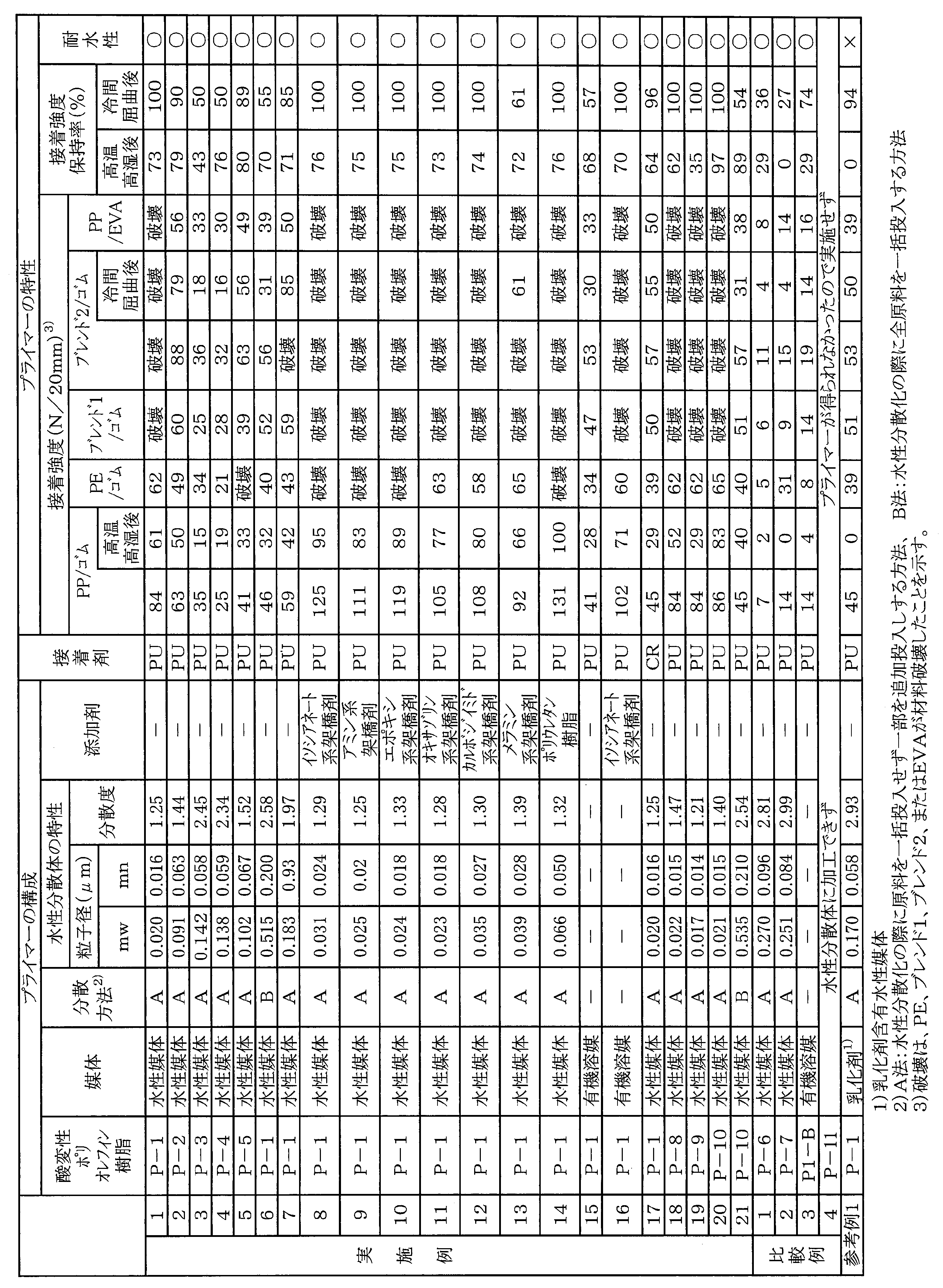
実施例14では、酸変性ポリオレフィン樹脂にポリウレタン樹脂を添加することで、優れたプライマー性能が確認された。
実施例16では、有機溶媒を媒体とする、酸変性ポリオレフィン樹脂溶液からなる履物部材用プライマーにおいても、架橋剤を添加することで、プライマー性能が良好となることが確認された。
Claims (12)
- 酸変性ポリオレフィン樹脂と媒体とを含有するプライマーであって、
酸変性ポリオレフィン樹脂が、オレフィン単位と不飽和カルボン酸単位とを共重合成分として含有する共重合体であり、
オレフィン単位として、プロピレン単位(A)と、プロピレン単位以外のオレフィン単位(B)とを含有し、
プロピレン単位(A)と、プロピレン単位以外のオレフィン単位(B)との質量比(A/B)が60/40~95/5であり、
プロピレン単位(A)と、プロピレン単位以外のオレフィン単位(B)との合計100質量部に対し、不飽和カルボン酸単位の含有量が0.1~10質量部であることを特徴とする履物構成部材用プライマー。 - 酸変性ポリオレフィン樹脂に含まれる、未反応不飽和カルボン酸モノマー成分の残存量が10,000ppm以下であることを特徴とする請求項1記載の履物構成部材用プライマー。
- 媒体が水性媒体であり、酸変性ポリオレフィン樹脂が水性媒体中に分散し、水性分散体中に分散された酸変性ポリオレフィン樹脂の重量平均粒子径が0.5μm以下であることを特徴とする請求項1または2記載の履物構成部材用プライマー。
- プロピレン単位以外のオレフィン単位(B)がブテンであることを特徴とする請求項1~3のいずれかに記載の履物構成部材用プライマー。
- 水性分散体中における酸変性ポリオレフィン樹脂の粒子径分布にかかる分散度が2.6以下であることを特徴とする請求項3または4記載の履物構成部材用プライマー。
- さらに、ポリウレタン樹脂を含有し、ポリウレタン樹脂の含有量が、酸変性ポリオレフィン樹脂100質量部に対して、5~300質量部であることを特徴とする請求項1~5のいずれかに記載の履物構成部材用プライマー。
- さらに、架橋剤を含有し、架橋剤の含有量が、酸変性ポリオレフィン樹脂100質量部に対して、0.1~30質量部であることを特徴とする請求項1~6のいずれかに記載の履物構成部材用プライマー。
- 履物構成部材が、ポリオレフィン系樹脂からなる部材であることを特徴とする請求項1~7のいずれかに記載の履物構成部材用プライマー。
- 請求項1~8のいずれかに記載の履物構成部材用プライマーより得られるプライマー層が、表面の少なくとも一部に積層されていることを特徴とする履物構成部材。
- 請求項9記載の履物構成部材を含むことを特徴とする履物。
- 請求項9記載の履物構成部材が、プライマー層上に設けられたウレタン系接着剤を介して接着されていることを特徴とする履物。
- 請求項1~8のいずれかに記載の履物構成部材用プライマーの製造方法であって、酸変性ポリオレフィン樹脂、塩基性化合物、有機溶媒および水を、密閉容器中80~240℃で攪拌した後、塩基性化合物、有機溶媒および水から選ばれる少なくとも1種を加え、密閉容器中80~240℃で攪拌することを特徴とする履物構成部材用プライマーの製造方法。
Priority Applications (3)
| Application Number | Priority Date | Filing Date | Title |
|---|---|---|---|
| CN201380062571.1A CN104822519A (zh) | 2012-12-04 | 2013-12-04 | 鞋构成部件用底漆、其制造方法、鞋构成部件以及鞋 |
| JP2014551115A JP6355560B2 (ja) | 2012-12-04 | 2013-12-04 | 履物構成部材用プライマー、その製造方法、履物構成部材、および履物 |
| US14/647,143 US9556352B2 (en) | 2012-12-04 | 2013-12-04 | Primer for footwear constituting members, method for producing same, footwear constituting member, and footwear |
Applications Claiming Priority (2)
| Application Number | Priority Date | Filing Date | Title |
|---|---|---|---|
| JP2012-265289 | 2012-12-04 | ||
| JP2012265289 | 2012-12-04 |
Publications (1)
| Publication Number | Publication Date |
|---|---|
| WO2014088015A1 true WO2014088015A1 (ja) | 2014-06-12 |
Family
ID=50883433
Family Applications (1)
| Application Number | Title | Priority Date | Filing Date |
|---|---|---|---|
| PCT/JP2013/082521 Ceased WO2014088015A1 (ja) | 2012-12-04 | 2013-12-04 | 履物構成部材用プライマー、その製造方法、履物構成部材、および履物 |
Country Status (4)
| Country | Link |
|---|---|
| US (1) | US9556352B2 (ja) |
| JP (1) | JP6355560B2 (ja) |
| CN (1) | CN104822519A (ja) |
| WO (1) | WO2014088015A1 (ja) |
Cited By (10)
| Publication number | Priority date | Publication date | Assignee | Title |
|---|---|---|---|---|
| JP2016009544A (ja) * | 2014-06-23 | 2016-01-18 | ユニチカ株式会社 | 二次電池電極用バインダー、スラリー、二次電池電極および二次電池 |
| JP2016210850A (ja) * | 2015-04-30 | 2016-12-15 | 日立マクセル株式会社 | 粘着テープ |
| WO2017025787A1 (ja) * | 2015-08-06 | 2017-02-16 | 藤森工業株式会社 | ホットメルト接着性榭脂フィルムおよびその製造方法 |
| JP2017036353A (ja) * | 2015-08-06 | 2017-02-16 | 藤森工業株式会社 | 接着性樹脂組成物、接着剤の製造方法、接着剤、接着性積層体、及び積層体 |
| JP2018527421A (ja) * | 2015-06-30 | 2018-09-20 | ダウ グローバル テクノロジーズ エルエルシー | 接着促進剤及び非極性基材を接着するために極性テキスタイルに使用する方法 |
| CN108690413A (zh) * | 2018-05-28 | 2018-10-23 | 常州市武进晨光金属涂料有限公司 | 车辆塑料用单组份水性导电底漆及其制备方法 |
| KR20190022324A (ko) * | 2017-08-23 | 2019-03-06 | 후지모리 고교 가부시키가이샤 | 접착성 수지 조성물 및 적층체 |
| KR20190022325A (ko) * | 2017-08-23 | 2019-03-06 | 후지모리 고교 가부시키가이샤 | 접착성 수지 조성물 및 적층체 |
| JP2019038950A (ja) * | 2017-08-25 | 2019-03-14 | ユニチカ株式会社 | 包装材料用接着剤、包装材料及び包装材料の製造方法 |
| JP2019196496A (ja) * | 2019-07-22 | 2019-11-14 | 藤森工業株式会社 | 接着性樹脂組成物、及び接着剤 |
Families Citing this family (10)
| Publication number | Priority date | Publication date | Assignee | Title |
|---|---|---|---|---|
| JP6902827B2 (ja) | 2016-02-08 | 2021-07-14 | 藤森工業株式会社 | 接着性樹脂組成物、被着体接着方法、及び接着性樹脂フィルム |
| WO2017156674A1 (en) * | 2016-03-14 | 2017-09-21 | Dow Global Technologies Llc | Process for preparing foamed articles made from ethylene/alpha-olefin interpolymers |
| JP6447557B2 (ja) * | 2016-03-24 | 2019-01-09 | 日亜化学工業株式会社 | 発光装置の製造方法 |
| CN106147493B (zh) * | 2016-06-29 | 2018-07-31 | 浙江佑泰新材料科技有限公司 | 一种用于汽车保险杠的水性底漆 |
| BR112019003728B1 (pt) * | 2016-08-23 | 2022-06-14 | Dow Global Technologies Llc | Composição e estrutura de múltiplas camadas |
| GB2571231B (en) * | 2016-11-09 | 2020-03-25 | Nike Innovate Cv | Textiles and articles, and processes for making the same |
| CN107455836B (zh) * | 2017-08-01 | 2019-10-29 | 浙江工贸职业技术学院 | 一种芭蕾舞用脚尖鞋 |
| US20220203709A1 (en) * | 2019-04-26 | 2022-06-30 | Tonejet Limited | Apparatus and method for preparing a cylindrical object for decorating thereon |
| EP4178999B1 (en) * | 2020-07-09 | 2026-03-04 | Habasit AG | Tpo primer |
| CN116783256B (zh) * | 2021-03-24 | 2024-07-12 | 关西涂料株式会社 | 水性底漆涂料组合物以及多层涂膜的形成方法 |
Citations (4)
| Publication number | Priority date | Publication date | Assignee | Title |
|---|---|---|---|---|
| JP2003521547A (ja) * | 1997-07-18 | 2003-07-15 | ミネソタ マイニング アンド マニュファクチャリング カンパニー | プライマー組成物および有機ポリマー基材の接着 |
| JP2008069254A (ja) * | 2006-09-14 | 2008-03-27 | Unitika Ltd | 水性接着剤およびそれを用いた積層体 |
| JP2009079078A (ja) * | 2007-09-25 | 2009-04-16 | Toyo Kasei Kogyo Co Ltd | 水性樹脂分散組成物の製造方法 |
| JP2009114319A (ja) * | 2007-11-06 | 2009-05-28 | Mitsui Chemicals Inc | 水性樹脂組成物 |
Family Cites Families (5)
| Publication number | Priority date | Publication date | Assignee | Title |
|---|---|---|---|---|
| JPH0742437B2 (ja) * | 1991-04-19 | 1995-05-10 | 日本製紙株式会社 | ポリオレフィン系樹脂用コーティング組成物 |
| US20040168348A1 (en) * | 2003-02-27 | 2004-09-02 | Strickland Barbara A. | Shoe upper having an adhesive impregnated fabric strip stitched thereto for sole attached thereto |
| JP2008056877A (ja) * | 2006-09-04 | 2008-03-13 | Unitika Ltd | ポリオレフィン樹脂水性分散体の製造方法 |
| FR2933986B1 (fr) | 2008-07-16 | 2010-08-27 | Arkema France | Utilisation d'un promoteur d'adherence encapsule dans un joint de colle aqueux collant deux substrats dont l'un au moins comprend un materiau (tpe-pa) |
| US20110112229A1 (en) * | 2008-08-14 | 2011-05-12 | Nippon Paper Chemicals Co., Ltd. | Dispersion resin composition, and paint composition, ink composition, adhesive composition and primer composition, containing the dispersion resin composition |
-
2013
- 2013-12-04 JP JP2014551115A patent/JP6355560B2/ja not_active Expired - Fee Related
- 2013-12-04 CN CN201380062571.1A patent/CN104822519A/zh active Pending
- 2013-12-04 US US14/647,143 patent/US9556352B2/en not_active Expired - Fee Related
- 2013-12-04 WO PCT/JP2013/082521 patent/WO2014088015A1/ja not_active Ceased
Patent Citations (4)
| Publication number | Priority date | Publication date | Assignee | Title |
|---|---|---|---|---|
| JP2003521547A (ja) * | 1997-07-18 | 2003-07-15 | ミネソタ マイニング アンド マニュファクチャリング カンパニー | プライマー組成物および有機ポリマー基材の接着 |
| JP2008069254A (ja) * | 2006-09-14 | 2008-03-27 | Unitika Ltd | 水性接着剤およびそれを用いた積層体 |
| JP2009079078A (ja) * | 2007-09-25 | 2009-04-16 | Toyo Kasei Kogyo Co Ltd | 水性樹脂分散組成物の製造方法 |
| JP2009114319A (ja) * | 2007-11-06 | 2009-05-28 | Mitsui Chemicals Inc | 水性樹脂組成物 |
Cited By (20)
| Publication number | Priority date | Publication date | Assignee | Title |
|---|---|---|---|---|
| JP2016009544A (ja) * | 2014-06-23 | 2016-01-18 | ユニチカ株式会社 | 二次電池電極用バインダー、スラリー、二次電池電極および二次電池 |
| JP2016210850A (ja) * | 2015-04-30 | 2016-12-15 | 日立マクセル株式会社 | 粘着テープ |
| JP2018527421A (ja) * | 2015-06-30 | 2018-09-20 | ダウ グローバル テクノロジーズ エルエルシー | 接着促進剤及び非極性基材を接着するために極性テキスタイルに使用する方法 |
| WO2017025787A1 (ja) * | 2015-08-06 | 2017-02-16 | 藤森工業株式会社 | ホットメルト接着性榭脂フィルムおよびその製造方法 |
| JP2017036355A (ja) * | 2015-08-06 | 2017-02-16 | 藤森工業株式会社 | ホットメルト接着性樹脂フィルムおよびその製造方法 |
| JP2017036353A (ja) * | 2015-08-06 | 2017-02-16 | 藤森工業株式会社 | 接着性樹脂組成物、接着剤の製造方法、接着剤、接着性積層体、及び積層体 |
| US11826991B2 (en) | 2015-08-06 | 2023-11-28 | Fujimori Kogyo Co., Ltd. | Hot-melt adhesive resin film and production method thereof |
| US11148401B2 (en) | 2015-08-06 | 2021-10-19 | Fujimori Kogyo Co., Ltd. | Hot-melt adhesive resin film and production method thereof |
| KR102272007B1 (ko) | 2017-08-23 | 2021-07-02 | 후지모리 고교 가부시키가이샤 | 접착성 수지 조성물 및 적층체 |
| US10669456B2 (en) | 2017-08-23 | 2020-06-02 | Fujimori Kogyo Co., Ltd. | Adhesive resin composition and laminate |
| KR102160435B1 (ko) * | 2017-08-23 | 2020-09-28 | 후지모리 고교 가부시키가이샤 | 접착성 수지 조성물 및 적층체 |
| KR20200111154A (ko) * | 2017-08-23 | 2020-09-28 | 후지모리 고교 가부시키가이샤 | 접착성 수지 조성물 및 적층체 |
| KR102160431B1 (ko) * | 2017-08-23 | 2020-09-28 | 후지모리 고교 가부시키가이샤 | 접착성 수지 조성물 및 적층체 |
| KR20190022325A (ko) * | 2017-08-23 | 2019-03-06 | 후지모리 고교 가부시키가이샤 | 접착성 수지 조성물 및 적층체 |
| KR20190022324A (ko) * | 2017-08-23 | 2019-03-06 | 후지모리 고교 가부시키가이샤 | 접착성 수지 조성물 및 적층체 |
| US11242475B2 (en) | 2017-08-23 | 2022-02-08 | Fujimori Kogyo Co., Ltd. | Adhesive resin composition and laminate |
| US12146078B2 (en) | 2017-08-23 | 2024-11-19 | Fujimori Kogyo Co., Ltd. | Adhesive resin composition and laminate |
| JP2019038950A (ja) * | 2017-08-25 | 2019-03-14 | ユニチカ株式会社 | 包装材料用接着剤、包装材料及び包装材料の製造方法 |
| CN108690413A (zh) * | 2018-05-28 | 2018-10-23 | 常州市武进晨光金属涂料有限公司 | 车辆塑料用单组份水性导电底漆及其制备方法 |
| JP2019196496A (ja) * | 2019-07-22 | 2019-11-14 | 藤森工業株式会社 | 接着性樹脂組成物、及び接着剤 |
Also Published As
| Publication number | Publication date |
|---|---|
| JP6355560B2 (ja) | 2018-07-11 |
| CN104822519A (zh) | 2015-08-05 |
| US20150315400A1 (en) | 2015-11-05 |
| US9556352B2 (en) | 2017-01-31 |
| JPWO2014088015A1 (ja) | 2017-01-05 |
Similar Documents
| Publication | Publication Date | Title |
|---|---|---|
| JP6355560B2 (ja) | 履物構成部材用プライマー、その製造方法、履物構成部材、および履物 | |
| JP6676139B2 (ja) | 接着剤 | |
| JP3759160B2 (ja) | ポリオレフィン樹脂水性分散体、その製造方法およびこれを用いた水性塗料 | |
| JP6408788B2 (ja) | 環状ポリオレフィン材料用塗工剤及び積層体 | |
| JP4005434B2 (ja) | 水性分散体、塗膜および積層体フィルム | |
| JP2015229710A (ja) | 水性分散体およびそれより得られる積層体 | |
| JP2009046568A (ja) | ポリオレフィン系樹脂の水系乳化分散液及びその製造方法 | |
| JP2020100772A (ja) | 水系コート剤、塗膜、および積層体 | |
| JP2018126947A (ja) | 積層体 | |
| JP6452282B2 (ja) | 金属板用接着剤 | |
| JP2015067674A (ja) | 履物構成部材用プライマー、履物構成部材、履物 | |
| JP6830238B2 (ja) | 接着剤およびそれを用いてなる積層体 | |
| JP2021095496A (ja) | 水性分散体、接着剤、積層体および履物 | |
| JP2004148729A (ja) | フィルム積層体 | |
| JP4159806B2 (ja) | フィルム積層体 | |
| JP2017031302A (ja) | 射出成形用接着剤 | |
| JP5743491B2 (ja) | 押出ラミネーション用フィルム積層体およびその製造方法 | |
| JP2012074424A (ja) | 太陽電池モジュール用接着剤、封止用保護シート及び太陽電池モジュール | |
| JP2016011417A (ja) | 塗料用バインダー | |
| JP2016189408A (ja) | 太陽電池モジュール用接着剤、封止用保護シートおよび太陽電池モジュール | |
| JP2016011420A (ja) | シクロオレフィンポリマー用塗工剤および積層体 | |
| TW201527475A (zh) | 水性乳化液 | |
| JP2019156887A (ja) | 水性分散体 | |
| JP2018138668A (ja) | 金属板用接着剤 | |
| JP2016188323A (ja) | 水性接着剤 |
Legal Events
| Date | Code | Title | Description |
|---|---|---|---|
| 121 | Ep: the epo has been informed by wipo that ep was designated in this application |
Ref document number: 13860341 Country of ref document: EP Kind code of ref document: A1 |
|
| ENP | Entry into the national phase |
Ref document number: 2014551115 Country of ref document: JP Kind code of ref document: A |
|
| WWE | Wipo information: entry into national phase |
Ref document number: 14647143 Country of ref document: US |
|
| NENP | Non-entry into the national phase |
Ref country code: DE |
|
| 122 | Ep: pct application non-entry in european phase |
Ref document number: 13860341 Country of ref document: EP Kind code of ref document: A1 |