WO2014069418A1 - 静電荷像現像用トナー並びに該トナーを備えた電子写真カートリッジ及び画像形成装置 - Google Patents
静電荷像現像用トナー並びに該トナーを備えた電子写真カートリッジ及び画像形成装置 Download PDFInfo
- Publication number
- WO2014069418A1 WO2014069418A1 PCT/JP2013/079171 JP2013079171W WO2014069418A1 WO 2014069418 A1 WO2014069418 A1 WO 2014069418A1 JP 2013079171 W JP2013079171 W JP 2013079171W WO 2014069418 A1 WO2014069418 A1 WO 2014069418A1
- Authority
- WO
- WIPO (PCT)
- Prior art keywords
- toner
- group
- wax
- substituted
- charge control
- Prior art date
- Legal status (The legal status is an assumption and is not a legal conclusion. Google has not performed a legal analysis and makes no representation as to the accuracy of the status listed.)
- Ceased
Links
Classifications
-
- G—PHYSICS
- G03—PHOTOGRAPHY; CINEMATOGRAPHY; ANALOGOUS TECHNIQUES USING WAVES OTHER THAN OPTICAL WAVES; ELECTROGRAPHY; HOLOGRAPHY
- G03G—ELECTROGRAPHY; ELECTROPHOTOGRAPHY; MAGNETOGRAPHY
- G03G9/00—Developers
- G03G9/08—Developers with toner particles
- G03G9/097—Plasticisers; Charge controlling agents
- G03G9/09733—Organic compounds
-
- G—PHYSICS
- G03—PHOTOGRAPHY; CINEMATOGRAPHY; ANALOGOUS TECHNIQUES USING WAVES OTHER THAN OPTICAL WAVES; ELECTROGRAPHY; HOLOGRAPHY
- G03G—ELECTROGRAPHY; ELECTROPHOTOGRAPHY; MAGNETOGRAPHY
- G03G9/00—Developers
- G03G9/08—Developers with toner particles
- G03G9/087—Binders for toner particles
- G03G9/08742—Binders for toner particles comprising macromolecular compounds obtained otherwise than by reactions only involving carbon-to-carbon unsaturated bonds
- G03G9/08746—Condensation polymers of aldehydes or ketones
- G03G9/08748—Phenoplasts
-
- G—PHYSICS
- G03—PHOTOGRAPHY; CINEMATOGRAPHY; ANALOGOUS TECHNIQUES USING WAVES OTHER THAN OPTICAL WAVES; ELECTROGRAPHY; HOLOGRAPHY
- G03G—ELECTROGRAPHY; ELECTROPHOTOGRAPHY; MAGNETOGRAPHY
- G03G9/00—Developers
- G03G9/08—Developers with toner particles
- G03G9/087—Binders for toner particles
- G03G9/08742—Binders for toner particles comprising macromolecular compounds obtained otherwise than by reactions only involving carbon-to-carbon unsaturated bonds
- G03G9/08755—Polyesters
-
- G—PHYSICS
- G03—PHOTOGRAPHY; CINEMATOGRAPHY; ANALOGOUS TECHNIQUES USING WAVES OTHER THAN OPTICAL WAVES; ELECTROGRAPHY; HOLOGRAPHY
- G03G—ELECTROGRAPHY; ELECTROPHOTOGRAPHY; MAGNETOGRAPHY
- G03G9/00—Developers
- G03G9/08—Developers with toner particles
- G03G9/087—Binders for toner particles
- G03G9/08775—Natural macromolecular compounds or derivatives thereof
- G03G9/08782—Waxes
-
- G—PHYSICS
- G03—PHOTOGRAPHY; CINEMATOGRAPHY; ANALOGOUS TECHNIQUES USING WAVES OTHER THAN OPTICAL WAVES; ELECTROGRAPHY; HOLOGRAPHY
- G03G—ELECTROGRAPHY; ELECTROPHOTOGRAPHY; MAGNETOGRAPHY
- G03G9/00—Developers
- G03G9/08—Developers with toner particles
- G03G9/087—Binders for toner particles
- G03G9/08784—Macromolecular material not specially provided for in a single one of groups G03G9/08702 - G03G9/08775
- G03G9/08797—Macromolecular material not specially provided for in a single one of groups G03G9/08702 - G03G9/08775 characterised by their physical properties, e.g. viscosity, solubility, melting temperature, softening temperature, glass transition temperature
Definitions
- the present invention relates to a toner for developing an electrostatic charge image, and further relates to an electrophotographic cartridge and an image forming apparatus provided with the toner for developing an electrostatic charge image.
- the toner for developing an electrostatic charge image by a pulverization method is produced by kneading raw materials such as a binder resin and a colorant, pulverizing the obtained mixture, and then classifying it to obtain a desired particle size component.
- a latent image formed on an optical semiconductor in electrophotography, electrostatic recording or the like is developed with an electrostatic charge image developing toner, and is transferred onto a recording material such as paper and thermally fixed, thereby obtaining a fixed image.
- toner in which wax is mixed with toner has been used for the purpose of preventing toner from adhering to the fixing roller and paper wrapping.
- heat fixing is performed at a lower temperature.
- a toner having a low melting point or an increased amount of wax is used.
- the dispersibility of the wax is adversely affected, which causes contamination of the photoreceptor (filming) and a decrease in gloss of the fixed image.
- a fixed image is obtained by superposing yellow, magenta, cyan, black toner, or four colors or three colors of yellow, magenta, and cyan toner.
- the toner required for such full-color image formation can be developed in a single color and the amount of toner attached to the printing paper is small, or even if it is developed in a superimposed manner and the amount of toner attached to the printing paper is large, Both must exhibit good fixability.
- full-color printing often prints photographic images, and a fixed image with high gloss is required.
- Patent Document 1 discloses a toner using a linear polyester having a softening point of 90 to 120 ° C. and carnauba wax
- Patent Document 2 discloses a polylactic acid-based biopolymer as a method for achieving both fixing properties and glossiness of a fixed image.
- a toner is disclosed in which 7.0 to 20% by weight of wax is added to a degradable resin and a terpene phenol copolymer resin.
- an object of the present invention is to provide a toner for developing an electrostatic image having an excellent fixing temperature range and capable of obtaining a high-gloss fixed image.
- the gist of the present invention is as follows. ⁇ 1> A toner containing a binder resin, a colorant and a wax, wherein the toner further contains a charge control resin represented by the following formula (1), and the wax contains an ester wax: Toner for image development.
- R 1 represents a hydrogen atom, a halogen atom, an alkyl group, —COC p H 2p + 1 (wherein p is an integer of 1 to 20), an aralkyl group, a substituted or unsubstituted phenyl group, A substituted or unsubstituted amino group, a nitro group, an alicyclic group, —SO 3 H, —Si (CH 3 ) 3 , an alkoxyl group, a carboxyl group, a sulfoamide group, a cyano group, or an acyl group is shown.
- R 2 represents an alkyl group, a substituted or unsubstituted phenyl group, or a substituted or unsubstituted aralkyl group.
- R 3 and R 4 each independently represent a hydrogen atom, an alkyl group having 1 to 12 carbon atoms, a substituted or unsubstituted phenyl group, or a heterocyclic group containing a nitrogen or oxygen atom.
- R 5 to R 8 each independently represents a hydrogen atom, a halogen atom, an alkyl group, an aralkyl group, or a substituted or unsubstituted amino group.
- (M + n) is an integer of 4 to 8, m is an integer of 1 or more, and n is an integer of 0 or more.
- An electrophotographic cartridge comprising the electrostatic image developing toner according to any one of ⁇ 1> to ⁇ 3>.
- An image forming apparatus comprising the electrostatic image developing toner according to any one of ⁇ 1> to ⁇ 3>.
- a fixed image having good fixability and high gloss can be obtained by using an electrostatic charge image developing toner containing an ester wax and a specific charge control resin.
- the present invention will be described in detail, but the present invention is not limited to the following embodiments, and can be arbitrarily modified without departing from the gist of the present invention.
- the “electrostatic image developing toner” may be simply abbreviated as “toner”. “Parts by weight” and “parts by mass” are synonymous.
- the toner of the present invention contains a binder resin, a colorant, a wax and a charge control resin, and a toner base is generally obtained by a melt-kneading pulverization method.
- the melt kneading and pulverization method is a method in which a wax, a charge control agent, a magnetic material, and the like are dry-mixed with a binder resin and a colorant, if necessary, and then melt-kneaded with an extruder, etc. This is how to get a mother.
- a toner can be obtained by attaching or fixing an external additive to the surface of the toner base thus obtained.
- the binder resin constituting the toner of the present invention is not particularly limited.
- the binder resin that can be used include saturated or unsaturated polyester resins, styrene-acrylic copolymer resins, and vinyl resins.
- the colorant may be appropriately selected from those known to be usable for toner.
- Specific examples of colorants include carbon black, aniline blue, phthalocyanine blue, phthalocyanine green, Hansa yellow, rhodamine dyes, chrome yellow, quinacridone, benzidine yellow, rose bengal, triallylmethane dyes, and monoazo dyes.
- Known arbitrary colorants such as dyes and pigments, disazo dyes and condensed azo dyes and pigments can be used singly or in combination.
- benzidine yellow a monoazo dye / condensed dye / pigment as a yellow dye / pigment
- quinacridone / monoazo dye / pigment as magenta dye
- phthalocyanine blue as a cyan dye / pigment.
- black dye / pigment carbon black or one prepared by mixing the yellow dye / pigment / cyan dye / pigment described above and toned to black is used.
- carbon black as a black dye / pigment exists as an aggregate of very fine primary particles, and when dispersed as a dye / pigment dispersion, coarsening of particles due to reaggregation is likely to occur.
- the degree of reagglomeration of carbon black particles correlates with the amount of impurities contained in carbon black (the degree of residual undecomposed organic matter). If there are many impurities, coarsening due to reaggregation after dispersion tends to be severe. showed that.
- the ultraviolet absorbance of the toluene extract of carbon black measured by the following method is preferably 0.05 or less, and more preferably 0.03 or less. In general, carbon black produced by the channel method tends to have a large amount of impurities, and therefore, carbon black produced by the furnace method is preferred as the carbon black used in the present invention.
- the wax contains an ester wax.
- the ester wax is a wax having an ester group, and may be either a natural ester wax or a synthetic ester wax, and may be used in a form in which a plurality of types of ester waxes are used in combination.
- Examples of natural ester wax include carnauba wax, montan wax, rice wax and the like.
- Synthetic ester waxes include fatty acid esters composed of fatty acids having 16 to 22 carbon atoms and mono- or polyhydric alcohols, mixtures of a plurality of these fatty acid esters, fatty acid amides composed of fatty acids having 16 to 22 carbon atoms and amines, Examples thereof include a mixture of a plurality of fatty acid amides. More specifically, WEP-2, WEP-3, WEP-4, WEP-5, WEP-6, WEP-7, WEP-8, and WE-10 manufactured by NOF Corporation (all trade names) ) And the like.
- ester waxes are preferable from the viewpoints of high temperature storage stability and releasability.
- synthetic ester waxes fatty acid esters and fatty acid esters comprising a fatty acid having 16 to 22 carbon atoms and a monohydric or polyhydric alcohol. A mixture of a plurality of these is more preferred.
- natural ester wax such as carnauba wax, montan wax and rice wax, fatty acid having 16 to 22 carbon atoms and monovalent or polyvalent
- a fatty acid ester composed of alcohol, a mixture of a plurality of fatty acid esters, a fatty acid amide composed of a fatty acid having 16 to 22 carbon atoms and an amine, and a synthetic ester wax such as a mixture of a plurality of fatty acid amides may be used.
- WEP-9 (trade name) manufactured by NOF Corporation may be mentioned.
- an existing natural ester wax and a synthetic ester wax are used in combination, at least one selected from the above-mentioned natural ester waxes and WEP-2, WEP manufactured by NOF Corporation as a synthetic ester wax are used. -3, WEP-4, WEP-5, WEP-6, WEP-7, WEP-8, WE-10 (all of which are trade names), etc. it can.
- a natural ester wax and a synthetic ester wax are used in combination or mixed, when the toner base material is melt kneaded and pulverized with other toner base materials, they may be added individually, or You may add what was mixed beforehand.
- the melting point of the ester wax is not particularly limited as long as the effects of the present invention are not significantly impaired.
- the lower limit is usually 50 ° C. or higher, and preferably 60 ° C. or higher from the viewpoint of high-temperature storage stability, while the upper limit is
- the temperature is usually 100 ° C. or lower, and preferably 90 ° C. or lower from the viewpoint of low-temperature fixability.
- the lower limit of the wax content relative to the toner is usually 0.5% by weight or more, and preferably 1.5% by weight or more from the viewpoint of the non-hot offset region temperature range.
- the upper limit is usually 10% by weight or less, preferably 6% by weight or less, and more preferably 6% by weight or less, from the viewpoint of preventing fusion to a sleeve or blade at the time of printing, filming to a photoreceptor, and the like. 5% by weight or less.
- the toner of the present invention may contain a wax other than the above-described ester wax as long as the effects of the present invention are not significantly impaired, but it is particularly preferable that the wax is composed only of an ester wax.
- waxes that can be used in combination other than the ester wax include paraffin wax, Fischer-Tropsch wax, and olefin wax.
- the content of the ester wax is not particularly limited as long as the effect of the present invention is not significantly impaired, but from the viewpoint of exerting the effect of the present invention, 50 weight% or more is preferable and 75 weight% or more is more preferable.
- the charge control resin contained in the present invention is represented by the following formula (1).
- R 1 is a hydrogen atom, a halogen atom, an alkyl group, —COC p H 2p + 1 (where p is an integer of 1 to 20), an aralkyl group, a substituted or unsubstituted phenyl group, a substituted group Alternatively, it represents an unsubstituted amino group, a nitro group, an alicyclic group, —SO 3 H, —Si (CH 3 ) 3 , an alkoxyl group, a carboxyl group, a sulfoamide group, a cyano group, or an acyl group.
- R 1 is preferably an alkyl group, and the carbon number of the alkyl group is preferably 1 or more and more preferably 8 or less.
- the lower limit of the carbon number is more preferably 3 or more, while the upper limit of the carbon number is more preferably 6 or less, and particularly preferably 4 or less.
- the alkyl group may be linear or branched, but a branched alkyl group is preferred.
- R 1 is most preferably a t-butyl group.
- R 2 represents an alkyl group, a substituted or unsubstituted phenyl group, or a substituted or unsubstituted aralkyl group.
- R 2 is preferably an alkyl group, and the carbon number of the alkyl group is preferably 1 or more and 12 or less.
- the lower limit of the carbon number is more preferably 3 or more, while the upper limit of the carbon number is more preferably 10 or less, and particularly preferably 8 or less.
- the alkyl group may be linear or branched, but a branched alkyl group is preferred.
- R 2 is most preferably a 2-ethylhexyl group as described above.
- R 3 and R 4 each independently represent a hydrogen atom, an alkyl group having 1 to 12 carbon atoms, a substituted or unsubstituted phenyl group, or a heterocyclic group containing a nitrogen or oxygen atom.
- R 3 and R 4 are preferably a hydrogen atom.
- R 5 to R 8 each independently represents a hydrogen atom, a halogen atom, an alkyl group, an aralkyl group, or a substituted or unsubstituted amino group.
- R 5 to R 8 are preferably a hydrogen atom.
- (M + n) is an integer of 4 to 8
- m is an integer of 1 or more
- n is an integer of 0 or more.
- the lower limit of the content of the charge control resin which is the compound represented by the above formula (1), is usually 0.1% by weight or more, preferably 0.5% by weight or more with respect to the toner.
- the upper limit is usually 2.5% by weight or less, preferably 1.5% by weight or less.
- the toner of the present invention may contain a charge control agent other than the charge control resin represented by the above formula (1) as long as the effect of the present invention is not significantly impaired, and is represented by the above formula (1).
- a charge control agent other than the charge control resin a charge control agent comprising an azine compound (nigrosine), a quaternary ammonium salt compound, a 2: 1 type metal-containing complex (chromium complex), a monoazo metal-containing complex compound, or the like, Examples thereof include a charge control agent made of a resin other than the charge control resin represented by the above formula (1).
- the content of the charge control agent used in combination is not particularly limited, but the total charge control agent is based on the toner.
- the lower limit is usually 0.1% by weight or more, preferably 0.25% by weight or more, while the upper limit is usually 5% by weight or less, preferably 2% by weight or less.
- an external additive can be further added as necessary.
- the external additive may be appropriately selected from those known to be used for toner.
- Examples of the external additive may include one or more kinds of hydrophobic silica, inorganic oxide fine particles, and organic fine particles.
- examples of the inorganic oxide fine particles include titanium oxide, aluminum oxide, magnetite, zinc oxide, Examples thereof include inorganic particles such as tin oxide, barium titanate, and strontium titanate.
- the organic fine particles include fine particles such as styrene resin, acrylic resin, epoxy resin, and melamine resin.
- the content of the external additive is not particularly limited, but the lower limit with respect to the toner base particles is usually 0.1% by weight or more, preferably 0.8%. 5 wt% or more, more preferably 0.8 wt% or more, while the upper limit is usually 6 wt% or less, preferably 5 wt% or less, more preferably 4 wt% or less.
- Examples of the method for adding the external additive include a method using a high-speed stirrer such as a Henschel mixer, a method using an apparatus capable of applying a compressive shear stress, and the like.
- the externally added toner to which the external additive is added can be prepared by a single-stage external addition method in which all external additives are added to the toner base particles at the same time, but separate external addition is performed for each external additive. It may be produced by the method.
- externally adding in order to prevent temperature rise, it is preferable to install a cooling device in the container or to add externally in stages.
- the toner of the present invention is filled in an electrophotographic cartridge, a toner bottle or the like and mounted on an image forming apparatus.
- the toner of the present invention can be provided in a known electrophotographic cartridge or image forming apparatus.
- Standard paper 92% whiteness, paper thickness 0.087 ⁇ m, basis weight 64 g / m 2 , size A4 (297 mm ⁇ 210 mm)
- the fixing unit of the commercially available two-component copying machine was removed to obtain an unfixed image.
- the adhesion amount of the toner to the paper was adjusted to about 0.5 mg / cm 2 and about 1.3 mg / cm 2 .
- the obtained unfixed image was fixed by an external fixing machine in which the temperature and process speed of the heat fixing roller were adjusted, and the fixing performance was evaluated visually for the occurrence of offset. When the offset did not occur, it was indicated as “ ⁇ ”, and when it occurred, it was indicated as “X”.
- the external fixing machine was used after removing the fixing part of a color compound machine AR-C261 (trade name) manufactured by Sharp Corporation.
- the adhesion amount was about 0.5 mg / cm 2
- the process speed was 70 mm / second
- the temperature of the heat fixing roller was adjusted to 140 ° C. and 150 ° C. for evaluation.
- the adhesion amount was about 1.3 mg / cm 2
- the process speed was 70 mm / second
- the temperature of the heat fixing roller was adjusted between 190 ° C. and 220 ° C. in increments of 10 ° C. and evaluated.
- the toner adhesion amount was about 0.5 mg / cm 2
- the external fixing machine was adjusted to a process speed of 70 mm / second
- the temperature of the heat fixing roller was adjusted to 180 ° C.
- the gloss performance was evaluated based on the fixed image.
- the glossiness of the solid portion was measured by 75 ° specular glossiness with Gloss Meter VG2000 (trade name) manufactured by Nippon Denshoku Industries Co., Ltd.
- the glossiness is 9% or more as ⁇ , and below 9% as x.
- a negatively chargeable nonmagnetic toner was prepared according to the following blending ratio.
- Resin A polyyester softening point 147 ° C. glass transition point 60 ° C. gel content 40%
- Resin B polyyester, softening point 100 ° C, glass transition point 64 ° C, gel content 0%
- Silica made by Nippon Aerosil Co., Ltd., trade name R972v) 1 part (0.9% by weight) -Wax A (Ester Wax, NOF Corporation, trade name WEP-9) 2.5 parts (2.3 wt%)
- Charge control agent A aromatic polycondensate represented by the following formula (2); charge control resin) 1 part (0.9 wt%)
- the charge control agent A represented by the above formula (2) is a compound that can be obtained according to Example 4 of Japanese Patent Application Laid-Open No. 2004-279838.
- the above raw materials were mixed with a Henschel mixer, melt kneaded with a twin screw extruder, coarsely pulverized, finely pulverized with a jet mill pulverizer, and classified to obtain a toner base having a volume average particle diameter of 8 ⁇ m.
- Example 1 A toner was obtained in the same manner as in Example 1 except that the charge control agent A of Example 1 was changed to charge control agent B.
- Charge control agent B sulfonic acid CCR, manufactured by Fujikura Kasei Co., Ltd., trade name FCA-1002NS
- Example 2 A toner was obtained in the same manner as in Example 1 except that the charge control agent A of Example 1 was changed to the charge control agent C.
- Charge control agent C boron metal complex, manufactured by Nippon Carlit Co., Ltd., trade name LR-147)
- Example 3 A toner was obtained in the same manner as in Example 1 except that it did not contain the charge control agent A of Example 1.
- a negatively chargeable nonmagnetic toner was prepared according to the following blending ratio.
- -Resin A polyyester, softening point 147 ° C, glass transition point 60 ° C, gel content 40%
- Resin B polyyester, softening point 100 ° C., glass transition point 64 ° C., gel content 0%
- Master batch B master batch B
- Silica made by Nippon Aerosil Co., Ltd., trade name R972v
- -Wax A Ester Wax, NOF Corporation, trade name WEP-9
- Charge control agent A aromatic polycondensate represented by the following formula (2); charge control resin) 1 part (0.9 wt%)
- the above raw materials were mixed with a Henschel mixer, melt kneaded with a twin screw extruder, coarsely pulverized, finely pulverized with a jet mill pulverizer, and classified to obtain a toner base having a volume average particle diameter of 8 ⁇ m.
- -Toner base 100 parts (97.7% by weight) Hydrophobic silica A 1.0 part (1.0% by weight) Hydrophobic silica B 0.7 part (0.7 wt%) ⁇ 0.5 parts of titanium oxide A (0.5% by weight) -Titanium oxide B 0.1 part (0.1 weight%)
- Example 3 A toner was obtained in the same manner as in Example 2 except that the wax A in Example 2 was changed to wax B.
- Wax B Ester Wax, NOF Corporation, trade name WEP-5
- Example 4 A toner was obtained in the same manner as in Example 2 except that the wax A in Example 2 was changed to wax C.
- Wax C Ester Wax, NOF Corporation, trade name WEP-10
- Example 4 A toner was obtained in the same manner as in Example 2 except that the wax A in Example 2 was changed to wax D.
- Wax D paraffin wax Nippon Seiki Co., Ltd., trade name: HNP-9PD
- Example 5 A toner was obtained in the same manner as in Example 2 except that the wax A in Example 2 was changed to wax E.
- Wax E polyethylene wax, manufactured by Mitsui Chemicals, Inc., trade name: High Wax 1120H
- Example 6 A toner was obtained in the same manner as in Example 2 except that the wax A of Example 2 was changed to wax E and wax F and the following parts were added respectively.
- ⁇ Wax E polyethylene wax, manufactured by Mitsui Chemicals, Inc., trade name: High Wax 1120H
- Wax F polypropylene wax, manufactured by Sanyo Chemical Co., Ltd., trade name: Viscol 550-P
- Example 7 A toner was obtained in the same manner as in Example 1 except that the charge control agent A in Example 1 was changed to the charge control agent D.
- Charge control agent D (Calix Allen, manufactured by Orient Chemical Industry Co., Ltd., trade name: E-89)
- Table 1 shows the results of evaluating the compositions and the evaluation items of the toners produced in Example 1, Comparative Examples 1 to 3 and Comparative Example 7.
- Table 2 shows the results of evaluating the compositions and the evaluation items for the toners produced in Examples 2 to 4 and Comparative Examples 4 to 6.
- the toner of the present invention can obtain a high gloss image as compared with the case of using a paraffin wax having a melting point similar to that of the ester wax (Comparative Example 4). It was confirmed that the toner of the present invention can provide an excellent fixing performance and a high gloss image as compared with the case of using other waxes (Comparative Examples 5 and 6).
Landscapes
- Physics & Mathematics (AREA)
- General Physics & Mathematics (AREA)
- Spectroscopy & Molecular Physics (AREA)
- Chemical & Material Sciences (AREA)
- Chemical Kinetics & Catalysis (AREA)
- Developing Agents For Electrophotography (AREA)
Abstract
本発明は、印刷用紙へのトナーの付着量が多い場合でも、オフセットが発生しない等、定着性能に優れ、また、定着画像の光沢性に優れる静電荷像現像用トナーを提供することを課題とする。本発明は、結着樹脂、着色剤及びワックスを含有するトナーであって、前記トナーは下記式(1)で表される帯電制御樹脂をさらに含有し、前記ワックスがエステルワックスを含有する、静電荷像現像用トナーに関する。
Description
本発明は、静電荷像現像用トナーに関し、さらには、前記静電荷像現像用トナーを備えた電子写真カートリッジ及び画像形成装置に関するものである。
粉砕法による静電荷像現像用トナーは、結着樹脂、着色剤等の原料を混練し、得られた混合物を粉砕した後、分級して所望の粒径成分を得ることにより製造される。電子写真、静電記録等において光半導体上に形成された潜像を静電荷像現像用トナーにより現像し、紙等の記録材上に転写後に熱定着させることにより、定着画像を得る。
従来、定着ローラーへのトナーの付着や、用紙の巻きつきを防止する目的で、トナー中にワックスを混合したトナーが用いられているが、近年、省エネルギーの観点から、より低温にて熱定着させるために、融点の低いワックスを用いたり、ワックスの添加量を増やしたトナーが用いられている。しかしながら、低温定着を得るために分散させにくい低融点ワックスを大量に使用すると、弊害としてワックスの分散性が低下し、感光体の汚染(フィルミング)や定着画像の光沢の低下を引き起こすことが一般的に知られている。
さらに、フルカラー印刷の場合はイエロー、マゼンタ、シアン、ブラックトナー、またはイエロー、マゼンタ、シアントナーの4色あるいは3色のトナーを重ねて、定着画像を得ることとなる。このようなフルカラーの画像形成に必要とされるトナーには、単色で現像され印刷用紙へのトナーの付着量が小さい場合でも、重ねて現像され印刷用紙へのトナーの付着量が多い場合でも、共に良好な定着性を発揮する必要がある。また、フルカラー印刷は写真画像を印刷することも多く、光沢性の高い定着画像が求められる。
例えば、定着性と定着画像の光沢性とを両立させる方法として、特許文献1では軟化点90~120℃の線形ポリエステルとカルナウバワックスを用いたトナーが開示され、特許文献2ではポリ乳酸系生分解性樹脂とテルペンフェノール共重合体樹脂に7.0~20重量%のワックスを添加するトナーが開示されている。
しかしながら、本発明者らが検討したところ、特許文献1及び2に記載の方法では、印刷用紙へのトナーの付着量が多い場合にオフセットが発生する等、定着性能や定着画像の光沢性について改善の余地があることが分かった。
上記実情に鑑みて、本発明では、優れた定着温度幅を持ち、さらに高光沢の定着画像が得られる静電荷像現像用トナーを提供することを課題とする。
上記実情に鑑みて、本発明では、優れた定着温度幅を持ち、さらに高光沢の定着画像が得られる静電荷像現像用トナーを提供することを課題とする。
上記課題に鑑みて本発明者らが鋭意検討した結果、従来のワックスの中でもエステルワックスと従来の帯電制御剤の中でも特定の帯電制御樹脂とを含有するトナーとすることにより、上記課題を解決出来ることを見出し、本発明を完成するに至った。
すなわち、本発明の要旨は以下のとおりである。
<1> 結着樹脂、着色剤及びワックスを含有するトナーであって、前記トナーは下記式(1)で表される帯電制御樹脂をさらに含有し、前記ワックスがエステルワックスを含有する、静電荷像現像用トナー。
<1> 結着樹脂、着色剤及びワックスを含有するトナーであって、前記トナーは下記式(1)で表される帯電制御樹脂をさらに含有し、前記ワックスがエステルワックスを含有する、静電荷像現像用トナー。

[式(1)中、R1は、水素原子、ハロゲン原子、アルキル基、-COCpH2p+1(ただし、pは1~20の整数である。)、アラルキル基、置換若しくは非置換フェニル基、置換若しくは非置換アミノ基、ニトロ基、アリサイクリック基、-SO3H、-Si(CH3)3、アルコキシル基、カルボキシル基、スルホアミド基、シアノ基又はアシル基を示す。R2は、アルキル基、置換若しくは非置換フェニル基又は置換若しくは非置換アラルキル基を示す。R3およびR4は、それぞれ独立して、水素原子、炭素数1~12のアルキル基、置換若しくは非置換フェニル基又は窒素若しくは酸素原子を含む複素環基を示す。R5~R8は、それぞれ独立して、水素原子、ハロゲン原子、アルキル基、アラルキル基又は置換若しくは非置換アミノ基を示す。また、(m+n)は4~8の整数であり、mは1以上の整数、nは0以上の整数である。]
<2> 前記ワックス中の前記エステルワックスの含有量が50重量%以上である、前記<1>に記載の静電荷像現像用トナー。
<3> 前記トナー中の前記式(1)で表される帯電制御樹脂の含有量が0.1重量%以上2.5重量%以下である、前記<1>または<2>に記載の静電荷像現像用トナー。
<4> 前記<1>乃至<3>のいずれか1に記載の静電荷像現像用トナーを備えた電子写真カートリッジ。
<5> 前記<1>乃至<3>のいずれか1に記載の静電荷像現像用トナーを備えた画像形成装置。
<2> 前記ワックス中の前記エステルワックスの含有量が50重量%以上である、前記<1>に記載の静電荷像現像用トナー。
<3> 前記トナー中の前記式(1)で表される帯電制御樹脂の含有量が0.1重量%以上2.5重量%以下である、前記<1>または<2>に記載の静電荷像現像用トナー。
<4> 前記<1>乃至<3>のいずれか1に記載の静電荷像現像用トナーを備えた電子写真カートリッジ。
<5> 前記<1>乃至<3>のいずれか1に記載の静電荷像現像用トナーを備えた画像形成装置。
本発明によれば、エステルワックスと特定の帯電制御樹脂とを含有する静電荷像現像用トナーとすることにより、良好な定着性と高い光沢性を有する定着画像を得ることができる
以下に本発明を詳細に説明するが、本発明は以下の実施形態に限定されるものではなく、本発明の要旨を逸脱しない範囲において、任意に変形して実施することができる。
以下、「静電荷像現像用トナー」を単に「トナー」と略記する場合がある。また、“重量部”と“質量部”とは同義である。
以下、「静電荷像現像用トナー」を単に「トナー」と略記する場合がある。また、“重量部”と“質量部”とは同義である。
本発明のトナーは、結着樹脂、着色剤、ワックス及び帯電制御樹脂を含有し、一般的には溶融混練粉砕法でトナー母体が得られる。溶融混練粉砕法とは、結着樹脂及び着色剤に、必要に応じてワックス、帯電制御剤、磁性体等を乾式混合した後、押出機等で溶融混練し、次いで粉砕、分級することでトナー母体を得る方法である。
こうして得られたトナー母体表面に外添剤を付着または固着させることによりトナーを得ることが出来る。
こうして得られたトナー母体表面に外添剤を付着または固着させることによりトナーを得ることが出来る。
本発明のトナーにおいて、構成する結着樹脂としては特に限定はないが、用いることができる結着樹脂としては、例えば、飽和又は不飽和ポリエステル樹脂、スチレン-アクリル系共重合体樹脂、ビニル系樹脂、フェノール樹脂、エポキシ樹脂、ポリエチレン系樹脂、ポリプロピレン系樹脂、アイオノマー樹脂、ポリウレタン樹脂、シリコン樹脂、ケトン樹脂、エチレン-アクリレート共重合体、キシレン樹脂、ポリビニルブチラール樹脂、スチレン-アクリル酸アルキル共重合体、スチレン-メタクリル酸アルキル共重合体、スチレン-アクリロニトリル共重合体、スチレン-ブタジエン共重合体、スチレン-無水マレイン酸共重合体等を挙げることができる。これらの結着樹脂は単独あるいは複数を併用する形で用いてもよい。
本発明のトナーにおいて、着色剤としては、トナーに用い得ることが知られているものの中から適宜選択して用いればよい。着色剤の具体的な例としては、カーボンブラック、アニリンブルー、フタロシアニンブルー、フタロシアニングリーン、ハンザイエロー、ローダミン系染顔料、クロムイエロー、キナクリドン、ベンジジンイエロー、ローズベンガル、トリアリルメタン系染顔料、モノアゾ系染顔料、ジスアゾ系染顔料、縮合アゾ系染顔料など、公知の任意の着色剤を単独あるいは複数を併用する形で用いることができる。
フルカラートナーの場合にはイエロー染顔料はベンジジンイエロー、モノアゾ系染顔料、縮合アゾ系染顔料を、マゼンタ染顔料はキナクリドン、モノアゾ系染顔料を、シアン染顔料はフタロシアニンブルーをそれぞれ用いるのが好ましい。黒色染顔料としてはカーボンブラック又は上記に示したイエロー染顔料/マゼンタ染顔料/シアン染顔料を混合して黒色に調色されたものが利用される。
このうち、黒色染顔料としてカーボンブラックは、非常に微細な一次粒子の凝集体として存在し、染顔料分散体として分散させたときに、再凝集による粒子の粗大化が発生しやすい。カーボンブラック粒子の再凝集の程度は、カーボンブラック中に含まれる不純物量(未分解有機物量の残留程度)の大小と相関が見られ、不純物が多いと分散後の再凝集による粗大化が激しい傾向を示した。不純物量の定量的な評価として、以下の方法で測定されるカーボンブラックのトルエン抽出物の紫外線吸光度が0.05以下であるのが好ましく、0.03以下であるのが一層好ましい。
一般に、チャンネル法のカーボンブラックは不純物が多い傾向を示すので、本発明に用いられるカーボンブラックとしては、ファーネス法で製造されたものが好ましい。
一般に、チャンネル法のカーボンブラックは不純物が多い傾向を示すので、本発明に用いられるカーボンブラックとしては、ファーネス法で製造されたものが好ましい。
本発明のトナーにおいて、ワックスとしては、エステルワックスを含有する。エステルワックスとは、エステル基を有するワックスのことであり、天然エステルワックスおよび合成エステルワックスのいずれであってもよく、複数種のエステルワックスを併用する形で用いてもよい。
天然エステルワックスの例としてはカルナウバワックス、モンタンワックス、ライスワックスなどが挙げられる。
合成エステルワックスとしては、炭素数16~22の脂肪酸と一価または多価のアルコールからなる脂肪酸エステル、該脂肪酸エステルの複数種の混合物、炭素数16~22の脂肪酸とアミンからなる脂肪酸アミド、該脂肪酸アミドの複数種の混合物等が挙げられる。より具体的には、日油(株)社製のWEP-2、WEP-3、WEP-4、WEP-5、WEP-6、WEP-7、WEP-8、WE-10(いずれも商品名)などが挙げられる。
上記のエステルワックスの中でも高温保存性及び離型性の観点から合成エステルワックスが好ましく、合成エステルワックスの中でも、炭素数16~22の脂肪酸と一価または多価のアルコールからなる脂肪酸エステルや脂肪酸エステルの複数種の混合物が更に好ましい。
合成エステルワックスとしては、炭素数16~22の脂肪酸と一価または多価のアルコールからなる脂肪酸エステル、該脂肪酸エステルの複数種の混合物、炭素数16~22の脂肪酸とアミンからなる脂肪酸アミド、該脂肪酸アミドの複数種の混合物等が挙げられる。より具体的には、日油(株)社製のWEP-2、WEP-3、WEP-4、WEP-5、WEP-6、WEP-7、WEP-8、WE-10(いずれも商品名)などが挙げられる。
上記のエステルワックスの中でも高温保存性及び離型性の観点から合成エステルワックスが好ましく、合成エステルワックスの中でも、炭素数16~22の脂肪酸と一価または多価のアルコールからなる脂肪酸エステルや脂肪酸エステルの複数種の混合物が更に好ましい。
また、天然エステルワックスと合成エステルワックスを併用または混合して用いる場合には、カルナウバワックス、モンタンワックス、ライスワックスなどの天然エステルワックスと、炭素数16~22の脂肪酸と一価または多価のアルコールからなる脂肪酸エステル、該脂肪酸エステルの複数種の混合物、炭素数16~22の脂肪酸とアミンからなる脂肪酸アミド、該脂肪酸アミドの複数種の混合物等の合成エステルワックスとを用いればよく、混合品としては、具体的には、日油(株)社製のWEP-9(商品名)が挙げられる。
既存の天然エステルワックスと合成エステルワックスとを併用する場合は、上述された、天然エステルワックスから選ばれる少なくとも1つと、合成エステルワックスとして上述された日油(株)社製のWEP-2、WEP-3、WEP-4、WEP-5、WEP-6、WEP-7、WEP-8、WE-10(いずれも商品名)などから選ばれる少なくとも1つとを、比率を適宜調整して用いることもできる。
天然エステルワックスと合成エステルワックスを併用または混合して用いる場合には、その他のトナー母体原料と溶融混練及び粉砕等を行ってトナー母体とする際に、各々個別に添加してもよく、あるいは、予め混合したものを添加してもよい。
天然エステルワックスと合成エステルワックスを併用または混合して用いる場合には、その他のトナー母体原料と溶融混練及び粉砕等を行ってトナー母体とする際に、各々個別に添加してもよく、あるいは、予め混合したものを添加してもよい。
エステルワックスの融点は、本発明の効果を著しく損なわない限り特に限定はないが、下限は、通常50℃以上であり、高温保存性の観点から、好ましくは60℃以上であり、一方、上限は、通常100℃以下であり、低温定着性の観点から、好ましくは90℃以下である。
ワックスの含有量は、トナーに対して、下限が、通常0.5重量%以上であり、非ホットオフセット域温度幅の観点から、好ましくは1.5重量%以上である。一方、上限は、通常10重量%以下であり、耐刷時のスリーブやブレードへの融着、感光体へのフィルミング等発生防止の観点から、好ましくは6重量%以下であり、さらに好ましくは5重量%以下である。
本発明のトナーは、本発明の効果を著しく損なわない限り、上記のエステルワックス以外のワックスを含有していてもよいが、ワックスがエステルワックスのみからなる場合が特に好ましい。
上記エステルワックス以外の併用できるワックスとしては、パラフィンワックス、フィッシャートロプシュワックス、オレフィンワックス等が挙げられる。
エステルワックスとそれ以外のワックスとを併用する場合、エステルワックスの含有量は、本発明の効果を著しく損なわない限り特に限定されないが、本発明効果の発揮の観点から、ワックスの総量に対して、50重量%以上が好ましく、75重量%以上がより好ましい。
上記エステルワックス以外の併用できるワックスとしては、パラフィンワックス、フィッシャートロプシュワックス、オレフィンワックス等が挙げられる。
エステルワックスとそれ以外のワックスとを併用する場合、エステルワックスの含有量は、本発明の効果を著しく損なわない限り特に限定されないが、本発明効果の発揮の観点から、ワックスの総量に対して、50重量%以上が好ましく、75重量%以上がより好ましい。
本発明に含有される帯電制御樹脂は、下記式(1)で表される。

式(1)中、R1は、水素原子、ハロゲン原子、アルキル基、-COCpH2p+1(ただし、pは1~20の整数である。)、アラルキル基、置換若しくは非置換フェニル基、置換若しくは非置換アミノ基、ニトロ基、アリサイクリック基、-SO3H、-Si(CH3)3、アルコキシル基、カルボキシル基、スルホアミド基、シアノ基又はアシル基を示す。
これらの中でもR1は、アルキル基であることが好ましく、アルキル基の炭素数は1以上であり8以下であることがより好ましい。R1がアルキル基の場合、炭素数の下限は、更に好ましくは3以上であり、一方、炭素数の上限は、さらに好ましくは6以下であり、特に好ましくは4以下である。アルキル基の炭素数が3以上の場合は、アルキル基は直鎖状でも分岐状でもよいが、分岐状のアルキル基が好ましい。R1は上述した中でもt-ブチル基が最も好ましい。
これらの中でもR1は、アルキル基であることが好ましく、アルキル基の炭素数は1以上であり8以下であることがより好ましい。R1がアルキル基の場合、炭素数の下限は、更に好ましくは3以上であり、一方、炭素数の上限は、さらに好ましくは6以下であり、特に好ましくは4以下である。アルキル基の炭素数が3以上の場合は、アルキル基は直鎖状でも分岐状でもよいが、分岐状のアルキル基が好ましい。R1は上述した中でもt-ブチル基が最も好ましい。
R2は、アルキル基、置換若しくは非置換フェニル基又は置換若しくは非置換アラルキル基を示す。
これらの中でも、R2は、アルキル基であることが好ましく、アルキル基の炭素数は1以上であり12以下であることがより好ましい。R2がアルキル基の場合、炭素数の下限は、更に好ましくは3以上であり、一方、炭素数の上限は、さらに好ましくは10以下であり、特に好ましくは8以下である。アルキル基の炭素数が3以上の場合は、アルキル基は直鎖状でも分岐状でもよいが、分岐状のアルキル基が好ましい。R2は上述した中でも2-エチルへキシル基が最も好ましい。
これらの中でも、R2は、アルキル基であることが好ましく、アルキル基の炭素数は1以上であり12以下であることがより好ましい。R2がアルキル基の場合、炭素数の下限は、更に好ましくは3以上であり、一方、炭素数の上限は、さらに好ましくは10以下であり、特に好ましくは8以下である。アルキル基の炭素数が3以上の場合は、アルキル基は直鎖状でも分岐状でもよいが、分岐状のアルキル基が好ましい。R2は上述した中でも2-エチルへキシル基が最も好ましい。
R3およびR4は、それぞれ独立して、水素原子、炭素数1~12のアルキル基、置換若しくは非置換フェニル基又は窒素若しくは酸素原子を含む複素環基を示す。
R3およびR4は、好ましくは水素原子である。
R3およびR4は、好ましくは水素原子である。
R5~R8は、それぞれ独立して、水素原子、ハロゲン原子、アルキル基、アラルキル基又は置換若しくは非置換アミノ基を示す。
R5~R8は、好ましくは水素原子である。
R5~R8は、好ましくは水素原子である。
(m+n)は4~8の整数であり、mは1以上の整数、nは0以上の整数である。
上記式(1)で表される化合物である帯電制御樹脂の含有量は、トナーに対して、下限が、通常0.1重量%以上であり、好ましくは0.5重量%以上である。一方、上限は、通常2.5重量%以下であり、好ましくは1.5重量%以下である。
本発明のトナーは、本発明の効果を著しく損なわない限り、上記式(1)で表される帯電制御樹脂以外の帯電制御剤を含有していてもよく、上記式(1)で表される帯電制御樹脂以外の帯電制御剤としては、アジン系化合物(ニグロシン)、4級アンモニウム塩系化合物、2:1型含金属錯体(クロム錯体)、モノアゾ含金錯体化合物等からなる帯電制御剤や、上記式(1)で表される帯電制御樹脂以外の樹脂からなる帯電制御剤等が挙げられる。
上記式(1)で表される帯電制御樹脂とそれ以外の帯電制御剤とを併用する場合、併用する帯電制御剤の含有量は、特に限定されないが、帯電制御剤の合計がトナーに対して、下限は、通常0.1重量%以上であり、好ましくは0.25重量%以上であり、一方、上限は通常5重量%以下であり、好ましくは2重量%以下である。
本発明のトナーにおいては、必要に応じてさらに外添剤を添加することができる。外添剤としては、トナーに用い得ることが知られているものの中から適宜選択して用いればよい。
外添剤としては、例えば1種類以上の疎水性シリカ及び無機酸化物微粒子、有機微粒子などを有していてもよく、無機酸化物微粒子としては例えば、酸化チタン、酸化アルミニウム、マグネタイト、酸化亜鉛、酸化錫、チタン酸バリウム、チタン酸ストロンチウム等の無機粒子が挙げられる。有機微粒子としては、スチレン系樹脂、アクリル系樹脂、エポキシ系樹脂、メラミン系樹脂等の微粒子が挙げられる。
外添剤としては、例えば1種類以上の疎水性シリカ及び無機酸化物微粒子、有機微粒子などを有していてもよく、無機酸化物微粒子としては例えば、酸化チタン、酸化アルミニウム、マグネタイト、酸化亜鉛、酸化錫、チタン酸バリウム、チタン酸ストロンチウム等の無機粒子が挙げられる。有機微粒子としては、スチレン系樹脂、アクリル系樹脂、エポキシ系樹脂、メラミン系樹脂等の微粒子が挙げられる。
本発明において、外添剤を使用する場合、外添剤の含有量は、特に限定はないが、トナー母粒子に対して、下限は、通常0.1重量%以上であり、好ましくは0.5重量%以上、より好ましくは0.8重量%以上であり、一方、上限は、通常6重量%以下であり、好ましくは5重量%以下であり、より好ましくは4重量%以下である。
外添剤の添加方法としては、ヘンシェルミキサー等の高速攪拌機を用いる方法や、圧縮剪断応力を加えることの出来る装置による方法等が挙げられる。
外添剤が添加された外添トナーは、トナー母粒子に全ての外添剤を同時添加して外添する一段外添法により作製できるが、外添剤毎に外添する分段外添法より作製してもよい。
外添するに際して、温度上昇を防止するために、容器に冷却装置を設置するか、分段外添することが好ましい。
外添剤が添加された外添トナーは、トナー母粒子に全ての外添剤を同時添加して外添する一段外添法により作製できるが、外添剤毎に外添する分段外添法より作製してもよい。
外添するに際して、温度上昇を防止するために、容器に冷却装置を設置するか、分段外添することが好ましい。
本発明のトナーは、電子写真カートリッジやトナーボトル等に充填され、画像形成装置に搭載される。本発明のトナーは、公知の電子写真カートリッジや画像形成装置に備えることができる。
以下、本発明を実施例によりさらに具体的に説明するが、本発明はその要旨を超えない限り、以下の実施例に限定されるものではない。以下の例で「部」とあるのは「質量部」を意味する。
<定着性能評価>
試験にはすべて標準紙(白色度 92%、紙厚 0.087μm、坪量 64g/m2、サイズ A4(297mm×210mm))を用いた。
市販の2成分複写機の定着機を外し、未定着画像を得た。その際に、トナーの紙への付着量を約0.5mg/cm2と約1.3mg/cm2に調整した。
得た未定着画像は熱定着ローラーの温度とプロセススピードを調整した外部定着機により定着させ、オフセットの発生有無を目視にて定着性能評価を行った。オフセットが発生しない場合は○、発生した場合は×と表記した。外部定着機はシャープ社製カラー複合機AR-C261(商品名)の定着部を取り外して使用した。
付着量を約0.5mg/cm2とした場合は、プロセススピードを70mm/秒とし、熱定着ローラーの温度を140℃と150℃に調整し、評価を行った。
付着量を約1.3mg/cm2とした場合は、プロセススピードを70mm/秒とし、熱定着ローラーの温度を190℃から220℃の間を10℃刻みで調整し、それぞれ評価を行った。
試験にはすべて標準紙(白色度 92%、紙厚 0.087μm、坪量 64g/m2、サイズ A4(297mm×210mm))を用いた。
市販の2成分複写機の定着機を外し、未定着画像を得た。その際に、トナーの紙への付着量を約0.5mg/cm2と約1.3mg/cm2に調整した。
得た未定着画像は熱定着ローラーの温度とプロセススピードを調整した外部定着機により定着させ、オフセットの発生有無を目視にて定着性能評価を行った。オフセットが発生しない場合は○、発生した場合は×と表記した。外部定着機はシャープ社製カラー複合機AR-C261(商品名)の定着部を取り外して使用した。
付着量を約0.5mg/cm2とした場合は、プロセススピードを70mm/秒とし、熱定着ローラーの温度を140℃と150℃に調整し、評価を行った。
付着量を約1.3mg/cm2とした場合は、プロセススピードを70mm/秒とし、熱定着ローラーの温度を190℃から220℃の間を10℃刻みで調整し、それぞれ評価を行った。
<光沢性能評価>
定着性能評価と同様の方法で、トナーの紙への付着量は約0.5mg/cm2、外部定着機はプロセススピードを70mm/秒、熱定着ローラーの温度を180℃に調整し、得た定着画像により光沢性能評価を行った。ベタ部の光沢度を、日本電色工業社製Gloss Meter VG2000(商品名)にて、75°鏡面光沢を測定した。
光沢度は9%以上を○とし、9%より下を×とした。
定着性能評価と同様の方法で、トナーの紙への付着量は約0.5mg/cm2、外部定着機はプロセススピードを70mm/秒、熱定着ローラーの温度を180℃に調整し、得た定着画像により光沢性能評価を行った。ベタ部の光沢度を、日本電色工業社製Gloss Meter VG2000(商品名)にて、75°鏡面光沢を測定した。
光沢度は9%以上を○とし、9%より下を×とした。
<実施例1>
以下に示す配合比により負帯電性非磁性トナーを作製した。
・樹脂A(ポリエステル 軟化点147℃ ガラス転移点60℃ ゲル分40%)60部(55.3重量%)
・樹脂B(ポリエステル 軟化点100℃ ガラス転移点64℃ ゲル分0%)34部(31.3重量%)
・マスターバッチA(樹脂B:Pigments Blue=15:3=60部:40部)10部(9.2重量%)
・シリカ(日本アエロジル(株)社製、商品名 R972v)1部(0.9重量%)
・ワックスA(エステルワックス 日油(株)社製、商品名 WEP-9)2.5部(2.3重量%)
・帯電制御剤A(下記式(2)で表される芳香族系重縮合物;帯電制御樹脂)1部(0.9重量%)
以下に示す配合比により負帯電性非磁性トナーを作製した。
・樹脂A(ポリエステル 軟化点147℃ ガラス転移点60℃ ゲル分40%)60部(55.3重量%)
・樹脂B(ポリエステル 軟化点100℃ ガラス転移点64℃ ゲル分0%)34部(31.3重量%)
・マスターバッチA(樹脂B:Pigments Blue=15:3=60部:40部)10部(9.2重量%)
・シリカ(日本アエロジル(株)社製、商品名 R972v)1部(0.9重量%)
・ワックスA(エステルワックス 日油(株)社製、商品名 WEP-9)2.5部(2.3重量%)
・帯電制御剤A(下記式(2)で表される芳香族系重縮合物;帯電制御樹脂)1部(0.9重量%)

尚、上記式(2)で表される帯電制御剤Aは、日本国特開2004-279838号公報の実施例4に従って得ることができる化合物である。
上記の原材料をヘンシェルミキサーで混合し、二軸押出機で溶融混練した後、粗粉砕し、ジェットミル粉砕機で微粉砕した後、分級して体積平均粒径8μmのトナー母体を得た。
次いで、以下の配合比により外添剤を高速ミキサーで混合し静電荷像現像用トナーを得た。
・トナー母体 100部(97.7重量%)
・疎水性シリカA 1.0部(1.0重量%)
・疎水性シリカB 0.7部(0.7重量%)
・チタン酸化物A 0.3部(0.3重量%)
・チタン酸化物B 0.3部(0.3重量%)
・トナー母体 100部(97.7重量%)
・疎水性シリカA 1.0部(1.0重量%)
・疎水性シリカB 0.7部(0.7重量%)
・チタン酸化物A 0.3部(0.3重量%)
・チタン酸化物B 0.3部(0.3重量%)
<比較例1>
実施例1の帯電制御剤Aを帯電制御剤Bにした以外は実施例1と同様にしてトナーを得た。
・帯電制御剤B(スルホン酸系CCR、藤倉化成(株)社製、商品名 FCA-1002NS)
実施例1の帯電制御剤Aを帯電制御剤Bにした以外は実施例1と同様にしてトナーを得た。
・帯電制御剤B(スルホン酸系CCR、藤倉化成(株)社製、商品名 FCA-1002NS)
<比較例2>
実施例1の帯電制御剤Aを帯電制御剤Cにした以外は実施例1と同様にしてトナーを得た。
・帯電制御剤C(ホウ素金属錯体、日本カーリット(株)社製、商品名 LR-147)
実施例1の帯電制御剤Aを帯電制御剤Cにした以外は実施例1と同様にしてトナーを得た。
・帯電制御剤C(ホウ素金属錯体、日本カーリット(株)社製、商品名 LR-147)
<比較例3>
実施例1の帯電制御剤Aを含有しないこと以外は実施例1と同様にしてトナーを得た。
実施例1の帯電制御剤Aを含有しないこと以外は実施例1と同様にしてトナーを得た。
<実施例2>
以下に示す配合比により負帯電性非磁性トナーを作製した。
・樹脂A(ポリエステル 軟化点147℃ ガラス転移点60℃ ゲル分40%)60部(54.3重量%)
・樹脂B(ポリエステル 軟化点100℃ ガラス転移点64℃ ゲル分0%)31部(28.1重量%)
・マスターバッチB(樹脂B:Pigments Red=57:1=60部:40部)15部(13.5重量%)
・シリカ(日本アエロジル(株)社製、商品名 R972v)1部(0.9重量%)
・ワックスA(エステルワックス 日油(株)社製、商品名 WEP-9)2.5部(2.3重量%)
・帯電制御剤A(下記式(2)で表される芳香族系重縮合物;帯電制御樹脂)1部(0.9重量%)
以下に示す配合比により負帯電性非磁性トナーを作製した。
・樹脂A(ポリエステル 軟化点147℃ ガラス転移点60℃ ゲル分40%)60部(54.3重量%)
・樹脂B(ポリエステル 軟化点100℃ ガラス転移点64℃ ゲル分0%)31部(28.1重量%)
・マスターバッチB(樹脂B:Pigments Red=57:1=60部:40部)15部(13.5重量%)
・シリカ(日本アエロジル(株)社製、商品名 R972v)1部(0.9重量%)
・ワックスA(エステルワックス 日油(株)社製、商品名 WEP-9)2.5部(2.3重量%)
・帯電制御剤A(下記式(2)で表される芳香族系重縮合物;帯電制御樹脂)1部(0.9重量%)

上記の原材料をヘンシェルミキサーで混合し、二軸押出機で溶融混練した後、粗粉砕し、ジェットミル粉砕機で微粉砕した後、分級して体積平均粒径8μmのトナー母体を得た。
次いで、以下の配合比により外添剤を高速ミキサーで混合し静電荷像現像用トナーを得た。
・トナー母体 100部(97.7重量%)
・疎水性シリカA 1.0部(1.0重量%)
・疎水性シリカB 0.7部(0.7重量%)
・チタン酸化物A 0.5部(0.5重量%)
・チタン酸化物B 0.1部(0.1重量%)
・トナー母体 100部(97.7重量%)
・疎水性シリカA 1.0部(1.0重量%)
・疎水性シリカB 0.7部(0.7重量%)
・チタン酸化物A 0.5部(0.5重量%)
・チタン酸化物B 0.1部(0.1重量%)
<実施例3>
実施例2のワックスAをワックスBにした以外は実施例2と同様にしてトナーを得た。
・ワックスB(エステルワックス 日油(株)社製、商品名 WEP-5)
実施例2のワックスAをワックスBにした以外は実施例2と同様にしてトナーを得た。
・ワックスB(エステルワックス 日油(株)社製、商品名 WEP-5)
<実施例4>
実施例2のワックスAをワックスCにした以外は実施例2と同様にしてトナーを得た。
・ワックスC(エステルワックス 日油(株)社製、商品名 WEP-10)
実施例2のワックスAをワックスCにした以外は実施例2と同様にしてトナーを得た。
・ワックスC(エステルワックス 日油(株)社製、商品名 WEP-10)
<比較例4>
実施例2のワックスAをワックスDにした以外は実施例2と同様にしてトナーを得た。
・ワックスD(パラフィンワックス 日本精鑞(株)社製、商品名 HNP-9PD)
実施例2のワックスAをワックスDにした以外は実施例2と同様にしてトナーを得た。
・ワックスD(パラフィンワックス 日本精鑞(株)社製、商品名 HNP-9PD)
<比較例5>
実施例2のワックスAをワックスEにした以外は実施例2と同様にしてトナーを得た。
・ワックスE(ポリエチレンワックス 三井化学(株)社製、商品名 ハイワックス1120H)
実施例2のワックスAをワックスEにした以外は実施例2と同様にしてトナーを得た。
・ワックスE(ポリエチレンワックス 三井化学(株)社製、商品名 ハイワックス1120H)
<比較例6>
実施例2のワックスAをワックスEとワックスFにし、各々以下の部数添加した以外は実施例2と同様にしてトナーを得た。
・ワックスE(ポリエチレンワックス 三井化学(株)社製、商品名 ハイワックス1120H)1.5部
・ワックスF(ポリプロピレンワックス 三洋化成(株)社製、商品名 ビスコール550-P)1.0部
実施例2のワックスAをワックスEとワックスFにし、各々以下の部数添加した以外は実施例2と同様にしてトナーを得た。
・ワックスE(ポリエチレンワックス 三井化学(株)社製、商品名 ハイワックス1120H)1.5部
・ワックスF(ポリプロピレンワックス 三洋化成(株)社製、商品名 ビスコール550-P)1.0部
<比較例7>
実施例1の帯電制御剤Aを帯電制御剤Dにした以外は実施例1と同様にしてトナーを得た。
・帯電制御剤D(カリックスアレン オリエント化学工業(株)社製、商品名 E-89)
実施例1の帯電制御剤Aを帯電制御剤Dにした以外は実施例1と同様にしてトナーを得た。
・帯電制御剤D(カリックスアレン オリエント化学工業(株)社製、商品名 E-89)
実施例1、比較例1~3および比較例7にて製造したトナーについて、組成及び上記評価項目について評価を行った結果を表-1に示す。また、実施例2~4及び比較例4~6にて製造したトナーについて、組成及び上記評価項目について評価を行った結果を表-2に示す。
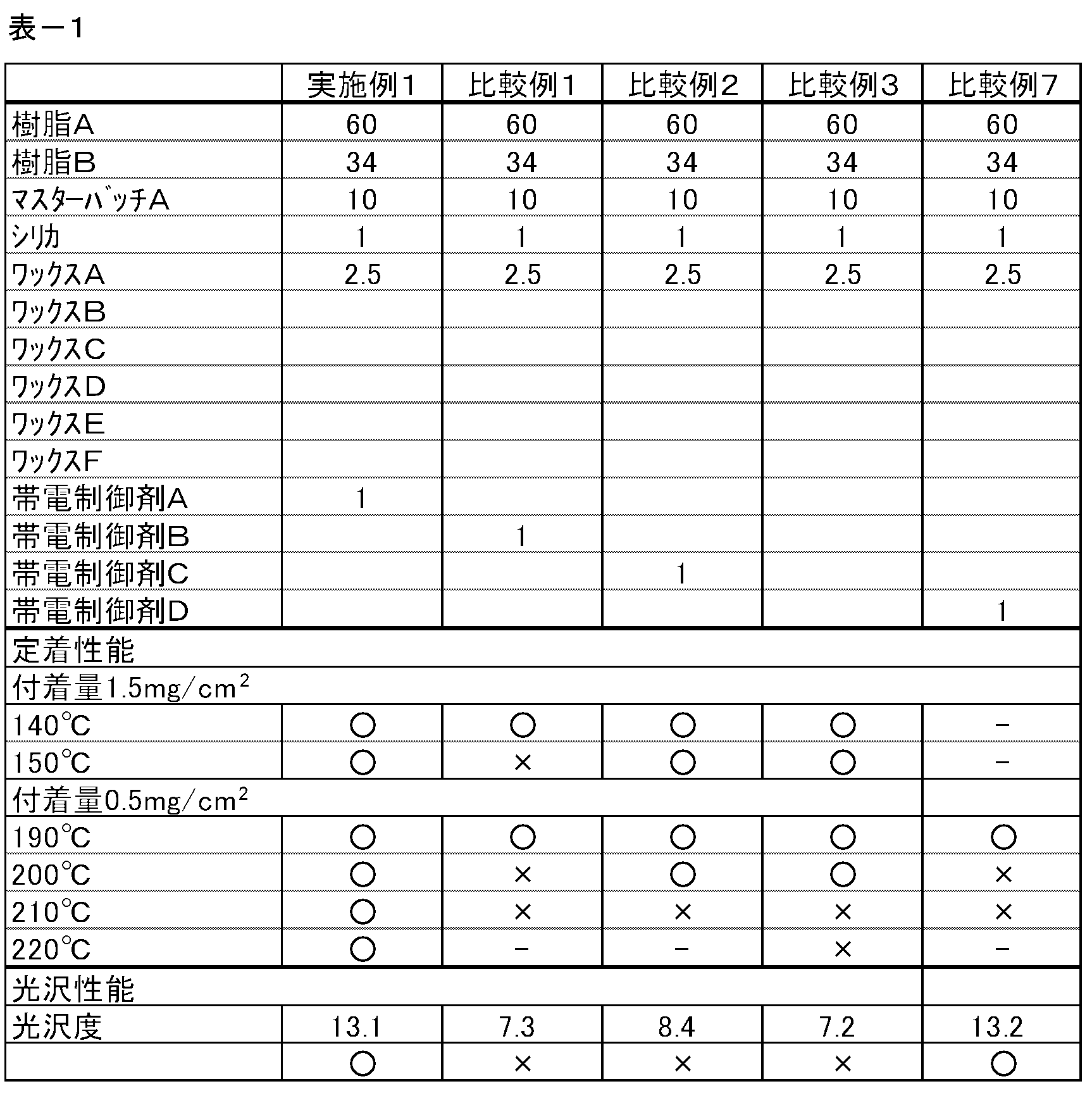
上記表-1より、本発明以外の帯電制御樹脂を用いた場合(比較例1及び7)、従来から用いられている金属錯体系の帯電制御剤を用いた場合(比較例2)及び帯電制御剤を入れない場合(比較例3)と比較して、本発明のトナーは優れた定着性能及び高光沢の画像が得られることが確認された。
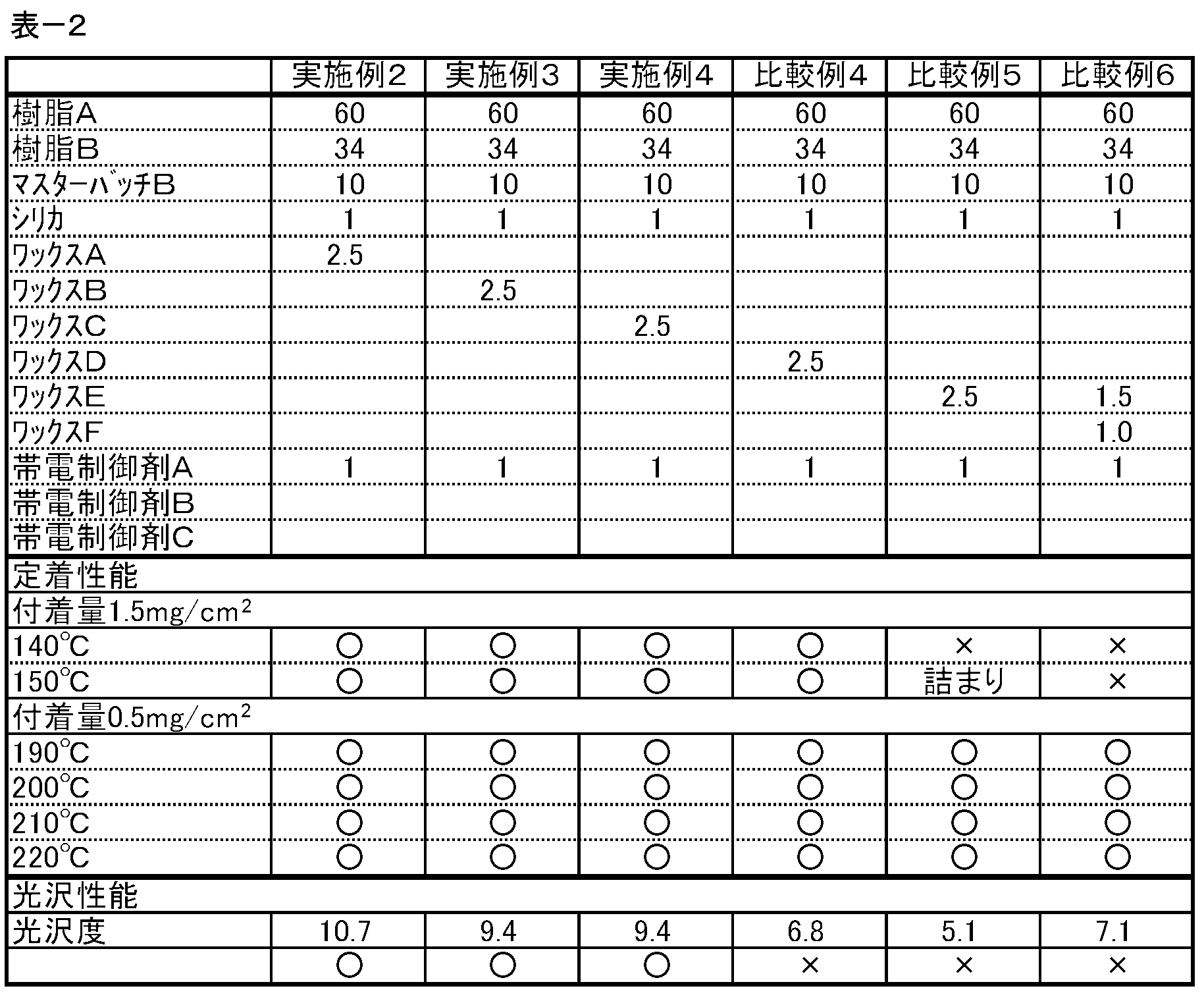
上記表-2より、エステルワックスと同程度の融点を持つパラフィンワックスを用いた場合(比較例4)と比較して、本発明のトナーは高光沢の画像を得られることが確認され、また、そのほかのワックスを用いた場合(比較例5及び6)と比較して、本発明のトナーは優れた定着性能及び高光沢の画像が得られることが確認された。
上記表-1及び表-2の結果から、従来のワックスの中でもエステルワックスを選択し、且つ従来の帯電制御剤の中でも特定の帯電制御剤を選択して、トナーに含有させることで、トナー付着量が多くなる場合であっても優れた定着性能及び高光沢の画像が得られることが分かる。
本発明を詳細に、また特定の実施態様を参照して説明したが、本発明の精神と範囲を逸脱することなく様々な変更や修正を加えることができることは当業者にとって明らかである。
本出願は2012年10月29日出願の日本特許出願(特願2012-237958)に基づくものであり、その内容はここに参照として取り込まれる。
本出願は2012年10月29日出願の日本特許出願(特願2012-237958)に基づくものであり、その内容はここに参照として取り込まれる。
Claims (5)
- 結着樹脂、着色剤及びワックスを含有するトナーであって、前記トナーは下記式(1)で表される帯電制御樹脂をさらに含有し、前記ワックスがエステルワックスを含有する、静電荷像現像用トナー。

- 前記ワックス中の前記エステルワックスの含有量が50重量%以上である、請求項1に記載の静電荷像現像用トナー。
- 前記トナー中の前記式(1)で表される帯電制御樹脂の含有量が0.1重量%以上2.5重量%以下である、請求項1または2に記載の静電荷像現像用トナー。
- 請求項1乃至3のいずれか1項に記載の静電荷像現像用トナーを備えた電子写真カートリッジ。
- 請求項1乃至3のいずれか1項に記載の静電荷像現像用トナーを備えた画像形成装置。
Priority Applications (2)
| Application Number | Priority Date | Filing Date | Title |
|---|---|---|---|
| CN201380055782.2A CN104756015A (zh) | 2012-10-29 | 2013-10-28 | 静电荷图像显影用调色剂、以及具备该调色剂的电子照相处理盒及图像形成装置 |
| US14/698,215 US20150227073A1 (en) | 2012-10-29 | 2015-04-28 | Electrostatic image developing toner, electrophotographic cartridge provided with said toner, and image forming device |
Applications Claiming Priority (2)
| Application Number | Priority Date | Filing Date | Title |
|---|---|---|---|
| JP2012237958 | 2012-10-29 | ||
| JP2012-237958 | 2012-10-29 |
Related Child Applications (1)
| Application Number | Title | Priority Date | Filing Date |
|---|---|---|---|
| US14/698,215 Continuation US20150227073A1 (en) | 2012-10-29 | 2015-04-28 | Electrostatic image developing toner, electrophotographic cartridge provided with said toner, and image forming device |
Publications (1)
| Publication Number | Publication Date |
|---|---|
| WO2014069418A1 true WO2014069418A1 (ja) | 2014-05-08 |
Family
ID=50627323
Family Applications (1)
| Application Number | Title | Priority Date | Filing Date |
|---|---|---|---|
| PCT/JP2013/079171 Ceased WO2014069418A1 (ja) | 2012-10-29 | 2013-10-28 | 静電荷像現像用トナー並びに該トナーを備えた電子写真カートリッジ及び画像形成装置 |
Country Status (4)
| Country | Link |
|---|---|
| US (1) | US20150227073A1 (ja) |
| JP (1) | JP6123622B2 (ja) |
| CN (1) | CN104756015A (ja) |
| WO (1) | WO2014069418A1 (ja) |
Cited By (1)
| Publication number | Priority date | Publication date | Assignee | Title |
|---|---|---|---|---|
| US20210325795A1 (en) * | 2020-04-17 | 2021-10-21 | Sharp Kabushiki Kaisha | Toner and two-component developer |
Families Citing this family (3)
| Publication number | Priority date | Publication date | Assignee | Title |
|---|---|---|---|---|
| JP6798203B2 (ja) * | 2016-09-08 | 2020-12-09 | 株式会社リコー | 電子写真用トナー、電子写真用現像剤、画像形成装置、及びプロセスカートリッジ |
| JP2019184859A (ja) * | 2018-04-12 | 2019-10-24 | シャープ株式会社 | トナー、二成分現像剤及びトナーの製造方法 |
| JP2020187149A (ja) | 2019-05-09 | 2020-11-19 | コニカミノルタ株式会社 | 画像形成方法 |
Citations (3)
| Publication number | Priority date | Publication date | Assignee | Title |
|---|---|---|---|---|
| JPH05119536A (ja) * | 1991-10-24 | 1993-05-18 | Minolta Camera Co Ltd | 現像剤 |
| JPH09281749A (ja) * | 1996-04-11 | 1997-10-31 | Orient Chem Ind Ltd | 静電荷像現像用トナー |
| JP2004279838A (ja) * | 2003-03-17 | 2004-10-07 | Fujikura Kasei Co Ltd | 負荷電制御剤およびこれを用いた静電荷像現像用トナー |
Family Cites Families (18)
| Publication number | Priority date | Publication date | Assignee | Title |
|---|---|---|---|---|
| JP3120644B2 (ja) * | 1993-11-26 | 2000-12-25 | ミノルタ株式会社 | 静電潜像現像用トナー |
| JPH10228133A (ja) * | 1997-02-14 | 1998-08-25 | Canon Inc | 静電荷像現像用トナー |
| JPH10260556A (ja) * | 1997-03-19 | 1998-09-29 | Konica Corp | 静電荷像現像用二成分現像剤及び画像形成方法 |
| JPH10293425A (ja) * | 1997-04-17 | 1998-11-04 | Mitsubishi Chem Corp | 電子写真用カラートナー |
| US6242147B1 (en) * | 1997-09-03 | 2001-06-05 | Minolta Co., Ltd. | Negatively chargeable toner and developing device using thereof |
| JP3531620B2 (ja) * | 2001-03-30 | 2004-05-31 | 富士ゼロックス株式会社 | 電子写真用カラートナー、カラー画像形成方法及びカラー画像形成装置 |
| JP2005049649A (ja) * | 2003-07-29 | 2005-02-24 | Canon Inc | トナー |
| JP4076929B2 (ja) * | 2003-08-29 | 2008-04-16 | 花王株式会社 | トナーの製造方法 |
| JP4721429B2 (ja) * | 2003-12-05 | 2011-07-13 | キヤノン株式会社 | トナー及びトナーの製造方法 |
| US7250241B2 (en) * | 2003-12-05 | 2007-07-31 | Canon Kabushiki Kaisha | Toner and process for producing toner |
| JP2006301091A (ja) * | 2005-04-18 | 2006-11-02 | Canon Inc | 画像形成方法及び現像装置 |
| US7754406B2 (en) * | 2007-02-08 | 2010-07-13 | Xerox Corporation | Ultra low melt emulsion aggregation toners having a charge control agent |
| US20080299476A1 (en) * | 2007-06-04 | 2008-12-04 | Danielle Renee Ashley | Toner Formulation |
| JP4929415B2 (ja) * | 2010-09-08 | 2012-05-09 | キヤノン株式会社 | トナー |
| US8741517B2 (en) * | 2010-09-15 | 2014-06-03 | Samsung Electronics Co., Ltd. | Toner for developing electrostatic latent image and method of preparing the same |
| JP5552411B2 (ja) * | 2010-10-14 | 2014-07-16 | 花王株式会社 | 電子写真用トナーの製造方法 |
| KR101773164B1 (ko) * | 2011-01-21 | 2017-08-30 | 에스프린팅솔루션 주식회사 | 전자사진용 토너 및 그의 제조방법 |
| KR20120095152A (ko) * | 2011-02-18 | 2012-08-28 | 삼성전자주식회사 | 정전하상 현상용 토너, 그 제조방법, 이 토너를 채용한 토너 공급 수단 및 화상 형성 장치 |
-
2013
- 2013-10-04 JP JP2013209112A patent/JP6123622B2/ja active Active
- 2013-10-28 CN CN201380055782.2A patent/CN104756015A/zh active Pending
- 2013-10-28 WO PCT/JP2013/079171 patent/WO2014069418A1/ja not_active Ceased
-
2015
- 2015-04-28 US US14/698,215 patent/US20150227073A1/en not_active Abandoned
Patent Citations (3)
| Publication number | Priority date | Publication date | Assignee | Title |
|---|---|---|---|---|
| JPH05119536A (ja) * | 1991-10-24 | 1993-05-18 | Minolta Camera Co Ltd | 現像剤 |
| JPH09281749A (ja) * | 1996-04-11 | 1997-10-31 | Orient Chem Ind Ltd | 静電荷像現像用トナー |
| JP2004279838A (ja) * | 2003-03-17 | 2004-10-07 | Fujikura Kasei Co Ltd | 負荷電制御剤およびこれを用いた静電荷像現像用トナー |
Cited By (3)
| Publication number | Priority date | Publication date | Assignee | Title |
|---|---|---|---|---|
| US20210325795A1 (en) * | 2020-04-17 | 2021-10-21 | Sharp Kabushiki Kaisha | Toner and two-component developer |
| US11947313B2 (en) * | 2020-04-17 | 2024-04-02 | Sharp Kabushiki Kaisha | Toner and two-component developer |
| JP7497199B2 (ja) | 2020-04-17 | 2024-06-10 | シャープ株式会社 | 2成分現像剤 |
Also Published As
| Publication number | Publication date |
|---|---|
| JP2014112205A (ja) | 2014-06-19 |
| CN104756015A (zh) | 2015-07-01 |
| US20150227073A1 (en) | 2015-08-13 |
| JP6123622B2 (ja) | 2017-05-10 |
Similar Documents
| Publication | Publication Date | Title |
|---|---|---|
| US7871749B2 (en) | Electrophotographic developing agent | |
| JP6123622B2 (ja) | 静電荷像現像用トナー | |
| JP2016167029A (ja) | 静電荷像現像用トナー | |
| JP2010526329A (ja) | トナー、トナーの製造方法およびトナーの使用 | |
| CN101689032A (zh) | 包括聚酯的调色剂,制造调色剂的方法和它的用途 | |
| JP2015131934A (ja) | ブリードアウトの抑制方法 | |
| JPWO2014073549A1 (ja) | 昇華転写染色方法及び白地汚染の抑制方法 | |
| JPH07244398A (ja) | トナー用内添離型剤及びそれを用いたトナー | |
| US5516612A (en) | Toner and developer compositions and processes thereof | |
| JP4475213B2 (ja) | 電子写真用マゼンタトナー | |
| JP6090100B2 (ja) | 静電荷像現像用トナー | |
| JP6256094B2 (ja) | 静電荷像現像用トナーの製造方法 | |
| JP4537291B2 (ja) | トナー用ワックスおよびこれらのワックスを用いたトナー | |
| JP6194832B2 (ja) | ブルートナー | |
| JP4393725B2 (ja) | イエロートナー及び画像形成装置 | |
| JP2000314983A (ja) | 電子写真用フルカラートナー及びこれを用いる画像形成方法 | |
| JP2017181572A (ja) | 静電荷像現像用トナー | |
| JP2000003065A (ja) | 静電荷像現像用トナー | |
| JP5376205B2 (ja) | 静電荷像現像用トナーの製造方法 | |
| JPH1144963A (ja) | 電子写真用トナー | |
| JP2003091094A (ja) | 静電潜像現像用トナー | |
| JPH02208662A (ja) | イエロートナー | |
| US20070184376A1 (en) | Method of preparing electrophotographic developer | |
| JP2009053351A (ja) | カラートナー | |
| JP2001100451A (ja) | 電子写真用フルカラートナー及びこれを用いる画像形成方法 |
Legal Events
| Date | Code | Title | Description |
|---|---|---|---|
| 121 | Ep: the epo has been informed by wipo that ep was designated in this application |
Ref document number: 13852090 Country of ref document: EP Kind code of ref document: A1 |
|
| NENP | Non-entry into the national phase |
Ref country code: DE |
|
| 122 | Ep: pct application non-entry in european phase |
Ref document number: 13852090 Country of ref document: EP Kind code of ref document: A1 |