WO2014041827A1 - 芳香族ポリエステルフィルム、太陽電池モジュール用バックシートおよび太陽電池モジュール - Google Patents
芳香族ポリエステルフィルム、太陽電池モジュール用バックシートおよび太陽電池モジュール Download PDFInfo
- Publication number
- WO2014041827A1 WO2014041827A1 PCT/JP2013/056427 JP2013056427W WO2014041827A1 WO 2014041827 A1 WO2014041827 A1 WO 2014041827A1 JP 2013056427 W JP2013056427 W JP 2013056427W WO 2014041827 A1 WO2014041827 A1 WO 2014041827A1
- Authority
- WO
- WIPO (PCT)
- Prior art keywords
- group
- aromatic polyester
- general formula
- polyester film
- alkyl group
- Prior art date
- Legal status (The legal status is an assumption and is not a legal conclusion. Google has not performed a legal analysis and makes no representation as to the accuracy of the status listed.)
- Ceased
Links
- 0 C*(c1c(*)c(*)c(*)c(O)c1*=*=*c(c(INC)c(*)c(I)c1*)c1O)=N Chemical compound C*(c1c(*)c(*)c(*)c(O)c1*=*=*c(c(INC)c(*)c(I)c1*)c1O)=N 0.000 description 1
Images

Classifications
-
- B—PERFORMING OPERATIONS; TRANSPORTING
- B32—LAYERED PRODUCTS
- B32B—LAYERED PRODUCTS, i.e. PRODUCTS BUILT-UP OF STRATA OF FLAT OR NON-FLAT, e.g. CELLULAR OR HONEYCOMB, FORM
- B32B27/00—Layered products comprising a layer of synthetic resin
- B32B27/18—Layered products comprising a layer of synthetic resin characterised by the use of special additives
-
- B—PERFORMING OPERATIONS; TRANSPORTING
- B32—LAYERED PRODUCTS
- B32B—LAYERED PRODUCTS, i.e. PRODUCTS BUILT-UP OF STRATA OF FLAT OR NON-FLAT, e.g. CELLULAR OR HONEYCOMB, FORM
- B32B27/00—Layered products comprising a layer of synthetic resin
- B32B27/36—Layered products comprising a layer of synthetic resin comprising polyesters
-
- C—CHEMISTRY; METALLURGY
- C08—ORGANIC MACROMOLECULAR COMPOUNDS; THEIR PREPARATION OR CHEMICAL WORKING-UP; COMPOSITIONS BASED THEREON
- C08J—WORKING-UP; GENERAL PROCESSES OF COMPOUNDING; AFTER-TREATMENT NOT COVERED BY SUBCLASSES C08B, C08C, C08F, C08G or C08H
- C08J5/00—Manufacture of articles or shaped materials containing macromolecular substances
- C08J5/18—Manufacture of films or sheets
-
- C—CHEMISTRY; METALLURGY
- C08—ORGANIC MACROMOLECULAR COMPOUNDS; THEIR PREPARATION OR CHEMICAL WORKING-UP; COMPOSITIONS BASED THEREON
- C08K—Use of inorganic or non-macromolecular organic substances as compounding ingredients
- C08K5/00—Use of organic ingredients
- C08K5/16—Nitrogen-containing compounds
- C08K5/29—Compounds containing one or more carbon-to-nitrogen double bonds
-
- C—CHEMISTRY; METALLURGY
- C08—ORGANIC MACROMOLECULAR COMPOUNDS; THEIR PREPARATION OR CHEMICAL WORKING-UP; COMPOSITIONS BASED THEREON
- C08K—Use of inorganic or non-macromolecular organic substances as compounding ingredients
- C08K5/00—Use of organic ingredients
- C08K5/16—Nitrogen-containing compounds
- C08K5/34—Heterocyclic compounds having nitrogen in the ring
- C08K5/35—Heterocyclic compounds having nitrogen in the ring having also oxygen in the ring
-
- H—ELECTRICITY
- H10—SEMICONDUCTOR DEVICES; ELECTRIC SOLID-STATE DEVICES NOT OTHERWISE PROVIDED FOR
- H10F—INORGANIC SEMICONDUCTOR DEVICES SENSITIVE TO INFRARED RADIATION, LIGHT, ELECTROMAGNETIC RADIATION OF SHORTER WAVELENGTH OR CORPUSCULAR RADIATION
- H10F19/00—Integrated devices, or assemblies of multiple devices, comprising at least one photovoltaic cell covered by group H10F10/00, e.g. photovoltaic modules
- H10F19/80—Encapsulations or containers for integrated devices, or assemblies of multiple devices, having photovoltaic cells
- H10F19/85—Protective back sheets
-
- C—CHEMISTRY; METALLURGY
- C08—ORGANIC MACROMOLECULAR COMPOUNDS; THEIR PREPARATION OR CHEMICAL WORKING-UP; COMPOSITIONS BASED THEREON
- C08J—WORKING-UP; GENERAL PROCESSES OF COMPOUNDING; AFTER-TREATMENT NOT COVERED BY SUBCLASSES C08B, C08C, C08F, C08G or C08H
- C08J2367/00—Characterised by the use of polyesters obtained by reactions forming a carboxylic ester link in the main chain; Derivatives of such polymers
- C08J2367/02—Polyesters derived from dicarboxylic acids and dihydroxy compounds
-
- Y—GENERAL TAGGING OF NEW TECHNOLOGICAL DEVELOPMENTS; GENERAL TAGGING OF CROSS-SECTIONAL TECHNOLOGIES SPANNING OVER SEVERAL SECTIONS OF THE IPC; TECHNICAL SUBJECTS COVERED BY FORMER USPC CROSS-REFERENCE ART COLLECTIONS [XRACs] AND DIGESTS
- Y02—TECHNOLOGIES OR APPLICATIONS FOR MITIGATION OR ADAPTATION AGAINST CLIMATE CHANGE
- Y02E—REDUCTION OF GREENHOUSE GAS [GHG] EMISSIONS, RELATED TO ENERGY GENERATION, TRANSMISSION OR DISTRIBUTION
- Y02E10/00—Energy generation through renewable energy sources
- Y02E10/50—Photovoltaic [PV] energy
Definitions
- the present invention relates to an aromatic polyester film, a back sheet for a solar cell module, and a solar cell module. Specifically, the present invention relates to a cyclic aromatic carbodiimide compound, a white aromatic polyester film containing fine particles, a solar cell module backsheet having the aromatic polyester film, and a solar cell in which the solar cell module backsheet is laminated. The present invention relates to a battery module.
- a solar cell module is formed by laminating glass or a front sheet / transparent filling material (sealing material) / solar cell element / sealing material / back sheet (BS) in this order from the light-receiving surface side on which sunlight enters. It has a structure.
- the back sheet (BS) is provided in the outermost layer of the solar cell module and functions to protect the solar cell element.
- the backsheet (BS) is expected to be exposed to wind and rain or placed in a high temperature and humidity environment for a long period of time, and therefore excellent weather resistance is required.
- PET film particularly a polyethylene terephthalate (hereinafter referred to as PET) film has been used for a back sheet for a solar cell module. Since these films have poor hydrolysis resistance, the molecular weight decreases due to hydrolysis, and embrittlement progresses, resulting in a decrease in mechanical properties. For this reason, practical strength could not be maintained over a long period of time as a back sheet for solar cells.
- PET polyethylene terephthalate
- Patent Documents 1 and 2 disclose that a cyclic carbodiimide compound is mixed into a back sheet as a terminal blocking agent in order to improve hydrolysis resistance.
- the cyclic carbodiimide compound reacts with the terminal carboxy group of the polyester to link the produced isocyanate to the terminal.
- a cyclic carbodiimide compound is used as the end-capping agent, there is an advantage that the isocyanate compound is not liberated and volatilization of the isocyanate gas can be suppressed.
- Patent Document 3 discloses that a ketene imine compound is used as an end-capping agent for polyester in order to improve hydrolysis resistance. Here, it has been proposed to suppress hydrolysis of the polyester by reacting the ketene imine compound with the terminal carboxyl group of the polyester.
- the back sheet for a solar cell module is preferably a white film in order to reflect sunlight and increase power generation efficiency.
- particles such as titanium oxide and silica are contained, or fine bubbles (voids) are generated in the film.
- the conventional white aromatic polyester film containing a terminal blocking agent such as a cyclic carbodiimide compound or a ketenimine compound has a high molecular weight due to the reaction between the terminal carboxylic acid of the aromatic polyester film and the terminal blocking agent.
- the inventors of the present application have clarified that cutting waste is likely to be generated when cutting a polyester film.
- the inventors of the present application have studied for the purpose of providing a white aromatic polyester film that has hydrolysis resistance but does not generate cutting waste during cutting. Advanced.
- the inventors of the present application have determined the content of the cyclic carbodiimide compound or ketene imine compound and fine particles in the aromatic polyester film containing the cyclic carbodiimide compound or ketene imine compound and fine particles. It was found that cutting waste is less likely to occur when cutting a polyester film by setting the particle diameter within a certain range and regulating the particle size and aggregation rate thereof.
- the present invention has the following configuration.
- the content of the cyclic carbodiimide compound or the ketene imine compound is 0.1 to 5% by mass with respect to the mass of the aromatic polyester resin, and the particle size of the fine particles is 0.00. 1 to 10 ⁇ m
- the content of the fine particles is 1 to 10% by mass with respect to the mass of the aromatic polyester resin, a part of the fine particles are aggregated, and the aggregation rate is 10 to 50%.
- R 2 to R 4 and R 6 to R 8 each independently represents a hydrogen atom, Represents an alkyl group, an aryl group or an alkoxy group, R 1 to R 8 may combine with each other to form a ring, X 1 and X 2 each independently represents a single bond, —O—, —CO—, Represents —S—, —SO 2 —, —NH— or —CH 2 —, and L 1 represents a divalent linking group.
- R 11 , R 15 , R 21 and R 25 each independently represents an alkyl group, an aryl group or an alkoxy group.
- R 12 to R 14 , R 16 to R 18 , R 22 ⁇ R 24 and R 26 ⁇ R 28 each independently represent a hydrogen atom, an alkyl group, .R represents an aryl group or an alkoxy group 11 ⁇ R 28 are bonded may also form a ring .
- X 11 together, X 12 , X 21 and X 22 each independently represents a single bond, —O—, —CO—, —S—, —SO 2 —, —NH— or —CH 2 —, wherein L 2 represents a tetravalent group.
- R 1 and R 5 , and R 11 , R 15 , R 21 and R 25 are each independently a secondary or tertiary alkyl group, Or the aromatic polyester film as described in [2] characterized by representing an aryl group.
- R 4 The aromatic polyester film as described in [2] or [3], wherein in the general formula (O-1), R 2 and R 6 are both hydrogen atoms.
- [5] The aromatic polyester film according to [1], wherein the ketene imine compound is represented by the following general formula (1).
- R 1 and R 2 each independently represents an alkyl group, an aryl group, an alkoxy group, an alkoxycarbonyl group, an aminocarbonyl group, an aryloxy group, an acyl group, or an aryloxycarbonyl group; 3 represents an alkyl group or an aryl group.
- R 1 represents an alkyl group, an aryl group, an alkoxy group, an alkoxycarbonyl group, an aminocarbonyl group, an aryloxy group, an acyl group, or an aryloxycarbonyl group.
- R 2 represents L 1 as a substituent.
- R 3 represents an alkyl group or an aryl group
- n is 1 to 4.
- L 1 represents an n-valent linking group.
- R 1 and R 5 represent an alkyl group, an aryl group, an alkoxy group, an alkoxycarbonyl group, an aminocarbonyl group, an aryloxy group, an acyl group, or an aryloxycarbonyl group.
- R 2 and R 4 Represents an alkyl group having L 2 as a substituent, an aryl group, an alkoxy group, an alkoxycarbonyl group, an aminocarbonyl group, an aryloxy group, an acyl group or an aryloxycarbonyl group, and R 3 and R 6 are an alkyl group or an aryl group.
- L 2 represents a single bond or a divalent linking group.
- the molecular weight of the portion other than the nitrogen atom constituting the ketene imine of the ketene imine compound and the substituent bonded to the nitrogen atom is 320 or more, [5] to [8] Aromatic polyester film.
- the aromatic polyester resin mainly contains terephthalic acid, naphthalenedicarboxylic acid as a dicarboxylic acid component, and ethylene glycol as a diol component, The aromatic polyester according to any one of [1] to [9], wherein the intrinsic viscosity (IV) is 0.7 to 0.9 g / dl and the acid value (AV) is 1 to 20 eq / ton.
- a laminated film comprising at least one layer of the aromatic polyester film according to any one of [1] to [10], and having 2 to 8 layers.
- a variation rate of a thickness of a layer having the largest thickness among the layers constituting the laminated film is 1 to 10%.
- the fine particles have a particle size of 0.1 to 10 ⁇ m
- the content of the fine particles is 1 to 10% by mass with respect to the mass of the aromatic polyester resin, and the step of preparing the master pellet kneads the aromatic polyester resin and the fine particles with
- R 1 and R 5 each independently represents an alkyl group, an aryl group or an alkoxy group.
- R 2 to R 4 and R 6 to R 8 each independently represents a hydrogen atom, Represents an alkyl group, an aryl group or an alkoxy group, R 1 to R 8 may combine with each other to form a ring,
- X 1 and X 2 each independently represents a single bond, —O—, —CO—, Represents —S—, —SO 2 —, —NH— or —CH 2 —, and L 1 represents a divalent linking group.
- R 11 , R 15 , R 21 and R 25 each independently represents an alkyl group, an aryl group or an alkoxy group.
- R 12 to R 14 , R 16 to R 18 , R 22 ⁇ R 24 and R 26 ⁇ R 28 each independently represent a hydrogen atom, an alkyl group, .R represents an aryl group or an alkoxy group 11 ⁇ R 28 are bonded may also form a ring .
- X 11 together, X 12 , X 21 and X 22 each independently represents a single bond, —O—, —CO—, —S—, —SO 2 —, —NH— or —CH 2 —, wherein L 2 represents a tetravalent group.
- R 1 and R 2 each independently represents an alkyl group, an aryl group, an alkoxy group, an alkoxycarbonyl group, an aminocarbonyl group, an aryloxy group, an acyl group, or an aryloxycarbonyl group; 3 represents an alkyl group or an aryl group.
- R 1 represents an alkyl group, an aryl group, an alkoxy group, an alkoxycarbonyl group, an aminocarbonyl group, an aryloxy group, an acyl group, or an aryloxycarbonyl group.
- R 2 represents L 1 as a substituent. Represents an alkyl group, aryl group, alkoxy group, alkoxycarbonyl group, aminocarbonyl group, aryloxy group, acyl group or aryloxycarbonyl group, wherein R 3 represents an alkyl group or an aryl group, and n is 1 to 4.
- R 1 and R 5 represent an alkyl group, an aryl group, an alkoxy group, an alkoxycarbonyl group, an aminocarbonyl group, an aryloxy group, an acyl group, or an aryloxycarbonyl group.
- R 2 and R 4 Represents an alkyl group having L 2 as a substituent, an aryl group, an alkoxy group, an alkoxycarbonyl group, an aminocarbonyl group, an aryloxy group, an acyl group or an aryloxycarbonyl group, and R 3 and R 6 are an alkyl group or an aryl group.
- L 2 represents a single bond or a divalent linking group.
- the aromatic polyester film of this invention becomes favorable for adhesiveness with a solar cell panel, and is used suitably as a back sheet
- FIG. 1 is a schematic view showing a configuration example of a twin-screw extruder for carrying out the method for producing a polyester film according to the present invention.
- a numerical range expressed using “to” means a range including numerical values described before and after “to” as a lower limit value and an upper limit value.
- the present invention relates to an aromatic polyester film.
- the aromatic polyester film of the present invention contains a cyclic carbodiimide compound or a ketene imine compound, fine particles, and an aromatic polyester resin.
- the content of the cyclic carbodiimide compound or ketene imine compound is 0.1 to 5% by mass with respect to the mass of the aromatic polyester resin.
- the particle diameter of the fine particles is 0.1 to 10 ⁇ m, and the content of the fine particles is 1 to 10% by mass with respect to the mass of the aromatic polyester resin. Part of the fine particles is aggregated, and the aggregation rate is 10 to 50%.
- the aromatic polyester resin can be obtained by reacting an aromatic dicarboxylic acid or an ester-forming derivative thereof with a low molecular weight aliphatic diol or a high molecular weight diol.
- aromatic dicarboxylic acids or ester-forming derivatives thereof include terephthalic acid, isophthalic acid, orthophthalic acid, naphthalene dicarboxylic acid, paraphenylene dicarboxylic acid, dimethyl terephthalate, dimethyl isophthalate, dimethyl orthophthalate, dimethyl naphthalene dicarboxylate, And dimethyl paraphenylene dicarboxylate. These may be used alone or in combination of two or more.
- Examples of the low molecular weight aliphatic diol include ethylene glycol, 1,2-propanediol, 1,3-propanediol, 1,3-butanediol, 1,4-butanediol, neopentyl glycol, and 1,5-pentane. Examples thereof include diol, 1,6-hexanediol, 1,4-cyclohexanedimethanol and the like. These may be used alone or in combination of two or more.
- Examples of the high molecular weight diol include polyethylene glycol, polypropylene glycol, polytetramethylene glycol, polyhexamethylene glycol and the like. These may be used alone or in combination of two or more.
- Examples of the crystalline aromatic polyester composed of the above components include polyethylene terephthalate, polybutylene terephthalate, polyhexamethylene terephthalate, polyethylene naphthalate, polybutylene naphthalate, butanediol terephthalate polytetramethylene glycol copolymer, and the like. Can be mentioned. These may be used alone or in combination of two or more. Particularly preferred among the aromatic polyesters described herein are those using terephthalic acid and naphthalenedicarboxylic acid as main components as dicarboxylic acids, and those having ethylene glycol and cyclohexanedimethanol as main components as diols. Preferred are polyethylene terephthalate, polyethylene naphthalate, and polycyclohexanedimethylene terephthalate, and more preferred are polyethylene terephthalate and polyethylene naphthalate.
- the shape of the aromatic polyester resin is not particularly limited, but is preferably a pellet. By using the aromatic polyester resin as pellets, mixing with fine particles described later can be facilitated.
- the shape of the pellet may be amorphous (crushed), cylindrical, or rectangular, but is preferably cylindrical or rectangular from the viewpoint of pellet productivity, and is preferably cylindrical from the viewpoint of supply stability to the extruder. . This is because the cylindrical shape does not easily crush the corners and does not easily generate powder, and therefore does not bridge (clog) in the hopper.
- the volume of the pellet is preferably 1 to 1000 mm 3 , more preferably 3 to 100 mm 3 , and still more preferably 5 to 60 mm 3 . If it is less than this range, it is easy to block in the hopper, which is not preferable. Moreover, when this range is exceeded, when it blows from the silo which stores the pellet to an extruder, it is difficult to convey and it is not preferable.
- the aromatic polyester film of the present invention contains fine particles.
- the fine particles serve to make the aromatic polyester film white.
- Fine particles include calcium carbonate, magnesium carbonate, barium carbonate, magnesium sulfate, barium sulfate, calcium sulfate, zinc oxide, magnesium oxide, calcium oxide, titanium oxide, alumina, aluminum hydroxide, hydroxyapatite, silica, mica, talc, kaolin It is preferable to use at least one selected from inorganic fine powders such as clay, glass powder, asbestos powder, zeolite and silicate clay. Of these, titanium oxide and barium sulfate are preferably used.
- the inorganic fine powder has a large refractive index.
- the inorganic fine powder has a large refractive index.
- an aromatic polyester resin at least one selected from the group consisting of calcium carbonate, barium sulfate, titanium oxide, and zinc oxide having a refractive index of 1.6 or more is used. More preferably, among these, it is particularly preferable to use titanium oxide. By using titanium oxide, it is possible to impart high reflection performance to the film with a smaller filling amount, and it is possible to obtain a film having high reflection performance even with a thin wall.
- titanium oxide examples include crystalline titanium oxides such as anatase-type titanium oxide and rutile-type titanium oxide. From the viewpoint of increasing the difference in refractive index from the polymer, titanium oxide having a refractive index of 2.7 or more is preferable. For example, a crystal form of rutile titanium oxide is preferably used.
- the high-purity titanium oxide is a titanium oxide having a small light absorption ability with respect to visible light, and means a material having a small content of colored elements such as vanadium, iron, niobium, copper, and manganese.
- titanium oxide in which the content of vanadium contained in titanium oxide is 5 ppm or less is referred to as high-purity titanium oxide.
- coloring elements such as iron, niobium, copper, and manganese contained in titanium oxide.
- the surface of the filler may be subjected to a surface treatment with a silicone compound, a polyhydric alcohol compound, an amine compound, a fatty acid, a fatty acid ester, or the like.
- a surface treatment may be performed on the surface of titanium oxide.
- the surface treatment agent for example, at least one selected from the group consisting of at least one inorganic compound selected from the group consisting of alumina, silica, zirconia, and the like, a siloxane compound, a silane coupling agent, a polyol, and polyethylene glycol.
- these organic compounds can be used. Moreover, you may use combining these inorganic compounds and organic compounds.
- ⁇ Inorganic fine powder and organic fine powder may be used in combination as fine particles.
- a plurality of types of fine particles can be used in combination.
- titanium oxide and other fillers, high-purity titanium oxide and other fine particles may be used in combination.
- the particle size of the fine particles used in the present invention is 0.1 to 10 ⁇ m.
- the particle diameter of the fine particles may be 0.1 to 10 ⁇ m, preferably 0.15 to 9 ⁇ m, and more preferably 0.2 to 8 ⁇ m.
- the light reflection efficiency can be increased. In particular, it is preferable because the reflection efficiency of light in the visible region can be increased.
- the content of fine particles in the aromatic polyester film is 1 to 10% by mass with respect to the mass of the aromatic polyester resin.
- the content of fine particles may be 1 to 10% by mass, preferably 1.5 to 8% by mass, and more preferably 2 to 6% by mass.
- the aggregation rate of the fine particles is 10 to 50%.
- the aggregation rate of the fine particles may be 10 to 50%, preferably 15 to 45%, and more preferably 20 to 40%.
- the aggregation rate of the fine particles indicates a ratio of the number of aggregated particles in 100 particles (particles and aggregated particles) observed using an optical microscope or an electron microscope.
- the number of aggregated particles counts the aggregate (particle lump) in which two or more particles aggregated as one particle.
- the fine particles When the fine particles are aggregated, the stress concentration point at the time of cutting can be reduced, and the destruction of the PET can be suppressed. Further, the fine particles are aggregated to have an apparently large size and are difficult to peel off. For example, when two fine particles are connected, the apparent particle size becomes long and it is difficult to fall off the cut surface. Thereby, generation
- the apparent number of fine particles decreases due to aggregation. However, only the apparent number of fine particles is reduced, and the number of fine particles actually contained is not reduced. For this reason, the reflectance of light is not lowered. On the other hand, when the same number of particles having a large particle size as the aggregate is contained without agglomerating the fine particles, the light reflectance decreases. That is, in the present invention, it is possible to suppress the generation of cutting waste while maintaining the light reflectivity by aggregating fine particles rather than containing the same number of particles having a large particle diameter as the aggregate. I have to.
- the fine particle aggregate as described above is formed by adjusting the manufacturing process of the master pellet.
- the master pellet is formed from a kneaded polyester resin and fine particles.
- the content of the fine particles is 30 to 70% by mass with respect to the polyester resin. It is preferable to use fine particles and polyester resin that have been sufficiently dried until the water content becomes 100 ppm or less.
- the polyester resin is preferably a pellet. By using the pellet-shaped polyester resin, the fine particles can be mixed uniformly. Furthermore, it is preferable to sufficiently dry the obtained master pellets until the water content becomes 100 ppm or less.
- the master pellets thus obtained are put into an extruder and kneaded. At this time, a fluctuation of 0.1 to 10%, preferably 0.2 to 5%, more preferably 0.3 to 3% is given to the rotational torque of the screw in the extruder.
- the torque fluctuation rate refers to the rate of change with respect to the average value. Specifically, the torque is measured for 1 minute, and an increase rate or a decrease rate in which the torque is increased or decreased is indicated by a value obtained by multiplying the average value of the torque during that time by the above fluctuation rate.
- the force applied to the resin can be varied, and a flow can be applied so that the resin flows non-uniformly.
- the resin stays instantaneously in the screw, and an aggregate of fine particles is formed here.
- the aggregation rate of the fine particles can be within the range of 10 to 50%. If the torque fluctuation is less than the above range, it is difficult to form aggregates, which is not preferable. On the other hand, if the torque fluctuation exceeds the above range, the aggregation rate of fine particles exceeds 50%, which is not preferable.
- Such extrusion is preferable because it is easy to adjust the torque by using a twin screw.
- the torque fluctuation of the screw as described above may be continuously and constantly applied, but it is preferably applied 1 time / minute to 100 times / minute, more preferably 3 times / minute to 80 times / minute. It is more preferable to apply 5 times / minute to 60 times / minute.
- the torque fluctuation of one time / minute means that the torque is measured for one minute, and the torque may be up or down once from the average value by a certain amount.
- the range above a certain level from the average value refers to a range defined by the rate of change in torque fluctuation.
- the number of torque fluctuations of the screw can be obtained by measuring the number of times the torque fluctuations within a range where the torque fluctuation change rate exceeds 0.1% and does not exceed 10% per minute. it can.
- torque fluctuation can be achieved by changing the power supplied to the motor that rotates the screw.
- the fluctuation of the electric power supplied to the motor can be achieved by increasing or decreasing the current value supplied to the motor. For example, this can be achieved by periodically or randomly increasing or decreasing the supply current value to the motor by computer control.
- the aromatic polyester film of the present invention contains a cyclic carbodiimide compound.
- a cyclic carbodiimide compound containing one carbodiimide group in the ring skeleton and having in the molecule at least one cyclic structure in which the first nitrogen and the second nitrogen are bonded by a bonding group functions as a cyclic sealant.
- a cyclic carbodiimide compound can be prepared by the method described in International Publication 2011/093478 pamphlet.
- the cyclic carbodiimide compound used in the present invention has a cyclic structure.
- the cyclic carbodiimide compound may have a plurality of cyclic structures.
- the cyclic structure has one carbodiimide group (—N ⁇ C ⁇ N—), and the first nitrogen and the second nitrogen are bonded by a bonding group.
- One cyclic structure has only one carbodiimide group.
- the compound may have a plurality of carbodiimide groups.
- the number of atoms in the cyclic structure is preferably 8 to 50, more preferably 10 to 30, further preferably 10 to 20, and particularly preferably 10 to 15.
- the number of atoms in the ring structure means the number of atoms directly constituting the ring structure, for example, 8 for a 8-membered ring and 50 for a 50-membered ring. This is because if the number of atoms in the cyclic structure is smaller than 8, the stability of the cyclic carbodiimide compound is lowered, and it may be difficult to store and use. From the viewpoint of reactivity, there is no particular restriction on the upper limit of the number of ring members, but cyclic carbodiimide compounds having more than 50 atoms are difficult to synthesize, and the cost may increase significantly. From this viewpoint, the number of atoms in the cyclic structure is preferably selected in the range of 10 to 30, more preferably 10 to 20, and particularly preferably 10 to 15.
- cyclic carbodiimide compound As the cyclic carbodiimide compound, it is preferable to use a cyclic carbodiimide compound represented by the following general formula (O-1) or general formula (O-2).
- O-1 cyclic carbodiimide compound represented by the following general formula (O-1) or general formula (O-2).
- R 1 and R 5 each independently represents an alkyl group, an aryl group or an alkoxy group.
- R 2 to R 4 and R 6 to R 8 each independently represents a hydrogen atom, an alkyl group, an aryl group or an alkoxy group.
- R 1 to R 8 may be bonded to each other to form a ring.
- X 1 and X 2 each independently represents a single bond, —O—, —CO—, —S—, —SO 2 —, —NH— or —CH 2 —.
- L 1 represents a divalent linking group.
- R 1 and R 5 each independently represents an alkyl group, an aryl group or an alkoxy group, preferably an alkyl group or an aryl group, preferably a secondary or tertiary alkyl group or Representing an aryl group is more preferred from the viewpoint of suppressing the reaction between the isocyanate end linked to the terminal of the polyester and the hydroxyl terminal of the polyester and suppressing the thickening, and particularly preferably a secondary alkyl group.
- the alkyl group represented by R 1 and R 5 is preferably an alkyl group having 1 to 20 carbon atoms, more preferably an alkyl group having 1 to 12 carbon atoms, and an alkyl group having 2 to 6 carbon atoms. It is particularly preferred.
- the alkyl group represented by R 1 and R 5 may be linear, branched or cyclic, but is branched or cyclic, and isocyanate and polyester linked to the end of the polyester. It is preferable from the viewpoint of suppressing the reaction at the hydroxyl terminal and suppressing thickening.
- the alkyl group represented by R 1 and R 5 is preferably a secondary or tertiary alkyl group, and more preferably a secondary alkyl group.
- the alkyl group represented by R 1 and R 5 is methyl group, ethyl group, n-propyl group, sec-propyl group, iso-propyl group, n-butyl group, tert-butyl group, sec-butyl group, iso-butyl.
- the alkyl group represented by R 1 and R 5 may further have a substituent, and the substituent is not particularly limited. However, the alkyl group represented by R 1 and R 5 preferably has no further substituent from the viewpoint of reactivity with the carboxylic acid.
- the aryl group represented by R 1 and R 5 is preferably an aryl group having 6 to 20 carbon atoms, more preferably an aryl group having 6 to 12 carbon atoms, and an aryl group having 6 carbon atoms. Particularly preferred.
- the aryl group represented by R 1 and R 5 may be an aryl group formed by condensing R 1 and R 2 or condensing R 5 and R 6, but R 1 and R 5 are each represented by R 2 It is preferable that the ring is not condensed with R 6 .
- Examples of the aryl group represented by R 1 and R 5 include a phenyl group and a naphthyl group, and among them, a phenyl group is more preferable.
- the aryl group represented by R 1 and R 5 may further have a substituent, and the substituent is not particularly limited. However, the aryl group represented by R 1 and R 5 preferably has no further substituent from the viewpoint of reactivity with the carboxylic acid.
- the alkoxy group represented by R 1 and R 5 is preferably an alkoxy group having 1 to 20 carbon atoms, more preferably an alkoxy group having 1 to 12 carbon atoms, and an alkoxy group having 2 to 6 carbon atoms. It is particularly preferred.
- the alkoxy group represented by R 1 and R 5 may be linear, branched or cyclic, but is branched or cyclic, and isocyanate and polyester linked to the end of the polyester. It is preferable from the viewpoint of suppressing the reaction at the hydroxyl terminal and suppressing thickening.
- alkoxy groups R 1 and R 5 represent, the may include groups terminated -O- is linked alkyl group represented by R 1 and R 5, the same preferable ranges R 1 and R 5
- the preferred alkyl group represented is a group in which —O— is linked to the terminal.
- the alkoxy group represented by R 1 and R 5 may further have a substituent, and the substituent is not particularly limited. However, the alkoxy group represented by R 1 and R 5 preferably has no further substituent from the viewpoint of reactivity with carboxylic acid.
- R 1 and R 5 may be the same or different, but are preferably the same from the viewpoint of cost.
- R 2 to R 4 and R 6 to R 8 each independently represents a hydrogen atom, an alkyl group, an aryl group or an alkoxy group, and a hydrogen atom, an alkyl having 1 to 20 carbon atoms Group is preferably an alkoxy group having 1 to 20 carbon atoms, more preferably a hydrogen atom or an alkyl group having 1 to 6 carbon atoms, and particularly preferably a hydrogen atom.
- the alkyl group, aryl group or alkoxy group represented by R 2 to R 4 and R 6 to R 8 may further have a substituent, and the substituent is not particularly limited.
- R 2 and R 6 are both hydrogen atoms in the general formula (O-1) from the viewpoint of easily introducing bulky substituents into R 1 and R 5 .
- WO2010 / 072111 exemplifies compounds in which an alkyl group or an aryl group is substituted at a site corresponding to R 2 and R 6 in the general formula (O-1) (meta position with respect to the carbodiimide group).
- R 1 to R 8 may be bonded to each other to form a ring.
- the ring formed at this time is not particularly limited, but is preferably an aromatic ring.
- two or more of R 1 to R 4 may be bonded to each other to form a condensed ring, and an arylene group or heteroarylene group having 10 or more carbon atoms is formed with a benzene ring substituted by R 1 to R 4 May be.
- the arylene group having 10 or more carbon atoms formed at this time include aromatic groups having 10 to 15 carbon atoms such as naphthalenediyl group.
- R 5 to R 8 may be bonded to each other to form a condensed ring, and an arylene group or heteroarylene having 10 or more carbon atoms together with a benzene ring substituted by R 5 to R 8.
- a preferred range at that time is the same as the preferred range when an arylene group or heteroarylene group having 10 or more carbon atoms is formed together with the benzene ring substituted by R 1 to R 4 .
- R 1 to R 8 in the general formula (O-1) are not bonded to each other to form a ring.
- X 1 and X 2 are each independently selected from a single bond, —O—, —CO—, —S—, —SO 2 —, —NH— and —CH 2 —.
- —O—, —CO—, —S—, —SO 2 —, —NH— is preferable, and —O—, —S— is easy to synthesize. From the viewpoint of
- L 1 represents a divalent linking group, each of which may contain a heteroatom and a substituent, may be a divalent aliphatic group having 1 to 20 carbon atoms, a divalent A alicyclic group having 3 to 20 carbon atoms, a divalent aromatic group having 5 to 15 carbon atoms, or a combination thereof is preferable, and a divalent aliphatic group having 1 to 20 carbon atoms is preferable. More preferred.
- Examples of the divalent aliphatic group represented by L 1 include an alkylene group having 1 to 20 carbon atoms.
- Examples of the alkylene group having 1 to 20 carbon atoms include a methylene group, an ethylene group, a propylene group, a butylene group, a pentylene group, a hexylene group, a heptylene group, an octylene group, a nonylene group, a decylene group, a dodecylene group, and a hexadecylene group.
- a methylene group, an ethylene group and a propylene group are more preferred, and an ethylene group is particularly preferred.
- These aliphatic groups may be substituted.
- substituents examples include an alkyl group having 1 to 20 carbon atoms, an aryl group having 6 to 15 carbon atoms, a halogen atom, a nitro group, an amide group, a hydroxyl group, an ester group, an ether group, and an aldehyde group.
- Examples of the divalent alicyclic group represented by L 1 include a cycloalkylene group having 3 to 20 carbon atoms.
- Examples of the cycloalkylene group having 3 to 20 carbon atoms include cyclopropylene group, cyclobutylene group, cyclopentylene group, cyclohexylene group, cycloheptylene group, cyclooctylene group, cyclononylene group, cyclodecylene group, cyclododecylene group, and cyclohexadecylene. Group and the like. These alicyclic groups may be substituted.
- substituents examples include an alkyl group having 1 to 20 carbon atoms, an aryl group having 6 to 15 carbon atoms, a halogen atom, a nitro group, an amide group, a hydroxyl group, an ester group, an ether group, and an aldehyde group.
- Examples of the divalent aromatic group represented by L 1 include an arylene group having 5 to 15 carbon atoms, which includes a hetero atom and may have a heterocyclic structure.
- Examples of the arylene group having 5 to 15 carbon atoms include a phenylene group and a naphthalenediyl group. These aromatic groups may be substituted.
- Examples of the substituent include an alkyl group having 1 to 20 carbon atoms, an aryl group having 6 to 15 carbon atoms, a halogen atom, a nitro group, an amide group, a hydroxyl group, an ester group, an ether group, and an aldehyde group.
- the number of atoms in the cyclic structure containing a carbodiimide group is preferably 8 to 50, more preferably 10 to 30, further preferably 10 to 20, and particularly preferably 10 to 15. .
- the number of atoms in the cyclic structure containing a carbodiimide group means the number of atoms that directly constitute the cyclic structure containing a carbodiimide group. For example, if it is an 8-membered ring, it is 50; It is. This is because if the number of atoms in the cyclic structure is smaller than 8, the stability of the cyclic carbodiimide compound is lowered, and it may be difficult to store and use.
- the number of atoms in the cyclic structure is preferably 10 to 30, more preferably 10 to 20, and particularly preferably 10 to 15.
- R 11 , R 15 , R 21 and R 25 each independently represents an alkyl group, an aryl group or an alkoxy group.
- R 12 to R 14 , R 16 to R 18 , R 22 to R 24 and R 26 to R 28 each independently represent a hydrogen atom, an alkyl group, an aryl group or an alkoxy group.
- R 11 to R 28 may combine with each other to form a ring.
- X 11 , X 12 , X 21 and X 22 each independently represent a single bond, —O—, —CO—, —S—, —SO 2 —, —NH— or —CH 2 —.
- L 2 represents a tetravalent linking group.
- R 11 , R 15 , R 21 and R 25 are the same as the preferred ranges of R 1 and R 5 in the general formula (O-1).
- R 11 and R 12 are condensed
- R 15 and R 16 are condensed
- R 21 and R 22 are condensed
- R 25 and R 26 are condensed.
- R 11 , R 15 , R 21 and R 25 do not form a ring by condensing with R 12 , R 16 , R 22 and R 26 , respectively.
- R 11 , R 15 , R 21 and R 25 may be the same or different, but are preferably the same from the viewpoint of cost.
- R 12 to R 14 , R 16 to R 18 , R 22 to R 24 and R 26 to R 28 are R 2 in the general formula (O-1). This is the same as the preferred range of ⁇ R 4 and R 6 ⁇ R 8 .
- R 12 to R 14 , R 16 to R 18 , R 22 to R 24, and R 26 to R 28 , R 12 , R 16 , R 22, and R 26 are all hydrogen atoms, R 11 , R 15 , R 21 and R 25 are preferable from the viewpoint of easy introduction of bulky substituents.
- R 11 to R 28 may be bonded to each other to form a ring.
- a preferable ring range is the above general formula (O-1) in which R 1 to R 8 are This is the same as the range of the ring formed by bonding.
- L 2 represents a tetravalent linking group, each of which may contain a heteroatom and a substituent, a tetravalent aliphatic group having 1 to 20 carbon atoms, a tetravalent It is preferably an alicyclic group having 3 to 20 carbon atoms, a tetravalent aromatic group having 5 to 15 carbon atoms, or a combination thereof, and is preferably a tetravalent aliphatic group having 1 to 20 carbon atoms. More preferred.
- Examples of the tetravalent aliphatic group represented by L 2 include an alkanetetrayl group having 1 to 20 carbon atoms.
- an alkanetetrayl group having 1 to 20 carbon atoms methanetetrayl group, ethanetetrayl group, propanetetrayl group, butanetetrayl group, pentanetetrayl group, hexanetetrayl group, heptanetetrayl group, octanetetrayl group Group, nonanetetrayl group, decanetetrayl group, dodecanetetrayl group, hexadecanetetrayl group and the like, methanetetrayl group, ethanetetrayl group, propanetetrayl group are more preferable, and ethanetetrayl group is particularly preferable preferable.
- These aliphatic groups may contain a substituent.
- substituents include an alkyl group having 1 to 20 carbon atoms, an aryl group having 6 to 15 carbon atoms, a halogen atom, a nitro group, an amide group, a hydroxyl group, an ester group, an ether group, and an aldehyde group.
- Examples of the tetravalent alicyclic group represented by L 2 include a cycloalkanetetrayl group having 3 to 20 carbon atoms as the alicyclic group.
- a cycloalkanetetrayl group having 3 to 20 carbon atoms examples include cyclopropanetetrayl group, cyclobutanetetrayl group, cyclopentanetetrayl group, cyclohexanetetrayl group, cycloheptanetetrayl group, cyclooctanetetrayl group, cyclononanetetrayl group Yl group, cyclodecanetetrayl group, cyclododecanetetrayl group, cyclohexadecanetetrayl group and the like.
- These alicyclic groups may contain a substituent.
- substituents include an alkyl group having 1 to 20 carbon atoms, an arylene group having 6 to 15 carbon atoms, a halogen atom, a nitro group, an amide group, a hydroxyl group, an ester group, an ether group, and an aldehyde group.
- Examples of the tetravalent aromatic group represented by L 2 include an arenetetrayl group having 5 to 15 carbon atoms, which may include a hetero atom and have a heterocyclic structure.
- Examples of the arenetetrayl group (tetravalent) having 5 to 15 carbon atoms include a benzenetetrayl group and a naphthalenetetrayl group. These aromatic groups may be substituted.
- Examples of the substituent include an alkyl group having 1 to 20 carbon atoms, an aryl group having 6 to 15 carbon atoms, a halogen atom, a nitro group, an amide group, a hydroxyl group, an ester group, an ether group, and an aldehyde group.
- L 2 which is a tetravalent linking group.
- the preferred range of the number of atoms in the cyclic structure containing each carbodiimide group in the general formula (O-2) is the preferred range of the number of atoms in the cyclic structure containing the carbodiimide group in the general formula (O-1). It is the same.
- the cyclic carbodiimide compound of the present invention is an aromatic carbodiimide having no ring structure in which the first nitrogen and the second nitrogen of two or more carbodiimide groups are bonded by a linking group in the molecule.
- the carbodiimide compound is monocyclic and is preferably represented by the above general formula (O-1) from the viewpoint of difficulty in increasing the viscosity.
- the cyclic carbodiimide compound of the present invention preferably has a plurality of cyclic structures and is represented by the general formula (O-2). .
- the cyclic carbodiimide compound used in the present invention it is preferable for the cyclic carbodiimide compound used in the present invention to have a molecular weight of 400 or more because volatility is small and generation of isocyanate gas during production can be suppressed. Further, the upper limit of the molecular weight of the cyclic carbodiimide compound is not particularly limited as long as the effects of the present invention are not impaired, but 1500 or less is preferable from the viewpoint of reactivity with carboxylic acid. The molecular weight of the cyclic carbodiimide compound used in the present invention is more preferably 500 to 1200.
- cyclic carbodiimide compound represented by the general formula (O-1) or (O-2), that is, specific examples of the cyclic carbodiimide compound of the present invention include the following compounds: It is done. However, the present invention is not limited to the following specific examples.
- the cyclic carbodiimide compound of the present invention is a compound having at least one structure (carbodiimide group) represented by —N ⁇ C ⁇ N— adjacent to an aromatic ring.
- the organic isocyanate can be heated to produce a decarboxylation reaction.
- the cyclic carbodiimide compound of the present invention can be synthesized with reference to the method described in JP2011-256337A. In synthesizing the cyclic carbodiimide compound of the present invention, there is no particular limitation as a method for introducing a specific bulky substituent into the ortho position of the arylene group adjacent to the first nitrogen and the second nitrogen of the carbodiimide group.
- nitrobenzene substituted with an alkyl group can be synthesized, and based on this, cyclic carbodiimide can be synthesized by the method described in WO2011 / 158958.
- the cyclic carbodiimide compound is preferably contained in an amount of 0.1 to 5% by mass, more preferably 0.2 to 3% by mass, and more preferably 0.3 to 2% by mass with respect to the aromatic polyester. More preferably, it is contained.
- the aromatic polyester film of the present invention contains a ketene imine compound.
- the ketene imine compound may be used alone or in combination with the cyclic carbodiimide compound.
- a ketene imine compound represented by the following general formula (1) is preferably used as the ketene imine compound.
- the ketene imine compound represented by the following general formula (1) will be described.
- R 1 and R 2 each independently represents an alkyl group, an aryl group, an alkoxy group, an alkoxycarbonyl group, an aminocarbonyl group, an aryloxy group, an acyl group, or an aryloxycarbonyl group.
- R 3 represents an alkyl group or an aryl group.
- the molecular weight of the portion excluding the nitrogen atom constituting the ketene imine of the ketene imine compound and the substituent bonded to the nitrogen atom is preferably 320 or more. That is, in the general formula (1), the molecular weight of the R 1 —C ( ⁇ C) —R 2 group is preferably 320 or more.
- the alkyl group represented by R 1 and R 2 is preferably an alkyl group having 1 to 20 carbon atoms, and more preferably an alkyl group having 1 to 12 carbon atoms.
- the alkyl group represented by R 1 and R 2 may be linear, branched or cyclic.
- Examples of the alkyl group represented by R 1 and R 2 include methyl group, ethyl group, n-propyl group, iso-propyl group, n-butyl group, tert-butyl group, sec-butyl group, iso-butyl group, n- Examples include pentyl group, sec-pentyl group, iso-pentyl group, n-hexyl group, sec-hexyl group, iso-hexyl group, cyclohexyl group and the like.
- the alkyl group represented by R 1 and R 2 may further have a substituent. Unless the reactivity of a ketene imine group and a carboxyl group is lowered, the substituent is not particularly limited, and the above substituents can be exemplified similarly.
- the number of carbon atoms of the alkyl group represented by R 1 and R 2 indicate the number of carbon that does not contain a substituent group.
- the aryl group represented by R 1 and R 2 is preferably an aryl group having 6 to 20 carbon atoms, and more preferably an aryl group having 6 to 12 carbon atoms.
- Examples of the aryl group represented by R 1 and R 2 include a phenyl group and a naphthyl group, and among them, a phenyl group is particularly preferable.
- the aryl group includes a heteroaryl group.
- the heteroaryl group refers to a group in which at least one of the ring-constituting atoms of a 5-membered, 6-membered or 7-membered ring exhibiting aromaticity or its condensed ring is substituted with a heteroatom.
- heteroaryl group examples include imidazolyl group, pyridyl group, quinolyl group, furyl group, thienyl group, benzoxazolyl group, indolyl group, benzimidazolyl group, benzthiazolyl group, carbazolyl group, and azepinyl group.
- the hetero atom contained in the heteroaryl group is preferably an oxygen atom, a sulfur atom, or a nitrogen atom, and particularly preferably an oxygen atom or a nitrogen atom.
- the aryl group or heteroaryl group represented by R 1 and R 2 may further have a substituent, and the substituent is not particularly limited as long as the reactivity between the ketene imine group and the carboxyl group is not lowered.
- the number of carbon atoms of the aryl or heteroaryl group represented by R 1 and R 2 indicate the number of carbon that does not contain a substituent group.
- the alkoxy group represented by R 1 and R 2 is preferably an alkoxy group having 1 to 20 carbon atoms, more preferably an alkoxy group having 1 to 12 carbon atoms, and an alkoxy group having 2 to 6 carbon atoms. It is particularly preferred that The alkoxy group represented by R 1 and R 2 may be linear, branched or cyclic. Preferable examples of the alkoxy group represented by R 1 and R 2 include a group in which —O— is linked to the terminal of the alkyl group represented by R 1 and R 2 .
- the alkoxy group represented by R 1 and R 2 may further have a substituent, and the substituent is not particularly limited as long as the reactivity between the ketene imine group and the carboxyl group is not lowered.
- the number of carbon atoms of the alkoxy group represented by R 1 and R 2 may indicate the number of carbon that does not contain a substituent group.
- the alkoxycarbonyl group represented by R 1 and R 2 is preferably an alkoxycarbonyl group having 2 to 20 carbon atoms, more preferably an alkoxycarbonyl group having 2 to 12 carbon atoms, and 2 to 6 carbon atoms. Particularly preferred is an alkoxycarbonyl group.
- Examples of the alkoxy moiety of the alkoxycarbonyl group represented by R 1 and R 2 include the examples of the alkoxy group described above.
- the aminocarbonyl group represented by R 1 and R 2 is preferably an alkylaminocarbonyl group having 1 to 20 carbon atoms or an arylaminocarbonyl group having 6 to 20 carbon atoms.
- Preferable examples of the alkylamino part of the alkylaminocarbonyl group include groups in which —NH— is linked to the terminal of the alkyl group represented by R 1 and R 2 .
- the alkylaminocarbonyl group represented by R 1 and R 2 may further have a substituent, and the substituent is not particularly limited as long as the reactivity between the ketene imine group and the carboxyl group is not lowered.
- arylamino moiety of the arylaminocarbonyl group having 6 to 20 carbon atoms include a group in which —NH— is linked to the terminal of the aryl group represented by R 1 and R 2 .
- Examples of the aryl moiety of the arylaminocarbonyl group represented by R 1 and R 2 include the examples of the aryl group or heteroaryl group described above.
- the arylaminocarbonyl group represented by R 1 and R 2 may further have a substituent, and the substituent is not particularly limited as long as the reactivity between the ketene imine group and the carboxyl group is not lowered.
- the number of carbon atoms in the alkyl amino group represented by R 1 and R 2 indicate the number of carbon that does not contain a substituent group.
- the aryloxy group represented by R 1 and R 2 is preferably an aryloxy group having 6 to 20 carbon atoms, and more preferably an aryloxy group having 6 to 12 carbon atoms.
- Examples of the aryl part of the aryloxy group represented by R 1 and R 2 include the examples of the aryl group or heteroaryl group described above.
- the acyl group represented by R 1 and R 2 is preferably an acyl group having 2 to 20 carbon atoms, more preferably an acyl group having 2 to 12 carbon atoms, and an acyl group having 2 to 6 carbon atoms. It is particularly preferred that The acyl group represented by R 1 and R 2 may further have a substituent, and the substituent is not particularly limited as long as the reactivity between the ketene imine group and the carboxyl group is not lowered. The number of carbon atoms in the acyl group represented by R 1 and R 2 may indicate the number of carbon that does not contain a substituent group.
- Aryloxycarbonyl group represented by R 1 and R 2 is preferably an aryloxycarbonyl group having 7 to 20 carbon atoms, more preferably R 1 and be an aryloxycarbonyl group having 7 to 12 carbon atoms
- Examples of the aryl moiety of the aryloxycarbonyl group represented by R 2 include the examples of the aryl group or heteroaryl group described above.
- R 3 represents an alkyl group or an aryl group.
- the alkyl group is preferably an alkyl group having 1 to 20 carbon atoms, and more preferably an alkyl group having 1 to 12 carbon atoms.
- the alkyl group represented by R 3 may be linear, branched or cyclic.
- Examples of the alkyl group represented by R 3 include methyl group, ethyl group, n-propyl group, iso-propyl group, n-butyl group, tert-butyl group, sec-butyl group, iso-butyl group, n-pentyl group, Examples thereof include a sec-pentyl group, an iso-pentyl group, an n-hexyl group, a sec-hexyl group, an iso-hexyl group, and a cyclohexyl group.
- the alkyl group represented by R 3 may further have a substituent. Unless the reactivity of a ketene imine group and a carboxyl group is lowered, the substituent is not particularly limited, and the above substituents can be exemplified similarly.
- the aryl group is preferably an aryl group having 6 to 20 carbon atoms, and more preferably an aryl group having 6 to 12 carbon atoms. Examples of the aryl group represented by R 3 include a phenyl group and a naphthyl group, and among them, a phenyl group is particularly preferable.
- the aryl group includes a heteroaryl group.
- the heteroaryl group refers to a group in which at least one of the ring-constituting atoms of a 5-membered, 6-membered or 7-membered ring exhibiting aromaticity or its condensed ring is substituted with a heteroatom.
- Examples of the heteroaryl group include imidazolyl group, pyridyl group, quinolyl group, furyl group, thienyl group, benzoxazolyl group, indolyl group, benzimidazolyl group, benzthiazolyl group, carbazolyl group, and azepinyl group. .
- the hetero atom contained in the heteroaryl group is preferably an oxygen atom, a sulfur atom, or a nitrogen atom, and particularly preferably an oxygen atom or a nitrogen atom.
- the aryl group or heteroaryl group represented by R 3 may further have a substituent, and the substituent is not particularly limited as long as the reactivity between the ketene imine group and the carboxyl group is not lowered.
- General formula (1) may contain the repeating unit.
- at least one of R 1 and R 3 is a repeating unit, and this repeating unit preferably includes a ketene imine moiety.
- ketene imine compound it is preferable to use a ketene imine compound represented by the following general formula (2).
- ketene imine compound represented by the following general formula (2) will be described.
- R 1 represents an alkyl group, an aryl group, an alkoxy group, an alkoxycarbonyl group, an aminocarbonyl group, an aryloxy group, an acyl group, or an aryloxycarbonyl group.
- R 2 represents an alkyl group, aryl group, alkoxy group, alkoxycarbonyl group, aminocarbonyl group, aryloxy group, acyl group or aryloxycarbonyl group having L 1 as a substituent.
- R 3 represents an alkyl group or an aryl group.
- n represents an integer of 1 to 4, and L 1 represents an n-valent linking group.
- the molecular weight of the (R 1 —C ( ⁇ C) —R 2 —) nL 1 group is preferably 320 or more.
- R 1 is the same as that in General Formula (1), and the preferred range is also the same.
- R 2 is an alkyl group, aryl group, alkoxy group, alkoxycarbonyl group, aminocarbonyl group, aryloxy group, acyl group or aryloxycarbonyl group having L 1 which is an n-valent linking group.
- the alkyl group, aryl group, alkoxy group, alkoxycarbonyl group, aminocarbonyl group, aryloxy group, acyl group or aryloxycarbonyl group has the same meaning as that in formula (1), and the preferred range is also the same.
- R 3 is the same as that in general formula (1), and the preferred range is also the same.
- L 1 represents an n-valent linking group, where n represents an integer of 1 to 4. Among these, n is preferably 2 to 4.
- the divalent linking group include, for example, —NR 8 — (R 8 represents a hydrogen atom, an alkyl group which may have a substituent, or an aryl group which may have a substituent, A hydrogen atom is preferred), —SO 2 —, —CO—, a substituted or unsubstituted alkylene group, a substituted or unsubstituted alkenylene group, an alkynylene group, a substituted or unsubstituted phenylene group, substituted or unsubstituted Examples thereof include a substituted biphenylene group, a substituted or unsubstituted naphthylene group, —O—, —S— and —SO—, and a group obtained by combining two or more thereof.
- the trivalent linking group examples include a group obtained by removing one hydrogen atom from those having a substituent among the linking groups mentioned as examples of the divalent linking group.
- Specific examples of the tetravalent linking group include, for example, a group obtained by removing two hydrogen atoms from those having a substituent among the linking groups mentioned as examples of the divalent linking group.
- n 2 to 4
- a compound having two or more ketene imine moieties in one molecule can be obtained, and a more excellent end-capping effect can be exhibited.
- the molecular weight per ketene imine group can be lowered, and the ketene imine compound and the terminal carboxyl group of the polyester can be reacted efficiently. Furthermore, it can suppress that a ketene imine compound and a ketene compound volatilize by having two or more ketene imine parts in 1 molecule.
- n is more preferably 3 or 4.
- n is more preferably 3 or 4.
- ketene imine compound a ketene imine compound represented by the following general formula (3) is preferably used.
- the ketene imine compound represented by the following general formula (3) will be described.
- R 1 and R 5 represent an alkyl group, an aryl group, an alkoxy group, an alkoxycarbonyl group, an aminocarbonyl group, an aryloxy group, an acyl group, or an aryloxycarbonyl group.
- R 2 and R 4 represent an alkyl group, aryl group, alkoxy group, alkoxycarbonyl group, aminocarbonyl group, aryloxy group, acyl group or aryloxycarbonyl group having L 2 as a substituent.
- R 3 and R 6 represent an alkyl group or an aryl group.
- L 2 represents a single bond or a divalent linking group.
- the molecular weight of the R 1 —C ( ⁇ C) —R 2 —L 2 —R 4 —C ( ⁇ C) —R 5 group is preferably 320 or more.
- R 1 is the same as that in General Formula (1), and the preferred range is also the same.
- R 5 is the same as R 1 in the general formula (1), and the preferred range is also the same.
- R 2 is the same as that in general formula (2), and the preferred range is also the same.
- R 4 is the same as R 2 in the general formula (2), and the preferred range is also the same.
- R 3 is the same as that in general formula (1), and the preferred range is also the same.
- R 6 is the same as R 3 in the general formula (1), and the preferred range is also the same.
- L 2 represents a single bond or a divalent linking group.
- divalent linking group include the linking groups exemplified for L 1 in formula (2).
- the molecular weight of the portion excluding the nitrogen atom constituting the ketene imine of the ketene imine compound and the substituent bonded to the nitrogen atom is preferably 320 or more.
- the molecular weight of the ketene imine compound excluding the nitrogen atom constituting the ketene imine and the substituent bonded to the nitrogen atom may be 320 or more, preferably 400 or more, and more preferably 500 or more.
- the molar molecular weight of the ketene imine compound relative to the number of ketene imine moieties in one molecule is preferably 1000 or less, more preferably 500 or less, and preferably 400 or less. Further preferred.
- the volatilization of the ketene imine compound itself is suppressed, and the terminal carboxyl group of the polyester Volatilization of the ketene compound that occurs when sealing is suppressed, and the terminal carboxyl group of the polyester can be sealed with a low addition amount of ketene imine compound.
- the ketene imine compound of the present invention is a compound having at least one ketene imine group, and is synthesized with reference to, for example, the methods described in J. ⁇ Am. Chem. Soc., 1953, 75 (3), pp 657-660. be able to.
- the ketene imine compound is more preferably trifunctional or tetrafunctional.
- the terminal sealing effect can be improved more and volatilization of a ketene imine compound and a ketene compound can be suppressed effectively.
- R 1 and R 3 form a cyclic structure linked, R 3 is alkylene or arylene group ring skeleton Become.
- R 1 has a linking group containing a ketene imine moiety.
- Illustrative compound (10) represents a repeating unit having a repeating number n, and n represents an integer of 3 or more.
- the left end shown in exemplary compound (10) is a hydrogen atom, and the right end is a phenyl group.
- the ketene imine compound is preferably contained in an amount of 0.1 to 5% by weight, more preferably 0.2 to 3% by weight, and more preferably 0.3 to 2% by weight, based on the aromatic polyester. More preferably.
- production of cutting waste can be suppressed at the time of cutting.
- a ketene imine compound and a cyclic carbodiimide compound are used together, it is preferable that the sum total of the content rate of two types of compounds exists in the said range.
- the aromatic polyester film of the present invention contains an aromatic polyester resin, fine particles, a cyclic carbodiimide compound, or a ketene imine compound.
- a cyclic carbodiimide compound or a ketene imine compound.
- only one of the cyclic carbodiimide compound or the ketene imine compound may be included, or both of them may be included.
- the terminal carboxyl group content in the aromatic polyester film (the carboxylic acid value of the aromatic polyester, hereinafter also referred to as AV) is 0 to 30 eq / ton, more preferably 1 to 20 eq / ton, still more preferably 3 to 15 eq / ton. It is.
- the intrinsic viscosity (hereinafter also referred to as IV) is preferably 0.6 to 1.2 dl / g, more preferably 0.65 to 1 dl / g, and still more preferably 0.7 to 0.85 dl / g.
- AV and IV within the above ranges, it is possible to suppress hydrolysis and lower molecular weight during the thermotest, and it is possible to suppress generation of chips (cutting scraps) after the thermotest. Further, by setting IV within the above range, film uniformity can be enhanced in addition to hydrolysis resistance. By setting AV within the above range, the heat resistance can be improved, and the decrease in strength over time of wet heat can be suppressed. Furthermore, when the AV is within the above range, the adhesion between the layers can be enhanced when the films are laminated.
- the aromatic polyester film is preferably subjected to solid phase polymerization after polymerization. Specifically, after the polymerized resin is dried and crystallized, it is 180 to 230 ° C., more preferably 190 to 220 ° C., more preferably 195 to 215 ° C., for 5 to 50 hours, more preferably 10 to 40 hours. More preferably, the heat treatment is performed in an inert gas stream (nitrogen or the like) or in a vacuum for 15 to 35 hours. As a result, AV and IV within the above ranges can be achieved, and low AV and high IV can be achieved.
- the aromatic polyester film can achieve AV and IV within the above ranges by adding a terminal blocking agent such as the above-mentioned cyclic carbodiimide compound or ketene imine compound.
- the terminal blocking agent lowers AV by reacting with the terminal carboxylic acid of the aromatic polyester.
- IV can be raised by the reaction of the carbodiimide group or ketene imine group with the terminal carboxylic acid and the generated isocyanate group with the terminal hydroxyl group of another aromatic polyester.
- a terminal blocker may be added at the time of master pellet preparation, and may be added at the extrusion process in a film forming process.
- the molecular weight of the aromatic polyester film of the present invention is preferably a weight average molecular weight (Mw) of 35,000 to 125,000, more preferably 50,000 to 90,000, and more preferably 60000 to 80,000 from the viewpoints of heat resistance and viscosity. Is particularly preferred.
- Mw weight average molecular weight
- a value in terms of polymethyl methacrylate (PMMA) measured by gel permeation chromatography (GPC) using hexafluoroisopropanol as a solvent can be used.
- the thickness of the aromatic polyester film of the present invention varies depending on the application, but when used as a member for a solar cell module backsheet, it is preferably 25 to 300 ⁇ m, more preferably 120 to 300 ⁇ m. By setting the thickness to the above lower limit or higher, sufficient mechanical strength can be obtained, and by setting the thickness to the upper limit or lower, a merit in cost can be obtained.
- the aromatic polyester film of the present invention is preferably stretched, more preferably biaxially stretched, particularly preferably planar biaxially stretched as compared with stretching such as tubular, and the like. It is particularly preferable that the film is axially stretched.
- the longitudinal (MD) orientation and transverse (TD) orientation of the polyester film of the present invention are each preferably 0.14 or more, more preferably 0.155 or more, and particularly preferably 0.16 or more. When the degree of orientation is equal to or greater than the above lower limit, the restraint property of the amorphous chain is improved (the mobility is lowered), and the hydrolysis resistance is improved. MD and TD orientation degrees were measured using x, y, and biaxially oriented films in an atmosphere of 25 ° C.
- the refractive index in the z direction is measured, and can be calculated from MD orientation degree: ⁇ n (x ⁇ z), TD; ⁇ n (yz).
- the present invention relates to a laminated film in which at least one aromatic polyester film containing the above-mentioned fine particles and a cyclic carbodiimide compound or a ketene imine compound is contained, and a plurality of layers are laminated.
- the number of laminated films is preferably 2 to 8 layers, more preferably 2 to 5 layers, and more preferably 2 to 3 layers.
- the laminated film only needs to include at least one layer of the above-described aromatic polyester film, but more preferably, layers having different fine particle contents are laminated. As described above, the light reflectance can be more effectively increased by using the laminated structure. Furthermore, by laminating layers having different fine particle contents, the thermal expansion coefficients between adjacent layers can be made different.
- curvature slightly occurs in each layer of the laminated film. Since the curvature generated in the laminated film functions to absorb the impact at the time of cutting, generation of cutting waste can be effectively suppressed.
- multilayer film and the film thickness of each layer can be restrained in a suitable range by making the number of lamination
- the variation rate of the thickness of the thickest layer in the laminated film is 1 to 10%, preferably 1.5 to 8%. More preferably, it is 2 to 6%.
- the thickness of a layer can be calculated
- the difference between the maximum value and the minimum value divided by the average value and expressed as a percentage is the thickness variation rate.
- the variation rate of thickness is determined for each MD and TD, and the average value is calculated.
- Each layer constituting the laminated film is formed by coextrusion.
- the resin (melt) extruded from the co-extruder is passed through a filter and a gear pump as necessary, and is supplied to a lamination die.
- the variation rate of the thickness can be formed by giving a temperature distribution of 1 to 10 ° C., preferably 1.5 to 8 ° C., more preferably 2 to 7 ° C. inside the lamination die.
- the layer can have a thickness variation rate. Thereby, generation
- temperature distribution is given inside the lamination die, the fluidity (viscoelasticity) of the melt changes, and subtle flow unevenness is formed. Since the melt flow in the die is established by a delicate balance of viscoelasticity of each layer, uneven thickness of the layer is formed as a result.
- the temperature distribution inside the lamination die may be performed in either the longitudinal direction or the width direction, but it is more preferable that the temperature distribution is applied to both. Thereby, it becomes easier to form the variation rate of the thickness of the layer within the above range.
- the period for giving the temperature distribution is preferably 1 to 30 cm, more preferably 2 to 25 cm, and still more preferably 3 to 20 cm for both MD and TD. Below this range, the thickness variation pitch tends to be too fine, and beyond this range, the thickness variation pitch is too large, making it difficult to form an effective “warp”.
- a method of providing the temperature distribution inside the stacking die there is a method of providing a heater divided in the longitudinal direction and the width direction and controlling these temperatures. Moreover, a temperature distribution can also be provided by attaching a cooling plate to a location where the temperature of the die is desired to be lowered and cooling.
- the method for producing an aromatic polyester film of the present invention includes a step of preparing a master pellet in which an aromatic polyester resin and fine particles are kneaded to disperse the fine particles in a high concentration, and the master pellet and the aromatic polyester pellet are mixed and extruded. And a step of casting from a die onto a cooling drum to form a film. At least one of the step of preparing a master pellet or the step of forming a film includes a step of mixing a cyclic carbodiimide compound or a ketene imine compound.
- the step of preparing the master pellet includes a step of kneading the aromatic polyester resin and the fine particles with the screw rotation torque, and the screw rotation torque is given a fluctuation of 0.1 to 10%.
- the aromatic polyester resin used for preparing the master pellet is preferably processed into a pellet after polycondensation of diol and dicarboxylic acid according to a conventional method.
- the dried fine particles, terminal blocker (cyclic carbodiimide compound or ketene imine compound), and aromatic polyester are kneaded to prepare master pellets in which fine particles are dispersed at a high concentration.
- Drying is performed by drying a composition such as fine particles, end-capping agent, and aromatic polyester resin in vacuum or hot air so that the water content is 100 ppm or less, more preferably 80 ppm or less, and even more preferably 60 ppm or less. .
- the drying temperature at this time is preferably 80 to 200 ° C., more preferably 100 to 180 ° C., and further preferably 110 to 170 ° C.
- the drying time can be appropriately adjusted so as to achieve the above moisture content.
- the kneading temperature is preferably from the crystal melting temperature (Tm) of the polyester resin to Tm + 80 ° C., more preferably Tm + 10 to Tm + 70 ° C., and further preferably Tm + 20 to Tm + 60 ° C.
- the kneading atmosphere may be any of air, vacuum, and inert gas flow, but more preferably vacuum and inert gas flow.
- the kneading time is 1 to 20 minutes, more preferably 2 to 18 minutes, and further preferably 3 to 15 minutes.
- FIG. 1 schematically shows a configuration example of a twin-screw extruder that can be used in carrying out the method for producing an aromatic polyester film according to the present invention.
- a twin-screw extruder When producing a polyester film by the melt extrusion method, generally used extruders are roughly classified into single-shaft and multi-shaft. As multi-shaft, a twin-screw extruder (two twin-screw extruder) is widely used. ing.
- a barrel 10 having a supply port 12 and an extruder outlet 14, two screws 20 ⁇ / b> A and 20 ⁇ / b> B that rotate in the barrel 10, and a temperature that is arranged around the barrel 10 and controls the temperature in the barrel 10.
- a twin screw extruder 100 provided with the control means 30 can be used.
- the barrel 10 may be provided with vents 16A and 16B for drawing a vacuum. By providing the vents 16 ⁇ / b> A and 16 ⁇ / b> B at a plurality of locations, it is possible to control the raw material moisture content and the like.
- Two screws 20 ⁇ / b> A and 20 ⁇ / b> B that are rotated by a drive motor 21 are provided in the barrel 10.
- the screw diameter is preferably 140 mm or more, more preferably 150 mm or more, and further preferably 160 to 200 mm.
- the twin-screw extruder 100 is roughly divided into a meshing type and a non-meshing type of the two screws 20A and 20B, and the meshing type has a larger kneading effect than the non-meshing type.
- any of a meshing type and a non-meshing type may be used, but a meshing type is preferably used from the viewpoint of suppressing kneading by sufficiently kneading the raw material resin.
- the rotation directions of the two screws 20A and 20B are also divided into the same direction and different directions, respectively.
- the different-direction rotating screws 20A and 20B have a higher kneading effect than the same-direction rotating type, and the same-direction rotating type has a self-cleaning effect, and thus is effective for preventing retention in the extruder.
- the axial direction is also parallel and oblique, and there is also a conical type shape used when applying strong shear.
- screw segments of various shapes are used.
- As the shape of the screws 20 ⁇ / b> A and 20 ⁇ / b> B for example, a full flight screw provided with a single spiral flight 22 having an equal pitch is used.
- the screws 20 ⁇ / b> A and 20 ⁇ / b> B can be provided with kneading portions 24 ⁇ / b> A and 24 ⁇ / b> B that promote melting of the raw material resin in the vicinity of the vents 16 ⁇ / b> A and 16 ⁇ / b> B.
- a temperature control zone for cooling the molten resin may be provided.
- the screw 28 By providing the screw 28 with a short pitch in the temperature control zone (cooling section), the resin moving speed of the wall surface of the barrel 10 is increased, and the temperature control efficiency can be increased.
- torque fluctuations to the screws 20A and 20B.
- the torque fluctuation of the screw as described above may be continuously and constantly applied, but it is preferably applied 1 time / minute to 100 times / minute, more preferably 3 times / minute to 80 times / minute. It is more preferable to apply 5 times / minute to 60 times / minute.
- Such torque fluctuation can be achieved by changing the power supplied to the motor that rotates the screw. By varying the current value supplied to the screw drive motor of the extruder by computer control, a desired screw number and torque fluctuation rate can be obtained.
- the kneaded resin is extruded into strands, cooled and solidified in air or water, and then cut into pellets.
- the additive concentration of the particles and the end-capping agent in the master pellet is preferably 1.5 to 20 times, more preferably 2 to 15 times, and further preferably 3 to 10 times the concentration used in the film.
- the reason why the additive concentration is made higher than the target concentration is that the target concentration is obtained by diluting with the aromatic polyester pellets in the next film-forming step.
- the master pellet is also dried so that the moisture content is 100 ppm or less, more preferably 80 ppm or less, and still more preferably 60 ppm or less.
- the obtained master pellets and aromatic polyester pellets are mixed, put into a single or twin screw extruder, and melt extruded.
- the melting temperature is preferably from the crystal melting temperature (Tm) of the polyester resin to Tm + 80 ° C., more preferably Tm + 10 to Tm + 70 ° C., and further preferably Tm + 20 to Tm + 60 ° C.
- the kneading atmosphere may be any of air, vacuum, and inert gas flow, but more preferably vacuum and inert gas flow.
- the extruded molten resin (melt) is preferably passed through a melt pipe, a gear pump, and a filter.
- the opening of the filter is preferably 1 to 50 ⁇ m, more preferably 5 to 40 ⁇ m, and still more preferably 10 to 30 ⁇ m. It is also preferable to provide a static mixer in the melt pipe to promote mixing of the resin and the additive.
- the above melt extrusion is performed for each type of resin.
- the combination of layers to be stacked is not particularly limited, and examples thereof include the following combinations. 1) Combination of fine particle layer and transparent layer (layer not containing fine particles and voids) 2) Combination of layers having different concentrations of fine particle layers 3) Combination of fine particle layer and void layer 4) Combination of void layer and transparent layer 5) Void 6) Combination of fine particle layer, void layer and transparent layer
- the number of stacked layers is preferably 2 to 8 layers, more preferably 2 to 5 layers, and more preferably 2 to 3 layers.
- the following configuration can be adopted.
- the molten resin (melt) is extruded onto a cooling roll through a die, and is cast and solidified.
- the obtained film turns into a cast film (unstretched original fabric).
- a multi-manifold die or a feed block die can be used as the die.
- the layer can have a thickness variation rate. Thereby, generation
- the period for giving the temperature distribution is preferably 1 to 30 cm, more preferably 2 to 25 cm, and still more preferably 3 to 20 cm for both MD and TD.
- the temperature of the cooling drum is preferably 0 to 60 ° C, more preferably 5 to 55 ° C, and further preferably 10 to 50 ° C.
- the original fabric is preferably stretched at least once in the machine direction (MD) and the transverse direction (TD).
- MD machine direction
- TD transverse direction
- they may be sequentially performed in the order of vertical ⁇ horizontal, horizontal ⁇ vertical, or may be simultaneously performed in two directions.
- Longitudinal stretching can usually be achieved by setting two or more pairs of nip rolls and passing the heated raw fabric between them so that the peripheral speed of the outlet side nip roll is higher than that of the inlet side. At this time, it is preferable to provide a temperature difference between the front and back as described above. Further, it is preferable to preheat the original fabric before longitudinal stretching.
- the preheating temperature is preferably Tg-50 to Tg + 30 ° C. of polyester, more preferably Tg-40 to Tg + 15 ° C., and further preferably Tg-30 to Tg.
- Such preheating may be brought into contact with a heating roll, a radiant heat source (IR heater, halogen heater, etc.) may be used, or hot air may be blown.
- the longitudinal stretching is preferably performed at Tg ⁇ 10 to Tg + 50 ° C., more preferably T to Tg + 40 ° C., and further preferably Tg + 10 to Tg + 35 ° C.
- the draw ratio is preferably 2 to 5 times, more preferably 2.5 to 4.5 times, still more preferably 3 to 4 times.
- the film is preferably cooled after longitudinal stretching, preferably Tg-50 to Tg, more preferably Tg-45 to Tg-5 ° C, still more preferably Tg-40 to Tg-10 ° C. Such cooling may be brought into contact with a cooling roll or may be blown with cold air.
- the transverse stretching is preferably performed using a tenter. That is, it can be performed by expanding the clip in the width direction while conveying the heat treatment zone while holding both ends of the polyester film with the clip.
- the stretching temperature is preferably Tg to Tg + 100 ° C., more preferably Tg + 10 to Tg + 80 ° C., and further preferably Tg + 20 to Tg + 70 ° C.
- the draw ratio is preferably 2 to 5.5 times, more preferably 2.5 to 5 times, still more preferably 3 to 4.5 times.
- the stretching step it is preferable to perform heat setting and relaxation after the stretching treatment and after heat treatment of the film.
- the heat setting is preferably carried out in the state of being gripped by the chuck in the tenter after the transverse stretching. In this case, the chuck interval is performed at the width at the end of the transverse stretching, further widened, or reduced in width. May be.
- the thermal relaxation treatment is a treatment for shrinking the film by applying heat to the film for stress relaxation.
- relaxation is preferably performed in at least one of length and width, and the amount of relaxation is preferably 1 to 15% (ratio to the width after transverse stretching) in both length and width, more preferably 2 to 10%, and still more preferably. 3 to 8%.
- the relaxation temperature is preferably Tg + 50 to Tg + 180 ° C., more preferably Tg + 60 to Tg + 150 ° C., and further preferably Tg + 70 to Tg + 140 ° C.
- Thermal relaxation is preferably performed at ⁇ 100 to Tm ⁇ 10 ° C., more preferably Tm ⁇ 80 to Tm ⁇ 20 ° C., and further preferably Tm ⁇ 70 to Tm ⁇ 35 ° C., where the melting point of the polyester is Tm. is there. This promotes the formation of crystals and improves the mechanical strength and heat shrinkability. Furthermore, hydrolysis resistance is improved by heat setting at Tm-35 ° C. or lower. This is to suppress the reactivity with water by increasing the tension (binding) without breaking the orientation of the amorphous part where hydrolysis is likely to occur.
- Lateral relaxation can be performed by reducing the width of the tenter clip.
- longitudinal relaxation can be implemented by narrowing the interval between adjacent clips of the tenter. This can be achieved by connecting adjacent clips in a pantograph shape and shrinking the pantograph.
- it can also heat-process and relieve
- Tension is preferably cross-sectional area per 0 ⁇ 0.8N / mm 2 of film, more preferably 0 ⁇ 0.6N / mm 2, more preferably from 0 ⁇ 0.4N / mm 2.
- 0N / mm 2 can be carried out by providing two or more pairs of nip rolls during conveyance and slacking them in a suspended manner (in a suspended form).
- Winding process The film coming out of the tenter is trimmed at both ends held by the clip, and subjected to knurling (embossing) at both ends, and then wound up.
- a preferable width is 0.8 to 10 m, more preferably 1 to 6 m, and still more preferably 1.5 to 4 m.
- the thickness is preferably 30 to 300 ⁇ m, more preferably 40 to 280 ⁇ m, still more preferably 45 to 260 ⁇ m. Such adjustment of the thickness can be achieved by adjusting the discharge amount of the extruder or adjusting the film forming speed (adjusting the speed of the cooling roll, the stretching speed linked to this).
- the aromatic polyester film according to the present invention can be produced by the above-described method.
- the aromatic polyester film of the present invention can be suitably used not only as a protective sheet for solar cell modules (back sheet for solar cell modules) but also for other uses.
- the film of the present invention, on which, COOH, OH, SO 3 H, can also be used as a laminate having a coating layer comprising at least one functional group selected from NH 2 and salts thereof.
- the back sheet for a solar cell module of the present invention includes the above-described aromatic polyester film.
- the aromatic polyester film of the present invention is used for a back sheet for a solar cell module, the problem that the back sheet is peeled off by cutting scraps is reduced, and in particular, adhesion between layers after wet heat aging can be greatly improved.
- the following functional layer may be applied to a polyester film after uniaxial stretching and / or biaxial stretching.
- a known coating technique such as a roll coating method, a knife edge coating method, a gravure coating method, or a curtain coating method can be used.
- surface treatment flame treatment, corona treatment, plasma treatment, ultraviolet treatment, etc.
- the solar cell module of the present invention preferably has an easy-adhesive layer on the side facing the sealing material of the battery side substrate in which the solar cell element is sealed with the sealing material.
- Easy adhesion showing adhesion to an adherend containing a sealing material (especially ethylene-vinyl acetate copolymer) (for example, the surface of the sealing material of the battery side substrate in which the solar cell element is sealed with the sealing material).
- a sealing material especially ethylene-vinyl acetate copolymer
- the easily adhesive layer has an adhesive force of 10 N / cm or more, preferably 20 N / cm or more, particularly with EVA (ethylene-vinyl acetate copolymer) used as a sealing material.
- EVA ethylene-vinyl acetate copolymer
- the easy-adhesion layer needs to prevent the backsheet from peeling off during use of the solar cell module, and therefore, the easy-adhesion layer desirably has high hydrolysis resistance.
- the easy-adhesion layer can contain a binder such as polyester, polyurethane, acrylic resin, and polyolefin, fine particles, a crosslinking agent, and an additive.
- a method for pasting a polymer sheet having easy adhesion to a polyester film and a method by coating Is preferable in that it can be formed.
- a coating method for example, a known method such as a gravure coater or a bar coater can be used.
- the solvent of the coating solution used for coating may be water or an organic solvent such as toluene or methyl ethyl ketone.
- a solvent may be used individually by 1 type and may be used in mixture of 2 or more types.
- coating it is preferable to combine the drying of an application layer and heat processing in the drying zone after heat processing. The same applies to the case where a colored layer and other functional layers described later are formed by coating.
- the thickness of the easy-adhesive layer is not particularly limited, but is usually preferably 0.05 to 8 ⁇ m, more preferably 0.1 to 5 ⁇ m.
- the thickness of the easy-adhesive layer is 0.05 ⁇ m or more, the required easy adhesion can be easily obtained, and when the thickness is 8 ⁇ m or less, the planar shape can be maintained better.
- the easily-adhesive layer in this invention has transparency.
- the polyester film of the present invention can be provided with a colored layer.
- the colored layer is a layer arranged in contact with the surface of the polyester film or through another layer, and can be constituted using a pigment or a binder.
- the first function of the colored layer is to increase the power generation efficiency of the solar cell module by reflecting the light that has reached the back sheet without being used for power generation in the solar cell out of the incident light and returning it to the solar cell. is there.
- the second function is to improve the decorativeness of the appearance when the solar cell module is viewed from the front side. In general, when a solar cell module is viewed from the front side, a back sheet can be seen around the solar cell, and the decorativeness can be improved by providing a colored layer on the back sheet.
- the pigment examples include inorganic pigments such as titanium oxide, barium sulfate, silicon oxide, aluminum oxide, magnesium oxide, calcium carbonate, kaolin, talc, ultramarine blue, bitumen, and carbon black, and organic pigments such as phthalocyanine blue and phthalocyanine green. It is done.
- a white pigment is preferable from the viewpoint of constituting a colored layer as a reflective layer that reflects incident sunlight.
- titanium oxide, barium sulfate, silicon oxide, aluminum oxide, magnesium oxide, calcium carbonate, kaolin, talc and the like are preferable.
- the binder for example, polyester, polyurethane, acrylic resin, polyolefin, or the like can be used.
- the binder is preferably an acrylic resin or a polyolefin.
- the acrylic resin a composite resin of acrylic and silicone is also preferable.
- preferred binders include the following.
- the polyolefin include Chemipearl S-120 and S-75N (both manufactured by Mitsui Chemicals).
- Examples of the acrylic resin include Julimer ET-410 and SEK-301 (both manufactured by Nippon Pure Chemical Industries, Ltd.).
- Examples of the composite resin of acrylic and silicone include Ceranate WSA1060, WSA1070 (both manufactured by DIC Corporation), H7620, H7630, H7650 (both manufactured by Asahi Kasei Chemicals Corporation) and the like.
- a cross-linking agent In addition to the binder and the pigment, a cross-linking agent, a surfactant, a filler, and the like may be further added to the colored layer in the present invention as necessary.
- the polyester film of the present invention can be provided with an undercoat layer.
- the undercoat layer may be provided between the colored layer and the polyester film.
- the undercoat layer can be formed using a binder, a crosslinking agent, a surfactant, and the like.
- binder contained in the undercoat layer examples include polyester, polyurethane, acrylic resin, and polyolefin.
- epoxy, isocyanate, melamine, carbodiimide, oxazoline and other crosslinking agents, anionic and nonionic surfactants, silica and other fillers may be added to the undercoat layer.
- the polyester film of the present invention is preferably provided with at least one of a fluorine-based resin layer and a silicon-based (Si-based) resin layer as an antifouling layer.
- a fluorine-based resin layer or the Si-based resin layer it is possible to prevent contamination of the polyester surface and improve weather resistance.
- it is also preferable to stick together fluorine resin films such as Tedlar (manufactured by DuPont).
- the solar cell module of the present invention includes the polyester film of the present invention or the back sheet for the solar cell module of the present invention.
- the solar cell module of the present invention comprises a solar cell element that converts light energy of sunlight into electric energy, a transparent substrate on which sunlight is incident, and the polyester film (back sheet for solar cell) of the present invention described above. It is arranged and arranged between.
- the substrate and the polyester film can be formed by sealing with a resin (so-called sealing material) such as an ethylene-vinyl acetate copolymer.
- the transparent substrate only needs to have a light-transmitting property through which sunlight can be transmitted, and can be appropriately selected from base materials that transmit light. From the viewpoint of power generation efficiency, the higher the light transmittance, the better.
- a transparent resin such as an acrylic resin, or the like can be suitably used.
- Solar cell elements include silicon-based materials such as single crystal silicon, polycrystalline silicon, and amorphous silicon, III-V groups such as copper-indium-gallium-selenium, copper-indium-selenium, cadmium-tellurium, gallium-arsenic, and II Various known solar cell elements such as -VI group compound semiconductor systems can be applied.
- Cyclic carbodiimide compounds 1 to 4 represented by the general formula (O-1) or (O-2) of the present invention having the following structures were used as end capping agents in each Example.
- the compounds 1 to 4 used in each example were synthesized by the following method.
- intermediate product A (nitro form).
- intermediate product A (0.1 mol), 5% palladium carbon (Pd / C) (1 g), and 200 ml of ethanol / dichloromethane (70/30) were charged into a reactor equipped with a stirrer, and 5 hydrogen substitution was performed.
- the reaction is performed in a state where hydrogen is constantly supplied at 25 ° C., and the reaction is terminated when there is no decrease in hydrogen.
- Pd / C was recovered and the mixed solvent was removed, an intermediate product B (amine body) was obtained.
- an intermediate product B (0.025 mol), imidazole (0.2 mol), carbon disulfide (0.2 mol), and 150 ml of acetonitrile are charged in a reactor equipped with a stirrer and a heating device under an N 2 atmosphere. The temperature of the reaction solution is raised to 80 ° C. and reacted for 15 hours. The obtained acetonitrile solution was concentrated and purified by column chromatography to obtain intermediate product C (thiourea). Next, an intermediate product C (0.025 mol), p-toluenesulfonyl chloride (0.1 mol), and 50 ml of pyridine are charged and stirred in a reactor equipped with a stirrer in an N 2 atmosphere. After reacting at 25 ° C.
- intermediate product A (nitro form).
- intermediate product A (0.02 mol), 5% palladium carbon (Pd / C) (1 g), and 200 ml of ethanol / dichloromethane (70/30) were charged into a reactor equipped with a stirrer, and 5 hydrogen substitution was performed. The reaction is performed in a state where hydrogen is constantly supplied at 25 ° C., and the reaction is terminated when there is no decrease in hydrogen.
- Pd / C was recovered and the mixed solvent was removed, an intermediate product B (amine body) was obtained.
- an intermediate product B (0.015 mol), imidazole (0.2 mol), carbon disulfide (0.2 mol), and 150 ml of acetonitrile are charged in a reactor equipped with a stirrer and a heating device under an N 2 atmosphere. The temperature of the reaction solution is raised to 100 ° C. and reacted for 15 hours. The solid precipitated after the reaction was collected by filtration and washed to obtain an intermediate product C (thiourea compound).
- an intermediate product C (0.01 mol), paratoluenesulfonyl chloride (0.1 mol), and 50 ml of pyridine are charged and stirred in a reactor equipped with a stirrer in an N 2 atmosphere. After reacting at 25 ° C.
- intermediate product A (0.1 mol), 5% palladium carbon (Pd / C) (1 g), and 200 ml of ethanol / dichloromethane (70/30) were charged into a reactor equipped with a stirrer, and 5 hydrogen substitution was performed. The reaction is performed in a state where hydrogen is constantly supplied at 25 ° C., and the reaction is terminated when there is no decrease in hydrogen. When Pd / C was recovered and the mixed solvent was removed, an intermediate product B (amine body) was obtained.
- an intermediate product B (0.025 mol), imidazole (0.2 mol), carbon disulfide (0.2 mol), and 150 ml of acetonitrile are charged in a reactor equipped with a stirrer and a heating device under an N 2 atmosphere. The temperature of the reaction solution is raised to 80 ° C. and reacted for 15 hours. The obtained acetonitrile solution was concentrated and purified by column chromatography to obtain intermediate product C (thiourea). Next, an intermediate product C (0.025 mol), p-toluenesulfonyl chloride (0.1 mol), and 50 ml of pyridine are charged and stirred in a reactor equipped with a stirrer in an N 2 atmosphere. After reacting at 25 ° C.
- intermediate product A (nitro form).
- intermediate product A (0.02 mol), 5% palladium carbon (Pd / C) (1 g), and 200 ml of ethanol / dichloromethane (70/30) were charged into a reactor equipped with a stirrer, and 5 hydrogen substitution was performed. The reaction is performed in a state where hydrogen is constantly supplied at 25 ° C., and the reaction is terminated when there is no decrease in hydrogen.
- Pd / C was recovered and the mixed solvent was removed, an intermediate product B (amine body) was obtained.
- an intermediate product B (0.015 mol), imidazole (0.2 mol), carbon disulfide (0.2 mol), and 150 ml of acetonitrile are charged in a reactor equipped with a stirrer and a heating device under an N 2 atmosphere. The temperature of the reaction solution is raised to 100 ° C. and reacted for 15 hours. The solid precipitated after the reaction was collected by filtration and washed to obtain an intermediate product C (thiourea compound).
- an intermediate product C (0.01 mol), paratoluenesulfonyl chloride (0.1 mol), and 50 ml of pyridine are charged and stirred in a reactor equipped with a stirrer in an N 2 atmosphere. After reacting at 25 ° C.
- a ketene imine compound represented by the general formula (1) of the present invention having the following structure was used in each Example as an end-capping agent.
- Exemplified Compound A and Exemplified Compound B are compounds represented by mono and bis described in Examples of US Pat. No. 3,692,745.
- PET A polymer of polyethylene terephthalate was obtained by the method described in JP-A-2011-165698. Specifically, 100 parts by mass of dimethyl terephthalate, 61 parts by mass of ethylene glycol, and 0.06 parts by mass of magnesium acetate tetrahydrate were charged into a transesterification reaction vessel, heated to 150 ° C., melted and stirred. The reaction was advanced while the temperature inside the reaction vessel was slowly raised to 235 ° C., and the methanol produced was distilled out of the reaction vessel. When the distillation of methanol was completed, 0.02 parts by mass of trimethyl phosphoric acid was added.
- Polyethylene-2,6-naphthalenedicarboxylate containing no particles was obtained. This is referred to as PEN-A.
- PET-A and PEN-A were subjected to solid phase polymerization according to JP-A-2009-182186. Specifically, the obtained polymers (PET-A, PEN-A) were pre-dried at 155 ° C. for 3 hours, and then subjected to solid phase polymerization in a nitrogen gas atmosphere.
- the solid phase polymerization temperature was 210 ° C. and solid phase polymerization was performed for the time described in Table 1 below. When the solid phase polymerization time is lengthened, IV is easily increased and AV is likely to be decreased. By increasing the solid phase polymerization temperature, AV is increased and IV is likely to be decreased.
- Fine particles are dried for 24 hours at 80 ° C. in PET (generally referred to as PET-A and PET-B) and PEN (generally referred to as PEN-A and PEN-B) to a water content of 30 ppm or less. It put into the extruder and knead
- Table 1 shows the composition of the fine particles and polyester, the torque fluctuation of the screw of the twin screw extruder, the kind of fine particles, and the amount added (to the aromatic polyester).
- TiO 2 -1 rutile dioxide acid number of titanium (surface alumina coating, the average particle diameter of 0.2 [mu] m)
- TiO 2 -2 rutile dioxide acid number of titanium (surface coated with alumina and trimethylolpropane, average particle size 0.3 [mu] m)
- BaSO 4 -1 Barium sulfate simple substance
- BaSO 4 -2 Barium sulfate is coated with silica Note that these particle sizes are measured by the method described in JP-A-2009-263604 after the film is formed by the method described below and the fine particles are taken out from the film. did.
- Table 1 summarizes the composition of the master pellets used in Examples 1 to 37 and Comparative Examples 1 to 4 and the preparation conditions thereof.
- the end-capping agent is not added to the master pellet, but these end-capping agents are added in the film forming process.
- Aromatic polyester pellets for dilution were mixed with the master pellets so that the fine particle concentrations (concentrations in the film) shown in Table 2 were obtained.
- a carbodiimide compound is mixed during film formation by adding a part of the carbodiimide compound to an aromatic polyester pellet for dilution.
- the mixture Prior to extrusion, the mixture was dried at 80 ° C. for 12 hours or more to reduce the water content to 30 ppm or less, and then kneaded using a twin screw extruder at 280 ° C. while performing a vacuum vent. After passing through a gear pump, this was filtered with a filter having an opening of 20 ⁇ m.
- a heater is provided at a point (6 points in total) divided into 3 rows x 12 width directions at intervals of 5 cm in the longitudinal direction (3 rows upstream from 3 cm from the die lip) on a 1 m wide die, and each temperature is changed. The temperature distribution of the die was given. The first row in the longitudinal direction was alternately repeated at high temperature and low temperature, the second row in the longitudinal direction was repeated at high temperature, medium temperature, and high temperature, and the third row in the longitudinal direction was repeated at high temperature, high temperature, and low temperature.
- the temperature distribution of the die was measured by measuring the temperature at the intermediate point between each heater with a contact thermometer, and the difference between the maximum temperature and the minimum temperature was divided by the average value and divided into hundreds of parts. It was extruded from a die onto a cooling drum at 30 ° C. and solidified. At this time, air at room temperature was sent to promote solidification. Further, electrostatic application was performed in the vicinity of the contact point between the melt coming out of the die and the cooling drum.
- the unstretched sheet obtained above was alternately passed through eight preheating rolls (diameter 300 mm ⁇ , wrap angle 180 degrees) in a zigzag manner.
- the PET-based level was 120 ° C. and the PEN-based level was 160 ° C., and the film was stretched 4 times using a tenter. Thereafter, each level was heat-fixed at 210 ° C. and then subjected to relaxation treatment at 190 ° C. for each of MD and TD by 3%. Thereafter, the chuck portions at both ends were trimmed, and knurling was applied to wind up 2000 m. This thickness is shown in Table 2.
- Particle size sample film is treated in air at 900 ° C. for 2 hours to remove the particles. This was measured using a particle analyzer by the method described in [0054] of JP-A-2009-263604.
- microparticle aggregation rate sample film was observed in cross-section parallel to MD and TD (observed at 5000 times using SEM). Arbitrarily 100 fine particles are observed, and those having a closest distance of 0.3 ⁇ m or less between the particles are regarded as aggregated particles. This number divided by the number of observations (100) and expressed as a percentage was defined as “fine particle aggregation rate”. This was measured in MD cross section and TD cross section, and the average value was shown.
- the thickness variation sample film of the thickest layer of the laminated film was observed at a cross section of 10 points per 1 cm (observed at 5000 times using SEM). The thickness of each layer was measured, and the difference between the maximum thickness and the minimum thickness of the 10 thickness measurements of each thickest layer was divided by the average thickness and expressed as a percentage. This measurement was obtained with MD and TD cross sections, and the average value was defined as the thickness variation.
- the carboxyl terminal amount AV was measured by the method of Malice. (Reference M. J. Malice, F. Huizinga. Anal. Chim. Acta, 22 363 (1960)).
- the intrinsic viscosity (IV) of these polyesters obtained was obtained from the following equation by dissolving the polyester in orthochlorophenol and measuring the solution viscosity measured at 25 ° C.
- ⁇ sp / C [ ⁇ ] + K [ ⁇ ] 2 ⁇ C
- ⁇ sp (solution viscosity / solvent viscosity) ⁇ 1
- C is the weight of dissolved polymer per 100 ml of solvent (1 g / 100 ml in this measurement)
- K is the Huggins constant (0.343)
- the solution viscosity and the solvent viscosity were measured using an Ostwald viscometer.
- Cutting waste at the time of cutting was measured by the following method. i) Using a Thomson blade having a blade angle of 60 degrees, punching was performed at 25 ° C. at 50 mm / min and a linear pressure of 5 kg / mm. (The chip angle is obtuse, and it is easy to generate chips by making it difficult to cut.) ii) The top surface was rubbed with black paper for a length of 1 m, and the number of chips on this was counted and listed in Table 1 (number of chips before the thermo test). iii) Chip after the thermo test: The above-mentioned chip measurement was similarly cut and measured after 100 hours at 120 ° C. and 100% rh, and listed in Table 1 (chip after the thermo test / polyester was added by this thermo. Because it decomposes and lowers its molecular weight, it becomes more brittle and chips are more likely to be generated).
- Visible light reflectance The visible light reflectance of the film was determined in accordance with the reflectance measurement method described in JP2011-25473A.
- the present inventions 1 to 5 have a film thickness of 100 ⁇ m and an aggregation rate of 10 to 50%. These show that the generation of cutting waste after cutting is markedly suppressed compared to Comparative Example 1 where the aggregation rate is 9% and Comparative Example 2 where the aggregation rate is 52%. In Comparative Example 1, the generation of cutting waste after the thermo is doubled compared to before the thermo, but in the present inventions 1 to 5, the generation of cutting waste is suppressed even after the thermo.
- the thickness of the film is 50 to 250 ⁇ m, and the content of the cyclic carbodiimide compound is 0.1 to 5% by mass.
- Inventions 29 to 36 are laminated films in which films are laminated. Also in the laminated film, the generation of cutting waste before and after the thermostat is suppressed, and it can be seen that the same effect as in the case of the single layer is obtained.
- Comparative Example 4 is a combination of Example 1 (PET + cyclic sealant) of JP2011-258641 and Example 23 (polylactic acid + cyclic sealant + fine particles (BaSO4)) of WO2011 / 093478.
- Example 4 contains fine particles, the agglomeration rate is not within the scope of the present invention, so the generation of cutting waste is not suppressed, and the present invention 37 is an example corresponding to Comparative Example 4, and the fine particles It turns out that generation
- Example 38 to 70, Comparative Examples 5 and 6 were prepared in the same manner as in Example 1 except that the following ketene imine compound was used as the terminal blocking agent.
- Ketene imine compound Sealant H Exemplary compound (1) described in the above chemical formula Sealant I: Exemplary compound (4) described in the above chemical formula Sealant J: Exemplary compound (7) described in the chemical formula above Sealant K: Exemplary compound (9) described in the chemical formula above Sealant L: Exemplified Compound A described in the above chemical formula Sealant M: Exemplified compound B described in the above chemical formula
- Table 3 summarizes the composition of the master pellets used in Examples 38 to 70 and Comparative Examples 5 and 6 and the preparation conditions thereof.
- the obtained master pellets were mixed with aromatic polyester pellets for dilution, and prepared so as to have the fine particle concentration (concentration in the film) shown in Table 4.
- the subsequent steps such as film formation and stretching, the same treatment as in Example 1 was performed.
- the present invention 38 to 42 has a film thickness of 75 ⁇ m and an aggregation rate of 10 to 50%. These show that the generation of cutting waste after cutting is significantly suppressed as compared with Comparative Example 5 in which the aggregation rate is 9% and Comparative Example 6 in which the aggregation rate is 52%. In Comparative Examples 5 and 6, the generation of cutting waste after the thermo is doubled compared to that before the thermo, but in the present inventions 38 to 42, the generation of cutting waste is suppressed even after the thermo.
- the thickness of the film is 50 to 250 ⁇ m, and the content of the ketene imine compound is 0.1 to 5 mass%. Also in these, it turns out that generation
- the present invention 64-70 is a laminated film in which films are laminated. Also in the laminated film, the generation of cutting waste before and after the thermostat is suppressed, and it can be seen that the same effect as in the case of the single layer is obtained.
- the aromatic polyester film of this invention becomes favorable for adhesiveness with a solar cell panel, and is used suitably as a back seat
- the present invention can increase the production efficiency of an aromatic polyester film containing a cyclic carbodiimide compound and fine particles, and has high industrial applicability.
Landscapes
- Chemical & Material Sciences (AREA)
- Organic Chemistry (AREA)
- Health & Medical Sciences (AREA)
- Chemical Kinetics & Catalysis (AREA)
- Medicinal Chemistry (AREA)
- Polymers & Plastics (AREA)
- Manufacturing & Machinery (AREA)
- Engineering & Computer Science (AREA)
- Materials Engineering (AREA)
- Manufacture Of Macromolecular Shaped Articles (AREA)
- Compositions Of Macromolecular Compounds (AREA)
- Laminated Bodies (AREA)
- Photovoltaic Devices (AREA)
Description
本発明は、芳香族ポリエステルフィルム、太陽電池モジュール用バックシートおよび太陽電池モジュールに関する。具体的には、本発明は、環状カルボジイミド化合物と、微粒子を含有した白色の芳香族ポリエステルフィルム、該芳香族ポリエステルフィルムを有する太陽電池モジュール用バックシート、該太陽電池モジュール用バックシートを積層した太陽電池モジュールに関する。
太陽電池モジュールは、一般に、太陽光が入射する受光面側からガラスまたはフロントシート/透明な充填材料(封止材)/太陽電池素子/封止材/バックシート(BS)がこの順に積層された構造を有している。バックシート(BS)は、太陽電池モジュールの最外層に設けられ、太陽電池素子を保護する働きをする。太陽電池モジュールが屋体に設置された場合、バックシート(BS)は、風雨に曝されたり、高温多湿環境下に長期間置かれることが想定されるため、優れた耐候性が求められる。
太陽電池モジュール用バックシートには、従来、ポリエステルフィルム、特にポリエチレンテレフタレート(以下、PET)フィルムが使用されている。これらのフィルムは、耐加水分解性に乏しいため、加水分解により分子量が低下し、脆化が進行して機械物性などが低下する。このため、太陽電池用のバックシートとして長期間に渡り実用的な強度を保持することができなかった。
この問題を解決するために、例えば、特許文献1および2には、耐加水分解性を向上させるために、環状カルボジイミド化合物を末端封止剤としてバックシートに混合することが開示されている。環状カルボジイミド化合物は、ポリエステルの末端カルボキシ基と反応して、生成したイソシアネートを末端に連結する。環状カルボジイミド化合物を末端封止剤として用いた場合、イソシアネート化合物を遊離させることがなく、イソシアネートガスの揮散を抑制できるという利点がある。
特許文献3には、耐加水分解性を向上させるために、ポリエステルの末端封止剤としてケテンイミン化合物を用いることが開示されている。ここでは、ケテンイミン化合物をポリエステルの末端カルボキシル基に反応させることによって、ポリエステルの加水分解を抑制することが提案されている。
特許文献3には、耐加水分解性を向上させるために、ポリエステルの末端封止剤としてケテンイミン化合物を用いることが開示されている。ここでは、ケテンイミン化合物をポリエステルの末端カルボキシル基に反応させることによって、ポリエステルの加水分解を抑制することが提案されている。
また、太陽電池モジュール用バックシートは、太陽光を反射させ発電効率を上げるために白色のフィルムであることが好ましいとされている。ポリエステルフィルムを白色にするために、酸化チタンやシリカなどの粒子を含有させたり、フィルムに微細な気泡(ボイド)を発生させることが行われている。
しかしながら、環状カルボジイミド化合物やケテンイミン化合物といった末端封止剤を含有した従来の白色の芳香族ポリエステルフィルムでは、芳香族ポリエステルフィルムの末端のカルボン酸と末端封止剤が反応することで高分子量化するため、ポリエステルフィルムを裁断する際に裁断屑が発生しやすいということが、本願発明者らの検討により明らかになった。
ポリエステルフィルムの加工工程中で裁断屑が発生すると、裁断屑や裁断屑中の粒子が脱落することによって、工程汚れが発生するため問題となる。
また、裁断屑がポリエステルフィルムに付着すると、ポリエステルフィルムと太陽電池パネルが貼り合わされて長期間使用された場合に、密着不良が起こり、ポリエステルフィルムが剥離することが、本願発明者らの検討により明らかになった。
また、裁断屑がポリエステルフィルムに付着すると、ポリエステルフィルムと太陽電池パネルが貼り合わされて長期間使用された場合に、密着不良が起こり、ポリエステルフィルムが剥離することが、本願発明者らの検討により明らかになった。
そこで本願発明者らは、このような従来技術の課題を解決するために、耐加水分解性を有しつつも裁断時に裁断屑が発生しない白色の芳香族ポリエステルフィルムを提供することを目的として検討を進めた。
上記の課題を解決するために鋭意検討を行った結果、本願発明者らは、環状カルボジイミド化合物またはケテンイミン化合物と微粒子を含有する芳香族ポリエステルフィルムにおいて、環状カルボジイミド化合物またはケテンイミン化合物と微粒子の含有率を一定範囲内とし、微粒子の粒径とその凝集率を規定することにより、ポリエステルフィルムを裁断する際に裁断屑が発生しにくいことを見出した。
具体的に、本発明は、以下の構成を有する。
具体的に、本発明は、以下の構成を有する。
[1]環骨格にカルボジイミド基を1つ含み、その第一窒素と第二窒素が結合基により結合されている環状構造を分子内に少なくとも1つ有する環状カルボジイミド化合物、またはケテンイミン化合物と、微粒子と、芳香族ポリエステル樹脂とを含み、前記環状カルボジイミド化合物または前記ケテンイミン化合物の含有率は、前記芳香族ポリエステル樹脂の質量に対して0.1~5質量%であり、前記微粒子の粒径は0.1~10μmであり、前記微粒子の含有率は前記芳香族ポリエステル樹脂の質量に対して1~10質量%であり、前記微粒子の一部は凝集しており、その凝集率が10~50%であることを特徴とする芳香族ポリエステルフィルム。
[2]前記環状カルボジイミド化合物は下記一般式(O-1)または一般式(O-2)で表されることを特徴とする[1]に記載の芳香族ポリエステルフィルム。

(一般式(O-1)中、R1およびR5は、それぞれ独立にアルキル基、アリール基またはアルコキシ基を表す。R2~R4およびR6~R8は、それぞれ独立に水素原子、アルキル基、アリール基またはアルコキシ基を表す。R1~R8は互いに結合して環を形成してもよい。X1およびX2は、それぞれ独立に単結合、-O-、-CO-、-S-、-SO2-、-NH-または-CH2-を表す。L1は2価の連結基を表す。)

(一般式(O-2)中、R11、R15、R21およびR25は、それぞれ独立にアルキル基、アリール基またはアルコキシ基を表す。R12~R14、R16~R18、R22~R24およびR26~R28は、それぞれ独立に水素原子、アルキル基、アリール基またはアルコキシ基を表す。R11~R28は互いに結合して環を形成してもよい。X11、X12、X21およびX22は、それぞれ独立に単結合、-O-、-CO-、-S-、-SO2-、-NH-または-CH2-を表す。L2は4価の連結基を表す。)
[3]前記一般式(O-1)および(O-2)中、R1およびR5、ならびに、R11、R15、R21およびR25がそれぞれ独立に2級もしくは3級アルキル基、または、アリール基を表すことを特徴とする[2]に記載の芳香族ポリエステルフィルム。
[4]前記一般式(O-1)中、R2およびR6がともに水素原子であることを特徴とする[2]または[3]に記載の芳香族ポリエステルフィルム。
[5]前記ケテンイミン化合物は下記一般式(1)で表されることを特徴とする[1]に記載の芳香族ポリエステルフィルム。
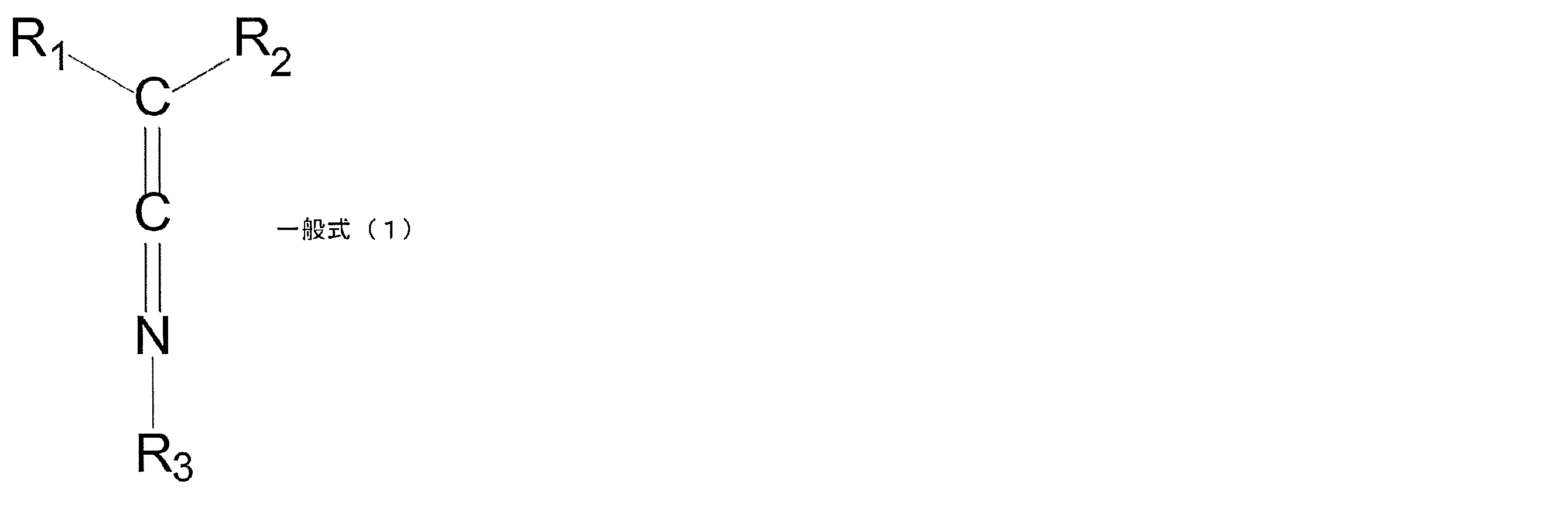
(一般式(1)中、R1およびR2は、それぞれ独立にアルキル基、アリール基、アルコキシ基、アルコキシカルボニル基、アミノカルボニル基、アリールオキシ基、アシル基またはアリールオキシカルボニル基を表し、R3はアルキル基またはアリール基を表す。)
[6] 前記ケテンイミン化合物は下記一般式(2)で表されることを特徴とする[1]に記載の芳香族ポリエステルフィルム。

(一般式(2)中、R1はアルキル基、アリール基、アルコキシ基、アルコキシカルボニル基、アミノカルボニル基、アリールオキシ基、アシル基またはアリールオキシカルボニル基を表す。R2は置換基としてL1を有するアルキル基、アリール基、アルコキシ基、アルコキシカルボニル基、アミノカルボニル基、アリールオキシ基、アシル基またはアリールオキシカルボニル基を表す。R3はアルキル基またはアリール基を表す。nは1から4の整数を表し、L1はn価の連結基を表す。)
[7]前記一般式(2)における、nが3または4であることを特徴とする[6]に記載の芳香族ポリエステルフィルム。
[8]前記ケテンイミン化合物は下記一般式(3)で表されることを特徴とする[1]に記載の芳香族ポリエステルフィルム。
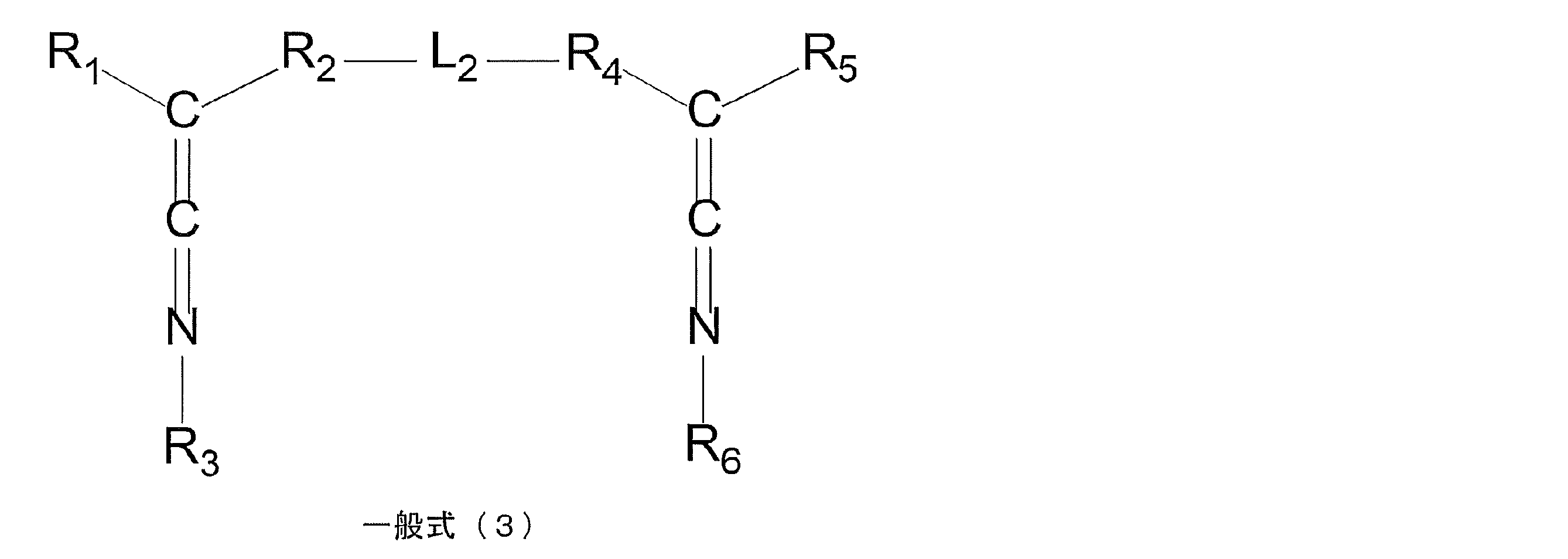
(一般式(3)中、R1およびR5はアルキル基、アリール基、アルコキシ基、アルコキシカルボニル基、アミノカルボニル基、アリールオキシ基、アシル基またはアリールオキシカルボニル基を表す。R2およびR4は置換基としてL2を有するアルキル基、アリール基、アルコキシ基、アルコキシカルボニル基、アミノカルボニル基、アリールオキシ基、アシル基またはアリールオキシカルボニル基を表す。R3およびR6はアルキル基またはアリール基を表す。L2は単結合または二価の連結基を表す。)
[9]前記ケテンイミン化合物のケテンイミンを構成する窒素原子と該窒素原子に結合している置換基を除く部分の分子量が320以上であることを特徴する[5]~[8]のいずれかに記載の芳香族ポリエステルフィルム。
[10]前記芳香族ポリエステル樹脂は、ジカルボン酸成分として、テレフタル酸、ナフタレンジカルボン酸、ジオール成分としてエチレングリコールを主として含み、
固有粘度(IV)が0.7~0.9g/dl、酸価(AV)が1~20eq/tonであることを特徴とする[1]~[9]のいずれかに記載の芳香族ポリエステルフィルム。
[11][1]~[10]のいずれかに記載の芳香族ポリエステルフィルムを少なくとも1層以上含み、積層数が2~8層であることを特徴とする積層フィルム。
[12]前記積層フィルムを構成する層のうち、最も膜厚が大きい層の厚みの変動率が1~10%であることを特徴とする[11]に記載の積層フィルム。
[13]環骨格にカルボジイミド基を1つ含み、その第一窒素と第二窒素が結合基により結合されている環状構造を分子内に少なくとも1つ有する環状カルボジイミド化合物、またはケテンイミン化合物と、微粒子と、芳香族ポリエステル樹脂とを含む芳香族ポリエステルフィルムの製造方法において、前記芳香族ポリエステル樹脂と、前記微粒子とを混練しマスターペレットを調製する工程と、前記マスターペレットと芳香族ポリエステルペレットを混合して押出した後、ダイから冷却ドラム上にキャストし製膜する工程を有し、前記マスターペレットを調製する工程または前記製膜する工程の少なくとも一方は、前記環状カルボジイミド化合物または前記ケテンイミン化合物を混合する工程を含み、前記微粒子の粒径は0.1~10μmであり、前記微粒子の含有率は、前記芳香族ポリエステル樹脂の質量に対して1~10質量%であり、前記マスターペレットを調製する工程は、前記芳香族ポリエステル樹脂と微粒子をスクリュー回転トルクで混練する工程を含み、前記スクリュー回転トルクには0.1~10%の変動が与えられる芳香族ポリエステルフィルムの製造方法。
[14]前記スクリュー回転トルクには1回/分~100回/分の変動が与えられることを特徴とする[13]に記載の芳香族ポリエステルフィルムの製造方法。
[15]前記製膜する工程は、前記ダイの内部に1~10℃の温度分布を付与する工程を含むことを特徴とする[13]または[14]に記載の芳香族ポリエステルフィルムの製造方法。
[16]前記環状カルボジイミド化合物は下記一般式(O-1)または一般式(O-2)で表されることを特徴とする[13]~[15]のいずれかに記載の芳香族ポリエステルフィルムの製造方法。

(一般式(O-1)中、R1およびR5は、それぞれ独立にアルキル基、アリール基またはアルコキシ基を表す。R2~R4およびR6~R8は、それぞれ独立に水素原子、アルキル基、アリール基またはアルコキシ基を表す。R1~R8は互いに結合して環を形成してもよい。X1およびX2は、それぞれ独立に単結合、-O-、-CO-、-S-、-SO2-、-NH-または-CH2-を表す。L1は2価の連結基を表す。)

(一般式(O-2)中、R11、R15、R21およびR25は、それぞれ独立にアルキル基、アリール基またはアルコキシ基を表す。R12~R14、R16~R18、R22~R24およびR26~R28は、それぞれ独立に水素原子、アルキル基、アリール基またはアルコキシ基を表す。R11~R28は互いに結合して環を形成してもよい。X11、X12、X21およびX22は、それぞれ独立に単結合、-O-、-CO-、-S-、-SO2-、-NH-または-CH2-を表す。L2は4価の連結基を表す。)
[17]前記一般式(O-1)および(O-2)中、R1およびR5、ならびに、R11、R15、R21およびR25がそれぞれ独立に2級もしくは3級アルキル基、または、アリール基を表すことを特徴とする[16]に記載の芳香族ポリエステルフィルムの製造方法。
[18]前記一般式(O-1)中、R2およびR6がともに水素原子であることを特徴とする[16]または[17]に記載の芳香族ポリエステルフィルムの製造方法。
[19]前記ケテンイミン化合物は下記一般式(1)で表されることを特徴とする[13]~[15]のいずれかに記載の芳香族ポリエステルフィルムの製造方法。

(一般式(1)中、R1およびR2は、それぞれ独立にアルキル基、アリール基、アルコキシ基、アルコキシカルボニル基、アミノカルボニル基、アリールオキシ基、アシル基またはアリールオキシカルボニル基を表し、R3はアルキル基またはアリール基を表す。)
[20]前記ケテンイミン化合物は下記一般式(2)で表されることを特徴とする[13]~[15]のいずれかに記載の芳香族ポリエステルフィルムの製造方法。
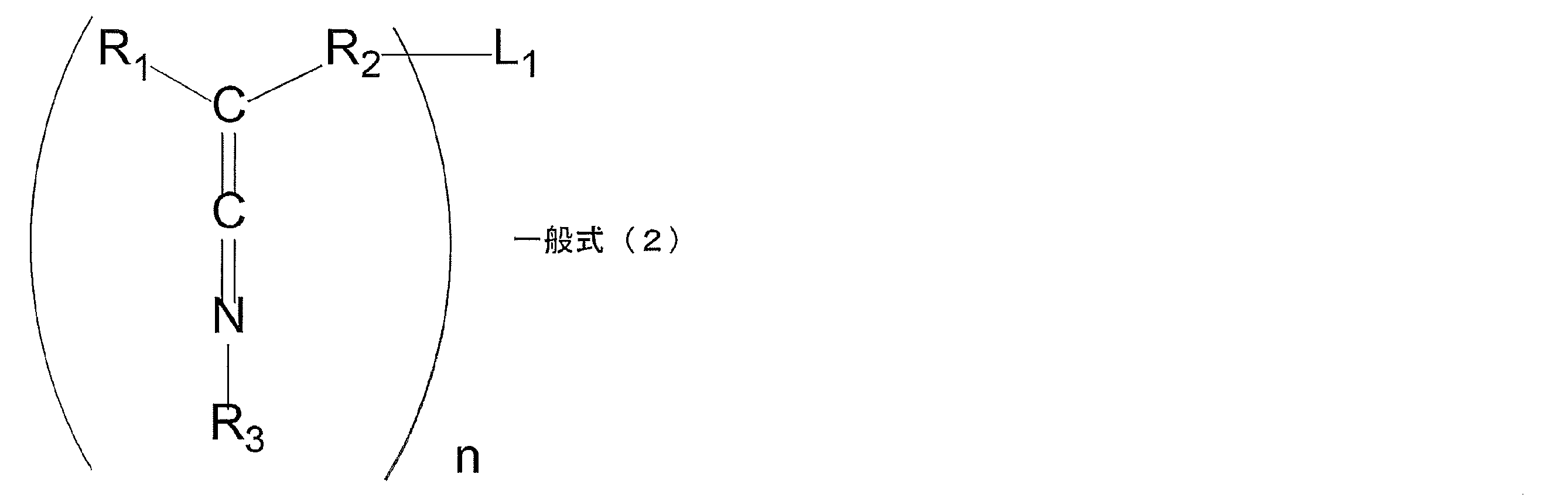
(一般式(2)中、R1はアルキル基、アリール基、アルコキシ基、アルコキシカルボニル基、アミノカルボニル基、アリールオキシ基、アシル基またはアリールオキシカルボニル基を表す。R2は置換基としてL1を有するアルキル基、アリール基、アルコキシ基、アルコキシカルボニル基、アミノカルボニル基、アリールオキシ基、アシル基またはアリールオキシカルボニル基を表す。R3はアルキル基またはアリール基を表す。nは1から4の整数を表し、L1はn価の連結基を表す。)
[21]前記一般式(2)における、nが3または4であることを特徴とする[20]に記載の芳香族ポリエステルフィルムの製造方法。
[22]前記ケテンイミン化合物は下記一般式(3)で表されることを特徴とする[13]~[15]のいずれかに記載の芳香族ポリエステルフィルムの製造方法。
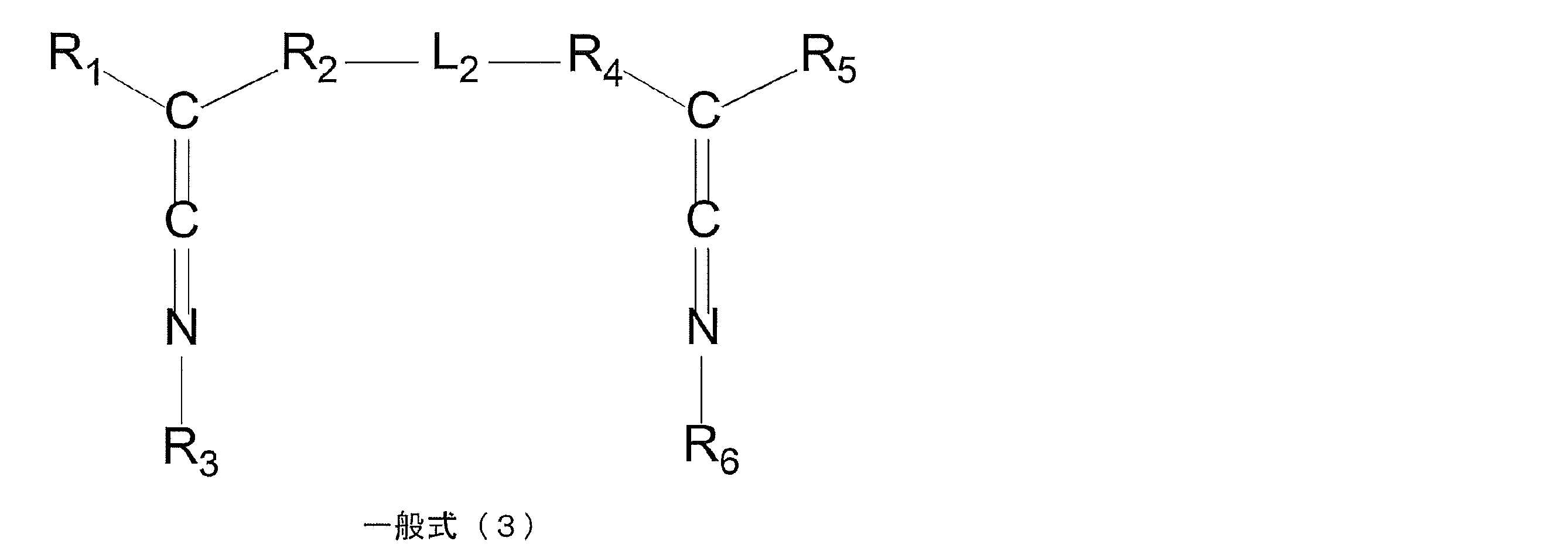
(一般式(3)中、R1およびR5はアルキル基、アリール基、アルコキシ基、アルコキシカルボニル基、アミノカルボニル基、アリールオキシ基、アシル基またはアリールオキシカルボニル基を表す。R2およびR4は置換基としてL2を有するアルキル基、アリール基、アルコキシ基、アルコキシカルボニル基、アミノカルボニル基、アリールオキシ基、アシル基またはアリールオキシカルボニル基を表す。R3およびR6はアルキル基またはアリール基を表す。L2は単結合または二価の連結基を表す。)
[23]前記ケテンイミン化合物のケテンイミンを構成する窒素原子と該窒素原子に結合している置換基を除く部分の分子量が320以上であることを特徴する[19]~[22]のいずれかに記載の芳香族ポリエステルフィルムの製造方法。
[24][13]~[23]のいずれかに記載の製造方法により製造された芳香族ポリエステルフィルム。
[25][1]~[10]及び[24]のいずれかに記載の芳香族ポリエステルフィルムを用いた太陽電池モジュール用バックシート。
[26][11]または[12]に記載の積層フィルムを用いた太陽電池モジュール用バックシート。
[27][25]または[26]に記載の太陽電池モジュール用バックシートを用いた太陽電池モジュール。
[2]前記環状カルボジイミド化合物は下記一般式(O-1)または一般式(O-2)で表されることを特徴とする[1]に記載の芳香族ポリエステルフィルム。
[3]前記一般式(O-1)および(O-2)中、R1およびR5、ならびに、R11、R15、R21およびR25がそれぞれ独立に2級もしくは3級アルキル基、または、アリール基を表すことを特徴とする[2]に記載の芳香族ポリエステルフィルム。
[4]前記一般式(O-1)中、R2およびR6がともに水素原子であることを特徴とする[2]または[3]に記載の芳香族ポリエステルフィルム。
[5]前記ケテンイミン化合物は下記一般式(1)で表されることを特徴とする[1]に記載の芳香族ポリエステルフィルム。
[6] 前記ケテンイミン化合物は下記一般式(2)で表されることを特徴とする[1]に記載の芳香族ポリエステルフィルム。
[7]前記一般式(2)における、nが3または4であることを特徴とする[6]に記載の芳香族ポリエステルフィルム。
[8]前記ケテンイミン化合物は下記一般式(3)で表されることを特徴とする[1]に記載の芳香族ポリエステルフィルム。
[9]前記ケテンイミン化合物のケテンイミンを構成する窒素原子と該窒素原子に結合している置換基を除く部分の分子量が320以上であることを特徴する[5]~[8]のいずれかに記載の芳香族ポリエステルフィルム。
[10]前記芳香族ポリエステル樹脂は、ジカルボン酸成分として、テレフタル酸、ナフタレンジカルボン酸、ジオール成分としてエチレングリコールを主として含み、
固有粘度(IV)が0.7~0.9g/dl、酸価(AV)が1~20eq/tonであることを特徴とする[1]~[9]のいずれかに記載の芳香族ポリエステルフィルム。
[11][1]~[10]のいずれかに記載の芳香族ポリエステルフィルムを少なくとも1層以上含み、積層数が2~8層であることを特徴とする積層フィルム。
[12]前記積層フィルムを構成する層のうち、最も膜厚が大きい層の厚みの変動率が1~10%であることを特徴とする[11]に記載の積層フィルム。
[13]環骨格にカルボジイミド基を1つ含み、その第一窒素と第二窒素が結合基により結合されている環状構造を分子内に少なくとも1つ有する環状カルボジイミド化合物、またはケテンイミン化合物と、微粒子と、芳香族ポリエステル樹脂とを含む芳香族ポリエステルフィルムの製造方法において、前記芳香族ポリエステル樹脂と、前記微粒子とを混練しマスターペレットを調製する工程と、前記マスターペレットと芳香族ポリエステルペレットを混合して押出した後、ダイから冷却ドラム上にキャストし製膜する工程を有し、前記マスターペレットを調製する工程または前記製膜する工程の少なくとも一方は、前記環状カルボジイミド化合物または前記ケテンイミン化合物を混合する工程を含み、前記微粒子の粒径は0.1~10μmであり、前記微粒子の含有率は、前記芳香族ポリエステル樹脂の質量に対して1~10質量%であり、前記マスターペレットを調製する工程は、前記芳香族ポリエステル樹脂と微粒子をスクリュー回転トルクで混練する工程を含み、前記スクリュー回転トルクには0.1~10%の変動が与えられる芳香族ポリエステルフィルムの製造方法。
[14]前記スクリュー回転トルクには1回/分~100回/分の変動が与えられることを特徴とする[13]に記載の芳香族ポリエステルフィルムの製造方法。
[15]前記製膜する工程は、前記ダイの内部に1~10℃の温度分布を付与する工程を含むことを特徴とする[13]または[14]に記載の芳香族ポリエステルフィルムの製造方法。
[16]前記環状カルボジイミド化合物は下記一般式(O-1)または一般式(O-2)で表されることを特徴とする[13]~[15]のいずれかに記載の芳香族ポリエステルフィルムの製造方法。
[17]前記一般式(O-1)および(O-2)中、R1およびR5、ならびに、R11、R15、R21およびR25がそれぞれ独立に2級もしくは3級アルキル基、または、アリール基を表すことを特徴とする[16]に記載の芳香族ポリエステルフィルムの製造方法。
[18]前記一般式(O-1)中、R2およびR6がともに水素原子であることを特徴とする[16]または[17]に記載の芳香族ポリエステルフィルムの製造方法。
[19]前記ケテンイミン化合物は下記一般式(1)で表されることを特徴とする[13]~[15]のいずれかに記載の芳香族ポリエステルフィルムの製造方法。
[20]前記ケテンイミン化合物は下記一般式(2)で表されることを特徴とする[13]~[15]のいずれかに記載の芳香族ポリエステルフィルムの製造方法。
[21]前記一般式(2)における、nが3または4であることを特徴とする[20]に記載の芳香族ポリエステルフィルムの製造方法。
[22]前記ケテンイミン化合物は下記一般式(3)で表されることを特徴とする[13]~[15]のいずれかに記載の芳香族ポリエステルフィルムの製造方法。
[23]前記ケテンイミン化合物のケテンイミンを構成する窒素原子と該窒素原子に結合している置換基を除く部分の分子量が320以上であることを特徴する[19]~[22]のいずれかに記載の芳香族ポリエステルフィルムの製造方法。
[24][13]~[23]のいずれかに記載の製造方法により製造された芳香族ポリエステルフィルム。
[25][1]~[10]及び[24]のいずれかに記載の芳香族ポリエステルフィルムを用いた太陽電池モジュール用バックシート。
[26][11]または[12]に記載の積層フィルムを用いた太陽電池モジュール用バックシート。
[27][25]または[26]に記載の太陽電池モジュール用バックシートを用いた太陽電池モジュール。
本発明によれば、耐加水分解性を有しつつも裁断時に裁断屑が発生しない芳香族ポリエステルフィルムを得ることができる。これにより、本発明の芳香族ポリエステルフィルムは、太陽電池パネルとの密着性が良好となり、太陽電池のバックシートとして好適に用いられる。
以下において、本発明について詳細に説明する。以下に記載する構成要件の説明は、代表的な実施形態や具体例に基づいてなされることがあるが、本発明はそのような実施形態に限定されるものではない。なお、本明細書において「~」を用いて表される数値範囲は「~」前後に記載される数値を下限値および上限値として含む範囲を意味する。
本発明は、芳香族ポリエステルフィルムに関する。本発明の芳香族ポリエステルフィルムは、環状カルボジイミド化合物またはケテンイミン化合物と微粒子と芳香族ポリエステル樹脂を含有する。環状カルボジイミド化合物またはケテンイミン化合物の含有率は、芳香族ポリエステル樹脂の質量に対して、0.1~5質量%である。また、微粒子の粒径は0.1~10μmであり、微粒子の含有率は芳香族ポリエステル樹脂の質量に対して1~10質量%である。微粒子の一部は凝集しており、その凝集率が10~50%である。
(芳香族ポリエステル樹脂)
芳香族ポリエステル樹脂は、芳香族ジカルボン酸又はそのエステル形成性誘導体と、低分子量脂肪族ジオール又は高分子量ジオールとを反応させることにより得ることができる。芳香族ジカルボン酸又はそのエステル形成性誘導体としては、例えば、テレフタル酸、イソフタル酸、オルトフタル酸、ナフタリンジカルボン酸、パラフェニレンジカルボン酸、テレフタル酸ジメチル、イソフタル酸ジメチル、オルトフタル酸ジメチル、ナフタリンジカルボン酸ジメチル、パラフェニレンジカルボン酸ジメチル等が挙げられる。これらは単独で用いられてもよく、2種類以上が併用されてもよい。
芳香族ポリエステル樹脂は、芳香族ジカルボン酸又はそのエステル形成性誘導体と、低分子量脂肪族ジオール又は高分子量ジオールとを反応させることにより得ることができる。芳香族ジカルボン酸又はそのエステル形成性誘導体としては、例えば、テレフタル酸、イソフタル酸、オルトフタル酸、ナフタリンジカルボン酸、パラフェニレンジカルボン酸、テレフタル酸ジメチル、イソフタル酸ジメチル、オルトフタル酸ジメチル、ナフタリンジカルボン酸ジメチル、パラフェニレンジカルボン酸ジメチル等が挙げられる。これらは単独で用いられてもよく、2種類以上が併用されてもよい。
低分子量脂肪族ジオールとしては、例えば、エチレングリコール、1,2-プロパンジオール、1,3-プロパンジオール、1,3-ブタンジオール、1,4-ブタンジオール、ネオペンチルグリコール、1,5-ペンタンジオール、1,6-ヘキサンジオール、1,4-シクロヘキサンジメタノール等が挙げられる。これらは単独で用いられてもよく、2種類以上が併用されてもよい。
高分子量ジオールとしては、例えば、ポリエチレングリコール、ポリプロピレングリコール、ポリテトラメチレングリコール、ポリヘキサメチレングリコール等が挙げられる。これらは単独で用いられてもよく、2種類以上が併用されてもよい。
高分子量ジオールとしては、例えば、ポリエチレングリコール、ポリプロピレングリコール、ポリテトラメチレングリコール、ポリヘキサメチレングリコール等が挙げられる。これらは単独で用いられてもよく、2種類以上が併用されてもよい。
上記の構成成分からなる結晶性芳香族ポリエステルとしては、例えば、ポリエチレンテレフタレート、ポリブチレンテレフタレート、ポリヘキサメチレンテレフタレート、ポリエチレンナフタレート、ポリブチレンナフタレート、テレフタル酸ブタンジオールポリテトラメチレングリコール共重合体等が挙げられる。これらは単独で用いられてもよく、2種類以上が併用されてもよい。これに記載の芳香族ポリエステルの中で特に好ましいのは、ジカルボン酸として、テレフタル酸、ナフタレンジカルボン酸を主成分に用いるもの、ジオールとしてエチレングリコール、シクロヘキサンジメタノールを主成分とするものが好ましく、より好ましくはポリエチレンテレフタレート、ポリエチレンナフタレート、ポリシクロヘキサンジメチレンテレフタレートであり、さらに好ましくはポリエチレンテレフタレート、ポリエチレンナフタレートである。
芳香族ポリエステル樹脂の形状は特に限定されることはないが、ペレット状であることが好ましい。芳香族ポリエステル樹脂をペレットとすることにより、後述する微粒子との混合を容易にすることができる。
ペレットの形状は、無定形(破砕形)、円柱形、長方形いずれでも構わないが、ペレットの生産性の観点から円柱形、長方形が好ましく、さらに押出し機への供給安定性からは円柱形が好ましい。円柱形では角が破砕しにくく、粉が発生しにくいため、ホッパー内でブリッジ(閉塞)しないからである。
ペレットの形状は、無定形(破砕形)、円柱形、長方形いずれでも構わないが、ペレットの生産性の観点から円柱形、長方形が好ましく、さらに押出し機への供給安定性からは円柱形が好ましい。円柱形では角が破砕しにくく、粉が発生しにくいため、ホッパー内でブリッジ(閉塞)しないからである。
好ましいペレットの体積は1~1000mm3が好ましく、より好ましくは3~100mm3、さらに好ましくは5~60mm3である。この範囲未満ではホッパー内で閉塞し易く好ましくない。またこの範囲を超えると、ペレットを貯蔵しているサイロから押出し機まで風送する際、搬送し難く好ましくない。
(微粒子)
本発明の芳香族ポリエステルフィルムは、微粒子を含有する。この微粒子は、芳香族ポリエステルフィルムを白色にする働きをする。微粒子としては、炭酸カルシウム、炭酸マグネシウム、炭酸バリウム、硫酸マグネシウム、硫酸バリウム、硫酸カルシウム、酸化亜鉛、酸化マグネシウム、酸化カルシウム、酸化チタン、アルミナ、水酸化アルミニウム、ヒドロキシアパタイト、シリカ、マイカ、タルク、カオリン、クレイ、ガラス粉、アスベスト粉、ゼオライトおよび珪酸白土等といった無機質微粉体から選ばれた少なくとも1種が用いられることが好ましい。中でも酸化チタン、硫酸バリウムが好ましく用いられる。
本発明の芳香族ポリエステルフィルムは、微粒子を含有する。この微粒子は、芳香族ポリエステルフィルムを白色にする働きをする。微粒子としては、炭酸カルシウム、炭酸マグネシウム、炭酸バリウム、硫酸マグネシウム、硫酸バリウム、硫酸カルシウム、酸化亜鉛、酸化マグネシウム、酸化カルシウム、酸化チタン、アルミナ、水酸化アルミニウム、ヒドロキシアパタイト、シリカ、マイカ、タルク、カオリン、クレイ、ガラス粉、アスベスト粉、ゼオライトおよび珪酸白土等といった無機質微粉体から選ばれた少なくとも1種が用いられることが好ましい。中でも酸化チタン、硫酸バリウムが好ましく用いられる。
また、得られるフィルムの反射率の向上効果を高くするという観点からは、フィルムを構成する組成物との屈折率差が大きいものが好ましく用いられる。すなわち、無機質微粉体の屈折率が大きいものが好ましい。具体的には、例えば、芳香族ポリエステル樹脂を用いる場合には、屈折率が1.6以上である炭酸カルシウム、硫酸バリウム、酸化チタンおよび酸化亜鉛からなる群より選ばれる少なくとも1種を用いることが更に好ましく、これらの中でも酸化チタンを用いることが特に好ましい。酸化チタンを用いることにより、より少ない充填量でフィルムに高い反射性能を付与することができ、また、薄肉でも反射性能の高いフィルムを得ることができる。
酸化チタンとしては、例えば、アナターゼ型酸化チタン及びルチル型酸化チタンのような結晶形の酸化チタンが挙げられる。高分子との屈折率差を大きくするという観点からは、屈折率が2.7以上の酸化チタンであることが好ましく、例えば、ルチル型酸化チタンの結晶形のものを用いることが好ましい。
酸化チタンの中でも純度の高い高純度酸化チタンを用いることが特に好ましい。ここで、高純度酸化チタンとは、可視光に対する光吸収能が小さい酸化チタンであり、バナジウム、鉄、ニオブ、銅、マンガン等の着色元素の含有量が少ないものをいう。なお、本明細書においては、酸化チタンに含まれるバナジウムの含有率が5ppm以下である酸化チタンを高純度酸化チタンという。高純度酸化チタンは、光吸収能を小さくするという観点からは、酸化チタンに含まれる、鉄、ニオブ、銅、マンガン等の着色元素も少なくすることが好ましい。
また、微粒子の高分子への分散性を向上させるために、充填剤の表面に、シリコーン系化合物、多価アルコール系化合物、アミン系化合物、脂肪酸、脂肪酸エステル等で表面処理を施しても良い。例えば、酸化チタンの脂肪族ポリエステル樹脂への分散性を向上させ、かつ、酸化チタンの光触媒活性を抑制するために、酸化チタンの表面に表面処理を施しても良い。表面処理剤としては、例えば、アルミナ、シリカおよびジルコニア等からなる群から選ばれた少なくとも1種の無機化合物、シロキサン化合物、シランカップリング剤、ポリオールおよびポリエチレングリコールからなる群から選ばれた少なくとも1種の有機化合物等を用いることができる。また、これらの無機化合物と有機化合物とを組み合わせて用いてもよい。
微粒子として、無機質微粉体と有機質微粉体とを組み合わせて使用してもよい。また、微粒子は複数種類を併用することができ、例えば、酸化チタンと他の充填剤、高純度酸化チタンと他の微粒子とを併用してもよい。
本発明に用いられる微粒子の粒径は0.1~10μmである。微粒子の粒径は0.1~10μmであれば良く、0.15~9μmであることが好ましく、0.2~8μmであることがより好ましくい。微粒子の粒径を上記範囲内とすることにより、光の反射効率を高めることができる。特に可視領域の光の反射効率を高めることができるため好ましい。
本発明では、芳香族ポリエステルフィルム中の微粒子の含有率は、芳香族ポリエステル樹脂の質量に対して、1~10質量%である。微粒子の含有率は、1~10質量%であれば良く、1.5~8質量%であることが好ましく、2~6質量%であることがより好ましい。微粒子の添加量を上記範囲内とすることにより、光の反射効率を適切な範囲内とすることができる。微粒子の添加量が上記上限値を超えると微粒子に対しバインダーであるポリエステルの量が低くなり微粒子を固定できなくなり、裁断時に剥落しやすくなるため好ましくない。
本発明では、微粒子の一部は凝集しており、その凝集率は10~50%である。微粒子の凝集率は、10~50%であれば良く、15~45%であることが好ましく、20~40%であることがより好ましい。微粒子の凝集率を上記範囲内とすることにより、裁断時に裁断屑が発生することを抑制することができる。凝集率が上記範囲を超えると、粒子の凝集体が多くなり、そこを裁断刃が通過する際、衝撃が発生し易く、これに伴い微粒子が剥落し裁断屑が発生し易くなる。
ここで、微粒子の凝集率とは、光学顕微鏡や電子顕微鏡を用いて観察した100個の粒子(粒子および凝集粒子)中に占める凝集粒子の数の割合を示す。なお、凝集粒子の数は、2個以上の粒子が凝集した凝集体(粒子塊)を1個の粒子としてカウントする。
ここで、微粒子の凝集率とは、光学顕微鏡や電子顕微鏡を用いて観察した100個の粒子(粒子および凝集粒子)中に占める凝集粒子の数の割合を示す。なお、凝集粒子の数は、2個以上の粒子が凝集した凝集体(粒子塊)を1個の粒子としてカウントする。
微粒子が凝集することにより、裁断の際の応力集中点を減少でき、PETの破壊を抑制できる。さらに、微粒子が凝集することで見かけ上大きなサイズとなり、剥落しにくくなる。例えば、微粒子が2つ繋がった場合、見かけの粒径が長くなり、裁断面から落ち難くなる。これにより、裁断屑の発生を効果的に防ぐことができる。
微粒子は凝集することで見かけ上の個数が減少する。しかし、微粒子は見かけ上の個数が減少するだけであって、実際に含有される微粒子の個数は減少しない。このため、光の反射率を下げることはない。一方、微粒子を凝集させずに、粒子径の大きな粒子を凝集塊と同じ数だけ含有させることとした場合、光の反射率が低下する。すなわち、本発明では、粒子径の大きな粒子を凝集塊と同じ数だけ含有させるのではなく、微粒子を凝集させることによって、光の反射率を維持しつつ、裁断屑の発生を抑制することを可能にしている。
上述したような微粒子の凝集体はマスターペレットの製造工程を調整することによって形成される。
マスターペレットは、ポリエステル樹脂と微粒子を混練したものから形成される。ここでは、微粒子の含有率は、ポリエステル樹脂に対して、30~70質量%である。微粒子とポリエステル樹脂は、含水率が100ppm以下になるまで十分に乾燥させたものを用いることが好ましい。なお、ポリエステル樹脂はペレットであることが好ましい。ペレット状のポリエステル樹脂を用いることにより、微粒子を均一に混合することができる。
さらに、得られたマスターペレットも含水率が100ppm以下になるまで十分に乾燥させることが好ましい。
マスターペレットは、ポリエステル樹脂と微粒子を混練したものから形成される。ここでは、微粒子の含有率は、ポリエステル樹脂に対して、30~70質量%である。微粒子とポリエステル樹脂は、含水率が100ppm以下になるまで十分に乾燥させたものを用いることが好ましい。なお、ポリエステル樹脂はペレットであることが好ましい。ペレット状のポリエステル樹脂を用いることにより、微粒子を均一に混合することができる。
さらに、得られたマスターペレットも含水率が100ppm以下になるまで十分に乾燥させることが好ましい。
このように得られたマスターペレットを、押出し機に入れ、混練する。この際押出し機中のスクリューの回転トルクに0.1~10%、好ましくは0.2~5%、さらに好ましくは0.3~3%の変動を与える。
ここで、トルクの変動率は、平均値に対する変化率を指す。具体的には、トルクを1分間計測し、その間のトルクの平均値に対し上記変動率を掛けた値だけ、トルクを増加あるいは低減させた増加率または低減率を示す。
ここで、トルクの変動率は、平均値に対する変化率を指す。具体的には、トルクを1分間計測し、その間のトルクの平均値に対し上記変動率を掛けた値だけ、トルクを増加あるいは低減させた増加率または低減率を示す。
トルクを変動させることにより、樹脂に与える力を変動させることができ、樹脂が不均一に流動するように流れを与えることができる。これによりスクリュー中で瞬時に樹脂が滞留し、ここで微粒子の凝集体が形成される。
トルク変動を上記範囲内とすることにより、微粒子の凝集率を10~50%の範囲内にすることができる。トルク変動が上記範囲未満では凝集体が形成されにくくなり好ましくない。一方、トルク変動が上記範囲を超えると微粒子の凝集率が50%を超えるため好ましくない。なお、このような押出しは2軸スクリューを用いることでトルク調整を行い易くなり好ましい。
トルク変動を上記範囲内とすることにより、微粒子の凝集率を10~50%の範囲内にすることができる。トルク変動が上記範囲未満では凝集体が形成されにくくなり好ましくない。一方、トルク変動が上記範囲を超えると微粒子の凝集率が50%を超えるため好ましくない。なお、このような押出しは2軸スクリューを用いることでトルク調整を行い易くなり好ましい。
上記のようなスクリューのトルク変動は、連続し常時付与しても良いが、1回/分~100回/分付与することが好ましく、3回/分~80回/分付与することがより好ましく、5回/分~60回/分付与することがさらに好ましい。トルク変動を上記範囲内とすることにより、所望の範囲で微粒子を凝集させることができる。
ここで、1回/分トルク変動するとは、1分間トルクを計測し、トルクが平均値からから一定以上、上振れまたは下振れすることが1回あることを指す。ここで、平均値からから一定以上の範囲とは、トルク変動の変化率で規定した範囲を指す。具体的には、1分間に、トルク変動の変化率が0.1%を超え、かつ10%を超えない範囲でトルクが変動した回数を計測することで、スクリューのトルク変動回数を求めることができる。
ここで、1回/分トルク変動するとは、1分間トルクを計測し、トルクが平均値からから一定以上、上振れまたは下振れすることが1回あることを指す。ここで、平均値からから一定以上の範囲とは、トルク変動の変化率で規定した範囲を指す。具体的には、1分間に、トルク変動の変化率が0.1%を超え、かつ10%を超えない範囲でトルクが変動した回数を計測することで、スクリューのトルク変動回数を求めることができる。
なお、このようなトルクの変動はスクリューを回転させるモーターの供給電力を変動させることで達成できる。モーターの供給電力を変動は、モーターに供給する電流値を増減させることで達成できる。例えばコンピューター制御によりモーターへの供給電流値を定期的あるいはランダムに増減させることで達成できる。
(環状カルボジイミド化合物)
本発明の芳香族ポリエステルフィルムは、環状カルボジイミド化合物を含有する。環骨格にカルボジイミド基を1つ含み、その第一窒素と第二窒素が結合基により結合されている環状構造を分子内に少なくとも1つ有する環状カルボジイミド化合物は、環状封止剤として機能する。
環状カルボジイミド化合物は、国際公開2011/093478号パンフレットに記載された方法によって調製することができる。
本発明の芳香族ポリエステルフィルムは、環状カルボジイミド化合物を含有する。環骨格にカルボジイミド基を1つ含み、その第一窒素と第二窒素が結合基により結合されている環状構造を分子内に少なくとも1つ有する環状カルボジイミド化合物は、環状封止剤として機能する。
環状カルボジイミド化合物は、国際公開2011/093478号パンフレットに記載された方法によって調製することができる。
本発明で使用する環状カルボジイミド化合物は、環状構造を有する。環状カルボジイミド化合物は、環状構造を複数有していてもよい。環状構造は、カルボジイミド基(-N=C=N-)を1個有しその第一窒素と第二窒素とが結合基により結合されている。一つの環状構造中には、1個のカルボジイミド基のみを有するが、例えば、スピロ環など、分子中に複数の環状構造を有する場合にはスピロ原子に結合するそれぞれの環状構造中に1個のカルボジイミド基を有していれば、化合物として複数のカルボジイミド基を有していても良い。環状構造中の原子数は、好ましくは8~50、より好ましくは10~30、さらに好ましくは10~20、特に好ましくは10~15である。
ここで、環状構造中の原子数とは、環構造を直接構成する原子の数を意味し、例えば、8員環であれば8、50員環であれば50である。環状構造中の原子数が8より小さいと、環状カルボジイミド化合物の安定性が低下して、保管、使用が困難となる場合があるためである。また反応性の観点よりは環員数の上限値に関しては特別の制限はないが、50を超える原子数の環状カルボジイミド化合物は合成上困難となり、コストが大きく上昇する場合が発生するためである。かかる観点より環状構造中の原子数は好ましくは、10~30、より好ましくは10~20、特に好ましくは10~15の範囲が選択される。
環状カルボジイミド化合物としては、下記一般式(O-1)または一般式(O-2)で表される環状カルボジイミド化合物を用いることが好ましい。
以下、本発明の環状カルボジイミド化合物の好ましい構造について、下記一般式(O-1)と一般式(O-2)の順に説明する。
以下、本発明の環状カルボジイミド化合物の好ましい構造について、下記一般式(O-1)と一般式(O-2)の順に説明する。
まず、一般式(O-1)で表される環状カルボジイミド化合物について説明する。
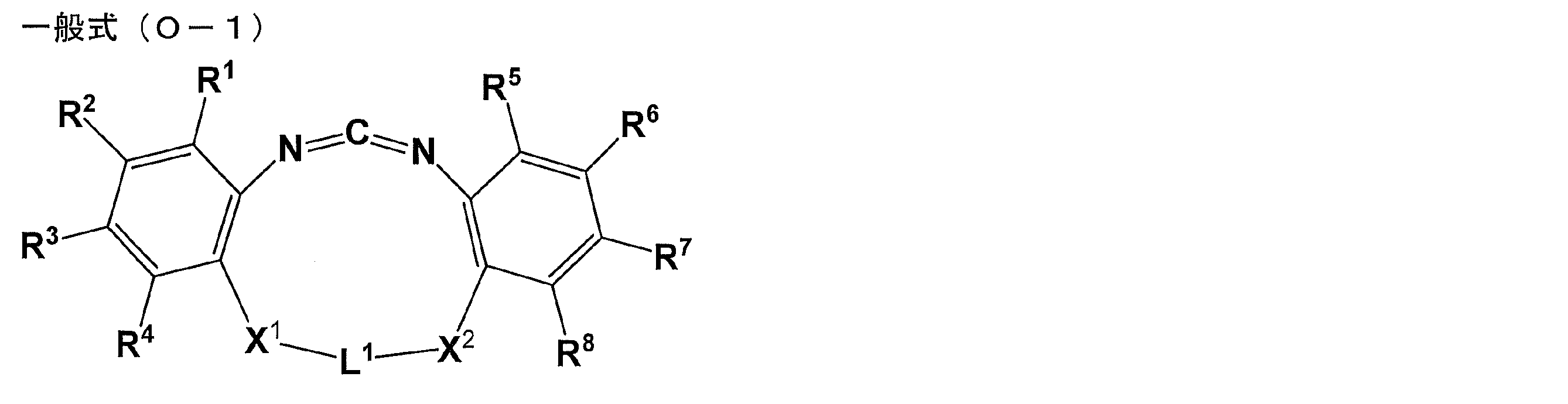
一般式(O-1)中、R1およびR5は、それぞれ独立にアルキル基、アリール基またはアルコキシ基を表す。R2~R4およびR6~R8は、それぞれ独立に水素原子、アルキル基、アリール基またはアルコキシ基を表す。R1~R8は互いに結合して環を形成してもよい。X1およびX2は、それぞれ独立に単結合、-O-、-CO-、-S-、-SO2-、-NH-または-CH2-を表す。L1は2価の連結基を表す。
上記一般式(O-1)中、R1およびR5は、それぞれ独立にアルキル基、アリール基またはアルコキシ基を表し、アルキル基またはアリール基を表すことが好ましく、2級もしくは3級アルキル基またはアリール基を表すことがポリエステルの末端に連結したイソシアエネートとポリエステルの水酸基末端の反応を抑制し、増粘を抑制する観点からより好ましく、2級アルキル基を表すことが特に好ましい。
R1およびR5が表すアルキル基は、炭素数1~20のアルキル基であることが好ましく、炭素数1~12のアルキル基であることがより好ましく、炭素数2~6のアルキル基であることが特に好ましい。R1およびR5が表すアルキル基は直鎖であっても分枝であっても環状であってもよいが、分枝または環状であることが、ポリエステルの末端に連結したイソシアエネートとポリエステルの水酸基末端の反応を抑制し、増粘を抑制する観点から好ましい。R1およびR5が表すアルキル基は2級または3級アルキル基であることが好ましく、2級アルキル基であることがより好ましい。R1およびR5が表すアルキル基は、メチル基、エチル基、n-プロピル基、sec-プロピル基、iso-プロピル基、n-ブチル基、tert-ブチル基、sec-ブチル基、iso-ブチル基、n-ペンチル基、sec-ペンチル基、iso-ペンチル基、n-ヘキシル基、sec-ヘキシル基、iso-ヘキシル基、シクロヘキシル基、などを挙げることができ、その中でもiso-プロピル基、tert-ブチル基、iso-ブチル基、iso-ペンチル基、iso-ヘキシル基、シクロヘキシル基が好ましく、iso-プロピル基、シクロヘキシル基、tert-ブチル基がより好ましく、iso-プロピル基およびシクロヘキシル基が特に好ましい。
R1およびR5が表すアルキル基はさらに置換基を有していてもよく、該置換基としては特に制限されるものではない。但し、R1およびR5が表すアルキル基は、カルボン酸との反応性の観点から、さらに置換基を有さないことが好ましい。
R1およびR5が表すアルキル基はさらに置換基を有していてもよく、該置換基としては特に制限されるものではない。但し、R1およびR5が表すアルキル基は、カルボン酸との反応性の観点から、さらに置換基を有さないことが好ましい。
R1およびR5が表すアリール基は、炭素数6~20のアリール基であることが好ましく、炭素数6~12のアリール基であることがより好ましく、炭素数6のアリール基であることが特に好ましい。R1およびR5が表すアリール基は、R1とR2が縮合またはR5とR6が縮合して形成されたアリール基であってもよいが、R1およびR5は、それぞれR2およびR6と縮合して環を形成しないことが好ましい。R1およびR5が表すアリール基は、フェニル基、ナフチル基などを挙げることができ、その中でもフェニル基がより好ましい。
R1およびR5が表すアリール基はさらに置換基を有していてもよく、該置換基としては特に制限されるものではない。但し、R1およびR5が表すアリール基は、カルボン酸との反応性の観点から、さらに置換基を有さないことが好ましい。
R1およびR5が表すアリール基はさらに置換基を有していてもよく、該置換基としては特に制限されるものではない。但し、R1およびR5が表すアリール基は、カルボン酸との反応性の観点から、さらに置換基を有さないことが好ましい。
R1およびR5が表すアルコキシ基は、炭素数1~20のアルコキシ基であることが好ましく、炭素数1~12のアルコキシ基であることがより好ましく、炭素数2~6のアルコキシ基であることが特に好ましい。R1およびR5が表すアルコキシ基は直鎖であっても分枝であっても環状であってもよいが、分枝または環状であることが、ポリエステルの末端に連結したイソシアエネートとポリエステルの水酸基末端の反応を抑制し、増粘を抑制する観点から好ましい。R1およびR5が表すアルコキシ基の好ましい例は、R1およびR5が表すアルキル基の末端に-O-が連結した基を挙げることがあり、好ましい範囲も同様にR1およびR5が表す好ましいアルキル基の末端に-O-が連結した基である。
R1およびR5が表すアルコキシ基はさらに置換基を有していてもよく、該置換基としては特に制限されるものではない。但し、R1およびR5が表すアルコキシ基は、カルボン酸との反応性の観点から、さらに置換基を有さないことが好ましい。
R1およびR5が表すアルコキシ基はさらに置換基を有していてもよく、該置換基としては特に制限されるものではない。但し、R1およびR5が表すアルコキシ基は、カルボン酸との反応性の観点から、さらに置換基を有さないことが好ましい。
R1およびR5は、同じであっても異なっていてもよいが、コストの観点から同じであることが好ましい。
上記一般式(O-1)中、R2~R4およびR6~R8は、それぞれ独立に水素原子、アルキル基、アリール基またはアルコキシ基を表し、水素原子、炭素数1~20のアルキル基、炭素数1~20のアルコキシ基であることが好ましく、水素原子、炭素数1~6のアルキル基がより好ましく、水素原子が特に好ましい。
R2~R4およびR6~R8が表すアルキル基、アリール基またはアルコキシ基はさらに置換基を有していてもよく、該置換基としては特に制限されるものではない。
本発明の環状カルボジイミド化合物は、上記一般式(O-1)中、R2およびR6がともに水素原子であることが、R1およびR5に嵩高い置換基を導入しやすい観点から好ましい。ここで、WO2010/071211号公報には、上記一般式(O-1)においてR2およびR6に相当する部位(カルボジイミド基に対してメタ位)にアルキル基やアリール基が置換した化合物が例示されているが、これらの化合物はポリエステルの末端に連結したイソシアネートとポリエステルの水酸基末端との反応を抑制することができない上、前記一般式(O-1)においてR2およびR6に相当する部位(カルボジイミド基に対してオルト位)に置換基を導入することが困難である。
R2~R4およびR6~R8が表すアルキル基、アリール基またはアルコキシ基はさらに置換基を有していてもよく、該置換基としては特に制限されるものではない。
本発明の環状カルボジイミド化合物は、上記一般式(O-1)中、R2およびR6がともに水素原子であることが、R1およびR5に嵩高い置換基を導入しやすい観点から好ましい。ここで、WO2010/071211号公報には、上記一般式(O-1)においてR2およびR6に相当する部位(カルボジイミド基に対してメタ位)にアルキル基やアリール基が置換した化合物が例示されているが、これらの化合物はポリエステルの末端に連結したイソシアネートとポリエステルの水酸基末端との反応を抑制することができない上、前記一般式(O-1)においてR2およびR6に相当する部位(カルボジイミド基に対してオルト位)に置換基を導入することが困難である。
上記一般式(O-1)中、R1~R8は互いに結合して環を形成してもよい。このときに形成される環は特に制限はないが、芳香族環であることが好ましい。例えば、R1~R4の2以上が互いに結合して縮合環を形成してもよく、R1~R4が置換しているベンゼン環とともに炭素数10以上のアリーレン基やヘテロアリーレン基を形成してもよい。このときに形成される炭素数10以上のアリーレン基としては、ナフタレンジイル基などの炭素数10~15の芳香族基が挙げられる。
同様に、例えば、R5~R8の2以上が互いに結合して縮合環を形成してもよく、R5~R8が置換しているベンゼン環とともに炭素数10以上のアリーレン基やヘテロアリーレン基を形成してもよく、そのときの好ましい範囲はR1~R4が置換しているベンゼン環とともに炭素数10以上のアリーレン基やヘテロアリーレン基を形成するときの好ましい範囲と同様である。
但し、本発明の環状カルボジイミド化合物は、上記一般式(O-1)中、R1~R8は互いに結合して環を形成しないことが好ましい。
同様に、例えば、R5~R8の2以上が互いに結合して縮合環を形成してもよく、R5~R8が置換しているベンゼン環とともに炭素数10以上のアリーレン基やヘテロアリーレン基を形成してもよく、そのときの好ましい範囲はR1~R4が置換しているベンゼン環とともに炭素数10以上のアリーレン基やヘテロアリーレン基を形成するときの好ましい範囲と同様である。
但し、本発明の環状カルボジイミド化合物は、上記一般式(O-1)中、R1~R8は互いに結合して環を形成しないことが好ましい。
上記一般式(O-1)中、X1およびX2は、それぞれ独立に単結合、-O-、-CO-、-S-、-SO2-、-NH-および-CH2-から選択される少なくとも1種を表し、その中でも-O-、-CO-、-S-、-SO2-、-NH-であることが好ましく、-O-、-S-であることが合成容易性の観点からより好ましい。
上記一般式(O-1)中、L1は2価の連結基を表し、それぞれヘテロ原子ならびに置換基を含んでいても良く、2価の炭素数1~20の脂肪族基、2価の炭素数3~20の脂環族基、2価の炭素数5~15の芳香族基、またはこれらの組み合わせであることが好ましく、2価の炭素数1~20の脂肪族基であることがより好ましい。
L1が表す2価の脂肪族基として、炭素数1~20のアルキレン基が挙げられる。炭素数1~20のアルキレン基として、メチレン基、エチレン基、プロピレン基、ブチレン基、ペンチレン基、ヘキシレン基、へプチレン基、オクチレン基、ノニレン基、デシレン基、ドデシレン基、へキサデシレン基などが挙げられ、メチレン基、エチレン基、プロピレン基がより好ましく、エチレン基が特に好ましい。これらの脂肪族基は置換されていてもよい。置換基として、炭素数1~20のアルキル基、炭素数6~15のアリール基、ハロゲン原子、ニトロ基、アミド基、ヒドロキシル基、エステル基、エーテル基、アルデヒド基などが挙げられる。
L1が表す2価の脂環族基として、炭素数3~20のシクロアルキレン基が挙げられる。炭素数3~20のシクロアルキレン基として、シクロプロピレン基、シクロブチレン基、シクロペンチレン基、シクロヘキシレン基、シクロへプチレン基、シクロオクチレン基、シクロノニレン基、シクロデシレン基、シクロドデシレン基、シクロへキサデシレン基などが挙げられる。これらの脂環族基は置換されていてもよい。置換基として、炭素数1~20のアルキル基、炭素数6~15のアリール基、ハロゲン原子、ニトロ基、アミド基、ヒドロキシル基、エステル基、エーテル基、アルデヒド基などが挙げられる。
L1が表す2価の芳香族基として、へテロ原子を含んで複素環構造を持っていてもよい、炭素数5~15のアリーレン基が挙げられる。炭素数5~15のアリーレン基として、フェニレン基、ナフタレンジイル基などが挙げられる。これらの芳香族基は置換されていてもよい。置換基として、炭素数1~20のアルキル基、炭素数6~15のアリール基、ハロゲン原子、ニトロ基、アミド基、ヒドロキシル基、エステル基、エーテル基、アルデヒド基などが挙げられる。
上記一般式(O-1)中、カルボジイミド基を含む環状構造中の原子数は、好ましくは8~50、より好ましくは10~30、さらに好ましくは10~20、特に好ましくは10~15である。
ここで、カルボジイミド基を含む環状構造中の原子数とは、カルボジイミド基を含む環状構造を直接構成する原子の数を意味し、例えば、8員環であれば8、50員環であれば50である。環状構造中の原子数が8より小さいと、環状カルボジイミド化合物の安定性が低下して、保管、使用が困難となる場合があるためである。また反応性の観点よりは環員数の上限値に関しては特別の制限はないが、50を超える原子数の環状カルボジイミド化合物は合成上困難となり、コストが大きく上昇する場合が発生するためである。かかる観点より前記一般式(O-1)中、環状構造中の原子数は好ましくは、10~30、より好ましくは10~20、特に好ましくは10~15の範囲が選択される。
ここで、カルボジイミド基を含む環状構造中の原子数とは、カルボジイミド基を含む環状構造を直接構成する原子の数を意味し、例えば、8員環であれば8、50員環であれば50である。環状構造中の原子数が8より小さいと、環状カルボジイミド化合物の安定性が低下して、保管、使用が困難となる場合があるためである。また反応性の観点よりは環員数の上限値に関しては特別の制限はないが、50を超える原子数の環状カルボジイミド化合物は合成上困難となり、コストが大きく上昇する場合が発生するためである。かかる観点より前記一般式(O-1)中、環状構造中の原子数は好ましくは、10~30、より好ましくは10~20、特に好ましくは10~15の範囲が選択される。
次に、前記一般式(O-2)で表される環状カルボジイミド化合物について説明する。

一般式(O-2)中、R11、R15、R21およびR25は、それぞれ独立にアルキル基、アリール基またはアルコキシ基を表す。R12~R14、R16~R18、R22~R24およびR26~R28は、それぞれ独立に水素原子、アルキル基、アリール基またはアルコキシ基を表す。R11~R28は互いに結合して環を形成してもよい。X11、X12、X21およびX22は、それぞれ独立に単結合、-O-、-CO-、-S-、-SO2-、-NH-または-CH2-を表す。L2は4価の連結基を表す。
上記一般式(O-2)中、R11、R15、R21およびR25の好ましい範囲は、上記一般式(O-1)中のR1およびR5の好ましい範囲と同様である。
R11、R15、R21およびR25が表すアリール基は、R11とR12が縮合、R15とR16が縮合、R21とR22が縮合またはR25とR26が縮合して形成されたアリール基であってもよいが、R11、R15、R21およびR25は、それぞれR12、R16、R22およびR26と縮合して環を形成しないことが好ましい。
R11、R15、R21およびR25は、同じであっても異なっていてもよいが、コストの観点から同じであることが好ましい。
R11、R15、R21およびR25が表すアリール基は、R11とR12が縮合、R15とR16が縮合、R21とR22が縮合またはR25とR26が縮合して形成されたアリール基であってもよいが、R11、R15、R21およびR25は、それぞれR12、R16、R22およびR26と縮合して環を形成しないことが好ましい。
R11、R15、R21およびR25は、同じであっても異なっていてもよいが、コストの観点から同じであることが好ましい。
上記一般式(O-2)中、R12~R14、R16~R18、R22~R24およびR26~R28の好ましい範囲は、上記一般式(O-1)中のR2~R4およびR6~R8の好ましい範囲と同様である。
R12~R14、R16~R18、R22~R24およびR26~R28中、R12、R16、R22およびR26がともに水素原子であることが、R11、R15、R21およびR25に嵩高い置換基を導入しやすい観点から好ましい。
R12~R14、R16~R18、R22~R24およびR26~R28中、R12、R16、R22およびR26がともに水素原子であることが、R11、R15、R21およびR25に嵩高い置換基を導入しやすい観点から好ましい。
このようにカルボジイミド基の近傍に、アルキル基、アリール基またはアルコキシ基のように嵩高い基を導入することで、カルボジイミド基とポリエステルの末端カルボン酸が反応した後に生成するイソシアネート基とポリエステルの末端水酸基の反応を抑制できる。この結果、ポリエステルの高分子量化を抑制でき、上述のようなポリエステルの粘性増加による切り屑の発生を抑制できる。
上記一般式(O-2)中、R11~R28は互いに結合して環を形成してもよく、好ましい環の範囲は上記一般式(O-1)中、R1~R8が互いに結合して形成する環の範囲と同様である。
上記一般式(O-2)中、X11、X12、X21およびX22の好ましい範囲は、上記一般式(O-1)中のX1およびX2の好ましい範囲と同様である。
上記一般式(O-2)中、L2は4価の連結基を表し、それぞれヘテロ原子ならびに置換基を含んでいてもよい、4価の炭素数1~20の脂肪族基、4価の炭素数3~20の脂環族基、4価の炭素数5~15の芳香族基、またはこれらの組み合わせであることが好ましく、4価の炭素数1~20の脂肪族基であることがより好ましい。
L2が表す4価の脂肪族基として、炭素数1~20のアルカンテトライル基などが挙げられる。炭素数1~20のアルカンテトライル基として、メタンテトライル基、エタンテトライル基、プロパンテトライル基、ブタンテトライル基、ペンタンテトライル基、ヘキサンテトライル基、ヘプタンテトライル基、オクタンテトライル基、ノナンテトライル基、デカンテトライル基、ドデカンテトライル基、ヘキサデカンテトライル基などが挙げられ、メタンテトライル基、エタンテトライル基、プロパンテトライル基がより好ましく、エタンテトライル基が特に好ましい。これら脂肪族基は置換基を含んでいてもよい。置換基として、炭素数1~20のアルキル基、炭素数6~15のアリール基、ハロゲン原子、ニトロ基、アミド基、ヒドロキシル基、エステル基、エーテル基、アルデヒド基などが挙げられる。
L2が表す4価の脂環族基として、脂環族基として、炭素数3~20のシクロアルカンテトライル基が挙げられる。炭素数3~20のシクロアルカンテトライル基として、シクロプロパンテトライル基、シクロブタンテトライル基、シクロペンタンテトライル基、シクロヘキサンテトライル基、シクロヘプタンテトライル基、シクロオクタンテトライル基、シクロノナンテトライル基、シクロデカンテトライル基、シクロドデカンテトライル基、シクロヘキサデカンテトライル基などが挙げられる。これら脂環族基は置換基を含んでいてもよい。置換基として、炭素数1~20のアルキル基、炭素数6~15のアリーレン基、ハロゲン原子、ニトロ基、アミド基、ヒドロキシル基、エステル基、エーテル基、アルデヒド基などが挙げられる。
L2が表す4価の芳香族基として、へテロ原子を含んで複素環構造を持っていてもよい、炭素数5~15のアレーンテトライル基が挙げられる。炭素数5~15のアレーンテトライル基(4価)として、ベンゼンテトライル基、ナフタレンテトライル基などが挙げられる。これらの芳香族基は置換されていてもよい。置換基として、炭素数1~20のアルキル基、炭素数6~15のアリール基、ハロゲン原子、ニトロ基、アミド基、ヒドロキシル基、エステル基、エーテル基、アルデヒド基などが挙げられる。
上記一般式(O-2)中、4価の連結基であるL2を介して、カルボジイミド基を含む環状構造が2つ含まれる。
上記一般式(O-2)中における各カルボジイミド基を含む環状構造中の原子数の好ましい範囲はそれぞれ、上記一般式(O-1)中におけるカルボジイミド基を含む環状構造中の原子数の好ましい範囲と同様である。
上記一般式(O-2)中における各カルボジイミド基を含む環状構造中の原子数の好ましい範囲はそれぞれ、上記一般式(O-1)中におけるカルボジイミド基を含む環状構造中の原子数の好ましい範囲と同様である。
本発明の環状カルボジイミド化合物は、分子内に2つ以上のカルボジイミド基の第一窒素と第二窒素とが連結基により結合した環構造を有さない芳香族カルボジイミドであること、すなわち本発明の環状カルボジイミド化合物は単環であり、上記一般式(O-1)で表されることが、増粘し難い観点から好ましい。
但し、揮散を抑制でき、製造時のイソシアネートガスの発生を抑制できる観点からは、本発明の環状カルボジイミド化合物は環状構造を複数有し、上記一般式(O-2)で表されることも好ましい。
但し、揮散を抑制でき、製造時のイソシアネートガスの発生を抑制できる観点からは、本発明の環状カルボジイミド化合物は環状構造を複数有し、上記一般式(O-2)で表されることも好ましい。
本発明に用いる環状カルボジイミド化合物の分子量が、400以上であると、揮散性が小さく、製造時のイソシアネートガスの発生を抑制できるため好ましい。また、環状カルボジイミド化合物の分子量の上限は本発明の効果を損なわない限り特に限定はないが、カルボン酸との反応性の観点から、1500以下が好ましい。
本発明に用いる環状カルボジイミド化合物の分子量は、500~1200であることがより好ましい。
本発明に用いる環状カルボジイミド化合物の分子量は、500~1200であることがより好ましい。
上記一般式(O-1)または一般式(O-2)で表されることを特徴とする環状カルボジイミド化合物の具体例、すなわち本発明の環状カルボジイミド化合物の具体例としては、以下の化合物が挙げられる。但し、本発明は以下の具体例により限定されるものではない。
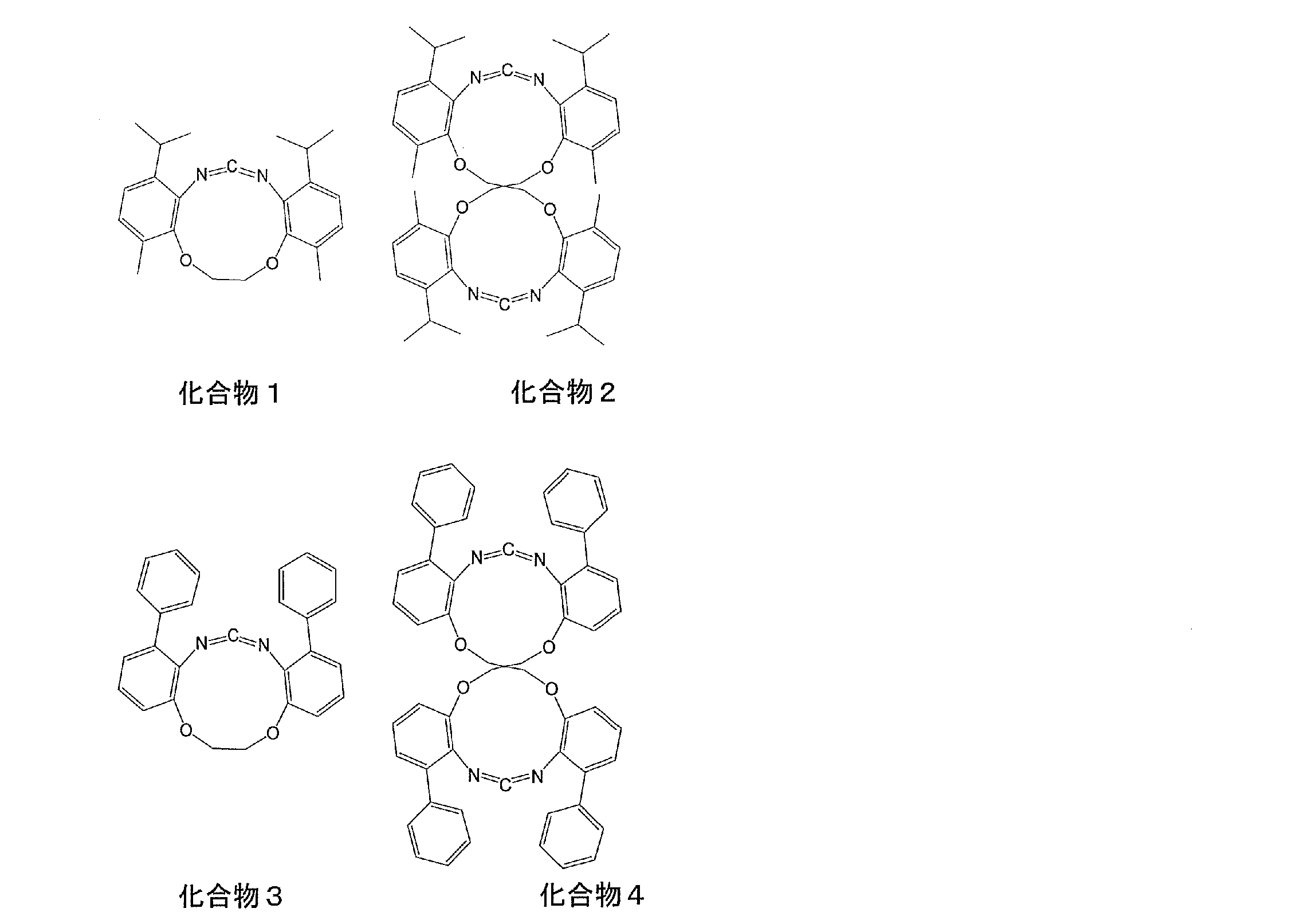

本発明の環状カルボジイミド化合物は、芳香環に隣接して-N=C=N-で表される構造(カルボイジイミド基)を少なくとも1つ有する化合物であり、例えば、適当な触媒の存在下に、有機イソシアネートを加熱し、脱炭酸反応で製造できる。また、本発明の環状カルボジイミド化合物は、特開2011-256337号公報に記載の方法などを参考にして合成することができる。
本発明の環状カルボジイミド化合物を合成するにあたり、カルボジイミド基の第一窒素と第二窒素に隣接するアリーレン基のオルト位に特定の嵩高い置換基を導入する方法としては特に制限はないが、例えば既知の方法でアルキルベンゼンをニトロ化することで、アルキル基が置換されたニトロベンゼンを合成することができ、それを元にWO2011/158958に記載の方法で環状カルボジイミドを合成することができる。
本発明の環状カルボジイミド化合物を合成するにあたり、カルボジイミド基の第一窒素と第二窒素に隣接するアリーレン基のオルト位に特定の嵩高い置換基を導入する方法としては特に制限はないが、例えば既知の方法でアルキルベンゼンをニトロ化することで、アルキル基が置換されたニトロベンゼンを合成することができ、それを元にWO2011/158958に記載の方法で環状カルボジイミドを合成することができる。
環状カルボジイミド化合物は、芳香族ポリエステルに対して、0.1~5質量%含有されていることが好ましく、0.2~3質量%含有されていることがより好ましく、0.3~2質量%含有されていることがさらに好ましい。環状カルボジイミド化合物の含有率を上記範囲内とすることにより、ポリエステルフィルムの粘度を適切な範囲内とすることができ、裁断時に、裁断屑の発生を抑制することができる。
(ケテンイミン化合物)
本発明の芳香族ポリエステルフィルムは、ケテンイミン化合物を含有する。ケテンイミン化合物は単独で用いても良く、上記環状カルボジイミド化合物と併用しても良い。
ケテンイミン化合物としては、下記一般式(1)で表されるケテンイミン化合物を用いることが好ましい。以下、下記一般式(1)で表されるケテンイミン化合物について説明する。
本発明の芳香族ポリエステルフィルムは、ケテンイミン化合物を含有する。ケテンイミン化合物は単独で用いても良く、上記環状カルボジイミド化合物と併用しても良い。
ケテンイミン化合物としては、下記一般式(1)で表されるケテンイミン化合物を用いることが好ましい。以下、下記一般式(1)で表されるケテンイミン化合物について説明する。

ここで、一般式(1)中、R1およびR2は、それぞれ独立にアルキル基、アリール基、アルコキシ基、アルコキシカルボニル基、アミノカルボニル基、アリールオキシ基、アシル基またはアリールオキシカルボニル基を表し、R3はアルキル基またはアリール基を表す。
ケテンイミン化合物のケテンイミンを構成する窒素原子と該窒素原子に結合している置換基を除く部分の分子量は320以上であることが好ましい。すなわち、上記一般式(1)では、R1-C(=C)-R2基の分子量は320以上であることが好ましい。
R1およびR2で表されるアルキル基は、炭素数1~20のアルキル基であることが好ましく、炭素数1~12のアルキル基であることがより好ましい。R1およびR2が表すアルキル基は直鎖であっても分枝であっても環状であってもよい。R1およびR2が表すアルキル基としては、メチル基、エチル基、n-プロピル基、iso-プロピル基、n-ブチル基、tert-ブチル基、sec-ブチル基、iso-ブチル基、n-ペンチル基、sec-ペンチル基、iso-ペンチル基、n-ヘキシル基、sec-ヘキシル基、iso-ヘキシル基、シクロヘキシル基などを挙げることができる。中でもメチル基、エチル基、n-プロピル基、iso-プロピル基、iso-ブチル基、シクロヘキシル基とすることがより好ましい。
R1およびR2が表すアルキル基はさらに置換基を有していてもよい。ケテンイミン基とカルボキシル基との反応性を低下させない限り、置換基は特に制限されることはなく、上記の置換基を同様に例示することができる。なお、R1およびR2が表すアルキル基の炭素数は、置換基を含まない炭素数を示す。
R1およびR2が表すアルキル基はさらに置換基を有していてもよい。ケテンイミン基とカルボキシル基との反応性を低下させない限り、置換基は特に制限されることはなく、上記の置換基を同様に例示することができる。なお、R1およびR2が表すアルキル基の炭素数は、置換基を含まない炭素数を示す。
R1およびR2で表されるアリール基は、炭素数6~20のアリール基であることが好ましく、炭素数6~12のアリール基であることがより好ましい。R1およびR2が表すアリール基としては、フェニル基、ナフチル基などを挙げることができ、その中でもフェニル基が特に好ましい。
アリール基にはヘテロアリール基が含まれるものとする。ヘテロアリール基とは、芳香族性を示す5員、6員又は7員の環又はその縮合環の環構成原子の少なくとも1つがヘテロ原子に置換されたものをいう。ヘテロアリール基としては、例えば、イミダゾリル基、ピリジル基、キノリル基、フリル基、チエニル基、ベンズオキサゾリル基、インドリル基、ベンズイミダゾリル基、ベンズチアゾリル基、カルバゾリル基、アゼピニル基を例示することができる。ヘテロアリール基に含まれるヘテロ原子は、酸素原子、硫黄原子、窒素原子であることが好ましく、中でも、酸素原子または窒素原子であることが好ましい。
R1およびR2が表すアリール基またはヘテロアリール基はさらに置換基を有していてもよく、ケテンイミン基とカルボキシル基との反応性を低下させない限り、置換基は特に制限されない。なお、R1およびR2が表すアリール基またはヘテロアリール基の炭素数は、置換基を含まない炭素数を示す。
アリール基にはヘテロアリール基が含まれるものとする。ヘテロアリール基とは、芳香族性を示す5員、6員又は7員の環又はその縮合環の環構成原子の少なくとも1つがヘテロ原子に置換されたものをいう。ヘテロアリール基としては、例えば、イミダゾリル基、ピリジル基、キノリル基、フリル基、チエニル基、ベンズオキサゾリル基、インドリル基、ベンズイミダゾリル基、ベンズチアゾリル基、カルバゾリル基、アゼピニル基を例示することができる。ヘテロアリール基に含まれるヘテロ原子は、酸素原子、硫黄原子、窒素原子であることが好ましく、中でも、酸素原子または窒素原子であることが好ましい。
R1およびR2が表すアリール基またはヘテロアリール基はさらに置換基を有していてもよく、ケテンイミン基とカルボキシル基との反応性を低下させない限り、置換基は特に制限されない。なお、R1およびR2が表すアリール基またはヘテロアリール基の炭素数は、置換基を含まない炭素数を示す。
R1およびR2で表されるアルコキシ基は、炭素数1~20のアルコキシ基であることが好ましく、炭素数1~12のアルコキシ基であることがより好ましく、炭素数2~6のアルコキシ基であることが特に好ましい。R1およびR2が表すアルコキシ基は直鎖であっても分枝であっても環状であってもよい。R1およびR2が表すアルコキシ基の好ましい例としては、R1およびR2が表すアルキル基の末端に-O-が連結した基を挙げることができる。R1およびR2が表すアルコキシ基はさらに置換基を有していてもよく、ケテンイミン基とカルボキシル基との反応性を低下させない限り、置換基は特に制限されない。なお、R1およびR2が表すアルコキシ基の炭素数は、置換基を含まない炭素数を示す。
R1およびR2で表されるアルコキシカルボニル基は、炭素数2~20のアルコキシカルボニル基であることが好ましく、炭素数2~12のアルコキシカルボニル基であることがより好ましく、炭素数2~6のアルコキシカルボニル基であることが特に好ましい。R1およびR2が表すアルコキシカルボニル基のアルコキシ部としては、上述したアルコキシ基の例を挙げることができる。
R1およびR2で表されるアミノカルボニル基は、炭素数1~20のアルキルアミノカルボニル基、炭素数6~20のアリールアミノカルボニル基であることが好ましい。アルキルアミノカルボニル基のアルキルアミノ部の好ましい例としては、R1およびR2が表すアルキル基の末端に-NH-が連結した基を挙げることができる。R1およびR2が表すアルキルアミノカルボニル基はさらに置換基を有していてもよく、ケテンイミン基とカルボキシル基との反応性を低下させない限り、置換基は特に制限されない。
炭素数6~20のアリールアミノカルボニル基のアリールアミノ部の好ましい例としては、R1およびR2が表すアリール基の末端に-NH-が連結した基を挙げることができる。R1およびR2が表すアリールアミノカルボニル基のアリール部としては、上述したアリール基またはヘテロアリール基の例を挙げることができる。R1およびR2が表すアリールアミノカルボニル基はさらに置換基を有していてもよく、ケテンイミン基とカルボキシル基との反応性を低下させない限り、置換基は特に制限されない。なお、R1およびR2が表すアルキルアミノカルボニル基の炭素数は、置換基を含まない炭素数を示す。
炭素数6~20のアリールアミノカルボニル基のアリールアミノ部の好ましい例としては、R1およびR2が表すアリール基の末端に-NH-が連結した基を挙げることができる。R1およびR2が表すアリールアミノカルボニル基のアリール部としては、上述したアリール基またはヘテロアリール基の例を挙げることができる。R1およびR2が表すアリールアミノカルボニル基はさらに置換基を有していてもよく、ケテンイミン基とカルボキシル基との反応性を低下させない限り、置換基は特に制限されない。なお、R1およびR2が表すアルキルアミノカルボニル基の炭素数は、置換基を含まない炭素数を示す。
R1およびR2で表されるアリールオキシ基は、炭素数6~20のアリールオキシ基であることが好ましく、炭素数6~12のアリールオキシ基であることがより好ましい。R1およびR2が表すアリールオキシ基のアリール部としては、上述したアリール基またはヘテロアリール基の例を挙げることができる。
R1およびR2で表されるアシル基は、炭素数2~20のアシル基であることが好ましく、炭素数2~12のアシル基であることがより好ましく、炭素数2~6のアシル基であることが特に好ましい。R1およびR2が表すアシル基はさらに置換基を有していてもよく、ケテンイミン基とカルボキシル基との反応性を低下させない限り、置換基は特に制限されない。なお、R1およびR2が表すアシル基の炭素数は、置換基を含まない炭素数を示す。
R1およびR2で表されるアリールオキシカルボニル基は、炭素数7~20のアリールオキシカルボニル基であることが好ましく、炭素数7~12のアリールオキシカルボニル基であることがより好ましいR1およびR2が表すアリールオキシカルボニル基のアリール部としては、上述したアリール基またはヘテロアリール基の例を挙げることができる。
R3はアルキル基またはアリール基を表す。アルキル基は、炭素数1~20のアルキル基であることが好ましく、炭素数1~12のアルキル基であることがより好ましい。R3が表すアルキル基は直鎖であっても分枝であっても環状であってもよい。R3が表すアルキル基としては、メチル基、エチル基、n-プロピル基、iso-プロピル基、n-ブチル基、tert-ブチル基、sec-ブチル基、iso-ブチル基、n-ペンチル基、sec-ペンチル基、iso-ペンチル基、n-ヘキシル基、sec-ヘキシル基、iso-ヘキシル基、シクロヘキシル基、などを挙げることができる。中でもメチル基、エチル基、n-プロピル基、iso-プロピル基、n-ブチル基、iso-ブチル基、シクロヘキシル基とすることがより好ましい。
R3が表すアルキル基はさらに置換基を有していてもよい。ケテンイミン基とカルボキシル基との反応性を低下させない限り、置換基は特に制限されることはなく、上記の置換基を同様に例示することができる。
アリール基は、炭素数6~20のアリール基であることが好ましく、炭素数6~12のアリール基であることがより好ましい。R3が表すアリール基としては、フェニル基、ナフチル基などを挙げることができ、その中でもフェニル基が特に好ましい。
R3が表すアルキル基はさらに置換基を有していてもよい。ケテンイミン基とカルボキシル基との反応性を低下させない限り、置換基は特に制限されることはなく、上記の置換基を同様に例示することができる。
アリール基は、炭素数6~20のアリール基であることが好ましく、炭素数6~12のアリール基であることがより好ましい。R3が表すアリール基としては、フェニル基、ナフチル基などを挙げることができ、その中でもフェニル基が特に好ましい。
アリール基にはヘテロアリール基が含まれるものとする。ヘテロアリール基とは、芳香族性を示す5員、6員又は7員の環又はその縮合環の環構成原子の少なくとも1つがヘテロ原子に置換されたものをいう。ヘテロアリール基としては、例えば、イミダゾリル基、ピリジル基、キノリル基、フリル基、チエニル基、ベンズオキサゾリル基、インドリル基、ベンズイミダゾリル基、ベンズチアゾリル基、カルバゾリル基、アゼピニル基を例示することができる。ヘテロアリール基に含まれるヘテロ原子は、酸素原子、硫黄原子、窒素原子であることが好ましく、中でも、酸素原子または窒素原子であることが好ましい。
R3が表すアリール基またはヘテロアリール基はさらに置換基を有していてもよく、ケテンイミン基とカルボキシル基との反応性を低下させない限り、置換基は特に制限されない。
R3が表すアリール基またはヘテロアリール基はさらに置換基を有していてもよく、ケテンイミン基とカルボキシル基との反応性を低下させない限り、置換基は特に制限されない。
なお、一般式(1)は、繰り返し単位を含んでいてもよい。この場合、R1またはR3の少なくとも一方が繰り返し単位であり、この繰り返し単位には、ケテンイミン部が含まれることが好ましい。
また、ケテンイミン化合物としては、下記一般式(2)で表されるケテンイミン化合物を用いることが好ましい。以下、下記一般式(2)で表されるケテンイミン化合物について説明する。

ここで一般式(2)中、R1はアルキル基、アリール基、アルコキシ基、アルコキシカルボニル基、アミノカルボニル基、アリールオキシ基、アシル基またはアリールオキシカルボニル基を表す。R2は置換基としてL1を有するアルキル基、アリール基、アルコキシ基、アルコキシカルボニル基、アミノカルボニル基、アリールオキシ基、アシル基またはアリールオキシカルボニル基を表す。R3はアルキル基またはアリール基を表す。nは1~4の整数を表し、L1はn価の連結基を表す。(R1-C(=C)-R2-)n-L1基の分子量は320以上であることが好ましい。
一般式(2)中、R1は、一般式(1)におけるそれと同意であり、好ましい範囲も同様である。
一般式(2)中、R2は、n価の連結基であるL1を有するアルキル基、アリール基、アルコキシ基、アルコキシカルボニル基、アミノカルボニル基、アリールオキシ基、アシル基またはアリールオキシカルボニル基を表す。アルキル基、アリール基、アルコキシ基、アルコキシカルボニル基、アミノカルボニル基、アリールオキシ基、アシル基またはアリールオキシカルボニル基としては、一般式(1)におけるそれと同意であり、好ましい範囲も同様である。
一般式(2)中、R3は、一般式(1)におけるそれと同意であり、好ましい範囲も同様である。
L1はn価の連結基を表し、ここで、nは1~4の整数を表す。中でも、nは2~4であることが好ましい。
二価の連結基の具体例としては、例えば、-NR8-(R8は水素原子、置換基を有していてもよいアルキル基または置換基を有していてもよいアリール基を表し、水素原子が好ましい)で表される基、-SO2-、-CO-、置換もしくは無置換のアルキレン基、置換もしくは無置換のアルケニレン基、アルキニレン基、置換もしくは無置換のフェニレン基、置換もしくは無置換のビフェニレン基、置換もしくは無置換のナフチレン基、-O-、-S-および-SO-ならびにこれらを2つ以上組み合わせて得られる基が挙げられる。
三価の連結基の具体例としては、例えば、二価の連結基の例として挙げた連結基のうち置換基を有するものから1つの水素原子を取り除いた基が挙げられる。
四価の連結基の具体例としては、例えば、例えば、二価の連結基の例として挙げた連結基のうち置換基を有するものから2つの水素原子を取り除いた基が挙げられる。
二価の連結基の具体例としては、例えば、-NR8-(R8は水素原子、置換基を有していてもよいアルキル基または置換基を有していてもよいアリール基を表し、水素原子が好ましい)で表される基、-SO2-、-CO-、置換もしくは無置換のアルキレン基、置換もしくは無置換のアルケニレン基、アルキニレン基、置換もしくは無置換のフェニレン基、置換もしくは無置換のビフェニレン基、置換もしくは無置換のナフチレン基、-O-、-S-および-SO-ならびにこれらを2つ以上組み合わせて得られる基が挙げられる。
三価の連結基の具体例としては、例えば、二価の連結基の例として挙げた連結基のうち置換基を有するものから1つの水素原子を取り除いた基が挙げられる。
四価の連結基の具体例としては、例えば、例えば、二価の連結基の例として挙げた連結基のうち置換基を有するものから2つの水素原子を取り除いた基が挙げられる。
本発明では、nを2~4とすることにより、ケテンイミン部を一分子中に2以上有する化合物とすることができ、より優れた末端封止効果を発揮することができる。また、ケテンイミン部を一分子中に2以上有する化合物とすることにより、ケテンイミン基当たりの分子量を低くすることができ、効率良くケテンイミン化合物とポリエステルの末端カルボキシル基を反応させることができる。さらに、ケテンイミン部を一分子中に2以上有することにより、ケテンイミン化合物やケテン化合物が揮散することを抑制することができる。
一般式(2)中、nは3または4であることがより好ましい。nを3または4とすることにより、ケテンイミン部を一分子中に3または4有する化合物とすることができ、より優れた末端封止効果を発揮することができる。また、nを3または4とすることにより、一般式(2)中のR1またはR2の置換基のモル分子量を小さくした場合であっても、ケテンイミン化合物の揮散を抑制することができる。
ケテンイミン化合物としては、下記一般式(3)で表されるケテンイミン化合物を用いることが好ましい。以下、下記一般式(3)で表されるケテンイミン化合物について説明する。

一般式(3)中、R1およびR5はアルキル基、アリール基、アルコキシ基、アルコキシカルボニル基、アミノカルボニル基、アリールオキシ基、アシル基またはアリールオキシカルボニル基を表す。R2およびR4は置換基としてL2を有するアルキル基、アリール基、アルコキシ基、アルコキシカルボニル基、アミノカルボニル基、アリールオキシ基、アシル基またはアリールオキシカルボニル基を表す。R3およびR6はアルキル基またはアリール基を表す。L2は単結合または二価の連結基を表す。R1-C(=C)-R2-L2-R4―C(=C)-R5基の分子量は320以上であることが好ましい。
一般式(3)中、R1は、一般式(1)におけるそれと同意であり、好ましい範囲も同様である。また、R5は、一般式(1)におけるR1と同意であり、好ましい範囲も同様である。
一般式(3)中、R2は、一般式(2)におけるそれと同意であり、好ましい範囲も同様である。また、R4は、一般式(2)におけるR2と同意であり、好ましい範囲も同様である。
一般式(3)中、R3は、一般式(1)におけるそれと同意であり、好ましい範囲も同様である。また、R6は、一般式(1)におけるR3と同意であり、好ましい範囲も同様である。
一般式(3)中、L2は、単結合または二価の連結基を表す。二価の連結基の具体例としては、一般式(2)のL1で例示した連結基を挙げることができる。
本発明では、ケテンイミン化合物のケテンイミンを構成する窒素原子と該窒素原子に結合している置換基を除く部分の分子量は320以上であることが好ましい。ケテンイミン化合物のケテンイミンを構成する窒素原子と該窒素原子に結合している置換基を除く部分の分子量は320以上であれば良く、400以上であることが好ましく、500以上であることがさらに好ましい。また、一分子中のケテンイミン部の数に対するケテンイミン化合物のモル分子量(モル分子量/ケテンイミン部の数)は、1000以下であることが好ましく、500以下であることがより好ましく、400以下であることがさらに好ましい。本発明では、ケテンイミン化合物のケテンイミン部炭素上の置換基の分子量及びケテンイミン部の数に対するケテンイミン化合物のモル分子量を上記範囲内とすることにより、ケテンイミン化合物自体の揮散を抑制し、ポリエステルの末端カルボキシル基を封止する際に生じるケテン化合物の揮散を抑制し、さらにポリエステルの末端カルボキシル基の封止を低添加量のケテンイミン化合物にて行うことができる。
本発明のケテンイミン化合物は、ケテンイミン基を少なくとも1つ有する化合物であり、例えば、J. Am. Chem. Soc., 1953, 75 (3), pp 657-660記載の方法などを参考にして合成することができる。
下記に一般式(1)の好ましい具体例を示すが、本発明はこれに限定されない。
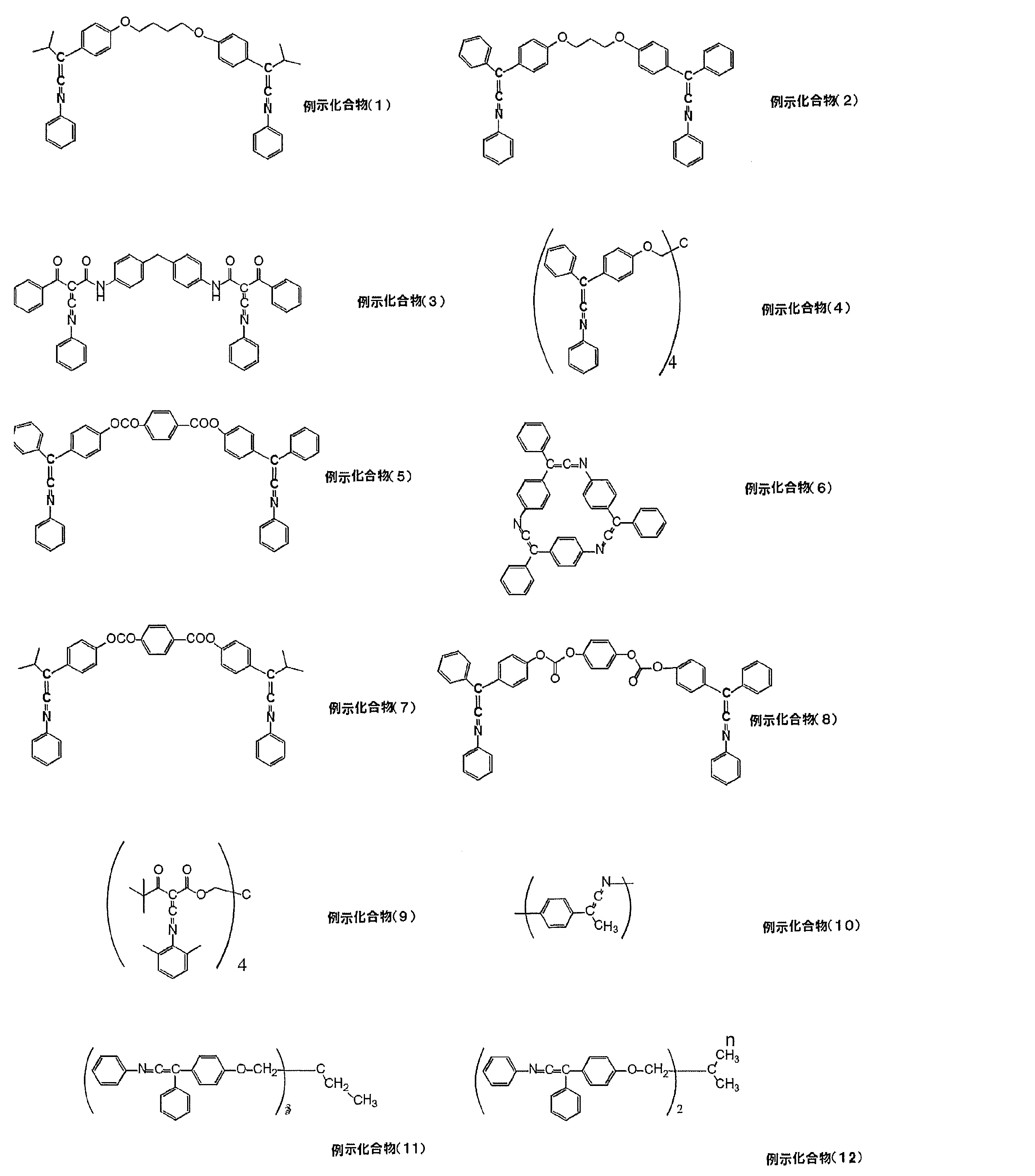


上記例示化合物に示されているように、本発明では、ケテンイミン化合物は、3官能または4官能であることがより好ましい。これにより、末端封止効果をより高めることができ、ケテンイミン化合物やケテン化合物の揮散を効果的に抑制することができる。また、例示化合物(6)のようにケテンイミン部を環骨格として環状構造を有する場合、R1とR3は連結して環状構造を形成し、R3は、環骨格のアルキレン基またはアリーレン基からなる。この場合、R1はケテンイミン部を含む連結基を有する。
例示化合物(10)は繰り返し数nの繰り返し単位を示し、nは3以上の整数を表す。例示化合物(10)に示される左末端は水素原子であり、右末端はフェニル基である。
例示化合物(10)は繰り返し数nの繰り返し単位を示し、nは3以上の整数を表す。例示化合物(10)に示される左末端は水素原子であり、右末端はフェニル基である。
ケテンイミン化合物は、芳香族ポリエステルに対して、0.1~5質量%含有されていることが好ましく、0.2~3質量%含有されていることがより好ましく、0.3~2質量%含有されていることがさらに好ましい。ケテンイミン化合物の含有率を上記範囲内とすることにより、裁断時に、裁断屑の発生を抑制することができる。
なお、ケテンイミン化合物と環状カルボジイミド化合物が併用される場合は、2種類の化合物の含有率の合計が、上記範囲内であることが好ましい。
なお、ケテンイミン化合物と環状カルボジイミド化合物が併用される場合は、2種類の化合物の含有率の合計が、上記範囲内であることが好ましい。
(芳香族ポリエステルフィルム)
本発明の芳香族ポリエステルフィルムは、芳香族ポリエステル樹脂、微粒子、環状カルボジイミド化合物またはケテンイミン化合物を含む。なお、環状カルボジイミド化合物またはケテンイミン化合物は、いずれか一方のみが含まれてもよく、両方が含まれてもよい。
本発明の芳香族ポリエステルフィルムは、芳香族ポリエステル樹脂、微粒子、環状カルボジイミド化合物またはケテンイミン化合物を含む。なお、環状カルボジイミド化合物またはケテンイミン化合物は、いずれか一方のみが含まれてもよく、両方が含まれてもよい。
芳香族ポリエステルフィルム中の末端カルボキシル基含量(芳香族ポリエステルのカルボン酸価、以下、AVともいう)は、0~30eq/ton、より好ましくは1~20eq/ton、さらに好ましくは3~15eq/tonである。固有粘度(以下、IVともいう)は0.6~1.2dl/gが好ましく、より好ましくは0.65~1dl/g、さらに好ましくは0.7~0.85dl/gである。AVおよびIVを上記範囲内とすることにより、サーモテスト中に加水分解が進行し低分子量化することを抑制でき、サーモテスト後の切り屑(裁断屑)の発生を抑制することができる。また、IVを上記範囲内とすることにより、耐加水分解性に加えて膜均一性も高めることができる。AVを上記範囲内とすることにより、耐熱性を高め、湿熱経時の強度の低下を抑制することができる。さらに、AVを上記範囲内とすることにより、フィルムを積層した際に、層間の密着性を高めることができる。一方、IVがこの範囲を超え分子量が増大しすぎると、分子間の絡み合いが大きくなり過ぎ破断伸度が低下し脆化し易い傾向となる。この場合、切り屑が発生し易くなり好ましくない。なお、これらのIV,AV値は芳香族ポリエステルフィルムでの測定値を指す。
芳香族ポリエステルフィルムは、重合後に固相重合されることが好ましい。具体的には、重合した樹脂を乾燥、結晶化したあと、180~230℃、より好ましくは190~220℃、さらに好ましくは195~215℃で、5~50時間、より好ましくは10~40時間、さらに好ましくは15~35時間、不活性気流中(窒素等)あるいは真空中で熱処理する。これにより、上記範囲内のAV、IVとすることができ、低AV、高IVを達成することができる。
また、芳香族ポリエステルフィルムは、上述したような環状カルボジイミド化合物やケテンイミン化合物などの末端封止剤を添加することによっても、上記範囲内のAV、IVを達成できる。末端封止剤は、芳香族ポリエステルの末端カルボン酸と反応することで、AVを低下させる。さらに、カルボジイミド基またはケテンイミン基が末端カルボン酸と反応して、生成したイソシアネート基が他の芳香族ポリエステルの末端水酸基と反応することにより、IVを高めることができる。なお、末端封止剤はマスターペレット作成時に添加してもよく、製膜工程での押出し工程で添加しても良い。
本発明の芳香族ポリエステルフィルムの分子量は、耐熱性や粘度の観点から、重量平均分子量(Mw)35000~125000であることが好ましく、50000~90000であることがより好ましく、60000~80000であることが特に好ましい。重量平均分子量は、ヘキサフルオロイソプロパノールを溶媒として用いたゲルパーミエーションクロマトグラフィー(GPC)によって測定したポリメチルメタクリレート(PMMA)換算の値を用いることができる。
本発明の芳香族ポリエステルフィルムの厚みは、用途によって異なるが、太陽電池モジュール用バックシートの部材として用いる場合には、25~300μmであることが好ましく、120~300μmであることがより好ましい。厚みを上記下限値以上とすることにより、十分な力学強度が得られ、上記上限値以下とすることにより、コスト上のメリットが得られる。
本発明の芳香族ポリエステルフィルムは延伸されていることが好ましく、二軸延伸されていることがさらに好ましく、平面二軸延伸されていることがチューブラーなどの延伸と比較して特に好ましく、逐次二軸延伸されていることがより特に好ましい。本発明のポリエステルフィルムの縦(MD)配向度、及び、横(TD)配向度は、それぞれ0.14以上であることが好ましく、0.155以上が更に好ましく、0.16以上が特に好ましい。各配向度が上記下限値以上であると、非晶鎖の拘束性が向上し(運動性が低下)、耐加水分解性が向上する。MD及びTD配向度は、アッベの屈折率計を用い、光源としては単色光ナトリウムD線を用い、マウント液としてはヨウ化メチレンを用いて25℃雰囲気中で二軸配向フィルムのx、y、z方向の屈折率を測定し、MD配向度:Δn(x-z)、TD;Δn(y-z)から算出することができる。
(積層フィルム)
本発明は、上述した微粒子と環状カルボジイミド化合物またはケテンイミン化合物を含有した芳香族ポリエステルフィルムを少なくとも1層含み、複数の層が積層された積層フィルムに関するものである。積層されるフィルムの数は、2~8層であることが好ましく、2~5層であることがより好ましく、2~3層であることが好ましい。積層されるフィルムには、上述した芳香族ポリエステルフィルムが少なくとも1層含まれていればよいが、より好ましくは微粒子含有量が異なる層を積層することがより好ましい。このように、積層構造とすることにより、光の反射率をより効果的に高めることができる。さらに、微粒子含有量が異なる層を積層することで、隣接する層間の熱膨張係数を異なるものとすることができる。これにより、積層フィルムの各層に僅かながら湾曲(反り)が発生することになる。この積層フィルムに発生した湾曲は、裁断時の衝撃を吸収する働きするため、裁断屑が発生することを効果的に抑制することができる。
積層フィルムに積層される層の数を上記下限値以上とすることにより、積層フィルムの各層に湾曲を発生させることができる。また、積層数を上記上限値以下とすることにより、積層フィルムの膜厚と各層の膜厚を適切な範囲内に抑えることができる。
本発明は、上述した微粒子と環状カルボジイミド化合物またはケテンイミン化合物を含有した芳香族ポリエステルフィルムを少なくとも1層含み、複数の層が積層された積層フィルムに関するものである。積層されるフィルムの数は、2~8層であることが好ましく、2~5層であることがより好ましく、2~3層であることが好ましい。積層されるフィルムには、上述した芳香族ポリエステルフィルムが少なくとも1層含まれていればよいが、より好ましくは微粒子含有量が異なる層を積層することがより好ましい。このように、積層構造とすることにより、光の反射率をより効果的に高めることができる。さらに、微粒子含有量が異なる層を積層することで、隣接する層間の熱膨張係数を異なるものとすることができる。これにより、積層フィルムの各層に僅かながら湾曲(反り)が発生することになる。この積層フィルムに発生した湾曲は、裁断時の衝撃を吸収する働きするため、裁断屑が発生することを効果的に抑制することができる。
積層フィルムに積層される層の数を上記下限値以上とすることにより、積層フィルムの各層に湾曲を発生させることができる。また、積層数を上記上限値以下とすることにより、積層フィルムの膜厚と各層の膜厚を適切な範囲内に抑えることができる。
積層フィルムにおいて最も厚い層の厚みの変動率は、1~10%、好ましくは1.5~8%。さらに好ましくは2~6%であることが好ましい。上記範囲内となるように厚みの変動を与えることで、層間の接触長を長くでき、層間の密着性を高めることができる。これにより、裁断時に層間が剥離し、そこから裁断屑が発生することを抑制できる。厚みの変動率は、上記範囲未満ではこの効果が発現できず切り屑が発生し易くなり、上記範囲を超えると層間の区別が付き難くなり、層間の熱膨張係数の差に由来する反りが発現しにくくなり裁断屑が増加する傾向になる。
なお、層の厚みは、MD、TD方向に断面をSEM観察し、各層の厚みを1cmごとに10点計測することによって求めることができる。10点計測の結果、最大値と最小値の差を平均値で割り百分率で表したものが、厚みの変動率となる。本発明では、厚みの変動率をMD、TDごとにもとめ、その平均値を算出している。
なお、層の厚みは、MD、TD方向に断面をSEM観察し、各層の厚みを1cmごとに10点計測することによって求めることができる。10点計測の結果、最大値と最小値の差を平均値で割り百分率で表したものが、厚みの変動率となる。本発明では、厚みの変動率をMD、TDごとにもとめ、その平均値を算出している。
積層フィルムを構成する各層は、共押出しにより形成される。共押出し機から押し出された樹脂(メルト)は、必要に応じて濾過機、ギアポンプに通され、積層用ダイに供給される。厚みの変動率は、積層用ダイ内部に1~10℃、好ましくは1.5~8℃、よりに好ましくは2~7℃の温度分布を付与することで形成することができる。上記範囲内で温度分布を付与することにより、層に厚みの変動率をつけることができる。これにより、より効果的に、裁断屑の発生を抑制することができる。
積層用ダイ内部で温度分布をつけると、メルトの流動性(粘弾性)が変化し、微妙な流動むらが形成される。ダイ中のメルトの流れは、各層の微妙な粘弾性のバランスにより成立しているため、この結果、層の厚みむらが形成される。
積層用ダイ内部で温度分布をつけると、メルトの流動性(粘弾性)が変化し、微妙な流動むらが形成される。ダイ中のメルトの流れは、各層の微妙な粘弾性のバランスにより成立しているため、この結果、層の厚みむらが形成される。
積層用ダイ内部の温度分布は長手方向、幅方向の何れかで行っても良いが、より好ましくは両方に付与されることが好ましい。これにより、上記範囲内の層の厚みの変動率をより形成しやすくなる。
また、なお、温度分布を与える周期は、MD、TDとも1~30cmが好ましく、2~25cmがより好ましくは、3~20cmがさらに好ましい。この範囲未満では厚み変動のピッチが細かすぎる傾向となり、これを超えると厚み変動のピッチが大きすぎ、有効な「反り」を形成しにくくなる。
また、なお、温度分布を与える周期は、MD、TDとも1~30cmが好ましく、2~25cmがより好ましくは、3~20cmがさらに好ましい。この範囲未満では厚み変動のピッチが細かすぎる傾向となり、これを超えると厚み変動のピッチが大きすぎ、有効な「反り」を形成しにくくなる。
積層用ダイ内部の温度分布を付与する方法としては、長手方向、幅方向に分割したヒーターを設け、これらの温度を制御する方法がある。また、ダイの温度を下げたい箇所に放冷板を取り付け冷却することで温度分布を付与することもできる。
(芳香族ポリエステルフィルムの製造方法)
本発明の芳香族ポリエステルフィルムの製造方法は、芳香族ポリエステル樹脂と微粒子を混練し微粒子を高濃度に分散したマスターペレットを調製する工程と、マスターペレットと芳香族ポリエステルペレットを混合して押出した後、ダイから冷却ドラム上にキャストし製膜する工程を有する。マスターペレットを調製する工程または製膜する工程の少なくとも一方は、環状カルボジイミド化合物またはケテンイミン化合物を混合する工程を含む。マスターペレットを調製する工程は、芳香族ポリエステル樹脂と微粒子をスクリュー回転トルクで混練する工程を含み、スクリュー回転トルクには0.1~10%の変動が与えられる。
本発明の芳香族ポリエステルフィルムの製造方法は、芳香族ポリエステル樹脂と微粒子を混練し微粒子を高濃度に分散したマスターペレットを調製する工程と、マスターペレットと芳香族ポリエステルペレットを混合して押出した後、ダイから冷却ドラム上にキャストし製膜する工程を有する。マスターペレットを調製する工程または製膜する工程の少なくとも一方は、環状カルボジイミド化合物またはケテンイミン化合物を混合する工程を含む。マスターペレットを調製する工程は、芳香族ポリエステル樹脂と微粒子をスクリュー回転トルクで混練する工程を含み、スクリュー回転トルクには0.1~10%の変動が与えられる。
(マスターペレットを調製する工程)
マスターペレットの調製に用いる芳香族ポリエステル樹脂は、ジオールとジカルボン酸を常法に従い重縮合した後、ペレット状に加工することが好ましい。乾燥した微粒子、末端封止剤(環状カルボジイミド化合物またはケテンイミン化合物)、芳香族ポリエステルを混練し、高濃度に微粒子の分散したマスターペレットを作成する。
マスターペレットの調製に用いる芳香族ポリエステル樹脂は、ジオールとジカルボン酸を常法に従い重縮合した後、ペレット状に加工することが好ましい。乾燥した微粒子、末端封止剤(環状カルボジイミド化合物またはケテンイミン化合物)、芳香族ポリエステルを混練し、高濃度に微粒子の分散したマスターペレットを作成する。
乾燥は、微粒子、末端封止剤、芳香族ポリエステル樹脂等の組成物を真空中あるいは熱風中で乾燥し含水率を100ppm以下、より好ましくは80ppm以下、さらに好ましくは60ppm以下にすることによって行われる。この時の乾燥温度は80~200℃が好ましく、より好ましくは100~180℃、さらに好ましくは110~170℃である。乾燥時間は、上記含水率になるように適宜調整することができる。
混練には、単軸押出し機、2軸押出し機、バンバリーミキサー、ブラベンダー等の各種混練機を使用できる。中でも2軸押出し機を用いるのが好ましい。混練温度はポリエステル樹脂の結晶融解温度(Tm)以上Tm+80℃以下が好ましく、より好ましくはTm+10~Tm+70℃、さらに好ましくはTm+20~Tm+60℃である。混練雰囲気は、空気中、真空中、不活性気流中いずれでも良いが、より好ましくは真空中、不活性気流中である。混練時間は1~20分、より好ましくは2~18分、さらに好ましくは3~15分である。
本発明では、混練には2軸押出し機を用いることが好ましい。図1は、本発明に係る芳香族ポリエステルフィルムの製造方法を実施する際に使用することができる2軸押出し機の構成例を概略的に示している。溶融押出し法によりポリエステルフィルムを製造する場合、一般的に用いられる押出機は大別して、単軸と多軸があり、多軸としては二軸押出機(2二軸スクリュー押出機)が広く使用されている。
本発明では、供給口12及び押出機出口14を有するバレル10と、バレル10内で回転する2つのスクリュー20A,20Bと、バレル10の周囲に配置され、該バレル10内の温度を制御する温度制御手段30を備えた2軸押出し機100を用いることができる。
バレル10には真空を引くためのベント16A,16Bが設けられていても良い。ベント16A,16Bを複数箇所に設けることで、原料水分量等を制御することが可能となる。
本発明では、供給口12及び押出機出口14を有するバレル10と、バレル10内で回転する2つのスクリュー20A,20Bと、バレル10の周囲に配置され、該バレル10内の温度を制御する温度制御手段30を備えた2軸押出し機100を用いることができる。
バレル10には真空を引くためのベント16A,16Bが設けられていても良い。ベント16A,16Bを複数箇所に設けることで、原料水分量等を制御することが可能となる。
バレル10内には、駆動モーター21によって回転する2つのスクリュー20A、20Bが設けられている。大量生産の観点から、スクリューの径は好ましくは140mm以上、より好ましくは150mm以上であり、さらに好ましくは160~200mmである。
2軸押出し機100は、2つのスクリュー20A,20Bの噛み合い型と非噛み合い型に大別され、噛み合い型のほうが、非噛み合い型よりも混練効果が大きい。本発明では、噛み合い型と非噛み合い型のいずれのタイプでも良いが、原料樹脂を十分混練して溶融ムラを抑制する観点から、噛み合い型を用いることが好ましい。
また、2つのスクリュー20A、20Bの回転方向もそれぞれ同方向と異方向に分かれる。異方向回転スクリュー20A、20Bは同方向回転型よりも混練効果が高く、同方向回転型は自己清掃効果を持っているため、押出機内の滞留防止には有効である。さらに軸方向も平行と斜交があり、強いせん断を付与する場合に用いられるコニカルタイプの形状もある。
2軸押出し機100は、2つのスクリュー20A,20Bの噛み合い型と非噛み合い型に大別され、噛み合い型のほうが、非噛み合い型よりも混練効果が大きい。本発明では、噛み合い型と非噛み合い型のいずれのタイプでも良いが、原料樹脂を十分混練して溶融ムラを抑制する観点から、噛み合い型を用いることが好ましい。
また、2つのスクリュー20A、20Bの回転方向もそれぞれ同方向と異方向に分かれる。異方向回転スクリュー20A、20Bは同方向回転型よりも混練効果が高く、同方向回転型は自己清掃効果を持っているため、押出機内の滞留防止には有効である。さらに軸方向も平行と斜交があり、強いせん断を付与する場合に用いられるコニカルタイプの形状もある。
本発明で用いることができる2軸押出し機100では、様々な形状のスクリューセグメントが用いられる。スクリュー20A、20Bの形状としては、例えば、等ピッチの1条のらせん状フライト22が設けられたフルフライトスクリューが用いられる。スクリュー20A、20Bには、図1に示すように、ベント16A,16B付近に、原料樹脂の溶融を促進する混練部24A,24Bを設けることができる。
2軸押出し機100の後半では溶融樹脂を冷却するための温調ゾーン(冷却部)を設けても良い。温調ゾーン(冷却部)にピッチの短いスクリュー28を設けることで、バレル10壁面の樹脂移動速度が高まり、温調効率を上げることができる。
この時、スクリュー20A、20Bには、トルク変動を加えるのが好ましい。具体的には、スクリュー20A、20Bの回転トルクに0.1~10%、好ましくは0.2~5%、さらに好ましくは0.3~3%の変動を与えることが好ましい。
上記のようなスクリューのトルク変動は、連続し常時付与しても良いが、1回/分~100回/分付与することが好ましく、3回/分~80回/分付与することがより好ましく、5回/分~60回/分付与することがさらに好ましい。なお、このようなトルクの変動はスクリューを回転させるモーターの供給電力を変動させることで達成できる。押出し機のスクリュー駆動モーターに供給する電流値を、コンピューター制御により変動させることによって、所望のスクリュー回数、トルク変動率を得ることができる。
上記のようなスクリューのトルク変動は、連続し常時付与しても良いが、1回/分~100回/分付与することが好ましく、3回/分~80回/分付与することがより好ましく、5回/分~60回/分付与することがさらに好ましい。なお、このようなトルクの変動はスクリューを回転させるモーターの供給電力を変動させることで達成できる。押出し機のスクリュー駆動モーターに供給する電流値を、コンピューター制御により変動させることによって、所望のスクリュー回数、トルク変動率を得ることができる。
混練した樹脂はストランド状に押出し、空気中あるいは水中で冷却、固化した後に裁断しペレット化する。
マスターペレット中の粒子、末端封止剤の添加剤濃度は、フィルムでの使用濃度の1.5~20倍が好ましく、より好ましくは2~15倍、さらに好ましくは3~10倍である。添加濃度を目的とする濃度よりも高くするのは、次工程の製膜工程で、芳香族ポリエステルペレットによって希釈されて目的濃度となるためである。
(製膜工程)
マスターペレットも、上記ポリエステル樹脂と同様に、含水率を100ppm以下、より好ましくは80ppm以下、さらに好ましくは60ppm以下になるように乾燥させる。得られたマスターペレットと芳香族ポリエステルペレットを混合し、単軸あるいは2軸の押出し機に投入し溶融押出しする。
マスターペレットも、上記ポリエステル樹脂と同様に、含水率を100ppm以下、より好ましくは80ppm以下、さらに好ましくは60ppm以下になるように乾燥させる。得られたマスターペレットと芳香族ポリエステルペレットを混合し、単軸あるいは2軸の押出し機に投入し溶融押出しする。
溶融温度はポリエステル樹脂の結晶融解温度(Tm)以上Tm+80℃以下が好ましく、より好ましくはTm+10~Tm+70℃、さらに好ましくはTm+20~Tm+60℃である。混練雰囲気は、空気中、真空中、不活性気流中いずれでも良いが、より好ましくは真空中、不活性気流中である。
押出された溶融樹脂(メルト)は、メルト配管を通し、ギアポンプ、濾過器を通すことが好ましい。濾過器の目開きは1~50μmが好ましく、より好ましくは5~40μm、さらに好ましくは10~30μmである。またメルト配管中にスタチックミキサーを設け、樹脂と添加物の混合を促すことも好ましい。
積層(共押出し)する場合は、樹脂の種類ごとに上記溶融押出しを行なう。積層する場合は、積層する層の組み合わせに特に限定はないが、例えば下記のような組合せを挙げることができる。
1)微粒子層と透明層(微粒子、ボイドを含まない層)の組合せ
2)微粒子層どうし濃度の異なる層の組合せ
3)微粒子層とボイド層の組合せ
4)ボイド層と透明層の組合せ
5)ボイド層どうし濃度の異なる層の組合せ
6)微粒子層とボイド層と透明層の組合せ
1)微粒子層と透明層(微粒子、ボイドを含まない層)の組合せ
2)微粒子層どうし濃度の異なる層の組合せ
3)微粒子層とボイド層の組合せ
4)ボイド層と透明層の組合せ
5)ボイド層どうし濃度の異なる層の組合せ
6)微粒子層とボイド層と透明層の組合せ
積層数は2層から8層が好ましく、より好ましくは2層から5層、より好ましくは2層から3層である。複数層積層する場合、例えば、下記のような構成とすることができる。
1)微粒子の多い層/微粒子の少ない層、
2)微粒子層/透明層
3)微粒子の多い層/透明層/微粒子の少ない層
4)微粒子の多い層/微粒子の少ない層/透明層
5)透明層/微粒子層/透明層
6)ボイドの多い層/ボイドの少ない層、
7)ボイド層/透明層
8)ボイドの多い層/透明層/ボイドの少ない層
9)ボイドの多い層/ボイドの少ない層/透明層
10)透明層/ボイド層/透明層
1)微粒子の多い層/微粒子の少ない層、
2)微粒子層/透明層
3)微粒子の多い層/透明層/微粒子の少ない層
4)微粒子の多い層/微粒子の少ない層/透明層
5)透明層/微粒子層/透明層
6)ボイドの多い層/ボイドの少ない層、
7)ボイド層/透明層
8)ボイドの多い層/透明層/ボイドの少ない層
9)ボイドの多い層/ボイドの少ない層/透明層
10)透明層/ボイド層/透明層
溶融樹脂(メルト)は、ダイを介して冷却ロール上に押し出され、キャストし固化する。このようにして得られたフィルムは、キャストフィルム(未延伸原反)となる。
層を積層する場合は、ダイとしては、マルチマニホールドダイ、フィードブロックダイを用いることができる。ここで、積層用ダイ内部には1~10℃、好ましくは1.5~8℃、よりに好ましくは2~7℃の温度分布を付与することが好ましい。上記範囲内で温度分布を付与することにより、層に厚みの変動率をつけることができる。これにより、より効果的に、裁断屑の発生を抑制することができる。
なお、温度分布を与える周期は、MD、TDとも1~30cmが好ましく、2~25cmがより好ましくは、3~20cmがさらに好ましい。
層を積層する場合は、ダイとしては、マルチマニホールドダイ、フィードブロックダイを用いることができる。ここで、積層用ダイ内部には1~10℃、好ましくは1.5~8℃、よりに好ましくは2~7℃の温度分布を付与することが好ましい。上記範囲内で温度分布を付与することにより、層に厚みの変動率をつけることができる。これにより、より効果的に、裁断屑の発生を抑制することができる。
なお、温度分布を与える周期は、MD、TDとも1~30cmが好ましく、2~25cmがより好ましくは、3~20cmがさらに好ましい。
冷却ドラムの温度は0~60℃が好ましく、より好ましくは5~55℃、さらに好ましくは10~50℃である。この時、メルトと冷却ドラムの密着を向上させ平面性を向上させるため、静電印加法、エアナイフ法、冷却ドラム上への水被覆等の等を用いることも好ましい。さらに冷却を効率的に行なうため、冷却ドラム上から冷風を吹きつけても良い。
(延伸工程)
原反は縦(MD)、横(TD)に少なくとも一回延伸されることが好ましい。縦、横に延伸する場合は、縦→横、横→縦のように逐次で行なってもよく、同時に2方向に延伸しても構わない。さらに、例えば縦→縦→横、縦→横→縦、縦→横→横のように多段で延伸することも好ましい。このような延伸の間に易接着層、静電防止層等の機能層を塗布しても良い。
原反は縦(MD)、横(TD)に少なくとも一回延伸されることが好ましい。縦、横に延伸する場合は、縦→横、横→縦のように逐次で行なってもよく、同時に2方向に延伸しても構わない。さらに、例えば縦→縦→横、縦→横→縦、縦→横→横のように多段で延伸することも好ましい。このような延伸の間に易接着層、静電防止層等の機能層を塗布しても良い。
縦延伸は、通常2対以上のニップロールを設置、その間を加熱した原反を通しながら、出口側ニップロールの周速を入口側より速くすることで達成できる。この時、上記のように表裏に温度差を付与することが好ましい。
また、縦延伸の前に原反を予熱することが好ましい。予熱温度はポリエステルのTg-50~Tg+30℃が好ましく、より好ましくはTg-40~Tg+15℃、さらに好ましくはTg-30~Tgである。このような予熱は、加熱ロールと接触させてもよく、放射熱源(IRヒーター、ハロゲンヒーター等)を用いても良く、熱風を吹き込んでも良い。
縦延伸はTg-10~Tg+50℃で行なうのが好ましく、より好ましくはT~Tg+40℃、さらに好ましくはTg+10~Tg+35℃で行なうのが好ましい。延伸倍率は2~5倍が好ましく、より好ましくは2.5~4.5倍、さらに好ましくは3~4倍である。
また、縦延伸の前に原反を予熱することが好ましい。予熱温度はポリエステルのTg-50~Tg+30℃が好ましく、より好ましくはTg-40~Tg+15℃、さらに好ましくはTg-30~Tgである。このような予熱は、加熱ロールと接触させてもよく、放射熱源(IRヒーター、ハロゲンヒーター等)を用いても良く、熱風を吹き込んでも良い。
縦延伸はTg-10~Tg+50℃で行なうのが好ましく、より好ましくはT~Tg+40℃、さらに好ましくはTg+10~Tg+35℃で行なうのが好ましい。延伸倍率は2~5倍が好ましく、より好ましくは2.5~4.5倍、さらに好ましくは3~4倍である。
縦延伸後、冷却するのが好ましく、Tg-50~Tgが好ましく、より好ましくはTg-45~Tg-5℃がより好ましくは、さらに好ましくはTg-40~Tg-10℃である。このような冷却は、冷却ロールに接触させても良く、冷風を吹き付けても良い。
横延伸はテンターを用いて行なうのが好ましい。即ちポリエステルフィルムの両端をクリップで把持しながら熱処理ゾーンを搬送しながら、クリップを幅方向に拡げることで行うことができる。
好ましい延伸温度はTg~Tg+100℃、より好ましくはTg+10~Tg+80℃、さらに好ましくはTg+20~Tg+70℃である。延伸倍率は2~5.5倍が好ましく、より好ましくは2.5~5倍、さらに好ましくは3~4.5倍である。
好ましい延伸温度はTg~Tg+100℃、より好ましくはTg+10~Tg+80℃、さらに好ましくはTg+20~Tg+70℃である。延伸倍率は2~5.5倍が好ましく、より好ましくは2.5~5倍、さらに好ましくは3~4.5倍である。
延伸工程においては、延伸処理後に、フィルムに熱処理後に、熱固定、緩和を行なうのが好ましい。
熱固定とは、180~210℃程度(更に好ましくは、185~210℃)で1~60秒間(更に好ましくは2~30秒間)の熱処理をフィルムに施すことをいう。熱固定は、横延伸に引き続き、テンター内でチャックに把持した状態で行なうのが好ましく、この際チャック間隔は横延伸終了時の幅で行なっても、さらに拡げても、あるいは幅を縮めて行なっても良い。熱固定を施すことによって、微結晶を生成し、力学特性や耐久性を向上させることができる。
熱固定に引き続き、緩和処理を行なうことが好ましい。熱緩和処理とは、フィルムに対して応力緩和のために熱を加えて、フィルムを収縮させる処理である。熱緩和処理は、緩和は縦、横少なくとも一方に行なうことが好ましく、緩和量は縦横とも1~15%(横延伸後の幅に対する割合)が好ましく、より好ましくは2~10%、さらに好ましくは3~8%である。緩和温度はTg+50~Tg+180℃が好ましく、より好ましくはTg+60~Tg+150℃、さらに好ましくはTg+70~Tg+140℃である。
熱緩和は、ポリエステルの融点をTmとした場合、-100~Tm-10℃で行なうのが好ましく、より好ましくはTm-80~Tm-20℃、さらに好ましくはTm-70~Tm-35℃である。これにより結晶の生成を促し、力学強度、熱収縮性が改善できる。さらにTm-35℃以下の熱固定により耐加水分解性が向上する。これは加水分解が発生し易い非晶部の配向を崩さず緊張(束縛)を高めることで水との反応性を抑制するためである。
横緩和はテンターのクリップの幅を縮めることで実施できる。また、縦緩和は、テンターの隣接するクリップ間隔を狭めることで実施できる。これは隣接するクリップ間をパンタグラフ状に連結し、このパンタグラフを縮めることで達成できる。また、テンターから取り出した後に、低張力で搬送しながら熱処理し緩和することもできる。張力はフィルムの断面積あたり0~0.8N/mm2が好ましく、より好ましくは0~0.6N/mm2、さらに好ましくは0~0.4N/mm2である。0N/mm2は、搬送させる際2対以上のニップロールを設け、この間で(懸垂状に)弛ませることで実施できる。
(巻取り工程)
テンターから出てきたフィルムは、クリップで把持していた両端がトリミングされ、両端にナーリング加工(型押し加工)が施された後、巻き取られる。好ましい幅は0.8~10m、より好ましくは1~6m、さらに好ましくは1.5~4mである。厚みは30~300μmが好ましく、より好ましくは40~280μm、さらに好ましくは45~260μmである。このような厚みの調整は、押出し機の吐出量の調整、あるいは製膜速度の調整(冷却ロールの速度、これに連動する延伸速度等の調整)により達成できる。
テンターから出てきたフィルムは、クリップで把持していた両端がトリミングされ、両端にナーリング加工(型押し加工)が施された後、巻き取られる。好ましい幅は0.8~10m、より好ましくは1~6m、さらに好ましくは1.5~4mである。厚みは30~300μmが好ましく、より好ましくは40~280μm、さらに好ましくは45~260μmである。このような厚みの調整は、押出し機の吐出量の調整、あるいは製膜速度の調整(冷却ロールの速度、これに連動する延伸速度等の調整)により達成できる。
以上説明したように、上述の方法によって、本発明に係る芳香族ポリエステルフィルムを作製することができる。本発明の芳香族ポリエステルフィルムは、後述するように太陽電池モジュールの保護シート(太陽電池モジュール用バックシート)として好適に用いることができるのみならず、他の用途にも用いることができる。
また、本発明のフィルムは、その上に、COOH、OH、SO3H、NH2及びその塩から選ばれる少なくとも一つの官能基を含む塗布層を設けた積層体としても用いることができる。
また、本発明のフィルムは、その上に、COOH、OH、SO3H、NH2及びその塩から選ばれる少なくとも一つの官能基を含む塗布層を設けた積層体としても用いることができる。
(太陽電池モジュール用バックシート)
本発明の太陽電池モジュール用バックシートは、上述した芳香族ポリエステルフィルムを含むことを特徴とする。本発明の芳香族ポリエステルフィルムを太陽電池モジュール用バックシートに用いると、裁断屑によってバックシートが剥落するという問題が少なくなり、特に湿熱経時後の層間の密着性を大きく改善することができる。
本発明の太陽電池モジュール用バックシートは、上述した芳香族ポリエステルフィルムを含むことを特徴とする。本発明の芳香族ポリエステルフィルムを太陽電池モジュール用バックシートに用いると、裁断屑によってバックシートが剥落するという問題が少なくなり、特に湿熱経時後の層間の密着性を大きく改善することができる。
本発明の太陽電池モジュール用バックシートには、例えば、一軸延伸後及び/又は二軸延伸後のポリエステルフィルムに下記の機能性層を塗設してもよい。塗設には、ロールコート法、ナイフエッジコート法、グラビアコート法、カーテンコート法等の公知の塗布技術を用いることができる。
また、これらの塗設前に表面処理(火炎処理、コロナ処理、プラズマ処理、紫外線処理等)を実施してもよい。さらに、粘着剤を用いて貼り合わせることも好ましい。
また、これらの塗設前に表面処理(火炎処理、コロナ処理、プラズマ処理、紫外線処理等)を実施してもよい。さらに、粘着剤を用いて貼り合わせることも好ましい。
<易接着性層>
本発明の太陽電池モジュールは、太陽電池素子が封止材で封止された電池側基板の該封止材と向き合う側に、易接着性層を有していることが好ましい。封止材(特にエチレン-酢酸ビニル共重合体)を含む被着物(例えば太陽電池素子が封止材で封止された電池側基板の封止材の表面)に対して接着性を示す易接着性層を設けることにより、バックシートと封止材との間を強固に接着することができる。具体的には、易接着性層は、特に封止材として用いられるEVA(エチレン-酢酸ビニル共重合体)との接着力が10N/cm以上、好ましくは20N/cm以上であることが好ましい。
さらに、易接着性層は、太陽電池モジュールの使用中にバックシートの剥離が起こらないことが必要であり、そのために易接着性層は高い耐加水分解性を有することが望ましい。易接着層には、ポリエステル、ポリウレタン、アクリル樹脂、ポリオレフィン等のバインダーや、微粒子、架橋剤、添加剤を含有することができる。
本発明の太陽電池モジュールは、太陽電池素子が封止材で封止された電池側基板の該封止材と向き合う側に、易接着性層を有していることが好ましい。封止材(特にエチレン-酢酸ビニル共重合体)を含む被着物(例えば太陽電池素子が封止材で封止された電池側基板の封止材の表面)に対して接着性を示す易接着性層を設けることにより、バックシートと封止材との間を強固に接着することができる。具体的には、易接着性層は、特に封止材として用いられるEVA(エチレン-酢酸ビニル共重合体)との接着力が10N/cm以上、好ましくは20N/cm以上であることが好ましい。
さらに、易接着性層は、太陽電池モジュールの使用中にバックシートの剥離が起こらないことが必要であり、そのために易接着性層は高い耐加水分解性を有することが望ましい。易接着層には、ポリエステル、ポリウレタン、アクリル樹脂、ポリオレフィン等のバインダーや、微粒子、架橋剤、添加剤を含有することができる。
本発明における易接着性層の形成方法としては、易接着性を有するポリマーシートをポリエステルフィルムに貼合する方法や塗布による方法があるが、塗布による方法は、簡便でかつ均一性の高い薄膜での形成が可能である点で好ましい。塗布方法としては、例えば、グラビアコーターやバーコーターなどの公知の方法を利用することができる。塗布に用いる塗布液の溶媒としては、水でもよいし、トルエンやメチルエチルケトンのような有機溶媒でもよい。溶媒は、1種類を単独で用いてもよいし、2種類以上を混合して用いてもよい。
また、易接着性層を塗布により形成する場合は、熱処理後の乾燥ゾーンにおいて塗布層の乾燥と熱処理を兼ねることが好ましい。なお、後述する着色層やその他の機能性層を塗布により形成する場合も同様である。
また、易接着性層を塗布により形成する場合は、熱処理後の乾燥ゾーンにおいて塗布層の乾燥と熱処理を兼ねることが好ましい。なお、後述する着色層やその他の機能性層を塗布により形成する場合も同様である。
易接着性層の厚みには特に制限はないが、通常は0.05~8μmが好ましく、より好ましくは0.1~5μmの範囲である。易接着性層の厚みは、0.05μm以上であることで必要とする易接着性が得られやすく、8μm以下であることで面状をより良好に維持することができる。
また、本発明における易接着性層は、透明性を有していることが好ましい。
また、本発明における易接着性層は、透明性を有していることが好ましい。
<着色層>
本発明のポリエステルフィルムには、着色層を設けることができる。着色層は、ポリエステルフィルムの表面に接触させて、あるいは他の層を介して配置される層であり、顔料やバインダーを用いて構成することができる。
本発明のポリエステルフィルムには、着色層を設けることができる。着色層は、ポリエステルフィルムの表面に接触させて、あるいは他の層を介して配置される層であり、顔料やバインダーを用いて構成することができる。
着色層の第一の機能は、入射光のうち太陽電池セルで発電に使われずにバックシートに到達した光を反射させて太陽電池セルに戻すことにより、太陽電池モジュールの発電効率を上げることにある。第二の機能は、太陽電池モジュールをオモテ面側から見た場合の外観の装飾性を向上することにある。一般に太陽電池モジュールをオモテ面側から見ると、太陽電池セルの周囲にバックシートが見えており、バックシートに着色層を設けることにより装飾性を向上させることができる。
顔料としては、例えば、酸化チタン、硫酸バリウム、酸化珪素、酸化アルミニウム、酸化マグネシウム、炭酸カルシウム、カオリン、タルク、群青、紺青、カーボンブラック等の無機顔料、フタロシアニンブルー、フタロシアニングリーン等の有機顔料が挙げられる。これら顔料のうち、入射する太陽光を反射する反射層として着色層を構成する観点からは、白色顔料が好ましい。白色顔料としては、例えば、酸化チタン、硫酸バリウム、酸化珪素、酸化アルミニウム、酸化マグネシウム、炭酸カルシウム、カオリン、タルクなどが好ましい。
着色層に好適なバインダーとしては、例えば、ポリエステル、ポリウレタン、アクリル樹脂、ポリオレフィン等を用いることができる。バインダーは、耐久性の観点から、アクリル樹脂、ポリオレフィンが好ましい。また、アクリル樹脂として、アクリルとシリコーンとの複合樹脂も好ましい。好ましいバインダーの例として、以下のものが挙げられる。
前記ポリオレフィンの例としては、ケミパールS-120、同S-75N(ともに三井化学(株)製)などが挙げられる。前記アクリル樹脂の例としては、ジュリマーET-410、SEK-301(ともに日本純薬工業(株)製)などが挙げられる。前記アクリルとシリコーンとの複合樹脂の例としては、セラネートWSA1060、WSA1070(ともにDIC(株)製)、H7620、H7630、H7650(ともに旭化成ケミカルズ(株)製)等を挙げることができる。
前記ポリオレフィンの例としては、ケミパールS-120、同S-75N(ともに三井化学(株)製)などが挙げられる。前記アクリル樹脂の例としては、ジュリマーET-410、SEK-301(ともに日本純薬工業(株)製)などが挙げられる。前記アクリルとシリコーンとの複合樹脂の例としては、セラネートWSA1060、WSA1070(ともにDIC(株)製)、H7620、H7630、H7650(ともに旭化成ケミカルズ(株)製)等を挙げることができる。
本発明における着色層には、バインダー及び顔料以外に、必要に応じて、さらに架橋剤、界面活性剤、フィラー等を添加してもよい。
<下塗り層>
本発明のポリエステルフィルムには、下塗り層を設けることができる。下塗り層は、例えば、着色層が設けられるときには、着色層とポリエステルフィルムとの間に下塗り層を設けてもよい。下塗り層は、バインダー、架橋剤、界面活性剤等を用いて構成することができる。
本発明のポリエステルフィルムには、下塗り層を設けることができる。下塗り層は、例えば、着色層が設けられるときには、着色層とポリエステルフィルムとの間に下塗り層を設けてもよい。下塗り層は、バインダー、架橋剤、界面活性剤等を用いて構成することができる。
下塗り層中に含有するバインダーとしては、ポリエステル、ポリウレタン、アクリル樹脂、ポリオレフィン等が挙げられる。下塗り層には、バインダー以外にエポキシ系、イソシアネート系、メラミン系、カルボジイミド系、オキサゾリン系等の架橋剤、アニオン系やノニオン系等の界面活性剤、シリカ等のフィラーなどを添加してもよい。
<防汚層(フッ素系樹脂層・ケイ素系樹脂層)>
本発明のポリエステルフィルムには、フッ素系樹脂層及びケイ素系(Si系)樹脂層の少なくとも一方を防汚層として設けることが好ましい。フッ素系樹脂層やSi系樹脂層を設けることで、ポリエステル表面の汚れ防止、耐候性向上が図れる。具体的には、特開2007-35694号公報、特開2008-28294号公報、WO2007/063698明細書に記載のフッ素樹脂系塗布層を有していることが好ましい。
また、テドラー(DuPont社製)等のフッ素系樹脂フィルムを張り合わせることも好ましい。
本発明のポリエステルフィルムには、フッ素系樹脂層及びケイ素系(Si系)樹脂層の少なくとも一方を防汚層として設けることが好ましい。フッ素系樹脂層やSi系樹脂層を設けることで、ポリエステル表面の汚れ防止、耐候性向上が図れる。具体的には、特開2007-35694号公報、特開2008-28294号公報、WO2007/063698明細書に記載のフッ素樹脂系塗布層を有していることが好ましい。
また、テドラー(DuPont社製)等のフッ素系樹脂フィルムを張り合わせることも好ましい。
[太陽電池モジュール]
本発明の太陽電池モジュールは、本発明のポリエステルフィルムまたは本発明の太陽電池モジュール用バックシートを含むことを特徴とする。
本発明の太陽電池モジュールは、太陽光の光エネルギーを電気エネルギーに変換する太陽電池素子を、太陽光が入射する透明性の基板と既述の本発明のポリエステルフィルム(太陽電池用バックシート)との間に配置して構成されている。基板とポリエステルフィルムとの間は、例えばエチレン-酢酸ビニル共重合体等の樹脂(いわゆる封止材)で封止して構成することができる。
本発明の太陽電池モジュールは、本発明のポリエステルフィルムまたは本発明の太陽電池モジュール用バックシートを含むことを特徴とする。
本発明の太陽電池モジュールは、太陽光の光エネルギーを電気エネルギーに変換する太陽電池素子を、太陽光が入射する透明性の基板と既述の本発明のポリエステルフィルム(太陽電池用バックシート)との間に配置して構成されている。基板とポリエステルフィルムとの間は、例えばエチレン-酢酸ビニル共重合体等の樹脂(いわゆる封止材)で封止して構成することができる。
太陽電池モジュール、太陽電池セル、バックシート以外の部材については、例えば、「太陽光発電システム構成材料」(杉本栄一監修、(株)工業調査会、2008年発行)に詳細に記載されている。
透明性の基板は、太陽光が透過し得る光透過性を有していればよく、光を透過する基材から適宜選択することができる。発電効率の観点からは、光の透過率が高いものほど好ましく、このような基板として、例えば、ガラス基板、アクリル樹脂などの透明樹脂などを好適に用いることができる。
太陽電池素子としては、単結晶シリコン、多結晶シリコン、アモルファスシリコンなどのシリコン系、銅-インジウム-ガリウム-セレン、銅-インジウム-セレン、カドミウム-テルル、ガリウム-砒素などのIII-V族やII-VI族化合物半導体系など、各種公知の太陽電池素子を適用することができる。
以下に実施例と比較例を挙げて本発明の特徴をさらに具体的に説明する。以下の実施例に示す材料、使用量、割合、処理内容、処理手順等は、本発明の趣旨を逸脱しない限り適宜変更することができる。したがって、本発明の範囲は以下に示す具体例により限定的に解釈されるべきものではない。
以下の構造の本発明の一般式(O-1)または(O-2)で表される環状カルボジイミド化合物1~4を末端封止剤として、各実施例に用いた。

各実施例で使用した上記の化合物1~4は以下の方法によって合成した。
[合成例1]
(化合物1の合成)
水400ml、濃塩酸400ml、硝酸ナトリウム0.5モル、硝酸ランタン6水和物5ミリモルを、撹拌装置を取り付けた反応装置に仕込み、カルバクロール0.5モルをエーテル1Lに溶解した溶液を水冷下、1時間かけて滴下した。その後、空冷下2時間反応させ、クロロホルム1Lで2回抽出し十分に水洗した。得られた有機相を硫酸マグネシウムで脱水した後、濃縮した。その後、カラムクロマトグラフィーにて精製し、カルバクロールのオルトニトロ体を202g得た。
次に上記で得られたニトロ体(0.1mol)と1,2-ジブロモエタン(0.05mol)、炭酸カリウム(0.3mol)、N,N-ジメチルホルムアミド200mlを攪拌装置および加熱装置を設置した反応装置にN2雰囲気下仕込み、130℃で12時間反応後、DMFを減圧により除去し、得られた固形物をジクロロメタン200mlに溶かし、水100mlで3回分液を行った。有機層を硫酸ナトリウム5gで脱水し、ジクロロメタンを減圧により除去し、中間生成物A(ニトロ体)を得た。
次に中間生成物A(0.1mol)と5%パラジウムカーボン(Pd/C)(1g)、エタノール/ジクロロメタン(70/30)200mlを、攪拌装置を設置した反応装置に仕込み、水素置換を5回行い、25℃で水素を常に供給した状態で反応させ、水素の減少がなくなったら反応を終了する。Pd/Cを回収し、混合溶媒を除去すると中間生成物B(アミン体)が得られた。
次に攪拌装置および加熱装置を設置した反応装置に、N2雰囲気下、中間生成物B(0.025mol)とイミダゾール(0.2mol)、二硫化炭素(0.2mol)、アセトニトリル150mlを仕込む。この反応溶液の温度を80℃にし、15時間反応させる。得られたアセトニトリル溶液を濃縮後、カラムクロマトグラフィーで精製することで中間生成物C(チオウレア体)が得られた。
次に、攪拌装置を設置した反応装置に、N2雰囲気下、中間生成物C(0.025mol)、塩化パラトルエンスルホニル(0.1mol)、ピリジン50mlを仕込み攪拌する。25℃で3時間反応させた後、メタノール150mlを加え、さらに25℃で1時間攪拌する。その後クロロホルム500mlを加え、十分に水洗した。得られたクロロホルム溶液を硫酸マグネシウムで脱水し濃縮後、カラムクロマトグラフィーで精製することで目的の化合物を得た。構造はNMR、IRで確認した。
1H-NMR(CDCl3) δ(ppm); 1.22(12H)、2.33(6H)、3.41(2H)、4.18(4H)、6.94(4H)
以上の反応により、化合物1を合成した。
(化合物1の合成)
水400ml、濃塩酸400ml、硝酸ナトリウム0.5モル、硝酸ランタン6水和物5ミリモルを、撹拌装置を取り付けた反応装置に仕込み、カルバクロール0.5モルをエーテル1Lに溶解した溶液を水冷下、1時間かけて滴下した。その後、空冷下2時間反応させ、クロロホルム1Lで2回抽出し十分に水洗した。得られた有機相を硫酸マグネシウムで脱水した後、濃縮した。その後、カラムクロマトグラフィーにて精製し、カルバクロールのオルトニトロ体を202g得た。
次に上記で得られたニトロ体(0.1mol)と1,2-ジブロモエタン(0.05mol)、炭酸カリウム(0.3mol)、N,N-ジメチルホルムアミド200mlを攪拌装置および加熱装置を設置した反応装置にN2雰囲気下仕込み、130℃で12時間反応後、DMFを減圧により除去し、得られた固形物をジクロロメタン200mlに溶かし、水100mlで3回分液を行った。有機層を硫酸ナトリウム5gで脱水し、ジクロロメタンを減圧により除去し、中間生成物A(ニトロ体)を得た。
次に中間生成物A(0.1mol)と5%パラジウムカーボン(Pd/C)(1g)、エタノール/ジクロロメタン(70/30)200mlを、攪拌装置を設置した反応装置に仕込み、水素置換を5回行い、25℃で水素を常に供給した状態で反応させ、水素の減少がなくなったら反応を終了する。Pd/Cを回収し、混合溶媒を除去すると中間生成物B(アミン体)が得られた。
次に攪拌装置および加熱装置を設置した反応装置に、N2雰囲気下、中間生成物B(0.025mol)とイミダゾール(0.2mol)、二硫化炭素(0.2mol)、アセトニトリル150mlを仕込む。この反応溶液の温度を80℃にし、15時間反応させる。得られたアセトニトリル溶液を濃縮後、カラムクロマトグラフィーで精製することで中間生成物C(チオウレア体)が得られた。
次に、攪拌装置を設置した反応装置に、N2雰囲気下、中間生成物C(0.025mol)、塩化パラトルエンスルホニル(0.1mol)、ピリジン50mlを仕込み攪拌する。25℃で3時間反応させた後、メタノール150mlを加え、さらに25℃で1時間攪拌する。その後クロロホルム500mlを加え、十分に水洗した。得られたクロロホルム溶液を硫酸マグネシウムで脱水し濃縮後、カラムクロマトグラフィーで精製することで目的の化合物を得た。構造はNMR、IRで確認した。
1H-NMR(CDCl3) δ(ppm); 1.22(12H)、2.33(6H)、3.41(2H)、4.18(4H)、6.94(4H)
以上の反応により、化合物1を合成した。
[合成例2]
(化合物2の合成)
合成例1で得たニトロ体(0.1mol)とペンタエリスリトールテトラブロミド(0.025mol)、炭酸カリウム(0.3mol)、N,N-ジメチルホルムアミド200mlを攪拌装置および加熱装置を設置した反応装置にN2雰囲気下仕込み、130℃で12時間反応後、DMFを減圧により除去し、得られた固形物をジクロロメタン200mlに溶かし、水100mlで3回分液を行った。有機層を硫酸ナトリウム5gで脱水し、ジクロロメタンを減圧により除去し、中間生成物A(ニトロ体)を得た。
次に中間生成物A(0.02mol)と5%パラジウムカーボン(Pd/C)(1g)、エタノール/ジクロロメタン(70/30)200mlを、攪拌装置を設置した反応装置に仕込み、水素置換を5回行い、25℃で水素を常に供給した状態で反応させ、水素の減少がなくなったら反応を終了する。Pd/Cを回収し、混合溶媒を除去すると中間生成物B(アミン体)が得られた。
次に攪拌装置および加熱装置を設置した反応装置に、N2雰囲気下、中間生成物B(0.015mol)とイミダゾール(0.2mol)、二硫化炭素(0.2mol)、アセトニトリル150mlを仕込む。この反応溶液の温度を100℃にし、15時間反応させる。反応後析出した固体をろ過回収し、洗浄することで中間生成物C(チオウレア体)が得られた。
次に、攪拌装置を設置した反応装置に、N2雰囲気下、中間生成物C(0.01mol)、塩化パラトルエンスルホニル(0.1mol)、ピリジン50mlを仕込み攪拌する。25℃で3時間反応させた後、メタノール150mlを加え、さらに25℃で1時間攪拌する。その後クロロホルム500mlを加え、十分に水洗した。得られたクロロホルム溶液を硫酸マグネシウムで脱水し濃縮後、カラムクロマトグラフィーで精製することで目的の化合物を得た。構造はNMR、IRで確認した。
以上の反応により、化合物2を合成した。
(化合物2の合成)
合成例1で得たニトロ体(0.1mol)とペンタエリスリトールテトラブロミド(0.025mol)、炭酸カリウム(0.3mol)、N,N-ジメチルホルムアミド200mlを攪拌装置および加熱装置を設置した反応装置にN2雰囲気下仕込み、130℃で12時間反応後、DMFを減圧により除去し、得られた固形物をジクロロメタン200mlに溶かし、水100mlで3回分液を行った。有機層を硫酸ナトリウム5gで脱水し、ジクロロメタンを減圧により除去し、中間生成物A(ニトロ体)を得た。
次に中間生成物A(0.02mol)と5%パラジウムカーボン(Pd/C)(1g)、エタノール/ジクロロメタン(70/30)200mlを、攪拌装置を設置した反応装置に仕込み、水素置換を5回行い、25℃で水素を常に供給した状態で反応させ、水素の減少がなくなったら反応を終了する。Pd/Cを回収し、混合溶媒を除去すると中間生成物B(アミン体)が得られた。
次に攪拌装置および加熱装置を設置した反応装置に、N2雰囲気下、中間生成物B(0.015mol)とイミダゾール(0.2mol)、二硫化炭素(0.2mol)、アセトニトリル150mlを仕込む。この反応溶液の温度を100℃にし、15時間反応させる。反応後析出した固体をろ過回収し、洗浄することで中間生成物C(チオウレア体)が得られた。
次に、攪拌装置を設置した反応装置に、N2雰囲気下、中間生成物C(0.01mol)、塩化パラトルエンスルホニル(0.1mol)、ピリジン50mlを仕込み攪拌する。25℃で3時間反応させた後、メタノール150mlを加え、さらに25℃で1時間攪拌する。その後クロロホルム500mlを加え、十分に水洗した。得られたクロロホルム溶液を硫酸マグネシウムで脱水し濃縮後、カラムクロマトグラフィーで精製することで目的の化合物を得た。構造はNMR、IRで確認した。
以上の反応により、化合物2を合成した。
[合成例3]
(化合物3の合成)
3-ヒドロキシビフェニル171g(1.0mol)をニトロメタン1700mlに溶解し、氷浴で2℃に冷却した後、攪拌しながら発煙硝酸を34ml滴下し、そのまま12時間攪拌した。200mlの水を加え、500mlのクロロホルムで反応性生物を抽出して塩酸水200ml、水100mlで洗浄した後、濃縮した。その後、カラムクロマトグラフィーにて生成し、2-ニトロ-3-ヒドロキシビフェニルを41g(0.3mol)得た。
次に上記で得られたニトロ体(0.1mol)と1,2-ジブロモエタン(0.05mol)、炭酸カリウム(0.3mol)、N,N-ジメチルホルムアミド200mlを攪拌装置および加熱装置を設置した反応装置にN2雰囲気下仕込み、130℃で12時間反応後、DMFを減圧により除去し、得られた固形物をジクロロメタン200mlに溶かし、水100mlで3回分液を行った。有機層を硫酸ナトリウム5gで脱水し、ジクロロメタンを減圧により除去し、中間生成物A(ニトロ体)を得た。
次に中間生成物A(0.1mol)と5%パラジウムカーボン(Pd/C)(1g)、エタノール/ジクロロメタン(70/30)200mlを、攪拌装置を設置した反応装置に仕込み、水素置換を5回行い、25℃で水素を常に供給した状態で反応させ、水素の減少がなくなったら反応を終了する。Pd/Cを回収し、混合溶媒を除去すると中間生成物B(アミン体)が得られた。
次に攪拌装置および加熱装置を設置した反応装置に、N2雰囲気下、中間生成物B(0.025mol)とイミダゾール(0.2mol)、二硫化炭素(0.2mol)、アセトニトリル150mlを仕込む。この反応溶液の温度を80℃にし、15時間反応させる。得られたアセトニトリル溶液を濃縮後、カラムクロマトグラフィーで精製することで中間生成物C(チオウレア体)が得られた。
次に、攪拌装置を設置した反応装置に、N2雰囲気下、中間生成物C(0.025mol)、塩化パラトルエンスルホニル(0.1mol)、ピリジン50mlを仕込み攪拌する。25℃で3時間反応させた後、メタノール150mlを加え、さらに25℃で1時間攪拌する。その後クロロホルム500mlを加え、十分に水洗した。得られたクロロホルム溶液を硫酸マグネシウムで脱水し濃縮後、カラムクロマトグラフィーで精製することで目的の化合物を得た。構造はNMR、IRで確認した。
以上の反応により、化合物3を合成した。
(化合物3の合成)
3-ヒドロキシビフェニル171g(1.0mol)をニトロメタン1700mlに溶解し、氷浴で2℃に冷却した後、攪拌しながら発煙硝酸を34ml滴下し、そのまま12時間攪拌した。200mlの水を加え、500mlのクロロホルムで反応性生物を抽出して塩酸水200ml、水100mlで洗浄した後、濃縮した。その後、カラムクロマトグラフィーにて生成し、2-ニトロ-3-ヒドロキシビフェニルを41g(0.3mol)得た。
次に上記で得られたニトロ体(0.1mol)と1,2-ジブロモエタン(0.05mol)、炭酸カリウム(0.3mol)、N,N-ジメチルホルムアミド200mlを攪拌装置および加熱装置を設置した反応装置にN2雰囲気下仕込み、130℃で12時間反応後、DMFを減圧により除去し、得られた固形物をジクロロメタン200mlに溶かし、水100mlで3回分液を行った。有機層を硫酸ナトリウム5gで脱水し、ジクロロメタンを減圧により除去し、中間生成物A(ニトロ体)を得た。
次に中間生成物A(0.1mol)と5%パラジウムカーボン(Pd/C)(1g)、エタノール/ジクロロメタン(70/30)200mlを、攪拌装置を設置した反応装置に仕込み、水素置換を5回行い、25℃で水素を常に供給した状態で反応させ、水素の減少がなくなったら反応を終了する。Pd/Cを回収し、混合溶媒を除去すると中間生成物B(アミン体)が得られた。
次に攪拌装置および加熱装置を設置した反応装置に、N2雰囲気下、中間生成物B(0.025mol)とイミダゾール(0.2mol)、二硫化炭素(0.2mol)、アセトニトリル150mlを仕込む。この反応溶液の温度を80℃にし、15時間反応させる。得られたアセトニトリル溶液を濃縮後、カラムクロマトグラフィーで精製することで中間生成物C(チオウレア体)が得られた。
次に、攪拌装置を設置した反応装置に、N2雰囲気下、中間生成物C(0.025mol)、塩化パラトルエンスルホニル(0.1mol)、ピリジン50mlを仕込み攪拌する。25℃で3時間反応させた後、メタノール150mlを加え、さらに25℃で1時間攪拌する。その後クロロホルム500mlを加え、十分に水洗した。得られたクロロホルム溶液を硫酸マグネシウムで脱水し濃縮後、カラムクロマトグラフィーで精製することで目的の化合物を得た。構造はNMR、IRで確認した。
以上の反応により、化合物3を合成した。
[合成例4]
(化合物4の合成)
合成例3で得たニトロ体(0.1mol)とペンタエリスリトールテトラブロミド(0.025mol)、炭酸カリウム(0.3mol)、N,N-ジメチルホルムアミド200mlを攪拌装置および加熱装置を設置した反応装置にN2雰囲気下仕込み、130℃で12時間反応後、DMFを減圧により除去し、得られた固形物をジクロロメタン200mlに溶かし、水100mlで3回分液を行った。有機層を硫酸ナトリウム5gで脱水し、ジクロロメタンを減圧により除去し、中間生成物A(ニトロ体)を得た。
次に中間生成物A(0.02mol)と5%パラジウムカーボン(Pd/C)(1g)、エタノール/ジクロロメタン(70/30)200mlを、攪拌装置を設置した反応装置に仕込み、水素置換を5回行い、25℃で水素を常に供給した状態で反応させ、水素の減少がなくなったら反応を終了する。Pd/Cを回収し、混合溶媒を除去すると中間生成物B(アミン体)が得られた。
次に攪拌装置および加熱装置を設置した反応装置に、N2雰囲気下、中間生成物B(0.015mol)とイミダゾール(0.2mol)、二硫化炭素(0.2mol)、アセトニトリル150mlを仕込む。この反応溶液の温度を100℃にし、15時間反応させる。反応後析出した固体をろ過回収し、洗浄することで中間生成物C(チオウレア体)が得られた。
次に、攪拌装置を設置した反応装置に、N2雰囲気下、中間生成物C(0.01mol)、塩化パラトルエンスルホニル(0.1mol)、ピリジン50mlを仕込み攪拌する。25℃で3時間反応させた後、メタノール150mlを加え、さらに25℃で1時間攪拌する。その後クロロホルム500mlを加え、十分に水洗した。得られたクロロホルム溶液を硫酸マグネシウムで脱水し濃縮後、カラムクロマトグラフィーで精製することで目的の化合物を得た。構造はNMR、IRで確認した。
以上の反応により、化合物4を合成した。
(化合物4の合成)
合成例3で得たニトロ体(0.1mol)とペンタエリスリトールテトラブロミド(0.025mol)、炭酸カリウム(0.3mol)、N,N-ジメチルホルムアミド200mlを攪拌装置および加熱装置を設置した反応装置にN2雰囲気下仕込み、130℃で12時間反応後、DMFを減圧により除去し、得られた固形物をジクロロメタン200mlに溶かし、水100mlで3回分液を行った。有機層を硫酸ナトリウム5gで脱水し、ジクロロメタンを減圧により除去し、中間生成物A(ニトロ体)を得た。
次に中間生成物A(0.02mol)と5%パラジウムカーボン(Pd/C)(1g)、エタノール/ジクロロメタン(70/30)200mlを、攪拌装置を設置した反応装置に仕込み、水素置換を5回行い、25℃で水素を常に供給した状態で反応させ、水素の減少がなくなったら反応を終了する。Pd/Cを回収し、混合溶媒を除去すると中間生成物B(アミン体)が得られた。
次に攪拌装置および加熱装置を設置した反応装置に、N2雰囲気下、中間生成物B(0.015mol)とイミダゾール(0.2mol)、二硫化炭素(0.2mol)、アセトニトリル150mlを仕込む。この反応溶液の温度を100℃にし、15時間反応させる。反応後析出した固体をろ過回収し、洗浄することで中間生成物C(チオウレア体)が得られた。
次に、攪拌装置を設置した反応装置に、N2雰囲気下、中間生成物C(0.01mol)、塩化パラトルエンスルホニル(0.1mol)、ピリジン50mlを仕込み攪拌する。25℃で3時間反応させた後、メタノール150mlを加え、さらに25℃で1時間攪拌する。その後クロロホルム500mlを加え、十分に水洗した。得られたクロロホルム溶液を硫酸マグネシウムで脱水し濃縮後、カラムクロマトグラフィーで精製することで目的の化合物を得た。構造はNMR、IRで確認した。
以上の反応により、化合物4を合成した。
以下の構造の本発明の一般式(1)で表されるケテンイミン化合物を末端封止剤として、各実施例に用いた。
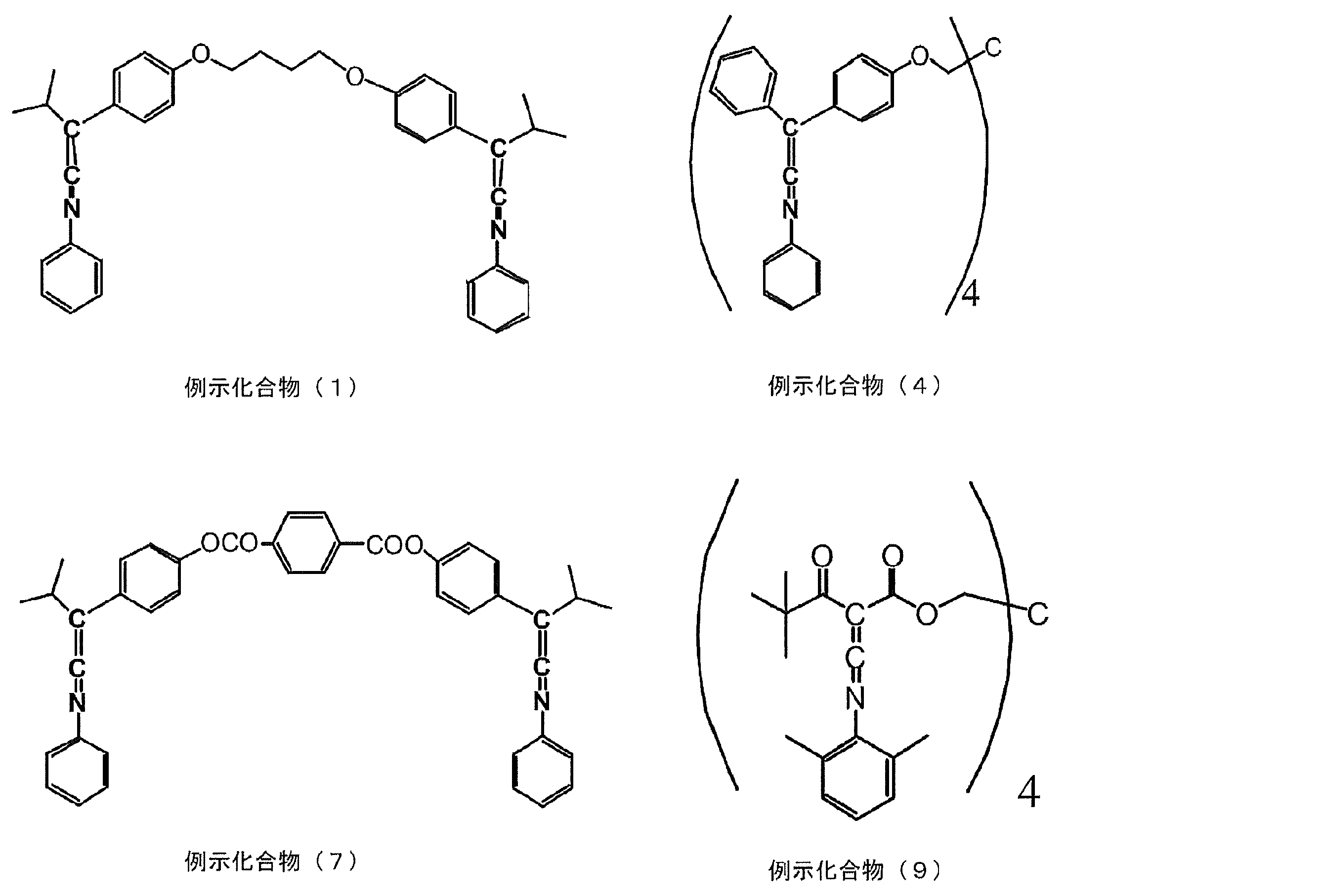
各実施例で使用した上記の例示化合物(1)(4)(7)(9)は以下の方法によって合成した。
[合成例5]
(例示化合物1の合成)

(例示化合物1の合成)
2-(4-ヒドロキシフェニル)-3-メチル酪酸29.1g(150mol)、無水酢酸375mlを三つ口フラスコに仕込み、還流下で3時間攪拌した。TLCにて反応終了を確認した後、過剰の無水酢酸を減圧留去した。得られた固体を酢酸エチルに溶解させ、1N塩酸水で分液洗浄を行った。溶媒を留去することで31.0g(収率87.5%)の(1-A)を得た。構造はNMRで確認した。
(1-A)17.1g(72.4mmol)、塩化チオニル21.5g(181mmol)、トルエン50mLを三つ口フラスコに仕込み70℃で1時間攪拌した。TLCにて反応終了を確認したあと、過剰の塩化チオニルと溶媒を減圧留去した。続けてトルエン50mLを加え、生成物を溶解させた後、5℃に冷却し、アニリン14.8g(159mmol)、トリエチルアミン16.1g(159mmol)を同時にゆっくり滴下し、氷冷下で2時間攪拌した。溶媒を減圧留去後、酢酸エチルに溶解させ、1N塩酸水で分液洗浄を行った。溶媒を留去することで16.2gの(1-B)を得た。(収率88%)
(1-B)16.2g(52mmol)、ナトリウムメトキシド(28%メタノール溶液)15.0g、メタノール50mLを三つ口フラスコに仕込み、室温下で2時間攪拌した。TLCにて反応の終了を確認した後、酢酸エチルを加え、1N塩酸水で分液洗浄を行った。溶媒を減圧留去した後、酢酸エチル/ヘキサン混合溶媒にて晶析させることで12.2gの(1-C)を得た。(収率87%)
(1-C)10.7g(40mmol)、炭酸カリウム16.6g(120mmol)、DMF70mLを三つ口フラスコに仕込み、50℃で窒素下攪拌を行った。1,4-ジブロモブタン4.31g(20mmol)滴下し、系内温度を110℃まで昇温し、24時間反応させた。反応後、酢酸エチルを加え、1N塩酸水、次に1N炭酸水素ナトリウム水溶液、飽和塩化ナトリウム水溶液で分液洗浄した。溶媒を減圧留去した後、2-プロパノール/ヘキサン混合溶媒にて晶析させることで8.3gの(1-D)を得た(収率70%)。
(1-D)6.0g(10.1mmol)、トリフェニルホスフィン6.9g(26.3mmol)トリエチルアミン4.08g(40.5mmol)、四塩化炭素3.12g(20.2mmol)、クロロホルム210mLを三つ口フラスコに仕込み、70℃で窒素下で8時間攪拌を行った。溶媒を減圧濃縮した後、ヘキサンで洗浄し、シリカゲルクロマトにて精製することで、2.5gの例示化合物(1)を得た。(収率:45%)
1H-NMR(DMSO-d6) δ(ppm); 1.2(12H)、1.8-1.9(4H)、2.9(2H)、4.0(4H)、6.9-7.0(4H)、7.1(4H)、7.2-7.5(10H)
1H-NMR(DMSO-d6) δ(ppm); 1.2(12H)、1.8-1.9(4H)、2.9(2H)、4.0(4H)、6.9-7.0(4H)、7.1(4H)、7.2-7.5(10H)
[合成例6]
(例示化合物4の合成)
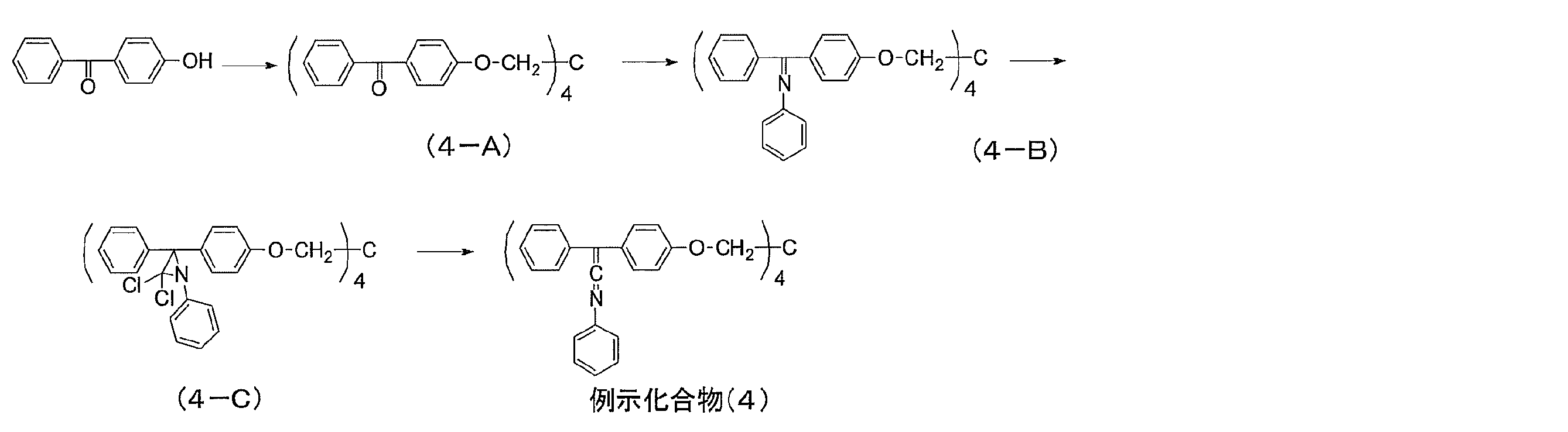
(例示化合物4の合成)
ベンゾフェノン15.1g(76mmol)、ペンタエリスリトールテトラブロミド6.08g(16mmol)、炭酸カリウム31.1g(225mmol)、DMF130mlを三つ口フラスコに仕込み、130℃で10時間攪拌した。溶媒を減圧留去して得られた固体を、蒸留水で1回、エタノールで1回洗浄し、酢酸エチルで晶析して(4-A)13.0g得た(収率95%)。構造はNMRで確認した。
(4-A)10.9g(12.7mmol)、アニリン7.08g(76.2mmol)、DABCO22.96g(154.6mmol)、クロロベンゼン390mlを三つ口フラスコに仕込み125℃で1時間攪拌し、続けてテトラクロロチタン9.9g(51mmol)加えて4時間攪拌した。得られた反応液を減圧濾過、続けて濃縮し、得られた固体をエタノールで洗浄して(4-B)13.5g得た(収率92%)。構造はNMRで確認した。
(4-B)10.2g(8.7mmol)、トリエチルベンジルアンモニウムクロライド6.0g、クロロホルム90mlを三つ口フラスコに仕込み、十分に攪拌しながら50%水酸化ナトリウム水溶液60gを一気に加え、40~45℃で1時間攪拌した。純水120ml、クロロホルム180mlを加えて2回純水で洗浄し、溶媒を減圧留去し(4-C)を12.9g(8.7mmol)得た(収率100%)。構造はNMRで確認した。
(4-C)12.9g(8.7mmol)、ヨウ化ナトリウム39g、アセトン210mlをフラスコに仕込み、75℃で2時間還流した。3.5%チオ硫酸ナトリウム水溶液に反応溶液をゆっくり滴下し、1時間攪拌した後、減圧濾過して固体を得た。得られた固体をカラムクロマトグラフィーで精製し、例示化合物(4)を7.2g(6.0mmol)得た(収率69%)。構造はNMRで確認した。
1H-NMR(CDCl3) δ(ppm); 4.32(8H)、7.05(8H)、7.20(20H)、7.36(20H)、7.45(8H)
1H-NMR(CDCl3) δ(ppm); 4.32(8H)、7.05(8H)、7.20(20H)、7.36(20H)、7.45(8H)
[合成例7]
(例示化合物7の合成)

(例示化合物7の合成)
2-(4-ヒドロキシフェニル)-3-メチル酪酸32.0g(165mmol)、1N水酸化ナトリウム水溶液450mLを三つ口フラスコに仕込み、室温下で攪拌した。テレフタロイルクロリド16.9g(83mmol)のトルエン100mL溶液を室温下で滴下した。滴下終了後、2N水酸化ナトリウム水溶液450mLを加えた。4時間反応させた後、3N塩酸水450mLを加えて、系内のpHを2にし、固体を析出させた。有機層をろ過し、39.0gの(7-A)を得た(収率88%)。
(7-A)16.0g(30mmol)、THF180mLを三つ口フラスコに仕込み、氷水化で攪拌しながら、メタンスルホン酸クロリド4.61mL(30mmol)、ついでN,N-ジイソプロピルエチルアミン11.5mL(66mmol)を滴下した。5時間攪拌し、TLCにて反応終了を確認した後、アニリン5.04g(54mmol)のTHF50mL溶液、N,N-ジイソプロピルエチルアミン11.5mL(66mmol)を続けて滴下し、N,N-ジメチル-4-アミノピリジンを少量添加した。室温下で3時間攪拌し、TLCにて反応終了を確認した後、飽和塩化ナトリウム水溶液、1N塩酸水、飽和塩化ナトリウム水溶液、ついで水で分液洗浄した。溶媒留去後、酢酸エチルで再結晶を行い11.7gの(7-B)を得た(収率60%)。
(7-B)5.73g(9.1mmol)、トリフェニルホスフィン6.18g(23.7mmol)、トリエチルアミン3.68g(36.4mmol)、四塩化炭素2.80g(18.2mmol)、クロロホルム190mLを三つ口フラスコに仕込み、70℃で窒素下で8時間攪拌を行った。溶媒を減圧濃縮した後、ヘキサンで洗浄を行うことで。3.7gの例示化合物(7)を得た(収率83%)。
1H-NMR(DMSO-d6) δ(ppm); 0.6(6H)、0.9(6H)、2.1-2.3(m、2H)、6.7(4H)、6.9(2H)、7.0-7.2(4H)、7.2-7.3(4H)、7.3-7.4(4H)、7.7(4H)
1H-NMR(DMSO-d6) δ(ppm); 0.6(6H)、0.9(6H)、2.1-2.3(m、2H)、6.7(4H)、6.9(2H)、7.0-7.2(4H)、7.2-7.3(4H)、7.3-7.4(4H)、7.7(4H)
[合成例8]
(例示化合物9の合成)

(例示化合物9の合成)
ピバロイルアセト酢酸エチル17.2g(0.1mol)、ペンタエリスリトール2.7g(20mmol)、パラトルエンスルホン酸0.3g(1.5mmol)を窒素雰囲気下、180℃にて攪拌した。TLCにて原料の消失を確認した後、系の温度を室温まで下げ、酢酸エチルに溶解させた。水を加えて分液し、有機層を硫酸マグネシウムで乾燥後、溶媒を減圧留去した。カラムクロマトグラフィーにて精製を行うことで、9.7gの(9-A)を得た(収率76%)。
(9-A)9.0g(14mmol)、1、8-ジアザビシクロ[5.4.0]ウンデカー7―エン9.2ml(62mmol)のテトラヒドロフラン30ml溶液を氷冷却下、2,6-ジメチル-フェニルチオイソシアネート10.1g(62mmol)のテトラヒドロフラン10ml溶液をゆっくりと滴下した。反応系の温度を室温まで昇温し、TLCにて原料の消失を確認した後、水/酢酸エチルを加えて分液した。有機層を食塩水、水にて洗浄した後、硫酸マグネシウムにて乾燥させた。溶媒を減圧留去し、カラムクロマトグラフィーにて精製を行うことで、16.5gの(9-B)を得た。(収率91%)
(9-B)10.0g(7.7mmol)のクロロホルム100ml溶液に、氷冷下、2-クロロー1,3-ジメチルイミダゾリウムクロライド2.0g(11.8mmol)のクロロホルム50ml溶液を添加し、トリエチルアミン4.3ml(30.8mmol)をゆっくりと滴下した。滴下終了後、攪拌しながら反応系の温度をゆっくりと室温まで昇温した。TLCにて原料の消失を確認した後、クロロホルム/水を加えて分液し、溶媒を減圧留去した。シリカゲルカラムクロマトにて精製を行うことで、5.6gの例示化合物(9)を得た(収率63%)。
1H-NMR(CDCl3-d) δ(ppm); 1.3(36H)、2.1(24H)、4.2(8H)、7.0-7.2(12H)
1H-NMR(CDCl3-d) δ(ppm); 1.3(36H)、2.1(24H)、4.2(8H)、7.0-7.2(12H)
さらに、ケテンイミン系の末端封止剤として、以下の化合物を実施例に用いた。なお、下記の例示化合物A及び例示化合物Bは米国特許3692745号公報の実施例に記載のmonoおよびbisで表される化合物である。
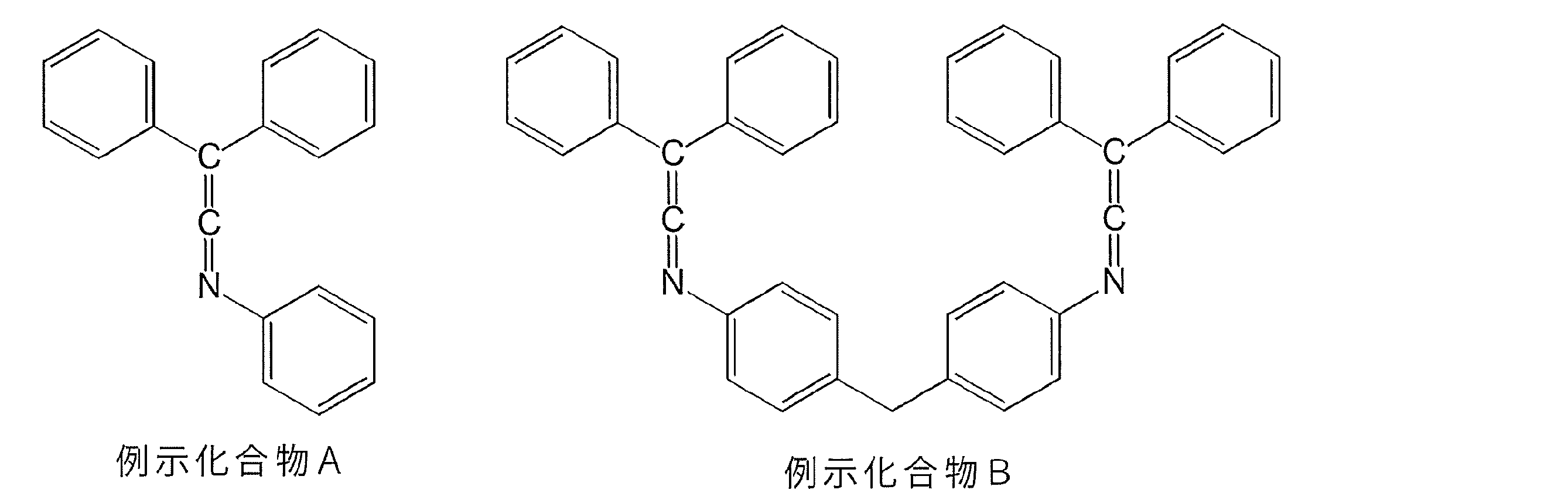
(実施例1~37、比較例1~4)
(ポリエステルの調製)
(1)PET
特開2011-165698号公報に記載の方法により、ポリエチレンテレフタレートのポリマーを得た。具体的には、エステル交換反応容器にジメチルテレフタレートを100質量部、エチレングリコールを61質量部、酢酸マグネシウム四水塩を0.06質量部仕込み、150℃に加熱して溶融し撹拌した。反応容器内温度をゆっくりと235℃まで昇温しながら反応を進め、生成するメタノールを反応容器外へ留出させた。メタノールの留出が終了したらトリメチルリン酸を0.02質量部添加した。トリメチルリン酸を添加した後、三酸化アンチモンを0.03質量部添加し、反応物を重合装置に移行した。ついで重合装置内の温度を235℃から290℃まで90分かけて昇温し、同時に装置内の圧力を大気圧から100Paまで90分かけて減圧した。重合装置内容物の撹拌トルクが所定の値に達したら装置内を窒素ガスで大気圧に戻して重合を終了した。重合装置下部のバルブを開いて重合装置内部を窒素ガスで加圧し、重合の完了したポリエチレンテレフタレートをストランド状にして水中に吐出した。ストランドはカッターによってチップ化した。このようにして固有粘度IV=0.50、AV=20のPETを得た。これをPET-Aとした。
(ポリエステルの調製)
(1)PET
特開2011-165698号公報に記載の方法により、ポリエチレンテレフタレートのポリマーを得た。具体的には、エステル交換反応容器にジメチルテレフタレートを100質量部、エチレングリコールを61質量部、酢酸マグネシウム四水塩を0.06質量部仕込み、150℃に加熱して溶融し撹拌した。反応容器内温度をゆっくりと235℃まで昇温しながら反応を進め、生成するメタノールを反応容器外へ留出させた。メタノールの留出が終了したらトリメチルリン酸を0.02質量部添加した。トリメチルリン酸を添加した後、三酸化アンチモンを0.03質量部添加し、反応物を重合装置に移行した。ついで重合装置内の温度を235℃から290℃まで90分かけて昇温し、同時に装置内の圧力を大気圧から100Paまで90分かけて減圧した。重合装置内容物の撹拌トルクが所定の値に達したら装置内を窒素ガスで大気圧に戻して重合を終了した。重合装置下部のバルブを開いて重合装置内部を窒素ガスで加圧し、重合の完了したポリエチレンテレフタレートをストランド状にして水中に吐出した。ストランドはカッターによってチップ化した。このようにして固有粘度IV=0.50、AV=20のPETを得た。これをPET-Aとした。
(2)PEN
ナフタレン-2,6-ジカルボン酸ジメチル100部、およびエチレングリコール60部を、エステル交換触媒として酢酸マンガン四水塩0.03部を使用し、150℃から238℃に徐々に昇温させながら120分間エステル交換反応を行なった。途中反応温度が170℃に達した時点で三酸化アンチモン0.024部を添加し、エステル交換反応終了後、リン酸トリメチル(エチレングリコール中で135℃、5時間0.11~0.16MPaの加圧下で加熱処理した溶液:リン酸トリメチル換算量で0.023部)を添加した。その後反応生成物を重合反応器に移し、290℃まで昇温し、27Pa以下の高真空下にて重縮合反応を行って、固有粘度が0.61dl/g、AV=18の、実質的に粒子を含有しない、ポリエチレン-2,6-ナフタレンジカルボキシレートを得た。これをPEN-Aと称する。
ナフタレン-2,6-ジカルボン酸ジメチル100部、およびエチレングリコール60部を、エステル交換触媒として酢酸マンガン四水塩0.03部を使用し、150℃から238℃に徐々に昇温させながら120分間エステル交換反応を行なった。途中反応温度が170℃に達した時点で三酸化アンチモン0.024部を添加し、エステル交換反応終了後、リン酸トリメチル(エチレングリコール中で135℃、5時間0.11~0.16MPaの加圧下で加熱処理した溶液:リン酸トリメチル換算量で0.023部)を添加した。その後反応生成物を重合反応器に移し、290℃まで昇温し、27Pa以下の高真空下にて重縮合反応を行って、固有粘度が0.61dl/g、AV=18の、実質的に粒子を含有しない、ポリエチレン-2,6-ナフタレンジカルボキシレートを得た。これをPEN-Aと称する。
(ポリエステルの固相重合)
PET-A、PEN-Aを特開2009-182186号公報に従い固相重合を行った。具体的には、得られたポリマー(PET-A、PEN-A)を155℃で3時間予備乾燥した後、窒素ガス雰囲気下で固相重合を行った。固相重合温度は210℃で下記表1に記載の時間、固相重合した。なお、固相重合時間を長くするとIVは増加、AVは減少し易く、固相重合温度を上げることでAVは増加しIVは低下し易い。
PET-A、PEN-Aを特開2009-182186号公報に従い固相重合を行った。具体的には、得られたポリマー(PET-A、PEN-A)を155℃で3時間予備乾燥した後、窒素ガス雰囲気下で固相重合を行った。固相重合温度は210℃で下記表1に記載の時間、固相重合した。なお、固相重合時間を長くするとIVは増加、AVは減少し易く、固相重合温度を上げることでAVは増加しIVは低下し易い。
固相重合したPET、PEN(PET-B、PEN-B)、固相重合しないPET、PEN(PET-A、PEN-A/表1中の固相重合時間=0のもの)を用い、下記のように微粒子を含むマスターペレットを作成した。また一部のペレットには末端封止剤も添加した。さらに、微粒子を含まないペレット(希釈ペレット)を配合し製膜した。また一部の希釈ペレットには末端封止剤を添加した。マスターペレット、希釈ペレットとも同一PEN、PET(固相重合時間のおなじもの)を使用した。
(芳香族ポリエステルと微粒子、末端封止剤を含むマスターペレットの製造)
PET(以降、PET-A、PET-Bの総称)、PEN(PEN-A、PEN-Bの総称)に、微粒子を80℃で24時間乾燥し含水率を30ppm以下とした後、2軸混練押出し機に投入し窒素気流中280℃で3分間混練した。この時の微粒子とポリエステルの組成、および2軸押出し機のスクリューのトルク変動、微粒子の種類、添加量(対芳香族ポリエステル)は表1に示した。
PET(以降、PET-A、PET-Bの総称)、PEN(PEN-A、PEN-Bの総称)に、微粒子を80℃で24時間乾燥し含水率を30ppm以下とした後、2軸混練押出し機に投入し窒素気流中280℃で3分間混練した。この時の微粒子とポリエステルの組成、および2軸押出し機のスクリューのトルク変動、微粒子の種類、添加量(対芳香族ポリエステル)は表1に示した。
<微粒子>
TiO2-1:ルチル型二酸化酸価チタン(表面をアルミナ被覆、平均粒径0.2μm)
TiO2-2:ルチル型二酸化酸価チタン(表面をアルミナとトリメチロールプロパンで被覆、平均粒径0.3μm)
BaSO4-1:硫酸バリウム単体
BaSO4-2:硫酸バリウムをシリカで被覆
なお、これらの粒径は後述の方法で製膜後、フィルムから微粒子を取り出し特開2009-263604に記載の方法で測定した。
TiO2-1:ルチル型二酸化酸価チタン(表面をアルミナ被覆、平均粒径0.2μm)
TiO2-2:ルチル型二酸化酸価チタン(表面をアルミナとトリメチロールプロパンで被覆、平均粒径0.3μm)
BaSO4-1:硫酸バリウム単体
BaSO4-2:硫酸バリウムをシリカで被覆
なお、これらの粒径は後述の方法で製膜後、フィルムから微粒子を取り出し特開2009-263604に記載の方法で測定した。
また、一部のマスターペレットには下記から選んだ末端封止剤を表1記載の量だけ2軸混練押出し機に添加した。
環状カルボジイミド化合物
封止剤A:上記化学式に記載した化合物1
封止剤B:上記化学式に記載した化合物2
封止剤C:上記化学式に記載した化合物3
封止剤D:上記化学式に記載した化合物4
封止剤E:WO2011/093478、p177-8 参考例5の化合物
封止剤F:WO2011/093478、p178-180 参考例6の化合物
封止剤G:スタビライザー9000(ラシヒ社製)
なお、封止剤E,FはWO2011/093478に準じて合成した。
環状カルボジイミド化合物
封止剤A:上記化学式に記載した化合物1
封止剤B:上記化学式に記載した化合物2
封止剤C:上記化学式に記載した化合物3
封止剤D:上記化学式に記載した化合物4
封止剤E:WO2011/093478、p177-8 参考例5の化合物
封止剤F:WO2011/093478、p178-180 参考例6の化合物
封止剤G:スタビライザー9000(ラシヒ社製)
なお、封止剤E,FはWO2011/093478に準じて合成した。
これらの芳香族ポリエステル、微粒子、末端封止剤は、2軸押出し機を用い混合し、280℃で、窒素気流中、3分間行なった。混練後、ストランド状に水中に押出し冷却固化した後、直径3mm、長さ5mmに裁断しマスターペレットを得た。
実施例1~37および比較例1~4で用いたマスターペレットの組成と、その作成条件を表1にまとめた。尚、MP13~MP22においては、末端封止剤をマスターペレットに添加していないが、これらは、製膜工程で、末端封止剤を添加している。
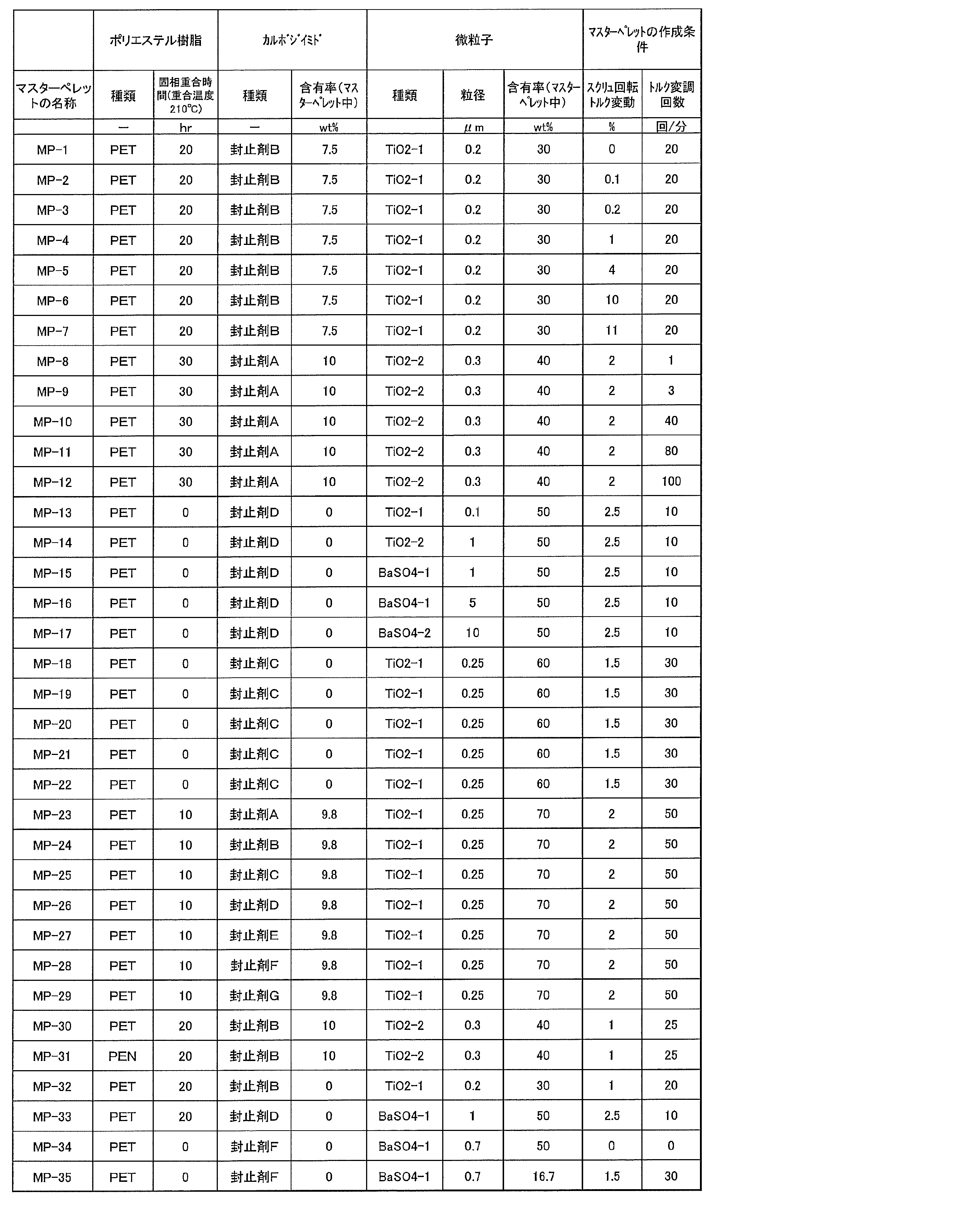
(製膜)
上記マスターペレットに希釈用の芳香族ポリエステルペレットを混合し、表2の微粒子濃度(フィルム中の濃度)となるようにした。表2の本発明29~35では、一部のカルボジイミド化合物を希釈用の芳香族ポリエステルペレットに添加することにより、カルボジイミド化合物を製膜中に混合している。
上記マスターペレットに希釈用の芳香族ポリエステルペレットを混合し、表2の微粒子濃度(フィルム中の濃度)となるようにした。表2の本発明29~35では、一部のカルボジイミド化合物を希釈用の芳香族ポリエステルペレットに添加することにより、カルボジイミド化合物を製膜中に混合している。
押出しの前に80℃で12時間以上乾燥し含水率を30ppm以下にした後、2軸押出し機を用い、280℃で真空ベントを行ないながら混練した。これを、ギアポンプを通したあと20μmの目開きのフィルターでろ過した。
ろ過後にダイに通した。単層の場合はコートハンガーダイに、積層の場合はフィードブロックダイにとおした。
1m幅のダイに長手方向5cm間隔(ダイリップから3cmのところから上流側に3列)で3列×幅方向12等分した点(合計6点)にヒーターを設け、各々の温度を変えることでダイの温度分布を付与した。長手方向1列は交互に高温、低温を繰り返し、長手方向2列目は高温、中温、高温の繰返し、長手方向3列目は高温、高温、低温の繰返しになるように温度設定した。
ダイの温度分布は各ヒーターとヒーターの間の中間点の温度を接触式温度計で測定し、最高温度と最低温度の差を平均値で割り百等分して求め、表2に記載した。
ダイから30℃の冷却ドラム上に押出し固化した。この時室温の風を送り固化を促した。さらにダイから出たメルトと冷却ドラムの接触点近傍に静電印加を行なった。
1m幅のダイに長手方向5cm間隔(ダイリップから3cmのところから上流側に3列)で3列×幅方向12等分した点(合計6点)にヒーターを設け、各々の温度を変えることでダイの温度分布を付与した。長手方向1列は交互に高温、低温を繰り返し、長手方向2列目は高温、中温、高温の繰返し、長手方向3列目は高温、高温、低温の繰返しになるように温度設定した。
ダイの温度分布は各ヒーターとヒーターの間の中間点の温度を接触式温度計で測定し、最高温度と最低温度の差を平均値で割り百等分して求め、表2に記載した。
ダイから30℃の冷却ドラム上に押出し固化した。この時室温の風を送り固化を促した。さらにダイから出たメルトと冷却ドラムの接触点近傍に静電印加を行なった。
(延伸)
上記で得た未延伸シートを8本の予熱ロール(直径300mmφ、ラップ角180度)を千鳥状に交互に通過させた。
上記で得た未延伸シートを8本の予熱ロール(直径300mmφ、ラップ角180度)を千鳥状に交互に通過させた。
縦延伸したあと、PET系の水準は120℃、PEN系の水準は160℃で4倍にテンターを用い横延伸した。この後、いずれの水準も210℃で熱固定した後、190℃でMD、TDに3%ずつ緩和処理を行なった。この後、両端のチャック部をトリミングした後、ナーリングを付与し2000m巻き取った。この厚みは表2に記載した。
(評価方法)
微粒子の粒径
サンプルフィルムを900℃、空気中で2時間処理し、微粒子を取り出す。これを特開2009-263604の[0054]に記載の方法でパーティクルアナライザーを用いて測定した。
微粒子の粒径
サンプルフィルムを900℃、空気中で2時間処理し、微粒子を取り出す。これを特開2009-263604の[0054]に記載の方法でパーティクルアナライザーを用いて測定した。
微粒子の凝集率
サンプルフィルムをMD,TDに平行に断面観察した(SEMを用い5000倍で観察)。微粒子を任意に100個観察し、粒子間の最近接距離が0.3μm以下のものを凝集粒子とする。この個数を観察個数(100個)で割り百分率で示したものを「微粒子の凝集率」とした。これをMD断面、TD断面で測定し、その平均値を示した。
サンプルフィルムをMD,TDに平行に断面観察した(SEMを用い5000倍で観察)。微粒子を任意に100個観察し、粒子間の最近接距離が0.3μm以下のものを凝集粒子とする。この個数を観察個数(100個)で割り百分率で示したものを「微粒子の凝集率」とした。これをMD断面、TD断面で測定し、その平均値を示した。
積層フィルムの最も厚い層の厚み変動
サンプルフィルムを1cmごとに10点断面観察した(SEMを用い5000倍で観察)。各層の厚みを測定し、最も厚い層の各10点の厚み測定値の最大厚みと最小厚みの差を平均厚みで割り百分率で示した。この測定をMD、TDの断面で求め、平均値を厚み変動とした。
サンプルフィルムを1cmごとに10点断面観察した(SEMを用い5000倍で観察)。各層の厚みを測定し、最も厚い層の各10点の厚み測定値の最大厚みと最小厚みの差を平均厚みで割り百分率で示した。この測定をMD、TDの断面で求め、平均値を厚み変動とした。
IV,AV
製膜後のフィルムに対し、下記手法でAV,IVを測定した。カルボキシル末端量AVは、Mauliceの方法によって、カルボキシル末端量を測定した。(文献 M.J.Maulice,F.Huizinga.Anal.Chim.Acta,22 363(1960))。
得られたこれらのポリエステルの固有粘度(IV)は、ポリエステルをオルトクロロフェノールに溶解し、25℃で測定した溶液粘度から、下式より固有粘度を得た。
ηsp/C=[η]+K[η]2・C
ここで、ηsp=(溶液粘度/溶媒粘度)-1であり、Cは、溶媒100mlあたりの溶解ポリマー重量であり(本測定では1g/100mlとする)、Kはハギンス定数(0.343とする)であり、溶液粘度、溶媒粘度はオストワルド粘度計を用いて測定した。
製膜後のフィルムに対し、下記手法でAV,IVを測定した。カルボキシル末端量AVは、Mauliceの方法によって、カルボキシル末端量を測定した。(文献 M.J.Maulice,F.Huizinga.Anal.Chim.Acta,22 363(1960))。
得られたこれらのポリエステルの固有粘度(IV)は、ポリエステルをオルトクロロフェノールに溶解し、25℃で測定した溶液粘度から、下式より固有粘度を得た。
ηsp/C=[η]+K[η]2・C
ここで、ηsp=(溶液粘度/溶媒粘度)-1であり、Cは、溶媒100mlあたりの溶解ポリマー重量であり(本測定では1g/100mlとする)、Kはハギンス定数(0.343とする)であり、溶液粘度、溶媒粘度はオストワルド粘度計を用いて測定した。
裁断時の切り屑
下記の手法により、裁断時の裁断屑を計測した。
i)刃角60度のトムソン刃を用い、25℃において、50mm/分、線圧5kg/mmで掛け打ち抜いた。(刃角が鈍角であり、切断し難い条件できることにより切り屑を発生し易くしている。)
ii)最断面を1m長にわたり黒紙で擦り、この上の切り屑の数を数え表1に記載した(サーモテスト前の切り屑の数)。
iii)サーモテスト後の切り屑:上記切り屑の測定を、120℃100%rh100時間後に同様に裁断、切り屑計測し表1に記載した(サーモテスト後の切り屑/このサーモによりポリエステルが加水分解し低分子量化するため、より脆くなり切り屑が発生し易くなっている)。
下記の手法により、裁断時の裁断屑を計測した。
i)刃角60度のトムソン刃を用い、25℃において、50mm/分、線圧5kg/mmで掛け打ち抜いた。(刃角が鈍角であり、切断し難い条件できることにより切り屑を発生し易くしている。)
ii)最断面を1m長にわたり黒紙で擦り、この上の切り屑の数を数え表1に記載した(サーモテスト前の切り屑の数)。
iii)サーモテスト後の切り屑:上記切り屑の測定を、120℃100%rh100時間後に同様に裁断、切り屑計測し表1に記載した(サーモテスト後の切り屑/このサーモによりポリエステルが加水分解し低分子量化するため、より脆くなり切り屑が発生し易くなっている)。
可視光反射率
特開2011-25473号に記載された反射率測定法に準じて、フィルムの可視光反射率を求めた。
特開2011-25473号に記載された反射率測定法に準じて、フィルムの可視光反射率を求めた。
異臭
テンター出口でカルボジイミドの分解物特有に刺激臭があるか否かを、官能評価を行った。その結果を記載した。
テンター出口でカルボジイミドの分解物特有に刺激臭があるか否かを、官能評価を行った。その結果を記載した。

表2に示されているように、本発明1~5は、フィルムの厚みが100μmであり、凝集率が10~50%のものである。これらは、凝集率が9%の比較例1や、凝集率が52%の比較例2に比べて、裁断後の裁断屑の発生が格段に抑制されているのがわかる。 また、比較例1ではサーモ前に比べてサーモ後において裁断屑の発生が倍増しているが、本発明1~5では、サーモ後であっても裁断屑の発生が抑制されている。
本発明6~28は、フィルムの厚みを50~250μmであり、環状カルボジイミド化合物の含有率が0.1~5質量%である。これらは、凝集率が8%の比較例3に比べて、サーモ前後の裁断屑の発生が格段に抑制されているのがわかる。
本発明29~36は、フィルムを積層した積層フィルムである。積層フィルムにおいても、サーモ前後の裁断屑の発生がおさえられており、単層の場合と同様の効果が得られていることがわかる。
比較例4は、特開2011-258641の実施例1(PET+環状封止剤)にWO2011/093478の実施例23(ポリ乳酸+環状封止剤+微粒子(BaSO4)を組合せたものである。比較例4では、微粒子を含有しているが、その凝集率が本発明の範囲ではないため、裁断屑の発生が抑制されていない。本発明37は比較例4に対応した実施例であり、微粒子の凝集率を30%とすることにより裁断屑の発生が抑制されていることがわかる。
(実施例38~70、比較例5および6)
末端封止剤に下記のケテンイミン化合物を用い、実施例1と同様の方法で実施例38~70、比較例5および6フィルムを作成した。
末端封止剤に下記のケテンイミン化合物を用い、実施例1と同様の方法で実施例38~70、比較例5および6フィルムを作成した。
ケテンイミン化合物
封止剤H:上記化学式に記載した例示化合物(1)
封止剤I:上記化学式に記載した例示化合物(4)
封止剤J:上記化学式に記載した例示化合物(7)
封止剤K:上記化学式に記載した例示化合物(9)
封止剤L:上記化学式に記載した例示化合物A
封止剤M:上記化学式に記載した例示化合物B
封止剤H:上記化学式に記載した例示化合物(1)
封止剤I:上記化学式に記載した例示化合物(4)
封止剤J:上記化学式に記載した例示化合物(7)
封止剤K:上記化学式に記載した例示化合物(9)
封止剤L:上記化学式に記載した例示化合物A
封止剤M:上記化学式に記載した例示化合物B
実施例38~70、比較例5および6で用いたマスターペレットの組成と、その作成条件を表3にまとめた。
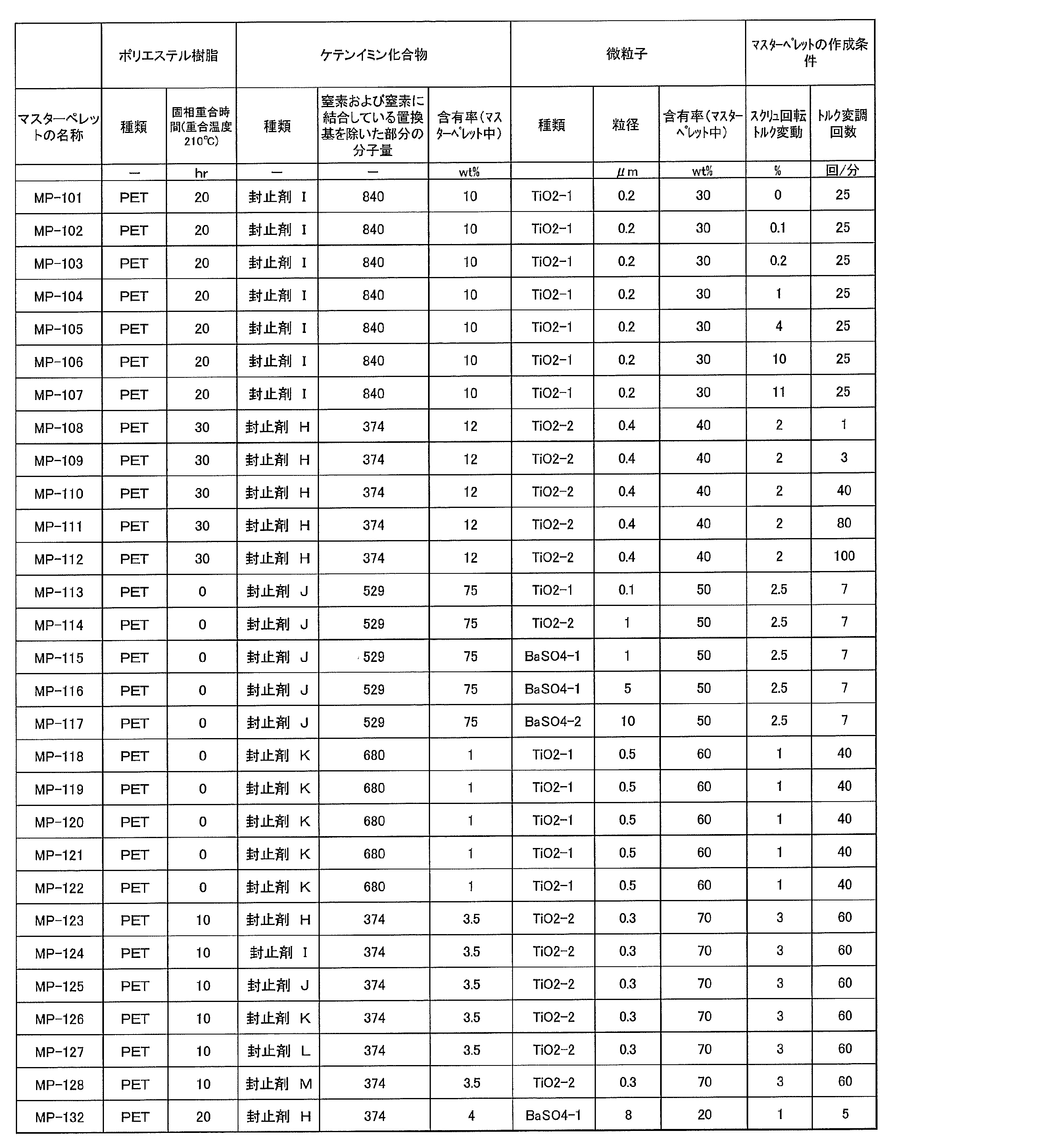
得られたマスターペレットに希釈用の芳香族ポリエステルペレットを混合し、表4の微粒子濃度(フィルム中の濃度)となるように調製した。その後の製膜、延伸等の工程においては、実施例1と同様の処理を行った。

表4に示されているように、本発明38~42は、フィルムの厚みが75μmであり、凝集率が10~50%のものである。これらは、凝集率が9%の比較例5や、凝集率が52%の比較例6に比べて、裁断後の裁断屑の発生が格段に抑制されているのがわかる。また、比較例5および6ではサーモ前に比べてサーモ後において裁断屑の発生が倍増しているが、本発明38~42では、サーモ後であっても裁断屑の発生が抑制されている。
本発明43~63は、フィルムの厚みを50~250μmであり、ケテンイミン化合物の含有率が0.1~5質量%である。これらにおいても、サーモ前後の裁断屑の発生が格段に抑制されているのがわかる。
本発明64~70は、フィルムを積層した積層フィルムである。積層フィルムにおいても、サーモ前後の裁断屑の発生がおさえられており、単層の場合と同様の効果が得られていることがわかる。
本発明によれば、環状カルボジイミド化合物と微粒子を含有した芳香族ポリエステルフィルムを裁断する際、裁断屑が発生することを抑制することができる。このため、本発明の芳香族ポリエステルフィルムは、太陽電池パネルとの密着性が良好となり、太陽電池のバックシートとして好適に用いられる。本発明は環状カルボジイミド化合物と微粒子を含有した芳香族ポリエステルフィルムの製造効率を高めることもでき、産業上の利用可能性が高い。
10 バレル
12 供給口
14 押出機出口
16A、16B ベント
20A、20B スクリュー
21 駆動モーター
22 フライト
23 減速ギア
24A、24B 混練部
30 温度制御手段
100 2軸押出し機
C1~C9 加熱/冷却装置
12 供給口
14 押出機出口
16A、16B ベント
20A、20B スクリュー
21 駆動モーター
22 フライト
23 減速ギア
24A、24B 混練部
30 温度制御手段
100 2軸押出し機
C1~C9 加熱/冷却装置
Claims (27)
- 環骨格にカルボジイミド基を1つ含み、その第一窒素と第二窒素が結合基により結合されている環状構造を分子内に少なくとも1つ有する環状カルボジイミド化合物、またはケテンイミン化合物と、微粒子と、芳香族ポリエステル樹脂とを含み、
前記環状カルボジイミド化合物または前記ケテンイミン化合物の含有率は、前記芳香族ポリエステル樹脂の質量に対して0.1~5質量%であり、
前記微粒子の粒径は0.1~10μmであり、前記微粒子の含有率は前記芳香族ポリエステル樹脂の質量に対して1~10質量%であり、
前記微粒子の一部は凝集しており、その凝集率が10~50%であることを特徴とする芳香族ポリエステルフィルム。 - 前記環状カルボジイミド化合物は下記一般式(O-1)または一般式(O-2)で表されることを特徴とする請求項1に記載の芳香族ポリエステルフィルム。
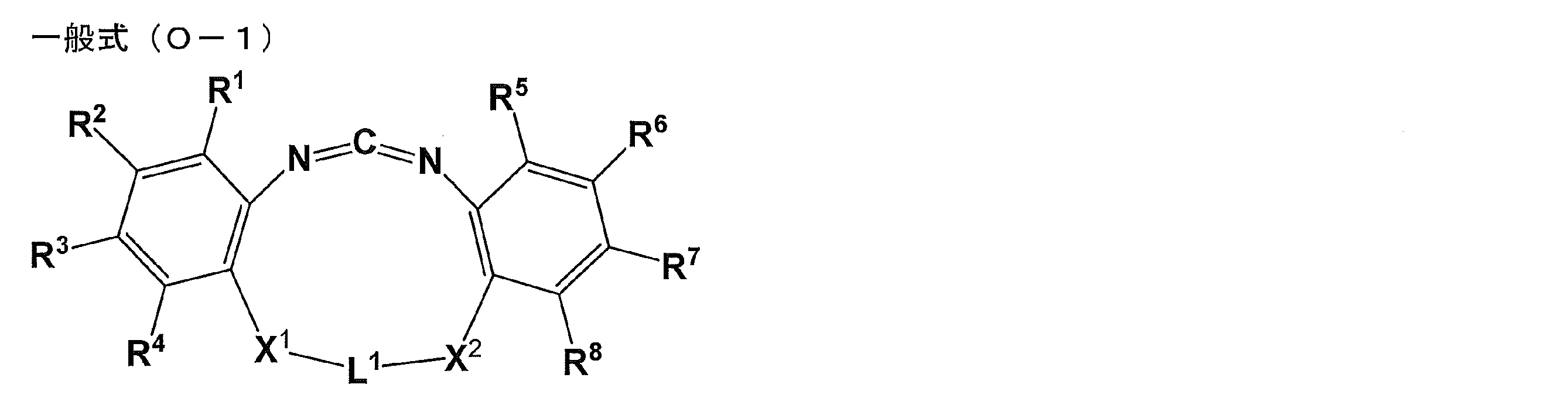

- 前記一般式(O-1)および(O-2)中、R1およびR5、ならびに、R11、R15、R21およびR25がそれぞれ独立に2級もしくは3級アルキル基、または、アリール基を表すことを特徴とする請求項2に記載の芳香族ポリエステルフィルム。
- 前記一般式(O-1)中、R2およびR6がともに水素原子であることを特徴とする請求項2または3に記載の芳香族ポリエステルフィルム。
- 前記ケテンイミン化合物は下記一般式(1)で表されることを特徴とする請求項1に記載の芳香族ポリエステルフィルム。
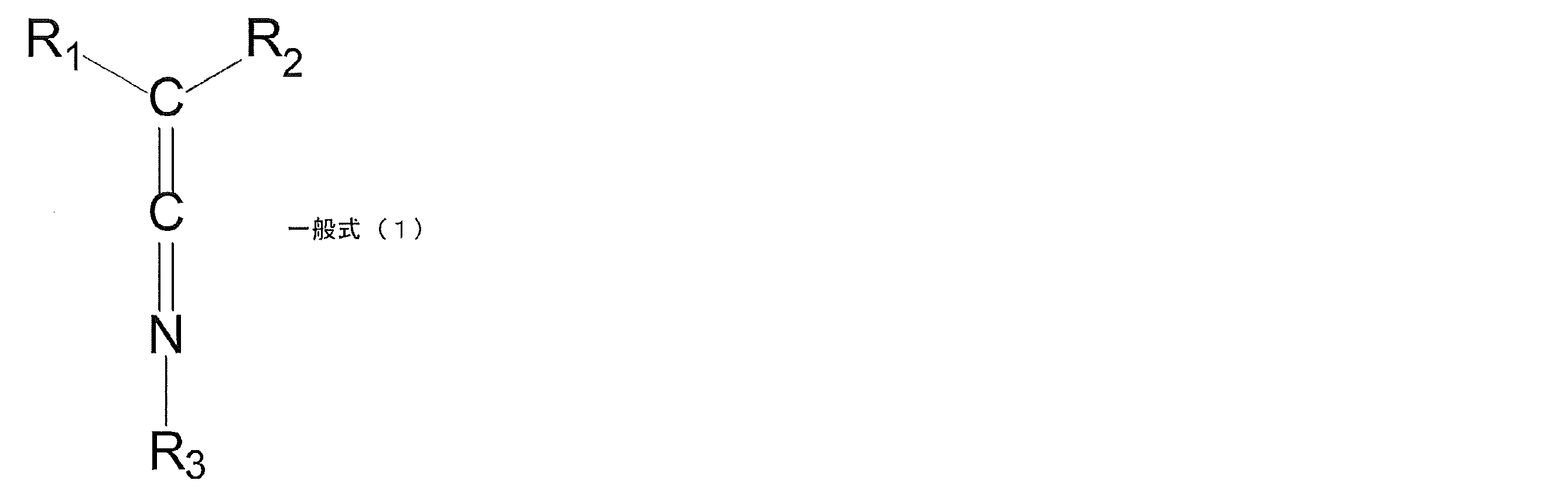
- 前記ケテンイミン化合物は下記一般式(2)で表されることを特徴とする請求項1に記載の芳香族ポリエステルフィルム。
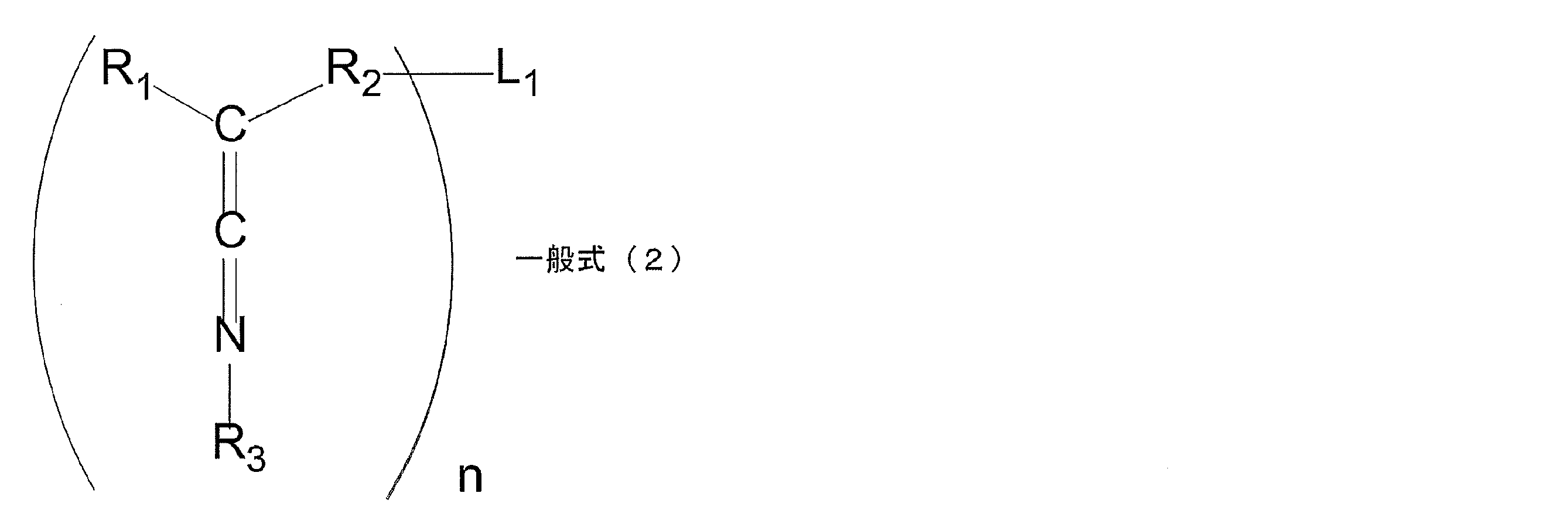
- 前記一般式(2)における、nが3または4であることを特徴とする請求項6に記載の芳香族ポリエステルフィルム。
- 前記ケテンイミン化合物は下記一般式(3)で表されることを特徴とする請求項1に記載の芳香族ポリエステルフィルム。
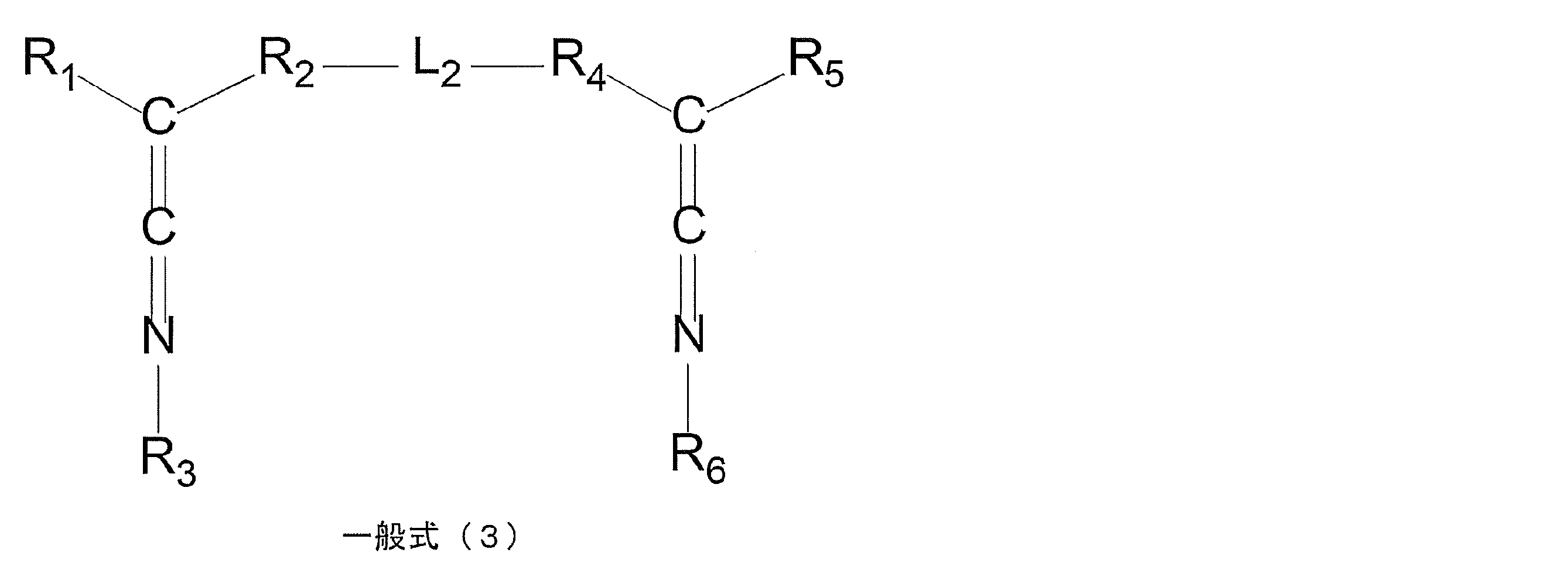
- 前記ケテンイミン化合物のケテンイミンを構成する窒素原子と該窒素原子に結合している置換基を除く部分の分子量が320以上であることを特徴する請求項5~8のいずれか1項に記載の芳香族ポリエステルフィルム。
- 前記芳香族ポリエステル樹脂は、ジカルボン酸成分として、テレフタル酸、ナフタレンジカルボン酸、ジオール成分としてエチレングリコールを主として含み、
固有粘度(IV)が0.7~0.9g/dl、酸価(AV)が1~20eq/tonであることを特徴とする請求項1~9のいずれか1項に記載の芳香族ポリエステルフィルム。 - 請求項1~10のいずれか1項に記載の芳香族ポリエステルフィルムを少なくとも1層以上含み、積層数が2~8層であることを特徴とする積層フィルム。
- 前記積層フィルムを構成する層のうち、最も膜厚が大きい層の厚みの変動率が1~10%であることを特徴とする請求項11に記載の積層フィルム。
- 環骨格にカルボジイミド基を1つ含み、その第一窒素と第二窒素が結合基により結合されている環状構造を分子内に少なくとも1つ有する環状カルボジイミド化合物、またはケテンイミン化合物と、微粒子と、芳香族ポリエステル樹脂とを含む芳香族ポリエステルフィルムの製造方法において、
前記芳香族ポリエステル樹脂と、前記微粒子とを混練しマスターペレットを調製する工程と、
前記マスターペレットと芳香族ポリエステルペレットを混合して押出した後、ダイから冷却ドラム上にキャストし製膜する工程を有し、
前記マスターペレットを調製する工程または前記製膜する工程の少なくとも一方は、前記環状カルボジイミド化合物または前記ケテンイミン化合物を混合する工程を含み、
前記微粒子の粒径は0.1~10μmであり、前記微粒子の含有率は、前記芳香族ポリエステル樹脂の質量に対して1~10質量%であり、
前記マスターペレットを調製する工程は、前記芳香族ポリエステル樹脂と微粒子をスクリュー回転トルクで混練する工程を含み、前記スクリュー回転トルクには0.1~10%の変動が与えられる芳香族ポリエステルフィルムの製造方法。 - 前記スクリュー回転トルクには1回/分~100回/分の変動が与えられることを特徴とする請求項13に記載の芳香族ポリエステルフィルムの製造方法。
- 前記製膜する工程は、前記ダイの内部に1~10℃の温度分布を付与する工程を含むことを特徴とする請求項13または14に記載の芳香族ポリエステルフィルムの製造方法。
- 前記環状カルボジイミド化合物は下記一般式(O-1)または一般式(O-2)で表されることを特徴とする請求項13~15のいずれか1項に記載の芳香族ポリエステルフィルムの製造方法。

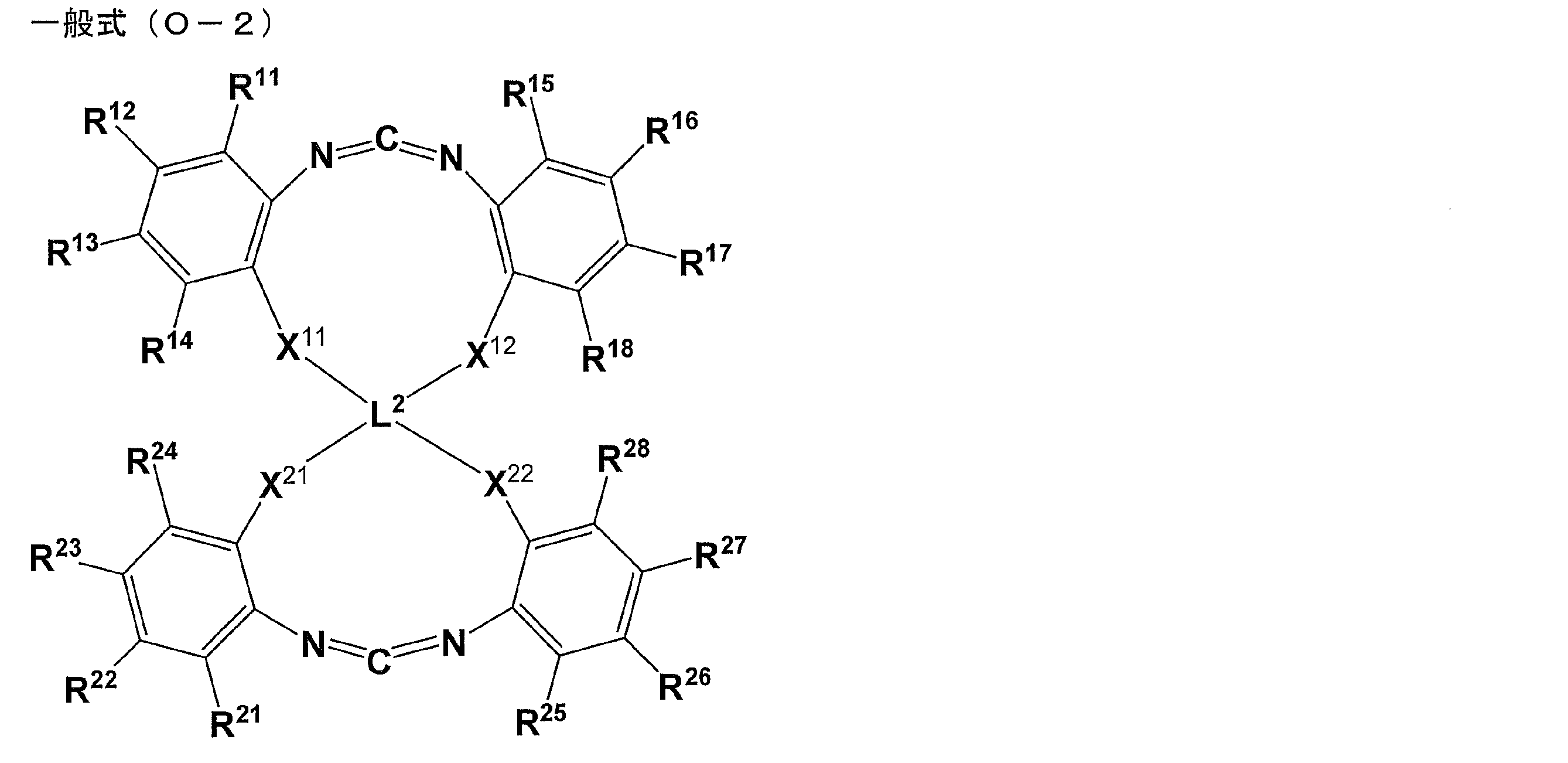
- 前記一般式(O-1)および(O-2)中、R1およびR5、ならびに、R11、R15、R21およびR25がそれぞれ独立に2級もしくは3級アルキル基、または、アリール基を表すことを特徴とする請求項16に記載の芳香族ポリエステルフィルムの製造方法。
- 前記一般式(O-1)中、R2およびR6がともに水素原子であることを特徴とする請求項16または17に記載の芳香族ポリエステルフィルムの製造方法。
- 前記ケテンイミン化合物は下記一般式(1)で表されることを特徴とする請求項13~15のいずれか1項に記載の芳香族ポリエステルフィルムの製造方法。

- 前記ケテンイミン化合物は下記一般式(2)で表されることを特徴とする請求項13~15のいずれか1項に記載の芳香族ポリエステルフィルムの製造方法。

- 前記一般式(2)における、nが3または4であることを特徴とする請求項20に記載の芳香族ポリエステルフィルムの製造方法。
- 前記ケテンイミン化合物は下記一般式(3)で表されることを特徴とする請求項13~15のいずれか1項に記載の芳香族ポリエステルフィルムの製造方法。
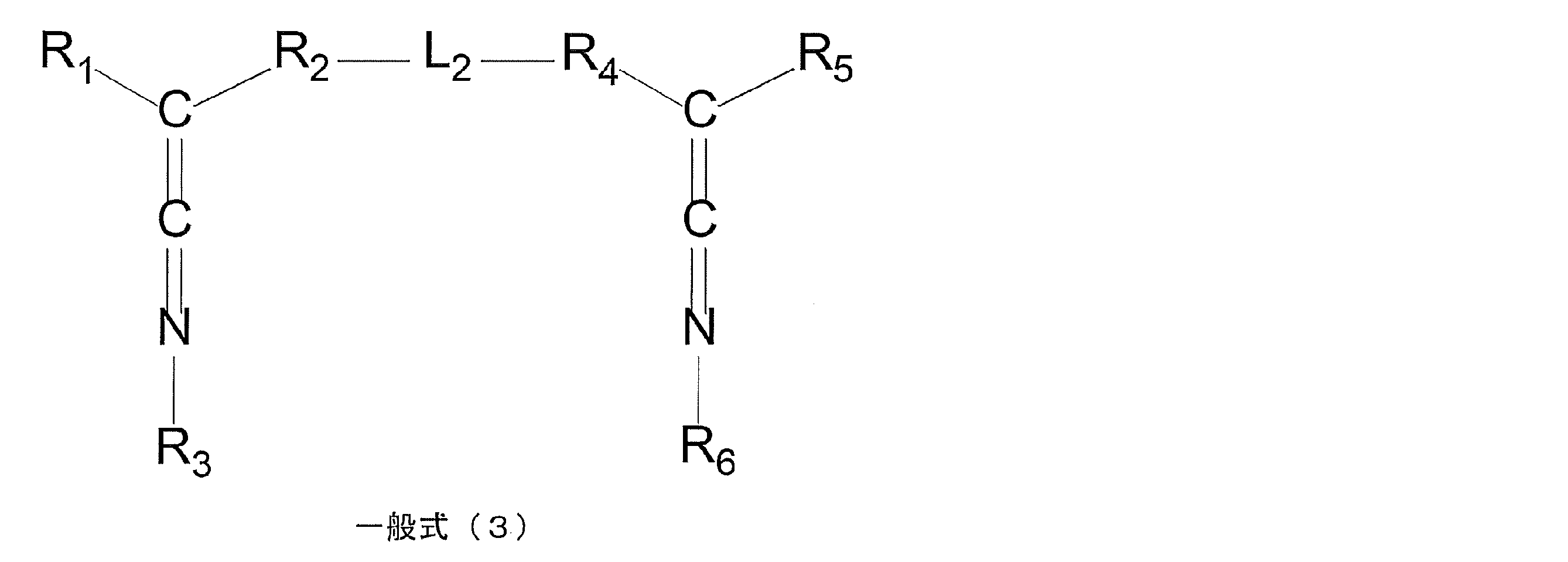
- 前記ケテンイミン化合物のケテンイミンを構成する窒素原子と該窒素原子に結合している置換基を除く部分の分子量が320以上であることを特徴する請求項19~22のいずれか1項に記載の芳香族ポリエステルフィルムの製造方法。
- 請求項13~23のいずれか1項に記載の製造方法により製造された芳香族ポリエステルフィルム。
- 請求項1~10及び請求項24のいずれか1項に記載の芳香族ポリエステルフィルムを用いた太陽電池モジュール用バックシート。
- 請求項11または12に記載の積層フィルムを用いた太陽電池モジュール用バックシート。
- 請求項25または26に記載の太陽電池モジュール用バックシートを用いた太陽電池モジュール。
Applications Claiming Priority (4)
| Application Number | Priority Date | Filing Date | Title |
|---|---|---|---|
| JP2012-203449 | 2012-09-14 | ||
| JP2012203449 | 2012-09-14 | ||
| JP2012-262980 | 2012-11-30 | ||
| JP2012262980 | 2012-11-30 |
Publications (1)
| Publication Number | Publication Date |
|---|---|
| WO2014041827A1 true WO2014041827A1 (ja) | 2014-03-20 |
Family
ID=50277966
Family Applications (1)
| Application Number | Title | Priority Date | Filing Date |
|---|---|---|---|
| PCT/JP2013/056427 Ceased WO2014041827A1 (ja) | 2012-09-14 | 2013-03-08 | 芳香族ポリエステルフィルム、太陽電池モジュール用バックシートおよび太陽電池モジュール |
Country Status (2)
| Country | Link |
|---|---|
| JP (1) | JP5827255B2 (ja) |
| WO (1) | WO2014041827A1 (ja) |
Cited By (5)
| Publication number | Priority date | Publication date | Assignee | Title |
|---|---|---|---|---|
| WO2014142106A1 (ja) * | 2013-03-12 | 2014-09-18 | 富士フイルム株式会社 | ケテンイミン化合物、ポリエステルフィルム、太陽電池モジュール用バックシートおよび太陽電池モジュール |
| CN104262271A (zh) * | 2014-06-10 | 2015-01-07 | 天津师范大学 | 四(4-三唑苯基)季戊四醚的制备方法与应用 |
| CN104311496A (zh) * | 2014-09-15 | 2015-01-28 | 天津师范大学 | 季戊四醇四三氮唑化合物及其制备方法与应用 |
| CN107406603A (zh) * | 2015-03-31 | 2017-11-28 | 富士胶片株式会社 | 白色聚酯薄膜及其制造方法、太阳能电池用背板以及太阳能电池模块 |
| JP2020520406A (ja) * | 2017-05-08 | 2020-07-09 | デュポン テイジン フィルムス ユーエス リミテッド パートナーシップ | 耐加水分解性ポリエステルフィルム |
Families Citing this family (4)
| Publication number | Priority date | Publication date | Assignee | Title |
|---|---|---|---|---|
| JP5852626B2 (ja) | 2012-11-06 | 2016-02-03 | 富士フイルム株式会社 | ケテンイミン化合物、ポリエステルフィルム、太陽電池モジュール用バックシートおよび太陽電池モジュール |
| JP5889776B2 (ja) * | 2012-12-20 | 2016-03-22 | 富士フイルム株式会社 | ポリエステルフィルム、太陽電池モジュール用バックシートおよび太陽電池モジュール |
| JP2017017171A (ja) * | 2015-06-30 | 2017-01-19 | 大日本印刷株式会社 | 太陽電池モジュール用の集電シート及びそれを用いた太陽電池モジュール。 |
| JP2018193410A (ja) * | 2015-10-01 | 2018-12-06 | 日清紡ケミカル株式会社 | 樹脂添加剤、並びにそれを用いたマスターバッチ及び樹脂組成物 |
Citations (6)
| Publication number | Priority date | Publication date | Assignee | Title |
|---|---|---|---|---|
| US3692745A (en) * | 1970-01-24 | 1972-09-19 | Akzona Inc | Method for chemically modifying thread-forming polyesters |
| JPS6460821A (en) * | 1987-08-31 | 1989-03-07 | Fuji Photo Film Co Ltd | Magnetic recording medium |
| JPH0562158A (ja) * | 1991-09-03 | 1993-03-12 | Diafoil Co Ltd | 磁気記録媒体用積層ポリエステルフイルム |
| JPH07240021A (ja) * | 1994-02-25 | 1995-09-12 | Toray Ind Inc | 二軸配向ポリエステルフイルム |
| WO2004038703A1 (ja) * | 2002-10-24 | 2004-05-06 | Teijin Dupont Films Japan Limited | 二軸配向ポリエステルフィルムおよびフレキシブルディスク |
| JP2011258641A (ja) * | 2010-06-07 | 2011-12-22 | Teijin Ltd | 太陽電池裏面保護膜用二軸配向ポリエステルフィルムおよびそれを用いた太陽電池裏面保護膜 |
-
2013
- 2013-02-22 JP JP2013033609A patent/JP5827255B2/ja not_active Expired - Fee Related
- 2013-03-08 WO PCT/JP2013/056427 patent/WO2014041827A1/ja not_active Ceased
Patent Citations (6)
| Publication number | Priority date | Publication date | Assignee | Title |
|---|---|---|---|---|
| US3692745A (en) * | 1970-01-24 | 1972-09-19 | Akzona Inc | Method for chemically modifying thread-forming polyesters |
| JPS6460821A (en) * | 1987-08-31 | 1989-03-07 | Fuji Photo Film Co Ltd | Magnetic recording medium |
| JPH0562158A (ja) * | 1991-09-03 | 1993-03-12 | Diafoil Co Ltd | 磁気記録媒体用積層ポリエステルフイルム |
| JPH07240021A (ja) * | 1994-02-25 | 1995-09-12 | Toray Ind Inc | 二軸配向ポリエステルフイルム |
| WO2004038703A1 (ja) * | 2002-10-24 | 2004-05-06 | Teijin Dupont Films Japan Limited | 二軸配向ポリエステルフィルムおよびフレキシブルディスク |
| JP2011258641A (ja) * | 2010-06-07 | 2011-12-22 | Teijin Ltd | 太陽電池裏面保護膜用二軸配向ポリエステルフィルムおよびそれを用いた太陽電池裏面保護膜 |
Cited By (11)
| Publication number | Priority date | Publication date | Assignee | Title |
|---|---|---|---|---|
| WO2014142106A1 (ja) * | 2013-03-12 | 2014-09-18 | 富士フイルム株式会社 | ケテンイミン化合物、ポリエステルフィルム、太陽電池モジュール用バックシートおよび太陽電池モジュール |
| JP2014198826A (ja) * | 2013-03-12 | 2014-10-23 | 富士フイルム株式会社 | ケテンイミン化合物、ポリエステルフィルム、太陽電池モジュール用バックシートおよび太陽電池モジュール |
| CN104262271A (zh) * | 2014-06-10 | 2015-01-07 | 天津师范大学 | 四(4-三唑苯基)季戊四醚的制备方法与应用 |
| CN104262271B (zh) * | 2014-06-10 | 2016-05-18 | 天津师范大学 | 四(4-三唑苯基)季戊四醚的制备方法与应用 |
| CN104311496A (zh) * | 2014-09-15 | 2015-01-28 | 天津师范大学 | 季戊四醇四三氮唑化合物及其制备方法与应用 |
| CN104311496B (zh) * | 2014-09-15 | 2016-05-18 | 天津师范大学 | 季戊四醇四三氮唑化合物及其制备方法与应用 |
| CN107406603A (zh) * | 2015-03-31 | 2017-11-28 | 富士胶片株式会社 | 白色聚酯薄膜及其制造方法、太阳能电池用背板以及太阳能电池模块 |
| US20170362429A1 (en) * | 2015-03-31 | 2017-12-21 | Fujifilm Corporation | White polyester film and method for manufacturing same, solar cell back sheet, and solar cell module |
| JP2020520406A (ja) * | 2017-05-08 | 2020-07-09 | デュポン テイジン フィルムス ユーエス リミテッド パートナーシップ | 耐加水分解性ポリエステルフィルム |
| JP7202364B2 (ja) | 2017-05-08 | 2023-01-11 | デュポン テイジン フィルムス ユーエス リミテッド パートナーシップ | 耐加水分解性ポリエステルフィルム |
| US11629241B2 (en) | 2017-05-08 | 2023-04-18 | Dupont Teijin Films U.S. Limited Partnership | Hydrolysis resistant polyester film |
Also Published As
| Publication number | Publication date |
|---|---|
| JP5827255B2 (ja) | 2015-12-02 |
| JP2014129500A (ja) | 2014-07-10 |
Similar Documents
| Publication | Publication Date | Title |
|---|---|---|
| JP5827255B2 (ja) | 芳香族ポリエステルフィルム、太陽電池モジュール用バックシートおよび太陽電池モジュール | |
| KR101627116B1 (ko) | 2 축 연신 폴리에스테르 필름 및 그 제조 방법 그리고 태양 전지 모듈 | |
| JP2014080561A (ja) | 芳香族ポリエステルフィルム、太陽電池モジュール用バックシートおよび太陽電池モジュール | |
| CN103748168B (zh) | 聚酯膜及其制造方法、太阳能电池用背板、以及太阳能电池模块 | |
| CN103370183A (zh) | 双轴拉伸聚酯膜及其制造方法、太阳能电池用背板、以及太阳能电池模块 | |
| CN105814136A (zh) | 亚氨基醚化合物、聚酯树脂组合物、生成羧酸酯的方法、聚酯薄膜、太阳能电池模块用背板及太阳能电池模块 | |
| CN104781340B (zh) | 烯酮亚胺化合物、聚酯膜、太阳能电池模块用背板及太阳能电池模块 | |
| JP5512749B2 (ja) | ポリエステルフィルムの製造方法 | |
| KR101589389B1 (ko) | 폴리에스테르 필름의 제조 방법, 폴리에스테르 필름, 태양 전지용 백시트, 및 태양 전지 모듈 | |
| KR101713872B1 (ko) | 폴리에스테르 수지의 제조 방법, 폴리에스테르 필름, 폴리에스테르 필름의 제조 방법, 태양 전지용 백시트, 및 태양 전지 모듈 | |
| KR101782239B1 (ko) | 폴리에스테르 필름 및 그 제조 방법 | |
| CN102959725A (zh) | 双轴拉伸白色聚对苯二甲酸乙二醇酯膜和太阳能电池组件用背面保护膜 | |
| JP5840967B2 (ja) | 樹脂組成物とその製造方法、ポリエチレンテレフタレートフィルム及び太陽電池モジュール用バックシート | |
| JP2013203070A (ja) | ポリエステルフィルムの製造方法、太陽電池用保護シート、及び太陽電池モジュール | |
| JP2014185244A (ja) | 耐紫外線性ポリエステルフィルム | |
| JP5856924B2 (ja) | 環状カルボジイミド化合物、ポリエステルフィルム、太陽電池モジュール用バックシートおよび太陽電池モジュール | |
| WO2014021323A1 (ja) | ポリエステルフィルムの製造方法、ポリエステルフィルム、太陽電池用保護シート、及び太陽電池モジュール | |
| JP5889776B2 (ja) | ポリエステルフィルム、太陽電池モジュール用バックシートおよび太陽電池モジュール | |
| CN107428060A (zh) | 聚酯薄膜及其制造方法、太阳能电池用背面保护片、以及太阳能电池模块 | |
| JP5676526B2 (ja) | ポリエステル樹脂の製造方法、太陽電池用保護シート、及び太陽電池モジュール | |
| JP6341998B2 (ja) | ポリエステル樹脂組成物、マスターペレット、ポリエステルフィルム、太陽電池モジュール用バックシート及び太陽電池モジュール | |
| JP2014077091A (ja) | ポリエステルフィルム、太陽電池モジュール用バックシートおよび太陽電池モジュール | |
| JP2014239126A (ja) | 太陽電池裏面封止用ポリエステルフィルム | |
| JP2014239125A (ja) | 太陽電池裏面封止用ポリエステルフィルム | |
| JP2010031206A (ja) | 共重合ポリエステル樹脂組成物およびそれからなる二軸配向フィルム |
Legal Events
| Date | Code | Title | Description |
|---|---|---|---|
| 121 | Ep: the epo has been informed by wipo that ep was designated in this application |
Ref document number: 13836743 Country of ref document: EP Kind code of ref document: A1 |
|
| NENP | Non-entry into the national phase |
Ref country code: DE |
|
| 122 | Ep: pct application non-entry in european phase |
Ref document number: 13836743 Country of ref document: EP Kind code of ref document: A1 |