WO2014034175A1 - 高意匠複層塗膜形成方法 - Google Patents
高意匠複層塗膜形成方法 Download PDFInfo
- Publication number
- WO2014034175A1 WO2014034175A1 PCT/JP2013/061526 JP2013061526W WO2014034175A1 WO 2014034175 A1 WO2014034175 A1 WO 2014034175A1 JP 2013061526 W JP2013061526 W JP 2013061526W WO 2014034175 A1 WO2014034175 A1 WO 2014034175A1
- Authority
- WO
- WIPO (PCT)
- Prior art keywords
- coating film
- color
- base coating
- metallic base
- forming
- Prior art date
- Legal status (The legal status is an assumption and is not a legal conclusion. Google has not performed a legal analysis and makes no representation as to the accuracy of the status listed.)
- Ceased
Links
Images

Classifications
-
- B—PERFORMING OPERATIONS; TRANSPORTING
- B05—SPRAYING OR ATOMISING IN GENERAL; APPLYING FLUENT MATERIALS TO SURFACES, IN GENERAL
- B05D—PROCESSES FOR APPLYING FLUENT MATERIALS TO SURFACES, IN GENERAL
- B05D5/00—Processes for applying liquids or other fluent materials to surfaces to obtain special surface effects, finishes or structures
- B05D5/06—Processes for applying liquids or other fluent materials to surfaces to obtain special surface effects, finishes or structures to obtain multicolour or other optical effects
- B05D5/065—Processes for applying liquids or other fluent materials to surfaces to obtain special surface effects, finishes or structures to obtain multicolour or other optical effects having colour interferences or colour shifts or opalescent looking, flip-flop, two tones
- B05D5/066—Processes for applying liquids or other fluent materials to surfaces to obtain special surface effects, finishes or structures to obtain multicolour or other optical effects having colour interferences or colour shifts or opalescent looking, flip-flop, two tones achieved by multilayers
-
- B—PERFORMING OPERATIONS; TRANSPORTING
- B05—SPRAYING OR ATOMISING IN GENERAL; APPLYING FLUENT MATERIALS TO SURFACES, IN GENERAL
- B05D—PROCESSES FOR APPLYING FLUENT MATERIALS TO SURFACES, IN GENERAL
- B05D5/00—Processes for applying liquids or other fluent materials to surfaces to obtain special surface effects, finishes or structures
- B05D5/06—Processes for applying liquids or other fluent materials to surfaces to obtain special surface effects, finishes or structures to obtain multicolour or other optical effects
- B05D5/067—Metallic effect
- B05D5/068—Metallic effect achieved by multilayers
-
- B—PERFORMING OPERATIONS; TRANSPORTING
- B05—SPRAYING OR ATOMISING IN GENERAL; APPLYING FLUENT MATERIALS TO SURFACES, IN GENERAL
- B05D—PROCESSES FOR APPLYING FLUENT MATERIALS TO SURFACES, IN GENERAL
- B05D1/00—Processes for applying liquids or other fluent materials
- B05D1/36—Successively applying liquids or other fluent materials, e.g. without intermediate treatment
- B05D1/38—Successively applying liquids or other fluent materials, e.g. without intermediate treatment with intermediate treatment
-
- B—PERFORMING OPERATIONS; TRANSPORTING
- B05—SPRAYING OR ATOMISING IN GENERAL; APPLYING FLUENT MATERIALS TO SURFACES, IN GENERAL
- B05D—PROCESSES FOR APPLYING FLUENT MATERIALS TO SURFACES, IN GENERAL
- B05D3/00—Pretreatment of surfaces to which liquids or other fluent materials are to be applied; After-treatment of applied coatings, e.g. intermediate treating of an applied coating preparatory to subsequent applications of liquids or other fluent materials
- B05D3/02—Pretreatment of surfaces to which liquids or other fluent materials are to be applied; After-treatment of applied coatings, e.g. intermediate treating of an applied coating preparatory to subsequent applications of liquids or other fluent materials by baking
- B05D3/0254—After-treatment
-
- B—PERFORMING OPERATIONS; TRANSPORTING
- B05—SPRAYING OR ATOMISING IN GENERAL; APPLYING FLUENT MATERIALS TO SURFACES, IN GENERAL
- B05D—PROCESSES FOR APPLYING FLUENT MATERIALS TO SURFACES, IN GENERAL
- B05D5/00—Processes for applying liquids or other fluent materials to surfaces to obtain special surface effects, finishes or structures
- B05D5/06—Processes for applying liquids or other fluent materials to surfaces to obtain special surface effects, finishes or structures to obtain multicolour or other optical effects
- B05D5/061—Special surface effect
- B05D5/063—Reflective effect
-
- B—PERFORMING OPERATIONS; TRANSPORTING
- B05—SPRAYING OR ATOMISING IN GENERAL; APPLYING FLUENT MATERIALS TO SURFACES, IN GENERAL
- B05D—PROCESSES FOR APPLYING FLUENT MATERIALS TO SURFACES, IN GENERAL
- B05D7/00—Processes, other than flocking, specially adapted for applying liquids or other fluent materials to particular surfaces or for applying particular liquids or other fluent materials
- B05D7/14—Processes, other than flocking, specially adapted for applying liquids or other fluent materials to particular surfaces or for applying particular liquids or other fluent materials to metal, e.g. car bodies
-
- B—PERFORMING OPERATIONS; TRANSPORTING
- B05—SPRAYING OR ATOMISING IN GENERAL; APPLYING FLUENT MATERIALS TO SURFACES, IN GENERAL
- B05D—PROCESSES FOR APPLYING FLUENT MATERIALS TO SURFACES, IN GENERAL
- B05D7/00—Processes, other than flocking, specially adapted for applying liquids or other fluent materials to particular surfaces or for applying particular liquids or other fluent materials
- B05D7/50—Multilayers
- B05D7/56—Three layers or more
- B05D7/57—Three layers or more the last layer being a clear coat
-
- C—CHEMISTRY; METALLURGY
- C09—DYES; PAINTS; POLISHES; NATURAL RESINS; ADHESIVES; COMPOSITIONS NOT OTHERWISE PROVIDED FOR; APPLICATIONS OF MATERIALS NOT OTHERWISE PROVIDED FOR
- C09D—COATING COMPOSITIONS, e.g. PAINTS, VARNISHES OR LACQUERS; FILLING PASTES; CHEMICAL PAINT OR INK REMOVERS; INKS; CORRECTING FLUIDS; WOODSTAINS; PASTES OR SOLIDS FOR COLOURING OR PRINTING; USE OF MATERIALS THEREFOR
- C09D201/00—Coating compositions based on unspecified macromolecular compounds
-
- C—CHEMISTRY; METALLURGY
- C09—DYES; PAINTS; POLISHES; NATURAL RESINS; ADHESIVES; COMPOSITIONS NOT OTHERWISE PROVIDED FOR; APPLICATIONS OF MATERIALS NOT OTHERWISE PROVIDED FOR
- C09D—COATING COMPOSITIONS, e.g. PAINTS, VARNISHES OR LACQUERS; FILLING PASTES; CHEMICAL PAINT OR INK REMOVERS; INKS; CORRECTING FLUIDS; WOODSTAINS; PASTES OR SOLIDS FOR COLOURING OR PRINTING; USE OF MATERIALS THEREFOR
- C09D5/00—Coating compositions, e.g. paints, varnishes or lacquers, characterised by their physical nature or the effects produced; Filling pastes
- C09D5/28—Coating compositions, e.g. paints, varnishes or lacquers, characterised by their physical nature or the effects produced; Filling pastes for wrinkle, crackle, orange-peel, or similar decorative effects
-
- C—CHEMISTRY; METALLURGY
- C09—DYES; PAINTS; POLISHES; NATURAL RESINS; ADHESIVES; COMPOSITIONS NOT OTHERWISE PROVIDED FOR; APPLICATIONS OF MATERIALS NOT OTHERWISE PROVIDED FOR
- C09D—COATING COMPOSITIONS, e.g. PAINTS, VARNISHES OR LACQUERS; FILLING PASTES; CHEMICAL PAINT OR INK REMOVERS; INKS; CORRECTING FLUIDS; WOODSTAINS; PASTES OR SOLIDS FOR COLOURING OR PRINTING; USE OF MATERIALS THEREFOR
- C09D7/00—Features of coating compositions, not provided for in group C09D5/00; Processes for incorporating ingredients in coating compositions
- C09D7/40—Additives
- C09D7/41—Organic pigments; Organic dyes
Definitions
- the present invention relates to a method for forming a multilayer coating film, particularly a method for forming a multilayer coating film having a high design.
- Patent Document 1 forms a first coating film by applying a first paint containing a bright material, and contains a coloring component without baking and curing the first coating film.
- a method for forming a multilayer coating film is disclosed, characterized in that the amount is 0.01 to 1% by weight based on the resin solid content.
- This technique eliminates the disadvantages of using a color clear by controlling the pigment content of the colored base paint of the second coating film, thereby preventing color unevenness and color fading of the coating film.
- color unevenness is likely to occur, it is difficult to develop a uniform coating color and uniform design, and strict variations in film thickness during coating It must be suppressed and productivity is not improved.
- Patent Document 2 a metallic base paint containing a bright pigment is applied to form a metallic base coating film, and a colored base paint containing a colored pigment is applied thereon to perform coloring.
- the lightness L * value of the metallic base coating film is set to 60 or less.
- the present invention is a method for forming a multi-layer coating film, and a design that is less likely to cause color unevenness in the coating film even if the film thickness fluctuation at the time of coating is not strictly controlled is uniform, and saturation and brightness
- An object of the present invention is to obtain a method for forming a high-design multi-layer coating film that is high in color and has a deep sense of color.
- This coating film forming method can provide a so-called candy color coating film.
- the present invention is a process (1) for obtaining a metallic base coating film by applying a metallic base paint containing a color pigment and a glittering material to the surface of an object to be coated, and the metallic obtained in the above process (1).
- the step (3) of applying a clear coating to form a clear coating, and the metallic base coating, the colored base coating and the clear coating obtained in the above steps (1) to (3) are heated and cured.
- a method for forming a multilayer coating film comprising a step (4) of forming a multilayer coating film, wherein the metallic base coating film obtained by heating and curing the metallic base coating film obtained in the step (1) as a single film is used.
- the light reflectance of the film is 45 to 50% at wavelengths of 650 to 700 nm, 20% or less at wavelengths of 410 to 440 nm and 510 to 590 nm, and obtained by heating and curing the colored base coating film obtained in the above step (2) as a single film
- the single colored base coating film obtained has a light transmittance of 50 to 70% at a wavelength of 400 to 700 nm, 88 to 92% at a wavelength of 650 to 700 nm, and 20 to 60% at wavelengths of 410 to 440 nm and 510 to 590 nm.
- a method for forming a high-design multilayer coating film is provided.
- the colored pigment contained in the metallic base paint and the colored pigment contained in the colored base paint are the same colored pigment.
- the colored pigment is preferably a perylene pigment.
- the color is highly saturated and light.
- a highly designed multi-layer coating film with a deep feeling can be formed.
- the light reflectance and light transmittance are both selected such that the reflection is large and the transmission is large in the visible light region having a high wavelength, that is, the region of 650 to 700 nm, and the reflection and the transmission are low in the other regions.
- FIG. 1 When plotting those satisfying the requirements of light reflectance and light transmittance on a graph with the horizontal axis representing wavelength and the vertical axis representing% of transmittance and reflectance, FIG. 1 is obtained.
- the light reflectance (single line in FIG. 1) of the single metallic base coating film and the light transmittance of the single coloring base coating film (in FIG. 1) in the long wavelength range of 650 to 700 nm.
- the light reflectance ( ⁇ ) of the single metallic base coating film and the light transmittance ( ⁇ ) of the single colored base coating film are lowered in the 410 to 590 nm region where the wavelength is short and the wavelength is short, color unevenness may occur.
- a high-design multilayer coating film having high saturation and lightness and deep color can be obtained.
- a highly designed red candy color coating film is expressed by a multilayer coating film.
- the high-design multilayer coating film forming method of the present invention comprises a step (1) of obtaining a metallic base coating film by applying a metallic base coating containing a color pigment and a bright material to the surface of an object to be coated, A step (2) of forming a colored base coating film by applying a colored base coating material containing a coloring pigment and not containing a bright material on the metallic base coating film obtained in 1), obtained in the above step (2). (3) forming a clear coating by applying a clear coating onto the colored base coating, and the metallic base coating, the colored base coating and the clear obtained in the above steps (1) to (3) It is a multilayer coating film formation method including the process (4) which heat-hardens a coating film and forms a multilayer coating film.
- Step (1) in the high-design multilayer coating film forming method of the present invention comprises applying the metallic base coating material containing a color pigment and a glittering material to the surface of the object to be coated to form a metallic base coating film.
- the metallic base coating film the color of the surface of the object to be coated can be concealed, and in combination with the later-described colored base coating film and clear coating film, high brightness, saturation and transparency can be exhibited.
- Objects to be coated examples include metals such as iron, steel, aluminum, tin, and zinc, alloys containing these, and molded or plated products of these metals, and glass.
- metals such as iron, steel, aluminum, tin, and zinc
- alloys containing these and molded or plated products of these metals, and glass.
- moldings made of plastic or foam and specific examples include automobile bodies and automobile parts.
- These objects to be coated are preferably subjected to degreasing treatment or surface treatment.
- an undercoat coating film may be formed on the surface of the object to be coated.
- the above-mentioned undercoat coating film is formed to conceal the material surface, provide anticorrosion properties and rust prevention properties, and can be obtained by applying an undercoat paint and then heat-curing it.
- the undercoat coating film has a dry film thickness of, for example, 10 to 50 ⁇ m.
- the undercoat used for forming such an undercoat film is not particularly limited, and specific examples include cationic electrodeposition paints and anion electrodeposition paints, specifically, hydroxyl group-containing Those well known by those skilled in the art, such as those containing a resin and a blocked polyisocyanate, and those containing a resin containing a sulfonium group and a propargyl group can be exemplified. After these are electrodeposited, they are heat cured according to the type of paint used.
- an intermediate coating film may be further formed on the undercoat coating film.
- the intermediate coating film is formed in order to conceal and adhere to the surface of the article to be coated and the undercoat film, and further to provide chipping resistance, and is formed on the undercoat film. It can be obtained by applying an intermediate coating.
- the film thickness of the intermediate coating film is, for example, 10 to 50 ⁇ m as a dry film thickness.
- the intermediate coating composition used to form the intermediate coating film contains a coating film forming component, for example, a hydroxyl group-containing polyester resin and / or a hydroxyl group-containing acrylic resin, a melamine resin and / or a blocked polyisocyanate. And the like well-known by those skilled in the art. Depending on the form of the paint to be used, these are dried or cured by being applied at normal temperature or by heating. In addition, the said process (1) can also be implemented by what is called wet on wet coating, without hardening an intermediate coating film.
- the metallic base coating used in the method for forming a highly designed multilayer coating film of the present invention is preferably a curable coating, and includes a coating film forming component, a color pigment and a glittering material.
- the coating film forming component is a binder for the obtained coating film, and examples thereof include resins such as acrylic resin, polyester resin, epoxy resin, and urethane resin. Furthermore, what has a sclerosing
- the colored pigment is to conceal the color of the surface of the object to be coated and to give saturation to the resulting multilayer coating film, for example, an inorganic colored pigment such as titanium dioxide, carbon black, iron oxide, yellow iron oxide, Phthalocyanine Blue, Phthalocyanine Green, Carbazole Violet, Anthrapyridine, Azo Orange, Flavanthrone Yellow, Isoindoline Yellow, Azo Yellow, Induslon Blue, Dibromoanthanthrone Red, Perylene Red, Azo Red, Anthraquinone Red, Quinacridone Red, Diketopyrrolo Examples thereof include organic coloring pigments such as pyrrole.
- the color pigment is preferably a perylene pigment, particularly perylene red, from the viewpoint of saturation and lightness.
- the glittering material gives brightness to the obtained multilayer coating film, and is not particularly limited as long as it satisfies a predetermined light reflectance.
- alumina powder, bronze powder, copper powder, tin powder Zinc powder, iron phosphide, metal-coated mica powder, titanium dioxide-coated mica powder and the like can be exemplified.
- the bright material aluminum powder is preferably used from the viewpoint that a predetermined light reflectance can be efficiently obtained.
- the content of the color pigment in the metallic base paint is not particularly limited, but from the viewpoint of brightness and saturation, the pigment mass concentration (mass of pigment contained in paint / (mass of pigment contained in paint and coating film forming component) 3) to 20% by mass, more preferably 7 to 17% by mass, and still more preferably 10 to 15% by mass. If it is less than 3% by mass, the light reflectance in the region of 410 to 590 nm where the wavelength is low may be insufficient, and color unevenness may not be prevented. If it exceeds 20% by mass, the saturation and lightness will be insufficient. There is a possibility that the design property cannot be obtained and the coating film quality is also lowered.
- the content of the glittering material of the metallic base paint is not particularly limited, but from the viewpoint of brightness and saturation, the pigment mass concentration is preferably 2 to 20% by mass, more preferably 3 to 15% by mass, and still more preferably. 5 to 10% by mass. If the amount is less than 2% by mass, the chroma and lightness may be insufficient and high designability may not be obtained. If the amount exceeds 20% by mass, the coating film quality may be deteriorated.
- the metallic base paint may contain, as necessary, those well known by those skilled in the art, such as extender pigments, curing catalysts, surface conditioners, ultraviolet absorbers, and antioxidants.
- the form of the metallic base paint is not particularly limited, and may be any of a solvent type, a water dispersion type, and a water type.
- the metallic base paint used in the method for forming a high-design multilayer coating film of the present invention is a single metallic base paint film formed by coating a metallic base paint alone, particularly when the coating color is a red color gamut.
- the light reflectance is required to be 45 to 50% at wavelengths of 650 to 700 nm and 20% or less at wavelengths of 410 to 440 nm and 510 to 590 nm. If this wavelength range is set off, the resulting paint color is no longer the red color gamut.
- the measurement of light reflectance is performed as follows.
- the steel plate is coated with a cationic electrodeposition coating and an intermediate coating, and each coated base plate is spray-coated with a prepared metallic base coating so that the dry coating thickness is 10 ⁇ m, and cured by heating at 140 ° C. for 20 minutes.
- single metallic base coating film means a coated plate having a cationic electrodeposition coating film, an intermediate coating film and a metallic base coating film on a steel plate. This means a state where no coating film exists.
- the light reflectivity was measured using a U-3310 type spectrophotometer (manufactured by Hitachi, Ltd.) with respect to the single metallic base coating film prepared, using a wavelength scanning mode of 300 to 780 nm, a scanning speed of 300 nm / min, and a sampling interval of 0. It can be obtained by measuring the ratio of the intensity of the light beam irradiated from the light source and the reflection of the light beam to the single metallic base coating film under the condition of 5 nm.
- the light reflectance measured as described above is 45 to 50%, preferably 47 to 49% at a wavelength of 650 to 700 nm. This wavelength range affects the saturation and lightness, the lightness of the multilayer coating film obtained when the light reflectance is less than 45% decreases, and the saturation of the multilayer coating film obtained when it exceeds 50%. Decreases.
- the light reflectance is 20% or less, preferably 15% or less, more preferably 10% or less at wavelengths of 410 to 440 nm and 510 to 590 nm.
- the wavelength in this region is a wavelength region in which a change in light transmittance of a colored base coating film described later is large, and has a great influence on the design. Accordingly, by suppressing the reflection of incident light in this wavelength region in the metallic base coating film and reducing the color development, the change in the design due to the film thickness variation during coating can be reduced. If the light reflectance in this wavelength region exceeds 20%, the design changes due to film thickness fluctuations during coating increases, which affects the design properties.
- the adjustment of the light reflectance of the metallic base paint is carried out by adjusting the types of color pigments and glittering materials contained in the metallic base paint, the mass concentration of these pigments, and the film thickness at the time of coating.
- the color pigment is perylene red
- the glittering material is aluminum powder
- the pigment mass concentration is 10 to 15% by mass and 5 to 10% by mass.
- the solid content concentration and viscosity of the metallic base paint to be applied can be appropriately adjusted by diluting with an organic solvent and / or water.
- Examples of the method for applying the metallic base paint in the step (1) include air spray coating, airless spray coating, electrostatic spray coating, and the like. From the viewpoint of coating efficiency, electrostatic spray coating is used. It is preferable.
- the step (1) in order to suppress the familiarity and inversion between the metallic base coating film obtained in the step (1) and the colored base coating film obtained in the step (2) described later, after the step (1). Before proceeding to the subsequent step (2), it is preferable to perform an operation for opening a time interval called an interval. By this interval, the organic solvent and / or water contained in the metallic base coating film can be sufficiently volatilized, and the appearance of the resulting multilayer coating film is improved.
- the interval is, for example, 15 seconds to 15 minutes. Moreover, you may perform heating operation with respect to the to-be-coated object which formed the metallic base coating film during the said interval.
- This heating operation may be to cure the metallic base coating film, but from the viewpoint of energy saving, it is not a preheating method that positively cures the metallic base coating film, but a metallic base coating film. Is preferably a heating operation for efficiently volatilizing the organic solvent and / or water contained therein.
- the preheating conditions are, for example, 40 to 80 ° C. and 2 to 10 minutes.
- the preheating can be performed using, for example, a warm air heater or an infrared heater.
- step (2) in the method for forming a high-design multilayer coating film of the present invention a colored base coating material containing a coloring pigment and not a glittering material is applied onto the metallic base coating film obtained in the above step (1).
- a colored base coating film is formed.
- the color obtained by the metallic base coating film can be finely adjusted, and the saturation and the depth of color can be further increased.
- the colored base paint used in the high-design multilayer coating film forming method of the present invention is preferably a curable paint, and contains a film-forming component and a color pigment. However, the colored base paint does not contain a bright material. If a bright material is contained, the light beam reflected by the lower metallic base coating film is weakened by the colored base coating film, and the color depth is also lowered.
- the coating film forming component and the color pigment include those described for the metallic base paint.
- the hue of the colored base coating film obtained by this coloring base coating film is similar to the hue of the metallic base coating film. It is preferable to use the same color.
- the similar color in the present invention means a color that is at least adjacent in the color arrangement of the hue ring (hue) of the Munsell display system.
- the colored pigment of the metallic base paint is preferably a perylene pigment
- the colored base paint is preferably a perylene pigment, particularly perylene red.
- the content of the color pigment in the colored base paint is preferably 0.1 to 5% by mass as a pigment mass concentration, more preferably 0.5 to 3% by mass, and further preferably 1 to 2% by mass. It is. When the content is less than 0.1% by mass, the saturation of the obtained multilayer coating film may not be improved, and when it exceeds 5% by mass, the transparency of the resulting multilayer coating film is obtained. There is a risk of not being able to.
- the above-mentioned colored base paint can include those well known by those skilled in the art, such as extender pigments, curing catalysts, surface preparation agents, ultraviolet absorbers, and antioxidants, as necessary.
- the form of the colored base paint is not particularly limited, and may be any of a solvent type, a water dispersion type, and a water-soluble type.
- the colored base paint used in the high-design multilayer coating film forming method of the present invention is a single colored base paint film formed by painting a colored base paint alone, particularly when the coating color is a red color gamut.
- the light transmittance is measured as follows. After spraying the prepared colored base paint on a polypropylene plate so that the dry film thickness is 12 ⁇ m, and heat-curing at 140 ° C. for 20 minutes, the paint film is peeled off from the polypropylene plate to form a single colored base paint film. create.
- the “single colored base coating film” means a coating film obtained by peeling only the colored base coating film from the substrate as described above.
- the light transmittance was measured by using a U-3310 type spectrophotometer (manufactured by Hitachi, Ltd.) with respect to the prepared single colored base coating film, in a wavelength scan mode, a scan speed of 300 nm / min in a section of 300 to 780 nm, and a sampling interval of 0. It can be determined by the intensity ratio of the transmitted light when the incident light passes through the single colored base coating film under the condition of 5 nm.
- the light transmittance measured as described above is 50 to 70%, preferably 50 to 60%, more preferably 50 to 55% at a wavelength of 400 to 700 nm.
- This wavelength range affects the saturation and lightness, the lightness of the multilayer coating film obtained when the light transmittance is less than 50% decreases, and the saturation of the multilayer coating film obtained when it exceeds 70%. Decreases.
- at a wavelength of 650 to 700 nm it is 88 to 92%, preferably 89 to 91%.
- This wavelength range affects the saturation and lightness, the lightness of the multilayer coating film obtained when the light transmittance is less than 88% decreases, and the saturation of the multilayer coating film obtained when it exceeds 92%. descend.
- the light transmittance is 20 to 60%, preferably 20 to 50%, more preferably 20 to 40% at wavelengths of 410 to 440 nm and 510 to 590 nm.
- the wavelength in this region is a wavelength region where the change in the light transmittance of the colored base coating film is large, and has a great influence on the design. Therefore, by limiting the light transmittance in this wavelength region in the colored base coating film within a specific range, it is possible to reduce the color change due to the film thickness variation during coating. When the light transmittance in this wavelength region is less than 20%, the saturation is lowered. When the light transmittance is more than 60%, the design changes due to film thickness variation during coating increases, which affects the design properties.
- the adjustment of the light transmittance of the colored base paint is performed by adjusting the type of pigment and the mass concentration of the pigment contained in the colored base paint, as well as the coating thickness.
- the color pigment is perylene red
- the pigment mass concentration is 1 to 2% by mass
- the solid content concentration and viscosity of the colored base paint can be appropriately adjusted by diluting with an organic solvent and / or water.
- the step (2) is followed.
- an operation for opening a time interval called an interval, and the object on which the colored base coating film is formed during the interval may be performed.
- the said interval and heating operation can be performed like the said process (1).
- Step (3) in the method for forming a high-design multilayer coating film of the present invention further comprises applying the clear coating material on the colored base coating film to form a clear coating film.
- This clear coating film can prevent color fading of the metallic base coating film and the colored base coating film, and can give a high transparency and color depth to the resulting multilayer coating film.
- the clear coating used in the method for forming a highly designed multilayer coating film of the present invention is preferably a curable coating from the viewpoint of the performance of the resulting coating film.
- the clear paint contains a film-forming component.
- the coating film-forming component include a combination of a resin and a curing agent described in the metallic base paint.
- an acrylic resin having an active hydrogen-containing functional group such as a hydroxyl group and / or A combination of a polyester resin and a curing agent of a polyisocyanate resin blocked as necessary, or a combination of a carboxylic acid group-containing acrylic resin and / or a polyester resin and an epoxy group-containing acrylic resin is preferable.
- the clear coating material can contain various additives well known by those skilled in the art, such as a surface conditioner, a viscosity control agent, an ultraviolet absorber, and a light stabilizer.
- the clear paint does not contain a coloring pigment and a bright material from the viewpoint of color fading property, weather resistance and color depth of the obtained coating film.
- the form of the clear coating is not particularly limited, and may be any of a solvent type, a water dispersion type, a water-soluble type, and a powder.
- step (3) when the clear paint to be applied is a solvent-type, water-dispersed type or water-soluble type, its solid content concentration and viscosity are appropriately determined by diluting with an organic solvent and / or water. Can be adjusted.
- the coating method in the step (3) is not particularly limited, and can be appropriately selected depending on the type and form of the clear paint. Specifically, in the case of a solvent type, a water dispersion type or a water type, an air spray is used. Examples of the coating include airless spray coating and electrostatic spray coating. In the case of powder, powder coating can be used.
- the film thickness is not particularly limited, but is usually 30 to 50 ⁇ m in dry film thickness.
- Step (4) in the method for forming a high-design multi-layer coating film of the present invention heats the metallic base coating film, the colored base coating film and the clear coating film obtained in the above steps (1), (2) and (3). It cures to form a multilayer coating.
- the conditions for the heat curing are not particularly limited.
- a high-design multilayer coating film can be obtained on the surface of the object to be coated by drying or curing at a predetermined temperature for a predetermined time.
- the predetermined temperature and the predetermined time can be appropriately set according to the type of the clear paint.
- the high-design multi-layer coating film obtained in this way is excellent in transparency, has a deep color, and has a high chroma design, and strictly suppresses film thickness fluctuations during painting. Even if it is not, generation
- the dry film thickness of the high design multilayer coating film is not particularly limited, and is, for example, 30 to 100 ⁇ m.
- Paliogen Maroon L3920 (BASF Perylene Red, trade name) 12.0 parts was added, and the pigment was dispersed to a particle size of 5 ⁇ m or less, and then Uban 128 (Mitsui Chemicals butylated melamine resin, trade name, solid) 47.2 parts) and 7.0 parts of aluminum paste 7640NS (aluminum pigment manufactured by Toyo Aluminum Co., Ltd., trade name) were weighed and stirred with a desktop stirrer to prepare metallic base paint 1. This was used after adjusting to the coating viscosity.
- Uban 128 Mitsubishi Chemicals butylated melamine resin, trade name, solid
- aluminum paste 7640NS aluminum pigment manufactured by Toyo Aluminum Co., Ltd., trade name
- the light reflectance of the obtained metallic base paint 1 was measured by the following method. The results are shown in Table 1.
- Method for Measuring Light Reflectance Electrodeposition of Powernics 110 (Cation Electrodeposition Paint Composition manufactured by Nippon Paint Co., Ltd.) on a dull steel sheet treated with zinc phosphate so as to have a dry film thickness of 20 ⁇ m is performed at 160 ° C. for 30
- An electrodeposition coating film was obtained by heat-curing for a minute.
- Olga TO-H-880-3 Gray Nippon Paint's polyester / melamine resin intermediate coating
- the intermediate coating film had an L * value of 48 when measured with a spectroscopic color difference meter SE-6000 (manufactured by Nippon Denshoku Industries Co., Ltd.).
- the metallic base coating 1 was spray-coated so that the dried coating film had a thickness of 10 ⁇ m, and was cured by heating at 140 ° C. for 20 minutes in a hot air drying furnace to obtain a single metallic base coating film.
- a single metallic base coating film using a U-3310 type spectrophotometer (manufactured by Hitachi, Ltd.) in a wavelength scan mode, a section of 300 to 780 nm under conditions of a scan speed of 300 nm / min and a sampling interval of 0.5 nm. The light reflectance of the single metallic base coating film in each wavelength region was determined.
- Production Examples 2 to 5 Preparation of Metallic Base Paints 2 to 5
- Metallic base paints 2 to 5 were prepared in the same manner as in Production Example 1 using the components and amounts shown in Table 1. Further, in the same manner as in Production Example 1, the light reflectance of the obtained metallic paints 2 to 5 was measured. The results are shown in Table 1.
- acrylic resin (acid value 20 mgKOH / g, hydroxyl value 75 mgKOH / g, number average molecular weight of 5,000, 60% solids) 213.
- Paliogen Maroon L3920 BASF Perylene Red, trade name
- Uban 128 Mitsubishi Chemicals Butylated Melamine Resin
- the light transmittance of the obtained colored base paint 1 was measured by the following method. The results are shown in Table 1.
- the colored base paint 1 is spray-coated so that the dry coating film has a thickness of 12 ⁇ m, and heated and cured at 140 ° C. for 20 minutes in a hot air drying furnace, and then the formed coating film is formed. It peeled from the polypropylene board and obtained the single colored base coating film.
- This single-colored base coating film was measured using a U-3310 type spectrophotometer (manufactured by Hitachi, Ltd.) in the wavelength scan mode at a scanning speed of 300 nm / min and a sampling interval of 0.5 nm. The light transmittance of the single colored base coating film in each wavelength region was determined.
- Manufacture example 9 Preparation of to - be-coated object
- the power phosphate 110 (cation paint electrodeposition composition by Nippon Paint Co., Ltd.) was electrodeposited to a dull steel plate treated with zinc phosphate so that the dry film thickness was 20 ⁇ m, and 160 ° C. And heat-cured for 30 minutes to obtain an electrodeposition coating film.
- Olga TO-H-880-3 Gray (Nippon Paint's polyester / melamine resin intermediate coating) was spray-coated on the obtained electrodeposition coating so that the dry film thickness was 30 ⁇ m. Then, it was cured by heating at 140 ° C. for 20 minutes to prepare an object to be coated on which an intermediate coating film was formed.
- Example 1 On the object to be coated having the intermediate coating film obtained in Production Example 9, the metallic base paint 1 obtained in Production Example 2 was applied with a metal bell so that the dry film thickness was 10 ⁇ m. After setting for 2 minutes, the colored base paint 1 was applied with a metabell so that the dry film thickness was 12 ⁇ m. After setting for 4 minutes, the clear paint was applied with a ⁇ (micro micro) bell so that the dry coating film became 35 ⁇ m. Furthermore, after setting for 10 minutes, it was baked and cured at 140 ° C. for 20 minutes to obtain a high-design multilayer coating film.
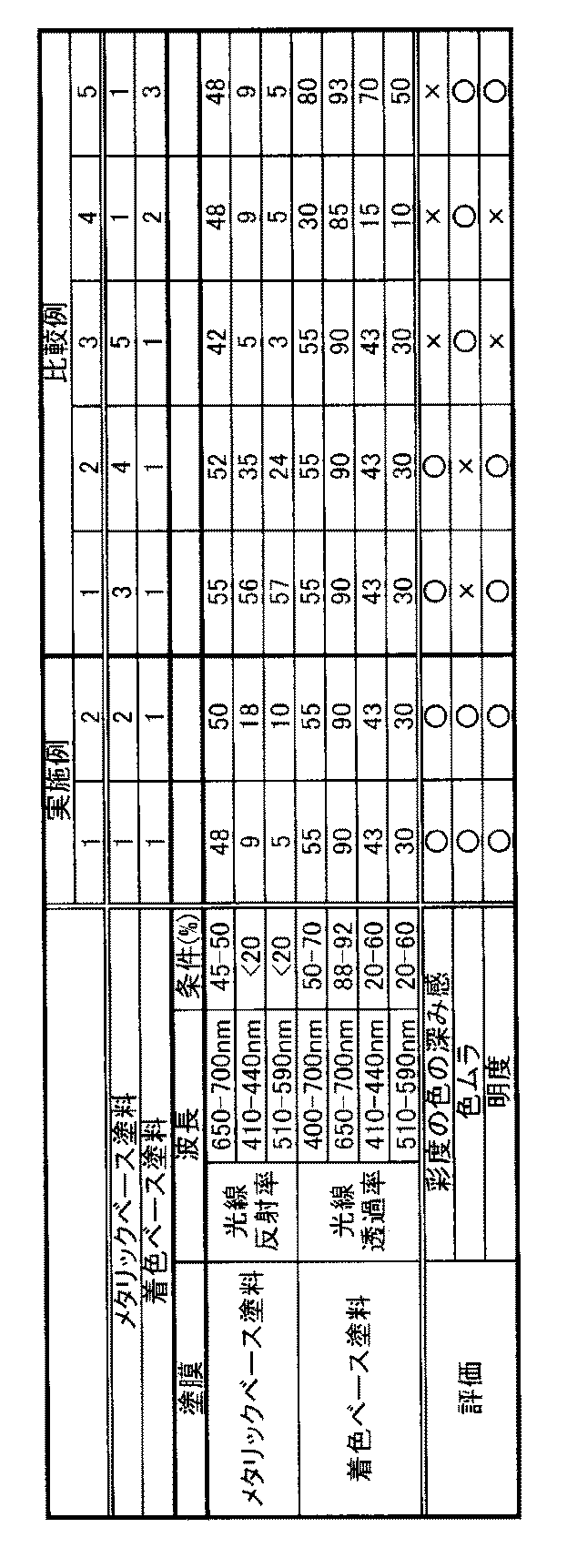
- Table 2 also shows the light reflectance of each wavelength region of the metallic base paint and the light transmittance of each wavelength region of the colored base paint.
- Unevenness of color The design property was evaluated by visually observing the unevenness of color of each of the obtained high-design multilayer coating films. The evaluation criteria are shown below. ⁇ : The entire coating film has a uniform color and no significant color unevenness is generated. ⁇ : The coating film has uneven color unevenness.
- Example 2 and Comparative Examples 1-5 In the same manner as in Example 1, the metallic base paint, the colored base paint, and the clear paint described in Table 2 were applied on the article to be coated having the intermediate coating film obtained in Production Example 9 and cured. A design multilayer coating film was obtained. The obtained multilayer coating film was evaluated for saturation, color depth, brightness, and color unevenness in the same manner as in Example 1, and the results are shown in Table 2.
- the light reflectance of the metallic base coating film and the light transmittance of the colored base coating film are within the scope of the present invention, and no defects are found in the saturation, color depth, brightness, and color unevenness.
- the metallic base paints 3 and 4 are used, the light reflectance of the metallic base coating film exceeds the upper limit of the range of the present invention, and color unevenness occurs.
- Comparative Example 3 uses the metallic base paint 5 and is within the scope of the present invention in many parts. However, only the wavelength range of 650 to 700 nm of the metallic base coating film has a low light reflectance of 42%, Depth and color depth and brightness are poor.
- the metallic base coating film is the metallic base coating material 1 that occupies the scope of the present invention.
- the colored base coating materials 2 and 3 are used, respectively. This is an example outside the scope of the invention.
- the saturation and color depth are not good.
- the result is that the lightness is also bad.
- the high-design multi-layer coating film forming method of the present invention provides a method of coating a so-called candy color coating film on a coated object having a large coating area such as an automobile without color unevenness, A coating can be applied.
- the metallic base coating film and the colored base coating film obtained in the high-design multi-layer coating film forming method of the present invention with the wavelength as the horizontal axis, the light reflectance of the single metallic base coating film and the light transmittance of the single colored base coating film Is a graph plotted with the ordinate as the vertical axis.
Landscapes
- Chemical & Material Sciences (AREA)
- Life Sciences & Earth Sciences (AREA)
- Engineering & Computer Science (AREA)
- Wood Science & Technology (AREA)
- Materials Engineering (AREA)
- Organic Chemistry (AREA)
- Application Of Or Painting With Fluid Materials (AREA)
- Paints Or Removers (AREA)
- Laminated Bodies (AREA)
Abstract
Description
本発明の高意匠複層塗膜形成方法における工程(1)は、上記被塗装物表面に対して、着色顔料および光輝材を含有している上記メタリックベース塗料を塗布してメタリックベース塗膜を形成するものである。このメタリックベース塗膜によって、被塗装物表面の色を隠蔽し、後述の着色ベース塗膜およびクリヤー塗膜と相まって、高い明度、彩度と透明感の意匠性を発現することができる。
上記被塗装物としては、例えば、鉄、鋼、アルミニウム、スズ、亜鉛等の金属やこれらを含む合金、および、これらの金属のメッキまたは蒸着した成型物、ならびに、ガラス、プラスチックや発泡体による成型物等を挙げることができ、具体的には、自動車車体や自動車部品が挙げられる。これら被塗装物は、脱脂処理や表面処理されていることが好ましい。さらに、上記被塗装物表面には、下塗り塗膜が形成されていてもよい。
本発明の高意匠複層塗膜形成方法に用いられるメタリックベース塗料は、硬化型塗料であることが好ましく、塗膜形成成分と、着色顔料および光輝材とを含んでいる。
本発明の高意匠複層塗膜形成方法における工程(2)は、上記工程(1)で得られたメタリックベース塗膜上に、着色顔料を含有し、光輝材を含有しない着色ベース塗料を塗布して着色ベース塗膜を形成するものである。この着色ベース塗膜によって、メタリックベース塗膜で得られた色を微調整し、さらに彩度と色の深み感を増すことができる。
本発明の高意匠複層塗膜形成方法に用いられる着色ベース塗料は、硬化型塗料であることが好ましく、塗膜形成成分および着色顔料を含んでいる。しかしながら、上記着色ベース塗料は、光輝材を含有していない。光輝材を含有していると下層のメタリックベース塗膜によって反射する光線が着色ベース塗膜によって弱められてしまい、かつ、色の深み感も低下してしまう。
本発明の高意匠複層塗膜形成方法における工程(3)は、さらに、上記着色ベース塗膜上に、上記クリヤー塗料を塗布してクリヤー塗膜を形成するものである。このクリヤー塗膜は、上記メタリックベース塗膜および着色ベース塗膜の色落ちを防止し、さらに、得られる複層塗膜に高い透明感と色の深み感を与えることができる。
本発明の高意匠複層塗膜形成方法に用いられるクリヤー塗料は、得られる塗膜の性能の観点から、硬化型塗料であることが好ましい。上記クリヤー塗料は、塗膜形成成分を含んでいる。上記塗膜形成成分としては、上記メタリックベース塗料で述べた樹脂と硬化剤との組合せを挙げることができるが、耐酸性の観点から、水酸基等の活性水素含有官能基を有するアクリル樹脂および/またはポリエステル樹脂と、必要に応じてブロック化されたポリイソシアネート樹脂の硬化剤との組合わせや、カルボン酸基含有アクリル樹脂および/またはポリエステル樹脂とエポキシ基含有アクリル樹脂との組み合わせであることが好ましい。
本発明の高意匠複層塗膜形成方法における工程(4)は、上記工程(1)、(2)および(3)で得られたメタリックベース塗膜、着色ベース塗膜およびクリヤー塗膜を加熱硬化して複層塗膜を形成するものである。
ステンレス容器に、日本ペイント社製アクリル樹脂(酸価20mgKOH/g、水酸基価75mgKOH/g、数平均分子量5,000、固形分60%)87.8部に、パリオゲンマルーンL3920(BASF社製ペリレンレッド、商品名)12.0部を加えて粒度が5μm以下となるように顔料分散し、次いでユーバン128(三井化学社製ブチル化メラミン樹脂、商品名、固形分60%)を47.2部、アルミペースト7640NS(東洋アルミニウム社製アルミニウム顔料、商品名)を7.0部秤量し、卓上攪拌機で攪拌して、メタリックベース塗料1を調製した。
これを塗装粘度に調整して用いた。
光線反射率の測定方法
リン酸亜鉛処理したダル鋼板に、パワーニクス110(日本ペイント社製カチオン電着塗料組成物)を、乾燥膜厚が20μmとなるように電着塗装し、160℃で30分間加熱硬化させて電着塗膜を得た。次に、得られた電着塗膜上に、オルガTO-H-880-3グレー(日本ペイント社製ポリエステル・メラミン樹脂系中塗り塗料)を、乾燥膜厚が30μmとなるようにスプレー塗装し、140℃で20分間加熱硬化させて中塗り塗膜を得た。この中塗り塗膜は分光式色差計SE-6000(日本電色工業社製)で測定したときのL*値が48であった。この塗板上に、メタリックベース塗料1を乾燥塗膜が10μmとなるようにスプレー塗装し、熱風乾燥炉にて140℃で20分間加熱硬化させて単独メタリックベース塗膜を得た。この単独メタリックベース塗膜をU-3310型分光光度計(日立社製)を用い、波長スキャンモードで300~780nmの区間をスキャンスピード300nm/min、サンプリング間隔0.5nmの条件で測定することによって、各波長領域での単独メタリックベース塗膜の光線反射率を求めた。
表1に記載の成分と配合量を用いて、製造例1と同様にメタリックベース塗料2~5を調製した。また、製造例1と同様にして、得られたメタリック塗料2~5の光線反射率を測定した。結果を表1に示す。
ステンレス容器に、日本ペイント社製アクリル樹脂(酸価20mgKOH/g、水酸基価75mgKOH/g、数平均分子量5,000、固形分60%)213.4部に、パリオゲンマルーンL3920(BASF社製ペリレンレッド、商品名)を3.0部加えて、粒度が5μm以下となるように顔料分散し、次いでユーバン128(三井化学社製ブチル化メラミン樹脂、商品名、固形分60%)を114.9部秤量し、卓上攪拌機で攪拌して、着色ベース塗料1を調製した。
これを塗装粘度に調整して用いた。
ポリプロピレン板上に、着色ベース塗料1を乾燥塗膜が12μmとなるようにスプレー塗装し、熱風乾燥炉にて140℃で20分間加熱硬化させた後、形成した塗膜をポリプロピレン板より剥離して単独着色ベース塗膜を得た。この単独着色ベース塗膜をU-3310型分光光度計(日立社製)を用い、波長スキャンモードで300~780nmの区間をスキャンスピード300nm/min、サンプリング間隔0.5nmの条件で測定した上で、各波長領域での単独着色ベース塗膜の光線透過率を求めた。
表1に記載の成分と配合量を用いて、製造例6と同様に着色ベース塗料2および3を調製した。また、製造例6と同様にして、得られた塗料の光線透過率を測定した。結果を表1に示す。

マックフローO-1800クリヤー(日本ペイント社製酸・エポキシ硬化系クリヤー塗料、商品名)を、塗装粘度に調整して用いた。
リン酸亜鉛処理したダル鋼板に、パワーニクス110(日本ペイント社製カチオン電着塗料組成物)を、乾燥膜厚が20μmとなるように電着塗装し、160℃で30分間加熱硬化し電着塗膜を得た。次に、得られた電着塗膜上に、オルガTO-H-880-3グレー(日本ペイント社製ポリエステル・メラミン樹脂系中塗り塗料)を、乾燥膜厚が30μmとなるようにスプレー塗装し、140℃で20分間加熱硬化させて、中塗り塗膜が形成された被塗装物を作成した。
製造例9で得られた中塗り塗膜を有する被塗装物上に、製造例2で得られたメタリックベース塗料1を、乾燥膜厚が10μmとなるようにメタベルにより塗装した。2分間のセッティングの後、着色ベース塗料1を、乾燥膜厚が12μmとなるようにメタベルにより塗装した。4分間のセッティングの後、クリヤー塗料を、乾燥塗膜が35μmとなるようにμμ(マイクロマイクロ)ベルにより塗装した。さらに10分間のセッティングの後、140℃で20分間焼付硬化させて高意匠複層塗膜を得た。
得られた各高意匠複層塗膜の彩度と色の深み感を目視にて観察することにより意匠性を評価した。評価基準を以下に示した。
○:彩度が高く、色の深み感に優れている
×:彩度が低い、もしくは色の深み感がない
得られた各高意匠複層塗膜の明度を分光測色計MA-68II(X-Rite社製)で測定し、15°L*値で評価した。評価基準を以下に示した。
○:45以上
×:45未満
得られた各高意匠複層塗膜の色ムラを目視にて観察することにより意匠性を評価した。評価基準を以下に示した。
○:塗膜全体が均一な色を有し、顕著な色ムラの発生がない
×:塗膜に色ムラが顕著に発生している
実施例1と同様に、製造例9で得られた中塗り塗膜を有する被塗装物上に、表2に記載のメタリックベース塗料、着色ベース塗料およびクリヤー塗料を塗装しかつ硬化して、高意匠複層塗膜を得た。得られた複層塗膜について、実施例1と同様に彩度と色の深み感、明度および色ムラを評価し、表2に結果を記載した。
Claims (3)
- 被塗装物表面に対して、着色顔料および光輝材を含有するメタリックベース塗料を塗布してメタリックベース塗膜を得る工程(1)、前記工程(1)で得られたメタリックベース塗膜上に着色顔料を含有し、光輝材を含有しない着色ベース塗料を塗布して着色ベース塗膜を形成する工程(2)、前記工程(2)で得られた着色ベース塗膜上にクリヤー塗料を塗布してクリヤー塗膜を形成する工程(3)、および、前記工程(1)、(2)および(3)で得られたメタリックベース塗膜、着色ベース塗膜およびクリヤー塗膜を、加熱硬化して複層塗膜を形成する工程(4)を含む複層塗膜形成方法であって、
前記工程(1)で得られるメタリックベース塗膜を単独膜として加熱硬化して得られる単独メタリックベース塗膜の光線反射率が、波長650~700nmにおいて45~50%、かつ、波長410~440nmおよび510~590nmにおいて20%以下であり、および
前記工程(2)で得られる着色ベース塗膜を単独膜として加熱硬化して得られる単独着色ベース塗膜の光線透過率が、波長400~700nmにおいて50~70%、波長650~700nmにおいて88~92%、かつ、波長410~440nmおよび510~590nmにおいて20~60%である、高意匠複層塗膜形成方法。 - 前記メタリックベース塗料に含まれる着色顔料と、前記着色ベース塗料に含まれる着色顔料が同一の着色顔料である請求項1に記載の高意匠複層塗膜形成方法。
- 前記着色顔料がペリレン系顔料である請求項2に記載の高意匠複層塗膜形成方法。
Priority Applications (5)
| Application Number | Priority Date | Filing Date | Title |
|---|---|---|---|
| RU2015111265/05A RU2569356C1 (ru) | 2012-08-28 | 2013-04-18 | Способ формирования превосходного многослойного пленочного покрытия |
| CN201380044979.6A CN104736259B (zh) | 2012-08-28 | 2013-04-18 | 形成优异的多层涂膜的方法 |
| MX2015002687A MX338095B (es) | 2012-08-28 | 2013-04-18 | Metodo para formar una excelente pelicula de recubrimiento de capas multiples. |
| US14/420,818 US9737906B2 (en) | 2012-08-28 | 2013-04-18 | Method for forming excellent multi-layer coating film |
| DE112013004277.0T DE112013004277B4 (de) | 2012-08-28 | 2013-04-18 | Verfahren zur Bildung eines vielschichtigen Beschichtungsfilmes |
Applications Claiming Priority (2)
| Application Number | Priority Date | Filing Date | Title |
|---|---|---|---|
| JP2012-187709 | 2012-08-28 | ||
| JP2012187709A JP5765741B2 (ja) | 2012-08-28 | 2012-08-28 | 高意匠複層塗膜形成方法 |
Publications (1)
| Publication Number | Publication Date |
|---|---|
| WO2014034175A1 true WO2014034175A1 (ja) | 2014-03-06 |
Family
ID=50183003
Family Applications (1)
| Application Number | Title | Priority Date | Filing Date |
|---|---|---|---|
| PCT/JP2013/061526 Ceased WO2014034175A1 (ja) | 2012-08-28 | 2013-04-18 | 高意匠複層塗膜形成方法 |
Country Status (7)
| Country | Link |
|---|---|
| US (1) | US9737906B2 (ja) |
| JP (1) | JP5765741B2 (ja) |
| CN (1) | CN104736259B (ja) |
| DE (1) | DE112013004277B4 (ja) |
| MX (1) | MX338095B (ja) |
| RU (1) | RU2569356C1 (ja) |
| WO (1) | WO2014034175A1 (ja) |
Cited By (1)
| Publication number | Priority date | Publication date | Assignee | Title |
|---|---|---|---|---|
| WO2016158692A1 (ja) * | 2015-03-27 | 2016-10-06 | 日本ペイント・オートモーティブコーティングス株式会社 | 複層塗膜の形成方法 |
Families Citing this family (29)
| Publication number | Priority date | Publication date | Assignee | Title |
|---|---|---|---|---|
| JP5867437B2 (ja) * | 2013-03-28 | 2016-02-24 | マツダ株式会社 | 車両の内板部塗膜 |
| GB2538882B (en) * | 2013-12-27 | 2021-05-12 | Nippon Paint Automotive Coatings Co Ltd | Method for forming multilayer coating film |
| DE112014006889B4 (de) * | 2014-08-27 | 2023-12-07 | Ykk Corporation | Reißverschlusstragband und damit versehener Reißverschluss |
| JP6360809B2 (ja) * | 2015-03-31 | 2018-07-18 | 関西ペイント株式会社 | 複層塗膜形成方法 |
| AU2016334203A1 (en) | 2015-10-05 | 2018-03-15 | M. Technique Co., Ltd. | Metal oxide particles and method for producing same |
| CN105419543B (zh) * | 2015-12-30 | 2017-09-29 | 江苏日出化工有限公司 | 多彩反射隔热涂层制作方法 |
| WO2017134910A1 (ja) | 2016-02-02 | 2017-08-10 | エム・テクニック株式会社 | 色特性を制御された酸化亜鉛粒子、及びその製造方法並びにその酸化亜鉛粒子を含む塗布用組成物 |
| CN109475899A (zh) | 2016-05-19 | 2019-03-15 | 威士伯有限公司 | 糖果色漆料和修补方法 |
| US10906097B2 (en) | 2016-06-02 | 2021-02-02 | M. Technique Co., Ltd. | Ultraviolet and/or near-infrared blocking agent composition for transparent material |
| US10899118B2 (en) | 2016-09-30 | 2021-01-26 | Mazda Motor Corporation | Multilayer coating film and coated article |
| RU2702593C1 (ru) | 2016-09-30 | 2019-10-08 | Мазда Мотор Корпорейшн | Многослойная покровная пленка и изделие с покрытием |
| JP6811449B2 (ja) * | 2017-01-27 | 2021-01-13 | 東洋インキScホールディングス株式会社 | 色彩変化装置及びそれを用いた色彩変化方法 |
| JP6875138B2 (ja) | 2017-02-01 | 2021-05-19 | 日本ペイント・オートモーティブコーティングス株式会社 | 積層塗膜、塗装物及び積層塗膜の形成方法 |
| CN110312683B (zh) | 2017-02-14 | 2022-10-11 | M技术株式会社 | 硅掺杂金属氧化物粒子、及含有硅掺杂金属氧化物粒子的紫外线吸收用组合物 |
| JP7090399B2 (ja) | 2017-02-21 | 2022-06-24 | 日本ペイント・オートモーティブコーティングス株式会社 | 水性塗料組成物および複層塗膜 |
| JP7341890B2 (ja) | 2017-11-01 | 2023-09-11 | 関西ペイント株式会社 | 複層塗膜形成方法 |
| CN111615431B (zh) * | 2018-01-15 | 2022-05-06 | 关西涂料株式会社 | 多层涂膜形成方法 |
| FR3083177B1 (fr) * | 2018-06-27 | 2021-04-02 | Valeo Systemes Thermiques | Panneau radiant destine a etre installe a l’interieur d’un habitacle de vehicule |
| CN109647682A (zh) * | 2019-01-28 | 2019-04-19 | 温岭德利众机械制造有限公司 | 一种防尘罩用束环表面处理工艺 |
| EP3943200A4 (en) * | 2019-03-22 | 2022-12-21 | Kansai Paint Co., Ltd | MULTILAYER COATED FILM AND METHOD FOR FORMING MULTILAYER COATED FILM |
| CN110280468A (zh) * | 2019-07-25 | 2019-09-27 | 大亚车轮制造有限公司 | 糖果色涂装车轮的生产方法 |
| JP6997149B2 (ja) * | 2019-09-13 | 2022-01-17 | ダイハツ工業株式会社 | 自動車車体の塗装方法 |
| US11819878B2 (en) | 2020-02-04 | 2023-11-21 | Kansai Paint Co., Ltd. | Method for forming multilayer coating film |
| JP7587945B2 (ja) * | 2020-09-10 | 2024-11-21 | 日本ペイント・オートモーティブコーティングス株式会社 | 赤色系複層塗膜および車両 |
| JP7539276B2 (ja) * | 2020-09-14 | 2024-08-23 | 日本ペイント・オートモーティブコーティングス株式会社 | 複層塗膜および複層塗膜の形成方法 |
| EP4230308A4 (en) * | 2020-10-13 | 2024-11-13 | Kansai Paint Co., Ltd | Multi-layer coating film forming method |
| JP7558881B2 (ja) * | 2021-04-19 | 2024-10-01 | 日本ペイント・オートモーティブコーティングス株式会社 | 赤色系複層塗膜および赤色系複層塗膜の形成方法 |
| JP2024079351A (ja) | 2022-11-30 | 2024-06-11 | マツダ株式会社 | 塗装物品およびその製造方法 |
| JP7663671B1 (ja) * | 2023-12-28 | 2025-04-16 | 日本ペイント・オートモーティブコーティングス株式会社 | 複層塗膜 |
Citations (9)
| Publication number | Priority date | Publication date | Assignee | Title |
|---|---|---|---|---|
| JPH06126239A (ja) * | 1992-10-19 | 1994-05-10 | Kanto Auto Works Ltd | 塗膜及びその形成方法 |
| JP2000084473A (ja) * | 1998-09-16 | 2000-03-28 | Nippon Paint Co Ltd | 積層塗膜の形成方法及び補修方法 |
| JP2000279877A (ja) * | 1999-03-31 | 2000-10-10 | Toyota Motor Corp | 複層メタリック塗膜形成法 |
| JP2002086057A (ja) * | 2000-09-18 | 2002-03-26 | Daihatsu Motor Co Ltd | 複層メタリック塗膜形成方法 |
| JP2002273332A (ja) * | 2001-03-21 | 2002-09-24 | Nippon Paint Co Ltd | 光輝性塗膜形成方法および塗装物 |
| JP2005137952A (ja) * | 2003-11-04 | 2005-06-02 | Nippon Yushi Basf Coatings Kk | 積層塗膜の形成方法、積層塗膜および塗装物 |
| JP2005305424A (ja) * | 2004-03-25 | 2005-11-04 | Kansai Paint Co Ltd | 複層塗膜形成方法 |
| JP2007167720A (ja) * | 2005-12-20 | 2007-07-05 | Honda Motor Co Ltd | 複層塗膜の形成方法 |
| JP2008302286A (ja) * | 2007-06-06 | 2008-12-18 | Kansai Paint Co Ltd | 塗膜形成方法 |
Family Cites Families (14)
| Publication number | Priority date | Publication date | Assignee | Title |
|---|---|---|---|---|
| CH635610A5 (de) | 1977-02-18 | 1983-04-15 | Hoechst Ag | Waermehaertbare beschichtungsmischung. |
| SU1037845A3 (ru) | 1977-02-18 | 1983-08-23 | Хехст Аг (Фирма) | Способ получени термоотверждаемых полимерных покрытий |
| US5407702A (en) | 1993-05-05 | 1995-04-18 | Aluminum Company Of America | Method for coating a metal strip |
| USH1667H (en) | 1993-09-02 | 1997-07-01 | The Dow Chemical Company | Solid powder coating composition |
| JP2609513B2 (ja) | 1994-12-14 | 1997-05-14 | 本田技研工業株式会社 | 複層塗膜形成法 |
| DE19606716C1 (de) * | 1996-02-23 | 1997-08-14 | Herberts Gmbh | Verfahren zur Mehrschichtlackierung |
| ZA973692B (en) | 1996-05-17 | 1997-11-25 | Dexter Corp | Extrusion coating compositions and method. |
| JP4455731B2 (ja) | 2000-05-10 | 2010-04-21 | 日本ペイント株式会社 | 高意匠性多層塗膜形成方法 |
| KR100708516B1 (ko) * | 2002-02-13 | 2007-04-16 | 피피지 인더스트리즈 오하이오 인코포레이티드 | 기판상에 다층 복합 코팅을 형성하기 위한 코팅 라인 및방법 |
| JP2003268567A (ja) | 2002-03-19 | 2003-09-25 | Hitachi Cable Ltd | 導電材被覆耐食性金属材料 |
| EP1522352B1 (en) * | 2003-10-10 | 2006-06-21 | Rohm And Haas Company | Primerless coating of heat-sensitive substrates and coating line |
| US20050214483A1 (en) | 2004-03-25 | 2005-09-29 | Tsukasa Fujieda | Method for forming multilayered coating film |
| CA2619997C (en) | 2005-08-24 | 2013-08-13 | A.M. Ramp & Co. Gmbh | Process for producing articles having an electrically conductive coating |
| JP2007075791A (ja) | 2005-09-16 | 2007-03-29 | Nippon Paint Co Ltd | 積層塗膜形成方法および塗装物 |
-
2012
- 2012-08-28 JP JP2012187709A patent/JP5765741B2/ja active Active
-
2013
- 2013-04-18 RU RU2015111265/05A patent/RU2569356C1/ru active
- 2013-04-18 WO PCT/JP2013/061526 patent/WO2014034175A1/ja not_active Ceased
- 2013-04-18 US US14/420,818 patent/US9737906B2/en active Active
- 2013-04-18 CN CN201380044979.6A patent/CN104736259B/zh active Active
- 2013-04-18 DE DE112013004277.0T patent/DE112013004277B4/de active Active
- 2013-04-18 MX MX2015002687A patent/MX338095B/es active IP Right Grant
Patent Citations (9)
| Publication number | Priority date | Publication date | Assignee | Title |
|---|---|---|---|---|
| JPH06126239A (ja) * | 1992-10-19 | 1994-05-10 | Kanto Auto Works Ltd | 塗膜及びその形成方法 |
| JP2000084473A (ja) * | 1998-09-16 | 2000-03-28 | Nippon Paint Co Ltd | 積層塗膜の形成方法及び補修方法 |
| JP2000279877A (ja) * | 1999-03-31 | 2000-10-10 | Toyota Motor Corp | 複層メタリック塗膜形成法 |
| JP2002086057A (ja) * | 2000-09-18 | 2002-03-26 | Daihatsu Motor Co Ltd | 複層メタリック塗膜形成方法 |
| JP2002273332A (ja) * | 2001-03-21 | 2002-09-24 | Nippon Paint Co Ltd | 光輝性塗膜形成方法および塗装物 |
| JP2005137952A (ja) * | 2003-11-04 | 2005-06-02 | Nippon Yushi Basf Coatings Kk | 積層塗膜の形成方法、積層塗膜および塗装物 |
| JP2005305424A (ja) * | 2004-03-25 | 2005-11-04 | Kansai Paint Co Ltd | 複層塗膜形成方法 |
| JP2007167720A (ja) * | 2005-12-20 | 2007-07-05 | Honda Motor Co Ltd | 複層塗膜の形成方法 |
| JP2008302286A (ja) * | 2007-06-06 | 2008-12-18 | Kansai Paint Co Ltd | 塗膜形成方法 |
Cited By (4)
| Publication number | Priority date | Publication date | Assignee | Title |
|---|---|---|---|---|
| WO2016158692A1 (ja) * | 2015-03-27 | 2016-10-06 | 日本ペイント・オートモーティブコーティングス株式会社 | 複層塗膜の形成方法 |
| JP2016185527A (ja) * | 2015-03-27 | 2016-10-27 | 日本ペイント・オートモーティブコーティングス株式会社 | 複層塗膜の形成方法 |
| CN107969118A (zh) * | 2015-03-27 | 2018-04-27 | 日涂汽车涂料有限公司 | 多层涂膜的形成方法 |
| CN107969118B (zh) * | 2015-03-27 | 2021-02-26 | 日涂汽车涂料有限公司 | 多层涂膜的形成方法 |
Also Published As
| Publication number | Publication date |
|---|---|
| CN104736259B (zh) | 2016-05-18 |
| CN104736259A (zh) | 2015-06-24 |
| JP2014042891A (ja) | 2014-03-13 |
| JP5765741B2 (ja) | 2015-08-19 |
| MX2015002687A (es) | 2015-05-12 |
| RU2569356C1 (ru) | 2015-11-20 |
| MX338095B (es) | 2016-04-01 |
| US9737906B2 (en) | 2017-08-22 |
| US20150217332A1 (en) | 2015-08-06 |
| DE112013004277T5 (de) | 2015-05-13 |
| DE112013004277B4 (de) | 2023-06-07 |
Similar Documents
| Publication | Publication Date | Title |
|---|---|---|
| JP5765741B2 (ja) | 高意匠複層塗膜形成方法 | |
| JP6658769B2 (ja) | 積層塗膜及び塗装物 | |
| US10239091B2 (en) | Method for forming multilayer coating film | |
| US10441970B2 (en) | Method for forming multilayer coated film | |
| JP2005305424A (ja) | 複層塗膜形成方法 | |
| JP5456496B2 (ja) | 高彩度複層塗膜の形成方法及び塗装物 | |
| JP4958090B2 (ja) | 複層塗膜形成方法及び塗装物品 | |
| TWI793326B (zh) | 複層塗膜形成方法 | |
| JP6343518B2 (ja) | パール調の遮熱複層塗膜の形成方法およびそれから得られる遮熱複層塗膜 | |
| JP4942459B2 (ja) | 積層塗膜の形成方法 | |
| JP5939604B2 (ja) | 塗料組成物及び塗膜形成方法 | |
| JP4290837B2 (ja) | メタリック塗膜の形成方法 | |
| JP2012170909A (ja) | 複層塗膜形成方法 | |
| JP2001314807A (ja) | 高意匠性多層塗膜形成方法 | |
| JP2001009364A (ja) | メタリック塗膜の補修方法 | |
| JP4824958B2 (ja) | メタリック塗料組成物、塗膜形成方法、塗膜構造及び塗装物品 | |
| JP2012017364A (ja) | メタリック塗料組成物及び塗膜形成方法 | |
| JP4712630B2 (ja) | 多層塗膜の補修方法およびそれから得られた被塗物 | |
| JPH10202186A (ja) | 光輝性塗膜の欠陥を補修する方法 | |
| JP2001038286A (ja) | 塗膜形成方法 | |
| JP2011219566A (ja) | メタリック塗料組成物及び塗膜形成方法 | |
| JP2022165253A (ja) | 赤色系複層塗膜および赤色系複層塗膜の形成方法 | |
| JP2001314812A (ja) | 多色性多層塗膜形成方法 | |
| JP2006130480A (ja) | 塗膜の補修方法及び複層塗膜 |
Legal Events
| Date | Code | Title | Description |
|---|---|---|---|
| 121 | Ep: the epo has been informed by wipo that ep was designated in this application |
Ref document number: 13832978 Country of ref document: EP Kind code of ref document: A1 |
|
| WWE | Wipo information: entry into national phase |
Ref document number: 14420818 Country of ref document: US |
|
| WWE | Wipo information: entry into national phase |
Ref document number: MX/A/2015/002687 Country of ref document: MX |
|
| WWE | Wipo information: entry into national phase |
Ref document number: 1120130042770 Country of ref document: DE Ref document number: 112013004277 Country of ref document: DE |
|
| ENP | Entry into the national phase |
Ref document number: 2015111265 Country of ref document: RU Kind code of ref document: A |
|
| 122 | Ep: pct application non-entry in european phase |
Ref document number: 13832978 Country of ref document: EP Kind code of ref document: A1 |