WO2013187489A1 - 1-クロロ-3,3,3-トリフルオロ-1-プロペン及び1,3,3,3-テトラフルオロプロペンの製造方法 - Google Patents
1-クロロ-3,3,3-トリフルオロ-1-プロペン及び1,3,3,3-テトラフルオロプロペンの製造方法 Download PDFInfo
- Publication number
- WO2013187489A1 WO2013187489A1 PCT/JP2013/066395 JP2013066395W WO2013187489A1 WO 2013187489 A1 WO2013187489 A1 WO 2013187489A1 JP 2013066395 W JP2013066395 W JP 2013066395W WO 2013187489 A1 WO2013187489 A1 WO 2013187489A1
- Authority
- WO
- WIPO (PCT)
- Prior art keywords
- reaction
- chloro
- isomerization
- raw material
- cis
- Prior art date
- Legal status (The legal status is an assumption and is not a legal conclusion. Google has not performed a legal analysis and makes no representation as to the accuracy of the status listed.)
- Ceased
Links
Images




Classifications
-
- C—CHEMISTRY; METALLURGY
- C07—ORGANIC CHEMISTRY
- C07C—ACYCLIC OR CARBOCYCLIC COMPOUNDS
- C07C17/00—Preparation of halogenated hydrocarbons
- C07C17/35—Preparation of halogenated hydrocarbons by reactions not affecting the number of carbon or of halogen atoms in the reaction
- C07C17/358—Preparation of halogenated hydrocarbons by reactions not affecting the number of carbon or of halogen atoms in the reaction by isomerisation
-
- C—CHEMISTRY; METALLURGY
- C07—ORGANIC CHEMISTRY
- C07C—ACYCLIC OR CARBOCYCLIC COMPOUNDS
- C07C17/00—Preparation of halogenated hydrocarbons
- C07C17/38—Separation; Purification; Stabilisation; Use of additives
-
- C—CHEMISTRY; METALLURGY
- C07—ORGANIC CHEMISTRY
- C07C—ACYCLIC OR CARBOCYCLIC COMPOUNDS
- C07C17/00—Preparation of halogenated hydrocarbons
- C07C17/38—Separation; Purification; Stabilisation; Use of additives
- C07C17/383—Separation; Purification; Stabilisation; Use of additives by distillation
-
- C—CHEMISTRY; METALLURGY
- C11—ANIMAL OR VEGETABLE OILS, FATS, FATTY SUBSTANCES OR WAXES; FATTY ACIDS THEREFROM; DETERGENTS; CANDLES
- C11D—DETERGENT COMPOSITIONS; USE OF SINGLE SUBSTANCES AS DETERGENTS; SOAP OR SOAP-MAKING; RESIN SOAPS; RECOVERY OF GLYCEROL
- C11D7/00—Compositions of detergents based essentially on non-surface-active compounds
- C11D7/50—Solvents
- C11D7/5004—Organic solvents
- C11D7/5018—Halogenated solvents
-
- C—CHEMISTRY; METALLURGY
- C09—DYES; PAINTS; POLISHES; NATURAL RESINS; ADHESIVES; COMPOSITIONS NOT OTHERWISE PROVIDED FOR; APPLICATIONS OF MATERIALS NOT OTHERWISE PROVIDED FOR
- C09K—MATERIALS FOR MISCELLANEOUS APPLICATIONS, NOT PROVIDED FOR ELSEWHERE
- C09K3/00—Materials not provided for elsewhere
- C09K3/30—Materials not provided for elsewhere for aerosols
-
- C—CHEMISTRY; METALLURGY
- C09—DYES; PAINTS; POLISHES; NATURAL RESINS; ADHESIVES; COMPOSITIONS NOT OTHERWISE PROVIDED FOR; APPLICATIONS OF MATERIALS NOT OTHERWISE PROVIDED FOR
- C09K—MATERIALS FOR MISCELLANEOUS APPLICATIONS, NOT PROVIDED FOR ELSEWHERE
- C09K5/00—Heat-transfer, heat-exchange or heat-storage materials, e.g. refrigerants; Materials for the production of heat or cold by chemical reactions other than by combustion
- C09K5/02—Materials undergoing a change of physical state when used
- C09K5/04—Materials undergoing a change of physical state when used the change of state being from liquid to vapour or vice versa
- C09K5/041—Materials undergoing a change of physical state when used the change of state being from liquid to vapour or vice versa for compression-type refrigeration systems
- C09K5/044—Materials undergoing a change of physical state when used the change of state being from liquid to vapour or vice versa for compression-type refrigeration systems comprising halogenated compounds
-
- C—CHEMISTRY; METALLURGY
- C09—DYES; PAINTS; POLISHES; NATURAL RESINS; ADHESIVES; COMPOSITIONS NOT OTHERWISE PROVIDED FOR; APPLICATIONS OF MATERIALS NOT OTHERWISE PROVIDED FOR
- C09K—MATERIALS FOR MISCELLANEOUS APPLICATIONS, NOT PROVIDED FOR ELSEWHERE
- C09K5/00—Heat-transfer, heat-exchange or heat-storage materials, e.g. refrigerants; Materials for the production of heat or cold by chemical reactions other than by combustion
- C09K5/02—Materials undergoing a change of physical state when used
- C09K5/04—Materials undergoing a change of physical state when used the change of state being from liquid to vapour or vice versa
- C09K5/041—Materials undergoing a change of physical state when used the change of state being from liquid to vapour or vice versa for compression-type refrigeration systems
- C09K5/044—Materials undergoing a change of physical state when used the change of state being from liquid to vapour or vice versa for compression-type refrigeration systems comprising halogenated compounds
- C09K5/045—Materials undergoing a change of physical state when used the change of state being from liquid to vapour or vice versa for compression-type refrigeration systems comprising halogenated compounds containing only fluorine as halogen
-
- C—CHEMISTRY; METALLURGY
- C11—ANIMAL OR VEGETABLE OILS, FATS, FATTY SUBSTANCES OR WAXES; FATTY ACIDS THEREFROM; DETERGENTS; CANDLES
- C11D—DETERGENT COMPOSITIONS; USE OF SINGLE SUBSTANCES AS DETERGENTS; SOAP OR SOAP-MAKING; RESIN SOAPS; RECOVERY OF GLYCEROL
- C11D7/00—Compositions of detergents based essentially on non-surface-active compounds
- C11D7/22—Organic compounds
- C11D7/28—Organic compounds containing halogen
- C11D7/30—Halogenated hydrocarbons
Definitions
- halogenated carbon examples include alkanes such as methane, ethane, propane, butane, pentane or hexane, alkenes such as ethene, propene, butene, pentene or hexene, or alkynes such as ethyne, propyne, butyne, pentyne or hexyne.
- alkanes such as methane, ethane, propane, butane, pentane or hexane
- alkenes such as ethene, propene, butene, pentene or hexene
- alkynes such as ethyne, propyne, butyne, pentyne or hexyne.
- a halogenated carbon in which some or all of the hydrogen atoms are substituted with fluorine, chlorine, bromine or iodine atoms, and the halogenated carbon
- a method for bringing a radical into contact with a raw material containing a raw material compound for example, in the case of a gas phase reaction, light or heat is applied to the radical generator, and the radical generator is activated in advance and then introduced into the reaction tube. And a method of introducing a mixture of a radical generator and a raw material containing a raw material compound into a reaction tube and activating it with light or heat.
- a method of simultaneously supplying a mixture of a radical generator and a raw material containing a raw material compound to the reaction tube is preferable.
- -1-chloro-3,3,3-trifluoro-1-propene (1233Z) Trans as raw material for cis-1-chloro-3,3,3-trifluoro-1-propene (1233Z)
- the -1-chloro-3,3,3-trifluoro-1-propene (1233E) is a pure substance of the trans isomer (1233E) or a mixture containing the cis isomer (1233Z) and the trans isomer (1233E). Also good.
- a trans isomer (1233E) produced by a known method can be used. For example, 1,1,1,3,3-pentachloropropane (240fa) is reacted with hydrogen fluoride in a gas phase. May be a mixture of the trans isomer (1233E) and cis isomer (1233Z) obtained by the above, or a composition obtained by subjecting this mixture to a known purification treatment.
- the content ratio of 1233Z in the raw material composition is preferably as small as possible, and the ratio of 1233E present in the raw material composition is 50% by weight or more, preferably 70% by weight or more, more preferably 90% by weight or more. It is.
- the mass ratio of 1233Z / 1233E in the raw material is preferably closer to zero. Specifically, the mass ratio of 1233Z / 1233E in the raw material is preferably 0 to 0.2, and more preferably 0 to 0.1. In addition, since the raw material when 1233Z is used as the target compound is 1233E, it is impossible that 1233E is zero.
- the product containing 1233Z obtained by the isomerization of the present invention is collected, and 1233E and 1233Z are isolated by distillation or the like, and then unreacted 1233E is used as a raw material again.
- Reasonable and preferable from the viewpoint of use By reusing unreacted 1233E as a raw material, 1233E can be efficiently converted to 1233Z.
- the radical generator may be activated in advance by applying light or heat to the radical generator and then introduced into the reaction tube.
- a mixture of a radical generator and a raw material composition containing 1233E may be introduced into a reaction tube and activated by light or heat.
- a method of simultaneously supplying a mixture of a radical generator and a raw material composition containing 1233E to the reaction tube is preferable.
- trans-1-chloro-3,3,3-trifluoropropene (1233E) By isomerization reaction in the presence of a radical, at least a part of trans-1-chloro-3,3,3-trifluoropropene (1233E) is converted to cis-1-chloro-3,3,3-trifluoropropene (1233Z). And the ratio of cis-1-chloro-3,3,3-trifluoropropene (1233Z) to trans-1-chloro-3,3,3-trifluoropropene (1233E) can be increased. .
- radical generator Since the generation of radicals is chained, it is preferable to add a small amount of radical generator.
- the addition of an excessive radical generator not only wastes auxiliary materials, but also places a burden on the separation process between the radical generator and 1233E after the reaction. Even in the case of air that is relatively easy to separate, as the amount of air added increases, the ability of the condensation process or distillation process decreases. Further, when chlorine is added excessively as a radical generator, a compound in which chlorine is added to a double bond is by-produced. In particular, since the compound in which chlorine is added to 1233E is HCFC which is a global warming and ozone depleting substance, it is preferable that the amount of by-product of the chlorine adduct is small.
- the conversion rate from 1233E to 1233Z was substantially reduced even if the addition amount of chlorine was reduced to the measurement lower limit of the chlorine flow meter in the experiment. No effect was observed. Therefore, it has been found that the amount of radical generator added may be extremely small (the experimental results will be described later).
- the optimal amount of radical generator added depends on the type of radical generator and the structure of the reaction tube. For example, when air, oxygen, and chlorine are compared, the height of activity is in the order of chlorine> oxygen> air.
- the amount of radical generator added depends on the type of radical generator and the shape of the reaction tube, but is usually preferably 0.0001 mol% or more and 10 mol% or less with respect to 1233E as a raw material. More preferably, it is 0.0001 mol% or more and 0.005 mol% or less. In a reaction tube excellent in contact between radicals and 1233E, 1233E and radicals can sufficiently collide. Therefore, the amount of radical generator added is preferably 0.0001 mol% or more and 0.005 mol% or less.
- reaction tubes excellent in contact between radicals and 1233E include those equipped with a static mixer, a Raschig ring, a pole ring, a wire mesh, or the like that is inert to the reaction.
- a static mixer a Raschig ring, a pole ring, a wire mesh, or the like that is inert to the reaction.
- a reaction tube having a large length / inner diameter ratio can efficiently generate radicals and 1233E even in an empty column having no packing as described above. It is particularly preferable because it is excellent in heat transfer.
- the material of the reaction tube or the like is preferably carbon, ceramics, stainless steel, nickel, or a nickel alloy (trade name, Hastelloy (TM), Inconel (TM), Monel (TM)) or the like.
- the inner diameter of the reaction tube is preferably 8 mm or more and 150 mm or less, and the length is preferably 1 m or more and 200 m or less, the inner diameter is 10 mm or more and 60 mm or less, and the length is 2 m or more and 50 m.
- the following empty reaction tubes are particularly preferred:
- the shape of the reaction tube is not particularly limited, and may be a straight tube or a coil shape, and may be folded using a joint or the like.
- the inner diameter and the length / inner diameter ratio are not particularly limited, and the desired isomerization can be achieved.
- a static mixer may be used if desired, and the reaction tube may be filled with a filler such as a Raschig ring or a pole ring.
- a filler such as a Raschig ring or a pole ring.
- alumina or the like in order to eliminate the catalytic activity, for example, a process of firing at 1300 ° C. or higher to make an inert is recommended.
- the heating method is not particularly limited, but it may be directly heated with an electric heater or a burner, or indirectly heated with a molten salt or sand.
- a solid catalyst is not essential, but in order to rapidly proceed the isomerization reaction in the presence of a radical, A solid catalyst may be used.
- a solid catalyst a metal, a metal oxide, a metal halide, activated carbon, or the like may be used, and a composite of these (eg, metal-supported activated carbon) can also be used.
- 1233E is likely to cause coking on the catalyst surface or may generate oil. It is preferable to use an inactivated solid catalyst.
- a solid catalyst may be used as described above, but isomerization in the presence of a radical is also possible.
- an empty tower means that objects, such as a catalyst and a packing, do not exist in the reactor or the internal space of a reaction tower.
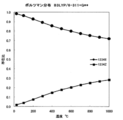
- the 1233E / 1233Z ratio increases as the temperature decreases, as previously shown in the Boltzmann distribution calculation example (see FIG. 1).
- the reaction temperature is usually 150 ° C. or higher and 800 ° C. or lower.
- 1233Z is used as the target compound, it is preferably 300 ° C. or higher and 700 ° C. or lower, more preferably 360 ° C. or higher and 560 ° C. or lower. If the reaction temperature is lower than 150 ° C., radicals are not sufficiently generated, and the reaction rate may be very slow.
- a temperature higher than 800 ° C. is not preferable because the raw material or product becomes an oily high-boiling product or coking.
- the contact time in the present invention is not particularly limited as long as isomerization proceeds sufficiently, but is usually 0.01 seconds or more and 50 seconds or less, preferably 0.05 seconds or more and 20 seconds or less. If the contact time is shorter than these, only the conversion rate greatly deviating from the thermodynamic equilibrium composition may be exhibited. On the contrary, when larger than these, even if the conversion rate close
- the 1233EZ mixture obtained by isomerization can be isolated into 1233E and 1233Z by ordinary distillation operation after removing radical generators and acid content by washing, drying with zeolite and the like. Unreacted 1233E obtained by isolation can also be reused as a raw material for the isomerization reaction to 1233Z.
- the radical isomerization step in the method for producing cis-1-chloro-3,3,3-trifluoropropene (1233Z) of the present invention may be combined with various steps such as distillation and purification, and is particularly limited. is not.
- cis-1-chloro-3,3,3-trifluoropropene (1233Z) using radical isomerization of trans-1-chloro-3,3,3-trifluoropropene (1233E) As a particularly preferred example, a process for producing 1233Z using 1,1,1,3,3-pentachloropropane (240fa) or the like as a raw material will be described.
- the radical isomerization reaction described above it is particularly preferable to apply the radical isomerization reaction described above.
- Third step Third component in which 1233E contained in the second composition obtained in the second step was isomerized to increase the content of cis-1-chloro-3,3,3-trifluoropropene (1233Z) Obtaining a composition;
- the first step is a fluorination reaction step. Specifically, in the first step, 1,1,1,3,3-pentachloropropane (240fa) is reacted with hydrogen fluoride to give 1-chloro-3,3,3-trifluoro-1-propene. It is the process of obtaining the 1st composition containing this.
- the distillation operation may be omitted.
- impurities such as 244fa, 235da, and 1335 are not substantially contained in 1233E which is a raw material of the third step (isomerization reaction).
- “Substantially free” specifically means that the content of each of these in the raw material composition is less than 2%, preferably less than 1%, more preferably less than 0.5%, even more preferably less than 0.1%. It means that.
- the purity and distillation efficiency of 1233Z depend on the content of impurities contained in the raw material composition part containing 1233E as the raw material.
- the third step is an isomerization reaction step. Specifically, the third step is a step of isomerizing 1233E contained in the second composition obtained in the second step to obtain a third composition having an increased content of the target compound 1233Z. .
- the above-mentioned radical isomerization is applied to the third isomerization reaction step.
- a radical generator is added without using a solid catalyst, 3-chloro-1,1,1,3-tetrachloropropane (244fa) exhibiting azeotropic or azeotrope-like behavior with 1233Z as the target compound in the isomerization reaction step.
- 2-chloro-1,1,1,3,3-pentafluoropropane (235da) by-product can be suppressed, so that there is an advantage that 1233Z with higher purity can be obtained.
- the fourth step is a step of separating the target compounds 1233Z and 1233E and other products in the third composition obtained in the third step.
- the fifth step is a step of collecting 1233E separated in the fourth step and reusing it in any one of the first to third steps.
- the separated 1233E can be returned to the isomerization reaction step and / or the fluorination step. Moreover, you may commercialize as a rigid urethane foam foaming agent as it is. According to the fifth step, the recovered 1233E can be used effectively. In particular, the process of returning to the third step is reasonable.
- the ultra high purity 1233Z of 99.9% or more is very stable because it does not contain impurities, and can be used for other purposes.
- high purity 1233Z obtained by the above-described manufacturing method is very suitable.
- a solar cell coolant is a working fluid for natural circulation boiling cooling. In the case of a natural circulation boiling cooling device of the type installed on the top of a solar cell panel, the top plate is transparent to allow sunlight to pass through. Therefore, stability in sunlight is particularly required.
- % of the composition analysis value represents “GC area%” of the composition obtained by measuring the reaction mixture by gas chromatography (detector: FID). The number of digits displayed is rounded off. For example, 0.00% indicates less than 0.005 GC area%.
- Example A-1 quartz was used as the material for the reaction tube.
- the molar ratio of chlorine / 1233E is 0.020.
- Examples A-2, A-3, A-5 The same experiment as in Example A-1 was performed except that the reaction temperature and the raw material supply rate were changed. The reaction temperatures and raw material supply rates in Examples A-2, A-3, and A-5 are shown in Table 1. Further, as a result of visual observation, generation of oil was not recognized.
- the molar ratio of chlorine / 1233E is 0.020, as in Example A-1.
- Example A-5 the molar ratio of chlorine / 1233E is 0.0020.
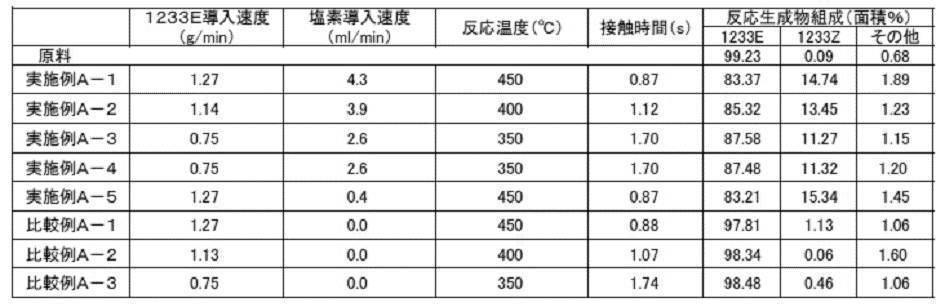
- Example A-5 it was found that the isomerization reaction from 1233E to 1233Z can be carried out at a high conversion rate even when a small amount of chlorine gas as a radical generator is added at the lower limit of measurement. Further, referring to Comparative Examples A-1 to A-3, the isomerization reaction from 1233E to 1233Z proceeds slightly without adding a radical generator, but the conversion rate of 1233E is several%, which is sufficient The conversion rate was not high.
- the residence time (contact time) in the central reactor in this experiment was 0.84 seconds, and 11% of the target compound was obtained in one pass, which proved to be a very efficient method.
- test pieces of Hastelloy C and SUS316 were put in the left reaction tube and this reaction was continued for a total of 200 hours, the annual corrosion rate was 0.1 mm / y or less.
- the weight and outer diameter of the Hastelloy C276 (TM) thermocouple protective tube in the central reaction tube were measured, the annual corrosion rate was 0.1 mm / y or less.
- it has the collection equipment similar to the apparatus shown in FIG. 4 after the exit of this reaction.
- Example A-7 (Recycling experiment) In the experiment of Example A-6, 16.1 kg of product was obtained. This was washed twice with ice water and dried with zeolite to obtain 13.6 kg of a dried product (the main mass loss is the amount adsorbed on the zeolite). This was distilled in a distillation column having a theoretical plate number of 20 to obtain 9.8 kg of a 1233E fraction having a purity of 99.41% (1233Z: containing 0.59%) and 1.1 kg of a 1233Z fraction having a purity of 99.9%. The same reaction as in Example A-6 was repeated using 1233E having a purity of 99.41% as a raw material.
- the temperature of the inlet part was 371 ° C.
- the temperature of the central part was 421 ° C.
- the temperature of the outlet part was 389 ° C.
- 1233E 88.03%
- 1233Z 12.23%
- others 0.31%
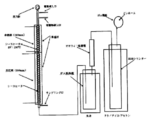
- Example A-8 Using the gas phase reactor shown in FIG. 4, isomerization of trans-1-chloro-3,3,3-trifluoropropene (1233E) was performed. In the hood, a quartz reaction tube (outer diameter 8 mm, inner diameter 6 mm, length 600 mm) in which two sheathed heaters each capable of independent temperature control were wound was placed vertically. A pressure gauge, nitrogen inlet, and organic substance inlet were installed at the top of the reaction tube, and a gas sampling port was installed at the outlet. The length of the upper heating zone (preheating section, 250 ° C.
- reaction temperature is shown in Table 6 below
- reaction section volume 8.48 ml
- Examples A-9 and A-10 The same experiment as in Example A-8 was conducted except that the reaction temperature and the organic substance supply rate were changed. The results are shown in Table 2. Further, as a result of visual observation, generation of oil was not recognized.
- Example A-11 The same experiment as in Example A-10 was conducted, except that a Ni reaction tube having the same size was used instead of the quartz reaction tube. The results are shown in Table 2. Further, as a result of visual observation, generation of oil was not recognized. In particular, no significant difference in the difference in the material of the reaction tube was observed, suggesting that the presence of radicals was greater than the wall effect.
- Example A-10 After the analysis in Example A-9, only the supply of chlorine was stopped. When the product composition was confirmed after 60 minutes, the cis-isomer (1233Z) was only 0.16 area%. When the conditions were returned to Example A-9 again (when chlorine was resupplied), the product composition of the cis form (1233Z) immediately recovered to 13.52%.
- Example A-12 When chlorine gas (Cl 2 ) was circulated at a rate of 2 cc / min through a SUS coil (no filler) with an outer diameter of 3 mm, an inner diameter of 2 m, and a length of 2000 mm heated by a heater (applied voltage: 50 V), the coil The temperature of the outlet gas was 359 ° C. This gas and the gas heated to 358 ° C. in Comparative Example B5 were used as a second reaction tube made of Hastelloy C276 (no packing) having an outer diameter of 10 mm, an inner diameter of 8 mm and a length of 440 mm heated by a heater (set temperature: 372 ° C.). ).
- the internal temperature of the second reaction tube was 361 ° C. at the inlet, 385 ° C. at the center, and 378 ° C. at the outlet.
- the composition was as follows: trans isomer (1233E): 88.2033%, cis isomer (1233Z): 10.67553%, other: 1.1214%. It was confirmed that by adding chlorine that generates radicals, the isomerization progressed remarkably from 0.0872% to 10.675% in the composition of the cis isomer (1233Z).
- Example A-13 An experiment similar to Example A-12 was conducted, except that the temperature of the second reaction tube having a length of 440 mm and air of 6 cc / min was changed to 409 ° C. instead of chlorine.
- the temperature of the air outlet gas was 359 ° C.
- the internal temperature of the second reaction tube at this time was an inlet 371 ° C., a center 423 ° C., and an outlet 392 ° C.
- the composition was as follows: trans isomer (1233E): 88.4959%, cis isomer (1233Z): 10.8612%, other: 0.6429%.
- By adding air that generates radicals it was confirmed that the isomerization proceeded significantly, with the composition of the cis form (1233Z) being 0.0872% ⁇ 10.812%.
- trans-1-chloro-3,3,3-trifluoro-1-propene is isomerized at high conversion without using a solid catalyst by adding a radical generator. Can be advanced.
- Process for producing cis-1-chloro-3,3,3-trifluoro-1-propene (1233Z) comprising a non-catalytic isomerization step
- the isomerization step of trans-1-chloro-3,3,3-trifluoro-1-propene (1233E) included in the method for producing -1-propene (1233Z) is a non-catalytic process without adding a radical generator. It can also be performed in a high temperature region under conditions.
- a method for producing cis-1-chloro-3,3,3-trifluoro-1-propene (1233Z) under catalyst-free and high-temperature conditions will be described.
- reaction temperature As described above, in the catalytic reaction, if the reaction temperature is increased, formation of 1233Z becomes advantageous. However, when the reaction temperature is increased, impurities such as coking and taring on the catalyst surface and running are performed. From the viewpoint of productivity such as cost, it has been difficult to produce 1233Z with high purity and efficiency on an industrial scale that meets equilibrium conditions advantageous for the production of 1233Z.
- trans-1-chloro-3,3,3-trifluoro-1-propene (1233E) which is a raw material of cis-1-chloro-3,3,3-trifluoro-1-propene (1233Z) May be a pure substance of the trans isomer (1233E) or a mixture (1233EZ) containing the cis isomer (1233Z) and the trans isomer (1233E).
- a trans isomer (1233E) produced by a known method can be used.
- 1,1,1,3,3-pentachloropropane (240fa) is reacted with hydrogen fluoride in a gas phase.
- trans-1-chloro-3,3,3-trifluoro-1-propene obtained by a known production method is a mixture (1233EZ) containing a trans isomer (1233E) and a cis isomer (1233Z).
- 1233E and 1233Z are governed by thermodynamic equilibrium. This equilibrium ratio depends on the temperature condition as shown by the calculation example of the Boltzmann distribution in FIG.
- the ratio of the trans isomer (1233E) and cis isomer (1233Z) actually observed tends to be the same in the calculated value, but the absolute value may be different.
- the equilibrium ratio varies depending on the reaction conditions such as the type and shape of the reaction vessel and the presence of the catalyst.
- the mass ratio of 1233Z / 1233E in the raw material is preferably closer to zero. Specifically, the mass ratio of 1233Z / 1233E is preferably 0 to 0.2, more preferably 0 to 0.1. In addition, since the raw material when 1233Z is used as the target compound is 1233E, it is impossible that 1233E is zero.
- the isomerization reaction is performed by a gas phase reaction in which a second composition mainly composed of trans-1-chloro-3,3,3-trifluoropropane (1233E) is introduced into the reaction region using a reactor.
- the material of the reactor is preferably a corrosion-resistant material such as carbon, ceramics, stainless steel, nickel, hastelloy, monel or inconel, and more preferably nickel, monel, hastelloy or inconel.
- the reaction mode is not particularly limited, either batch type or flow type, but a general gas phase flow type is preferable. It is also possible to accompany an inert gas such as nitrogen with the raw material.
- the reaction pressure is not particularly limited, either under pressure or under reduced pressure, but operation near normal pressure is easy.
- a pressure reaction of 1 MPa or more is not preferable because not only an expensive pressure-resistant device is required, but also polymerization of raw materials or products is concerned. It is only necessary to heat the empty tube, but a filler such as a static mixer or Raschig ring may be added if desired. Corrosion-resistant materials as described above are also recommended for these materials. If it is desired to use alumina or the like as a filler, it is recommended to calcinate at, for example, 1300 ° C. or higher to eliminate the catalytic activity. Otherwise, the raw material may caulk on the surface of the filler or tar. In addition, an unexpectedly difficult-to-distill material can be produced as a by-product.
- the specific surface area of the filler is preferably 5 m 2 / g or less. If it is larger than this, it may show catalytic activity in the same manner, and tarring as described above may occur. That is, in the present invention, the presence of the catalyst is avoided.
- the method for heating the apparatus is not particularly limited, but a method of directly heating with an electric heater or a burner or a method of heating indirectly using molten salt or sand is recommended.
- Patent Document 10 US Patent Application Publication No.
- a catalyst described as effective in 2010/0152504 if the reaction is performed at a high temperature of 400 ° C. or higher, the raw material and the product are compounds having multiple bonds. Often transformed into coke or tar.
- the reaction is carried out at a temperature of 400 ° C. or more for a long time, the oil component is produced as a by-product, and the raw material is wasted, the catalytic activity is reduced by coking, or clogging may occur in some cases.
- the reaction time of the gas phase circulation system is represented by the contact time. Since no catalyst is used in the present invention, the same concept as the contact time is called residence time.
- the residence time is a value (seconds) obtained by dividing the volume (ml) of the reaction part of the reaction tube by the flow rate (ml / second) of the supply gas at the reaction temperature.
- the residence time is usually 0.01 seconds or more and 50 seconds or less, preferably 0.1 seconds or more and 10 seconds or less. In general, when the residence time is shorter than 0.01 seconds, the conversion rate may be lowered. When the residence time is longer than 50 seconds, not only the productivity per unit reactor is decreased, but also the undesirable impurity TFPy (CF 3 C ⁇ CH) and the like may be by-produced, coked on the wall surface, and tar content may appear.
- an appropriate reaction temperature there is a combination of an appropriate reaction temperature and an appropriate residence time.
- a combination in which the reaction temperature is 450 ° C. to 700 ° C. and the residence time is 0.01 seconds or more and 50 seconds or less is illustrated (including the hatched portion and the boundary in FIG. 6).
- a combination in which the reaction temperature is 450 ° C. to 700 ° C. and the residence time is 0.1 second or more and 10 seconds or less is included (including the hatched portion and the boundary in FIG. 8).
- the shaded area (including the boundary) within the solid line is a particularly preferable area where tar conversion and coking are substantially not possible and a practical conversion rate can be secured.
- the left side and the lower side of this region are regions where tarlation and coking are low but conversion is insufficient. Further, the right side and upper side of this region are regions where the conversion rate is high but tarring or coking occurs.
- the pressure in the system increases due to the generation of hydrogen chloride, but the pressure was set to 1 MPa by a back pressure valve provided at the rear of the reactor. Since the reaction was stable after 3 hours from the start of the reaction, the product gas flowing out from the reactor was blown into water to remove the acidic gas, and the organic matter was collected with a dry ice-acetone trap.
- 3-pentafluoropropane (235da) and 1-chloro-1,1,4,4,4-pentafluoro-2-butene (1335) were confirmed.
- 3-chloro-1,1,1,3-tetrafluoropropane (244fa), 2-chloro-1,1,1 obtained by this fluorination reaction step and distillation step were used.
- 3,3-pentafluoropropane (235da), 1-chloro-1,1,4,4,4-pentafluoro-2-butene (1335) and the like without any impurities a trans isomer having a purity of 99.19% ( 1233E) was used.
- Example B-1 As shown in FIG. 4, a reaction tube (outer diameter: 8 mm, inner diameter: 6 mm, length: 600 mm), which is not filled with two sheathed heaters each capable of temperature control independently, is placed vertically in the hood. did. A pressure gauge, nitrogen inlet, and organic substance inlet were installed at the top of the reaction tube, and a gas sampling port was installed at the outlet.
- the length of the upper heating zone (preheating section, 250 ° C. setting) is 200 mm, and the length of the lower heating zone (reaction section temperature is described in Table A) is 300 mm (reaction section volume: 8.48 ml). It is.
- Example B-14 The same experiment as in Example B-13 was conducted, except that 100 ml / min of nitrogen was accompanied. The results are shown in Table 3. By nitrogen accompanying, by-product of low boiling point such as TFPy (CF 3 —CH ⁇ CH) was suppressed.
- Example B-4 The ⁇ -alumina beads were pulverized and filled with 8.5 ml of particles of about 0.5 mm to 1.5 mm in the above reaction tube, and then the same experiment as in Example 1 was performed under the conditions described in Table 1. After the formation of oil was observed, the reaction tube was blocked and the experiment was stopped.
- Comparative Example B-5 The same experiment as Comparative Example B-4 was performed except that AlF 3 pellets were used. Similarly, after the production of oil was observed, the reaction tube was blocked and the experiment was stopped.
- Example B-16 An experiment similar to Example B-8 was conducted for 12 hours, except that a SUS gas washing bottle (3000 ml) containing 5% by mass of sodium bicarbonate water (500 ml) was used. The gas cleaning bottle and the trap liquid were combined and separated to obtain 2092.5 g of organic matter. To this, 102 g of 5% by mass of sodium bicarbonate water was added for washing and liquid separation to obtain 2047.7 g of organic matter. To this, 101 g of ion-exchanged water was added and washed and separated to obtain 2012. 1 g of organic matter (the pH of the aqueous phase at this time was 8).
- Example B-19 (Application: Cooling composition for solar cell) 20 g of the sample obtained in Example B-16 was charged into a pressure resistant glass container and sealed. Solar exposure experiments were conducted on the rooftop for 37 days from October 14, 2011 (location: Kawagoe City, Saitama Prefecture). Table 5 shows the results of GLC analysis of the samples before and after the test. When the cis-isomer (1233Z) substantially free of 3-chloro-1,1,1,3-tetrafluoropropane (244fa) obtained in the present invention was used, no composition change was substantially observed.
- trans-1-chloro-3,3,3-trifluoro-1-propene is isomerized at a high conversion rate under a high temperature without a catalyst without adding a radical generator. It can be seen that it is possible to proceed.
- a mixture of 1233E and 1233Z obtained by reacting 1,1,1,3,3-pentachloropropane (240fa) with hydrogen fluoride is usually 3-chloro-1,1,1 which is difficult to separate by distillation from 1233Z.
- 3-tetrachloropropane (244fa) and 2-chloro-1,1,1,3,3-pentafluoropropane (235da) may be contained, but in the isomerization of the present invention, it is difficult to separate by distillation from 1233Z. It is one of the advantages that it can be carried out without separating 244fa and 235da, and there is no problem even if a by-product derived from the production of the raw material used is included.
- the isomerization reaction from cis-1-chloro-3,3,3-trifluoro-1-propene (1233Z) to trans-1-chloro-3,3,3-trifluoro-1-propene (1233E) is The equilibrium ratio of 1233E: 1233Z is rapidly reached to the thermodynamic equilibrium point by the catalytic action of radicals. If the isomer ratio of 1233Z: 1233E (1233Z / 1233E) is greater than the equilibrium ratio, at least a portion of 1233Z is converted to 1233E. Since the ratio of 1233E / 1233Z is governed by thermodynamic equilibrium, the apparent conversion rate from 1233Z to 1233E becomes small when a raw material having a high content of 1233E is used. Therefore, it is desirable to use a raw material having a high content of 1233Z.
- 1233Z As a pure substance is ideal as a raw material, but 1233EZ containing 1233E in the raw material composition may be used.
- the content ratio of 1233E in the raw material composition is preferably as small as possible, and the ratio of 1233Z present in the raw material composition is 50% by weight or more, preferably 70% by weight or more, more preferably 90% by weight or more. It is.
- the mass ratio of 1233E / 1233Z in the raw material is preferably closer to zero.
- the mass ratio of 1233E / 1233Z is preferably 0 to 0.2, and more preferably 0 to 0.1.
- the raw material when 1233E is used as the target compound is 1233Z, there is no possibility that 1233Z is zero.
- 1233E and 1233Z can be easily separated by distillation due to the difference in boiling point. Therefore, when using a mixture of 1233E and 1233Z as a raw material, it is recommended to use a raw material composition having a high content of 1233Z after separating 1233E by distillation in advance. It is preferable to distill and separate a mixture of 1233Z and 1233E, using 1233E as a product and 1233Z as a raw material.
- an isomerization reaction for converting 1233Z to 1233E can proceed by generating radicals in the reaction system in a predetermined temperature range.
- a radical generator may be selected from at least one selected from halogen gases such as chlorine and bromine, air, oxygen, ozone, oxygen-containing gases such as hydrogen peroxide or nitrogen oxides, and halogenated carbon.
- halogen gases such as chlorine and bromine
- halogenated carbon As the radical generator, air or oxygen is particularly preferable.
- the details of the halogenated carbon have been described above and are omitted here. It should be noted that 1-chloro-3,3,3-trifluoro-1-propene (1233) as a raw material of the present invention is not included as a halogenated carbon as a radical generator.
- the radical generator when performing a gas phase reaction, may be activated in advance by applying light or heat to the radical generator and then introduced into the reaction tube.
- a mixture of a radical generator and a raw material composition containing 1233Z may be introduced into a reaction tube and activated by light or heat.
- a method of simultaneously supplying a mixture of a radical generator and a raw material composition containing 1233Z to the reaction tube is preferable.
- a method of supplying a mixture of a radical generator and a raw material composition containing 1233Z to a heated reaction tube and applying thermal energy to the mixture in the reaction tube to generate a thermal radical is preferable.
- cis-1-chloro-3,3,3-trifluoropropene (1233Z) when 1233E is desired as the target compound, cis-1-chloro-3,3,3-trifluoropropene (1233Z), chlorine, oxygen, bromine, air, hydrogen peroxide, ozone, A mixture containing at least one radical generator selected from the group consisting of nitrogen oxides and halogenated carbons is heated and subjected to an isomerization reaction in the presence of radicals to give cis-1-chloro-3,3,3- A method of isomerizing trifluoropropene (1233Z) to trans-1-chloro-3,3,3-trifluoropropene (1233E) is preferred.
- radical generator It is preferable to add a small amount of the radical generator.
- the addition of an excessive radical generator not only wastes secondary materials but also places a burden on the separation process of the radical generator and 1233 after the reaction. Even in the case of air that is relatively easy to separate, as the amount of air added increases, the ability of the condensation process or distillation process decreases. Further, as described above, when chlorine is added excessively as a radical generator, a compound in which chlorine is added to a double bond is by-produced. In particular, the compound in which chlorine is added to 1233 is HCFC which is a global warming and ozone depleting substance.
- the amount of radical generator added depends on the type of radical generator and the shape of the reaction tube, it is usually preferably 0.0001 mol% or more and 10 mol% or less with respect to 1233Z as a raw material. More preferably, it is 0001 mol% or more and 0.005 mol% or less. In a reaction tube excellent in contact between radicals and 1233Z, 1233Z and radicals can sufficiently collide. Therefore, the amount of radical generator added is preferably 0.0001 mol% or more and 0.005 mol% or less.
- a reaction tube having a large length / inner diameter ratio not only enables efficient contact between radicals and 1233E even in an empty column without the above-mentioned packing, but also for heat transfer. Is also particularly preferable.
- the ratio of the length / inner diameter of the reaction tube is 10 or more and 1000 or less, preferably 20 or more and 500 or less.
- the ratio of length / inner diameter is smaller than 10
- the contact between the radical and 1233Z may not be sufficient
- the ratio of length / inner diameter is larger than 1000, the cost of the apparatus increases or depending on the operating conditions. May increase the pressure loss.
- a solid catalyst is not essential, but in order to rapidly advance the isomerization reaction in the presence of a radical, A solid catalyst may be used.
- the solid catalyst the solid catalyst exemplified in the description of the method for producing cis-1-chloro-3,3,3-trifluoro-1-propene (1233Z) described above is preferably used.
- the radical generator and 1233Z undergo an unexpected reaction instead of an isomerization reaction, and the reaction material 1233Z is converted into an undesired byproduct, and the radical generator is reacted with 1233Z. This is sometimes not preferable.
- the reaction temperature is usually 150 ° C. or higher and 800 ° C. or lower.
- 1233E is used as the target compound, it is preferably 150 ° C. or higher and 450 ° C. or lower, more preferably 200 ° C. or higher and 350 ° C. or lower. is there. If the reaction temperature is lower than 150 ° C., radicals are not sufficiently generated, and the reaction rate may be very slow.
- a temperature higher than 800 ° C. is not preferable because the raw material or product becomes an oily high-boiling product or coking.
- productivity is often discussed by the value obtained by dividing the volume of the reaction zone by the feed rate of the raw material.
- the contact time When the catalyst is packed in the reaction zone, it is called the contact time. ing.
- a solid catalyst In the production of trans-1-chloro-3,3,3-trifluoropropene (1233E) of the present invention, a solid catalyst is not used, but it is referred to as contact time for convenience.
- the isomerization reaction with radicals in the process for producing trans-1-chloro-3,3,3-trifluoropropene (1233E) of the present invention is carried out by distillation separation, washing, It can be combined with various processing steps such as drying.
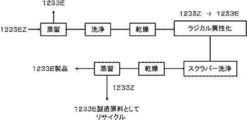
- the combination of the isomerization reaction and the treatment process is not particularly limited, but FIG. 9 shows an example of a production process of 1233E that is usually performed.
- cleaning, and a drying process can use the general system used for a normal chemical product manufacturing process, and are not specifically limited.
- a continuous distillation system, a batch distillation system, or the like can be used as appropriate.
- a desiccant is also appropriately selected.
- trans-1-chloro-3,3,3-trifluoropropene (1233E) begins with 1-chloro-3,3,3-trifluoropropene (1233EZ) as a raw material. Is separated into a trans isomer (1233E) and a cis isomer (1233Z) by a distillation operation, and then water is removed to remove acid content such as hydrochloric acid from the resulting mixture containing the cis isomer (1233Z) as a main component. A step of washing the cis-form (1233Z) from which acid content has been removed with a desiccant such as zeolite, and a mixture containing the dried cis-form (1233Z) as a main component.
- a desiccant such as zeolite
- a high-purity transformer that can be used as a product by subjecting the resulting mixture to a purification step, drying the resulting mixture containing the trans form (1233E) with a desiccant such as zeolite, and further subjecting the dried mixture to a distillation operation.
- a step of obtaining a body (1233E) may be included. 1233Z separated by distillation may be recovered and used again as a raw material for producing 1233E.
- the step of scrubber-type water washing of the mixture containing 1233E obtained by the isomerization reaction has not only the effect of removing acid content by water washing but also the effect of cooling the gas, and a separate cooling device is provided. This is not necessary and is advantageous in terms of cost. Moreover, you may perform the water washing process of the batch system etc. which remove
- the upper and lower sheath heaters of the reaction tube are controlled to a predetermined temperature using a PID temperature controller while flowing nitrogen from the carrier gas inlet, and then 1233Z is inserted from the raw material inlet.
- the raw material composition was introduced at a predetermined supply rate, and at the same time, the nitrogen flow was stopped.
- the product gas was collected at the gas sampling port and analyzed by a gas chromatograph.
- Tables 6 to 8 show reaction conditions of each Example and each Comparative Example.
- Example C-1 An isomerization reaction of a raw material composition containing a predetermined amount of carbon tetrachloride (CCl 4 ) and 1233Z as a radical generator was performed.
- Example C-2 1233Z having a purity of 99.67% as a raw material at a supply rate of 0.41 g / min and chlorine gas as a radical generator at a supply rate of 2.4 ml / min (the molar ratio of chlorine / 1233Z is 0.034,
- the same experiment as in Example C-1 was performed except that the amount of chlorine added was 3.4 mol%) and introduced into a reaction tube (made of Hastelloy C276) heated to 200 ° C.
- Example C-2 The experiment was performed under substantially the same conditions as in Example C-2 except that no chlorine gas was added.
- cis-1-chloro-3,3,3-trifluoro-1-propene is isomerized at high conversion without using a solid catalyst by adding a radical generator. The reaction can proceed.
- cis-1-chloro-3,3,3-trifluoro-1-propene (1233Z) is isomerized to trans-1-chloro-3,3,3-trifluoro-1-propene (1233E).
- a reaction tube mainly composed of a corrosion-resistant alloy containing nickel or the like is used, if the reaction is carried out at a high temperature condition of 600 ° C. or higher, the corrosion of the reaction tube proceeds, and a thick reaction tube is formed. Even if it is used, it must be replaced every year, which hinders operation.
- the reaction temperature is set to 100 ° C. higher than the conventional temperature by the catalytic action of radicals in the isomerization step. Since the temperature can be lowered by ⁇ 300 ° C., corrosion of the reaction tube can be prevented.
- the isomerization reaction from cis-1-chloro-3,3,3-trifluoro-1-propene (1233Z) to trans-1-chloro-3,3,3-trifluoro-1-propene (1233E) Can proceed even under high temperature conditions without catalyst without adding a radical generator.
- the isomerization of cis-1-chloro-3,3,3-trifluoro-1-propene (1233Z) under non-catalytic and high-temperature conditions is carried out by cis-1-chloro-3, This is almost the same as the isomerization reaction of trans-1-chloro-3,3,3-trifluoro-1-propene described in the method for producing 3,3-trifluoro-1-propene (1233Z).
- the raw material used is preferably 1234E purified by deoxidation, drying, distillation or the like.
- An unpurified crude product can also be used.
- a mixture of 1234E and 1234Z can also be used.
- trans-1,3,3,3-tetrafluoropropene (1234) obtained by a known production method is a mixture of 1234E and 1234Z, and the ratio of 1234E and 1234Z is in a thermodynamic equilibrium. Ruled. This equilibrium ratio depends on temperature, as shown by the calculation example of the Boltzmann distribution in FIG. The equilibrium ratio also varies depending on the reaction conditions such as the type and shape of the reaction vessel and the presence of the catalyst.
- the isomerization reaction from trans-1,3,3,3-tetrafluoropropene (1234E) to cis-1,3,3,3-tetrafluoropropene (1234Z) is carried out by the catalytic action of the radical 1234E: 1234Z.
- the isomer ratio of 1234Z: 1234E (1234Z / 1234E) is smaller than the equilibrium ratio, at least a part of 1234E is converted to 1234Z.
- the apparent conversion rate from 1234E to 1234Z is reduced.
- pure material 1234E is ideal as a raw material, but 1234EZ containing 1234Z in the raw material composition may be used. If attention is paid to the equilibrium, the content ratio of 1234Z in the raw material composition is preferably as small as possible, and the proportion of 1234E present in the raw material composition is 50% by weight or more, preferably 70% by weight or more, more preferably 90% by weight or more. It is.
- the mass ratio of 1234Z / 1234E in the raw material is preferably closer to zero. Specifically, the mass ratio of 1234Z / 1234E is preferably 0 to 0.2, and more preferably 0 to 0.1. In addition, since the raw material in the case of using 1234Z as the target compound is 1234E, it is impossible that 1234E is zero.
- 1234E and 1234Z can be easily separated by distillation because they have different boiling points. Therefore, when using a mixture of 1234Z and 1234E as a raw material, it is preferable to perform distillation separation beforehand. When 1234Z is the target compound, it is preferable to distill and separate a mixture of 1234Z and 1234E, use the separated 1234Z as a product, and use the separated 1234E as a raw material for the isomerization reaction from 1234E to 1234Z.
- the product containing 1234Z obtained by isomerization of 1234E is collected, and 1234E and 1234Z are isolated by distillation, etc., and then unreacted 1234E is used as a raw material again. This is preferable because it is possible.
- an isomerization reaction for converting 1234E to 1234Z can proceed by generating radicals in the reaction system in a predetermined temperature range.
- a radical generator may be selected from at least one selected from halogen gases such as chlorine and bromine, air, oxygen, ozone, oxygen-containing gases such as hydrogen peroxide or nitrogen oxides, and halogenated carbon.
- halogen gases such as chlorine and bromine
- halogenated carbon As the radical generator, air or oxygen is particularly preferable.
- the details of the halogenated carbon have been described above and are omitted here. Note that 1,3,3,3-tetrafluoropropene (1234) as a raw material of the present invention is not included as a halogenated carbon as a radical generator.
- the radical generator may be activated in advance by applying light or heat to the radical generator and then introduced into the reaction tube.
- a mixture of a radical generator and a raw material composition containing 1234E may be introduced into a reaction tube and activated by light or heat.
- a method of simultaneously supplying a mixture of a radical generator and a raw material composition containing 1234E to the reaction tube is preferable.
- an inert gas such as nitrogen may be accompanied together with the raw material composition as long as it is added excessively and productivity does not decrease.
- a method of supplying a mixture of a radical generator and a raw material composition containing 1234E to a heated reaction tube and applying thermal energy to the mixture in the reaction tube to generate a thermal radical is preferred.
- At least a part of trans 1,3,3,3-tetrafluoropropene (1234E) is converted to cis 1,3,3,3-tetrafluoropropene (1234Z) by an isomerization reaction in the presence of a radical.
- the ratio of cis-1,3,3,3-tetrafluoropropene (1234Z) to -1,3,3,3-tetrafluoropropene (1234E) can be increased.
- radical generator Since the generation of radicals is chained, it is preferable to add a small amount of radical generator. As described above, addition of an excessive radical generator not only wastes secondary materials, but also imposes a load on the separation process of the radical generator and 1234E after the reaction. Even in the case of air that is relatively easy to separate, as the amount of air added increases, the ability of the condensation process or distillation process decreases. Moreover, when chlorine is added excessively as a radical generator, a compound in which chlorine is added to a double bond is by-produced. In particular, since the compound in which chlorine is added to 1234E is HCFC which is a global warming and ozone depleting substance, it is preferable that the amount of by-product of the chlorine adduct is small.
- the conversion rate from 1234E to 1234Z was substantially reduced even if the addition amount of chlorine was reduced to the measurement lower limit of the chlorine flow meter in the experiment. No effect was observed. Therefore, it has been found that the amount of radical generator added may be extremely small (the experimental results will be described later). However, the optimal amount of radical generator added depends on the type of radical generator and the structure of the reaction tube. In the case of a reaction tube excellent in mixing, the desired conversion can be achieved even with the addition of a small amount of radical generator, but if not, by increasing the radical concentration by increasing the amount of radical generator added. The conversion rate may be improved.
- the amount of radical generator added depends on the type of radical generator and the shape of the reaction tube, but is usually preferably 0.0001 mol% or more and 10 mol% or less with respect to 1234E as a raw material. More preferably, it is 0.0001 mol% or more and 0.005 mol% or less.
- the addition amount of the radical generator is preferably 0.0001 mol% or more and 0.005 mol% or less.
- a reactor equipped with a static mixer which is inert to the reaction, a Raschig ring, a pole ring or a wire mesh or the like is exemplified.
- a packing in the reaction tube it is of course possible to place a packing in the reaction tube.
- a reaction tube having a large length / inner diameter ratio can efficiently generate radicals and 1234E even in an empty column having no packing as described above. It is particularly preferable because it is excellent in heat transfer.
- the ratio of the length / inner diameter of the reaction tube is 10 or more and 1000 or less, preferably 20 or more and 500 or less.
- the inner diameter of the reaction tube is preferably 8 mm or more and 150 mm or less, and the length is preferably in the range of 1 m or more and 200 m or less, and the reaction of an empty column having an inner diameter of 10 mm or more and 60 mm or less and a length of 2 m or more and 50 m or less.
- a tube is particularly preferred.
- the shape of the reaction tube is not particularly limited, and may be a straight tube or a coil shape, and may be folded using a joint or the like.
- the material of the apparatus such as the reaction tube is preferably carbon, ceramics, stainless steel, nickel or nickel alloy (trade name, Hastelloy (TM), Inconel (TM), Monel (TM)) or the like.
- TM Hastelloy
- TM Inconel
- TM Monel
- a quartz tube or the like can be used for a small facility.
- An unfilled reaction tube may be used, but a static mixer may be used if desired.
- a filler such as a Raschig ring or a pole ring may be filled.
- the heating method is not particularly limited, but it may be directly heated with an electric heater or a burner, or may be indirectly heated with molten salt or sand.
- the isomerization reaction of 1234E can be performed even with a very small amount of catalyst by re-cleavage even when recombined at a reaction temperature at which the radical generator can generate radicals. Is promoted. That is, in the method for producing 1,3,3,3-tetrafluoropropene including the trans (1234E) -cis (1234Z) isomerization step of 1,3,3,3-tetrafluoropropene (1234) of the present invention, The isomerization reaction proceeds with the addition of a small amount of catalyst.
- a solid catalyst is not essential, but in order to rapidly advance the isomerization reaction in the presence of a radical, the solid catalyst May be used.
- the solid catalyst a metal, a metal oxide, a metal halide, activated carbon or the like may be used, and a composite of these (eg, metal-supported activated carbon) can also be used.
- 1234E is likely to cause coking on the catalyst surface or may generate oil. It is preferable to use an inactivated solid catalyst.
- the 1234E / 1234Z ratio increases as the temperature decreases, as previously shown in the Boltzmann distribution calculation example (see FIG. 10).
- the reaction temperature is usually 150 ° C. or higher and 700 ° C. or lower.
- 1234Z is used as the target compound, it is preferably 300 ° C. or higher and 700 ° C. or lower, more preferably 350 ° C. or higher and 650 ° C. or lower.
- the preferable reaction temperature can be rephrased as a temperature at which radicals are efficiently generated from the radical generator.
- the reaction temperature is lower than 150 ° C., the reaction rate may be very slow because sufficient radicals are not generated.
- the reaction temperature is higher than 700 ° C., the raw material or product becomes an oily high-boiling product or coking, which is not preferable.
- reaction pressure is not particularly limited, but the operation near normal pressure is easy. However, a pressure reaction of 1 MPa or more is not preferable because not only an expensive pressure-resistant apparatus is required but also polymerization of raw materials or products is concerned.
- productivity is often discussed by a value obtained by dividing the volume of the reaction zone by the raw material supply rate.
- contact time When the reaction zone is filled with a catalyst, it is called contact time.
- a solid catalyst In the production of cis-1,3,3,3-tetrafluoropropene (1234Z) of the present invention, which will be described later, a solid catalyst is not used, but it is also referred to as contact time for convenience.
- the contact time in the present invention is not particularly limited as long as isomerization proceeds sufficiently, but is usually 0.01 seconds or more and 50 seconds or less, preferably 0.05 seconds or more and 20 seconds or less. In general, if the contact time is shorter than these, only the conversion rate greatly deviating from the thermodynamic equilibrium composition may be exhibited. On the contrary, when larger than these, even if the conversion rate close
- 1234EZ mixture obtained by isomerization removes radical generators and acid content by washing, and after drying with zeolite or the like, 1234E and 1234Z can be isolated by ordinary distillation operation.
- the obtained unreacted 1234E can also be reused as a raw material for the isomerization reaction.
- HFC-245fa 1,1,1,3,3-pentafluoropropane
- 1234E 1,1,1,3,3-pentafluoropropane
- HFC-245fa and 1234Z have close boiling points and form an azeotrope-like composition, so that separation by distillation is very difficult.
- isomerization proceeds without forming HFC-245fa as a by-product (see Example 7 described later), and thus high-purity 1234Z is easily obtained. be able to.
- % of the composition analysis value represents “area%” of the composition obtained by measuring the reaction mixture by gas chromatography (detector: FID). The number of digits displayed is rounded off. For example, 0.00% in the table indicates that it is less than 0.005 area%.
- the temperature of the reaction tube was raised to 650 ° C. while flowing nitrogen gas at a flow rate of about 100 ml / min into a gas phase reactor (made of SUS316L, inner diameter 6 mm, length 260 mm) comprising a cylindrical reaction tube equipped with an external heating device. did.
- the gas phase reaction apparatus used in the examples is an apparatus having a configuration similar to that of the gas phase reaction apparatus shown in FIG.
- Example D-1 to D-3 In Examples D-1 to D-3, chlorine gas was used as a radical generator, the supply amount of chlorine gas was changed, and chlorine gas was introduced into a reaction tube to carry out an isomerization reaction of 1234E. .
- the results are shown in Table 9.
- the ratios of chlorine gas were 1.8 mol%, 0.6 mol%, and 0.1 mol%, respectively, and the molar ratio of chlorine / 1234E was 0.018, respectively. 0.0056 and 0.0011.
- Comparative Example D-1 Comparative Example 1 was obtained by carrying out the reaction under the same conditions as in Example D-1, except that no radical generator was added.
- Example D-3 it was found that the isomerization reaction from 1234E to 1234Z can be performed at a high conversion rate even when a very small amount of chlorine gas is added as a radical generator. Further, referring to Comparative Example D-1, the isomerization reaction from 1234E to 1234Z proceeds without adding a radical generator, but the pass-through rate of 1234E is several percent, which is not a sufficient conversion rate. .
- the present invention includes a cis-1,3 comprising an isomerization step from trans-1,3,3,3-tetrafluoropropene (1234E) to cis-1,3,3,3-tetrafluoropropene (1234Z).
- the reaction temperature can be lowered by 100 ° C. to 300 ° C. compared to the prior art by the catalytic action of radicals in the isomerization step. Corrosion can be prevented.
- the isomerization reaction from trans-1,3,3,3-tetrafluoropropene (1234E) to cis-1,3,3,3-tetrafluoropropene (1234Z) is performed without adding a radical generator. It is possible to proceed even under high temperature conditions without using a catalyst.
Landscapes
- Chemical & Material Sciences (AREA)
- Organic Chemistry (AREA)
- Chemical Kinetics & Catalysis (AREA)
- Life Sciences & Earth Sciences (AREA)
- Engineering & Computer Science (AREA)
- Oil, Petroleum & Natural Gas (AREA)
- Wood Science & Technology (AREA)
- Organic Low-Molecular-Weight Compounds And Preparation Thereof (AREA)
- Low-Molecular Organic Synthesis Reactions Using Catalysts (AREA)
Description
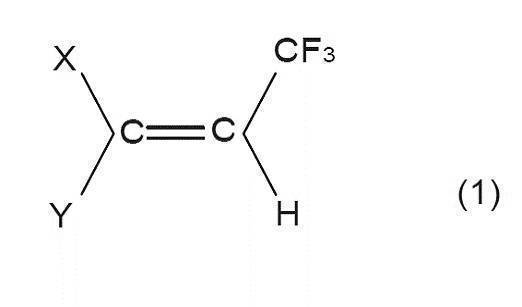
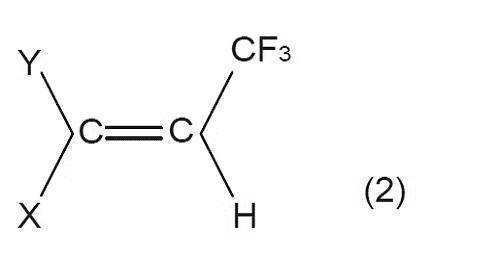
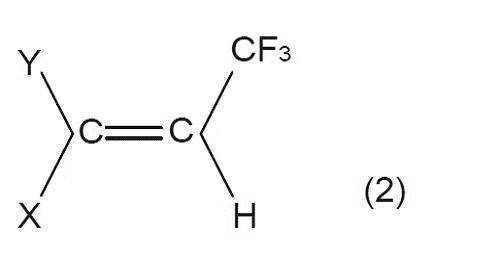
[前記一般式(1)及び(2)において、XとYとはフッ素原子(F)又は水素原子(H)であり且つ前記XとYとは同一ではなく、或いは、前記Xと前記Yとは塩素原子(Cl)又は水素原子(H)であり且つ前記XとYとは同一ではない。]
1,1,1,3,3-ペンタクロロプロパンをフッ化水素と反応させて、前記式(1)及び前記式(2)で表される化合物と3-クロロ-1,1,1,3-テトラフルオロプロパン(244fa)、2-クロロ-1,1,1,3,3-ペンタフルオロプロパン(235da)、及び、1-クロロ-1,1,4,4,4-ペンタフルオロ-2-ブテン(1335)から選ばれる少なくとも1種からなる化合物と、を含む第1組成物を生成する工程と、
前記第1組成物から前記一般式(2)で表される化合物を蒸留により除去する工程と、
前記式一般(2)を除去した前記第1組成物から、3-クロロ-1,1,1,3-テトラフルオロプロパン、2-クロロ-1,1,1,3,3-ペンタフルオロプロパン、及び、1-クロロ-1,1,4,4,4-ペンタフルオロ-2-ブテンから選ばれる少なくとも1種からなる化合物を蒸留により除去して、前記一般式(1)で表される化合物を得る工程と、
を前記異性化工程の前に含んでもよい。

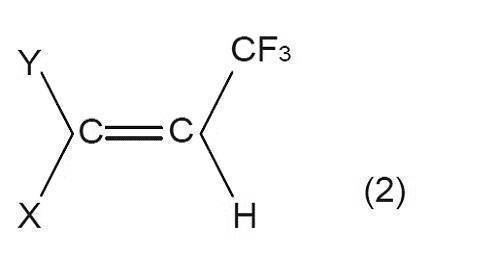
[前記一般式(1)及び(2)において、XとYとは塩素原子(Cl)又は水素原子(H)であり且つ前記XとYとは同一ではない。]
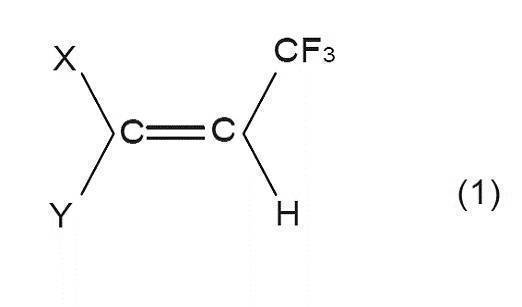

[前記一般式(1)及び(2)において、XとYとはフッ素原子(F)又は水素原子(H)であり且つ前記XとYとは同一ではない。]
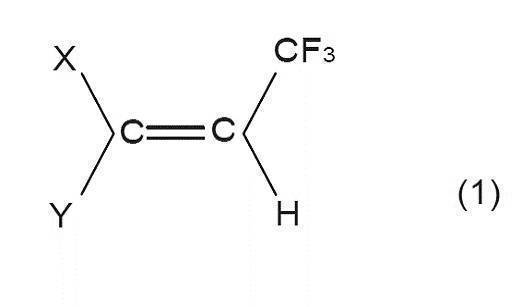
ここで、1233である場合、一般式(1)において、XとYとは塩素原子(Cl)又は水素原子(H)であり且つXとYとは同一ではない。1234である場合、一般式(1)において、XとYとはフッ素原子(F)又は水素原子(H)であり且つXとYとは同一ではない。

ここで、1233である場合、一般式(1)において、XとYとは塩素原子(Cl)又は水素原子(H)であり且つXとYとは同一ではない。1234である場合、一般式(1)において、XとYとはフッ素原子(F)又は水素原子(H)であり且つXとYとは同一ではない。
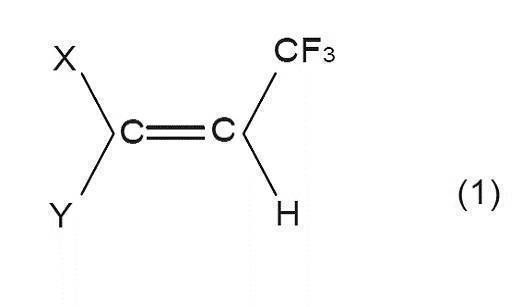
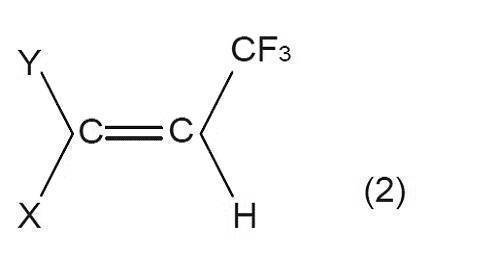
ここで、一般式(1)及び(2)において、XとYとはフッ素原子(F)又は水素原子(H)であり且つXとYとは同一ではなく、或いは、XとYとは塩素原子(Cl)又は水素原子(H)であり且つXとYとは同一ではない。
シス-1-クロロ-3,3,3-トリフルオロ-1-プロペン(1233Z)の原料となるトランス-1-クロロ-3,3,3-トリフルオロ-1-プロペン(1233E)は、トランス体(1233E)の純物質、もしくはシス体(1233Z)とトランス体(1233E)とを含む混合物であってもよい。トランス体(1233E)は、公知の方法で製造されたものが使用可能であり、例えば、気相中で1,1,1,3,3-ペンタクロロプロパン(240fa)をフッ化水素と反応させることにより得られるトランス体(1233E)とシス体(1233Z)との混合物、また、この混合物を公知の精製処理に付して得られた組成物であってもよい。
第1工程はフッ素化反応工程である。具体的には、第1工程は、1,1,1,3,3-ペンタクロロプロパン(240fa)をフッ化水素と反応させて、1-クロロ-3,3,3-トリフルオロ-1-プロペンを含む第1組成物を得る工程である。
第2工程は蒸留工程である。具体的には、第2工程は、第1工程で得られた第1組成物から、3-クロロ-1,1,1,3-テトラフルオロプロパン(244fa)、2-クロロ-1,1,1,3,3-ペンタフルオロプロパン(235da)、1-クロロ-1,1,4,4,4-ペンタフルオロ-2-ブテン(1335)から選ばれる少なくとも1種の化合物を蒸留により除去して、トランス-1-クロロ-3,3,3-トリフルオロ-1-プロペン(1233E)を主成分とする第2組成物を得る工程である。
1リットルガラス製フラスコに、表面積1200m2/g、細孔径18オングストロームの粒状椰子殻炭(武田薬品工業製粒状白鷺G2X、4~6メッシュ)0.2リットルを入れ130~150℃に加温した後、真空ポンプにより水分を除去した。水分の留出が認められなくなった時点でフラスコ内に窒素を導入して常圧とした。
還流冷却器と攪拌機とを備えたSUS316L製1リットルオートクレーブに、触媒調製例1に示した活性炭100ミリリットル、1,1,2,2-テトラクロロエタン0.3モル(50.4g)を仕込み、攪拌しながら温度を180℃に保ち、フッ化水素の供給速度を0.75g/min、1,1,1,3,3-ペンタクロロプロパンを0.425g/minの速度で反応器に供給した。反応の進行とともに塩化水素の発生により系内の圧力は上昇するが、反応器後部に備えた背圧弁により1MPaとした。反応開始3時間後には反応は安定したので、反応器から流出する生成ガスを水中に吹き込み酸性ガスを除去した後、ドライアイス-アセトン-トラップで有機物を捕集した。
第3工程は異性化反応工程である。具体的には、第3工程は、第2工程で得られた第2組成物に含まれる1233Eを異性化させ、目的化合物である1233Zの含有率を高めた第3組成物を得る工程である。第3工程の異性化反応工程は、上述のラジカル異性化が適用される。固体触媒を用いずにラジカル発生剤を添加すると、異性化反応工程において、目的化合物となる1233Zと共沸もしくは共沸様挙動を示す3-クロロ-1,1,1,3-テトラクロロプロパン(244fa)や2-クロロ-1,1,1,3,3-ペンタフルオロプロパン(235da)の副生成を抑制することができるため、より高純度の1233Zを得られるという利点がある。
第4工程は、第3工程で得られた第3組成物において、目的化合物である1233Zと1233E及びその他の生成物とを分離する工程である。
第5工程は、第4工程で分離された1233Eを回収し、第1工程~第3工程の何れかで再利用する工程である。分離された1233Eは、異性化反応工程及び/又はフッ素化工程に再度戻すことができる。また、そのまま硬質ウレタンフォーム発泡剤などとして製品化されてもよい。この第5工程によれば、回収した1233Eを有効に活用することができる。特に、第3工程に戻すプロセスが合理的である。
以下、本発明のシス-1-クロロ-3,3,3-トリフルオロプロペン(1233Z)の製造について、実施例を挙げて具体的に説明するが、本発明は、これらの実施例に限定されるものではない。ここで、組成分析値の「%」は、反応混合物をガスクロマトグラフィー(検出器:FID)によって測定して得られた組成の「GC面積%」を表す。尚、表示桁数以下は四捨五入した。例えば、0.00%は0.005GC面積%未満であることを示している。
窒素(300ml/分)を流通させながら、上部の予備加熱部を250℃、下部の反応加熱部を450℃に加熱後、原料導入口から原料として純度99.23%の1233E(シス体(1233Z):0.09%含有)を1.27g/分、ラジカル発生剤として塩素(Cl2)を4.3ml/分の供給速度で供給し、1分後に窒素の供給を停止した。4時間後にガスサンプリング口から、ガスタイトシリンジで採取したガスを分析した。原料の供給方法としては、1233Eとラジカル発生剤となる塩素(Cl2)との混合物を反応管に供給した。また、目視観察した結果、オイル分の生成は認められなかった。尚、実施例A-1においては、反応管の材質として石英を使用した。塩素/1233Eのモル比は0.020である。
反応温度、原料供給速度を変更した以外は、実施例A-1と同様の実験を行った。実施例A-2、A-3、A-5における反応温度、原料供給速度は、表1に示す。また、目視観察の結果、オイル分の生成は認められなかった。尚、実施例A-2、A-3において、塩素/1233Eのモル比は、実施例A-1と同様に0.020である。また、実施例A-5において、塩素/1233Eのモル比は、0.0020である。
石英製反応管の代わりに同じ大きさのNi製反応管を用いる以外、実施例A-3と同じ実験を行った。その結果を表1に示す。また、目視観察の結果、オイル分の生成は認められなかった。特に、反応管の材質の違いの有意差は特に認められなかったことから、壁効果よりもラジカルの存在が大きいことが示唆された。
比較例A-1~A-3として、ラジカル発生剤である塩素を添加しない以外は、実施例A-1~A-3と同じ実験条件で反応を行った。その結果、塩素を添加しない場合、異性化反応は進行しなかった。
(1233Eの予熱器での異性化の確認)
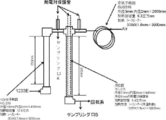
図5に示す装置の左部のみを稼動して、1233Eの予熱器での異性化の確認実験を行った。300Wのシースヒーターで加熱された10mm、内径8mm、長さ400mmのハステロイC276(TM)製の予熱器に純度99.99%の1233E(1233Z:0.00%、その他:0.01%)を1.38g/分の速度で流通させた。このとき、予熱器の出口温度は355℃であった。サンプリング口Aで、このガスを分析した結果、1233E:99.88%、1233Z:0.04%、その他:0.08%であり、この条件では実質的に1233Eから1233Zへの異性化が進行していないことが確認された。
(不活性ガスを用いた場合の確認)
図5の装置の全部を稼動して、不活性ガスを用いた実験を行った。比較例A-4の動作に加えて、右部と中央部を稼動させた。右部は空気もしくは窒素の予熱装置である。300Wのシースヒーターで加熱された外径3mm、内径2mm、長さ2000mmのSUS316製コイルに窒素を6cc/分の速度で流通させた。このとき、予熱器の温度は359℃であった。353℃に加熱された1233Eと358℃に加熱された窒素とを、外径6mmの熱電対保護管を有する外径10mm内径8mmの加熱部長さ380mm、加熱部の容積8.4cm3のハステロイC276(TM)の反応管に導入した。このとき、入口部(上部)の温度は370℃、中央部の温度は421℃、出口部(下部)の温度389℃であった。サンプリング口Bで、このガスを分析した結果、1233E:98.72%、1233Z:1.04%、その他:0.24%であり、ラジカル発生剤が無い系では温度を420℃に上げても、1233Zが僅か1%程度しか生成しておらず、殆ど異性化が進行していないことが確認された。本実験における中央反応器における滞留時間(接触時間)は0.84秒である。
窒素の代わりに空気を用いる以外、比較例A-5と同じ実験を行った。このとき、入口部(上部)の温度は370℃、中央部の温度は420℃、出口部(下部)の温度388℃であった。サンプリング口Bで、このガスを分析した結果、1233E:88.48%、1233Z:11.01%、その他:0.51%であり、ラジカル発生剤である空気を触媒量添加することによって、10倍以上の収率で1233Zが得られることが判明した。本実験における中央反応器における滞留時間(接触時間)は0.84秒であり、ワンパスで11%の目的化合物が得られるので非常に効率的な方法であることが判明した。左部反応管にハステロイCおよびSUS316のテストピースを入れて、この反応を通算200時間継続したところ、何れも、年間腐食速度は0.1mm/y以下であった。また、中央部反応管におけるハステロイC276(TM)製熱電対保護管の重量および外径測定を行ったところ、年間腐食速度は0.1mm/y以下であった。尚、本反応の出口以降は、図4に示す装置と同様の捕集設備を有する。
(SUS316の耐久性実験)
中央部反応管における熱電対保護管をSUS316製にする以外、実施例A-6と同じ実験を50時間行った。実験終了後、保護管が腐食して、表面の剥離が観測された。
(リサイクル実験)
実施例A-6の実験において、16.1kgの生成物を得た。これを、氷水による水洗2回とゼオライトによる乾燥を行ない、13.6kgの乾燥物を得た(主な質量ロスは、ゼオライトへの吸着分である)。これを理論段数20段の蒸留塔で蒸留し、純度99.41%の1233Eフラクション(1233Z:0.59%含有)を9.8kg、純度99.9%の1233Zフラクション1.1kgを得た。純度99.41%の1233Eを原料として、実施例A-6と同じ反応を再度行った。このとき、入口部(上部)の温度は371℃、中央部の温度は421℃、出口部(下部)の温度389℃であった。サンプリング口Bで、このガスを分析した結果、1233E:88.03%、1233Z:11.23%、その他:0.31%であり、1233Eをリサイクルできることが確認できた。
図4に示した気相反応装置を用いて、トランス-1-クロロ-3,3,3-トリフルオロプロペン(1233E)の異性化反応を行った。フード内に、それぞれ独立して温度制御可能な2本のシースヒーターを巻いた石英製反応管(外径8mm、内径6mm、長さ600mm)を縦置きした。反応管上部には圧力ゲージ、窒素導入口、有機物導入口を設置し、出口にはガスサンプリング口を設置した。上部の加熱ゾーン(予備加熱部、250℃設定)の長さは200mmであり、下部の加熱ゾーン(反応温度は後述の表6参考)の長さは300mm(反応部の容積:8.48ml)である。反応管出口には、氷で冷却したガス洗浄瓶(内容物:10gの重曹を190gのイオン交換水に溶かしたもの)、合成ゼオライト(MS-3A)を充填した乾燥塔、ドライアイス-アセトンで冷却したステンレススチール製(SUS製)トラップ(出口はピンホールを開けたゴム風船)を設置した。窒素(300ml/分)を流通させながら、上部の予備加熱部を250℃、下部の反応部を450℃に加熱後、純度99.23%のトランス体(1233E)(シス体(1233Z):0.09%含有)を1.27g/分、ラジカル発生剤として塩素(Cl2)を4.3ml/分の速度で供給し、1分後に窒素の供給を停止した。4時間後にガスサンプリング口から、ガスタイトシリンジで採取したガスを分析した結果を表2に示す。また、目視観察した結果、オイル分の生成は認められなかった。
反応温度、有機物供給速度を変更した以外、実施例A-8と同様の実験を行った。その結果を表2に示す。また、目視観察の結果、オイル分の生成は認められなかった。
石英製反応管の代わりに同じ大きさのNi製反応管を用いる以外、実施例A-10と同じ実験を行った。その結果を表2に示す。また、目視観察の結果、オイル分の生成は認められなかった。特に、反応管の材質の違いの有意差は特に認められなかったことから、壁効果よりもラジカルの存在が大きいことが示唆された。
塩素を添加しない例を比較例として示す。実験方法とは実施例A-8と同様であり、詳しい反応条件および結果を表2の通りである。塩素が無い系では実用的に異性化は進行しなかった。
実施例A-9の分析終了後、塩素の供給だけを止めた。60分後に生成物組成を確認したところ、シス体(1233Z)は僅か0.16面積%であった。再び実施例A-9に条件に戻すと(塩素を再供給すると)、シス体(1233Z)の生成物組成は13.52%に直ちに回復した。
外径10mm、内径8mm長さ350mmのハステロイC276製の反応管(充填物無)をヒーター(設定温度:331℃)で加熱した。ここに、原料(組成はトランス体(1233E):99.380%、シス体(1233Z):0.0204%、その他:0.6716%を1.38g/minの速度で流通させた。その時の出口ガスの温度は358℃であった。出口ガスを分析した結果、組成はトランス体(1233E):99.2927%、シス体(1233Z):0.0872%、その他:0.6201であった。ラジカルが存在しない系において、360℃未満の場合、シス体(1233Z)の組成が0.0204%→0.0872%であり、実質的に異性化が進行しないことが確認された。
ヒーター(加電圧:50V)で加熱された外径3mm×内径2m×長さ2000mmのSUS製コイル(充填物無)に塩素ガス(Cl2)を2cc/minの速度で流通させたところ、コイルの出口ガスの温度は359℃であった。このガスと比較例B5で358℃に加熱されたガスを、ヒーター(設定温度:372℃)で加熱された外径10mm、内径8mm長さ440mmのハステロイC276製の第2反応管(充填物無)に導入した。この時の第2反応管の内温は入口361℃、中央385℃、出口378℃であった。出口ガス分析した結果、組成はトランス体(1233E):88.2033%、シス体(1233Z):10.6753%、その他:1.1214%であった。ラジカルを発生する塩素を添加することによって、シス体(1233Z)の組成が0.0872%→10.675%と、異性化が顕著に進行したことが確認された。
塩素の代わりに空気6cc/min、長さ440mmの第2反応管の設定温度を409℃にする以外、実施例A-12と同様の実験を行った。空気の出口ガスの温度は359℃であり、この時の第2反応管の内温は入口371℃、中央423℃、出口392℃であった。出口ガス分析した結果、組成はトランス体(1233E):88.4959%、シス体(1233Z):10.8612%、その他:0.6429%であった。ラジカルを発生する空気を添加することによって、シス体(1233Z)の組成が0.0872%→10.8612%と、異性化が顕著に進行したことが確認された。
尚、本発明のシス-1-クロロ-3,3,3-トリフルオロ-1-プロペン(1233Z)の製造方法に含まれるトランス-1-クロロ-3,3,3-トリフルオロ-1-プロペン(1233E)の異性工程は、ラジカル発生剤を添加することなく、無触媒条件下の高温領域においても行うことができる。以下、無触媒、高温条件下でのシス-1-クロロ-3,3,3-トリフルオロ-1-プロペン(1233Z)の製造方法について述べる。
1リットルガラス製フラスコに、表面積1200m2/g、細孔径18オングストロームの粒状椰子殻炭(武田薬品工業製粒状白鷺G2X、4~6メッシュ)0.2リットルを入れ130~150℃に加温した後真空ポンプにより水分を除去した。水分の留出が認められなくなった時点でフラスコ内に窒素を導入して常圧とした。
還流冷却器と攪拌機を備えたSUS316L製1リットルオートクレーブに、触媒調製例1に示した活性炭100ミリリットル、1,1,2,2-テトラクロロエタン0.3モル(50.4g)を仕込み、攪拌しながら温度を180℃に保ち、フッ化水素の供給速度を0.75g/分、1,1,1,3,3-ペンタクロロプロパンを0.42g/分の速度で反応器に供給した。反応の進行とともに塩化水素の発生により系内の圧力は上昇するが、反応器後部に備えた背圧弁により1MPaとした。反応開始3時間後には反応は安定したので、反応器から流出する生成ガスを水中に吹き込み酸性ガスを除去した後、ドライアイス-アセトン-トラップで有機物を捕集した。
図4に示すように、フード内に、それぞれ独立して温度制御可能な2本のシースヒーターを巻いた何も充填していない反応管(外径8mm、内径6mm、長さ600mm)を縦置きした。反応管上部には圧力ゲージ、窒素導入口、有機物導入口を設置し、出口にはガスサンプリング口を設置した。上部の加熱ゾーン(予備加熱部、250℃設定)の長さは200mmであり、下部の加熱ゾーン(反応部温度はA表1記載)の長さは300mm(反応部の容積:8.48ml)である。反応管出口には、氷で冷却したガス洗浄瓶(内容物:10gの重曹を190gのイオン交換水にとかしたもの)を経由後、合成ゼオライト(MS-3A)を充填した乾燥塔、ドライアイス-アセトンで冷却したステンレススチール製(SUS製)トラップ(出口はピンホールを開けたゴム風船)を設置した。窒素(300ml/分)を流通させながら、上部の予備加熱部を250℃、下部の反応部を500℃に加熱後、純度99.19%のトランス体(1233E)を0.6g/分の速度で供給し、1分後に窒素の供給を停止した。4時間後にガスサンプリング口から、ガスタイトシリンジで採取したガスを分析した結果を表3に示す。また、目視観察した結果、オイル分の生成は認められなかった。
反応温度、有機物供給速度(滞留時間)を変更した以外、実施例B-1と同様の実験を行った。その結果を表3に示す。また、目視観察の結果、オイル分の生成は認められなかった。
窒素100ml/分を同伴する以外、実施例B-13と同様の実験を行った。その結果を表3に示す。窒素同伴により、TFPy(CF3-CH≡CH)等の低沸分の副生が抑制された。
反応温度、有機物供給速度(滞留時間)を変更した以外、実施例B-1と同様の実験を行った。その結果を表3に示す。なお、比較例B-1、B-2においては、オイルの生成は認められなかったが、転化率は実用的なレベルに至らなかった。比較例B-3においては大量のオイル分の生成が認められた(ガスサンプリング口がオイルで汚れてガスクロ分析できなかった)。
γアルミナビーズを粉砕して、約0.5mmから1.5mmの粒8.5mlを上記の反応管に充填後、表1に記載の条件で実施例1と同様の実験を行った。オイルの生成が認められた後、反応管が閉塞したので、実験を中止した。
AlF3ペレットを用いる以外は比較例B-4と同じ実験を行った。同様にオイルの生成が認められた後、反応管が閉塞したので、実験を中止した。
物質収支を求めるために実施例B-10のサンプリング後、ガス洗浄瓶(内容物:イオン交換水(200ml))とSUS製トラップを交換し同条件で反応を継続した。124.59gフィード後(約85分後)、ガス洗浄瓶およびSUS製トラップ内の液体の両方を予め冷蔵庫で冷却した分液ロートに入れて分液した。その結果、有機物が124.33g回収された(有機物回収率は99.8%、組成はTFPy:0.04%、1234E:0.43%、1336:0.00%、245fa:0.09%、1234Z:0.17%、トランス体(1233E):82.81%、シス体(1233Z):15.82%、その他:0.64%)。また、上層の水相を水酸化ナトリウムによる中和滴定及び硝酸銀滴定したところ、有機物中の塩酸含有量は0.002wt%、フッ化水素含有量は0.05wt%であった。以上より、本条件において、オイル生成やコーキングが実質的に起こっていないことが示された。
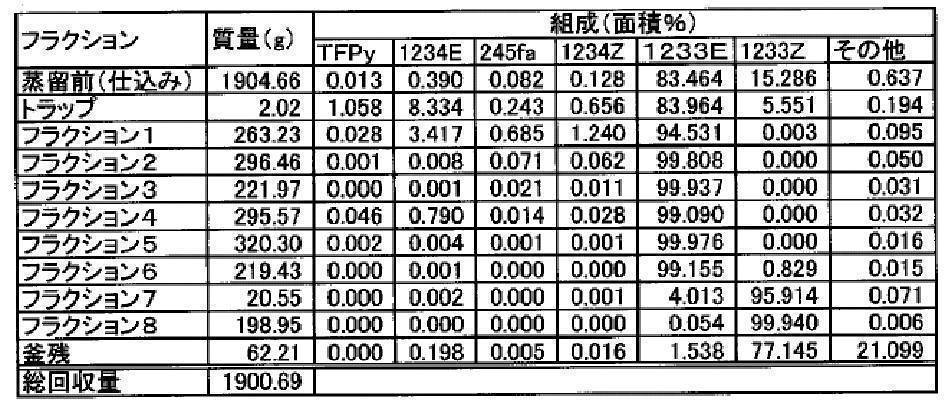
5質量%の重曹水(500ml)を入れたSUS製ガス洗浄瓶(3000ml)を用いる以外、実施例B-8と同様の実験を12時間行った。ガス洗浄瓶とトラップの液体を合わせて、分液することによって、2092.5gの有機物を得た。これに102gの5質量%の重曹水を加えて洗浄、分液すると、2047.7gの有機物が得られた。これに101gのイオン交換水を加えて洗浄、分液することによって、2012.1gの有機物が得られた(この時の水相のpHは8であった)。この有機相に105gのイオン交換水を加えて、同様に洗浄、分液した結果、1979.1gの有機物が得られた(この時の水相のpHは7であった)。この有機物に合成ゼオライト(MS-3A)を50g加えて、一晩冷蔵庫で保管後、濾過することによって水分8ppmのサンプルが1910.1g得られた。このサンプルを理論段数35段の蒸留塔で分留した結果を表4に示す。有機物は-5℃に冷却したマイクロシリンジを用いて液体のサンプルをGC(ガスクロマトグラフィー)で分析した。フラクション8において、99.94面積%の高純度シス体(1233Z)が得られ、このフラクションにおいて3-クロロ-1,1,1,3-テトラフルオロプロパン(244fa)、2-クロロ-1,1,1,3,3-ペンタフルオロプロパン(235da)は検出されなかった。
実施例B-16の蒸留で得られたフラクション2から6をブレンドしたリサイクル原料(トランス体(1233E):純度99.61%)として、実施例B-8と同様の実験を行った結果を表3に示す。リサイクル原料でも同じ結果が得られた。
(用途:洗浄剤)
実施例B-16で得られた純度99.94面積%の高純度シス体(1233Z)を小型超音波洗浄機に仕込み、指紋が付いたガラス製レンズを30秒間洗浄した。洗浄後、ドライヤーで乾燥し、目視したところ、指紋が完全に除去され、シミの発生は観察されなかった。
(用途:太陽電池用冷却組成物)
実施例B-16で得られたサンプル20gを耐圧仕様の硝子容器に仕込み密栓した。2011年10月14日から37日間、屋上にて太陽光暴露実験を行った(場所:埼玉県川越市)。試験前後のサンプルをGLC分析した結果を表5に示す。本発明で得られた実質的に3-クロロ-1,1,1,3-テトラフルオロプロパン(244fa)を含まないシス体(1233Z)を用いた場合は、組成変化が実質的に認められなかったが、比較例B-6の様に、抽出蒸留法で得られた3-クロロ-1,1,1,3-テトラフルオロプロパン(244fa)を含有するシス体(1233Z)を用いると、著しい組成変化が認められた。
特開2010-202640(特許文献11)記載の方法で抽出蒸留後、精密蒸留したサンプルを用いる以外、実施例B-19と同じ実験を行った。その結果を表5に示す。


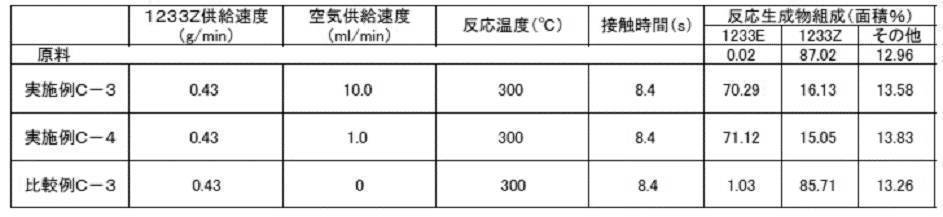
トランス-1-クロロ-3,3,3-トリフルオロ-1-プロペン(1233E)の原料となるシス-1-クロロ-3,3,3-トリフルオロ-1-プロペン(1233Z)は、シス体(1233Z)の純物質、もしくはシス体(1233Z)とトランス体(1233E)とを含む混合物であってもよい。シス体(1233Z)は、公知の方法で製造されたものが使用可能であり、例えば、気相中で1,1,1,3,3-ペンタクロロプロパン(240fa)をフッ化水素と反応させることにより得られるトランス体(1233E)とシス体(1233Z)との混合物、また、この混合物を公知の精製処理に付して得られた組成物であってもよい。
以下、本発明のトランス-1-クロロ-3,3,3-トリフルオロプロペン(1233E)の製造について、実施例を挙げて具体的に説明するが、本発明は、これらの実施例に限定されるものではない。ここで、組成分析値の「%」は、反応混合物をガスクロマトグラフィー(検出器:FID)によって測定して得られた組成の「GC面積%」を表す。尚、表示桁数以下は四捨五入した。例えば、0.00%は0.005GC面積%未満であることを示している。
ラジカル発生剤として、四塩化炭素(CCl4)を所定量と1233Zとを含む原料組成物の異性化反応を行った。
比較例として、四塩化炭素(CCl4)を添加せずに、1233Zを含む原料組成物の異性化反応を行った。四塩化炭素(CCl4)を添加しないことを除いて、反応条件は実施例C-1と略同じである。

原料として純度99.67%の1233Zを0.41g/minの供給速度で、ラジカル発生剤として塩素ガスを2.4ml/minの供給速度で(塩素/1233Zのモル比は0.034であり、塩素の添加量は3.4mol%)、200℃に加熱された反応管(ハステロイC276製)に導入する以外、実施例C-1と同じ実験を行った。
塩素ガスを添加しない以外は、実施例C-2と略同じ条件で実験を行った。

塩素ガスの代わりに空気をラジカル発生剤として、1233Zを含む原料組成物の異性化反応を行った。尚、空気中の酸素がラジカル発生剤としての有効成分であり、空気の組成における酸素成分は、20.9%なので、実施例C-3、実施例C-4における酸素/1233Zのモル比は、実質的にそれぞれ0.028、0.0028である。
空気を添加しない以外は、実施例C-3、C-4と同じ条件で実験を行った。
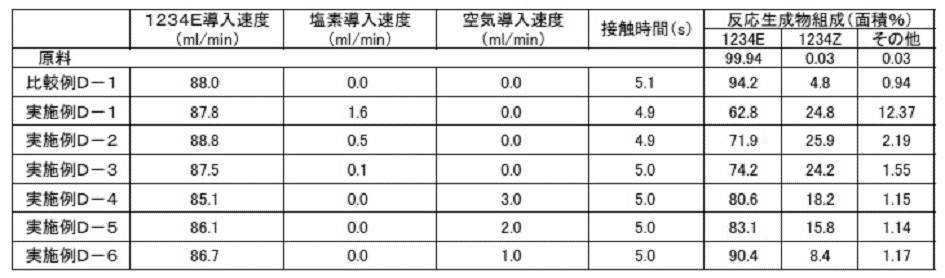
シス-1,3,3,3-テトラフルオロプロペン(1234Z)の原料となるトランス-1,3,3,3-テトラフルオロプロペン(1234E)は、任意の方法で製造されたものが使用可能であり特に限定されない。例えば、1234Eは、工業的に入手可能な1,1,1,3,3-ペンタフルオロプロパン(HFC-245fa)と水酸化ナトリウム等の塩基との反応によって容易に合成できることが知られている。尚、1,1,1,3,3-ペンタフルオロプロパン(245fa)は、上述の1233のフッ素化により得られる。また、1234Eは、上述した1233Eをフッ素化することにより得ることもできる。また、1234E自体もマグネシウム合金製造時に用いる防燃カバーガスとして工業生産されており、入手可能である。
以下、本発明のシス-1,3,3,3-テトラフルオロプロペン(1234Z)の製造について、実施例を挙げて具体的に説明するが、本発明はこれらの実施例に限定されるものではない。ここで、組成分析値の「%」は、反応混合物をガスクロマトグラフィー(検出器:FID)によって測定して得られた組成の「面積%」を表す。尚、表示桁数以下は四捨五入した。例えば、表中の0.00%は0.005面積%未満であることを示している。
実施例D-1~D-3においては、ラジカル発生剤として塩素ガスを使用し、塩素ガスの供給量をそれぞれ変化させて、塩素ガスを反応管に導入して1234Eの異性化反応を行った。結果を表9に示す。尚、実施例D-1~D-3において、塩素ガスの割合は、それぞれ1.8mol%、0.6mol%、0.1mol%であり、塩素/1234Eのモル比は、それぞれ0.018、0.0056、0.0011である。
実施例D-4~D-6においては、ラジカル発生剤として空気を使用し、空気の供給量をそれぞれ変化させて、空気を反応管に導入して1234Eの異性化反応を行った。結果を表9に示す。尚、実施例D-4~D-6において、空気の割合は、それぞれ3.4mol%、2.3mol%、1.1mol%であり、空気/1234Eのモル比は、それぞれ0.034、0.022、0.011である。
ラジカル発生剤を添加しない以外は、実施例D-1と同様の条件で反応を実施したものを比較例1とした。
原料として高純度のトランス-1,3,3,3-テトラフルオロプロペン(99.99%以上)、ラジカル発生剤として空気2.3mol%を反応管に導入して、異性化反応を実施した。結果を表10に示す。

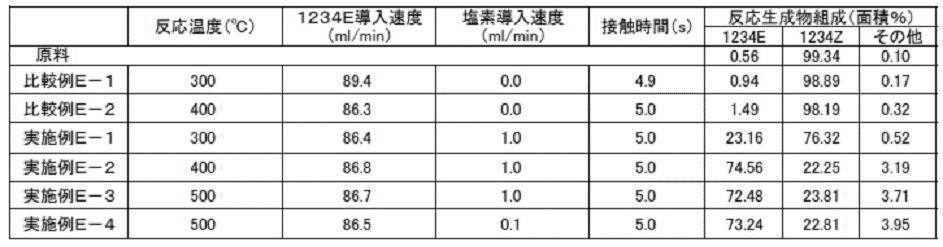
トランス-1,3,3,3-テトラフルオロプロペン(1234E)の原料となるシス-1,3,3,3-テトラフルオロプロペン(1234Z)は、任意の方法で製造されたものが使用可能であり特に限定されない。例えば、1234Zは、工業的に入手可能な1,1,1,3,3-ペンタフルオロプロパン(HFC-245fa)と水酸化ナトリウム等の塩基との反応によって容易に合成できることが知られている。尚、上述したように、1,1,1,3,3-ペンタフルオロプロパン(245fa)は、上述の1233のフッ素化により得られる。また、1234Zは、上述した1233Zをフッ素化することにより得ることもできる。
以下、本発明のトランス-1,3,3,3-テトラフルオロプロペン(1234E)の製造について、実施例を挙げて具体的に説明するが、本発明はこれらの実施例に限定されるものではない。ここで、組成分析値の「%」は、反応混合物をガスクロマトグラフィー(検出器:FID)によって測定して得られた組成の「面積%」を表す。尚、表示桁数以下は四捨五入した。例えば、表中の0.00%は0.005面積%未満であることを示している。

Claims (15)
- 少なくとも一般式(1)で表される化合物を含む原料組成物を、ラジカル発生剤の存在下で加熱し、前記原料組成物中の前記一般式(1)で表される化合物の少なくとも一部を一般式(2)で表される化合物に変換する異性化工程を含む、一般式(2)で表される化合物の製造方法。

[前記一般式(1)及び(2)において、XとYとはフッ素原子(F)又は水素原子(H)であり且つ前記XとYとは同一ではなく、或いは、前記Xと前記Yとは塩素原子(Cl)又は水素原子(H)であり且つ前記XとYとは同一ではない。] - 前記一般式(1)及び(2)において、前記Xが水素原子(H)であり、前記Yが塩素原子(Cl)であるとき、
1,1,1,3,3-ペンタクロロプロパンをフッ化水素と反応させて、前記式(1)及び前記式(2)で表される化合物と3-クロロ-1,1,1,3-テトラフルオロプロパン(244fa)、2-クロロ-1,1,1,3,3-ペンタフルオロプロパン(235da)、及び、1-クロロ-1,1,4,4,4-ペンタフルオロ-2-ブテン(1335)から選ばれる少なくとも1種からなる化合物と、を含む第1組成物を生成する工程と、
前記第1組成物から前記一般式(2)で表される化合物を蒸留により除去する工程と、
前記式一般(2)を除去した前記第1組成物から、3-クロロ-1,1,1,3-テトラフルオロプロパン、2-クロロ-1,1,1,3,3-ペンタフルオロプロパン、及び、1-クロロ-1,1,4,4,4-ペンタフルオロ-2-ブテンから選ばれる少なくとも1種からなる化合物を蒸留により除去して、前記一般式(1)で表される化合物を得る工程と、
を前記異性化工程の前に含むことを特徴とする請求項1に記載の製造方法。 - ラジカル発生剤が、塩素、酸素、臭素、空気、過酸化水素、オゾン、窒素酸化物およびハロゲン化炭素からなる群より選ばれる少なくとも一つであることを特徴とする請求項1に記載の製造方法。
- 前記異性化工程が気相中で実施されることを特徴とする請求項1に記載の製造方法。
- 前記異性化工程が固体触媒の非存在下で実施されることを特徴とする請求項1に記載の製造方法。
- 前記異性化工程が気相流通方式の空塔で行われることを特徴とする請求項1に記載の製造方法。
- 前記ラジカル発生剤の添加量は、前記一般式(1)で表される化合物に対して、0.0001mol%以上、10mol%以下であることを特徴とする請求項1に記載の製造方法。
- 前記一般式(1)及び(2)において、前記Xが水素原子(H)であり、前記Yがフッ素原子(F)であるとき、前記異性化工程における加熱温度が150℃以上700℃以下であることを特徴とする請求項1に記載の製造方法。
- 前記一般式(1)及び(2)において、前記Xがフッ素原子(F)であり、前記Yが水素原子(H)であるとき、前記異性化工程における加熱温度が150℃以上700℃以下であることを特徴とする請求項1に記載の製造方法。
- 前記一般式(1)及び(2)において、前記Xが水素原子(H)であり、前記Yが塩素原子(Cl)であるとき、前記異性化工程における加熱温度が150℃以上800℃以下であることを特徴とする請求項1に記載の製造方法。
- 前記一般式(1)及び(2)において、前記Xが塩素原子(Cl)であり、前記Yが水素原子(H)であるとき、前記異性化工程における加熱温度が150℃以上800℃以下であることを特徴とする請求項1に記載の製造方法。
- 少なくとも一般式(1)で表される化合物を含む原料組成物を、無触媒下で450℃以上700℃以下に加熱し、滞留時間を0.01秒以上50秒以下に設定して、前記原料組成物中の前記一般式(1)で表される化合物の少なくとも一部を一般式(2)で表される化合物に変換する異性化工程を含む、一般式(2)で表される化合物の製造方法。
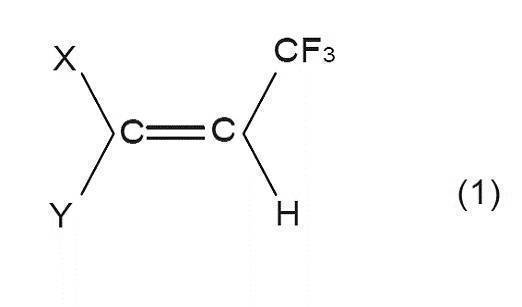

[前記一般式(1)及び(2)において、XとYとは塩素原子(Cl)又は水素原子(H)であり且つ前記XとYとは同一ではない。] - 前記滞留時間は、0.1秒以上、10秒以下であることを特徴とする請求項12に記載の製造方法。
- 少なくとも一般式(1)で表される化合物を含む原料組成物を、無触媒下で500℃以上900℃以下に加熱し、滞留時間を0.01秒以上50秒以下に設定して、前記原料組成物中の前記一般式(1)で表される化合物の少なくとも一部を一般式(2)で表される化合物に変換する異性化工程を含む、一般式(2)で表される化合物の製造方法。
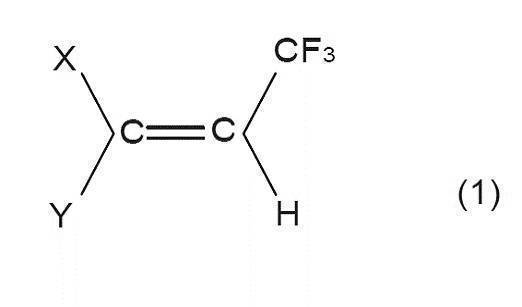
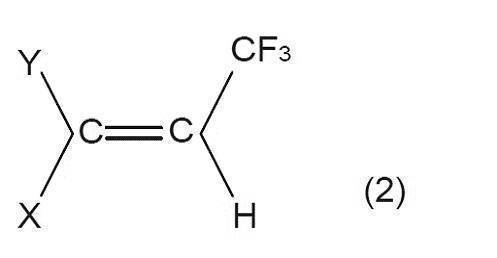
[前記一般式(1)及び(2)において、XとYとはフッ素原子(F)又は水素原子(H)であり且つ前記XとYとは同一ではない。] - 前記滞留時間は、0.1秒以上、10秒以下であることを特徴とする請求項14に記載の製造方法。
Priority Applications (4)
| Application Number | Priority Date | Filing Date | Title |
|---|---|---|---|
| DE112013003077.2T DE112013003077B4 (de) | 2012-06-13 | 2013-06-13 | Verfahren zum Herstellen von 1-Chlor-3,3,3-Trifluor-1-Propen und 1,3,3,3-Tetrafluorpropen |
| CN201380029064.8A CN104603089B (zh) | 2012-06-13 | 2013-06-13 | 1-氯-3,3,3-三氟-1-丙烯及1,3,3,3-四氟丙烯的制造方法 |
| JP2014521412A JP6156374B2 (ja) | 2012-06-13 | 2013-06-13 | 1−クロロ−3,3,3−トリフルオロ−1−プロペン及び1,3,3,3−テトラフルオロプロペンの製造方法 |
| US14/564,606 US9221731B2 (en) | 2012-06-13 | 2014-12-09 | Method for producing 1-chloro-3,3,3-trifluoro-1-propene and 1,3,3,3-tetrafluoropropene |
Applications Claiming Priority (10)
| Application Number | Priority Date | Filing Date | Title |
|---|---|---|---|
| JP2012134054 | 2012-06-13 | ||
| JP2012-134054 | 2012-06-13 | ||
| JP2012137704 | 2012-06-19 | ||
| JP2012-137706 | 2012-06-19 | ||
| JP2012-137704 | 2012-06-19 | ||
| JP2012-137705 | 2012-06-19 | ||
| JP2012137705 | 2012-06-19 | ||
| JP2012137706 | 2012-06-19 | ||
| JP2012249198 | 2012-11-13 | ||
| JP2012-249198 | 2012-11-13 |
Related Child Applications (1)
| Application Number | Title | Priority Date | Filing Date |
|---|---|---|---|
| US14/564,606 Continuation US9221731B2 (en) | 2012-06-13 | 2014-12-09 | Method for producing 1-chloro-3,3,3-trifluoro-1-propene and 1,3,3,3-tetrafluoropropene |
Publications (1)
| Publication Number | Publication Date |
|---|---|
| WO2013187489A1 true WO2013187489A1 (ja) | 2013-12-19 |
Family
ID=49758307
Family Applications (1)
| Application Number | Title | Priority Date | Filing Date |
|---|---|---|---|
| PCT/JP2013/066395 Ceased WO2013187489A1 (ja) | 2012-06-13 | 2013-06-13 | 1-クロロ-3,3,3-トリフルオロ-1-プロペン及び1,3,3,3-テトラフルオロプロペンの製造方法 |
Country Status (5)
| Country | Link |
|---|---|
| US (1) | US9221731B2 (ja) |
| JP (1) | JP6156374B2 (ja) |
| CN (1) | CN104603089B (ja) |
| DE (1) | DE112013003077B4 (ja) |
| WO (1) | WO2013187489A1 (ja) |
Cited By (9)
| Publication number | Priority date | Publication date | Assignee | Title |
|---|---|---|---|---|
| JP2016515118A (ja) * | 2013-03-15 | 2016-05-26 | ハネウェル・インターナショナル・インコーポレーテッド | (e)−1−クロロ−3,3,3−トリフルオロプロペンの(z)−1−クロロ−3,3,3−トリフルオロプロペンへの高温異性化 |
| JP2017509606A (ja) * | 2014-02-19 | 2017-04-06 | アーケマ・インコーポレイテッド | ヒドロクロロフルオロオレフィンを製造するためのプロセス |
| CN107406357A (zh) * | 2015-03-19 | 2017-11-28 | 霍尼韦尔国际公司 | 干燥HCFO‑1233zd的方法 |
| JP2018048205A (ja) * | 2015-06-02 | 2018-03-29 | セントラル硝子株式会社 | ハイドロハロフルオロオレフィンの製造方法 |
| KR101928224B1 (ko) | 2014-07-15 | 2018-12-11 | 다이킨 고교 가부시키가이샤 | 클로로프로펜의 제조 방법 및 2,3,3,3-테트라플루오로프로펜의 제조 방법 |
| JP2019048958A (ja) * | 2017-09-12 | 2019-03-28 | 株式会社カネコ化学 | 合成樹脂の溶解剤 |
| CN110240535A (zh) * | 2014-08-14 | 2019-09-17 | 科慕埃弗西有限公司 | 通过脱氟化氢来制备E-1,3,3,3-四氟丙烯(HFC-1234ze)的方法 |
| JP2021059498A (ja) * | 2019-10-03 | 2021-04-15 | セントラル硝子株式会社 | 不飽和クロロフルオロカーボンの製造方法 |
| WO2021187369A1 (ja) * | 2020-03-19 | 2021-09-23 | セントラル硝子株式会社 | (ハイドロ)ハロカーボンの製造方法 |
Families Citing this family (12)
| Publication number | Priority date | Publication date | Assignee | Title |
|---|---|---|---|---|
| US9926244B2 (en) | 2008-10-28 | 2018-03-27 | Honeywell International Inc. | Process for drying HCFO-1233zd |
| CN106660907B (zh) * | 2014-07-15 | 2019-01-22 | 中央硝子株式会社 | 反式-1-氯-3,3,3-三氟丙烯的制造方法 |
| ES2908787T3 (es) * | 2017-01-13 | 2022-05-03 | Honeywell Int Inc | Refrigerante, composiciones de transferencia de calor, métodos y sistemas |
| WO2018231764A1 (en) * | 2017-06-12 | 2018-12-20 | Honeywell International Inc. | Method to produce hfo-1234yf from tcp by suppressing the bubble/dew point |
| CN107522592B (zh) * | 2017-09-07 | 2020-06-02 | 浙江衢化氟化学有限公司 | 一种联产多种卤代烯烃和氟代烷烃的方法 |
| WO2019093401A1 (ja) * | 2017-11-09 | 2019-05-16 | 関東電化工業株式会社 | 1,2-ジクロロ-1-(2,2,2-トリフルオロエトキシ)エチレン、その製造方法及びその用途 |
| CN111499489B (zh) * | 2019-01-30 | 2023-04-11 | 浙江省化工研究院有限公司 | 一种含氟烯烃异构化的方法 |
| CN110585753B (zh) * | 2019-10-12 | 2021-11-12 | 唐山浩昌杰环保科技发展有限公司 | 一种润滑油蒸馏罐 |
| JP6809589B1 (ja) * | 2019-10-28 | 2021-01-06 | ダイキン工業株式会社 | ジフルオロエチレンの製造方法 |
| CN113527049B (zh) * | 2020-04-22 | 2024-08-23 | 陕西中蓝化工科技新材料有限公司 | 一种反式/顺式-HFO-1234ze和HFO-1234yf的联产制备工艺 |
| CN113527047B (zh) * | 2020-04-22 | 2024-08-16 | 陕西中蓝化工科技新材料有限公司 | 一种联产制备反式-HFO-1234ze和顺式-HFO-1234ze的工艺 |
| WO2022138675A1 (ja) | 2020-12-22 | 2022-06-30 | セントラル硝子株式会社 | 不飽和クロロフルオロカーボンの製造方法、及び組成物 |
Citations (3)
| Publication number | Priority date | Publication date | Assignee | Title |
|---|---|---|---|---|
| US20120059199A1 (en) * | 2010-09-03 | 2012-03-08 | Pokrovski Konstantin A | Continuous low-temperature process to produce trans-1-chloro-3,3,3-trifluoropropene |
| JP2012509324A (ja) * | 2008-11-19 | 2012-04-19 | アーケマ・インコーポレイテッド | ヒドロクロロフルオロオレフィンを製造するための方法 |
| JP2012512160A (ja) * | 2008-12-12 | 2012-05-31 | ハネウェル・インターナショナル・インコーポレーテッド | 1−クロロ−3,3,3−トリフルオロプロペンの異性化 |
Family Cites Families (16)
| Publication number | Priority date | Publication date | Assignee | Title |
|---|---|---|---|---|
| JP3818398B2 (ja) | 1995-12-29 | 2006-09-06 | ダイキン工業株式会社 | 1,1,1,3,3−ペンタフルオロプロパンの製造方法 |
| US6111150A (en) | 1996-06-20 | 2000-08-29 | Central Glass Company, Limited | Method for producing 1,1,1,3,3,-pentafluoropropane |
| JP3821514B2 (ja) | 1996-06-20 | 2006-09-13 | セントラル硝子株式会社 | 1,3,3,3−テトラフルオロプロペンの製造法 |
| JP3031456B2 (ja) | 1996-07-12 | 2000-04-10 | 国際電気株式会社 | 携帯用電子機器のカバー |
| JP3886229B2 (ja) | 1997-11-11 | 2007-02-28 | セントラル硝子株式会社 | 1,3,3,3−テトラフルオロプロペンの製造法 |
| JPH11180908A (ja) | 1997-12-19 | 1999-07-06 | Daikin Ind Ltd | 1,1,1,3,3−ペンタフルオロプロパンの製造方法及びその製造中間体の製造方法 |
| JP3031465B2 (ja) | 1998-02-26 | 2000-04-10 | セントラル硝子株式会社 | 1,1,1,3,3−ペンタフルオロプロパンの製造方法 |
| EP0939071B1 (en) | 1998-02-26 | 2003-07-30 | Central Glass Company, Limited | Method for producing fluorinated propane |
| JP2008028571A (ja) | 2006-07-19 | 2008-02-07 | Sharp Corp | 受信装置及び遠隔操作装置 |
| GB0706978D0 (en) | 2007-04-11 | 2007-05-16 | Ineos Fluor Holdings Ltd | Process |
| JP5380882B2 (ja) | 2007-04-17 | 2014-01-08 | セントラル硝子株式会社 | 3,3,3−トリフルオロプロピンの製造方法 |
| US8513473B2 (en) | 2007-10-10 | 2013-08-20 | Central Glass Company, Limited | Method for producing trans-1,3,3,3-tetrafluoropropene |
| JP2010152504A (ja) | 2008-12-24 | 2010-07-08 | Osaka Prefecture Univ | 商品棚配置装置 |
| JP5477011B2 (ja) | 2009-02-03 | 2014-04-23 | セントラル硝子株式会社 | (z)−1−クロロ−3,3,3−トリフルオロプロペンの精製方法 |
| JP5655527B2 (ja) * | 2009-12-02 | 2015-01-21 | 住友化学株式会社 | (z)−シアノアルケニルシクロプロパンカルボン酸化合物の製造方法 |
| JP5470178B2 (ja) * | 2010-07-06 | 2014-04-16 | 信越化学工業株式会社 | 尿素存在下のラジカル異性化によるe,e−脂肪族共役ジエン化合物の製造方法 |
-
2013
- 2013-06-13 JP JP2014521412A patent/JP6156374B2/ja active Active
- 2013-06-13 DE DE112013003077.2T patent/DE112013003077B4/de active Active
- 2013-06-13 CN CN201380029064.8A patent/CN104603089B/zh active Active
- 2013-06-13 WO PCT/JP2013/066395 patent/WO2013187489A1/ja not_active Ceased
-
2014
- 2014-12-09 US US14/564,606 patent/US9221731B2/en active Active
Patent Citations (3)
| Publication number | Priority date | Publication date | Assignee | Title |
|---|---|---|---|---|
| JP2012509324A (ja) * | 2008-11-19 | 2012-04-19 | アーケマ・インコーポレイテッド | ヒドロクロロフルオロオレフィンを製造するための方法 |
| JP2012512160A (ja) * | 2008-12-12 | 2012-05-31 | ハネウェル・インターナショナル・インコーポレーテッド | 1−クロロ−3,3,3−トリフルオロプロペンの異性化 |
| US20120059199A1 (en) * | 2010-09-03 | 2012-03-08 | Pokrovski Konstantin A | Continuous low-temperature process to produce trans-1-chloro-3,3,3-trifluoropropene |
Cited By (14)
| Publication number | Priority date | Publication date | Assignee | Title |
|---|---|---|---|---|
| JP2016515118A (ja) * | 2013-03-15 | 2016-05-26 | ハネウェル・インターナショナル・インコーポレーテッド | (e)−1−クロロ−3,3,3−トリフルオロプロペンの(z)−1−クロロ−3,3,3−トリフルオロプロペンへの高温異性化 |
| JP2017509606A (ja) * | 2014-02-19 | 2017-04-06 | アーケマ・インコーポレイテッド | ヒドロクロロフルオロオレフィンを製造するためのプロセス |
| KR101928224B1 (ko) | 2014-07-15 | 2018-12-11 | 다이킨 고교 가부시키가이샤 | 클로로프로펜의 제조 방법 및 2,3,3,3-테트라플루오로프로펜의 제조 방법 |
| CN110240535A (zh) * | 2014-08-14 | 2019-09-17 | 科慕埃弗西有限公司 | 通过脱氟化氢来制备E-1,3,3,3-四氟丙烯(HFC-1234ze)的方法 |
| CN110240535B (zh) * | 2014-08-14 | 2022-09-13 | 科慕埃弗西有限公司 | 通过脱氟化氢来制备E-1,3,3,3-四氟丙烯(HFC-1234ze)的方法 |
| CN107406357A (zh) * | 2015-03-19 | 2017-11-28 | 霍尼韦尔国际公司 | 干燥HCFO‑1233zd的方法 |
| JP2018048205A (ja) * | 2015-06-02 | 2018-03-29 | セントラル硝子株式会社 | ハイドロハロフルオロオレフィンの製造方法 |
| JP2019048958A (ja) * | 2017-09-12 | 2019-03-28 | 株式会社カネコ化学 | 合成樹脂の溶解剤 |
| JP2021059498A (ja) * | 2019-10-03 | 2021-04-15 | セントラル硝子株式会社 | 不飽和クロロフルオロカーボンの製造方法 |
| WO2021187369A1 (ja) * | 2020-03-19 | 2021-09-23 | セントラル硝子株式会社 | (ハイドロ)ハロカーボンの製造方法 |
| JPWO2021187369A1 (ja) * | 2020-03-19 | 2021-09-23 | ||
| CN114901617A (zh) * | 2020-03-19 | 2022-08-12 | 中央硝子株式会社 | (氢)卤烃的制备方法 |
| JP7670992B2 (ja) | 2020-03-19 | 2025-05-01 | セントラル硝子株式会社 | (ハイドロ)ハロカーボンの製造方法 |
| US12448343B2 (en) | 2020-03-19 | 2025-10-21 | Central Glass Company, Limited | Method for purifying (hydro)halocarbon by reduced pressure distillation from azeotropic or azeotropic-like composition |
Also Published As
| Publication number | Publication date |
|---|---|
| DE112013003077B4 (de) | 2019-08-14 |
| JP6156374B2 (ja) | 2017-07-05 |
| US20150099907A1 (en) | 2015-04-09 |
| CN104603089B (zh) | 2016-08-24 |
| JPWO2013187489A1 (ja) | 2016-02-08 |
| CN104603089A (zh) | 2015-05-06 |
| US9221731B2 (en) | 2015-12-29 |
| DE112013003077T5 (de) | 2015-04-02 |
Similar Documents
| Publication | Publication Date | Title |
|---|---|---|
| JP6156374B2 (ja) | 1−クロロ−3,3,3−トリフルオロ−1−プロペン及び1,3,3,3−テトラフルオロプロペンの製造方法 | |
| EP2178814B1 (en) | Method for producing fluorinated olefins | |
| RU2548902C2 (ru) | Способ получения 2,3,3,3-тетрафторопропена газофазным фторированием пентахлоропропана | |
| JP6382374B2 (ja) | 1,1,1,3,3−ペンタフルオロプロパン、トランス−1−クロロ−3,3,3−トリフルオロプロペン、及びトランス−1,3,3,3−テトラフルオロプロペンを共製造するための統合方法 | |
| CN104781219B (zh) | 用于制造2,3,3,3-四氟丙烯的改进的方法 | |
| JP6234951B2 (ja) | フッ化有機化合物の製造方法 | |
| JP6084168B2 (ja) | トランス−1−クロロ−3,3,3−トリフルオロプロペン、トランス−1,3,3,3−テトラフルオロプロペン、及び1,1,1,3,3−ペンタフルオロプロパンを共に製造するための統合方法 | |
| JP7092861B2 (ja) | C3塩素化アルカン及びアルケン化合物の製造方法 | |
| US10414704B2 (en) | Process for the manufacture of 2-chloro-3,3,3-trifluoropropene by gas phase fluorination of pentachloropropane | |
| JP6251992B2 (ja) | シス−1,3,3,3−テトラフルオロプロペンの製造方法 | |
| KR20140077958A (ko) | 2,3,3,3-테트라플루오로프로펜의 제조 방법 | |
| WO2018047972A1 (ja) | 1-クロロ-2,3,3-トリフルオロプロペンの製造方法 | |
| JP5990990B2 (ja) | シス−1,3,3,3−テトラフルオロプロペンの製造方法 | |
| JP7315856B2 (ja) | 1,2-ジクロロ-3,3,3-トリフルオロプロペンの製造方法 | |
| JP6627849B2 (ja) | シス−1,3,3,3−テトラフルオロプロペンの製造方法 | |
| JP6032085B2 (ja) | 3,3,3−トリフルオロプロピンの製造方法 | |
| KR20240141736A (ko) | 고비점 플루오르화 성분의 혼합물로부터 1-클로로-3,3,3-트리플루오로프로펜(HCFO-1233zd)을 제조하기 위한 통합 공정 | |
| JPWO2019003847A1 (ja) | 1−クロロ−3,3,3−トリフルオロプロペンの製造方法 |
Legal Events
| Date | Code | Title | Description |
|---|---|---|---|
| 121 | Ep: the epo has been informed by wipo that ep was designated in this application |
Ref document number: 13803919 Country of ref document: EP Kind code of ref document: A1 |
|
| ENP | Entry into the national phase |
Ref document number: 2014521412 Country of ref document: JP Kind code of ref document: A |
|
| WWE | Wipo information: entry into national phase |
Ref document number: 1120130030772 Country of ref document: DE Ref document number: 112013003077 Country of ref document: DE |
|
| 122 | Ep: pct application non-entry in european phase |
Ref document number: 13803919 Country of ref document: EP Kind code of ref document: A1 |