WO2013153969A1 - 樹脂組成物 - Google Patents
樹脂組成物 Download PDFInfo
- Publication number
- WO2013153969A1 WO2013153969A1 PCT/JP2013/059640 JP2013059640W WO2013153969A1 WO 2013153969 A1 WO2013153969 A1 WO 2013153969A1 JP 2013059640 W JP2013059640 W JP 2013059640W WO 2013153969 A1 WO2013153969 A1 WO 2013153969A1
- Authority
- WO
- WIPO (PCT)
- Prior art keywords
- film
- resin composition
- mass
- parts
- volume resistivity
- Prior art date
- Legal status (The legal status is an assumption and is not a legal conclusion. Google has not performed a legal analysis and makes no representation as to the accuracy of the status listed.)
- Ceased
Links
Images
Classifications
-
- C—CHEMISTRY; METALLURGY
- C08—ORGANIC MACROMOLECULAR COMPOUNDS; THEIR PREPARATION OR CHEMICAL WORKING-UP; COMPOSITIONS BASED THEREON
- C08J—WORKING-UP; GENERAL PROCESSES OF COMPOUNDING; AFTER-TREATMENT NOT COVERED BY SUBCLASSES C08B, C08C, C08F, C08G or C08H
- C08J5/00—Manufacture of articles or shaped materials containing macromolecular substances
- C08J5/18—Manufacture of films or sheets
-
- C—CHEMISTRY; METALLURGY
- C08—ORGANIC MACROMOLECULAR COMPOUNDS; THEIR PREPARATION OR CHEMICAL WORKING-UP; COMPOSITIONS BASED THEREON
- C08K—Use of inorganic or non-macromolecular organic substances as compounding ingredients
- C08K3/00—Use of inorganic substances as compounding ingredients
- C08K3/02—Elements
- C08K3/04—Carbon
-
- C—CHEMISTRY; METALLURGY
- C08—ORGANIC MACROMOLECULAR COMPOUNDS; THEIR PREPARATION OR CHEMICAL WORKING-UP; COMPOSITIONS BASED THEREON
- C08K—Use of inorganic or non-macromolecular organic substances as compounding ingredients
- C08K3/00—Use of inorganic substances as compounding ingredients
- C08K3/02—Elements
- C08K3/04—Carbon
- C08K3/041—Carbon nanotubes
-
- C—CHEMISTRY; METALLURGY
- C08—ORGANIC MACROMOLECULAR COMPOUNDS; THEIR PREPARATION OR CHEMICAL WORKING-UP; COMPOSITIONS BASED THEREON
- C08K—Use of inorganic or non-macromolecular organic substances as compounding ingredients
- C08K7/00—Use of ingredients characterised by shape
- C08K7/02—Fibres or whiskers
- C08K7/04—Fibres or whiskers inorganic
- C08K7/06—Elements
-
- C—CHEMISTRY; METALLURGY
- C08—ORGANIC MACROMOLECULAR COMPOUNDS; THEIR PREPARATION OR CHEMICAL WORKING-UP; COMPOSITIONS BASED THEREON
- C08K—Use of inorganic or non-macromolecular organic substances as compounding ingredients
- C08K7/00—Use of ingredients characterised by shape
- C08K7/22—Expanded, porous or hollow particles
- C08K7/24—Expanded, porous or hollow particles inorganic
-
- C—CHEMISTRY; METALLURGY
- C08—ORGANIC MACROMOLECULAR COMPOUNDS; THEIR PREPARATION OR CHEMICAL WORKING-UP; COMPOSITIONS BASED THEREON
- C08L—COMPOSITIONS OF MACROMOLECULAR COMPOUNDS
- C08L23/00—Compositions of homopolymers or copolymers of unsaturated aliphatic hydrocarbons having only one carbon-to-carbon double bond; Compositions of derivatives of such polymers
- C08L23/02—Compositions of homopolymers or copolymers of unsaturated aliphatic hydrocarbons having only one carbon-to-carbon double bond; Compositions of derivatives of such polymers not modified by chemical after-treatment
- C08L23/04—Homopolymers or copolymers of ethene
- C08L23/06—Polyethylene
-
- C—CHEMISTRY; METALLURGY
- C08—ORGANIC MACROMOLECULAR COMPOUNDS; THEIR PREPARATION OR CHEMICAL WORKING-UP; COMPOSITIONS BASED THEREON
- C08L—COMPOSITIONS OF MACROMOLECULAR COMPOUNDS
- C08L23/00—Compositions of homopolymers or copolymers of unsaturated aliphatic hydrocarbons having only one carbon-to-carbon double bond; Compositions of derivatives of such polymers
- C08L23/26—Compositions of homopolymers or copolymers of unsaturated aliphatic hydrocarbons having only one carbon-to-carbon double bond; Compositions of derivatives of such polymers modified by chemical after-treatment
- C08L23/28—Compositions of homopolymers or copolymers of unsaturated aliphatic hydrocarbons having only one carbon-to-carbon double bond; Compositions of derivatives of such polymers modified by chemical after-treatment by reaction with halogens or halogen-containing compounds
- C08L23/286—Chlorinated polyethylene
-
- H—ELECTRICITY
- H01—ELECTRIC ELEMENTS
- H01B—CABLES; CONDUCTORS; INSULATORS; SELECTION OF MATERIALS FOR THEIR CONDUCTIVE, INSULATING OR DIELECTRIC PROPERTIES
- H01B1/00—Conductors or conductive bodies characterised by the conductive materials; Selection of materials as conductors
- H01B1/20—Conductive material dispersed in non-conductive organic material
- H01B1/24—Conductive material dispersed in non-conductive organic material the conductive material comprising carbon-silicon compounds, carbon or silicon
-
- H—ELECTRICITY
- H01—ELECTRIC ELEMENTS
- H01M—PROCESSES OR MEANS, e.g. BATTERIES, FOR THE DIRECT CONVERSION OF CHEMICAL ENERGY INTO ELECTRICAL ENERGY
- H01M4/00—Electrodes
- H01M4/02—Electrodes composed of, or comprising, active material
- H01M4/62—Selection of inactive substances as ingredients for active masses, e.g. binders, fillers
- H01M4/624—Electric conductive fillers
-
- H—ELECTRICITY
- H01—ELECTRIC ELEMENTS
- H01M—PROCESSES OR MEANS, e.g. BATTERIES, FOR THE DIRECT CONVERSION OF CHEMICAL ENERGY INTO ELECTRICAL ENERGY
- H01M8/00—Fuel cells; Manufacture thereof
- H01M8/02—Details
- H01M8/0202—Collectors; Separators, e.g. bipolar separators; Interconnectors
- H01M8/0204—Non-porous and characterised by the material
- H01M8/0223—Composites
- H01M8/0226—Composites in the form of mixtures
-
- H—ELECTRICITY
- H01—ELECTRIC ELEMENTS
- H01M—PROCESSES OR MEANS, e.g. BATTERIES, FOR THE DIRECT CONVERSION OF CHEMICAL ENERGY INTO ELECTRICAL ENERGY
- H01M8/00—Fuel cells; Manufacture thereof
- H01M8/02—Details
- H01M8/0202—Collectors; Separators, e.g. bipolar separators; Interconnectors
- H01M8/023—Porous and characterised by the material
- H01M8/0241—Composites
- H01M8/0243—Composites in the form of mixtures
-
- H—ELECTRICITY
- H01—ELECTRIC ELEMENTS
- H01M—PROCESSES OR MEANS, e.g. BATTERIES, FOR THE DIRECT CONVERSION OF CHEMICAL ENERGY INTO ELECTRICAL ENERGY
- H01M8/00—Fuel cells; Manufacture thereof
- H01M8/18—Regenerative fuel cells, e.g. redox flow batteries or secondary fuel cells
- H01M8/184—Regeneration by electrochemical means
- H01M8/188—Regeneration by electrochemical means by recharging of redox couples containing fluids; Redox flow type batteries
-
- C—CHEMISTRY; METALLURGY
- C08—ORGANIC MACROMOLECULAR COMPOUNDS; THEIR PREPARATION OR CHEMICAL WORKING-UP; COMPOSITIONS BASED THEREON
- C08J—WORKING-UP; GENERAL PROCESSES OF COMPOUNDING; AFTER-TREATMENT NOT COVERED BY SUBCLASSES C08B, C08C, C08F, C08G or C08H
- C08J2323/00—Characterised by the use of homopolymers or copolymers of unsaturated aliphatic hydrocarbons having only one carbon-to-carbon double bond; Derivatives of such polymers
- C08J2323/02—Characterised by the use of homopolymers or copolymers of unsaturated aliphatic hydrocarbons having only one carbon-to-carbon double bond; Derivatives of such polymers not modified by chemical after treatment
- C08J2323/04—Homopolymers or copolymers of ethene
- C08J2323/06—Polyethene
-
- C—CHEMISTRY; METALLURGY
- C08—ORGANIC MACROMOLECULAR COMPOUNDS; THEIR PREPARATION OR CHEMICAL WORKING-UP; COMPOSITIONS BASED THEREON
- C08J—WORKING-UP; GENERAL PROCESSES OF COMPOUNDING; AFTER-TREATMENT NOT COVERED BY SUBCLASSES C08B, C08C, C08F, C08G or C08H
- C08J2323/00—Characterised by the use of homopolymers or copolymers of unsaturated aliphatic hydrocarbons having only one carbon-to-carbon double bond; Derivatives of such polymers
- C08J2323/26—Characterised by the use of homopolymers or copolymers of unsaturated aliphatic hydrocarbons having only one carbon-to-carbon double bond; Derivatives of such polymers modified by chemical after-treatment
- C08J2323/28—Characterised by the use of homopolymers or copolymers of unsaturated aliphatic hydrocarbons having only one carbon-to-carbon double bond; Derivatives of such polymers modified by chemical after-treatment by reaction with halogens or halogen-containing compounds
-
- C—CHEMISTRY; METALLURGY
- C08—ORGANIC MACROMOLECULAR COMPOUNDS; THEIR PREPARATION OR CHEMICAL WORKING-UP; COMPOSITIONS BASED THEREON
- C08K—Use of inorganic or non-macromolecular organic substances as compounding ingredients
- C08K2201/00—Specific properties of additives
- C08K2201/001—Conductive additives
-
- C—CHEMISTRY; METALLURGY
- C08—ORGANIC MACROMOLECULAR COMPOUNDS; THEIR PREPARATION OR CHEMICAL WORKING-UP; COMPOSITIONS BASED THEREON
- C08K—Use of inorganic or non-macromolecular organic substances as compounding ingredients
- C08K2201/00—Specific properties of additives
- C08K2201/011—Nanostructured additives
-
- C—CHEMISTRY; METALLURGY
- C08—ORGANIC MACROMOLECULAR COMPOUNDS; THEIR PREPARATION OR CHEMICAL WORKING-UP; COMPOSITIONS BASED THEREON
- C08L—COMPOSITIONS OF MACROMOLECULAR COMPOUNDS
- C08L23/00—Compositions of homopolymers or copolymers of unsaturated aliphatic hydrocarbons having only one carbon-to-carbon double bond; Compositions of derivatives of such polymers
- C08L23/02—Compositions of homopolymers or copolymers of unsaturated aliphatic hydrocarbons having only one carbon-to-carbon double bond; Compositions of derivatives of such polymers not modified by chemical after-treatment
-
- Y—GENERAL TAGGING OF NEW TECHNOLOGICAL DEVELOPMENTS; GENERAL TAGGING OF CROSS-SECTIONAL TECHNOLOGIES SPANNING OVER SEVERAL SECTIONS OF THE IPC; TECHNICAL SUBJECTS COVERED BY FORMER USPC CROSS-REFERENCE ART COLLECTIONS [XRACs] AND DIGESTS
- Y02—TECHNOLOGIES OR APPLICATIONS FOR MITIGATION OR ADAPTATION AGAINST CLIMATE CHANGE
- Y02E—REDUCTION OF GREENHOUSE GAS [GHG] EMISSIONS, RELATED TO ENERGY GENERATION, TRANSMISSION OR DISTRIBUTION
- Y02E60/00—Enabling technologies; Technologies with a potential or indirect contribution to GHG emissions mitigation
- Y02E60/10—Energy storage using batteries
-
- Y—GENERAL TAGGING OF NEW TECHNOLOGICAL DEVELOPMENTS; GENERAL TAGGING OF CROSS-SECTIONAL TECHNOLOGIES SPANNING OVER SEVERAL SECTIONS OF THE IPC; TECHNICAL SUBJECTS COVERED BY FORMER USPC CROSS-REFERENCE ART COLLECTIONS [XRACs] AND DIGESTS
- Y02—TECHNOLOGIES OR APPLICATIONS FOR MITIGATION OR ADAPTATION AGAINST CLIMATE CHANGE
- Y02E—REDUCTION OF GREENHOUSE GAS [GHG] EMISSIONS, RELATED TO ENERGY GENERATION, TRANSMISSION OR DISTRIBUTION
- Y02E60/00—Enabling technologies; Technologies with a potential or indirect contribution to GHG emissions mitigation
- Y02E60/30—Hydrogen technology
- Y02E60/50—Fuel cells
Definitions
- the present invention relates to a resin composition for a conductive resin film. More specifically, the present invention relates to a resin composition for a conductive resin film excellent in tensile elongation, bending resistance and flexibility.
- renewable energy such as solar power generation, wind power generation and wave power generation has attracted attention as a new energy source to replace fossil fuels such as oil and nuclear power.
- these renewable energies are strongly affected by the weather, the output is extremely unstable. Therefore, in order to connect a large amount of these energies to the electric power network, for example, it is necessary to level out output fluctuations with a large capacity storage battery.
- a redox flow battery performs charge / discharge by separating two types of ion solutions with a cation exchange membrane and simultaneously carrying out an oxidation reaction and a reduction reaction on electrodes provided in both solutions. For example, in a redox flow battery using a sulfuric acid aqueous solution of vanadium for both electrodes, tetravalent vanadium is oxidized to pentavalent at the positive electrode and trivalent vanadium is reduced to divalent at the negative electrode during charging. The reverse reaction occurs during discharge.
- the redox flow battery has a feature that the equipment can be easily enlarged. In addition, since it does not use flammable or explosive substances and does not generate such substances, it is safer than sodium / sulfur batteries or lithium ion secondary batteries. Are better.
- the electrode of the redox flow battery is immersed in an electrolytic solution such as an aqueous sulfuric acid solution and undergoes a redox reaction. Therefore, high conductivity and chemical resistance are required, and a carbon fiber aggregate or platinum plating is used as an electrode. in use.
- a carbon fiber aggregate or platinum plating is used as an electrode. in use.
- the carbon fiber aggregate is liquid-permeable, there is a problem that the connection portion between the carbon fiber aggregate and the copper wire is affected by the transported sulfuric acid aqueous solution or the like.
- Platinum plating is a very good conductor and excellent in chemical resistance, but it is a noble metal and expensive.
- a conductive resin film kneaded with conductive carbon such as ketjen black is used as an electrode (for example, Patent Documents 1 to 4), or an electrode such as a carbon fiber aggregate or a copper plate is covered with the conductive resin film. It has been done.
- these conductive resin films when kneaded with a large amount of conductive carbon to give sufficiently high conductivity, have absolutely insufficient tensile elongation, bending resistance or flexibility, There is a problem that it breaks easily. Further, if the amount of conductive carbon is reduced to ensure tensile elongation, bending resistance and flexibility, the volume resistivity exceeds 10 ⁇ ⁇ cm. The redox flow battery used in the above is not satisfactory in that the internal resistance increases.
- Patent Document 5 Carbon nanotubes have attracted attention as conductive carbon, and it is expected that the above problems can be solved (for example, Patent Document 5 and Non-Patent Document 1).
- Patent Document 5 there is a problem that carbon nanotubes are difficult to defibrate and are therefore very difficult to disperse in a resin.
- a large amount of carbon nanotubes must be blended in the same way as ketjen black, and eventually the conductive resin film has tensile elongation, bending resistance and flexibility. It is insufficient practically.
- increasing the shear stress in the defibration / dispersion process breaks the carbon nanotubes. It becomes necessary to do.
- conductive films made of a composition obtained by mixing carbon black or carbon nanotubes with a propylene-olefin copolymer wax to form a master batch and mixing with an organic polymer have been proposed (for example, Patent Documents 6 and 7). ).
- the masterbatch allows high filling of carbon black or carbon nanotubes, but the resulting film is not sufficiently conductive.
- JP-A-1-149370 JP-A-4-259754 Japanese Unexamined Patent Publication No. 7-053813 JP 2001-015144 A JP 2006-111870 A Special table 2012-507586 gazette Special table 2012-507588 gazette
- An object of the present invention is to have conductivity, excellent tensile elongation, bending resistance and flexibility, and an electrolyte circulation type secondary battery such as a redox flow battery, a zinc / chlorine battery, and a zinc / bromine battery. It is providing the resin composition for the conductive resin film suitable for the electrode in the etc., or its covering protection.
- thermoplastic resin 100 parts by mass of thermoplastic resin
- resin composition comprising 1 to 60 parts by mass of carbon nanotubes and
- C 1 to 100 parts by mass of at least one selected from the group consisting of acetylene black and graphite.
- the film comprising the resin composition of the present invention has high conductivity and is excellent in tensile elongation, bending resistance and flexibility, and therefore, an electrolyte circulation type secondary battery such as a redox flow battery, zinc -It can be used suitably for the electrode in a chlorine battery, a zinc-bromine battery, etc. or the coating protection thereof.
- an electrolyte circulation type secondary battery such as a redox flow battery, zinc -It can be used suitably for the electrode in a chlorine battery, a zinc-bromine battery, etc. or the coating protection thereof.
- thermoplastic resin Thermoplastic resin
- the component (A) receives the components (B) to (D) which are carbon fillers, and the obtained film has tensile elongation, bending resistance, flexibility and the like. Gives mechanical properties.
- thermoplastic resins include polyethylene, polypropylene, polybutene-1, poly-4-methylpentene-1, chlorinated polyethylene, ethylene / ⁇ -olefin copolymers, ethylene / vinyl acetate copolymers, and ethylene / polyethylene.
- Polyolefin resins such as acrylate copolymers; Polyvinyl chloride resins such as polyvinyl chloride and vinyl chloride / vinyl acetate copolymers; Polyamide resins such as nylon 11 and nylon 12; Polyurethane resins: Non-crystalline Low crystalline or crystalline polyester resin; Acrylonitrile / butadiene / styrene copolymer (ABS resin); Hydrogenated styrene elastomer such as hydrogenated styrene / conjugated diene copolymer; Acrylic resin; Silicone Resin; Polyvinylidene chloride resin; Etc. can be mentioned Ropuren resin, one or two or more of these can be suitably selected according to the intended use of the conductive resin film.
- polyethylene sulfate and chlorinated polyethylene are preferable.
- chlorinated polyethylene having a chlorine content of 25 to 45% by mass is more preferable.
- crystalline chlorinated polyethylene having a chlorine content of 25 to 45% by mass is most preferable.
- the crystalline chlorinated polyethylene is a DSCQ1000 type manufactured by TA Instruments Japan Co., Ltd., held at 190 ° C. for 5 minutes, cooled to ⁇ 10 ° C.
- the heat of fusion ( ⁇ H) of 20 J / g or more Means something examples include “Eraslene 404B (trade name)” and “Eraslen 303B (trade name)” available from Showa Denko KK.
- Carbon nanotubes have a diameter of about 1 to 250 nm and a length of 0.1 to 250 ⁇ m in which a six-membered ring network (graphene sheet) made of carbon is formed into a single-layer or multilayer coaxial tube. It is a fibrous substance of a degree and functions to impart high conductivity to the conductive resin film as a conductive filler. Accordingly, those having few lattice defects and high conductivity of the carbon nanotubes themselves are preferable. Moreover, since the thing with small bulk specific gravity is easy to open, it is preferable.
- Such carbon nanotubes include Nanosyl S.I. A. “Nanosil NC7000 (trade name)” of the company, “VGCF-X (trade name)” of Showa Denko K.K.
- the amount of component (B) is 1 to 60 parts by weight, preferably 20 to 50 parts by weight, per 100 parts by weight of component (A).
- the amount is less than the lower limit, the volume resistivity is higher than 10 ⁇ ⁇ cm, and when it is too much, tensile elongation, bending resistance and flexibility may be insufficient.
- the component (C) Acetylene black and graphite
- the component (C) maintains processability in the production (melt kneading) step and the film formation step of the resin composition, and the carbon nanotube (B) and if present.
- the carbon fiber (D) is defibrated and highly dispersed, and as a result, the conductivity of the film is increased, and mechanical properties such as tensile elongation are improved.
- the component (C) itself has conductivity, the component (C) itself functions to increase the conductivity of the film.
- Acetylene black is a carbon fine particle produced by thermal decomposition of acetylene gas, and is a conductive carbon black having a partially graphitized structure.
- Examples of commercially available acetylene black include Denka Black (trade name) manufactured by Denki Kagaku Kogyo Co., Ltd.
- Ketjen black In addition to acetylene black, ketjen black is known as a conductive carbon black. Ketjen black has high conductivity, but unlike acetylene black, it has a hollow shell-like structure, so the composition obtained by kneading it with thermoplastic resin and carbon nanotubes melts during film formation. It does not exhibit ductility and cannot be formed into a film.
- Graphite also called graphite, is a mineral made of carbon, and includes natural graphite such as scaly graphite and earthy graphite, and artificial graphite such as pyrolytic graphite.
- a pulverized product of graphite is used.
- the pulverized product preferably has an average particle size of 10 ⁇ m or less, more preferably 5 ⁇ m or less. When the particle diameter is too large, there are defects such as a hole in the conductive resin film, a convex portion on the film surface, and a small film elongation.
- the average particle diameter is a particle diameter distribution curve measured using a laser diffraction / scattering particle size analyzer MT3200II (trade name) manufactured by Nikkiso Co., Ltd., so that the cumulative particle diameter from the smaller one is 50% by mass. It is.
- the amount of component (C) is 1 to 100 parts by weight, preferably 10 to 60 parts by weight, more preferably 20 to 50 parts by weight, based on 100 parts by weight of component (A).
- the amount of component (C) is 1 to 100 parts by weight, preferably 10 to 60 parts by weight, more preferably 20 to 50 parts by weight, based on 100 parts by weight of component (A).
- Carbon fiber Carbon fiber is a fiber that is obtained by heating carbonization treatment of an organic fiber precursor, and 90% or more by mass is composed of carbon.
- the component (D) in the present invention is an optional component that can be added to further impart conductivity to the film.
- Carbon fiber can give high conductivity in the fiber orientation direction, but the conductivity in the fiber orientation direction and the vertical direction is low, and therefore the conductivity value varies greatly depending on the measurement position and direction of the film. There is a problem. Surprisingly, however, when component (D) is included in component (A) along with carbon components (B) and (C), the above problems are greatly improved and the conductivity of the film can be increased.
- the fiber composition is cut to a fiber length of about 1 to 15 mm so as to be easily melt kneaded.
- a carbon fiber “Torayka Cut Fiber (trade name)” manufactured by Toray Industries, Inc. can be cited.
- the amount of component (D) to be blended is preferably 1 to 60 parts by weight, more preferably 10 to 30 parts by weight with respect to 100 parts by weight of component (A).
- the amount is less than the above lower limit, the effect of blending the component (D) cannot be obtained.
- the amount is too large, tensile elongation, bending resistance and flexibility may be insufficient.
- additives such as lubricants, antioxidants, anti-aging agents, weathering stabilizers such as light stabilizers and ultraviolet absorbers, heat stabilizers, copper damage inhibitors, mold release agents, Further, additives such as surfactants can be further contained as long as they do not contradict the purpose of the present invention.
- the amount of the additive is about 0.001 to 5 parts by mass with respect to 100 parts by mass of the component (A).
- inorganic fillers other than the components (B) to (D) can be further contained as long as they do not contradict the purpose of the present invention.
- examples of the inorganic filler include light calcium carbonate, heavy calcium carbonate, hydrous magnesium silicate, and talc.
- the blending amount of the inorganic filler is about 1 to 20 parts by mass with respect to 100 parts by mass of (A) the thermoplastic resin.
- the resin composition of the present invention can be obtained by melt-kneading components (A) to (C) and, if necessary, component (D) and other optional components using an optional melt-kneader.
- the melt kneader include batch kneaders such as a pressure kneader and a mixer; extrusion kneaders such as a co-rotating twin screw extruder and a different direction rotating twin screw extruder; and a calender roll kneader. These may be used in any combination.
- the obtained resin composition can be pelletized by an arbitrary method, and then formed into a film using, for example, a calendar processing machine, or using an extruder and a T-die.
- Pelletization can be performed by methods such as hot cutting, strand cutting, and underwater cutting.
- the melt-kneaded resin composition may be directly sent to a calendering machine or a T-die to form a film.
- Any calendar processing machine can be used, and examples thereof include an upright three roll, an upright four roll, an L four roll, an inverted L four roll, and a Z roll.
- Any extruder can be used, and examples thereof include a single-screw extruder, a co-rotating twin-screw extruder, and a counter-rotating twin-screw extruder.
- Any T die can be used, and examples thereof include a manifold die, a fishtail die, and a coat hanger die.
- the conductive resin film thus obtained may be crosslinked and cured by a known method, for example, electron beam irradiation, in order to enhance its heat resistance and solvent resistance.
- the conductive film comprising the resin composition of the present invention has a volume resistivity ⁇ measured in accordance with JIS K 7194 of 10 ⁇ ⁇ cm or less, and is measured in accordance with the volume resistivity ⁇ and JIS K 7127.
- the tensile elongation E satisfies the formula (1).
- Log ⁇ ⁇ 0.02E ⁇ 1.4 Formula (1) the unit of ⁇ is ⁇ ⁇ cm, and the unit of E is%.
- the volume resistivity of the film needs to be 10 ⁇ ⁇ cm or less. Preferably it is 1.0 ohm * cm or less, More preferably, it is 0.1 ohm * cm or less.
- the volume resistivity is preferably as low as possible.
- the conductive resin film has a tensile elongation, bending resistance and flexibility so that the electrode made of the conductive resin film or the coating of the electrode with the conductive resin film is not easily broken by a physical force. It is also necessary that the mechanical properties of these are good. Therefore, the smaller the volume resistivity and the larger the mechanical properties such as tensile elongation, the higher the industrial utility and the more useful the conductive film.
- the conductive resin film comprising the resin composition of the present invention has a volume resistivity ⁇ of 10 ⁇ ⁇ cm or less, and the volume resistivity ⁇ and the tensile elongation E satisfy the above formula (1).
- it can be suitably used for protecting electrodes in zinc / chlorine batteries, zinc / bromine batteries, and the like or for covering them.
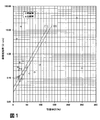
- FIG. 1 is a semilogarithmic graph showing the relationship between the volume resistivity ⁇ and tensile elongation E of the films of the examples (shown by ⁇ ) and the comparative examples (shown by ⁇ ), the vertical axis is ⁇ , and the horizontal axis Is E.
- volume resistivity ⁇ and the tensile elongation E are values determined by the following method.
- (B) Volume resistivity ⁇ In accordance with JIS K 7194, measurement was performed by a four-probe method (probe method). A film that had been conditioned for 24 hours or more in a test room at a temperature of 23 ⁇ 2 ° C. and a relative humidity of 50 ⁇ 5% was cut into a size of 80 mm in the machine direction of the film and 50 mm in the width direction of the film to obtain a test piece. . About one test piece using probes arranged at equal intervals (probe interval 5mm) on a straight line using a resistivity meter "Loresta GPMCP-T610 (trade name)" of Mitsubishi Chemical Analytech Co., Ltd. Measurements were taken at five measurement positions.
- the film thickness was measured using a dial thickness gauge “H-1A (trade name)” manufactured by Ozaki Seisakusho Co., Ltd. according to the dimensional measurement of the test piece specified in JISK 7194.
- H-1A dial thickness gauge
- the homepage http://www.mccat.co.jp/3seihin/genri/ghlup2.htm
- Mitsubishi Chemical Analytech Co., Ltd. can be referred.
- This test was performed on five test pieces, and the average value of these was used as the tensile elongation E of the film.
- the film thickness was measured between the marked lines of the test specimens using a dial thickness gauge “H-1A (trade name)” manufactured by Ozaki Seisakusho Co., Ltd. (total of 10 locations), and the average value thereof was used.
- Examples 1 to 11 and Comparative Examples 1 to 14 Using a 5-liter intensive mixer manufactured by Nippon Roll Manufacturing Co., Ltd., the blends having the blending ratios shown in Table 1 were melt-kneaded. At this time, the discharge temperature was 190 ° C. Subsequently, using a reverse L-shaped four calendar with a roll diameter of 200 mm and a roll width of 700 mm manufactured by Nippon Roll Manufacturing Co., Ltd., a film having a thickness of 300 ⁇ m was obtained (the roll temperature was the first roll / second roll / third roll / 205 ° C / 205 ° C / 185 ° C / 175 ° C in order of the fourth roll, take-up speed 5 m / min). About the obtained film, while determining volume resistivity (rho) and tensile elongation E, according to the following method, the bending resistance and the softness
- (C) Bending resistance JIS is set so that the machine direction of the film becomes the tensile direction from the film that has been conditioned for 24 hours or more in a test room at a temperature of 23 ⁇ 2 ° C and a relative humidity of 50 ⁇ 5%
- a test piece of K7127 test piece type 1B was punched out, bent 180 ° so that the entire chuck portion at both ends of the test piece overlapped, and the bending position was rubbed with a finger and then raised. Next, this was bent to the opposite side in the same manner by 180 °, and the folding position was squeezed with a finger and then raised. In this way, the operation of bending and raising at the same folding position and then bending to the opposite side was repeated, and the following criteria were used.
- ⁇ The film was not broken even after 6 sets.
- ⁇ The film broke after 2 to 6 sets.
- X The film broke after 1 set.
- Comparative component (C) (C-3) Ketjen Black “KJ300 (trade name)” by Lion Corporation
- Ingredient (D) (D-1) Toray Industries, Inc. carbon fiber “Treca Cut Fiber T008A-006 (trade name)”, cut length 6 mm, fiber diameter 7 ⁇ m
- the films of Examples 1 to 11 satisfy the formula (1) and have low volume resistivity and high tensile elongation, bending resistance and flexibility.
- the films of Comparative Examples 1 to 12 do not satisfy the formula (1), and any of tensile elongation, bending resistance and flexibility is insufficient, or is inferior in conductivity.
- Comparative Examples 13 and 14 in which ketjen black was used in place of the component (C), the resin composition did not exhibit melt ductility at the time of film formation, and a film could not be obtained.
- the volume resistivity ⁇ after the tensile test was also measured.
- a film cut into a size of 100 mm ⁇ 25 mm with the width direction of the film as the longitudinal direction is used as a test piece, and the center point (intersection of both diagonal lines) is marked with a magic, and between the chucks at a tensile speed of 5 mm / min.
- the volume resistivity ⁇ after the tensile test was measured in the same manner as in (a) except that one mark position was used as the measurement position.
- the volume resistivity before the tensile test was 2.5 ⁇ 10 ⁇ 1 ⁇ ⁇ cm, but after the tensile test, it was 3.6 ⁇ 10 0 ⁇ ⁇ cm. That is, even when the tensile deformation was 100%, the decrease in volume resistivity was one digit. This indicates that the conductive resin film made of the resin composition of the present invention has a very small change in conductivity due to deformation.
Landscapes
- Chemical & Material Sciences (AREA)
- Chemical Kinetics & Catalysis (AREA)
- Engineering & Computer Science (AREA)
- Health & Medical Sciences (AREA)
- Organic Chemistry (AREA)
- Polymers & Plastics (AREA)
- Medicinal Chemistry (AREA)
- Manufacturing & Machinery (AREA)
- General Chemical & Material Sciences (AREA)
- Electrochemistry (AREA)
- Sustainable Development (AREA)
- Sustainable Energy (AREA)
- Life Sciences & Earth Sciences (AREA)
- Composite Materials (AREA)
- Materials Engineering (AREA)
- Physics & Mathematics (AREA)
- Dispersion Chemistry (AREA)
- Spectroscopy & Molecular Physics (AREA)
- Nanotechnology (AREA)
- Compositions Of Macromolecular Compounds (AREA)
- Manufacture Of Macromolecular Shaped Articles (AREA)
- Inert Electrodes (AREA)
- Conductive Materials (AREA)
Priority Applications (5)
| Application Number | Priority Date | Filing Date | Title |
|---|---|---|---|
| US14/391,471 US9660271B2 (en) | 2012-04-09 | 2013-03-29 | Resin composition |
| CN201380018989.2A CN104245852B (zh) | 2012-04-09 | 2013-03-29 | 树脂组合物及导电性树脂膜 |
| KR1020147027328A KR20150008057A (ko) | 2012-04-09 | 2013-03-29 | 수지조성물 |
| KR1020207031711A KR20200130477A (ko) | 2012-04-09 | 2013-03-29 | 수지조성물 |
| EP13776098.9A EP2837661B1 (en) | 2012-04-09 | 2013-03-29 | Resin composition |
Applications Claiming Priority (2)
| Application Number | Priority Date | Filing Date | Title |
|---|---|---|---|
| JP2012-088593 | 2012-04-09 | ||
| JP2012088593A JP6184056B2 (ja) | 2012-04-09 | 2012-04-09 | 樹脂組成物 |
Publications (1)
| Publication Number | Publication Date |
|---|---|
| WO2013153969A1 true WO2013153969A1 (ja) | 2013-10-17 |
Family
ID=49327537
Family Applications (1)
| Application Number | Title | Priority Date | Filing Date |
|---|---|---|---|
| PCT/JP2013/059640 Ceased WO2013153969A1 (ja) | 2012-04-09 | 2013-03-29 | 樹脂組成物 |
Country Status (5)
| Country | Link |
|---|---|
| US (1) | US9660271B2 (https=) |
| EP (1) | EP2837661B1 (https=) |
| JP (1) | JP6184056B2 (https=) |
| KR (2) | KR20200130477A (https=) |
| WO (1) | WO2013153969A1 (https=) |
Cited By (3)
| Publication number | Priority date | Publication date | Assignee | Title |
|---|---|---|---|---|
| WO2015037383A1 (ja) * | 2013-09-10 | 2015-03-19 | リケンテクノス株式会社 | 導電性樹脂組成物及びそのフィルム |
| JP2017128721A (ja) * | 2016-01-19 | 2017-07-27 | ゼロックス コーポレイションXerox Corporation | 導電性ポリマーコンポジット |
| US10767035B2 (en) | 2014-10-09 | 2020-09-08 | Riken Technos Corporation | Method for producing thermoplastic resin composition film |
Families Citing this family (15)
| Publication number | Priority date | Publication date | Assignee | Title |
|---|---|---|---|---|
| JP2014133842A (ja) * | 2013-01-11 | 2014-07-24 | Yazaki Corp | 導電性樹脂組成物 |
| JP6557448B2 (ja) * | 2013-11-15 | 2019-08-07 | フタムラ化学株式会社 | 金属接着導電性樹脂フィルム及び導電性樹脂金属複合材 |
| GB2539862B (en) * | 2014-05-09 | 2021-03-03 | Council Scient Ind Res | An improved next generation off-laboratory polymer chip electrode |
| JP2016192255A (ja) * | 2015-03-30 | 2016-11-10 | 古河電池株式会社 | バナジウムレドックス電池 |
| CN113754927B (zh) | 2015-08-17 | 2023-09-15 | 电化株式会社 | 碳纳米纤维复合体的制造方法和碳纳米纤维复合体 |
| JP6780835B2 (ja) * | 2015-09-14 | 2020-11-04 | 片野染革株式会社 | 樹脂組成物、樹脂組成物の製造方法、粉状混合物、レドックスフロー電池用双極板、及び燃料電池用セパレータ |
| JP2017141370A (ja) * | 2016-02-10 | 2017-08-17 | デンカ株式会社 | 導電性高分子材料およびそれを用いた成形品 |
| CN108779337B (zh) * | 2016-03-28 | 2022-03-08 | 日立安斯泰莫株式会社 | 热塑性树脂组合物以及热塑性树脂组合物的制造方法 |
| KR101947867B1 (ko) * | 2016-07-28 | 2019-02-13 | 권원현 | 탄소복합재 제조방법 및 이를 통해 제조된 탄소복합재 |
| JP6780363B2 (ja) * | 2016-08-19 | 2020-11-04 | 東洋インキScホールディングス株式会社 | 導電性樹脂組成物、成形体およびその製造方法 |
| WO2018145720A1 (en) * | 2017-02-10 | 2018-08-16 | Cmblu Projekt Ag | Flow-by electrode unit and use thereof, redox flow battery system and use thereof, method of manufacturing a flow-by electrode unit, method of operating a redox flow battery system |
| WO2019069141A1 (en) * | 2017-10-05 | 2019-04-11 | National Industrialization Company (Tasnee) | ELECTRICALLY CONDUCTIVE POLYPROPYLENE AND POLYETHYLENE COMPOSITE MATERIALS AND METHOD FOR THE PRODUCTION THEREOF |
| EP3716376A4 (en) * | 2018-02-27 | 2020-12-30 | Lg Chem, Ltd. | CATHODE AND SECONDARY BATTERY INCLUDING A CATHODE |
| CN109320862A (zh) * | 2018-12-14 | 2019-02-12 | 潍坊潍星联合橡塑有限公司 | 阻燃抗静电氯化聚乙烯液压胶管外层胶及其制备方法 |
| KR20230158828A (ko) * | 2022-05-12 | 2023-11-21 | 에스케이온 주식회사 | 이차전지용 건식 전극 시트 제조방법 및 장치, 이차전지용 건식 전극 시트 및 이를 포함하는 이차전지 |
Citations (9)
| Publication number | Priority date | Publication date | Assignee | Title |
|---|---|---|---|---|
| JPH01149370A (ja) | 1987-12-04 | 1989-06-12 | Meidensha Corp | プラスチック電極 |
| JPH04259754A (ja) | 1991-02-15 | 1992-09-16 | Meidensha Corp | カーボンプラスチック電極 |
| JPH0753813A (ja) | 1993-08-10 | 1995-02-28 | Shin Etsu Polymer Co Ltd | 導電性プラスチック組成物 |
| JP2001015144A (ja) | 1999-06-29 | 2001-01-19 | Sumitomo Electric Ind Ltd | レドックスフロー電池の電池セル用カーボン板および電池セル構造 |
| JP2005200620A (ja) * | 2003-12-15 | 2005-07-28 | Bridgestone Corp | 熱可塑性樹脂組成物及び熱可塑性樹脂成形品 |
| JP2006111870A (ja) | 2004-09-14 | 2006-04-27 | Showa Denko Kk | 導電性樹脂組成物、その製造方法及び用途 |
| JP2012500317A (ja) * | 2008-08-19 | 2012-01-05 | チェイル インダストリーズ インコーポレイテッド | 優れた電気伝導性、耐摩耗性及び高耐熱性を有する熱可塑性樹脂組成物 |
| JP2012507587A (ja) | 2008-11-06 | 2012-03-29 | クラリアント・ファイナンス・(ビーブイアイ)・リミテッド | プロピレン−オレフィン−コポリマーワックス及びカーボンナノチューブを含む組成物 |
| JP2012507586A (ja) | 2008-11-06 | 2012-03-29 | クラリアント・ファイナンス・(ビーブイアイ)・リミテッド | プロピレン−プロピレン−コポリマーワックス及びカーボンブラックを含む組成物 |
Family Cites Families (23)
| Publication number | Priority date | Publication date | Assignee | Title |
|---|---|---|---|---|
| JP3414528B2 (ja) * | 1994-09-30 | 2003-06-09 | 藤倉ゴム工業株式会社 | 可撓性のある導電シートの製造方法 |
| JPH08259767A (ja) * | 1995-03-20 | 1996-10-08 | Sumitomo Electric Ind Ltd | 導電性プラスチック板およびそれを用いた電池セル |
| JPH11100512A (ja) * | 1997-09-26 | 1999-04-13 | Yokohama Rubber Co Ltd:The | 熱可塑性エラストマー組成物 |
| JP3673747B2 (ja) * | 2001-10-25 | 2005-07-20 | 本田技研工業株式会社 | 燃料電池用セパレータ及びその製造方法 |
| JP4266752B2 (ja) * | 2002-11-01 | 2009-05-20 | 三菱レイヨン株式会社 | カーボンナノチューブ含有組成物及びその調製方法、またそれを用いた複合体及びその製造方法 |
| TW200519150A (en) * | 2003-12-05 | 2005-06-16 | Showa Denko Kk | Conductive resin composition and molded product thereof |
| EP1869120B1 (en) | 2005-04-04 | 2014-12-31 | Showa Denko K.K. | Electrically conducting curable resin composition, cured product thereof and molded article of the same |
| EP1780822B1 (en) | 2005-11-01 | 2012-01-18 | Tomoegawa Co., Ltd. | Gas diffusion electrode, membrane-electrode assembly, polymer electrolyte fuel cell, and methods for producing |
| JP2007128671A (ja) | 2005-11-01 | 2007-05-24 | Tomoegawa Paper Co Ltd | ガス拡散電極、膜−電極接合体とその製造方法、および固体高分子型燃料電池 |
| JP5224686B2 (ja) * | 2006-12-21 | 2013-07-03 | 旭化成ケミカルズ株式会社 | 導電性熱可塑性樹脂組成物の成形用混合物およびこれを成形してなる成形品 |
| KR100833782B1 (ko) * | 2007-09-18 | 2008-05-29 | 금호타이어 주식회사 | 열전도성이 향상된 고무조성물 |
| JP5205947B2 (ja) * | 2007-12-12 | 2013-06-05 | スターライト工業株式会社 | 樹脂炭素複合材料 |
| JP5018460B2 (ja) * | 2007-12-26 | 2012-09-05 | 東洋インキScホールディングス株式会社 | カーボンナノチューブ分散体及びそれを用いてなる樹脂組成物ならびに成形体 |
| JP2010138305A (ja) * | 2008-12-12 | 2010-06-24 | Sonac Kk | Cnt配合樹脂材料 |
| US7939167B2 (en) | 2008-12-30 | 2011-05-10 | Cheil Industries Inc. | Resin composition |
| KR101267272B1 (ko) | 2008-12-30 | 2013-05-23 | 제일모직주식회사 | 수지 조성물 |
| JP5177435B2 (ja) * | 2009-04-16 | 2013-04-03 | 株式会社イノアック技術研究所 | 複合材料 |
| JP5250154B2 (ja) | 2010-04-14 | 2013-07-31 | 高橋 玄策 | 導電性熱可塑性樹脂組成物 |
| JP2011228059A (ja) | 2010-04-16 | 2011-11-10 | Sumitomo Electric Ind Ltd | レドックスフロー電池用双極板 |
| TWI405802B (zh) | 2010-06-24 | 2013-08-21 | Nat Univ Tsing Hua | 官能基化石墨烯強化複合材料導電板之製備方法 |
| JP2012022910A (ja) * | 2010-07-15 | 2012-02-02 | Toray Ind Inc | 高分子電解質材料およびそれを用いた高分子電解質膜、膜電極複合体 |
| US9680135B2 (en) * | 2010-09-02 | 2017-06-13 | Intellectual Discovery Co., Ltd. | Pouch-type flexible film battery |
| CA2754372A1 (en) * | 2011-10-04 | 2013-04-04 | Hydro-Quebec | Positive-electrode material for lithium-ion secondary battery and method of producing same |
-
2012
- 2012-04-09 JP JP2012088593A patent/JP6184056B2/ja active Active
-
2013
- 2013-03-29 KR KR1020207031711A patent/KR20200130477A/ko not_active Ceased
- 2013-03-29 WO PCT/JP2013/059640 patent/WO2013153969A1/ja not_active Ceased
- 2013-03-29 KR KR1020147027328A patent/KR20150008057A/ko not_active Ceased
- 2013-03-29 EP EP13776098.9A patent/EP2837661B1/en active Active
- 2013-03-29 US US14/391,471 patent/US9660271B2/en active Active
Patent Citations (9)
| Publication number | Priority date | Publication date | Assignee | Title |
|---|---|---|---|---|
| JPH01149370A (ja) | 1987-12-04 | 1989-06-12 | Meidensha Corp | プラスチック電極 |
| JPH04259754A (ja) | 1991-02-15 | 1992-09-16 | Meidensha Corp | カーボンプラスチック電極 |
| JPH0753813A (ja) | 1993-08-10 | 1995-02-28 | Shin Etsu Polymer Co Ltd | 導電性プラスチック組成物 |
| JP2001015144A (ja) | 1999-06-29 | 2001-01-19 | Sumitomo Electric Ind Ltd | レドックスフロー電池の電池セル用カーボン板および電池セル構造 |
| JP2005200620A (ja) * | 2003-12-15 | 2005-07-28 | Bridgestone Corp | 熱可塑性樹脂組成物及び熱可塑性樹脂成形品 |
| JP2006111870A (ja) | 2004-09-14 | 2006-04-27 | Showa Denko Kk | 導電性樹脂組成物、その製造方法及び用途 |
| JP2012500317A (ja) * | 2008-08-19 | 2012-01-05 | チェイル インダストリーズ インコーポレイテッド | 優れた電気伝導性、耐摩耗性及び高耐熱性を有する熱可塑性樹脂組成物 |
| JP2012507587A (ja) | 2008-11-06 | 2012-03-29 | クラリアント・ファイナンス・(ビーブイアイ)・リミテッド | プロピレン−オレフィン−コポリマーワックス及びカーボンナノチューブを含む組成物 |
| JP2012507586A (ja) | 2008-11-06 | 2012-03-29 | クラリアント・ファイナンス・(ビーブイアイ)・リミテッド | プロピレン−プロピレン−コポリマーワックス及びカーボンブラックを含む組成物 |
Non-Patent Citations (1)
| Title |
|---|
| TAKASE; HIROFUMI: "Dispersion Technique and Evaluation of Carbon Nanotubes", SEIKEI-KAKOU, vol. 18, no. 9, 2006, pages 646 - 652 |
Cited By (5)
| Publication number | Priority date | Publication date | Assignee | Title |
|---|---|---|---|---|
| WO2015037383A1 (ja) * | 2013-09-10 | 2015-03-19 | リケンテクノス株式会社 | 導電性樹脂組成物及びそのフィルム |
| US9748017B2 (en) | 2013-09-10 | 2017-08-29 | Riken Technos Corporation | Electrically conductive resin composition, and film produced from same |
| US10767035B2 (en) | 2014-10-09 | 2020-09-08 | Riken Technos Corporation | Method for producing thermoplastic resin composition film |
| JP2017128721A (ja) * | 2016-01-19 | 2017-07-27 | ゼロックス コーポレイションXerox Corporation | 導電性ポリマーコンポジット |
| JP7005145B2 (ja) | 2016-01-19 | 2022-01-21 | ゼロックス コーポレイション | 導電性ポリマーコンポジット |
Also Published As
| Publication number | Publication date |
|---|---|
| JP2013216786A (ja) | 2013-10-24 |
| US9660271B2 (en) | 2017-05-23 |
| EP2837661A4 (en) | 2015-12-16 |
| KR20200130477A (ko) | 2020-11-18 |
| JP6184056B2 (ja) | 2017-08-23 |
| EP2837661B1 (en) | 2018-10-17 |
| EP2837661A1 (en) | 2015-02-18 |
| CN104245852A (zh) | 2014-12-24 |
| US20150076419A1 (en) | 2015-03-19 |
| KR20150008057A (ko) | 2015-01-21 |
Similar Documents
| Publication | Publication Date | Title |
|---|---|---|
| JP6184056B2 (ja) | 樹脂組成物 | |
| JP6385197B2 (ja) | 導電性樹脂組成物、及びそのフィルム | |
| JP6453026B2 (ja) | 熱可塑性樹脂組成物フィルムの製造方法 | |
| US20190048108A1 (en) | Resin composition, method for producing resin composition, powdery mixture, bipolar plate for redox flow batteries and separator for fuel cells | |
| US8986576B1 (en) | Carbon nanotube composite materials | |
| Kwon et al. | Polypropylene nanocomposites doped with carbon nanohorns for high-voltage power cable insulation applications | |
| Naji et al. | Extruded polycarbonate/Di-Allyl phthalate composites with ternary conductive filler system for bipolar plates of polymer electrolyte membrane fuel cells | |
| JP6246264B2 (ja) | 樹脂組成物 | |
| JP2011153214A (ja) | 導電性樹脂組成物及び導電性シ−ト | |
| JP2004168897A (ja) | 高導電性樹脂成形品 | |
| Teymoory et al. | Impact of salt and fillers on the rheological properties of polymer composites | |
| CN104245852B (zh) | 树脂组合物及导电性树脂膜 | |
| Bouatia et al. | Development and characterisation of electrically conductive polymeric‐based blends for proton exchange membrane fuel cell bipolar plates | |
| TWI585139B (zh) | 樹脂組成物及導電性樹脂膜 | |
| Naji et al. | Melt processed conductive polycarbonate composites with ternary fillers towards bipolar plate applications | |
| JP4802368B2 (ja) | 高導電性成形品の製造方法 | |
| Ramirez-Herrera et al. | Preparation and properties of polypropylene-carbon nanotubes nanocomposites for application in bipolar plates | |
| KR20260028179A (ko) | 배터리 전극판용 hdpe 및 탄소 나노튜브를 함유하는 고 전기 전도성 화합물 |
Legal Events
| Date | Code | Title | Description |
|---|---|---|---|
| 121 | Ep: the epo has been informed by wipo that ep was designated in this application |
Ref document number: 13776098 Country of ref document: EP Kind code of ref document: A1 |
|
| ENP | Entry into the national phase |
Ref document number: 20147027328 Country of ref document: KR Kind code of ref document: A |
|
| NENP | Non-entry into the national phase |
Ref country code: DE |
|
| WWE | Wipo information: entry into national phase |
Ref document number: 14391471 Country of ref document: US |
|
| WWE | Wipo information: entry into national phase |
Ref document number: 2013776098 Country of ref document: EP |