WO2012176696A1 - 酸化ルテニウム粉末、それを用いた厚膜抵抗体用組成物および厚膜抵抗体 - Google Patents
酸化ルテニウム粉末、それを用いた厚膜抵抗体用組成物および厚膜抵抗体 Download PDFInfo
- Publication number
- WO2012176696A1 WO2012176696A1 PCT/JP2012/065313 JP2012065313W WO2012176696A1 WO 2012176696 A1 WO2012176696 A1 WO 2012176696A1 JP 2012065313 W JP2012065313 W JP 2012065313W WO 2012176696 A1 WO2012176696 A1 WO 2012176696A1
- Authority
- WO
- WIPO (PCT)
- Prior art keywords
- thick film
- film resistor
- powder
- ruthenium oxide
- composition
- Prior art date
- Legal status (The legal status is an assumption and is not a legal conclusion. Google has not performed a legal analysis and makes no representation as to the accuracy of the status listed.)
- Ceased
Links
Classifications
-
- H—ELECTRICITY
- H01—ELECTRIC ELEMENTS
- H01C—RESISTORS
- H01C7/00—Non-adjustable resistors formed as one or more layers or coatings; Non-adjustable resistors made from powdered conducting material or powdered semi-conducting material with or without insulating material
-
- C—CHEMISTRY; METALLURGY
- C01—INORGANIC CHEMISTRY
- C01G—COMPOUNDS CONTAINING METALS NOT COVERED BY SUBCLASSES C01D OR C01F
- C01G55/00—Compounds of ruthenium, rhodium, palladium, osmium, iridium, or platinum
- C01G55/004—Oxides; Hydroxides
-
- C—CHEMISTRY; METALLURGY
- C01—INORGANIC CHEMISTRY
- C01G—COMPOUNDS CONTAINING METALS NOT COVERED BY SUBCLASSES C01D OR C01F
- C01G55/00—Compounds of ruthenium, rhodium, palladium, osmium, iridium, or platinum
-
- H—ELECTRICITY
- H01—ELECTRIC ELEMENTS
- H01C—RESISTORS
- H01C7/00—Non-adjustable resistors formed as one or more layers or coatings; Non-adjustable resistors made from powdered conducting material or powdered semi-conducting material with or without insulating material
- H01C7/003—Thick film resistors
Definitions
- the present invention relates to a ruthenium oxide powder, a composition for a thick film resistor and a thick film resistor using the same, and a chip resistor, a hybrid IC, or a resistor network having sufficient performance even when the ruthenium content is low
- the present invention relates to a ruthenium oxide powder that can be manufactured at low cost as an electronic component material such as a thick film resistor composition and a thick film resistor using the same.
- a thick film resistor such as a chip resistor, a hybrid IC, or a resistor network is formed by printing and baking a thick film resistor paste on a ceramic substrate.
- a composition for a thick film resistor a composition mainly composed of ruthenium oxide powder typified by ruthenium oxide and glass powder as conductive particles is widely used.
- ruthenium oxide and glass powder are used for thick film resistors are that they can be fired in air and the resistance temperature coefficient (TCR) can be brought close to 0, and the resistance value in a wide region For example, a resistor can be formed.
- TCR resistance temperature coefficient
- the resistance value varies depending on the blending ratio. Increasing the compounding ratio of ruthenium oxide, which is a conductive particle, decreases the resistance value, and decreasing the compounding ratio of the conductive material increases the resistance value. By utilizing this fact, in the thick film resistor, a desired resistance value appears by adjusting the mixing ratio of ruthenium oxide and glass powder.
- the most common ruthenium oxide is ruthenium oxide (RuO 2 ) having a rutile-type crystal structure, and has the lowest specific resistance among the types of ruthenium oxides described later.
- a combination of ruthenium oxide (RuO 2 ) powder and glass powder generally forms a resistor in the region of 10 ⁇ 2 ⁇ ⁇ cm to 10 4 ⁇ ⁇ cm (10 ⁇ 4 ⁇ ⁇ m to 10 2 ⁇ ⁇ m). it can.
- ruthenium oxide examples include ruthenium oxide (RuO 2 ) having a rutile crystal structure, lead ruthenate having a pyrochlore crystal structure, bismuth ruthenate, calcium ruthenate having a perovskite crystal structure, strontium ruthenate, ruthenium There are barium acid, lanthanum ruthenate, and the like, and these are oxides showing metallic conductivity.
- Ruthenium oxide (RuO 2 ) having a rutile-type crystal structure is obtained by, for example, coating RuO 2 particles obtained by roasting amorphous ruthenium oxide hydrate with at least one of KOH and NaOH, for example. After roasting, it is manufactured by a method such as washing with water and drying (see Patent Document 4).
- Thick film resistors composed of ruthenium oxide and glass powder are widely used because of their excellent resistance characteristics, but ruthenium is an expensive noble metal, and thick film resistors using this composition are costly. There are high drawbacks. Therefore, it is difficult to reach with a combination of ruthenium oxide and glass powder, and in a low resistance value thick film resistance composition, a desired resistance value appears by adding palladium and silver as a conductive material. .
- palladium is a noble metal that is more expensive than ruthenium, and the thick film resistor in the region where the resistance value is low has a disadvantage that the cost is similarly increased.
- ruthenium and palladium are produced in small quantities, the price fluctuates drastically and the raw material costs for manufacturing thick film resistors are not stable.
- a thick film resistor having a low resistance value has a high ruthenium or palladium content, so that the price is high and the product price becomes unstable. Therefore, a low-cost composition for thick film resistors in which the amount of ruthenium and palladium used is reduced as much as possible in the region where ruthenium and resistance values are low has been desired.
- Patent Document 1 An example in which ruthenium oxide (RuO 2 ) having a fine particle size has been used for a thick film resistor is disclosed in JP-A-7-22202 (Patent Document 1).
- This Patent Document 1 states that durability against electrostatic discharge (ESD) can be improved by using ruthenium oxide having a large specific surface area, the specific surface area is 50 m 2 / g or more, and the crystallite size.
- An example of a thick film resistor composition using a solid ruthenium oxide having a thickness of 25 nm or less is given.
- even the largest specific surface area is 51.9 m 2 / g, and the smallest crystallite size is 13.3 nm. With this specific surface area and crystallite size, ruthenium cannot be reduced to such an extent that a sufficiently economical effect can be obtained as a thick film resistor composition.
- Patent Document 2 JP-A-8-217459 (Patent Document 2) describes an example of producing a ruthenium oxide powder having a specific surface area of 70 m 2 / g or more (Example). However, there is no description about crystallites. In addition, since the ruthenium content in ruthenium oxide is 73.9% at the maximum, it is ruthenium oxide with low integrity of hydrated crystals, and a thick film resistor using such ruthenium oxide powder has a resistance value. As a result, ruthenium cannot be reduced as a thick film resistor composition.
- Patent Document 3 describes a resistor paste using ruthenium oxide having a specific surface area of 200 m 2 / g as conductive particles (Example). However, there is no description about the crystallite, and it is described as a ruthenium oxide to which 20% of H 2 O is added. Therefore, the integrity of the hydrated crystal is low.
- JP-A-7-22202 Japanese Patent Application Laid-Open No. 8-21759 JP-A-4-290401 JP-A-8-268722
- An object of the present invention is to provide a ruthenium oxide powder that can be manufactured at low cost as an electronic component material such as a chip resistor, a hybrid IC, or a resistor network having a sufficient performance even when the content of ruthenium is low, and a thick film using the same
- the object is to provide a resistor composition and a thick film resistor.
- ruthenium oxide having high crystallinity in a composition for a thick film resistor containing conductive particles and glass powder as main components It has been found that even when the crystallite diameter is fine, grain growth is suppressed during firing of the resistance paste, and by using such ruthenium oxide (RuO 2 ) as a raw material, resistance After confirming that an inexpensive thick film resistor composition having a low value and a reduced ruthenium content can be provided, the present invention has been completed.
- ruthenium oxide (RuO 2 ) powder having a rutile-type crystal structure having a crystallite diameter of 3 to 10 nm measured on the (110) plane by X-ray diffraction method. And a ruthenium oxide powder characterized in that the Ru content is 73% by mass or more.
- a ruthenium oxide powder according to the first aspect, wherein the ruthenium oxide (RuO 2 ) powder has a specific surface area of 70 to 200 m 2 / g. .
- the ruthenium oxide (RuO 2 ) powder has a ratio of the crystallite diameter D1 to the specific surface area diameter D2 of the following formula (1):
- a ruthenium oxide powder is provided that is characterized by filling.
- the crystallite diameter D1 is a value (nm) measured on the (110) plane of the rutile crystal structure by the X-ray diffraction method
- the specific surface area diameter D2 is the specific surface area of the powder as S (m 2 / g )
- the composition for a thick film resistor comprising conductive particles composed of ruthenium oxide powder and glass powder as main components. Things are provided.
- the conductive particles silver (Ag) powder, palladium (Pd) powder, or silver-coated oxide and noble metal powder coated with palladium. Any one or more of these may be blended, and a thick film resistor composition is provided.
- the conductive particles and the glass powder are blended in a mass ratio of 5:95 to 70:30.
- a thick film resistor composition is provided.
- a thick film resistor composition according to any one of the fourth to sixth aspects, wherein the glass powder has a 50% cumulative particle size of 5 ⁇ m or less.
- the thick film resistor paste according to any one of the fourth to seventh aspects wherein the thick film resistor composition is dispersed in an organic vehicle containing a fatty acid.
- a thick film resistor paste is provided, wherein the content of is 0.1 to 10 parts by weight with respect to 100 parts by weight of ruthenium oxide.
- the thick film resistor paste according to the eighth aspect wherein the fatty acid is a higher fatty acid having 12 or more carbon atoms.
- the conductive particles and the glass powder are blended in a mass ratio of 5:95 to 70:30.
- a resistor paste is provided.
- a thick film resistor obtained by firing the thick film resistor composition of any of the fourth to seventh inventions on a ceramic substrate.
- a thick film resistor formed by applying the thick film resistor paste of any of the eighth to tenth inventions to a ceramic substrate and then firing the paste. The mass%
- ruthenium oxide (RuO 2 ) powder having a rutile-type crystal structure has a fine crystallite diameter of 3 to 10 nm as measured on the (110) plane by X-ray diffraction, and Ru Since the crystallinity is as high as 73% by mass or more, grain growth is suppressed at the time of firing the resistance paste while being fine.
- This effect becomes larger when the specific surface area of ruthenium oxide (RuO 2 ) is in a specific range, and the specific surface area diameter calculated from the specific surface area and specific gravity is measured by the X-ray diffraction method. If it is within a specific range with respect to the crystallite diameter, a greater effect can be obtained.
- ruthenium oxide (RuO 2 ) powder of the present invention as a raw material, it is possible to provide a thick film resistor composition and a thick film resistor paste that are inexpensive and excellent in economy. Furthermore, according to the present invention, a high-performance thick film resistor can be formed by using this ruthenium oxide powder as a thick film resistor composition and firing it on a ceramic substrate.
- the ruthenium oxide powder of the present invention is a ruthenium oxide (RuO 2 ) powder having a rutile-type crystal structure, and has a crystallite diameter of 3 to 10 nm measured on the (110) plane by an X-ray diffraction method. And Ru content is 73 mass% or more, It is characterized by the above-mentioned.
- RuO 2 ruthenium oxide
- Ruthenium oxide (RuO 2 ) powder for thick film resistors is generally manufactured by heat-treating wet synthesized hydrated ruthenium oxide powder. Depending on the synthesis method and heat treatment conditions, grain size and crystal Sex is different. Further, the characteristics vary depending on the particle size and crystallinity.
- the present invention intends to provide a thick film resistor having a desired resistance value at a low cost because the particle size and crystallinity of the ruthenium oxide (RuO 2 ) powder satisfy the following condition (a): It is.
- the ruthenium oxide (RuO 2 ) powder which is a raw material for thick film resistors, has a crystallite size measured by X-ray diffraction when the primary particles are small and the primary particles can be regarded as almost single crystals. Can be substituted.
- ruthenium oxide (RuO 2 ) having a rutile crystal structure the diffraction peaks on the (110), (101), (211), (301), and (321) planes of the crystal structure are relatively large among the diffraction peaks.
- the crystallite diameter measured in the (110) plane must be 3 to 10 nm.
- the resistance value of the thick film resistor is evaluated by an area resistance value where the ratio of the resistor width and the resistor length is 1: 1.
- the thick film resistor composition comprising ruthenium oxide (RuO 2 ) powder and glass powder as the main constituents, even if these blending ratios are the same, the sheet resistance value that appears depends on the particle size of the raw material powder. .
- a thick film resistor uses ruthenium oxide powder having a particle diameter of 15 nm to 500 nm and glass powder having a particle diameter of 500 nm to 10 ⁇ m.
- the resistance value is low and the ruthenium content is reduced.
- a thick film resistor composition is to be obtained. If the crystallite size of the ruthenium oxide (RuO 2 ) powder is less than 3 nm, there is a problem that the particle growth occurs during the firing as described above, resulting in a high area resistance value. If it exceeds 10 nm, there is a problem that the sheet resistance value becomes high.
- the crystallite diameter of the ruthenium oxide (RuO 2 ) powder is more preferably 3.2 to 9.8 nm.
- the Ru content of ruthenium oxide must be 73% by mass or more. If the Ru content is less than 73% by mass, the crystallinity is low, so that there is a problem that the ruthenium oxide particles grow during firing of the resistance paste and the area resistance value is increased.
- the Ru content is preferably 74% by mass or more.
- the ruthenium oxide (RuO 2 ) powder for the thick film resistor needs to satisfy the condition (a), but preferably satisfies the following condition (b). It is more preferable to satisfy the above condition. Thereby, the area resistance value of the thick film resistor is not increased, and a cheaper thick film resistor can be provided.
- the specific surface area of the ruthenium oxide (RuO 2 ) powder is less than 70 m 2 / g, the resistance value when the thick film resistor is formed becomes high, and the effect of reducing the ruthenium content cannot be obtained.
- it exceeds 200 m 2 / g the dispersion in the thick film resistor paste is reduced and the ruthenium oxide powder is agglomerated, so that the resistance value of the thick film resistor is increased and the effect of reducing the ruthenium content is obtained.
- a preferred specific surface area is 75 to 190 m 2 / g.
- the primary particle size of the ruthenium oxide (RuO 2 ) powder used for the thick film resistor is small, it can be represented by a crystallite size or a specific surface area. If the primary particles can be regarded as a single crystal, the particle size can be substituted with the crystallite size measured by the X-ray diffraction method. As the crystallite becomes smaller, the number of crystal lattices that completely satisfy the Bragg condition is reduced, and the diffraction line profile when X-rays are irradiated is widened.
- the crystallite diameter is D1 (nm)
- the X-ray wavelength is ⁇ (nm)
- the diffraction line profile spread is ⁇
- the diffraction angle is ⁇ .
- the diameter is measured.
- D1 (nm) (K ⁇ ⁇ ) / ( ⁇ ⁇ cos ⁇ ) (2) (In the formula, K is a Scherrer constant, and 0.9 is used.)
- the specific surface area diameter D2 is larger than the crystallite diameter D1, and D1 relative to D2
- the ratio, ie D1 / D2 is smaller than 1. Therefore, the value of D1 / D2 is a measure of the crystal perfection of the particle. The smaller the D1 / D2, the lower the completeness of the crystal forming the particle, and the higher the D1 / D2, the higher the completeness of the crystal. it can.
- the completeness of the crystals forming the particles decreases and the value of D1 / D2 tends to decrease.
- the crystallinity is high and close to a single crystal, those satisfying D1 / D2 ⁇ 0.70 are preferable. More preferable is D1 / D2 ⁇ 0.73.
- Ruthenium oxide (RuO 2 ) powder for thick film resistors is not limited by its production method, but by heat-treating wet hydrated ruthenium oxide powder. It is desirable to manufacture. In this production method, the particle size and crystallinity differ depending on the synthesis method and heat treatment conditions.
- the Ru solution and the synthesis method when synthesizing the hydrate of Ru oxide include, as a typical method, a method of adding ethanol to a K 2 Ru 2 O 4 aqueous solution, or a method of neutralizing a RuCl 3 aqueous solution with KOH or the like. Is mentioned.
- the hydrated ruthenium oxide powder is heat-treated at a temperature exceeding 400 ° C. in an oxidizing atmosphere to remove crystal water and increase the crystallinity of the powder.
- the oxidizing atmosphere is a gas containing 10% by volume or more of oxygen, and for example, air can be used.
- the temperature of the heat treatment is lower than 400 ° C., the ruthenium oxide is not completely formed.
- the heat treatment temperature is generally 500 to 800 ° C.
- an appropriate heat treatment time is appropriately set depending on a heat treatment temperature, a heat treatment atmosphere, a heat treatment method, and the like.
- the heat treatment time is 1 hour or longer, the particle diameter of the ruthenium oxide increases particularly at high temperatures, and ruthenium tends to volatilize as hexavalent or octavalent oxides (RuO 3 or RuO 4 ).
- Preferred is 40 minutes or less, and more preferred is 30 minutes or less.
- Thick film resistor composition The present invention synthesizes a ruthenium oxide powder having a specific crystallite diameter and a specific ruthenium content, and using it as a conductive component of the thick film resistor composition Thus, an attempt is made to obtain an inexpensive thick film resistor by reducing the amount of ruthenium oxide. That is, the present invention is a thick film resistor composition comprising conductive particles made of ruthenium oxide powder and glass powder as main components.
- the above-described ruthenium oxide powder is used as the conductive particles.
- ruthenium oxide (RuO 2 ) powder As necessary, ruthenium oxide (RuO 2 ) powder.
- Other conductive particles may be included.
- the conductive particles include silver (Ag) powder, palladium (Pd) powder, or silver powder oxide powder and noble metal powder coated with palladium.
- the shape is not particularly limited, such as a spherical shape or flake shape, and the average particle size is preferably 0.1 to 10 ⁇ m.
- ruthenium oxides such as lead ruthenate having a pyrochlore type crystal structure, bismuth ruthenate, calcium ruthenate having a perovskite type crystal structure, strontium ruthenate, barium ruthenate, lanthanum ruthenate, etc. Is mentioned.
- Glass powder Glass powder is not limited by its composition or manufacturing method. Thick film resistors are generally made of lead-containing aluminoborosilicate lead, and other glass powders containing no lead, such as zinc borosilicate, calcium borosilicate, and barium borosilicate. Are also used. Glass is generally produced by mixing predetermined components or their precursors in such a composition that a desired resistance value can be obtained, and melting and quenching them. The melting temperature is around 1400 ° C., and rapid cooling is often performed by placing the melt in cold water or flowing it on a cold belt. The glass is pulverized to a desired particle size by a ball mill, a vibration mill, a planetary mill, a bead mill, or the like.
- the particle size of the glass powder is not limited, but the 50% cumulative particle size of the particle size distribution meter using laser diffraction is preferably 5 ⁇ m or less, more preferably 3 ⁇ m or less. If the particle size of the glass powder is too large, the area resistance value of the fired thick film resistor will be low, but the variation in the area resistance value will increase, resulting in a decrease in yield and load characteristics. Becomes higher.
- the ratio of conductive particles such as ruthenium oxide (RuO 2 ) powder and glass powder can be arbitrarily changed depending on the intended sheet resistance value. That is, when the target resistance value is high, less conductive particles are blended, and when the target resistance value is low, many conductive particles are blended.
- the composition for thick film resistor of the present invention includes adjustment of area resistance value and resistance temperature coefficient, adjustment of expansion coefficient, improvement of voltage resistance and other improvements.
- additives for the thick film resistor composition MnO 2 , CuO, TiO 2 , Nb 2 O 5 , Ta 2 O 5 , SiO 2 , Al 2 O 3 , ZrO 2 , ZrSiO 4 and the like are generally used. Yes.
- the ratio of the additive is generally 0.05 to 20% with respect to the total weight of the ruthenium oxide (RuO 2 ) powder and the glass powder.
- the present invention is not limited by the type or composition of the vehicle resin or solvent.
- the resin component ethyl cellulose, maleic resin, rosin and the like are generally used, and terpineol, butyl carbitol, butyl carbitol acetate and the like are generally used as the solvent. These blending ratios are adjusted according to the desired viscosity. Also, a solvent having a high boiling point can be added for the purpose of delaying the drying of the paste.
- the ratio of the vehicle to the resistor composition is not particularly limited, but is generally 30% to 100% by weight.
- a planetary mill, a bead mill, etc. can be used in addition to a three-roll mill, but the method is limited to the paste production method. Not done.
- the thick film resistor composition of the present invention can be previously mixed with a ball mill or a rough machine and then dispersed in a vehicle.
- the thick film resistor paste it is desirable to disaggregate the inorganic raw material powder and disperse it in a solvent in which the resin component is dissolved.
- the particle size of the powder becomes smaller, the aggregation becomes stronger and it becomes easier to form secondary particles.
- the ruthenium oxide (RuO 2 ) powder of the present invention it is effective to use a fatty acid as a dispersant in order to easily dissociate the secondary particles and disperse them in the primary particles. It is considered that the fatty acid has a function of adhering to the surface of ruthenium oxide (RuO 2 ) powder and facilitating dispersion.
- the fatty acid used in the present invention may be saturated or unsaturated, but higher fatty acids having 12 or more carbon atoms are more preferable from the viewpoint of dispersing ruthenium oxide (RuO 2 ) powder and preventing aggregation again.
- the fatty acid may be added when the inorganic raw material powder is dispersed in the vehicle, or may be dispersed in the vehicle after preliminarily adhering to the ruthenium oxide (RuO 2 ) powder.
- Thick film resistor The thick film resistor of the present invention is a thick film resistor formed by firing the composition for a thick film resistor on a ceramic substrate, and the thick film resistor paste is applied to the ceramic substrate. It is a thick film resistor formed by firing after coating.
- the Ru content in the inorganic component in the thick film resistor is adjusted according to the target resistance value. For example, in order to obtain a thick film resistor having a resistance value of about 1 K ⁇ , it is economical that the Ru content is 18% or less, particularly 15% or less, and a thick film resistor having a smaller resistance value and 100 ⁇ . If it is necessary, the Ru content must be further increased. In the present invention, the requirement for a wide range of resistance values can be met by setting the Ru content in the inorganic component of the thick film resistor to 23 mass% or less.
- the crystallite diameter can be calculated from the broadening of the peak of X-ray diffraction.
- the peak of the rutile structure obtained by X-ray diffraction is waveform-separated into K ⁇ 1 and K ⁇ 2, and then the half width is measured as the spread of the peak of K ⁇ 1 corrected for the spread by the optical system of the measuring instrument. From the Scherrer equation Calculated.
- the formed thick film resistor has a film thickness, a resistance value, a temperature coefficient of resistance from 25 ° C. to ⁇ 55 ° C. (COLD-TCR), a temperature coefficient of resistance from 25 ° C. to 125 ° C. (HOT-TCR), and current noise.
- the rate of change in resistance value (ESD characteristics) when static electricity was discharged was evaluated.
- the film thickness averaged the value which measured the film thickness of five thick film resistors with the thickness roughness meter of the stylus. Moreover, the resistance value averaged the value which measured the resistance value of 25 thick film resistors with the digital multimeter.
- the temperature coefficient of resistance was determined by holding the thick film resistor at ⁇ 55 ° C., 25 ° C., and 125 ° C. for 15 minutes, and then measuring the respective resistance values (R ⁇ 55 , R 25 , R 125 ). (4) Calculated by (5) and averaged five thick film resistors.
- COLD-TCR (ppm / ° C.) (R ⁇ 55 ⁇ R 25 ) / R 25 / ( ⁇ 80) ⁇ 10 6 (4)
- HOT-TCR (ppm / ° C.) (R 125 ⁇ R 25 ) / R 25 / (100) ⁇ 10 6 (5)
- the current noise measured with a QUAN-TECH MODEL315C applied with a voltage of 1/10 W was expressed as a noise index, and the average of five thick film resistors was taken.
- the ESD characteristic is that after a charge is charged to a unit of 200 pF-0 ⁇ at a voltage of 1 KV, a thick film resistor is discharged, and the resistance value before discharge is R 0 and the resistance value after discharge is R 1.
- the change in resistance value was calculated by the following equation (6).
- the rate of change was measured with five thick film resistors and averaged.
- ESD characteristics (%) (R 1 ⁇ R 0 ) / R 0 ⁇ 100 (6)
- Example 1 In Example 1, an aqueous solution in which potassium ruthenate was dissolved was used as a raw material, a ruthenium oxide precipitate was synthesized in the aqueous solution, this was solid-liquid separated, washed and dried at 80 ° C. to obtain a ruthenium oxide powder.
- the ruthenium oxide after drying had a ruthenium content of 61.5% by mass and was an oxide hydrate.
- the dried ruthenium oxide powder was heat-treated at 650 ° C. for 10 minutes to obtain ruthenium oxide (RuO 2 ) powder having a Ru content of 73.8% by mass.
- Example 2 the heat treatment conditions of the dried ruthenium oxide powder were changed in the range of 680 to 800 ° C. and 10 to 30 minutes as shown in Table 1.
- the obtained ruthenium oxide (RuO 2 ) powder is dispersed together with a glass powder having an average particle diameter of 1.5 ⁇ m in a vehicle composed of 5% by mass to 15% by mass of ethyl cellulose and 75% by mass to 95% by mass of terpineol by a three-roll mill.
- a film resistance paste was prepared.
- glass powder A glass powder A (PbO: 50 mass% —SiO 2 : 35 mass% —B 2 O 3 : 10 mass% —Al 2 O 3 : 5 mass%) was used.
- glass powder B SiO 2 : 35 mass% -B 2 O 3 : 20 mass% -Al 2 O 3 : 5 mass% -CaO: 5 mass% -BaO: 20 mass% -ZnO : 15% by mass.
- the composition of the ruthenium oxide (RuO 2 ) powder and the glass powder was adjusted so that the area resistance value of the formed thick film resistor was about 1 K ⁇ .
- 43 parts by weight of the vehicle was blended with respect to 100 parts by weight of the total of ruthenium oxide (RuO 2 ) powder and glass powder.
- stearic acid was dispersed in the vehicle with a three-roll mill to prepare a thick film resistance paste.
- These thick film resistor pastes were printed, dried and fired on an alumina substrate having a purity of 96% by mass to form a thick film resistor and evaluated.
- the prepared thick film resistance paste is printed on an electrode of 1% by mass Pd and 99% by mass Ag previously formed by firing on an alumina substrate, dried at 150 ° C. ⁇ 5 minutes, and then a peak temperature of 850 ° C. ⁇ 9 For a total of 30 minutes to form a thick film resistor.
- the size of the thick film resistor was such that the resistor width was 0.3 mm, the resistor length was 0.3 mm, and the thickness was 10 ⁇ m.
- the evaluation results are shown in Table 1.
- the composition of the ruthenium oxide (RuO 2 ) powder and the glass powder was adjusted in Comparative Examples 1 to 5 so that the area resistance value of the formed thick film resistor was about 1 K ⁇ . Further, stearic acid was used except in Comparative Examples 2 and 5 and dispersed in a vehicle with a three-roll mill to prepare a thick film resistance paste.
- RuO 2 ruthenium oxide
- Example 13 to 18 In addition to the raw materials used in Examples 1 to 12, silver (Ag) powder having an average particle diameter of 1.0 ⁇ m, palladium (Pd) powder having an average particle diameter of 0.3 ⁇ m and an additive were used. In Examples 13 to 18, The thickness resistance of the formed thick film resistor was adjusted to about 5 ⁇ . In the preparation of the thick film resistance paste, 43 parts by weight of the vehicle was blended with respect to 100 parts by weight in total of the conductive powder of Ruthenium oxide (RuO 2 ) powder, Ag powder, Pd powder, glass powder, and additive powder. At this time, stearic acid was dispersed in the vehicle with a three-roll mill to prepare a thick film resistance paste.
- RuO 2 Ruthenium oxide
- the specific crystallite diameter and high crystallinity of the present invention used ruthenium oxide (RuO 2 ) powder.
- the Ru content is smaller than in the comparative example except for Example 12.
- the value of current noise is low, and the resistance value change (ESD characteristics) when static electricity is discharged is also excellent.
- the specific crystallite diameter of the present invention Since ruthenium oxide (RuO2) powder having high crystallinity is used, the Ru content in the inorganic component can be reduced.
- the resistance value change (ESD characteristic) when static electricity is discharged is also excellent. Therefore, according to the present invention, it can be seen that a thick film resistor composition having a reduced amount of expensive ruthenium used, economically advantageous and excellent in electrical characteristics can be obtained.
- the ruthenium oxide having a crystallite diameter outside the scope of the present invention was used, the content of ruthenium oxide (RuO 2 ) in the inorganic component was generally larger than that of the example, and the desired No result was obtained.
- a thick film resistor composition that is economically advantageous and has excellent electrical characteristics, in which the amount of expensive ruthenium used is reduced.
- a thick film resistor having sufficient performance as an electronic component such as a chip resistor, a hybrid IC, or a resistor network can be obtained.
Landscapes
- Chemical & Material Sciences (AREA)
- Organic Chemistry (AREA)
- Engineering & Computer Science (AREA)
- Microelectronics & Electronic Packaging (AREA)
- Inorganic Chemistry (AREA)
- Physics & Mathematics (AREA)
- Electromagnetism (AREA)
- Non-Adjustable Resistors (AREA)
- Inorganic Compounds Of Heavy Metals (AREA)
- Apparatuses And Processes For Manufacturing Resistors (AREA)
- Conductive Materials (AREA)
Abstract
Description
ルチル型の結晶構造を有する酸化ルテニウム(RuO2)は、例えば、不定形酸化ルテニウム水和物を焙焼して得られたRuO2 粒子に、例えば、KOHおよびNaOHの少なくとも一方を被覆させ、再び焙焼したのち、水洗、乾燥するなどの方法で製造されている(特許文献4参照)。
そのためルテニウム酸化物とガラス粉末の組み合わせでは到達することが難しい、低い抵抗値領域の厚膜抵抗用組成物においては、導電物としてパラジウムと銀を添加することで所望の抵抗値を出現させている。しかし、パラジウムはルテニウムよりも高価な貴金属であり、この抵抗値が低い領域の厚膜抵抗体も同様にコストが高くなる欠点がある。また、ルテニウムとパラジウムは産出量が少ないため価格変動が激しく厚膜抵抗体の製造にかかる原料コストが安定しない。特に抵抗値が低い厚膜抵抗体程、ルテニウムもしくはパラジウム含有率が高いために価格が高く、製品価格が不安定になる。したがって、ルテニウム、抵抗値が低い領域においてはルテニウムとパラジウムの使用量を極力削減した低価格の厚膜抵抗体用組成物が望まれていた。
また、本発明の第3の発明によれば、第1または2の発明において、酸化ルテニウム(RuO2)粉末は、結晶子径D1と比表面積径D2の比が、下記の式(1)を満たすことを特徴とする酸化ルテニウム粉末が提供される。
D1/D2≧0.70 ・・・(1)
(ただし、結晶子径D1は、X線回折法によるルチル型結晶構造の(110)面での測定値(nm)であり、比表面積径D2は、粉末の比表面積をS(m2/g)、比重をρ(g/cm3)と表したときの6×10-6/(ρ・S)の計算値(nm)である)
また、本発明の第5の発明によれば、第4の発明において、導電性粒子として、さらに銀(Ag)粉、パラジウム(Pd)粉、もしくはパラジウムによりコートされた銀粉の酸化物及び貴金属粉末のいずれか1種以上が配合されることを特徴とする厚膜抵抗体用組成物が提供される。
一方、本発明の第6の発明によれば、第4又は5の発明において、導電性粒子とガラス粉末は、質量比として5:95~70:30の範囲で配合されることを特徴とする厚膜抵抗体用組成物が提供される。
また、本発明の第7の発明によれば、第4~6のいずれかの発明において、ガラス粉末は、50%累計粒度が5μm以下であることを特徴とする厚膜抵抗体用組成物が提供される。
また、本発明の第8の発明によれば、第4~7のいずれかの発明において、厚膜抵抗体組成物が脂肪酸を含む有機ビヒクル中に分散した厚膜抵抗体ペーストであって、脂肪酸の含有量が酸化ルテニウム100重量部に対して0.1~10重量部であることを特徴とする厚膜抵抗体ペーストが提供される。
また、本発明の第9の発明によれば、第8の発明において、脂肪酸が、炭素数が12以上の高級脂肪酸であることを特徴とする厚膜抵抗体ペーストが提供される。
さらに、本発明の第11の発明によれば、第4~7のいずれかの発明の厚膜抵抗体用組成物を、セラミック基板上で焼成してなる厚膜抵抗体が提供される。
また、本発明の第12の発明によれば、第8~10のいずれかの発明の厚膜抵抗体ペーストを、セラミック基板に塗布した後、焼成して形成された厚膜抵抗体が提供される。
質量%
したがって、本発明の酸化ルテニウム(RuO2)粉末を原料とする事によって、安価で経済性に優れた厚膜抵抗体用組成物および厚膜抵抗体ペーストを提供することができる。
さらに、本発明によれば、このルテニウム酸化物粉末を厚膜抵抗体用組成物として用い、セラミック基板上で焼成することで、高性能な厚膜抵抗体が形成できる。
本発明の酸化ルテニウム粉末は、ルチル型結晶構造を有する酸化ルテニウム(RuO2)粉末であって、X線回折法でその(110)面を測定した結晶子径が3~10nmであり、かつRu含有量が73質量%以上であることを特徴とする。
(イ)X線回折法によってルチル型結晶構造の(110)面で測定した結晶子径が3~10nmであり、かつRu含有量が73質量%以上である酸化ルテニウム(RuO2)粉末。
粒径の小さい酸化ルテニウム(RuO2)粉末では、抵抗ペーストを焼成し形成された厚膜抵抗膜中の酸化ルテニウム(RuO2)粒子間の距離が小さくなり、面積抵抗値が低くなると考えられる。しかし、酸化ルテニウム(RuO2)粉末の粒径を小さくし過ぎた場合、抵抗ペーストを焼成している間に酸化ルテニウム(RuO2)粒子の成長が起こり、酸化ルテニウム(RuO2)間の距離が大きくなって面積抵抗値が高くなると考えられる。
また、本発明では、酸化ルテニウム(RuO2)のRu含有量が73質量%以上でなければならない。Ru含有量が73質量%未満であると、結晶性が低いので、抵抗ペーストの焼成中に酸化ルテニウム粒子の成長がおこり面積抵抗値が高くなる問題がある。Ru含有量は74質量%以上であることが好ましい。
(ロ)比表面積が70m2/g以上、200m2/g以下である、酸化ルテニウム(RuO2)粉末。
(ハ)X線回折法によってルチル型結晶構造の(110)面で測定した結晶子径をD1(nm)、導電性粒子の比表面積をS(m2/g)、比重をρ(g/cm3)と表した時、6×10-6/(ρ・S)として算出される比表面積径D2(nm)として、D1/D2≧0.70である酸化ルテニウム(RuO2)粉末。
厚膜抵抗体に用いられる酸化ルテニウム(RuO2)粉末の一次粒子の粒径は小さいので、結晶子径や比表面積径で代表する事ができる。そして一次粒子をほぼ単結晶と見なす事が出来る場合、粒径をX線回折法によって測定された結晶子径で代用する事ができる。結晶子が小さくなると完全にBraggの条件を満たす結晶格子が減り、X線を照射した際の回折線プロファイルが広がる。格子歪が無いと仮定した場合、結晶子径をD1(nm)、X線の波長をλ(nm)、回折線プロファイルの広がりをβ、回折角をθとすると以下のScherrerの式から結晶子径が測定される。
D1(nm)=(K・λ)/(β・cosθ) ・・・(2)
(式中、KはScherrer定数であり、0.9を用いる。)
一方、比表面積径は、粉末の粒径が細かくなるとその比表面積が大きくなる。これにより粉末の粒径をD2(nm)、密度をρ(g/cm3)、比表面積をS(m2/g)とすると、粉末が真球や立方体の形状の場合は、以下の関係式が成り立つ。このD2によって算出される粒径は比表面積径と呼ばれている。
D2(nm)=6×10³/(ρ・S) ・・・(3)
厚膜抵抗体用の酸化ルテニウム(RuO2)粉末は、その製造方法によって制限されるものではないが、湿式で合成された水和した酸化ルテニウム粉末を熱処理することによって製造することが望ましい。この製造方法では、その合成方法や熱処理の条件によって粒径や結晶性が異なる。
水和した酸化ルテニウム粉末は、酸化雰囲気下で400℃を超える温度で熱処理することで結晶水がとれ、粉末の結晶性が高くなる。ここで酸化雰囲気とは、酸素を10容積%以上含む気体であり、例えば空気を使用することができる。
熱処理の温度は400℃より低いとルテニウム酸化物が完全に生成されず、一方、800℃を超えると、ルテニウム酸化物の粒径が大きくなり過ぎたり、ルテニウムが6価や8価の酸化物(RuO3やRuO4)となって揮発する割合が高くなり好ましくない。したがって、熱処理温度は、500~800℃とすることが一般的である。また、適正な熱処理の時間は、熱処理温度、熱処理の雰囲気、熱処理方法等により適宜設定する。熱処理時間が1時間以上だと、特に高温ではルテニウム酸化物の粒径が大きくなり、ルテニウムが6価や8価の酸化物(RuO3やRuO4)となって揮発する傾向がある。好ましいのは40分以下、より好ましいのは30分以下である。
本発明は、特定の結晶子径を有し、かつ特定のルテニウム含有量であるルテニウム酸化物粉末を合成し、それを厚膜抵抗体用組成物の導電成分とすることで、ルテニウム酸化物の配合量を少なくし、安価な厚膜抵抗体を得ようとするものである。
すなわち、本発明は、酸化ルテニウム粉末からなる導電性粒子とガラス粉末を主要構成成分として配合してなる厚膜抵抗体用組成物である。
本発明は、導電性粒子として前記のルテニウム酸化物粉末を使用するが、本発明の厚膜抵抗体用組成物には、必要に応じて、酸化ルテニウム(RuO2)粉末以外の導電性粒子を含んでも良い。これらの導電性粒子としては、銀(Ag)粉、パラジウム(Pd)粉もしくはパラジウムによりコートされた銀粉の酸化物粉末及び貴金属粉末を挙げることができる。形状は球状、フレーク状など特に限定されず、平均粒径は0.1~10μmのものが好ましい。
また、これらの他にも、パイロクロア型の結晶構造を有するルテニウム酸鉛、ルテニウム酸ビスマス、ペロブスカイト型結晶構造を有するルテニウム酸カルシウム、ルテニウム酸ストロンチウム、ルテニウム酸バリウム、ルテニウム酸ランタン等のルテニウム酸化物等が挙げられる。
ガラス粉末は、その組成や製造方法によって限定されない。厚膜抵抗体には、一般的に鉛を含有するアルミノホウケイ酸鉛が多く用いられており、その他ホウケイ酸亜鉛系、ホウケイ酸カルシウム系、ホウケイ酸バリウムなどの鉛を含有しない組成系のガラス粉末も用いられている。ガラスは、一般的に、所定の成分またはそれらの前駆体を目的とする抵抗値が得られるような配合で混合し、これらを溶融し急冷する事によって製造される。溶融温度は1400℃前後、急冷は溶融物を冷水中に入れるか冷ベルト上に流す事によって行われる事が多い。ガラスの粉砕はボールミル、振動ミル、遊星ミル、あるいはビーズミルなどで目的とする粒度まで行われる。
本発明の厚膜抵抗体用組成物は、ビヒクルと呼ばれる樹脂成分を溶解した溶剤中に分散すれば厚膜抵抗体ペーストになる。本発明では、ビヒクルの樹脂や溶剤の種類や配合によって限定されない。樹脂成分としては、エチルセルロース、マレイン酸樹脂、ロジンなどが一般的であり、溶剤はターピネオール、ブチルカルビトール、ブチルカルビトールアセテート等が一般に用いられている。これらの配合比は所望とする粘度によって調整される。また、ペーストの乾燥を遅らせる目的で沸点が高い溶剤を加える事もできる。抵抗体用組成物に対するビヒクルの割合は、特に限定されないが重量で30%~100%が一般的である。
本発明で用いられる脂肪酸は、飽和、不飽和を問わないが、酸化ルテニウム(RuO2)粉末を分散させ、再び凝集するのを防ぐ観点から、炭素数が12以上の高級脂肪酸がより望ましい。脂肪酸は無機原料粉末をビヒクル中に分散させる際に加えても、あるいは予め酸化ルテニウム(RuO2)粉末に付着させた後に、ビヒクル中に分散させても良い。
本発明の厚膜抵抗体は、前記厚膜抵抗体用組成物を、セラミック基板上で焼成してなる厚膜抵抗体であり、また、前記厚膜抵抗体ペーストを、セラミック基板に塗布した後、焼成して形成された厚膜抵抗体である。
厚膜抵抗体中の無機成分中のRu含有量は、目的とする抵抗値の大きさによって調整する。例えば、抵抗値が1KΩ前後の厚膜抵抗体を得るには、Ruの含有量が18%以下、特に15%以下とするのが経済的であり、抵抗値がより小さく100Ωの厚膜抵抗体が必要であれば、更にRu含有率は高くする必要がある。本発明では、厚膜抵抗体の無機成分中のRu含有量を23質量%以下にすることで広範な抵抗値への要求に対応できるようになる。
形成された厚膜抵抗体は、膜厚、抵抗値、25℃から-55℃までの抵抗温度係数(COLD-TCR)、25℃から125℃までの抵抗温度係数(HOT-TCR)、電流ノイズ、静電気を放電した際の抵抗値変化率(ESD特性)を評価した。
また、抵抗値は25個の厚膜抵抗体の抵抗値をデジタルマルチメーターで測定した値を平均した。
COLD-TCR(ppm/℃)=(R-55-R25)/R25/(-80)×106 ・・・(4)
HOT-TCR(ppm/℃)=(R125-R25)/R25/(100)×106 ・・・(5)
ESD特性は、200pF-0Ωのユニットに1KVの電圧で電荷を充電した後、厚膜抵抗体に放電して、放電前の抵抗値をR0、放電後の抵抗値をR1として、放電後の抵抗値変化を以下の式(6)によって計算した。5個の厚膜抵抗体で変化率を測定し、平均をとった。
ESD特性(%)=(R1-R0)/R0×100 ・・・(6)
実施例1では、ルテニウム酸カリウムを溶解した水溶液を原料にして、水溶液中で酸化ルテニウムの沈殿を合成し、これを固液分離し、洗浄後80℃で乾燥して酸化ルテニウム粉末を得た。乾燥後の酸化ルテニウムはルテニウム含有率が61.5質量%であり、酸化水和物であった。この乾燥後の酸化ルテニウム粉末を650℃で10分熱処理し、Ru含有量73.8質量%の酸化ルテニウム(RuO2)粉末を得た。一方、実施例2~12では、実施例1とは異なり、この乾燥後の酸化ルテニウム粉末を表1のように、680~800℃、10~30分の範囲で熱処理条件を変化させた。
得られた酸化ルテニウム(RuO2)粉末を平均粒径1.5μmのガラス粉末と共に、エチルセルロース5質量%~15質量%とターピネオール75質量%~95質量%からなるビヒクルにスリーロールミルで分散させて厚膜抵抗ペーストを作成した。ガラス粉末としては、ガラス粉末A(PbO:50質量%-SiO2:35質量%-B2O3:10質量%-Al2O3:5質量%)を用いた。なお、実施例4,7ではガラス粉末B(SiO2:35質量%-B2O3:20質量%-Al2O3:5質量%-CaO:5質量%-BaO:20質量%-ZnO:15質量%)を使用した。酸化ルテニウム(RuO2)粉末とガラス粉末の配合は、実施例1~10では、形成された厚膜抵抗体の面積抵抗値がおよそ1KΩになるように調整した。
厚膜抵抗ペーストの作成では、酸化ルテニウム(RuO2)粉末とガラス粉末の合計100重量部に対してビヒクル43重量部の配合にした。このとき、実施例10以外でステアリン酸をスリーロールミルでビヒクル中に分散させて、厚膜抵抗ペーストを作成した。これらの厚膜抵抗ペーストを純度96質量%のアルミナ基板上に印刷、乾燥、焼成して厚膜抵抗体を形成して評価した。
予めアルミナ基板に焼成して形成された1質量%Pd、99質量%Agの電極上に、作成した厚膜抵抗ペーストを印刷し、150℃×5分で乾燥した後、ピーク温度850℃×9分、トータル30分で焼成し厚膜抵抗体を形成した。厚膜抵抗体のサイズは抵抗体幅を0.3mm、抵抗体長さを0.3mm、厚さ10μmとなるようにした。評価結果を表1に示した。

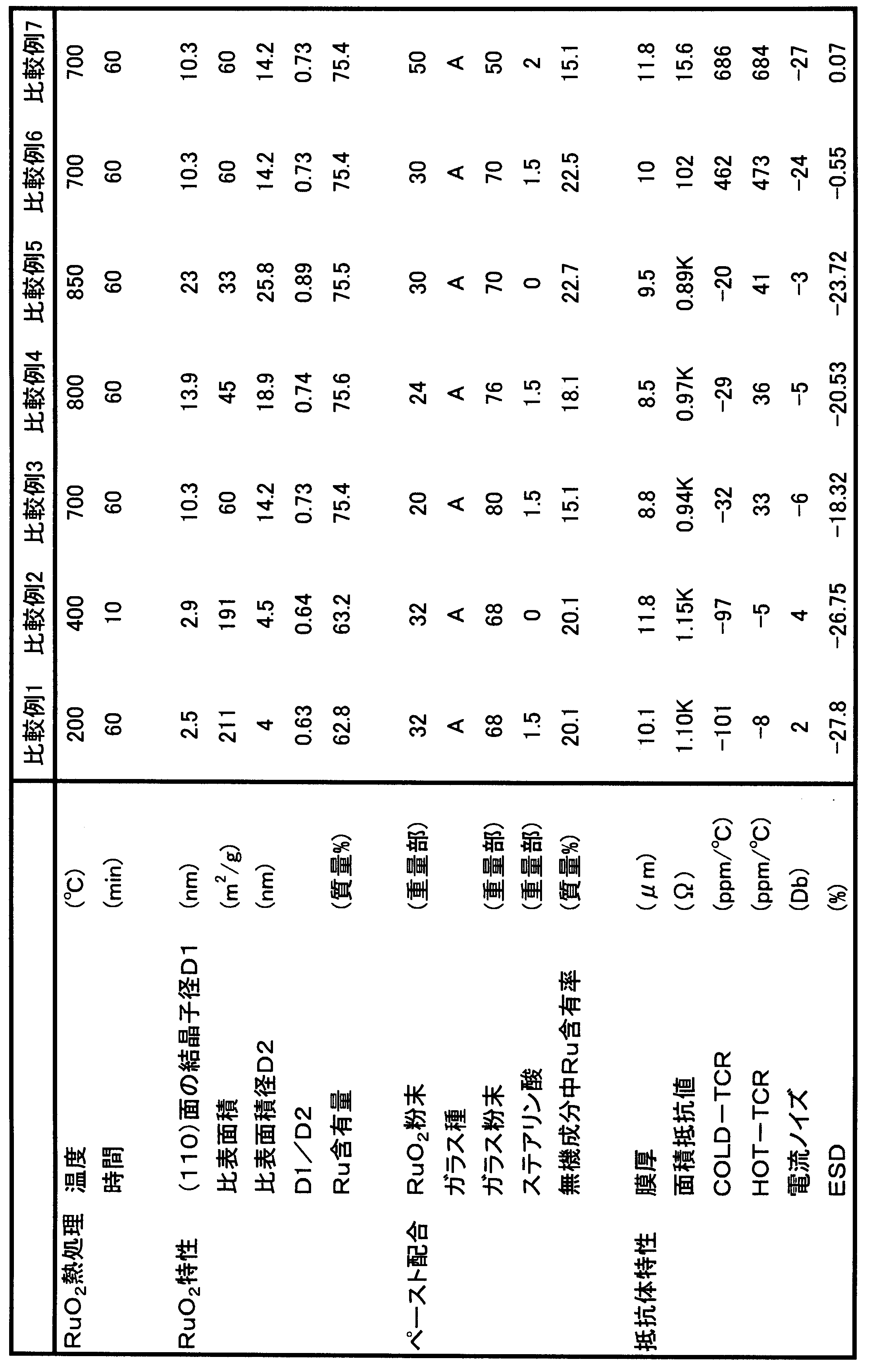
実施例1と同様に、ルテニウム酸カリウムを溶解した水溶液を原料にして、水溶液中で酸化ルテニウムの沈殿を合成し、これを固液分離し、洗浄後80℃で乾燥して酸化ルテニウム粉末を得た。次に、実施例1とは異なり、この乾燥後の酸化ルテニウム粉末を表2のように、200~850℃、10~60分の範囲で熱処理条件を変化させた。
その後、実施例1と同様に、厚膜抵抗ペーストを作成し、厚膜抵抗体を形成して評価した。なお、全ての比較例でガラス粉末Aを使用した。酸化ルテニウム(RuO2)粉末とガラス粉末の配合は、比較例1~5では、形成された厚膜抵抗体の面積抵抗値がおよそ1KΩになるように調整した。また、比較例2,5以外でステアリン酸を用い、スリーロールミルでビヒクル中に分散させて、厚膜抵抗ペーストを作成した。
実施例1~12で使用した原材料に加え、平均粒径1.0μmの銀(Ag)粉、平均粒径0.3μmのパラジウム(Pd)粉と添加剤を使用し、実施例13~18では、形成された厚膜抵抗体の面積抵抗値がおよそ5Ωになるように調整した。
厚膜抵抗ペーストの作成では、酸化ルテニウム(RuO2)粉末、Ag粉、Pd粉の導電粉とガラス粉末、添加剤粉の合計100重量部に対してビヒクル43重量部の配合にした。このとき、ステアリン酸をスリーロールミルでビヒクル中に分散させて、厚膜抵抗ペーストを作成した。これらの厚膜抵抗ペーストを、実施例1~12と同様に、印刷、乾燥、焼成して評価した。評価結果を表3に示した。
実施例13~18では厚膜抵抗体のESD特性の印加電圧を3KVに変更した以外は、実施例1~12と同じ手法で評価した。

比較例1~7と同様の方法で得た乾燥後の酸化ルテニウム粉末を、表4のように、200~850℃、10~60分の範囲で熱処理条件を変化させた。
その後、実施例13~18と同様に、実施例1~12で使用した原材料に加え、平均粒径1.0μmの銀(Ag)粉、平均粒径0.3μmのパラジウム(Pd)粉と添加剤を使用し、比較例8~12では、形成された厚膜抵抗体の面積抵抗値がおよそ5Ωになるように調整した。また、比較例2,5以外でステアリン酸を用い、スリーロールミルでビヒクル中に分散させて、厚膜抵抗ペーストを作成した。これらの厚膜抵抗ペーストを、比較例13~18と同じ手法で評価した。
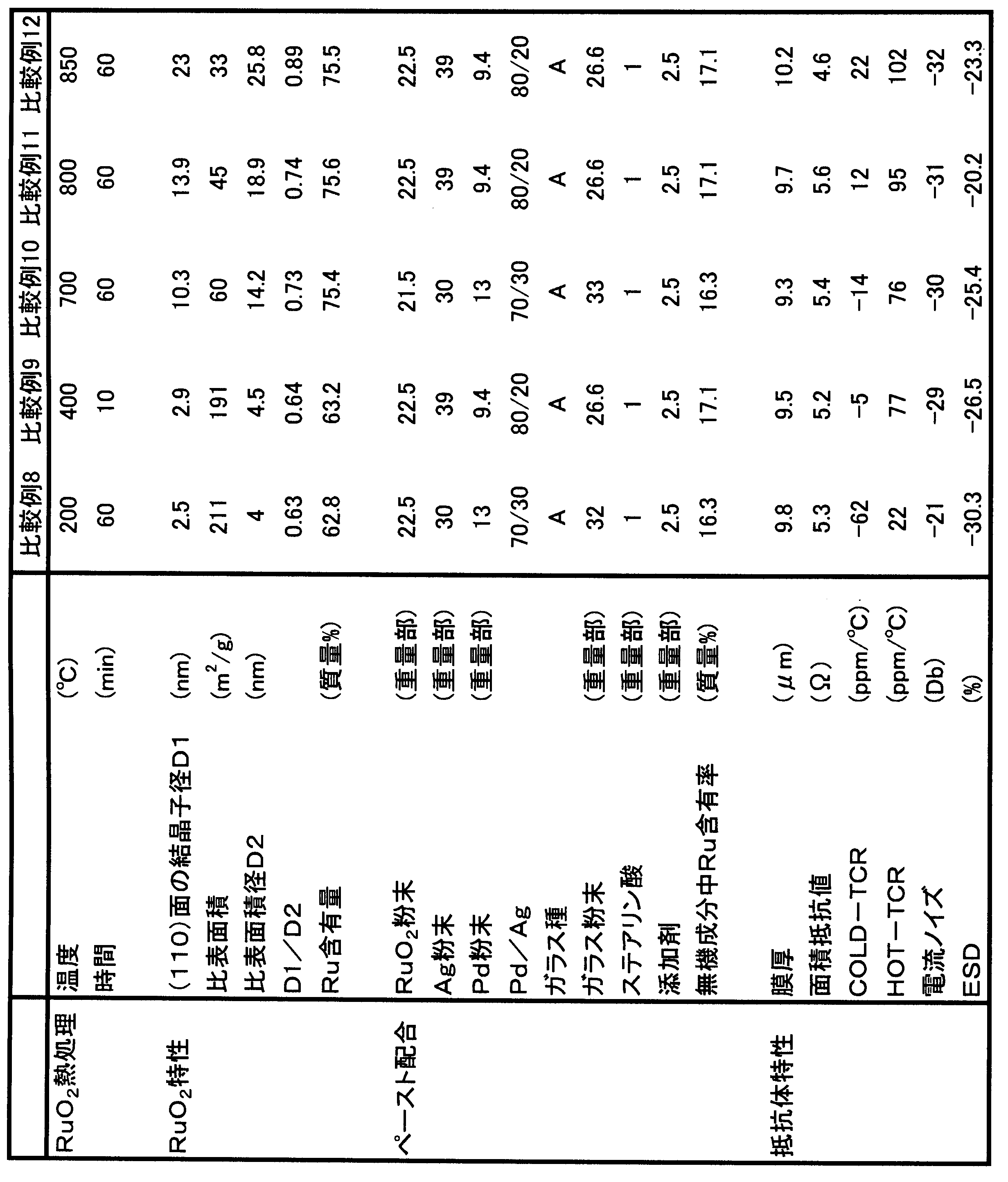
表1の実施例、表2の比較例に示したように、実施例では、本発明の特定の結晶子径、高結晶性を有する酸化ルテニウム(RuO2)粉末を用いたため、無機成分中のRu含有率が実施例12以外は比較例よりも少なくなっている。また、実施例では、電流ノイズの値が低く、静電気を放電させた際の抵抗値変化(ESD特性)も優れている。
また、酸化ルテニウムに加え、パラジウムと銀を添加した低い抵抗値領域においては、表3の実施例、表4の比較例に示したように、実施例では、本発明の特定の結晶子径、高結晶性を有する酸化ルテニウム(RuO2)粉末を用いたため、無機成分中のRu含有率を低下させることができている。また、静電気を放電させた際の抵抗値変化(ESD特性)も優れている。したがって、本発明によれば、高価なルテニウムの使用量を削減した、経済的に有利なしかも電気特性にすぐれた厚膜抵抗体組成物が得られることが分かる。
これに対し比較例では、結晶子径が本発明の範囲から外れるルテニウム酸化物を用いたので、無機成分中の酸化ルテニウム(RuO2)の含有率が全般に実施例よりも大きくなり、所望の結果が得られなかった。
Claims (12)
- ルチル型結晶構造を有する酸化ルテニウム(RuO2)粉末であって、X線回折法でその(110)面を測定した結晶子径が3~10nmであり、かつRu含有量が73質量%以上であることを特徴とする酸化ルテニウム粉末。
- 酸化ルテニウム(RuO2)粉末の比表面積が70m2/g以上、200m2/g以下であることを特徴とする請求項1に記載の酸化ルテニウム粉末。
- 酸化ルテニウム(RuO2)粉末は、結晶子径D1と比表面積径D2の比が、下記の式(1)を満たすことを特徴とする請求項1または2に記載の酸化ルテニウム粉末。
D1/D2≧0.70 ・・・(1)
(ただし、結晶子径D1は、X線回折法によるルチル型結晶構造の(110)面での測定値(nm)であり、比表面積径D2は、粉末の比表面積をS(m2/g)、比重をρ(g/cm3)と表したときの6×10-6/(ρ・S)の計算値(nm)である) - 請求項1~3のいずれかに記載の酸化ルテニウム粉末からなる導電性粒子とガラス粉末を主要構成成分として配合してなる厚膜抵抗体用組成物。
- 導電性粒子として、さらに銀(Ag)粉、パラジウム(Pd)粉もしくはパラジウムによりコートされた銀粉の酸化物粉末及び貴金属粉末のいずれか1種以上を配合したことを特徴とする請求項4に記載の厚膜抵抗体用組成物。
- 導電性粒子とガラス粉末は、質量比として5:95~70:30の範囲で配合されることを特徴とする請求項4又は5に記載の厚膜抵抗体用組成物。
- ガラス粉末は、50%累計粒度が5μm以下であることを特徴とする請求項4~6のいずれかに記載の厚膜抵抗体用組成物。
- 請求項4~7のいずれかに記載の厚膜抵抗体組成物が、脂肪酸を含む有機ビヒクル中に分散した厚膜抵抗体ペーストであって、脂肪酸の含有量が酸化ルテニウム100重量部に対して0.1~10重量部であることを特徴とする厚膜抵抗体ペースト。
- 脂肪酸は、炭素数が12以上の高級脂肪酸であることを特徴とする請求項8に記載の厚膜抵抗体ペースト。
- 導電性粒子とガラス粉末は、質量比として5:95~70:30の範囲で配合されることを特徴とする請求項8に記載の厚膜抵抗体ペースト。
- 請求項4~7のいずれかに記載の厚膜抵抗体用組成物を、セラミック基板上で焼成してなる厚膜抵抗体。
- 請求項8~10のいずれかに記載された厚膜抵抗体ペーストを、セラミック基板に塗布した後、焼成して形成された厚膜抵抗体。
Priority Applications (3)
| Application Number | Priority Date | Filing Date | Title |
|---|---|---|---|
| KR1020137022570A KR101958496B1 (ko) | 2011-06-21 | 2012-06-15 | 산화 루테늄 분말, 그것을 이용한 후막 저항체용 조성물 및 후막 저항체 |
| CN201280013181.0A CN103429537B (zh) | 2011-06-21 | 2012-06-15 | 氧化钌粉末、使用它的厚膜电阻体用组合物及厚膜电阻体 |
| JP2013521554A JP5835325B2 (ja) | 2011-06-21 | 2012-06-15 | 酸化ルテニウム粉末、それを用いた厚膜抵抗体用組成物、厚膜抵抗体ペーストおよび厚膜抵抗体 |
Applications Claiming Priority (2)
| Application Number | Priority Date | Filing Date | Title |
|---|---|---|---|
| JP2011-136939 | 2011-06-21 | ||
| JP2011136939 | 2011-06-21 |
Publications (1)
| Publication Number | Publication Date |
|---|---|
| WO2012176696A1 true WO2012176696A1 (ja) | 2012-12-27 |
Family
ID=47422534
Family Applications (1)
| Application Number | Title | Priority Date | Filing Date |
|---|---|---|---|
| PCT/JP2012/065313 Ceased WO2012176696A1 (ja) | 2011-06-21 | 2012-06-15 | 酸化ルテニウム粉末、それを用いた厚膜抵抗体用組成物および厚膜抵抗体 |
Country Status (5)
| Country | Link |
|---|---|
| JP (3) | JP5835325B2 (ja) |
| KR (1) | KR101958496B1 (ja) |
| CN (1) | CN103429537B (ja) |
| TW (1) | TWI529135B (ja) |
| WO (1) | WO2012176696A1 (ja) |
Cited By (8)
| Publication number | Priority date | Publication date | Assignee | Title |
|---|---|---|---|---|
| JP2018043895A (ja) * | 2016-09-12 | 2018-03-22 | 住友金属鉱山株式会社 | 二酸化ルテニウム粉末とその製造方法、厚膜抵抗体ペースト、及び、厚膜抵抗体 |
| WO2018180959A1 (ja) * | 2017-03-28 | 2018-10-04 | 住友金属鉱山株式会社 | 酸化ルテニウム粉末、厚膜抵抗体用組成物、厚膜抵抗体用ペースト、及び厚膜抵抗体 |
| JP2019172555A (ja) * | 2018-03-29 | 2019-10-10 | 住友金属鉱山株式会社 | 厚膜抵抗体用組成物、厚膜抵抗体用ペースト、及び厚膜抵抗体 |
| JP2020001951A (ja) * | 2018-06-27 | 2020-01-09 | 住友金属鉱山株式会社 | 酸化ルテニウム粉末の乾燥方法 |
| WO2020026942A1 (ja) * | 2018-07-31 | 2020-02-06 | 住友金属鉱山株式会社 | 厚膜抵抗体用組成物、厚膜抵抗体用ペースト、及び厚膜抵抗体 |
| JP2020070215A (ja) * | 2018-10-31 | 2020-05-07 | 住友金属鉱山株式会社 | 酸化ルテニウム粉の製造方法及び酸化ルテニウム粉、並びに酸化ルテニウム粉を有する厚膜抵抗ペースト |
| US20230167011A1 (en) * | 2020-05-01 | 2023-06-01 | Sumitomo Metal Mining Co., Ltd. | Thick film resistor paste, thick film resistor, and electronic component |
| EP4564377A4 (en) * | 2022-07-27 | 2025-11-19 | Sumitomo Metal Mining Co | Ruthenium oxide powder, composition for thick film strength, paste for thick film strength and thick film strength |
Families Citing this family (18)
| Publication number | Priority date | Publication date | Assignee | Title |
|---|---|---|---|---|
| JP6167880B2 (ja) * | 2013-12-05 | 2017-07-26 | 東芝ライテック株式会社 | ヒータおよび画像形成装置 |
| CA2939542C (en) | 2014-09-12 | 2017-07-18 | Shoei Chemical Inc. | Thick film resistor and production method for same |
| CN104961165A (zh) * | 2015-06-19 | 2015-10-07 | 东华大学 | 一种表面改性的氧化钌水合物及其制备及应用 |
| CN105139916B (zh) * | 2015-06-30 | 2017-01-04 | 苏州洋杰电子有限公司 | 碳粉掺杂钼基厚膜电阻浆料及其制备方法 |
| KR101739744B1 (ko) | 2015-08-13 | 2017-05-25 | 대주전자재료 주식회사 | 무연 후막 저항 조성물, 무연 후막 저항체 및 이의 제조방법 |
| KR102745341B1 (ko) | 2016-10-06 | 2024-12-20 | 삼성전자주식회사 | 복합물질과 그 형성방법 및 복합물질을 포함하는 장치 |
| JP6848327B2 (ja) * | 2016-10-19 | 2021-03-24 | 住友金属鉱山株式会社 | 正温度係数抵抗体用組成物、正温度係数抵抗体用ペースト、正温度係数抵抗体ならびに正温度係数抵抗体の製造方法 |
| JP6966717B2 (ja) * | 2017-08-25 | 2021-11-17 | 住友金属鉱山株式会社 | 厚膜抵抗体組成物及びそれを含む厚膜抵抗ペースト |
| CN110580993B (zh) * | 2017-10-23 | 2021-05-04 | 潮州三环(集团)股份有限公司 | 一种阻值范围为10ω/□~100ω/□的厚膜电阻浆料及其制备方法 |
| CN107986341A (zh) * | 2017-12-18 | 2018-05-04 | 西安宏星电子浆料科技有限责任公司 | 片式电阻浆料用氧化钌粉及其制备方法 |
| JP7121231B2 (ja) | 2018-01-15 | 2022-08-18 | 三菱マテリアル株式会社 | 導電性膜及びその製造方法 |
| KR102230597B1 (ko) * | 2019-04-29 | 2021-03-22 | 강릉원주대학교산학협력단 | 이산화루테늄 및 이의 제조방법 |
| CN110085346B (zh) * | 2019-04-30 | 2021-04-30 | 东莞珂洛赫慕电子材料科技有限公司 | 一种适配氮化硅基材的发热电阻浆料及其制备方法和应用 |
| CN115516579A (zh) * | 2020-05-01 | 2022-12-23 | 住友金属矿山株式会社 | 厚膜电阻糊、厚膜电阻体和电子部件 |
| CN112010558B (zh) * | 2020-09-03 | 2022-09-27 | 山东华菱电子股份有限公司 | 无铅硅酸盐玻璃釉原料组成物、无铅硅酸盐玻璃釉及其应用 |
| CN114105228B (zh) * | 2021-11-25 | 2022-08-19 | 西北有色金属研究院 | 一种厚膜电阻用氧化钌的制备方法 |
| CN116730411A (zh) * | 2023-05-25 | 2023-09-12 | 江西金海岛新材料有限公司 | 一种电阻浆料用RuO2及其制备方法 |
| WO2025182735A1 (ja) * | 2024-02-29 | 2025-09-04 | パナソニックIpマネジメント株式会社 | 抵抗体ペースト及びチップ抵抗器 |
Citations (5)
| Publication number | Priority date | Publication date | Assignee | Title |
|---|---|---|---|---|
| JPH113801A (ja) * | 1997-06-11 | 1999-01-06 | Sumitomo Metal Mining Co Ltd | 厚膜抵抗ペーストおよびその製造方法 |
| US20030062512A1 (en) * | 1999-12-01 | 2003-04-03 | Ryan Joseph V. | Electrically conducting ruthenium dioxide aerogel composite |
| JP2005235754A (ja) * | 2004-01-20 | 2005-09-02 | Tdk Corp | 導電性材料及びその製造方法、抵抗体ペースト、抵抗体、電子部品 |
| JP2005306677A (ja) * | 2004-04-22 | 2005-11-04 | Sumitomo Metal Mining Co Ltd | Ru−M−O微粉末、その製造方法、及びそれらを用いた厚膜抵抗体組成物 |
| JP2006248815A (ja) * | 2005-03-09 | 2006-09-21 | Sumitomo Metal Mining Co Ltd | Ru−Mn−O微粉末、その製造方法、及びそれを用いた厚膜抵抗体組成物 |
Family Cites Families (10)
| Publication number | Priority date | Publication date | Assignee | Title |
|---|---|---|---|---|
| JPS5252933A (en) * | 1975-10-24 | 1977-04-28 | Shoei Kagaku Kogyo Kk | Ressiting coating containing rutile ruthenium oxide |
| JPS57205462A (en) * | 1981-06-12 | 1982-12-16 | Sumitomo Metal Mining Co Ltd | Resistance paint |
| JPS5950032A (ja) * | 1982-09-17 | 1984-03-22 | Shoei Kagaku Kogyo Kk | 二酸化ルテニウム粉末の製造方法 |
| JPH01282457A (ja) * | 1988-05-09 | 1989-11-14 | Terumo Corp | 酵素センサ |
| JP2605875B2 (ja) * | 1989-07-10 | 1997-04-30 | 富士ゼロックス株式会社 | 抵抗体膜およびその形成方法 |
| EP0628974A2 (en) * | 1993-06-07 | 1994-12-14 | E.I. Du Pont De Nemours & Company Incorporated | Thick film resistor composition |
| JP4466402B2 (ja) * | 2005-02-17 | 2010-05-26 | 住友金属鉱山株式会社 | 厚膜導体形成用組成物 |
| US8628695B2 (en) * | 2008-04-18 | 2014-01-14 | E I Du Pont De Nemours And Company | Surface-modified ruthenium oxide conductive material, lead-free glass(es), thick film resistor paste(s), and devices made therefrom |
| JP5045615B2 (ja) * | 2008-08-27 | 2012-10-10 | 住友金属鉱山株式会社 | 導電粉及びその製造方法 |
| JP5465915B2 (ja) * | 2009-04-16 | 2014-04-09 | 国立大学法人信州大学 | 薄膜導電膜の形成方法 |
-
2012
- 2012-06-15 JP JP2013521554A patent/JP5835325B2/ja active Active
- 2012-06-15 WO PCT/JP2012/065313 patent/WO2012176696A1/ja not_active Ceased
- 2012-06-15 KR KR1020137022570A patent/KR101958496B1/ko active Active
- 2012-06-15 CN CN201280013181.0A patent/CN103429537B/zh active Active
- 2012-06-20 TW TW101122033A patent/TWI529135B/zh active
-
2015
- 2015-10-28 JP JP2015211657A patent/JP6079851B2/ja active Active
-
2017
- 2017-01-18 JP JP2017006494A patent/JP6256636B2/ja active Active
Patent Citations (5)
| Publication number | Priority date | Publication date | Assignee | Title |
|---|---|---|---|---|
| JPH113801A (ja) * | 1997-06-11 | 1999-01-06 | Sumitomo Metal Mining Co Ltd | 厚膜抵抗ペーストおよびその製造方法 |
| US20030062512A1 (en) * | 1999-12-01 | 2003-04-03 | Ryan Joseph V. | Electrically conducting ruthenium dioxide aerogel composite |
| JP2005235754A (ja) * | 2004-01-20 | 2005-09-02 | Tdk Corp | 導電性材料及びその製造方法、抵抗体ペースト、抵抗体、電子部品 |
| JP2005306677A (ja) * | 2004-04-22 | 2005-11-04 | Sumitomo Metal Mining Co Ltd | Ru−M−O微粉末、その製造方法、及びそれらを用いた厚膜抵抗体組成物 |
| JP2006248815A (ja) * | 2005-03-09 | 2006-09-21 | Sumitomo Metal Mining Co Ltd | Ru−Mn−O微粉末、その製造方法、及びそれを用いた厚膜抵抗体組成物 |
Non-Patent Citations (3)
| Title |
|---|
| KUO-HSIN CHANG ET AL.: "Coalescence inhibition of hydrous Ru02 crystallites prepared by a hydrothermal method", APPLIED PHYSICS LETTERS, vol. 88, 2006, pages 193102-1 - 193102-3 * |
| TODD P. LUXTON ET AL.: "Characterization and dissolution properties of ruthenium oxides", JOURNAL OF COLLOID AND INTERFACE SCIENCE, vol. 359, 27 March 2011 (2011-03-27), pages 30 - 39 * |
| YASUSHI MURAKAMI ET AL.: "Preparation of ultrafine ruthenium oxide particles with ammonium hydrogencarbonate", DENKI KAGAKU, vol. 65, no. 12, 5 December 1997 (1997-12-05), pages 992 - 996 * |
Cited By (19)
| Publication number | Priority date | Publication date | Assignee | Title |
|---|---|---|---|---|
| JP2018043895A (ja) * | 2016-09-12 | 2018-03-22 | 住友金属鉱山株式会社 | 二酸化ルテニウム粉末とその製造方法、厚膜抵抗体ペースト、及び、厚膜抵抗体 |
| US10832838B1 (en) | 2017-03-28 | 2020-11-10 | Sumitomo Metal Mining Co., Ltd. | Ruthenium oxide powder, thick film resistor composition, thick film resistor paste, and thick film resistor |
| WO2018180959A1 (ja) * | 2017-03-28 | 2018-10-04 | 住友金属鉱山株式会社 | 酸化ルテニウム粉末、厚膜抵抗体用組成物、厚膜抵抗体用ペースト、及び厚膜抵抗体 |
| JP2018165238A (ja) * | 2017-03-28 | 2018-10-25 | 住友金属鉱山株式会社 | 酸化ルテニウム粉末、厚膜抵抗体用組成物、厚膜抵抗体用ペースト、及び厚膜抵抗体 |
| KR102512682B1 (ko) | 2017-03-28 | 2023-03-21 | 스미토모 긴조쿠 고잔 가부시키가이샤 | 산화루테늄 분말, 후막 저항체용 조성물, 후막 저항체용 페이스트 및 후막 저항체 |
| CN110461771A (zh) * | 2017-03-28 | 2019-11-15 | 住友金属矿山株式会社 | 氧化钌粉末、厚膜电阻用合成物、厚膜电阻用浆煳、及厚膜电阻 |
| KR20190132394A (ko) * | 2017-03-28 | 2019-11-27 | 스미토모 긴조쿠 고잔 가부시키가이샤 | 산화루테늄 분말, 후막 저항체용 조성물, 후막 저항체용 페이스트 및 후막 저항체 |
| JP7110671B2 (ja) | 2018-03-29 | 2022-08-02 | 住友金属鉱山株式会社 | 厚膜抵抗体用組成物、厚膜抵抗体用ペースト、及び厚膜抵抗体 |
| JP2019172555A (ja) * | 2018-03-29 | 2019-10-10 | 住友金属鉱山株式会社 | 厚膜抵抗体用組成物、厚膜抵抗体用ペースト、及び厚膜抵抗体 |
| JP7056407B2 (ja) | 2018-06-27 | 2022-04-19 | 住友金属鉱山株式会社 | 酸化ルテニウム粉末の乾燥方法 |
| JP2020001951A (ja) * | 2018-06-27 | 2020-01-09 | 住友金属鉱山株式会社 | 酸化ルテニウム粉末の乾燥方法 |
| JP2020021818A (ja) * | 2018-07-31 | 2020-02-06 | 住友金属鉱山株式会社 | 厚膜抵抗体用組成物、厚膜抵抗体用ペースト、及び厚膜抵抗体 |
| WO2020026942A1 (ja) * | 2018-07-31 | 2020-02-06 | 住友金属鉱山株式会社 | 厚膜抵抗体用組成物、厚膜抵抗体用ペースト、及び厚膜抵抗体 |
| JP7251068B2 (ja) | 2018-07-31 | 2023-04-04 | 住友金属鉱山株式会社 | 厚膜抵抗体用組成物、厚膜抵抗体用ペースト、及び厚膜抵抗体 |
| JP2020070215A (ja) * | 2018-10-31 | 2020-05-07 | 住友金属鉱山株式会社 | 酸化ルテニウム粉の製造方法及び酸化ルテニウム粉、並びに酸化ルテニウム粉を有する厚膜抵抗ペースト |
| JP7124645B2 (ja) | 2018-10-31 | 2022-08-24 | 住友金属鉱山株式会社 | 酸化ルテニウム粉の製造方法及び酸化ルテニウム粉、並びに酸化ルテニウム粉を有する厚膜抵抗ペースト |
| US20230167011A1 (en) * | 2020-05-01 | 2023-06-01 | Sumitomo Metal Mining Co., Ltd. | Thick film resistor paste, thick film resistor, and electronic component |
| US12304860B2 (en) * | 2020-05-01 | 2025-05-20 | Sumitomo Metal Mining Co., Ltd. | Thick film resistor paste, thick film resistor, and electronic component |
| EP4564377A4 (en) * | 2022-07-27 | 2025-11-19 | Sumitomo Metal Mining Co | Ruthenium oxide powder, composition for thick film strength, paste for thick film strength and thick film strength |
Also Published As
| Publication number | Publication date |
|---|---|
| CN103429537B (zh) | 2015-04-22 |
| TWI529135B (zh) | 2016-04-11 |
| JP2016074593A (ja) | 2016-05-12 |
| JP5835325B2 (ja) | 2015-12-24 |
| CN103429537A (zh) | 2013-12-04 |
| JP6079851B2 (ja) | 2017-02-15 |
| TW201311569A (zh) | 2013-03-16 |
| KR20140025338A (ko) | 2014-03-04 |
| JP6256636B2 (ja) | 2018-01-10 |
| JP2017122043A (ja) | 2017-07-13 |
| JPWO2012176696A1 (ja) | 2015-02-23 |
| KR101958496B1 (ko) | 2019-03-14 |
Similar Documents
| Publication | Publication Date | Title |
|---|---|---|
| JP6256636B2 (ja) | 酸化ルテニウム粉末の製造方法 | |
| CN110461771B (zh) | 氧化钌粉末、厚膜电阻用合成物、厚膜电阻用浆煳、及厚膜电阻 | |
| JP6931455B2 (ja) | 抵抗体用組成物及びこれを含んだ抵抗体ペーストとそれを用いた厚膜抵抗体 | |
| JP6804044B2 (ja) | 抵抗体用組成物及びこれを含んだ抵抗体ペーストさらにそれを用いた厚膜抵抗体 | |
| JP4285315B2 (ja) | Ru−M−O微粉末、その製造方法、及びそれらを用いた厚膜抵抗体組成物 | |
| CN112514007B (zh) | 厚膜电阻体用组成物、厚膜电阻体用膏体及厚膜电阻体 | |
| JP7139691B2 (ja) | 厚膜抵抗体用組成物、厚膜抵抗ペースト及び厚膜抵抗体 | |
| JP7390103B2 (ja) | 抵抗体用組成物、抵抗ペースト、厚膜抵抗体 | |
| TWI795545B (zh) | 厚膜電阻用組成物、厚膜電阻用膏體及厚膜電阻 | |
| JP2020136323A (ja) | 厚膜抵抗体用組成物、厚膜抵抗体用ペースト、及び厚膜抵抗体 | |
| JP2020178069A (ja) | 厚膜抵抗体用組成物、厚膜抵抗体用ペースト、及び厚膜抵抗体 |
Legal Events
| Date | Code | Title | Description |
|---|---|---|---|
| 121 | Ep: the epo has been informed by wipo that ep was designated in this application |
Ref document number: 12803051 Country of ref document: EP Kind code of ref document: A1 |
|
| ENP | Entry into the national phase |
Ref document number: 2013521554 Country of ref document: JP Kind code of ref document: A |
|
| ENP | Entry into the national phase |
Ref document number: 20137022570 Country of ref document: KR Kind code of ref document: A |
|
| NENP | Non-entry into the national phase |
Ref country code: DE |
|
| 122 | Ep: pct application non-entry in european phase |
Ref document number: 12803051 Country of ref document: EP Kind code of ref document: A1 |