WO2012137869A1 - 硬化性樹脂組成物、その硬化物、積層体およびその積層体の製造方法 - Google Patents
硬化性樹脂組成物、その硬化物、積層体およびその積層体の製造方法 Download PDFInfo
- Publication number
- WO2012137869A1 WO2012137869A1 PCT/JP2012/059372 JP2012059372W WO2012137869A1 WO 2012137869 A1 WO2012137869 A1 WO 2012137869A1 JP 2012059372 W JP2012059372 W JP 2012059372W WO 2012137869 A1 WO2012137869 A1 WO 2012137869A1
- Authority
- WO
- WIPO (PCT)
- Prior art keywords
- component
- meth
- mass
- resin composition
- curable resin
- Prior art date
- Legal status (The legal status is an assumption and is not a legal conclusion. Google has not performed a legal analysis and makes no representation as to the accuracy of the status listed.)
- Ceased
Links
Images

Classifications
-
- C—CHEMISTRY; METALLURGY
- C08—ORGANIC MACROMOLECULAR COMPOUNDS; THEIR PREPARATION OR CHEMICAL WORKING-UP; COMPOSITIONS BASED THEREON
- C08F—MACROMOLECULAR COMPOUNDS OBTAINED BY REACTIONS ONLY INVOLVING CARBON-TO-CARBON UNSATURATED BONDS
- C08F220/00—Copolymers of compounds having one or more unsaturated aliphatic radicals, each having only one carbon-to-carbon double bond, and only one being terminated by only one carboxyl radical or a salt, anhydride ester, amide, imide or nitrile thereof
- C08F220/02—Monocarboxylic acids having less than ten carbon atoms; Derivatives thereof
- C08F220/10—Esters
- C08F220/12—Esters of monohydric alcohols or phenols
- C08F220/16—Esters of monohydric alcohols or phenols of phenols or of alcohols containing two or more carbon atoms
- C08F220/18—Esters of monohydric alcohols or phenols of phenols or of alcohols containing two or more carbon atoms with acrylic or methacrylic acids
- C08F220/1804—C4-(meth)acrylate, e.g. butyl (meth)acrylate, isobutyl (meth)acrylate or tert-butyl (meth)acrylate
-
- B—PERFORMING OPERATIONS; TRANSPORTING
- B32—LAYERED PRODUCTS
- B32B—LAYERED PRODUCTS, i.e. PRODUCTS BUILT-UP OF STRATA OF FLAT OR NON-FLAT, e.g. CELLULAR OR HONEYCOMB, FORM
- B32B7/00—Layered products characterised by the relation between layers; Layered products characterised by the relative orientation of features between layers, or by the relative values of a measurable parameter between layers, i.e. products comprising layers having different physical, chemical or physicochemical properties; Layered products characterised by the interconnection of layers
- B32B7/04—Interconnection of layers
- B32B7/12—Interconnection of layers using interposed adhesives or interposed materials with bonding properties
-
- B—PERFORMING OPERATIONS; TRANSPORTING
- B32—LAYERED PRODUCTS
- B32B—LAYERED PRODUCTS, i.e. PRODUCTS BUILT-UP OF STRATA OF FLAT OR NON-FLAT, e.g. CELLULAR OR HONEYCOMB, FORM
- B32B7/00—Layered products characterised by the relation between layers; Layered products characterised by the relative orientation of features between layers, or by the relative values of a measurable parameter between layers, i.e. products comprising layers having different physical, chemical or physicochemical properties; Layered products characterised by the interconnection of layers
- B32B7/04—Interconnection of layers
- B32B7/12—Interconnection of layers using interposed adhesives or interposed materials with bonding properties
- B32B7/14—Interconnection of layers using interposed adhesives or interposed materials with bonding properties applied in spaced arrangements, e.g. in stripes
-
- C—CHEMISTRY; METALLURGY
- C08—ORGANIC MACROMOLECULAR COMPOUNDS; THEIR PREPARATION OR CHEMICAL WORKING-UP; COMPOSITIONS BASED THEREON
- C08F—MACROMOLECULAR COMPOUNDS OBTAINED BY REACTIONS ONLY INVOLVING CARBON-TO-CARBON UNSATURATED BONDS
- C08F265/00—Macromolecular compounds obtained by polymerising monomers on to polymers of unsaturated monocarboxylic acids or derivatives thereof as defined in group C08F20/00
- C08F265/04—Macromolecular compounds obtained by polymerising monomers on to polymers of unsaturated monocarboxylic acids or derivatives thereof as defined in group C08F20/00 on to polymers of esters
- C08F265/06—Polymerisation of acrylate or methacrylate esters on to polymers thereof
-
- C—CHEMISTRY; METALLURGY
- C08—ORGANIC MACROMOLECULAR COMPOUNDS; THEIR PREPARATION OR CHEMICAL WORKING-UP; COMPOSITIONS BASED THEREON
- C08F—MACROMOLECULAR COMPOUNDS OBTAINED BY REACTIONS ONLY INVOLVING CARBON-TO-CARBON UNSATURATED BONDS
- C08F4/00—Polymerisation catalysts
- C08F4/40—Redox systems
-
- C—CHEMISTRY; METALLURGY
- C09—DYES; PAINTS; POLISHES; NATURAL RESINS; ADHESIVES; COMPOSITIONS NOT OTHERWISE PROVIDED FOR; APPLICATIONS OF MATERIALS NOT OTHERWISE PROVIDED FOR
- C09J—ADHESIVES; NON-MECHANICAL ASPECTS OF ADHESIVE PROCESSES IN GENERAL; ADHESIVE PROCESSES NOT PROVIDED FOR ELSEWHERE; USE OF MATERIALS AS ADHESIVES
- C09J135/00—Adhesives based on homopolymers or copolymers of compounds having one or more unsaturated aliphatic radicals, each having only one carbon-to-carbon double bond, and at least one being terminated by a carboxyl radical, and containing at least another carboxyl radical in the molecule, or of salts, anhydrides, esters, amides, imides or nitriles thereof; Adhesives based on derivatives of such polymers
- C09J135/02—Homopolymers or copolymers of esters
-
- Y—GENERAL TAGGING OF NEW TECHNOLOGICAL DEVELOPMENTS; GENERAL TAGGING OF CROSS-SECTIONAL TECHNOLOGIES SPANNING OVER SEVERAL SECTIONS OF THE IPC; TECHNICAL SUBJECTS COVERED BY FORMER USPC CROSS-REFERENCE ART COLLECTIONS [XRACs] AND DIGESTS
- Y10—TECHNICAL SUBJECTS COVERED BY FORMER USPC
- Y10T—TECHNICAL SUBJECTS COVERED BY FORMER US CLASSIFICATION
- Y10T428/00—Stock material or miscellaneous articles
- Y10T428/31504—Composite [nonstructural laminate]
- Y10T428/31855—Of addition polymer from unsaturated monomers
- Y10T428/31935—Ester, halide or nitrile of addition polymer
Definitions
- the present invention relates to a curable resin composition, a cured product thereof, and a laminate including the cured product.
- Laminates such as laminated glass have safety such as prevention of scattering and penetration, and transparency, and can also have soundproofing, ultraviolet blocking, infrared blocking, design, etc. as desired. Therefore, it is widely used in fields such as building materials, machine tools, and automobiles.
- the following method is used as a manufacturing method of a laminated body.
- a resin film such as polyvinyl butyral is sandwiched between two base materials such as a glass plate and a resin plate and thermocompression bonded.
- a room temperature curable resin liquid is poured between two substrates and cured by curing.
- a (meth) acrylic resin composition is mainly used as the room temperature curable resin liquid.
- a redox polymerization initiating system for curing a (meth) acrylic resin composition at room temperature a redox polymerization initiating system using benzoyl peroxide as a curing agent and tertiary amine as an accelerator is widely used.
- a redox polymerization initiating system using benzoyl peroxide as a curing agent and tertiary amine as an accelerator is widely used.
- a redox polymerization initiating system there is a problem that the cured product is colored, and it is difficult to adapt to a laminate requiring colorless transparency.
- Patent Document 1 discloses a (meth) acrylic resin composition containing hydroperoxide as a curing agent and a thiourea compound as an accelerator.
- Patent Document 2 A (meth) acrylic resin composition containing a peroxide (such as t-hexylperoxyisopropyl monocarbonate) as a curing agent and a mercapto compound as an accelerator is disclosed in Patent Document 2.
- the (meth) acrylic resin composition (1) cannot be said to have sufficient strength and transparency of the cured product. Since the (meth) acrylic resin composition (2) does not undergo a sufficient polymerization reaction at room temperature, there is a concern about poor curing.
- JP 2004-211003 A Japanese Patent Laid-Open No. 2003-105157
- the present invention provides a curable resin composition that can be cured at room temperature to obtain a cured product having excellent strength and transparency, the cured product, a laminate including the cured product, and a method for producing the laminate. To do.
- the present invention has the following aspects.
- the first aspect of the present invention is: (A) (meth) acrylic polymerizable monomer component, (B) a thiourea compound component, and (C) a peroxide component having the structure of the following formula (1), (D) It is a curable resin composition that may contain a (meth) acrylic polymer component as an optional component.
- R is a hydrocarbon group having 1 to 15 carbon atoms.
- the content of the component (A) is 5 to 100% by mass with respect to the total mass of the component (A) and the component (D), and the component (D) A curable resin composition having a content of 0 to 95% by mass.
- the content of the component (A) is 40 to 100% by mass with respect to the total mass of the component (A) and the component (D), and the component (D)
- the content of the component (A) is 60 to 100% by mass with respect to the total mass of the component (A) and the component (D), and the component (D)
- the content of the component (A) is 80 to 100% by mass with respect to the total mass of the component (A) and the component (D), and the component (D)
- the content of the component (A) is 80 to 98% by mass with respect to the total mass of the component (A) and the component (D), and the component (D)
- the total amount of the component (A) and the component (D) is 100 parts by mass, the component (C) 0.05 to 5 parts by mass, and the component (D) 0
- 0.1 to 3 parts by mass of the component (C) and 0 part of the component (D) are added to 100 parts by mass of the component (A) and the component (D).
- the total amount of the component (A) and the component (D) is 100 parts by mass, and the component (C) is 0.15 to 1.5 parts by mass, and the component (D)
- a tenth aspect of the present invention is a cured product obtained by curing the curable resin composition according to any one of the first to sixth aspects.
- the eleventh aspect of the present invention is a cured product obtained by curing the curable resin composition according to the seventh aspect.
- the twelfth aspect of the present invention is a cured product obtained by curing the curable resin composition according to the eighth aspect.
- the thirteenth aspect of the present invention is a cured product obtained by curing the curable resin composition according to the ninth aspect.
- a fourteenth aspect of the present invention is a laminate including a layer made of the cured product according to the tenth aspect between two base materials.
- a fifteenth aspect of the present invention is a laminate including a layer made of the cured product according to the eleventh aspect between two base materials.
- a sixteenth aspect of the present invention is a laminate including a layer made of the cured product according to the twelfth aspect between two base materials.
- a seventeenth aspect of the present invention is a laminate including a layer made of the cured product according to the thirteenth aspect between two base materials.
- the curable resin composition according to any one of the first to sixth aspects is poured between two opposing substrates to cure the composition. It is a manufacturing method of the laminated body as described in an aspect.
- a laminate according to the fifteenth aspect wherein the curable resin composition according to the seventh aspect is poured between two opposing substrates, and the composition is cured. It is a manufacturing method of a body.
- a twentieth aspect of the present invention is the lamination according to the sixteenth aspect, in which the curable resin composition according to the eighth aspect is poured between two opposing substrates to cure the composition. It is a manufacturing method of a body.
- the curable resin composition described in the ninth aspect is poured between two opposing substrates, and the composition is cured, so that the composition is cured. It is a manufacturing method of a body.
- a cured product that is cured at room temperature and has excellent strength and transparency can be obtained.
- the cured product of the present invention has excellent strength and transparency.
- the laminate of the present invention has excellent safety such as penetration prevention and transparency.
- the method for producing a laminate of the present invention can produce a laminate having excellent safety such as penetration prevention and transparency.
- (Meth) acryl is a general term for acrylic and methacrylic
- (Meth) acrylate is a general term for acrylate and methacrylate
- the “(meth) acryloyl group” is a generic name for an acryloyl group and a methacryloyl group, and CH 2 ⁇ C (R) —C ( ⁇ O) — [R is a hydrogen atom or a methyl group. ].
- the curable resin composition of the present invention comprises (A) a (meth) acrylic polymerizable monomer component, (B) a thiourea compound component, and (C) a peroxide component containing the structure of formula (1). Including.
- the curable resin composition of the present invention may further contain (D) (meth) acrylic polymer component as an optional component.
- (A) the (meth) acrylic polymerizable monomer component is the component (A)
- (B) the thiourea compound component is the component (B)
- (C) contains the structure of the formula (1)
- the peroxide component to be used is referred to as component (C)
- the (D) (meth) acrylic polymer component is referred to as component (D).
- the content of the component (A) and the component (D) is 5 to 100 of the component (A) with respect to the total mass of the component (A) and the component (D).
- the component (D) is 0 to 95% by mass.
- the (meth) acrylic polymerizable monomer as the component (A) is a compound having a (meth) acryloyl group.
- a monofunctional compound having one (meth) acryloyl group in the molecular structure may be used, or a polyfunctional compound having two or more (meth) acryloyl groups in the molecular structure may be used.
- component (A) examples include (meth) acrylic acid, methyl (meth) acrylate, ethyl (meth) acrylate, propyl (meth) acrylate, n-butyl (meth) acrylate, i-butyl (meth) acrylate, t-butyl (meth) acrylate, heptyl (meth) acrylate, 2-ethylhexyl (meth) acrylate, n-octyl (meth) acrylate, isooctyl (meth) acrylate, n-nonyl (meth) acrylate, isononyl (meth) acrylate, Decyl (meth) acrylate, lauryl (meth) acrylate, tridecyl (meth) acrylate, stearyl (meth) acrylate, cyclohexyl (meth) acrylate, benzyl (meth) acrylate,
- a component may be used individually by 1 type and may use 2 or more types together.
- the curable resin composition of the present invention varies depending on the required properties of the laminate of the present invention, it cannot be said unconditionally, but at least an alkyl (meth) acrylate (A) from the point that the weather resistance of the cured product is good. It is preferable to include as a component.
- the alkyl (meth) acrylate methyl methacrylate is preferable from the viewpoint of transparency of the cured product, and from the viewpoint of flexibility, ethyl (meth) acrylate, n-butyl (meth) acrylate, 2-ethylhexyl (meth) is preferable.
- Acrylate and 2-ethylhexyl diethylene glycol (meth) acrylate are preferred, and di (meth) acrylates are preferred from the viewpoint of strength.
- the (B) component thiourea compound is an accelerator and reacts with the (C) component to generate radicals.
- component (B) examples include thiourea, ethylenethiourea, N, N′-dimethylthiourea, N, N′-diethylthiourea, N, N′-dipropylthiourea, N, N′-di-n-butylthio.
- Examples include urea, N, N′-dilaurylthiourea, N, N′-diphenylthiourea, trimethylthiourea, 1-acetyl-2-thiourea, 1-benzoyl-2-thiourea and the like.
- a component may be used individually by 1 type and may use 2 or more types together.
- N, N′-diethylthiourea and N, N′-di-n-butylthiourea are particularly preferable from the viewpoint of the strength of the cured product.
- the blending amount of the component (B) is preferably 0.05 to 5 parts by mass, more preferably 0.1 to 3 parts by mass, when the total amount of the components (A) and (D) is 100 parts by mass. 0.2 to 2 parts by mass is more preferable, and 0.15 to 1.5 parts by mass is particularly preferable.
- (B) By making the compounding quantity of a component 0.05 mass part or more, sclerosis
- Component (C) The peroxide containing the structure of the following formula (1) which is the component (C) is a curing agent and reacts with the component (B) to generate radicals.
- R is a hydrocarbon group having 1 to 15 carbon atoms.
- R may be saturated or unsaturated, and may be linear, branched or cyclic.
- R is preferably a hydrocarbon group having 4 to 8 carbon atoms from the viewpoint of solubility in the component (A), and is preferably saturated and branched.
- component (C) examples include t-hexyl peroxyisopropyl monocarbonate, t-butyl peroxyisopropyl monocarbonate, t-butyl peroxy 2-ethylhexyl monocarbonate, t-butyl peroxyallyl monocarbonate, 1, Examples include 6-bis (t-butylperoxycarbonyloxy) hexane.
- component (C) one type may be used alone, or two or more types may be used in combination.
- component (C) t-hexyl peroxyisopropyl monocarbonate and t-butyl peroxy 2-ethylhexyl monocarbonate are particularly preferable from the viewpoints of solubility in the component (A) and transparency of the cured product.
- the amount of component (C) is preferably 0.1 to 10 parts by weight, more preferably 0.3 to 7 parts by weight, with the total amount of component (A) and component (D) being 100 parts by weight. 0.5 to 4 parts by mass is more preferable.
- hardenability of the curable resin composition of this invention becomes favorable because the compounding quantity of a component shall be 0.1 mass part or more. Moreover, the intensity
- the (D) component (meth) acrylic polymer is an optional component, but the strength of the cured product of the present invention can be improved by further adding the (D) component.
- the (meth) acrylic polymer is a polymer containing 50% by mass or more of (meth) acrylic monomer units in the composition.
- the (meth) acrylic monomer is a monomer having a (meth) acryloyl group, and the unit is a repeating unit constituting the polymer.
- the (meth) acrylic monomer may be a monofunctional monomer or a polyfunctional monomer. A monofunctional monomer is preferable from the viewpoint of solubility in the component (A).
- (meth) acrylic monomers include (meth) acrylic acid, methyl (meth) acrylate, ethyl (meth) acrylate, propyl (meth) acrylate, n-butyl (meth) acrylate, i-butyl (meth) Acrylate, t-butyl (meth) acrylate, heptyl (meth) acrylate, 2-ethylhexyl (meth) acrylate, n-octyl (meth) acrylate, isooctyl (meth) acrylate, n-nonyl (meth) acrylate, isononyl (meth) Acrylate, decyl (meth) acrylate, lauryl (meth) acrylate, tridecyl (meth) acrylate, stearyl (meth) acrylate, cyclohexyl (meth) acrylate, benzyl (meth) acrylic acid,
- the (meth) acrylic monomer unit contained in the component (D) may be one type or two or more types.
- (D) component may contain other monomer units other than a (meth) acrylic-type monomer unit. Any other monomer may be used as long as it is copolymerizable with a (meth) acrylic monomer, and examples thereof include vinyl monomers such as styrene.
- the proportion of the (meth) acrylic monomer unit is preferably 70% by mass or more and more preferably 80% by mass or more in the component (D). The upper limit of this ratio is not particularly limited, and may be 100% by mass.
- the component (D) include polymethyl methacrylate, polyethyl methacrylate, polybutyl methacrylate, a copolymer composed of methyl methacrylate units and n-butyl methacrylate units, methyl methacrylate units and n-butyl acrylate units. And a copolymer.
- a copolymer comprising a methyl methacrylate unit and an n-butyl methacrylate unit is preferable.
- the weight average molecular weight of the component (D) is preferably 10,000 to 500,000, more preferably 30,000 to 200,000. When the weight average molecular weight is 10,000 or more, the strength of the cured product is improved. When the weight average molecular weight is 500,000 or less, the solubility in the component (A) is good.
- (D) component is used in the state which melt
- the blending amount of component (D) is preferably 0 to 60% by weight, more preferably 0 to 40% by weight, and more preferably 0 to 20% by weight when the total amount of component (A) and component (D) is 100% by weight. % Is more preferable, and 2 to 20% by mass is particularly preferable. (D) By mix
- the curable resin composition of the present invention may contain other components as long as the effects of the present invention are not impaired.
- specific examples of other components include radical polymerizable monomers other than acrylic such as vinyl monomers, polymers of non-acrylic radical polymerizable monomers such as vinyl monomers, antioxidants, plastics And various additives such as an agent, an ultraviolet absorber, a silane coupling agent, an antifoaming agent, a polymerization inhibitor, a filler and a phosphor.
- a thermal polymerization initiator such as a peroxide other than the component (C) and an azo compound, and a photopolymerization initiator such as 1-hydroxycyclohexyl phenyl ketone are added as other components. May be.
- the content of other components is not particularly limited, but is preferably 10 parts by mass or less and more preferably 5 parts by mass or less with respect to 100 parts by mass in total of the components (A) to (D).
- the method for producing the curable resin composition of the present invention is not particularly limited, but from the viewpoint of workability, a plurality of components (A) are mixed with stirring in advance, or components (A) and (D) are mixed with stirring.
- the resin liquid is preferably used.
- the component (A) is a single (meth) acrylic polymerizable monomer, no particular stirring work is required.
- the component (A) is a plurality of (meth) acrylic polymerizable monomers, it is preferable to stir and mix at room temperature or under heating at about 40 to 80 ° C. over 1 to 30 minutes.
- the component (B) may be mixed at the same time when the components (A) and (D) are stirred and mixed, or may be stirred and mixed with the resin liquid at room temperature immediately before the curable resin composition is cured.
- the component (C) is preferably mixed with stirring at room temperature immediately before curing the curable resin composition.
- the component (B) that is an accelerator, that is, a thiourea compound, is combined with the component (C) that is a curing agent, that is, a peroxide containing the structure of the formula (1).
- a cured product that is cured at room temperature and has excellent strength and transparency can be obtained.
- the cured product of the present invention is obtained by curing the curable resin composition of the present invention.
- a hardening method The method of adding (C) component to the resin liquid which melt
- the cured product of the present invention can be produced by curing, for example, by leaving the curable resin composition of the present invention containing all components.
- the ambient temperature for standing still is not particularly limited, but is preferably 10 to 45 ° C, more preferably 15 to 40 ° C, and still more preferably 20 to 35 ° C.
- the standing time is not unconditionally because the progress rate of the curing reaction varies greatly depending on the standing temperature, the amount of the component (B), and the amount of the component (C), but the standing temperature is 15 to 40 ° C.
- the standing time is 0.5 to 30 hours, the curing reaction is almost completed.
- the curing reaction is inhibited by oxygen, curing with oxygen such as curing by injecting into a closed cell or container, curing in an inert gas atmosphere such as nitrogen, curing under a coating with a polyethylene terephthalate film, etc. It is preferable to cure so as to avoid contact with the functional resin composition. Moreover, it is preferable to perform defoaming work and to reduce the amount of dissolved oxygen in the curable resin composition.
- the laminate of the present invention comprises a layer made of the cured product of the present invention as an intermediate layer between two substrates.
- FIG. 1 is a cross-sectional view showing an example of the laminate of the present invention.
- the laminate 10 is surrounded by two base materials 12, a frame-shaped gasket 14 provided between the two base materials 12 along the periphery of the base material 12, and the two base materials 12 and the gasket 14.
- the intermediate layer 16 is formed by injecting the curable resin composition of the present invention into the gap and curing it.
- the substrate examples include a glass plate, a resin plate, and a resin film.
- the material for the resin plate and the resin film transparent resins such as acrylic resin, polycarbonate, and polyethylene terephthalate are preferable.
- the thickness of the intermediate layer is preferably 0.05 to 30 mm.
- the laminate of the present invention include a laminated glass provided with the cured product of the present invention as an intermediate layer; a laminate of a resin plate and glass provided with the cured product of the present invention as an intermediate layer; and the cured product of the present invention.
- Examples include a laminate of a resin plate and a resin plate provided as an intermediate layer; a laminate of a resin film and a resin film provided with the cured product of the present invention as an intermediate layer.
- Applications of the laminate of the present invention include building materials, machine tool windows, vehicle glazing, display members, solar cell members, lighting members, and the like.
- the method for producing the laminate of the present invention is not particularly limited as long as the curable resin composition of the present invention is poured between two opposing substrates and the composition is cured.
- a method for example, a gap is provided between two base materials using a gasket or the like, the defoamed curable resin composition of the present invention is injected into the gap, the injection port is sealed, and the composition is Examples include a method of curing a product and integrating the resulting cured product layer and two substrates.
- the cured product of the present invention is excellent in transparency and strength, the laminate provided with it has high transparency and safety such as prevention of penetration. Moreover, since the curable resin composition of this invention can be hardened
- part means “part by mass”. Measurement and evaluation in this example were performed according to the following methods.
- Weight average molecular weight The weight average molecular weight was obtained by dissolving the polymer in tetrahydrofuran as a solvent and converting the molecular weight measured by gel permeation chromatography into polystyrene.
- Nitrogen substitution was performed under stirring, and the temperature was raised to 70 ° C. to carry out polymerization. After detecting the peak of the polymerization exotherm, the temperature was raised to 98 ° C., the reaction was further carried out for 0.5 hours, and the mixture was cooled to 40 ° C. The obtained aqueous suspension was filtered through a nylon filter cloth having an opening of 45 ⁇ m, and the filtrate was washed with deionized water. After dehydration, it was dried at 40 ° C. for 20 hours to obtain a granular (meth) acrylic polymer.
- this (meth) acrylic polymer is referred to as polymer 1.
- Example 1 To 100 parts of the resin liquid 1, 0.2 part of N, N′-diethylthiourea manufactured by Wako Pure Chemical Industries, Ltd. was added as component (B), and stirred and mixed until completely dissolved. 2 parts of t-hexylperoxyisopropyl monocarbonate as component (C) was further added to the stirred mixture, and the mixture was stirred and mixed. The defoamed product was poured into a cell made of two glass plates covered with a polyethylene terephthalate film and a gasket made of vinyl chloride resin and sealed. After standing at 25 ° C.
- Example 2 to 16 A cured product was obtained in the same manner as in Example 1 except that the composition ratio was changed as shown in Table 1, and each evaluation was performed.
- Comparative Examples 1 to 3 the composition ratio was changed as shown in Table 1.
- Comparative Example 1 cumene hydroperoxide manufactured by Kayaku Akzo Co., Ltd. was used as a curing agent.
- Comparative Example 2 thiosalicylic acid manufactured by Wako Pure Chemical Industries, Ltd. was used as an accelerator.
- Comparative Example 3 t-butyl peroxy 2-ethylhexanoate manufactured by NOF Corporation was used as a curing agent.
- cured material was carried out similarly to Example 1, and obtained hardened
- Comparative Examples 2 and 3 since the resin liquid was not cured and a cured product was not obtained, evaluation on the cured product was not performed.
- MMA methyl methacrylate
- n-BA n-butyl acrylate
- EHMA 2-ethylhexyl methacrylate
- EHA 2-ethylhexyl acrylate
- BDMA 1,3-butylene glycol dimethacrylate
- Polymer 1 Copolymer of methyl methacrylate and n-butyl methacrylate obtained in Synthesis Example 1 Diethylthiourea: N, N′-diethylthiourea manufactured by Wako Pure Chemical Industries, Ltd.
- Dibutylthiourea N, N'-di-n-butylthiourea manufactured by Wako Pure Chemical Industries
- Diphenylthiourea N, N′-diphenylthiourea manufactured by Wako Pure Chemical Industries, Ltd.
- Perhexyl I t-hexyl peroxyisopropyl monocarbonate manufactured by NOF Corporation
- product name: Perbutyl I, Perbutyl E t-butyl peroxy 2-ethylhexyl monocarbonate manufactured by NOF Corporation
- Kayakumen H Cumene hydroperoxide manufactured by Kayaku Akzo Co., Ltd.
- Product name: Kayakumen H, Perbutyl O t-butyl peroxy 2-ethylhexanoate manufactured by NOF Corporation
- Thiosalicylic acid Thiosalicylic acid manufactured by Wako Pure Chemical Industries, Ltd.
- a curable resin composition that can be cured at room temperature to obtain a cured product having excellent strength and transparency, the cured product, a laminate including the cured product, and a method for producing the laminate Therefore, it is extremely useful in the industry.
Landscapes
- Chemical & Material Sciences (AREA)
- Organic Chemistry (AREA)
- Health & Medical Sciences (AREA)
- Chemical Kinetics & Catalysis (AREA)
- Medicinal Chemistry (AREA)
- Polymers & Plastics (AREA)
- Engineering & Computer Science (AREA)
- Materials Engineering (AREA)
- Polymerisation Methods In General (AREA)
- Laminated Bodies (AREA)
- Graft Or Block Polymers (AREA)
- Polymerization Catalysts (AREA)
- Addition Polymer Or Copolymer, Post-Treatments, Or Chemical Modifications (AREA)
Abstract
Description
(i)ガラス板および樹脂板等の2枚の基材の間にポリビニルブチラール等の樹脂フィルムを挟み込んで加熱圧着する方法。
(ii)2枚の基材の間に常温硬化性の樹脂液を流し込み、硬化することで接着する方法。常温硬化性の樹脂液としては、主に(メタ)アクリル系樹脂組成物が用いられている。
(1)ハイドロパーオキサイドを硬化剤とし、チオ尿素化合物を促進剤として含む(メタ)アクリル系樹脂組成物が、特許文献1に開示されている。
(2)過酸化物(t-ヘキシルパーオキシイソプロピルモノカーボネート等)を硬化剤とし、メルカプト化合物を促進剤として含む(メタ)アクリル系樹脂組成物が特許文献2に開示されている。
(2)の(メタ)アクリル系樹脂組成物は、常温で十分な重合反応が進まないため、硬化不良が懸念される。
(A)(メタ)アクリル系重合性単量体成分、
(B)チオ尿素化合物成分、および
(C)下記式(1)の構造を有する過酸化物成分
を含み、
(D)(メタ)アクリル系重合体成分
を任意成分として含んでいてもよい硬化性樹脂組成物である。

本発明の硬化物は、優れた強度および透明性を有する。
本発明の積層体は、突き抜け防止等の優れた安全性および透明性を有する。
本発明の積層体の製造方法は、突き抜け防止等の優れた安全性および透明性を有する積層体を製造できる。
「(メタ)アクリル」は、アクリルとメタクリルの総称であり、
「(メタ)アクリレート」は、アクリレートとメタクリレートの総称であり、
「(メタ)アクリロイル基」は、アクリロイル基とメタクリロイル基の総称であり、CH2=C(R)-C(=O)-[Rは水素原子またはメチル基である。]で表される。
本発明の硬化性樹脂組成物は、(A)(メタ)アクリル系重合性単量体成分、(B)チオ尿素化合物成分、(C)式(1)の構造を含有する過酸化物成分を含む。本発明の硬化性樹脂組成物は、さらに(D)(メタ)アクリル系重合体成分を任意成分として含んでいてもよい。この明細書においては、(A)(メタ)アクリル系重合性単量体成分を(A)成分、(B)チオ尿素化合物成分を(B)成分、(C)式(1)の構造を含有する過酸化物成分を(C)成分、(D)(メタ)アクリル系重合体成分を(D)成分という。本発明の硬化性樹脂組成物において、(A)成分および(D)成分の含有量は、前記(A)成分および前記(D)成分の合計質量に対して、前記(A)成分5~100質量%であり、前記(D)成分0~95質量%であることが好ましい。
(A)成分である(メタ)アクリル系重合性単量体は、(メタ)アクリロイル基を有する化合物である。分子構造内に1つの(メタ)アクリロイル基を有する単官能化合物であってもよく、分子構造内に2つ以上の(メタ)アクリロイル基を有する多官能化合物であってもよい。
本発明の硬化性樹脂組成物は、本発明の積層体の必要特性によって異なるため一概にはいえないが、硬化物の耐候性が良好となる点からは、少なくともアルキル(メタ)アクリレートを(A)成分として含むことが好ましい。アルキル(メタ)アクリレートとしては、硬化物の透明性の点からは、メチルメタクリレートが好ましく、柔軟性の点からは、エチル(メタ)アクリレート、n-ブチル(メタ)アクリレート、2-エチルヘキシル(メタ)アクリレート、2-エチルヘキシルジエチレングリコール(メタ)アクリレートが好ましく、強度の点からは、ジ(メタ)アクリレート類が好ましい。
(B)成分であるチオ尿素化合物は促進剤であり、(C)成分と反応してラジカルを発生させる。
(B)成分としては、硬化物の強度の点から、N,N’-ジエチルチオ尿素、N,N’-ジ-n-ブチルチオ尿素が特に好ましい。
(C)成分である下記式(1)の構造を含有する過酸化物は、硬化剤であり、(B)成分と反応してラジカルを発生する。

(C)成分としては、(A)成分への溶解性および硬化物の透明性の点から、t-ヘキシルパーオキシイソプロピルモノカーボネート、t-ブチルパーオキシ2-エチルヘキシルモノカーボネートが特に好ましい。
(D)成分である(メタ)アクリル系重合体は任意成分であるが、(D)成分をさらに加えることで、本発明の硬化物の強度を向上することができる。(メタ)アクリル系重合体は、組成中に(メタ)アクリル系モノマー単位を50質量%以上含む重合体である。(メタ)アクリル系モノマーは、(メタ)アクリロイル基を有するモノマーであり、単位は、重合体を構成する繰り返し単位である。(メタ)アクリル系モノマーは、単官能モノマーであってもよく、多官能モノマーであってもよい。(A)成分への溶解性の点から、単官能モノマーが好ましい。
本発明の硬化性樹脂組成物は、本発明の効果を損なわない範囲で、その他の成分を含んでいてもよい。
その他の成分の具体例としては、ビニル系モノマー等のアクリル系以外のラジカル重合性単量体、ビニル系モノマー等のアクリル系以外のラジカル重合性単量体の重合体、並びに酸化防止剤、可塑剤、紫外線吸収剤、シランカップリング剤、消泡剤、重合禁止剤、充填剤および蛍光体等の各種添加剤が挙げられる。
また、硬化物の強度をより向上するために、(C)成分以外の過酸化物およびアゾ化合物等の熱重合開始剤、1-ヒドロキシシクロヘキシルフェニルケトン等の光重合開始剤をその他の成分として加えてもよい。
その他の成分の含有量は、特に限定されないが、(A)~(D)成分の合計100質量部に対して、10質量部以下が好ましく、5質量部以下がより好ましい。
本発明の硬化性樹脂組成物の製造方法は、特に限定されないが、作業性の点から、あらかじめ複数の(A)成分の撹拌混合、または(A)成分と(D)成分の撹拌混合を行い、樹脂液としておくことが好ましい。(A)成分のみを用いる場合、(A)成分が単一の(メタ)アクリル系重合性単量体であれば、特に撹拌作業は必要ない。(A)成分が複数の(メタ)アクリル系重合性単量体であれば、常温または40~80℃程度の加熱下で、1~30分かけて撹拌混合を行うことが好ましい。(A)成分と(D)成分を用いる場合、40~100℃程度の加熱下で0.5~5時間かけて撹拌混合することが好ましい。
(C)成分は、硬化性樹脂組成物の貯蔵安定性の点から、硬化性樹脂組成物を硬化する直前に樹脂液に常温で撹拌混合することが好ましい。
本発明の硬化性樹脂組成物は、促進剤である(B)成分、すなわちチオ尿素化合物に、硬化剤である(C)成分、すなわち式(1)の構造を含有する過酸化物を組み合わせている。このような特定の組み合わせの重合開始系によれば、常温で硬化し、しかも優れた強度および透明性を有する硬化物が得られる。
本発明の硬化物は、本発明の硬化性樹脂組成物を硬化して得られるものである。
硬化方法としては、特に限定されないが、(B)成分を溶解した樹脂液に(C)成分を加える方法、(C)成分を溶解した樹脂液に(B)成分を加える方法、(B)成分を溶解した樹脂液と(C)成分を溶解した樹脂液とを混合する方法等が挙げられる。作業性および貯蔵安定性の点から、(B)成分を溶解した樹脂液に(C)成分を加える方法が好ましい。
本発明の積層体は、2つの基材の間に本発明の硬化物からなる層を中間層として備えるものである。図1は、本発明の積層体の一例を示す断面図である。積層体10は、2つの基材12と、基材12の周縁に沿って2つの基材12の間に設けられた枠状のガスケット14と、2つの基材12とガスケット14とに囲まれた隙間に本発明の硬化性樹脂組成物を注入し、硬化させてなる中間層16とを有する。
中間層の厚さは、0.05~30mmが好ましい。
本発明の積層体の用途としては、建材、工作機械窓、車輌グレージング、ディスプレイ部材、太陽電池部材、照明部材等が挙げられる。
重量平均分子量は、ポリマーを溶剤であるテトラヒドロフランに溶解し、ゲルパーミュエーションクロマトグラフィを用いて測定した分子量をポリスチレン換算して求めた。
硬化性樹脂組成物の硬化性について、目視で以下のような評価を行った。
〔硬化性の評価基準〕
A:セルに密閉した状態で、25℃に24時間静置した後、硬化している。
C:セルに密閉した状態で、25℃に24時間静置した後、硬化していない。
3mm厚の硬化物のヘーズをJIS K7136に準じて測定した。測定には、村上色彩技術研究所製ヘーズメーターHM-150型を用いた。以下の基準で評価を行った。
〔硬化物の透明性の評価基準〕
AA:ヘーズが2%未満。
A:ヘーズが2%以上、5%未満。
B:ヘーズが5%以上、10%未満。
C:ヘーズが10%以上。
D:硬化しなかったため、評価せず。
3mm厚の硬化物から、JIS K6251に規定されているダンベル状3号形を打ち抜き、得られたダンベル状試験片について引張強さ測定を実施した。引張速度は、500mm/minとした。試験は3本の試験片について行い、その平均値を評価した。なお、引張強さは、下記式(2)を用いて算出した。
引張強さ(MPa)=最大点荷重(N)/試験片の断面積(mm2)・・・(2)
〔硬化物の強度の評価基準〕
AA:5MPa以上。
A:3MPa以上、5MPa未満。
B:1.5MPa以上3MPa未満
C:1.5MPa未満。
D:硬化しなかったため、評価せず。
撹拌機、冷却管、温度計を備えた重合装置中に、脱イオン水の145部、分散安定剤としてケン化度80%、重合度1,700のポリビニルアルコールの0.5部を加えて撹拌した。ポリビニルアルコールを完全に溶解した後、撹拌を停止し、メチルメタクリレートの40部、n-ブチルメタクリレートの60部、2,2’-アゾビスイソブチロニトリルの0.1部、n-ドデシルメルカプタンの0.5部、硫酸ナトリウムの0.3部を加えて再度撹拌した。撹拌下で窒素置換を行い、70℃に昇温して重合を行った。重合発熱のピークを検出後、98℃に昇温して、さらに0.5時間反応を行い、40℃に冷却した。得られた水性懸濁液を目開き45μmのナイロン製濾過布で濾過し、濾過物を脱イオン水で洗浄した。脱水後、40℃で20時間乾燥して、粒状の(メタ)アクリル系重合体を得た。この重合体は、メチルメタクリレートとn-ブチルメタクリレートとの共重合体であって、モノマーの質量比はメチルメタクリレート/n-ブチルメタクリレート=40/60、重量平均分子量(Mw)は60,000であった。以下、この(メタ)アクリル系重合体をポリマー1という。
(A)成分として、メチルメタクリレートの54.5部、n-ブチルアクリレートの45部、1,3-ブチレングリコールジメタクリレートの0.5部を配合し、常温で撹拌混合した。配合物を樹脂液1とした。
(A)成分として、メチルメタクリレートの49.5部、n-ブチルアクリレートの10部、2-エチルヘキシルメタクリレートの20部、2-エチルヘキシルアクリレートの20部、1,3-ブチレングリコールジメタクリレートの0.5部を配合し、常温で撹拌混合した。配合物を樹脂液2とした。
冷却器を備えた反応容器に、(A)成分として、メチルメタクリレートの54.5部、n-ブチルアクリレートの40部、1,3-ブチレングリコールジメタクリレートの0.5部を入れ、撹拌しながら、(D)成分として、ポリマー1の5部を少量ずつ加えた。すべて加えた後、反応溶液を60℃に昇温し、温度を維持したまま2時間撹拌した。2時間後、ポリマー1が完全に溶解したことを確認した後、冷却し、樹脂液3を得た。
樹脂液1の100部に、(B)成分として和光純薬株式会社製N,N’-ジエチルチオ尿素の0.2部を加え、完全に溶解するまで撹拌混合した。撹拌混合したものに、さらに(C)成分としてt-ヘキシルパーオキシイソプロピルモノカーボネートの2部を加え、撹拌混合した。これを脱泡したものを、ポリエチレンテレフタレートフィルムで被覆したガラス板の2枚と塩化ビニル樹脂製のガスケットとで作製したセルに流し込み、密閉した。25℃に24時間静置した後、両面のガラスおよびポリエチレンテレフタレートフィルムを剥がし取り、厚さ3mmの硬化物を得た。
硬化性樹脂組成物および硬化物について各評価を行った。結果を表1に示す。
組成比を表1のように変更した以外は、実施例1と同様に硬化物を得て、各評価を行った。
比較例1~3では、組成比を表1のように変更した。比較例1では、硬化剤として化薬アクゾ株式会社製クメンハイドロパーオキサイドを用いた。比較例2では、促進剤として和光純薬株式会社製チオサリチル酸を用いた。比較例3では、硬化剤として日油株式会社製t-ブチルパーオキシ2-エチルヘキサノエートを用いた。それ以外は、実施例1と同様に、硬化物を得て、各評価を行った。比較例2と3に関しては、樹脂液が硬化せず、硬化物が得られなかったため、硬化物に関する評価は実施しなかった。
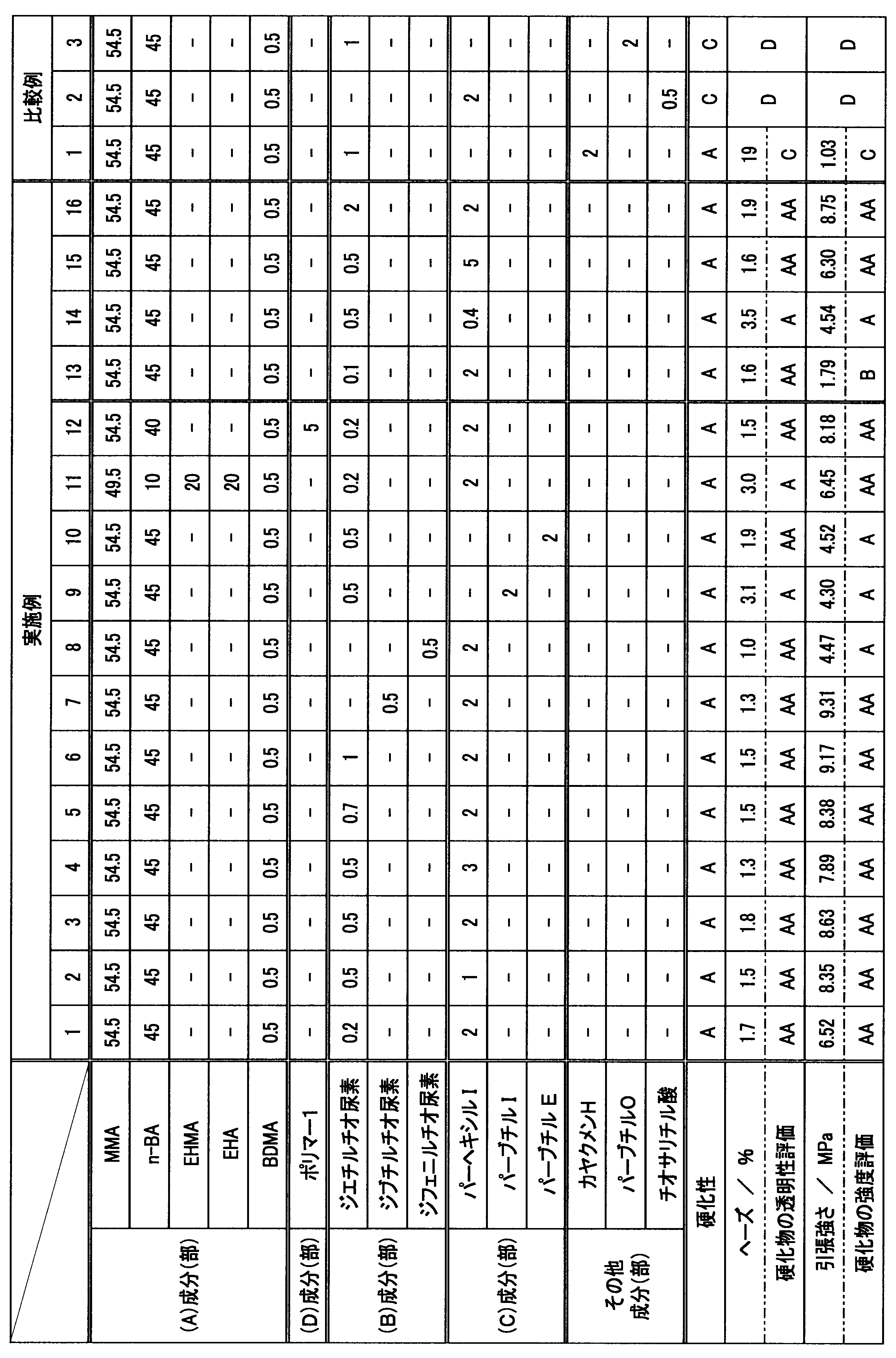
MMA:メチルメタクリレート、
n-BA:n-ブチルアクリレート、
EHMA:2-エチルヘキシルメタクリレート、
EHA:2-エチルヘキシルアクリレート、
BDMA:1,3-ブチレングリコールジメタクリレート、
ポリマー1:合成例1で得たメチルメタクリレートとn-ブチルメタクリレートの共重合体、
ジエチルチオ尿素:和光純薬工業株式会社製N,N’-ジエチルチオ尿素、
ジブチルチオ尿素:和光純薬工業株式会社製N,N’-ジ-n-ブチルチオ尿素、
ジフェニルチオ尿素:和光純薬工業株式会社製N,N’-ジフェニルチオ尿素、
パーヘキシルI:日油株式会社製t-ヘキシルパーオキシイソプロピルモノカーボネート、製品名:パーヘキシルI、
パーブチルI:日油株式会社製t-ブチルパーオキシイソプロピルモノカーボネート、製品名:パーブチルI、
パーブチルE:日油株式会社製t-ブチルパーオキシ2-エチルヘキシルモノカーボネート、製品名:パーブチルE、
カヤクメンH:化薬アクゾ株式会社製クメンハイドロパーオキサイド、製品名:カヤクメンH、
パーブチルO:日油株式会社製t-ブチルパーオキシ2-エチルヘキサノエート、製品名:パーブチルO、
チオサリチル酸:和光純薬工業株式会社製チオサリチル酸。
一方、比較例1は、硬化性の評価はAであったが、(C)成分を含まないので硬化物の透明性および強度の評価がともにCであった。比較例2に関しては、(B)成分を含まないので十分な重合反応が起こらず、硬化性の評価がCであった。比較例3に関しては、(C)成分を含まないので十分な重合反応が起こらず、硬化性の評価がCであった。
12 基材
16 中間層(硬化物)
Claims (21)
- (A)(メタ)アクリル系重合性単量体成分、
(B)チオ尿素化合物成分、および
(C)下記式(1)の構造を有する過酸化物成分
を含み、
(D)(メタ)アクリル系重合体成分
を任意成分として含んでいてもよい硬化性樹脂組成物。

- 前記(A)成分および前記(D)成分の合計質量に対して、
前記(A)成分の含有量が5~100質量%であり、
前記(D)成分の含有量が0~95質量%である、請求項1に記載の硬化性樹脂組成物。 - 前記(A)成分および前記(D)成分の合計質量に対して、
前記(A)成分の含有量が40~100質量%であり、
前記(D)成分の含有量が0~60質量%である、請求項1に記載の硬化性樹脂組成物。 - 前記(A)成分および前記(D)成分の合計質量に対して、
前記(A)成分の含有量が60~100質量%であり、
前記(D)成分の含有量が0~40質量%である、請求項1に記載の硬化性樹脂組成物。 - 前記(A)成分および前記(D)成分の合計質量に対して、
前記(A)成分の含有量が80~100質量%であり、
前記(D)成分の含有量が0~20質量%である、請求項1に記載の硬化性樹脂組成物。 - 前記(A)成分および前記(D)成分の合計質量に対して、
前記(A)成分の含有量が80~98質量%であり、
前記(D)成分の含有量が2~20質量%である、請求項1に記載の硬化性樹脂組成物。 - 前記(A)成分および前記(D)成分の合計100質量部に対して、
前記(C)成分0.05~5質量部、および
前記(D)成分0.1~10質量部を含む、請求項1~6のいずれか一項に記載の硬化性樹脂組成物。 - 前記(A)成分および前記(D)成分の合計100質量部に対して、
前記(C)成分0.1~3質量部、および
前記(D)成分0.3~7質量部を含む、請求項1~6のいずれか一項に記載の硬化性樹脂組成物。 - 前記(A)成分および前記(D)成分の合計100質量部に対して、
前記(C)成分0.15~1.5質量部、および
前記(D)成分0.5~4質量部を含む、請求項1~6のいずれか一項に記載の硬化性樹脂組成物。 - 請求項1~6のいずれか一項に記載の硬化性樹脂組成物を硬化して得られる硬化物。
- 請求項7に記載の硬化性樹脂組成物を硬化して得られる硬化物。
- 請求項8に記載の硬化性樹脂組成物を硬化して得られる硬化物。
- 請求項9に記載の硬化性樹脂組成物を硬化して得られる硬化物。
- 2つの基材の間に、請求項10に記載の硬化物からなる層を備えた積層体。
- 2つの基材の間に、請求項11に記載の硬化物からなる層を備えた積層体。
- 2つの基材の間に、請求項12に記載の硬化物からなる層を備えた積層体。
- 2つの基材の間に、請求項13に記載の硬化物からなる層を備えた積層体。
- 2つの相対する基材の間に、請求項1~6のいずれか一項に記載の硬化性樹脂組成物を流し込み、前記組成物を硬化させる請求項14に記載の積層体の製造方法。
- 2つの相対する基材の間に、請求項7に記載の硬化性樹脂組成物を流し込み、前記組成物を硬化させる請求項15に記載の積層体の製造方法。
- 2つの相対する基材の間に、請求項8に記載の硬化性樹脂組成物を流し込み、前記組成物を硬化させる請求項16に記載の積層体の製造方法。
- 2つの相対する基材の間に、請求項9に記載の硬化性樹脂組成物を流し込み、前記組成物を硬化させる請求項17に記載の積層体の製造方法。
Priority Applications (3)
| Application Number | Priority Date | Filing Date | Title |
|---|---|---|---|
| CN201280026123.1A CN103562236B (zh) | 2011-04-05 | 2012-04-05 | 固化性树脂组合物、其固化物、层叠体及该层叠体的制造方法 |
| US14/009,417 US9487682B2 (en) | 2011-04-05 | 2012-04-05 | Curable resin composition, cured product thereof, laminate, and method for producing laminate |
| JP2012520612A JP5857958B2 (ja) | 2011-04-05 | 2012-04-05 | 硬化性樹脂組成物、その硬化物、積層体およびその積層体の製造方法 |
Applications Claiming Priority (2)
| Application Number | Priority Date | Filing Date | Title |
|---|---|---|---|
| JP2011-083622 | 2011-04-05 | ||
| JP2011083622 | 2011-04-05 |
Publications (1)
| Publication Number | Publication Date |
|---|---|
| WO2012137869A1 true WO2012137869A1 (ja) | 2012-10-11 |
Family
ID=46969259
Family Applications (1)
| Application Number | Title | Priority Date | Filing Date |
|---|---|---|---|
| PCT/JP2012/059372 Ceased WO2012137869A1 (ja) | 2011-04-05 | 2012-04-05 | 硬化性樹脂組成物、その硬化物、積層体およびその積層体の製造方法 |
Country Status (4)
| Country | Link |
|---|---|
| US (1) | US9487682B2 (ja) |
| JP (1) | JP5857958B2 (ja) |
| CN (1) | CN103562236B (ja) |
| WO (1) | WO2012137869A1 (ja) |
Cited By (2)
| Publication number | Priority date | Publication date | Assignee | Title |
|---|---|---|---|---|
| JP2017197652A (ja) * | 2016-04-27 | 2017-11-02 | 株式会社菱晃 | 硬化性樹脂組成物及びその硬化物、並びにコーティング材 |
| JP2018145276A (ja) * | 2017-03-03 | 2018-09-20 | 株式会社クラレ | (メタ)アクリル系ブロック共重合体およびそれを含有する活性エネルギー線硬化性組成物。 |
Families Citing this family (2)
| Publication number | Priority date | Publication date | Assignee | Title |
|---|---|---|---|---|
| GB2576703B (en) * | 2018-08-16 | 2022-07-13 | Henkel IP & Holding GmbH | Two step adhesive systems |
| CN109652057B (zh) * | 2018-12-10 | 2022-03-18 | 南阳师范学院 | 一种锰掺杂硫化锌量子点嵌入型荧光复合膜的制备方法 |
Citations (7)
| Publication number | Priority date | Publication date | Assignee | Title |
|---|---|---|---|---|
| JP2002105142A (ja) * | 2000-09-28 | 2002-04-10 | Kayaku Akzo Corp | パーオキシカーボネート、樹脂組成物及び成形体 |
| JP2003105157A (ja) * | 2001-09-28 | 2003-04-09 | Mitsubishi Rayon Co Ltd | 樹脂組成物 |
| JP2004211003A (ja) * | 2003-01-07 | 2004-07-29 | Nippon Shokubai Co Ltd | (メタ)アクリル系樹脂組成物 |
| JP2007084782A (ja) * | 2005-08-26 | 2007-04-05 | Nippon Shokubai Co Ltd | (メタ)アクリル系樹脂組成物及び(メタ)アクリル系硬化物品 |
| JP2010111757A (ja) * | 2008-11-06 | 2010-05-20 | Denki Kagaku Kogyo Kk | 難燃性アクリル系熱伝導材料及びその用途 |
| JP2010132876A (ja) * | 2008-10-27 | 2010-06-17 | Mitsubishi Rayon Co Ltd | 硬化性(メタ)アクリル系樹脂組成物、積層材中間膜及び積層材 |
| JP2010168580A (ja) * | 2008-12-26 | 2010-08-05 | Nippon Shokubai Co Ltd | ラジカル硬化性樹脂組成物 |
Family Cites Families (4)
| Publication number | Priority date | Publication date | Assignee | Title |
|---|---|---|---|---|
| JPS5227176A (en) * | 1975-08-23 | 1977-03-01 | Mitsubishi Heavy Ind Ltd | Storing apparatus |
| US4343921A (en) * | 1978-11-06 | 1982-08-10 | Usm Corporation | Adhesive composition |
| ID20459A (id) * | 1997-06-24 | 1998-12-24 | Denki Kagaku Kogyo Kk | Komposisi resin yang bisa mengawetkan, komposisi perekat, produk dan susunan yang diawetkan |
| MX2009003364A (es) * | 2006-09-29 | 2009-04-14 | Denki Kagaku Kogyo Kk | Hoja acrilica adhesiva, muy termicamente conductiva. |
-
2012
- 2012-04-05 JP JP2012520612A patent/JP5857958B2/ja active Active
- 2012-04-05 CN CN201280026123.1A patent/CN103562236B/zh not_active Expired - Fee Related
- 2012-04-05 WO PCT/JP2012/059372 patent/WO2012137869A1/ja not_active Ceased
- 2012-04-05 US US14/009,417 patent/US9487682B2/en not_active Expired - Fee Related
Patent Citations (7)
| Publication number | Priority date | Publication date | Assignee | Title |
|---|---|---|---|---|
| JP2002105142A (ja) * | 2000-09-28 | 2002-04-10 | Kayaku Akzo Corp | パーオキシカーボネート、樹脂組成物及び成形体 |
| JP2003105157A (ja) * | 2001-09-28 | 2003-04-09 | Mitsubishi Rayon Co Ltd | 樹脂組成物 |
| JP2004211003A (ja) * | 2003-01-07 | 2004-07-29 | Nippon Shokubai Co Ltd | (メタ)アクリル系樹脂組成物 |
| JP2007084782A (ja) * | 2005-08-26 | 2007-04-05 | Nippon Shokubai Co Ltd | (メタ)アクリル系樹脂組成物及び(メタ)アクリル系硬化物品 |
| JP2010132876A (ja) * | 2008-10-27 | 2010-06-17 | Mitsubishi Rayon Co Ltd | 硬化性(メタ)アクリル系樹脂組成物、積層材中間膜及び積層材 |
| JP2010111757A (ja) * | 2008-11-06 | 2010-05-20 | Denki Kagaku Kogyo Kk | 難燃性アクリル系熱伝導材料及びその用途 |
| JP2010168580A (ja) * | 2008-12-26 | 2010-08-05 | Nippon Shokubai Co Ltd | ラジカル硬化性樹脂組成物 |
Cited By (2)
| Publication number | Priority date | Publication date | Assignee | Title |
|---|---|---|---|---|
| JP2017197652A (ja) * | 2016-04-27 | 2017-11-02 | 株式会社菱晃 | 硬化性樹脂組成物及びその硬化物、並びにコーティング材 |
| JP2018145276A (ja) * | 2017-03-03 | 2018-09-20 | 株式会社クラレ | (メタ)アクリル系ブロック共重合体およびそれを含有する活性エネルギー線硬化性組成物。 |
Also Published As
| Publication number | Publication date |
|---|---|
| CN103562236A (zh) | 2014-02-05 |
| JPWO2012137869A1 (ja) | 2014-07-28 |
| US20140120358A1 (en) | 2014-05-01 |
| CN103562236B (zh) | 2016-01-20 |
| JP5857958B2 (ja) | 2016-02-10 |
| US9487682B2 (en) | 2016-11-08 |
Similar Documents
| Publication | Publication Date | Title |
|---|---|---|
| TW201226499A (en) | Photocurable adhesive composition | |
| TWI625542B (zh) | 用於光學用途的黏著劑組成物 | |
| JP2015521226A (ja) | 3重硬化型の、場合により透明な接着剤 | |
| JP5879963B2 (ja) | 熱硬化性樹脂組成物、その硬化物からなる光学部材 | |
| KR20160122741A (ko) | 액정 밀봉용 경화성 수지 조성물 | |
| JP2009102467A (ja) | アクリル系透明粘着剤組成物 | |
| JP5857958B2 (ja) | 硬化性樹脂組成物、その硬化物、積層体およびその積層体の製造方法 | |
| JP2018538376A (ja) | リペア−リワーク能を有する接着剤組成物 | |
| JP5556118B2 (ja) | 硬化性(メタ)アクリル系樹脂組成物、積層材中間膜及び積層材 | |
| JP7771976B2 (ja) | 接着剤セット、並びに接着体及びその製造方法 | |
| CN117377732A (zh) | 耐热性丙烯酸类粘接剂组合物 | |
| US11332562B2 (en) | Composition | |
| WO2011087008A1 (ja) | 硬化性樹脂組成物、その硬化物からなる光学部材 | |
| JP5533406B2 (ja) | 紫外線硬化型粘着剤組成物 | |
| CN105474084B (zh) | 液晶密封剂及液晶显示面板的制造方法 | |
| JP2018131563A (ja) | 硬化性樹脂組成物及びその硬化物、並びにコーティング材、シート及びフィルム | |
| JP2012191196A (ja) | 太陽電池モジュール用封止材、太陽電池モジュールおよびその製造方法 | |
| JP2010189471A (ja) | 硬化性樹脂組成物、その硬化物からなる封止材および充填剤 | |
| KR101920242B1 (ko) | 고성능 수성 아크릴 점착제 조성물 및 그 제조방법 | |
| JP2015030748A (ja) | 接着剤組成物、その硬化物及び接合体 | |
| JP2014088458A (ja) | アクリル系接着剤組成物 | |
| JP5456270B2 (ja) | 樹脂板接着用樹脂組成物及び積層品 | |
| JP6115747B2 (ja) | 硬化性樹脂組成物及びその硬化物 | |
| JP7848543B2 (ja) | 接着剤セット、接着体及び接着体の製造方法 | |
| JP6582413B2 (ja) | 硬化性樹脂組成物、硬化物、光学部材及び光学デバイス |
Legal Events
| Date | Code | Title | Description |
|---|---|---|---|
| ENP | Entry into the national phase |
Ref document number: 2012520612 Country of ref document: JP Kind code of ref document: A |
|
| 121 | Ep: the epo has been informed by wipo that ep was designated in this application |
Ref document number: 12768505 Country of ref document: EP Kind code of ref document: A1 |
|
| NENP | Non-entry into the national phase |
Ref country code: DE |
|
| WWE | Wipo information: entry into national phase |
Ref document number: 14009417 Country of ref document: US |
|
| 122 | Ep: pct application non-entry in european phase |
Ref document number: 12768505 Country of ref document: EP Kind code of ref document: A1 |