WO2012133556A1 - リチウム二次電池用電解液及びリチウム二次電池 - Google Patents
リチウム二次電池用電解液及びリチウム二次電池 Download PDFInfo
- Publication number
- WO2012133556A1 WO2012133556A1 PCT/JP2012/058189 JP2012058189W WO2012133556A1 WO 2012133556 A1 WO2012133556 A1 WO 2012133556A1 JP 2012058189 W JP2012058189 W JP 2012058189W WO 2012133556 A1 WO2012133556 A1 WO 2012133556A1
- Authority
- WO
- WIPO (PCT)
- Prior art keywords
- metal
- lithium secondary
- secondary battery
- electrolyte
- negative electrode
- Prior art date
- Legal status (The legal status is an assumption and is not a legal conclusion. Google has not performed a legal analysis and makes no representation as to the accuracy of the status listed.)
- Ceased
Links
Images







Classifications
-
- H—ELECTRICITY
- H01—ELECTRIC ELEMENTS
- H01M—PROCESSES OR MEANS, e.g. BATTERIES, FOR THE DIRECT CONVERSION OF CHEMICAL ENERGY INTO ELECTRICAL ENERGY
- H01M10/00—Secondary cells; Manufacture thereof
- H01M10/05—Accumulators with non-aqueous electrolyte
- H01M10/056—Accumulators with non-aqueous electrolyte characterised by the materials used as electrolytes, e.g. mixed inorganic/organic electrolytes
- H01M10/0564—Accumulators with non-aqueous electrolyte characterised by the materials used as electrolytes, e.g. mixed inorganic/organic electrolytes the electrolyte being constituted of organic materials only
- H01M10/0566—Liquid materials
- H01M10/0567—Liquid materials characterised by the additives
-
- H—ELECTRICITY
- H01—ELECTRIC ELEMENTS
- H01M—PROCESSES OR MEANS, e.g. BATTERIES, FOR THE DIRECT CONVERSION OF CHEMICAL ENERGY INTO ELECTRICAL ENERGY
- H01M10/00—Secondary cells; Manufacture thereof
- H01M10/05—Accumulators with non-aqueous electrolyte
- H01M10/052—Li-accumulators
-
- H—ELECTRICITY
- H01—ELECTRIC ELEMENTS
- H01M—PROCESSES OR MEANS, e.g. BATTERIES, FOR THE DIRECT CONVERSION OF CHEMICAL ENERGY INTO ELECTRICAL ENERGY
- H01M10/00—Secondary cells; Manufacture thereof
- H01M10/05—Accumulators with non-aqueous electrolyte
- H01M10/056—Accumulators with non-aqueous electrolyte characterised by the materials used as electrolytes, e.g. mixed inorganic/organic electrolytes
- H01M10/0564—Accumulators with non-aqueous electrolyte characterised by the materials used as electrolytes, e.g. mixed inorganic/organic electrolytes the electrolyte being constituted of organic materials only
- H01M10/0566—Liquid materials
- H01M10/0568—Liquid materials characterised by the solutes
-
- H—ELECTRICITY
- H01—ELECTRIC ELEMENTS
- H01M—PROCESSES OR MEANS, e.g. BATTERIES, FOR THE DIRECT CONVERSION OF CHEMICAL ENERGY INTO ELECTRICAL ENERGY
- H01M10/00—Secondary cells; Manufacture thereof
- H01M10/05—Accumulators with non-aqueous electrolyte
- H01M10/056—Accumulators with non-aqueous electrolyte characterised by the materials used as electrolytes, e.g. mixed inorganic/organic electrolytes
- H01M10/0564—Accumulators with non-aqueous electrolyte characterised by the materials used as electrolytes, e.g. mixed inorganic/organic electrolytes the electrolyte being constituted of organic materials only
- H01M10/0566—Liquid materials
- H01M10/0569—Liquid materials characterised by the solvents
-
- Y—GENERAL TAGGING OF NEW TECHNOLOGICAL DEVELOPMENTS; GENERAL TAGGING OF CROSS-SECTIONAL TECHNOLOGIES SPANNING OVER SEVERAL SECTIONS OF THE IPC; TECHNICAL SUBJECTS COVERED BY FORMER USPC CROSS-REFERENCE ART COLLECTIONS [XRACs] AND DIGESTS
- Y02—TECHNOLOGIES OR APPLICATIONS FOR MITIGATION OR ADAPTATION AGAINST CLIMATE CHANGE
- Y02E—REDUCTION OF GREENHOUSE GAS [GHG] EMISSIONS, RELATED TO ENERGY GENERATION, TRANSMISSION OR DISTRIBUTION
- Y02E60/00—Enabling technologies; Technologies with a potential or indirect contribution to GHG emissions mitigation
- Y02E60/10—Energy storage using batteries
Definitions
- the present invention relates to an electrolyte for a lithium secondary battery and a lithium secondary battery.
- Lithium secondary batteries are widely used as portable electronic devices such as notebook computers and mobile phones because of their high discharge voltage and energy density.
- development of large-sized storage batteries for vehicles is being promoted against the background of environmental problems and energy problems.
- plug-in hybrid vehicles and electric vehicles it has become an important issue to extend the mileage per charge and to be able to charge quickly.
- a liquid electrolyte in which a lithium salt is dissolved in a carbonate ester solvent is generally used, and charging is usually performed at 4.2V. This is because the electrolyte solution undergoes oxidative decomposition on the positive electrode at a voltage exceeding 4.2V.
- Lithium batteries using boroxine compounds have been proposed for the purpose of obtaining good charge cycle characteristics.
- Japanese Laid-Open Patent Publication No. 11-121033 and Japanese Translation of PCT International Publication No. 2009-512137 disclose a lithium ion secondary battery in which a boroxine compound is added to an electrolytic solution.
- Japanese Patent Application Laid-Open No. 2004-6237 discloses a polymer lithium battery in which a boroxine compound is added to a polymer electrolyte
- Japanese Patent Application Laid-Open No. 11-54151 discloses the use of a boroxine compound as an anion-trapping type polymer electrolyte. ing.
- Electrochemistry, 78, 397 (2010) contains mixed electrolytes of tricyanoethyl borate and other borate esters
- the 51st Battery Conference, Abstracts 2G17 (2010) contains tricyanoethyl borate and carbonate.
- An electrolytic solution using a mixed solvent with an ester has been reported.
- An object of the present invention is to provide an electrolyte for a lithium secondary battery and a lithium secondary battery that can be repeatedly charged at a high voltage.
- An electrolytic solution for a lithium secondary battery in which at least one solvent selected from a carbonate ester and a borate ester, LiBF 4 and a boroxine compound represented by the following formula (I) or (II) are mixed.
- a lithium secondary battery comprising a positive electrode, a negative electrode, and the electrolyte solution for a lithium secondary battery according to ⁇ 1>.
- the positive electrode is a metal oxide or a metal phosphate.
- the positive electrode comprises Li, Mn or Al, one or three kinds selected from Mn, Al, Co or Cr, and Ni, a metal oxide and a metal phosphorous oxide composed of O or PO 4 , and Li and Mn
- a lithium secondary battery according to ⁇ 3> which is a compound selected from the group consisting of a metal oxide composed of Co, Fe, O, or PO 4 and a metal phosphorous oxide.
- the positive electrode and Li, and Mn, Li-Mn based metal oxides consisting of O or PO 4 Metropolitan and metal phosphate, and Li, and Mn, and Co, and Ni, and O or PO 4 Li—Mn—Co—Ni-based metal oxide and metal phosphorous oxide, and Li—Mn—Cr—Ni-based metal oxide composed of Li, Mn, Cr, Ni, O, or PO 4
- the lithium secondary battery according to ⁇ 3> which is a compound selected from the group consisting of a material and a metal phosphorous oxide.
- Metal oxide and metal phosphorous oxide composed of Li and one or three selected from Mn or Al, Co or Cr, and Ni, and O or PO 4 , and Li, Mn, and Co
- a compound selected from the group consisting of a metal oxide composed of Fe, O and O or PO 4 and a metal phosphorous oxide is subjected to a surface treatment by applying a voltage in the electrolyte for a lithium secondary battery according to ⁇ 1>.
- Lithium battery including a positive electrode, a negative electrode, and an electrolytic solution in which LiBF 4 is dissolved in boric acid ester.
- ⁇ 7> The lithium secondary battery according to any one of ⁇ 2> to ⁇ 6>, wherein the negative electrode is a negative electrode made of metallic lithium surface-treated with tetraethoxysilane, an alloy-based negative electrode, or a carbon-based negative electrode.
- Metal oxides and metal oxides composed of Li, one or three selected from Mn, Al, Co, Cr, and Ni, and O or PO 4 , and Li, Mn, and Co
- a positive electrode selected from the group consisting of a metal oxide consisting of Fe and O or PO 4 and a metal phosphorous oxide
- a negative electrode obtained by surface-treating metallic lithium with the electrolyte for a lithium secondary battery according to ⁇ 1>, An electrolytic solution in which LiBF 4 is dissolved in a borate ester; Including lithium secondary battery.
- An electrolytic solution in which LiBF 4 is dissolved in the borate ester includes triisopropyl borate (B [OCH (CH 3 ) 2 ] 3 ) and tricyanoethyl borate (B (OCH 2 CH) as the borate ester. 2 CN)
- an electrolytic solution for a lithium secondary battery and a lithium secondary battery that can be repeatedly charged at a high voltage.
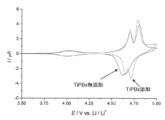
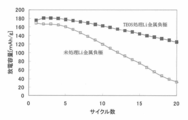
- LiBF 4 / EC-EMC is a diagram showing a (1 1 v / v) LiMn 2 O 4 cyclic voltammogram of a thin film on the inside. Is a diagram showing a charge-discharge test results using LiMn 2 O 4 cathode and TiPBx added LiBF 4 carbonate electrolyte. It is a diagram showing a charge-discharge cycle at 60 ° C. using LiMn 2 O 4 thin film positive electrode and a lithium metal anode.
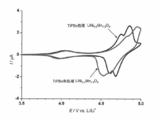
- LiBF 4 / EC-EMC shows a cyclic voltammogram of LiCr 0.05 Ni 0.45 Mn 1.5 O 2 thin film in the (1 1 v / v) in.
- 1molkg -1 LiBF 4 / EC-EMC is a diagram showing a (1 1 v / v) Cole-Cole plot of LiCr 0.05 Ni 0.45 Mn 1.5 O 2 thin film in.
- LiNi is a diagram showing a 0.5 Mn 1.5 O 4 cyclic voltammograms at the positive electrode of the boric acid ester mixture electrolytic solution.
- TEOS tetraethoxysilane
- LiMn 1/3 Ni 1/3 Co 1/3 O 2 positive electrode LiBF 4 ( 1 molkg ⁇ 1 )
- BCN-EC-EMC 1: 1: 1 v
- TEOS tetraethoxysilane
- the present inventors conducted extensive research to develop a lithium secondary battery that can be charged at a high voltage.
- a carbonate ester solvent or a borate ester solvent was used with LiBF 4 as a supporting salt. It has been found that by using an electrolyte obtained by adding a specific boroxine compound and a positive electrode that is stable to a high potential, a lithium secondary battery that can be charged even at a high voltage of 4.4 V or higher can be obtained.
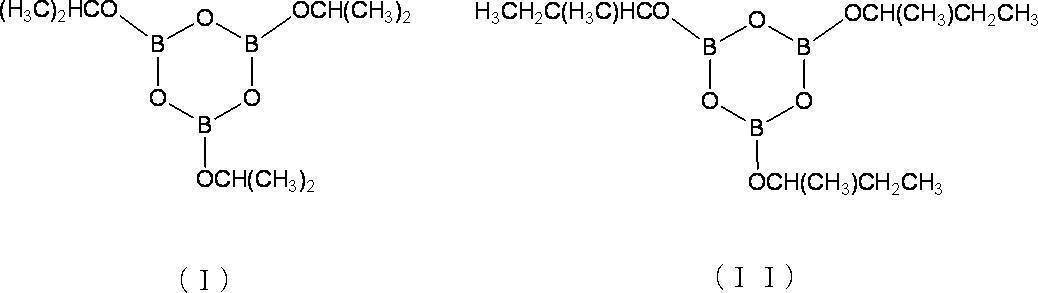
- An electrolyte for a lithium secondary battery according to the present invention includes at least one solvent selected from a carbonate ester and a borate ester, LiBF 4, and a boroxine compound represented by the following formula (I) or (II): Are mixed.
- the boroxine compound represented by the formula (I) may be referred to as “TiPBx” (triisopropoxyboroxine), and the boroxine compound represented by the formula (II) may be referred to as “TsBBx” (trisec-butoxyboroxine). is there.
- a solvent which comprises the electrolyte solution for lithium secondary batteries of this invention at least 1 sort (s) chosen from a carbonate ester solvent and a borate ester solvent is used.
- the carbonate ester solvent examples include a mixed solvent of ethylene carbonate (EC) and ethyl methyl carbonate (EMC), a mixed solvent of ethylene carbonate and diethyl carbonate (DEC), and propylene carbonate.
- EC ethylene carbonate
- EMC ethylene carbonate and diethyl carbonate
- propylene carbonate examples include propylene carbonate.
- the mixing ratio (volume ratio) of EC and EMC is 1 to 3: 3 to 1. preferable.
- boric acid ester solvent examples include a mixed solvent of triisopropyl boric acid, trifluoroethyl boric acid and tricyanoethyl boric acid.
- the mixing ratio (molar ratio) of triisopropyl boric acid, trifluoroethyl boric acid, and tricyanoethyl boric acid is preferably 1 to 5: 0 to 5: 1 to 5.
- a carbonate ester solvent and a borate ester solvent may be mixed and used.
- the mixed solvent can be used.
- the lithium secondary battery electrolyte of the present invention uses LiBF 4 as a supporting salt. Even when the TiPBx the electrolyte consisting of carbonate solution was added LiCF 3 SO 3 salt and LiPF 6 salt as a supporting salt was added, and the corrosion of aluminum current collector in LiCF 3 SO 3 salt, also, TiPBx is LiPF 6 Since it reacts with salt and loses its effect, good charge / discharge characteristics cannot be obtained. On the other hand, by using LiBF 4 as the supporting salt and optimizing the amount of TiPBx added, it is possible to exhibit characteristics that can withstand high voltage charging.
- the addition amount of LiBF 4 in the electrolytic solution is preferably 0.2 to 3.0% by mass, and more preferably 0.5 to 1.5% by mass.
- LiBF 4 in addition to LiBF 4 , other lithium salt may be added in a small amount.
- LiCF 3 SO 3 salt when LiCF 3 SO 3 salt is added, the charge cycle characteristics (discharge capacity) are lowered. It is preferable to add only LiBF 4 .
- the addition amount of the boroxine compound (TiPBx, TsBBx) in the electrolytic solution according to the present invention is preferably 0.01 to 3.0% by mass, more preferably 0.1 to 1.0% by mass. preferable.
- the electrolyte solution for a lithium secondary battery according to the present invention may contain other additives.
- An example is vinylene carbonate.
- the lithium secondary battery according to the first embodiment of the present invention includes a positive electrode, a negative electrode, and the above-described electrolyte for a lithium secondary battery according to the present invention.
- a positive electrode that does not change its structure at a high potential can be used.
- a metal oxide or a metal phosphorus oxide can be preferably used. Specifically, (a) Li, one or three kinds selected from Mn or Al, Co or Cr, and Ni, and a metal oxide and metal phosphorous oxide composed of O or PO 4 , (b) Li , Mn, Co, Fe, and O or PO 4 metal oxides and metal phosphorous oxides, and (c) Li, Fe, and Ni metal oxides and metal phosphorous oxides.
- a compound selected from the group is preferred, and in particular, Li—Mn metal oxide (LiMn 2 O 4 ) composed of Li, Mn and O, Li—Mn—Co— composed of Li, Mn, Co or Cr, Ni and O.
- Ni-based metal oxides and Li—Mn—Cr—Ni-based metal oxides are preferable.
- the “metal oxide and metal phosphorous oxide composed of Ni” include the following.
- Li—Mn—Co—Ni-based metal oxide or metal phosphate oxide (2) Li—Mn—Cr—Ni-based metal oxide or metal phosphate oxide (3) Li—Mn—Co-based metal oxide Or metal phosphor oxide (4) Li—Mn—Cr metal oxide or metal phosphate oxide (5) Li—Mn—Ni metal oxide or metal phosphate oxide (6) Li—Al—Co—Ni Metal oxide or metal phosphate (7) Li—Al—Co based metal oxide or metal phosphate (8) Li—Al—Ni based metal oxide or metal phosphate (9) Li—Co—Ni Metal oxide or metal phosphate (10) Li—Fe—Ni metal oxide or metal phosphate (11) Li—Mn metal oxide or metal phosphate
- -Negative electrode- metallic lithium, an alloy-based negative electrode, or a carbon-based negative electrode can be used.
- TEOS tetraethoxysilane
- a carbon-based negative electrode can be preferably used.
- Oxidation-resistant borate ester reacts with a lithium metal negative electrode even if its electrochemical characteristics are good, so a countermeasure for the negative electrode is necessary. Therefore, by pretreating the metal lithium negative electrode with an orthosilicate solution such as TEOS, the negative resistance of the oxidation-resistant borate electrolyte can be imparted.
- a lithium metal is immersed in an EC-EMC (1: 1 v / v) solution of 1% by mass of tetraethoxysilane (TEOS) for 1 hour at room temperature, and then washed with EC-EMC to obtain TEOS-treated lithium metal.
- TEOS tetraethoxysilane
- alloy-based negative electrode examples include an alloy of lithium and tin or silicon.
- Examples of the carbon-based negative electrode include natural spherical graphite, massive artificial graphite, and mesophase carbon microbeads.
- the components and addition amounts described above for the electrolytic solution for a lithium secondary battery according to the present invention can be employed.
- the lithium secondary battery according to the second embodiment of the present invention includes a metal oxide and metal phosphorylation composed of Li, one or three selected from Mn, Al, Co, Cr, and Ni, and O or PO 4. And a compound selected from the group consisting of metal oxides and metal phosphorous oxides consisting of Li, Mn, Co, Fe, O or PO 4, and the above-described lithium secondary battery according to the present invention.
- Li—Mn—Co—Ni-based metal oxides or Li—Mn—Ni-based metal oxides can be formed by using TiPBx (boroxin compound represented by the above formula (I)), LiBF 4 and carbonic acid.
- the surface treatment is preferably performed by applying a voltage in an electrolyte mixed with an ester.
- the voltage applied when surface-treating the metal oxide used as the positive electrode is preferably 4.6 V or more, and more preferably 4.8 V or more and 5.2 V or less.
- the surface treatment time is preferably 3 to 120 minutes, more preferably 5 to 60 minutes.
- metallic lithium, an alloy-based negative electrode, or a carbon-based negative electrode can be used as in the first embodiment.
- TEOS tetraethoxysilane
- a negative electrode made of, an alloy-based negative electrode, or a carbon-based negative electrode can be suitably used.
- an electrolytic solution in which LiBF 4 is dissolved in a borate ester is used.
- Specific examples of the boric acid ester and the amount of LiBF 4 added are the same as those in the first embodiment, that is, the above-described electrolytic solution for a lithium secondary battery according to the present invention.
- a lithium secondary battery according to a third embodiment of the present invention is a mixture of a positive electrode, a negative electrode made of metallic lithium surface-treated with tetraethoxysilane, an alloy-based negative electrode or a carbon-based negative electrode, tricyanoethyl borate, and a carbonate. It comprises an electrolytic solution in which LiBF 4 is dissolved in a solvent.
- the positive electrode constituting the lithium secondary battery according to the third embodiment is not particularly limited, it can be used LiMn 2 O 4 or LiMn 1/3 Co 1/3 Ni 1/3 O 2 suitably.
- the negative electrode constituting the lithium secondary battery according to the third embodiment is the same as in the first and second embodiments, and a negative electrode made of metallic lithium surface-treated with tetraethoxysilane, an alloy-based negative electrode, or a carbon-based negative electrode is used. It is done.
- an electrolytic solution in which LiBF 4 is dissolved in a mixed solvent of tricyanoethyl borate and carbonate is used.
- Specific examples of the carbonate ester and the amount of LiBF 4 added are the same as those in the first embodiment.
- the mixing ratio (volume ratio) of tricyanoethyl borate and carbonate is preferably 2 to 1: 1 to 4.
- the lithium secondary battery according to the fourth embodiment of the present invention is a metal oxide and metal phosphorylation composed of Li, one to three selected from Mn, Al, Co, Cr, and Ni, and O or PO 4. And a positive electrode selected from the group consisting of metal oxides and metal phosphorous oxides consisting of Li, Mn, Co, Fe, O or PO 4, and metal lithium as the lithium according to the present invention described above
- Electrolytic solution for secondary battery that is, electrolysis in which at least one solvent selected from carbonate ester and borate ester, LiBF 4 and a boroxine compound represented by the above formula (I) or (II) are mixed.
- a negative electrode surface-treated with a liquid and an electrolytic solution in which LiBF 4 is dissolved in a borate ester are included.
- the metal oxide or the metal phosphor oxide described in the second embodiment is used.
- a Li—Ni—Mn—O-based positive electrode is preferable. Used.
- the same electrolytic solution that constitutes the lithium secondary battery of the first embodiment can be adopted.
- an electrolytic solution in which LiBF 4 is dissolved in a borate ester, particularly triisopropyl borate (B [OCH (CH 3 ) 2 ] 3 ) and boron As an electrolytic solution constituting the lithium secondary battery according to the fourth embodiment, an electrolytic solution in which LiBF 4 is dissolved in a borate ester, particularly triisopropyl borate (B [OCH (CH 3 ) 2 ] 3 ) and boron.
- An electrolytic solution in which LiBF 4 is dissolved in a boric acid ester containing acid tricyanoethyl (B (OCH 2 CH 2 CN) 3 ) is preferable.
- Cyclic voltammetry (CV) swept to 5 V at 30 ° C. was measured using lithium metal as a counter electrode and a standard electrode. For comparison, the measurement results are shown in FIG. 1 together with the case where an electrolytic solution to which TiPBx was not added was used.
- CV Cyclic voltammetry
- FIG. 3 shows the results of measuring the change in capacity retention rate due to charge / discharge at 60 ° C. using the LiMn 2 O 4 thin film electrode (positive electrode), the lithium metal electrode (negative electrode), and the electrolytic solution of Experimental Example 2.
- the charge / discharge capacity decreased rapidly at a high temperature of 60 ° C., but a significant improvement was observed just by adding a small amount of TiPBx, indicating that charging at high temperature and high voltage is possible. It was done.
- the reason why the capacity gradually decreases with the number of cycles is thought to be due to dissolution of LiMn 2 O 4 at 60 ° C. and decomposition of the electrolytic solution on the lithium metal negative electrode. By suppressing these dissolution and decomposition, It is considered that charging at higher temperature and higher voltage is possible.
- the Cole-Cole plot measured at 4.68V after sweeping to 5V is shown in FIG.
- the size of the second arc is the interface resistance, and it was shown that the addition of TiPBx reduces the interface resistance after 5 V sweep, and can improve the cycle life of the high-voltage rechargeable battery.
- the LiNi 0.5 Mn 1.5 O 4 thin film surface-treated as described above was prepared in a 2: 1: 6 (molar ratio) of triisopropyl boric acid, trifluoroethyl boric acid and tricyanoethyl boric acid.
- the mixture was replaced with an electrolytic solution in which 0.7 mol kg ⁇ 1 LiBF 4 was dissolved in a mixed solvent, and cyclic voltammetry was measured.
- the results are shown in FIG. When the untreated LiNi 0.5 Mn 1.5 O 4 positive electrode was swept up to 5 V, the waveform was broadened, and lithium ion insertion and desorption reaction hardly occurred.
- the electrolyte was prepared by dissolving 1 mol / l of LiBF 4 in a solvent in which equal amounts of tricyanoethyl borate (B (OCH 2 CH 2 CN) 3 : BCN) and EC-EMC (1: 1 v / v) were mixed. .
- B OCH 2 CH 2 CN
- EC-EMC EC-EMC
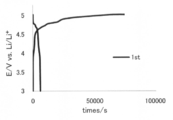
- Figure 8 shows the measurement results of 3.0-5.0V charge / discharge.
- the carbonate electrolyte solution deteriorated rapidly after the first charge / discharge, and the second charge / discharge could not be performed. This is considered to be due to decomposition of the carbonate ester electrolyte at 5V.
- Fig. 9 shows the 3.0-5.0V charge / discharge measurement results. Although the 5V charge significantly improved compared with the carbonate electrolyte, the deterioration to the metal lithium negative electrode was insufficient as the cycle was repeated due to insufficient stability to the metal lithium negative electrode.
- Fig. 10 shows the measurement results of 3.0-5.0V charge / discharge.
- the metallic lithium negative electrode is pretreated with a TiPBx-containing carbonate ester electrolyte, a stable coating is formed on the lithium surface, and it is considered that the decomposition of the electrolyte can be suppressed to some extent. Therefore, the charge / discharge cycle was improved as compared with the result shown in FIG.
- the carbonate electrolyte solution decomposes at the positive electrode at 5V and deteriorates quickly, whereas the borate ester electrolyte to which triisopropyl borate is added can greatly improve and charge / discharge at 5V.
- borate ester electrolytes mixed with triisopropyl borate are expected to be more stable.
- TiPBx TiPBx to the surface or the surface treatment of the positive electrode with the TiPBx-containing electrolyte described in the second embodiment is considered to improve the charge / discharge characteristics at high voltage, and will be developed in the future. It is expected to be an electrolyte suitable for high energy density storage batteries.
- Electrolyte solution (A) TiPBx additive-free electrolyte solution or (B) TiPBx-added electrolyte solution (A) TiPBx-free carbonate ester electrolyte solution: 1.0 mol / kg LiBF 4 / EC: EMC (1: 1 (v / v )) (B) TiPBx-added carbonate ester electrolyte: 1.0 mol / kg LiBF 4 / EC: EMC (1: 1 (v / v)) + 0.2 wt% TiPBx
- FIG. 11 shows a charge / discharge curve using the TiPBx-free carbonate ester electrolyte
- FIG. 12 shows a charge / discharge curve using the TiPBx-added carbonate electrolyte.
- TiPBx significantly improved the charge / discharge cycle characteristics at 4.7 V charge.
- the discharge capacity decreased at the 30th time, the decomposition of carbonate ester could not be completely suppressed at 4.7 V, or it seems to be affected by dissolution of LiMn 2 O 4 .
- Example 9 -Charging / discharging test using LiNi 1/3 Co 1/3 Mn 1/3 O 2 positive electrode- Using a ternary positive electrode, the effect of addition of TiPBx (charge / discharge cycle characteristics) was evaluated at 4.5 V charge.
- the electrode configuration, charge / discharge conditions, and the configuration of the electrolysis solution are as follows.
- Electrolyte solution (A) TiPBx additive-free electrolyte solution or (B) TiPBx-added electrolyte solution (A) TiPBx-free carbonate ester electrolyte solution: 1.0 mol / kg LiBF 4 / EC: EMC (1: 1 (v / v )) (B) TiPBx-added carbonate ester electrolyte: 1.0 mol / kg LiBF 4 / EC: EMC (1: 1 (v / v)) + 0.2 wt% TiPBx
- FIG. 13 shows the results of measuring the charge / discharge cycle characteristics when TiPBx was added and when it was not added. Only by adding 0.2 wt% of TiPBx, an increase in discharge capacity and an improvement in cycle characteristics were observed, and an effect of adding TiPBx in high voltage charging was recognized.
- FIG. 14 shows a charge / discharge curve when using a TiPBx-free carbonate ester electrolyte
- FIG. 15 shows a charge / discharge curve when using a TiPBx-added carbonate electrolyte.
- LiBF 4 electrolyte is not suitable for a carbon-based negative electrode, but it seems to be more stable for a high-capacity negative electrode such as an alloy that is expected to be put to practical use because of its high reduction potential.
- the charging voltage is set low in order to obtain a long life, but the charging voltage can be increased by adding TiPBx.
- TiPBx By adding TiPBx to the carbonate ester electrolyte, it is possible to improve the charging voltage, increase the capacity by improving the utilization rate of lithium in the positive electrode, improve the discharge voltage, and further suppress the deterioration of the charging state and increase the voltage. What can be realized with a small amount of additive, such as being easy to remove, is considered practically effective because it can be realized without changing the constituent materials and the battery manufacturing process.
- the lithium secondary battery according to the present invention has a high energy density and is 4.5 V or more by optimizing the composition of the electrolyte and the surface treatment method of the positive electrode and the negative electrode. Charging with a high voltage is also possible, and for example, it can also be applied to an in-vehicle storage battery capable of rapid charging.
Landscapes
- Chemical & Material Sciences (AREA)
- Engineering & Computer Science (AREA)
- Manufacturing & Machinery (AREA)
- Chemical Kinetics & Catalysis (AREA)
- Electrochemistry (AREA)
- General Chemical & Material Sciences (AREA)
- Physics & Mathematics (AREA)
- Condensed Matter Physics & Semiconductors (AREA)
- General Physics & Mathematics (AREA)
- Inorganic Chemistry (AREA)
- Secondary Cells (AREA)
- Battery Electrode And Active Subsutance (AREA)
Abstract
高電圧で繰り返し充電することができるリチウム二次電池用電解液、リチウム二次電池用電極及びリチウム二次電池を提供する。 炭酸エステル溶媒及びホウ酸エステル溶媒から選ばれる少なくとも1種の溶媒と、LiBF4と、下記式(I)又は(II)で表されるボロキシン化合物と、を混合したリチウム二次電池用電解液。
Description
本発明は、リチウム二次電池用電解液及びリチウム二次電池に関する。
リチウム二次電池は放電電圧及びエネルギー密度が高いことから、ノートパソコンや携帯電話などの携帯電子機器として広く普及している。
一方、環境問題、エネルギー問題を背景として、車載用の大型蓄電池の開発が進められている。プラグインハイブリッド車や電気自動車では一充電あたりの走行距離を伸ばすこと、および急速充電できることが重要課題となっている。
一方、環境問題、エネルギー問題を背景として、車載用の大型蓄電池の開発が進められている。プラグインハイブリッド車や電気自動車では一充電あたりの走行距離を伸ばすこと、および急速充電できることが重要課題となっている。
車載用リチウム電池のエネルギー密度(Wh/kg=VAh/kg)を大きくするためには、電極活物質の容量(Ah/kg)を大きくすることと、放電電圧(V)を高電位化することの二つの方法があり、高容量、高電位の正極の開発が進められている。
また、急速充電するためには、より高電圧での充電も望まれている。
また、急速充電するためには、より高電圧での充電も望まれている。
また、電気自動車では、リチウム二次電池を満充電に近い状態の高い充電深度で保持する時間が長い。高い充電深度では、高電位の正極上で電解液の分解が起こりやすく、電池の劣化を招きやすい。高電圧で電解液の分解を抑制できると、高電圧で充電可能な電池は、高充電深度での劣化が起こりにくくなるため、リチウム二次電池の長寿命化にも有効である。
従来のリチウムイオン二次電池の電解液としては、一般的に、炭酸エステル溶媒にリチウム塩を溶解させた液体電解質が用いられ、通常、4.2Vで充電が行われている。これは、4.2Vを超える電圧では電解液が正極上で酸化分解してしまうためである。
良好な充電サイクル特性を得ることなどを目的として、ボロキシン化合物を用いたリチウム電池が提案されている。
例えば、特開平11-121033号公報及び特表2009-512137号公報には、電解液にボロキシン化合物を添加したリチウムイオン二次電池が開示されている。
特開2004-6237号公報には、ポリマー電解質にボロキシン化合物を添加したポリマーリチウム電池が開示され、特開平11-54151号公報には、ボロキシン化合物をアニオン捕捉型ポリマー電解質として利用することが開示されている。
また、Journal of Electrochemical Society, 157, A677(2010)には、嵩高いイソプロピル基を含むボロキシン化合物をLiCF3SO3と等量加えた電解液は高電圧での分解を抑制できることが報告されている。
例えば、特開平11-121033号公報及び特表2009-512137号公報には、電解液にボロキシン化合物を添加したリチウムイオン二次電池が開示されている。
特開2004-6237号公報には、ポリマー電解質にボロキシン化合物を添加したポリマーリチウム電池が開示され、特開平11-54151号公報には、ボロキシン化合物をアニオン捕捉型ポリマー電解質として利用することが開示されている。
また、Journal of Electrochemical Society, 157, A677(2010)には、嵩高いイソプロピル基を含むボロキシン化合物をLiCF3SO3と等量加えた電解液は高電圧での分解を抑制できることが報告されている。
一方、Electrochemistry, 78, 397(2010)にはホウ酸トリシアノエチルと他のホウ酸エステルとの混合電解液、第51回電池討論会、講演要旨集2G17(2010)にはホウ酸トリシアノエチルと炭酸エステルとの混合溶媒を用いた電解液が報告されている。
本発明は、高電圧で繰り返し充電することができるリチウム二次電池用電解液及びリチウム二次電池を提供することを目的とする。
前記目的を達成するため以下の発明が提供される。
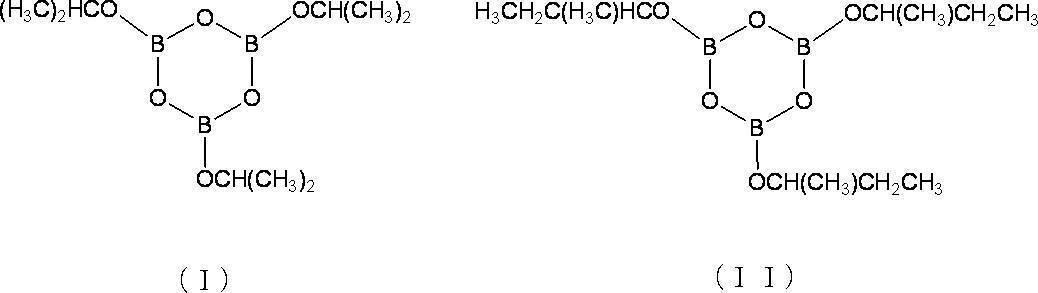
<1> 炭酸エステル及びホウ酸エステルから選ばれる少なくとも1種の溶媒と、LiBF4と、下記式(I)又は(II)で表されるボロキシン化合物と、を混合したリチウム二次電池用電解液。
<2> 正極と、負極と、<1>に記載のリチウム二次電池用電解液と、を含むリチウム二次電池。
<3> 前記正極が、金属酸化物又は金属リン酸化物である<2>に記載のリチウム二次電池。
<4> 前記正極が、Liと、Mn若しくはAl、Co若しくはCr、及びNiから選ばれる一種乃至三種と、O若しくはPO4とからなる金属酸化物及び金属リン酸化物、並びに、Liと、Mnと、Coと、Feと、O若しくはPO4とからなる金属酸化物及び金属リン酸化物からなる群より選ばれる化合物である<3>に記載のリチウム二次電池。
<5> 前記正極が、Liと、Mnと、O若しくはPO4とからなるLi-Mn系金属酸化物及び金属リン酸化物、Liと、Mnと、Coと、Niと、O若しくはPO4とからなるLi-Mn-Co-Ni系金属酸化物及び金属リン酸化物、並びに、Liと、Mnと、Crと、Niと、O若しくはPO4とからなるLi-Mn-Cr-Ni系金属酸化物及び金属リン酸化物からなる群より選ばれる化合物である<3>に記載のリチウム二次電池。
<6> Liと、Mn若しくはAl、Co若しくはCr、及びNiから選ばれる一種乃至三種と、O若しくはPO4とからなる金属酸化物及び金属リン酸化物、並びに、Liと、Mnと、Coと、Feと、O若しくはPO4とからなる金属酸化物及び金属リン酸化物からなる群より選ばれる化合物を、<1>に記載のリチウム二次電池用電解液中で電圧を印加して表面処理した正極と、負極と、ホウ酸エステルにLiBF4を溶解した電解液を含むリチウム二次電池。
<7> 前記負極が、テトラエトキシシランで表面処理した金属リチウムからなる負極、合金系負極又は炭素系負極である<2>~<6>のいずれかに記載のリチウム二次電池。
<8> Liと、Mn若しくはAl、Co若しくはCr、及びNiから選ばれる一種乃至三種と、O若しくはPO4とからなる金属酸化物及び金属リン酸化物、並びに、Liと、Mnと、Coと、Feと、O若しくはPO4とからなる金属酸化物及び金属リン酸化物からなる群より選ばれる正極と、
金属リチウムを<1>に記載のリチウム二次電池用電解液で表面処理した負極と、
ホウ酸エステルにLiBF4を溶解した電解液と、
を含むリチウム二次電池。
<9> 前記ホウ酸エステルにLiBF4を溶解した電解液が、前記ホウ酸エステルとして、ホウ酸トリイソプロピル(B[OCH(CH3)2]3)とホウ酸トリシアノエチル(B(OCH2CH2CN)3)を含む<8>に記載のリチウム二次電池。
<1> 炭酸エステル及びホウ酸エステルから選ばれる少なくとも1種の溶媒と、LiBF4と、下記式(I)又は(II)で表されるボロキシン化合物と、を混合したリチウム二次電池用電解液。
<2> 正極と、負極と、<1>に記載のリチウム二次電池用電解液と、を含むリチウム二次電池。
<3> 前記正極が、金属酸化物又は金属リン酸化物である<2>に記載のリチウム二次電池。
<4> 前記正極が、Liと、Mn若しくはAl、Co若しくはCr、及びNiから選ばれる一種乃至三種と、O若しくはPO4とからなる金属酸化物及び金属リン酸化物、並びに、Liと、Mnと、Coと、Feと、O若しくはPO4とからなる金属酸化物及び金属リン酸化物からなる群より選ばれる化合物である<3>に記載のリチウム二次電池。
<5> 前記正極が、Liと、Mnと、O若しくはPO4とからなるLi-Mn系金属酸化物及び金属リン酸化物、Liと、Mnと、Coと、Niと、O若しくはPO4とからなるLi-Mn-Co-Ni系金属酸化物及び金属リン酸化物、並びに、Liと、Mnと、Crと、Niと、O若しくはPO4とからなるLi-Mn-Cr-Ni系金属酸化物及び金属リン酸化物からなる群より選ばれる化合物である<3>に記載のリチウム二次電池。
<6> Liと、Mn若しくはAl、Co若しくはCr、及びNiから選ばれる一種乃至三種と、O若しくはPO4とからなる金属酸化物及び金属リン酸化物、並びに、Liと、Mnと、Coと、Feと、O若しくはPO4とからなる金属酸化物及び金属リン酸化物からなる群より選ばれる化合物を、<1>に記載のリチウム二次電池用電解液中で電圧を印加して表面処理した正極と、負極と、ホウ酸エステルにLiBF4を溶解した電解液を含むリチウム二次電池。
<7> 前記負極が、テトラエトキシシランで表面処理した金属リチウムからなる負極、合金系負極又は炭素系負極である<2>~<6>のいずれかに記載のリチウム二次電池。
<8> Liと、Mn若しくはAl、Co若しくはCr、及びNiから選ばれる一種乃至三種と、O若しくはPO4とからなる金属酸化物及び金属リン酸化物、並びに、Liと、Mnと、Coと、Feと、O若しくはPO4とからなる金属酸化物及び金属リン酸化物からなる群より選ばれる正極と、
金属リチウムを<1>に記載のリチウム二次電池用電解液で表面処理した負極と、
ホウ酸エステルにLiBF4を溶解した電解液と、
を含むリチウム二次電池。
<9> 前記ホウ酸エステルにLiBF4を溶解した電解液が、前記ホウ酸エステルとして、ホウ酸トリイソプロピル(B[OCH(CH3)2]3)とホウ酸トリシアノエチル(B(OCH2CH2CN)3)を含む<8>に記載のリチウム二次電池。
本発明によれば、高電圧で繰り返し充電することができるリチウム二次電池用電解液及びリチウム二次電池が提供される。
Journal of Electrochemical Society, 157, A677(2010)には、嵩高いイソプロピル基を含むボロキシン化合物をLiCF3SO3と等量加えた電解液は高電圧での分解を抑制できることが報告されているが、本発明者らが研究を重ねたところ、この電解液を電池に適用して充放電試験した場合、4.4V以上の高電圧では分解を抑制する効果が不十分であることが判明した。
そこで、本発明者らは、高電圧で充電可能なリチウム二次電池を開発すべく鋭意研究を重ねたところ、炭酸エステル系溶媒又はホウ酸エステル系溶媒に、支持塩としてLiBF4を用い、さらに特定のボロキシン化合物を添加して得た電解液と、高電位まで安定な正極を用いることにより、4.4V以上の高電圧でも充電可能なリチウム二次電池が得られることを見出した。
<リチウム二次電池用電解液>
本発明に係るリチウム二次電池用電解液は、炭酸エステル及びホウ酸エステルから選ばれる少なくとも1種の溶媒と、LiBF4と、下記式(I)又は(II)で表されるボロキシン化合物と、を混合したものである。
本発明に係るリチウム二次電池用電解液は、炭酸エステル及びホウ酸エステルから選ばれる少なくとも1種の溶媒と、LiBF4と、下記式(I)又は(II)で表されるボロキシン化合物と、を混合したものである。
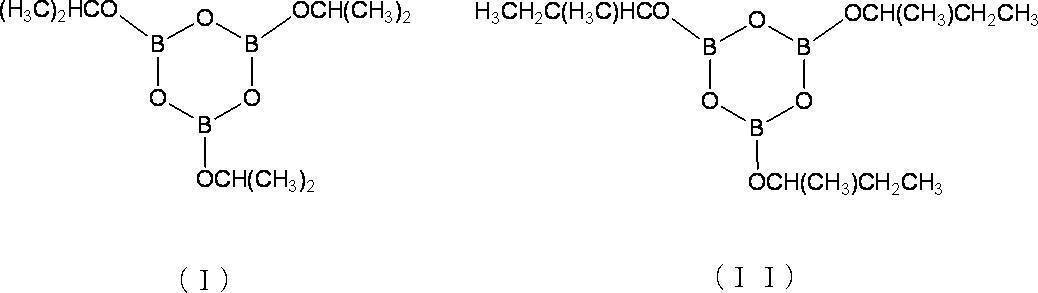
以下、式(I)で表されるボロキシン化合物を「TiPBx」(トリイソプロポキシボロキシン)、式(II)で表されるボロキシン化合物を「TsBBx」(トリsec-ブトキシボロキシン)と記す場合がある。
‐溶媒‐
本発明のリチウム二次電池用電解液を構成する溶媒としては、炭酸エステル系溶媒及びホウ酸エステル系溶媒から選ばれる少なくとも1種を用いる。
本発明のリチウム二次電池用電解液を構成する溶媒としては、炭酸エステル系溶媒及びホウ酸エステル系溶媒から選ばれる少なくとも1種を用いる。
炭酸エステル系溶媒の具体例としては、炭酸エチレン(EC)と炭酸エチルメチル(EMC)との混合溶媒、炭酸エチレンと炭酸ジエチル(DEC)との混合溶媒、炭酸プロピレンなどが挙げられる。
炭酸エステル系溶媒として、炭酸エチレン(EC)と炭酸エチルメチル(EMC)との混合溶媒を用いる場合、ECとEMCとの混合比(体積比)は、1~3:3~1であることが好ましい。
炭酸エステル系溶媒として、炭酸エチレン(EC)と炭酸エチルメチル(EMC)との混合溶媒を用いる場合、ECとEMCとの混合比(体積比)は、1~3:3~1であることが好ましい。
ホウ酸エステル系溶媒の具体例としては、トリイソプロピルホウ酸、トリフルオロエチルホウ酸およびトリシアノエチルホウ酸の混合溶媒が挙げられる。トリイソプロピルホウ酸、トリフルオロエチルホウ酸、トリシアノエチルホウ酸の混合比(モル比)は1~5:0~5:1~5であることが好ましい。
炭酸エステル系溶媒とホウ酸エステル系溶媒を混合して用いてもよい。例えば、炭酸エチレン(EC)、炭酸エチルメチル(EMC)、ホウ酸トリシアノエチル(BCN)を、EC:EMC:BCN=1~3:1~3:1~3の混合比(体積比)で混合した混合溶媒を用いることができる。
‐支持塩‐
本発明のリチウム二次電池用電解液は、支持塩としてLiBF4を用いる。
支持塩としてLiCF3SO3塩やLiPF6塩を添加した炭酸エステル溶液からなる電解液にTiPBxを添加しても、LiCF3SO3塩ではアルミニウム集電体を腐食し、また、TiPBxはLiPF6塩と反応して効果を失うため、良好な充放電特性が得られない。
一方、支持塩としてLiBF4を用い、TiPBxの添加量を最適化することにより、高電圧充電に耐えられる特性を発揮することができる。
本発明のリチウム二次電池用電解液は、支持塩としてLiBF4を用いる。
支持塩としてLiCF3SO3塩やLiPF6塩を添加した炭酸エステル溶液からなる電解液にTiPBxを添加しても、LiCF3SO3塩ではアルミニウム集電体を腐食し、また、TiPBxはLiPF6塩と反応して効果を失うため、良好な充放電特性が得られない。
一方、支持塩としてLiBF4を用い、TiPBxの添加量を最適化することにより、高電圧充電に耐えられる特性を発揮することができる。
電解液中のLiBF4の添加量は、0.2~3.0質量%であることが好ましく、0.5~1.5質量%であることがより好ましい。
支持塩として、LiBF4のほか、少量であれば他のリチウム塩を添加してもよいが、例えば、LiCF3SO3塩を添加すると充電サイクル特性(放電容量)が低下するため、支持塩としては、LiBF4のみを添加することが好ましい。
‐ボロキシン化合物‐
本発明に係るリチウム二次電池用電解液には、下記式(I)又は(II)で表されるボロキシン化合物が添加される。
本発明に係るリチウム二次電池用電解液には、下記式(I)又は(II)で表されるボロキシン化合物が添加される。
本発明に係る電解液中の上記ボロキシン化合物(TiPBx、TsBBx)の添加量は、0.01~3.0質量%であることが好ましく、0.1~1.0質量%であることがより好ましい。
‐その他の添加剤‐
本発明に係るリチウム二次電池用電解液は、他の添加剤を含んでもよい。
例えば、炭酸ビニレンが挙げられる。
本発明に係るリチウム二次電池用電解液は、他の添加剤を含んでもよい。
例えば、炭酸ビニレンが挙げられる。
<リチウム二次電池>
(第1実施形態)
本発明の第1実施形態に係るリチウム二次電池は、正極と、負極と、前述した本発明に係るリチウム二次電池用電解液と、を含んで構成される。
(第1実施形態)
本発明の第1実施形態に係るリチウム二次電池は、正極と、負極と、前述した本発明に係るリチウム二次電池用電解液と、を含んで構成される。
‐正極‐
正極としては、高電位で構造変化しない正極を使用することができ、高電位での分解を抑制する観点から、金属酸化物又は金属リン酸化物を好適に用いることができる。
具体的には、(a)Liと、Mn若しくはAl、Co若しくはCr、及びNiから選ばれる一種乃至三種と、O若しくはPO4とからなる金属酸化物及び金属リン酸化物、(b)Liと、Mnと、Coと、Feと、O若しくはPO4とからなる金属酸化物及び金属リン酸化物、並びに(c)Liと、Feと、Niとからなる金属酸化物及び金属リン酸化物からなる群から選ばれる化合物が好ましく、特に、Li、Mn及びOからなるLi-Mn系金属酸化物(LiMn2O4)、Li、Mn、Co若しくはCr、Ni及びOからなるLi-Mn-Co-Ni系金属酸化物、Li-Mn-Cr-Ni系金属酸化物(例えば、LiCr0.05Ni0.45Mn1.5O2)が好適である。
「(a)Liと、Mn若しくはAl、Co若しくはCr、及びNiから選ばれる一種乃至三種と、O若しくはPO4とからなる金属酸化物又は金属リン酸化物」及び「(c)Liと、Feと、Niとからなる金属酸化物及び金属リン酸化物」としては、例えば、以下のものが挙げられる。
(1)Li-Mn-Co-Ni系金属酸化物又は金属リン酸化物
(2)Li-Mn-Cr-Ni系金属酸化物又は金属リン酸化物
(3)Li-Mn-Co系金属酸化物又は金属リン酸化物
(4)Li-Mn-Cr系金属酸化物又は金属リン酸化物
(5)Li-Mn-Ni系金属酸化物又は金属リン酸化物
(6)Li-Al-Co-Ni系金属酸化物又は金属リン酸化物
(7)Li-Al-Co系金属酸化物又は金属リン酸化物
(8)Li-Al-Ni系金属酸化物又は金属リン酸化物
(9)Li-Co-Ni系金属酸化物又は金属リン酸化物
(10)Li-Fe-Ni系金属酸化物又は金属リン酸化物
(11)Li-Mn系金属酸化物又は金属リン酸化物
正極としては、高電位で構造変化しない正極を使用することができ、高電位での分解を抑制する観点から、金属酸化物又は金属リン酸化物を好適に用いることができる。
具体的には、(a)Liと、Mn若しくはAl、Co若しくはCr、及びNiから選ばれる一種乃至三種と、O若しくはPO4とからなる金属酸化物及び金属リン酸化物、(b)Liと、Mnと、Coと、Feと、O若しくはPO4とからなる金属酸化物及び金属リン酸化物、並びに(c)Liと、Feと、Niとからなる金属酸化物及び金属リン酸化物からなる群から選ばれる化合物が好ましく、特に、Li、Mn及びOからなるLi-Mn系金属酸化物(LiMn2O4)、Li、Mn、Co若しくはCr、Ni及びOからなるLi-Mn-Co-Ni系金属酸化物、Li-Mn-Cr-Ni系金属酸化物(例えば、LiCr0.05Ni0.45Mn1.5O2)が好適である。
「(a)Liと、Mn若しくはAl、Co若しくはCr、及びNiから選ばれる一種乃至三種と、O若しくはPO4とからなる金属酸化物又は金属リン酸化物」及び「(c)Liと、Feと、Niとからなる金属酸化物及び金属リン酸化物」としては、例えば、以下のものが挙げられる。
(1)Li-Mn-Co-Ni系金属酸化物又は金属リン酸化物
(2)Li-Mn-Cr-Ni系金属酸化物又は金属リン酸化物
(3)Li-Mn-Co系金属酸化物又は金属リン酸化物
(4)Li-Mn-Cr系金属酸化物又は金属リン酸化物
(5)Li-Mn-Ni系金属酸化物又は金属リン酸化物
(6)Li-Al-Co-Ni系金属酸化物又は金属リン酸化物
(7)Li-Al-Co系金属酸化物又は金属リン酸化物
(8)Li-Al-Ni系金属酸化物又は金属リン酸化物
(9)Li-Co-Ni系金属酸化物又は金属リン酸化物
(10)Li-Fe-Ni系金属酸化物又は金属リン酸化物
(11)Li-Mn系金属酸化物又は金属リン酸化物
‐負極‐
負極としては、金属リチウム、合金系負極、又は、炭素系負極を使用することができ、還元分解を抑制する観点から、テトラエトキシシラン(TEOS)で表面処理した金属リチウムからなる負極、合金系負極、又は、炭素系負極を好適に用いることができる。
負極としては、金属リチウム、合金系負極、又は、炭素系負極を使用することができ、還元分解を抑制する観点から、テトラエトキシシラン(TEOS)で表面処理した金属リチウムからなる負極、合金系負極、又は、炭素系負極を好適に用いることができる。
耐酸化性ホウ酸エステルは、電気化学的特性はよくてもリチウム金属負極と反応してしまうため、負極対策が必要である。そこで、金属リチウム負極をTEOS等のオルト珪酸エステル溶液で前処理することにより、耐酸化性ホウ酸エステル電解液の負極耐性を持たせることができる。例えば、1質量%のテトラエトキシシラン(TEOS)のEC-EMC(1:1 v/v)溶液中に、リチウム金属を室温で1時間浸した後、EC-EMCで洗浄し、TEOS処理リチウム金属負極を得ることができる。
合金系負極としては、リチウムとスズ又はシリコンとの合金が挙げられる。
炭素系負極としては、天然球状黒鉛、塊状人工黒鉛、メゾフェーズカーボンマイクロビーズが挙げられる。
‐電解液‐
電解液は、本発明に係るリチウム二次電池用電解液について前述した成分及び添加量を採用することができる。
電解液は、本発明に係るリチウム二次電池用電解液について前述した成分及び添加量を採用することができる。
(第2実施形態)
本発明の第2実施形態に係るリチウム二次電池は、Liと、Mn若しくはAl、Co若しくはCr、及びNiから選ばれる一種乃至三種と、O若しくはPO4とからなる金属酸化物及び金属リン酸化物、並びに、Liと、Mnと、Coと、Feと、O若しくはPO4とからなる金属酸化物及び金属リン酸化物からなる群より選ばれる化合物を、前述した本発明に係るリチウム二次電池用電解液中で電圧を印加して表面処理した正極と、負極と、ホウ酸エステルにLiBF4を溶解した電解液と、を含んで構成される。
本発明の第2実施形態に係るリチウム二次電池は、Liと、Mn若しくはAl、Co若しくはCr、及びNiから選ばれる一種乃至三種と、O若しくはPO4とからなる金属酸化物及び金属リン酸化物、並びに、Liと、Mnと、Coと、Feと、O若しくはPO4とからなる金属酸化物及び金属リン酸化物からなる群より選ばれる化合物を、前述した本発明に係るリチウム二次電池用電解液中で電圧を印加して表面処理した正極と、負極と、ホウ酸エステルにLiBF4を溶解した電解液と、を含んで構成される。
‐正極‐
正極として用いる前記金属酸化物を表面処理する際に用いる電解液の構成(各成分の添加量等)は、第1実施形態のリチウム二次電池を構成する電解液と同様のものを採用することができるが、特に、Li-Mn-Co-Ni系金属酸化物又はLi-Mn-Ni系金属酸化物を、TiPBx(前記式(I)で表されるボロキシン化合物)と、LiBF4と、炭酸エステルとを混合した電解液中で電圧を印加して表面処理することが好ましい。
正極として用いる前記金属酸化物を表面処理する際に印加する電圧は、4.6V以上であることが好ましく、4.8V以上5.2V以下であることがより好ましい。また、表面処理する時間は、3~120分であることが好ましく、5~60分であることがより好ましい。
正極として用いる前記金属酸化物を表面処理する際に用いる電解液の構成(各成分の添加量等)は、第1実施形態のリチウム二次電池を構成する電解液と同様のものを採用することができるが、特に、Li-Mn-Co-Ni系金属酸化物又はLi-Mn-Ni系金属酸化物を、TiPBx(前記式(I)で表されるボロキシン化合物)と、LiBF4と、炭酸エステルとを混合した電解液中で電圧を印加して表面処理することが好ましい。
正極として用いる前記金属酸化物を表面処理する際に印加する電圧は、4.6V以上であることが好ましく、4.8V以上5.2V以下であることがより好ましい。また、表面処理する時間は、3~120分であることが好ましく、5~60分であることがより好ましい。
‐負極‐
負極としては、第1実施形態と同様、金属リチウム、合金系負極、又は、炭素系負極を使用することができ、還元分解を抑制する観点から、テトラエトキシシラン(TEOS)で表面処理した金属リチウムからなる負極、合金系負極、又は、炭素系負極を好適に用いることができる。
負極としては、第1実施形態と同様、金属リチウム、合金系負極、又は、炭素系負極を使用することができ、還元分解を抑制する観点から、テトラエトキシシラン(TEOS)で表面処理した金属リチウムからなる負極、合金系負極、又は、炭素系負極を好適に用いることができる。
‐電解液‐
第2実施形態に係るリチウム二次電池では、ホウ酸エステルにLiBF4を溶解した電解液が用いられる。
ホウ酸エステルの具体例及びLiBF4の添加量は、第1実施形態、すなわち、前述した本発明に係るリチウム二次電池用電解液と同様である。
第2実施形態に係るリチウム二次電池では、ホウ酸エステルにLiBF4を溶解した電解液が用いられる。
ホウ酸エステルの具体例及びLiBF4の添加量は、第1実施形態、すなわち、前述した本発明に係るリチウム二次電池用電解液と同様である。
(第3実施形態)
本発明の第3実施形態に係るリチウム二次電池は、正極と、テトラエトキシシランで表面処理した金属リチウムからなる負極、合金系負極又は炭素系負極と、ホウ酸トリシアノエチルと炭酸エステルとの混合溶媒にLiBF4を溶解した電解液を含んで構成される。
本発明の第3実施形態に係るリチウム二次電池は、正極と、テトラエトキシシランで表面処理した金属リチウムからなる負極、合金系負極又は炭素系負極と、ホウ酸トリシアノエチルと炭酸エステルとの混合溶媒にLiBF4を溶解した電解液を含んで構成される。
‐正極‐
第3実施形態に係るリチウム二次電池を構成する正極は、特に限定されないが、LiMn2O4又はLiMn1/3Co1/3Ni1/3O2を好適に用いることができる。
第3実施形態に係るリチウム二次電池を構成する正極は、特に限定されないが、LiMn2O4又はLiMn1/3Co1/3Ni1/3O2を好適に用いることができる。
‐負極‐
第3実施形態に係るリチウム二次電池を構成する負極は、第1、第2実施形態と同様であり、テトラエトキシシランで表面処理した金属リチウムからなる負極、合金系負極又は炭素系負極が用いられる。
第3実施形態に係るリチウム二次電池を構成する負極は、第1、第2実施形態と同様であり、テトラエトキシシランで表面処理した金属リチウムからなる負極、合金系負極又は炭素系負極が用いられる。
‐電解液‐
第3実施形態に係るリチウム二次電池を構成する電解液としては、ホウ酸トリシアノエチルと炭酸エステルとの混合溶媒にLiBF4を溶解した電解液が用いられる。
炭酸エステルの具体例及びLiBF4の添加量は、第1実施形態と同様である。
ホウ酸トリシアノエチルと炭酸エステルとの混合比(体積比)は2~1:1~4であることが好ましい。
第3実施形態に係るリチウム二次電池を構成する電解液としては、ホウ酸トリシアノエチルと炭酸エステルとの混合溶媒にLiBF4を溶解した電解液が用いられる。
炭酸エステルの具体例及びLiBF4の添加量は、第1実施形態と同様である。
ホウ酸トリシアノエチルと炭酸エステルとの混合比(体積比)は2~1:1~4であることが好ましい。
(第4実施形態)
本発明の第4実施形態に係るリチウム二次電池は、Liと、Mn若しくはAl、Co若しくはCr、及びNiから選ばれる一種乃至三種と、O若しくはPO4とからなる金属酸化物及び金属リン酸化物、並びに、Liと、Mnと、Coと、Feと、O若しくはPO4とからなる金属酸化物及び金属リン酸化物からなる群より選ばれる正極と、金属リチウムを前述した本発明に係るリチウム二次電池用電解液、すなわち、炭酸エステル及びホウ酸エステルから選ばれる少なくとも1種の溶媒と、LiBF4と、前記式(I)又は(II)で表されるボロキシン化合物と、を混合した電解液で表面処理した負極と、ホウ酸エステルにLiBF4を溶解した電解液と、を含んで構成される。
本発明の第4実施形態に係るリチウム二次電池は、Liと、Mn若しくはAl、Co若しくはCr、及びNiから選ばれる一種乃至三種と、O若しくはPO4とからなる金属酸化物及び金属リン酸化物、並びに、Liと、Mnと、Coと、Feと、O若しくはPO4とからなる金属酸化物及び金属リン酸化物からなる群より選ばれる正極と、金属リチウムを前述した本発明に係るリチウム二次電池用電解液、すなわち、炭酸エステル及びホウ酸エステルから選ばれる少なくとも1種の溶媒と、LiBF4と、前記式(I)又は(II)で表されるボロキシン化合物と、を混合した電解液で表面処理した負極と、ホウ酸エステルにLiBF4を溶解した電解液と、を含んで構成される。
‐正極‐
第4実施形態に係るリチウム二次電池を構成する正極は、第2実施形態で挙げた金属酸化物又は金属リン酸化物が用いられ、例えば、Li-Ni-Mn-O系の正極が好適に用いられる。
第4実施形態に係るリチウム二次電池を構成する正極は、第2実施形態で挙げた金属酸化物又は金属リン酸化物が用いられ、例えば、Li-Ni-Mn-O系の正極が好適に用いられる。
‐負極‐
負極として金属リチウムを表面処理する際に用いる電解液の構成(各成分の添加量等)は、第1実施形態のリチウム二次電池を構成する電解液と同様のものを採用することができる。特に、金属リチウムを、TiPBx(前記式(I)で表されるボロキシン化合物)と、LiBF4と、炭酸エステルとを混合した電解液中に浸して表面に被膜を形成することが好ましい。
負極として金属リチウムを表面処理する際に用いる電解液の構成(各成分の添加量等)は、第1実施形態のリチウム二次電池を構成する電解液と同様のものを採用することができる。特に、金属リチウムを、TiPBx(前記式(I)で表されるボロキシン化合物)と、LiBF4と、炭酸エステルとを混合した電解液中に浸して表面に被膜を形成することが好ましい。
‐電解液‐
第4実施形態に係るリチウム二次電池を構成する電解液としては、ホウ酸エステルにLiBF4を溶解した電解液、特に、ホウ酸トリイソプロピル(B[OCH(CH3)2]3)とホウ酸トリシアノエチル(B(OCH2CH2CN)3)を含むホウ酸エステルにLiBF4を溶解した電解液が好ましい。
第4実施形態に係るリチウム二次電池を構成する電解液としては、ホウ酸エステルにLiBF4を溶解した電解液、特に、ホウ酸トリイソプロピル(B[OCH(CH3)2]3)とホウ酸トリシアノエチル(B(OCH2CH2CN)3)を含むホウ酸エステルにLiBF4を溶解した電解液が好ましい。
以下、本発明の実施例及び比較例に係る実験例について説明するが、本発明はこれらの実験例に限定されるものではない。
<実験例1>
高温、高電圧において正極内の炭素導電剤やバインダーの酸化の影響を排除するため、レーザーアブレーション法で作製したLiMn2O4薄膜を用いて高電圧充電のための基礎評価を行った。
炭酸エチレン(EC)と炭酸エチルメチル(EMC)の体積比1対1(適宜、「EC-EMC(1:1 v/v)」と記す。)の混合溶媒に1molkg-1の濃度でLiBF4塩を溶かした電解液に0.01molkg-1の濃度でトリイソプロポキシボロキシン(TiPBx)を添加した。
高温、高電圧において正極内の炭素導電剤やバインダーの酸化の影響を排除するため、レーザーアブレーション法で作製したLiMn2O4薄膜を用いて高電圧充電のための基礎評価を行った。
炭酸エチレン(EC)と炭酸エチルメチル(EMC)の体積比1対1(適宜、「EC-EMC(1:1 v/v)」と記す。)の混合溶媒に1molkg-1の濃度でLiBF4塩を溶かした電解液に0.01molkg-1の濃度でトリイソプロポキシボロキシン(TiPBx)を添加した。
対極および標準電極にリチウム金属を用いて、30℃で5Vまで掃引したサイクリックボルタンメトリー(CV)を測定した。比較のためTiPBxを添加しなかった電解液を用いた場合とともに測定結果を図1に示す。
TiPBx無添加では、5Vまで電位を上げた後、リチウムイオンの正極への挿入反応の波形が脱離反応のピークと非対称になり、挿入反応が起こりにくくなったことが示された。これは、界面に分解性生物が生成したためと思われる。
一方、1モルのリチウム塩(LiBF4)に対して、TiPBxを0.01モル相当量添加すると、5Vに印加した後も、リチウムイオンの正極への挿入反応と脱離反応の波形の対称性が良好となり、挿入反応がスムースに起こったことが示された。
この測定結果は、炭酸エステル系溶媒にリチウム塩としてLiBF4を添加するとともにTiPBxを添加した電解液を用いることで高電圧充電リチウム二次電池が得られることを示している。
TiPBx無添加では、5Vまで電位を上げた後、リチウムイオンの正極への挿入反応の波形が脱離反応のピークと非対称になり、挿入反応が起こりにくくなったことが示された。これは、界面に分解性生物が生成したためと思われる。
一方、1モルのリチウム塩(LiBF4)に対して、TiPBxを0.01モル相当量添加すると、5Vに印加した後も、リチウムイオンの正極への挿入反応と脱離反応の波形の対称性が良好となり、挿入反応がスムースに起こったことが示された。
この測定結果は、炭酸エステル系溶媒にリチウム塩としてLiBF4を添加するとともにTiPBxを添加した電解液を用いることで高電圧充電リチウム二次電池が得られることを示している。
<実験例2>
EC-EMC(1:1 v/v)の混合溶媒に1molkg-1濃度のLiBF4塩を溶かして得た電解液に、0.2質量%濃度に相当するTiPBxを添加して溶かした。この電解液をセパレータのセルガードに浸み込ませ、二極セル内でLiMn2O4シート正極とリチウム金属板負極の間に挟んだ後、1日放置した。その後、30℃の恒温糟内で、充電電圧4.7V、放電電圧3.5Vで、0.5Cのレートで充放電試験を行った。
EC-EMC(1:1 v/v)の混合溶媒に1molkg-1濃度のLiBF4塩を溶かして得た電解液に、0.2質量%濃度に相当するTiPBxを添加して溶かした。この電解液をセパレータのセルガードに浸み込ませ、二極セル内でLiMn2O4シート正極とリチウム金属板負極の間に挟んだ後、1日放置した。その後、30℃の恒温糟内で、充電電圧4.7V、放電電圧3.5Vで、0.5Cのレートで充放電試験を行った。
充放電試験の結果を、LiBF4電解液にLiCF3SO3(LiTrif)とTiPBxをそれぞれ0.2質量%添加した電解液を用いたリチウム二次電池と比較して図2に示す。
TiPBx無添加電解液を用いた場合、4.7Vの高圧充電では、サイクルを重ねると急激に放電容量が低下した(図2中の◆)。これは電解液の分解によると思われる。
一方、TiPBx添加電解液を用いたリチウム二次電池では、急激な容量低下はなく(図2中の■)、高電圧充電が可能であった。
なお、支持塩としてLiBF4のほかにLiTrifを少量添加すると、サイクル特性は低下した(図2中の▲)。
また、図示してないが、支持塩としてLiTrifのみ用いると充放電不可能であった。
TiPBx無添加電解液を用いた場合、4.7Vの高圧充電では、サイクルを重ねると急激に放電容量が低下した(図2中の◆)。これは電解液の分解によると思われる。
一方、TiPBx添加電解液を用いたリチウム二次電池では、急激な容量低下はなく(図2中の■)、高電圧充電が可能であった。
なお、支持塩としてLiBF4のほかにLiTrifを少量添加すると、サイクル特性は低下した(図2中の▲)。
また、図示してないが、支持塩としてLiTrifのみ用いると充放電不可能であった。
<実験例3>
LiMn2O4薄膜電極(正極)と、リチウム金属電極(負極)と、実験例2の電解液を用い、60℃での充放電による容量維持率の変化を測定した結果を図3に示す。
TiPBx無添加電解液では、60℃の高温では急速に充放電容量が低下したが、TiPBxを少量添加しただけで顕著な改善が認められ、高温、高電圧での充電も可能になることが示された。
なお、サイクル数と共に徐々に容量低下が起こるのは、60℃におけるLiMn2O4の溶解およびリチウム金属負極上での電解液の分解が原因と考えられ、これらの溶解及び分解を抑制することで、さらなる高温、高電圧での充電も可能と考えられる。
LiMn2O4薄膜電極(正極)と、リチウム金属電極(負極)と、実験例2の電解液を用い、60℃での充放電による容量維持率の変化を測定した結果を図3に示す。
TiPBx無添加電解液では、60℃の高温では急速に充放電容量が低下したが、TiPBxを少量添加しただけで顕著な改善が認められ、高温、高電圧での充電も可能になることが示された。
なお、サイクル数と共に徐々に容量低下が起こるのは、60℃におけるLiMn2O4の溶解およびリチウム金属負極上での電解液の分解が原因と考えられ、これらの溶解及び分解を抑制することで、さらなる高温、高電圧での充電も可能と考えられる。
<実験例4>
LiCr0.05Ni0.45Mn1.5O2薄膜を作用電極に、参照電極および標準電極に金属リチウムを用いて、LiBF4 /EC-EMC電解液中でのCV測定を5Vまで掃引して行った。また、LiBF4を1モル/kg添加した電解液にTiPBxを0.01モル/kg添加した電解液とTiPBx無添加電解液を比較した。結果を図4に示す。
TiPBx添加電解液を用いることにより、正極へのリチウムイオンの挿入脱離反応が起こりやすくなり、高電位正極に適用できることが明らかとなった。
LiCr0.05Ni0.45Mn1.5O2薄膜を作用電極に、参照電極および標準電極に金属リチウムを用いて、LiBF4 /EC-EMC電解液中でのCV測定を5Vまで掃引して行った。また、LiBF4を1モル/kg添加した電解液にTiPBxを0.01モル/kg添加した電解液とTiPBx無添加電解液を比較した。結果を図4に示す。
TiPBx添加電解液を用いることにより、正極へのリチウムイオンの挿入脱離反応が起こりやすくなり、高電位正極に適用できることが明らかとなった。
また、5Vに掃引後、4.68Vで測定したコールコールプロットを図5に示す。二つ目の円弧の大きさは界面抵抗であり、TiPBx添加によって5V掃引後の界面抵抗が小さくなり、高電圧充電電池のサイクル寿命の改善が可能であることが示された。
<実験例5>
5V正極のLiNi0.5Mn1.5O4薄膜をレーザーアブレーション法で作製し、TiPBxを0.01molkg-1添加した1mol/kgのLiBF4のEC-EMC(1:1 v/v)溶液で5Vまで印加して、正極の表面処理を行った。
5V正極のLiNi0.5Mn1.5O4薄膜をレーザーアブレーション法で作製し、TiPBxを0.01molkg-1添加した1mol/kgのLiBF4のEC-EMC(1:1 v/v)溶液で5Vまで印加して、正極の表面処理を行った。
次に、上記のようにして表面処理したLiNi0.5Mn1.5O4薄膜を、トリイソプロピルホウ酸、トリフルオロエチルホウ酸およびトリシアノエチルホウ酸の2:1:6(モル比)の混合溶媒に0.7molkg-1のLiBF4を溶かした電解液中に入れ替え、サイクリックボルタンメトリーを測定した。結果を図6に示す。
未処理のLiNi0.5Mn1.5O4正極では、5Vまで掃引すると、波形がブロード化し、リチウムイオンの挿入脱離反応が起こりにくくなった。
一方、TiPBx添加電解液で予め表面処理したLiNi0.5Mn1.5O4正極を用いると、波形が明確になり、リチウムイオンの挿入脱離反応が起こりやすくなり、高電圧充電リチウム二次電池が可能となることが示された。
未処理のLiNi0.5Mn1.5O4正極では、5Vまで掃引すると、波形がブロード化し、リチウムイオンの挿入脱離反応が起こりにくくなった。
一方、TiPBx添加電解液で予め表面処理したLiNi0.5Mn1.5O4正極を用いると、波形が明確になり、リチウムイオンの挿入脱離反応が起こりやすくなり、高電圧充電リチウム二次電池が可能となることが示された。
<実験例6>
1質量%のテトラエトキシシラン(TEOS)のEC-EMC(1:1 v/v)溶液中に、リチウム金属薄膜を室温で1時間浸した後、EC-EMCで洗浄し、TEOS処理リチウム金属負極を得た。
1質量%のテトラエトキシシラン(TEOS)のEC-EMC(1:1 v/v)溶液中に、リチウム金属薄膜を室温で1時間浸した後、EC-EMCで洗浄し、TEOS処理リチウム金属負極を得た。
電解液は、ホウ酸トリシアノエチル(B(OCH2CH2CN)3:BCN)とEC-EMC(1:1 v/v)を等量混合した溶媒にLiBF4を1mol/l溶かして調製した。
LiMn1/3Ni1/3Co1/3O2粉末を導電剤の炭素材料と共にアルミニウム集電体上に塗布したシート正極およびTEOS処理リチウム金属負極を用い、実験例1と同様の方法でセルを組み、室温、カットオフ電圧3.0V-4.5V、0.2Cのレートで充放電試験を行った。結果を図7に示す。
LiMn1/3Ni1/3Co1/3O2粉末を導電剤の炭素材料と共にアルミニウム集電体上に塗布したシート正極およびTEOS処理リチウム金属負極を用い、実験例1と同様の方法でセルを組み、室温、カットオフ電圧3.0V-4.5V、0.2Cのレートで充放電試験を行った。結果を図7に示す。
リチウム金属負極を用いると、ホウ酸エステル含有電解液は不安定のため、放電容量はサイクルを重ねると急激に低下した。
一方、TEOS処理リチウム金属負極を用いることによって、容量低下を抑えることが可能となり、高電圧充電リチウムイオン電池を構成できることがわかった。
一方、TEOS処理リチウム金属負極を用いることによって、容量低下を抑えることが可能となり、高電圧充電リチウムイオン電池を構成できることがわかった。
<実験例7>
-薄膜正極を用いた炭酸エステル電解液の評価-
以下の炭酸エステル電解液、電池構成、及び充放電条件により充放電測定を行った。なお、シート電極では、正極に用いるバインダーや導電助剤が5Vで酸化されて影響が出ることが懸念されるため薄膜正極を用いた。
電解液:1.0molkg-1LiBF4/EC:EMC(1/1(v/v))
正極:LiNi0.5Mn1.5O4薄膜
負極:Li箔
充放電条件:定電流値:1μA、Cut-off電位:3.0-5.0V
-薄膜正極を用いた炭酸エステル電解液の評価-
以下の炭酸エステル電解液、電池構成、及び充放電条件により充放電測定を行った。なお、シート電極では、正極に用いるバインダーや導電助剤が5Vで酸化されて影響が出ることが懸念されるため薄膜正極を用いた。
電解液:1.0molkg-1LiBF4/EC:EMC(1/1(v/v))
正極:LiNi0.5Mn1.5O4薄膜
負極:Li箔
充放電条件:定電流値:1μA、Cut-off電位:3.0-5.0V
図8に3.0-5.0V充放電の測定結果を示す。炭酸エステル電解液では1回目の充放電から急速に劣化が起こり2回目の充放電はできなくなった。これは炭酸エステル電解液の5Vでの分解によると考えられる。
-薄膜正極を用いたホウ酸エステル電解液の評価-
上記「薄膜正極を用いた炭酸エステル電解液の評価」における炭酸エステル電解液を下記構成のホウ酸エステル電解液に代えたこと以外は上記と同様にして充放電測定を行った。
電解液:0.7molkg-1LiBF4/BIP:BCN(1:2(mol/mol))
なお、ホウ酸エステル電解液として、ホウ酸トリメチルは金属リチウム負極に不安定であるため、比較的安定なホウ酸トリイソプロピル(B[OCH(CH3)2]3:BIP)をホウ酸トリシアノエチル(B(OCH2CH2CN)3:BCN)に加えて用いた。
上記「薄膜正極を用いた炭酸エステル電解液の評価」における炭酸エステル電解液を下記構成のホウ酸エステル電解液に代えたこと以外は上記と同様にして充放電測定を行った。
電解液:0.7molkg-1LiBF4/BIP:BCN(1:2(mol/mol))
なお、ホウ酸エステル電解液として、ホウ酸トリメチルは金属リチウム負極に不安定であるため、比較的安定なホウ酸トリイソプロピル(B[OCH(CH3)2]3:BIP)をホウ酸トリシアノエチル(B(OCH2CH2CN)3:BCN)に加えて用いた。
図9に3.0-5.0V充放電の測定結果を示す。5V充電で、炭酸エステル電解液に比べかなりの改善がなされたが、金属リチウム負極への安定性が不十分なため、サイクルを重ねると劣化が見られた。
-前処理した金属リチウム負極を用いたホウ酸エステル電解液の評価-
上記「薄膜正極を用いたホウ酸エステル電解液の評価」において、金属リチウム負極(Li箔)に代えて、下記のTiPBx含有炭酸エステル電解液で前処理した金属リチウム負極を用いたこと以外は同様にして充放電試験を行った。
負極:1.0molkg-1LiBF4/EC:EMC(1:1(v/v))+0.01molkg-1TiPBxにLi箔を浸して前処理を行った。
上記「薄膜正極を用いたホウ酸エステル電解液の評価」において、金属リチウム負極(Li箔)に代えて、下記のTiPBx含有炭酸エステル電解液で前処理した金属リチウム負極を用いたこと以外は同様にして充放電試験を行った。
負極:1.0molkg-1LiBF4/EC:EMC(1:1(v/v))+0.01molkg-1TiPBxにLi箔を浸して前処理を行った。
図10に3.0-5.0V充放電の測定結果を示す。金属リチウム負極をTiPBx含有炭酸エステル電解液で前処理すると、リチウム表面に安定な被膜が形成され、電解液の分解をある程度抑制できると考えられる。そのため、図9に示す結果に比べ充放電サイクルの改善がなされた。
上記測定結果により、炭酸エステル電解液では5Vで正極で分解が起こり、すぐに劣化してしまうのに対し、ホウ酸トリイソプロピルを添加したホウ酸エステル電解液は大幅に改善でき、5Vで充放電可能なことが解った。金属リチウム負極より還元電位の高い合金等の負極(現在開発が進められている)に対しては、ホウ酸トリイソプロピルを混合したホウ酸エステル電解液はより安定になると予想され、さらに、電解液へのTiPBxの添加、または、第2実施形態で説明したTiPBx含有電解液による正極の表面処理を併用することによって、高電圧での充放電特性が向上すると考えられ、今後開発される高電圧作動、高エネルギー密度の蓄電池に適した電解液となることが期待される。
<実験例8>
-LiMn2O4正極を用いた充放電試験-
炭酸エステル電解液にTiPBxを添加した場合と添加しない場合とで充放電特性を評価した。電極構成、充放電条件、電界液の構成は以下の通りである。
正極:LiMn2O4
負極:金属Li
セパレータ:セルガード#3501:セルガード(株)製
充放電:Cut-off voltage:3.5-4.7V、0.5C、30℃
電解液:下記(A)TiPBx無添加電解液又は(B)TiPBx添加電解液
(A)TiPBx無添加炭酸エステル電解液:1.0mol/kg LiBF4/EC:EMC(1:1(v/v))
(B)TiPBx添加炭酸エステル電解液:1.0mol/kg LiBF4/EC:EMC(1:1(v/v))+0.2wt%TiPBx
-LiMn2O4正極を用いた充放電試験-
炭酸エステル電解液にTiPBxを添加した場合と添加しない場合とで充放電特性を評価した。電極構成、充放電条件、電界液の構成は以下の通りである。
正極:LiMn2O4
負極:金属Li
セパレータ:セルガード#3501:セルガード(株)製
充放電:Cut-off voltage:3.5-4.7V、0.5C、30℃
電解液:下記(A)TiPBx無添加電解液又は(B)TiPBx添加電解液
(A)TiPBx無添加炭酸エステル電解液:1.0mol/kg LiBF4/EC:EMC(1:1(v/v))
(B)TiPBx添加炭酸エステル電解液:1.0mol/kg LiBF4/EC:EMC(1:1(v/v))+0.2wt%TiPBx
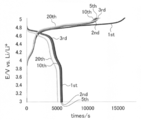
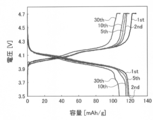
図11にTiPBx無添加炭酸エステル電解液を用いた充放電カーブを示し、図12にTiPBx添加炭酸エステル電解液を用いた充放電カーブを示す。TiPBxの添加により4.7V充電での充放電サイクル特性がかなり改善された。なお、30回目では放電容量の低下が見られたが、4.7Vでは炭酸エステルの分解を完全に抑制できないか、あるいはLiMn2O4の溶解による影響があると思われる。
<実験例9>
-LiNi1/3Co1/3Mn1/3O2正極を用いた充放電試験-
三元系正極を用い、4.5V充電でTiPBxの添加効果(充放電サイクル特性)を評価した。電極構成、充放電条件、電界液の構成は以下の通りである。
正極:LiNi1/3Co1/3Mn1/3O2
負極:金属リチウム
セパレータ:セルガード#3501:セルガード(株)製
充放電:0.5C、Cut-off voltage:3.5-4.5V、30℃
電解液:下記(A)TiPBx無添加電解液又は(B)TiPBx添加電解液
(A)TiPBx無添加炭酸エステル電解液:1.0mol/kg LiBF4/EC:EMC(1:1(v/v))
(B)TiPBx添加炭酸エステル電解液:1.0mol/kg LiBF4/EC:EMC(1:1(v/v))+0.2wt%TiPBx
-LiNi1/3Co1/3Mn1/3O2正極を用いた充放電試験-
三元系正極を用い、4.5V充電でTiPBxの添加効果(充放電サイクル特性)を評価した。電極構成、充放電条件、電界液の構成は以下の通りである。
正極:LiNi1/3Co1/3Mn1/3O2
負極:金属リチウム
セパレータ:セルガード#3501:セルガード(株)製
充放電:0.5C、Cut-off voltage:3.5-4.5V、30℃
電解液:下記(A)TiPBx無添加電解液又は(B)TiPBx添加電解液
(A)TiPBx無添加炭酸エステル電解液:1.0mol/kg LiBF4/EC:EMC(1:1(v/v))
(B)TiPBx添加炭酸エステル電解液:1.0mol/kg LiBF4/EC:EMC(1:1(v/v))+0.2wt%TiPBx
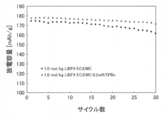
TiPBxを添加した場合と、添加しない場合とで充放電サイクル特性を測定した結果を図13に示した。TiPBxを0.2wt%添加するだけで放電容量の増大とサイクル特性の改善が認められ、高電圧充電におけるTiPBxの添加効果が認められた。
また、図14にTiPBx無添加炭酸エステル電解液を用いた場合の充放電カーブを示し、図15にTiPBx添加炭酸エステル電解液を用いた場合の充放電カーブを示した。両充放電カーブに大きな違いはないが、放電容量がTiPBxの添加によって増大し、サイクル後の低下も抑制された。これはTiPBxによって正極表面上に良好な被膜が形成され、正極上での酸化分解が抑制されたためと考えられる。
LiBF4電解液は炭素系負極に適さないが、今後実用化が期待されている合金などの高容量負極には還元電位が高いためより安定になると思われる。なお、自動車用では長期の寿命を得るために、充電電圧を低めに設定しているが、TiPBxの添加によって充電電圧を高くすることが可能となる。
TiPBxの炭酸エステル電解液への添加によって、充電電圧向上が可能となり、正極内のリチウムの利用率向上による容量増大、放電電圧の向上、さらには、充電状態の劣化抑制や電圧を上げた急速充電がしやすくなる等、少量の添加剤で実現できることは、構成材料や電池製造プロセスを変えずに実現できるため実用的に有効と考えられる。
TiPBxの炭酸エステル電解液への添加によって、充電電圧向上が可能となり、正極内のリチウムの利用率向上による容量増大、放電電圧の向上、さらには、充電状態の劣化抑制や電圧を上げた急速充電がしやすくなる等、少量の添加剤で実現できることは、構成材料や電池製造プロセスを変えずに実現できるため実用的に有効と考えられる。
以上、本発明について説明したが、本発明に係るリチウム二次電池は、高エネルギー密度を有し、電解液の組成並びに正極及び負極の表面処理法を最適化することで、4.5V以上の高電圧で充電することも可能であり、例えば、急速充電可能な車載用蓄電池にも適用することができる。
日本出願2011-071248の開示はその全体が参照により本明細書に取り込まれる。本明細書に記載された全ての文献、特許出願、および技術規格は、個々の文献、特許出願、および技術規格が参照により取り込まれることが具体的かつ個々に記された場合と同程度に、本明細書中に参照により取り込まれる。
Claims (9)
- 炭酸エステル及びホウ酸エステルから選ばれる少なくとも1種の溶媒と、
LiBF4と、
下記式(I)又は(II)で表されるボロキシン化合物と、
を混合したリチウム二次電池用電解液。

- 正極と、負極と、請求項1に記載のリチウム二次電池用電解液と、を含むリチウム二次電池。
- 前記正極が、金属酸化物又は金属リン酸化物である請求項2に記載のリチウム二次電池。
- 前記正極が、Liと、Mn若しくはAl、Co若しくはCr、及びNiから選ばれる一種乃至三種と、O若しくはPO4とからなる金属酸化物及び金属リン酸化物、並びに、Liと、Mnと、Coと、Feと、O若しくはPO4とからなる金属酸化物及び金属リン酸化物からなる群より選ばれる化合物である請求項3に記載のリチウム二次電池。
- 前記正極が、Liと、Mnと、O若しくはPO4とからなるLi-Mn系金属酸化物及び金属リン酸化物、Liと、Mnと、Coと、Niと、O若しくはPO4とからなるLi-Mn-Co-Ni系金属酸化物及び金属リン酸化物、並びに、Liと、Mnと、Crと、Niと、O若しくはPO4とからなるLi-Mn-Cr-Ni系金属酸化物及び金属リン酸化物からなる群より選ばれる化合物である請求項3に記載のリチウム二次電池。
- Liと、Mn若しくはAl、Co若しくはCr、及びNiから選ばれる一種乃至三種と、O若しくはPO4とからなる金属酸化物及び金属リン酸化物、並びに、Liと、Mnと、Coと、Feと、O若しくはPO4とからなる金属酸化物及び金属リン酸化物からなる群より選ばれる化合物を、請求項1に記載のリチウム二次電池用電解液中で電圧を印加して表面処理した正極と、
負極と、
ホウ酸エステルにLiBF4を溶解した電解液と、
を含むリチウム二次電池。 - 前記負極が、テトラエトキシシランで表面処理した金属リチウムからなる負極、合金系負極又は炭素系負極である請求項2~請求項6のいずれか1項に記載のリチウム二次電池。
- Liと、Mn若しくはAl、Co若しくはCr、及びNiから選ばれる一種乃至三種と、O若しくはPO4とからなる金属酸化物及び金属リン酸化物、並びに、Liと、Mnと、Coと、Feと、O若しくはPO4とからなる金属酸化物及び金属リン酸化物からなる群より選ばれる正極と、
金属リチウムを請求項1に記載のリチウム二次電池用電解液で表面処理した負極と、
ホウ酸エステルにLiBF4を溶解した電解液と、
を含むリチウム二次電池。 - 前記ホウ酸エステルにLiBF4を溶解した電解液が、前記ホウ酸エステルとして、ホウ酸トリイソプロピル(B[OCH(CH3)2]3)とホウ酸トリシアノエチル(B(OCH2CH2CN)3)を含む請求項8に記載のリチウム二次電池。
Priority Applications (1)
| Application Number | Priority Date | Filing Date | Title |
|---|---|---|---|
| JP2013507682A JP6019534B2 (ja) | 2011-03-28 | 2012-03-28 | リチウム二次電池用電解液及びリチウム二次電池並びにリチウム二次電池の製造方法 |
Applications Claiming Priority (2)
| Application Number | Priority Date | Filing Date | Title |
|---|---|---|---|
| JP2011-071248 | 2011-03-28 | ||
| JP2011071248 | 2011-03-28 |
Publications (1)
| Publication Number | Publication Date |
|---|---|
| WO2012133556A1 true WO2012133556A1 (ja) | 2012-10-04 |
Family
ID=46931264
Family Applications (1)
| Application Number | Title | Priority Date | Filing Date |
|---|---|---|---|
| PCT/JP2012/058189 Ceased WO2012133556A1 (ja) | 2011-03-28 | 2012-03-28 | リチウム二次電池用電解液及びリチウム二次電池 |
Country Status (2)
| Country | Link |
|---|---|
| JP (1) | JP6019534B2 (ja) |
| WO (1) | WO2012133556A1 (ja) |
Cited By (13)
| Publication number | Priority date | Publication date | Assignee | Title |
|---|---|---|---|---|
| WO2014067914A1 (en) * | 2012-10-30 | 2014-05-08 | Basf Se | Lithium ion secondary battery comprising a silicon anode |
| EP2840639A1 (en) | 2013-08-22 | 2015-02-25 | Hitachi Ltd. | Electrolyte solution for lithium secondary battery and lithium secondary battery using the same |
| EP3059795A1 (en) | 2015-02-18 | 2016-08-24 | Hitachi, Ltd. | Lithium secondary battery, electrolyte solution for lithium secondary battery, and additive for electrolyte solution therefor |
| WO2017022615A1 (ja) * | 2015-08-04 | 2017-02-09 | 日立化成株式会社 | リチウム二次電池用非水電解液、リチウム二次電池用正極及びその製造方法、並びに、リチウム二次電池 |
| JP2017033838A (ja) * | 2015-08-04 | 2017-02-09 | 日立化成株式会社 | リチウム二次電池用非水電解液及びそれを用いたリチウム二次電池 |
| JP2017033839A (ja) * | 2015-08-04 | 2017-02-09 | 日立化成株式会社 | リチウム二次電池用正極、リチウム二次電池及びリチウムイオン二次電池用正極の製造方法 |
| JP2017517845A (ja) * | 2014-05-08 | 2017-06-29 | 三星エスディアイ株式会社Samsung SDI Co., Ltd. | 有機電解液、及びこの電解液を採用したリチウム電池 |
| WO2017183696A1 (ja) * | 2016-04-21 | 2017-10-26 | 日立化成株式会社 | リチウム二次電池及びリチウム二次電池の製造方法 |
| WO2018042925A1 (ja) | 2016-09-05 | 2018-03-08 | 日立化成株式会社 | 電気化学素子用添加剤、電気化学素子用電解液、電気化学素子、リチウムイオン二次電池用電解液、リチウムイオン二次電池及び電気化学素子用添加剤の製造方法 |
| US10122046B2 (en) | 2014-10-03 | 2018-11-06 | Uchicago Argonne, Llc | Electrolyte compositions for high voltage lithium-ion batteries |
| JP2019029184A (ja) * | 2017-07-31 | 2019-02-21 | 株式会社日立製作所 | リチウム二次電池及びその製造方法 |
| CN111883830A (zh) * | 2020-07-24 | 2020-11-03 | 香河昆仑化学制品有限公司 | 一种锂离子电池电解液以及电池负极和电化学储能器件 |
| JP2022540337A (ja) * | 2019-07-10 | 2022-09-15 | リトロニック バッテリーテクノロジー ゲーエムベーハー | アルカリ金属電気化学セルにおける電解質添加剤による電圧遅延の解消とインピーダンスの安定化 |
Families Citing this family (1)
| Publication number | Priority date | Publication date | Assignee | Title |
|---|---|---|---|---|
| CN112751083A (zh) * | 2020-12-30 | 2021-05-04 | 珠海冠宇电池股份有限公司 | 一种锂离子电池用非水电解液及包括该非水电解液的锂离子电池 |
Citations (2)
| Publication number | Priority date | Publication date | Assignee | Title |
|---|---|---|---|---|
| JP2001006683A (ja) * | 1999-06-23 | 2001-01-12 | Toyota Central Res & Dev Lab Inc | リチウム電池用活物質材料 |
| JP2003123757A (ja) * | 2001-10-17 | 2003-04-25 | Samsung Sdi Co Ltd | リチウム二次電池用負極活物質及びその製造方法 |
-
2012
- 2012-03-28 JP JP2013507682A patent/JP6019534B2/ja not_active Expired - Fee Related
- 2012-03-28 WO PCT/JP2012/058189 patent/WO2012133556A1/ja not_active Ceased
Patent Citations (2)
| Publication number | Priority date | Publication date | Assignee | Title |
|---|---|---|---|---|
| JP2001006683A (ja) * | 1999-06-23 | 2001-01-12 | Toyota Central Res & Dev Lab Inc | リチウム電池用活物質材料 |
| JP2003123757A (ja) * | 2001-10-17 | 2003-04-25 | Samsung Sdi Co Ltd | リチウム二次電池用負極活物質及びその製造方法 |
Non-Patent Citations (8)
| Title |
|---|
| AKIRA KISHIMOTO ET AL.: "Koden'i Seikyoku o Mochiita Hosan Ester - Tansan Ester Kongo Denkaieki no Tokusei Hyoka", ABSTRACTS, BATTERY SYMPOSIUM IN JAPAN, vol. 51ST, 8 November 2010 (2010-11-08), pages 492 * |
| ATSUYA KANEKO ET AL.: "Kongo Hosan Ester Denkaieki to Denkyoku Katsubusshitsu tono Kaimen Hanno", ABSTRACTS, BATTERY SYMPOSIUM IN JAPAN, vol. 50TH, 30 November 2009 (2009-11-30), pages 159 * |
| ATSUYA KANEKO ET AL.: "Taisankasei o Yusuru Zen Hoso-kei Denkaieki", ABSTRACTS, BATTERY SYMPOSIUM IN JAPAN, vol. 51ST, 8 November 2010 (2010-11-08), pages 493 * |
| SHIKITO ONODA ET AL.: "Boroxin Kagobutsu Tenka Denkaieki o Mochiita Li-ion Denchi no Juhoden Kyodo", THE ELECTROCHEMICAL SOCIETY OF JAPAN TAIKAI KOEN YOSHISHU, vol. 78TH, 29 March 2011 (2011-03-29), pages 356 * |
| T.HORINO ET AL.: "High Voltage Stability of Interfacial Reactionat the LiMn204 Thin-Film Electrodes/Liquid Electrolytes with Boroxine Compounds", JOURNAL OF THE ELECTROCHEMICAL SOCIETY, vol. 157, no. 6, 2010, pages A677 - A681, XP002733756, DOI: doi:10.1149/1.3374638 * |
| TATSUO FUJINAMI: "Hoso Kagobutsu o Mochiiru Koden'atsu Chikudenchi-yo Denkaieki", 91ST ANNUAL MEETING OF THE CHEMICAL SOCIETY OF JAPAN IN SPRING (2011) KOEN YOKOSHU I, 11 March 2011 (2011-03-11), pages 71 * |
| TOMOHIRO HORINO ET AL.: "tri-isopropoxy boroxine o Fukumu Ekitai Denkaishitsu-chu deno LiMn204 Usumaku Denkyoku no Kaimen Hanno", THE ELECTROCHEMICAL SOCIETY OF JAPAN TAIKAI KOEN YOSHISHU, vol. 77TH, 26 March 2010 (2010-03-26), pages 30 * |
| TOMOHIRO HORINO ET AL.: "Tri-isopropoxy boroxine o Tenka shita Ekitai Denkaishitsu no Taisankasei Kojo Kiko no Kento", ABSTRACTS, BATTERY SYMPOSIUM IN JAPAN, vol. 51ST, 8 November 2010 (2010-11-08), pages 491 * |
Cited By (25)
| Publication number | Priority date | Publication date | Assignee | Title |
|---|---|---|---|---|
| WO2014067914A1 (en) * | 2012-10-30 | 2014-05-08 | Basf Se | Lithium ion secondary battery comprising a silicon anode |
| US10062925B2 (en) | 2013-08-22 | 2018-08-28 | Hitachi, Ltd. | Electrolyte solution for lithium secondary battery and lithium secondary battery |
| EP2840639A1 (en) | 2013-08-22 | 2015-02-25 | Hitachi Ltd. | Electrolyte solution for lithium secondary battery and lithium secondary battery using the same |
| JP2015041531A (ja) * | 2013-08-22 | 2015-03-02 | 株式会社日立製作所 | リチウム二次電池用電解液及びリチウム二次電池 |
| US11251465B2 (en) | 2014-05-08 | 2022-02-15 | Samsung Sdi Co., Ltd. | Organic electrolyte and lithium battery employing said electrolyte |
| JP2017517845A (ja) * | 2014-05-08 | 2017-06-29 | 三星エスディアイ株式会社Samsung SDI Co., Ltd. | 有機電解液、及びこの電解液を採用したリチウム電池 |
| US10122046B2 (en) | 2014-10-03 | 2018-11-06 | Uchicago Argonne, Llc | Electrolyte compositions for high voltage lithium-ion batteries |
| EP3059795A1 (en) | 2015-02-18 | 2016-08-24 | Hitachi, Ltd. | Lithium secondary battery, electrolyte solution for lithium secondary battery, and additive for electrolyte solution therefor |
| KR20160101859A (ko) | 2015-02-18 | 2016-08-26 | 가부시끼가이샤 히다치 세이사꾸쇼 | 리튬 이차 전지, 리튬 이차 전지용 전해액, 및, 리튬 이차 전지의 전해액용 첨가제 |
| US10189866B2 (en) | 2015-02-18 | 2019-01-29 | Hitachi, Ltd. | Lithium secondary battery, electrolyte solution for lithium secondary battery, and additive for electrolyte solution therefor |
| JP2017033838A (ja) * | 2015-08-04 | 2017-02-09 | 日立化成株式会社 | リチウム二次電池用非水電解液及びそれを用いたリチウム二次電池 |
| JP2017033839A (ja) * | 2015-08-04 | 2017-02-09 | 日立化成株式会社 | リチウム二次電池用正極、リチウム二次電池及びリチウムイオン二次電池用正極の製造方法 |
| WO2017022615A1 (ja) * | 2015-08-04 | 2017-02-09 | 日立化成株式会社 | リチウム二次電池用非水電解液、リチウム二次電池用正極及びその製造方法、並びに、リチウム二次電池 |
| JPWO2017183696A1 (ja) * | 2016-04-21 | 2019-01-17 | 株式会社日立ハイテクノロジーズ | リチウム二次電池及びリチウム二次電池の製造方法 |
| CN109155437A (zh) * | 2016-04-21 | 2019-01-04 | 株式会社日立高新技术 | 锂二次电池及锂二次电池的制造方法 |
| EP3451432A4 (en) * | 2016-04-21 | 2019-12-25 | Hitachi High-Technologies Corporation | LITHIUM SECONDARY BATTERY AND METHOD FOR PRODUCING A LITHIUM SECONDARY BATTERY |
| WO2017183696A1 (ja) * | 2016-04-21 | 2017-10-26 | 日立化成株式会社 | リチウム二次電池及びリチウム二次電池の製造方法 |
| WO2018042925A1 (ja) | 2016-09-05 | 2018-03-08 | 日立化成株式会社 | 電気化学素子用添加剤、電気化学素子用電解液、電気化学素子、リチウムイオン二次電池用電解液、リチウムイオン二次電池及び電気化学素子用添加剤の製造方法 |
| KR20190025685A (ko) | 2016-09-05 | 2019-03-11 | 가부시키가이샤 히다치 하이테크놀로지즈 | 전기 화학 소자용 첨가제, 전기 화학 소자용 전해액, 전기 화학 소자, 리튬 이온 이차 전지용 전해액, 리튬 이온 이차 전지 및 전기 화학 소자용 첨가제의 제조 방법 |
| JP2019029184A (ja) * | 2017-07-31 | 2019-02-21 | 株式会社日立製作所 | リチウム二次電池及びその製造方法 |
| JP7038500B2 (ja) | 2017-07-31 | 2022-03-18 | ビークルエナジージャパン株式会社 | リチウム二次電池及びその製造方法 |
| JP2022540337A (ja) * | 2019-07-10 | 2022-09-15 | リトロニック バッテリーテクノロジー ゲーエムベーハー | アルカリ金属電気化学セルにおける電解質添加剤による電圧遅延の解消とインピーダンスの安定化 |
| JP7731807B2 (ja) | 2019-07-10 | 2025-09-01 | リトロニック バッテリーテクノロジー ゲーエムベーハー | アルカリ金属電気化学セルにおける電解質添加剤による電圧遅延の解消とインピーダンスの安定化 |
| CN111883830A (zh) * | 2020-07-24 | 2020-11-03 | 香河昆仑化学制品有限公司 | 一种锂离子电池电解液以及电池负极和电化学储能器件 |
| CN111883830B (zh) * | 2020-07-24 | 2023-05-12 | 香河昆仑新能源材料股份有限公司 | 一种锂离子电池电解液以及电池负极和电化学储能器件 |
Also Published As
| Publication number | Publication date |
|---|---|
| JP6019534B2 (ja) | 2016-11-02 |
| JPWO2012133556A1 (ja) | 2014-07-28 |
Similar Documents
| Publication | Publication Date | Title |
|---|---|---|
| JP6019534B2 (ja) | リチウム二次電池用電解液及びリチウム二次電池並びにリチウム二次電池の製造方法 | |
| CN108598488B (zh) | 一种高能量密度锂离子电池及其电解液 | |
| CN102576906B (zh) | 锂离子电池用电解液 | |
| CN110416615A (zh) | 一种抑制锂枝晶生长的电解液及锂电池 | |
| CN106058316A (zh) | 一种高镍三元锂离子动力电池电解液及高镍三元锂离子动力电池 | |
| CN105098246A (zh) | 高电压电解质和锂离子电池 | |
| CN111211351A (zh) | 一种锂离子电池用电解液功能添加剂、锂离子电池电解液、锂离子电池 | |
| CN115275354A (zh) | 一种适用于碱金属离子电池的无碳酸乙烯酯电解液及应用 | |
| CN105609876B (zh) | 一种噻吩酯类化合物电解液添加剂以及含该电解液添加剂的高电压电解液 | |
| CN102956918B (zh) | 一种改善锰酸锂电池高温性能的电解液 | |
| CN114784381A (zh) | 一种电解液及其制备方法、锂离子电池 | |
| EP4358221A1 (en) | Electrolyte, secondary battery, and electric device comprising secondary battery | |
| CN112599859A (zh) | 一种高能量密度动力电池的制备方法 | |
| CN114142093A (zh) | 一种三元高电压锂离子电池电解液添加剂和含有该添加剂的电解液及锂离子电池 | |
| CN117497850B (zh) | 一种电池 | |
| CN107394268A (zh) | 锂二次电池电解液及其锂二次电池 | |
| CN104282944A (zh) | 一种锂离子电池高电压电解液及其用途 | |
| CN107910587A (zh) | 锂二次电池电解液及锂二次电池 | |
| CN113889667B (zh) | 一种适配可快充钴酸锂电池的高电压电解液及其应用 | |
| JP4901089B2 (ja) | 非水電解質二次電池 | |
| CN109449489A (zh) | 一种非水电解液及含有该非水电解液的锂离子电池 | |
| CN110635168B (zh) | 一种抗老化电解液添加剂、锂离子电池电解液及锂离子电池 | |
| CN113346142A (zh) | 锂离子二次电池用低浓度电解液及锂离子二次电池 | |
| CN117558986B (zh) | 一种锂离子电池用电解液及其制备方法和应用 | |
| FI130647B1 (en) | Improved rechargeable batteries and their manufacture |
Legal Events
| Date | Code | Title | Description |
|---|---|---|---|
| 121 | Ep: the epo has been informed by wipo that ep was designated in this application |
Ref document number: 12765824 Country of ref document: EP Kind code of ref document: A1 |
|
| DPE1 | Request for preliminary examination filed after expiration of 19th month from priority date (pct application filed from 20040101) | ||
| ENP | Entry into the national phase |
Ref document number: 2013507682 Country of ref document: JP Kind code of ref document: A |
|
| NENP | Non-entry into the national phase |
Ref country code: DE |
|
| 122 | Ep: pct application non-entry in european phase |
Ref document number: 12765824 Country of ref document: EP Kind code of ref document: A1 |