WO2012133116A1 - 感光性樹脂組成物、これを用いた感光性エレメント、画像表示装置の隔壁の形成方法及び画像表示装置の製造方法 - Google Patents
感光性樹脂組成物、これを用いた感光性エレメント、画像表示装置の隔壁の形成方法及び画像表示装置の製造方法 Download PDFInfo
- Publication number
- WO2012133116A1 WO2012133116A1 PCT/JP2012/057364 JP2012057364W WO2012133116A1 WO 2012133116 A1 WO2012133116 A1 WO 2012133116A1 JP 2012057364 W JP2012057364 W JP 2012057364W WO 2012133116 A1 WO2012133116 A1 WO 2012133116A1
- Authority
- WO
- WIPO (PCT)
- Prior art keywords
- resin composition
- photosensitive resin
- image display
- display device
- meth
- Prior art date
- Legal status (The legal status is an assumption and is not a legal conclusion. Google has not performed a legal analysis and makes no representation as to the accuracy of the status listed.)
- Ceased
Links
Images

Classifications
-
- G—PHYSICS
- G03—PHOTOGRAPHY; CINEMATOGRAPHY; ANALOGOUS TECHNIQUES USING WAVES OTHER THAN OPTICAL WAVES; ELECTROGRAPHY; HOLOGRAPHY
- G03F—PHOTOMECHANICAL PRODUCTION OF TEXTURED OR PATTERNED SURFACES, e.g. FOR PRINTING, FOR PROCESSING OF SEMICONDUCTOR DEVICES; MATERIALS THEREFOR; ORIGINALS THEREFOR; APPARATUS SPECIALLY ADAPTED THEREFOR
- G03F7/00—Photomechanical, e.g. photolithographic, production of textured or patterned surfaces, e.g. printing surfaces; Materials therefor, e.g. comprising photoresists; Apparatus specially adapted therefor
- G03F7/004—Photosensitive materials
- G03F7/027—Non-macromolecular photopolymerisable compounds having carbon-to-carbon double bonds, e.g. ethylenic compounds
-
- G—PHYSICS
- G03—PHOTOGRAPHY; CINEMATOGRAPHY; ANALOGOUS TECHNIQUES USING WAVES OTHER THAN OPTICAL WAVES; ELECTROGRAPHY; HOLOGRAPHY
- G03F—PHOTOMECHANICAL PRODUCTION OF TEXTURED OR PATTERNED SURFACES, e.g. FOR PRINTING, FOR PROCESSING OF SEMICONDUCTOR DEVICES; MATERIALS THEREFOR; ORIGINALS THEREFOR; APPARATUS SPECIALLY ADAPTED THEREFOR
- G03F7/00—Photomechanical, e.g. photolithographic, production of textured or patterned surfaces, e.g. printing surfaces; Materials therefor, e.g. comprising photoresists; Apparatus specially adapted therefor
- G03F7/004—Photosensitive materials
-
- G—PHYSICS
- G03—PHOTOGRAPHY; CINEMATOGRAPHY; ANALOGOUS TECHNIQUES USING WAVES OTHER THAN OPTICAL WAVES; ELECTROGRAPHY; HOLOGRAPHY
- G03F—PHOTOMECHANICAL PRODUCTION OF TEXTURED OR PATTERNED SURFACES, e.g. FOR PRINTING, FOR PROCESSING OF SEMICONDUCTOR DEVICES; MATERIALS THEREFOR; ORIGINALS THEREFOR; APPARATUS SPECIALLY ADAPTED THEREFOR
- G03F7/00—Photomechanical, e.g. photolithographic, production of textured or patterned surfaces, e.g. printing surfaces; Materials therefor, e.g. comprising photoresists; Apparatus specially adapted therefor
- G03F7/004—Photosensitive materials
- G03F7/0041—Photosensitive materials providing an etching agent upon exposure
-
- G—PHYSICS
- G03—PHOTOGRAPHY; CINEMATOGRAPHY; ANALOGOUS TECHNIQUES USING WAVES OTHER THAN OPTICAL WAVES; ELECTROGRAPHY; HOLOGRAPHY
- G03F—PHOTOMECHANICAL PRODUCTION OF TEXTURED OR PATTERNED SURFACES, e.g. FOR PRINTING, FOR PROCESSING OF SEMICONDUCTOR DEVICES; MATERIALS THEREFOR; ORIGINALS THEREFOR; APPARATUS SPECIALLY ADAPTED THEREFOR
- G03F7/00—Photomechanical, e.g. photolithographic, production of textured or patterned surfaces, e.g. printing surfaces; Materials therefor, e.g. comprising photoresists; Apparatus specially adapted therefor
- G03F7/004—Photosensitive materials
- G03F7/0047—Photosensitive materials characterised by additives for obtaining a metallic or ceramic pattern, e.g. by firing
-
- G—PHYSICS
- G03—PHOTOGRAPHY; CINEMATOGRAPHY; ANALOGOUS TECHNIQUES USING WAVES OTHER THAN OPTICAL WAVES; ELECTROGRAPHY; HOLOGRAPHY
- G03F—PHOTOMECHANICAL PRODUCTION OF TEXTURED OR PATTERNED SURFACES, e.g. FOR PRINTING, FOR PROCESSING OF SEMICONDUCTOR DEVICES; MATERIALS THEREFOR; ORIGINALS THEREFOR; APPARATUS SPECIALLY ADAPTED THEREFOR
- G03F7/00—Photomechanical, e.g. photolithographic, production of textured or patterned surfaces, e.g. printing surfaces; Materials therefor, e.g. comprising photoresists; Apparatus specially adapted therefor
- G03F7/004—Photosensitive materials
- G03F7/0048—Photosensitive materials characterised by the solvents or agents facilitating spreading, e.g. tensio-active agents
-
- G—PHYSICS
- G03—PHOTOGRAPHY; CINEMATOGRAPHY; ANALOGOUS TECHNIQUES USING WAVES OTHER THAN OPTICAL WAVES; ELECTROGRAPHY; HOLOGRAPHY
- G03F—PHOTOMECHANICAL PRODUCTION OF TEXTURED OR PATTERNED SURFACES, e.g. FOR PRINTING, FOR PROCESSING OF SEMICONDUCTOR DEVICES; MATERIALS THEREFOR; ORIGINALS THEREFOR; APPARATUS SPECIALLY ADAPTED THEREFOR
- G03F7/00—Photomechanical, e.g. photolithographic, production of textured or patterned surfaces, e.g. printing surfaces; Materials therefor, e.g. comprising photoresists; Apparatus specially adapted therefor
- G03F7/004—Photosensitive materials
- G03F7/027—Non-macromolecular photopolymerisable compounds having carbon-to-carbon double bonds, e.g. ethylenic compounds
- G03F7/028—Non-macromolecular photopolymerisable compounds having carbon-to-carbon double bonds, e.g. ethylenic compounds with photosensitivity-increasing substances, e.g. photoinitiators
-
- G—PHYSICS
- G03—PHOTOGRAPHY; CINEMATOGRAPHY; ANALOGOUS TECHNIQUES USING WAVES OTHER THAN OPTICAL WAVES; ELECTROGRAPHY; HOLOGRAPHY
- G03F—PHOTOMECHANICAL PRODUCTION OF TEXTURED OR PATTERNED SURFACES, e.g. FOR PRINTING, FOR PROCESSING OF SEMICONDUCTOR DEVICES; MATERIALS THEREFOR; ORIGINALS THEREFOR; APPARATUS SPECIALLY ADAPTED THEREFOR
- G03F7/00—Photomechanical, e.g. photolithographic, production of textured or patterned surfaces, e.g. printing surfaces; Materials therefor, e.g. comprising photoresists; Apparatus specially adapted therefor
- G03F7/004—Photosensitive materials
- G03F7/027—Non-macromolecular photopolymerisable compounds having carbon-to-carbon double bonds, e.g. ethylenic compounds
- G03F7/032—Non-macromolecular photopolymerisable compounds having carbon-to-carbon double bonds, e.g. ethylenic compounds with binders
- G03F7/033—Non-macromolecular photopolymerisable compounds having carbon-to-carbon double bonds, e.g. ethylenic compounds with binders the binders being polymers obtained by reactions only involving carbon-to-carbon unsaturated bonds, e.g. vinyl polymers
-
- G—PHYSICS
- G03—PHOTOGRAPHY; CINEMATOGRAPHY; ANALOGOUS TECHNIQUES USING WAVES OTHER THAN OPTICAL WAVES; ELECTROGRAPHY; HOLOGRAPHY
- G03F—PHOTOMECHANICAL PRODUCTION OF TEXTURED OR PATTERNED SURFACES, e.g. FOR PRINTING, FOR PROCESSING OF SEMICONDUCTOR DEVICES; MATERIALS THEREFOR; ORIGINALS THEREFOR; APPARATUS SPECIALLY ADAPTED THEREFOR
- G03F7/00—Photomechanical, e.g. photolithographic, production of textured or patterned surfaces, e.g. printing surfaces; Materials therefor, e.g. comprising photoresists; Apparatus specially adapted therefor
- G03F7/004—Photosensitive materials
- G03F7/038—Macromolecular compounds which are rendered insoluble or differentially wettable
- G03F7/0382—Macromolecular compounds which are rendered insoluble or differentially wettable the macromolecular compound being present in a chemically amplified negative photoresist composition
-
- G—PHYSICS
- G03—PHOTOGRAPHY; CINEMATOGRAPHY; ANALOGOUS TECHNIQUES USING WAVES OTHER THAN OPTICAL WAVES; ELECTROGRAPHY; HOLOGRAPHY
- G03F—PHOTOMECHANICAL PRODUCTION OF TEXTURED OR PATTERNED SURFACES, e.g. FOR PRINTING, FOR PROCESSING OF SEMICONDUCTOR DEVICES; MATERIALS THEREFOR; ORIGINALS THEREFOR; APPARATUS SPECIALLY ADAPTED THEREFOR
- G03F7/00—Photomechanical, e.g. photolithographic, production of textured or patterned surfaces, e.g. printing surfaces; Materials therefor, e.g. comprising photoresists; Apparatus specially adapted therefor
- G03F7/004—Photosensitive materials
- G03F7/09—Photosensitive materials characterised by structural details, e.g. supports, auxiliary layers
- G03F7/105—Photosensitive materials characterised by structural details, e.g. supports, auxiliary layers having substances, e.g. indicators, for forming visible images
-
- G—PHYSICS
- G03—PHOTOGRAPHY; CINEMATOGRAPHY; ANALOGOUS TECHNIQUES USING WAVES OTHER THAN OPTICAL WAVES; ELECTROGRAPHY; HOLOGRAPHY
- G03F—PHOTOMECHANICAL PRODUCTION OF TEXTURED OR PATTERNED SURFACES, e.g. FOR PRINTING, FOR PROCESSING OF SEMICONDUCTOR DEVICES; MATERIALS THEREFOR; ORIGINALS THEREFOR; APPARATUS SPECIALLY ADAPTED THEREFOR
- G03F7/00—Photomechanical, e.g. photolithographic, production of textured or patterned surfaces, e.g. printing surfaces; Materials therefor, e.g. comprising photoresists; Apparatus specially adapted therefor
- G03F7/20—Exposure; Apparatus therefor
Definitions
- the present invention relates to a photosensitive resin composition, a photosensitive element using the same, a method for forming partition walls of an image display device, and a method for manufacturing an image display device.
- an image display device (PLD: Paper Like Display) that is as thin as paper, can be freely carried, and can display characters and images has attracted attention.
- PLD Paper Like Display
- Such an image display device has visibility and portability, which are the advantages of paper as a normal printed matter, and is capable of electrically rewriting information, so that it can be used as an alternative to paper in terms of environment and cost. Practical application is being attempted.
- Non-Patent Document 1 As the display technology of the image display device, various types such as a type in which particles are moved by electrophoresis, a liquid crystal type, and an electrochemical type have been devised (for example, see Non-Patent Document 1).
- a type for moving particles methods such as a microcapsule electrophoresis method, a microcup electrophoresis method, an electronic powder fluid method, and a toner display are being studied.
- white and black particles as a display medium are sealed between transparent electrodes, an electric field is applied, and these particles are electrically moved to form and display a white / black image.
- active driving and passive driving as driving methods of the image display device, and a back technology (panel circuit) for the image display device has been studied.
- a partition wall for enclosing white / black particles is required as described above.
- a method for forming such partition walls a mold transfer method, a screen printing method, a sand blast method, a photolithography method, an additive method, and the like have been proposed (for example, see Patent Document 1).
- a photolithographic method that can form a high-definition pattern efficiently by irradiation with actinic rays using a photosensitive resin composition has attracted attention.
- Non-Patent Document 2 There is a report example of realizing a full color display by combining a color filter with a white / black image display (for example, see Non-Patent Document 2).
- a display laser descriptive display
- this display has a simple structure, the manufacturing cost is low, and since only the display pixels are depicted with a laser, it has excellent features such as low power consumption. Since this display needs to partition and enclose the phosphor, a partition is required.
- a method for forming such a partition there are various methods as in the case of PLD. Among them, a photolithographic method capable of efficiently forming a high-definition pattern has attracted attention.
- the partition wall of the image display device using the photolithography method is formed as follows. That is, a step of laminating a light-shielding layer called a black matrix on a substrate by a photolithographic technique, and a photosensitive resin composition or a photosensitive film (photosensitive element) is laminated on the light-shielding layer. A step of forming a photosensitive resin composition layer, a step of irradiating a predetermined portion of the photosensitive resin composition layer with actinic rays to photocure an exposed portion, and a step of removing an unexposed portion to form a photocured product pattern
- the partition of an image display apparatus is formed by the method containing these. Accordingly, patterning properties (sensitivity, resolution, and adhesion to the substrate) are generally required for the photosensitive resin composition for forming the partition walls of the image display device.
- an image display device for PLD When manufacturing an image display device for PLD, a process of filling a display medium such as particles in the photocured product pattern obtained in the above process, a process of heat-treating the photocured product pattern, a process of attaching an electrode substrate, etc. In addition. Thereby, the image display apparatus which uses the hardened
- a laser delineable display it further includes a step of heat-treating the photocured product pattern obtained in the above step, a step of applying a phosphor or the like in the photocured product pattern, and the like.
- mold display which uses the hardened
- the color of the partition material is preferably gray to black, depending on the display and application. This is because, by having the above color, it is possible to expect an effect that the color looks tight when an image is displayed.
- Patent Documents 2 to 4 disclose photosensitive resin compositions for forming partition walls of an image display device.
- JP 2007-178881 A JP 2010-066666 A JP 2010-169934 A JP 2010-256775 A
- the photosensitive resin composition for forming the partition walls of the image display device as disclosed in the above Patent Documents 2 to 4 When the photosensitive resin composition for forming the partition walls of the image display device as disclosed in the above Patent Documents 2 to 4 is used, the light resistance which is one of the reliability required for the display is not sufficient. However, there is a problem that the display characteristics may be affected by fading due to ultraviolet rays. In particular, in the laser description type display, the partition wall material is irradiated with an ultraviolet laser, and when a photosensitive resin composition as disclosed in the above Patent Documents 2 to 4 is used, the photosensitive resin composition fades and affects display characteristics. There was a problem.
- the present invention has been made in view of the above problems, and can form a partition wall of an image display device excellent in light resistance, and has a photosensitive resin composition excellent in patternability, a photosensitive element using the same, and an image It is an object of the present invention to provide a method for forming partition walls of a display device and a method for manufacturing an image display device.
- the present invention is a photosensitive resin composition for forming partition walls of an image display device, wherein the photosensitive resin composition comprises (A) a binder polymer, (B) a photopolymerizable compound, and (C) a photopolymerization.
- An initiator (D) an inorganic black pigment, (E) a surfactant, and (F) a mercapto group-containing compound, wherein the (B) photopolymerizable compound contains at least one unsaturated group and isocyanuric in the molecule.
- a photosensitive resin composition containing a photopolymerizable compound having a ring structure.
- the photosensitive resin composition of the present invention has the above-described configuration, it is excellent in patterning properties and easily forms partition walls for an image display device excellent in light resistance without fading due to ultraviolet rays. Can do.
- the photopolymerizable compound having at least one unsaturated group and isocyanuric ring structure in the molecule further has at least one hydroxyl group in the molecule. Thereby, it becomes possible to further improve light resistance and patterning property.
- the (D) inorganic black pigment contains titanium black. Thereby, it becomes possible to make light resistance and patterning property compatible at a higher level.
- the (E) surfactant preferably contains an imidazoline-based surfactant.
- the present invention also provides a photosensitive element comprising a support and a photosensitive resin composition layer comprising the above-mentioned photosensitive resin composition formed on the support.
- the photosensitive element of the present invention is provided with a photosensitive resin composition layer comprising the above-described photosensitive resin composition of the present invention, so that the appearance of the coating film is not impaired, and the light resistance is not faded by ultraviolet rays.
- An excellent partition for an image display device can be easily formed with good workability.
- the thickness of the photosensitive resin composition layer is preferably 10 to 100 ⁇ m. As a result, it is possible to form a partition for an image display device having excellent light resistance without fading the ultraviolet ray and without fading due to ultraviolet rays.
- the present invention also includes a lamination step of laminating a photosensitive resin composition layer composed of the photosensitive resin composition on a substrate of an image display device, and irradiating a predetermined portion of the photosensitive resin composition layer with actinic rays.
- a forming method is provided.
- the formation method of the partition of the image display apparatus which has the process of forming a photocured material pattern similarly to the said process is provided.
- the method for forming the partition wall of the image display device of the present invention uses the above-described photosensitive resin composition of the present invention, the partition wall for an image display device having excellent light resistance without fading due to ultraviolet rays can be easily obtained. Can be well formed.
- the present invention further includes a heating step of heat-curing the photocured product pattern formed by the above-described method for forming a partition wall of an image display device at 60 to 250 ° C. to form a partition wall for the image display device.
- a heating step of heat-curing the photocured product pattern formed by the above-described method for forming a partition wall of an image display device at 60 to 250 ° C. to form a partition wall for the image display device Provide a method.
- the present invention also provides a method for manufacturing an image display device, comprising: a step of filling or applying a display medium in the partition wall; and a step of attaching a substrate to the opposite side of the partition wall so as to face one of the substrates.
- a method for manufacturing an image display device comprising: a step of filling or applying a display medium in the partition wall; and a step of attaching a substrate to the opposite side of the partition wall so as to face one of the substrates.
- the present invention also includes (A) a binder polymer, (B) a photopolymerizable compound, (C) a photopolymerization initiator, (D) an inorganic black pigment, (E) a surfactant, and (F) a mercapto group-containing compound. And (B) a photopolymerizable compound for forming a partition wall of an image display device, wherein the photopolymerizable compound contains a photopolymerizable compound having at least one unsaturated group and isocyanuric ring structure in the molecule.
- Application as a functional resin composition is provided.
- the present invention further includes (A) a binder polymer, (B) a photopolymerizable compound, (C) a photopolymerization initiator, (D) an inorganic black pigment, (E) a surfactant, and (F) a mercapto group-containing compound. And (B) a photopolymerizable compound for forming a partition wall of an image display device, wherein the photopolymerizable compound contains a photopolymerizable compound having at least one unsaturated group and isocyanuric ring structure in the molecule.
- the present invention provides an application for the production of a conductive resin composition.
- the photosensitive resin composition excellent in patterning property, the photosensitive element using the same, the formation method of the partition of an image display apparatus, and an image A method for manufacturing a display device can be provided.
- the photosensitive resin composition of this invention is excellent in the dispersion stability of (D) inorganic type black pigment, and it becomes possible to maintain the coating-film external appearance at the time of setting it as a photosensitive element favorable.
- (meth) acrylic acid means acrylic acid and methacrylic acid corresponding thereto
- (meth) acrylate means acrylate and corresponding methacrylate
- (meth) acryloyl means acryloyl and it. Means the corresponding methacryloyl.
- the photosensitive resin composition of the present invention comprises (A) a binder polymer, (B) a photopolymerizable compound, (C) a photopolymerization initiator, (D) an inorganic black pigment, (E) a surfactant, and ( F) It contains a mercapto group-containing compound (mercapto group-containing hydrogen donor).
- the present inventor infers as follows.
- leuco crystal violet has been used as a hydrogen donor for (C) a photopolymerization initiator in order to improve patterning properties.
- the leuco crystal violet becomes crystal violet after exposure and colors the resin by coloring.
- the resin containing crystal violet has a problem that it is easily faded by ultraviolet rays.
- the (F) mercapto group-containing compound (mercapto group-containing hydrogen donor) used in the present invention can donate hydrogen without color development, patterning property does not occur without causing a problem of fading. Can be improved.
- by fading the resin with (D) inorganic black pigment fading due to ultraviolet rays can be reduced as much as possible.
- (A) Component Binder Polymer
- the (A) binder polymer in the present invention include acrylic resins, styrene resins, epoxy resins, amide resins, amide epoxy resins, alkyd resins, and phenol resins. It is done.
- an acrylic resin is preferable from the viewpoint of alkali developability. These can be used alone or in combination of two or more binder polymers.
- combinations of two or more types of binder polymers include two or more types of binder polymers composed of different copolymer components, two or more types of binder polymers having different weight average molecular weights, and two or more types of binder polymers having different degrees of dispersion. Can be mentioned.
- a polymer having a multimode molecular weight distribution described in JP-A-11-327137 can also be used.
- the binder polymer of component (A) can be produced, for example, by radical polymerization of a polymerizable monomer.
- the polymerizable monomer include polymerizable styrene derivatives such as styrene, vinyl toluene, ⁇ -methyl styrene, p-methyl styrene and p-ethyl styrene, and vinyl alcohols such as acrylamide, acrylonitrile and vinyl-n-butyl ether.
- Examples of the (meth) acrylic acid alkyl ester include, for example, methyl (meth) acrylate, ethyl (meth) acrylate, propyl (meth) acrylate, butyl (meth) acrylate, pentyl (meth) acrylate, (meth Hexyl acrylate, heptyl (meth) acrylate, octyl (meth) acrylate, 2-ethylhexyl (meth) acrylate, and structural isomers thereof. These can be used alone or in combination of two or more.
- the binder polymer preferably contains a carboxyl group from the viewpoint of alkali developability.
- the binder polymer is obtained by radical polymerization of a polymerizable monomer having a carboxyl group and other polymerizable monomers. Can be manufactured.
- the polymerizable monomer having a carboxyl group is preferably (meth) acrylic acid from the viewpoints of developability and stability.
- the component (A) is at least one selected from the group consisting of butyl (meth) acrylate, butyl (meth) acrylate, styrene and styrene derivatives, from the viewpoint of improving light resistance, resolution and adhesion. It is preferable to have a structural unit based on a polymerizable monomer. Moreover, it is more preferable that both at least one selected from the group consisting of butyl (meth) acrylate and a butyl derivative (meth) acrylate and at least one selected from the group consisting of styrene and a styrene derivative are included. That is, the component (A) is preferably obtained by radical polymerization of these polymerizable monomers, and preferably has a structural unit derived from these polymerizable monomers. .
- the content constitutes the component (A) in terms of excellent adhesion and peelability. It is preferably 1 to 50% by mass, more preferably 5 to 40% by mass, still more preferably 5 to 35% by mass, based on the total mass of the polymerizable monomer, and 10 to 30% by mass. % Is particularly preferred.
- the content thereof is based on the total mass of the polymerizable monomer constituting the component (A) in terms of excellent adhesion and peelability. Is preferably 10 to 70% by mass, more preferably 15 to 60% by mass, still more preferably 20 to 50% by mass, and particularly preferably 25 to 45% by mass.
- (A) component has a structural unit based on (meth) acrylic-acid alkylesters other than a (meth) butyl acrylate and a (meth) acrylic acid butyl derivative from a viewpoint of improving alkali developability and peeling characteristics. Is preferred.
- (A) component has a structural unit based on (meth) acrylic acid alkyl ester other than (meth) acrylic acid butyl and a (meth) acrylic acid butyl derivative
- the content is in peelability, resolution, and adhesiveness.
- it is preferably 1 to 50% by mass, more preferably 5 to 45% by mass, based on the total mass of the polymerizable monomers constituting the component (A), and 10 to 40% by mass. More preferably, it is more preferably 15 to 40% by mass.
- the acid value of the binder polymer is preferably 30 mgKOH / g or more from the viewpoint of resolution, more preferably 80 mgKOH / g or more, still more preferably 130 mgKOH / g or more, 180 mgKOH / g. The above is particularly preferable.
- the acid value of the binder polymer (A) is preferably 250 mgKOH / g or less, more preferably 240 mgKOH / g or less, and 230 mgKOH / g or less from the viewpoint of developer resistance and adhesion. Is more preferable, and 220 mgKOH / g or less is particularly preferable.
- the weight average molecular weight of the binder polymer (measured by gel permeation chromatography (GPC) and converted by a calibration curve using standard polystyrene) is preferably 20,000 or more from the viewpoint of developer resistance. 25,000 or more, more preferably 30,000 or more, and particularly preferably 40,000 or more.
- the weight average molecular weight of the (A) binder polymer is preferably 300,000 or less, more preferably 150,000 or less, and further preferably 100,000 or less, from the viewpoint of shortening the development time. It is preferably 90,000 or less.
- Component (B) Photopolymerizable compound
- the component (B) that can be used in the present embodiment is not particularly limited as long as photocrosslinking is possible.
- the component (B1) at least one in the molecule Photopolymerizable compound having an unsaturated group and an isocyanuric ring structure
- component (B2) a compound obtained by reacting a polyhydric alcohol and / or a glycidyl group-containing compound with an ⁇ , ⁇ -unsaturated carboxylic acid
- component (B3) The compound which has one ethylenically unsaturated bond in a molecule
- these can be used individually by 1 type or in combination of 2 or more types, the photosensitive resin composition of this invention contains (B1) component as an essential component among these.
- Component (B1) Photopolymerizable compound having at least one unsaturated group and isocyanuric ring structure in the molecule
- the photopolymerizable compound of component (B1) in the present invention has at least one unsaturated group and isocyanuric ring in the molecule.
- it can be used without particular limitation as long as it has a structure, it preferably has at least one hydroxyl group in the molecule.
- the photopolymerizable compound of component (B) includes a photopolymerizable compound having at least one unsaturated group and isocyanuric ring structure in the molecule, at least one hydroxyl group, at least one unsaturated group and isocyanuric in the molecule. Both photopolymerizable compounds having a ring structure can also be included.
- a compound represented by the general formula (I) is preferably used from the viewpoint of adhesion.
- each R 1 is independently a group represented by the following General Formula (II), a group represented by the following General Formula (III), or a group represented by the following General Formula (IV). Represents a group. However, at least one of R 1 is a group represented by the following general formula (II) or the following general formula (IV). ]
- R 2 represents a hydrogen atom or a methyl group, and m is an integer of 1 to 14.
- R 2 represents a hydrogen atom or a methyl group, n is an integer of 1 to 9, and m is an integer of 1 to 14. ]
- At least one of R 1 is a group represented by the general formula (III), and At least one of R 1 is a group represented by general formula (II) or general formula (IV).
- m is an integer of 1 to 14, and preferably 1 to 6. By setting m to 14 or less, chemical resistance can be improved.
- m is an integer of 1 to 14, preferably 1 to 6, and n is an integer of 1 to 9, and preferably 3 to 6. By setting m to 14 or less, chemical resistance can be improved, and by setting n to 9 or less, mechanical strength can be improved.
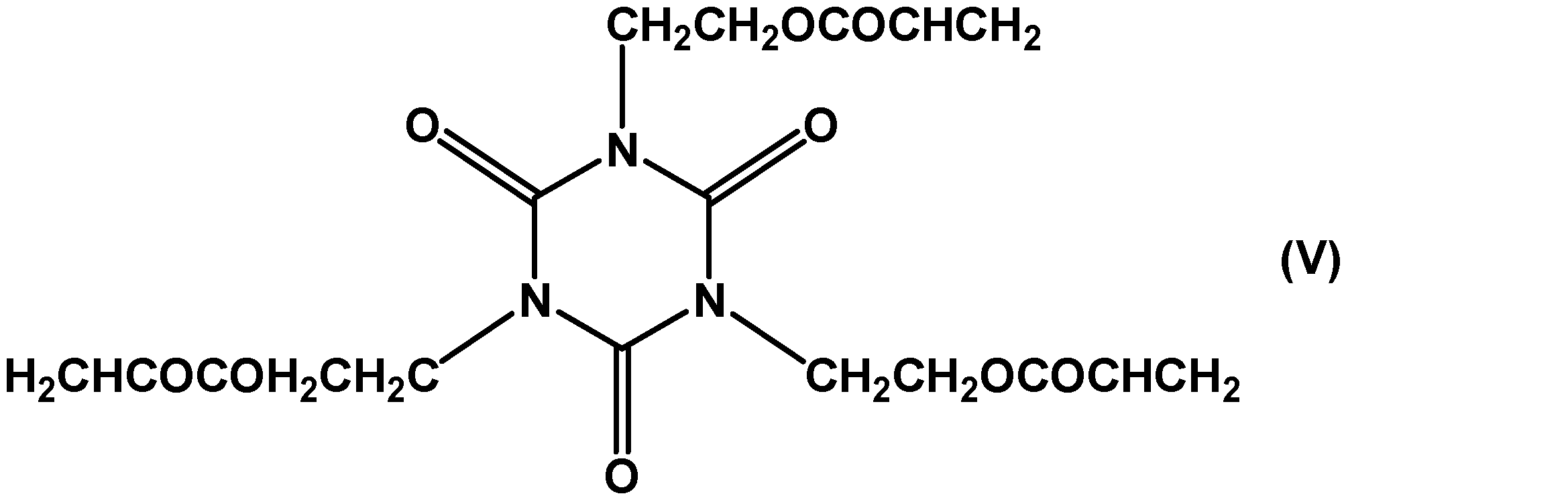
- a compound represented by the general formula (V) is particularly preferable.
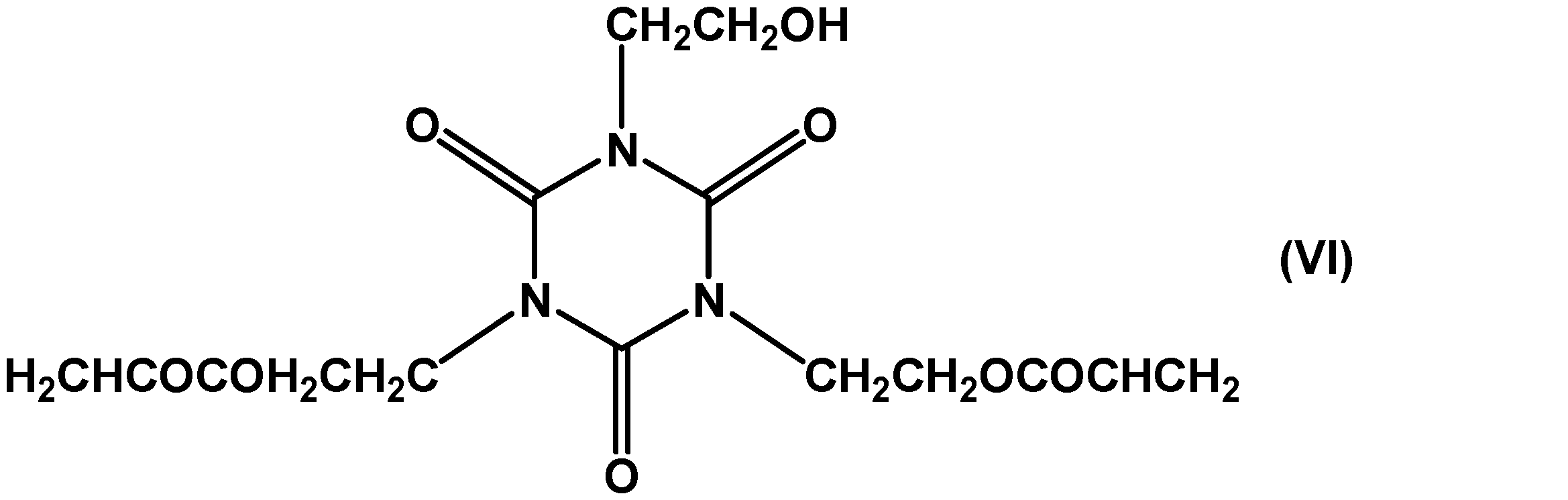
- a compound represented by the general formula (VI) is particularly preferable.
- Examples of commercially available compounds represented by the above general formula (I) include NK oligo UA-21 (trade name of Shin-Nakamura Chemical Co., Ltd., general formula (I), wherein R 1 is all represented by the general formula ( Compound IV), M-315 (trade name of Toa Gosei Co., Ltd., a compound in which R 1 is all of the general formula (II) in general formula (I)), M-215 (trade name of Toa Gosei Co., Ltd.) In general formula (I), two R 1 are general formula (II), and one R 1 is general formula (III)) etc. are mentioned.
- the content of the photopolymerizable compound having at least one unsaturated group and an isocyanuric ring structure in the molecule is 100 masses of the total amount of the component (A) and the component (B) from the viewpoint of adhesion and film formation.
- the amount is preferably 1 to 40 parts by mass, more preferably 3 to 30 parts by mass, and still more preferably 6 to 25 parts by mass.
- Component (B2) Component obtained by reacting polyhydric alcohol and / or glycidyl group-containing compound with ⁇ , ⁇ -unsaturated carboxylic acid (B2)
- Component includes, for example, polyethylene glycol di (meth) acrylate (ethylene group) Polyalkylene glycol di (meth) acrylates such as polypropylene glycol di (meth) acrylate (having 2 to 14 propylene groups); trimethylolpropane di (meth) acrylate, Trimethylolpropane (meth) acrylate compounds such as methylolpropane tri (meth) acrylate, trimethylolpropane ethoxytri (meth) acrylate, trimethylolpropane propoxytri (meth) acrylate; tetramethylolmethane tri (meth) acrylate, Tetramethylolmethane (meth) acrylate compounds such as lamethylolmethane tetra (meth) acryl
- group di (meth) acrylate compound is included as (B2) component at the point which is excellent in adhesiveness.
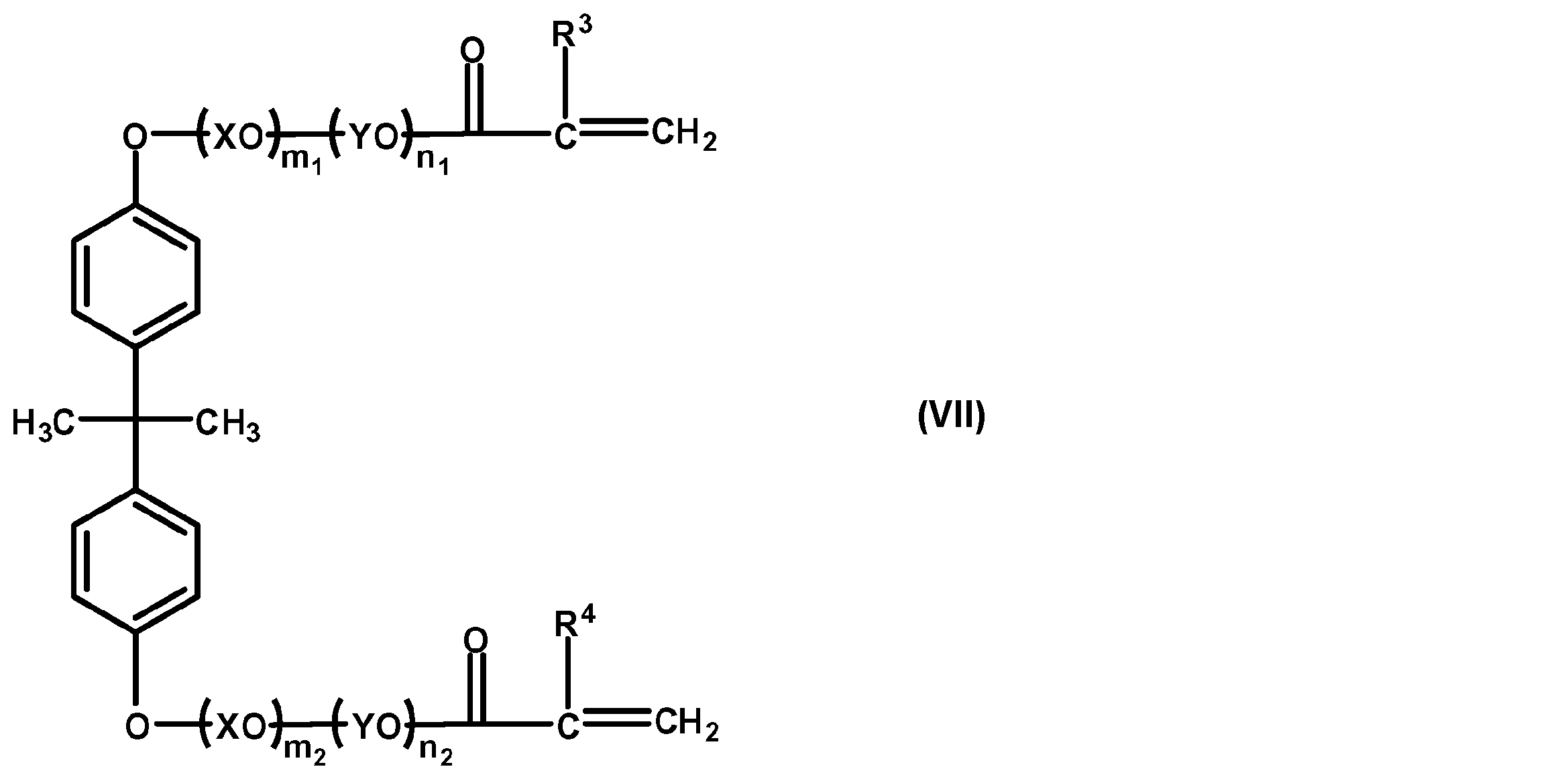
- Examples of the bisphenol A-based di (meth) acrylate compound include compounds represented by the following general formula (VII).
- R 3 and R 4 each independently represent a hydrogen atom or a methyl group.
- XO and YO each independently represent an oxyethylene group or an oxypropylene group, which are different from each other.
- (XO) m 1 , (XO) m 2 , (YO) n 1 and (YO) n 2 each independently represent a (poly) oxyethylene chain or a (poly) oxypropylene chain.
- m 1 , m 2 , n 1 and n 2 each independently represents an integer of 0 to 40.
- n 1 + n 2 is 0 to 20
- XO is an oxypropylene group and YO is an oxypropylene group
- m 1 + m 2 is 1 to 40
- n 1 + n 2 is 0 to 20
- XO is an oxypropylene group and YO is an oxyethylene group
- m 1 + m 2 is 0 to 20
- n 1 + n 2 is 1 to 40.
- 2,2-bis (4- (methacryloxypentaethoxy) phenyl) propane is BPE-500 (trade name, manufactured by Shin-Nakamura Chemical Co., Ltd.) or It is commercially available as FA-321M (trade name, manufactured by Hitachi Chemical Co., Ltd.).
- 2,2-bis (4- (methacryloxypentadecaethoxy) phenyl) propane is commercially available as BPE-1300 (trade name, manufactured by Shin-Nakamura Chemical Co., Ltd.). These may be used alone or in any combination of two or more.
- the bisphenol A (meth) acrylate compound is preferably used in combination with the trimethylolpropane (meth) acrylate compound.
- the content of the component (B2) in the photosensitive resin composition is 1 to 20 parts by mass with respect to 100 parts by mass of the total amount of the component (A) and the component (B) in terms of excellent film formability. Is preferably 5 to 15 parts by mass.
- Component (B3) Compound having one ethylenically unsaturated bond in the molecule
- Examples of the compound having one ethylenically unsaturated bond in the molecule include nonylphenoxypolyethyleneoxyacrylate, phthalic acid compounds, and (meth) Examples include alkyl acrylates.
- nonylphenoxypolyethyleneoxyacrylate or a phthalic acid-based compound from the viewpoint of improving the resolution, adhesion, resist shape, and release property after curing in a well-balanced manner.
- the component (B3) is not particularly limited, but preferably includes a compound represented by the following general formula (IX) in terms of excellent resolution.
- R 5 represents a hydrogen atom or a methyl group
- R 6 represents a hydrogen atom, a methyl group or a halogenated methyl group
- R 7 represents an alkyl group having 1 to 6 carbon atoms, a halogen atom. It represents either an atom or a hydroxyl group
- p represents an integer of 0 to 4.
- a plurality of R 7 may be the same or different.
- Examples of the compound represented by the general formula (IX) include ⁇ -chloro- ⁇ -hydroxypropyl- ⁇ ′-(meth) acryloyloxyethyl-o-phthalate, ⁇ -hydroxyethyl- ⁇ ′-(meth).
- Examples include acryloyloxyethyl-o-phthalate and ⁇ -hydroxypropyl- ⁇ '-(meth) acryloyloxyethyl-o-phthalate, among which ⁇ -chloro- ⁇ -hydroxypropyl- ⁇ '-(meth) acryloyl Oxyethyl-o-phthalate is preferred.
- ⁇ -Chloro- ⁇ -hydroxypropyl- ⁇ '-methacryloyloxyethyl-o-phthalate is commercially available as FA-MECH (product name, manufactured by Hitachi Chemical Co., Ltd.).
- the content of the component (B3) in the photosensitive resin composition is 1 to 15 parts by mass with respect to 100 parts by mass of the total amount of the component (A) and the component (B) in terms of excellent film formability. Is preferably 5 to 15 parts by mass.
- the component (B3) can be used alone or in combination of two or more. Among them, nonylphenoxypolyethyleneoxyacrylate and a phthalic acid compound are preferably used in combination.
- (C) Component Photopolymerization Initiator Next, the photopolymerization initiator that is the (C) component will be described.
- fragrances such as benzophenone, 2-benzyl-2-dimethylamino-1- (4-morpholinophenyl) -butanone-1, 2-methyl-1- [4- (methylthio) phenyl] -2-morpholino-propanone-1
- Quinones such as alkyl anthraquinones; benzoin ether compounds such as benzoin alkyl ether; benzoin compounds such as benzoin and alkyl benzoin; benzyl derivatives such as benzyldimethyl ketal; 2- (o-chlorophenyl) -4,5-diphenylimidazole Dimer, 2,4,5-triarylimidazole dimer such as 2- (o-fluorophenyl) -4,5-diphenylimidazole dimer; 9-phenylacridine, 1,7- (9,9 Acridine derivatives such as' -a
- the component (C) preferably contains a 2,4,5-triarylimidazole dimer from the viewpoint of improving the sensitivity at the time of resist pattern formation and the adhesion of the formed resist pattern, and 2- (o- More preferably, it includes (chlorophenyl) -4,5-diphenylimidazole dimer.
- the 2,4,5-triarylimidazole dimer may be symmetric or asymmetric in structure.
- Component (D) Inorganic black pigment
- the inorganic black pigment of component (D) include titanium black, carbon black, cobalt black and the like, and titanium black is preferably used from the viewpoint of patterning properties.
- the particle size of the inorganic black pigment is preferably 1 nm to 10 ⁇ m and more preferably 10 nm to 1 ⁇ m from the viewpoint of suppressing aggregation. If it is 1 nm or less, it is difficult to obtain industrially, and if it is 10 ⁇ m or more, the patterning property may be affected.
- Surfactant As the surfactant of the above component (E), for example, surfactants represented by imidazoline, unsaturated polycarboxylic acid polymer, alkylammonium salt of polycarboxylic acid, polysiloxane copolymer, etc. Is mentioned. Examples of commercially available products include homogenol L-100, homogenol L-18 (trade name, manufactured by Kao Corporation), Disperbyk-116, Disperbyk-108 (trade name, manufactured by Big Chemie Japan Co., Ltd.), and the like.
- an imidazoline surfactant From the viewpoint of the dispersion stability of the (D) inorganic black pigment in the photosensitive resin composition solution and the appearance of the coating film when forming the photosensitive element, it is preferable to use an imidazoline surfactant.
- the carbon at the 2-position of the imidazoline is substituted with a linear saturated or unsaturated hydrocarbon group having 6 to 20 carbon atoms, and the nitrogen at the 3-position is substituted with a hydroxyethyl group.
- imidazoline derivatives a compound represented by the following formula (VIII) is preferably used, and homogenol L-95 (product name, manufactured by Kao Corporation) is commercially available.
- the mercapto group-containing compound functions as a hydrogen donor for (C) the photopolymerization initiator.
- the mercapto group-containing compound of the component (F) as long as it contains a mercapto group, it can be used without particular limitation as long as it does not inhibit the effects of the present invention. In terms of excellent resin transparency after exposure, it preferably contains a mercapto group-containing hydrogen donor compound containing an aromatic ring, and preferably contains a mercapto group-containing hydrogen donor compound containing a heterocyclic ring.
- mercaptobenzoxazole in combination with a photoinitiator, characteristics such as sensitivity, resolution, and adhesion are good, and from the viewpoint of being industrially available, mercaptobenzoxazole, mercaptobenzimidazole, mercaptobenzotriazole, mercaptobenzothiazole, di- It is more preferable to include at least one selected from mercaptothiadiazole and mercaptodimethylaminopyridine, and it is more preferable to include at least one selected from mercaptobenzimidazole and mercaptobenzoxazole.
- the content of the component (A) in the photosensitive resin composition is 100 parts by mass of the total amount of the component (A) and the component (B) from the viewpoint of the coating properties of the photosensitive resin composition and the mechanical strength of the photocured product.
- the content is preferably in the range of 40 to 80 parts by mass, and more preferably 45 to 70 parts by mass.
- the content of the component (B) in the photosensitive resin composition is 20 to 60 masses with respect to 100 parts by mass of the total amount of the components (A) and (B), from the viewpoints of resolution, adhesion, and film formability.
- the range is preferably in the range of 30 parts by weight, and more preferably 30 to 55 parts by weight.
- the content of the (C) photopolymerization initiator in the photosensitive resin composition is 100 parts by mass of the total amount of the component (A) and the component (B) from the viewpoints of sensitivity, adhesion, and curability at the bottom of the photocured product.
- the content is preferably 0.1 to 20 parts by mass, and more preferably 0.2 to 10 parts by mass.
- the content of hexaarylbiimidazole in the component (C) is preferably 10 to 90% by mass, and preferably 20 to 80% by mass from the viewpoint of adhesion and suppression of development sludge during development processing. More preferred.
- the content of the (D) inorganic black pigment in the photosensitive resin composition is the components (A) and ((A) and (A) from the viewpoint of the light shielding properties, dispersion stability, and appearance of the coating film when the photosensitive element is formed.
- the total amount of component B) is preferably from 0.1 to 10 parts by weight, more preferably from 0.2 to 5 parts by weight, based on 100 parts by weight.
- the content of the (E) surfactant in the photosensitive resin composition is (A) from the viewpoint of the light shielding properties, dispersion stability, coating film appearance during film formation of the photosensitive element, and film handling properties.
- Component and (B) component the total amount is preferably 0.01 to 5 parts by mass, more preferably 0.05 to 3 parts by mass, and 0.1 to 1 part by mass with respect to 100 parts by mass. More preferably, it is 0.1 to 0.9 parts by mass.
- the resin composition containing the above components may further include a thermochromic inhibitor, a plasticizer such as p-toluenesulfonamide, a pigment, a filler, an antifoaming agent, a flame retardant, a stabilizer, and adhesion.
- a thermochromic inhibitor such as p-toluenesulfonamide
- a pigment such as a pigment
- a filler such as a plasticizer
- an antifoaming agent such as p-toluenesulfonamide
- a pigment such as p-toluenesulfonamide
- a pigment such as p-toluenesulfonamide
- a pigment such as p-toluenesulfonamide
- a pigment such as p-toluenesulfonamide
- a filler such as p-toluenesulfonamide
- an antifoaming agent such as a
- the dye such as leuco crystal violet preferably does not contain 0.1 part by mass or more, and does not contain 0.01 part by mass or more with respect to 100 parts by mass of the total amount of component (A) and component (B). More preferably, it is more preferable not to contain 0.001 part by mass or more.
- the photosensitive resin composition of the present invention containing the above components can be obtained, for example, by uniformly kneading and mixing the components with a roll mill, a bead mill or the like. If necessary, it can be dissolved in a solvent such as methanol, ethanol, acetone, methyl ethyl ketone, methyl cellosolve, ethyl cellosolve, toluene, N, N-dimethylformamide, propylene glycol monomethyl ether, or a mixed solvent thereof to obtain a solid content of 30 It can be used as a solution of about ⁇ 60 mass%.
- a solvent such as methanol, ethanol, acetone, methyl ethyl ketone, methyl cellosolve, ethyl cellosolve, toluene, N, N-dimethylformamide, propylene glycol monomethyl ether, or a mixed solvent thereof to obtain a solid content of 30 It can be used as a solution
- a method for forming (laminating) the photosensitive material composition layer on the substrate of the image display device using the obtained photosensitive resin composition is not particularly limited, but the photosensitive resin composition is liquid on the substrate.
- a method of applying and drying as a resist can be used.
- a protective film can be coat
- the thickness of the photosensitive resin composition layer to be applied varies depending on the use, but is preferably about 1 to 100 ⁇ m after drying.
- Examples of the protective film in the case where the protective film is used after being coated as a liquid resist include polymer films such as polyethylene and polypropylene.
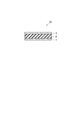
- FIG. 1 is a schematic cross-sectional view showing a preferred embodiment of the photosensitive element of the present invention.
- the photosensitive element 10 of the present invention includes a support 1, a photosensitive resin composition layer 2 made of the photosensitive resin composition formed thereon, and a photosensitive resin composition layer.
- the protective film 3 is provided as needed.
- a polymer film of polyethylene terephthalate, polypropylene, polyethylene, polyester, or the like can be preferably used as the support 1, for example, a polymer film of polyethylene terephthalate, polypropylene, polyethylene, polyester, or the like can be preferably used.
- the thickness of the polymer film is preferably about 1 to 100 ⁇ m, more preferably 5 to 50 ⁇ m, and even more preferably 10 to 30 ⁇ m.
- the formation method of the photosensitive resin composition layer 2 on the support 1 is not particularly limited, it can be preferably carried out by applying and drying a solution of the photosensitive resin composition.
- the thickness of the applied photosensitive resin composition layer 2 varies depending on the use, but is preferably about 1 to 100 ⁇ m after drying. When used in this application, the thickness of the photosensitive resin composition layer 2 is more preferably 10 to 100 ⁇ m after drying, more preferably 20 to 90 ⁇ m, and more preferably 30 to 80 ⁇ m. Is particularly preferred.
- Application can be performed by a known method such as a roll coater, comma coater, gravure coater, air knife coater, die coater, bar coater, or the like. Drying can be performed at 70 to 150 ° C. for about 5 to 30 minutes. Moreover, it is preferable that the amount of the residual organic solvent in the photosensitive resin composition layer 2 shall be 2 mass% or less from the point which prevents the spreading
- the surface of the photosensitive resin composition layer 2 may be coated using the polymer film used as the support 1 as the protective film 3.
- the protective film 3 has a smaller adhesive force between the photosensitive resin composition layer 2 and the protective film 3 than the adhesive force between the photosensitive resin composition layer 2 and the support 1. Also preferred is a low fisheye film.
- the photosensitive element 10 includes an intermediate layer and a protective layer such as a cushion layer, an adhesive layer, a light absorption layer, and a gas barrier layer in addition to the photosensitive resin composition layer 2, the support 1 and the optional protective film 3. You may do it.
- the manufactured photosensitive element 10 is usually stored by being wound around a cylindrical winding core. At this time, it is preferable that the support 1 is wound up so as to be on the outside.
- An end face separator is preferably installed on the end face of the roll-shaped photosensitive element roll from the viewpoint of end face protection, and a moisture-proof end face separator is preferably installed from the viewpoint of edge fusion resistance.
- a packing method it is preferable to wrap and package in a black sheet with low moisture permeability.
- the core include plastics such as polyethylene resin, polypropylene resin, polystyrene resin, polyvinyl chloride resin, and ABS resin (acrylonitrile-butadiene-styrene copolymer).
- a method for forming partition walls of an image display device includes a step of laminating a photosensitive resin composition or a photosensitive resin composition layer using a photosensitive element on a substrate of the image display device, and the photosensitive resin composition.
- a photosensitive resin composition layer is laminated on a substrate of an image display device using the above-described photosensitive resin composition of the present invention.
- the substrate include an insulating substrate such as a glass substrate or a polymer substrate, a semiconductor substrate such as a silicon substrate, a substrate on which an electrode such as ITO is formed, or a glass substrate on which a color filter is formed.
- the above-described coating method is used, and a photosensitive element can also be used.
- the laminating method using the photosensitive element when a protective film is present on the photosensitive resin composition layer, it is laminated on the substrate while removing the protective film.
- a protective film is present on the photosensitive resin composition layer
- it is laminated on the substrate while removing the protective film.
- lamination conditions for example, by heating the photosensitive resin composition layer to about 70 to 130 ° C., pressure bonding is performed on the substrate at a pressure of about 0.1 to 1 MPa (about 1 to 10 kgf / cm 2 ).
- stacking etc. is mentioned, It is also possible to laminate
- the shape of the substrate surface is usually flat, but irregularities and electrode patterns may be formed as necessary.
- the photosensitive resin composition layer is irradiated with actinic rays in an image form to photocur the exposed portion.
- actinic rays in an image form there is a method of setting a mask pattern on the photosensitive resin composition layer and irradiating the image form with an actinic ray and photocuring the photosensitive resin composition layer in the exposed portion. is there.
- the mask pattern may be a negative type or a positive type, and a commonly used one can be used.
- a known light source for example, a light source that effectively emits ultraviolet light, visible light, or the like, such as a carbon arc lamp, a mercury vapor arc lamp, a high-pressure mercury lamp, or a xenon lamp is used.
- a direct drawing exposure method in which a pattern is directly drawn with a laser without using a mask pattern can also be used.
- a photocured product pattern is formed on the substrate for the image display device by selectively removing the photosensitive resin composition layer in the unexposed portion by development.
- the development step when a support is present, the support is removed prior to development.
- Development is performed by removing unexposed portions by wet development, dry development, or the like using a developer such as an alkaline aqueous solution, an aqueous developer, or an organic solvent. In the present invention, it is preferable to use an alkaline aqueous solution.
- alkaline aqueous solution examples include a dilute solution of 0.1 to 5% by mass sodium carbonate, a dilute solution of 0.1 to 5% by mass potassium carbonate, a dilute solution of 0.1 to 5% by mass sodium hydroxide, and the like.
- the pH of the alkaline aqueous solution is preferably in the range of 9 to 11, and the temperature is adjusted according to the developability of the photosensitive resin composition layer. Moreover, you may mix surfactant, an antifoamer, an organic solvent, etc. in alkaline aqueous solution.
- Examples of the development method include a dip method, a spray method, brushing, and slapping.
- the formed photocured product pattern may be further cured by a heat treatment at about 60 to 250 ° C., if necessary.
- the method for manufacturing an image display device of the present invention includes a step of filling or applying a display medium such as particles in the partition obtained in the above step, and a step of attaching a substrate to the opposite side of the partition so as to face one substrate.
- the substrate include an insulating substrate such as a glass substrate or a polymer substrate, a semiconductor substrate such as a silicon substrate, or a substrate on which an electrode such as ITO is formed.
- an electrode substrate 30 comprising an electrode 4 and a substrate 5 is prepared.
- the above-described photosensitive element 10 is formed on the electrode substrate 30.
- the photosensitive resin composition layer 2 and the support 1 are laminated (lamination step).
- the photosensitive resin composition layer 2 is irradiated with an actinic ray 8 in an image form using a mask pattern 7, and an exposed portion is formed. Photocuring (exposure process).
- the photosensitive resin composition layer 2 in the unexposed area is selectively removed by development to be photocured on the substrate for the image display device (electrode substrate 30).
- An object pattern 20 is formed (development process).
- the step of attaching another electrode substrate 30 to the photocured material pattern 20 can be performed as follows. That is, in the above process, the adhesive 40 is laminated on the photocured material pattern 20 as shown in FIG. 2D, and the electrode substrate 30 and the photocured material are cured by the adhesive 40 as shown in FIG. This is done by adhering the object pattern 20.
- a transparent electrode substrate is used at least for the electrode substrate on the display surface side of the image display device.
- Example 1 Examples 1 to 4 and Comparative Examples 1 to 3
- the materials shown in Table 1 were mixed with stirring to obtain a photosensitive resin composition solution.
- the resin (1) as component (A) in Table 1 was synthesized according to Synthesis Example 1 below.
- the unit of the compounding quantity of each material is g in Table 1, and the compounding quantity of resin (1) shows the compounding quantity of solid content.
- a solution prepared by dissolving 0.5 g of azobisisobutyronitrile in 150 g of a mixture of methyl cellosolve and toluene having a mass ratio of 3: 2 was dropped into the flask over 10 minutes.
- Dilution with a solvent gave a binder polymer (resin (1)).
- the obtained binder polymer had a weight average molecular weight of 50,000, a dispersity of 2.0, and an acid value of 195 mgKOH / g.
- the weight average molecular weight of the binder polymer was measured by gel permeation chromatography, and was derived by conversion using a standard polystyrene calibration curve.
- the measurement conditions of gel permeation chromatography (GPC) are shown below.
- the photosensitive resin composition solution obtained in Table 1 was uniformly applied onto a 16 ⁇ m-thick polyethylene terephthalate film (trade name: HTR-02, manufactured by Teijin DuPont Films, Ltd.), and hot air convection drying at 90 ° C. After drying for 10 minutes in a machine, the film is protected with a protective film made of polyethylene (tensile strength in the film longitudinal direction: 16 MPa, tensile strength in the film width direction: 12 MPa, trade name: NF-15, manufactured by Tamapoly Co., Ltd.). A sex element was obtained. The film thickness after drying of the photosensitive resin composition layer was 40 ⁇ m. About the obtained photosensitive element, the coating-film external appearance was evaluated by visual observation and microscopic observation. As a result, the appearance of the coating film of all the photosensitive elements was good.
- a glass substrate SiO 2 sputter; length 370 mm, width 480 mm, thickness 0.7 mm, manufactured by Mitsushi Kasei Co., Ltd., trade name: SP-SiO 2
- SP-SiO 2 glass surface
- the photosensitive element was laminated through a laminating roll heated to 110 ° C. while peeling off the polyethylene protective film so that the photosensitive resin composition layer was in contact with the glass surface.
- the resulting laminate has a glass substrate, a photosensitive resin composition layer, and a polyethylene terephthalate film from the bottom.
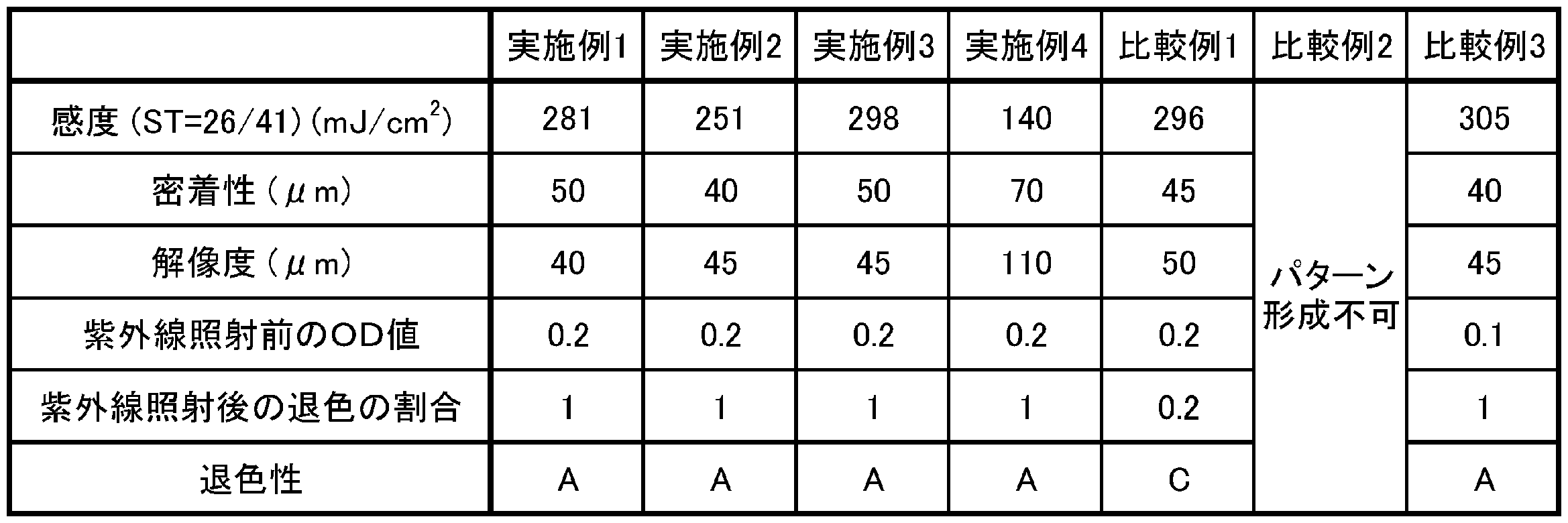
- the obtained laminate was evaluated for sensitivity, adhesion, resolution, and fading.
- the line width / space width is 30/400 to 200/400 (unit: ⁇ m, line width 5 ⁇ m) as a negative for adhesion evaluation
- a photo tool having a wiring pattern with a space pattern of increasing and a photo pattern having a 41-step tablet is brought into close contact with the polyethylene terephthalate film of the laminate, and the number of remaining step steps after development of the 41-step tablet is 26. Exposure was performed with an energy amount of 0.0.
- Adhesiveness is expressed by the width ( ⁇ m) of the thinnest line that remains without being peeled off by the developer. The smaller this value, the tighter the line is attached without peeling from the glass substrate. Indicates high. Table 2 shows the evaluation results.
- a scattered light exposure machine manufactured by Oak Manufacturing Co., Ltd.
- HMW-201GX having a high-pressure mercury lamp lamp
- exposure was performed with an energy amount such that the number of remaining step stages after development of the 41-step tablet was 26.0.
- the polyethylene terephthalate film was peeled off, and a 1% by mass aqueous sodium carbonate solution was sprayed at 30 ° C. for 30 seconds to remove the unexposed portion and evaluate the resolution.
- the resolution is represented by the smallest space width ( ⁇ m) in which the unexposed portion is well removed by the development processing, and the smaller the numerical value, the better the resolution.
- Table 2 shows the evaluation results.
- the dried laminate was used as a sample, and its OD (Optical Density) value was measured using a transmission densitometer (Ihara Electronics Co., Ltd.) Ihac-T5. In order to tighten the image on the display, the OD value is preferably around 0.2.
- the sample was irradiated with ultraviolet rays for 5 days with a light resistance tester (manufactured by Toyo Seiki Seisakusho, model number: Suntest XLS +), and OD was measured with a transmission densitometer (manufactured by Ihara Electronics Co., Ltd.) Ihac-T5. The value was measured and the rate of fading was calculated.
- the ratio of fading was calculated by the ratio of the OD value after ultraviolet irradiation to the OD value before ultraviolet irradiation, as shown in the following formula (X).
- Table 2 shows the OD value before ultraviolet irradiation (initial OD value) and the ratio of fading after ultraviolet irradiation.
- the fading due to heat was evaluated based on the rate of fading after UV irradiation.
- the evaluation results are shown in Table 2. The closer the numerical value of the fading rate after ultraviolet irradiation is to 1, the less the fading property (the less fading).
- the color fading property was low (the fading rate was over 0.7 to 1 or less) A, the fading color was slightly seen (the fading rate was over 0.2 to 0.7 or less) B, and the color fading property was large.
- the product (the fading rate is 0.2 or less) was evaluated as C.
- Examples 1 to 4 have good sensitivity, adhesion, and resolution, are less faded by ultraviolet rays, and are excellent in light resistance.
- a partition of an image display device having excellent light resistance can be formed, and a photosensitive resin composition having excellent patterning properties, a photosensitive element using the same, and a partition of an image display device And a method for manufacturing the image display device.
Landscapes
- Physics & Mathematics (AREA)
- General Physics & Mathematics (AREA)
- Spectroscopy & Molecular Physics (AREA)
- Chemical & Material Sciences (AREA)
- Engineering & Computer Science (AREA)
- Architecture (AREA)
- Structural Engineering (AREA)
- Chemical Kinetics & Catalysis (AREA)
- Ceramic Engineering (AREA)
- Materials For Photolithography (AREA)
- Electrochromic Elements, Electrophoresis, Or Variable Reflection Or Absorption Elements (AREA)
- Polymerisation Methods In General (AREA)
- Addition Polymer Or Copolymer, Post-Treatments, Or Chemical Modifications (AREA)
- Photosensitive Polymer And Photoresist Processing (AREA)
Abstract
Description
本発明の感光性樹脂組成物は、(A)バインダーポリマー、(B)光重合性化合物、(C)光重合開始剤、(D)無機系黒色顔料、(E)界面活性剤、及び、(F)メルカプト基含有化合物(メルカプト基含有水素供与体)を含有してなる。
本発明における(A)バインダーポリマーとしては、例えば、アクリル系樹脂、スチレン系樹脂、エポキシ系樹脂、アミド系樹脂、アミドエポキシ系樹脂、アルキド系樹脂、フェノール系樹脂が挙げられる。(A)バインダーポリマーとしては、アルカリ現像性の観点からは、アクリル系樹脂が好ましい。これらは単独で、又は2種類以上のバインダーポリマーを組み合わせて用いることができる。2種類以上のバインダーポリマーの組み合わせの例としては、異なる共重合成分からなる2種類以上のバインダーポリマー、異なる重量平均分子量の2種類以上のバインダーポリマー、異なる分散度の2種類以上のバインダーポリマーなどが挙げられる。また、特開平11-327137号公報記載のマルチモード分子量分布を有するポリマーを使用することもできる。
本実施形態に用いることのできる(B)成分としては、光架橋が可能であれば特に制限はないが、例えば、(B1)成分:分子内に少なくとも1つの不飽和基及びイソシアヌル環構造を有する光重合性化合物、(B2)成分:多価アルコール及び/又はグリシジル基含有化合物にα,β-不飽和カルボン酸を反応させて得られる化合物、(B3)成分:分子内にエチレン性不飽和結合を1つ有する化合物が挙げられる。これらは一種を単独で、又は二種以上を組み合わせて用いることができるが、本発明の感光性樹脂組成物は、これらの中でも、(B1)成分を必須成分として含む。
本発明における(B1)成分の光重合性化合物は、分子内に少なくとも1つの不飽和基及びイソシアヌル環構造を有していれば特に制限なく用いることができるが、さらに、分子内に少なくとも1つの水酸基を有していることが好ましい。



(B2)成分としては、例えば、ポリエチレングリコールジ(メタ)アクリレート(エチレン基の数が2~14のもの)、ポリプロピレングリコールジ(メタ)アクリレート(プロピレン基の数が2~14のもの)等のポリアルキレングリコールジ(メタ)アクリレート;トリメチロールプロパンジ(メタ)アクリレート、トリメチロールプロパントリ(メタ)アクリレート、トリメチロールプロパンエトキシトリ(メタ)アクリレート、トリメチロールプロパンプロポキシトリ(メタ)アクリレート等のトリメチロールプロパン(メタ)アクリレート化合物;テトラメチロールメタントリ(メタ)アクリレート、テトラメチロールメタンテトラ(メタ)アクリレート等のテトラメチロールメタン(メタ)アクリレート化合物;ジペンタエリスリトールペンタ(メタ)アクリレート、ジペンタエリスリトールヘキサ(メタ)アクリレート等のジペンタエリスリトール(メタ)アクリレート化合物;ビスフェノールAジオキシエチレンジ(メタ)アクリレート、ビスフェノールAトリオキシエチレンジ(メタ)アクリレート、ビスフェノールAデカオキシエチレンジ(メタ)アクリレート等のビスフェノールA系ジ(メタ)アクリレート化合物;トリメチロールプロパントリグリシジルエーテルトリアクリレート及びビスフェノールAジグリシジルエーテルアクリレートが挙げられる。
分子内にエチレン性不飽和結合を1つ有する化合物としては、例えば、ノニルフェノキシポリエチレンオキシアクリレート、フタル酸系化合物及び(メタ)アクリル酸アルキルエステルが挙げられる。

次に、(C)成分である光重合開始剤について説明する。
(D)成分の無機系黒色顔料としては、例えば、チタンブラック、カーボンブラック、コバルトブラック等が挙げられ、パターニング性の観点から、チタンブラックが好ましく用いられる。無機系黒色顔料の粒径は、凝集を抑える点では、1nm~10μmが好ましく、10nm~1μmがより好ましい。1nm以下は工業的に入手が難しく、また10μm以上だとパターニング性に影響を及ぼす可能性がある。
上記(E)成分の界面活性剤としては、例えば、イミダゾリン、不飽和ポリカルボン酸ポリマー、ポリカルボン酸のアルキルアンモニウム塩、ポリシロキサンコポリマー等に代表される界面活性剤が挙げられる。市販品としては、例えば、ホモゲノール L-100、ホモゲノール L-18(花王株式会社製、商品名)、Disperbyk-116、Disperbyk-108(ビックケミー・ジャパン株式会社製、商品名)等が挙げられる。

(F)メルカプト基含有化合物は、(C)光重合開始剤の水素供与体として機能するものである。上記(F)成分のメルカプト基含有化合物としては、メルカプト基を含有する限り、本発明の効果を阻害しない範囲であれば特に制限無く使用することができる。露光後の樹脂透明性に優れる点では、芳香族環を含むメルカプト基含有水素供与体化合物を含むことが好ましく、複素環を含むメルカプト基含有水素供与体化合物を含むことが好ましい。これらの中でも、光開始剤と組み合わせて感度、解像度、密着性などの特性が良好であり、工業的に入手可能な観点から、メルカプトベンゾオキサゾール、メルカプトベンゾイミダゾール、メルカプトベンゾトリアゾール、メルカプトベンゾチアゾール、ジメルカプトチアジアゾール、メルカプトジメチルアミノピリジンから選択される少なくとも一種を含むことがより好ましく、メルカプトベンゾイミダゾール、メルカプトベンゾオキサゾール、から選択される少なくとも一種を含むことがさらに好ましい。
図1は、本発明の感光性エレメントの好適な一実施形態を示す模式断面図である。図1に示すように、本発明の感光性エレメント10は、支持体1と、その上に形成された上記感光性樹脂組成物からなる感光性樹脂組成物層2と、感光性樹脂組成物層2上に形成された保護フィルム3と、を備える。なお、保護フィルム3は、必要に応じて設けられる。
次に、本発明の画像表示装置の隔壁の形成方法及び画像表示装置の製造方法について説明する。画像表示装置の隔壁の形成方法は、画像表示装置の基板上に、感光性樹脂組成物、又は感光性エレメントを用いて感光性樹脂組成物層を積層する積層工程と、上記感光性樹脂組成物層の所定部分に活性光線を照射して露光部を光硬化せしめる露光工程と、上記感光性樹脂組成物層の上記露光部以外の部分を除去して光硬化物パターンを形成する現像工程と、を有する。
表1に示す材料を撹拌混合し、感光性樹脂組成物の溶液を得た。なお、表1中の(A)成分である樹脂(1)は、下記の合成例1に従って合成した。また、表1中、各材料の配合量の単位はgであり、樹脂(1)の配合量は、固形分の配合量を示す。
[バインダーポリマーの合成]
撹拌機、還流冷却器、温度計、滴下ロート及び窒素ガス導入管を備えたフラスコに、質量比3:2であるメチルセロソルブ及びトルエンの配合物500gを加え、窒素ガスを吹き込みながら撹拌して、85℃まで加熱した。一方、重合性単量体としてメタクリル酸150g、メタクリル酸メチルエステル110g、アクリル酸エチルエステル65g、メタクリル酸ブチルエステル50g及びスチレン125gと、アゾビスイソブチロニトリル2.5gとを混合した溶液(以下、「溶液a」という)を用意し、85℃に加熱された質量比3:2であるメチルセロソルブ及びトルエンの上記配合物に溶液aを4時間かけて滴下した後、85℃で撹拌しながら2時間保温した。さらに、質量比3:2であるメチルセロソルブ及びトルエンの配合物150gにアゾビスイソブチロニトリル0.5gを溶解した溶液を、10分かけてフラスコ内に滴下した。滴下後の溶液を撹拌しながら85℃で5時間保温した後、冷却して不揮発分(固形分)が43質量%になるように、質量比3:2であるアセトン及びプロピレングリコールモノメチルエーテルの混合溶媒で希釈してバインダーポリマー(樹脂(1))を得た。得られたバインダーポリマーの重量平均分子量は50000、分散度は2.0、酸価は195mgKOH/gであった。
[GPC測定条件]
ポンプ:日立 L-6000型(株式会社日立製作所製)
カラム:Gelpack GL-R440 + GL-R450 + GL-R400M
カラム仕様:10.7mmφ × 300mm
溶離液:テトラヒドロフラン
測定温度:室温(20~25℃)
流量:2.05mL/分
濃度:120mg/5mL
注入量:200μL
圧力:49Kgf/cm2
検出器:日立 L-3300型RI(株式会社日立製作所製)
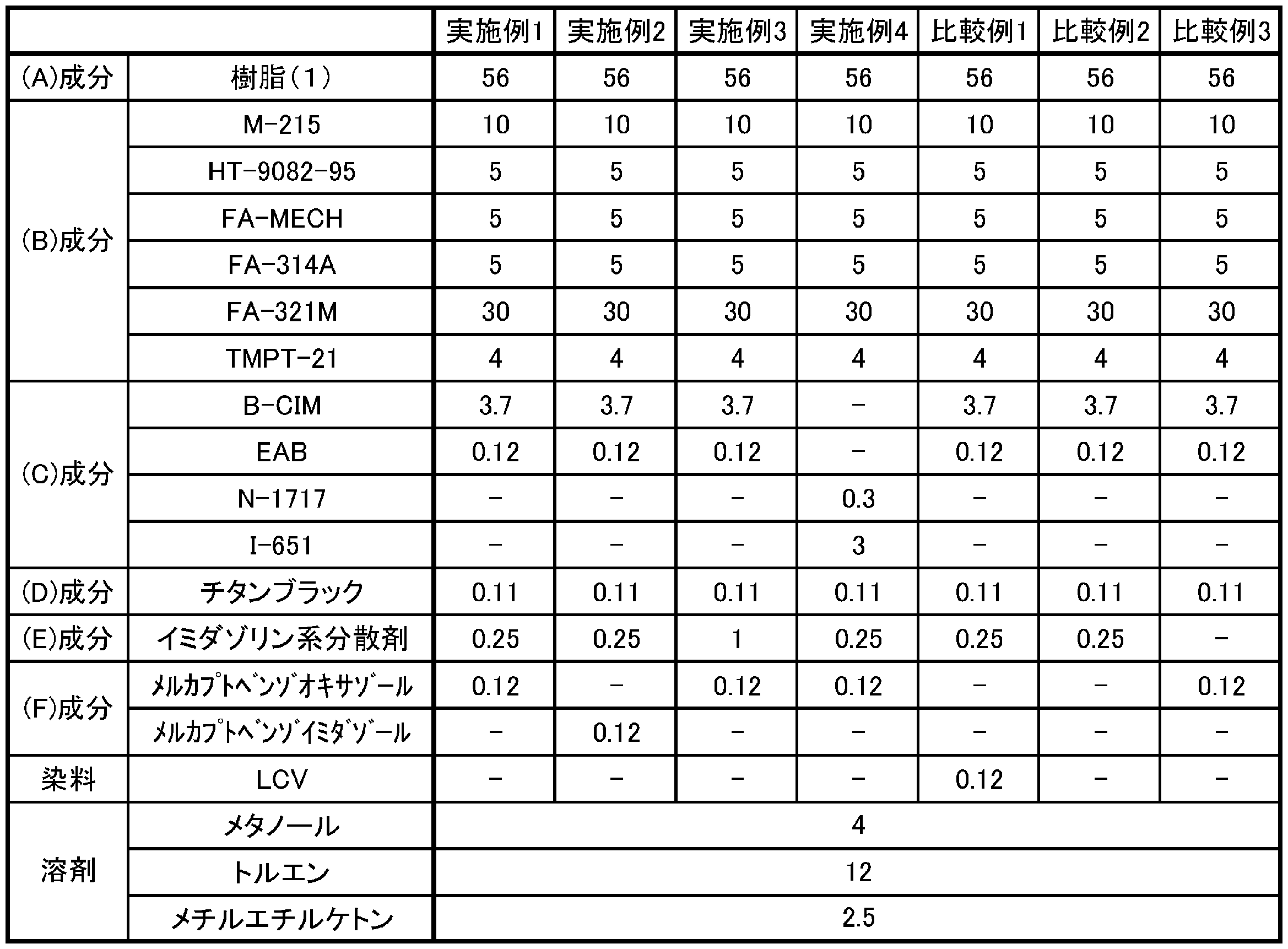
M-215;ビス(アクリロキシエチル)ヒドロキシエチルイソシアヌレート(東亜合成株式会社製、商品名)
HT-9082-95;アクリル樹脂溶液(末端にヒドロキシル基を有するポリカーボネート化合物、有機イソシアネート及び2-ヒドロキシエチルアクリレートを反応させて得られた光重合性化合物:重量平均分子量4000、日立化成工業株式会社製、商品名)
FA-MECH;γ-クロロ-2-ヒドロキシプロピル-β’-メタクリロイルオキシエチル-o-フタレート(大阪有機化学工業株式会社製、商品名)
FA-314A;ノニルフェニルEO変性モノアクリレート(1分子中にエチレンオキサイド(EO)基を4モル付加させたもの、日立化成工業株式会社製、商品名)
FA-321M;EO変性ビスフェノールAジメタクリレート(1分子中にエチレンオキサイド(EO)基を10モル付加させたもの、日立化成工業株式会社製、商品名)
TMPT-21;トリメチロールプロパンEO変性トリアクリレート(1分子中にエチレンオキサイド(EO)基を21モル付加させたもの、日立化成工業株式会社製、商品名)
B-CIM;2-(2-クロロフェニル)-1-[2-(2-クロロフェニル)-4,5-ジフェニル-1,3-ジアゾール-2-イル]-4,5-ジフェニルイミダゾール(保土ヶ谷化学工業株式会社製、商品名)
EAB;N,N’-テトラエチル-4,4’-ジアミノベンゾフェノン(保土ヶ谷化学工業株式会社製、商品名)
N-1717;1,7-ビス(9-アクリジニル)ヘプタン(株式会社ADEKA製、商品名)
I-651;ベンジルジメチルケタール(チバスペシャリティーケミカル社製、商品名)
チタンブラック;BT-1HCA(三菱マテリアル電子化成社製、商品名)
イミダゾリン系分散剤(界面活性剤);(花王株式会社製、商品名ホモゲノール L-95)
LCV;ロイコクリスタルバイオレット(山田化学株式会社製、商品名)
高圧水銀灯ランプを有する散乱光露光機(株式会社オーク製作所製)HMW-201GXを用いて、41段ステップタブレットを有するフォトツールを積層物のポリエチレンテレフタレートフィルム上に密着させ、露光を行った。露光後、ポリエチレンテレフタレートフィルムを剥離し、1質量%炭酸ナトリウム水溶液を30℃で30秒間スプレーすることにより、未露光部分を除去した。41段ステップタブレットの現像後の残存ステップ段数が26.0となるエネルギー量を感度(mJ/cm2)とした。このエネルギー量の数値が小さい程、感度が高いことを示す。表2に評価結果を示した。
高圧水銀灯ランプを有する散乱光露光機(株式会社オーク製作所製)HMW-201GXを用いて、密着性評価用ネガとしてライン幅/スペース幅が30/400~200/400(単位:μm、ライン幅5μmずつ増加、スペース幅一定)の配線パターンを有するフォトツールと、41段ステップタブレットを有するフォトツールとを積層物のポリエチレンテレフタレートフィルム上に密着させ、41段ステップタブレットの現像後の残存ステップ段数が26.0となるエネルギー量で露光を行った。露光後、ポリエチレンテレフタレートフィルムを剥離し、1質量%炭酸ナトリウム水溶液を30℃で30秒間スプレーすることにより、未露光部分を除去して密着性を評価した。密着性は現像液により剥離されずに残った最も細いラインの幅(μm)で表され、この数値が小さい程、細いラインでもガラス基板から剥離せずに密着していることから、密着性が高いことを示す。表2に評価結果を示した。
41段ステップタブレットを有するフォトツールと、解像度評価用ネガとしてライン幅/スペース幅が30/30~200/200(単位:μm)の配線パターンを有するフォトツールとを積層物のポリエチレンテレフタレートフィルム上に密着させ、高圧水銀灯ランプを有する散乱光露光機(株式会社オーク製作所製)HMW-201GXを用いて、41段ステップタブレットの現像後の残存ステップ段数が26.0となるエネルギー量で露光を行った。露光後、ポリエチレンテレフタレートフィルムを剥離し、1質量%炭酸ナトリウム水溶液を30℃で30秒間スプレーすることにより、未露光部分を除去して解像度を評価した。解像度は現像処理によって未露光部が良好に除去された最も小さいスペース幅(μm)で表され、この数値が小さいほど解像度は良好である。表2に評価結果を示した。
積層物に、高圧水銀灯ランプを有する散乱光露光機(株式会社オーク製作所製)HMW-201GXを用いて、41段ステップタブレットの現像後の残存ステップ段数が26.0となるエネルギー量で露光を行った。露光後、ポリエチレンテレフタレートフィルムを剥離し、1質量%炭酸ナトリウム水溶液を30℃で30秒間スプレーし、160℃に加熱した箱型乾燥機(三菱電機株式会社製、型番:NV50-CA)内に1時間静置した。乾燥後の積層物をサンプルとし、そのOD(Optical Density)値を、透過濃度計(伊原電子工業株式会社製)Ihac-T5を用いて測定した。ディスプレイの画像を引き締めるために、OD値は0.2付近が望ましい。次いで、サンプルに対し、耐光性試験機(株式会社東洋精器製作所製、型番:サンテストXLS+)にて5日間紫外線を照射し、透過濃度計(伊原電子工業株式会社製)Ihac-T5でOD値を測定し、退色の割合を算出した。退色の割合は、下記式(X)に示すように、紫外線照射前のOD値に対する紫外線照射後のOD値の割合により算出した。表2に紫外線照射前のOD値(初期OD値)及び紫外線照射後の退色の割合を示した。

Claims (9)
- 画像表示装置の隔壁を形成するための感光性樹脂組成物であって、
前記感光性樹脂組成物が、(A)バインダーポリマー、(B)光重合性化合物、(C)光重合開始剤、(D)無機系黒色顔料、(E)界面活性剤及び(F)メルカプト基含有化合物を含み、
前記(B)光重合性化合物が、分子内に少なくとも1つの不飽和基及びイソシアヌル環構造を有する光重合性化合物を含有する、感光性樹脂組成物。 - 前記分子内に少なくとも1つの不飽和基及びイソシアヌル環構造を有する光重合性化合物が、さらに、分子内に少なくとも1つの水酸基を有する、請求項1に記載の感光性樹脂組成物。
- 前記(D)無機系黒色顔料が、チタンブラックを含む、請求項1又は2に記載の感光性樹脂組成物。
- 前記(E)界面活性剤が、イミダゾリン系界面活性剤を含む、請求項1~3のいずれか一項に記載の感光性樹脂組成物。
- 支持体と、該支持体上に形成された請求項1~4のいずれか一項に記載の感光性樹脂組成物からなる感光性樹脂組成物層と、を備える感光性エレメント。
- 前記感光性樹脂組成物層の膜厚が10~100μmである、請求項5に記載の感光性エレメント。
- 画像表示装置の基板上に、請求項1~4のいずれか一項に記載の感光性樹脂組成物からなる感光性樹脂組成物層を積層する積層工程と、
前記感光性樹脂組成物層の所定部分に活性光線を照射して露光部を光硬化せしめる露光工程と、
前記感光性樹脂組成物層の前記露光部以外の部分を除去して光硬化物パターンを形成する現像工程と、
を有する、画像表示装置の隔壁の形成方法。 - 請求項7に記載の画像表示装置の隔壁の形成方法により形成された光硬化物パターンを、60~250℃で加熱処理して熱硬化せしめる加熱工程をさらに有する、画像表示装置の隔壁の形成方法。
- 表示媒体を、請求項7又は8に記載の方法により形成された隔壁内に充填又は塗布する工程と、
一方の基板に対向するように隔壁の反対側に基板を貼り付ける工程と、
を有する、画像表示装置の製造方法。
Priority Applications (5)
| Application Number | Priority Date | Filing Date | Title |
|---|---|---|---|
| US14/008,503 US9482946B2 (en) | 2011-03-30 | 2012-03-20 | Photosensitive resin composition, photosensitive element using same, method for forming partition wall of image display device, and method for manufacturing image display device |
| KR1020167030271A KR20160128464A (ko) | 2011-03-30 | 2012-03-22 | 감광성 수지 조성물, 이를 사용한 감광성 엘리먼트, 화상 표시 장치의 격벽의 형성 방법 및 화상 표시 장치의 제조 방법 |
| CN2012800158921A CN103460131A (zh) | 2011-03-30 | 2012-03-22 | 感光性树脂组合物、使用了其的感光性元件、图像显示装置的隔壁的形成方法及图像显示装置的制造方法 |
| KR1020137027775A KR20130132655A (ko) | 2011-03-30 | 2012-03-22 | 감광성 수지 조성물, 이를 사용한 감광성 엘리먼트, 화상 표시 장치의 격벽의 형성 방법 및 화상 표시 장치의 제조 방법 |
| JP2013507465A JP5660200B2 (ja) | 2011-03-30 | 2012-03-22 | 感光性樹脂組成物、これを用いた感光性エレメント、画像表示装置の隔壁の形成方法及び画像表示装置の製造方法 |
Applications Claiming Priority (2)
| Application Number | Priority Date | Filing Date | Title |
|---|---|---|---|
| JP2011074948 | 2011-03-30 | ||
| JP2011-074948 | 2011-03-30 |
Publications (1)
| Publication Number | Publication Date |
|---|---|
| WO2012133116A1 true WO2012133116A1 (ja) | 2012-10-04 |
Family
ID=46930843
Family Applications (1)
| Application Number | Title | Priority Date | Filing Date |
|---|---|---|---|
| PCT/JP2012/057364 Ceased WO2012133116A1 (ja) | 2011-03-30 | 2012-03-22 | 感光性樹脂組成物、これを用いた感光性エレメント、画像表示装置の隔壁の形成方法及び画像表示装置の製造方法 |
Country Status (6)
| Country | Link |
|---|---|
| US (1) | US9482946B2 (ja) |
| JP (1) | JP5660200B2 (ja) |
| KR (2) | KR20130132655A (ja) |
| CN (1) | CN103460131A (ja) |
| TW (1) | TW201308000A (ja) |
| WO (1) | WO2012133116A1 (ja) |
Cited By (4)
| Publication number | Priority date | Publication date | Assignee | Title |
|---|---|---|---|---|
| JP2015069161A (ja) * | 2013-09-30 | 2015-04-13 | 東京応化工業株式会社 | 感光性樹脂組成物、樹脂パターンの製造方法、及び表示装置 |
| JPWO2013115262A1 (ja) * | 2012-02-02 | 2015-05-11 | 日立化成株式会社 | 感光性樹脂組成物及びそれを用いた感光性エレメント、スペーサーの形成方法、並びに、スペーサー |
| CN104813231A (zh) * | 2012-11-27 | 2015-07-29 | 富士胶片株式会社 | 光硬化性组合物、转印材料、硬化物及其制造方法、树脂图案制造方法、硬化膜、液晶显示装置、有机el显示装置及触摸屏显示装置 |
| JPWO2023074630A1 (ja) * | 2021-10-26 | 2023-05-04 |
Families Citing this family (5)
| Publication number | Priority date | Publication date | Assignee | Title |
|---|---|---|---|---|
| TWI563030B (en) * | 2014-10-01 | 2016-12-21 | Chi Mei Corp | Photosensitive resin composition for black matrix, black matrix, color filter and method for manufacturing the same, and liquid crystal display apparatus |
| JP6482206B2 (ja) * | 2014-08-22 | 2019-03-13 | キヤノン株式会社 | 中空構造を有するパターンの形成方法 |
| CN108241259B (zh) * | 2018-01-24 | 2021-08-10 | 杭州福斯特电子材料有限公司 | 一种具有良好孔掩蔽功能可直接描绘曝光成像的抗蚀剂组合物 |
| KR20190094731A (ko) | 2018-02-05 | 2019-08-14 | 동우 화인켐 주식회사 | 착색 감광성 수지 조성물 및 이를 이용하여 제조된 컬러소자 및 표시장치 |
| WO2022210799A1 (ja) * | 2021-03-29 | 2022-10-06 | 株式会社カネカ | 基板積層体、イメージセンサ、及び基板積層体の製造方法 |
Citations (4)
| Publication number | Priority date | Publication date | Assignee | Title |
|---|---|---|---|---|
| WO2008146855A1 (ja) * | 2007-05-29 | 2008-12-04 | Asahi Glass Company, Limited | 感光性組成物、隔壁、ブラックマトリックス |
| JP2010066676A (ja) * | 2008-09-12 | 2010-03-25 | Hitachi Chem Co Ltd | 感光性樹脂組成物、これを用いた感光性エレメント、画像表示装置の隔壁の形成方法及び画像表示装置の製造方法 |
| JP2010237567A (ja) * | 2009-03-31 | 2010-10-21 | Fujifilm Corp | フォトマスクブランクス、及びフォトマスク |
| JP2010266861A (ja) * | 2009-04-16 | 2010-11-25 | Fujifilm Corp | カラーフィルタ用重合性組成物、カラーフィルタ、及び固体撮像素子 |
Family Cites Families (12)
| Publication number | Priority date | Publication date | Assignee | Title |
|---|---|---|---|---|
| JP4563936B2 (ja) * | 2003-04-10 | 2010-10-20 | 株式会社カネカ | 硬化性組成物 |
| US20050288166A1 (en) * | 2004-06-24 | 2005-12-29 | Jun-Kyu Cha | Lead-free black ceramic composition for filter and filter formed using the same |
| JP2007072035A (ja) | 2005-09-06 | 2007-03-22 | Tokyo Ohka Kogyo Co Ltd | 感光性組成物 |
| JP5066337B2 (ja) | 2005-12-28 | 2012-11-07 | 株式会社ブリヂストン | 情報表示用パネル |
| JP2007249190A (ja) | 2006-02-14 | 2007-09-27 | Fujifilm Electronic Materials Co Ltd | 光硬化性組成物、それを用いた反射防止膜、及び固体撮像素子 |
| KR101030022B1 (ko) * | 2007-09-11 | 2011-04-20 | 제일모직주식회사 | 안료 분산액 조성물, 이를 포함하는 컬러필터용 레지스트조성물 및 이로부터 제조된 컬러필터 |
| JP5589270B2 (ja) | 2007-10-23 | 2014-09-17 | Jsr株式会社 | 青色カラーフィルタ用感放射線性組成物、カラーフィルタ及び液晶表示素子 |
| JP5512095B2 (ja) | 2008-04-28 | 2014-06-04 | 富士フイルム株式会社 | 感光性組成物、固体撮像素子用感光性組成物、固体撮像素子用遮光性カラーフィルタ、及び固体撮像素子 |
| JP4935833B2 (ja) | 2009-01-23 | 2012-05-23 | 日立化成工業株式会社 | 感光性樹脂組成物、これを用いた感光性エレメント、画像表示装置の隔壁の形成方法及び画像表示装置の製造方法 |
| JP4873043B2 (ja) | 2009-04-28 | 2012-02-08 | 日立化成工業株式会社 | 感光性樹脂組成物、これを用いた感光性エレメント、画像表示装置の隔壁の形成方法及び画像表示装置の製造方法 |
| JPWO2010134550A1 (ja) | 2009-05-20 | 2012-11-12 | 旭硝子株式会社 | 光学素子の製造方法 |
| JP6076738B2 (ja) * | 2009-09-11 | 2017-02-08 | ジェイピー ラボラトリーズ インコーポレイテッド | ナノ構造の変形、破壊、および変換に基づくモニタリング装置およびモニタリング方法 |
-
2012
- 2012-03-20 US US14/008,503 patent/US9482946B2/en not_active Expired - Fee Related
- 2012-03-22 KR KR1020137027775A patent/KR20130132655A/ko not_active Ceased
- 2012-03-22 CN CN2012800158921A patent/CN103460131A/zh active Pending
- 2012-03-22 JP JP2013507465A patent/JP5660200B2/ja not_active Expired - Fee Related
- 2012-03-22 KR KR1020167030271A patent/KR20160128464A/ko not_active Ceased
- 2012-03-22 WO PCT/JP2012/057364 patent/WO2012133116A1/ja not_active Ceased
- 2012-03-28 TW TW101110833A patent/TW201308000A/zh unknown
Patent Citations (4)
| Publication number | Priority date | Publication date | Assignee | Title |
|---|---|---|---|---|
| WO2008146855A1 (ja) * | 2007-05-29 | 2008-12-04 | Asahi Glass Company, Limited | 感光性組成物、隔壁、ブラックマトリックス |
| JP2010066676A (ja) * | 2008-09-12 | 2010-03-25 | Hitachi Chem Co Ltd | 感光性樹脂組成物、これを用いた感光性エレメント、画像表示装置の隔壁の形成方法及び画像表示装置の製造方法 |
| JP2010237567A (ja) * | 2009-03-31 | 2010-10-21 | Fujifilm Corp | フォトマスクブランクス、及びフォトマスク |
| JP2010266861A (ja) * | 2009-04-16 | 2010-11-25 | Fujifilm Corp | カラーフィルタ用重合性組成物、カラーフィルタ、及び固体撮像素子 |
Cited By (7)
| Publication number | Priority date | Publication date | Assignee | Title |
|---|---|---|---|---|
| JPWO2013115262A1 (ja) * | 2012-02-02 | 2015-05-11 | 日立化成株式会社 | 感光性樹脂組成物及びそれを用いた感光性エレメント、スペーサーの形成方法、並びに、スペーサー |
| CN104813231A (zh) * | 2012-11-27 | 2015-07-29 | 富士胶片株式会社 | 光硬化性组合物、转印材料、硬化物及其制造方法、树脂图案制造方法、硬化膜、液晶显示装置、有机el显示装置及触摸屏显示装置 |
| JP6045603B2 (ja) * | 2012-11-27 | 2016-12-14 | 富士フイルム株式会社 | 光硬化性組成物、転写材料、硬化物の製造方法、樹脂パターン製造方法、硬化膜、液晶表示装置、有機el表示装置並びにタッチパネル表示装置 |
| CN104813231B (zh) * | 2012-11-27 | 2018-12-04 | 富士胶片株式会社 | 光硬化性组合物、转印材料、硬化物及其制造方法、树脂图案制造方法、硬化膜及其应用 |
| JP2015069161A (ja) * | 2013-09-30 | 2015-04-13 | 東京応化工業株式会社 | 感光性樹脂組成物、樹脂パターンの製造方法、及び表示装置 |
| JPWO2023074630A1 (ja) * | 2021-10-26 | 2023-05-04 | ||
| WO2023074630A1 (ja) * | 2021-10-26 | 2023-05-04 | 株式会社レゾナック | 感光性樹脂組成物、感光性エレメント、及び、積層体の製造方法 |
Also Published As
| Publication number | Publication date |
|---|---|
| JP5660200B2 (ja) | 2015-01-28 |
| US20140087619A1 (en) | 2014-03-27 |
| US9482946B2 (en) | 2016-11-01 |
| CN103460131A (zh) | 2013-12-18 |
| KR20160128464A (ko) | 2016-11-07 |
| JPWO2012133116A1 (ja) | 2014-07-28 |
| TW201308000A (zh) | 2013-02-16 |
| KR20130132655A (ko) | 2013-12-04 |
Similar Documents
| Publication | Publication Date | Title |
|---|---|---|
| JP5660200B2 (ja) | 感光性樹脂組成物、これを用いた感光性エレメント、画像表示装置の隔壁の形成方法及び画像表示装置の製造方法 | |
| JP6019791B2 (ja) | 隔壁形成材料、これを用いた感光性エレメント、隔壁の形成方法及び画像表示装置の製造方法 | |
| CN101218538B (zh) | 感光性树脂组合物和使用其的感光性部件,抗蚀剂图案的形成方法,印刷配线板的制造方法和等离子显示面板用间隔壁的制造方法 | |
| JP5884337B2 (ja) | 感光性樹脂組成物、これを用いた感光性エレメント、画像表示装置の隔壁の形成方法、画像表示装置の製造方法及び画像表示装置 | |
| JP5924350B2 (ja) | 感光性樹脂組成物及びそれを用いた感光性エレメント、スペーサーの形成方法、並びに、スペーサー | |
| JP4941438B2 (ja) | 感光性樹脂組成物、画像表示装置の隔壁の形成方法及び画像表示装置の製造方法 | |
| CN101410755B (zh) | 感光性树脂组合物、使用其的感光性元件、抗蚀图案的形成方法及印刷电路板的制造方法 | |
| JP2010169934A (ja) | 感光性樹脂組成物、これを用いた感光性エレメント、画像表示装置の隔壁の形成方法及び画像表示装置の製造方法 | |
| JP2008304710A (ja) | 感光性樹脂組成物及び感光性フィルム | |
| JP5626574B2 (ja) | 感光性樹脂組成物並びにこれを用いた感光性エレメント、画像表示装置の隔壁の形成方法及び画像表示装置の製造方法 | |
| WO2014050567A1 (ja) | 感光性樹脂組成物、感光性エレメント、レジストパターンの形成方法及びタッチパネルの製造方法 | |
| JP4873043B2 (ja) | 感光性樹脂組成物、これを用いた感光性エレメント、画像表示装置の隔壁の形成方法及び画像表示装置の製造方法 | |
| JP5920357B2 (ja) | 感光性樹脂組成物、これを用いた感光性エレメント、硬化物、画像表示装置の隔壁の形成方法、画像表示装置の製造方法及び画像表示装置 | |
| JP5126408B2 (ja) | 感光性エレメント、画像表示装置の隔壁の形成方法及び画像表示装置の製造方法 | |
| JP2014041188A (ja) | 感光性樹脂組成物、これを用いた感光性エレメント、隔壁、隔壁の形成方法及び画像表示装置の製造方法 | |
| JP2007304536A (ja) | 感光性樹脂組成物 | |
| JP4555988B2 (ja) | 感光性エレメント | |
| JP2012162601A (ja) | オーバーコート用光硬化性樹脂組成物、オーバーコート用光硬化性エレメント、導電膜基板の製造方法及び導電膜基板 | |
| JP2018049055A (ja) | 感光性導電フィルム、導電パターンの形成方法及び導電パターン基板の形成方法 | |
| JP2016161666A (ja) | 感光性樹脂組成物、感光性エレメント及びガラス基板の加工方法 |
Legal Events
| Date | Code | Title | Description |
|---|---|---|---|
| 121 | Ep: the epo has been informed by wipo that ep was designated in this application |
Ref document number: 12764528 Country of ref document: EP Kind code of ref document: A1 |
|
| ENP | Entry into the national phase |
Ref document number: 2013507465 Country of ref document: JP Kind code of ref document: A |
|
| NENP | Non-entry into the national phase |
Ref country code: DE |
|
| ENP | Entry into the national phase |
Ref document number: 20137027775 Country of ref document: KR Kind code of ref document: A |
|
| WWE | Wipo information: entry into national phase |
Ref document number: 14008503 Country of ref document: US |
|
| 122 | Ep: pct application non-entry in european phase |
Ref document number: 12764528 Country of ref document: EP Kind code of ref document: A1 |