WO2012121043A1 - フェノール樹脂成形材料 - Google Patents
フェノール樹脂成形材料 Download PDFInfo
- Publication number
- WO2012121043A1 WO2012121043A1 PCT/JP2012/054748 JP2012054748W WO2012121043A1 WO 2012121043 A1 WO2012121043 A1 WO 2012121043A1 JP 2012054748 W JP2012054748 W JP 2012054748W WO 2012121043 A1 WO2012121043 A1 WO 2012121043A1
- Authority
- WO
- WIPO (PCT)
- Prior art keywords
- weight
- parts
- molding material
- phenol resin
- resin molding
- Prior art date
- Legal status (The legal status is an assumption and is not a legal conclusion. Google has not performed a legal analysis and makes no representation as to the accuracy of the status listed.)
- Ceased
Links
Classifications
-
- C—CHEMISTRY; METALLURGY
- C08—ORGANIC MACROMOLECULAR COMPOUNDS; THEIR PREPARATION OR CHEMICAL WORKING-UP; COMPOSITIONS BASED THEREON
- C08L—COMPOSITIONS OF MACROMOLECULAR COMPOUNDS
- C08L61/00—Compositions of condensation polymers of aldehydes or ketones; Compositions of derivatives of such polymers
- C08L61/04—Condensation polymers of aldehydes or ketones with phenols only
- C08L61/06—Condensation polymers of aldehydes or ketones with phenols only of aldehydes with phenols
-
- C—CHEMISTRY; METALLURGY
- C08—ORGANIC MACROMOLECULAR COMPOUNDS; THEIR PREPARATION OR CHEMICAL WORKING-UP; COMPOSITIONS BASED THEREON
- C08K—Use of inorganic or non-macromolecular organic substances as compounding ingredients
- C08K3/00—Use of inorganic substances as compounding ingredients
- C08K3/18—Oxygen-containing compounds, e.g. metal carbonyls
- C08K3/20—Oxides; Hydroxides
- C08K3/22—Oxides; Hydroxides of metals
-
- C—CHEMISTRY; METALLURGY
- C08—ORGANIC MACROMOLECULAR COMPOUNDS; THEIR PREPARATION OR CHEMICAL WORKING-UP; COMPOSITIONS BASED THEREON
- C08K—Use of inorganic or non-macromolecular organic substances as compounding ingredients
- C08K3/00—Use of inorganic substances as compounding ingredients
- C08K3/34—Silicon-containing compounds
-
- C—CHEMISTRY; METALLURGY
- C08—ORGANIC MACROMOLECULAR COMPOUNDS; THEIR PREPARATION OR CHEMICAL WORKING-UP; COMPOSITIONS BASED THEREON
- C08K—Use of inorganic or non-macromolecular organic substances as compounding ingredients
- C08K3/00—Use of inorganic substances as compounding ingredients
- C08K3/34—Silicon-containing compounds
- C08K3/346—Clay
-
- C—CHEMISTRY; METALLURGY
- C08—ORGANIC MACROMOLECULAR COMPOUNDS; THEIR PREPARATION OR CHEMICAL WORKING-UP; COMPOSITIONS BASED THEREON
- C08K—Use of inorganic or non-macromolecular organic substances as compounding ingredients
- C08K5/00—Use of organic ingredients
- C08K5/16—Nitrogen-containing compounds
- C08K5/34—Heterocyclic compounds having nitrogen in the ring
- C08K5/3467—Heterocyclic compounds having nitrogen in the ring having more than two nitrogen atoms in the ring
- C08K5/3477—Six-membered rings
-
- C—CHEMISTRY; METALLURGY
- C08—ORGANIC MACROMOLECULAR COMPOUNDS; THEIR PREPARATION OR CHEMICAL WORKING-UP; COMPOSITIONS BASED THEREON
- C08K—Use of inorganic or non-macromolecular organic substances as compounding ingredients
- C08K5/00—Use of organic ingredients
- C08K5/16—Nitrogen-containing compounds
- C08K5/34—Heterocyclic compounds having nitrogen in the ring
- C08K5/3467—Heterocyclic compounds having nitrogen in the ring having more than two nitrogen atoms in the ring
- C08K5/3477—Six-membered rings
- C08K5/3492—Triazines
- C08K5/34922—Melamine; Derivatives thereof
Definitions
- the present invention relates to a phenol resin molding material.
- This application claims priority based on Japanese Patent Application No. 2011-052737 filed in Japan on March 10, 2011, the contents of which are incorporated herein by reference.
- the phenol resin molding material is a material having an excellent balance in terms of mechanical strength, heat resistance, dimensional accuracy, and cost. Therefore, phenol resin molding materials are widely used in various fields. Among them, it is also used for electronic parts such as bobbins because of its excellent electrical insulation and heat resistance. When used in electronic parts, flame retardancy is required.
- a method for obtaining flame retardancy there is a method of adding a halogen compound such as a chlorine-containing compound or a bromine-containing compound or an antimony compound such as antimony trioxide.
- a halogen compound such as a chlorine-containing compound or a bromine-containing compound
- an antimony compound such as antimony trioxide.
- a phenol resin molding material that can exhibit flame retardancy without containing a halogen compound, an antimony compound, red phosphorus, and an organic phosphorus compound is required.
- An object of the present invention is to provide a phenol resin molding material capable of obtaining a molded product having flame retardancy without containing a halogen compound, an antimony compound, red phosphorus and an organic phosphorus compound as a flame retardant. .
- a phenol resin molding material according to [1] wherein the component (A) is magnesium hydroxide or aluminum hydroxide.
- the component (C) is melamine.
- the phenol resin component is 20 to 60 parts by weight, the component (A) is 2 to 20 parts by weight, the component (B) is 1 to 20 parts by weight, and the component (C) is 0.
- the phenol resin molding material according to any one of [1] to [3], which is contained in an amount of 1 to 10 parts by weight.
- a phenol resin molding material that can exhibit flame retardancy without containing a halogen compound, an antimony compound, red phosphorus, and an organic phosphorus compound without impairing moldability, general characteristics, curability, and workability. Obtainable.
- the molding material of the present invention is characterized by containing a phenol resin, (A) a metal hydroxide, (B) an unfired clay, and (C) a flame retardant comprising a nitrogen compound.
- a novolac type phenol resin obtained by reacting phenols and aldehydes in the presence of an acidic catalyst, phenols and aldehydes as basic catalysts.
- examples thereof include a resol type phenol resin obtained by reacting in the presence. These can be used alone or in combination.
- hexamethylenetetramine can usually be used as a curing agent.
- the content of hexamethylenetetramine is not particularly limited, but it is preferably 10 to 30 parts by weight, more preferably 10 to 20 parts by weight, based on 100 parts by weight of the novolac type phenol resin.
- the resol type phenol resin is used alone or when the novolac type phenol resin and the resol type phenol resin are used in combination, it is not necessary to use hexamethylenetetramine.
- the content of the phenol resin is preferably 20 to 60 parts by weight, and more preferably 30 to 60 parts by weight, in 100 parts by weight of the molding material.
- a molding material can fully be knead
- molding can be ensured, and a moldability can be made favorable.
- good mechanical strength can be imparted to the molded product.
- the molding material of the present invention uses, as a flame retardant, a combination of three components consisting of (A) a metal hydroxide, (B) an unfired clay, and (C) a nitrogen compound.
- the molding material of the present invention is characterized by not using a flame retardant such as a halogen compound, an antimony compound, red phosphorus, or an organic phosphorus compound.
- the flame retardants used in the molding material of the present invention are all highly safe for the environment, and are less difficult to clean than halogen compounds, antimony compounds, red phosphorus, and organic phosphorus compounds. It is a flame retardant.
- the molding material of the present invention can be obtained by using only such a component as a flame retardant and obtaining a molding material capable of molding a molded product having good flame retardancy.
- the molding material of the present invention contains (A) a metal hydroxide as the first flame retardant.
- a metal hydroxide decomposes at the time of combustion, water is generated, and the heat of the combustion field can be taken away to exhibit flame retardancy.
- the metal hydroxide (A) used in the molding material of the present invention is preferably magnesium hydroxide or aluminum hydroxide. When using, it can be used properly in consideration of the effects on properties other than flame retardancy.
- the amount of the metal hydroxide is preferably 2 to 20 parts by weight, particularly preferably 5 to 10 parts by weight when the molding material is 100 parts by weight.
- (A) By making the compounding quantity of a metal hydroxide more than the said lower limit, sufficient flame retardance can be expressed, and by making it the said upper limit or less, specific gravity is suppressed and mechanical strength. Can be made good.
- the molding material of the present invention contains (B) unfired clay as the second flame retardant.
- the amount of unfired clay is preferably 1 to 20 parts by weight when the molding material is 100 parts by weight. More preferably, it is 5 to 15 parts by weight. (B) By making the compounding quantity of unbaked clay more than the said lower limit, sufficient flame retardance can be expressed, and by making it below the said upper limit, workability at the time of molding material manufacture, The moldability can be made good.
- the molding material of the present invention contains (C) a nitrogen compound as a third flame retardant.
- the nitrogen compound releases an inert gas during combustion, and can exhibit flame retardancy by diluting the oxygen concentration in the combustion field to stop the combustion.
- the (C) nitrogen compound used in the molding material of the present invention includes melamine monomer, melamine resin, melamine cyanurate and the like.
- the compounding amount of the nitrogen compound is preferably 0.1 to 10 parts by weight when the molding material is 100 parts by weight. More preferably, it is 0.5 to 5 parts by weight.
- (C) By making the compounding quantity of a nitrogen compound more than the said lower limit, sufficient flame retardance can be expressed. Moreover, the curability of a molded article can be made favorable by setting it as the said upper limit or less.
- the molding material of the present invention uses a combination of three flame retardants composed of (A) metal hydroxide, (B) unfired clay, and (C) nitrogen compound.
- a boron compound in the molding material of the present invention, can be further blended as a flame retardant.
- Boron compounds are also non-halogen, non-antimony, and non-phosphorous flame retardants, so they remain clean even when blended.
- Specific examples of the boron compound include boric acid and zinc borate.
- an inorganic filler can be used in the molding material of the present invention.
- Such inorganic filler is not particularly limited, and examples thereof include glass fiber, clay, calcium carbonate, silica, rock wool, mica, and wollastonite, and these may be used alone or in combination of two or more. Can do.
- an organic filler can be further used.
- organic fillers include, but are not limited to, wood powder, cotton, cellulose, pulverized cloth, rubber, nitrile-butadiene rubber, and the like, and these can be used alone or in combination of two or more. .
- a curing aid in addition to the raw materials described above, a curing aid, a colorant, a release agent, a plasticizer, and the like can be blended as necessary.
- the molding material of this invention is manufactured by a normal method. That is, each of the above components is mixed at a predetermined blending ratio, melt kneaded using a heating roll, a kneader, and a twin screw extruder, and then cooled and pulverized.
- the molding material of the present invention can be molded by a usual molding method such as compression molding, transfer molding or injection molding.
- Example 1 50 parts by weight of resol type phenol resin, 10 parts by weight of metal hydroxide, 15 parts by weight of unfired clay, 2 parts by weight of nitrogen compound, 19 parts by weight of organic filler, 1 part by weight of colorant, 1 part by weight of release agent, and curing A raw material mixture containing 2 parts by weight of the auxiliary agent was melt-kneaded for 3 minutes with a 90 ° C. heating roll, taken out, pulverized, and pulverized into granules to obtain a molding material.
- Example 2 50 parts by weight of resol type phenol resin, 10 parts by weight of metal hydroxide, 10 parts by weight of unfired clay, 5 parts by weight of boron compound, 2 parts by weight of nitrogen compound, 19 parts by weight of organic filler, 1 part by weight of colorant, mold release
- a raw material mixture containing 1 part by weight of the agent and 2 parts by weight of the curing aid was melt-kneaded for 3 minutes with a heating roll at 90 ° C., then taken out, pulverized, and pulverized into granules to obtain a molding material.
- Example 3 50 parts by weight of resol type phenol resin, 10 parts by weight of metal hydroxide, 5 parts by weight of unfired clay, 10 parts by weight of boron compound, 2 parts by weight of nitrogen compound, 19 parts by weight of organic filler, 1 part by weight of colorant, mold release
- a raw material mixture containing 1 part by weight of the agent and 2 parts by weight of the curing aid was melt-kneaded for 3 minutes with a heating roll at 90 ° C., then taken out, pulverized, and pulverized into granules to obtain a molding material.
- Comparative Example 1 50 parts by weight of resol type phenol resin, 10 parts by weight of inorganic filler, 15 parts by weight of unfired clay, 2 parts by weight of nitrogen compound, 19 parts by weight of organic filler, 1 part by weight of colorant, 1 part by weight of release agent, curing aid A raw material mixture containing 2 parts by weight of the agent was melt-kneaded for 3 minutes with a 90 ° C. heating roll, then taken out, pulverized, and pulverized into granules to obtain a molding material.
- Comparative Example 2 50 parts by weight of resol type phenol resin, 10 parts by weight of metal hydroxide, 15 parts by weight of inorganic filler, 2 parts by weight of nitrogen compound, 19 parts by weight of organic filler, 1 part by weight of colorant, 1 part by weight of release agent, curing A raw material mixture containing 2 parts by weight of the auxiliary agent was melt-kneaded for 3 minutes with a heating roll at 90 ° C., taken out, pulverized, and pulverized into granules to obtain a molding material.
- test pieces of 125 mm ⁇ 12.5 mm ⁇ 0.16 mm and 125 mm ⁇ 12.5 mm ⁇ 5.0 mm were prepared by compression molding. The molding conditions were a mold temperature of 175 ° C. and a curing time of 2 minutes. Using these test pieces, a flame resistance test was performed according to UL94.
- test pieces of bending strength, bending elastic modulus, and Charpy impact strength were prepared by transfer molding. The molding conditions were a mold temperature of 175 ° C. and a curing time of 3 minutes. Using these test pieces, a test was performed in accordance with JIS K 6911.
- Table 1 shows the raw material composition of the molding materials of Examples and Comparative Examples, and the evaluation results of the obtained molded products.
- Example 1 is a molding material of the present invention in which a flame retardant comprising a metal hydroxide, an unfired clay, and a nitrogen compound is blended. Halogen, antimony, red phosphorus / organic phosphorus flame retardant A molded article having good flame retardancy and mechanical strength could be obtained without using.
- Examples 2 and 3 are molding materials obtained by substituting a part of the unfired clay with a boric acid compound, and these were also able to obtain molded articles having good flame retardancy and mechanical strength.
- Comparative Example 1 was a molding material that did not contain a metal hydroxide, but the combustibility of a molded product with a small thickness deteriorated and V-0 was not obtained.
- Comparative Example 2 was a molding material in which unfired clay was not blended, but flame retardancy deteriorated at any thickness, and V-0 was not obtained.
- Comparative Example 3 was a molding material that did not contain a nitrogen compound, but the combustibility of a molded product with a small thickness deteriorated and V-0 was not obtained.
- the phenolic resin molding material obtained by the present invention can obtain a molded product having flame retardancy and mechanical strength equivalent to those of conventional ones without using halogen, antimony, red phosphorus / organic phosphorus flame retardants. . For this reason, it is suitably applied to electric and electronic parts such as bobbins, transformers, and relay covers.
Landscapes
- Chemical & Material Sciences (AREA)
- Health & Medical Sciences (AREA)
- Chemical Kinetics & Catalysis (AREA)
- Medicinal Chemistry (AREA)
- Polymers & Plastics (AREA)
- Organic Chemistry (AREA)
- Dispersion Chemistry (AREA)
- Compositions Of Macromolecular Compounds (AREA)
Abstract
ハロゲン、アンチモン、赤燐・有機リン系難燃剤を用いずに従来と同等な難燃性、機械的強度を有する成形品が得られるフェノール樹脂成形材料を提供する。フェノール樹脂と、(A)金属水酸化物、(B)未焼成クレー、及び、(C)窒素化合物からなる難燃剤とを含有することを特徴とするフェノール樹脂成形材料であり、好ましくは、フェノール樹脂成形材料100重量部中、フェノール樹脂成分を20~60重量部、(A)成分を2~20重量部、(B)成分を1~20重量部、(C)成分を0.1~10重量部含有する。
Description
本発明は、フェノール樹脂成形材料に関する。
本願は、2011年3月10日に、日本に出願された特願2011-052737号に基づき優先権を主張し、その内容をここに援用する。
本願は、2011年3月10日に、日本に出願された特願2011-052737号に基づき優先権を主張し、その内容をここに援用する。
フェノール樹脂成形材料は、機械的強度、耐熱性、寸法精度、及びコストの面でバランスに優れた材料である。そのため、フェノール樹脂成形材料は、各種分野において広く用いられている。その中でも、電気絶縁性や耐熱性に優れることからボビンなどの電子部品にも用いられている。電子部品に用いられる際には難燃性が必要となる。
難燃性を得る手法として、含塩素化合物や含臭素化合物などのハロゲン化合物、三酸化アンチモンなどのアンチモン化合物を添加する方法がある。
しかしながら環境保護の観点から、ハロゲン化合物およびアンチモン化合物の使用は好ましくないと指摘されている。そのため、ハロゲン化合物およびアンチモン化合物に依存しない、難燃化のための方法が求められている。
しかしながら環境保護の観点から、ハロゲン化合物およびアンチモン化合物の使用は好ましくないと指摘されている。そのため、ハロゲン化合物およびアンチモン化合物に依存しない、難燃化のための方法が求められている。
ハロゲン化合物を使用しない方法としては、赤燐を添加する方法がある(例えば、特許文献1参照。)。この方法は、特にフェノール樹脂成形材料に対して、主に使用されている方法であり、フェノール樹脂自身の難燃性と組み合わさって十分な難燃効果を得ることができる。しかし、赤燐を使用しない難燃化のための方法も求められている。
赤燐を使わずに有機リン化合物を配合して、難燃効果を得る方法がある。この方法では、上記の赤燐を使用する方法と同様に、燃焼時に成形品表面に炭化皮膜を形成し、熱と酸素供給を遮断することにより難燃性を得ている。ただし、その有機リン化合物により得られる効果は、赤燐の場合よりも弱い。
このように、環境保護の観点などから、ハロゲン化合物、アンチモン化合物、赤燐及び有機リン系化合物を含有しないで難燃性を発揮できるフェノール樹脂成形材料が求められている。
本発明の目的は、難燃剤として、ハロゲン化合物、アンチモン化合物、赤燐及び有機リン系化合物を含まずに、難燃性を有する成形品を得ることができるフェノール樹脂成形材料を提供することである。
本発明の目的は、下記の本発明の態様により達成される。
[1]フェノール樹脂と、(A)金属水酸化物、(B)未焼成クレー、及び、(C)窒素化合物からなる難燃剤とを含有することを特徴とするフェノール樹脂成形材料。
[2](A)成分が、水酸化マグネシウムもしくは水酸化アルミニウムである上記[1]に記載のフェノール樹脂成形材料。
[3](C)成分が、メラミンである上記[1]又は[2]に記載のフェノール樹脂成形材料。
[4]フェノール樹脂成形材料100重量部中、フェノール樹脂成分を20~60重量部、(A)成分を2~20重量部、(B)成分を1~20重量部、(C)成分を0.1~10重量部含有する上記[1]から[3]のいずれか一つに記載のフェノール樹脂成形材料。
[1]フェノール樹脂と、(A)金属水酸化物、(B)未焼成クレー、及び、(C)窒素化合物からなる難燃剤とを含有することを特徴とするフェノール樹脂成形材料。
[2](A)成分が、水酸化マグネシウムもしくは水酸化アルミニウムである上記[1]に記載のフェノール樹脂成形材料。
[3](C)成分が、メラミンである上記[1]又は[2]に記載のフェノール樹脂成形材料。
[4]フェノール樹脂成形材料100重量部中、フェノール樹脂成分を20~60重量部、(A)成分を2~20重量部、(B)成分を1~20重量部、(C)成分を0.1~10重量部含有する上記[1]から[3]のいずれか一つに記載のフェノール樹脂成形材料。
本発明によれば、成形性、一般特性、硬化性、作業性を損なうことなく、ハロゲン化合物、アンチモン化合物、赤燐及び有機リン系化合物を含有しないで難燃性を発揮できるフェノール樹脂成形材料を得ることができる。
以下に、本発明の態様であるフェノール樹脂成形材料(以下、単に「本発明の成形材料」ということがある)について詳細に説明する。
本発明の成形材料は、フェノール樹脂と、(A)金属水酸化物、(B)未焼成クレー、及び、(C)窒素化合物からなる難燃剤とを含有することを特徴とする。
本発明の成形材料は、フェノール樹脂と、(A)金属水酸化物、(B)未焼成クレー、及び、(C)窒素化合物からなる難燃剤とを含有することを特徴とする。
本発明に用いられる成形材料に配合されるフェノール樹脂としては、フェノール類とアルデヒド類とを酸性触媒の存在下で反応させて得られるノボラック型フェノール樹脂、フェノール類とアルデヒド類とを塩基性触媒の存在下で反応させて得られるレゾール型フェノール樹脂、などを例示することができる。これらを単独で使用あるいは併用することができる。
ノボラック型フェノール樹脂を単独で用いる場合、通常、硬化剤としてヘキサメチレンテトラミンを使用することができる。ヘキサメチレンテトラミンの含有量は特に限定されないが、ノボラック型フェノール樹脂100重量部に対し、10~30重量部が好ましく、さらに好ましくは、10~20重量部である。また、レゾール型フェノール樹脂単独、またはノボラック型フェノール樹脂とレゾール型フェノール樹脂を併用する場合は、ヘキサメチレンテトラミンを用いなくてもよい。
本発明の成形材料において、フェノール樹脂の含有量は、成形材料100重量部中に、好ましくは20~60重量部であり、さらに好ましくは30~60重量部である。
フェノール樹脂の含有量を上記下限値以上とすることにより、成形材料を充分に混練することができ、成形材料の生産性を高めることができる。また、成形時の流動性を確保し、成形性を良好なものとすることができる。
フェノール樹脂の含有量を上記上限値以下とすることにより、成形品に良好な機械的強度を付与することができる。
フェノール樹脂の含有量を上記下限値以上とすることにより、成形材料を充分に混練することができ、成形材料の生産性を高めることができる。また、成形時の流動性を確保し、成形性を良好なものとすることができる。
フェノール樹脂の含有量を上記上限値以下とすることにより、成形品に良好な機械的強度を付与することができる。
本発明の成形材料は、難燃剤として、(A)金属水酸化物、(B)未焼成クレー、及び、(C)窒素化合物からなる三成分を組み合わせて用いる。そして、本発明の成形材料は、ハロゲン化合物、アンチモン化合物、及び、赤燐、有機リン系化合物といった難燃剤を使用しないことを特徴とする。
本発明の成形材料で用いる難燃剤は、いずれも環境に対して安全性が高く、ハロゲン化合物、アンチモン化合物、及び、赤燐、有機リン系化合物と比較して環境への影響が小さいクリーンな難燃剤である。本発明の成形材料は、難燃剤としてこのような成分のみを使用し、良好な難燃性を有した成形品を成形できる成形材料を得ることができたものである。
本発明の成形材料で用いる難燃剤は、いずれも環境に対して安全性が高く、ハロゲン化合物、アンチモン化合物、及び、赤燐、有機リン系化合物と比較して環境への影響が小さいクリーンな難燃剤である。本発明の成形材料は、難燃剤としてこのような成分のみを使用し、良好な難燃性を有した成形品を成形できる成形材料を得ることができたものである。
本発明の成形材料は、第一の難燃剤として(A)金属水酸化物を含有する。(A)金属水酸化物は燃焼時に分解して水が発生し、燃焼場の熱を奪うことにより、難燃性を発現することができる。
本発明の成形材料に用いられる(A)金属水酸化物は水酸化マグネシウム、水酸化アルミニウムが好ましい。使用する場合は難燃性以外の特性への影響を考えて使い分けることができる。
本発明の成形材料に用いられる(A)金属水酸化物は水酸化マグネシウム、水酸化アルミニウムが好ましい。使用する場合は難燃性以外の特性への影響を考えて使い分けることができる。
(A)金属水酸化物の配合量は、成形材料を100重量部としたとき、2~20重量部であることが好ましく、特に好ましいのは5~10重量部である。
(A)金属水酸化物の配合量を上記下限値以上とすることにより、充分な難燃性を発現させることができ、また、上記上限値以下とすることにより、比重を抑え、機械的強度を良好なものとすることができる。
(A)金属水酸化物の配合量を上記下限値以上とすることにより、充分な難燃性を発現させることができ、また、上記上限値以下とすることにより、比重を抑え、機械的強度を良好なものとすることができる。
本発明の成形材料は、第二の難燃剤として、(B)未焼成クレーを含有する。(B)未焼成クレーは、燃焼時に分解して水を発生することにより熱を奪い、難燃性を発現することができる。
(B)未焼成クレーの配合量は、成形材料を100重量部としたとき、1~20重量部が好ましい。さらに好ましくは5~15重量部である。
(B)未焼成クレーの配合量を上記下限値以上とすることにより、充分な難燃性を発現させることができ、また、上記上限値以下とすることにより、成形材料製造時の作業性や、成形性を良好なものとすることができる。
(B)未焼成クレーの配合量を上記下限値以上とすることにより、充分な難燃性を発現させることができ、また、上記上限値以下とすることにより、成形材料製造時の作業性や、成形性を良好なものとすることができる。
本発明の成形材料は、第三の難燃剤として、(C)窒素化合物を含有する。(C)窒素化合物は燃焼時に不活性ガスを放出し、燃焼場の酸素濃度を希釈して燃焼を止めることにより、難燃性を発現することができる。
本発明の成形材料に用いられる(C)窒素化合物にはメラミンモノマー、メラミン樹脂、メラミンシアヌレートなどがある。
本発明の成形材料に用いられる(C)窒素化合物にはメラミンモノマー、メラミン樹脂、メラミンシアヌレートなどがある。
(C)窒素化合物の配合量は、成形材料を100重量部としたとき、0.1~10重量部が好ましい。さらに好ましくは0.5~5重量部である。
(C)窒素化合物の配合量を上記下限値以上とすることにより、充分な難燃性を発現させることができる。また、上記上限値以下とすることにより、成形品の硬化性を良好なものとすることができる。
(C)窒素化合物の配合量を上記下限値以上とすることにより、充分な難燃性を発現させることができる。また、上記上限値以下とすることにより、成形品の硬化性を良好なものとすることができる。
本発明の成形材料はこのように、(A)金属水酸化物、(B)未焼成クレー、(C)窒素化合物からなる三種の難燃剤を組み合わせて用いることで、各々が上述した難燃メカニズムを発現することにより、単独では難燃効果が弱い部分を補い、成形材料として高い難燃効果を発揮することができるものである。
本発明の成形材料においては、さらに難燃剤としてホウ素系化合物を配合することもできる。ホウ素系化合物も非ハロゲン、非アンチモン、非リンである難燃剤であるので、配合してもクリーンな材料のままである。ホウ素化合物は具体的にはホウ酸、ホウ酸亜鉛などがある。
本発明の成形材料においては、このほか、無機充填材を用いることができる。
このような無機充填材としては、特に限定されないが、例えば、ガラス繊維、クレー、炭酸カルシウム、シリカ、ロックウール、マイカ、ウォラストナイトなどが挙げられ、これらを単独、または2種類以上併用することができる。
このような無機充填材としては、特に限定されないが、例えば、ガラス繊維、クレー、炭酸カルシウム、シリカ、ロックウール、マイカ、ウォラストナイトなどが挙げられ、これらを単独、または2種類以上併用することができる。
また本発明の成形材料においては、さらに有機充填材を用いることができる。
このような有機充填材としては、特に限定されないが、例えば、木粉、コットン、セルロース、粉砕布、ゴム、ニトリル-ブタジエンラバーなどが挙げられ、これらを単独、または2種類以上併用することができる。
このような有機充填材としては、特に限定されないが、例えば、木粉、コットン、セルロース、粉砕布、ゴム、ニトリル-ブタジエンラバーなどが挙げられ、これらを単独、または2種類以上併用することができる。
本発明の成形材料においては、以上に説明した原材料のほかに、必要に応じて、硬化助剤、着色剤、離型剤、可塑剤などを配合することができる。
本発明の成形材料は、通常の方法により製造される。即ち、上記の各成分を所定の配合割合で混合し、加熱ロール、コニーダ、二軸押出機を使用して溶融混練した後、冷却、粉砕することにより得られる。
本発明の成形材料は、圧縮成形、トランスファー成形、射出成形などの通常の成形方法により成形品を得ることができる。
以下、実施例にて本発明を詳細に説明するが、本発明はこれらの実施例によって何ら限定されるものではない。
実施例及び比較例に用いた各原料は以下の通りである。
(1)レゾール型フェノール樹脂:住友ベークライト社製スミライトレジンPR
(2)金属水酸化物:水酸化マグネシウム
(3)未焼成クレー:未焼成クレー
(4)窒素化合物:メラミン
(5)無機充填剤:炭酸カルシウム
(6)有機充填材:粉砕布
(7)着色剤:カーボンブラック
(8)離型剤:ステアリン酸カルシウム
(9)硬化助剤:消石灰
(10)ホウ素化合物:ホウ酸亜鉛
(1)レゾール型フェノール樹脂:住友ベークライト社製スミライトレジンPR
(2)金属水酸化物:水酸化マグネシウム
(3)未焼成クレー:未焼成クレー
(4)窒素化合物:メラミン
(5)無機充填剤:炭酸カルシウム
(6)有機充填材:粉砕布
(7)着色剤:カーボンブラック
(8)離型剤:ステアリン酸カルシウム
(9)硬化助剤:消石灰
(10)ホウ素化合物:ホウ酸亜鉛
(実施例1)
レゾール型フェノール樹脂50重量部、金属水酸化物10重量部、未焼成クレー15重量部、窒素化合物2重量部、有機充填材19重量部、着色剤1重量部、離型剤1重量部、硬化助剤2重量部を配合した原料混合物を、90℃の加熱ロールにより3分間溶融混練した後取り出し、粉砕し、顆粒状に粉砕して成形材料を得た。
レゾール型フェノール樹脂50重量部、金属水酸化物10重量部、未焼成クレー15重量部、窒素化合物2重量部、有機充填材19重量部、着色剤1重量部、離型剤1重量部、硬化助剤2重量部を配合した原料混合物を、90℃の加熱ロールにより3分間溶融混練した後取り出し、粉砕し、顆粒状に粉砕して成形材料を得た。
(実施例2)
レゾール型フェノール樹脂50重量部、金属水酸化物10重量部、未焼成クレー10重量部、ホウ素化合物5重量部、窒素化合物2重量部、有機充填材19重量部、着色剤1重量部、離型剤1重量部、硬化助剤2重量部を配合した原料混合物を、90℃の加熱ロールにより3分間溶融混練した後取り出し、粉砕し、顆粒状に粉砕して成形材料を得た。
レゾール型フェノール樹脂50重量部、金属水酸化物10重量部、未焼成クレー10重量部、ホウ素化合物5重量部、窒素化合物2重量部、有機充填材19重量部、着色剤1重量部、離型剤1重量部、硬化助剤2重量部を配合した原料混合物を、90℃の加熱ロールにより3分間溶融混練した後取り出し、粉砕し、顆粒状に粉砕して成形材料を得た。
(実施例3)
レゾール型フェノール樹脂50重量部、金属水酸化物10重量部、未焼成クレー5重量部、ホウ素化合物10重量部、窒素化合物2重量部、有機充填材19重量部、着色剤1重量部、離型剤1重量部、硬化助剤2重量部を配合した原料混合物を、90℃の加熱ロールにより3分間溶融混練した後取り出し、粉砕し、顆粒状に粉砕して成形材料を得た。
レゾール型フェノール樹脂50重量部、金属水酸化物10重量部、未焼成クレー5重量部、ホウ素化合物10重量部、窒素化合物2重量部、有機充填材19重量部、着色剤1重量部、離型剤1重量部、硬化助剤2重量部を配合した原料混合物を、90℃の加熱ロールにより3分間溶融混練した後取り出し、粉砕し、顆粒状に粉砕して成形材料を得た。
(比較例1)
レゾール型フェノール樹脂50重量部、無機充填剤10重量部、未焼成クレー15重量部、窒素化合物2重量部、有機充填材19重量部、着色剤1重量部、離型剤1重量部、硬化助剤2重量部を配合した原料混合物を、90℃の加熱ロールにより3分間溶融混練した後取り出し、粉砕し、顆粒状に粉砕して成形材料を得た。
レゾール型フェノール樹脂50重量部、無機充填剤10重量部、未焼成クレー15重量部、窒素化合物2重量部、有機充填材19重量部、着色剤1重量部、離型剤1重量部、硬化助剤2重量部を配合した原料混合物を、90℃の加熱ロールにより3分間溶融混練した後取り出し、粉砕し、顆粒状に粉砕して成形材料を得た。
(比較例2)
レゾール型フェノール樹脂50重量部、金属水酸化物10重量部、無機充填剤15重量部、窒素化合物2重量部、有機充填材19重量部、着色剤1重量部、離型剤1重量部、硬化助剤2重量部を配合した原料混合物を、90℃の加熱ロールにより3分間溶融混練した後取り出し、粉砕し、顆粒状に粉砕して成形材料を得た。
レゾール型フェノール樹脂50重量部、金属水酸化物10重量部、無機充填剤15重量部、窒素化合物2重量部、有機充填材19重量部、着色剤1重量部、離型剤1重量部、硬化助剤2重量部を配合した原料混合物を、90℃の加熱ロールにより3分間溶融混練した後取り出し、粉砕し、顆粒状に粉砕して成形材料を得た。
(比較例3)
レゾール型フェノール樹脂50重量部、金属水酸化物10重量部、未焼成クレー15重量部、無機充填剤2重量部、有機充填材19重量部、着色剤1重量部、離型剤1重量部、硬化助剤2重量部を配合した原料混合物を、90℃の加熱ロールにより3分間溶融混練した後取り出し、粉砕し、顆粒状に粉砕して成形材料を得た。
レゾール型フェノール樹脂50重量部、金属水酸化物10重量部、未焼成クレー15重量部、無機充填剤2重量部、有機充填材19重量部、着色剤1重量部、離型剤1重量部、硬化助剤2重量部を配合した原料混合物を、90℃の加熱ロールにより3分間溶融混練した後取り出し、粉砕し、顆粒状に粉砕して成形材料を得た。
(評価方法)
(1)耐燃性
実施例及び比較例で得られた成形材料を用いて、コンプレッション成形により125mm×12.5mm×0.16mmと125mm×12.5mm×5.0mmの試験片を作製した。成形条件は、金型温度175℃、硬化時間2分間とした。これらの試験片を用いてUL94に準拠し耐燃試験を実施した。
(2)機械的強度
実施例及び比較例で得られた成形材料を用いて、トランスファー成形により曲げ強さ、曲げ弾性率、およびシャルピー衝撃強度の試験片を作製した。成形条件は、金型温度175℃、硬化時間3分間とした。これらの試験片を用いてJIS K 6911に準拠し試験を実施した。
(1)耐燃性
実施例及び比較例で得られた成形材料を用いて、コンプレッション成形により125mm×12.5mm×0.16mmと125mm×12.5mm×5.0mmの試験片を作製した。成形条件は、金型温度175℃、硬化時間2分間とした。これらの試験片を用いてUL94に準拠し耐燃試験を実施した。
(2)機械的強度
実施例及び比較例で得られた成形材料を用いて、トランスファー成形により曲げ強さ、曲げ弾性率、およびシャルピー衝撃強度の試験片を作製した。成形条件は、金型温度175℃、硬化時間3分間とした。これらの試験片を用いてJIS K 6911に準拠し試験を実施した。
実施例及び比較例の成形材料の原材料配合、及び、得られた成形品の評価結果を表1に示す。
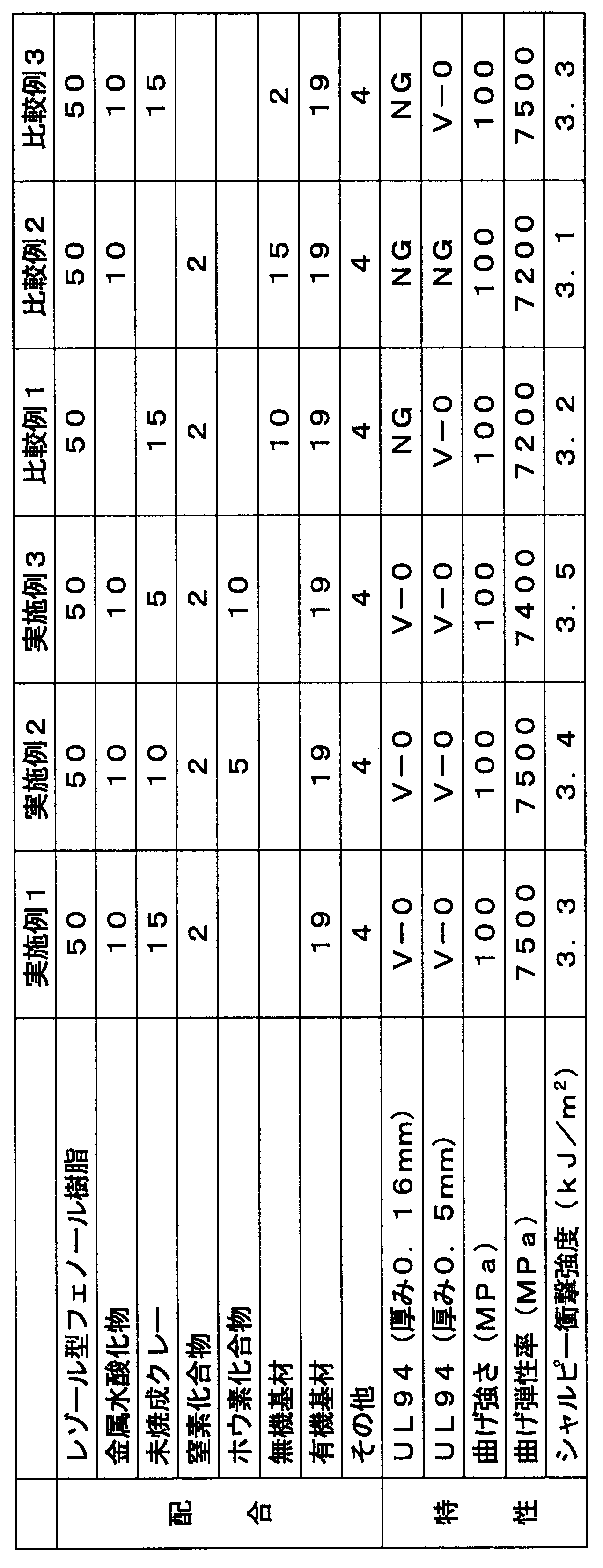
上記評価の結果、実施例1は、金属水酸化物、未焼成クレー、及び、窒素化合物からなる難燃剤を配合した本発明の成形材料であり、ハロゲン、アンチモン、赤燐・有機リン系難燃剤を用いることなく良好な難燃性、機械的強度を有する成形品を得ることができた。
実施例2、実施例3は未焼成クレーの一部をホウ酸化合物に置換した成形材料であるが、これらも良好な難燃性、機械的強度を有する成形品を得ることができた。
比較例1は金属水酸化物を配合しなかった成形材料であるが、厚みが薄い成形品での燃焼性が悪化しV-0が得られなかった。
比較例2は未焼成クレーを配合しなかった成形材料であるが、どの厚みでも難燃性が悪化しV-0が得られなかった。
比較例3は、窒素化合物を配合しなかった成形材料であるが、厚みが薄い成形品での燃焼性が悪化しV-0が得られなかった。
実施例2、実施例3は未焼成クレーの一部をホウ酸化合物に置換した成形材料であるが、これらも良好な難燃性、機械的強度を有する成形品を得ることができた。
比較例1は金属水酸化物を配合しなかった成形材料であるが、厚みが薄い成形品での燃焼性が悪化しV-0が得られなかった。
比較例2は未焼成クレーを配合しなかった成形材料であるが、どの厚みでも難燃性が悪化しV-0が得られなかった。
比較例3は、窒素化合物を配合しなかった成形材料であるが、厚みが薄い成形品での燃焼性が悪化しV-0が得られなかった。
本発明によって得られるフェノール樹脂成形材料は、ハロゲン、アンチモン、赤燐・有機リン系難燃剤を用いることなく従来と同等な難燃性、機械的強度を有する成形品を得ることができるものである。このため、ボビン、トランス、リレーカバーなどの電気電子部品に好適に適用されるものである。
Claims (4)
- フェノール樹脂と、(A)金属水酸化物、(B)未焼成クレー、及び、(C)窒素化合物からなる難燃剤とを含有することを特徴とするフェノール樹脂成形材料。
- (A)成分が、水酸化マグネシウムもしくは水酸化アルミニウムである請求項1に記載のフェノール樹脂成形材料。
- (C)成分が、メラミンである請求項1又は2に記載のフェノール樹脂成形材料。
- フェノール樹脂成形材料100重量部中、フェノール樹脂成分を20~60重量部、(A)成分を2~20重量部、(B)成分を1~20重量部、(C)成分を0.1~10重量部含有する請求項1から3のいずれかに一項に記載のフェノール樹脂成形材料。
Priority Applications (2)
| Application Number | Priority Date | Filing Date | Title |
|---|---|---|---|
| CN201280004354.2A CN103282432B (zh) | 2011-03-10 | 2012-02-27 | 酚醛树脂成型材料 |
| KR1020137016552A KR101816335B1 (ko) | 2011-03-10 | 2012-02-27 | 페놀 수지 성형 재료 |
Applications Claiming Priority (2)
| Application Number | Priority Date | Filing Date | Title |
|---|---|---|---|
| JP2011052737A JP5879702B2 (ja) | 2011-03-10 | 2011-03-10 | フェノール樹脂成形材料 |
| JP2011-052737 | 2011-03-10 |
Publications (1)
| Publication Number | Publication Date |
|---|---|
| WO2012121043A1 true WO2012121043A1 (ja) | 2012-09-13 |
Family
ID=46798011
Family Applications (1)
| Application Number | Title | Priority Date | Filing Date |
|---|---|---|---|
| PCT/JP2012/054748 Ceased WO2012121043A1 (ja) | 2011-03-10 | 2012-02-27 | フェノール樹脂成形材料 |
Country Status (5)
| Country | Link |
|---|---|
| JP (1) | JP5879702B2 (ja) |
| KR (1) | KR101816335B1 (ja) |
| CN (1) | CN103282432B (ja) |
| TW (1) | TWI568787B (ja) |
| WO (1) | WO2012121043A1 (ja) |
Cited By (1)
| Publication number | Priority date | Publication date | Assignee | Title |
|---|---|---|---|---|
| JP2014058628A (ja) * | 2012-09-19 | 2014-04-03 | Sumitomo Bakelite Co Ltd | フェノール樹脂成形材料、成形品及び電気電子部品 |
Families Citing this family (1)
| Publication number | Priority date | Publication date | Assignee | Title |
|---|---|---|---|---|
| GB2563043B (en) * | 2017-05-31 | 2023-01-11 | Acell Ind Ltd | Phenolic moulding material |
Citations (3)
| Publication number | Priority date | Publication date | Assignee | Title |
|---|---|---|---|---|
| JPH1121409A (ja) * | 1997-07-07 | 1999-01-26 | Showa Highpolymer Co Ltd | 発泡シート用水性エマルジョン組成物 |
| JP2002212387A (ja) * | 2001-01-23 | 2002-07-31 | Sumitomo Bakelite Co Ltd | フェノール樹脂樹脂成形材料 |
| JP2006233151A (ja) * | 2005-02-28 | 2006-09-07 | Sumitomo Bakelite Co Ltd | フェノール樹脂成形材料 |
Family Cites Families (5)
| Publication number | Priority date | Publication date | Assignee | Title |
|---|---|---|---|---|
| JPH08217953A (ja) * | 1995-02-17 | 1996-08-27 | Sumitomo Bakelite Co Ltd | フェノール樹脂組成物 |
| JPH11172072A (ja) * | 1997-12-12 | 1999-06-29 | Sumitomo Bakelite Co Ltd | フェノール樹脂組成物 |
| DE102004039664B4 (de) * | 2004-08-16 | 2007-08-02 | Albemarle Corp. | Flammschutzzusammensetzung mit monomodaler Korngrößenverteilung auf Basis von Metallhydroxid und Ton, deren Herstellungsverfahren und Verwendung sowie flammgeschütztes Polymer |
| JP2006077061A (ja) * | 2004-09-08 | 2006-03-23 | Sumitomo Bakelite Co Ltd | コンミテータ用フェノール樹脂成形材料 |
| JP5207710B2 (ja) * | 2007-11-19 | 2013-06-12 | 富士フイルム株式会社 | 記録媒体及びその製造方法、並びにインクジェット記録方法 |
-
2011
- 2011-03-10 JP JP2011052737A patent/JP5879702B2/ja active Active
-
2012
- 2012-02-23 TW TW101105976A patent/TWI568787B/zh active
- 2012-02-27 WO PCT/JP2012/054748 patent/WO2012121043A1/ja not_active Ceased
- 2012-02-27 KR KR1020137016552A patent/KR101816335B1/ko not_active Expired - Fee Related
- 2012-02-27 CN CN201280004354.2A patent/CN103282432B/zh active Active
Patent Citations (3)
| Publication number | Priority date | Publication date | Assignee | Title |
|---|---|---|---|---|
| JPH1121409A (ja) * | 1997-07-07 | 1999-01-26 | Showa Highpolymer Co Ltd | 発泡シート用水性エマルジョン組成物 |
| JP2002212387A (ja) * | 2001-01-23 | 2002-07-31 | Sumitomo Bakelite Co Ltd | フェノール樹脂樹脂成形材料 |
| JP2006233151A (ja) * | 2005-02-28 | 2006-09-07 | Sumitomo Bakelite Co Ltd | フェノール樹脂成形材料 |
Cited By (1)
| Publication number | Priority date | Publication date | Assignee | Title |
|---|---|---|---|---|
| JP2014058628A (ja) * | 2012-09-19 | 2014-04-03 | Sumitomo Bakelite Co Ltd | フェノール樹脂成形材料、成形品及び電気電子部品 |
Also Published As
| Publication number | Publication date |
|---|---|
| CN103282432B (zh) | 2017-02-15 |
| KR20130141619A (ko) | 2013-12-26 |
| TWI568787B (zh) | 2017-02-01 |
| TW201245320A (en) | 2012-11-16 |
| JP2012188529A (ja) | 2012-10-04 |
| KR101816335B1 (ko) | 2018-01-08 |
| CN103282432A (zh) | 2013-09-04 |
| JP5879702B2 (ja) | 2016-03-08 |
Similar Documents
| Publication | Publication Date | Title |
|---|---|---|
| CN103059346B (zh) | 复合阻燃剂、制备方法及其应用 | |
| KR100898418B1 (ko) | 난연성 접착제 조성물 및 그 제조방법 | |
| CN110964256A (zh) | 一种高效无卤膨胀型阻燃玻纤增强聚丙烯材料及其制备方法 | |
| CN100467530C (zh) | 环保阻燃abs专用料及其制备方法 | |
| CN102604378A (zh) | 一种阻燃增强的聚酰胺组合物及其模制品 | |
| CN104004326B (zh) | 聚酯复合材料及其制备方法 | |
| CN104371270B (zh) | 一种橡胶改性的本征阻燃环保酚醛模塑料 | |
| JP5879702B2 (ja) | フェノール樹脂成形材料 | |
| JP5504803B2 (ja) | フェノール樹脂成形材料 | |
| KR20100027316A (ko) | 강성이 우수한 비할로겐계 난연 폴리프로필렌 수지 조성물 | |
| CN104781342A (zh) | 聚对苯二甲酸丁二醇酯树脂组合物 | |
| KR20130120212A (ko) | 에폭시몰딩컴파운드용 자기소화성 에폭시 수지 및 그 제법, 에폭시몰딩컴파운드용 에폭시 수지 조성물 | |
| CN101434742A (zh) | 一种环保型耐热不饱和聚酯电工塑料 | |
| JP2014058628A (ja) | フェノール樹脂成形材料、成形品及び電気電子部品 | |
| JP2006342346A (ja) | 難燃剤、該剤を含有する難燃性樹脂組成物及び該組成物の使用 | |
| TWI278463B (en) | Flame retardant resin composition | |
| JPS5938266B2 (ja) | ポリカ−ボネ−ト樹脂組成物 | |
| JPS61296057A (ja) | 難燃性不飽和ポリエステル樹脂組成物 | |
| JP3270144B2 (ja) | フェノール樹脂成形材料 | |
| JP2006225526A (ja) | フェノール樹脂成形材料 | |
| JPH10330583A (ja) | フェノール樹脂組成物 | |
| JP5381573B2 (ja) | 熱硬化性樹脂成形材料 | |
| JP5402142B2 (ja) | フェノール樹脂成形材料 | |
| KR101790835B1 (ko) | 폴리카보네이트 난연수지 조성물 및 성형품 | |
| WO2014075225A1 (zh) | 复合阻燃剂、制备方法及其应用 |
Legal Events
| Date | Code | Title | Description |
|---|---|---|---|
| 121 | Ep: the epo has been informed by wipo that ep was designated in this application |
Ref document number: 12755402 Country of ref document: EP Kind code of ref document: A1 |
|
| ENP | Entry into the national phase |
Ref document number: 20137016552 Country of ref document: KR Kind code of ref document: A |
|
| NENP | Non-entry into the national phase |
Ref country code: DE |
|
| 122 | Ep: pct application non-entry in european phase |
Ref document number: 12755402 Country of ref document: EP Kind code of ref document: A1 |