WO2012117929A1 - エポキシシリコーン樹脂及びそれを用いた硬化性樹脂組成物 - Google Patents
エポキシシリコーン樹脂及びそれを用いた硬化性樹脂組成物 Download PDFInfo
- Publication number
- WO2012117929A1 WO2012117929A1 PCT/JP2012/054381 JP2012054381W WO2012117929A1 WO 2012117929 A1 WO2012117929 A1 WO 2012117929A1 JP 2012054381 W JP2012054381 W JP 2012054381W WO 2012117929 A1 WO2012117929 A1 WO 2012117929A1
- Authority
- WO
- WIPO (PCT)
- Prior art keywords
- resin composition
- epoxy
- general formula
- formula
- thermosetting resin
- Prior art date
- Legal status (The legal status is an assumption and is not a legal conclusion. Google has not performed a legal analysis and makes no representation as to the accuracy of the status listed.)
- Ceased
Links
- KQEJGXLRINKCST-UHFFFAOYSA-N CN(C(N(CC1OC1)C(N1CC2OC2)=O)=O)C1=O Chemical compound CN(C(N(CC1OC1)C(N1CC2OC2)=O)=O)C1=O KQEJGXLRINKCST-UHFFFAOYSA-N 0.000 description 1
Classifications
-
- H—ELECTRICITY
- H10—SEMICONDUCTOR DEVICES; ELECTRIC SOLID-STATE DEVICES NOT OTHERWISE PROVIDED FOR
- H10W—GENERIC PACKAGES, INTERCONNECTIONS, CONNECTORS OR OTHER CONSTRUCTIONAL DETAILS OF DEVICES COVERED BY CLASS H10
- H10W74/00—Encapsulations, e.g. protective coatings
- H10W74/40—Encapsulations, e.g. protective coatings characterised by their materials
- H10W74/47—Encapsulations, e.g. protective coatings characterised by their materials comprising organic materials, e.g. plastics or resins
- H10W74/476—Organic materials comprising silicon
-
- C—CHEMISTRY; METALLURGY
- C08—ORGANIC MACROMOLECULAR COMPOUNDS; THEIR PREPARATION OR CHEMICAL WORKING-UP; COMPOSITIONS BASED THEREON
- C08G—MACROMOLECULAR COMPOUNDS OBTAINED OTHERWISE THAN BY REACTIONS ONLY INVOLVING UNSATURATED CARBON-TO-CARBON BONDS
- C08G59/00—Polycondensates containing more than one epoxy group per molecule; Macromolecules obtained by polymerising compounds containing more than one epoxy group per molecule using curing agents or catalysts which react with the epoxy groups
- C08G59/18—Macromolecules obtained by polymerising compounds containing more than one epoxy group per molecule using curing agents or catalysts which react with the epoxy groups ; e.g. general methods of curing
- C08G59/40—Macromolecules obtained by polymerising compounds containing more than one epoxy group per molecule using curing agents or catalysts which react with the epoxy groups ; e.g. general methods of curing characterised by the curing agents used
- C08G59/42—Polycarboxylic acids; Anhydrides, halides or low molecular weight esters thereof
-
- C—CHEMISTRY; METALLURGY
- C08—ORGANIC MACROMOLECULAR COMPOUNDS; THEIR PREPARATION OR CHEMICAL WORKING-UP; COMPOSITIONS BASED THEREON
- C08G—MACROMOLECULAR COMPOUNDS OBTAINED OTHERWISE THAN BY REACTIONS ONLY INVOLVING UNSATURATED CARBON-TO-CARBON BONDS
- C08G59/00—Polycondensates containing more than one epoxy group per molecule; Macromolecules obtained by polymerising compounds containing more than one epoxy group per molecule using curing agents or catalysts which react with the epoxy groups
- C08G59/18—Macromolecules obtained by polymerising compounds containing more than one epoxy group per molecule using curing agents or catalysts which react with the epoxy groups ; e.g. general methods of curing
- C08G59/40—Macromolecules obtained by polymerising compounds containing more than one epoxy group per molecule using curing agents or catalysts which react with the epoxy groups ; e.g. general methods of curing characterised by the curing agents used
- C08G59/50—Amines
- C08G59/5033—Amines aromatic
-
- C—CHEMISTRY; METALLURGY
- C08—ORGANIC MACROMOLECULAR COMPOUNDS; THEIR PREPARATION OR CHEMICAL WORKING-UP; COMPOSITIONS BASED THEREON
- C08G—MACROMOLECULAR COMPOUNDS OBTAINED OTHERWISE THAN BY REACTIONS ONLY INVOLVING UNSATURATED CARBON-TO-CARBON BONDS
- C08G77/00—Macromolecular compounds obtained by reactions forming a linkage containing silicon with or without sulfur, nitrogen, oxygen or carbon in the main chain of the macromolecule
- C08G77/04—Polysiloxanes
- C08G77/14—Polysiloxanes containing silicon bound to oxygen-containing groups
-
- C—CHEMISTRY; METALLURGY
- C08—ORGANIC MACROMOLECULAR COMPOUNDS; THEIR PREPARATION OR CHEMICAL WORKING-UP; COMPOSITIONS BASED THEREON
- C08G—MACROMOLECULAR COMPOUNDS OBTAINED OTHERWISE THAN BY REACTIONS ONLY INVOLVING UNSATURATED CARBON-TO-CARBON BONDS
- C08G77/00—Macromolecular compounds obtained by reactions forming a linkage containing silicon with or without sulfur, nitrogen, oxygen or carbon in the main chain of the macromolecule
- C08G77/04—Polysiloxanes
- C08G77/22—Polysiloxanes containing silicon bound to organic groups containing atoms other than carbon, hydrogen and oxygen
- C08G77/26—Polysiloxanes containing silicon bound to organic groups containing atoms other than carbon, hydrogen and oxygen nitrogen-containing groups
-
- C—CHEMISTRY; METALLURGY
- C08—ORGANIC MACROMOLECULAR COMPOUNDS; THEIR PREPARATION OR CHEMICAL WORKING-UP; COMPOSITIONS BASED THEREON
- C08G—MACROMOLECULAR COMPOUNDS OBTAINED OTHERWISE THAN BY REACTIONS ONLY INVOLVING UNSATURATED CARBON-TO-CARBON BONDS
- C08G77/00—Macromolecular compounds obtained by reactions forming a linkage containing silicon with or without sulfur, nitrogen, oxygen or carbon in the main chain of the macromolecule
- C08G77/48—Macromolecular compounds obtained by reactions forming a linkage containing silicon with or without sulfur, nitrogen, oxygen or carbon in the main chain of the macromolecule in which at least two but not all the silicon atoms are connected by linkages other than oxygen atoms
- C08G77/50—Macromolecular compounds obtained by reactions forming a linkage containing silicon with or without sulfur, nitrogen, oxygen or carbon in the main chain of the macromolecule in which at least two but not all the silicon atoms are connected by linkages other than oxygen atoms by carbon linkages
-
- C—CHEMISTRY; METALLURGY
- C09—DYES; PAINTS; POLISHES; NATURAL RESINS; ADHESIVES; COMPOSITIONS NOT OTHERWISE PROVIDED FOR; APPLICATIONS OF MATERIALS NOT OTHERWISE PROVIDED FOR
- C09K—MATERIALS FOR MISCELLANEOUS APPLICATIONS, NOT PROVIDED FOR ELSEWHERE
- C09K3/00—Materials not provided for elsewhere
- C09K3/10—Materials in mouldable or extrudable form for sealing or packing joints or covers
- C09K3/1006—Materials in mouldable or extrudable form for sealing or packing joints or covers characterised by the chemical nature of one of its constituents
- C09K3/1018—Macromolecular compounds having one or more carbon-to-silicon linkages
-
- H—ELECTRICITY
- H10—SEMICONDUCTOR DEVICES; ELECTRIC SOLID-STATE DEVICES NOT OTHERWISE PROVIDED FOR
- H10H—INORGANIC LIGHT-EMITTING SEMICONDUCTOR DEVICES HAVING POTENTIAL BARRIERS
- H10H20/00—Individual inorganic light-emitting semiconductor devices having potential barriers, e.g. light-emitting diodes [LED]
- H10H20/80—Constructional details
- H10H20/85—Packages
- H10H20/852—Encapsulations
- H10H20/854—Encapsulations characterised by their material, e.g. epoxy or silicone resins
Definitions
- the present invention relates to an epoxy silicone resin having a linear or cyclic siloxane bond, and a thermosetting resin composition having the optical component, hardness, bending property, heat-resistant coloring property, and light-coloring property as an essential component.
- the present invention relates to a thermosetting resin composition suitable for the material field and optical semiconductor material field.
- Epoxy resins are mainly used in many applications in the paint, civil engineering, and electrical fields because of their excellent electrical properties, adhesion, and heat resistance.
- aromatic epoxy resins such as bisphenol A type diglycidyl ether, bisphenol F type diglycidyl ether, phenol novolac type epoxy resin, and cresol novolac type epoxy resin are water resistant, adhesive, mechanical properties, heat resistant, and electrical insulating properties. It is widely used in combination with various curing agents because of its excellent economic efficiency.
- these resins contain an aromatic ring, they are easily deteriorated by ultraviolet rays or the like, and there are restrictions in use in fields where weather resistance and light resistance are required.
- the epoxy resin composition since the hardness of the cured product is high, it is excellent in handling properties. In low-power white LED sealing applications, the required durability is obtained, so it is often used in low-power applications. Yes. However, high-power LEDs tend to cause discoloration due to an increase in light emission and heat generation, and thus have a disadvantage that it is difficult to obtain a sufficient lifetime. In order to prevent discoloration due to an increase in calorific value, an epoxy resin exhibiting a high glass transition temperature is used, but such an epoxy resin is highly elastic and has bending properties such as strength and deflection as compared with a normal epoxy resin. Since it is low, there is a problem that the sealing material is easily cracked in an environment where cutting such as dicing or a rapid temperature change may occur.
- Patent Document 1 discloses a resin composition obtained by an addition reaction of a polyorganosiloxane resin having a hydrosilyl group and a polyorganosiloxane resin having an alkenyl group.
- Patent Document 2 discloses a curable polyorganosiloxane composition containing a phenyl group, an optical semiconductor element sealing agent and an optical semiconductor device using the same.
- Patent Document 3 discloses an epoxy silicone resin having a linear and cyclic siloxane structure having an epoxycyclohexyl group in the side chain as an essential component.
- Patent Documents 4 and 5 disclose organopolysiloxanes having diglycidyl isocyanuryl alkyl groups at least at both ends of the main chain and compositions containing the same.
- Patent Document 6 discloses an addition reaction product of an organosilicon compound having two hydrosilyl groups and a polycyclic hydrocarbon having two addition-reactive carbon-carbon double bonds in one molecule, and A composition comprising an addition reaction product having at least two addition-reactive carbon-carbon double bonds in one molecule and a compound having a Si—H group is disclosed.
- thermosetting resin compositions described in these patent documents also have the above characteristics sufficiently.
- the present invention has a cured product having high hardness, excellent heat resistance coloring property, UV coloring property, strength and deflection, and less damage to the package even under reflow and heat cycles, and is suitable for the electronic material field and optical semiconductor encapsulation.
- An object is to provide a curable resin composition.
- Another object is to provide an epoxy silicone resin suitable as a material for the thermosetting resin composition.
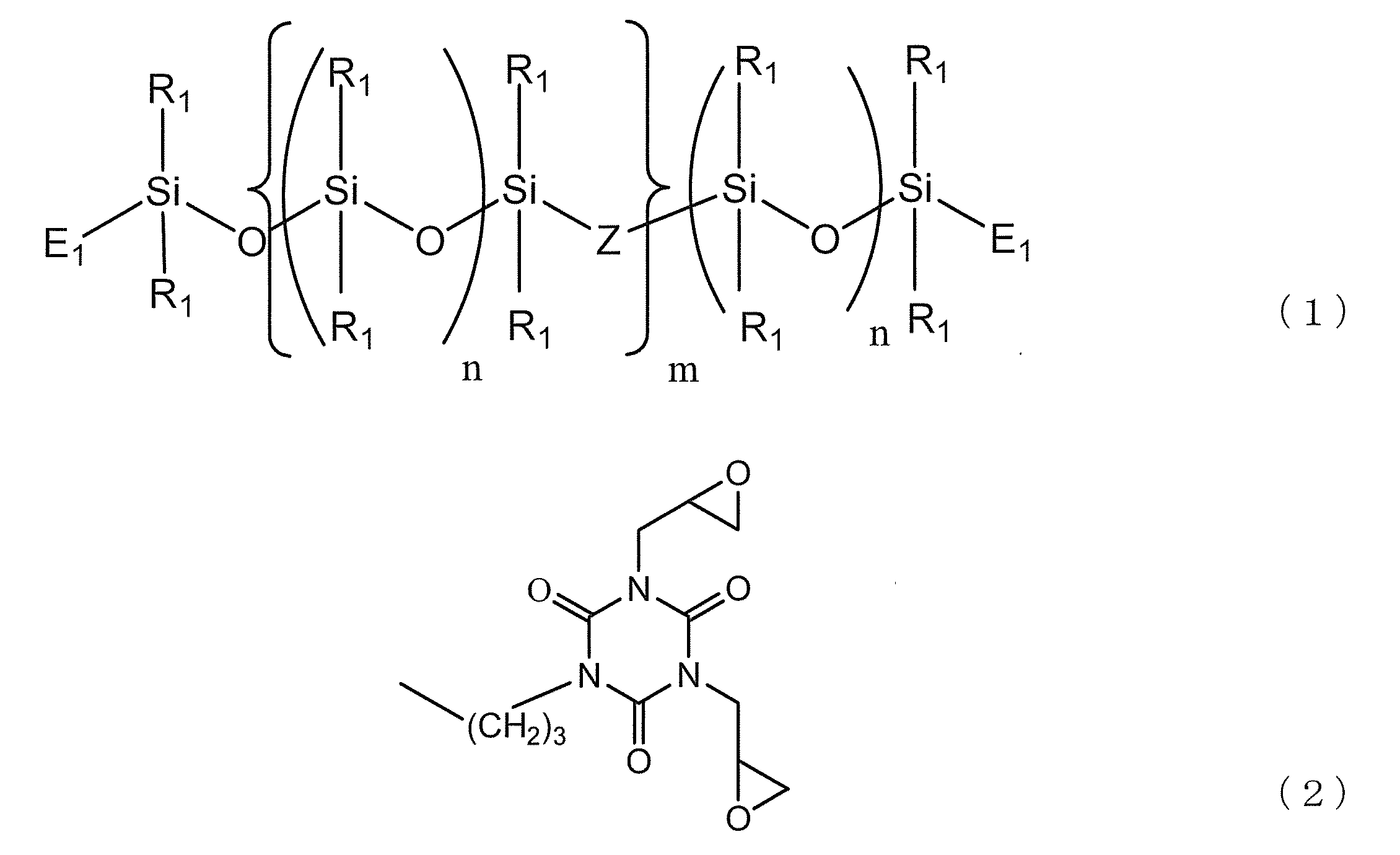
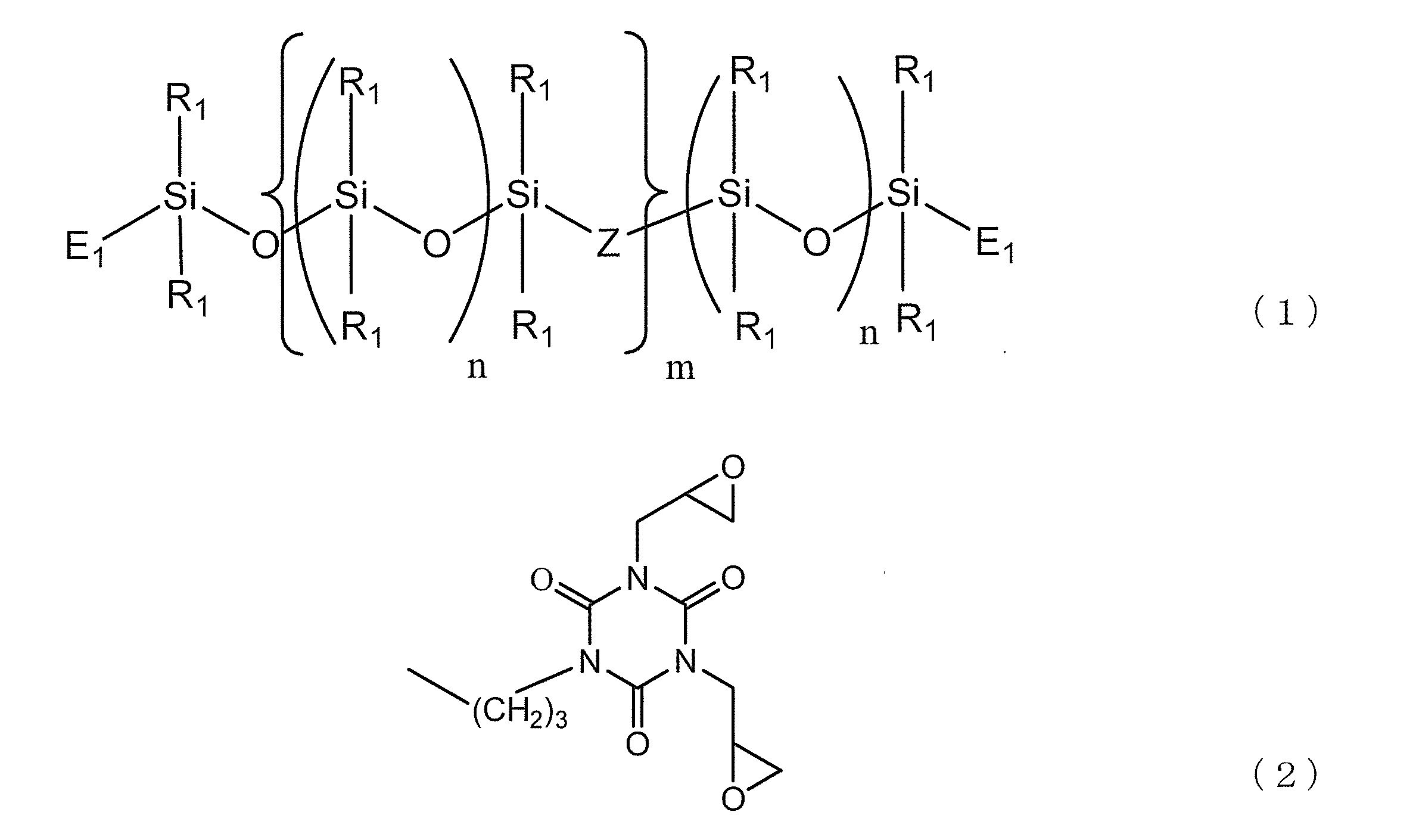
- the present invention is represented by the general formula (1) and has an epoxy equivalent of 180 to 2000 g / eq. It relates to an epoxy silicone resin.
- R 1 represents a hydrocarbon group having 1 to 10 carbon atoms, which may be the same or different.
- M represents a number of 0 ⁇ m ⁇ 100, and n represents a number of 0 ⁇ n ⁇ 100.
- E 1 Represents a diglycidyl isocyanuryl-propyl group represented by the formula (2), and Z represents a divalent organic residue containing a carbon atom at both ends and an Si atom inside.
- Z in the general formula (1) includes a divalent organic residue represented by the general formula (3) or the general formula (4).
- R 2 represents a hydrocarbon group having 1 to 10 carbon atoms, which may be the same or different.
- L is a number of 0 ⁇ l ⁇ 100.
- R 3 represents a hydrocarbon group having 1 to 10 carbon atoms, and may be the same or different.
- J and k are each an integer of 0 to 4, and 1 ⁇ j + k ⁇ 4.
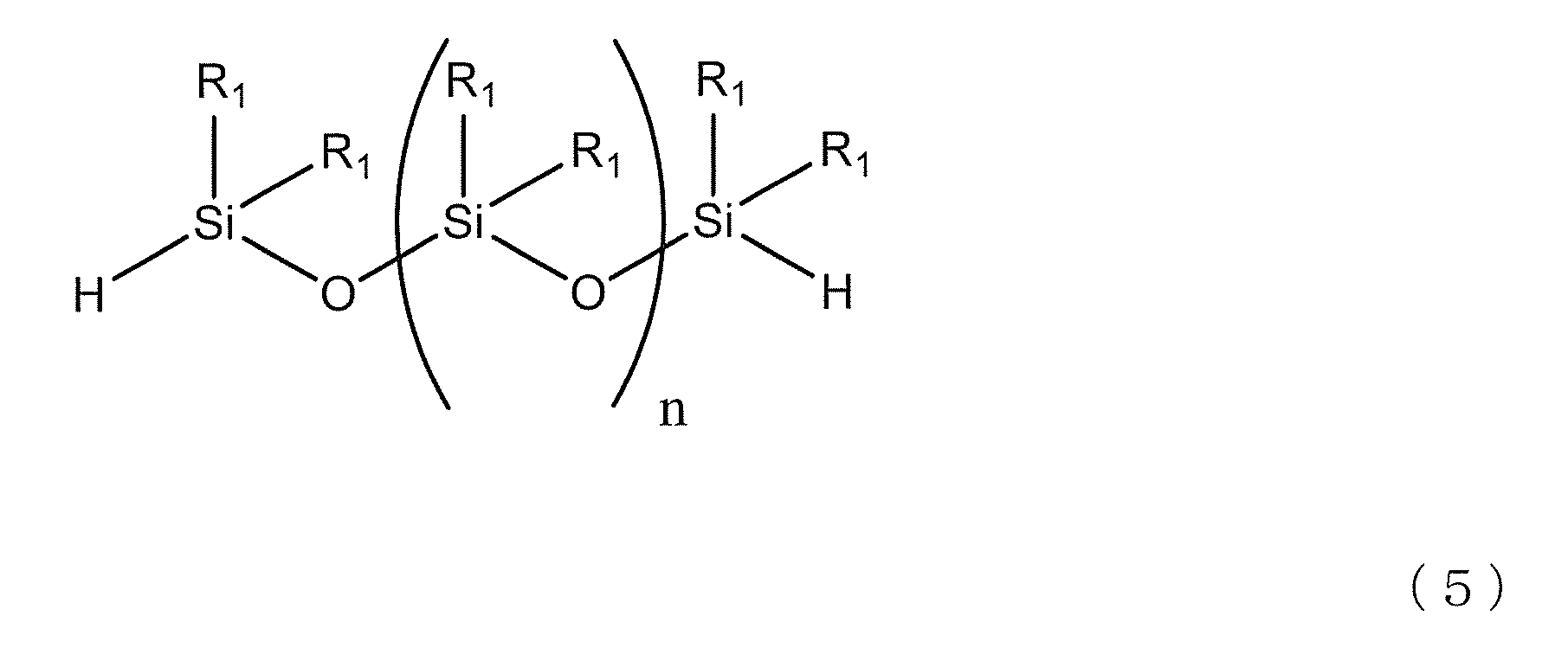
- the present invention provides a polyorganosiloxane having both ends SiH represented by the general formula (5) and a polyorganosiloxane having both ends vinyl groups represented by the general formula (6) or the general formula (7) in less than the theoretical amount. Then, the remaining SiH group is subjected to end-capping reaction using monoallyl diglycidyl isocyanurate, and this relates to a method for producing an epoxy silicone resin represented by the above general formula (1).
- R 1 and n have the same meaning as in general formula (1).
- R 2 represents a hydrocarbon group having 1 to 10 carbon atoms, which may be the same or different.
- L is a number of 0 ⁇ l ⁇ 100.
- R 3 represents a hydrocarbon group having 1 to 10 carbon atoms, and may be the same or different.
- J and k are each an integer of 0 to 4, and 1 ⁇ j + k ⁇ 4.
- the present invention includes a thermosetting resin composition containing an epoxy resin, a curing agent (B), and a curing accelerator (C) as essential components, and the epoxy silicone resin (A) described above as an epoxy resin component.
- the present invention relates to a characteristic thermosetting resin composition.
- Examples of the curing agent (B) include acid anhydrides, amine compounds that are liquid at room temperature, and amino resins that are liquid at room temperature.
- Examples of the curing accelerator (C) include quaternary ammonium salts or quaternary phosphonium salts.
- the epoxy resin component includes 5 to 150 parts by weight of an epoxy resin (D) that is liquid at room temperature with respect to 100 parts by weight of the epoxy silicone resin (A), and an epoxy equivalent of 180 g / eq. -1000 g / eq. The thing which is is mentioned.
- thermosetting resin composition is useful as a resin composition for optical parts or a resin composition for electronic parts, a resin composition for optical semiconductor parts, or a liquid sealing resin composition for semiconductors. Moreover, this invention is sealed using said thermosetting resin composition, It is an LED apparatus characterized by the above-mentioned.
- the epoxy silicone resin of the present invention is represented by the above general formula (1) and has an epoxy equivalent of 170 to 2000 g / eq. It is.
- R 1 represents a hydrocarbon group having 1 to 10 carbon atoms.
- the hydrocarbon group include, but are not limited to, a methyl group, an ethyl group, a propyl group, an isopropyl group, an n-butyl group, a hexyl group, a phenyl group, and a naphthyl group. Also good.
- Preferable R 1 is a methyl group from the viewpoint of physical properties such as heat resistance and light color resistance when it is easily available and a thermosetting resin composition is obtained by heat treatment.
- m is 0 ⁇ m ⁇ 100
- n is 0 ⁇ n ⁇ 100
- the Z component is necessarily included.
- Desirable numbers of m and n are 0 ⁇ m ⁇ 30, 0 ⁇ n ⁇ 30, and 0 ⁇ m + n ⁇ 50 from the viewpoint of heat resistance coloring property, light coloring resistance, and mechanical properties when cured. . More preferably, 0 ⁇ m ⁇ 8, 0 ⁇ n ⁇ 8, and 0 ⁇ m + n ⁇ 20. More preferably, m is 0.3 to 2, n is 1 to 10, and m + n is 1.5 to 10. Particularly preferably, 0.2 ⁇ m ⁇ 2, 0 ⁇ n ⁇ 8, and 0.5 ⁇ m + n ⁇ 10.
- m and n are average values (number average).
- Z represents a divalent organic residue in which carbon atoms are arranged at both ends and an Si atom is contained inside.
- Examples of such a structure include a structure represented by the general formula (8), (9), (10), (11), or (12).
- R 4 , R 6 and R 9 each independently represents a divalent hydrocarbon group having 1 to 10 carbon atoms, and may have an aromatic ring inside.
- R 5 , R 8 , R 11 independently represents a monovalent hydrocarbon group having 1 to 10 carbon atoms
- R 7 represents a phenylene group or a naphthylene group
- R 10 represents a divalent hydrocarbon group having 1 to 20 carbon atoms
- the terminal single line represents a single bond.
- R 2 and l have the same meanings as in the general formula (3), R 3 , j and k have the same meanings as in the general formula (4), and R 12 and R 13 are independently carbon atoms. Represents a divalent hydrocarbon group of the number 1 to 10.
- preferred structures are those represented by the general formula (11) from the viewpoints of availability, ease of production of the epoxy silicone resin of the present invention, heat resistance coloring property when cured, light coloring property, and mechanical properties.
- R 2 in the general formula (11) is a methyl group, 0 ⁇ l ⁇ 20
- the structure represented by the said General formula (3) or General formula (4) is preferable.
- R 2 and R 3 independently represent a divalent hydrocarbon group having 1 to 10 carbon atoms, and preferred hydrocarbon groups are the same as those described for R 1. .
- the epoxy silicone resin of the present invention includes a polyorganosiloxane having both ends SiH containing polyorganosiloxane represented by the above general formula (5), and a vinyl group-containing poly terminal represented by the above general formula (6) or the above general formula (7).
- the organosiloxane can be reacted in less than the theoretical amount, and then the remaining SiH groups can be advantageously produced by end-capping reaction with monoallyl diglycidyl isocyanurate.
- the method for producing an epoxy silicone resin of the present invention uses a polyorganosiloxane containing SiH groups at both ends represented by the general formula (5) as a raw material, and uses the amount in which unreacted SiH groups remain, and uses the general formula (6).
- both end vinyl group-containing polyorganosiloxanes represented by (7) are reacted by hydrosilylation, and then unreacted SiH groups are subjected to end-capping reaction using monoallyl diglycidyl isocyanurate. Since the ratio of the unreacted SiH group is related to the E 1 content of the epoxy silicone resin represented by the general formula (1), the result is related to the epoxy equivalent. Accordingly, there is no particular limitation as long as unreacted SiH groups can be left in a range that satisfies the epoxy equivalent, but it is preferable that 20 to 80% SiH groups remain.
- both ends SiH group-containing polyorganosiloxane is charged into the reaction system first, and then both ends vinyl group-containing polyorganosiloxane in an amount in which unreacted SiH groups always remain is added in order. It is particularly preferable to perform end-capping reaction using monoallyl diglycidyl isocyanurate after confirming that (hydrosilylation reaction) is completed. Moreover, 2 or more types of polyorganosiloxane represented by General formula (6) or General formula (7) may be used together.
- both ends SiH group-containing polyorganosiloxane, both ends vinyl group-containing polyorganosiloxane and monoallyl diglycidyl isocyanurate are collectively charged into the reaction system to carry out hydrosilylation reaction,
- hydrosilylation is carried out by mixing polyvinylsiloxane containing terminal vinyl groups and monoallyl diglycidyl isocyanurate and introducing them into the reaction system, and then introducing polyorganosiloxane containing SiH groups at both ends for hydrosilylation.
- the reaction rate of the reaction is significantly faster for the polyorganosiloxane containing both terminal vinyl groups than for monoallyl diglycidyl isocyanurate, a siloxane resin having no epoxy group is easily produced selectively in the reaction system. For this reason, the resulting epoxy silicone resin causes phase separation and becomes cloudy, and the transparency is lost. Moreover, even if the cloudiness does not occur, the effect of the present invention cannot be obtained in terms of physical properties of the cured product.
- the hydrosilylation reaction proceeds in the presence of a noble metal catalyst.
- a noble metal catalyst various precious metals or complex compounds thereof can be used as long as they are known.
- the noble metal catalyst include platinum, rhodium, palladium, ruthenium, and iridium, but are not limited thereto, and two or more kinds may be used as necessary.
- a material in which these metals are immobilized on a particulate carrier material such as carbon, activated carbon, aluminum oxide, silica, or the like may be used.
- noble metal complex compounds include platinum halogen compounds (PtCl 4 , H 2 PtCl 6 .6H 2 O, Na 2 PtCl 6 .4H 2 O, etc.), platinum-olefin complexes, platinum-alcohol complexes, platinum-alcolate complexes, platinum -Ether complexes, platinum-carbonyl complexes, platinum-ketone complexes, platinum-vinylsiloxane complexes such as platinum-1,3-divinyl-1,1,3,3-tetramethyldisiloxane, bis ( ⁇ -picoline) -platinum dichloride , Trimethylenedipyridine-platinum dichloride, dicyclopentadiene-platinum dichloride, cyclooctadiene-platinum dichloride, cyclopentadiene-platinum dichloride, bis (alkynyl) bis (triphenylphosphine) platinum complex, bis (alkynyl)
- the above precious metal catalysts may be used alone or in advance in a solvent to be dissolved, and then charged into the reaction system.
- the use ratio of the noble metal catalyst is not particularly limited, but is usually in the range of 0.1 ppm to 100,000 ppm, preferably 1 ppm to 10,000 ppm, based on the total weight of the raw materials used in the reaction.
- the hydrosilylation reaction can be carried out without a solvent, but the reaction system may be diluted with an organic solvent as necessary, and is not particularly limited as long as it is a compound that does not adversely influence the reaction.
- organic solvent such as dichloromethane, chloroform, carbon tetrachloride, 1,2-dichloroethane, aliphatic ketones such as acetone, methyl ethyl ketone, methyl isobutyl ketone, cyclohexanone, cyclopentanone, benzene, toluene, orthoxylene
- aromatics such as meta-xylene, para-xylene, chlorobenzene and dichlorobenzene
- ethers such as diethylene glycol dimethyl ether and triethylene glycol dimethyl ether
- esters such as ethyl acetate and n-butyl acetate. Two or more of these organic solvents may be selected and used as a mixed solvent
- the temperature condition in the hydrosilyl addition reaction is not particularly limited, but is usually 0 ° C. to 200 ° C., preferably 30 ° C. to 180 ° C. Below 0 ° C, the reaction takes time and is not economical. When the reaction is carried out at 200 ° C. or higher, the addition reaction between the epoxy group and the hydrosilyl moiety proceeds, making it difficult to control the reaction.
- the functional expression of the curable resin composition in the present invention is not impaired, It is good also as a curable resin composition using the resin obtained by performing the hydrosilylation reaction using the compound containing an epoxy group together.
- the compound containing at least one vinyl group and an epoxy group in one molecule include allyl glycidyl ether, glycidyl methacrylate, 4-vinylcyclohexene oxide, limonene oxide, monovinyl diepoxycyclohexane, and the like. Two or more kinds may be used in combination.
- the amount to be used is not particularly limited, but is preferably 50 mol% or less of monoallyl diglycidyl isocyanurate from the viewpoint of expressing the function of the curable resin composition of the present invention.
- the epoxy silicone resin of the present invention has an epoxy equivalent of 170 to 2000 g / eq. Preferably 200 to 1000 g / eq. More preferably, it is 230 to 700 g / eq. By being in this range, a cured product excellent in transparency, heat resistant colorability, glass transition temperature, and bending deflection can be obtained. When the epoxy equivalent is out of this range, it is not preferable because the cured product becomes brittle, the surface hardness is lowered to cause stickiness, and the heat resistant colorability is deteriorated.
- thermosetting resin composition contains an epoxy resin, a curing agent (B), and a curing accelerator (C) as essential components, and includes the epoxy silicone resin of the present invention as an epoxy resin component.
- the epoxy silicone resin of the present invention is referred to as an epoxy silicone resin (A).
- thermosetting resin composition of the present invention various compounds can be applied as long as they are known as curing agents for epoxy resins.
- organic amine compounds such as polyallylamine, polyamidoamine, dicyandiamide and derivatives thereof, imidazoles and derivatives thereof such as 2-methylimidazole and 2-ethyl-4-methylimidazole, bisphenol A, bisphenol F, brominated bisphenol A, naphthalene Diol, dihydric phenol compound such as 4,4'-biphenol, novolak resin or aralkyl phenol resin obtained by condensation reaction of phenol or naphthols with formaldehyde or xylylene glycol, acid anhydride compound and polyhydric organic alcohol Polycarboxylic acid obtained by reaction, succinic anhydride, maleic anhydride, phthalic anhydride, hexahydrophthalic anhydride, methylated hexahydrophthalic anhydride, nadic
- a preferable curing agent for obtaining transparency, heat-resistant coloring property, and light-resistant coloring property in the present invention is an acid anhydride, a compound having an amine group and a liquid compound at room temperature, or a phenol resin.
- acid anhydrides particularly preferred are acid anhydrides, and more preferred are hexahydrophthalic anhydride, methylated hexahydrophthalic anhydride, and hydrogenated nadic anhydride.
- curing accelerator (C) various compounds can be applied as long as they are known as epoxy resin curing accelerators. Examples include tertiary amines and salts thereof, imidazoles and salts thereof, organic phosphine compounds and salts thereof, and organic metal salts such as zinc octylate and tin octylate. Two or more kinds may be used as necessary. . Particularly preferred curing accelerators for obtaining the effects of the present invention are quaternary ammonium salts, organic phosphine compounds, quaternary phosphonium salts, and more preferred catalysts are quaternary phosphonium salts.
- thermosetting resin composition of the present invention comprises the above components (A), (B) and (C) as essential components, but for the purpose of adjusting the viscosity, the curing rate, etc., to a preferred form for those skilled in the art
- component (D) a liquid epoxy resin or epoxy compound having two or more epoxy groups in one molecule other than the component (A) at room temperature may be used.
- the epoxy equivalent of the mixture of (A) and (D) was 180 g / eq. -1000 g / eq.
- the effect of this invention is acquired because it is the range of this.
- the proportion of the component (A) and the component (D) is preferably in the range of 5 to 150 parts by weight of the epoxy resin (D) that is liquid at room temperature with respect to 100 parts by weight of the epoxy silicone resin (A).
- aromatic hydrogenated epoxy resin derived from monocyclic dihydric phenols such as resorcinol, hydroquinone, 2,5-ditertiarybutylhydroquinone, 1,3-naphthalenediol, 1,4- Epoxy resins derived from naphthalene diols such as naphthalene diol, 1,5-naphthalene diol, 1,6-naphthalene diol, 2,7-naphthalene diol, and the like, and hydrogenated aromatic rings thereof, 4,4 ′ -Isopropylidene diphenol, 4,4'-isopropylidenebis (2-methylphenol), 4,4'-isopropylidenebis (2,6-dimethylphenol), 4,4'-dihydroxydiphenylmethane, 4,4 ' -Dihydroxy-3,3'-d
- the epoxy silicone resin represented by General formula (18) is mentioned.
- R 14 to R 16 are each a hydrocarbon group or aromatic group having 1 to 20 carbon atoms which may contain an epoxy group inside, and have 1 to 3 etheric oxygen atoms inside.
- thermosetting resin composition of the present invention When the thermosetting resin composition of the present invention is used for LED sealing, it is preferable to add an antioxidant to prevent oxidative deterioration during heating and to produce a cured product with little coloration.
- antioxidant various compounds can be applied as long as they are known.
- thermosetting resins can be blended with the thermosetting resin composition of the present invention.
- thermosetting resins include unsaturated polyester resins, thermosetting acrylic resins, thermosetting amino resins, thermosetting melamine resins, thermosetting urea resins, thermosetting urethane resins, and thermosetting oxetane resins. , Thermosetting epoxy / oxetane composite resin, and the like, but are not limited thereto.
- the curable resin composition of the present invention comprises the above components (A) to (C) as essential components, but the resin component (in addition to the resin, a component that is cured to become part of the resin, such as a monomer, a curing agent, etc. 60 wt% or more, preferably 80 wt% or more, more preferably 90 wt% or more of the (A) component to the (B) component.
- the blending ratio of the component (A), the component (B) and the component (C) may be determined as follows.
- component (B) is not a cationic curing agent
- the epoxy groups of all epoxy components and the functional groups in the curing agent of component (B) are in the range of 0.8 to 1.5 in terms of equivalent ratio. Outside this range, an unreacted epoxy group or a functional group in the curing agent remains after curing, and functions such as hardness and heat resistance when cured are reduced, which is not preferable.
- the blending ratio of the component (C), which is a curing accelerator is preferably in the range of 0.1 wt% to 5 wt% with respect to the total of the epoxy groups of all the epoxy components and the component (B).
- the gelation time is delayed, resulting in a decrease in workability due to a decrease in rigidity at the time of curing. Conversely, if it exceeds 5.0 wt%, curing proceeds during the molding and unfilling is likely to occur. Become.
- the component (B) is a cationic curing agent
- it is 0.01 to 10 parts by weight, preferably 0.1 to 5 parts by weight with respect to 100 parts by weight of the total epoxy component.
- the amount is less than 0.01 parts by weight, poor curing tends to occur. Conversely, when the amount exceeds 5 parts by weight, it is not preferable in terms of transparency and heat resistant colorability.
- thermosetting resin of the present invention When the thermosetting resin of the present invention is applied as an electronic component, its use and manufacturing process are not particularly limited.
- a filler such as silica is mixed with the thermosetting resin composition of the present invention, kneaded with a kneader or a hot three roll, and then tableted into a cavity of a sealing mold. It is possible to adopt a transfer mold method in which heat-curing is performed.
- a dispensing method is adopted in which a resin is injected into a predetermined position. I can do it.
- thermosetting resin composition of the present invention a method of laminating copper foil by press molding, or thermosetting of the present invention to copper foil
- the resin composition can be applied by a casting method or the like and bonded to a desired substrate.
- a curing agent that is liquid at room temperature, and if necessary, such as silica, alumina, titanium oxide, rubber particles, etc.
- a dispensing method in which a resin is injected into a predetermined position after a desired viscosity using a filler or the like can be employed.
- optical component applications include optical lenses, sealing materials for optical semiconductors, white molding materials for optical semiconductors, and optical semiconductor adhesives. Any process can be applied.
- the optical lens material can be manufactured by a known process such as a dispense method, a transfer mold method, or injection molding.
- thermosetting resin composition of the present invention As a sealing material for an optical semiconductor device (LED device), a method of filling an optical semiconductor element with an external electrode using a gold wire or the like and then using a known technique such as a transfer molding method or a potting method can be applied. At this time, various known fluorescent powders may be used in the thermosetting resin composition of the present invention for the purpose of converting light emitted from the optical semiconductor element. Moreover, in order to express moderate thixotropy, you may add well-known fillers, such as a silica and an aerosil, silane coupling materials, and surfactants.
- thermosetting resin composition of the present invention is mixed with a filler such as silica, titanium oxide, and alumina, kneaded with a kneader or three heat rolls, and then tableted and sealed.
- a transfer mold method in which the resin is sent to the cavity of the mold and thermally cured can be applied.
- thermosetting resin composition of the present invention which is paste-formed by kneading with a roll or the like using a filler such as silica, titanium oxide, alumina, silver powder, if necessary, is dispensed. It is possible to apply a method of applying the film to a base material by the above method, or further bonding a film shape using a known film material onto the base material, mounting the optical semiconductor element, and thermosetting.
- thermosetting resin composition of the present invention is applied to a thin film using a spin coater, bar coater, etc. on a substrate such as a fluororesin plate, PET film, polyimide, etc.
- a film body can be obtained by peeling.
- thermosetting resin and thermosetting film obtained by the above method can be applied to various applications as long as they are used for electronic parts and optical parts.
- Flexible printed wiring boards, anisotropic conductive films, coverlay films, die attach It can be applied to electronic parts such as films and interlayer insulating materials, optical parts such as transparent protective films, optical waveguide films, and optical semiconductor films.
- Example 1 In the general formula (5), R 1 is methyl group, n is 4 and polyorganosiloxane having SiH groups at both ends thereof is 516 parts by weight (2.4 equivalents as SiH group), dioxane 582 parts by weight, carbon 1.8 parts by weight of supported platinum (platinum supported amount 3%) was put into a 3 L separable flask equipped with a stirring motor, a reflux condenser, and a nitrogen line, and the temperature was raised to 100 ° C. while stirring. Next, in the general formula (6), 67 parts by weight (0.7 equivalents as a vinyl group) of an organosiloxane having vinyl groups at both ends where R 2 is a methyl group and l is 0 over 1 hour. I put it in.
- R 1 is a methyl group
- m has an average value of 0.4
- n has an average value of 4
- Z has the general formula ( In 3)
- 1002 parts by weight of an epoxy silicone resin (ES1) in which R 2 is a methyl group and l 0 was obtained.
- the epoxy equivalent of this resin is 312 g / eq.
- the viscosity at room temperature was 5.6 Pa ⁇ s.
- Example 2 Formula (5) Niite, R 1 is a methyl group, a polyorganosiloxane 86 parts by weight of the average value of n has an SiH group at both ends, which is a 4 (0.4 eq as a SiH group), dioxane 190 parts by weight, 0.32 parts by weight of platinum carrying carbon (platinum carrying amount 3%) was put into a 1 L separable flask equipped with a stirring motor, a reflux condenser, and a nitrogen line, and the temperature was raised to 100 ° C. while stirring.
- Example 3 In the general formula (5), 726 parts by weight of a polyorganosiloxane having an SiH group at both ends where R 1 is a methyl group and the average value of n is 8 (2.0 equivalents as a SiH group), 1160 parts by weight of dioxane, carbon 1.96 parts by weight of supported platinum (platinum supported amount 3%) was put into a 3 L separable flask equipped with a stirring motor, a reflux condenser, and a nitrogen line, and the temperature was raised to 100 ° C. while stirring.
- Example 4 In the general formula (5), 430 parts by weight of polyorganosiloxane (2.0 equivalents as SiH groups) having SiH groups at both ends, wherein R 1 is a methyl group and the average value of n is 4, dioxane 949 Part by weight and 1.52 parts by weight of carbon-supported platinum (platinum support amount 3%) were put into a 3 L separable flask equipped with a stirring motor, a reflux condenser, and a nitrogen line, and the temperature was raised to 100 ° C. while stirring.
- polyorganosiloxane 2.0 equivalents as SiH groups having SiH groups at both ends, wherein R 1 is a methyl group and the average value of n is 4
- dioxane 949 Part by weight and 1.52 parts by weight of carbon-supported platinum (platinum support amount 3%) were put into a 3 L separable flask equipped with a stirring motor, a reflux condenser, and a nitrogen line, and the temperature was raised to 100 °
- the reaction system was charged. After confirming that the increase in molecular weight was stopped by gel permeation chromatography (GPC), 281 parts by weight of N-allyl-N ′, N ′′ -diglycidyl isocyanurate (1.0 equivalent as a vinyl group) was added. A solution dissolved in 281 parts by weight of dioxane was added over 1 hour. After completion of the addition, the internal temperature was raised to 110 ° C., and the reaction was carried out while refluxing dioxane.
- GPC gel permeation chromatography
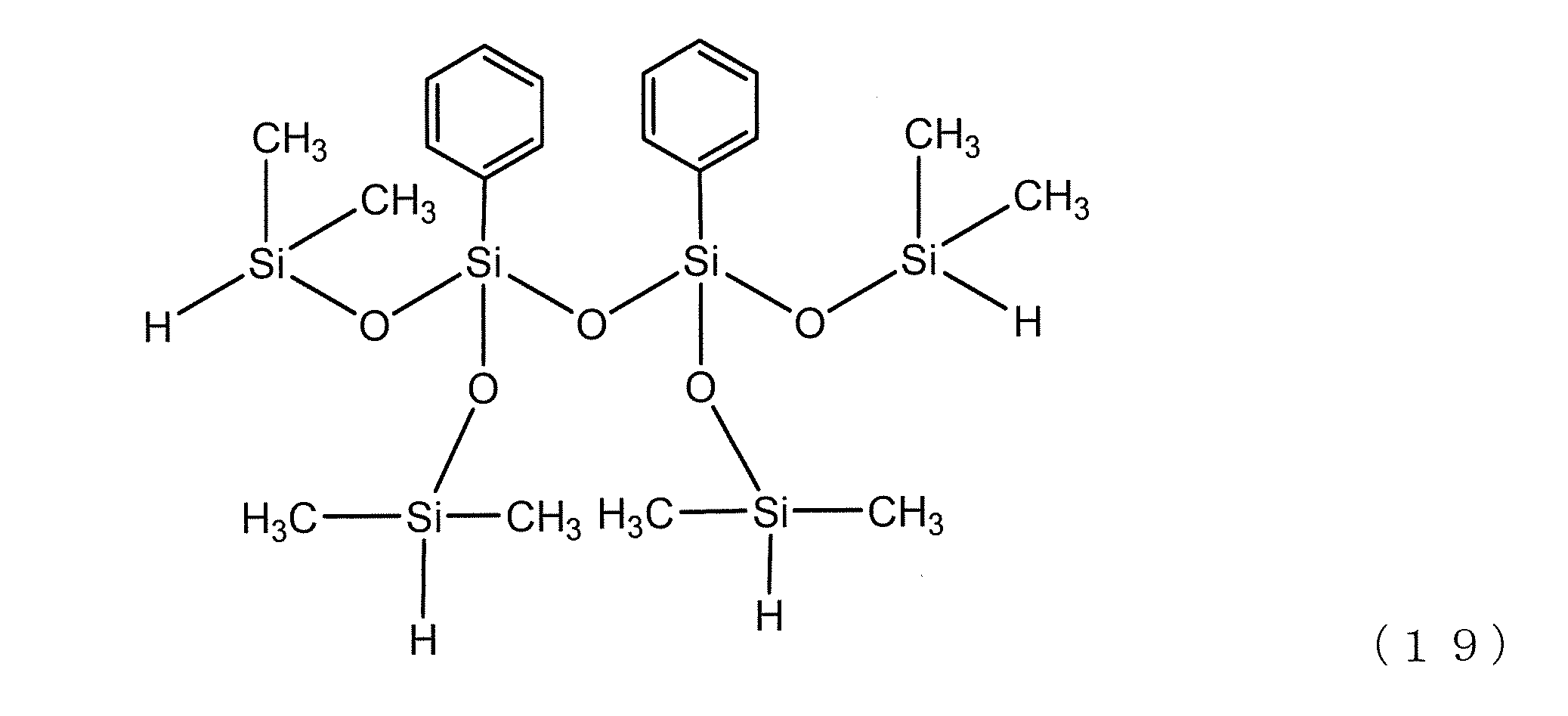
- Synthesis example 1 26.4 parts by weight of organohydrogensiloxane represented by the formula (19) (0.2 equivalent as SiH group), 78 parts by weight of dioxane, 0.14 parts by weight of carbon-supported platinum (platinum support amount 3%) , A reflux condenser, and a 500 mL separable flask equipped with a nitrogen line were heated to 100 ° C. while stirring. Subsequently, a solution in which 56.2 parts by weight of N-allyl-N ′, N ′′ -diglycidyl isocyanurate (0.2 equivalent as a vinyl group) was dissolved in 56 parts by weight of dioxane was added over 1 hour.
- Examples 5-8 The epoxy silicone resins (A) (ES1 to 4) obtained in Examples 1 to 4 were converted into epoxy equivalents and acid anhydrides using methylated hexahydrophthalic anhydride (MH: acid anhydride equivalents 168 g / eq.). Add so that the equivalent ratio is 1: 1, mix well, and add 0.5% by weight of tetra-n-butylphosphonium o, o'-diethyl phosphorodithionate as a curing accelerator and mix. Then, it was vacuum degassed and cured in a mold at 120 ° C. for 4 hours and further at 160 ° C. for 12 hours to prepare resin plates having a thickness of 1 mm and 4 mm.
- MH acid anhydride equivalents 168 g / eq.
- Example 9 70 parts by weight of the epoxy silicone resin (ES2) obtained in Example 2 was used as the component (A), and 3,4-epoxycyclohexenylmethyl-3 ′, 4′-epoxycyclohexene carboxy was used as the component (D).
- a resin liquid containing 30 parts by weight of a rate (EpC: epoxy equivalent 130 g / eq.) was prepared. Using this resin solution and MH, the ratio of epoxy equivalent to acid anhydride equivalent is added to 1: 1, mixed well, and tetra-n-butylphosphonium o, o′-diethyl as a curing accelerator.
- Phosphorodithionate is added at 0.5% by weight, mixed, vacuum degassed, and cured in a mold for 4 hours at 120 ° C. and further for 12 hours at 160 ° C., and 1 mm and 4 mm thick resin plates It was created.
- Example 10 70 parts by weight of the epoxy silicone resin (ES4) obtained in Example 4 is used as the component (A), and 3,4-epoxycyclohexenylmethyl-3 ′, 4′-epoxycyclohexenecarboxy is used as the component (D).
- a resin liquid containing 30 parts by weight of the rate was prepared. Using this resin solution and MH, the ratio of epoxy equivalent to acid anhydride equivalent is added to 1: 1, mixed well, and tetra-n-butylphosphonium o, o′-diethyl as a curing accelerator. Phosphorodithionate is added at 0.5% by weight, mixed, vacuum degassed, and cured in a mold for 4 hours at 120 ° C. and further for 12 hours at 160 ° C., and 1 mm and 4 mm thick resin plates It was created.
- Examples 11-14 Epoxy silicone resins (A) (ES1 to 4) obtained in Examples 1 to 4 were mixed with diethyltoluenediamine (DETDA: active hydrogen equivalent 45 g / eq.), Ratio of epoxy equivalent to active hydrogen equivalent 1: 1, 2-ethyl-4-methylimidazole as a curing accelerator was added in an amount of 0.5% by weight, vacuum degassed in a mold at 120 ° C. for 4 hours, Furthermore, it hardened
- DETDA diethyltoluenediamine
- Example 5 is the same as Example 5 except that (A) component was not used and 26 parts by weight of 3,4-epoxycyclohexenylmethyl-3 ′, 4′-epoxycyclohexenecarboxylate (EpC) and 34 parts by weight of MH were used. The same operation was performed to prepare resin plates having a thickness of 1 mm and 4 mm.
- Comparative Example 2 The same procedure as in Comparative Example 1 was carried out except that 20 parts by weight of triglycidyl isocyanurate (EpT, epoxy equivalent 100 g / eq.) And 34 parts by weight of MH were used without using the component (A). And the resin board of 4 mm was created.
- EpT triglycidyl isocyanurate
- Comparative Example 3 ((Me 2 CH 2 ⁇ CH) SiO 1/2 ) 1.0 (MeSiO 3/2 ) 1.11 (Me 2 SiO) 100 parts by weight of a silicone resin represented by 0.05 , vinyl equivalent is 1,400 g / Eq. 20 parts by weight of a dimethylsiloxane oil containing vinyl groups at both ends and a hydrosilyl equivalent of 64 g / eq.
- a silicone resin represented by 0.05 vinyl equivalent is 1,400 g / Eq.
- 20 ppm of a platinum-tetravinyldisiloxane complex xylene solution as a curing catalyst is added to the total weight, vacuum degassed, and 120 ° C. for 4 hours in a mold. Further, it was cured at 160 ° C. for 12 hours to prepare resin plates having thicknesse
- Comparative Example 4 (C 6 H 5 ) 0.62 (CH 2 ⁇ CH) 0.38 (CH 3 ) 0.38 SiO 30 parts by weight of a phenyl silicone resin represented by 1.31 , and a hydrosilyl equivalent of 163 g / eq. 16 parts by weight of methyl hydrogen silicone oil represented by the formula, 20 ppm of a platinum-tetravinyldisiloxane complex xylene solution as a curing catalyst is added to the total weight, vacuum degassed at 120 ° C. in a mold. It was cured for 4 hours and further at 160 ° C. for 12 hours to prepare resin plates having a thickness of 1 mm and 1 mm.
- Comparative Example 6 The same operation as in Example 6 was carried out except that 40.6 parts by weight of the epoxy silicone resin (ES5) obtained in Synthesis Example 1 and 33.6 parts by weight of MH were used without using the component (A). Resin plates having a thickness of 1 mm and 4 mm were prepared.
- Comparative Example 7 25 parts by weight of a hydrosilylation reaction product (vinyl equivalent: 250 g / eq.) Generated from 1,3,5,7-tetramethylcyclotetrasiloxane and an excess amount of vinylnorbornene, and an excess of 1,3,5,7 -Using 16 parts by weight of a hydrosilylation reaction product (SiH equivalent: 160 g / eq.) Generated from tetramethylcyclotetrasiloxane and vinylnorbornene, a xylene solution of platinum-tetravinyldisiloxane complex as a curing catalyst was used with respect to the total weight. 20 ppm was added, vacuum deaerated, and cured in a mold at 120 ° C. for 4 hours and further at 160 ° C. for 12 hours to prepare resin plates having a thickness of 1 mm 1 mm and 4 mm.
- a hydrosilylation reaction product (vinyl equivalent: 250 g / eq.
- the physical properties of the cured resin plate were measured by the following method.
- Tg glass transition temperature
- the heating rate was 5 ° C./min.
- Table 1 shows the measurement results of each test of the cured products obtained in Examples 5 to 10.
- Table 2 shows the measurement results of each test of the cured products obtained in Examples 11 to 14.
- Table 3 shows the measurement results of the tests of the cured products obtained in Comparative Examples 1 to 7. In Table 3, NM means not measurable.
- the physical properties of the sealed LED device were measured by the following method. (10) Reflow test When the sealed LED package is continuously passed through a reflow oven set to hold 260 ° C. for 15 seconds, the presence or absence of coloring, cracking, or peeling of the sealing material is confirmed. did. The results are shown in Table 4. (11) Measurement of thermal shock test The sealed LED package was subjected to a test of ⁇ 40 ° C. to 100 ° C. and 500 cycles, and the presence of cracks and peeling of the sealing material was confirmed with a microscope. The results are shown in Table 5. In Tables 4 and 5, E5 in the formulation means the formulation of Example 5, E6 means the formulation of Example 6, C1 means the formulation of Comparative Example 1, and C2 means the formulation of Comparative Example 2. The same applies hereinafter. Also, ⁇ means no, and X means yes.
- the epoxy silicone resin of the present invention is a curable resin composition, which is excellent in surface hardness, strength, and deflection when it is obtained as a cured product obtained by applying heat, has transparency, and has excellent heat resistance and light resistance. An excellent cured product or film can be obtained. Therefore, it is useful for electronic component materials such as semiconductors and circuit boards, and optical component materials such as optical lenses, optical sheets, and white molding materials for light reflection. Improvement of problems such as coloring by light, reflow mounting and cracks in the heat cycle environment, disconnection, and peeling from the substrate can be expected.
Landscapes
- Chemical & Material Sciences (AREA)
- Organic Chemistry (AREA)
- Health & Medical Sciences (AREA)
- Chemical Kinetics & Catalysis (AREA)
- Medicinal Chemistry (AREA)
- Polymers & Plastics (AREA)
- Engineering & Computer Science (AREA)
- Materials Engineering (AREA)
- Epoxy Resins (AREA)
- Structures Or Materials For Encapsulating Or Coating Semiconductor Devices Or Solid State Devices (AREA)
- Led Device Packages (AREA)
- Silicon Polymers (AREA)
Abstract
硬化物の硬度が高く、耐熱着色性、耐UV着色性、強度、たわみに優れ、リフロー、ヒートサイクル下でもパッケージの損傷が少ない、電子材料分野や光半導体封止に適した熱硬化性樹脂組成物と、それに適したエポキシシリコーン樹脂を提供する。 このエポキシシリコーン樹脂は、一般式(1)で表され、エポキシ当量が170~2000g/eq.である。また、この熱硬化性樹脂組成物は、エポキシ樹脂成分としてこのエポキシシリコーン樹脂(A)と、硬化剤(B)、及び硬化促進剤(C)を含む。(式中、R1は炭化水素基を表し、mは0<m≦100、nは0≦n≦100の数を表し、E1は式(2)で表されるジグリシジルイソシアヌリル-プロピル基であり、Zは両末端が炭素原子で内部にSi原子を含む2価の有機残基である。)
Description
本発明は直鎖または環状シロキサン結合を有するエポキシシリコーン樹脂、およびそれを必須成分とする光学特性、硬度、曲げ特性、耐熱着色性、耐光着色性に優れる熱硬化性樹脂組成物に関し、特に、電子材料分野や光半導体材料分野に適した熱硬化性樹脂組成物に関する。
エポキシ樹脂は、電気特性、接着性、耐熱性等に優れることから主に塗料分野、土木分野、電気分野の多くの用途で使用されている。特に、ビスフェノールA型ジグリシジルエーテル、ビスフェノールF型ジグリシジルエーテル、フェノールノボラック型エポキシ樹脂、クレゾールノボラック型エポキシ樹脂等の芳香族エポキシ樹脂は、耐水性、接着性、機械物性、耐熱性、電気絶縁性、経済性などが優れることから種々の硬化剤と組み合わせて広く使用されている。しかし、これらの樹脂は芳香環を含むことから、紫外線等により劣化しやすく、耐候性、耐光性を求められる分野では使用上の制約があった。
エポキシ樹脂組成物に関しては、硬化物の硬度が高いため、ハンドリング性に優れており、低出力の白色LED封止用途では、必要な耐久性が得られることから、低出力用途では多く用いられている。しかし、高出力LEDにおいては、発光量や発熱量の増加により変色を生じやすく、十分な寿命を得ることが難しい短所を有している。発熱量の増加による変色を防ぐために、高いガラス転移温度を発現するエポキシ樹脂が使用されるが、このようなエポキシ樹脂は高弾性である上、強度、たわみなどの曲げ特性が通常のエポキシ樹脂より低いため、ダイシング等の切削加工や急激な温度変化が起こりうる環境下では封止材が割れやすいなどの課題も有している。加えて近年のLEDの発光波長の短波長化により、連続使用すると変色を生じて発光出力が低下しやすいなどの課題も有している。このため、封止材には更なる耐熱着色性、耐光性の改善と同時に、機械強度を有することが求められる。
近年、耐熱・耐光黄変性に優れるシリコーン樹脂をベースにしたLED封止材の開発が行われており、ヒドロシリル基とアルケニル基の付加反応による樹脂組成物や、エポキシ基を有するシリコーン樹脂を、硬化剤を用いて硬化させて得られる樹脂組成物の報告がなされている。
しかし、シリコーン樹脂やシリコーン骨格を主鎖に持つエポキシ樹脂の多くは、シリコーン骨格に由来する高い可とう性を持つが、硬化物の硬度が低く、表面にべたつき性を生じやすいことや、強度が低い短所を有している。このため、埃の付着等による透明性の劣化を生じやすく、LED製造時のハンドリングに難があり、製造方法や構成、デザイン、用途に制限を受けている。また、フェニル基を含有した、硬度の高いシリコーン骨格を有する樹脂は、ハンドリング性は改善されるが、強度、たわみに問題があり、点灯消灯時の急激な温度変化等によって割れを生じやすいなどの短所を有している。エポキシシクロヘキシル基を含有するエポキシ当量の低い樹脂についても、表面硬度等ハンドリング性は改善されるものの、シリコーンの長所である耐熱着色性が損なわれる上、LED封止材としての要求に耐えられるものではなく、更なる改善が求められている。また、有機オレフィン化合物とヒドロシリル基を有するオルガノポリシロキサンからなる樹脂組成物についても、強度、黄変の面から改善が求められている。
また、携帯電話やモニターのバックライトに搭載されるLEDは数が多いため、回路基板に一括はんだ実装するリフロープロセスを通る必要がある。環境に則した鉛フリーはんだで実装するためには260℃程度のリフロー炉にLEDパッケージ全体が曝されるため、急激な温度変化により封止材の着色、クラック、封止材と接着部位の接着力不足によるハガレ、封止材の膨張によるワイヤーの断線等の損傷が生じ、歩留まり、生産性の向上が求められている。
このように、耐候性に優れるシリコーン樹脂をベースにしても、LED封止材に要求される物性を完全に満たしているものは得られておらず、十分な硬度、強度、たわみを有し、耐熱着色、耐UV着色性に優れ、エポキシ樹脂と同様の量産性、ハンドリング性を有する材料が求められている。
特許文献1には、ヒドロシリル基を有するポリオルガノシロキサン樹脂とアルケニル基を有するポリオルガノシロキサン樹脂の付加反応による樹脂組成物が開示されている。特許文献2には、フェニル基を含有する硬化性ポリオルガノシロキサン組成物およびそれを用いた光半導体素子封止剤及び光半導体装置が開示されている。特許文献3には側鎖にエポキシシクロヘキシル基を有する直鎖及び環状シロキサン構造を必須とするエポキシシリコーン樹脂が開示されている。特許文献4、5には、少なくとも主鎖の両末端にジグリシジルイソシアヌリルアルキル基を有するオルガノポリシロキサン及びそれを含む組成物が開示されている。特許文献6には、2個のヒドロシリル基を有する有機ケイ素化合物と、付加反応性炭素―炭素二重結合を1分子中に2個有する多環式炭化水素との付加反応生成物であり、かつ付加反応性炭素―炭素二重結合を1分子中に少なくとも2個有する付加反応生成物と、Si-H基を有する化合物とを含む組成物が開示されている。しかし、これら特許文献に記載された熱硬化性樹脂組成物も、上記特性を十分に有しているとは言い難い。
本発明は、硬化物の硬度が高く、耐熱着色性、耐UV着色性、強度、たわみに優れ、リフロー、ヒートサイクル下でもパッケージの損傷が少ない、電子材料分野や光半導体封止に適した熱硬化性樹脂組成物を提供することを目的とする。他の目的は、上記熱硬化性樹脂組成物の材料として適したエポキシシリコーン樹脂を提供することにある。
本発明は、一般式(1)で表され、エポキシ当量が180~2000g/eq.であるエポキシシリコーン樹脂に関する。

(式中、R1は炭素数1~10の炭化水素基を表し、各々同一でも異なっていても良い。mは0<m≦100、nは0≦n≦100の数を表す。E1は式(2)で表されるジグリシジルイソシアヌリル-プロピル基を表す。Zは両末端に炭素原子、内部にSi原子を含む2価の有機残基を表す。)
(式中、R1は炭素数1~10の炭化水素基を表し、各々同一でも異なっていても良い。mは0<m≦100、nは0≦n≦100の数を表す。E1は式(2)で表されるジグリシジルイソシアヌリル-プロピル基を表す。Zは両末端に炭素原子、内部にSi原子を含む2価の有機残基を表す。)
一般式(1)中のZとしては、一般式(3)または一般式(4)で表される2価の有機残基がある。

(式中、R2は炭素数1~10の炭化水素基を表し、各々同一でも異なっていてもよい。lは0≦l≦100の数である。)

(式中、R3は炭素数1~10の炭化水素基を表し、各々同一でも異なっていても良い。j、kはそれぞれ0~4の整数であり、1≦j+k≦4である。)
(式中、R2は炭素数1~10の炭化水素基を表し、各々同一でも異なっていてもよい。lは0≦l≦100の数である。)
(式中、R3は炭素数1~10の炭化水素基を表し、各々同一でも異なっていても良い。j、kはそれぞれ0~4の整数であり、1≦j+k≦4である。)
また、本発明は一般式(5)で表される両末端SiH含有ポリオルガノシロキサンに、一般式(6)または一般式(7)で表される両末端ビニル基含有ポリオルガノシロキサンを理論量未満で反応させ、ついで残存するSiH基を、モノアリルジグリシジルイソシアヌレートを用いて末端封止反応を行うことを特徴とする上記一般式(1)で表されるエポキシシリコーン樹脂の製造方法に関する。
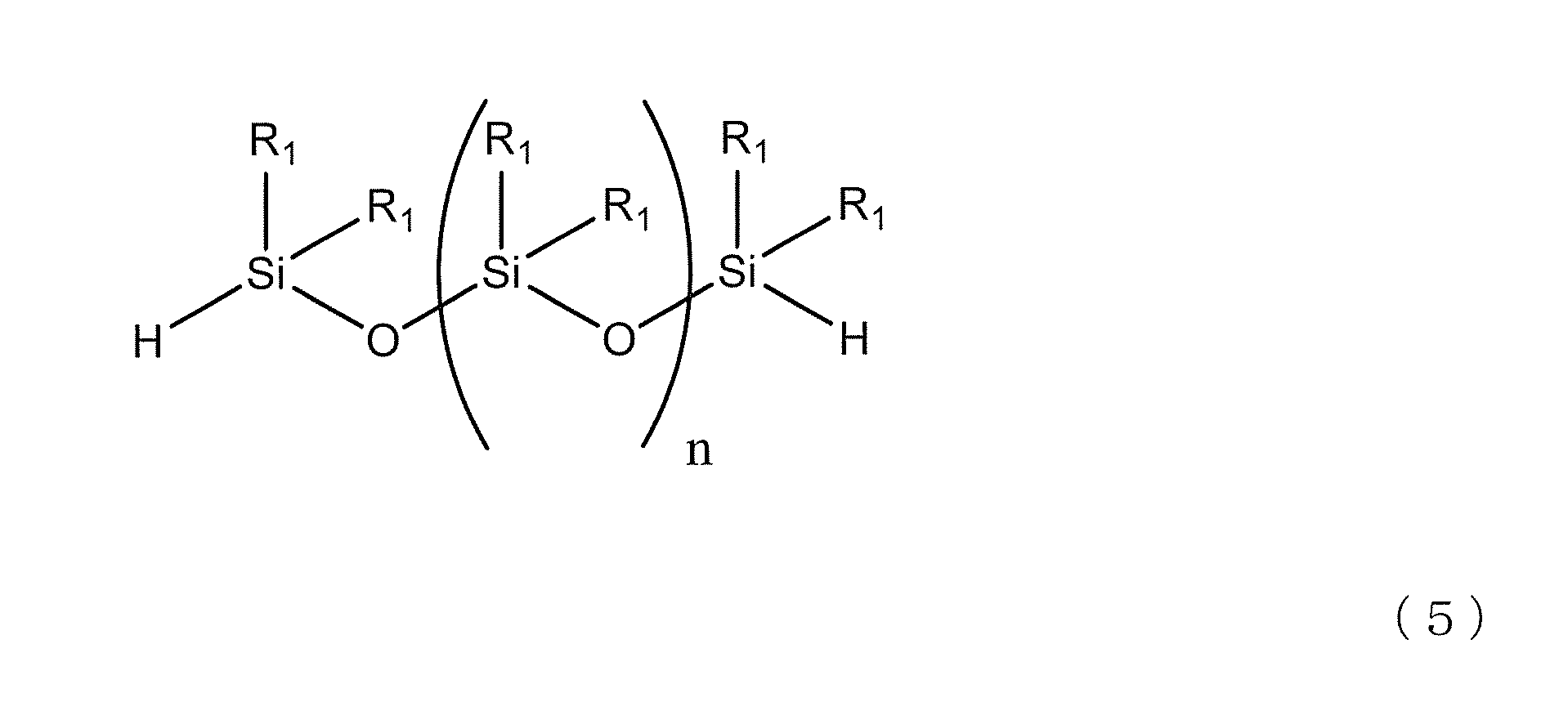
(式中、R1及びnは一般式(1)と同義である。)
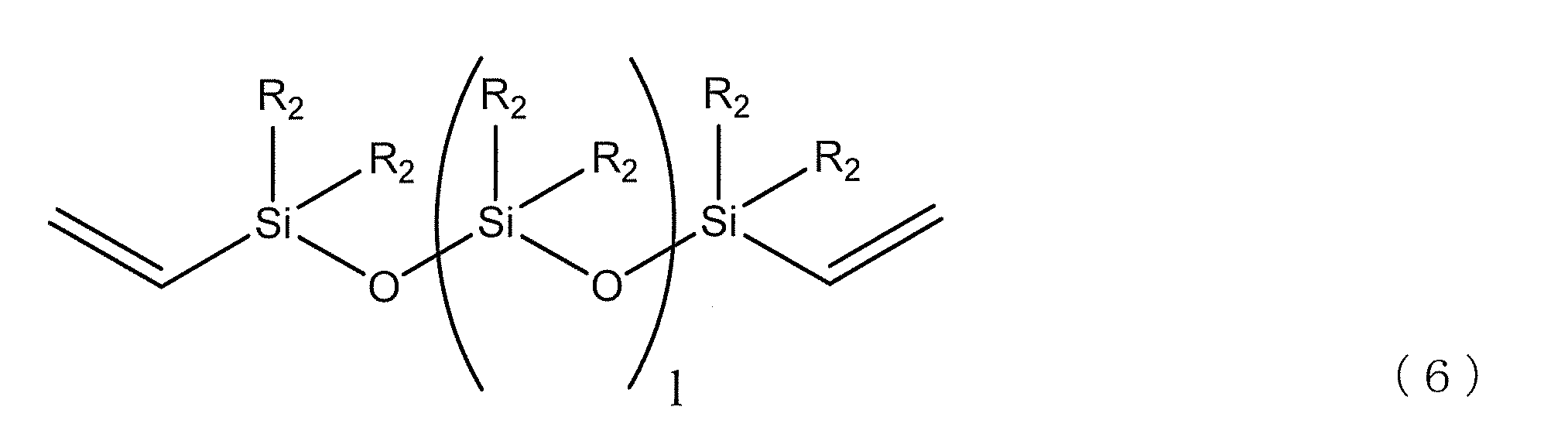
(式中、R2は炭素数1~10の炭化水素基を表し、各々同一でも異なっていてもよい。lは0≦l≦100の数である。)
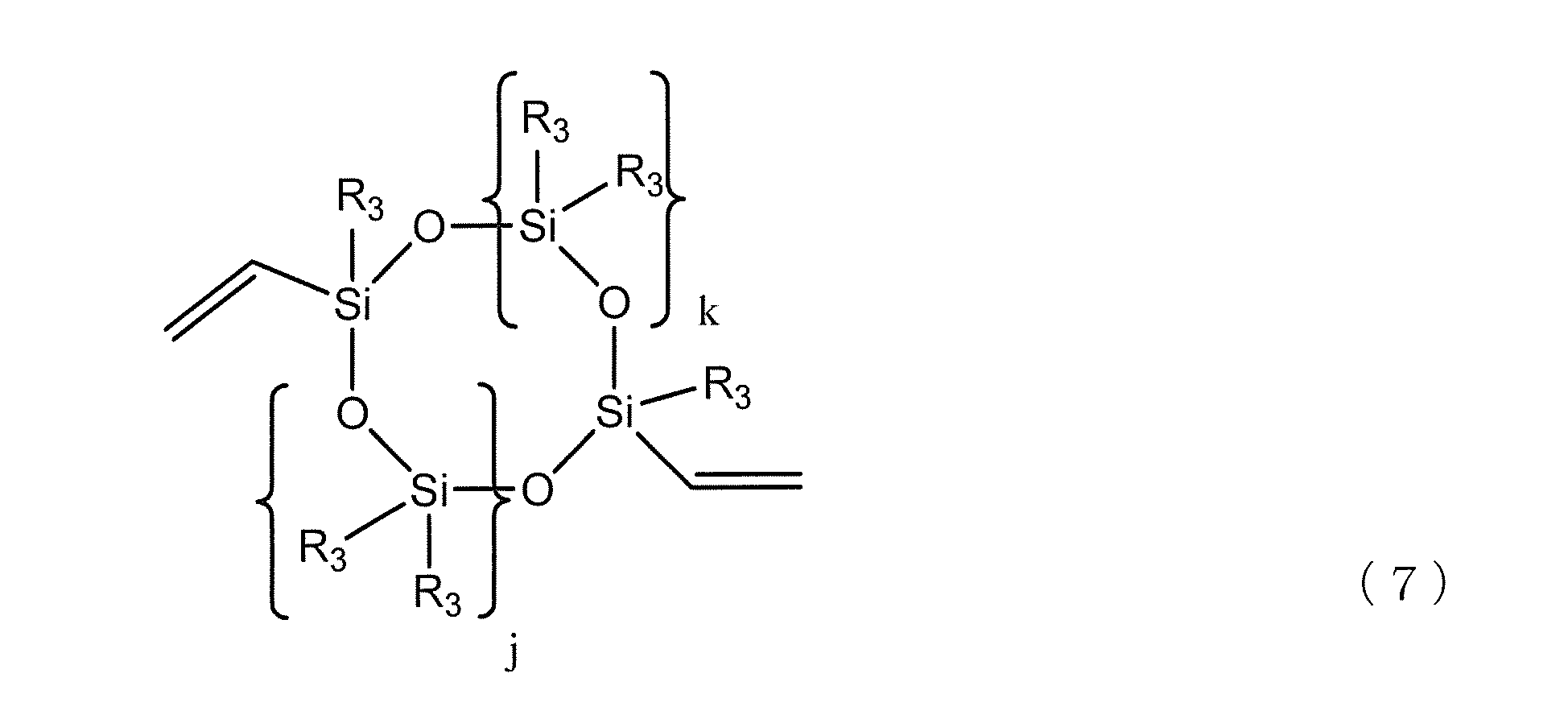
(式中、R3は炭素数1~10の炭化水素基を表し、各々同一でも異なっていても良い。j、kはそれぞれ0~4の整数であり、1≦j+k≦4である。)
(式中、R1及びnは一般式(1)と同義である。)
(式中、R2は炭素数1~10の炭化水素基を表し、各々同一でも異なっていてもよい。lは0≦l≦100の数である。)
(式中、R3は炭素数1~10の炭化水素基を表し、各々同一でも異なっていても良い。j、kはそれぞれ0~4の整数であり、1≦j+k≦4である。)
更に本発明は、エポキシ樹脂、硬化剤(B)、及び硬化促進剤(C)を必須成分として含む熱硬化性樹脂組成物において、エポキシ樹脂成分として上記のエポキシシリコーン樹脂(A)を含むことを特徴とする熱硬化性樹脂組成物に関する。
硬化剤(B)としては、酸無水物、室温で液状のアミン化合物、または室温で液状のアミノ樹脂が挙げられる。硬化促進剤(C)としては、4級アンモニウム塩または4級ホスホニウム塩が挙げられる。また、エポキシ樹脂成分としては、エポキシシリコーン樹脂(A)100重量部に対し、室温で液状のエポキシ樹脂(D)5~150重量部を含み、エポキシ当量が180g/eq.~1000g/eq.であるものが挙げられる。
上記熱硬化性樹脂組成物が、光学部品用樹脂組成物又は電子部品用樹脂組成物、光半導体部品用樹脂組成物、または半導体用液状封止樹脂組成物として有用である。また、本発明は、上記の熱硬化性樹脂組成物を用いて封止することを特徴とするLED装置である。
以下、本発明の実施の形態について詳細に説明する。
本発明のエポキシシリコーン樹脂は上記一般式(1)で表され、エポキシ当量が170~2000g/eq.である。
本発明のエポキシシリコーン樹脂は上記一般式(1)で表され、エポキシ当量が170~2000g/eq.である。
一般式(1)中、R1は炭素数1~10の炭化水素基を表す。炭化水素基としては、たとえば、メチル基、エチル基、プロピル基、イソプロピル基、n―ブチル基、ヘキシル基、フェニル基、ナフチル基などがあげられるがこれらに限定されず、各々同一でも異なっていても良い。好ましいR1としては、入手の容易性及び熱硬化性樹脂組成物とし、熱処理を施して得られる硬化物としたときの耐熱着色性、耐光着色性などの物性の観点から、メチル基である。
一般式(1)中、mは0<m≦100、nは0≦n≦100であり、Z成分を必ず含む。好ましいm、nの数は硬化物としたときの耐熱着色性、耐光着色性、機械物性の観点から、0<m≦30、0≦n≦30であり、0<m+n≦50である。更に好ましくは0<m≦8、0≦n≦8であり、0<m+n≦20である。より好ましくは、mは0.3~2であり、nは1~10であり、m+nは1.5~10である。特に好ましくは0.2≦m≦2、0≦n≦8あり、0.5<m+n≦10である。ここで、mとnは平均値(数平均)である。
一般式(1)中、Zは両末端に炭素原子が配され、内部にSi原子を含む2価の有機残基を表す。このような構造としては、たとえば、一般式(8)、(9)、(10)、(11)又は(12)で表わされるような構造が挙げられる。

(式中、R4、R6、R9は独立に、炭素数1~10の2価の炭化水素基を表し、内部に芳香族環を有していても良い。R5、R8、R11は独立に、炭素数1~10の1価の炭化水素基を表わす。R7はフェニレン基またはナフチレン基を表す。R10は炭素数1~20の2価の炭化水素基を表し、内部に芳香族環を有していてもよく、エーテル結合性酸素原子を有していても良い。)なお、基を表わす化学式において、末端の単線は単結合を表わす。

(式中、R2およびlは一般式(3)における表記と同義であり、R3、j、kは一般式(4)における説明と同義であり、R12、R13は独立に、炭素数1~10の2価の炭化水素基を表す。)
これらのうち、好ましい構造としては、入手の容易性、本発明のエポキシシリコーン樹脂の製造の容易性、硬化物とした際の耐熱着色性、耐光着色性、機械物性の観点から、一般式(11)または一般式(12)で表される構造が好ましく、一般式(11)中のR2がメチル基、0≦l≦20、一般式(12)中のR3がメチル基、k=1、j=1であることがより好ましい。なかでも、上記一般式(3)または一般式(4)で表される構造が好ましい。一般式(3)及び(4)において、R2、R3は、独立に炭素数1~10の2価の炭化水素基を表すが、好ましい炭化水素基はR1で説明したと同様である。
一般式(3)及び(11)において、繰り返し数を表わすlがいくつかの整数を有する場合は、その平均値(数平均)が上記した範囲の数となる。
本発明のエポキシシリコーン樹脂は、上記一般式(5)で表される両末端SiH含有ポリオルガノシロキサンに、上記一般式(6)または上記一般式(7)で表される両末端ビニル基含有ポリオルガノシロキサンを理論量未満で反応させ、ついで残存するSiH基を、モノアリルジグリシジルイソシアヌレートを用いて末端封止反応を行うことにより有利に製造することができる。
本発明のエポキシシリコーン樹脂の製造方法は、一般式(5)で表される両末端SiH基含有ポリオルガノシロキサンを原料とし、未反応のSiH基が残存する量を用いて、一般式(6)又は(7)で表される両末端ビニル基含有ポリオルガノシロキサンを、ヒドロシリル化により反応させ、ついで未反応のSiH基を、モノアリルジグリシジルイソシアヌレートを用いて末端封止反応を行う。未反応のSiH基の割合は、得られる一般式(1)で表されるエポキシシリコーン樹脂のE1の含有量に関係するので、結果としてエポキシ当量に関係することになる。したがって、上記エポキシ当量を満たす範囲となるように未反応のSiH基を残すことができれば特に限定されないが、20~80%SiH基が残存してすることが好ましい。
この反応において、両末端SiH基含有ポリオルガノシロキサンを先に反応系内に投入しておき、ついで必ず未反応のSiH基が残存する量の両末端ビニル基含有ポリオルガノシロキサンを逐次添加し、反応(ヒドロシリル化反応)が完結したことを確認してから、モノアリルジグリシジルイソシアヌレートを用い末端封止反応を行うことが特に好ましい。また、一般式(6)または一般式(7)で表されるポリオルガノシロキサンは、2種以上を併用してもよい。
上記以外の方法、例えば、両末端SiH基含有ポリオルガノシロキサン、両末端ビニル基含有ポリオルガノシロキサンとモノアリルジグリシジルイソシアヌレートを一括して反応系内に投入してヒドロシリル化反応を行ったり、両末端ビニル基含有ポリオルガノシロキサンと、モノアリルジグリシジルイソシアヌレートを混合して反応系内に投入し、ついで両末端SiH基含有ポリオルガノシロキサンを投入してヒドロシリル化を行ったりする場合は、ヒドロシリル化反応の反応速度がモノアリルジグリシジルイソシアヌレートに対して両末端ビニル基含有ポリオルガノシロキサンの方が著しく早いため、反応系内にエポキシ基を有さないシロキサン樹脂が選択的に生成しやすくなる。このため、得られるエポキシシリコーン樹脂が相分離を起こし白濁し、透明性が失われること、また白濁を生じなくとも硬化物物性の面で本発明の効果が得られないため好ましくない。
ヒドロシリル化反応(付加反応)は、貴金属触媒の存在下で進行することが広く知られている。触媒としては、公知のものであれば種々の貴金属又はその錯体化合物を使用することができる。貴金属触媒としては、例えば、白金、ロジウム、パラジウム、ルテニウム又はイリジウムなどが挙げられるがこれらに限定されず、必要に応じて2種以上用いても良い。また、これらの金属を微粒子状担体材料、例えばカーボン、活性炭、酸化アルミニウム、シリカなどに固定化されたものを用いても良い。
貴金属の錯体化合物としては、白金ハロゲン化合物(PtCl4、H2PtCl6・6H2O、Na2PtCl6・4H2O等)、白金―オレフィン錯体、白金―アルコール錯体、白金―アルコラート錯体、白金―エーテル錯体、白金―カルボニル錯体、白金―ケトン錯体、白金―1,3-ジビニルー1,1,3,3-テトラメチルジシロキサンなどの白金―ビニルシロキサン錯体、ビス(γ―ピコリン)―白金ジクロライド、トリメチレンジピリジン-白金ジクロライド、ジシクロペンタジエン-白金ジクロライド、シクロオクタジエン-白金ジクロライド、シクロペンタジエン-白金ジクロライド、ビス(アルキニル)ビス(トリフェニルホスフィン)白金錯体、ビス(アルキニル)(シクロオクタジエン)白金錯体、塩化ロジウム、トリス(トリフェニルホスフィン)ロジウムクロライド、テトラキスアンモニウムーロジウムクロライド錯体などが挙げられるが特に限定されず、必要に応じて2種以上使用しても良い。
上記貴金属触媒はそれぞれ単独で、あるいは溶解する溶媒にあらかじめ溶解させておき、しかる後反応系内に投入してもよい。貴金属触媒の使用割合は特に限定されないが、通常反応に用いた原料の合計重量に対して、0.1ppm~100000ppm、好ましくは1ppmから10000ppmの範囲である。
ヒドロシリル付加反応は、無溶媒でも反応を行うことができるが、必要に応じて有機溶媒にて反応系を希釈してもよく、反応に悪影響を与える化合物でなければ特に制限されない。例えば、ジクロロメタン、クロロホルム、四塩化炭素、1,2-ジクロロエタンなどのハロゲン系炭化水素類、アセトン、メチルエチルケトン、メチルイソブチルケトン、シクロヘキサノン、シクロペンタノンなどの脂肪族ケトン類、ベンゼン、トルエン、オルトキシレン、メタキシレン、パラキシレン、クロロベンゼン、ジクロロベンゼンなどの芳香族類、ジエチレングリコールジメチルエーテル、トリエチレングリコールジメチルエーテルなどのエーテル類、酢酸エチル、酢酸-n-ブチルなどのエステル類が挙げられる。これらの有機溶媒は、2種以上を選択して混合溶媒として使用してもよい。
ヒドロシリル付加反応における温度条件については、特に限定されないが、通常0℃~200℃、好ましくは30℃~180℃である。0℃以下では反応の進行に時間を要し経済的ではない。200℃以上で反応を行うとエポキシ基とヒドロシリル部位との付加反応が進行し、反応をコントロールすることが困難となる。
また、エポキシシリコーン樹脂の合成反応において、本発明における硬化性樹脂組成物の機能発現を損なわない程度であれば、モノアリルジグリシジルイソシアヌレートに加え、一分子中に少なくとも一つ以上のビニル基とエポキシ基を含有する化合物を併用してヒドロシリル化反応を行い、得られた樹脂を用いて硬化性樹脂組成物としてもよい。一分子中に少なくとも一つ以上のビニル基とエポキシ基を含有する化合物としては、例えばアリルグリシジルエーテル、グリシジルメタクリレート、4-ビニルシクロヘキセンオキシド、リモネンオキシド、モノビニルジエポキシシクロヘキサンなどが挙げられるがこれらに限定されず、2種以上を併用してもよい。用いる量は特に限定されないが、本発明の硬化性樹脂組成物の機能発現の観点から、モノアリルジグリシジルイソシアヌレートの50mol%以下であることが好ましい。
本発明のエポキシシリコーン樹脂は、エポキシ当量が170~2000g/eq.であり、好ましくは200~1000g/eq.であり、さらに好ましくは230~700g/eqである。この範囲であることで、透明性、耐熱着色性、ガラス転移点温度、曲げたわみに優れた硬化物を得ることができる。エポキシ当量がこの範囲から外れる場合は、硬化物が脆くなる、または表面硬度が低くなりべたつきを生じる、耐熱着色性が悪くなるなどの理由で好ましくない。
次に、本発明の熱硬化性樹脂組成物について説明する。熱硬化性樹脂組成物は、エポキシ樹脂、硬化剤(B)、及び硬化促進剤(C)を必須成分とし、エポキシ樹脂成分として本発明のエポキシシリコーン樹脂を含む。熱硬化性樹脂組成物の説明において、本発明のエポキシシリコーン樹脂をエポキシシリコーン樹脂(A)という。
本発明の熱硬化性樹脂組成物に含まれる硬化剤(B)としては、エポキシ樹脂の硬化剤として公知のものであれば種々の化合物を適用できる。例えば、ポリアリルアミン、ポリアミドアミン、ジシアンジアミド及びその誘導体などの有機アミン化合物、2-メチルイミダゾール、2-エチル-4-メチルイミダゾールなどのイミダゾール及びその誘導体、ビスフェノールA、ビスフェノールF、臭素化ビスフェノールA、ナフタレンジオール、4,4’-ビフェノールなどの2価フェノール化合物、フェノールやナフトール類とホルムアルデヒドあるいはキシリレングリコール類との縮合反応により得られるノボラック樹脂あるいはアラルキルフェノール樹脂、酸無水化合物と多価有機アルコールとの反応により得られる多価カルボン酸、無水コハク酸、無水マレイン酸、無水フタル酸、無水ヘキサヒドロフタル酸、メチル化無水ヘキサヒドロフタル酸、無水ナジック酸、水素化無水ナジック酸、無水トリメリット酸、無水ピロメリット酸などの酸無水物、アジピン酸ヒドラジドなどのヒドラジド化合物、スルホニウムカチオン、ヨードニウムカチオンを有する有機カチオン分子と、テトラフルオロほう素アニオン、ヘキサフルオロリンアニオン、ヘキサフルオロひ素アニオン、ヘキサフルオロアンチモンアニオン等のアニオン種で構成されているオニウム塩化合物等からなるカチオン硬化剤を適用することができ、必要に応じて2種類以上を用いてもよい。本発明における透明性、耐熱着色性、耐光着色性を得るための好ましい硬化剤は、酸無水物、アミン基を有する室温で液状の化合物、またはフェノール樹脂である。特に、酸無水物であり、更に好ましくは無水ヘキサヒドロフタル酸、メチル化無水ヘキサヒドロフタル酸、水素化無水ナジック酸である。
硬化促進剤(C)としては、エポキシ樹脂の硬化促進剤とし公知のものであれば種々の化合物を適用できる。例えば、3級アミン及びその塩類、イミダゾール類及びその塩類、有機ホスフィン化合物及びその塩類、オクチル酸亜鉛、オクチル酸スズなどの有機金属塩が挙げられ、必要に応じて2種類以上を用いてもよい。特に、本発明の効果を得るための好ましい硬化促進剤は、4級アンモニウム塩類、有機ホスフィン化合物、4級ホスホニウム塩類であり、更に好ましい触媒は4級ホスホニウム塩類である。
本発明の熱硬化樹脂組成物は、上記(A)、(B)及び(C)成分を必須成分とするが、粘度、硬化速度の調整等、当業者に好ましい形態とすることを目的として、(D)成分として、(A)成分以外の1分子中に2個以上のエポキシ基を有する、室温で液状のエポキシ樹脂またはエポキシ化合物を用いてもよい。このとき、(A)と(D)の混合物でエポキシ当量が180g/eq.~1000g/eq.の範囲であることで、本発明の効果が得られる。(A)成分と(D)成分の使用割合は、エポキシシリコーン樹脂(A)100重量部に対し、室温で液状のエポキシ樹脂(D)5~150重量部の範囲が好ましい。
(D)成分は、単独あるいは混合して室温で液状を有するものであれば種々の化合物を選択できる。たとえば、レソルシノール、ハイドロキノン、2,5-ジターシャリブチルヒドロキノンなどの単環型二価フェノール類から誘導されるエポキシ樹脂の芳香環を核水素化したもの、1,3-ナフタレンジオール、1,4-ナフタレンジオール、1,5-ナフタレンジオール、1,6-ナフタレンジオール、2,7-ナフタレンジオールなどのナフタレンジオール類から誘導されるエポキシ樹脂、およびその芳香環を核水素化したもの、4,4’-イソプロピリデンジフェノール、4,4’-イソプロピリデンビス(2-メチルフェノール)、4,4’-イソプロピリデンビス(2,6-ジメチルフェノール)、4,4’-ジヒドロキシジフェニルメタン、4,4’-ジヒドロキシ-3,3’-ジメチルジフェニルメタン、4,4’-ジヒドロキシ-3,3’,5,5’-テトラメチルジフェニルメタン、4,4’-セカンダリーブチリデンビスフェノール、4,4’-イソプロピリデンビス(2-ターシャリーブチルフェノール)、4,4’-シクロヘキシリデンジフェノール、4,4’-ブチリデンビス(6-ターシャリーブチル-2-メチル)フェノール等のビスフェノール類から誘導されるエポキシ樹脂、およびその芳香族環を核水素化したエポキシ樹脂が挙げられる。また、一般式(13)~(17)で示される脂環式エポキシ樹脂も好ましく挙げられる。
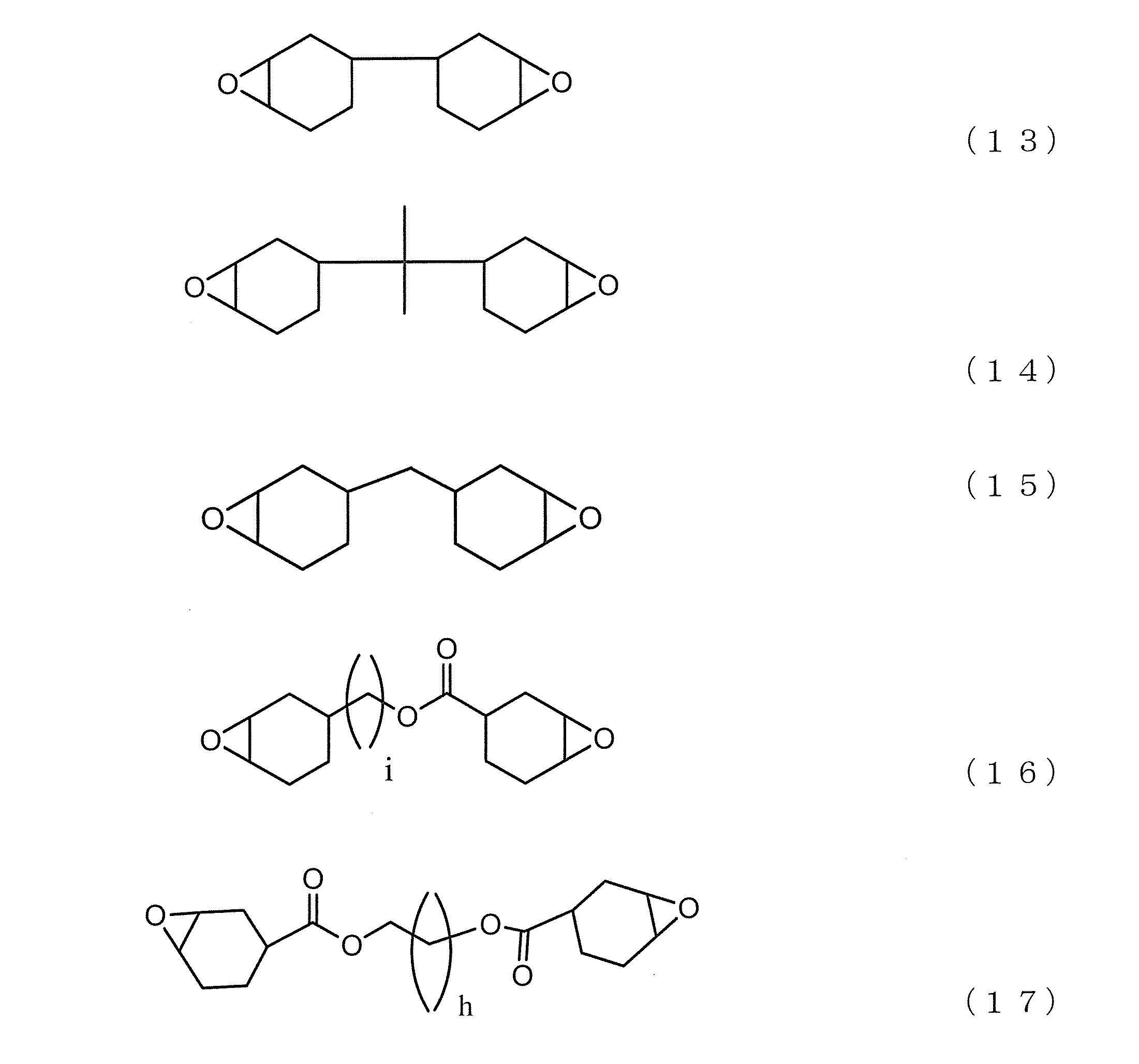
(式中、i、hは独立に1~20の整数を表す)
また、一般式(18)で表されるエポキシシリコーン樹脂が挙げられる。
(R14SiO3/2)e(R15R16SiO)f(Me3SiO1/2)g (18)
(式中、R14~R16は、それぞれ内部にエポキシ基を含んでいてもよい炭素数1~20の炭化水素基、芳香族基であり、内部にエーテル性酸素原子を1~3個有していても良い。ただし、R14~R16のうち、1つ以上は必ずエポキシ基を含む。またR15、R16が同時にエポキシ基を有することはない。e~gは、e+f+g=1、0≦e<1、0<f<1、0<g<0.75を満たす数である。)
(R14SiO3/2)e(R15R16SiO)f(Me3SiO1/2)g (18)
(式中、R14~R16は、それぞれ内部にエポキシ基を含んでいてもよい炭素数1~20の炭化水素基、芳香族基であり、内部にエーテル性酸素原子を1~3個有していても良い。ただし、R14~R16のうち、1つ以上は必ずエポキシ基を含む。またR15、R16が同時にエポキシ基を有することはない。e~gは、e+f+g=1、0≦e<1、0<f<1、0<g<0.75を満たす数である。)
本発明における熱硬化性樹脂組成物をLED封止用途として使用する際には、酸化防止剤を配合し、加熱時の酸化劣化を防止し着色の少ない硬化物とすることが好ましい。
酸化防止剤としては公知のものであれば種々の化合物を適用できる。例えば、2,6-tert-ブチル-p-クレゾール、ブチル化ヒドロキシアニソール、2,6-tert-ブチル-p-エチルフェノール、ステアリル-β-(3,5-ジ-tert-ブチル-4-4-ヒドロキシフェニル)プロピオネートなどのモノフェノール類、2,2-メチレンビス(4-メチル-6-tert-ブチルフェノール)、2,2-メチレンビス(4-エチル-6-tert-ブチルフェノール)、4,4’-チオビス(3-メチル-6-tert-ブチルフェノール)などのビスフェノール類、1,1,3-トリス(2-メチル-4-ヒドロキシ-5-tert-ブチルフェニル)ブタン、1,3,5-トリメチル-2,4,6-トリス(3,5-ジ-tert-ブチル-4-ヒドロキシベンジル)ベンゼン、テトラキス[メチレン-3-(3,5-ジ-tert-ブチル-4-ヒドロキシフェニル)プロピオネート]メタンなどの高分子型フェノール類、9,10-ジヒドロ-9-オキサ-10-ホスファフェナントレン-10-オキサイド、10-(3,5-ジ-tert-ブチル4-ヒドロキシベンジル)-9,10-ジヒドロ-9-オキサ-10-ホスファフェナントレン-10-オキサイド、10-デシロキシ-9,10-ジヒドロ-9-オキサ-10-ホスファフェナントレン-10-オキサイドなどのオキサホスファフェナントレンオキサイド類、ジラウリル3,3’―ジラウリル3,3’―チオジプロピオネート、ジミリスチル3,3’―ジラウリル3,3’―チオジプロピオネート、ジステアリル3,3’―ジラウリル3,3’―チオジプロピオネート、ペンタエリスリチルテトラキス(3―ラウリルチオプロピオネート)等のエステル骨格含有チオエーテル化合物系酸化防止剤が挙げられる。これらの酸化防止剤は必要に応じて2種類以上を用いてもよい。
また、本発明の熱硬化性樹脂組成物には他の熱硬化性樹脂を配合することもできる。このような熱硬化性樹脂としては、不飽和ポリエステル樹脂、熱硬化性アクリル樹脂、熱硬化性アミノ樹脂、熱硬化性メラミン樹脂、熱硬化性ウレア樹脂、熱硬化性ウレタン樹脂、熱硬化性オキセタン樹脂、熱硬化性エポキシ/オキセタン複合樹脂等が挙げられるがこれらに限定されない。
本発明の硬化性樹脂組成物は、上記(A)~(C)成分を必須成分とするが、樹脂成分(樹脂の他、硬化して樹脂の一部となる成分、例えば、モノマー、硬化剤、硬化促進剤を含むが、溶剤、充填剤は含まない)の60wt%以上、好ましくは80wt%以上、より好ましくは90wt%以上が(A)成分~(B)成分であることがよい。また、(A)成分、(B)成分及び(C)成分の配合割合は、次のようにして決めることがよい。
(B)成分がカチオン硬化剤でない場合は、全エポキシ成分のエポキシ基と(B)成分の硬化剤中の官能基が当量比で0.8~1.5の範囲であることが好ましい。この範囲外では硬化後も未反応のエポキシ基、又は硬化剤中の官能基が残留し、硬化物としたときの硬度や耐熱性等の機能が低下するため好ましくない。また、硬化促進剤である(C)成分の配合割合としては、全エポキシ成分のエポキシ基と(B)成分の合計に対して、0.1wt%~5wt%の範囲が好ましい。0.1wt%未満ではゲル化時間が遅くなって硬化時の剛性低下による作業性の低下をもたらし、逆に5.0wt%を超えると成形途中で硬化が進んでしまい、未充填が発生し易くなる。
(B)成分がカチオン硬化剤である場合、全エポキシ成分100重量部に対し、0.01~10重量部、好ましくは0.1重量部~5重量部である。0.01重量部未満の場合は硬化不良が発生しやすくなり、逆に5重量部を超えると透明性、耐熱着色性の点で好ましくない。
本発明の熱硬化性樹脂を電子部品として適用する場合、その用途、製造プロセスについては特に限定されるものではない。たとえば、半導体封止材料であれば本発明の熱硬化性樹脂組成物にシリカなどのフィラーを混合し、ニーダーや熱3本ロールにて混練したのち、タブレット化して封止用金型のキャビティに送り込み熱硬化させるトランスファーモールド方式をとることができる。また、室温で液状である硬化剤と混合し、必要に応じてシリカ、アルミナ、酸化チタンなどのフィラー等を用いて所望の粘度としたのち、所定の位置に樹脂を注入するディスペンス方式をとることが出来る。
また、回路基板としては、たとえばガラスクロスなどの基材に本発明の熱硬化性樹脂組成物を含浸させた後、銅箔をプレス成型により貼り合わせる方法や、銅箔に本発明の熱硬化性樹脂組成物をキャスト法などにより塗布し、所望の基材と貼り合わせる方法をとることが出来る。
また、基板と半導体の接合部を封止・保護するアンダーフィル材として使用する場合には、室温で液状である硬化剤と混合し、必要に応じてシリカ、アルミナ、酸化チタン、ゴム粒子などのフィラー等を用いて所望の粘度としたのち、所定の位置に樹脂を注入するディスペンス方式をとることが出来る。
また、光学部品用途としては、たとえば光学レンズ、光半導体用封止材、光半導体用白色成型材料、光半導体接着剤などがあげられるがその用途についてはこれらに限定されず、公知の用途、製造プロセスであれば適用が可能である。
たとえば、光学レンズ材料としては、ディスペンス方式、トランスファーモールド方式、射出成型等の公知のプロセスにより製造が可能である。
光半導体装置(LED装置)用封止材としては、光半導体素子を金ワイヤー等で外部電極に接続したのち、トランスファーモールド方式、ポッティング方式等公知の技術を用いて充填する方法が適用できる。この際、本発明の熱硬化性樹脂組成物に、光半導体素子から発光する光を変換する目的で、各種公知の蛍光粉末を用いてもよい。また、適度なチクソ性を発現させるため、シリカ、エアロジルなどの公知のフィラーやシランカップリング材、界面活性剤などの公知の添加剤を加えてもよい。
光半導体用白色成型材料としては、本発明の熱硬化性樹脂組成物に、シリカ、酸化チタン、アルミナなどのフィラーを混合し、ニーダーや熱3本ロールにて混練したのち、タブレット化して封止用金型のキャビティに送り込み熱硬化させるトランスファーモールド方式等を適用できる。
光半導体装置用接着剤としては、本発明の熱硬化性樹脂組成物を、必要に応じてシリカ、酸化チタン、アルミナ、銀粉などのフィラーを用いてロール等による混練によりペースト化したものをディスペンス等の方法で基材に塗布、またはさらに公知のフィルム材を用いてフィルム状としたものを、基材の上に貼り合わせ、光半導体素子をマウントし熱硬化させる方法等を適用できる。
本発明の熱硬化性樹脂組成物は、フッ素樹脂板、PETフィルム、ポリイミド等の基材上に、スピンコーター、バーコーター等を用いて薄膜状に塗布し、熱硬化させた後、基材をはがすことでフィルム体を得ることが出来る。
上記手法により得られた熱硬化性樹脂及び熱硬化フィルムは、電子部品用途、光学部品用途であれば種々の用途に適用でき、フレキシブルプリント配線板、異方性導電フィルム、カバーレイフィルム、ダイアタッチフィルム、層間絶縁材料等の電子部品用途、透明保護フィルム、光導波路用フィルム、光半導体フィルム等の光学部品用途に適用可能である。
次に、本発明を実施例に基づいて具体的に説明するが、本発明はその要旨を越えない限り、以下の実施例に限定されるものではない。
実施例1
一般式(5)において、R1がメチル基、nの平均値が4である両末端にSiH基を有するポリオルガノシロキサン516重量部(SiH基として2.4当量)、ジオキサン582重量部、カーボン担持白金(白金担持量3%)1.8重量部を、攪拌モーター、還流冷却管、窒素ラインを装着した3Lのセパラブルフラスコに投入し、攪拌しながら100℃に昇温した。ついで、一般式(6)において、R2がメチル基、lが0である両末端にビニル基を有するオルガノシロキサンを67重量部(ビニル基として0.7当量)を、1時間かけて反応系内に投入した。ゲルパーミエーションクロマトグラフィー(GPC)法により、両末端にビニル基を有するオルガノシロキサンの消失を確認した後、N-アリル-N’,N’’-ジグリシジルイソシアヌレート472重量部(ビニル基として1.7当量)をジオキサン472重量部に溶解させた溶液を1時間かけて投入した。投入終了後、内温を110℃まで昇温し、ジオキサンを還流させながら反応を行った。0.1規定の水酸化カリウム/メタノール溶液に反応液を滴下し、水素ガスの発生が認められなくなることにより反応が終了したことを確認して、残存する白金触媒をセライトを用いてろ過した。エバポレータを用いて、ろ液の溶媒留去を行うことで、一般式(1)において、R1がメチル基、mの平均値が0.4、nの平均値が4、Zが一般式(3)においてR2がメチル基、l=0であるエポキシシリコーン樹脂(ES1)を1005重量部得た。この樹脂のエポキシ当量は312g/eq.室温での粘度は5.6Pa・sであった。
一般式(5)において、R1がメチル基、nの平均値が4である両末端にSiH基を有するポリオルガノシロキサン516重量部(SiH基として2.4当量)、ジオキサン582重量部、カーボン担持白金(白金担持量3%)1.8重量部を、攪拌モーター、還流冷却管、窒素ラインを装着した3Lのセパラブルフラスコに投入し、攪拌しながら100℃に昇温した。ついで、一般式(6)において、R2がメチル基、lが0である両末端にビニル基を有するオルガノシロキサンを67重量部(ビニル基として0.7当量)を、1時間かけて反応系内に投入した。ゲルパーミエーションクロマトグラフィー(GPC)法により、両末端にビニル基を有するオルガノシロキサンの消失を確認した後、N-アリル-N’,N’’-ジグリシジルイソシアヌレート472重量部(ビニル基として1.7当量)をジオキサン472重量部に溶解させた溶液を1時間かけて投入した。投入終了後、内温を110℃まで昇温し、ジオキサンを還流させながら反応を行った。0.1規定の水酸化カリウム/メタノール溶液に反応液を滴下し、水素ガスの発生が認められなくなることにより反応が終了したことを確認して、残存する白金触媒をセライトを用いてろ過した。エバポレータを用いて、ろ液の溶媒留去を行うことで、一般式(1)において、R1がメチル基、mの平均値が0.4、nの平均値が4、Zが一般式(3)においてR2がメチル基、l=0であるエポキシシリコーン樹脂(ES1)を1005重量部得た。この樹脂のエポキシ当量は312g/eq.室温での粘度は5.6Pa・sであった。
実施例2
一般式(5)にいて、R1がメチル基、nの平均値が4である両末端にSiH基を有するポリオルガノシロキサン86重量部(SiH基として0.4当量)、ジオキサン190重量部、カーボン担持白金(白金担持量3%)0.32重量部を攪拌モーター、還流冷却管、窒素ラインを装着した1Lのセパラブルフラスコに投入し、攪拌しながら100℃に昇温した。ついで、一般式(6)において、R2がメチル基、lの平均値が4である両末端にビニル基を有するオルガノシロキサンを51重量部(ビニル基として0.2当量)を、1時間かけて反応系内に投入した。ゲルパーミエーションクロマトグラフィー(GPC)法により、分子量の増大が停止したことを確認後、N-アリル-N’,N’’-ジグリシジルイソシアヌレート56重量部(ビニル基として0.2当量)をジオキサン56重量部に溶解させた溶液を1時間かけて投入した。投入終了後、内温を110℃まで昇温し、ジオキサンを還流させながら反応を行った。0.1規定の水酸化カリウム/メタノール溶液に反応液を滴下し、水素ガスの発生がなくなったことを確認して、残存する白金触媒をセライトを用いてろ過した。エバポレータを用いて、ろ液の溶媒留去を行うことで、一般式(1)において、R1がメチル基、mの平均値が1、nの平均値が4、Zが一般式(3)においてR2がメチル基、l=4であるエポキシシリコーン樹脂(ES2)を167重量部得た。この樹脂のエポキシ当量は451g/eq.室温での粘度は2.0Pa・sであった。
一般式(5)にいて、R1がメチル基、nの平均値が4である両末端にSiH基を有するポリオルガノシロキサン86重量部(SiH基として0.4当量)、ジオキサン190重量部、カーボン担持白金(白金担持量3%)0.32重量部を攪拌モーター、還流冷却管、窒素ラインを装着した1Lのセパラブルフラスコに投入し、攪拌しながら100℃に昇温した。ついで、一般式(6)において、R2がメチル基、lの平均値が4である両末端にビニル基を有するオルガノシロキサンを51重量部(ビニル基として0.2当量)を、1時間かけて反応系内に投入した。ゲルパーミエーションクロマトグラフィー(GPC)法により、分子量の増大が停止したことを確認後、N-アリル-N’,N’’-ジグリシジルイソシアヌレート56重量部(ビニル基として0.2当量)をジオキサン56重量部に溶解させた溶液を1時間かけて投入した。投入終了後、内温を110℃まで昇温し、ジオキサンを還流させながら反応を行った。0.1規定の水酸化カリウム/メタノール溶液に反応液を滴下し、水素ガスの発生がなくなったことを確認して、残存する白金触媒をセライトを用いてろ過した。エバポレータを用いて、ろ液の溶媒留去を行うことで、一般式(1)において、R1がメチル基、mの平均値が1、nの平均値が4、Zが一般式(3)においてR2がメチル基、l=4であるエポキシシリコーン樹脂(ES2)を167重量部得た。この樹脂のエポキシ当量は451g/eq.室温での粘度は2.0Pa・sであった。
実施例3
一般式(5)において、R1がメチル基、nの平均値が8である両末端にSiH基を有するポリオルガノシロキサン726重量部(SiH基として2.0当量)、ジオキサン1160重量部、カーボン担持白金(白金担持量3%)1.96重量部を攪拌モーター、還流冷却管、窒素ラインを装着した3Lのセパラブルフラスコに投入し、攪拌しながら100℃に昇温した。ついで、一般式(6)において、R2がメチル基、l=0である両末端にビニル基を有するオルガノシロキサンを93重量部(ビニル基として1.0当量)を、1時間かけて反応系内に投入した。ゲルパーミエーションクロマトグラフィー(GPC)法により、分子量の増大が停止したことを確認後、N-アリル-N’,N’’-ジグリシジルイソシアヌレート281重量部(ビニル基として1.0当量)をジオキサン281重量部に溶解させた溶液を1時間かけて投入した。投入終了後、内温を110℃まで昇温し、ジオキサンを還流させながら反応を行った。0.1規定の水酸化カリウム/メタノール溶液に反応液を滴下し、水素ガスの発生がなくなったことを確認して、残存する白金触媒をセライトを用いてろ過した。エバポレータを用いて、ろ液の溶媒留去を行うことで、一般式(1)において、R1がメチル基、mの平均値が1、nの平均値が8、Zが一般式(3)においてR2がメチル基、l=0であるエポキシシリコーン樹脂(ES3)を1023重量部得た。この樹脂のエポキシ当量は538g/eq.室温での粘度は1.1Pa・sであった。
一般式(5)において、R1がメチル基、nの平均値が8である両末端にSiH基を有するポリオルガノシロキサン726重量部(SiH基として2.0当量)、ジオキサン1160重量部、カーボン担持白金(白金担持量3%)1.96重量部を攪拌モーター、還流冷却管、窒素ラインを装着した3Lのセパラブルフラスコに投入し、攪拌しながら100℃に昇温した。ついで、一般式(6)において、R2がメチル基、l=0である両末端にビニル基を有するオルガノシロキサンを93重量部(ビニル基として1.0当量)を、1時間かけて反応系内に投入した。ゲルパーミエーションクロマトグラフィー(GPC)法により、分子量の増大が停止したことを確認後、N-アリル-N’,N’’-ジグリシジルイソシアヌレート281重量部(ビニル基として1.0当量)をジオキサン281重量部に溶解させた溶液を1時間かけて投入した。投入終了後、内温を110℃まで昇温し、ジオキサンを還流させながら反応を行った。0.1規定の水酸化カリウム/メタノール溶液に反応液を滴下し、水素ガスの発生がなくなったことを確認して、残存する白金触媒をセライトを用いてろ過した。エバポレータを用いて、ろ液の溶媒留去を行うことで、一般式(1)において、R1がメチル基、mの平均値が1、nの平均値が8、Zが一般式(3)においてR2がメチル基、l=0であるエポキシシリコーン樹脂(ES3)を1023重量部得た。この樹脂のエポキシ当量は538g/eq.室温での粘度は1.1Pa・sであった。
実施例4
一般式(5)において、R1がメチル基で表される、nの平均値が4である両末端にSiH基を有するポリオルガノシロキサン430重量部(SiH基として2.0当量)、ジオキサン949重量部、カーボン担持白金(白金担持量3%)1.52重量部を攪拌モーター、還流冷却管、窒素ラインを装着した3Lのセパラブルフラスコに投入し、攪拌しながら100℃に昇温した。ついで、一般式(7)において、R3がメチル基、j=k=1である両末端にビニル基を有する環状オルガノシロキサン160重量部(ビニル基として1.0当量)を、1時間かけて反応系内に投入した。ゲルパーミエーションクロマトグラフィー(GPC)法により、分子量の増大が停止したことを確認後、N-アリル-N’,N’’-ジグリシジルイソシアヌレート281重量部(ビニル基として1.0当量)をジオキサン281重量部に溶解させた溶液を1時間かけて投入した。投入終了後、内温を110℃まで昇温し、ジオキサンを還流させながら反応を行った。0.1規定の水酸化カリウム/メタノール溶液に反応液を滴下し、水素ガスの発生がなくなったことを確認して、残存する白金触媒をセライトを用いてろ過した。エバポレータを用いて、ろ液の溶媒留去を行うことで、一般式(1)において、R1がメチル基、mの平均値が1、nの平均値が4、Zが一般式(4)においてR3がメチル基、j=k=1であるエポキシシリコーン樹脂(ES4)を791重量部得た。この樹脂のエポキシ当量は429g/eq.室温での粘度は8.1Pa・sであった。
一般式(5)において、R1がメチル基で表される、nの平均値が4である両末端にSiH基を有するポリオルガノシロキサン430重量部(SiH基として2.0当量)、ジオキサン949重量部、カーボン担持白金(白金担持量3%)1.52重量部を攪拌モーター、還流冷却管、窒素ラインを装着した3Lのセパラブルフラスコに投入し、攪拌しながら100℃に昇温した。ついで、一般式(7)において、R3がメチル基、j=k=1である両末端にビニル基を有する環状オルガノシロキサン160重量部(ビニル基として1.0当量)を、1時間かけて反応系内に投入した。ゲルパーミエーションクロマトグラフィー(GPC)法により、分子量の増大が停止したことを確認後、N-アリル-N’,N’’-ジグリシジルイソシアヌレート281重量部(ビニル基として1.0当量)をジオキサン281重量部に溶解させた溶液を1時間かけて投入した。投入終了後、内温を110℃まで昇温し、ジオキサンを還流させながら反応を行った。0.1規定の水酸化カリウム/メタノール溶液に反応液を滴下し、水素ガスの発生がなくなったことを確認して、残存する白金触媒をセライトを用いてろ過した。エバポレータを用いて、ろ液の溶媒留去を行うことで、一般式(1)において、R1がメチル基、mの平均値が1、nの平均値が4、Zが一般式(4)においてR3がメチル基、j=k=1であるエポキシシリコーン樹脂(ES4)を791重量部得た。この樹脂のエポキシ当量は429g/eq.室温での粘度は8.1Pa・sであった。
合成例1
式(19)で表されるオルガノハイドロジェンシロキサン26.4重量部(SiH基として0.2当量)、ジオキサン78重量部、カーボン担持白金(白金担持量3%)0.14重量部を攪拌モーター、還流冷却管、窒素ラインを装着した500mLのセパラブルフラスコに投入し、攪拌しながら100℃に昇温した。ついで、N-アリル-N’,N’’-ジグリシジルイソシアヌレート56.2重量部(ビニル基として0.2当量)をジオキサン56重量部に溶解させた溶液を1時間かけて投入した。投入終了後、内温を110℃まで昇温し、ジオキサンを還流させながら反応を行った。0.1規定の水酸化カリウム/メタノール溶液に反応液を滴下し、水素ガスの発生がなくなったことを確認して、残存する白金触媒をセライトを用いてろ過した。エバポレータを用いて、ろ液の溶媒留去を行うことで、両末端および側鎖にエポキシ基含有イソシアヌル環を配したエポキシシリコーン樹脂(ES5)を74重量部得た。この樹脂のエポキシ当量は203g/eq.室温では流動性を示さない半固形状であった。
式(19)で表されるオルガノハイドロジェンシロキサン26.4重量部(SiH基として0.2当量)、ジオキサン78重量部、カーボン担持白金(白金担持量3%)0.14重量部を攪拌モーター、還流冷却管、窒素ラインを装着した500mLのセパラブルフラスコに投入し、攪拌しながら100℃に昇温した。ついで、N-アリル-N’,N’’-ジグリシジルイソシアヌレート56.2重量部(ビニル基として0.2当量)をジオキサン56重量部に溶解させた溶液を1時間かけて投入した。投入終了後、内温を110℃まで昇温し、ジオキサンを還流させながら反応を行った。0.1規定の水酸化カリウム/メタノール溶液に反応液を滴下し、水素ガスの発生がなくなったことを確認して、残存する白金触媒をセライトを用いてろ過した。エバポレータを用いて、ろ液の溶媒留去を行うことで、両末端および側鎖にエポキシ基含有イソシアヌル環を配したエポキシシリコーン樹脂(ES5)を74重量部得た。この樹脂のエポキシ当量は203g/eq.室温では流動性を示さない半固形状であった。
実施例5~8
実施例1~4で得られたエポキシシリコーン樹脂(A)(ES1~4)を、メチル化ヘキサヒドロ無水フタル酸(MH:酸無水物当量168g/eq.)を用いて、エポキシ当量と酸無水物当量の比が1:1となるように加え、よく混合し、さらに硬化促進剤としてテトラ-n-ブチルホスホニウムo,o’-ジエチルホスホロジチオネートを全体の0.5重量%投入、混合し、真空脱気して金型内で、120℃で4時間、更に160℃で12時間硬化して厚さ1mm及び4mmの樹脂板を作成した。
実施例1~4で得られたエポキシシリコーン樹脂(A)(ES1~4)を、メチル化ヘキサヒドロ無水フタル酸(MH:酸無水物当量168g/eq.)を用いて、エポキシ当量と酸無水物当量の比が1:1となるように加え、よく混合し、さらに硬化促進剤としてテトラ-n-ブチルホスホニウムo,o’-ジエチルホスホロジチオネートを全体の0.5重量%投入、混合し、真空脱気して金型内で、120℃で4時間、更に160℃で12時間硬化して厚さ1mm及び4mmの樹脂板を作成した。
実施例9
(A)成分として、実施例2で得られたエポキシシリコーン樹脂(ES2)を70重量部使用し、更に(D)成分として3,4-エポキシシクロヘキセニルメチル-3’,4’-エポキシシクロヘキセンカルボキシレート(EpC:エポキシ当量130g/eq.)を30重量部配合した樹脂液を調製した。この樹脂液と、MHを用いて、エポキシ当量と酸無水物当量の比が1:1となるように加え、よく混合し、さらに硬化促進剤としてテトラ-n-ブチルホスホニウムo,o’-ジエチルホスホロジチオネートを全体の0.5重量%投入、混合し、真空脱気して金型内で、120℃で4時間、更に160℃で12時間硬化して厚さ1mm及び4mmの樹脂板を作成した。
(A)成分として、実施例2で得られたエポキシシリコーン樹脂(ES2)を70重量部使用し、更に(D)成分として3,4-エポキシシクロヘキセニルメチル-3’,4’-エポキシシクロヘキセンカルボキシレート(EpC:エポキシ当量130g/eq.)を30重量部配合した樹脂液を調製した。この樹脂液と、MHを用いて、エポキシ当量と酸無水物当量の比が1:1となるように加え、よく混合し、さらに硬化促進剤としてテトラ-n-ブチルホスホニウムo,o’-ジエチルホスホロジチオネートを全体の0.5重量%投入、混合し、真空脱気して金型内で、120℃で4時間、更に160℃で12時間硬化して厚さ1mm及び4mmの樹脂板を作成した。
実施例10
(A)成分として、実施例4で得られたエポキシシリコーン樹脂(ES4)を70重量部使用し、更に(D)成分として3,4-エポキシシクロヘキセニルメチル-3’,4’-エポキシシクロヘキセンカルボキシレートを30重量部配合した樹脂液を調製した。この樹脂液と、MHを用いて、エポキシ当量と酸無水物当量の比が1:1となるように加え、よく混合し、さらに硬化促進剤としてテトラ-n-ブチルホスホニウムo,o’-ジエチルホスホロジチオネートを全体の0.5重量%投入、混合し、真空脱気して金型内で、120℃で4時間、更に160℃で12時間硬化して厚さ1mm及び4mmの樹脂板を作成した。
(A)成分として、実施例4で得られたエポキシシリコーン樹脂(ES4)を70重量部使用し、更に(D)成分として3,4-エポキシシクロヘキセニルメチル-3’,4’-エポキシシクロヘキセンカルボキシレートを30重量部配合した樹脂液を調製した。この樹脂液と、MHを用いて、エポキシ当量と酸無水物当量の比が1:1となるように加え、よく混合し、さらに硬化促進剤としてテトラ-n-ブチルホスホニウムo,o’-ジエチルホスホロジチオネートを全体の0.5重量%投入、混合し、真空脱気して金型内で、120℃で4時間、更に160℃で12時間硬化して厚さ1mm及び4mmの樹脂板を作成した。
実施例11~14
実施例1~4で得られたエポキシシリコーン樹脂(A)(ES1~4)を、ジエチルトルエンジアミン(DETDA:活性水素当量45g/eq.)を用いて、エポキシ当量と活性水素当量の比1:1となるように加え、よく混合し、さらに硬化促進剤として2-エチルー4-メチルイミダゾールを全体の0.5重量%投入し、真空脱気して金型内で、120℃で4時間、更に160℃で12時間硬化して厚さ1mm及び4mmの樹脂板を作成した。
実施例1~4で得られたエポキシシリコーン樹脂(A)(ES1~4)を、ジエチルトルエンジアミン(DETDA:活性水素当量45g/eq.)を用いて、エポキシ当量と活性水素当量の比1:1となるように加え、よく混合し、さらに硬化促進剤として2-エチルー4-メチルイミダゾールを全体の0.5重量%投入し、真空脱気して金型内で、120℃で4時間、更に160℃で12時間硬化して厚さ1mm及び4mmの樹脂板を作成した。
比較例1
(A)成分を使用せず、3,4-エポキシシクロヘキセニルメチル-3’,4’-エポキシシクロヘキセンカルボキシレート(EpC)を26重量部,MHを34重量部用いた他は、実施例5と同様の操作を行い厚さ1mm及び4mmの樹脂板を作成した。
(A)成分を使用せず、3,4-エポキシシクロヘキセニルメチル-3’,4’-エポキシシクロヘキセンカルボキシレート(EpC)を26重量部,MHを34重量部用いた他は、実施例5と同様の操作を行い厚さ1mm及び4mmの樹脂板を作成した。
比較例2
(A)成分を使用せず、トリグリシジルイソシアヌレート(EpT、エポキシ当量100g/eq.)を20重量部、MHを34重量部用いた他は、比較例1と同様の操作を行い厚さ1mm及び4mmの樹脂板を作成した。
(A)成分を使用せず、トリグリシジルイソシアヌレート(EpT、エポキシ当量100g/eq.)を20重量部、MHを34重量部用いた他は、比較例1と同様の操作を行い厚さ1mm及び4mmの樹脂板を作成した。
比較例3
((Me2CH2=CH)SiO1/2)1.0(MeSiO3/2)1.11(Me2SiO)0.05で表されるシリコーンレジン100重量部、ビニル当量が1,400g/eq.である両末端ビニル基含有ジメチルシロキサンオイル20重量部、ヒドロシリル当量が64g/eq.であるメチルハイドロジェンシリコーンオイル48重量部を用い、硬化触媒として白金―テトラビニルジシロキサン錯体のキシレン溶液を、全重量に対し20ppm加え、真空脱気して金型内で、120℃で4時間、更に160℃で12時間硬化して厚さ1mm1mm及び4mmの樹脂板を作成した。
((Me2CH2=CH)SiO1/2)1.0(MeSiO3/2)1.11(Me2SiO)0.05で表されるシリコーンレジン100重量部、ビニル当量が1,400g/eq.である両末端ビニル基含有ジメチルシロキサンオイル20重量部、ヒドロシリル当量が64g/eq.であるメチルハイドロジェンシリコーンオイル48重量部を用い、硬化触媒として白金―テトラビニルジシロキサン錯体のキシレン溶液を、全重量に対し20ppm加え、真空脱気して金型内で、120℃で4時間、更に160℃で12時間硬化して厚さ1mm1mm及び4mmの樹脂板を作成した。
比較例4
(C6H5)0.62(CH2=CH)0.38(CH3)0.38SiO1.31で表されるフェニルシリコーンレジン30重量部と、ヒドロシリル当量が163g/eq.で表されるメチルハイドロジェンシリコーンオイルを16重量部用い、硬化触媒として白金―テトラビニルジシロキサン錯体のキシレン溶液を、全重量に対し20ppm加え、真空脱気して金型内で、120℃で4時間、更に160℃で12時間硬化して厚さ1mm1mm及び4mmの樹脂板を作成した。
(C6H5)0.62(CH2=CH)0.38(CH3)0.38SiO1.31で表されるフェニルシリコーンレジン30重量部と、ヒドロシリル当量が163g/eq.で表されるメチルハイドロジェンシリコーンオイルを16重量部用い、硬化触媒として白金―テトラビニルジシロキサン錯体のキシレン溶液を、全重量に対し20ppm加え、真空脱気して金型内で、120℃で4時間、更に160℃で12時間硬化して厚さ1mm1mm及び4mmの樹脂板を作成した。
比較例5
(A)成分を使用せず、下記一般式(15)において、k=0、j=0.8、i=0.2で表され、R7がメチル基、R8が2-(3,4-エポキシシクロヘキシル)エチル基で表されるエポキシシリコーン樹脂(ESC、エポキシ当量207g/eq.)を42重量部、MHを27重量部用いた以外は実施例6と同様の操作を行い厚さ1mm及び4mmの樹脂板を作成した。
(R6SiO3/2)k(R7R8SiO)j(Me3SiO1/2)i (15)
(A)成分を使用せず、下記一般式(15)において、k=0、j=0.8、i=0.2で表され、R7がメチル基、R8が2-(3,4-エポキシシクロヘキシル)エチル基で表されるエポキシシリコーン樹脂(ESC、エポキシ当量207g/eq.)を42重量部、MHを27重量部用いた以外は実施例6と同様の操作を行い厚さ1mm及び4mmの樹脂板を作成した。
(R6SiO3/2)k(R7R8SiO)j(Me3SiO1/2)i (15)
比較例6
(A)成分を使用せず、合成例1で得られたエポキシシリコーン樹脂(ES5)を40.6重量部、MHを33.6重量部用いた以外は実施例6と同様の操作を行い厚さ1mm及び4mmの樹脂板を作成した。
(A)成分を使用せず、合成例1で得られたエポキシシリコーン樹脂(ES5)を40.6重量部、MHを33.6重量部用いた以外は実施例6と同様の操作を行い厚さ1mm及び4mmの樹脂板を作成した。
比較例7
1,3,5,7-テトラメチルシクロテトラシロキサンと、過剰量のビニルノルボルネンから生じるヒドロシリル化反応生成物(ビニル当量:250g/eq.)25重量部、及び過剰の1,3,5,7-テトラメチルシクロテトラシロキサンとビニルノルボルネンから生じるヒドロシリル化反応生成物(SiH当量:160g/eq.)16重量部を用い、硬化触媒として白金―テトラビニルジシロキサン錯体のキシレン溶液を、全重量に対し20ppm加え、真空脱気して金型内で、120℃で4時間、更に160℃で12時間硬化して厚さ1mm1mm及び4mmの樹脂板を作成した。
1,3,5,7-テトラメチルシクロテトラシロキサンと、過剰量のビニルノルボルネンから生じるヒドロシリル化反応生成物(ビニル当量:250g/eq.)25重量部、及び過剰の1,3,5,7-テトラメチルシクロテトラシロキサンとビニルノルボルネンから生じるヒドロシリル化反応生成物(SiH当量:160g/eq.)16重量部を用い、硬化触媒として白金―テトラビニルジシロキサン錯体のキシレン溶液を、全重量に対し20ppm加え、真空脱気して金型内で、120℃で4時間、更に160℃で12時間硬化して厚さ1mm1mm及び4mmの樹脂板を作成した。
硬化した樹脂板の物性測定は以下の方法にて行った。
(1)硬化物のガラス転移温度(Tg)の測定
セイコー電子工業(株)製熱応力歪測定装置TMA/SS120Uを用いて30℃から270℃の範囲で測定し、線膨張率の変化した温度をガラス転移温度とした。昇温速度は5℃/分とした。
(1)硬化物のガラス転移温度(Tg)の測定
セイコー電子工業(株)製熱応力歪測定装置TMA/SS120Uを用いて30℃から270℃の範囲で測定し、線膨張率の変化した温度をガラス転移温度とした。昇温速度は5℃/分とした。
(2)線膨張率の測定
セイコー電子工業(株)製熱応力歪測定装置TMA/SS120Uを用いて30℃から270℃の範囲で測定し、40℃と60℃の2点で結ばれた直線の傾きから線膨張率を算出した。昇温速度は5℃/分とした。
セイコー電子工業(株)製熱応力歪測定装置TMA/SS120Uを用いて30℃から270℃の範囲で測定し、40℃と60℃の2点で結ばれた直線の傾きから線膨張率を算出した。昇温速度は5℃/分とした。
(3)硬化物の初期透過度
日立製作所製自記分光光度計U-3410を用いて、厚さ1mm硬化物の400nmの透過度を測定した。
日立製作所製自記分光光度計U-3410を用いて、厚さ1mm硬化物の400nmの透過度を測定した。
(4)耐UV性の測定
厚さ4mmの硬化物をQパネル社製耐候性試験機QUVを用いて、600時間UV照射した後の400nmの透過度を、初期透過度と同様にして測定した。QUVのランプにはUVA340nmを用い、ブラックパネル温度は55℃とした。
厚さ4mmの硬化物をQパネル社製耐候性試験機QUVを用いて、600時間UV照射した後の400nmの透過度を、初期透過度と同様にして測定した。QUVのランプにはUVA340nmを用い、ブラックパネル温度は55℃とした。
(5)初期耐熱性の測定
1mm厚の硬化物を150℃の環境下にさらし、72時間後の400nmの透過度を、初期透過度と同様にして測定した。
1mm厚の硬化物を150℃の環境下にさらし、72時間後の400nmの透過度を、初期透過度と同様にして測定した。
(6)長期耐熱性の測定
1mm厚の硬化物を150℃の環境下にさらし、480時間後の400nmの透過度を、初期透過度と同様にして測定した。
1mm厚の硬化物を150℃の環境下にさらし、480時間後の400nmの透過度を、初期透過度と同様にして測定した。
(7)硬度の測定
テクロック(株)性硬度計TYPE-Dを用いて、室温での硬化物の表面硬度を測定した。
テクロック(株)性硬度計TYPE-Dを用いて、室温での硬化物の表面硬度を測定した。
(8)金型取り外し後の硬化物形状
金型を外したとき、硬化物の均一性や硬化収縮による硬化物の割れを目視にて判定した。○:均一な硬化物である。△:金型の形状を保っているが硬化物中にクラックが生じている。×:金型の形状を保たず、樹脂が割れている。
金型を外したとき、硬化物の均一性や硬化収縮による硬化物の割れを目視にて判定した。○:均一な硬化物である。△:金型の形状を保っているが硬化物中にクラックが生じている。×:金型の形状を保たず、樹脂が割れている。
(9)曲げ、たわみ特性試験
JIS-7171に準拠し、80mm×10mm×4mmの試験片を用いて、オートグラフ(島津製作所(株)製)により曲げ弾性率、曲げ強度、曲げたわみを測定した。○は破断せずを意味する。
JIS-7171に準拠し、80mm×10mm×4mmの試験片を用いて、オートグラフ(島津製作所(株)製)により曲げ弾性率、曲げ強度、曲げたわみを測定した。○は破断せずを意味する。
実施例5~10により得られた硬化物の各試験の測定結果を表1に示す。実施例11~14により得られた硬化物の各試験の測定結果を表2に示す。比較例1~7により得られた硬化物の各試験の測定結果を表3に示す。表3において、NMは測定不可を意味する。


実施例15~20、比較例8~14
実施例5~10、比較例1~7の配合により得られた配合物を、底辺部が銀メッキされた青色LED用プレモールドパッケージに、注型により充填し、100℃2時間、150℃5時間硬化させて封止して、LED装置を作成した。
実施例5~10、比較例1~7の配合により得られた配合物を、底辺部が銀メッキされた青色LED用プレモールドパッケージに、注型により充填し、100℃2時間、150℃5時間硬化させて封止して、LED装置を作成した。
封止されたLED装置の物性測定は以下の方法にて行った。
(10)リフロー試験
封止されたLEDパッケージを、260℃を15秒保持するよう設定されたリフロー炉に連続して3回通過させたとき、封止材の着色、クラック、剥がれの有無を確認した。結果を表4に示す。
(11)熱衝撃試験の測定
封止されたLEDパッケージを、-40℃~100℃、500サイクルの試験に供し、顕微鏡にてクラック及び封止材の剥がれの有無を確認した。結果を表5に示す。
表4及び5において、配合におけるE5は実施例5の配合を意味し、E6は実施例6の配合を意味し、C1は比較例1の配合を意味し、C2は比較例2の配合を意味し、以下同様である。また、○は無しを意味し、Xは有りを意味する。
(10)リフロー試験
封止されたLEDパッケージを、260℃を15秒保持するよう設定されたリフロー炉に連続して3回通過させたとき、封止材の着色、クラック、剥がれの有無を確認した。結果を表4に示す。
(11)熱衝撃試験の測定
封止されたLEDパッケージを、-40℃~100℃、500サイクルの試験に供し、顕微鏡にてクラック及び封止材の剥がれの有無を確認した。結果を表5に示す。
表4及び5において、配合におけるE5は実施例5の配合を意味し、E6は実施例6の配合を意味し、C1は比較例1の配合を意味し、C2は比較例2の配合を意味し、以下同様である。また、○は無しを意味し、Xは有りを意味する。


本発明のエポキシシリコーン樹脂は、硬化性樹脂組成物とし、熱を施して得られる硬化物としたときの表面硬度、強度、たわみに優れ、透明性を有し、耐熱着色性、耐光着色性に優れる硬化物またはフィルムを得ることができる。したがって、半導体や回路基板などの電子部品材料や、光学レンズ、光学シート、光反射用白色成型材料などの光学部品材料に有用であり、特に昨今LED封止材において課題となっている、熱・光による着色、リフロー実装やヒートサイクル環境下におけるクラック、断線、基材との剥離といった問題の改善が期待できる。
Claims (11)
- 一般式(1)で表され、エポキシ当量が170~2000g/eq.であるエポキシシリコーン樹脂。
式中、R1は炭素数1~10の炭化水素基を表し、各々同一でも異なっていても良い。mは0<m≦100、nは0≦n≦100の数を表す。E1は式(2)で表されるジグリシジルイソシアヌリル-プロピル基を表す。Zは両末端に炭素原子、内部にSi原子を含む2価の有機残基を表す。 - 一般式(1)中のZが、一般式(3)または一般式(4)で表される2価の有機残基であることを特徴とする請求項1に記載のエポキシシリコーン樹脂。

式中、R2は炭素数1~10の炭化水素基を表し、各々同一でも異なっていてもよい。lは0≦l≦100の数である。

式中、R3は炭素数1~10の炭化水素基を表し、各々同一でも異なっていても良い。j、kはそれぞれ0~4の整数であり、1≦j+k≦4である。 - 一般式(5)で表される両末端SiH含有ポリオルガノシロキサンに、一般式(6)または一般式(7)で表される両末端ビニル基含有ポリオルガノシロキサンを理論量未満で反応させ、ついで残存するSiH基を、モノアリルジグリシジルイソシアヌレートを用いて末端封止反応を行うことを特徴とする一般式(1)で表されるエポキシシリコーン樹脂の製造方法。
式中、R1は炭素数1~10の炭化水素基を表し、各々同一でも異なっていても良い。mは0<m≦100、nは0≦n≦100の数を表す。E1は式(2)で表されるジグリシジルイソシアヌリル-プロピル基を表す。Zは両末端に炭素原子、内部にSi原子を含む2価の有機残基を表す。
式中、R1及びnは一般式(1)と同義である。
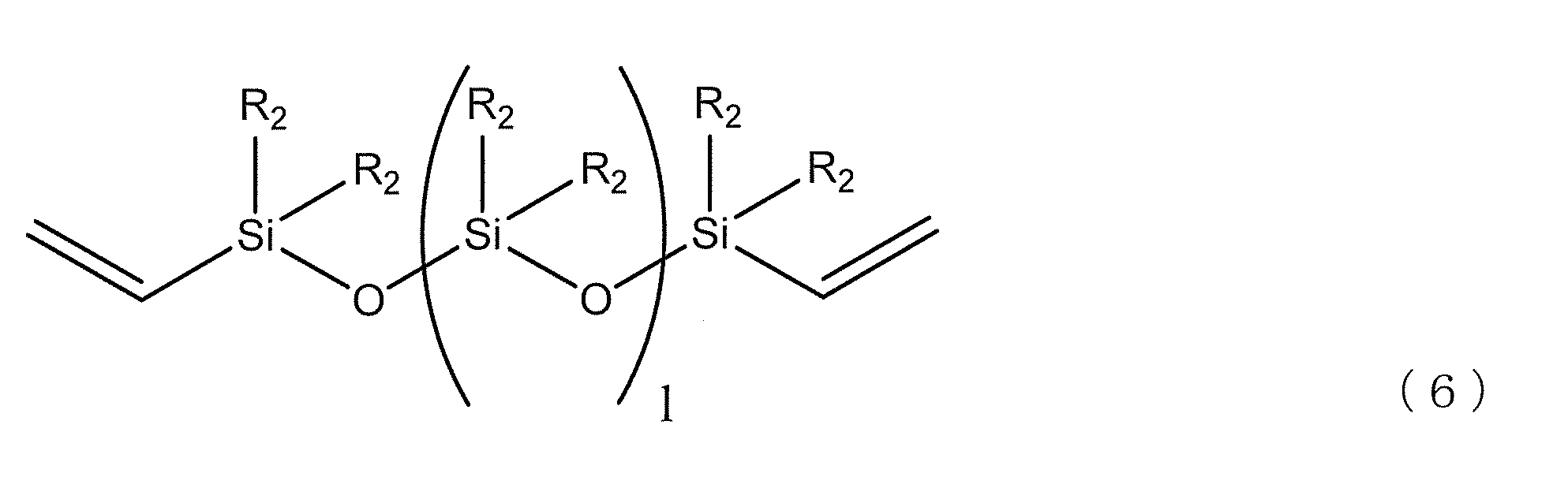
式中、R2は炭素数1~10の炭化水素基を表し、各々同一でも異なっていてもよい。lは0≦l≦100の数である。
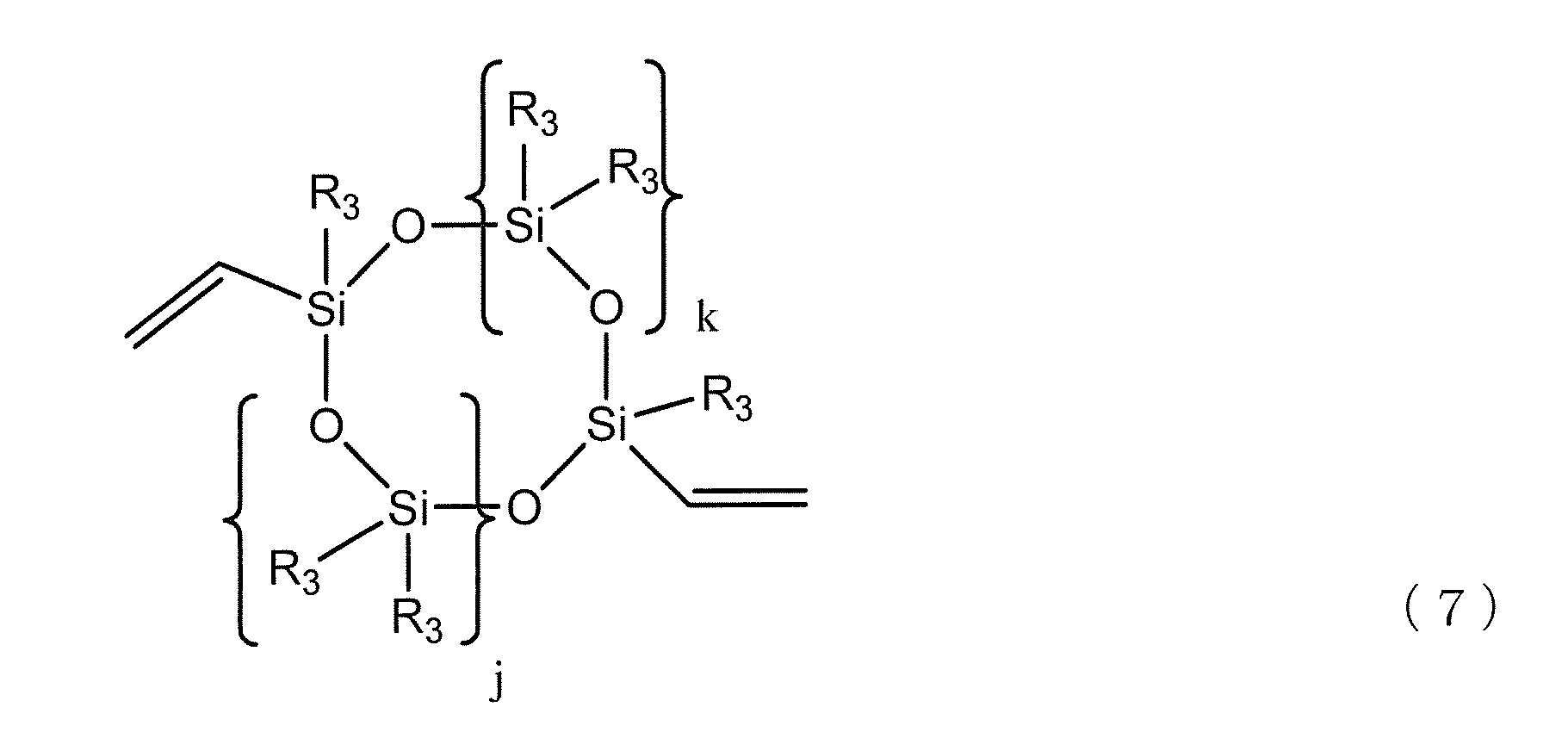
式中、R3は炭素数1~10の炭化水素基を表し、各々同一でも異なっていても良い。j、kはそれぞれ0~4の整数であり、1≦j+k≦4である。 - エポキシ樹脂、硬化剤(B)、及び硬化促進剤(C)を必須成分として含む熱硬化性樹脂組成物において、エポキシ樹脂成分として請求項1に記載のエポキシシリコーン樹脂(A)を含むことを特徴とする熱硬化性樹脂組成物。
- 硬化剤(B)が、酸無水物、アミン基を有する室温で液状の化合物、またはフェノール樹脂であることを特徴とする請求項4に記載の熱硬化性樹脂組成物。
- 硬化促進剤(C)が、4級アンモニウム塩または4級ホスホニウム塩であることを特徴とする請求項4に記載の熱硬化性樹脂組成物。
- エポキシ樹脂成分が、エポキシシリコーン樹脂(A)100重量部に対し、室温で液状のエポキシ樹脂(D)5~150重量部を含み、エポキシ当量が180~1000g/eq.であることを特徴とする請求項4に記載の熱硬化性樹脂組成物。
- 熱硬化性樹脂組成物が、光学部品用樹脂組成物又は電子部品用樹脂組成物であることを特徴とする請求項4に記載の熱硬化性樹脂組成物。
- 熱硬化性樹脂組成物が、光半導体部品用樹脂組成物であることを特徴とする請求項4に記載の熱硬化性樹脂組成物。
- 熱硬化性樹脂組成物が、半導体用液状封止樹脂組成物であることを特徴とする請求項4に記載の熱硬化性樹脂組成物。
- 請求項9に記載の熱硬化性樹脂組成物を用いて封止することを特徴とするLED装置。
Priority Applications (1)
| Application Number | Priority Date | Filing Date | Title |
|---|---|---|---|
| JP2013502264A JPWO2012117929A1 (ja) | 2011-02-28 | 2012-02-23 | エポキシシリコーン樹脂及びそれを用いた硬化性樹脂組成物 |
Applications Claiming Priority (2)
| Application Number | Priority Date | Filing Date | Title |
|---|---|---|---|
| JP2011-042615 | 2011-02-28 | ||
| JP2011042615 | 2011-02-28 |
Publications (1)
| Publication Number | Publication Date |
|---|---|
| WO2012117929A1 true WO2012117929A1 (ja) | 2012-09-07 |
Family
ID=46757866
Family Applications (1)
| Application Number | Title | Priority Date | Filing Date |
|---|---|---|---|
| PCT/JP2012/054381 Ceased WO2012117929A1 (ja) | 2011-02-28 | 2012-02-23 | エポキシシリコーン樹脂及びそれを用いた硬化性樹脂組成物 |
Country Status (3)
| Country | Link |
|---|---|
| JP (1) | JPWO2012117929A1 (ja) |
| TW (1) | TW201247746A (ja) |
| WO (1) | WO2012117929A1 (ja) |
Cited By (5)
| Publication number | Priority date | Publication date | Assignee | Title |
|---|---|---|---|---|
| WO2014033937A1 (ja) * | 2012-08-31 | 2014-03-06 | 新日鉄住金化学株式会社 | エポキシシリコーン樹脂及びそれを用いた硬化性樹脂組成物 |
| JP2014125566A (ja) * | 2012-12-26 | 2014-07-07 | Nippon Steel & Sumikin Chemical Co Ltd | エポキシシリコーン樹脂組成物 |
| JP2014205812A (ja) * | 2013-04-16 | 2014-10-30 | 信越化学工業株式会社 | 樹脂組成物、樹脂フィルム及び半導体装置とその製造方法 |
| JP2019513882A (ja) * | 2016-05-10 | 2019-05-30 | ダウ シリコーンズ コーポレーション | アミノ官能性エンドブロッキング基を有するシリコーンブロックコポリマー、並びにその調製方法及び使用方法 |
| WO2024038795A1 (ja) * | 2022-08-15 | 2024-02-22 | 信越化学工業株式会社 | 光カチオン硬化型シリコーン組成物及びシリコーン硬化物並びに光デバイス |
Citations (12)
| Publication number | Priority date | Publication date | Assignee | Title |
|---|---|---|---|---|
| JPH032189A (ja) * | 1989-04-27 | 1991-01-08 | Siemens Ag | イソシアヌレート含有有機珪素化合物及びその製法 |
| JPH0782379A (ja) * | 1993-07-21 | 1995-03-28 | Toray Dow Corning Silicone Co Ltd | 有機ケイ素重合体の製造方法 |
| JP2002338692A (ja) * | 2001-05-18 | 2002-11-27 | Shin Etsu Chem Co Ltd | メチルフェニルポリシロキサンジオール及びその製造方法、並びに液状放射線硬化型樹脂組成物、光ファイバ用被覆組成物及び光ファイバ |
| JP2004099751A (ja) * | 2002-09-10 | 2004-04-02 | Nippon Unicar Co Ltd | イソシアヌル酸誘導体基含有オルガノポリシロキサン、エポキシ樹脂組成物および半導体装置 |
| JP2009203258A (ja) * | 2008-02-26 | 2009-09-10 | Nippon Steel Chem Co Ltd | エポキシシリコーン樹脂を含む硬化性樹脂組成物 |
| JP2009235254A (ja) * | 2008-03-27 | 2009-10-15 | Nippon Steel Chem Co Ltd | エポキシシリコーン樹脂を含む硬化性樹脂組成物 |
| JP2009275206A (ja) * | 2008-01-28 | 2009-11-26 | Shin Etsu Chem Co Ltd | ジグリシジルイソシアヌリル変性オルガノポリシロキサン及びそれを含む組成物 |
| JP2010100758A (ja) * | 2008-10-24 | 2010-05-06 | Adeka Corp | ケイ素含有硬化性組成物 |
| WO2011024836A1 (ja) * | 2009-08-26 | 2011-03-03 | 新日鐵化学株式会社 | シリコーン樹脂を含んだアルカリ可溶性樹脂及び感光性樹脂組成物、並びに感光性樹脂組成物を用いた硬化物 |
| JP2011077353A (ja) * | 2009-09-30 | 2011-04-14 | Showa Denko Kk | 転写材料用硬化性組成物およびそれを用いたパターン形成方法 |
| JP2011168701A (ja) * | 2010-02-18 | 2011-09-01 | Nitto Denko Corp | 光半導体素子封止用熱硬化性樹脂組成物およびその硬化体、ならびにそれを用いて得られる光半導体装置 |
| JP2011208120A (ja) * | 2010-03-09 | 2011-10-20 | Momentive Performance Materials Inc | 自己接着性ポリオルガノシロキサン組成物 |
-
2012
- 2012-02-23 WO PCT/JP2012/054381 patent/WO2012117929A1/ja not_active Ceased
- 2012-02-23 JP JP2013502264A patent/JPWO2012117929A1/ja active Pending
- 2012-02-24 TW TW101106229A patent/TW201247746A/zh unknown
Patent Citations (12)
| Publication number | Priority date | Publication date | Assignee | Title |
|---|---|---|---|---|
| JPH032189A (ja) * | 1989-04-27 | 1991-01-08 | Siemens Ag | イソシアヌレート含有有機珪素化合物及びその製法 |
| JPH0782379A (ja) * | 1993-07-21 | 1995-03-28 | Toray Dow Corning Silicone Co Ltd | 有機ケイ素重合体の製造方法 |
| JP2002338692A (ja) * | 2001-05-18 | 2002-11-27 | Shin Etsu Chem Co Ltd | メチルフェニルポリシロキサンジオール及びその製造方法、並びに液状放射線硬化型樹脂組成物、光ファイバ用被覆組成物及び光ファイバ |
| JP2004099751A (ja) * | 2002-09-10 | 2004-04-02 | Nippon Unicar Co Ltd | イソシアヌル酸誘導体基含有オルガノポリシロキサン、エポキシ樹脂組成物および半導体装置 |
| JP2009275206A (ja) * | 2008-01-28 | 2009-11-26 | Shin Etsu Chem Co Ltd | ジグリシジルイソシアヌリル変性オルガノポリシロキサン及びそれを含む組成物 |
| JP2009203258A (ja) * | 2008-02-26 | 2009-09-10 | Nippon Steel Chem Co Ltd | エポキシシリコーン樹脂を含む硬化性樹脂組成物 |
| JP2009235254A (ja) * | 2008-03-27 | 2009-10-15 | Nippon Steel Chem Co Ltd | エポキシシリコーン樹脂を含む硬化性樹脂組成物 |
| JP2010100758A (ja) * | 2008-10-24 | 2010-05-06 | Adeka Corp | ケイ素含有硬化性組成物 |
| WO2011024836A1 (ja) * | 2009-08-26 | 2011-03-03 | 新日鐵化学株式会社 | シリコーン樹脂を含んだアルカリ可溶性樹脂及び感光性樹脂組成物、並びに感光性樹脂組成物を用いた硬化物 |
| JP2011077353A (ja) * | 2009-09-30 | 2011-04-14 | Showa Denko Kk | 転写材料用硬化性組成物およびそれを用いたパターン形成方法 |
| JP2011168701A (ja) * | 2010-02-18 | 2011-09-01 | Nitto Denko Corp | 光半導体素子封止用熱硬化性樹脂組成物およびその硬化体、ならびにそれを用いて得られる光半導体装置 |
| JP2011208120A (ja) * | 2010-03-09 | 2011-10-20 | Momentive Performance Materials Inc | 自己接着性ポリオルガノシロキサン組成物 |
Cited By (7)
| Publication number | Priority date | Publication date | Assignee | Title |
|---|---|---|---|---|
| WO2014033937A1 (ja) * | 2012-08-31 | 2014-03-06 | 新日鉄住金化学株式会社 | エポキシシリコーン樹脂及びそれを用いた硬化性樹脂組成物 |
| JP2014125566A (ja) * | 2012-12-26 | 2014-07-07 | Nippon Steel & Sumikin Chemical Co Ltd | エポキシシリコーン樹脂組成物 |
| JP2014205812A (ja) * | 2013-04-16 | 2014-10-30 | 信越化学工業株式会社 | 樹脂組成物、樹脂フィルム及び半導体装置とその製造方法 |
| JP2019513882A (ja) * | 2016-05-10 | 2019-05-30 | ダウ シリコーンズ コーポレーション | アミノ官能性エンドブロッキング基を有するシリコーンブロックコポリマー、並びにその調製方法及び使用方法 |
| WO2024038795A1 (ja) * | 2022-08-15 | 2024-02-22 | 信越化学工業株式会社 | 光カチオン硬化型シリコーン組成物及びシリコーン硬化物並びに光デバイス |
| JP2024025981A (ja) * | 2022-08-15 | 2024-02-28 | 信越化学工業株式会社 | 光カチオン硬化型シリコーン組成物及びシリコーン硬化物並びに光デバイス |
| JP7792874B2 (ja) | 2022-08-15 | 2025-12-26 | 信越化学工業株式会社 | 光カチオン硬化型シリコーン組成物及びシリコーン硬化物並びに光デバイス |
Also Published As
| Publication number | Publication date |
|---|---|
| TW201247746A (en) | 2012-12-01 |
| JPWO2012117929A1 (ja) | 2014-07-07 |
Similar Documents
| Publication | Publication Date | Title |
|---|---|---|
| JP5680928B2 (ja) | エポキシシリコーン樹脂含有硬化性樹脂組成物 | |
| JP5037385B2 (ja) | エポキシシリコーン樹脂を含む硬化性樹脂組成物 | |
| CN104583264B (zh) | 环氧硅酮树脂及使用其的固化性树脂组合物 | |
| TWI532790B (zh) | And a resin composition for sealing an optical semiconductor element | |
| JP5557324B2 (ja) | ダイボンド剤及び光半導体装置 | |
| KR20180061405A (ko) | 반도체 장치 및 반도체 소자 보호용 재료 | |
| WO2016013622A1 (ja) | 熱硬化性樹脂組成物及びその成形体 | |
| JP5359349B2 (ja) | 光反射用熱硬化性樹脂組成物、光半導体素子搭載用基板及びその製造方法、並びに光半導体装置 | |
| CN107074785A (zh) | 多元羧酸和含有其的多元羧酸组合物、环氧树脂组合物、热固化性树脂组合物、它们的固化物以及光半导体装置 | |
| JP5914058B2 (ja) | エポキシシリコーン樹脂組成物 | |
| JPWO2012117929A1 (ja) | エポキシシリコーン樹脂及びそれを用いた硬化性樹脂組成物 | |
| JP2017186478A (ja) | エポキシ樹脂、それを含有するエポキシ樹脂組成物とその硬化物 | |
| JP5738142B2 (ja) | エポキシシリコーン樹脂及びそれを用いた硬化性樹脂組成物 | |
| JP5914110B2 (ja) | 硬化性樹脂組成物 | |
| JP5523376B2 (ja) | エポキシシリコーン樹脂及びそれを用いた硬化性樹脂組成物 | |
| JP2015067798A (ja) | エポキシシリコーン樹脂及びそれを用いた硬化性樹脂組成物 | |
| JP2014080540A (ja) | エポキシシリコーン樹脂及びそれを用いた硬化性樹脂組成物 | |
| CN105594004A (zh) | 光半导体装置用热固化性树脂组合物及使用其得到的光半导体装置用引线框以及光半导体装置 | |
| JP6343552B2 (ja) | 光反射用熱硬化性樹脂組成物、これを用いた光半導体素子搭載用基板及びその製造方法、並びに光半導体装置 | |
| JP5139857B2 (ja) | エポキシシリコーン樹脂を含む硬化性樹脂組成物 | |
| JP2014125566A (ja) | エポキシシリコーン樹脂組成物 | |
| JP2013087235A (ja) | エポキシシリコーン樹脂及びそれを用いた硬化性樹脂組成物 | |
| JP5629643B2 (ja) | シリコーン変性エポキシ樹脂組成物、該樹脂組成物を含む光半導体封止組成物及び光半導体素子接着剤 | |
| JP2017128640A (ja) | 硬化性組成物およびその利用 | |
| JP5457282B2 (ja) | エポキシシリコーン樹脂含有硬化性樹脂組成物 |
Legal Events
| Date | Code | Title | Description |
|---|---|---|---|
| 121 | Ep: the epo has been informed by wipo that ep was designated in this application |
Ref document number: 12752547 Country of ref document: EP Kind code of ref document: A1 |
|
| ENP | Entry into the national phase |
Ref document number: 2013502264 Country of ref document: JP Kind code of ref document: A |
|
| NENP | Non-entry into the national phase |
Ref country code: DE |
|
| 122 | Ep: pct application non-entry in european phase |
Ref document number: 12752547 Country of ref document: EP Kind code of ref document: A1 |