WO2012111818A1 - 蛍光プローブ - Google Patents
蛍光プローブ Download PDFInfo
- Publication number
- WO2012111818A1 WO2012111818A1 PCT/JP2012/053855 JP2012053855W WO2012111818A1 WO 2012111818 A1 WO2012111818 A1 WO 2012111818A1 JP 2012053855 W JP2012053855 W JP 2012053855W WO 2012111818 A1 WO2012111818 A1 WO 2012111818A1
- Authority
- WO
- WIPO (PCT)
- Prior art keywords
- group
- atom
- general formula
- salt
- capturing
- Prior art date
- Legal status (The legal status is an assumption and is not a legal conclusion. Google has not performed a legal analysis and makes no representation as to the accuracy of the status listed.)
- Ceased
Links
- 0 **(*)(c1cc(*(CC=C)CC=C)ccc1C(c1ccccc1*)=C1C=C2)C1=CC2=*(CC=C)CC=C Chemical compound **(*)(c1cc(*(CC=C)CC=C)ccc1C(c1ccccc1*)=C1C=C2)C1=CC2=*(CC=C)CC=C 0.000 description 7
- WDSIAVAEIFBIDU-UHFFFAOYSA-N C[Si](C)(c1cc(N)ccc1C(c1ccccc1)=C1C=C2)C1=CC2=[NH+][O-] Chemical compound C[Si](C)(c1cc(N)ccc1C(c1ccccc1)=C1C=C2)C1=CC2=[NH+][O-] WDSIAVAEIFBIDU-UHFFFAOYSA-N 0.000 description 1
Images


Classifications
-
- G—PHYSICS
- G01—MEASURING; TESTING
- G01N—INVESTIGATING OR ANALYSING MATERIALS BY DETERMINING THEIR CHEMICAL OR PHYSICAL PROPERTIES
- G01N33/00—Investigating or analysing materials by specific methods not covered by groups G01N1/00 - G01N31/00
- G01N33/48—Biological material, e.g. blood, urine; Haemocytometers
- G01N33/50—Chemical analysis of biological material, e.g. blood, urine; Testing involving biospecific ligand binding methods; Immunological testing
- G01N33/58—Chemical analysis of biological material, e.g. blood, urine; Testing involving biospecific ligand binding methods; Immunological testing involving labelled substances
- G01N33/582—Chemical analysis of biological material, e.g. blood, urine; Testing involving biospecific ligand binding methods; Immunological testing involving labelled substances with fluorescent label
-
- C—CHEMISTRY; METALLURGY
- C07—ORGANIC CHEMISTRY
- C07F—ACYCLIC, CARBOCYCLIC OR HETEROCYCLIC COMPOUNDS CONTAINING ELEMENTS OTHER THAN CARBON, HYDROGEN, HALOGEN, OXYGEN, NITROGEN, SULFUR, SELENIUM OR TELLURIUM
- C07F7/00—Compounds containing elements of Groups 4 or 14 of the Periodic Table
- C07F7/02—Silicon compounds
- C07F7/08—Compounds having one or more C—Si linkages
- C07F7/0803—Compounds with Si-C or Si-Si linkages
- C07F7/081—Compounds with Si-C or Si-Si linkages comprising at least one atom selected from the elements N, O, halogen, S, Se or Te
- C07F7/0812—Compounds with Si-C or Si-Si linkages comprising at least one atom selected from the elements N, O, halogen, S, Se or Te comprising a heterocyclic ring
-
- C—CHEMISTRY; METALLURGY
- C07—ORGANIC CHEMISTRY
- C07F—ACYCLIC, CARBOCYCLIC OR HETEROCYCLIC COMPOUNDS CONTAINING ELEMENTS OTHER THAN CARBON, HYDROGEN, HALOGEN, OXYGEN, NITROGEN, SULFUR, SELENIUM OR TELLURIUM
- C07F7/00—Compounds containing elements of Groups 4 or 14 of the Periodic Table
- C07F7/02—Silicon compounds
- C07F7/08—Compounds having one or more C—Si linkages
- C07F7/0803—Compounds with Si-C or Si-Si linkages
- C07F7/081—Compounds with Si-C or Si-Si linkages comprising at least one atom selected from the elements N, O, halogen, S, Se or Te
-
- C—CHEMISTRY; METALLURGY
- C07—ORGANIC CHEMISTRY
- C07F—ACYCLIC, CARBOCYCLIC OR HETEROCYCLIC COMPOUNDS CONTAINING ELEMENTS OTHER THAN CARBON, HYDROGEN, HALOGEN, OXYGEN, NITROGEN, SULFUR, SELENIUM OR TELLURIUM
- C07F7/00—Compounds containing elements of Groups 4 or 14 of the Periodic Table
- C07F7/02—Silicon compounds
- C07F7/08—Compounds having one or more C—Si linkages
- C07F7/10—Compounds having one or more C—Si linkages containing nitrogen having a Si-N linkage
-
- C—CHEMISTRY; METALLURGY
- C09—DYES; PAINTS; POLISHES; NATURAL RESINS; ADHESIVES; COMPOSITIONS NOT OTHERWISE PROVIDED FOR; APPLICATIONS OF MATERIALS NOT OTHERWISE PROVIDED FOR
- C09B—ORGANIC DYES OR CLOSELY-RELATED COMPOUNDS FOR PRODUCING DYES, e.g. PIGMENTS; MORDANTS; LAKES
- C09B11/00—Diaryl- or thriarylmethane dyes
- C09B11/28—Pyronines ; Xanthon, thioxanthon, selenoxanthan, telluroxanthon dyes
-
- C—CHEMISTRY; METALLURGY
- C09—DYES; PAINTS; POLISHES; NATURAL RESINS; ADHESIVES; COMPOSITIONS NOT OTHERWISE PROVIDED FOR; APPLICATIONS OF MATERIALS NOT OTHERWISE PROVIDED FOR
- C09B—ORGANIC DYES OR CLOSELY-RELATED COMPOUNDS FOR PRODUCING DYES, e.g. PIGMENTS; MORDANTS; LAKES
- C09B69/00—Dyes not provided for by a single group of this subclass
- C09B69/008—Dyes containing a substituent, which contains a silicium atom
-
- G—PHYSICS
- G01—MEASURING; TESTING
- G01N—INVESTIGATING OR ANALYSING MATERIALS BY DETERMINING THEIR CHEMICAL OR PHYSICAL PROPERTIES
- G01N33/00—Investigating or analysing materials by specific methods not covered by groups G01N1/00 - G01N31/00
- G01N33/48—Biological material, e.g. blood, urine; Haemocytometers
- G01N33/50—Chemical analysis of biological material, e.g. blood, urine; Testing involving biospecific ligand binding methods; Immunological testing
- G01N33/53—Immunoassay; Biospecific binding assay; Materials therefor
- G01N33/531—Production of immunochemical test materials
- G01N33/532—Production of labelled immunochemicals
- G01N33/533—Production of labelled immunochemicals with fluorescent label
Definitions
- the present invention relates to a novel fluorescent probe. More specifically, the present invention relates to a fluorescent probe that emits fluorescence by capturing a measurement target substance such as proton, metal ion, reactive oxygen species, hypoxic environment, enzyme activity, or glutathione through a capturing group.
- a measurement target substance such as proton, metal ion, reactive oxygen species, hypoxic environment, enzyme activity, or glutathione
- Rhodamine is a fluorescent dye that has been known for a long time like fluorescein. Since both have high fluorescence quantum yields in water, they have been widely applied in the biological field as fluorescent tags. In recent years, live cell imaging techniques using fluorescent probes have been actively used. Rhodamine is also widely used as a mother nucleus of fluorescent probes that play a major role in this technique.
- This fluorescent probe having TMDHS as a basic skeleton is basically a probe that utilizes intramolecular photoinduced electron transfer (PeT) and the opening and closing of a spiro ring.
- PeT intramolecular photoinduced electron transfer
- the amino groups at the 2-position and the 7-position are substituted with a substituent other than a hydrogen atom such as a methyl group.
- the oxygen atom of the compound in which the amino groups at the 3rd and 6th positions in rhodamine are unsubstituted (hereinafter sometimes referred to as “N, N-unsubstituted Orhodamine” in this specification) is replaced with a silicon atom.
- An object of the present invention is to provide a novel fluorescent probe. More specifically, a compound in which the oxygen atom at the 10-position of the xanthene ring portion of rhodamine in which the amino groups at the 3-position and the 6-position are unsubstituted is substituted with a silicon atom, a method for producing the compound, and use of the compound It is an object of the present invention to provide a fluorescent probe and a method for measuring a substance to be measured using the fluorescent probe.
- N, N, N ', N'-tetraallyldiamino-Si-xanthone from 3-bromo-N, N-diallylaniline as a raw material.
- the allyl group is eliminated after reacting N, N, N ', N'-tetraallyldiamino-Si-xanthone with a halogenated benzene derivative, the amino groups at the 3- and 6-positions are unsubstituted.
- intramolecular light is introduced by introducing a group capable of capturing the measurement target substance into the 9-position benzene ring of N, N-unsubstituted Si rhodamine (hereinafter sometimes referred to as “capturing group” in this specification).
- capturing group a group capable of capturing the measurement target substance into the 9-position benzene ring of N, N-unsubstituted Si rhodamine
- N, N-unsubstituted Si rhodamine has an absorption wavelength and fluorescence wavelength shifted by about 90 nm longer than rhodamine 110, which is N, N-unsubstituted O rhodamine, and N, N-unsubstituted Si rhodamine
- the absorption wavelength of the N, N-unsubstituted Si rhodamine introduced with the capture group is shifted to a short wavelength by about 90 nm.
- the present inventors have found that it is possible to design a highly sensitive fluorescent probe for protons, metal ions, reactive oxygen species, hypoxic environment, enzyme activity, glutathione, etc. using the change in absorption wavelength due to the introduction of this capture group.
- the maximum absorption wavelength of a compound obtained by acylating one of the unsubstituted amino groups at the 3-position or 6-position of the xanthene ring of N, N-unsubstituted Si rhodamine is around 500 nm and does not absorb light around 590 nm.
- the maximum absorption wavelength moves to around 590 nm, so when measuring with excitation light near 590 nm, strong fluorescence near 610 nm Can be observed.
- R 1 represents 1 to 4 identical or different monovalent substituents present on the benzene ring
- R 2 represents a monovalent substituent
- R 3 and R 4 each independently represents hydrogen
- R 5 and R 6 each independently represents an alkyl group or an aryl group having 1 to 6 carbon atoms
- R 7 and R 8 each independently represent a hydrogen atom
- R 9 and R 10 each independently represents a hydrogen atom or a monovalent substituent
- X represents a silicon atom, a germanium atom, or a tin atom
- R 1 represents a hydrogen atom, or 1 or 2 monovalent substituents present on the benzene ring (the substituent is a capturing group capable of capturing a measurement target substance).
- R 2 is a monovalent substituent (the substituent is a capturing group capable of capturing a substance to be measured, having 1 to 6 carbon atoms), and is selected from the group consisting of a carbonyl group, a halogen atom, and an amino group.
- R 3 and R 4 are selected from the group consisting of Each independently represents a hydrogen atom or an alkyl group having 1 to 6 carbon atoms, R 5 and R 6 each independently represents an alkyl group having 1 to 6 carbon atoms, and R 7 and R 8 each independently A hydrogen atom or an alkyl group having 1 to 6 carbon atoms, R 9 and R 10 represent a hydrogen atom or a capture group capable of capturing a measurement target substance, and X represents a silicon atom or a germanium atom or a salt thereof Is provided.
- R 1 represents a hydrogen atom, or 1 or 2 monovalent substituents present on the benzene ring (the substituent is a capturing group capable of capturing a measurement target substance, the number of carbon atoms).
- R 1 represents a monovalent substituent (selected from the group consisting of 1 to 6 alkyl groups, alkoxy groups having 1 to 6 carbon atoms, hydroxyl group, carboxy group, halogen atom, or amino group).
- the group includes a capture group capable of capturing a measurement target substance, an alkyl group having 1 to 6 carbon atoms, an alkenyl group having 1 to 6 carbon atoms, an alkynyl group having 1 to 6 carbon atoms, and 1 to 6 carbon atoms.
- R 3 and R 4 represent a hydrogen atom
- R 5 and R 6 each independently an alkyl group having 1 to 3 carbon
- R 7 and R 8 is a hydrogen atom
- R 9 Or fine R 10 are each independently a hydrogen atom, or an analyte indicates catchable capture group
- X is the aforementioned compound or a salt thereof is provided which indicates a silicon atom.
- R 1 or R 2 and R 9 and / or R 10 may be a capture group at the same time, but when R 1 or R 2 is a capture group, R 9 and / or at the same time.
- R 10 is preferably not a capturing group, and when R 9 and / or R 10 is a capturing group, it is preferable that R 1 and R 2 are not simultaneously a capturing group.
- R 1 or R 2 and R 9 and / or R 10 are simultaneously capture groups, and R 1 or R 2 is substituted with a capture group that functions as a PeT-type off / on probe, and R 9 and / or R 10
- the capture group that utilizes the change in absorption wavelength is substituted, for example, the fluorescence is turned off / on by the PeT-type capture group, and the excitation wavelength also changes by the capture group that utilizes the change in absorption wavelength. It is possible to measure the spatiotemporal change of two measurement objects.
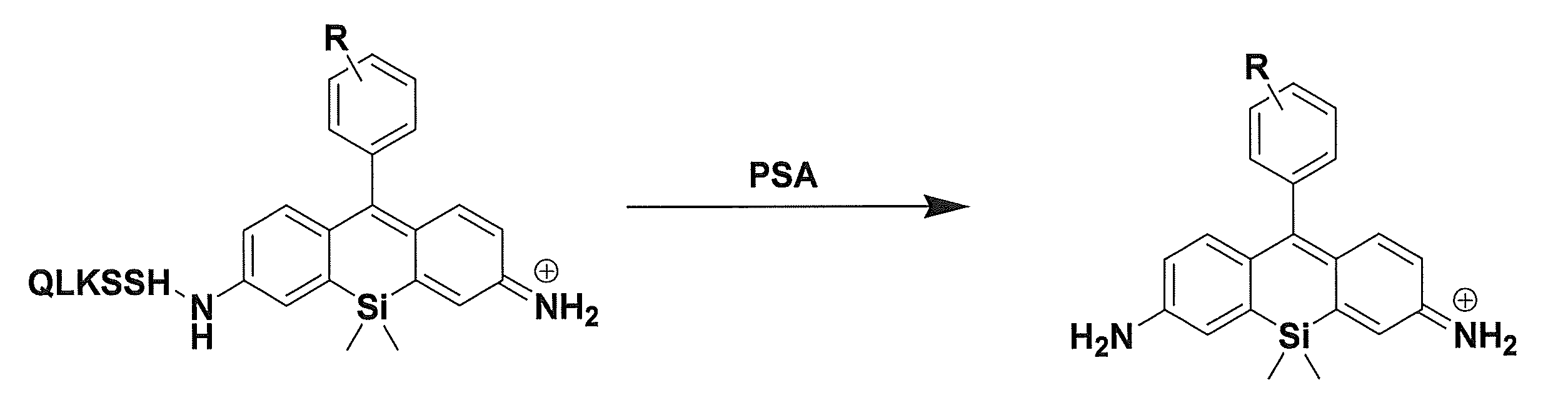
- a compound represented by the above general formula (I) (wherein R 1 or R 2 represents a capturing group, and R 9 and R 10 represent a hydrogen atom) or a compound thereof Fluorescent probe for measurement such as salt-containing proton, metal ion, reactive oxygen species, hypoxic environment, enzyme activity, or glutathione; the above general formula (I) (wherein R 9 and / or R 10 represents a capture group) , R 1 and R 2 each represent a monovalent substituent other than a capturing group) or a proton salt, a metal ion, a reactive oxygen species, a hypoxic environment, an enzyme activity, a glutathione, or the like
- a fluorescent probe for use a proton comprising a compound represented by the above general formula (I) (wherein R 1 or R 2 represents a capture group, and R 9 and / or R 10 represents a capture group) or a salt thereof;
- R 1 and R 2 represent a monovalent substituent other than a capture group, and R 9 and / or R 10 represent an enzyme activity and a glutathione capture group).
- a protective group may be appropriately introduced into the substituent, and a process for producing a compound represented by: (d)
- the compound represented by the above general formula (III) is deallylated, and the above general formula (I) (wherein R 3 and R 4 represent a hydrogen atom, and R 5 and R 6 are Each independently represents an alkyl or aryl group having 1 to 6 carbon atoms; R 7 and R 8 represent a hydrogen atom; R 9 and R 10 represent a hydrogen atom; X represents a silicon atom, a germanium atom, or tin
- a step of producing a compound of the formula (showing an atom) when a protecting group is introduced to produce the above general formula (III) in R 1 and R 2 ), the protecting group is deprotected in step (d)
- a method comprising any one or more steps, which may be performed before, after or simultaneously, preferably two or more consecutive steps. In order to improve the reaction yield, it is also preferable to reduce the compound represented by the general formula (I)
- a method for producing the compound represented by the above general formula (I) or a salt thereof comprising the above step (d); the production of the compound represented by the above general formula (I) or a salt thereof
- a method comprising the steps (c) and (d); a method for producing the compound represented by the general formula (I) or a salt thereof, wherein the steps (b), (c), And a method comprising the step (a), (b), (c), and (d), wherein the compound represented by the general formula (I) or a salt thereof is produced.
- a method is provided.
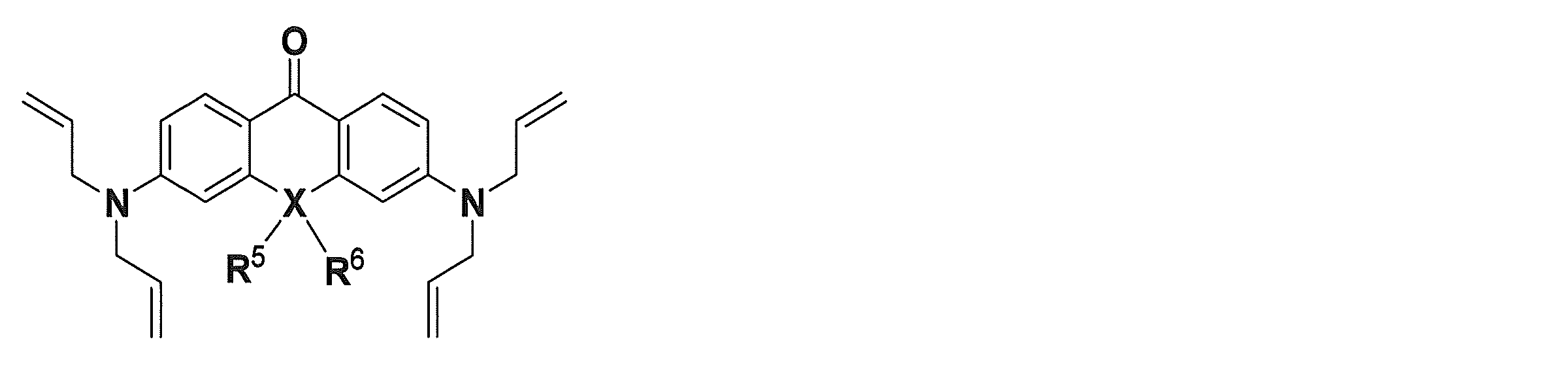
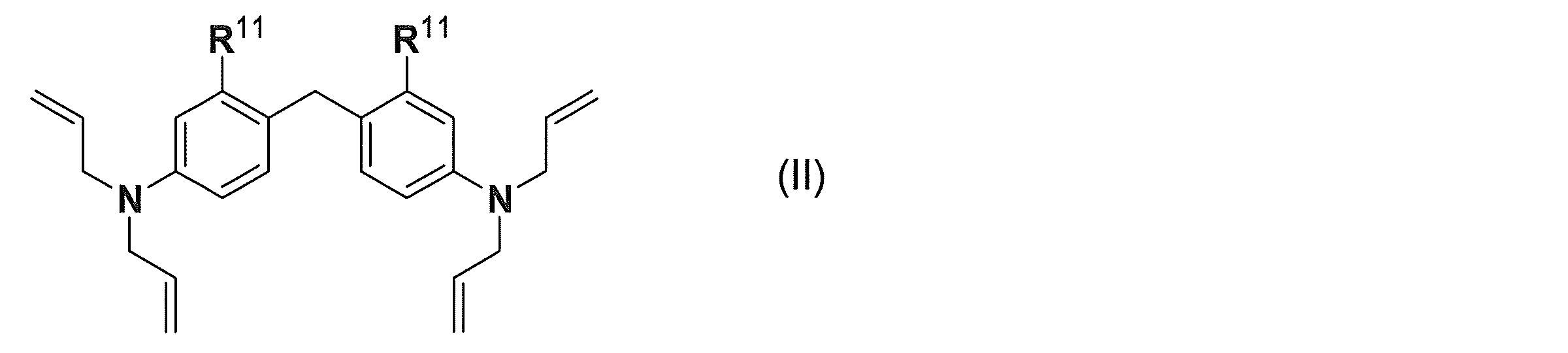
- a preferred embodiment of the above production method (a) The following general formula (II) from 3-halogenated-N, N-diallylaniline and formaldehyde produced from 3-halogenated aniline and allyl halide: (Wherein R 11 represents a halogen atom), (b) After reacting the compound represented by the general formula (II) with dichlorodimethylsilane, the following N, N, N ′, N′-tetraallyl-diamino-Si-xanthone is produced by an oxidation reaction.
- a protective group may be appropriately introduced into the substituent, and a process for producing a compound represented by: (d)
- the compound represented by the above general formula (IIIa) is deallylated, and the above general formula (I) (wherein R 3 and R 4 represent a hydrogen atom, and R 5 and R 6 are a methyl group; R 7 and R 8 represents a hydrogen atom; R 9 and R 10 represents a hydrogen atom; X to produce a compound of a silicon-atom) is (R 1 and R 2 in the above general
- a protective group is introduced to produce formula (IIIa)
- the protective group may be deprotected before or after step (d) or simultaneously)
- a method comprising any one or more of these steps, preferably two or more consecutive steps. In order to improve the reaction yield, it is also preferable to reduce the compound represented by the above general formula (IIIa) to 9H-xanthene before deallylation at the time of deallylation.
- R 1 , R 2 , R 9 , and R 10 are capture groups capable of capturing a measurement target substance.
- the fluorescence properties change before and after capturing the substance to be measured.
- the general formula ( The compound represented by I) or a salt thereof is a compound for producing a fluorescent probe capable of measuring a measurement target substance such as proton, metal ion, reactive oxygen species, hypoxic environment, enzyme activity, or glutathione with high sensitivity. Can be used.
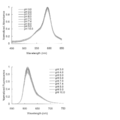
- FIG. 3 is a diagram showing the pH profile of 2-Me SiR600 (Example 2 (3)) in a 0.1 M sodium phosphate buffer containing 1% DMSO as an absorption spectrum (upper) and a fluorescence spectrum (lower). Fluorescence was measured at an excitation wavelength of 593 nm.
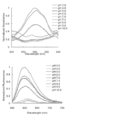
- FIG. 4 is a diagram showing the pH profile of N-acetyl-2-Me SiR600 (Example 2 (4)) in an 0.1 M sodium phosphate buffer containing 1% DMSO as an absorption spectrum (upper) and a fluorescence spectrum (lower). Fluorescence was measured at an excitation wavelength of 505 nm.
- FIG. 3 is a diagram showing the pH profile of 2-Me SiR600 (Example 2 (3)) in a 0.1 M sodium phosphate buffer containing 1% DMSO as an absorption spectrum (upper) and a fluorescence spectrum (lower). Fluorescence was measured at an excitation wavelength of 505 nm.
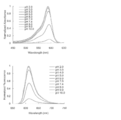
- FIG. 2 is a diagram showing the pH profile of 2-COOH SiR600 (Example 2 (6)) in a 0.1 M sodium phosphate buffer containing 1% DMSO as an absorption spectrum (upper) and a fluorescence spectrum (lower). Fluorescence was measured at an excitation wavelength of 590 nm.
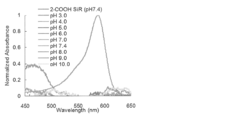
- FIG. 4 is a graph showing an absorption spectrum of a pH profile of Z-DEVD-SiR600 (Example 4 (2)) in 0.1 M sodium phosphate buffer containing 1% DMSO.
- the lower part is a scheme that explains the pH-dependent decrease in absorption of Z-DEVD-SiR600.
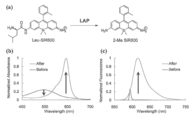
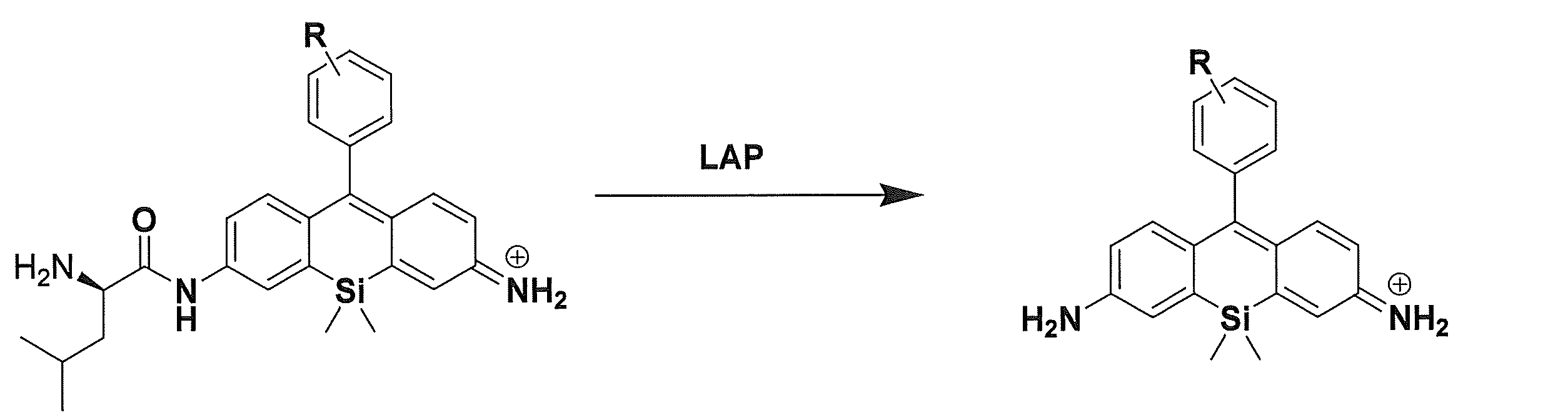
- FIG. 4 is a diagram showing a reaction scheme (a) when Leu-SiR600 (Example 4 (3)) is reacted with LAP, and an absorption spectrum (b) and a fluorescence spectrum (c). Fluorescence was measured at an excitation wavelength of 593 nm.
- an “alkyl group” or an alkyl part of a substituent containing an alkyl part has, for example, 1 to 6 carbon atoms, preferably 1 to 4 carbon atoms, More preferably, it means an alkyl group composed of straight, branched, cyclic, or a combination thereof having about 1 to 3 carbon atoms.
- alkyl group for example, methyl group, ethyl group, n-propyl group, isopropyl group, cyclopropyl group, n-butyl group, sec-butyl group, isobutyl group, tert-butyl group, cyclopropyl Examples thereof include a methyl group, an n-pentyl group, and an n-hexyl group.
- halogen atom may be any of a fluorine atom, a chlorine atom, a bromine atom or an iodine atom, preferably a fluorine atom, a chlorine atom or a bromine atom.
- R 1 represents a hydrogen atom, or 1 to 4 identical or different monovalent substituents present on the benzene ring.
- R 1 represents a monovalent substituent present on the benzene ring, it is preferable that about 1 to 2 identical or different substituents are present on the benzene ring.
- R 1 represents one or more monovalent substituents, the substituent can be substituted at any position on the benzene ring.
- R 1 represents a hydrogen atom or one substituent is present.
- the monovalent substituent represented by R 1 may be a substituent that acts as a capturing group for the substance to be measured.
- the substituent that acts as a capture group may be a substituent that acts as a capture group alone, or a combination of two or more substituents on the benzene ring, preferably two adjacent groups on the benzene ring.
- the substituent may act as a capturing group by a combination of substituents. Two such substituents may be bonded to form a cyclic structure, or the cyclic structure may change to a ring-opened structure after reaction with the substance to be measured. Alternatively, two adjacent substituents may form a cyclic structure together with these two substituents after reaction with the substance to be measured.
- the benzene ring may form part of the capturing group. Furthermore, two or more substituents acting as a capture group alone may be bonded to the benzene ring, and two or more different substituents acting as capture groups for different substances to be measured may be present on the benzene ring. May be present.
- the substitution position of one or more substituents acting as a capturing group on the benzene ring is not particularly limited, and the substitution position can be any position.
- the type of the substance to be measured is not particularly limited.
- protons for example, alkali metal ions such as sodium ions and lithium ions, alkaline earth metal ions such as calcium ions, magnesium ions, and zinc ions
- activity Oxygen species eg, hydroxyl radicals, peroxynitrite, hypochlorous acid, hydrogen peroxide, etc.
- hypoxic environments or enzymes (peptidases, proteases, lactamases, sugar hydrolases, transferases, oxidoreductases), Any of glutathione and the like may be used.
- a capture group that specifically captures a measurement target substance for example, a) As a capturing group for protons, —CR 20 —AN R 21 R 22 (wherein R 20 , R 21 , and R 22 are each independently a hydrogen atom, and optionally having 1 substituent) Represents an alkyl group having 6 alkyl groups, an aryl group which may have a substituent, an alkylene group having 1 to 3 carbon atoms to which R 20 and R 21 or R 20 and R 22 are bonded; A represents a substituent And a capturing group represented by an optionally substituted alkylene group having 1 to 3 carbon atoms)
- peroxynitrite, hydroxyl radical, hypochlorous acid is p-aminophenyloxymethyl group, p-hydroxyphenyloxymethyl group, and nitric oxide is adjacent to the benzene ring.
- hypochlorous acid is a capturing group represented by —CH 2 —SH (the capturing group is It functions by substituting R 2 in the general formula (I) of the present specification, and carbon at the 10-position of the xanthene ring containing X (carbon substituted by the benzene ring substituted by R 1 and R 2 ) To form a thiophene ring)
- Capture group for the enzyme (the capture group for the enzyme is a monovalent substituent that is cleaved by contact with the enzyme, or the substituent is further modified with another substituent by contact with the enzyme)
- the peptidase and the protease may be a capture group described as a fluorescent probe for GGT and a fluorescent probe for GGT in this specification, or on page 12 of International Publication WO2010095450 [ Amino acid residue (amino acid residue is a group in which one hydrogen atom is removed from the amino group or carboxy group of the amino acid) substituted with the compound of (1) to (7) described in Chemical Formula 4] Acyl residues derived from 20 types of L-amino acids constituting the protein to be included (the above amino acid residues bind to the amino group to which R 9 or R 10 in the general formula (I) of the present specification is bound.
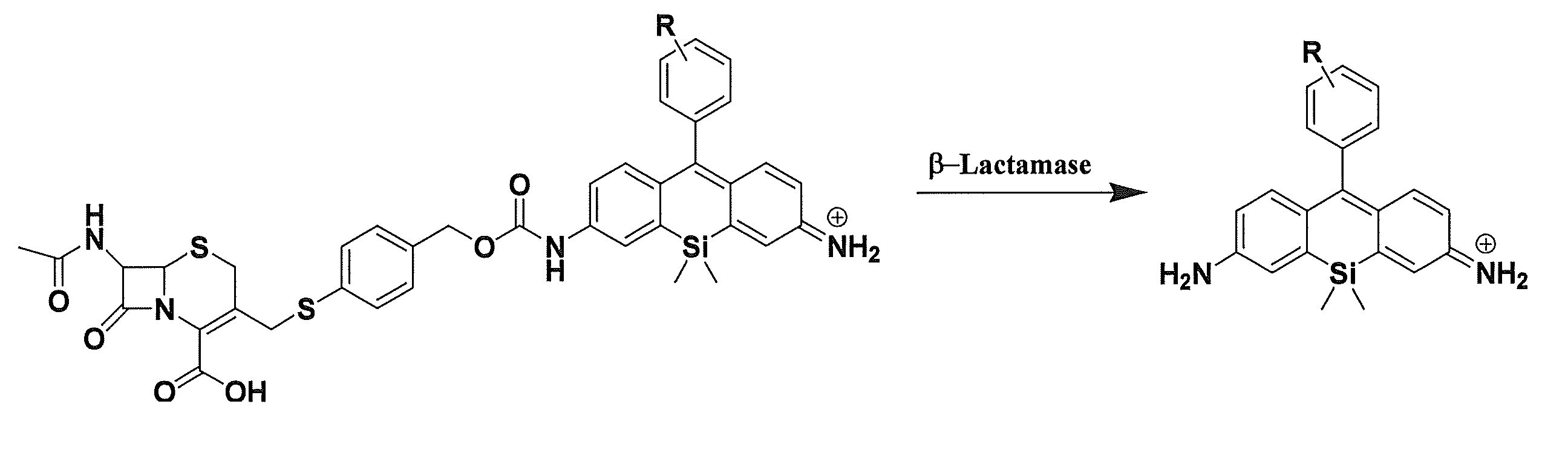
- the lactamase is a capture group described in Chemical Formula [15] in the present specification, and the sugar hydrolase is a galactosyl group, a glucosyl group, a glucuronosyl group, or a glucuronyltransferase. Is a hydroxyl group, amino group, carboxy group, thiol group
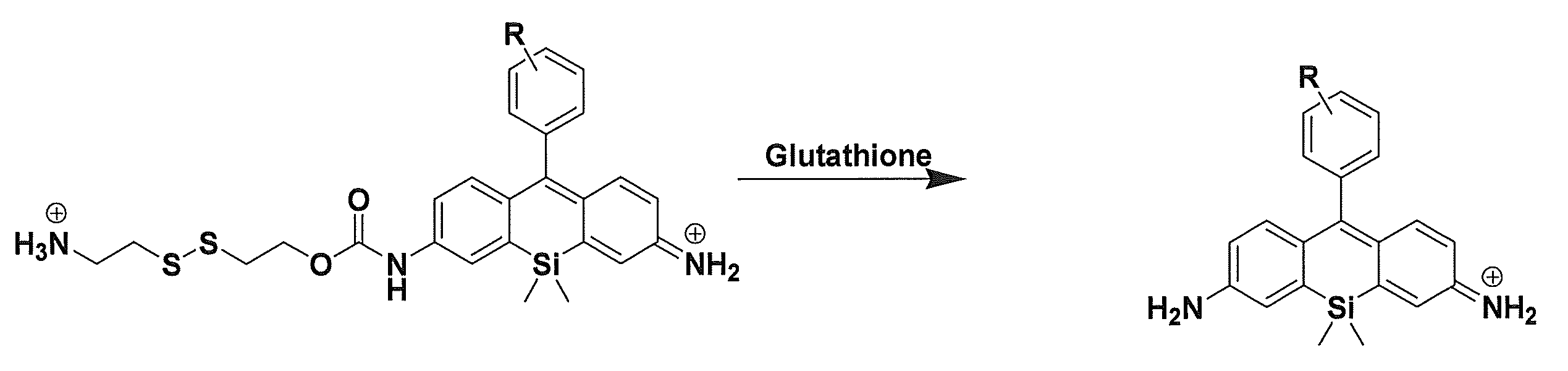
- Examples of the capturing group for glutathione include a capturing group such as the capturing group described in Chemical Formula [16] in the present specification. These capture groups may be directly substituted with a compound represented by the general formula (I) or a salt thereof, or may be substituted with a compound represented by the general formula (I) or a salt thereof via a spacer. Sometimes it is good.
- the capturing group is not limited to those described in the above publications.
- the above-mentioned publications also describe the method of use together with a capture group that specifically captures a substance to be measured, the compound of the general formula (I) in this specification or a salt thereof is measured.
- the present invention can be used as a fluorescent probe for specific measurement of a substance.
- a capturing group having the following structure can be exemplified as a capturing group for nitric oxide (the benzene ring of the following capturing group is substituted by R 1 and R 2 in the compound represented by the general formula (I)).
- Benzene ring In the present specification, this compound is sometimes referred to as diamino N, N-unsubstituted Si rhodamine.
- capture means that the chemical structure is changed by a chemical reaction with a measurement target substance in addition to the case where a capture group captures a metal ion or the like without causing a chemical change substantially. It must be interpreted in the broadest sense, including cases, and should not be interpreted in any way restrictive.
- the present invention relates to a compound represented by the general formula (I) or a salt thereof, a method for producing the compound, a fluorescent probe using the compound, and a method for measuring a measurement target substance using the fluorescent probe,
- a compound represented by the general formula (I) or a salt thereof a method for producing the compound, a fluorescent probe using the compound, and a method for measuring a measurement target substance using the fluorescent probe
- the monovalent substituent represented by R 2 may be a substituent that acts as a capturing group for the substance to be measured.
- the substituent that acts as a capturing group may be a substituent that acts as a capturing group alone, or may be a substituent that acts as a capturing group in combination with R 1 on the benzene ring.
- R 1 and R 2 ortho to R 2 combine to form a cyclic structure, the cyclic structure after reaction with the analyte changes the opening structure It may be.
- the benzene ring may form part of the capturing group. Examples of the capturing group represented by R 2 include the above-described capturing groups.
- Examples of such a group include a hydroxymethyl group, a mercaptomethyl group, a hydroxyethyl group, a mercaptoethyl group, a carboxy group, a carboxymethyl group, a carbamoyl group, and —CONHNH 2 .
- the monovalent substituent represented by R 2 is bonded to the carbon at the 10-position of the xanthene ring containing X (the carbon substituted by the benzene ring substituted by R 1 and R 2 ) to form a lactone ring or a lactam ring
- the xanthene ring conjugated system may be cleaved, and the absorption wavelength of the compound represented by the general formula (I) may be greatly shifted to the short wavelength side.
- the compound represented by the general formula (I) can take a structural isomer in which a spiro ring such as a lactone ring or a lactam ring is formed.
- the monovalent substituent represented by R 14 is preferably a hydrogen atom, an alkyl group having 1 to 6 carbon atoms, an aryl group, or an amino group, and described in Org. Lett., 12, pp. 476-479, 2010. Groups for capturing mercury, groups for capturing diacetyl as described in J. Fluoresc., 19, pp. 601-606, 2009, Org. Biomol. Chem., 8, pp. 5277-5279, 2010 Or a group for capturing copper ions described in 1).
- the compound represented by the general formula (I) may exist as a salt.
- the salt include base addition salts, acid addition salts, amino acid salts and the like.
- the base addition salt include metal salts such as sodium salt, potassium salt, calcium salt, magnesium salt, ammonium salt, or organic amine salts such as triethylamine salt, piperidine salt, morpholine salt, and acid addition salt.
- examples thereof include mineral acid salts such as hydrochloride, sulfate, and nitrate, and organic acid salts such as methanesulfonate, paratoluenesulfonate, citrate, and oxalate.
- Examples of amino acid salts include glycine salts.
- the salt of the compound of the present invention is not limited to these. The same applies to other compounds in the present specification.
- the compound of the present invention represented by the general formula (I) may have one or two or more asymmetric carbons depending on the type of substituent, and stereoisomerism such as optical isomers or diastereoisomers. There may be a body. Pure forms of stereoisomers, any mixture of stereoisomers, racemates, and the like are all within the scope of the present invention.
- the compound of the present invention represented by the general formula (I) or a salt thereof may exist as a hydrate or a solvate, and any of these substances is included in the scope of the present invention.
- solvents such as ethanol, acetone, isopropanol, can be illustrated. The same applies to other compounds in the present specification.
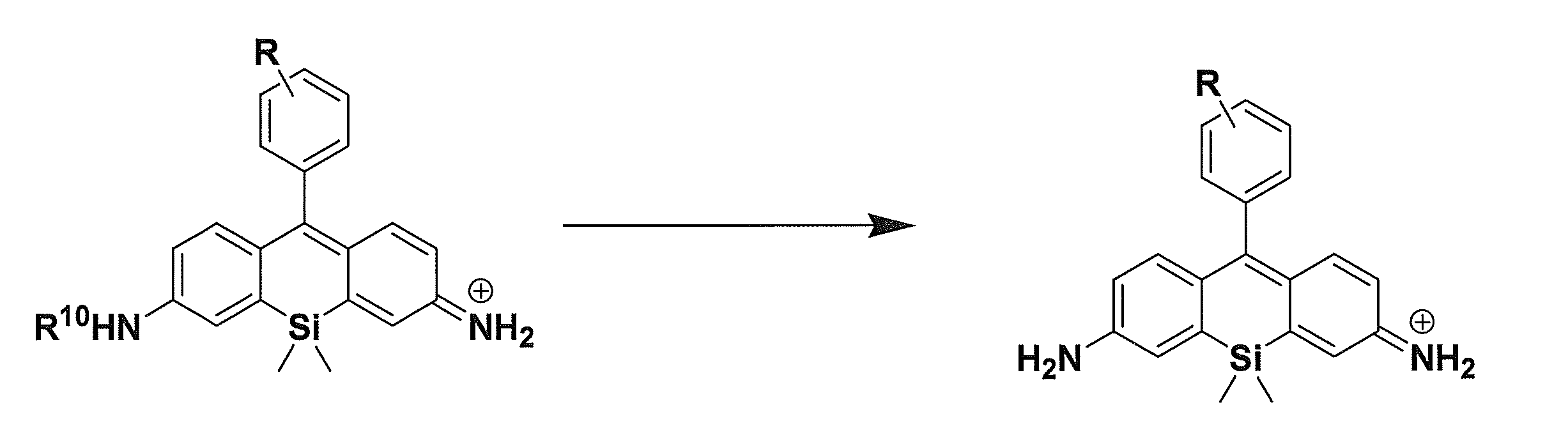
- a fluorescent probe is a compound in which the capture group of R 9 and / or R 10 is cleaved by contact with a substance to be measured and the absorption wavelength is shifted to a long wavelength (in the above general formula (I), R 9 and / or R 10 is (Corresponding to a compound having an unsubstituted amino group) can be generated, and can be suitably used as a fluorescent probe for measurement of a substance to be measured.
- substances to be measured include enzymes (peptidases, proteases, lactamases, sugar hydrolases, transferases, oxidoreductases, etc.) and glutathione.
- the enzyme is preferably a peptidase, a protease, or a lactamase.
- the type of peptidase or protease is not particularly limited as long as it can hydrolyze the acyl group in the compound of the present invention represented by the above general formula (I) wherein R 9 and / or R 10 is an acyl group.
- the peptidase may be an endopeptidase or an exopeptidase
- the protease may be either an endoprotease or an exoprotease.
- an acyl residue derived from the amino acid can be used for R 9 and / or R 10 and a compound designed in this way is used.
- a specific peptidase or protease can be specifically measured (an acyl residue derived from an amino acid indicates the remaining partial structure obtained by removing the hydroxyl group from the carboxy group of the amino acid). From this point of view, it is preferable to use an acyl residue derived from an amino acid hydrolyzable by a peptidase or protease as R 9 and / or R 10 as a fluorescent probe for peptidase or protease.
- An acyl residue derived from the above can be used.
- R 10 is a capture group and is cleaved by contact with a substance to be measured and the absorption wavelength shifts to a long wavelength (in the above general formula (I), R 9 and / or R 10 is a compound having an unsubstituted amino group)
- R 9 and / or R 10 is a compound having an unsubstituted amino group
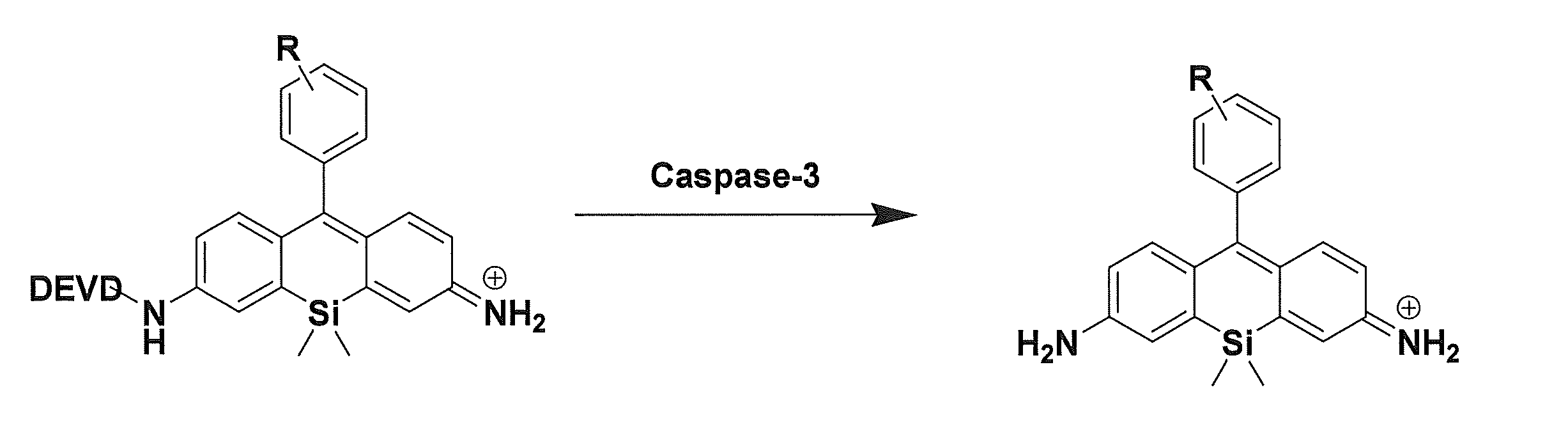
- Protease are examples of suitable R 10 when it is caspase -3 (Caspase-3).
- DEVD represents the single letter code for amino acids. In the present specification, this compound is sometimes referred to as N-DEVD-substituted Si rhodamine.
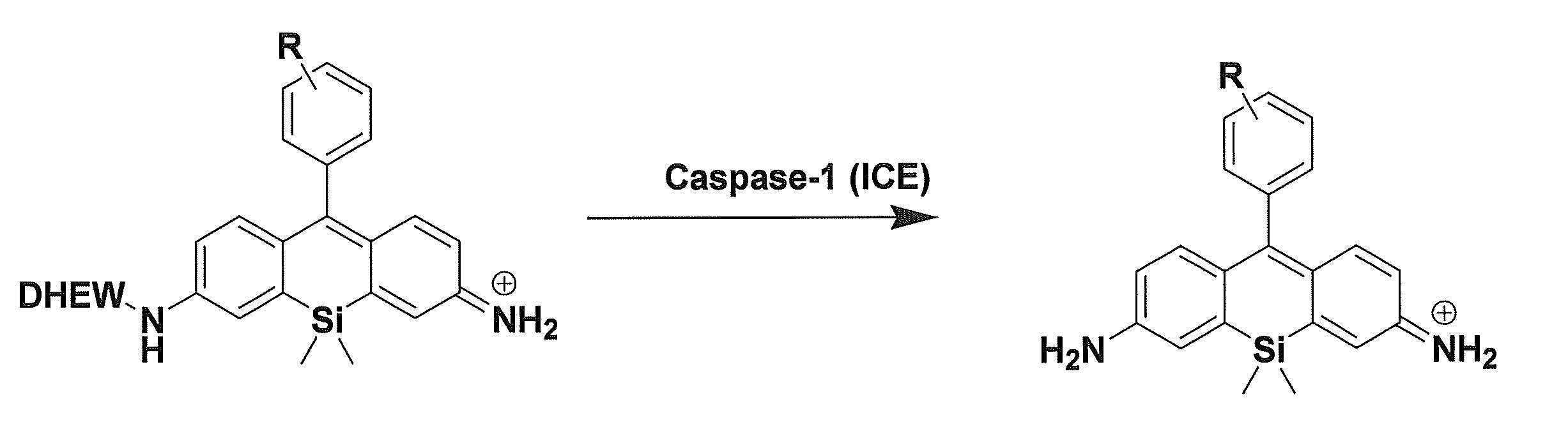
- DHEW represents the single letter code for amino acids.
- QLKSSH is a single letter code for amino acids.
- GGT ⁇ -glutamyl transpeptidase: ⁇ -glutamyl transpeptidase
- cancer cells and cancer tissues can be specifically measured and can be used as a cancer diagnostic agent. .
- the measurement of the measurement target substance using the various fluorescent probes described above can be performed according to a method well known to those skilled in the art such as the method described in the above-mentioned publication regarding the capture group, it can be used as a reagent for research. It can also be used as a reagent for diagnosis of animals and humans.
- the various fluorescent probes described above it becomes possible to measure the concentration and amount of the substance to be measured in a test tube, or it is taken into a living cell or living body and imaged by a bioimaging technique. can do.
- the following steps (a) a step of bringing a compound represented by the general formula (I) having a capture group or a salt thereof into contact with a substance to be measured, and (b) the above step (a).
- Examples thereof include a method including a step of measuring the fluorescence intensity of the compound after capturing the generated measurement target substance.
- R 9 and / or R 10 can be easily converted to an appropriate substituent by a known method.
- functional substituents other than the capture group can be introduced, for example, a substituent for labeling and a substituent for forming a caged compound.
- the term “measurement” used in this specification should be interpreted in the broadest sense, including measurement, examination, detection, and the like performed for the purpose of quantification, qualification, or diagnosis.
- the compound of the present invention can be synthesized according to the following synthesis scheme.
- N, N, N ′, N′-tetraallyl-diamino-Si-rhodamine derivatives can be synthesized from -xanthone.
- 1/5 equivalents of N, N, N ′, N, N, N ′, N′-tetraallyl-diamino-Si-rhodamine derivative can be synthesized by adding N′-tetraallyl-diamino-Si-xanthone and treating with hydrochloric acid.
- Step (b) The allyl protecting group of N, N, N ', N'-tetraallyl-diamino-Si-xanthone is one of the protecting groups of amino group widely used in organic synthesis, and has a catalytic amount of tetrakis (triphenylphosphine) palladium And easy deprotection by treatment with 5-6 equivalents of 1,3-dimethylbarbituric acid.
- a fluorescent probe in which R 1 or R 10 is substituted with a capture group can be obtained by appropriately combining the synthesis methods of Examples 1 and 2 and a conventionally known method.
- nitric oxide can be measured according to the method described as the method for measuring nitric oxide in International Publication WO1999 / 001447.
- NOC-12 and NOC-13 which are spontaneous nitric oxide generators, can be reacted by contacting the nitric oxide produced in the reaction solution with diamino-N, N-unsubstituted X rhodamine.
- a reaction solvent for example, 0.1M phosphate buffer (pH 7.4) is used.
- a suitable reaction solvent is used.
- the amount of nitric oxide produced can be measured by measuring the fluorescence intensity with a spectrofluorometer at various excitation and fluorescence wavelengths.
- the enzyme activity of caspase-3 can be measured according to the method described as the method for measuring caspase activity by cleavage of fluorescent substrate in JP-T-2004-521080.
- the standard reaction mixture (final volume 300 ⁇ L) contained N-DEVD-substituted Si rhodamine and purified or crude caspase-3 enzyme in 50 ⁇ mMHEPES / KOH (pH 7.0), 10% (volume basis), glycerin, 0.1% (w / v) in CHAPS, 2 mM EDTA, 5 mM dithiothreitol, incubate the mixture at 25 ° C and continuously monitor the reaction with a fluorescence spectrophotometer at the appropriate excitation and fluorescence wavelengths
- the enzyme activity of caspase-3 can be measured. Specific techniques are described in the examples of this specification.
- Me represents a methyl group
- Ac represents an acetyl group
- Example 1 General formula (I) of the present invention according to the following scheme (wherein R 3 and R 4 represent a hydrogen atom, R 5 and R 6 represent a methyl group; R 7 and R 8 represent a hydrogen atom; R N, N, N ′, N′-tetraallyl-diamino-Si-xanthone, which is a synthetic intermediate of a compound represented by 9 and R 10 represents a hydrogen atom; X represents a silicon atom, was synthesized. Similarly, a compound in which X is a germanium atom and a compound in which R 5 and R 6 are ethyl groups were also synthesized.
- Example 2 Using N, N, N ′, N′-tetraallyl-diamino-Si-xanthone synthesized in Example 1, in the general formula (I) of the present invention, R 1 is a hydrogen atom and R 2 is a methyl group or A carboxyl group, R 3 and R 4 are hydrogen atoms, R 5 and R 6 are methyl groups, R 7 and R 8 are hydrogen atoms, R 9 and R 10 are hydrogen atoms, X A compound having a silicon atom or a salt thereof was synthesized. Further, to synthesize a compound obtained by introducing an acetyl group as R 10 in the above compounds.
- N, N, N ', N'-Tetraallyl-2-methyl SiR600 (350 mg, 0.65 mmol) is dissolved in methanol (20 mL), to which sodium borohydride (29 mg, 0.77 mmol) is added, and 0 After stirring at 30 ° C. for 30 minutes, the solvent was distilled off under reduced pressure and water was added. This was extracted with dichloromethane and washed with brine.
- 1,3-dimethylbarbituric acid (543 mg, 3.48 mmol) and tetrakis (triphenylphosphine) palladium (121 mg, 0.104 mmol) were added, The reaction vessel was degassed and purged with argon, followed by stirring at 35 ° C. for 21 hours. The reaction solution was suspended in a saturated aqueous sodium carbonate solution, extracted with dichloromethane, and washed with a saturated aqueous sodium carbonate solution and brine.
- the reaction mixture was extracted with dichloromethane and washed with brine. The organic layer was dried over sodium sulfate and the solvent was distilled off under reduced pressure. Trifluoroacetic acid (12 ml) was added, and the mixture was stirred at room temperature for 1 hr. After the solvent was distilled off under reduced pressure, water was added, extracted with dichloromethane, and washed with brine. The organic layer was dried over sodium sulfate and the solvent was distilled off under reduced pressure.
- N, N, N ', N'-Tetraallyl-2-COOH SiR600 (310 mg, 0.58 mmol) was dissolved in dichloromethane (30 ml) and 1,3-dimethylbarbituric acid (454 mg, 2.91 mmol) was added to tetrakis.
- (Triphenylphosphine) palladium (101 mg, 0.087 mmol) was added, the inside of the reaction vessel was degassed, purged with argon, and stirred at 35 ° C. for 20 hours.
- the reaction solution was suspended in a saturated aqueous sodium carbonate solution, extracted with dichloromethane, and washed with a saturated aqueous sodium carbonate solution and brine.
- Example 3 The absorption and fluorescence spectra of 2-Me SiR600 synthesized in Example 2 and the acetylated product (N-Ac-2-Me SiR600) and the pH profile were measured. The results are shown in FIGS. 1 and 2 and Table 1.
- 2-Me SiR600 the absorption maximum wavelength was greatly changed to the shorter wavelength side than 2-Me SiR600 by acetylating the amino group at the 3-position of the xanthene ring.
- the absorbance of the acetylated compound decreased depending on the decrease in pH, but 2-Me SiR600 hardly changed the absorbance depending on the pH. Therefore, 2-Me SiR600 acylated at the 3-position amino group can function as a fluorescent probe for detecting enzyme activity having a large S / N ratio due to a change in absorption wavelength without using intramolecular photoinduced electron transfer.
- Example 4 Using 2-Me SiR600 synthesized in Example 2 as the starting compound, following the steps shown in Scheme oligopeptide residue as R 10 (Cbz-Asp-Glu -Val-Asp) caspase-3 activity for a fluorescent probe was introduced (Z-DEVD-SiR600: Cbz and Z are benzyloxycarbonyl groups) and a leucine aminopeptidase (LAP) activity detection probe (Leu-SiR600) into which a leucine residue (Leu) was introduced were synthesized. (R represents Cbz-Asp-Glu-Val-Asp residue or Leu residue)
- Cbz-DEVD-OH peptide was synthesized by the usual Fmoc solid phase synthesis method using 2-chlorotrityl chloride resin (1.3 mmol / g, 100-200 mesh, 1% DVB).
- Trifluoroacetic acid (10 ml) was added to the residue, and the mixture was stirred at room temperature for 1 hour, and then the solvent was distilled off under reduced pressure.
- HRMS (ESI + ): Calcd for [M] + , 935.3647 Found, 935.3617 (-3.1 mmu).
- the absorption spectrum of Z-DEVD-SiR600 was measured in 0.1 M sodium phosphate buffer at pH 3 to 10 containing 1% DMSO. The measurement results are shown in FIG. 5, and the photochemical characteristics are shown in Table 3 below together with SiR600. Although the absorbance of Z-DEVD-SiR600 varies depending on the pH, it does not absorb light near the maximum absorption (593 nm) of SiR600 produced by contact with caspase-3, and caspase that uses excitation light near 593 nm. -3 activity measurement was confirmed without being affected by Z-DEVD-SiR600.
- 2-MeSiR600 (3 mg, 6.5 ⁇ mol) is dissolved in DMF (6 ml) and Boc-Leu-OH ⁇ H 2 O (17.1 mg, 68.7 ⁇ mol), HATU (22 mg, 57.9 ⁇ mol), HOBt ⁇ H 2 O (6.8 mg, 44.4 ⁇ mol) and DIPEA (14.2 ⁇ l, 111 ⁇ mol) were added, and the mixture was stirred at room temperature for 25 hours. After the solvent was distilled off under reduced pressure, water was added, extracted with dichloromethane, washed with brine, the organic layer was dried over sodium sulfate, and the solvent was distilled off under reduced pressure.
- Trifluoroacetic acid (6 ml) was added to the residue, and the mixture was stirred at room temperature for 1 hour, and then the solvent was evaporated under reduced pressure.
- HRMS (ESI + ): Calcd for [M] + , 456.2471 Found, 456.2425 (-4.7 mmu).
- Example 5 Caspase-3 was reacted with Z-DEVD-SiR600 to evaluate its function as a fluorescent probe.
- Caspase-3 (0.5 ⁇ g) was added to Z-DEVD-SiR600 (2 ⁇ M) and reacted for 10 hours.
- the reaction was carried out at 37 ° C. using 0.75 ml of 20 mM HEPES buffer (pH 7.4) containing 100 ⁇ M dithiothreitol (DTT), 10% glycerin, 0.1% CHAPS, 100 mM NaCl, and 0.1% DMSO.
- DTT dithiothreitol
- FIG. 6 (d) reaction kinetic parameters are shown in FIG. 6 (d).
- Z -DEVD-SiR600 has a maximum absorption wavelength of around 500 nm, but 2-Me SiR600 produced by reaction of Z-DEVD-SiR600 with caspase-3 has a maximum absorption at 593 nm.
- Fig. 6 (c) almost no fluorescence is observed before the reaction, and very strong fluorescence can be observed after the reaction as shown in Fig. 6 (c). It was shown that it can be suitably used as a fluorescent probe.
- Example 6 Leu-SiR600 was reacted with leucine aminopeptidase to evaluate its function as a fluorescent probe.
- Leucine aminopeptidase (0.096 units) was added to Leu-SiR600 (6 ⁇ M) and allowed to react for 2.5 hours. The reaction was performed at 37 ° C. using 0.75 ml of 0.1 M sodium phosphate buffer (pH 7.4) containing 0.8% DMSO.
- the absorption spectrum and fluorescence spectrum before and after the reaction are shown in FIGS. 7 (b) and (c), respectively. As shown in Fig.
- the maximum absorption wavelength of Leu-SiR600 is around 500 nm, but 2-Me SiR600 produced when Leu-SiR600 reacts with leucine aminopeptidase has a maximum absorption at 593 nm, so 593 nm As shown in FIG. 7 (c), almost no fluorescence is observed before the reaction, and very strong fluorescence can be observed after the reaction. That is, it was shown that Leu-SiR600 can be suitably used as a fluorescent probe for caspase-3.
- the compound represented by the general formula (I) provided by the present invention or a salt thereof has a property that the fluorescence property changes before and after the capture of the measurement target substance, and is a metal ion, reactive oxygen species, proton or enzyme activity. It can utilize as a compound for manufacturing the fluorescent probe which can measure a measuring object substance etc. with high sensitivity.
Landscapes
- Chemical & Material Sciences (AREA)
- Health & Medical Sciences (AREA)
- Organic Chemistry (AREA)
- Life Sciences & Earth Sciences (AREA)
- Immunology (AREA)
- Engineering & Computer Science (AREA)
- Biomedical Technology (AREA)
- Urology & Nephrology (AREA)
- Molecular Biology (AREA)
- Hematology (AREA)
- Microbiology (AREA)
- Cell Biology (AREA)
- Biotechnology (AREA)
- Food Science & Technology (AREA)
- Medicinal Chemistry (AREA)
- Physics & Mathematics (AREA)
- Analytical Chemistry (AREA)
- Biochemistry (AREA)
- General Health & Medical Sciences (AREA)
- General Physics & Mathematics (AREA)
- Pathology (AREA)
- Investigating Or Analysing Materials By The Use Of Chemical Reactions (AREA)
- Measuring Or Testing Involving Enzymes Or Micro-Organisms (AREA)
Abstract
Description

(a)3-ハロゲン化アニリンとアリルハライドから製造される3-ハロゲン化-N,N-ジアリルアニリンとホルムアルデヒドから下記の一般式(II):

(b)上記の一般式(II)で表される化合物とX(Halo)2(R5)(R6)(Haloは塩素原子又は臭素原子を示し、X、R4、及びR5は上記と同義である)とを反応させ後、酸化反応によって下記のN,N,N',N'-テトラアリル-ジアミノ-X-キサントンを製造する工程、
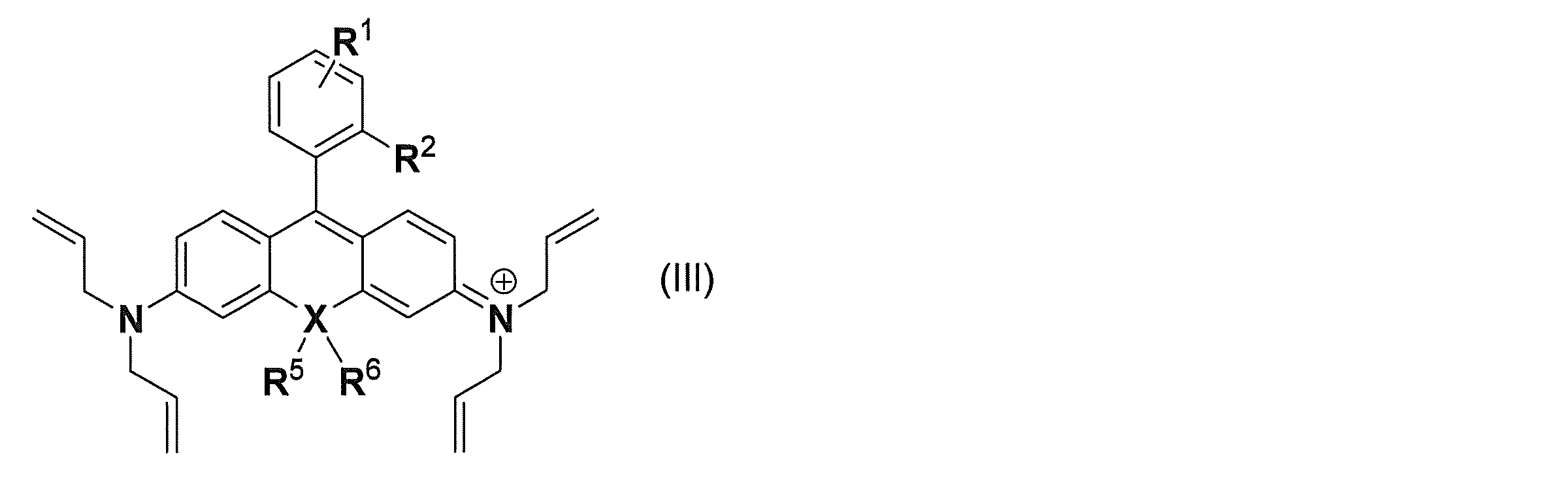
(d) 上記の一般式(III)で表される化合物の脱アリル化を行い、上記の一般式(I)(式中、R3及びR4が水素原子を示し、R5及びR6がそれぞれ独立に炭素数1~6個のアルキル基又はアリール基を示し;R7及びR8が水素原子を示し;R9及びR10が水素原子を示し;Xは珪素原子、ゲルマニウム原子、又はスズ原子を示す)の化合物を製造する工程(R1及びR2に上記の一般式(III)を製造するために保護基を導入した場合には、該保護基の脱保護を工程(d)の前後又は同時に行ってもよい)のいずれか1つ以上の工程、好ましくは連続した2以上の工程を含む方法が提供される。脱アリル化に際して上記の一般式(III)で表される化合物を還元して9H-キサンテンとした後に脱アリル化を行うことも反応収率を改善するために好ましい。
(a)3-ハロゲン化アニリンとアリルハライドから製造される3-ハロゲン化-N,N-ジアリルアニリンとホルムアルデヒドから下記の一般式(II):
(b)上記の一般式(II)で表される化合物とジクロロジメチルシランとを反応させ後、酸化反応によって下記のN,N,N',N'-テトラアリル-ジアミノ-Si-キサントンを製造する工程、

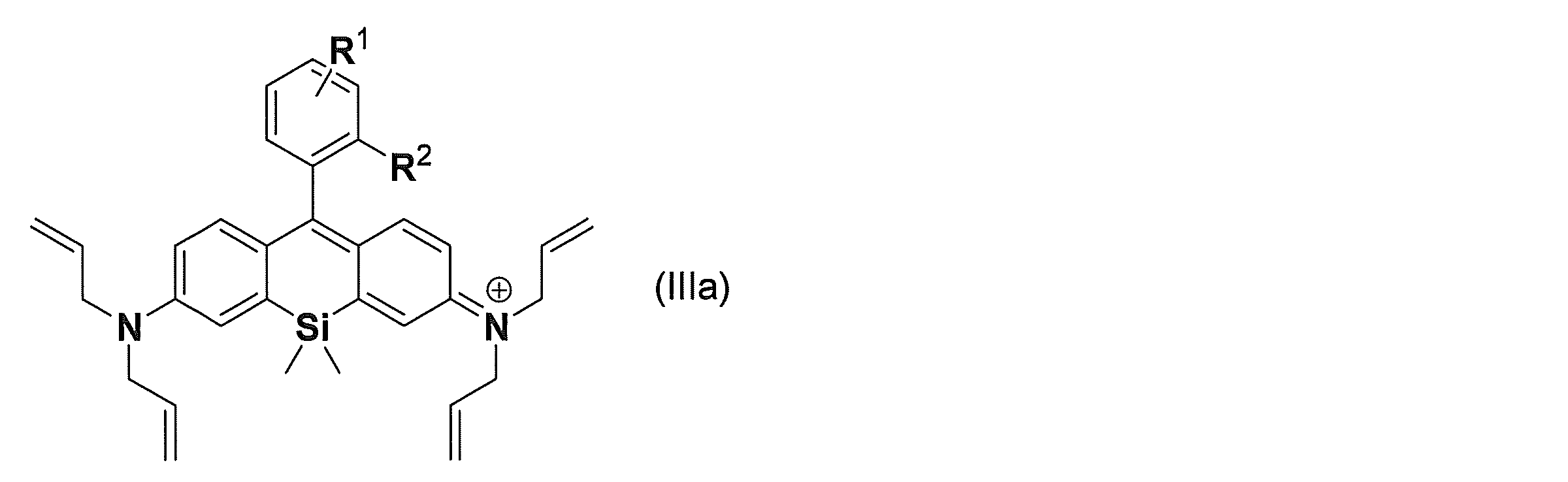
(d) 上記の一般式(IIIa)で表される化合物の脱アリル化を行い、上記の一般式(I)(式中、R3及びR4が水素原子を示し、R5及びR6がメチル基を示し;R7及びR8が水素原子を示し;R9及びR10が水素原子を示し;Xは珪素原子を示す)の化合物を製造する工程(R1及びR2に上記の一般式(IIIa)を製造するために保護基を導入した場合には、該保護基の脱保護を工程(d)の前後又は同時に行ってもよい)
のいずれか1つ以上の工程、好ましくは連続した2以上の工程を含む方法も提供される。脱アリル化に際して上記の一般式(IIIa)で表される化合物を還元して9H-キサンテンとした後に脱アリル化を行うことも反応収率を改善するために好ましい。
a)プロトンに対する捕捉基としては、-CR20-A-N R21R22(式中R20、R21、R22はれぞれ独立に水素原子、置換基を有していてもよい炭素数1~6個のアルキル基、置換基を有していてもよいアリール基、R20とR21またはR20とR22が結合した炭素数1~3個のアルキレン基を示し; Aは置換基を有していてもよい炭素数1~3個のアルキレン基を示す)で表される捕捉基
などの捕捉基を挙げることができる。これらの捕捉基は直接一般式(I)で表される化合物、又はその塩に置換してもよく、スペーサーを介して一般式(I)で表される化合物、又はその塩に置換してもよい場合もある。



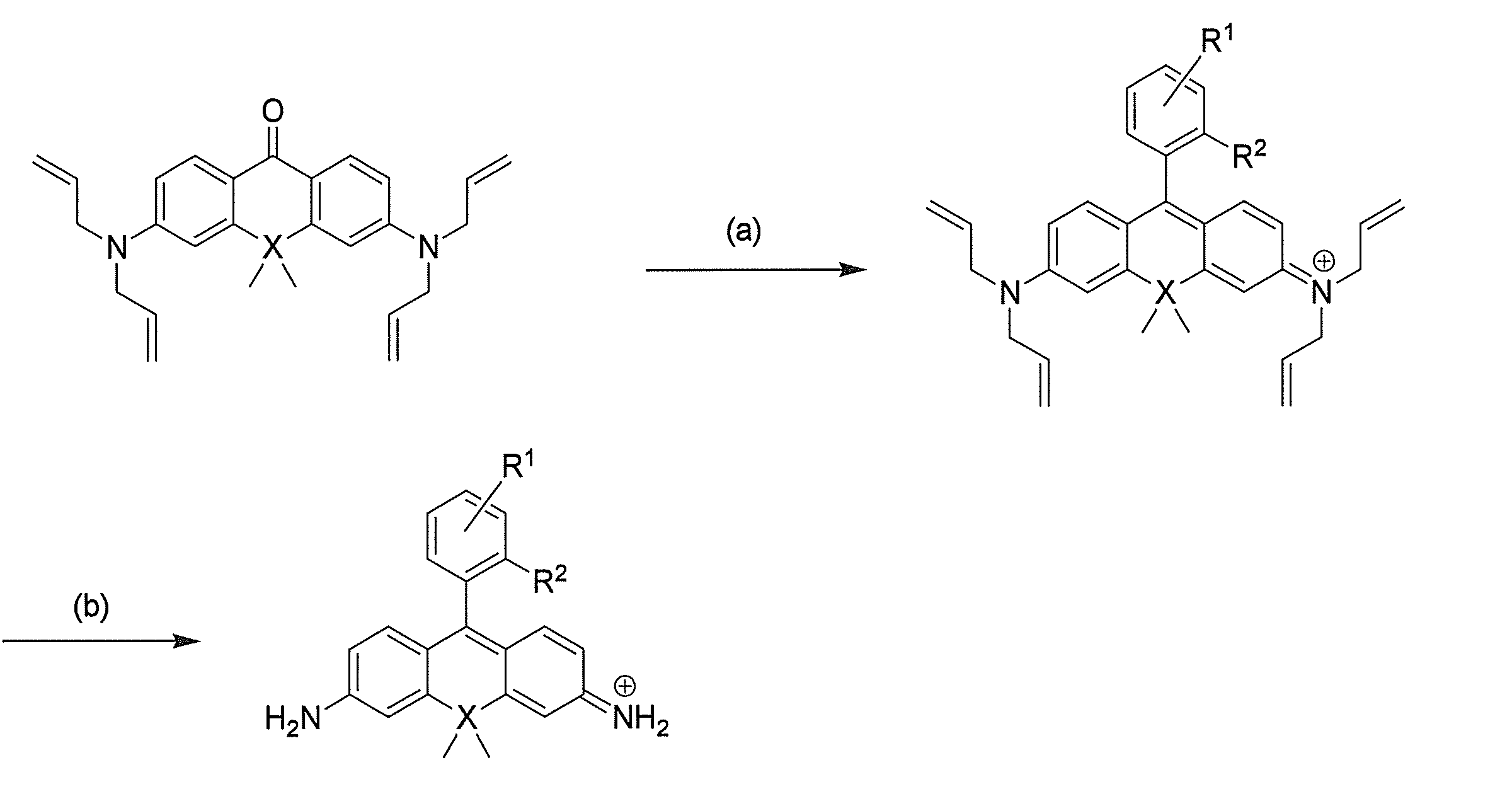
国際公開WO2005/085811には、例1で合成されるN,N,N',N'-テトラアリル-ジアミノ-Si-キサントンの珪素原子が酸素原子である類似化合物(3,6-ビスジメチルアミノキサントン)を用いてN,N,N',N'-テトラメチルローダミン誘導体の合成方法が開示されているので、該合成方法を参考にしてN,N,N',N'-テトラアリル-ジアミノ-Si-キサントンからN,N,N',N'-テトラアリル-ジアミノ-Si-ローダミン誘導体を合成することができる。例えば、溶媒中、- 78℃でハロゲン化ベンゼン誘導体に対して1当量から1.1当量のsec-ブチルリチウムを加えた後、ハロゲン化ベンゼン誘導体に対して1/5当量のN,N,N',N'-テトラアリル-ジアミノ-Si-キサントンを加え、塩酸で処理することによりN,N,N',N'-テトラアリル-ジアミノ-Si-ローダミン誘導体を合成することができる。また、本明細書の実施例にはXとして珪素原子又はゲルマニウム原子を含むN,N,N',N'-テトラアリル-ジアミノ-X-ローダミンの製造方法の具体例が開示されているので、これらを参考にすることによってN,N,N',N'-テトラアリル-ジアミノ-X-ローダミン誘導体を合成することができる。
N,N,N',N'-テトラアリル-ジアミノ-Si-キサントンのアリル保護基は有機合成において汎用されているアミノ基の保護基の一つであり、触媒量のテトラキス(トリフェニルホスフィン)パラジウム及び5~6当量の1,3-ジメチルバルビツール酸で処理することで容易に脱保護される。脱アリル化に際して上記の一般式(III)で表される化合物を還元して9H-キサンテンとした後に脱アリル化を行うことも反応収率を改善するために好ましい。
上記例1及び例2の合成方法と従来公知の方法とを適宜組み合わせることによってR1やR10が捕捉基で置換されている蛍光プローブを得ることができる。
以下のスキームに従って本発明の一般式(I)(式中、R3及びR4が水素原子を示し、R5及びR6がメチル基を示し;R7及びR8が水素原子を示し;R9及びR10が水素原子を示し;Xは珪素原子を示す)で表される化合物の合成中間体であるN,N,N',N'-テトラアリル-ジアミノ-Si-キサントンを合成した。同様にしてXがゲルマニウム原子である化合物、及びR5及びR6がエチル基である化合物も合成した。
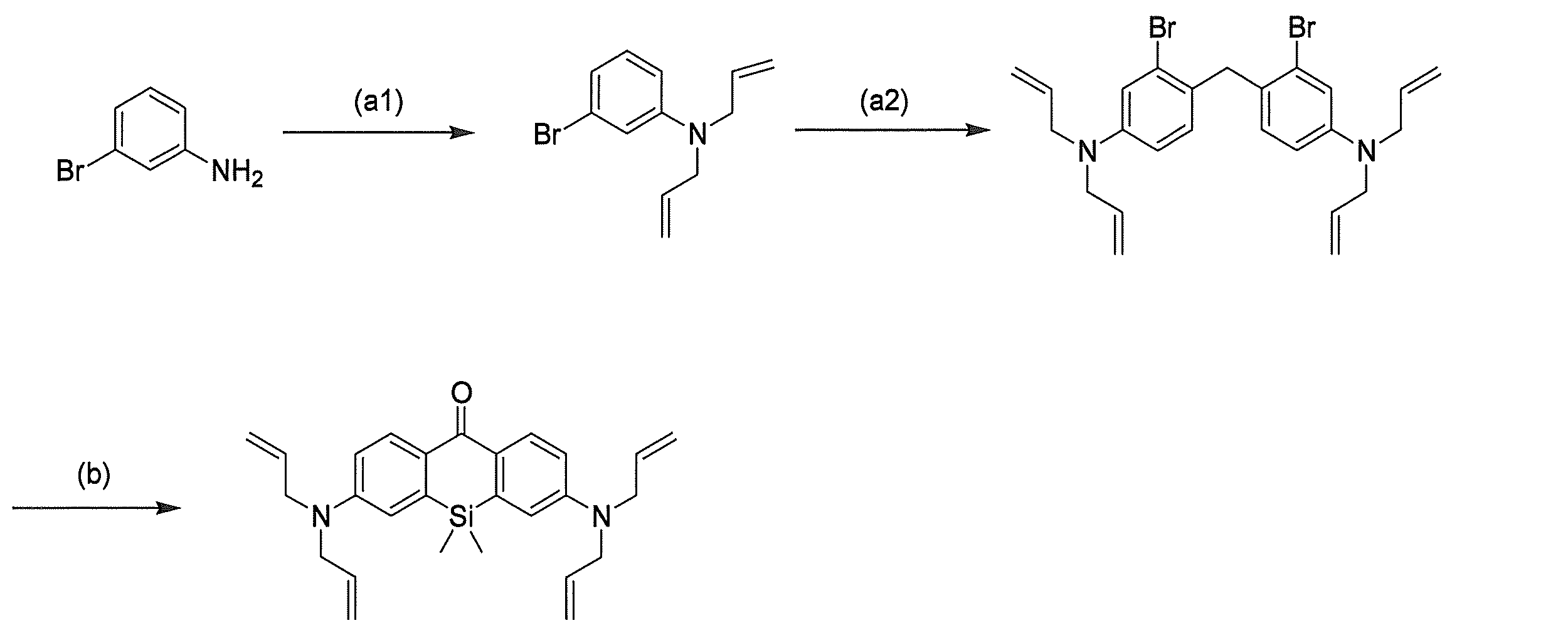
炭酸カリウム (22.0 g, 159 mmol)をアセトニトリルに懸濁し、3-ブロモアニリン (8.71 mL, 80.0 mmol)、アリルブロミド (23.7 mL, 280 mmol) を加えて80℃で14時間攪拌した。室温まで冷却した後にセライトろ過を行い、酢酸エチルでよく洗った。溶媒を除去した後にカラムクロマトグラフィー(シリカゲル, 1/40 酢酸エチル/ヘキサン) で精製し、3-ブロモ-N,N-ジアリルアニリン (17.1 g, 67.9 mmol, 収率85%) を得た。
1H-NMR (300.40 MHz, CDCl3): δ 3.87-3.90 (m, 4H), 5.11-5.15 (m, 2H), 5.17-5.18 (m, 2H), 5.75-5.88 (m, 2H), 6.58 (dd, 1H, J = 2.2, 8.1 Hz), 6.77-6.81 (m. 2H), 7.01 (t, 1H, J = 8.1Hz)
13C-NMR (75.45 MHz, CDCl3): δ 52.7, 110.8, 115.0, 116.3, 119.0, 123.3, 130.2, 133.2, 150.0
HRMS (ESI+): Found: 252.0429, calculated 252.0388 for [M+H]+(+4.1 mmu)
3-ブロモ-N,N-ジアリルアニリン(17.1 g, 67.9 mmol) を酢酸 (200 mL) に溶解し、37% ホルムアルデヒド液 (10.2 g, 340 mmol)を加えて80℃で75分間加熱した。室温まで冷却した後、飽和炭酸水素ナトリウム水溶液と水酸化ナトリウムで中和した。この混合物をジクロルメタンで抽出し、食塩水で洗浄した。有機層を硫酸ナトリウムで乾燥して溶媒を除去した後、カラムクロマトグラフィー(シリカゲル, 1/30 酢酸エチル/ヘキサン)で精製し、ビス(2-ブロモ-4-N,N-ジアリルアミノフェニル)メタン (15.2 g, 29.5 mmol, 収率87%)を得た。
1H-NMR (300.40 MHz, CDCl3): δ 3.85-3.87 (m, 8H), 3.96 (s, 2H), 5.13-5.19 (m, 8H), 5.76-5.88 (m, 4H), 6.54 (dd, 2H, J = 2.9, 8.8 Hz), 6.81 (d, 2H, J =8.1 Hz), 6.90 (d, 2H, J = 2.9 Hz)
13C-NMR (75.45 MHz, CDCl3): δ 39.7, 52.7, 111.7, 116.0, 116.2, 125.5, 126.9, 130.8, 133.5, 148.1
HRMS (ESI+): Found: 517.0654, calculated 517.0677 for [M+H]+(-2.3 mmu)
乾燥させアルゴン置換したフラスコにビス(2-ブロモ-4-N,N-ジアリルアミノフェニル)メタン (8.16 g, 15.8 mmol) と脱水テトラヒドロフラン(THF, 50 mL)を加えた。-78℃に冷却後、1M sec-ブチルリチウム (45 mL, 45mmol) を加え、20分間攪拌した。そのままの温度でジクロロジメチルシラン (2.9 mL, 30 mmol) を脱水THF 10 mLに溶解してゆっくりと加え、室温に戻して1時間攪拌した。2N 塩酸で反応を停止して炭酸水素ナトリウムで中和した。この混合物をジクロルメタンで抽出して食塩水で洗浄し、有機層を硫酸ナトリウムで乾燥させた後に溶媒を除去した。残渣をアセトン (150 mL)に溶解し、0℃に冷却して過マンガン酸カリウム (6.88 g, 43.5 mmol)を少量ずつ2時間かけて加え、さらに同じ温度で1時間攪拌した。ジクロルメタン (200 mL)を加えてろ紙を用いて吸引ろ過した。溶媒を除去し、カラムクロマトグラフィー(シリカゲル, ジクロルメタン) で精製してN,N,N',N'-テトラアリル-ジアミノ-Si-キサントン (2.23 g, 5.20 mmol, 収率33%) を得た。
1H-NMR (300.40 MHz, CDCl3): δ 0.41 (s, 6H), 4.02 (d, 8H, J = 5.1 Hz), 5.17-5.23 (m, 8H), 5.82-5.94 (m, 4H), 6.80-6.83 (m, 4H), 8.34 (d, 2H, J = 8.1 Hz)
13C-NMR (75.45 MHz, CDCl3): δ -1.1, 52.8, 113.5, 114.8, 116.7, 130.0, 131.7, 133.1, 140.5, 150.2, 185.1
HRMS (ESI+): Found:429.2347, calculated 429.2362 for [M+H]+(-1.5 mmu)
乾燥させアルゴン置換したフラスコに、ビス(2-ブロモ-4-N,N-ジアリルアミノフェニル)メタン(6.16 g, 11.9 mmol) と脱水THF (40 mL)を加えた。-78℃に冷却後、1M sec-ブチルリチウム(BuLi) (34 mL, 34 mmol) を加え、20分間攪拌した。そのままの温度でジクロロジメチルゲルマン (2.62 mL, 22.7 mmol) を脱水THF 15 mLに溶解したものをゆっくりと加え、室温に戻し1時間攪拌した。2N 塩酸で反応を止め、炭酸水素ナトリウムで中和した。これをジクロルメタンで抽出して食塩水で洗い、有機層を硫酸ナトリウムで乾燥させた後に溶媒を除去した。これをアセトン (120 mL)に溶解し、0℃に冷却した。この混合物に過マンガン酸カリウム (5.20 g, 32.9 mmol)を少量ずつ2時間かけて加え、さらに同じ温度で1時間攪拌した。この混合物にジクロルメタン (200 mL)を加えて、その溶液をろ紙を用いて吸引ろ過した。そして溶媒を除去し、カラムクロマトグラフィー (シリカゲル、ジクロルメタン) で精製することにより目的物(1.29 g, 2.72 mmol, 収率 23%)を得た。
1H NMR (300 MHz, CDCl3): δ0.54 (s, 6H), 4.00-4.02 (m, 8H) 5.17-5.23 (m, 8H), 5.81-5.94 (m, 4H), 6.72 (d, 2H, J = 2.9 Hz), 6.78 (dd, 2H, J = 2.6, 9.2 Hz), 8.36 (d, 2H, J = 8.8 Hz)
13C NMR (75 MHz, CDCl3): δ-1.8, 52.3, 112.6, 114.4, 116.2, 129.6, 131.7, 132.7, 142.8, 149.8, 184.5
LRMS (ESI+): m/z Found 475, calculated 475 for [M+H]+
乾燥させアルゴン置換したフラスコに、テトラキス(トリフェニルホスフィン)パラジウム (330 mg, 0.285 mmol) と 1,3-ジメチルバルビツール酸(1.41 g, 9.04 mmol) を加えた。この混合物に、N,N,N',N'-テトラアリルジアミノ-Ge-キサントン (1.00 g, 2.11 mmol) をジクロルメタン 50 mL に溶解して加え、35℃で16時間攪拌した。溶媒を除去して飽和炭酸ナトリウム水溶液に懸濁し、ジクロルメタンで抽出した。有機層を硫酸ナトリウムで乾燥させて溶媒を除去した後、カラムクロマトグラフィー(シリカゲル, 4/3 酢酸エチル/ヘキサン)で精製し、3,6-ジアミノ-Ge-キサントン混合物 (760 mg, 収率定量的) を得た。
1H NMR (300 MHz, CD3OD): δ0.55 (s, 6H), 6.73-6.76 (m, 4H), 8.33 (d, 2H, J = 9.5 Hz)
13C NMR (75 MHz, CD3OD): δ-1.9, 116.1, 118.3, 130.9, 133.2, 145.2, 152.9, 187.3
LRMS (ESI+): m/z Found: 315, calculated 315 for [M+H]+
乾燥させアルゴン置換したフラスコにビス(2-ブロモ-4-N,N-ジアリルアミノフェニル)メタン(1.65 g, 3.20 mmol) と脱水THF (20 mL)を加えた。-78℃に冷却後、1M sec-BuLi (10 mL, 10 mmol) を加え、20分間攪拌した。そのままの温度でジクロロジエチルシラン(1.04 mL, 7.02 mmol) を脱水THF 5 mLに溶解してゆっくり加え、室温に戻し1時間攪拌した。2N 塩酸で反応を止め、炭酸水素ナトリウムで中和した。これをジクロルメタンで抽出して食塩水で洗い、有機層を硫酸ナトリウムで乾燥させた後に溶媒を除去した。これをアセトン(50 mL)に溶解し、0℃に冷却した。この混合物に過マンガン酸カリウム (1.49 g, 9.43 mmol)を少量ずつ2時間かけて加え、さらに同じ温度で1時間攪拌した。この混合物にジクロルメタン(50 mL)を加えて、その溶液をセライトろ過した。そして溶媒を除去し、カラムクロマトグラフィー (シリカゲル, 10/1 ヘキサン/酢酸エチル) で精製することによりN,N,N',N'-3,6-テトラアリルジアミノ-ジエチルSi-キサントン (419 g, 0.917 mmol, 収率 29%)を得た。
1H NMR (300 MHz, CDCl3): δ0.91 (s, 10H), 4.01-4.02 (m, 8H) 5.17-5.22 (m, 8H), 5.82-5.94 (m, 4H), 6.79-6.84 (m, 4H), 8.35 (d, 2H, J = 8.8 Hz)
13C NMR (75 MHz, CDCl3): δ5.56, 7.48, 52.7, 113.3, 115.0, 116.5, 130.9, 131.6, 133.1, 138.3, 149.9, 185.3
HRMS (ESI+): m/z Found 457.2661, calculated 457.2675 for [M+H]+(-1.5 mmu)
乾燥させアルゴン置換したフラスコに、テトラキス(トリフェニルホスフィン)パラジウム (204 mg, 0.176 mmol) と1,3-ジメチルバルビツール酸(1.04 g, 6.67 mmol) を加えた。この混合物に、N,N,N',N'-テトラアリルジアミノ-ジエチルSi-キサントン (419 mg, 0.917 mmo) をジクロルメタン 30 mL に溶解して加え、35℃で16時間攪拌した。溶媒を除去して飽和炭酸ナトリウム水溶液に懸濁し、ジクロルメタンで抽出した。有機層を硫酸ナトリウムで乾燥させて溶媒を除去した後、カラムクロマトグラフィー(シリカゲル, 4/5 酢酸エチル/ヘキサン)で精製し、3,6-ジアミノ-ジエチルSi-キサントン (236 mg, 0.796 mmol, 収率 87%) を得た。
1H NMR (300 MHz, CDCl3): δ0.83-0.95 (m, 10H), 4.10 (s, 4H), 6.76-6.81 (m, 4H), 8.33 (d, 2H, J = 7.8 Hz)
13C NMR (75 MHz, CDCl3): δ5.37, 7.38, 116.2, 117.5, 132.0, 132.9, 138.8, 148.9, 185.5
HRMS (ESI+): m/z Found 297.1462, calculated 297.1423 for [M+H]+(3.9 mmu)
例1で合成されるN,N,N',N'-テトラアリル-ジアミノ-Si-キサントンを用い、本発明の一般式(I)において、R1が水素原子であり、R2がメチル基又はカルボキシル基であり、R3及びR4が水素原子であり、R5及びR6がメチル基であり、R7及びR8が水素原子であり、R9及びR10が水素原子であり、Xが珪素原子である化合物又はその塩を合成した。また、上記の化合物にR10としてアセチル基を導入した化合物を合成した。
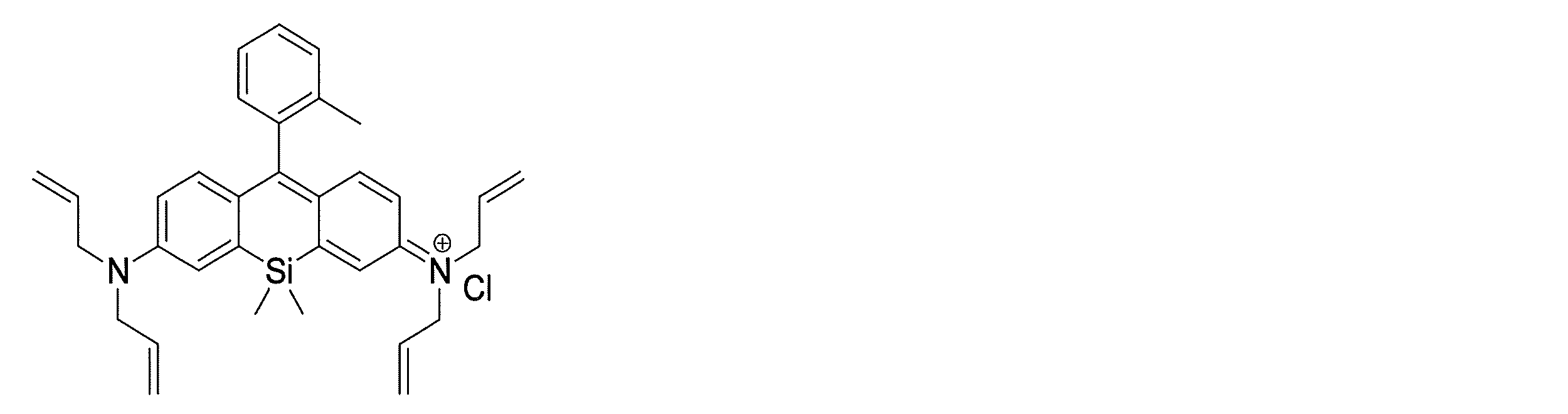
1H-NMR (300 MHz, CD3OD): δ 0.55 (s, 3H), 0.57 (s, 3H), 2.04 (s, 3H), 4.31 (d, J = 5.1 Hz, 8H), 5.19-5.31 (m, 8H), 5.88-6.00 (m, 4H), 6.79 (dd, J = 9.6 Hz, 3.0 Hz, 2H), 7.10-7.13 (m, 3H), 7.33-7.47 (m, 5H)
13C-NMR (100 MHz, CDCl3) δ -1.57, -1.32, 19.51, 54.64, 115.87, 118.13, 122.89, 126.79, 129.13, 130.12, 131.35, 132.58, 136.89, 139.85, 142.91, 149.83, 155.52, 172.10
HRMS (ESI+) Calcd for [M]+, 503.2882 Found, 503.2856 (-2.7 mmu)

1H-NMR (300 MHz, CDCl3): δ 0.39 (s, 3H), 0.54 (s, 3H), 2.22 (s, 3H), 3.56 (s, 4H), 5.53 (s, 1H), 6.55 (dd, J = 2.9 Hz, 8.0 Hz, 2H), 6.80 (d, J = 8.0 Hz, 2H), 6.91 (d, J = 2.9 Hz, 2H), 7.05-7.12 (m, 4H)
13C-NMR (75 MHz, CDCl3) δ -1.03, -0.42, 20.51 20.92, 50.07, 117.00, 118.96, 125.88, 126.11, 130.10, 131.11, 131.13, 134.15, 135.47, 139.11, 143.40, 145.89
HRMS (ESI+) Calcd for [M+H]+, 345.1787 Found, 345.1739 (-4.8 mmu)
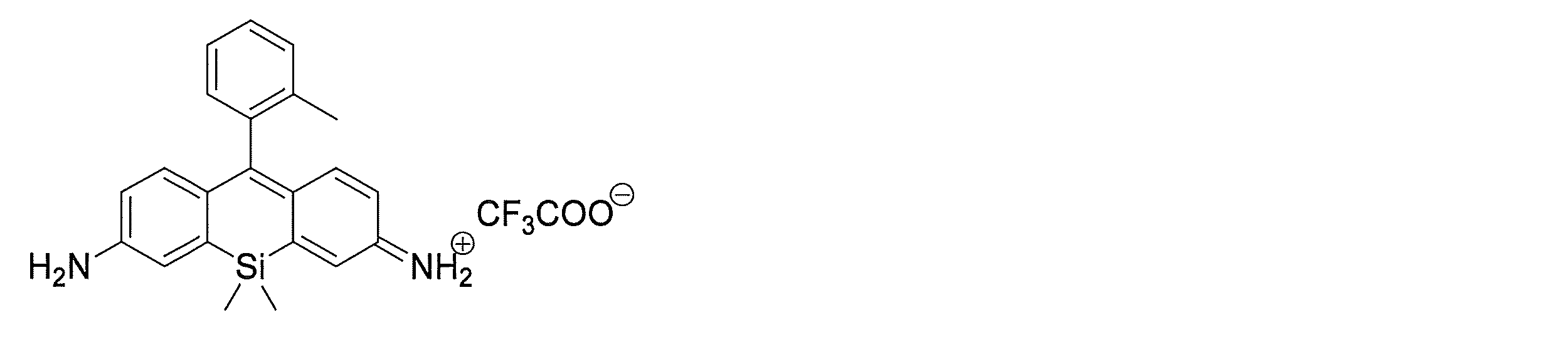
1H-NMR (400 MHz, CD3OD): δ 0.53 (s, 3H), 0.54 (s, 3H), 2.04 (s, 3H), 6.56 (dd, J= 2.4 Hz, 9.2 Hz, 2H), 7.02 (d, J = 9.2 Hz, 2H), 7.11 (s, 1H), 7.18 (d, J = 2.4 Hz, 2H), 7.33-7.50 (m, 3H)
13C-NMR (100 MHz, CD3OD) δ -1.76, -1.51, 19.44, 116.87, 124.39, 126.74, 128.50, 130.05, 131.30, 136.86, 140.07, 143.85, 150.45, 158.52, 171.96
HRMS (ESI+) Calcd for [M]+, 343.1630 Found, 343.1628 (-0.3 mmu)

LRMS (ESI+) [M]+ 385
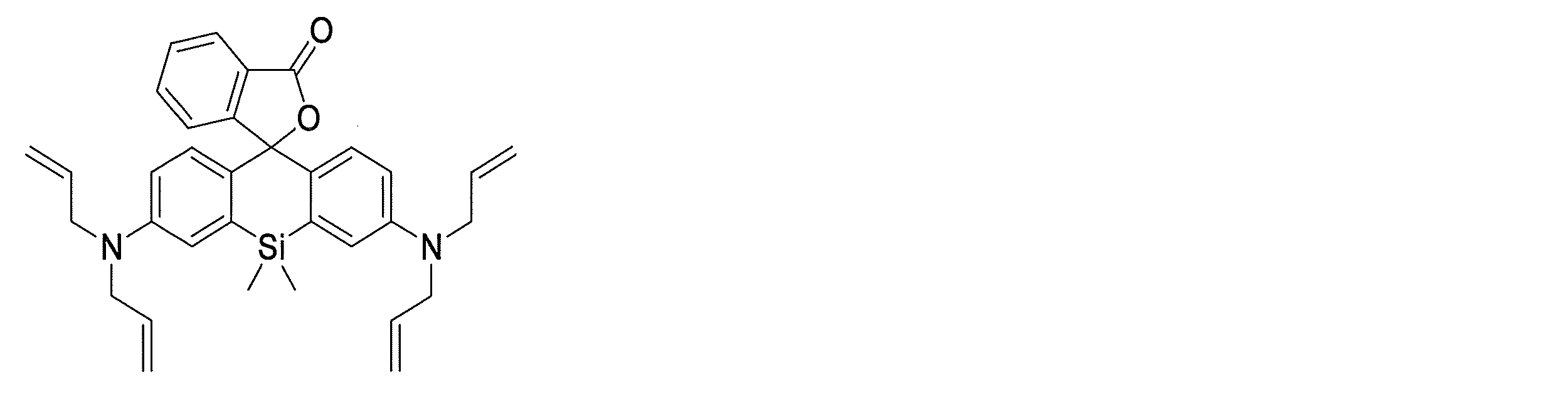
1H-NMR (300 MHz, CDCl3): δ 0.60 (s, 6H), 3.97 (d, J = 5.1 Hz, 8H), 5.17-5.23 (m, 8H), 5.75-5.88 (m, 4H), 6.68 (dd, J = 3.0 Hz, 6.8 Hz, 2H), 6.83 (d, J = 6.8 Hz, 2H), 7.15 (d,J = 3.0 Hz, 2H), 7.37 (d, J= 7.1Hz, 1H), 7.59 (t, J = 7.1 Hz, 1H), 7.70 (t, J = 7.1 Hz, 1H), 7.99 (d, J = 7.1 Hz, 1H)
13C-NMR (100 MHz, CDCl3) δ -2.03, 0.40, 52.76, 92.12, 112.97, 116.22, 116.82, 124.98, 125.63, 127.58, 128.13, 128.69, 131.90, 133.39, 133.66, 137.32, 147.51, 153.68, 170.44
HRMS (ESI+) Calcd for [M+H]+, 533.2624 Found, 533.2593 (-3.1 mmu)

1H-NMR (400 MHz, DMF-d7): δ 0.65 (s, 3H), 0.73 (s, 3H), 6.74-6.75 (m, 4H), 7.23 (s, 2H), 7.56 (d, J = 7.7 Hz, 1H), 7.85 (t, J = 7.7 Hz, 1H), 7.99 (t, J = 7.7 Hz, 1H), 8.12 (d, J = 7.2 Hz, 1H)
13C-NMR (400 MHz, DMF-d7) δ -1.62, 0.33, 92.50, 115.72, 119.33, 125.46, 125.78, 127.16, 128.44, 129.81, 132.42, 134.91, 137.14, 149.16, 155.28, 170.72
HRMS (ESI+) Calcd for [M+H]+, 373.1372 Found, 373.1347 (-2.5 mmu)

HRMS (ESI+): Found: 415.1453, calculated 415.1478 for [M+H]+(-2.5 mmu).
例2で合成した2-Me SiR600及びアセチル化体(N-Ac-2-Me SiR600)の吸光及び蛍光スペクトル、並びにpHプロファイルを測定した。結果を図1及び2、並びに表1に示す。2-Me SiR600はキサンテン環3位のアミノ基をアセチル化することにより吸収極大波長が2-Me SiR600に比べ大きく短波長側に変化した。また、アセチル化体はpHの低下に依存して吸光度が減少するものの2-Me SiR600はpHに依存した吸光度の変化はほとんどなかった。従って、3位のアミノ基をアシル化した2-Me SiR600は分子内光誘起電子移動を用いることなく吸収波長変化により大きなS/N比を持つ酵素活性検出蛍光プローブとして機能させることができる。


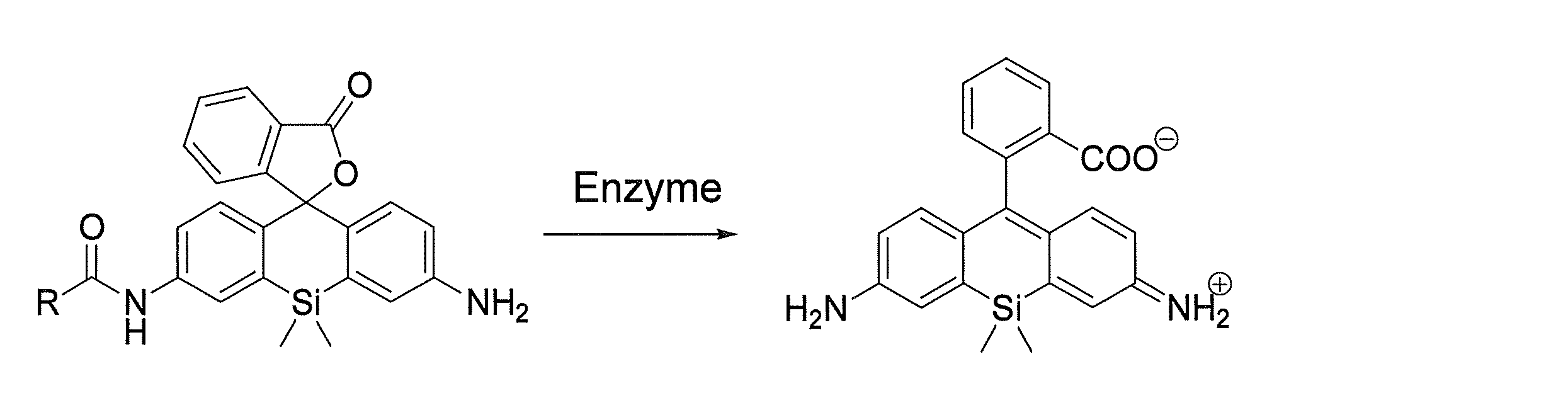
例2で合成した2-Me SiR600を原料化合物として用い、以下のスキームに示す工程によりR10としてオリゴペプチド残基(Cbz-Asp-Glu-Val-Asp)を導入したcaspase-3活性用蛍光プローブ(Z-DEVD-SiR600:Cbz及びZはベンジルオキシカルボニル基を意味する)、及びロイシン残基(Leu)を導入したロイシンアミノペプチダーゼ(LAP)活性検出用プローブ(Leu-SiR600)を合成した。


(b)Fmoc 脱保護サイクル: Fmoc保護基の脱保護は、20% (v/v)ピペリジン/DMF溶液をレジンに加え、12分攪拌することで行った。
(c)レジンからの切り出し: トリフルオロ酢酸:ジクロロメタン = 2 : 98 の溶液をレジンに加え、1 分攪拌を10回行なうことで、Cbz-DEVD-OHペプチドをレジンから切り出した。レジンを濾過で除き、ろ液を減圧留去し、残渣に過剰量の冷水を加えて生じた沈殿をろ取し、Cbz-DEVD-OHペプチドを得た。
HRMS (ESI+): Calcd for [M+Na]+, 801.3898 Found, 801.3904 (+0.6 mmu).

HRMS (ESI+): Calcd for [M]+, 935.3647 Found, 935.3617 (-3.1 mmu).
精製後のHPLCクロマトグラム(16% アセトニトリル/0.1 % トリフルオロ酢酸/水から80% アセトニトリル/0.1% トリフルオロ酢酸/水(流速 = 1.0 mL/min)のリニアグラディエント, Abs. 500 nm)では15.8分に単一ピークを認めた。
Z-DEVD-SiR600はpHに依存して吸光度が変化するものの、caspase-3と接触して生成するSiR600の極大吸収(593nm)付近の光は吸収せず、593nm付近の励起光を使用するcaspase-3活性測定がZ-DEVD-SiR600の影響を受けずに行えることが確認された。


HRMS (ESI+): Calcd for [M]+, 456.2471 Found, 456.2425 (-4.7 mmu).
精製後のHPLCクロマトグラム(16% アセトニトリル/0.1 % トリフルオロ酢酸/水から80% アセトニトリル/0.1% トリフルオロ酢酸/水(流速 = 1.0 mL/min)のリニアグラディエント, Abs. 500 nm)では13.5分に単一ピークを認めた。
Z-DEVD-SiR600に対してcaspase-3を反応させて蛍光プローブとしての機能を評価した。Z-DEVD-SiR600(2 μM)にcaspase-3(0.5μg)を添加して10時間反応させた。反応は100 μM ジチオスレイトール(DTT)、10%グリセリン、0.1% CHAPS、100 mM NaCl、及び0.1% DMSOを含む20 mM HEPES バッファー(pH 7.4) 0.75 mlを用いて37℃で行った。反応前後の吸収スペクトル及び蛍光スペクトル(励起波長をそれぞれ図6(b)及び(c)に示し、反応の動力学パラメータを図6(d)に示した。図6(b)に示すようにZ-DEVD-SiR600の極大吸収波長は500nm付近であるが、Z-DEVD-SiR600がcaspase-3と反応して生成する2-Me SiR600は593nmに極大吸収を持つので、593nmの励起光で反応の前後の測定を行えば、図6(c)に示すように反応前にはほとんど蛍光が観察されずに、反応後に非常に強い蛍光が観察できる。すなわち、Z-DEVD-SiR600がcaspase-3に対する蛍光プローブとして好適に使用できることが示された。
Leu-SiR600に対してロイシンアミノペプチダーゼを反応させて蛍光プローブとしての機能を評価した。Leu-SiR600 (6 μM)にロイシンアミノペプチダーゼ(0.096ユニット)を添加して2.5時間反応させた。反応は0.8% DMSOを含む0.1 M リン酸ナトリウムバッファー(pH 7.4) 0.75 mlを用いて37℃で行った。反応前後の吸収スペクトル及び蛍光スペクトルをそれぞれ図7(b)及び(c)に示す。図7(b)に示すようにLeu-SiR600の極大吸収波長は500nm付近であるが、Leu-SiR600がロイシンアミノペプチダーゼと反応して生成する2-Me SiR600は593nmに極大吸収を持つので、593nmの励起光で反応の前後の測定を行えば、図7(c)に示すように反応前にはほとんど蛍光が観察されずに、反応後に非常に強い蛍光が観察できる。すなわち、Leu-SiR600がcaspase-3に対する蛍光プローブとして好適に使用できることが示された。
Claims (12)
- 下記の一般式(I):
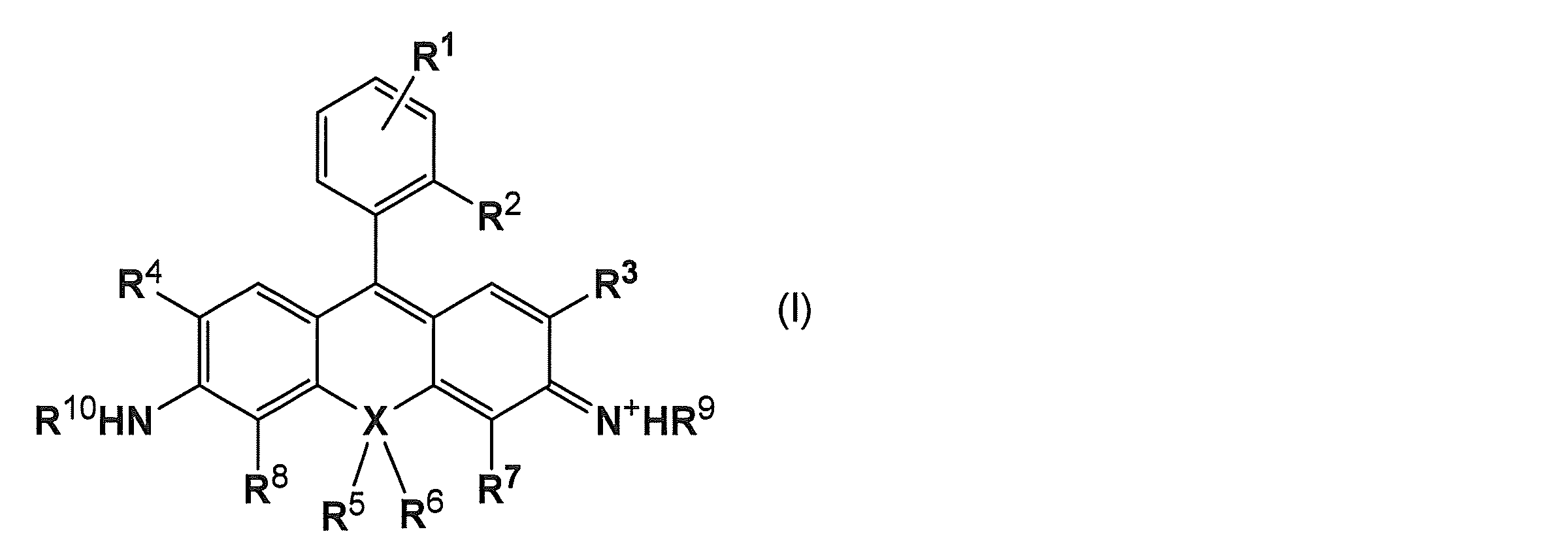
R9及びR10はそれぞれ独立に水素原子、又は一価の基を示し;Xは珪素原子、ゲルマニウム原子、又はスズ原子を示す)
で表される化合物又はその塩 - Xが珪素原子又はゲルマニウム原子である請求項1に記載の化合物又はその塩。
- R1又はR2がプロトン、金属イオン、活性酸素種、低酸素環境、酵素活性、又はグルタチオンを捕捉可能な捕捉基であり、R9及びR1が水素原子である請求項1又は2に記載の化合物又はその塩。
- R9及び/又はR10がプロトン、金属イオン、活性酸素種、低酸素環境、酵素活性、又はグルタチオンを捕捉可能な捕捉基であり、R1及びR2が水素原子である請求項1又は2に記載の化合物又はその塩。
- R9及び/又はR10がペプチダーゼ、プロテーアーゼ、ラクタマーゼ、糖加水分解酵素、転移酵素、酸化還元酵素からなる群から選ばれる酵素活性を捕捉するための捕捉基である請求項4に記載の化合物又はその塩。
- R9及び/又はR10がぺプチダーゼ、プロテアーゼ、及びラクタマーゼからなる群から選ばれる酵素により切断される捕捉基である請求項4及び5に記載の化合物又はその塩。
- R9及び/又はR10がぺプチダーゼ又はプロテアーゼがカスパーゼ、前立腺特異抗原、ロイシンアミノペプチダーゼ、γ-グルタミルタランスペプチターゼからなる群から選ばれる酵素により切断される捕捉基である請求項4ないし6に記載の化合物又はその塩。
- 請求項1ないし7のいずれか1項に記載の一般式(I)で表される化合物を含む蛍光プローブ。
- R1又はR2がプロトン、金属イオン、活性酸素種、低酸素環境、酵素活性、又はグルタチオンを捕捉可能な捕捉基であり(ただし、R1とR2が同時に捕捉基であることはなく)、R9及び/又はR10がプロトン、金属イオン、活性酸素種、低酸素環境、酵素活性、又はグルタチオンを捕捉可能な捕捉基である請求項1又は2に記載の化合物又はその塩。
- 測定対象物質の測定方法であって、下記の工程:(a)請求項1に記載の一般式(I)で表される化合物又はその塩と測定対象物質とを接触させる工程、及び(b)上記工程(a)で生成した測定対象物質の捕捉後の化合物の蛍光強度を測定する工程を含む方法。
- 請求項1に記載の一般式(I)で表される化合物 (ただし、R3及びR4が水素原子を示し、R5及びR6がそれぞれ独立に炭素数1~6個のアルキル基又はアリール基を示し;R7及びR8が水素原子を示し;R9及びR10が水素原子を示し;Xが珪素原子、ゲルマニウム原子、又はスズ原子を示す)又はその塩の製造方法であって、下記の工程:
(a)3-ハロゲン化アニリンとアリルハライドから製造される3-ハロゲン化-N,N-ジアリルアニリンとホルムアルデヒドから下記の一般式(II):
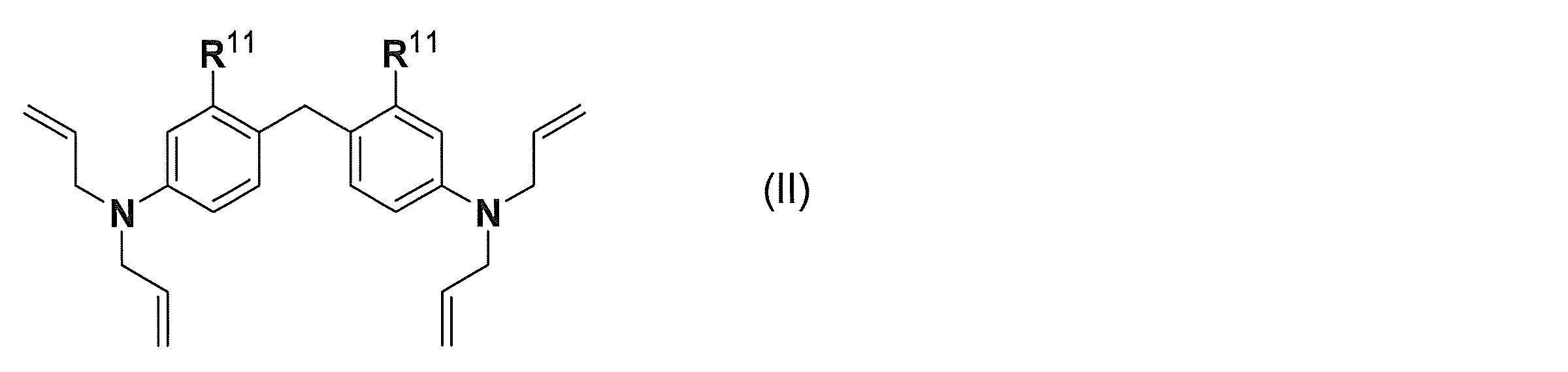
(b)上記の一般式(II)で表される化合物とジクロロジアルキルシランとを反応させ後、酸化反応によって下記のN,N,N',N'-テトラアリル-ジアミノ-Si-キサントンを製造する工程、
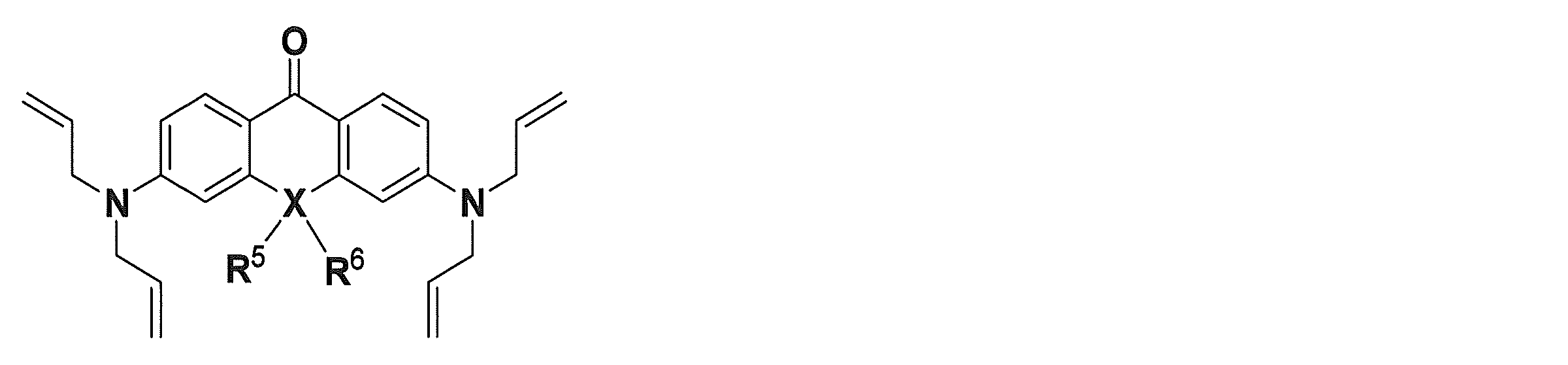
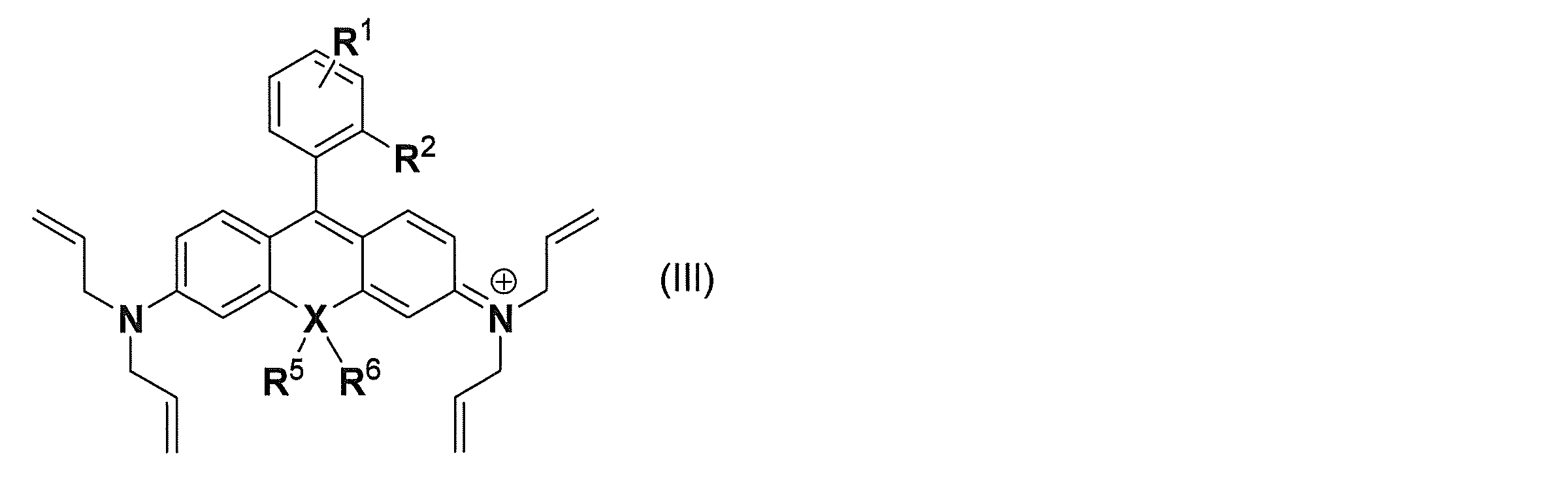
(d) 上記の一般式(III)で表される化合物の脱アリル化を行い、上記の一般式(I)(式中、R3及びR4が水素原子を示し、R5及びR6がそれぞれ独立に炭素数1~6個のアルキル基又はアリール基を示し;R7及びR8が水素原子を示し;R9及びR10が水素原子を示し;Xは珪素原子、ゲルマニウム原子、又はスズ原子を示す)の化合物を製造する工程(R1及びR2に上記の一般式(III)を製造するために保護基を導入した場合には、該保護基の脱保護を工程(d)の前後又は同時に行ってもよい)
を含む方法。 - 下記の一般式(III):
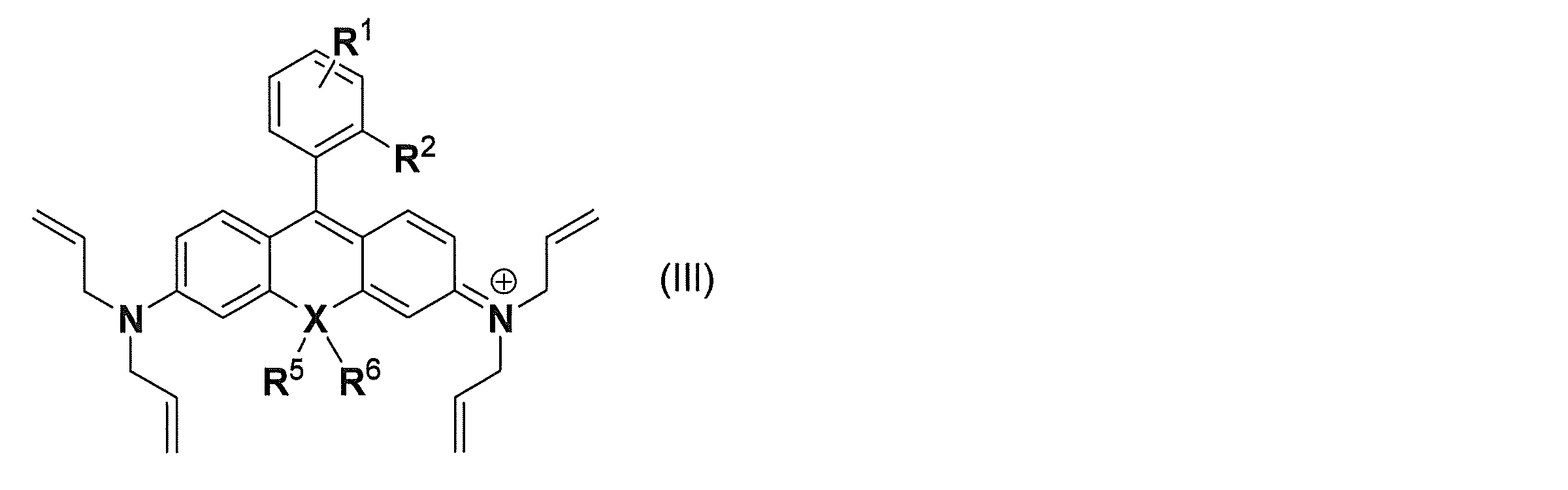
で表される化合物又はその塩。
Priority Applications (2)
| Application Number | Priority Date | Filing Date | Title |
|---|---|---|---|
| JP2012558043A JP5807025B2 (ja) | 2011-02-18 | 2012-02-17 | 蛍光プローブ |
| US13/985,185 US9329184B2 (en) | 2011-02-18 | 2012-02-17 | Fluorescent probe |
Applications Claiming Priority (2)
| Application Number | Priority Date | Filing Date | Title |
|---|---|---|---|
| JP2011033396 | 2011-02-18 | ||
| JP2011-033396 | 2011-02-18 |
Publications (1)
| Publication Number | Publication Date |
|---|---|
| WO2012111818A1 true WO2012111818A1 (ja) | 2012-08-23 |
Family
ID=46672728
Family Applications (1)
| Application Number | Title | Priority Date | Filing Date |
|---|---|---|---|
| PCT/JP2012/053855 Ceased WO2012111818A1 (ja) | 2011-02-18 | 2012-02-17 | 蛍光プローブ |
Country Status (3)
| Country | Link |
|---|---|
| US (1) | US9329184B2 (ja) |
| JP (1) | JP5807025B2 (ja) |
| WO (1) | WO2012111818A1 (ja) |
Cited By (22)
| Publication number | Priority date | Publication date | Assignee | Title |
|---|---|---|---|---|
| WO2014057999A1 (ja) | 2012-10-11 | 2014-04-17 | 独立行政法人科学技術振興機構 | 細胞内アセチル化のイメージング試薬 |
| WO2014106957A1 (ja) * | 2013-01-07 | 2014-07-10 | 国立大学法人 東京大学 | 非対称Siローダミン及びロドールの合成 |
| JP2014157150A (ja) * | 2013-01-18 | 2014-08-28 | Univ Of Tokyo | 超解像蛍光イメージング用プローブ |
| WO2014136781A1 (ja) * | 2013-03-04 | 2014-09-12 | 国立大学法人 東京大学 | 蛍光プローブ |
| WO2014136780A1 (ja) * | 2013-03-04 | 2014-09-12 | 国立大学法人 東京大学 | カルパイン活性検出蛍光プローブ |
| WO2014144793A1 (en) * | 2013-03-15 | 2014-09-18 | Visen Medical, Inc. | Substituted silaxanthenium red to near-infrared fluorochromes for in vitro and in vivo imaging and detection |
| JP2014240935A (ja) * | 2013-06-12 | 2014-12-25 | Jsr株式会社 | カラーフィルタ用着色組成物、カラーフィルタ及び表示素子 |
| WO2015083799A1 (ja) * | 2013-12-04 | 2015-06-11 | 国立大学法人 東京大学 | 近赤外線消光団 |
| WO2015129705A1 (ja) * | 2014-02-28 | 2015-09-03 | 国立大学法人 東京大学 | グルタチオン検出用蛍光プローブ |
| US9170266B2 (en) | 2011-02-18 | 2015-10-27 | The University Of Tokyo | Fluorescent probe |
| WO2015194606A1 (ja) * | 2014-06-17 | 2015-12-23 | 国立大学法人大阪大学 | 蛍光プローブ、一重項酸素検出剤、又は一重項酸素検出方法 |
| WO2016029671A1 (zh) * | 2014-08-28 | 2016-03-03 | 中国人民解放军第二军医大学 | 一种硅基罗丹明衍生物及其制备方法和应用 |
| WO2016136718A1 (ja) * | 2015-02-27 | 2016-09-01 | 国立大学法人 東京大学 | 超解像蛍光イメージング用プローブ |
| WO2018003686A1 (ja) * | 2016-06-30 | 2018-01-04 | 国立大学法人 東京大学 | 酵素特異的な細胞内滞留性赤色蛍光プローブ。 |
| WO2018101456A1 (ja) * | 2016-12-01 | 2018-06-07 | 国立大学法人 東京大学 | 深赤色蛍光プローブ |
| WO2018101473A1 (ja) * | 2016-12-02 | 2018-06-07 | 国立大学法人東京大学 | 化合物、葉酸受容体可視化蛍光プローブ及びそれらの使用 |
| CN110204568A (zh) * | 2019-07-02 | 2019-09-06 | 华东师范大学 | 一类硅基取代香豆素衍生物及其合成方法 |
| JPWO2018135598A1 (ja) * | 2017-01-19 | 2019-12-12 | 国立大学法人 東京大学 | 新規蛍光標識方法 |
| CN110872314A (zh) * | 2019-11-21 | 2020-03-10 | 华东师范大学 | 一种不对称硅基取代罗丹明衍生物及制备方法和应用 |
| WO2020095946A1 (ja) * | 2018-11-07 | 2020-05-14 | 国立大学法人 東京大学 | 新規蛍光プローブ |
| JPWO2021070906A1 (ja) * | 2019-10-09 | 2021-04-15 | ||
| EP3833715A2 (en) * | 2018-08-10 | 2021-06-16 | Life Technologies Corporation | Silicon-substituted rhodamine dyes and dye conjugates |
Families Citing this family (7)
| Publication number | Priority date | Publication date | Assignee | Title |
|---|---|---|---|---|
| WO2012099218A1 (ja) | 2011-01-20 | 2012-07-26 | 国立大学法人 東京大学 | 蛍光プローブ |
| CN105482807A (zh) * | 2015-11-24 | 2016-04-13 | 中国人民解放军第二军医大学 | 具有溶酶体定位功能的硅基罗丹明铜离子荧光探针及其制备方法和应用 |
| EP3475443B1 (en) | 2016-06-23 | 2025-02-12 | Life Technologies Corporation | Methods and compositions for detecting or measuring caspases or apoptosis |
| WO2019222653A1 (en) * | 2018-05-18 | 2019-11-21 | Singular Genomics Systems, Inc. | Silicon containing detectable compounds |
| EP4055023A4 (en) | 2019-11-07 | 2024-01-03 | Singular Genomics Systems, Inc. | SILICON-CONTAINING DETECTED COMPOUNDS AND USES THEREOF |
| JP2023542867A (ja) | 2020-09-11 | 2023-10-12 | グリンプス バイオ, インコーポレイテッド | 疾患の検出/診断、病期分類、モニタリング及び処置のための生体外でのプロテアーゼ活性検出 |
| US12359068B2 (en) | 2023-02-10 | 2025-07-15 | Singular Genomics Systems, Inc. | Rhodamine fluorescent compounds and production methods thereof |
Citations (4)
| Publication number | Priority date | Publication date | Assignee | Title |
|---|---|---|---|---|
| WO2005024049A1 (ja) * | 2003-09-05 | 2005-03-17 | Daiichi Pure Chemicals Co., Ltd. | 蛍光プローブ |
| CN1810812A (zh) * | 2006-03-03 | 2006-08-02 | 大连理工大学 | 含硅元素的阳离子发色团及其衍生物 |
| WO2010026743A1 (ja) * | 2008-09-03 | 2010-03-11 | 国立大学法人 東京大学 | 低酸素環境測定用試薬 |
| WO2010126077A1 (ja) * | 2009-04-30 | 2010-11-04 | 国立大学法人 東京大学 | 近赤外蛍光化合物 |
Family Cites Families (5)
| Publication number | Priority date | Publication date | Assignee | Title |
|---|---|---|---|---|
| EP1000941B1 (en) | 1997-07-02 | 2003-08-13 | Nagano, Testuo | Diaminorhodamine derivatives |
| JP2006117593A (ja) * | 2004-10-22 | 2006-05-11 | Osaka Prefecture | 新規蛍光性化合物およびその製造方法 |
| JP5124780B2 (ja) | 2006-03-03 | 2013-01-23 | 国立大学法人 東京大学 | 蛍光プローブ |
| JP4945760B2 (ja) * | 2006-10-10 | 2012-06-06 | 国立大学法人群馬大学 | 含ケイ素蛍光化合物および該化合物を用いた蛍光標識剤 |
| WO2012099218A1 (ja) * | 2011-01-20 | 2012-07-26 | 国立大学法人 東京大学 | 蛍光プローブ |
-
2012
- 2012-02-17 US US13/985,185 patent/US9329184B2/en active Active
- 2012-02-17 WO PCT/JP2012/053855 patent/WO2012111818A1/ja not_active Ceased
- 2012-02-17 JP JP2012558043A patent/JP5807025B2/ja not_active Expired - Fee Related
Patent Citations (4)
| Publication number | Priority date | Publication date | Assignee | Title |
|---|---|---|---|---|
| WO2005024049A1 (ja) * | 2003-09-05 | 2005-03-17 | Daiichi Pure Chemicals Co., Ltd. | 蛍光プローブ |
| CN1810812A (zh) * | 2006-03-03 | 2006-08-02 | 大连理工大学 | 含硅元素的阳离子发色团及其衍生物 |
| WO2010026743A1 (ja) * | 2008-09-03 | 2010-03-11 | 国立大学法人 東京大学 | 低酸素環境測定用試薬 |
| WO2010126077A1 (ja) * | 2009-04-30 | 2010-11-04 | 国立大学法人 東京大学 | 近赤外蛍光化合物 |
Non-Patent Citations (3)
| Title |
|---|
| "ACS Chemical Biology", CHEMICAL COMMUNICATIONS, vol. 6, 28 February 2011 (2011-02-28), pages 600 - 608 * |
| CHEMICAL COMMUNICATIONS, vol. 47, 28 February 2011 (2011-02-28), pages 4162 - 4164 * |
| JOURNAL OF THE AMERICAN CHEMICAL SOCIETY, vol. 133, 9 August 2011 (2011-08-09), pages 14157 - 14159 * |
Cited By (52)
| Publication number | Priority date | Publication date | Assignee | Title |
|---|---|---|---|---|
| JP5807024B2 (ja) * | 2011-02-18 | 2015-11-10 | 国立大学法人 東京大学 | 蛍光プローブ |
| US9170266B2 (en) | 2011-02-18 | 2015-10-27 | The University Of Tokyo | Fluorescent probe |
| WO2014057999A1 (ja) | 2012-10-11 | 2014-04-17 | 独立行政法人科学技術振興機構 | 細胞内アセチル化のイメージング試薬 |
| WO2014106957A1 (ja) * | 2013-01-07 | 2014-07-10 | 国立大学法人 東京大学 | 非対称Siローダミン及びロドールの合成 |
| EP2942352A4 (en) * | 2013-01-07 | 2016-09-07 | Univ Tokyo | ASYMMETRIC SI-RHODAMINE AND RHODOL SYNTHESIS |
| US9714260B2 (en) | 2013-01-07 | 2017-07-25 | The University Of Tokyo | Asymmetrical Si rhodamine and rhodol synthesis |
| JPWO2014106957A1 (ja) * | 2013-01-07 | 2017-01-19 | 国立大学法人 東京大学 | 非対称Siローダミン及びロドールの合成 |
| JP2014157150A (ja) * | 2013-01-18 | 2014-08-28 | Univ Of Tokyo | 超解像蛍光イメージング用プローブ |
| WO2014136781A1 (ja) * | 2013-03-04 | 2014-09-12 | 国立大学法人 東京大学 | 蛍光プローブ |
| WO2014136780A1 (ja) * | 2013-03-04 | 2014-09-12 | 国立大学法人 東京大学 | カルパイン活性検出蛍光プローブ |
| JP5688826B2 (ja) * | 2013-03-04 | 2015-03-25 | 国立大学法人 東京大学 | カルパイン活性検出蛍光プローブ |
| AU2014228504C1 (en) * | 2013-03-15 | 2019-10-03 | Visen Medical, Inc. | Substituted silaxanthenium red to near-infrared fluorochromes for in vitro and in vivo imaging and detection |
| CN105073761A (zh) * | 2013-03-15 | 2015-11-18 | 文森医学公司 | 用于体外和体内成像和检测的取代的硅杂蒽阳离子红至近红外荧光染料 |
| CN105073761B (zh) * | 2013-03-15 | 2020-10-20 | 文森医学公司 | 用于体外和体内成像和检测的取代的硅杂蒽阳离子红至近红外荧光染料 |
| AU2014228504B2 (en) * | 2013-03-15 | 2019-04-11 | Visen Medical, Inc. | Substituted silaxanthenium red to near-infrared fluorochromes for in vitro and in vivo imaging and detection |
| JP2016521254A (ja) * | 2013-03-15 | 2016-07-21 | ビセン メディカル, インコーポレイテッド | invitroおよびinvivoイメージングおよび検出のための置換シラキサンテニウム赤色〜近赤外蛍光色素 |
| US9649389B2 (en) | 2013-03-15 | 2017-05-16 | Visen Medical, Inc. | Substituted silaxanthenium red to near-infrared fluorochromes for in vitro and in vivo imaging and detection |
| WO2014144793A1 (en) * | 2013-03-15 | 2014-09-18 | Visen Medical, Inc. | Substituted silaxanthenium red to near-infrared fluorochromes for in vitro and in vivo imaging and detection |
| JP2014240935A (ja) * | 2013-06-12 | 2014-12-25 | Jsr株式会社 | カラーフィルタ用着色組成物、カラーフィルタ及び表示素子 |
| WO2015083799A1 (ja) * | 2013-12-04 | 2015-06-11 | 国立大学法人 東京大学 | 近赤外線消光団 |
| JPWO2015083799A1 (ja) * | 2013-12-04 | 2017-03-16 | 国立大学法人 東京大学 | 近赤外線消光団 |
| US10004815B2 (en) | 2013-12-04 | 2018-06-26 | The University Of Tokyo | Near-infrared quenching group |
| JPWO2015129705A1 (ja) * | 2014-02-28 | 2017-03-30 | 国立大学法人 東京大学 | グルタチオン検出用蛍光プローブ |
| US10261090B2 (en) | 2014-02-28 | 2019-04-16 | The University Of Tokyo | Glutathione-detecting fluorescent probe |
| WO2015129705A1 (ja) * | 2014-02-28 | 2015-09-03 | 国立大学法人 東京大学 | グルタチオン検出用蛍光プローブ |
| US10564164B2 (en) | 2014-06-17 | 2020-02-18 | Osaka University | Fluorescent probe, singlet oxygen detection agent, and singlet oxygen detection method |
| WO2015194606A1 (ja) * | 2014-06-17 | 2015-12-23 | 国立大学法人大阪大学 | 蛍光プローブ、一重項酸素検出剤、又は一重項酸素検出方法 |
| JPWO2015194606A1 (ja) * | 2014-06-17 | 2017-06-29 | 国立大学法人大阪大学 | 蛍光プローブ、一重項酸素検出剤、又は一重項酸素検出方法 |
| WO2016029671A1 (zh) * | 2014-08-28 | 2016-03-03 | 中国人民解放军第二军医大学 | 一种硅基罗丹明衍生物及其制备方法和应用 |
| US10837909B2 (en) | 2015-02-27 | 2020-11-17 | The University Of Tokyo | Super-resolution fluorescent imaging probe |
| JPWO2016136718A1 (ja) * | 2015-02-27 | 2017-12-07 | 国立大学法人 東京大学 | 超解像蛍光イメージング用プローブ |
| WO2016136718A1 (ja) * | 2015-02-27 | 2016-09-01 | 国立大学法人 東京大学 | 超解像蛍光イメージング用プローブ |
| WO2016136328A1 (ja) * | 2015-02-27 | 2016-09-01 | 国立大学法人 東京大学 | 超解像蛍光イメージング用プローブ |
| WO2018003686A1 (ja) * | 2016-06-30 | 2018-01-04 | 国立大学法人 東京大学 | 酵素特異的な細胞内滞留性赤色蛍光プローブ。 |
| JP2018000074A (ja) * | 2016-06-30 | 2018-01-11 | 国立大学法人 東京大学 | 酵素特異的な細胞内滞留性赤色蛍光プローブ。 |
| US11591359B2 (en) | 2016-06-30 | 2023-02-28 | The University Of Tokyo | Enzyme-specific intracellularly-retained red fluorescent probe |
| JP7100363B2 (ja) | 2016-12-01 | 2022-07-13 | 国立大学法人 東京大学 | 深赤色蛍光プローブ |
| JPWO2018101456A1 (ja) * | 2016-12-01 | 2019-10-24 | 国立大学法人 東京大学 | 深赤色蛍光プローブ |
| WO2018101456A1 (ja) * | 2016-12-01 | 2018-06-07 | 国立大学法人 東京大学 | 深赤色蛍光プローブ |
| WO2018101473A1 (ja) * | 2016-12-02 | 2018-06-07 | 国立大学法人東京大学 | 化合物、葉酸受容体可視化蛍光プローブ及びそれらの使用 |
| JPWO2018135598A1 (ja) * | 2017-01-19 | 2019-12-12 | 国立大学法人 東京大学 | 新規蛍光標識方法 |
| JP7178701B2 (ja) | 2017-01-19 | 2022-11-28 | 国立大学法人 東京大学 | 新規蛍光標識方法 |
| EP3833715B1 (en) * | 2018-08-10 | 2026-01-07 | Life Technologies Corporation | Silicon-substituted rhodamine dyes and dye conjugates |
| US12258477B2 (en) | 2018-08-10 | 2025-03-25 | Life Technologies Corporation | Silicon-substituted rhodamine dyes and dye conjugates |
| EP3833715A2 (en) * | 2018-08-10 | 2021-06-16 | Life Technologies Corporation | Silicon-substituted rhodamine dyes and dye conjugates |
| WO2020095946A1 (ja) * | 2018-11-07 | 2020-05-14 | 国立大学法人 東京大学 | 新規蛍光プローブ |
| JP2020075883A (ja) * | 2018-11-07 | 2020-05-21 | 国立大学法人 東京大学 | 新規蛍光プローブ |
| JP7303532B2 (ja) | 2018-11-07 | 2023-07-05 | 国立大学法人 東京大学 | 新規蛍光プローブ |
| CN110204568A (zh) * | 2019-07-02 | 2019-09-06 | 华东师范大学 | 一类硅基取代香豆素衍生物及其合成方法 |
| WO2021070906A1 (ja) * | 2019-10-09 | 2021-04-15 | 国立大学法人 東京大学 | ピューロマイシン感受性アミノペプチダーゼ又はブレオマイシン加水分解酵素検出用蛍光プローブ。 |
| JPWO2021070906A1 (ja) * | 2019-10-09 | 2021-04-15 | ||
| CN110872314A (zh) * | 2019-11-21 | 2020-03-10 | 华东师范大学 | 一种不对称硅基取代罗丹明衍生物及制备方法和应用 |
Also Published As
| Publication number | Publication date |
|---|---|
| JPWO2012111818A1 (ja) | 2014-07-07 |
| US20140342384A1 (en) | 2014-11-20 |
| JP5807025B2 (ja) | 2015-11-10 |
| US9329184B2 (en) | 2016-05-03 |
Similar Documents
| Publication | Publication Date | Title |
|---|---|---|
| JP5807025B2 (ja) | 蛍光プローブ | |
| US9714260B2 (en) | Asymmetrical Si rhodamine and rhodol synthesis | |
| Ren et al. | Fluorescent probe for simultaneous discrimination of Cys/Hcy and GSH in pure aqueous media with a fast response under a single-wavelength excitation | |
| JP5588962B2 (ja) | プロテアーゼ測定用蛍光プローブ | |
| Ismail et al. | A julolidine-fused coumarin-NBD dyad for highly selective and sensitive detection of H2S in biological samples | |
| WO2007100061A1 (ja) | 蛍光プローブ | |
| JP5228190B2 (ja) | パーオキシナイトライト蛍光プローブ | |
| Yang et al. | A red-emitting fluorescent probe for hydrogen sulfide in living cells with a large Stokes shift | |
| WO2014136780A1 (ja) | カルパイン活性検出蛍光プローブ | |
| Fang et al. | An instantaneous fluorescent probe for detecting hydrogen sulfide in biological systems | |
| CN109438319B (zh) | 一种检测亮氨酸氨肽酶的化合物及其制备方法和应用 | |
| US10383956B2 (en) | Fluorescent probe for detecting dipeptidyl peptidase IV | |
| Zhang et al. | Water-soluble BODIPY derivative as a highly selective “Turn-On” fluorescent probe for hydrogen sulfide in living cells | |
| JP2018145126A (ja) | カルボキシペプチダーゼ活性検出用蛍光プローブ | |
| WO2018101456A1 (ja) | 深赤色蛍光プローブ | |
| CN109608495B (zh) | 一种检测hno的化合物及其制备方法和应用 | |
| JP2023056054A (ja) | Activatable型ラマンプローブ | |
| Zhao et al. | A BODIPY-based fluorescent chemosensor for Cu2+ and biological thiols, and its application as a Cu2+ probe in live cell imaging | |
| JP5360609B2 (ja) | 低酸素環境測定用試薬 | |
| Wei et al. | A Chemiluminescent Hydrogen Sulfide Probe with Multimodal Validation for Inflammation Diagnosis in Vivo | |
| JP4929452B2 (ja) | 新規クマリン誘導体 | |
| JP2004101389A (ja) | アルミニウムイオン及び/又は第二鉄イオン測定用プローブ | |
| KR101322615B1 (ko) | 티올 선택성을 갖는 화학정량 형광 표지자, 그 제조방법 및 이를 이용한 생체내 티올 영상화 방법 | |
| CN119431146A (zh) | 一种芘基荧光探针及其制备方法和应用 | |
| Yang | (A) BODIPY as a versatile fluorophore (B) Synthesis of PNAs via Staudinger reaction |
Legal Events
| Date | Code | Title | Description |
|---|---|---|---|
| 121 | Ep: the epo has been informed by wipo that ep was designated in this application |
Ref document number: 12747230 Country of ref document: EP Kind code of ref document: A1 |
|
| ENP | Entry into the national phase |
Ref document number: 2012558043 Country of ref document: JP Kind code of ref document: A |
|
| NENP | Non-entry into the national phase |
Ref country code: DE |
|
| 122 | Ep: pct application non-entry in european phase |
Ref document number: 12747230 Country of ref document: EP Kind code of ref document: A1 |
|
| WWE | Wipo information: entry into national phase |
Ref document number: 13985185 Country of ref document: US |